M AT R I C U L AT I O N I S S U E B R I E F DECEMBER 2025
MATRICULATION ISSUE BRIEF By: Annah Mercer, Julia King, Abby Marcantonio, and Melanie Gonzalez
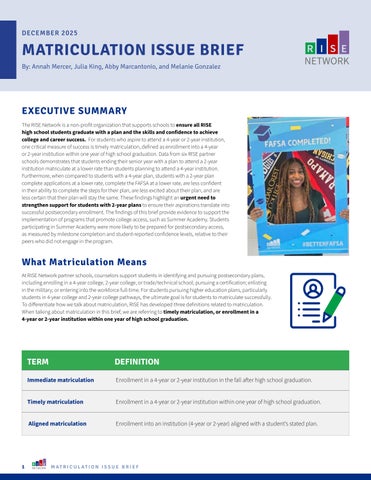
EXECUTIVE SUMMARY The RISE Network is a non-profit organization that supports schools to ensure all RISE high school students graduate with a plan and the skills and confidence to achieve college and career success. For students who aspire to attend a 4-year or 2-year institution, one critical measure of success is timely matriculation, defined as enrollment into a 4-year or 2-year institution within one year of high school graduation. Data from six RISE partner schools demonstrates that students ending their senior year with a plan to attend a 2-year institution matriculate at a lower rate than students planning to attend a 4-year institution. Furthermore, when compared to students with a 4-year plan, students with a 2-year plan complete applications at a lower rate, complete the FAFSA at a lower rate, are less confident in their ability to complete the steps for their plan, are less excited about their plan, and are less certain that their plan will stay the same. These findings highlight an urgent need to strengthen support for students with 2-year plans to ensure their aspirations translate into successful postsecondary enrollment. The findings of this brief provide evidence to support the implementation of programs that promote college access, such as Summer Academy. Students participating in Summer Academy were more likely to be prepared for postsecondary access, as measured by milestone completion and student-reported confidence levels, relative to their peers who did not engage in the program.
What Matriculation Means At RISE Network partner schools, counselors support students in identifying and pursuing postsecondary plans, including enrolling in a 4-year college, 2-year college, or trade/technical school; pursuing a certification; enlisting in the military; or entering into the workforce full-time. For students pursuing higher education plans, particularly students in 4-year college and 2-year college pathways, the ultimate goal is for students to matriculate successfully. To differentiate how we talk about matriculation, RISE has developed three definitions related to matriculation. When talking about matriculation in this brief, we are referring to timely matriculation, or enrollment in a 4-year or 2-year institution within one year of high school graduation.
1
TERM
DEFINITION
Immediate matriculation
Enrollment in a 4-year or 2-year institution in the fall after high school graduation.
Timely matriculation
Enrollment in a 4-year or 2-year institution within one year of high school graduation.
Aligned matriculation
Enrollment into an institution (4-year or 2-year) aligned with a student’s stated plan.
M AT R I C U L AT I O N I S S U E B R I E F
M AT R I C U L AT I O N I S S U E B R I E F
Why Matriculation Matters For RISE Network educators, the timely matriculation of students with 4-year and 2-year college plans represents the culmination of students’ K-12 education and counselors’ efforts to guide students through the necessary milestones for enrollment. These milestones span students’ junior and senior years, including the summer after high school graduation. Despite counselors’ best efforts, there are several factors that may influence whether a student is likely to enroll in college, even among those with aspirations to do so. According to the Department of Education, tuition levels and student financial aid are critical factors that shape whether a student will matriculate. Additionally, the national landscape and personal circumstances, like a lack of post-high school adult support, play a role. [1] As USA Today reported last year, major disruptions such as the COVID-19 pandemic and increased difficulty in applying for financial aid have served as disincentives to, and created barriers to, matriculation. [2] Despite these obstacles, RISE Network educators persist, knowing that their efforts matter. In Connecticut, high school graduates earn a median salary of $37,365, according to a 2023 report from the U.S. Career Institute, while students who attend college have higher earning potential. [3] For example, Connecticut community colleges are the largest producers of graduates for jobs in high-demand fields like allied health and nursing and manufacturing, professions with salaries ranging from $42,000 to $86,000 per year. [4] Students’ opportunities for economic mobility through college education, combined with programs like Pledge to Advance Connecticut (PACT) that minimize costs to students, illustrate the importance of matriculation. [5] Recognizing both the opportunities and the barriers, it is essential to examine the drivers of matriculation that impact students’ ability to matriculate.
Matriculation Drivers Through years of networked continuous improvement, RISE and our partners have identified five key drivers of postsecondary access: postsecondary exploration; plan identification & student confidence; milestone completion; academic success; and financial planning. This brief’s analysis and recommendations focus on:
•
Plan identification & student confidence: Students identify and commit to a well-matched plan and build the confidence and skills to access and succeed in their chosen plan.
•
Milestone completion: Students complete the access milestones necessary to pursue their postsecondary plan with support from their high school.
•
Financial planning: Students build financial literacy and have access to financial aid to make higher education more affordable.
2
M AT R I C U L AT I O N I S S U E B R I E F
M AT R I C U L AT I O N I S S U E B R I E F
Trends in Matriculation Timely matriculation rates decreased for the graduating classes of 2020 and 2024 By analyzing data from the National Student Clearinghouse (NSC) for six RISE partner schools’ classes of 2017 through 2024, [6] we found that timely matriculation hit an all-time low of 62.3 percent for the Class of 2020. While many factors may have been at play, the COVID-19 pandemic was likely a major reason for this dip, which was observed across Alliance schools in Connecticut. [7] After the pandemic, schools saw consistent improvement until the Class of 2023, for which 67.7 percent of graduates matriculated within one year. This increase brought the matriculation rate for students in these six schools within the RISE Network back to pre-pandemic levels, something that was not achieved at the state level. Unfortunately, the Class of 2024 fared worse, dropping down to a 62.6 percent rate of timely matriculation (See Figure 1). This concerning reversal in progress may be due to the negative impact of the “Better FAFSA” released that year, and may also be showing the impact of other national and cultural pressures being faced by higher education more broadly. Figure 1: Timely Matriculation Trends in Connecticut, 2017 - 2024
RISE partners
CT Alliance District schools
CT statewide
80% 68%
68%
62%
68%
58%
59%
60%
40% 2017
2018
2019
2020
2021
2022
2023
2024
*2024 state data not available at the time of analysis
Students with a 2-year plan matriculate at a rate 30 points lower than students with a 4-year plan Many RISE Network partner schools collect information about students’ postsecondary plans through counselor input into the RISE Data Hub and our Junior, Start-of-Year Senior, and End-of-Year Senior Surveys. By combining end-of-year data on student postsecondary plans with data from the NSC, we see that timely matriculation for students with a 2-year plan is 26 percentage points lower than for students with a 4-year plan (See Figure 2). While matriculation rates for students with a 4-year plan have hovered around approximately 90 percent for the past three years, matriculation rates for students with a 2-year plan have hovered around approximately 60 percent. To explore why students with a 2-year plan might be matriculating at a lower rate than students with a 4-year plan, we will look at three drivers in particular: financial planning, milestone completion, and student confidence.
3
M AT R I C U L AT I O N I S S U E B R I E F
Figure 2: Matriculation outcomes by postsecondary plan, Class of 2024
100%
0.5% 9.1% 9.7%
2.4% 32.7%
75%
6.2% 50% 25% 0%
80.7%
58.7%
4-Year College Plan
Missing from NSC Dataset Did Not Matriculate
2-Year College Plan
Matriculated - Different Institution Type Matricualted As Expected
M AT R I C U L AT I O N I S S U E B R I E F
Students who did not complete FAFSA were much less likely to matriculate Financial planning, including completing the FAFSA, is a critical milestone for students hoping to matriculate. Completing the FAFSA is particularly important in Connecticut, where students can receive free tuition at CT State Community College, provided they meet the requirements. For the past three years, students at schools within RISE’s network with a 2-year plan have completed the FAFSA at much lower rates than students with a 4-year plan (See Figure 3). Furthermore, when observing only students with a 2-year plan, we found that those who completed the FAFSA achieved timely matriculation at twice the rate of those who did not complete the FAFSA (See Figure 4).
Figure 3: FAFSA Completion Rates by postsecondary plan, Class of 2024
4-Year College Plan 2-Year College Plan
85%
14%
47%
52%
Completed FAFSA Incomplete, No data, Not Submitted Figure 4: FAFSA Completion Rates by matriculation outcome, Class of 2024 students with a 2-year plan
61%
Enrolled Within One Year
On RISE’s End-of-Year Senior Survey, students with a 2-year plan who did not complete the FAFSA were asked why they did not complete it. One of the highest responses for not completing the FAFSA was not knowing about the financial aid process.
Did Not Enroll Within One Year
28%
38%
71%
Completed FAFSA Incomplete, No data, Not Submitted
Decreases in timely matriculation rates coincide with decreases in student confidence How confident a student is in their selected plan is a critical driver of timely matriculation. Using data from the RISE End-of-Year Senior Survey, we examined students’ self-ratings of their confidence in their ability to complete the steps necessary to achieve their plan, their certainty that they would remain in the same plan, and their excitement about the plan they chose to pursue. Students with a 4-year plan were overall more confident in, more certain of, and more excited about their plan than students with a 2-year plan (See Figure 5). Students from the class of 2024, students with a 4-year plan consistently had confidence rates 11 to 14 percentage points higher than students with a 2-year plan. Figure 5: Plan Confidence, Certainty, and Excitement Rates by plan, Class of 2024
Plan Confidence 100% 75%
82% 68%
Plan Certainty
Plan Excitement 83%
74%
65%
57%
50% 25% 0%
4
4-Year College
2-Year College
M AT R I C U L AT I O N I S S U E B R I E F
4-Year College
2-Year College
4-Year College
2-Year College
M AT R I C U L AT I O N I S S U E B R I E F
When observing the matriculation rates for the class of 2024, students who reported confidence in their 2-year or 4-year plans matriculated at higher rates than students who said they were not confident. Amongst students with a 2-year plan, 71.4 percent of those who were confident in their plan achieved timely matriculation, compared to only 57.4 percent who were not confident in their plan. Amongst students with a 4-year plan, we also see a relationship between confidence and matriculation, where 91.9 percent of confident students achieved timely matriculation, compared to 82.6 percent of not confident students (See Figure 6). Figure 6: Timely Matriculation Rates by postsecondary plan and Confidence Level, Class of 2024
100%
Not Confident
Confident 91%
75%
82%
50%
57%
71%
25% 0% 2-Year College
Students of color, male students, and English Language Learners were less likely to matriculate
4-Year College
Figure 7: Timely Matriculation Rates of 2-Year College Students by Subgroup, Classes of 2022, 2023, & 2024
In addition to financial planning, milestone completion, and student confidence being drivers of timely matriculation, some subgroups of students within the RISE partner schools consistently matriculate at lower rates than their peers. These subgroups are: English Language Learners (ELL), male students, and students of color. When assessing students with a 2-year plan for the classes of 2022, 2023, and 2024, only 47 percent of the English language learning students matriculated, compared to 67.1 percent of students who were not English Language Learners. Male students were four percentage points less likely to matriculate than their female peers. Additionally, students of color, in particular Black and Latine students, were less likely to matriculate than their white peers (See Figure 7).
Timely Matriculation Female
64.7%
Male
60.6%
ELL
47.0%
Not ELL
67.1%
Black or African American
63.5%
Hispanic or Latino
61.1%
White
68.1% 0%
5
M AT R I C U L AT I O N I S S U E B R I E F
20%
40%
60%
80%
M AT R I C U L AT I O N I S S U E B R I E F
Insights and Explorations in Addressing Matriculation Gaps While there are a number of reasons that students may not matriculate, the observed trends provide insights that may be useful in developing strategies and initiatives to address matriculation gaps. RISE Network schools are working on improving matriculation strategies that have shown a positive impact over time, as well as developing potential new strategies to address the observed trends and gaps.
Summer Transition Support Schools in the RISE Network engage students in two summer programs, Summer Academy and Summer Melt, with the goal of supporting students in preparing to matriculate. During the summer before their senior year, students have the option to attend a free four- to five-day academy that allows them to receive support in milestone completion from a postsecondary access team. This program is designed to support matriculation by providing students with information about the college application process in order to build their confidence, as well as to encourage students to complete applications and the FAFSA earlier to avoid competing priorities later in the school year. To learn more about the impact of Summer Academy, read our Summer Academy Learning Brief. The Summer Melt campaign is intended to reduce the number of students who do not pursue their postsecondary plan due to challenges that arise after graduation. During the summer post-graduation, students receive texts including reminders for upcoming deadlines and prompts to complete milestones. At some schools, students have the opportunity to connect with a counselor for support with tasks like changing their postsecondary plan, registering for orientation, and completing the FAFSA. Together, these efforts encourage students to complete the necessary steps for matriculation early while providing a safeguard for students who were unable to. To learn more about Summer Melt, visit our blog.
FAFSA Task Force Recognizing the importance of applying for financial aid for many students pursuing a college education, RISE supports network schools in implementing the FAFSA Task Force strategy. FAFSA Task Forces provide one-on-one support to students and families as they navigate the financial aid process. At each participating school, a team of educators is assigned a small rotating caseload of students to support in completing the FAFSA. Educators collaborate to share insights about FAFSA completion and make data-driven decisions about which students to prioritize for caseload enrollment. Some school teams have intentionally focused their efforts on first-generation students and students with 2-year plans in response to trends observed in FAFSA completion data. Through targeted outreach, schools are supporting matriculation by ensuring that access to financial aid does not become a barrier to postsecondary success. To learn more about FAFSA Task Forces, visit our blog.
6
M AT R I C U L AT I O N I S S U E B R I E F
M AT R I C U L AT I O N I S S U E B R I E F
Community College Supports Some RISE Network schools provide a number of supports specifically for students with 2-year plans, including Application Days, FAFSA Clinics, and Registration Days. These events are run in partnership with local CT State community colleges to provide students and their families with hands-on support with completing applications and financial aid forms earlier, as well as with additional milestones for matriculation, like course selection and enrollment.
Looking Ahead: Well-Matched Plans While implementing strategies to address concerns about milestone completion is one way in which partner schools are hoping to address the matriculation gap, equally as important is the driver of ensuring stronger alignment between students’ goals and their identified postsecondary plan. Preliminary data from RISE partner schools shows that 27 percent of students in the Class of 2024 changed their postsecondary plan between their junior year and the end of their senior year. Changing plans may indicate that a student’s initial choice was not well-informed or well-matched, and may contribute to missed milestones or non-matriculation. By focusing on supporting students in clarifying their goals, assessing their readiness, and committing to a plan, schools can provide earlier targeted interventions. This work will be essential to reducing the risk of students disconnecting and ensuring that every student transitions into a postsecondary pathway that is both intentional and attainable.
Conclusion While these practices provide important context for how RISE educators support students in preparing to matriculate, the data make clear that challenges to matriculation remain for students with plans to attend a 2-year college. Compared to students with 4-year plans, students with 2-year plan are less likely to complete essential financial planning and less likely to feel confident, excited, and certain about their plans. By focusing targeted matriculation support for students with a 2-year plan, educators and counselors can not only reduce gaps in matriculation but also help ensure that every student graduates with the skills, confidence, and opportunities to succeed.
7
M AT R I C U L AT I O N I S S U E B R I E F
M AT R I C U L AT I O N I S S U E B R I E F
Endnotes 1.
Mathtech, Inc. Factors Related to College Enrollment. U.S. Department of Education. Accessed September 10, 2025. https://www.ed.gov/media/document/enroll98pdf-54909.pdf
2.
USA Today. “College Enrollment, Tuition Since COVID (Graphics).” USA Today, August 13, 2024. Accessed September 10, 2025. https://www.usatoday.com/story/news/education/2024/08/13/college-enrollment-tuition-since-covid-graphics/74729160007/
3.
Jordin Frey, “How Much More High School Graduates Earn Than Non-Graduates in Every State,” U.S. Career Institute, August 2023, accessed September 10, 2025, https://www.uscareerinstitute.edu/blog/how-much-more-high-school-graduates-earn-than-non-graduates. U.S. Career Institute
4.
Lawrence Cook, “Free Tuition Draws Diverse, Working Students to Connecticut Community Colleges,” Connecticut Senate Democrats, September 17, 2024, accessed September 10, 2025, https://www.senatedems.ct.gov/free-tuition-draws-diverse-working-students-to-connecticutcommunity-colleges. Connecticut Senate Democrats
5.
Free Tuition at CT State, Connecticut State Colleges & Universities, accessed September 10, 2025, https://ctstate.edu/free-tuition
6.
Data from six RISE Network schools, which are each part of the Connecticut Alliance Districts, was used for this analysis.
7.
The Alliance Districts in Connecticut are the state’s 36 highest-need school districts. https://portal.ct.gov/-/media/sde/alliance-districts/list_of_alliance_districts.pdf https://portal.ct.gov/sde/alliance-districts/alliance-and-opportunity-districts
8
M AT R I C U L AT I O N I S S U E B R I E F
ABOUT THE RISE NETWORK The RISE Network’s mission is to ensure all RISE high school students graduate with a plan and the skills and confidence to achieve college and career success. Founded in 2015, RISE partners with public high schools to lead statewide networks where school communities work together to use data to learn and improve. Through its core and most comprehensive network, RISE partners with nine high schools and eight public school districts, serving over 13,000 students; the majority of RISE students identify as Black, Latine, and/or low-income. RISE high schools work together to ensure all students experience success as they transition to, through, and beyond high school by using data to pinpoint needs, form hypotheses, and pursue ideas to advance student achievement. RISE high schools have achieved double-digit gains improving Grade 9 on-track achievement, four-year-high school graduation rates, and student identification of postsecondary plans, while also decreasing subgroup gaps across all indicators. In 2021, the RISE Network was honored to receive the Carnegie Foundation’s annual Spotlight on Quality in Continuous Improvement recognition. Increasingly, RISE is pursuing opportunities to scale its impact through consulting partnerships with public school districts, state agencies, and non-profit organizations.
Here are more ways you can connect with RISE: ctrise.org/GetInvolved
ctrise.org/email
@ctrisenetwork
RISE Network