Connecticut Woodlands – Spring 2026 | Beginnings & Endings
Land Acknowledgment Statement
CFPA acknowledges we are on the traditional lands of the Mashantucket Pequot Tribal Nation, the Mohegans, the Eastern Pequot, Schaghticoke, Golden Hill Paugussett, Nipmuc, and Niantic peoples. We pay our respect to the Indigenous people who are no longer here due to colonization, forced relocation, disease, and warfare. We thank them for stewarding this land throughout generations. We recognize the continued presence of Indigenous people on this territory who have survived attempted genocide, and who still hold ties to the land spiritually and culturally. We shall be good stewards of the land we all call Quinnentucket, Connecticut.
CONTRIBUTOR
Spotlight
Amy Brady is an environmental journalist and chief development officer at the Solutions Journalism Network. She’s also the author of Ice: From Mixed Drinks to Skating Rinks—a Cool History of a Hot Commodity. In her first article for CT Woodlands, Amy wrote about bloodroot, which she grows at her home in New Haven.
What inspired you to focus on the environment in your journalism work?
I’m a lifelong environmentalist, who cares deeply about our more-than-human friends, plants and animals alike. But you don’t have to be an environmentalist to be fascinated by their stories! Every week I encounter a new scientific paper or hear from a scientist-friend about something new discovered in nature. Telling nature’s story through journalism is a privilege.
What types of environmental stories do you find most interesting?
Stories that highlight nature’s resilience or touch upon evidence-based solutions to environmental problems are my favorites. What good is reporting on a problem if it doesn’t also offer a rigorous analysis of ways to solve it?
What caught your attention about bloodroot?
At first, it was the name. It’s so provocative! And then I learned about how valuable it is to local ecosystems: It’s among the first food sources available for insects in early spring. I also love how it looks. Its petals have this shimmery quality that looks magical in sunlight.
As a writer, what do you like most about living in CT? What inspires you about your home state?
Connecticut isn’t a big state, but it boasts a huge number of woodlands, hiking trails, and nature reserves. I can travel ten minutes in any direction from home and find myself in a beautiful place surrounded by nature. It’s a great place to live!
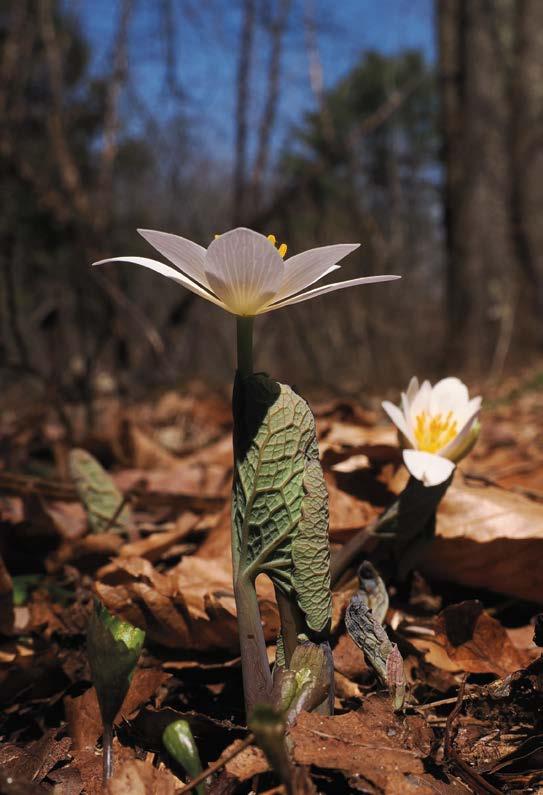
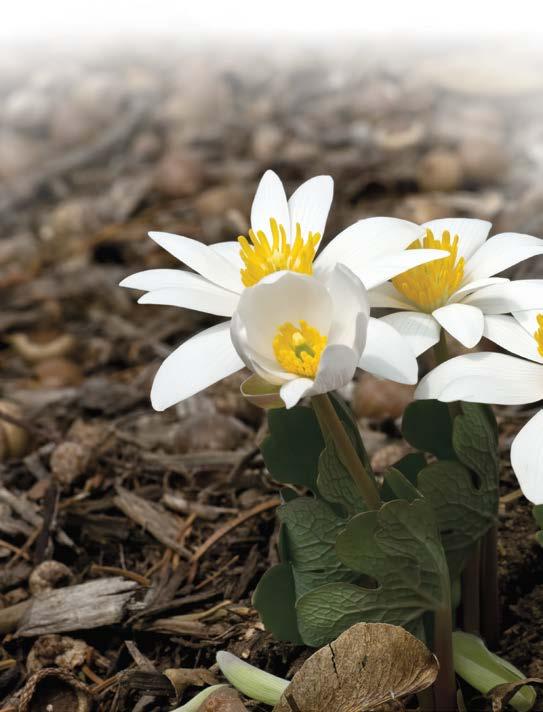
On the cover: Bloodroot blooming in the James L. Goodwin State Forest. Photo by Michelle Poudrette, @northeastnativeplants on Instagram.
Tell us about your garden! What are you most excited to grow this year?
I’m excited about all the bloodroot coming up this year! I also have some other Connecticut natives, including cardinal flower, wild columbine, and butterfly weed. But I’m probably most excited about the eastern redbud tree we got from the New Haven Urban Resources Initiative last fall. It’s already budding, and I can’t wait to see its first bloom!
Do you have any tips for gardeners who are interested in growing native plants in CT this year?
I have two! The first is to not overthink it. Most native plants are easy to care for and are drought resistant once established, so they will do fine with little care. Just pick a couple whose colors you like and let ‘em rip! The second is to not get discouraged if they look kind of puny their first couple of years. It takes a good three years for perennial natives to start looking their best.
Editor’s Note
A few days before Artemis II was scheduled to splash down in the Pacific, I sat at my computer with my three-year-old and showed her photos taken by crew members of a distant crescent Earth, dipping below a cratered moon. “We live there!” I told her, pointing at the half-shadowed planet. She looked at me skeptically.
“That’s our home?” she asked. I was surprised to find my eyes welling with tears. “That’s our home,” I told her. Many questions followed, but she eventually seemed convinced.
Lately, I’ve found myself thinking about perspective. To see the Earth from above is a powerful reminder that everyone who cares about our planet is fighting for the same place. Despite arbitrary borders and endlessly cruel wars, we all float on a singular sphere of interconnected life. Here on Earth, it’s also helpful to get up close. Watch a bee gather pollen from a flower in your yard. Maybe that pollen is carried to a crop that eventually lands in a kitchen where the flavor reminds some distant stranger of home. It’s that zooming in and out that inspires me to get outside, to go for walks in the woods and listen for the birds that traveled thousands of miles to be here. The images provided by the brave crew of Artemis II are a precious illustration of how small we are. At the same time, their stories are proof that we can accomplish enormous dreams when we work as a team. To fight for the future of our planet, we must hold both perspectives at once.
In this issue, we’re looking closely at bird eggs, a shimmering native flower, and one couple’s camping journey across the state. We’re also zooming out to examine a common desire to remain close to nature, even after death.
But first, we’ll meet our new executive director, Joey Listro, who has spent considerable time with his hands in the earth of this state, while also working on systemic challenges to connecting people to nature. I’m thrilled to welcome his perspective to the pages of CT Woodlands.
Welcome to this little corner of stories about Connecticut and the big world around us, fellow earthlings. I hope you enjoy what blooms here.
Britany Robinson
Editor
The Connecticut Forest & Park Association, Inc.
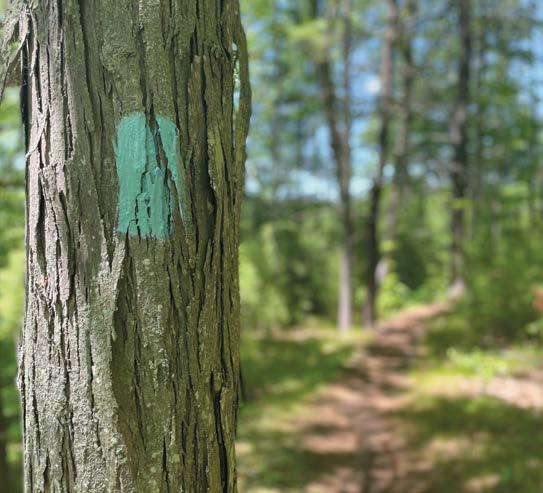
The Connecticut Forest & Park Association (CFPA) is a 501c3 nonprofit organization that protects forests, parks and the Blue-Blazed Hiking Trails for future generations by connecting people to the land. Since 1895, CFPA has enhanced and defended Connecticut's rich natural heritage through advocacy, conservation, recreation, and education, including maintaining the 825-mile Blue-Blazed Hiking Trail System. CFPA depends on the generous support of members to fulfill its mission. For more information and to donate, go to ctwoodlands.org
Board of Directors
President
Laurie Giannotti, Deep River
Vice-President
David Terry, East Hampton
Treasurer
William Cordner, West Simsbury
Secretary
Seth Huttner, Hartford
Forester
Michael Ferrucci, North Branford
Jeff Bolton, Granby
Della Corcoran, Farmington
Beth Critton, West Hartford
David Ellis, Wallingford
Alan Hurst, East Hampton
Michael Proctor, New Haven
Tom Tella, Wolcott
Marcus Ware, Ellington
Staff
Alex Bradley
Trails Stewardship Coordinator
Clare Cain
Deputy Director
Cal Creeden
Development Assistant
Teralyn LaChance
Office and Volunteer Manager
Joey Listro
Executive Director
Beth Merow
Education Director
Linda Pierce
Development Director
Kate Preston
Trails Conservation Coordinator
Julia Sonen
Education Assistant
Meaghan Strange
Communications Coordinator
Chuck Toal
Trails Day Coordinator
Connecticut Woodlands
Britany Robinson Editor
Margaret Gibson Poetry Editor
Kolk Design
Graphic Design
Thanks to photo contributions from Thomas Burkholder, Dwayne and Lisa Ladd, Joey Listro, Michelle Poudrette.
Sustainably printed on FSC certified paper using solar power and LED-UV curable inks, which don’t release harmful VOCs into the atmosphere and can reduce energy consumption by 30% compared to conventional inks.
Connecticut Woodlands is a quarterly magazine published since 1936 by CFPA. Advertising local goods or services is welcome. For specifications and rates, visit ctwoodlands.org/rates.
Contact us at info@ctwoodlands.org or call 860-346-TREE.
@ctforestandparkassociation
@ctwoodlands
@Connecticut Forest & Park Association
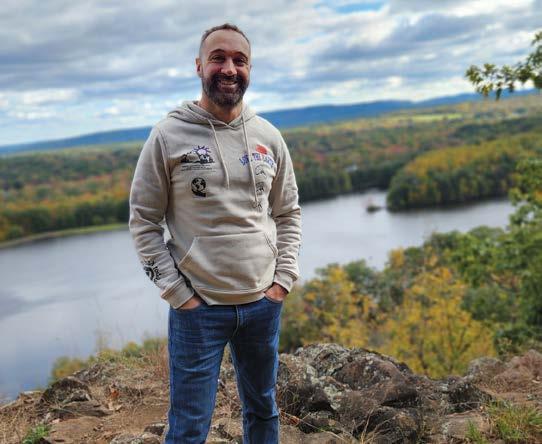
Joey Listro on The Power of Access and Advocacy
A conversation with CFPA’s new executive director
Joey Listro’s work began with growing food. He’s tended to soil and plants all over the state, and he knows how to make things grow.
From growing potatoes to community-based nonprofits, Joey has dedicated himself to nurturing and expanding upon healthy ecosystems. Now, we are lucky to be welcoming his expertise into our own ecosystem of conservation and advocacy work at Connecticut Forest & Park Association, as our new executive director.
Prior to arriving at CFPA, Joey was the founder and executive director of New Britain ROOTS. Over his twelve-year tenure, he developed programs that served thousands of youth and families, and he secured and managed more than $4 million in public and philanthropic funding. With tireless advocacy and passionate commitment to improving access to the outdoors and healthy food for all, Joey developed community engagement initiatives across environmental justice neighborhoods. In doing so, he fostered partnerships with the Connecticut Department
“We
are such a diverse state, and conversations around conservation don’t always reflect that. I think access to the outdoors is a human right and should be accessilbe to everyone.”
of Agriculture, Connecticut Department of Energy and Environmental Protection, municipal public works departments, and public schools.
CT Woodlands caught up with Joey to learn a little more about his background and the passion and experience he’ll bring to this new era for CFPA. In addition to this interview, we’re excited to welcome Joey’s expertise and insight to future editions of CT Woodlands Magazine.
“I really see farmers and conservationists as good stewards of the land, taking care of natural resources while also keeping the landscapes and communities around them strong.”
Where are you from? Tell us about your connection to Connecticut.
I'm a lifelong Connecticut resident for the most part. I grew up in New Britain, in a really diverse community. When I was in the eighth grade, my family moved to Newington. I come from Italian heritage; growing up in New Britain my family lived together in a multi-generational home—great-grandparents, grandparents, my parents, and me, all under one roof.
My grandparents, who came from Sicily, were big gardeners. They turned almost our whole yard into a food garden, which was so much fun. I loved running around the garden growing up.
When did you know you wanted to work in the outdoors?
In high school, I knew I wanted to do something that involved caring for the environment. I loved being outside, and I also wanted to take care of people. I was raised on the value that you take care of your community. I also wanted to explore. I was kind of an idealistic dreamer.
I went to the University of Southern Maine and started taking environmental science courses, and I learned a lot about climate change and humans’ impact on the environment.
The summer before my senior year, I started working at an organic farm. I was outside six days a week at 7am, learning how to grow vegetables. That farm provided a portion of what they grew to food pantries, and they had a summer camp where they taught high schoolers how to farm. A lot of the kids had never worked outside before. Getting to watch them fall in love with the outdoors was really special.
It was a dream job. It showed me how much I love working outside and working with people—especially towards a cause with an emphasis on community. I knew I wanted to keep doing that.
Tell us about your work prior to joining CFPA. I returned to the farm the following year as an AmeriCorps member. I worked on the high school employment program and created a curriculum on organic farming. After a year of that work, I found my way back to Connecticut, where
I found the Incubator Farm Program, which leased land to new farmers in Connecticut. I leased an acre of property and started a community-supported agriculture (CSA) business.
One of my favorite crops to grow is potatoes. It’s that wow factor when you harvest them. It’s especially fun for kids to dig through the dirt. Anyways, I grew too many potatoes, so my friend and I got a mandolin and started making potato chips and selling them at Coventry Farmer’s Market. They were such a hit. I did that for a while, but I really missed working with people.
Next I joined an organization called Friends of Sullivan Farm in Milford, Connecticut where I developed organic farming programs for K-12 students. I was there for two years.
After that I moved back to New Britain. I’d really missed working in diverse communities. I started working at a little organic farm that wanted to do more outreach in the community, to provide education and affordable food to people who needed it. They asked me to research and propose what it would look like to start a charitable organization to do that work. That’s how New Britain ROOTS was born, which I founded and then led for the last twelve years.
When we first started, we were bringing kids to the farm for educational programming. But eventually the farm went under and we pivoted to building out infrastructure on school grounds—bringing the farm to them. Eventually we had a garden or greenhouse in all 13 schools in New Britain.
We also purchased a mobile farmer’s market truck. We’d source fresh food from regional farms and distribute it within our community, enabling residents to use SNAP benefits, often with matching incentives, to significantly reduce the cost of produce.
Along the way, I took classes on the weekends, eventually earning a Master’s Degree in Public Administration and a Nonprofit Management Certificate from the UConn School of Public Policy, while also gaining valuable public service experience through my time serving on the New Britain Board of Education.
You’ve done a lot of work in connecting people to nature. What have you learned about how to foster those connections?
I really see farmers and conservationists as good stewards of the land, taking care of natural resources while also keeping the landscapes and communities around them strong.
In order to be good stewards, you have to get people to care. You have to help unlock something, to help people understand why they should care about conservation work.
When children are working in a garden, they build connections to the food they’re eating and the work they’re doing. Maybe a child is a picky eater. If you hand them a cherry tomato, they might say they don’t like it. But if they’re involved in planting and growing that cherry tomato, they become invested in the process and they’re going to want to love it. It makes a huge difference.
I’ve been working at the grassroots level for a long time, helping kids connect to nature in that way. I’m a firm believer that the younger you have these experiences with nature, the better. The same goes for hiking in the woods or kayaking on a river. It’s my personal mission to make outdoor experiences more accessible to everyone.
What excites you most about stepping into this role at CFPA?
I’ve always been interested in systems-level work—developing strategies for long-term goals. Over the years, I’ve seen that advocacy is a big part of that process. We need to be vocal to achieve results. At New Britain ROOTS and in collaboration with a coalition of organizations called the Farm to School Collaborative, we tried to communicate the importance of providing children with gardening experiences and getting local food into cafeterias. We spent a lot of time educating legislators on why those things are important, what they look like, and how they can support them.
I really enjoyed this side of the work, because we were working with a lot of different people on a shared mission.
When I started farming in Connecticut, I connected with a group of young, early-career farmers who were all trying to build support systems and stronger networks. Out of that, we formed the New CT Farmer Alliance, which is really where my advocacy work began to take shape.
I was drawn to efforts that addressed one of the biggest barriers for new farmers: access to land. From there, I got more involved in working with state legislators, farmers, and agencies, and realized how much I value that kind of collaboration and impact.
I’m coming from a very small nonprofit organization, where we were deeply ingrained in the community. We built relationships that took a lot of time. I’m excited to bring that experience to a statewide organization like CFPA, where I’ll be able to go out to communities all over the state and help organize them around CFPA’s mission.
I’m also looking forward to fostering connections with urban forestry programs and serving our cities across Connecticut. We are such a diverse state, and conversations around conservation don’t always reflect that. I think access to the outdoors is a human right and should be accessible to everyone. There’s so much potential to connect with more people from all backgrounds. It’s exciting.
What have you learned about CFPA so far that’s stood out to you?
Before stepping into this role, I was at an organization with a 12-year history—and I’d been there since the start of it. Now I’m at an organization with over 130 years of history. I’m really standing on the shoulders of the people who have built this organization from the ground up. It's such an honor to have been appointed to this position, to carry that legacy forward. I would be lying if I didn’t say that it’s also a little intimidating.
Interim (now Deputy) Director Clare Cain gave me a copy of Connecticut Woodlands: A Century’s Story of the Connecticut Forest & Park Association. It’s amazing to learn about the roots of this organization and its evolution over the last century. It’s very inspiring. I learned that CFPA has been involved in every single legislative session since it was established. In every session, including this one, they’ve had a conservation agenda in which they’ve been able to provide and fight for recommendations for conservation programs. That’s really cool.
I still have so much to learn. But what I have learned is that the people that make up CFPA, the staff, volunteers, and Board are incredibly kind, passionate, and hardworking people who are exceptionally good at what they do.
What’s your favorite blue-blazed hiking trail?
When I lived in New Britain, I frequented Ragged Mountain Preserve in Berlin with my dog, Virginia. We probably went over 100 times. I loved those trails, because they were so close to me and so well-maintained. The views, especially along the traprock ridgeline on the New England Trail, are incredibly scenic.
Also, the trails up in Litchfield County are great, especially Macedonia Brook State Park. The views from the top of Cobble Mountain on the Macedonia Ridge Trail are spectacular.
“I was raised on the value that you take care of your community. I also wanted to explore. I was kind of an idealistic dreamer.”
The Work of Change on The Tunxis Trail
By Thomas Burkholder
In 2013, I was hiking on the mainline Tunxis Trail near Johnnycake Mountain in Burlington. I was minding my business, enjoying the quiet, the occasional bird song, the trees. And then I heard something less soothing. A man was yelling at me from his deck, telling me to get off his property.
Up through the 1990s, this section of trail ran through a farm. The 2006 Connecticut Walk Book still showed that location, but the year it was published, the landowner started clearing a road that would become Mountaintop Pass. By 2013, there were at least a dozen new houses on the road, and at least one of the homeowners was clearly unhappy about hikers coming through.
Rattled by this altercation, I reached out to the Burlington Land Trust who put me in touch with Dan Casey, whom I’ve coincidentally known for years. Dan said, “Hey, why don’t you join my trail crew?” And I thought it sounded like a pleasant way to spend my weekends. I said yes, and we got to work.
Dan outlined a plan to fix the Blue/ White trail and to build a new section of the then- Blue/Yellow up through
Burlington to connect at Hotchkiss Rd. The following winter and spring, we flagged the new trail and connected the sections. Over a weekend in 2014, that Blue/Yellow section was reblazed and became the mainline Tunxis Trail, now contiguous from Bristol through Burlington. I was honored to become the trail manager of the new section.
This route worked great until July 2017, when the landowner finally got permission from Burlington to connect Sawmill Rd to Mountaintop Pass. Then houses were built on the trail corridor north of the Blue/White Trail, disconnecting the Tunxis mainline once again. An alternate route moved the trail west onto Town of Burlington property, but this added an unpleasant half-mile walk on a road with no shoulders.
Enter Peter Dorpalen, member of CFPA’s Trails Designation Committee and inveterate woods wanderer. In
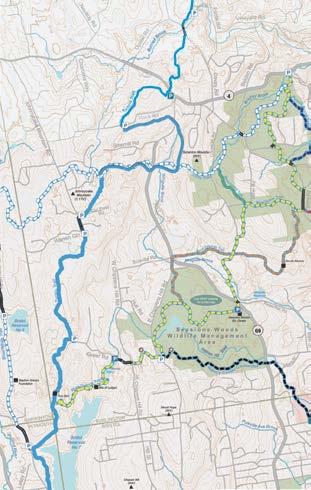
2023, he explored a potential trail corridor on New Britain Water Department property that would move the mainline Tunxis Trail east of Rt. 69.
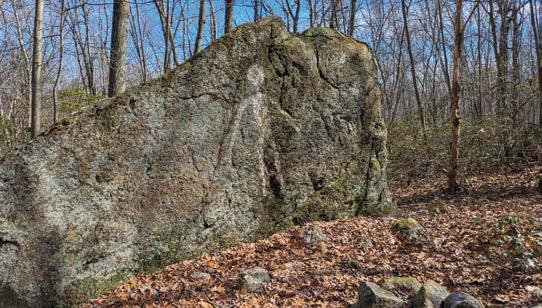
In 2024, CFPA decided this major route change would be worthwhile. That December, Peter and I walked and further refined the new section, which would be 1.3 miles long. We made a good team as we both paid attention to different things. Peter is always looking for interesting geologic features to bring trails along. But he misses some things that I catch. For example, someone had painted an alien face on a big rock, and Peter had the trail going past the faceless side. But I said, “Look, people want to see the alien!” and we adjusted accordingly. Peter put in a huge amount of work, bushwhacking through this area to get things started, putting in nearly 100 volunteer hours by the time the trail location was complete.
The Tunxis relocation was chosen as one of the major projects at CFPA’s annual Spring Trails Workshop in 2025. In preparation, Peter and I cut up trees on the ground with a chainsaw that were too large to cut with a handsaw. When workshop participants arrived, we had new trail managers and more than 20 volunteers, all ready to learn how to cut new trail and maintain them with a variety of tools. Hazel hoes, McLeods, pick mattocks, loppers, pruning saws, and weed cutters were all wielded to open the trail. We also had a Rock Stars group, led by Wayne Fogg, working on stepping stones. With all 5 crews working a full day, we had it completely roughed in, the trail bed defined.
The next phase was to go back and blaze the newly dug trail, clean up some of the rougher spots, and open it for hiking. With volunteers broken into groups, the blazing was finished, and sections of the old trail were brushed in and blazes removed.
The last job was to do some side-hilling, cutting the tread of the trail into the side of the hill to make it level and to prevent erosion. Clare Cain organized a work party, and then picked the hottest day of the summer—95ºF and very humid with thunderstorms predicted in the afternoon. About a dozen volunteers spread out and started working on sections. The bulk of the work was finished before dark clouds encouraged us all to head home. And that is where the trail stands today. The Tunxis is now a continuous 40-mile trail from Bristol Reservoir Number 7 in Terryville, all the way to the Massachusetts state line in Hartland.
The saga of this relocation, a series of disconnections that ultimately took 30 years to fix, is a reminder that development is encroaching on our ability to have recreational hiking trails. We depend on the goodwill of private landowners for key trail connectivity, but they also tend to live in these places for their own peace and quiet. There will always be some friction
For the latest trail location info, visit CFPA's online trails map.
between development and recreation. Which is why this kind of trail work, maintenance, and responsible trail use is so necessary. We have to keep adapting and relocating as needed. We all have a role to play in keeping our favorite trails accessible.
Tom Burkholder is an avid hiker, trail manager, sawyer, and member of the Trails Committee for CFPA. He is interested in the history of the area and loves searching old USGS topographical maps and poking around in the woods. Tom has been a professor of chemistry at Central Connecticut State University for over 30 years.
Good Eggs
By Laurie Morrissey
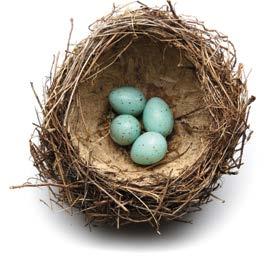
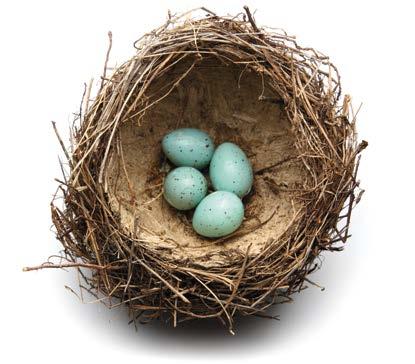
One day last June, an American robin built her nest on top of the propane tank outside my kitchen window, giving me a rare opportunity to observe the egg-laying process. She fluffed up a bit and shifted around restlessly. Her wings trembled, her tail bobbed, and her beak opened as her muscles contracted to push out the egg. After a few minutes, she rose to inspect the newest of three gorgeous blue eggs, oval and slightly over an inch long.
The avian egg is one of nature’s marvels. Porous, yet waterproof; thin and light, yet surprisingly tough. The egg is strong enough to resist fracture from the outside, yet delicate enough to crack from within when it’s time. The interior of the egg contains nutrients, minerals, antimicrobials, and water. The embryo needs only two things from outside the shell walls: air, which they absorb through microscopic pores, and a parent for warmth and occasional rotation, so they don’t stick to the shell membranes.
“The eggshell is one of the fastest-forming biomaterials in nature. The calcium carbonate shell typically forms in under 24 hours.”
By studying birds’ eggs, scientists gain insight into evolution and the effects of humancaused changes in the environment.
For the next two weeks, the mother robin left the nest only briefly to feed. Incubation is done exclusively by female robins, but parental responsibilities vary by species, with some males incubating full-time and others sharing the work of keeping eggs warm.
Across species, eggs are remarkably diverse in size, shape, color, and patterning. The world’s tiniest bird egg is laid by a Jamaican species of hummingbird. The largest is that of the ostrich. In Connecticut, the smallest is the jellybean-sized egg of the ruby-throated hummingbird, laid in a nest the size of a walnut on a slender branch. On the opposite side of the size spectrum is the tennis ball-sized egg of a bald eagle, laid in a massive stick nest high in a tree.
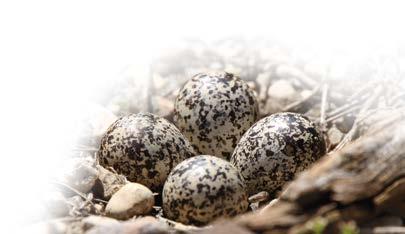
Egg structure and color developed as adaptations for survival and are influenced by many factors, including nesting preferences and brooding behavior of individual species. The eggs of killdeer, for example, have
dark speckles and blotches on a tan background, allowing them to blend in with the gravel on which they nest. The deep blue of a robin’s egg, according to some scientists, may help protect the egg from sun exposure. Incubation times also vary widely, from about 14 days for a hummingbird to 40 for a bald eagle.
By studying birds’ eggs, scientists gain insight into evolution and the effects of human-caused changes in the environment.
Mary Caswell Stoddard investigates eggshell structure and function at Princeton University. “The eggshell is one of the fastest-forming biomaterials in nature,” she says. “The calcium carbonate shell typically forms in under 24 hours.” The strength of the shell changes over time: hardest when first laid and decreasing in strength as the chick extracts calcium for its development. Caswell also investigates egg shapes. “Owls, for example, tend to lay round eggs, hummingbirds lay elliptical eggs, and many shorebirds lay pointy eggs,” she says. “In general, better fliers tend to lay eggs that are more elliptical or asymmetrical.”
It’s not unusual to find an egg on the ground, or a nest that appears abandoned. “Causes are most frequently unknown,” says Sunny Kellner, wildlife rehabilitation manager at Connecticut Audubon Society’s Sharon Center, “but most likely they were purposefully rejected from the nest by the mother, for issues with the egg that they can detect and we cannot, or from falling from a predator attack or other disruptions to the nest.”
People often call the center out of concern, she says. “However, eggs found outside the nest are no longer viable due to the movement of the embryo during the fall, which disrupts or prevents development, as well as being cold for extended periods of time.” Calls are encouraged—with the caveat that often the advice is to allow nature to take its course. Depending on the time of year and the species, birds that lose eggs and entire clutches often lay a second clutch. Some songbirds, including robins, bluebirds, and cardinals, may have three broods in a season.
Eggs typically hatch in the same sequence in which they were laid, and depending upon the size of the clutch,
it can take a few days. The hatchling breaks a tiny hole with its beak, then gradually chips away to enlarge it. The babies struggle out of the shell blind and nearly featherless, but they grow fast. I wasn’t fortunate enough to witness the hatching of the robin’s eggs outside my window, but I did observe what came next. After disposing of the broken shells, the parents flew back and forth finding food for their hungry offspring, feeding their babies every 15-20 minutes from dawn to dusk. They carried fecal sacs away from the nest, where they wouldn’t attract predators.
Hopefully, the young birds survived to lay their own eggs and raise their own broods—ensuring the Connecticut woodlands are never without this beloved species.
Laurie D. Morrissey is a New Hampshire-based writer whose work has appeared in Connecticut Woodlands since 2016. She has also been published in Northern Woodlands, Art New England, New Hampshire Home, Appalachia, and numerous poetry journals.
Killdeer typically lay a clutch of three to six eggs in a small depression on the ground, near low vegetation.
Japanese quail Blackcrowned night heron
Great gray owl
Ural owl Blue crane Black swan Emu North African ostrich Chicken
“If fairies were real, they would live in the blossoms of bloodroot.”
The Fleeting Beauty of Bloodroot
By Amy Brady
Every April, woodlands across Connecticut welcome the arrival of spring with tiny green triangles pushing up through the last of the snow. These are the first leaves of bloodroot, one of the state’s earliest-blooming native wildflowers.
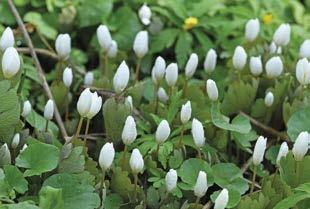
On a hike through a state forest last spring, I marveled at how the flowers formed white, sparkling patches across the floor, as if the sky had dropped its stars overnight. If fairies were real, they would live in the blossoms of bloodroot.
Even plant experts, for whom shimmering flowers are nothing new, are enchanted with the early riser. “It’s
such a joy to see them,” said William Moorhead, the Senior Botanist/Plant Community Ecologist with the Natural Diversity Database (NDDB), a program within the Wildlife Division of the Connecticut Department of Energy & Environmental Protection (DEEP). “They’re a sign that spring is here.”
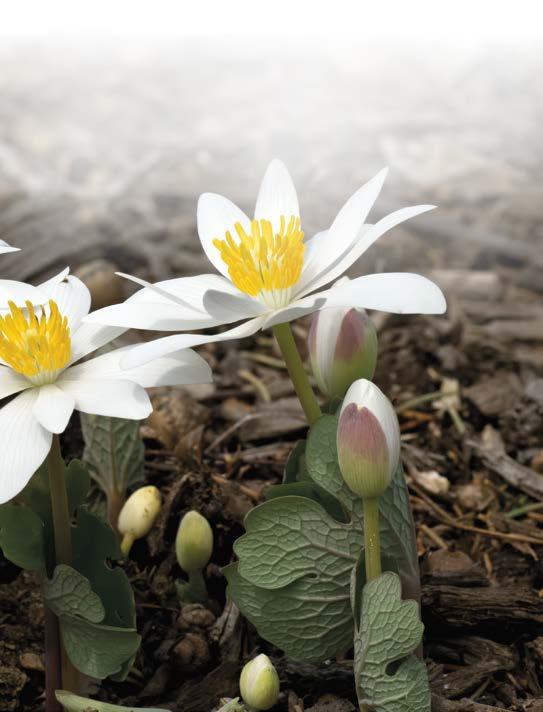
The sparkling effect is due to the reflective quality of the flower’s petals, which in clusters of eight to twelve, form windmill-like, two-inch blooms that last no more than two to three days each. At night, they close to protect their nutrient-rich pollen for the morning’s hungry pollinators—insects
such as native bees, beetles, and flower flies who are just waking from their long winter’s sleep.
“We have thousands of species of native bees here in the U.S.,” said Ricky Bentley, a Program Manager at the Connecticut Land Conservation Council. And more than 300 species here in Connecticut. “Many of these bees are threatened by habitat destruction and loss of food sources.” It’s especially hard for them in early spring, when most flowers have yet to open. This makes the early-blooming bloodroot a key component of healthy local ecosystems.
“The Algonquin used bloodroot as a love charm. The Micmac believed it contained aphrodisiac properties.”
Even ants feast on bloodroot—on its seeds, that is. After the blooms fade, the plant forms pods that burst open with dozens of tiny seeds covered in a sticky, clear substance called elaiosome. “Elaiosome is like a little bag of food full of fats and proteins that attracts ants,” said Moorhead. The ants carry the seeds back to their nest, where they consume the gooey substance with gusto before “tossing the seeds unharmed to their waste disposal areas, where the soil has been fertilized by dead ant bodies and ant frass.” With luck, some of those seeds will germinate the following year. “It’s an important symbiotic relationship,” Moorhead continued. “And not an unusual dispersal strategy among spring ephemerals.”
Indeed, this mutually beneficial relationship occurs up and down the entire eastern seaboard, where the flower’s range stretches from Florida to Canada’s eastern provinces . In Connecticut, bloodroot is most abundant in woodlands but can be found in some yards and gardens with shady areas. I grow the flower in a shady patch in my yard reserved for native plants. They’re now in their third spring, and soon I expect a spectacular show. (Perennials like bloodroot tend to grow slowly their first two years. In year three, they leap to life.)
Wherever you find bloodroot, you may have heard it called by another name. It goes by sandwort, red puccoon, red paint, sweet slumber, snakebite, and sanddragon—mythical, ominous-sounding names inspired, in part, by the bright red sap that flows throughout the plant, including the rhizomes, which when sliced open, burn as red as an open wound.
The names may also derive from the flower’s many uses throughout history. The Algonquin used bloodroot as a love charm. The Micmac believed it contained aphrodisiac properties. Ponca men rubbed the blood-red sap into their palms before touching the skin of a love interest. Their romantic intentions were made known by the red stain left behind.
Despite tasting exceedingly bitter, the sap has also been used in medicines. Indigenous peoples used it to purify the blood, heal wounds, and relieve fever and pain. By the 1800s, European settlers were incorporating it into treatments for inflammation and cough. In large doses, it was used as a laxative and to extricate worms from the stomach. Throughout the nineteenth century doctors experimented with bloodroot in therapies for skin cancers,
and by the early twentieth it was still used to treat minor skin issues. Later studies suggested the plant contained dental plaque-fighting properties, which lead a Colorado-based company Vipont Pharmaceuticals in 1983 to begin adding bloodroot sap extract to their oral hygiene products. The product was pulled from the market a few years later when additional research suggested the sap caused pre-cancer in the mouth.
For this reason and others, bloodroot has never been approved for medicinal use by the U.S. Food and Drug Administration (FDA). In fact, the FDA warns consumers against using the plant to treat skin problems because it can destroy healthy tissue.
Yet, the tiny flower is still collected today, presumably for its healing properties. In some places, over-collection combined with habitat loss and the introduction of invasive plants and insects has led the United Plant Savers to deem the flower “at risk” of localized extinction. “In Connecticut,” says Moorhead, “I do not believe that bloodroot is threatened significantly by human predation, though it may be less abundant in some areas of the state compared to others.”
This is great news for flower lovers. Still, bloodroot’s increasing vulnerability in other parts of the country serves as a cautionary tale for us here in Connecticut, and a reminder that the well-being of our ecosystem depends largely on how we interact with it.
From late March to early May, woodland trails throughout the state will briefly sparkle with the white petals of bloodroot opening up to the sun. For those of us who encounter it, the U.S. Forest Service offers some sound advice: “respect and protect wildflowers and their habitats, leave only footprints, and take only memories and photos so that future generations may enjoy our precious natural heritage.”
THRESHOLD
Who wouldn’t want to say at last breath, I’m so happy, I’m so happy, I loved my life—
then curl like a shell on the tide line of a crescent beach or float like a winged seed
over one field into the next, or settle down on the forest floor with falling leaves and acorns and mast?
Today, once again I may see how sun can open the heart as it turns a leaf translucent, how even a bobcat returns your gaze if you stand still long enough. I can be as still as a lichen,
can be owl call, pond shimmer, cedar. When there’s gentle rain on my face, I am raining.
Take a breath, the oldest swirl of wind in the forest whispers. Let me hold you
Let me rock you in my arms. Take a breath.
Margaret Gibson
A Natural Death How the landscape of burial is changing in Connecticut and beyond.
By Britany Robinson
Glenn Cheney’s life is full of color. Nine years ago, at 65 years old, Cheney took up painting, and his depictions of flowers and forests cover a long wall in his kitchen. There are bursts of orange, yellow, and purple petals; stands of brown and white trees; and skies of stirring grays and blues. He plans on many more years of painting and sitting by the burbling stream in his backyard. In the warmer months, friends sometimes join him at the water for gin and tonics or a swim.
Like most people, Cheney doesn’t like to think about the end of his life. But what he really can’t stand is the idea of his body being placed in a dark, colorless box, or sent through an industrial furnace where it would release about 540 pounds of carbon on its way to becoming ash. Instead, he wants to return to nature, to give the nutrients in his body back to the soil where new life can grow. And he has a plan that gives him comfort: No fancy casket, no chemicals. He will be buried in a gently sloping field at the edge
of Hanover Cemetery, about a mile from his house, in a section that’s recently been designated for green burials.
The Green Burial Council, a nonprofit that established industry standards and certification, defines green burial as an “environmentally-conscious approach to death care” that “prioritizes placing the body directly in the Earth, forgoing embalming, and using biodegradable materials.” There are no concrete vaults, and cotton shrouds or simple wooden coffins are used in place of polished wood and metals.
As concern for the climate crisis intensifies, so does awareness of the impact of our choices in all aspects of life. This includes how we die. Conventional burial practices result in significant resource extraction, land use, and carbon emissions. Cremation, the method of final disposition for 63% of Americans in 2025, requires the burning of fossil fuels, resulting in 360,000 metric tons of CO₂ in the U.S. each year.
Long before there were silk-lined caskets or formal funeral homes, what we now call “green” or “natural” burials were standard. Aspects of green burial have continued to be common practice for many, including those of Jewish and Muslim faith. Many indigenous peoples have maintained natural burial practices for millennia. But in the United States, where the funeral industry has formalized the memorialization and grieving process with catalogues of expensive caskets and urns, many are reconsidering and returning to this ancient practice.
Advocates for green burial see an opportunity to not only reduce the impact of death care, but also to nurture healthier relationships with the natural cycles of life and death.
Cheney first learned of green burials from a friend, who had been thinking about her end-of-life options. She shared her interest in green burials with Cheney, who thought it made perfect sense. “It occurred to me,” he says, “that burying [in a coffin] prevents a lot of nutrients from returning to the environment, to the ecosystem we’re part of.”
The two started researching their options and found them surprisingly limited in Connecticut. Perhaps there was an opportunity here to start a natural cemetery themselves. So, they launched a nonprofit, called Connecticut Green Burial Grounds; built a simple website where they collected research to share with others; and then spent five years looking for land, in hopes of starting something new.
As concern for the climate crisis intensifies, so does awareness of the impact of our choices in all aspects of life. This includes how we die.
environmental and economic. At first there was hesitation. But after some discussion and additional research, all board members agreed to designate half an acre at the edge of the cemetery to green burials, where bodies cannot be embalmed and all materials must be biodegradable. Markers are made of natural stone, placed flush with the ground. Families are encouraged to plant natives, and the meadow is only mowed once a year, in the fall, allowing for natural growth.
“We decided that we want to accommodate what people are looking to do,” says Jennifer Benson, sexton of Hanover Cemetery. “This seems to be the way people are going. Economically, it was a good decision.”
Sahara Farrugio, a Connecticut-based funeral planner and founder of Smart Funeral Planning, says interest in green burial is consistently strong in Connecticut. “People want something more natural or environmentally aligned,” she says. Often, they’re disappointed by what’s available in-state. Connecticut does not have any exclusively natural cemeteries. Hanover is one of five conventional cemeteries with a designated section for green burials. “People ultimately choose what’s available locally, such as hybrid cemeteries. A smaller number are motivated enough to look out of state to fully meet their goals.”
But they kept hitting roadblocks. “We went all over Connecticut, and we couldn’t find a place.” Properties for sale would be too close to wetlands or houses. They approached some land trusts about partnerships, but none were interested.
Eventually, Cheney struck up a conversation with members of the board of Hanover Cemetery. He delivered a presentation about the benefits of green burials, both
Angelina Silverio of Milford never imagined she’d be planning a funeral this year. But when her baby, Ava, died on the day of her birth, Silverio and her family were faced with the devastating task of finding a cemetery. Nothing felt right.
“I’ve had a lot of loss in my life,” says Silverio. “I’m familiar with the traditional funeral route. But I kept thinking, there has to be something else. I don’t want a depressing cemetery—I just want a pretty spot.”
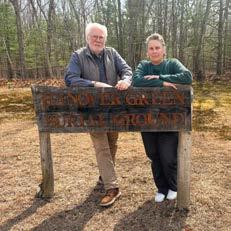
Glenn Cheney with Hanover Cemetery sexton, Jennifer Benson. Cheney crafted the sign for Hanover Green Burial Ground.
She and her family toured several green cemetery options in Connecticut, but she says they all felt like an afterthought, tucked behind the familiar rows of granite headstones.
Silverio eventually found what she was looking for in Vermont Forest Cemetery, a three-hour drive from her home in Milford. The distance is not ideal, but in looking at photos of the peaceful forest and in speaking to the founder, Michelle Hogle Acciavatti, she knew this was the place for her daughter. On a day between two snowstorms, the family drove up to honor Ava at an intimate graveside ceremony. The plot was beneath a big tree that would provide shade come spring, right next to a pretty creek. Acciavatti read a poem, and her toddler son played with Ava’s big sister, Amelia, in the snow. Everything was soft and white.
“It was really hard,” Silverio says. “But it just felt right.”
At Vermont Forest Cemetery, there are no mowed lawns or headstones. Plots are dug between trees, among 56 acres of upland mixed hardwood forest. In 2017, Acciavatti and a group of green burial advocates successfully lobbied to change state law, decreasing the required depth of burial from five to 3.5 feet. The change was critical in the legalization of green burials, as bodies must be placed in the active layer of soil, where oxygen, soil, and warmth aid in breakdown and nutrients cycle through. She opened Vermont Forest Cemetery, the first of its kind in Vermont, in 2023.
Years ago, the land was heavily logged. “We’re hoping to restore [the forest] to a healthy balance,” says Acciavatti. “Not the health of the 1800s, but the health it needs to survive into the next century.” After burial, the plots are left to rewild. A partnership with White River Natural Resources Conservation District guarantees that the land, and the plots in which people are buried, are protected from development in perpetuity.
When a tree dies and falls in the forest, it breaks down to support other living things. Small animals find shelter among the fallen branches. Rain softens the wood. Moss grows. As leaves, branches, and trunk decompose, the tree material mixes with soil on the ground and becomes nutrient-rich humus, which helps prevent erosion, retains soil moisture, and feeds new life. “Humus” and “human” both have Latin roots that mean “earth.” While studies are limited when it comes to the impact of human burial on soil health, we know that decomposition plays a critical role in the health of an ecosystem.
“Land can be enhanced by burial,” says Lee Webster, Co-founder of the Conservation Burial Alliance. Vermont Forest Cemetery aligns with best practices for conservation burial, a specific type of green burial that combines earthfriendly methods with conservation partnerships, allowing burial grounds to be a tool for protecting—even rehabilitating—the land. There are currently no conservation burial grounds in Connecticut.
When a tree dies and falls in the forest, it breaks down to support other living things.
Webster has done a lot of work in trying to convince land trusts of the benefits of partnering with nonprofits in the establishment of conservation burial grounds. She says it’s difficult to get these environmental groups interested in the business of burying the dead. But Webster thinks that for those with an open mind, conserving land and creating final resting places for humans is a natural fit.
“We’re both dealing with deep time,” she says. “Conservation means conservation forever. Burial means burial forever.”
People who choose green or conservation burial are often doing so because they feel a connection to a place and the earth. By returning to a natural cycle, there is a comforting continuation of life. Loved ones often find comfort in this process, too.
➨ page 21
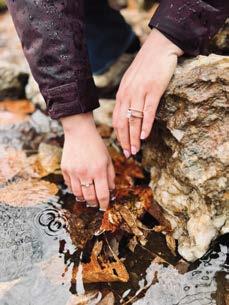
Angelina Silverio dips her hands in a creek near Ava’s plot.
Living THE Dream at Connecticut Campgrounds
By Britany Robinson
Dwayne Ladd grew up with stories of cross-country road trips. His mom had fond memories from her own childhood of winding along Route 66, through quirky western towns, across dramatic landscapes, and she shared them with Dwayne. Her memories turned into his goals; someday, he would buy an RV for his future family, and they’d travel the country together. In 1996, Dwayne married Lisa. But it would take more than two decades for the couple to go camping.
In 2019, Dwayne’s mother was diagnosed with ALS. Her health was deteriorating, but she set her sights on one more trip. She wanted to go back to Route 66. Dwayne and Lisa got to work on making it happen. Through Dwayne’s business, they already had a utility van that could accommodate a wheelchair, and they started building it out for camping. But, the illness progressed quickly, and Dwayne’s mother died before they could hit the road.
Dwayne and Lisa knew the best way to honor his mother was to push forward with the van conversion, and get out there. In 2020, they went camping for the very first time at Macedonia Brook State Park in Kent. From there, the dream transformed. They haven’t driven cross-country, but that first weekend got them hooked on camping: they fell in love with being out in nature, sleeping in the van, and spending time in Connecticut’s forests.
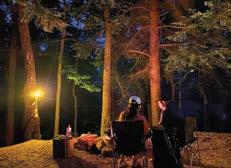
Dwayne and Lisa have since visited every state park in Connecticut and most of the campgrounds.They camp almost every weekend, even in the winter months. While they often venture to surrounding states, Connecticut is home and they say they love how many adventures they can find within an hour’s drive.
Camping transformed their lives. To start, Lisa says Dwayne was able to work through some grief while building out the campervan. “It was a lot of work,” says Lisa. “I was so proud of him.”
“Who needs a therapist when you can go camping?” asks Dwayne. Over the years, getting outside has strengthened their connection as a couple, too. “Camping still brings us together, even after 30 years [of marriage],” says Lisa.
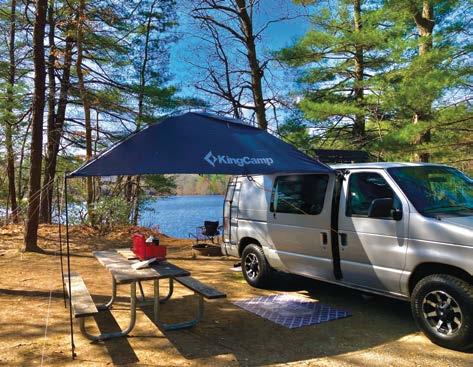
Their campervan is now outfitted for full-on vanlife.” They have a cozy bed, a stove, solar power, and a toilet in the surprisingly spacious back. They’ve considered extending the roof so they can stand up straight inside, but they aren’t willing to sacrifice the accessible surface up top, where they often lie down at night to see the stars.
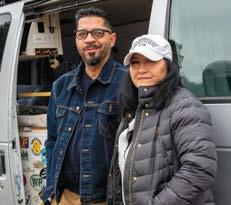
Dwayne and Lisa fell so hard for camping, they started a YouTube channel called Dee and Lee in their RV. Recently, they’ve both transitioned away from other work to focus on producing videos full-time. For six years now, the couple has documented their adventures camping in Connecticut and beyond. Over 4,000 subscribers tune in to watch their campground reviews, recommendations, and where they’ll venture next. CT Woodlands caught up with Dwayne and Lisa (or, Dee and Lee, as they often go by) at Black Stone State Park, as they prepared to hit the road for a longer trip south. They’re excited for a bigger trip this year. But at a campground not far from home, they were equally excited to share their expertise on camping in Connecticut.
What is your favorite campground in Connecticut?
Dee: It was a cold March day when we camped our first night at Wilderness Lake Campground and Resort [in Willington] but we loved it. It’s a beautiful campground with wooded sites; people flock there. We usually prefer state park campgrounds, but this one is private.
On that first camping trip, we noticed this land jutting into the water. It just looked like a mound of rocks, but we thought, how cool would it be to camp right there? Three years later we went back. They had built a site there, and we booked it. That’s where we filmed our very first YouTube episode.
What are you looking for when searching for campgrounds?
Lee: We look for campgrounds that give us a similar feeling to Wilderness Lake. When Dee books campgrounds, he is always looking for that special site.
Dee: I had never booked a site before then. It turned into this tedious thing. I’m on Google Earth, looking at all these sites, looking at reviews. One requirement is there must always be some kind of water—even if it’s just a little creek.
Finding that perfect campsite is tricky. My son said we should start a YouTube channel—because other people are struggling with this same thing. So now we find and share those best sites at each campground.
What do you love most about camping?
Lee: Being out in nature is so healing. We‘re big into grounding, walking barefoot outside. I love hiking, listening to the sounds at night, and a crackling campfire.
Dee: Hiking and a good bacon burger off the campfire.
What lessons have you learned over the years?
Dee: Less is more. You watch some YouTube camping videos, and they make you think you need every piece of gear under the sun. But then you’re unloading the car and it takes two or three hours. You don’t need all that. But we’re studious before we go. We always know what amenities are available and what kind of wildlife to watch out for.
With so many places to go camping, why camp in Connecticut?
Lee: We like how Connecticut is a small state and the campgrounds resemble that. You’ve got the big ones, like Hamonnasset and Rocky Neck [state parks], but the rest of them are mostly small and quaint. And they speak to you. There’s usually hiking right there. Connecticut campgrounds have a little bit of everything, and then it’s a short drive to another beautiful campground.
What other campgrounds do you recommend around the state?
Macedonia Brook State Park campground has the best hiking accessibility in the state. The Green Falls area of Pachaug State Forest has beautiful hiking around Green Falls Pond [including Blue-Blazed Trails].
Salt Rock State Park is great for a sense of seclusion. Even though it’s popular, there’s lots of space to spread out.
A Natural Death, continued from page 18
At Vermont Forest Cemetery, the experience of the living is a priority. In a documentary about conservation burial, Acciavatti describes the process of burial for families: “Instead of leaving the casket or body on top of the grave, people come and lower the body into the grave.” She says this can make it easier to walk away, “because you know you’ve come to give that body back to the earth.” The forest operates as a burial ground, but they also host art installations, educational programming, and even a kids’ summer camp.
“We believe humans are part of the ecosystem,” says Acciavatti. “We’re interacting with this environment on a daily basis.”
Conservation groups rely on the support of people who feel connected to the places they protect and the ecosystems they restore. Land trusts build trails, host birdwatchers, and teach people about wildlife. To have a family member buried in a plot of land is another layer of connection to that place.
“We’re both dealing with deep time. Conservation means conservation forever. Burial means
burial forever.”
“If I have someone buried on conservation land, I’m going to support that land trust,” says Webster. “I’m going to be excited when they build a foot bridge and I can bring my kids and enjoy that place because I feel connected to it. Land trusts are just starting to come around to the idea of using burial as a conservation strategy, which will have resounding impacts on the natural burial movement and community conservation once it is normalized.”
Alot will need to change in Connecticut for conservation burial grounds like Vermont Forest Cemetery to exist someday. Roadblocks remain, both cultural and regulatory. For now, an increasing number of conventional cemeteries are opening up to the idea of green burial, as more people learn about them and express interest. Connecticut Green Burial Grounds was dissolved as a nonprofit in 2025, but the website is still up for anyone who is searching for information.
Glenn Cheney has told all of his friends about the new green burial section at Hanover. His neighbor bought five plots for herself and her family. When asked what kind of tree he’d like planted on his own plot someday, Cheney says he’d be happy with any tree. “As long as it provides shade to whoever visits.”
Connwood Foresters, Inc.
39 Cherry Hill Road | PO Box 150 Rockfall CT, 06481 (860) 349-9910 | www.Connwood.com
Working hard for Connecticut’s Forests Since 1945
Connecticut forests are working harder than ever.
Fragmented landscapes, development pressure, invasive species, and climate change all shape how forests grow, recover, and endure.
Connwood Foresters, Inc. works with landowners to care for, improve, and protect forests, using climate-adaptive forestry practices grounded in real-world conditions.
Environmental Stewardship and Land Management since 1982
• Forest & Open Space Management Services
• Property Tax Reduction (PA 490 & Chapter 61)
• GIS Mapping
• Forest & Wildlife Habitat Improvement
• Timber Inventories & Appraisals
• Professionally Managed Timber Harvests
• Environmental Oversight
• Watershed & Utility Land Management
• Recreation Plans & Implementation
• Forest Stewardship Plans
6 WAY ROAD MIDDLEFIELD, CT 06455 860-349-7007 FAX: 860-349-7032
EMAIL: FW@FWFORESTERS COM WWW FWFORESTERS COM
Satellite Offices in Connecticut: HAMDEN, NEW BRITAIN
CFPA is accepting applications for the 2026-2027 Master Woodland Manager Program. Learn to care for forests for wildlife, your community, and future generations in this year-long program.
Storm damage is ever ywhere — blowdowns, washouts, and blocked paths threaten the trails you love. You can help repair damage and keep trails safe! Give $97 today and your gift will be MATCHED at ctwoodlands.org/donate
Pathways
Early Camping in Connecticut
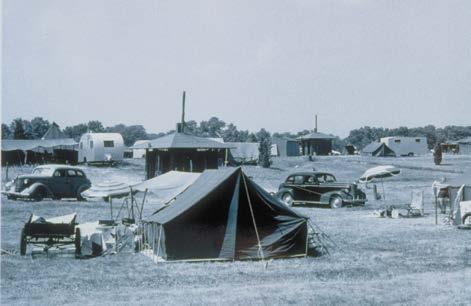
Sitting between a salt marsh and a tidal river, tucked behind a soft sand beach, lies one of Connecticut’s most popular campgrounds. Rocky Neck State Park first welcomed campers in 1931, at a time when camping was gaining popularity following the proliferation of affordable cars. This photo of campsites at Rocky Neck, taken in 1949, illustrates the post-war camping boom, when gear and destinations were becoming more accessible for family car camping. Sleeping bags and camping stoves, first developed for use during the war, were now being purchased at Army surplus stores by those eager to visit new places and sleep under the stars.
While Connecticut is often overlooked for camping in deeper wilderness to the north, our small state has some beautiful destinations. Not to mention, Connecticut is, in a sense, the birthplace of recreational camping. A minister from Guilford, William H.H. Murray, wrote Adventures in the Wilderness in 1869, a guidebook to camping in the Adirondacks that became an instant bestseller. The book was the first to espouse the healing experience of leisure time in the wilderness, and it transformed the New York mountain range into a popular destination. But it was Connecticut that first inspired Murray, whose childhood was spent hunting, fishing, and exploring the woods and farmland of Guilford.
Today there are over 1,400 campsites in Connecticut (including over 150 at Rocky Neck, where you can sleep in walking distance to the beach) offering a great diversity of wildlife, landscape, and recreational experiences. When considering how to spend your summer weekends this year, you might be inspired by Murray:
“Go to the village where you were born, to the old ancestral farm where you toiled when young…Go to the sea-shore, to the mountains, to the wilderness; go anywhere where you can forget your cares and cast aside your burdens…Let the old, old nurse, Nature...take you to her bosom again; and you will return to the city happier and healthier for the embrace.”