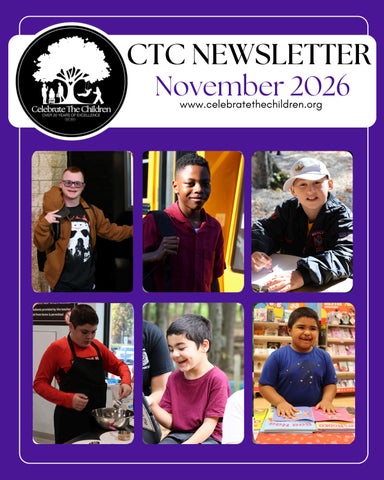
CTC NEWSLETTER November 2026 www.celebratethechildren.org
CTC NEWSLETTER November 2026 www.celebratethechildren.org
Important Dates
Student Spotlight 11/6
11/9
11/11
11/26 11/27
No School
Holiday Express
Wonderful Wednesday
No School Happy Thanksgiving
Updates & Resources Topical updates, tips, & tricks from our staff, by department!
A Letter from the Executive Director
Staff Spotlight
Student Spotlight
Staff Spotlight
Education HQ
Floortime
S2C
C.A.R.E.S
Behavior
Physical Therapy
Occupational Therapy
Celebrate the Children School 1
CTC Community
@ctc_school
(973)989-4033 www.celebratethechildren.org 230 Diamond Spring Road Denville, New Jersey 07834
Dear CTC Families and Stakeholders, Welcome to our quarterly newsletter! CTC is excited to transition to a quarterly publication, allowing us to share even more updates, highlights, and information with our community while continuing to promote transparency and keep everyone informed. We look forward to connecting with you each quarter! This school year, we are underscoring the critical importance of communication and expression. Our theme, “Communication Is the Key to Potential,” serves as a powerful reminder that communication is a human right. Every student deserves a meaningful way to communicate, express themselves, and participate fully in their world and learning. As educators and professionals, we must also recognize the importance of effective communication with families, school districts, and one another. We are part of a collaborative support team and network, united by a shared mission: to support our students' growth, strengthen their ability to connect with the world around them, and promote positive outcomes that lead to greater independence. We believe in our students, their innate abilities, and their unlimited potential. We remain committed to providing a strong programmatic foundation that recognizes each student's unique profile, builds upon their individual strengths, and creates meaningful opportunities for growth, learning, communication, and independence. Another one of our key priorities this school year has been creating a better balance between technology and experiential learning by reducing screen time, limiting the use of certain technologies, such as smartboards, and expanding hands-on learning and outdoor experiences. We are thrilled to see our vision of less screen time and more outdoor lessons and experiences coming to life. We recognize how meaningful these opportunities are in supporting healthy brain development, emotional well-being, and social growth. What a wonderful way for our students to connect classroom learning to real-world experiences, explore their surroundings, and build knowledge through hands-on discovery! We are also incredibly fortunate to have such beautiful and diverse outdoor spaces that extend our classrooms beyond four walls. Our campus features outdoor classrooms, the Mary Alice Landis Garden- where memories and stories bloom, gardens, a greenhouse, playgrounds, walking trails, counseling spaces, amphitheaters, picnic areas, an Environmental Center, and a beautiful pond, along with many other scenic spaces for our students to explore, discover, and thrive. These environments provide meaningful opportunities for our students to learn through experience, connect with nature, build relationships, and develop new skills. They allow learning to happen naturally through exploration, creativity, social connection, and hands-on discovery. In relation to curriculum, we are proud to announce that our Related Services Department has developed a Daily Living Skills Curriculum designed to help our students build the practical skills they need to navigate everyday life with greater confidence, independence, and success. This initiative reflects our commitment to providing meaningful, functional learning opportunities that strengthen activities of daily living (ADLs), promote the development of essential life skills, and prepare students for greater independence across home, school, and community settings. As discussed during our Back-to-School Night, and in keeping with our commitment to transparency and meaningful collaboration with parents and stakeholders, we will be organizing focus groups to facilitate important conversations about how we can continue to strengthen communication and improve our school community. We believe that listening, sharing perspectives, and working together are essential to making CTC the best it can be for our students, families, and staff. More information about dates and participation opportunities will be shared soon.
2
(973)989-4033 www.celebratethechildren.org 230 Diamond Spring Road Denville, New Jersey 07834
On October 20, 2026, we were honored to gather as a CTC community to remember our beloved former Principal, Mary Alice Landis, and celebrate her remarkable life and legacy. It was a beautiful evening filled with heartfelt tributes, stories, and cherished memories shared by so many whose lives she touched. The evening reflected the extraordinary person Mary Alice was and the lasting impact she made on our CTC family. Her legacy lives on through the many lessons she taught us, the relationships she built, and the countless lives she influenced along the way. As a lasting tribute to Mary Alice, we dedicated a beautiful reading garden in her honor, complete with benches and a lending library. This special space will provide students with a place to read, reflect, connect, and create their own memories. It is a meaningful way to celebrate her love of education and ensure that her legacy continues to bloom throughout our campus. This November, we are dedicating our Kindness Month to celebrating and honoring Dr. Tony Novembre, whose kindness, generosity, and lasting contributions to CTC continue to inspire us. Dr. Tony Novembre was not only a valued colleague but also a mentor and an important part of the CTC family. He served as our Supervisor of Instruction and Director of Business from 2010 to 2015, making lasting contributions to our school and community. Tony played an instrumental role in helping CTC acquire the Denville campus and worked tirelessly to support the Administration and the entire CTC community. He approached everything he did with grace, kindness, and genuine dedication to others. Tony exemplified what it means to be a truly good person, not only through his words but, more importantly, through his actions. His impact on CTC and the people fortunate enough to work alongside him continues to be felt, and we are grateful for the legacy he leaves behind. As we celebrate Kindness Month, we are reminded that kindness is more than a gesture; it is reflected in how we treat others, how we support one another, and the lasting difference we make in the lives of those around us. Mary Alice and Tony embodied these values, and we are proud to honor their memory by carrying them forward. Enjoy the upcoming holiday celebrations and the special time spent with family and friends. Wishing everyone a joyful, relaxing, and memorable holiday season!
If you have any questions about our events, please contact Kristin Polster at kpolster@celebratethechildren.org. Looking to visit or tour our program? Please contact Katie McColligan at kmccolligan@celebratethechildren.org.
Regards, Lauren Blaszak Lauren Blaszak
Student Spotlight Each month, one randomly selected CTC student shares their school experience and what makes them unique!
November Student of the Month: Joey! Rishi - What do you like to do for fun? Joey - I like the snowman song - Sia Snowman
Rishi - What is something you know a lot about? Joey - Sharks Rishi - Who do you like to spend time with at school? Joey - Ms. Madeline Rishi - Who’s your favorite student? Joey - Paxton and Lissander Rishi - What makes you laugh? Joey - The ABC duck song
3
Staff Spotlight Members of our amazing staff share their CTC stories, personal hobbies, and professional motivations!
November Staff Member of the Month: Jodie Fry! Ishan: When did you start working at CTC? Jodie I started as a para in DJ’s room in 2019! Ishan: What is your favorite part of your job Jodie: My favorite part of the job is being with all the students and learning about each individual and what makes them unique and different. Ishan: What inspires you most? Jodie: Something that inspires me is collaborating with my coworkers and seeing all the different perspectives to best help an individual. Ishan: Is there anything you'd like to say to your colleagues? Jodie: Yes! I would love to give a shoutout to Gina’s class, I love seeing all the teamwork, collaboration, and floortime with the kids, keep up the amazing work! Ishan: What position do you hold at our school now? Jodie: I’m a teacher assistant in Gina’s room
Interview conducted by CTC student Ishan. 4
CTC Community Celebrate the Children is deeply grateful for all of the wonderful community partners we and our students are fortunate to work with. Every month, we shine a light on just one of the many amazing establishments in our community.
The Pasta Shop On a recent CBI, Andrew’s class in the Young Adult Program was able to visit the Pasta Shop in Denville. We learned about what it is like to work in a restaurant, what job opportunities there are in the field, and got to enjoy some delicious food.
The job exploration focused on hosting, pasta making, cooking, and back of house work. Our students had the opportunity to speak to different employees, and to do tasks such as serve food, clear tables, and practiced using hand made pasta sheets. Some of my favorite parts of the trip were watching the ladies using the giant pasta machine, and doing cheese pulls with the mozzarella sticks. I also am really passionate about music and so is the owner of The Pasta Shop. I told him how much I enjoyed the music he played, and he said I can make a playlist and they will use it in the restaurant!
The Pasta Shop has been a strong community partner for our CTC community by supporting us through donations and fundraisers. Last year The Pasta Shop partnered with the YAP agriculture program to take the tomatoes we grew, and used them into sauce at their kitchen facility for us as a fundraiser. The YAP has been extra proud to partner with and learn from The Pasta Shop because they were recently voted the number one pasta restaurant in the country by Yelp.
- Written by Kes from Y.A.P. at Celebrate the Children School
5
Education HQ From internships, to specials, C.B.I.s, and more, Education HQ features topical program initiatives each month!
Experience-Based Learning & Outdoor Education By: Abigail Montello I have always loved outdoor learning, both as a student and as a teacher! Being outside together and enjoying the fresh air can help us feel refreshed and ready to learn. In my classroom, I value everything nature has to offer. There is so much to discover right outside our doors! We count and compare leaves, flowers, and acorns, explore our school garden, and bring familiar classroom activities outdoors, including reading, handwriting, and yoga. These experiences connect with my students’ love of the outdoors and hands-on learning. We love learning with our whole bodies, and outdoor spaces give us opportunities to move, explore, and make meaningful connections. Last year, for example, I noticed that my students loved both the school garden and crunchy foods, so we brought those interests together by making pickles! During a Community-Based Instruction trip, we purchased mason jars and cucumbers, and we grew our own dill in the classroom. Through this project, we practiced sequencing steps, explored the life cycle of plants, and discovered how we could use what we grow to create something of our own. It was a fun and meaningful way to connect our students’ interests with learning in the classroom, garden, and community!
Outdoor learning brings our lessons to life! Throughout October, my students have been learning about pumpkins in preparation for our school-wide pumpkin-picking trip. To practice, students searched for pumpkins hidden throughout our outdoor classrooms, picked their favorites, and used play money to purchase them. This hands-on experience connected classroom learning with opportunities to practice counting, making choices, and exchanging money while exploring nature. Our outdoor spaces also inspire curiosity through seasonal scavenger hunts and discoveries. “I love going outside to learn to see the leaves and find them when we do scavenger hunts,” said Zion, a first-grade student. Whether searching for colorful leaves or picking pumpkins, our students are building skills and making meaningful connections with the world around them.
6
Floortime Floortime is the heartbeat of CTC. Learn more about Floortime and the DIR® model here each month.
The Sensory Seeker The DIR model goes beyond play; it also considers sensory processing challenges. It might be tempting to label behaviors beyond hitting, bumping, or throwing as problems, but for many children, these actions often come from difficulties handling sensory input.
So, how does Floortime help with these challenges during play? Floortime engages children by responding to their need for intense sensory input. This helps them organize their nervous system and connect with others. Instead of trying to stop these seeking behaviors, we used them to encourage shared interactions. Floortime encourages parents and caregivers to enter the child’s world by following their interests and turning everyday moments into interactive experiences. By replacing extended downtime with playful, engaging interactions, families can help children stay connected, emotionally regulated, and actively involved in their environment. This approach encourages child-led, relationship-based play that supports emotional regulation and helps them engage with the world while feeling safe. One fun activity is a simple drum circle. This allows children to get sensory input while feeling secure sitting on the floor.
The drum circle also encourages different ways of communicating, like rhythm and timing, acknowledging peers, and taking turns. Most importantly, it gives everyone an enjoyable activity to share. So how does banging on a drum support the sensory seeker? It provides so many benefits, such as tactile, auditory, and muscle feedback that helps the sensory seeker regulate their nervous system and release energy while having fun.
The end goal is to redirect the behavior and provide a proactive strategy that offers the child similar sensory input positively. By understanding why certain behaviors happen, we can support them to express themselves in better ways. By redirecting their energy into activities that satisfy their sensory needs and encourage positive interactions.
7
- Kelsey Lovenberg, Floortime Specialist at Celebrate The Children
Spelling to Communicate Spelling toCommunicate (S2C) is a powerful practice that allows non-speaking individuals to communicate their thoughts through typing or utilizing a letterboard. Celebrate the Children is proud to empower and amplify their voices.
Building the Foundation for Communication: Three Pillars of S2C Sessions here at CTC Spelling to Communicate (S2C) is often described as a motor-based approach to communication that emphasizes the coordination between a person’s intended actions and their physical execution. Before a student can participate in a 30-minute spelling session, it is important to support three foundational pillars: 1. The Communication Partner Relationship 2. Motor Planning and Execution 3. Regulation and Engagement When students come to our S2C (spelling to Communicate) sessions, they are doing more than spelling on letterboards. They are also practicing the foundational skills that support participation, coordination, and readiness for communication. A student may have difficulty engaging in a motor task, such as pointing to letters to spell when their body feels unsettled or when the environment does not support their regulation and engagement. Establishing a trusting relationship with the communication partner, creating a supportive environment, and engaging in movement and play-based activities are all important parts of each session. 1. Regulation and Engagement: Preparing the Body for Learning Sessions often begin by attending to students’ individual sensory and movement needs. We consider factors such as posture, positioning, comfort, and opportunities for movement breaks. These supports can help students feel more comfortable and prepared to participate. Our goal is to create an environment in which students can engage in activities at their own pace while building the skills needed for participation. 2. Motor Planning and Execution: Breaking Down the Movements Pointing to a letter may appear to be a simple action, but it involves coordinating several complex movements. A student must isolate a finger, extend the hand, reach toward a target, touch the intended letter, and withdraw the hand before moving on to the next letter. We practice these purposeful movements through a variety of activities, not only with stencils and letterboards but also through playful, engaging learning experiences that encourage movement, coordination, and practice. 3. The Communication Partner Relationship: Building Trust and Connection The relationship between the student and the communication partner is another essential part of our sessions. Creating a supportive, respectful environment helps students participate without unnecessary pressure. Communication partners should honor each student’s individuality, allow adequate processing time, and support opportunities for meaningful communication.
- Maria Korpos, S2C Practitioner at Celebrate the Children
8
Behavior Team The Behavior Team provides insights and tools to support student success, at school and at home.
Collaborate to Communicate Collaboration among professionals is essential to supporting the development of positive, functional, and meaningful communication skills for our students. Some students may benefit from additional support with receptive language (understanding communication), expressive language (communicating thoughts, wants, and needs), social interaction, and emotional regulation. A collaborative approach allows special education teachers, speech-language pathologists, occupational therapists, Board Certified Behavior Analysts (BCBAs), school psychologists, paraprofessionals, and families to work together to develop individualized strategies that promote effective communication across environments and everyday activities. At Celebrate the Children, we recognize and celebrate the unique strengths, backgrounds, learning styles, and communication needs of every student. Our students bring a variety of linguistic and cultural experiences to the learning environment, including students who communicate in languages other than English. As a team, we continually explore ways to ensure that each student has meaningful opportunities to express themselves, understand others, and participate as fully as possible in their educational experience.
From a behavioral perspective, communication is a foundational skill that supports independence, self-advocacy, social connection, and emotional well-being. When students have difficulty communicating their wants, needs, preferences, or feelings, misunderstandings may occur and frustration may increase.
One way Celebrate the Children is working to further support communication is by exploring technology that helps staff better understand students who communicate in different languages. These tools may be programmed to pair a student's words or phrases with an English translation and a corresponding picture or visual representation. This approach can help staff recognize and respond to a student's communication more accurately while supporting the development of shared understanding.
When thoughtfully selected and individualized, these tools can complement other communication supports. Consistent collaboration among team members helps ensure that communication strategies are meaningful, accessible, and responsive to each student's abilities and preferences. Practice across daily routines and environments can further help students and staff become more comfortable using these supports.
- Anthony Hellman, Board-Certified Behavior Analyst at Celebrate the Children
12
CARES Corner CARES stands for Counseling, Advocacy and Resources for Educational SupportOur School Social Workers and Counselors are here to support you and your child.
Welcome Back to the 2026-2027 School Year Our CARES Department and CTC Connections are excited to support our families with many exciting trainings happening throughout the year. These will include a variety of exciting topics each month! To find more information about upcoming training and support groups please visit Celebrate the Children’s website under the “Upcoming Events” tab as well as Celebrate the Children’s Facebook Page.
November 2026 Events -November 4 at 6:30 pm Transition and Support Coordination with Spectrum Care Management and Counseling (Virtual) -November 10 at 12 pm Navigating DDD (virtual) with The Division of Developmental Disabilities (DDD) -November 12 at 1:30 pm Parent Healing Group (on campus) -November 18 at 6:30 pm An Overview of SSI & Medicaid with Spectrum Care Management and Counseling (virtual) -November 19 at 1:30 pm Parent Healing Group (on campus) Coming soon in November: Parent to Parent Virtual Support Group (High School, Young Adult and Alumni Families)
December 2026 Events December 3 at 1:30 pm. Parent Healing Group (on campus) December 17 at 1:30 pm Parent Healing Group (on campus)
Even more to be announced! Also don’t forget to check out the CTC Connections Resource Hub for a vast variety of resources, supports as well as our upcoming training calendar! Click here to visit!
- Kelly Parrella, School Social Worker at Celebrate The Children
13
Physical Therapy Initiatives and activity recommendations from our Physical Therapists.
Horsing Around at Equine Tranquility Wellness Center! No matter what the weather brings, spending time outdoors offers incredible benefits for children of all ages. Outdoor community-based instruction allows our students to step beyond the classroom, build confidence, and connect with the world around them. This year, one of our most inspiring field experiences the physical therapists join in on is visiting the Equine Tranquility Wellness Center for Equine-Assisted Learning. Here, dedicated rescue horses are given a wonderful second career—helping students build physical skills, nurture emotional well-being, and discover the magic of equine connection. The physical therapists use their expertise to assist the students while mounting the horse and riding the trail. Hands-On in the Barn: Independence & Preparation From the moment our students step off the bus, they are welcomed by supportive barn staff who encourage independence every step of the way. Rather than sitting back, students take charge of their preparation: finding the proper safety helmet, assisting with saddling the horses, and gathering reins. Taking part in these groundwork routines instills responsibility and pride before even placing a foot in the stirrup. On the Trail & In the Ring With gentle assistance from instructors, students mount their horses and begin riding in the indoor ring. Once they get comfortable guiding their horses around the arena, they venture outdoors onto scenic trail rides. Guided through nature, students practice steering and maintaining rhythm while enjoying the sights and sounds of the outdoors. Physical & Emotional Growth Riding a horse provides remarkable physical benefits, helping students develop core strength, dynamic balance, and equilibrium reactions. The physical therapists have the opportunity to see the physical capabilities of the student in action. Beyond the physical workout, the emotional impact is immediate; the broad smiles on our students' faces reflect pure joy and confidence. Through a relationship-based approach, students build trust and meaningful connections with both the equine center team and the gentle horses.
Experiences like these highlight the transformative power of outdoor discovery and relationship-focused learning, giving our students unforgettable moments of growth, joy, and community connection. As a physical therapist, it is rewarding to watch our students being physically challenged while having such a meaningful experience with the horses.
- Cindy Kenworthy, BSPT, MSHS at Celebrate The Children
10
Occupational Therapy A look into our Occupational Therapists’ involvement in student development at CTC.
Boosting Handwriting Skills: Fun Bilateral Coordination Activities for Kids This month occupational therapists are working on coordinating both hands together to work on building prewriting/handwriting skills as well as participation in classroom activities. Did you know that learning to write well actually takes two hands working together? Writing requires "bilateral coordination,” using both sides of the body in a smooth, controlled way. When a child writes, one hand guides the pencil while the non-dominant hand stabilizes the paper. Building these helper-hand muscles and brain connections makes handwriting smoother, less tiring, and a lot more fun! This year CTC is continuing to use the Connect Experience Write (CEW) prewriting/writing program with the preschool through upper elementary classrooms. In conjunction with the CEW program in the classroom therapists are incorporating fun bilateral play and crafts into their therapy session to support the students participation in handwriting activities. Here are simple, engaging ways our therapists are working on students' bilateral coordination as a precursor to handwriting skills. Paper-and-Pencil Play: Practice drawing, tracing, or coloring while reminding your child to use their "helper hand" to hold the paper flat. Using stencils or tracing paper naturally forces both hands to work as a team. Crafting with Scissors: Cutting requires one hand to snip and the other to turn the paper. Start by cutting playdough, then move to snipping paper strips or cutting out simple shapes for weekend art projects. Playdough Creations: Squishing, rolling "snakes," and flattening playdough builds crucial hand strength. Rolling a ball between two open palms requires excellent two-handed control. Kitchen Helper Tasks: Cooking is full of handwriting warm-ups! Stirring batter while holding the bowl, kneading dough, or rolling out cookies with a rolling pin teach hands to perform different, coordinated jobs. Clapping Games & Rhymes: Classic games like "Pat-a-Cake" or rhythm hand-claps encourage symmetrical movements, timing, and motor planning. Movement & Crawling Races: Strong writing starts with a strong core and shoulders. Encourage your child to crawl like a bear or crab, or bounce and catch a large ball with both hands to build upper-body stability.
Tips for Success: Families can support generalization of these skills by Incorporating these quick play ideas into your daily routine and focus on celebrating effort over perfection. Every time your child stabilizes a bowl, cuts out a shape, or holds down their paper, they are laying the groundwork for confident, comfortable handwriting! - Chelsea Davis, MS, OTR/L at Celebrate The Children
9
Speech- Language Pathology Speech-Language Pathologists detail their work at CTC and provide options for furthering communication at home.
Taking Cognitive Thinking Group Outside Cognitive Thinking Group utilizes the lens of all three related service departments (occupational therapy, physical therapy, speech-language therapy) to build on and generalize foundational skills. The onset of the school year has allowed for group activities to take place outside that incorporate body thinking, motor planning, ideation, and symbolic language while focusing on the principles of DIR. Utilizing the nice weather to get the students outside helps break up the day while helping with regulation and improving attention and focus. Reciprocal engagement is supported using a shared event allowing for meaningful relationship building.
The students have started the new year and have adjusted to new people (teachers and other students) and environments (change of classrooms). The activities planned for allow the students to better know each other and build confidence in the back-and-forth with their peers. High school students have focused on independently setting up the space for the activity’s dynamics. This reinforces executive functioning and shows the value of peer collaboration for goal driven tasks. Layering in symbolic language around the demands of the interaction allows for ideation to take hold. This is done by providing wait time to the directive (for example, pass the ball to your left; if you are wearing shorts stand behind your chair). Peer modeling and reduced prompting from staff enforces working memory for motor planning and the understanding and execution of spatial relational concepts. Naturalistic instruction builds on the activity with incremental demands. For example, having the students work on introducing themselves and shaking hands with their conversation partner. This prepares them for multiple opportunities that lend itself to social etiquette. Body proxemics, verbal exchange, and motor planning the sequence of a demand call on the perspective of each therapist while modeling opportunities that can be worked on outside structured group activities. This teaching paradigm supports the generalization and development of skills that will continue into adulthood, maximizing independence and competence.
The glue to each activity is the relationship that acts as motivation for engagement with the ever important peer relationships which builds confidence and friendships. Cognitive Thinking Group activities will continue throughout the year, with a blended focus on the DIR principles and how they can be applied to gross motor, fine motor, executive functioning, and language development.
- Michelle Attardi, M.A., CCC-SLP at Celebrate The Children
11
Parent Trainings Upcoming workshops and events designed to strengthen the home–school connection. Highlighting opportunities for parents to learn,s hare, and partner with the school in supporting every child’s growth and success.
Join us November 17, 2026 at 9:30am for our next group training, “Surviving the Holidays” and toy buying guide! Email, aprice@celebratethechildren.org to respond or if you have any questions.
Thank You, Parents, for an Amazing start to the year! Thank you to all the families who were able to join us for our October Parent Partnering Department training, “Connecting Through Communication: A DIR/Floortime Introduction for Every Family!” It was wonderful to come together, learn, and share ideas about how we can strengthen communication and build meaningful connections with our children through the DIR/Floortime approach. We appreciate your participation, questions, and willingness to share your experiences. Learning from one another helps us continue to build connections between home and school and support our children’s growth in communication, relationships, and engagement. The holiday season can be exciting, but it can also bring changes in routines, sensory challenges, and new expectations for our children. We’ll share practical strategies to help families navigate the holidays, make the season more enjoyable, and choose toys that encourage connection, engagement, and meaningful play. We welcome families to attend in person at Celebrate the Children or virtually through Zoom. RSVP to aprice@celebratethechildren.org and save your spot! We look forward to sharing helpful ideas and strategies you can use with your family throughout the holiday season. We hope to see you there! With appreciation, Celebrate the Children’s Parent Partnering Team, Antoinette Price and Beth Ribaudo 14
www.celebratethechildren.org