£6 | OCTOBER/NOVEMBER 2026
T H E
M A G A Z I N E
O F
C Y C L I N G
U K
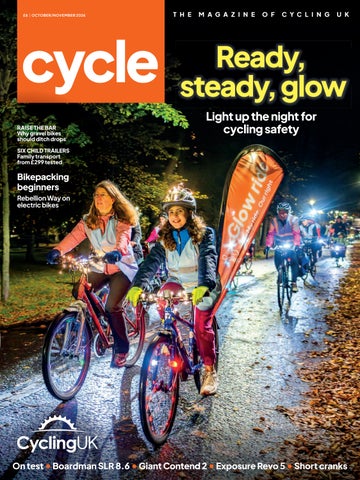
Ready, steady, glow RAISE THE BAR Why gravel bikes should ditch drops
Light up the night for cycling safety
SIX CHILD TRAILERS Family transport from £299 tested
Bikepacking beginners Rebellion Way on electric bikes
On test • Boardman SLR 8.6 • Giant Contend 2 • Exposure Revo 5 • Short cranks
From the editor Cycling UK: Parklands, Railton Road, Guildford, GU2 9JX E: cycling@cyclinguk.org W: cyclinguk.org T: 01483 238301 Cycle promotes the work of Cycling UK. Cycle’s circulation is approx. 51,000. Cycling UK is one of the UK’s largest cycling membership organisations, with approx. 70,500 members and affiliates. Chief Executive: Sarah Mitchell. Cyclists’ Touring Club, a Company Limited by Guarantee, registered in England No 25185, registered as a charity in England and Wales Charity No 1147607 and in Scotland No SC042541. Registered office: Parklands, Railton Road, Guildford, GU2 9JX. Cycle magazine: Editor: Dan Joyce E: editor@cyclinguk.org Designer: Christina Richmond Advertising: Tilly Prytherch T: 0203 198 3092 E: Tilly.Prytherch@ jamespembrokemedia.co.uk Publisher: James Houston. Cycle is published six times per year on behalf of Cycling UK by James Pembroke Media: Ground Floor, Riverside North, Walcot Yard, Bath, BA1 5BG. T: 01225 337777 Cycle is copyright Cycling UK, James Pembroke Media, and individual contributors. Reproduction in whole or in part without permission from Cycling UK and James Pembroke Media is forbidden. Views expressed in the magazine are those of the individual contributors and do not necessarily reflect those of the editor or the policies of Cycling UK. Advertising bookings are subject to availability, the terms and conditions of James Pembroke Media, and final approval by Cycling UK. Printed by: Acorn Web Offset Ltd, Loscoe Close, Normanton Industrial Estate, Normanton, WF6 1TW T: 01924 220633
Not every cycling development is unalloyed progress. Arguably (p30), even something as popular as the gravel bike could be much better. Yet when it comes to lighting we are truly living in a golden age. You can buy brilliant hub-dynamo lights. There are battery lights with car-headlight lumens and hourslong runtimes. Remember when bike lights were like a cinema usher’s torch? Thirtyfive years ago I was commuting around 30 miles a day, cycling to and from the offices of New Cyclist magazine in Coldstream. My Ever Ready lamps were powered by a pair of weighty D-cells that would scarcely last the journey home. (To avoid spending my wages on disposable batteries I used NiCads, which had to be recharged every night and popped into the lamps every morning, still warm.) If you hit a pothole, the front lamp would sometimes leap from its bracket. The pitiful beam – a pale glow extending a handful of metres beyond the front wheel – made pothole strikes inevitable. One night I hit a horizontal trench on an otherwise unlit road. Seeing it at the last second, I bunny-hopped only most of the way across. The rear wheel hit the far edge square on, causing a snakebite puncture. The dull inconvenience of having to fit a spare tube was given an extra frisson of excitement by the knowledge that the NiCad batteries were dying as I worked… Today’s cycle lights are exponentially better and make night-time riding more practical than ever. But if we want more people to cycle for transport both day and night, the lights themselves are only a small part of the solution. Turn to page 14 for more.
14 36 Light up the night
cyclinguk.org
cycling at night
bike world
IN THE FRAME
07 Quick releases
39 Gear
How the Cyclists’
Components and
Defence Fund is taking on Merseyrail; your
accessories tested
cycling legacy; financial
44 Shop window
advice from M&G; and
Previews of new
more
products
14 Ready, steady, glow!
46 Budget road bikes
Shining a light on women’s cycling safety this October
£650 Boardman SLR 8.6, £750 Giant Contend 2 52 Child trailers
TOUR & EXPLORE 18 Bikepacking
Six options for towing pre-school children
made e-asier Bikepacking novices ride Rebellion Way on e-bikes 24 Traffic-free France Travelling to an event
OVER TO YOU 57 Letters Your feedback on Cycle and cycling
in Angers on the Vélo
60 Q&A
Francette
Your technical, health and legal questions
FEATURES 28 Raise the bar
Editor Top: Andy Catlin
Founded in 1878
A beginner’s guide to
04 Freewheeling Bits and pieces from the
DAN JOYCE Cover photo: InfraSisters glow ride in Edinburgh, 2025. By Andy Catlin
QUICK RELEASES
Is it time to ditch the drops for UK ‘gravel’
62 Profile What racing cyclist Fraser Martin did next
riding? Three experts
65 Travellers’ tales
explain what they use
Your ride reports
OCTOBER/NOVEMBER 2026
3
Save money Lower gears for less Road bikes are often over-geared for everyday riding. One of the least expensive ways to address that is to fit a gear-hanger extender such as SunRace’s SP570 Extender Link (£11.99, ison-distribution.com). This lowers the position of the rear derailleur, enabling you to fit a larger cassette. Aside from the new cassette and gear-hanger extender, all you need is some extra chain links to ensure you can still run big/ big. It’s an easy way to fit an 11−36 or larger cassette in place of an 11−32.
Watch this
Cycling UK’s new videos spotlight the people and places being transformed by cycling. They demonstrate that when councils make bold choices to invest in cycling, it works. It gives more people the confidence to cycle, makes high streets more vibrant and creates nicer places to live. We hope our new report, The Route Forward, will convince decision-makers that cycling investment pays off. cyclinguk.org/route-forward
Freewheel i Find a local group near you and enjoy a ride this weekend: cyclinguk.org/ group-listing
A short tour around the wonderful world of cycling On my bike
Prof Scarlett McNally OBE
Consultant Orthopaedic Surgeon and BMJ columnist
Right: Scarlett McNally. Top right: neurofactor/Pilot Cycles
Why do you cycle? For health and to get around. In 2019 I was too ill to walk. I bought an electric bike and got strong enough (along with some chemo) to have a stem cell transplant. How far do you ride each week? About 40 miles for travel – commuting and between train stations and conferences. About 20 miles for leisure. Which of your bikes is your favourite? My electric bike for commuting. I think that getting started after traffic lights speedily and getting up hills speedily means drivers are often less angry.
4
OCTOBER/NOVEMBER 2026
What do you always take with you when cycling? Waterproof over-trousers Who mends your punctures? On several occasions, I’ve had a puncture and got in a taxi to a bike shop. Don’t judge me! I fix people for a living. I’m usually in a rush to get somewhere. It’s raining: bike, public transport or car? Bike. I’m smug past the traffic! We need to make cycling normal. Please read ‘The Bristol Declaration’ at www. fph.org.uk – I led this. It explains the links between transport and health and how everyone can help with the practicalities. Lycra or normal clothes? Normal and as smart as possible. It’s transport not a sweaty race. If you had £100 to spend on cycling, what would you get? A few years ago, at Bespoke cycle
cyclinguk.org
Magic carpets aren’t real The potential difference in ride feel between titanium and carbon bicycles was measured for the first time this summer using mobile electroencephalography (EEG). The result? Riders’ brains looked the same on both bikes. The famous ‘magic carpet’ smoothness of titanium didn’t show up on the EEG. There was no measurable vibration difference between the frames. The differences between riders were many times greater than between the two bikes. One small but unconfirmed signal – possible calmer steering on titanium in the technical section – will be the subject of a follow-up study. neurofactor.nl/en/cases/ pilot-titanium-vs-carbon
l ing
campaign group in Eastbourne, we got 20 sets of lights to give to people we saw cycling without them. I’m coorganising our glow ride to get more women cycling this year. Anything that increases confidence and safety would be worth considering. What’s your favourite cycle journey? We’ve been campaigning for a seafront cycle route in Eastbourne for 15 years. There are lovely forbidden sections. I’m weary of the same people objecting while the town gets more congested, unhealthy, polluted and with unwarranted transport poverty. What single thing would most improve matters for UK cyclists? 20mph where people are. It massively reduces injuries and fear. What we really need is good infrastructure, but until we get proper funding, 20mph is cheap, rapid and effective.
cyclinguk.org
Your ride
Al Donald
Following a diagnosis of multiple sclerosis, Al Donald in East Lothian found that he was feeling down and losing confidence. Borrowing an e-bike from Cycling UK’s Connecting Communities project enabled him to rediscover cycling. “It was a chance to try and rediscover cycling again and to feel the benefits of motion and exercise and being outdoors in the fresh air,” he says. “A friend had been down to one of the sessions at Musselburgh and told me about it. We’ve been going regularly since then. The cycling really does help.” Al already owned a 16in-wheel Brompton, but says that the Brompton G-Line Electric he borrowed has been a game changer. “I’ve been to the shops, the gym, right across to the other side of Edinburgh to go visit a friend. Yeah – it’s great… It reminded me how precious cycling can be and how precious being able to use a bicycle is. It’s benefitted my mental health. It really has. It lifts my mood.” He struggles to find the right words: “It just makes me… it cheers me up.” Connecting Communities receives funding from a Scottish government People and Place grant, administered and supported in the south-east of Scotland by SEStran. For more details, visit: cyclinguk.org/connecting-communities-al
Cycling UK at industry’s Oscars Cycling UK has been shortlisted in two categories in the 2026 BikeBiz Awards, which acknowledge excellence across the cycling industry. We’re up for Cycling Advocacy of the Year, which is decided by a panel of
judges, and Cycling Media of the Year for Cycle magazine, which is voted for by the public. Voting will have closed by the time this issue lands of your doormat. Winners will be announced at a ceremony in Birmingham on 15 October. bikebizawards.com
OCTOBER/NOVEMBER 2026
5
Quick releases
Cycling news and views from around the UK Left: Sara Lincoln Photography
CAMPAIGNS
Right: Magdalena Cichocka
Eurostar delays
Merseyrail fail People being banned from cycling infuriates our members. Whenever it’s suggested my inbox fills up with messages asking what we’re going to do about it, writes Duncan Dollimore. Cycling UK set up the Cyclists’ Defence Fund (CDF) 25 years ago so we could step in and challenge decisions that affect cyclists or cycling. Though we’ve intervened in many other cases, including the unlawful removal of cycle lanes and the failure to prosecute a driver following the death of a cyclist, the threat of bike bans has been a constant. Ten years ago, it was Mansfield. The council proposed to use a public space protection order to ban cyclists from the entirety of the town centre at all times. We took legal action and the council changed their plan. This summer it’s Merseyside and surrounding areas, with trainoperating company Merseyrail trying to ban all non-folding e-bikes from their network, including all 69 train stations. We’re challenging this through the Cyclists’ Defence Fund. There has been no consultation and Merseyrail has refused to share any evidence
cyclinguk.org
for its decision. The response from Cycling UK members on the e-bike ban has been electric, with Merseyrail and local MPs inundated with complaints and emails. Over the last 25 years, CDF has had to adapt to new challenges, and this year e-bikes have been a theme. In July, through CDF, we intervened after West Midlands Police wrongly seized and destroyed a £6,500 e-bike belonging to one of our affiliated community cycling clubs, then threatened to prosecute the rider. After our intervention the police accepted their mistake, have compensated the community club, and are taking no further action. If we’re not ready to challenge cases like these, other train-operating companies or police forces may take similar actions. But to be ready we need your support, because CDF is entirely funded through your donations. So if you’d like us to carry on challenging companies like Merseyrail and want us to fight for cyclists’ rights across the UK for another 25 years, please consider donating to CDF today. cyclinguk.org/campaigns/cyclistsdefence-fund
Jointly with the European Cyclists Federation, we recently met with Eurostar to push them to improve provision for bikes on their trains. Nonfolding, fully assembled bikes can only be taken on the London-Brussels route now, and the booking process is not easy. With Virgin Trains set to run services through the Channel Tunnel from 2030, we have reminded them of the requirement to carry eight fully assembled bicycles per train, according to French and Belgian national rail laws.
Could you be our next big winner?
For just £1 a week, you could be in with a chance of winning the £25,000 jackpot every Saturday in the Cycling UK Lottery. There are other prizes too, including £2,000, £250 and £25, plus a special prize in the monthly Super Draw. With a 1-in-50 chance of winning a prize, your odds are better than many other lotteries. And there’s a feel-good bonus: 55% of lottery proceeds go directly towards Cycling UK’s work to make cycling safer, more accessible and enjoyable for everyone. cyclinguk.org/ lottery
OCTOBER/NOVEMBER 2026
7
Quick releases
Bike Active North Suffolk is running one of its regular sessions for cyclists or would-be cyclists with disabilities or differing needs in Halesworth on 20 October. A range of adaptive cycles are available for the short, traffic-free ride. The suggested donation for taking part is £5. cyclinguk.org/accessible-cycling-halesworth
COMMUNITY 01
Scotland Annual Gathering
03
C&NW President’s Ride
Cycling UK’s Scotland Annual Gathering takes place at 11am on Saturday 31 October at the Augustine United Church Hall in Edinburgh. Speakers include endurance cyclist Christina Mackenzie, mountain biker Kerry McPhee and Ashley Wheaton, Cycling UK’s Chair of Trustees. There will be a panel discussion on cycle campaigning and updates about Cycling UK’s community projects, campaigns and policy work and our latest route, Gallovidian Gravel. It’s free to attend but registration is essential for catering. Donations are welcome. cyclinguk.org/ scotland-annualgathering-2026
Autumn in the Peak
Chester and North Wales CTC members will be taking part in the President’s Ride on 22 October. It’s an annual event that enables riders from all parts of the widely spread group to meet up and cycle with fellow members. The route alternates between North Wales and Cheshire; this year it’s Cheshire’s turn. It starts and finishes at Walk Mill, near Waverton. All cyclists are welcome but booking is essential. cyclinguk.org/presidentsride-2026
01
03
02
04
04
02
Right: Getty Images
Enjoy the Peak District at its autumn best on this scenic and challenging 65-mile (105km) audax ride on Saturday 24 October. Starting in Marple, the ride includes a loop around Ladybower Reservoir, climbs over Snake Pass and takes in the Upper Derwent Valley Reservoirs. The return journey visits Tideswell’s famous Cathedral of the Peak before winding through Perrydale and tackling the climbs of Peaslow and Peep O’Day. The ride finishes with a well-earned curry or sandwich. Visit the website for more information or to book your place. cyclinguk.org/autumn-peak
British Human Power Club AGM The AGM for the British Human Power Club, which promotes all aspects of humanpowered vehicles for competitive, recreational and utility activities, takes place at the Hillingdon Cycle Circuit, Hayes, on 18 October. It will be preceded by the last race of the 2026 Championships Series, and trophies will be awarded at the AGM. Those wanting to race must sign-on beforehand; it’s £9 for BHPC members and £14 for non-members. More details online. bit.ly/bhpc-2026-agm
8
AUGUST/SEPTEMBER 2026
cyclinguk.org
Quick releases NEWS & EVENTS
Left: Getty Images
Vote now for your trustees
What legacy will you leave behind? We’re delighted to be supporting Free Wills Month this October, a national campaign helping people make or update their will. Through Cycling UK’s partnership with Octopus Legacy, members can write a simple will for free, with options to do so online, by phone, by video call or in person. There’s no obligation to leave a gift to Cycling UK – it’s simply an opportunity to make planning for the future that little bit easier. If cycling has been an important part of your life, we’d love you to consider leaving a gift in your will to Cycling UK. It’s a lasting way to share your passion with future generations and help protect the future of cycling. For generations, Cycling UK has helped people experience the freedom, friendship and joy
“If cycling has been an important part of your life, we’d love you to consider leaving a gift in your will to Cycling UK” 10 OCTOBER/NOVEMBER 2026
that cycling can bring. A gift of any size can help us campaign for safer roads and routes, and help more people discover the benefits of travelling by cycle. Including a gift to Cycling UK in your will enables you to pass on your cycling legacy, as life member Mr Millington explained. “Leaving a gift to Cycling UK in my will is the best way to honour what cycling has given me,” he said. “Cycling has given me so much; I want to pass that joy onto generations to come.” If you already have a will, you can still add a gift to Cycling UK using a codicil. You can download the form from our website or, if you’d prefer a paper copy, get in touch and someone from our team will be happy to send one to you. Whether you’re writing your first will, updating an existing one or simply thinking about the future, Free Wills Month is a good opportunity to put your wishes in place. Find out more at cyclinguk.org/legacy or email giftinwills@ cyclinguk.org
Your Cycling UK trustee elections voting form is enclosed with this issue of Cycle. Details of the candidates and instructions on how to vote are included on the form. All candidate statements can be found on the website at: cyclinguk.org/becometrustee. The deadline to vote is 9am on Friday 23 October. Thank you to those who cast their vote and attended the 2026 Cycling UK AGM. Outcomes from the meeting, along with details presented, can be found online. cyclinguk.org/agm-2026
Membership FAQs and figures We’ve brought together answers to some of the most common questions members ask about their Cycling UK membership. You can find these Frequently Asked Questions (FAQs), along with our updated Terms of Membership, at cyclinguk.org/ membership-tandcs. We hope you’ll find the information you need there, but if your question isn’t covered, please email membership@ cyclinguk.org or call us on 01483 238301 (lines open 10am to 4pm Monday to Friday) and we’ll be happy to help.
cyclinguk.org
Quick releases MEMBER BENEFITS
Plan your next cycling adventure Whether you’re looking for a UK escape, a European tour or a long-haul cycling holiday, Saddle Skedaddle offers Cycling UK members exclusive discounts on a range of incredible cycling trips. With options for road riders, gravel enthusiasts and leisure cyclists, there’s plenty of inspiration for your next adventure. Thinking ahead to 2027? Take a look at pages 22−23 for Saddle Skedaddle’s top picks and start planning your next unforgettable ride. cyclinguk.org/saddleskedaddle
Plan what your future could hold Just as you’d plan a long ride before setting off, taking time to plan your finances could help keep your future on track. Many people contemplating retirement find themselves wondering:
Photo: Getty Images
• Am I saving enough for the retirement I’d like? • Will my pension last as long as I need it to? • Could I be making better use of my savings?
12
As a Cycling UK member, you can book a free consultation call with an expert financial adviser from M&G Advice. They’ll help you understand your current position, discuss your goals and explore the options available to you. You’ll receive a personal recommendation at no cost to you; a charge will only be payable if you choose to proceed with their recommendation.
OCTOBER/NOVEMBER 2026
M&G Advice provides a restricted advice service, recommending from a carefully selected range of products and funds. Good financial advice could help bring clarity to important decisions and provide reassurance that you’re heading in the right direction. Research* found that people who took financial advice increased their wealth by around £47,000 over ten years, demonstrating the value that advice could provide in a wide range of financial circumstances. To find out more and arrange your free consultation call, visit: cyclinguk.org/ mandg *Source: ILC-UK (International Longevity Centre UK) ‘What it’s worth’ report, 2019. The research explored the impact of financial advice between 2001−2006 on financial outcomes in 2014−2016. Due to the fact this study was carried out over such a long period, it is the latest data available.
Keep your kit dry this autumn with Ortlieb Wet roads and unpredictable weather are all part of autumn riding, making dependable waterproof luggage more important than ever. Ortlieb’s range of panniers, commuter bags and bikepacking gear is designed to keep your belongings protected from the elements. Built for durability and everyday practicality, Ortlieb products are trusted by cyclists worldwide. Cycling UK members can enjoy 10% off Ortlieb products. cyclinguk.org/ortlieb
cyclinguk.org
Quick releases CAMPAIGNS
Ready, steady,
glow Last autumn’s glow rides were brilliant, with thousands of riders lighting up the night all across the UK. This year they’re on 22 October. Why not join us? Glow rides are celebrations of cycling that spotlight the need for safer streets and better cycle routes, especially for women riding after dark. Open to all but focused on women’s safety, the rides are organised by local cyclists and community groups. Highlights from last year Last year’s glow rides brought together people of all ages to highlight safety issues Glow rides aim to make a statement
14 OCTOBER/NOVEMBER 2026
while showing the strength and unity of communities wanting safer walking and cycling routes. Despite heavy rain, almost 3,000 riders lit up roads from Plymouth to Perth with bike lights, glow sticks and reflective gear to shine a light – literally – on the barriers to cycling that women continue to face. Some events had up to 100 people, while others were just a group of friends decorating their bikes and going for a ride. A glow ride can be as big or small as you like. Anne-Marie Goldsmith was one of last year’s participants. She had a brain haemorrhage that caused a stroke almost 30 years ago, which led to her to not being able to cycle. “I accepted that I would never ride a bike again,” she said. However, she was persuaded by a friend to join her on the back of a tandem. She’s never looked back, saying that cycling was “completely liberating”. By taking part in the event
she said she felt she was doing her bit to promote cycling for women. Why glow rides are important In most parts of the UK, safety concerns continue to dominate women’s decisions around cycling. Despite growing enthusiasm for active travel, women often feel shut out from the freedom that cycling can bring. “[Many women] get very nervous about going out in the dark, especially when they are cycling alone if the streets aren’t lit or if they’re going down dark alleyways, ” said Lorraine Murrell, chair of Newbury Road Club. “[The fact that] a lot of ladies get nervous is sad as that spoils their love of cycling.”
“No one should feel forced to choose between a busy road and a dark, isolated path”
What we’re campaigning for Glow rides are part of Cycling UK’s women’s safety campaign ‘My ride. Our
cyclinguk.org
Quick releases
Be a shining example Mass women’s rides will be taking place in towns and cities across the UK to call for safer streets and for routes designed with women’s needs in mind. No one should feel forced to choose between a busy road and a dark, isolated path. There should be a route that feels safe and welcoming. Glow riding in Portsmouth last year
ride’ (cyclinguk.org/my-ride-our-right), which calls for safer cycling routes for women and for more investment in infrastructure to address the gender divide. We are calling for long-term funding for cycling and walking, and for cycling networks designed and delivered to reflect the journeys women need to take. That means not just building commuter corridors for city workers but developing routes that serve school runs, shopping trips, healthcare visits and other everyday journeys – particularly within local neighbourhoods. “Improving safety for cyclists means more
cyclinguk.org
than adding painted lanes,” said Kitty Cresswell Riol, Norwich glow-ride organiser. “It’s about designing streets that feel welcoming and secure for everyone. Protected cycle lanes, better lighting and well-designed junctions make a huge difference, especially for women riding after dark. Lower traffic speeds, connected routes and visible cycle parking all help create an environment where cycling feels safe, practical and inclusive.” On 22 October, you too could be a shining example of the demand for safer cycling conditions for women: join a glow ride or organise one in your area.
Photos, CW from main image: Gareth Davies, Robyn Furtado, Kerry Morgan, Andy Catlin
This 2025 glow ride lit up the streets of Worcester
To find a ride near you or register your own, read our guides: cyclinguk.org/glowrides. If you have any questions, email campaigns@ cyclinguk.org. We may even be able to put you in touch with someone nearby who has organised a glow ride before.
This year’s Glow Rides are sponsored by cycling distributor ZyroFisher, with Altura and CatEye helping us make the night shine.
OCTOBER/NOVEMBER 2026
15
Tour&explore
Bikepacking made e-asier Great rides
18 OCTOBER/NOVEMBER 2026
cyclinguk.org
Tour&explore
Looking for an achievable adventure, bikepacking novices Katie Mackenzie and Jenny Box spent three days riding part of Rebellion Way on e-bikes
L
et’s get away for another long weekend this year,” my sister Jenny suggested. We’ve hiked through the Peak District before but didn’t want to repeat that. As I’d recently bought an e-bike, I voted we try bikepacking. We’ve both cycled a lot but never on a multi-day trip. One of Cycling UK’s long-distance routes would be a great opportunity to test my e-bike – and ourselves. Jenny could hire an e-bike. We settled on Rebellion Way, the 373km (232 miles) route around Norfolk. We know the area pretty well already, so it felt like a safe introduction to bikepacking. Rebellion Way is supposed to take five-to-seven days and we only had three, but surely on e-bikes we could whizz round? I did some longerdistance trial runs and realised that 80 miles in a day was ludicrous for us. We would scale it back to no more than 50. That meant some tweaks to the route: we’d skip the bottom section and only do the bits we were most interested in.
support crew/driver (my husband). He was doing the first 15 miles with us on his gravel bike before turning round and returning home. It was beautiful in the forest and the riding was flat and easy. The forest lasted for much of the first half of the day. It was glorious: shady trails; great coffee; and lots of friendly cyclists and walkers. Then we hit ‘the sand’. Having burned out my motor a few weeks earlier on a sandy heath in Suffolk, I cautiously made us walk. It wasn’t pleasant but thankfully didn’t last too long, as e-bikes laden with panniers are not what you’d call ‘lightweight’. Back on the road, we bowled into Swaffham to be confronted by market day. We found our intended café and, a little dazed from the sudden hustle and bustle and low on blood sugar, we ordered the first thing on the menu: the Rebellion Way Toastie. We were kindly allowed to plug in our batteries. Feeling deflated Suitably revived, we set off for our afternoon’s journey north to the sea. We diverted from Rebellion
Way to visit the village where our grandparents lived. From there almost all the way to Heacham we were on a 12−mile-long mostly unpaved track. Off-road riding is rather bumpy when your bike is heavily laden, requiring lots of concentration to avoid sharp stones, holes and sandy patches. Disaster struck. With about 10 miles to go, I noticed that my back wheel kept sliding about. I had a flat tyre. As we were in the middle of
“The first half of the day was glorious: shady trails; great coffee; and lots of friendly cyclists. Then we hit ‘the sand’”
Sun, trees and sand The forecast for the spring bank holiday at the end of May was spectacular: three days of sun. With our mother’s warnings of extreme heat in Norfolk in our ears, I bought one of those little caps that go under your helmet to keep the sun off your face. That would do the trick… Carrying enough snacks to last us a week and lots of water, we set off from Brandon Country Park with our
Top left: Just beyond Lynford, Our Lady & St Stephen Church Bottom left: Bridge over the River Wissey, by the flooded gravel pits of Lynford Water Top right: Puncture kit but no wheel-removal tools Bottom right: Sunset over The Wash at Heacham
cyclinguk.org
OCTOBER/NOVEMBER 2026
19
Tour&explore
Fact file Bikepacking made e-asier Distance: 215km (134 miles) over three days. Route: Mostly following Rebellion Way, we started in Brandon, Suffolk, and headed north to the coast at Heacham. Day two was east along the coast to Sheringham. Day three was south-east to the Norfolk Broads, east of Norwich. Conditions: A mix of off-road tracks and small country roads. A couple of busy areas, like Swaffham and Wroxham, but mostly quiet with little traffic. Glorious sunshine the whole time. Bikes used: Katie – Giant Explore E+ 2 with 625Wh battery. Jenny – rented electric mountain bike with 504Wh battery. Recharging: We recharged the batteries each night, carrying them to our rooms. We topped up the batteries at café stops along the way when required. Navigation: Komoot app. I also used the Giant app on my bike’s screen. It was perfect: we didn’t have any arguments about directions and were never lost. I’m glad I had… A kickstand for my bike - we stopped a lot and it makes life so much easier. Two water bottles each and lots of snacks. A phone holder on my handlebar; it would have driven me mad to keep taking my phone out of my pocket to check the route. A power bank for my phone. Next time I would… Make sure we had more ergonomic handlebars as we both got sore wrists and hands. Take better equipment for fixing punctures. Go for a longer trip! Further info: cyclinguk.org/ rebellion-way; komoot.com; ordnancesurvey.co.uk.
20 OCTOBER/NOVEMBER 2026
nowhere, we had no choice but to try to patch it up. We couldn’t get the wheel off with our little multitool, but managed to pull out a thorn and then remove and patch just that section of tyre. Then we had an almighty battle to get the tyre back on. Much swearing was done. We pumped up the tyre, proud of ourselves for completing the task… and then watched as the pressure started seeping back down again. Too tired to go through it all again, we continued on to Heacham, stopping every mile to pump up the tyre – until the pump seemed to give up and I began losing more precious air than I was putting in. I mentally calculated how far I could walk if I had to. In the end, the slowly softening tyre held up long enough to get us to the hotel by 6pm. We settled down with cold drinks and good food, steeling ourselves to deal with the problem the next morning. After a hot, anxious night, I rushed to the nearby bike hire place next morning. The woman behind the desk had no idea about bikes; she was running the golf shop and would be on her own all day. Reluctantly, I did the one thing I didn’t want to do: I asked my husband for help. He sweetly loaded up the car with the proper tools and drove nearly two hours to mend my bike for me. After a pause for a coffee, he sent us on our
Clockwise from above: Approaching Holkham Hall. Taking a photo of a distant windmill – a big ask for a phone’s camera. Journey’s end at Woodbastwick. Celebratory pints at the Fur & Feather Inn. The climb up to Beeston Regis Heath was too steep to pedal even with electric assistance
way and then drove all the way home again. What a legend! National Trust, proper teas Having lost both time and our desire to ride on gravel tracks, we shortened our route and removed most of the off-road sections. It was still a lovely journey. We cycled past the impressive Holkham Hall. At Wellsnext-the-Sea we stopped at a nice pub for lunch and a recharge (us and batteries). Then we rode through many pretty villages to finish the day in Sheringham, where our youth hostel and a pub overlooking the sea awaited us. Day three dawned with a hearty breakfast. We were keen to see what the next section of the trip would bring. That turned out to be an immediate off-road, uphill section that was so steep we both had to get off and push. Even MAX POWER couldn’t haul us up.
cyclinguk.org
Tour&explore
We were rewarded with the most beautiful downhill section through rhododendron-studded woodland, where we didn’t have to pedal at all for a couple of miles. The rest of the morning was lovely. We passed Felbrigg and Blickling Halls, then stopped at a National Trust tearoom for an early lunch. (It’s compulsory to stop at a National Trust tearoom.) Arriving at Aylsham, we were looking forward to the Bure Valley Path, an eight-mile stretch of cycle track running beside a small steam railway. We got to see a lot of the steam train as we played tag with it along the way. It would stop; we would stop. I did a lot of waving to the passengers, and the driver blew the whistle for me. Narrow trails and Broads The only fly in our beautiful Norfolk ointment was that both our bikes had wide handlebars – almost too wide for the Bure Valley Path, which is lined with wire fencing. One false move and your bar is lodged in the wire. We both ended up in the fence, with
“The hill was so steep we had to get off and push. Even MAX POWER couldn’t haul us up” cyclinguk.org
scrapes and bruises to show for it. Jenny managed to dislodge her chain. We just could not get it back on. Possibly it was because we were too dripping with sweat in the midday sun to see what we were doing. I accosted a man out for a ride with his family and asked him to help. Covered in chain oil and with only a wet wipe for his troubles, he fixed it and then rode away through the heat haze to catch up with his family. After a while, the path switched to the other side of the train track and was much wider, so we had a more relaxed pootle down to Wroxham, which was very busy on the sunniest bank holiday Monday ever. The Broads were chocka with people messing about on the water. We stopped to take in the views down at Salhouse Broad. It was fun to watch the novice boaters tackle steering. No judgement from us after our Bure Valley mishaps! All too quickly, we were onto the home stretch. After more quiet country lanes, watching wildlife and nattering, we rolled into our final pub stop for a celebratory pint. This last stretch felt bittersweet, knowing our glorious tour of Norfolk would soon end. We were looking forward to a rest, but neither of us really wanted to leave our new life on the road. That’s the best way to finish an adventure: wanting more.
Plan your own adventure Inspired by Katie and Jenny’s trip? Why not plan an adventure of your own with Cycling UK’s collection of long-distance routes? From peaceful lanes and historic market towns to rugged coastlines, ancient landmarks and spectacular landscapes, our routes are designed to help you discover the very best of Britain by bike. Whether you’re looking for a weekend escape, a touring holiday or your next bikepacking challenge, there’s an adventure waiting to be explored. Plan with confidence using our official guidebooks, packed with maps, itineraries and expert advice. Each guidebook is the perfect companion to the official GPX download. Completed a route? Celebrate your achievement with a beautifully designed art print, produced in partnership with Ordnance Survey, available in light and dark editions. cyclinguk.org/routes
OCTOBER/NOVEMBER 2026
21
Tour&explore
Great rides
Traffic-free France With a gravel-biking event in western France to attend, Jo Burt and his partner Claire left the car at home and cycled there on the Vélo Francette
O
f course, the only problems we had on our trip down and up the Vélo Francette were British based. The first one was our train to the ferry in Portsmouth, which dependably turned into a bus for the last bit so we had to ride the final eight miles, including an anxious section along a dual carriageway because the cycle lane was shut. The other was the GB-stickered driver who took exception to us cruising to the front of the lengthy passport queue once in France and used his campervan as a weapon to barge into us to display his
24 OCTOBER/NOVEMBER 2026
displeasure. Apart from that it was lovely. The Vélo Francette is a 600km cycle route that runs through northwest France from the Channel port of Ouistreham to La Rochelle on the Atlantic. It uses old railway lines, riverside trails and quiet roads to ensure a tranquil, traffic-free experience. We – that’s partner Claire and I – were using it to travel to the Nature is Bike gravel event in Angers, which conveniently sits on the route about halfway down. We rode the event a couple of years back and enjoyed it so much we resolved to return but cycle there and back instead of driving. We took an overnight Brittany
Ferries across the wet bit to turn it into a proper adventure. We split the trip into two days each way. The terrain doesn’t have a challenging elevation profile, and the character of the route means minimal navigation complications, so it ought to have been easily doable and a relaxing ride. We hadn’t factored in the first heatwave of the summer, the constant pedalling nature of a steady railway grade, both up and down, and Claire having a Bad Day On The Bike. From Channel to canal As soon as you’re off the ferry at Ouistreham (incidents aside), you’ll see signs for the Vélo Francette. Within minutes you’re cruising south
cyclinguk.org
Tour&explore
nip off in search of a long lunch, or just as an excuse to explore the area. The Vélo Francette website is a wide-ranging resource for route planning, accommodation and bike-friendly information if you need help in this regard. We like to live on our wits and Google Maps to forage for food, which fortuitously leads to an award-winning bakery’s filled baguette in Château-Gontier.
“We stumble sun baked into a welcoming, air-conditioned Carrefour for snacks”
cyclinguk.org
Opposite: Much of the Vélo Francette is on ex-railway lines Above left: Other sections follow waterways, such as the Canal de Caen à la Mer Above right: The route is signposted as soon as you’re off the ferry Below: Mayenne (town, river and department)
Fact file La Vélo Francette Distance: Our total distance was 590 kilometres over four days, with a roughly 160km/130km split both ways. Route: We followed the Vélo Francette all the way to Angers, and then back again. Conditions: It was… warm. Tyres rolled along tarmac, gravel, broken road, cinder track and sand. Bikes used: A gravel bike and a mountain bike. Maps/guides: GPS. GPX files downloaded from cycling.lavelofrancette.com. I’m glad I had… A GPS. Not that the route was complicated, but it makes navigation faff free. Next time I would… Not go to a gravel event midway. Take my 32mm-tyred road bike instead. Maybe also an iPod. Further info: General information for cycling in France (in English) – en.francevelotourisme.com. Cycling UK’s advice on taking your bike on ferries – cyclinguk. org/bike-ferry
The cycleway south As we’re aiming for a gravel event, Claire is on her Mason gravel bike. Because my own gravel bike is undergoing a poorly timed refurb, I’m on my Specialized hardtail
Photos: Jo Burt
on a shared path alongside the Canal de Caen à la Mer, and 10 kilometres later you’re into Caen proper. After a bit of a fiddle to get through the city and navigate safe passage through an inordinate amount of joggers, the Vélo Francette starts in earnest. You could probably stop here for the first of many coffees and patisseries, but with a long day ahead of us and being generally crowd averse, we decide to crack on and eventually stop after about 50km in Saint-Rémy to grab a late breakfast. After about 55km the route morphs into quiet country roads for a short spell. Their corners, curves and undulations are a blessed relief on both the legs and head after the wonderfully traffic free but unexciting constant-gradient straight lines of the ex-railway line. Flers appears at 100km. We stumble sun baked into a welcoming, airconditioned Carrefour for a basket of snacks, then sit in the shade by the trolleys inhaling a family pack of icecreams and trying to rouse Claire’s legs. Whether you want to just grab and go or tour some French cuisine, the Vélo Francette passes through some major towns and small villages where there’s plenty of opportunity to
AUGUST/SEPTEMBER 2026
25
Tour&explore
MTB with fast tyres, which is lumbering overkill to be honest. The surface under tyre is a mix of tarmac, light gravel, cinder track, scruffy path and a few sandy bits so you’d be absolutely fine onboard a touring bike or fattertyred road bike. We encounter all sorts of other riders, from old folks on e-bikes to wood-stain-tanned tourists, and no one is having problems clipping along. Ride what you’ve got; you’ll be fine. Our halfway overnight is in Mayenne, the name of the town, river and department. For a large town it’s surprisingly empty. In true French fashion, evening meal choices seem limited so we go for the easy option, which is a curry house right underneath our accommodation and in the shadow of the town’s castle, on the hottest evening of the year, on a terrace overlooking the river. It’s nice if a little incongruous. The waiter apologises for the bottles of Kingfisher not being English sized. The next morning we make sure the hotel doesn’t make any profit on their €10 extra breakfast buffet and then continue south.
Top left: Jo and Claire’s destination: the Nature is Bike festival in Angers Above: If you want more châteaux, the Vélo Francette intersects the Loire by Bike route Left: It’s well signed throughout
and some of those cottages have been handily converted into tiny cafés. While we’re travelling down the Vélo Francette with a destination in mind, it makes for an excellent quiet corridor to get you through this whole region of France before striking out to any number of places: Le Mans, Tours and Poitiers lie to the east; Rennes and Nantes to the west. If you follow it all the way to the end at La Rochelle, you might as well keep going down to Bordeaux. Other long-distance bike routes bisect the Vélo Francette, too. La Véloscénie goes east-west from Paris to Mont-SaintMichel. Our goal of Angers is also on the Loire by Bike route that runs from Saint-Nazaire to Nevers, as well as the less demanding Vallée du Loir à vélo’. Options to keep pedalling abound.
“I’m on my hardtail MTB with fast tyres, which is lumbering overkill”
Look back at Angers From here the Vélo Francette follows the Mayenne river, which makes for a far more stimulating, cooler, meandering and pleasing second day. That barely noticeable gradient is trending downhill now, which also helps. There is more civilisation to pass through. Locks and their attendant cottages regularly punctuate a landscape that is verging on bucolic,
26 OCTOBER/NOVEMBER 2026
There’s a short interlude where we partake in the Nature Is Bike festival, riding the 100km event one day and the more casual Angers Guinguette the next. Then we head back home the same way. It’s not something we’d usually do, preferring circular routes over out-and-backs but it’s not so bad a commute. This does mean that it’s slightly uphill all the way back to Mayenne, our handy halfway stop again, and the much looked forward to gently downhill all the way to the sea has developed a bit of a niggly headwind, ensuring we have to pedal every inch of the way.
Nature is Bike Nature is Bike is a weekend festival based in Angers, designed to get everyone involved in gravel cycling. The event arena takes over a large part of a town park with a bike expo area, food stalls and entertainment. There are seven events running, from the serious Defi200 (won two years ago by ex-pro Victor Bossoni, who went on to conquer the TransContinental and Tour Divide), two overnight bikepacking rides and three one-day gravel rides. There are also two Angers Guinguette rides, which are casual affairs with frequent, relaxed food stops. natureisbike.com
cyclinguk.org
Feature
Raise the bar ‘Gravel’ riding in the UK is rarely best on a drop-bar bike with 38mm tyres. Dan Joyce, Isla Rowntree and Guy Kesteven explain what they use and why
28 OCTOBER/NOVEMBER 2026
cyclinguk.org
Feature
G
RAVEL BIKING IS basically
1990s mountain biking. Plenty of cycling articles, keyboard-warrior comments and YouTube videos start with this premise. While it’s an oversimplification – gravel bikes are not mountain bikes, not even old ones – there’s more than a grain of truth in it for UK cyclists. Gravel bikes are marketed more as go-anywhere, do-anything allterrain bikes than as all-roads bikes. The imagery suggests that they’re the perfect Swiss-army-knife bike, excelling not just on gravel roads but also the same bridleways and less technical trails that made up much of 1990s mountain biking. They’re not. They don’t. The United States has more than a million miles of unsurfaced roads, on which gravel bikes are great. The UK doesn’t. Forest fire-roads and green lanes are as close as we come. A mixed-surface ride here – on one of Cycling UK’s long-distance routes, for example (cyclinguk.org/long( distance) distance – generally includes rights of way that are literally off road and not just off tarmac. So why are so many cyclists using drop-bar bikes with medium-width tyres for rides where a flat-bar bike with bigger tyres would offer more comfort and control? It’s partly (OK, mostly) down to media and marketing. Possibly there’s an element of
Off-theOff-the-peg options We (Isla, Guy and Dan) have settled on our bike choices through trial and error, having ridden countless bikes and bike setups. But we’re not claiming to have unique insights. Some manufacturers already offer flat-bar gravel bikes. Here are a few.
cyclinguk.org
You don’t need a drop bar for extra hand positions or to get more aero
denialism from riders who have just dropped two or three grand on a new bike. (Yes, you can ride a gravel bike there – but you could say the same about an off-road unicycle.) It’s also a reflection of how we got here. Gravel bikes budded from the cyclocross branch of cycling’s family tree. ’Cross bikes have drop bars and narrow (30−something millimetre) tyres. This is not because those are better for cyclocross, as Thomas Frischknecht and Nick Craig proved by winning on flat-bar CX bikes before they were banned. It’s because drops and narrow tyres are enforced by the UCI. Why? Tradition. A few years ago I spoke
MERIDA SPEEDER 100 £800 Merida’s Speeder hybrid range, which had 32mm tyres and was aimed at commuters and fitness riders, has ‘gone gravel’ (sic). The new bikes have: 45mm tyres, with room for 50mm; a slacker head angle; and more frame mounts. A mid-step frame is an option. merida-bikes.com
to Jeff Jones about his own bikes. Cyclocross, he said, is like having a foot race where all the competitors have to run in high heels. Gravel bikes have diverged from cyclocross bikes as designers have grappled with the problem of making an essentially unsuitable bike better able to deal with off-road trails. The geometry has changed. Tyres are bigger. Bars have widened and flared. All this has helped but, I would argue, misses the point. If you really want to raise the bar for what we consider gravel riding in the UK, you have to start by ditching that drop bar altogether.
“Gravel bikes are marketed more as allterrain bikes than as allroads bikes”
SCOTT SCALE GRAVEL 10 £2,349
Your eyes don’t deceive you: the Scale Gravel 10 is fully rigid carbon-fibre mountain bike with 29×2.4in XC tyres and inboard Spirgrips for more hand positions. It’s equipped with 1×12 SRAM S1000 Eagle AXS wireless gearing. scott-sports.com
SONDER CAMINO AL APEX1 FLAT BAR £1,199 The Camino is ‘built for those moments when the road turns into trail and the bridleway drops off into singletrack’. Most have drops. This, the cheapest by £300, has a flat bar, plus a carbon fork, 1×12 SRAM Apex gears and 45mm tyres. alpkit.com
OCTOBER/NOVEMBER 2026
29
Feature
Isla’s Rosetta Rosetta is Islabikes’ new flat-bar, midstep gravel bike for adults. It came about after I’d built what turned out to be the first prototype for my wife. We love Cycling UK’s long-distance routes and she wanted a dedicated bike for that kind of riding – interesting UK-style off road, interspersed with quiet roads and cycleways. Her brief was a flat handlebar, a low stepover, very low gears and all the travel practicalities included. On our subsequent trips I continued to ride my old drop-bar off-road tourer, and I found myself becoming jealous of her bike. She was taking in the views, descending with confidence and getting on and off her loaded bike more easily than I was. It occurred to me that other people might enjoy something similar, so I set about developing a version for production, starting with one for me! The accepted format of a gravel bike is a dropped handlebar, a high top tube and, often, surprisingly high gears. We imagine ourselves thrashing along flat, smooth gravel roads like we see in the cycling media. The reality, however, is that we ride muddy singletrack, grassy descents, old railway lines, pretty lanes, woodland trails and, yes, occasionally a gravel road. The traditional gravel bike is best suited to racing, and yet most gravel
riders don’t race at all. So I’d like to challenge these norms, starting with the handlebar. I’m no stranger to riding a dropbar bike off road – I’ve won several national championships in cyclocross – but recently I’ve made the switch to a flat bar for off-road touring. And what a revelation it has been! The most notable change is to braking. My smallish hands can’t reach the levers properly from the drops (and, let’s face it, who goes down there anyway?), and braking from the hoods is an awkward, unnatural sideways movement, where the hand has little strength. Modern hydraulic brakes make the best of this but it’s still no fun on a long, rough descent. So why don’t cyclocross racers complain about this? Well, here’s the thing: you rarely brake hard or long in a cyclocross. Any braking just requires a light, brief touch to scrub off a bit of speed, which is completely different from descending an offroad pass with luggage on, where prolonged, heavy braking is essential and hand fatigue quickly becomes a factor. A flat bar puts the brake levers in a position that makes best use of the hands’ strength, and the levers are usually much easier to reach than drop-bar levers, especially if you have smaller hands. This, coupled with a slightly more
“The traditional gravel bike is best suited to racing, yet most aren’t raced”
cyclinguk.org
upright ‘sightseeing stance’ for the rider, and a mid-step frame for ease of dismounting for gates and tea breaks, has increased our enjoyment of our multi-day trips, in particular – with no downsides for short, luggage-free blasts after work, either.
MY ‘GRAVEL’ BIKE
Islabikes Rosetta £3,299.99, plus accessories Key features • Flat bar for natural control and confident braking. • Ergonomic grips with integrated mini barends for multiple hand positions and all-day support. • Mid-step frame for easy mounting and dismounting, even with luggage. • A choice of three tyre
styles to suit your riding – 35mm road, 40mm gravel or 57mm XC. • Shorter-thanconventional cranks for comfort and rider longevity, with no loss of efficiency. • Full range of tried-andtested travel-ready accessories to tailor it to your kind of adventure More info: www.islabikes. co.uk
OCTOBER/NOVEMBER 2026
31
Feature
Guy’s Merida Big Nine Every time I post a test video on a gravel bike, someone inevitably comments: “I wouldn’t ride that down there.” What’s interesting is that those comments often come from totally opposite perspectives. Gravel riders who haven’t tried a mountain bike mean I’m being very brave/reckless riding rougher terrain on a rigid bike with a drop bar and skinny tyres. Whereas those with a mountain bike background quite rightly think I’m just being stupid when I could be using suspension, a flat bar and fat tyres. And the thing is, both of them are ‘right’, because for a lot of the riding we call ‘gravel’ in the UK, a lightweight MTB makes far more sense. While bigger tyres add a few hundred grams and suspension forks up to a kilo, a flat bar and separate brakes and shifters rather than dropbar-combo controls can win a lot of that back. Mountain bike frames are often comparable in weight to gravel frames and sometimes significantly lighter – despite being stronger and having more tyre clearance and more stable, safer steering. What XC tyres add in weight they can give back in easier rolling on rougher terrain. The further you ride, the less you’ll feel fatigue from transferred vibration and lumpy surfaces, and from wrestling with steep ‘off-roadie’ steering. The kick
you’ll get cruising up to a conventional gravel or road biker on a climb is definitely worth some extra Watts. This isn’t just anecdotal or statistical surmise. I spent most of last year experimenting with various builds on a Mason Macro hardtail, moving from rigid to suspension forks and then from drop bar to flat bar, all the while working through countless different hyper-fast XC and fat gravel tyre options. I even experimented with prototype wheels with deep-section gravel rims on MTB hubs, along with mini bar extensions, which I’ve been a fan of for years. Going back to what’s ‘right’, though: it depends entirely on what you want as a rider. For example, I loved the Macro with big tyres, a rigid fork and a wide drop-bar. A flat bar and rigid fork didn’t chime with me, despite being super light, as I couldn’t make the most of the flat bar without suspension. But then a drop bar and a suspension fork didn’t feel great for the opposite reason. And while the conventional hardtail XC format is undoubtedly faster as things get rougher, I know a fullsuspension XC bike would be faster and smoother still. But who said faster was automatically more fun or more fulfilling? Because unless you’re a serious racer, surely the whole reason to ride a bike off road is fundamentally silly. That’s a whole other conversation entirely – and everyone will have a different and equally right answer to that, too.
“For a lot of UK ‘gravel’, a lightweight MTB makes far more sense”
cyclinguk.org
MY ‘GRAVEL’ BIKE
Merida Big Nine carbon race hardtail Key features • Lightweight carbon frame. This is the cheaper, heavier Big Nine frame, but at 1,300g it’s still comparable to most gravel bikes’ but with much more tyre space. • SQlab Innerbarends. These mini forward extensions, set at a 500mm spacing, mean better aerodynamics for fast sections and more stable steering on climbs. The flat-barand-bar-end combo with MTB controls is still much lighter than a drop-bar setup, too.
•S illy-fast tyres. Currently Vittoria Peyote Race front and Terreno Race rear for a faster off-road roll than any skinny gravel tyre. They’re not much slower on the road either. • Trimmed handlebar. Chopped from 780 to 750mm to reduce weight and improve tree-clipping clearance when I don’t need the extra leverage for extreme trails. More info: for a video of Guy testing different setups side by side, visit: bit.ly/guykestv-gravelv-MTB
OCTOBER/NOVEMBER 2026
33
Feature
Dan’s Carver Gnarvester The only gravel bikes I’ve enjoyed as all-terrain bikes have been drop-bar 29ers like the Genesis Vagabond, Mason ISO and Salsa Cutthroat. They’ve ridden better off road, thanks to higher trail figures (slacker head angles), taller stack heights (longer head tubes and forks), and wider tyres. Only the drop bars held them back. Yet if you began with the frameset of one of these bikes and fitted a Jones Loop H-bar (or On-One’s copy, the Geoff), you could build a great UK gravel bike. More easily than if you started with an MTB frame, in fact, as mountain bikes tend to be lower and longer, and a Jones-style bar works better when it’s higher and closer than a standard flat bar. But I used a mountain bike frame as it’s what I had: my 11-year-old Carver Gnarvester, a titanium MTB designed for the 29x3in tyres that the industry has largely abandoned. I wrote about this bike in the Feb/Mar 2016 issue. It was my off-road bike for everything until the down tube developed a terminallooking crack. Patrick Banks of Limit Fabrications (limitfabrications.co.uk) fixed it neatly and economically, but by then I had another mountain bike. The Gnarvester needed a new role. It looks incongruous as a gravel bike, with huge tyres on 45mm-wide
rims, but works very well. The titanium frame and Travers Prong carbon fork have mountain bike geometry, big clearances and fittings for a rear pannier rack and for cargo/bottle cages on the fork. Those wide, lowpressure tyres do away with the need for suspension on rougher terrain. On loose surfaces like gravel, the bigger tyre footprint vastly improves traction and flotation. Only on smooth, hardsurface climbs is extra drag evident. The Jones-style Geoff handlebar, which I’ve raised by fitting a steeply angled stem, provides as many hand positions as a drop bar. To get aero, I added Spirgrips to the front loop. Their flared ends kept my hands in place off road but they were too short so I replaced them with some 120mm-long ‘West Biking’ bar-ends found on eBay (£8.32). The resulting timetrial-style position is more aerodynamic than the wide drops or hoods of a gravel bike – and maybe of a road bike. When testing Schwalbe’s G-One Speed Pro TLR tyres, I kept up fine on this bike on an 18mph-average road ride. Off road, where I’ve mostly been using tougher, grippier 29+ XC tyres, the Gnarvester has proved itself more comfortable and capable than clubmates’ gravel bikes – and at least as quick. After bruising my forearms riding on rough fire roads, I added armrests scavenged from an old aero-bar.
“The bigger tyre footprint vastly improves traction and flotation”
34 OCTOBER/NOVEMBER 2026
MY ‘GRAVEL’ BIKE
Repurposed Carver Gnarvester Key features • Lightweight frame and fork. These help offset the higher weight of the wheels, tyres and handlebar. • On-One Geoff handlebar with 120mm bar-ends (fitted as shown after trying all orientations), TT armrests, Jones H-bar Pack and a Beeline Velo 2 on a stem-cap mount. • Wide, fast-rolling tubeless tyres. Any wide MTB or gravel tyre would work but I’m mostly
using 29x3in XC tyres, which can be run at lower pressures. • 155mm cranks. Better ground clearance, more fluid pedalling and a roomier aero position. • Dropper seatpost (125mm). Not essential but nice for the tricky descents my gravelbike companions tend to walk. Also handy for putting feet on the floor while sitting and chatting. More info: cyclinguk.org/ cycle-febmar-2016
cyclinguk.org
Feature
L
ights are a legal and practical necessity whenever you’re cycling between the hours of sunset and sunrise. You must have: white front light; red rear light; red rear reflector; amber pedal reflectors. It’s not quite that simple – see cyclinguk.org/lightingregulations – but such a setup should satisfy safety concerns and the police. If you’re an habitual night-time cyclist, the approaching end of British Summer Time is your final cue to locate your lights and test that they still work. If you’re not yet a night-rider, rest assured that you’ll often be given a wider berth by drivers at night than you would during the day. Your white front and red rear lights remind them that you too are traffic.
Light up the night With good lights and sensible precautions, cycling at night needn’t be difficult. Dan Joyce has some guidelines for beginners
Left: Andy Gollogly
Be prepared You need lights whenever you might find yourself riding in the dark, not just when you plan to. Maybe a meeting at work runs over. Maybe you get a mechanical problem and it takes a while to sort out. If you have dynamo lights, bolted to your bike and powered by a hub generator, then you’re more ‘ever ready’ than any battery-lit cyclist. You can’t forget your lights and they won’t run flat. Only a disconnected cable or vandalism is likely to stop them working, since modern LEDs last much, much longer than the incandescent bulbs of old. Most battery lights are quick-release ones that attach to the handlebar and seatpost. Since you’ll remove them regularly, there’s a risk that you’ll forget them. Store them somewhere you won’t fail to take them with you. Alternatively, fit bolt-on battery lights to the fork crown and the rear of a pannier rack. Whichever type of battery lights you choose, make sure the headlamp at least is rechargeable. It’s worth carrying a couple of be-seen lights as a backup in case your main lights fail. For the front backup, consider a small head torch; it’s great when making unexpected repairs in the dark.
36 OCTOBER/NOVEMBER 2026
Being seen If you’re using battery lights, be aware of their runtimes and charge them regularly. The output of rechargeable lights can drop off rapidly as the charge
cyclinguk.org
Feature
remaining depletes. If your bike lacks mudguards, dirty water and road grime can also compromise light output. Flashing lights draw the eye more than steady lights. Unlike most other road users, cyclists are legally permitted to use flashers. As a result, the flashing red rear light has come to be associated with cyclists. The problem with flashers is that they make it harder for drivers to judge your distance or track your movement. If you’re riding anywhere without street lights, use a steady rear light as well as or instead of a flasher, or set the light to pulse mode (if available) so it never goes dark. Flashing front lights are of minimal use to see where you’re going and bright ones can distract other road users, so a steady lamp is always better up front. Reflective items also help pinpoint your presence. Pedal reflectors and reflective ankle bands are especially good as the up-down motion is unique to cyclists. Lighting your way How much light you need to see where you’re going will depend on where you ride. If you ride solely under street lights, you don’t need much of a beam at all. If you ride on unlit roads, you’ll need a strong beam that illuminates the road at least 15 metres ahead. That’s determined by how well the light is focused as well as how powerful it is, so it’s difficult to be prescriptive, but around 300−800 lumens should be enough for a steady pace on unlit roads. Off road, you’ll need more light – probably 1,000 lumens or more – in a wider spread. Adjust your speed to suit your front light’s beam. You must be able to stop within the distance you can see ahead. At 15mph, you may need 10 metres to stop – and you can double that or more if it’s raining or you’re tired. It’s very easy to hit potholes in the dark. For that reason, stick to familiar routes at night as far as possible. That way you’ll know where the hazards are.
How bright is right? Cycle light output is usually measured in lumens. (German manufacturers use lux; 1 lux = 1 lumen per square metre.) How many lumens you’ll need for your headlamp will depend on where you ride.
Main image: Riding under street lights, the primary role of your bike lights is to ensure that you’re seen Above: On unlit roads and tracks, you also need a beam that’s powerful enough to light your way
There are some routes that you might use in daylight that are best avoided at night – that unlit cycle track, perhaps, or that inner city underpass. This is a pressing issue for women in particular, which is why Cycling UK started running glow rides each autumn to draw attention to it; see pages 14−15 for more. Dazzled! Oncoming car headlights on full beam can blind you. The driver is legally obliged to dip the headlights but might not. If you see a car with full-beam lights approaching, don’t look directly at it. Slow down and dip your head so you’re looking just in front of your front wheel. If you can do it safely, turning your handlebar side to side will wiggle your front light and might remind the driver to dip. Some cycle lights are more than capable of dazzling drivers. Resist the temptation to give them a taste of their own medicine. Apart from being annoying and dangerous, it’s against the law. The Highway Code (Rule 114) says: “You MUST NOT use any lights in a way which would dazzle or cause discomfort to other road users, including pedestrians, cyclists and horse riders.” If you use a high-power front light intended for mountain biking at night, toggle it down to a lower setting whenever you see other road users.
“There are some routes that you might use in daylight that are best avoided at night”
cyclinguk.org
Under street lights: 50+ lumens
In urban areas the role of your lights is to get you noticed rather than light your way. Small, bright lights without a defined beam will suffice. Example: Lezyne KTV Drive/KTV Drive+ Light Set (£47, upgradebikes.co.uk). upgradebikes.co.uk
Unlit lanes: 300+ lumens
For unlit rural roads and badly surfaced, badly lit urban roads, you’ll need a front lamp with a beam to light your way and pick out your path. Around 300−800 lumens should suffice, depending on your speed. Example: CatEye AMPP 500S/ViZ 150 Bike Light Set (£64.99, cateyecycling.co.uk).
Off-road trails: 1,000+ lumens
On trails you need lots of light and a wide spread, not just a focused beam. But for riding on roads as well, the facility to switch instantly between ‘full beam’ and ‘dipped’ is indispensable. Example: Ravemen PR2000 (£149.99, ravemen.com). ravemen.com
OCTOBER/NOVEMBER 2026
37
In the frame Gear
Shop window
Books
Bike test
Group test
p44
p46
p50
p56
Bikes, components, kit and media reviewed by journalists and staff
Other options
MUC-OFF AIRMACH ELECTRIC MINI INFLATOR £75
Lightweight and compact enough for a jersey pocket, Muc-Off’s AirMach Electric Mini delivers accurate inflation but is pricier than the Oxford. muc-off.com
OX F O R D
NanoJet Ultra Compact Cordless Tyre Inflator £49.99, oxfordproducts.com Until recently, I’d dismissed electric mini-pumps as another cycling gadget I didn’t need. A hand pump or CO2 inflator had always served me well enough. But after several weeks with the Oxford NanoJet, I’ve become a convert. The NanoJet is a compact, cordless inflator that’s small enough to slip into a jersey pocket yet powerful enough for a wide range of tyre
Verdict Compact, lightweight and genuinely useful, the Oxford NanoJet has earned a permanent place in my riding kit. It’s quick to charge, easy to operate and versatile enough for everything from road bikes to car tyres. I’d prefer a different display orientation, but that’s my only criticism.
cyclinguk.org
+ FAST INFLATION, RAPID CHARGING + ACCURATE PRESSURE SETTING – DISPLAY CAN BE AWKWARD TO READ
It comes with a silicone cover and a storage bag
types. During testing, I used it on road, gravel, mountain bike and BMX tyres, as well as a car tyre and an airbed using the supplied adaptors. Charging takes less than 25 minutes via USB-C, making it easy to keep topped up between rides. Operation is simple: set your target pressure, attach it to the valve, press the power button and let the pump do the work. It automatically stops when the chosen pressure is reached. Inflation is faster than using a hand pump and more predictable than CO2 cartridges. It also avoids the waste from single-use canisters. The NanoJet is undeniably noisy, although no louder than other electric inflators I’ve used. It’s effectively a miniature compressor, so some noise is inevitable. My advice? Don’t top up your tyres at sunrise on a campsite!
AIRBANK POCKET SE MINI BIKE PUMP £36.67
The Pocket SE Mini lacks some of the refinement and premium feel of pricier rivals, but offers strong performance and excellent value for money.
airbankpump.com
The display orientation could be improved. When inflating tubeless tyres, I position the valve at the top of the wheel to reduce the chance of sealant entering it. In that position, the display is upside down and awkward to read. It’s not a big deal. Habits form quickly. Thanks to its convenience and accuracy, I found myself reaching for the NanoJet before almost every ride. It’s quietly become part of my routine, and I’ve used it far more than I expected. Paul Howard
OCTOBER/NOVEMBER 2026
39
Gear
In the frame A very powerful dynamo lamp that can charge USB devices and that works off the bike as well
Other options
SINEWAVE CYCLES BEACON 2 £379.99
This compact, bolt-on, aluminiumbodied lamp has 750 lumens max output, onboard USB charging and five minutes of integral standlight. It can be powered by an external power bank. sinewavecycles.com, sjscycles.co.uk
EXPOSURE LIGHTS
Revo 5 dynamo front light
+ REMOVABLE FOR OFF-BIKE USE + LIGHT OUTPUT + HUGE VERSATILITY
£355, exposurelights.com Exposure’s new Revo 5 has a strong claim to be the most capable dynamo front light around. It has an impressive 1,200−lumen maximum light output, USB-C device charging, an internal battery (rechargeable off the bike) that gives up to 90 minutes runtime without dynamo input, and a generous suite of modes. What sets it apart from its closest rivals is the off-bike lighting capability, as it is easily detachable from the bike. The dynamo wire can be unplugged and the light is attached using Exposure’s quickrelease mounting system. Although this is excellent, the clamp’s Allen bolt head now sits on the lampfacing side of the bracket, making it difficult to tighten the clamp with the lamp clipped in. Like the original Revo (reviewed cyclinguk.org/cycle-junejuly-2017), the Revo 5’s shell is turned from 6063 aluminium billet but with a silvery-grey anodised
40 OCTOBER/NOVEMBER 2026
finish. It’s a little larger and heavier at around 199g, including dynamo wiring and mounting bracket. The Revo 5 can be used to power Exposure’s RedEye Mk3 rear light, which adds around 55g with a 1m wire. The wire plugs into a port in the back of the Revo. Both the RedEye and charging ports are sealed by silicone storm caps when not in use. Full details of the various lighting, charging and power modes may be found online, but basically the Revo 5 can be run in Ultra mode, where the USB-C charging port on the back can be used to power a device; or MTB mode, where it does not. Instead, an external power bank can be plugged in to provide extra light output. A multi-colour LED in the back panel indicates internal battery charge status when receiving dynamo power and can be checked at any time. In Ultra mode, with the lamp flashing, it charged up an iPhone 16 by 15% in 10 hilly miles. High or Low
IGARO C1 PRO £359.99
Super-efficient, tech-packed USBcharging dynamo light available in top- and bottom-mount versions; the reflector is directional. Mode configuration is by Bluetooth and it has a standlight. igaro.com
Verdict Powerfully functional, exceptionally versatile and with Exposure’s fabled build quality, durability and serviceability, the Revo 5 is arguably the state-of-the-art devicecharging dynamo front lamp.
power modes will consume more dynamo output and limit charging, but that is a decent return on what did not feel like much resistance when pedalling. Richard Hallett
cyclinguk.org
Gear
In the frame Other options
+ LOTS OF SIZES + NOT EXPENSIVE – CRANK BOLTS NOT INCLUDED
HOPE EVO CRANKSET £285+
Aluminium cranks with a 30mm axle, available in 135, 155, 165, 170 and 175mm lengths. Will take a spiderless chainring, 104 BCD single ring or 104/64 BCD double. hopetech.com
HUP 2-PIECE ROAD/CX/ XC CRANKS £75 Primarily aimed at younger cyclists, these direct-mount, single-ring cranks have a rider weight limit of 90kg so will work for adults, too. Lengths from 125−170mm, 24mm axle. kidsracing.co.uk
42 OCTOBER/NOVEMBER 2026
THORN
104/64 PCD Triple Crankset MK2 £54.99, sjscycles.co.uk Most cranks come in a narrow range of sizes, typically 170mm and up to 5mm either side. That’s plus or minus 3%. If your legs are more than 3% shorter than Mr Average’s, too bad. Anyone wanting to pedal smaller circles for other reasons – limited knee bend, say – is also out of luck. These Thorn cranks are available in 150−185mm in 5mm increments. The test pair are 155mm, like the Hope Evo cranks I reviewed last year (cyclinguk.org/hope-evo-crankset) and have used ever since. I prefer the faster, more fluid pedalling that short cranks promote, and they all but eliminate pedal strikes off road. While beautifully machined, Hope Evos are expensive. These Thornbadged cranks, made by Andel, are a fraction of the price. They’re forged aluminium alloy and are designed for three chainrings: the four-arm spider has bolt-circle diameters of 104mm (outer, middle) and 64mm (inner). I fitted a 30−tooth narrow-wide single chainring in the middle position. The cranks fit JIS square-taper bottom brackets. A 110mm bottom bracket will give a 51mm chainline on the middle ring, and should
enable the crank arms to clear most chainstays. I’ve been using a 113mm bottom bracket as I’ve fitted the cranks to bikes with 148mm (Boost) dropouts and 29×3in tyres. The chainline is fine and both the cranks and my feet have good chainstay clearance. (The inner face of the crank arms are 155mm apart, while the Q-factor is 183mm.) Square-taper is old school. Some cyclists say they find it less stiff or secure than modern designs. I haven’t, even when I used these Thorn cranks on a singlespeed MTB. Admittedly I’m not big or strong, and I pedal with a high cadence, but I couldn’t detect any princess-andthe-pea differences between these and the Hope Evos when riding. Weight: 554g (155, cranks only). Dan Joyce
Shorter cranks aren’t just for shorter riders. We’ll have an article on this, ahem, shortly
Verdict A nicely finished, forged-alloy triple crankset that comes in non-standard sizes. Whether you could benefit from shorter cranks due to your height or simply want to try a different length, these Thorn cranks are probably the most affordable option.
cyclinguk.org
Shop window
New and upcoming products that have caught the editor’s eye
Save money
Don’t forget your exclusive member savings, with up to 50% off cycling products and services. Visit cyclinguk.org/ member-benefits
02
Ortlieb Back-Roller 20L Zip Pocket £105
01
FLIT M2i £2,999
The M2i is a new, lighter version of FLIT’s electric folder. At 13.3kg it saves 1.2kg over the M2 (cyclinguk. org/e-folding-bikes) by using premium components such as Hope brakes. flit.bike
What’s special about this IP64 pannier is that it’s one of the first products made from TIDURA, Ortlieb’s new, in-house fabric, which is PVC-free. It has a five-year warranty. uk.ortlieb.com
05
03
Shimano 2.2mm disc rotors £49.99+ Shimano has launched thicker (2.2mm vs 1.75mm) disc rotors for MTBs. They should last longer, bend less and doubtless heat up slower. Sizes: 200mm and 220mm. shimano.com
06
Stan’s Rolled Gold Tubeless Sealant 500ml £27
04
Salsa Fargo 32 Steel Frameset £1,749.99
The Fargo, one of the earliest drop-bar 29ers, now has a 32in-wheel stablemate. It comes in S and M sizes, not just L and XL, and is therefore said to fit riders down to 5ft 2in – somehow! salsacycles.com
44 OCTOBER/NOVEMBER 2026
This biodegradable sealant is for road and gravel bike tyres, sealing holes up to 7.8mm across in tyres with pressures from 35−100psi. A 28mm road tyre needs only 35mm of sealant. stans.com
Peaty’s Monarch saddle £69.99/£89.99
This 145mm-wide saddle has a shape reminiscent of a Charge Spoon, suspended rails (chrome-moly or titanium) and serviceability: the rails are user replaceable. peatys.co.uk
07
Redshift Quickdraw Saddle Bag £64.99
The dropper-post-compatible Quickdraw attaches magnetically and is secured with a Velcro strap. It can be stashed under the saddle or removed with one hand. redshiftsports.com
cyclinguk.org
Bike In the frame test
Budget road bikes Road bikes for beginners or for commuting and training needn’t cost the earth. Steve Williams tests a Boardman SLR 8.6 and a Giant Contend 2 These two entry-level road bikes might seem hard to tell apart – similar geometries, similar specs and even similar paint jobs – but real differences become apparent when you ride them. Yes, the Giant is £100 more, but it justifies that premium in various ways. The really good news, though, is that the Boardman still absolutely earns its place. Frame, fork & handlebar Both frames are aluminium: ALUXXgrade alloy in the Giant’s case, and 6061 X7 in the Boardman’s. In reality they’re both 6061, and the cheaper Boardman’s metalwork is actually more sophisticated. Its triple-butted tubes have thick walls at the ends for stronger joints, and slim walls in between to keep weight lower. The Giant’s single-butted tubes are the same thickness all the way along. You may prefer the ‘hidden welds’ of the Boardman for the carbon-ish look it brings, but for me it didn’t quite work. They’ve obviously just been ground down before painting, and not that evenly either. The results are a little lumpy under that matt grey paint, and the tricky junctions at the bottom bracket have just been left alone entirely. Still, if you don’t peer too closely it’s a sleek-looking thing.
46 OCTOBER/NOVEMBER 2026
Internal routing lends its own sleekness to the glossy Giant, though that’s less of a joy when it’s time to replace the cables. And as both bikes feature mounts for full-length mudguards front and rear, either will make a good winter bike for those looking to preserve their number-one steeds. If you do your own maintenance, the ‘oldfashioned’ Boardman has the edge in practicality. Both have alloy bars clamped to full carbon forks; the steerers are carbon too, saving weight over carbon-bladed forks with aluminium steerers hidden away in the head tube. The Boardman’s is C7 carbon, while Giant lists the Contend’s only as ‘composite’. Not all composite is carbon – fibreglass is also a composite – but this is, as you’d expect, carbon fibre. Whatever the subtleties of frame tubing and fork construction, it’s actually the Boardman that’s heavier and harsher on the road. Despite the chunky square-section frame looking more modern, it
Middle: Both bikes use Claris drivetrains but the Boardman has a slightly smaller (11− 32) cassette Bottom: External cables make maintenance easier
cyclinguk.org
In the frame Bike test
Tech spec Boardman SLR 8.6 Left: The Boardman’s narrower tyres and stiffer frame best suit smoother roads Below: The mudguardcompatible fork is full carbon fibre
Price: £650. Sizes: SM, MD, LG (tested), XL. Weight: 10.5kg (23.1lb), without pedals. Frame & fork: Triple-butted 6061 X7 aluminium frame with hidden welds, square-taper bottom bracket and mounts for mudguards, panniers and two bottles. C7 full carbon fork with mudguard mounts. Wheels: 25−622 Vittoria Zaffiro tyres, Boardman SLR Tubeless Ready wheels, 28/28 spokes, Formula RB31(F) and RB-30(R) hubs. Transmission: Toe-strap road pedals, FSA Tempo Compact 50−34 chainset, square taper 68×118mm bottom bracket, KMC Z8 chain, Shimano HG50 cassette. Shimano Claris shifters, Shimano Claris front and rear derailleurs. 16 ratios, 28−120in. Braking: Shimano Claris cable shifters, Tektro R315 mid-drop rim brake callipers. Steering & seating: Boardman soft-grip bar tape, Boardman alloy 420mm handlebar with 120mm drop, Boardman alloy stem, FSA no.10 semi-integrated headset, Boardman SLR saddle, Boardman alloy 27.2mm seatpost, Boardman alloy 31.8mm seat clamp. Equipment: None.
feels a little old school in a way the more traditionally tubed Giant ironically doesn’t. The flip side to the Boardman’s less compliant ride is a slightly racier feel. Components The bikes share significant chunks of their spec lists. Both come with Shimano Claris levers and derailleurs, an FSA Tempo compact crankset, a Shimano HG50 cassette, a KMC chain and Tektro rim brakes. There are some minor differences, including slightly different models of chain and brake calliper, but the difference you’ll actually notice is the cassette. The Giant has a 34−tooth sprocket for winding up those unforgiving hills, whereas the Boardman only has a 32. While two extra teeth doesn’t sound much, that’s roughly a 6% difference and, combined with the Giant’s 800g weight advantage, it makes things noticeably easier on long climbs. As Shimano’s Claris drivetrain is 8−speed, the gaps between ratios are inevitably quite large, but the 50−34 compact chainrings create a decent spread for all but the very slowest and fastest (steepest) parts of a ride. The rear shifting in particular is light and positive, though the Boardman’s front derailleur was smoother and easier to use than the identical setup on the Giant. I assume it’s down to differences in cable length and routing.
Both manufacturers spec a lot of own-brand parts. It’s decent if unspectacular kit across the board: bars, stems, hubs, rims, seatposts, saddles. Saddles are very personal but I found both very comfortable and supportive. While neither handlebar is harsh, the Giant’s, with its plush Velo cork tape, was particularly good. The Giant’s saddle is irritating to adjust, however, as it involves four bolts in two sizes and a ratcheting clamp that’s easy to mess up. Angle adjustments mean undoing two bolts and very carefully moving loose parts without losing your place, and you must fully tighten the bolts each time to test the final angle. I spent half my first ride beside the road with two dropped Allen keys and an increasingly grumpy face. Once set, the saddle and seatpost are utterly secure, but then so are the Boardman’s – and that involves just one Allen key and two minutes. At least the Giant has height marks on the post – useful, especially as its D-shaped cross-section leaves you with very limited upgrade
“WITH MOUNTS FOR MUDGUARDS FRONT AND REAR, EITHER WILL MAKE A GOOD WINTER BIKE”
cyclinguk.org
boardmanbikes.com
Dimensions in millimetres and degrees 390 570 589 673 45
596 73˚
57
73˚ 815
555 415
172.5 270 1,011
OCTOBER/NOVEMBER 2026
28 130 622 24
47
In the frame Bike test
Tech spec Giant Contend 2
options. This post will probably be there for the duration. Meanwhile the Boardman has no alignment marks, even on the handlebar, which makes centring them awkward. These aspects aren’t especially beginner friendly, but at least they’re jobs you tend to do once then leave alone. If like me you’ve become used to hydraulic discs, going back to rim brakes might be a bit of a shock, especially in the rain. Both sets of Tektro sidepulls (TK-B177, Giant; R315, Boardman) need squeezing like the very last of the toothpaste if you want to stop sharpish, and the noises on dirty back roads as your rims return to atoms is almost as painful as decelerating only gently into a hedge. There’s no scope for upgrading to discs on either bike, but both would benefit from a switch to metal-backed cartridge blocks such as Shimano 105 or something fancy from the likes of SwissStop. Ride Despite the frames being closely matched in shape and size, and the stack and reach figures being within millimetres, the two bikes ride differently. While the Boardman’s
cyclinguk.org
Price: £750. Sizes: XS, S M, ML, L (tested), XL. Weight: 9.71kg (21.4lb), without pedals. Frame & fork: ALUXX-grade aluminium frame with mudguard mounts and two bottle cage mounts. Advanced-grade composite fork with composite OverDrive tapered steerer. Wheels: 28−622 CST Sprint tyres, Giant S-R3 rims, stainless spokes, Giant alloy hubs. Transmission: FSA Tempo cranks, KMC Z72 chain, Shimano HG50 cassette. Shimano Claris shifters, Shimano Claris front and rear derailleurs. 16 ratios, 27−121in. Braking: Shimano Claris cable levers, Tektro TK-B177 rim brakes. Steering & seating: Velo cork bar tape, Giant Connect 440mm handlebar, Giant Sport 110mm stem, unspecified headset. Giant Approach saddle, Giant D-Fuse offset seatpost, unbranded twin-bolt seatclamp. Equipment: None
Right: These days even Claris shifters use dual-control levers rather than ‘mouse ear’ buttons Below right: Both bikes have 50−34 doubles. The Giant’s front derailleur wasn’t quite as slick shifting – likely due to the cable run
10.5kg heft (without pedals) inevitably dulls it on sprints or steep climbs, for the rest of the time it feels lively and responsive. Ironically, it’s the considerably lighter (9.7kg sans pedals) Giant that creates the more relaxed vibes. Partly this is the wider handlebar giving you a more stable and openchested position, while also giving you a tighter rein on the steering. Partly it’s the 28mm CST Sprint tyres. They insulate you from much
giant-bicycles.com Dimensions in millimetres and degrees 393 575 596
73˚
680 50
821 605 72.5˚
57
555 412
175 276 1,017
OCTOBER/NOVEMBER 2026
32 130 622 27
49
Bike In the frame test
Other options
VAN RYSEL EDR AF SHIMANO CLARIS 2×8 £699.99
Well-specced with 32mm tyres, thru-axles, an 11−34 cassette and Tektro mechanical disc brakes.
decathlon.co.uk
PINNACLE LATERITE 3 £900
The higher price gets you an upgrade to a 2×9 Shimano Sora drivetrain. At the time of writing, there was a significant discount to £600.
evanscycles.com
50 OCTOBER/NOVEMBER 2026
more of the tarmacgeddon beneath your wheels, and the bigger contact patch gives a little more steering inertia. It has a stable, sure-footed feel at all speeds. Neither bike has the stiffest wheelset; they both use open dropouts with QR axles rather than the stiffer, more secure thruaxles that disc brakes require. The resulting sideways flex does nothing to absorb vibration or bumps – unless you can corner on your elbows like a MotoGP god. The Boardman’s skinny 25mm Vittoria Zaffiro rubber can’t soak up much in the way of potholes or even rough tarmac. It can be a pretty buzzy and jarring ride on poor roads, even with pressures as low as 65psi. I eventually accepted this, settled on 80psi for decent rolling with a
Above: Less weight, wider tyres and a wider gear range give the Giant a more relaxing ride Left: The Giant’s Tektro sidepulls will clear a 28mm tyre plus a mudguard
little bit of give, and even enjoyed its livelier feel. The Boardman can take up to 28mm tyres, unless you’re running mudguards, so the option’s there for a little more squish – and you’ll particularly notice the difference if you find a true 28mm tyre. I measured the 25mm Vittorias at an actual 24mm width. The Giant’s CSTs were also undersized at 27mm, but it can run 28mm tyres with mudguards or 32mm without.
Verdict The Giant Contend 2 might win on many factors – it’s lighter, slightly better geared, more comfortable, and its ride feels a smidge more modern. Yet it’s not a knockout, especially at £100 more. The Boardman SLR 8.6 wins on price: even though the Giant earns its premium, the Boardman has the edge on value. There just aren’t many bikes offering as much as this for £650, and on smooth roads over rolling hills it’s a cracking bike for spinning out some miles. With its external cabling it’s also easier for a home mechanic to maintain. I’ll call it: this one’s a draw.
cyclinguk.org
Group test
In the frame
What to look for Capacity Most trailers accommodate two children. There are single-seat versions of some models, which are a little cheaper, lighter and narrower. All have cargo space behind the seats, and the passenger space can be used for soft loads like groceries when not needed for children.
Child trailers
All trailers have mesh to keep out insects and wheel-flung debris
A child trailer turns any bike into a family vehicle, capable of transporting one or two small children plus luggage. Trailer veteran Dan Joyce reviews six Unless you’re lucky enough to own an e-cargo cycle with a rain canopy, a child trailer is the most practical way to cycle with one or two preschool children. A trailer offers better weather protection, capacity and handling than a child seat yet remains relatively affordable. Many child trailers will double as (rather bulky) pushchairs, with a small wheel fitted at the front and the tow-bar removed. Like a pushchair, a child trailer needs: a comfortable – and ideally reclining – seat; a secure harness; and ideally a brake to stop it rolling when parked or when getting children in and out. All child trailers fold down for storage and have quick-release wheels. You can tow a child trailer with just about any bike that has low enough
52 OCTOBER/NOVEMBER 2026
gears (or electric assistance) and good enough brakes. A full-length rear mudguard on the towing bike will help prevent the trailer becoming filthy when it’s wet, while a kickstand is useful for parking. Children are ready for a cycle trailer anywhere between six and 12 months, depending on their ability to sit up. Some trailers have optional babyseat inserts, enabling infants as young as a month old to be transported – albeit with caveats. Children outgrow trailers when they exceed the weight limit or are too big for the straps to secure them safely. That’s usually around age four or five. A child trailer must be equipped with a red rear light and a red rear reflector when used between dusk and dawn.
Safety The safety standards for child trailers are EN 15918 (Europe) and ASTM F1975 (US). All these trailers meet one or both. Key safety features are: a roll cage; a five-point safety harness with a child-proof fastening; a security strap for the hitch; and a low centre of gravity. Flags and reflectors, which all these trailers have, aid conspicuity, as do bright-coloured canopies. Versatility It’s useful to be able to convert a cycle trailer into a pushchair (stroller), especially when passengers are asleep. Off-road wheels and tyres are an extra for some trailers, while some have optional skis. Size and weight Width determines the gaps the trailer will fit through. Single-seaters are narrower so can be wheeled to places two-seaters sometimes can’t. Weight is important if you’ll be lifting the trailer, less so if you’ll only be towing it. All trailers fold for storage, though most require a couple of bungees to hold everything together. Hitch Trailers attach to a hitch on the towing bike’s rear axle. Standard hitches generally fit quick-release, nutted and e-bike-motor axles. Thruaxle kits are an optional extra. Check what length and thread pitch you need before buying.
cyclinguk.org
In the frame
Group test
Burly Bee Single
Cube Kids Trailer Double Pure
Also available as a two-seater Double (£459.99), the Bee is Burley’s original and least expensive child trailer. At the time of writing, it was discounted to £349 by Chicken Cyclekit, Burley’s UK distributor. Being cheaper, the Bee misses out on some of the features of Burley’s premium trailers, notably a stroller conversion. ‘Bike trailer’ is its sole job. The Bee is compatible with Burley’s Baby Snuggler (£87.99) for infants from three months old, as well as the 16+ Wheel Kit (£209.99), a pair of off-road wheels with wide tyres. The simple steel hitch fits QR and solid axles. Thru-axle kits are fairly expensive at £65.99. There are multiple versions, with different lengths and thread pitches, so be sure to get the right one. The trailer is made from aluminium tubing and tough (600D) polyester fabric. Nice touches include tinted windows with UV protection (UPF 50+) and a pocket in the hammock-style seat to better accommodate a helmeted head. At 38 litres (45 for the double) the boot behind the seat is a good size for toddler paraphernalia. There’s a parking brake, which makes it easier to get your passenger in and out without your bike falling over. The only thing missing is reinforcement for the footwell; an optional Floor Mat is £43.99. The Bee is the lightest and most compact trailer here, and it folds easily and quickly. I was often able to leave it set up, however, as it’s narrow enough to wheel through doorways.
Cube’s Double Pure feels like a more refined version of the Halfords Advanced trailer (overleaf). It’s aluminium rather than steel but the overall design is very similar: same seats, straps, reinforced footwell, push-bar, removable stroller wheel, tow-bar and hitch. Although the hinges are different, the folding process is fundamentally the same. There are some significant differences. The Cube trailer has adjustable, coil-spring suspension. It’s supplied with its parking brake set up and working; you don’t need to do any spannering. And there’s a range of optional thru-axles (£39.95 each). Demonstrating how easy it is to mix up thread pitches, Cube sent me the wrong one. I used the M-Wave thru-axle instead, which worked fine. The range of accessories is wider for the Cube trailer. There’s a Baby Seat (£99.95) for infants as young as one month (stroller use only); Fat Wheels (£129.95) similar to the Burley’s for off-road rides; a couple of different Jogger Kits (£99.95); and both rain and storage covers (£29.95 each). The raincover will limit the leakiness most trailers exhibit in heavy rain, so is worth buying for year-round UK use. Like the Halfords trailer, the Cube has pockets for passengers and an easily accessible boot for cargo. It’s similarly wide and heavy. Hauling it folded through doorways and down side passag es was hard work. You really want to be able to roll this straight into a garage with your bike.
Overall width: 67.5cm. Folded size: 94×67×28cm. Weight: 10.4kg. Min age: 12 months (three months with Baby Snuggler). Max passenger weight: 18kg.
Overall width: 87cm. Folded size: 107×86×39cm. Weight: 17.8kg. Min age: Six months (one month with Baby Seat). Max passenger weight: 22kg each (but only 42kg for two).
Lightweight and compact, the Bee is the easiest trailer here to tow, carry or store. While it doesn’t convert into a stroller, it ticks all the other important boxes
A big, sturdy trailer like the Halfords Advanced, but with suspension and more accessories. That’s worth the £100 price difference, if you can afford it
£414.99, burley.com
cyclinguk.org
£399, cube.eu
OCTOBER/NOVEMBER 2026
53
Group test
In the frame
Halfords Advanced Double Bike Trailer
Hamax Outback Next 1-seat Bike Trailer
This is a lot of trailer for the money: physically because it’s wide and heavy, with steel tubing instead of aluminium; and technologically, because it has features you wouldn’t expect at this price, such as a quick-fold frame that snaps into place when unfolded and a good-quality stroller conversion. The nose wheel for this is quick release, while the push-bar is adjustable. The seats, headrests and fivepoint straps are all padded, so you can cinch your passengers firmly in place without chafing them. Reinforcement in the footwell should help prevent it wearing through here. The boot is a good size but “is not intended for items weighing more than 5kg” – individual items, presumably, as the trailer’s total load capacity is 45kg. The trailer has a foot-operated parking brake, which you’ll appreciate when using the trailer as a stroller. The only downside is that, if you buy the trailer boxed, you have to fit the brake yourself. This is fiddly as access to the brake’s nuts and bolts is awkward. Tip: don’t use the awful, soft-steel spanner supplied with the trailer! The hitch is almost identical to that of the Cube and M-Wave trailers. So although there’s no dedicated Halfords thruaxle, you can just buy an M-Wave 12mm Converter Thru Axle (pictured) and use that. Note: as a member, you can claim a 7% discount at Halfords (cyclinguk.org/halfords), making this trailer even better value.
Yes, that’s a big investment for a cycle trailer – and the twoseater is even more expensive at £999. It is versatile, however: it can be fitted with skis as well as on- and off-road wheels for jogging. It comes with a stroller wheel, which tucks neatly under the chassis when not in use. Longevity looks to be good as the base is solid. This won’t wear like fabric but it inevitably adds weight: the Hamax is the heaviest trailer here despite being a single seater. As it’s more compact, with a frame clip to hold it together when folded, it’s easier to carry than the Cube or Halfords trailers. The trailer belies its mass when towed, at least on the flat. Better aerodynamics might contribute but I think it’s mostly down to the supple and easily adjustable coil-spring suspension. The ball-and-socket hitch may also help, as whatever angle the trailer is at relative to the bike, it never feels like the tail is trying to wag the dog. Hamax’s universal thru-axle (£79.99) avoids problems with thread pitch and length. It’s supplied with a choice of three threaded studs that bolt onto the end of the axle, along with a set of spacers, so it should fit any thru-axle bike. Features include a reclining seat with three positions, enabling your child to nap more easily, and an adjustable sun visor. A separate raincover is £59.90, while a Baby Seat for newborns is £129.99. The one downside? The whole trailer is ninja black!
Overall width: 87cm. Folded size: 100×82×53cm. Weight: 17.2kg. Min age: 12 months. Max passenger weight: 22kg each (45kg total load).
Overall width: 75cm. Folded size: 107×72×35cm. Weight: 18.6kg. Min age: Six months (newborn with baby seat, stroller only). Max passenger weight: 22kg.
Hefty but great-value trailer with a stroller conversion. A dedicated thru-axle isn’t an option but you can use one designed for a different trailer
State-of-the-art cycle trailer that’s packed with practical and comfort-focused features – but with a price tag to match. Shame about the colour options
£299, halfords.com
54 OCTOBER/NOVEMBER 2026
£949, hamax.com
cyclinguk.org
In the frame
Group test
M-Wave Stalwart Kid Suspension Light
Thule Chariot Cross 2 Single
This is the most expensive of M-Wave’s four-model range of child trailers. It is indeed light and it has coil-spring suspension. While I think wider, softer tyres would be as effective in soaking vibration and bumps, suspension is nice to have. Apart from its springs, the M-Wave is simpler than the other trailers, which all have a pushchair-style fold. Here the sides fold in or out individually. You thread the hammock seats through the cross brace, then secure that at the top of the trailer. Keeping the design simple does mean there’s less to go wrong. The same could be said for the old-school seat straps. This M-Wave doesn’t convert to a stroller so a brake isn’t absolutely necessary. I’d still like one for loading/unloading. Curiously, even though there are two seats, the load capacity is only 20kg. That’s two rather small toddlers. The standard hitch works with QR and nutted axles. An M-Wave 12mm Converter Thru Axle is £39.99. There are three thread-pitch options.
Reduced to £989.99 at the time of writing, Thule’s trailer can also be used by joggers and skiers with the appropriate extras. It comes with stroller wheels that flip out of the way when not in use. The Thule is narrower than the Hamax and lacks its rigid base so is a little lighter. It has adjustable, leaf-spring suspension, an easily reclined seat for tired toddlers and a frame clip to keep it folded. Rather than cargo space inside, the Thule has a separate fold-out basket on the back. Its capacity is lower but your passenger can’t be poked by hard objects here. The towing arm can be locked to both bike and trailer. Thule thru-axles (there are a lot) are £59.99. A Chariot Infant Sling (£114.99) is available for strolling with newborns. Less conventional accessories include a great Balance Bike Holder (£89.99, fits the two-seater model only) and a Sun and Wind Tarp (£129.99).
£375, ison-distribution.com
£1,099, thule.com
Overall width: 77cm. Folded size: 67×72×35cm. Weight: 10.7kg. Min age: not stated. Max passenger weight: 20kg.
Overall width: 66cm. Folded size: 96×62×42cm. Weight: 17kg. Min age: Six months (one month with infant sling, strolling). Max passenger weight: 22kg.
Low weight capacity hampers the longevity and versatility of this otherwise decent two-seater. I’d prefer it with one seat and a narrower wheel track
A high-quality trailer with a comfortable ride, lockable security and a splendid range of accessories. But the Hamax trailer feels more robust, which matters at this price
Verdict The M-Wave is a decent trailer whose load limit is too low for a two-seater. While you could probably exceed 20kg safely enough, it should be tested and rated for higher loads. As a one-child trailer, it’s fine. Aside from their drab colours, the versatile Thule and Hamax trailers are every bit good as their prices imply. For
cyclinguk.org
me, the standout features are the supple suspension and easily reclined seats. Being more durable, the Hamax is the better buy. For those with less deep pockets, it’s a three-way choice between the Halfords, Cube and Burley. The Halfords Advanced is a good trailer at a great price (even without your Cycling UK discount), something
hard-pressed parents may appreciate. The Cube is a straightforward step up from it. My top pick is the Burley Bee, and not just because I’m now a less impecunious grandparent. Its light weight and compact fold make it the easiest trailer to live with, especially if you don’t have a garage or want to take it folded onto a train.
OCTOBER/NOVEMBER 2026
55
Letters Over to you
LETTER OF THE MONTH
If you build it
I was pleased to read the Never Netherlands article, and agree that improved cycling infrastructure will get more people cycling. As someone who grew up in the Netherlands in the 1970s, I remember the hard-hitting Stop Kindermoord (stop child murder) campaign. We had excellent, separated bike paths, protected crossings and parents taking turns collecting neighbourhood children in groups to bring them home after school. One really important aspect was a rigorous cycling proficiency programme in school that had a theory and practical element; the latter was a ride around our village with parents at certain checkpoints noting how you crossed junctions, among other things. The long-term consequences of such training is that when cyclists learn to drive they are very aware and tolerant of cyclists. Marcel Jaspars
WIN AN ORTLIEB VELO-SLING FLEX AND MOUNTINGSET WORTH £110
THE LETTER OF THE MONTH
wins a 2.5−litre Velo-Sling Flex courtesy of Ortlieb. Ideal for valuables and anything you want to keep handy, it’s a versatile, waterproof shoulder bag that can be quickly and securely attached to your bike using the Handlebar Mounting-Set. For more about Ortlieb products, visit uk.ortlieb.com. And don’t forget that, as a Cycling UK member, you get a 10% discount on Ortlieb products bought online. See cyclinguk.org/ortlieb for details.
cyclinguk.org
I am a member of Cycling UK and the Mountain Bothies Association (MBA). The info box in the recent bothies article stated ‘bothies are free’. Well, nothing in life worth having is free. The work of the MBA comes at a cost, met by volunteers and the financial support of members. In my view, the magazine article ought to have encouraged users to chip in by joining the MBA or donating. The only reason the bothies are there and ‘free’ is because someone is paying for them in time, cash or both. MBA membership costs only £25 a year (or £15 for those under 16, 65 and over, or unwaged). You can join via the website. mountainbothies.org.uk/join Keith Lilley
Trades dispute
I was disappointed to read the letter ‘Stop thieves’ in the Aug/Sep issue. The writer is entitled to describe the distress of having bicycles stolen and to encourage better security. However, I was surprised that the magazine chose to publish speculative comments implying a connection between builders, scaffolders and theft without any supporting evidence. Cycling UK has always struck me as an organisation that promotes fairness, inclusion and evidencebased discussion. Publishing unsubstantiated speculation of this kind seems inconsistent with those values. Gary Whiteland
Bike-rail hang-ups
I’ve been making quite a few train journeys with my bikes this summer, starting from Inverness. It’s been a mixed bag. Some trains have hanging space for bikes, which is fine for a road bike with shallow rims. With deep rims, a straight handlebar or a heavy bike, it’s a struggle. An MTB with a wide bar, 29in wheels and tyres to match will not fit. Booking a return journey via Scotrail, online or over the phone, doesn’t seem to work; you don’t get a bike reservation for the return. It seems the only reliable way to achieve this is at a manned station. Online bookings do not give you a choice of connection time. Changing platforms at Edinburgh Waverley takes more than 10 minutes if you have a laden touring bike. And if a connection fails for any reason, you no longer have a valid bike reservation. Dr John Heathcote
Top left: Getty Images. Left: Dan Joyce
Cost of a night out
OCTOBER/NOVEMBER 2026
57
Over to you
Map reference
The recommendation of the Garmin Edge for cycling navigation was a surprise to me. I’ve had three Garmins and found them all fiddly to use, with counterintuitive controls. I want a device to work without spending hours learning the intricacies of its functions and settings. I now use a mobile phone with Ordnance Survey mapping. It is a lot simpler, has a larger screen and lots of other functions. An outdated, spare phone works well and is ‘free’. OS mapping is superior to any other maps, can be used on several devices and is well worth the subscription. A variety of bicycle attachment devices are available for phones. Battery life can be easily extended with a cheap power bank, and waterproof cases are available if needed. Douglas Salmon For anyone wanting to go down this route, don’t forget that Cycling UK members get 35% off the first year of an OS Maps Premium subscription. cyclinguk.org/ osmaps
Barriers to progress
I’ve enjoyed your recent articles about trikes and cargo bikes. My
Get in touch Letters are edited
for space and clarity. The editor reads and automatically acknowledges all letters but publishes only a selection. Please include your membership number. Write to: Cycle Letters, Cycling UK, Parklands, Railton Rd, Guildford, GU2 9JX or email editor@cyclinguk.org.
58 OCTOBER/NOVEMBER 2026
e-recumbent trike enables me to get around, carry cargo and go touring. My disability makes a trike essential. Cyclepath barriers are a bugbear for tricyclists, cargo bike riders and those towing trailers. I recently got my trike jammed in a barrier on a National Cycle Network route on the south coast. It had to be lifted out. This is unpleasant for anyone and worse for someone with a disability. I modified other recommended routes to be sure of getting through. This absolutely should not be necessary. No barrier will stop motorcycles, and a single bollard will stop cars. How can Cycling UK and others get this over to engineers? Nearer home I lobby the council and often it works. I encourage other members to do the same. A better answer would be proper training and accountability for route builders. Ken Reed
PHOTO OF THE MONTH
Ukulele strikes a chord I remember reading that motorists tended to be more courteous to cyclists wearing skirts. Since I started ukulele lessons, I have noticed a positive difference in driver behaviour when the uke’ is protruding from a pannier. During the football World Cup, I added a flag of St George to show my support for the England team. I was then treated better by van drivers as well! Bob Trotter
Cycling UK forum Get immediate feedback from other members at forum.cyclinguk.org. Here’s an abridged extract from a recent thread: cyclinguk.org/cycle-canaldanger. IS IT DANGEROUS TO CYCLE ALONG A CANAL? Squiddy: My mate is adamant I shouldn’t cycle along the canal. He said if I were to fall in I would surely drown. Google says canals are around one metre deep. Sounds like I could easily stand up. Thoughts? alastairwb: You’re right, he’s wrong! I’m an avid fan of Canal Boat Diaries, and watching this you see how shallow canals are. pjclinch: You could contrive a scenario where you were clipped in and knocked yourself out on a submerged shopping
trolley etc, but I think in most cases the main damage would be to pride and bearings. rogerzilla: The locks can be very deep. geomannie: There are risks associated with any activity and cycling beside a canal clearly carries some. But one has to put risk in context. For example, is canal cycling more dangerous than riding in traffic? hufty: I’d be more worried about the risk of canal water going in your mouth than the risk of drowning. PH: When I fell in a canal, the water at the edge came up to my shoulders. I’m 6′2″. a.twiddler: The benefits outweigh the drawbacks for me. Everything in life involves some risk, and towpath cycling is one of the lesser ones. pete75: Considerably less dangerous than riding on roads shared with motor vehicles.
cyclinguk.org
Over to you
?
Q&A
Q
Your technical, health and legal queries answered by Cycle’s experts
Local highways agencies or councils seem to Q have stopped cutting back shrubbery, which now covers road signs. Also, painted road markings have all but disappeared. What is the position legally if a driver collides with a cyclist due to not being aware of the hazards these signs and road markings indicate?
Main photo: Alamy. Top right: Getty Images
Martyn Pearce
Coincidentally, I heard the BBC news covering the topic of faded and nonexistent road markings in early June. Maintenance of trees, bushes and hedges is the responsibility of the landowner or occupier. Road markings and street signage on public land falls to the relevant local authority. The law is mainly set out in the Highways Act 1980. Liability can rest with the local authority for failing to maintain and repair the highway so that it is reasonably fit to use, but usually overgrown shrubs and faded road markings are demoted to secondary points of
60 OCTOBER/NOVEMBER 2026
interest in litigation claims. There are often easier cases to pursue against negligent road users – for example, if a shrub is blocking your view, don’t just pull out. It is, however, possible to bring claims against the owner, occupier or relevant highway authority. I would recommend that you report any dangerous overgrown shrubbery, faded road markings and hidden signage just like you would report a pothole. You can use public reporting apps such as Fill That Hole or Fix My Street, or report them directly to the relevant local authority (online or by email, post or phone). Also note that, under the Highways Act 1980 (section 154), if an overhanging hedge, tree, or shrub is on private land and is causing a hazard, the local highway authority should require the landowner to cut it back. If this is not done, ultimately the council should do the work and charge the landowner. Remember too that councils and private individuals are restricted from cutting hedges during the main bird nesting season (March to August), unless there is an immediate safety risk. There are also specific requirements to follow when there are tree preservation orders in place. Nadia Kerr
A friend electrified my Giant mountain bike and used an ROHS UN 38.3 battery. I don’t find it much of a help. Would I benefit from a more powerful battery? I think both a 52V and 72V are available? Would the current charger work? John Stevenson A more powerful battery may improve performance. But there’s not enough information here to comment further. RoHS – Restriction of Hazardous Substances – is an EU certification directive, while UN 38.3 is an international protocol for the classification of lithium batteries. If your friend has the technical know-how to electrify your bike safely, he should be able to advise on a battery upgrade and to ensure that the battery and charger are safe and compatible; they present a serious fire risk otherwise. You (or your friend) can read more about e-bike batteries here: cyclinguk.org/ecyclebatteries. Richard Hallett
Q
I have a carbon seatpost stuck in a titanium frame. Any ideas for removal? The usual penetrating fluids? geomannie, on the Cycling UK Forum Try John Lee, The Seatpost Man (theseatpostman.com), who specialises in seatpost removal. He may also be able to advise on preventing it happening again. Richard Hallett
cyclinguk.org
Over to you
Q
At 46 years old, I have been looking into getting into road cycling to get fit and lose weight. I had a microdiscectomy on my lumbar spine in 2019 to remove a herniated disc at the L5−S1 level. Cycling seems to be low impact, but I worry the aggressive riding position required for road cycling could potentially aggravate my lower back issues. Any advice? Ali101, on the Cycling UK Forum You are right that cycling is an excellent way to improve your health, while being gentle on your joints. Before you start you need to have a basic level of fitness and flexibility that will allow you to sit comfortably on your bike. You might want to complement cycling with a gentle exercise programme from a physiotherapist or NHS website, working on your core and gluteal muscles. You could start on a stationary cycle, which would avoid jarring your spine. Your choice of bike and how it’s set up will be important. A suspension seatpost or sprung saddle might protect your back. Raising a road bike’s handlebar with a different stem or stem riser, or
choosing a gravel or hybrid bike instead, will give a more upright position and avoid the forward flexion that may aggravate your lumbar spine. Don’t overdo things! Keep the load down by spinning the pedals with a high cadence. Put a time limit on your rides to avoid muscle fatigue. If you find this easy, you can start to add in a few hill climbs and go a bit further. Whether you will lose weight once you are cycling regularly will depend on other factors such as how much cake you consume at the coffee stops! Dr Kate Brodie A stem riser is an inexpensive way to put a bike’s handlebar higher for comfort, while a suspension seatpost will help filter out the bumps
Meet the experts
Dr Kate Brodie Retired GP H E A LT H
Richard Hallett
Cycle’s technical editor TECHNICAL
Nadia Kerr
Partner & serious injury solicitor, Fletchers Solicitors LEGAL
Having cleaned a noisy front disc brake, it now Q works fine. But when standing over the bike and braking while rocking it forward, it still squeals. Why? Paulc, on the Cycling UK Forum
Brake squeal is caused by high-frequency vibration as the braking surfaces alternately grip and slip. With disc brakes it is often generated by oil or grease contamination, which facilitates the ‘slip’ part. Anything less than total removal of the contaminants may shift the squeal frequency to a different speed range. One option is to use the brake hard enough to burn off any contaminants. Be careful not to heat the disc to the point where the brake fades. Another option is to degrease the disc and replace the pads, which are slightly porous and difficult to clean thoroughly. Or you may try deglazing the pads by roughening them with coarse abrasive cloth. Be sure to remove any embedded particles before use. Richard Hallett
Get in touch Email your technical, health or legal questions to editor@cyclinguk.org or write to Cycle Q&A,
Cycling UK, Parklands, Railton Road, Guildford, GU2 9JX. Please include your membership number. Cycle cannot answer unpublished queries. Note: Cycling UK has an advice line for members’ personal injury claims, t: 0330 107 1789.
cyclinguk.org
OCTOBER/NOVEMBER 2026
61
Over to you
Profile
Fraser Martin What do racers do when they step away from the sport? For Fraser Martin, it was a career in financial advice – with some unexpected overlap with the cycling world FROM THE AGE of 15, after my dad took me to Belgium to see the Tour of Flanders, I decided I wanted to be a road racer. I was lucky enough for that dream to come true, alongside racing on the track. I signed for the Raleigh GAC UCI Continental team, raced the Tour de Yorkshire and the U23 London Six Day, won several Scottish Track Championship titles, and raced internationally in Belgium, Spain, France and the Netherlands. Cycling gave me much more than results. The freedom of being on a bike, the headspace that comes from being out in the countryside, and the thrill of racing in a bunch kept me coming back year after year. More importantly, I met my now wife and my closest friends through cycling. I owe a lot to this sport. In 2022 I decided it was time to step away from racing and focus on my career as a financial adviser – as well as having a little more time for my wife and dogs. It wasn’t a difficult decision. Racing at that level meant dedicating a huge amount of time to training simply to maintain the fitness required to compete. I wanted to put that same energy into developing my career and building our financial advice business, Allocate Wealth Management (Appointed Representatives of M&G). There are more similarities between the two than I initially realised. Racing taught me about discipline, preparation, resilience and working towards something that might be years away. Those are qualities I’ve carried into financial advice. The best part of this new career is the relationships. Cycling introduced
62 OCTOBER/NOVEMBER 2026
me to many of the most important people in my life, and financial advice is similarly relationship driven. I now get to work with individuals and families over many years, helping them understand their finances, plan for the future and have more confidence in the decisions they’re making. Through my work with M&G, it’s been particularly nice to see my old and new careers overlap through this partnership with Cycling UK. It was a pleasure to be invited to the Cycling UK Gallovidian Gravel launch. I hadn’t appreciated how much planning and research had gone into creating it. One thing I particularly like about the Cycling UK routes is how accessible they are. Being able to put your bike on a train to Dumfries and start the adventure from there removes one of the biggest practical
Top: Fraser racing in the Tour Series event in Castle Douglas in Dumfries and Galloway Below: Crossing the line at a race near Aberdeen
barriers to taking on a multi-day route. It’s also great to have a route like this in Scotland. Galloway is a great part of the country for riding bikes, and Gallovidian Gravel gives Cycling UK a fantastic opportunity to point people north and show what the region has to offer. I’m certainly not as fast as I used to be but I still love being out on two wheels. These days it could be a gravel ride, a potter to the café, a mountain bike ride with the dogs – my collie/Labrador cross is an exceptional descender – or a blast around the velodrome. The competitive side of me hasn’t disappeared, but cycling now is much more about enjoyment, getting outside and spending time with good people. Explore the financial planning benefits available to Cycling UK members through M&G on page 12.
cyclinguk.org
Holidays & Directory
To advertise contact Tilly Prytherch: tilly.prytherch@jamespembrokemedia.co.uk
To advertise here contact Tilly Prytherch
0203 198 3092
ACCOMMODATION IN N MALLORCA FROM £50/NIGHT
A beautiful house in ancient POLLENCA: roof terraces, aircon, 2 double ensuites. Close to Plaza and Calvary. Patio to store bikes. View at: pollensaproperties.wordpress.com rolandkhoward@hotmail.co.uk
To advertise here contact
Tilly Prytherch 0203 198 3092
tilly.prytherch@ jamespembrokemedia.co.uk
Over to you
Travellers’ tales
EuroVelo 6’s waterways Who: Sandy D Franklin Where: France When: July 2026
Pedalling by ear Who: Sam & Beck (BimblingByBike.com) Where: Britain, Europe, West Africa When: Ongoing
Want more routes?
cyclinguk.org/ routes
cyclinguk.org
Most days on tour start in a similar fashion: roll up the tent, load the bikes, then point our front wheels in the direction of the next destination. What really shapes the day for me, though, isn’t the route loaded on our bike computer – it’s the sounds. Leaving a quiet camping spot in the UK, we might set off to a chorus of blackbirds and distant traffic. By mid morning it’s kids enjoying their break time, clatter from a builders’ yard, someone running after a bus. Later, the sizzle of gravel thrown up under our aluminium mudguards replaces the roar of a main road, and I know we’ve picked the correct turning without even consulting a map. On our current tour we’ve ridden from Britain, through Europe and deep into West Africa. My way of listening has shaped the experience for me as much as anything my eyes
and nose have offered up. It’s my way of navigating the world. Villages introduce themselves through heightened bustle, manual work sounds, revving motorbike engines and children calling out. Between settlements the bike becomes wonderfully small again, with only wind, birds, insects and the sound of the surface under our tyres for company. And if we hear something exciting, stopping and listening more intently is always easy on a bike. I carry a small audio recorder, but you don’t need any kit to travel like this. The bicycle does most of the work. It’s fast enough to cover ground, slow enough that your ears never get dumped into a completely unfamiliar sound world. You’re always plugged into and part of the soundscape. Paying attention to this has changed how I experience every journey. Once you start pedalling by ear, even familiar routes feel like new places to explore.
Stage one of EuroVelo 6 runs from the Loire estuary at SaintBrevins-les-Pins to Basel in Switzerland. The Loire often floods in winter, while in summer many of its channels dry out; this year it reached a critically low mark. Our first day took us past the photogenic pêcheries, little huts perched on stilts. The river was a haven for wildlife. An otter crossed the cycle track in front of us, trees were white with egrets, the skies were full of swifts swooping to sip from the water, and there were herons galore. Paved cyclepaths took us along the river through sleepy villages, by châteaux and vineyards, and past fields of sunflowers. At Digoin we followed the Canal du Centre to the Saône. A few days later we joined the narrow Canal du Rhône au Rhin. Alternating in places with the River Doubs, we rode through the Jura and the old town of Dole, whose cathedral was a trip highlight. At MontreauxChâteau, the highest point on the canal (341m), the descent to the Rhine began with a staircase of 12 locks close together. Our penultimate day found us in Mulhouse, an historic city with Germanic Alsace architecture.
• Listen here: tiny.cc/ BimblingByBike
OCTOBER/NOVEMBER 2026
65
Over to you
Travellers’ tales
Street View for cyclists Who: Stephen Psallidas Where: North-east England When: 2023-2025
A detour for d’Huez Who: Brian Parry Where: France When: May 2026
Share your story We’d love to hear your Travellers’ tales! Email: editor@ cyclinguk.org
The two of us were of the same mind. We – 63-year-old Jason and me, Brian, aged 79 – were on the busy D1091 in the French Alps. We had set out from Calais 11 days earlier. The roundabout ahead indicated Bourg-d’Oisans to the right, Briançon straight on and L’Alpe d’Huez left. Although our goal was to cycle beyond Briançon to the Italian border at Bardonecchia, we went left. L’Alpe d’Huez was only a short detour from our planned route, so giving it a go was an absolute necessity. Soon after passing the large billboard detailing the climb’s stats – 13.8 km length, 7.9% to 8.1% average gradient, 21 hairpins, 1,071m of ascent – Jason was out of sight. He’s a more fluid cyclist than I am, his drop-bar carbon racer is lighter than my flatbar aluminium commuter and, of course, age is on his side. Besides, we are quite comfortable riding separately at our own pace. I’ve learned from experience that, when cycling up big hills, it’s best not to view the ordeals ahead. So I laboured away sloth-like at 3-6mph, eyes fixed on the tarmac beneath me. I
66 OCTOBER/NOVEMBER 2026
reached the summit in one go, apart from a single, short water stop at the town boundary. Jason was already there, sitting outside the inaptly named L’Indiana Bar with two mugs of coffee for us. It wasn’t until we started descending that we were able to drink in our achievement. When we peeped over the parapet into the dizzy void below at the first hairpin, Bourgd’Oisans appeared to lie almost vertically beneath us. It was enough to bring on a butterfly stomach-drop, in fact. Feeling elated, we took the descent gingerly, knowing that if we got carried away a fall would be a very woeful affair indeed. We stopped at hairpins 12 and 13 to pay homage to Tom Pidcock and Geraint Thomas, the only two British cyclists to win a Tour de France stage on L’Alpe d’Huez. Coincidentally, Jason is from Leeds like Tom, while I’m from Cardiff like Geraint. We made it to Bardonecchia, on cue, two days later.
Reading the feature about video cameras (cyclinguk.org/ filming-rides), I thought others might be interested to hear how I use mine. From from 2023 to 2025 I recorded every trafficfree National Cycle Network route in north-east England and then uploaded the results to Google Street View. I used a home-made helmet bracket for my 360-degree action camera (initially a Go Pro Max, later an Insta360 X5). My aims were to encourage cycling and walking by eliminating the ‘here there be dragons’ map gaps, reduce the time needed by maintenance staff to recce issues, and give emergency services visibility of locations if a cyclist or walker called 999. I rode remote forest tracks around Wark, clifftop trails near Berwick, spectacular viaducts at Lambley and Consett, and many beautiful old railway routes. Despite being rattled for countless hours, my cameras suffered no faults or damage. I can’t say the same for myself, what with various punctures, mechanicals, wrong turns, and near heat exhaustion on Sleightholme Moor. I work full time and so had to juggle weekends and weather.