£6 | OCTOBER/NOVEMBER 2026
T H E
M A G A Z I N E
O F
C Y C L I N G
U K
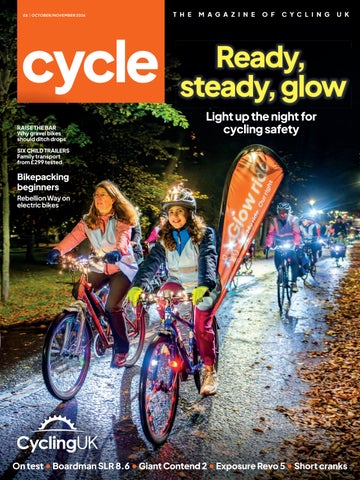
Ready, steady, glow RAISE THE BAR Why gravel bikes should ditch drops
Light up the night for cycling safety
SIX CHILD TRAILERS Family transport from £299 tested
Bikepacking beginners Rebellion Way on electric bikes
On test • Boardman SLR 8.6 • Giant Contend 2 • Exposure Revo 5 • Short cranks
Join today!
Membership from just £3 a month!* Click here for more information *See www.cyclinguk.org/join for more information and for terms and conditions.
From the editor Cycling UK: Parklands, Railton Road, Guildford, GU2 9JX E: cycling@cyclinguk.org W: cyclinguk.org T: 01483 238301 Cycle promotes the work of Cycling UK. Cycle’s circulation is approx. 51,000. Cycling UK is one of the UK’s largest cycling membership organisations, with approx. 70,500 members and affiliates. Chief Executive: Sarah Mitchell. Cyclists’ Touring Club, a Company Limited by Guarantee, registered in England No 25185, registered as a charity in England and Wales Charity No 1147607 and in Scotland No SC042541. Registered office: Parklands, Railton Road, Guildford, GU2 9JX. Cycle magazine: Editor: Dan Joyce E: editor@cyclinguk.org Designer: Christina Richmond Advertising: Tilly Prytherch T: 0203 198 3092 E: Tilly.Prytherch@ jamespembrokemedia.co.uk Publisher: James Houston. Cycle is published six times per year on behalf of Cycling UK by James Pembroke Media: Ground Floor, Riverside North, Walcot Yard, Bath, BA1 5BG. T: 01225 337777 Cycle is copyright Cycling UK, James Pembroke Media, and individual contributors. Reproduction in whole or in part without permission from Cycling UK and James Pembroke Media is forbidden. Views expressed in the magazine are those of the individual contributors and do not necessarily reflect those of the editor or the policies of Cycling UK. Advertising bookings are subject to availability, the terms and conditions of James Pembroke Media, and final approval by Cycling UK. Printed by: Acorn Web Offset Ltd, Loscoe Close, Normanton Industrial Estate, Normanton, WF6 1TW T: 01924 220633
Not every cycling development is unalloyed progress. Arguably (p30), even something as popular as the gravel bike could be much better. Yet when it comes to lighting we are truly living in a golden age. You can buy brilliant hub-dynamo lights. There are battery lights with car-headlight lumens and hourslong runtimes. Remember when bike lights were like a cinema usher’s torch? Thirtyfive years ago I was commuting around 30 miles a day, cycling to and from the offices of New Cyclist magazine in Coldstream. My Ever Ready lamps were powered by a pair of weighty D-cells that would scarcely last the journey home. (To avoid spending my wages on disposable batteries I used NiCads, which had to be recharged every night and popped into the lamps every morning, still warm.) If you hit a pothole, the front lamp would sometimes leap from its bracket. The pitiful beam – a pale glow extending a handful of metres beyond the front wheel – made pothole strikes inevitable. One night I hit a horizontal trench on an otherwise unlit road. Seeing it at the last second, I bunny-hopped only most of the way across. The rear wheel hit the far edge square on, causing a snakebite puncture. The dull inconvenience of having to fit a spare tube was given an extra frisson of excitement by the knowledge that the NiCad batteries were dying as I worked… Today’s cycle lights are exponentially better and make night-time riding more practical than ever. But if we want more people to cycle for transport both day and night, the lights themselves are only a small part of the solution. Turn to page 14 for more.
14 36 Light up the night
cyclinguk.org
cycling at night
bike world
IN THE FRAME
07 Quick releases
39 Gear
How the Cyclists’
Components and
Defence Fund is taking on Merseyrail; your
accessories tested
cycling legacy; financial
44 Shop window
advice from M&G; and
Previews of new
more
products
14 Ready, steady, glow!
46 Budget road bikes
Shining a light on women’s cycling safety this October
£650 Boardman SLR 8.6, £750 Giant Contend 2 52 Child trailers
TOUR & EXPLORE 18 Bikepacking
Six options for towing pre-school children
made e-asier Bikepacking novices ride Rebellion Way on e-bikes 24 Traffic-free France Travelling to an event
OVER TO YOU 57 Letters Your feedback on Cycle and cycling
in Angers on the Vélo
60 Q&A
Francette
Your technical, health and legal questions
FEATURES 28 Raise the bar
Editor Top: Andy Catlin
Founded in 1878
A beginner’s guide to
04 Freewheeling Bits and pieces from the
DAN JOYCE Cover photo: InfraSisters glow ride in Edinburgh, 2025. By Andy Catlin
QUICK RELEASES
Is it time to ditch the drops for UK ‘gravel’
62 Profile What racing cyclist Fraser Martin did next
riding? Three experts
65 Travellers’ tales
explain what they use
Your ride reports
OCTOBER/NOVEMBER 2026
3
Quick releases CAMPAIGNS
Ready, steady,
glow Last autumn’s glow rides were brilliant, with thousands of riders lighting up the night all across the UK. This year they’re on 22 October. Why not join us? Glow rides are celebrations of cycling that spotlight the need for safer streets and better cycle routes, especially for women riding after dark. Open to all but focused on women’s safety, the rides are organised by local cyclists and community groups. Highlights from last year Last year’s glow rides brought together people of all ages to highlight safety issues Glow rides aim to make a statement
14 OCTOBER/NOVEMBER 2026
while showing the strength and unity of communities wanting safer walking and cycling routes. Despite heavy rain, almost 3,000 riders lit up roads from Plymouth to Perth with bike lights, glow sticks and reflective gear to shine a light – literally – on the barriers to cycling that women continue to face. Some events had up to 100 people, while others were just a group of friends decorating their bikes and going for a ride. A glow ride can be as big or small as you like. Anne-Marie Goldsmith was one of last year’s participants. She had a brain haemorrhage that caused a stroke almost 30 years ago, which led to her to not being able to cycle. “I accepted that I would never ride a bike again,” she said. However, she was persuaded by a friend to join her on the back of a tandem. She’s never looked back, saying that cycling was “completely liberating”. By taking part in the event
she said she felt she was doing her bit to promote cycling for women. Why glow rides are important In most parts of the UK, safety concerns continue to dominate women’s decisions around cycling. Despite growing enthusiasm for active travel, women often feel shut out from the freedom that cycling can bring. “[Many women] get very nervous about going out in the dark, especially when they are cycling alone if the streets aren’t lit or if they’re going down dark alleyways, ” said Lorraine Murrell, chair of Newbury Road Club. “[The fact that] a lot of ladies get nervous is sad as that spoils their love of cycling.”
“No one should feel forced to choose between a busy road and a dark, isolated path”
What we’re campaigning for Glow rides are part of Cycling UK’s women’s safety campaign ‘My ride. Our
cyclinguk.org
Quick releases
Be a shining example Mass women’s rides will be taking place in towns and cities across the UK to call for safer streets and for routes designed with women’s needs in mind. No one should feel forced to choose between a busy road and a dark, isolated path. There should be a route that feels safe and welcoming. Glow riding in Portsmouth last year
ride’ (cyclinguk.org/my-ride-our-right), which calls for safer cycling routes for women and for more investment in infrastructure to address the gender divide. We are calling for long-term funding for cycling and walking, and for cycling networks designed and delivered to reflect the journeys women need to take. That means not just building commuter corridors for city workers but developing routes that serve school runs, shopping trips, healthcare visits and other everyday journeys – particularly within local neighbourhoods. “Improving safety for cyclists means more
cyclinguk.org
than adding painted lanes,” said Kitty Cresswell Riol, Norwich glow-ride organiser. “It’s about designing streets that feel welcoming and secure for everyone. Protected cycle lanes, better lighting and well-designed junctions make a huge difference, especially for women riding after dark. Lower traffic speeds, connected routes and visible cycle parking all help create an environment where cycling feels safe, practical and inclusive.” On 22 October, you too could be a shining example of the demand for safer cycling conditions for women: join a glow ride or organise one in your area.
Photos, CW from main image: Gareth Davies, Robyn Furtado, Kerry Morgan, Andy Catlin
This 2025 glow ride lit up the streets of Worcester
To find a ride near you or register your own, read our guides: cyclinguk.org/glowrides. If you have any questions, email campaigns@ cyclinguk.org. We may even be able to put you in touch with someone nearby who has organised a glow ride before.
This year’s Glow Rides are sponsored by cycling distributor ZyroFisher, with Altura and CatEye helping us make the night shine.
OCTOBER/NOVEMBER 2026
15
Tour&explore
Bikepacking made e-asier Great rides
18 OCTOBER/NOVEMBER 2026
cyclinguk.org
Tour&explore
Looking for an achievable adventure, bikepacking novices Katie Mackenzie and Jenny Box spent three days riding part of Rebellion Way on e-bikes
L
et’s get away for another long weekend this year,” my sister Jenny suggested. We’ve hiked through the Peak District before but didn’t want to repeat that. As I’d recently bought an e-bike, I voted we try bikepacking. We’ve both cycled a lot but never on a multi-day trip. One of Cycling UK’s long-distance routes would be a great opportunity to test my e-bike – and ourselves. Jenny could hire an e-bike. We settled on Rebellion Way, the 373km (232 miles) route around Norfolk. We know the area pretty well already, so it felt like a safe introduction to bikepacking. Rebellion Way is supposed to take five-to-seven days and we only had three, but surely on e-bikes we could whizz round? I did some longerdistance trial runs and realised that 80 miles in a day was ludicrous for us. We would scale it back to no more than 50. That meant some tweaks to the route: we’d skip the bottom section and only do the bits we were most interested in.
support crew/driver (my husband). He was doing the first 15 miles with us on his gravel bike before turning round and returning home. It was beautiful in the forest and the riding was flat and easy. The forest lasted for much of the first half of the day. It was glorious: shady trails; great coffee; and lots of friendly cyclists and walkers. Then we hit ‘the sand’. Having burned out my motor a few weeks earlier on a sandy heath in Suffolk, I cautiously made us walk. It wasn’t pleasant but thankfully didn’t last too long, as e-bikes laden with panniers are not what you’d call ‘lightweight’. Back on the road, we bowled into Swaffham to be confronted by market day. We found our intended café and, a little dazed from the sudden hustle and bustle and low on blood sugar, we ordered the first thing on the menu: the Rebellion Way Toastie. We were kindly allowed to plug in our batteries. Feeling deflated Suitably revived, we set off for our afternoon’s journey north to the sea. We diverted from Rebellion
Way to visit the village where our grandparents lived. From there almost all the way to Heacham we were on a 12−mile-long mostly unpaved track. Off-road riding is rather bumpy when your bike is heavily laden, requiring lots of concentration to avoid sharp stones, holes and sandy patches. Disaster struck. With about 10 miles to go, I noticed that my back wheel kept sliding about. I had a flat tyre. As we were in the middle of
“The first half of the day was glorious: shady trails; great coffee; and lots of friendly cyclists. Then we hit ‘the sand’”
Sun, trees and sand The forecast for the spring bank holiday at the end of May was spectacular: three days of sun. With our mother’s warnings of extreme heat in Norfolk in our ears, I bought one of those little caps that go under your helmet to keep the sun off your face. That would do the trick… Carrying enough snacks to last us a week and lots of water, we set off from Brandon Country Park with our
Top left: Just beyond Lynford, Our Lady & St Stephen Church Bottom left: Bridge over the River Wissey, by the flooded gravel pits of Lynford Water Top right: Puncture kit but no wheel-removal tools Bottom right: Sunset over The Wash at Heacham
cyclinguk.org
OCTOBER/NOVEMBER 2026
19
Feature
Raise the bar ‘Gravel’ riding in the UK is rarely best on a drop-bar bike with 38mm tyres. Dan Joyce, Isla Rowntree and Guy Kesteven explain what they use and why
28 OCTOBER/NOVEMBER 2026
cyclinguk.org
Feature
G
RAVEL BIKING IS basically
1990s mountain biking. Plenty of cycling articles, keyboard-warrior comments and YouTube videos start with this premise. While it’s an oversimplification – gravel bikes are not mountain bikes, not even old ones – there’s more than a grain of truth in it for UK cyclists. Gravel bikes are marketed more as go-anywhere, do-anything allterrain bikes than as all-roads bikes. The imagery suggests that they’re the perfect Swiss-army-knife bike, excelling not just on gravel roads but also the same bridleways and less technical trails that made up much of 1990s mountain biking. They’re not. They don’t. The United States has more than a million miles of unsurfaced roads, on which gravel bikes are great. The UK doesn’t. Forest fire-roads and green lanes are as close as we come. A mixed-surface ride here – on one of Cycling UK’s long-distance routes, for example (cyclinguk.org/long( distance) distance – generally includes rights of way that are literally off road and not just off tarmac. So why are so many cyclists using drop-bar bikes with medium-width tyres for rides where a flat-bar bike with bigger tyres would offer more comfort and control? It’s partly (OK, mostly) down to media and marketing. Possibly there’s an element of
Off-theOff-the-peg options We (Isla, Guy and Dan) have settled on our bike choices through trial and error, having ridden countless bikes and bike setups. But we’re not claiming to have unique insights. Some manufacturers already offer flat-bar gravel bikes. Here are a few.
cyclinguk.org
You don’t need a drop bar for extra hand positions or to get more aero
denialism from riders who have just dropped two or three grand on a new bike. (Yes, you can ride a gravel bike there – but you could say the same about an off-road unicycle.) It’s also a reflection of how we got here. Gravel bikes budded from the cyclocross branch of cycling’s family tree. ’Cross bikes have drop bars and narrow (30−something millimetre) tyres. This is not because those are better for cyclocross, as Thomas Frischknecht and Nick Craig proved by winning on flat-bar CX bikes before they were banned. It’s because drops and narrow tyres are enforced by the UCI. Why? Tradition. A few years ago I spoke
MERIDA SPEEDER 100 £800 Merida’s Speeder hybrid range, which had 32mm tyres and was aimed at commuters and fitness riders, has ‘gone gravel’ (sic). The new bikes have: 45mm tyres, with room for 50mm; a slacker head angle; and more frame mounts. A mid-step frame is an option. merida-bikes.com
to Jeff Jones about his own bikes. Cyclocross, he said, is like having a foot race where all the competitors have to run in high heels. Gravel bikes have diverged from cyclocross bikes as designers have grappled with the problem of making an essentially unsuitable bike better able to deal with off-road trails. The geometry has changed. Tyres are bigger. Bars have widened and flared. All this has helped but, I would argue, misses the point. If you really want to raise the bar for what we consider gravel riding in the UK, you have to start by ditching that drop bar altogether.
“Gravel bikes are marketed more as allterrain bikes than as allroads bikes”
SCOTT SCALE GRAVEL 10 £2,349
Your eyes don’t deceive you: the Scale Gravel 10 is fully rigid carbon-fibre mountain bike with 29×2.4in XC tyres and inboard Spirgrips for more hand positions. It’s equipped with 1×12 SRAM S1000 Eagle AXS wireless gearing. scott-sports.com
SONDER CAMINO AL APEX1 FLAT BAR £1,199 The Camino is ‘built for those moments when the road turns into trail and the bridleway drops off into singletrack’. Most have drops. This, the cheapest by £300, has a flat bar, plus a carbon fork, 1×12 SRAM Apex gears and 45mm tyres. alpkit.com
OCTOBER/NOVEMBER 2026
29
Shop window
New and upcoming products that have caught the editor’s eye
Save money
Don’t forget your exclusive member savings, with up to 50% off cycling products and services. Visit cyclinguk.org/ member-benefits
02
Ortlieb Back-Roller 20L Zip Pocket £105
01
FLIT M2i £2,999
The M2i is a new, lighter version of FLIT’s electric folder. At 13.3kg it saves 1.2kg over the M2 (cyclinguk. org/e-folding-bikes) by using premium components such as Hope brakes. flit.bike
What’s special about this IP64 pannier is that it’s one of the first products made from TIDURA, Ortlieb’s new, in-house fabric, which is PVC-free. It has a five-year warranty. uk.ortlieb.com
05
03
Shimano 2.2mm disc rotors £49.99+ Shimano has launched thicker (2.2mm vs 1.75mm) disc rotors for MTBs. They should last longer, bend less and doubtless heat up slower. Sizes: 200mm and 220mm. shimano.com
06
Stan’s Rolled Gold Tubeless Sealant 500ml £27
04
Salsa Fargo 32 Steel Frameset £1,749.99
The Fargo, one of the earliest drop-bar 29ers, now has a 32in-wheel stablemate. It comes in S and M sizes, not just L and XL, and is therefore said to fit riders down to 5ft 2in – somehow! salsacycles.com
44 OCTOBER/NOVEMBER 2026
This biodegradable sealant is for road and gravel bike tyres, sealing holes up to 7.8mm across in tyres with pressures from 35−100psi. A 28mm road tyre needs only 35mm of sealant. stans.com
Peaty’s Monarch saddle £69.99/£89.99
This 145mm-wide saddle has a shape reminiscent of a Charge Spoon, suspended rails (chrome-moly or titanium) and serviceability: the rails are user replaceable. peatys.co.uk
07
Redshift Quickdraw Saddle Bag £64.99
The dropper-post-compatible Quickdraw attaches magnetically and is secured with a Velcro strap. It can be stashed under the saddle or removed with one hand. redshiftsports.com
cyclinguk.org
Join today!
Membership from just £3 a month!* Click here for more information *See www.cyclinguk.org/join for more information and for terms and conditions.
Bike In the frame test
Budget road bikes Road bikes for beginners or for commuting and training needn’t cost the earth. Steve Williams tests a Boardman SLR 8.6 and a Giant Contend 2 These two entry-level road bikes might seem hard to tell apart – similar geometries, similar specs and even similar paint jobs – but real differences become apparent when you ride them. Yes, the Giant is £100 more, but it justifies that premium in various ways. The really good news, though, is that the Boardman still absolutely earns its place. Frame, fork & handlebar Both frames are aluminium: ALUXXgrade alloy in the Giant’s case, and 6061 X7 in the Boardman’s. In reality they’re both 6061, and the cheaper Boardman’s metalwork is actually more sophisticated. Its triple-butted tubes have thick walls at the ends for stronger joints, and slim walls in between to keep weight lower. The Giant’s single-butted tubes are the same thickness all the way along. You may prefer the ‘hidden welds’ of the Boardman for the carbon-ish look it brings, but for me it didn’t quite work. They’ve obviously just been ground down before painting, and not that evenly either. The results are a little lumpy under that matt grey paint, and the tricky junctions at the bottom bracket have just been left alone entirely. Still, if you don’t peer too closely it’s a sleek-looking thing.
46 OCTOBER/NOVEMBER 2026
Internal routing lends its own sleekness to the glossy Giant, though that’s less of a joy when it’s time to replace the cables. And as both bikes feature mounts for full-length mudguards front and rear, either will make a good winter bike for those looking to preserve their number-one steeds. If you do your own maintenance, the ‘oldfashioned’ Boardman has the edge in practicality. Both have alloy bars clamped to full carbon forks; the steerers are carbon too, saving weight over carbon-bladed forks with aluminium steerers hidden away in the head tube. The Boardman’s is C7 carbon, while Giant lists the Contend’s only as ‘composite’. Not all composite is carbon – fibreglass is also a composite – but this is, as you’d expect, carbon fibre. Whatever the subtleties of frame tubing and fork construction, it’s actually the Boardman that’s heavier and harsher on the road. Despite the chunky square-section frame looking more modern, it
Middle: Both bikes use Claris drivetrains but the Boardman has a slightly smaller (11− 32) cassette Bottom: External cables make maintenance easier
cyclinguk.org
In the frame Bike test
Tech spec Boardman SLR 8.6 Left: The Boardman’s narrower tyres and stiffer frame best suit smoother roads Below: The mudguardcompatible fork is full carbon fibre
Price: £650. Sizes: SM, MD, LG (tested), XL. Weight: 10.5kg (23.1lb), without pedals. Frame & fork: Triple-butted 6061 X7 aluminium frame with hidden welds, square-taper bottom bracket and mounts for mudguards, panniers and two bottles. C7 full carbon fork with mudguard mounts. Wheels: 25−622 Vittoria Zaffiro tyres, Boardman SLR Tubeless Ready wheels, 28/28 spokes, Formula RB31(F) and RB-30(R) hubs. Transmission: Toe-strap road pedals, FSA Tempo Compact 50−34 chainset, square taper 68×118mm bottom bracket, KMC Z8 chain, Shimano HG50 cassette. Shimano Claris shifters, Shimano Claris front and rear derailleurs. 16 ratios, 28−120in. Braking: Shimano Claris cable shifters, Tektro R315 mid-drop rim brake callipers. Steering & seating: Boardman soft-grip bar tape, Boardman alloy 420mm handlebar with 120mm drop, Boardman alloy stem, FSA no.10 semi-integrated headset, Boardman SLR saddle, Boardman alloy 27.2mm seatpost, Boardman alloy 31.8mm seat clamp. Equipment: None.
feels a little old school in a way the more traditionally tubed Giant ironically doesn’t. The flip side to the Boardman’s less compliant ride is a slightly racier feel. Components The bikes share significant chunks of their spec lists. Both come with Shimano Claris levers and derailleurs, an FSA Tempo compact crankset, a Shimano HG50 cassette, a KMC chain and Tektro rim brakes. There are some minor differences, including slightly different models of chain and brake calliper, but the difference you’ll actually notice is the cassette. The Giant has a 34−tooth sprocket for winding up those unforgiving hills, whereas the Boardman only has a 32. While two extra teeth doesn’t sound much, that’s roughly a 6% difference and, combined with the Giant’s 800g weight advantage, it makes things noticeably easier on long climbs. As Shimano’s Claris drivetrain is 8−speed, the gaps between ratios are inevitably quite large, but the 50−34 compact chainrings create a decent spread for all but the very slowest and fastest (steepest) parts of a ride. The rear shifting in particular is light and positive, though the Boardman’s front derailleur was smoother and easier to use than the identical setup on the Giant. I assume it’s down to differences in cable length and routing.
Both manufacturers spec a lot of own-brand parts. It’s decent if unspectacular kit across the board: bars, stems, hubs, rims, seatposts, saddles. Saddles are very personal but I found both very comfortable and supportive. While neither handlebar is harsh, the Giant’s, with its plush Velo cork tape, was particularly good. The Giant’s saddle is irritating to adjust, however, as it involves four bolts in two sizes and a ratcheting clamp that’s easy to mess up. Angle adjustments mean undoing two bolts and very carefully moving loose parts without losing your place, and you must fully tighten the bolts each time to test the final angle. I spent half my first ride beside the road with two dropped Allen keys and an increasingly grumpy face. Once set, the saddle and seatpost are utterly secure, but then so are the Boardman’s – and that involves just one Allen key and two minutes. At least the Giant has height marks on the post – useful, especially as its D-shaped cross-section leaves you with very limited upgrade
“WITH MOUNTS FOR MUDGUARDS FRONT AND REAR, EITHER WILL MAKE A GOOD WINTER BIKE”
cyclinguk.org
boardmanbikes.com
Dimensions in millimetres and degrees 390 570 589 673 45
596 73˚
57
73˚ 815
555 415
172.5 270 1,011
OCTOBER/NOVEMBER 2026
28 130 622 24
47
Group test
In the frame
What to look for Capacity Most trailers accommodate two children. There are single-seat versions of some models, which are a little cheaper, lighter and narrower. All have cargo space behind the seats, and the passenger space can be used for soft loads like groceries when not needed for children.
Child trailers
All trailers have mesh to keep out insects and wheel-flung debris
A child trailer turns any bike into a family vehicle, capable of transporting one or two small children plus luggage. Trailer veteran Dan Joyce reviews six Unless you’re lucky enough to own an e-cargo cycle with a rain canopy, a child trailer is the most practical way to cycle with one or two preschool children. A trailer offers better weather protection, capacity and handling than a child seat yet remains relatively affordable. Many child trailers will double as (rather bulky) pushchairs, with a small wheel fitted at the front and the tow-bar removed. Like a pushchair, a child trailer needs: a comfortable – and ideally reclining – seat; a secure harness; and ideally a brake to stop it rolling when parked or when getting children in and out. All child trailers fold down for storage and have quick-release wheels. You can tow a child trailer with just about any bike that has low enough
52 OCTOBER/NOVEMBER 2026
gears (or electric assistance) and good enough brakes. A full-length rear mudguard on the towing bike will help prevent the trailer becoming filthy when it’s wet, while a kickstand is useful for parking. Children are ready for a cycle trailer anywhere between six and 12 months, depending on their ability to sit up. Some trailers have optional babyseat inserts, enabling infants as young as a month old to be transported – albeit with caveats. Children outgrow trailers when they exceed the weight limit or are too big for the straps to secure them safely. That’s usually around age four or five. A child trailer must be equipped with a red rear light and a red rear reflector when used between dusk and dawn.
Safety The safety standards for child trailers are EN 15918 (Europe) and ASTM F1975 (US). All these trailers meet one or both. Key safety features are: a roll cage; a five-point safety harness with a child-proof fastening; a security strap for the hitch; and a low centre of gravity. Flags and reflectors, which all these trailers have, aid conspicuity, as do bright-coloured canopies. Versatility It’s useful to be able to convert a cycle trailer into a pushchair (stroller), especially when passengers are asleep. Off-road wheels and tyres are an extra for some trailers, while some have optional skis. Size and weight Width determines the gaps the trailer will fit through. Single-seaters are narrower so can be wheeled to places two-seaters sometimes can’t. Weight is important if you’ll be lifting the trailer, less so if you’ll only be towing it. All trailers fold for storage, though most require a couple of bungees to hold everything together. Hitch Trailers attach to a hitch on the towing bike’s rear axle. Standard hitches generally fit quick-release, nutted and e-bike-motor axles. Thruaxle kits are an optional extra. Check what length and thread pitch you need before buying.
cyclinguk.org
Join today!
Membership from just £3 a month!* Click here for more information *See www.cyclinguk.org/join for more information and for terms and conditions.
Over to you
Travellers’ tales
Street View for cyclists Who: Stephen Psallidas Where: North-east England When: 2023-2025
A detour for d’Huez Who: Brian Parry Where: France When: May 2026
Share your story We’d love to hear your Travellers’ tales! Email: editor@ cyclinguk.org
The two of us were of the same mind. We – 63-year-old Jason and me, Brian, aged 79 – were on the busy D1091 in the French Alps. We had set out from Calais 11 days earlier. The roundabout ahead indicated Bourg-d’Oisans to the right, Briançon straight on and L’Alpe d’Huez left. Although our goal was to cycle beyond Briançon to the Italian border at Bardonecchia, we went left. L’Alpe d’Huez was only a short detour from our planned route, so giving it a go was an absolute necessity. Soon after passing the large billboard detailing the climb’s stats – 13.8 km length, 7.9% to 8.1% average gradient, 21 hairpins, 1,071m of ascent – Jason was out of sight. He’s a more fluid cyclist than I am, his drop-bar carbon racer is lighter than my flatbar aluminium commuter and, of course, age is on his side. Besides, we are quite comfortable riding separately at our own pace. I’ve learned from experience that, when cycling up big hills, it’s best not to view the ordeals ahead. So I laboured away sloth-like at 3-6mph, eyes fixed on the tarmac beneath me. I
66 OCTOBER/NOVEMBER 2026
reached the summit in one go, apart from a single, short water stop at the town boundary. Jason was already there, sitting outside the inaptly named L’Indiana Bar with two mugs of coffee for us. It wasn’t until we started descending that we were able to drink in our achievement. When we peeped over the parapet into the dizzy void below at the first hairpin, Bourgd’Oisans appeared to lie almost vertically beneath us. It was enough to bring on a butterfly stomach-drop, in fact. Feeling elated, we took the descent gingerly, knowing that if we got carried away a fall would be a very woeful affair indeed. We stopped at hairpins 12 and 13 to pay homage to Tom Pidcock and Geraint Thomas, the only two British cyclists to win a Tour de France stage on L’Alpe d’Huez. Coincidentally, Jason is from Leeds like Tom, while I’m from Cardiff like Geraint. We made it to Bardonecchia, on cue, two days later.
Reading the feature about video cameras (cyclinguk.org/ filming-rides), I thought others might be interested to hear how I use mine. From from 2023 to 2025 I recorded every trafficfree National Cycle Network route in north-east England and then uploaded the results to Google Street View. I used a home-made helmet bracket for my 360-degree action camera (initially a Go Pro Max, later an Insta360 X5). My aims were to encourage cycling and walking by eliminating the ‘here there be dragons’ map gaps, reduce the time needed by maintenance staff to recce issues, and give emergency services visibility of locations if a cyclist or walker called 999. I rode remote forest tracks around Wark, clifftop trails near Berwick, spectacular viaducts at Lambley and Consett, and many beautiful old railway routes. Despite being rattled for countless hours, my cameras suffered no faults or damage. I can’t say the same for myself, what with various punctures, mechanicals, wrong turns, and near heat exhaustion on Sleightholme Moor. I work full time and so had to juggle weekends and weather.