Cycle promotes the work of Cycling UK. Cycle’s circulation is approx. 51,000. Cycling UK is one of the UK’s largest cycling membership organisations, with approx. 70,500 members and affiliates.
Chief executive: Sarah Mitchell. Cyclists’ Touring Club, a Company Limited by Guarantee, registered in England No 25185, registered as a charity in England and Wales Charity No 1147607 and in Scotland No SC042541.
Publisher: James Houston. Cycle is published six times per year on behalf of Cycling UK by James Pembroke Media: 90 Walcot Street, Bath, BA1 5BG. T: 01225 337 777
Cycle is copyright Cycling UK, James Pembroke Media, and individual contributors. Reproduction in whole or in part without permission from Cycling UK and James Pembroke Media is forbidden. Views expressed in the magazine are those of the individual contributors and do not necessarily reflect those of the editor or the policies of Cycling UK. Advertising bookings are subject to availability, the terms and conditions of James Pembroke Media, and final approval by Cycling UK.
Printed by: Acorn Web Offset Ltd, Loscoe Close, Normanton Industrial Estate, Normanton, WF6 1TW T: 01924 220633 Founded in 1878
From the editor
Cycling, by definition, moves forward. If nothing ever changed, we’d still be rolling around on penny farthings. In fact, scratch that: we’d be scooting along on Von Drais Laufmaschines made from wood.
Sometimes the changes are transformational. The shift from penny farthings to chain-drive safety bikes wasn’t just a technical improvement, it opened up cycling to a far wider audience. Pneumatic tyres made bone-shaking rides a thing of the past. E-bikes have expanded horizons, making cycling more accessible to more people.
Sometimes it’s a shift in focus, a way of doing things that’s evolutionary rather than revolutionary. Take the boom in bikepacking bikes and equipment, which has seen a surge of interest in cycle travel. It’s not a new activity; 19th century cyclists rode unsurfaced tracks with the luggage stashed in frame– and saddlebags made from leather. Rather, it’s a different way of touring – one that clearly appeals to new audiences.
Which brings me to Cycling UK’s rebrand, a new chainring-shaped dawn for the look and feel of the charity. The core values haven’t changed. What has changed are the clarifications to the charity’s purposes and a sprucing up of how those purposes are presented. To get more bums on bikes – to create happier, healthier and greener lives through cycling –we need to get the message across to more people.
The rebrand is why the issue of Cycle that you’re holding in your hands looks different. New designs, new colours, new fonts, sections moved around. But in terms of content, it’s fundamentally the same magazine. I hope you like it.
Quick releases
04 Freewheeling
Bits and pieces from the bike world
07 Quick releases Cycling UK’s rebrand; the Big Bike Brunch; meet our new Chair of Trustees; new Cycling UK jersey from Kalas; the ‘My Ride. Our Right’ campaign; support our new route appeal; and more
Tour & explore
20 The longest days
A 1,200km audax event in the land of the midnight sun
24 Weekender
Peak panoramas – a road ride through the southern Peak District
26 Retiring, not stopping
A pensioner’s proof that adventure isn’t only for the young
Features
32 How I roll
Four cyclists describe their bike and equipment choices for cycle touring
38 Commuting A to Z
26 beginner’s tips for transport cycling
DAN JOYCE Editor
Reviews
41 Gear
Components and accessories tested
46 Shop window Previews of new products
48 Books
Cycling inspiration when you’re stuck inside
50 Grand tourers
Ridgeback Tour and Marin Four Corners 1 on test
56 Mason Macro frameset
Highly configurable hardtail frame for bikepacking
59 Brompton commuting bags
Four front bags for the iconic small wheeler
Over to you
63 Letters
Your feedback on Cycle and cycling
66 Interview
Cycling UK member
Martin Gill’s fundraising challenge
68 Q&A
Your technical, health and legal questions answered
70 Bike finder
A lightweight stepthrough for London cycling
73 Travellers’ tales
Cycling UK members’ ride report
Above right: Alan Picken
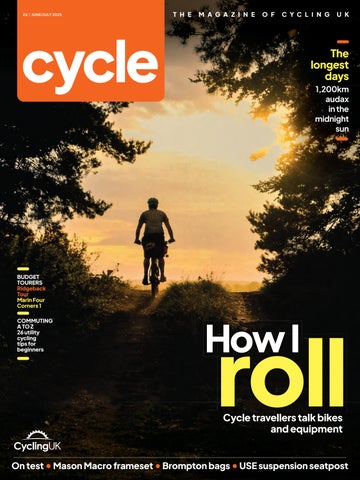
Cover photo: North of West Acre on the Rebellion Way, Norfolk, by Saskia Martin
Quick releases
Cycling news and views from around the UK BRAND
Brand new Cycling UK
We’re excited to introduce Cycling UK’s refreshed brand – a bold new chapter that reflects our proud heritage while powering our mission to enable and inspire people from all backgrounds to experience cycling’s joys and benefits.
Why the change? To achieve our long-term goals – including shifting the dial on public perceptions of cycling – we needed a brand that better communicates who we are and what we stand for. Through extensive
“To achieve our long-term goals –including shifting the dial on public perceptions of cycling – we needed a brand that better communicates who we are and what we stand for”
research and testing with members like you, staff, trustees, and new audiences, we created a refreshed brand that is confident, positive and engaging.
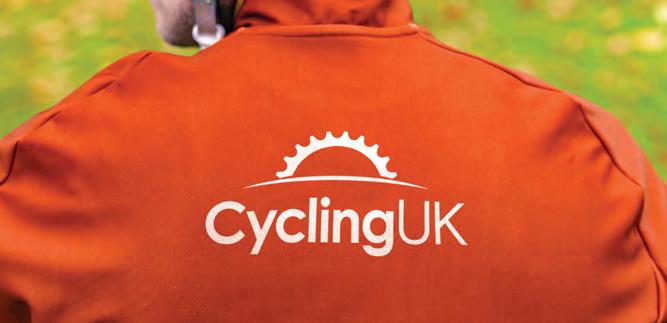
Our new logo combines a cycle cog and a sunrise, symbolising a new dawn for us. The warm orange tones of the palette evoke feelings of optimism and possibility, while the design is intended to be inspiring and inclusive. It mirrors our values and our mission to create a happier, healthier and greener society through cycling. This isn’t just a new look; it’s a vital part of our broader efforts to increase participation and make cycling more accessible.
For members, this means greater visibility for the charity you support and more opportunities to inspire others to ride. A more modern look will help us to form exciting partnerships with new brands and organisations, so you can enjoy even better member benefits.
We hope you enjoy the fresh look in this issue of Cycle. As we roll out the new brand, we aim to grow our impact and welcome more people into the cycling community.
Our new tagline, ‘ride with us’, captures the spirit of what we’re building – a movement where everyone belongs.
We’re proud of how far we’ve come and equally excited about where we’re headed. Thanks for joining us on the journey.
Changing up a gear
Sarah Mitchell, our chief executive, said: “We’re thrilled to introduce our new brand, which reflects both our history and our ambitious vision for the future. For almost 150 years, Cycling UK has worked tirelessly to champion the benefits of cycling, and as we continue to evolve, this new brand will help us reach even more people. We’re about creating a world where cycling is part of everyday life for all of us, contributing to a healthier, greener and more connected society.
“Cycling UK’s new brand is designed to engage people across all walks of life and to help them see how cycling can make a real difference in their lives and communities. We want to show how cycling can boost our economy, improve our wellbeing, support environmental sustainability, and create safer, better linked communities.”
➜ Watch this
You can see what our new brand looks like in action, and who it’s for, in this short video. In short: cycling is for everyone! cyclinguk.org/rebrand-video
Quick releases
Be part of the
journey
ROUTES
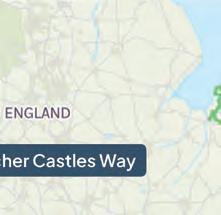
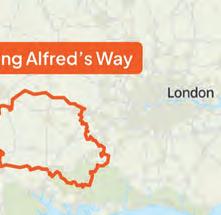
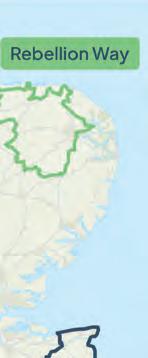
For the past seven years, Cycling UK has been creating long-distance routes through hills, moorland, coasts and forests that you have downloaded and ridden in your thousands. We’re planning a new route for 2025 and are inviting you to be part of it.
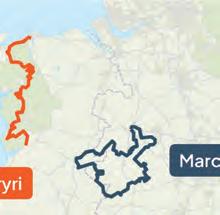
We need to raise £42,000 for this new route so that it can become reality. You stepped up last year to enable us to add Marcher Castles Way to our portfolio. The route GPX file has already had more than 4,000 downloads since it launched late last year. The Gill Foundation has agreed to match fund donations made to the 2025 appeal, making every pound you donate go twice as far.
We can only continue to develop more routes with the support of people like you. By backing –
Support our new route
Find out more at: cyclinguk.org/ routes-appeal
and then riding – this one, you might find yourself pedalling through some spectacular British countryside you’ve never explored before. All donors will receive:
• Regular updates on route development
• Early access to pre-order the route guide
• GPX file of the route on the launch day Thousands of people have enjoyed cycling, friendship and memory making along our routes. We hope you are as excited as we are about launching another. We’d like to finish the new route this summer so that you can ride it before the year is out!
Scan the QR code or visit cyclinguk.org/ routes-appeal to find out more and donate
The Gill Foundation Supporter Martin Gill (see p66) says: “We are continuing our commitment to create a series of new UK-based multiday tours to ensure there are routes for anybody and everybody to ride. Please join us in the journey to create new routes with Cycling UK for people like you to experience. We will match fund your donation to the routes appeal to double the impact. Please donate today and help reach the target of £42,000 for this new route. Thanks.”
Left:
Robyn Furtado
Retiring,
Great rides
not stopping
Adventure isn’t only for the young. Sarah Cook describes her journey into cycle-travelling retirement that’s seen her ride 24,000km – and counting
Ambitions of adventure haunt us all at various stages of life. The expectation is that it’s the domain of young people. I never anticipated that this would be how I filled my retirement.
Growing up I was fascinated by maps – of South America, in particular. Christopher Columbus, Magellan: explorers who set out with only a compass and some food supplies, not knowing where and how far they were going. What would all those frayed Pacific edges of land look like?
In my teens I discovered accounts of mountaineering exploits in the Alps and the Himalayas, all by men. Could women do that too? Later I encountered Dervla Murphy’s cycling adventure, Full Tilt: from Ireland to India with a Bicycle, and Josie Dew’s solo exploits in her first book, The Wind in my Wheels. And then Bettina Selby’s escapades from Karachi to Kathmandu, Riding the Mountains Down, solo and in her late 40s. Women could, can, do it.
SARAH COOK
Sarah is a Cycling UK member who’s been travelling for more than six years
Time to go
In my 60th year, the adventuring urge, which had been quietly dormant deep within for many years, finally became unignorable. All those years of conforming and responsibilities – school, university, marriage, raising a family – were behind me. I had the freedom, finance and fitness to acknowledge the adventure lust. But what to do? Where to go?
“In my 60th year, the adventuring urge, that had been quietly dormant deep within for many years, finally became unignorable”
A slow, solo, self-propelled journey interested me. I wanted to discover what it was like to live as an itinerant traveller. What would happen within Mind, Body and Spirit when life was mobile and minimalist and unfamiliar?
I had quite a tussle with Mind. The negative committee residing in my head is good at quashing dreams and ambitions. It likes to sit firmly on any ideas that are non-conformist. It wanted me to knuckle down to middle-class retirement, without any of this adventure lark. This isn’t what 60−year-olds do.
Body was ready for an adventure. I had good base fitness from mountain walking, and had lately taken up trail running. I knew that, even in my seventh decade, if I looked after it, Body had the strength and stamina to do what I asked of it.
Spirit was raring to go.
Breaking free
The universe aligned. I had my own property I could let out for extra income, I had a small pension, and together these would provide enough monthly income for budget self-
propelled travel. I had good health and fitness, something that so many of my peers were losing, and I realised: if I don’t do it now, maybe I never will.
The bicycle won as my chosen mode of transport. I wouldn’t need to carry my gear on my back. I could take a few luxury items that I’d never dream of putting in a rucksack. I would still be outside, in the world, interacting with people and the environment, and I would be traveling slowly.
The universe began to provide meetings with women travellers who had undertaken long-distance journeys. Women who had experience and recommendations for equipment and destinations. Women who
encouraged me, who knew their own negative committee, who knew that caged spirit and who understood the need to adventure.
Charlotte knew about Surly Long Haul Trucker touring bicycles. Robyn and her sister had cycled the Pacific West Coast route of the USA,
How I roll
There’s no optimum solution for cycle travel, only what works for you. Andrew Sykes, Susanna Thornton, Cass Gilbert and Josh Reid explain their choices
BIKES FOR TOURING AND BIKEPACKING are among the most diverse of any cycling discipline. Racing bikes look similar because they have the same goal: win! That means convergent evolution. Touring and bikepacking can be whatever you decide they are. If your bike will carry some luggage and take you where you want to go in relative comfort, it’s a valid option. There are good reasons why the traditional Britishstyle touring bike looks like it does, and it may be the best choice for the riding you have in mind. But the fact that there are far more touring and bikepacking trips made than there are such bikes sold tells you that a trad tourer is not a prerequisite. Maybe you just want to use what you have? Maybe, like the four cyclists here, your priorities are different when it comes to comfort, convenience, terrain or versatility? Whatever your solution, here’s to diversity!
Andrew P Sykes European-style tourer
WHEN I FIRST set off on a solo cycle tour, I did so on the bike that I was using for pottering around my local area – a Trek hybrid – attaching a rack to give me somewhere to hang the panniers. I wasn’t convinced I’d embrace the concept of travelling with a bike long term, so it was all minimal and cheap. Fortunately, I thoroughly enjoyed the experience so I upgraded to a proper touring bike, a Ridgeback Panorama World.
Over the next decade, as I gradually climbed the learning curve of cycle touring, I mucked around endlessly with the Ridgeback. First to go was the drop handlebar, replaced by a much more comfortable butterfly bar. But that required a change of gear system so I could use mountain bike shifters, and the stem needed lengthening. Then there was the Brooks saddle, the pedals, the Marathon Plus tyres… I was soon cycling the two-wheeled equivalent of Trigger’s broom.
After three long European tours, culminating in my 2015 cycle from Tarifa in Spain to Nordkapp in Norway, I started to plan the purchase of a replacement bike. Come 2019, I knew exactly what I wanted. I was tempted by a custom build but in the end went for a Dutch Koga WorldTraveller Signature. It’s semi-bespoke – that’s the Signature bit – and, with the excellent guidance of David Stainthorpe at Cyclesense in Tadcaster, I was able to select all the equipment that I wanted from the outset. Flat handlebar,
Kit list
Andrew’s choices
Bike: Koga
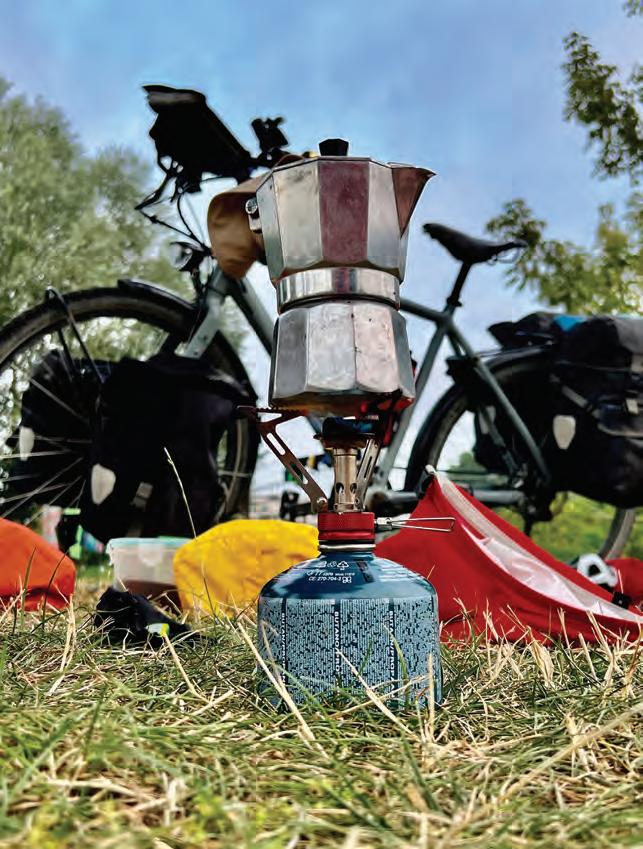
WorldTraveller Signature Favourite kit: Voile straps (for attaching the tent to the rack). Alite Mayfly chair. Japanese Crane Suza bell. Handlebar-mounted compass. Quad Lock phone mount. Topeak tablet drybag (for paper maps, not the iPad).
Mocha coffee pot (small, with handle inadvertently broken off making it far easier to pack). Sea To Summit collapsible cooking pot. Prescription sunglasses. Sinner string cord (for keeping the sunglasses in place). More info: CyclingEurope.org
a Rohloff hub gear, carbon belt drive, front hub dynamo (with connected USB port and lights), rear wheel lock, hydraulic brakes, stands front and back and, of course, a Brooks saddle.
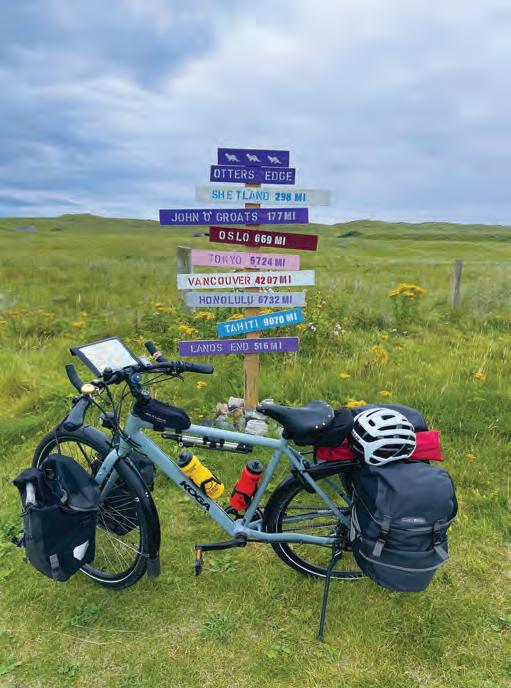
She (her name is Wanda, a bike called Wanda…) is my dream - albeit expensivetouring bicycle. Although we never made it to Japan in 2020 as planned, we have been happily exploring the UK and continental Europe ever since. This included my 5,000km ‘Grand Tour’ around France, into the Alps and down the Rhine, but there have been lots of shorter escapades along the way: from Santander to Porto; a tour linking the four capital cities here at home; as well as travels in the Yorkshire Dales, along the Outer Hebrides, and most recently to Shetland and Orkney.
She’s a sturdy (that’s diplomatic for ‘heavy’) machine but so comfortable to ride, and the Rohloff-belt drive combination makes her – touch wood – almost maintenance free. The kit is carried in four Ortlieb panniers and the
lightweight Hubba Hubba tent sits perfectly on the rear rack. I did once toy with the idea of bikepacking, and even bought some bags. But for the very long tours, I required more storage space. As I now make podcasts and films for YouTube, I need somewhere for the technical kit (audio recorder, drone, GoPro, as well as a small iPad for editing and publishing content while en route). That said, I can still see the attraction of heading off with only the essentials on a lightweight bike. Perhaps one day I will.
Left: Otters Edge campsite on the Isle of Benbecula in the Western Isles Below: Andrew on Anglesey Bottom: Porto, on a trip from Santander
01
Growtac Equal Control Levers
$212 each
These integrated levers are friction shifting, so they’ll operate almost any road, gravel or mountain bike derailleur – or combination thereof. Review coming later this year.
velo-orange.com
02
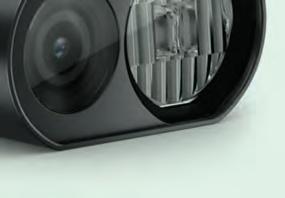
Garmin Varia Vue
£459.99
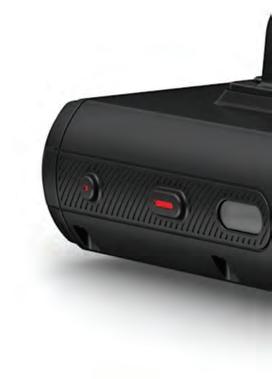
Garmin adds a Cycliq-style front light/camera with incident detection. It shoots 4k footage and will pair with the Varia RCT715 rear light/ camera/radar. MicroSD card not supplied. garmin.com
03
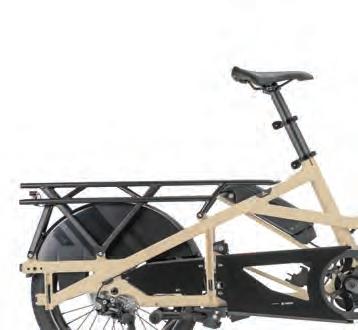
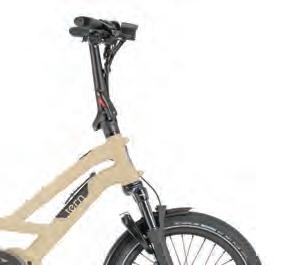
Tern GSD Gen3
£5,000+
05
04
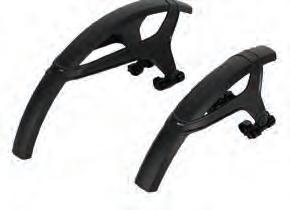
Zéfal M65 MTB Mudguard Set
£48.99
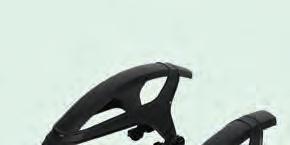
Designed for mountain bike tyres up to 2.6in wide in any of the common diameters, Zéfal’s new M65 guards look like they’d work well for MTB bikepacking. zefal.com/en/
Singular Kite
Titanium frameset £2,800
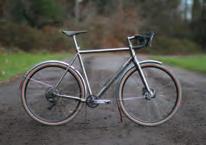
One of the nicer gravel bikes I saw at Bespoked, the latest Singular Kite looks on point, has all the fittings you need and takes 55−622 tyres. Unusually, it has a titanium fork. singularcycles.com
06
The new version of Tern’s benchmark e-cargo bike has a stronger frame (max gross vehicle weight of 210kg), ABS brakes, a longer wheelbase and a wider accessory ecosystem. ternbicycles.com
Carradice Cambrian Saddlebag (16L) £94.95
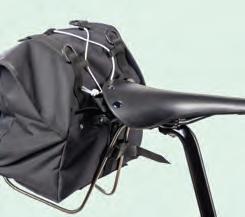
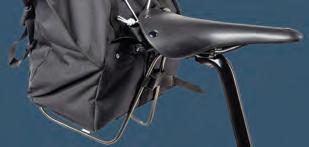
The new Adventure Range from Carradice is made from waterproof cordura rather than cotton duck, and includes bar bags, frame bags and saddlebags – like this one. Cycling UK members get 15% off all Carradice bags. carradice.co.uk
07
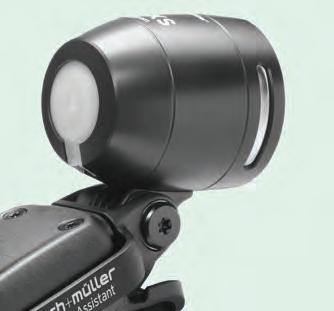
Busch+Müller Leval Curve Light Assistant £105
Strapping a light to your head or helmet isn’t the only way to see round dark corners: the Leval turns a B+M e-bike light into the bend in response to the bike’s tilt. Clever. bumm.de/en/
In the frame Bike test
Grand tourers
Can you still buy a proper touring bike for less than a £1,000? Simon Withers tests a Ridgeback Tour and Marin
Four Corners 1 to find out
There aren’t many sub-£1,000 tourers around these days, with Trek’s 520 following the likes of the Dawes Galaxy into cycling history. The two test bikes do come in under a grand. But are they genuine tourers that will take you far and wide, despite their comparatively modest price tags? Pleasingly, the answer is yes.
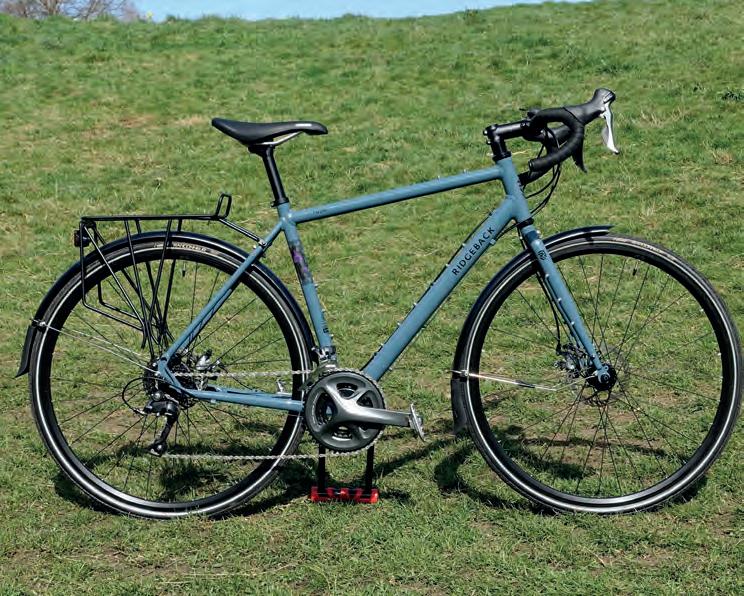
The British-designed Ridgeback Tour and the Four Corners 1 from US outfit Marin offer two different takes on the touring bike – one traditional, the other more ‘gravel’.
Frame and fork
The Marin is old-school chromemoly steel while the Ridgeback is aluminium (with a chrome-moly fork), but both are neatly made and have plenty of bosses. You can’t fit a full-size bottle in a standard cage on the Marin’s seat tube, although a side-entry cage would work, yet even without that you can carry three bottles on the main frame triangle. Both bikes have quick-release dropouts for frame and fork, which is a little unusual in this era of thruaxles. It’s not a major issue at this price, however, and it didn’t seem to detract from the effectiveness of the bikes’ disc brakes. Staying with the slightly retro theme: all the cabling is external. As a mechanic of modest skills, I’m always happy with that, even
if internal routing looks neater. Each bike also has separate rear rack and mudguard eyelets, plus room for wider tyres and mudguards. The Marin will take mudguards over its 45mm Vee tyres, or you could go for even wider rubber without. Both test bikes are the medium option of five sizes, and they both have the slacker head angle you’d expect in a long-distance adventure bike. Seat angles are a little steeper than is traditional for a tourer. The Marin has a much longer wheelbase at 1,087mm, compared with the Ridgeback’s tighter 1,035mm.
Components
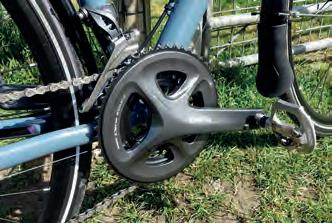
The Ridgeback Tour has a three-ring setup that shifts well but misses out on lower gears due to the fact that it’s a 50−39−30 road triple. Having three chainrings means smaller jumps between ratios, so you can usually find the correct gear for your cadence, but the 26in bottom gear is too high for a tourer. On one occasion I found myself pushing the Ridgeback up a steep hill with heavy traffic
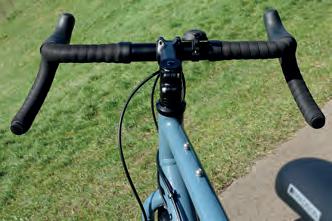
Top: Flared drops are as effective on tourers as they are on gravel bikes
Below: The 50−39− 30 road triple chainset results in a high bottom gear
passing closer than I’d have liked.
By contrast, the Four Corners’ lowest gear is just 21in, which is the sort of gear you need for loaded touring, especially when you hit the climbs. A Shimano Altus 44−32−22 chainset would have provided a 22in bailout gear for the Ridgeback, or a wallclimbing 18in gear if paired with a 34t cassette.
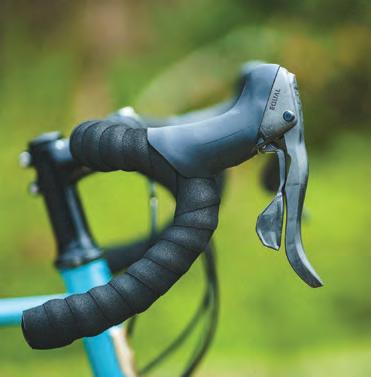
While Shimano’s 8−speed Claris gearing needs little introduction, the Marin has the less familiar 9−speed Microshift Sword. It works very well. Rather than a brake lever that doubles as a shifter, it has a dedicated brake lever and two paddles for changing gear. On the right, the larger paddle shifts to a lower gear, the smaller paddle to a higher gear. On the left, the larger paddle shifts to the big ring. It takes a bit of getting used to but offers consistent and accurate shifting and a light action.
In the frame
Tech spec Ridgeback Tour
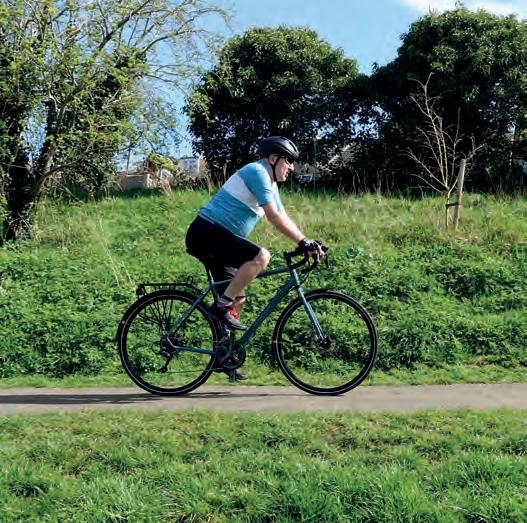
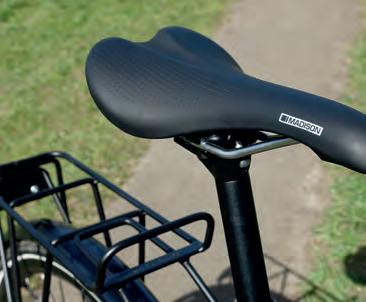
Left: Not as upright as the Marin but still comfortable Below: The Ridgeback’s Flux saddle is a pleasant perch. The rack means it’s touring ready
“I FOUND MYSELF PUSHING THE RIDGEBACK UP A STEEP HILL WITH HEAVY TRAFFIC PASSING CLOSER THAN I’D HAVE LIKED”
discs. They’re a good choice – effective, even if they don’t have the light action of hydraulics, simple to fettle and still functional with a wonky rim. The Marin’s dualpiston TRP Spyre Cs take the honours for performance, edging out the Ridgeback’s single-piston Promax brakes. There’s little to choose between the rest of the kit, with the alloy stems, bars and seatposts typical of pretty much any bike around this price; all are absolutely fine. While the specs suggest the bars have different flares, both actually measure 42cm at the hoods and 50cm across the drops.
The sub-compact double chainset, a slightly unusual 46−29, is paired with an 11−38 cassette. This means there are inevitably bigger jumps between gears, with a six-tooth jump from the 32 to the 38 sprocket, but for me the much lower bottom gear is always a price worth paying.
Both have brakes typical for entrylevel drop-bar bikes: cable-actuated
The Ridgeback comes with mudguards and a rear rack, despite being cheaper than the Marin. The rack is tough and solid and the unbranded full-length mudguards have quick-release safety clips.
The ride
As well as numerous shorter rides, I rode both of these bikes for
Price: £899.99.
Sizes: XS, S, M (tested), L, XL.
Weight: 12.85kg/28.3lb.
Frame & fork: Aluminium frame with QR dropouts, ‘bento box’ bosses, four sets of bottle/luggage bosses, rack and mudguard mounts; Ridgeback chrome-moly disc 1−1/8in fork with QR dropouts, triple bosses on each blade, mudguard mounts.
Bromptons are more practical as day-to-day transport when you add a dedicated front bag. Dan Joyce reviews four good ones
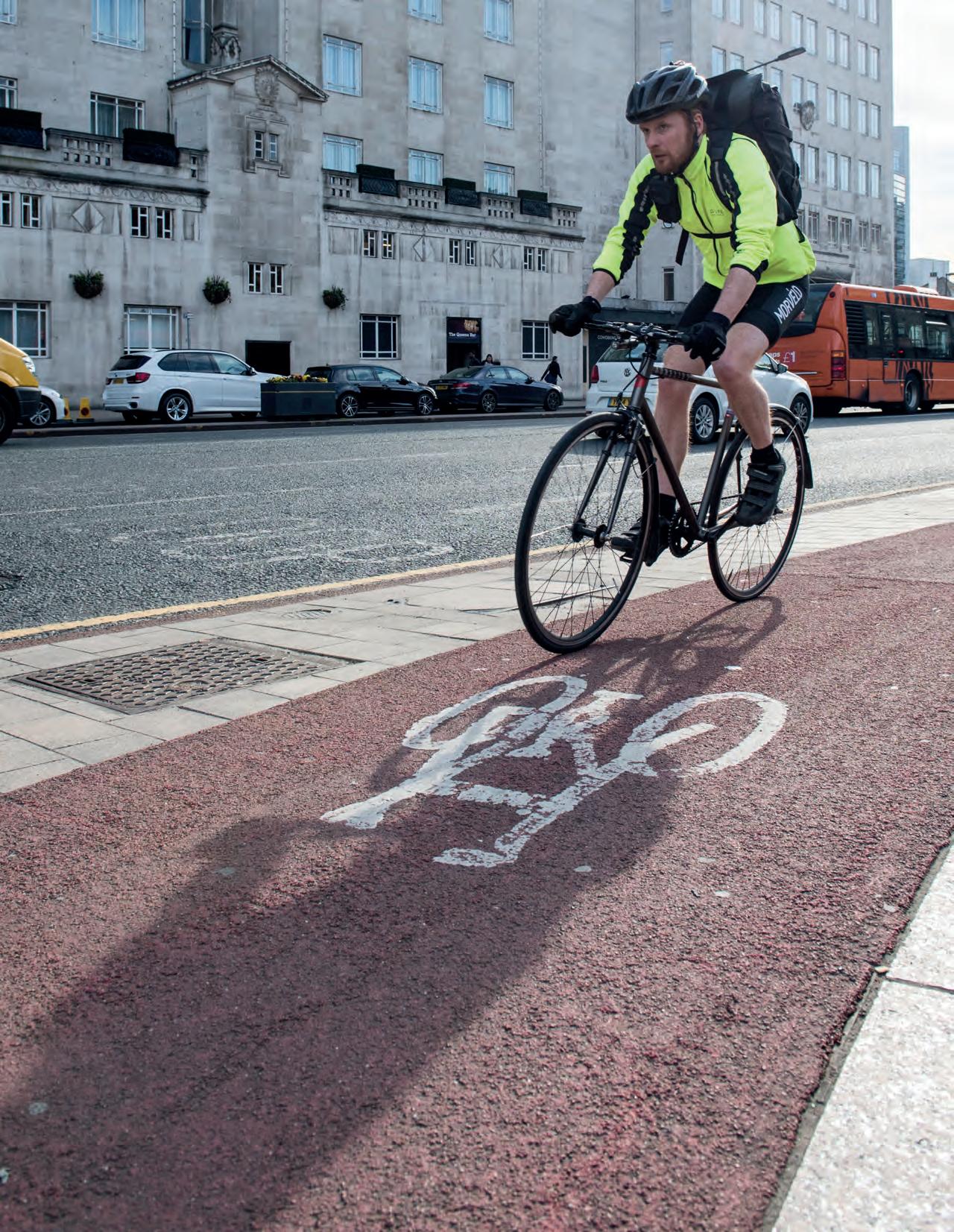
Bromptons work best for everyday urban journeys such as the stationto-office commute. Luggage is a given in such situations, and a dedicated Brompton front bag is the best way to carry it. You won’t sweat or ache like you might with a backpack, and having the weight over the front wheel helps stabilise the low-trail steering.
Brompton front bags clip onto the head-tube-mounted Front Carrier Block (£19) that most models are sold with. This is rated for loads up to 10kg. While it will carry more – I once hauled 35kg of tiles – doing so is very much at your own risk. Brompton’s Front Carrier Block can also be fitted to other small-wheelers with the matching head-tube mount, such as Circe’s Helios tandem.
Bromptons are sometimes used for touring (see p34), which may require more carrying capacity in the form of additional bags or a larger front bag. The focus of this review, however, is transport cycling and business trips.
I packed each bag with: my 16in laptop, other electronics, a rain cape, tools, snacks, plus a wash-bag and extra clothing for overnight trips. I also used the bags for shopping, trips to the pool and so on.
Note that members receive discounts with Restrap and Carradice. See cyclinguk.org/member-benefits.
“The focus of this review is transport cycling and business trips”
What to look for
Capacity
These bags range in size from 16 to 25 litres. Total volume isn’t the whole story, however. Shape (width, depth and height, which I’ve listed in centimetres in the reviews) matters for some loads, while other contents might require external pockets and/ or internal dividers. Do you have specific items to carry? My 16in laptop is a deal breaker, for example.
Weather resistance
It’s easier to avoid downpours on a folder as you can take it in a taxi or on a bus. But if you ride often enough in the UK, you will get wet. The bag needs to be waterproof enough to keep vulnerable contents (laptop!) dry. A rain cover can work but bags that are inherently waterproof are more reliable. Rolltops keep rain out best.
Durability
Apart from wear and tear while riding, a Brompton bag will be stashed in luggage racks and stood on station platforms. Durability is, if anything, even more important than with touring panniers. Both Carradice and Restrap offer lifetime warranties.
Features
A carry handle is essential, a shoulder strap useful. All four bags have both. (Take care to remove or cinch the shoulder strap while riding, so it can’t dangle onto the front wheel.) Reflective details are useful at night, while adjustable straps accommodate smaller and larger loads better.
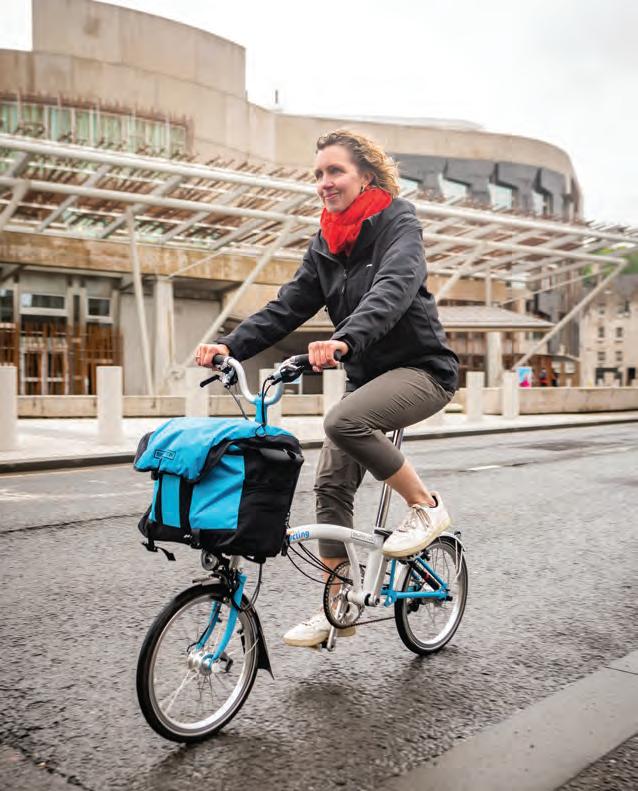
CEO Sarah Mitchell on one of Cycling UK’s office Bromptons
Right: Andy Catlin
Prairies, parks and peaks
Where: United States
Who: Steve Carr
When: Summer 2024
Want more routes?
cyclinguk.org/ routes
It had been a hot day of cycling in Illinois, with high humidity and a boiling sun. Along with my friend Guy, I was slumped in the shade outside a huge Walmart in Kewanee. My phone said it was partially shutting down due to the heat. A tornado warning then appeared, recommending a building’s lowest floor or basement for safety. We opted for a one-storey cheap motel and watched the storm darken and build. Cycling in ‘tornado alley’, part of our Northern Tier route across the northern states of the USA, was living up to its name.
An interesting potter
Where: The Netherlands
Who: Andrea and Bill Whitehead
When: March 2025
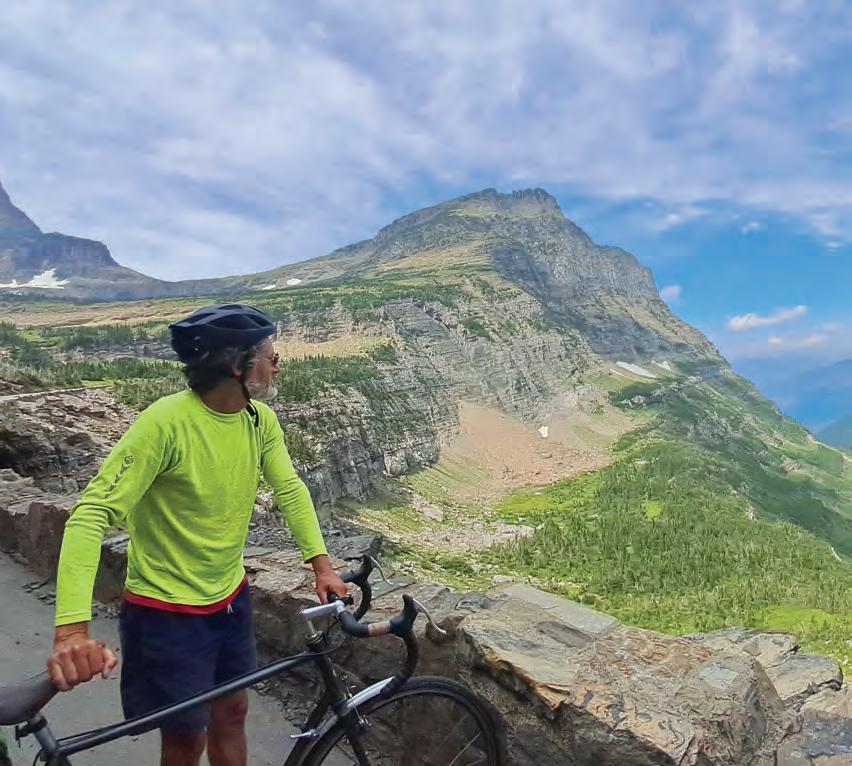
Cyclists that we met as we headed west enthused about the Glacier National Park in Montana. They also mentioned meeting bears, the park being known for its grizzlies. The route follows Going-to-theSun Road, named after the eponymous, 9,647ft mountain. We climbed Logan Pass (6,646ft), amazed by the rock walls rising sheer out of huge forests, topped by glaciers stretching between summits.
We saw only one large bear. Traffic slowed down, we stopped and away into the undergrowth it plodded, heading towards Saint Mary Lake. Given the traffic levels, being a grizzly in Glacier looked challenging.
From there to the Pacific is still almost 1,000 miles. Our final col was a classic climb: the Washington Pass (5,477ft). At the summit the temperature fell to 7ºC. At Rainy Pass, just after the Washington Pass, steady rain duly started. But it was downhill all the way to the blue water of Puget Sound.
Steve’s blog is: wutheringbikes.org.uk
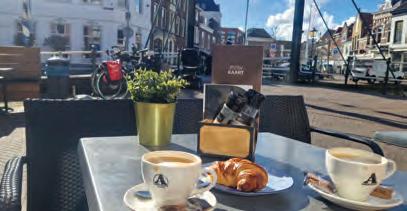
We were listening to the radio when up popped a piece about the singer Nick Cave’s exhibition of a series of ceramics called ‘The devil – a life’. As it was in Holland, it sounded like a good excuse for a short cycling adventure. Two weeks later we were on the ferry from Hull to Rotterdam. The first 10km from the ferry is through the largest port in Europe. This might sound daunting but there are cycle tracks right from the ferry. After passing what appear to be the gates of Mordor at the boundary of the port, the cycle routes continue throughout the Netherlands, anywhere you go. A short, cycle-friendly ferry ride across the Nieuwe Waterweg takes you to the historic, canalcrossed town of Maassluis. We stopped off at our favourite canal-side café, Monsieur Paul. Fully fuelledup, we rode up the coast. A wide tarmac cycle track slices through the sandduned shoreline and carries on further north. But for us it finished at our hotel door in Scheveningen. This gave us access to Voorlinden Museum to see the exhibit. We also had the beach and the attractions of the Hague in easy reach. What an amazing trip!