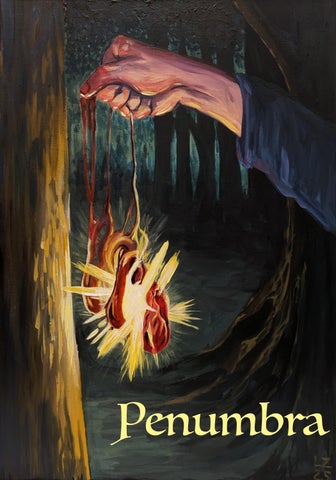
Penumbra
Penumbra 2026
Volume 36
The Art & Literary Journal of Stanislaus State penumbra (pi-num ‘bre): n. 1. A partial shadow, as in an eclipse, between regions of complete shadow and complete illumination. 2. The partly darkened fringe around a sunspot. 3. An outlying, surrounding region; periphery; fringe. [Lat. paene, almost – Lat. umbra, shadow]
All About Penumbra Since 1991, Penumbra has proudly published poetry, fiction, nonfiction, and visual art by contributors from the Stanislaus region, throughout the U.S., and abroad. Our editing and design staff is composed entirely of students: they make all editorial decisions, including which submissions are accepted and how the journal is designed. Because new students staff the journal every year, Penumbra constantly evolves. Each year, we receive hundreds of art and literary submissions, and through an anonymous voting process, we decide which works to accept. Students are responsible for all editing and design choices, creating the finished journal by the end of the semester. Every Spring, English 4019: Editing Literary Magazines is open to students with junior or higher academic standing. Students from all majors are welcome: the course offers professional training in areas including art, business, and communications. Annually, we launch the new issue with readings on the CSU Stanislaus campus near the end of the spring term. Thank you to those who contributed to Penumbra 2026. Your talent makes the journal what it is. Please continue sending us your work: submissions will open for Penumbra 2027 in late 2026.
3
Penumbra Staff Faculty Advisor Dr. Tony Perrello
Editorial & Managerial Assistant Allison Westlund Editor-in-Chief & Reviews Editor Reagan Oliveira
Blog Editor
Jackeline García-López
Podcast Coordinator Julian Saenz-Payne
Workshop Coordinator Emily Torres
Marketing & Social Media Intern Lyet Koffi
Editing & Design Staff
Tuesday Mendez Asher Monte Jessenia Montiel Briana Pedroso Kyara Rodriguez Kate Rodriguez Anthony Reyes Amanda Trevino Gilberto Vazquez Victor Walker
Brandon Coldiron Elizabeth Curiel Velarde Nicolas Deloach Addison Edeal Malachi Hernandez Yuleiny Jaquez Daniela Macias Jessica Magallon Andria Martin Natalie Mejia
5
Table of Contents
Order of Appearance: Staff Favorites are indicated by an * Heart of a Bodhisattva.............................................................................................................................10 Lucinda Zaharris Working on Dying...................................................................................................................................11 Jackeline García-López I Thank the Fear for Keeping Me Alive........................................................................................12-13 May Garner Red Willow Song.....................................................................................................................................14 David Anson Lee Confessional..............................................................................................................................................15 Julia Koncurat On the Beach After Love’s Loss...........................................................................................................16 Stella Ho As We Watch TV......................................................................................................................................17 Mindy Kober Playing Mommy*................................................................................................................................18-20 Harrison Dutton Late Night Conversation........................................................................................................................21 Patricia Deal The Black Mirror.......................................................................................................................................22 Andres Jimenez Sundown Sippers......................................................................................................................................23 Matthew Andrews He Asked if I Was Vegan.........................................................................................................................24 Calissa Palmer A Leg Up.....................................................................................................................................................25 Hope Clayton Is it him? Or is it me?..............................................................................................................................26 Emily Torres A Ghost.......................................................................................................................................................27 Lucinda Zaharris The Root of the Memory..................................................................................................................28-29 Sadee Bee thin (anorexia)..........................................................................................................................................30 David DiSarro Promise Beneath A Rusted Sky............................................................................................................31 Meghan Reyes Pondering US Set Adrift.........................................................................................................................32 Schuyler Becker
phytocide...................................................................................................................................................33 Sharisa Aidukaitis Absolute Truth..........................................................................................................................................34 Diana Woodcock Chestnut.....................................................................................................................................................35 Anne Murphy One Light, One Dark..............................................................................................................................36 Nancy Haskett Retracing My Steps..................................................................................................................................37 Jackeline García-López Merienda..............................................................................................................................................38-41 Trin Encarnacion The Line At The Border....................................................................................................................42-43 John Grey Sunset over the Delta...............................................................................................................................44 David Anson Lee All Poems Are About Death...................................................................................................................45 Paul Hostovsky In the Shade of the Dogwood Tree...............................................................................................46-49 Brandon Coldiron Everything was Forever until it was No More..........................................................................50-51 C. M. Green Little Fish ..................................................................................................................................................52 Andres Jimenez I Love That................................................................................................................................................53 Ian Golub Spiraling into the Darkness..............................................................................................................54-55 Emily Torres Home(bound) Fragments.......................................................................................................................56 Clayre Benzadón Harvest.......................................................................................................................................................57 Simon Collinson The Other Coin..................................................................................................................................58-59 Huina Zheng The Fish and the Boat......................................................................................................................60-61 Mindy Kober How To Be Nocturnal.......................................................................................................................62-63 Schuyler Becker
Table of Contents Continued Order of Appearance:
Waiting for the Bus..................................................................................................................................64 Tom Myers A DESCENT INTO DOGGEREL......................................................................................................65 Salvatore Salerno Rider Out Sabastion’s Window..............................................................................................................66 Terry Brinkman Cutting My Toenails................................................................................................................................67 David Romanda Lucky*...................................................................................................................................................68-70 Huina Zheng Soberanes Point and Whale Peak.......................................................................................................71 Meghan Reyes Fig Trees.....................................................................................................................................................72 Schuyler Becker Out of Season............................................................................................................................................73 Julia Koncurat Last Call Home..................................................................................................................................74-78 Robert Sparrow-Downes Stone Cast Lady with Flowers..............................................................................................................79 Helen Heery OLD LADY................................................................................................................................................80 Mario Loprete Comet.........................................................................................................................................................81 Pixie Bruner Neon Sign .................................................................................................................................................82 Tom Myers Valley After Rain......................................................................................................................................83 David Anson Lee A Bowl of Soup...................................................................................................................................84-86 Huina Zheng The Cure for What Ails You..................................................................................................................87 Randall Coll Twisted Game*.........................................................................................................................................88 Andres Jimenez Winter Morning Gifts..............................................................................................................................89 Neil Elder The Hands of Men...................................................................................................................................90 Calissa Palmer
Supplication..............................................................................................................................................91 Helen Heery Lanterns on the Riverbank.....................................................................................................................92 David Anson Lee Alien in Walmart.......................................................................................................................................93 Joanne Clarkson Kodokushi Prefecture*.......................................................................................................................94-95 Brandon Shane my Ghost..............................................................................................................................................96-97 Jackeline García-López Preloved.............................................................................................................................................98-100 Kate Faigen the reader’s gift.......................................................................................................................................101 Sharisa Aidukaitis GRAVEN ANGEL.........................................................................................................................102-103 Dee Allen Identifying What We Don’t Understand................................................................................104-105 Mindy Kober The Very Idea.................................................................................................................................106-107 John Grey The Night Window.................................................................................................................................108 Joanne Clarkson Unwelcomed Guest................................................................................................................................109 Angelique Renee Limatoc Arnold
Heart of a Bodhisattva By Lucinda Zaharris
Medium: Acrylic on stretched canvas
10
Working on Dying
By Jackeline García-López I rehearse disappearance in small ways-letting days pass without naming them. The body thins itself toward silence. Even joy feels temporary, like borrowed blood. Nothing ends suddenly. It just keeps not staying. I live as proof that dying takes time.
11
I Thank the Fear For Keeping Me Alive By May Garner
Fear lingered long enough to teach me how to pass for prepared. How to keep my keys threaded between my fingers, to call fire intuition and feel virtuous about it. In my family, we never named the ache. We named the precautions to take. Lock the door, don’t trust the quiet. Assume the worst and you’ll never be surprised. This was offered as wisdom, as love with a pulse. It entered my body early on; a constant bracing, like air itself might strike first. I discovered how to live a half-step ahead of harm, how to confuse anticipation with control. I carried it carefully, like something breakable, something sacred. Not everything handed down is meant to be kept. Some things are only instructions for surviving a past that has already ended. I am adapting to interrupt the reflex, allow my shoulders to stop without scanning the room, to believe that calamity does not require validation.
12
There is a difference between memory and mandate. Between what shaped you and what still gets a vote. I thank the fear for keeping me alive. Then, I set it down. Not gently. Just finally.
13
Red Willow Song
By David Anson Lee Grandfather carved his story into willow, red stains from bloodroot ink, hands trembling yet steady as the river behind the village. He hummed while he worked, a tune that wound through cottonwoods, through my father’s voice, through mine: a song of belonging, of survival, of the winter without firewood, the spring we planted corn by moonlight. I trace the carved lines: each notch a heartbeat, each knot a lesson. To endure. To remember. To sing. The willow leans toward the creek, listening still, waiting for me to carry the song beyond the valley, beyond shadows of displacement, into the bright pulse of morning.
14
Confessional
By Julia Koncurat I’m sorry about the cockroach that I crushed with my rain boot when it scuttled across the bathroom tiles in the middle of the night. I’m sorry about the splotch of blood that marred the white tiles but it was easy to clean up after all and the body scraped nicely off my boot. Had it been a ladybug or a butterfly or a bumblebee, I would not have been so quick to squash the bug, but it was a slimy, scuttle-y, roach, and I, and my mother, and my mother’s mother, have always been afraid of them. The truth is, God, I wouldn’t have been sorry had I not seen the red blood of the creature, and its twitching, dying limbs, and realized that I too, know what it’s like to be small, and scared, and hated.
15
On the Beach After Love’s Loss By Stella Ho
The sea keeps rising, and rolling waves kiss my bare ankles. A crab burrows into sand as I bury my sadness in salt air. It’s no use. In truth, all I do is lose. In longing, all present pain traces the past and erases the future. Herring gulls fly back and forth over restless waters, going nowhere. The sand still has an imprint of your body and so I lay myself down in the space you left behind. I close my eyes, but all I feel is the sun’s distant warmth. The world is no longer ours.
16
As We Watch TV
By Mindy Kober
Medium: Gouache on paper
17
Playing Mommy* By Harrison Dutton
The dogs found it first. Before she could catch a glimpse, they pounced on it, pawing and nipping. She kicked them away. Though they hadn’t even drawn blood, the thing should’ve been dead. Hell, it looked like it should’ve died at birth. Was it deformed? She tried to place the species, but couldn’t. A bald eagle chick, maybe? No, not even they got this big. Whatever it was, it looked like a cross between a baby bird and human fetus. As the animal writhed, pine needles caked its flesh. The lumps where its eyes should’ve been made her stomach turn. Just a newborn. Barely even alive. Outside the nest, it would last less than a week – maybe not even that. Maybe she should let the dogs have at it; put it out of its misery. She gasped and shook her head. Jesus, where had those thoughts come from? All that was animal logic. And she was no animal. Around a tree she tied the dogs’ leashes. Unzipping her backpack, she crouched and grimaced as she scooped up the pathetic thing then stuffed it inside. Before she could change her mind, she jerked the zipper shut. On her way home, the bloody yolk of a sun dipped below the trees. Every minute, the dogs turned around to investigate her backpack, their leashes tangling. Every time she kneed them away, only for them to pester her again soon after. Little bastards were lucky she needed the company, otherwise she would’ve set them loose into the woods ages ago. Something screeched in her ear. Flinching, she stumbled, and almost fell backward onto the pack. It was only then, when the dogs howled and started clawing at the pack, that she identified the sound’s source. Well damn. For something so weak and impotent, it sure had a set of lungs. It was like those fire alarms from school, the kind that made you instinctively cover your ears. For a while she tried just that, but the sound stabbed right through her hands. Halfway there, she opened the pack, cursing, and glared down at it. Its blind face jerked up, and its beak gaped open. So it was calling for her, then. Food. Of course. She’d read once in a school textbook that chicks needed to eat every few hours. How long had it laid there, on the forest floor, starved? Again she closed the zipper on it. Once she had it settled in its new home, it would calm down, surely. She stormed back to the house; all the while its screams drilled into her skull.
18
It went on like that all night. In the sink she soaked a few towels and with them made a makeshift nest. Still it bleated at her, loud enough to drown out the dogs outside. Its pink flesh glistened under the kitchen’s chandelier. The same way Ronnie had glistened in the midwife’s arms, after they dragged his limp body out of her. The hospital had sent her home with an urn. Half a year later, her husband sent her the papers at work. He’d been seeing someone weeks before that, someone whose body wouldn’t murder his children. She rummaged through the fridge for some leftover venison. When she offered it to the thing, it spat the red flecks back at her, and resumed its tantrum. At one point she had to retreat outside, just to quell the ringing in her ears. The dogs’ howls grew ragged, almost panicked. She was tempted to take the thing outside. Let it scream its little head off in the shed. But no, the cold would take it. She would just have to grit her teeth through its fit, until it accepted its place. That, or until its vocal cords ruptured. She had her money on the latter. Back into the house she marched. As soon as it saw her, it started up again. Jaw clenched, she yanked the fridge open, ground beef tumbling out. She picked up one of the packages. Maybe it didn’t take solid food? Armed with a meat tenderizer, she pounded the beef into paste, and then scraped it into a bowl, and doused it in hot water. She whisked it into a red slime, and, nose scrunched, presented it to her guest. In the middle of another screech, it gaped – out of hunger or indignation she couldn’t tell. She raised the bowl to its beak. Tilting it, she poured some in, and with her other hand nudged its beak upward. At first it convulsed. She shielded her face in case it spat up. Then its throat bulged, and she gave a little cheer. For the first time tonight, it had accepted an offering; shown some damn gratitude. She wetted a towel, and, cooing, dabbed at the beads of red on its beak, gracing the hideous thing with her care. Outside, the dogs screamed. Halfway through its dinner, it made a sound. She squinted at it. It sounded like the chirping that baby gators made. “You’re welcome,” she said. Then she glanced at the bulge in its neck, which hadn’t gone away. It was choking. She sucked in a breath. Dropping the towel, she cringed as she pressed her fingers to its veiny flesh, and tried to massage the bulge down.
19
Its beak snapped open. The eruption that followed sprayed over her neck and torso. Meat goo bled through her shirt, drizzled off her arms. Now empty, it started screeching again, sharper than ever, a needle in her eardrum. For a second she stood there, gawping at it. Then her hands screwed into fists. One hand found the meat tenderizer. What was she waiting for? One hard strike, and she could shut it up for good. Clenching the handle, she forced herself to place it down on the counter. I wouldn’t. She sucked in a breath, and pushed it further away. I know I wouldn’t. With a dish rag she wiped herself off as best she could, then forced a smile. “What am I gonna do with you?” The thing stared past her. Brow creased, she squinted at it. Why had it stopped screeching? And the dogs, too. She listened, ear strained. The dogs never stopped. She stared outside. Past the floodlights, nothing visible. Through the open window, the night silence filled her ear. That tingling sensation, the one she sometimes got in the woods, crawled up her back. In the hall, the floorboards groaned. She spun toward it. Another groan, and then another, as something shifted its weight, creeping toward the kitchen. Behind her, the thing turned to the hall, chirping. It was then, as the creaks neared the hall’s threshold, that the realization came to her, though far too late. The thing wasn’t calling for her. It was calling for its mother.
20
Late Night Conversation
By Patricia Deal
with the point of sharpened words–sent letters pool ink drips from the corners of his mouth open palms cup the softened edges of confusion letter by stained letter, she dries them into worlds
21
The Black Mirror By Andres Jimenez
Medium: Ink on paper
22
Sundown Sippers
By Matthew Andrews
It’s become a ritual: sloshed waves of amber pelting high glass walls. Through the pane, fading sun casts the pond in a saintly glow, still but for the gentle ripples of wading ducks, fish dancing, soft caress of western breeze. The window’s a frame, the picture balanced like a knife blade on the finger – a fantasy, a portrait drawn of wayward rays of light. The fingers twirl the glass, then a sip, then another.
23
He Asked if I Was Vegan By Calissa Palmer
I laughed so hard my belly shook, soft like dough, seasoned like a Sunday roast. Do these curves look like they sprouted from kale? No, love, this is heritage cooking. Thighs marinated in the patience of slow-cooked oxtail, hips wide as a ladle’s sweep, built to stir, to serve, to feast. Breasts lifted and glazed, basted in my gravy-slick hands that know my name. This isn’t tofu and tempeh, this is plantain fried to a golden curve, pounded yam holding hips in place, coconut cream whispering over soft rolls, fufu and fire, jollof and joy. Ask me again if I’m vegan, and I’ll show you a body that remembers every meal it’s ever loved, seasoned, simmered, still warm.
24
A Leg Up
By Hope Clayton
I had a date with a dashing doctor. I, in my best white backless gown, skin laved to an opaque purity. Bring it on, I thought. Touch me where I’ve never been touched before. Spin my world until I lose all inhibition. When I came to, the guy had fled the scene, having other assignations down the hall. But despite our fleeting encounter, I was grateful for the new knee he had given to me.
25
Is it him? Or is it me? By Emily Torres
A whisper of imagination, Contemplating the hallucination. Asking myself what is reality? Is it him or is it me? I’m as confused as can be, For he invades my dreams. Attempting to set myself free from whatever sorcery he deems. Waking up with a sense of danger, Searching the dark to find monsters. I turn, in fear, begging for peace— Suddenly he appears, disguised as it. Blink once. Blink twice. He disappears— Leaving me alone again, Asking myself what is reality? Is it him? Or is it me?
26
A Ghost
By Lucinda Zaharris
Medium: Acrylic on stretched canvas
27
The Root of the Memory By Sadee Bee
Our apartment was cramped; they were always cramped. No matter which one we moved into, it only ever had three bedrooms and one bathroom. By we, I mean myself, my two moms, my older brother, and my younger sister. A family of five squeezed into those tiny spaces—rooms pressed up against each other, often so close we could hear each other snoring or crying. My brother always got his own room. Due to the imposed conventions of privacy between the sexes, sharing a room with my little sister was a requirement. All of this, a structural confinement and a dampening of the spirit. Others may have valued such closeness, but I loathed the sentiment. People in those neighborhoods found our family peculiar. Our skin blended in well enough, our nuclear composition, not so much. My older brother, wheelchair bound from a young age, always sparked loud questions from the other kids. They were always seemingly disappointed to learn he had been born that way and was not a victim of some epic accident. Sometimes he told them he was in an attempt to lighten the mood. My two moms, a quiet contention amongst those around us. Furtive glances and raised eyebrows greeted us around every corner. At times, I counted it as a blessing as the absence of my father was rarely noticed. Other times, a festering agitation boiled in me when I was unable to block out the whispers. My mom would say, “People judge what they don’t understand. Ignore them.” So I did my best to do just that. I never felt the need to justify my parents, and I never did. Their story was not mine to divulge. Whenever the walls of our apartment were too restricting or our parents needed a break, we were ushered outside until the streetlights came on. Apartment complex playgrounds were where we ventured, still within shouting distance of our mothers. Though outside, even the buildings were all squeezed together. As if the concrete and rebar were attempting to strangle every piece of greenery out of the land. Even the parks morphed over time to fit each urban sprawl we planted our feet in. Sand gave way to wood chips, wood chips gave way to ruber pellets, then fused to some kind of semi-bouncy blacktop that resembled a parking lot. As if we children would at any moment morph into cars instead of adult human beings. But even out there, in the jam-packed chaos of city life, we had some space to stretch our arms. A place to run without fear of slamming into things or even each other. There we weren’t small, meek, or quiet–no, we were kings and queens, pirates, and even whole armies. We marked our territory, drew our names on park benches, and carved symbols into trees–our tiny hearts begged to be remembered. We even learned to fly on the swings, defying gravity as we soared from our seated positions, never quite caring where we landed. Boy, did we land. We landed hard and scraped our knees, but laughed in the face of danger. 28
The boys caught bees in jars and shook them vigorously, sending us girls screaming for safety. In the summer, we would wait until almost dark to light fireworks we had squirreled away. Sometimes we aimed them at each other, playing a somewhat dangerous game of tag. My siblings and I often hastily crafted time capsules together, leaving them buried beneath the dirt next to the roots of trees. Believing we would still be there years later to dig them back up. Boxes filled with hope that we would never leave. We always left. Sometimes we left calm and measured, other times quick and hurried. There was never an explanation–that was something we children were not owed. When I drive past any of these neighborhoods now, I am not greeted with happy pangs in my heart. No smile graces my face as butterflies of uneasiness flitter deep in my belly. Beneath those pulsing insects rests a bittersweet longing of wanting to belong somewhere–of wanting to recall more than I do. The playgrounds I vaguely recognize are often still standing, in disrepair, and barely used. Sometimes I venture into them, looking for the marks we left–searching for faded remnants of a childhood I have trouble remembering. Our time capsule hiding spots are long lost in my mind. I know where we’ve been, sometimes, I even know how long we were there, but the things I remember most are things I would prefer to forget. The apartment complexes, the laundromats, and the schools still stand tall as landmarks of all we have survived. Everything remains in these places, except for us. My family once pressed together like Lego pieces we used to play with are now knocked over and splattered across highways. Taking with us the memories of where we have been to where we are going–carving our own delineations in the landscape to preserve boundaries. Though our roots grow beneath these roads, tethering us to each other–no matter the distance. We cannot run from who we were, for all of it has followed us to who we are. There is no need for me to depict a specific place. I am a part of everywhere I have ever lived. Neighborhoods, to me, are not really about their names or their eccentricities, but about the identities each of us shaped inside them.
29
thin (anorexia)
By David DiSarro the narrow puddles of her eyes, the sunken garden of her skin, the marrow of her memory, draped in a body too thin.
30
Promise Beneath A Rusted Sky
By Meghan Reyes
Medium: Acrylic on stretched canvas
31
Pondering US Set Adrift By Schuyler Becker
What a rapid, ravenous country we live in and feed on with its countdowns and deadlines People racing down crowded city streets and stagnant freeways When the treasures are found not by the unfocused eye but the softly beating heart
The endless pursuit (pursuit being key) toward eternal youth or the imitations of success
The hands sifting through dirt and clay The grip of those that bear witness to rattlesnakes in the tall grass and laughter communing with rushing rivers Why do we as a human race set off firecrackers to cast a smokescreen across a starlit sky? Why do we speak of achieving a dream but forget the sounds of a cypress night? So many seek to know everything without a glance to the auspicious glory of unseen fields or unsung communities.
32
phytocide
By Sharisa Aidukaitis
I apologize to the houseplants I optimistically bought to brighten the interior of my hominid-infested box; I didn’t intend to curtail your existence, just to selfishly breathe your oxygen and stare at your chlorophyll in the dead of winter, but instead of creating a symbiosis, I became a parasite and siphoned your life, now as I throw your corpses onto the compost heap I wonder if I had given you some of the water that drowned the kitchen succulent if you’d all still be here photosynthesizing in harmony; and I almost taste the pheromone fear of your brothers who still adorn the mantle begging for the rain they can glimpse through the window.
33
Absolute Truth
By Diana Woodcock This wild, white continent is radiant light and sacred dark. For all who venture here, it offers freedom beyond fear, a chance for rebirth and becoming at last one with Earth. But one must come with a mindset and a heart bent on being present, not preoccupied. Only then can one take in the fact that Antarctica is absolute truth—truth of impermanence and endurance, truth of birth and death, truth of hard matter—ice and rock, truth of penguin rookeries where thieveries are the order of the day—neighbors squawking and pecking away, stealing marblesized pebbles from each other to build their nests, truth of skuas snatching penguin hatchlings from their nests to tear them apart and devour them, truth of mystery and curiosity—the chemistry and calamity of glacial meltwater, truth of the ghostly hush of the early explorers’ forsaken huts. 34
Chestnut
By Anne Murphy
A gentle giant made of wood. Forever here. I stand for years. Through the seasons, Spring, Summer, Autumn, Winter. Lost count of how long it’s been. I’ve sheltered animals and insects. In Spring my sticky buds attract the birds, to sing their lamenting tunes, waiting, for the upcoming cycle of new life. My buds burst, furling out new leaves, like new curls on a baby’s head. The weather changes, people slow down, admire my leaves, rest against my trunk, a sly smoke, a quick kiss, a small embrace, picnic, keep cool, I sway gently in the breeze. Nesting birds fight over territories, battles between the crows and magpies. My pink and white flowers sending out their fragrant scent to those who pass. My blossoms fall like snow as my fruit blooms into life. Starting small, until my branches can no longer hold them plopping into the soft green grass. Children fight, gather them for battles. Autumn passing it’s fingers through my hair, I wear a colourful cloak, watch people laugh, play with my falling leaves. I shiver as Autumn runs from Jack Frost. Winter approaches, my branches bare. People rush by, covered from head to toe. I’m alone I drift to sleep.
35
One Light, One Dark A Pair of Golden Shovel Poems
(from “The End of Mother Daughter” by Margaret Doyle) By Nancy Haskett I could hold you for hours, my first-born, your long lashes over blue eyes, small hands and fingers that are waving near my face, knees slightly bent, feathery dark hair, so soft to my touch, and I watch your small chest as you take each breath, already hungry again, waiting. You’ve hit me for the last time, bruised my face, blackened one of my eyes, tried, again, to show that you are the one in control, but my hands are bent into fists, I have stopped listening to all of your excuses and promises to change, your guilt-ridden apologies whispered from rancid breath. I am done waiting.
36
Retracing My Steps
By Jackeline García-López
Medium: Acrylic on canvas
37
Merienda
By Trin Encarnacion A pair of ICE agents swaddled in ballistic-resistant vests, the word POLICE in ugly, capital, Helvetica letters stamped over their hearts, stop me on the sidewalk. Golden hour paints stratus cloud streaks milky orange like shreds of grated queso de bola. Below, a yolk-hued filter oozes over West Plaza Drive, adding visual warmth to an already humid Orlando street. I imagine myself melting down into the litter-clogged sewer slits adjacent to my jelly Mary Janes, like butter left out to soften for too long slipping down a sink drain, past obstructions of bloated ramen noodles and discarded spam chunks evading the garbage disposal. Instead, I halt my gaze on the box of moldy ensaymadas before me. “Just leaving the post office?” asks the blond with a neck gaiter barely pulled up to his razor-scratched face, nodding at the box and then peering down the street at the USPS. “Yes,” I say, glancing down the same, now barren, street. “I hurried over here before they closed. My mom just texted me saying she sent perishables.” I think of the blue bubble of her texts (Ay jusko! It is already late over there. Be sure to pick up the package!) as I fold back cardboard flaps to present the sweet bread buns gone bad to them. The blond scrunches up his face like a balled up wrapper about to be discarded. “What are those?” “Filipino pastries.” There’s a dozen of them—six cheesy original and six cheesy ube, all in individual wrappers donning the Red Ribbon logo—packed neatly into a reused Amazon box. I’d just ripped off layers of masking tape entombing them in this cardboard bundle for transit, revealing the moist buns in sweaty plastic jackets, glistening with sugary butter, topped with shredded cheese, and speckled with dots of mold, when an unmarked van pulled up beside me and these two men, with their weapons strapped to their chests and ICE agent badges glinting in the sun, stepped out. The blond turns to his partner. “You know what these are? Aren’t you Fil—” “Why not get these delivered to your house?” the partner asks, pushing the box out of his sight. Despite the ski mask hugging his face, cap pulled down low, and tinted sunglasses, I spy slivers of brown skin that a suntan can’t emulate.
38
I cradle the box in the crook of my arm. “At my apartment complex we’ve been having issues with packages going missing. Now I always check need signature for every delivery. When I’m not there to sign, the packages go to the post office.” He pushes his sunglasses further up his covered nose. “Uh huh. So you must have some identification on you then?” I graze my free hand against the empty pockets of my sweatpants, wishing the touch of my thigh through the polyester would magically turn into my wallet with ID nestled inside. An image of my mom squinting at her iPhone comes to mind. She’d texted me while I bedrotted post a full day of classes, in an oversized t-shirt and sweatpants with various stains that refuse to lift in the wash. My greasy hair had been slicked back into a ponytail secured by a stretched out elastic. In that flurry of running out the door per her insistence, I’d left behind my wallet, ID, and even my phone. And while at the post office, I didn’t even realize I’d forgotten those items, as the aunties at the counter knew me by name and had never requested to verify my identity with a photo ID. The bundled-up agent zeros in on my hand failing to produce what he wants. “If you don’t have any identification on you, how do we know you’re an American citizen?” “I am American,” I say, but never have believed. They both cock their heads to the side. I try again, telling them what I know for sure: “I was born here in America, at a Kaiser in San Diego, the one on Zion Avenue. My mom and dad immigrated with their parents when they were kids, so they got citizenship a long time ago, like in the 80s or something. They’ve never gone back to the Philippines since and neither can speak Tagalog anymore. Both of my grandpas were in the armed forces and fought in wars for America like the Vietnam War I’m pretty sure,” I say, trying to recall accolades listed on their headstones in that veteran graveyard in Miramar, but instead remembering old photographs of two men, barely any older than I am now, posed before an American flag in pressed uniforms. Unsmiling. I keep going: “My brother is an undergraduate student in the ROTC. My sister works in healthcare.” As I speak, I stare at the seeds of mold blooming atop the buns as if willing them to remind me of my family’s beginnings in America—all the evidence I may need to prove we’d been rooted here for decades now. Whether those roots have produced trees yielding any fruit not bitter or bruised, they don’t need to know.
39
“And you?” asks the blond agent as he crosses his arms, “Who are you exactly?” I am.
I hesitate to reveal more, especially that I study history—that I know exactly who
The bundled-up agent waves in my face, getting too close as I think about what to say. “Hello? We asked you to tell us who you are. Answer us. Now.” For a second, I consider yanking off his mask, forcing him to reveal his identity to me. Ask him, who could very well be a cousin or friend of a cousin or friend of a cousin’s friend, when did your family move to America? What or who did they leave behind in the process? And when they moved here, what grand delusions about America did they dream up as they laid to rest each night? How many of those hopes had to do with their children and grandchildren and generations so far into the future? What must the elders of your family think of what you do now? Are they proud or appalled? Are you second generation or third? How far removed must you be from your family’s immigration to work a job like this? When instead I refuse to speak, the blond steps closer. “Ma’am, we need to verify your citizenship before we can let you go.” I think of my mom again, perusing packs of ensaymadas in the Mira Mesa Red Ribbon location, next to the Seafood City. Past the glass display case featuring the Mocha Crunch Cakes topped with honeycomb candies that she orders for my birthday every year and her favorite Ube Overload Cake with Philippine ube halaya, she picked up various packs to examine before making her selection. She searched for ensaymadas unsmushed with extra cheesy topping, extra ube swirls, with a longer expiration date stickered to the front. She probably chatted with the lolas and aunties working behind the counter about sending me some since there are no Red Ribbons in Florida. At least there’s a Jollibee! she’d tell them, and they’d all smile at the fact that I have Chickenjoy Fried Chicken, sweet spaghetti with hotdogs, and palabok with sliced egg to keep me company. The bundled-up agent reaches for the box and tosses it to the side while the blond wraps an arm around my shoulder, pushing me toward their van. I reach out for the ensaymadas scattering on the asphalt.
40
In an alternate timeline, I slip out of the agent’s grasp, dive for an ensaymada causing beads of blood to bubble up along my arms, rip open its package not caring if I litter as I fling the plastic wrapper behind me, and bite down on the moldy bread, swallowing before the ICE agents apprehend me once more. In an alternate timeline, I’m already back at my apartment, scraping off dots of mold with a knife. In an alternate timeline, I FaceTime my mom to tell her the ensaymadas are delicious.
41
The Line at The Border By John Grey
It’s hot outside. The fans are blowing in. The line is long. The windows are few. An old man, thin and bent, grasps his crumpled documents, thinks he heard his name being called. But the officer signals someone else forward. The old man steps ahead of him. Another man says, “I was here before you.” The old man says, “I was here yesterday. And the day before that. And the day before that.” It’s a cue for a nearby agent. “I’ll take this.” The old man gets angry, thrusts his papers toward the agent’s chest then takes a swing, a feeble exhausted right cross that fails to make contact. And then he is gone, whisked away by two more agents who appear out of nowhere, shoved into the back of some transport van.
42
The line closes behind him like nothing happened. Outside, it’s even hotter. Inside, the fan struggles to keep up. A woman looks at her watch. A kid kicks the metal rail. Some guy mutters how he could use a cigarette. And the process grinds on. It’s slow. It’s sweaty. And it’s hungry. The van door slams. It’s such a hollow sound. And final. For a second the whole place goes quiet. Everyone can feel it. Even the whirring fan seems to slow. A life unimportant, invisible almost, is folded up and filed away. Then someone coughs. Another sighs. The line inches forward again.
43
Sunset Over The Delta By David Anson Lee
The levee bends like a bowed back, cicadas drumming their summer hymn. Light spills over water, turning reeds to molten gold and sky to bruised violet. I watch a father teach his son to throw a line into the slow river, the boy’s small hand trembling with the weight of a world he has yet to meet. The sun dips behind distant almond hills; every shadow stretches long: as regrets, as hopes, as love unspoken. A heron lifts, black silhouette against amber. We grow by letting go, while keeping what glows in the fading light.
44
All Poems Are About Death By Paul Hostovsky
They’re talking about tying teacher pay to teacher performance, and tying teacher performance to student outcomes. They like to use words like outcomes. They probably don’t read much poetry, whoever they are, and wouldn’t know a good line if they wrote one. I remember Mr. Westrich though, my 7th grade English teacher, who died in a boating accident the summer I was 12. I remember his performance—his performances—the way he’d make us all laugh, the way he’d interrupt us whenever we said um or er. “Don’t burp,” he’d say (he called um and er “burps”). We had to put a penny in the jar every time we burped. When the jar filled up, he said, he would buy us a cake. And we’d all eat it together. He was as good as his word. I hated school but I loved Mr. Westrich. Whenever we said “y’know” he’d interrupt us and say, “No, I don’t know, tell me!” Our outcomes, if anyone cared to measure them, spanned a lifetime of not burping, of saying what we meant instead of saying “y’know.” But his greatest performance was dying like that, in high summer, on a sailboat, or under a sailboat—I don’t remember how it happened, only that it did, only that he died—his final act. His perfect disappearance. No one I knew and loved had ever died. He was the first one. It taught me what can’t be put into words. It taught me the ineffable. It was around that time I first started making poems.
45
In the Shade of the Dogwood Tree By Brandon Coldiron
Matanan. The Old Ward. The Silent One. Appalachia is an old place. Oh, Matanan. What I have done this morning is unforgivable. He didn’t deserve it. I will never be able to take back my whipping hands striking soft, naked flesh. I will never be able to unsee small, shirtless shoulders cowering in defense of his mad mother’s malice. I am the monster who beat her child. I had Lattice chained to the trunk of my soul, and now it is gone. Oh Matanan... I am a single mother. My boy and I live together in a small, clean home. We are a happy little family of two, and we get by. We are one with the community, as it should be, but we are lesser, and the lack of attention suits us well. My boy is young. Too young to have his own dog, maybe, but old enough to know he wants one. He’s smart, too. He can recognize our loneliness, see the bruising under my eyes from sleep-deprived nights and early mornings, and he understands the meaning behind my words when I talk to others about grown matters. Three nights ago, we nestled in our peace. I don’t remember the movie we watched; it was a cartoon with characters and music that only a child could love. In this perfect place, I began to drift into a wonderful sleep. As my eyes closed, I watched my boy’s gleaming face in the bluish light of spinning images in the darkness of our den with utter satisfaction. The morning sun caressed my face, cupping my chin gently, and my eyes fluttered open My son was asleep inches away from me, his head lolled back with his mouth wide open. It was a sleep that revealed all his teeth, from the front teeth to the back molars, like he had turned into one of the cartoon characters from the night before. A single snot bubble danced in time with his breathing, completing the image. I remember staring at him for a long time, admiring his simple, small snores. Smiling, I made my way to the kitchen. Everything inside me shattered like a snow globe hitting tile floors. Some terrible beast began to rise within me. Everything was ruined. There were stains on every part of every cabinet in the kitchen. Some kind of chemical reaction had taken place on the varnish; it had bubbles and pocks. There was broken glass in the sink, and the floor was so sticky it made noise to walk on. 46
The microwave was off, and I tried to restart the clock. I was unable to resuscitate it. My face and chest had begun to heat, and my eyes burned with salty tears. The stove was a ruined mess, and the dishwasher was lying beyond salvation. My fury and desperation welled until I couldn’t stand the sight of my personal cataclysm any longer. I deserted the ruinous wreckage. I sought my prey. There was a ripping on my chest and a spinning sound like metal twine unraveling a tin spool. Matanan, I never even noticed it. I stormed into the room where my exhausted boy was still sleeping off his night’s labors. I yanked him by the arm and dragged him into the kitchen. It never occurred to me to check his hands for cuts or burns from broken glass or mishandling cleaning solvents. I ignored his usual boyish grin as it turned to anguish and again as it melted into terror like wax. He cried in confusion as I screamed in his face, and his sad water left no impression on my rage. He didn’t expect the first slap; I didn’t either. I had never struck him before that morning. The crack resounded like a rock falling into an empty cave. The breaking of the boundary fed fuel to my fury. The second slap was easier than the first. His face had entirely broken in despair. After that, my arms took a life of their own. My hands struck without mercy. I was not allowed to continue for long. Suddenly, I felt myself floating, the noise faded, and the heat in my heart dissipated, leaving me cold and empty. I had a sense of being without form. I was other, in a place that was other. Then I saw a Lattice of Light floating in front of where my nose should have been. Spinning outmfrom my center, the Lattice began to break apart and attach individual threads to events dancing around me as they appeared, like a series of vignettes illustrating my life like a non-linear documentary. One by one, the images began to dissipate and fade. The light sank into my chest, and thoughts of my mother flooded my mind. Matanan. When I was young, not unreasonably young, but before I was truly a woman, my mother gave me a necklace. It was a beautiful, intricately laced web of gold threads woven in the shape of a pear. No matter how closely I looked at it with my tiny, chubby child fingers, I could not see into the center of the pendant. Its laurels swam and wove their magic in a comforting strangeness. 47
She handed it to me carefully, reverently. She held my hands firmly, and I stared into her sad, solemn eyes. She warned me. “A day will come, a day sooner or later, a singular defining moment in your life, and when that time comes, you will lose this pendant. It will open itself to you, and you will live as two for just a few moments. You will have to act quickly and choose one, or one will be chosen for you. Do you understand?” I said, “Yes, mama,” although I did not. I could feel the steel in her stare, and the weight of what she had given me seeped lead into my fingers. She released my delicate hands and held me without actually looking at me. I wore the pendant every single day after that, but my mother never saw or acknowledged that conversation again. Like the setting afternoon sun, the light began to dim, and I began to sink. A weight began in my toes, and it worked its way up, slowly at first but gaining speed. I looked below where my feet should have been and saw myself in two ghostly vignettes. I had been reduced from a storm to a symphony and finally to a couplet. It was time to choose. There was a version of me, my withered, weeping son gripped in tight white knuckles, trying desperately to fend off slaps from... me. There was also a version of me holding him, hugging him close, laughing, and sitting in the middle of the wreckage of the kitchen. That one version had a beaming boy, confused but happy. Instantly, my decision had been made for me. Not by the light or a lack of time, but by the smile on a little boy’s face. Although I sank toward faces of laughter and love, it was incomplete. In both versions, I saw small but noticeable cuts on his fingers. I saw a chemical burn on his forearm. His feet were red, and his toes were bruised. His eyes had blackened with bags from a lack of sleep, and he was so dirty. Still, his grubby face radiated love and cheer as we laughed together on ruined floors. I woke fully and began to kiss him on all his little injuries. I wept, and he asked me if I was ok. I told him I was; of course, I was. He said he was sorry, and I wept even harder. A knife in my heart twisted. The unforgivable crime I just committed already felt slushy, like it never happened at all. Except it had. My hands could remember. I do not deserve the forgiveness my boy granted me out of ignorance, but I am grateful for it. So, so grateful. 48
I held the pendant in my hands, and it was dim in a way it had never been before, and I understood something else. I looked my boy in the eyes, my sudden seriousness catching him off guard, and I handed him the dead treasure. I warned him, “A day will come, a day sooner or later, a singular defining moment in your life, and when that time comes, you will lose this pendant. It will open itself to you, and you will live as two for just a few moments. You will have to act quickly and choose one, or one will be chosen for you. Do you understand?” The laughter had died, and my tears had dried. He was so confused, but he said firmly, “Yes, Mama,” although he did not. He held the pear in his cut-up little child fingers just as I had somany years ago, and I forbade myself to hope. Matanan.
49
Everything was Forever until it was No More1 By C.M. Green
Styrofoam was forever and so was microplastic and so was american exceptionalism and so was white supremacy. And so was capitalism and so was the democratic party. So, was forever a lie, and should we be surprised, and should revolution come I will be ready. God grant me the strength to punch my pillows into malleable shapes so my lover sleeps well. God, what hast thou wrought? God grant me the rot that will take time, take down forever. The gates of heaven are gilded and I used to buy ticket after ticket, but now God grant me the grace—no, the grit—to grip cloud, harp, wing and all, and bring them to the level of the earth, blinking sign says heaven, now, free, for all, if you are willing to succumb. And this, here, now—this writhing dying snake of an empire— this was forever until it will be no more, no more profit, no more green corporate grinning, no more tearing up the land, no more ignoring those who care for the land, no more death cult, no more industrial complexes, no more complex words built to distract from truth. Complexity is inherent and nuance undersold, but some things are quite simple. Comrade, coalition, compassion, crack of capital’s collapse. Nothing is forever. It is no more. No more cadavers, no more bombs, no more violent disregard and complacent violence. Today we begin something entirely new, which will also be forever until it is no more. Forever as an imaginary,
50
as a road towards futures more liberated, towards love. ____________________________ 1This title comes from the book of the same name by Alexei Yurchak.
51
Little Fish
By Andres Jimenez
Medium: Ink on paper
52
I Love That
By Ian Golub you love chocolate at night and eggs in the morning. I love that you spell everything correctly, and I spell nothing well but L-O-V-E. You charge your battery with coffee and mojitos. I don’t know what you see in me, except the odd features of the world— reticence my forte, diffidence too. Shake me and I might rattle out like a box of tacks. After a night of drinking, you rocket from bed, bound down the stairs, cuddle-call the dog, marvel at the ordinary. Your dark hair frames those cosmic eyes; your skin aglow with fiery energy— Morning Europa— let’s make eggs together, forget the small betrayals of who forgot cash for the sitter. I want most to live inside your love, but for now I write you here, my love. 53
Spiraling into the Darkness By Emily Torres
Fate / dark / night / silence / choice / blood She never gave a thought about fate. To her, it was always bleak and dark. Her life was so empty, like the night. Thoughts drowned out the silence. It did not matter; she had no choice, But to spill her thoughts out like blood. She used to be disgusted by the thought of blood. Always thought she would lose her fate. The world was cruel, not giving her the choice. She spiraled into a place both hideous and dark, Deciding perhaps it was best with the silence And would decide to run into the night. The black sky seemed endless, called the night. The stars bled, pouring out like spilled blood, Made her question her existence, swallowed into silence. The reality of the loss of her life and fate – A simple truth she feared – the world stayed dark. How could she reclaim what had been her choice? Does it not matter now, this ghost of a choice? People hunted her fears like thieves in the night, Made her feel the world was buried in the dark. She wanted them to pay in their own blood, Have them feel what she felt by sealing their fate, How she wishes she could have them trapped in silence. She would weaponize this silence, Deciding to never grant anyone another choice. She would bend and control the world’s fate, Doing all her evil work in the night. Who could stop her from spilling innocent blood, Finally making them fear the dark?
54
But how could she let her goodness become dark? It took her out of her trance – the truth in the silence. She once saw herself reflected in innocent blood. She froze before making the ultimate choice. Glancing up once more into the night, She knew she must rewrite her fate. Within her fate, she would not fear the dark. Her silence would be a strength against the blackened night. For it was always her choice, deciding to save her own blood.
55
Home(bound) Fragments By Clayre Benzadón
I dig a home I am bound / by boundary // scar // scary * a car idles for me, an elevator waits for me claustrophobia used to be my therapist and Linkedin:
illusion of control
* te vas a casar con
un hombre judio
porque te
lo digo
a man I haven’t in years to ask
spoken to if I’m still
dating someone
and maybe there’s a way
to say sorry
without feeling guilty
for being half
gay— *
I don’t travel anymore
there is never
a job the only one left for me is to dig up
the house again
56
Harvest
By Simon Collinson
I’ve reaped what I’ve sown, and so ended up, ageing disgracefully, every pleasure and sordid sin, reflected and represented, deeply within my gnarled, and creviced skin, each disgrace traced, in the tracks of my face, revealing so much decay, and decadence within. –But it was such fun.
57
The Other Coin By Huina Zheng
The golden piggy bank stands quietly on the bedside table, its color deepened by the lamp. It smiles at me, a cartoon cow with a round, endearing belly. The thin slit along its back is where the coins go in. I stroke its head, the surface rough but warm. Time for its weekly cleaning. I set it on my lap and wipe it with a damp cloth: its tiny horns, glossy black eyes, fixed grin, and plump belly, and then the four short legs so close they are nearly hidden. Then I twist open the black circular cap on its underside. One-yuan coins spill onto the sheets, ringing bright and clear. I take a fresh cloth and wipe each one until it shines. asking.
“How many more will it take?” I whisper, answering a question I never stopped
The bank is heavy now. If I hadn’t stopped dropping in a coin each day, it would have filled long ago. When he placed it in my hands, he smiled and promised that once it was full, he would be back. No. He said that by then he would have already returned. These bright little discs carry my longing in silence. They have witnessed my waiting, my love. When I finish wiping the last one, I count them: 285. I waited for him, with hope, for 285 days. He had sworn he’d only be gone a year. A mountain child himself, he wanted others to see beyond the ridges that shaped him. The day the news arrived, I stopped saving. They found his body downstream the next morning. The boy he pushed to safety, will he remember to stay clear of the river? I return the coins to the cow’s belly. A year. A full year. Their clinking no longer startles me. From my pocket, I take the coin I have not touched since.
58
My fingers tremble but do not release it. I slide it into the narrow slit. A flash of gold. For a moment, he holds me again.
59
The Fish and the Boat By Mindy Kober
60
Medium: Gouache on paper
61
How To Be Nocturnal By Schuyler Becker
With sleep an Estranged lover Waiting, watching, waiting Outside on the porch Gazing up at the moon He traces every constellation With the nighttime A bold and brash And beautiful sister Lounging in the corners Legs crossed At the knee As you kneel, kneel, kneel Before a prayer With eyes like A sniper’s scope Targets relegated To time, truth, And troubled dreams With a cup of espresso Beckoning too soon A child awakened In the dead of night That doesn’t know not To knock at your door With 2 A.M. an expert Apprenticed to midnight It whispers you have more time For one more chapter, For one more poem, For one more over-wrought anxiety
62
With a cat rumbling in Toasted fur, cold ears, Eyes blinking to the minute He pulls you back in Through window and wood And you remember To sleep and sleep and sleep Until you no longer Drift upon the porch steps Desperate as a fog.
63
Waiting for the Bus By Tom Myers
She cradles her son in her aching left arm, his diapered bottom resting on her hip. She bends her knees, hitching him higher, waits impatiently for the next city bus. Hot cement eats at her worn rubber soles. Shielding her eyes from the harsh midday glare, she steps onto the asphalt, peers down the road – nothing. She longs to be carried away from the Valley boredom, the whitewashed haze of summer skies– to escape her loneliness, her bed empty for months. Downturned lips wear disappointment like a badge. Her life peels away, a discarded retread. Broken promises and false hopes litter her past. She waits. The bus is late.
64
A DESCENT INTO DOGGEREL By Salvatore Salerno
O Wingéd Poesy, you’ve taken me so far! Shall I mayhaps go farther, to live among the stars, Or maybe as a comet that streaks through its year, Or perhaps a firefly that flashes, then disappears. Line Five? Already creeps out this Vine of Doubt, Creeping to kink this page with damning sprouts: Is creeps the superb verb, is vine the aptest metaphor? To what petty end is this blather and dithering for? Does this line make me look fatuous or needy? For shame, for fame is the mind behind this pen greedy? Line Eleven? Oh My Gourd, is this porridge mess a sonnet To hoist my puny reputation on it? Curséd be this Thing I shouldn’t have begun; I’ll never read this doggerel to anyone!
65
Rider Out Sabastion’s Window By Terry Brinkman
Medium: Acrylic on recycled card board 66
Cutting My Toenails By David Romanda
My wife started cutting my toenails. My wife started cutting my toenails. According to her, I wasn’t doing it right— either too long or too short. She cuts them for me every two weeks. It’s a small thing, and maybe gross for some people, but I’m telling you— it sure makes me feel loved.
67
Lucky*
By Huina Zheng
My mother said her distant cousin had three children. One was raised by the grandparents on his side, one by the grandparents on hers, and only the eldest daughter lived with them in Guangzhou. This was during the years China enforced family planning. Both the cousin and his wife were civil servants. A second child meant losing their stable, state-provided jobs. “So how did his wife hide the pregnancy?” I asked. My mother glanced at me, then lowered her voice, conspiratorial, even when no one else was around. “There are always ways,” she said. “People want sons.” After two daughters, they finally had a boy. The son arrived. The jobs stayed. My parents had four children.They hid in mountains the family planning office couldn’t reach. They cleared land,grew vegetables, lived in a mud-brick house, poor enough to rattle. My mother’s cousin lived in an apartment in Guangzhou and enjoyed the benefits of the state. The extra children became a secret they guarded carefully. When I was in middle school, my father took me to a hospital in Guangzhou to check the scar on my arm, the one that had swelled and kept growing after a smallpox vaccine when I was six. We stayed at my mother’s cousin’s place. I shared a room with their eldest daughter, Ling. I slept on the floor. Ling didn’t allow me to touch any of the books on her shelf. “They’re all mine,” she said. I thought her parents probably never told her to yield to younger siblings, never reminded her to be the sensible older sister. Maybe because, in her life, she really was the only child. When we talked about siblings, she said she was an only child. From the floor, her eyes locked onto mine, sharp enough to gouge out a lie. “No,” I said. “You have a sister. And a brother.” She warned me that if I kept talking nonsense, she would kick me out. She hated people who spoke carelessly. I wanted to tell her I already knew and wouldnever say it aloud. But I was more afraid of upsetting my father. He already disliked my quietness. I didn’t want him to regret bringing me to Guangzhou. So I bit my lower lip and watched Ling open her wardrobe. She showed me a princess dress, pink and blue. She told me where her mother bought it, how expensive it was. 68
Once, without thinking, I mentioned that after every school registration, my mother complained for an entire day. Without local residency or family planning certificates, each child required an extra fee I could never quite name. After paying it, we lived on tofu and greens, or fried eggs. We became moral vegetarians. “That’s healthier,” my mother said. “You can’t buy thinness in old age.” I wanted to tell her I would trade all that thinness for braised pork. For fried chicken. For ribs heavy with garlic. But I knew when to keep my mouth shut. Only my brother was allowed to complain. Because he was the youngest. And because he was a boy. We three daughters became the reason meat disappeared from the table. My mother was like that. She liked to talk about how bitter her life was, how bitter because she had given birth to so many daughters, how much anger she endured from her mother-in-law, how much worry we caused her. I listened. I never argued. That habit stayed with me. Now I can arrange my face into concern or a smile. The muscles have set, like frozen jelly. No emotion melts them. Ling stared at me. “My sister never complains,” she said. Then quickly added,” if I had a sister.” “Would she miss her parents?” I asked. “Would her friends wonder who her parents were?” “No,” she said. “No one knows who her parents are. She has to live like a spy. Mouth welded shut.” I nodded. Then we talked about how brave spies were in war dramas. When I was in college, my mother called me. Again, she lowered her voice, though there was no one who could overhear. “The cousin’s second daughter jumped off a building,” she said. “Why?” I asked.
69
“Early romance. Discovered by the homeroom teacher. The boy wanted to break up. They blamed the teacher. They blamed the boy.” My mother paused. “The ones they should have blamed were themselves. Think about it,” she said. “A girl grows up like an orphan. She can’t even say who her parents are. How could sheturn out healthy?” I never met that girl. But I think about her often. I wonder whether Ling would admit she once had a sister. I thought about comforting Ling, then realized we had long lost contact. We didn’t even have each other’s numbers. “You kids are very lucky, my mother said. You grew up with your parents around.” I thought about how, whenever she cooked braised chicken, the drumstick always went to my brother. How only my sisters and I washed dishes and mopped the floor. How only my brother was her support in old age. I don’t know which is luckier: growing up without parents and imagining love, or growing up beside them and watching love divided. I opened my mouth. No sound came out. My toes rubbed against the cold, dirty floor through my slippers. My mother laughed. “Your fate is good, she said. Otherwise, how would you know how lucky you are?”
70
Soberanes Point and Whale Peak By Meghan Reyes
Medium: Oil pastel on mixed medium paper
71
Fig Trees
By Schuyler Becker Change feels like sunset streetlights needles and thread and strings of pearls tumbling off the end like nickels and dimes lost pockets of ordinary you didn’t know at the time it’s a goodbye stuck in your throat it’s the metallic chimes of keys to your new home in my freedom-fevered mind change feels like sunlight filtering through the trees a face of crisscrossed lines and the idea that my branches are many too.
72
Out of Season
By Julia Koncurat the proud evergreen never loses its leaves but I shudder, my branches in the howling wind. oh, would that I was a bear or a frog, I could sleep through this struggle but I bare myself before you no beauty, nor shelter from the cold. I wasn’t always like this, you know at another time, you could’ve seen my verdant leaves, my twisting flowers, my heavy, decedent fruit, and you wouldn’t even know the way I’ve trembled through the cold.
73
Last Call Home
By Robert Sparrow-Downes “Hello?” “Hi Mom.” “Darren, is that you?” “Yeah, Mom. I’m your only child,” he said with a slight snicker. “It’s just . . . It’s been a while since I’ve heard from you. How are you?” There was a brief pause. “I’m okay . . . Been better, though.” “Is everything okay? Do you need some money?” “No, Mom, I don’t need any money. I’m . . .” He considered his words carefully. “I just wanted to talk.” “Where are you? I hear a lot of cars.” “I’m just out for a walk.” “Did you get a new phone? I didn’t recognize the number. I almost didn’t answer—” “I had to get rid of my phone . . . Times have been a bit hard recently. I’m just calling from a payphone.” “Well, you need a phone. I can help you with that, if you’d like; I have no problem helping with that.” “It’s okay, Mom. Thanks for the offer, though.” “You need a phone for everything these days. You can’t get by without one.” “I don’t need one, Mom. I do appreciate it, though.” There was a lull in the conversation. Neither knew what to say. 74
Darren didn’t like the silence. “How have things been with you, mom? Is everything good with the house? I think last time we spoke you had a flood in the basement.” “Oh, yes. I got that dealt with a while ago. But the house has been falling apart for a long time now, as you know. Ever since you were a kid. Not much I can do about that now—money’s as tight as ever.” “It was okay back then; I liked growing up there.” “Well, it often seemed like you just wanted to get out.” “I was young back then. I think all kids want to get out of their parents’ house . . . It’s just one of those things. If I could go back, I would try to be better for you. I know I was a hassle.” “There were no problems really until you started running around with that group of boys.” “I know. I’d stay away from them if I could go back.” “Darren?” “Yeah?” “Be honest with me . . . Are you back on drugs?” “No, why do you ask?” “Because you never call unless you need something. And that always seems to coincide with you using again.” “I’m not on drugs, Mom. Do I sound like I am?” “You don’t, but sometimes it’s hard to tell.” “I’m not.” 75
“Okay.” “Jeez, Mom. Why did you say that?” “I just told you.” “I just wanted to check in on you. Is there anything you need help with? I think I can finally help out. Y’know, I often think about repaying you for everything you’ve done for me over the years.” “Darren, you don’t even have a phone. Besides, if you are able to help somebody, it should be Steven.” Darren fell silent. “How is he anyway? Have you seen him recently?” “I saw him a few weeks back. He’s doing alright.” that.”
“It’s not right for a child to grow up without a father. I thought you’d have known
“He’s not growing up without a father. I told you I just saw him. And it’s not all up to me, y’know. If Jess doesn’t want me around, what can I do?” “She doesn’t want you around because you’ve caused her a lot of problems. Much more than you caused me growing up. Much more—” “I know. But I’ll make sure he’s taken care of.” “Are you working right now?” “Yes, mom. I’m working.” “Where?” “Just working as a handyman, doing odd jobs, things like that. It’s hard to find work these days.” 76
“It’s hard to find work when you have a record, Darren.” “I know, but there’s nothing I can do about that now. Jeez, Mom, why do you keep saying these things?” “It’s just the truth, Darren. And it’s not right for Steven.” “I know. I’ve been trying hard for him.” It was at this point that Darren’s mom heard a faint ringing sound. Thinking it was her hearing aids acting up again, she adjusted them in her ears. “Where are you?” she asked. “I told you, I’m at a payphone.” “But where?” “By my place. Why?” “Just wondering.” There was another pause in the conversation. Darren’s mom could still hear the ringing. “Darren?” “Yeah?” “Why are you really calling?” “I did something bad, mom.” It became clear that the ringing Darren’s mom heard was in fact sirens in the distance. They were getting closer. “My God, Darren. What did you do?”
77
“Mom, listen. I’m sorry . . . But you’ll find the answers you’re looking for. And my penance. We were happy once . . . Remember that. Just find that place again.” The sirens were getting closer. It was hard for her to hear her son. “What did you do? Answer me.” “Tell Steven I’m sorry.” Freeze! Put your hands in the air! “Darren.” She thought she heard some crinkling on the other end of the line. “Darren, don’t do anything stupid.” “I miss those elm trees so much.” Drop the weapon! A gunshot rang out. Then a thud was heard, followed by a commotion—stomping feet, shouting. The phone hung there, taking it all in. Just before the time on the call expired, Darren’s mother hung up the phone.
78
Stone Cast Lady with Flowers By Helen Heery
Two robust men lift her from Len’s Junk Store, drag her to my Ford, from car boot to my backyard. She stands beside the red brick wall, legs casually crossed. Her left knee, speckled lichen-green, one bare breast and shoulder, peppered black, cheeks once smooth, now pitted. Her chipped, slightly parted lips frostbitten, as if words about to be spoken had frozen. Waves of loosely tied-up hair and ribbons tumble, she holds a bundle of flowers. With dress hitched up, cloth knotted above one hip she stands barefoot. Like her countless sisters scattered across the land, braced for the next uncharted dawn.
79
OLD LADY
By Mario Loprete
Medium: Oil on concrete
80
Comet
By Pixie Bruner
Night loves where light bends against the eyepiece, where starlight trembles on the edge of the triumvirate mirrors of a hanging man’s last breath— the noose a constellation etched in bone and forgotten skies. Your death a parallax, a shift too sharp for any heart while tethered to gravity’s lie. Stars are kinder than memory— they blaze, then fold, spin a billion suns dying mutely, and distant, and still I chase them, despite your surrender to light’s cruel geometry. Herschel saw and swept the sky’s black maw, but even her stars could not reprieve your echo from its final last drop from a branch in daytime. You were an eccentric orbit I could not predict, a heart undone by its own gravity, plunging and stopping with a jerk toward infinity. Every comet that sweeps across the history of dusk bears your name like a curse, a ribbon of frost and blaze that refuses to disappear. I watch them ache, dancing across horizons, remembering how love dies, not ever with sound and fury but a mute collapse under variable dimming stars.
81
Neon Sign
By Tom Myers He staggers the sidewalk Sways side to side, Bullhorn voice blaring. Slurred obscenities slap Against the storefront wall Like his father’s open hand. He plops down hard on the bare cement, His head loose like a bobblehead doll, Spent body passes out. Drool from open mouth Pools on the sidewalk, strangers Afford him a glance, hurry on, The smell of urine strong. Dark invades the city like rising flood Waters, the hum of street lamps like Buzzing cicadas, The neon sign above Ben’s Club Blinks red, yellow, red, yellow… Bright stripes project off his body Like a theatre movie screen. Groggy, confused By the flashing lights, He expects the bite of cuffs, The ride to the police station. Struggling to his feet, He stumbles off Disappearing into the random night.
82
Valley After Rain
By David Anson Lee
Rain leaves diamonds on vineyard wires, earth exhales the scent of clay and leaves. Dust and drought retreat into memory, puddles mirror clouds that drift slow as thought. A child runs past, laughing, splashing into newborn mud. I remember how the world once fit entirely in a small palm, and now stretches to fill my chest with longing. The sky lightens in patches, gold leaking through slate clouds. I think of all unseen lives brushing past mine: farmers, ancestors, strangers, lovers. The valley hums quietly: an elegy and celebration, a reminder that life– in its impermanence– is luminous, even in shadow.
83
A Bowl of Soup By Huina Zheng
I told my mother the weather was dry and that she should drink snow pear soup with apricot and lean pork. It would help moisten her body. She said the soup tasted too bland. I told her the nutrition was in the broth. “Better to eat without dishes than to eat without soup,” I said, a saying she’d taught me as a child. She shook her head and said she didn’t want it. The nurse suggested adding some soy sauce. I shook my head. She was from the north. She didn’t understand. When my mother taught me how to make soup, she always emphasized that the soul of Cantonese soup lies in tasting the natural sweetness released by ingredients after long hours of simmering. Salt, she said, would ruin the soup’s cooling or nourishing effects. “This is the soup you make for me every autumn,” I said. “It’s also one of your favorites.” “I don’t like it,” she said. “Have a few more sips. You’ll like it.” The soup was smooth and rich, with the natural sweetness of snow pear and dried fig, and the faint bitterness of apricot kernels. My mother used to say that drinking a bowl of it in the dry autumn was like giving the inside of your body a gentle moisturizing treatment. She believed soup nourished people. All year round, she made different soups according to the season. She said her skin stayed supple and radiant because she kept drinking soup. “When you become a mother,” she once said, “you should make soup for your child too. Once a child drinks soup, they’ll think of you.” She was often in the kitchen, wearing a pink-edged apron. Her hair smelled of smoke and flame, her skin of the wok. Lemon-scented dish soap seeped into the creases of her fingernails. Her arms carried the smells of corn-and-carrot pork bone soup, tomato-and-potato pork bone soup, and bitter melon with soybean and ribs. She was right. Every time I drink soup, I think of her. When my six-year-old daughter, Lan, drinks goji leaf and pork liver soup, she says it tastes like Mom. I plan to teach her how to make soup when she turns twelve, the way my mother once taught me. 84
My mother told me that for moisturizing soups, two hours was enough; any longer and the sweetness would fade. For nourishing soups, two and a half to three and a half hours were needed so the collagen and medicinal properties could fully release. Fish soup, she said, had to be done within thirty minutes, or the meat would lose its tenderness. Her mind held decades of kitchen knowledge. Written down, it would make a very thick cookbook. All of it is now sealed somewhere in her brain by Alzheimer’s. One Sunday, when I brought her carrot-and-corn pork shank soup, she said it was her favorite. “Is it good?” I asked. “When making soup, the water is usually three times the volume of the ingredients,” she said. “Did you add too much water?” A warm current spread through my body, from my chest to my limbs. My throat tightened, aching. I forced a smile and asked, “Mom, do you recognize me?” “What kind of question is that?” she said. “What mother wouldn’t recognize her own child?” I blinked hard, holding the tears back. The light in her eyes was the same as when she used to stand in the kitchen, reminding me that heat control was the soul of soup. Every time I make soup now, I hear her words: “Add ingredients to boiling water, bring to a rolling boil, simmer on low heat, then turn off the fire.” The next second, just as I was about to tell her how much I missed her, the light in her eyes dimmed, like a candle blown out by the wind. The way she looked at me had changed. “It’s not good,” she said. I looked at the soup in her bowl. “You... this soup is good for your body.” “No flavor.” “Be good. Drink a few more sips,” I said. 85
“I don’t want it.” “Mom—” “I don’t know you.” This wasn’t a test. It was a conclusion. “Your tongue may have forgotten,” I said, “but your body will remember.” She put the bowl down and turned to the windowsill, where a mimosa plant sat. She touched it with her finger and watched the leaves fold inward, shyly. It was my favorite thing to do as a child. “Mom, next Sunday I’ll make you goji leaf and pork liver soup,” I said to her back. “That’s one of your favorites too. You’ll like it.” I drank the remaining soup from the thermos. One spoonful at a time. The warmth slid down my throat and settled in my stomach, like a quiet, glowing seed. Inside it were all the flavors she had ever taught me and all the love and longing I carry for her.
86
The Cure for What Ails You By Randall Coll
I have right here the cure for what ails you; it’s an elixir for your every ill. Take it: your wounds will be as good as new. I promise you, it’s not some magic woo, and neither is it vaccine nor pill; all it is, is the cure for what ails you. Don’t be surprised by what you always knew, that you need nothing but a righteous will to render all your wounds healed good as new. And pay no mind to that lab coated-crew who calculate pain as butchers do your bill; There does exist a cure for what ails you: You squint your eyes and tilt your head askew and set the world upright once more until yourself and all your wounds seem good as new. The truth hurts only those who haven’t a clue; believe it, though, and you’re impossible to kill. Go on and take the cure for what ails you, and make your wounds appear as good as new.
87
Twisted Game*
By Andres Jimenez
Medium: Ink on paper
88
Winter Morning Gifts By Neil Elder
In pre-dawn grey-lilac light of December I ghost through the house; no sound and no light, just the kettle’s small glow and steady boil in the closed kitchen. Something like muscle memory tells me the way to the mug and the coffee, and I sit whilst others sleep-on above me. Shuttling backwards and forwards amid the noise of my own thoughts, I meet myself in moments of time: an old man lost in a car park, kaleidoscopic colour bursting through water, the child alone on a beach, a red kite swooping, jumbling faces of those who hated, the ambulance and delivery. My coffee cools, the garden takes on light, returning me to the morning. Slipping out of the house, silence is the gift that I leave for those still sleeping, the gift I go on craving.
89
The Hands of Men By Calissa Palmer
The hands of men, plump, clammy and grabby, taking more than would make me happy. Tears in eyes, words gather up at tip of tongue, trickling out like rectangle-shaped Lego. As he pretends, he doesn’t recognise what it’s like to hear, no. He wants what he wants, and that is all that matters. Not the girl sat opposite, with heart-shaped eyes, speaking to someone who doesn’t want to understand. The hands of men plump, clammy and grabby, taking more than would make me happy. Poor girl can’t fathom that these are the games some guys play. Tear ducts overflow; drops gather like speckles of rain on a sun-kissed window. As he pretends, he doesn’t recognise what it’s like to hear, no. He wipes it away; it disappears. A smirk at the recognition fleeting across his face, as she lies there, crumpled, folded like abandoned pillows. The hands of men, plump, clammy and grabby, taking more than would make me happy. As she hears the click of the lock, and the sound of footsteps fading, down a corridor, as fruits are taken and her nectar forsaken, and she is lain empty, with nothing left to give. As he pretends, he doesn’t recognise what it’s like to hear, no. So, he shoots off. Buzzing, sights set, ready to pollinate the next flower. She rolls over, unable to face the light, her arms wrapped tight around her, inconsolable. The hands of men, plump, clammy and grabby, taking more than would make me happy. As he pretends he doesn’t recognise what it’s like to hear, no.
90
Supplication
By Helen Heery
Don’t take me in a gown gaping for a crowd of dour faces looking down, me fed by intravenous line. Don’t take me bled, hollow-veined, limbs severed, losing grip of a broken wing, a crashing plane. Don’t take me mute, flung from a deck, lung malfunction, gasping for breath, lips blueing, a sinking ship. Don’t take me pale and in a sweat, palpitating, the vice tightening inside my chest. When you take me wait; wait till I’m asleep, until I’m curled up, oblivious inside a dream.
91
Lanterns on the Riverbank By David Anson Lee
On Mid-Autumn night, lanterns float like fireflies on the slanting river. Grandmother’s voice rides the cool breeze: “Remember where you came from, even if the path is dark.” I release my own paper lantern, inscribed with names I barely know: cousins I never met, friends who have drifted into another life, another country. The water cradles them and carries them silently. Reflections waver. I feel the pull of generations: light held against the shadow of forgetting. In that glow, I see my father’s hands folding dumplings, my mother’s laughter in the kitchen. I am tethered to love I cannot see, yet must honor in every small act of remembrance.
92
Alien in Walmart By Joanne Clarkson
My first glimpse is envy for the woman at the end of the cereal aisle wisp thin with a bluish-green shimmer to her knee-length hair. She raises a hand with four – no three, maybe six – impossibly long fingers and runs them over cereal boxes as if caressing the paper faces of factory children in third-world countries I can’t remember the names of. A mechanical lift screeches, reaching for cartons on the highest shelves. She runs her fingers over the sound as if sensing weariness on the other side of the world. A novel written in smog. Her outdated coat is as colorless as a faux forest of Christmas in July. She doesn’t startle when a woman with a cart of dented bargains and three rambunctious children barges right through her, changing her skin from opal to golden. And I wonder why her light years chose this urban catastrophe to explore rather than salmon streams or orchid forests? Earth, I want to shout, is better than this. Yet I stay silent out of shame because I have chosen to be here too on this chilly afternoon pawing through piles of marked-down jeans, never quite finding my size. Never quite solving the riddle of how I should visit this world. 93
Kodokushi Prefecture* By Brandon Shane
Every door in Okinawa opens facing the Pacific. Earthquakes will break the hum of blue banded bees, bodies emerging from water coaxed in seaweed and surrounded by tetani growing on rusty rebar: the solitary will be found, but only after drowning alone. Houses are easily replaceable the paper walls don’t hold well by design, and the trucks are small, turning briny corners where ocean splashes rock before choking under tires. Tsunamis are ceremonies of preparation, like snow heaping in winter: Okinawa is a neighbor along the Pacific Ring of Fire, a community arranged in death: the mountain boar barreling towards a child tusks forward when the earth is still.
94
My mother listened to the drunk working men head into the hills with their Arisaka rifles, robins flying overhead as the elder women prepared a wooden casket: hammers bullets and waves colliding at once.
95
my Ghost
By Jackeline García-López
I didn’t summon you. You came anyway-dripping history through my walls, breathing cold into the softest parts of me. You learned my name before I ever spoke it. You knew where I hid my fear, how I sleep with one hand open like I’m still expecting mercy. You follow me room to room, a devotion that feels like surveillance. Every mirror has learned your face-or maybe I’ve learned how to see you where nothing should be. I tried to leave you behind like dust, like a bad year, but you clung to my ankles with the patience of eternity. You don’t age. You don’t forgive. You don’t go. Sometimes you are gentle. You brush my hair with memories that aren’t mine. You whisper love like a confession that was never meant for the living. Sometimes you are cruel-reminding me that I am temporary, that my warmth is a flaw, that my pulse will betray me one day and you’ll still be here waiting.
96
I hate that I listen. I hate that I soften. I hate that loneliness sounds like you when the lights go out. Because loving you means surrendering doors, means mistaking absence for intimacy, means calling possession a kind of fate. And yet-when the world forgets me, you never do. When everyone leaves, you stay. So tell me, ghost-is this love, or just the longest haunting I’ll ever survive?
97
Preloved
By Kate Faigen
When Carole’s husband died, she bought herself a pair of stilettos. Chic, highshine, timeless—those were Clark’s stipulations. “So I’ll hear you coming into my room,” he joked toward the end of his life, referring to the mausoleum. “Then I’ll listen to you while I rest, so nothing changes.” Though he was nearing eighty-five, Carole hated that he sat on death’s doorstep with such composure. Like anyone afflicted with the love of another, Carole’s plan was to go first. But the wrench had been thrown, and all she could do was slip her feet into a pair of shoes. The first time Carole visited Clark’s new room, she laughed—with her heels on, his crypt was situated precisely at her eye level. Clark and Carole always said that comedy was tragedy that made sense. He had been right—though everything changed, nothing did. She’d go to him, tell her stories, then conjure his laugh so clear and crisp that she almost had to shush herself. She’d talk of South Sartain, their imaginary island in the Pacific where they laid on the hot sand and watched television in the sky. Years later, just before it was Carole’s turn to spend her remaining days in bed, she took the stilettos to a thrift store in town and sent them off with a kiss. * Andrea stuffed her cursed clothing into a black trash bag and slung it over her shoulder. The end had come for her. Hours after her latest vodka bender, as she peeled herself off of her living room floor, Andrea welcomed defeat. In accordance, she decided to rid herself of each garment that held grim memories in their fibers—the Sunday service dress she passed out in, the jeans she had on during the injury—then she would drive to the countryside with one last bottle and let a higher power take over. She was spiritual that way. Inside the thrift store, Andrea was mere feet from the counter when she spotted them. The designer stilettos of her dreams—chic, high-shine, timeless. A fever inside her cooled. Immediately Andrea thought of the overpriced psychic she had seen at the turn of her forties, who claimed that she would find fulfillment once she surrendered her material possessions. Andrea laughed as she stepped outside in her new heels, the world wonderfully different from an elevated vantage point. Her feet felt battle-ready and bold. She decided to forget the higher power and use her own—so she strutted to the closest Alcoholics Anonymous meeting, and the next spring, with her one-year chip in hand, she made a note to stop at the thrift store on her way home to pass on the stilettos in her purse. 98
* Outside of the hospital, the text message trailed Maggie like drops of blood: My heart-shaped chiffon cake MUST be pink. After her 12-hour shift, Maggie disconnected her brain from LIFE AND DEATH and plugged it into JULIA’S BIRTHDAY PARTY. The switch was seamless—she had been on-call as both a nurse and a loyal friend for years. Maggie’s feet, bound by clogs drizzled in bodily fluids, took her to the thrift store. Her place of solace. The slight smell of someone on a jacket, a stain on a picture frame; the quiet mysteries soothed her. Coming upon the stilettos was like finding a smile on a sick patient—these treasures had so much life to them. Chic, high-shine, timeless. Maggie’s brain immediately went to Julia. They’d make a beautiful 34th birthday gift. So perfect that my party happens to be on your first day off in three months! Julia’s text had read the next afternoon. Maggie paced in front of the microwave while reviving a mug of coffee, the boxed and wrapped shoes on her table. You can come before everyone to help and stuff! When the microwave dinged, Maggie stared at her reflection in the door: nineteen-years-old and trying to apply mascara in the mirror, Julia behind her, crying over Maggie’s nursing award at school. The next thing Maggie knew, the TV happened to be playing The Philadelphia Story, the curtains were drawn, there was a glass of Pinot Noir poured, and she was lying comfortably on her couch, in her softest pajamas with her feet crossed, the stilettos pointing upward. * The fifth time the shower rod fell, Bia curled up in the tub and cried. She Googled “sunk cost fallacy” on her phone and wondered if it wasn’t too late to go backwards. Un-sign her first apartment lease, unpack all of her belongings, unsee the vision she had for herself in the city. Bia eyed the shower curtain blanketing her like an adult-baby. “I can’t reach,” she said to no one. Her parents were four states away, her landlord a stranger. She knew what her mom and dad would say. Stick with it, kid. The hard times are good times. But all she wanted to know was why she chose an apartment without a shower rod, and why she didn’t have a tall enough chair to stand on. And why there was no one there to help her. And if she’d ever have anyone to help her with anything again.
99
A thud at the front door interrupted her brooding. Bia got up to retrieve the package and ripped it open, her fingers blistered from all the unboxing, hanging, hammering. But the sight of the stilettos was a balm. They were chic, high-shine, timeless—just as they appeared on her favorite consignment website. She was particularly struck by the description. The other pieces were labeled “preowned,” while this seller had used “preloved.” Bia held a shoe in her hand and studied the height of the heel, the slight damage on its sole. Her first real pair. They felt snug on her feet, like someone was hugging her.
100
the reader’s gift
By Sharisa Aidukaitis
I found your bookmark tonight, former borrower of this library book, and it was really quite fortuitous, as I did not want to leave the warmth of my bed to scrounge for a scrap of paper of my own—and I wonder how long this carefully ripped strip of newsprint has adorned page thirty-three; and I find I have to swallow an unbidden sense of superiority toward you, bestower of bookmarks, for I fully intend to finish this book, and you, it seems, may have never beheld the wonders of page thirty-four, harried as you perhaps were by due dates and life demands and the crippling fear of yet another late fee; but then I chastise myself, for perhaps you did finish the book but found life’s meaning encoded on this page and needed to mark it for your reference; so just in case that was the genesis of the crisply folded ad for my “dream bathroom in one day,” I read the marked poem with careful attention, seeking the illumination you received; but having never dreamt of a bathroom and failing to find life’s secret on this page, I take my new bookmark and slide it to the next leaf
101
GRAVEN ANGEL By Dee Allen
After an exquisite lady entered death— His mother Claire— Bringing forth a brand new life— His brother William— Little Victor’s only true companion was an angel. Whittling knife, chisel, mallet, gouge, paint brush In the sculptor’s hands gave majestic shape To a mass of wood, seemingly Sent from Heaven to Earth As a standing guardian to one moody boy. Armoured with raised wings, a battle spear clutched, Pointed finger, skyward gaze. Something he confided in. Something he Gave prayers & wishes to—filled a parental void. At night, the graven angel Appeared in his dreams An altered saint. More crimson. More gold. Moving. Coming to his rescue amidst towering flames. Could be The Apocalypse—or maybe Hell. His winged messenger shared the enticing secret Victor longed to know: How to overcome death And evade the ache of loss. Could be Michael—or maybe Lucifer. As a man, Victor was the doctor His cruel father Leopold trained him to be. Dream theory, continual need tested in a stone tower Cut by cut, stitch by stitch, on different body parts taken 102
From criminals dead at the gallows, from soldiers fallen on the frozen battlefield. Lightning from the stormy heavens Power surge to lab machines gave life to an assembled man. Its inability to take instruction, saying only its maker’s name Cost Victor his tower, his leg, scientific glory. Lab-made man—dysfunctional. Angel’s promise—deceit. Upon its last appearance in the dream flames, the graven angel Removed its smooth boyish face to reveal A bare grinning skull face, hollow socket vision, Victor’s future. An introduction to death & misfortune. Revenge for past abuse Big, strong, Lumbering, Stitched-up, Undying, Hounded its maker to the very edge of this earth. _______________________________________ [ Inspired by the film Frankenstein, written and directed by Guillermo Del Toro. ]
103
Identifying What We Don’t Understand By Mindy Kober
104
Medium: Gouache on paper
105
The Very Idea By John Grey
My mother’s gone and what is left me are the memories but also the idea of her – the woman pegging wet clothes to the backyard line or pushing a cart up and down grocery store aisles – the one who held her work in one hand and her children in the other but didn’t drop one – who made the most of her narrow choices, whose body ached but whose pulse refused to listen to the pain – who let regret wait in the wings, who never once said the word “widow,”
106
and now I carry her the way she bore everything, without complaint, without ceremony, as if it were the natural thing for a woman to lift a world and call it living. Oh yes, I remember her. But I also get the idea.
107
The Night Window By Joanne Clarkson
I watch rain cast long barbs against night glass steamed with kitchen sweat. Reflection of a family of ghosts. They have cooked and eaten a traditional meal. Recipes so hallowed there is no word for ingredient. Spices and something about butter. I try to superimpose my face but am as invisible as scent. I know if I walk outside in the heavy wind, I will be beaten and spattered. I know if I stay here, hands immersed in suds, I will dissolve. A vision appears behind me. My great-aunt in an apron vined with strawberries, her curly hair pinned back. She brings a cooking pot burned and stained with a homeland of ruined orchards. Resurrected from ash, voices from a farther room debate blood-lines. The rain is gone. Is that a streetlight or starlight in the window? Hush, a dream is being born.
108
Unwelcomed Guest
By Angelique Renee Limatoc Arnold
We do not speak of you as the sun goes down, the Voldemort vermin of sunset barbecues and backyard family games. My Dad always says, They’re more afraid of you than you are of them. While his words may weave seasoned wisdom, I see what you really are.v Darker than the darkness scurrying into rock wall crevices, hiding behind potted orchids and under piles of damp towels. Waiting Just waiting Silencing our laughter with the flutter of small, determined wings. Where? Where are you? Behind the pool bar? By the refrigerator? At the foot of the wooden steps? We retreat in blind panic tossing leftovers into Tupperware, dishes balanced precariously on trays as our circus act caravans the chaos into the house, our safe zone wrongly defined. You are there. The most clever of evil sneaking in as the backdoor shuts. Your antennae feeling the fear, as you fly at us! The B-52 Bomber, the creepy-crawly crunch nugget, the party crasher, the dirty buggah that ruins the evening — just because it can. 109
Staff Favorites Art Twisted Game
Poetry Kodokushi Prefecture
Fiction Playing Mommy
Nonfiction Lucky
Acknowledgments Launching a Penumbra edition is a team effort, and it would not have been possible without the help of many people. Our gratitude first goes to the Department of English for being the foundation from which Penumbra has grown. Thank you to Dr. John Wittman, the department chair, for his invaluable guidance and support of the journal and Dr. Tony Perrello, our faculty advisor, for promoting innovation and a strong work ethic that allowed us to bring the journal to life. This publication would not have been possible without the hard work, guidance, and artistic vision of Reagan Oliveira, Penumbra’s editor-in-chief. We would also like to thank our student editors Jackeline García-López, Julian Saenz-Payne, Emily Torres, Lyet Koffi for their advice and contributions. A special thanks to Allison Westlund, our Editorial & Managerial Assistant, for her continual support throughout the creation of this journal. Lastly, we extend our gratitude to our editing and design staff who dedicated themselves to providing invaluable assistance and hard work. We are also grateful to Stan Prints, Dean DeCocker, and the rest of the University Art Gallery team for their exemplary work and support. Finally, we extend our heartfelt appreciation to Dean of Humanities Dr. James Tuedio, Provost Dr. Richard Ogle, President Dr. Britt Rios-Ellis, and those not mentioned for their continuous support throughout this process: thank you for helping make Penumbra possible. Cover Art: “Heart of a Bodhisattva” by Lucinda Zaharris All rights revert to the contributors. Penumbra is indexed in the Humanities International Index. Content © 2026 Penumbra Department of English California State University, Stanislaus One University Circle Turlock, CA 95382 Penumbra@csustan.edu Peumbraonline.com ISBN: 979-8-3507-5834-4