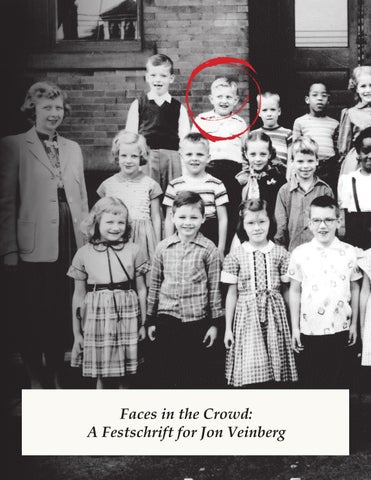
Faces in the Crowd: A Festschrift for Jon Veinberg
Faces in the Crowd: A Festschrift for Jon Veinberg 1947-2017
Penumbra Press Series 5
This book is funded by the Instructionally Related Activities Grant of California State University, Stanislaus. California State University, Stanislaus Penumbra Literary and Art Journal 1 University Cr. Turlock, CA 95382
Edited by Penumbra Press Fall 2025 Staff Faculty Advisor: Tony Perrello Editors-in-Chiefs: Reagan Olivera & Julian Saenz-Payne Curator and Guest Editor: Chris Buckley Supporting Advisor: Allison Westlund General Staff: Guadalupe Casteñda, Jackeline García-López, Malachi Hernandez, Alejandra Ibarra Saldana Lyet Koffi, Marcio Maragol and Emily Torres. Cover Design: Nic Webber Proudly Printed by: Stan Prints at Stanislaus State
All memoir, prose excerpts, and poems are © by the individual authors. For permission to reprint contact the editor and/or the Press. Penumbra Press, 2025. ISBN: 979-8-3507-4701-0 Copyright © 2025 All Rights Reserved. Penumbra Press is an extension of Penumbra and Penumbra Online. For more information, see our website at www.penumbraonline.com.
The Penumbra Press Selection Process For the past five years, Penumbra Press has supported local and fledgling poets by producing two chapbooks of poetry annually. This industry has been successful and beneficial: novice editors experience hands-on work creating a small, precious literary artifact; Stan State Art students work in tandem with poets to generate unique cover art; the voice of the poet enters the literary arena; Stan Prints does its work; the world is gifted with a new voice. 2025 marks a slight departure from what has become our standard practice; we still called far and wide for poets to send us their work and their ideas, and we selected one from out of the many—but only one, not two. The other book of poetry, the one that you are holding in your hands or perhaps leaning forward to view on a screen—is a Festschrift in honor of a poet who lived his life and plied his trade in California’s Great Central Valley.
A Festschrift celebrates and honors the legacy of a great teacher, historian, philosopher, or poet, usually with remembrances and written contributions by that person’s friends, students, and colleagues. The subject honored by this book, the great Fresno poet Jon Veinberg (1947-2017) richly deserves such a tribute, and an assemblage of his poet-friends have responded with poems and reminiscences to help memorialize their fallen friend. The voices in this book are united not only by their relationship with Jon, but by their connections to the Great Central Valley. And this is part of the mission of Penumbra: to illuminate and bring into the world’s view the life and art of the region surrounding Stanislaus State University.
Table of Contents
Preface........................................................................................................................................................................................................ 1 Introduction.............................................................................................................................................................................................. 3 Jon Veinberg: Selected Works ����������������������������������������������������������������������������������������������������������������������������������������������������������� 6 C. Anne Engert: Interview with Jon Veinberg ������������������������������������������������������������������������������������������������������������������������������ 9 Chirstopher Buckley: A Review of Jon Veinberg’s Books ��������������������������������������������������������������������������������������������������������16 Jon Veinberg: Last Poems ������������������������������������������������������������������������������������������������������������������������������������������������������������������21 Irreverant Elegy for Jon Veinberg: 1947-2017, Christopher Buckley ....................................................................................35 A Sparking of the Senses: in Memory of Jon Veinberg, David Dominguez............................................................................38 “I first met Jon . . .” &. Remember Jon, Glover Davis ����������������������������������������������������������������������������������������������������������������39 “I have for years admired . . .” & The Depot, Peter Everwine.................................................................................................41 Messengers, Lee Herrick ��������������������������������������������������������������������������������������������������������������������������������������������������������������������41 Elegy for Jon, Tony Perrello ��������������������������������������������������������������������������������������������������������������������������������������������������������������42 Preface to Voice of the Wind & Morning & The Visitation, Dixie Salazar.............................................................................43 Letter Left for Jon Veinberg, Luis Omar Salinas ���������������������������������������������������������������������������������������������������������������������������44 “Though Jon and I became friends . . .” & Moves, Timothy Sheehan....................................................................................45 from “We Don’t Have to See the Menu”, Gary Soto ������������������������������������������������������������������������������������������������������������������45 from “Home Alone”, Gary Soto ��������������������������������������������������������������������������������������������������������������������������������������������������������46 Elegy, Gary Soto ����������������������������������������������������������������������������������������������������������������������������������������������������������������������������������47 Jon plays bocce in heaven..., Gary Young ���������������������������������������������������������������������������������������������������������������������������������������48 Biographies.............................................................................................................................................................................................49
PREFACE: Central Valley Scop
Tony Perrello
As an English professor at Stanislaus State University and faculty advisor for the campus literary journal, Penumbra, I have had the pleasure of introducing several cohorts of students to the Fresno Poets as guest presenters at my semi-annual Valley Voices series. We relished the California-focused works of Gary Soto, Juan Felipe Herrera, Lee Herrick, and of course, Jon Veinberg. I knew Soto, Herrera, and Herrick by reputation, but Jon Veinberg I knew as family, as well as a great poetic voice. I am therefore happy to team with Jon’s long-time friend and fellow poet Chris Buckley to put together a Festschrift in honor of Jon’s achievements and his abiding memory. A Festschrift is, by definition, a collection of works in honor of a great teacher, written by his former students and colleagues. As an exemplar of the Roman vates, a poet, teacher, prophet, and seer, Jon most certainly merits such recognition. The compassionate life he lived, his influence on the lives and art of others, and the vibrancy and authenticity of his work and career as a poet of the Great Central Valley all speak of a life to which celebration and tribute are sublimely due and which, in light of Jon’s passing far too soon, I am honored to contribute. I first met Jon Veinberg as a member of my future wife’s family during one of those social occasions suitors dread—being introduced to the relatives. A Ph.D. and a teaching career were still distant destinations for me, faintly glimpsed road signs in the fog along highway 99. With a short list of accomplishments and not much to offer aside from a love of literature, my nerves stiffened when two new acquaintances were announced at the Christmastime gathering by Vilma Veinberg, Jon’s mother, with her gently wry herald: “Here they are. The poets are arriving.” Jon and his wife Dixie Salazar entered the room, and almost immediately the anticipatory tension I had been feeling melted in Jon’s natural warmth, his good-natured questioning, and his spirit of easy laughter. During that long afternoon meal of wine and storytelling, Jon—always Jonny among family—introduced me to the groaning board of Estonian cuisine that he loved. Through his gustatory tutelage, I was fed into this family with copious amounts of the traditional Estonian winter diet: blood sausage, pickled herring, sült (pork aspic), rosolje (beet salad), and more. Still living large in my memory of that day are my feelings as I left the scene, that alongside the family I was about to gain through marriage, I had also made a new friend in Jon Veinberg. In time, through my personal relationship with Jon and through the family history of my in-laws, I gained deeper insight into this man of great empathy and his talent for communicating in poetry the challenges, perspectives, and individual pain in the lives and experiences of the less fortunate. Jon had begun his own life amidst a world fraught with hard times. His father had died before his birth, and his mother, sister, and aunt— with Jon arriving officially into the world along the way—had been forced to flee their native Estonia to escape the Soviet advance across post-WWII Eastern Europe. The Veinberg family’s harrowing and inspiring refugee story includes living in displaced-persons camps, eating food smuggled in a baby carriage by nuns working for the international refugee committee, securing passage overland with American soldiers, and catching a particularly fortuitous boat to Ellis Island in 1949. After spending his early childhood in New York City, Hartford, and Pittsburgh—“places which went largely unnoticed” by the young child—Jon and his family headed West to Fresno in 1955. This dusty city in the Golden State’s vast, flat valley of a midsection, an expanse known for both its agricultural bounty and the general impoverishment of its inhabitants, would be his home for the rest of his life. Jon would eventually earn an MFA in Creative Writing from UC Irvine, a discipline he found serendipitously through a college course taken to satisfy the last-minute discovery of an unfulfilled graduation requirement at Fresno State. Though drawn to the life of a poet and gratified by consequent success as a prominent voice on the Fresno literary scene, Jon eschewed the academic career potential that this vocation offered. Instead he answered another professional calling. Jon worked for many years as a mental health counselor and therapist at various group homes in Fresno, many of them housing at-risk teens and those suffering from substance abuse. Perhaps the synergy between these twin lines of Jon’s livelihoods—mental health professional and creative writ-
1
er—further nourished and amplified his native ability to peer deeply into the experiences and trials of others and to lay bare, to those who suffer and to the world that looks on, what he had seen. Throughout Jon’s years spent offering counsel to people in difficult circumstances, he maintained an unfettered capacity for living life with joy and humor. Jon had a loud laugh and an appetite for life like few others. Holiday dinners were expansive affairs full of wine, laughter, and convivial though voracious feasting. Alongside Jon’s prodigious appetite for enjoying good food and good friends, he also hungered for good competition. He drove an old, dusty Camry missing four hubcaps, but the trunk housed a wide-ranging collection of sports equipment—rackets, clubs, baseball gloves, and balls for any occasion. We once teed off at dawn and ate lengua burritos together on the walk down the first fairway at Airways Golf Course. He was slender and deceptively agile, and he hated to lose. But he always displayed a generosity of spirit; I remember him tapping the flagstick so that his blind friend, Kirch, knew where to direct his putt. He wanted to beat Kirch, I’m sure, but not without tapping that flagstick. Jon’s competitive edge was no doubt sharpened by his membership in the community of Fresno poets, most of whom taught in universities. Working with and against this group of writers, his voice emerged as an enduring channel for Fresno’s unseen and unnoticed. Jon’s negative capability allowed him to speak—to be a virtual “ventriloquist” as his poet-friend Peter Everwine observed—in the tongues of orphans, refugees, winos, bill collectors, addicts, weary early-morning diners, and old, dying dogs. But of all the voices of presence in Jon’s poetry, one absence hovered above and behind all the others. As Jon has said, his father’s “presence is in most of my work because I never knew him.” Ernst Veinberg, who died a mere four months before Jon was born, was a physician, writer, and renowned college professor. Jon’s poem “The Anatomy Lesson” brings his father’s absent voice into palpable presence: My mother was his student, and when I ask if he loved her he says, “I always tossed her the fibula.” He cradles me to his chest and I’m content in the frailty of my own bones, at how his invisible body and mine for a brief moment traveled through the same spoke of light, knowing if he were to return it would make little difference. Jon’s dreamscape meditation on death, on coming to terms with longing for what has been lost, or in the case of his father’s cradling embrace never known at all, poignantly exposes the paradox of a profound truth: that as powerful as is presence, absence may be just as powerful, sometimes even more. This is often the case for those whose voices and deeds leave lasting marks upon the world. Their works endure beyond their presence, and even in the absences felt so keenly by those who knew them personally, their spirit and their influence live on. Such is and will be with Jon Veinberg. His body of work also leaves behind a trail for others to journey further upon, because the world ever needs voices of wisdom and insight like Jon Veinberg’s so that we neither lose ourselves in the midst our joys and forget those who mourn, nor in the persistence of our own grieving fail to embrace life’s contentments.
2
INTRODUCTION: from “My Great Good Luck: Jon Veinberg 1947-2017”
Christopher Buckley
In a 2007-2008 interview Jon related: I come from a family of scientists. My father was an anatomy teacher. He was well read and spoke five languages. There were a lot of doctors in my dad’s family, and he too, earned a medical degree. He came to America in 1930 under a Rockefeller scholarship. Then he went back to Estonia. From this experience, he felt America was the most opportune place to go for Estonians caught under the Russian regime. My mother was pursuing being a doctor. During that time, Estonia was an egalitarian country. Women held a lot of occupation weight. She was his student. My dad died over there in 1946. After fleeing Estonia and giving birth to me, my mother wanted to catch the first boat out. We missed the first boat, but it blew up after it hit a mine. We missed the second boat because my sister broke her arm; it went to Paraguay. We caught the third boat and by happenstance or luck it was going to America. When we arrived at Ellis Island, my mother didn’t speak any English. Jon spent his early childhood in New York, Connecticut, and Pittsburgh, PA. Then, with a job opportunity for his mother Vilma, the family relocated to Fresno, California in the early 1960’s. Jon graduated from Roosevelt High School and attended Fresno State University where he first studied poetry writing with Philip Levine. He received a BA in Psychology but pursued his writing in the MFA program at UC Irvine. So in one sense, my great good luck began in Germany when Jon and his family missed those first two boats out of the country and caught the third one to the U.S. More practically, it began at Fresno State which offered an office of “Evaluations” to which a student could apply for his/her course work to be evaluated with regard to how they were proceeding toward graduation in a major. About 1971 or ’72 Jon went to Evaluations and handed in his request to discover that he had in fact completed enough courses for his degree in Psychology but was short two elective courses. Without knowing anything about Philip Levine or poetry writing, Jon signed up for a poetry workshop, thinking, How hard could this be? That course with Levine was hard—Phil was a magnificent but rigorous teacher—and it changed Jon’s life as he discovered his vocation in poetry. And it changed mine, giving me the great good luck to meet Jon a couple years later and have him as a friend in poetry and in life for 43 years. Although Jon would, for most of his working life, have a career and jobs in mental health with his degree in Psychology, he found poetry and became a poet—hands down one of the best, most compelling, and original of our generation, and one of the outstanding poets of The Fresno School. Our mutual friend, Gary Soto, was in that class at Fresno State, and Soto recalls that one of Jon’s first poetic efforts was titled, “Green-Eyed Ants,” which early on demonstrated Jon’s penchant for looking outside of himself for his subjects. My good fortune really began in my first MFA workshop at UC Irvine which found me in the room with Jon and Soto, Gary
3
Young, Tim Sheehan and Deborah Gorlin. Diane Wakoski was the visiting poet for that first quarter and Jon and I agreed she was a terrific and exact teacher as well as a generous mentor. Jon kept a house in Fresno while he was in grad school and drove home often. It was Jon who introduced me into the circle of Fresno poets by first inviting me up to stay one weekend. He suggested we go over to Levine’s house and visit, and that seemed to me impossible and presumptuous . . . you could just go over to his house? Jon called Phil and Phil said sure, come by for a drink the next afternoon, and so, apprehensive as I was, we went. I had met Phil years before at San Diego State when he was down for a reading, and we played a couple sets of tennis together, but I would then have never thought of calling up and going by to visit. Phil was very friendly and relaxed, as was Jon, who chatted easily with Phil and Franny. I can’t remember saying much of anything that day. For a few years I taught several places in southern California and then moved to teach part-time at Fresno State. During that time, I got together with Jon every week for a talk about what poets we were reading or to exchange poems for help and suggestions. I often nagged him about finishing up rough drafts, getting work into the mails. Jon was not writing letters or emailing editors, not at the post office promoting himself in the mails. Rather, he was working in mental health. He was a great student of the human condition, the mind, the wounds it receives in the rush of experience. And with his great compassion, helped many. While teaching at Fresno State, I learned letterpress printing on a press in a colleague’s garage. The first book I printed was a chapbook by Jon, Nothing About the Dead, 1980. Only recently, I found a copy of it on the internet and bought it, first one I have ever seen for sale, though the colophon says I printed 250 of them. “Dog Poem” from that chapbook, though an early poem, is still one of Jon’s best. Over many years of teaching beginning poets, I always advised them to avoid sentimentality and subjects like the death of a pet. I would bring in Jon’s poem with its fierce and original approach and resolution to an old subject, its gravity and shaking mortality, and show them the one exception which proved the rule. I landed a full-time job at UCSB but still drove up to Fresno to stay with Jon, and he sometimes drove down to Santa Barbara, and we sent poems back and forth in the mail in those days prior to email. In 1986 I placed a book with Vanderbilt University Press, and soon began screening poetry mss. for them. I suggested Jon send his first ms. in to Vanderbilt, telling the director, John Poindexter, that I thought it was an amazing book but that I was a close friend of Jon’s and should not review it officially. I suggested he send it to Ed Hirsch and Chase Twichell, which he did, and they both gave it enthusiastic support for publication. Vanderbilt published Jon’s An Owl’s Landscape in 1988, about which Ed Hirsch wrote: “His poems have a strong sense of conflict and drama. They try to tell the truth about ordinary people—they also grant these people their individuality and dignity.” Introducing Jon at a reading I said: “Line to line and poem to poem, few poets today can sustain language and imagery this brilliant and inventive, a subject this deeply human, a voice this true, this powerful. . . . His is a vision of the world being pieced back together, a world shining in its shattered parts. These poems celebrate the power of the spirit unadorned and yet illuminated with integrity.” I was not exaggerating. We traveled to Europe together, saw each other almost daily when I lived in Fresno, and he remained my great and wonderful friend for 43 years. I could write pages and pages about Jon—his generosity, compassion, fierce intellect, critical insight, grounded sense of democratic values, and his amazing poems and sustaining sense of humor . . . no one like him. In 1991 he married Dixie Salazar, a Fresno poet and artist and they made a mutually supportive, joyous, and creative life together for thirty years. As I said at his memorial service, it’s always seemed to me that truly great poetry is a result of great character, not skill with language alone. Jon was a man of great character, of great insight, imagination, and compassion, and that gave rise to his exceptional poetry. To my mind, he was largely overlooked by those who purport to be champions of poetry. Jon was a true individual. He realized early on that he wanted no part of
4
academia with its duplicity and political agendas and machinations, and as well he would not network or curry favor, play poetry politics. He worked longer hours than those of us who were teaching and likely did more good in the world, especially working with teens at risk the last ten or fifteen years of his life. Yet he published five books, and, most interestingly to my mind, received two National Endowment for the Arts grants for his poetry, a competition in which the applications are judged anonymously. Each time, I imagined the celebrated judges reading his work and wondering where this great poet had been the last several years, and wasn’t this someone whose work they should know? In addition to his two NEA grants, Jon also received the Vern Rutsala Award from HUBBUB magazine, and had work selected for POETRY DAILY. Along with Ernesto Trejo, he edited the important anthology, Piecework: 19 Fresno Poets in 1987. More recently Jon and I edited, Messenger to the Stars: A Luis Omar Salinas New Selected Poems & Reader for the Ash Tree Series published by Tebot Bach, 2014. Jon’s poems appeared in many anthologies: What Will Suffice: Contemporary Poets on the Art of Poetry; Highway 99: A Literary Journey through California’s Great Central Valley; The Geography of Home: California’s Poetry of Place; Many Californias: Literature from the Golden State; Bear Flag Republic: Prose Poems & Poetics from California; Aspects of Robinson: Homage to Weldon Kees: and One for the Money: The Sentence as a Poetic Form. Jon’s passing was a crushing blow to his family and friends, a roadblock on that path of hope we all try to follow. For most of my life I knew that joy, hilarity, insight, and camaraderie were only a phone call away, a three hour drive to Fresno—that great good fortune I carried with me since the first day I met him 43 years ago. When Gary Soto called with the terrible news, I felt a lot of the luck of my life evaporate. But realistically, I have to make myself understand how fortunate I was to have Jon as a friend all that time. Jon wrote exceptional poetry that resulted from his unique and compassionate character, his incisive intelligence, his understanding of irony countered with joy in the world. He wrote in the voice of animals, in the voices of the disenfranchised, in the voices of the lost whom he reclaimed. His last book ANGELS AT BUS STOPS is one of the finest books by anyone of our generation. We have lost a great poet and a luminous and original soul. Here’s Cicero’s famous line from his funeral poem to his brother, # 110: Atque in perpetuum frater ave atque vale/And forever brother, hail and farewell.
5
from What Will Suffice: Contemporary American Poets on the Art of Poetry, 1955
Jon Veinberg
On the back of my book I am rewarded with a blurb that uses the words “Drama’ and “Imagination,” two words that always held negative connotations while growing up. For instance, in the fifth grade, I was absorbed in devising a plan for dropping cherry bombs into our public school restroom. A perfect strategy when completed which I could share with my classmates in the simultaneous sensation of seeing and hearing shit and porcelain explode. This act was always met with failure, admonition, and the principal’s recurring lecture on the parameters of drama and imagination. There are other examples: The harpooning of goldfish with a number two lead pencil after reading The Old Man and the Sea, the transplanting of rattlesnake tails onto the body of a turtle in hopes of generating a better way to crawl. One could say that I now write poems because I am being rewarded for things I was once punished for. One could say but it wouldn’t be true. In “Stickball ‘Till Dawn” a group of boys are playing a typical game in a forbidden place and time, a place and time of their own devising. Whether they know it or not they are sensing human drama unfold. It is not unlike the act of writing poems that these boys should return as poets to rehash this experience over a few beers, to return to a point of reference where their passion for a silly game has surpassed their fear of darkness. The journey they take is through the myriad sounds and symbols of each one’s specific memory. The trouble is that the journey never ends in the same collective place, or they, as a group, would fly there to quench their imaginative thirsts without ever having to set foot on the ground. They have been lucky enough to begin at a similar place, a spot of familiar experience. The bombing of toilets in a grammar school bathroom or the playing of stickball under the meager arc of neon isn’t a bad place to start dramatizing and embellishing.
6
from How Much Earth, 2001
Jon Veinberg
Over the past forty years of living in Fresno I’ve put a great deal of thought into why I live here and can never come up with one concrete reason. It’s become a cliché that the San Joaquin Valley is the agricultural breadbasket of the world and I’m beyond embarrassment when I still rely on the expertise of my friends to point out the difference between a peach and nectarine tree. I’ve yet to read a Chamber of Commerce pamphlet that doesn’t espouse being two hours from the mountains and three from the ocean. I’m not all that crazy about staying in a cabin in the woods for more than two days and my beachfront deck has whittled away into the mist of a dream. When I’m writing, the two most recurring thoughts that come to mind, no matter where I am, are God and Fresno’s imagery and I’ve yet to make a connection. Today my reason for staying is that I’m doing penance for, on a sweltering pre-summer day in the sixth grade, having locked Henry Lopez in the ball shed. It was at least a couple of hours before the teachers heard screams they couldn’t pinpoint and discovered him missing. When they pulled him out all he could talk about was spiders. While the school officials grilled me about a motive and kept asking if things were okay at home I saw through the window poor, dehydrated Henry waiting for me outside the school fence. Even as a twelve-year-old Henry always carried a knife. It was our shared secret though it took that day to figure out why; for people like me. When I stepped outside the gate and apologized I saw the scar that ran from the corner of his mouth to below his chin, something he never talked about, quiver as he broke into laughter and told me, “hope you didn’t get into too much trouble, besides it’ll toughen me up for what’s ahead.” The last I heard Henry was doing time and I doubt he’s the same, and wonder what shed he might be trying to scratch out of now. What I find in Henry is what I find in abundance where I live, Fresno: toughness and vulnerability, secret pains, the capacity to forgive and to spit laughter into the mouth of hardship. If I were to someday run into Henry I’d want to see that same scar quiver as it once did though I don’t know what I’d say to make that happen, maybe if I told him that I now write poetry he would laugh so hard that that scar would disappear. I’d have to tell him that it toughens me up for what’s ahead.
7
from Bear Flag Republic: Prose Poems & Poetics from California I ask more of my poems than they ask of me. The first I ask of any poem, while it’s still in my head, is for it to identify itself, whether by title, theme, or form. One day when it exclaimed a desire to be a prose poem I thought we would both journey down a doomed path without a hiccup of sense. It kept reminding me of how I could enhance all the elements I once espoused: a storytelling personality and temperament laced with humor, the adventure in using a myriad of themes and as many circular patterns my subconscious could handle, exaggeration to the level of preposterous, unlimited spokes of transition, softer language yet more venom per bite, and best of all, I would exude greater clarity of thought. I don’t know if any of these expectations were fulfilled, however, in writing prose poems I always feel as though I’m committing a crime, albeit a misdemeanor akin to stealing hubcaps from the grand limos of novels and/or verse when the rest of the world is asleep. I’m addicted to my crime and my adrenaline is popping.
8
Jon Veinberg
from “An Interview with Jon Veinberg”
C. Anne Engert
for The San Joaquin Valley Journal. It was hosted by the English department at Stanislaus State and published by Tony Perrello in an online format. Anne conducted the interview following Jon’s reading at the University bookstore in 2010. AE: When did you start writing seriously? JV: Graduate school in ’74; I took poetry classes two years prior to that. That’s when I wrote my first poem. I’ve been writing ever since. ’72—that would have probably made me about 25. AE: And at what point did you begin to think of publishing? JV: I published because I was more encouraged by my friends and other poets to publish than I was by the act of publishing itself. I didn’t like the business aspect of it. It got in the way of writing. There’s politics involved in everything. In poetry, since everything is kind of slim-goings, you compete with people, editors, their friends and all that. I’ve been on the good side of that too, but I am kind of out of the loop because I am not involved in the academic environment. AE: What was the first time you were published? JV: It was at Fresno State. Somebody asked me for a poem for Backwash and I gave it to them and it was published. I don’t think it was overwhelming or that I was any better because of it. I just thought, that’s what you do. AE: What about when you published your first commercial book? Was that different? JV: I was a bit more ecstatic. But bear in mind that you usually have to wait a whole year. So, once they accept it, you have to wait, and then all kinds of delays happen. So, when it finally came out...I should have been more excited. But I was more excited than just publishing in magazines. AE: How about your family? JV: Oh, they thought it was the most fantastic thing. AE: Is your mother still living? JV: No, but she was when I came out with the books, and oh, she thought it was great! AE: Did you have to endure very much rejection? You always hear about people getting so many rejection letters.
9
JV: Every poet has to endure rejection. I’ve heard horror stories about people who have these wonderful books out that were rejected dozens of times—I haven’t had that. I think my percentage is pretty good. Send out ten poems, I think I can get maybe five published, and that’s really pretty good. AE: But as far as a beginning writer being crushed by rejection letters, what would you say in that regard? JV: I think a lot of poets want to publish before they write a whole lot. And maybe they think that it is easy to do that. Poems, I think they think, are easier to write than novels. But a book of poems, I don’t think is any easier than writing a novel, according to what I’ve heard from people who’ve done both. AE: When you say publish before they write a whole lot, what would you say is enough to begin thinking about it? JV: I think that you have to have discovered your voice. And, if you don’t know, someone will tell you. Poets don’t write by themselves. They always have other poets look at their work, no matter who you are. AE: I want to ask you about the community of poets in Fresno. I’m sure you’ve probably been asked about Gary Soto’s comment about not being able to shake the dust off from Fresno in your poetry, because you do continue to write about the Central Valley. But what I was wondering is how has that community of poets contributed to your life as a poet? Is it a factor? JV: Yes, it’s a huge factor. Let me start with Gary Soto’s quote. I don’t write necessarily about the Valley. ‘Shaking the dust off from Fresno,’ he’s wrong about that. And he should know better because he knows the poetry. I think he meant it differently. I think he meant it metaphorically, that I should actually leave Fresno. He writes a lot more about Fresno than I do. But he left Fresno. He lives in Berkeley. Most of those poems I read today were about places outside of Fresno. I think you can capture the same image in Fresno as you can in Rome. I mean crumbling buildings or whatever else it is. It’s just a matter of what you put into the subject matter and what is the heart of that poem. Fresno images are exact in pretty much any place. AE: Does the community of poets in Fresno communicate with one another? Is there a circle of collaboration in some way? JV: There’s not a circle of collaboration. But, we are great friends and supporters of each other, and that’s what I absolutely love. Here are people that used to be my teachers, and now they’re my friends. I mean, that’s pretty rare. And not only were they my teachers, they are excellent poets. I am just surprised that I know people of that caliber. And they’re still writing. Two of my best friends are in their eighties, and they are still writing as well as they ever wrote; they are absolutely fabulous poets. And fabulous human beings. They have a great sense of compassion and support. AE: So, do you find yourselves mutually inspiring one another, and if not, or even if that’s only a part of it, what does inspire you the most? What people and situations do you find the most inspiration from? JV: I find most of my inspiration from people who don’t have much—people who don’t have a voice, people who are struggling just to make ends meet. Things like that. People who have internal struggles that nobody else can see. That inspires me a lot. AE: I wanted to bring up your website, where you’ve got several blurbs about the new book. One is from Chase Twitchell, who has written that your book is “inhabited by a cast of characters that is made up of oddballs and losers whose situations you explore without a trace of condescension.” Do you think that your empathy for peo-
10
ple with outsider status stems from your own experience as an immigrant, coming to this country as an outsider? JV: I worked in mental health for a long time. And I think I was pretty good at what I did for just that reason: I did have a sense of empathy. I mentioned during the reading that my mother was a nurse, so maybe I got it from her. She was always empathetic to situations. Both my sisters are very empathetic, so it runs right through our veins. Whether it’s cultural or chemical, I don’t know, but we’re there, we’re there. AE: Another theme I noticed in several of your poems was the search for lost fathers. Of course, your father passed away before you were born, and that’s obviously a formative experience in anybody’s life. How has that shaped your worldview, and thus your poetry? JV: Well, we can back up to that other question. You’re also much more empathetic toward the people who, in this day and age are single parents, or whose families are not complete. So that shapes a lot. Also it gives you an incredibly fierce sense of independence that you might not necessarily want. AE: We like to be taken care of sometimes. JV: Sometimes we do like to be taken care of, or share something. As a kid I missed out on all those little things. And that’s not playing the blame game. It’s just the cards that you were dealt. So you learn to play baseball on your own, rather than go find somebody to teach you that. And when I think about it that’s how I discovered poetry. I just wanted to see what it was like and ended up liking it. AE: Today in your discussion, you mentioned Philip Levine’s advice, “Why write about yourself, when you can write about something interesting?”. Where has that led you that surprised you, in writing about, not yourself, but about ‘something interesting.’ JV: I think everything that isn’t geared inward is always interesting to me, if it works. There’s a poem that I have in The Speed Limit of Clouds called “The Lighthouse.” That poem is surprising because I’d never seen a lighthouse growing up in Pittsburg. But the image of the lighthouse captivated me, how that thing goes around searching for—with the light—searching around for things that are lost. And I always considered my sister and I kind of these lost little souls out there looking for their father. And when I put the two together, I made the lighthouse up. So, that lighthouse was never that much a part of me, but that led to the imaginative turn. AE: How about other writers? What has been the influence on you of other writers—besides the community that you are with in Fresno, other major writers that you encountered in college, or wherever? JV: The very first writer that I ever read a full book of was Federico Garcia Lorca, the great Spanish poet. Oh my goodness, I just couldn’t put his book down. I read it in the library. And again, it was pure accident. I was looking for somebody else’s book. I think some of the Polish poets, Zbigniew Herbert was an incredible influence on me. And probably, if I were to take a book, and that’s the only book I could take anywhere, I would take Neruda’s collected poems. Neruda could write about anything, anywhere, and he had such a magical relationship with the earth and humanity. It was just mind-boggling, his immense talent. And thematically and stylistically, I like him as well as anybody. AE: As you have assimilated those into yourself, do you feel that coming out as you write, or have you completely separated from that [influence]...I mean, you’ve been doing it a long time now? JV: My wife read an old poem of mine. And she said, “Were you reading Neruda at this time?” and I said, “I
11
don’t know.” And she says, “Well, it sounds like him.” You know, I am assimilating. As a matter of fact, sometimes, I can’t believe I wrote a line—and not because I think it’s good—largely because the voice isn’t fierce. Where’d that line come from? And I actually think I’m stealing. So, I go through all these books trying to think where’d I get that line? And I haven’t found it yet. So, I did make it up. I did assimilate it, and I think Neruda does that for me. AE: What do you mean by fierce? Is that a quality you are looking for on your work? JV: Yes, I am. I think that there’s some rage in my poetry. And I’m not afraid to share it. That’s what I mean by fierce. Not that I’m fearless, but I’m trying to point out the fearlessness of the subject matter that I’m usually writing about. Death is a big theme in there. And people that are dying with dignity are a big deal to me. AE: I want to hear more about how the poetry process works for you, how the writing process works. First of all, do you see it as a natural gift or a cultivated craft, or maybe some of both? JV: A bit of both. First of all, I think there are few people who have the true gift of poetry. Let’s face it, language is a learned experience, and when you’re trying to put emotions into words, you have learned the word part. So, it can’t be intrinsic. It can’t be genetic. Somewhere along the line you’ve had the desire to express yourself through music...through the music of words, I should say. That’s where it starts, and you can’t do it unless you’ve heard it. Nobody just wakes up and all of a sudden is a Mozart in poetry. AE: When you are writing a poem, do you go through multiple drafts, or does it pretty much come out the way you want it the first time? JV: Oh, it never comes out the first time, ever. Never has a poem turned out as good as I wanted it to. Or never has a poem gone in the direction I started it out. The subject matter might be the same, but the direction always changes. It’s a very big surprise. You know, sometimes ending lines start out as beginning lines. Beginning lines end up as ending lines. AE: How do you know when a poem is finished? JV: Two things: I think you feel that it’s done. You can’t pull any more weeds. That’s it. There is such a thing as overworking a poem, putting too much into it so it doesn’t sound natural. AE: You said that lines come to you, or maybe scenes or ideas, but not maybe so much a story that you’re trying to tell—just lines. Did I get you right on that? JV: I think lines are the place where they start; if you’ve got one line you can attach it to a story... One thing, you have to like the line. It has to hit you as cerebral and in your heart. So you have to be moved by the line. There’s a line, and I can fit it to a story of my own. And that’s where I’ll start. I might get rid of the line. I might get rid of the story. But something will come out of it. That’s the seed, where it begins. I have to feel it. It has to have a rhythm, a music, and it has to have meaning. AE: Do you keep a notebook of ideas, or sticky notes all over the house? JV: I keep a little notebook, yeah. AE: What else? JV: A big sheet of drawing paper. Start the poem on drawing paper and fill it up, as if you were working on a
12
painting, and see where it ends up. I’ve done that before. AE: That sounds like fun. JV: It is fun. But the trouble is that the drawing paper is so much more expensive than you think! [laughter] And it is fun. A lot of the times, poetry is kind of excruciating because you’re working alone and you feel like you can do better. But it is really a lot of fun. If you’re not having fun, you’ve got to rethink your motive for doing it. AE: Have you ever had the experience of trying to make a poem work for you that just won’t, and what do you do with that? JV: Yes, I toss it real quick. I’ve thrown away poems, and I have friends who say never throw away anything because there might be something in there you might save. Worse yet, I’ve lost poems. I lost a whole stack of them one time. It was at a reading, and I liked them! It was tape recorded so I thought, oh, great. I went to the guy who did the recording. “Oh yeah, I got the tape. Here it is, take it.” It was the only tape in three year’s worth of poets where the sound had accidentally turned off. So, I even took it to a lip reader. Poets will do anything to get their poems back. AE: Is there a place in today’s poetry, for you or in general for formal elements such as rhyme and meter? JV: Yes, there is, and they’re doing it. There are poets that I know very well that are doing rhyme and meter. In an October issue of The New Yorker, Richard Wilbur is still writing in rhyme and meter. Another friend of mine, Glover Davis, writes in rhyme and meter, but not necessarily all the time. AE: Do you ever incorporate that kind of formality into your poetry? JV: No, I don’t. I write in syllabics. It’s a great exercise for me. I think my voice is being kind of jaded when I do that. It’s too forced. AE: How about performance? Do you do very many live readings? JV: I do my fair share. There’s a huge paradox to this. When you are writing poetry you are creating myth— about events, characters, things of some historical value to your life. When you’re giving a reading, you are really making a myth out of yourself. And so the attention is on you. And writing is a little far-fetched from that—from my point of view, because I try to write outside of myself. It’s almost like two different art forms. AE: What would you say is the biggest challenge of doing a reading? JV: Feeling the audience. I had a sheet of paper on which I’d written titles of poems, some of which I read, some I didn’t. But that puts the structure on it, and that’s all I have. Some people like to know exactly what they’re doing the whole time. I want it to be a little more improvisational. AE: And what’s the biggest reward of doing a public reading? JV: Well, I think I saw it today. I saw people’s faces, and they were kind of glued to the poem when I was reading to them. That was pretty nice. I like that. Did I mention the money? [laughter] AE: When you think of people reading your work, buying your books and reading your work, how do you want them to read your work? What do you want them to take away from it?
13
JV: I want to very simply break their hearts and stop time. That’s what I want to do. And I know that sounds incredibly inflated, but I think compassion lies in that when you’ve got a little crack in your heart. And I also think that when you’re doing something, being part of the creative process, and readers are I think part of my creative process, you do stop time for them. People think you just sit down and write at a table or in your room or something. I carry poems around in my head that I’m working on. That’s what I do. Poems I’m working on don’t leave me, until I think they’re done. I’ve had roommates who were poets and I’ve sat at a desk and said, oh, I’m going to write this poem, boom, boom, boom and I’m done. And they say, “God you’re fast!” And I say, “No, I’ve been working on this for a week.” AE: What are you reading currently? JV: I’m reading the Portuguese poet Saramago, who just won the Nobel Prize not too long ago. All the Numbers is the title of that book. I’m reading a book of poetry from an Argentinean poet by the name of Juan Gelman. And I just finished a book by another Portuguese writer called The Natural Order of Things by... his name is— and what a great name—Antonio Lobo Antunes. He’s actually a fiction writer. And I always go back to a Polish poet that I’m immensely impressed with: Adam Zagajewski. AE: What would you say is the most rewarding aspect of life as a poet? Is that what you consider yourself, when you think, ‘this is what I am’? JV: You know, all I can do is compare this to Robert Frost—and I’m not trying to compare myself to Robert Frost. But towards the end of his life, and you know how popular he was and what a great poet he was, they asked him, ‘well what about your life as a poet?’ And he said—in all seriousness because he was not a humble man— “All I really wanted to do was write a few good poems, and I hope I did that.” That’s what I kind of think. I think a poet is somebody who has to go through the world like everybody else, except that he does one thing a little bit different—and that’s write poetry. AE: You mentioned during the presentation that poets write about their passions and flaws. How do you see that coming out in your work, aside from “chewing on bones?” JV: Richard Hugo has a poem called “The Lady in Kicking Horse Reservoir” about someone falling into a lake and drowning. And what he’s really doing is exposing his hate toward this woman that left him. And that’s disguised through techniques. They don’t really just say ‘I hate you because you left me.’ It’s him and this woman going through all the reeds and being suffocated and things of that nature. So, I think it is more thematic than it is just little lines here and there. Well, you know the poem I read, “The Crest Theater.” I’m not such a great character in that either. I’m really kind of making fun of my boss and other events—throwing winos out of the theater, too. And I’m being very egocentric by putting my name on the marquee. AE: What keeps driving you on as a poet? JV: I love the music of poetry, that’s all. I still think it’s a magical, magical art. And miraculous that we are able to sit down and write it—and it’s lasted so long and will continue to last. AE: On the practical end of things, you got an MFA degree as part of your education as a writer. Do you feel like that really contributed to your success in your poetry; is it a necessary thing for a person to have to be a successful writer? JV: No, I don’t think it is a necessary thing to have for a writer. But what I did have was friends. You meet people who also became writers, and they remained active friends throughout my lifetime. Soto is one of them.
14
Chris Buckley is another one. Gary Ent is another one. All very well-known poets. And you also learn how to look at your poems. The more you can look at your poems, the better you are—seriously look at them. And that’s what workshop MFAs do. AE: So you’re a proponent then of creative writing classes in general in colleges. Do you think the state of them currently is really helpful to writers, or what would you do to improve them? JV: Well, I don’t know what the state is right now, because I’m not involved in them. But, I think there’s too many of them. How many poets can we handle? At Fresno State, in my beginning writing class, we had five students that all ended up with books—published poets. And more than one book. I mean, just wonderful poets. When I was in graduate school, there were basically a handful of top MFA schools: Iowa, Columbia, Arizona, and Irvine. So if you got an MFA, it kind of meant that you were on your way. That’s not necessarily true, now, there’s just so much out there. AE: So what advice do you have then for the aspiring writer right now? JV: I think the poet should learn how to carve a sense of time into their schedule to write nothing but poetry, even if it’s an hour a day. That’s what William Carlos did. One hour a day. Of course, he was a genius, maybe that’s why he wrote an hour a day. Keep reading poetry, and you’ll know when... And another thing is, the poetry that you do write, find somebody that you trust to read it, somebody who will give you honest criticism. And then you’ll find out whether you’re passionate enough to continue doing so. AE: Of all the poetry that you’ve written, what’s your favorite poem? JV: I’ve been asked that before, and I keep saying I must keep looking for one, but I really don’t have a favorite poem. If poets consider their poems children, could you choose between your children? I sometimes like the poems that don’t get a whole lot of ‘play’ in terms of periodicals and publications, poems that are image-driven. And I think people find those very difficult to understand. But I like them mainly because it was a great experience writing them, and it was hard to write those. They’re more challenging. The ones that have a narrative behind them aren’t as challenging as the ones that have a voice behind them. AE: For instance, which one? Can you give me a title of one that would be what you are talking about? JV: Yeah, in this book: “Epilepsy.” This is a poem in which the disease itself is the voice. And I’m not going to say it’s my favorite. Of course, it’s not my favorite. But it’s the type of a poem that I like. AE: On the title of the new book, I was looking in the table of contents for the poem that was the title poem, and there isn’t one that I could see. How does the title fit in with the rest of the poems? JV: It’s a line in one of the poems. I think it’s the last poem in the book. It’s “Ride with Roberta,” and it’s an elegiac poem to a young woman poet who died and the line is in that poem. AE: And what is the “speed limit of clouds?” JV: I don’t know, because the line is “and how does God enforce the speed limit of clouds?” It was just a line where we’re getting together, and Roberta and I always used to talk in this loose, kind of metaphysical gibberish. [laughter] and we enjoyed ourselves so much in doing that. And that’s where that line kind of came from, like a philosophical, metaphysical construct, you might say. And then, it rings true, when somebody dies, and it’s really the passage of time. Slow down clouds! The quicker you go, the faster time is passing us.
15
A review of Jon Veinberg’s Books: The Bloomsbury Review
Christopher Buckley
Jon Veinberg’s poems have always been exceptional in that they do not take up the mainstream lyric mode of the last 60 years. He rarely speaks about himself in a biographical sense; there are no personal complaints about his lot in life. Rather, he looks at/into the lives of others, speaks for and through them to focus on the difficulties he observes human condition. With great empathy, he gives himself over to his subjects and finds the authentic music of experience at street level. At the same time, he is a poet of great imagination, and his poems invent structures and contexts and find an imagistic language which is fresh and compelling. His poems often have a strong sense of drama and are always accessible. The eminent American poet, Peter Everwine, wrote “Jon Veinberg’s first book, An Owl’s Landscape, was justly praised for its dramatic power and broad empathy with the lives of ordinary people. In this new collection (Oarless Boats, Vacant Lots), Veinberg has raised that level of power to an even greater and more assured intensity. We may well be, as he says, “dark and oarless boats,” but in these poems one can find a clarity of vision that glares back at the world and an urgency that has found its own fierce music. More simply put: these are poems that matter.” Veinberg’s first publication was, Nothing About the Dead, 1980. “Dog Poem” from that chapbook is still one of his hallmark poems. Veinberg’s poems not only take on the personas of other individuals but often assume the point of view from animals; his was a wide compassion for the world. In “Dog Poem” he avoids the subject’s sentimentality and predictability and though the poet himself could be the speaker, the focus largely is filtered through the dog and gives the reader an original approach and resolution that contains a gravity and shaking mortality for both.
Dog Poem No heavier than a sack of flour, I carry him in my coat, upwards, through the rubble of manzanita, willow herb and tin can. I set him down every few yards To scrape the muck from his eye And wipe his drivel from my cuff. He tries a step forward, falls, and rolls back down to rest, his front legs pawing the air. I take him to the farthest hill, high enough to where nobody can hear. He winces and cocks his ear to what I think is animal terror— the coyote’s whine, the bat humming a circle around his head, the owl’s glare. When he has fallen asleep I pull the trigger at close range. I hear two quick whimpers and see his ears dragged back
16
and his bad leg twitching as if he were hit right in the middle of a bad dream. I turn away and look for the path I had made the night before. Soon light will unravel from the thickets. I should have nothing to fear.
Vanderbilt University Press published An Owl’s Landscape in 1988, about which Ed Hirsch wrote: “His poems have a strong sense of conflict and drama. They try to tell the truth about ordinary people—they also grant these people their individuality and dignity.” One of the hallmark poems from that collection is “Next to Tut” a poem that highlights several aspects of Veinberg’s talent and vision. The conceit is a spirit or ghost reflecting on King Tut—an exhibition of Tut’s sarcophagus and burial treasures made tours of many US cities from 1976-79 and that, no doubt, struck the Veinberg imagination. And the lavish displays made for a challenge in language which Jon met. The speaker is a “local” spirit and that grounded point of view balances the elaborate set up of the Egyptian artifacts. Here is the opening of the poem:
Next to Tut You know, Tut, they were wrong about us ending up the same. Even now I admire you, how your hands lie luminous and crossed, steamed into the gold of many histories and how your eyes remain unfired and cloudlike as if held under the weightless custody of stars.
The phrasing and image making is original and engaging; he has a talent for choosing fresh verbs to energize a line. But the unique aspect of most all Veinberg poems is that he is able to balance, to complement the heightened language and imagination, by grounding the central emotion and voice of the poem in the specifics of lives lived at the neighborhood level, by evoking the struggles and dignity of real people, e.g. “Johnny Mendez”. Here is the end of the poem:
My mother is still scraping leftovers for the cat. I smell Mama Botta’s pizza and cheap tobaccos spilling out of the pockets of old men asleep on the porch, and sometime I wonder what mess Johnny Mendez will be in when he gets here. No Tut, your bones were put together someplace else. You will remain young and untarnished because what we want to remember is your bronzed and unripened face, your blank and tender eyes. In the next finger of wind, we’ll walk down my street where I happen to be very important because where I come from, Tut, all the dead are vanished jewels.
17
The Speed Limit of Clouds, 2009, won C&R Press’s first national book contest. In this collection Veinberg establishes the elegy as his focus and predominant mode. There are several poems that recall the dignity and resilience of his Estonian family suffering under the Germans and Russians in the ‘40s. This is one of the best, a tribute to an aunt who represents all of his people.
Spring Thaw, Estonia, 1943
Jutta, your cities are paved with ice. The women have gone thin this winter, they ached inside their sweaters and tug at the hems of their virginal skirts. For eight months your dead lay beneath the ice. Soon the sun will unlock their graves. There is a boy no older than sixteen whose spine will melt into a stream and your heroes will float below your feet. The children play in a patch of light, tossing black bread and salt pork to the first whistle of finches. When steam rises from the soaked leaves your dead will sprout and multiply as red poppies over your countryside. The children will lay their ears to the ground to pick out their fathers’ voices. Jutta, your rivers are flooding. All of the poems in this collection, but this one especially, evidence Veinberg’s keen eye for detail, his ability to convey his themes in the objects he qualifies and selects. The closure/last line demonstrates the poet’s preference for the concrete and dramatic, the specifics that are emblematic and resonant far beyond the concise details. Another superb elegy toward the end of this collection is “Riding with Roberta”. Roberta Spear, who died midlife in 2003, was one of the brightest lights among the group of Fresno poets. The speaker takes a drive through Fresno and nearby environs and imaginatively places Roberta in the front seat with him—guide, friend, inspiration, compatriot in poetry. This is a poem of loss and mortality, of course, and the speaker touches on several subjects that were close to Spear’s life and writing; and it is again the specifics of life and imagination that make this an amazingly poignant poem. Here is the last half of the poem:
the soccer fields are littered with knee braces and halved lottery tickets and when the Torres kids practice using chopsticks on their ant farm I want to dig into the roots of your laughter and even though it’s impossible I don’t want anything to do with time and death. I’ll pull
18
out Larry, Chuck, Shirley, and Ernesto for a game of checkers with our emptied long necks at the Kee Kong Club. We’ll dance in a circle with our hands on each other’s shoulders to a music no one else can hear. . . . and you’ll tell me about those ancient fishermen in Norway who were so frightened by the stars they navigated by the varying scents of the sea and when was it, exactly, that the face of shade lost its color and what does God do to enforce the speed limit of clouds/ I’ll put you away but not for good. The dust blowing off the alfalfa fields outside Hanford meets up with the mist spreading its arms across the coastal range and somewhere in a small town in Italy there is a row of chestnut trees asking about you. The geraniums have burst open, streaking the sky with blood, speaking to us from a much deeper soil.
Veinberg rounds up the lost poets here in his elegy and with his honest and authentic voice, without exaggeration and with detail lifted to emblem, to symbol, and pulls them back, into the company of poetry and life. Jon Veinberg’s last book, Angels At Bus Stops, was published in 2014 by Lynx House Press. He was at the height of his powers and imagination in this collection, and the finest testament to his unique and gritty vision, his compassionate talent, is the title poem. In it, his imagination combines and counterpoints the daily particulars of life as he witnessed it in Fresno, and unusually for Veinberg, he includes some critical details from his biography that center and unite the themes of the poem. The people in the poem, in the poet’s memory—even the poet—are transformed, and saved by such hope, by such specific attention bordering on love—by poetry. This could almost be an elegy he wrote for himself as he was taken from his friends and poetry long before his time.
Angels At Bus Stops
When rain is the scratch of fingernails across the moon’s face,
and the wind sears the treetops stapling its eyes shut,
the angels have a tough time telling time
19
or in what direction they’re supposed to be transporting the dead.
I’ve watched them limp Into boxcars brimming with sacks
of dirt crusted potatoes, ready to lift a supine, hung over
and mistaken saint into the smoke-stacked air
of south Fresno, and once you thought Marty the wino
was buried alive under a cardboard coffin. Rain tilts my umbrella toward a lost afternoon
of darkened windows in coffee shops and flooded canals,
its weed-tangled bottom shimmering with silver hand guns
perceived by the angels to be the jeweled perch of Jesus.
When they come up behind me I don’t know if I’m dead or alive.
They shrug their wings as if to say taking care of the dead is harder than you think.
Even the padlocked taco trucks and check cashing parlors
on south Van Ness look worn out, their windows veiled in soot
each starless time the train whistle pulses through,
their souls sawed into streamers with the dull blade of money.
In the bone chilling emptiness of November a woman
in a black hat and overcoat is fumbling for change
20
at the leafless bus stop on First Street, her husband with his rooster crowned hair
mumbles to the unpeopled sidewalk in his native Estonian
that the chimes of winter have just begun their steady climb
to a tumultuous crescendo. Bus stop angel, who walks me
from cover to cover, through rain and bad dreams,
how often you remind me that I got here by the message you sent
from that bus stop in Pittsburgh to my mother to reunite her
to her refugee friends and a job, I have followed you since then
through the cold and deepening puddles, toward any tunnel you choose,
breathing in the mist of your wings the shoulders of heaven hidden
behind the soggy clouds and dark grille of the sky. Veinberg’s poems take an unflinching look into the actual and often painful portions of this life, but he looks finally to the strength and beauty of those who survive. Line to line and poem to poem, few poets today sustain language and imagery this inventive, determined, and gutsy and manage a subject this deeply human, a voice this true, this powerful. His is a vision of the world being pieced back together, a world shining in its shattered parts. These poems celebrate the power of the spirit unadorned and yet illuminated with integrity, with hope.
Jon Veinberg - Last Poems 3 TREES Ernesto wasn’t embarrassed to admit that he loathed physical labor, exercise of any kind. This came from a man who was beautiful, trim, whose childhood dream was to be a flamenco dancer, whose father trained boxers in
21
Mexicali. Once he volunteered to haul boulders up an embankment for our friend to build a retaining wall in Santa Cruz. He kept stopping midway up the hill to discuss the varied translations of Neruda, wondering how he might treat this as a poetry inspiring experience: an ode to the grandeur of rocks or one that invoked the pathos of the oppressed worker. When Ernesto bought a house with a gone-to-swamp swimming pool, roses in their death beds, uncared for fruit trees on an one acre back yard plot I was only too glad to help him move, a one day project that took two weeks because of his effervescent stalling tactics: I’m thirsty, I’ll buy you a beer at the Silver Dollar; this beer made me crave salt, let’s stop at the 7-11 for sunflower seeds; I’ll need to order Chinese take out for lunch and maybe a nap break afterwards. I had deep concern for his yard and I shouldn’t have. I should have known that Ernesto would never let anything waste away and die if he could help it. The pool ended up meeting his Hollywood standards, the roses showed off their bounty of colors, the withered fruit trees lapped up water once again and new ones were planted. I never asked him how he did this because I knew he didn’t know. There’s a black and white photo that his wife Diane took of him acting the part of a land baron farmer. He’s wearing Levis and a denim shirt rolled to the elbows, his arm attached to a shovel. The trouble is that he’s wearing dress loafers, designer sunglasses and the shovel is upside down. Once after a long day of teaching he came over to my house, concern etching his face. He told me he had a confession to make that plagued all weak-charactered men, right away I knew he shouldn’t have taken that teaching gig and made himself vulnerable to those students whom I knew would adore him. I sat down, ready to hear about his involvement with a young heroin addict, ready for him to show me his sleeve-covered tracks. But all he said was that he felt guilty of buying a quart of ice cream from Thrifty’s for his family that night and had finished eating the whole thing by the time he got to my house a mile away. I suggested he buy another quart from a classier parlor and offered my services as a sponsor and interventionist. I’ve planted a tree in my backyard in his memory. It’s a tree only he and I can see and he’s welcome to it anytime. It’s an ice cream tree and with it I’ve left a can of butterscotch syrup and a spoon. I don’t bother to unlock the gate because I know he’s now light enough to pass through anything. When I hear the spoon clanging, the humming and crowding of bees in the arbor, I’ll go outside to taste that sweetness once again and we’ll go on from where we left off—the sky inking tranquility and the orange flame of the moon raging with envy at our butterscotch smiles, laughing as if there was no such thing as death. *** Moulton was a grizzly bear with bad teeth who rode a motorcycle. He looked as if children had scribbled games of tic-tac-toe on his face as he snored on the couch, and when he smiled he could spotlight a dark forest. His face should’ve been carved into Rushmore apart from the other four and looking into a different direction, accepting all the chaff the wind could throw his way. No matter what his age, he always looked older. My dog loved him, perked up his ears each time he heard a motorcycle, kids loved him, bankers and bartenders, the homeless, and the guy owning a view of the bluffs; I’m sure bats and wolves as well. Moulton was very proud of his arrest record. Once, upon release, he walked past a Hmong refugee who looked lost and disoriented at a bus stop. He put his arm across his shoulders and pointed to the bevy of men in suits lugging briefcases, lectured the refugee through his gravelly voice, “see those guys over there, they’re twice as scared as you and their future looks like shit.” Despite the language barrier the man looked like he understood Moulton—which was rare even in English—then accepted a ride on his motorcycle. Moulton would set up shop at the College Union selling in-depth astrological horoscopes for five dollars as he advertised on a square of cardboard scribed with crayons. If you didn’t have five dollars he would do a quick
22
analysis for a cup of coffee and if you didn’t want your fortune told he would do it for free, which is what he did for me and after a six month analysis, he called and said I could do whatever I wanted and when I asked if that was all he could come up with after all this time he said, “yep, buddy boy, it’s like a rap sheet from the planets and it’s all they have on you.” For as long as I can remember Moulton always had trouble with his teeth which were false and that he carried in a pliant black case clipped to his belt as if they were handcuffs. Once when he was hosting a poetry radio show, which he had asked me on as a guest, he just took them out and read a poem of mine, gumming the lines. Then he left me in charge while he tried to borrow another set from the technician’s father, as I found out later. Another time they flew out while he was reciting a soliloquy as a lead character in a Shakespeare play. When he died we planted two pistache trees on the corner of Olive and Linden in the Tower District and buried with it a couple handfuls of coffee beans donated by Java Cafe, his favorite hangout. I regret not walking through the Tower District where Moulton was an iconic figure and not asking for other mementos to bury: extra spark plugs for his next ride, keys to a garage which stored an old sofa he could crash on, a shot glass, a book of James Wright’s poems from the used bookstore, a hippie-fringed vest from the thrift store, a rusted church key from the antiques’ peddler. I’ve planted a tree in my yard that grows teeth so that when he comes over with his knapsack of poems and apples, and picks a ripe set off the tree, whittles away the peel and eats the apple, core and all. He’ll bring out his poems and read in the voice I first heard at Cafe Midi when he read to post bail money for a friend. The wind will change direction; the tooth tree will clack like silver chimes against the background of stars tumbling backwards into a distinct sky bruised with drama. *** Omar was a brother in poetry and organ meats. Sometimes I think we spent as much time discussing the flavorable merits of a delicately spiced and baked pig’s snout as on the poetry of Byron. I loved sitting in Omar’s backyard, eating a breakfast of eggs, potatoes, beans, and buche; halving an avocado from his tree, sprinkling it with a fresh lemon from one of his lemon trees, then using the avocado shell as an ash tray afterwards. If there were a wind it would sigh. The birds would turn their beaks up at us, especially when they thought we had tricked them into believing our platefuls of fried tripe were not a lottery of worms. It was as if the darkness of the world had quickly moved to a place outside of our selves. During his life Omar survived many catastrophes. When I once asked him what he attributed this life-enhanced quality to, he said he was born with a resilient gene and menudo. Without me telling him Omar always seemed to know when I didn’t have a job. He would come over with a huge jar of his second mother’s homemade menudo and this was usually complemented by another dish—a frozen chicken, a can of olives, a few over ripe bananas. We would eat till we sweated the poverty out of our pores. It was definitely a dish loaded with mood enhancers as we began to talk so fast we couldn’t understand each other but knew whatever we were postulating was brilliant. His family called me one day to tell me Omar was in ICU care at a local hospital. When I got there the priest was already giving what I assumed to be Last Rites. I came again the next day to find his bed empty and when I inquired about his passing the nurses said that he’s not dead, he’s fine and in another room entertaining and flirting with the nurses. I was so excited to see him I gave in to his wish to bring him something to eat from the outside so long as it didn’t oppose doctor’s orders. I brought him a lengua burrito and when I cut it in half it smelled—I’m sure and Omar agreed—of God boiling potatoes in heaven. In the last six months of his life I took him to a Mexican restaurant that served all-you-can-eat menudo on Tuesdays. We made a mess of the place—oregano spilled into our bowls like rain from a leaky roof, onions squished
23
between our teeth, and the chili flakes so hot our ears caught fire. We ate like it was our last meal, and it was. It was the last time I ate with Omar. It was Omar’s publishers-clearing-house dream to own a ranch. The house would be encircled by a wide, flower-potted porch, so he could have a different view of his sad-eyed cows each day. There would be plenty of hired help to freshen his ice tea during the long afternoons. When I come to visit him there I’m going to bring a tripas tree to plant—cabeza, sesos, trotters, and honeycomb tripe, all the unwanted parts will blossom and flicker like magic. The stars will light up one by one and we’ll be as serene as the droopy-eyed moon smacking its lips. *** Everyone needs a tree to talk to and I’ve got three. It’ll be a community of wind that brings us back together on a Friday morning to the Chicken Pie Shop. Moulton will choose from his bushel a set of teeth to accommodate a square of cherry cobbler and a side of cinnamon, which he’ll snort to clear his sinuses. Omar will work on his liver scrambler and I’ll have a go with the gizzard stew. A mound of chocolate pudding graced with an acre of whipped cream will leave a mustachioed film on Ernesto’s upper lip. We’ll, once again, begin reinventing our lives over platefuls of imaginary truths, buttering our bread with soul.
The Anatomy Lesson At first I hear it as a puff of wind splitting the pittosporum tops, then the window shade snapping up. My father is sitting beside me measuring my sleep. He shakes a jar of pennies at the bedside to waken me and asks if I’m still wetting the bed. He counts my ribs and I float in his arms to a flat spot on the rooftop, past the endless neon, so close to the moon’s face, given the chance, I could pinch the vein pulsating its cheek. We begin by inventing countries out of the elastic pattern of clouds and when the sky shrinks to a platter I ask him what it’s like to be dead and he answers, “For some it’s not as bad as they say.” From the loose gravel below our feet we shape bodies: twigs and splinters of wood shake for bones, wind swept candy wrappers for skin then one by one we dismantle them, feed them to starlight and he tells me how as an anatomy teacher he would, as a final exam, throw a cadaver bone three feet above his head and expect the precise answer before it landed. My mother was his student and when I ask if he loved her he says, “I always tossed her the fibula.” He cradles me to his chest and I’m content in the frailty
24
of my own bones, at how his invisible body and mine for a brief moment traveled through the same spoke oflight, knowing if he were to return it would make little difference. Aunt Good and the Blue-Green Radio Through warp and inconsiderate dust you’ve aged better than me, old voice. One day I’ll turn you over to the children cause you’re bound to outlast them, sure to let them inherit my regrets. I could’ve sold you to the ragman or given you away at Christmas wrapped up in good luck bows to toothless Lopez and his three legged dog except he’s been dead for twenty-six years and the ragman hasn’t shown his face since they closed the mill. Then where would you be but stuck singing my legacy to the spirits of junkyards and mold. Ain’t it funny how old photos take shape each time I pull you out as if my heart too, needed washing, hearing its bad pitch and secret wires. I should’ve buried you with my first love, along with the gold hairpin and portable mirror, chocolate wrappers and fake fingernails. But I didn’t have the guts to give you up. As my final act I’ll smash you to pieces and plant each part inside the bodies of all whom I love cause, dammit, all I want anymore is to be remembered. Let them, old voice, hear me moaning after I’m gone. Let them make my emptiness their song.
The Non-Privileged List Whiter than snow in Sweden, duller than 3-day-old dishwater, sour as curdled Cream of Wheat, I heard the cholo boys clicking their Zippos inside their khakis, a sound as symphonic as teeth clacking in an old man’s sleep or the sycamore branches breaking under the weight of an Indian summer breeze scratching the windows of East Hall
25
where we all glared at each other, wondering who brought the dice to roll for Johnny Mendez’s last cigarette before they carted him out of English and into detention. Israel Gonzalez said I had a white boy’s hobo face because of my beady eyes and feral hair, said I hopped trains to school every morning, which I did just for the chase and the whiff of exhaust, like burnt pretzels, and the hypnotic grind of steel on undying steel sparking the day. He had a gold starred tooth that glinted against the sun and a blade that gleaned specks of dried goo from his fingernails. His mother told him that Mexicans got their darkness from the moon— his father, a moth the light refused after he scalded his face with antifreeze under the flashlight of a wild and wispy moon. He drove a coppery primed Fleetline with rustglazed Tijuana tuck & roll, a fur bordered mirror and sloe gin in the glove compartment below a fake I.D. and ticket stubs from The Marigold Ballroom. After a sixer of Schlitz Malt and swerving around sagebrush and the dusty caked corners of Calwa, we met Madrigal and Chuy at the park who glared me down with eyes blind as pearls behind the shades that, I’m sure, dreamt of boneyards in their sleep. The silence of the afternoon was broken by the hum of gnats, those electric eels of valley air, circling my ears, haloing my head. When they asked me to run for president of Roosevelt High because I was the only white guy who let them copy from my spelling tests each week and didn’t snicker when their fathers staggered home from mopping floors on the graveyard at Zacky Farms
26
and strangled the truth of their early morning whereabouts, I thought of Henry Lopez and how I locked him the ball shed on a stuffy, airless June afternoon, the scar on his lower chin striving to escape his face at thoughts of Math. No one missed him until we all heard the banging and screaming. Henry never told me he was afraid of spiders and the dark, and when added together, it was all the arithmetic he needed to know. Henry had been long gone to rumor and it wasn’t the only time I’d been fired from a grammar school gig. Once, before that, as a crossing guard, I got ratted out by six-year olds for peeing in the bushes by the newly planted oleanders, my stop sign leaning against the lamppost of 7th & Kerchoff. Not a year passes when fueled by bourbon and starlight I don’t think of Henry and his backyard strewn with hubcaps and refurbished bits of broken down Frigidaires and ask him to forgive me wherever he might be, and for the moon to shine its spotlighted teeth into the necks of those kindergartners who pointed me out for pissing on their shrubs. I can’t run for president because I’m on the non privileged list for reasons I can’t remember. I must have insulted the Geometry teacher’s mother, body slammed a stack of books in the library, or got caught trading nasties with a girl named Jaws in the 3rd base dugout at lunch? Now, I’m waiting for the first rain to come in pelts in the miracle of quiet, the rain washing away the sounds of childhood clean into the gutter, and for each of them to come out of the dark gaps between the clouds, put their hands, one by one, on my shoulder and say, “It’s all right, we had fun.” And with the rain glistening my face I will look each one in the eye and say, “I’m sorry. I should have tried harder.”
27
Angel at the Greyhound Bus Depot God must have been drunk on time and trickery when he routed me here to work on the souls of low-life hucksters and panhandlers cadging for bus fare, coffee and a cheap ride to heaven. I would’ve had a livelier time roaming the whores on Fresno Street, who go to sleep with the first pollen of light, can easily ignore the hiss of cockroaches crisscrossing underfoot just before they sprint beneath the refrigerator’s bulky shoulder. Besides, I can always see a little of their childhoods buried behind their eyes—the popsicle boats circling the park’s fountain, a pair of arms lifting them up to the patio cave to match the blue of the sky to the robin’s egg twined with light, and a father walking home from the night shift in a flannel shirt, a scarred lunch pail in hand, peeking in the kitchen window as he tried to mimic the notes of the full throated jay, as you tried to chase him down across the leaf strewn lawn. Sometimes I think God is hammering a nail into my heart when I ask Him if the dead really miss us and He says, no. I’d rather baptize the whores in an algae clustered pool reflecting the fleecy clouds, gray as oatmeal.
BLT with Avocado & a Bloody Mary It might be something I wish for when I’m dying, something more complete than the granite face of El Capitan, or more at peace than the chimed eyes of Tibetan monks calling out for their flock of hungry ghosts, or more rooted than the panhandler caged in shadow in the corner parking lot off Wishon. I admit it, I almost lost my soul to deep fried chicken claws and deviled eggs. But when I bit into that crunchy bacon,
28
thick slabs of foliaged fat carved from the underside of the moon’s belly, my mouth turned into a grease-splotched shouting sermon. I swined and sinned, sherds of black soul took their redemptive places while the moored and trusty tenement of my tongue began to dream backwards. The poetry gods must have been drunk on time and darkness when they watched Omar and I patching up our poems over a bowl of freshly picked avocados. We would halve them, pepper them with our words and use the shells as ashtrays, then chant for the stray clouds to find their long lost verbs and the stars to toss their dice our way. We would bury the pits and hope that our wrangled phrases would pick up the scent of this valley’s fern-rich loam only to return as the green and dazzling jewels of early April. To bite into a dew covered tomato is to bite into a slice of sunrise streaming its river of light into my cheeks. A young boy is sneaking out of his 2nd floor apartment behind the potato chip factory. He is cracking a pocket full of walnuts against the curb as he follows an elbow of stars north toward the canal bank, through a slaw of gopher snakes, browned bermuda, and puncture vines, stopping only to adjust the Red Ryder strapped across his shoulder and to yank out the stickers lodged into his bare feet. He hears the slosh of water and points his penlight into the scrub and stir of crickets. He finds the red eyes of squirrels and upstart tomatoes climbing and dwarfing the willows. He munches the tomatoes. They go down easier than the syrup of canned peaches nesting the cupboards of home. He notices how its blood matches the color of his gashed feet and how easily its juices accept his throat. I put my faith in heaven’s oven to hold it all together, thick skin of a marbled sour dough baguette, the fresh smell of pumpernickel seed gone
29
to flesh has been known to steer many a sober-scarred saint mad, all washed down with the wild haired bird of life’s zesty pour of fire and ice rescued from hell’s furnace. I’ll glut the night and drink the day, wait for heaven’s harness to lift me up. It won’t be a smooth ride but it hasn’t been a cake walk down here either. I’ll watch the ships shrink into a shimmering horizon of uncharted stars. And for old time’s sake I’ll lick my lips and once again taste the salt of poetry.
Butterflies I am writing a letter to the President as make-up for an assignment I flunked in the 4th grade. All immigrants should do so said the teacher. Even though I got here by ship I don’t remember anyone ever weeping at the sight of the Statue of Liberty. We were cold and nauseous. But I do remember each of the 23 faces that crammed the breezeway of the apartment building when the civil defense sirens went off. It wasn’t that the mills of morality stopped grinding or that I spent too much time eavesdropping on the after-hours anarchists raging in chirps at the shoe shine parlor, or that each day Susan Monge dared me to peek up her flower print skirt and caused me to fail my assignment. I didn’t know how to use periods. My rule was that you used one after each breath, so I had a lot of one-word sentences, and if there were a lot of breaths with no words the whole page would quickly fill up with dots. Sometimes when the words out-sprinted the counting of breaths I would place periods in random spots hoping God would overrule the rules of punctuation. I will write a poem for the President that imitates my childhood. A sonnet on mother earth will do wonders except that we abandoned her a long time ago. I’ll write how I learned baseball in an alley in Pittsburgh, my cousin whittling a bat out of a 2x4 yanked from the shed behind the hospital. I’ve never seen a true cowboy and am afraid of horses because they hate us. We whip them and have them stand in stalls for most of the day. So far my lessons in history have been in remembering wars that my real life is trying to forget. Because the President is a hard ass who spits on his hands before answering the phone and I’m out of a job, I’ll start the letter in spring and end it in early winter. I’ll drive to the mountains, the coast, trample the slough weeds of my valley collecting butterflies—monarchs & reds & lilac-bordered coppers & the erratic hackberry emperor. I’ll burn one wing off each and mail the rest off, tendrilled body and all, to the President. Butterflies are supposed to carry messages from the dead. Souls are ringing.
The Lighthouse Ice has bloated the Allegheny, trapped the barges, starred the birch buds banking the turnpike and spread into the wailing, rickety pipes of the basement. My sheets are stiff and cold, moonlight gnaws at the torn shade when I go to my sister’s room to wake her, to confess I’m afraid of the dark and to ask if it’s true what I heard over
30
a hot dog at the Woolworth’s counter that a band of rats squeezed through the floorboards of a tenement in New York and chewed off a child’s foot, my age, as he slept. But instead I ask where do all the dead fathers go after they leave us. She tells me they walk in single file up to the lighthouse at the crown of the knoll overlooking the river where they shrink into a thumbnail of light called soul. Sometimes they play cards with an invisible deck. They laugh and slap each other’s phantom backs with hands reduced to habits. They inhale our dust and pool their breath in hopes of inventing a new shelf of wind. Sometimes they wrap what their bodies used to look like in gauze and tiptoe through our rooms so we won’t forget them. But mainly they put their hoarse, sonorous voices together and howl. When I ask if the living have soul she points outside to a woman scavenging milk crates and dragging a carpet down the alley and tells me having soul is part sadness, part tingle. I reveal I felt both when I spied our neighbor, the widow Mrs. Pierce, doing it in the kitchen with the pharmacist. That, she says, is a different kind of light. For now we are dark and oarless boats, so tiny when the lighthouse turns its beacon on it’s likely to miss us the first few circles and when the light finally hits it’ll pause as if stunned to spot us still afloat, giving us more time to take in these shoreless hours and to glare back at its blinding face.
Wild Birds Beneath the tangle of drizzle and mist, the wind hisses prophesies to itself, muffling the pants of nose-to-the ground dogs who just the hour before slipped their collars.
31
Why do I keep seeing you there, Omar, on the corner of Broadway and Belmont heeling your smokes and losing count of angels, thumbing a ride under the funeral parlor’s wink? And the wild birds whose names are no longer within reach that preened their wings inside your heart so nimbly it is no small wonder to catch you floating among them leaf-like, past the palm fronds and recalcitrant roses, through the moon’s braid of light beyond where fog and poverty drip into the same alley and when the blue tinderbox of desire crackles outside the hospital you died in and the untamed soul teeters like an unbalanced brick, I’m sure you’ll turn up through the gauze of clouds, the reef of time, to answer it all back with spit and guts, the wind scorching your eyelid, your hat on fire, your words melded in the hard flame of stars.
A Small Suitcase I could tell they’d never make it by the way she hugged me to the breast that wasn’t feeding the boy. After two years of being tracked by German soldiers in black uniforms and Russians in brown with red trim and black belts, after being tossed from one crowded boat to another, I’m tired of them drumming on my skin each time a bomb goes off a hundred meters away— tired of crossing the frigid waters I’ve lost count of, and of watching children cough up blood onto the freshly fallen snow. They must be desperate to have that chatterbox of a four year old blond girl lug me through the line of another refugee camp only to have their dreams blackened by another customs agent
32
who won’t be bribed by the silver spoons I carry in the tattered pouch of the lining I share with the death certificate of God knows who, and the eyeglasses of a nearsighted professor who these omen-led Estonians believe still holds enough vision to lead them to America. If they get that far, they’ll need more than luck to hold them up, more than waking up without the blanket they left behind, with their left feet planted in the earth upon rising before the sun teases them with light. They’ll need more than the sack of coins I carry and the herring they’ll eat on New Years and the crows they’ll drive off their sills. The hysterical one will once again throw herself into the water and the others will follow with me bearing all they own, like a small, bloated mule, praying I’ll keep them afloat. The sea will foam, the gulls will scream, and they’ll wave off all help. And I’ll be thrown in the nearest ash can or washed up and left leaning against the sea-battered feet of The Statue of Liberty.
Pumpernickel When I eat pumpernickel bread I am a young boy pumping my butter-fattened legs toward the farmhouse, past the slate stacked sauna, through the undulating wheat and peat-smoked bogs, the mist rattling the leaves off the alder and white birch
33
into a mix of water and wind. I find you culling the blackberry vine, urging the oats to roll themselves, the shovel always at your side, an ally to wrestle the cabbage heads with. White flour has gummed the wild hair of your arms into tiny globes of snow, bees dance on your neck and when you kick at the millions of moths that invade your rye each year I watch your eyes flame from the dust of their wings as you throw your pocket watch at them into a splash of mud. Grandfather, I have no need to build a straw cave anymore or learn how to start a fire without matches. The black geese have long ago floated into the driftwood they were born into and where I live there are no storks living in the church belfry hovering over their clutch of eggs, their beaks clattering, alerting us to the revival of beetroot, the loitering of spring. But I can still remember how to predict the hour of rain by dividing the sky into twelve squares, picking out the dark ones, then adding to it the wing beats of a goldeneye duck. Each day I come home for lunch and knife into the hard crust of pumpernickel, its center as sour and dark as God’s pain, and I cover it with a small boatload of herring and for twenty minutes, between noon light and dream light, I watch you pour scalded milk over butter, sugar, salt, muttering to the caraway seeds, triple kneading the dough, then throwing the leftover grains out the window, some of which will take to the earth, others to be carried by the wind across four countries and two wars and beyond uncountable, borderless waters to land at my kitchen table, where you inhabit
34
the pungent taste of pumpernickel, a seeded taste I refuse to spit out.
Irreverent Elegy for Jon Veinberg: 1947-2017
Christopher Buckley
The poetry gods must have been drunk on time and darkness—J.V. It comes out of nowhere . . . and probably goes back there as well. . . . Still, we like to feel there’s some connection between the sky and our sense of loss— the rain, the dead cold camphor leaves clogging the drive. But it’s only winter in California and it doesn’t come to much. . . . * Goddamnit—as I’ve said for 50 years with no second thoughts— there was nothing we didn’t see eye to eye on except blood sausage and menudo con pata, and maybe those skillets of chicken hearts and gizzards fried with a slab of butter that got you through grad school. We went from politics in the Baltic to which poets should be exiled to Albania, always on the same page; from ethically hamstrung university administrators, to the uselessness of the catacombs of St. Callistus in Rome where no one was saved beyond their bones. We were a tag-team of minor league anarchists and didn’t care if it got us nowhere beyond your back yard, raising a glass to our lost compadres
35
and howling with your dog Moses into the cave of fallen stars? All we wanted— as your aunt advised— was to eat marinated meat and tell the truth— hang the mid-level managers, new-school manglers of syntax, actuaries, and assorted plaster saints! Jesus wept, or should have . . . but what’s the use? A few lines change nothing. I don’t know . . . or I do, and don’t want to. . . .
*
I remember you returning from Christmas break to that house we had on the cul-de-sac, with two dark loaves of rye your aunt had baked, which, sliced leaf-thin, kept us going for weeks along with the bony chickens you bought with food stamps from a butcher who gave us change in cash, enough to toss in a jar for a bottle of Jack Daniels once in a great while, enough so we could throw the wings to our stray, grey cat who didn’t know we weren’t the kings of Costa Mesa.
*
If there is a choice, I think you’d choose to come back as a Red-shouldered Hawk atop a giant evergreen on Fulton street from where you could see downtown to the cinema where you wore a maroon, polyester tux,
36
and worked for next to nothing, but happily through the crusts and candle ends of youth . . . or to the greasy breakfast joint next to Emerald Thrift, where you eyed each face making its way into the forlorn Fresno sunlight with a shredded treasure in tow. And who doesn’t know The Eagle Café’s long gone, that it never was destined for grace? Wherever it is, I still see you at the counter with Omar and Ernesto, steam rising from a blue plate special of sweet breads and Swiss chard, a thick fluorescence on the air which you no longer need to breathe. . . . And Christ! there’s no one leaning on the bar at the Basque Hotel anymore with a snifter of Fundador against the shirt tails of the dark. Mainly, I think you’re looking into the Tower District, into the window of Piemonte’s, at the logs of salami you’d carry home on sale, at the ghosts and panhandlers wiping their mouths on their sleeves as all those sandwiches float out the door. . . .
*
There was still road ahead, you were writing your fiercest, most forbearing work with grit, with that gristle of light webbed high in the sycamores— and there were birds you had yet to charm from the trees. . . . Elegies are mostly about the speakers, the ones left behind, going through papers in an empty room,
37
watching leaves of Chinese elm fall and fill an empty parking space. And that phrase, left behind, implies we go somewhere— some subconscious hope in that . . . and so I hope that there’s a there there, as the lady almost said . . . I hope Vilma’s set a table with creamed herring, sausage, and a decent bottle of red. All of us who loved you are left with a fraction of the courage in our coat pockets with which you faced the shaking stars— all of us shaking, more now each night. . . . Now, if I had a loaf of that heavy, hard as brick black bread, if I still had a good right arm, I’d toss it smack through heaven’s window, let the glass spray across the night and shrug my shoulders wondering just what the hell?
A Sparking of the Senses: In Memory of Jon Veinberg I stand on the front porch and sip my coffee as opossums skitter across my roof and jump into the neighbor’s lemon tree, branches sweeping the scattered stars as light consumes the sky brightening Central Fresno. Days ago, I attended your memorial, but I believe you are here as the squirrels scale fence posts and crows caw and dive-bomb gutters swirling with sprinkler water. The camellia on my porch bloomed overnight, and as I read “Pumpernickel,” my favorite Veinberg poem, the fragrance of the blossoms drifted inside the house, the scent luring me here and drawing me into twilight . . . and I remember the day you and Chris picked me up for a round of golf, and how, despite a backswing that defied everything Hogan said plus the Laws of Physics, you spent the front nine smacking the ball low and straight
38
David Dominguez
while hawks hunted under the eucalyptus. Then, after my eighth errant Tee-shot, we strolled the tenth fairway stretched along the Kings, walked through wet grasses, poked at rotten logs, and talked poetry. You said, “for me, it starts with a sparking of the senses,” and after I pitched my ball at the flag, I caught our shadows on the fairway as we sauntered towards the green. We reached for our putters as if drawing a sword from behind a muleta— Lorca, Neruda, Machado, mano a mano, nothing more than white water in our ears and a hunger we appeased at the Chicken Pie Shop a few hours later. You ordered the chicken liver scrambler, biscuits and gravy, bacon, and home fries, and Chris had the Ortega chili sausage cheese omelet with rye toast. And after I asked for an egg white vegetarian omelet, you both laughed as the waitress poured coffee. Then, you said, “the senses light a fire in my heart or gut, and the only way to put it out is to write a poem.”
Glover Davis on Jon Veinberg I first met Jon when I was a playground leader in charge of a gym and several baseball diamonds in Fresno. Jon was a student at Roosevelt High School and his friends came from middle class or working-class families. These kids were tough and self-reliant. But even then Jon more than held his own with his wit and his swift, articulate sentences. Years later when Jon became a poet, a very good poet, I wasn’t that surprised. I used to read poems to those kids from time to time and they would listen sometimes with wonder in their eyes. I’m not sure I had that much of an influence on Jon but later we were always close. I got the playground job because I was a vet and because one of the Fresno State football coaches was an important adviser to the city recreation department. The team had already committed all of their money for junior college players. So I went all over Fresno to different playgrounds. It was a great job and I got to meet people from all over. But I think Jon exemplified the kind of basic, real, gifted people who would compose excellent poems. If there was anything exceptional about that San Joaquin Valley it would be demonstrated by a few men like Jon Veinberg.
Remember Jon
Glover Davis
Remember how he crossed the infield with adolescent friends when Tule fogs obscured the playing fields. There would be Lance Olson, the Derroian brothers and others laughing and shoving each other. You could hear them clear across the fields before at last they would emerge from the gray mists their breaths pluming in front of them and Jon appeared among them bundled up in his pea coat, feisty, ducking some punches, jabbing the air. 2.
39
Imagine Jon in a white cubicle Reviewing files before his next client, some hurt kid who would tentatively sit in front of him like a trapped animal, afraid, talking non-stop, eyes everywhere or else defiant, sealed in a stone-like silence till Jon elicited laughter and finally a discussion of some lost purpose abysmal conditions obscured. Whatever anyone had done Jon claimed he did something equivalent or worse. 3. Remember Hanzlicek’s on New Year’s Eve. Pete, Dixie, Fran, Mariana, Chuck, Diane laughing, drinking as Jon and Phil Levine’s wit struck like flint on steel and lit the night for us till tolling bells and the fireworks blooming on a dark sky announced a new year’s arrival and we were all there. 4. Recall how Jon would eat, drink, stay up late with us, turn up the volume on a jazz recording showing how this music might exhibit parallels to the prosodies we sometimes would defend or deconstruct halfway through the night or till gray dawn appeared. What now remains are Jon’s inked syllables in limited editions a reader might thumb through on a hot day within the cool shade cast by a Fig Garden elm and hear, as if by chance, a voice rise from the page, not wondering how Jon’s body, slim as it was, made such resonant lines when his heart beat like the wings of a hummingbird and spilled its iridescent colors on a page. We will never hear again a voice like Jon’s emerging from the mists of Tule fogs revealing fields on a cold winter day.
40
Peter Everwine on Jon Veinberg “I have for years admired the way a Veinberg poem makes its fierce and insistent music taking up, not another lyric subject, but rather entering the lives of others and giving over his vision and passion to the dignity of the individual trying to do his or her best on earth. Jon’s is a selfless poetry and engages the basic mysteries of our existence, and elbows and shoulders its way toward the light, toward some concrete meaning that we might wrestle with a little anger and compassion, with great imagination, and with hard won beauty.”
The Depot
Peter Everwine
One by one they set their baggage on the platform and, relieved of the burden, prepare to depart. One holds a lucky coin in his hand. One thinks of a pond he fished as a boy. One whistles softly through pursed lips. One keeps a sorrow in her heart. One leaves the words that went unsaid. One sees a window darkening with winter rain. Meanwhile the baggage has been stowed away or lost in the confusion, because, as usual, a crowd is milling about on the platform, waving goodbye to those diminishing into distance. for Jon Veinberg
Messengers for Jon Veinberg In the heatwave of a Fresno July, a slight wind animates the brown hair of an angel at a bus stop. The wind could be Jon’s voice or an angelic mother who escaped Soviet-controlled Estonia so he could notice the lives of bus riders on Belmont or Jensen. In winter, the rain could be his voice. One angel sings to her refugee friends.
41
Lee Herrick
One limps to the VA on Route 20 Hughes/McKinley. One heads to work at the community center on Route 33 Belmont. Somewhere else, the wealthy travel alone as they want to be, leave and arrive when they please, going weeks without noticing any elderly woman’s eyes, the hard-earned fatigue of their holy hands, their frayed, mottled wings.
Elegy for Jon We were there to say our good-byes, My young son and I, to Jon . . . Family, friend, poet, caretaker, seer, Lover of great food and good sport, Of blood sausages and jello-molded hog hoof sült Of organ meats and salamis And the warm red wine of family feasting; Of baseball mitts and greasy basketballs Of Frisbees, rackets, golf tees, and ping pong paddles And the laughing bliss of playing to win. Jon lay clad in his hospital gown and we watched for some sign of knowing in him, but saw none. Our prayer-clasped hands trembled Like helpless branches Swept by the sucking winds of his body’s urgent breaths Through the tunnels of a clouded oxygen mask, As Valley Fever kept eating his lungs alive, Eating them into the void. Go on, talk to him. He’ll hear you, someone said. What do you say to the dying, To the fading coal of the poet’s mind-fire As it enters into the remote dark? We’re here. We love you. We stand by, frozen in wishes with no future. No one speaks. Where have your words gone, Jon? Midday, and the windows of this room darken With gray, quiet death.
42
Tony Perrello
Clouds move in and park themselves As if they have forgotten their wandering winds. The stillness blankets our memories. We will remember the lion in the repose and relish of endless banquets of pumpernickel and lengua, of love in weightless forever. And your words . . . they live on Like clouds without speed limits.
Preface: Voice of the Wind
Dixie Salazar
I did not set out to make these poems—they came to me one by one like stray cats you don’t invite but that just show up expecting to be fed. My beloved husband Jon passed away in January of 2017. I had set myself the task of writing a poem for his memorial service and told myself that if I didn’t like it, no one had to know that I had even tried. In that way, after several years of not writing, I was able to proceed and much to my surprise and delight, after that, more poems appeared, mewling at the door begging for attention. These poems were written from the first of the year 2017 until the present—the most productive writing period I can remember—all for and because of Jon. We were both poets and it seemed fitting to write poems for him, but I never envisioned this body of work in his honor. He never wrote a complete poem for me, although there were passages in his work that related to me. He didn’t work that way. But I am gratified and humbled to have been presented with these poems and my greatest hope is that they honor his life, his work, our love and his remarkable being. —October 2017
Morning for Jon Birds stir and shake off the night to rise and praise silence and hollows where nothing but air and light revolve. A slice of leftover moon drips with the steady pulse of rain. Even the wind shrinks into shadows curls inward, ruffling the waves of the sea where tears have fled and scattered-- scales flashing over a vast urn of sadness. From the lap of midnight an owl dreams a return to a time when morning still owned its own heart now it wanders, trails its light over the spokes of two bicycles dropped in the sand, wheels still spinning.
43
Dixie Salazar
Morning abounds with your absence and the beating heart of a single star strayed far from its moorings.
The Visitation
Dixie Salazar
We held each other close in a corner of the bedroom by the doorway breathing into the night together no tubes or lights flickering no numbers sliding wildly up and down no background music of a brittle heart’s fickle beeping... You were as solid as a tree I could circle with my arms a tree that found me wandering, lost again and took me in its arms--no need for words even though we had both danced with them when all the signs of life were flashing and vital. Now you no longer sagged with the weariness of fighting to breathe-we blended into one tree, nothing between us-- our molecules falling in love all over again. I knew you from the gravity of your weight that had pulsed against me often in the night and from the smell of the moon and wind on your breath and when I awoke I knew it had not been a dream.
Letter Left for Jon Veinberg You must be out somewhere counting the trees or the dreamers, the fireflies disappearing in October with its treasures in a coat of dusk. I am welcomed into your house by Moses, your dog, and the crickets are serenading while the evening gathers its flesh of children. I have wondered about Estonia, the blood of your forefathers like a sky bluer than silence. Under the stars I catch your warrior’s laughter and in the house of Estonia a last star traverses your eyes in the hush of coffee and morning. You’re a magician in the clouds, sojourning through my life, a troubadour singing the simples odes to light. I wish I could spin your heart through my Mexican barrio and joke the mariachi into song, quibble about girls and the nature of angels. You are a song. And the ballads
44
Luis Omar Salinas
of the mountain and cornfield sing a joy of good fortune. I too welcome dawn like you and whistle down the avenue, confident, positive, the mid-noon sun will be a poem written in the heart where it all belongs.
Timothy Sheehan on Jon Veinberg Though Jon and I became friends in graduate school at Irvine, it was only after we earned our degrees and moved on that we began to sit across a board on visits and play chess, that extraordinary game. He had played off and on for years, and though he had more experience than I, neither of us were deep, profound students of the game; what we shared was a love of the beautiful Staunton pieces as they moved variously across the board, and the seemingly endless possibilities those moves presented. I would come over from Santa Cruz, and after my three-hour drive to Fresno, there you’d find us in his backyard, deep in the intricacies of chess. Jon was well-known for his laugh, his engaging nature, yet over the board he was quiet, deep in thought and concentration, as he pondered his next move. I would sometimes wonder, sitting there, if that was his expression as he sat at his desk, crafting his wonderful poems. I’m grateful he saw my included prose poem. Rest easy, Jon. I miss you. Blessings.
Moves for Jon Veinberg
Timothy Sheehan
Fresno, early May. In a well-shaded yard near the white framework of an arbor, two men sit across a chess board, the first moves resolved into knight takes bishop, bishop’s pawn takes knight. As they shift and settle in, a collie wanders over and nuzzles at their feet, the long, narrowing perspective of his nose, someone had said, like tracks that vanish into distances. Or into years that one day would somehow fall between these friends. Years that dissolve now with pen strokes on the page, an afternoon breeze steady in the branches, the dog curled into sleep, a game of unnumbered possibilities laid out before them, and just begun.
from “We Don’t Have to see the Menu”
Gary Soto
He was laughing when the pat of butter on his (butter) knife flew into the air and landed on the tip of his shoe. My wife and I were sitting across from him. To this day I remember the butter flipping like a poker chip. Jon, still yammering his tale of unpaid parking tickets, bent over and picked the butter off his shoe. He pressed it on a slice of sourdough bread, spread it with his (butter) knife, and brought the first of many slices to his mouth, that part of the body that either beckons friendships or gets us in trouble. Jon was in a festive mood. He was an eater. I recall poet Chris Buckley saying that when Jon finished a wing of barbecue chicken, the bones looked like they were dipped in lye—bones sucked to slivers. And how was that chicken prepared? Lathered in bottled sauce, then placed on a small hibachi set in the middle of a lawn. The Fresno location was Arthur Street, a rental that Buckley shared with someone that I can’t recall. But the hibachi, with its grill greasy from previous cookouts, I do recall. Jon enjoyed these gatherings. For a few minutes he got the chance to become someone devious. He became a pyromaniac who baptized the briquets with lighter fluid, stepped back, and tossed the match. Flames burst forth in several unearthly colors, the devil’s mantel. This amigo of ours liked fire and to anger the flames by flicking water on them, which enraged them to momentarily grow. Fire meant, I’m gonna eat good. The cats—always cats in search of scraps—looked on. A decade earlier Jon and I shared a beachfront hovel in Laguna Beach. This wooden ship of an apartment
45
creaked in the salty breeze and lifted our curtains—peek-a-boo to the passersby. This was fall 1974, when we were both graduate creative writing students at UC-Irvine. I was made aware of Jon’s source of sustenance. How so? I was the unpaid kitchen staff. From Monday to Friday, I presented our slop on plastic dishes. Our home cooking was chili beans, with cheese laced on the surface and five saltine crackers like playing cards. We were college-poor and, like sailors on our creaking ship, we rode it out, neither of us complaining. Our beverage at the time? Water. But this story is not wholly true. I was wealthier than Jon, with a scholarship, for instance, and always a single twenty in my wallet. Weekly, Chris Buckley, also an Irvine MFA poet, would come over with eggs and mushrooms and whip up a skillet of something new to us—a souffle. Fancy him, with a bit of French and Italian in his vocabulary, Spanish as well, I believe. This eggy dish slid onto our plastic dishes to Buckley’s Frenchy slur of Voila. Yeah, it might have been voila to Buckley’s continental taste but to us valley boys it was hearty “eats.” On those times Chris came over, we drank bad white wine that nevertheless did the trick. On our fare as graduate students—meatless chili beans and the occasional hotdogs without proper buns—we lost weight. We became tinker toys our girlfriends hugged when they visited us to tumble in our beds. After two years of producing poems—some good, some bad—we returned home, jobless but fully degreed. I went to Mexico City, while Jon did whatever there was to do, job wise, in Fresno. And on his return to Fresno, Jon and others would claim a booth at the Chicken Pie shop on Olive Avenue. At first his pals might have been high school or college friends but were soon replaced by local poets. The poets were Chuck Moulton, Omar Salinas, and Ernesto Trejo, who gathered weekly to gab about this or that. But one by one, they fit their berets snuggly onto their heads and departed this life, with Jon being the last. The Chicken Pie Shop is also gone, the chickens having flown the coop. We returned home. Jon, a smoker at the time, lit up a cigarette in the backyard. The stars were out, wind was in the lemon tree, a song by the Carpenters was coming from some ignorant household across the alleyway. I had paid for dinner, and Jon would soon pay for my lodgings—a mat on the floor. But first we had had a beer, then another and yet another. The moon was like a scythe in the dark sky by the time we finished. Toward midnight, the wispy songs of the Carpenters shut up for good. The next morning, done with our college days of chili beans, we tore into the Basque chicken and licked our fingers clean—to hell with the paper napkins. Buckley was right. Only slivers of bones remained, without a morsel for the cat, a white bib of fur under his chin.
from “Home Alone”
Gary Soto
As it was morning, I walked around the block, just to readjust my bones and lube the pumps inside me. I returned home and browsed my bookshelf. I pulled out a book of poems by fellow poet Jon Veinberg, a book titled The Owl’s Landscape, which may or may not have received any reviews. Published twenty-five years ago, I was aware of its strength then and I’m aware of it now. I read “Stretchmark Café,” “Stray Dogs in the Rain,” and “Sparrows as Ghosts.” Each poem in that collection should have been made into posters and slapped onto college-dorm walls. Was it too late to tell Veinberg that I would be envious of this collection if I hadn’t learned from these poems—maybe even swiped from them. I admire many lines, these particularly: Why do they shake their fingers at me— those dead clocks full of mysterious nods? Mysterious nods—is that what time is, little nods at our movements, our deceits, our platters of chicken, our days, in other words? I placed Veinberg’s book back on the shelf, then was alerted by the red blink on the message machine: Becky of Cardholder Services again. I found myself in the kitchen and looked out the window, my eyebrows the eyebrows of an owl. Was I now among those old people with their faces in the window? I noticed two sparrows at the window box—Veinberg and me of the bird world?
46
Cheese sandwich for lunch, a small beer before dinner, then dinner in the shape of two turkey sandwiches. . . . At sixty, my teeth were in my head, not a jam jar on a nightstand—not bad. My hair, however, had made its escape. Was I ready for ski poles? What’s it like to die with a spoonful of alphabet soup rising to your mouth? I sighed for Veinberg, and for other poet friends: Buckley, Young, and Espada. Why do we do this to ourselves? We chirp to the world and no one visits our nests.
Elegy
In memory of Jon Veinberg
What’s the legal speed limit for clouds? From where I stand on a dry front lawn My guess is twenty-miles-an-hour, Fifteen near a school crosswalk. But you, amigo, the second Of three friends to die in a drought year, My guess is the speed of a gondola, A slow paddling, with dust in your eyelashes As you reached the edge of town. Never knew you to be in a hurry, Just the puttering sort feeling for your car keys And pausing on the lawn, looking back at the house, Thinking, Did I forget to put the cat back in the fridge?— No, the milk I mean. This was our joke, Two Fresno poets leaning toward forgetfulness. I said, “Jon, let’s live not only Until the cat is in the fridge But also the dog and the bilingual parrot!” I don’t know where you’re buried, Or if sunshine outlines your grave. But on the headstone inside my head I chisel, “Loved cheese and bread, Had kind words for blood sausages.” And so where are you, anyhow? Friend, I intend to set cheese and bread on a picnic table, Grill sausage but let the trotters get away. I’ll toss a salad, uncap a bottle of Estonian beer, Rework the joke about the Greek doctor and the Irish patient, Slap my knee and say, “That’s a good one.” I have more to say to the dead than the living. I sigh at this truth, finish my beer. And when I open the fridge I may find the cat. Forgetful me, I’ve aged since you rowed away on a cloud. If I find the dog and bilingual parrot Next to the milk and ketchup,
47
Gary Soto
Then—and only then—I may shiver From the cold rolling out the open door. And the legal speed limit for a cloud? Not sure. But the face in the cloud, budged along By wind, belonged to my friend.
Jon plays bocce in heaven...
Gary Young
Jon plays bocce in heaven, where the clacking balls make celestial music, winos draped in white robes sip Chardonnay, and stray dogs gnaw on meaty bones. There’s Armenian flatbread, platters of blood sausage, and Czechoslovakian beer to wash it all down. A choir in the clouds sings the blues, but here on earth, where the rain keeps falling, crows circle overhead and refuse to land. His friends cry out and search for him in vain. And though he once raised the dead when he heard such wailing, even Jesus wept. for Jon Veinberg
48
BIOGRAPHIES Christopher Buckley’s SPREZZATURA is published by Lynx House Press, 2025. His last book, One Sky to the Next, 2023, won the Longleaf Press Book Prize. His work was selected for Best American Poetry 2021 and he is the recipient of a Guggenheim Fellowship in Poetry, two NEA grants, a Fulbright Award in Creative Writing, and four Pushcart Prizes. He has edited over a dozen critical collections and anthologies, most recently NAMING THE LOST: THE FRESNO POETS—Interviews & Essays. Glover Davis studied with Philip Levine at Fresno State and graduated from the Iowa Writers Workshop. His books of poetry are Bandaging Bread, August Fires, Legend, Separate Lives, Spring Drive, and My Cap of Darkness (2016). Davis’ work has appeared in many journals, including The Southern Review, Poetry, Yale Review, Crazy Horse, Prairie Schooner, and The New England Review. In 2022 Lamar University Literary Press published Academy of Dreams—New & Selected Poems David Dominguez is the author of Marcoli Sausage, (Chicano Chapbook Series), Work Done Right (University of Arizona Press), and The Ghost of César Chávez (C&R Press). His poems have appeared in Crab Orchard Review, Miramar, Poet Lore, and Southern Review, and have been anthologized in The Wind Shifts: New Latino Poetry; Bear Flag Republic: Prose Poems and Poetics from California; Breathe: 101 Contemporary Odes; How Much Earth: the Fresno Poets; Camino del Sol: Fifteen Years of Latina and Latino Writing; and Highway 99: A Literary Journey Through California’s Great Central Valley. He teaches at Reedley College and is a co-founder of The Packinghouse Review. Peter Everwine was one of the most accomplished and valued poets and translators writing today. His estimable career includes the Lamont Poetry Prize, a senior Lecturer Fulbright award for the University of Haifa, Israel, fellowships from the National Endowment for the Arts and Guggenheim Foundation, and an American Academy of Arts and Letters Award in Literature. His recent collections include The Countries We Live In: Selected Poems Natan Zach 1955-1979, Tavern Books, 2011; Listening Long and Late, University of Pittsburgh Press, 2013, and the limited edition poetry chapbook A Small Clearing, Aureole Press, 2016. A posthumous collection, Pulling the Invisible but Heave Cart: Last Poems was published by Stephen F. Austin State Univ. Press, 2019. Lee Herrick is the California Poet Laureate. He is the author of In Praise of Late Wonder: New and Selected Poems (Gunpowder Press, 2024) and three other books of poems, including Scar and Flower. His writing appears widely, in Here: Poems for the Planet, with an introduction by the Dalai Lama; Indivisible: Poems of Social Justice, with an introduction by Common; and Dear America: Letters of Hope, Habitat, Defiance, and Democracy, among others. Born in Daejeon, Korea and adopted to the United States at ten months, he lives and teaches in Fresno, California. Tony Perrello teaches medieval literature, Shakespeare, and horror studies at Stanislaus State University, where he serves as the faculty advisor for Penumbra, the journal of literature and art in the English department. His academic interests lie in the intersection of contemporary pop-culture forms and Early Modern life and literature. He’s written about medieval riddles, Shakespearean sources and analogues, environmental degradation and the Anthropocene, cartoons, graphic novels, Estonian monsters, video games, and cinematic horror.
49
Dixie Salazar’s books of poetry are: Hotel Fresno, Blue Moon Press,1988; Reincarnation of the Common Place, Salmon Run Press, 1999; Blood Mysteries, Univ. of Arizona, 2003; and Flamenco Hips and Red Mud Feet, Univ. of Arizona Press, 2009. LIMBO, her novel, was published by White Pine Press in 1995. CARMEN AND CHIA MIX MAGIC, a young adult fantasy novel was published by Black Opal books in 2014. Her newest collection of poetry is Altar for Escaped Voices, Tebot Bach, 2013. Her most recent is VOICE OF THE WIND from Brandenburg Press, 2018. Dixie and Jon Veinberg were married in 1991 and devoted their shared life to many mutual loves—art, music, film, fiction, poetry, wine, the ocean and good times with friends and family. Luis Omar Salinas was a pioneering Chicano poet, a significant voice in 20th and 21st C. American poetry, and an important member of the Fresno School of poets. His work is best found in Messenger to the Stars: a Luis Omar Salinas New Selected Poems & Reader edited by Jon Veinberg & Christopher Buckley for Tebot Bach’s Ash Tree Poetry Series. Timothy Sheehan is the author of YES, Greenhouse Review Press, and HERE, Brandenburg Press. Recent work appears in Miramar, Solo Novo, and Aspects of Robinson: Homage to Weldon Kees from Backwaters Press. “Moves’ first appeared in The Packinghouse Review. About Jon Veinberg he writes: For years I had wanted to write a poem about playing with Jon. Finally, eight years ago, a poem found the light, and I’m particularly grateful now that I could send it on to him, and how much he enjoyed it. Jon was a great soul, a marvelous poet, and he is and always will be missed. As a final note, the someone in the poem is Peter Everwine. Gary Soto’s “Home Alone” is from What Poets Are Like by Gary Soto (Sasquatch Books, 2013). Used by permission of the author. His most recent poetry book is Downtime (Gunpowder Press). He is producing, along with others, a feature-length film based on his young-adult novel Buried Onions. His middle- grade novel Puppy Love is published by HarperCollins 2023. Jon was a many faceted personality in Gary Soto’s life. He was a classmate, roommate, best man in his and Carolyn’s wedding in 1975, drinking buddy, provider of inspiration, instigator of both high and lowbrow talk, and star of a six-minute short film titled “Hunger.” Gary Young has been awarded grants from the National Endowment for the Arts and the National Endowment for the Humanities. He’s received a Pushcart Prize, and his book of poems, The Dream of a Moral Life, won the James D. Phelan Award. He is the author of several other collections of poetry including Hands; Days; Braver Deeds, winner the Peregrine Smith Poetry Prize; No Other Life, winner of the William Carlos Williams Award; Pleasure; Even So: New and Selected Poems; and most recently, Adversary. In 2009 He received the Shelley Memorial Award from the Poetry Society of America. Recent books are That’s What I Thought and American Analects, both from Persea Books; and Taken to Heart: 70 Poems from the Chinese from White Pine Press. He directs the Cowell Press at UC Santa Cruz. He says this about Jon: “I met Jon Veinberg forty-three years ago. I mention the duration, because it seems unreal that so much time has passed since we became friends while in graduate school. He was a dear and constant friend from the moment we met, and he never wavered in that.”
50
In Memoriam Jon Veinberg 1947 - 2017
This collection would not have been possible without the tireless efforts of Jon’s long-time friend and fellow poet Christopher Buckley, who solicited and helped organize its content.
51
1947 - 2017