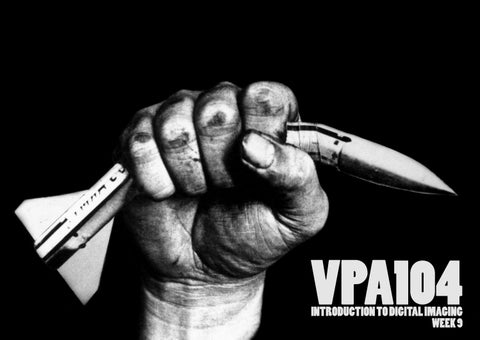
VPA104
INTRODUCTION TO DIGITAL IMAGING WEEK 9
ABOUT THIS WEEK:
We will be looking primarily at Peter Kennard, whose photomontage work has spanned 40 years. He has been shown at the Tate, the Imperial War Museum and many more prestigious museums, but believes:
«2»
This week is the last in our topic on Photomontage.
Find out more here: http://metro.co.uk/2013/06/17/meet-the-artists-making-a-protest-about-the-g8-summit-3841159/#ixzz471uVlYmU
VPA104: Week 9
‘My idea of copyright is to give people the right to copy my work,’ he said. ‘For four decades the point of my work has been to get it out to people who will respond to it outside of galleries.”
VPA104: Week 9
The 1970s and 80s saw a resurgence of photomontage as a vehicle for political protest, in particular in Thatcher’s UK. Some of the key artists of this time are Peter Kennard, Michael Bennett, Peter Dunne and Lorraine Leeson, David King, Cath Tate and Rhinoceros. There will be some of these artists’ work to view today , but you also might like to do some research into European and American photomontage as well.
«3»
MODERN PHOTOMONTAGE
NO NUKES:
VPA104: Week 9
Although the 1960s saw a revival of sorts in photomontage, and even advertisers began to see its value in peddling their own ideas, it was really during the 1980s that photomontage made a comeback, in particular as a means of campaigning against nuclear weapons.
ÂŤ4Âť
PHOTMONTAGE REVIVAL IN THE 1980S
VPA104: Week 9
Without a doubt, Peter Kennard is one of the world’s foremost modern photomontage artists. His early Photomontage work was especially important during his involvement with the Campaign for Nuclear Disarmament (CND) in the 1980s. Of this he wrote:
«5»
PETER KENNARD
VPA104: Week 9
I had become disturbed by the fact that the burgeoning antinuclear campaign was using undoctored images of nuclear bombs and missiles, merely adding their own slogan. This was also the time when Athena posters were selling a poster of an air-brushed mushroom cloud which was deemed to be an acceptable image to put up on bedroom walls. I still have the page from their catalogue which illustrates the poster, next to two American pick-up trucks, all listed under ‘The Twentieth Century: Power and Energy’.
«6»
“I remember in 1979 going to a tiny office in Great Queen Street where the Campaign for Nuclear Disarmament (CND) was based. It was there that I showed Bruce Kent and a few others my photomontages and said I’d like to do work for nuclear disarmament.
«7» VPA104: Week 9
“My elder son once came home with a book called Discover the World of Weapons. On its cover was the photo of an enormous missile pointing skywards at the title. The whole book was designed with psychedelic 1960s graphics. This was considered suitable reading matter for eight year olds. And they called us insane. I felt that these images had to be broken, had to be taken out of the supposedly rational discourse in which they could become domestic decoration.
The point of my work is to use easily recognisable iconic images, but to render them unacceptable. To break down the image of the all-powerful missile, in order to represent the power of the millions of people who are actually trying to break them. After breaking them, to show new possibilities emerging in the cracks and splintered fragments of the old reality.”
VPA104: Week 9
https://www.youtube.com/watch?v=74YEv0GUaDk
«8»
https://www.youtube.com/watch?v=ait3g1h8Wp8
VPA104: Week 9
«9»
“Protect and Survive” (1981) Peter Kennard
THATCHER’S BRITAIN
The Free Market vs the Welfare State Margaret Thatcher became Britain’s first female Prime Minster in 1979 and was to remain in this position until 1990, making her the longest-running Prime Minister to hold office in the 20th Century. In her time, Thatcher introduced radical reforms similar to those also being introduced in the United States under Roland Reagan: the Chicago School of Economics played a highly influential role in the development of these policies– which we are still feeling the effects of today: the watering down of the powers of government, deregulation of the markets, the privatisation of state-owned assets, labour market flexibility and the weakening of unions. Peter Kennard’s photomontage work responded to this “Thatcherism”...
“Thatcher Smashes Through a Miner’s Helmet” (1985) Peter Kennard
“Britain for Sale” (1985) Peter Kennard
“Thatcher Cuts Health Care” (1985) Peter Kennard
“Thatcher Pukes up the Welfare State” (1986) Peter Kennard
“War Head” (1981) Peter Kennard
GLOBALISATION:
ECONOMICS, IRAQ & TECHNOLOGY Kennard’s more recent work, some of which he completed in partnership with Cat Phillips, draws our attention to globalisation, the war in Iraq and the G8 Summit, to name a few. Still active and still an activist, Kennard’s work continues to push the envelope.
“Our Financial Times” (1995) Peter Kennard
“Union Mask” (2011) Peter Kennard
“Welcome to the G8� Poster Series (2013) Peter Kennard
“Welcome to the G8� Poster Series (2013) Peter Kennard
“Welcome to the G8� Poster Series (2013) Peter Kennard
“Prime Minister David Cameron features in an artwork by Peter Kennard and Cat Phillips as Banksy’s Dismaland Bemusement Park opens to the public, on August 28, 2015 in Weston-Super-Mare, England. Graffiti artist Banksy has opened the subversive, pop-up theme park styled exhibition at the derelict seafront Tropicana lido, featuring the work of 50 artists. The ‘Bemusement Park’ combines dark humour and ‘entry-level anarchism’ and will open for just five weeks.” (Quote from Getty Images)
VPA104: Week 9
« 31 »
IN CONCLUSION
PHOTOMONTAGE IS AS MUCH ABOUT CREATING A POLITICAL, SOCIAL OR CULTURAL STATEMENT AS IT IS ABOUT CREATING A DYNAMIC ARTWORK. IT’S ABOUT USING WHAT’S AVAILABLE WITHIN THE MASS MEDIA IN PARTICULAR TO INVOKE LARGER IDEAS: JUXTAPOSING FRAGMENTS AGAINST ONE ANOTHER, LARGER IDEAS CAN BE READILY MADE AVAILABLE TO PEOPLE. WHILE THE VICTORIANS MIGHT HAVE FOUND CHOPPING ONE ANOTHER’S HEADS OFF AMUSING, THE REAL ESSENCE OF PHOTOMONTAGE IS FOUND WITHIN IDEAS OF SOCIAL JUSTICE, ANTI-WAR MOVEMEMENTS AND POLITICAL COMMENTARY.