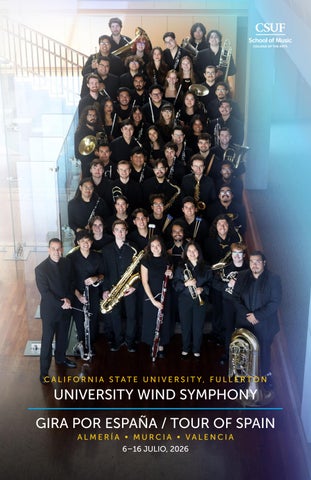
C A L I F O R N I A S TAT E U N I V E R S I T Y, F U L L E R T O N
UNIVERSITY WIND SYMPHONY GIRA POR ESPAÑA / TOUR OF SPAIN ALMERÍA • MURCIA • VALENCIA 6–16 JULIO, 2026
T HE R EP ER TOIR E | E L RE PE RTORIO The repertoire selected for the CSU Fullerton Wind Symphony’s 2026 Spain Tour explores the historical and cultural connections linking Spain, California, and Latin America. These relationships have shaped languages, traditions, architecture, and musical expression for centuries. The program honors Spain’s rich musical heritage through works rooted in Andalusian, Valencian, and broader Spanish traditions while also highlighting composers from the United States and Mexico whose music reflects the continuing influence of Spanish culture throughout the Americas. As ambassadors of California State University, Fullerton and the United States, the members of the University Wind Symphony are honored to share this musical dialogue with audiences across Spain. The repertoire celebrates both the uniqueness of each culture and the enduring connections that unite them through music.
El repertorio seleccionado para la gira española de 2026 de la University Wind Symphony de California State University, Fullerton explora los vínculos históricos, culturales y artísticos que unen a España, California y América Latina. Durante siglos, estas relaciones han modelado tradiciones, lengua, arquitectura y expresiones musicales. El programa rinde homenaje al rico patrimonio musical español mediante obras inspiradas en las tradiciones andaluzas y valencianas. Al mismo tiempo presenta compositores de Estados Unidos y México cuya música refleja la influencia duradera de la cultura española en todo el continente americano. Varias de las obras evocan a España directamente a través de retratos musicales de Almería, Valencia y Andalucía. Otras exploran la manera en que las tradiciones españolas cruzaron el Atlántico y pasaron a formar parte de la identidad cultural de California y América Latina. En conjunto, estas composiciones ilustran un diálogo continuo entre continentes, culturas y generaciones. Como embajadores de California State University, Fullerton y de los Estados Unidos, los integrantes de la University Wind Symphony tienen el honor de compartir este viaje musical con el público español. A través de la música celebramos tanto la singularidad de cada cultura como los lazos permanentes que nos unen..
C A L I F O R N I A S TAT E U N I V E R S I T Y, F U L L E R T O N
UNIVERSITY WIND SYMPHONY GIRA POR ESPAÑA 2026 / SPAIN TOUR 2026 DR. DUSTIN BARR, CONDUCTOR MICHAEL YOSHIMI, CLARINET 2 Julio 2026 Preview Concert/ Concierto de presentación Meng Concert Hall FULLERTON, CALIFORNIA 10 Julio 2026 Auditorio Maestro Padilla ALMERÍA , SPAIN
11 Julio 2026 Plaza de la Iglesia de San Juan Bautista BENIAJÁN, SPAIN 12 Julio 2026 Festival Bienal de Música de Buñol Auditorio Municipal San Luis BUÑOL, SPAIN
PROGRAMS WILL BE SELECTED FROM THE FOLLOWING REPERTOIRE LOS PROGRAMAS SE SELECCIONARÁN DEL SIGUIENTE REPERTORIO MÚSICA Y VINOS Manuel Morales Martínez
EL CAMINO REAL Alfred Reed
THEME FROM “SILVERADO” Bruce Broughton arranged by Randol Bass
DANZÓN NO. 2 Arturo Márquez transcribed by Oliver Nickel
L A PROCESIÓN DEL ROCÍO Joaquín Turina transcribed by Alfred Reed
FANDANGUILLO DE ALMERÍA Gaspar Vivas Gómez
URBAN LIG HT James David TRAVELER David Maslanka BL ACK DO G: RHAPSODY FOR CL ARINET Scott McAllister Michael Yoshimi, clarinet soloist
LO CANT DEL VALENCIÀ Pedro Sosa SUSPIROS DE ESPAÑA Antonio Álvarez Alonso
ESPAÑOL
ENGLISH
MÚ S IC A Y VIN O S Manuel Morales Martínez Spanish composer Manuel Morales Martínez is widely recognized for his colorful and audience-friendly works for wind band. Inspired by the landscapes, festivals, and communal spirit of Mediterranean Spain, Música y Vinos evokes the joy of gathering together to share food, friendship, and artistic expression. The work combines vibrant rhythmic energy with expansive melodies and brilliant orchestration. Moments of exuberance alternate with passages of warmth and reflection, creating a musical portrait of Spanish hospitality and celebration. Música y Vinos serves as a musical welcome, establishing the spirit of friendship and cultural exchange that defines the ensemble’s journey through Spain.
El compositor español Manuel Morales Martínez es ampliamente reconocido por sus obras llenas de color y facilidad de escucha para el público de banda sinfónica. Inspirada en los paisajes, las fiestas populares y el espíritu comunitario del Mediterráneo español, Música y Vinos evoca el placer de reunirse para compartir comida, amistad y expresión artística. La partitura combina una energía rítmica vibrante con amplias melodías y una orquestación brillante. Los momentos de entusiasmo festivo se alternan con pasajes de calidez y reflexión, creando un retrato musical de la hospitalidad española. Música y Vinos constituye una bienvenida musical que establece el espíritu de amistad e intercambio cultural que inspira el viaje del ensamble por España.
P ROGR AM NOT ES | NOTAS AL PRO GRAMA
ESPAÑOL
ENGLISH
T HEME FROM S ILVE RADO Bruce Broughton, arr. Randol Bass Although the 1985 film Silverado was not filmed in Almería, it belongs to a cinematic tradition that owes much to the landscapes of southern Spain. During the second half of the twentieth century, the deserts surrounding Almería became the most famous European filming location for western films. Productions from Hollywood and across Europe transformed the region into a cinematic version of the American frontier, creating an enduring artistic connection between southern Spain and California’s film industry. Bruce Broughton’s stirring theme from Silverado captures the grandeur, adventure, and optimism associated with the western genre. Through its soaring melodies and expansive musical landscapes, the score evokes a shared cinematic tradition that connects Hollywood and Almería across continents. For this tour, the work serves as a tribute to that remarkable cultural relationship and to the role both regions have played in shaping one of cinema’s most iconic genres.
Aunque la película Silverado (1985) no fue rodada en Almería, forma parte de una tradición cinematográfica que debe mucho a los paisajes del sur de España. Durante la segunda mitad del siglo XX, los desiertos almerienses se convirtieron en el escenario europeo más emblemático para el rodaje de películas del oeste. Producciones procedentes de Hollywood y Europa transformaron la región en una versión cinematográfica de la frontera americana, creando un vínculo artístico duradero entre el sur de España y la industria cinematográfica de California. El célebre tema compuesto por Bruce Broughton para Silverado captura la grandeza, la aventura y el espíritu épico asociados al género western. Sus amplias melodías y paisajes sonoros evocan una tradición cinematográfica que une a Hollywood y Almería a través de los continentes. En el contexto de esta gira, la obra rinde homenaje a esa extraordinaria relación cultural y al papel fundamental que ambas regiones han desempeñado en la historia de uno de los géneros más emblemáticos del cine.
ESPAÑOL
ENGLISH
L A P ROCES IÓN D EL RO CÍO Joaquín Turina transcribed by Alfred Reed Joaquín Turina stands among the most important Spanish composers of the twentieth century. Born in Seville, Turina developed a distinctive musical language that blended Andalusian folk traditions with the harmonic sophistication he encountered during his studies in Paris. Composed in 1912, La Procesión del Rocío portrays the annual pilgrimage to the village of El Rocío in Andalusia, one of Spain’s most celebrated religious festivals. Turina vividly depicts both the devotional and festive dimensions of the event, creating a musical narrative rich in color, atmosphere, and emotion. The work opens with a mood of quiet reverence before gradually giving way to increasingly animated scenes of celebration. Brilliant fanfares, dance-like rhythms, and evocative melodies combine to portray the sights and sounds of the procession. Alfred Reed’s masterful transcription has become a cornerstone of the wind band repertoire, preserving the spirit and vitality of Turina’s original orchestral score.
Joaquín Turina figura entre los compositores españoles más importantes del siglo XX. Nacido en Sevilla, desarrolló un lenguaje musical propio en el que convergen las tradiciones populares andaluzas y la sofisticación armónica adquirida durante sus estudios en París. Compuesta en 1912, La Procesión del Rocío describe la famosa romería que cada año se celebra en la localidad onubense de El Rocío. Esta es una de las manifestaciones religiosas y populares más emblemáticas de España. Turina retrata con extraordinaria riqueza sonora tanto el carácter devocional como el ambiente festivo que rodea esta tradición. La obra comienza con una atmósfera de reverencia que poco a poco da paso a escenas de celebración. Fanfarrias brillantes, ritmos de danza y melodías evocadoras se combinan para recrear los sonidos y emociones de la procesión. La magistral
P ROGR AM NOT ES | NOTAS AL PRO GRAMA transcripción de Alfred Reed ha convertido esta obra en una referencia fundamental del repertorio para banda sinfónica, mientras conserva el espíritu y la vitalidad de la partitura orquestal original.
U R BAN L IGH T James David
ENGLISH
Inspired by Chris Burden’s iconic “Urban Light” installation at the Los Angeles County Museum of Art, James David’s Urban Light celebrates the energy, creativity, and cultural identity of contemporary California. The installation’s collection of restored historic streetlamps has become one of Los Angeles’s most recognizable landmarks, symbolizing the city’s unique relationship between history, art, and urban life. David’s composition draws upon several artistic traditions closely associated with California. Throughout the work, listeners can hear rhythmic patterns derived from Morse code spelling the word “California,” woven into a musical language influenced by American minimalism, particularly the work of California-born composer John Adams. The score also evokes the atmosphere of Los Angeles through references to classic film noir, while elements of rock-and-roll energy reflect another important cultural export of the region. Combining driving rhythms, luminous orchestration, and cinematic imagination, Urban Light serves as a vibrant musical portrait of Southern California. As part of this tour program, it offers audiences a contemporary counterpart to the historical and cultural connections explored elsewhere in the repertoire, presenting California as a place where art, innovation, and diverse creative traditions continue to intersect. Inspirada en la instalación artística Urban Light de Chris Burden, situada frente al Los Angeles County Museum of Art,”, la obra de James David celebra la energía, la creatividad y la identidad cultural de la California contemporánea. La instalación artística es un conjunto de farolas históricas restauradas que se han convertido en uno de los iconos visuales más reconocibles de Los Ángeles, simbolizando la relación única de la ciudad con la historia, el arte y el espacio urbano.
ESPAÑOL
La composición incorpora diversas referencias asociadas a la cultura californiana. A lo largo de la obra aparecen patrones rítmicos derivados del código Morse que deletrea la palabra “California”, integrados dentro de un lenguaje musical influido por el minimalismo estadounidense y, en particular, por las obras del compositor californiano John Adams. La partitura también hace referencia a la atmósfera del cine negro clásico ambientado en Los Ángeles, mientras que la energía del rock and roll expresa otra de las contribuciones culturales más influyentes de la región. La combinación de ritmos dinámicos, orquestación brillante e imaginación cinematográfica convierte Urban Light en un vibrante retrato musical del sur de California. En el programa, la obra ofrece una perspectiva contemporánea de la historia y cultura californiana, presentando California como un lugar donde el arte, la innovación y diversas tradiciones creativas continúan encontrándose.
ENGLISH
T R AVEL ER David Maslanka Few composers have shaped the modern American wind band tradition as profoundly as David Maslanka. Throughout his career, Maslanka elevated the wind ensemble to a medium capable of expressing the deepest dimensions of human experience, creating works that combined technical mastery with extraordinary emotional and spiritual depth. Traveler stands as a powerful example of that artistic vision. For Maslanka, the title Traveler referred not to a physical journey but to the universal spiritual journey of life itself. He described the work as a meditation on the path each person follows through experiences of struggle, growth, discovery, and transformation. T he music unfolds as a series of evolving landscapes, moving between moments of introspection, searching, affirmation, and renewal. Traveler presents on this program as a representative work of the contemporary American wind band tradition. It reflects the qualities that have made Maslanka one of the most influential voices in the history of the medium: profound sincerity, spiritual exploration,
P ROGR AM NOT ES | NOTAS AL PRO GRAMA
ESPAÑOL
and a deep belief in music’s power to illuminate the human experience. Pocos compositores han influido en la tradición de la banda sinfónica estadounidense moderna de manera tan profunda como lo hizo David Maslanka. A lo largo de su carrera, Maslanka elevó el agrupación de viento a un medio capaz de expresar las dimensiones más profundas de la experiencia humana, creando obras que combinan un extraordinario dominio técnico con una intensa profundidad emocional y espiritual. Traveler constituye un ejemplo especialmente representativo de esta visión artística. Para Maslanka, el título Traveler no aludía a un viaje físico, sino al viaje de la vida espiritual de cada persona. El compositor describía la obra como una reflexión sobre el camino que cada individuo recorre a través de experiencias de lucha, crecimiento, descubrimiento y transformación. La música se desarrolla como una sucesión de paisajes dinámicos, transitando entre momentos de introspección, búsqueda, afirmación y renovación. Traveler se presenta en este programa como una muestra representativa de la tradición contemporánea de la banda sinfónica estadounidense. La pieza refleja las cualidades que han convertido a Maslanka en una de las figuras más influyentes en la historia del repertorio: la sinceridad artística, la exploración espiritual y una profunda convicción en el poder de la música para iluminar la experiencia humana.
B L AC K D OG: R HAP S ODY FO R CL ARINE T Scott McAllister Michael Yoshimi, clarinet soloist American composer Scott McAllister has earned a reputation for creating works that blur the boundaries between classical music, popular culture, and contemporary American life. Black Dog: Rhapsody for Clarinet draws inspiration from Led Zeppelin’s iconic 1971 rock anthem while transforming its energy and spirit into a virtuosic showcase for solo clarinet and wind ensemble.
ENGLISH ESPAÑOL
Rather than functioning as a straightforward arrangement, the work reimagines the swagger, intensity, and improvisatory character of classic rock through the lens of contemporary concert music. The solo clarinet assumes a role similar to that of a lead vocalist or guitarist, navigating dazzling technical passages, soaring melodies, and moments of expressive freedom. Throughout the work, listeners may hear fleeting references to familiar rock gestures transformed by McAllister’s distinctive compositional voice. The result is a work that is both entertaining and artistically compelling, requiring extraordinary technical command and musical versatility from the soloist. This evening’s performance features Michael Yoshimi, Professor of Clarinet at California State University, Fullerton.
El compositor estadounidense Scott McAllister se ha distinguido por crear obras que difuminan las fronteras entre la música clásica, la cultura popular y la vida contemporánea estadounidense. Black Dog: Rhapsody for Clarinet toma como inspiración la célebre canción de Led Zeppelin publicada en 1971 y transforma su energía y carácter en una obra brillante para clarinete solo y banda sinfónica. Lejos de ser una simple adaptación, la composición reinterpreta la intensidad, el virtuosismo y el espíritu improvisatorio del rock clásico desde la perspectiva de la música de concierto contemporánea. El clarinete asume un papel comparable al de un cantante o guitarrista solista, recorriendo exigentes pasajes técnicos y melodías de gran libertad expresiva. A lo largo de la obra aparecen referencias sutiles a gestos característicos del rock, integrados dentro del lenguaje personal del compositor. El resultado es una pieza tan entretenida como exigente que requiere del solista un dominio técnico extraordinario y una gran versatilidad musical. La interpretación de esta noche cuenta con la participación de Michael Yoshimi, Profesor de Clarinete de California State University, Fullerton.
P ROGR AM NOT ES | NOTAS AL PRO GRAMA
ESPAÑOL
ENGLISH
EL C AMINO RE AL Alfred Reed Commissioned in 1985, El Camino Real quickly became one of Alfred Reed’s most celebrated and frequently performed compositions. The title refers to “The Royal Road,” the historic route that connected California’s Spanish missions and settlements during the colonial era. Rather than depicting the road itself, Reed imagined a festive celebration of California’s Spanish heritage. Drawing inspiration from traditional Spanish dance forms, particularly the jota and the fandango, he created a brilliant concert work filled with rhythmic vitality, colorful orchestration, and infectious energy. For a Californian ensemble performing in Spain, El Camino Real serves as a powerful musical bridge between two cultures whose histories remain deeply intertwined. The work reminds listeners of the enduring influence Spain has had on the cultural development of the American Southwest.
Compuesta en 1985, El Camino Real se convirtió rápidamente en una de las obras más populares y representativas de Alfred Reed. El título hace referencia al histórico “Camino Real”, la ruta que conectaba las misiones y asentamientos españoles establecidos en California durante el periodo colonial. Más que describir el camino en sí, Reed imaginó una celebración festiva de la herencia española presente en California. Inspirándose en formas tradicionales como la jota y el fandango, creó una obra brillante, llena de energía rítmica, color orquestal y entusiasmo contagioso. Para una agrupación californiana que interpreta música en España, El Camino Real representa un poderoso puente musical entre dos culturas cuyas historias permanecen profundamente conectadas. La obra recuerda al oyente la influencia duradera que España ha ejercido sobre el desarrollo cultural del suroeste de los Estados Unidos.
DANZÓN NO. 2 Arturo Márquez transcribed by Oliver Nickel
ESPAÑOL
ENGLISH
Few works better capture the cultural journey at the heart of this tour than Arturo Márquez’s Danzón No. 2. Born in Sonora, Mexico, Márquez spent his teenage years in La Puente, California— just twenty miles from California State University, Fullerton. His life and music reflect the deep cultural connections linking Spain, Mexico, California, and the broader Spanish-speaking world. Composed in 1994, Danzón No. 2 is inspired by the danzón, a social dance tradition that originated in Cuba and flourished in Mexico. Like many artistic traditions of Latin America, the danzón emerged from centuries of cultural exchange connecting Europe and the Americas. Márquez transforms these influences into a concert work of remarkable sophistication, emotional depth, and rhythmic vitality. The music unfolds gradually, moving from elegance and restraint toward increasingly animated dance episodes. Moments of intimacy give way to passages of exuberance and celebration, culminating in a thrilling conclusion. Beyond its Mexican origins, the work symbolizes a musical homecoming—a celebration of the enduring cultural ties that connect Spain to California through Mexico and Latin America.
Pocas obras reflejan mejor el recorrido cultural que inspira esta gira que el Danzón No. 2 de Arturo Márquez. Nacido en Sonora (México), Márquez pasó su adolescencia en La Puente, California, que está a tan solo treinta y dos kilómetros de California State University, Fullerton. Su trayectoria personal y artística muestran los profundos vínculos culturales que unen a España, México, California y el conjunto del mundo hispanohablante. Compuesto en 1994, Danzón No. 2 toma como punto de partida el danzón, una tradición de baile social nacida en Cuba y desarrollada posteriormente en México. Como muchas manifestaciones artísticas de América Latina, el danzón es fruto de siglos de intercambios culturales entre Europa y el continente americano. Márquez transforma esas influencias en una obra sofisticada con profundidad emocional y vitalidad rítmica.
P ROGR AM NOT ES | NOTAS AL PRO GRAMA La composición se desarrolla de manera gradual, avanzando desde una atmósfera de elegancia hacia momentos cada vez más dinámicos y apasionados. Instantes de intimidad alternan con explosiones de energía y celebración que conducen a un final brillante y emocionante. Más allá de su origen mexicano, la obra simboliza un regreso musical a casa: una celebración de los lazos culturales que conectan a España con California a través de México y América Latina.
ESPAÑOL
ENGLISH
FANDANGU I LLO D E ALME RÍA Gaspar Vivas Gómez Born in Almería, composer and conductor Gaspar Vivas Gómez has become one of the most prominent musical voices of southeastern Spain. Fandanguillo de Almería draws upon one of the region’s most distinctive traditional dance forms, reflecting the rich folkloric heritage of Andalusia. The work is characterized by energetic rhythms, brilliant melodies, and a distinctly Spanish sense of passion and vitality. Echoes of flamenco-inspired gestures and traditional dance patterns can be heard throughout, creating a vivid musical portrait of Almería and its people. Particularly meaningful on this tour, the piece allows the University Wind Symphony to honor the city and province that hosts its first concert on Spanish soil. Nativo de Almería, el compositor y director Gaspar Vivas Gómez se ha consolidado como una de las figuras musicales más representativas del sureste de España. Fandanguillo de Almería se inspira en una de las formas de danza más características de la región y refleja la riqueza del patrimonio folclórico andaluz. La obra destaca por sus ritmos enérgicos, melodías brillantes y un inconfundible carácter español. A lo largo de la pieza se escuchan referencias al flamenco y patrones de danza tradicional que crean un vívido retrato musical de Almería y de su gente. Su inclusión en esta gira es de gran importancia pues permite a la University Wind Symphony rendir homenaje a la ciudad y provincia que acogen su primer concierto en España.
ESPAÑOL
ENGLISH
LO C ANT D EL VALE NCIÀ Pedro Sosa Lo Cant del Valencià occupies a special place within the musical traditions of the Valencian Community. Written by Pedro Sosa, the work celebrates the history, culture, and identity of the Valencian people while reflecting the region’s extraordinary devotion to band music. Richly melodic and noble in character, the composition balances moments of grandeur with passages of warmth and lyricism. Its themes evoke pride in local traditions while highlighting the strong communal bonds that have sustained Valencian musical culture for generations. For audiences in Buñol—one of the world’s most celebrated centers of band music—the work carries particular significance. It serves as a tribute to the remarkable musical heritage of Valencia and to the generations of musicians, educators, and community ensembles that have made the region an international model of musical participation.
Lo Cant del Valencià ocupa un lugar especial dentro de las tradiciones musicales de la Comunidad Valenciana. La obra de Pedro Sosa celebra la historia, la cultura y la identidad del pueblo valenciano, reflejando al mismo tiempo la extraordinaria importancia que tiene la música de banda en la región. De carácter noble y profundamente melódico, la composición combina momentos de solemnidad con pasajes de gran lirismo y calidez expresiva. Sus temas transmiten orgullo por las tradiciones locales y exaltan los fuertes vínculos comunitarios que han sustentado la cultura musical valenciana durante generaciones. Para el público de Buñol, una de las grandes capitales mundiales de la música de banda, la obra posee un significado especialmente profundo. Constituye un homenaje al extraordinario patrimonio musical valenciano y a las generaciones de músicos, docentes y sociedades musicales que han convertido a la región en un referente internacional.
P ROGR AM NOT ES | NOTAS AL PRO GRAMA
ESPAÑOL
ENGLISH
S U S P I ROS D E ESPAÑA Antonio Álvarez Alonso Composed in 1902 by Antonio Álvarez Alonso, Suspiros de España is among the most beloved pasodobles ever written. Although originally conceived as an instrumental work, it later became closely associated with lyrics expressing nostalgia for Spain and longing for one’s homeland. The title, translated as “Sighs of Spain,” captures the work’s unique combination of elegance, pride, and sentiment. Its unforgettable melody has become deeply woven into Spanish cultural life and remains a staple of festivals, civic celebrations, and concert performances throughout the country. More than a century after its creation, Suspiros de España continues to serve as a musical symbol of Spanish identity. Its enduring popularity speaks to the work’s ability to evoke powerful feelings of memory, belonging, and affection for one’s homeland. Compuesto en 1902 por Antonio Álvarez Alonso, Suspiros de España es uno de los pasodobles más célebres y queridos de la historia de la música española. Aunque fue concebido originalmente como obra instrumental, con el tiempo quedó estrechamente asociado a letras que expresan nostalgia por España y añoranza de la tierra natal. Su título resume perfectamente el carácter de la obra: una combinación de elegancia, orgullo y emoción contenida. Su inolvidable melodía se ha integrado profundamente en la vida cultural española y continúa siendo protagonista de fiestas populares, celebraciones cívicas y conciertos en todo el país. Más de un siglo después de su composición, Suspiros de España sigue siendo un auténtico símbolo musical de la identidad española, capaz de despertar sentimientos de memoria, pertenencia y cariño a la patria.
ENGLISH
The University Wind Symphony at California State University, Fullerton (CSUF) is the premier large wind ensemble in the university’s School of Music. Comprising the most accomplished wind and percussion students at CSUF, the ensemble is recognized for artistic excellence, innovative programming, and a commitment to both foundational works of the wind band canon and significant contemporary repertoire. Under the leadership of Dr. Dustin Barr, Director of Bands and Professor of Music, the Wind Symphony presents ambitious and thoughtfully curated programs that span early twentieth-century masterworks to new and emerging compositional voices. The ensemble is particularly dedicated to championing new music and contributing meaningfully to the evolving artistic landscape of the wind band medium. The Wind Symphony has appeared at multiple conferences of the College Band Directors National Association, including the 2019 National Conference and the 2024 Western Division Conference. Internationally, the ensemble has toured Portugal, South Korea, Japan, and China, serving as a cultural ambassador for California State University, Fullerton and the United States. Recent honors include Second Place in the 2024–25 American Prize in Wind Band/Wind Ensemble Performance and Third Prize in the Ernst Bacon Memorial Award for the Performance of American Music.
AB OU T THE | ACE RA DE L A C AL I FO R NI A S TAT E UNIVE RSIT Y, F U LLE RTO N W I ND S YMPH O NY
La University Wind Symphony de la California State University, Fullerton (CSUF) es una de las formaciones universitarias de viento más destacadas de los Estados Unidos. Integrada por los estudiantes más sobresalientes de viento y percusión de su Escuela de Música, la agrupación combina excelencia artística, innovación y un firme compromiso con la evolución del repertorio para banda sinfónica.
ESPAÑOL
Dirigida por el Dr. Dustin Barr, la agrupación presenta programas ambiciosos y meticulosamente curados para demostrar tradición y modernidad, desde obras emblemáticas del siglo XX hasta creaciones contemporáneas de la nueva generación. Su actividad artística refleja una clara vocación por impulsar nuevas propuestas y ampliar los horizontes sonoros del repertorio para banda sinfónica. A lo largo de su trayectoria, la University Wind Symphony ha sido invitada en múltiples ocasiones a los congresos de la College Band Directors National Association (CBDNA), incluyendo su participación en la Conferencia Nacional del 2019, uno de los reconocimientos más prestigiosos para una banda universitaria en los Estados Unidos. Su proyección internacional la ha llevado a realizar giras por Europa y Asia, con ejecuciones en Portugal, Corea del Sur (Jeju International Band Festival), Japón, y China. En cada uno de estos destinos, la agrupación ha actuado como embajadora cultural, compartiendo su visión artística y estableciendo vínculos musicales más allá de fronteras. Entre sus distinciones nacionales figuran premios otorgados por The American Prize, incluyendo el Segundo Premio en 2024–25 en la categoría de Wind Band/Wind Ensemble Performance, así como el Tercer Premio en el Ernst Bacon Memorial Award for the Performance of American Music. Con sede en el Vaughncille Joseph Meng Concert Hall, la CSUF Wind Symphony continúa proyectándose como una formación de referencia internacional, combinando excelencia interpretativa, compromiso pedagógico y liderazgo artístico.
ENGLISH
DUSTIN BARR is the Director of Bands and Professor of Music at California State University, Fullerton, where he leads the university’s comprehensive band program. He conducts the acclaimed University Wind Symphony and University Band, oversees the graduate wind conducting program, and teaches courses in conducting and music education. Prior experiences include appointments as Assistant Director of Bands at Michigan State University, Director of Bands at Mt. San Antonio College, and Assistant Director of Bands at Esperanza High School in Anaheim, California. A leading pedagogue in the field of conducting, Barr collaborated with theatre director Jerald Schwiebert to integrate performance theory with various movement disciplines, pioneering innovative approaches to conducting instruction. Their co-authored book, Expressive Conducting: Movement and Performance Theory for Conductors (Routledge, 2018), has become an essential resource for conductors worldwide. His work in movement theory has resulted in invitations to present masterclasses and lectures throughout the USA and in Spain. Moreover, his research on Scandinavian chamber wind ensemble music resulted in published editions of Asger Lund Christiansen’s Octet, Op. 43 and Svend Schultz’s Divertimento for Wind Octet. Barr’s accomplishments have garnered wide recognition, including winning Second Prize of the 2024 American Prize in Conducting and Second Prize of the 2024 American Prize in Collegiate Wind Band Performance. His leadership of the CSUF University Wind Symphony has resulted in prestigious performances at the College Band Directors National Association (CBDNA) conferences at both national (2019) and regional (2024) levels, as well as a headlining performance at the 2023 California All State Music Education Conference. The University Wind Symphony’s 2022 album, Effigy, is another noteworthy achievement. This album features the music of composer Brian Baumbusch and was the result of innovative musical practices and remote recording projects undertaken during the COVID-19 pandemic. Under Barr’s direction, the ensemble also received
BIOGR PAHIE S | BIO GRAFÍAS Third Prize in the 2021 American Prize Ernst Bacon Award for the Performance of American Music.
ESPAÑOL
Barr has guest-conducted prominent ensembles, including the United States Army Band “Pershing’s Own” and the United States Air Force Band of the Golden West, in addition to numerous collegiate bands across the country. Additionally, he has appeared as a guest conductor of leading bands in Valencia and Almería, Spain. He holds a Doctor of Musical Arts in conducting from the University of Michigan, and both Master and Bachelor of Music degrees from California State University, Fullerton. His principal mentors include Michael Haithcock and Mitchell Fennell. Dustin Barr es Director de las Bandas Sinfónicas y profesor de música en la California State University, Fullerton, donde lidera el programa completo de bandas de la universidad. Dirige la reconocida University Wind Symphony y la University Band, coordina el programa de posgrado en dirección de bandas e imparte asignaturas de dirección y educación musical. Anteriormente ha desempeñado los cargos de Subdirector de Bandas en la Michigan State University, Director de Bandas en el Mt. San Antonio College y Subdirector de Bandas en la Esperanza High School de Anaheim (California). Como figura de referencia en el ámbito de la dirección, Barr colaboró con el director teatral Jerald Schwiebert en la integración de la teoría de la interpretación con distintas disciplinas del movimiento, impulsando enfoques innovadores en la enseñanza de la dirección. El libro que ambos coescribieron, Expressive Conducting: Movement and Performance Theory for Conductors (Routledge, 2018), se ha consolidado como una obra de referencia para directores de todo el mundo. Su trabajo en el campo de la teoría del movimiento le ha valido invitaciones para impartir clases magistrales y conferencias en Estados Unidos y en España. Asimismo, su investigación sobre el repertorio escandinavo para conjunto de viento de cámara dio lugar a la publicación de ediciones críticas del Octeto, Op. 43 de Asger Lund Christiansen y del Divertimento para octeto de viento de Svend Schultz.
La trayectoria de Barr ha sido ampliamente reconocida, entre otros galardones, con el Segundo Premio del American Prize en Dirección (2024) y el Segundo Premio del American Prize en Interpretación de Banda Universitaria (2024). Bajo su liderazgo, la CSUF University Wind Symphony ha sido invitada a participar en prestigiosos congresos de la College Band Directors National Association (CBDNA), tanto a nivel nacional (2019) como regional (2024), así como a ofrecer el concierto principal en la California All State Music Education Conference de 2023. Otro hito destacado es el álbum Effigy (2022), dedicado a la música del compositor Brian Baumbusch y fruto de innovadoras prácticas musicales y proyectos de grabación a distancia desarrollados durante la pandemia de la COVID-19. Asimismo, bajo su dirección, la agrupación obtuvo el Tercer Premio en el Ernst Bacon Award for the Performance of American Music del American Prize 2021. Barr ha sido director invitado de prestigiosas agrupaciones, entre ellas la United States Army Band “Pershing’s Own” y la United States Air Force Band of the Golden West, además de numerosas bandas universitarias en todo Estados Unidos. En España, ha dirigido como invitado a destacadas bandas de Valencia y Almería. Es Doctor en Artes Musicales en Dirección por la University of Michigan y posee los títulos de Máster y Licenciado en Música por la California State University, Fullerton. Entre sus principales maestros figuran Michael Haithcock y Mitchell Fennell.
Hawaii-born clarinetist MICHAEL YOSHIMI is an active performer and educator based in Los Angeles. He joined the faculty at California State University, Fullerton (CSUF) in 2022 and was appointed Assistant Professor in 2024. He also teaches at Claremont Graduate University. Michael frequently appears as a guest player with the Los Angeles Philharmonic and has performed with ensembles including the Pacific Symphony, Los Angeles Opera, Jacksonville Symphony, Boise Philharmonic, and Hawaii Symphony Orchestra, among others.
BIOGR PAHIE S | BIO GRAFÍAS
ENGLISH
Since 2013, Michael has been the clarinet instructor at the Colburn Community School of Performing Arts, where he has developed one of the most successful private studios in the country. His students come from across Los Angeles and have been accepted into top conservatories and universities, including the Colburn School, University of Southern California, Rice University, Eastman School of Music, The Juilliard School, Cleveland Institute of Music, Northwestern University, Columbia University, Stanford University, and Brown University. His students have earned numerous accolades, including top honors at prestigious competitions such as the International Clarinet Association’s High School Solo Competition, the National YoungArts Foundation Finals, and the Music Center’s Spotlight Awards. They have also performed on National Public Radio’s From the Top and participated as principal players in renowned summer festivals such as the Verbier Junior Festival Orchestra, Yellow Barn Young Artists Program, Carnegie Hall’s National Youth Orchestra/National Youth Orchestra 2 (NYO/NYO2), Boston University Tanglewood Institute, and Interlochen Arts Camp. Michael holds a Doctor of Musical Arts and a Master of Music degree in clarinet performance from the University of Southern California’s Thornton School of Music, as well as a Bachelor of Music degree from Northwestern University. His principal teachers were Yehuda Gilad and J. Lawrie Bloom. Michael’s teaching philosophy emphasizes the role of teachers in not only building a strong foundation in music but also shaping the lives of their students. He focuses on cultivating solid fundamentals to enable his students to express themselves freely through their instrument. He looks forward to connecting with and mentoring new students from around the world.
ESPAÑOL
El clarinetista Michael Yoshimi, nacido en Hawái, es un intérprete y docente en activo en Los Ángeles. Se incorporó al profesorado de la California State University, Fullerton (CSUF) en 2022 y fue nombrado Profesor Asistente en 2024. Asimismo, imparte docencia en la Claremont Graduate University. Michael actúa con frecuencia como músico invitado con la Los Angeles Philharmonic y ha colaborado con agrupaciones como la Pacific Symphony, la Los Angeles Opera, la Jacksonville Symphony, la Boise Philharmonic y la Hawaii Symphony Orchestra, entre otras. Desde 2013, Michael es profesor de clarinete en la Colburn Community School of Performing Arts, donde ha desarrollado uno de los estudios privados de mayor prestigio del país. Su alumnado procede de distintos puntos de Los Ángeles y han sido admitidos en algunos de los conservatorios y universidades más prestigiosos, entre ellos la Colburn School, la University of Southern California, Rice University, la Eastman School of Music, The Juilliard School, el Cleveland Institute of Music, Northwestern University, Columbia University, Stanford University y Brown University. Sus estudiantes han obtenido numerosos reconocimientos, incluidos primeros premios en competiciones de gran prestigio como el Concurso Solista de Secundaria de la International Clarinet Association, las finales de la National YoungArts Foundation y los Music Center Spotlight Awards. Asimismo, han actuado en el programa radiofónico From the Top de la National Public Radio y han participado en calidad de primeros atriles en reconocidos festivales de verano como la Verbier Junior Festival Orchestra, el Yellow Barn Young Artists Program, la National Youth Orchestra y la National Youth Orchestra 2 (NYO/NYO2) del Carnegie Hall, el Boston University Tanglewood Institute y el Interlochen Arts Camp. Michael es doctor en Música y máster en Interpretación de Clarinete por la Thornton School of Music de la University of Southern California, y Licenciado en Música por la Northwestern University. Entre sus principales maestros se encuentran Yehuda Gilad y J. Lawrie Bloom.
BIOGR PAHIE S | BIO GRAFÍAS Su filosofía pedagógica enfatiza el papel del profesorado no solo en la construcción de una sólida base musical, sino también en la formación integral del alumnado. Se centra en el desarrollo de fundamentos técnicos firmes que permitan a sus estudiantes expresarse con libertad a través del instrumento. Espera poder conectar y acompañar en su formación a nuevos estudiantes de todo el mundo.
P ER S ONNE L | PE RSONAL Flute/Flauta Dani Arditti Kimberly Areas Harold Boche Castro Roger Justo Crystal Lee Oboe/Oboe America Dionati Stephanie Marquez Lilith Wathen Bassoon/Fagot Nayalin Guzman Emma Johnson Rekha Michael Clarinet/Clarinete Humberto Bravo Myko Crisostomo Oren Dror Yvonne Martinez Michael Morales Jonathan Recomanta Jesus Santiago Christian Solis Bass Clarinet/Clarinete Bajo Olivia Hirsch Ryan Nguyen Saxophone/Saxofón Benjamin Jones Adam Kummer Joshua Lopez Alejandro Martinez Ariel Perez Trumpet/Trompeta Dominick Bonelli Trevor Cannon Isaac Montaño Alex Santiago Susanna Sun Rudy Xool
Horn/Trompa River Ballantyne Diego Campos Andy French Adam Sevilla Trombone/Trombón Isaac Leyva Nicholas Perez Nathanael Peters Bass Trombone/Trombón Bajo Nikolas Hernandez Euphonium/Bombardino Derek Edous-Brauers Stephen Lopez Jessie Romo Tuba/Tuba Zachary Arnold Eddie Bonilla Double Bass/Contrabajo Angelina Salcedo Percussion/Percusión Cameron Abrahamson Andrew Alvidrez Ethan Greek Brad Harris Diego Mendoza John Sunderman Piano/Piano Amelia Thompson
AC K N OWL ED GEMENT S | AGRADECIMIE NTO S The California State University, Fullerton University Wind Symphony gratefully acknowledges the many individuals and organizations whose generosity, support, and collaboration have made the 2026 Spain Tour possible. We are deeply grateful for their commitment to providing our students with opportunities for artistic growth, educational enrichment, and meaningful engagement with communities around the world. La University Wind Symphony de California State University, Fullerton expresa su más sincero agradecimiento a las numerosas personas e instituciones cuya generosidad, apoyo y colaboración han hecho posible la gira por España de 2026. A todos ellos les agradecemos profundamente su compromiso con la formación artística, educativa y humana de nuestros estudiantes. California State University, Fullerton Ronald S. Rochon, President, California State University, Fullerton Sean Walker, Provost and Vice President for Academic Affairs Arnold Holland, Dean, College of the Arts Dave Mickey, Associate Dean, College of the Arts Randall Goldberg, Director, School of Music Christopher Johnson, Budget Coordinator, College of the Arts Elizabeth Williams, Business Coordinator, School of Music Heather Richards-Siddons and Alvin Chiu, Marketing and Communications, College of the Arts CSUF Music Associates CSUF Alliance for the Performing Arts Donors to the CSUF Wind Bands Office of Instructionally Related Activities Office of Study Abroad and Global Engagement Tour Providers and Spanish Hosts Juan José Navarro Hernández ACFEA Tour Consultants, specifically Catherine John, Catherine Clambaneva, Pilar Pino, Eva Rodriguez Fernandez, and Laura Parker San José Vicerrectorado de Cultura y Sociedad de la Universidad de Almería Agrupación Musical San Indalecio Agrupación Musical de Beniaján Concejalía de Cultura e Identidad de Murcia Bienal de Música de Buñol Concejalía de Cultura de Buñol Sociedad Musical “La Artística” de Buñol Ayuntamiento de Buñol
music.fullerton.edu