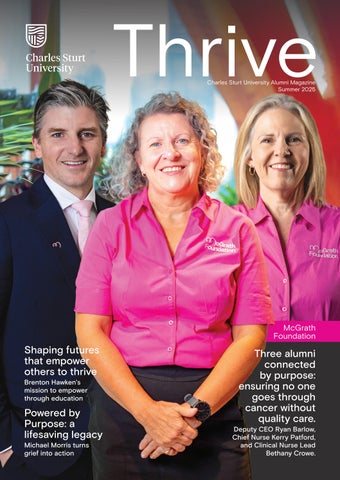
Thrive Charles Sturt University Alumni Magazine Summer 2025
McGrath Foundation
Shaping futures that empower others to thrive Brenton Hawken's mission to empower through education
Powered by Purpose: a lifesaving legacy Michael Morris turns grief into action
Three alumni connected by purpose: ensuring no one goes through cancer without quality care. Deputy CEO Ryan Barlow, Chief Nurse Kerry Patford, and Clinical Nurse Lead Bethany Crowe.
Contents Welcome
3
From the classroom to council: Brenton’s mission to empower through education
4
Connected through care: alumni shaping brighter futures at the McGrath Foundation
6
Seeing the unseen: the future of breast cancer diagnostics
10
700 nurses and counting: Charles Sturt celebrates 20 years of nursing education at Albury-Wodonga
11
Class Act: leadership in the regions
12
Celebrating our 2025 Alumni Award winners
14
CSU-ACA community support initiatives
21
Powered by purpose: a lifesaving legacy
22
Evolution and impact: a career built on community
24
Alumni amplifying children’s voices: two researchers changing the conversation
26
Professor Richard Price: the power of switching lanes
28
The Silent Emergency: closing the gaps in youth mental health care
30
Visionary in online education
31
Breaking Stereotypes: from disability to doctorate
32
Charles Sturt raises a glass to five decades of contributions to Australia’s wine industry
34
Belief in the Bush: empowering regional youth through education
35
Teaching hope: keeping young people learning through illness
36
Research news
37
Honouring a Life of Service: the Steven Tougher memorial 38 scholarship Bridging the Digital Divide: affordable robotics for the future of agriculture
40
Celebrating alumni achievements
41
Alumni events
42
Campus news
44
Alumni authors
46
Alumni podcasts
47
Alumni Give: the transformative power of scholarships
48
2
Thrive | Summer 2025
Charles Sturt University Alumni Magazine With special thanks to all those who contributed to this Summer 2025 edition. Contact us Charles Sturt University Alumni Locked Bag 588, Wagga Wagga NSW 2678, Australia Email: alumni@csu.edu.au Charles Sturt University - TEQSA Provider Identification: PRV12018 (Australian University). CRICOS Provider: 00005F. © Charles Sturt University, 2025.
Your privacy information is managed under the University’s Privacy Management Plan to ensure the University meets its obligations under the privacy legislations, the Privacy and Personal Information Protection Act 1998 (NSW) and the Privacy Act 1988 (Cth) and the Health Records and Information Privacy Act 2002 (NSW). For further information see the University's Privacy web page or contact the University's Privacy Officer.
Welcome Welcome to the 2025 edition of Thrive, our Charles Sturt University alumni magazine. This year’s publication is a powerful reflection of the impact, generosity and leadership that define our alumni community. At Charles Sturt University, our commitment to strengthening regional Australia remains at the heart of everything we do. We continue to champion student success, drive research that responds to real-world challenges, and build partnerships that create lasting social and economic outcomes for our communities. The stories in this edition highlight the extraordinary ways our alumni are shaping a world worth living in - locally, nationally and globally. Throughout these pages, you’ll meet graduates who embody courage, innovation and service. From Brenton Hawken’s transformative work revitalising First Nations culture and education in Temora, to Emma Bylsma’s leadership journey grounded in connection and lifelong learning, our alumni continue to show what’s possible when passion meets purpose. We proudly celebrate our 2025 Alumni Award winners - trailblazers in AI security, cancer research, cultural fire leadership, social impact, entrepreneurship and global policy. Their achievements remind us of the breadth of excellence within our community and the profound difference Charles Sturt graduates make every day. You’ll also read about alumni driving change in healthcare, from the McGrath Foundation’s expansion into all cancers, to groundbreaking research in breast cancer diagnostics, to the compassionate work of social workers, counsellors and mental health advocates across the regions. Their stories reflect the heart of our mission: to serve our communities with integrity, care and expertise. Our international alumni continue to inspire, too - from Cambodia’s rising government leaders and community advocates to innovators bridging the digital divide in agriculture, to global educators shaping the future of online learning. Their contributions strengthen our global network and deepen our shared commitment to opportunity and access. This year, we’ve had the privilege of reconnecting with many of you at alumni events across Australia and around the world. These gatherings - from Port Moresby to Hong Kong, from Nepal to Sydney - remind us of the enduring bonds formed at Charles Sturt and the pride our graduates carry with them throughout their lives.
Meet our team Sarah Ansell Director of Advancement
Carly Evans Associate Director of Advancement
Naomi Ricketts Alumni Relations Managing Editor, Thrive
Ali Hill Alumni Relations
Stacey Fish Development Officer
We extend our heartfelt thanks to everyone who has contributed their time, expertise and generosity to support our students and communities. Whether through mentoring, philanthropy, advocacy or storytelling, your involvement strengthens the future of our alumni network. If you’re interested in giving back, our Alumni Give program offers many ways to make a meaningful impact. Thank you for being an essential part of the Charles Sturt University alumni community. Your achievements inspire us, your stories enrich us, and your connection sustains the spirit of Charles Sturt. We hope you enjoy this edition of Thrive - and feel proud to be part of a community that is making a lasting difference. If you have a story to share, we’d love to hear from you at alumni@csu.edu.au. Carly Evans Associate Director, Advancement Office Charles Sturt University Alumni
3
From the classroom to council: Brenton’s mission to empower through education In the NSW rural town of Temora, Brenton Hawken’s determination to build a better world has unleashed a groundswell of positive change – not only for young First Nations students and their classmates, but across the whole community. Growing up on a sheep stud outside Parkes, the Charles Sturt Bachelor of Education graduate always saw his future in teaching. “School was an incredible experience for me. With so many wonderful mentors in the classroom, I saw firsthand how education can change lives and knew early on that this was how I wanted to make a difference,” Brenton says. Throughout his education – from learning Wiradjuri language at school to services like Ngunggilanha at Charles Sturt – he thrived in environments where First Nations culture was visible and valued. So when the proud Wiradjuri man walked through the front gate of Temora High School to begin his teaching career, he was taken aback by the lack of acknowledgement of First Nations culture he found. “It was a strange experience for me; there was no visual cultural acknowledgement anywhere in the school, not even an Aboriginal flag,” he recalls. “But it really hit home when I experienced Aboriginal kids who, through no fault of their own, had no connection to their cultural identity. I could see the role of community and education to change that, the potential to shift school policy and culture.” 4
Thrive | Summer 2025
And change it he has. Brenton shared his ideas with aligned colleagues, and together they brought staff and the wider school community on board. The Aboriginal flag soon flew proudly at the school’s entrance – the first step in a widespread transformation that has strengthened Aboriginal student engagement and connected the broader community with First Nations culture. “We’ve established a dedicated Aboriginal Education Team, revitalised Wiradjuri language, created culturally safe spaces, and embedded Aboriginal culture across the school – from uniforms and water tanks to community outreach events. And that’s just the beginning,” he says. “The proudest moment comes from seeing kids owning their culture and sharing it with their peers, families and communities. The ripple effect across the town has been significant, with many community members expressing
that the visibility of our programs has helped strengthen cultural pride and identity.” The 2021 NSW/ACT Young Achiever of the Year in Aboriginal Education is also transforming vocational education and training at Temora. As Head Teacher of Technology and Applied Studies, Brenton has revitalised programs, secured investment in industrystandard facilities, driven curriculum reform and enrolment growth, and created genuine pathways to employment for rural students. Brenton’s mission doesn’t rest when the school bell rings. In 2024, at just 29 years old, he was elected a Temora Shire Councillor – the first Aboriginal person to hold the position in the shire’s history. Here he champions First Nations representation, from Acknowledgement of Country to Wiradjuri signage, and gives voice to the region’s evolving younger demographic.
“The proudest moment comes from seeing kids owning their culture and sharing it with their peers, families and communities ... the ripple effect has helped strengthen cultural pride and identity.” Brenton Hawken, Bachelor of Education (Technology and Applied Studies), 2018, Graduate Certificate in Wiradjuri Language, Culture and Heritage, 2022.
Left to right: Brendon in his role in Aboriginal Education; teaching a food technology class; Temora council swearing in; 2021 NSW/ACT Young Achiever of the Year in Aboriginal Education; Uni days - Gobba Village Resident Advisor Team; Brenton with his family at his graduation.
“Young people in our community have strong aspirations, and as a teacher, I hear their goals and ideas every day. Through this platform, I can help ensure their voices – and those of everyone in our diverse community – are reflected in decision making and shape our region’s development.” Studying teaching and then the Graduate Certificate in Wiradjuri Language at Charles Sturt has been fundamental to Brenton’s path, enabling him to grow in an environment that reflected his own experience and values and equipped him to lead in rural education. As an undergraduate student, he also represented NSW in the National Indigenous Youth Parliament and attended the national Student Leadership Forum in Canberra, beginning his path as a powerful advocate for change. “I’ve faced harmful stereotypes that continue to disadvantage Aboriginal Australians,” he says. “These experiences fuel my determination to challenge prejudice, educate others, and create pathways for a more inclusive and understanding future.” But his greatest source of inspiration is his family: his mother, a proud Aboriginal woman and single parent of four, and his
sister Tara, who had Down syndrome. Though both have sadly now passed, their legacy lives on in him. Brenton credits his mother for his work ethic and determination. “Mum worked incredibly hard and instilled a belief in me that nothing can stop you from pursuing your goals and aspirations, and Tara taught me the meaning of patience, unconditional love and the drive to uplift those around me.” Brenton will soon step away from classroom teaching in pursuit of greater impact, joining the NSW Department of Education as Aboriginal Education Strategic Delivery Advisor across the Riverina in 2026. “As a teacher and local councillor, I have the privilege of shaping futures, building connections, and creating opportunities that empower others to thrive, and there’s no greater reward than seeing the impact of that work in the lives of students and the strength of our community,” he says. “I’m excited to take our model out to schools, sharing our knowledge and building capacity among staff and leaders. Working together, we can dismantle systemic barriers and do better for our children and communities.” Charles Sturt University Alumni
5
Connected through care:
alumni shaping brighter futures at the McGrath Foundation
For 20 years, McGrath Cancer Care Nurses have been a lifeline for regional, rural and remote Australians navigating breast cancer. Working right at the heart of their communities, they are synonymous with compassionate, people-centred care through distressing times. Now, the McGrath Foundation is embarking on an exciting new chapter, expanding its care beyond breast cancer to all cancers so that every person across Australia – regardless of diagnosis or location – can access quality care, free of charge. At the centre of this transformation are three Charles Sturt University alumni living the yindyamarra winhanganha ethos every day: Chief Nurse Kerry Patford, Clinical Nurse Lead Bethany Crowe, and Deputy CEO Ryan Barlow. Though their paths to here differ, they are connected by a singular purpose: ensuring no one goes through cancer without quality care.
A new era in cancer care With one in two Australians likely to be diagnosed with cancer in their lifetime, equity of care across all cancers is high on the national agenda. After two decades building something incredibly
impactful – more than 300 nurses, caring for over 167,000 families across the country – the McGrath Foundation was ready to answer the call. “We knew that if we were going to do more than breast, it had to be all,” says Ryan, part of the executive team guiding the strategy and vision. “So when the Federal Government asked us to take on all cancers in its call for equity of care, we ran towards the opportunity. We couldn’t believe it was finally possible; we were ready, and here was a doorway to make it happen.” It’s a huge and complex undertaking, requiring exponential growth in strategy, funding, nursing and support services. But Ryan is far from daunted. “It's going to take a long, long time. But knowing we’re on a pathway to a place where every patient, every family gets the care they need – it’s why we get up in the morning.”
Pictured left, top: Beth Crowe (second from left) with Brisbane Nurses, 2021; centre: McGrath Foundation 20th Anniversary Event - Kerry Patford, Tracy Bevan, Glenn McGrath, Mel McLaughlin; bottom: Ryan Barlow (centre) at 2023 Pink Test with Mc Grath Foundation colleauges.
Caring at her core: Kerry Patford Among the first McGrath Cancer Care Nurses, Kerry has been part of the mission since 2009. Now Chief Nurse, she leads the national nursing team, building the framework of education, support and resources they need to care for their communities. Based in Wangaratta in northeast outcomes because the system isn’t Victoria, she brings a regional designed for them.” lens to national outcomes. One Though no longer on the frontline, of her proudest achievements is Kerry remains deeply connected establishing the Nurse Clinical to the patients and families around Lead Team – a national collective whom the McGrath Foundation’s of specialist nurses across multiple cancer streams who mentor their “We have a colleagues on the ground. “I’m incredibly proud of the way the McGrath Foundation is fostering excellence in nursing,” she says. “If we weren't doing a good job, we wouldn’t get the opportunities to expand. That comes down to the excellence of our nurses and the care they provide.”
compassionate mission revolves. “I’m still a nurse at my core; it’s just a broader vision. There’s no better feeling than when someone arrives scared and overwhelmed, and you can create moments of comfort, so they leave feeling their world is a little bit clearer and more hopeful.”
responsibility to uplift the care of ... all populations who experience poorer outcomes because the system isn’t designed for them.” Kerry Patford Bachelor of Health Science (Nursing), 1998.
After an interrupted childhood, Kerry was drawn to nursing by the collegiality of hospital training – an extended family united by purpose. As the profession evolved, she completed a nursing degree via distance through Charles Sturt. The values she encountered have reverberated throughout her life and work.
“There was a strong focus on how our health system impacts First Nations communities, and it really opened my eyes to the inequities,” she recalls. “We also explored the creation of Medicare, and that gave me a global perspective on what it takes to build healthcare systems that support everyone.” This commitment to equity sits at the heart of the McGrath Foundation’s evolution. “We have a responsibility to uplift the care of First Nations peoples, LGBTIQ+ communities, people in rural and remote areas, older Australians, those living with disability or mental illness, culturally diverse groups – all populations who experience poorer Charles Sturt University Alumni
7
“I experienced firsthand the profound difference specialist nursing roles make and wanted to influence how these roles worked on a bigger scale.” Bethany Crowe Master of Nursing, 2017.
Redefining clinical excellence: Bethany Crowe As Clinical Nurse Lead, Bethany is co-designing McGrath’s expanded model of care, working with patients, carers, clinicians, priority communities and the non-government sector to translate the vision into clinical practice. It’s the culmination of over 30 years in cancer nursing, leadership and research. “When our CEO, Holly Masters, announced we’d been invited to expand care to all cancers, there were tears; we were so excited this was finally going to happen,” she says
“I experienced first-hand the profound difference specialist nursing roles make and wanted to influence how these roles worked on a bigger scale,” she says.
“We are building on everything we’ve done, working in partnership across the sector. I don’t think any other country could do what we’re going to do; Australia really is leading the way.”
“It’s incredibly rewarding to use the knowledge and skill I’ve gained to practice at the top of my scope and help shape the work of thousands of nurses across Australia.”
Bethany spent two decades as a specialist breast care nurse and team leader before joining the McGrath Foundation in 2021. Undertaking a Master of Nursing (Leadership and Management) at Charles Sturt, she was considering stepping away from the cancer space when her own ovarian cancer diagnosis at 38 changed everything.
Bethany embraces the mentoring of her Charles Sturt lecturers , tailoring every assignment in her Masters to improving cancer care and implementing each one in the workplace. The program’s emphasis on cultural safety has infused everything she has done since.
8
Thrive | Summer 2025
“What I learned at Charles Sturt has definitely shaped the priority
populations-focused model of care we’re about to implement. That inclusivity across every sector of society is so integral to what we do; we’re all working together for the wellbeing of everyone with cancer.” In practice, that might mean helping rural patients access travel and accommodation, translating complex information, coordinating treatment pathways or offering emotional support. “It’s about understanding what matters most to each person and helping them live as well as possible at every point in their care. Supporting people in that way is one of the most rewarding and satisfying parts.”
Empowering the vision: Ryan Barlow Ryan’s path to guiding the McGrath Foundation’s strategic vision is unconventional. After studying communications and advertising at Charles Sturt, he spent almost 20 years in the workhard, play-hard world of advertising. “It was all-consuming – giving 100 per cent, long days, never letting anyone down; eventually it took its toll,” says Ryan. “I wasn’t showing up the way I wanted to for my wife and our four kids. I knew I needed to reset, to rethink not just what I wanted to do for the rest of my life, but who I wanted to be.” He hadn’t considered the not-for-profit sector when the call came for “the job that didn’t exist until it did”, but the McGrath Foundation’s practical, person-centred impact immediately resonated. For Ryan, this was more than a career move – it was a call to lead with purpose and make a difference where it mattered most.
“Leadership isn’t about being the smartest person in the room; ... it’s bringing together the expertise around you to make the most effective decisions.”
“Each step of the interview process reaffirmed that this felt right, professionally and personally. It was the change I needed to show up differently.” In eight years with the Foundation, first leading Marketing and Revenue and now as Deputy CEO, Ryan has flourished within the organisation’s ‘inverted pyramid’ model. He describes it as the “ultimate support play”; rather than executives sitting at the top, their role is to empower everyone around them to succeed. “Leadership isn’t about being the smartest person in the room; it’s about perspective, presence, active listening, and bringing together the expertise around you to make the most effective decisions,” he says. “It’s about continually fighting for an outcome until you get there, never cutting corners – something my time at Charles Sturt really helped bring out in me.” In a culture built around its remarkable nurses, Ryan’s work is anchored by the McGrath Foundation’s four core values: Care Always, Share You, Get Back Up, and Courageous Invention. “I think the McGrath Foundation chooses you,” he reflects. “You need to be willing to bring all your experience, energy and ideas, but also to admit what you don’t know and work with others to find the answers that can, quite frankly, change the world. It rewards you in ways no pay check or handshake ever could.”
Ryan Barlow Bachelor of Arts (Communication & Advertising), 2001.
A nation-changing moment There is much work ahead as the McGrath Foundation steps boldly into this bigger, brighter future, taking its care to all cancers. Kerry, Bethany and Ryan could not be prouder to bring the unique skills, empathy, resilience and networks they have nurtured over the years to bring this vision and purpose to life, leading from the heart through astonishing complexity and change.
Together, they are shaping a future where compassionate, high-quality cancer care is available to every person across Australia with cancer, irrespective of their diagnosis, background or postcode. The care of a McGrath Cancer Care Nurse is free, and no referral is required. To find your closest nurse, visit: www.mcgrathfoundation. com.au Charles Sturt University Alumni
9
In the continuum from research to care, Charles Sturt’s impact is only growing. In this story, we turn our gaze to detection with Associate Professor Kelly Spuur, whose re-search is shaping a new frontier in imaging and diagnostics for earlier, more equitable breast cancer detection.
Seeing the unseen: the future of breast cancer diagnostics Behind Associate Professor Kelly Spuur’s work is a belief that women deserve better: better imaging, better access, and better chances of early detection. For over 30 years, she has combined clinical expertise with research leadership to tackle one of the most pressing challenges in women’s health: ensuring early, accurate detection of breast cancer for all. “The better imaging we can do, the more likely we are to find breast cancer before it’s too late,” Kelly says. “It doesn’t matter how skilled the radiologist or surgeon or oncologist is – if the image isn’t of the best possible quality, we’ve already put that woman at a disadvantage.” Kelly has turned a childhood fascination with bones into a career at the leading edge of radiographic diagnostics and mammography. Now an internationally recognised expert in her field, the Charles Sturt academic and Bachelor of Applied Science (Medical Imaging) graduate spent 10 years in clinical mammography before her frustration with out-dated image evaluation systems led her to a PhD focused on image quality. Her PhD research helped shape Volpara TruPGMITM, a groundbreaking automated software platform enabling local, national and international benchmarking of image quality. Allowing radiographers to see their images assessed for image quality in real time, is a powerful educational tool that directly improves image quality and potentially breast cancer detection. Kelly’s current research focuses on emerging Cone Beam Breast CT technologies developed in the US, which capture a true 3D image of the breast without compression or physical contact. It’s an exciting alternative to the limitations of 2D mammogram technologies, which are 10
Thrive | Summer 2025
uncomfortable for many women and can leave cancers obscured due to overlapping or dense breast tissue. She is particularly interested in the impact on women’s experiences, and the potential to boost screening rates among women who have experienced trauma, are culturally sensitive to touch, or are anxious about the process. “One in seven Australian women will develop breast cancer before the age of 85, yet so many women put off having a mammogram for all these reasons and more,” she says. “With Cone Beam Breast CT, you’re lying on your stomach, you adjust yourself so that your breast is centred in the table aperture. There’s no handling of the breasts, no touching or compression, no standing around half undressed in front of someone you don’t know.” It’s also good news for future screening of women in regional, rural and remote areas, who often face long travel or wait times to access screening. “The unit is fully self-contained, and is easily able to be set up as a mobile van. Mobile vans will be able to travel the country doing screening at a much higher volume than traditional imaging as the scan time is only seven seconds per breast, including
in vulnerable populations such as remote First Nations communities.” Kelly is also focused on building the future workforce needed to expand access to high-quality breast screening for every woman. She is particularly passionate about growing Charles Sturt’s Graduate Diploma of Mammography program, and its pool of talented alumni shaping public and private practice throughout Australia. “We have a desperate need for workforce particularly in the BreastScreen program and it’s crucial to encourage more non radiography students into the Graduate Diploma of Mammography program and radiographers to specialise in mammography,” she says. “With the work we’ve done in this space, we’re now seeing undergraduate students choose mammography earlier in their careers and the pool of Graduate Diploma of Mammography students increase. That’s part of the legacy I want to create: a pipeline of skilled, passionate professionals to bring the best possible breast imaging and diagnostics experience to every Australian woman.”
Photo: (From left) Acting Vice-Chancellor Professor Graham Brown, Executive Dean of the Charles Sturt Faculty of Health and Science Professor Megan Smith, Leader of the Australian Liberal Party, The Hon. Sussan Ley, MP, and Head of the Charles Sturt School of Nursing, Paramedicine and Healthcare Sciences Professor Kerryn Butler-Henderson at the panel discussion in Albury-Wodonga.
700 nurses and counting:
Charles Sturt celebrates 20 years of nursing education at Albury-Wodonga Charles Sturt staff, students and alumni were joined by healthcare professionals, the Leader of the Australian Liberal Party and Charles Sturt alumnus, The Hon. Sussan Ley, to celebrate 20 years of nursing graduates in Albury-Wodonga. To commemorate this milestone, the University will host a special event attended by Charles Sturt alumna and Leader of the Australian Liberal Party, The Hon. Sussan Ley, MP, who began her own journey in public service after studying at Charles Sturt. Across all Charles Sturt campuses more than 7,600 nursing students have graduated since 1994; 698 of these have studied a Bachelor of Nursing at the AlburyWodonga campus since its introduction in 2005. This year, Charles Sturt has more than 3,150 students studying the Bachelor of Nursing, with 153 of these at Albury-Wodonga. Acting Vice-Chancellor Professor Graham Brown said this is a significant milestone in Albury-Wodonga that further demonstrates Charles Sturt’s contribution to regional healthcare services.
“Charles Sturt University’s almost 700 nursing graduates from the Albury-Wodonga campus since 2005 are not just numbers on a page, they are the backbone of regional healthcare services,” he said. “Charles Sturt is the largest provider of registered nursing education in regional Australia because we see the value and importance of providing quality nursing education that ensures students are career-ready from the moment they graduate. “Our graduates have been helping to fill workforce shortages for decades, with more than 70 per cent of our students staying to live and work in the regions after graduation.” The celebration comes at a critical time for the nursing profession and healthcare in regional Australian communities. Head of the Charles Sturt School of Nursing, Paramedicine and Healthcare Sciences Professor Kerryn Butler-
Henderson said Charles Sturt plays a vital role in regional healthcare. “With more than 7,600 nurses graduating from the Bachelor of Nursing since 1984, Charles Sturt University plays a critical role in addressing the health workforce needs of rural and regional communities,” she said. “Between 2020 and 2024, approximately 2,000 students graduated from the Bachelor of Nursing, an average of 500 nursing graduates a year. Over the past 20 years, the number of nursing graduates from the Albury-Wodonga campus has increased by 96 per cent, reflecting the University’s commitment to meeting the growing healthcare needs of the region and beyond. Keen to support nursing scholarships? Donate via the School of Nursing, Midwifery and Indigenous Health Fund fund here. Charles Sturt University Alumni
11
Class Act: Leadership in the Regions From science teacher to Deputy Principal, Emma Bylsma’s story shows how education shapes leaders - and how Charles Sturt University helps them thrive in regional communities. When Emma Bylsma walked into her first classroom in Mount Druitt in 1995, she wasn’t thinking about school leadership, strategic planning, or community impact. She simply wanted to teach. “I genuinely love teaching,” she says. “I love that every day is varied and I get to make a difference in the lives of others.” Today, as Deputy Principal at St Columba Anglican School (SCAS) in Port Macquarie, Emma leads with the same spirit - deeply grounded in relationships, authenticity, and a lifelong commitment to learning. “Leadership was never the goal,” she says. “But if you cannot connect with people, you cannot lead them. Students know that I see them, know them, and care for them, and that drives a learning environment based on trust and connection.” Her career is a reminder that regional leaders often grow from the support of their community, driven by passion and strengthened by education.
Why Charles Sturt was the perfect fit In 2025, Emma completed her Master of Business Administration with Charles Sturt University - an achievement woven into the reality of raising four children while managing senior leadership responsibilities.
She credits Charles Sturt’s flexibility and people-first approach for making it possible. “What I valued most was the intersection of flexibility and authentic support that Charles Sturt University provides for professional, regional students,” she says. “The coursework was 100% remote, which was non-negotiable for my co-parenting arrangement. The availability of three teaching sessions per year was a game-changer.” Just as powerful was the human connection behind the course design. “One lecturer rang me when an assignment was late to ask if I needed help,” Emma recalls. “Another understood my ‘working-mum reality’ and gave me an individual assessment option so I could study at 5 am. That level of care turned a challenging pursuit into a successful one.” Her graduation in Port Macquarie - a community celebration surrounded by family, colleagues, SCAS alumni, local Elders, and CSU staff - reinforced her sense of belonging. Emma’s trajectory from science teacher to Deputy Principal has been anything but linear - and she encourages others to embrace the same openness. “You have to take responsibility for developing yourself,” she says. “In today’s complex and changing world, continuous learning is not optional, it’s essential.”
“What I valued most was the intersection of flexibility and authentic support that Charles Sturt University provides for professional, regional students.” Emma Bylsma. Master of Business Administration (with specialisations) 2025
Pictured far left; Emma speaking at Principal's Dinner, Port Macquarie, left; Emma graduating in Port Macquarie, pictured with Head of School of Business, Jac Bird and firend. Kate Wood-foye. 12
Thrive | Summer 2025
Her advice to those considering further study or a career pivot is refreshingly practical: • Identify your gaps - and be brave. For Emma, developing business and technical leadership capability meant choosing an MBA. • Choose a program that fits your reality. Prestige means little without feasibility. • Expect grit to matter. “There is no such thing as work-life balance,” she says with a smile. “Just strategic ‘close enoughs’ and intentional trade-offs.” Her message is clear: growth doesn’t just happen. It’s built by intention. Emma is unequivocal about the role universities like Charles Sturt play in regional Australia. “Regional universities are the foundation of thriving, resilient communities,” she says. “Their role is far beyond simply providing education; they are the key to long-term social and economic sustainability.” She sees this every day - through Charles Sturt students training in critical professions, through graduates who choose to stay regional, and through her own family, with future teachers, a physiotherapist, and a paramedic in the making, all committed to serving the Mid North Coast. When students study locally and remain in the region, Emma says, they strengthen schools, health services, industries, and social fabric. Looking forward, she believes deeper partnerships are essential. “We must collaborate to support teaching internships, build more local industry connections, and help students gain realworld experience,” she says. “Ultimately, supporting regional education is investing in people - and when we do that locally, the entire community benefits.” Her values lead her leadership, too: “Don’t trade integrity for convenience. If your values don’t align with the culture of an organisation, don’t be afraid to walk away.”
A Partner in Possibility For Emma, Charles Sturt University didn’t just offer an MBA - it offered confidence, capability, and connection. It gave her the tools to lead, the flexibility to balance her life, and the affirmation that regional leaders matter deeply to their communities. In her words, CSU was “the perfect fit” - and a partner in shaping the kind of leadership regional Australia needs. Charles Sturt University Alumni
13
2025 Alumni Award Winners We recognise the outstanding achievements of our alumni and celebrate the remarkable contributions they are making to their communities and professions, whether in their local region or the global stage. 14
Thrive | Summer 2025
Professional Excellence: Ben KereopaYorke A trailblazer in AI security and governance, Ben Kereopa-Yorke is shaping and protecting Australia’s digital future. Driven by a deeply personal connection to technology as an equaliser, he is determined to ensure AI technologies are developed and deployed responsibly, securely and equitably. “Being born deaf and relying on hearing aids from an early age, I have firsthand experience of how technology can be both empowering and vulnerable,” Ben says. “The intersection of artificial intelligence and cybersecurity particularly captured my imagination because it represents the frontier where human creativity meets technological capability. The ethical implications, the mathematical complexity, and the real-world impact all aligned with my desire to work on problems that truly matter.” Ben worked with Telstra before taking on one of Australia’s first specialist AI security roles with nbn in 2025. He bridges theoretical frameworks with practical implementation strategies to protect critical national infrastructure from emerging threats and build organisation-wide AI and cybersecurity capacity. He also co-leads the OWASP Machine Learning Security Top 10 project, developing the ‘three pillars’ AI security framework and establishing critical security benchmarks adopted by major cybersecurity agencies in Australia, the US and the UK. Alongside his industry work, Ben has built a strong academic profile across research, publication and editorial leadership, enabling him to influence both practical and theoretical advancement in AI security globally. Ben’s journey to professional excellence is unconventional,
“I’m constantly reminded that our work in cybersecurity isn’t just about protecting systems, but people’s livelihoods, privacy and digital futures.” Ben Kereopa-Yorke. Grad Cert in Cyber Security, 2022, Master of Cyber Security, 2023, Graduate Certificate in Terrorism and Security Studies, 2024.
entering the Charles Sturt Master of Cybersecurity without a prior bachelor’s degree. He describes the decision as a challenging but deeply rewarding turning point in his career and life. “My Master of Cybersecurity completely transformed my trajectory. At Charles Sturt, I discovered my passion for AI security and developed the foundational knowledge that would define my career. I also gained the confidence to believe that someone like me, born deaf and coming from a nontraditional path, could contribute meaningfully to the cybersecurity and AI fields.”
Ben has also completed postgraduate degrees in cloud computing and in terrorism and security studies at Charles Sturt, committed to building the interdisciplinary expertise so vital in the ever-shifting threat landscape. He is a dedicated mentor and industry thought leader, and champions the technologies, people and skills critical to Australia’s future as a member of ACS’s Professional Standards Board. “I’m constantly reminded that our work in cybersecurity isn’t just about protecting systems, but people’s livelihoods, privacy and digital futures. Every day brings new challenges in AI security, and I get to help shape how Australia responds to these evolving threats.” Charles Sturt University Alumni
15
Research Excellence: Amber Johns Amber Johns is reshaping the future of pancreatic cancer, bringing new hope to a disease that holds a daunting 13 per cent five-year survival rate. She is determined to transform our understanding and treatment of the disease – and offer genuine hope for a cure. Amber is an award-winning, multidisciplinary pancreatic cancer researcher. She has spent nearly two decades at the intersection of clinical practice, research and policy, building capacity and infrastructure for cancer research in Australia and beyond. “I have worked with investigators and organisations in over 13 countries, been involved in the establishment of global policies for research, and facilitated landmark translational programs,” Amber says. She spent over 15 years at the Garvan Institute of Medical Research, growing the pancreatic cancer lab into a thriving international research hub. She led the Australian Pancreatic Cancer Genome Initiative (APGI) – part of the International Cancer Genome Consortium (ICGC) – to map the pancreatic cancer genome and created a rich library of clinical data and samples, now central to advancing new pancreatic cancer treatments worldwide. Amber also played a key role in the ICGC’s ambitious mission to analyse specimens from 100,000 cancer patients, delivering high-quality data vital to defeating cancer. As she reflects on the progress so far, there is much to celebrate. “I could have cried during the 2025 AACR symposium. If you’d told me 15 years ago, starting out as a pancreatic cancer researcher, that we’d now have nearly 20 RAS inhibitors in trials –some showing double-digit response rates – I honestly wouldn’t have believed you,” she says. “Science can be slow, unpredictable, even heartbreaking. But it moves. And when it does, it’s nothing short of incredible.” In 2024, Amber joined Pankind, the Australian Pancreatic Cancer Foundation, as Head of Research and Programs. With her strategic vision and unique blend of clinical, community and scientific expertise, she is advancing translational research to lift survival rates and quality of life for Australians impacted by pancreatic cancer. She continues to contribute globally as an honorary researcher at the Garvan, through her work with the ICGC, and as product translation lead for Concr, a UK-based biotech company applying astrophysics methods to predict patient treatment responses. 16
Thrive | Summer 2025
“Science can be slow, unpredictable, even heartbreaking. But it moves. And when it does, it’s nothing short of incredible.” Amber Johns, Bachelor of Medical Science, 2007
First Nations Excellence: David Windsor An inspiring force in cultural fire leadership, David is helping communities rediscover and embrace cultural fire practices that have cared for Country for generations. A proud descendant of the Kaurareg people of Kiriri Island in Zenadth Kes (Torres Strait), David brings First Nations knowledge into contemporary emergency management practices and strengthens connections between people, culture and Country. His calling came in 2013, when a bushfire tore through the mine where he worked as Emergency Services and Security Supervisor. Recognising significant gaps in bushfire response training, he jumped immediately into action. “I joined my local Volunteer Bushfire Brigade and completed training to build my skills in bushfire preparedness and mitigation,” says David. “As a result, I introduced a hazard reduction program at the mine site, working alongside local First Nations communities and seeking their guidance on protecting heritage areas. That experience gave me a much deeper appreciation of cultural burning and the importance of our relationship with the environment.” After two decades leading emergency response teams across four states, David joined the
Western Australian Department of Fire and Emergency Services (DFES) in 2022 as Cultural Fire and Partnerships Coordinator. Here, he works with First Nations groups and non-indigenous organisations statewide to create culturally safe spaces and build capacity for cultural burning programs. “A big part of my work is creating opportunities for collaboration, while supporting people to navigate challenges and engage with Country,” he says. "We have been fortunate to have been invited onto Country to support cultural burns – many of which marked a ‘return to Country’ for Elders and Traditional Custodians who, due to the multi-generational impacts of colonisation, haven’t undertaken cultural burning on their ancestral lands for decades.” Among his proudest achievements are coordinating the sector-leading Karla Katitjin Bullargar Walluk Yong-a Gathering and driving a threefold rise in cultural burns across the Noongar region in 2024. He has shaped policy on protecting Aboriginal heritage during bushfire response, earned NSW Resilient Australia Awards recognition for
“Life is all about relationships - to each other and to Country. Never minimise a chance to learn from who and what surrounds you.” David Windsor Master of Fire Investigation, 2020. Master of Emergency Management, 2022. his work in the Shire of York, and contributed to global conversations on Indigenous fire practices. David’s master’s degrees in Emergency Management and Fire Investigation from Charles Sturt are part of his commitment to continuous growth. “Always look to improve what you do; it’s only through hard work and adversity that we strive to become our best,” he says. Charles Sturt University Alumni
17
“It’s about the people we care for, the communities we stand beside, and the shared commitment to wellbeing that we hold so close to our hearts.” Anita Geary, Bachelor of Social Work, 2020. Graduate Certificate in Wiradjuri Language, 2024.
Social Impact: Anita Geary Anita Geary is quietly transforming the future of mental healthcare in regional Australia. As Founder and Director of Insight Therapies Counselling and Consultancy in Wodonga, she provides inclusive, life-changing therapy for those so often left behind: children, trauma survivors, carers and neurodivergent individuals. “At Insight, we believe in the power of safety, connection and healing,” says Anita. “It’s about the people we care for, the communities we stand beside, and the shared commitment to wellbeing that we hold so close to our hearts.” Since graduating with a Bachelor of Social Work in 2020, she has poured her energy into building a multidisciplinary team that now walks alongside thousands of people each year who may otherwise have fallen through the cracks. Insight also offers group programs to cut wait times and increase accessibility to care, and provides subsidised therapy to people experiencing financial hardship – enabling many to engage meaningfully with mental health support for the first time. “The most powerful moment in my work came when a client said, 18
Thrive | Summer 2025
‘I’ve never felt so seen and heard before – not just by you, but by me as well.’ That has stayed with me ever since, and sits at the core of everything I try to create through my practice,” Anita says.
Innovation Project, and works extensively with community health and disability advocacy groups. Each initiative builds capability and generates lasting change where it’s needed most.
Anita’s social impact extends far beyond her own practice. She is a passionate advocate for animal-assisted therapy (AAT) and co-author of Australia’s national AAT competency standards, embedding the practice in hospitals and training frontline mental health workers to deliver better patient experiences and outcomes.
Working in systems that often failed those she supported sits at the heart of Anita’s determination to do things differently.
As an Accredited Mental Health Social Worker, Anita has also co-designed innovative programs supporting communities often overlooked by mainstream services. She has created leadership pathways for women with disabilities affected by violence through the SPARK
“My vision for Insight came not from one moment, but many small ones – a deep belief in fairness, a drive to sit with people in the hard places and a commitment to building something that felt safe, connected and human,” Anita says. “As a social worker, putting yourself forward for recognition can feel uncomfortable. So much of the work happens quietly, behind the scenes. To have it formally recognised like this means a lot.”
Innovation, Entrepreneurship and Creativity: Tara James Tara James is taking Australian ingenuity and innovation to the world, finding possibility where others see complexity and solving problems before they arise. Tara is Founder and Managing Director of Small and Mighty Group, a sought-after global collective of expert consultants spanning marketing, business development, leadership and organisational psychology. Since 2017, the company has helped Australian biomedical, medtech, greentech and manufacturing companies grow, scale and reach global markets. “I love translating complex technology into simple, obvious solutions, then taking those innovations from concept to viable business to global impact,” Tara says. “Where others said it couldn’t be done, I did it anyway. I’ve never followed the conventional blueprint for success – and I don’t plan to start now.” Always one to break the mould, Tara was the first in her rural farming family to pursue higher education and was among the early adopters of digital and social media marketing. She went
“Where others said it couldn’t be done, I did it anyway. I’ve never followed the conventional blueprint for success – and I don’t plan to start now.” Tara James Bachelor of Business (Marketing), 2006.
against the grain to establish Small and Mighty as a fully remote company long before remote work became mainstream. “Back then, people saw working remotely, engaging contractors instead of employees and using digital tools for business and growth as an inferior approach,” she says. “Strategic clarity and excellence in delivery matter far more than where your team sits. There are many businesses I completed with at that time that didn’t last beyond two years, while we’re still growing and flourishing.” Among the many clients to benefit from Tara’s entrepreneurial insight is biotech company TekCyte, so impressed it appointed her its CEO. She now leads the international commercialisation of its world-first drug-free coatings for medical devices and implants, including BIOINVISIBLE and Nanovita.
“These innovative coatings reduce the risk of infection, implant rejection, resurgery and blood clots, with potential to save countless lives and millions of dollars every year,” she says. “Drug-resistant infections alone claim at least 700,000 lives each year, and antimicrobial resistance is projected to cost the global economy up to US$100 trillion by 2050. Implant-related infections contribute significantly to this burden, which is why bringing products like these to market is so important.” Tara’s curiosity, confidence and strategic mindset were truly ignited through her Bachelor of Business at Charles Sturt, setting the stage for her extraordinary entrepreneurial journey. “If I had been told upon graduating that I would be CEO of an innovative Australian biotech company in 20 years, I would have thought: ‘if I believe I can, it’s possible’.”
Young Alumni: Dr Sena Semsak His Excellency Dr Sena Semsak was just 28 when he became the youngest ever Advisor to the Royal Government of Cambodia, a role equivalent to Secretary of State. Today, the Charles Sturt Master of Commerce (Finance) graduate is the Head of Policy Unit and Personal Assistant to the Prime Minister, dedicating his career to strengthening the future of education in his country. “The most fulfilling aspect of my work is knowing that every decision and action contributes to a future where education empowers individuals and transforms communities,” Sena says. He began his career in business and finance, developing deep expertise in financial operations, integrity and risk management. After graduating in 2018, Sena was appointed a director in the Council of Ministers, learning from senior government officials before advancing to Deputy General of the Supreme National Economic Council in 2020. Here, he directly advised the Prime Minister and influenced national policy. Elevated to Advisor in 2021, he is the youngest member of the Cambodian government to be awarded the title of His Excellency. Sena was appointed to his current role in 2023, continuing a meteoric rise fuelled by exceptional leadership and service. “As Assistant to the Prime Minister with a focus on education reforms, I leverage my diverse experience in finance, governance and policy to drive impactful national education reforms that empower future generations.”
“I have always been drawn to building and improving things, with a passion for problem-solving, creativity, and a strong desire to make a meaningful impact.” Dr Sena Semsak Master of Commerce (Finance), 2017. 20
Thrive | Summer 2025
Sena’s commitment to building a better world extends far beyond government. As Secretary General of the Charles Sturt University–Alumni Cambodia Association, he has led high-impact initiatives including scholarship programs, school and hospital rebuilding, blood donation drives, vaccination access, tree planting and more. He is also involved in a range of other community organisations, leads student groups to learn the history of Cambodia, and has served as a tutor and mentor to junior MBA students at Charles Sturt in Cambodia. Sena shares his skills, knowledge and experience widely with the community, inspiring the next generation of Cambodian students to realise their potential. “I have always been drawn to building and improving things, with a passion for problem-solving, creativity, and a strong desire to make a meaningful impact,” he says. “This award is a humbling reminder that success is not just a personal achievement, but also a reflection of invaluable support and guidance from those who have shaped my journey.”
CSU-ACA Community Support Initiatives The Charles Sturt University Alumni Cambodia Association (CSU ACA) continues to coordinate community support activities across Cambodia. Through donations, volunteer participation, and collaboration with partner groups, the association delivers practical assistance to families, students, and schools. CSU ACA, together with the Women Bright Program, organised the collection and distribution of food and essential items for refugees living in five camps in Preah Vihear province. Contributions came from friends, family members, and donors in Phnom Penh, France, the USA, Australia, and the Philippines. The team prepared and delivered supplies to 800 refugee families.
As part of its annual community support activities, CSU ACA also provided study materials to Otres Thmey Primary School in Preah Sihanouk Province. Items donated by CSU ACA members and supporters included: • 300 school bags and pen boxes • 900 writing books • 300 rulers • 300 pens • 600 pencils • 300 erasers • 300 pairs of socks • 300 blankets
These materials were distributed to students and teachers at the school. In addition, CSU ACA donated 200 English–Khmer storybooks and installed new tables and chairs in the library at New Outress Primary School in Kampongsom Province. Students and staff reported positive engagement with the updated library space and new reading materials.
Charles Sturt University Alumni
21
Powered by Purpose: a lifesaving legacy For Michael Morris, service has never been confined to the boundaries of a job description. Over a 35-year career with Fire and Rescue NSW (FRNSW), he has led through crisis, supported communities in their darkest hours, and helped shape the future of emergency response. But it was a personal tragedy that transformed his life’s mission - driving him to champion change for children and families affected by non-fatal-drowning. Michael began his career in public service with the Royal Australian Navy before joining FRNSW in 1990, drawn by the promise of challenge and purpose. Rising through operational and technical roles, he was appointed Deputy Commissioner, Field Operations in 2025, overseeing 336 Fire stations and more than 7,000 staff and 5000 volunteers across NSW.
skillset through flexible online learning.
His leadership has spanned some of the state’s most significant emergencies - from the 1994 Blue Mountains bushfires to the devastating 2019–20 fire season and recent floods. He’s also served internationally, including deployment to the 2015 Western wildfires in the United States, and as part of Australia’s urban search and rescue team. For 16 years, he supported colleagues through FRNSW’s peer support program, reflecting his deep commitment to wellbeing and resilience.
On 9 April 2006, his two-year-old son Samuel suffered a non-fatal drowning in the family’s backyard pool, resulting in severe hypoxic brain injury and lifelong disability. The FRNSW and local Penrith community rallied around them, raising vital funds for the costly equipment Samuel needed as the family navigated new complexities of medical care.
Completing his MBA proved instrumental in Michael’s career growth, building his managerial
“At Charles Sturt I was able to choose subjects most relevant to where I wanted to go, rather than just getting a generic education, and that was incredibly valuable,” he says. Yet Michael’s most profound contribution began outside the fireground.
The experience reshaped Michael’s understanding of trauma, recovery, and the gaps in support for families navigating life after non-fatal drowning. Drowning is still a leading cause of accidental death among young children, with hundreds
of Australian children aged 0-4 experiencing non-fatal drowning each year, often bringing lifelong disability. Determined to turn grief into action, Michael and his wife Jo-ann founded the Samuel Morris Foundation in 2007 - Australia’s first charity dedicated to supporting children disabled by non-fatal drowning. The Foundation provides equipment, services, and advocacy for families, while driving systemic change in healthcare, disability support, and water safety policy. “Samuel’s experience revealed how invisible non-fatal drowning was in both the public health conversations, and conversations about drowning prevention,” says Michael. “We knew we had to push for recognition - not just for our son, but for every child and family facing this journey.” In 2012, Michael was awarded a Churchill Fellowship to strengthen support for non-fatal-drowning survivors and investigate the longterm health impacts of hypoxic brain injury. His research took him
Above: Michael and Jo-ann awarded the Medal of the Order of Australia, 2025; Michael and Jo-ann's son, Samuel; Michael training CPR. 22
Thrive | Summer 2025
across the United States, Canada, Ireland, United Arab Emirates and South Africa, where he explored best-practice models in paediatric rehabilitation, family support, and data collection. The Fellowship became a catalyst for national and global advocacy. “We’ve worked with Royal Life Saving Australia and international partners to ensure non-fatal drowning is included in national reporting and policy frameworks,” he explains. “The World Health Organization now includes it in its global data - a major step forward.” Michael’s professional and personal worlds continue to intersect. His MBA from Charles Sturt University helped him build the strategic skills needed to lead both within FRNSW and the Foundation. He’s seen fire and rescue
evolve - from reactive response to proactive community engagement - and applies the same philosophy to drowning prevention: empowering families, raising awareness, and driving change before tragedy strikes. Though Samuel passed away in 2014, his legacy lives on through the Foundation’s work and the lives it touches. In 2025, Michael and Jo-ann were awarded the Medal of the Order of Australia for their contributions to drowning prevention, health advocacy and the community through charitable organisations.
“The Foundation has helped hundreds of families feel seen, supported and connected ... it’s not just about equipment or services - it’s about giving people hope and showing them they’re not alone in this.” Michael Morris OAM, Master of Business Administration, 2020.
“The Foundation has helped hundreds of families feel seen, supported and connected,” says Michael. “It’s not just about equipment or services - it’s about giving people hope and showing them they’re not alone in this.” Charles Sturt University Alumni
23
Evolution and impact: a career built on community Brooke Plunkett began her career as a journalist, her sights set on reporting from war zones around the globe. But a shift into the mining industry brought her life and her heart to the small rural community of Parkes, and she wouldn’t have it any other way. “I’ve been so lucky to experience living and working in different countries, but I’m always happy to come home,” Brooke says. Raised near Singleton in the NSW Hunter Valley, Brooke reported for Fairfax - including covering the 2008 Beijing Olympics as a student - then spent eight months with Global News TV in Canada. Relishing the excitement of the 24/7 news cycle, her return home to local reporting left her craving something more fulfilling. “My father and brother were both working in the mining industry, and I’d also had some exposure to it through journalism. It seemed like an interesting career, so I applied for a role in community engagement communications with Northparkes Operations.” Since she joined Northparkes now Evolution Mining - in 2011, Brooke has built a diverse and thriving career. After almost five years in the community space, her manager nudged her towards recruitment. She spent the next seven years - excepting a sixmonth communications project role with the mine’s parent company in Phoenix, Arizona - as a talent and organisational development specialist. It was during this time that she began her Master of Dispute Resolution and Human Resource Development at Charles Sturt University, completed online over six years while growing her career and family. “The skills I gained, particularly in negotiation and mediation, have helped me so much, in the communications space, too. It’s all about how you have conversations 24
Thrive | Summer 2025 2023
with people, navigating how to help them while also realising the best outcomes for the business.” Returning to communications in 2023, Brooke now leads Northparkes’ internal and external communications portfolio. Among her many achievements as Communications and Engagement Superintendent, she has delivered a major community festival uniting over 8,000 locals, is revitalising the company’s awardwinning staff volunteering program, and manages a high-impact community investment program. “Our approach to community investment is more than handing out money; we really immerse ourselves in the community to invest where it’s needed most,” she says. “It’s incredibly rewarding to build relationships with our neighbours, our Indigenous communities, and community groups to work with them to make the community better for everyone.” She also played a key role in enabling The Heart of Parkes, a strategic partnership between Evolution Mining and Charles Sturt’s School of Rural Medicine. Launched on 1 July 2025, the fully equipped training facility for medical students is a critical step in addressing the shortage of regional GPs. In the traditionally male-dominated mining industry, Brooke feels fortunate to be part of what she says is an inclusive and respectful culture at Northparkes - though she realises her experience may not be echoed sector-wide. As a Women in Mining (WIMnet) mentor, she is determined to build on the work of her predecessors.
“It was harder for women in mining 20 years ago, it’s getting better for us now, and it will be easier still in 20 years. It’s our responsibility to keep the momentum going and continue to advocate for change.” Brooke Plunkett, Master of Dispute Resolution, 2024.
“It was harder for women in mining 20 years ago, it’s getting better for us now, and it will be easier still in 20 years. It’s our responsibility to keep the momentum going and continue to advocate for change.” This drive for positive systemic change flows beyond her professional life. After volunteering as an English teacher in a remote village in Uganda in 2015, Brooke co-founded Kusoma’s Promise, a volunteer initiative that provided sponsorships for over 400 Ugandan students. “I couldn’t just go home and not do something to help, so we organised sponsors to pay for students’ school fees and materials, and a cup of milk each day so they had fuel to learn,” Brooke says. “We went back annually to ensure the money was having the intended impact, but couldn’t keep that going after COVID-19 hit. We continued to directly sponsor a little girl, though, and she’s now at university studying to be a teacher. Many other sponsors have also continued to support kids directly.” Though travel still calls her, Brooke adores the life she has built in Parkes with her husband, an electrician at Northparkes, and their two young boys (pictured below), on their 25-acre property ten minutes from town. “I love the lifestyle we have here. I love that our kids can grow up making campfires and riding their bikes, and I can ride and jump my horses. I have my family, great friends, community. And I have this career I’m so grateful for, where I can keep growing and making a difference.”
Charles Sturt University Alumni
25
Alumni Amplifying Children’s Voices: Two Researchers Changing the Conversation At Charles Sturt University’s Bathurst campus, a bright, welcoming space called The Treehouse is home to a bold vision: a world where every child’s voice is heard. This is the heart of the Children’s Voices Centre (CVC), a vibrant research hub dedicated to empowering children to communicate, collaborate, and create a better future. Led by two passionate researchers (who are also Charles Sturt alumni) – Distinguished Professor Sharynne McLeod and Associate Professor Tamara Cumming as well as Associate Professor Kathy Cologon - the Centre is breaking barriers and shaping global conversations about equity, education, and wellbeing.
Championing communication for all
“Communication is a basic human right”, says CVC Director Professor Sharynne McLeod. An internationally recognised expert, Sharynne’s research explores how children communicate across languages and cultures, and how society can ensure every child has the right to be understood. Her work influences policy and practice worldwide, from multilingualism and speech sound disorders to inclusive education.
Top image, Associate Professor Tamara Cumming, Distinguished Professor Sharynne McLeod and Associate Professor Kathy Cologon; above, Children’s Voices Centre launch in 2025. 26
Thrive | Summer 2025
Sharynne’s blog, Speaking My Languages, celebrates linguistic diversity and supporting families navigating communication challenges. For Sharynne, amplifying children’s voices isn’t just about words - it’s about dignity, identity, and belonging. As the driving force behind Charles Sturt University’s membership of the World Health Organization (WHO) inaugural Disability Health Equity Network,
Pictured above left: Associate Professor Kathy Cologon Associate Professor Tamara Cumming supported children speaking with the United Nations Foundation event; right, Distinguished Professor Sharynne McLeod presented Children’s Voices Centre research at the World Health Organization in Geneva.
Sharynne has recently travelled to Geneva, Washington and Fiji to deliver insights from her research to global audiences and partners. “Children’s voices must be at the heart of global health decisions. Through their drawings and words, they remind us that health equity is not just policy it’s personal,” Sharynne reflects. “Our role is to ensure every child is heard and supported in shaping a healthier world.”
From media to early childhood advocacy
Tamara Cumming recalls her journey to the Children’s Voices Centre was sparked by witnessing the passion and wisdom early childhood educators bring to their practice. “In my early 30s, I worked in a preschool for two years – that’s where I understood that early childhood education is the foundation of a thriving society,” she recalls. A scholarship opportunity led her to Charles Sturt, where she completed a PhD in Early Childhood Education in 2015. “My supervisors, Professors Jennifer Sumsion and Sandie Wong, were foundational to my approach to using research to make a difference in educators’ lives,” she says. “I’m passionate about elevating early childhood education and advocating for educators - so their expertise is respected and rewarded.” Today, as Associate Director of the Children’s Voices Centre, Tamara’s role is as dynamic as it is impactful. “Planning the day, emails, social media, accounting, visiting customers and providing education - in short, everything!” she laughs. Beneath that variety lies a clear purpose: leading partnerships, securing funding, and
driving research that amplifies children’s voices. Current projects include arts-based research with children to inform World Health Organization plans for improving global health equity, particularly for children with disabilities. “The CVC team is passionate, expert, and innovative - it’s a great group to be part of,” Tamara says.
A shared vision for change Together, Sharynne, Tamara and Kathy lead a Centre that embodies Charles Sturt’s ethos of respect, wisdom, and creating a world worth living in. From influencing policy to fostering global and community partnerships, the Children’s Voices Centre is a testament to what happens when research meets advocacy.
Join us in this mission Alumni can play a vital role in this work - through research collaborations, advocacy, or philanthropic support. Learn more and make a difference: www.csu.edu. au/office/advancement/ our-projects/childrensvoices-centre Together, we can amplify children’s voices and build a future where every child is understood, valued, and empowered.
On World Children’s Day (20 November 2025), the CVC hosted a truly inspiring online event. Children interviewed CSU alumnus David Ohana, Chief Communications & Marketing Officer at the United Nations Foundation, exploring how communication and advocacy can change the world. Watch the recording. L earn more about David Ohana.
Charles Sturt University Alumni
27
The power of switching lanes Associate Professor Richard Price has never believed in the concept of staying in your lane. In an impressively varied and non-linear career, it’s a philosophy that’s served him well. “Switching lanes is great, so long as you’re not a chaotic driver,” Richard laughs. “With each move into unfamiliar territory, you become the naïve ‘newbie’; the outsider. You just need a willingness to set ego aside, listen and learn, and see how connecting your diverse experiences can create valuable new insights.” Over four decades, Richard has harnessed his talent for bringing people together to drive high-impact collaborations across government, industry, academia and community. He spent the first 15 years of his career in government, where he was a lead architect in drafting and implementing the Primary Industries and Energy Research and Development (R&D) Act 1989. “I see what we did as fundamentally reshaping and securing Australia’s rural R&D landscape,” he says. “The 15 R&D Corporations that came out of this currently invest 28
Thrive | Summer 2025
close to $1 billion in agricultural research and development annually, much of which flows into regional universities like Charles Sturt to fund innovation and collaboration across the country. This, in turn, benefits regional communities and the national economy alike.” Shifting gears into research management, Richard cofounded Land & Water Australia in 1990. The trailblazing R&D corporation forged new benchmarks in holistic collaboration, delivering gamechanging national research initiatives including the National Dryland Salinity Program and Grain and Graze. “These programs changed the way we think about effective collaboration in rural R&D,” he says. “They weren’t driven by researchers, but by community and industry. We empowered communities by investing in the local R&D they wanted to do and connecting it into
incredibly detailed, high-level national science. Communities understood and championed it, leading to tremendous adoption levels.” Richard completed his Charles Sturt PhD on the sociology of research during this time – often on the move, earning him the title of the only student Professor Ian Gray had supervised almost entirely over the phone in a fastmoving vehicle. The experience drew all the threads together. “My Charles Sturt studies stitched together my government, community, science and business roles. It’s shaped everything I’ve done since – internationally, nationally and locally.” By then, Richard was managing hundreds of researchers and millions in research funding. But having built yet another successful career, he again changed lanes when he founded Kiri-ganai Research, combining his bureaucratic and research management experience to influence better policy.
“My Charles Sturt studies stitched together my government, community, science and business roles. It’s shaped everything I’ve done since – internationally, nationally and locally.”
Richard (centre) lecturing, age 24.
Richard Price, PhD, 2003. Through Kiri-ganai, he has led numerous national and international projects, including preparing Chinese wetland management guidelines and establishing interjurisdictional committees to enhance environmental policy implementation across China. Collaboration with Wetlands International was key, and Richard’s company has overseen collaborations totalling more than $200 million in government and industry investment, earning a Banksia Foundation Award and two Eureka Prize finalist nods along the way. Richard’s next transition was into academia at Associate Professor and Professorial levels, initially leading climate adaptation research at the Australian National University. In 2014, as Director (Research) and Deputy Director of The Australia-Indonesia Centre, he oversaw R&D clusters in energy, health, infrastructure, water and agriculture, including a collaboration improving outcomes for children through the critical first 1,000 days of life. Later, at the Centre for Invasive Species Solutions, he broadened Australia’s national focus on invasive species management from protecting agriculture to safeguarding the environment. Though his work took him around the world – he spent just 53 nights at home in 2014 – Richard always made time for family, even writing pirate-themed books for his young
“grand-pirates”. Now back on home soil in Canberra, he and his wife are guardians of their 12-year-old autistic grandson Eli, who came to live with them at age four. “I’ve never had children of my own – I inherited my two daughters in their teens – so learning to become a father to Eli has been an incredible privilege. He’s absolutely thriving here, and his intelligence is super scary. We have a lot of fun together.” Though Richard still runs Kiri-ganai with enviable energy, much of his focus – and profit – goes into his volunteer passion projects. Among them is Kids’ Conference Australia, building capacity in primary and secondary students in Australia, Asia and beyond to advocate for their own learning and play their part as researchers and creators of knowledge and innovation.
Richard (right) at work in southern NSW.
Richard as Director (Research) and Deputy Director of The Australia-Indonesia Centre.
He also gives considerable time to the Soap4Life Foundation, an initiative he cofounded to help stop the spread of infectious diseases in remote villages in Laos. Teaching locals to make soap does more than improve hygiene and public health; when they sell the excess, it also creates an income stream to help lift families from poverty. These are but a few facets of Richard’s remarkable legacy, changing the world for the better through curiosity, commitment, and refusal to pick one lane.
Above: Richard and family at his graduation in Wagga Wagga, 2003.
Richard’s support behind the scenes Soap4Life, founded in 2014 with Richard’s early encouragement of the remarkable La Vaiyakone (left), now empowers village women across Laos through soap‑making while also producing water filters and vital piping systems for schools and community halls - work driven by a dedicated team in which Richard insists the real credit belongs to La, a true force of nature. Charles Sturt University Alumni
29
Australia’s youth mental health crisis is no longer looming - it’s here. Anxiety, depression, and suicide among young people have surged dramatically in the past decade. For those aged 10–24, this is a public health emergency that demands urgent action.
The Silent Emergency:
Closing the Gaps in youth Mental Health Care The numbers behind the alarm
National data shows mental health disorders among young Australians have jumped by 50% in just 15 years. Suicide remains one of the leading causes of death for this age group. While metropolitan services are stretched, the gaps in regional care are even more alarming. Families outside major cities often face long waits or travel hours for specialist help, time that can mean the difference between hope and heartbreak.
Why now?
Social media pressures, climate anxiety, economic uncertainty, and the lingering shadow of COVID-19 have created a perfect storm. These aren’t just statistics, they’re our students, our patients, our neighbours.
Voices from the frontline
Kristina Maximous, a Charles Sturt University alumnus and current PhD candidate, knows these challenges firsthand: “Returning to complete a PhD was driven by a desire to improve how we recognise and respond to paediatric mental health in emergency care. Working clinically, I saw how quickly children can fall through gaps in fragmented systems, and I wanted to contribute to meaningful, evidenceinformed change. As a mum of two, my drive for research has only strengthened, fuelled by a strong commitment to ensuring our children 30
Thrive | Summer 2025
grow up in environments where support is accessible, timely, and compassionate should they ever require it.” Kristina’s career spans over a decade as a dual-registered paramedic in England and Australia, leadership roles in major incident response, and now academic teaching at the University of Tasmania. She continues to work clinically while chairing education committees and contributing to global health initiatives. Her research at Charles Sturt focuses on amplifying childcentred perspectives across health and education systems.
The professional call to action
Paramedics, clinicians, and educators are on the front line. Every interaction matters: spotting warning signs, asking the right questions, and connecting young people to care. But professionals need support too - training, resources, and systems that work in rural and regional settings.
Charles Sturt University is stepping up. With research leadership in health, emergency care, and communityfocused innovation, Charles Sturt is driving solutions tailored for regional Australia. From telehealth models to school-based interventions, the goal is clear: no child should fall through the cracks because of their postcode. This isn’t just a health issue - it’s a call to action. Our kids deserve better, and together, we can make sure they get it. F ind out more about the research happening at the Children’s Voices Centre. Read the full report.
What you can do • Learn the signs: Withdrawal, sudden mood changes, or talk of hopelessness. • Start the conversation: Ask, listen, and validate feelings. • Connect to help: Know local and online resources. • Advocate for change: Support initiatives that strengthen regional mental health care.
“Working clinically, I saw how quickly children can fall through gaps in fragmented systems, and I wanted to contribute to meaningful, evidence-informed change.” Kristina Maximous Graduate Certificate in Learning and Teaching in Higher Education, 2023.
Visionary in Online Education When David Robertson set out to reinvent his career, he wasn’t stepping away from education – he was stepping into its future. Trading the classroom for the cutting edge, he dove into the fast-evolving world of online learning design. Today, he’s widely recognised as one of Australia’s most visionary leaders in the field, shaping digital education experiences that empower thousands of students to thrive. As Director of Learning Design at OES (Online Education Services) – a SEEK-owned powerhouse in global online education – David leads the charge in transforming how learning happens, one breakthrough at a time. “Moving into the online learning design space was a leap of faith, as it wasn’t a large or particularly well-known industry at the time. But I had been really inspired by my own experience studying my Master of Education online at Charles Sturt, particularly as a mature age student later diagnosed with autism and ADHD,” David says. “Knowing that there were other students like me out there was a huge motivating factor in my decision to take this career path. I wanted to help other nontraditional learners unlock the life-changing power of learning in a way that works for them, and this still inspires me every day.” After a serious ankle ligament injury halted his professional rugby career trajectory at age 19, David built a successful career in the fitness industry. Segueing into Vocational Education and Training (VET) on relocating to Australia from Scotland, he began experimenting with blended learning models for his students. He applied for an entrylevel role at OES as a Learning Design Assistant in August 2018, and within months had earned multiple promotions, facilitated the company’s first-ever learning design hackathon and secured OES’s first Learn X Award for learning design (pictured right).
David was appointed Director of Learning Design in March 2023, just five years after his career switch. He now leads a diverse global team of more than 80 learning designers, digital designers and multimedia specialists spanning Australia, South Africa and the UK. Together, they have redefined innovation in online education, winning 21 industry awards – including Best Learning Design Team for two consecutive years – along the way. He is living proof that leaning into passion and curiosity can open unexpected opportunities to build a satisfying career – and change the lives of others. “I’m incredibly passionate about designing world-class learning experiences for students who historically may have been underrepresented, marginalised or fallen through the gaps,” says David. “In a profession where the ultimate goal is to improve the outcome for another human, passion and purpose are far more important than anything else.”
“I’m incredibly passionate about designing worldclass learning experiences for students who historically may have been underrepresented, marginalised or fallen through the gaps.” David Robertson Bachelor of Adult and Vocational Education, 2017. Master of Education, 2018.
Charles Sturt University Alumni
31
Breaking Stereotypes: From Disability to Doctorate Meet Charles Sturt graduate Dr Chrissy Antonopoulos - a passionate advocate who is challenging stereotypes, reshaping conversations, and empowering others through her work. Chrissy is legally blind, neurodivergent and a psychologist who just finished her PhD on implicit or unconscious bias – the biases and beliefs everyone has but aren’t aware of. Her choice behind this all stemmed from her experience after she was diagnosed with vision loss. Chrissy says finding employment was difficult, especially after she would disclose her disability. “I had job offers revoked and was even fired after disclosing I would need to use screen magnification software,” she said. “I had also noticed people were treating me differently after becoming disabled. “People would assume I was not capable of working, being in a relationship, or being independent.” Chrissy says many aren’t aware of the impact their words or assumptions have on those with disabilities. Her experience studying at other universities highlighted for her the educational barriers many face. “I’ve had situations where I was not supplied with textbooks in a format I could access, like PDF documents, until the end of semester,” Chrissy said. “When I originally enrolled in psychology honours, I had a supervisor who did not understand that I could not read text and would tell me I was reading “too slow” and would not complete my thesis. “I’ve also faced many barriers in accessing psychology studies with universities making assumptions about my ability to meet the competencies for psychology registration.” Despite the struggle, Chrissy powered on until she found education that was supportive of her needs. “For my PhD, Charles Sturt has been 32
Thrive | Summer 2025
the smoothest disability support I have received,” she said. “I was supplied with textbooks and documents I needed in an accessible format and provided with software like transcription and screen magnification. “Without this support, it would have been extremely difficult for me to complete my PhD and I’m grateful for the ease in which it was provided.” Now, Chrissy is using her experience in her role as director and psychologist of Beyond Bias Consulting to better the lives of others with disabilities, chronic health conditions and mental health concerns. “I truly believe that what underpins much of the barriers we face are the attitudes and stereotypes of others, mostly the unconscious biases people have,” she said. “If we can encourage others to look inwards and consider how they feel and think about disability, we can start to challenge and unpack the prevalent unconscious biases in the community. Chrissy says there should be more people with disabilities in leadership roles to truly represent the more than 20% of Australians who do have a disability. “People with disabilities bring a wealth of experience, knowledge and expertise in many different areas,” she said. “Diversity of thought in leadership is important and having leaders with a disability is part of this picture that needs to be prioritised. “Our skills related to resourcefulness, creativity and persistence have been developed as a response to surviving in a society which is often not built for us.” Originally written by Lewis Donaldson for the Charlie blog, this story is republished with permission.
“I truly believe that what underpins much of the barriers we face are the attitudes and stereotypes of others, mostly the unconscious biases people have.” Dr Chrissy Antonopoulos PhD, 2025.
Charles Sturt University Alumni
33
Charles Sturt raises a glass to five decades of contributions to Australia’s wine industry The Charles Sturt Winery at Wagga Wagga has been shaping Australia’s wine industry since 1975 – producing award-winning wines, pioneering research and graduates who are estimated to make up half of the nation’s winemakers. The first wine science degree was offered from 1975 through The Riverina College of Advanced Education, Charles Sturt’s predecessor institute, as a response to demand from the industry for a degree with technical depth. The winery is primarily a research facility for staff and students in Wagga Wagga and makes wines for academic projects, government institutions, private industry and commercial sale, which can be tasted and purchased via the Cellar Door. Winemaker Mr Johnny Clark with the Gulbali Institute for Agriculture, Water and Environment has been at the award-winning Charles Sturt Winery for five-and-a-half years. He said the winery offers an invaluable learning resource for students and research facility. “The winery provides an area where academics and students can test and analyse berry samples, juice and finished wine,” he said. “It helps prove and de-bunk theories, contributes to long-term data collection and opens a window to students on what hopefully is a life-long vocation.” Johnny estimates that half of the winemakers currently working in 34
Thrive | Summer 2025
Australia have graduated from Charles Sturt. “Over this half-century we have seen so many technical advances in wine making – in microbiology, wine chemistry and winery engineering,” he said. “Australia has been at the forefront … and much of the Australian contribution has happened here at Charles Sturt. Professor of Oenology with the School of Agricultural, Environmental and Veterinary Sciences in Wagga Wagga Dr Leigh Schmidtke has been with Charles Sturt for more than 23 years. His focus is on research programs where winemaking is a requirement to demonstrate the impact of experiments in vineyards. The teaching of wine science and viticulture at the campus commenced in the mid 1970s and has played an important role in the University’s teaching program. Charles Sturt currently offers the Bachelor of Viticulture, Bachelor of Wine Science, Bachelor of Wine Business and postgraduate options with specialty focuses on viticulture and oenology through the School of Agricultural, Environmental and Veterinary Sciences.
The Gulbali Institute currently has multiple wine science research projects, including the impact of metal ions on wine quality. While the equipment might be smaller, the University’s winery functions the same as a commercial winery. “Having a functional winery equipped similar to that present in a commercial winery enables students to see and do aspects of wine making in a life-like environment,” Leigh said. The size of the winery has decreased over the years, but Leigh said it has not diminished its teaching capacity. The focus has shifted from commercial to a small boutique business that largely serves the winemaking role for research projects. “This 50-year milestone demonstrates Charles Sturt’s commitment to serving the wine making industry of the nation,” Leigh said. “We have students and graduates from all over Australia and have taught many winemakers who have made significant industry achievements.”
Pictured above: left, Andrew Birks, Andrew Markides; centre, winemaker Johnny Clark and Dr Leigh Schmidtke; right, cellar door sales.
Belief in the Bush: empowering Regional youth through education Hilary Matchett grew up with a guiding principle her parents often repeated: education is the one thing no one can take away from you. That belief became the foundation for her life – shaping her studies, her career, and her mission to lift regional youth through education as Head of Engagement, Media and Impact at the Country Education Foundation of Australia (CEF). Raised on a 5,500-acre mixed farming property in Central Western NSW, Hilary’s childhood was grounded in the values of hard work, resilience, and community. Summers weren’t spent at shopping centres or ski resorts; they were spent in dusty sheep yards under a blazing sun. Those experiences taught her resourcefulness, teamwork, and the importance of finishing what you start – even when conditions are tough. When Hilary finished high school in 2009, uncertainty loomed in the wake of the global financial crisis. Guided by her natural ability to connect with people and her mother’s encouragement, she enrolled in Charles Sturt University’s Bachelor of Communication. She went on to complete three degrees at Charles Sturt, including a Master of Commerce in corporate communication. “Charles Sturt’s ethos of creating a world worth living in really resonated with me,” Hilary says. “It wasn’t just about building a “CEF’s mission career – it was about using aligns perfectly with what you learn to make a difference. When you’re Charles Sturt’s ... both blessed with an education, organisations believe the greatest thing you can do is lift others.” where you live
shouldn’t limit your opportunities.” Hilary Matchett Bachelor of Communication (Public Relations), 2012. Graduate Certificate in Commerce, 2019. Master of Commerce (Corporate Communications), 2021.
That belief led Hilary to CEF, a national organisation dedicated to helping rural and regional youth access education and career opportunities. Her first connection came through her mother’s involvement in the local Grenfell foundation, where Hilary saw firsthand the
ripple effect of support: financial assistance paired with belief in a young person’s potential. When a national role at CEF opened, everything clicked – her education, experience, and passion for regional communities aligned perfectly. Today, Hilary drives partnerships and engagement to amplify CEF’s impact, including a major collaboration with Charles Sturt University. Together, they’ve committed $400,000 over three years to support CEF students enrolled at Charles Sturt, helping with study and living costs. It’s a practical expression of shared values. “CEF’s mission aligns perfectly with Charles Sturt’s,” Hilary says. “Both organisations believe where you live shouldn’t limit your opportunities. Education changes lives, families, and communities – and in regional areas, that means communities can thrive well into the future.” For Hilary, the work is deeply personal. Every success story – from a law graduate running a firm in Yass to a mechanic building a business in Grenfell – reinforces the power of education and community support. Through scholarships, mentoring, and encouragement, CEF removes barriers like financial strain, distance, and self-doubt. “There’s so much talent and strength in regional communities,” Hilary says. “I want every young person – whether they’re from Cunnamulla, Cootamundra, or the Pilbara – to know they can achieve their goals. It might take support, and it won’t always be easy, but they should have every confidence in themselves and their ideas.” Hilary’s journey reflects the values she grew up with – hard work, resilience, and community – and how they align with Charles Sturt’s vision and CEF’s mission. From the sheep yards to shaping futures, her story is proof that education doesn’t just change lives; it strengthens the very fabric of regional Australia. Charles Sturt University Alumni
35
Teaching hope: keeping young people learning through illness For children facing serious illness, continuing their schooling during hospital stays isn’t just about keeping up academically. According to Tom Smith, it’s also about connection, confidence, and building a bridge back to normalcy when life feels anything but. Tom is Assistant Principal at St George Hospital School, a specialised learning unit within the hospital’s paediatric ward supporting patients from K-12. Working closely with students’ home schools and NSW Health, Tom provides individualised learning, meeting each student where they are academically. “As Assistant Principal, I teach the Outreach Class,” Tom explains.
“The best part of my job is seeing the incredible growth in my students as they reconnect with learning and build confidence in themselves.” Tom Smith Bachelor of Education (Primary), 2012 .
“I provide specialised educational support to students from years 5 to 11, helping them re-engage with learning and supporting their transition back to their regular schools or alternative pathways like specialist education settings and TAFE. In any one day I could be teaching Shakespeare, linear equations and electricity.” Tom’s passion for education began in a tiny rural school on Canberra’s outskirts, inspired by a handful of dedicated teachers who showed him the power of inclusion, connection and care in learning. “I was especially inspired by how, in such a small school, they managed to cater to many different grades and needs in one classroom,” he recalls. “They made sure we never missed out – I vividly remember my teachers coaching my Saturday T-Ball and Softball teams and supporting our participation in district performing arts festivals. Those traits have stayed with me.”
36
Thrive | Summer 2025
His experience at Charles Sturt University strengthened that ethos, shaping both his teaching and his volunteer work with Queer Screen and Qtopia Sydney. “I loved how Charles Sturt brought together people from all different places, creating such a mix of perspectives and experiences. Everyone felt welcome, and that diversity and connection made studying there richer.” Tom’s teaching career has taken him from the Snowy Mountains to Sydney, including almost three years as Assistant Principal at Newtown Public School. He made the rewarding transition to hospitalbased education in 2024, teaching at Royal Prince Alfred Hospital School before taking up his current role in mid-2025. Tom has earned multiple awards for excellence in teaching and service delivery at both school network and state levels. “The best part of my job is seeing the incredible growth in my students as they reconnect with learning and build confidence in themselves,” he says. “The experience has left me feeling more rejuvenated, passionate and fulfilled, both professionally and personally. It’s reminded me of why I love being a teacher and the impact that teachers can make.”
Research news Highlights from research at Charles Sturt University
Immersive collaboration to secure Australia’s agrifood future The King, the Prime Minister and a fishway: Gulbali Institute project gains royal attention A fisheries sustainability initiative led by the Gulbali Institute has captured national attention in Cambodia. During the National Ploughing Ceremony in June, the FishTech Cambodia project was presented to His Majesty King Norodom Sihamoni, Prime Minister HE Hun Manet, Minister for Agriculture, Forestry and Fisheries HE Dith Tina and other senior officials. To communicate the science of fish migration and fishway technology, the Cambodian team developed a working model fish ladder using model railway components. This engaging educational tool enabled non-technical audiences, including government leaders, to gain a deeper understanding of the importance of sustainable fish passage.
Charles Sturt University’s Digital Agrifood Summit 2025 was convened at the Wagga Wagga campus during November under the theme Securing Australia’s Agrifood Future. With immersive engagement at its core, the summit brought together producers, researchers, government leaders and industry influencers to address the challenges and opportunities shaping Australia’s agrifood landscape. The immersive programs were a defining feature, offering delegates hands-on exposure to real-world farming systems, research innovations and supply chain technologies. These sessions enabled direct dialogue with industry and researchers, while facilitating rare access to senior industry decision makers from across the agrifood and finance sectors including McDonald’s, Woolworths, Mars, PepsiCo, Allied Pinnacle, Elders, Deloitte, NAB, research and development corporations (RDCs) and Rabobank. Their active participation underscored the summit’s role as a national convening point for strategic collaboration.
FishTech Cambodia is part of a broader initiative titled FishTech: Integrating Technical Fisheries Solutions Into River Development Programs Across South-East Asia. The program is funded by the Australian Centre for International Agricultural Research (ACIAR).
Climate smart agriculture was a central theme, with discussions focused on adaptive technologies, regenerative practices and policy frameworks to build resilience in the face of climate volatility. Charles Sturt researchers and partners showcased initiatives that integrate climate responsiveness into production systems, reinforcing the university’s leadership in future-focused agrifood research.
The project focuses on strengthening the capacity to conserve fisheries while securing long-term economic and environmental benefits.
The Digital Agrifood Summit 2025 reaffirmed Charles Sturt’s role as a catalyst for securing Australia’s agrifood future where immersive learning, climate-smart innovation and cross-sector leadership converge.
Charles Sturt researcher, Dr Lihong Zheng honoured at Asian Innovation Excellence Awards 2025 Securing the prestigious Australia Learning & Development Innovation of the Year – Education, the award highlights the transformative work of the University’s Data Science and Engineering Research Unit (DSERU). Led by Dr Lihong Zheng, DSERU has spearheaded national initiatives that harness artificial intelligence, cybersecurity, computer vision and data analytics to address Australia’s most pressing challenges in agriculture, health and education.
Charles Sturt University Alumni
37
Honouring a Life of Service: The Steven Tougher Memorial Scholarship For those who knew Steven Tougher, his legacy is one of kindness, compassion, and dedication to helping others. He embodied everything it means to be a Charles Sturt graduate—a professional committed to serving his community, a friend always ready with a smile, and a leader who uplifted those around him.
#sillysocks4steve On 14 April 2024, colleagues, friends and communities across Australia pulled on their boldest, brightest socks to honour paramedic Steven Tougher - one year on from his tragic death. Inspired by Steve’s fun-loving spirit, the campaign celebrated his life as a husband, father, son, and friend. With support from NSW Ambulance and his family, thousands joined in, sharing photos with #sillysocks4steve and remembering the joy Steve brought to so many. A small act. A big heart. A lasting legacy. 38
Thrive | Summer 2025
#ZeroTolerance to violence against frontline workers Currently a proposed Law, Steven’s Law is designed to protect and empower frontline workers by ensuring they can perform their vital roles without fear of violence or intimidation. It introduces a mandatory minimum 12-month jail sentence for anyone who assaults a frontline worker, regardless of the offender’s state of mind. By relying on camera footage and witness accounts, the law removes the burden from victims to press charges themselves. The goal is to create a safe, respectful environment where frontline workers feel secure, supported, and able to focus on what they do best—helping others. Left: Madison Tougher is presented flowers from Online Student Representative Council President, Jordan Treloar
Tragically, Steven’s life was cut short in April 2023, less than a year into his career as a paramedic with NSW Ambulance. In the wake of his passing, the Charles Sturt Foundation established the Steven Tougher Memorial Scholarship—a lasting tribute to his commitment to healthcare, community service, and the values he stood for. What makes this scholarship especially powerful is the way it has been embraced by the student community. Steven wasn’t just a student at Charles Sturt - he was a leader and a friend to many. He was an active member of the university’s online student community, serving as Vice President of the Online Learning Student Representative Committee (SRC) from 2019 to 2020 and as President from 2020 to 2021. Students who worked alongside him in the SRC, his fellow paramedicine and nursing graduates, and members of the broader Charles Sturt community have all contributed to this scholarship. Their support
ensures that future paramedicine students can follow in Steven’s footsteps - pursuing careers dedicated to saving lives and serving others. Steven earned two qualifications from Charles Sturt University, graduating with a Bachelor of Nursing in 2018 and then a Bachelor of Paramedicine in 2021. Those who knew him speak of his deep passion for healthcare - not just as a profession, but as a calling. “Steven was a shining example of Charles Sturt’s motto, ‘Yindyamarra Winhanganha’ - the wisdom of respectfully knowing how to live well in a world worth living in,” said Charles Sturt University ViceChancellor Professor Renée Leon. “Our graduates are making remarkable contributions in their chosen professions, and it is so very terrible for Steven’s life to end tragically. Any act of violence towards our dedicated healthcare professionals is unacceptable.”
Steven’s family - his wife, Madison, his parents, Jillian and Jeff, and his sister, Jess - have spoken about the extraordinary person he was. In a heartfelt statement, they remembered Steven’s unwavering kindness, his love for his job, and the joy he brought to those around him. This scholarship is more than just financial support; it is a symbol of Steven’s enduring impact. It ensures that his passion for caring for others lives on, helping students who share his commitment to paramedicine and community service. Steven Tougher lived a life of service. He touched countless lives in his short but impactful career, and now, through this scholarship, he will continue to make a difference. This initiative is a testament to the strength of the Charles Sturt community - a community that comes together in times of tragedy to support, uplift, and honour those who have given so much. Charles Sturt University Alumni
39
Master of Information Technology graduate Jawwad Aamer Khan is living proof of the power of regional ideas and purpose-driven innovation to generate global impact. The Melbournebased entrepreneur is determined to democratise technology, building solutions that serve not only business, but society as a whole.
Bridging the Digital Divide: Affordable Robotics for the Future of Agriculture “I am energised by creating solutions that empower people – whether it’s developing technologies that help warehouses operate more intelligently, mentoring young entrepreneurs to unlock their potential, or building tools to support small and midsized farmers with affordable precision robotics,” says Jawwad. “Every project is a ripple that not only advances industries but also uplifts communities, driving innovation that is inclusive, accessible and deeply human-centred.” Jawwad moved to Australia in 2016 from India to complete his master’s degree at Charles Sturt, stepping quickly into the industry. He led high-impact projects including the nationwide technology rollout for the Caltex to Ampol transition, and spent a year working with CSIRO and LiveCorp on the LiveX project underpinning Australia’s global livestock supply chain. The experience fuelled his entrepreneurial fire. “I was inspired by the combination of real-world challenges I encountered and the belief that technology could be a powerful tool to solve them. I wanted to simplify complexity, build meaningful solutions, and make a lasting impact across critical industries like supply chain and agriculture.” In 2023, Jawwad founded Cyneryx, 40
Thrive | Summer 2025
an IT consultancy specialising in warehouse automation, robotics integration and digital supply chain transformation. The company now helps major clients such as Pandora Jewellery, Officeworks, Publicis Sapient and other top-tier retailers transition to smarter, more efficient systems. Drawing on his AgTech experience, Jawwad also launched AgRobot, a research-backed startup delivering affordable robotics to small and medium-sized farmers. Placing accessible precision agriculture technology for crop monitoring, soil analysis and harvesting into the hands of more producers, its tools are helping bridge the digital divide in agriculture. Jawwad says his Charles Sturt studies and the guidance of teachers, including course coordinator Rajasekaran Lakshmiganthan, have been instrumental to his success. He now pays this forward as a passionate mentor to students and early-stage entrepreneurs. “Raja’s belief in my potential gave me the confidence to pursue
opportunities that felt out of reach at the time, helping me secure a role in my field early on despite the limitations of being an international student,” he says. “Paired with my own determination, that became the foundation for everything I’ve built since. It’s also why I now mentor others – because I know how powerful it can be when someone truly believes in you.”
“Every project is a ripple that not only advances industries but also uplifts communities, driving innovation that is inclusive, accessible and deeply human-centred.” Jawwad Aamer Khan, Master of Information Technology (Software Design and Development) (2017)
Celebrating alumni achievements Tom Norman Bachelor of Agricultural Science, 2024. Tom has been appointed to the NSW Youth Advisory Council - one of only 12 young leaders shaping the future for the state. As a 5th generation Riverina farmer he’s been innovating on his family’s farm in Illabo - from piloting green ammonia fertiliser to being named a Groundbreaker at evokeAG 2025. The new Youth Advisory Council will work directly with Minister for Youth, Rose Jackson, on issues front of mind for young people across NSW including mental health, cost of living, and climate change. Now, Thomas is bringing his energy and optimism to the government table: “I want to encourage young people to try something new that scares them. If people have big dreams and big goals, they don’t have to give up on them.” Photo courtesy of Agrifutures Australia evokeAG
Carol Mudford Bachelor of Nursing, 2014. Carol is the 2025 National AgriFutures Australia Rural Women’s Award Winner - for her leadership and commitment to improving wellbeing in one of Australia’s most iconic and under-supported industries. Carol is a shearer, wool handler, registered nurse, and the founder of sHedway, a national not-for-profit tackling suicide prevention and mental health in the shearing industry. Based in Dubbo, NSW, Carol launched sHedway in 2023 after the loss of a fellow shearer to suicide and the growing need for mental health support in shearing sheds across Australia. Carol wants more people in the wool industry to talk openly about their mental wellbeing: 'Keep Walking In' - we say in the sheds, and at sHedway we also say ‘Keep Reaching Out’. Photo courtesy of Rachel Lenehan/AgriFutures
Liam Mowbray Bachelor of Veterinary Biology/Bachelor of Veterinary Science (Honours), 2020. Liam was named as one of seven participants in the Cattle Australia 2025–26 National Beef Leaders (NBL) program! Liam is a cattle veterinarian, Angus breeder, and Research & Development Specialist at Angus Australia. Based in Barrington, he works closely with producers, researchers, and industry stakeholders to deliver genetic research outcomes and guide national breed improvement strategies. He also facilitates the Angus Sire Benchmarking and Genetic Evaluation Consultative Committees, shaping the future of genetic research and development across the beef industry. As part of the NBL program, Liam will also engage in Cattle Australia activities - including meeting with Ministers and Government officials at Parliament House, and receiving mentoring to connect them with leading figures across the beef supply chain.
Charles Sturt University Alumni
41
Alumni events Cambodia This year we have had the honour of connecting with many of our amazing alumni around Australia and around the world, check out some of the events you were at!
Port Moresby
Hong Kong
Port Macquarie Happy Hour
42
Thrive | Summer 2025
India
China Nepal
Vivid Cruise - Sydney
Charles Sturt University Alumni
43
Campus news What's been happening at our campuses.
Regional Healthcare Boost: First Doctors Graduate from Joint Medicine Program. The initial cohort of 38 students, who commenced their studies in 2021, has completed the course, with more than 80 per cent soon to commence their careers in rural and regional practice. Charles Sturt University has celebrated a landmark moment in regional Australian healthcare, with the first cohort of students completing the Joint Program in Medicine delivered in partnership with Western Sydney University. The milestone comes as Charles Sturt announces accreditation from the Australian Medical Council to deliver the Doctor of Medicine program independently from 2026, cementing its role as one of the few regional universities in Australia to train doctors from start to finish. Charles Sturt Vice-Chancellor Professor Renée Leon said the program was designed as a social contract with regional Australia to help address these issues and inequities. “For too long, regional Australians have endured inequitable access to healthcare,” she said. “By training doctors in regional settings, we are embedding them in the communities where they are most needed. This is not just an academic initiative—it is a promise to deliver better health outcomes for regional Australians. The recent allocation of 10 additional Commonwealth Supported Places means that from next year the course will have 47 CSPs, dramatically increasing its ability to address critical doctor shortages across regional, rural and remote communities. These additional places mean more students will study medicine in regional Australia and, importantly, more doctors will work in regional communities when they graduate.
44
Thrive | Summer 2025
Charles Sturt to open campus in Sri Lanka. Charles Sturt University is progressing plans to open a campus in Sri Lanka which will offer world-class education opportunities to students while bringing additional revenue to support the University’s core regional mission. The transnational education (TNE) venture will be delivered in partnership with Prospects Education and will initially offer courses in business and early childhood education. Disciplines such as information technology, psychology, engineering and health are earmarked for future expansion. The first intake of students is expected in the second half of 2026. Charles Sturt Vice-Chancellor Professor Renée Leon said the plans reflected the University’s commitment to making education more accessible globally. “We are excited to bring Charles Sturt’s worldclass courses to students in Sri Lanka,” she said. “This campus will provide students with the chance to gain internationally recognised qualifications and open doors to career opportunities while studying in their own country.” “It will also facilitate new and valuable academic and research connections and build greater awareness of Charles Sturt University and our regional communities internationally.” Professor Leon emphasised that the University remained committed to reinvesting the benefits of any international growth into its regional education mission. “The benefits of this venture are not limited to the students in Sri Lanka and the skills and knowledge they will bring to their nation’s workforce,” Professor Leon said.
A Conversation That Echoed: Reflecting on the Michael Kirby Empowerment Scholarship Launch Experts debate what comes next for Australia’s immigration laws. The grounds of the Australian Centre for Christianity and Culture were still humming with conversation long after the recent roundtable, Australia’s Immigration Debate: Where Next?, drew to a close. Attendees gathered under soft Canberra light, reflecting on an evening that brought clarity, challenge and hope to one of the nation’s most enduring public debates. Immigration has shaped Australia since 1788, but recent global conflicts, economic pressures and rising local tensions have pushed the conversation into new territory. Against this backdrop, Charles Sturt University’s Centre convened a panel of leading thinkers to explore where the nation might go next—ethically, legally and socially. Facilitated by Wiradjuri man and Distinguished Professor Stan Grant Jnr, the discussion brought together Dr Amy Erickson, Professor Daniel Ghezelbash, Alex Kaufman, Professor Clive Hamilton and Farhan Rehman. Each offered a distinct lens, weaving together global insight, legal expertise and deep ethical reflection. Their dialogue was robust yet generous, modelling the kind of engagement Australia urgently needs. Executive Director Professor Peter Sherlock reminded participants that the stakes are high: Australia’s vibrant culture and world‑leading social cohesion depend on how the nation navigates this moment. He urged Australians not only to consider what they think about immigration, but how they enter the conversation. As the evening closed, one message resonated strongly: shaping Australia’s future requires courage, careful listening and a willingness to reimagine what living well together could look like. Find out more about Distinguished Professor Stan Grant Jnr's work in Yindyamarra Nguluway here.
The Charles Sturt community recently came together for a moving and memorable online event featuring The Hon. Michael Kirby AC CMG, held in recognition of National Coming Out Day and LGBTIQA+ History Month. What unfolded was more than a conversation — it was a moment of shared reflection, courage, and collective commitment to visibility and inclusion. Hosted by Associate Professor Clifford Lewis, the event opened with heartfelt remarks from Chief Operating Officer Michelle Crosby, who shared her own journey toward authenticity and leadership. Professor Mark Nolan then guided a rich and thoughtful discussion with Michael Kirby, exploring his distinguished career, his experience of coming out, and the enduring importance of representation in public life. The event also marked the official launch of the Michael Kirby Empowerment Scholarship — a partnership between the Charles Sturt Foundation and the LGBTIQA+ Ally Network. Designed to support LGBTQIA+ students facing barriers to education, the scholarship embodies the values Michael Kirby has championed throughout his life: dignity, equality, and opportunity. A live fundraising drive ran throughout the session, with all proceeds dedicated to empowering students academically and personally. Donations over $2 are tax deductible, ensuring every contribution makes a meaningful difference.
If you missed the event, you can still be part of its impact: W atch the interview and experience the full conversation. D onate today to support the Michael Kirby Empowerment Scholarship and help LGBTQIA+ students thrive. Charles Sturt University Alumni
45
Alumni Authors The Rising Edge: In Foreign Land
Susie Chhetri Master of Professional Accounting, 2020. The Rising Edge is a message of hope, courage and possibility for anyone chasing their dreams far from home. Whether you are at the beginning of your journey or facing a new chapter, the personal story, experiences and practical easy-to-follow steps crafted in this book will not only inspire you to believe in yourself, and take bold actions, but also equip you with the tools to rise to your fullest potential. Originally from Nepal, Susie arrived in Australia in 2018 with big dreams in her heart but uncertainties in mind. She encountered countless struggles in her early years but eventually, she discovered a way to turn the things around. Susie brings valuable insights and tools together through her own lived experience. The Rising Edge is not just another immigrant story. It’s a practical, inspiring guide written by someone who has walked the same path and knows the silent battles faced by student immigrants trying to build a fulfilling life far from home.
Unseen: Art and Crime in Australia Dr Penelope Jackson PhD, 2023. A riveting look at art thefts, fakes, forgeries, vandalism, ‘disappeared works’ and more The Australian art world is often host to crime, including theft, fraud and forgeries. Unseen offers a unique insight into art crime in Australia from colonisation to today, focusing on those stories that have often escaped mainstream attention. From the many offences committed against William Dobell’s work, to the mysterious re-emergence of Rupert Bunny’s Girl in Sunlight twenty-three years after it disappeared, from fraudulently sold Aboriginal art to climate activists spraypainting a famous Frederick McCubbin, Australian art has been a hotbed of revolt, recrimination and even robbery since European contact. This is the story of art at the nexus of culture and commerce: art plus money can lead to deceit and dashed dreams. Unseen captures the stories of many artworks, artists and collectors at the centre of our nation’s most enduring art scandals. Ultimately, it explores how our conception of artistic value changes over time, and what that reveals about Australian society.
46
Thrive | Summer 2025
Vulcan Craig Ford Master of Information Systems Security, 2019. Have you ever dreamed of being a hacker? To anyone who meets her, Samantha is just a good-hearted teenager who wants to finish school and go to college. Yet she has a secret life... She has spent years living two lives, one as Sam who the world sees most, and one as Foresight, who Sam feels is her true self, where she is a passionate and gifted hacker. In Vulcan, the third installment of the Foresight series, we dive back into the mind of Sam, the fearless hacker and new leader of Team Vulcan, a formidable group tasked with top-secret assignments. Things have changed and this time around, Sam is making the rules - she decides what goes and what doesn't. Sam must once again dive deeper into the hacker rabbit hole...
Kids These Days: Understanding and Supporting Youth Mental Health
Dr Will Dobud (alum and lecturer) and Dr Nevin Harper PhD, 2020 (Will). Anxiety, depression, self-harm, substance use disorders, and teen suicide – despite having more counsellors, educators, experts, and medications than ever before, today’s young people are suffering from a mental health epidemic. Exploring a range of factors contributing to this wicked problem – from social media, overprotection, and environmental toxins to the erosion of connection – Kids These Days clearly identifies what works for raising happy and healthy youth, and what does not. This essential guide is an unflinching examination of the failings of the mental health industry and a call to action for adults to stand up against interference, harmful interventions, and ideologies negatively impacting our children. It’s time to stop labelling youth and recognise them as the heroes of their own stories. Whether a parent, guardian, therapist, educator, or other role model, we need to build trust and foster relationships.
Alumni Podcasts Dreaming: Welcome to Our Country Ellie Laing Bachelor of Arts (CommunicationPublic Relations & Organisational Comm), 2005 This warm and accessible title in the bestselling and award-winning Welcome to Our Country series invites children to feel the vastness of the Dreaming and its central place in the spirituality and lives of First Nations people. Co-written by Adam Goodes, and Charles Sturt alum Ellie Laing and Barkindji illustrator David Hardy. In my dreaming at night, I see pictures behind my eyes that take me far away. Way way back in the beginning, Akurras slithered, carving rivers, in a Creation story from my Dreaming, my Muda. Law men came down from the sky to teach us about our Country. In my Muda, the Ancestors are never far, and I can see how I fit and who I am. Told in a child's voice, Dreaming is a joyful and thoughtprovoking story in the bestselling and award-winning Welcome to Our Country series, and follows one young girl as she imagines what it might be like to be part of the Dreaming, past and present.
Legacy Chris Hammer Bachelor of Arts Communication (Journalism), 1984. Martin Scarsden flees an assassination attempt but lands in even more trouble with a deadly family feud leaving him at death's door in Chris Hammer's next blockbuster crime novel. Martin scarsden is on the run. Will the desert save him - or bury him? The blast hits them, a shock wave ... glass smashing ... Somewhere a woman screams. A second explosion, and Martin looks towards the hall, what's left of it, flames roaring and smoke pouring skywards.
Business with Brooke Brooke Watts Bachelor of Business (Management), 2021. Business with Brooke is the go-to podcast for uncovering the inspiring success stories of regional and rural Australia. Hosted by Brooke Watts, a dynamic leader in agriculture and business management, this podcast shines a spotlight on the people and enterprises driving innovation and growth in the bush. Each episode dives into the journeys of entrepreneurs, community leaders, and change-makers who are transforming their regions, showcasing the passion, resilience, and ingenuity that make the heart of regional Australia so extraordinary.
Overnight Experts Chris Colter Bachelor of Arts (Communication Advertising)/Bachelor of Business (Marketing), 2011. Chris Colter and Sam Geer have launched ‘Overnight Experts’, a new podcast that sees the pair dive into a range of topics to become, as the name suggests, overnight experts. Each episode of the podcast will unpack a timely topic, from cancel culture and industry plants to OnlyFans and deep fakes, offering sharp takes on what it all means for business. “The world certainly doesn’t need another podcast, especially one with two white dudes in the bloody marketing industry— that isn’t lost on us,” “But we are really, really curious people and we love talking to each other and we genuinely love the part of our job that allows us to get really deep on topics in a short amount of time. Pitching gives you that opportunity, whether it’s a consumer behaviour, a certain category or sector of business or an element of culture, you’ve got to learn something really quickly and get deep on it to share with people. We thought, you know what? That sounds like a good basis for a podcast.”
The Rural Researcher Dr Kristy Robson PhD, 2016.
Someone is targeting Martin Scarsden. They bomb his book launch and shoot up his hometown.
The Rural Researcher podcast features researchers, practitioners and community leaders shaping the future of rural and regional health.
Fleeing for his life, he learns that nowhere is safe, not even the outback. The killers are closing in, and it's all he can do to survive. But who wants to kill him and why? Can he discover their deadly motives and turn the tables?
Hosted by Three Rivers Department of Rural Health Senior Research Fellow Kristy Robson, this new series explores how research translates into real-world impact for rural communities.
Martin Scarsden's most perilous, challenging and intriguing assignment yet.
"Whether you’re a researcher, clinician, health service or policy thinker, this podcast brings you stories, insights, and inspiration from the people making a difference beyond the city limits," explains Dr Robson. Charles Sturt University Alumni
47
Alumni Give
From 11 to 470: The transformative power of scholarships Forty years ago, a small but significant step was taken. Eleven students were awarded the first Foundation Scholarships at what was then Mitchell College. Among them was Wayne Burns, a young Bachelor of Communication student with big aspirations but limited financial means. Today, that same scholarship program has grown exponentially, with over 470 scholarships awarded in 2024 alone, distributing more than $3.7 million in financial support to students across all campuses. Reflecting on that pivotal moment in his life, Wayne describes his initial reaction as one of disbelief.
“I didn’t expect to receive it. I wasn’t an academic star, but I knew this scholarship would change my path ... it meant I could take up internships in Sydney and Melbourne, opportunities I wouldn’t have been able to afford otherwise.” Wayne Burns Bachelor of Arts Communication (Journalism), 1987. 48
Thrive | Summer 2025
“I didn’t expect to receive it. I wasn’t an academic star, but I knew this scholarship would change my path. Coming from a workingclass background, it meant I could take up internships in Sydney and Melbourne, opportunities I wouldn’t have been able to afford otherwise.” That early support helped pave the way for a distinguished career in public affairs. Today, Wayne is the Executive Director of the Centre for Corporate Public Affairs, an international research and membership organisation focused on best practices in corporate communications, government relations, and
stakeholder engagement. His work has had a global reach, particularly across the Asia-Pacific region, influencing how major organisations navigate public policy and corporate responsibility. For many students, scholarships are more than just financial aid, they serve as a vote of confidence, a belief in their potential. Wayne acknowledges this impact, advising future recipients to embrace both the privilege and responsibility of such an opportunity. “Be grateful, but also recognise that someone believes in you. That can be the wind at your back as you go through university and into your career.” Wayne’s story is just one of many that demonstrate the lasting influence of donor generosity. Over the years, scholarship recipients have gone on to make significant contributions to their industries and communities, many choosing to give back by supporting the next generation of students.
If you’re interested in giving back, there are many opportunities and we would love to hear from you. Check out our Alumni Give program at alumni.csu.edu.au/alumni-give