summer 2015
pursuing justice, we seek god’s gift of peace.
Living
peace
congregation of the sisters of st. joseph of peace
Breathing New Life into an Inheritance of Peace SUMMER 2015
1
in this issue 3
Living
peace
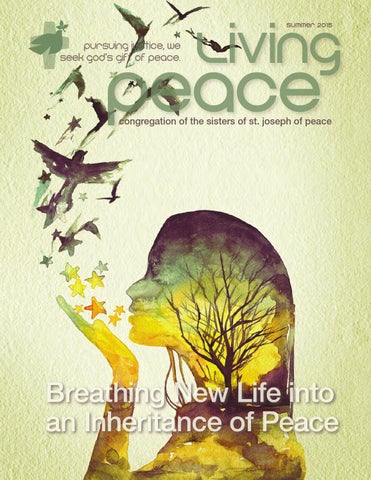
Copyright: Articles in Living Peace may be reprinted. Please include the following on reprints: “Reprinted with permission from the Sisters of St. Joseph of Peace, 399 Hudson Terrace, Englewood Cliffs, NJ 07632, www.csjp.org” Please send us a copy of the reprinted article. Jan Linley, Editor Editorial Board Katrina Alton, CSJP Susan Dewitt, CSJP Jane Ellis, CSJP-A Terrence Moran, CSJP-A Coralie Muzzy, CSJP Cover Art The artwork on our cover is called Blowing Dreams by Nanda Corrêa, a Brazilian architect and urbanist from Rio de Janeiro. She graduated from Universidade Federal Fluminense, then let her dreams guide the way and currently works as a freelance illustrator. Beyond commissioned works and winning t-shirt designs in permanent contests, she also develops a series of personal illustrations that reflect her great passion for traveling, music, photography, poetry, colors and nature. You can find more of Nanda’s art on these websites: kammiatelier.com, nandacorrea.tumblr.com, facebook.com/NandaCorreaIllustration, and on twitter @nanda_kammi. Design Beth Ponticello, CEDC, www.cedc.org
by Margaret Shannon, CSJP
3
Peace: What’s it Worth?
4
Inheriting Great Love and Responsibility
6
The York Street Project: A Relationship for a Lifetime
by Jan Linley
summer 2015
Living Peace is a biannual publication of the Congregation of the Sisters of St. Joseph of Peace. If you wish to change your address, or if you or someone you know would like to be added to our Living Peace mailing list, please contact Linda Hanson at lhanson@csjp-olp.org or 425-467-5400.
Message from Congregation Leadership: Breath of Fresh Air
by Susan Francois, CSJP
by Jennifer LaRocque
8
Saying Yes to New Life by Sheila Lemieux, CSJP
10
Making Something New: Peace Ministries, Inc.
12
Every Day Is a Journey
14
Sister Louise Dumont: God Is with Me in the Faithfulness
16
Frank Speak: Relic of the Past, Hope for the Future
18
Beatification of Archbishop Romero
19
Who Am I Now?
20
History and Roots: The Power of One
by Margaret Jane Kling, CSJP
by Katrina Alton, CSJP
by Susan Dewitt, CSJP
by Frank McCann, CSJP-A
by Susan Dewitt, CSJP
by Jane Ellis, CSJP-A
Leadership Team Message: Breath of Fresh Air
by Margaret Shannon, CSJP It was an experience of taking in a “breath of fresh air” during a recent stay at our UK home in Rearsby, England. There’s nothing fresher than air on an English countryside. The breath of fresh air was inside too…among the sisters who continue offering amazing hospitality to those who come there. I’ve heard it said by a townsperson that the CSJP presence in Rearsby is the soul of the town. As the sisters prepare to leave Rearsby for Nottingham and other places, one might wonder, if the townsperson is correct, what will happen to the soul of Rearsby. It reminds me of the Ascension/Pentecost story. “Unless I leave, the Spirit cannot come…” What strikes me though is that Ruah, the breath of God, the breath of our charism of peace through justice, has already been released in Rearsby and elsewhere, from the very beginning. So in truth, the soul has become part and parcel of the town and townspeople. That remains forever.
Breathing new life into our circumstances, our world, requires a conversion of heart… breathing deeply and exhaling fully, letting go so something new can come in, be inhaled and be released anew. We are asked to do the counter-intuitive thing in uncertain times. Instead of holding our breath, hoping to maintain our balance, we are asked to breathe, and breathe deeply. It’s like falling in love; we may lose our equilibrium for a while. This type of conversion takes place deep inside us and may require letting go of something so much a part of us that it seems inconceivable to part with it. Yet in doing this, we are able to see the signs of our times more clearly and what the Spirit requires of us going forward into a future full of hope and possibility. The sisters in Rearsby seem to me to be very practical women, knowing when it’s time to hunker down and when it’s time to let go, having that intuitive sense that has served them well over many decades. What will move them and all of us going forward? continued on page 9
Peace: What’s It Worth? Unlike money, property or jewels, peace is not a tangible gift passed to us from a previous generation or one that we can leave in a will for future generations. Would that we could. What then, do we mean by breathing new life into an inheritance of peace? The charism of the Sisters of St Joseph of Peace is peace through justice, expressed more fully in the tagline on our website and the front cover of this publication, “Pursuing justice, we seek God’s gift of peace;” or in the words of the Congregation’s founder, Margaret Anna Cusack, which appear on the Congregation’s letterhead: “The very name Sisters of Peace will, it is hoped, inspire the desire of peace and a love for it.” It is this charism, the continual examining and living of it, that is the inheritance we explore in this issue. In her article, “Inheriting Great Love and Responsibility,” from which our theme is drawn, Sr. Susan Francois writes about the difficulty of understanding charisms as static treasures. Noting that charisms are not transferable or transmittable, she
by Jan Linley
writes: “Our responsibility is to lean on our inheritance of love and the example of those who have gone before, to breathe new life into our founding stories, and to respond to the unmet needs of today.” Breathing new life into the charism of peace through justice is not new. Responding to the unmet needs of the day has, from the beginning, been how the charism has been enfleshed and made vital again and again. George Leonard, raised in the boys’ orphanage that was once in Englewood Cliffs, New Jersey, his dormitory in the building that now houses our offices, is a living testament to that. George grew up to be a police officer who rescued a baby girl abandoned on the side of the road. Likewise, a grateful Jennifer LaRocque, former client of The York Street Project, reveals how much York Street meant to her and her children, providing them with a home, an education and a future. Sr. Margaret Jane Kling, vice chair of the Congregation’s new Peace Ministries, Inc. explains that this new corporation was formed to sustain some of the ministries started by the sisters, continued on page 9
SUMMER 2015
3
Inheriting Great Love and Responsibility by Susan Rose Francois, CSJP Susan’s article initially appeared in Global Sisters Report (www.globalsistersreport.org) a project of National Catholic Reporter. Periodically during contemplative prayer, a random distracting thought pops into my mind and catches my attention, no matter how pious or spiritual my intentions when I first sit down to pray. It might be as simple as what I plan to cook for dinner that evening or as complex as composing an email. Every once in a while, however, a thought drifts in which is indeed worthy of further prayer and reflection, no matter how random it might at first seem. About a month ago, for example, I found myself contemplating “Downton Abbey” from my perspective as a younger Catholic Sister. There I was, sitting in the chapel with my Sister housemates, when I found myself thinking: “It’s almost as if I’m Matthew Crawley.” I remember wondering at the time, where did that one come from? In the weeks since, however, it has led to much fruitful reflection. Let me try to explain without any unnecessary plot spoilers. If you happen to be familiar with the ongoing saga of “Downton Abbey,” suffice it to say that I am referencing the Matthew Crawley of the early seasons. I also hope and pray that my story ends on a more positive note, many years from now. If by chance you are not a fan of this public television drama, all you need to know is that Matthew Crawley is a solicitor and distant cousin to the Earl of Grantham who unexpectedly finds himself heir apparent to the family fortune and title. While he is a successful professional in his chosen field, he is a novice in the running of a large estate and does not know the nuances of the family history. Moreover, he is poised to inherit during a time of uncertainty and great social upheaval. There is much he has to learn, yet there is also much that he cannot possibly ever hope to learn that would help him navigate such a changing landscape. I suppose my subconscious latched on to this comparison because, as a younger woman religious who was recently elected to congregation leadership, I find myself in a somewhat similar situation. While I came to religious life after spending a decade in local government administration, I have a tremendous amount to learn about leadership in a religious congregation. Also, as a newer member, my experience of community is necessarily limited. I just haven’t been around that long. I am coming to understand this as both a deficit and a gift.
4
Dan Stevens as Matthew Crawley in Downton Abbey
On the one hand, I sometimes lack the historical context for complex issues and questions. However, on the other hand, I am free from many of the assumptions that might otherwise constrain my heart and mind if I did carry such a personal history in community. Finally, given the present demographic reality in religious life, you can also make the case that the younger generations of women religious are entering during a time of uncertainty and upheaval. We can, and should, imagine and dream about the future, even as we navigate the ever-changing landscape before us. In the end, however, only God knows what lies ahead. In the weeks since I had my Matthew Crawley observation, I have been thinking quite a bit about inheritance and wealth. The wealth I am pondering is not so much financial as it is spiritual. It is the wealth of love accumulated by my Sisters through more than 130 years of faithful service to God’s people. It is the currency of relationship, the blessing of memories, our pioneer spirit, the lived experience of renewal, and the reclaiming of our founding story and charism. In many ways, I am late to the party, and yet I am able to dance to the music that is playing on in full stream in the company of amazing women alive with the love of God. If only the dance could go on at the same tempo and with the same large crowd on the dance floor! Sadly, barring a major intervention by the Holy Spirit, we know that we are poised for some major shifts in religious life. I am grateful for my random Matthew Crawley thought because it has helped me to come to grips with some of the responsibility I feel for the future.
LIVING PEACE
Sisters Mary Thorne, Grace DiDomenicantonio, Margaret Shannon and Susan Francois attend anti-trafficking demonstration.
If I am honest, at times it is a heavy weight on my shoulders, as I suspect it is heavy on the shoulders of many younger members. How can we possibly follow in the footsteps of the women who answered the call of Vatican II so fearlessly? In my experience, younger religious tend to be excited about the potential for a smaller-scale religious life which may emerge in the next couple of decades, but we by no means have a blueprint for how to get there. We share the sadness that our elder Sisters feel when we make tough decisions to withdraw from ministries due to declining numbers. We also anticipate the not-too-distant future when we will have substantially fewer companions on the journey. Thankfully, we do not face this moment alone. The younger generations in religious life may be small, but we do exist, and we are increasingly connected across congregation lines. Also, just as Matthew Crawley was able to learn from the Earl of Grantham and the Dowager Countess, we have incredible wealth in our elder Sisters in community. If you have not yet read Teresa Maya’s Open Letter to the Great Generation on Global Sisters Report, take this as an opportunity to do so. She articulates so well the love and admiration we have for those who paved the way, as well as the urgent need for them now as mentors: “My generation needs your wisdom, we need you as mentors, to counsel us, to tell the stories, to pass on your passion, to stand by our side and assure us it is OK to make mistakes, to try again, to inspire us to carry on your legacy.”
SUMMER 2015
Back: Sisters Chero Chuma, Dorothy Verna, Katrina Alton, Susan Francois; Front: Sisters Juliana Iwuagwu, Sukyi Hur, Sheena George
The wider church is also facing a similar moment. Last week, I attended a conference at Fordham University called “Our Inheritance: Vatican II at 50, The Post-Conciliar Generation Looks at the Next Half Century.” Generation X Catholic academics drew upon the wealth of the past 50 years of Catholic scholarship to explore how Vatican II continues to shape the church and wider society in areas such as politics, gender and globalization. Our inheritance is great, and so is our responsibility. This can be an overwhelming thought if we think of our communities’ charisms as static treasures we are responsible for keeping safe. But, as Bernard Lee observes in The Beating of Great Wings: A Worldly Spirituality for Active, Apostolic Communities: “Charism is not a property. It is not a possession. It is not transferrable. It is not transmittable. And it is not controllable.” Instead, “It can only be reinvented, posited, in a new socio-historical setting, but never simply reenacted” (pg. 16). Our responsibility is to lean on our inheritance of love and the example of those who have gone before, to breathe new life into our founding stories, and to respond to the unmet needs of today. We have been called to carry on in our way in this moment, and hopefully, one day, we too can pass on the torch to the next generation.
Susan Rose Francois is a member of the Congregation Leadership Team for the Sisters of St. Joseph of Peace. She was a Bernardin scholar at Catholic Theological Union and has ministered as a justice educator and advocate. Read more of her work on her blog, At the Corner of Susan and St. Joseph.
5
A Relationship for a Lifetime by Jennifer LaRocque Adapted from her speech at the 2014 Spring Event
The York Street Project Founded by the Sisters of St. Joseph of Peace, the York Street Project engages in education and hospitality to better the lives of women and children. It is comprised of Kenmare High School, St. Joseph’s Home, The Nurturing Place, and St. Mary’s Residence. Kenmare High school offers educational programs to young women completing a diploma, while the Nurturing Place focuses on the development of children from the ages of four months to seven years old. These children are also the residents of St. Joseph’s Home, which provides housing and support for them and their single mothers. Similarly, St. Mary’s Residence serves low-income, single women as they pursue careers.
Children from The Nurturing Place walking outside
6
I like to say that I took the scenic route through high school. My freshman year was supposed to be glorious. I’d always been a good student, yes, even a bit of a nerd. School was my refuge as a child, the only place where I could shine. And school had free books! Books have always been my best friend. I could get lost out on the prairie with Laura, or think I was as smart as Encyclopedia Brown once in a while. But as I said, while I thought my freshman year would be great, I soon learned that I was wrong. The school I was enrolled in was like a scene from one of those movies where the principal carries around a bat. Inside the classrooms, there was no learning going on, the teachers had no control. I started to hate going to school. At the same time, I hated being at home because of other circumstances, so it became easy to fall through the cracks. I would get on the bus in the morning and keep on riding past the school. I’d get off at my best friend’s house and spend the day with her. She hated the fact that I was skipping school, but at that point in my life, she knew she was also the only adult that I could turn to; so while she lectured me every day about it, she was still my safe harbor. At 16, I dropped out of school. A few months later, I took another stab at traditional high school, but by that time, I’d had a taste of so-called freedom and decided I would do the cool adult thing and just get a GED. So I dropped out again. It was far too easy. My mother had unhealthy priorities at that time in her life, so I was basically governing myself, and the school didn’t push too hard to keep me enrolled. As the next two years passed, my mother got better and started pushing me to do something with myself. One thing about my mom, when she was good, she was awesome. And, of course, my best friend never stopped hassling me, thank heavens. My oh-so-cool GED plans hadn’t panned out. I first heard about The York Street Project (YSP) through a friend of mine who would soon be attending Kenmare High School. She was excited to go back to school and have her children right next door in The Nurturing Place. Unfortunately for her, she lasted all of one semester; fortunately for me, Kenmare was now on my radar. I took the placement exam, and the rest is my history. I don’t know what it was but when I walked in, I just knew it was the place for me. I was excited about learning again, and I became a new person there. I met women who have become my dearest friends in life, teachers who have made a place in my heart, especially one Sister Lucy Clarke. I have never met a kinder and more generous soul in this life, and she has this great sense of humor. Sr. Lucy expanded my literary horizons, and my crafty ones, too. I’m still trying art projects with my kids that I learned in her class. One of the biggest lessons I learned about The York Street Project is that you have to be committed. I believe Kenmare High School’s motto is “an education for a lifetime;” but it’s really so much more than that. It’s a relationship for a lifetime. They are committing to you and your family, but to reap all of the benefits, you must commit right back: your time, your effort,
LIVING PEACE
your patience as well. The people at YSP have proven they will go out on any and every limb for their women and children. When it was time for me to do an employee internship at Kenmare as part of the graduation requirement, I talked with my social worker at the school about where to go. It was clear that my career path and interests did not lie in the internships that companies like Pershing and Merrill Lynch were so generously offering. My interests were in medicine and writing. At the time, my mother and I were big fans of Rosie magazine. We knew the publishing offices were in New York. I went to see my social worker on a whim, and she made it happen. That was really the thing that turned the light on for me that I really could do what I wanted. I didn’t have to just live my life with what is outside my door. I also knew that as long as I was striving to be better, no matter the road bumps along the way, I would have this network to back me. I graduated from Kenmare in 2002, after a year and a half of nonstop schooling, including summer school in order to gain extra credits. At that time, I didn’t realize I would be coming back to the YSP for help with the next stage of my life as well. I was living with my mother and my son in a two room apartment in a rundown building overflowing with mice. When it rained outside, it rained inside. And the worst part of that was the fact that I had to wade through drug addicts in various states of consciousness to reach my door. I worked two jobs and it was still a struggle every month to pay the full rent and keep the lights on. And of course, there were times when it was one or the other and dinner was by candlelight. I was paranoid that someone would find out, and I would lose my son. It seemed that no matter how much I worked, there were never enough hours in a day, let alone enough hours in my paycheck. I was anxious, wondering whether I had made the right decision to bring my son into such a life. What was I doing for him? How could I change his life? At this point, I knew all about the work the people at St. Joseph’s Home performed, and I knew I had to try every option. I knew I could trust them. And I also knew they were probably the last stop between my family and the streets. So once again, I came to the women at YSP, hands out in need, and they accepted me. They taught me how to manage a household and gave me stability so I could focus on school and work. And they opened up my parenting abilities and allowed me to connect with my son in new ways. We had many opportunities there that I would never have been able to afford and experience with my son, and I thank all the generous people who made that possible from the bottom of my heart. Today, I am a proud mother of three; and each of them has blossomed under the care of some of the
SUMMER 2015
Jennifer with her children
most wonderful teachers I have encountered. The adventures and experiences all three of my children have had at The Nurturing Place would not have been possible anywhere else. I’ve been a pediatric LPN for four years now. I am gearing up for another go at school for an RN and Master’s Degree. I know I have another long road ahead of me, and while my last child is slowly growing out of the Nurturing Place, I also know my relationship with YSP will still be part of the foundation I have beneath me to complete this next journey. The things I learned there are more than book lessons, they are life lessons that I will carry with me forever. While the circumstances that brought me down this road may not have been ideal, I am travelling the path I was meant to. I have seen the impact YSP has had on so many lives, the women and children that have had nowhere else to turn. These arms have been open to them, and have never closed. It is more than a project. It’s a home, a home where they love you and want you to succeed and will supply you with the tools to do so. I have mentioned the open arms and generous help offered, but let me make something else clear: each aspect of the YSP is about teaching you how to empower yourself. They will give you the supplies, teach you the skills, and show you the way, but it’s up to you to put in the effort to rebuild your life. They are true believers in the saying, “If you give a man a fish, he eats for a day, but if you teach a man to fish, he eats for a lifetime.”
7
Saying Yes to New Life by Sheila Lemieux, CSJP Judi Dench in her recent film, The Second Best Exotic Marigold Hotel, a British comedy-drama sequel to the sleeper hit, The Best Exotic Marigold Hotel, plays the role of Evelyn Greenslade, a 79-year-old woman living in Jaipur, India. Evelyn is offered a job as a fabric buyer. She is concerned whether at her age she is up for the job given the many responsibilities and considerable travel that will be required. As she struggled with the decision to take the position, a few of her lines grabbed my attention and resonated within me. She asks, “How many new lives can we have?” And her conclusion is “as many as we like.” Evelyn’s question challenges the reality that there is only so much more life to be lived given her age. Her conclusion suggests we can constantly recreate ourselves by saying yes to new opportunities regardless of our age. There is something really freeing about not putting limitations on possibilities for the future. Evelyn’s question was similar to a question I asked myself when discerning whether to allow my name to go forward in nomination for Congregation Leadership. It was a big thing to say yes to leadership at this time in my life! After all, at 74, Judi Dench and I are contemporaries. It was a leap of faith. I recall some agonizing moments during this reflective time. On the one hand, I recognized a desire deep within me to make the remaining years of my life really matter. I felt the pull to move beyond my present reality and allow myself to be stretched. On the other hand, my thoughts centered on those lifelines that keep me whole. What about relationships with my friends, my family, and what about my other commitments? I was happy where I was. I have some caretaking responsibility; how could I reconcile that with serving in Congregation leadership? Was I up to the challenge of pushing myself outside of my comfort zone yet again? Would the demands be too much? Was the Spirit really leading me in this decision? The notion of letting go and taking risks and trusting was a bit overwhelming but not entirely unfamiliar. The Gaelic term, Trasna, familiar to our sisters and associates, means crossing over. In this instance, crossing over means to choose the unfamiliar path. Sisters don’t think of retirement in the same way our contemporaries do. For most of the sisters who have gone before us, the idea of retirement in the traditional sense seldom crossed their minds. Many years ago sisters were sent wherever they were asked to go, sometimes with little or no advance warning as to what they might be doing or where they might be going, even if it meant a move across the country or to another country entirely. Sisters would receive an envelope once a year that held their ministry appointments. They were sent where there were needs to be met and people to be served, and it had little to do with age. Only a significant illness could deter that service. One of the ways in which our vowed religious lifestyle distinguishes us is our commitment to the gospel imperatives and the Congregation’s charism of peace through justice lived out where life finds us. That does not cease when we reach age 65 or age 74. A quote from Pope Francis in his Apostolic Exhortation, continued on page 9
8
LIVING PEACE
Saying Yes continued from page 8
The Joy of the Gospel, describes this in a more forceful way when he states, “…all of us are asked to obey God’s call to go forth from our own comfort zone in order to reach all the ‘peripheries’ in need of the light of the Gospel.” Francis’s invitation serves as a reminder that as Christians none of us is exempt from moving beyond ourselves to the critical mission before us. When I think back to our Congregation meeting last September, the Holy Spirit was definitely hovering over the waters in Seattle where our meeting took place. We, sisters and associates, recognized the urgency of the work and promotion of our charism—our founding spirit—in these most urgent times. We set the direction for the next six years and elected new
leadership for our Congregation. I was one of those elected to our Congregation Leadership Team. There is an image in the Genesis Creation narrative from Hebrew Scriptures that captivates me each time I hear it read. It is the moment when God breathes life into the nostrils of Adam, a profound moment of cosmic happening. From that first moment God breathes life into us, we embrace a journey of continually awakening to the gift of life all around. In a flash of restrained humor, when I was elected Congregation Leader, I visualized our Creator God bending down to breathe new life into this 74-year-old wineskin. It was another example of God’s indomitable surprises. How could I not say yes?
Leadership Team Message, continued from page 3
Peace: What’s it Worth?, continued from page 3
Another way to ask it is, as the refrain from a song says, “Why do we do what we do?” The late Pedro Arrupe, S.J. answers this best when he writes,
and she shares hopes for its future. Sr. Susan Dewitt journeyed to El Salvador, where the CSJPs ministered for many years, for the Beatification of Archbishop Romero, who was a living example of peace through justice. And Frank McCann gives a call to action for the eradication of nuclear weapons. Breathing new life into the old often means saying yes to new opportunities and challenges. Congregation Leader Sr. Sheila Lemieux reflects on her decision to say yes to congregation leadership at a time in her life when she thought that type of call and challenge was behind her. On the flip side, newly retired Associate Jane Ellis shares where she finds peace and joy during her journey of transition. Meanwhile, Sr. Katrina Alton, on another journey altogether, ponders why “anyone would want to journey into the heart of religious life today.” And finally, 91-year-old Sr. Louise DuMont pauses for a moment with Sr. Susan Dewitt to share what has kept her grounded on her long and fulfilling journey. What would peace be worth if it had a price? Truly, it is priceless beyond measure. Hopefully, the day will come when we live in a world that values the peace born of nonviolence over oil, money or might makes right. Until then, the peacemakers among us, in daring to imagine leaving an inheritance of peace, will continue to plant seeds and nurture this most precious bestowal in the tabernacle of our collective spirit.
Nothing is more practical than finding God, that is, than falling in love in a quite absolute, final way. What you are in love with, what seizes your imagination, will affect everything. It will decide what will get you out of bed in the morning, what you do with your evenings, how you spend your weekends, what you read, whom you know, what breaks your heart, and what amazes you with joy and gratitude. Fall in love, stay in love, and it will decide everything. So let us all now take a deep breath and remember to exhale! Exhale into our inheritance of peace. Fall in Love attributed to Fr. Pedro Arrupe, S.J. (1907–1991) from Finding God in All Things, A Marquette Prayer Book, Milwaukee, WI: Marquette University, 2009
SUMMER 2015
9
Making Something New:
Peace Ministries, Inc.
by Margaret Jane Kling, CSJP
Back in 2012, Congregation leaders initiated a planning process to consider the best way to secure a vibrant future for our New Jersey sponsored ministries. These ministries include: Concordia Learning Center at St Joseph’s School for the Blind, Cusack Care Center, Holy Name Medical Center, St. Ann’s Home, Stella Maris Retreat Center, WATERSPIRIT, The York Street Project, including The Nurturing Place, Kenmare School, St. Mary’s Residence and St Joseph’s Home. Some of these are among the first ministries founded by the Sisters nearly 130 years ago.
Continuing a Tradition of Compassionate Service
After completion of an initial sponsorship study with the aid of David Nygren Associates, a Governance Task Force was appointed. This task force was charged with the responsibility of establishing what would become Peace Ministries, Inc. (PMI), a sponsoring ministry for all of the ministries listed above that will link them more tightly together and support those most vulnerable. Work groups immediately began to study the legal issues involved in such an undertaking,
Seated L to R: Kate Chambers, Rosemary Coffey, Francine McGuire, Arleatha Williams Standing L to R: Pat Weidner (Associate & Secretary), John Sheridan, Greg Plechner, Maureen Donohue, Anne Raftery Denyeau; not pictured Ted Carnevale.
10
Sisters Kristin Funari and Margaret Jane Kling.
recommendations for orientation and ongoing formation of trustees and competencies needed in order to form an effective board. Essential to all this work was a document created by the task force, titled “Hopes and Aspirations for the Future of Our Ministries for the Congregation of the Sisters of St. Joseph of Peace.” The hopes and aspirations kept us in focus. This document, based on our CSJP Constitutions, succinctly clarified our mission along with our hopes for the future. It is addressed to the sisters and to all who participate with us in ministry. Following are a few excerpts from this document. “As the Sisters of St. Joseph of Peace consider new ways of sustaining the ministries we have faithfully and joyfully carried on for the past 128 years, we are eager to ensure that the tradition of compassionate service continues. In this document we offer our hopes and aspirations for the ministries presently undertaken, for all that may develop in the future, and for the women and men who commit themselves to this work of service.” “We expect of ourselves and our lay partners and collaborators an openness to the present and emerging needs of the times in which we live and particular sensitivity to the call of those who are suffering. Such openness requires wise and discerning hearts and an unwavering reliance upon the Spirit of God.” Peace Ministries, Inc. now serves as the umbrella organization to support the ministries in those areas that they share in common. It aims to build LIVING PEACE
coordination among them, so that resources and learning can be shared. Eleven trustees were appointed by the Congregation Council in March 2014:
Ted Carnevale Kate Chambers, CSJP Associate Rosemary Coffey, CSJP Anne Raftery Denyeau Maureen Donohue, CSJP Associate Margaret Jane Kling, CSJP – Vice Chairperson Francine McGuire Greg Plechner John Sheridan – Chairperson Arleatha Williams Kristin Funari, CSJP, Assistant Congregation Leader
The full PMI Board meets monthly at Shalom Center in Englewood Cliffs, New Jersey. This first year our work has centered on five areas: 1. Bylaws – to understand the delegated powers to PMI from the Congregation Council; 2. Mission – to get to know the ministries and to determine how to establish mission and ministry reviews; 3. Trustee Formation/Education – in areas including theological heritage, sponsorship, prayer, Catholic identity, social justice and ethical decision-making, ethical and religious directives, care of the earth, and leadership style; 4. Governance – to plan the evolution of the individual ministries into the new structure; 5. Staffing - to define the Executive Director position and begin a search for candidates.
Shaping the Future
At this point, teams of two or three PMI Trustees will meet with the leadership of each ministry to learn more about the individual ministry, and to share the work and plans of Peace Ministries, Inc. Together they will develop future action steps, relating to the mission and ensuring it stays vibrant and sustainable into the future. Peace Ministries Trustees are committed to a style of leadership that is collaborative, mission-centered, just, compassionate, transparent and consistent. Our mission statement sums it up and gives us direction and inspiration: Looking to the future and rooted in the call to make Christ’s gospel of peace come alive through works of justice, Peace Ministries, Inc. governs, supports, and advocates for its sponsored ministries.
SUMMER 2015
Wax When I see you and how you are, I close my eyes to the other. For your Solomon’s seal I become wax throughout my body. I wait to be light. I give up opinions on all matters. I become the reed flute for your breath. You were inside my hand. I kept reaching around for something. I was inside your hand, but I kept asking questions of those who know very little. I must have been incredibly simple or drunk or insane to sneak into my own house and steal money, to climb over my own fence and take my own vegetables. But no more. I have gotten free of that ignorant fist that was pinching and twisting my secret self. The universe and the light of the stars come through me. I am the crescent moon put up over the gate to the festival. From A Year with Rumi: Daily Readings by Coleman Barks
11
Every day is a journey and the journey itself is home. By Katrina Alton, CSJP In Ireland there is the often told tale of the stranger who stops and asks the locals for directions and receives the reply, “Well, you don’t want to be starting from here!” But “here” is the only place we can start from, and our CSJP history is littered with examples of our journeying to and fro, our building up and letting go, our celebrations and our sufferings. Religious life today is at a crossroads. Here in Scotland the statistics tell a depressing story of the decline and withdrawal of religious congregations: communities are closing and ministries ending. So why, you may ask, would anyone want to journey into the heart of religious life today? The simple answer is that God is still calling, and our charism is, I believe, still relevant. Although it may seem that we religious are on a very precarious journey right now, hasn’t that always been the case? Aren’t all journeys filled with
rather than a place, a searching rather than a finding. Over the last few weeks I’ve been reflecting on the familiar Gospel story of the two disciples on the road to Emmaus, and I keep wondering why they didn’t recognise Jesus. Was it grief?
“God is still calling, and our charism is, I believe, still relevant.” risks and dangers? Look at the risks thousands of people from across the African continent and the Middle East are taking every today to flee war, persecution, and economic poverty. They may have a clear destination in mind, but the journey is treacherous, claiming many lives either in the heat of the Sahara or in the waters of the Mediterranean, and even if they reach their destination, the journey is far from over, as they struggle to find a welcome and a sense of belonging. Jesus’ whole life was one of journeying; being born literally on the move, fleeing and seeking asylum in Egypt, to having nowhere to ‘lay his head’ during his mendicant ministry. Yet revealed in this precarious and fragile life is ‘The Way’; a journey rather than a destination, a path
12
Fear? I don’t know, but what the Gospel does tell us is that, in spite of this, they still welcomed this ‘stranger’ into their midst. Even though they didn’t recognise Jesus they walked with him, talked with him, and then begged him to come and stay with them. But imagine, just for a moment, if they hadn’t welcomed the stranger; they hadn’t walked, talked, or invited him to share a meal and stay with them. Imagine they hadn’t broken bread, and that their eyes were not opened, and that they missed this opportunity of meeting the risen Jesus! Instead they would have reached their destination downhearted and afraid; they would have shut the door, maybe never to return to Jerusalem, never to share the joy of the resurrection with their sisters and brothers...Imagine....
LIVING PEACE
I find this very easy to imagine, because allowing the ‘stranger’ to journey with me isn’t something that comes naturally. I’ve been influenced by the media campaigns of ‘stranger danger’, and all the negative stereotyping of those that are different from me. I’m as riddled with fear and suspicion as the next person, at times as downcast as the two disciples walking away from Jerusalem, walking away from their community, walking away from Jesus. Yet Jesus knew only too well what it meant to be on the margins, to be the ‘stranger’: Jesus speaks from experience. Rumours surrounded the circumstances of his birth, in Egypt this Jewish family must have been viewed with suspicion. The religious leaders frowned upon him spending time in the company of ‘prostitutes and sinners’, and in the end he dies the death of a criminal and a fugitive. So it isn’t surprising that Jesus tells us very clearly what is involved if we want to journey with him along ‘The Way’: “I was a stranger and you welcomed me, I was naked and you clothed me, I was hungry and you fed me, I was in prison and sick and you visited me.” (Matthew 25:35-6) From his own experience of exclusion, hunger, poverty and arrest, Jesus invites us to follow him, to journey with him, to encounter in such pain and suffering the mystery and power of the resurrection, to experience for ourselves, just as the disciples did on the road to Emmaus, that “perfect love casts out all fear.” (1 John 4:18) Any journey requires a letting go of the familiar, as our founder, Margaret Anna Cusack, knew only too well: “How often have I thought, what if I had decided to stay in Newry convent? What a long chain of events depended on my decision! I believe God has His own designs even when we least expect it, and leads us in the way He would have us go, if we are not opposing His will.” (The Story of My Life - 1893) Today, we as CSJP’s, are once more trying to discern God’s will for us, particularly how to make real our commitment to our 2014 Chapter Call: Disturbed by the Spirit, we recommit ourselves to Jesus’ way of radical hospitality. We are called to a deeper and wider living of community for mission in company with poor
SUMMER 2015
“a journey rather than a destination, a path rather than a place, a searching rather than a finding.” and marginalized people. Our contemplative discernment pushes us, individually and as a Congregation, to action; deeper mutual support enables us to take risks for justice, peace, and the integrity of creation. As disciples of Jesus, we respond anew to the call of Mother Clare to be “brave, noble, largeminded, courageous souls.” So let us pray that the same Spirit that guided and inspired Mother Clare to respond to the needs of the poor and oppressed people of her day, may ignite in each of us a desire to walk, talk, and welcome into our communities the ‘stranger’, confident in Jesus’ promise: “Whatever you do to the least of my sisters and brothers you do to me.” (Matthew 25:45) Title from a quote by 17th century Japanese poet Matsuo Basho
13
Sister Louise DuMont: “God is with me in the faithfulness.”
by Susan Dewitt, CSJP At 91, Sister Louise DuMont is, as she always has been, quiet, peaceful, unassuming and reflective. She is also, as she has always been, a woman of wisdom and deep insight. Louise doesn’t speak often in meetings, but when she does speak everyone quiets down to listen. Twenty-one years ago, in 1994, everyone quieted down when Louise stood up in a painful and contentious meeting of sisters in the Archdiocese of Seattle with Archbishop Thomas Murphy. This meeting was in preparation for the Bishops’ Synod on Religious Life, which was not going to hear many of the voices or perspectives of religious women (a few religious women and men were auditors). Louise stood up to address the gathering, holding her handwritten words because, as she said, “I don’t want to get carried away with emotion nor do I want to leave anything out.” She said, “We know the history of the struggle that women had as they strove to move out of the cloister into the streets, the Spirit of God was calling to new ways of being Church, of serving God’s people, and the Church, over years, continued to try to find ways to keep the women locked up. . . I look to the upcoming Synod on Religious Life with much apprehension. . . [but] somehow I am confident that the Spirit is at work, She always is and will not die.” Louise has carried that prophetic sense of religious life through times of great and turbulent change. She was the first sister to be elected (rather than appointed) Province Leader in 1968, and the first Sister to have an official photograph in street clothes. The drama of that change is visible in a succession of leadership photographs at St. Mary-on-the-Lake, Bellevue, Washington. The more essential meaning of the change takes shape from Louise DuMont’s commitment to the responsibility of each Sister for her own life. When she became a Sister in 1944, everything in the life of a religious was controlled: she remembers a young sister asking, “Can the Provincial even tell me I need to have a dresser scarf on my dresser?” In those days, the answer would have been “Yes.” Louise, who was challenged by being put in charge of the Juniorate (sisters who had made their
14
Sisters Louise DuMont, Mary Powers and Eileen Keane, 1968
first profession and were completing schooling or training for their ministries) had to chart her own path in this new responsibility. “I didn’t know what I was doing or what I was supposed to do. But somehow I found that it was God’s work.” As she did that work with God, she asked the young sisters to take charge of their own lives, silencing the community’s morning bell at St. Mary’s and telling the juniors to set their own alarms. As the first elected Provincial, she chose to both accept and share the responsibility, developing the first leadership teams with Sisters Joan Leonard, Mary Powers, and Eileen Keane. There were difficult times. Louise recalls one Chapter meeting when a Sister claimed that the community had lost all sense of obedience. Louise got so angry that she left and went to her room with a raging headache. But, characteristically, she took responsibility, went back LIVING PEACE
“I have never been a great pray-er, but I was faithful throughout the years to a time of prayer each day, and that has been my source of hope, my source of peace” and addressed the situation, “and I think there was peace from that.” Louise’s deep peacefulness is grounded in her life of prayer, though she makes little of that daily faithfulness. “I have never been a great pray-er, but I was faithful throughout the years to a time of prayer each day, and that has been my source of hope, my source of peace. I never had any visions or any great moments of light. I have continued to feel that God is with me in the faithfulness.” Now in her nineties, Sister Louise DuMont continues that life of faithfulness, with a few questions. “In recent months, I have been thinking more and more about death. I’m trying to figure out what God still wants of me. I don’t have a fear of death, yet I find myself wondering what death is all about, and what’s on the other side of death.” That honesty and fearlessness, along with a lively sense of joy and hospitality, characterizes Louise DuMont’s whole life, a life rooted in God. “I’m always amazed at being seen as a person with wisdom,” she says. “I have to say that for me there have been hard moments, but I have never felt I was abandoned by God or people. Life has been good.”
SUMMER 2015
Top: Sister Louise DuMont, 1975 Bottom: Sister Louise DuMont, 2014
15
FrankSpeak
Relic of the Past, Hope for the Future By Frank McCann, CSJP-A, Congregation Justice and Peace Facilitator Despite our Congregation’s calling to be peacemakers, promoting the eradication of nuclear weapons seems to be a relic of our activist past. Except for the CSJPs in Scotland, we’ve moved on. Yet the existence of nuclear weapons continues to be a very real threat to our planet, to justice and to any hope for real peace. Several recent incidents point to the ongoing risks of maintaining nuclear arsenals and challenge us—in hope—to continue work to eliminate nuclear weaponry. The July 28, 2012 “Transform Now Plowshares Action” of three protestors, including Michael Walli, Greg Boertje-Obed and 82-year-old Sr. Megan Rice, demonstrated how easy it was to get close to nuclear materials stored at the Oak Ridge nuclear facility in Tennessee, where uranium is highly enriched for weapons of mass destruction.
The UK is not without its nuclear security breaches as revealed in Able Seaman William McNeilly’s recent whistleblower report (https://wikileaks.org/ trident-safety). He reveals over 30 safety and security breaches he observed in his role as an Engineering Technician Weapons Engineer Submariner at the Faslane Trident nuclear submarine base in Scotland. Among the breaches were never having bags checked when boarding the subs and security failing to check ID badges. These breaches alone could allow a bomb to be brought onboard a nuclear-armed submarine. North Korea’s willingness to thumb its nose at the community of nations, along with its continued development of missile technology, puts the world at risk of a nuclear strike, or accident, by a nation which may only need to perceive a threat.
The U.S. has a backlog of weapons to be decommissioned and currently has 2,000 weapons at the ready. Even military experts say half that number is more than adequate. We have to ask, “Adequate for what?”
The Scene of the Memorial Service Held at the Urakami Roman Cathoric Cathedral, November 23, 1945. (The Pictorial Post-Cards Regarding the War Calamities, Suffered on August 9, 1945. Published by the Nagasaki City Office.)
16
LIVING PEACE
Memorial Peace Park in Nagasaki; Woman protecting child: “Protection of Our Future” by Peter de Jong, Nagasaki, Japan, gift of City of Middelburg, Netherlands in 1983
There are countries like India, Pakistan and Israel that never signed the Nuclear Non-Proliferation Treaty, (NPT) live in ”tough neighborhoods,” and have accepted few controls over their nuclear capabilities. The instability of Pakistan clearly raises questions about the security of their nuclear weapons. The world community cannot afford to live with the threats these conditions pose. Negotiations with Iran to eliminate its capacity to produce a nuclear weapon have been in the news much of the past year. Iran’s claim that it seeks only peaceful uses for its nuclear capability may appear doubtful to some, but it rests on one of the pillars of the NPT signed by nations in 1968. The “have-nots” agreed not to seek nuclear weapons conditioned upon the “haves” reducing their stockpiles of weapons, and with an agreement to share nuclear technology for peaceful uses. Little of the latter has occurred and the “have-nots” are not happy. After some reductions in weaponry at the end of the cold war, there has been little progress in further reductions. The U.S. has a backlog of weapons to be decommissioned and currently has 2,000 weapons at the ready. Even military experts say half that number is more than adequate. We have to ask, “Adequate for what?” The maintenance of a nuclear arsenal is also expensive. Most of the original weapons are reaching the end of their life cycle and “need” to be replaced. President Obama proposes spending one trillion dollars over the next three decades to upgrade the nuclear weapons and the aircraft, submarines and missiles that deliver them. The UK proposes to
SUMMER 2015
spend a hundred million pounds in the next decade on the same task. All this, while both nations are tightening budgets and calling for austerity especially in programs that address the needs of the poor and marginalized. Last December, Pope Francis moved the goal posts for Catholics when looking at nuclear deterrence. While always condemning the use of nuclear weapons, their existence as instruments of deterrence was grudgingly permitted…until now. In his letter to the President of the Conference on the Humanitarian Impact of Nuclear Weapons, he wrote: “Nuclear deterrence and the threat of mutually assured destruction cannot be the basis for an ethics of fraternity and peaceful coexistence among peoples and states.” August marks the 70th anniversary of the first uses of nuclear weapons in war at the bombing of Hiroshima and Nagasaki, August 6 & 9, 1945. The hibakusha—survivors of those first blasts—have lived 70 years to tell of the devastation and destruction they experienced. We can see in their bodies the effects of atomic power used for death. But the hibakusha are dying off now and who will remind us, of what an exploded nuclear weapon can do? Japan has issued a call to many to come to Japan and witness Hiroshima and Nagasaki themselves so that they can become modern day prophets of what should never again be allowed to happen. The intervening years of non-use can lull us into complacency about the existence and threat of nuclear weapons, but we cannot allow that to happen. The remembrance of children who were vaporized should make complacency impossible. Protesting nuclear weaponry was one of the first actions I took with the CSJPs in the early 1980s. Our children were infants, and we hoped for a better world. Now they have children, and we still hope for a world free of nuclear weapons. Perhaps we can use this remembrance of Hiroshima and Nagasaki to rekindle the CSJP opposition to nuclear arms. Pope Francis has spoken about the great cost; the risk of their use is too great. Earth does not need another wound, and as always the poor and marginalized call for justice.
Sample letters have been prepared and can be found on the CSJP website: www.csjp.org. Please use these letters as templates to write to your elected representatives and tell them that we want to live in peace and cannot support the continued use of nuclear weapons for deterrence or for any other purpose.
17
Beatification of Archbishop Romero by Susan Dewitt, CSJP L to R, Top row: Romero’s image carried by mourning women Mercedes Aria carries Oscar Romero’s image in yearly procession Altar at the Capilla de la Divina Providencia where Archbishop Romero was assassinated. L to R, Bottom Row: Round rainbow above Salvador del Mundo plaza as Beatification ceremony began Romero’s tomb in the crypt of the San Salvador Cathedral Salvadorans wait for the beginning of the Beatification ceremony
18
Archbishop Óscar Arnulfo Romero y Galdámez was seen as a saint by many of the people of El Salvador even before his martyrdom on March 24th, 1980. For years the path to formal recognition of his holiness was blocked by those who had been on the side of government in El Salvador’s Civil War of the 1980s and by those in the church who identified him with liberation theology. The block was lifted by Pope Francis, and on May 23rd I had the happiness to join the people of El Salvador in celebrating his formal Beatification, the final step before recognition as a Saint. Sisters of St. Joseph of Peace have been accompanying the people of El Salvador since 1985, at the height of the Civil War, when Andrea Nenzel and Margaret Jane Kling ministered in the Calle Real Refugee Camp. Today our accompaniment continues through our scholarship program and PazSalud, the El Salvador Health Mission of PeaceHealth and the CSJPs. I was there on behalf of the many CSJP sisters and associates and PeaceHealth caregivers who have ministered with Monseñor Romero’s beloved people.
LIVING PEACE
Who am I Now? by Jane Ellis, CSJP-A Last July I retired and began my beautiful journey of transformation. After a 40-year career in healthcare that was divided between almost 20 years in southern hospitals and 20 years in northern hospitals, I developed an appreciation for morphing. Upon my retirement, I came back to my southern roots; those things that shaped, molded and formed within me what I had brought north long years ago. My career defined me as a professional; however, my experience of being immersed in the fragility of human life at its most vulnerable, converted and elevated me to servant. Having arrived to a brand new home, I reunited with family and friends, unpacked, and began a season of discovery. At the forefront of my every morning prayer and reflection, I contemplate, “Who am I now?” No longer defined by my professional role, I pray for guidance in searching for and answering that question. Surrounding my new neighborhood is a 365-acre park, the Moss Rock Preserve. It took me a few months before I began the discovery of this beautiful setting. Immediately, I was humbled by the magnificent rock wall outcroppings; granite walls, some twenty to thirty feet, rise from heavily oak-shaded paths that meander along beautiful brooks. The discovery of this natural habitat was simply breathtaking, and it was no more than a thousand yards from my new home; but more importantly, I made a personal discovery. I have now come to understand and value that like these majestic, granite stones the amalgamation of my life experiences as both professional and servant serve as touchstones for my transformational journey into retirement. In this knowledge I find great peace and joy.
We invite you to
connect & participate Consider becoming a Sister
In the USA contact: Sister Susan Francois, CSJP, Congregation Vocation Director, sfrancois@csjp.org In the UK, contact: Sister Maureen Brennan, CSJP, Vocation Team Member, maureenbrennancsjp@gmail.com
Consider becoming an associate Women or men who share our concerns and charism. Contact: Sister Coralie Muzzy, CSJP, Congregation Formation Director, cmuzzy@csjp-olp.org
participate with financial Support
Donate on line at www.csjp.org or use the envelope included.
request prayer Support
Do not be anxious about anything, but in everything, by prayer and supplication, with thanksgiving, let your requests be made known to God. —Philippians 4:6 Our Sisters and Associates pray daily for friends, supporters, all who ask our prayers and those linked with us through the Pious Union of Prayer. The original purpose of this Union was to form a network of prayer for peace in homes and in families. Send a request online by selecting “Prayer Request” from our website home page menu, www.csjp.org or by mail in the US using the return envelope.
Subscriptions/Feedback
We invite you to subscribe to Living Peace at no cost. Please send feedback to livingpeace@csjp.org or write to us c/o Sisters of St. Joseph of Peace, Attention: Jan Linley 399 Hudson Terrace, Englewood Cliffs, NJ 07632
learn more about us at
www.csjp.org SUMMER 2015
19
Sisters of St. Joseph of Peace Congregation Office 399 Hudson Terrace Englewood Cliffs, NJ 07632
History and Roots
The Power of One The Congregation and eastern regional offices in Englewood Cliffs, New Jersey are housed in a building called Shalom Center. Once upon a time the second floor of Shalom was a dormitory for some of the approximately 100 orphan boys that lived here; others slept in the larger St. Joseph’s home, which was also on the property. George Leonard and his brother were orphans from the time they were infants. Leonard claims, “We had a good life.” Not only were they educated, but they learned everything from electrical work to carpentry and how to fix cars and even how to do laundry. And there was always time for some fun. Little did Leonard or the Sisters know that he would grow up to serve and protect and to become a savior to an abandoned baby girl. When he was a young patrol officer and directing traffic at St. Gabriel’s church in Saddle River, New Jersey a few days before Christmas in 1962, Leonard noticed cars slipping on a patch of ice and decided to get some salt. On his way to his patrol car and not far from the church, he noticed a coat lying on a snow bank. Worried it might blow into traffic, he went to pick it up only to discover a basket. Initially he thought there was a doll inside it, but on closer inspection, he realized it was a baby. Acting quickly and with an adrenaline rush, Leonard got the baby into his patrol car where he put the heat on and massaged the cold infant to warm her. A police dispatcher sent another patrolman to help escort Leonard and the baby to the nearest hospital where nurses called the baby Merry Christmas. She was just two hours old when Leonard found her. Merry was soon adopted. Leonard went on to have a successful career, which included being the first police officer to receive the Bergen County Counselor of Youth Award for
Top: Officer George Leonard teaches school children right from wrong Bottom: Shalom Center
outstanding work with youth. He’s a firm believer in the difference one person can make and is fond of saying, “Just because you go down a wrong road, doesn’t mean you can’t make a U-turn and go down the right one.” Now retired and with two grown daughters, Leonard lives in Florida with his wife and still keeps in touch with some of the sisters who he considers his family.