california
SPECIAL DISTRICTS A Publication of the California Special Distric ts Association Volume 21, Issue 5 • September-Oc tober 2026
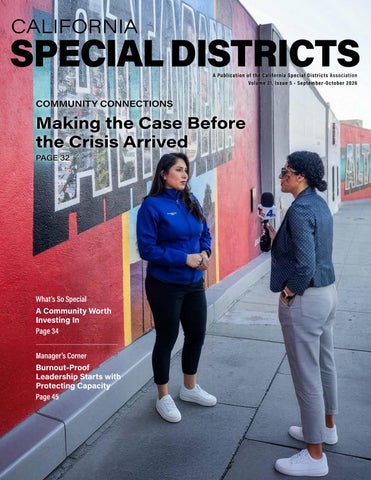
COMMUNITY CONNECTIONS
Making the Case Before the Crisis Arrived PAGE 32
What’s So Special A Community Worth Investing In Page 34 Manager’s Corner Burnout-Proof Leadership Starts with Protecting Capacity Page 45
i | CALIFORNIA SPECIAL DISTRICTS September-October 2026
California Special Districts Alliance The California Special Districts Alliance is a collaborative partnership between the California Special Districts Association (CSDA), the CSDA Finance Corporation (CSDAFC), and the Special District Risk Management Authority (SDRMA). These three highly respected statewide organizations join forces to help special districts in California better serve their communities.
CSDA Board and Staff
SDRMA Board and Staff
CSDAFC Board and Staff
OFFICERS
OFFICERS
OFFICERS
LORENZO RIOS, CSDM, PRESIDENT, Clovis Veterans Memorial District PETER KAMPA, CSDM, VICE PRESIDENT , Groveland Community Services District DON BARTZ, CSDM, SECRETARY, Phelan Pinon Hills Community Services District ANTONIO MARTINEZ, TREASURER, Contra Costa Water District ELAINE MAGNER, PAST PRESIDENT, Pleasant Valley Recreation and Park District
MEMBERS OF THE BOARD
RYAN CLAUSNITZER, CSDM, A lameda County Mosquito Abatement District SCOTT DUFFIELD, CSDM, H eritage Ranch Community Services District VINCENT FERRANTE, Moss Landing Harbor District CURTIS JORRITSMA, Hilmar County Water District JO MACKENZIE, Vista Irrigation District NOELLE MATTOCK, El Dorado Hills Community Services District GREG P. ORSINI, M cKinleyville Community Services District PATRICK OSTLY, N orth of River Sanitary District #1 STEVE PALMER, Donner Summit Public Utilities District KEVIN PHILLIPS, Paradise Irrigation District FRED RYNESS, Burney Water District KATHRYN SLATER-CARTER, San Mateo County Harbor District NIKKI WINSLOW, Altadena Library District
STAFF
NEIL MCCORMICK, Chief Executive Officer MEGAN HEMMING, Chief Professional Development Officer MUSTAFA HESSABI, Chief Counsel KYLE PACKHAM, Chief Advocacy & External Affairs Officer CASSANDRA STRAWN, Chief Member Services & Communications Officer RICK WOOD, Chief Finance & Operations Officer TOMICKO ABELLA, Member Services Representative AARON AVERY, Director of State Legislative Affairs BRITTNEY BARSOTTI, Legislative Representative ANNA C. STAGG, L egislative Assistant EMILY CHA, Database & Online Communities Specialist MARCUS DETWILER, Legislative Representative BRENT FARRAR, D esign & Websites Manager AUBREY GOHL, Member Services Representative JOSE GUERRERO, Graphic Design/Video Specialist COLLEEN HALEY, Public Affairs Field Coordinator CASSIE HASKINS, Member Services Representative LILIA M. HERNANDEZ, Associate Legislative Analyst MORGAN LESKODY, Communications Specialist MICHAEL MEYER, Member Services Manager CHRIS NORDEN, Public Affairs Field Coordinator RICHELLE NOROYAN, Public Affairs Field Coordinator CHRIS PALMER, Senior Public Affairs Field Coordinator AMBER PHELEN, Management Analyst RACHAEL POPPINO, Professional Development Coordinator OLIVIA ROBERTSON, Member Services Specialist JENNIFER SMITH, Professional Development Coordinator OPHELIA SZIGETI, L egislative Analyst ANTHONY TANNEHILL, Legislative Representative ERASMO VIVEROS, Public Affairs Field Coordinator DANE WADLÉ, Director of State Field Operations KRISTIN WITHROW, Senior Communications Specialist
ROBERT SWAN, PRESIDENT, Groveland Community Services District JESSE CLAYPOOL, VICE PRESIDENT, Honey Lake Valley Resource Conservation District THOMAS WRIGHT, SECRETARY, Clovis Veterans Memorial District
MEMBERS OF THE BOARD
ROBERT HOUSLEY, CSDM, Midway City Sanitary District VIRGINIA CHANG KIRALY, San Mateo County Harbor District SANDY SEIFERT-RAFFELSON, Herlong Public Utility District MIKE SCHEAFER, Costa Mesa Sanitary District
STAFF
DEBBIE YOKOTA, CPCU, Chief Executive Officer MATT CLUTTERBUCK, CPA, MBA, Chief Financial Officer ENRIQUETA CASTRO, CSP, Chief Risk Officer WENDY TUCKER, AU, Chief Underwriting Officer ALANA LITTLE, Health Benefits Manager DANNY PEÑA, SIP, WCCP, Workers’ Compensation Claims Manager ROBERTO LOZANO, Liability Claims Manager PETR KOVALCHUK, CPA, Finance Manager SOPHANRA CASTANAR, CSP, CHMM, Risk Control Manager JASON THORN, Data Architect MARGARITO CRUZ, Senior Accountant ERIC LUCERO, ARM, Senior Risk Control Specialist GUILLERMO DE LA TORRE, Senior Risk Control Specialist TAMARA BAKKIE, SIP, WCCA, Senior Workers’ Compensation Claims Supervisor JOHN PESHKOFF, SIP, WCCA, Senior Workers’ Compensation Claims Examiner MARTHA WARREN, SIP, WCCA, Senior Workers’ Compensation Claims Examiner MICHELLE BROWN, Senior Health Benefits Specialist TERESA GUILLEN, Underwriting Specialist II JUSTIN GUTIERREZ, Accountant II KEITH IKAMI, Senior Liability Claims Examiner LISA SANDOVAL, Underwriting Specialist II CANDICE RICHARDSON, Senior Management Analyst MARIETTA HARRISON, SIP, WCCA, Future Medical Claims Examiner CHER DARLING, Workers’ Compensation Claims Assistant KOJI LO, Liability Claims Examiner I AMY SUTHERLIN, Underwriting and Program Manager CAMREN BUTLER, Program Specialist II HEIDI SINGER, Medical Only/Claims Assistant SARAH PUPUNU, Health Benefits Specialist I Special District Risk Management Authority 1112 I Street, Suite 300 Sacramento, CA 95814 tel: 800.537.7790 www.sdrma.org
JO MACKENZIE, PRESIDENT, Vista Irrigation District VINCE FERRANTE, VICE PRESIDENT, Moss Landing Harbor District ELAINE MAGNER, SECRETARY, Pleasant Valley Recreation and Park District GREG P. ORSINI, TREASURER, McKinleyville Community Services District
MEMBERS OF THE BOARD
RONALD COATS, DIRECTOR, East Valley Water District PAULA HANSEN, CSDM, Southgate Recreation & Park District GLENN LAZOF, Regional Government Services Authority
CONSULTANTS
RICK BRANDIS, Brandis Tallman, a Division of Oppenheimer & Co. Inc. JEFF LAND, Brandis Tallman, a Division of Oppenheimer & Co. Inc. STEFAN MORTON, Municipal Finance Corporation WILLIAM MORTON, Municipal Finance Corporation ALBERT REYES, Kutak Rock LLP DMITRY SEMENOV, Ridgeline Municipal Strategies, Consultant to the Working Capital Financing Program NICOLE TALLMAN, Brandis Tallman, a Division of Oppenheimer & Co. Inc.
STAFF
NEIL MCCORMICK, Chief Executive Officer DAVID MCMURCHIE, Legal Counsel MICHAEL MEYER, Member Services Manager AMBER PHELEN, Management Analyst RICK WOOD, Chief Finance & Operations Officer CSDA Finance Corporation 1112 I Street, Suite 200, Sacramento, CA 95814 tel: 877.924.2732 www.csdafinance.net
For editorial or advertising inquiries: Phone - 877.924.2732 Email - membership@csda.net
California Special Districts Association 1112 I Street, Suite 200 Sacramento, CA 95814 toll-free: 877.924.2732 www.csda.net
ii
Purchasing, Travel, and Fleet in One Card. Earn a 1% rebate.* Manage expenses and payables without the need for multiple card programs or personal card reimbursements. Our highly customized One Card program is backed by VISA® and designed for your district.
Contact us to learn how our partnership with California Special Districts Association can benefit you.
Anastasia Efstathiu VP, Relationship Manager 916-774-3923 AnastasiaEfstathiu @ColumbiaBank.com
Member FDIC
Baldeep Atwal VP, Commercial Card Sales Consultant Global Payments & Deposits 916-742-0942 BaldeepAtwal@ColumbiaBank.com
Equal Housing Lender
1 | CALIFORNIA SPECIAL DISTRICTS September-October 2026
*No annual fee. Subject to credit approval. For additional information about terms, costs, and conditions, contact 866-486-7782 or mail to 2998 Douglas Blvd., Ste 145 Roseville, CA 95678.
CONTENTS 3
President’s Message
20
In Review 2026 CSDA Annual Conference & Exhibitor Showcase
42
Legal Brief AI in Special Districts: Managing the Legal Risks Behind the Opportunity
4
CSDA News
5
Professional Development
25
You Ask We Answer
45
6
Dates & Deadlines
26
8
Got Governance Trust Begins Before the Public Meeting Starts
Feature CSDA Inaugural Lifetime Achievement Award Recipient Arlene Schafer
Manager’s Corner Burnout-Proof Leadership Starts with Protecting Capacity
48
Money Matters Reserves are More Than Money in the Bank
51
Business Affiliate Highlight UPUD Finds Confidence in Trusted Counsel During Challenging Times
10
Interview Advocacy Starts Before the Ask
13
Movers & Shakers
14
Ask the Experts Beyond Boundaries: Stronger Together
16
Tech Tips
17
Industry Insights Elevating Leadership Across Southern California’s Water Agencies
18
Solutions & Innovations Innovation in Water Takes Flight: Taking Water Operations to New Heights
28
National Special Districts Association Is Your Special District Ready for Federal Funding? Now Is the Time to Start the Conversation
31
Districts Make the Difference Put Your District in the Spotlight
32
Community Connections Making the Case Before the Crisis Arrived
34
What’s So Special A Community Worth Investing In
37
Managing Risk Managing District Risks Through Effective Employee Benefits Education
40
From the Capitol The Maddy Report Spotlights Special Districts
Community Connections
Making the Case Before the Crisis Arrived
18
Solutions & Innovations
Innovation in Water Takes Flight: Taking Water Operations to New Heights
2
32
48
Money Matters
Reserves are More Than Money in the Bank
PRESIDENT'S MESSAGE
Carrying It Forward Sometimes the most useful resource is the person beside us. This year’s CSDA Annual Conference & Exhibitor Showcase left me thinking less about the agenda and more about the people. Ben Nemtin’s “Powered by Purpose” challenged us to lead with intention and build resilience within our teams. Kyle Scheele’s “Thinking Inside the Box” reminded us that real creativity often begins with constraint. But what stays with me most are the conversations: people sharing what worked, what did not, and what might be possible. That commitment to shared service was evident in this year’s CSDA Awards. Our award winners showed how one local problem, met with collaboration by a district and the community it serves, can create meaningful impact. Their accomplishments deserve recognition, and so do the many strong ideas submitted by districts working to serve their residents better, stretch limited resources, build trust, and improve public services. As we celebrate America’s 250th anniversary, I have been thinking about the promise of self-government and the ordinary people who carry it forward. Benjamin Franklin’s famous challenge, “A republic, if you can keep it,” reminds us that self-government is not something we simply inherit. It must be stewarded and strengthened for those who follow. That responsibility is carried forward not only through the services special districts provide, but through the people who contribute their time, knowledge, and expertise to strengthening the institutions that support them.
Lorenzo Rios, CSDM, President
Much of that work is invisible. Committee members make CSDA stronger by reviewing submissions, strengthening professional development, shaping advocacy, and sharing expertise. Legislative outreach gives special districts a voice with policymakers who may not fully understand the breadth of what we do. These contributions often happen behind the scenes, but they matter greatly. Carrying the spirit of the conference forward does not require a grand gesture. Stay engaged with your local chapter, join a committee, participate in a webinar, or reach out to another district whose mission looks nothing like yours. A water district can learn from a fire district. A recreation district can offer a leadership lesson useful to a healthcare or utility district. As we develop future leaders, we should create pathways that invite others into this work and equip them to carry it forward. Stronger Together is more than something we say. It is something we practice. Through chapters, committees, webinars, conferences, Alliance Partners, exhibitors, and relationships across the special district community, CSDA connects us to practical knowledge and expertise we can draw on throughout the year. The resource we need is often already beside us. That is how we carry this legacy forward.
3 | CALIFORNIA SPECIAL DISTRICTS September-October 2026
CSDA News
Go Digital with California Special Districts Magazine Prefer reading on your phone, tablet, or computer? CSDA members can now choose to receive a digital edition of California Special District magazine instead of a printed copy. Enjoy the same great content while reducing paper use and accessing each issue wherever you are. Visit your member profile to update your magazine delivery preference.
members.csda.net/CSDA2/EMSProfile/PublicAccountPage.aspx
CSDA Members Elect 2027–2029 Board of Directors Seat C Representatives The results are in! CSDA members have elected the 2027–2029 Board of Directors representatives for Seat C. Five incumbent directors were re-elected to serve another three-year term, and members elected a new representative for the Northern Network. BAY AREA NETWORK Antonio Martinez, Board Vice President, Contra Costa Water District (Re-elected)
NORTHERN NETWORK Karli Frye, General Manager, Southern Cascades Community Services District (Newly Elected)
CENTRAL NETWORK Curtis Jorritsma, General Manager, Hilmar County Water District (Re-elected)
SIERRA NETWORK Peter Kampa, CSDM, General Manager, Groveland Community Services District (Re-elected)
COASTAL NETWORK Vincent Ferrante, Commissioner, Moss Landing Harbor District (Re-elected)
SOUTHERN NETWORK Nikki Winslow, District Director, Altadena Library District (Re-elected)
Build Your Leadership Skills Advance your career with the Special District Leadership Foundation’s Essential Leadership Skills Certificate (ELSC). There’s still time to make progress in 2026, with qualifying workshops covering supervisory skills, human
resources, financial management, special district laws and organizational development available through December. Live and On-Demand webinars may also qualify, providing additional flexibility to work toward your certificate.
4
ProDev
Meeting the Moment: SB 827 Training in 2026 When SB 827 created new training requirements for special district officials, CSDA quickly responded to help districts understand and meet the new mandate. Throughout 2026, CSDA brought Navigating Governance and Finance in Special Districts to communities across California, providing timely, accessible training on the governance and financial principles district leaders need to serve effectively. The strong participation in these sessions demonstrates both the need for this education and the commitment
of special district officials to informed, responsible governance. There are still opportunities to complete the required training in 2026. Two in-person sessions remain: • October 14 in Hayward • October 27 in Redding For those unable to attend in person, CSDA also offers an on-demand version, making it convenient to complete the training on your own schedule.
Professional Development for Every Role No matter your role in a special district, CSDA offers educational resources designed to support you at every stage of your professional development. Our resource bundles make it easy to explore training opportunities tailored specifically for general managers, board members, and board secretaries/clerks, along with resources for other special district professionals coming soon. From foundational education to advanced leadership and governance training, these curated resources can help you
identify opportunities that align with your responsibilities and professional goals. Whether you’re new to your position or looking to build on years of experience, CSDA is here to help you continue learning, growing and serving your district effectively.
https://www.csda.net/learn/resource-pages
Save the Date: Join Us in 2027! 2027 Conference Calendar SDRMA Spring Education Day March 24–25, 2027, Sacramento
General Manager Leadership Summit June 21–23, 2027, Olympic Valley
Special Districts Legislative Days March 31–April 1, 2027, Sacramento
Annual Conference & Exhibitor Showcase August 30–September 2, 2027, San Diego
Special District Leadership Academy April 20–23, 2027, La Quinta Special District Leadership Academy May 16–19, 2027, Santa Rosa
5 | CALIFORNIA SPECIAL DISTRICTS September-October 2026
Board Secretary/Clerk Conference October 25–27, 2027, Santa Rosa Special District Leadership Academy November 7–10, 2027, Seaside
Dates & Deadlines 2026 CSDA Webinars
2026 CSDA Workshops (Virtual & In-Person)
Sexual Harassment Prevention Training for Non-Supervisors October 13
In-Person Workshop: Navigating Governance and Finance in Special Districts (Bay Area) October 14
Ethics AB 1234 Compliance Training October 20
Virtual Workshop: Human Resources Boot Camp for Special Districts October 14–15
Building Public Trust Through Financial Transparency October 27 Cyber Threats, Trends, and Safeguards October 28
Virtual Workshop: Financial Management for Special Districts October 21–22
Creating a Successful Performance Evaluation Process November 17
In-Person Workshop: Navigating Governance and Finance in Special Districts (Redding) October 27
Telling Your Story to the Media and Legislators November 19
In-Person Workshop: The Art of Electronic Records Management November 3
Using AI to Enhance Your Presentations December 8
In-Person Workshop: Words That Work Mastering Staff Reports, Agenda Titles, and Meeting Minutes November 3
2026 CSDA Conferences
In-Person Workshop: Overview of Special District Laws (Sacramento) November 18
Board Secretary/Clerk Conference November 3–5 – Santa Barbara Early Bird ends October 2
Virtual Workshop: Organizational Development December 2–3
To view more details and to register for conferences, events, workshops or webinars go to the CSDA Events Page https://qrco.de/bddc8t
6
Virtual Workshop: SDLA Module 4 – Board’s Role in Human Resources December 9–10
Representing California public agencies for over 70 years.
Jim Markman
Construction
Labor & Employment
Special Districts
LOS ANGELES
Roxanne Diaz
Eminent Domain
Litigation
Telecommunications
SAN FRANCISCO
Ginetta Giovinco
Energy
Public Agency Law
Transportation
Craig Steele
Environmental
Public Finance
Waste Management
Dave Fleishman
General Counsel
Real Estate
Water Law
7 | CALIFORNIA SPECIAL DISTRICTS September-October 2026
ORANGE COUNTY
888.479.4529
TEMECULA CENTRAL COAST SACRAMENTO
Got Governance? Trust Begins Before the Public Meeting Starts How authentic leadership strengthens communication in special districts By Charlene Engeron, Public Information Officer, Mojave Water Agency
It Starts Innocently Enough
occurs, assumptions weren’t challenged and important conversations never took place. By the time those gaps become visible during a public meeting, the damage to public confidence has often already begun.
A routine board meeting is moving along. The consent calendar has been approved. Staff presentations are on track. Then a board member asks a question that catches everyone off guard. Another director says they understood the issue differently. Staff members exchange quick glances. Someone in the audience leans forward. Suddenly, the discussion isn’t really about the agenda item anymore. It’s about whether leadership appears aligned.
That’s why authentic leadership is much more than a leadership philosophy. In special districts, it’s a governance strategy. Unlike many public agencies, special districts operate remarkably close to the communities they serve. Residents see board members at the grocery store, staff at community events, and attend meetings because the decisions affect their daily lives. That proximity is one of our greatest strengths, but it also means trust is earned, or diminished, one interaction at a time.
What people notice immediately is whether leadership appears prepared, aligned and confident. They notice surprise. They notice hesitation. They notice inconsistency. Before a vote is ever taken, they’re already forming opinions about the organization itself. One thing I’ve learned after years of working in public agencies is that communication failures are rarely caused by a lack of talking. More often, they’re caused by conversations that never happened. Before the meeting
Authenticity has become a leadership buzzword, often confused with saying exactly what’s on your mind or sharing every thought in the name of transparency.
8
GOT GOVERNANCE?
That’s Not Authenticity. That’s Chaos.
Authentic leadership isn’t announcing every opinion that pops into your head during a board meeting. Most of us have had at least one moment where our internal voice deserved an employee-of-the-month award simply for staying internal. Experience teaches another lesson: just because something is true doesn’t mean it belongs in a microphone, particularly if it’s the kind of comment that causes everyone to look over at legal counsel. Authentic leadership asks something different. Do our actions consistently reflect our values? Does our internal culture match our public messaging? Do the people we lead experience the same integrity we communicate to the public? When those pieces align, communication changes. Difficult conversations don’t become easy, but they become more credible. Residents may disagree with a rate adjustment, a capital project or a policy decision, yet still believe leadership is acting honestly and consistently. In public service, that’s often the difference between healthy disagreement and lasting distrust. Alignment doesn’t mean agreement. Healthy boards debate. Directors bring different perspectives. Votes won’t always be unanimous, and they shouldn’t be. What matters is that everyone comes to the meeting with a shared understanding of the facts, the process and the decision before them. That preparation isn’t about
scripting outcomes or avoiding difficult questions. It’s about respecting the public process. Residents deserve to see leaders wrestling thoughtfully with complex issues, not trying to reconcile conflicting information for the first time under the lights of a board meeting. Consistency matters just as much inside the organization as it does outside. Employees notice when leaders’ actions don’t match their words. If collaboration is celebrated while departments operate in silos, or transparency is promoted while difficult conversations are avoided, credibility suffers. Those internal habits eventually become external communication because culture always finds its way to the podium. Infrastructure ages. Budgets tighten. Emergencies happen. That’s public service. What distinguishes highly trusted organizations isn’t that they avoid challenging conversations. It’s that they’ve built credibility long before those conversations become necessary. The next time you’re sitting in a board meeting and a difficult discussion begins to unfold, pay attention to what the audience is watching. They’re probably not evaluating the engineering report, the financial projections or the legal analysis. They’re watching the people. They’re deciding whether leadership appears prepared, whether communication seems consistent and whether the organization is worthy of their trust. Because in special districts, public trust doesn’t begin when someone steps to the podium. It begins long before the meeting is ever called to order.
9 | CALIFORNIA SPECIAL DISTRICTS September-October 2026
Interview Advocacy Starts Before the Ask By Morgan Leskody, Communications Specialist, CSDA Effective special district advocacy is built through clear communication, trusted relationships and a willingness to show how policy decisions affect the communities districts serve. Special districts are often tasked with explaining work that is both essential and largely invisible. Water moves, wastewater is treated, parks stay open and fire protection systems stand ready, often without the public giving much thought to the agencies and infrastructure behind those services. For today’s special district leaders, effective advocacy requires more than knowing the issues. It means being able to translate technical information, build relationships long before they are needed and connect policy decisions to the people they ultimately affect. Those are principles Charlotte Holifield has carried throughout a career spanning legislative offices, public affairs and California water. Today, as External Affairs Manager and Public Information Officer for Calleguas Municipal Water District, that approach has helped expand the district’s presence with policymakers, community
organizations and the public. It also earned Holifield CSDA’s 2026 Ralph Heim Exceptional Outreach & Advocacy Award. The recognition honors outreach and advocacy that strengthens both special districts and the communities they serve.
Make the Complex Understandable
For Holifield, good communication begins with a deceptively simple question: What would I want to know if I were a member of the public? Water provides no shortage of complicated answers. Industry terminology, technical infrastructure and dense legislation all create communication barriers for the public. Holifield makes a point of removing acronyms and industry jargon and never assuming an audience already understands how water systems work. Even presentations to elected officials and community leaders have included explanations of terms such as “acre-foot,” “purveyor” and “wholesaler.” “I really am passionate about definitions of what we use in our industry because you have to have that foundational
10
INTERVIEW
understanding for anybody to even understand what you’re talking about,” Holifield said. This same principle carries into advocacy. The challenge is not simply understanding policy, but translating that policy into practical consequences for a community. That becomes especially important when districts find themselves having to correct misconceptions that have already taken hold.
Tell the Story Behind the Policy
Facts explain an issue. Stories explain why it matters.
The work continues after the tour. A quarterly newsletter, an occasional coffee with legislative staff or a timely note explaining how the district is responding to an issue all help maintain the connection. The goal is not constant communication. It is useful communication. “You don’t want to be too frequent, but you can’t let them forget about you,” Holifield said. “I think it’s all about people and relationships.”
Be Ready When the Moment Comes
For special districts, storytelling connects decisions by leaders to the people experiencing their effects locally.
Those relationships and communication systems matter most when circumstances change quickly.
“Legislators need examples of how their constituents are affected by policies,” Holifield said. “Policies have impacts on the ground.”
When the Sandy Fire broke out near Calleguas’ facilities in Simi Valley, firefighting helicopters began drawing water from the district’s reservoir more than 800 times. Calleguas used its existing traditional and social media channels to explain the lake’s role, provide information and reassure the community during a fast-moving emergency. The district’s social media traffic increased exponentially, and TV and newspaper journalists interviewed district officials as people sought information about the firefighting response. According to Holifield, the purpose of the proactive media outreach was to tell the district’s story to stakeholders who needed and wanted the information.
That philosophy helped Holifield create the Regional Legislative Group after joining Calleguas. The group brings together many of the district’s 19 water purveyors alongside legislative staff to discuss proposed legislation and its potential local effects. When Assemblymember Steve Bennett introduced AB 367 following the Mountain Fire, the group was able to explain directly how provisions could affect Ventura County water suppliers by walking through those impacts point by point. Holifield said those conversations helped highlight consequences the legislator may not have anticipated. It is an example of advocacy as dialogue rather than transaction.
Build Relationships Before You Need Them
Perhaps the clearest lesson from Holifield’s approach is also one of the least complicated: do not wait until you need something to introduce yourself. Shortly after arriving at Calleguas, Holifield began inviting state and federal elected officials to visit the district and learn about its work. “Building those relationships first by showing them what we do, not asking for anything,” she said. “I’m a firm believer in getting to know somebody, an organization or a legislator without coming with an ask.”
That balance may be one of the defining skills of modern public-sector communication: recognizing when a district needs to speak, understanding what its audience needs to know and having enough trust already established that people will listen. For special districts, advocacy does not begin when a bill is introduced or when an elected official’s vote is needed. It is built steadily through understandable information, meaningful stories, regional partnerships and relationships maintained over time. The strongest advocates make sure that when the moment comes to explain why a special district matters, they are not introducing the district for the first time.
11 | CALIFORNIA SPECIAL DISTRICTS September-October 2026
Your Website Should Work as Hard as Your District Does. Built exclusively for special districts, Streamline websites make it easy to keep your community informed while meeting today’s accessibility and transparency expectations.
ADA-conscious design Easy content updates Agenda and meeting integrations
See why districts across California choose Streamline.
Purpose-built for California special districts
getstreamline.com/csda
12
The Sacramento Municipal Utility District (SMUD) Board of Directors named Lora Anguay as its new CEO and general Lora Anguay manager, effective Aug. 2. Anguay previously served as SMUD’s chief zero carbon officer, was selected following a national search and brings more than two decades of utility leadership experience. She succeeds Paul Lau, who is retiring after nearly 45 years with SMUD. West Valley Water District has welcomed Brandon Yoshida as its new Board Secretary. Yoshida Brandon Yoshida brings extensive administrative experience from the Chino Basin Water Conservation District and the City of Hemet. In his new role, he will support the Board of Directors by coordinating meetings, maintaining official records, preparing agendas and minutes, and helping ensure compliance with applicable laws and regulations.
The Kern County Water Agency has appointed Taryn Ravazzini as Assistant General Manager – Strategic Initiatives, effective Taryn Ravazzini Aug. 16. Ravazzini joins the Agency’s Executive Management Team, where she will lead strategic, regulatory and legislative initiatives involving the State Water Resources Control Board, the California Department of Water Resources, the California Legislature and fellow State Water Project contractors. She brings extensive experience in California water policy and interagency collaboration to the role.
Laurene Green, Sarah Palmer, Alan Burnham, Jim Lehrman, Sean Roberts
Congratulations to Laurene Green and Sarah Palmer on their election as Board President and Vice President, respectively, of the Zone 7 Water Agency Board of Directors. Joining them are newly elected directors Alan Burnham, Jim Lehrman and Sean Roberts, who will help lead the Agency in providing safe, reliable water, managing the Tri-Valley’s groundwater basin and protecting the region from flooding.
Irvine Ranch Water District Board President Steve LaMar has received Steve LaMar the prestigious Edmund G. “Pat” Brown Award from the California Council for Environmental and Economic Balance (CCEEB). The award recognizes leaders who exemplify the “spirit of balance” between environmental stewardship and economic growth. LaMar was honored for his longstanding leadership in water policy, habitat conservation and regional collaboration, including his role in advancing one of California’s first Natural Community Conservation Plans and serving as president of the Natural Communities Coalition.
13 | CALIFORNIA SPECIAL DISTRICTS September-October 2026
Ask the Experts
14
ASK THE EXPERTS
Beyond Boundaries: Stronger Together By Kristin Withrow, Senior Communications Specialist, CSDA When a legislative or regulatory challenge affects a district, it’s common to tackle it alone. But the most influential voices are rarely individual ones. This is a central focus of California Special Districts Association’s diverse offerings of in-person educational opportunities. When special district leaders come together around shared experiences, important connections are forged. Tom Coleman, General Manager of Rowland Water District, Mauricio Guardado, General Manager of United Water Conservation District, and Federico Barajas, Executive Director of the San Luis & Delta-Mendota Water Authority, have been taking advantage of the leverage gained through association with each other. They came together to discuss their successful advocacy and how their intentional regional partnerships have strengthened their agencies. Although their organizations serve different regions of California, spread between central and southern parts of the state, and have distinct responsibilities, they discovered they were facing many of the same regulatory and operational challenges. By comparing experiences, sharing strategies and presenting a unified message, they transformed what once appeared to be isolated local issues into broader regional concerns that capture the attention of policymakers. As Barajas explained, hearing the same message from multiple organizations “requires attention and requires action” because it demonstrates that an issue extends beyond a single district. A unified voice gives legislators and regulators a clearer picture of how decisions affect entire regions, which presents a more compelling situation than one affecting an individual agency.
The leaders emphasized that this kind of collaboration should begin long before it’s needed. “It all started with just simply building a relationship between us as managers,” said Barajas. “Once we were able to establish and build a relationship...we found that we have a lot more things in common than we thought.”
Where to Begin
For special district leaders, conferences and leadership events provide one of the best opportunities to make those connections. Rather than staying within familiar circles or focusing only on peers from the same industry, they encouraged attendees to be intentional about meeting leaders from other districts and regions. Today’s casual conversation could become tomorrow’s trusted resource, or a collaborative partner. Guardado encouraged attendees to push beyond their comfort zones. “You’ve got to get comfortable being uncomfortable. We get ourselves caught in these silos... but you’ve got to move out of your silos. You have to go and meet people with common interests,” he said. Those relationships create a stronger support network. They also amplify the collective voice of special districts. When agencies work together across geographic and organizational boundaries, they represent more communities, more customers and a broader range of shared needs. This makes it easier for decision-makers to recognize both the scale of the challenge and the urgency of finding solutions. Because sometimes the most effective way to strengthen your own district is to look beyond its boundaries.
15 | CALIFORNIA SPECIAL DISTRICTS September-October 2026
Tech Tips
Get More from CSDA Events with The Hub CSDA – The Hub puts CSDA resources in your pocket, from communities and advocacy to professional development and publications. But when you’re attending a CSDA conference, The Hub becomes even more essential. Going digital gives you access to the most up-to-date event schedule, including any last-minute changes, plus speaker materials and session downloads right from your device. You can also receive real-time notifications and announcements, so you don’t miss important updates throughout the event. And don’t forget to keep your phone handy: raffles, prizes and other conference activities may require The Hub to participate. Whether you’re at a conference or connecting with CSDA year-round, make The Hub your go-to resource wherever you go.
www.csda.net/career-center
16
Industry Insights Elevating Leadership Across Southern California’s Water Agencies By Santa Margarita Water District Nine water agencies unite to develop future leaders through the Elevate Leadership Academy, which celebrates its inaugural graduating class. The Elevate Leadership Program concluded in early 2026 with its final session and graduation, celebrating the inaugural class of emerging leaders from nine Southern California water agencies. The program was created through the shared vision of several water districts and municipal general managers who recognized the importance of developing the next generation of water industry leaders. Beyond building leadership skills, the program emphasized the value of relationships across agencies. Collaboration, resource-sharing, and open communication among districts play a critical role in delivering reliable, highquality drinking water, recycled water, and wastewater services to the communities they serve. Over a six-month period, participants from nine water agencies came together for six sessions focused on key leadership topics, including personalities, coaching and mentoring, emotional intelligence, delegation, prioritization, having difficult conversations, and effective communication. Each session was hosted by a different partner agency, reinforcing the program’s regional nature.
The first graduating class completed its final session and received certificates of completion on January 13, 2026, at Santa Margarita Water District headquarters in Rancho Santa Margarita. The graduation marked an important milestone for both participants and the agencies that supported the program. General managers expressed pride in their team members for completing the program. Santa Margarita Water District General Manager Robert Grantham encourages graduates to continue building relationships with one another and to reach out as challenges and opportunities arise throughout their careers. Feedback from participants was overwhelmingly positive, highlighting the program’s impact on both leadership development and regional collaboration. The success of the inaugural Elevate Leadership Program sets a strong foundation for future classes and continued partnership across the water industry. The participating agencies include: Elsinore Valley Municipal Water District, El Toro Water District, Fallbrook Utility District, Jurupa Community Services District, Valley Center Municipal Water District, Rainbow Water District, Rancho California Water District, Santa Margarita Water District, and Yuima Municipal Water District.
17 | CALIFORNIA SPECIAL DISTRICTS September-October 2026
Solutions & Innovations
Innovation in Water Takes Flight: Taking Water Operations to New Heights By Morgan Leskody, Communications Specialist, CSDA How Irvine Ranch Water District won the 2026 CSDA Excellence in Technology Award by building a drone program that is changing the way work gets done When many organizations first adopt drone technology, the applications are often narrow: aerial photography, occasional inspections or the novelty of having another piece of equipment in the field. Irvine Ranch Water District (IRWD) took a different approach. The district didn’t set out to build an enterprise drone program. It initially explored drone technology as a safer, more efficient way to collect water samples from reservoirs, with a single use case and clearly defined goals. But once staff saw what the technology could do, ideas quickly began to multiply. Team members across the organization started identifying new ways drones could improve their work, building on a tool that had already proven its value. What began with reservoir sampling naturally expanded
into construction inspections, GIS mapping, water loss investigations, emergency response and infrastructure documentation. Within its first year, the program had evolved into a resource embraced across the district, with each new application helping reduce costs, improve safety and deliver higher-quality data. Today, the program is projected to save the district approximately $250,000 annually while continuing to grow through standardized workflows and new use cases.
Looking Beyond Aerial Photography
The Enterprise Drone Program remains rooted in its original purpose: collecting reservoir water samples more safely and efficiently. Equipped with specialized sampling equipment, the drone allows staff to collect samples in about 30 minutes compared to roughly 90 minutes using an amphibious vehicle, while eliminating many of the risks
18
SOLUTIONS & INNOVATIONS
associated with working on the water. The technology also provides repeatable sampling locations through GIS waypoints, creating greater consistency from one sampling event to the next. As the program took shape, something unexpected happened. Staff across the district began seeing possibilities beyond the original mission. Engineers, GIS specialists, operations staff and others started asking how the same technology could support their work. Rather than remaining a tool for a single department, the drone program became a catalyst for collaboration, with ideas emerging from across the organization. Today, drones also support water loss investigations, construction inspections, infrastructure documentation, orthomosaic mapping and rapid emergency response. Each new application builds on the same foundation while creating shared data and standardized workflows that benefit multiple departments.
Innovation Starts With People
Technology may have sparked the program, but people are what allowed it to grow. Launching a new initiative required leadership willing to invest in an emerging technology and trust staff to explore where it could provide value. That support gave the team room to experiment, refine workflows and demonstrate results without limiting the program to its original purpose. Once those early successes became visible, curiosity took over. What began as a water sampling project quickly caught the attention of employees throughout the district. Rather than remaining the responsibility of a single department, the program became a shared resource, with ideas emerging organically as teams discovered new ways
the technology could support their work. Collaboration replaced silos, allowing the program to expand naturally while staying grounded in its original mission. Each new application strengthened the next. Data collected for one purpose could support another. Conversations between departments generated new ideas. The drone program became more than a technology project; it became an example of what can happen when staff are encouraged to think creatively, share ideas and build solutions together.
Lessons for Other Districts
For districts considering a similar program, the biggest takeaway may have little to do with drones. IRWD didn’t begin with a long list of use cases. It started by solving one problem well. Once staff experienced the value of the technology firsthand, new ideas emerged naturally from across the organization. That organic growth was possible because the district invested not only in the equipment, but also in standardized workflows, data management and crossdepartment collaboration. Those systems ensured that every new application strengthened the program instead of creating another standalone project. Innovation doesn’t always require a sweeping transformation. Sometimes it begins with one successful idea, leadership willing to support it and employees empowered to ask, “What else is possible?” For IRWD, that mindset transformed a single water sampling project into a districtwide resource that continues to evolve alongside the people who use it.
19 | CALIFORNIA SPECIAL DISTRICTS September-October 2026
In Review
2026 CSDA Annual Conference & Exhibitor Showcase Special district leaders from across California gathered in Palm Desert for CSDA’s 2026 Annual Conference & Exhibitor Showcase. Attendees connected with colleagues, explored new ideas and solutions, and gained insights from educational sessions and inspiring keynotes. Thank you to everyone who helped make this year’s conference a success!
2 Exhibitors and attendees socialized and connected at
the Mix and Mingle reception. 3 Participants gained deeper knowledge in breakout
sessions and the District Collaboration Breakfast. 4 Keynote speaker Ben Nemtin wowed audiences with his
powerful storytelling and message about the role of purpose in the work we do.
1 Attendees joined the Boots and Bites Taste of the City
5 Wednesday’s keynote speaker, Kyle Scheele, brought
event where they received personalized mugs, learned to line dance, and won prizes!
humor and excitement to the stage with stories of his life and “Thinking Inside the Box.”
1
1
1
1
2
2
3
4
5
20
IN REVIEW
2026 CSDA Annual Awards CSDA proudly celebrated the outstanding individuals and special districts recognized during the 2026 Annual Conference & Exhibitor Showcase. This year’s award recipients exemplify innovation, leadership, public service
and dedication to their communities. Congratulations to all our honorees, and thank you for the exceptional work you do for California’s special districts!
Exceptional Public Outreach & Advocacy Award (Large District) Inland Empire Utilities Agency
Exceptional Public Outreach & Advocacy Award (Small District) San Gabriel Valley Mosquito and Vector Control District
Innovative Program of the Year Award (Large District) Yorba Linda Water District
Innovative Program of the Year Award (Small District) Camarillo Health Care District
21 | CALIFORNIA SPECIAL DISTRICTS September-October 2026
IN REVIEW
Excellence in Technology Award Irvine Ranch Water District
Chapter of the Year Award Association of San Bernardino County Special Districts
Staff Member of the Year Award Kim Boyd, Tahoe City Public Utility District
General Manager of the Year Kimberly Thorner, Olivenhain Municipal Water District
Ralph Heim Exceptional Outreach & Advocacy Award Charlotte Lopez Holifield, Calleguas Municipal Water District
Lifetime Achievement Award Arlene Schafer
22
Board Member of the Year Award Debra A. Canero, Valley Sanitary District
23 | CALIFORNIA SPECIAL DISTRICTS September-October 2026
24
Questions Appear in CSDA Online Communities
Q: Jennifer Crayne, Administrative Services Manager, Novato Fire Protection District I am seeking a policy regarding the use of security cameras in/on a public building, including proper retention periods for footage and the procedure for public records requests. What are the legal requirements and best practices? If anyone is willing to share their policy, I would greatly appreciate it.
A: Shannon Harroun, Clerk of the Board, Placer County Air Pollution Control District Our retention policy: Maintains video monitoring recordings for 1 year, Per CA Gov Code 53160, retain video monitoring recordings for a minimum of one year; the destruction shall be approved by the District Board and the written consent of District Counsel shall be obtained. Maintains telephone and radio communications recording for 100 days, Per CA Gov Code 53160, retain telephone and radio communications recordings for a minimum of 100 days; the destruction shall be approved by the legislative body and the written consent of the agency attorney shall be obtained. A: Kait Knight, District & Community Relations Manager, Diablo Water District It is on our video server for 90 days and then retained for 1 year. We just redid our records retention schedule and you may view it here, https://bit.ly/3VU7pXa. Thanks!
Engage with your peers and ask questions on CSDA’s Open Forum community! https://www.csda.net/communities-home
CSDA Disclaimer: This section is not intended to be legal advice. Members should always seek legal counsel. The information contained here is for general reference purposes only.
25 | CALIFORNIA SPECIAL DISTRICTS September-October 2026
BUSINESS DIRECTORY
Q&A You Ask We Answer
Feature CSDA Inaugural Lifetime Achievement Award Recipient Arlene Schafer By Kristin Withrow, Senior Communications Specialist, CSDA Arlene Schafer’s career in public service spans nearly five decades, but those who have worked alongside her say her impact cannot be measured simply in years. Her legacy is reflected in stronger communities, more effective local services, and a generation of special district leaders who benefited from her steady guidance and institutional knowledge. This year, the California Special Districts Association (CSDA) is recognizing Schafer with its Lifetime Achievement Award, honoring a career defined by commitment to local government, environmental leadership, and advocacy for special districts across California. Schafer announced her retirement from the Costa Mesa Sanitary District Board of Directors in 2025, concluding a public service career that began in 1978 when she was elected to the Costa Mesa City Council. During her eight
years on the council, she served as mayor from 1980 to 1982 before continuing to serve the community through the Costa Mesa Sanitary District (CMSD), where she spent more than 30 years helping guide the agency through significant operational and environmental advancements. During her tenure at CMSD, Schafer served the district during transformative projects and programs that modernized services and strengthened environmental stewardship in the region. Those efforts included transitioning from manual to automated curbside solid waste collection, launching one of Southern California’s first curbside organics recycling programs, establishing a household hazardous waste collection service, and implementing a three-cart recycling and organics system for residents. “Arlene has left an everlasting legacy to the betterment of our community,” said CMSD Board President Mike Scheafer
26
FEATURE
in announcing her retirement. “We owe Arlene a debt of gratitude for her dedicated and loyal service to Costa Mesa.” While Schafer’s local accomplishments are extensive, many within California’s special district community know her for her 25 years of dedication at CSDA. Schafer joined the CSDA Board of Directors in 2000 and remained an active leader through 2025, including serving as CSDA President from 2008 to 2009. During a period of significant growth for the association and for statewide recognition of special districts, Schafer helped elevate the role of local agencies in legislative and public policy discussions. Over the years, she served on numerous committees that shaped the direction of the organization, including the Executive, Fiscal, Legislative, Member Services, and Professional Development committees. “Arlene is one of CSDA’s longest-serving board members,” said Neil McCormick, CSDA CEO. “She has been instrumental in amplifying the voice of special districts in Sacramento, helping grow our membership from a few hundred in 2000 to nearly 1,400 today. Special districts have a stronger voice thanks to Arlene.” Those roles reflect CSDA’s belief that effective public service depends not only on strong leadership, but also on ongoing education, responsible governance, and cultivating future leaders. In addition to her work with CSDA, Schafer served on the CSDA Finance Corporation Board beginning in 2006, helping guide service for agencies accessing infrastructure financing solutions at a time when many local governments faced increasing fiscal pressures. She also joined the Alliance Executive Council in 2016, contributing to collaborative efforts among organizations representing California’s special districts. Her reach extended beyond district and association boundaries as well. Schafer represented local interests on the Orange County Local Agency Formation Commission from 2000 to 2010, including a term as chair in 2003. For 25 years, she also represented CMSD through the Independent Special Districts of Orange County (ISDOC), serving in leadership positions as both president and vice president.
Throughout those decades of service, Schafer earned a reputation for bringing professionalism and pragmatism to difficult conversations. Fellow board members and local government leaders often turned to her for perspective rooted in experience rather than politics. Her approach emphasized collaboration, long-term planning, and public trust — qualities that became hallmarks of her leadership style. The formal resolution honoring Schafer adopted by CSDA describes her career as “a legacy of professionalism, collaboration, and leadership,” adding that her dedication “has inspired generations of public servants while enhancing the delivery of essential local services across California.” That influence can be seen not only in policies and programs, but also in the many relationships she built throughout California’s local government community. Leaders who worked with Schafer often note her willingness to mentor newer board members, advocate for special districts of all sizes, and focus consistently on the broader mission of public service. As California communities continue facing challenges tied to infrastructure, environmental sustainability, fiscal management, and public engagement, the role of special districts remains critically important. Schafer spent much of her career helping ensure those agencies had a seat at the table and a unified voice in Sacramento. Her retirement marks the conclusion of an extraordinary chapter in California local government leadership, but the systems, programs, and organizations she helped strengthen will continue serving residents for years to come. The CSDA Lifetime Achievement Award recognizes individuals whose careers have made a lasting impact on the special district community. For those who have worked alongside Arlene Schafer, the recognition reflects not only the length of her service, but also the depth of her contributions. Few public servants dedicate decades to improving both their own communities and the broader systems that support local governance statewide. Schafer did both, marking a record of service that helped shape the modern special district community in California.
27 | CALIFORNIA SPECIAL DISTRICTS September-October 2026
Is Your Special District Ready for Federal Funding? Now Is the Time to Start the Conversation By Chantal Unfug, Public Affairs, National Special Districts Association
Federal funding can seem complex, but special districts don’t have to navigate it alone. The National Special Districts Association (NSDA) Grants Program gives members expertise, funding resources and guidance built specifically for special districts. As a CSDA member, you get these benefits automatically! Congressionally Directed Spending (CDS), also called earmarks, is an additional federal funding avenue that allows Members of Congress to request funding for specific community projects in their states and districts. Earmarks are a real funding option for special districts, and they require planning that starts well before any deadline.
What Congressionally Directed Spending Looks Like
Instead of applying to a federal agency, districts work through their Members of Congress. Congress Members can request funding for a specific local project as part of
the annual appropriations process. That opens the door to projects that don’t fit neatly into an existing grant program due to cost or scope. Earmarks have funded construction and acquisition for district water and wastewater systems, fire stations, transportation improvements, community facilities, environmental restoration, and other local projects. The process starts months before Congress votes on spending bills, so right now is when districts should be talking to their congressional offices about project priorities. Those offices need time to understand a project and decide whether it’s a good candidate before the formal request window opens in the winter/spring. The NSDA Grants Team works with special districts to help identify projects that may be appropriate for CDS consideration, understand congressional and federal agency requirements, guide competitive project requests, and navigate the process after an award, including federal grant requirements.
28
NSDA
California Districts Are Putting This to Work
California special districts regularly participate in the annual appropriations process. The following are just two examples of earmarks secured on behalf of special districts in federal fiscal year 2026. Diablo Water District secured $1,145,144 for their Seismic Resiliency Reservoir and Transmission Line Improvement Project. This CDS funding will support structural steel and foundation reinforcements to a 2.5 million gallon steel reservoir and the installation of a parallel water transmission mainline to significantly mitigate risks associated with major seismic events. East Bay Regional Park District secured $1,092,000 for their Martin Luther King Jr. Regional Shoreline Water Quality Improvement Project. This CDS funding will help implement green infrastructure to enhance water quality and reduce pollutants, sedimentation, and nutrient runoff into the San Leandro and San Francisco Bays.
Be strategic! Districts that start the conversation months ahead, rather than scrambling when a deadline hits, tend to put together stronger requests and give congressional offices the information they need to act.
Where to Start
If your district has a capital project or community priority that could use federal support, here’s what you can do right now: Pick your top project(s) and pull together the basics: what the project does, who it serves, what it costs, and how far along planning is. Then start a conversation with your congressional office. You don’t need a polished proposal yet, just a relationship and a head start. Take advantage of what you already have through NSDA. Submit your project through the Project Idea Portal and sign up for Office Hours for further discussion. CSDA members are welcome to message NSDAGrants@tfgnet.com with any questions!
29 | CALIFORNIA SPECIAL DISTRICTS September-October 2026
SPECIAL DISTRICT LEADERSHIP FOUNDATION
CHECK OUT OUR SCHOLARSHIPS AT SDLF.ORG Contact SDLF at info@sdlf.org for details. Phone: 916-231-2909 Fax: 916-442-7889
30
sdlf.org
Put Your District in the Spotlight By Kristin Withrow, Senior Communications Specialist, CSDA Every day, special districts are improving lives in communities across California—and those stories deserve to be seen. Districts Make the Difference (DMTD) is building public awareness of the essential services special districts provide while reinforcing the importance of local control. By following @localdistricts on social media and tagging us in your own posts, you give us the opportunity to amplify your success stories to a broader audience. From January 1 through July 31, 2026, DMTD content generated: • 2.3 million impressions • 163,591 engagements
• 729,750 video views • 15,347 link clicks Whether you’re celebrating a new project, highlighting dedicated staff, showcasing community events, or sharing the essential services you provide, we’d love to help your story reach more people. Follow @localdistricts on your favorite social platform, tag us in your posts, and use #DistrictsMakeTheDifference whenever it fits. Together, we can build stronger public understanding of the vital role special districts play every day. Your story strengthens the story of all special districts.
31 | CALIFORNIA SPECIAL DISTRICTS September-October 2026
Community Connections Making the Case Before the Crisis Arrived By Morgan Leskody, Communications Specialist, CSDA
In the weeks after the Eaton Fire, the most urgent needs were impossible to miss. Thousands of residents had been displaced. Homes and businesses were gone. Agencies were working to provide food, clothing and shelter while removing toxic debris and securing damaged neighborhoods. At the same time, San Gabriel Valley Mosquito and Vector Control District, winner of the 2026 Exceptional Public Outreach & Advocacy – Small District Award, saw another threat beginning to take shape, one that was quieter, less immediate and easy to overlook. The Eaton Fire burned approximately 14,000 acres and destroyed about 9,000 structures within the district’s service area. Among the damaged properties were more than 1,400 swimming pools. Left filled with stagnant water, those pools could quickly become mosquito habitats,
creating a secondary public health risk months after the flames were extinguished. Mosquito and vector control is not traditionally built into wildfire recovery. Federal, state and local agencies had established roles and response plans, but the district was not initially included. District staff had to find their place within the larger recovery effort while explaining why action was needed before mosquito populations surged or illness appeared. Although the district’s work seemed preventive in nature, the threat was a direct consequence of the fire. The challenge was communicating that addressing the newly created mosquito habitat was not separate from recovery, but an essential step in preventing the disaster from creating a secondary public health crisis. That required persistence. At recovery meetings, agencies were focused on residents who had lost homes, access to necessities and the enormous task of debris removal.
32
COMMUNITY CONNECTIONS
Against that backdrop, raising concerns about mosquitoes could seem disconnected from the crisis at hand. Still, the district knew that waiting would make the problem much harder to control. The greatest risk of disease was expected 90 to 120 days after the fire. That gave the district a narrow window to act, but not the luxury of delaying. Once mosquitoes began developing across hundreds of pools, the scale of the response could grow overnight. The district also faced practical limits. Its emergency reserves were designed for disease response, not an incident of this magnitude. Its staff normally focused on proactive habitat management throughout the community, not the ongoing treatment of more than 1,400 pools in a disaster zone. The response quickly became an all-hands effort. Employees across every department stepped into new roles, while the district pursued financial assistance, equipment and qualified personnel. It drew on an existing mutual aid agreement with other vector control and special districts in Southern California and sought support through FEMA and state and county resource requests. Communication became central to nearly every part of the work. Many residents were no longer living at their properties, making traditional outreach such as door hangers and mailed notices ineffective. The district created a dedicated website, multilingual outreach materials and clear ways for residents to ask questions or raise concerns. The website also became an internal “North Star,” giving
staff one place to refine language, document decisions and stay consistent as the response evolved. The district also leaned into news media. Through interviews, staff explained that the U.S. Army Corps of Engineers would empty pools when property owners specifically requested it, but that option was not widely known. As media outlets repeated the message, the number of pools being emptied grew from a small handful to hundreds. Each emptied pool reduced the need for pesticide treatment and removed a potential source of mosquito habitat. Advocacy also changed how the response was funded. The district was initially told its work did not qualify for FEMA reimbursement because it was preventing a future emergency rather than responding to a current one. Staff reframed the request around the active mosquito habitat created by the fire and the direct connection between that habitat and increased disease risk. The justification was approved, allowing the district to move forward without waiting for mosquito populations or illness to spike. The experience reinforced the importance of building relationships beyond a district’s traditional partners. Public health, disaster response, legislative and advocacy connections all proved critical, helping establish a precedent for special districts to respond proactively at the point of risk rather than after a preventable public health emergency. By combining technical expertise with clear communication and coalition building, the district ensured mosquito control became part of the recovery conversation before another crisis emerged.
33 | CALIFORNIA SPECIAL DISTRICTS September-October 2026
What's So Special A Community Worth Investing In By Morgan Leskody, Communications Specialist, CSDA Camarillo Health Care District is showing how listening to a community can turn new technology into meaningful connection. Virtual reality (VR) may conjure images of video games and younger users exploring digital worlds. At Camarillo Health Care District, four VR headsets and a set of desk cycles are serving a different audience. Older adults are pedaling across the Golden Gate Bridge, exploring distant destinations and revisiting places connected to their own memories, all without leaving their chairs. The district’s “Pedaling the Planet” program, recipient of CSDA’s 2026 Innovative Program of the Year – Small District Award, combines virtual reality with cardiovascular exercise and social interaction. But behind the technology is a larger story about a district that has learned to listen to
its community and a community that trusts its district to keep finding new ways to serve them. The program grew from Adventures in Virtual Reality, launched by the district in 2022 as communities emerged from the isolation of the COVID-19 pandemic. Staff saw the effects of prolonged disconnection, particularly among older adults, people with disabilities and others whose health or mobility could make returning to normal activities more difficult.
Technology offered an unexpected way to reconnect.
Rather than assuming virtual reality belonged primarily to younger generations, the district saw an opportunity to give older adults access to something novel, exciting and increasingly useful.
34
WHAT'S SO SPECIAL
“
Our aging population is increasing significantly in our county as well as directly in Camarillo. They want to be able to have something cool as well.” Blair Barker Camarillo Health Care District
“Our aging population is increasing significantly in our county as well as directly in Camarillo,” CEO Blair Barker said. “They want to be able to have something cool as well.” That decision opened possibilities extending far beyond entertainment. For someone unable to travel because of health, mobility or financial limitations, VR can provide access to experiences that may otherwise be out of reach. Participants can visit the Louvre, explore places from their past or simply experience somewhere new while sharing the adventure with others. Pedaling the Planet added another dimension. Launched in 2025, the program pairs VR experiences with desk cycles, incorporating physical activity, hand-eye coordination and cognitive exercises. Classes are intentionally social, with participants experiencing virtual environments together and talking about what they saw afterward. The response suggests the district identified something its community wanted. Among participants surveyed, 97% enjoyed the experience, 86% reported an uplifted mood and 95% said they would recommend the program. The average participant was 75 years old.
Residents Wanted More.
Barker recalled the community response to the district’s growing VR offerings simply: “This is great. What else can you give us?” That enthusiasm has helped the program move beyond district classrooms. Support from the City of Camarillo through Community Development Block Grant funding
allowed the district to bring equipment to senior apartment complexes and assisted living facilities, reaching people who may be homebound or face transportation, health or mobility barriers. The Camarillo Public Library has partnered with the district to incorporate virtual travel into programming for older adults, while VR has also been incorporated into a family caregiver symposium. That support is significant. Innovative programs require more than an innovative idea. They require a board willing to invest, community partners willing to participate and residents willing to trust their district enough to try something unfamiliar. Barker said that trust is one of the most meaningful parts of the work. Participants allow district staff into their lives and arrive with “the faith and the trust in the district and the willingness to try something new.” Perhaps the clearest measure of that relationship is how residents describe the district themselves. Barker recalled community members expressing appreciation that the district continued finding ways to reach them and, importantly, made them feel that “as an older adult that we’re worth investing in.” That sentiment represents something much bigger than the success of one program. When districts listen closely enough to understand what their communities need, and communities trust them enough to embrace what comes next, innovation does not have to begin with technology. It can begin simply by making sure people know they have not been overlooked.
35 | CALIFORNIA SPECIAL DISTRICTS September-October 2026
36
Managing Risk Managing District Risks Through Effective Employee Benefits Education By Alana Little, Health Benefits Manager and Wendy Tucker, Chief Underwriting Officer, SDRMA Employee Benefits Liability (EBL) claims typically arise when an employee alleges they were harmed because of an administrative error, omission, or miscommunication regarding benefits. Examples include incorrect enrollment, failure to communicate eligibility requirements, inaccurate explanations of coverage, missing enrollment deadlines, or providing incomplete information that leads an employee to make an uninformed decision. Helping employees understand their health benefit options is not only an employee education initiative but also an important risk management strategy. When employees misunderstand their benefits, districts may face complaints, disputes, or benefits liability allegations if employees believe they were not provided accurate or complete information.
While health carriers are responsible for determining coverage and paying claims, districts may face allegations that inaccurate, incomplete, or unclear communications contributed to an employee’s misunderstanding of their available benefits. Potential exposure areas include situations where employees: • Do not understand enrollment deadlines or eligibility requirements. • Misinterpret provider network limitations or out-ofnetwork coverage rules. • Are unaware of deductibles, coinsurance obligations, or out-of-pocket maximums. • Do not understand prescription drug formularies and associated costs. • Believe they received guidance from district staff that influenced their plan selection.
37 | CALIFORNIA SPECIAL DISTRICTS September-October 2026
MANAGING RISK • Fail to enroll themselves or eligible dependents because they misunderstood plan requirements. Although many of these situations may ultimately be resolved without liability, they can create administrative burdens, employee relations challenges, and potential claims alleging errors or omissions in benefits administration. Districts can strengthen their risk management efforts by establishing consistent communication practices and clearly documenting benefit-related information. Recommended practices include: • Providing employees with Summary of Benefits and Coverage (SBC) documents and other carrier materials during onboarding and Open Enrollment. • Clearly communicating enrollment deadlines, eligibility requirements, and procedures for adding or removing dependents. • Encouraging employees to review plan documents and carrier resources before making enrollment decisions.
• Training human resources and benefits staff to provide plan information while avoiding interpretations of coverage that are determined by the health carrier. • Documenting benefit communications and employee acknowledgments when appropriate. • Offering educational meetings, webinars, or benefit fairs where employees can obtain information directly from carriers or benefits professionals. • Routinely reminding employees to review plan changes during annual Open Enrollment. Employee education is an important component of sound benefits administration. By providing clear, consistent, and timely information about health benefit plans, districts can help employees make informed decisions while reducing the risk of misunderstandings that may result in EBL exposures. Effective communication, documentation, and employee engagement can support both employee wellbeing and the district’s overall risk management objectives. Special districts participating in SDRMA health coverage can contact Alana Little at alittle@sdrma.org for questions about health plan resources and employee education.
38
Your Trusted Advisor For Special District HR Solutions Providing HR and management consulting services: Executive & Technical Recruitments
Supplemental HR Staffing, HR Membership & Outsourcing
Strategic Planning
Training & Leadership Development
Workforce & Succession Planning
Executive Coaching
Organizational Assessments
Classification & Compensation
Performance Management
HR Compliance & Investigations
Contact us today to explore tailored solutions for your organization.
cpshr.us
39 | CALIFORNIA SPECIAL DISTRICTS September-October 2026
800.822.4277
From the Capitol The Maddy Report Spotlights Special Districts By Anna C. Stagg, Legislative Assistant, CSDA On July 19, 2026, The Maddy Report, a production of the Maddy Institute, highlighted special districts in an episode titled “Understanding the Role of Special Districts.” Featured in the discussion were three special district leaders: Lorenzo Rios, CEO of Clovis Veterans Memorial District and California Special Districts Association Board President, Bill Stretch, General Manager at Fresno Irrigation District, and Kyle Packham, Chief Advocacy and External Affairs Officer for CSDA. The Maddy Report primarily airs on television via ABC30 (KFSN), the local ABC affiliate covering the San Joaquin Valley and Central California.
districts are unique to each community as exemplified by the differences of the 25 veteran memorial districts across California. “Special districts are special, with a very specific mission. These are neighbors taking care of neighbors,” said Rios.
How Local Governments Meet Community Needs
Advocacy for the Interests of Special Districts in California
CEO and Board President Rios described special districts as “the most local form of government” that their communities vote into existence. Rios’ Veterans Memorial special district created a living memorial and a unique civic center dedicated to providing services for veterans for 80 years. Rios also shared that the services of special
General Manager Stretch shared that the Fresno Irrigation District’s (FID) primary purpose is to provide surface water, including snow melt from the Sierra Nevada to its service area, which includes over 8,000 customers. FID owns and operates over 600 miles of canals and pipelines. Stretch described the successful Proposition 218 campaigns as “very transparent with our constituency.”
Chief Advocacy and External Affairs Officer Packham explained the difference between independent and dependent special districts, characterizing California’s 2,000 independent special districts as “highly localized and highly specialized with an elected board of directors directly accountable to the community they’re serving.” On
40
FROM THE CAPITOL
Broadcast Details Television Station: ABC30 (KFSN) Online Streaming: Episodes and segments are also published directly on the Maddy Institute YouTube channel. Radio/Podcast Alternatives: The public affairs program also extends to radio formats such as KVPR (public radio) and KMJ NewsTalk.
the other hand, dependent special districts are more like a department of another governmental body. Packham explained the process of forming a new special district, emphasizing the importance of ensuring that communities who are paying for and receiving services have the final say. It’s a “community-guided, communityengaged process.” Packham said that “special districts are the backbone of infrastructure for our state,” and “the more we’re able to empower them to act in a very efficient and effective and long-term sustainable, reliable way, the better off we’ll be.” CSDA’s advocacy tackles the policy restrictions, restraints, and regulations that limit special districts in efforts to free them to do what they do best. Packham also said that one CSDA priority, H.R. 2766 in Congress, defines special districts in federal law. This federal statute would allow partnerships and facilitate intergovernmental cooperation.
Getting Connected to Your Special Districts
Rios advised that to get involved with special districts, go to your Local Agency Formation Commission (LAFCO) and
see what special districts exist in your area. “If you ever wonder why mosquitoes are under control, it’s because there is someone dedicated to that.” Rios said to Google the special district’s name and find their information. “The more we know, the stronger we are. This takes away the myth and puts facts in there and you realize how much power each citizen really has. You just need to exercise it,” Rios said. The discussion highlighted the critical role special districts play in communities throughout California, delivering many of the essential services residents rely on every day. The Maddy Institute states its purpose is “to provide a non-partisan venue for the thoughtful discussions on important public policy issues facing the San Joaquin Valley, California and the Nation.” For more information on special districts, visit www.districtsmakethedifference.org or visit www.csda. net for information about hundreds of webinars and workshops.
41 | CALIFORNIA SPECIAL DISTRICTS September-October 2026
Legal Brief AI in Special Districts: Managing the Legal Risks Behind the Opportunity By Morgan Leskody, Communications Specialist, CSDA
Artificial intelligence is rapidly moving from an emerging technology to an everyday workplace tool. For special districts, AI presents opportunities to improve efficiency, reduce time spent on routine tasks, analyze information and support employees in delivering public services. But those opportunities come with legal and governance considerations that districts should address before AI becomes embedded in day-to-day operations. The challenge is not necessarily whether a district should use AI. It is determining where the technology adds value, who is responsible for its use and what safeguards need to be in place. As highlighted during the 2026 CSDA Annual Conference session, “The Role of AI in Special Districts: Legal Risks and Governance Solutions” with Gabriella Kamran from Liebert Cassidy Whitmore, districts should approach AI implementation deliberately. The technology continues to evolve faster than many of the laws and regulations governing its use, while existing legal requirements still apply.
Start with Governance, Not the Tool
Before selecting an AI platform, districts should first identify the problem they are trying to solve and determine which tools are appropriate and who should be involved in implementation. A governance structure may include representatives from executive leadership, information technology and security, legal counsel and departments that will use the technology. Districts should also establish an AI use policy defining approved or prohibited uses, expectations around privacy and confidentiality, and enforcement. Existing policies addressing technology use, privacy, confidentiality, discrimination and harassment should also be reviewed for consistency. The presentation identified four overarching pillars of AI governance: human oversight, privacy, defined targets and measurement, and transparency. Human review is particularly important. AI can produce inaccurate information, reinforce biases or generate results
42
LEGAL BRIEF
that appear authoritative without being correct. Districts should consider AI-generated information a tool to support decision-making, rather than automatically treating it as the decision-maker.
Employment Decisions Require Particular Care
Human resources may be one of the most appealing areas for AI adoption, with potential uses ranging from employee FAQs and document translation to recruitment and performance evaluations. Recruitment illustrates both the potential and the risk. AI tools can screen, score and rank applicants, potentially saving staff time. At the same time, algorithmic decisionmaking may introduce or amplify bias. An automated system could screen out candidates belonging to a protected classification or produce a recommendation without sufficient documentation explaining the decision. Similar concerns arise when AI is used to evaluate existing employees or recommend discipline. Districts still need appropriate human review of the information, applicable policies and circumstances surrounding an employee’s performance. Privacy and surveillance present additional concerns when AI-powered systems monitor employee activity.
Don’t Overlook Wage and Hour Requirements
implementation of AI is generally not itself a negotiable decision. However, exceptions may arise, including uses involving surveillance or displacement of employee duties. Even when the decision itself is not negotiable, the impacts and effects of implementation may be. Changes to employee duties, potential discipline or new training requirements may trigger bargaining obligations. Districts may need to provide notice and an opportunity for labor representatives to identify negotiable impacts and, when appropriate, participate in good-faith negotiations before implementation proceeds. AI can also assist with reviewing memoranda of understanding, classification and compensation studies, proposals or requests for information. These uses require the same attention to privacy, confidentiality and human review as other applications.
Move Forward, but Move Deliberately
For special districts, avoiding AI entirely is unlikely to be a long-term strategy. But neither is adopting a new tool simply because it promises efficiency. A thoughtful implementation process starts by asking: What does the district need? Which technology can address that need? Who should be involved? And how will the district implement and evaluate it responsibly?
AI can assist with payroll, timekeeping and compliance functions, including identifying timesheet inconsistencies or helping audit regular and overtime rates. Automation, however, does not eliminate the employer’s responsibility to comply with wage and hour laws.
Districts can pilot tools with a limited user group, collect feedback, measure outcomes and refine their approach before expanding use. Training should also include broader AI literacy so staff understand both the capabilities and limitations of the technology.
The U.S. Department of Labor has cautioned that AI systems should not determine hours worked solely through productivity metrics. Technology may identify periods as “idle” or “non-productive,” but that does not necessarily determine whether the time is compensable. Employers remain responsible for paying employees for all hours worked and should use human oversight to validate AIgenerated information.
The central takeaway is straightforward: the time to start thinking about AI is now, but there is no need to rush. A district that pairs innovation with clear policies, human oversight, privacy protections and careful consideration of its legal obligations will be better positioned to capture AI’s benefits without creating unnecessary risk.
AI Can Also Trigger Labor Relations Questions For represented workplaces, implementing AI may also raise labor relations questions.
Selecting tools and determining the means and methods of operations generally fall within management rights, and
This article is provided for general informational purposes only and is not intended as legal advice. Special districts should consult legal counsel regarding specific legal questions or circumstances. This article is based on the Annual Conference & Exhibitor Showcase session, “The Role of AI in Special Districts: Legal Risks and Governance Solutions,” presented by Gabriella Kamran of Liebert Cassidy Whitmore.
43 | CALIFORNIA SPECIAL DISTRICTS September-October 2026
Need an IT support provider that understands special districts?
California Special Districts Association’s Cybersecurity and Technology Services Get out of the IT trenches and back to working on what matters. VC3, the California Special Districts Association’s endorsed IT service provider, has been making IT personal, making IT easy, and getting IT right for more than 30 years. Serving over 1,100 local government organizations of all sizes, VC3’s California-based engineers are supported by a deep bench of national talent.
Powered By
VC3.COM | 800-481-4369
A Trusted Public Agency Partner For 50 Years Strategic Planning Board Governance Public Outreach
Building strong communities. For more than 80 years, we have partnered with public, private and government agencies in California to help their communities thrive.
rauchcc.com • 408-374-0977 44
Manager’s Corner Burnout-Proof Leadership Starts with Protecting Capacity By Kristin Withrow, Senior Communications Specialist, CSDA Special district general managers operate in environments defined by public visibility, political complexity and a seemingly endless stream of decisions. Board members, staff, regulators, residents and the media all want answers—sometimes urgently. Over time, even highly capable leaders can begin to feel the effects. They may become less patient, less creative or more hesitant to make difficult decisions. Yet because they continue showing up and getting the work done, the underlying problem can be easy to miss.
Stephanie Smith from Best Best & Krieger LLP, who is a popular speaker at CSDA conferences, challenges people to reconsider what burnout really looks like. “Burnout is not weakness. It’s not a lack of resilience, commitment or passion. It is the slow depletion of your capacity,” Smith explains. That depletion rarely happens because of one major event, she explains. Instead, it develops through years of latenight texts, long board meetings, constant interruptions, urgent requests and hundreds of small decisions competing for attention. continued ......>
45 | CALIFORNIA SPECIAL DISTRICTS September-October 2026
MANAGER'S CORNER
Smith compares leadership capacity to the battery in a smartphone. When it is new, it charges quickly and holds energy for a long time. Over the years, it takes longer to recharge and drains more quickly.
General managers routinely hold time for board meetings, deadlines and agenda preparation on their calendars. Yet uninterrupted time to think, analyze and solve problems is often squeezed into whatever minutes remain.
The problem, she explains, is that agencies carefully monitor nearly every other important asset. They track reserves, maintain infrastructure, plan fleet replacements and manage risk. But they rarely track or protect the capacity of the person responsible for making the organization’s most consequential decisions.
That work, however, may be among a manager’s highestvalue contributions.
“Every decision you make depends on you being at your best,” Smith advises.
Recognizing Decision Fatigue
Executive burnout does not always cause leaders to stop working. More often, it changes how they work. Signs of decision fatigue may include: • Delaying difficult conversations • Requesting unnecessary information • Struggling with simple decisions As a result, leaders may become more controlling, less patient or less willing to take strategic risks. Smith describes it as having too many tabs open on a computer. Eventually, the system slows down and stops responding—not because it is incapable, but because it no longer has sufficient capacity. The demands contributing to this overload are often structural. Board expectations, public complaints, staff interruptions, regulatory responsibilities and political conflict continually draw from the same limited reserve of attention. What’s more, traditional self-care alone may not solve the problem. “You cannot ‘wellness’ yourself out of structural burnout,” Smith cautions. “You cannot yoga your way out of structural burnout, and you cannot take a vacation from structural burnout. You will still come back to all of those things.”
Protect Strategic Thinking Time
Smith’s central recommendation is to protect strategic thinking.
“Leadership requires space,” Smith explains. “Leaders are not doing anything wrong by exercising that space.” Protecting capacity may require changes to organizational habits. Examples may include: • Establishing a meeting-free morning each week • Delegating routine approvals • Creating clearer expectations with the board • Protecting evenings from work-related demands Strong governance can also reduce decision fatigue. When board members and general managers understand where policy direction ends and implementation begins, fewer issues become unnecessarily complicated. Regular conversations about priorities, roles and expectations can reduce friction before it becomes conflict. Smith also encourages leaders to identify their personal and professional values. Clear values act as a decisionmaking filter. When leaders understand their nonnegotiables, choices become easier, boundaries become clearer and others learn how to approach them more effectively. “When your values become clear, your decisions become clear,” she advises. “When your decisions become clear, it reduces decision fatigue.” The goal is not to eliminate every difficult day. Public service will always involve competing expectations, political tension and unexpected challenges. The goal is to ensure leaders retain the clarity, creativity and energy needed to address them. Smith challenges leaders to answer one important question to assess their burnout risk: If nothing changes, where will you be in six months, two years or five years? Burnout-proof leadership begins by recognizing that leadership capacity is not unlimited. It is a strategic asset— and protecting it is essential not only for the manager, but for the long-term effectiveness of the entire agency.
46
BORROW CONFIDENTLY. Simple, Accessible Financing for Your District’s Unique Needs. Get your free, no-obligation quote. www.csdafinance.net
The CSDA Finance Corporation is part of the California Special Districts Alliance which is a collaborative partnership between the California Special Contact us at (916) 442-7887 Districts Association, the CSDA Finance Corporation, and the Special District Risk Management Authority (SDRMA). 47 | CALIFORNIA SPECIAL DISTRICTS September-October 2026
Money Matters Reserves are More Than Money in the Bank By Morgan Leskody, Communications Specialist, CSDA
Why clear, current reserve and investment policies protect services, public trust and a district’s ability to respond when plans change. A reserve policy may sound like the kind of financial document that gets adopted, filed away and revisited only when an auditor asks for it. Rick Wood, CSDA Chief Finance and Operations Officer, uses a much more relatable example to show why that approach can quickly become costly. In May 2020, Wood went to buy lumber for a treehouse and learned that a two-by-four that had cost about $2.45 only months earlier was now roughly $7.50. The lesson for districts is simple: if a reserve target was built around the cost of replacing a pipe, roof, vehicle or facility several years ago, it may no longer reflect what that replacement would cost today. A policy can still be on the books while the plan behind it is badly out of date. In his Annual Conference session, “Reserves & Investment Policies: How Much Is Enough and What Your Policy Should Actually Say,” Wood emphasized that reserves are not simply extra money sitting in an account. They help districts manage uneven cash flow, stabilize rates, respond
to emergencies, replace aging infrastructure and continue providing services when revenue drops or costs rise. The question is not only how much a district has saved, but what the money is intended to cover and whether the amount remains realistic. There is no universal formula. CSDA’s Special District Reserve Guidelines stress that the right balance must be determined case by case because every district has different services, revenue sources, risks and infrastructure. Wood pointed to a water district he previously worked with, where part of the reserve target was connected to the expected life of the agency’s infrastructure. Using a 20-year life cycle, the agency aimed to set aside one-twentieth of the infrastructure’s value each year. That calculation would not necessarily fit a library, fire protection or health care district, but the thinking behind it applies broadly: identify what must eventually be replaced, estimate when it will be needed and understand what it will realistically cost. GASB Statement No. 54 also helps explain why a large number on a financial statement does not necessarily represent a large pot of readily available cash. It separates fund balance into five categories, ranging from money that
48
MONEY MATTERS cannot be spent to money with fewer restrictions. In plain terms, some funds are restricted by law or an outside party, some have been formally committed by a board, some are assigned for an intended use and only the remainder is broadly available.
A specialized position that once could be filled at a lower salary may now require an experienced, certified professional in a competitive market. A reserve policy based only on yesterday’s operating assumptions can create a false sense of security.
Wood offered the example of another district that received a $5 million gift from a member of the public. The principal was to remain intact, while investment earnings were designated to support specific programs the donor had personally used and valued. While the funds appear within the district’s finances, their use is not open-ended. Clear policy language protects the donor’s intended purpose and helps board members, staff and the public understand what the balance can and cannot fund.
Reserve and investment policies should work together. The reserve policy explains why money is being held; the investment policy explains how it will be protected and made available until it is needed. For public agencies, the priorities are safety first, liquidity second and yield third. The goal is not to chase the highest return. It is to preserve public funds, ensure cash is available when obligations come due and earn a reasonable return within those limits.
The consequences of getting this wrong are not theoretical. Wood pointed to districts recovering from the Paradise wildfire and Los Angeles-area fires, where rebuilding costs can exceed what was set aside. Waiting until after a disaster to explain why reserves matter, or to discover they are inadequate, leaves districts with fewer choices and may require difficult conversations about rates, taxes, debt or reduced services. Costs can also change in less dramatic ways. Inflation affects construction and equipment, while the cost of replacing highly trained employees is often overlooked.
Wood’s central takeaway is straightforward: Districts should have both policies, review them at least annually and update them as costs, laws, risks and community needs change. Board members should routinely ask whether the policies support the district’s mission, whether required reporting is reaching the board and whether the public can understand why the reserves exist. A thoughtful reserve is not money withheld from the community. It is part of the promise that essential services will still be there when an emergency strikes, an asset fails or the price of a two-by-four suddenly triples.
MONEY MATTERS by CSDA Finance Corporation Helpful Hands for Your Biggest (or Smallest) Financing Projects Over the first half of 2026, CSDA Finance Corporation has helped to facilitate over $67.4 million in financing for special districts. Whatever the size of your need, our consultants draw on decades of experience to find the right financing solution for your agency.
RECENTLY CLOSED TRANSACTIONS AGENCY
PROJECT
AMOUNT FINANCED
Cloverdale Fire Protection District
Land acquisition
$238,000
Humboldt Waste Management Authority
Land Purchase
$4,900,000
Northern Sonoma County Fire Protection District Fire Station Improvements
$6,407,000
McKinleyville Community Services District
Water System Improvements
$4,800,000
McKinleyville Community Services District
Wastewater System Improvements
$4,200,000
Yolo Emergency Communications Agency
Radio Infrastructure
$5,300,000
Get A Quote!
CSDA Finance Corporation is here to help. Visit csdafinance.net to submit a quote request online or call 877.924.2732 for more information.
49 | CALIFORNIA SPECIAL DISTRICTS September-October 2026
BUSINESS AFFILIATE
SPECIAL ACKNOWLEDGEMENTS DIAMOND LEVEL AllPaid www.AllPaid.com
CSDA Finance Corporation www.csdafinance.net
Amazon Business www.csda.net/amazon-business
Enterprise Mobility www.enterprisemobility.com
California CAD Solutions (CALCAD) www.calcad.com
GovDeals www.govdeals.com
California CLASS www.californiaclass.com
Special District Risk Management Authority www.sdrma.org
Columbia Bank www.columbiabank.com
Streamline www.getstreamline.com
CPS HR Consulting www.cpshr.us
Utility Cost Management, LLC www.utilitycostmanagement.com VC3 www.vc3.com
PLATINUM LEVEL Atkinson, Andelson, Loya, Ruud & Romo www.aalrr.com
Liebert Cassidy Whitmore www.lcwlegal.com
Best Best & Krieger www.bbklaw.com
Platinum Strategies Inc www.platinumstrategiesinc.com
Five Star Bank www.fivestarbank.com
Richards Watson Gershon www.rwglaw.com Tri Counties Bank www.tcbk.com
50
BUSINESS AFFILIATE HIGHLIGHT
UPUD Finds Confidence in Trusted Counsel During Challenging Times By Kristin Withrow, Senior Communications Specialist, CSDA Shortly after joining Union Public Utility District, General Manager Jessica Self faced a significant challenge: a citizen-led initiative around Proposition 218 legislation and rate setting. Seeking specialized expertise, colleagues across the special district community encouraged her to meet with Best Best & Krieger (BBK), whose attorneys provided guidance on the complex issues involved.
legal resources when needed. Self credits the firm not only for its technical knowledge, but also for its commitment to finding the right solutions and people for the district.
With natural turnover occurring during the protracted legal matter, rather than simply filling roles based on availability, Self said BBK attorneys took the time to help identify the right long-term counsel for UPUD, ensuring continuity and confidence during a challenging period.
“When you go through those kinds of situations, you definitely form a bond with people,” Self said. “The BBK attorneys we have are amazing. I’m very thankful for them.”
Today, BBK serves as both general and special counsel for the district, while also connecting UPUD with additional
“I could tell they knew what they were talking about and understood the complex situation we were in,” Self said, looking back on the legal challenge. Now, more than three years later, the partnership remains strong.
For Self, the value of the relationship comes down to confidence—knowing the district has a trusted team ready to help navigate complex issues and provide sound legal guidance when it matters most.
GOLD LEVEL Alan Biller and Associates www.alanbiller.com
National Demographics Corporation (NDC) www.ndcresearch.com
Brown Armstrong Accountancy Corporation www.bacpas.com
NBS www.nbsgov.com
California Bank of Commerce www.californiabankofcommerce.com
Nossaman, LLP www.nossaman.com
CalTrust www.caltrust.org
Redwood Public Law, LLP www.redwoodpubliclaw.com
Centric Business Solutions www.centricabusinesssolutions.com
River City Bank www.rivercitybank.com
Cole Huber LLP www.colehuber.com
SiteLogiq www.sitelogiq.com
Complete Paperless Solutions www.cps247.com
Slovak Baron Empey Murphy & Pinkney LLP www.sbemp.com
Easeworks www.easeworks.com
Townsend Public Affairs www.townsendpa.com
Energy Systems Group www.energysystemsgroup.com
Tyler Technologies, Inc. www.tylertech.com
Kosmont Financial Services www.KosmontFinancial.com
Witt O’Brien’s www.wittobriens.com
BOOST YOUR BOTTOM LINE With CSDA Value Added Benefits Special programs or discounts offered by CSDA’s Endorsed Affiliates – tailored just for CSDA members!
• Commercial Card • Cybersecurity / IT Services • Digital Mapping Solutions • Financing • GASB Reporting Compliance • Human Resources • Investments Learn more online at csda.net/value-benefits
51 | CALIFORNIA SPECIAL DISTRICTS September-October 2026
• Merchant Services • Online Surplus Auction • Risk Management • Utility Cost Control • Vehicle Rentals • Website Design
BUSINESS DIRECTORY
CHPL SIGN SOLUTIONS
Providing practical legal solutions tailored to the unique needs of California public agencies.
888.464.9663 izoneimaging.com
LOS ANGELES | SAN FRANCISCO | ORANGE COUNTY TEMECULA | CENTRAL COAST | SACRAMENTO
888.479.4529
Since 1954
rwglaw.com
A Trusted Public Agency Partner For 50 Years
Proactive Legal Counsel & Training for California Special Districts. www.lcwlegal.com
We’re here to help you do more for your business. At Columbia Bank, we can offer you more resources, additional lending options and expanded industry expertise. Which means when it comes to growing your business, the possibilities are endless. Learn more at columbiabank.com.
Member FDIC
Equal Housing Lender
52
Clarity. Resilience. Trust. In Public Finance. platinumstrategiesinc.com
HR SERVICES MANAGEMENT CONSULTING EVALUATION & SELECTION EMPLOYEE EXPERIENCE LICENSING & CERTIFICATION
Modern, accessible, and easy to manage. Websites built specifically for California special districts. getstreamline.com/csda
CSDA has several digital and print advertising opportunities.
Post your job in the CSDA Career Center! www.csda.net/ career-center
Advertise With CSDA! www.csda.net/advertising
53 | CALIFORNIA SPECIAL DISTRICTS September-October 2026
How can we support your insurance, risk, and health benefits needs? www.sdrma.org
800.537.7790
BUSINESS DIRECTORY
Trusted name. Longtime partner. Caring staff.
PRSRT STD U.S. Postage PAID Permit No. 316 Sacramento, CA
California Special Districts Association 1112 I Street, Suite 200 Sacramento, CA 95814
Five Star Bank assists special districts throughout California by cutting fees, increasing interest earning, and simplifying the banking experience. How can we help you? REAGAN BALLO
LO GAN M O N TG O M E RY
SVP / Managing Director of Government Banking
AVP / Government Banking Officer
916.660.5752 rballo@fivestarbank.com
916.306.1094 lmontgomery@fivestarbank.com
Member FDIC & Equal Housing Lender
54