56
The Official ACT Prep Guide
A2
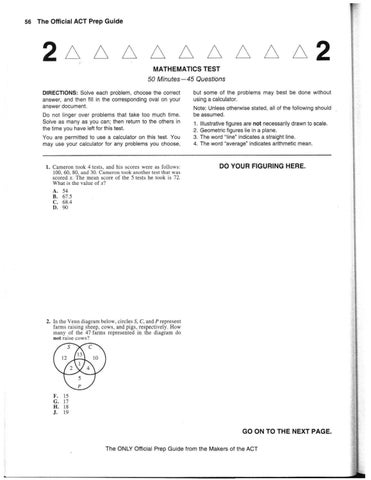
2A AOOA A MATHEMATICS TEST 50 Minutes-45 Questions DIRECTIONS: Solve each problem, choose the correct answer, and then fill in the corresponding oval on your answer document. Do not linger over problems that take too much time. Solve as many as you can; then return to the others in the time you have left for this test. You are permitted to use a calculator on this test. You may use your calculator for any problems you choose,
1. Cameron took 4 tests, and his scores were as follows: 100, 60, 80, and 30. Cameron took another test that was scored x. The mean score of the 5 tests he took is 72. What is the value of x? A. 54 B. 67.5 C. 68.4 D. 90
but some of the problems may best be done without using a calculator. Note: Unless otherwise stated, all of the following should be assumed. 1. Illustrative figures are not necessarily drawn to scale. 2. Geometric figures lie in a plane. 3. The word "line" indicates a straight line. 4. The word "average" indicates arithmetic mean.
DO YOUR FIGURING HERE.
2. In the Venn diagram below, circles S, C, and P represent farms raising sheep, cows, and pigs, respectively. How many of the 47 farms represented in the diagram do not raise cows?
F. 15 G. 17 H. 18 J. 19
GO ON TO THE NEXT PAGE. The ONLY Official Prep Guide from the Makers of the ACT
Taking and Scoring Your First ACT Practice Test
A2
A A A
3. Marco designs a spinner wheel that has exactly 4 sections: red, blue, green, and yellow. He wants the spinner wheel to have a 25% chance of landing on each section. He spins the wheel 500 times. The results of the spins are shown in this table. Spinner wheel section
Number of times the spinner lands in each section
Red
80
Blue
165
Green
130
Yellow
125
DO YOUR FIGURING HERE.
Your First Practice Test
2A A
Based on the results in this table, one of the following changes would be the best fix. Which one? A. He should decrease the area of the red section by increasing the area of the blue section. B. He should increase the area of the red section by decreasing the area of the blue section. C. He should increase the area of the red section by decreasing the area of any of the other three sections. D. He should decrease the area of the blue section, and then it does not matter which section's area is increased.
4. In AABC, LA and LC are congruent, and the measure of LB is 143.6°. What is the measure of LA? F. 18.2° G. 36.4° H. 71.8° J. 143.6°
5. Which of the following expressions is equivalent to x2 — x — 30? A. B. C. D.
(x + 3)(x — 10) (x + 6)(x — 5) (x — 6)(x + 5) (x -15)(x-15)
6. Which of the following matrices is equal to 5
[--40 -5] [
2
9
F. [-20 -15] G. [-2105]
H.
J.
57
[
51 07] [-20 10 1 L 0 -25J
GO ON TO THE NEXT PAGE. The ONLY Official Prep Guide from the Makers of the ACT
58 The Official ACT Prep Guide
2A AL
A.A AL
7. Lavonne purchased some tickets and snack vouchers for an upcoming event and gave them to the members of her work group. Each member of her work group received the same number of tickets and the same number of snack vouchers. The total number of tickets she gave to her group was 30, and the total number of snack vouchers was 75. Which of the following could be the number of members in Lavonne's work group? A. 10 B. 15 C. 25 D. 30
AL
DO YOUR FIGURING HERE.
8. The initial speed, in miles per hour, of a certain car that skids to a stop can be estimated by multiplying the length of the skid, in feet, by 35 and then taking the square root of the product. According to this method, what is the estimated initial speed, in miles per hour, of the car when it makes a 108-foot skid? F. 1/T2ff G. 'Tag H. 641F5 J. 2101
9. If 6y = 5x - 1, then x = ? A. 6y - I B. —5 y + 1 6y - 1 5 6y + I D. 5
C.
10. A boat is traveling at a speed of 30 miles per hour. What is the boat's speed in feet per second? (Note: 1 mile = 5,280 feet) F. 20 G. 30 H. 44 J. 176
GO ON TO THE NEXT PAGE. The ONLY Official Prep Guide from the Makers of the ACT
Taking and Scoring Your First ACT Practice Test
2 AL
ALAI\
11. An object is launched vertically at 30 meters per second from a 55-meter-tall platform. The height, h(t) meters, of the object t seconds after launch is modeled by h(t) = —4.9t2 + 30t + 55. What will be the height, in meters, of the object 3 seconds after launch?
AAA
59
2
DO YOUR FIGURING HERE.
Your First Practice Test
A. 44.1 B. 100.9 C. 145 D. 189.1
12. The whole numbers 1 through 30 were each written on separate pieces of paper. Those 30 pieces of paper were put into a jar. One piece of paper will be randomly drawn from this jar. What is the probability that this piece of paper will have a prime number written on it?
F. 30 G.
p[2o
H. % j
J. 10 30
13. For an angle with measure a in a right triangle, 5 What is the value of cos a? 5 and tan a = 12 sin a = — 3 A. 12 13 B.
12 1194 C. 12 119 D. 13 12
14. Which of the following values, if any, is the y-value of the solution set to the system of equations below? 2x — y = 7 —4x + 2y = 2 F. 2 G. 5 H. 9 J. There is no such value for y.
GO ON TO THE NEXT PAGE. The ONLY Official Prep Guide from the Makers of the ACT
60
The Official ACT Prep Guide
2 AL A A L,A A AL 2 15. Which of the following expressions is equivalent to
DO YOUR FIGURING HERE.
39
(Y -4-
A. y3 + 21y2 + 147y + 343 B. y3 + 14y + 343 C. y3 + 14y+ 49 D. y3 + 343
16. The sum of 3 positive integers is 180, and the ratio of the integers is 5:3:2. What is the value of the smallest of the integers? F. G. H. J.
18 36 54 90
17. Which of the following expressions is equivalent to (x2 — y2) — (6x2 + 4xy — y2)? A. —5x2 — 4xy B. -5x2 + 4xy - 2y2 C. 7x2 + 4xy - 2y2 D. 7x2 + 4xy + 2y2
18. Given i =
what is -0 +
F. 7i G. H. 3 —4i J. 3 + 4i
19. The first 5 terms of an arithmetic sequence are 7, 21, 35, 49, and 63. Let t„ represent the nth term of the sequence. What is the value of t25? A. B. C. D.
175 343 357 371
20. At a certain time of day, a flagpole casts a 9.0-foot-long shadow and a nearby 4.0-foot-tall fence post casts a 2.4-foot-long shadow. Given that both the flagpole and the fence post are vertical and on level ground, what is the height, in feet, of the flagpole? F. G. H. J.
5.4 10.6 15.0 15.4
GO ON TO THE NEXT PAGE. The ONLY Official Prep Guide from the Makers of the ACT
Taking and Scoring Your First ACT Practice Test
2 AA, LA/ 21. In rectangle ABCD shown, segments BE and CE partition the rectangle into 3 triangles. Given DE = 7 centimeters, BE = 26 centimeters, and CE = 25 centimeters, what is the length, in centimeters, of BC?
LA L2
DO YOUR FIGURING HERE.
B
A
Your First Practice Test
E 7 C
1) A. B. C. D.
10 15 17 24
22. In a particular cleaning solution, the ratio of concentrated solution to water is 3:40. How many cups of concentrated solution should be added to 5 gallons of water to make the cleaning solution in the given ratio? (Note: 4 cups = 1 quart; 4 quarts = 1 gallon) F. 12 G. 6 H. 112
J. 38 23. Let f(t) = 7e3' + 1. Which of the following numbers is closest to the value of f(5)? A. B. C. D.
-2 x 10⁻¹ 3 x 10² 2x 10⁷ 6x 10⁷
24. Which of the following expresses 40° in radians? F.
2 97c
G. 2i 9
H. 9n 2
J.
61
7,200 It
GO ON TO THE NEXT PAGE. The ONLY Official Prep Guide from the Makers of the ACT
62 The Official ACT Prep Guide
2A
A. A
25. Let the function f be defined as f(x) = -9x2. In the standard (x,y) coordinate plane, the graph of y = f(x) undergoes a transformation such that the result is the graph of y = f(x) — 4. Under this transformation the graph of y = f(x) is: A. shifted downward 4 coordinate units. B. shifted left 4 coordinate units. C. stretched horizontally by a factor of 4. D. stretched vertically by a factor of 4.
A, A Ac,2 DO YOUR FIGURING HERE.
26. For all positive values of a, b, c, and d, when 2
ab2
c = d, which of the following expressions is
equal to b? F.
ja(d - c)
l
2
,12(d - c) G. a
H. 112da- c - c
J.
2a
27. On a trip, 2 sisters counted 1,430 vehicles. They divided the vehicles into categories: cars, trucks, and other. They noted the color of each as white, black, red, or other, as shown in the table. What is the probability that a randomly selected truck is black? White
Black
Red
Other
Total
Car
118
62
97
197
474
Truck
100
31
116
232
479
Other
86
85
94
212
477
Total
304
178
307
641
1,430
31 A. 178
B.
31 479
C.
31 1,430
D.
479 1,430
GO ON TO THE NEXT PAGE. The ONLY Official Prep Guide from the Makers of the ACT
Taking and Scoring Your First ACT Practice Test 63
2A A D D A.
DO YOUR FIGURING HERE.
Your First Practice Test
28. A regular hexagon is inscribed in a circle with diameter 18 inches, as shown. What is the perimeter, in inches, of the hexagon?
A A A2
F. 54 G. 108 H. 274-S J. 5443
29. Tanya earns $34,000 in her 1st year at a job. She is given a raise of the same dollar amount each year, resulting in her earning $38,080 in the 4th year at the job. What is the total of Tanya's earnings during her 4 years at the job? A. $136,000 B. $140,080 C. $144,160 D. $152,320
30. In the standard (x,y) coordinate plane, how many points are both 5 coordinate units from the origin and also 2 coordinate units from the line y = 0? F. 0 G. 1 H. 2 J. 4
31. In AABC, if the measure of LA is less than the measure of LB, and the measure of LB is less than the measure of LC, what is the correct ordering of the side lengths, from least to greatest? A. AB < BC < AC B. AB < AC < BC C. BC<AC<AB D. BC < AB < AC
GO ON TO THE NEXT PAGE. The ONLY Official Prep Guide from the Makers of the ACT
64 The Official ACT Prep Guide
2A AL
A AL
32. Lajuan sells exactly 4 kinds of pies in his bakery:
A A A2 DO YOUR FIGURING HERE.
apple, pecan, coconut cream, and peach. Of the pies he sold on Thursday,
were apple, -2- were pecan, 24
were coconut cream, and 8 were peach. How many total pies did Lajuan sell on Thursday? F. G. H. J.
40 42 56 128
33. In a certain quadrilateral, 2 opposite angles each measure (3x + 5)°. The other 2 opposite angles each measure (x + 3)°. What is the value of x? A. 1 B. 9 C. 43 D. 88
34. The first 4 terms of a sequence are shown in the table. The sequence is defined by a1 = 2 and a,=a„_ 1 + (n — 1)2 for n≥.. 2. What is the sixth term, a6, of this sequence? al
a2
a3
a4
2
3
7
16
F. G. H. J.
68 57 41 32
35. On the real number line, how many integers are between and — 725 ? — 65 6 A. B. C. D.
8 28 48 140
GO ON TO THE NEXT PAGE. The ONLY Official Prep Guide from the Makers of the ACT
Taking and Scoring Your First ACT Practice Test
A A F. G. H. J.
02
A. A
36. During a particular experiment, 2 events, A and B, can each occur. Events A and B are mutually exclusive during this experiment. Which of the following probabilities is 0?
DO YOUR FIGURING HERE.
P(A) P(B) P(A or B) P(A and B)
Your First Practice Test
37. The polynomial function defined by p(x) = x3 + x2 — 8x — 12 has (x — 3) as one of its linear factors. What are all and only the zeros of p? A. B. C. D.
—3 and —2 —3 and 2 —2 and 3 2 and 3
38. Jonathan rode his bike every day for 18 days. The table shows each of the distances he rode. The table also shows the number of days he rode each of those distances. Distance (in miles)
Number of days
1
2
3
4
4
3
5
6
7
3
What is the median daily distance, in miles, that Jonathan rode his bike for the 18 days? F. 3 G. 3.5 H. 4 J. 4.5
39. A tourism organization randomly selected 100 tourists finishing their summer visit to Spain. The organization asked them how many cities they had toured in the country. The table shows the results. Based on these data, for the population of tourists that visited Spain during the summer, what is the best estimate of the mean number of cities toured? Number of cities
1
2
3
Number of tourists
10
40
50
A. B. C. D.
65
0.8 2 2.4 3
GO ON TO THE NEXT PAGE. The ONLY Official Prep Guide from the Makers of the ACT
66 The Official ACT Prep Guide
2ALL
AL
40. Given the equation tx =y, where y is a real number, what must be true of x? x is: F. an even real number. G. a rational number. H. an integer. J. a nonnegative real number.
A A A A. DO YOUR FIGURING HERE.
41. Given that 1 ≤ m ≤ 4, 4 ≤ n ≤ 6, and 8 ≤ p ≤ 10, what is the greatest possible value for (-7-.:-)(P )? A. B.
3 20
1 15
C. 10 D.
8
42. Which of the following datasets has the largest standard deviation? F. 0, 0, 10, 10 G. 0, 1, 9, 10 H. 2, 3, 5, 7 J . 5, 5, 5, 5
43. Michael has a cylindrical fish tank, shown, that has an inside diameter of 18 inches. When he put colored gravel in his fish tank, the water level of the tank rose 2 inches. What is the volume of the gravel in cubic inches?
A. B. C. D.
18m 36n 162n 648n
GO ON TO THE NEXT PAGE. The ONLY Official Prep Guide from the Makers of the ACT
Taking and Scoring Your First ACT Practice Test 67
A
44. The table gives values of f(x), g(x), and h(x) for all positive integers x ≤ 5. Given h(f(g(a)))= 1 where a is a positive integer less than or equal to 5, what is the value of a? x
f(x)
g(x)
h(x)
1
2
4
3
2
1
5
1
3
4
2
5
4
5
3
4
5
3
1
2
F. G. H. J.
A A2 DO YOUR FIGURING HERE.
Your First Practice Test
z\ A
2 3 4 5
45. Each time Coin C is tossed, it lands faceup or facedown. The probability of landing faceup is 3 times the probability of landing facedown. In a certain game, the player wins $1.00 when Coin C lands faceup and the player wins $2.00 when Coin C lands facedown. To the nearest cent, what is the expected value of each toss of Coin C in this game? A. $1.25 B. $1.33 C. $1.50 D. $1.67
END OF TEST 2 STOP! DO NOT TURN THE PAGE UNTIL TOLD TO DO SO. DO NOT RETURN TO THE PREVIOUS TEST.
The ONLY Official Prep Guide from the Makers of the ACT
76 The Official ACT Prep Guide
400000000o SCIENCE TEST 40 Minutes-40 Questions DIRECTIONS: There are several passages in this test. Each passage is followed by several questions. After reading a passage, choose the best answer to each question and fill in the corresponding oval on your answer document. You may refer to the passages as often as necessary. You are not permitted to use a calculator on this test.
Passage I Green anoles and brown anoles (2 species of reptiles) behave differently when the species are together in a habitat than when the species are in separate habitats. Table 1 lists the anole species present in each of 3 habitats (Habitats X, Y, and Z).
Table 2 lists the number of times each of Behaviors 1-4 was displayed by the anoles in a habitat. Green anoles display Behaviors 1-3 only; brown anoles display Behavior 4 only. Table 2 Number of times behavior was displayed in Habitat:
Table 1 Behavior Habitat
Anole species present:
X
green only
Y
green and brown
Z
brown only
X
Y
Z
1
4
5
N.A.
2
3
6
N.A.
3
24
13
N.A.
4
N.A.
5
17
Note: N.A. indicates the behavior was not displayed in the habitat.
Figure 1 shows, for each anole species, the average perching height in a habitat.
Table 3 lists, for the anole species in a habitat, the average display time for Behavior 5. Table 3
average perching height (m)
Figure 1 1.8 1.6 1.4 1.2 1.0 0.8 _ 0.6 _ 0.4 _ 0.2 _ 0.0
Key
Anole species
Habitat
Average display time for Behavior 5 (s)
• green anole • brown anole
Green
X
23.1
Green
Y
23.7
Brown
Y
49.6
Brown
Z
33.1
•
•
X
Y Habitat
•
Figure 1 and Tables 2 and 3 adapted from Jessica R. Edwards and Simon P. Lailvaux, "Display Behavior and Habitat Use in Single and Mixed Populations of Anolis carolinensis and Anolis sagrei Lizards." ©2012 by Blackwell Verlag GmbH.
GO ON TO THE NEXT PAGE. The ONLY Official Prep Guide from the Makers of the ACT
Taking and Scoring Your First ACT Practice Test
77
0000000004 2. Which of the following observations for brown anoles was(were) the same in both Habitats Y and Z? 1. Average perching height 2. The number of times Behavior 4 was displayed 3. Average display time for Behavior 5 F. 1 only G. 3 only H. 1 and 2 only J. 2 and 3 only 3. Based on Table 3, how many display times were measured for Behavior 5 in Habitat Z? A. 2 B. 4 C. 12 D. Cannot be determined from the given information
4. Based on Figure 1, for green anoles, the difference in average perching height between Habitat X and Habitat Y was closest to which of the following? F. 0.0 m G. 0.3 m H. 0.7 m J. 1.0 m
5. A student claimed that anoles are endotherms. Which of the following explains why this claim is incorrect? Anoles are: A. amphibians and primarily generate heat from internal metabolic processes to maintain body temperature. B. amphibians and primarily absorb heat from the surrounding environment to maintain body temperature. C. reptiles and primarily generate heat from internal metabolic processes to maintain body temperature. D. reptiles and primarily absorb heat from the surrounding environment to maintain body temperature.
GO ON TO THE NEXT PAGE. The ONLY Official Prep Guide from the Makers of the ACT
Your First Practice Test
1. Based on Table 2, which of the following ratios best represents the number of times Behavior 2 was displayed in Habitat X compared to the number of times Behavior 2 was displayed in Habitat Y? A. 1:2 B. 1:8 C. 4:5 D. 5:6
78
The Official ACT Prep Guide
4cc00000004 Passage II The coastline of Antarctica consists of many ice shelves (floating 100-1,000 m thick sheets of ice that extend from a landmass). Many of these ice shelves are melting, causing them to calve (break off) large pieces known as icebergs. Four students each explain iceberg calving. Student 1 Antarctic ice shelves melt due to the warming of the air above the surface of the ice during the summer. When the air temperature increases, the surface ice melts and water pools. The meltwater moves downward into the ice shelf, causing fractures to form. The accumulation of many fractures in the ice over many summers gradually leads to icebergs calving from an ice shelf. Student 2 Student 1 is correct that an increase in air temperature during the summer leads to surface ice melting and water pooling, causing fractures to form in the ice. However, the action of the meltwater alone is insufficient to produce fractures deep enough to cause calving. When the air temperature lowers at the beginning of winter, falling snow accumulates in the fractures, increasing the pressure on the ice, eventually causing calving. After a large snowfall, calving can occur within a few days. Student 3 Antarctic ice shelves melt only from below. During the summer, ocean currents circulate water that is just above freezing into and out of the basal cavity (the area underneath an ice shelf), causing the ice within the cavity to melt. For every 0.1°C that the ocean water is above freezing, the water melts a thickness of 10 m of ice from the bottom per year. When the ice shelf thickness has been reduced by at least 50 m, calving occurs.
Student 4 The warmer water circulated by ocean currents melts the ice shelf as described by Student 3. However, calving cannot occur from this process alone. Snow accumulates on the surface of the ice each winter, but each following summer, warm air leads to the melting and compaction of the snow. The compaction lowers the surface of the ice shelf, pushing the ice down into the basal cavity, where it is melted by the ocean water. After several winter-summer cycles, the ice shelf becomes top-heavy due to the snow and the melting from below, and calving occurs.
6. Which of the following diagrams best shows the location of the basal cavity as described by Student 3? F.
iceberg
H. basal cavity
iceberg
J•
iceberg
land 1c- basal cavity ocean water G.
Iceberg
land
basal cavity
land basal cavity ocean water
ocean water
GO ON TO THE NEXT PAGE. The ONLY Official Prep Guide from the Makers of the ACT
Taking and Scoring Your First ACT Practice Test 79
7. Suppose that the air temperature along the Antarctic coastline is never warmer than —10°C and that the atmospheric pressure is always 1.0 atmosphere. Does this information support the description given by Student 1? A. Yes, because ice cannot melt at those temperatures. B. Yes, because ice can melt at those temperatures. C. No, because ice cannot melt at those temperatures. D. No, because ice can melt at those temperatures. 8. Based on the description of the icebergs that are calved along the coastline of Antarctica, do the icebergs sink or float? F. Sink; they are more dense than ocean water. G. Sink; they are less dense than ocean water. H. Float; they are more dense than ocean water. J. Float; they are less dense than ocean water. 9. Which of Students 1 and 4, if either, implied that the processes involved in iceberg calving will take more than one year to result in the formation of an iceberg? A. B. C. D.
Student 1 only Student 4 only Both Student 1 and Student 4 Neither Student 1 nor Student 4
10. In regard to the season(s) involved in iceberg calving, how does Student 2's description differ from Student 3's description? Student 2 indicated that: F. summer and winter are involved in calving, whereas Student 3 indicated that only summer is involved in calving. G. summer and winter are involved in calving, whereas Student 3 indicated that only winter is involved in calving. H. only summer is involved in calving, whereas Student 3 indicated that summer and winter are involved in calving. J. only winter is involved in calving, whereas Student 3 indicated that only summer is involved in calving.
11. Which of Students 2, 3, and 4 agree(s) with Student 1 that some form of melting occurs on the ice shelf surface? A. Student 2 only B. Students 2 and 3 only C. Students 2 and 4 only D. Students 3 and 4 only
GO ON TO THE NEXT PAGE. The ONLY Official Prep Guide from the Makers of the ACT
Your First Practice Test
oo o o o o o o 04
80 The Official ACT Prep Guide
400000 Passage III Amphiprion percula, a species of clownfish, are kept in many home aquariums. Two experiments were conducted to determine how diet and stocking density (number of fish per liter of seawater, fish/L) affect the specific growth rate (SGR; percent increase in length per day, percent/day) in A. percula. Experiment I Each of 12 identical 15 L tanks received 10 L of seawater having a salinity of 33 parts per thousand (ppt), a temperature of 27°C, and a pH of 8.2. Salinity, temperature, and pH were kept constant over the course of the experiment. A. percula of similar lengths were selected, and their lengths were measured, in cm, with a ruler. Then they were equally distributed among the tanks at a stocking density of 1 fish/L. The tanks were then divided equally into 4 groups. For 4 months, each group was fed a different diet (Diets Q—T). Each group was fed the same mass of food 3 times daily. At the end of 4 months, the length of each fish was measured, in cm, with a ruler, and the SGR of each fish was calculated. The average SGR was then determined for each group (see Table 1).
O o o o4 Experiment 2 The procedures for Experiment 1 were repeated except that each group was kept at a different stocking density, 0.5 fish/L, 1 fish/L, 2 fish/L, or 3 fish/L, and all fish were fed Diet T. At the end of 4 months, the average SGR was determined for each group (see Table 2). Table 2 Stocking density (fish/L)
Average SGR (percent/day)
0.5
0.50
1
0.35
2
0.25
3
0.20
Tables adapted from Joao Chambel et al., "Effect of Stocking Density and Different Diets on Growth of Percula Clownfish, Amphiprion percula (Lacepede, 1802)." ©2015 by Springer.
Table 1 Diet
Average SGR (percent/day)
Q
0.30
R
0.40
S
0.50
T
0.35
12. Which of the following statements about the relationship between the number of A. percula per tank and the average SGR is consistent with the results of Experiment 2? On average, as the number of A. percula per tank increased, the average SGR: F. increased only. G. decreased only. H. remained the same. J. varied with no general trend.
GO ON TO THE NEXT PAGE. The ONLY Official Prep Guide from the Makers of the ACT
Taking and Scoring Your First ACT Practice Test 81
4000000coo4 Diet
Percent protein
Q
52.5
R
48.0
S
41.1
T
38.1
Which of the following statements about the percent protein in each diet and the average SGR is consistent with the data shown in the table and the results of Experiment 1? The diet that resulted in the: A. highest average SGR also had the highest percent protein.
B. highest average SGR had the lowest percent protein. C. lowest average SGR had the highest percent protein. D. lowest average SGR also had the lowest percent protein. 14. Based on the results of Experiment 1, if Experiment 2 were repeated except that all the A. percula were fed Diet R, would the average SGRs more likely have been lower or higher for each group? F. Lower; on average, A. percula fed Diet R had an SGR 0.05 percent/day less than those fed Diet T. G. Lower; on average, A. percula fed Diet R had an SGR 0.10 percent/day less than those fed Diet T. H. Higher; on average, A. percula fed Diet R had an SGR 0.05 percent/day greater than those fed Diet T. J. Higher; on average, A. percula fed Diet R had an SGR 0.10 percent/day greater than those fed Diet T.
15. Suppose that, in the experiments, 1 g of food were added to each tank at each feeding. A total of how many grams of food would have been placed into an individual tank each day? A. 1 g B. 3 g C. 12 g D. 36 g
16. How many A. percula were placed in each of the tanks in Experiment 1 ? F. G. 4 H. 10 J. 12
17. Which of the following was a dependent variable in Experiment 1? A. Volume of seawater in each tank B. Specific growth rate C. Diet fed to the A. percula D. Stocking density of the A. percula
GO ON TO THE NEXT PAGE. The ONLY Official Prep Guide from the Makers of the ACT
Your First Practice Test
13. The following table gives the percent protein in each of the 4 diets.
82 The Official ACT Prep Guide
4000000
004
Passage IV
The results for each sample are shown in Figure 1.
Scientists hypothesized that heating tomatoes affects the concentration of nutrients such as vitamin C and lycopene (a red pigment) in the tomatoes. They conducted 2 experiments to test their hypothesis.
Figure 1 0.8 0.7 0.6 0.5 0.4 0.3
Experiment 1 Two kilograms of a particular variety of raw tomatoes were sliced and then blended in a food processor until a homogeneous (uniform) tomato mixture was produced. The mixture was divided into 4 equal samples (Samples 1-4). Each sample was placed in a separate plastic bag, and the bags were sealed. The hag containing Sample 1 was immediately frozen at —40°C. The bags containing Samples 2-4 were each incubated in a water bath at 88°C for a different period of time (see Table 1) and then frozen at —40°C.
'SF .0W.. ,-, .., .
•
,'
0.2 0.1 0
lie il-
, g'..
..;:i.gt-A-• ,,,... --.; . .
,....,.
' ''-';',.."
,.. Y..,
IV
, ..?,..;,
•
2
1
4
3 Sample
Sample
Incubation time at 88°C (min)
Experiment 2 Experiment 1 was repeated except that in Step 3 the filtered liquid was analyzed to determine the lycopcne concentration in milligrams per gram of tomato (mg/g tomato). The results for each sample are shown in Figure 2.
1
0
Figure 2
2
2
3
15
4
30
Table 1
6 5
Then, 2 days later, Steps 1-3 were performed for each sample. 1. The sample was thawed, and then 100 g of the sample was placed in a beaker containing 200 mL of Solvent A. 2. The contents of the beaker were mixed for 5 min at 25°C and then filtered using a paper filter. The filtered liquid was collected. 3. The filtered liquid was analyzed to determine the vitamin C concentration in micromoles per gram of tomato (µmol/g tomato).
• 4 •u E •O O 0, 3 a.) •a) b4
a 2 1 4
2 Sample
Figures 1 and 2 adapted from Veronica Dewanto et al., "Thermal Processing Enhances the Nutritional Value of Tomatoes by Increasing Total Antioxidant Activity." ©2002 by American Chemical Society.
GO ON TO THE NEXT PAGE. The ONLY Official Prep Guide from the Makers of the ACT
Taking and Scoring Your First ACT Practice Test
83
18. Which of the samples in Experiment 1 was most likely intended as a control for the concentration of vitamin C present in the unheated tomatoes? F. Sample 1 G. Sample 2 H. Sample 3 J. Sample 4
19. Based on the results of Experiment 2, which of the following incubation times would most likely have produced a tomato mixture with a lycopene concentration between 5 mg/g tomato and 6 mg/g tomato? A. 0 min B. 0.2 min C. 2 min D. 20 min
20. A student claimed that heating tomatoes decreases the concentration of nutrients present. This claim is consistent with the results shown for which of vitamin C and lycopene, if either? F. Vitamin C only G. Lycopene only H. Both vitamin C and lycopene J. Neither vitamin C nor lycopene
21. Assume that, in the experiments, the water bath contained pure water at standard atmospheric pressure (1 atmosphere; atm). While the bags containing the samples were being incubated, was the water in the water bath most likely boiling? A. Yes; the incubation temperature was less than the boiling point of water at 1 atm. B. Yes; the incubation temperature was greater than the boiling point of water at l atm. C. No; the incubation temperature was less than the boiling point of water at 1 atm. D. No; the incubation temperature was greater than the boiling point of water at 1 atm. 22. In Experiment 1, how many of the samples had a vitamin C concentration of less than 1.0 µmol/g tomato? F. 0 G. 1 H. 3 J. 4 23. Consider the following procedures performed in Experiment 2 for Sample 2. 1. The sample was frozen. 2. The sample was incubated in the water bath. 3. The sample and solvent mixture was filtered. These procedures were performed in what order? A. 1, 2, 3 B. 1, 3, 2 C. 2, 1,3 D. 2, 3, 1
GO ON TO THE NEXT PAGE. The ONLY Official Prep Guide from the Makers of the ACT
Your First Practice Test
o o o o o o o o
84 The Official ACT Prep Guide
4000000000 Passage V
Figure 1
A molten alloy (a mixture of 2 or more metallic elements) can be poured into a cylindrical mold and cooled to form an ingot. Crystals form inside the ingot as it cools. The average crystal length, L, in micrometers (µm), determines how brittle the ingot will be. A method for reducing L using rotating magnetic fields was applied to Alloy Q as it cooled in the molds. Table 1 shows the elemental composition of Alloy Q. Figure 1 shows the effect of the relative magnetic stirring force, F, on L for ingots formed from molten Alloy Q that had an initial temperature of either 280°C or 550°C.
102 Key 280°C ---- 550°C
100 98 -g
96
,-
94 92 1
Table 1
1
I
Element Aluminum
Symbol
Percent by mass in Alloy Q
Al
88.7
Silicon
Si
10.8
Manganese
Mn
0.28
Magnesium
Mg
0.22
/ "c7
90 88
0
/......‘`‘
1 I
10
..., '. •
%,. ,
20
%ft....."
30
...."
..-...
40
50
F (x 107) Figure 1 is adapted from S. Denisov, et al., "The Effect of Traveling and Rotating Magnetic Fields on the Structure of Aluminum Alloy During Its Crystallization in a Cylindrical Crucible." ©2014 by Institute of Physics, University of Latvia.
GO ON TO THE NEXT PAGE. The ONLY Official Prep Guide from the Makers of the ACT
Taking and Scoring Your First ACT Practice Test 85
4
4
25. Consider the 2 trends shown for Alloy Q initially at the temperatures of 280°C and 550°C, from F = 40 x 107 through F = 48 x 107. If these lines were to continue along the same trend, at which of the following values of F would the average crystal lengths most likely be the same? A. F = 50 x 107 B. F = 60 x 107 C. F = 70 x 107 D. F = 80 x 107 26. Based on Figure 1, which of the following combinations of values for initial temperature and F would produce the shortest average crystal length in an ingot of Alloy Q? The smallest L would be produced with a temperature of: F. 280°C and F = 10 x 107. G. 280°C and I' = 40 x 107. H. 550°C and F = 10 x 107. J. 550°C and F = 40 x 107.
27. The following table lists the mass of silicon in 50 g samples of 4 different alloys, one of which is Alloy Q.
Sample
Mass of Si (g)
W
0.11
X
0.14
Y
2.7
Z
5.4
Given the composition of Alloy Q, which sample is most likely Alloy Q? A. Sample W B. Sample X C. Sample Y D. Sample Z
28. Based on Table 1, if an ingot of Alloy Q had a mass of 200 g, that ingot would contain what mass of Mg? F. 0.22 g G. 0.44 g H. 2.2 g J. 4.4 g
GO ON TO THE NEXT PAGE. The ONLY Official Prep Guide from the Makers of the ACT
Your First Practice Test
24. A linear region of a graph is a range of data that can be approximated with a straight line. Based on Figure 1, for Alloy Q initially at a temperature of 550°C, which of the following ranges of F best represents a linear region? F. Between 0 and 10 x 107 G. Between 10 x 107 and 20 x 107 H. Between 20 x 107 and 30 x 107 J. Between 30 x 107 and 40 x 107
86
The Official ACT Prep Guide
0
0
0
0
0
!
Passage VI In a lake, water leaches (dissolves out) soluble organic compounds from decaying tree leaves, producing dissolved organic carbon (DOC). DOC is subsequently removed from the water if it is adsorbed by (becomes adhered to the surface of) clay mineral particles that are suspended in the water. Three studies done at a lake examined DOC adsorption by 3 clay minerals—CM1, CM2, and CM3—found in the lake's sediment.
0
0
0
0
Study 2 Study 1 was repeated, substituting CM2 for CM1 (see Figure 2). Figure 2 60 p (2 8
4 530
Green leaves were collected from 5 types of trees around the lake (maple, oak, pine, magnolia, and rhododendron). A 5 L volume of lake water was filtered to remove all solid particles. The following procedures were performed for each type of leaf: A 100 g sample of the leaves was mixed with a 1 L volume of the filtered lake water. The mixture was then placed in the dark for 10 weeks at 4°C while leaching occurred. At 10 weeks, the mixture was filtered to remove all solid particles. The resulting liquid (the leachate) was analyzed for DOC.
acd; -E7
L) 20
Study 1 The following procedures were performed for each leachate: A 100 mL volume of the leachate was mixed with 10 g of CM1. The mixture was stirred continuously for 2 hr, then filtered to remove all solid particles. The resulting liquid (the filtrate) was analyzed for DOC. The percent of the leachate DOC that had been adsorbed by CM1 was calculated (see Figure 1).
Study 3 Study 1 was repeated, substituting CM3 for CM1 (see Figure 3).
Figure 1 60 50 40 30 20 7 10 7
4) a3
10 0
Vd cc.``-P
.s,,,z. .,0 ' .oc' '\' - w,,,4 ) zoe'
o
e leachate
Figure 3 60 50 40 -i 30 20 10
60. ,o-c,
0
0-
leachate
leachate
Figures and table adapted from Todd Tietjen, Anssi Vahatalo, and Robert Wetzel, "Effects of Clay Mineral Turbidity on Dissolved Organic Carbon and Bacterial Production." ©2005 by the Swiss Federal Institute for Environmental Science and Technology.
GO ON TO THE NEXT PAGE. The ONLY Official Prep Guide from the Makers of the ACT
Taking and Scoring Your First ACT Practice Test 87
40000000004
30. Based on the results of Study 3, the percent of leachate DOC adsorbed by CM3, averaged across the 5 types of leaves, is closest to which of the following? F. G. H. J.
10% 20% 30% 40%
31. Is the statement "CM2 adsorbed a greater percent of the DOC in the maple leachate than did CM3" supported by the results of Studies 2 and 3? A. Yes; CM2 adsorbed 35% of the leachate DOC, whereas CM3 adsorbed 7%. B. Yes; CM2 adsorbed 55% of the leachate DOC, whereas CM3 adsorbed 17%. C. No; CM2 adsorbed 7% of the leachate DOC, whereas CM3 adsorbed 35%. D. No; CM2 adsorbed 17% of the leachate DOC, whereas CM3 adsorbed 55%.
32. Based on the results of the studies, which of the 3 clay minerals, if any, reduced the DOC in the oak leachate by more than 50%? F. CM1 only G. CM2 only H. CM1 and CM3 only J. None of the 3 clay minerals
33. Is a mixture of any one of the leachates and any one of the clay minerals properly considered a solution? A. Yes, because the clay mineral particles are dissolved in the leachate. B. Yes, because the clay mineral particles are not dissolved in the leachate. C. No, because the clay mineral particles are dissolved in the leachate. D. No, because the clay mineral particles are not dissolved in the leachate.
34. In lake water, DOC is broken down into simpler compounds by electromagnetic energy in the visible wavelength range. What action was taken in the studies to prevent this process from occurring? F. Each mixture of leaves and filtered lake water was placed in the dark. G. Each mixture of filtrate and clay mineral was placed in the dark. H. Each mixture of leaves and lake water was filtered. J. Each mixture of leachate and clay mineral was filtered.
GO ON TO THE NEXT PAGE. The ONLY Official Prep Guide from the Makers of the ACT
Your First Practice Test
29. Based on the results of the studies, from which of the 5 leachates was the greatest percent of DOC adsorbed by CM1, CM2, and CM3, respectively? A. CM1: maple CM2: maple CM3: rhododendron B. CM1: oak CM2: pine CM3: magnolia C. CM1: pine CM2: magnolia CM3: rhododendron D. CM1: pine CM2: magnolia CM3: magnolia
88 The Official ACT Prep Guide
it000000000 Passage VII Table 1 When light shines on a metal plate, electrons can be ejected from the plate. An electron will be ejected if the energy, E, of a photon (particle of light) striking the plate is greater than the minimum energy, M, required for the electron to be removed from the plate. The maximum kinetic energy of the ejected electron, K, is the difference between E and M as shown in the equation: K=E — M Students conducted 2 experiments to examine how differences in the light striking a metal plate affect K. The setup included a light source, a removable filter, a circuit with an ammeter to measure current, a power supply that could be adjusted to measure K, and a vacuum tube containing a metal plate and an electrode (see Figure 1). Figure I filter light
•
vacuum tube
Frequency (x 1014 Hz)
E (eV)
Red
4.4
1.81
N.A.*
Yellow
5.2
2.14
N.A.*
Green
5.6
2.31
0.11
Blue
6.3
2.60
0.40
Violet
7.5
3.10
0.90
Color
K (eV)
*N.A.—Not available; no electrons were ejected. Experiment 2 With the same setup as in Experiment 1 except without a filter, the current, in milliamperes (mA), and K were measured as the intensity of the light was varied. Table 2 shows the current and K for 4 different relative light intensities, each given as a percent of maximum intensity.
electrode
metal plate
Table 2
power supply ammeter Experiment 1 A filter was placed between the metal plate and the light source, and the K of the ejected electrons was measured. This procedure was repeated with each of 4 additional filters. Each filter transmitted light of only one frequency. Table 1 lists the following: • color of light transmitted by the filter • frequency of light in hertz, Hz • E in electron volts, eV • K in electron volts
Relative intensity
Current (mA)
K (eV)
100%
40.0
0.90
50%
19.8
0.90
25%
9.8
0.90
12.5%
4.8
0.90
35. Consider the current shown on the ammeter in Figure 1. Based on the results of Experiment 2, when this current was measured, what was the relative intensity of the light? A. B. C. D.
100% 50% 25% 12.5%
1
GO ON TO THE NEXT PAGE. The ONLY Official Prep Guide from the Makers of the ACT
Taking and Scoring Your First ACT Practice Test 89
4O O O O O O O a O4 37. Based on Figure 1, are the particles ejected from the metal plate moving toward the electrode or away from the electrode, and are those particles positively charged or negatively charged? A. Toward; positively charged B. Toward; negatively charged C. Away from; positively charged D. Away from; negatively charged 38. Based on the equation in the passage and the results of Experiment 1, what was the value of M for the metal plate used in the setup? F. 2.14 eV G. 2.20 eV H. 2.31 eV J. 2.42 eV
39. The cutoff frequency for a particular metal is the lowest frequency of light at which electrons are ejected from the metal. Based on the results of Experiment 1, the cutoff frequency for the metal plate was: A. less than 4.4 x 10¹⁴ Hz. B. between 4.4 x 10¹⁴ Hz and 5.2 x 10¹⁴ Hz. C. between 5.2 x 10¹⁴ Hz and 5.6 x 10¹⁴ Hz. D. greater than 5.6 x 10¹⁴ Hz. 40. The relationship between E and the frequency of light is given by the equation: E = hf where h is Planck's constant and f is the frequency of light. Based on the data for green light in Table I, which of the following expressions could be used to determine the value of h? x 1014 Hz F. 5.60.11 eV 0.11 eV 5.6 x 1014 Hz x 1014 Hz H. 5.62.31 eV
G.
J.
2.31 eV 5.6 x 10¹⁴ Hz
END OF TEST 4 STOP! DO NOT RETURN TO ANY OTHER TEST.
The ONLY Official Prep Guide from the Makers of the ACT
Your First Practice Test
36. What aspect of the experimental setup was held constant in Experiment 2 but not in Experiment 1? F. Color of light G. Light source H. Type of metal plate J. Distance between metal plate and electrode
Taking and Scoring Your First ACT Practice Test 91
You may wish to photocopy these sample answer document pages to respond to the practice ACT Writing Test. Please enter the information at the right before beginning the writing test.
WRITING TEST BOOKLET NUMBER Print your 9-digit Booklet Number in the boxes at the right.
WRITING TEST FORM Print your 5-character Test Form in the boxes at the right and fill in the corresponding ovals.
Begin WRITING TEST here.
If you need more space, please continue on the next page.
The ONLY Official Prep Guide from the Makers of the ACT
Your First Practice Test
Use a No. 2 pencil only. Do NOT use a mechanical pencil, ink, ballpoint, or felt-tip pen.
92
The Official ACT Prep Guide
WRITING TEST
2
If you need more space, please continue on the back of this page.
The ONLY Official Prep Guide from the Makers of the ACT
93
Your First Practice Test
Taking and Scoring Your First ACT Practice Test
If you need more space, please continue on the next page.
The ONLY Official Prep Guide from the Makers of the ACT
94 The Official ACT Prep Guide
The ONLY Official Prep Guide from the Makers of the ACT
Taking and Scoring Your First ACT Practice Test
95
Practice Writing Test Prompt 1 Your Signature: (Do not print.) Print Your Name Here:
Month
Day
Year
Form 24WT2
ThecT® WRITING TEST BOOKLET You must take the multiple-choice tests before you take the writing test.
Directions This is a test of your writing skills. You will have forty (40) minutes to read the prompt, plan your response, and write an essay in English. Before you begin working, read all material in this test booklet carefully to understand exactly what you are being asked to do. You will write your essay on the lined pages in the answer document provided. Your writing on those pages will be scored. You may use the unlined pages in this test booklet to plan your essay. Your work on these pages will not be scored. Your essay will be evaluated based on the evidence it provides of your ability to: • clearly state your own perspective on a complex issue and analyze the relationship between your perspective and at least one other perspective • develop and support your ideas with reasoning and examples • organize your ideas clearly and logically • communicate your ideas effectively in standard written English Lay your pencil down immediately when time is called.
DO NOT OPEN THIS BOOKLET UNTIL TOLD TO DO SO.
ACT'
PO Box 168 Iowa City, IA 52243-0168
©2025 by ACT Education Corp. All rights reserved. NOTE: This test material is the confidential copyrighted property of ACT Education Corp., and may not be copied, reproduced, sold, scanned, emailed, or otherwise transferred without the prior express written permission of ACT Education Corp. Violators of ACT Education Corp.'s copyrights are subject to civil and criminal penalties.
The ONLY Official Prep Guide from the Makers of the ACT
Your First Practice Test
Your Date of Birth:
96 The Official ACT Prep Guide
Outer Space The United States and other nations have been exploring outer space for more than 50 years. Orbiting Earth, visiting the Moon, and maintaining an international space station have been landmarks of technological and scientific achievement. But major problems persist on the home planet, including hunger, disease, and pollution. Plans for further space exploration—sending people to Mars, for example—compete for financial and intellectual resources that could be used to help address these problems. To what extent, then, should we continue to explore outer space?
Read and carefully consider these perspectives. Each suggests a particular way of thinking about the question above. Perspective One
Perspective Two
Perspective Three
The pursuit of greater knowledge is worth any expense. Even if exploring space does not solve problems at home, it increases our understanding of the universe and our place within it.
Life on Earth must always be our first priority. Exploring outer space is not more important than feeding people on Earth and ensuring the health of the planet.
Scientific and technological achievements are the key to progress for humankind. By exploring outer space, we may discover new solutions to old problems.
Essay Task Write a unified, coherent essay in which you address the question of whether we should continue to explore outer space. In your essay, be sure to: • clearly state your own perspective and analyze the relationship between your perspective and at least one other perspective • develop and support your ideas with reasoning and examples • organize your ideas clearly and logically • communicate your ideas effectively in standard written English Your perspective may be in full agreement with any of those given, in partial agreement, or completely different.
The ONLY Official Prep Guide from the Makers of the ACT
Taking and Scoring Your First ACT Practice Test
97
Planning Your Essay Your work on these prewriting pages will not be scored. Use the space below and on the back cover to generate ideas and plan your essay. You may wish to consider the following as you think critically about the task: Strengths and weaknesses of different perspectives on the issue • What insights do they offer, and what do they fail to consider? • Why might they be persuasive to others, or why might they fail to persuade?
Your First Practice Test
Your own knowledge, experience, and values • What is your perspective on this issue, and what are its strengths and weaknesses? • How will you support your perspective in your essay?
If you need more space to plan, please continue on the back of this page.
The ONLY Official Prep Guide from the Makers of the ACT
98 The Official ACT Prep Guide
Planning Your Essay Use this page to continue planning your essay. Your work on this page will not be scored.
The ONLY Official Prep Guide from the Makers of the ACT