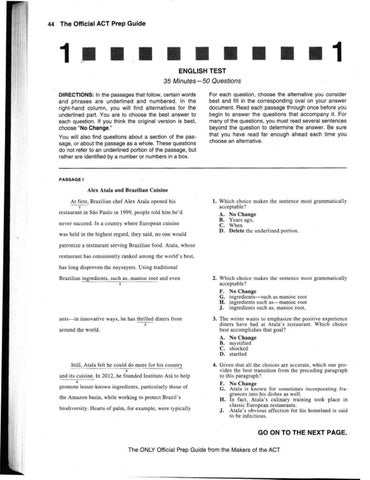
44 The Official ACT Prep Guide
■ ■ ■
■ ■ • • • • 1 ENGLISH TEST 35 Minutes-50 Questions
DIRECTIONS: In the passages that follow, certain words and phrases are underlined and numbered. In the right-hand column, you will find alternatives for the underlined part. You are to choose the best answer to each question. If you think the original version is best, choose "No Change." You will also find questions about a section of the passage, or about the passage as a whole. These questions do not refer to an underlined portion of the passage, but rather are identified by a number or numbers in a box.
For each question, choose the alternative you consider best and fill in the corresponding oval on your answer document. Read each passage through once before you begin to answer the questions that accompany it. For many of the questions, you must read several sentences beyond the question to determine the answer. Be sure that you have read far enough ahead each time you choose an alternative.
PASSAGE I
Alex Atala and Brazilian Cuisine At first, Brazilian chef Alex Atala opened his restaurant in Sao Paulo in 1999, people told him he'd never succeed. In a country where European cuisine was held in the highest regard, they said, no one would
1. Which choice makes the sentence most grammatically acceptable? A. No Change B. Years ago, C. When D. Delete the underlined portion.
patronize a restaurant serving Brazilian food. Atala, whose restaurant has consistently ranked among the world's best, has long disproven the naysayers. Using traditional Brazilian ingredients, such as, manioc root and even 2
2. Which choice makes the sentence most grammatically acceptable? F. No Change G. ingredients—such as manioc root H. ingredients such as—manioc root J. ingredients such as, manioc root,
ants—in innovative ways, he has thrilled diners from 3
around the world.
3. The writer wants to emphasize the positive experience diners have had at Atala's restaurant. Which choice best accomplishes that goal?
A. No Change B. mystified C. shocked D. startled Still, Atala felt he could do more for his country 4
and its cuisine. In 2012, he founded Instituto Ata to help 4
promote lesser-known ingredients, particularly those of the Amazon basin, while working to protect Brazil's biodiversity. Hearts of palm, for example, were typically
4. Given that all the choices are accurate, which one provides the best transition from the preceding paragraph to this paragraph? F. No Change G. Atala is known for sometimes incorporating fragrances into his dishes as well. H. In fact, Atala's culinary training took place in classic European restaurants. J. Atala's obvious affection for his homeland is said to be infectious.
GO ON TO THE NEXT PAGE. The ONLY Official Prep Guide from the Makers of the ACT
Taking and Scoring Your First ACT Practice Test 45
■ • • • • 1 harvested from Brazil's wild jugara palms in an unsustainable way. Needing eight years to mature,
pupunha palms, which grow clusters of stems, each with a small heart. Careful harvesting ensures that the tree will live to yield more hearts, resulting in
5. Which choice makes the sentence most grammatically acceptable? A. No Change B. tree dies once their C. trees die once its D. tree dies once it's 6. Which choice most effectively maintains the essay's tone? F. No Change G. pull through and spawn H. continue to churn out J. keep doling out
6
environmentally friendly production. Atala prioritizes his working relationships with Amazonian tribes. Utilizing their historical know-how they have, he aims to bolster tribe members' 7
livelihoods while exposing a wider audience to Brazilian ingredients. For instance, Baniwa women have farmed
distinctly flavorful chili peppers for centuries that use 8
indigenous agricultural techniques, to create a seasoning called pimenta jiquitaia. Partnering with Instituto Ata have enabled these women from a remote rain forest region 9
to scale up production and market their product globally.
Expanding awareness of the rich diversity of Brazil's native ingredients, Atala continues to lead in deciphering 10
the country's food culture. With his characteristic passion and intensity, the renowned chef seeks to inspire Brazilians
7. Which choice is least redundant in context? A. No Change B. knowledge that tribe members know about local plants, C. knowledge of local plants in the area, D. knowledge of local plants, 8. Which choice makes the sentence most grammatically acceptable? F. G. H. J.
No Change centuries, which use centuries who use centuries, using
9. Which choice makes the sentence most grammatically acceptable? A. No Change B. has enabled C. are enabling D. enable 10. Which choice is clearest and most precise in context? F. No Change G. transforming H. dislocating J. contorting
to rediscover the connections between culture, nature, and food.
GO ON TO THE NEXT PAGE. The ONLY Official Prep Guide from the Makers of the ACT
Your First Practice Test
the tree dies once its large heart is removed. Atala 5 began persuading producers to cultivate Amazonian
46
The Official ACT Prep Guide
•
•
•
• • • • 1
PASSAGE II
Rediscovering Hrosvitha Hrosvitha, a medieval author and dramatist—is 11 one of the earliest known European women playwrights. Although little is known about her life, scholars agree Hrosvitha was born to a noble family around 935 CE.
11. Which choice makes the sentence most grammatically acceptable? A. No Change B. author and dramatist, C. author, and dramatist D. author and dramatist
As a relation of Holy Roman Emperor Otto I, she most likely spent her early years as part of his court. Later, sometime before 959 CE, she entered the abbey at Gandersheim, it was well known 12
as a significant center of learning.
Hrosvitha entered Gandersheim as a canoness rather than a nun. Her title did not require a vow of poverty,
12. Which choice makes the sentence most grammatically acceptable? F. No Change G. Gandersheim and, historically, this abbey was H. Gandersheim, it was an abbey J. Gandersheim, an abbey
but Hrosvitha did take the abbey's customary vow of chastity, which absolved her of an obligation to marry. This circumstance made it okay for her to keep her 13
financial status without incurring responsibilities to
a husband and children. Nevertheless, Hrosvitha had 14
a greater level of independence—she could acquire property, receive guests, employ servants, and visit the royal court—than most women of her time.
13. Which choice most effectively maintains the essay's tone? A. No Change B. permitted her to hang on to C. allowed her to retain D. let her keep up 14. Which transition word or phrase is most logical in context? F. No Change G. On the other hand, H. As a result, J. In contrast,
Hrosvitha produced at least eight narrative religious poems, two historical epics (about the court of Otto I and 15
Gandersheim), and six comedy-dramas. It is for these dramas that she is best known today.
15. Which choice best helps indicate that each historical epic covered different subject matter? A. No Change B. (each focused on the court of Otto I and C. (focusing on the court of Otto I as well as D. (one about the court of Otto I, the other about
GO ON TO THE NEXT PAGE. The ONLY Official Prep Guide from the Makers of the ACT
Taking and Scoring Your First ACT Practice Test 47
a • • • PASSAGE III A Musical Detour [1] Every night while driving home from a hectic day at work, my three-year-old twins quarreling in the
highway, onto a stretch of Route 66 that is, surrounded by 16
arid New Mexico hills. When we're nearly three miles into our detour, I roll down the windows. Looking pointedly
into the rearview mirror, windows rolled down, I say 17
something about not throwing anything out of the car, but neither boy is listening. I check my speed. [A] Carefully, I steer toward the fog line. "Here it is, boys!" I yell at the
16. Which choice makes the sentence most grammatically acceptable? F. No Change G. highway onto a stretch of Route 66, that is, H. highway onto a stretch, of Route 66 that is J. highway onto a stretch of Route 66 that is 17. Which choice is least redundant in context? A. No Change B. into the rearview mirror, three miles into our detour, C. behind me by looking into the rearview mirror, D. into the rearview mirror,
backseat, the passenger-side tires finding the rumble strips etched into the asphalt. [2] Normal rumble strips create that loud, grating noise when you drive over them—like a built-in alarm for 18
drivers who drift too close to the road's edge. These strips 18
are different. The boys abruptly stop their squalling as the car begins to vibrate. Then, instead of that jolting warning noise, we hear the distinct strain of the song "America the Beautiful." [B] The road is playing us a song.
18. If the writer were to delete the underlined portion (adjusting the punctuation as needed), the paragraph would primarily lose: F. information that indicates how prevalent rumble strips are on roadways. G. a detail that reveals the narrator's opinion of distracted drivers. H. information that clarifies a primary function of rumble strips. J. a detail that indicates what the rumble strips look like.
[3] I've been taking this detour out of Albuquerque for two years, ever since these musical rumble strips were installed. City planners wanted to find out whether 19
the novelty of hearing a snippet of song would give drivers an incentive to obey the speed limit; the tune is
19. Which choice is least redundant in context? A. No Change B. were implemented just outside Albuquerque. C. that play music were put in. D. were added a couple years ago.
only recognizable if they're going a reasonable forty-five miles per hour. Whether this strategy works, I don't know.
GO ON TO THE NEXT PAGE. The ONLY Official Prep Guide from the Makers of the ACT
Your First Practice Test
backseat, I take a short detour. I turn off the gridlocked
48 The Official ACT Prep Guide
• • le • • 1 [C] For me, this brief musical interlude is a charming curiosity, a welcome interruption in my work-week slog. Even though constant traffic has worn down the musical rumble strips and warped the sound of some of the notes, there are currently no plans to restore the strips. 20
[4] After the last one of the notes fades into the darkening 21
sky, I glance back at the boys, who have been lulled by the 22
wonder of the song. [D] I stop worrying about work, about how many toy cars might have gotten lost between there and home. Until then, I feel like everything is going to 23
be just fine.
24
20. Given that all the choices are accurate, which one most effectively leads into the rest of the essay? F. No Change G. lots of other drivers, not just me, still make this detour to hear the tune. H. sometimes drivers will turn around and drive over the strips again. J. this detour on our drive home never fails to buoy my spirits. 21. Which choice makes the sentence most grammatically acceptable? A. No Change B. have disappeared C. disappear D. fade 22. Which choice makes the sentence most grammatically acceptable? F. No Change G. whom have H. they have J. whose 23. Which transition word or phrase is most logical in context? A. No Change B. Now and then, C. For now, D. Later, 24. At this point, the writer is considering adding the following accurate sentence: I hear there is another musical road in the US, somewhere in California. Should the writer make this addition? F. Yes, because it makes clear that the narrator has plans to travel on other musical roads. G. Yes, because it indicates that the musical road in New Mexico is not unique. H. No, because it draws the focus away from the New Mexico musical road and its effect on the narrator. jr. No, because it fails to provide specific details about the construction of the musical road in California.
GO ON TO THE NEXT PAGE. The ONLY Official Prep Guide from the Makers of the ACT
Taking and Scoring Your First ACT Practice Test 49
1 •
•
•
1
•
Question 25 asks about the preceding passage as a whole. 25. The writer wants to add the following sentence to the
The sentence would most logically be placed at: A. Point A in Paragraph 1. B. Point B in Paragraph 2. C. Point C in Paragraph 3. D. Point D in Paragraph 4.
PASSAGE IV The Case for Visible Storage [1 1 Public museums exist for two main reasons: to educate the public and provide stewardship (legal and 26
ethical management, care, documentation, and use) of 26
their collections. Unfortunately, due to space constraints, a typical museum only exhibits about ten percent of the items in its collection; the other ninety percent remains
in storage. When displaying such a small portion of 27
artifacts severely limits public access and therefore public education. Furthermore, maintaining such a large number of artifacts in storage while acquiring additional items
26. If the writer were to delete the underlined portion, the essay would primarily lose a: F. suggestion that not all public museums provide proper stewardship for their artifacts. G. clarification of what public museum stewardship entails. H. list of reasons for educating the public on stewardship. J. description of the daily tasks performed by curators. 27. Which choice makes the sentence most grammatically acceptable? A. No Change B. With the display of C. While displaying D. Displaying
makes finding enough suitable storage space difficult, especially for delicate items. [A] [2] To remain true to the goals of education and stewardship, museums should dedicate public access space to visible storage. [B] Also known as open storage, visible storage provides ways to display many items in 28
small or irregular spaces, allowing more artifacts to be on exhibit. [C]
28. Which choice makes the sentence most grammatically acceptable? F. No Change G. storage makes providing H. storage, which provides J. storage, providing
GO ON TO THE NEXT PAGE. The ONLY Official Prep Guide from the Makers of the ACT
Your First Practice Test
essay: It is marvelously quiet.
50 The Official ACT Prep Guide
1 •
•
•
•
[3] In a traditional museum display, each artifact is labeled and positioned at eye level with plenty of space between it and the other objects. 29
Subsequently, artifacts in visible storage spaces are placed 30
close together and are often displayed from floor to ceiling with few labels. Areas of a museum that cannot house a
29. Which choice makes the sentence most grammatically acceptable? A. No Change B. between them C. among them D. among it 30. Which transition word is most logical in context? F. No Change G. Conversely, H. Namely, J. Granted,
traditional display, therefore, might be ideal for a visible storage display. Ceramic pottery where it might otherwise 31
be positioned in individual glass cases might be lined up on shelves behind a glass wall. An antique fork and spoon fastened to a large informational board might instead be
31. Which choice makes the sentence most grammatically acceptable? A. No Change B. that which C. that D. Delete the underlined portion.
part of an entire set of silverware arranged under glass in pull-out cabinet drawers. [D] [4] While some artifacts can never be displayed
32
many pieces that can—and should—be viewed are not. 33
32. At this point, the writer is considering adding the following parenthetical phrase: (whether because of light sensitivity or the request of a donor) Given that the information is accurate, should the writer make this addition here? F. Yes, because it gives specific examples to help explain why some objects can never be displayed in a museum. G. Yes, because it offers specific examples of items that require special storage. H. No, because it detracts from the paragraph's focus on the ideal museum layout. J. No, because it diminishes the role museums play in educating the public. 33. Which choice makes the sentence most grammatically acceptable? A. No Change B. can and should— C. can, and should D. can and, should
GO ON TO THE NEXT PAGE. The ONLY Official Prep Guide from the Makers of the ACT
Taking and Scoring Your First ACT Practice Test 51
• • • • El Whereas a museum designates areas for visible storage, it 34 uses space efficiently, providing safe displays for artifacts and allowing visitors greater access to independently study
34. Which choice is clearest and most precise in context?
F. No Change G. Although H. When J. Since
the works that make the museum unique. J p
35. The writer wants to add the following sentence to the essay This potentially compromises stewardship. For the sake of logic and cohesion, the sentence should be placed at: A. Point A in Paragraph 1. B. Point B in Paragraph 2. C. Point C in Paragraph 2. D. Point D in Paragraph 3.
PASSAGE V The Sociable Weavers' Complex Nest
In the sparse yet relatively green environment of the Kalahari Desert, birds known as sociable weavers build their enormous nests atop the desert's signature camelthorn trees. Slung across the branches, each nest—which can measure up to thirteen feet wide and seven feet thick—is a sprawling community home to hundreds of birds.
[7
36. If the writer were to delete the phrase "which can mea-
sure up to thirteen feet wide and seven feet thick" from the preceding sentence (adjusting the punctuation as needed), the sentence would primarily lose: F. specific information that illustrates the minimum height at which the weavers begin building their nests. G. specific information that underscores the enormousness of the weavers' nests. H. details that clarify how the weavers are able to survive in the Kalahari Desert. J. details that explain how the weavers' nests differ from other birds' nests.
GO ON TO THE NEXT PAGE. The ONLY Official Prep Guide from the Makers of the ACT
Your First Practice Test
Question 35 asks about the preceding passage as a whole.
52 The Official ACT Prep
Guide
1 1111 •
I
A weaver nest does
bowl-like bird nest.
•
to construct their nests,
many as one hundred
the nests look more like
four-to-six-inch-wide chambers.
nest, it squeezes through and continuing up a
a one-inch-wide entrance hole,
passageway to a chamber. In each
chamber, up to five of the
sparrow-sized birds can huddle
the as a group together when 39 Kalahari nights get cold.
The multi -chamber construction of the weaver nest has drawn comparisons Indeed, the nests
to that of an apartment building.
exemplify communal living at there most 40
effective. Each one houses multiple generations of birds, all of whom work
• • 1
sticks, grass, and feathers
chamber by flying to the underside of the
38
•
not resemble a common
disorganized piles. Built within each nest are as
A bird enters a
•
Although the weavers use
typical materials such as
37
•
together to maintain their home.
37. The writer wants to emphasize the unusual appearance of the weavers' nests by using playful language to evoke a specific image. Which choice best accomplishes this goal? A. No Change B. carelessly plunked-down haystacks. C. collections of disparate items. D. large knots. 38. Which choice makes the sentence most grammatically acceptable? F. No Change G. then squeezes H. squeezing J. to squeeze 39. Which choice is least redundant in context? A. No Change B. all together, staying warm when the temperature drops and gets colder at night. C. and stay warm when temperatures plummet at night and it's cold. D. for warmth during the cold Kalahari nights. 40. Which choice makes the sentence most grammatically acceptable? F. No Change G. when its at it's H. at it's J. at its
GO ON TO THE NEXT PAGE. The ONLY Official Prep Guide from the Makers of the ACT
Taking and Scoring Your First ACT Practice Test
53
• • • • • 1 PASSAGE VI The Artful Stitch of Paj Ntaub She depicts flowers with layers of petals, intricate spirals and rosettes, teardrops bending within circles, and 41
reds, blues, pinks, yellows, and greens on fabric of delicate silk or cotton. Pang Xiong Sirirathasuk Sikoun is a master of paj ntaub, or "flower cloth" embroidery, the most difficult of the century's-oldest Hmong needlework arts. 42
41. Which choice best maintains the stylistic pattern of descriptions established earlier in the sentence'? A. B. C. D.
42. Which choice makes the sentence most grammatically acceptable? F. G. H. J.
Paj ntaub is increasingly made in lighter, softer shades 43
today. She's been creating stitched textiles since she was a 43
young woman living in northern Laos. For the past several decades, she's been designing paj ntaub in Philadelphia, Pennsylvania, where she also teaches her craft.
Flower cloth (commonly as a shirt, 44 dress, coat, or collar) is made to be worn 44
as clothing and, depending on the amount
No Change something with a dizzying effect— mazes that she createsso many lines-
No Change centuries-old centuries'-old century's-old
43. The writer is considering deleting the underlined sentence. Should the sentence be kept or deleted? A. Kept, because it compares Pang Xiong's embroidery style with that of modern paj ntaub. B. Kept, because it places the subject of the essay in a modem context. C. Deleted, because it detracts from the paragraph's focus on the various styles of ancient Hmong needlework arts. D. Deleted, because it adds a detail that is irrelevant to the paragraph's introduction of Pang Xiong's connection to paj ntaub. 44. The best placement for the underlined portion would be: F. where it is now. G. after the word made. H. after the word clothing. J. after the word needlework.
of needlework on the piece, is designed either for everyday wear or for a special occasion.
GO ON TO THE NEXT PAGE. The ONLY Official Prep Guide from the Makers of the ACT
Your First Practice Test
dizzying mazes of lines—embroidering them in vibrant
54
The Official ACT Prep Guide
1 •
II •
•
With pattern names such as "elephant's foot" and "snail house" and images of animals framed by geometric designs, paj ntaub patterns are versatile. 45
What distinguishes paj ntaub from other Hmong needlework arts are the artist's use of tiny, tight stitches and several complex techniques. One
technique is reverse appliqué, in which shapes 46
are cut out from, rather than added on top of, the embroidered fabric. Another is elaborate overstitching: thousands of layered stitches are applied to its surface. 47
Pang Xiong regrets that most people she knows today wear only regular clothes. When she was growing 48
up in Laos, she explains, she had few items of clothing, but each garment she owned was handcrafted paj ntaub.
45. Which choice most clearly builds on the information provided earlier in the sentence about a common theme in paj ntaub patterns and images? A. No Change B. only a master artist is able to create paj ntaub clothing for special occasions. C. paj ntaub patterns are extraordinarily colorful. D. paj ntaub celebrates the natural world. 46. Which choice makes the sentence most grammatically acceptable? F. No Change G. appliqué which H. appliqué and J. appliqué, 47. Which choice makes the sentence most grammatically acceptable? A. No Change B. the surface of the fabric. C. the surface of it. D. their surface. 48. The writer is considering revising the underlined portion to the following: . mass-produced Should the writer make this revision? F. Yes, because the revision creates a clearer contrast between the homogeneous styles of clothing that are popular today and the handcrafted paj ntaub. G. Yes, because the revision emphasizes Pang Xiong's desire for her handcrafted paj ntaub to be sold on a large scale in stores. H. No, because the original word reinforces the idea that although paj ntaub clothing can be used for everyday wear, it should be saved for special occasions. J. No, because the original word more specifically describes the type of clothing Pang Xiong disapproves of.
GO ON TO THE NEXT PAGE. The ONLY Official Prep Guide from the Makers of the ACT
Taking and Scoring Your First ACT Practice Test
• • •
1 However, she still wears flower cloth every day and 49
would like to inspire others to do so. Pang Xiong teaches paj ntaub in art museums—including at the Smithsonian Institution, where some of her textiles are on permanent
55
• 1
49. Which transition word or phrase, if any, is most logical in context? A. No Change B. For example, she C. Besides, she D. She
n Pang Xiong is showing a new generation the joys of paj ntaub and beautiful handcrafted clothing.
50. Which of the following true statements, if added here, would best build on the ideas presented in this paragraph and connect to the final sentence of the essay? F. She loves when people, no matter what their ethnicity, wear traditional clothing every day. G. She often teaches paj ntaub to Hmong adults her age who want to learn new techniques. H. Recently, she worked with nine young Hmong women in a formal apprenticeship. J. One of her own favorite pieces tells the story of her family.
END OF TEST 1 STOP! DO NOT TURN THE PAGE UNTIL TOLD TO DO SO.
The ONLY Official Prep Guide from the Makers of the ACT
Your First Practice Test
display—and in community settings around Philadelphia.
68 The Official ACT Prep Guide
3
3
READING TEST 40 Minutes-36 Questions DIRECTIONS: There are several passages in this test. Each passage is accompanied by several questions. After reading a passage, choose the best answer to each question and fill in the corresponding oval on your answer document. You may refer to the passages as often as necessary.
Passage I LITERARY NARRATIVE: This passage is adapted from the short story "Janus" by Ann Beattie (©1985 by The New Yorker Magazine, Inc.).
The bowl was perfect. Perhaps it was not what you'd select if you faced a shelf of bowls, and not the sort of thing that would inevitably attract a lot of attention at a crafts fair, yet it had real presence. It was as 5 predictably admired as a mutt who has no reason to suspect he might be funny. Just such a dog, in fact, was often brought out (and in) along with the bowl. Andrea was a real-estate agent, and when she thought that some prospective buyers might be dog10 lovers, she would drop off her dog at the same time she placed the bowl in the house that was up for sale. She would put a dish of water in the kitchen for Mondo, take his squeaking plastic frog out of her purse and drop it on the floor. He would pounce delightedly, just 15 as he did every day at home, batting around his favorite toy. The bowl usually sat on a coffee table, though recently she had displayed it on top of a pine blanket chest and on a lacquered table. It was once placed on a cherry table beneath a glorious still-life painting, where 20 it held its own. Everyone who has purchased a house or who has wanted to sell a house must be familiar with some of the tricks used to convince a buyer that the house is quite special: a fire in the fireplace in early evening; 25 jonquils in a pitcher on the kitchen counter, where no one ordinarily has space to put flowers; perhaps the slight aroma of spring, made by a single drop of scent vaporizing from a lamp bulb. The wonderful thing about the bowl, Andrea 30 thought, was that it was both subtle and noticeable—a
paradox of a bowl. Its glaze was the color of cream and seemed to glow no matter what light it was placed in. There were a few bits of color in it—tiny geometric flashes—and some of these were tinged with flecks of 35 silver. They were as mysterious as cells seen under a microscope; it was difficult not to study them, because they shimmered, flashing for a split second, and then resumed their shape. Something about the colors and their random placement suggested motion. People who 40 liked country furniture always commented on the bowl, but then it turned out that people who felt comfortable
with opulence loved it just as much. But the bowl was not at all ostentatious, or even so noticeable that anyone would suspect that it had been put in place deliberately. 45 They might notice the height of the ceiling on first entering a room, and only when their eye moved down from that, or away from the refraction of sunlight on a pale wall, would they see the bowl. Then they would go immediately to it and comment. Yet they always fal50 tered when they tried to say something. Perhaps it was because they were in the house for a serious reason, not to notice some object. Once, Andrea got a call from a woman who had not put in an offer on a house she had shown her. That 55 bowl, she said—would it be possible to find out where the owners had bought that beautiful bowl? Andrea pretended that she did not know what the woman was referring to. A bowl, somewhere in the house? Oh, on a table under the window. Yes, she would ask, of course. 60 She let a couple of days pass, then called back to say that the bowl had been a present and the people did not know where it had been purchased. She was sure that the bowl brought her luck. Bids were often put in on houses where she had displayed 65 the bowl. Sometimes the owners, who were always asked to be away or to step outside when the house was being shown, didn't even know that the bowl had been in their house. Once—she could not imagine how—she left it behind, and then she was so afraid that something 70 might have happened to it that she rushed back to the house and sighed with relief when the owner opened the door. The bowl, Andrea explained—she had purchased a bowl and set it on the chest for safekeeping while she toured the house with the prospective buyers, 75 and she . . . She felt like rushing past the frowning woman and seizing her bowl. The owner stepped aside. In the few seconds before Andrea picked up the bowl, she realized that the owner must have just seen that it had been perfectly placed, that the sunlight struck the 80 bluer part of it. Her pitcher had been moved to the far side of the chest, and the bowl predominated. All the way home, Andrea wondered how she could have left the bowl behind. It was like leaving a friend at an outing—just walking off. Sometimes there were stories 85 in the paper about families forgetting a child somewhere and driving to the next city. Andrea had only gone a mile down the road before she remembered.
GO ON TO THE NEXT PAGE. The ONLY Official Prep Guide from the Makers of the ACT
Taking and Scoring Your First ACT Practice Test 69
3
2. The passage as a whole can best be described as an exploration of the: F. career of a real estate agent and the agent's typically mundane transactions with clients. G. special glaze on a bowl and why the glaze makes the bowl both subtle and noticeable. H. perceived perfection of an object and that object's effect on people. J. problems that can result from a person's unyielding focus on obtaining material goods.
3. The passage most strongly suggests that a useful characteristic of the bowl, in terms of Andrea's purpose for the object, is the bowl's: A. universal appeal. B. famous designer. C. ostentatious look. D. commercial availability.
4. In lines 53-75, Andrea responds to an inquiry about her bowl and explains why her bowl was placed in a client's home with statements that can best be described as: F. vague generalizations. G. absolute truths. H. half-truths. J. lies.
5. In the passage, Andrea is characterized as believing that compared to most tricks used by real estate agents to impress potential buyers, her trick of placing the bowl in a home is: A. more humorous to potential buyers. B. more obvious to potential buyers. C. less familiar to potential buyers. D. less enticing to potential buyers. 6. According to the passage, the random placement of colors in the bowl's glaze creates a surface that: F. acts as a mirror. G. seems to move. H. appears cracked in the sunlight. J. scatters prisms on the walls of a room. 7. One main point of the fifth paragraph (lines 53-62) is that: A. Andrea's bowl sometimes attracts more interest than does the house itself. B. Andrea's bowl does not actually belong to her, but she hopes to find its owner. C. Andrea is often asked about the bowl when a client puts in an offer on a house. D. Andrea sometimes forgets where in a house she has placed the bowl. 8. In the passage, the admiration the bowl receives is directly compared to the admiration received by: F. a mutt. G. a plastic frog. H. a cherry table. J. the aroma of spring. 9. The passage suggests that one reason prospective home buyers have difficulty sharing their thoughts about the bowl is that they realize: A. they are not visiting the home for the purpose of noticing decorative objects. B. they do not want to reveal that they have the financial means to buy the bowl. C. Andrea might start talking about the bowl instead of discussing the home that is for sale. D. Andrea might find the bowl even more intriguing than they do.
GO ON TO THE NEXT PAGE. The ONLY Official Prep Guide from the Makers of the ACT
Y
1. The point of view from which the passage is told is best described as that of a: A. first person narrator, present in the action, who relates events as they happen. B. first person narrator, not present in the action, who relates events that happened in the past. C. third person narrator, present in the action, who relates the thoughts and feelings of many characters. D. third person narrator, not present in the action, who relates the thoughts and feelings of primarily one character.
70 The Official ACT Prep Guide
3
3
What the Dutch could not have known was that a
Passage II INFORMATIONAL: This passage is from the book The Botany of Desire: A Plant's-Eye View of the World by Michael Pollan. Originally cultivated in the Ottoman Empire. tulips were introduced to Europe at the end of the sixteenth century and became wildly popular in the seventeenth century.
One crucial element of the beauty of the tulip that intoxicated the Dutch, the Turks, the French, and the English has been lost to us. To them the tulip was a magic flower because it was prone to spontaneous and 5 brilliant eruptions of color. In a planting of a hundred tulips, one of them might be so possessed, opening to reveal the white or yellow ground of its petals painted, as if by the finest brush and steadiest hand, with intricate feathers or flames of a vividly contrasting hue. 10 When this happened, the tulip was said to have "broken," and if a tulip broke in a particularly striking manner—if the flames of the applied color reached clear to the petal's lip, say, and its pigment was brilliant and pure and its pattern symmetrical—the owner 15 of that bulb had won the lottery. For the offsets of that bulb would inherit its pattern and hues and command a fantastic price. The fact that broken tulips for some unknown reason produced fewer and smaller offsets than ordinary tulips drove their prices still higher. 20 Semper Augustus was the most famous such break. The closest we have to a broken tulip today is the group known as the Rembrandts-so named because Rembrandt painted some of the most admired breaks of his time. But these latter-day tulips, with their heavy 25 patterning of one or more contrasting colors, look clumsy by comparison, as if painted in haste with a thick brush. To judge from the paintings we have of the originals, the petals of broken tulips could be as fine and intricate as marbleized papers, the extravagant 30 swirls of color somehow managing to seem both bold and delicate at once. In the most striking examples— such as the fiery carmine that Semper Augustus splashed on its pure white ground—the outbreak of color juxtaposed with the orderly, linear form of the 35 tulip could be breathtaking, with the leaping, wayward patterns just barely contained by the petal's edge. Anna Pavord recounts the extraordinary lengths to which Dutch growers would go to make their tulips break, sometimes borrowing their techniques from 40 alchemists, who faced what must have seemed a comparable challenge. Over the earth above a bed planted with white tulips, gardeners would liberally sprinkle paint powders of the desired hue, on the theory that rainwater would wash the color down to the roots, 45 where it would be taken up by the bulb. Charlatans sold recipes believed to produce the magic color breaks; pigeon droppings were thought to be an effective agent, as was plaster dust taken from the walls of old houses. Unlike the alchemists, whose attempts to change base 50 metals into gold reliably failed, now and then the would-be tulip changers would be rewarded with a good break, inspiring everybody to redouble their efforts.
55 virus was responsible for the magic of the broken tulip,
a fact that, as soon as it was discovered, doomed the beauty it had made possible. The color of a tulip actually consists of two pigments working in concert—a base color that is always yellow or white and a second, 60 laid-on color called an anthocyanin; the mix of these two hues determines the unitary color we see. The virus works by partially and irregularly suppressing the anthocyanin, thereby allowing a portion of the underlying color to show through. It wasn't until the 1920s, 65 after the invention of the electron microscope, that scientists discovered the virus was being spread from tulip to tulip by Myzus persicae, the peach potato aphid. Peach trees were a common feature of seventeenthcentury gardens. By the 1920s the Dutch regarded their tulips as commodities to trade rather than jewels to display, and since the virus weakened the bulbs it infected (the reason the offsets of broken tulips were so small and few in number), Dutch growers set about ridding their 75 fields of the infection. Color breaks, when they did occur, were promptly destroyed, and a certain peculiar manifestation of natural beauty abruptly lost its claim on human affection.
70
I can't help thinking that the virus was supplying 80 something the tulip needed, just the touch of abandon
the flower's chilly formality called for. Maybe that's why the broken tulip became such a treasure in seventeenth-century Holland: the wayward color loosed on a tulip by a good break perfected the flower, even as 85 the virus responsible set about destroying it. On its face the story of the virus and the tulip would seem to throw a wrench into any evolutionary understanding of beauty. Excerpt from THE BOTANY OF DESIRE: A PLANT'S-EYE VIEW OF THE WORLD by Michael Pollan, copyright © 2001 by Michael Pollan. Used by permission of Random House, an imprint and division of Penguin Random House LLC. All rights reserved.
10. The main purpose of the passage is to: F. highlight changes in the flower industry from the seventeenth century through today. G. examine the way certain plants have been represented in art over the centuries. H. provide an overview of plant viruses and the way they affect the flower market. J. explain a particular flower variation and how it has been perceived historically.
GO ON TO THE NEXT PAGE. The ONLY Official Prep Guide from the Makers of the ACT
Taking and Scoring Your First ACT Practice Test 71
3
12. It can reasonably be inferred from the passage that some seventeenth-century tulip growers believed tulip breaks were mainly caused by: F. suppliers' storage conditions. G. diseased tulip bulbs. H. certain growing techniques. J. certain weather patterns. 13. The information in lines 57-64 primarily functions to: A. describe the range of potential tulip colors. B. explain how the color variation in a broken tulip occurs. C. argue that yellow and white are the only natural tulip colors. D. indicate why broken tulips contain no anthocyanin. 14. The sixth paragraph (lines 79-85) differs from the rest of the passage in that it: F. questions whether the virus that caused broken tulips was harmful to bulbs. G. argues that growers should have dealt with broken tulips differently. H. challenges the idea that broken tulips were beautiful. J. presents a personal meditation on broken tulips.
15. According to the passage, in the seventeenth century, the fact that broken tulip bulbs tended to produce fewer and smaller offsets compared to typical tulip bulbs resulted in: A. a decrease in the demand for broken tulips. B. a fear among growers that broken tulips were diseased. C. an increase in prices for broken tulips. D. a desire among growers to plant a wider variety of crops. 16. In the passage, the author compares broken tulips as they are represented in Rembrandt's paintings to: F. peach-tree blossoms. G. paint powders sprinkled on the ground. H. a painting hastily done with a thick brush. J. intricately marbleized papers. 17. The passage author most likely mentions that peach trees were a staple of seventeenth-century gardens to: A. highlight a crop favored by growers who did not cultivate tulips. B. emphasize that peach trees are not as popular in gardens today. C. explain how peach potato aphids spread the tulip virus. D. compare tulips to another popular seventeenthcentury crop. 18. As it is used in line 80, the word abandon most nearly means: F. uninhibitedness. G. relinquishment. H. retreat. J. denial.
GO ON TO THE NEXT PAGE. The ONLY Official Prep Guide from the Makers of the ACT
Your First Practice Test
11. The main point of the second paragraph (lines 21-36) is that: A. modern Rembrandt tulips have been painted by many of today's most famous artists. B. compared to seventeenth-century broken tulips, today's multicolored tulips are less visually appealing. C. the tulip break known as Semper Augustus was a striking example of the seventeenth-century broken tulip. D. Rembrandt was responsible for painting the most famous tulip breaks of his time.
72 The Official ACT Prep Guide
3
3 Passage B by Steve Stoute
Passage III INFORMATIONAL: Passage A is from the book Foundation: B-Boys, B-Girls, and Hip-Hop Culture in New York by Joseph G. Schloss (©2009 by Oxford University Press). Passage B is from the book The Tanning of America: How Hip-Hop Created a Culture That Rewrote the Rules of the New Economy by Steve Stoute with Mim Eichler Rivas (O2011 by Steve Stoute).
It wasn't until I was nine years old, late in 1979, that I even heard the words "hip" and "hop" strung together or was able to grasp the notion of what being a 50 rapper actually meant. That was when, fatefully, I heard a record that changed my life (and pop culture) forever.
Passage A by Joseph G. Schloss
Like it's yesterday, I can still remember that moment over at my aunt's home in Brooklyn—where it seemed there was always a party under way with rela55 tives and neighbors hanging out, a great spread of food, and new, hot music on the record player. Most stereo systems in those days could be adapted for the single two-sided records that were smaller and had the big hole in the middle (45 RPM) as well as the bigger 60 records with the small holes (33'/3 RPM)—which were the full albums that had several songs on each side.
The term b-boying refers to break dancing.
In the first sense of the term, hip-hop refers collectively to a group of related art forms in different media (visual, sound, movement) that were practiced in AfroCaribbean, African American, and Latino neighbor5 hoods in New York City in the 1970s. The term, when used in this sense, also refers to the events at which these forms were practiced, the people who practiced them, their shared aesthetic sensibility, and contemporary activities that maintain those traditions. Perhaps the most important aspect of this variety of hip-hop is that it is unmediated, in the sense that most of the practices associated with it are both taught and performed in the context of face-to-face interactions between human beings. To some degree, this con15 stitutes an intentional rejection of the mass media by its practitioners, but to a great extent it is just the natural result of the practices themselves. Activities like b-boying and graffiti writing are simply not well suited to the mass media. Although in both cases, brief 20 attempts were made to bring these forms of expression into mainstream contexts (b-boying in a series of lowbudget "breaksploition" movies in the early 1980s and graffiti as part of a short-lived gallery trend around the same time), neither developed substantially in those 25 environments. This, it has been suggested, was not so much because the forms lacked appeal, but because— on an economic level—b-boying was an advertisement with no product. This reality is reflected in the phrase that is often used to refer to this branch of hip-hop: 30 "hip-hop culture," which suggests something that is lived rather than bought and sold.
10
The second sense of the term hip-hop refers to a form of popular music that developed, or was developed, out of hip-hop culture. This hip-hop, also known 35 as "rap music," resulted from the interaction between hip-hop culture and the preexisting music industry. As we would expect, this hip-hop features elements of both sensibilities. My students are often surprised when I point out that, even when hip-hop lyrics seem to reject 40 every aspect of mainstream culture and morality, the one thing they almost never reject is a strict 16-bar verse structure derived from Tin Pan Alley pop music. But this should not be surprising. This hip-hop, in contrast to hip-hop culture, is deeply intertwined with the 45 mass media and its needs, largely because it does have a product: records, CDs, MP3s, and ringtones.
But as the intro plays to what I recognize as "Good Times" by the group Chic and I'm drawn into the living room because it's a familiar hit song from the previous 65 summer, I encounter a record on the turntable that defies categorization. Instead of the sweet female lead vocals of that disco smash, I hear something totally different and spot a baby-blue label on the black vinyl record I've never seen before. Even though it's a 70 twelve-inch disc, the size of an album, as I listen to the on rhyming words being spoken—"Singin' on 'n' 'n' on / The beat don't stop until the break of dawn / Singin' on 'n' on 'n' on on 'n' on / Like a hot buttered a pop da pop da pop dibbie dibble pop da pop 75 pop / Ya don't dare stop"—it hits me that this entire side is one long song. Almost fifteen minutes long as it turns out. Or, to be exact, fourteen minutes and thirty-six seconds of pure fun laid over the thumping bass beat from the 80 break of "Good Times" with sing-along words easy to remember and repeat. The record, I discover, is by an unknown group, the Sugarhill Gang, and is called "Rapper's Delight." From then on, nobody ever has to tell me what rap 85 is. It's whatever words are spoken, chanted, or talk-
sung, or whatever philosophies, stories, or ideas are espoused, by the house party Master of Ceremonies.
19. According to Passage A, one reason elements of hip-hop culture such as b-boying are rarely represented in mass media is that these art forms: A. have never been brought to the public's attention. B. are not bought and sold as products. C. do not appeal to young people. D. declined in popularity after the 1970s.
GO ON TO THE NEXT PAGE. The ONLY Official Prep Guide from the Makers of the ACT
Taking and Scoring Your First ACT Practice Test 73
3
3 F. emotions. G. sensitivities. H. perspectives. J. feelings of gratitude.
24. Based on Passage B, it can reasonably be inferred that the author views his first exposure to rap music as: F. memorable but ultimately not very important. G. significant for his childhood but less so for his adulthood. H. a transformative experience. J. a disappointing experience.
21. Based on Passage A, which statement best captures the relationship between Tin Pan Alley pop music and rap music? A. Rap artists have rejected every aspect of Tin Pan Alley pop. B. Rap artists have been aware of Tin Pan Alley pop but not influenced by it. C. Tin Pan Alley pop developed at the same time as rap. D. Tin Pan Alley pop has influenced many rap artists.
25. Compared to Passage A, Passage B focuses more on: A. early hip-hop's interaction with the marketplace. B. attempts to move hip-hop art into galleries. C. the mass media. D. the author's personal experience.
22. Which of the following details does the author of Passage B highlight as one that caused "Rapper's Delight" to stand out as different compared to other songs he knew? F. The song's intro G. The female vocals H. The length of the song J. The fact that the song was on a vinyl record
26. Which of the following elements of Passage B is not included in Passage A? F. A story involving a particular rap song G. A discussion of the early days of hip-hop H. A mention of the New York City area in the context of hip-hop J. An acknowledgment of rap's interaction with other musical forms
23. In the context of Passage B, the main point of the third paragraph (lines 62-76) is that the author was: A. struck by the combination of new and established musical elements in the music he was hearing. B. uncomfortable with what he viewed as an unwelcome change to a favorite song. C. more interested in an unfamiliar album label than in the new music that was playing. D. convinced that the new form of music he was hearing would become more popular than disco.
27. The authors of both passages would most likely agree with the idea that early rap music: A. represented artists' rejection of the music industry and its practices. B. represented a significant development in American popular culture. C. was more popular than today's rap music. D. was slow to find an audience.
GO ON TO THE NEXT PAGE. The ONLY Official Prep Guide from the Makers of the ACT
Your First Practice Test
20. As it is used in line 38, the word sensibilities most nearly means:
74 The Official ACT Prep Guide
3
3
Passage IV INFORMATIONAL: This passage is from the article "The Rise and Fall of the Living Fossil" by Ferris Jabr (©2015 by Nautilus). The term "living fossil" refers to creatures that had emerged long ago and seemed to have stopped evolving.
Like all living fossils, crocodiles were thought to have emerged in the distant past and then stayed largely unchanged. The standard theory held that the crocodilian species we know today originated in Africa during 5 the Cretaceous (145 to 66 million years ago), when the seven continents were much closer together. As the continents drifted apart, the crocodilians went with them, explaining how they ended up in a band of tropics encircling the globe. If that were true, then modern 10 crocodilian species should be very different from one another at the level of genes and molecules, because there would have been more than enough time for substantial mutations to accumulate. By the 1990s, however, molecular analysis revealed that immune system 15 molecules conserved across living crocodilian species were remarkably similar in structure and behavior. Intrigued by this puzzle, a post-doctoral research fellow at the University of Washington named Jamie Oaks began collecting DNA samples from all 23 living 20 crocodilian species, comparing sections of the genome where mutations were most likely to have appeared. Oaks did not find nearly as many differences between the modern crocodilian genomes as one would expect had those species diverged all the way back in the Cre25 taceous. He concluded that modern crocodilian species split from their last common ancestor between 8 and 13 million years ago, not long before ancient hominins split from their last common ancestor with chimpanzees. The living fossil theory of crocodiles had overes30 timated their evolutionary age by about a factor of 10. Oaks also noticed something odd about the DNA samples he had acquired from the iconic Nile crocodiles (Crocodylus niloticus): they did not match up with each other. In fact, the variation between them was 35 great enough to suggest that he was looking at two distinct species. If so, then not only were modern crocodiles much too young to be living fossils, but they had also continued to speciate after diverging from their basal ancestor—something living fossils are not sup40 posed to do. On its own, Oaks' study was intriguing, but not enough to convince the larger scientific community to cleave the Nile crocodile into two species. Unbeknownst to him, however, a separate team of scientists was preparing to corroborate his results. In 45 the early 2000s, on an excursion to Chad, the wildlife conservationist Michael Klemens encountered some odd little crocodiles in a desert oasis. They were so docile that he and his companions could swim beside them without concern. He took a tissue sample from 50 one that had recently perished and sent it to the American Museum of Natural History in New York City, where Evon Hekkala, an assistant professor at Fordham
University studying crocodilian diversity, sequenced its genome. When she compared the docile croc's DNA to 55 other Nile crocodiles, she noticed some rather striking differences. Could these tame crocs be an entirely distinct species? DNA analysis of 123 African crocodiles-as well as 57 separate samples from museum specimens, 60 including crocodiles mummified in ancient Egypt— confirmed her suspicion. In a few sections of their respective genomes, all the mild-mannered crocs would have one DNA sequence, and all the typical Nile crocs another. They even had different numbers of chromo65 somes. "That made us very confident that there were actually two different populations and they were not mixing their DNA," Hekkala says. The two different species had diverged between 3 and 6 million years ago: Crocodylus niloticus in the East and the smaller, 70 less aggressive Crocodylus suchus in the West. The vast majority of mummified crocodiles were C. suchus, suggesting that ancient Egyptians had recognized the
difference. Together, Hekkala, Oaks, and other scientists 75 helped redraw the map of how crocodilians evolved in
space and time, and conclusively removed them from the category of living fossils.
28. In the context of the passage, how does the analysis of crocodilian immune system molecules relate to the living fossil theory of crocodilian evolution? F. The analysis confirms the living fossil theory. G. The analysis suggests the living fossil theory is accurate. H. The analysis supports the living fossil theory in some ways and does not support the theory in other ways. J. The analysis does not support the living fossil theory. 29. Which of the following statements best summarizes Oaks's analysis of Nile crocodiles' DNA as it is presented in the third paragraph (lines 31-42)? A. It suggested that Nile crocodiles are older than what was previously believed, which does not support the living fossil theory of crocodiles. B. It suggested that different species of crocodiles do not share a basal ancestor, which the scientific community has confirmed. C. It suggested that the analysis was hastily done, which prompted the scientific community to ignore it. D. It suggested that the DNA came from two species, which did not support the living fossil theory of crocodiles.
GO ON TO THE NEXT PAGE. The ONLY Official Prep Guide from the Makers of the ACT
Taking and Scoring Your First ACT Practice Test 75
3
3
31. According to the passage, molecular analysis revealed that immune system molecules from living crocodilian species were similar in: A. structure and behavior. B. color and size. C. density and age. D. shape and weight.
32. In the context of the passage, the statement in lines 47-49 mainly serves to: F. indicate that Klemens and his companions believed that the crocodiles were diseased. G. establish the tameness of the crocodiles in the desert oasis. H. suggest that Klemens and his companions suspected they were swimming with Crocodylus niloticus. J. indicate that the crocodiles in the desert oasis had not yet fully matured.
33. According to the passage, after Klemens sent a tissue sample of a perished crocodile to Hekkala, Hekkala then: A. estimated the crocodile's age. B. studied the crocodile's immune system. C. sequenced the crocodile's genome. D. identified mutations in the crocodile's molecular structure. 34. In the context of the passage, the detail that Crocodylus niloticus and Crocodylus suchus have different numbers of chromosomes provides support for the claim that the two species: F. diverged during the Cretaceous. G. had similar diets. H. did not evolve from the same ancestor. J. were not mixing their DNA. 35. According to the passage, Crocodylus niloticus and Crocodylus suchus diverged between: A. and 2 million years ago. B. 3 and 6 million years ago. C. 8 and 13 million years ago. D. 66 and 145 million years ago. 36. Based on the passage, the phrase "redraw the map" (line 75) is most likely meant to be read: F. literally; scientists no longer believed crocodiles originated in Africa. G. literally; scientists no longer believed crocodiles once lived in a band of tropics. H. figuratively; scientists amended the narrative of the natural history of crocodiles. J. figuratively; scientists believed their findings would have broader implications on archaeology.
END OF TEST 3 STOP! DO NOT TURN THE PAGE UNTIL TOLD TO DO SO. DO NOT RETURN TO A PREVIOUS TEST.
The ONLY Official Prep Guide from the Makers of the ACT
Your First Practice Test
30. The main purpose of the fifth paragraph (lines 58-73) is to: F. describe the DNA analysis that confirmed Crocodylus niloticus and Crocodylus suchus were two distinct species. G. provide information on the mummification of crocodiles that was pertinent to Hekkala's analysis. H. explain how Hekkala revolutionized DNA analysis by comparing the DNA of 123 different African crocodiles. J. introduce the behavioral differences between Crocodylus niloticus and Crocodylus suchus.
Taking and Scoring Your First ACT Practice Test
91
You may wish to photocopy these sample answer document pages to respond to the practice ACT Writing Test. WRITING TEST BOOKLET NUMBER Print your 9-digit Booklet Number in the boxes at the right.
WRITING TEST FORM Print your 5-character Test Form in the boxes at the right and fill in the corresponding ovals.
Use a No. 2 pencil only. Do NOT use a mechanical pencil, ink, ballpoint, or felt-tip pen.
Begin WRITING TEST here.
If you need more space, please continue on the next page.
The ONLY Official Prep Guide from the Makers of the ACT
0 CD 00 CE, CD C> CDC, (Di DI 0 ,C0i 0 (53, 01 0 CO 0 O GD (=Di
Your First Practice Test
Please enter the information at the right before beginning the writing test.
92
The Official ACT Prep Guide
If you need more space, please continue on the back of this page.
The ONLY Official Prep Guide from the Makers of the ACT
y₹
Your First Practice Test
Taking and Scoring Your First ACT Practice Test 93
If you need more space, please continue on the next page.
The ONLY Official Prep Guide from the Makers of the ACT
94
The Official ACT Prep Guide
The ONLY Official Prep Guide from the Makers of the ACT
Taking and Scoring Your First ACT Practice Test
95
Practice Writing Test Prompt 1 Your Signature: (Do not print.) Print Your Name Here:
Month
Day
Year
TheAcr
Form 24WT2
WRITING TEST BOOKLET
You must take the multiple-choice tests before you take the writing test.
Directions This is a test of your writing skills. You will have forty (40) minutes to read the prompt, plan your response, and write an essay in English. Before you begin working, read all material in this test booklet carefully to understand exactly what you are being asked to do. You will write your essay on the lined pages in the answer document provided. Your writing on those pages will be scored. You may use the unlined pages in this test booklet to plan your essay. Your work on these pages will not be scored. Your essay will be evaluated based on the evidence it provides of your ability to: • clearly state your own perspective on a complex issue and analyze the relationship between your perspective and at least one other perspective • develop and support your ideas with reasoning and examples • organize your ideas clearly and logically • communicate your ideas effectively in standard written English Lay your pencil down immediately when time is called.
DO NOT OPEN THIS BOOKLET UNTIL TOLD TO DO SO.
ACT
PO Box 168 Iowa City, IA 52243-0168
©2025 by ACT Education Corp. All rights reserved. NOTE: This test material is the confidential copyrighted property of ACT Education Corp., and may not be copied, reproduced, sold, scanned, emailed, or otherwise transferred without the prior express written permission of ACT Education Corp. Violators of ACT Education Corp.'s copyrights are subject to civil and criminal penalties.
The ONLY Official Prep Guide from the Makers of the ACT
Your First Practice Test
Your Date of Birth:
96 The Official ACT Prep Guide
Outer Space The United States and other nations have been exploring outer space for more than 50 years. Orbiting Earth, visiting the Moon, and maintaining an international space station have been landmarks of technological and scientific achievement. But major problems persist on the home planet, including hunger, disease, and pollution. Plans for further space exploration—sending people to Mars, for example—compete for financial and intellectual resources that could be used to help address these problems. To what extent, then, should we continue to explore outer space?
Read and carefully consider these perspectives. Each suggests a particular way of thinking about the question above. Perspective One
Perspective Two
Perspective Three
The pursuit of greater knowledge is worth any expense. Even if exploring space does not solve problems at home, it increases our understanding of the universe and our place within it.
Life on Earth must always be our first priority. Exploring outer space is not more important than feeding people on Earth and ensuring the health of the planet.
Scientific and technological achievements are the key to progress for humankind. By exploring outer space, we may discover new solutions to old problems.
Essay Task Write a unified, coherent essay in which you address the question of whether we should continue to explore outer space. In your essay, be sure to: • clearly state your own perspective and analyze the relationship between your perspective and at least one other perspective • develop and support your ideas with reasoning and examples • organize your ideas clearly and logically • communicate your ideas effectively in standard written English Your perspective may be in full agreement with any of those given, in partial agreement, or completely different.
The ONLY Official Prep Guide from the Makers of the ACT
Taking and Scoring Your First ACT Practice Test
97
Planning Your Essay Your work on these prewriting pages will not be scored. Use the space below and on the back cover to generate ideas and plan your essay. You may wish to consider the following as you think critically about the task: Strengths and weaknesses of different perspectives on the issue • What insights do they offer, and what do they fail to consider? • Why might they be persuasive to others, or why might they fail to persuade?
Your First Practice Test
Your own knowledge, experience, and values • What is your perspective on this issue, and what are its strengths and weaknesses? • How will you support your perspective in your essay?
If you need more space to plan, please continue on the back of this page.
The ONLY Official Prep Guide from the Makers of the ACT
98 The Official ACT Prep Guide
Planning Your Essay Use this page to continue planning your essay. Your work on this page will not be scored.
The ONLY Official Prep Guide from the Makers of the ACT