MAGAZINE
M AG A Z I N E | FA L L 2 0 2 6
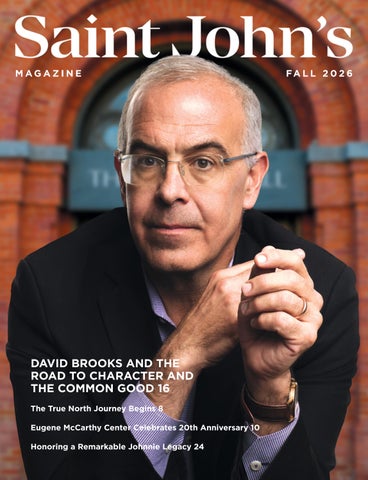
DAVID BROOKS AND THE ROAD TO CHARACTER AND THE COMMON GOOD 16 The True North Journey Begins 8 Eugene McCarthy Center Celebrates 20th Anniversary 10 Honoring a Remarkable Johnnie Legacy 24
FA L L 2 0 2 6
INSIDE THIS ISSUE
Features First Steps on a Bold New Path P. 8 FALL 2026 MAGAZINE
Saint John’s University and the College of Saint Benedict have begun rolling out the True North Journey – a distinct four-year experience designed to deliver on the promise to make an SJU and CSB education mean more.
20 Years of Opportunity and Engagement P. 10 That’s what the Eugene J. McCarthy Center for Public Policy and Civic Engagement has provided to students from all majors in its two decades of existence.
Remembering an Amazing Johnnie P. 24 Family and friends of Josh Fiedler ’03, who died unexpectedly in 2020, have pulled together to honor his legacy.
Share a story with a friend electronically at sjualum.com/saint-johns-magazine
8
10
SAINT JOHN’S MAGAZINE is the alumni magazine of Saint John’s University. It is published twice a year, in the spring and fall, by the SJU Office of Institutional Advancement.
Departments My Perspective
2
View from Collegeville
3
In Sight
28
Advancing the Mission
30
Service to the Church
36
SJU Athletics
38
Class Notes
42
PROJECT MANAGER Sarah Forystek EDITOR Frank Rajkowski frajkowsk001@csbsju.edu CREATIVE DIRECTION AND DESIGN Gearbox Creative CONTRIBUTORS Ruth Athmann Rob Culligan ’82 Dave DeLand Dana Drazenovich Michael Hemmesch ’97 Eric Hollas, OSB Ryan Klinkner ’04 Jim Kuhn ’02 Jordan Modjeski Hannah O’Brien Frank Rajkowski Rick Speckmann ’72 PHOTOGRAPHY Tom Morris ’89 Tommi O’Laughlin ’13 COVER PHOTO ILLUSTRATION Noted author and commentator David Brooks. Used with permission based on photo by ©Howard Schatz and Beverly Ornstein. UNIVERSITY ARCHIVIST Br. Eric Pohlman EDITOR EMERITUS †Lee A. Hanley ’58 ADDRESS CHANGES Ruth Athmann Saint John’s University P.O. Box 7222 Collegeville, MN 56321 rathmann@csbsju.edu
SJU ALUMNI ON SOCIAL Like us on Facebook at
facebook.com/sjualum Follow us on Instagram at
instagram.com/sjualumni
24
Follow us on LinkedIn at
linkedin.com/school/saint-john’s-university Find Saint John’s Magazine online at
sjualum.com/saint-johns-magazine @2026 Saint John’s University
MY PERSPECTIVE | PRESIDENT BRIAN BRUESS
A Journey With Purpose Twenty years ago, the Eugene J. McCarthy Center for Public Policy and Civic Engagement was founded with a simple but ambitious idea: that students learn best when they are invited to engage the world, not simply study it. Two decades later, that vision has never felt more relevant. As you’ll read in this issue, the McCarthy Center has become far more than a place to explore public policy or prepare for careers in government. It has become a place where students discover confidence, build meaningful relationships and begin to see themselves as people capable of making a difference. Again and again, I hear the same theme from students involved with the center. They arrive curious but uncertain. They leave with something much more enduring than a résumé line. They leave believing they belong in rooms where important decisions are made. They leave knowing they can ask thoughtful questions, navigate disagreement with respect and contribute to the common good. That kind of transformation is, at its heart, what a Benedictine liberal arts education has always been about. It’s also why the McCarthy Center feels so closely connected to our vision for the True North Journey. The True North Journey goes beyond helping students find internships, mentors or career pathways. It helps students discover who they are, what gifts they have been given and how those gifts can be placed in service of others. It intentionally connects the classroom with real-world experience, alum mentorship, reflection and vocational discernment so that every student graduates prepared not only for a first job, but for a meaningful life.
President Brian Bruess
In many ways, the McCarthy Center has been living that model for 20 years.
As you’ll read in this issue, the McCarthy Center has become far more than a place to explore public policy or prepare for careers in government. It has become a place where students discover confidence, build meaningful relationships and begin to see themselves as people capable of making a difference.
In September, the center will mark its 20th anniversary by welcoming bestselling author and New York Times columnist David Brooks for the 20th Annual Eugene J. McCarthy Lecture. His topic – The Road to Character and the Common Good – could not be more fitting. Character is formed through the daily choices we make, the relationships we build and the opportunities we have to serve something larger than ourselves. Those are precisely the kinds of experiences the McCarthy Center has been cultivating for two decades.
As I visit with alums, one of the qualities I hear about most often is the generosity of this community. Time and again, Johnnies and Bennies step forward to mentor students, create internships, offer advice and encourage the next generation. The McCarthy Center has become one of the clearest expressions of that generosity, connecting students with alums who are eager to help them grow in confidence, recognize their gifts and prepare for lives of meaningful leadership.
Its students have the opportunity to hear distinguished leaders speak, yes – but they also organize the events, welcome the guests and engage them in conversation. They both learn about civic engagement and practice it. They build professional networks and become part of a community of Johnnies and Bennies eager to open doors for those who follow. Those experiences matter because they cultivate something that cannot be taught through lectures alone: confidence. Confidence to introduce yourself to someone you admire. Confidence to tackle unfamiliar challenges. Confidence to imagine a future that once seemed beyond reach.
2 | SAINT JOHN'S UNIVERSITY MAGAZINE
As we celebrate this milestone anniversary, I am deeply grateful to the visionaries, benefactors, faculty, staff and alums who have shaped the McCarthy Center over the past 20 years. Most of all, I am grateful for the students who continue to remind us what is possible when talent is matched with opportunity. Their stories affirm something we have long believed at Saint John’s and Saint Ben’s: Education is about preparing students to live with purpose, to lead with integrity and to serve generously. That has been the McCarthy Center’s legacy for 20 years. It is also the promise of the True North Journey, and one of the many reasons I remain so optimistic about the future of these remarkable institutions.
VIEW FROM COLLEGEVILLE
Daniel J. Lee Named Inaugural Joint Vice President for Institutional Advancement at SJU and CSB “His leadership will help us build on the solid foundation already in place, deepen engagement across our community and grow the resources needed to support our students and our future.” Lee previously served as vice president for University Relations at Pacific Lutheran University in Washington, where he led an integrated division that included advancement, marketing and communications and engagement. He has also held senior leadership roles in external relations and development within the nonprofit sector. “Across his career, Dan has focused on connecting institutions with the people and partners who believe in their work – strengthening alum engagement, expanding philanthropic support and developing innovative partnerships that enhance student opportunity and institutional sustainability,” Bruess said in announcing his hiring to the campus community.
Building on an already strong history while charting a bold path for the future. That’s the mission Dan Lee has now undertaken. Lee began his new role as the inaugural vice president for institutional advancement at both Saint John’s University and the College of Saint Benedict this past August, making him the first joint leader to serve both institutions in this role.
In this new integrated advancement leadership position, Lee will help align strategy, strengthen coordination across both campuses and position the institutions for continued growth in philanthropy and engagement. “Dan is a thoughtful and strategic leader who understands how to build relationships, align teams and inspire investment in mission-driven institutions,” said Brian J. Bruess, president of the College of Saint Benedict and Saint John’s University.
In his new role, Lee will lead fundraising and alum and parent engagement across both campuses. He will play a central role in strengthening relationships with alums, parents and friends while helping grow the philanthropic and partnership support that advances student success and institutional priorities. Lee will build upon the impressive track record of advancement success at SJU and CSB led respectively by Rob Culligan and Heather PieperOlson and their teams. Pieper-Olson recently accepted the vice president of Advancement position at St. Cloud State University, and Culligan will continue in a joint senior Advancement position for SJU and CSB.
FALL 2026 | 3
VIEW FROM COLLEGEVILLE
Brett Mushatt ’98 to Receive Bob Basten Award BY | FRANK RAJKOWSKI He remained in the area after graduating from SJU in 1998, working first in a variety of roles with the Boys and Girls Club of Central Minnesota. He still sits on the organization’s board of directors. But in 2002, he switched gears to pursue a career in law enforcement. After joining the St. Cloud Police Department as an officer, Mushatt has steadily risen through the ranks. He was promoted to assistant chief in 2022. He’s also been a member of the League of Minnesota Cities Insurance Trust Peer Support Advisory Board, composed of professionals from law enforcement, the fire service and mental health professions. And he’s been a longtime volunteer coach at Sauk Rapids High School, spending 17 seasons working with the defensive backs in football and the past seven in track and field. For those efforts, and numerous others, Mushatt has been named the recipient of this year’s Bob Basten Award, presented annually to a former Johnnie football player who has exhibited outstanding leadership traits, is involved with his community and alma mater, has carried a sense of fair play beyond the football field and has demonstrated an overall commitment to excellence. It’s named in honor of Basten ’82, who went to training camp with the Minnesota Vikings before embarking on a successful career as a business executive. He died in 2012 after a decade-long battle with ALS/Lou Gehrig’s Disease.
The Central Minnesota community has always meant a great deal to Brett Mushatt. The former Johnnie All-American defensive back grew up in the region and graduated from St. Cloud Tech High School in the spring of 1994. He chose to go to college here as well, picking Saint John’s over larger schools like the University of Minnesota and South Dakota State, which had also shown recruiting interest. “Saint John’s seemed like a good fit for me,” he recalled. “I wanted to stay closer to home. We didn’t go many places when I was growing up, so this community and this area have always been really important to me.” Mushatt became a four-year starter in Collegeville, earning All-MIAC honors as a junior and senior and All-American distinction during his junior season in 1996. His nine interceptions that fall remain tied for third place in school history, and his career total of 15 is tied for third on the program’s all-time list as well.
4 | SAINT JOHN'S UNIVERSITY MAGAZINE
Mushatt will receive the award at halftime of the Johnnies’ matchup against Bethel, scheduled for 1 p.m. on Oct. 3 at Clemens Stadium. “One of the hallmarks of the Bob Basten Award is service to the community,” SJU head coach Gary Fasching said. “Brett Mushatt has given back to the community in so many ways. In his role as assistant police chief, he’s helped to lead efforts to make St. Cloud a safe community. He has worked to build trust between community members and the police department. Brett has been a volunteer for many organizations and has also given his time to help coach football. “The same things that made Brett an outstanding football player at Saint John’s, he has carried into his professional career. Service, leadership and treating people the right way are values that Brett cares deeply about. He has worked hard to make the world a better place, and he continues to excel in his work and community involvement. “For all the things that he stands for, Brett Mushatt is more than deserving of the Bob Basten Award.”
VIEW FROM COLLEGEVILLE
Trent Kirchner ’00 Settles into New Role as Vikings Assistant General Manager BY | FRANK RAJKOWSKI
Trent Kirchner is proving you can indeed go home again.
“It’s going well,” Kirchner said in July. “It’s been drinking through a firehose to some extent because we’ve been trying to do a lot of things in one month that you usually have a full offseason to do. But the support we’ve gotten has been great.
The family just moved into a new home in the Twin Cities suburbs and Kirchner spent this summer getting acclimated to his new role – one that reunites him with SJU graduate Ryan Monnens ’98, the Vikings director of player personnel.
The 2000 Saint John’s University graduate spent the past 16 years with the NFL’s Seattle Seahawks, serving as assistant director of pro personnel, then as vice president of player personnel.
“It’s just an amazing opportunity to have the chance to come home and work for the team I cheered for as a kid. I can remember going to school on Monday mornings and being sky high when the Vikings won and really mad when they lost. So I know the kind of passion that exists in the fanbase here.”
The two first got to know each other as teammates on the Johnnie football team in the late 1990s and have remained in touch as they’ve climbed the NFL ladder.
During his tenure, he helped lead the team to three Super Bowl berths and a pair of Super Bowl titles – including a 29-13 victory over the New England Patriots in Super Bowl LX this past February. But earlier this summer, he was named to an assistant general manager position with the Minnesota Vikings – the team the Fulda, Minnesota, native grew up rooting for. The move reunites him with Nolan Teasley, who was named the team’s new general manager on June 1. Teasley spent the past 13 seasons with the Seahawks, including the last three as the team’s assistant general manager.
Kirchner said family played a huge role in his decision to take his new job. “It was really about (my wife) Jessica and the boys (Carter and Landon),” he said. “I wouldn’t have made this decision without them being OK with it. Jessica was born in North Dakota, so she knows this area. And our sons have been back here visiting a lot. We’re now near my parents (Ron and Diane, who still live in Fulda) and my brother Troy lives in Mendota Heights. We’ve never been able to live close to family like this before. “So that’s an exciting part of it all.”
“I have so much respect for everything Ryan has accomplished over the course of his career,” Kirchner said. “We’ve had the chance to talk frequently over the years and he does a great job. It’s great to now get the chance to work alongside him.” He’s also been able to reconnect with other SJU graduates like Jake Essler ’14, one of the team’s college scouts, and Nick Maurer ’03, the Vikings’ vice president for corporate partnership sales. “I first got to know Jake through the Saint John’s connection and it’s exciting to get to work with him as well,” Kirchner said. “And I first got to know Nick when he was in high school because his brother Ben is one of my best friends from SJU.”
SJU Class of ’26 Leaps into Postgraduate Life The 169th annual commencement ceremony was held on the morning of May 16 in the Saint John’s Abbey and University Church. A total of 376 graduates (340 undergraduate and 36 graduate students from the Saint John’s School of Theology and Seminary) took part. Among graduating Johnnies, the top majors were global business leadership (77), accounting (56), exercise and health sciences (28), computer science (20), finance (18) and psychology (18).
FALL 2026 | 5
VIEW FROM COLLEGEVILLE
New Members Join Boards of Trustees A group of new members was named to the College of Saint Benedict and Saint John’s University Boards of Trustees on July 1. The new trustees are: Shelly Bauerly Kopel ’90 Bauerly Kopel serves as partner for Granite Partners and has been a key operating partner with the firm since its founding. Bauerly Kopel brings considerable prior experience from her work with Venture Allies. Before that, she was program director for the Bush Leadership Program at the Carlson School of Management. She is a Saint Ben’s graduate and holds a Master of Education from Harvard and MBA and Ph.D. in education administration from the University of Minnesota.
Mark Fisler Fisler is a partner and managing director of Ocean Park. During the last several decades, he amassed significant senior leadership experience as an investment banker, a corporate financial advisor, a business executive and an owner. He also has experience as a C-suite executive in ag processing and has served on numerous boards within the ag supply chain and biofuels industries. During his 18-year tenure at Piper Jaffray, Fisler managed the offering of over $10 billion in investment grade rated bond offerings, structured debt financings and securitizations and led more than $500 million in private equity offerings for food, agribusiness and biofuels companies. Fisler received both a bachelor’s degree in finance and a bachelor’s degree in economics, cum laude, from the University of St. Thomas.
Heidi Hovland ’88 Hovland is founder of Altitude Co, a boutique communications company. An award-winning communicator, she is passionate about creating strategies and campaigns that drive companies forward, solve business problems, create new opportunities, influence internal and external stakeholders, and protect and strengthen reputation and leadership. A former agency CEO, Hovland led practices and sectors for the world’s leading agencies, including DeVries Global, FleishmanHillard and Edelman. With broad sector expertise and a generalist’s ability to shift easily between a wide range of client needs, Hovland has served as trusted advisor to C-level and senior
6 | SAINT JOHN'S UNIVERSITY MAGAZINE
executives within some of the world’s most respected companies, including Procter & Gamble, Johnson & Johnson, Celebrity Cruise Lines, IHOP and Chobani. Hovland is a graduate from Saint Ben’s with a Bachelor of Arts degree in English and communication.
Colette Peters ’93 Peters is the federal court– appointed receiver for CDCR’s Mental Health Service Delivery System, appointed in August 2025 and charged with creating a constitutionally adequate mental health care system in California prisons. She previously served as director of the Federal Bureau of Prisons (2022–25), leading 40,000 employees, 160,000 incarcerated individuals and an $8 billion budget. She served as director of the Oregon Department of Corrections (2012–22). She is a proud alumna of Saint Ben’s.
Xiani Medina ’28 CSB Student Trustee Representative 2026-27 Medina is a junior at Saint Ben’s, majoring in sociology with a minor in psychology. She plans to pursue a Master of Social Work following her undergraduate studies. Medina is actively engaged in campus life, singing in the Women’s Chorus, working at Saint John’s Institutional Advancement and leading efforts to reestablish a service sorority on campus.
Francis Koll ’29 SJU Student Trustee Representative 2026-27 Koll is a sophomore at Saint John’s, majoring in English and political science with a minor in theology. He serves on the Saint John’s Senate and works at both the Eugene McCarthy Center for Public Policy and Civic Engagement and the circulation desk at Clemens Library.
Complete bios of all board members can be found on the Boards of Trustees website. csbsju.edu/about/boards-of-trustees
VIEW FROM COLLEGEVILLE
Judge Reynaldo Aligada ’98 Appointed to Seat on Minnesota Supreme Court BY | FRANK RAJKOWSKI
Ramsey County District Court Judge Reynaldo Aligada Jr., a 1998 Saint John’s University graduate, has been appointed to an associate justice seat on the Minnesota Supreme Court. According to his official Minnesota Judicial Branch biography, he has worked as an associate attorney with the firm of Robins, Kaplan, Miller and Ciresi LLP, and as a judicial law clerk to the Honorable Michael J. Davis of the United States District Court for the District of Minnesota and the Honorable Wilhelmina M. Wright of the Minnesota Court of Appeals. The release states he currently serves as chair of the Minnesota Supreme Court Advisory Committee on the Minnesota Rules of Evidence, as well as being a member of the Tribal Court State Court Forum and the Committee on Minnesota Civil Jury Instructions. According to his biography, he has also received a special achievement award from the Minnesota Association of Criminal Defense Lawyers and was named an “Up and Coming Attorney” by Minnesota Lawyer. After obtaining his Bachelor of Arts from SJU, he went on to obtain his Juris Doctor at William Mitchell College of Law in St. Paul.
The appointment was announced May 19. In a LinkedIn post, the Minnesota Asian Pacific American Bar Association noted the appointment makes Aligada the first Asian Pacific American justice in Minnesota Supreme Court history.
“I am so grateful to the governor and his team for entrusting me with this great responsibility. I recognize the impact the court’s decisions have on the lives of Minnesotans, and I will strive to do justice and protect the rule of law.”
He will fill the vacancy created by Governor Tim Walz’s appointment of Justice Theodora Gaïtas as the court’s chief justice.
Aligada was appointed to his Ramsey County District Court seat in 2019. He was then elected to the post in 2020.
“I am humbled and honored to be selected as an associate justice of the Minnesota Supreme Court,” Aligada said in an official release.
The release notes his past work in the Office of the Federal Defender in Minneapolis, first as an assistant federal defender, then as a first assistant federal defender.
“It is my distinct honor to appoint Judge Aligada to the Minnesota Supreme Court,” Walz stated in the release announcing the appointments. “He is someone who leaves a lasting impression on everyone he meets, pairing a keen legal mind with genuine humility and compassion. He will be a justice who truly sees and listens to the people who come before him, ensuring every voice is heard and respected. “In addition to his outstanding judicial background, he will bring a perspective not yet represented on this court, the voice of Minnesota’s Asian Pacific Islander community, further strengthening the court’s connection to the people it serves.”
FALL 2026 | 7
TAKING THE FIRST STEPS ON THE
Every great journey begins with a first step.
Three key elements will go into making that happen:
That’s exactly what’s happening at Saint John’s University and the College of Saint Benedict this fall.
Each student will be connected to their own personalized team – a dedicated group of mentor navigators matched to their interests, goals and academic path. That team will help guide them through their entire four-year journey.
The two schools have begun rolling out the True North Journey – a distinct four-year experience designed to deliver on the promise to make an SJU and CSB education mean more. It’s an initiative based on mentorship, reflection and real-world learning, making sure a student’s time on campus leads to more than just a major. “Education is fundamentally about relationships,” SJU and CSB President Brian J. Bruess said. “The professors who challenge you, the staff members who encourage you, the alums who open doors, the classmates who become lifelong friends – those connections shape who you become. “The True North Journey is our commitment to making sure every student experiences that kind of mentoring, discovers a deeper sense of purpose and graduates with the confidence and relationships to make a meaningful difference in the world.”
The True North Team
Mentorship-centered community Each student will have the chance to define their purpose in relation to the world’s needs through meaningful relationships with mentors. Their Network Navigator will help connect them with developmentally appropriate opportunities, starting with first-year meet-and-greets to more profound one-to-one mentor relationships beginning as a sophomore.
M eaningful access to experiential opportunities Every student will get the chance to transform classroom concepts into real-world action. That includes the internships, study-abroad and undergraduate research opportunities and community-engaged learning that have long been a hallmark of the SJU and CSB experience. But beyond that, through True North Team advisors and peer resources, they’ll hear even more consistently, more frequently and with more encouragement about the importance of experiential learning and how to access more of those chances for hands-on experience that will give them a leg up when it comes to future career paths. The framework for making it all happen is already in place, harnessing currently existing resources and adding new ones at the same time. That includes a team of eight Academic and eight Career Navigators, as well as two new Network Navigators on staff this academic year, with two more to follow in 2027-28.
8 | SAINT JOHN'S UNIVERSITY MAGAZINE
The Academic Navigators are tasked with everything from helping a student explore majors to building a four-year plan and connecting coursework with personal and professional purpose. The Career Navigators, meanwhile, will help students translate their interests and academic experiences into real-world opportunities like internships, career exploration and preparation for entering tomorrow’s workplace.
The path students follow looks like this:
Year 1: Chart tudents explore their strengths, values S and aspirations while beginning to discover who they are and what they want to be.
The Network Navigators are specialized connectors, building bridges between each student and the vaunted SJU and CSB alumni network, as well as with other professional partners – giving Johnnies and Bennies a leg up on future aspirations.
Year 2: Test
“The True North Journey is not a brand-new thing, but rather a way of really leaning into things we do well already,” said Aaron Voth, the Assistant Dean for Student Leadership and Engagement at SJU and CSB. “The exciting part of this is we’re doing them more intentionally now.
Year 3: Build
“We’ve had academic advisors and career advisors. We’ve had this vast Bennie and Johnnie alumni network. But students had to opt into those opportunities. Now, they have to opt out. We’re making a promise that if you come to Saint Ben’s and Saint John’s, you will have access to all these opportunities and the framework for accessing them will already be in place for you.” This fall’s class of incoming first-year and transfer students are the first to begin the process. That started with fall orientation this past August, now rechristened as Basecamp.
“The True North Journey is not a brand-new thing, but rather a way of really leaning into things we do well already. The exciting part of this is we’re doing them more intentionally now.” Aaron Voth Assistant Dean for Student Leadership and Engagement at SJU and CSB
There, students had the chance to meet with members of their individualized True North Team and get familiar with all the resources available to support their academic, personal and social success. Each student also took the CliftonStrengths assessment, helping generate information about themselves that can be used to help guide their four-year path. “We made sure to carve out time to make those connections happen so students were introduced to that network of support right away,” Voth said.
Students consider bold ideas and push at the edges of what’s possible while growing in confidence.
tudents round out their skills, S expand their reach and chart their way forward with purpose and clarity.
Year 4: Launch Students take big steps toward their transition to postgraduate life.
It’s all part of a framework designed to ensure students graduate prepared to lead a life of impact, confidence and meaning, shaped by who they are and what they’re called to become. “It’s incredibly impressive how quickly this has come together – from an idea to the operationalization of this plan,” said Kevin Clancy ’00, the assistant dean for Experiential Education at SJU and CSB. “It speaks to the fact that this has truly been a cross-institution endeavor. People from all across Saint Ben’s and Saint John’s have come together to breathe life into this. “It’s been an exciting process to be part of.” It helps that plenty of this kind of work has already been going on across the two campuses – including at the Eugene J. McCarthy Center for Public Policy and Civic Engagement, which is celebrating its 20th anniversary this academic year (see story on Page 10). “The kinds of experience students have long been getting at the McCarthy Center, at the Donald McNeely Center for Entrepreneurship and at many other places is what we want to expand to include all students now,” Clancy said. “The mentorship, the connection between classroom learning and learning outside the classroom. “So many of our students have already been experiencing that, but it’s been in silos. The True North Journey is about making sure its campus-wide.”
FALL 2026 | 9
20 YEARS OF LIMITLESS
POSSIB The Eugene J. McCarthy Center for Public Policy and Civic Engagement at SJU and CSB has opened new doors to students over the past two decades. BY | FRANK RAJKOWSKI Real-world, hands-on experience. Access to a deep and supportive alumni network ready to offer valuable guidance and support. Abundant opportunities to build confidence and develop critical thinking and leadership skills. Francis Koll has found all that and so much more through his work at the Eugene J. McCarthy Center for Public Policy and Civic Engagement at Saint John’s University and the College of Saint Benedict. “As college students, we have all these ambitions when it comes to what we want to go on and achieve,” said Koll, a sophomore at SJU majoring in political science and English. “The McCarthy Center makes those dreams seem like less of a moonshot.
SJU sophomore Francis Koll delivers the introduction for the 19th annual McCarthy Lecture last March.
“Having the chance to plan events and get to know the nationally renowned speakers we bring in has done so much to increase my confidence,” he continued. “I can’t put into words what a privilege it was to meet someone like (former National Security Director) Jake Sullivan or (former White House Chief of Staff and Secretary of Veterans Affairs) Denis McDonough. “These are people who have been in the rooms where it happens. But when you get to know them, you realize they’re just human beings like you or me. It’s a powerful reminder that we can go on to make real impacts as well. That’s one of the biggest things I’ve realized working here. It’s made my future goals more accessible.” The McCarthy Center – which is celebrating its 20th anniversary during the 2026-27 academic year – was founded as a way to honor the rich
McCarthy Center director Matt Lindstrom (far left) and student staffers drive a consistently excellent level of programming at the center.
BILITIES columnist, author and political commentator David Brooks.
CSB junior Alayna Furman (far left) and other members of the McCarthy Center staff pose with SJU graduate and former White House Chief of Staff and Secretary of Veterans Affairs Denis McDonough (center) prior to a Politics and Pasta event during the 2025-26 academic year.
tradition of government service and civic achievement that has long existed on and off the campuses. It was also a way to centralize the many resources and opportunities already available to students interested in exploring public policy and civic engagement, while continuing to expand those offerings. But perhaps its biggest benefit is providing students a sense of their limitless future possibilities. “The McCarthy Center is the most exciting place to be on campus,” said CSB junior Alayna Furman, one of the McCarthy Center’s student coordinators. “There is so much there within reach. It’s all very centralized and the center provides support to help you navigate it. It’s unlike anything I thought I’d be able to experience in college. “In the year and a half I’ve been engaged here, I’ve really been forced to step outside my shell in ways that, at the time, were incredibly daunting. But it’s helped me reframe how I understand myself and my place in the world. We talk a lot in
our team meetings about imposter syndrome. That feeling when you’re interacting with alumni, or meeting people from much larger institutions, and you think ‘What am I doing here?’ and ‘Do I really belong?’ “The McCarthy Center has helped me dismantle that kind of thinking,” she continued. “It’s given me experiences that build confidence. I can now say I’ve done these things before and I know I can handle them. I feel more comfortable stepping out on a limb and challenging myself.”
• The Joe Farry Professorship, which supports faculty and student research on critical public policy issues. This rotating professorship has sustained numerous publications and community engagement projects on a wide range of topics, including Native American boarding schools, urban planning, racial covenants, economic policies, the SJU and CSB Bahamian partnership and Abraham Lincoln’s leadership. • Polidazzle, an annual event that connects current students with alumni, faculty and friends actively engaged in law, government, politics and public policy. • The McCarthy Center Mentor Program, in which students are connected with friends of the McCarthy Center in a wide variety of fields, gaining valuable experience through informational interviews, job shadowing, personalized feedback on résumés and cover letters and much more.
Challenging herself through opportunities and experiences like: • The annual Eugene J. McCarthy Lecture, which in the past has attracted notable names like Sullivan and McDonough (a 1992 SJU graduate), as well as current or former U.S. Senators Dave Durenberger (SJU class of 1955), Amy Klobuchar, Tina Smith, Chris Dodd and Chuck Hagel. It has also drawn prominent national media figures like Tom Brokaw, the late Cokie Roberts and, this year,
Jon McGee and his son Andrew, both SJU graduates, attend a McCarthy Lecture.
FALL 2026 | 11
Washington, D.C., study tours are one of the many experiences and opportunities the McCarthy Center provides.
• The Washington, D.C., Summer Program, now in its 47th year, is run by the SJU and CSB Political Science Department but is partially supported by the McCarthy Center through programs like the John Brandl Scholars, which offers eligible students stipends to be used in support of summer internships. • Study tours that provide experiential learning opportunities for students to meet with professionals and learn more about careers and policy issues through hands-on site visits and conversations. “It really comes down to confidence, skills and connections,” said Matt Lindstrom ‘92, the, McCarthy Center’s founding director and the Edward Henry professor of political science at SJU and CSB. “In high
school, students aren’t always taught how to speak with adults, how to debate issues, how to act in professional meetings, how to write a grant or even how to speak into a microphone. “We try to provide opportunities where they can gain confidence doing all those things and more. They see they can make an impact in these areas because they’re doing it every day through the opportunities the center offers. And they have the chance to see others around them or recent graduates making an impact, too. “So, what at first looks to be very difficult, imagining themselves as say a judge or a minister of finance, starts seeming more obtainable,” he continued. “Windows start opening through the sense of confidence they’re gaining.”
The McCarthy Center is named for former U.S. Sen. Eugene McCarthy, an SJU alum.
Honoring a legacy That attitude was personified by the McCarthy Center’s namesake, former Sen. Eugene McCarthy. A native of nearby Watkins, Minnesota, McCarthy was a standout student and athlete at SJU before graduating in 1935. He later spent time as a faculty member at the school before embarking on a political career that included stints in the U.S. House of Representatives and the U.S. Senate. McCarthy is best known for his longshot anti-Vietnam War run for the Democratic presidential nomination in 1968. It was his surprisingly strong showing against incumbent Lyndon Johnson in the New Hampshire primary that year that is widely considered to have persuaded Johnson to withdraw from the race, which brought fellow Sen. Robert F. Kennedy into it. McCarthy went on to mount two more presidential bids. He never wavered in his strong connection to his alma mater – returning to campus often over the years. “Saint John’s became a huge part of his life,” his daughter Ellen said. “It was a major influence on him. Throughout his adult life, it was always a safe place he could come
12 | SAINT JOHN'S UNIVERSITY MAGAZINE
back to and spend time trying to regroup and restore. Even in those dark days in 1968, after Robert Kennedy was assassinated and before the convention in Chicago, it’s where he came back to recharge. “Both Saint John’s and Saint Ben’s are quite remarkable for such small universities,” she added. “Look at the quality of the alumni and what they go on to do. It’s very impressive to have had so many senators and congressmen, cabinet members and corporate and military leaders all come out of this one place.” McCarthy said her father would be proud of the work the center named in his honor is doing. “He used to say, ‘Don’t let anyone name a highway after me,’ but I think he’d be very honored by what’s been established at the McCarthy Center,” she said. “It’s really a living memorial with such positive outcomes. So many important people have been and remain involved with it. “There’s a lot that needs to be done in our society today. There are huge challenges that need to be faced. There has to be new generations of leaders to meet them, and (the McCarthy Center) is playing a huge role in preparing those individuals for that task.”
Laying the foundation The McCarthy Center was preceded by the establishment of the Eugene J. McCarthy Lecture. It originated from a series of discussions involving then-SJU President Br. Dietrich Reinhart and Rob Culligan ’82 from Institutional Advancement in consultation with McCarthy himself before his death in December 2005, as well as some of his close friends who wanted to find a way to continue his legacy.
spending 12 years in the Minnesota state legislature. He was also a distinguished educator, including serving as dean of the Hubert H. Humphrey Institute of Public Affairs at the University of Minnesota and as a Distinguished Professor of Public Policy at SJU, where he also served on the school’s board of regents. “It was his vision to have a policy center on campus that reflected
That group included Michael Rubino of the U.S. State Department, Fr. William Byron of Georgetown University and Al Eisele, a 1958 SJU graduate, editor of The Hill and the author of a book about Eugene McCarthy and Hubert Humphrey titled “Almost to the Presidency.” Conversations were also had with McCarthy’s daughter Ellen and niece Mary Beth Yarrow McCarthy. The first lecture was held in 2006 and was delivered by nationally noted columnist E.J. Dionne. When it came to the center itself, it took a vast community working together to make it a reality. But certain names stand out. The first is John Brandl, a 1959 SJU graduate who went on to a long career in public service, including
Gen. Paul Nakasone and Matt Lindstrom.
Nationally noted columnist E.J. Dionne delivered the first McCarthy Center Lecture in 2006.
FALL 2026 | 13
the deep tradition of public service at these schools, and that would also provide a platform for current and future students to get involved in public policy discussions, experiences and debates,” Lindstrom said of Brandl, who died in 2008 after a battle with cancer. “He knew that as much as you could learn from textbooks and in the classroom, you also needed
guided engagement in public policy and government, which is the core purpose of the McCarthy Center.”
in particular,” Whalen said. “He’s brought an additional and special focus on our students.
Grants from the Bush Foundation helped fund a variety of programs on and off campus during the 200506 academic calendar. The center was established the following year when Lindstrom was named director and staff was hired.
“It’s turned into all we’ve envisioned and more. When you look at where the McCarthy Center is at now, it’s actually gone well beyond anything I could have ever imagined.”
Making it all possible was a $5 million gift from 1970 graduate Dan Whalen and his wife, Katharine, who were close with Brandl and wanted to make his vision a lasting reality. “Saint John’s and Saint Ben’s have always developed great leaders – before and since the founding of the McCarthy Center,” said Whalen, who later served as SJU’s interim president. “What the McCarthy Center has done is allow for students interested in public policy matters to be able to focus on those areas with a lot of assistance and direction. “It’s provided a focus and made it easier to direct those energies in positive and productive ways.”
Celebrated news anchor Tom Brokaw delivers the McCarthy Lecture in 2012.
Whalen and others are quick to credit Lindstrom’s leadership with playing a big role in making that happen. “We’ve had great leadership from a lot of people, but Matt
Former National Security Advisor Jake Sullivan (far right) and Mary Beth McCarthy Yarrow (second from right), niece of former U.S. Sen. Eugene McCarthy, meet with students.
14 | SAINT JOHN'S UNIVERSITY MAGAZINE
“One early thing Matt made sure of is that this wasn’t just a place for political science or history students,” added John Taylor, a 1958 SJU graduate and long-time official at the school who has played a big role at the center since its founding. “He wanted artists and nursing majors involved. He connected with alumni to create spots for them with summer engagements. He raised money from Johnnie and Bennie donors alike for scholarships. He’s done so much to grow the center into what it is today.” But Lindstrom said he’s had plenty of help. “Stacy Penk did a ton of work the first 11 years, and without her the McCarthy Center wouldn’t be what it is today,” he said. “And Anastasia Nathe, the current assistant, is really the staff member that runs the show. Both are CSB alums and have done so much to make this all work.”
Students attend the 21st yearly session of the Conference of the Parties to the United Nations Framework Convention on Climate Change.
Yielding the rewards The hundreds of students who have come through the McCarthy Center over the past two decades are quick to testify to the benefits the experience had when it came to their future careers. “When I went to one of the alumni events in D.C. last year, Matt mentioned the center was about to be 20 years old and that seemed unbelievable to me,” said Maude Cooper, a 2011 CSB graduate who was one of the center’s first student workers and has gone on to become a senior program officer at the Millennium Challenge Corp. in Washington, D.C. “It’s been so cool to see the sheer number of students who have benefited from all it’s had to offer. “Public policy involvement and civic engagement are so important to a healthy society. And that doesn’t start when you’re 37 like I am now. It starts with getting comfortable having those discussions when you’re younger. “It starts with learning to be open to different viewpoints and finding value in that process even if you don’t always agree with them,” she continued. “The McCarthy Center is a place where those conversations can happen.”
CSB junior Alayna Furman, a student coordinator at the McCarthy Center, calls the center the “most exciting place on campus.”
“For me, it was about the summer program in D.C. and the early opportunities I had to engage with the serious thinkers we brought to campus,” added Tom Freeman, a 2008 SJU graduate who is now the government relations director at Cargill. “It was having breakfast with someone like E.J. Dionne and talking about public policy issues. “And it was about all the alums who were willing to give their time to offer advice and assistance. That was invaluable to me.” Freeman has gone on to serve as a McCarthy Mentor himself, becoming part of an alumni network that is one of the center’s biggest assets. “I just think it has a ton of value,” said 2007 SJU graduate Luke Hellier, who is now the director of government affairs at Starkey Hearing and the mayor of Lakeville, Minnesota. “Finding post-college employment in the political world especially can often be about who you know. Having something like the McCarthy Center on campus gives you the opportunity to build up relationships that come in so handy after you graduate.”
law has been aided by my work at the McCarthy Center,” said Furman, who spent this past summer doing communication work in the office of U.S. Rep. Angie Craig. “I’ve gotten to speak with numerous attorneys in all different fields of law who are Bennies and Johnnies. Understanding the nuance of their experiences, how they got to where they are and what their day-to-day lives look like has been really eyeopening for me.” “We talk about the alumni network at these schools so frequently, but unique doesn’t really cover it,” Koll added. “It’s crazy how many alumni are willing to drop everything at a moment’s notice and help you out in any way they can. “That’s been really eye-opening for me, and that’s just part of the plentiful opportunities and experiences the McCarthy Center has to offer. “To have an organization like this at a school our size is really unprecedented,” he added. “I just feel so fortunate to be part of this community.”
That’s what current students like Koll and Furman are counting on. “Part of understanding my future career path and wanting to go into
FALL 2026 | 15
PROMINENT COLUMNIST AND COMMENTATOR DAVID BROOKS TO DELIVER
20TH ANNUAL MCCARTHY LECTURE BY | FRANK RAJKOWSKI
David Brooks has spent decades observing the American political and cultural scene. During that time, the best-selling author, contributing writer at The Atlantic and recurring commentator on PBS NewsHour – who also spent many years as a columnist for the New York Times – has gotten to know many of the key figures who have shaped recent U.S. history. But the ones who have impressed him most have shared a common trait. “The people I like in public life are those who can see beyond the polls and latest GDP numbers into the spiritual health of the country, which isn’t good at the moment,” he said. “But I always try to tell a hopeful story. We go through these kinds of rough patches every 60 or 70 years in the American system of government – those moments where it feels like we’re tearing it all down. They can be really hard to live through. Yet things get better. If you look at the 1960s, we had assassinations and bombings and unrest. But by the late 1970s and ’80s, things had calmed down again. The key is finding leaders who are able to come up with innovative solutions to our national problems.” Developing such future leaders is the mission behind the Eugene J. McCarthy Center for Public Policy and Civic Engagement at the College of Saint Benedict and Saint John’s University. That mission is reflected in the speakers who have been chosen to deliver the annual
McCarthy Lecture, an event that – like the McCarthy Center itself – is celebrating its 20th anniversary this academic year. Past speakers have included names like former National Security Advisor Jake Sullivan and former White House Chief of Staff and Secretary for Veterans Affairs Denis McDonough (a 1992 SJU graduate), as well as current or former U.S. Senators like Dave Durenberger (SJU Class of 1955), Amy Klobuchar, Tina Smith, Chris Dodd and Chuck Hagel. It has also drawn prominent national media figures like Tom Brokaw, the late Cokie Roberts and, this year, Brooks, who said he eagerly accepted the invitation to take part. This year’s lecture is scheduled for 7 p.m. on Oct. 6 at the Benedicta Arts Center on the CSB campus. “One of the things I like about speaking at Catholic schools, or any schools with a religious orientation, is that they seem to provide a true moral framework for their students,” Brooks said. “I think they often do a better job of impacting students’ lives. Education isn’t just about books and facts. It’s about your life and finding where you fit into the fabric of society as a whole.” Brooks added that he appreciates the impact the center’s namesake had on American politics. Former U.S. Sen. Eugene McCarthy, a 1935 SJU graduate, is best known for his long-shot anti-Vietnam War run for the Democratic presidential nomination in 1968. That campaign drew a strong following among younger Americans.
16 | SAINT JOHN'S UNIVERSITY MAGAZINE
“For a politician, I think Sen. McCarthy was pretty learned and thoughtful,” Brooks said. “He was a bit crusty, but that’s something a lot of young people seem to gravitate to. I see that today in the Bernie Sanders phenomenon.” In a way, it’s fitting Brooks should be the one to deliver the 20th annual installment of the lecture. The first installment, back in 2006, was delivered by fellow columnist E.J. Dionne – with whom Brooks has long appeared as a tandem on PBS and elsewhere. “I’m honored to follow in E.J.’s footsteps, though I’d be more honored if he were following in mine,” Brooks joked. Among the themes Brooks hopes to stress is the importance of being open to new experiences and ideas as students prepare to begin their professional lives. “I always tell younger people to try three radically different things during their 20s,” he said. “That’s how you find out what you like doing and what you don’t. You can’t think yourself into a calling. You have to try it out and see how it feels.” And, of course, Brooks said it is vitally important to have a familiarity with history. “One of the reasons the Founding Fathers were able to write the Declaration of Independence was that they read a lot of history,” he said. “They understood concepts like human rights and were able to articulate them. “I think it’s still just as important to be able to do that today as it was then.”
THE POWER OF THE JOHNNIE NETWORK
HELPED BRING DAVID BROOKS TO COLLEGEVILLE How did David Brooks wind up agreeing to deliver the 20th annual Eugene J. McCarthy Lecture this October? It’s actually a quintessential Johnnie story. “This whole thing got started when Joe Cavanaugh ’81 sent me an article by David Brooks called How America Got Mean,” said Fred Senn ’64, the founding partner at Fallon Worldwide and a former member of the SJU Boards of Regents and the Alumni Board. “I contacted (SJU and CSB) President (Brian) Bruess to bring it to his attention – only to learn that he was not only aware of it but was also struck by its relevance to our educational mission. “What struck me about the article was that Brooks was lamenting how colleges were abdicating their duty to teach moral formation,” he added. “In my experience, Saint John’s had never failed to instill a moral sense of purpose. It’s part of our DNA; it’s part of being a Johnnie.” Bruess then sent Brooks a letter commending him on the article and thanking him for articulating something many have been sensing for some time – that beneath much of our political polarization and social fragmentation is a deeper crisis of moral and relational formation.
“In a season shadowed by political violence, your thesis – that we are living in a culture disconnected from moral formation – could not be more timely,” Bruess wrote. “Your essay makes clear that many Americans sense something missing in contemporary life: a shared vocabulary of virtue, a framework of meaning larger than politics or selfinterest. Our conviction at SJU and CSB is that Benedictine practices – rooted in hospitality, balance, listening and respect – offer one path toward renewal.” From there, a pair of prominent Johnnies – Denis McDonough ’92, a former White House chief of staff and secretary of veterans affairs, and Bill Kling ’64, founder of Minnesota Public Radio – added their voices to the process. McDonough, who knows Brooks personally, sent him an email. “I’m writing to you about my alma mater, Saint John’s University in Collegeville, Minnesota, a community founded by Benedictine monks that cherishes many of the same values that you hold dear,” McDonough wrote. “You may have heard of Saint John’s’ influential role in global Church reforms of Vatican II, of Saint John’s as the training ground of Senators Gene McCarthy and Dave Durenberger, of it as the birthplace of Minnesota Public Radio, of it as the first Catholic university in the country
Fred Senn ’64
Joe Cavanaugh ’81
to establish a Chair in Jewish Studies, or, failing all that, you may have heard of it as home to the winningest coach in football history, John Gagliardi (whom McDonough played for).” “And now for a request. Saint John’s would like to invite you to deliver the annual McCarthy Lecture at Saint John’s. It is named after the late Sen. Eugene McCarthy, and the first person to deliver the McCarthy Lecture was your friend (and fellow columnist) E.J. Dionne. You would be the 20th.” Brooks said it was an offer he eagerly accepted. “I think the world of Denis,” he said. “I also had the chance to get to know Dave Durenberger really well over the years. I’ve always been a fan of his. He came to my wedding, and later in his life, he came to a talk I gave in St. Paul. So over the years, I’ve built connections to Minnesota, and to graduates of Saint John’s.” The final step then came when – in classic Saint John’s fashion – a Johnnie alumnus quietly stepped forward and offered to fund the lecture, without recognition or fanfare. No spotlight. No conditions. Just a belief that bringing thoughtful voices and meaningful conversations to Saint John’s matters. To round things out, during the McCarthy Lecture, Brooks will be interviewed by another Johnnie, Bill Pelfrey ’88, former executive in residence for the CSB+SJU Donald McNeely Center for Entrepreneurship and co-creator of Grand Illuminations.
Bill Kling ’64
Denis McDonough ’92
Bill Pelfrey ’88
David Durenberger ’55
FALL 2026 | 17
FOR
20 20:
MCCARTHY CENTER ALUMS
LOOK BACK ON EXPERIENCES GAINED AND LESSONS LEARNED
Meghan Mullon
Anna (Cron) Bowles
Graduation year: 2018
Graduation year: 2016
Major: Political science
Major: Political science and Latino and Latin American studies
Role at or involvement with the McCarthy Center: Student coordinator Present job: Legislative Director to Rep. Angie Craig (D-MN-02) What is your best memory from your involvement with the McCarthy Center: Meeting my fiancé, Nash, who also worked as a student coordinator! What role did the McCarthy Center play in preparing you for your professional career: Working at the McCarthy Center taught me the value of community-centered service. I learned how to create spaces where those with different backgrounds and perspectives could feel comfortable engaging. These skills have served me well as I continue to navigate our country’s increasingly polarized political landscape in both my professional and personal capacities.
by providing opportunities for professional development, experiential learning and meaningful networking. Through its programs, I strengthened the skills and confidence needed to explore different career paths while building relationships with alumni and professionals through informational interviews. Those conversations often led to invaluable career and lifestyle advice, lasting friendships and ongoing mentorship – helping shape both my professional journey and long-term career goals.
Role at or involvement with the McCarthy Center: Student worker; McCarthy Mentor Program coordinator Present job: International Trade Specialist at U.S. Department of Commerce What is your best memory from your involvement with the McCarthy Center: It’s hard to choose just one! Some of my favorite experiences include Politics and a Pint, connecting with incredible alumni through the Mentor Program and receiving financial support as a Robson and Brandl Scholar – which made it possible for me to complete summer internships in both Bosnia and Herzegovina and Washington, D.C., as well as to travel to Paris, France, as part of the inaugural SJU and CSB student delegation to COP21, where we observed the United Nations climate negotiations firsthand. What role did the McCarthy Center play in preparing you for your professional career: The McCarthy Center played a pivotal role in preparing me for my career
18 | SAINT JOHN'S UNIVERSITY MAGAZINE
Luke Hellier Graduation year: 2007 Major: Political science Role at or involvement with the McCarthy Center: Helped establish the center during my senior year Present job: Mayor of Lakeville, Minnesota; Director of Government Affairs at Starkey Hearing What is your best memory from your involvement with the McCarthy Center: My best memory was working with Matt Lindstrom and Luke Fischer to establish the Polidazzle event as a way for current students to interact with alums working in public policy.
These experiences helped lay a very strong foundation for my career as I approached graduation, especially as a student on campus during the pandemic when opportunities were sometimes more limited. It also helped clarify what I did and did not want to pursue after graduation, which I considered some of the most valuable insight I could gain at the time.
Kate Fenske
Lindsey (Gideon) Minto
Graduation year: 2023
Graduation year: 2013
Major: Integrative science (public health concentration)
Major: Biology
Role at or involvement with the McCarthy Center: Student coordinator; McCarthy Mentor Program as mentee (as a student) and mentor (as an alum) Present job: Engagement and Stewardship Manager with Wilderness Inquiry What is your best memory from your involvement with the McCarthy Center: One of my favorite memories was planning and executing the New York City study tour over winter break of 2022. The program took place during the tail-end of the COVID-19 pandemic, which made organizing events and travel especially challenging. Despite that, the study tour provided a much-needed opportunity for students to come together, travel and learn in person after more than a year of limited inperson opportunities. During the trip, we met with alumni and other SJU and CSB connections in the New York area and visited several museums and historic sites. I also had the chance to see journalist and author Robert Costa speak at Polidazzle. At the time, I was working as a managing editor for The Record on campus. His remarks about the importance and responsibility of journalism felt especially meaningful and directly relevant to my own interests. What role did the McCarthy Center play in preparing you for your professional career: The McCarthy Center had a strong influence on my career development. My two years working there provided remarkable networking opportunities – from shaking hands with U.S. senators and federal officials to traveling across the country to connect with influential CSB and SJU alums.
Role at or involvement with the McCarthy Center: Student coordinator; Washington, D.C., study tour participant
Luke Fischer Graduation year: 2008 Major: Political science Role at or involvement with the McCarthy Center: Student worker Present job: League of Minnesota Cities Executive Director What is your best memory from your involvement with the McCarthy Center: My favorite part about the early days of the McCarthy Center was seeing the vision Matt Lindstrom began to lay out for what the center could be. He brought in speakers on a wide array of topics, urged civil (yet spirited) debate and talked about “nuance” more than anyone else! We visited Washington, D.C., and had the chance to meet with an alum doing important policy work on the Hill. Gaining that exposure was inspiring! What role did the McCarthy Center play in preparing you for your professional career: A lot of campus policy and political work happens in a super-partisan way. It’s easy to lump ideas together and carry them around as a shield or a projectile. Through the McCarthy Center, I came to appreciate that a lot of the work that needs to happen on behalf of the public does not need to have an R or D by it. It’s probably better when it doesn’t. In my line of work, we always say there isn’t a Republican or Democrat way to fill a pothole – it just needs to be filled. And the McCarthy Center helped me develop that understanding.
Present job: Manager Revision Knee Marketing, Stryker What is your best memory from your involvement with the McCarthy Center: I had a great time on the Washington, D.C., study tour. And I really enjoyed meeting Tom Brokaw and being his “bodyguard” during his visit to campus to deliver the McCarthy Lecture. What role did the McCarthy Center play in preparing you for your professional career: The McCarthy Center provided great exposure to various areas of public service. As a student coordinator, I learned a lot through planning the McCarthy Lecture. It connected me to the D.C. alum community and drove my passion to live there. I’m proof that the McCarthy Center is for all majors, not just political science.
Katie Tillman Graduation year: 2015 Major: Political science and German Role at or involvement with the McCarthy Center: Volunteer; student coordinator Present job: English Teacher, Istanbul, Turkey
FALL 2026 | 19
What is your best memory from your involvement with the McCarthy Center: I loved working with so many smart and hardworking individuals. The McCarthy Center always had a positive vibe. I knew if I stopped by for work, or just to hang out, there would be someone fun and interesting to work or chat with. What role did the McCarthy Center play in preparing you for your professional career: Working at the McCarthy Center helped me understand the value of collaboration and how to find a role for myself within a team environment.
Leadership Fellows program. An incredible mentor-mentee relationship with CSB alum Amy Walstien led to an internship with her employer, Minnesota Business Partnership, and the opportunity to learn from her in a professional setting. During my time as a student coordinator, I learned how to plan events and coordinate projects, spent a considerable amount of time thinking about how certain messaging/writing would be received by different stakeholders and increased my willingness to discuss complex issues with people of unique backgrounds – skills I continue to use on a daily basis.
Those opportunities strengthened my commitment to public service and prepared me to contribute as an engaged citizen while working and living in Washington, D.C.
Peter Dudziak Graduation year: 2017 Major: Economics and political science Role at or involvement with the McCarthy Center: Student coordinator Present job: Health Policy Advisor, Office of Sen. Eric Schmitt (R-Missouri)
Landon Peterson Graduation year: 2023 Major: Political science Role at or involvement with the McCarthy Center: Volunteer; student coordinator Present job: Associate Bank Examiner, Federal Reserve Bank of Minneapolis What is your best memory from your involvement with the McCarthy Center: I really enjoyed the Minneapolis study tour. We made stops at the Hennepin County Government Center, Federal Reserve Bank of Minneapolis, Minnesota Business Partnership and Target. I remember meeting with alums at each place and getting to ask questions about their career paths and current jobs. The trip really demonstrated the strength and variety of the CSB and SJU alumni network. I learned a lot about the different public and private jobs that exist for people interested in public policy, law and business like me. What role did the McCarthy Center play in preparing you for your professional career: When I look at my résumé, the McCarthy Center connections are evident and abundant. I was able to get my foot in the door at the Federal Reserve Bank of Minneapolis because I received funding through the Summer
Regan Dolezal Graduation year: 2022 Major: Political science Role at or involvement with the McCarthy Center: Student volunteer Present job: American University Staff Member in Office of Merit Awards What is your best memory from your involvement with the McCarthy Center: Working with Elliot Edeburn (SJU ’21) during the summer of 2020 to create the “I’m Glad You Asked” podcast ahead of the 2020 presidential election was a particularly rewarding experience. The project was especially enjoyable because we had the opportunity to interview incredibly knowledgeable and engaging SJU and CSB faculty experts from a variety of fields while exploring some of the most important issues surrounding the 2020 election. What role did the McCarthy Center play in preparing you for your professional career: The McCarthy Center brought together some of the community’s most intellectually curious and civically engaged individuals. By fostering informed dialogue and creating meaningful opportunities for civic engagement, the McCarthy Center empowered me to pursue experiences both in the U.S. and abroad after graduation.
20 | SAINT JOHN'S UNIVERSITY MAGAZINE
What is your best memory from your involvement with the McCarthy Center: The 100th Politics and a Pint with Denis McDonough What role did the McCarthy Center play in preparing you for your professional career: As a student coordinator at the McCarthy Center, I was in charge of planning our monthly Politics and a Pint events. The events were always about different political topics. Planning them exposed me to a variety of political issues while helping determine what area of policy I was most passionate about.
Tyler Brown Graduation year: 2015 Major: Political science Role at or involvement with the McCarthy Center: Student coordinator Present job: Vice President and Head of Government Affairs, Sammons Financial Group
20 FOR 20: MCCARTHY CENTER ALUMS LOOK BACK ON EXPERIENCES GAINED AND LESSONS LEARNED
What is your best memory from your involvement with the McCarthy Center: It’s hard to choose just one memory, but the Politics and a Pint events stand out. The series created a welcoming, informal space for students to engage with current events. Some of the most thoughtful and memorable conversations I witnessed or participated in during my time in college happened at those events. What role did the McCarthy Center play in preparing you for your professional career: I’m especially grateful for the networking opportunities the McCarthy Center provided and the many chances I had to meet and engage with accomplished leaders. Those experiences instilled confidence in my ability to succeed professionally and make a difference. As a student coordinator, I also gained valuable hands-on experience that helped me develop skills I have used throughout my career.
and service. It strengthened my leadership, communication and relationship-building skills and gave me the confidence to contribute to public policy discussions. Those experiences continue to support my work at the Central Bank, my postgraduate studies and my service as a National Youth Ambassador.
Kathryn (Hauff ) Dehn Drew Stommes Graduation year: 2013 Major: Political science Role at or involvement with the McCarthy Center: Student coordinator Present job: Senior Data Analyst at SmarterDx (clinical AI company)
Liam Miller Graduation year: 2023 Major: Economics Role at or involvement with the McCarthy Center: Student coordinator and co-lead of the McCarthy Center Mentor Program Present job: Senior Assistant in the External Relations Unit Within the Governor’s Office at the Central Bank of The Bahamas What is your best memory from your involvement with the McCarthy Center: Helping co-lead the Mentor Program and seeing students build meaningful professional relationships. As an international student, I understood the immense value of stepping outside my comfort zone and building networks across different groups. What role did the McCarthy Center play in preparing you for your professional career: The McCarthy Center connected my academic education with civic engagement
professional career. Finally, the center provided concrete support for my professional development through the Brandl Scholarship, which helped make it possible for me to spend a summer interning at a think tank in Washington, D.C.
What is your best memory from your involvement with the McCarthy Center: The people and sense of community around the center. I loved working with Matt Lindstrom and my fellow student coordinators and was constantly inspired by their vision, ambition and commitment to building thoughtful civic and political engagement on campus. Just as importantly, there was a real sense of camaraderie and fun. Events like Politics and a Pint captured that especially well, bringing people together to talk seriously about politics while still creating a relaxed, welcoming atmosphere. What role did the McCarthy Center play in preparing you for your professional career: The McCarthy Center played an important role in helping me become comfortable communicating and interacting in professional settings. Before my involvement with the center, I had very little experience networking or engaging with people in professional environments, and the opportunities I had gave me confidence speaking with people from a wide range of backgrounds and experiences. It also reinforced the importance of civic values, intellectual openness and basic decency in politics – lessons that have stayed with me throughout my academic and
Graduation year: 2012 Major: Political science Role at or involvement with the McCarthy Center: Robson Scholar Present job: Corporate Partner at Fox Rothschild Law Firm What is your best memory from your involvement with the McCarthy Center: Having Matt Lindstrom as a teacher and mentor was a privilege. He is a fabulous teacher and really cares about his students and their success. What role did the McCarthy Center play in preparing you for your professional career? The McCarthy Center helped me build the practical skills and professional relationships that shaped my path to law school and beyond.
Damir Tokic Graduation year: 2006 Major: Political science Role at or involvement with the McCarthy Center: Washington, D.C., Summer Study Program Present job: Foreign Service Officer, U.S. Department of State
FALL 2026 | 21
What is your best memory from your involvement with the McCarthy Center: Spending the summer in Washington, D.C. I instantly fell in love with the city and valued the opportunity to observe the work on Capitol Hill. As an international student at the time, I was amazed by the transparency and openness of governance in the United States. I was amazed I could attend hearings on the Hill and join private meetings with members of Congress alongside SJU alum and lobbyist David Turch, for whom I worked. What role did the McCarthy Center play in preparing you for your professional career: The advice and mentorship I received from Kay Wolsborn and Matt Lindstrom were invaluable as I progressed through my career. Besides the excellent academic preparation, they taught me many essential skills I use every day as a diplomat: how to take detailed meeting notes, how to write policy proposals that can be easily digested by department principals and how to deliver briefings on complex issues. Whenever I am complimented on these skills by colleagues or supervisors, I think of Prof. Wolsborn and Prof. Lindstrom. I can still hear Prof. Wolsborn repeating, “Early is on time, on time is late, late is unacceptable.” I have yet to be late for a meeting.
Peanut Butter M&Ms, sharing ideas and putting together events covering a broad range of topics related to both domestic and international issues. Stacy and Matt were always close by to offer guidance and enabled us to pursue anything we were inspired by. Working at the McCarthy Center felt like a limitless opportunity to learn and create among friends. What role did the McCarthy Center play in preparing you for your professional career: Working for the McCarthy Center prepared me to think outside the box, find commonality with others I disagreed with politically and to lean in. I attribute my experiences at the McCarthy Center to preparing me for my current position, which I advocated for and created for myself after identifying a need within the organization and a commercial opportunity. Working at the McCarthy Center gave me the confidence needed to believe in myself and jump into challenges headfirst.
John’s University Post Office in Sen. McCarthy’s honor. Being trusted with projects that preserved and celebrated his legacy reinforced for me that public leadership is about leaving institutions stronger than you found them. What role did the McCarthy Center play in preparing you for your professional career: The McCarthy Center gave me my first real opportunity to experience public service beyond the classroom. It taught me that leadership is built through relationships, service and a willingness to step into difficult conversations. As a student worker, I wasn’t just supporting events; I was helping convene elected officials, nonprofit leaders, advocates and community members around important public issues. Those experiences showed me how policy, politics and community organizing intersect, and they gave me the confidence to pursue a career dedicated to building power alongside communities. Looking back, the McCarthy Center helped shape not only my professional skills but also my understanding of the kind of leader I wanted to become.
Edwin Torres DeSantiago Graduation year: 2016 Major: Political science
Today, whether leading statewide coalitions, advising organizations through complex public affairs challenges or building Voyageurs Public Affairs, I still carry the lessons I learned there: lead with integrity, listen first, build unlikely partnerships and always remember that public service is ultimately about improving people’s lives.
Role at or involvement with the McCarthy Center: Student worker and student leader
Melissa (DeOrio) Dekker Graduation year: 2014 Major: Political science Role at or involvement with the McCarthy Center: Student employee Present job: Global Cyber Threat Intelligence Lead, S-RM What is your best memory from your involvement with the McCarthy Center: It’s hard to choose, but my fondest memories are related to planning and hosting Politics and a Pint events on campus. We spent many hours gathered around the table with
Present job: CEO and Founder, Voyageurs Public Affairs LLC What is your best memory from your involvement with the McCarthy Center: One of my favorite memories was helping plan the Centennial Celebration honoring Sen. Eugene J. McCarthy’s 100th birthday. It was incredibly meaningful to celebrate the legacy of one of Minnesota’s great public servants while bringing together students, alumni, faculty and community leaders around the values of civic engagement and public service. I also take great pride in helping lead the effort to rename the Saint
22 | SAINT JOHN'S UNIVERSITY MAGAZINE
Valentín Sierra Graduation year: 2010 Major: Political science Role at or involvement with the McCarthy Center: Founding student member Present job: Director of Strategic Partnerships at Dapper Global, a government technology and AI
20 FOR 20: MCCARTHY CENTER ALUMS LOOK BACK ON EXPERIENCES GAINED AND LESSONS LEARNED
company headquartered in Dubai; Director of International Relations and Strategic Alliances at Axon360 (Grupo MASIN); Global Partnerships Director at LinkTIC, building partnerships that connect Latin America with the United States, Europe, the Middle East and Asia. In 2024 I was selected by the government of the United Arab Emirates for its Global Government Leaders Program, a cohort of 30 public officials from emerging economies invited to live in the UAE under a Golden Visa and develop initiatives of global reach. What is your best memory from your involvement with the McCarthy Center: Two moments, 14 years apart. The first is being in the room when the center was still just an idea: a visionary professor, a handful of students and a name that carried a challenge. I grew up around a market plaza in Manizales, Colombia, where my father taught me to look people in the eye and to raise my hand. Eugene McCarthy raised his in 1968 when almost no one else would, so helping to found a center in his name felt like the most improbable and the most natural thing in the world. The second moment came on Feb. 4, 2020, when I returned for the 13th annual Eugene J. McCarthy Lecture and brought to campus former Colombian President Juan Manuel Santos, the 2016 Nobel Peace Prize laureate, to interview him on stage about reconciliation and empathy. Sitting there, between the legacy of a senator who raised his hand for peace and the president who signed peace for my country, I understood what the center had given me: a seat at tables I once could not have imagined. What role did the McCarthy Center play in preparing you for your professional career: Everything, honestly. The center was my first laboratory of public life: It taught me that policy is the art of bringing people who see the world differently into the same room and keeping them there, with respect, until something better emerges. Those are the exact tools I use today helping shape technology and artificial intelligence cooperation between Colombia, the United States and the United Arab Emirates: listening first, building trust across cultures and turning conversations into institutions. The center also opened the doors that shaped my career. Through it and the generosity of the Johnnie alumni network I landed my first internship in
Washington with Mark Irion, and later my years with Kiyoshi Nakasaka. Years afterward, Matt Lindstrom’s was one of the recommendation letters that carried me to the Harvard Kennedy School. And SJU and CSB opened the world itself to me: This community gave a kid from a public school in Manizales a full scholarship, sent him on exchange to China in 2008 and taught him, through its Benedictine values, that leadership is above all a form of service. The McCarthy Center was the first place that dared me to dream at full size.
person, I think the public speaking and professional networking I did through the McCarthy Center helped boost my confidence and gave me some “learned-extroversion” skills that set me up for success later on – especially in the academic setting, which can be really intimidating – and for my Ph.D. fieldwork in Pakistan, which involves talking to strangers pretty much constantly.
Dan Wolgamott Graduation year: 2013
Erin Kelso Graduation year: 2015 Major: Political science
Major: Political science Role at or involvement with the McCarthy Center: Student worker/ graphic designer; Jackson Fellow; Brandl Scholar D.C. Intern
Role at or involvement with the McCarthy Center: Volunteer; student coordinator
Present job: Minnesota State Representative (DFL-District 14B)
Present job: Finishing Ph.D. in political anthropology at the Freie Universität Berlin, writing my dissertation on feminist political movements and religious minority women activists in Pakistan.
What is your best memory from your involvement with the McCarthy Center: The truly epic, insightful and inspiring conversation I had while riding to the airport with former U.S. Sen. and U.S. Defense Secretary Chuck Hagel after the 2009 McCarthy Lecture.
What is your best memory from your involvement with the McCarthy Center: I loved the long nights hanging out at the center with my political science buddies, studying (cramming) for midterms and finals. What role did the McCarthy Center play in preparing you for your professional career: There are a few
things I think really set me on my current path. In my last year as a student coordinator, I organized a panel where we invited students with immigration experiences to share their stories. Those stories really stuck with me, especially during the events that took place in Minnesota this past winter. My participation in the D.C. summer study program helped me figure out a career in Washington was not for me, which informed the path I ultimately ended up taking. And finally, being a more introverted
What role did the McCarthy Center play in preparing you for your professional career: The McCarthy Center is a powerhouse organization that empowers students with the network and opportunities to achieve their goals of making a difference through public policy and civic engagement. My career in Minnesota politics is owed to the relationships I’ve cultivated through the incredible network of Johnnies and Bennies who are involved with the McCarthy Center, as well as the knowledge and experience I gained from the opportunities that I received from my involvement with the McCarthy Center.
FALL 2026 | 23
REMEMBERING AN AMAZING
JOHNNIE Josh Fiedler ’03 spent a lifetime bringing people together. Now his friends and family hope to honor his memory by establishing a scholarship in his name. BY | FRANK RAJKOWSKI
Mark Koch still speaks of Josh Fiedler in the present tense. It’s the only way that truly feels natural. For while Koch’s good friend, coworker and fellow Johnnie passed away tragically at the age of only 39 after suffering a heart attack in December 2020, his jovial, generous spirit and infectious passion for the people, places and things he loved remain very much present today.
with me,” said Koch, a 2002 Saint John’s graduate who worked with Fiedler at Compeer Financial, a member-owned farm credit cooperative serving agriculture and rural communities. “Maybe that’s my own little coping mechanism. But he was such an inspirational guy. That came across the moment you first met him. He was involved in so much, and he brought people together from all kinds of different social circles.
“I still think of him as being here
24 | SAINT JOHN'S UNIVERSITY MAGAZINE
“A bunch of guys who’d never met each other before suddenly found themselves in a fishing league together just because they all knew Josh and he connected them (even if he wasn’t in the league himself). He could find common ground with anyone, and if there was something he loved, that enthusiasm became contagious.” Among the things Fiedler – a farm lender and a corporate leader at the time of his death – was most enthusiastic about was his time in Collegeville.
The first-generation college student, who grew up on his family’s dairy farm outside St. Joseph, attended Sartell High School. He then majored in political science at SJU, worked in the sports information department and at the student radio station, led campus tours, served on student senate and had his hand in many other activities and organizations before graduating in 2003. “Josh was always full of ideas,” said his sister Jan (Fiedler) Barthel, a 2005 graduate of the College of Saint Benedict. “Saint John’s gave him the opportunity to explore them. It allowed him to blossom and really discover his purpose. “The work ethic was already there. The values were already there. But college gave him a place where those things could grow into something bigger.” “Growing up on the farm taught us a lot,” added sister Amy (Fiedler) Kramer, a 2007 CSB graduate. “We learned hard work. We learned responsibility. We learned how to work together because we really didn’t have a choice. At the time, there were things we wished we could do that we couldn’t because of farm responsibilities. But looking back, that foundation taught us so much.
“Josh was always at the center of the circle. There were his friends, his co-workers, the people he managed, family members, people in the community. But they all relied on him in a lot of ways. What amazed me after his passing was discovering how many people considered him their first phone call.” Amy (Fiedler) Kramer Josh’s sister and 2007 CSB graduate
“Then, when Josh got to college, he was able to take all that and apply it to things he was passionate about.”
All the while, his ties to SJU and his Johnnie friends and classmates remained strong.
Fiedler worked at Wells Fargo before joining Compeer Financial, where the natural leader quickly rose through the ranks. But he also continued exploring his passion for sports, providing commentary during Central Minnesota high school athletic events on local radio and writing for the Minnesota Vikings website. He was also a trained weather spotter and served on the St. Wendel Township Board.
“I asked him once why he chose Saint John’s, because he was so passionate about it,” recalled Liz Fiedler-Mergen, now an author who has since been remarried to another Johnnie, Brent Mergen ’08, but still lives on the farm, which she and Josh named Sunny Mary Meadow, after Josh’s late mother.
He and wife Liz purchased the family farm and settled there to raise their own family, which includes daughters Vidalia, who was 3 at the time of Josh’s death, and Davie, whom Liz learned for certain she was pregnant with the day after Josh’s funeral.
“He said because it was close to home and he was scared of going too far away. He was a first-generation college student who wasn’t sure if he’d even go to college. But Saint John’s felt safe and comfortable to him and it became a place where he could thrive and flourish.
FALL 2026 | 25
“Josh was proud of that. He wanted to find ways to make it easier for other students to have the same experience he did.” Which is why Fiedler-Mergen, Koch and a group of Fiedler’s other friends have made it their mission to establish a scholarship in his name at the school – something they know would make Josh proud.
“Josh always talked about starting a scholarship and how, when he reached retirement age, he wanted to be involved in the process of reading applications and meeting the people it was awarded to. He was so passionate about that. When he passed, we felt like this was something we had to take on in his honor. He’d want his legacy to be reflected in students who grew up the same way he did.” Ben Wagner 2005 SJU graduate
“Josh always talked about starting a scholarship and how, when he reached retirement age, he wanted to be involved in the process of reading applications and meeting the people it was awarded to,” recalled Ben Wagner, a 2005 SJU graduate who is now a tax attorney in the Twin Cities. “He was so passionate about that. When he passed, we felt like this was something we had to take on in his honor. He’d want his legacy to be reflected in students who grew up the same way he did. “He’d be so happy if the Saint John’s community impacted their lives in the same way it did his.” “Honestly, it was an idea we had immediately,” Fiedler-Mergen added. “I don’t think we’d even had Josh’s funeral yet and people were reaching out to try and figure out how to make this happen. “This is exactly what Josh would have wanted us to do.”
“He told me that during his freshman year, he worked at an off-campus job and didn’t have a chance to fully enjoy the experience,” she continued. “But that summer, he decided he’d completely rethink his approach and find ways to immerse himself in every opportunity he could. He felt like he came away from his time there a lot more wellrounded as a person.” Scholarships played a big role in making Fiedler’s SJU experience possible, and family and friends say he spoke often about wanting to set up one for students from backgrounds similar to his own as a way of paying things forward. “He received a lot of scholarships himself and he attributed that to shaping a lot of his experience there,” Fiedler-Mergen said. “It was important to him to find ways to give back.”
“Besides his family, there were two things Josh was most proud of,” Koch added. “The first was growing up on a dairy farm in Stearns County that had been in his family for generations. I heard him talk about that thousands of times. “The other was being a graduate of Saint John’s. He always raved about that to people and encouraged them to take their kids to visit campus. Once, when we were at Wells Fargo, we had a regional manager in town who ran half the country in our division. Josh decided we should bring him to a Johnnie football game. We made a big company event out of it and the guy was blown away. A few of our co-workers had high school kids at the time, and they told us that experience caused them to encourage their kids to apply and consider Saint John’s and Saint Ben’s, too.
26 | SAINT JOHN'S UNIVERSITY MAGAZINE
That sentiment is shared by his sisters as well. “To me, it would be the ultimate legacy,” Barthel said. “That and his daughters because being a father meant so much to him. But a scholarship would be a living legacy. It would represent some of the things he truly loved most – Saint John’s and being able to help people. “When it gets to the point where it happens, it will probably bring me to tears,” Kramer added. “It would mean seeing Josh’s legacy continue and seeing something he was so passionate about continue to impact people for years and years to come. “One of the biggest things that brings me joy now is hearing people continue to tell Josh stories,” she continued. “Sometimes about something serious. Sometimes about something funny he did.
But they tell me how much he meant to them, and every story reminds me of how many lives he touched. “A scholarship would help those stories continue.” It would also continue bringing people together – a skill that seemed to be Fiedler’s forte. “Josh was always at the center of the circle,” Kramer said. “There were his friends, his co-workers, the people he managed, family members, people in the community. But they all relied on him in a lot of ways. What amazed me after his passing was discovering how many people considered him their first phone call. “Whether it was a business idea, a family issue, a work problem or advice of any kind. They all came to him.”
And SJU was always near the center of Fiedler’s own circle. “Josh and I were talking with a coworker once who had been in an agricultural fraternity at his own school,” Koch said. “He told us he could call anyone up who’d been a member – even guys from the 1970s – and they’d take his call. We both told him it sounded a lot like Saint John’s and Johnnies in general. “We had a high degree of confidence that if we picked up the phone and called another Johnnie, they’d listen to what we had to say and give us a chance to prove ourselves. I know Josh really valued that. He viewed Saint John’s as his fraternity. He viewed it as a true brotherhood.”
FALL 2026 | 27
IN SIGHT
Reunion Weekend Demonstrates What Makes SJU and CSB So Special Forming connections that last a lifetime is one of the things that make Saint John’s University and the College of Saint Benedict such special places. That sense of community was on display again during Reunion Weekend 2026 (held June 2528). Around 1,300 alums and friends of the two schools returned to both campuses. This year’s festivities gathered graduates from class years ending in 1s and 6s. Those Bennies and Johnnies spent the three days taking part in class gatherings, open houses, alum college sessions and other events, as well as honoring those receiving Alumni Achievement Awards at SJU and Reunion Awards at CSB. But the biggest draw was the chance to reconnect with the two campuses and with one another.
28 | SAINT JOHN'S UNIVERSITY MAGAZINE
FALL 2026 | 29
ADVANCING THE MISSION
STILL CRUISIN’ After all These Years
THE CULLIGAN YOUNG ADVANCEMENT TEAM LEGACY
BY | DANA DRAZENOVICH
Cully and Youngsie. They have been household names in the Saint John’s University alumni community for decades, and they’ve also been one another’s wingman.
Saint John’s standards, we pale in comparison to legends John Gagliardi and Jim Smith,” Culligan said, laughing.
Between the two of them, Rob Culligan ’82 and John Young ’83 have been around SJU for 82 years – four each as students and 37 each as employees.
“For two dudes who thought they would be moving on after graduation, our combined tenure is surprising and rare. I guess you could think of us as unicorns.
And they keep on cruisin’. “In Benedictine time, it’s a blink of an eye, and by
John Young (left) and Rob Culligan (right).
It’s been a blessing and a heck of a lotta fun. In the words of Indiana Jones, ‘It’s not the years, it’s the mileage.’”
ADVANCING THE MISSION
Culligan and Young have a uniquely enduring relationship that stretches from entry-level jobs as freshfaced Admissions representatives to the top spots in Saint John’s Institutional Advancement. They have spent the past 27 years as the yin and yang of Institutional Advancement, Culligan as vice president and Young as associate vice president – although they’re both a little more yang than yin.
“We’ve always been colleagues, but friendship, that’s where it really started,” Young added. Together, they built and led an exceptional Advancement team on an unprecedented journey characterized by growth, progress, innovation and success.
“I’ve always relied on John. He brings different gifts, talents and perspectives, and we complement each other’s strengths,” Culligan said.
FALL 2026 | 31
ADVANCING THE MISSION
“We have the best jobs in the world – working with Johnnie and Bennie alums, parents and friends,” Culligan said. “When you break down Advancement work, it’s fundamentally about two things: friend-raising and fund-raising.” The two of them and their teammates have mastered the art, and they make it look easy. “We know each other’s strengths and weaknesses inside and out,” Young said. “I can remember saying one time, ‘Rob’s the head coach and I’m the offensive coordinator.’ A head coach and an offensive coordinator don’t go off in isolation and do their own thing. One informs the other.” Culligan agreed. “I think it works because we’re a team, and we relate to everybody else in Advancement as part of that team, too,” he said. “Everyone is valued. We have different roles, but we trust and rely on each other, and we take counsel from one another and we act together in unison as a team.”
Fund-Raising and Friend-Raising That team knows how to exceed goals. In the early 1990s, Saint John’s was raising on average about $10 million a year in gift commitments. When Culligan and Young began building their team, it grew to $15 million, then $20 million, then $25 million, then $30 million and then $35 million.
This past fiscal year, it rose to an astonishing, record-breaking $56 million for the university and abbey, $20 million beyond the previous year’s record. They refer to this latest spike as The Great Leap Forward. Culligan and Young have helped lead six highly successful capital campaigns over the past 35 years, during which Saint John’s has received more than $700 million in gift commitments. “We are proud of the significant funds that our team has raised, but more importantly, it’s about creating impact, about leveraging philanthropic support to help students and their families access SJU and CSB, and it’s about improving the student experience,” Culligan said. “Behind every named scholarship and academic center, and most campus facilities, is an exceptionally generous alumnus, parent, couple, family or extended family, all people who care deeply about these institutions,” Young added.
• In academic buildings and student life facilities such as the Science Center, the Reinhart Learning Commons and the renovated Alcuin Library, the McKeown Center and the Nicol Bridge. • In game-changing sports facilities like the McNeely Spectrum, Clemens Stadium, Sexton Arena, Becker Park, Lynch Plaza, Haws Field, Chang Tennis Complex, Skalicky Dome and Gagliardi Field. • In academic centers like the Eugene J. McCarthy Center for Public Policy and Civic Engagement, the Donald McNeely Center for Entrepreneurship and the new Humanities Institute. • I n Benedictine mission projects like Abbey Guesthouse, the Benedictine Institute and the world-renowned The Saint John’s Bible. • In a combined SJU and CSB Summer Reunion program and the infamous Johnnie football tailgate and famed game-day experience.
The impact Culligan referenced can be found at every turn:
In the process, Culligan and Young have formed more friendships than they can count, which they cherish more than they can put into words.
• In scholarship support for students from every walk of life, all economic circumstances, and all talents and abilities, including the Rogers Scholars, Slaggie Scholars, Ladner Scholars, Sexton Scholars, Coborn Scholars, Dryer Scholars, Morgan Scholars and Galanis Scholars, to name just a few.
“The beauty of Advancement work is you engage with amazing people, often alumni and parents, and when you’re around as long as we have been, about 40 years, many become much more than donors and colleagues. They become close friends, and that’s been an unexpected blessing,” Young said. As recently as this summer’s Reunion, an alumnus Young had recruited as an Admissions representative told him Young was the reason he had come to Saint John’s. “And I’ve had multiple people say that to me, so those became key relationships long-term. “But here we are, nearly 40 years later, and all those people remember that I did that.” They both still enjoy their work too much to hit cruise control just yet, but they’re shifting lanes and gears. Culligan stepped into a new senior Advancement position in August, and Young has been a half-timer since July 2025.
Culligan and Young with Tom Nicol ’91 (left) and the late Phil Galanis ’75 (second from right).
32 | SAINT JOHN'S UNIVERSITY MAGAZINE
ADVANCING THE MISSION
“We worked hard. We played hard. We traveled a lot. And we learned how to tell a compelling story about Saint John’s and Saint Ben’s.” Culligan’s and Young’s paths crisscrossed for about a decade. Young joined Institutional Advancement in 1989 as the first associate director of alumni relations and director of the parent relations program. Meanwhile, a few years earlier, Culligan headed to the Southwest to pursue a life’s dream. The 2026 SJU and CSB Social in the Bahamas: (left to right) Rob Culligan ’82, Jim Sexton ’81, Chris Coborn ’81, Kevin Smith ’87, Tom Nicol ’91 and John Young ’83.
They pass the mantle to Daniel Lee, SJU and CSB’s first joint vice president of Institutional Advancement, with their full confidence and support. “We feel strongly about the talent of our two CSB and SJU Advancement teams, and the opportunities in the future are truly exciting,” Young said. “With President Brian Bruess, Dan Lee and the team, the sky’s the limit. Our best days are yet to come.” But as they glide into the twilight of their careers, they can’t help but reflect on the four decades they have traveled side by side and stride for stride at SJU and CSB.
Admissions to Advancement The parallels between Culligan’s and Young’s professional trajectories are uncanny. Both got their start in Admissions. Both have been on the Saint John’s and Saint Ben’s payroll for 37 years. Both left for a few years and then returned to campus.
They can track their shared history back to 1982-83, when Young was a senior working in the Registrar’s Office and Culligan and Franc Fennessy ’80, then Admissions counselors, suggested he apply for an opening on their staff. “I said, ‘Yeah, sure, I’d be interested,’ and then it was, ‘OK, let’s meet in St. Joe for a few cold ones,’” Young recalled. He got the job, and the first phase of the Culligan/Young partnership was, launched. “As Carl (Bill Murray) said to Ty (Chevy Chase) in ‘Caddyshack’, it was, ‘Buddies for life,’” Culligan said. Being road warriors for Admissions turned out to be the perfect preparation for Advancement. “We were so fortunate because we had a phenomenal Admissions team,” Culligan said. “There was a marvelous esprit des corps. We learned the importance of building a fun, ambitious team from those days in Admissions.
The Admissions Days circa 1983: (left to right) Pat Gaffney ’83, Theresa Noesen ’84, Paul Noack ’83, John Young ’83, Lisa Pope ’83, Rob Culligan ’82 and Franc Fennessy ’80.
“After working in Admissions for two years, I decided to leave Saint John’s to join a volunteer program in southern Colorado,” Culligan said. “The dean of admission at that time, Roger Young, sat me down with the vice president of Advancement, Fr. Don LeMay, and they tried to convince me to stay. Fr. Don said, ‘Rob, we would like you to stick around. I think you would make a fine development officer someday.’ And I responded in all sincerity, ‘Fr. Don, I could never ask anyone for money.’” LeMay’s crystal ball and persistent prayer ruled the day. Culligan came back in 1992 as grant writer for Saint Ben’s Institutional Advancement and then transitioned to Saint John’s to become director of development for the Hill Museum & Manuscript Library and the School of Theology and Seminary. Culligan stepped up to director of development for the university in 1997, the year Young left to become development director at Loras College in his home state of Iowa. When then-President Br. Dietrich Reinhart ’71, OSB, named Culligan vice president for Advancement in 1999, he tapped Young to replace him as director of development.
The legendary Fr. Don Talafous was a guiding force for Culligan and Young for decades, well into his 90s.
FALL 2026 | 33
ADVANCING THE MISSION
The Institutional Advancement team at the Beach Bash during the SJU and CSB Reunion in 2026.
For that, Culligan invoked “The Blues Brothers”. “We had to get the band back together again.” Young returned in March 2000, the Elwood to Culligan’s Jake, his alumni relations experience the perfect balance to Culligan’s fundraising expertise.
Dynamic Duo Their longevity in Advancement makes Cully and Youngsie and their colleagues anomalies in a field known for turnover. “You’d be hard-pressed, I think, to find that kind of continuity anyplace else, in terms of the top Advancement positions,” Culligan said. That they did it as a duo makes it more unusual still. “We get along because we have enough in common. We care deeply about this place and the Benedictines,” Young said. “I seem to know what Rob’s thinking, and I know what’s really important to him when it comes to certain things that we do in Advancement,” Young said. “So if any other team members have raised a question, I’ve been able to say, ‘Hey, there’s a good reason why Rob feels passionately that we do it this way or we need to
do this,’ and everybody values that and appreciates that.” Culligan pinpointed two reasons their partnership stood strong for so many years. One, Young brought in levity when Culligan needed it. “I can get overly serious and too uptight, and Youngsie helps me remember to keep it light and to keep it real. And I need that.” Two, they operated as equals, and Young has never been shy about voicing his opinions. “My leadership style has never been hierarchical, so yeah, by title I have been the vice president and he has been the associate vice president, but I’ve always looked at us as one unified leadership team,” Culligan said. “We thought through, we processed, we discussed. Sometimes we debated, but we always came together, the two of us, on any major decision.” When Troy Fritz ’88 returned to Saint John’s about 10 years ago and stepped in as associate vice president for major gifts, he was added to the leadership mix. “It became a triad, and it was the same thing,” Culligan said. “The three of us would work together, think together, make decisions together.”
34 | SAINT JOHN'S UNIVERSITY MAGAZINE
More recently, Adam Herbst ’99 became associate vice president of university relations and joined the Advancement leadership crew.
Shoulders to Stand On Saint John’s Institutional Advancement tends to be like a family – and longevity runs in the family. They can’t top Culligan and Young’s 37 years apiece, but Fritz has worked here 17 years, Herbst 15. “I think one of the most significant things is we’re focused and we’re present,” Fritz said. “Our team likes to come into the office because we like the interaction with each other, and I think that culture has built over time. “You know, there’s just kind of a fun factor here, but everybody works really hard and never loses sight of what our jobs and our mission are,” Fritz added. When new employees need mentoring, veterans are approachable. When someone is hurting, support from coworkers is instinctual. “It’s interesting. When new people come into our office and begin working, they’ll tell you that they come from good cultures, but they haven’t seen anything like this,” Fritz said.
ADVANCING THE MISSION
“And the other thing that drives our long tenure of people coming here and staying here is we really focus on trying to elevate people from within. We identify talent, we develop them and then when opportunities present themselves, we try to move people upward and into more responsibility versus going to the outside all the time.” Even those who pursue opportunities elsewhere tend to follow the road back to Saint John’s. Fritz left to help St. Cloud Cathedral High School build its development program for a few years and then came back to oversee major gifts. So too with Ted Kain ’12, who returned to SJU and became director of annual giving and recently took the role of senior development officer. Cully and Youngsie point to their predecessors for establishing an environment that set them up to succeed. “We stand on the shoulders of the people who came before us, particularly the Benedictines who started the alumni and development program,” Culligan said.
Members of the SJU IA team gather together to celebrate the holidays.
Their forebearers and role models included legendary monks like Br. Dietrich Reinhart ’71, OSB, Abbot John Klassen ’71, OSB, Fr. Dan Ward, OSB, Fr. Don LeMay ’49, OSB, Fr. Don Talafous ’48, SOT ’52, OSB, Fr. Walter Reger, OSB, and more recently, Fr. Eric Hollas ’75, OSB and Fr. Tim Backous ’76, OSB, as well as longtime Alumni Director Thom
Woodward ’70 and Public Affairs Director Lee Hanley ’58. “John Crosby was the vice president before me, and he was phenomenal,” Culligan said. “These are the people who showed us the ropes, the ones who built an affirmative culture, and they’re the ones who helped us understand how we do this the Benedictine way and to do so by embracing Benedictine values and practices. “Actually, if it were up to Fr. Dan Ward, Youngsie and I would have joined the monastery,” he joked. Now, Culligan and Young offer up their shoulders to others, something they look forward to doing in honor of their Advancement predecessors who coached and mentored them all those years ago. “The name of one of our previous capital campaigns was One Generation to the Next,” Culligan said. “It’s time to take a chapter out of that book, to pass the baton to the next generation. We need to make way for others, including our younger colleagues at Saint John’s and Saint Ben’s, to breathe new life, new energy and new ideas into the mix. We’ll still be here alongside them, guiding and cheering them on, being their greatest supporters, just as others did for us many years ago. “It’s about giving back and paying it forward,” said Culligan. “After all, it’s the cycle of life.”
Culligan and Young hoist a Johnnie Rat flag at the football tailgate.
FALL 2026 | 35
HUMAN DIGNITY IN THE AGE OF
ARTIFICIAL INTELLIGENCE
P h o t o C re d i t : ©
Vat i
ca
n
M
ed
ia
BY | LAUREN L. MURPHY
36 | SAINT JOHN'S UNIVERSITY MAGAZINE
SERVICE TO THE CHURCH
SAINT JOHN’S SCHOOL OF THEOLOGY FACULTY MEMBER PARTICIPATES IN VATICAN RESEARCH GROUP Dr. Noreen Herzfeld’s academic interests have prepared her well for this precise moment in history. She has studied and taught computer science, mathematics, ecotheology, monastic spirituality and pastoral ministry. She is currently the director of the Benedictine Spirituality and Ecotheology Program at the Saint John’s School of Theology and Seminary and she is a member of the AI Research Group for the Centre for Digital Culture of the Vatican Dicastery for Culture and Education. As we reckon with the realities of climate change, the rapid development of artificial intelligence and where God might be in all of this, Herzfeld provides expertise. Herzfeld said Benedictines have an important role to play in ecotheology. That’s because Benedictines make three promises when they take final vows: obedience, conversion of life and stability. The last is a monastic’s commitment to a particular community in a particular place. “Stability fosters a real knowledge of the land they are living on and a spirit of care for it,” she said. Herzfeld added another key Benedictine value can also inspire care of creation. “Hospitality means hospitality,” she noted. “Not just for the humans who come to the monastery or surround the monastery but also for God’s other creatures.” Artificial intelligence has become a pervasive cause of concern among theologians, ministers and environmentalists. Herzfeld and her colleagues in the AI Research Group were honored to have the chance to give a presentation at the Vatican. In Antiqua et Nova, a note on the relationship between artificial and human intelligence, the Congregation for the Doctrine of the
Faith referred to their book titled Encountering Artificial Intelligence. In his first encyclical, Magnifica Humanitas, Pope Leo XIV references the CDF’s note. Herzfeld said she appreciates the Pope’s use of his authority to speak on AI. “(Christianity) brings to the table of world religions a deep sense of embodiment,” she said. “Our metaphors come out of embodied experience. When we speak to each other, we’re speaking out of our embodied experience. This is something AI is not doing. Its words are not connected to the physical world.” But can AI be a tool for good work? “Yes,” Herzfeld said with enthusiasm. “I see it happening – especially in AI programs that are narrowly focused and aimed at solving problems.”
“One of the things the church can do is ask, ‘How can we provide people with a technology-free zone where they can rediscover the joys of physical presence and community unmediated by technology?’”
Noreen Herzfeld
She went on to provide a pair of examples – one that predicts how proteins fold, providing beneficial and quick information to biologists. The other that predicts how various weather events (flooding, etc.) could impact populated areas. But she said the general AI that users encounter in chatbots or similar programs is less consistently accurate and far more expensive
to train. The frequent use of such AI can also lead to “deskilling,” weakening a person’s critical thinking and ability to learn. It can also affect practical skills like writing, impacting not only their work but even their moral and spiritual lives. “Giving our agency to AI means we’re also giving over our moral agency and sense of responsibility,” Herzfeld said. Herzfeld emphasized the importance of discernment. “We can all make choices about whether we’re going to use AI or not,” she said. “It should be a deliberate choice.” Herzfeld also finds hope in the pushback against AI, citing the fact that people are becoming aware of the environmental impacts of data centers and are resisting their development in their communities. “Many young people don’t want to live in a mechanized world,” she observed. Herzfeld sees this as an opportunity. “One of the things the church can do is ask, ‘How can we provide people with a technology-free zone where they can rediscover the joys of physical presence and community unmediated by technology?’” she said. Such relational moments – whether they are encounters among humans or between humans and creation – are essential in a world that is inundated with technology, algorithms and AI. As Pope Leo writes in Magnifica Humanitas, “In Christ, we are called to cooperate in the work of creation, rather than be disinterested observers of technological processes that limit our freedom and responsibility. The dignity inscribed in each of us by the Holy Spirit can also be seen in our capacity to reflect critically, choose and love freely, and form authentic relationships.”
FALL 2026 | 37
JOHNNIE SPORTS
Class of 2026 Set to Take Its Place in SJU J-Club Hall of Honor
It’s a list that spans five decades of athletic dominance at Saint John’s University. That might be the best way to describe the 2026 class of inductees into the SJU J-Club Hall of Honor. In all, 10 individuals and one team will take their place alongside other Johnnie greats when this year’s induction ceremony is held in Guild Hall on the evening of Oct. 17. The ceremony will begin at 5:15 p.m., following the SJU football team’s Homecoming matchup against Concordia, which is scheduled for 1 p.m. at Clemens Stadium, Registration is $75 per person before Oct. 11 ($100 per person after) and includes dinner and beverages. Registration for children ages 6-12 is $35 each and those ages 6 and under are free. All proceeds go to the J-Club to support SJU athletics.
“It’s really an event that has come to serve as the capstone of Homecoming Saturday,” J-Club President Dan Murphy ’05 said. “You have the tailgate in the morning, the game in the afternoon, and it’s been great to see how many people then transition over to Guild Hall to take part in this event each year. “It’s such a great way to honor the amazing athletic tradition we have at Saint John’s.”
• Don Kluk ’71 Track and field • Bob Hanson ’79 Hockey • Dave Arnold ’73 Football/track and field • Jim Wagner ’94 Football • Ryan Roder ’97 Baseball
This year’s class of inductees consists of:
•J ohn Newman ’99 Wrestling
• Fr. Otto Weber ’57, OSB Wrestling/coaching/administration
•C linton Damman ’08 Golf
• Bob Dumonceaux ’61 J-Club Distinguished Service Award
“It’s really a group that covers the wide range of Johnnie athletics over the years,” Murphy said. “These were some really incredible athletes and it will be fun to be part of honoring them.”
• 1968 SJU Cross Country Team •J im Holmes ’69 Basketball/track and field
38 | SAINT JOHN'S UNIVERSITY MAGAZINE
JOHNNIE SPORTS
tudent-athletes must be a S sophomore, junior or senior with a minimum cumulative GPA of 3.5 on a 4.0 scale to qualify for Academic All-MIAC recognition. Transfers, like freshmen, must complete a full academic year to be eligible the following season. Athletically, student-athletes must be a member of a MIACsponsored, varsity team and be academically and athletically eligible. The student-athlete must have utilized a season of participation (per NCAA and MIAC definitions) and have remained on the sports roster through the conclusion of the sports season. • Wide receiver Sam Nolan ’27 was named a nominee for the 2026 Allstate American Football Coaches Association (AFCA) Good Works Team. Nolan is one of 162 nominees for the team, which recognizes a select group of college football players who have made a commitment to service and enriching the lives of others. Each of the Johnnies’ last eight nominees were named to the Allstate AFCA Good Works Team and SJU has nine honorees overall. Nolan is a member of the SJU Faith Prison Ministry program, a confirmation teacher at St. Joseph Catholic Church in St. Joseph, Minnesota, and participated in two service trips during spring break as a freshman and sophomore. He is a member of SJU’s StudentAthlete Advisory Committee (SAAC) and takes over from fellow wideout Dylan Wheeler ’26, a 2025 Allstate AFCA Good Works Team member. Nolan is a member of the CSB+SJU Special Olympics club and begins his fourth year of raising money for St. Jude Children’s Research Hospital and Tackle Cancer.
Baseball Photo by Jordan Modjeski
• Eighty Saint John’s studentathletes earned 2025-26 Winter and Spring Academic All-MIAC honors in June. Saint John’s saw its streak of consecutive academic years leading the MIAC in male honorees end at five – by one honoree – with 141 in 2025-26. St. Olaf edged the Johnnies with 142. SJU had 61 fall honorees in cross country, football and soccer, the most in the conference.
Photo by Jordan Modjeski
General
Casey Vangsness ’14
• Saint John’s has two new head coaches for the 2026-27 academic year, Casey Vangsness ’14 in golf and Alex Van Krevelen in wrestling. Vangsness has served as the lead instructor at Swedberg Golf Academy in his hometown of Alexandria, Minnesota, since December 2024 and was the head golf professional at Minnewaska Golf Club in Glenwood, Minnesota, from 2020 to 2024. Prior to those positions, Vangsness was the assistant golf professional at Minneapolis Golf Club (2018) and at Minnewaska G.C. (2017). He also served as an assistant coach at SJU during the 2016-17 season. A decorated Johnnie golfer, Vangsness was a two-time Golf Coaches Association of America (GCAA) All-American, the 2011 GCAA Region Freshman of the Year and a GCAA All-Region selection all four years. He was the 2011 MIAC Freshman of the Year and the MIAC Player of the Year as a senior in 2014. Vangsness is one of only three Johnnies to finish in the top 10 at the MIAC Championship all four years in the program. Van Krevelen served as head wrestling coach at Shakopee High School the past five seasons (2021-26) where he led the Sabers to Minnesota Class 3A runner-up finishes in 2026 and 2025, as well as third-place finishes in 2024 and 2022. Six of the 11 state qualifiers placed in the top six in February, including three state champions and two runners-up. Shakopee compiled a 133-20 dual record and qualified 45 wrestlers for the state tournament, 25 of whom placed in the top six during Van Krevelen’s five-year tenure: four champions, six runners-up, four third-place, four fourth-place, four fifth-place and three sixth-place.
Max Edwards ’29
Saint John’s baseball finished third in the MIAC with a 13-7 record (28-16 overall) and made its 16thconsecutive appearance in the MIAC Tournament (18th overall) under the direction of first-year head coach Scott Lieser this spring. Pitcher Max Edwards ’29 was named to the D3baseball.com All-America second team, as well as the D3baseball.com Region 9 Pitcher of the Year and Rookie of the Year. He was named to the All-Region 9 first team by both D3baseball.com and the American Baseball Coaches Association (ABCA) and became the first to earn MIAC Mike Augustin Pitcher of the Year and MIAC Rookie of the Year awards in the same season. Edwards, pitcher Dylan Bloom ’26, right fielder Brendan Hemr ’26, pitcher Hunter Hoen ’27 and pitcher Matthew Magnuson ’27 were named All-MIAC. Five Johnnies achieved College Sports Communicators (CSC) Academic All-District distinction: Hemr, first baseman Justin Brooks ’27, third baseman Reed Marquardt ’26, catcher Mason McCurdy ’27 and center fielder Riley Schwellenbach ’27. First baseman Collin Kray ’26 earned the MIAC Elite 22 Award for baseball, which is presented to the individual with the highest GPA among the student-athletes who participated in the four-team MIAC Tournament, for the second-straight year. SJU received the ABCA Team Academic Excellence Award after the 56 Johnnies on the roster combined for a 3.61 GPA.
FALL 2026 | 39
JOHNNIE SPORTS
Photo by Jordan Modjeski
Peyton Podany ’29
Basketball
Golf
The Johnnie basketball team tied for second in the conference (16-11, 11-5 MIAC) and earned the No. 2 seed in the MIAC playoffs, the program’s 14th-consecutive appearance and 32nd since the postseason tournament started in 1984-85. The Johnnies also advanced to the championship game for the sixth time in the last seven seasons without any of the previous season’s starters.
Golf finished sixth out of nine teams at the 2025 MIAC Championships in late September. Gavin Grahek ’28 was named to the Division III PING All-Region 6 team and was All-MIAC honorable mention. SJU has now had 64 All-Region honorees in the last 27 seasons (since 2000). The program received GCAA All-Academic team recognition for the 18th-straight season, while Grahek, Tim Fultz ’26 and Ethan Kress ’26 were named GCAA All-America Scholars.
Guard Peyton Podany ’29 became the first Johnnie freshman to earn All-MIAC first-team honors in 50 years. Guard Baiden Bean ’27 was named All-MIAC honorable mention and post Vincent Hillesheim ’27 joined Podany on the MIAC AllPlayoff Team. Two Saint John’s University student-athletes – guards Liam Farniok ’28 and Henry Tschetter ’28 – were named CSC Academic All-District. SJU earned its 14th-straight National Association of Basketball Coaches (NABC) Team Academic Excellence Award and three Johnnies were named to the 2025-26 NABC Honors Court: wing Jamison Lien ’27, guard A.J. McCleery ’27 and guard Thomas Menk ’26. The Johnnies combined for a 3.61 GPA in 2025-26.
The SJU golf program has now had an All-America Scholar each of the last 27 years, for a total of 56 during that span.
Hockey SJU hockey (17-7-4, 10-3-3 MIAC) swept both the MIAC regular-season and playoff titles for the fifth time in program history. The Johnnies won their 10th MIAC regular-season championship and first since 2020, as well as their first MIAC playoff championship (sixth overall) and earned their first trip to the NCAA Division III Tournament (seventh overall) since 2013. SJU ended the 2025-26 season ranked No. 15 in the final DIIIHockeyNews.com national poll.
40 | SAINT JOHN'S UNIVERSITY MAGAZINE
Goaltender Jon Howe ’26 was named to the 2025-26 CCM Hockey/AHCA Division III All-America West Region first team, DIIIHockeyNews.com AllAmerica West Region second team and All-USCHO second team. He was SJU hockey’s first All-America first-team selection in 20 years and the 25th overall. Off the ice, Howe was named to the CSC Academic All-America at-large first team. Head coach Doug Schueller won his third regular-season MIAC title, second playoff crown and his third MIAC Men’s Hockey Coach of the Year honor. He was also a finalist for the Edward Jeremiah Award, presented to the national coach of the year in NCAA Division III men’s hockey. Forward Carter Krenke ’29 was named All-USCHO rookie team honorable mention. Howe, Krenke, defenseman Mason Campbell ’26, forward Chris Kernan ’27 and forward Jack Wandmacher ’27 were All-MIAC picks. Forwards Jackson Borst ’27 and Logan Lyke ’27 were All-MIAC honorable mention, while defenseman Conner Couet ’26 joined Howe and Kernan on the MIAC All-Playoff team.
Swimming & Diving SJU finished third out of six teams at the 2026 MIAC Championships and tied for 37th out of 46 teams at the NCAA Championships in Indianapolis. Brayden Slavik ’26 ended his decorated career with a third-place finish in the 1,650yard freestyle – the best podium placement by a Johnnie at the NCAA Championships since 2005 – with an MIAC- and programrecord time of 15:26.52, which was nearly six full seconds faster than his 15:32.16 that he used to win his third-straight MIAC title in the event. The All-America honor was the second for Slavik, who was named the MIAC Men’s Swimmer of the Year for the second-straight season in 2025-26 and earned All-America honorable mention with a 15th-place finish in the event at last year’s NCAA Championships. Cody Watts ’27 competed at the NCAA Regional for the secondstraight season and finished eighth in the 1-meter dive and 18th on the 3-meter board. He earned his third and fourth All-MIAC honor (top three) with a second-place score in the 1-meter dive and third on the 3-meter board at the 2026 MIAC
JOHNNIE SPORTS
Photo by Jordan Modjeski
Jon Howe ’26
Championships. Academically, Watts earned College Swimming and Diving Coaches Association of America (CSCAA) Scholar All-America second-team honors for the secondconsecutive season and was joined on the CSC Academic All-District team by Trevor Barton ’27, Henry Hilgendorf ’28 and Jason Jones ’28.
Tennis The Johnnie tennis team finished eighth in the MIAC with a 1-8 record (2-12 overall) in 2026. Alex Draeger ’27 and Cole Haabala ’28 earned All-MIAC honors in doubles competition. Draeger, Taylor Duncan ’26 and Andrew Eckmann ’28 earned CSC Academic All-District honors. As a team, SJU collected its 13thstraight All-Academic Team Award from the Intercollegiate Tennis Association (ITA). To be eligible for the ITA All-Academic Team Award, an institution must submit the academic year’s grade-point averages for each student-athlete on the roster and carry a team GPA of 3.2 or higher. The 10 Johnnies combined for a 3.63 GPA in 2025-26.
Indoor Track & Field SJU finished third out of 11 teams at the MIAC Indoor Championships, where 11 Johnnies earned 13 All-MIAC honors and Cole Stencel ’27 won MIAC titles in the 1,000-meter and mile runs. He set school records in both and the MIAC record in the mile, while Owen Montreuil ’26 ran the fastest 600 meters in SJU history. The SJU 4x200-meter relay also took second with a school-record and All-MIAC performance. Stencel earned All-America honors with an eighth-place finish in the mile run – the first for SJU in the event and the 20th All-America performance for the program indoors – at the 2026 NCAA Division III Indoor Track & Field Championships.
Outdoor Track & Field The Johnnies finished third out of 11 teams at the 2026 MIAC Outdoor Championships in May. SJU qualified four athletes to the 2026 NCAA Division III Outdoor Championships and collected a pair of All-America second-team performances: Mitchell Degen ’26 in the javelin (11th) and Stencel in the 1,500 meters (16th).
Stencel was named to the CSC Academic All-America cross country/track and field third team and was named to the CSC Academic All-District team along with Degen, Montreuil, Grady Minnerath ’28, Cooper Smith ’27 and Nick St. Peter ’26.
Wrestling SJU wrestling went 4-6 in dual matches and finished 10th out of 16 teams at the NCAA Regional. Connor Krueger ’27 became the first Johnnie since 2020 to qualify for the NCAA Division III Championships after taking second in the 133-pound bracket at the regional. He narrowly lost his two national matches and ended the season with a 21-5 record. Thomas Holmquist ’28 (sixth at 125 lbs.), Carson Gellerman (sixth at 184 lbs.) and Aidan Wayne ’27 (eighth at 197 lbs.) also placed in the top eight at the regional. Wayne posted a team-best 31-7 season record. Three wrestling student-athletes – Krueger, Gellerman and Holmquist – earned 2025-26 National Wrestling Coaches Association Scholar AllAmerica honors.
FALL 2026 | 41
CLASS NOTES
Milestones
2002
1971
Derrick Lindstrom has been named interim president of Minnesota State College Southeast, a public technical and community college with campuses in Red Wing and Winona.
2004 Matt Bergmann, the CEO of Laketown Electric, was recently named one of Minneapolis/St. Paul Business Journal’s Most Admired CEOs. The publication cited his work in growing the company from $2 million to $50 million annually.
2008 Brett Johnson opened the General Sports Bar in Edina this past March. Johnson, along with co-owner Marty Collins, already own and operate Nolo’s Kitchen and Bar in Minneapolis and The Hilltop in Edina.
2012
R.J. Hinkemeyer’s “The Younger Brother” won the Next Generation’s Short Story Award for general fiction. Set during the Vietnam War era, it was included in their 2026 anthology. Hinkemeyer’s political thriller, “Everlasting Tides,” a Claymore Award finalist, was published earlier this year on Amazon.
1973
1995 Jeremy Loretz of the Loretz Johnson Insurance Agency has been named the 2026 Big “I” Minnesota agent of the year. David Walz, president and CEO of Madelia Health, was recently named one of 146 Rural Hospital and Health System Presidents and CEOs to know by Becker’s Hospital Review.
1997 Jason Williams has been named chief people officer at Thomson Reuters. He took on the position last March. Jeff Sieben earned a spot on the Minnesota Legal 250 list. Presented by the Minnesota Lawyer publication, the list recognizes the state’s most influential and impactful attorneys. Among the other Johnnies joining him on the list were Eric Ruzicka ’98, Art Boylan ’01 and Bryan Huntington ’10.
1999
Dr. Philip Tsui is scheduled to be inducted into the California Social Work Hall of Distinction at the National Association of Social Workers, California Chapter Conference in San Francisco on Oct. 17. The honor is in recognition of his long and successful career in psychology in the San Francisco Bay Area.
Patrick Bowlin was named an assistant women’s basketball coach at the University of Washington in July. He joins head coach Tina Langley’s staff after a successful year as an assistant at WisconsinGreen Bay. Last season, his team finished 25-9 and advanced to the first round of the NCAA tournament before falling 75-58 to Minnesota at Williams Arena in Minneapolis.
2026 Conner Couet was featured in an Outdoor News story highlighting his business venture, Firearms Training Tool, which he developed though the Donald McNeely Center Entrepreneurship program at SJU. He was recently kept busy at a booth at the annual Game Fair in Ramsey.
Jesse Hicks was named the new president of Mankato Loyola Catholic School in May. Hicks attended the school from kindergarten through high school graduation. Jesse Stremcha was recently promoted to Senior Vice President of Growth & Innovation at Lutheran Social Service of Minnesota.
2001 Brian Roers, co-founder and
42 | SAINT JOHN'S UNIVERSITY MAGAZINE
owner of Roers Companies, and his brother Kent were among the winners of the 2026 Ernst & Young Entrepreneur of the Year Heartland program. The award recognizes “visionary leaders of high-growth companies driving innovation, growth and prosperity for future generations.”
Former SJU President interim Eugene McAllister (Aug. 2019-May 2021) released his novel Now I See in July. It can be found on Amazon and other online booksellers.
CLASS NOTES
Marriages
2011 Kara (Nyberg ’12) & Matthew
2007 Julia (Bates ’14) to Nicholas
2012 Erin & William Newkirk, twin boys,
2013 Emil (Greimel ’14) to Tyler Montray,
Breeanna & Luke Riordan, boy,
Musech, Jan. ’26
Sept. ’25
2016 Colleen (Creeden) to Peter Diliberti, Oct. ’25
2017 Taylor (Grootwassink ’17) to
Anthony Gruenhagen, Sept. ’25
tephanie (Kellner ’18) to William S Ornburg, April ’26
2018 Kacie (Limesand ’18) to Johsua Flaig, Dec. ’25
Sierra (Vancek) to Michael Nelson, April ’26
2019 Sarah (Miller) to John Miles, June ’26
2020 Emma (Forliti ’20) to Jonah Nebosis, Jan. ’26
Allegra (Hoppe ’21) to Trey Perez, April ’26
Anna (Tobritzhofer ’20) to Andrew Scherer, Oct. ’25
2021 Alexis (Wiome ’21) to Jason Comstock, Feb. ’26
Lisa (Pahr ’21) to Blake Golden, Jan. ’26
Shae (Annis ’22) to Tyler Johnson, June ’25
Courtney (Conlin ’20) to Ryan Kero, May ’26
Reeve, girl, Winnie, March ’26
Wenner, boy, Rowan, March ’26
Kelly Faber & Mark Steingraeber, boy, Leo, June ’26
2015 Ashleigh (Walter ’15) & Patrick Kelsey (Nelson ’15) & Michael Tomten, boy, Elliott, Jan. ’26
Carolyn (Bedford ’15) & Michael 2016 Sarah (Manning ’18) & William Hershey, boy, Raymond, May ’26
Brittany & Josh Young, girl,
Edwards, Oct. ’25
Maggie (Berg ’23) to Dominic Phillips, May ’25
2024 Keiley (Maahs ’24) to Carter Grove, April ’25
2025 Bernie (Donlon ’23) to Anthony Kovacs, May ’26
Ellie (Smith ’24) to Carson Tschudi, Oct. ’25
2027 Olivia (Tautges ’26) to Parker Harmon, July ’26
Births 1998 Alissa & Nels Hinderlie, boy, Oskar, May ’26
2010 Emma & Alex Hennen, boy, Calvin, Apr. ’26 Sayuri Yamamoto & John Stanton, boy, Hugh, Jan. ’26
2011 Sarah & Dustin Hansen, boy, Ronan, Feb. ’26
mother of Tom ’82 and Peggy (Gottwalt) Beaudoin CSB ’83, Dec. ’25
1955 Dr. Paul Gills, brother of Tom ’63, June ’26
2017 Elizabeth (Flaherty ’17) & Jeff
William Holmbeck, Mar. ’26
Manon (Gammon-Deering ’15)
1956 Ansgar Johansen, brother of
Paul Huber, June ’26
Johnson, boy, Frederick, Sept. ’25
deceased Jarl ’62, Feb. ’26
& Maxwell Kuzara, girl, Marais, Feb. ’24
Dr. René Pelletier, Mar. ’26
Manon (Gammon-Deering ’15)
& Maxwell Kuzara, girl, Madeline, Jan. ’26
Rev. Bernard Steiner, June ’26
1957 James Duenow, father of Tom ’88, Jon ’91, Dec. ’25
John Franz, Apr. ’26
boy, Cameron
Gehrz, boy, Francis, Jun. ’25
Deaths
Clausing, Oct. ’25
Eileen Gottwalt, spouse of Louis,
Marlowe, May ’26
Alexis (Lang ’23) to Isaiah Primus,
Rianna (Doyle ’23) to Logan
deceased Richard ’51, Charles ’56, June ’26
Sarah (Dobesh ’17) & Logan
Amber (Klein ’20) & Jake
2023 Page (Gaza ’23) to Nathan
Rev. Leonard Eckroth, brother of
Canfield, boy, Henry, May ’25
Makaya (Bloch) to Andrew
Robillard, Oct. ’25
Charles, mother of Mark ’89, sister of deceased Thomas Stadther ’68, Jan. ’26
Torgerson, boy, James, Nov. ’25
Brianna (Kreft ’22) to Drew Engel,
Sept. ’25
1954 Diane Drexler, spouse of deceased
Sullivan, girl, Eilish, June ’26
2020 Sydney (Robillard ’20) & Daniel
Mackenzie (Staples ’23) to Aaron
brother, Tomas Willette ’59, deceased siblings DePaul Willette ’51, Michael Willette ’52, Pierre Willette ’58, Apr. ’26
John Scepaniak, boy, Thor, Feb. ’26
2022 Jenna (Bukowski ’23) to Carter
Mooney, June ’26
Joseph Dietrich, Feb. ’25
Mary Hughes, spouse of Mark,
2014 Rebeka (Schwendemann ’14) &
Allison (Kosobud ’17) & Matthew Burgstahler, girl, Harriet, Feb. ’26
June ’26
Bernard DesRoches, Feb. ’26
Callahan, April ’26
2013 Shannon (Jessen ’13) & Kevin
2018 Emma (Backes ’19) & David Franta,
Donat, May ’26
of deceased William, mother of Patrick ’78, Mark ’80, Daniel ’88, Peter ’92, Matthew ’93, deceased Thomas ’81, June ’26
Charles & Jack, March ’26
Emma (Solheim ’21) to Samuel Tibbits, April ’26
1953 Mary Christopherson, spouse
Wesley Laseski, May ’26
1958 John Bald, June ’26 Thomas Clifford, June ’26
Mary Deutz, spouse of Ronald, Dec. ’25
Muehlenbein, girl, Ruth, Sept. ’25
Raymond Gellerman, Dec. ’25
Thomas Melchior, father of Paul ’85, May ’26
1940 Genevieve Jacobs, deceased spouse Louis, mother of Gregory ’68, June ’26
1949 John Happe, brother of Dale ’54,
Br. Benet Tvedten, Mar. ’26 Andrew Westerhaus, Apr. ’26
1959 Thomas Jurgenson, brother-in-law to Fr. William Skudlarek, OSB ’59, SOT/Sem ’64, Tom ’77, Mark ’82, Feb. ’26
father of deceased Stephen ’77, brother of deceased Glen ’51, Gene ’57, May ’26
Myrna Ohmann, spouse of Ron,
Elmer Trousdale, Apr. ’26
1950 Eleanor MacDonnell, deceased
spouse James, deceased siblings Arthur Buchl ’49, Stanley Buchl ’50, Andrew Buchl ’52, Jan. 26
1951 Dr. Harold Dziuk, father of
mother of Jason ’90, June ’26
George Steiner, May ’26 1960 Barbara Blaine, spouse of deceased Joe, Mar ’26
Phylis Cavanagh, spouse of deceased William, mother of John ’91, Mar. ’26
Michael ’78, Mar. ’26
Thomas Pieper, father of John, Feb. ’26
1952 Charles Dowdle, Oct. ’25. Colleen Rawlings-Bernick, mother of Michael Rawlings ’76, David Rawlings ’79, spouse of deceased Richard Rawlings, deceased brothers John Burns ’55, Michael Burns ’59, May ’26 Hon. Robert Ryan, Feb. ’26
William Colberg, Apr. ’26
Marcia Fournelle, spouse of John, mother of John ’88, Feb. ’26
David Hutcheson, father of
David ’81, Stephen ’84, Apr. ’26
1961
William Bergevin, May ’26 David Bjorklund, father of Bob ’87, Joseph ’88, June ’26
Dan Schwinghammer, son of deceased Willard ’38, June ’26 bott Melvin Valvano, OSB, A brother of Victor ’64, June ’26
FALL 2026 | 43
CLASS NOTES
1962 Henry Fischer, Dec. ’25 William McBride, June ’26 ichael Ricci Sr., father of M Michael Jr. ’85, Jon ’90, June ’26
Robert Schwob, father of Chris ’88, Mark ’89, Dave ’92, brother of deceased John ’54, Apr. ’26
1963
George Andria, June ’26 Fred Belay, Mar. ’26 Vince Kinney, May ’26 Thomas Lindgren, Feb. ’26
Robert Mannella, father of
Dominic ’89, brother of Felix ’60, May ’26 r. Henry Reichert Jr., father of D Larry ’89, Chris ’91, Feb. ’26 Gary Schroepfer, Jan. ’26
1964 David Huber, Feb. ’26 George Krocke Sr., brother of
1968 Paul Steingraeber, father of
John ’99, Joe ’02, Tom ’05, May ’26
1969
Nov. ’25
1971 Patrick J. Burns, Sept. ’25 Linda Selbitschka, spouse of Ted,
Rev. Martin Shallbetter, May ’26
Feb. ’26
Lee, May ’26
1967 Tom Buttweiler, Mar. ’26 Jewell Glady, spouse of deceased Stephen, May ’26
Aleda Stuhldreher, spouse of Gus, Mar. ’26
Gary Tomczik, brother of Ron ’65, Mar. ’26
Robert Weum, Dec. ’25 Antoinette Williams, spouse of deceased Mike, Nov. ’25
1968 Daniel Eckes, brother of S. Lois Eckes SOT/Sem ’89, Jan. ’26
Terrence Gleason, father of
Joe ’02, brother of deceased Jim ’74, Feb. ’26
Stephen Schaefer, May ’26
Mike Thelen, Apr. ’26
1983 Janice Chouanard, mother of James ’83, June ’26
SOT/SEM 1983
Michael Podawiltz, Feb. ’26
1984
SOT/SEM 1972
Dennis Willaert, brother of Andrew ’80, Mark ’85, Apr. ’26
1985
1972 1973
Daniel Sommers, brother of Timothy ’88, June ’26
1986 Alex Blaylock, June ’26 1988 Lynn Kroiss, spouse of Steve,
Jim ’78, Mar. ’26
S. Rita Lui, O.P., Feb. ’26 Phillip Wetzel, Mar. ’26
David Kirwan, brother of Jim ’75, Apr. ’26
1974 Jeanne Christianson, mother of
Tony, Dave ’75, Peter ’79, Bill 83, Eric ’85, Paul ’88, Nick ’93, Apr. ’26 homas Dailey, brother of T deceased Michael ’69, Mar. ’26
Gary Goetteman, June ’24 1975 Jerry Kosanovich, Apr. ’26 1976 Patrick Bromelkamp, brother of
Mike ’75, Dan ’79, Dave ’82, Tim ’91, Jan. ’26
Melvin Sunquist, May ’26
1965 Richard Anderson, Jan. ’26 1966 Samuel Johnson, Mar. ’26 Ruth Wilwerding, spouse of
Bob ’83, Dave ’86, Apr. ’26
John Sloan, brother of Tom ’73,
Charles ’61, Francis ’66, May ’26 James, mother of Gavin ’05, May ’26
Apr. ’26
Mikki Pfefferle, sister of Steve,
1970 Judy Schmidt, spouse of Marty,
Jane Marrin, spouse of deceased John Ossanna, June 26
Michael Dailey, father of Sean ’92, brother of deceased Thomas ’74, May ’26
1981 Daryl Dorosh, June ’26 Heidi Gasperlin, spouse of Tom ’81,
Julie Gaetz, spouse of Tom, Feb. ’26
James Gubbels, brother of Joe ’78, Jan. ’26
Susan Klinkhammer, spouse of David, Mar. ’26
Linda Reisdorfer, spouse of Neil, Mar ’26
SOT/SEM 1976
S. Christine Rody, S.C., Apr. ’26
Paul Schroeder, Apr. ’26
1977 Gerry Balder, father of Kyle ’06,
brother of Tim ’81, Pat ’88, May ’26
SOT/SEM 1977
James Lopresti, Feb. ’26
Br. John McMuldren, C.S.C., Feb. ’26 S. Olga Neft, OSF, May ’26
1978 Mark Sakry, father of Brent ’07,
Raymond Stein, brother of Don ’74, Mar. ’26
44 | SAINT JOHN'S UNIVERSITY MAGAZINE
brother of Denny ’63, deceased brother Dean ’68, May ’26
June ’26
1989 Gregory Molnar, Feb.’26 1990 Bradley Rink, Apr. ’26 1992 Christian Gribneau, Apr. ’25 1994 David Clements, Feb. ’26 Kathleen Twohy, mother of
Christopher Fournelle ’94, sibling of James Twohy ’82, Kevin Twohy ’83, deceased sibling John Twohy ’75, Jan. ’26
SOT/SEM 1994
Rev. Maurice Haefling, OSB, Feb. ’26
1995 David Nelimark, father of,
Dr. Robert ’69, brother Brian ’97, May ’26
May Yang Nelimark, spouse of deceased David ’95, May ’26
1997 Karl Meyer, Mar. ’26. SOT/SEM 1998
Rev. James Kilzer, OSB, Feb. ’26
2005 Chris Brossart, son of John ’79, brother of Matt ’07, deceased brother Tom ’14, May ’26
2006 Daniel Royer, Mar. ’25 SOT/SEM 2010
Mike Janku, spouse of Kathy, Feb. ’26
SOT/SEM 2015
Julie Scegura, Feb. ’26
LEAVE YOUR LEGACY
Giving Back to a Place That Meant So Much If it wasn’t for Dr. Al Heckman, Craig Anderson ’74 might never have ended up at Saint John’s University. He wouldn’t have met his wife, Judy, a fellow nursing major and 1974 College of Saint Benedict graduate. And he may not have elected to spend well over two decades in the U.S. Army Nursing Corps, allowing him the chance to see the world and make a real impact on the lives of those around him.
“We both spent our careers as nurses. We weren’t CEOs, or rich by any means, but we saved our money and invested it. It’s grown over the years and we set up a plan about 10 years ago. It was an easy way to make sure some of what we have will go to a good cause and make a real difference, even after we’re gone. We both believe in Saint John’s and Saint Ben’s and feel like it’s important to give back to the places that helped get you to where you are in life.”
“My dad had nothing to do with Catholicism and coming to a Catholic school wouldn’t have even been on my radar,” said Anderson, a graduate of what was then known as Henry Sibley High School (now Two Rivers). “But I was so lucky to get a high school job working with Dr. Heckman, who was the director of the Hill Foundation (from 1952 to 1973), which played such a big role in starting the Hill Monastic Manuscript Library (HMML) on campus,” he continued. “He was sold on Saint John’s and told me he thought it would be a great fit for me. I don’t think I even visited ahead of time. I just took his word for it. He was my mentor and he turned out to be 100 percent correct.” Indeed, Anderson – who came from what he described as a troubled family – found a network of support at SJU that has lasted a lifetime. “It wasn’t just about my education,” he said. “Saint John’s provided me with a moral framework and a way to live. That made a huge difference in my life. I developed a sense of direction there and I formed friendships that have lasted a lifetime.
Craig and Judy – who have three children, including daughter Kilian, a 2009 CSB graduate – give back in other ways, too.
Those connections again proved valuable in June 2012 when Craig and Judy – who settled and raised a family in Colorado Springs – lost their home to the Waldo Canyon forest fire. “It was a difficult time for us, but so many people from the Saint John’s and Saint Ben’s community reached out to provide assistance,” he said. “That really helped get us through it.” It’s why both Craig and Judy believed it was so important to find a way to include SJU and CSB in their respective estate planning. “I wanted to find a way to give back to Saint John’s because Saint John’s did so much for me,” said Craig, who rose to the rank of lieutenant colonel before retiring from military service. Judy has set up a similar plan at Saint Ben’s.
Craig is a Benedictine oblate with Saint John’s Abbey, one of a group of around 500 laypeople who pray for and with the monks and visit the abbey to volunteer. He is also a docent for the Heritage Edition copy of The Saint John’s Bible that is on display at St. Michael’s Episcopal Church in Colorado Springs. Docents are specially trained volunteers or staff members who guide visitors through educational presentations, page-turnings and public viewings of the Bible. “You have to know the Bible pretty well, especially the 150 illuminations it contains,” he said. “It’s a lot of work, but it’s fun for me. I get a lot of enjoyment from it. “And it helps keep me connected to Saint John’s, which is really important.”
For more information on ways to Leave Your Legacy through charitable gift annuities, or other similar giving tools, please contact the Planned Giving team at 320-363-2116 or visit sjulegacy.org.
FALL 2026 | 45
NONPROFIT ORG.
TWIN CITIES, MN PERMIT NO. 405
INSTITUTIONAL ADVANCEMENT P.O. Box 7222 Collegeville, MN 56321 CHANGE SERVICE REQUESTED
Welcome Home, Johnnies and Bennies
HOMECOMING 2026 JOIN US SATURDAY, OCT. 17 for a day packed with activities for alumni and families, including the Johnnie football game against Concordia at 1 p.m. at Clemens Stadium. No matter your class year, make plans to be back on campus and take part in a Homecoming to remember! Visit csbsju.edu/alums-and-friends/homecoming for more details.