T h e C rys ta l Va l l e y E c h o Vol. 23 Issue No. 8
Fiercely Independent and Local Since 2003
October 2026
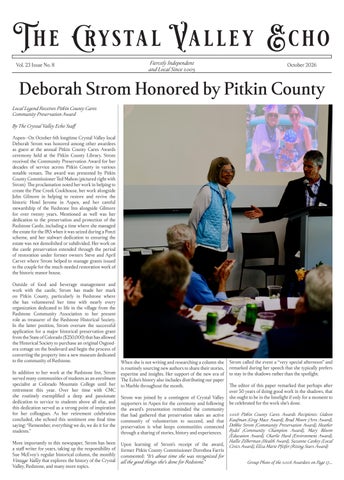
Deborah Strom Honored by Pitkin County Local Legend Receives Pitkin County Cares Community Preservation Award By The Crystal Valley Echo Staff Aspen—On October 6th longtime Crystal Valley local Deborah Strom was honored among other awardees as guest at the annual Pitkin County Cares Awards ceremony held at the Pitkin County Library. Strom received the Community Preservation Award for her decades of service across Pitkin County in various notable venues. The award was presented by Pitkin County Commissioner Ted Mahon (pictured right with Strom) The proclamation noted her work in helping to create the Pine Creek Cookhouse, her work alongside John Gilmore in helping to restore and revive the historic Hotel Jerome in Aspen, and her careful stewardship of the Redstone Inn alongside Gilmore for over twenty years. Mentioned as well was her dedication to the preservation and protection of the Redstone Castle, including a time where she managed the estate for the IRS when it was seized during a Ponzi scheme, and her stalwart dedication to ensuring the estate was not demolished or subdivided. Her work on the castle preservation extended through the period of restoration under former owners Steve and April Carver where Strom helped to manage grants issued to the couple for the much-needed restoration work of the historic manor house. Outside of food and beverage management and work with the castle, Strom has made her mark on Pitkin County, particularly in Redstone where she has volunteered her time with nearly every organization dedicated to life in the village from the Redstone Community Association to her present role as treasurer of the Redstone Historical Society. In the latter position, Strom oversaw the successful application for a major historical preservation grant from the State of Colorado ($250,000) that has allowed the Historical Society to purchase an original Osgoodera cottage on the boulevard and begin the process of converting the property into a new museum dedicated to the community of Redstone. In addition to her work at the Redstone Inn, Strom served many communities of students as an enrolment specialist at Colorado Mountain College until her retirement this year. Over her time with CMC she routinely exemplified a deep and passionate dedication to service to students above all else, and this dedication served as a strong point of inspiration for her colleagues. As her retirement celebration concluded, she echoed this sentiment one final time saying: “Remember, everything we do, we do it for the students.” More importantly to this newspaper, Strom has been a staff writer for years, taking up the responsibility of Sue McEvoy’s regular historical column, the monthly Vintage Valley that explores the history of the Crystal Valley, Redstone, and many more topics.
When she is not writing and researching a column she is routinely sourcing new authors to share their stories, expertise and insights. Her support of the new era of The Echo’s history also includes distributing our paper to Marble throughout the month. Strom was joined by a contingent of Crystal Valley supporters in Aspen for the ceremony and following the award’s presentation reminded the community that had gathered that preservation takes an active community of volunteerism to succeed, and that preservation is what keeps communities connected through a sharing of stories, history and experiences. Upon learning of Strom’s receipt of the award, former Pitkin County Commissioner Dorothea Farris commented: “It’s about time she was recognized for all the good things she’s done for Redstone."
Strom called the event a “very special afternoon” and remarked during her speech that she typically prefers to stay in the shadows rather than the spotlight. The editor of this paper remarked that perhaps after over 50 years of doing good work in the shadows, that she ought to be in the limelight if only for a moment to be celebrated for the work she’s done. 2026 Pitkin County Cares Awards Recipients: Gideon Kaufman (Greg Mace Award), Brad Moore (Arts Award), Debbie Strom (Community Preservation Award), Heather Rydel (Community Champion Award), Mary Bloom (Education Award), Charlie Hurd (Environment Award), Hallie Zilberman (Health Award), Suzanne Caskey (Local Civics Award), Eliza-Marie Pfeifer (Rising Stars Award) Group Photo of the 2026 Awardees on Page 17....
Page 2 • The Crystal Valley Echo • Vol. 23, Issue No. 8 October 2026
2026 Community Happenings Legacy Dance Company Bingo Fundraiser-October 24, doors at 2:00 PM, bingo 3:00–5:00 PM, Glenwood Springs Elks Lodge, Glenwood Springs.
Chunky Hand Knit Blankets with Jennifer Swanson-November 1, 10:00 AM–1:00 PM, The Art Base, Basalt.
First Friday: Día de los Muertos Celebration-November 6, 5:00–8:00 PM, Main Street and participating downtown venues, Carbondale.
Mandala Meditation with Andrew Roberts-Gray-November 1, 10:00 AM–12:00 PM, The Art Base, Basalt.
Consensual Improv: 10 Year Celebration-November 6, 8:00–10:00 PM, Thunder River Theatre Company, Carbondale.
James Casebere: Visiting Artist Lecture-November 3, 4:30–5:30 PM, Anderson Ranch Arts Center, Snowmass Village.
Steven Yazzie: Visiting Artist Lecture-November 10, 4:30–5:30 PM, Anderson Ranch Arts Center, Snowmass Village.
Creepy Crawly Night-October 28, 3:00–5:30 PM, Sprazzo, Carbondale.
Winter Sound Bath & Forest Bathing-November 4, 5:15–6:30 PM, ACES Catto Center at Toklat, Aspen.
How Ruedi Reservoir Helped Colorado River Users Through 2026 Dry Conditions-November 10, 5:00 PM, Basalt Regional Library, Basalt.
Fall Exploration: Ranch at Roaring Fork 2.0-October 29, 8:00–11:30 AM, Ranch at Roaring Fork, Carbondale area.
Celebrate Roaring Fork Conservancy's 30th Birthday-November 5, 11:30 AM, The River Center, Basalt.
Logan Phillips at Explore Books-November 11, 5:30–7:00 PM, Explore Books, Aspen.
7th Annual Trunk or Treat-October 30, 4:00– 6:00 PM, Carbondale Town Hall, Carbondale. Haunted Hangouts: The Ghosts of Glenwood Springs-October 30–November 1, beginning at 6:00 PM October 30, Hotel Colorad.
RFTA Master Plan Open House-November 5, 6:00–8:00 PM, Glenwood Springs Library, Glenwood Springs.
Silkroad Up-Close: Kaoru Watanabe, Kinan Azmeh and Maeve Gilchrist-October 24, 8:00–10:00 PM, TACAW, Basalt. Film + Conversation: Living With Wildlife-October 27, 7:00–9:00 PM, Crystal Theatre, Carbondale.
Immersive Sound & Watercolor Journey with Megan DiSabatino-November 15, 2:00–4:30 PM, The Art Base, Basalt.
The Crystal Valley Echo & Marble Times Mission Statement: To provide a voice for the residents of the Crystal River Valley; to bring attention to the individuals and local businesses that are the fabric of the Crystal Valley region; to contribute to the vitality of our small town life. Editor-in-Chief: Tucker D. Farris Editor@crystalvalleyecho.com For advertising sales contact: Advertising@crystalvalleyecho.com Or call our advertising manager at +1(970)618-6812 The Crystal Valley Echo is published monthly, And is distributed throughout the Crystal Valley. The Crystal Valley Echo is 100% Human-Created And does not condone, elicit, perform, or implement creative, Journalistic, or logistical usages of generative artificial intelligence. No part of this newspaper may be used in the training Of artificial intelligence, doing so will result in legal action. All rights of works by contributing authors and photographers Remain the sole property of their creators in perpetuity.
www.CrystalValleyEcho.com
Vol. 23, Issue No. 8 October 2026 • The Crystal Valley Echo Page 3
From the Editor's Desk... (Dis)Connection By Tucker Farris Following the publication of last month’s issue, I found myself aimlessly scrolling Facebook as I have unfortunately done fairly regularly since 2009. I will confess that I often fantasize about being one of the lucky few who can delete the app, delete the account and log out forever. The unfortunate nature of reality (reality is often a pesky foil to good fantasies) is that I am more or less locked into the madness and depravity that is Mark Zuckerberg’s Meta Presents: Facebook. In 2009 when I and many of my high school friends joined the site it was, to us, the natural place to go upon the sale and eventual decline of Myspace. At the time, social media was a fragmented frontier of new places to explore and specific niches. Tumblr was for fandoms and art, Instagram was for artsy photos of our lunches, Flickr was for the kids whose parents bought them expensive DSLR cameras, and Facebook was where you went to post pictures of parties, school events, and to see what all your friends were doing over the weekends. It had a built-in messaging app that bypassed needing a cell phone or a plan that included unlimited texts (text messaging used to cost money per text) so it really was the social networking place for hyperlocal connectivity. Today, social media has all but blurred entirely together. When I post a photo of the front page of The Echo on our Instagram page, it automatically posts the same thing to my own personal Facebook page, and a Facebook story. Everything has “stories” now, and I have lost track of which story goes where. I know that I get notifications on every app for every story, but I have to question, at times what these little digital hearts actually mean. I am tied to Facebook not because of the networking, frankly I have seen so many random things there that I feel at times it is actively reducing my ability to think. AI is, of course, rampant there. From local businesses slapping together embarrassingly bad event flyers to political candidates slopping out campaign ads that feature barely human-adjacent creatures and nearly-Colorado looking landscapes, or restaurants having the audacity to post inedible looking AI-generated foods, I am so nearly done with the place. I am, for now, tied to this place for several reasons. First, I must demonstrate some kind of social media presence for this newspaper, and remain connected to the discourse that flows throughout our local discussions, and be able to provide real-time quick updates to a large audience. Secondly, and far more demandingly, I bear the title of administrator of Carbondale’s community group on Facebook. The latter posting has been a rollercoaster since taking over the role during the pandemic. Someday I will write about what this truly demands of me, what I have learned about the community, and the many absolutely insane private messages I have been sent over the years by locals and visitors alike. But what calls me to this editorial this month is neither of these things, but instead a post that generated quite a stir among Crystal Valley residents some time ago. I will not disclose the name of the poster as I do not feel that a callout is necessary or really acceptable in a newspaper. I recently read a column where the author did this and I felt it was particularly gauche if truth be told. Instead, I am drawn to reflect on this particular post’s content, and the resulting conversations. The gist of the message was simple: a new couple had moved to the Crystal Valley from elsewhere (I won’t disclose exactly where, but it was a place that has different license plates than Colorado), and having settled into their home noticed something quite shocking, dismaying and deserving of a rallying local call to action to demand social change. The shocking discovery?
That there is no cell phone service from the Southern edge of Sunfire Ranch to just before Paonia on the other side of the mountains. I know, I know, the horror…
Even today, a trip up the river entails a reminder message to loved ones that “I’m heading to Redstone, I’ll be out of service for a bit” as a casual reminder.
The post continued with what read as a passionate, if ill-informed rallying cry to the locals of the Crystal Valley to stand up and “demand” that “town council” fix this issue at once. “The squeaky wheel gets the grease” was also a term included. The author of this post lived near Redstone and so right off the bat it is important to note that Redstone does not have a formal “town council” by virtue of our status as an unincorporated enclave in Pitkin County. Marble, having gone through the process of incorporation does indeed have a town council, but I doubt that the author was appealing to Marble residents and councilmembers to establish cellular phone service North of Redstone. The author then bizarrely linked a contact form to the town government of Castle Rock, Colorado which lies between Denver and Colorado Springs, far away from our valley on the other side of the continental divide. I am unsure if the idea here was that they had moved to Castle Rock (I would assume they’d have noticed our lack of chain restaurants, shopping centers and Interstate 25, but I have seen people not notice many things far more obvious than a missing interstate) and just assumed that they had jurisdiction over this stretch of Pitkin County, or (far more likely) they assumed that www.crgov.com stood for “Crystal River government”. Either reality is laughably uninformed, but again, this is Facebook, there is no shortage of posts that should have remained thoughts kept to one’s self.
Of course, times have changed now with the advent of a wider adoption of wireless internet and the evolution of cell phones to make and receive calls via Wi-Fi. I can still remember the first call I made from the parking lot of The Inn on their Wi-Fi, and the shock on the other end of the line that I was indeed making a cell phone call from Redstone. I recall too the marked inconvenience of receiving a spam call while having a conversation outside the General Store and thinking about the extremely odd feeling of having my phone ring on Redstone Boulevard.
But the post itself is far less worthy of a discussion than the discussions it generated. It is easy to poke fun at newcomers from big cities in other states who are not quite ‘up’ on the ways of life here, and being a lifelong local, and fifthgeneration one at that, I have tried to shy away from outwardly chastising people for such things because it’s just not worth the time. Having said that, I would offer the following advice to anyone considering moving to a new area, be that here, Castle Rock, or beyond: before you decide to buy a house, visit it. If you notice there’s no cell service, and that’s a major issue for you, maybe buy a house closer to the tower. What intrigued me more was the nearlyuniversal chorus of residents responding to the post all saying something along the lines of: “we live here because there is no cell service” or “we like to live disconnected from the world.” These sentiments have more or less been the philosophy I have understood as a generally accepted and treasured aspect of life in the Crystal Valley ever since I was a child. Growing up, when my dad would be working in Redstone or Marble or hauling logs to and from Hotchkiss, you just knew that a straight-tovoicemail call meant he was somewhere between Paonia and the Pitkin County line on 133 and that your burning question of “can we get pizza for dinner” would have to wait until the phone connected again. In rare occasions the (highly illegal and inappropriate) idea of jumping on the spare fire department radio in the kitchen and bouncing a message up the Crystal Valley via translators would play in my mind, but I, of course, never acted on it. Spending time in Redstone and Marble, as a kid, meant that there were no phone calls to tear any of us away from whatever activity we were engaged with, or that if we needed to make a call, that the Inn or the fire stations were places to go.
It is hard to imagine the Crystal Valley as a place with cell service. Just as it was hard to imagine Redstone as a place with an internet connection. I think, however, that there is a difference between these two services. Internet in Redstone, at least in my own experience, is a thing I use for work, for formal email communiques, for historical research, and the occasional, obligatory scroll through Facebook. I think too, that one winter during a particularly rough snowstorm while taking an evening at the Inn to avoid driving home in the whiteout, I used this internet connection to watch a movie on my laptop in the room.
It creates a sense of instant needs, of instant replies, of perpetual, infinite availability. If I can be reached from anywhere, I am less present wherever I am. Many comments on this ludicrous Facebook post echoed the idea that one of the many reasons we love where we live is the break it gives us from always needing to be reachable. It lets us slow down and listen to the river, or watch the trees, or smell the rain. It means we can’t check messages, we can’t watch videos and (thankfully) all of our “influencer” visitors need to wait until service resumes to post their short videos about our local treasures (imagine how much digital noise would exist at Penny if influencers could upload directly from the river, I shudder to think). The lack of connectivity means we actually have to be connected to real life and not the illusions behind our screens. We are often too connected today, to worlds beyond our present moments, either real ones or imagined ones. I think that is part of the indescribable magic of where we live, where we can find connection in our collective disconnection, and what better way to do that than to read a real paper newspaper that downloads information directly to you without the need for a single bar of signal?
Cell service though, that feels different. Its immediate, persistent, and it follows you everywhere. On Wi-Fi, I can choose which emails to respond to or ignore, which projects to work on, and I can be deliberate in how much availability I allow. Cellular is the inverse.
Community Classes at your local CMC in downtown Carbondale WATERCOLOR SKILLS
BEGINNER ACRYLIC PAINTING
FUNDRAISING
MORE SWING DANCE LINDY HOP
Learn to paint rocks, trees, water and reflections, texture, clouds, mountains and more. Tues, 9:15am-12:15pm, 10/27-12/1 Learn tools to build your non -profit’s resource base. Tuesday, 5:30-8:30pm, ONLINE 10/27
Basic exercises to introduce this medium, and create finished pieces from the first class Tuesdays, 5:30-8:30pm, 11/3-12/8
Build on the basics and expand your skills and knowledge. Wed, 6:30-8:30pm, 11/11-12/9
EXPLORING LOSS, GRIEF, AND RECOVERY
HAND WOVEN BASKETS TWILL MARKET BASKET
CREATE A PERSONAL REFUGE FOR THE HOLIDAYS
CROSS-COUNTRY SKI LESSONS - CLASSIC & SKATE
Personalize the vocabulary and context of grief and loss, for your own healing and recovery. Thursdays, 6-8pm, 10/29-12/10
Stay grounded, emotionally regulated, and joyfully engaged even during stressful times. Saturdays, 9am-12pm, 10/31-11/21
Create a functional Market basket with an intro to twill. Thursday/Friday, 9am-2pm, 12/3-12/4
Offered at Spring Gulch Trail System in January. Registration opens on November 16.
Scan for more information and self-registration CMC Lapalla Center
690 Colorado Avenue
970-963-2172
Page 4 • The Crystal Valley Echo • Vol. 23, Issue No. 8 October 2026
Local Splinters
Vote Yes For Healthy Community Fund
Twenty-four years ago, in 2002, Pitkin County residents voted overwhelmingly to approve a new program: the Healthy Community Fund. Since then, the HCF has become one of the most important investments we make in our community. Voters continue to support the program, renewing it three additional times in 2006, 2011 and 2018. This November, Pitkin County voters will once again be asked to renew the HCF. We strongly encourage the community to support this essential program and vote yes on Ballot Issue 1A. The HCF is a voter-approved property tax that supports Health and Human Services programs, Public Health, Senior Services, and dozens of local nonprofit organizations. Last year alone, HCF funding supported more than 70 community programs and organizations serving people across Pitkin County. As the Pitkin Board of County Commissioners deliberated over the terms of the renewal, we also had to consider impending federal and state budget cuts that take effect next year. After lengthy discussions, we decided to extend the sunset of this historically popular program to 25 years and modify the fund’s structure from fixed revenue to a fixed mill levy, which will provide a more dependable source of funding as community needs grow. Throughout those debates, however, we all agreed on one thing: The Healthy Community Fund is too important to lose. Over the next two months, HCF ambassadors and advocates will present to local organizations, and we’ll publish letters and testimonials from friends and neighbors across our community whom the HCF has served. You will hear from experts in public health, social services, environmental programs, children’s health and education and other organizations that contribute to our community’s health and well-being. The local investment is more important than ever. According to Billy Wynne, Pitkin County’s new Director of Community Health Services: “As federal and state health funding grows more volatile, a stable local fund — secured by a long renewal horizon and a fixed mill levy — is the community’s insurance policy.” For 24 years, the Healthy Community Fund has been one of the ways we take care of each other. A vote for renewal continues that tradition of neighbors helping neighbors — and making sure the people and organizations our community relies on can keep doing their work. If the HCF has touched your life, your family or your community, now we need your help. Join our grassroots Yes on 1A campaign. Lend your name, write a letter, talk with your neighbors, volunteer, or contribute at renewthehcf.org.
Together, let’s continue taking care of our community. Vote Yes on 1A! This commentary was written by Committee to Renew the Healthy Community Fund members Christine Benedetti, Christa Gieszl, Ted Mahon and Greg Poschman.
Fall Leaf Recycling Begins in Carbondale
Beginning October 19th, residents can drop off branches up to two (2) inches in diameter, yard and garden waste, or loose leaves (No plastic bags). Collection is at the corner of 4th and Colorado across the street from Town Hall.
Aspen Police Department charges Early Learning Center Childcare Director with Child Abuse
Aspen, CO – On Tuesday, Oct. 13, 2026, Aspen police charged 60-year-old Anna Speessen with one count of misdemeanor child abuse stemming from an investigation that began in early May. Speessen has been the director of the Early Learning Center, a nonprofit childcare center located in Aspen, since September 2025. The city of Aspen emphasizes the fundamental principle that every person accused of a crime is presumed innocent unless and until their guilt is established beyond a reasonable doubt in a court of law. To protect the integrity of this investigation and the privacy of the family involved, the Aspen Police Department will not provide further information at this time.
Structure Fire at 16400 Highway 82, Carbondale Carbondale, Colo. (October 12, 2026) Carbondale & Rural Fire Protection District responded to a structure fire at 16400 Highway 82 at 1:16 p.m. Firefighters from Carbondale Fire arrived on scene to find a single-family residence fully engulfed in flames. The home was occupied when the fire started, but all residents escaped safely. No injuries were reported. “The home was fully involved when crews arrived,” said Incident Commander Ashley Buss Greene. “The surrounding vegetation created the potential for a wildfire, so our priority was to contain the fire to the structure and protect the surrounding area. Our firefighters and mutual aid partners worked together to prevent an already devastating situation from becoming even worse.” The structure was a total loss. Investigation teams from Carbondale Fire and Roaring Fork Fire Rescue are working to determine the cause of the fire. Firefighters remained on scene extinguishing hot spots into the evening. Roaring Fork Fire Rescue Authority, Glenwood Springs Fire Department, and Aspen Fire Department assisted Carbondale Fire with fire suppression. Colorado River Fire Rescue, Aspen Ambulance District, Carbondale Police Department, Garfield County Sheriff’s Office and Garfield County Communications Center also supported the incident.
Redstone Inn to Begin Brush Collection for Grand Illumination Bonfire
The Redstone Inn will begin accepting donations of brush for the annual Grand Illumination bonfire beginning October 20th. Brush may be donated in the Lower Parking Lot.
Roaring Fork Schools See Music Program Revival & First Concert After many years, Carbondale area schools once again have a band program. The new bands from Carbondale Middle School and Roaring Fork High School (a combined total of over 100 musicians) will perform their first concert Thursday, October 29th at 7:00pm in the Carbondale Middle School Auditorium. The Crystal Valley Echo will cover the event and feature a complete story in the November issue. Colorado Mountain College Journalism Program Begins Renewal The Crystal Valley Echo and Colorado Mountain College will soon be partnering to revive a journalism program under the umbrella of the Walter Isaacson School. The program hopes to draw students from near and far with a desire to engage in critical, well-written community journalism, as well as many other facets of the field. Classes begin in the spring term at our new premises at the Aspen Campus. More information to follow.
The Echo Becomes First Print Newspaper to Utilize Newly-Created Typeface
Microsoft in collaboration with Studiogusto and Fabbrica di San Pietro (The Official Vatican Institution for the Preservation and Restoration of St. Peter's Basilica in Rome) released a brand new digital typeface (font) to mark the 400th anniversary of the completion and concecration of St. Peter's Basilica (which will occur on November 18th of this year). The typeface is inspired by the handwritten journals of Michelangelo and the block letters adorning buildings created by the renaissance master. The typeface (named michelangelus) is what is known as a "humanist serif font" which essentially means it is designed to carry elements of handwritten style in a printed format. The Crystal Valley Echo has since adopted this typeface as our new regular font for printed materials, becoming the first publication to do so. This issue is our first incorporating the new font, which replaces all non-stylized text in our paper.
The Echo's Release Dates Change
Beginning with this issue, The Crystal Valley Echo will return to an older print schedule from earlier in our publication history. Instead of publishing on the first of each month, we will now publish on the 15th of each month. This aligns better with our schedules, our methods for coverage of events, our construction of calendars, etc. Expect some possible hiccups or delays as adjust, but rest assured, we're not going anywhere...
Vol. 23, Issue No. 8 October 2026 • The Crystal Valley Echo Page 5
Book Review: John Green's Hollywood, Ending By The Crystal Valley Echo Staff Released September 22nd, 2026, Hollywood, Ending is the newest novel by bestselling author John Green (The Fault in Our Stars, Paper Towns, Everything is Tuberculosis) and represents his first foray into the adult fiction market after having wide success with his young adult fiction. The novel is centered around two actors that meet on the set of a fictional film titled Andy Warhol Never Gets Old, a biopic of the pop artist’s last year of life and death, Kai Laramie, a fresh-faced new actor on the scene playing the role of Andy’s assistant, and Juniper Castillo, a former child star trying to step beyond the limelight of children’s television shows. Through the making of the film and the resulting media blitz and instant new fame, Juniper and Kai navigate the new elements of their realities in new spotlights. Kai struggles with the demands of social media and the modern attention economy, while Juniper struggles to reinvent herself in a world where popular culture never forgets. The novel, while retaining some of the fictive tropes that had made his earlier work compelling for young adult readers, demonstrates Green’s evolution as an author, where in some places the reader can find themselves wishing he had taken us a sentence or two further, and in others presenting brilliantly eloquent and resounding prose as he meditates on the nature of fame, celebrity, and human relationships in the 21st century. At its core, the novel weaves together a narrative on the nature of the digital worlds we live in, and what they demand of us both privately, and when they become a central focal point of our work lives. Commentary throughout on Warhol’s pop art movement and philosophies demonstrates both a careful research on Green’s part, and a poignant setting for many of the meditations on fame and status in the novel.
Reflecting on the productionheavy, commercialized and fameobsessed world of Warhol’s Factory, Green weaves together modern anxieties about image, love, pain and privacy into the fabric of a compelling modern romance that leaves the reader with more than just warm fuzzy feelings, but instead offers several notable avenues for self-reflection and metacognitive relatability in the journeys of Kai and Juniper. Green demonstrates a smart command of the difficulties of writing the same story from two first-person perspectives, one where other authors either over-emphasize the differing perspective, or compress individual perspectives into a combination of the two that feels inauthentic. Juniper and Kai, in the limited boundaries of their shared story do have a distinct dissonance in their characterizations, and how they experience the same events. Juniper experiences the world of fame as someone who has been close to the spotlight for a lifetime, while Kai sees the same lights and doesn’t yet know how to squint to protect his view of the world. The novel explores trauma, anxiety and the perpetual demand of the world for the performance of self, even if those performances are painful or reluctant. In these explorations, Green presents a novel that is deeply, if simply, human. It is not a book that demands more from a reader than their attention to join the ride and to experience and reflect within it. Intentionally or not, the novel draws heavily on the irony of Warhol’s outlook on life and approaches that conversation of the proverbial fifteen minutes of fame without ever feeling like a cheapening of that ironic corner of the world of art. There is a critique of the commercialization of entertainment, the trapping temptations of fame, and the allure of companionship in the throes of the weirdness of modern life.
In sum, Hollywood, Ending will not shatter ground that has not already been trodden. It does not reinvent the wheel, but it does not need to. Green has honed his formula for a compelling story that will keep the reader’s attention, while also providing enough off-ramps into self-reflection that readers can explore at their leisure. At the time of printing it is unknown when or if this novel will receive the inevitable film adaption, but the reality of it is that the fictional film Green outlines as a plot setting would be a far more engaging and introspective story for the screen than this novel. For entertainment, escapism and the occasional waltz into relatability, Hollywood, Ending is a fun spirited read that bridges the gap between young adult romance fiction and a more mature foray into the genre.
Hollywood, Ending By John Green (2026) Rating: 4/5 Genre: Fiction, Romance, Art Tasting notes: Well-paced, not a demanding read, formulaic with substance, relatable with moments of truly good introspection, if you like pop art and Andy Warhol as a casual enjoyer, this one might be of interest.
Page 6 • The Crystal Valley Echo • Vol. 23, Issue No. 8 October 2026
See You In The Movies… A New Monthly Column on Film and Popular Culture, By Khloe Peterson Walking through the front door, shedding off the day, you sit on your couch to watch a cozy Fall movie, hot beverage in hand. Scrolling through the top fall films, there is one that stands out: “The Fantastic Mr. Fox,” Directed by Wes Anderson in 2009, based on the novel by Roald Dahl. What makes this movie a first of the autumn season pick is how the colors make the film feel like fall, almost like enveloping yourself in a pumpkin-spice latte. Wes Anderson is notorious for his frame-by-frame style of shooting films, dabbling in stop motion, making even his live-action films feel like stop-motion, and even though “Fantastic Mr. Fox” is a stop-motion,following that same style of cinematography, keeping warm color palettes with vibrant oranges, yellows, and browns, which, from a stylistic standpoint, makes this film the perfect fall movie. We even get the contrast of colors in the sewer and underground sequences. Bold and bright colors are what make Anderson’s films feel like Wes Anderson. Another key component we see in a lot of Anderson's films is how the characters seem to always ask the question “who am I?” It makes his audiences come from all corners, as we have all asked ourselves, at one point in time or another, that very question. This movie is no stranger to this theme, as we see not only Mr. Fox works through that question, but every single other character as well. Mr. Fox’s wife, Mrs. Fox questions her marriage, his son Ash, whose determination to be an athlete becomes a key theme, and even Kristofferson, the nephew, who seemingly knows exactly who he is, from the start of the film.
As I rewatched the film, there are details I missed from the first time I watched it. Right off the bat, the movie starts with the song “Davy Crockett” a man notorious for adventure, and that parallels well to Mr. Fox, who can never be bored, and always is on the look out for adventure. The music then fades to that notorious theme of Mr. Fox, which every year around october circulates TikTok and Instagram Reels, still drawing in new audiences. We see this at the end as well as Mr. Fox’s family listen to his final toast of the movie, and the soundtrack goes back to a variant of what we hear in the beginning, a good nod to the “whats next?” aspect of the film, even if it isn’t directly the same soundtrack.
As you scroll through autumn films this season, don’t skip past “The Fantastic Mr. Fox.” With its orange color palette, warm story, and characters that keep you engaged from beginning to end, this film has been classified as one of fall’s favorites. Anderson ensures that even though it is stop-motion, it does not feel like it, and keeps that charm that makes Anderson uniquely Anderson, which pairs well with the theme of this film. Even on a rewatch, this film has had me grinning from ear to ear and quoting my favorite lines, and it will always remain a rewatch for me. Enjoy the “ber” months, and Happy fall, y’all.
One sequence in the film still speaks to audiences:“I have a phobia of wolves!” (Anderson, 2009) was almost removed from the final cut. Anderson insisted on keeping it, as he felt it was the core of the movie. I think he’s right. Looking at your fear straight on, and knowing you’re afraid, is one of the key answers to that question, “who am I?” This one section of film has also now circulated the social media posts, proving that “Fantastic Mr. Fox” has truly never aged.
“I think I have this thing where I need everybody to think I'm the greatest, the quote-unquote Fantastic Mr. Fox." (Anderson, 2009)
“Fantastic Mr. Fox” is, at its root, about finding identity, and while times change and people change, that doesn’t always have to be a bad thing. The movie teaches audiences that it’s okay to be uniquely you. Even if it means being odd, wearing sweatpants tucked into tube socks, stealing birds, or painting thunderstorms on a canvas. We are all at the carnal root, wild animals, and it’s our job to live alongside that instead of fighting it or trying to be something we're not.
LIMITED WEEKENDS LEFT FOR SUMMER & FALL EVENTS
Senior Spooktacular Redstone Senior Days At the Redstone Inn
OCTOBER 13
Noon – Lunch ($10)
RSVP by the Friday prior.
1:00 p.m. – Program
The Life We Co-Create Join Brook LeVan, cofounder and executive director of Sustainable Settings, for a fascinating look at biodynamic farming, healthy soil, and the many living systems that work together to grow our food. Discover how caring for the soil helps create healthier farms, communities, and ecosystems.
PLEASE RSVP:
(970) 920-5432
TUESDAY, OCTOBER 27th
You Are Welcome Here
at the Redstone Inn
A Gathering Place for All
BLIZZARD BOXES 9:00am - 2:00pm • 3-day supply of shelf-stable food to have on hand in winter • For Pitkin County seniors in rural areas, at no cost to you • Order your Blizzard Box by calling (970) 920-5432
Family Reunions | Weddings | Conventions Retreats | Community Events
FLU & COVID SHOTS 9:00am - 12:00pm • All ages welcome • High Dose Flu Available (65+) • Flu vaccines are covered by Medicaid, Medicare and private insurance – bring your card with you • COVID vaccines offered
Call to Book Your Event
SMILES FOR SENIORS 9:00am - 4:00pm • Call for an appointment (970) 920-5420 • Cleaning & Screening – $85 (financial assistance available) ADDITIONAL SERVICES 9:00am - 2:00pm • Consultations on Care Navigation, Economic Assistance, Veterans Services, Vintage & Medicare LUNCH 12:00 pm • Please RSVP by noon the Friday prior: (970) 920-5432 • $10 – followed by dessert and Halloween treats MEDICARE OPEN ENROLLMENT 12:45pm • Medicare Open Enrollment information • Individual assistance available 9am-2pm
WANT TO BE KEPT IN THE LOOP?
Send us your email address: (970) 920-5432 • seniors@pitkincounty.com
178 Co Rd 3, Marble, CO 81623 | (970) 963-9522 chairmountainranch@gmail.com | chairmountainranch.com
Vol. 23, Issue No. 8 October 2026 • The Crystal Valley Echo Page 7
Drought A Column by Ted Benge Red dust caked in the corners of horses’ eyes and clung to their eyelashes and the hair around their black noses. The weather had been hot for weeks, and the normally friendly summer sun blazed, feeling ceaseless and violent. Wind raked the fields and the surface of the soil, sweeping away whatever moisture clung to the shady undersides of grass stalks and whipping up particles that the horses breathed in and coughed out. All summer, I waited for some relief. I am an outfitter, running a herd of 30+ horses on pasture leased from local ranches. In a typical summer, the grass that sprouts from the ground is sufficient to keep 35,000 pounds of horsepower healthy. I irrigate the pastures, carefully directing the cool mountain runoff. Every day before or after guiding, I pull on rubber irrigation boots, grab a shovel, dam the ditches and dig diversions so water flows to high spots and evenly through the fields. This year, the ditches were dry. I couldn’t rely on pasture for any material percentage of the horses’ total feed requirements. Where they historically ran in rich, verdant fields, their shod feet kicked up puffs of dust. I started feeding the horses 100% hay in May and increased the portions as the season and their work loads progressed, steadily supplementing with expensive grain, beet and feed products. Despite the extra effort and expense, I still struggled to keep weight on some horses. It was painful to see one or another lose muscle, and difficult to fatten them up again. “El Niño will bring above average monsoons this summer,” everyone said and repeated, trying to manifest rain. But it didn’t. I checked the weather every day, and watched as the chances of storms bearing rain sufficient to soak the soil dwindled and faded. My crew and I sweated under the sun’s daily arc and choked in the dust that coated the leaves along the trails and roads we ride. This was the second-driest January-to-August period in 132 years in Pitkin County, where I outfit and keep the horses, according to drought.gov. Matt Aboussie, Communications Director at the Colorado River District, told me over the phone that despite the scant precipitation this year, “temperature has been the biggest factor” in creating the drought. “In the spring, we saw high temperatures melting precious snowpack, but did not see a correlated increase in soil moisture content and stream flows,” he said. Spring was “the start of a tough season for water users and irrigators.” To feed my horses, I drove to Delta almost every other week to buy hay. And I fretted at night working through the books. Costs piled up in a business that is already low margin by nature; it’s a labor of love, a lifestyle business. With diesel over $6.00 per gallon, hay dear in a supply deficit, grain and feed supplements pricey, and days and hours lost to tracking down, buying, hauling and feeding hay, it has been an especially difficult year. When I could find a few hours, I would help the family friend who owns the ranch where I buy most of my hay, lending time to drive a stack wagon or baler, or help deliver hay to another customer. Local ranchers have struggled, as well. Tai Jacober, of Phoenix Ranching, said that their family had to buy 1,000 tons of hay at three times the rate paid last year. Range grass in the mountains, where they graze cows on a permit during the summer, stayed fairly strong, he said, but lack of water reduced his operation’s usable grazing allotment by 18,000 acres, about a third of the total. And though the family faced irrigation cutbacks and continuous stress, they feel fortunate.
”Parts of this world go through things much worse,” he said. “Other [ranchers] had to wean early, had to come off their [grazing] permits early, had to deal with fires. But we feel lucky to get through it.” As water managers have drained reservoirs to meet water demand across the West, our area reserves have dwindled. Ruedi Reservoir is at its lowest level since construction. Aboussie says, “If this winter is as poor as the previous one, we will be out of options for emergency supplies.” I worry about the future. What might be the cumulative effects of multiple drought years, not only on soil and pasture health, but on the aspen groves, mountain grass and pine forests that are victims of human-caused climate change? From a business viability perspective, will I be able to withstand consecutive years without grass? Will pasture leases still be available, and will hay producers still be able to provide hay as water supplies diminish? This drought not only impacts irrigators and land and water users. We all feel the heat and see the brown, brittle grass stalks. We all pay higher prices for beef, and contend with fewer opportunities to float, fish, and have campfires. We all face the increased risk of catastrophic wildfire. In the face of uncertainty, we must focus on the things we can control, and adapt to the circumstances we confront with positivity and hope.
The author’s horses kicking up dust. Photo by Ted Benge.
Ted Benge was born and raised in the Roaring Fork Valley and is a lifelong hunter, skier, and hiker. The owner of Capitol Peak Outfitters and an AVSC ski coach, he lives in Missouri Heights.
Page 8 • The Crystal Valley Echo • Vol. 23, Issue No. 8 October 2026
THE MARBLE TIMES A LOOK AT LIFE AT THE MARBLE CHARTER SCHOOL
All content is provided by the Marble Charter School staff with original essays written by students and is not edited by The Crystal Valley Echo staff. Essays From MCS 4th and 5th Grade Students Skiing By Freya 5th grade Gliding over the snow, the wind in your face, you're as light as a feather, and hot cocoa. The first reason why I like skiing is that you can go so fast. I like going fast because the wind flaps in your face and in your hair. It feels so good to just basically fly over the snow. When you go downhill, you gain speed, and when you gain speed, your skis make you feel weightless. If you go slow, then you get all hot and sweaty, but if you go fast, then you get cooled off and it feels so good. Also, when you go fast, you hear a very, very satisfying sound, and you feel it too. Secondly, another reason why I like to ski is that you take breaks at the lodge. Why I like to take breaks at the lodge is because they have delicious food and hot chocolate, oh, and they also have cookies!! Cookies!! When you go into the lodge, you get to take off your hot, sweaty ski clothes and you finally, finally get to cool off and eat some food! In the lodge, you talk to other people and see their faces, which you don’t usually see under all those layers of clothes. Lastly, I like to ski because you can ski in groups. When you ski in groups, you meet new people and you can get really close to them. While in a group, you don’t feel alone and they will always be there for you, even through hard times. Actually, you actually might see them later on in life, even share a room in college. Or you might live next to each other in the future. In addition, you don’t feel left out. Without a doubt, I love skiing, and I hope that after reading this, you’ll understand why I love skiing, and I hope that you’ll try it. Maybe you already have, but either way, it's awesome once you get the hang of it. Hammy in the Snow By August 5th grade When the snow falls and I open the door my dog runs out into the snow and plays. My dog's name is Hammy and he is a very silly boy “sometimes” but most of the time he is very lazy. During the school year when I get home, he doesn't even greet me at the door, all he does is lie down and looks at me. Sometimes we call him the house hippo. He will take around 3-4 naps a day when I am at school. He also has a big head and big eyes. My dog is a black lab. When there is powdered snow outside in the yard he runs around while leaping and jumping. Also he rolls in the snow while snorting and gets snow up his nose. Whenever I am building a snowman he runs into the snowman “sometimes” but never knocks it over. He also likes to eat the snow so he might bite the snowman. Whenever I build a snowman he follows me and helps me build them.
The Lyrebird By Willa 4th grade
Weaverbirds By Jade 4th grade
Along the coast of southeastern Australia, lives the Lyrebird. The Lyrebird is a very unique bird. They are among the most skilled vocal mimickers in the natural world.
One of the most unique talented birds in the whole world lives in the deserts of Africa, the Weaverbird. It has one of the most amazing talents in the world- to make its nest the perfect cocoon shape; they make it so nice that it looks like it’s bought from the store.
Did you know that lyrebirds are one of nature's best ecosystem engineers? When the ground-dwelling birds aren’t singing or shaking their ornate tail feathers to impress a potential mate, they spend their time foraging, using their powerful, rake-like feet to unearth insects and crustaceans. Each bird overturns vast amounts of leaf litter and soil in the wild—up to a staggering 352 tons, or 11 dump trucks each year. Female Lyrebirds build dome-shaped nests made of sticks.They make these nests on the ground in tree stumps, in tree ferns, or even in caves, and fill them with fern fronds, feathers, moss and roots. Once they've built and decorated their home, they'll generally lay one egg, which hatches in six weeks. The young lyrebird will then live in the nest for 6-10 weeks of its life. Did you know that only the male lyrebird has the long pretty tail? The male lyrebirds use their tails to attract a female to be his mate. Furthermore, the lyrebird is named after its incredible tail, it is named after the lyre which is a big instrument that looks like a U shaped harp. The male lyrebird's tail takes 7 years to grow to its full length. Furthermore, the lyrebirds eat earth worms, spiders, snails, millipedes, centipedes, beetles, ants, and other insects. They will occasionally eat frogs and lizards. Last but not least is the lyrebirds amazing talent, mimicking. It can mimic so many different noises, like zippers, other birds, and construction sounds, and best of all it can even mimic human voices. The male and female lyrebirds can both mimic human voices. One reason the male lyrebird mimics sounds, is to attract mates and impress female lyrebirds. When the male lyrebird is trying to impress a mate they will mimic other bird calls like the kookaburra, the Eastern whipbird, and the pied currawong. Furthermore, some lyrebirds mimic construction sounds or camera shutters. Lyrebirds mimic sound so precisely like people talking it almost sounds like it’s actually coming from a human when they do it. In conclusion I think that lyrebirds are amazing and unique birds.
First, I'll tell you about their appearance. The males have more bright colors to attract females. They have a yellow body with a black head and pink feet. The females are brown and grey to blend in with things to stay away from predators. These incredible birds eat seeds and grain, but their diet also includes insects, fruits and nectar. They make their nest by tying small pieces of grass and twigs together. Once they have the first part done they start weaving the grass together making the shape of the cocoon. After that they start to build a long tube at the bottom that they fly up to form a nice entrance; it can take them years to build these nests. The most bright and green nest attracts females to mate. Once a male is finished with its nest it will fly around it and see if a female likes its work. If not the male will have to rip it apart and start a new one. If a female does not have a mate they will either sleep in trees, dense bushes, or foliage. These birds commonly group, that means their nests are usually close together; otherwise the groups can be little. Sometimes when all the weaverbirds in the group are too hot they will combine their homes together and make one 50 times as big as the normal size. They put a big layer of grass and wheat on the top to prevent heat. It is sort of like an apartment building because they each have their own room. In conclusion, I think that the talent of the weaverbird is amazing and it is very helpful for them. I think it is smart and unique.
Vol. 23, Issue No. 8 October 2026 • The Crystal Valley Echo Page 9
Lead King Loop Race Pictorial Photos by Cal Branigan, Crystal Valley Echo Photojournalist
The Lead King Loop is an annual 25k race that leads runners through the Lead King Basin, past the Crystal Mill and to the Town of Crystal before returning to Marble for Slow Grooving Barbecue and a community gathering. It also includes an 8-mile dash up the Yule Marble Quarry Road into the Maroon Bells-Snowmass and Ragged Wilderness areas. All proceeds from the race go directly to funding the Marble Charter School. The Crystal Valley Echo's own photojournalist Cal Branigan attended the event and captured these memories of this year's Lead King Loop as part of The Echo's continued support of the Marble Charter School, the original home of our publication.
Page 10 • The Crystal Valley Echo • Vol. 23, Issue No. 8 October 2026
PitCo Candidate Talks Redstone, Environment, Affordability, Public Lands, and Water John Doyle, Candidate for Pitkin County Commissioner (District 1) Shares Platform and Visions for County Government By Tucker Farris As election season descends upon the nation, focus is split between a crop of state and local ballot issues, the national midterm elections, and several races for county governance. In Pitkin County’s first district Aspen City Councilman John Doyle has thrown his hat into the ring running to step into the vacancy soon to be created by current commissioner Patti Clapper’s retirement from the board after over two decades of serving. The Echo sat down with Doyle to explore the scope of his vision for Pitkin County and his plans for what he will contribute to the discussions of local governance if elected this November. Doyle is a native of Colorado who moved to Aspen in 1980, taking up residence in a cabin on the backside of Aspen Mountain where he would live for 16 years. He was moved to step into local politics due to a rising frustration with “developer song and dance,” specifically the Lift 1A corridor saga. This involved local developers purchasing an acre of land at the base of Aspen Mountain’s Lift 1A from SkiCo for $10 million in 2019 and securing a narrow approval from local voters to rezone the property and build a luxury hotel. The situation escalated in 2022 when the original purchasers of the land flipped the property for $76.25 million and created shockwaves through the upper valley among locals, government officials and the press. Doyle reflected on the 1A saga and discussed how he had, like many locals watched the changing face of Aspen from its heyday as a haven for artists and ski bums to a playground for the ultra-wealthy. He tied his experience living on the back of Aspen Mountain to this discussion and the recent Pandora expansion as factors that drive him to consider a careful and protective stance when it comes to development, for locals, the spirit of the community, and the environment. In discussing the Aspen Mountain expansion, Doyle stated that the idea of expanding a playground that has progressively become harder to access for locals during a declared climate emergency was an irresponsible decision. In keeping with this thread on environmental issues pressing the community, the conversation shifted to the discussion of water, one that was made even more timely given the historic drought season during the previous summer (despite fall rainstorms, Aspen still remains under water shortages). Speaking of the state of water in the western US, Doyle referred to the major reservoirs as “depleted savings accounts” and explained that his view of the practice of banking water was slowly becoming unsustainable. With the recently released report by the Crystal River Wild and Scenic Coalition,
The Echo asked Doyle’s thoughts on the project, and he relayed that he was strongly opposed to any new dams or reservoirs, calling them “fool’s errands” given the state of water scarcity in the west. This conversation evolved into a broader discussion on the preservation of public lands. Considering Pitkin County is roughly 85% public lands, Doyle expressed a strong desire to continue to work to preserve these lands and signaled strong disapproval to the sales of any public lands to private entities. Aside from the issues of water and preservation of public lands, another issue at the forefront of Doyle’s position is the rising need for proactive wildfire mitigation in the county, praising Aspen Fire Chief Jake Anderson for leading the efforts up valley in shifting the public consciousness on wildfire mitigation into actionable collaborations. He also praised the emergence of grants for county residents to be able to afford wildfire mitigation in remote communities like Redstone where mitigation is also becoming a present and actively undertaken precaution. Affordability is a conversation that is unavoidable in Pitkin County politics. Pitkin County has the highest per capita and investment income in the state due to Aspen’s concentration of wealth. This has historically created a difficult divide considering Aspen and Snowmass are not the only communities represented in Pitkin County, while there is a disproportionate concentration of wealth up valley, Pitkin County includes the communities of Redstone and Meredith where most residents are working or middle class. Doyle, speaking on this divide, specifically in the context of Redstone called it one of the last affordable places in the county (compared to Aspen) and spoke of the spirit of Redstone being a community that historically has not wanted to be pressured into the loud folds of Aspen’s growth and development and expressed a strong desire to preserve the quiet relaxed spirit of Redstone by protecting it from the socioeconomic pressures of Aspen. On the subject of development, Doyle opposes massive single-occupant houses that disrupt the natural landscapes of the region and said that he supports the county’s decisions to reduce the maximum square footage of such homes from 15,000 square feet to around 9000 square feet. He praised the “Rural and Remote” zoning policies of the late 1990s as a major factor slowing the overdevelopment of places like Redstone and up the Frying Pan where such overdevelopment would be inappropriate. Doyle again credits his own “rural and remote” experience when he lived in his cabin on Aspen Mountain as a factor influencing his desire to limit the size of housing developments in these more rural communities within the county. A major component of the discussion of affordability up and down the valley aside from housing is transportation and traffic.
Above: John Doyle, Courtesy Photo Traffic has increased steadily on Highway 82 into Aspen over the past decade with morning up valley traffic becoming a staggering part of daily commuter life in the valley. This is due to the down valley migration of much of the working population of the valley who, due to the rising costs from Aspen down the river, must commute from further and further down valley into Aspen for work each day. Doyle spoke about these issues and stressed a strong support for public transportation as a solution to reduce the amount of cars on the road to reduce the strain of commuting on workers and residents. He expressed a desire to see the upper valley begin to transition to a less car-dependent culture, citing Switzerland’s investments in passenger rail as an ideal inspiration for a proposed solution to the traffic issues on Highway 82. He spoke of the possibility of a passenger rail service connecting Aspen to down valley communities, noting that the RFTA right of way along the Rio Grande Trail (originally a rail line connecting Aspen and Glenwood Springs) was large enough to accommodate the exiting bicycle infrastructure and a rail service to connect Aspen with Basalt, Carbondale and Glenwood Springs to make it easier to commute up and down valley without needing to drive on the highway, with the additional benefit of connecting the soon-to-be expanded Aspen airport to the city of Aspen via rail as well. Additionally, the topic of reviving RFTA’s service to and from Redstone was discussed as a way of increasing accessibility and connection to other communities for residents in the village to be able to more easily travel from Redstone to Carbondale, and from there, to anywhere RFTA services.
When asked about the transportation needs of workers who bring tools or other materials to Aspen for their jobs, he proposed a possibility of creating a system where workers could safely store and deposit their needed tools in a storage locker in Aspen and use them through the week while not needing to commute with them daily, and said that this was only one possible solution, but that he recognized the specific needs that these types of jobs have and how they fit into the conversation of transportation noting that work needed to be done that considers everyone who commutes to Aspen, not just residents. Doyle is running for District 1 of Pitkin County which is mostly concentrated in the City of Aspen, and when asked about Redstone, he expressed sympathy for the opinions of some Redstone residents that they are often ‘forgotten’ by Pitkin County in favor of up valley communities, and that this was not the right way for county governance to function. Doyle stated that if elected to represent Pitkin County, he understands that as a responsibility to represent all of Pitkin County including Redstone. Speaking of Redstone, Doyle communicated a love of the history of the village, especially its original historic buildings such as the Redstone Inn and the Redstone Castle. He pledged to protect and preserve these valuable historic landmarks “at all costs” and spoke of their importance in the overall historic fabric of the county. He relayed that he deeply values the spirit and charm of Redstone and the break it provides for locals and visitors from the busy world of Aspen. Doyle Concluded on Page 15...
Vol. 23, Issue No. 8 October 2026 • The Crystal Valley Echo Page 11
Gonzo is Alive, Well, and Still Weird... Anita Thompson Leads a Discussion on Nationalism and Patriotism, Drawing From the Works of Late Husband Hunter S. Thompson By The Crystal Valley Echo Staff Glenwood Springs—A rising conversation in the United States over the past decade has been one examining the crossroads between the concepts of patriotism and nationalism. The latter being one historically associated with a rise in authoritarianism, and a reduction of civil liberties and the erosion of democracy. Patriotism, often associated with nationalism, is a wholly unique and separate sense of being. This was the central focus of a discussion hosted at the Colorado Mountain College campus in Glenwood Springs, featuring Anita Thompson (pictured right showcasing a middle school assignment on patriotism by a young Hunter S. Thompson ), wife of the legendary gonzo journalist who spent a large portion of his life navigating the question of ‘nationalism vs. patriotism’ in his prolific and often far out works. The event, a community education class open to the public was presented under the banner of CMC’s Center For Civics Education and Engagement, and welcomed participants to take a walk on the wild side of contemporary social commentary through a brief exploration of the works that defined the gonzo movement in post-modern literature. What emerged was an engaging conversation that was partially biographical of the late Dr. Gonzo and partially a reflection on the movements of social and political history in the last half century. Thompson began the discussion by introducing some of the earliest signed materials of her late husband’s writing including a piece from middle school wherein the future journalist was tasked with defining patriotism.
Elements here in this work before stepping into the madness of the 1960s reflected a definition of patriotism that rings true to the typical and common definitions of the term. The dissonance between the two ideas was a longstanding hallmark of Thompson’s work, with hints emerging as early as 1971 in Fear and Loathing in Las Vegas, with meditations on the idea of the American Dream, evolving through his Fear and Loathing on the Campaign Trail ’72 where Thompson began to fully explore the nature of American democracy, and the balance between the duties of patriotism and the temptations of nationalism. Classically, the definitions of these terms involve a “love of country” with nationalism being an overt, or more intense dedication. Thompson as well as other 20th century writers (such as George Orwell) instead view the two in a more complex way: where patriotism is classified as a defensive act, a dedication to the virtues and positive missions of one’s country and an active role in the preservation and defense of those virtues. Nationalism, conversely, is an offensive act, meaning it is the act of directly imposing dedication to one’s nation.
This difference was at the core of the recent discussion hosted by CMC and reflects its broader discussions of its civics education, where the idea of patriotism is preserved as an act of crticial preservation, of being civically engaged being for the benefit of upholding the virtues of one’s nation, and within this there is a capacity to feel both pride and emotions inverse to it all at once. Nationalism lacks the critical defensive dedication to the pitfalls and triumphs of one’s country and instead it evolves into a compulsory, enforced reality where the options for critique and for preserving the safeguards of a nation’s virtues slips away into authoritarianism. Thompson’s work chronicling the latter half of what he would term The American Century, followed the moments in our collective history when the defensive act of patriotism became the targets of nationalistic compulsions, and across the multiple genres of his coverage, the thread of trying to uncover these political realities became a through line of his work. While never claiming nor pretending to be an investigative journalist, Thompsons canon invariably becomes a longform investigation of post-war America, and as a result, a near-prophetic prescription of things to unfold in the 21st century.
The discussion of these concepts through Thompson’s lens comes into focus on the simple idea that to love one’s country is to always envision it better than it has been, to have the civic courage to democratically challenge the status quos that enforce what he might have referred to as fear and loathing. Where the responsibility of the citizenry of a given nation is to the defensive preservation of that which makes the country good, while also opting to take a firm stance against rising tides of nationalism. At the core of this argument is the idea that patriotism is a choice bound in freedom, while nationalism waylays freedom of choice to confound a population to a forced way of thinking, acting and behaving. Ultimately an exploration of Thompson’s work, when the specific perspective of the traditional trappings of the Gonzo movement are stripped away, what we find is a patriot’s decadent and depraved quest to find and protect those American virtues that resonate as the brightest parts of our shared history in spite of the darker days always creeping in from the edges.
Page 12 • The Crystal Valley Echo • Vol. 23, Issue No. 8 October 2026
Paw & Pen Humility
By Oneal Bogan Being humble is not always easy. I remember many childhood lessons centered around the idea of humility, my dad often reminding us how important it was to be humble, even when it went against how you wanted to behave. As I grew up, I began to understand the importance, but often failed to demonstrate humility when it was needed. As a veterinarian, we are in a position where we often give instructions for pet parents to follow, with a feeble hope that they will actually do what was advised. Many times I have wondered, complained and ruminated on why people have difficulty doing as they were instructed - whether it’s giving the medications as directed, or keeping their pet limited to certain activities while they heal - regardless of the subject matter, my frustration would endure, my bafflement a constant feeling. It took one tiny moment in time on a brisk October morning for me to learn one of my biggest lessons in humility and finally be able to understand the struggle with veterinary instruction. It was a Saturday morning. I was sipping my coffee while buzzing around the house, getting ready for my workday while managing my dog and human family and their morning demands. It had been a busy week and I was feeling guilty that my two Labradors hadn’t had much exercise. Together they were a hive of activity, two young dogs needing an outlet for their boundless energy. Grabbing the chuckit, I decided to throw the ball for a few minutes before I had to leave for work. Standing on my doorstep, I knew what had happened before I got close to my yellow Lab. Moments earlier, he had bounded down a small hill after the bouncing ball and landed wrong on his left front leg. His yelp was enough to make my stomach drop, and the way he immediately held his leg in the air was enough to spell disaster - he had broken something. Tears streaming down my face, I was by his side, noting how swollen his wrist was.
I could make excuses for why my dog didn’t receive the activity restriction he was ordered. I could blame my kids for leaving the door open or blame where we live for the bandage getting dirty. But the truth was that I was not following orders. I just wanted my best bud to be happy and didn’t want him to have to stay indoors while everyone else enjoyed the autumn weather. I let him do way too much, even if it was on a leash. And I, of all people, certainly knew better. When he started limping again, I knew I had messed up. Hesitantly, I rechecked X-rays three weeks after his surgery and saw what I dreaded would be there—his surgical repair had failed. It would need to be repeated, and his recovery period would restart all over again. My colleague gave me the grace not to lecture me, presumably because he knew how much I had already beaten myself up. Humble pie is hard to swallow. Two years later, my best boy is healed and can run with me, especially on the mountain trails where the ground is softer. It took three months in a splint and dedicated activity restriction, not to mention heavy doses of medication to keep him mellow. The process was not easy, and many days I wondered if he would ever be able to hike, run, and chase a ball again. When my clients struggle to give their pets medication or maintain leash walks only, I now have empathy and can try to troubleshoot ways to make it work with them. I no longer get frustrated and tell them they just have to do it. I tell them about my dog and the battle I had with letting him be a dog versus doing what I needed to do so he would heal. Not all lessons are easy to come by, but my lesson with humility made me a much better vet, and a much better person. Humble pie doesn’t seem bad after all.
After a rushed drive to work, sedation, and X-rays, the fracture of the bone on the edge of his wrist was diagnosed. The break was right near the joint, making repair more complicated since the bone would not be able to be plated in an ideal spot. I spoke to a colleague who confirmed - he could do the surgery, but it was not a good prognosis. If the surgery failed, the entire joint would need to be fused together. Feeling sick, I organized the details of his surgery. Suddenly, I found myself in the shoes of my clients, listening to the at-home instructions, the medication doses he should be on, and the resonating theme that he would need to be kept on very limited activity - on a leash and back inside. This would be his life for the next eight weeks, and likely longer after his recheck X-rays.
BUYING OR SELLING? GIVE ME A CALL! Mike Kennedy, Broker/Owner 970-379-3907 mikekennedy@sopris.net ColoradoHomesRanches.com
• Residential • Commercial • Ranch Properties
0985 Hwy 133 970-963-1940 Each office independently owned and operated.
35 YEARS OF LOCAL REAL ESTATE EXPERIENCE
The Redstone Historical Society
WANTS YOU to join us!
www.historyredstone.org historyredstone@gmail.com
Vol. 23, Issue No. 8 October 2026 • The Crystal Valley Echo Page 13
Paperboy Omnibus Exhibition Chronicles Cultural History From Woodstock to Mountain Fair and Beyond By The Crystal Valley Echo Staff Carbondale—For longtime local Terry Glasenapp (right), collecting has been a part of daily life for the majority of his. Regular listeners of KDNK will recognize his voice and deep musical knowledge as Wholly Bozo, a show he has regularly entertained the valley with through much of KDNK’s history. Students, staff, and faculty of Colorado Mountain College will recognize his infinite friendliness and expertise at the front desk of the Carbondale campus. Originally from Rochester, Minnesota, Glasenapp began his relationship with media through a career path that has almost faded into the pages of history. Working as a paperboy, he began life with a unique understanding of the ways that newspapers and periodicals act as living records of our shared times. Paperboy Omnibus is Glasenapp’s magnum opus collating his love of music, art, photography and print media into an immersive exhibition that takes visitors through the highs and lows of American cultural history one page at a time. The exhibition opened to the public October 1st and will run through the remainder of the month at the Carbondale CMC campus (690 Colorado Ave). During the October 1st opening gala, Glasenapp treated a room packed with longtime local artists, musicians, colleagues and friends to an electrified trip down memory lane. As their guide, Glasenapp began with a film he produced titled Into the Light which served as an atmospheric setting for the forthcoming discussion. Featuring spellbinding video captured across the United States, the film introduced light as a major character in the stories that would unfold. We fast forward then to the summer of 1969. Glasenapp recounts discovering an advertisement for the upcoming and soonto-be legendary Woodstock Art and Music Fair taking place that August in upstate New York. At this moment in the presentation, Glasenapp passed around a small piece of paper in protective plastic, the paper depicting a hand-drawn reproduction of the original ad that would send him on a journey to the festival that would become known as one of the greatest musical events in modern history. Describing the journey to Woodstock, Glasenapp welcomed the audience alongside him as he described the journey into history, first by car, then when traffic slowed to a halt, by foot surrounded by thousands of others making the pilgrimage up the road to the venue, joined in peace and love and an anticipation that was palpable. While many attendees might wax poetic about the musical acts, or what it felt like to watch Crosby, Stills, Nash and Young perform, Glasenapp’s recollections mirrored his outwardly kind hearted demeanor. They focused on the humanity of the shared experience among those countless
thousands of young people who had come to live together in the waning days of the 1960s. Instead of recounting Jimi Hendrix’s guitar solos, he told the spellbound audience about the eventual adoption of the concert-goers by the local community, who, upon hearing that the festival was short of food began working diligently to ensure the crowd was well-fed for the entire three day experience. Most poignantly, Glasenapp reflected on the reality that in a crowd with that many people, with music and words of revolution still in the air, with Vietnam raging, with the nation still reeling from the shocking and violent deaths of Martin Luther King Jr. Robert F. Kennedy the year before, that for the entire three days there was no violence. No injuries. Nothing but peace, love, music and light. Glasenapp’s collection on display in his exhibition reflects this period of musical and cultural history in many ways, from the small slip of paper with the original ad that brought him to the festival to posters, reprints, album covers, and special edition issues of magazines, Woodstock is alive and well in his omnibus. Through his opening remarks, moments of his stories were punctuated with detours through musical history, playing snippets of tunes by Bob Dylan, Jimi Hendrix, The Beatles, and many others.
With each guitar chord opening each song, the room erupted into palpable joy. With most, if not all attendees joining in a fullroom rendition of each song. A particular artist, Paul Winter was a central focus of one of Glasenapp’s stories, and is also near the loving center of his exhibition. Glasenapp recalls an experience of first hearing whalesongs, and then embarking on a vision to produce an exhibition specifically highlighting cetacean life in the Pacific Ocean. He recalls one of his showings of the exhibition, where upon arrival he learned that Paul Winter was performing a concert at the same venue, the same days. Winter attended his opening, and within his collection, Glasenapp proudly displays a poster listing him alongside Winter’s concert. A lyric of Winter’s reflects the spirit of community bonding over music in the room, as facilitated by Glasenapp’s guiding hand through history. In a circle of friends, in a circle of sound, all our voices will blend when we touch common ground… Glasenapp moved to Glenwood Springs in 1976, and his stories and collections from then on began to feature the local cultures of his new home. Within Paperboy Omnibus’ pages, visitors will not only find Woodstock posters, but a chronology of Mountain Fair posters, local music scene posters, and newspaper front pages highlighting the ebbs and flows of local life from Aspen to Grand Junction and beyond.
The Sopris Sun, The Valley Journal, The Glenwood Springs Post Independent, The Aspen Times, and The Aspen Daily News all make appearances, where milestones of the last half of the 20th century and the first two decades of the 21st come into focus under the bylines. Newspapers make up a major percentage of the artifacts preserved in the exhibition, and the through-line of his early life as a paperboy is on full display in the care, attention and love of newsprint evidenced in his work. A book featured in his exhibition displays one hundred years of front pages from the LA Times, and peppered in with local coverage of local events, newspapers marking nearly every major beat of human history have found a permanent home among the pages of Glasenapp’s collections. To walk through the exhibition is to walk through history itself, both familiar beats from the events that have shaped the present, and in smaller, more intimate corners, the local events that were at one time or another a major memory for a smaller, select few.
Paperboy Omnibus runs through the rest of October at Carbondale’s CMC campus (690 Colorado Ave.).
Page 14 • The Crystal Valley Echo • Vol. 23, Issue No. 8 October 2026
By Miriam Fennell Crystal Valley Echo Contributor
Harvest Village: Understanding What the “New” Development Application Means for the Roaring Fork Valley
Harvest Roaring Fork is no longer the name of the project. The developer, Realty Capital of Texas, withdrew the previous application and submitted a new development application under a different name: Harvest Village. Different name. Same developer. That distinction matters because Garfield County is reviewing Harvest Village as a new application, even though it follows the developer’s earlier Harvest Roaring Fork proposal. As I began reviewing the new application, I found myself asking a simple question:How different is this “new” proposal from the previous Harvest Roaring Fork plan?In the ways that matter to our community, it is not. The new application still proposes up to 1,500 residential units, approximately 55,000 square feet of commercial space and a 120-room hotel. Those were the fundamental components of the previous Harvest Roaring Fork proposal. So rather than focusing on the new name, I decided to look at the important underlying numbers. Did the number of homes change? Did the new application change the amount of traffic the development is expected to generate? Did the water demand change? Did the amount or type of housing being offered change in a meaningful way? And what can the community expect from this new application? Those are the questions I have been researching. This is an effort to educate our community about what is actually being proposed, look closely at the numbers, and ask whether the changes described in the new application translate into meaningful changes. What, If Anything, Has Actually Changed? The previous Harvest Roaring Fork application was reviewed by the Garfield County Planning Commission, which recommended denial in March. Changing the name and submitting a new application does not change the rules or the reality for our community. Garfield County still has the same Comprehensive Plan and Land Use and Development Code, and our community is still facing the same challenges with drought, wildfire risk, traffic, water, infrastructure and emergency evacuation. One of the changes the developer has highlighted most prominently is the elimination of potential accessory dwelling units, or ADUs. For readers who may not be familiar with ADUs, these are small, additional living units that a homeowner could potentially choose to build on a property in the future, subject to applicable county rules and approvals. They are not guaranteed or automatically built with every home. Each would require a homeowner to submit the appropriate application to the county, and approval is not guaranteed. In a September 2 article in The Sopris Sun, the developer described eliminating the potential for 450 accessory dwelling units as a reduction in the overall project density. But does it really? Let us take a closer look. Those 450 units are not 450 homes being removed from the 1,500 homes proposed in the new Harvest Village application. They represented the possibility of additional housing units, with no guarantee they would ever be built. Bottom line: The new Harvest Village application still proposes up to 1,500 residential units. Eliminating the possibility of future ADUs does not reduce the number of primary residential units proposed. Traffic on an Already Burdened Highway Highway 82 is a critical transportation corridor for the Roaring Fork Valley, and its capacity to accommodate additional traffic is an ongoing regional concern. Several intersections along the corridor have been identified by CDOT as operating at failing levels of service. So what would Harvest Village add to an already strained transportation corridor?
The original Harvest Roaring Fork traffic analysis projected approximately 11,936 additional weekday vehicle trips at buildout—nearly 12,000 additional weekday trips. That analysis was based on 1,500 residential units, along with the proposed hotel, office and retail uses. The new Harvest Village application carries forward that earlier traffic projection. The potential ADUs were not included in the original traffic calculation, which was based on 1,500 residential units. Their removal therefore does not reduce the traffic projected in that analysis. Nearly 12,000 additional weekday vehicle trips. That is the projection being carried forward with the new application.
For a valley already dealing with traffic congestion, this is an incredibly significant number. Highway 82 serves communities throughout the Roaring Fork Valley, and the impacts of additional traffic do not stop at county or city boundaries. These impacts would affect virtually everyone in our community. There is another question that deserves an answer: The earlier traffic analysis was based on a 90room hotel and approximately 50,000 square feet of commercial space, while the current proposal includes a 120-room hotel and approximately 55,000 square feet of commercial space. Has the traffic analysis been recalculated to fully account for the revised project? The revised application does not eliminate the fundamental traffic concern. Nearly 12,000 additional weekday vehicle trips are still being carried forward from a development along a corridor already experiencing failing levels of service at several intersections. That impact has not been shown to have been reduced with the new application. Water Demand in a Drying Region Our concerns about water are not hypothetical. We are experiencing drought conditions now. The water situation adds to these concerns. According to the Roaring Fork Conservancy’s October 8, 2026, river report, many streamflows in the region were running at less than half of what is typical for this time of year. The report also identified extreme to exceptional drought conditions and below-average soil moisture. These conditions raise important questions about the long-term reliability of water supplies as the valley faces continued development and increasing demand. Against this backdrop, the current Harvest Village application projects total annual water demand of approximately 216 million gallons—nearly 600,000 gallons per day—according to its August 2026 Waterlaw water-use summary. The application continues to rely on water-supply documentation associated with the earlier Harvest Roaring Fork proposal, raising questions about whether the water-supply analysis adequately reflects the current proposal and its long-term demands. The central question is whether the existing watersupply documentation adequately demonstrates that sufficient water will be available to serve a development of this scale over the long term. For a community already facing significant drought concerns, that question deserves serious consideration before a development of this size moves forward. What Does “Workforce Housing” Actually Mean? The housing breakdown in Harvest Village raises an important question: What does the proposal actually offer the people who currently live and work in our valley? There has been considerable discussion about the development providing 450 “workforce” or “affordable” homes. But these 450 homes are not all the same type of housing, and those distinctions matter. Of the 1,500 proposed residential units, 150 are identified as “Article 8 Housing Availability Mitigation Units” required by Garfield County. These homes have income eligibility requirements based on Area Median Income, or AMI. AMI is a measure of household income in a particular area, adjusted for household size. Garfield County requires Harvest Village to set aside 150 homes for income-qualified buyers under its land-use rules, known as Article 8. The rules divide these 150 homes into three categories based on how much money a household earns.
Using Garfield County’s 2026 income limits, here is how much a household could earn annually to qualify for one of these 150 homes by category:
- 30 Category I units: For households earning up to 80% of AMI — $63,920 for a one-person household or $91,280 for a four-person household. - 45 Category II units: For households earning up to 100% of AMI — $79,900 for a one-person household or $114,100 for a four-person household. - 75 Category III units: Divided among three income levels: - 120% AMI: $95,880 for a one-person household or $136,920 for a four-person household. - 140% AMI: Approximately $111,860 for a one-person household or $159,740 for a four-person household. - 180% AMI: $143,820 for a one-person household or $205,380 for a four-person household. These are gross annual household incomes, before taxes, Social Security, Medicare, health insurance, retirement contributions, childcare and other deductions. These figures apply only to the 150 deed-restricted units required under Article 8. They represent income eligibility levels, not housing costs or what a household can actually afford after taxes, insurance, HOA fees and other living expenses. The application proposes 300 additional deed-restricted “workforce” residences, but these units have no household income limits or price-appreciation caps. In other words, as their values inevitably increase, these homes would ultimately be sold at market rates. To qualify, the owner must work at least 30 hours per week in Garfield, Pitkin or Eagle County. Under a separate provision, an owner-occupant may also qualify by working full-time from home. The residence must be the owner’s primary residence for at least nine months of the year. Other proposed restrictions apply, including a prohibition on owning other improved residential real estate. The remaining 1,050 homes—70% of the entire development—are market-rate residences. These homes are not identified as income-restricted housing, and the application does not establish any income-based affordability limits for them. Their prices will be determined by the current market prices for our area of Colorado. For context, my review of current home prices along the Highway 82 corridor between Basalt and Glenwood Springs, excluding Aspen Glen and its golf-course properties, found prices generally ranging from approximately $850,000 to $1.5 million or more. My Zillow research also shows substantial differences among communities and property types, with many single-family and higher-end properties priced well above that range. These market figures provide context for the affordability question facing local workers. So the 450 homes described as workforce or affordable housing consist of two extremely different groups: 150 units with specific AMIbased income requirements, and 300 workforce residences with employment and occupancy requirements but absolutely no stated income limitations or price-appreciation caps. Workforce housing is critically important to the Roaring Fork Valley. But “calling” a home “workforce” or “affordable” does not actually make it affordable. The other 1,050 homes are completely market-rate. 70% of this proposed development will be sold to anyone from anywhere that can afford them. They will cost whatever the current market demands. The real question is how many of these 1,500 homes the people who live and work here will actually be able to buy—and how many will truly remain financially accessible as prices rise over time?
- Fast-food and counter worker: $36,000 - Cashier: $40,000 - Retail salesperson: $44,000 - Janitor or cleaner: $45,000 - Firefighter: $58,000 - Elementary school teacher: $66,000 - Electrician: $65,000 - Carpenter: $71,000 - Licensed practical or vocational nurse: $75,000 - Police or sheriff patrol officer: $79,000 - Registered nurse: $104,000 These are approximate regional occupational wage estimates, not what every individual worker earns. They are gross wages, before taxes and other necessary deductions. The source is the U.S. Bureau of Labor Statistics’ "May 2025 occupational employment and wage estimates" (https://www. bls.gov/oes/2025/may/oessrcma.htm). A teacher earning $66,000, for example, does not take home $66,000 to spend on housing. Taxes, Social Security, Medicare, health insurance, retirement contributions, childcare and other expenses all affect how much a household actually has available. That brings us back to the ultimate central question: A worker may “technically” meet an eligibility requirement or qualify under a workforce-housing “definition” and still be unable to afford the home. And with no stated income limitations or priceappreciation caps on 300 of the designated workforce residences—and no income-based affordability limits identified for the other 1,050 units—the number of homes labeled “workforce” or “affordable” does not, by itself, tell us how many will be attainable for the people who keep this valley running. That brings us to the price of the homes. Harvest’s public FAQ states that homes are expected to start around $390,000. The FAQ describes an expected starting price; it does not guarantee that price. And with current taxes and tariffs on building materials potentially affecting construction costs, there is even more reason to question whether that starting price will hold. At the February 25 public Planning and Zoning hearing, I heard the developer state that homes would actually start at approximately $412,000, before homeowners association fees, insurance and other associated costs. Using the affordability calculations attributed to Harvest, a roughly $390,000 home would correspond to approximately $96,700 in gross annual household income with a 20% down payment, or approximately $108,800 with a 10% down payment. And please note: the figures mentioned above are estimates, they are not a guarantee that a buyer will automatically qualify for a mortgage. And gross income is only the beginning. Buyers also need a down payment and must be able to afford the monthly mortgage payment, property taxes, homeowners insurance, HOA fees and other expenses. Qualifying for a mortgage does not necessarily mean a home is affordable. Interest rates matter, too: Currently, 7.4% and 7.7% for a benchmark 30-year fixed loan. This is where I think an important distinction gets lost in the conversation. “Can qualify” is not necessarily the same as “can afford.” If we are talking about workforce housing, I think we should be asking: Who is eligible? Who is the housing intended to serve?
Who Can Actually Afford to Live in Harvest Village?
What will the home actually cost?
To put that question into context, I looked at regional wage data.
What income does a household actually need to afford it?
Using May 2025 U.S. Bureau of Labor Statistics occupational wage estimates for the Northwest Colorado nonmetropolitan area, which includes Garfield, Eagle and Pitkin counties, the approximate annual wages for some of the people who keep our valley running are:
And, perhaps most importantly, how much of the housing being proposed is actually attainable to the people who live and work in the Roaring Fork Valley? Harvest Village Continued on Page 15...
Vol. 23, Issue No. 8 October 2026 • The Crystal Valley Echo Page 15
Harvest Village Continued... live and work in the Roaring Fork Valley? Harvest Village in the Bigger Picture of the Roaring Fork Valley As I continued researching Harvest Village, I realized that looking only at the 1,500 homes proposed at this one development does not tell the entire story. Harvest is one project within a much larger pattern of residential development, approved capacity, proposed projects and remaining development rights along the Highway 82 corridor. My preliminary working inventory identifies approximately 2,782 residential units across projects from the Aspen area toward I-70. To put the potential scale in perspective, that number would equate to approximately 7,000 residents if we assumed an average of 2.5 residents per unit. This is a working research figure, not a prediction of how many homes will ultimately be built or how many additional residents will arrive. The projects are at different stages, and the inventory still requires verification. Some entries may represent completed units, remaining development rights or proposals that need further reconciliation. The larger question is how cumulative development could affect a region already facing challenges with traffic, water, infrastructure, emergency services, wildlife connectivity and housing affordability. Those impacts cannot be fully understood by examining one development at a time. Our roads, water resources, workforce, emergency services and natural environment are interconnected across municipal and county boundaries. I do not think the answer to growth is simply to stop building. I also do not think the answer is to look at each development proposal as though it exists independently from everything happening around it. The goal is to understand what is actually being proposed, examine the numbers, ask the difficult questions and consider what responsible growth should look like for the valley we all share. This is only the beginning of my research into Harvest Village. My next phase of research will look more closely at traffic, water, wildlife, infrastructure and emergency evacuation, both within the Harvest Village proposal and in the context of cumulative growth along the Highway 82 corridor.
John Doyle Interview Continued... During his tenure on Aspen’s City Council (first elected in March 2021 and reelected in April 2025), Doyle’s record reflects many of the sentiments he expresses in his platform for county commissioner. He has regularly supported affordable housing initiatives, wildfire mitigation efforts, conscientious water storage practices and a strong opposition to water diversions from the Roaring Fork Valley to other parts of the state. He has served on numerous local boards and commissions including CAST, CORE, The Aspen Snowmass Nordic Council, and the Aspen-Pitkin County Housing Authority boards. More information on Doyle’s campaign can be found on his website at: https://johndoylepitkincountycommissioner.com/
Meetings and Legal Notices: Town of Marble: The Marble Town Council meets the first Thursday of each month at 7:00 PM at the Marble Community Church Fellowship Hall. Next Month's Meeting will take place Thursday, November 5th. Crystal River Caucus: Meetings are held on the second Thursday of odd-numbered months at 7:00 p.m. at the Church of Redstone, 213 Redstone Blvd, Redstone, CO 81623. Virtual attendance is available, and meeting links will be sent to everyone on the Caucus email list. To join the email list, send a message to crcaucus@gmail.com. Redstone Community Association: Meets the first Tuesday of Each month at 5:30 pm in the Redstone Inn Library
Page 16 • The Crystal Valley Echo • Vol. 23, Issue No. 8 October 2026
Parting Shots from a Busy Month...
Clockwise from top left: Three toffee apples sit forgotten in the rain outside the Glenwood Springs Mall. A freshly fallen aspen leaf soaks in the first of many fall rainstorms outside The Pitkin County Courthouse in Aspen. Youth DJ's from the Andy Zanca Youth Empowerment Program highight the success of their recent 24-hour radio takeover at KDNK (photo courtesy of AZYEP). A sneak preview of the new Journalism Department at Colorado Mountain College (a project that The Echo is undertaking). The first halo of snowfall on Mount Sopris following a long, hot and dry summer.
There with you, from careful planning to carefree afternoons. A lot can change in 53 years. What matters is what stays true. Alpine Bank remains locally and employee owned, deeply committed to Colorado, and built around real relationships with the people and communities we serve.
Vol. 23, Issue No. 8 October 2026 • The Crystal Valley Echo Page 17
Top: Radiosphere graphic from KDNK who celebrated a momentus fall membership drive, raising over $120,000 in only 8 days (graphic designed by Humans Chris Hassig and the KDNK staff). Right: A hawk stands watch over Carbondale in the evening before the leaves fell. Below: Pitkin County Commissioners pose with awardees of the 2026 Pitkin County Cares Awards in Aspen following the awards ceremony.
Page 18 • The Crystal Valley Echo • Vol. 23, Issue No. 8 October 2026
Coal Basin, The Legacy and Renaissance The Redstone Historical Society's Vintage Valley By Bentley Henderson It's been 35 years since the doors - or more succinctly portals - of Mid-Continent Resources coal basin coal mines closed. The once thriving industrial complex that was one of the largest employers in the region, was reclaimed in the early 2000' s is now the home to a hiking and mountain biking area with trails that are suited to riders and hikers of every ability. This is a far cry from how it looked in coal basin at the height of the mining years. Mid-Continent operated in coal basin from 1956 until it left the property in 1991. There is a common misconception about the operations of the site at coal basin, as many assume that there was one mine and all of the coal that came out of coal basin was produced from that one mine. This conclusion couldn't be further from the truth. At one point during its history Mid-Continent was producing coal in five different mines within the basin, each of them designated with a name and number; Dutch Creek No. 1, Dutch Creek No. 2, LS Wood No. 3, Bear Creek No.4, and Coal Basin No.5, each with its own unique conditions and challenges. What started out as a relatively small operation would soon become an industrial behemoth with hundreds of employees working three shifts to support the production of the coal. Along with the five coal mine sites scattered along the upper valley, the lower site was comprised of a wash plant, a bathhouse, and numerous coal storage facilities. Over time Mid-Continent would become an innovator in the coal mining industry, being one of the first operators to work on grades that exceed 20%, one of the first to employ methane gas detection shut-offs on its equipment, and importantly, one of the first in the country to use longwall mining techniques. Mid Continent's operations were highly mechanized. The company started out utilizing continuous mining machinery to engage in typical "Room and Pillar" mining methods. The operations of the mining effort involved the continuous miner (miner) which extracted the coal from the working face and loaded it into a shuttle car which took the coal from the miner to a conveyor belt line which then transported the coal outside for further processing. The miner was a large, low slung machine with a wide rotating drum shaped head equipped carbide bits that ground the coal from the seam. In the room and pillar mining method, multiple parallel entries were mined with "crosscuts" connecting them every 80'. Think of it as a typical street grid with each street being 15" to 18" feet wide and each block being 80 feet square.
This progression continued as far as the company's permit would allow, and then, given the permit limitations this grid pattern might take a turn to continue mining depending upon the layout of the actual coal seam. In some cases, having a working face that could be in excess of 5000' from the portal. In accordance with its permits, Mid-Continent would ultimately produce coal from each of the five different mines employing the room and pillar extraction method. As mining and time marched on it became evident to the mine operators that in certain locations within a particular mine they would effectively reach the end of the permitted area and basically run out of coal. Once they reached this point Mid-Continent, in an effort to extract the maximum amount of coal from the seam, then employed a technique known as "Pillar Extraction." More commonly known as pulling pillars. If you were to picture that street grid again, pulling pillars could be akin to slowly going into the remaining block itself and taking what was there making street wider and wider, until the two parallel streets were effectively joined . This method, while highly efficient and productive was also incredibly dangerous. As you pulled out the coal from the pillar, you slowly exposed more unsupported roof increasing the chances for cave-ins, which ironically was an intended part of the program. With this process, the company was able extract almost 100% of the coal from the seam. Understand, this activity was carefully monitored and only done by the most experienced miners.
Over time as the pressure for production became more intense, it became necessary for MidContinent to look for alternatives to the room and pillar, and pillar extraction methods of mining. In 1976, Mid-Continent obtained and began production with a longwall mining machine. Longwall mining is a method of extraction where, similar to pillar extraction, the roof is allowed to cave in as mining advances. Unlike room and pillar, and pillar extraction, which used continuous miners and shuttle cars to mine and transport the coal, the longwall method used a rotating shear head that ground the coal from the coal face. The shear traveled horizontally across the coal face for hundreds of feet dropping the mined coal onto a continuous belt line that advanced with the cutting head, ultimately taking the coal outside, eliminating the need to transport the coal via a shuttle car from the working face to the conveyor belt. It was during the time while the longwalls were operating (No. 1 and No. 3 mine each utilized longwall mining), that Mid-Continent realized its highest levels of production essentially from 1983 to 1989. Production levels during that time routinely approached 1 million tons per year, and in a couple of those years exceeded 1 million tons. All told, over the course of its operations, Mid-Continent would mine in excess of 28 million tons of coal out of coal basin. If you have been in the valley long enough to have been here when the mines were in operation, you will know that the relationship between the company and the local area was a tenuous one.
While it was responsible for millions of dollars in taxes, royalties, and payroll, it was for some, an environmental blight on the Crystal River Valley. Whether it was simply the industrial complex in the basin, the coal trucks on Highway 133, or the impacts on Coal Creek, by the time it was shuttered, many felt that it had run its course. If the means justifies the end, then it's only appropriate that the basin would now become a recreational space that everyone can enjoy. This article is dedicated to the 55 brave men who lost their lives working in the mines in Coal Basin. Author Bentley Henderson is a 40 year Carbondale resident that spent 2 1/2 years in the early 80's working the mines of coal basin. Photo Caption (Above): Long Wall Memorial at the base of the Coal Basin Road Names of 55 miners lost. Photo Provided by the Redstone Historical Society
Vol. 23, Issue No. 8 October 2026 • The Crystal Valley Echo Page 19
Funnies, Features, Puzzles and Oddities The Inky Ledger...
The Fog & Folly Crossword Vol. 8 Across 2. A brief period when rain becomes less intense 5. Dark cloud associated with thunderstorms 7. The atmospheric condition that can produce rain 9. Weather event involving strong winds and heavy rain 10. Long period of unusually heavy rainfall 13. Funnel-shaped storm over water 14. Loud rumble heard after a flash in the sky
Down 1. Sudden rush of wind accompanying a storm 3. Flash of electricity during a storm 4. Water flowing over normally dry land after heavy rain 6. Sudden, heavy burst of rain 8. Rotating column of air extending from a thunderstorm 11. Tiny ice pellets that fall during some storms 12. Large body of water vapor droplets in the sky 15. gauge The instrument used to measure rainfall
The Inky Ledger is a monthly feature of historic comics and comic strips from the early 20th century. Each month, a new artist or series is featured as a way to reflect on the timeless movements of satire, comedy, critique and caricature.
This panel comes from a strip titled "Out Our Way". Out Our Way first saw the light of day as a single-panel cartoon March 20, 1922. Created by J.R. Williams it depicted American rural and small town life. The strip acted as an umbrella for several series, which included 'The Bull Of The Woods', 'Why Mothers Get Gray' and 'Heroes Are Made, Not Born'. Another recurring title was 'Worry Wart' that starred a young boy. Other regular characters included a cowboy named Curly and Wes a ranch bookkeeper. When a Sunday page was launched some of the characters were grouped together as the Willet family. At its height Out Our Way appeared in more than 700 newspapers, with a readership in the millions. J. R. Williams died in 1957, but Out Our Way continued to be produced by among others: Neg Cochran, Paul Gringle and Ed Sullivan. The last strip was produced in 1977, twenty years after Williams' death and fifty-five years since it launched.
Fog & Folly September 2026 Crossword Answers: Across 4. Primer 7. Abecedary 9. Reprobate 10. Slate 11. Truant 13. Punishment 15. Recitation
Down 1. Governess 2. Preceptor 3. Scholar 5. Dame 6. Penmanship 8. Abacus 12. Dunce 14. Inkwell
To submit art, features, or other oddities to adorn this page, Kindly send word to The Echo at: Editor@CrystalValleyEcho.com
Madame Wyndrose’s Patented Mystical Monthly Mono-Lexical Meanderings A monthly one-word horoscope to guide your hand... Aries Mar 21-Apr 19 PLUVIATILE
Cancer Jun 21- Jul 22 NIMBIFEROUS
Libra Sep 23- Oct 22 MIZZLE
Capricorn Dec 22- Jan 19 BRONTIDE
Taurus Apr 20-May 20 TEMPESTUOUS
Leo Jul 23-Aug 22 IMBRICATE
Scorpio Oct 23- Nov 21 PETRICHOR
Aquarius Jan 20-Feb 18 OMBROSCOPE
Gemini May 21- Jun 20 FULMINATION
Virgo Aug 23- Sep 22 ADUST
Sagittarius Nov 22-Dec 21 NUBILOUS
Pisces Feb 19-Mar 20 FULIGINOUS
All submissions considered. Few accepted. A Tasting of Prose: “Solitude is the catalyst that brings reality to fermentation.”
-Bruno Schulz The Street of Crocodiles (1934)
Page 20 • The Crystal Valley Echo • Vol. 23, Issue No. 8 October 2026
Autumn
ADVENTURES begin at Redstone Inn!
by The Ru es! i k c o R of The
Your Front-Row Seat to Colorado's Fall Colors Book your stay today! This fall, discover why there's no better place than the Redstone Inn to experience Colorado's most colorful season. Enjoy golden aspens, crisp mountain air, and scenic landscapes at every turn. Spend your days exploring the charming town of Redstone, horseback riding or fly fishing by the river before returning to the warmth and timeless hospitality of our historic inn.
82 Redstone Blvd Redstone, CO 81623 www.redstoneinn.com
@redstoneinnco