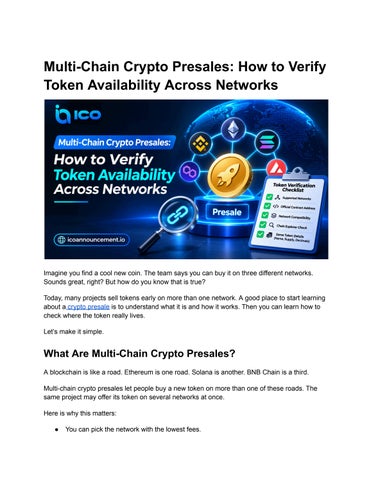
Multi-Chain Crypto Presales: How to Verify Token Availability Across Networks
Imagine you find a cool new coin. The team says you can buy it on three different networks. Sounds great, right? But how do you know that is true? Today, many projects sell tokens early on more than one network. A good place to start learning about a crypto presale is to understand what it is and how it works. Then you can learn how to check where the token really lives. Let’s make it simple.
What Are Multi-Chain Crypto Presales? A blockchain is like a road. Ethereum is one road. Solana is another. BNB Chain is a third. Multi-chain crypto presales let people buy a new token on more than one of these roads. The same project may offer its token on several networks at once. Here is why this matters: ● You can pick the network with the lowest fees.
● You can use the wallet you already have. ● More people can join, so the project grows faster. But there is a catch. Each network has its own token address. That means each version of the token is a separate item. If you buy the wrong one, you could lose your money.
Why Do Projects Go Multi-Chain? Teams have good reasons to spread out. Knowing them helps you ask smart questions. ● ● ● ●
Lower costs. Some networks charge tiny fees. Others charge a lot. Faster speed. Some networks finish trades in seconds. More buyers. Each network has its own fans. Less crowding. One busy network can slow everything down.
Not every team does this well, though. Some just say “multi-chain” because it sounds fancy. That is why you need to check the facts yourself.
Why Checking Token Availability Matters Scammers love confusion. When a token lives on many networks, it is easy to make a fake one. A fake token can look just like the real one. It can even have the same name and logo. If you want a place to see projects that are listed and announced, you can browse ICO Announcement to get a sense of what real listings look like. Seeing real examples trains your eye. Here is what can go wrong if you skip checking: ● ● ● ●
You send money to a fake sale page. You buy a token on a network that the team does not support. You get a token that cannot be moved or sold later. You pay extra fees to fix a mistake.
A few minutes of checking can save you a lot of pain.
Step-by-Step: How to Verify Token Availability Follow these steps one at a time. Do not skip any.
Step 1: Start With the Official Website Go to the project’s real website. Be careful here. Do not click links from random posts or messages.
Look for a page that lists: ● Each network the token will use ● The token address for each network ● The dates of the sale If the site does not list these, that is a warning sign.
Step 2: Match the Contract Address Every token has a contract address. It is a long string of letters and numbers. Think of it as the token’s home address. Write down the address from the official site. Then compare it with the address shown in other trusted places. They must match exactly. Even one wrong letter means it is a different token.
Step 3: Use a Block Explorer A block explorer is a free website that lets you look at what is happening on a network. Each network has its own. ● Ethereum uses Etherscan. ● BNB Chain uses BscScan. ● Solana uses Solscan. Paste the contract address into the right explorer. Then check these things: ● ● ● ●
Does the token name match? Does the token have the right symbol? How many holders does it have? When was it created?
If a token claims to be on three networks, search all three. A real token will show up on each one.
Step 4: Check the Announcement Trail A real project leaves a trail. It posts news. It shares dates. It explains each step. You can follow upcoming sales and updates through a trusted ICO calendar to see if the dates match what the team says. If the dates on the website, the calendar, and the team’s posts all agree, that is a good sign. If they do not agree, slow down.
Step 5: Look at the Bridge Plan
Sometimes a token starts on one network and moves to others using a bridge. A bridge is like a ferry that carries tokens from one road to another. Ask these questions: ● Which bridge will the team use? ● Is the bridge already built and tested? ● When can you move your tokens? A team that cannot answer these may not be ready for multi-chain crypto presales.
Red Flags to Watch For Some signs should make you stop and think. Here are the big ones: ● ● ● ●
No contract addresses. If the team will not share them, be careful. Big promises. Nobody can promise you will get rich. Pressure to hurry. Real sales do not need panic. Different addresses everywhere. The address should be the same across trusted sources. ● Hidden team. If you cannot find who runs it, that is a problem. ● A copied website. Fake sites often look just like real ones. If you see even one of these, do more research. If you see several, walk away. Many people also like to read about other early offers, such as a free crypto airdrop, to learn how real teams share information. Real teams are open. They answer questions. They do not hide.
A Simple Checklist You Can Use Print this out or save it on your phone. Check each line before you buy. ● ● ● ● ● ● ● ●
I am on the official website. I found the contract address for my network. I checked the address on a block explorer. I The token name and symbol match. The sale dates match across trusted sources. I know which wallet works with this network. I understand the bridge plan, if there is one. I am only using money I can afford to lose.
If every box has a check, you are in much better shape.
Tips for Staying Safe Here are some easy habits that help: ● ● ● ● ● ●
Bookmark the official site. Then you never have to search for it again. Use a separate wallet. Keep a small wallet just for presales. Start small. Try a tiny amount first to see if everything works. Double-check the network. Your wallet must be set to the right one. Never share your seed phrase. No real team will ask for it. Save your receipts. Keep transaction links in case you need them.
Before you commit to anything, it also helps to read a fair token sale guide so you know the words and steps. The more you know, the harder it is for anyone to trick you.
What If the Token Is Not Available on Your Network? This happens a lot. A team may say the sale is on three networks, but you only have a wallet for one. Or the token may only be live on one network for now. Do not panic. Here is what to do: ● ● ● ●
Check the official site again for a launch schedule. See if the team plans to add more networks later. Wait instead of buying a wrapped or copied version. Ask questions in the official community channels.
Waiting is okay. There will always be another sale. Rushing is how most people lose money.
Why Multi-Chain Crypto Presales Are Growing More networks are being built every year. Each one has its own fans and its own tools. Projects want to reach all of them. That is good news for buyers. You get more choices. You can pick the network that fits you best. But more choices also mean more things to check. The skills in this article will help you for a long time. Once you learn how to verify an address and read an explorer, you can do it on any network.
Final Thoughts Multi-chain crypto presales can be exciting. They open the door to new projects on many networks. But the same freedom that makes them fun also makes them risky.
Remember the main steps: ● ● ● ● ● ●
Start at the official website. Match the contract address. Use a block explorer. Check the dates and news. Understand the bridge plan. Watch for red flags.
Take your time. Ask questions. Never trust a single source. When you check first and buy second, you protect yourself. And that is the smartest move in crypto. This article is for learning only. It is not financial advice. Always do your own research.