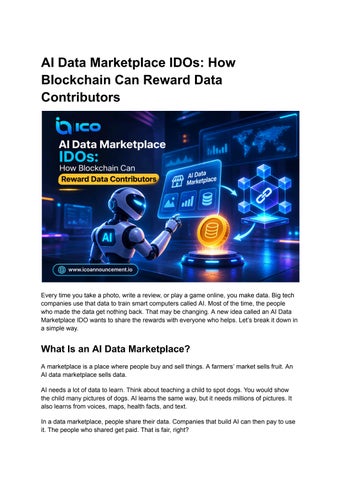
AI Data Marketplace IDOs: How Blockchain Can Reward Data Contributors
Every time you take a photo, write a review, or play a game online, you make data. Big tech companies use that data to train smart computers called AI. Most of the time, the people who made the data get nothing back. That may be changing. A new idea called an AI Data Marketplace IDO wants to share the rewards with everyone who helps. Let’s break it down in a simple way.
What Is an AI Data Marketplace? A marketplace is a place where people buy and sell things. A farmers’ market sells fruit. An AI data marketplace sells data. AI needs a lot of data to learn. Think about teaching a child to spot dogs. You would show the child many pictures of dogs. AI learns the same way, but it needs millions of pictures. It also learns from voices, maps, health facts, and text. In a data marketplace, people share their data. Companies that build AI can then pay to use it. The people who shared get paid. That is fair, right?
What Does IDO Mean? IDO stands for Initial DEX Offering. That sounds hard, but the idea is easy. A new crypto project wants to raise money. It creates its own digital coin, called a token. Then it sells some of those tokens on a DEX. A DEX is a “decentralized exchange.” It is a trading website that runs on code instead of a big company. Anyone with a crypto wallet can join. You don’t need to ask a bank for permission. You can see a list of crypto IDO listings to learn which projects are selling tokens now and which ones are coming soon. So an AI Data Marketplace IDO is when a data marketplace project sells its first tokens on a DEX. The money helps the team build the marketplace. The tokens help run it.
How Blockchain Rewards Data Contributors Now for the exciting part. A blockchain is like a shared notebook that nobody can secretly change. Thousands of computers keep a copy. When something is written in the notebook, everyone can check it. Here is how it can help data contributors:
1. Proof of Who Shared the Data The blockchain writes down who gave the data and when. Nobody can say they didn’t know.
2. Automatic Payments A smart contract is a small computer program on the blockchain. It works like a vending machine. If a company uses your data, the contract sends your payment automatically. There is no boss who can forget to pay you.
3. Rewards in Tokens Contributors often get paid in the marketplace’s own token. They can keep it, trade it, or use it inside the marketplace.
4. You Stay in Control Many projects let you pick what you share. You can say yes or no. Some also hide your name so your privacy stays safe.
A Simple Example Let’s say a girl named Maya loves taking pictures of birds. She has thousands of them. An AI company wants to build an app that names birds from photos.
Maya joins a data marketplace. She uploads her bird photos and adds labels like “robin” and “blue jay.” The blockchain records that these photos came from Maya. The AI company pays to use the photos. The smart contract sends a share of the money to Maya. If the app uses her photos again next year, she gets paid again. Without a marketplace like this, Maya would probably get nothing. That is the big idea.
Why Do Projects Use an IDO? You may wonder why a data marketplace would sell tokens at all. There are a few good reasons. First, building a marketplace costs money. The team needs workers, computers, and safe storage. Selling tokens helps pay for it. Second, tokens bring in a community. When people own tokens, they care about the project. They want it to grow, so they tell friends and share more data. Third, tokens give the marketplace its own money. Buyers use tokens to pay for data. Contributors earn tokens for sharing. This keeps the whole system running in one place. Many of these projects mix artificial intelligence with blockchain. If you’re curious about them, you can browse AI crypto projects to see what kinds of ideas are out there.
Good Things About This Idea Here are some of the best parts: ● More fairness. People who make the data share in the rewards. ● More trust. Everything is written on the blockchain where people can check it. ● Better data. When people get paid, they share more and better data. That helps AI work better. ● Open to all. A student in one country can sell data to a company in another country. ● Less waiting. Smart contracts pay quickly, without long paperwork.
Careful! There Are Risks Too Now it is time for a serious talk. Not every project is good. Some are weak, and some are even scams. Before you put any money in, remember these points.
Prices Can Drop Fast A token can lose most of its value quickly. Never use money you need for food, rent, or school.
Some Teams Make Big Promises
If a project promises you will get rich, be careful. Nobody can promise that.
Data Can Be Misused Ask how the project keeps your data safe. Ask if you can remove it later.
Code Can Have Bugs A smart contract is only as good as the people who wrote it. Mistakes can lose money.
Rules Are Still Changing Different countries have different laws about crypto and data. To learn more about a project before you decide, read some independent project reviews. They give a closer look at the team, the plan, and the risks. This post is for learning only. It is not financial advice.
Questions to Ask Before You Join Here is a simple checklist. Think of it like checking a toy before you buy it. 1. Who is on the team? Are the people real? Can you find their work online? 2. What problem does it solve? A good project has a clear job. “We want to pay people for their data” is clear. “We will be the next big thing” is not. 3. How are tokens shared? Look at how many go to the team, to buyers, and to data contributors. If the team keeps almost all of them, that is a warning sign. 4. Is there a real product? Look for a working demo, not just a pretty website. 5. How is your data protected? Look for clear rules on privacy and on what buyers can do with the data. 6. Has anyone checked the code? An outside review, called an audit, is a good sign. If you are new to all this, reading step-by-step crypto guides can help you learn the basic words and steps before you try anything.
What Could the Future Look Like? Imagine a world where people own a small piece of the data they create. Doctors could share health facts, with names removed, to help find new medicines. Farmers could share weather and soil facts to help grow more food. Drivers could share road information to make maps better. Everyone in the chain would get a fair share. That world is not here yet. AI Data Marketplace IDOs are still new, and many ideas will not work out. But the main idea is a good one: if your data helps build something valuable, you should share in the reward.
Blockchain makes this possible because it can track who gave what, and it can pay people without a middleman. That is why so many builders are excited about it.
Where to Keep Learning The crypto world moves fast, so new IDOs launch all the time. Keep reading, keep asking questions, and take your time. It is always okay to say “I need to learn more first.” A good place to start is the news and listings on ICO Announcement, where you can find crypto news, presales, ICOs, and IDOs all in one place.