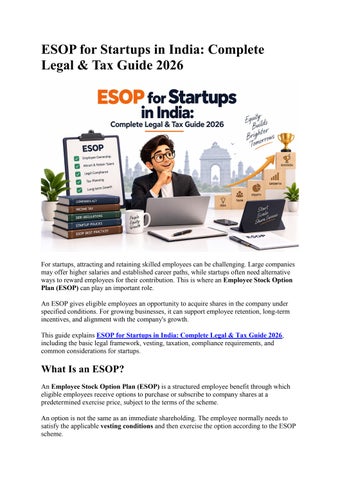
ESOP for Startups in India: Complete Legal & Tax Guide 2026
For startups, attracting and retaining skilled employees can be challenging. Large companies may offer higher salaries and established career paths, while startups often need alternative ways to reward employees for their contribution. This is where an Employee Stock Option Plan (ESOP) can play an important role. An ESOP gives eligible employees an opportunity to acquire shares in the company under specified conditions. For growing businesses, it can support employee retention, long-term incentives, and alignment with the company's growth. This guide explains ESOP for Startups in India: Complete Legal & Tax Guide 2026, including the basic legal framework, vesting, taxation, compliance requirements, and common considerations for startups.
What Is an ESOP? An Employee Stock Option Plan (ESOP) is a structured employee benefit through which eligible employees receive options to purchase or subscribe to company shares at a predetermined exercise price, subject to the terms of the scheme. An option is not the same as an immediate shareholding. The employee normally needs to satisfy the applicable vesting conditions and then exercise the option according to the ESOP scheme.
For startups, ESOPs can form part of a broader employee incentive and retention strategy.
Why Are ESOPs Important for Startups? Startups often compete for talented employees in a highly competitive market. An ESOP scheme can provide employees with a potential long-term financial interest in the company's growth. Some potential benefits include:
Attracting skilled professionals Encouraging employee retention Rewarding long-term contribution Creating an ownership-oriented culture Aligning employee interests with business growth Providing an additional component of employee compensation
However, an ESOP should be properly structured and documented rather than treated as an informal promise of future shares.
Legal Framework for ESOPs in India The legal framework for ESOPs depends on the company's structure and regulatory status. For companies covered by the Companies Act, 2013, employee stock options are governed by applicable provisions of the Act and the Companies (Share Capital and Debentures) Rules, along with other applicable regulations. Listed companies may also need to comply with the regulatory framework applicable to employee benefit schemes under securities-market regulations. Therefore, startups should review their eligibility, corporate structure, articles, shareholder arrangements, and applicable regulatory requirements before introducing an ESOP scheme.
Key Components of an ESOP Scheme A properly designed ESOP plan should clearly define the rights and responsibilities of the company and employees.
1. Grant of Options The company grants a specified number of stock options to eligible employees according to the approved scheme.
2. Vesting Period The ESOP vesting period is the period over which employees earn the right to exercise their options.
A startup may use a multi-year vesting schedule. The exact structure depends on the company's ESOP policy and applicable legal requirements.
3. Exercise Price The exercise price is the amount the employee must pay to acquire shares when exercising vested options. The company should clearly communicate the exercise price and relevant conditions to employees.
4. Exercise of Options Once the options are vested, the employee can exercise them according to the terms of the ESOP scheme.
5. Allotment of Shares After valid exercise and completion of the required procedures, the company may allot the corresponding shares to the employee, subject to applicable law and documentation.
ESOP Taxation in India One of the most important aspects of an ESOP is understanding ESOP taxation in India. Tax implications can generally arise at different stages of the ESOP lifecycle.
Tax at the Exercise Stage When an employee exercises eligible stock options and receives shares, the value of the specified security or sweat equity may be treated as a taxable perquisite under the applicable income-tax provisions. The taxable amount and valuation depend on the applicable rules and circumstances.
Tax When Shares Are Sold If an employee later sells the shares received through ESOPs, the transaction may result in capital gains tax. The tax treatment can depend on factors such as:
Whether the shares are listed or unlisted Holding period Sale price Applicable cost basis Applicable tax regime and provisions
Employees should therefore consider both the exercise-stage taxation and the eventual sale of shares.
ESOP Tax Deferral for Eligible Startups Certain employees of eligible startups may qualify for a specific ESOP tax deferral mechanism under the Income Tax Act, subject to prescribed conditions. This mechanism does not necessarily eliminate the tax liability. Instead, it can defer the payment or deduction of tax on the ESOP perquisite until specified triggering events, subject to the applicable provisions. Startups and employees should verify whether the company and employee satisfy the conditions before relying on any tax deferral.
ESOP Compliance Requirements Implementing an ESOP scheme involves corporate and compliance formalities. Depending on the company and applicable regulations, important areas can include:
Drafting the ESOP scheme Board approvals Shareholder approvals Grant documentation Maintaining employee option records Vesting records Exercise documentation Share allotment procedures Statutory registers Accounting and financial reporting Tax deduction and reporting Required disclosures
Maintaining accurate records is particularly important as the startup grows and raises additional funding.
What Happens to ESOPs When an Employee Leaves? The treatment of ESOPs after an employee leaves depends on the terms of the company's ESOP policy and applicable law. The scheme should clearly address situations such as:
Resignation Termination Retirement Death
Permanent disability Termination for cause Exercise period after employment ends
Employees should carefully review these provisions before accepting an ESOP grant.
Common ESOP Mistakes Startups Should Avoid Startups can face unnecessary legal and financial complications when ESOPs are not properly structured. Common mistakes include:
Making informal equity promises Poorly drafted ESOP documentation Not obtaining required approvals Unclear vesting conditions Failing to explain the exercise price Ignoring tax implications Incorrect cap-table management Not defining exit treatment Missing corporate compliance requirements
Professional guidance can help startups establish a more organised ESOP process.
How Business Registration Consultants Can Help Startups Before implementing an ESOP, a startup should have the appropriate business structure and registrations in place. This is where Best Business Registration Consultants in India for Startups & SMEs can provide valuable support. Professional consultants can assist businesses with company incorporation, LLP registration, startup-related registrations, corporate documentation, statutory compliance, and other business setup requirements. For startups planning future fundraising or employee equity programmes, establishing a suitable legal and compliance foundation from the beginning can make future corporate processes easier to manage.
Why Choose CRSPL? Compliance & Registration Services Private Limited (CRSPL) provides business registration, corporate compliance, legal, taxation, and advisory support for startups and SMEs. CRSPL can assist businesses with areas such as:
Company and LLP registration
Startup registration support Corporate compliance Business licences and registrations ESOP-related corporate documentation Tax and compliance coordination Legal and regulatory advisory
Whether you are launching a new startup or expanding an existing business, having the right registration and compliance structure can help you operate more efficiently.
Conclusion An ESOP can be a valuable employee incentive for startups, but it requires careful planning. From ESOP legal compliance and vesting conditions to exercise procedures and taxation, every part of the scheme should be properly documented and understood. If your startup is considering an ESOP programme, professional corporate and compliance guidance can help you establish the right framework while reducing avoidable errors. Looking for professional support for your startup or SME? Connect with Compliance & Registration Services Private Limited (CRSPL) for business registration, corporate compliance, and legal support.
FAQs 1. What is ESOP for startups in India? ESOP is an employee incentive mechanism that gives eligible employees the option to acquire shares in a company subject to specified terms, conditions, and vesting requirements.
2. Are ESOPs taxable in India? Yes, ESOPs can have tax implications. Tax may arise when options are exercised and when the resulting shares are subsequently sold, depending on the applicable provisions.
3. What is an ESOP vesting period? The vesting period is the period during which an employee earns the right to exercise the stock options granted to them.
4. What is an ESOP exercise price? The exercise price is the predetermined price an employee is required to pay to acquire shares after the relevant options become exercisable.
5. Can startups offer ESOPs to employees?
Eligible companies can establish ESOP schemes subject to the applicable provisions of the Companies Act, rules, and other regulatory requirements.
6. Is ESOP tax deferral available to startups? Certain eligible startups and employees may qualify for tax deferral subject to prescribed conditions. Eligibility should be verified on a case-by-case basis.
7. What happens to ESOPs after an employee resigns? The treatment of vested and unvested options depends on the ESOP scheme, employment terms, and applicable legal provisions.
8. Can CRSPL help startups with registration and compliance? Yes. CRSPL provides business registration, corporate compliance, legal, taxation, and advisory support for startups and SMEs.
Thank You for Reading For professional assistance with startup registration, ESOP-related compliance, corporate documentation, and business advisory, contact Compliance & Registration Services Private Limited (CRSPL). Address: A-34, 2nd Floor, Naraina Industrial Area, Phase II, Delhi - 110028 Phone: 8800018027 Email: care@crspl.in Website: https://crspl.in/ CRSPL — Supporting Startups & SMEs with Registration, Compliance and Business Solutions.