Crowder Quill 45 years
The literary-art magazine and contest of Crowder College All rights reserved, Copyright 2026 Crowder College, Neosho, Mo.

Created by Mark Hollandsworth Used for the 1981-1987 covers; persists in current logo
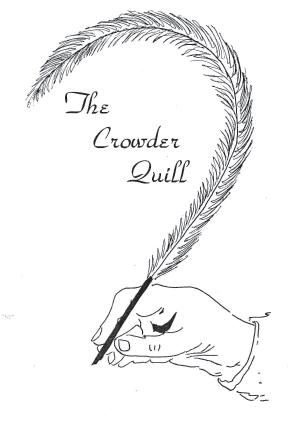
Created by Tammy Omar Used for the spring and fall 1980 covers
The Crowder Quill is a literary-art magazine published at Crowder College in order to encourage and showcase the creative abilities of local writers, artists, and photographers, as well as provide a cultural link between Crowder College and our surrounding communities.
The publication is funded through Crowder College as an educational tool and community service. Both the contest and publication are free. The Crowder Quill is published each spring semester in May. Art and literary submissions are accepted at CrowderQuill.com from May 1 to Feb. 1 each year. All entries should be submitted online except by special permission; contact Quill@Crowder.com. The maximum number of entries per category per person is four. Only one award per category is allotted per person. Entries are judged by staff members. Divisions are high school, Crowder College students, and community members. All participants must live within 100 miles of a Crowder College campus. For more details about the contest and publication, go to www.CrowderQuill.com. Disclaimer: Some content may be inappropriate for younger audiences.
The Crowder Quill, 601 Laclede Ave., Neosho, Mo., 64850, 417-455-5410, fax 417-451-4280 www.CrowderQuill.com; Facebook and Instagram: Crowder Quill; email: Quill@crowder.edu


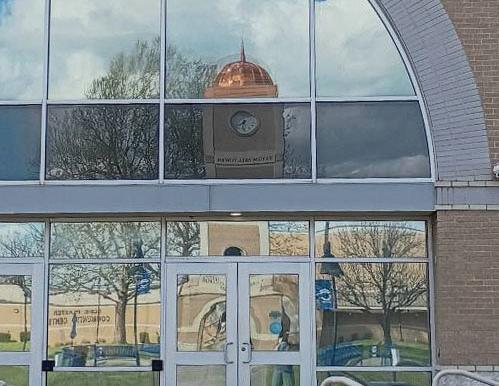







The Crowder College Family exists to inspire and nurture all who are touched by them. -- James Tatum
The Tatum Bell tower reflects on the rich history the Crowder Quill has served at the college and within the community. The Quill is a service encouraging and promoting creative expression among artists, authors, and photographers. James Tatum helped found Crowder College on the principle of servant leadership and was the first person honored with a dedication within the Quill.
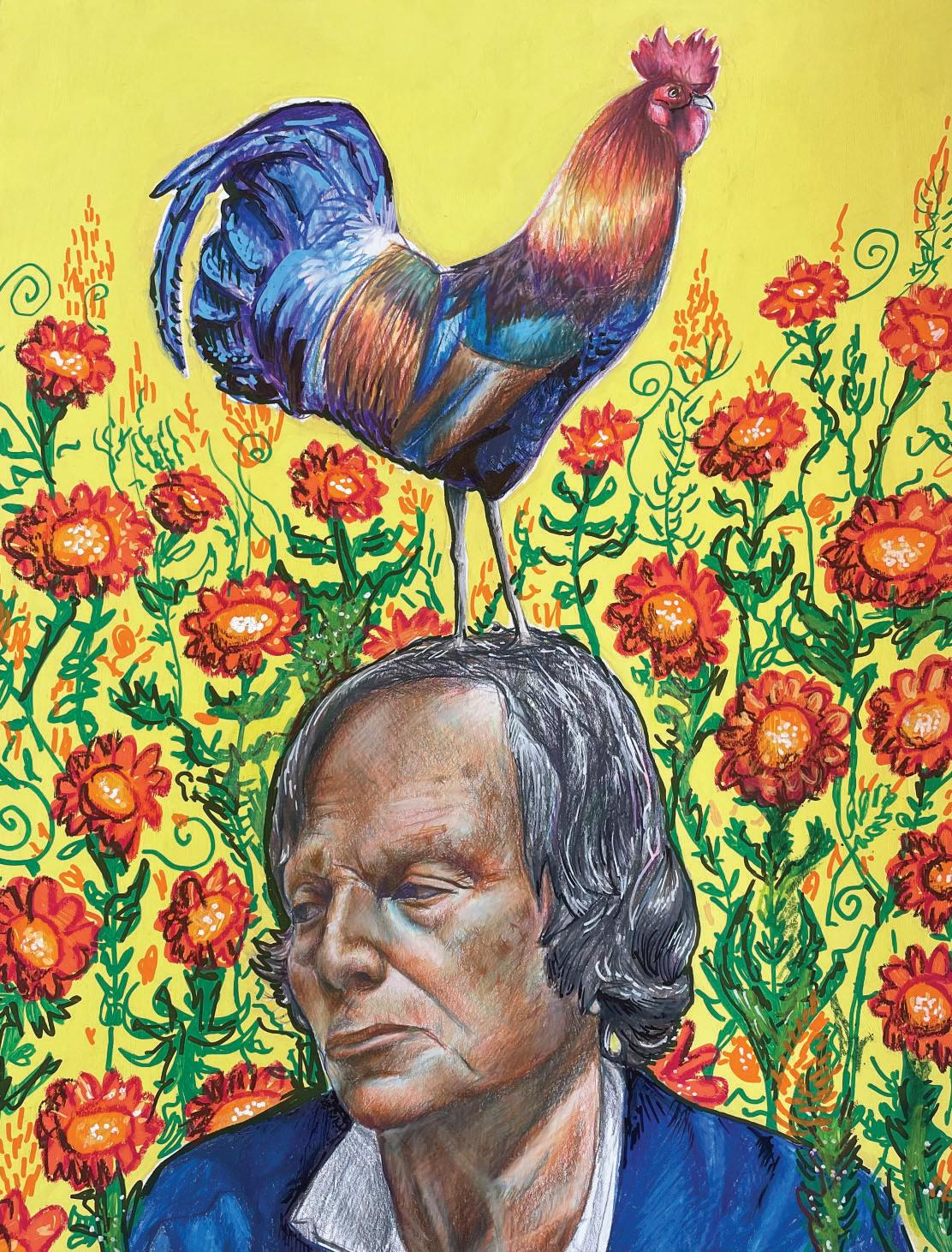
Amongst her flowers and beloved rooster, this piece is an homage to my grandma. Colour pencil,
pen and acrylic paint over cardboard.
Salema is a Portuguese native with achievements including Artist of the Year, pieces featured in the MSSU Art Show, and two pieces featured in the Portuguese version of J.K. Rowling's Ickabog. He also attended the prestigious summer school Drawing Matter in London. Salema is developing an AP drawing portfolio focused on the concept of personal experiences with culture.
Jessi Hilton Goodman Quill Staff
see www. CrowderQuill.com.
On an ordinary school day in 1980, one that seemed no different from the rest, Dan Richard stepped before the Crowder College English faculty with a spark of an idea. He couldn’t have known the spark would kindle a flame. That ordinary day in 1980 marked the beginning of a legacy, the beginning of the magazine we know and love: the Crowder Quill, a nationally awardwinning publication with around 1,000 entries submitted annually.
For eight years, until his retirement in 1988, Richard guided the Crowder Quill to be a model of excellence and creativity. Now 45 years later, the Quill continues on, giving an opportunity to the community to express themselves within its pages.
Sandy Jordan, who was among the first Crowder Quill staff in 1980, remembered those early days and said, “When Dan Richard stood in front of a handful of students, he had a vision, a formless entity he wanted to bring to life.” And he did. What began as a whisper of possibility is now a beloved, nationally awardwinning publication; proof of what a single idea, a single dream, can become.
Starting in 1980, the Quill was published twice a year, displaying the creativity and life of the community; in 1985 the contest gained a “Junior Division” for grades 1-8. Both were discontinued in 2006, with the Quill becoming an annual publication and the “Junior Division” being replaced by an annual K-8 fine arts day, held in the fall until 2011.
For 45 years, whether annual or bi-annual, this magazine has been a staple of our creative history and imagination. The Quill has grown
and changed, with the addition of color photography in 2003, digital art in 2010, and the altering of the art categories to reflect Crowder’s academic departments, 2D and 3D art, in 2013; with the Quill’s growth, its ability to give back to the community has expanded, with $500 scholarships being added as a prize to the high school gold winners for all eight categories each year.
Latonia Bailey has worked alongside the Quill for decades. Her journey with the Crowder Quill began with a Quill gold award she won as a high school student in 1987. By spring 1989, she had joined the staff as a poetry judge, and in 1994 she took the lead as the faculty adviser. Since then, she has been instrumental in every step of the magazine’s creation, leading students in the judging, promoting, and designing. Faculty and students alike have chosen her for honorary publication within its pages. Without her, the Quill would not be the same.
The Quill’s logo also has its own history. The original logo was created by Tammy Omar for the 1980 spring and fall editions. From 1981 to 1987, Mark Hollandsworth’s striking and elegant logo graced the cover and defined the magazine’s early years. Starting in 1988, the tradition shifted; each year’s cover became the canvas for a new creator, chosen from the art of that year’s entries or from staff members. Still, Hollandsworth’s original Quill continued to make appearances across the Crowder Quill’s social media, within its logo, and its pages, honoring the memory of those who shaped the magazine’s early history.
COLOPHON: The Crowder Quill publication is designed annually by Crowder College students enrolled in DIGM 105 Applied Graphic Design and Media Campaigns using Adobe InDesign. Text was set in Bell MT, story titles in Myriad Pro, and credits in Arial. The magazine was printed at Sun Graphics in Parsons, Kans. The cover stock is Sappi Flo Gloss Digital Cover 12 x 18 80 lb. 7TP coated, and inside pages are on 11x17 60 lb. white Husky Opaque Offset Domtar.
Special thanks to the following individuals and departments for making this publication and contest possible:
Cindy Brown, Public Information Office
Roger Powell, Communications Instructor
Josh Novak and Josh Knott, Art Instructors
Diane Vasilis, Graphic Design Instructor
Stephanie Witcher, Communications Division Chair
Saydee Wheeler, Communications Division Administrative Assistant
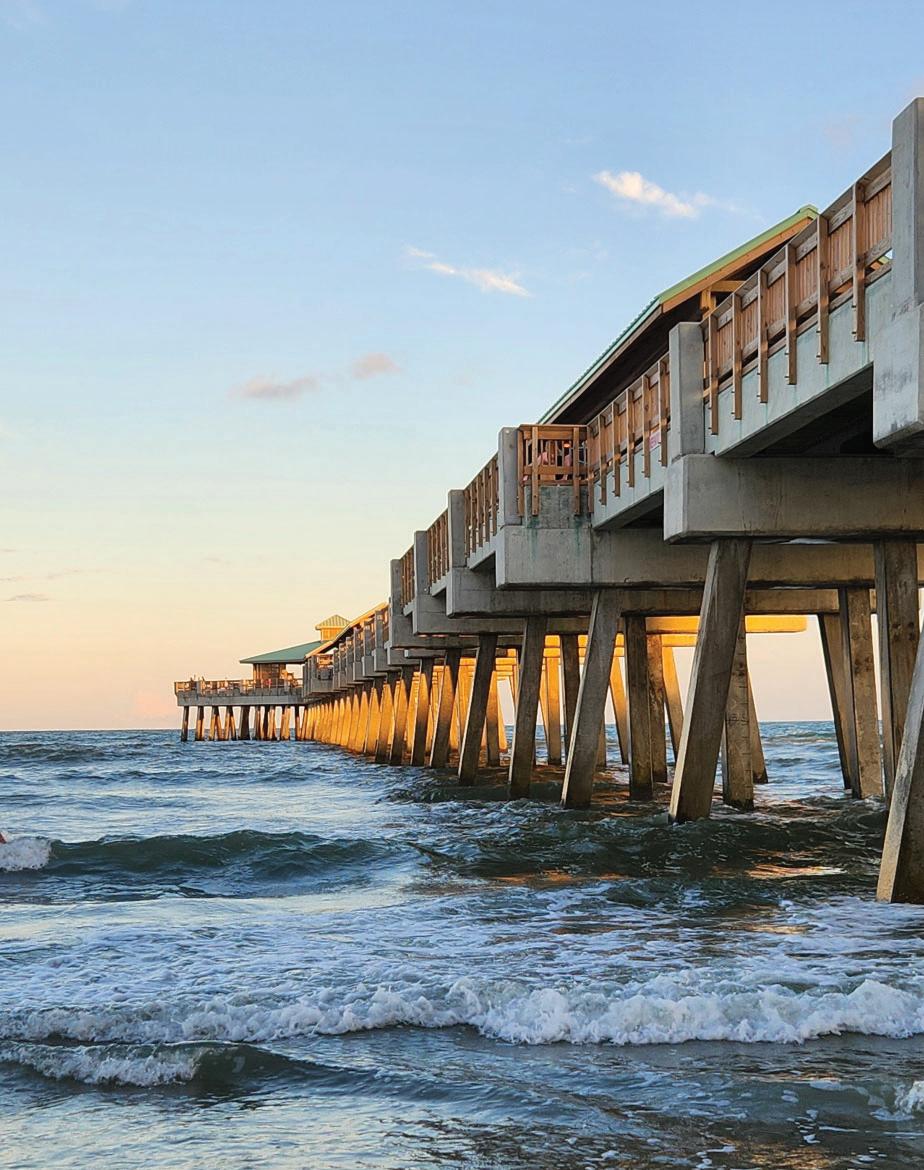
Mckenzie Sarakinis Joplin Community Bronze Nonfiction Persuasive Essay
I discuss the importance of architecture and infrastructure on community and culture. Most of my focus is on American city construction and its isolationism.
Sarakinis, a Crowder graduate, is working towards her PhD in plant genetics and aspiring to work in conservation.
When thinking of our culture, we often focus on the clearly human aspects; music, dance, art, and other such ways of human expression. What we often fail to take into consideration is our environment. We are not only affected by the buildings we reside in, but by their distance from each other, their colors and patterns, even the lighting that surrounds them can affect our mood and our likelihood to spend time in them. When taken into consideration, architecture can be a powerful tool in bringing communities together, in the same way it can, intentionally or not, tear communities apart. For communities and cultures throughout the United States to prosper, it is important for architects and planners to put serious time and consideration into their designs, and for them to focus not only on physical appeal, but on comfort and accessibility.
When large-scale city development began in the United States it was very loosely regulated, builders were allowed to create any building they wanted wherever they pleased, so long as they were structurally stable. While this initially was not an issue, over time businesses and factories began building near homes, skyscrapers began blocking out sunlight and factories filled neighborhoods with loud mechanical buzzing and presented potential health hazards. Eventually New York City inhabitants began demanding regulation, and in 1916 they created the first example of city zoning, separating buildings into residential, business, and industrial districts (“A Brief History of American Zoning”).
Over time zoning laws evolved, as cars became more integral parts of our lives they became more important considerations in new zoning laws. While this was a good idea on paper, designers had trouble figuring out how much parking should be required for different businesses. This lack of understanding led to zoning laws created from best guesses; laws that required grocery stores to provide 4 ½ parking spots per 1,000 square feet of store space or laws that required churches to have one parking spot per three fixed seats (“Zoning Ordinance - Section 28 Parking Standards”). While these guesses were sometimes sufficient, they also had a tendency to give far more
parking than necessary, widening the distances between individual stores and contributing to sprawl.
When looking at these issues head on, it’s hard to see any specific problem with these laws, separated districts and extra parking sound like non-issues. However, these zoning laws have, over time, forced cities to become less walkable. With miles of neighborhoods and parking lots between stores, recreational areas, and individual homes it becomes near impossible for people living in these cities to travel without vehicles. Some view this car reliability as a good thing, saying it reflects how wealthy the United States is, while also making the country more efficient (“In Praise of America’s Car Addiction”). This positive depiction of car-centric architecture, however, is simply not true.
In these car reliant cities, anyone who is too young, too poor, or too physically or mentally handicapped to drive are trapped within their neighborhood, unable to leave the few miles around their home without the help of their friends and family. When this is taken into consideration, the lack of walkability stops being a simple inconvenience, it becomes discriminatory. By making transportation so difficult for so many, it limits the possibility of social connection and community to the select few able to reliably drive themselves to recreational areas, thereby stifling the potential for new ideas and cultural growth. Even for those lucky enough to drive, just the act of driving limits an individual’s chance to socialize. As explained by Andrew Price, “When I lived in the city, I used to have random encounters with strangers, often daily. … Living in the suburbs, I have eliminated most of these random encounters. When I get into my car to drive to work, I feel like I’m travelling through town in my own isolated box. When I get out of my car at work, the only people that I interact with are co-workers, and when I return home, the only people that I interact with are family.” (“The Negative Consequences of Car Dependency”).
The lack of walkability in most cities is, unfortunately, not the only issue preventing social connection and cultural growth in the U.S. As of late, architectural techniques have been used to intentionally make areas less
welcoming in the form of hostile architecture. Spikes on low garden walls, metal dividers on benches, and intentional metal studs in railings all work to discourage not only specific demographics, but people in general from spending time in public areas (“‘Hostile Architecture’: How Public Spaces Keep the Public Out”). Despite being intended to only keep out the homeless or prevent skateboarding, hostile design in general has the tendency to scare off most people wanting to spend time in these areas, ultimately defeating their purpose.
While zoning laws and hostile architecture have caused some issues in our living areas, these problems are far from unfixable. Over the years, many people have put time and effort into trying to understand what elements make living areas more comfortable and inclusive. This, however, was no easy task; environmental effects, in general, are difficult to study due to their variability. Environments don’t only include physical areas, they also include things like weather, temperature, lighting, and even the other people who inhabit those spaces (“Mental Health and Environmental Exposures: An Editorial”). That being said, it has been found that things as simple as having clean, inclusive spaces significantly improve the mental health of the people living in those areas (“How Your
Environment Affects Your Mental Health”).
To counter the struggle with urban sprawl and car over reliance, the easiest solution is simply to make zoning laws less strict. While factories should still be kept away from homes, small businesses should be allowed to occupy buildings in residential areas. By doing this, the stores would not only be able to get more customers, but the individuals living in the surrounding areas would be able to easily walk to potential grocery stores and small shops. In a similar vain, apartment buildings should be allowed to exist in suburban areas to an extent. While a 20 story apartment complex should not be built in the middle of a neighborhood with only single family houses, smaller complexes should be allowed throughout the area.
This idea, the simplification of zoning laws, is not a new one. In fact, many states in the U.S. have already done their own version of this. An example often used to show the positive effects of looser zoning would be the cities of Houston and San Jose. Unlike almost any other major city in the U.S., Houston has no zoning restrictions, and because of this the city has built housing at nearly three times the rate of cities like San Jose and New York. To add to this accomplishment, the housing made in Houston isn’t just sprawl, they managed to
|Continued to 6|
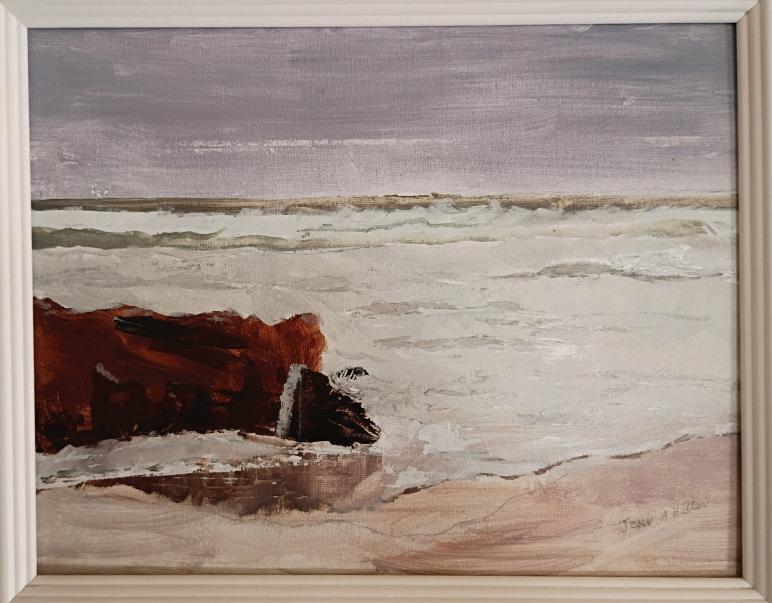
Jessi Hilton Goodman Quill Staff 2D Art
I painted this ocean scene when I was 11, which was the first time working with oil paints and textures. I used a wet on dry method, working from the furthest scenery to the closest, more detailed scenery.
Hilton loves to express herself through art and writing. She is a dual enrollment student and hopes to earn a master’s degree in psychology with a minor in business.
build around the same number of apartments as Los Angeles, despite only being half the size (“A Bold Case against Zoning”).
Even if large law overturning is not an option, cities and public areas can still be made more culturally enriching simply by changing design choices. As of late, many buildings have been constructed with the idea of modernism in mind, and while this is not inherently a bad thing it has led some buildings to feel “placeless.” To get around this, architects should consider the culture and history of the places they build in. For example, architects in Norway have made modern looking buildings fit the culture of the area by making the northern lights a key element in the buildings design. Similarly, architects in Russia have made buildings look similar to Fabergé eggs for the same reason. While this solution may not satisfy everyone, small considerations like this could help make areas more distinguishable and lively (“How Culture Continues to Impact Architectural Design”).
If even taking into consideration the history of an area is too much to ask, making areas more naturally comfortable would help to encourage more sociable and community based cities. While rarely considered, lighting could be a great way to make places more lively. Despite popular belief, more light is not always a good thing, if an area is too brightly lit it may very well make people feel as though they are under a spotlight. To counter this, cities should have a comfortably dim lighting, enough light to see by but not so much that inhabitants feel blinded (“Understanding Hostile Architecture: The Cause and Effect of Restricting Public Space”).
Whether people realize it or not, our surroundings have a big effect on not only how we feel, but how we think of our community. Through both intentional and unintentional design choices, cities throughout the United States have become less connected, and while that might be disheartening, it is far from an unsolvable issue. By putting a greater emphasis on the social aspect of cities, future architects may be able to bring more life and culture into towns, one building at a time.
Sources
Andrew Price “The Negative Consequences of Car Andrew Price. “The Negative Consequences of Car Dependency ” Dependency.” Strong Towns , Towns, 21 Jan 2015, 21 Jan. www strongtowns org/jour nal/2015/1/20/ www.strongtowns.org/journal/2015/1/20/ the-negative-consequences-of-car-dependency the-negative-consequences-of-car-dependency. “A Bold Case Against Zoning ” “A Bold Case Zoning.” Nolan Gra y, Nolan Gray, 11 July 11 2022, www.fastcompany.com/90766731/a- 2022, bold-case-against-zoning Accessed 22 Apr bold-case-against-zoning. Accessed 22 Apr. 2024 2024.
“A Brief Histor y of American Zoning ” “A Brief History of American Zoning.” City of Billings, MT, Community Builders, , MT, Community Builders, www billingsmt gov/DocumentCenter/ www.billingsmt.gov/DocumentCenter/ View/34836/9---A-Brief-Histor y-ofView/34836/9---A-Brief-History-ofAmerican-Zoning?bidId=#: :te xt=The%20 American-Zoning?bidId=#:~:text=The%20 City’s%20officials%20realized%20 something,comprehensive%20zoning%20 ordinance%20in%201916 Accessed 22 Apr ordinance%20in%201916. Accessed 22 Apr. 2024 2024.
Helbich, Marco “Mental Health and Environmental Marco. “Mental Health and Environmental Exposures: An Editorial ” An Editorial.” Inter national International Jour nal of Environmental Research and Public Journal Environmental Research and Public Health, vol 15, no 10, 10 Oct 2018, p vol. 15, no. 10, 10 Oct. 2018, p. 2207, www ncbi nlm nih gov/pmc/ar ticles/ 2207, www.ncbi.nlm.nih.gov/pmc/articles/ PMC6210156/, https://doi org/10 3390/ PMC6210156/, https://doi.org/10.3390/ ijerph15102207 ijerph15102207.
“How Culture Continues to Impact Architectural “How Culture Continues to Architectural Design | Laura U.” Laura U.” Laura U Design Collective , Laura U Collective, 20 Oct 2019, www laurau com/how-culture- 20 Oct. 2019, www.laurau.com/how-culturecontinues-to-impact-architectural-design/ continues-to-impact-architectural-design/. Hu, Winnie “‘Hostile Architecture’: How Public Hu, Winnie. “‘Hostile Architecture’: How Public Spaces Keep the Public Out ” Spaces Keep the Public Out.” The New York Times , York Times, 8 Nov 2019, www nytimes 8 Nov. 2019, www.nytimes. com/2019/11/08/nyregion/hostilearchitecture-nyc html architecture-nyc.html.
“In Praise of America’s Car Addiction ” Addiction.”
The Economist, The www economist com/ www.economist.com/ finance-and-economics/2023/11/09/ in-praise-of-americas-car-addiction in-praise-of-americas-car-addiction.
Lindberg, Sara “How Your Environment Affects Sara. “How Your Environment Affects Your Mental Health.” Ver ywell Mind, Verywell Mind, 23 Mar 2023, www ver ywellmind com/how- Mar. 2023, www.verywellmind.com/howyour-environment-affects-your-mentalhealth-5093687 health-5093687.
The Neighborhood Design Center “Understanding The Design Center. Hostile Architecture: The Cause and Effect of Restricting Public Space ” Public Space.” The Neighborhood The Design Center, Center, 2 Oct. 2023, ndc-md.org/ 2 Oct. 2023, news-and-stories/understanding-hostilearchitecture-the-cause-and-effect architecture-the-cause-and-effect.
“Zoning Ordinance - Section 28 Parking Standards Ordinance - Section 28 Standards | Unified Development Ordinance ” Unified Ordinance.” Online encodeplus com, online encodeplus Online.encodeplus.com, online.encodeplus. com/regs/castlepines-co/doc-viewer com/regs/castlepines-co/doc-viewer. aspx?secid=1458#secid-1458 Accessed 23 aspx?secid=1458#secid-1458. Accessed 23 Apr 2024 Apr. 2024.
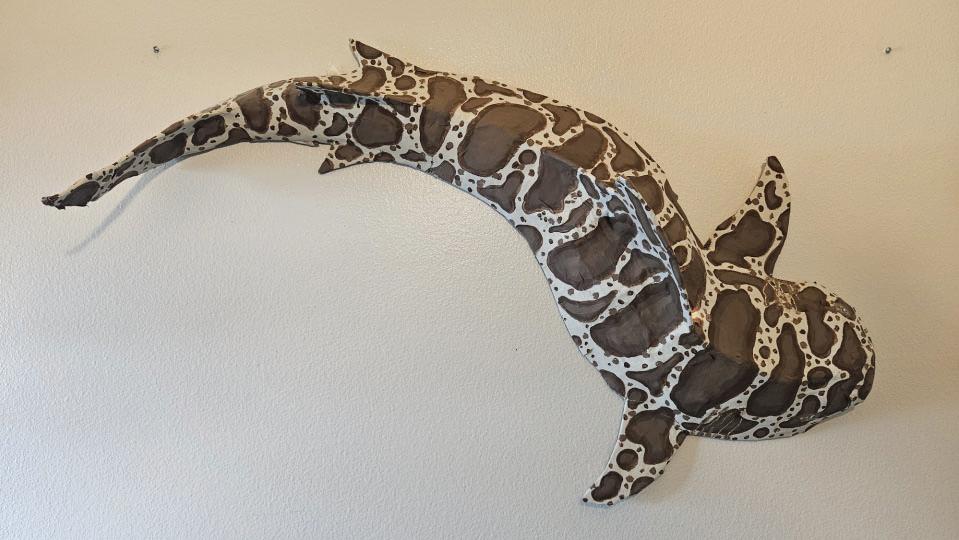
I’ve always loved sharks, and more recently, cardboard sculptures. This is my second and favorite shark sculpture due to time spent on this Leopard Shark. Cardboard outline, filled with paper, covered in tape; papier-mâché outcast, painted based on many shark pictures
Eidem’s projects have always been an outlet for her ideas and emotions. With future plans to study nature, he sees art in everything, and wishes to show that in all of his pieces.
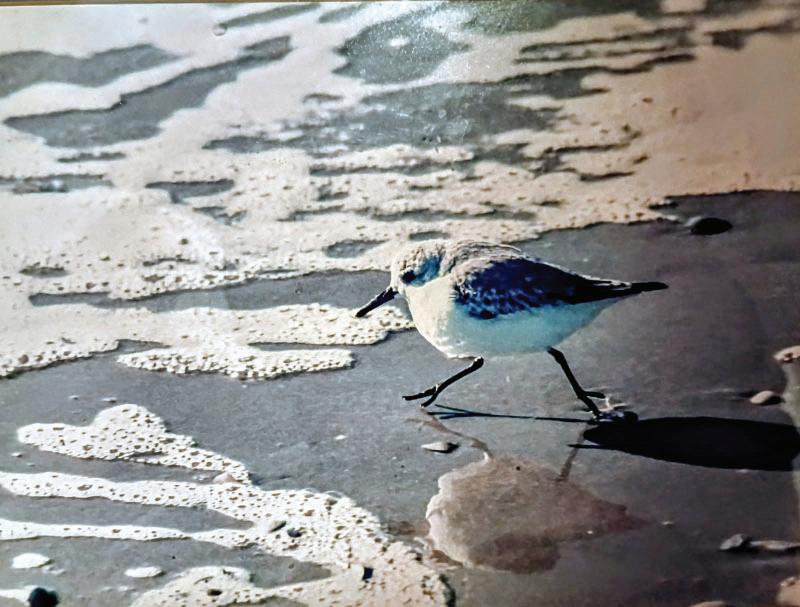
Julie Hilton Goodman Quill Staff Color Photography
I loved watching these birds on my early morning beach walk! I’ve been learning how to identify diverse birds from sounds, flight patterns, coloring, and shape. Canon Rebel with 300 zoom lens, auto settings
Hilton captures moments with photography and art and is relearning manual camera settings.
Holly Vogelpohl Fairview Crowder Gold
B&W Photography
I took this picture at Wonders of Wildlife in Bass Pro. It shows that even with all the craziness and chaos in the exhibit, life goes on. Motorola g stylus cellphone camera
Holly, a freshman, wants to get a job at National Geographic. She took a multimedia class in high school.
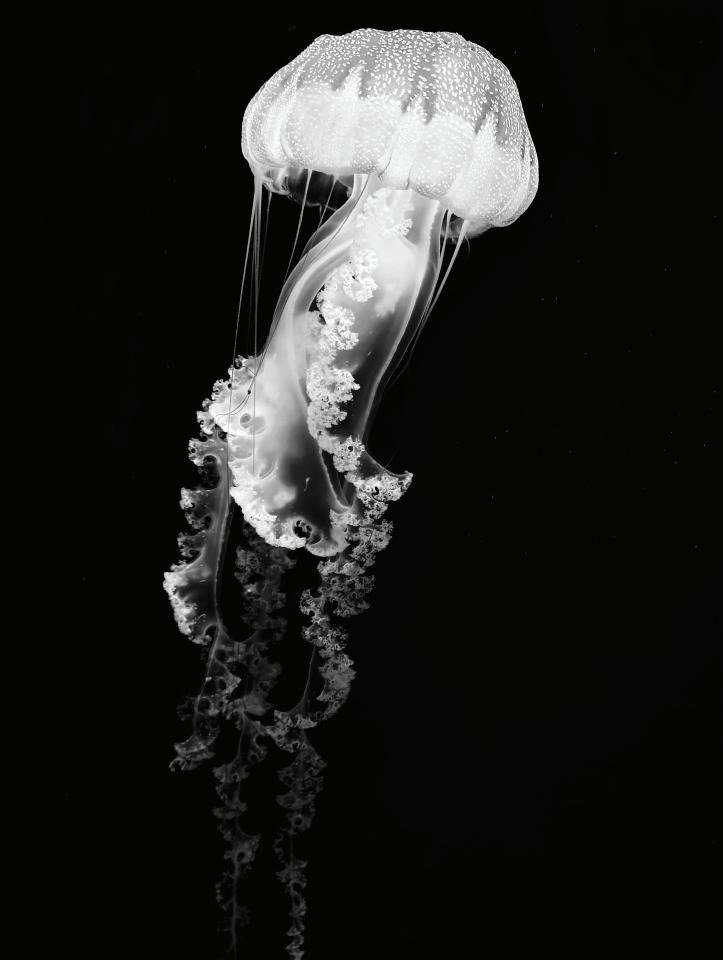
*Logan Barton McDonald County High School Gold Digital Art
Inspired by the Windows XP Azul wallpaper and the Cook Islands, I used Scratch “bitmap” art editor, and a limited colour palette to test myself. I used dithering to make two colours blend into one.
Barton hopes to continue art or game-related development after high school.
*Scholarship recipient

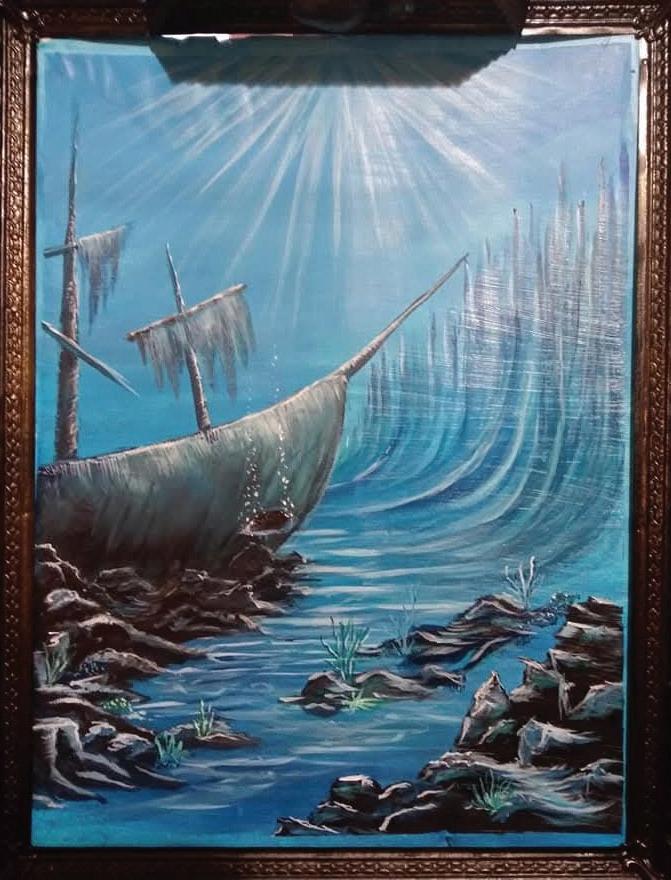
Dawn Kimmel Granby
Community Silver
2D Art
This is dedicated to my late father who was in the Navy and a devoted family man. Acrylic on backerboard in a lighted vintage frame
Kimmel is a single mom with a passion to paint and express her creative side.
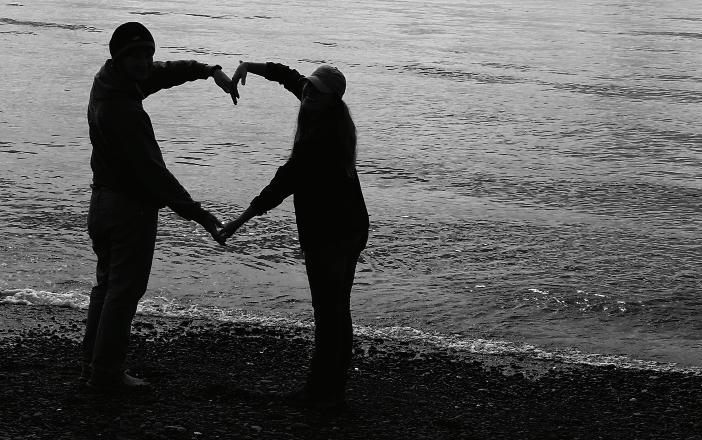
Latonia Bailey Neosho Quill Staff Adviser B&W Photography
I captured this photo of my son and daughter-inlaw on the beach on Kenai Peninsula in Alaska. Samsung phone camera with minor editing to convert to B&W
Bailey, coordinator of the Digital Marketing and Photography programs, enjoys contributing to the contest each year in various categories.
*Dominick Trimble McDonald County High School Gold Nonfiction Narrative
This is a personal story of taking a risk and going alone to California. People I met on my journey taught me life lessons and views, giving me a new way to live.
Trimble loves music, surfing, hiking, and being around loving people. He wants to become a conservationist and travel the world.
*Scholarship recipient
ravel — seniors talk about regrets of not exploring the world, and tired parents yearn to book that flight and go on vacation, but are engulfed by the dark nothingness of adulthood. Letting their dream get muffled by another day of work, saying, “Maybe next year,” keeping a little light to shine at that never-ending tunnel that they will never touch. Running, walking, and crawling to be free, but the tunnel never ends. To leave this tunnel is to take a risk, leave the tunnel, and allow the world to hit you head-on.
Knowing this, when I was granted the opportunity to stay in California for a MONTH with my family, despite the only memory I have of them being their fat wiener dog we called Sausage Boy. With hesitancy I said yes. If I said that this trip didn’t have hardships and that it was all sunshine and rainbows, then I would be lying. Going on a plane alone at 15 years old, miles from home, staying with basically strangers. It was scary but worth every moment.
Breaking that tunnel is the most amazing thing, breaking every wall that tells you you aren’t good enough, you can’t do it, it’s not safe, and that is not possible.
Leaving my home wasn’t the factor that shattered me; it was just one woman who changed me forever. One woman changed that, reentered my whole way of life, and gave me a new view on how I take every situation. Aunt Jenny is a jolly old woman with long braided grey hair that reached to her butt. This woman wasn’t my actual aunt, but in Hawaiian culture, a woman who is older than you who isn’t your mother is an auntie. Upon meeting this woman, she was so happy to see me. I could feel pure love for everything that she had, looking around, mesmerized by the vast crafts on her wall and the pure warmth of her space. Looking around further, I noticed the humongous photo of her daughter in an O’Neill outfit while surfing a 20-foot wave on her baby blue shortboard. It made me think, what am I doing here? I can’t do all that. I’m just some random nobody from Missouri, but Aunt Jenny didn’t see that; she sees everything good, she sees the potential in the world. Her view added another crack into that tunnel, which she would sooner break.
The next day, she meets me at the designated spot we planned the night before, wetsuit on and surfboard in hand, running
down to the beach. I see Jenny waiting.
“Are you ready?” she says while I set down my board on a lying log.
“As ready as I’ll ever be”
“Remember, Dom, do it island style.”
She gave me the rundown of how to jump on the board and how to paddle when I was at her house the night before. Despite preparation, I was scared out of my mind. The ocean was scary enough, but now going meters out and having the waves crash on you filled me with anxiety. Jenny left and ran into the water to find a spot to practice.
“C’mon, Dom!” Jenny yelled out from the ocean.
My heart is still beating out of my chest. I ran into the water. Holding onto my board, the waves try to push me back one after the other, giving me no chance to breathe.
I paddle faster and longer strokes as I try to make it to Jenny’s location, having to bob under the waves as they come rushing towards me.
“Ok, listen, the most important thing about surfing is not the balance of a nice board, it’s about how well they can read the waves. Each wave is like a person, each different, with their small details that form who they are.”
I listen as the flow of water sways back and forth with each cold wave gently pushing us.
“If you see two peaked waves, don’t go for it; the first will lose its energy, and the second will crash onto you.”
I nod.
When picking the perfect wave, I should be alone, and you must be on the opposite side of the breaking point.
“Like this one,” she says, giggling.
I get on my board and wait for Jenny’s signal.
“Paddle hard!”
Paddling, I see the water lift me in the air.
Jenny yells, “UP!”
I spring up as she taught me and stick my hands out to keep balance, the feeling of the wax gripping my feet and the cold splash of the white water could not be compared to anything. The anxiety of everything disappeared. The cold of the ocean, the thump
of my heart, and the heavy feeling in my chest were gone as soon as I stepped up on that board. I knew that was what Jenny meant by living the island style and living by the aloha spirit. Treating every moment like that, the moment I just felt. That moment shattered my box, giving me reason -- reason to never judge and hate because every wave is different and I choose where my wave takes me.
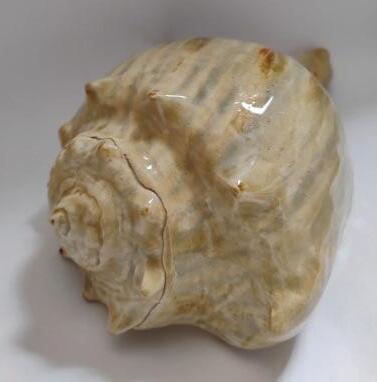
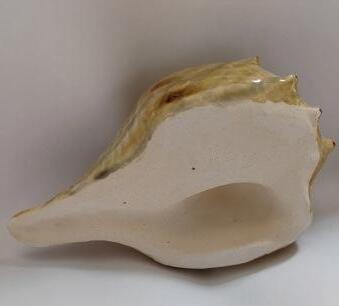
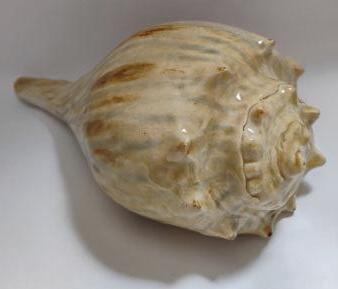
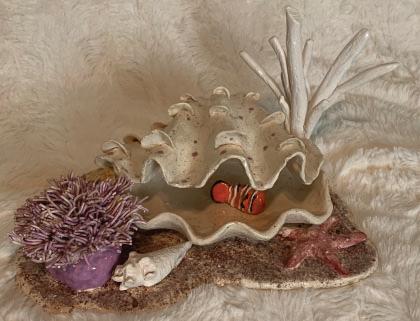
Jessi Hilton Goodman
I made this shell as the first assignment in my beginner ceramics class, using a hand-building method.
Hilton, a dual enrollment student, loves reading, writing, and all forms of art. She plans to earn a master’s degree in psychology with a minor in business.
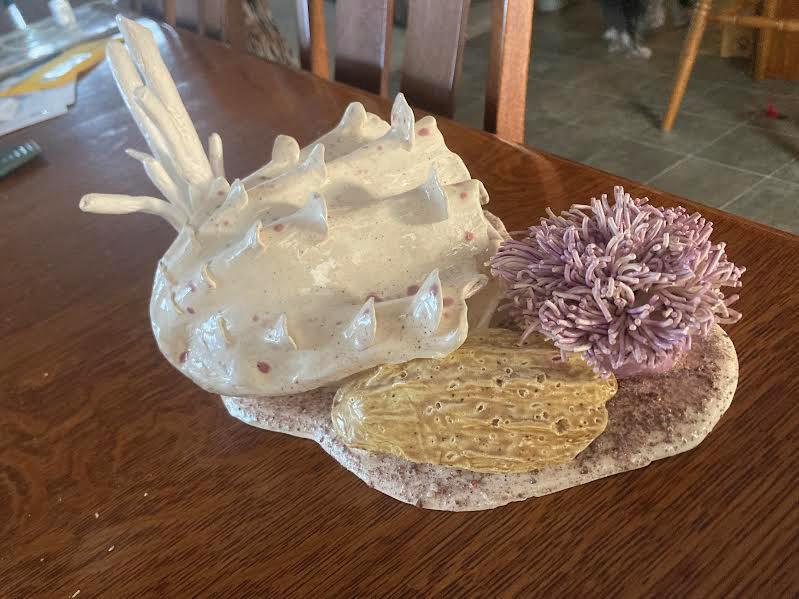
Through much trial and error, I did something new, making a statement that makes it more special to me. This ceramic piece was made through slab building and draping techniques.
Taffiner, involved with student organizations, will study Secondary Education for Social Studies, enjoys pottery.
Kelly Reddin Joplin Community Gold Fiction Short Story
Using elements from another paranormal story, with a not quite right ending, I rewrote the entire story.
Reddin, a former elementary and middle school teacher, is a master trainer for an international educational company. She enjoys volunteering and writing and has several books in print and three series in progress.
he first time it happened, I was six. I was putting on my clothes near the mirror, and she appeared. My image was in the mirror, but it wasn’t me. I had a red top with blue shorts. The girl in the mirror was wearing a yellow polka dot dress. I shut my eyes, and when I opened them, I saw myself - red top and blue shorts. I went to play and forgot all about it.
When I was twelve, I looked in the mirror and saw myself wearing my school uniform, a plaid skirt with a white blouse. I looked down and saw I had on jeans and a t-shirt. When I looked in the mirror again, I had on jeans and a t-shirt.
Later that year, Mom and I were talking in my room. She looked around and said, “I have always liked your grandmother’s mirror. I am so glad I put it in your room.”
I looked at Mom. “You never told me it was Grandma’s mirror.”
“Oh, yes. I couldn’t part with it after she was gone,” Mom recalled.
“When did Grandma die?” I asked. “ I don’t think you ever told me about that.”
“It’s a strange story. She just disappeared. I went to see her, and everything in her house was in order. The doors were locked. Her purse was on the table, car in the garage, but she was gone. Of course, I called the police, and they investigated, but she was never seen again. After a year, we cleaned out her house, and this is one of the few things I brought over.” Tears filled Mom’s eyes.
I put my arms around her. “Mom, I am so sorry. I never knew. I always assumed she died.”
We stood together for a while, and then we left my room, ending the conversation.
Time passed, and I forgot about the conversation, at least until high school. My “twin” was often in the mirror, waiting for me. She seemed to be asking me to come closer, but I felt the hair on the back of my neck come up, so I remained a few feet away.
When I was dressing for prom, my twin appeared in the mirror. She looked radiant. Again, she beckoned me, but I refused to come closer. Something inside yelled, “Danger!” I put on my shoes, and did my makeup and hair in the bathroom. I was spooked. I even slept at a friend’s house that night. When I returned home, the mirror held only my image.
Anytime I had friends over, the mirror
was just a regular mirror. None of us saw anything strange in the mirror, no “twin” in different clothing. So, everything seemed to be fine for a long time.
When graduation day came, I was excited to wear my cap and gown. I made a quick look in the mirror - I looked great. I ran down the stairs and got into the car. The day was lovely, and Mom and Dad were so proud. When I waltzed back into the room to change for the graduation party, my gown touched the mirror. I was immediately pulled partially in. I screamed and grabbed the bedpost. I was able to tug my gown, foot, and leg back out. I looked in the mirror and saw my twin holding my shoe. She was smiling playfully. She motioned for me to come over and get the shoe. She held it out to me, and it looked like the strap was broken. My ankle had a small cut on it. I grabbed my clothes and jumped on and over the bed to get out of the room. I wasn’t going anywhere near that mirror. I decided to turn the mirror to the wall as soon as I could.
When I returned home, I wiggled behind the mirror. When I touched the frame, it vibrated in my hands, and I let go. Then, I tried to tug it again. As soon as my skin touched the frame, the vibrations started. I cautiously walked to the other side of the mirror. This time, an older woman looked out at me. She was so sad. She pushed her hands at me, signaling me away from the mirror. My eyes widened. Then, I blinked. She was gone, replaced by my “twin” who was beckoning me to come closer.
I ran from the room and asked Mom to show me a picture of Grandma. She was puzzled, but went to a shelf and handed me an album. I turned the pages and stared.
The woman in the mirror was definitely my grandmother. I was sure of it. How could I get her out without being pulled in? That seemed impossible.
I wasn’t sure what to do next, except that I wasn’t going to tell my mom. She would never believe me. No one else had seen the people in the mirror. That night, I stayed on the couch, not wanting to go to my room. Thinking about what to do kept me awake most of the night. Finally, I had a plan. I was able to get some sleep. Mom tiptoed around me in the morning until I got off the couch. I slipped into the kitchen and fortified myself
with cereal, toast, and coffee. Then, I put my plan into action.
First, I made a trip to Dad’s storage area, snagging the set of keys on my way there. I unlocked the cabinet and the drawers, choosing carefully what I needed. Fully prepared, I went to my room. I walked in, climbed over the bed so I could stand directly in front of the mirror. Only me in the mirror - good. I aimed the shotgun and fired. The mirror shattered, pieces flying around the room. My parents rushed down the hall and took in the scene. I stood, covered with small shards, smiling. Gun pointed down.
It was chaos after that. Dad took the safety glasses and the gun, which he secured. Mom cleaned me up. Dad removed the shards of the mirror and took the empty frame outside.
Mom and Dad kept asking me why I shot the mirror. I didn’t say a word. They were very concerned, but I was relieved. They decided to keep an eye on me, but allowed me to remain quiet. I was deciding what to tell them, but my mind was whirling.
Dad put the mirror frame in his truck and took it to a donation place for furniture. He returned, still shaken from my actions. He checked my room and was puzzled. The bullet had only shattered the mirror and did not go through to the wall. No bullet holes anywhere.
That afternoon, the police arrived at our door. They asked if they could come into the house to talk with us. We sat in the living room, anxiety filling the room. Detective Reynolds told us two bodies had been found. They believed one was my grandmother. The woman matched a photo from an old missing persons case. Someone would need to go to the morgue to identify the body. We sat silently in shock. My mother had tears running down her face. Her mother had been missing for almost 18 years. Mom was in shock, “Where could she have been? It can’t be her. She would have called me.”
Dad reassured her and said that we should go together and see. It took a while for Mom to agree. About 30 minutes later, we went to the morgue. My father said, “Let me go in first, Maria. If it is your mother, you can come in. If not, you don’t have to see anything. Chrissy, stay with your mom.”
Detective Reynolds nodded and took my dad in. He returned a few minutes later, shaken. “I am certain it’s your mother. You don’t have to go in. You can see her at the funeral home after she has been cleaned up.”
“No, I want to see her now,” Mom said firmly. Detective Reynolds escorted her in.
When they returned, the color had drained from Mom’s face, and her body drooped. Detective Reynolds took my father aside and whispered a question. “Do you have twin daughters?”
Dad responded, “No, why do you ask?”
“A second body was found with your mother-in-law. She looks exactly like your daughter. I thought perhaps you might be able to help identify her.” Dad shook his head, “Chrissy doesn’t even have a cousin that resembles her.”
We went home in silence. Later that night, after my Mom had gone to bed, my father came to my room. “Chrissy, I know you didn’t want to talk about it earlier. You are not in trouble, but I need to know why you took my gun and shot the mirror.”
Hesitantly, I began telling him a couple of things. He held me close and soon everything was pouring out. After the story was complete, he sat with me. I knew he was shocked. Dad kissed the top of my head and said, “Please don’t tell your mother. She has enough pain.” I just sobbed and nodded. When I finally calmed, he left to be with Mom.
Eating breakfast a few days later, an article caught my attention. An elderly woman and a teenage girl had been shot, and their bodies were found near some furniture that had been thrown out. Shards of mirror were embedded in their bodies. The date matched
[Continued to 14]
Anika Adame Joplin Quill Staff Digital Art
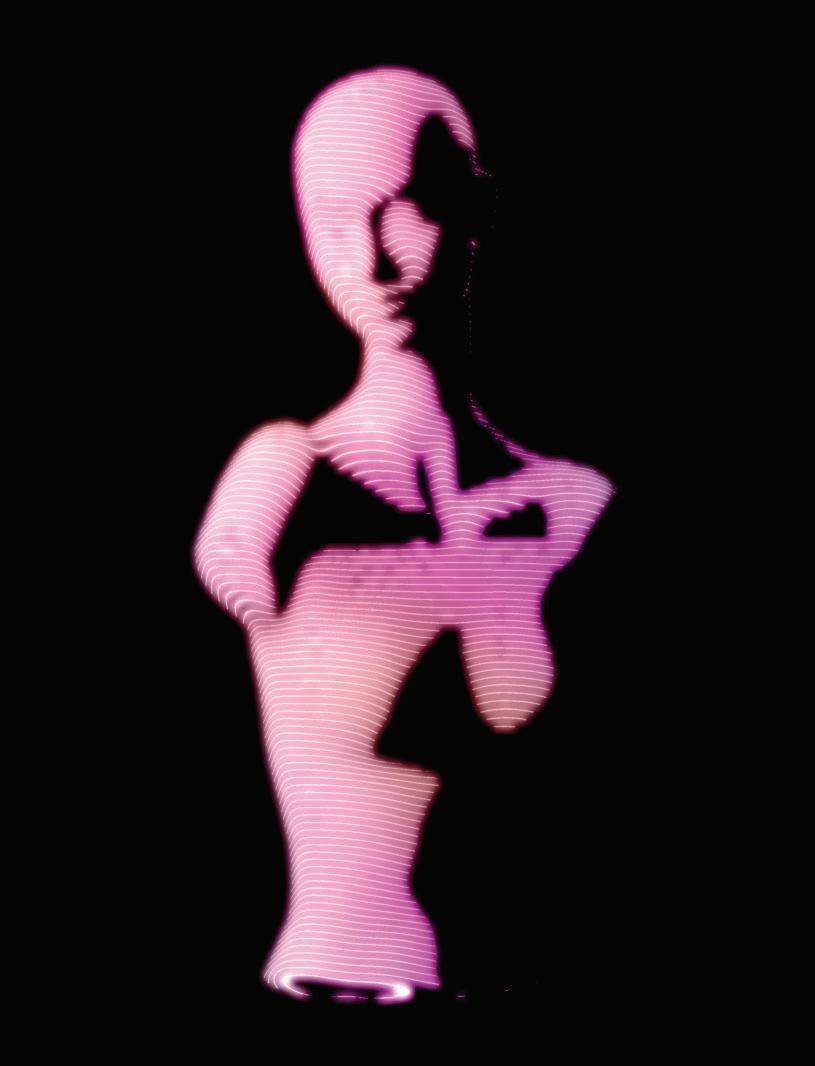
Inspired by vapor wave editing style and circuit bending, I added glow and color for more interest. It reminds me of being a young child, in front of Nana’s 40” plasma TV. Mannequin stock photo, Photoshop, and YouTube guide for the CRT effect.
Adame, interested in digital art, printing, and photography, will study graphic design.
Selah Bridges Neosho Crowder
Honorable Mention Nonfiction Essay
Receiving my dog was one of the best things that has ever happened to me. This essay describes the experience.
Bridges is a dually enrolled student.
exactly, and I knew I had somehow killed my grandma and my “twin.” The woman had been identified as my grandmother, but the teenager’s name was still unknown. Her picture was shown, and she looked just like me. They said she was found wearing one shoe, which was also shown. I noticed the strap seemed broken. I was floored - how could this be? Soon my friends were texting me. “That girl looks like you!”
Weeks passed, and she remained unidentified. Eventually, she was buried in an unmarked grave. Mom looked shellshocked for months, not knowing what happened to her mother.
Twenty years have passed since I shot the mirror. The secret of that mirror will accompany me to my grave, like it did my father. We never told Mom anything about me seeing Grandma in the mirror. It was a secret worth keeping.
No full-length mirror will catch my reflection. My body shakes when I think about my leg being sucked into that mirror. It is terrifying. A small scar appeared just above my heel in the shape of the shoe. It reminds me just how close I came to joining my grandma and disappearing forever. My actions were extreme, but that mirror will never hurt anyone ever again.
Is my dream really coming true? Little did I know that this thought would be racing through my head just hours later. I had always dreamed about having my very own puppy, and that day, it felt like my life was finally fulfilled. The day was packed full of surprises, anticipation, and the long-awaited joy that came with my puppy.
Of all the gifts I had ever received, I have never enjoyed a surprise more than I did that day. However, it was not instant gratification; the surprise did not come until later in the day. We started out by driving to Roaring River State Park. It was my Memaw’s birthday, and we were going to celebrate at the camper. It was a little more than an hour away, but it felt like forever. When we finally arrived, we celebrated my Memaw’s birthday, and I played outside. What I didn’t know was that my mom had been messaging a woman about a puppy. I continued on for a while just playing by myself and enjoying a warm summer day. All of a sudden, my mom pulled me aside and asked what I would think about getting a puppy. My mind immediately went racing, thinking, “ Is this a joke? What does it look like? What will I name it? Is it cute? I hope it’s a girl!” All of these thoughts rushed through my mind, but before I could ask any of them, my mom said, “Now, it’s not for sure, and I’m not certain yet, but this is what she looks like.” She showed me a picture of her, and my heart sank. The way the picture was taken made the puppy look like an anomaly. The angle made her look big and awkward. I acted with
apathy, and my mom asked me why. I told her, and she showed me a different picture. In this picture, you could tell how adorable she was, and I became overwhelmed with joy. She was the perfect little fluffball that I had pictured in my mind. This had become one of the best surprises I had ever experienced.
Now the anticipation began. I started to anticipate what it would be like to hold her and what I would call her. First, we said goodbye to my Memaw, and we left my brothers. It was just my mom and I. I was so excited that I couldn’t stop talking about the puppy. I was so used to inanimate toys and pretend puppies that when I thought of my own puppy, it made me burst with joy. The drive to meet the woman was only about forty-five minutes away, but it felt like an eternity. I had been able to wait my whole life, but those minutes felt like another lifetime. I couldn’t stop thinking about what I would name her and how much we would play together. The moment finally arrived when we pulled into the driveway. I had thought I felt anticipation before, but I had not in comparison to that moment.
However, the anticipation slowly began to be replaced with joy. As I stepped out of the car and saw this tiny black thing in the woman’s arms, I almost cried tears of joy. My long-awaited desire to have my own puppy was finally over. I walked up and took her from her arms. She had a little yellow dress on, and she was the cutest thing I had ever seen. The woman said what her name was, and it was very atypical. I immediately knew I would
Sometimes I don’t know how to express the things inside my head. I have a dresser full of letters that I will never send. There are poems, there are drawings—fragments no one has ever seen. Little ghosts of who I was, and who I might have been. I wonder if I’ll ever mourn the words that were a waste, or the ones that never touched my tongue, and simply slipped away. When I wash my hair, I’ll think of everything that I did wrong. When I walk, I’ll hum these thoughts, and hope somebody knew me all along.
I’m always thinking of better ways I could have handled a situation; times I should have spoken up, or stayed quiet. These moments shape how others think of me; I exhaust myself with explanations, hoping someone already knows who I am inside.
Towne, a first-year student, explores our world of cruelty and hope, darkness and beauty, and hopes to become an important figure for children, helping those who have been harmed.
change it. My mom talked to the woman and asked questions about things we needed to know about her, but all I could think about was that I had my very own puppy. I didn’t have to share with anyone because she was my own. We left the woman and headed back to the campground. Apparently, all of the excitement had worn me out, and I fell asleep with my new puppy. I had waited so long for my own puppy, and my patience had finally paid off.
Had my dream really come true? By the end of the day, this question was answered with yes, dreams do come true. I had waited so long, and that day, all of my hopes and dreams of a puppy had been answered. The day had been full of surprises, anticipation, and finally joy with my new puppy.
Pan Jane Towne
Rich Hill
Crowder
Silver Poetry
Rhymed Verse
Pawp
December Willey
Carl Junction High School Honorable Mention 2D Art
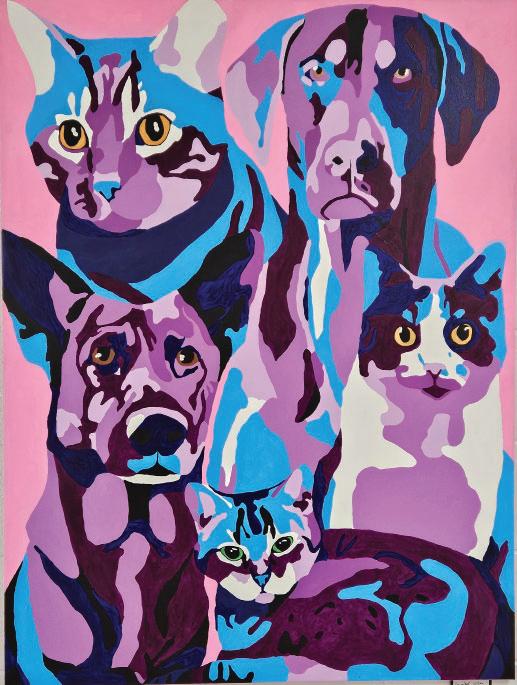
This pop art style piece is 36 x 48 inches and is a painting of all of my pets: Ash, Emma, Lilith, Ziva, and Sherbet. I’ve always wanted to make a piece dedicated to my pets.
Willey, a junior, has participated in past competitions and hopes to open her own pet portrait business.
Journie Marie Daniels McDonald County High School Bronze Nonfiction Memoir
My family and I lived through a natural disaster that we are still recovering from. We have felt the effects of this flood through the eight years that we have resided here. Regardless, we are creative and resourceful with what we do have, and will survive as the days come.
Daniels, a senior, has a passion for art and writing, expressing her thoughts through her work.
Angela Carter Fairview Crowder Silver Color Photography
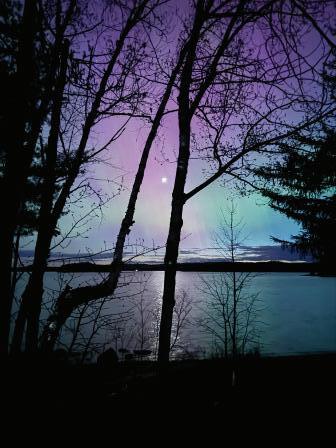
I’ve always found it fascinating that the Northern Lights look better in picture than in person. Only through artificial means can we see their true beauty.
iPhone 18 Pro
Carter is a General Studies student.
Almost eight years ago, as of 2025, we moved to our house in Anderson, Missouri. Back then, we were a riotous family of five, ready for the adventure that came with moving to a new house. The new scenery, the new experiences: we were ready for a change. Our house is on Indian Creek; when looking off the back porch, an overwhelming eyeful of lush green trees leaning over the water to capture a glimpse of the colorful, intricate rocks hiding beneath the cold current is there to greet any willing soul. When we first moved to the old log cabin, we were told it would never flood. But with how close the creek was to our house, taking up the main portion of our backyard, we had our suspicions regardless. But our neighbors were confident, assuring, and welcoming.
“That water hasn’t climbed over the rock bank in over one hundred years,” they would say.
Our decision to move into the cabin or elsewhere was an ever-tipping scale. Making a house into your home was a big decision. But our family was ready and willing. And when it came down to it, with the gleaming creek whispering softly for us to stay, we couldn’t say
no. As far as I knew, at the ripe age of ten, I was thrilled at the prospect.
The first few weeks were like a dream. Our first time in the creek was a bit rough, the current urging my family downstream as if we weren’t supposed to be there, like the current herself knew we were outsiders, foreigners to her entitled part of nature. We’d be tripping over ourselves trying to make it upstream. But I like to believe I made amends, that I mastered those vigorous tidal waves.
We acquainted ourselves throughout the endless summer days. What once was an uninviting, angry current became an irresistible stream. I found peace in the rock bed, peace in the velvety ripples. The rubbery smell of our dollar store inner tubes mixed with sunscreen that could pale any complexion. The smell of the fresh creek water and its icecold feel in contrast with the hot sun. And after a full day of swimming, my family would come back to our unfamiliar new home, our bodies dog-tired and revitalized, to eat salty fries and grilled burgers with too much ketchup. However, this creek was more deceiving than we initially thought.
The morning of this imposing event was like every other day of summer. I woke up languidly, with the sun beaming on my face, beaming through the expansive windows over my bed, completely unaware of the flood escapade soon to happen. I only felt the relief of waking up on my terms, no blaring alarm clock telling me what to do. I woke up feeling elated with a sense of calm and peace. I leisurely made my way into my parents’ bedroom, where my mom was sitting on her bed, tying up some loose ends at work. She beamed and greeted me with a chipper morning attitude. We said our good mornings, and I used her patio door to enter onto our back porch. We were on the second floor, and I peered down at the creek through the tree leaves cloaking us. I knew it had poured the night before, but the creek smiled at me, clear and shallow as ever, sparkling even. I smiled back, still joyous at the fresh sight. I went back in to take a bath, getting ready for another normal, spectacular, summer day.
But the creek, she had other plans.
Unbeknownst to the inhabitants of the household, the water was rising higher and higher as the minutes passed by. I made my visit to the back porch throughout the morning, and took notice of its ascent. But the creek rose and fell now and then with the summer showers, so surely it wasn’t anything to worry about. But I kept checking back, uneasy at the slow realization that every time I looked, the water had risen higher. It wasn’t until the creek itself stretched and reached to grip the back porch steps of our house that declined the rock bank that we grew truly unnerved. The normal, clear, glistening water that had greeted me that morning was now replaced with a murky brown so thick it was opaque. The calm sway of the waves that I had once mastered was now at a race, carrying large branches downstream that rivaled trees. Her usual slim form was now resembling the width of a lake. By then, we knew we had to get moving, but the alarm that blared through all our phones simultaneously was an affirming incentive. Our phone screens presented an urgent message accompanying its screeching alert: FLASH FLOOD!
We started moving, and we moved fast. Prioritizing our most important belongings and making an assembly line up the stairs to move them away from the impending flood waters. We tossed the items haphazardly in odd and unconventional places, littering the floor and stacking them tall to the ceiling. The underlying panic turned into full-blown mayhem when we looked out the windows to find the water filling our yard, the murky brown swirling and finding residence in the hollows and craters in the earth. We only had a modicum of our belongings upstairs; regardless of our efficient assembly line, the organized chaos we had formulated in hopes of saving what we had from the treacherous flood waters. We had three dogs and three cats that needed to be loaded up in a vehicle that we did not have. We had two cars, one was with my dad at work,
and one had been stationary in our driveway for weeks, unable to run. In our front yard, the water only rose higher, smaller puddles coming together to form generous ponds, mounds of earth lifting out of the water, the only thing exposed from our uneven land. We ditched the assembly line. We needed to leave immediately.
Our last resort of transportation was my sister, and we had called her about an hour before, so she was on her way. We left the cats upstairs in my parents’ closed bedroom with food, water, and litter. We didn’t have enough cat carriers or room in the vehicle to take them with us. It was me, my two brothers, my sister, my mom, and everything we had managed to pack in our to-go bags during the chaos. We grabbed our bags and each of the dogs, snaping on their collars and leashes.
We finally made it outside, but the small puddles had turned into a substantial lake in our front yard. The murky brown water reached our front steps and expanded the length of our land, and we had no choice but to walk through it. We saw my sister speeding down the road, faster than our neighbors would allow in any other circumstance, and she skidded to a screeching halt on the road
[Continued to 18]
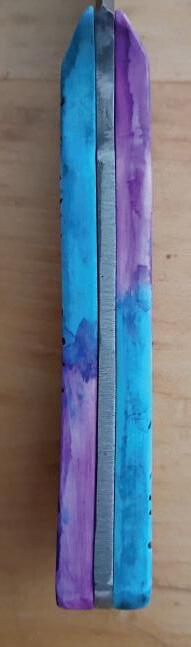
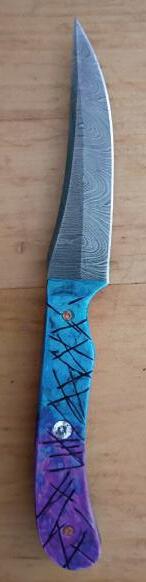
Hilton Goodman Community Silver 3D Art
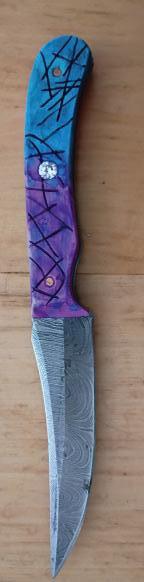
I made this knife handle from faux bone on a pre-made knife blade, as a gift for my wife.
Hilton doesn’t consider himself an artist but took a class to learn how to carve, shape, and design a unique knife handle.
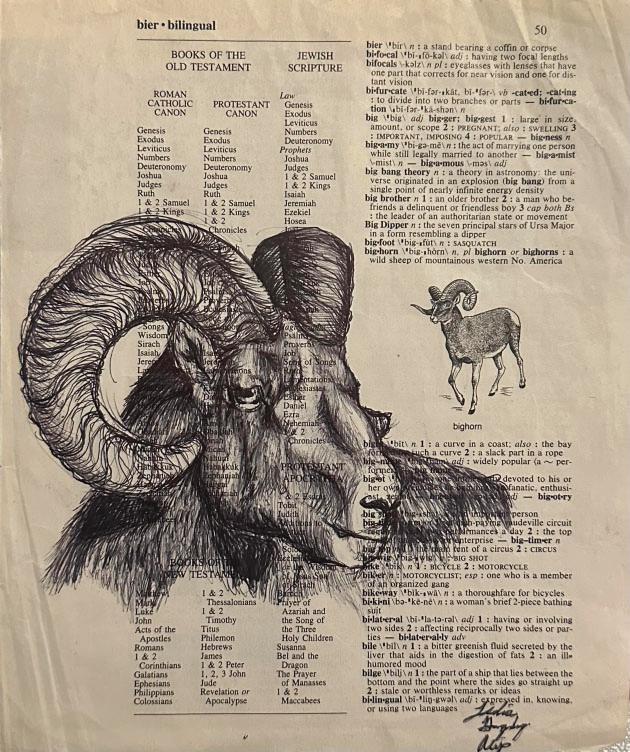
La Birria
Lidia Alejo
McDonald County High School
Honorable Mention 2D Art
I went to Mexico for one week in October to celebrate Day of the Dead. I saw many animals, but the ones I liked seeing the most were the “Carneros.”
Alejo, a senior, enjoys telling stories through her work.
[Continued from 17]
spanning the front of our house. We didn’t have a driveway anymore, and my sister couldn’t drive through the water, so she stayed on the other side of our newfound lake with the car stalled. We attempted to guide our dogs through the water, and when they made it clear they weren’t budging, pulling back on their collars and digging their paws into the ground, my brothers had to carry them to the car. Our dogs are not small by any means, and at the ripe age of ten, with essentially no muscle, I was not strong enough to pick Jax up. Jax hesitated at the cusp of the water. But with a soft pleading tug at the leash, and one “Come on, bud,” he continued through it, feigning bravery, the same way I did.
We trudged through the water together, the water reached up to my knees, and Jax nearly had to swim. We all made it to my sister’s car, our clothes brown and soaked. We loaded our stuff up and piled into the car, our big dogs moving uncomfortably and unsettled on our laps. We took one last look at our house
that we almost had the chance to call home before driving to higher ground. We were all still exhilarated and out of breath from the action of the morning as we drove to our first stop. Unfortunately, on the way, I found out Jax may be able to brave treacherous flood waters, but he did not have as much of a stomach for moving cars. I sat in the middle between my brothers with dog puke on my lap and rolling down my leg as I prayed for two things: for our destination to arrive as fast as possible, and for Jax to not get sick again before we got there. Luckily, through this hard time, we had a lot of help; neighbors living in a different neighborhood on a different elevation took in our dogs, and we stayed at my uncle’s, where we could finally rest for the first time since that morning. When we got there, we told my uncle and aunt about our insane morning, all talking excitedly and filling in gaps for each other when someone missed an important part of the story. Later in the day, my parents went to check on our house, and they promptly sent back photos of it being half-submerged in water.
For some families, this may have been a bleak time in life, an upset to what should have been an upward trajectory. A time for stress, worry, and mourning. But for us, it seemed more like an adventure. We lived in a house that was actively submerged in four feet of water, and we laughed. Even my parents, having to bear the brunt of this natural disaster, still smiled and laughed. We went to bed that night, all sleeping on quilt pallets we made on the living room floor of my uncle’s house, recounting the events of the ludicrous day and speculating about the events for tomorrow.
This natural disaster only solidified the strength my family had to endure and persevere. So when the water finally came down, and we were able to drive back after all was said and done, we looked at our soiled house: mud caked inches thick on every surface, walls brown and soaked through four feet high, our appliances, fridges, tables, and couches damp and moved ajar from the treacherous floodwater, all of our belongings waterlogged and ruined. We breathed in the cool, damp air and the smell of creek water, and we didn’t falter. Even at the eerie presence of a new beginning on an adventure we didn’t know we were taking.
There are dark shadows creeping around the corners of my home. Blackness darts around the abode as sunlight wraps its arms into the window shades. I think back to the times when I could not see him grown.
Three years have gone by since he was snatched off the streets.
A lonely, crying boy that I was eager to meet.
No mother to be found nearby, I saved him; quite frankly, there is no need to thank me.
Named after a street artist, he is a black cat we call Banksy.
At first, he seems pleasant; allowing a few seconds of softness and a couple sniffs. His whiskers dance around as he takes in the smells off my fingertips.
Then the rough sandpaper tongue exchanges for sharp talons wrapping around my hand.
I think to myself: this is nothing new, this is nothing I can’t stand.
Then my skin rips as the nails of the once calm cat now raging sinks into feral fixations.
Phew, I might need some hydration.
Piercing pain grabs me further as I yank my hand away.
I look down at the searing sensations rattling through my fingers; they are far from gray. I can see my flesh making miniature mountains where there once was a claw.
Lava seeping out slowly as I look back at that swatting paw.
Pat, pat, from the swings of rage induced feline.
Now I’m running towards the spray bottle as if I’m making a beeline.
As soon as my fingertips reach the bottle, I am swarmed with relief.
I turn around to find my target, but he is nowhere to be found as time becomes a thief.
Looking at my hands; one is swarming with red, and one is holding a bottle that’s blue.
Feeling a heating wave of defeat thinking, He must be hiding, it must be true.
Creeping around corners, the darkness of Banksy was avoiding being a victim. As I stood there with scratches all over my arms, I had thought that I had tricked him. He had won this battle once before and he will win the war again, For in this household there is a chaos center, where Banksy likes to pretend.
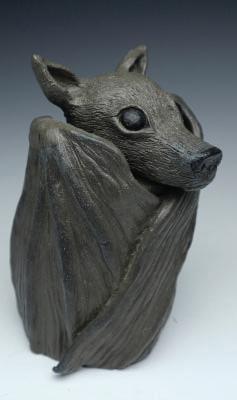
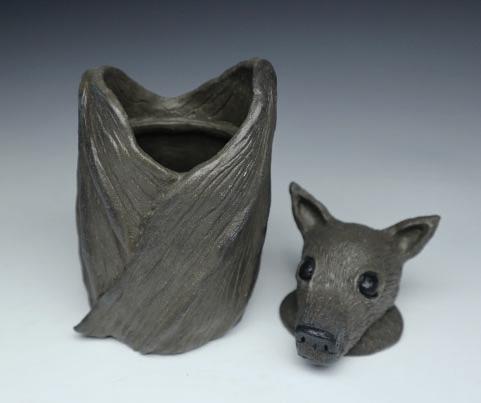
I created this lidded vessel for my only granddaughter, to honor her hard work while facing many difficulties, to graduate MU with a degree in Conservation & Natural Resource Management.
Keira Yenzer
Joplin
Quill Staff
Poetry
Rhymed Verse
I wrote this poem about my cat, Banksy, who was rescued off the streets and still has his feral moments.
Yenzer has been writing since grade school. She plans to attend a university after graduating.
Venita Henson Neosho Community Gold 3D Art
Henson, a lifetime learner since retiring, enjoys sculpture and 3D art.
Jessi Hilton Goodman Quill Staff Nonfiction Essay
Written for English 101, this depicts feelings during business pitch competitions, and the struggles faced, calm and excitement felt.
Hilton, a dual enrollment student, plans to pursue a master’s degree in psychology. She would love to continue entrepreneurship throughout her career.
Icould not hear anything but the rapid beating of my heart, the creak of the polished wooden floor as I took my place on stage, and the rush of blood through my ears. Through the blinding lights, all I could see were the eyes of the audience, waiting, ready to see me fail.
My heart pounded and my mind raced. I tasted the dryness of my mouth. I feared I would be unable to speak.
My emotions ran rampant, making me lose what semblance of confidence I possessed. I was anxious, scared, and doubtful. What if I mess up? What if I fail? I felt sick.
I could not wait for the business pitch competition to be over; I could not wait to no longer be seen.
This is a bad idea. The only thought running through my head as I stood, waiting for my cue to begin.
And then I spoke.
“Good morning, audience, judges.” My voice wobbled, a hint of my growing anxiety showing through, but I kept speaking, pitching the idea that had been rolling through my head for the last year, building itself into a dream, a goal, and eventually, a reality.
As I spoke, I began to feel a sense of calm; I began to understand that even if I failed, even if I didn’t win, I would keep trying. I felt proud of my business, I was proud of myself for going up there and competing against people twice my age with far more experience than I, 15 at the time, could ever dream.
Before I knew it, my pitch ended. I sat in my seat, trying to listen to my competitors as they gave pitches that I considered better than mine. I accepted that I would lose.
As the judges left to decide the winner of the $500.00 prize, I sat in my seat, focusing on the cold of the metal digging into my shoulder blades. I accepted that I would not win; the other competitors had better stage presence, practice, and public speaking skills.
I sat there, picking apart every single second of my speech, noting all the mistakes, how my voice cracked when I said “good morning,” how my hands shook as I explained my idea. All the ways I didn’t do it perfectly I barely noticed when the judges returned to the room.
Actually, that’s a lie. I watched them like a
hawk, analyzing their expressions and posture to see if the impossible was possible.
To my absolute shock, they kept looking at me. In my mind, that could mean one of two outcomes: option one, they were so confused by my pitch that they couldn’t stop thinking about it, or option two, they liked it, and they were considering me? I was doubtful of the latter, but my heart began to race as the thought took root in my brain. You’re setting yourself up for disappointment. I thought to myself, they wouldn’t choose you; don’t get your hopes up.
Even as these thoughts tried to dissuade me, I couldn’t help but hope. I sat on the edge of my seat, heart pounding, blood rushing, hoping above all hope that I had done it.
As I watched, they spoke one last time, nodded their heads, and went to the announcer to tell him their decision.
There were three winners, and every time a name was called, I listened, hoping to hear mine, and trying to keep the negative thoughts from drowning me as a name other than mine was called.
The final name. The final chance. I doubt I was breathing as I waited; it felt as though time had stopped.
The announcer looked at me, could it be?
“And the final winner for tonight...”
Silence. My head pounded. From what? I wasn’t sure, perhaps it was the adrenaline, perhaps my heart pounding, or perhaps I just needed to remember to breathe.
“Jessi Hilton, founder of I’m Fine Design!”
I sat in my seat, too shocked to move. I shakily got up to accept my prize and smiled for the pictures; I could not believe what was happening. Me? I won?
I smiled so much my muscles ached. My hands still had a tremor from the adrenaline, my voice cracked while I answered questions, and I was still doubtful that this would work. It was terrifying to be seen and to push through that fear; but in that moment, after all the lingering anxiety, above all the thoughts running though my head, the main thing I felt was proud. I was proud of myself for what I had done, and I was excited for what I could do next.
Quincy Scates had never been seen as normal. All her life, she was never sure of what was real or not. “Did that really happen? Or was it just your imagination?” her family would always say.
That’s why when she heard the knocking, she didn’t think much of it. But then it became too much. She would wake up at random times throughout the night, which would scare her when she was cooking food, even when she would come inside from taking her dog, Noodle, out.
One day, she and her friend, Leslie, were getting brunch. It had become a daily activity for the two. Leslie was aware of Quincy’s condition. That’s why Quincy was hesitant to tell her about the knocking. Yet she did it anyway. She knew it was a mistake when she saw Leslie’s face after. “Are you sure it’s real?”
Leslie asked. Quincy didn’t know what to say; she just agreed. It was probably nothing.
She went home that day feeling even more conflicted. That was until she saw Noodle absently staring at the wall. The same wall she heard the knocking from. She knew it wasn’t in her mind anymore. She immediately went to her telephone and dialed 911.
The police arrived in 6 minutes and 38 seconds. She explained to them what had been happening throughout the week, and they told her they’d search her house for her. She
could tell by their exchanged glances that they didn’t truly believe her. They searched the house fairly quickly, then told her it was probably just house noises. Noodle seemed to stare at that wall all night.
Over the next few days, nothing changed. She thought of calling the police again, telling them they were wrong and to check again. But she didn’t. One day, the stress got too much for her. She was gone by the next morning. The neighbors reported they hadn’t seen her leave the house in days and requested a wellness check. When the police arrived, the door was unlocked. Inside lay Quincy.
The smell hit the officers quickly, and less than 30 minutes later, ambulances arrived. It was clearly too late, though. By late afternoon, the police figured their investigation was over. They ruled out foul play and declared it a suicide. They thought they were done. That was until they received a call at exactly 6:28 am coming from Quincy’s residence. They were confused at first, but checked it out anyway. Upon entering the house, they didn’t notice anything out of place from the last time they were there. They called out, “Wallace County police department, is anyone here?” Silence. They searched the house but found nothing. “It was probably just an accidental call.” That was until they heard it. 3 slow knocks, coming from the wall.
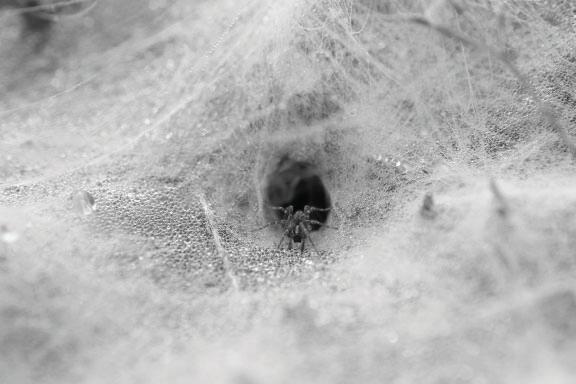
One September morning, heavy dew revealed funnel webs all over my yard. I was so focused on the architecture of the webs that I didn’t at first notice the spiders at the entrance. Canon 7D on auto
Briley Davis
McDonald County High School Honorable Mention Fiction Short Story
I wrote this to show how easy it is for something to go wrong when someone, especially mentally ill, is not believed.
Davis is a quiet and hardworking student focused on identifying an industry where her skills will thrive best.
Marcy Abercrombie Neosho Community Gold
B&W Photography
Abercrombie is a data engineer in Information Technology who enjoys photographing nature and NASCAR races.
Julie Catlett Joplin Community Bronze 2D Art
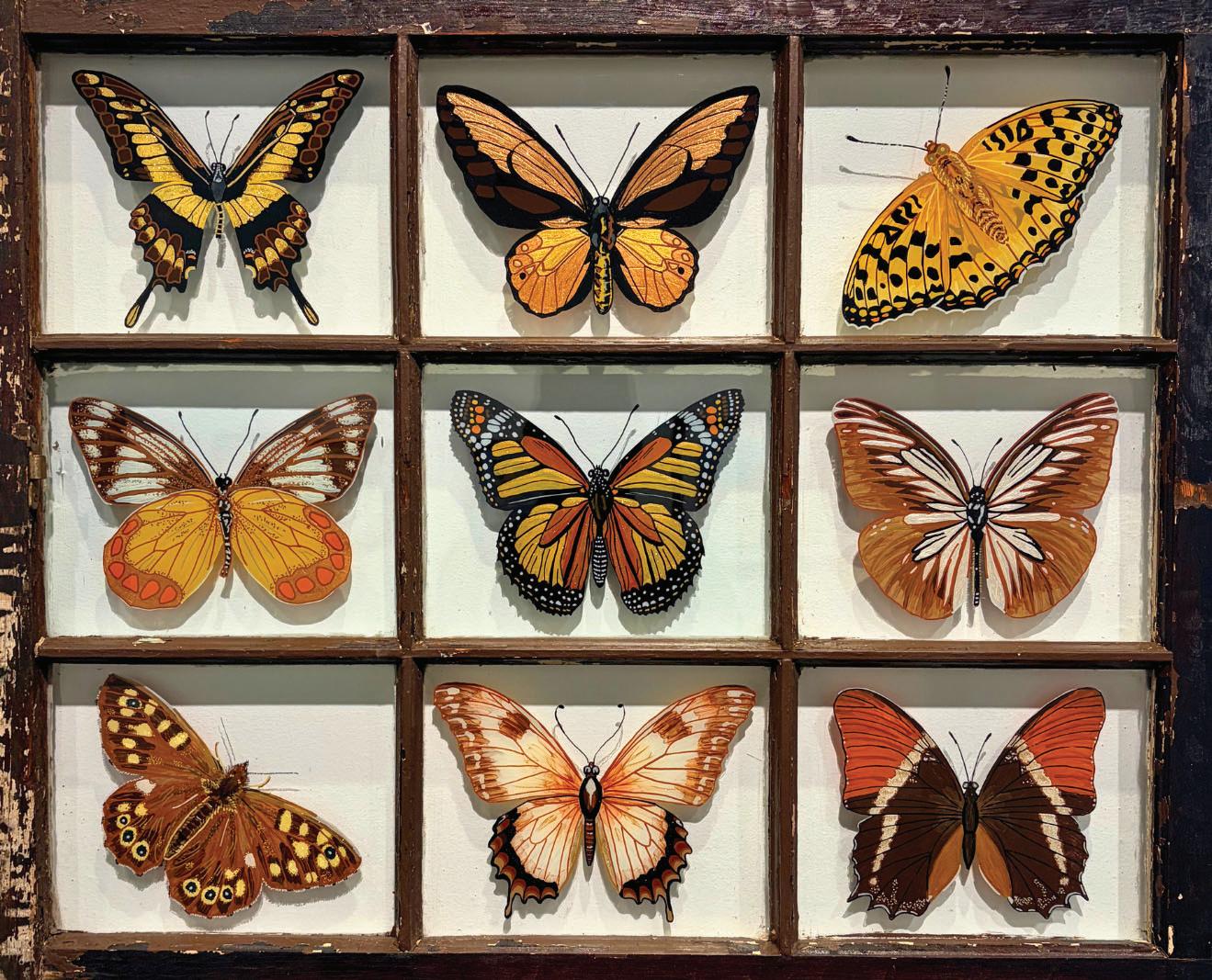
Butterflies and moths represent individuality, transformation and coexistence, and invite the viewer to slow down and consider what we notice, protect, and remember.
Catlett, a local artist with Green Hearts Studio, will be featured in solo regional shows this year. She specializes in reverse painting on vintage glass windows.
Dixi Straw Webb City Crowder Honorable Mention Poetry Rhymed Verse
Straw aspires to get a degree in psychology.
There’s a spider on the wall I sit here and watch it crawl Where’s it going, I don’t know It’s pro’bly going where spiders go!
My kitten jumps for craneflies My kitten climbs the walls My kitten jumps a lot Or sometimes, not at all!
One spot two spot three spot four Five spot six spot seven spot more! Ladybird lady beetle ladybug galore Everywhere everywhere The moment I open the door!
I wrote this to showcase whimsy and childlike joy for the little things that happen in my room. Since my window has no screen, I often get ladybugs and other visitors when it is open, which I catch and release, if my kitten doesn’t catch them first.
Pushing up through the cracks in broken sidewalks, growing where others could not.
Through nights that were dark and bitterly cold, and through sunshine, most often too hot.
Thriving through weeds and destitute ground, growing where others would die.
They learn to stand tall and bloom through it all, shaking it off as they reach for the sky.
Not planted with care in soft garden soil, they learned how to shine on their own.
Beating the odds and all the flowers in pots, growing strong, never planted, or sown.
From the mountains up high to the valleys so deep, thriving wherever they go, when flowers grow wild, they’ll always survive. Wildflowers don’t care where they grow.
Next time you pass by a flower growing wild, take a minute and ask yourself why.
Without the slightest of care, could they even grow there, where others quite simply won’t try?
Without a gardener’s help or a trellis to lean, they stand stronger than those on display.
Now, wonder with me, how big could they be if only we helped on their way?
Their strengths overlooked, so often ignored, by those with a fancier eye.
But when the roses have faltered and withered away, they still bloom as they reach for the sky.
So look for the cracks and see where they grow, there’s beauty if only you try.
For these are the kids who learned far too young to struggle, endure, and get by.
I hope now you see the same beauty with me, but one thing you surely should know, when a child grows wild, they’ll always survive. Wildflowers don’t care where they grow.
Buck Owen Goodman Community Bronze Poetry
Rhymed Verse
After decades in law enforcement, my most powerful lessons came from kids carrying far more than they should. With little support or opportunity, they still showed up, worked hard, and refused to quit. Like wildflowers breaking through concrete, they found ways not just to survive, but to thrive.
Owen, a criminal justice professional with over 20 years of experience, is dedicated to creating safe, supportive learning environments where kids can succeed.
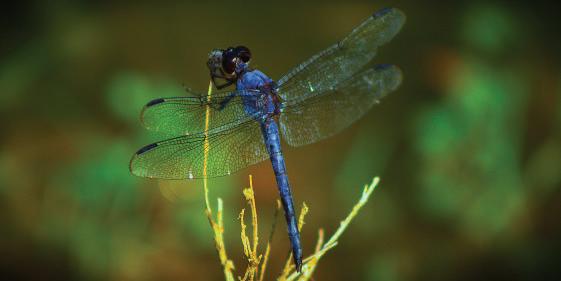
Dragonfly, Oklahoma
Stacy Kern Stotts City Community Gold
Color Photography
Kern is a rough stock rodeo photographer attending Penn State World Campus.
Canon t100 Rebel
Jonathan Martinez McDonald County High School Silver B&W Photography
I took this photo in a park for my mom. iPhone 16, shutter 1/1285 sec., ISO 64
Martinez is a kind and quiet kid. He strives to be polite, as he tries to become more social and courageous. In his free time, he likes taking pictures. In the future, he aspires to go to college and live a nice and calm life.
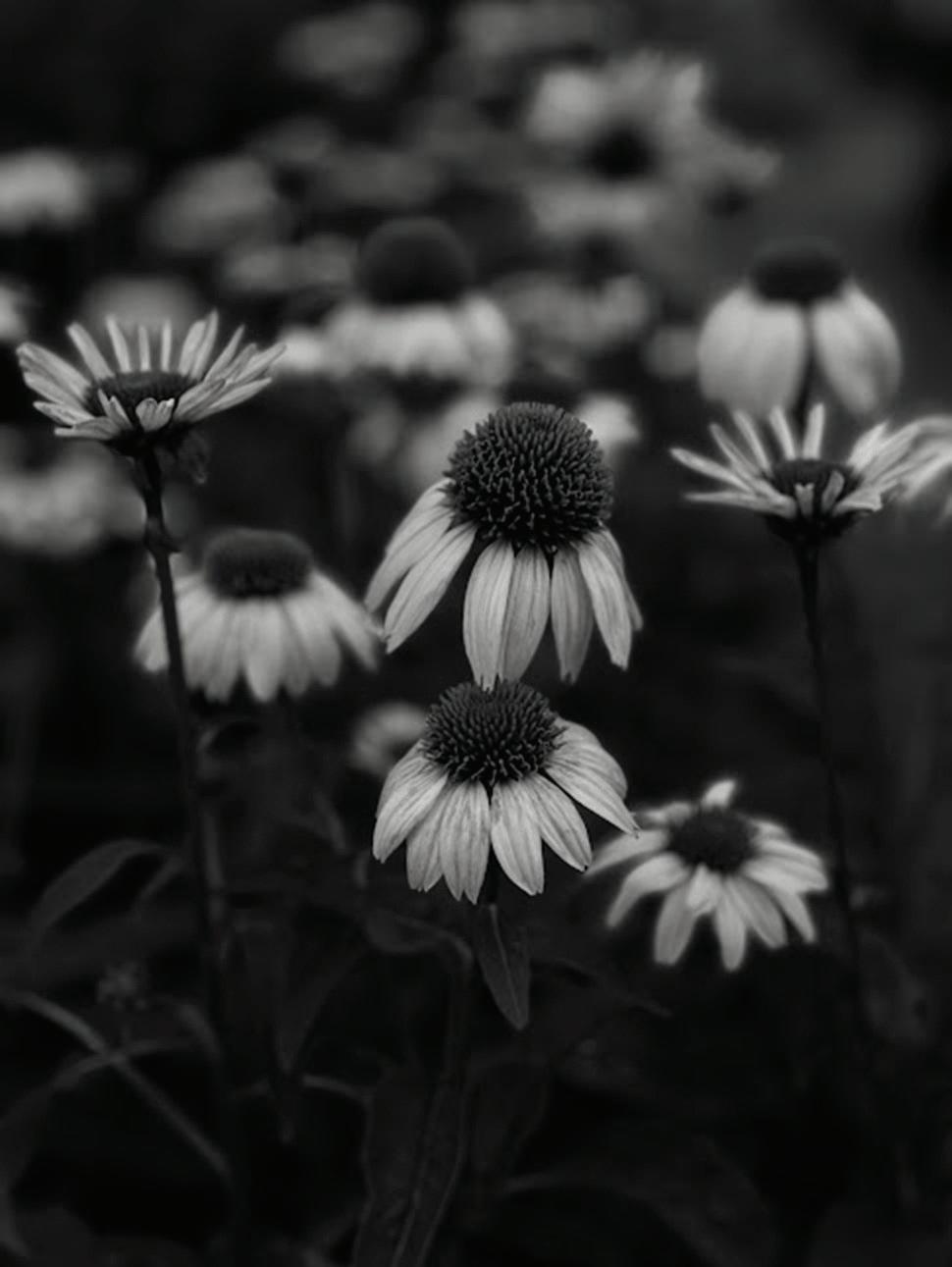
Regina Hightower Neosho Crowder Bronze
Color Photography
This photo captures one of the beauties of nature. Canon Rebel T7, auto settings
A lifetime resident of Neosho, Hightower’s interests led her to take photography courses, hoping to become a wildlife/nature photographer.
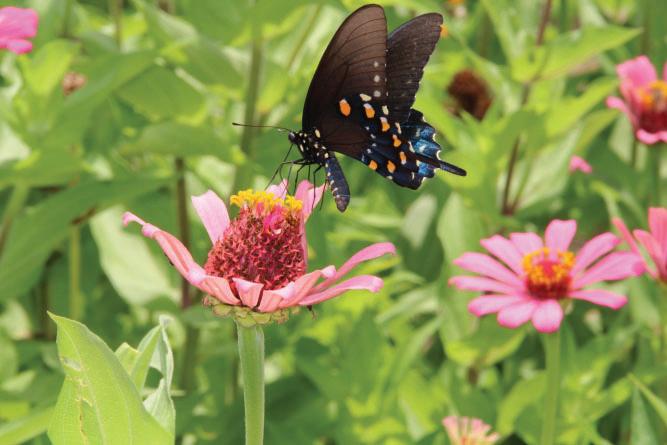
The concrete below my feet vibrated as the underground train approached its first stop during the morning rush hour. The subway bustled with a variety of boots, heels, sneakers, men’s dress shoes, slippers, and flats. The stench of perfumes and metal filled my nostrils as I moved along with the flow of hasty men, women, and school children. My destination endlessly remained unknown as I consistently followed the busy mess of nobodies, because they made my transparent being feel as if I were normal.
Everyone seemed too lost in their own affairs to notice the crowds surrounding them, so in a way everyone in the subway became as invisible as I had always been. I had memorized the routines of the mass of people and could place whether they were running late or had time to spare. The business men who would check their wrists at the time as if it were an internal instinct, construction workers lugging their boots and tools along with them to their worksites, women rushing their children into the trains in hopes of making their scheduled appointments, and the occasional drug addict swaying and singing their way in and out of the doors as if they couldn’t make up their mind about where they were headed.
in the little space in the metal car, checking his phone while cursing at the time. I assumed the poor man was either late to an important interview or had accidentally slept in after promising a young girl he would meet her for a morning coffee date. With a large step I crossed the yellow line and my transparent figure stood a few inches next to the frantic mess of a man, but as soon as my head turned to peer through the open doors of the station I had just came from, that’s when I saw her.
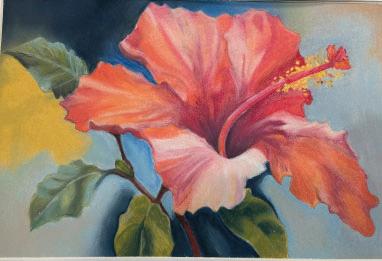
Saydee Wheeler Goodman Crowder Gold Fiction Short Story
“Ubi Amor, Ibi Vita” means “where there is love, there is life.”
Day after day I would walk alongside the crowds feeling as if I too had somewhere to be, sometimes riding the train to a new destination, and other times remaining against the cold concrete walls watching the people pass.
Today I spotted a young man dressed in a freshly purchased suit and nervous expression displayed across his face. I decided to follow his quick and skittish pace out of curiosity of his point of disembarkation. He quickstepped over the gap of the grimy concrete with the yellow line into the train avoiding the others who had been trying to push their way out and jog up the stairs into the city streets. He began pacing
The mob of busybodies came to a silent halt when her hazel eyes adorned in dark lashes met mine. Her lips began to curl into a soft smile as she tilted her head at me letting her vibrant copper hair cascade over her shoulders, giving me a warm quiet greeting. The bland walls of the station beyond the doors of the car exploded in vibrant colors as if her presence alone could bring a room to life. I glanced around the sea of strange faces for an explanation of why her gaze found my once unnoticeable figure, but there was no hypothesis in sight. I became rendered in a frozen stance out of shock and pure joy. After countless lonely years of remaining unseen to the human eye, and accepting the fate of my eternal solitude, someone
finally truly saw me. My heart skipped out of my chest as my eyes grew wide and laughter spilled from my lips, partially out of relief but mostly in hopefulness of finding a kindred spirit. My heart hummed with a joyous tune, and my feet began to move before my mind could comprehend the motion until my toes were at the edge of the door, only a few feet from my familiar stranger.
In an unexpected rush, time returned and the sliding glass barrier closed separating me from the woman as my breath faltered in a panic. The wheels screeched into movement while the sight of her faded out of view through the dark tunnel. The crowds enveloped her vivacious light until she was permanently absent from my vision.
Wheeler, an alumna who loves writing and the arts, will graduate as one of the first recipients of the Career and Creative Writing certificate at Crowder.
Liz Rhuems
Webb City High School Silver 2D Art
This flower emerged through more than 20 hours of focused work, becoming a space where I could slow down, relax, and create.
Rhuems plans to study biology and play softball at Northeastern Oklahoma A&M.
Billie
Holladay
Skelley Joplin
Community Silver Nonfiction Essay
After witnessing a starling murmuration, I wrote about their mesmerizing beauty.
A retired clinical nurse specialist and nursing educator, Skelley enjoys focusing on her writing. Her work has appeared in various journals, magazines, and anthologies—and she has written 13 books for children and teens.
If you’ve ever been lucky enough to see a flock of starlings performing a swirling, synchronous sky dance, you know it can be a mesmerizing sight. Their aerial acrobatic performances can feature thousands of birds moving in unison, swooping, diving, and whirling through the air in a cloud of coordinated formations. At a moment’s notice, they can twist, turn, and change the density and shape of their patter ns. The flock can split apart and fuse together again in seconds to continue spiraling across the sky. This stunning display is called a murmuration, and while the phenomenon is dazzling, it is also puzzling as to why starlings do it.
With no designated leader during a murmuration (a term that evolved from the low murmuring sound made by thousands of wings beating together), each starling in the flock monitors and mimics its neighbors. Researchers believe that each bird keeps track of six or seven of its nearby neighbors and makes adjustments based on their movements to create the fluid formations. It is not clear what causes murmurations to occur, but predators, body heat, roosting sites, and information sharing may be involved.
Scientists theorize that starlings perform their intricate dance as a defense mechanism to deter predators, like Peregrine falcons and hawks. The rapid, gyrating movements
Latonia Bailey Neosho
Quill Staff Adviser Digital Art
Bailey, coordinator of the Digital Marketing and Photography programs, enjoys contributing to the contest each year in various categories.
of the mass of birds may confuse predators, and when a flock acts like a single entity, it can change shapes quickly and compress into dense, intimidating forms. The flock can even split into separate groups to employ different escape patterns. There is safety in numbers, and when the flock is flying together, it is more difficult for a predator to single out one bird for capture. If a bird falls out of the pattern, however, a predator can easily pick it off.
Murmuration simply for defense may not provide a completely satisfactory explanation, however, because these aerial ballets are sometimes performed when no predator is evident. Murmurations are most often observed in the evening before the birds settle down to roost for the night. If a predator is nearby, the birds could return to their roosts for protection instead of engaging in a coordinated dance that can last from a few seconds to 30-45 minutes. Their lengthier performances require a great deal of energy. By returning to their roosting site, they could save time and energy. In addition, a large group of pirouetting birds engaged in synchronized flight is also known to attract predators, so murmurations may occur for additional reasons beyond defense.
These aerial ballets may be a visual invitation to other starlings to join them to form a larger population for roosting. With
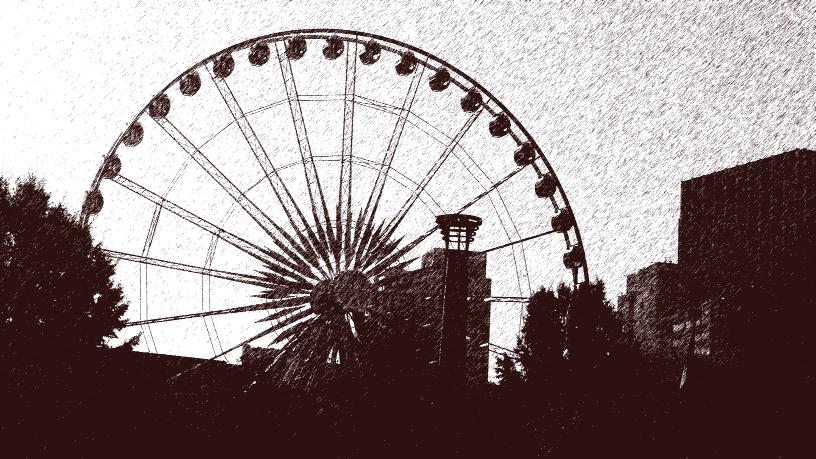
more bodies, there is more body heat, and the larger the flock, the greater the warmth. But why starlings feel the need to perform their gyrations for such long periods and burn such tremendous amounts of energy remains puzzling.
Another theory suggested by researchers is that starlings join together to share information about the environment and the best food locations, but even with all these theories, what exactly causes a murmuration to occur remains somewhat of a mystery. Maybe starlings just frolic together as a way of expressing their joy in movement. They could stop their sky dancing rather quickly, but they often continue their pulsating everchanging patterns for long periods. Perhaps, they engage in their aerial antics simply because they enjoy the activity or maybe they perform because they know we enjoy watching their amazing displays!
Other birds, like red-winged blackbirds and common grackles, also perform dances
of coordinated flight, and other animals engage in synchronized movements similar to murmurations. Fish, for example, join together in large groups to protect themselves from predators, and some insects, like gnats and honeybees, swarm together in coordinated movements. Few creatures, however, perform the coordinated, complex patterns that starlings exhibit. W hile starlings can be loud, destructive birds that attack crops, cause problems for livestock, and threaten native birds, they also perform the most intricate and spectacular murmurations.
If you ever get a chance to observe a starling murmuration, you’ll be amazed by how the birds create their ethereal clouds of graceful fluidity. It’s a breathtaking spectacle. They may be just one of nature’s mysteries, but murmurations are definitely special because they have a transfixing beauty that will make you wonder whether you are awake or dreaming.
Caitlin Cook Stella Quill Staff B&W Photography
Moved by the serenity and peace of the scene, I photographed this bird on a wire during sunset in Siloam Springs, Ark. Canon EOS 90D, shutter 1/160 sec., f5.6, ISO 800
Cook hopes to continue at Missouri State University, after completing an associate degree in Photography.
Douglas Brown Joplin Crowder Bronze Nonfiction Essay
The walls I’ve put up are lowering as belief in myself grows. I share this piece publicly to display connections made with people.
Brown is a first generation, nontraditional student planning to graduate spring 2026 with an associate degree in criminal justice. He aspires to attend law school and become a criminal trial attorney.
When I was a child, I caught a fleeting glimpse
Out of the corner of my eye I turned to look, but it was gone I cannot put my finger on it now The child is grown, the dream is gone (Waters 3:46)
Iwas an adult the first time I heard and considered what those lyrics meant. It was as if a chilling verdict had been imposed upon me. It transported me back to a time when, as a 9-year-old boy, something inexplicable happened to me. It started as any summer day would have started, no doubt. I awoke to the smell of cigarettes and black coffee wafting from the living room to my bedroom. My feet were greeted by the many cords of fabric that adorned my orange and blue shag carpet. I would walk into the living room to say good morning to my mom and stepfather, who preferred to be called Sonny. Sometimes he was already in the garage, working on cars. A cacophony of ratchets turning, the air compressor moaning, and the din of metal on metal could usually be heard along with gratuitous cursing. Breakfast usually consisted of cold Pop-Tarts; we always seemed to have the brown sugar cinnamon ones that gave me heartburn. Afterward, I
Sophia Anderson Joplin Crowder Bronze 2D Art
Each fall I enjoy looking at a group of trees near my house that seem to burst into vibrant colors before dozing off. This is my interpretation of their slipping into slumber.
Anderson is a dreamer and creative enthusiast who hopes to be a published author.
would watch cartoons or help Sonny with any menial tasks he might have had for me. Many a summer day was spent anticipating being cut loose from chores so I could play with my neighbor friend or by myself in the backyard. Lunch was usually light. I had to eat by myself in the dining room; Sonny said I was too young to eat in the living room with them on the nice furniture and that I might make a mess. Our kitchen table was a diner-style booth, with a linoleum-like wood-grain top and slippery orange bench seats. A replica 60s miniature jukebox sat off to the side, much like me. I would consider a past I knew little of, as I flipped through pages of the jukebox dining companion, wondering how Elvis could have made a whole song about a hound dog. It was the shiniest thing in the house.
A hazy recollection of the beginning of the day would soon give way to one of my clearest memories of growing up. I was finally free. I made my way to the sandbox, walking past my arch nemesis, the rope hanging from the maple tree in the backyard. I fought many an imaginary battle with the yellow nylon rope, usually as Leonardo, my favorite Ninja Turtle. I would hope my valiant bravery would win the affection of April O’Neil, but I always relented in magnanimous fashion, for the rope
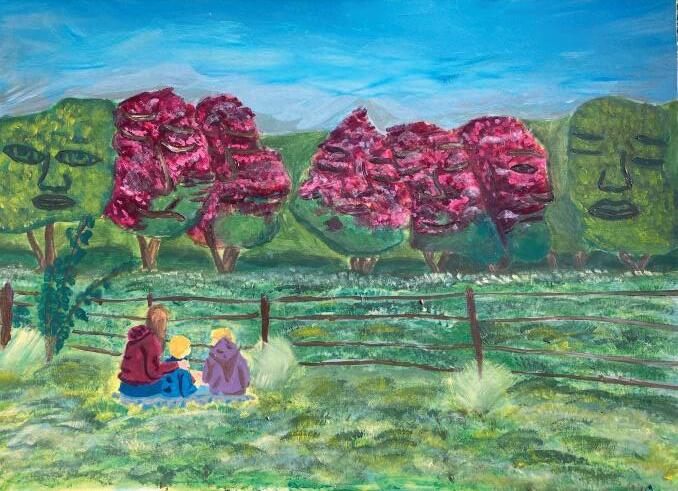
always returned to its fighting stance. Next time would be different, I would tell myself. Past the rope was the sandbox, underneath the maple tree. The railroad tie frame smelled of and sweated oil in the heat. I put my hands in the sand until I reached the perma-damp layer created by the shadow of the tree, where the sand clumped together the best. It did not seem the cat had visited it yet; the only smell was cold, wet earth. I saw the toy dump truck that lived there, now more rust than yellow. I remembered when it was brand new, from a previous birthday, and my cousin, who wanted to play with it. I threw it at his face, abruptly ending the party. His cry was two types of pain, howling for the physical and stuttering inhales for the betrayal. Guilt left almost before it arrived as I started making something out of the sand with the bucket that also lived there. I left the sandbox to grab a toy, the maple tree behind me now. I bent over to pick up the toy, and then I felt it. I stopped. Who was behind me? What was behind me? I felt a presence, and it felt bigger than me, bigger than my parents. It was more tantalizing than wonder, more profound than an epiphany, and more consuming than sorrow as I now know it. Would it be God? I knew when I turned around, I was going to experience something rather than just see it. Am I ready? Yes, I had to know. As I turned, I caught that fleeting glimpse in the peripheral of my eye. The more I turned to see it, the faster it flew away, like an eye floater protecting its mystery. When I stopped turning, all that remained was the maple tree. It was aglow as only the sun can make, low in the sky, matching the yellowing of the leaves as autumn teased us. I could see every vein tracing the annual leaf clocks. A thought of the Canadian flag passed by me like a grasshopper with a purpose. The tree had a longer shadow than when I first stepped outside, and I could now hear the assertive breeze wash by my ears as it was agitating the leaves, and the initial knot of emotions gave way to an unfamiliar feeling. Belonging. To what did I now belong? I continued to soak in the maple tree. The shadows of the leaves were in the throes of a synchronized square dance with their creators. Coarse pips of bark had their own dark veins running through it, except where freshly exposed wood had been created, perhaps by another heroic endeavor I had. Thick roots plunged into the dusty ground, the stoic foundation of what I
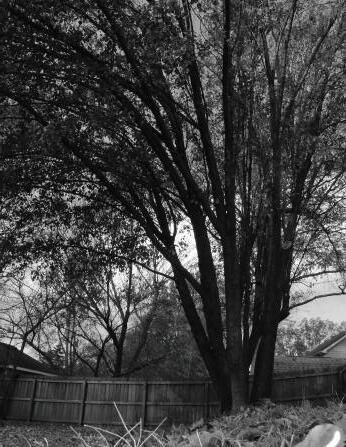
was beholding. Was the tree what caused my emotions? Was it the thing that led my gaze to the tree? This was the cue for my feelings to slowly recede. Belonging gave way to the need for answers. What did I feel that so strongly compelled me to turn and look? I felt like I was missing something. I ran inside, slamming the flimsy back door with the chipping paint behind me. Sonny hated it when I did that. I found Mom and explained what happened in a less adequate way. She said, “I think you had a rite of passage.” I had to ask what that could possibly mean. “Something that happens when a boy becomes a man.” I remember thinking that I was not ready to become a man yet, like my stepfather. It seemed a miserable thing to become. I also wondered if everyone experienced something so profound.
I now know I’m not the only one. I first thought when I heard that song as a young man that I, too, needed to quest for the anesthetic so richly portrayed in “Comfortably Numb” (Waters). However, as I considered what the lyrics meant to me later, I then knew why the words seemed to be a chilling verdict being imposed upon me. I was already serving my sentence. Thanks for getting me ready, Sonny. The child is grown.
Works Cited: Waters, Roger. “Comfortably Numb” The Wall, Harvest Records, 1979.
Anika Adame Joplin
Quill Staff
B&W Photography
Inspired by B&W film photographers, I captured this tree that I often watch turn from bright green to neutral brown, to leaves falling off, until only grey branches remain, expressing seasons changing. Canon EOS Rebel T6, shutter 1/200 sec., f/16, ISO 200
Adame, interested in digital art, printing, and photography, will study graphic design.
Bryce Hall Goodman Crowder Gold Nonfiction Essay
I wrote this because of my teacher’s inspiration, about a time I will never forget with a friend.
Hall is taking an English class to complete an associate degree while serving in the United States Air Force.
When I was 16 years old, my friend Justin and I were able to witness one of the best supercross events of all time in person. Supercross is a sport known for its tough and grueling nature. Supercross demands that you be the most physically fit athlete and the most mentally tough. This often ups the intensity of the event and makes it very interesting and thrilling for the spectators, often times showcasing how grit, determination, and split-second decisions all affect the outcome. However, little did Justin or I know just how true that was.
We woke up at 5:30 a.m., ambitious to get on the road towards the stadium by about 6 a.m. As we started our annual journey to the stadium, we knew the drive would be a long and boring one, filled with anticipation for the race. Around 9 a.m., three hours in the drive was boring and dragging on just like every other time we had made the drive. As a result, we decided to use this as our opportunity to get out of the car and stretch our legs, we pulled over to a gas station for some snacks and a restroom break. Careful not to waste any time, as we still had another three hours of driving. After a short 15 minutes, off we went back onto the long, grueling drive, ready to tackle the last half of the drive. Finally, after 6 hours and only one break, we could see the giant Dallas Cowboys stadium. We hurried to find a parking spot, as we were both very excited and anxious for the races.
We then proceed into the stadium at a very brisk pace. As we enter, the smell of race fumes and the sight of the dirt bikes flying off of massive jumps makes our heart rates go through the roof. The first qualifying sessions had just begun, we hurried to find our seats to watch our favorite rider, Ken Roczen. He put blazing fast lap times in the qualifying sessions, and at the end of the second qualifying session, Ken was the fastest. Justin and I were over the moon; this meant that Ken would have a good gate pick for his heat race. As we had suspected, the heat races went off without a hitch, Ken Roczen won heat one, and Cooper Webb won heat two. Cooper Webb was Ken’s championship rival. All that was left was the main event, and little did we know we were in for one of the gnarliest main events ever.
Cooper antagonized Ken by picking a gate right next to ken, setting up for a drag race
off the start. The 30-second board came out, and the anticipation was at an all-time high. The 30-second board went sideways, and the gate dropped. Ken Roczen pulled the hole shot, meaning he was the first rider through the first turn. Though Cooper Webb was not so fortunate, as he came around the first corner in about seventh place. Justin and I were ecstatic that Ken Roczen was in the lead, as he was our favorite rider. But, as the main event went on, Cooper Webb was determined to overtake the other riders and catch up with Ken. Then, with two laps remaining, Cooper took over second place. The crowd was coming to life as Cooper Webb was right on Ken’s tailpipe. Cooper kept gritting it out, inching closer and closer, but Ken managed to hold him for one of the two remaining laps. Now with the last lap flag flying, it is anyone’s race to win. Justin and I, and the entire crowd were on our feet, some cheering for Ken and some for Cooper, as Ken Roczen was holding strong and holding off Cooper’s pass attempts. Until the last corner.
When Ken makes the wrong split-second decision and chooses an outside line and allows Cooper to sneak up the inside of him. As they go over the finish line jump it is neck and neck. Justin and I were in shock, asking others if they knew who won. No one could tell, even by watching it in slow motion. So, the race officials had to review footage frame by frame. After careful deliberation and three very long minutes, they announced that Cooper Webb took the win by the narrowest margin in supercross history. Justin and I were frustrated but could not be upset as Cooper Webb showed the most amount of determination and grit that we had ever seen from anyone, which led to his success that night.
Having watched one of the most intense sports events we have ever witnessed in person. We started the walk out of the stadium. As we were walking out, we reflected on “What would have happened had Ken just blocked the inside?” and “How did Cooper Webb not just settle for second?”
But we already had those answers. It was through Coopers relentless determination to win the race, and his grit to never stop pushing through the pack, and Ken’s one split second of lapsed judgment. So, with our question answered, a thrill that exceeded all expectations, and a lesson learned in hand, we hop in our car and head for the hotel.
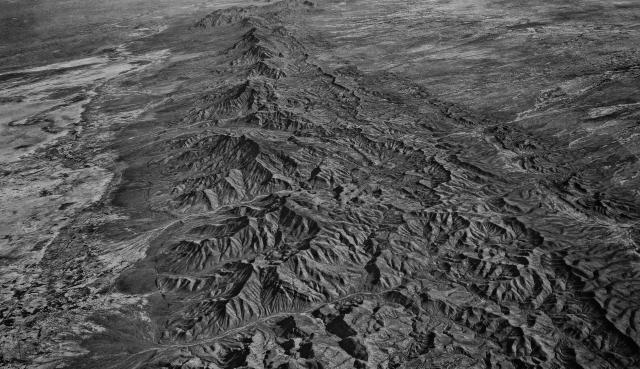
image in Southern California
how mountains often separate desert from inhabitable areas with deep dinosaur spine-like channels. Samsung Galaxy A54 5G, shutter 1/1000 sec., f/1.8, ISO 40, processed in Photoshop CS2
Lieutenant Roberts paused writing mid-word, looking over the rim of his glasses at me as I sat in his office and my young daughter played with the folds of my skirt. He quietly laid his pen on the desk and asked, “What did you say?”
“I said I was going to return to my husband and son and wish you to give back my pony as soon as possible.”
“I am sorry but that is impossible” he replied impatiently, returning to his papers.
“Well then I will just leave.”
“No madam, that is impossible. I have orders to facilitate your return to your family in St. Louis and arrangements are being made for just that.”
“I won’t go and if you force me, I will run away and return to my husband.” I looked down at my folded hands in my lap as he turned his chair to gaze out his office window. The quiet in the room seemed to grow heavier by the minute. My hands were no longer the soft white hands I once had but were calloused and scarred from years of hard work. I remember when they were soft, when I was young and I thought I was in love. Liem McDonald was so handsome, and he owned his own dry goods business. The prize “catch” in my town! He said he loved me, but on our wedding day I waited over an hour at the church. Finally, a note was delivered telling me there was another that he loved more, and he was sorry. Sorry? I felt I could no longer
live in that town after being so humiliated, so I traveled to St. Joseph and against the warnings of dangers and hardships by the wagon master, I bravely joined a wagon train to California.
We traveled the Oregon Trail west toward a new future for all of us. The days were hard, long, and hot, and the nights were not much better, but during that time I learned to be quite good at driving the team pulling my wagon that carried all my worldly possessions. We had reached the windy, tall grass prairies of Kansas when we first saw them. A small group of, what the wagon master called “Savages," following at a distance. Wagons were driven closer together and everyone carried weapons, but it did little good. On the third day, in the early dawn they attacked. The wagon master handed me a pistol with the instructions to save the last bullet for myself, I never shot it even once. I huddled, terrified in my wagon while the rest of the wagon train was annihilated. All except me where I was hidden. And then they found me.
I pointed my pistol at them but could not pull the trigger. One of the men jerked it from my hands. Grabbing my hair, he dragged me from my wagon, ripped my dress from my body, and threw me to the ground while the men gathered around me laughing. Terrified, I grabbed a rock and threw it at the one who pulled me from the wagon, hitting his face and
[Continued to 32]
Jammie Graves Webb City Community Silver
B&W Photography
Graves , a photography enthusiast since college, studied engineering graphics. He continues learning, and creating unique images of the world around him.
Venita Henson Neosho Crowder Silver Fiction Short Story
We all have one place our heart feels no need to search for true home and love. When we find that place, we know we have found peace.
Henson, a long-term non-traditional student, enjoys ceramics and sculpture. She has written stories from a young age, but when a friend challenged her to write in a genre outside her comfort zone, this story resulted.
Grace Allison
McDonald County High School Bronze
B&W Photography
I thought this would look good as wallpaper, in black and white.
iPhone 12 Pro Max
Allison, a freshman cheerleader, aspires to become a nurse and work hard in school.
[Continued
drawing blood. Some of the men pointed at him, jeering and laughing even harder. Glaring at me, he drew his knife and raised it to kill me, when a word stopped him. The men parted and a tall, young man walked to me, grabbing my arm, he jerked me to my feet and walked around me as if he was looking at some animal for sale. He argued briefly with the man holding the knife before handing him the reins of one of my horses from my wagon. I had been bought for the price of a horse stolen from me.
My captor shoved me onto his pony, swung up on its back behind me, and we galloped away from the last white people I would see for years.
We traveled all day and all night, only stopping to allow the ponies to drink. At dawn the next day we arrived at their camp and there was celebration but also grieving for warriors who had been killed during the raid. My captor rode through the camp, stopping his pony at the entrance of a lodge, he shoved me off at the feet of a very old woman. She looked at me lying in the dirt and poked at me with her walking stick. Speaking a few words to him, she wrapped a blanket around me and shoved me into her lodge. I had become her property.
Four winters passed. I worked very hard, but I had food, good shelter, clothing, and was treated kindly by the old woman who taught
me her language and customs. One beautiful spring day while I picked berries and she sat leaning against a tree to rest in the sunshine, she quietly stopped living and went to live with the Creator. I truly grieved for a friend that day but could not help but wonder what was to become of me. Would I be given to someone else? Would they be as kind as she was? That evening, the man who brought me there, who had been watching me from afar, came to the lodge with two ponies to ask for me in marriage.
He is a kind husband, a good hunter, and we have had a good life. We were blessed with a strong healthy son and then after two years, a daughter who did not breathe when she was born. We grieved for her. Three years later the daughter now at my knee was born, strong and well. But now I am a captive in the world where I had once lived but live no longer. I long for my husband’s arms and gentle smile and for my son.
Lieutenant Roberts turned back to look at me and my daughter. Picking up his pen, he slowly began to tap it on the papers on his desk. Clearing his throat, he spoke in a low but very firm voice, “No madam, you will not leave and return anywhere except back to your family in St. Louis. Your time with those savages is over. With time, living back in civilization, you will realize you belong with your kind, with white people. If you wish to leave that half-breed brat here, we will deliver
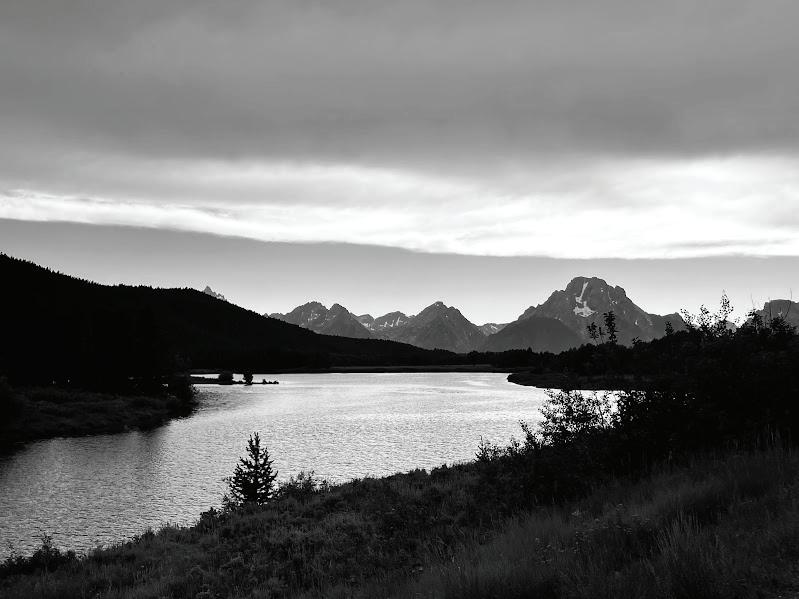
it to the nearest mission to be raised to be as white as possible.”
The words stung like a whip. In the years I had lived with my husband’s people, I had never witnessed savages, only pride and self-reliance. People with good souls, being destroyed by the people he planned to send me to. And definitely, no one was going to take my daughter away from me while I lived. Not speaking to the Lieutenant, I defiantly looked directly into his eyes, rising from my chair, I held my chin up with pride, holding my daughter’s hand, we walked out of his office without looking back. I had spoken for the last time, now I planned to return to my husband and son. If Lieutenant Roberts would not allow it, then I would return without his permission, but I would return! As the moon rose into the night sky, my daughter and I silently slipped out the cabin door. There was a guard, but he was sleeping as we silently passed. Staying in the shadows, we moved toward the corral where my pony stood with other horses. Quietly I called him to me, slipping a rope around his neck, I put my daughter on his back and led him through the gate. When we reached the gate of the Fort, I found more sleeping soldiers. Smiling to myself, I opened the gate and swung up onto my pony, silently walking him toward the woods. We had gone a short way when I heard the alarm being sounded at the Fort, we had been discovered! Kicking my pony into a gallop, we began to run as far and as fast as possible knowing the soldiers would soon be in pursuit.
We traveled fast, trying to stay in shadows as much as possible, but I could hear the soldiers catching up with us. Hiding in a ravine, I let my pony catch his breath before we began our flight again. We changed directions and hid again, but they kept coming. Their scout always finding our trail. We had gone many miles before they finally caught up and surrounded me, I tried to force my pony through the soldier’s horses but was turned back over and over.
Defeated! My daughter and I would die in this place before we would go back to the Fort, so I forced my pony against one of the soldiers and grabbed his revolver. Years ago, I had to choose to fire the wagon master’s revolver to escape being captured and I failed, this time I would not.
Pointing the revolver at my daughter, I closed my eyes, and silently in my heart begged my husband for forgiveness when I
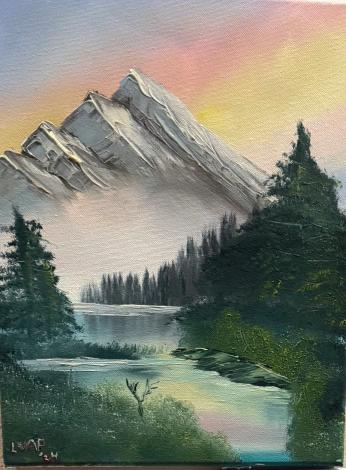
Lieutenant Roberts yelling at me to stop. “Madam, you drive a hard bargain! There will be no one die here tonight. If it is that important to you to live with those people, then so be it. Go! Go live with those savages and good riddance to you. One white squaw and half-breed brat is not worth my worry. But, just what do you want me to tell your family in St. Louis? That you chose savages over them?”
I looked at him, not with hate but with pity. He was the one with hate in his heart, he could not see how hard and evil his words were. He knew nothing of the people, my people, that he spoke about. He was a poor excuse for a man!
Looking at him and with pride in my voice I said, “Lieutenant Roberts, kindly tell the ones in St. Louis that Kathleen Brannon died twelve years ago with that wagon train on the tall grass prairie of Kansas. She is no more. On that day I was born, Grey Doe, adopted daughter of Rabbit Woman, wife of Tall Elk, mother of Runs With Horses and Small Bird. And I live well.”
The soldiers parted as I turned my pony and kicked him into a gallop toward my home and husband. Tall Elk and my son were waiting for us at the top of the hill, silhouetted in the morning sky. He gently took my hand then touched my cheek and smiled, taking his daughter to ride with him, we turned our ponies and rode back to my life, back to my home back to where my heart lives.
Laup McKeever
Seligman
Community Honorable Mention 2D Art Oil and Canvas
Reminiscing on cold days, this puts you in early morning spring alongside a stream listening to Mother Natures sounds.
McKeever, with no formal training, follows Bob Ross techniques, bringing Mother Nature inside when it’s cold, by painting what inspires him.
Jessi Hilton Goodman Quill Staff Poetry Rhymed Verse
I was given a prompt to make a poem about Fall during a letter writers club meeting. I used visual description to make the poem feel real-to-life.
Hilton, a dual credit student, loves to read and write. She plans to study psychology with a minor in business.
Leaves whisper under wandering feet, Geese cry across the glowing sky, The wind hums a farewell song as they fly on by, The scent of a campfire curls into the air, Frost kisses the morning grass with utmost care, Sunlight spills through the trees in vibrant golden hues, Autumn drapes the earth in an amber shawl, Shadows stretch longer, chasing the fleeing sun, Far off in the distance, The sky a canvas of pink and grey, As the horizon fades into the arms of the suns’ final ray. As the final leaves drift to the frosty floor, There is so much more to see, More beauty, more peace. This is Autumn, A season of rest and tranquility.
Julie Hilton Goodman Quill Staff 2D Art Watercolor
In a 30-minute workshop, I loosely painted a lake, forest, and reflection. The instructor said, “you can finish that at home,” but I liked it as is and realized my art can be “finished” when I see it as complete.
Hilton captures moments with art and photography.
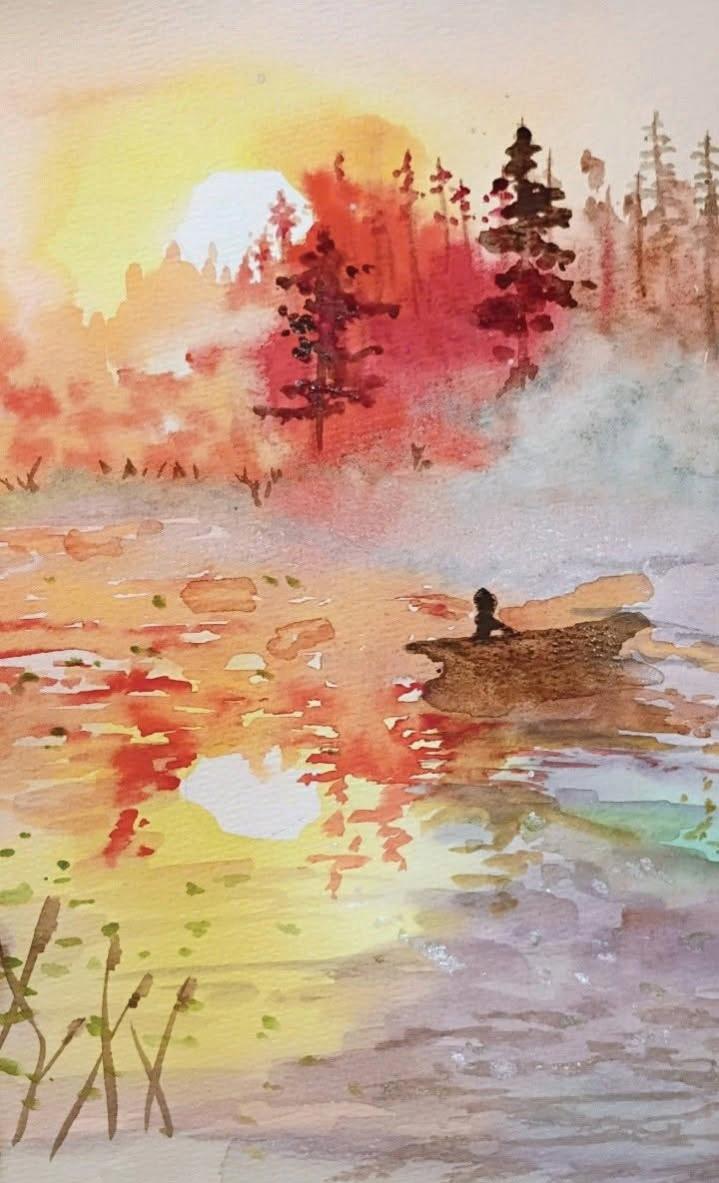
“Spring Semester.” What?! Snow. Ice. Classes cancelled. Sleds! It’s Winter. Not Spring!
With only one class the first two weeks of the spring semester, I believed the name was misleading.
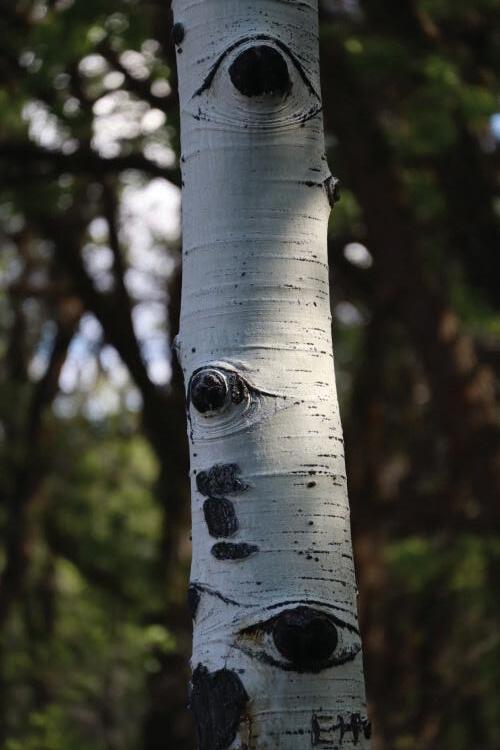
Julie Hilton Goodman Quill Staff Poetry Haiku
Hilton records moments in time to reflect and share.
Jayden Mustain
McDonald County High School Silver Color Photography
Aspens, showstoppers with their bark and fall colors, look back at you - not in malice, but curiosity - watching over sleeping families, rustling their leaves in a lullaby. Canon R100, shutter 1/800 sec., f7.1, ISO 1250
Mustain, a senior planning to study anthropology at Mizzou, and work in the Southwest U.S., loves to write, create art, and make frybread.
Jessi Hilton Goodman Quill Staff Fiction
Fantasy/Science
I have never written a story with a love interest before and it was quite fun to broaden my horizons and try something new.
Hilton, a dual credit student, loves to read and write. She plans to study psychology with a minor in business.
Years of chasing the impossible have led me here, standing at its edge. This portal, my life’s work, whispers the promise of answers, escape, and perhaps even the life I never thought I could have. The vortex churns like molten glass, waves of violet and gold folding into themselves. Shadows ripple across the walls as if reality itself is bending.
I don’t realize that the future waiting for me may be the very thing I’ve been running from. Once I step through, everything changes. There is no going back.
Just as I begin to step into the portal, I hear a voice call out behind me.
“Dr. Veylin?! What the sparks are you doing?”
I want to ignore him, pretend I didn’t hear, but the worry in his voice makes me hesitate. I sigh as I step away from my creation, my obsession.
My mother vanished when I was nine. My father died soon after. Aunt Nallie raised me with silence and warnings instead of answers. This portal is everything those years have denied me.
With a long, exasperated sigh, I turn, facing the face of Brennan, my friend and confidant since my mother disappeared.
“Oh, um, when did you get here?”
I try to sound calm, but I can tell I failed by the look of anger on his usually composed face.
“Elara Breanna Veylin.”
I almost wince at his use of my full name, giving him what I hope is an innocent smile.
“Yes?”
My hands itch to pull my clipboard out and pretend to be busy, but I know it would never fool him. Even with what I am sure was a horrible attempt at sounding calm, Brennan just watches me, and I do actually wince when I see anger fade to reveal hurt in his eyes. He knows I was considering leaving him and everything behind for what he considers nonsense.
“I can explain. It’s just-”
He cuts me off before I can utter the first sentence of my well-rehearsed excuse.
“Elara.”
I can hear the underlying hurt in his voice, but when I look up at him, all I see is sadness and understanding.
“You don’t need to explain. I know it’s a
hard time of the year because of your mom’s-”
This time, I cut him off.
“Don’t. Please. Just don’t.”
I swallow hard, refusing to meet his eyes as I rebuild the walls I’ve had since I was nine. I turn away and fidget with some computer parts, not sure what they are, but knowing I need an excuse not to face Brennan and what I am sure is the pity he has for my messed-up past.
I think back to the years of sleepless nights and the countless equations covering every space in my house. The portal continues to hum beside me.
Just a few steps and I could fulfill my dream, my father’s dream before his death: to find the reason for my mother’s disappearance. This dream is calling me, promising me answers. It’s the one thing I’ve held onto for the last ten years: the possibility of reuniting with my mom.
“Brennan,” my voice cracks, and I clear my throat before speaking. “You don’t understand, I need to do this, I can’t-”
I’m cut off by the sound of boots echoing on the steel floor, much closer than I expected. I jump as I feel a warm hand on my tense shoulder.
“You think I don’t understand? Elara, I’ve been here every step of the way. I helped you build this thing. Stepping through alone is suicide.”
I don’t resist as I feel the tug of him turning me to face him, eyes downcast as I stand still as a statue. I can hear the worry and conviction in his voice, surprised by how much his care affects me. As I glance back at the swirling chaos, colors fold into themselves like a whirlwind. For a second, I’m sure I saw a face in the vortex. A woman’s face. My breath catches.
Mom?
I blink, and it’s gone.
“Elara.”
Brennans’ voice is soft, almost pleading, making me feel awful for being such a horrible friend.
“Elara, you’ve been chasing ghosts since you were nine. Maybe it’s time to stop.”
I laugh, my voice holding a foreign bitterness as my guilt fades away to anger and hurt at the thought that he would tell me to give up.
My mind flashes back to that night against
my will. I can still smell the rain and hear my mother’s soft goodbye. I was too young to understand that she meant she was leaving for good.
Gone. Gone was the woman who would tuck me in to bed and sing me lullabies when I had nightmares of monsters and demons. The more I think about that night, the more I’m filled with anger, until I release it on the one least deserving of it.
“Stop? When I’m this close? When this could be it? Brennan. It’s right there. Look at it!”
My voice rises as I gesture towards the still swirling vortex, the answers I’ve been seeking my whole life, finally within my reach. I can see his face etched with sadness. His next words cause me to pause for just a moment.
“What if what’s on the other side isn’t what you think?”
My mind flashes to Aunt Nallie’s weird old warnings that she’d give me when I started asking questions.
“Some doors should stay closed, Elara.”
It used to frustrate me when she’d say that, but now, as I look at Brennan’s worryfilled eyes, then to the portal calling me, I see she may have been right. I have been so focused on myself and wanting answers, I never stopped to think about the consequences, about Brennan, or about what I already have.
Deep down, I know Brennan’s right. As I realize this, I move to shut the portal off for good; but as I reach for the controls, it
pulses, stronger this time, and I feel something in me respond. Heat licks at my skin, sharp and electric. My fingertips tingle with an icy, powerful feeling.
The hum of the portal deepens into a growl, vibrating through the labs’ steel floor. Heat sears through my veins, fire and ice colliding; a scream clawing its way past my lips. The air reeks of burnt metal, sharp enough to sting my nose. The portal pulses and shakes, bursting in a flash of light, sending a wave of energy straight at me. I can almost hear my mother’s voice, calling me. Maybe this is the end.
I have no idea how long it has been. The clock, which should be moving toward the seventh hour, is frozen mid-tick. Something is very, very wrong. Why the sparks is nothing moving? Brennan, frozen in place, still has the look of sadness from our fight plastered to his usually relaxed and handsome face.
I would think time had stopped completely if it weren’t for the occasional movement of the air from our drafty air vents, or the slow blinking of the laboratory’s computers. What is happening to me?
“Brennan? Brennan, can you hear me?”
I’m beginning to panic as I realize I am the only one not affected by whatever that portal did. I try to shake Brennan out of it as my situation truly begins to set in.
Just as I’m sure I’m about to have a
[Continued to 38]

Latonia Bailey Neosho
Quill Staff Adviser Color Photography
Rock formations appear in Lower Antelope Canyon near Page, Arizona, as viewed during a tour within the slot canyons.
Bailey, coordinator of the Digital Marketing and Photography programs, contributes to the contest each year in various categories.
Maddilynn Idell Pineville Quill Staff Color Photography
The way the sun was hitting the clouds at golden hour made the sky almost glow. I think this shows that a moment can be so beautiful. Canon T100, shutter 1/125 sec., f8.0, ISO 1000
Idell will finish an associate degree in art, then attend MSSU for a bachelor’s in Graphic Design. Because she gets ideas to try from other artists, she hopes to motivate others when they see her projects.
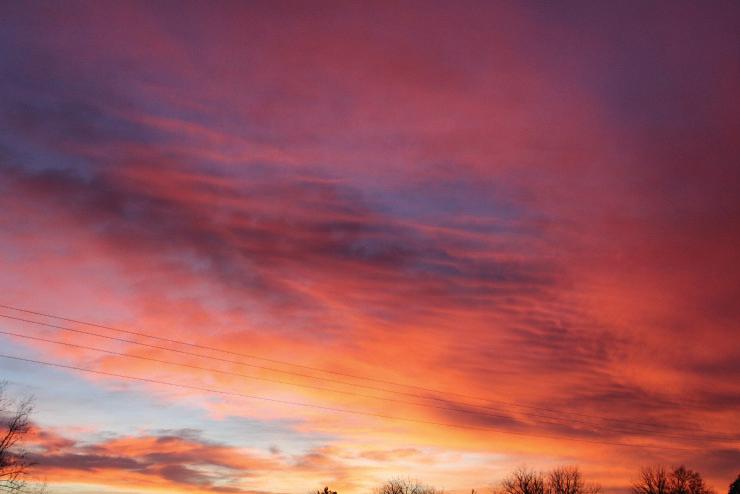
[Continued from 37]
full-blown panic attack, I hear the whisper of voices calling me from the now empty space where the portal once sat. However, they’re distorted, flickering in and out.
I step closer to the portal-shaped burn mark in the ground, determined to understand what is happening. Just as I reach out, fingers brushing the scorch marks, I’m pulled roughly back by the strong arms of Brennan. I stumble back, losing my balance, Brennan holding me up while I regain my footing.
“What in the sparks just happened, Elara? One second you were about to turn the portal off and the next it’s gone and you’re standing there! How on Earth did you move that fast?”
His words blur into static. All I see is the void where my life’s work once sat.
“Elara.”
“Elara!”
“ELARA!”
I flinch, realizing he’s been calling my name for the last few minutes. I hold my head, unsure what’s real and what is likely induced by far too many sleepless nights.
“Elara? Are you alright?”
His voice is soft, threaded with concern, and guilt stabs me like a serrated knife. After everything, after my reckless ideas, he still worries about me. That burns more than the heat of the explosion.
I realize he’s been staring at me far too long. Heat crawls up my neck, blooming across my cheeks. I nod, looking away to hide my
flushed face and my confusion as to what the sparks just happened.
Exploding portals, freezing time, and now I’m blushing? Either I hit my head or I’m dead, and this is the afterlife.
Just as I’m about to stand and give some excuse about needing sleep, his hand, rough and calloused, tips my chin towards him. His eyes, stormy and gray, fierce and tender, lock onto mine.
I realize rather quickly that I am way too close to him. Great, now I’m blushing again! What is wrong with me? Before I can spiral further into my very confusing thoughts, his voice hits my ears and makes my thoughts, and heart, freeze.
“I lost you to grief once, Elara. I won’t lose you to this, too. Something obviously happened. Somehow, you moved across the room before I could blink, and we’re going to figure out why. Together.”
I slowly nod, still in a daze from my confusing thoughts about him, about the portal, about everything. I drift towards my desk, Brennan shadowing me like he expects me to shatter.
As Brennan and I sit together in silence, I make a decision that could change everything.
I have spent decades chasing ghosts. Tonight, I choose the living. This is a future I can build, not chase. Whatever happened tonight, whatever chaos is about to unfold, I know we can handle it. Together.
Is there coal in my soul, Or a furnace born to burn?
I’ve carried the weight of kingdoms, For love that asks no return.
I gave my hands to the broken, Knowing they’d shatter again, Because my heart was forged forgiving— A weapon that only bends.
I’ve built altars from my own marrow, Offered peace upon my spine, Endured the storm and bore the cross, For burdens that weren’t mine.
There’s a scar for every story, Each carved with fire and pain, Proof that nothing was for nothing— Every mark has earned its name.
For everything I do has meaning, Every act, a sacred thread, I help the lost, I lift the fallen, And guide the ones I’ve led.
I mentor those who walk behind, And learn from those beside, For wisdom is the quiet river Where both strength and grace reside.
Yet I wonder—am I savior, Or fool dressed up in grace? For every wound I cauterize Leaves another in its place.
My humility is my humanity, My strength and my disease, I heal though I know the ending— I cannot help but bleed.
And still my heart beats restless, Yearning without a name, For who? For what? I do not know— Only the echo remains.
So I walk through fire unyielding, Though the embers take their toll, For my name is Terrin the man of earth, And I’ll dig ‘til I find my soul.
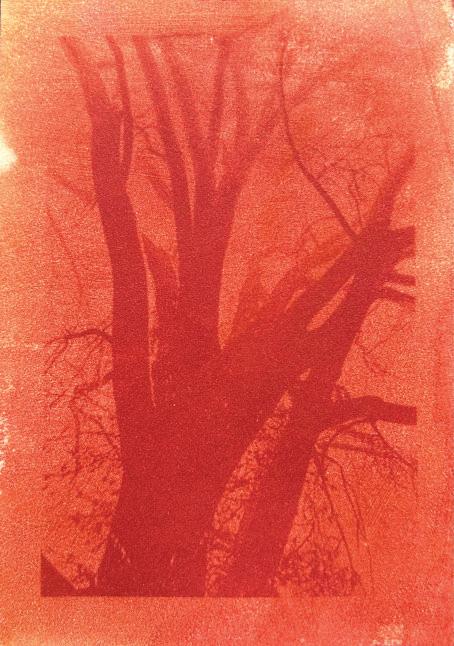
Anika Adame Joplin Quill Staff 2D Art Anthotype
I tested the anthotype method to see my photography differently. Photo on turmeric/ rubbing alcohol coated ink paper, UV lightcured 6 hours, baking soda/water wash
Adame, interested in digital art, printing, and photography, will continue graphic design after earning her associate degree.
Terrin McIlvaine Neosho Community Silver Poetry Lyric Poetry
From the exhaustion and defiance of endlessly bearing others’ burdens, I wrote this, questioning whether my inner furnace of compassion is a gift or a slow-burning curse.
McIlvaine has many aspirations for the future.
Hope Shinn Webb City High School
Honorable Mention Poetry
Rhymed Verse
Three years ago, a friend of mine took his life. This poem is about my feelings now, looking back.
Shinn, a senior, tries to be playful and generous to those around them.
I still stand and stare, my mind looks to him, It holds onto despair, a snare that misses him. I feel awful for that night, a grim and dark place, Despite all my might, I see his face.
I take a breath, and held it tight, Wanting to forget that haunting night. Locked within, a heart that beats and bleeds, Heavy it weighs, straining at the seams.
A smile eclipsed by dark despair, His laughter echoes in empty air. In those hollow halls, silence falls, A broken memory, something my mind recalls.
I bite my tongue, silence my cries, Choking on sorrow, bound in goodbyes. An endless ache, not bitter, but kin, In silence, I mourn what might have been.
Each breath feels wrong, a stolen light, In laughter I falter, joy feels contrite. I take a pause and pick myself up, He wouldn’t want me to be distraught.
I hold on, never letting go, I wouldn’t leave you just because I’m told so. I move forward, you in tow, I won’t let you, nor your memory go.
I learn and grow, coming to terms that his actions aren’t my own, I wish to honor him and go on knowing I’m not alone. He is here, even in the dark when I don’t know, He never left, no, he would never let me go.
I take a breath and look up to the sky, He wasn’t evil, though I still wonder why. The stars tell me nothing, not a word in return, Just the hard lessons of what I have learned.
I exhale the pressure that I’ve kept in my chest, Laying my questions to rest. There are no answers, no why or no how, I’m just learning to live in the here and the now.
3 Years now, and seasons are shifting, A heavy fog that’s still lifting. My Pain isn’t gone, still present to date, But I don’t let it anchor me like a weight.
Dull is the pain, a scar that I wear, The weight shown that I was there. I carry his light, a dying spark, A companion of mine that’s bright in the dark.
Going far and all alone, learning how to live on my own. My heartbeat packed in a case, I left in another place.
Suitcases zipped on the floor, packed with clothes and so much more, like memories and my heart - sore, worried I’ll forget them all.
I wake up where my name sounds wrong. Where every day feels twice as long. The walls don’t know the girl I’ve been, or who I am when I walk in.
Every time I dare to speak, I fear my voice sounds strange or weak. Practicing smiles, rehearsing tone, to rise above the doubt I own.
Back home, laughter fills the air, inside jokes I no longer share. Time moves on, I fade from view, turning into someone new.
I miss your warmth, mom, every day. Your words that chased my fears away. No distance dulls the truth I know, your heart is with me where I go.
Here I am brave ‘cause I must be, converting miles and currency. Every fear I face and beat, turns the unknown into sweet.
Exchange year! Should burn and shout. And turn my fears all inside out. Not teach how silence screams so loud. Not ache while standing in a crowd.
At night, I stare at foreign stars, counting time zones, counting scars, wondering how I’m meant to cope, when every day erodes my hope.
Translating thoughts every day, until each one loses its weight. I reach for words that drift away, the truth becomes what I can’t say.
But every morning, still I rise, with fear reflecting in my eyes. I walk ahead, though unsure where, carrying more than I can bear.
Two worlds live under my skin, one I yearn for, one I’m in. And though this road is hard and long, I am planting roots in foreign stone.
Young and torn, yet growing strong, finding courage where I don’t belong. Missing home, yet standing tall, knowing I’ll rise through it all.
Find myself and become more.

Rhymed Verse
I wrote this about loneliness, bravery of leaving home, and how the exchange year experience stretches over all versions of myself.
Šcerbejová, an exchange student from the Czech Republic, is gaining new perspectives living abroad. She hopes to attend university, travel the world, and continue learning from different cultures and experiences.
David Zacharias Pittsburg, Kan. Community Gold
Digital Art
Zacharias, a photographic hobbyist, has traveled the U.S. and internationally, capturing photos of people, architecture, landscapes, and wildlife. Hana Ščerbejová Webb City High School Bronze Poetry
Journie Marie Daniels
McDonald County High School Silver Digital Art
Have you noticed rainbow soap in a car wash, or the colorful glisten of a newly blown bubble? That is what I wanted to capture in this piece.
Procreate App
Daniels, a senior, expresses her thoughts through art and writing.

Brooke Pope Carl Junction Crowder
Honorable Mention
Color Photography
Looking for a part-time job, I started working at Tee Time in Webb City, where I found a lifelong hobby. Shutter 1/60 sec., f/4.8, ISO 320.
Pope, post-associates, takes photography and business courses at while completing a bachelor degree in Human Resource Management at MSSU.

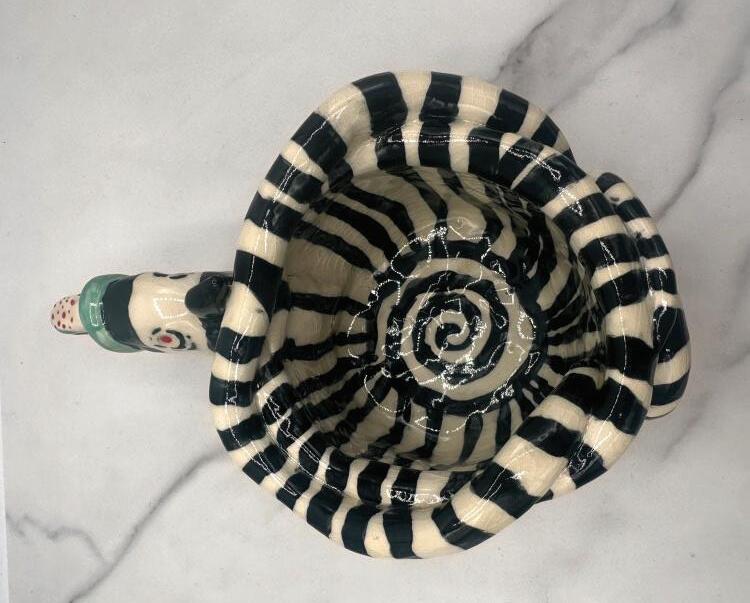
Nellie Mitchell Joplin Community Bronze 3D Art Ceramics
This planter combines pinch pot and coil methods, brought together with black and white stripes. Low fire earthenware, glazes, and underglazes.
Mitchell, in her 20th year of art education, teaches at Carl Junction High School.
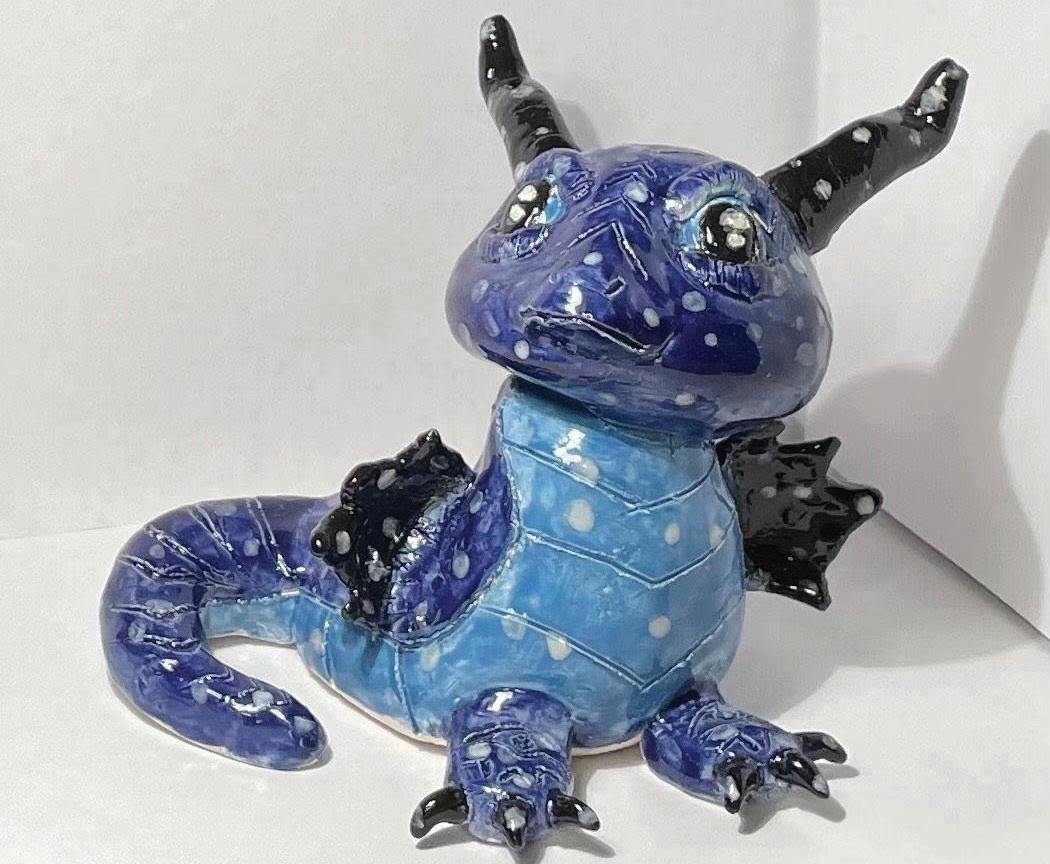
Molly Cameron Carl Junction High School
Honorable Mention 3D Art Ceramics
Based off the night sky, dots painted to look like stars, “Kalos’astra” means “Beautiful Star.” Twice-fired, hand shaped ceramic, glazed.
Cameron, a junior who likes to draw, read, take sky photos, plays trumpet in school and in jazz bands, plans to be a lifetime learner.
Peyton Holiday McDonald County High School Bronze Fiction Fantasy/Horror
This is based on a personal story of the past few years. These few pages show Badar, the protagonist’s trauma, and how everything began, as the start of a larger universe I made.
Holiday, a freshman, is an aspiring paleontologist, artist, and writer. She raises many birds on her family farm, and strives to live what she believes: “Big things come from small beginnings.”
n a sunny day atop a hill, Badar was working on his family's farm, picking tomatoes, pulling carrots, and harvesting cabbage. Normally, this would be his mother's job, but she was currently sick with chicken pox, and he didn’t want her working even though she claimed she was “perfectly capable”... though he clearly doubted and told her he’d do the work until she got better. Because, unfortunately, his siblings were also down with the sickness. While he was working, he noticed that some of the plant leaves were wilting and had strange black and brown spots on them, along with yellowing of the leaves. He’d never seen this on the plants before, so he just plucks the leaves and goes on with his day. As the sun sets, he makes his way back into the house, finding his mother in her chair. Noticing she looks worse than before. He sighs.
“Mother,” he says, “you look terrible. Is there any medicine left? Let me get it for you.” He stops abruptly as his mother gently grabs his wrist.
“I used the last of it for your sister,” she finally speaks, which Badar is surprised by, as she hadn’t really spoken since she caught this sickness.
He takes a moment, thinking before he slightly smiles, “I’ll go to the village and get some. I'm sure Mrs. Kotryna won’t mind a late-night visit.” He knew that Kotryna was always awake late at night; she was the village healer after all, and with the current round of chickenpox going around, she was working overtime. Despite his mother's protests and trying to get him not to go, he grabs his bag and a lantern and goes anyway. He knows his family needs the medicine, and without his father, he’s the only one who can go do it. As he starts his trek, the sun begins to set, and the fog begins to set in. He’s used to it being humid, as it was spring and it rained quite often. As he walked and got closer to the village, the lantern's flame started to flicker in the humid air. He worried that it might die out if he didn't get to the village soon.
Thankfully, Badar made it to the village in time and to Mrs. Kotryna’s cabin. Knocking on the door he waits patiently for a few moments before the door creaks open, and Mrs. Kotryna is standing there. “Sorry to bother you this late, Mrs. Kotryna, but my family... I’ve come for some medicine, if you’d be kind enough to
help.”
Mrs. Kotryna took a moment before responding, “You’re not sick, are you, Badar?” she said, her voice laced with skepticism.
“Fortunately, no I'm not.” He was a little taken aback by her cautiousness. Mrs. Kotryna had always been a little odd, often being called the village crazy lady or something along the lines of that. But he could understand why she was skeptical, probably not wanting to get sick herself.
She took a moment before opening the door further “All right, you may come in. I have something I'd like to speak with you about anyways.” He walked inside as she allowed him to, closing the door behind him.
“What did you want to speak with me about, if I may ask?” He was quite curious as to what she wanted to talk to him about, and him specifically. That was the odd part to him; why him? Out of everyone in the village, him??
She started preparing the medicine, mostly just herbs and plants as she spoke. “You remember that dragon that attacked Antana's farm a few days ago?” she said solemnly.
“Of course I do. It’s been years since a dragon attacked our village; it shocked everyone. Why?” He stared at her, watching and listening as she worked.
“Well, I spoke with Antana after the attack, and he let me get a look at the body....” She paused for a moment, before sighing, “It was just a juvenile, not old enough to have left the nest on its own. Its wings were torn and its eyes… nothing about it was right.”
“I’m sure it wasn’t anything Mrs. Kotryna, but it is a bit weird that a juvenile would be out of the nest. Or that a nest would even be anywhere around here.” He shrugged.
She finished making the medicine as she put it in a makeshift pouch out of leather, and handed it to him. “Just be careful on your way home, Badar. I’m afraid your mother wouldn’t make it without you. Since I still owe her for getting herbs for me, I don't need anything in return for this.” She smiled.
He paused for a moment, looking at the pouch then at her. “Thank you," Mrs. Kotryna, "I'm sure my mother will be thankful," and with that, he turned, and left her cabin. Lantern in hand, he put the pouch into his bag. In the humid air the lantern wasn’t much
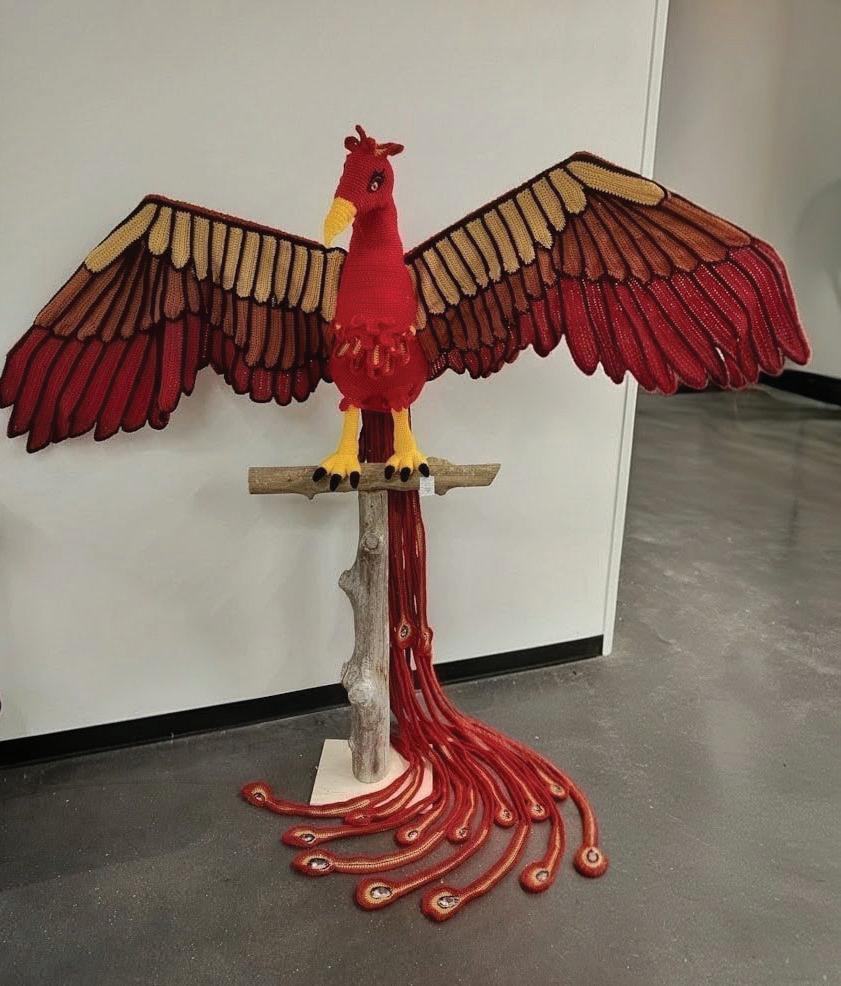
help, but he knew his way around the forest and trails, so he started his long walk home. The fog was thick, and as he walked the trail and got closer to home, it only seemed to get thicker. After what felt like hours of walking, he made it to his family's farm. Walking to the house... he noticed the front door was open, which he could’ve sworn he'd closed when he left. And, even if he didn’t, his mother would’ve. He took his bag off and set it aside, looking around the house a bit, and... he started to worry a little. He couldn’t find his mother, nor his siblings anywhere. He would focus on finding them; that was until he heard a scream from outside, followed by a shrill screech. He rushed outside, where he found his little sister, and a dragon... or what appeared to be a dragon. It didn’t look
right; its wings were torn, eyes sunken and dull, flesh… almost practically melting off of its jaw. But Badar didn’t think; he ran, grabbing his mother’s pitchfork from the shed. “Dahlia!” he called out to his sister. But all he heard was another scream, which was soon cut short. All he could hear now was the silence of the night around him, and a faint crunching noise which soon faded.. He was left alone in the darkness, hearing nothing but the sound of his own heartbeat, panicked and fast. He was scared, terrified even. He knew for a fact that whatever that… thing was, it wasn’t natural, and... it had killed his little sister, and more than likely, he was next. He gripped the pitchfork in his hands, shaky and unsteady. And before he could even react, it
[Continued to 46]
*Caitlyn Bonass
Cassville
High School Gold
3D Art Sculpture
With 200 hours of crochet, I made something unlike anything else in an art viewed as craft.
Assembled with yarn, polyfill, a driftwood frame, wings from a Megan Papp pattern. Other parts scaled to wings based on a zoo peacock photo.
Bonass, an ambitious exchange student, athlete, and artist, endeavors to leave smiles and joy, by bringing to life, ideas through crochet. Her dream, is to impact the world, with a crochet hook, yarn, and an idea.
*Scholarship recipient
[Continued from 45]
lunged at him from the darkness, sharp teeth sinking into his arm, its eyes boring into his. He froze in fear for a second, the pain finally registering as the dragon pushed him to the ground, pinning him as he struggled. Badar may have tried to be brave, but he was only sixteen, a teenager, what could he possibly do against this… thing? He gritted his teeth, trying not to scream from the pain. Him being
young was one thing, but his determination to survive was another. He let go of the pitchfork momentarily, using his free hand to punch the Dragon in the face, which stunned it, making it hiss and let go. He stumbled to his feet, grabbing the pitchfork once more, adrenaline coursing through his veins. There was one thing going through his mind at that very moment.
It was either going to be him, or that
Julie Hilton Goodman Quill
Staff
B&W Photography
While observing fireworks after Wizard Night at an NWA Naturals baseball game, it was “natural” to pull out wands. Hasselblad, auto settings.
Hilton captures moments with art and photography. She is relearning manual camera settings.
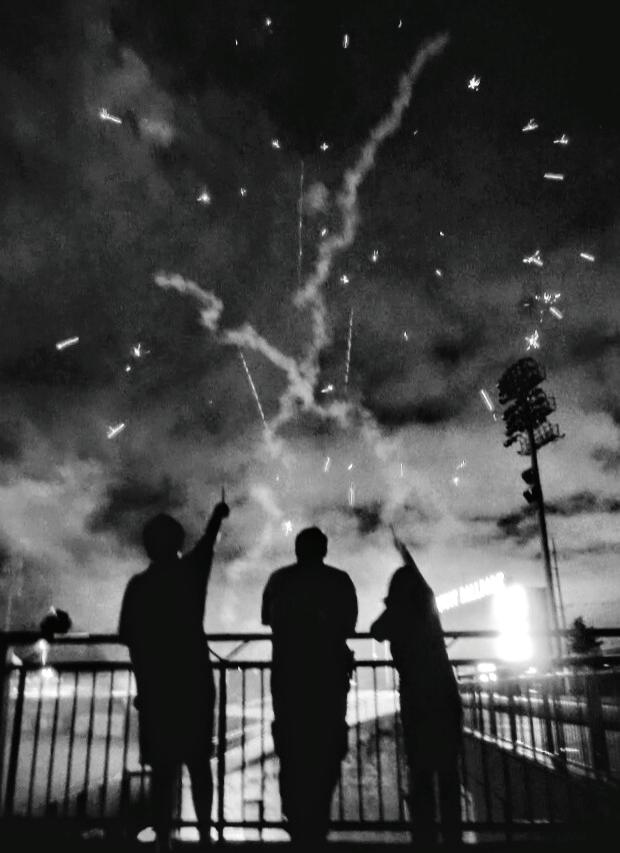
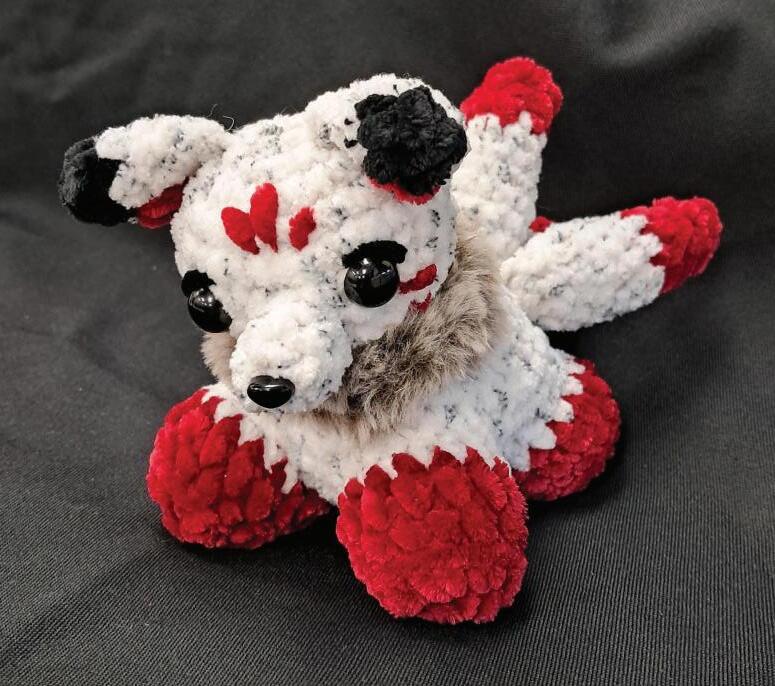
thing walking out of this alive. And he wasn’t prepared to die that day. Even though he was wounded and bleeding, he gripped the pitchfork. While the creature was still stunned, in a moment of bravery, or... stupidity, he ran forward, and drove the spikes of the pitchfork into the Dragon’s chest, shoving it backwards and onto its back as it flailed and let out an almost human-like scream. He kept pushing. Keeping the Dragon pinned even as its hind claws scratched at his legs. “DIE!” He shouted at it, his tone desperate. He couldn’t hold it down much longer, but, in a moment, he gripped the pitchforks handle with both hands, and twisted it. The dragon went limp beneath him immediately; he stood there for a second afterwards, leaning on the pitchfork as he stared down at the… ‘Dragon,' although now that he got a better look at it, could you even call it that? After what felt like an eternity, he stepped back and away from the corpse, walking around it as he called out “Dahlia! Dahlia, you can come out now!” He knew it was a long shot that his sister would still be
alive, and even if she was, she would’ve run far from the farm. He could only hope that was the case. But he just wanted something, anything, to know his sister was all right. But he knew, deep down he knew. He just didn’t want to acknowledge that more than likely, she was dead. He went back to the house, getting his lantern and lighting it before he went back outside and to the dragon's corpse to grab the pitchfork, when he noticed something he hadn’t before, the dragon...was it... crying..? Or, well, it seemed to be. But it was most definitely dead. Badar just narrowed his eyes, yanking the pitchfork out of the dead dragon's chest, before turning and beginning his search for his sister, or his brother. If he could find any of his family, that would be enough for him. He cared about them more than anything; he’d give his life if necessary. His arm was still bleeding from the bite, his shirt sleeve soaked with the red liquid. But he was going to find his family, by any means necessary.
Maddilynn Idell
Pineville
Quill Staff 3D Art
I like kitsunes, so I made one as an example for others. Weight 4 Yarn: red, black velvet, white-gray mix, gray fluffy; 6mm plastic safety eyes; 4mm inline metal hook; poly-fil stuffing; “Kitsune Fox” pattern on LunarLoopsz.
Idell will finish an associates in art, then attend MSSU for a bachelors in graphic design. Because she gets ideas to try from other artists, she hopes to motivate others when they see her projects.
Leanna Moore Purdy Crowder Bronze 3D Art Clay
Feeling in a twine myself, and inspired by Beth Caveners work, I put my pain into my sculpture. Hand-formed; heated, detailed with stick; torch to finish smooth.
While planning to become a doctor, Moore will pursue art as a passion and hobby.
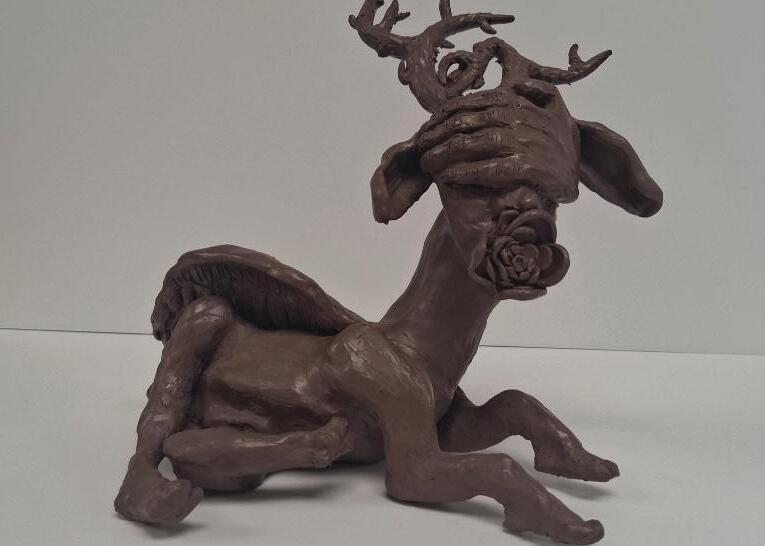
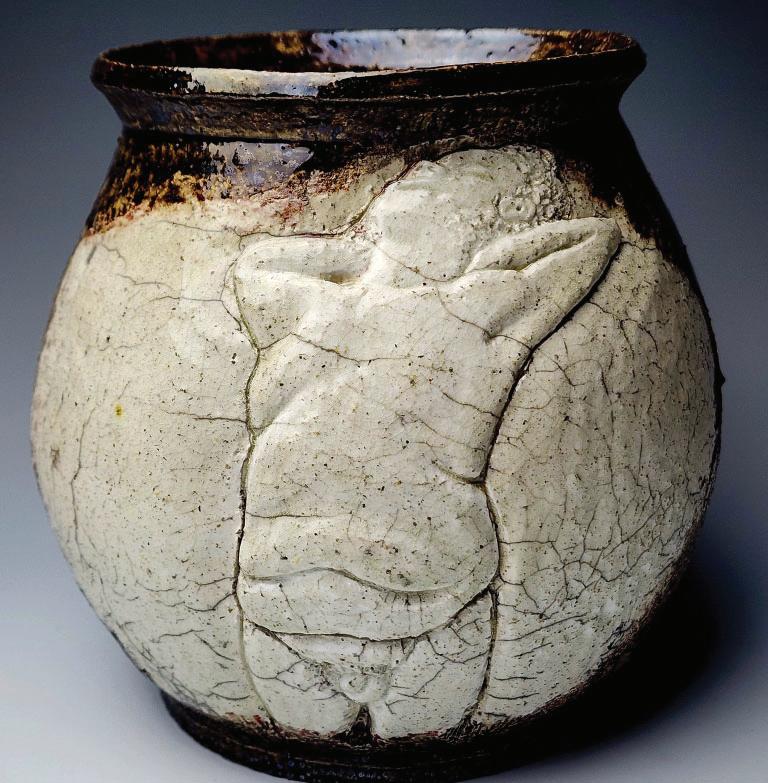
Tiffany Blevins Anderson Community Honorable Mention 3D Art Ceramics
I wanted to present this as a gift to my beloved. Pottery. Raku firing.
Blevins, a life long learner, has degrees and certificates in theatre, art and design, graphic design, business, and federal record keeping from Crowder, Haskell Indian Nations University, and National Archives, Department of Interior. As Fine Arts Assistant at Crowder, she wants to pursue a masters in studio art.
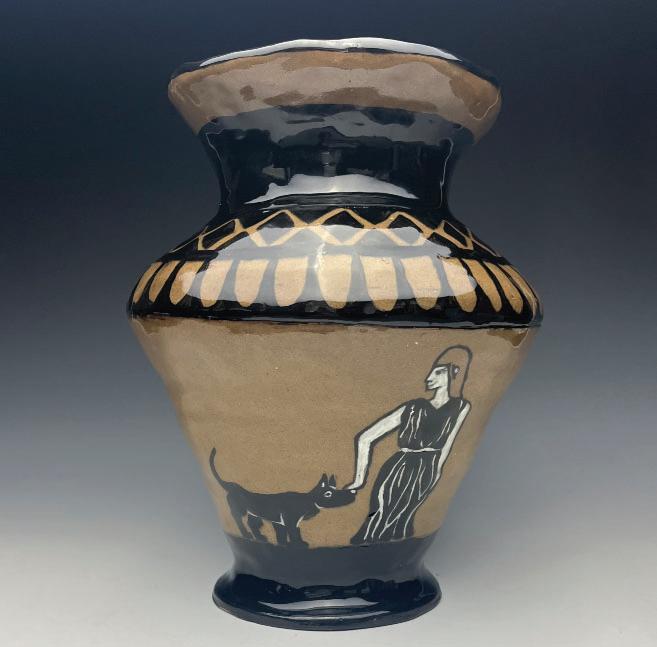
Leah Stephens McDonald County High School Silver 3D Art
Inspired by Vincent van Gogh's “Starry Night," I learned to value creative freedom over perfection. Transforming its flat imagery into a 3D handcoiled ceramic sculpture proved to be a demanding yet fulfilling process.
Stephens, a senior pursuing a bachelor’s degree in Business Marketing, focuses on capturing “the beauty of God’s creation” while aspiring to open an art studio.
Magdalyn Lindsey Monett Crowder Gold 3D Art Ceramics
Inspired by storytelling on historic Grecian pots and the loss of my dog, this piece shows a girl and dog, sad while separated but then joyously finding each other. Coil built with underglaze
Having practiced pottery for over four years, Lindsey now studies art and design, and plans to finish an art degree at Missouri State University.
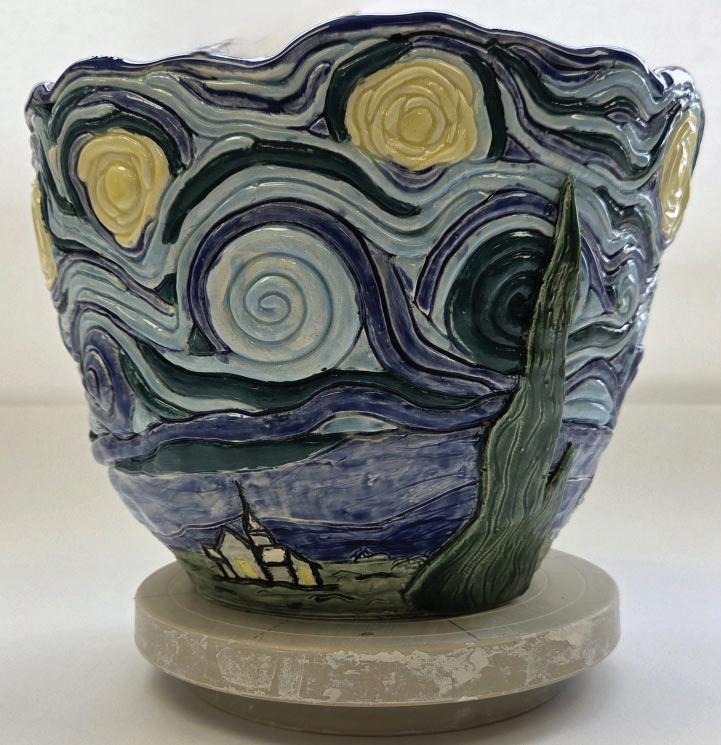
Garret Akin Cassville Community Gold Poetry Metered Verse
A name with two meanings, Cillian is “Church" or “War/ strife," while O’Clery is the oldest known Irish surname. Working on this poem helped me process the problem of why God allows suffering, confront suffering and suicide, and point people to Jesus Christ, who embraced suffering for our sake.
Akin, a minister at Mill Street Church of Christ, has a beautiful wife, Makayla, three rowdy boys, Waylon, Wyatt, and Weston, and loves helping others. He hopes his writings can be another way to serve.
Content Warning
Poor Cillian O’Clery, so weary of strife. He can’t keep a job, And he can’t please his wife. No one respects him, And no one expects him To make a good go of his life.
Poor Cillian O’Clery; the chap’s in a plight. He’s drunk on his anger, And so full of spite. His life’s too mundane, And he’s tired of the pain. At the bridge it must all end tonight.
In his own way, he says bye to all he knows. He sneaks past a fire, And he longs for its glow. “Just a distraction, Forget the attraction.” So Cillian clings to the shadows.
Cillian O’Clery is set on his choice. He thinks those who knew him Will come to rejoice. He climbs on the ledge And shuffles to the edge When he hears a deep, grav’ly voice.
“Ya cheat! This is me bridge, and I be its troll. I know what yer aim is. Aye, I know yer goal. I caught ya creepin’, Yer thinkin’ of leapin’ Without even payin’ me toll!”
Poor Cillian near jumped clean out of his skin. If he’d been scared before, He didn’t know when. Green as a clover, He almost fell over When he saw who it was he was hearin.'
It was the homeliest thing he ever had seen. The troll was yea tall, And it looked gruff and mean. Despite its huge nose And the hair on its toes, He saw in its eyes it was keen.
“Oh no, sir! Robbin’ you was not my intent. If I had one to give, I’d give my last cent. But due to the bills And no work at the mills, My very last farthing’s been spent.”
“Aye, I can tell yer not breakin’ much delph, But it’s none me concern Yer stuck on a shelf.
So, ya bridge jumper, Ya’d best solve me stumper, Or I’ll chuck ya down there meself!”
When Cillian realized his life was at stake, He lusted for what
He was ready to take. “Tell me the riddle, And don’t try to diddle.”
With a mischievous smile, the troll spake:
“Without it, this life doesn’t carry much worth. Some have to seek it; Some possess it from birth. It soothes the trials And the long, weary miles And fills the obtainer with mirth.”
O’Clery did grieve his deplorable dealth. “Could the answer be fame?
Or maybe it’s health?”
But Cillian sought it, And finally got it:
“Certainly, the answer is wealth!”
“Ya miserable fool!” guffawed the ole troll. “Ya must have a sickness Inflictin’ yer soul! If ya endure it, I know I can cure it—
I’ll hurl ya to the rocks below!”
Poor Cillian O’Clery, he let out a scream. Before he could blink, He flew down to the stream. But right above ground, A tumultuous sound Sprang up from a portal that gleamed.
Instead of the rocks, he fell into the light, Still full of terror (With a dash of delight).
Soon he stopped falling, And heard someone calling As the vile troll came into sight.
“I aught to squeeze your neck, you wicked ole troll! Surely you are the one Who needs a cured soul!”
He went to grab him, But before he could nab him, He heard a groan come from a knoll.
It came from a man whose skin clung to his bones. When he could move them, They clanged eerie tones. Putrid and reeking, His sores were all leaking On his bed of pure filth and stones.
“Come here, my son,” the man moaned to O’Clery. “Our time is little, So please do not tarry.”
Cillian approached him, Lest the man reproach him, Though slowly and still a bit wary.
“I once had children like you, in their prime. But they were cut down Before it was time.
All those who knew me
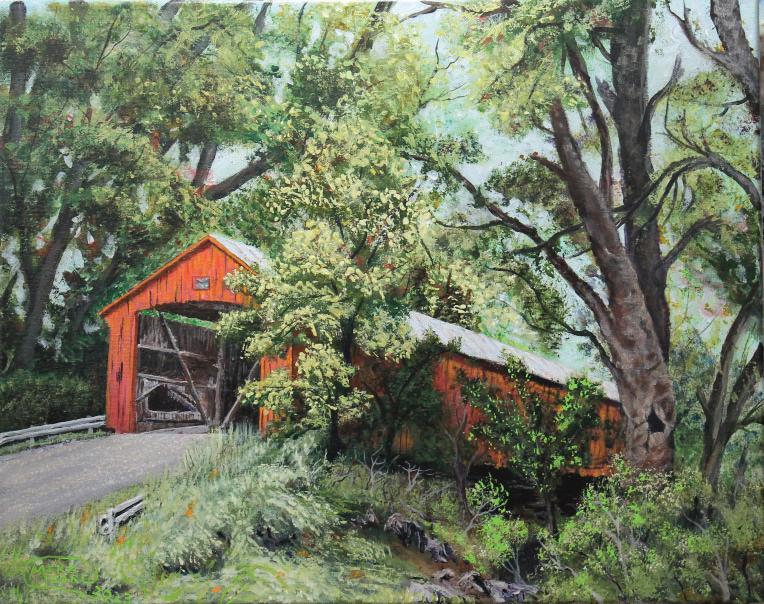
Think this is what’s due me, Though I have committed no crime.”
“I don’t know why I’ve been stripped and forsaken.
I don’t lust for wealth Or all that was taken. But one thing I know, Since I’ve been brought low, My thirst for God has awakened.”
Emotions in Cillian festered and burned. This poor, ignorant man Must not have yet learned.
While he’s lying there, God surely can’t care. He should not be sought for, but spurned.
“You long for him who dealt you this hand?
The Crusher of children, The Scorcher of land? Did he not sting, Yet to him you still cling?
I’m afraid, sir, I don’t understand.”
“Is that your solution? To judge him and rave?
I won’t lift my head; I can’t be that brave. Shall I despise him, Or shall I chastise him For taking back all that he gave?”
“Oh son, you must not serve the same God as I. My God’s actions and ways For me are too high. He has every right,
With his infinite sight, To cause us to live or to die.”
“My belief in God’s goodness helps me survive. I’ll understand someday Why I am alive. I can’t be hateful; I choose to be grateful. And son, with this heart I will thrive.”
“It’s time to go now,” boomed the troll like a thunder.
A gale threatened Cillian, His body to sunder. Terrible and loud, A dark funnel of cloud Lifted him, then pulled him under.
Gray faded as Cillian fell through the light. He tried pulling his skin
With all of his might.
“Wake up from this dream!” He exclaimed with a scream. But this was no mare of the night.
He lifted his eyes in a dark, rocky cleft. The wind was still blowing With breathtaking heft. The troll, gruff and mean, Was nowhere to be seen, So Cillian assumed that he’d left.
Left there to die as earth started to quake, He mimicked the mountain And started to shake.
[Continued to 52]
Michael K. Moore Neosho
Community Gold
2D Art
Acrylic on canvas
I painted the bridge from a photo I took. Moore has been painting for 16 years, preferring acrylic as his main medium. There is always an in-progress painting on the easel, as he finds painting to be so relaxing.
[Continued from 51]
He began crawling As rocks started falling, Groping for the right path to take.
Suddenly, a flame showed the way with a flash. He got up to his feet And started to dash. If he ran later, He’d be in a crater, For a slab came down with a crash.
Trembling from the fear still coursing his veins, His heart pounded his ribs And gave him great pains. He came to a halt In a cave of Basalt As fire shone upon bloody stains.
He followed the trail as it led to the heat. Finally it ended On two bloody feet. Face-down was laying
Ntsiab-Liaj
Jolisa Moua Crowder Gold
2D Art Relief Printing
This piece got me into Gothic art, which takes much time and dedication. The process for this relief print was to draw, scale up, transfer to linoleum, retrace, stain, cut away, ink, and print on paper or t-shirt.
Moua, a sophomore, is a life-long artist. Her inspirations come from anything related to horror.
A man who was praying, Whom Cillian didn’t dare greet.
Beyond the cave mouth, a fiery funnel shone. In the blink of an eye, The firelight had flown. In the dark, blinking, Cillian began thinking That he and the man were alone.
Instantly, yet gently, a whisper he heard. Not from the man’s lips, For they spoke not a word. The voice entrancing Set his heart to dancing While everything in him was stirred.
Cillian’s thoughts were at war in his head. He felt perilous peace, A delightful dread. Lovely, yet terrible, Almost unbearable, When he heard what the thin whisper said.
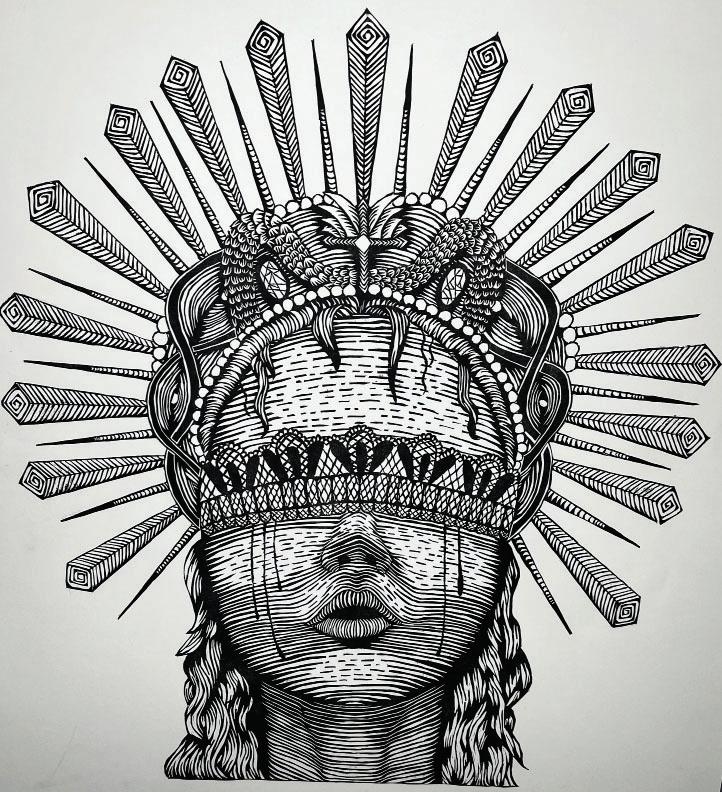
“My weary child, I know why you’re here. The journey’s been cruel, And you are with fear. You may feel bereft, But I have never left. Through everything, I have been near.”
“I was there with your mother when you were born.
With you through victory, And with you through scorn. Through all of these years I have counted your tears. Child, I weep whenever you mourn.”
“But now, play the man, for your task is not through.
Arise, and stand fast; I’ve much for you to do. Before you depart, I can strengthen your heart With a scene that I long to show you.”
The man ran away renewed, body and soul.
Cillian looked ’round, And he saw the ole troll. By a blinding light, The gruff troll said with might, “Come, child, and walk through the portal.”
“What? No grabbing me to throw like a sack?”
Said saucy Cillian, Awaiting attack. “No, I won’t force ya or even coerce ya. If ya wish, I can now take ya back.”
He thought of his home, but decided to enter, Fell in a dark mob, Locked right in the center. A hatred-filled stench That no person would quench Oozed from this crowd of tormentors.
He followed their gazes to roughly-hewn beams.
A man fixed to them, Bloodied with streams.
Gaunt and yet swollen, His dignity stolen, He hung naked, receiving their screams.
His body was covered with deep lacerations. Sweat bit his eyes With stinging sensations. The soldiers jabbed him, And one of them stabbed him, All from their comfortable stations.
Cillian O’Clery had seen this before. He knew what transpired And what was in store. But for some reason, The weight of this treason Shook Cillian deep down to his core.
As water and blood poured from the man’s side, His eyes locked with Cillian’s; Cillian’s opened wide. Even the thick crowd Couldn’t serve as a shroud. ’Twas no place for Cillian to hide.
“My precious Cillian, keep your gaze upon me. Is it these three spikes Holding me to this tree? I’d be in the sky In the blink of an eye If I chose to set myself free.”
“My only restraint is the love I possess. My desire to heal, My longing to bless. I have seen your chains, And I’ve felt all your pains. I know all your sorrow and stress.”
“Allow me to help bear this weight by your side. You can’t stop suffering; You can’t run and hide. Soon I’ll erase it, But now we will face it Until life is all that abides.”
“Please come to me, child,” the hanging man spoke. Cillian walked ’neath him. Blood started to soak, First into his hair Flowing down everywhere, ’Til blood coated him like a cloak.
O’Clery wiped away the blood from his eyes. He looked up above him And saw the black skies. But glancing around And down at the ground, Saw the ledge to his lovely surprise.
He walked through his town, contemplative and slow.
He came to a fire And basked in its glow. Someone beside him, Or someone inside him, Had made his gratitude grow.
Cillian solved the riddle with help from the troll. He was now grateful For no farthings for tolls. He’d found a treasure By way of displeasure, A well springing up in his soul.
Rich Cillian O’Clery gets weary of strife. He can’t keep a job, But he’s pleased with his wife. Few men respect him, But they all expect him
To see his Lord after this life.
Julie Hilton Goodman Quill Staff Nonfiction
This is a part of a series of character sketches I’m writing about family members for a family story book.
Hilton enjoys writing stories but has rarely shares with anyone. She’s considering changing that a little at a time.
generation removed from each other, we first met in Memphis, when she picked me up at my grandma’s house to visit the youngest sister of my great grandma. Beth is one of the great keepers of history in my family, or likely, any other. She is married to the other half of a superb duo of museum quality curators of family stories, heirlooms, and all things Volkswagen.
Lester and Beth married in a manner befitting such a couple, on New Years Day, in one of the grand old homes in Memphis, the Woodruff – Fontaine Museum. Services were conducted, not just by any pastor, but of course, a cousin. It’s nice to keep everything in the family if you actually know all your family out to third cousins and beyond.
Although we’d communicated via email, Beth and I’d never met before that day at Grandma’s. I felt like I found an instant friend, united by love of history, books, finding our own past, and future! We visited my Great Aunt, which was an adventure all on its own. But then we went to Beale Street and shopped at A.Schwabs, where if you can’t find it, you really don’t need it. We had lunch at The Front Street Deli, where a scene from the movie, The Firm, was filmed.
We visited her then fiancé,’ Lester, and he showed me the replica VW Showroom from 1973, when he bought his first Volkswagen Beetle. The Showroom was in an extra bedroom. With more visiting, we discovered that Lester had co-owned a well-known hobby shop that I’d visited as a child with my dad.
So, I found another friend in my new cousin-in-law, Lester, just like with my cousin, Beth. I have found over the last several years how great it is to get to know your family. There are things you can learn that you have in common, like hobbies, interests, and even skills or talents. But what’s been even more fun for me is getting to know my cousins as people since our first meeting.
Lester and Beth have been having a birthday party every year since the VW Beetle turned 50 a few years ago. It’s gotten bigger each year and has been written up in the newspaper. They make friends wherever they go and invite friends and family to their home whenever possible. It’s so much fun to visit their home. It’s like a museum in some ways but also very comfortable, with dogs, cats, and occasionally the neighborhood peacock, Kevin.
Beth is also an author of mystery books, including drones as one of the main
characters. She discusses drones often in her blog. But one of the favorite things that Beth does is her daily greeting with a different coffee cup from different viewpoints.
Here are some of my favorites over the last few months:
“Coffeeinthehood: the neighbors house resembles one of those Thomas Kinkade paintings.”
“Coffeeinthedriveway: Whitey is part polar bear.”
“Coffeeintheyard: These needle-like ice crystals are called hoar frost.”
“Coffeeinthehood: The meteorologist calls the low clouds hanging over us ‘ice fog.’”
“Coffeewithcats: Seven’s rather elderly but he still patrols the yard. Seven is a cat adopted July 7, 2007.”
“Coffeeandwriting: is all about drones!
“Coffeeinthegarage: Lester’s 1973 Super Beetle has new upholstery. Here’s how it looks before he puts the front passenger seat back in.” Lester keeps this Beetle in bubble wrap when he isn’t working on it, and only drives it the week of it’s birthday these days.
“Coffeeinthegarden: The first daffodil.”
“Coffeeintheyard: Kevin dropped in for a snack.” Kevin just roams the neighborhood, actually returning to his home sometimes. He’s a very beautiful pea fowl.
One last thing I’ve learned about Lester is that one will never leave their home without Lester checking your vehicle and making sure all fluids are full, and you’ve got clean windows, before heading home again. He’s always got a red shop cloth in his back pocket. It’s not just for automobiles, but that’s how I always picture him, using that ever constant red shop rag, looking out for the safety of his family and friends.
The last thing I want to mention about Beth is what a gracious hostess she has been since I met her. Always welcoming, and working behind the scenes to surprise you makes it so you never know what will happen. My last visit, I learned new things about the five foot doll house with all the museum pieces inside it. Also, she surprised me with a luncheon with several cousins, some I’ve met and a few more I’d only emailed. And lastly, she and Lester took me and a cousin I’ve been writing to for years to dinner at one of the best barbecue joints in Memphis. We swapped stories and I found several more cousins/ friends.
My cousins are wonderful characters with superb character and I’m grateful to know them!
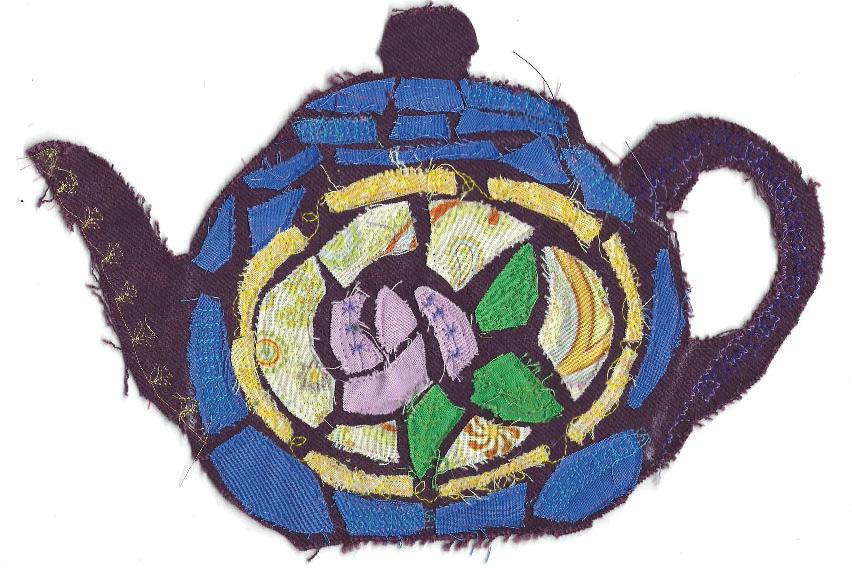
Aubree Anderson | Carl Junction High School
Honorable Mention | 3D Art
A Jelly Cat inspired me, but I added function emitting warmth. Bowl traced with clay, slip and scoring hold it together.
Anderson, a sophomore and newer art student, tries hard in class and works hard in the art space, using her time wisely.
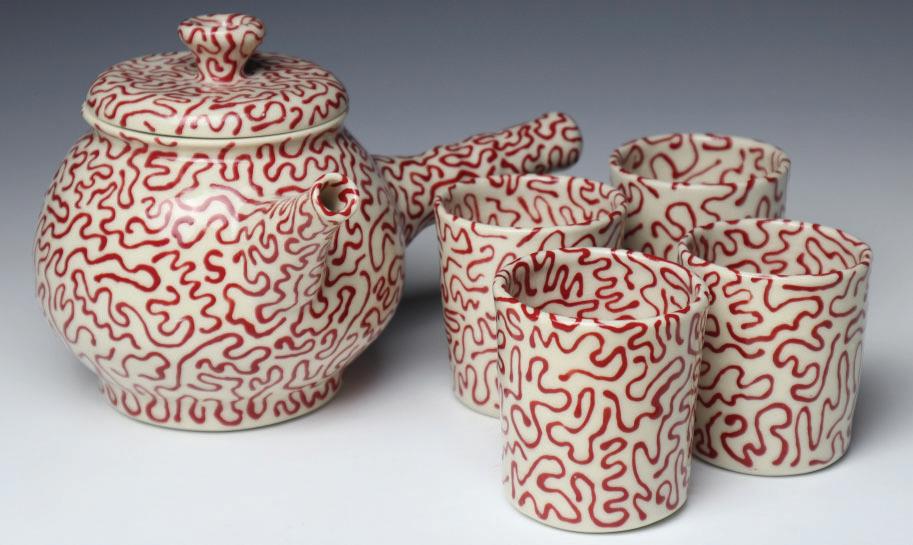
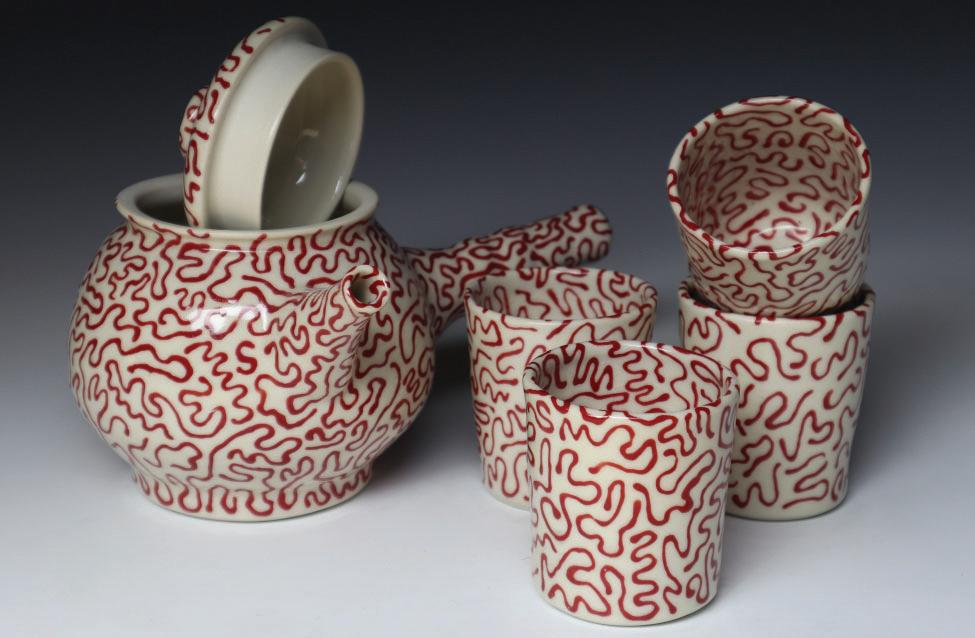
Brinn Schnelle | Joplin | Community Honorable Mention | 3D Art
Made from thrifted fabric scraps, this gives them new purpose.
Schnelle, who studies conservation biology, studio art, and scientific illustration at MSSU, shows relationships between art and science, layering real-life and imaginative themes, balancing familiarity with whimsical playfulness.
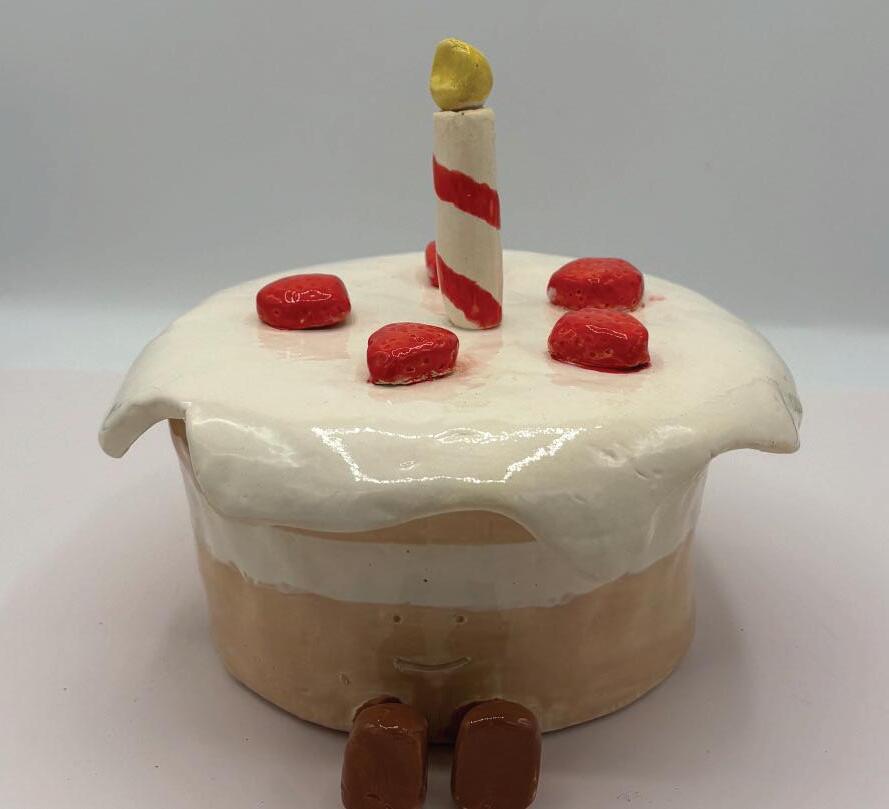
Maisie Weston | Neosho | Crowder Silver | 3D Art
Inspired by the Japanese vessel, Kyusu, with single-hand pouring handle on the side, I added my personal squiggle line style, making the set cohesive yet funky in the best way. Wheel thrown porcelain clay, red underglaze, clear coat fired to cone 6
Weston, who plans to have her own studio, has worked in ceramics for three years, and conveys whimsy and nostalgia for childhood imagination, using traditional shapes.
Samantha Cafferty Neosho Crowder Honorable Mention Fiction
“Unrescued” grew from my need to honor the quiet strength it takes to hold your own story and allowed me to feel the weight of my survival, listen to truths I carry, and witness the fierce grace in saving yourself.
Cafferty, newer to writing but a long-time observer of human experience, is drawn to stories of resilience, self-discovery, and inner depth. She creates poetry that explores emotional truth, illuminates strength and beauty, and shows quiet power in personal growth and living authentically.
nce upon a time, there was a princess locked away in the highest room of an abandoned castle. It was the classic tale of a life in need of saving, and a hero meant to deliver a happy ending.
But stories like that are always told from the ground, never from the tower. Truth rarely survives the first draft of a fairytale, and her voice was never built to fit the narrow tale they tried to place her in.
In this story, the princess laid each stone of the castle herself, building it because the world below was too shallow to hold the weight of her becoming. Within those walls, the canvases spoke the raw language of a beautiful, troubled mind. At the center of it all hung a chandelier, crafted from the shards of who she used to be, pieces that no longer cut, but caught the light and scattered warmth in directions she had never known. Her library was lined with heavy, leather-bound volumes of every belief she had lost and every truth she had reclaimed.
She was the master of her kingdom, but independence is a heavy crown to carry, and the velvet of solitude had begun to feel like iron.
Before the castle was a sanctuary, it was a ruin of silence.
She once trusted the stories told from the ground, that being saved proved she was worthy, that love arrived wrapped in armor. So, she placed the most delicate parts of herself into the hands of knights who climbed toward her with polished promises and practiced steadiness.
But altitude sickness tells the truth the ground never will. They blamed the thin air for their discomfort, never realizing that clarity feels like suffocation to those who’ve lived on the smog of a sleeping world. Only then did they see that her softness was a product of her strength, and her depth was a pressure that crushed anyone who had never learned to breathe below the surface.
And each time they retreated, desperate for the shallow breath of the world below, she wondered if her air was simply too harsh. She wore their departures like evidence, searching her reflection for the flaw that made her unworthy of being stayed for, never realizing they were choking on their own limits, not on
her atmosphere.
Knights are not heroes in this story. They are trespassers, mistaking peace for invitation and boundaries for challenge. They arrive in polished armor, convinced that surviving her air entitles them to her heart.
They step across the threshold, fingers brushing the canvases of her mind, smearing the wet ink of her vulnerabilities as if they were mere blemishes. They march through the library of her survival, scoffing at the clutter of her life stories. To them, the architecture of a woman who saved herself is nothing more than a renovation project.
They came expecting a captive curled in the dark, a beast to slay, a woman to carry from ruin. They had practiced being heroes, learned the lines of a savior, prepared tenderness meant only for the helpless.
She stood in the room’s quiet center. She did not stumble. She did not lower herself for their convenience. Her eyes did not plead, they measured, they questioned, they demanded nothing but recognition.
And that was the moment the story unraveled.
For the first time, the knights felt the weight of their own stories crumble. Their armor felt hollow. She had no role for them, no pedestal to mount, no chains to unlock. She had become whole without them.
The battle that followed was not a clash of blades but a war of wills, spoken in spells meant to shrink her: too much, too intense, too real.
What she wanted had never been rescue. She wanted presence, not performance; companionship, not caretaking. Someone to step up and build a deliberate, intentional life beside her, not drag her back into the sleeping, unconscious world. Healing had made her whole, but it had also drawn the line for the love she could accept.
Pride rose in them like a shield, a desperate reflex to restore the familiar order where they stood above and she stood in need. They wanted her to be small, needed her to be breaking.
But beneath that instinct was something far more disorienting, the quiet, magnetic pull of the men they could become if they dared step out of the story already written. To walk beside her meant abandoning the safety of the savior’s script. No armor. No applause. Only
the raw, unsettling work of becoming real.
And when she stood in that truth, they flinched. Their cowardice struck cold, their courage measured against her life and found wanting. Her strength was a mirror, reflecting the parts of themselves they refused to confront. They could not rise to meet her altitude, tethered to the world below: the world of easy connections, comfort without responsibility, love that asked nothing but admiration. She did not close the door. She did not curse them. She named them: the Pretender, who loved the image but not the reality; the Mirror-Seeker, who wanted admiration more than equality; the Almost-Lover, who understood her but still walked away; the Gentle Coward, who meant well but never enough to stay; the Historian, who rewrote fear as her flaw to protect his pride. Not villains, not heroes, just echoes of unfinished courage. Each taught her a different angle of abandonment, a different shape of almost, a different way a man can touch a soul without ever holding it. By naming them, she reclaimed the parts of herself too vast for them to carry.
the terms of her heart:
“Once upon a time, a princess lived in a castle she built from scratch. When the right one arrives, he will not come to slay a dragon, for the dragon is her strength made manifest. He will come with quiet, steady patience, the kind that disarms more than any sword. He will see her weariness, the weight of shoaaaaulders notched by survival, and do the only thing that could make her stay: offer his own strength as a pillow, not a cage. He will sit among the heavy volumes of her survival and not scoff at the clutter. He will offer a witness, not a rescue. He will not be diminished by her kingdom, for he has already done the raw, unsettling work of becoming real before reaching her gates.”
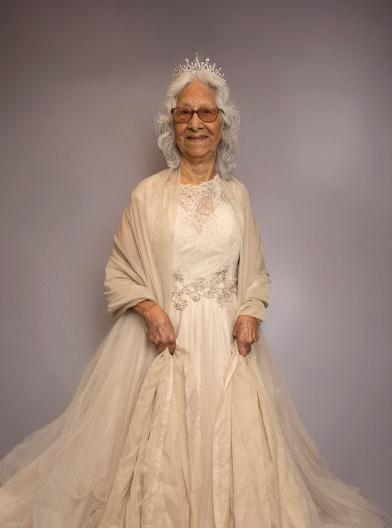
Nearly a centenarian, this woman carries herself with strength and dignity, wearing a tiara to recognize wisdom, resilience, and legacy she reminds that age does not diminish, but defines, royalty. I love you, Grandma! Nikon Z7II, shutter 1/125 sec., f/3.5, ISO 400
The beast, the story they built to explain their retreat, was hers alone. Quiet behind the ribs of a five-foot-two girl, not a terror, but a guardian. Not a shadow to frighten the world, but a reminder of the strength forged in every moment they fled. She did not rule it, it embodied her. The rhythm of her courage, the pulse of all she had survived and reclaimed.
And so she began her own story, to define
The story was perfect. In the ink, she was understood.
As she closed the book, she felt the sharp, haunting chill of her solitude, a loneliness that was also a liberty. She had saved herself. She had rebuilt the ruins.
She was whole. She was hurting. And she was waiting, not for a hero to finish her story, but for a soul brave enough to read it.
Until then, the silence was hers. The castle hers. The beast hers. And in the heart of her own life, that was finally, hauntingly, enough.
And so, in the oldest language of every fairy tale ever told, she crafted her ending, not the one written for her, but the one she chose:
Once upon a time, she saved herself. And she lived honestly, fiercely, luminously ever after.
Mandie Adams
Mount Vernon Community Bronze Color Photography
Adams, a professional photographer, specializes in newborn and family portraiture, emotive, fine-art imagery telling deeply personal stories using connection, light, and authenticity.
Kelly Reddin Joplin Community Honorable Mention Nonfiction
Being Nana Claus is a dream come true for me: I love seeing the joy on people’s faces as they meet her and am blessed by Nana’s experiences.
Reddin, a former teacher and global master trainer for an educational company, is writing three series and has several books in print.
t isn’t Christmas yet, but I am in the spirit.
I have just donned my Nana Claus outfit for a photoshoot and a public service announcement. The summer heat has me starting to sweat, but as I pump gas into my car, I see people all around me smiling and waving – and not just the kids.
I wanted to be Nana Claus from the time I was 16 and worked at a mall. Many of the kids who came to see Santa were scared to be placed on a strange man’s lap, whose face was barely visible.
I thought, “Mrs. Claus would be like your best grandma. Who would be scared of her?” So, I decided that when I grew up, I would become Mrs. Claus.
As I approached 60, I sewed my costume and bought a wig and “Mrs. Claus” glasses. For my birthday, I became Mrs. Claus. She greeted everyone at the party, and my dream came true. Mrs. Claus offered to visit people, schools, organizations, and so forth. She had a blast talking with kids and adults, having pictures taken with the disabled and the elderly, and just being Mrs. Claus. However, she asked everyone to call her Nana Claus, because it was less formal and more like a grandma’s name.
On school visits, the students ask about the elves and the reindeer. Nana prepares for some questions to help with consistency –Donner likes to get petted between his ears, while Blitzen likes a nose rub. Naming several elves, Nana talks about their jobs at the North Pole, what they like to eat, and what they like to do.
However, she places a strong emphasis on kindness and gratitude. Nana says, “Santa and I think kindness and gratitude are two
*Chayce Bowman McDonald County High School Gold
B&W Photography
To figure out the coolest vehicle in our family, I took photos and decided it was my dad’s classic 68’ Chevy.
*Scholarship recipient
important behaviors, and we have the elves report to us about how kind and grateful each child is.”
A favorite event is the Christmas Train by Watco for first graders. Nana meets the students when they hop off the buses. Pictures are taken in front of the train, and then it’s “All Aboard.” Watco provides water, cookies, and bells for each child while they ride for about 40-45 minutes, starting and ending in Pittsburg, Kansas. We wave at all the cars and sing Christmas songs. Nana moves from car to car, sitting with every willing child, so the teachers can take pictures. At the end of the ride, she stands outside the train to receive and give another round of waves, thanks, and hugs. Her favorite group might be the special education high school students who also attend. The students, their para-professionals, and teachers sit in one car. She sits with any student who wishes for company. Some of the students are quite loving and like to hold hands or touch the soft fur on Nana’s costume. She asks them questions and answers theirs. The outing is a real treat for them (and Nana). She now recognizes several of the students because they are allowed to come every year of high school.
Being in parades is a lot of fun, too. Nana doesn’t like riding with Santa on the firetruck. She prefers to walk the sides of the street and talk with people. While starting at the front of a parade, she ends near the back. Nana hands out candy instead of throwing it.
Sometimes children ask if Nana is coming to their school. If she is not scheduled, I usually reach out to the principal to see if it is possible. Nana might see the same child three or four times in a season. Generally, they run
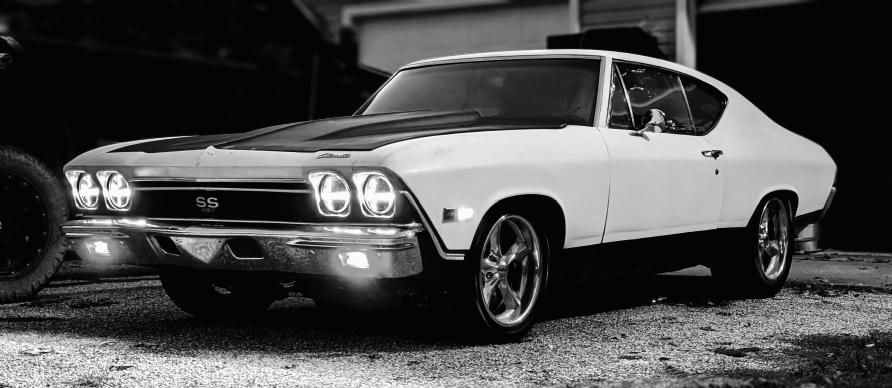
up and ask if Nana remembers them. That can be tricky. Nana typically says that her memory isn’t as good as Santa’s, so they might need to remind her of their names. She generally remembers their faces, but not necessarily their names. So far, that has worked. Nana does, however, remember some children’s names.
Charlotte was four the first time Nana met her. Her mom said Charlotte was extremely shy and that she had never been able to get a Christmas picture. Nana nodded and picked up a book. She asked Charlotte, who was behind her mother, clinging to her legs, if she liked books. Charlotte gave a slight nod. Nana told her that she enjoyed reading books and was going to read one.
Nana read a page aloud and then turned the book toward Charlotte so she could see the pictures. After reading five or six pages, Charlotte moved beside and then in front of her mom. By the time Nana finished the book, Charlotte was standing beside Nana, who asked her to choose another book. Charlotte looked through the basket of books and chose one. Nana asked if she sat on her grandma’s
lap to read. She gave a full nod.
“Would you like to sit on my lap to read this book?” She climbed up. They read the book together, and Nana asked questions about the pictures. Charlotte’s mom took pictures the entire time. When the book was finished, Nana asked Charlotte if she would let her mom take a picture of us.
She said, “Yes!” and put her arms around Nana’s neck, giving a big hug.
Charlotte’s mom was thrilled. Nana told Charlotte that she hoped Charlotte would visit her again sometime. Charlotte waved goodbye. Nana continued to read and have pictures taken with other children. Suddenly, Charlotte ran up and gave Nana a big hug. Her mom said she just wanted to say goodbye. Nana felt the child’s loving warmth from her head to her toes. Charlotte comes to visit Nana every year now, and Christmas pictures are never a struggle.
Enjoying the company of children, the disabled, and the elderly, Nana Claus is a blessing for which I am extremely grateful.
Aubree Chisam Crane Community Honorable Mention Color Photography
Chisam, a Crowder alumni, graduated in 2023 with an associate degree in General Studies and a certificate in Digital Media Marketing. She is a double major in Photography and Graphic Design at MSU.
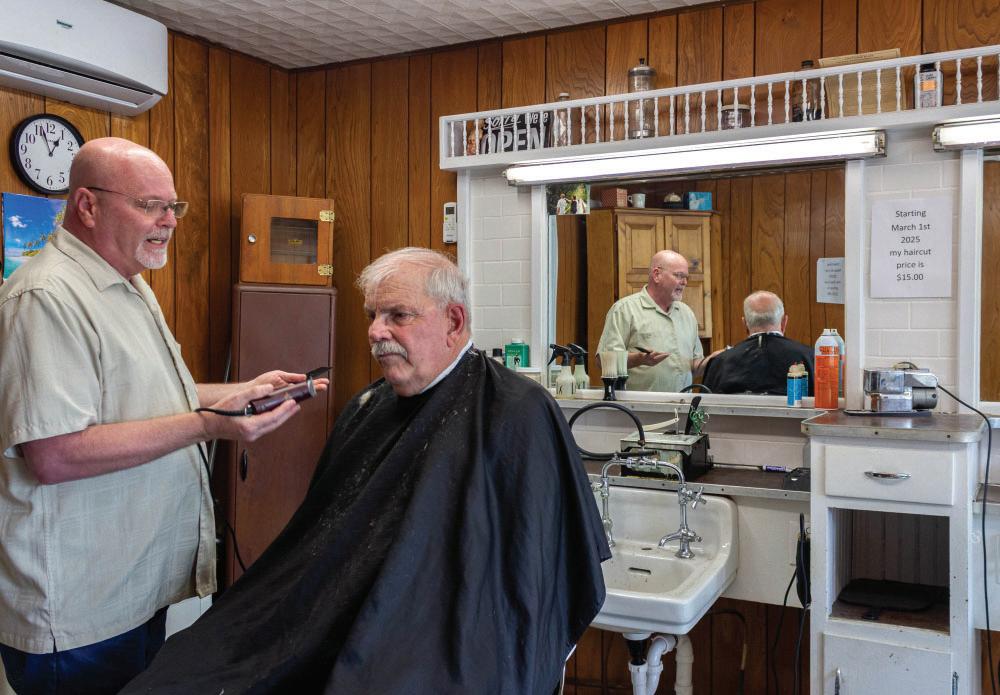
*Raegen Phelps Aurora High School Gold Fiction Short Story
Inspired by Anne Boleyn’s complicated, rocky life story and her desire to become a beloved queen of England, I wrote about her being led to execution.
Phelps, a senior excited about heading to college, wants to become a history teacher and share her passions with others. She enjoys writing short stories and creating art.
*Scholarship recipient
ay 19, 1536, I look out at a sea of blurry faces mocking me. I crave the silence of the tower compared to the assault my ears are hearing. My people who loved me so dearly are now the ones calling me an incestuous witch. They hurl insults in an attempt to intimidate me, as if my worst fear was not mere feet ahead of me. In the crowd, my sister stands with tears aging her youthful face. Her eyes, full of love and compassion, draw me in. For a moment, I manage to block out all the noise and remember how life was just a few weeks ago. I was the Queen of England. Young, powerful, and far too naive to foresee my downfall. The only goal I truly had was happiness. Everything was divine, and yet somehow, court gossip had still made its rounds. Glancing at my ladies-in-waiting, I see both trustworthy and disgraceful faces. They know nothing of what my story truly consists of. My dearest husband, Henry, has been persuaded by rumors. He’s too blinded by his own ambition for a male heir to even spare me a glance. Even though I am innocent, the courts have deemed me guilty. Reality sinks back in when the executioner escorts me toward the block. I feel my legs weaken with every step. Overlooking the mob, I feel my facade slowly slip away from my grasp. My time in the London Tower had opened my eyes to the realities of court. Humanity is inherently selfish. With trembling
hands, I remove my French veil and reveal the coif that holds my hair back. Crisp air flows over my head, cooling the sweat that was beading underneath. Tossing the veil aside, my focus lands on the robe that cascades down my shoulders. Thick velvet fabric, the signature royal purple color, clashed with the gloomy surroundings. Brushing my hands across the collar, soft fur tickles my palms. With my head held high, I unfasten my parliamenta robe and allow it to fall to the ground, reluctantly renouncing my title of queen. Left draped around my neck was my signature B necklace. Its pearls and gold remind me of the pride being a Boleyn once had. “Are you ready?” the executioner asks. With a swift movement, I fall to my knees. Warmth spreads across my face as tears streak down my cheeks. Humiliation seeps in, forcing additional thoughts of guilt and fear to dance in the back of my mind. I lay my head down on the block’s frigid wood. In my peripheral, I catch the metallic gleam of the executioner’s sword. The shimmer swiftly disappears and the crowds reprimand thunder across the stage. I pray my sister survives this madness and secures my daughter Elizabeth’s rightful place on the throne. Closing my eyes, I attempt to find peace within me. Before the sword touches my neck, I have one final thought. I am Anne Boleyn, and ambition caused my ruin.
Ron Reed Smith Joplin Community Bronze Fiction Essay
Smith, a native of the Galena/Joplin area, spins tales with the folksy charm of a front-porch conversation.
It would be nice if everybody could show up by four o’clock. I have something important to say, and I can’t bear to go through it more than once. On March 5, 1960, the family of Griffin Greenfeld gathered at his stately old home near Cameron, Mo. The 91-year-old patriarch, having suffered another heart attack just a month earlier, was convinced his time on earth was nearly finished. That afternoon, after snacking on cake and sipping punch, nearly 40 relatives—children, grandchildren, greatgrandchildren—moved into the spacious parlor and surrounded Grandpa “`Griff” in his old mahogany rocker. Some sat on settees, others perched on chairs dragged in from the dining room, while the younger ones took their places, cross-legged, on the polished hardwood floor. It felt a lot like a wake—except the guest of honor was still breathing, blinking, and complaining about grocery prices and the hot weather. For years, the family had marveled at the old man’s independence. Until recent weeks, he’d always gotten out of bed before dawn to milk cows, yank weeds from his vegetable garden, hang wet laundry on the backyard clothesline, and steer his trusty old
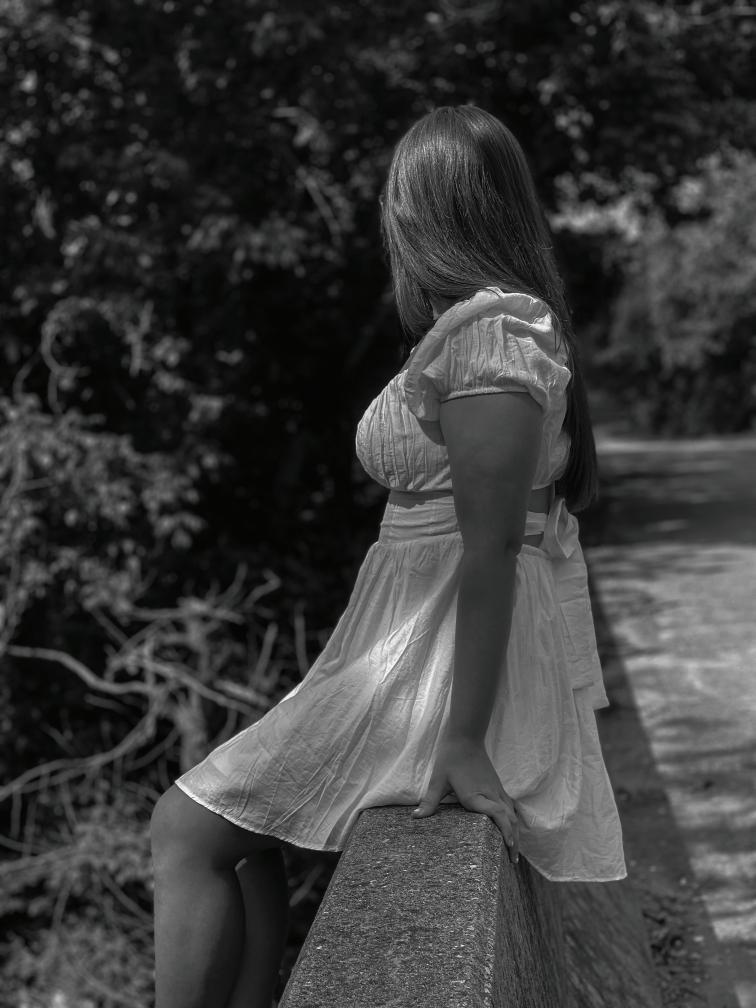
pickup into town for the daily lunch special at Bobcat’s diner.
Despite the health scares, his mind remained sharp as ever, the same dependable source of common sense and wisdom it had always been. Once he was sure everyone was in place, Grandpa Griff lifted a dusty, leatherbound book from the floor, and set it on his lap. He cleared his throat, and the room grew silent. Even the toddlers settled down and stopped their chatter, sensing the importance of the moment.
“Children,” he began in a warm, low tone, “Thank you all for coming. I’m honored so many of you made the effort to be here on my birthday. But—first things first—you should probably understand this might be the last time we’ll see each other this side of Heaven. And that’s alright. I’ve lived longer than most, and I’m ready to go when the Good Lord calls me home. So let’s not worry too much about that today. This ain’t a funeral—just another weekend get-together for the Greenfelds.”
[Continued to 62]
Kadicey Wells Stark City Crowder Silver B&W Photography
This photo captures a moment of calmness, where my sister took a moment to simply pause. I was reminded there is a quiet strength and beauty in silence. iPhone 12 Pro Max Camera
When not working at 7 Brew, Wells does photography or helps the people she loves.
[Continued from
He paused briefly to gather his composure, taking a long, deep breath.
“Now, I ain’t much of one for speechifying, but I do want to read you something—an account I wrote down in this here journal a long time ago. Never shared it with anyone but your Grandma Lillian. It’s been hidden away in the attic for nigh onto sixty years.” He adjusted himself in the chair, and then took another sip of the punch before moving ahead.
“It’s a story from when I was just a boy. I ain’t proud of it, but I don’t wanna leave this here earth without confessing it. I’m pretty sure I’ll rest better in the after-life if I’ve owned up to the stains on my character while I’ve still got breath enough to do it. ” Whispers of speculation were heard from every corner of the room. Then silence fell again—deep and respectful—as the old man turned to the first page and began to read aloud.
Here’s what the family heard: “I’ll admit it—I’ve always been fascinated by guns. Pistols, muskets, rifles—you name it, I’ve owned them all at one time or another. Heck, I even had one of them baby-sized two-shot Derringer guns for a spell. The thing wasn’t powerful enough to crack the leather on a bull’s backside, but it sure was a fun toy to fool with. You’d think, with all the time I spent fiddling around with my little arsenal, I’d be as good a shot as that Annie Oakley woman they write about in the newspapers. But no. Just being fond of guns don’t make you a marksman—it just means you’ll spend all your extra money on bullets, so you can shoot holes in tin cans and break glass bottles in the back yard. Anyway…I’m one of them fellas.”
“When I was just a youngster, my ma and I lived alone in a little old tin-roof shanty on 10th Street over in Saint Joe. She took in laundry and braided rag rugs to sell at the outdoor market, but it was barely enough to get us by. And she wouldn’t let me work until I turned twelve—said I needed all the book-learning I could get. But as soon as I was allowed, I started going around the neighborhood, offering to chop wood, haul water, plant potatoes—anything for a few pennies or a nickel.
“One family I helped pretty often was the Howards, up on Lafayette Street. I loved working for them. Tom Howard was one of the kindest, most generous men I ever met. Some days, he’d give me a whole dime just for painting porch posts or helping his missus with the housework. And if I mucked out their
horse barn, he’d slip me an extra coin for my trouble—him a-hating that particular chore so much.
“But, truth be told, it wasn’t just the extra pay that kept me going back to their house. It was Mr. Howard’s guns. Lord-a-Mighty! That man’s collection was so big, he could’ve started his own war if he’d had a mind to. There was every kind you could imagine—all cleaned, polished, oiled, and arranged on a big table right behind the front door. Of course, he never liked me touching them. But every now and again, when he stepped out of the room, I’d pick one up, aim it out the window—going on like I was some kind of soldier guarding a fort.”
Now, this next part ain’t easy for me to write about. “It happened about a month after my 13th birthday. I was doing work up at the Howard’s house, and Mr. Tom said he’d pay me an extra nickel if I scrubbed the floors real good before his wife came back from visiting kinfolk over in Kearney—wanted to surprise her. I agreed to the deal, and set out to brush them pine planks until there wasn’t a speck of dirt left...even got down on my hands and knees to rub special-hard on the dark spots where some tobacco-spitter had missed the cuspidor.
“I was sweeping in the front room when that Mr. Bob—the young feller that used to come around a lot—he busted through the front door with a big, friendly ‘Hello!’ Well, he came in so sudden and so loud, it startled me. I might’ nigh hopped right out of my boots! Rattled me so hard, the top of my broom handle ran wild—knocked a framed picture plumb off the wall, and pushed another one kinda cattywampus.
“He said, ‘Hey there, pardner! Is your boss man hanging around here some’eres?’
“In the back yard. I’ll fetch him in for you, mister.’
“When Mr. Tom came in to talk with his visitor, it didn’t sound like the two of them was getting along so good—lots of angry questions about some ten-thousand-dollar reward, or something sich as that. “Mr. Bob claimed he didn’t know nothing about it—just wanted to come by and show off the revolver he just bought—a brand new 44-caliber Smith and Wesson. And Great Heavenly Days! That thing was beautiful! He claimed he could have gotten it for as little as thirty dollars, but the elk-bone grip and the engraved scrollwork took the price all the way to thirty-eight dollars.
“Yes-sir, Tom,’ he said. ‘That there gun was custom-built to my own specifications.
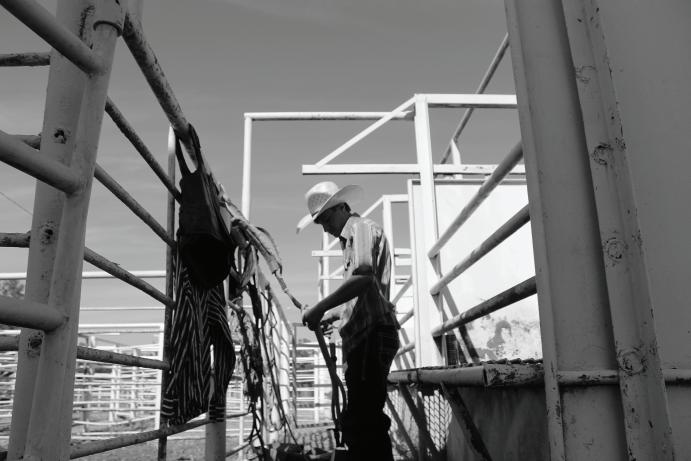
Perfect balance, and the trigger is set to just four ounces of pull. Why, if you even look at that thing cock-eyed, she’s liable to go off on ya!’
“Listening to all that, I stopped thinking about dirty floors and tilted pictures. I couldn’t stop staring at that fancy gun lying there on the table—wanting to touch it more than anything in the world. My heart was fluttering in my chest like a butterfly in a bird cage.
“While the men argued—all kinds of talk about banks and trains and finding some man named ‘Frank’—I crept over, inch by inch, until I was right beside that brand new revolver.
“I glanced over to check, but them two fellers weren’t paying me a lick of attention. Mr. Bob was busy yelling and cussing, and Mr. Tom had turned away to straighten up that picture I had accidentally bumped with my broom. So, this was my opportunity. I reached over and grabbed that long shiny gun, wrapping my palm around the handle and slipping my finger through the loop.
“Mr. Bob had been telling the God’s truth. The weight of that thing was so finely balanced, even a greenhorn like me could have kept it dead-on-target while pulling the trigger.
“Just then, the gun’s owner spotted me, and yelled, ‘Hey, boy! Put that down!’”
At this point in the story, Grandpa Griff paused. The kids closest to him saw the moisture in his eyes. He swallowed hard, and then blinked a few times. His voice was jittery
as he read through the next passage.
“It’s hard to explain—everything happened kind of fast—but that angry man’s loud holler scared me half to death. My hands jerked real quick, and that gun…well, that gun went off—accidental-like. Sounded like a thunderbolt had hit the house.
“Mr. Bob snatched it away from me, but we both froze when we saw Tom Howard clutching the back of his neck. There was blood on his fingers. He turned around, dropped to his knees, stared at Mr. Bob holding the revolver—with the barrel still smoking. Then, in a voice barely above a whisper, he said, ‘Why, Bob? Why?’ After that, he collapsed all the way to the floor—dead.
Griffin Greenfeld’s audience fell into stunned silence. Even the youngest listeners sat motionless and wide-eyed. Finally, someone spoke up, trying to offer the storyteller some comfort. “But Dad… it wasn’t your fault—just an accident! And you were barely a teenager. That’s not a burden you should’ve carried around for so long. The past is the past. Why bring it up now, after all these years?”
The old man closed the journal slowly, his fingers trembling a bit as they traced the edge of the cover.
“Because,” he answered in a voice that was soft, somber, and steady, “I don’t want to be the only soul left on this earth who knows the truth.
“Ford didn’t shoot Jesse James.”
Stacy Kern Carthage Community Honorable Mention B&W Photography
I captured this at the Carthage saddle club: my son on a day like any other. Canon Rebel, 18mm, f/3.5, 1/2000 sec., ISO 100
Kern, a former Crowder student, has a passion for bull riding, photography, and the beauty of telling stories with her lens.
Heather Maassen Seneca Quill Staff Nonfiction Essay
Witnessing school shootings become normalized over the last 25 years is something I will never understand. However, knowing people willingly chose to profit off this rather than trying to prevent them altogether is beyond comprehension.
Maassen, enrolled in Digital Media Marketing, works for a local e-commerce company. She plans on using the DIGM certificate to advance her career and possibly start her own business.
David Zacharias Pittsburg, Kan. Community Honorable Mention B&W Photography
While dabbling with film, Zacharias transitioned to digital for the most part. He has traveled the U.S. and internationally, capturing photos of interesting people, regional architecture, landscapes, and wildlife
In 1999 I was a junior in high school, and it was like an episode of a sitcom.
Stereotypical teenager life full of lockers slamming, bells ringing, crushing on boys and piling into my best friend Darcy’s 1994 Honda Civic Hatchback, complete with a giant subwoofer in the back and a Flowmaster. We worried about normal teenage stuff like passing our classes and not getting caught by our parents when we skipped our afternoon classes. Violence was something that happened in movies, or “somewhere else.” We never even had fights on campus at our comfortable suburban school.
Then Columbine happened...
On April 20th, 1999, we watched a high school become a crime scene. A school that looked just like ours. Students who looked just like us. Teachers that looked just like Mrs. Kempf and Mr. Whitmire (my favorite teachers). We were old enough to understand what we were seeing, but too young to fully process what it meant.
It felt unthinkable. A horrible, isolated event. An anomaly. A once-in-a-lifetime tragedy. But unfortunately, it was not.
Over the next 25 years, the unthinkable became familiar. School shootings did not just continue; they multiplied. The language around them evolved. Lockdowns. Active shooters. Shelter in place. Code red. What once sounded like war terminology became part of everyday school vocabulary that could also be seen on the evening news. I will never understand how it was just.... accepted. Nothin’ to see here, folks!
Then the drills followed. Children began practicing how to hide, be silent, and barricade doors. Teachers learned how to assess threats and make life-or-death decisions in seconds. Schools installed security cameras, reinforced doors and windows, panic buttons, and security systems if you were lucky enough to live in a school district with the budget for it.
And somewhere between Columbine and now, fear has become normalized. It became not only normalized but also monetized. People grew increasingly desensitized as mass shootings frequented their preferred 24-hour “news” networks.
Today, companies selling bulletproof backpacks to elementary school children.
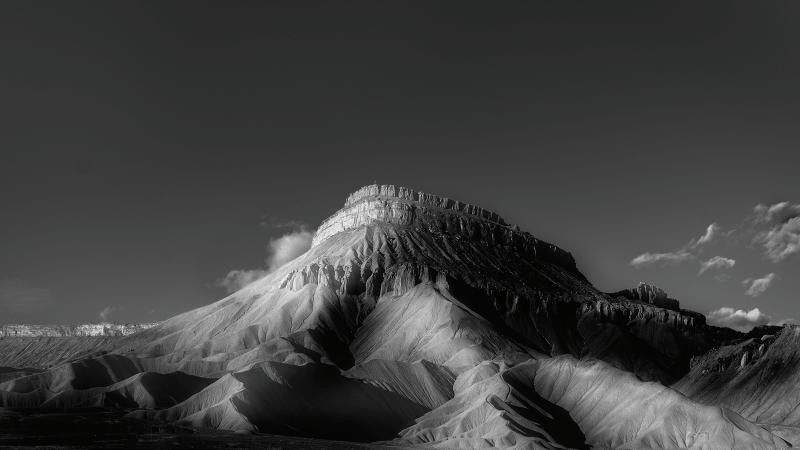
Outside of Arches National Park, this formation with appealing shapes and lighting, lacked eyecatching contrast after processing in color, so I switched to B&W. Dodging and burning accented shadows and highlights. Nikon D7000, 11-16 mm (16 mm), shutter 1/250 sec., f/11, ISO 200
There are consulting firms charging thousands of dollars to train teachers and staff in active shooter response. There are entire industries built around school security and threat assessment. What began as a reaction to the Columbine tragedy has grown into a multiBILLION-dollar market.
A business born from the idea that this is no longer rare. A business built on the assumption that this will keep happening. A business that continues to grow as if there is no end in sight. How many kids will it take? How many bulletproof backpacks need to be sold until they have met their quota? How many classroom shelters need to be peddled to school districts before someone cries out, “Enough! This is madness!”.
Do parents take their kids back-to-school shopping and help them pick out a new backpack each fall? Ranging from Common Level IIIA for just your basic everyday “handgun protection,” to Level III/IV “rifle-rated” armored protection. I am not sure my family would have been able to afford the armored backpack. It sounds expensive.
protection as banks, airports, and government buildings. It only took one 9/11 to implement new security measures at airports. It only took one Oklahoma City Bombing to reinforce federal buildings.
My generation (elder millennials) are now customers in a fear-based economy, and business is booming. We witnessed the horrors of Columbine and now have the option to buy our children and grandchildren armored plates for their backpacks. Just in case.
“...with many making the grim conclusion, ‘It’s not a matter of IF, but WHEN.’ ”
A 6-year-old child should be looking forward to their peanut-butter and jelly sandwich with the crust cut off and a Mott’s Applesauce cup for lunch. They should not even know what these drills are or why they are doing them. The unfortunate truth is that 95% of schools in America have active-shooter drills. America is the only country on earth that goes beyond just natural disaster drills, like tornado drills and earthquake drills. Those were scary enough when I was a kid. Some schools, if they can afford it, have actors who pretend to be shooters. I wish I were kidding. Countless studies show how traumatizing the drills are for school-aged children, with many making the grim conclusion, “it’s not a matter of IF, but WHEN.”
We have created systems to manage the unimaginable instead of eliminating it. We have taught children how to survive violence instead of preventing it. We have too easily accepted that classrooms need the same
We have learned to live with the possibility of the worst and call it “readiness.” Not because it is acceptable, but because most attempts to find a solution seem to be met with significant resistance. Americans would rather have access to military-grade firearms instead of keeping children safe in school. Congress values the money they receive from lobbyists and special interest groups more than they value the lives of this country’s future generations. The Second Amendment was intended for citizens to have the ability to defend themselves against a tyrannical government, but the citizens themselves have become tyrants. “Guns don’t kill people, people kill people” is a common statement made by 2A enthusiasts. “We have a mental health problem in this country, not a gun problem” is another tried-and-true defense. There are many. However, no matter how we choose to look at the problem, we have been unable to find the solution. Or even the cause. However, we do know that it is solely an American issue.
Until the pain of remaining the same becomes greater than the fear of change, we will continue to lose innocent lives within the very walls that are meant to shape their futures. Until parents and the government choose children over guns and money, we will continue to lose innocent lives. America has a societal issue, and until it acknowledges it needs to change, nothing will change.
I wish I knew the solution. I just hope to live to see the day where people are more important than pain and profits.
*Rita Johnson Marionville High School Gold Poetry
I created this to inspire others to speak up about what they go through, but also to inspire texting or calling those you love to check on them. You never truly know what they go through.
Johnson wants to work in the art industry and spread the word about mental illness to help others.
*Scholarship recipient
Magdalyn Lindsey Monett Crowder Honorable Mention 2D Art
A few days after one of my best friends passed from cancer, I took the reference photo and painted to express how empty and tiring it can be to lose someone.
Lindsey is majoring in Art and Design and hopes to transfer to Missouri State University to finish her bachelor’s degree in art.
What if zombies eat brains because the one they have is rotting? They yearn for it.
So much they would kill for it? They are so desperate for that feeling that they once had. So desperate to feel.
So bad the desire is uncontrollable. So desperately wanting something taken from them back. Their bodies rotting.
Bones breaking. Their bodies fall apart from the lack of feeling. As “humans” we see them as a threat or scary.
But they are just as scared as we are.
Just as desperate to feel as we are.
But as humans we are programmed to see the difference. We are made to see the flaws on the outside before looking in.
But in reality we are all the same. We lose it gradually until we are nothing. Some are faster than others.
And the more feeling we lose.
The faster the desire becomes and the bones break.
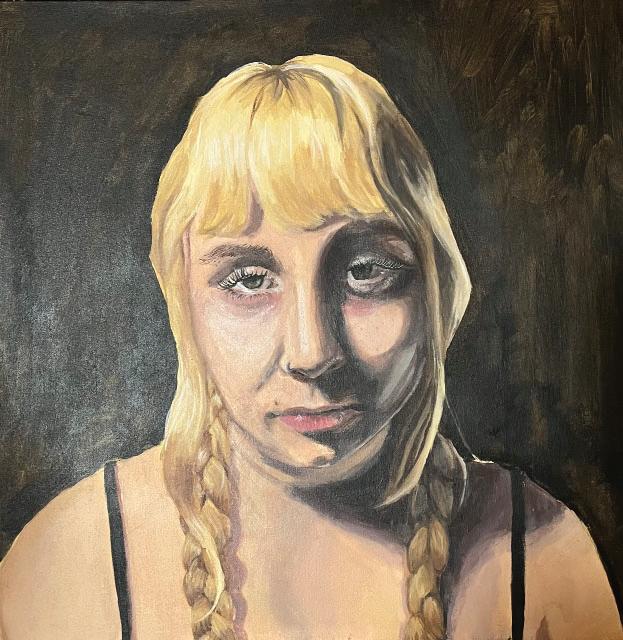
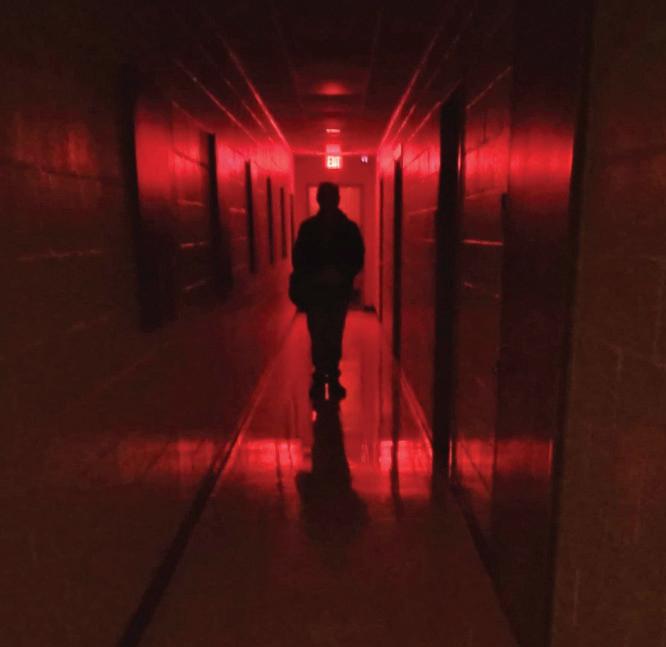
My childhood was filled with confusing tense situations where puzzle pieces did not fit together. I was a toddler when my mother tried to carry me to bed, swaying down the hallway and suddenly dropping me on my dollhouse. She threw worse fits than my younger brother and I combined. My dad would take us away from her when she acted that way. We once went to a waterpark and chose a slide where I went first and waited for her at the bottom. She flew out of the slide but did not come out of the water. I thought she was messing with me, floating face down until I turned her over, and her face was purple. Lifeguards came rushing after they heard me screaming in horror; she was taken to the hospital in an ambulance. When my parents divorced, I thought they still had a chance until my dad told me that my mom was sick.
Being seven, I thought it would be cancer or something contagious.
Years later, the day was coming to an end; my family and I were just wrapping up at Chuck E. Cheese’s when the rain stopped pouring. The drizzle from the mist was making the neon reds, yellows, and greens from the lights reflect off the wet pavement. After a seemingly long drive home, we arrived at our grandmother’s house. That is where we stayed when we came out to visit from Colorado, from living with our dad. We used to visit every weekend, which then turned to once a month, to every holiday, then to twice a year.
We were young; I was twelve, and my brother was ten. This was when my mother had spent too long in the bathroom; she snapped at me for noticing. This made me feel
[Continued to 69]
Jessi Hilton Goodman
Quill Staff
Color Photography
My brother and I stayed late last semester for a final day of wet clay ceramics. The light from the exit sign made my brother’s silhouette look mysterious. Motorola 5G 2025, auto settings
Hilton, a dual enrollment student, planning to major in psychology with a business minor, enjoys reading, writing, and taking photos.
Keira Yenzer
Joplin
Crowder
Quill Staff
Nonfiction
I lost my mom to drugs about two years ago and am sharing my story to bring attention to how strong addiction can be and how confusing it can be for a child to experience the parent’s situation.
Yenzer has been writing since starting college again and plans to continue her education at a university.
Content Warning
Haiey Kreighaum
Webb City High School
Honorable Mention Poetry
Kreighaum, a senior, has been through two relationships and three family members passing away. Through all that, she’s still going strong and happy.
A broken trust, a whispered name, Not she, but he, a burning shame. Her world, once bright, now turned to gray, A love betrayed, led far astray.
His eyes, that held her tenderly, Reflected by someone else, you see. A secret kept, a hidden touch, A love for him, desired so much.
Her heart, a bird with wounded wing, No longer dares to dance and sing. The gentle breeze now feels like ice, A love she lost, a painful price.
Though tears may fall like autumn rain, She’ll rise again, and ease the pain. For love resides in many forms, And a new sun dawns, escaping storms.
My ex inspired this poem. I’m still not over that he cheated, but I hope putting all of my emotions into this will help me forget about it.
Lola Fontana Joplin Crowder Silver Digital Art
I drew this digitally to represent trauma my sister and I experienced from child neglect, specifically caused by addiction.
Fontana, who creates with various media, has been making art since childhood. Now preferring digital art, they look forward to furthering their art career in things such as comics, stories. They are majoring in General Studies.
Content Warning
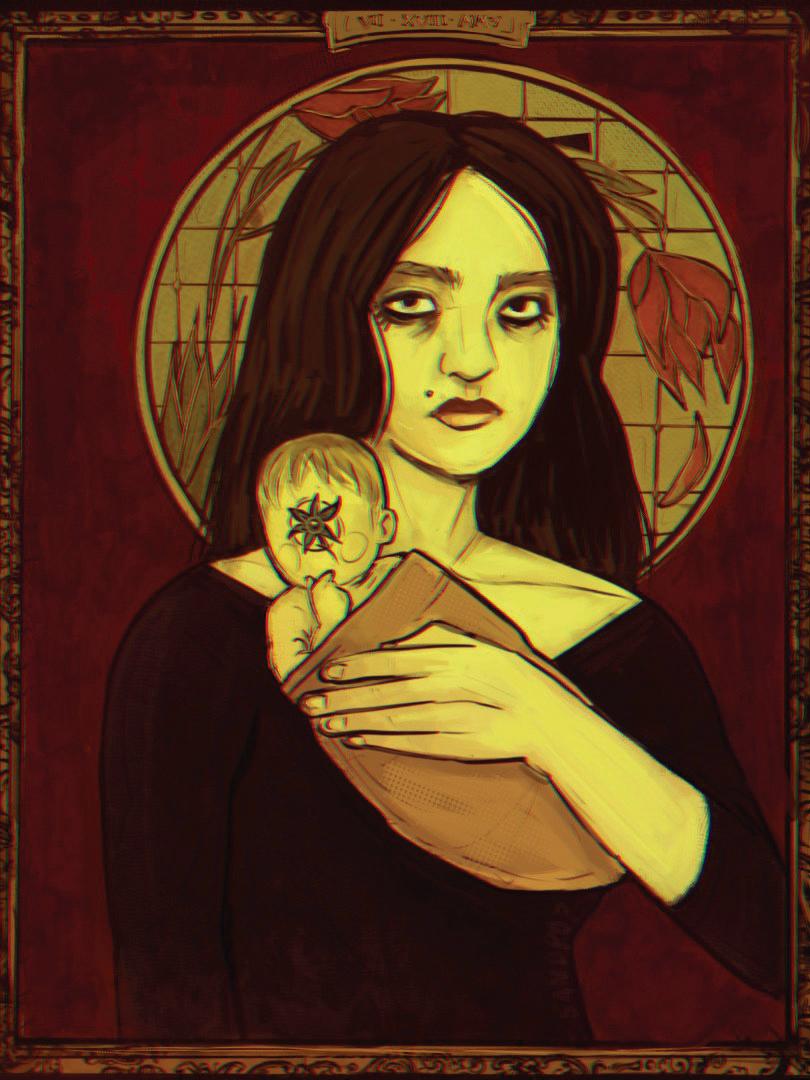
as though I should not have said anything at all. I stomped down the stairs into the basement where the guest bedroom resided. Huffing and puffing while putting myself to bed, I decided to turn off the light and tuck myself in. It was dark until the bedroom door cracked open, lifting me from my near slumber.
“Keira, I think there’s something wrong with Mom,” my younger brother sniffled through the crack. I could only see his silhouette, and his face was dark; I felt a shift in my stomach as the door creaked open more, letting more light into the room. “She’s not moving! She won’t say anything!” he had moved to the end of the bed sobbing, “Keira, please come up stairs.” I jumped out of bed and took the stairs by two. Passing the living room, I saw her sitting in the same old rocking chair through the back door windows. The air remained still and quiet. As I opened the back door, I expected her to look up at me; she remained sitting, looking forward into the distance. Goosebumps began to rise in my arms. I stepped outside to look at her, and her face was frozen; her eyes were unfocused, staring at nothing. My stomach lurched and my skin ran cold. Her arms were stiff; one holding a cigarette that had left ashes all over her shirt, and the other clutching a coke can.
My first instinct was to grab the cigarette and coke can that was about to spill all over her clothes. As soon as my hand touched hers, she grabbed my arm. I tried to rip my arm away; her grip was stronger. My twelve-yearold strength was nothing compared to her adult power. I looked at the back door where I had stepped out from, and my younger brother was standing there watching, crying with fear in his eyes. “Go get someone,” I said steadily, trying to stay calm while my mother was latching onto my arm like a leech. He turned and ran. It took no more than a minute or two before my grandparents came storming out the door. My grandpa grabbed both my arm and my mother’s, ripping them apart. A wave of relief swarmed over me as soon as I was free from her grip.
“Meredith, what did you take?” my grandma yelled over and over again. My mother sat there, head leaning against the back, staring at the ceiling. Her face was blank, she was nonresponsive, she could not say a word back. My grandpa was on the phone in the house with 911 while my younger brother sat on the couch, I went in there to give him a hug. As I pulled away from my sobbing sibling,
my eyes caught a glimpse of something small, silver, and shaped like a small can of soup without a label. I grabbed it from my mother’s purse and noticed that it could unscrew open. When I pulled the lid away slowly, I saw an assortment of different colors and shapes of pills. I started to pour them out in my hand to see them better when my grandpa stepped in quickly and grabbed them out of my hands.
“You don’t know what those are or what they could do to you,” he spat out then huffed as he twisted the silver tube shut and shoved it down his pocket turning away from me. The cops filed into the household with firemen and EMTs. They brought in a gurney and lifted my limp mother onto it, her head dropping and swaying as they maneuvered her. As she was wheeled away and stuffed into the ambulance to be transported to the hospital, my older brother entered the house through the garage after being called back home from friends. He comforted me and my younger brother and then explained to us that she had been struggling with this thing called “addiction.” I had never heard of it before that night.
The next day, after watching countless movies and TV shows with the siblings all night until morning, my older brother decided to go grab food for lunch. This left me and my younger brother alone for about thirty minutes, which was enough time for my mother to stop by with cupcakes. She acted as though nothing had happened and that she did not just traumatize us. I screamed and yelled at her, calling her a monster. I did not know what else to do or say; I was filled with rage and fear that it would happen again. I told her to never come back, that I never wanted to see her again.
I did not speak to or see my mother after that incident for a few daunting years. It was until high school when we reconnected; I had endured many hospitalizations getting diagnosed with depression, anxiety, and PTSD. All I wanted was my mom in life. I wanted guidance, memories from her past, and her whole collection of clothing. I did not know my mother; I only knew what was told about her, but then I finally got to know her once I moved to Missouri five years ago. She was funny, smart, and her favorite color was magenta. She went to rehab but did not last long there before moving away.
There would be times when I would not hear from the family; my mom was overdosing
[Continued to 70]
[Continued from
repeatedly throughout the week, and they did not want me to be there. I saw her turn purple again one night and my grandma called 911. When help arrived, they gave her Narcan; she came back and was talking within minutes. I got a phone call about my mom; she crashed her car into a van and went flying through the windshield. She broke her entire face and required reconstructive surgery.
She lost the battle to drugs two years ago. People say it was for the better; I feel like I’m getting stabbed in the chest every time I hear it. I sent her a text the day she asked for more fentanyl. She never replied, and I found out she had passed right after work in February of 2023. It was one in the morning, and I received a text from the older brother to meet
at grandma’s house. I knew the reunion was not going to be a good meeting. Finding out that drugs had finally taken her was so heart wrenching that I felt as though I had lost a part of me. I no longer had my mom to call about everything and anything. The connection I strove to have with my mother was cut like a thin thread. I think about her still, every day. Although she had problems that led to the end of her life, she had qualities that I miss, like her boisterous laugh. I do not wish to end up like her; therefore, I will not follow her path. Each day I actively choose health over addiction and family before anything else. She chose darkness over the help of her family and for that I will always remember that family comes first, never drugs.
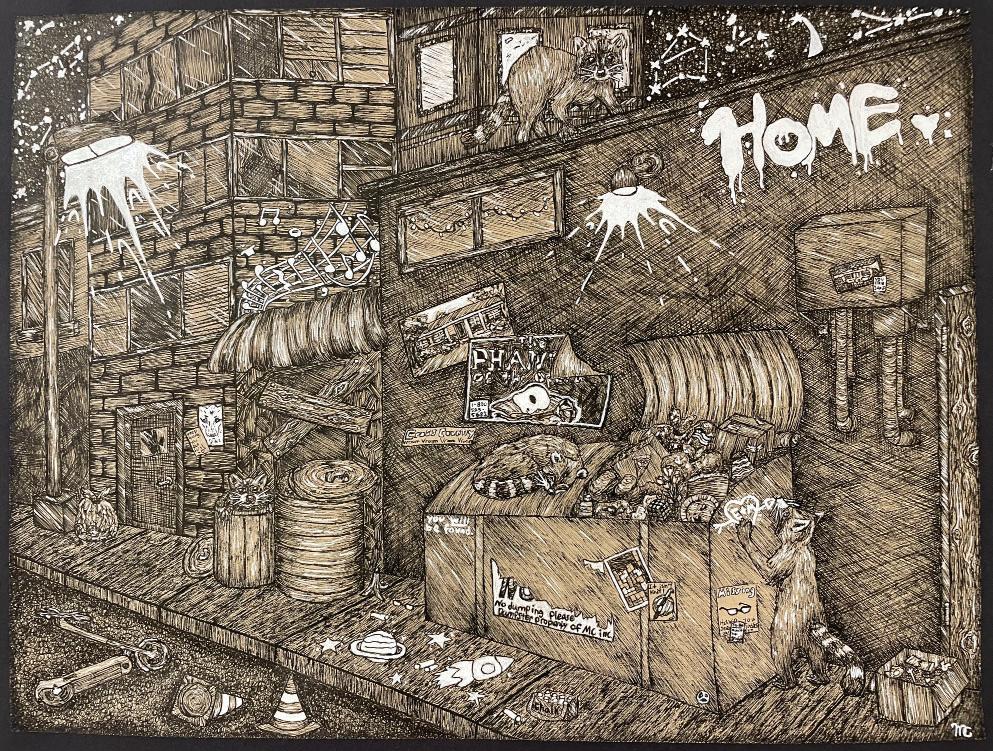
he crack on the sidewalk stares at me as I step on it, “I dropped something,” I tell my brother as I circle back to step on it again. My focus remains on the judgmental line. I stumble, knocking into the trash can behind me. Brayden snickers. I roll my eyes and glare at the crack, “You won this time,” I think. Brayden goes back to talking about his lesson plans for the week. Who cares what the kindergarteners learn? No one can trust anything. Brayden has no idea that every person we pass on the street is talking about me. He doesn’t have to worry about that. At the coffee shop, I feel eyes boring into me. I glance around, but see nothing.
“Earth to Madelyn, let’s go.” I glance at him, forcing a smile. Walking towards the table, I wonder why I see so much more than him. Katy, my brother’s fiancée, is waiting on us, three mugs sitting in front of her; they’re so normal, knowing nothing about the secrets. I sit down across from her, letting my mind wander as they talk excitedly about horribly mundane things.
The water closes around me, cold needles biting into my skin. My lungs burn. Pressure pins me down as muddy water fills my mouth. I grow tired. I stop fighting. The dark takes me.
“Madelyn!” Katy’s voice cuts through the nightmare. She laughs and slides closer. “I said your name a hundred times. Brayden went to the school for parent-teacher conferences, so it’s just us!” Her happiness buzzes against my skin. I pull back. “I just want to get some work done. Can we go home?” Panic slips into my voice before I can stop it. Her smile falters, “Is something going on?” I’m fine, I tell myself. Everyone else is the problem, not me. I see her eyes drop as I don’t respond, and I just start walking. The crack is laughing at me; it knows I’m alone. Inside, I go straight to my room, thinking about how my brother and I can be so different. He gets happiness, I get the truth. I was told I’m more like dad, he’s more mom. I don’t remember my dad, and my mom died right after I was born, something about postpartum depression. Not long after, my dad was accused of trying to drown me; he’s been locked up ever since.
I hear my brother come home, followed by Katy’s voice heading this way. I pretend to be asleep as the door cracks open. “I’m worried about her,” Katy says softly. My brother’s
response comes slowly, “I can’t believe they’re releasing him. He tried to kill his toddler, and they’re just letting him out? Of course, she’s not doing okay.” Katy sounds uncomfortable. “With him being released in seven days, can you tell me what actually happened?” Brayden sighs. I perk, he’s never told me about it. “It was the anniversary of my mom’s death, and we went to the pond, her favorite place. Madelyn was just being a kid, but it made Dad angry. He was always angry. I left for a few minutes, but when I came back, he was soaked and walking away. I was so confused. Then I saw her dress under the water. Horror struck as I registered what he had done. I pulled her out and got her to the hospital. They arrested him that day.” His voice breaks. “I’ll never leave her again.” The room tilts, my chest tightens. Why does he hide everything? I can take more than him; he knows nothing.
I slink back into my room, mind already elsewhere, desperate to find out more. The only thing I know to do is open Facebook. There’s a thread on Messenger I’ve ignored since the day I opened this account. My grandma, my dad’s mom. I clicked the little video camera, it barely rang before a woman’s face filled my screen, her eyes were filled with tears, eyes that matched mine, “Madelyn?” She breaths. “Is that really you?” I nod. “I have questions about dad.” She studied me, then nodded slowly. “I wondered how you were feeling. So close to his release date, or if you knew.” I blink, “I’m not looking for another grandma, just answers.’’ She hesitated, nodding again, “Understood.” And finally, I asked every question that has haunted me.
Almost three hours later, I shut my laptop and sank back into the wall feeling even more confused. According to my grandma, mom and dad were happy, very in love, no money issues, Brayden was a really good kid; they were happy until they weren’t. They struggled to get pregnant again. When they finally got pregnant with me, they were even happier, but then she had me, and never bounced back, eventually killing herself. Grandma said that after that, she came over multiple times a week. Dad was working a hundred hours a week between his job at the fire department and an under-the-table job, he never said, but she always assumed it was illegal. The news broke before she was even allowed to speak
[Continued to 72]
Lexi Burlingame Scammon, Kan. Crowder Bronze Fiction
This short psychological thriller is told by an unreliable narrator and makes readers question whether it was a perfectly executed plan or simply a girl gone mad.
Burlingame , a young mom and aspiring nurse, likes to take herself to worlds apart from this one, and finds refuge from books.
Content Warning
to her son. She was sure they got the names wrong. My dad never drank. She came over unannounced all the time; there was never alcohol, and he was never drunk. Later, the report said that he had morphine in his system, but no alcohol. The police chalked it up to a kid not understanding the difference and said he was abusing opioids. His alibi couldn’t be proved because it had something to do with an unknown job. None of it made sense. Was she just a mother who couldn’t believe her son did that? I went through everything over and over as my room slowly grew darker. Trying to calm my racing mind as I slowly drifted off to sleep.
I’ve been hiding out in my room long enough; I hear the sizzle of pans, and the smell of breakfast is wafting towards me. Might as well go eat. I fix a plate as Katy and Brayden chatter along. “You okay? You haven’t said anything.” Brayden looks at me, a playful smile on his face. “Could at least say good morning, you know.” I feel annoyance settle in my chest. “Yes. Good morning.” Why does everyone assume I’m not okay? “Just tired.” He gave me a sad smile but didn’t push.
I walk straight back to my room. Katy and Brayden’s laughter drifted from the kitchen. I curl into the window seat and grab a book. I blink; my eyes clear as music pulls me back to reality: Taylor Swift’s “Timeless,” I think? I have no idea how long I’ve been reading, but I’m going to guess quite a while as the sun is starting to set. I walk into the kitchen to find them dancing. He looks so happy, so sure. I want to warn him. Instead, I just tiptoe back to my room to fall asleep to the sound of their voices.
Chaos drags me into the living room to find Brayden frantic. He’s never this uncontrolled. Today is the day. He turns to face me, unease in his eyes. “I don’t have to go to work today.” I stifle a grumble; he’s too naive to protect me.
“Go,” I assure him. “I’ll be fine.” He looks like he wants to argue, “Fine. But don’t leave, don’t open the door, and lock it behind me as soon as I leave.” I nod, barely listening, thinking only of a full-day binge. A day not thinking of Dad. Brayden gives me one last long look before leaving, “Please be safe, I love you.” I don’t glance back, just wave, gathering up some snacks for a full day alone.
The day bleeds away as I watch my comfort show, feeling myself relax. I don’t need answers; I don’t hear the voices. A sudden
knock makes my heart spike. Hands trembling, I grab a knife from the kitchen. I suck in a breath as I look through the peephole. Relief floods through me when I see the empty hallway. Maybe someone knocked on a neighbor’s apartment.
Turning back towards the kitchen, I spot my brother’s coffee and lunch, weird. He must be really on edge; he never forgets anything. Next to it, my water bottle, he must’ve filled it before he left. Feeling okay, I settle back into the couch, pushing play. Drinking my water, hoping to ease the anxious dry mouth. As the theme song fills the living room, my body sags, and the anxiety ebbs as my body fills with exhaustion, pulling me to sleep.
I can’t see. I can’t breathe. My hands and ankles are bound; there’s something over my head. I’m in a vehicle. I scream, but they’re drowned out by the radio. I have an idea of where I’m going, the pond. Dad’s finishing what he started. The vehicle comes to a stop. Hands drag me out, and I hit the ground, crying out in pain. The hood is ripped from my head.
I see Brayden. Relief floods through me, then quickly dies. His eyes are wrong; he’s not my Brayden. “You were supposed to die.” He looks through me. What is he saying? “You are so stupid.” I felt my mind splinter as he talks, going on about how he blamed me for our mom dying, hated me for surviving, and how he held me under the water. Saw dad, so he panicked and saved me. Then, framed dad, ensuring no one questioned him.
“I kept you close,” he said with a smirk. “I couldn’t risk you finding out.” The only thing pulsing through my mind is that Grandma was right; the voices were wrong. My body is shaking with sobs. He laughs. “Dad came by the apartment today. He’ll go down for it again. And you,”
His gaze flicks to my hands. “You should’ve locked the door. Drugging that ridiculous water bottle was easy.” He laughs, a cruel sound. With that, I’m plunged into the icy needles; the last thing I see is a devilish smile on my angel brother’s face. I can’t die this time, I’m kicking, fighting, but he’s stronger. His hand was forcing me down. I feel the weight settle in my chest as my lungs burn with desperation for a breath. The murky water starts to turn black as the darkness creeps into the edges of my vision. I feel my body go light. I feel my urgencies end, and everything is gone.
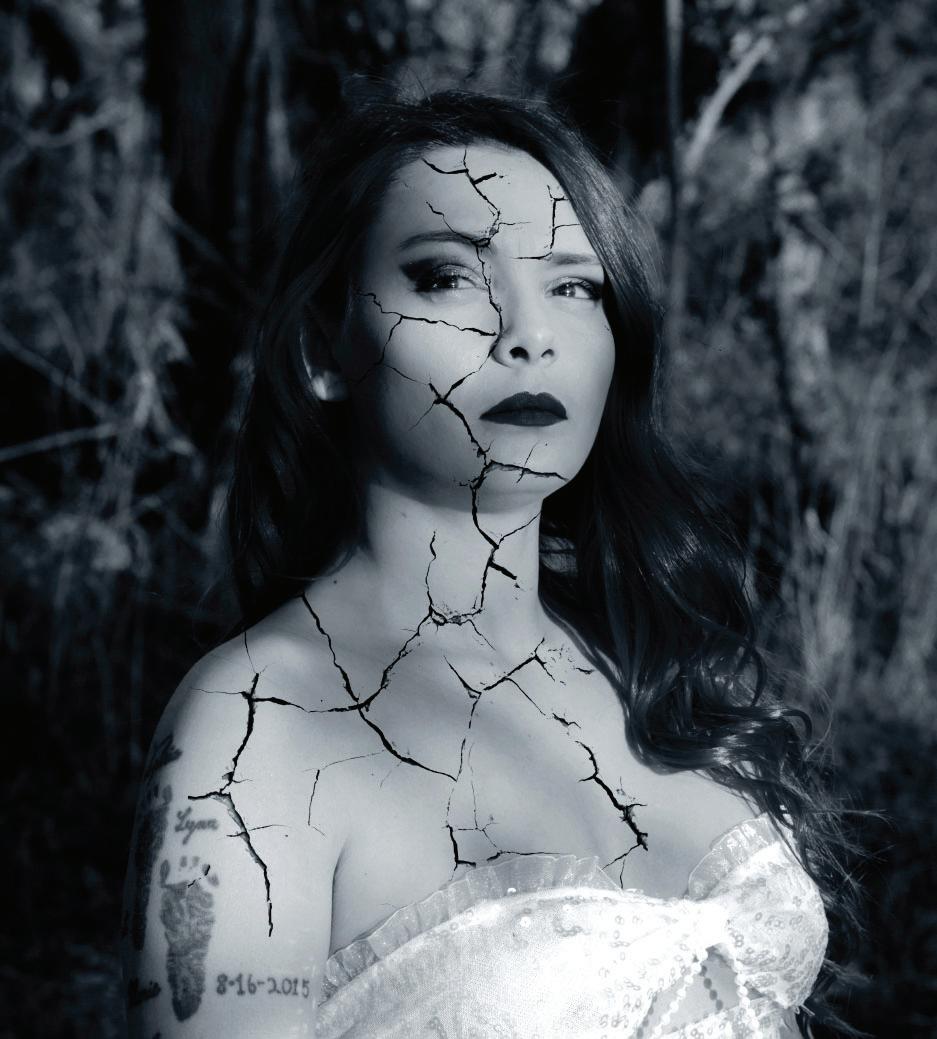
|
My model and I did a session for my website. After playing around in Photoshop I decided to turn her into a porcelain doll. I used a picture of cracked concrete and blended with different modes to create this effect. Canon Rebel EOS T7, manual mode
Hill is a photographer who likes to have fun and explore new areas in photography. She is also a dedicated mom to two children.
Brooklyn McGehee Carl Junction High School Silver Poetry
To confront the weight of expectations (mostly from parents) and the guilt I carry for not meeting them, I wrote this, drawing from my experiences, and coming to terms with them. This helped me externalize my feelings and life experiences.
McGehee, a junior, explores different media of art and expression as she strives to understand herself and the world on a deeper level.
I’m sorry I’m not your perfect art project. I’m sorry I’m the smudge you didn’t ask for, The brush stroke that ran wild, The color that bled way too far.
I’m sorry I can’t stay inside the lines, Can't be the shape you drew in your mind, Can’t hold the form you hoped I’d hold.
Every step I take, Spills paint where it shouldn’t be, Rips at the edges of what could’ve been Whole.
And I keep wondering If I was ever meant to belong In the gallery you imagined for me.
I imagine your quiet disappointment, The smiles that never quite reach your eyes, The things you don’t say out loud. It weighs heavier than any words, And I feel it settle in my chest, Making me smaller, Shrinking me until I wonder If I can ever grow Into the person you dreamed of me to be.
I’m sorry for the ways that I sabotage myself, And your imagination of what your art project was supposed to be. I’m sorry for being messy, For being incomplete, For being human in a world that wants perfection.

Now, Mom–You hand me the ideas of dreams, you never reached And call it love.
Tell me it’s for my own good while painting it in your colors.
Everything you wanted but couldn’t be, You stitched it into my skin and told me to wear it proudly. You say you’re helping.
But it’s always been about you.
Your second chance, your dreams, Your project, your reflection staring back at you through me. And still, somehow, You left me to finish this project alone.
Still,
Beneath all the torn pages and fading paint, There's a small patch of canvas That refuses to be touched by anyone, Where I could possibly start again, On my own terms. And maybe this time, I’ll paint something that doesn’t hurt to look at.
I’m sorry I am not your perfect art project. But maybe one day, I can be enough for you. And for myself.
This work comes from a personal struggle, getting lost, and losing your voice. The mix of a realistic portrait with illustrated elements shows the tension between how people see us and how we view ourselves, asking if adornment is style, protection, or both. Drawn elements on portrait image, created with Procreate
Flores works primarily with digital illustration and mixed visual styles, focusing on identity, emotion, symbolism, and blending realism with illustrative elements. She explores how personal experiences, feelings and cultural symbols can be visually expressed in a modern and expressive way.
It feels like drowning, like I can’t breathe The weight of expectation suffocates me
They tell me I’m just a dramatic teen I’m acting stupid, nothing’s wrong with me
Bottle it up and bury my dreams
Pretend I fit in with society
Repaint my mask so that nobody can see How badly these things are affecting me
I know they care, but they’re also blind
To how the lack of oxygen eats my mind I’m fading right before your eyes I cry, she’s mad, they don’t realize
I don’t have an escape, I don’t have the time
Sometimes I wish I hadn’t survived
They tell me to be happy and I really do try
But I’ve forgotten how to swim and the water’s too high
I wrote this poem my sophomore year of high school. I was struggling with my mental health at the time and was attempting to find a way to cope. Writing poetry helped me do that.
Aubree Chisam
Crane Community
Silver
Digital Art
This project was created in my Graphic Productions class at Missouri State University while we covered screen printing, limited color palettes, and color separations.
Chisam graduated from Crowder with her associate degree in General Studies and a certificate in Digital Media Marketing. Now double majoring in Photography and Graphic Design at Missouri State University, she plans to work in publishing and as a freelance photographer.
Dimitri Davison
Sarcoxie
High School
Honorable Mention
Poetry
Rhymed Verse
Davison, a junior, hopes to graduate from an Ivy league university, to become an author and history professor.
Lidia Alejo McDonald County High School Silver Nonfiction Essay
I wrote this to express how I gradually disconnected from my culture even though it is important part of my identity.
Alejo, a senior, enjoys telling stories through her work.
Ihave plenty of regrets in my life; however, if I had to choose which one has impacted me the most, it would be denying my cultural identity. It started in elementary school. I started noticing little things. I found it weird how, unlike the other kids, I had two last names and no middle name. I dreaded anytime someone would ask if my last name was Godzilla. I do not blame my classmates for not being able to read or pronounce Gonzalez but it was humiliating each time. I loved my ESL teacher, and to this day, I still talk to her; however, when I was younger, I studied hard so I would no longer be pulled out of class. I stopped going to her award parties and stayed with other friends in class, pretending that I did not miss the chaos that happened all the time in her class. I resented my parents for telling me to only speak Spanish in the house; to me, they were trying to stop me from learning English. I now realize it was so I wouldn’t forget my Spanish. Back then, I thought trying to blend in did no harm. In reality, I was trying to erase part of my identity.
stereotypical joke, all I did was laugh I didn’t know what to say or do. It was embarrassing that most jokes had truth behind it. Besides those times where my parents are obnoxious in public I was never embarrassed by my parents, but the customs that come from my parents town did. When talking to family members, I am asked if I know how to cook and clean, or if I’m ready to be married yet. I always answer with the same response
“I am going to focus on school for now,” and like a movie script, I’m met with the same words that they disguise as advice, “If you wait longer you might be alone forever.“ That embarrassment and shame made me want to disassociate with my culture as a whole. It’s beautiful how family is a priority but when it’s been something I’ve had to listen to from a young age it makes me feel trapped.
A people without the knowledge of their past, history, origin and culture is like a tree without
roots.
Why disconnection with culture may happen, in my experience, trying to blend in was one of the biggest reasons as to why I avoided being more involved in my own culture. Instead of using my traditions to make connections, I tried replacing them with what I saw around me. To everyone, I no longer eat beans and eggs in the morning. I ate cereal. On Thanksgiving, tamales weren’t on the menu; it was turkey and green beans. Throughout elementary and middle school, there was a very limited number of people I could connect with; my brother and my older cousins were who I looked up to, and they had an even bigger gap than I. I have also noticed that my parents have started to forget their indigenous dialect tarasco, because after leaving their home town they no longer had people besides themselves to use their language. Another big factor was embarrassment. Whenever I heard a
-Marcus Garvey
The first time I met my grandma, I was 14 years old. I did not know what to expect. By the end of the day I was already getting scolded. Embroidery is something very important in our culture. All girls wore nahuas every day, everything from the way you wore the scarf to the style of the lace mattered. My grandma asked why I hadn’t learned anything from my parents. I gave her a very vague answer. She asked, “Are you embarrassed of our culture?” At that moment I felt extreme guilt because I knew even though I believed I wasn’t, my actions were showing the complete opposite. For the rest of my stay I followed my grandma learning everything I had previously brushed off. Cooking traditional meals not with the intention of needing to feed a future family but to preserve the recipes.
There are many things I missed out on and others where I have vague memories. I noticed that my fluency in Spanish started deteriorating. Since it took me so long to acknowledge culture, it just means I have to try twice as hard to learn more about it and speak more about it, and share it with others. Your culture is part of your identity, it’s important to embrace it.
Sitting at the airport gate, waiting to depart— I’m surrounded by huge windows. I see a white bird, perhaps a gull, beautiful, agile, aerodynamically impressive. Wings beating the air with elegant precision, like a winged ghost, swooping against the sky.
Ironic, I think…the real thing among all these gigantic metal imitators.
As the bird flies closer and hovers like a Harrier— I stand for a better look. Horrified, I watch as it relentlessly attacks several of its kin on the runway. The other birds fly off in a huff, apparently not enjoying being dive-bombed and terrorized by a ruthless ghost.
As I continue to stare— I realize this bird has no feathers. Only shell-like plating in imitation, it is no endothermic vertebrate, only a cold, metallic fake. Suddenly, a gate employee announces: “Our new robo-bird…a robot designed to rid the runway of unwanted birds.”
More technology mimicking nature— a mechanical imitation of the real thing. Just an avian imposter, a wolf in sheep’s clothing, created by man to do his bidding and solve his problems.
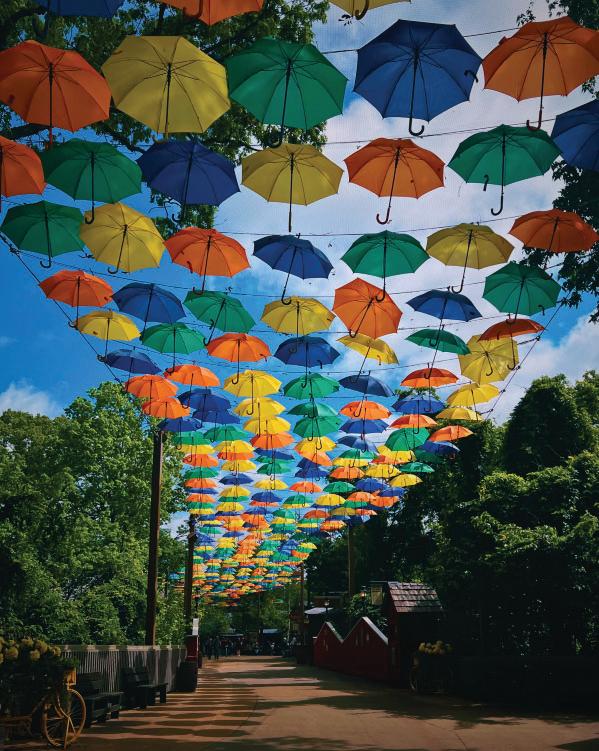
Billie Holladay Skelley Joplin Community Honorable Mention Poetry
I was inspired to write this poem after an unusual experience at an airport.
Skelley received bachelors and masters degrees from the University of Wisconsin-Madison. A retired clinical nurse specialist and educator, she now focuses on writing books -- 13 so far for children/teens ,with work in journals, magazines, and anthologies.
Melanie Chuta Carthage Crowder Gold
Color Photography
I was inspired by the striking contrast and vivid hues against the Ozark sky. iPhone 13 Pro Max
Chuta is pursuing a career in nursing. She uses photography to romanticize the everyday world.
Maristela Lacour
Carl Junction
High School
Honorable Mention
2D Art
My AP 2-D Art & Design Portfolio is inspired by Greek words for types of love. This depicts my parents on a trip to Great Sand Dunes, Colorado, through my camera lens. Colored pencils, black Sharpie.
Lacour won awards for art in middle and high school. Combining love for cultures, creativity, and entrepreneurship, she will study international business.
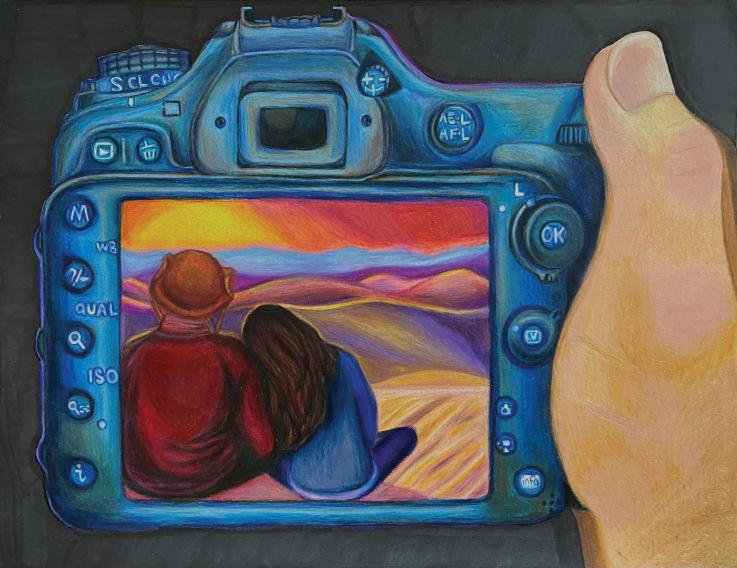
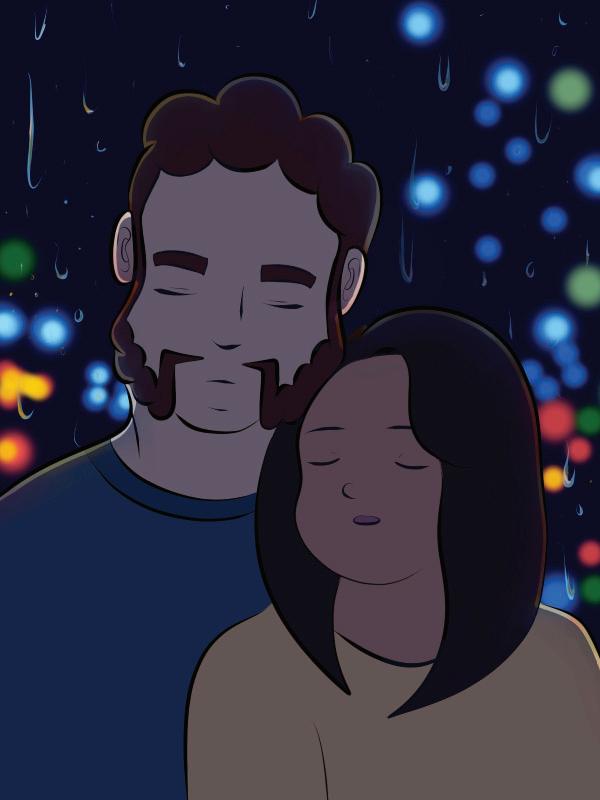
Tiffany Blevins Anderson Community
Honorable Mention
Digital Art
I try to live my life very intentionally. This piece is inspired by my goal for intentional rest this year.
Clip Art Studio Paint Pro
Blevins works as the Fine Arts Division Assistant for Crowder College while continuing to hone her artistic skills using her lifetime learner credit. She hopes to pursue her MFA in Studio Arts.
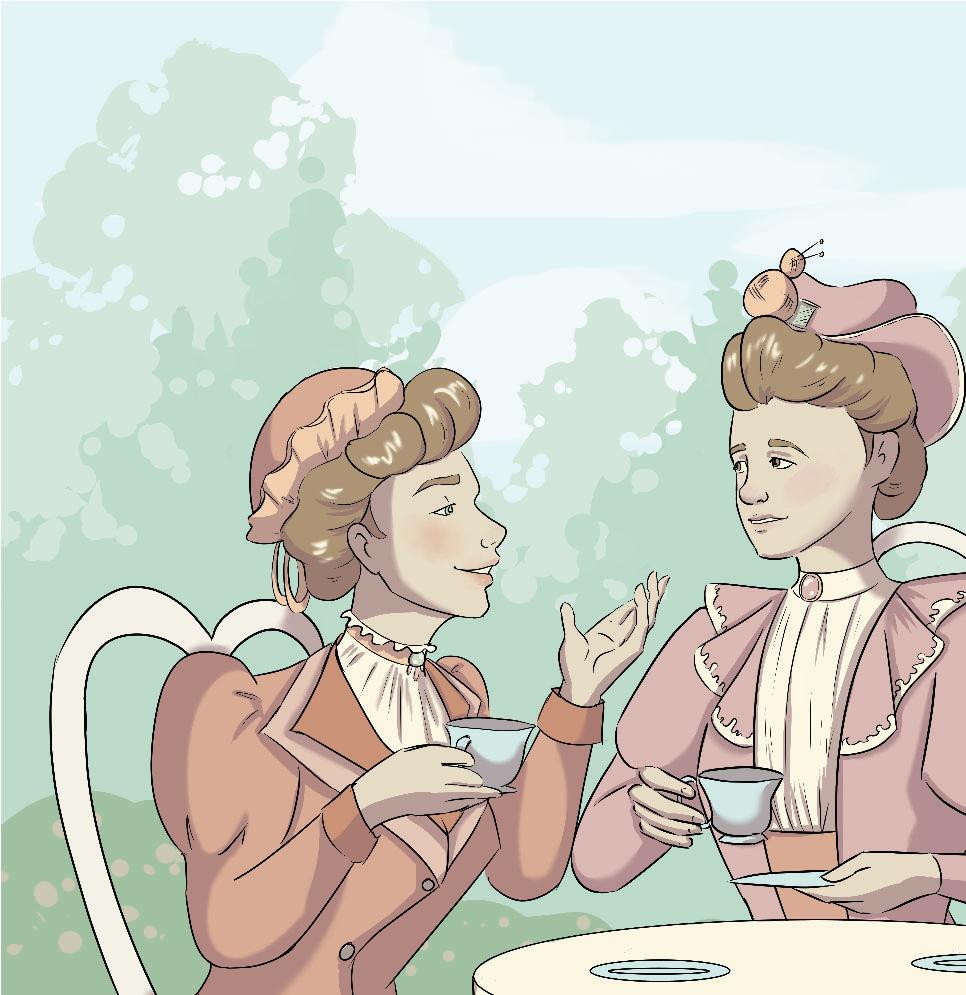
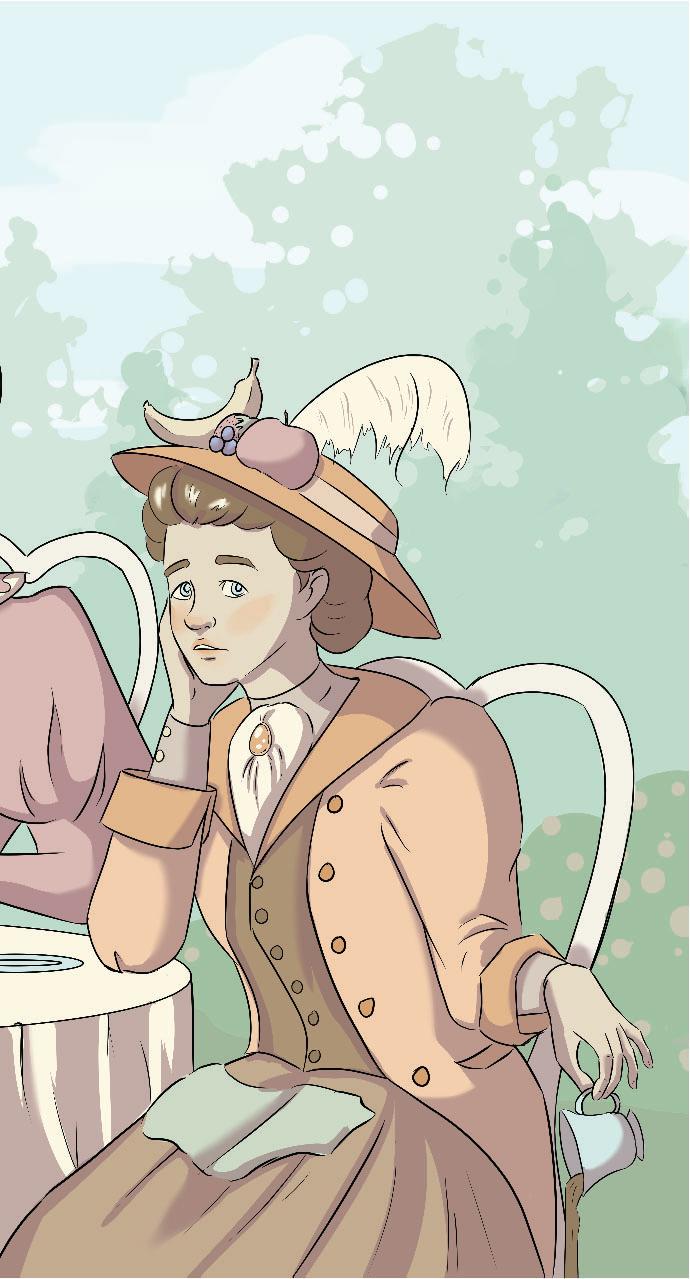
Jamie Billings
Noel Community Bronze
Digital Art
I created this piece for a digital illustration class with the challenge to create augmented reality. The two women on the left are secretly thinking catty thoughts, while the third is simply disappointed with the tea.
Billings is a painter, illustrator, and musician. Her paintings have been in local galleries and exhibits.
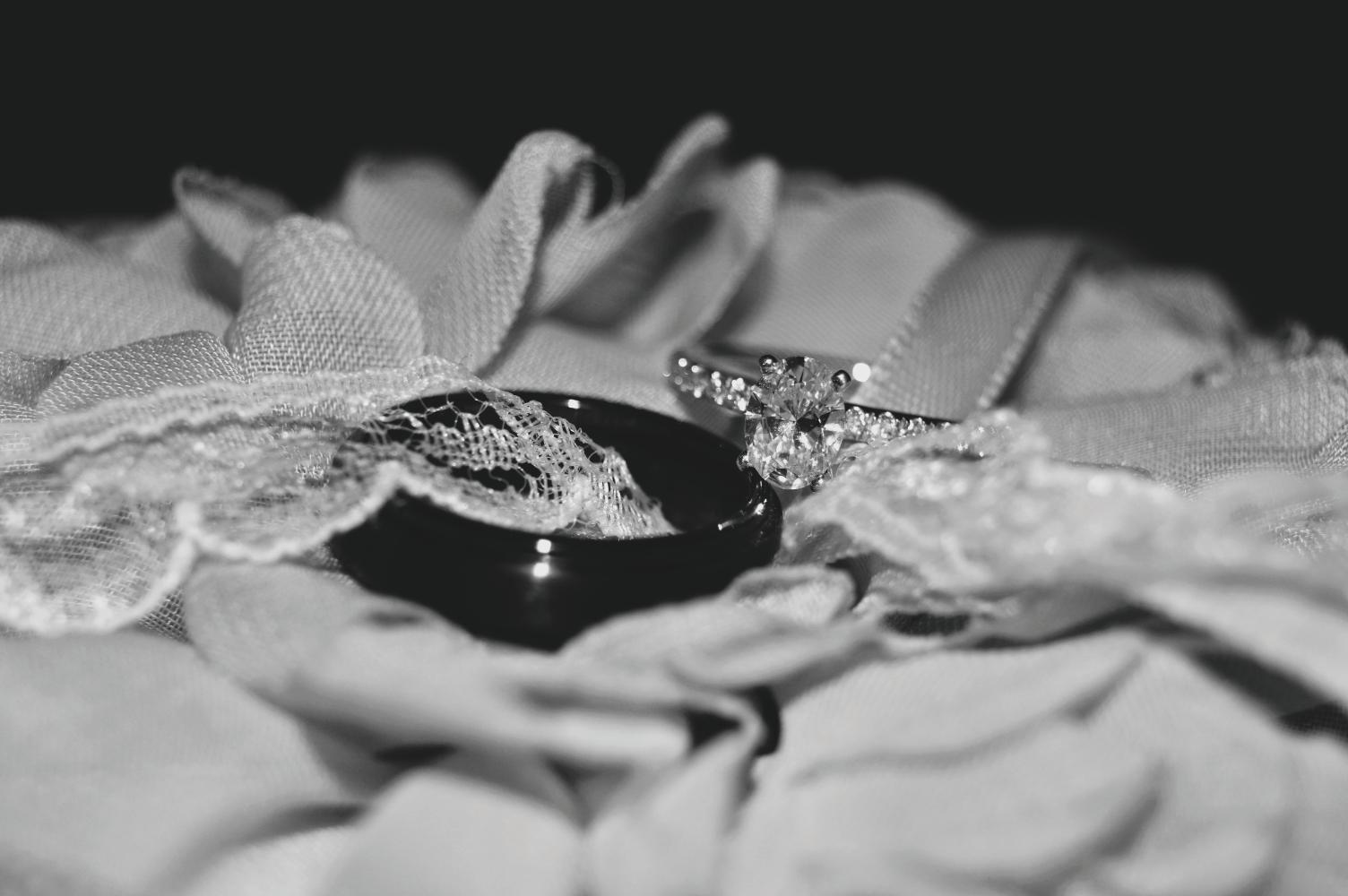
Cali Wooldridge
El Dorado Springs Crowder
Bronze
B&W Photography
I took this photo for a 2025 bride.
Wooldridge is a photographer who cannot resist a good ring shot.
Megan Lawson Neosho Quill Staff Fiction Short Story
I wrote this story to show the devastating moments of humanity that exist even during war.
Lawson is an employee of Crowder College.
Vex felt weak, not just in his knees, trembling hands, arms or legs, but mentally. The entire war had him exhausted and defeated. He didn’t know how his superiors seemed to be strong about the situation. Men were dying, they were losing, they were dying.
He looked blankly at the can of dried beef in his hands. Practically starving, he couldn’t force himself to eat. His appetite was ruined by the sight of his fellow soldiers who seemed to be even hungrier and without food. He knew that it was more an “every man for himself” war than a unified one, but he couldn’t force himself to be selfish. He could imagine the nuns at the orphanage he grew up in scolding him, telling him about how gluttony was a sin and to always share food. His own self-preservation and his moral compass were fighting in his head about what he should do.
But before he could come to a decision of his own, he saw one of the soldiers across from him. The soldier seemed to be either freezing or crying. He had his head buried in his knees as he hugged himself, trying to block out the outside world.
Vex furrowed his brow before pushing himself up despite his body’s protest and made his way over to the balled-up soldier. Slowly kneeling next to him, he asked, “Are you okay? Are you hurt?” His tone was soft but filled with concern. His focus was still fully on the man before him; his mind had gotten used to ignoring the hell around him. Yelling and screaming were all too common, though it never got easier to deal with, but this man seemed to need his attention more.
When the soldier didn’t respond or lift his head, Vex reached out to check his pulse. He swore he saw the soldier breathing, but maybe that was his imagination making up things, hopeful thinking. Though he quickly pulled his hand back as the soldier lifted his head and looked over at him. Vex recollected himself despite being startled; it wasn’t the worst thing he experienced, so he got over it relatively quickly. He cleared his throat before asking,
“Hello? Are you alrig-“ He froze. His words and breath caught in his throat as he
stared at the soldier before him. He wasn’t sure what he was expecting, but this certainly wasn’t it.
He was a child.
Vex felt a wave of disgust wash over him. He heard that the youth were being drafted in the war, but to see it with his own two eyes was something else entirely. The boy looked 16; Vex was working on the orphanage’s farm at that age. His heart broke at the thought of a 16-year-old out in the trenches. Vex’s daughter was around the boy’s age; he could never imagine his baby girl out here, risking her life for something that she couldn’t fully understand. But someone out there didn’t have to imagine that happening to their son, because here he was. Starving.
Vex got a good look at him before making up his mind. He practically shoved his canned food into the boy’s hands, not letting him give it back. He had to put some meat on those bones. He was still growing; he needed the food and energy more than anyone here.
“Eat.” Vex’s tone had become far sterner than it was before.
“Wha-?” the teen furrowed his brows as he tried to get a word in.
“-Eat.” Vex cut in, not leaving any room for argument.
The teen ended up doing what the older man told him to and started to eat. At first, he didn’t take big bites but then his hunger made itself known. He ate like it was his last meal before he died. Vex wanted to tell him to slow down, not choke on the food or make himself sick, but he knew that the teen probably wasn’t even paying attention to the outside world at the moment. So instead, Vex decided to look out for the boy, to make sure he would survive another day.
“Never thought dried beef would taste so good.” The kid laughed softly.
“Food tastes stronger when you’re hungry,” Vex reminded. He had grown so used to that saying. They were constantly told about how they should stop worrying about why food tasted weird; it was just your head playing tricks on you.
Vex saw the dog tags around his neck and squinted his eyes to make out the engraving on them. He could barely read what was on
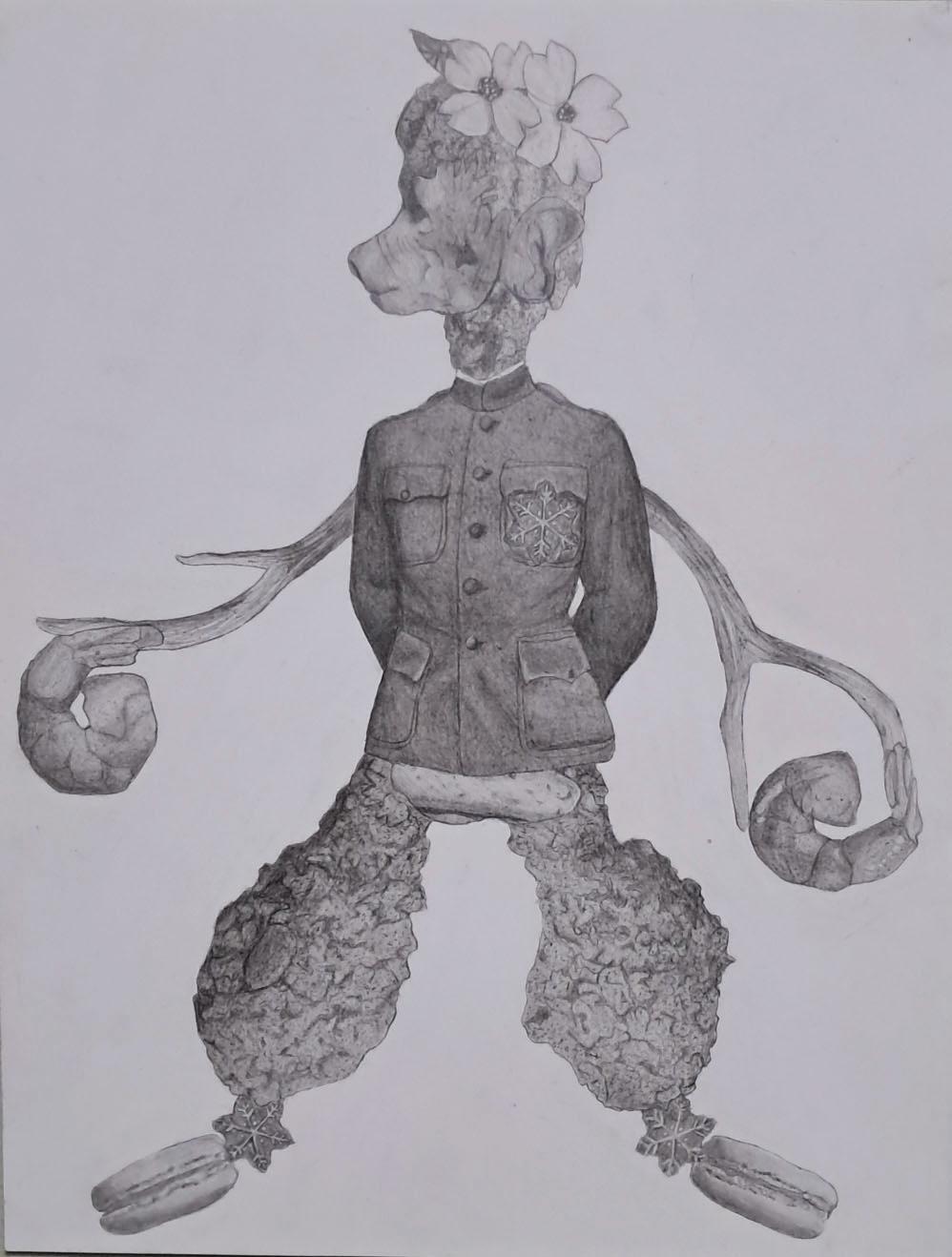
them; he was somewhat worried that his eyesight was failing him, but it also could be that the dog tags were incredibly banged up.
“Your name is Zane?” Vex asked wanting to verify, so he didn’t call him by the wrong name, and for formality’s sake.
Zane looked up and nodded. He had finished eating from the can and was in the process of chewing his last bite. “Yes-“
The gunfire that started to rain down on them was instantaneous, catching all the soldiers in that area off guard. Almost on
reflex, Vex went to cover Zane as the two got up. He’d rather die than let a literal child be shot. The shouting of men either yelling to move, giving updates on what the enemy was doing and where they were, or the screams of those who were shot, filled the air. Vex pulled Zane up to his feet and grabbed his rifle before moving to a safer space with more cover, one where they could shoot at no man’s land easier. When they made it to an area that was deemed safer, Vex quickly started to load
[Continued to 82]
Maddilynn Idell
Pineville Quill Staff 2D Art
I made this collage from different photos of foods, dear antlers, a monkey, and a soldier’s jacket, showing that you can make great things from random photos.
Idell is working on her associate degree and plans to transfer to MSSU for Graphic Design.
[Continued
his gun and aimed it at the rush of soldiers running across the war scarred field. He lined his scope up to one and took a deep breath before exhaling and pulling the trigger. The recoil didn’t move him much, since he had gotten better with his stance over time, but it left an empty feeling in his chest, and that feeling was amplified by the thud of the enemy soldier hitting the ground, dead.
He had no time to mourn or feel guilt for his actions, there were plenty more where that came from, and he couldn’t risk them overtaking this trench, so he went into a pattern. Breathe, shoot, breathe, shoot, and reload when necessary. The other soldiers went into the same routine; it was engraved into them, and was the reason they were still alive. Even Zane followed the pattern.
If only Zane didn’t.
He didn’t have the same experience that the others had, so his routine was flawed in just one small way. He gave the enemy an opportunity to shoot back. His head was peeking out just enough to allow a clean shot, and before Vex even picked up on that fact, he was already hit.
Zane, needing to know that he was going to be okay, even if it was obvious that wouldn’t happen.
“Mammy… mammy…” Zane choked out, his eyes watery and his breathing uneven. He tried to huddle against Vex, trying to seek any sort of comfort as he cried out for his mother. His tears and blood soaked through Vex’s uniform, permanently staining his skin and soul forever. His heart shattered, listening to him call for someone who couldn’t be there for him in his last minutes.
“Shhh… your mama will be here soon? You’re mammy’s hero, you know that? She’d be real proud. Remember that, won’t you?” Vex tried to keep his breathing steady as well, not wanting to cry himself. His one hand slowly ran his fingers through Zane’s hair as his other hand rubbed circles on his back; he remembered doing that for his daughter when she was young. It made him tear up even more, this was someone’s baby, and that someone couldn’t be there for him.
He had finished eating from the can and was in the process of chewing his last bite.
Vex swore he’d never forget that scream, that it’d be engraved into his mind for the rest of his life. Vex quickly dropped everything he was doing and went down to the bleeding boy, trying to see where he was hit and if there was anything he could do.
The bullet struck Zane along the side of his face, tearing through the muscle before dislocating his jaw. The impact left his mouth hanging at an unnatural angle. He shouldn’t look like this; he shouldn’t be in this situation to begin with. He was a child…
Vex started to cry out to see if there was any available medic, anyone who actually knew anything about healing, but no one responded. Medics were hard to come by these days, especially in areas the government didn’t deem as the biggest necessity to protect. So, Vex decided to at least try to comfort the kid and do the best he could with the little he had.
“Shhhh… shh… hey… it’s okay… you’re going to be alright, son… you hear? Just breathe...” He spoke more to himself than to
Zane stopped saying words at this point, instead mumbling nonsense and giving out weak choked sobs. He was shivering and shaking before his movements started to slow, and his eyes started to droop. His body slowly grew cold and gave out on him. He leaned all his weight on Vex and continued to murmur what Vex assumed were what he wanted his last words to be. He felt horrible that he couldn’t understand him he wanted to spread the message of what the boy wanted the world to have as his last impression. He felt like he failed.
“Hey, just go to sleep, yeah? I’ll be here when you wake up, I won’t… I won’t leave you. You did good. I’m… I’m so sorry…” Vex stammered , trying to take deep breaths.
He felt the boy go stiff. He thought that would break him until he heard his death rattle… He knew he’d never be able to get that out of his head.
He held him for the longest time before he eventually had to let go; the war still needed him after all. He set the boy down and just mumbled one last thing to him.
“Good night. Sweet dreams…”

Damien Pauley Carthage
Quill Staff
Digital Art
Pauley does traditional and physical 3D art, 3D computer modeling, and 2D stop motion animation.
he first rays of the sun had not touched the window pane of his bedroom, but Hugh Robinson was almost fully dressed. Searching in the dark for his leather shoes, he knocked over a tall column of books stacked on the floor. At first, he worried the noise might wake someone, but then he heard the branches of the bald cypress briskly knocking against the tool shed.
“Noisy tree, but that’s good,” he whispered. “Yes, wind is good.”
He finally found his shoes and got them securely on is feet, but as he was doing so, he realized it was chilly in his room. Probably not more than 40 degrees outside, he estimated.
“Where’s my jacket?” He wondered.
Looking around for his wool jacket in the dim light, he knocked his kite off the chair. Again, he worried about the noise, but the branches of the cypress continued their thumping against the shed.
Grabbing his hat, Hugh quietly slipped out of his bedroom, tiptoed through the kitchen, opened the back door, stepped out onto the porch, and closed the door as quietly as he could.
Then, taking the steps two at a time, he jumped to the ground and began running. The wind was brisk, but it felt good on his cheeks. He hadn’t gone fifty yards down the road before he saw old Mr. Langley sweeping his front porch. Mr. Langley’s unoccupied porch swing was rocking back and forth and swaying from side to side with each
changing gust of the wind.
The wind is picking up, Hugh thought, as he watched the bouncing swing.
“Where you off to so early, Hugh?” the old man called out.
“I’m going to the dunes. The brothers are back,” answered Hugh.
Mr. Langley rolled his eyes and shook his head back and forth.
“Hogwash. Royal waste of time. Everyone knows it’s impossible for a heavier-than-air machine to fly. Crazy fools are going to break their necks!”
“Maybe, Mr. Langley, but today could be the day.”
Hugh took off running down the road before Mr. Langley could say more. He had several miles to cover, and the sun was already up.
Fortunately, his 13-year-old legs were in good shape, and he covered the distance in record time. When he reached the wooden sign with Kitty Hawk painted on it, he left the road and began running across the sand. After fifteen minutes, he could make out several men in the distance.
Hugh wanted to see, but he didn’t want to be seen, so he searched around for an elevated dune. Not too far off, he found a dry elevation of sand, and dropping to his knees, he began digging with his hands. In a few minutes, he had a depression where he could sit comfortably and watch, but not be easily
[Continued to 84]
Billie Holladay Skelley Joplin Community Silver Fiction Historical Short Story
I wrote this for a writing contest in which the prompt was to insert a historical figure into a setting they were not actually present in an attempt to envision the events though their eyes.
A retired clinical nurse specialist and nursing educator, Skelley enjoys focusing on her writing. She has written 13 books for children and teens and her work has appeared in various journals, magazines, and anthologies.
noticed. Sitting down, Hugh made sure his new seat provided a good view of the beach.
This was not the first time Hugh had fashioned himself a seat in the sand. He knew the Wright brothers liked Kitty Hawk because the place had soft, sandy beaches to land on and there was usually a steady wind. He had watched them the last two years, and he had been there three days earlier. Something had broken or gone wrong three days ago, but now they were back for another attempt.
Hugh could see several men hovering by one side of the flyer. One man was waving something in the air that looked like a sheet.
Hugh could hear the material flapping in the wind. He could also make out both Orville and Wilbur because there was no doubt they were in charge. Wilbur was doing something with a propeller, and Orville was checking the controls. Hugh also saw a man adjusting a camera on a tripod. Everyone looked busy, but they obviously were not quite ready, and Hugh was relieved. He had made it in time.
He leaned his head back on the mound of sand behind him and gazed up at the blue-grey sky. He could see seagulls circling in wider and wider arcs. It always amazed him how skillfully they moved through the air.
Suddenly, Hugh heard the plane’s engine come to life. He sat up, studied the sun, and decided it must be a little after ten o’clock.
Hugh could see that Orville had positioned himself in the flyer’s cradle. Orville had his hands on the control levers.
Hugh’s heart started pounding in his chest. His eyes sparkled with excitement. They are ready, he thought. They’re going to do it
The restraining wire was released, and the flyer moved. Wilbur started running alongside the machine steadying the wings. Just as Orville lifted off the ground, the man with the camera took a picture.
The flyer was up. It was pitching and shifting, but Orville was keeping it in the air!
Hugh was so excited, he burst out of his sand seat like a jack-in-the-box.
“He’s doing it! He’s doing it! I knew they could do it,” he yelled, jumping up and down with joy and kicking a cloud of sand high into the air. “Orville is flying!”
Hugh watched as the plane swooped across the sand and stopped. The other men came running down the beach and caught up to the flyer. They were cheering and congratulating the brothers. Someone in the
crowd yelled out, “It’s the first sustained flight of a heavier-than-air machine!”
No one noticed Hugh jumping up and down in the sand and grinning from ear to ear, but he was celebrating, too.
Standing still for a second, Hugh saw Wilbur grab his brother and hug him. Then, the men turned the flyer and headed back toward the take-off area.
“Grand,” said Hugh. “It’s just grand!”
As he stood there, he thought about all the kites he’d flown and all the birds he’d watched.
“It’s happening,” he whispered to the sand dunes. “It’s actually happening. Flying is going to change everything. I bet someday there will be several planes in the air at the same time, circling around in wide arcs like the seagulls, and darting here and there, just like the falcons. People will fly … just like the birds.”
Still smiling, Hugh decided to head home. He ran as fast as his legs would carry him because he wanted to tell everyone that today, December 17, 1903, was the day people started to fly!
He found Mr. Langley sitting in the swing on his front porch. He was reading the newspaper. Hugh called to him.
“They did it, Mr. Langley, they did it. The plane flew!”
“I don’t believe it,” the old man said, shaking his head, and dropping the paper in his lap.
Hugh ran on home to tell his family the exciting news. [Continued
“It’s true. I saw it with my own eyes, and a man took a picture with a camera. It was just a short flight, but I think someday people will go longer distances. Maybe, they’ll even fly from one city to another.”
“Malarkey! No one is going to be foolish enough to get in one of those contraptions and go anywhere. It wouldn’t stay up with lots of people in it, and even if it did, the riders could fall out, get rained on, or tossed about in the wind. You’d have to be crazy to even think of it … let alone try it.”
“Well, maybe they’ll only fly on sunny days, I don’t know, but I would try it. I’d go up in a plane. For sure, I would. I think it would be grand to see everything from the air and have a bird’s view of what the world looks like. I’d do it for certain.”
Shaking his head with disgust, Mr. Langley resumed reading the newspaper.
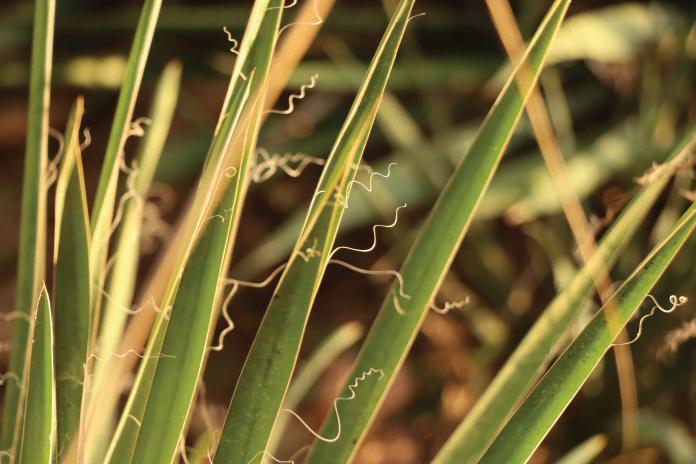
At Natural Falls State Park near Siloam Springs, Ark., I came across this plant highlighted by the sunlight. I was mesmerized by the “strings” and captured the detail of the confined scene. Canon EOS 90D, shutter 1/800 sec., f/5.6, ISO 3200
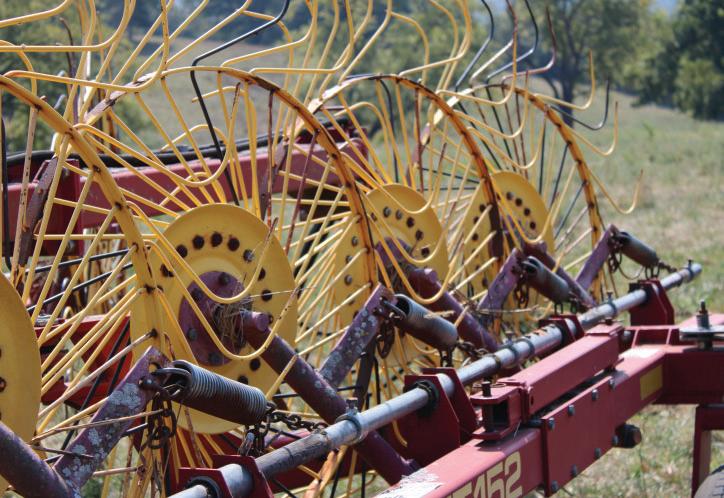
Caitlin Cook
Stella Quill Staff Color Photography
Cook is pursuing an associate degree in Photography. She hopes to continue her education at Missouri State University.
Maggie Marion East Newton High School
Bronze Color Photography
Marion is enrolled in a multimedia class that is challenging her to step outside the box and have a more creative and artistic outlook.
Quinlan Roberts Cassville Crowder Gold
Poetry
“Dead Man Band” is about a man grieving the inevitability of death. I wrote it as a jaunty and lively rejection of the doom and gloom that comes with that. I wanted it to be so whimsical that it has an almost comforting feeling to it.
Roberts aspires to be an archaeologist and a teacher in the future. Roberts has a love for all things writing and literature, and is excited to share his work in the Quill
Once I walked upon a grave
On a moonlit night, where skeletons lay
Is this my fate? My place to stay?
What a dreadful place, what an awful day
To go through life is such joy, and hope To be parted by sickness, how can I cope?
I dread my days, my days of ail
I wish not to know, what’s beyond the veil I looked upon that stony tombstone And up he sat, a man of bone.
He greeted me so “Hello there, sir!”
“I’m the skeleton man!” And with a whir
He bounded over, in a blur
“What a delightful night, you’re just in time
For the skeleton dance, a waltz sublime!”
I stood there aghast, my eyes gone wide
Til’ over yonder, my eyes did spy
Festival of the dead, moonlit, and tomb-side!
Stars winked and shone, those people of bone
Arms locked in dance, and tapping on woad
The skeleton man
Took me in hand
And dragged me along to that dead man band.
Where boldly out loudly
They danced and sang proudly
To a song for the deceased
That brought them much peace
They took my whole span
Jahnee Presley
Carthage Crowder Silver 2D Art
I love skulls, and realism in art, but none have been quite like this. Colored pencil, refined to contour, solid lines, stippling.
Presley has a life-long interest in art.
The whole of my hand
And brought me to prance
In the skeleton dance
Hands clasped in hand
They danced on command
To the tune of the corpse band.
Tapping ‘round bonfire
To ivory lyre
They looked me in the face
As if they knew my place
They said, “We think you’re fun!”
“And weren’t you just about done?”
“You’re one of us now, a troubadour!”
“Part of the band, forevermore!”
I looked upon my own hand, and thought “Why not now? It shouldn’t be fought”
It’s natural as birth
Which gives us great mirth
So
I said yes, and looked upon my own hand
To see nothing but bone, white as salt-sand.
The bones looked at me then
And I looked at them
They said to me quickly
And macabrely succinctly
“You’re part of us now! Now give us a hand!”
So I took up a horn, lying by a stand
And now I play in that dead man band.
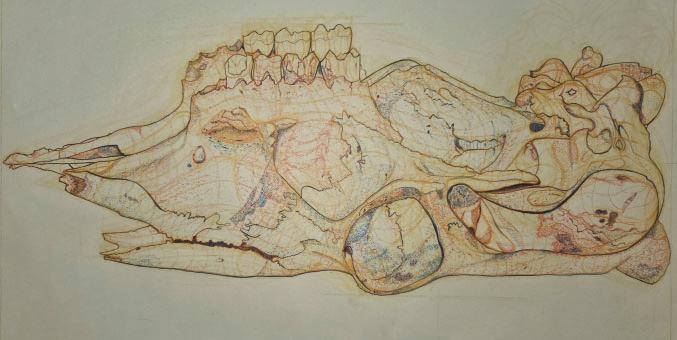
Bright as laughter, light as breath. We toss it high into the sky, As if we expect the color alone
To rewrite the weight of a moment.
But confetti always settles. And within this settling, It reveals its true nature.
We do the same thing inside ourselves.
We decorate ourselves With tiny pieces of pseudo-happiness. Quick fixes, half joys, fake smiles, It looks festive from the outside, But inside, it’s just debris. Emotional static.
The world praises this kind of brightness. We have been spoon-fed scraps of airbrushed joy, curated bliss,
Never letting anything sink too deep. To me, it feels like a sickness. A shiny, socially approved disease That we pass around because “feeling full” is easier than admitting we’re empty.
I’d rather be hollow.
Confetti Theory says, There is a quiet courage in clearing the table, then sitting in the bare space that remains. In letting emptiness, Be emptiness, without decorating it.
Imagine if we could actually see how much confetti a person chooses to carry. If it clung to them like dust, visible as scars or hair or clothing.
Would you chase the ones who’ve stripped themselves bare? Or gravitate to the ones Sparkling with distraction, The ones who look easier to love?
What if we sorted humanity, not by beauty or strength, but by the courage to sit inside their own emptiness, without manufacturing meaning just to feel full.
What if depth
Was the only currency. What if honesty Was the only language.
Without the fill and fluff of confetti, you have to face yourself.
Just you, And whatever truth is left in the room after everything colorful finally settles.
And maybe that’s the real work, living with the emptiness until it tells you what It’s been trying To say.
Samantha Cafferty Neosho Crowder Bronze Poetry
This poem came from a fascination with how we hide emptiness by decoration, and courage to sit with the truly bare, allowed confronting bright illusions, embracing honesty and strength in emptiness, to face oft avoided parts of self.
Cafferty, new to writing, but an observer of human experience, is drawn to resilience, self-discovery and inner depth. She illuminates strength, authentic beauty, and the full spectrum of emotion.
Lydia Churchill Carl Junction High School Silver Fiction Short Story
Inspired by a recent trip to Northern Ireland, where I had the opportunity to visit Belfast, and learn some of its history, I wrote this story.
Churchill, a senior, has loved telling stories since she learned to talk. She hopes to study creative writing at the U.S. Air Force Academy.
April 15th, 1941, Belfast, Northern Ireland
Maisie didn’t know when the sirens had stopped screaming. They were all of them so terrified in the shelter—Da with his arms around her, silent and rigid; neighbours and strangers shoved in one on top of another, reeking with sweat from fear and stifling heat; a woman praying aloud with a rosary and not a soul grumbling about it—and time warped under the press of terror and endless waiting. Eventually, though, she came to realise that the sirens and explosions were over, dawn was breaking, and it was finally safe to come out.
Da’s big hand swallowing hers, they staggered to the surface with the rest of their compatriots. Maisie blinked in the dusty morning light at the neighbourhood where she’d been born and raised. She might as well have been on the moon. The once-cheery streets were little more than a smattering of craters and heaps of rubble, relieved by the occasional battered structure. And fire. The haze in the air, she realised as they shuffled along, was smoke and ground-up bits of houses.
Da stopped abruptly before a gap between two half-collapsed buildings. The splintered base of a yellow-painted doorframe poking out of the rubble was the only thing that told Maisie where they were. The house where Da and his brother had grown up, the house where Maisie had been born, the house where Mum had died.
The house that had taken a direct hit from a German bomb.
For a moment, Maisie thought her father had forgotten to breathe. He just stared vacantly at the charred bricks and beams, all the colour drained from his face. “We’re safe. We survived the night,” Da finally rasped, and it sounded more like a question than a reassurance.
“James!” Mr. Shilliday hollered from down the street, waving urgently. “Quick! We need another man over here!”
Da placed a hand on Maisie’s shoulder. “I have to help our neighbours. You stay.”
“But, Da—”
“No, stay right here. I’ll come back for you.” With that, he hurried off, and it was just Maisie and the wreckage of the only place she’d ever called home.
A flash of green poking out of the heaps of crumbled stone caught her eye. Something had survived the bomb. Carefully, she clambered down into the crater. Rough debris scraping her hands and knees, she dug and pulled out a dusty bundle of ripped corduroy. A porcelain head stared back at her from between the folds, cracked in half like an egg. “Lilly,” Maisie whimpered, feeling four years old again as she cradled the broken doll to her chest.
“Are ye hurt, lass?”
Maisie looked up. A soldier in uniform stood on what was left of her front doorstep, peering down at her with a look of concern. Blinking away tears, she shook her head.
“And your baby?”
“She’s not real. Just a doll, see?” She pointed to Lilly’s busted head.
He smiled. “Ah. Lucky thing, too. Much harder to fix a baby.” To Maisie’s frown, he added, “Though you don’t feel very lucky, I warrant.” He crouched on one knee and extended a hand to her. “Doesn’t look safe for either of you down there. Come up, why don’t you?”
Maisie reached for his hand and allowed him to pull her out of the crater. His grip was firm, but his hands were deathly cold. “Um, thank ye, sir.”
He smiled, revealing a gap between his two front teeth. He looked young, with a smooth face and curly, dark hair not unlike her own. “I’m no ‘sir,’ lass, just a private. Call me Jasper.”
“Maisie.” She wanted to return his smile, but her face felt stuck.
His expression turned solemn. “Is this your home, Miss Maisie?”
“Was. Nothin’ left of it, now.” A knot built in her throat. “Ev’ryone said we wouldn’t be bombed ‘cause we’re too far away from England. Da says we don’t have enough shelters or guns to fight back. I don’t want the Germans to kill us,” she sobbed. “I just want my home.”
“Chin up, now, lass,” Jasper said softly. “That’s not gonna happen, understand? Me and the rest of our boys are gonna beat them and keep you safe. That’s why I’m fighting, y’see; I have a little brother, James, not much older’n you. I know it feels like the whole world’s at war, but you just have to keep your chin up.” Gently, he tucked his cold fingers
under her chin and tilted her head to meet his gaze. “My little brother’s not gonna be a soldier, if I can help it. We’re fighting a war to end all wars, Maisie. Lord willing, we’ll win, and we’ll rebuild our homes, and we’ll have peace. Once and forever, peace.” He smiled determinedly, eyes big and brown and earnest.
“Can ye be strong until then?”
Maisie sniffled and stood a little taller. “Yessir.”
“None of that, now,” he teased. “I’m still just Jasper to you. No ‘sir’ about it.”
“Maybe you’ll be a general after you drive Hitler out of France.”
His expression faltered. “Who?”
“Hitler! The one who took over Germany and started the war, of course.”
Jasper’s brows pinched together. “I don’t think—you mean the Kaiser?”
“No!” Maisie cried incredulously. “I mean Hitler. The evilest man in the world, Da says. Do you really mean you don’t know who that is?”
Jasper suddenly looked lost. Before he could answer, a voice from behind her called, “Maisie!”
She turned around. “Da!” She ran to meet him, broken glass crunching under her boots. His shirt was grimy with soot and sweat. “Da, what happened?”
“The Carters were trapped in their coal store. They’re out now, but a man from the Auxiliary Fire Service says we have to evacuate. Come on; no time to look for belongings.”
“Can Jasper come with us?” “Jasper?”
“He stayed with me while you were gone.” She turned back to the remains of their home, but the doorstep was deserted, save Lilly resting against the stump of the yellow doorframe. She looked left and right, but the only people she saw were their neighbours. “He was right here, Da. He said he was a soldier fighting the Germans. He has a little brother named James.”
Da stared at her, his expression unreadable.
“I’m telling the truth, Da!” “Maisie.” Da’s brown eyes glittered with tears. “My brother Jasper died in the Great War when I was a boy.”
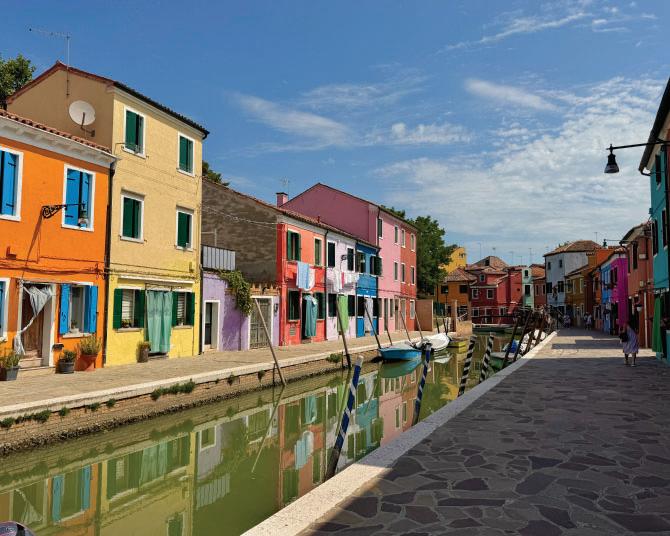
Amber Davidson Joplin Community Honorable Mention Color Photography
Being a group leader for EF tours allowed me to take this photo of the empty Burano streets, while sharing the amazing experience with my students and their families. iPhone 15 Pro Max
Davidson, an art and photography teacher for 15 years, fills her free time with art, travel and time with her family.
Alyson Massardo Monett Community
Honorable Mention Fiction Short Story
The theme of this story is slowing down, giving a chance to reminisce. What time takes in years, it gives back in a lifetime of memories.
Massardo is a graduate student and has competed in several art and literature competitions. She enjoys photography, reading and writing.
he candle was running low. Natalie made a mental note to grab more from the cabinet. She picked up the candle holder, continuing her nightly rounds. She lit the extra candles, making sure her husband would have enough light to walk around without problem when he came back. The light bulbs that needed replacing were another item on the growing mental note in Natalie’s mind. She kept walking, doublechecking that the doors were locked, the kitchen was clean, and the dog was fed.
Ellie Allgood McDonald County High School
Honorable Mention 2D Art
I emphasized the importance of mundane objects in life by appreciating their details. I layered vine charcoal, compressed charcoal, charcoal pencils, and white charcoal.
Allgood draws inspiration from our environment and hopes to become a wildlife biologist.
‘Finally,’ she thought, ‘I can rest.’ The days had been long without her husband the past two weeks. His work often took him away from her, long stretches of time where it was just her and the dog to fill the house. Him being gone didn’t use to bother her, back when they had kids running around. Their kids had grown up, faster than Natalie had wanted or noticed, and soon had gone, houses of their own to fill. Their youngest moving out is when they had gotten the dog. A present from her lover, a companion to stay with her when everyone else had left.
a few hours a day, and all the way at the top, it felt like you could see the entire world. She could stay up there forever, listening to the waves crash against the rocks. It was at the top of the lighthouse that he had asked her. A simple affair, the question asked as casually as one talks about the weather. It had shocked her, turning to look at him so fast she almost slipped. He had caught her, just like he always did. His smile shone brighter than the lighthouse light, but his eyes betrayed his nervousness. She had almost knocked them both down in her excitement and attempt to hug him. The picture on the wall was of them standing at the bottom of the lighthouse, him yelling to the world that she had said yes.
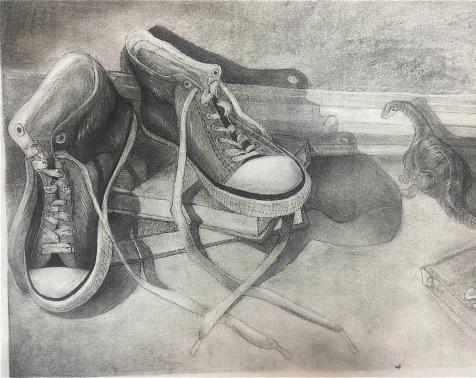
Scratching the pup’s head, she continued up stairs, pulling the blinds to cover the windows. The door to her office creaked softly as she shut it behind her. Slowly she walked through the room, stopping to look at all the pictures hanging on the wall, taking them in, feeling the memories attached to all of them.
The lighthouse on the beach was the first one. It had been where he had proposed. A warmer than average day, perfect for taking a stroll after lunch. The lighthouse had always been her favorite place to go to. Back then, it had been open to the public for
The second picture was newer, a picture of their first born, their beautiful twins. They were only a few years old in the picture, no more than two. They were at the zoo, feeding the giraffes. The twins had been begging all day, even as they got distracted by all the other animals. She remembers their excitement (and mild disgust) at holding the crackers for the giraffes to grab. The picture was of her husband, lifting the twins up high enough to hold the crackers over the fence. They all had matching smiles, shining bright enough she could almost feel the warmth through the picture.
She kept looking, her own smile growing as she examined each picture, recalled each memory. She settled into her desk chair, joints creaking like her office door. Time had caused that, just like it had caused the empty house. But as she sat, listening to her husband’s car come up the drive, the dog jumping up to greet him at the door, she couldn’t find herself angry at time. Time may be the cause of her problems, but time had given her this. A home full of memories. A heart full of love.
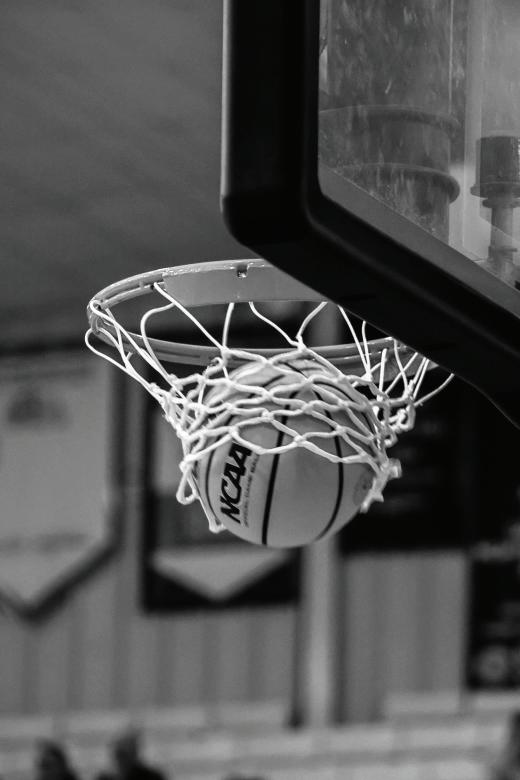
Maristela Lacour
Carl Junction High School
Honorable Mention Color Photography
I captured this photo from the top of the Arc de Triomphe, looking over the bustling city of Paris and its iconic landmark, the Eiffel Tower. iPhone 13
Lacour, a senior, has won various awards for her artwork and plans to major in business in college, combining her love for cultures, creativity, and entrepreneurship.
Jax Harris
McDonald County High School
Honorable Mention
B&W Photography
This picture represents the accuracy needed to make a basketball shot. Canon EOS R50, auto settings
Harris, a freshman, always puts others first and makes sure they feel welcome. He aspires to get his business degree and start his own company, and become a liked and respected man.
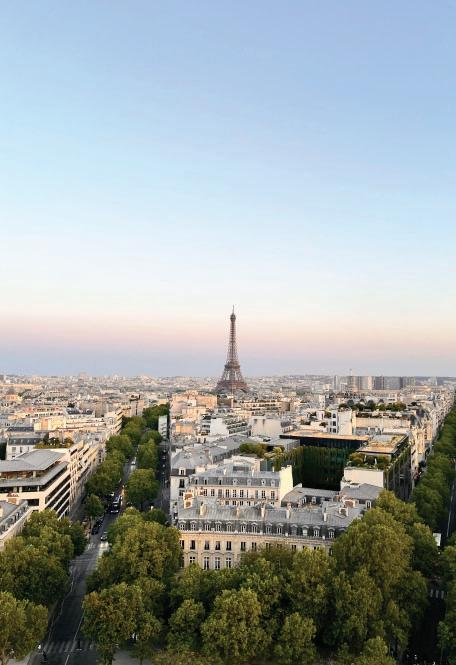
M.E. Rowe Seneca Community Gold Nonfiction Essay
Prompted to describe my favorite hobby led me to write this essay, which soon became one of my favorite pieces.
Rowe, an awardwinning fiction author, dabbles in multiple genres, but her true love is suspense. Writing in a secluded corner of southwest Missouri, Rowe resides with her beloved husband, two dogs, and a sassy calico cat.
f you asked me what my favorite hobby is, it would be a four-way toss-up between reading, talking, writing, and music. The simplest answer would be that words are my favorite hobby. Being a logophile to my very soul influences everything. It’s nearly unfathomable the difference twenty-six letters can make. A to Z are the makings of every word I’ve ever heard, read, written, or spoke.
As an early talker and reader, my love of words has been lifelong. Growing up, the adults in my life were never without a book nearby, whether it was Barbara Cartland, Stephen King, or Louis L’Amour. As an only child, characters in books were some of my first friends. My grandmother taught me to read because, she used to joke, if I could read for myself, I’d quit talking incessantly and stop asking for her to read to me every five seconds so she could have a moment’s peace. The joke was on her, the more I read, the more I wanted to talk about what I read. I also found that the more I read, the better my vocabulary became. Words themselves fascinated me; their origins, multiple meanings, and sometimes just the way they sounded or looked on the page.
Library days were always my favorite days growing up. As I got older, I found it harder and harder to return the books I loved, the books that became part of me. In my early teens I began collecting books, nothing worth any monetary value, but sentimental value is always worth more.
In my teens, writing and music became as much of a hobby as reading. Thoughts written on paper were easier to deal with than when they were left scurrying around my mind like rabid squirrels. Writing was therapy that became entertainment, which evolved into the need to create. Those same twentysix letters that made up every word I read or wrote, also made up every song I heard. Music inexplicably moves me, regardless of genre. The emotion in lyrics draws me in every time. My brain is full of obscure knowledge, and quite a bit of it is lyrics. You’ll always want me on your trivia team, but I guarantee you won’t want me to sing aloud!
Raising children in my twenties was an adventure. Part of the ride was teaching them to speak and read. I quickly realized maybe my grandma wasn’t joking about the reason for teaching me to read! However, singing silly songs and reading stories with my children
are some of my most special memories. Seeing the well-rounded individuals my adult children have become, in part, due to my encouragement of reading and music, is most rewarding.
Coming into middle age, without much of my family left to reminisce with, I have memories. Songs that we sang or played in the background at family functions, mainly Country and Western music, brings to mind family game nights with aunts, uncles, cousins, and grandparents trash talking someone for playing a Draw Four or an exclamation of “Domino!” Everyone goofing off, singing along and making up nonsense lyrics, so many words exchanged in love, fun, and fellowship.
I remember my dad listening to the Beach Boys and Jan and Dean records so loud the pictures literally shook on our walls. We sang along with every song and played ‘air drums’ as well. I inherited my mother’s eclectic taste in music. She could go from Fleetwood Mac, to Elvis, to KISS, to The Backstreet Boys without batting an eye. Yes, my mother loved The Backstreet Boys!
Seeing a Hardy Boys book in a thrift shop can sometimes move me to tears remembering my dad’s story of having to leave his Hardy Boys collection behind during a childhood move. On the flip side, seeing a huge selection of Harlequin romance novels in a thrift shop reminds me of my mom, grandma, and aunts doing their regular book swap and playfully fighting over who got which book next.
Seeing my mother’s name scrawled on the bottom corner of a painting she signed fills me with pride. The hand drawn blueprints and design descriptions of the wooden Barbie furniture my father carved is physical proof of the care and thought he put into making me happy. The old shoebox full of intricately folded notes written on spiral notebook paper. Words faded with age, once passed in secret in class and overtly in the hallways, remind me of my youth, lost friends and lifelong friendships. Handwritten family recipes with misspelled words and ambiguous stains, as well as old family photographs with carefully scripted details of names, dates, and locations on the back are some of my most prized possessions.
The older I get, the more I appreciate every letter from A to Z. Every loving and encouraging word that was ever spoken to me consisted of the same twenty-six letters, in
some variation, as the words I spoke in return. Those letters made the wedding vows my husband and I took over thirty years ago and still hold dear. Those same twenty-six letters on a keyboard bring me joy as I create words to hopefully entertain and encourage others. Every car trip and house cleaning day consists of listening to all kinds of music loudly and singing along horribly. I fall asleep and wake up to a podcast or an audio book. And books, well, the intoxicating smell of an old book shop is a natural high. My home library count
is into the thousands and my to be read pile knows no bounds, but they both keep growing. If you haven’t ever thought about the everyday miracles we receive due to the twenty-six letters of the alphabet, you should. And if you’re looking for a hobby; reading, talking, writing, and music, in other words, words, is the way to go! And if you need someone to share your new hobby with, come see me! We’ll read, write, talk, listen to music, and make memories.
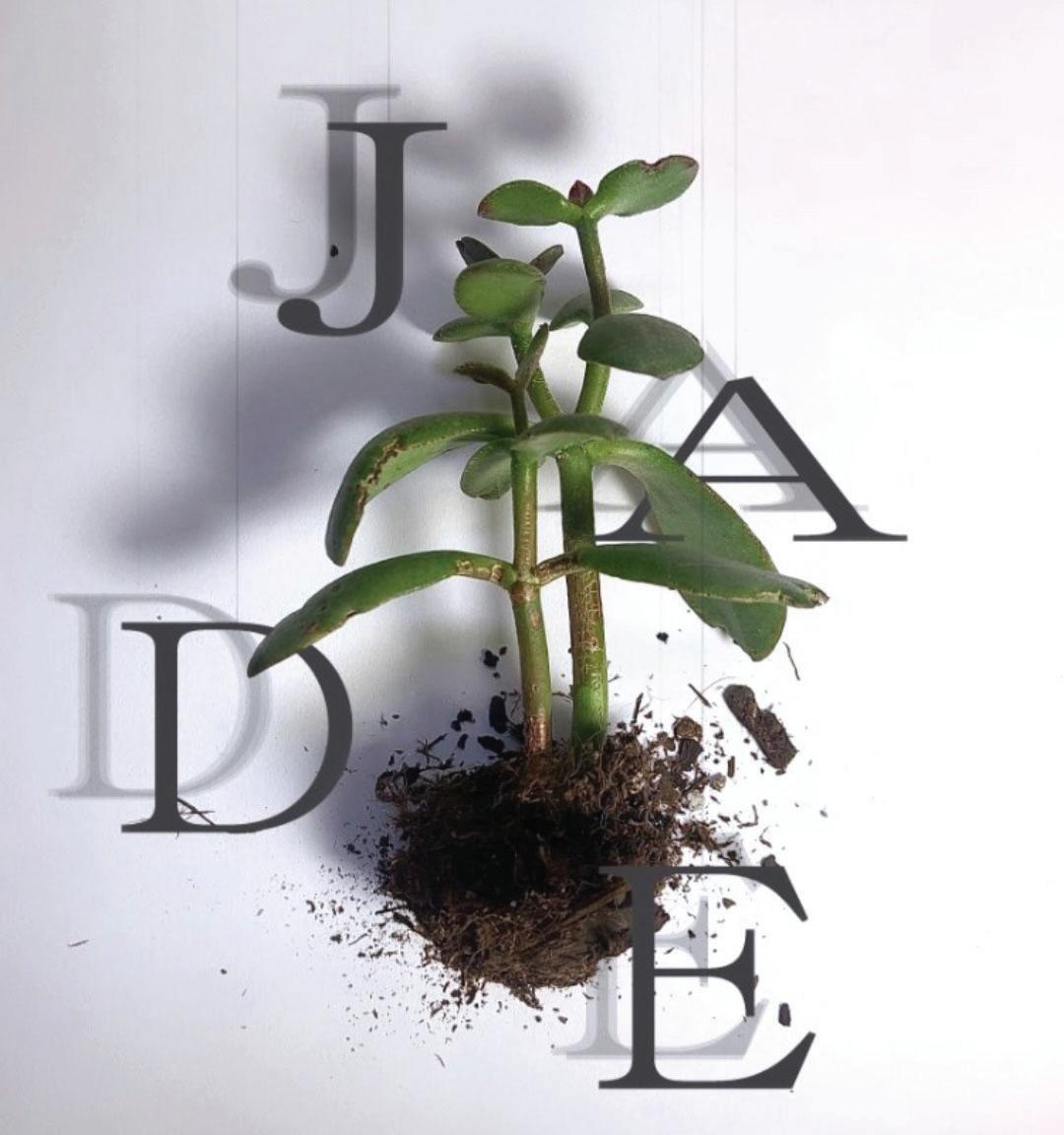
I wanted to take a photo of an object, practice using Photoshop, and turn it into something more. Canon camera
Knatcal is a long-time digital art and graphic design student who plans to find a career in a related field after graduation.
Sophia Anderson Joplin Crowder Silver Nonfiction Essay
I wrote this to explore things that drive a person’s responsibility to the United States.
Anderson is a selfproclaimed dreamer and creative enthusiast, who loves all creative arts, and hopes to soon be a published author.
here are three things that power a person: striving for success, fighting for justice, and the want for power. Everybody is affected by them at one time or another. Each theme has been repeated time after time all throughout history. They have been a part of American history from the start and they shall be a part of all history forever.
The strive for success in modern North American history started with Christopher Columbus. He wanted, like so many others in his time, to be remembered for finding the route to the Indies. He wanted to be famed and known as successful. Unfortunately he was remembered for some different reason. The journey for success was repeated when the colonies were formed. Each founder strove to build a colony to support their ideas. They wanted a place to practice their religions, support their culture, and to live their dreams. Appallingly the want for success drove white men to take an entire people captive, to torture them, and to make them do their work. Many white men used slaves to gain money and success.
The world is just a screen where our internal battles
it and most have acted on it more than once. The histories are crawling with stories of men and women which this want of power has led to their doom. The start of this abominable thing was years, decades, centuries ago but its first appearance in American history was in the very first story: the colonization. The king wanted more power so he sent people to colonize America. The people wanted more power so they raged all out war. After the war they still wanted more power so they refused to give up slaves, which then resulted in, once again, an even bigger war, against themselves. Brother fighting brother, families fighting families, man fighting man. For what? Another man’s wants and wishes. Power is blinding, the more one has the more one wants, the best power is the shared power.
projected.
are
The fight for justice started with a real fight. Not just some miserable fist fight, but an all out war. Many things led to the American Revolution, but the sense of injustice was the main influence. Though the founding fathers did not agree, they all agreed on one thing: the king was being unjust and irrational. These founders wanted their new country to have a just system. In response to this agreement they created courts, judges, and laws. They wanted to provide a just country for the generations to come.
Sadly, the want for power is as common as a loaf of bread in a house. Everybody has felt
Each of these themes are connected. One mans striving for success is another man’s fight for justice. One man’s fight for justice is another man’s need for power. Our harmless journeys for success and justice often end up a power blinded war. Not just a physical war but a spiritual one, not fought on a field, but in our hearts. It’s a war against what we think is right and what we truly honestly know is right. It’s a war that the evil uses to drag us places we can’t return from. It’s a war that God can use to strengthen us and guide us. He uses it to show us that power is not the answer, but he is. The issues which we see corrupting the world are not out there, but in here. It all starts somewhere, it starts in the heart. If we want to fix the world, we must first fix our hearts toward the world. The world is just a screen where our internal battles are projected. It’s not out there, it’s in here.
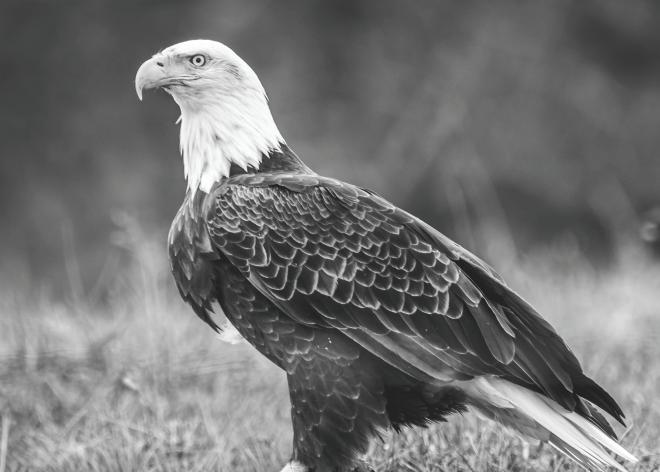
Steve Wilson Anderson Community Bronze B&W Photography
This moment in time, I captured for others to enjoy.
Wilson, a local photographer, strives to share what he sees through his lens.
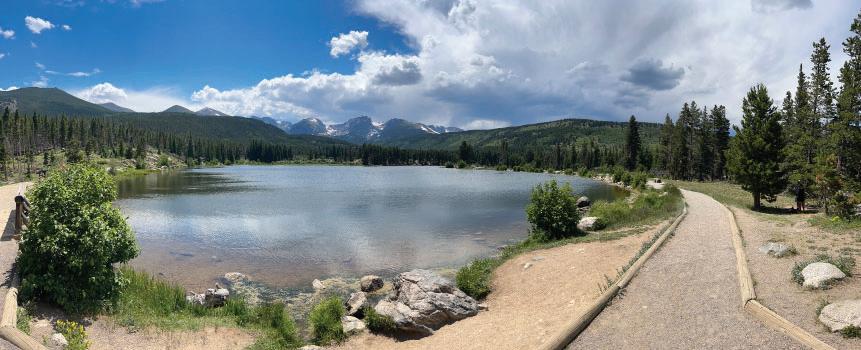
Mountain Lake Trail
*Logan Weaver | Carl Junction High School | Gold | Color Photography
While walking around Sprague Lake in Rocky Mountain National Park, I was inspired by the peaceful water and beauty of sunlight reflected in the lake. iPhone 14, auto settings
Weaver, a sophomore who has worked on art, especially drawing, for six years, recently began practicing photography. He hopes to work in architecture, so he can create drawings as he works.
*Scholarship recipient
Anderson Aurora
Carl Junction
Carthage Cassville
Crane
El Dorado
Fairview Goodman Granby Jane Joplin
Lamar
Loma Linda Marionville Monett
Mount Vernon
Neck City
Neosho Noel Pierce City
Pineville Pittsburg, Kan. Powell Purdy
Rich Hill
Sarcoxie
Scammon, Kan.
Seligman
Seneca
Shell Knob
Southwest City
Stark City
Stella Stotts City
Webb City
The magazine is a compilation of winning entries in literature, art, and photography from aspiring authors, artists, and photographers. Entrants generally reside in the communities within a 100-mile radius of the ten Crowder College campuses in southwest Missouri, including Cassville, Neosho, Nevada, McDonald County, and Webb City. They may be high school students, Crowder College students, or community members. The employees of Crowder College are classified as “community” in order to avoid competition with Crowder students.
Each entry includes an artist/author statement, which is a short reflection from contributors about their goals or reasons for creating a particular piece, including insight into the creative process, inspiration, or subject matter of their entries, as well as a biographical statement. For graphic entries, the technical process is included if provided.
For the 2025-26 contest, 919 entries were received, and 130 entries were chosen for publication. There were 97 individuals published, including staff entrants. Award winners were published and received certificates to be recognized as part of the 45th anniversary edition of the publication.
The following provides more information about contributors to the magazine, including high school and college students, community members, and the magazine staff.
The following high schools participated:
Aurora High School
Carl Junction High School
Cassville High School
East Newton High School
Lamar High School
Marionville High School
McDonald County High School
Sarcoxie High School
Webb City High School
Special awards are presented to the high schools with the most winning entries. The award is calculated on points: gold winners count as four points, silver as three, bronze as two, and honorable mention as one.
1st Place
McDonald County High School
2nd Place
Carl Junction High School
3rd Place
Webb City High School
Eduardo Salema, 2D Art “Vovo`” Cover
Carl Junction High School
Caitlyn Bonass, 3D Art “From the Ashes” Page 45 Cassville High School
Chayce Bowman, B&W Photography “Classic Muscle” Page 56 McDonald County High School
Logan Weaver, Color Photography “Mountain Lake Trail” Page 95
Carl Junction High School
Logan Barton, Digital Art “Agua Cristalina” Page 8 McDonald County High School
Raegen Phelps, Fiction “Ambition’s End” Page 60
Aurora High School
Dominick Trimble, Nonfiction “Jenny” Page 10
McDonald County High School
Rita Johnson, Poetry “Zombies” Page 66 Marionville High School
Gold high school entrants in each category win a $500 scholarship eligible upon enrollment in a course corresponding to the winning category. See more information on www.CrowderQuill.com.
The primary task of the Crowder Quill staff is to produce the magazine from contributed contest entries, not produce the contents themselves. However, staff members are required to submit entries as a class assignment to demonstrate expertise in their field of judging. Winning entries are honorarily published but do not receive awards. The staff entries published in this issue were judged by the following honorary judges:
• Literary entries: Quill faculty adviser Latonia Bailey and Roger Powell, English instructor
• Art entries: Art instructors Joshua Knott and Josh Novak
• Photography and digital art: Graphic design instructor Diane Vasilis
Staff members publicize the contest, select winning entries, and design the magazine. A variety of majors are represented on the staff. See the winning entries for additional author/ artist statements as well as biographical information from each contributor to the magazine.
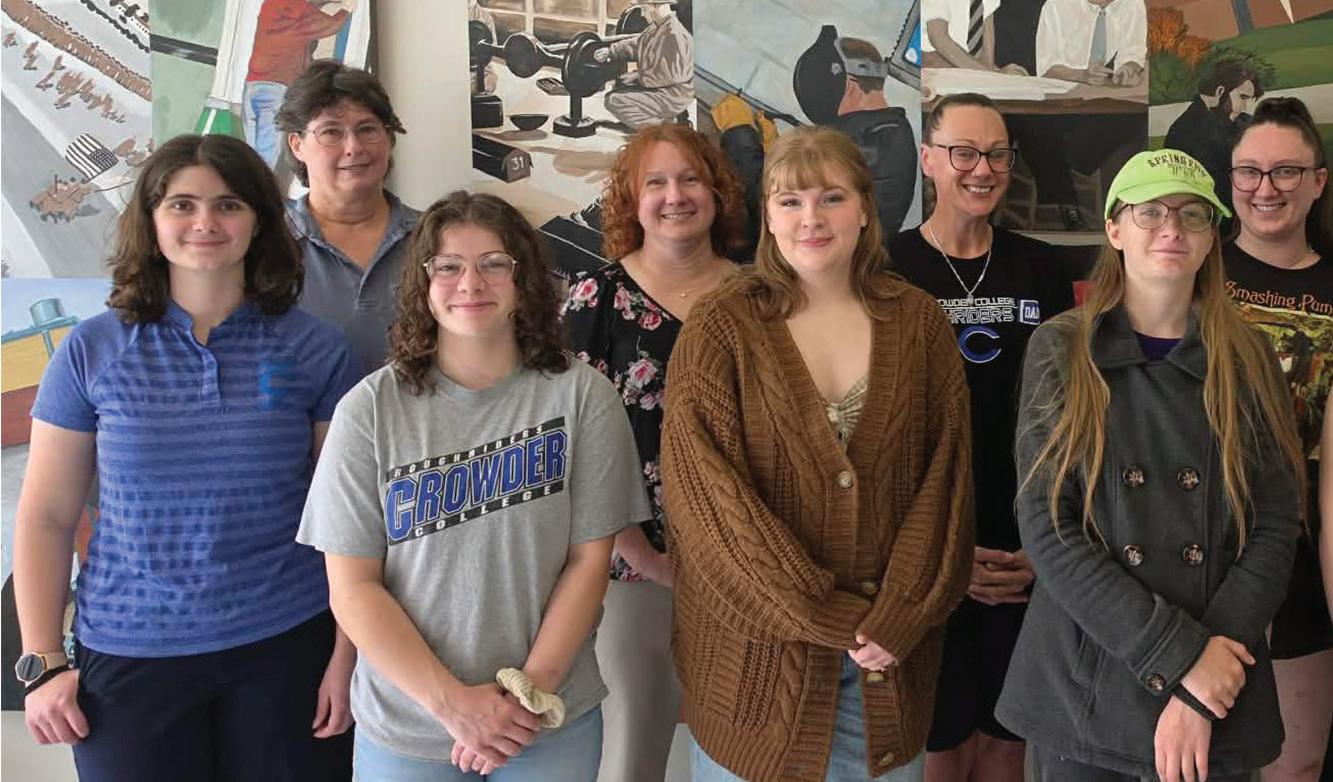
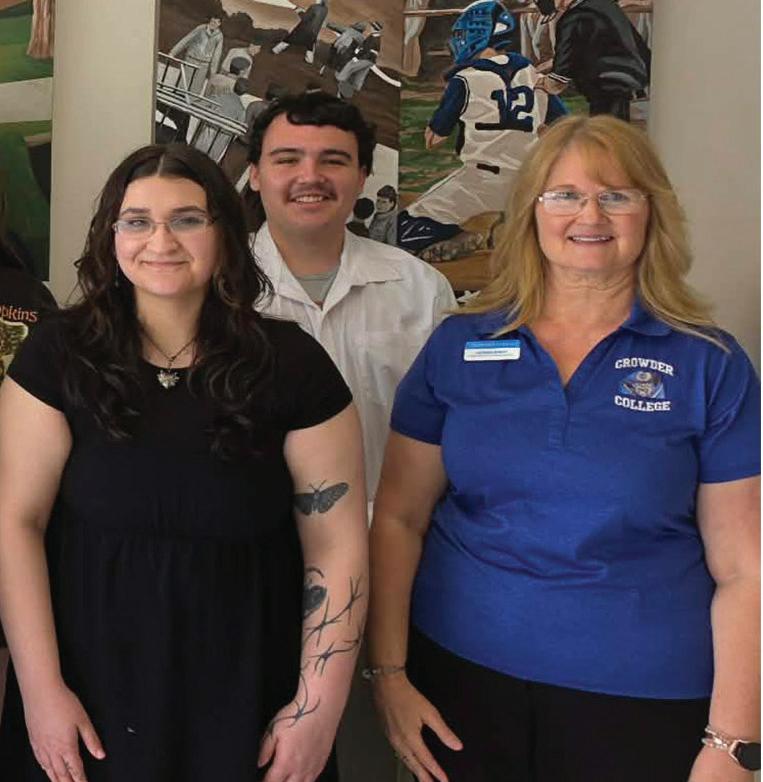
The magazine was a compilation of winning entries in the following literary and art categories. Various forms of each genre were welcome as publication submissions. All files are uploaded online. The following are common terms and explanations within each category. For more detailed contest guidelines for future contests, see www.CrowderQuill.com.
Original two-dimensional art may be black and white or color. Art should be created based on real life (still life, landscape, or live model), memory, or imagination rather than copied from published materials. If a source is referenced, credit must be given. Model consent is required.
Qualifying art must include a relief that protrudes at least 1/8 inch off the surface. Photographs of the art (front and side view required) should be uploaded online.
This graphic art category includes computergenerated art or extensively manipulated photographs in order to create special effects. Photography with only minor adjustments should be entered in one of the photography categories. Photo manipulations include using layers and filters for creative effects.
Black and white entries may be reproduced from film or digital files with only minor corrections and adjustments.
We seek film or digital files that emphasize vibrant color with only minor adjustments. All photography is judged on originality, contrast, composition, and artistic merit.
Essays, character sketches and other true-to-life writings should be limited to 1,800 words.
Clear plot development and well-defined characters should be limited to 1,800 words.
Free verse, blank verse, rhymed or metered verse poetry should make a point, state emotion, or relate an experience.
A Day at the Beach .............................................................................11
Fish out of Water .................................................................................7
From the Ashes ...................................................................................45
Girl’s Best Friend ...............................................................................49
Kalos’astra ............................................................................................43
Kita the Kitsune ..................................................................................46
Knife Handle ........................................................................................17
Like a Greek God ...............................................................................48
Natural Object: Shell .........................................................................11
Nature’s Inner Twines ......................................................................48
Red Squiggle Tea Set.........................................................................55
Sandworm ............................................................................................43
Sweet Treat ..........................................................................................55
Swirling Sky ........................................................................................49
Tea Time ..............................................................................................55
The Winged Fox ...............................................................................19
Agua Cristalina .....................................................................................8
Be Gentle ..............................................................................................68
CRT Dreams ........................................................................................13
Devils Tower Moon ...........................................................................41
Ferris Sketch ........................................................................................26
Flight of Fortresses ..........................................................................83
Fortune Plant ......................................................................................93
Harry Potter, The Cat, Owl, and Train ........................................99
Iridescent Bubble ................................................................................42
Matmos .................................................................................................75
“Not My Name” ..................................................................................74
Porcelain Doll ......................................................................................73
Sleeping in the City............................................................................78
What’s the Tea? ..................................................................................79
Beach Love .............................................................................................9
Behind the Chutes ..............................................................................63
Classic Muscle .....................................................................................58
Expecto Patronum..............................................................................47
Grace in Stillness ................................................................................61 Grand Teton National Park .............................................................32
Lazy Daisy............................................................................................24
Mine .......................................................................................................95
Moab Bluff ...........................................................................................64
Ring Ring .............................................................................................79
Silhouette ..............................................................................................27
Specter of the Sea ................................................................................8
Spider Waiting at Entrance of Its Funnel Web .........................21
Spine Black Mountain .......................................................................31
Swish .....................................................................................................91
The Tree Changes Too .....................................................................29
A Late Summer Bloom ..............................................................25
Blind Faith ...................................................................................52
Cow Skull .....................................................................................86
Dozing of the Trees ..................................................................28
Fall Reflections ............................................................................34
Foggy Mountain .........................................................................33
General Chicken .........................................................................81
Good Grief ..................................................................................66
La Birria ........................................................................................18
Mammoth .....................................................................................39
Ocean Oil Painting .......................................................................5
One Man’s Trash ........................................................................70
Pawp ..............................................................................................15
Reminiscence ...............................................................................90
River Crossing ............................................................................51
Sepia Dreams ...............................................................................22
Shared Horizon ...........................................................................78
Sunken Splendor ...........................................................................9
Vovó .........................................................................................cover
A Century Crowned ...................................................................57
A Northern Sky ..........................................................................16
Barber Shop Moments ..............................................................59
Belle Vue .......................................................................................91
Bogeys and Birdies .....................................................................42
Burano ...........................................................................................89 Butterfly ........................................................................................24
Cape May Winter .........................................................................7
Crowder After Dark ...................................................................67
Dragonfly, Oklahoma .................................................................23
Echoes of the Ozarks ................................................................77
Golden Hour ................................................................................38
Lower Antelope Canyon ...........................................................37
Mountain Lake Trail .................................................................95
Pier into the Ocean ......................................................................3
Strings ...........................................................................................85
The Ones Who Watch Over ....................................................35
Tools of the Land.......................................................................85
The Crowder Quill | 2025-2026 | 45th Anniversary Edition
A Haunted Family ...............................................................................71
Ambition’s End ....................................................................................60
Candlelight ............................................................................................90
Dragon’s Blight....................................................................................44
Food Tastes Stronger When You’re Hungry ...............................80
Griffin Greenfeld’s Final Message .................................................60
Home Is Where My Heart Is ...........................................................31
Once and Forever, Peace ....................................................................88
Running Toward Tomorrow ............................................................36
The Knocking in the Wall .................................................................21
The Mirror ............................................................................................12
Ubi Amor, Ibi Vita ...............................................................................25
Unrescued..............................................................................................56
Winds of Change ................................................................................83
All Together Now: Murmurations ..................................................26
Being Nana Claus ................................................................................58
Do You Dare .......................................................................................100
Dreams Do Come True ......................................................................14
How It Feels To Be Seen ...................................................................20
How Our Environment Affects Our Culture and Vice Versa .....4 I Believe Culture Is an Important Part in Our Life ....................76 It’s in Here ............................................................................................94
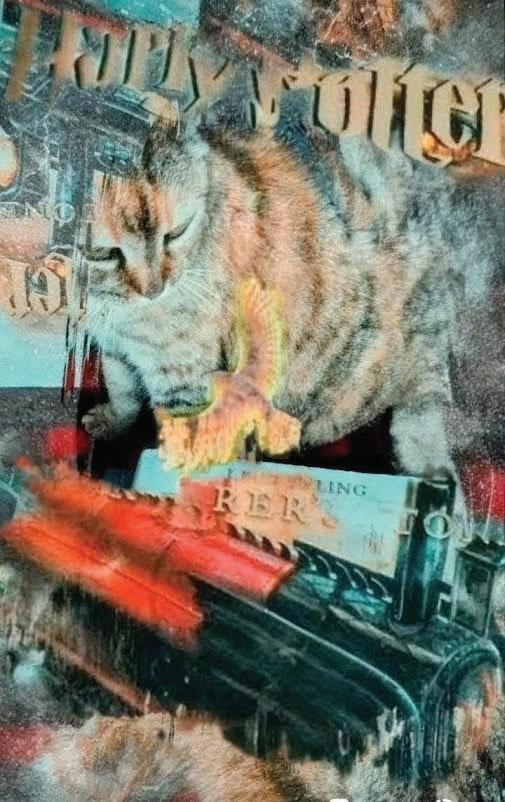
|
|
I photographed my cat looking at ‘Harry Potter and the Sorcerer’s Stone,’ by J.K. Rowling. I jumbled the photo using various tools. Messenger glitch tool. Lightbox Move, Eraser, Light, Contrast, and Filter tools.
Hilton captures moments with photography or art. She is relearning manual camera settings and new techniques in various media.
Cassandra Jordan Goodman Community Special Merit Nonfiction Essay
A person has a dream they want to become a reality. There are those who move forward with determination, and others who let the world crush those dreams. It doesn’t matter what others think. The only thing that matters is what you want and believe you can accomplish.
Jordan is a free-lance writer. Her career began when at the age of six, she knew she was meant to be a writer. She has grown from a Sam Spade typewriter to the complexities of a computer. Never giving up, she has overcome challenges to share her words with the world.
We recognize and honor Cassandra Jordan, founding Quill staff member, who has been a valuable supporter of the Crowder Quill through the years. Below is her reflection of the experience.
The snow lies pristine. Unmarked and waiting to be written on. But you know if you venture out, it will be hard. The snow will resist you, suck you down into its coldness and maybe even trip you and you will land on your face. The prospect leaves you standing at the window with your hands in your pockets, the desire rumbling through you, but you turn away. Afraid of the challenge, too timid to try.
When the subject of a literary magazine for Crowder College was brought up, it was met with skeptic raised eyebrows. The Ozark people are a no-nonsense individualist breed. You didn’t find literary magazines lying about the house. The people are too practical to waste their time on trifles.
But Mr. Richard saw the vast white expanse and believed it should be marked by stories and the work of artist. He stepped into the unwelcoming mass of cold and in a small, unused classroom he laid out his dream. We hammered out the details and I named it. We believed it could be done.
smallest beginnings leads to something thriving and vibrantly alive.
The magic of holding a book with your work included never gets old nor dims in the eyes of eager artists and writers. At a recent writer’s conference, a young woman came up to me. She had heard me talking about the magazine at a writer’s meeting. She was hoping to find a market for her work and submitted it to the Quill. Her eyes glowed as she told me she had been accepted. The excitement of acceptance, the anticipation of being published made her glow. A reaffirmation of what we had believed in and fought to bring to life.
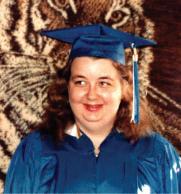
People hesitated to send in entries; actually then they were hand delivered to boxes in designated places. They smiled, lifted eyebrows, and a few made condescending remarks. But we didn’t quit, and the thin first edition came out. We met in a small conference room to hand out awards and pass out the magazine. We had made a path, and we hoped others would follow
Think of how many artists and writers have been published in these 45 years. I know I once figured out I had been in about 75% of the issues. My late husband, children and grandchildren have seen their work in the pages of multiple Quills. My youngest was on the staff one semester. Yes, you can stand at the window looking at the pristine snow, wanting to make your mark but just keep your hands in your pockets, your dreams and visions locked in the safety of your soul.
Safe, but you will never have the opportunity of knowing your words are being read and you are touching people, perhaps changing lives. Of all the things I have written, had published and won honors for…the ones I am proudest of, are my articles in the Standard
Original Quill Staff
Cheryl Ball
Patti Bowman
James Paul Dickey
Sally Geeding
Sandy Jordan
LeeAnn Sontheimer
Wesley Watkins
Dan Richard, Adviser
It wasn’t easy. The magazine went through many changes. It opened up to students of all grades and the community. The editors encouraged people to express themselves, to dream a dream and turn it into reality. The success of the authors and artist encouraged many. They used their experiences to launch their careers. Over time, the Quill went from twice a year to a single issue, and the school entries were narrowed to high school. It has changed with the times, growing in scope to meet the needs of an ever-changing world. It has won awards and made Crowder shine. It has gone from 20 entries to over a thousand.
The college began with two officer’s barracks and has grown into a beautiful campus of multiple buildings. It has expanded into satellite communities and is a highly respected institution. My sister was among the first to attend. In my family at least four generations have attended Crowder College. It seems that the
The Nazarene publication goes around the world, printed in many languages and distributed to their missions. I cannot calculate the number of people who have seen and read my words. My dream started out simply as the vision of a young girl sitting in a pear tree, embarrassed by a rejection. A rejection only means you have tried, you have learned and honed your skills. One of my rejections morphed into a very lucrative first place victory in a prestigious contest.
So, do you dare? Do you take your hands out of your pockets and make your mark, share your vision and feel the thrill of accomplishment? Or do you walk away and let others have their moment of glory, as they take their first steps toward a rewarding career.
The blank paper, the pristine canvas, calls out your name. Do you dare to answer the call? Or will you fade into the night, a shadow of what might have been.
Each year, the Quill recognizes outstanding service, contributions, and dedication to the Crowder Quill. See the opposite page for this year’s dedication to Cassandra Jordan, original Quill staff member.
2014 - The first Quill dedication was for James B. Tatum, who helped found the college in 1963 and served on the Board of Trustees for more than 50 years, distinguishing himself as the longestserving board president of a community college anywhere.

2015 - As Print Shop supervisor, Jon Finley printed more than 50 editions of the publication from the time he was hired in fall 1987 until 2015.
2016 - Dr. Kent Farnsworth, former president of Crowder College, was a great support to the Quill. Now a successful published author, Farnsworth serves as a model for aspiring authors, artists and photographers.
2017 - Dan Richard founded the Quill in 1980 to create an outlet for aspiring authors and artists and continued to advise the publication until 1988 when he retired. His legacy lives on.
2018 - Dennis and Charlene Bergen, retired art instructors from McDonald County High School, have been strong supporters of The Crowder Quill, helping many students through the years to enter the contests. They both were published in the Quill many times, demonstrating an example to their students.


2019 - All area high school and homeschool instructors who encourage their students to enter the contest were recognized. They inspire and influence their students in many positive, remarkable ways and foster an environment in which students gain confidence to pursue publication and awards with their creative works.
2020 - Produced during the beginning of a global pandemic, this edition was dedicated to all those affected by Covid-19. All campus activities were suspended during the last half of the spring 2020 semester, including hosting the Quill ceremony, which would have commemorated the 40th anniversary of the publication.
2021 - Nina Beaver, retiring chair of the Communications Division, has been a great support to the magazine and contest. Employed at Crowder since 1992 first as instructor of English and literature, Beaver encouraged many students to enter the contest.
2022 - Due to low enrollment in the course, there was not a 2022 edition.
2023 - James Paul (J.P.) Dickey, original member of the Crowder Quill staff in 1980, retired as a Crowder employee after 23 years. Dickey served in various roles, including theatre instructor, director, division chair, and director of Admissions. Dickey helped support the Quill throughout the years, including as keynote speaker for the Quill awards ceremony.


2024 - Emma LaRose, administrative assistant for the Communications Division and student at Crowder College, provided invaluable contributions to the production of the Crowder Quill. Emma went above and beyond, reaching out to a wider area of schools to invite them to participate in the contest, devised a more efficient process for creating award certificates, and spent countless hours sorting entries into the appropriate contest divisions, typing, and other duties.
2025 - Suzanne Prior, a May 2025 Crowder retiree, was a valuable supporter of the Crowder Quill during her tenure at Crowder as English/Literature Instructor. She encouraged her students to submit their creative works to the Quill and shared submissions with her classes. She also assisted with the on-site children’s Fine Arts Day that the Quill hosted from 2006-2011 in conjunction with the print publication.