Please note: this is not nal. Proofreading of this manuscript has not been completed. Errors will be corrected in the nal version.
No part of this manuscript may be used or reproduced in any manner without written permission from Crossed Crow Books. Any requests for reproduction can be sent to publicity@crossedcrowbooks.com.
Praise for Herne the Hunter
“Bringing a balance of lived Neo-Pagan practice and a historically informed analysis, Herne the Hunter weaves stories, meditations, and rituals into a guide for working with Herne and his many archetypes. Socially aware, locally grounded, and richly poetic, Rowan’s words lead us through strugle, breakthrough, inspiration, and connection—inviting us to discover our own. Te depth of insight refects a profound relationship with place and ancestral story. Herne the Hunter is deeply resonant for Australian readers and those drawn to Herne around the world.”
—Julie Brett, author of Australian Druidry
“In Herne the Hunter, Rowan Hunter takes the reader on a journey from whispered legend and spectral huntsman to that of a living Deity. Trough the weaving of folklore, devotion, and personal experience, the reader is encouraged to establish deeper connections with Herne who, all the while, remains where he has always been—untamed, challenging, and profoundly human.”
—Frances Billinghurst, author of Dancing the Sacred Wheel, Encountering the Dark Goddess: A Journey into the Shadow Realms, On Her Silver Rays: A Guide to the Moon, Myth and Magic, and editor of Call of the God: Exploring the Divine Masculine within Modern Paganism
About the Author
NOTFOR DISTRIBUTION
Rowan Hunter is an Eclectic Witch who has been practicing for over two decades and has been a Devotee of Herne the Hunter for almost as long. Teir practice is a mixture of Witchcraf, OBOD and Australian Druidry, mixed with heavy guidance from their Ancestors. Rowan took on the name of “Hunter” as part of their devotion to Herne. Tey live in the Riverina on Wiradjuri Country with their three cats, Bobba, Frankie, and Luna.
Disclaimer: Crossed Crow Books, LLC does not participate in, endorse, or have any authority or responsibility concerning private business transactions between our authors and the public. Any internet references contained in this work were found to be valid during the time of publication, however, the publisher cannot guarantee that a specifc reference will continue to be maintained. Tis book’s material is not intended to diagnose, treat, cure, or prevent any disease, disorder, ailment, or any physical or psychological condition. Te author, publisher, and its associates shall not be held liable for the reader’s choices when approaching this book’s material. Te views and opinions expressed within this book are those of the author alone and do not necessarily refect the views and opinions of the publisher. Tis publication and all of its contents, including artwork, were created exclusively by human minds. No part of this work was generated, assisted, or modifed by any artifcial intelligence (AI) tools.
Crossed Crow Books opposes the unauthorized use of AI to reproduce, analyze, or train models on this work. Any attempts to use this book, in whole or in part, for data mining, machine learning, or AI training purposes is prohibited.
Published by:
Crossed Crow Books, LLC
518 Davis St, Suite 205 Evanston, IL 60201 www.crossedcrowbooks.com
Printed in the United States of America.
IBI
Acknowledgements
I acknowledge the traditional custodians of the land on which this book was written, the Wiradjuri people, and I pay my respects to Elders past, present, and emerging.
I thank and acknowledge the Spirits of the Land for helping me ground, for their inspiration, for the joy it brings to my soul as I connect to where I live.
I have been bloging about Herne and other topics (to various degrees of satisfaction) since 2011 at BookOfEucalypt. com. I have had written dedications to Herne published in Call of the God by Frances Billinghurst (under my dead name) and featured in the Small Tapestry magazine through the Pagan Awareness Network (PAN) INC.
NOTFOR DISTRIBUTION
It is my hope that this book can be everything my blog is not—structured, coherent, and a better starting point for those who have heard the call of the Forest Lord.
Tank you to my wonderful partner for supporting my unyielding desire to write this book. It began as an idea at our
kitchen table in our frst unit and now has evolved into a work of dedication to Herne.
Tank you to those who helped me edit and brainstorm in this book’s earliest forms while I found its voice, particularly Shell, Shanda, Leanne, and Lily.
Tank you to everyone at Crossed Crow Books for helping turn this work of dedication into a physical reality.
NOTFOR DISTRIBUTION
About the Author | IV Foreword | XIV
Part One: Origins of Myth and Legend
Herne the Hunter: A Short Story ..........................................13 Who is Herne? ..............................................................................22 “Tere is an Old Tale Goes…”..................................................27 Te Reinvention of Herne ........................................................39 Becoming a God ...........................................................................45
Part Two: Exploring Herne’s Connections
Te Rutting Stag ..........................................................................53 Te Wild Hunt .............................................................................57
Activity: Connecting with Nature .......................................74
Sacrifce and Renewal ................................................................78
Activity: Charm for Focused Attention ..............................83
Kings of Oak and Holly.............................................................88
Sovereignty, Goddess of the Land..........................................97
Mental Health ...............................................................................105
Activity: Seeking the Gods with Intention .........................110
Activity: Water Blessing ........................................................114
Physical Charms and Symbols ................................................117
Part Three:
Rituals and Practice
Forming a Relationship with Herne .....................................127
Creating Sacred Space ...............................................................132
Activity: Creating an Internal Sacred Space 140
Activity: Internal Sacred Space Meditation ......................142
Ritual to Call Herne: Introduce Yourself ............................146
Ritual: Winter Solstice—Holly King ....................................153
Ritual: Summer Solstice—Oak King ....................................159
Calls, Incense, and Oils .............................................................165
Travelling the Year: A Tarot-Based Journey .......................171
Activity: Reading with the Cards ........................................175
Part Four: The Archetypes of Herne the Hunter
Ink Drawings
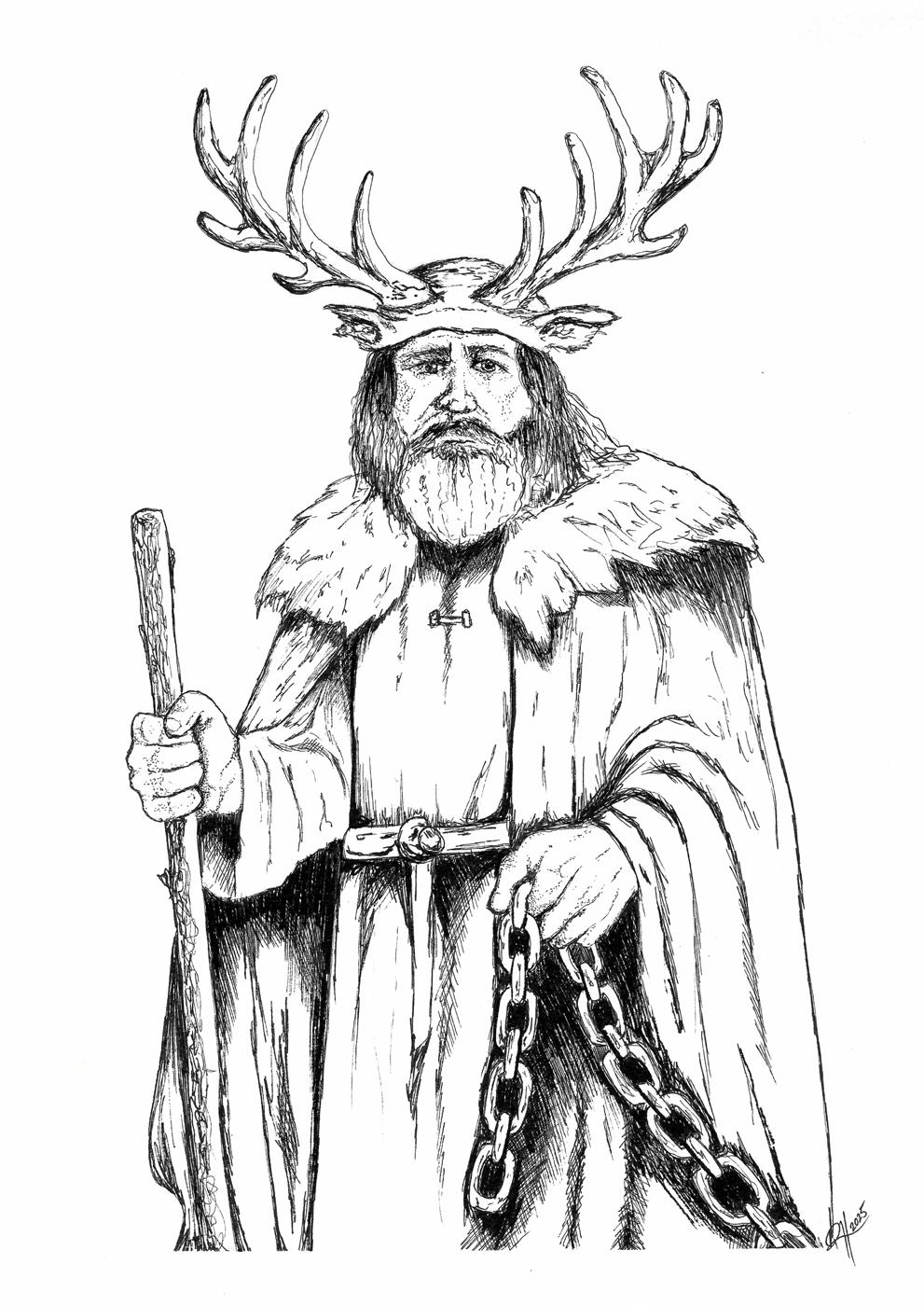
Herne the Hunter, as described by William Shakespeare in Te Merry Wives of Windsor ................................................................ 38
Herne as leader of the Wild Hunt .........................................64
Te Oak King ................................................................................87
Te Holly King .............................................................................90
Sovereignty, as she appeared in my dream ..............................104
Herne as the Hunter Archetype ................................................179
Tables
Travelling the Year in Tarot .....................................................173
Archetypes of Herne the Hunter and Corresponding Sabbats .....................................................182
NOTFOR DISTRIBUTION
Foreword
NOTFOR DISTRIBUTION
Many years ago now I met the author of this book—Rowan Hunter—at the frst all-day ecstatic witchcraf intensive I ever ofered to the wider Craf and Pagan community. It happened in the city I now fnd myself living in. I did not know that I’d be writing a foreword for a book of Rowan’s or that it would be so deeply devoted to Herne, but here we are. In the witching ways of things it ofen goes like this. I remember the person I met at this intensive as a dedicated, passionate devotee and blossoming mystic. Tis book to their patron is another testament to this.
Herne is a being I know little about on a personal level (more now that I have read this book!), but I have met Herne. I met Herne when I frst travelled to the Isle of the Mighty, that Island people call Britain or Albion. Tat was in August 2008. I met Rowan a year and a month later in 2009 in Gadigal Country, so-called Sydney.
In an Oxfordshire forest in the frst few days of a nineweek pilgrimage, we three Wildwood witches gathered and
Foreword
drew the Circle between the worlds. We tranced deep into communion with the land and the powers of the land rose up to commune with us. I remember feeling His presence, the profound presence of a being named Herne. I had surely come upon His name in books, but I had never quite considered this Deity, this folk-spirit, this legendary man. But there He was. Tinking back on this now I remember a sofness that was strength and a strength that was sofness, a deeply caring aura worn through by time, but not degraded at all. A forest myth moving through their native landscape and also something more distinctively familiar. A sense of humanity in there as well. A powerful sacrifcial god-being who carried the wild. My experience is that the beings we name as Deities, as Gods, throughout time and culture are great and noble spirits who arise from multiple roots and rivers. Tey are greaterthan-the-sum-of-their-parts and ofen emerge from and as the landscape. Tey come from archetypal and primordial powers, people, the cosmos, some human act of sacrifce, hope, and desperation; a crossroads or collision that either weaves that lineage into the spirit or conjures the attention of that being. Tis is ofen why certain Deities seem to adopt groups of people or are tied in myth and story to certain trees, towns, rivers, or landmarks. I once wrote,
NOTFOR DISTRIBUTION
A God is a spirit who has sacrifced themself upon the altar of their own story to give profoundly from that mythos, to be in and as that mythos, to enact that in the world.
In a way, the edges of a God both sharpen and refne around that story-myth, defned by it, but they also dissolve in such a way as to no longer carry that personality—both fxed and changing—that humans carry. Consequently and throughout culture, the Gods are said to be envious of us humans. We have edges in ways they don’t, and we don’t have edges in ways they do. It is my experience that, through partnering together, humans and Deities can deepen, reveal, and blossom! It is clear to me that Rowan Hunter has seen and felt a similar mystery in the becoming-a-god of a legendary human through the profound transformations catalysed by land, sacrifce, initiatory crisis, and folk process. Gods are tricky. Gods are confronting. Herne is tricky and confronting. And the Gods are also very good to their own.
In the Craf I know and love, the Gods are not our saviours. Tey may help to initiate us, to bring us into the mysteries, to challenge and jostle us. And if we rise to it, we change. Ofen we change for the better, but that choice or destiny is not up to Tem, it’s ups to us, the divinity that we are remembering ourselves to be. Working with the Gods is flled with opportunity for becoming.
NOTFOR DISTRIBUTION
Rowan Hunter has skilfully woven together folklore, myth, legend, anecdotes, experience, and carefully-considered ritual and magic into a modern grimoire for encountering Herne the Hunter. Tis book is a gif to Herne, it’s a gif to those who know and will know Herne, it’s a gif to the growing body of literature that modern spirit-workers,
Foreword
mystics, Pagans, and Witches gif to the world. Tis book is a gif. Hail Herne!
—Fio Gede Parma
NOTFOR DISTRIBUTION
Author of Te Witch Belongs to the World, Ecstatic Witchcraf, and Magic of the Pearl Pentacle.
Introduction
NOTFOR DISTRIBUTION
What happens when a ghost story, once whispered to frighten children, takes on a life of its own? When does the shadowy fgure haunting the woods, crowned with tattered horns, leading the Wild Hunt with hounds at his heels, become something more than a legend? Myths evolve over time, shifing from folktale to faith, from whispered warnings to sacred invocation. Herne the Hunter has followed this path, transforming from a local specter into a Deity honoured and revered in Neo-Pagan traditions. Tis isn’t a new phenomenon, as both Classical Rome and the Norse wove older, pre-Christian Gods into their pantheons, as Germanic and Celtic traditions adapted myths to ft their evolving beliefs.1
From the Neo-Pagan perspective that shapes this book, Herne was once a man who became a localised legend, who evolved into a God. He is not Cernunnos, although the com-
1. Bevill, Robert S. Goddess, King, and Grail: Aspects of Sovereignty within the Early Medieval Heroic Tradition of the British Isles. 2009.
Introduction
parison is an honour. He moves with the rhythm of the land, embodying the wild balance of nature as both the golden light fltering through ancient oaks and the deep, untamed darkness of the forest at night. He is the sun’s warmth on your back, and the silver gleam of the moon above the trees. Both hunter and hunted, he carries the raw, untamed pulse of the wild: the strength of a stag in full stride, the gentle descent of an autumn leaf. He enacts justice with fury when wrongs are committed, yet his laughter is deep and rich, and his humor is sharp.
Herne takes many forms. Sometimes he is the towering Huntsman, with his antlers crowning his brow, his hounds loyal at his side, and his voice like the wind through the trees. At times, he is the storm itself, thundering across the sky on a midnight-black steed whose eyes burn red as he leads the Wild Hunt. Other times, he lingers in the shadows or watches from the protection of the leafy canopies above you as a silent observer of rites cast beneath the boughs. And then there are moments when he walks among us. In this form, his presence is unmistakable, his long hair tied back with a leather cord, the scent of moss and woodsmoke clings to his skin. His eyes pierce while a knowing smirk plays at his lips as if he’s just thought of a joke he knows you’ll appreciate.
NOTFOR DISTRIBUTION
Within modern Paganism, Herne stands among the great Horned Gods, alongside the likes of Cernunnos, Dionysus, and Pan. It is important that we understand that he is not simply a
re-creation or a localised version of these Gods. He is neither as ancient as Cernunnos nor as primal as Pan. His presence is distinct with his own spirit, his own energy, his own quirks, and his own mythology.
NOTFOR DISTRIBUTION
He is the Oak King, locked in eternal battle with the Holly King as the seasons shif. He is the masterful hunter and wild guardian of the land; he is the sovereign and champion of the forest. He is the steadfast guide for those honing their craf. He challenges, comforts, and stands beside those who seek him through various forms, sometimes as a father, sometimes a lover, a brother, or a mentor.
And unlike most Gods, Herne understands what it means to be human, because legend holds that he was once a man himself. He will not walk your path for you, but he will light the way. He will ofer wisdom and guidance, and the quiet certainty that you are not alone as you carve your own journey through the wilds of life.
As you read this book (whether you absorb every word or simply skim a few passages), I urge you to approach it with both an open mind and a healthy dose of skepticism. No book, no matter how well-researched or passionately written, can fully defne the essence of a God. Your personal experiences and your own connection with Herne are what truly matter. His presence isn’t something that can be fully captured in words, as with all beings, it must be lived, felt, and explored frst-hand.
Having honoured Herne for more than half my life, I’ve learned (through trial and error) what he values and what he
fnds amusing. One of the greatest lessons? He isn’t concerned with rigid formalities. If you offer water instead of alcohol because you’re underage or participating in Dry July, he understands. He enjoys a homemade offering, but he’ll accept something store-bought just as readily. And if you leave a gift in a sealed container with the explanation, “It’s the middle of summer, this is sugar-coated, and I don’t want ants ,” he will almost certainly find it amusing.
I’d also like to note that this book is intended as a companion to the works that came before it, contributing to the ongoing exploration of the man, the myth, the legend. In Search of Herne the Hunter by Eric L. Fitch and the rarer “Herne the Hunter: A Berkshire Legend” by Michael John Petrie are both excellent resources, rich with folklore and historical research. Rather than retreading the same ground, my focus here is to expand the conversation in new directions and to explore not just the history, but the living presence of Herne the Hunter.
How I Found Herne
NOTFOR DISTRIBUTION
Te name “Herne” has always been in my vocabulary, long before I was introduced to Witchcraf and all the other beautiful paths within the Neo-Paganism umbrella. It was a name I learnt as soon as I had to write my address, because I grew up in the Geelong suburb of Herne Hill. It used to be a little suburb ofen associated with the Geelong Cement Works and divided by a train line that once ran through it. It was the fnal suburb of the Geelong West region, where you could ride your
Herne the Hunter
bike up to the edge of the Moorabool Valley and watch the sun set, casting shadows over the paddocks and farmland.
Before I began dreaming of a man with antlers, who would shape-shif before me and encourage me to run through the forests of my mind, it was the name of a street I would ofen walk down afer school on my way to my grandparents’ house. It was the name of the local state primary school that the kids in my street attended, while I attended the local Catholic school (and was envious of my neighbours because they got to wear pants in winter to school).
Herne represented an area long before I realised how much greater power existed within that name.
I have memories of deciding that my Catholic upbringing was not for me, as in March 1998, listening to Silverchair and just having that lightbulb moment of, “this isn’t for me.” My mother remembers it as beginning two years earlier. In the car afer my First Confrmation, I removed the red felt shawl from my shoulders and said, “Well, that’s the last of the Sacraments done!”
I was twelve.
NOTFOR DISTRIBUTION
Like all good girls at an all-girls Catholic high school (particularly in the 1990s), we went through “a phase” where we dabbled in Witchcraf and the occult. Tis is where I was introduced to Witchcraf, and the concept of duality within the God and the Goddess. Te internet was new, social media wasn’t a term that existed, so there was a lot of fumbling around in the dark.
Introduction
My favourite explanation of how I navigated those early days of my path is to picture a caught fsh that has leaped out of the fsherman’s bucket and is trying to navigate its way back to the water.
NOTFOR DISTRIBUTION
I didn’t know it was Herne who would join me as I frst began meditation to ambient nature music, or that a particular animal in that space was my Fetch. Tere was a man, and that man had antlers, and there was a dog that sort of resembled a wolf but also sort of resembled a German Shepherd, but also didn’t resemble either. I knew the man was a Horned God, but that was the extent of my knowledge. And “Fetch” wasn’t a term I was aware of within the vocabulary of folklore, and it would be a long, long time before those dots were connected. In retrospect, I believe it was kismet that I put the wrong course as my frst preference when I fnished high school. If I had gotten into graphic design frst instead of multimedia design, I would never have sat in a computer lab bored at eighteen, typing in random words into a search engine. I never would have thought to look up the origins of the name of my suburb and would never have learnt Herne’s name.
Trough that pathway, I came across the image of “Herne the Hunter” by Marc Potts, with his green skin, ivy crossing over his chest, and the antlers upon his crown that I would see when I closed my eyes. Tat was it—it was him. I saved the image to a foppy disk, used it in a JavaScript class, and later beged my mother for use of her credit card so I could purchase a print from the artist.
It was another year or two before I performed a SelfDedication to the Craf. I had a bath with lavender, I purchased a pendant to represent the moment, I took myself out to the You Yangs Regional Park, and, from memory, that was when I frst properly called Herne into a rite.
NOTFOR DISTRIBUTION
Tis was really quite daunting because it meant that he was no longer a subconscious consideration of my imagination. Verbally acknowledging him in this manner and calling him in to witness this ritual when I was still so incredibly new to everything was scary. I had not long purchased a “Book of Shadows”—black vinyl book with gold lettering, and I was still utilising the books on Witchcraf as textbooks. I wanted to learn everything straight away and devour everything I could. In my naivety, I wasn’t aware of the extent that this path would take me within both the whole of Neo-Pagan pathways, and as someone walking with Herne.
Shortly afer, my altar went from a packing box with a pillowcase over it to me re-utilising my cofee table. I had my Marc Pott’s “Herne the Hunter” picture on my altar, and soon that was joined by a plushie of Simba from Te Lion King Broadway Musical as another representation of the animalistic and powerful aspect of Herne and the Horned God.
As I grew within my practice, my path changed in various directions. I learnt that Herne wasn’t as big a fan of joining me in rituals held at the beaches of the Great Ocean Road as he was within the bushland and forests of the You Yangs and Otway National Parks. For a long time, within ritual at least, I felt as
Introduction
though he stood on the boundary of my energetic circle, just watching on. It was very reminiscent of how teachers will watch you as you do a practical exercise at TAFE or university because they want you to learn for yourself, and make the mistakes, and nudge you every so ofen to what you should consider.
My practice changed dramatically once I moved to Western Sydney because the water was so far away, and the land felt so incredibly diferent. To help me understand this new environment, I began learning with the Order of Bards, Ovates, and Druids. I learned about the spaces within suburban Sydney that, while beautiful, should be avoided (especially alone) and which were safer. I met new people who expanded my world with their own knowledge and introduced me to aspects of the Craf that I hadn’t and would probably never have discovered in books. My gratitude to these individuals is immense.
My relationship with Herne deepened and evolved. Te more it grew, there was an incredible pull and, at the time, the only way I could describe it was “marriage.” Later, I learned the term was to become a Devotee, or a Dedicant, and honestly, the change in the language made me feel so much more comfortable with the idea!
One August Full Moon, I dedicated myself and my path to Herne the Hunter.
NOTFOR DISTRIBUTION
I got his silhouette tattooed on my arm. I began a Bachelor’s of Natural Science degree to change work felds into Environmental Management as part of my devotional practice. Ten life changed, and I was unable to fnish my degree.
In time, I came out as non-binary and queer. I lef my husband and changed my name entirely. Taking on “Hunter” as my new last name was such an obvious decision, and it was another act of my devotion to Herne.
NOTFOR DISTRIBUTION
Ten came the idea for this book. I had written two incarnations of the “30 Days of Devotion Blog Project” a few years prior and thought, “What if I expand on this?” Over the course of several years, this went from an idea at my kitchen table to me re-writing “How I Found Herne” for the nth time because he and I had a 5 a.m. conversation while I was feeding my cats, and he thought I could do better.
Why Tese Rituals are Made to be Adapted
As someone who is both autistic and has ADHD, I understand rituals need to work for you, and what others have written may leave you uninspired. I have intentionally included sugestions for alternative ritual activities that can be easily modifed to suit your personal comfort and practice. My hope is that these rituals serve as inspiration, allowing you to shape them in a way that feels right for you.
My experiences in ritual spaces have also given me the opportunity to work alongside individuals with a wide range of physical abilities and mobility challenges. Because of this, I am very aware of the importance of accessibility and the concept of “spoon theory,” the metaphor describing the limited energy those with chronic illness have access to.
Introduction
I have called upon Herne while hiking to breathtaking lookouts at my ftness peak and while relying on a walking stick in my early thirties due to health problems. As everyone approaches rituals diferently, and our ability to engage in spiritual practice can vary from day to day, it is important to me that the rituals and meditations within are accessible.
He will delight in an incense blend that you craf specifcally for him, but he will just as easily accept the lighting of a store-bought incense stick if that is all you have the energy for. To Herne, the sincerity of your connection matters far more than material oferings of monetary value. What he truly values is your time, your energy, and the efort you put into building a meaningful relationship with him.
I hope that within these pages you fnd the guidance and insight you seek in your journey with Herne the Hunter. My goal in writing this book was to create something that teenage me would have dreamed of owning, a resource that I longed for when I was just beginning my path. What started as a personal project has grown into something far greater than I ever imagined, and I am honoured to share it with you.
Brightest blessings, Rowan Hunter
NOTFOR
NOTFOR DISTRIBUTION
NOTFOR DISTRIBUTION
PART ONE
Origins of Myth and Legend
Herne the Hunter
A Short Story
By Rowan B. Hunter (2012)
NOTFOR DISTRIBUTION
Once upon a time, I was just a man.
I was a son, a brother, and a lover to many women, provided they had a pretty smile and sat on my knee of a night over a drink with the lads.
I had a wife, but I lost her and my son to childbirth. I was so distraught that I married myself to the hunt. Tat was my passion—that was my life, and I loved no other woman.
I was one of eight children—three sisters, four brothers— and I was somewhere in the middle. We weren’t rich, but we had enough. My father made sure that we all could trail a rabbit through the forest without making a sound. Not many people can claim they can do that, but it kept food on the table when there was no coin. Bloody taxes, they were the death of so many families when I was a lad.
Herne the Hunter A Short Story
Hunting was what I did. I lived for it, and I was bloody good at it. Not many could best me, even in my youth, and I never came home empty-handed.
We didn’t attend school, as that meant going to see the Vicar. If they had to send one, they had to send all. My mother knew how to read, and she had taught the eldest the basics, who then taught we younger ones when she was busy running the house, ensuring we were all kept out of mischief, including my father.
No one knew the forests like I did. Tanks to my father, I knew every trail, every tree, and every hiding spot. I knew what hole a burrow was and what was a den. I could tell how old the animal tracks were, which way they went, and why they probably went there. I could tell one tree from another, knew the call of the birds, what calls meant danger, and when I had been spotted. I told you I was good. Well, I was good enough that the King himself became impressed with me, and I soon became His man. He was a bloody fne King, if I say so myself. Not everyone liked Richard the Second, but you didn’t have to like a man for him to be a good ruler. It helped when your people liked you, but it wasn’t absolute. Just don’t let anyone hear you say that, and you’ll keep your head on your shoulders.
As I was saying, I soon became His man. Some called me his favourite, but I never heard it from his mouth. He liked how I knew where the game was in Windsor Forest, and I could guarantee him a good day of hunting. Tat didn’t win me friends, but I was foolish.
Who needed friends when I was the King’s man, right?
Always keep friends, as even friends can become enemies, likely to put a knife in your back, then plead ignorance.
One day, and a beautiful day it was in Windsor Forest, the rain had been steady, so the ground was nice and damp. It can make tracking the animals harder at times, but sof leaves and ground don’t make as much noise as when dry. Te Royal Hunting Party went out—the King, me, along with other hunters in his service and his guards, and a couple of hounds—the only sound we made was that of the horses’ hooves and the dogs snifng excitedly along the ground. Te hounds caught a trail, and of we went galloping through the forest, chasing afer them. Tere it was: Te most beautiful creature we had seen in Windsor—a white deer.
Oh, what a prize that would’ve been. A rare fnd, indeed.
On went the chase. His Majesty at my side, we led our horses at such a speed, never losing sight of it.
NOTFOR DISTRIBUTION
At His Majesty’s command, the arrows were released. We didn’t want to slay it, merely bring it down. Slaying such an animal is a crime unless you’re the King himself. His forest, his rules. It was trapped, unable to go further through the thick landscape. His Majesty was of his horse, his sword in hand, ready to make the kill, but the stag retaliated and came for him.
I didn’t even think about what I was doing, I just did it—I stepped in front of my King, plunged my sword into the stag’s heart… and that’s all I remember. I woke up in a strange hut a few days later.
Herne the Hunter A Short Story
Te stag’s horns had done damage, but a Wise Man, Urswick, had appeared and ofered to tend to my wounds. Wise Man, Magi, Sorcerer, Wizard, he went by them all. I drank vile tonics and had foul-smelling ointments applied to my wound, but it did the trick, and I recovered to full health. Something deep within me told me not to trust him, but there’s not a lot one can do lying in the sick bed with a deer’s bloody head tied to yours. But something was wrong.
I fought my way out when he insisted I stay bedridden, and once I was able to stand without wanting to pass out I was back on my horse and in the forest with my King. It was good to be back—weeks staring at mud brick walls were enough to make anyone go mad. I missed the smell of the woods afer the rain, the calls of the animals, the feel of branches brushing against me as I stalked my prey. I smelt the woods, and I heard the calls, but for the life of me, I couldn’t fnd the prey.
I knew something was wrong, and it pained me to hear His Majesty disappointed to bring back any game. I kept falling short, and the other men soon took over in the lead, fnding the odd wild pig or pheasant. But no matter how many they found, His Majesty still looked to me.
NOTFOR DISTRIBUTION
Te men didn’t like that, so they set me up to fail. Tey were jealous, envious bastards.
I didn’t know what they were doing at the time. Tey told His Majesty that I was going out at night to hunt, leaving nothing for the day’s royal hunting party. He refused to
believe this and continued to look to me. Tey bode their time, and day afer day, I found nothing.
It was wrong: I did everything right. I couldn’t understand why I couldn’t fnd a single animal.
NOTFOR DISTRIBUTION
Te opportunity presented itself, and once more the others pointed to me. His Majesty, ready to put this slander to rest, ordered my chambers be searched. Not much I could do when the evidence is stacked against me. Hides from game—wolves, deer, foxes, pigs—all found their way into an unused chest and closet.
But it wasn’t me.
His Majesty was foolish enough to believe the lies and had me publicly disgraced. He was ashamed, and I was bloody outraged! I maintain my innocence—to this DAY, I maintain my innocence! It was not me!
Foolish man. Foolish, foolish man.
He banished me—banished me!—from the castle, from the kingdom, from the realm. I had been publicly disgraced, and I had lost everything—the praise of my King, my ability to hunt, my ability to live. Had I been banished but still able to hunt, it might have been diferent. But it wasn’t.
I was found the next day hanging from an old oak tree in the forest. I had no other choice—I couldn’t live like that, feeling like only half a man. Te hunt was everything to me. To feel the beat of the earth beneath my feet, the change of wind against my cheek, stalking like an animal of the forest; that was what I lived for. Why live when I couldn’t have that?
Yet I found no peace in death. In death, I discovered the truth from that fateful day in the forest. Urswick had told the hunting party and His Majesty, that I was to be carried back to the castle in a litter with the head and horns of the white stag tied to my head. It is an old belief that horns from any beast—stag, bull, and the like—represent new life and fertility. An old belief, and the men, prone to superstitions, went along. Or so I thought. In return for my full health, the Wise Man took my hunting skills. He stole them from me, at the wishes of the other hunters.
As I mentioned earlier, they were jealous, envious bastards. In death, those horns remained. Tey soon became a part of me, and I was both man and beast: a true animal of the forest. I stayed away until King Richard the Second died, and a new King was crowned. Each winter, I sought revenge. Each of the King’s favourites soon lost their hunting skill, and before long found their way to me and joined my own hunting party. We rode on horses, black as the night sky, with hounds at my feet, collecting unsuspecting souls that wandered along, or dared to question me. Te rage that lived within me was overpowering, overwhelming, and fantastic.
I got my revenge. Man, woman, child—it didn’t matter. Tey all found their way to me, and I accepted them all.
But the world changed, and so did I. Deep down, I was still loyal to the land, to the forest, and to my King. Outraged? Yes. Betrayed? Absolutely. Taking lost souls to join me for my hunt lost its hold over me. My story soon became myth, and myth is
ofen changed to suit the times. So, I, too, changed over time, and I found my balance.
Sovereignty. Oh, she was beautiful. She came to me as a young maiden dressed in a shimmering white gown that clung to her curves, with gold chains and jewels in her tied-back blonde hair. She introduced me to a new way of thinking, that I could still maintain a strong element of the man I once was.
I learnt that I could still honour my land and country, be one for my land and country, without giving full loyalty to the Crown. I could still be loyal to the kingdom, but not necessarily to one King or Queen. Rulers die, the hand that governs change, but the spirit of the land, the spirit of Albion, of Britain, of England, will always remain. Its history, its power, and its essence will remain long afer you and I are but a forgotten memory.
So rather than a hunter of the forest, I became Lord of the Forest, to some at least. To those who honour the old ways, who honour the changing of the leaves and the fow of the river, I became one of many facets of the Horned God.
NOTFOR DISTRIBUTION
I became the Hunter once more, but rather than a man who lost his skills, I became one honoured and revered for his ability. I was once just a man, but now I represent so much more to those who remember my story: the thrill of the chase and the thrill of the hunt; the personal sacrifce and the strength of the oak; to honour nature, to be one with nature; and to the honour of land and country.
To honour me—and the memory and myth of who I was and who I am—means to honour yourself, in both the light
Herne the Hunter A Short Story
and the dark aspects of who you are. To honour me means to honour the land, your environment, and honour the sacrifce you make on a personal, emotional, and physical level. It’s about knowing and understanding sacrifce, experiencing the pain, and growing from it. It’s staying loyal to those around you, even in the hardest of times, proving your own strength of will and of self.
But it is not just those who honour me that see me. Now that I no longer feel the need to hunt in anger through Windsor Forest, I have been seen, and will continue to be seen, beneath my replaced oak tree. Te oak of which I died upon remained for over eight hundred years, and when it fell to rot, it was replaced.
I will always be a part of Windsor Forest, and of Albion. When the land is in danger, I will be there. Watch for me when the monarch is near death. I will remind you all again of my loyalty and the sacrifce I made for my King.
For now, I am sitting beside the writer as my words are typed and my tale is told. I am not seen, but my spirit and my energy are felt. And they smile, knowing that this story is but one way they have chosen to honour me. I am their father, their brother, their friend. I live on because they choose to remember me.
NOTFOR DISTRIBUTION
My name is Herne of Windsor and, once upon a time, I was a hunter.
Tis was frst published at BookOfEucalypt.com, it has been featured in the Small Tapestry publication by the Pagan Awareness Network and later published in Call of the God: An Antholog Exploring the Masculine Divine by Frances Billinghurst (under my dead name).
NOTFOR
Who is Herne?
Herne the Hunter is that glimmer just outside your peripheral vision as you walk through the bushland or forest, lost in your own thoughts, telling you to tune back to the land. He is the light catching beautifully on the leafy canopy above you, and the robin staying just a little bit longer on the path in front of you. He waits for you to be ready to notice.
Herne is a man who became legend, whose legend then rose to Deity. What began as a tale told within Berkshire society and tied to the haunting beauty of Great Windsor Park has become an important part of British folklore.
NOTFOR DISTRIBUTION
His tale straddles the line between myth and ghost story as he is depicted as a spectral huntsman who rides through the forest on horseback, accompanied by a phantom pack of hounds, forever haunting the woods and luring unsuspecting souls to join him in the hunt.
Te frst known recorded mention of Herne the Hunter appears in William Shakespeare’s comedic play, “Te Merry Wives of Windsor,” written in 1597. Whether he was ever a real
Herne the Hunter
person or simply a fusion of ancient myths remains unknown, as his origins are layered and shaped by folklore, history, and evolving storytelling. Herne has long since transcended any single source.
NOTFOR DISTRIBUTION
Any internet search of the tale of Herne the Hunter will lead you to a variation of the short story at the beginning of this book. Tis story is a variation of a series by William Harrison Ainsworth. In his 1842 series-turned-novel, Windsor Castle: A Historical Romance, Ainsworth transformed Herne into something far more gothic and supernatural. Herne was painted as this vivid and eerie picture of the mythical and spectral hunter, describing moonlit visions of him galloping through the woods, clad in deer skins, antlers crowning his head, fanked by shadowy black hounds and a ghostly owl. Tis mysterious and otherworldly version of Herne took hold of the public imagination and never let go.
Even his name is a mystery. Some sugest it mimics the call of a stag, while others theorise that he was once Richard Horne, a yarrowman, or a gamekeeper (of which I will go into detail further on). Whether he is a forgotten historical fgure or an archetype that transcends time, Herne’s signifcance lies not in his origins but in the enduring power of his legend. What matters is the name we know him by and the one we call upon in ritual and in moments of connection.
Like Odin and Woden, Herne is a representation of the wild huntsman archetype, tied to the Otherworld and the wilderness. While Odin leads the Wild Hunt in Norse mythology,
collecting souls of the dead, and Woden serves a similar role in Anglo-Saxon tradition, Herne’s presence is more localised and deeply rooted in the forests of England.
Herne’s story, like all myths, has grown and adapted across generations. He is not bound by a single truth but exists in many forms, shaped by those who invoke him. In this way, he mirrors the fuid nature of identity by reminding us that we, too, are not defned by one version of ourselves but by the stories we continue to create.
Neo-Pagan God
One of the most profound lessons Herne ofers is about identity and perspective. Just as every person is seen diferently through the eyes of a parent, a sibling, or a friend, so too does Herne exist in multiple forms. Like us, he has also been shaped by different stories and interpretations. But none of these variations make him any less real.
NOTFOR DISTRIBUTION
In the same way, we are not defned by a single narrative. Our identity is not locked into one version of ourselves as we, too, evolve and grow and change as Herne continues to evolve within his own mythology. We may change our last names with marriage, or our whole identity at times of personal transformation, but we are still ourselves at our core, regardless of the name we have taken. It doesn’t matter if others see us diferently or if our past selves feel distant from who we are today. What matters is that we exist, that we embrace our journey, and that we claim the fullness of who we are.
Herne stands as a reminder that our stories (however complex, however layered) are ours to own. In his own way, he challenges us to embrace all the facets of who we are, to step into our own power, and to continue evolving into something greater and uniquely yet authentically ourselves.
NOTFOR DISTRIBUTION
When we invoke Herne, whether into our sacred circles, our rituals, or our lives, it is essential to do so with respect. Like any other spirit or Deity, his willingness to assist depends not only on our intentions but also on the circumstances and his own will. He is not a passive fgure, nor does he simply respond to demand. Tere have been times when Herne has outright refused to help me; not out of disrespect on my part, but because he could not or would not act in those situations.
For example, one time, I went to my Coven Sister’s house to partake in an Underworld ritual. It was a journey I needed to undertake on my own, with no hand-holding. Herne waved me of like a child attending school for the frst time from the end of the driveway. Aferward, I found him sitting on her front fence in wait. He acknowledged that his presence was not required, and to overstep would show disrespect to those we called to that night.
Herne isn’t all solemnity and reverence, though. He has a sharp wit and a sense of humour that can catch you of guard. One of my favorite personal encounters with him came early in my practice when I asked him to give me a “witch name,” something special and secret, just between us. Using a pendulum, I attempted to spell it out, letter by letter. But instead of
a meaningful name, I ended up with an incoherent string of Ns, Ds, and Rs. Tere were no vowels and zero sense, just gibberish.
I became so incredibly frustrated when trying to make sense of it, when suddenly, I heard his unmistakable, deep, booming laugh.
“What’s wrong with your own name?” he asked, amusement clear in his tone.
Te irony, of course, is that I legally changed my name a decade later. But his message stuck with me. Names hold power, but they don’t defne who we are. We don’t need to seek outside validation or attach ourselves to something “special” to make us worthy. As he told me, we already are.
NOTFOR DISTRIBUTION
There Is an Old Tale Goes...
NOTFOR DISTRIBUTION
At the core of Herne’s legend is the connection to the Berkshire region of England, where Herne has become an integral part of Berkshire’s identity. Formed over centuries, his tale has become immortalised in folklore, literature, and, of course, popular imagination. When Queen Elizabeth I requested that Shakespeare write a comedic play featuring Falstaf in love, an opportunity was found to weave Herne’s legend into Te Merry Wives of Windsor. Curran writes that this choice was almost inevitable.2 It is fortunate for us that Shakespeare found a place in his work for Herne’s legend, as it has allowed its survival in literary history. Trough the interest and imagination of those who also came aferward, Shakespeare began the path to transform Herne into a powerful symbol of loyalty, betrayal, and the unseen forces of nature.
2. Curran, Bob. Walking with the Green Man. New Page Books, 2007, pp. 72–77.
Mistress Page
Tere is an old tale goes that Herne the hunter, Sometime a keeper here in Windsor forest, Doth all the winter-time, at still midnight, Walk round about an oak, with great rag’d horns; And there he blasts the tree and takes the cattle And makes milch-kine yield blood and shakes a chain In a most hideous and dreadful manner: You have heard of such a spirit, and well you know Te superstitious idle-headed eld Received and did deliver to our age Tis tale of Herne the hunter for a truth.
NOTFOR DISTRIBUTION
Page
Why, yet there want not many that do fear In deep of night to walk by this Herne’s oak But what of this?
Mistress Ford
Marry, this is our device; Tat Falstaf at that oak shall meet with us.
Page
Well, let it not be doubted but he’ll come:
And in this shape when you have brought him thither, What shall be done with him? what is your plot?
Mistress Page
NOTFOR DISTRIBUTION
Tat likewise have we thought upon, and thus: Nan Page, my daughter and my little son And three or four more of their growth we’ll dress Like urchins, ouphes and fairies, green and white, With rounds of waxen tapers on their heads, And rattles in their hands: upon a sudden, As Falstaf, she and I, are newly met, Let them from forth a sawpit rush at once With some difused song: upon their sight, We two in great amazedness will fy: Ten let them all encircle him about And, fairy-like, to-pinch the unclean knight, And ask him why, that hour of fairy revel, In their so sacred paths he dares to tread In shape profane.
While Mistress Page’s frst verse is ofen the focal point of discussions about Herne, it’s important that we consider the entire conversation in Te Merry Wives of Windsor to grasp its signifcance fully. Tis exchange between Mistress Page, Master
Page, and Mistress Ford not only leads us to Herne’s Oak and its importance but also highlights Herne’s connection to fairies and the Fae. A close reading of Shakespeare’s words reveals just how deeply rooted the play is in a specifc part of Windsor Forest as it raises questions about the true age of his legend, sugesting that it may not be as ancient as it appears at frst glance.
For those interested in a detailed breakdown of these themes, Annals of Windsor by Tighe and Davis 3 is an invaluable resource and is now accessible through the Internet Archives. In Search of Herne the Hunter by Fitch 4 and Herne the Hunter: A Berkshire Legend by Petrie 5 (though the latter is much harder to fnd) ofer dedicated and thorough explorations of the subject. Teir extensive research is so comprehensive that attempting to summarise it here would not do it justice.
“…given all this extremely loaded symbolism, Shakespeare’s Herne becomes something more than a simple ghost of some former forestry warden; he becomes the embodiment of all
3. Tighe, Robert R., and James E. Davis. Annals of Windsor: Being a History of the Castle and Town; with Some Account of Eton and Places Adjacent. Internet Archive, 1858, pp. 683–702, https://archive.org/details/ annalsofwindsor01tigh/
NOTFOR DISTRIBUTION
4. Fitch, Eric. In Search of Herne the Hunter. Capall Bann Publishing, 1994, pp. 1–22.
5. Petrie, M. J. Herne the Hunter. 1972, pp. 11–30.
the ancient and natural forces. He becomes, in efect, a form of the Green Man.”
—Dr. Bob Curran, Walking with the Green Man6
From a Neo-Pagan perspective, especially when searching for Herne’s origins as a Deity, these passages from Te Merry Wives of Windsor take on even greater signifcance. Tey ofer a glimpse into the layers of folklore and mythological symbolism that have shaped Herne’s identity over time, such as:
• Te antlers Herne wears on his crown
• His connection to a very specifc oak tree
• He is known to disrupt the cattle, turning their milk to blood
NOTFOR
• He shakes a chain, sugesting the ghoulish nature and the role of psychopomp
• According to Mistress Page, the tale is told by the elders as truth
• He is connected to Fairies
Instances such as Herne disrupting cattle have been documented over the centuries. Fitch ofers numerous tellings of Herne’s sightings within Windsor Forest (never within the 6. Curran, Bob. Walking with the Green Man. New Page Books, 2007, p. 75.
Is an Old Tale Goes... Castle itself).7 When Herne does appear, typically to soldiers posted at the Castle, cattle disruption and crop degradation would ofen follow.8 Other tellings have been of those who have heard his horn, or felt the Wild Hunt pass them by.
Great Rag’d Horns
Te horns or antlers, as we have now come to associate with Herne, connect the character to much older traditions (particularly those of pre-Christian Europe), where leaders and shamans would wear antlers or animal skins to embody the spirit of their totem animals.9
Herne’s connection to two powerful archetypes within Neo-Paganism, the Horned God and the Forest Spirit, exists because of his antlered crown. As a figure who exists between worlds, Herne strides through both the physical and the supernatural realms. Te symbolism of antlers runs deep within British folklore, as it represents strength and fertility along with cycles of transformation and renewal. Tis reverence for antlers can be traced back to some of the oldest known ritual artifacts in Britain. One of the most signifcant discoveries comes from Star Carr in the Vale of Pickering, where archaeologists have unearthed 10,000-year-old antler headdresses. Tese headdresses,
NOTFOR DISTRIBUTION
7. Fitch, Eric. In Search of Herne the Hunter. Capall Bann Publishing, 1994, pp. 1–22.
8. Bolitho, Hector. Te Romance of Windsor Castle. Evans Brothers Ltd, 1946.
9. Curran, Bob. Walking with the Green Man. New Page Books, 2007, pp. 72–77.
Herne the Hunter
crafed from red deer antlers, are believed to have served both practical and ceremonial purposes.10
Te practicality of these headdresses allowed the hunter to blend into their surroundings, much like our camoufage print outfts used today in hunting and Defense Force uniforms. And like many of us still do within our own ceremonies, they were used in sacred rites. To utilise a representation of the animal, whether it be complete fabrication (such as papier-mâché or 3D printing) or decorating their bones, or even taxidermy, it helps us establish a deeper connection between humans, the animal world, and the divine.11
Te duality of the antlers, representing both the practicality of clan survival and spiritual transformation, echoes within Herne’s own story. Te placing of the antlers on his crown to assist in the healing connects us to the act of invoking and allowing for a spiritual transformation, while also connecting to the act of survival while hunting. It is this balance between the tangible and the mystical that reinforces Herne in his Archetypal role as a Guardian of the Wild, a spirit of renewal and change, and an enduring symbol of humanity’s endless relationship with nature.
NOTFOR DISTRIBUTION
10. Fitch, Eric. In Search of Herne the Hunter. Capall Bann Publishing, 1994, pp. 41–50.
11. Fitch, Eric. In Search of Herne the Hunter. Capall Bann Publishing, 1994, pp. 41–50.
Herne’s Oak
“Born in ancient soils, the oak has dug down into the earth through the centuries and now is deeply embedded here on this patch of earth…I wonder if you can become a Green Man in this day and age. Can you step into the oak and become someone other than yourself, someone fused with oak knowledge, with peace and calm?”
—James Canton, Te Oak Papers
12
During my research for this book, I found various historical sources. Tese included Tighe and Davis (1858), as previously mentioned, and A Treatise on the Identity of Herne’s Oak by William Perry, published in 1867. (Fortunate for us, these are both available online through the Internet Archives.) Perry,13 who served as a woodcarver to the Queen, presented a compelling perspective on the signifcance of Herne’s Oak. He believed that the tree was not revered because of the legend of Herne the Hunter; rather, the legend itself emerged due to the tree’s pre-existing signifcance. Could the oak already be regarded with deep respect and admiration, so that over time, the myth
12. Canton, James. Te Oak Papers. Black Inc., 2020, p. 68.
13. Perry, William. A Treatise on the Identity of Herne’s Oak, Shewing the Maiden Tree to Have Been the Real One. Internet Archive, 1867, p. 58, https:// archive.org/details/atreatiseoniden00perrgoog/
Herne the Hunter
of Herne became intertwined with its legacy? Harte supports this idea, arguing, “Te allusion would lose all its efect if there had not been a real Herne’s Oak, and a real ghost story to go with it.”14
Herne’s connection to the oak has since evolved beyond Shakespeare’s mention in Te Merry Wives of Windsor and the tale of his tragic hanging.
“Ancient oaks have always been special,” writes James Canton,15 who spent two years connecting with the Honywood Oak near his home in North Essex. “You can stand beneath a grand oak and know that your more distant ancestors did so, too. Oaks hold onto the memories of earlier generations. By touching the skin of the oak it is possible to feel some tentative trace of those have gone before.”
Within most European folklore, the oak tree has come to represent the bridging between the heavens and the earth, as well as the underworld. Within Herne’s own mythology, his connection to Odin and Woden (discussed later) connects his oak to Ygdrasil, the Norse Tree of Life. His transformation into the ghostly presence that roams Windsor Forest aligns with the belief that trees are not only regarded as sacred, but they can act as portals between the realms.
NOTFOR DISTRIBUTION
14. Harte, Jeremy. “Herne the Hunter: A Case of Mistaken Identity?” At the Edge, no. 3, 1996, pp. 27–33.
15. Canton, James. Te Oak Papers. Black Inc., 2020, p. 4.
Te Fairy Dell
Nestled within Windsor Forest is Little Park, which once had a name that evoked imagery of mystery and enchantment: Fairy Dell.16 Tis older name sugests that the area was once tied to the local folklore and legends of the Fae. With shifing cultural attitudes and Christianisation renaming many mystical and once-sacred places, it is evident that the royal lands were not exempt from this change. Tis previous name can be seen as to why Herne is ofen associated with the Fae.
Te references are scattered, and there ofen isn’t a scholarly reference to connect the two, but Herne has occasionally been referenced as the “King” or “Protector” of the Fae.
Herne does not claim this title.
While he is deeply intertwined with the Fae, as he is all creatures of the forest, he will be their champion and stand for them when requested, but he is not their King. Tis idea lends back to folklore, where we are reminded of humanity’s historical reverence for nature and the unseen creatures that dwell within, and that deep desire to forge our own connection within ancient woodlands.
NOTFOR DISTRIBUTION
16. Tighe, Robert R., and James E. Davis. Annals of Windsor: Being a History of the Castle and Town; with Some Account of Eton and Places Adjacent. Internet Archive, 1858, pp. 703–706, https://archive.org/details/annals ofwindsor01tigh/
“It is reasonably supposed that the sites at which this fgure is said to appear, in particular Windsor Great Park, were ancient places of worship of the horned God.”
NOTFOR DISTRIBUTION
—M. Senior17, Myths of Britain
17. Senior, Michael. Myths of Britain. Guild Publishing, 1979, p. 32.
NOTFOR DISTRIBUTION
Herne the Hunter, as described by William Shakespeare in “Te Merry Wives of Windsor,” drawing by Rowan Hunter.
The Reinvention of Herne
NOTFOR DISTRIBUTION
Names, afer all, are only labels to help us identify with the Gods.
—Raymond Buckland
Ask anyone about Herne the Hunter, and they’ll likely picture a fgure haunting Windsor Forest, or perhaps a variation of Cernunnos. Tey may picture a cursed huntsman with antlers sprouting from his head, doomed to roam the woods for eternity. Although his name frst appears in Shakespeare’s Te Merry Wives of Windsor (1597), sugesting the legend was already well known in Berkshire (or so people thought), there is a possibility that the truth of his origins may lie elsewhere.
Recent research sugests that Herne’s origins may not lie in Berkshire at all. According to Williams,18 Worcestershire might be the true birthplace of the myth. Tis ongoing debate only
18. Williams, H. Te Mystery of Mercia. 2021, pp. 39–46.
e Reinvention of Herne
proves how folklore is anything but fxed as stories shif and evolve as they pass from one generation to the next. Stories have always been shaped by local traditions and the imagination of storytellers, particularly when stories were so reliant on the oral telling by travelling bards or shared from generation to generation.
Today, a quick search for Herne the Hunter will likely lead to Windsor Castle: A Historical Romance (1842) by William Harrison Ainsworth.19 His novel, originally a weekly serial, transformed Herne into something far more terrifying than Shakespeare’s version. Leaning into the supernatural, Ainsworth depicts Herne as a vengeful spirit capable of cursing those who wronged him. Over time, his novel blurred the line between folklore and fction, leaving many to believe that Ainsworth’s dramatised version was rooted in historical fact.
But was Herne ever real? Even outside of Ainsworth’s novel, stories of ghostly hunters are scattered throughout England. Windsor Forest has long been rumored to be haunted, but similar fgures appear elsewhere. Take Callow, the spectral huntsman of Feckenham Forest in Worcestershire. Feckenham’s proximity to Arden Forest (so closely tied to Shakespeare) raises an interesting theory that the playwright’s Herne may have been inspired by even older regional myths.
NOTFOR DISTRIBUTION
19. Ainsworth, William H. Windsor Castle: An Historical Romance. G. Routledge, 1853.
the Hunter
Marcus argues that he was nothing more than a literary invention designed to ft the tone of Te Merry Wives of Windsor. 20 Others sugest a more tangible origin: A man named Richard Horne, a hunter in the time of Henry VIII, who was caught poaching in Windsor Forest.
NOTFOR DISTRIBUTION
Tighe and Davis also delve into the origins of Herne’s character, noting that while there are no other records of his tale, there is an intriguing clue from the reign of Henry VIII.21 A manuscript from that time lists a “Rycharde Horne, yeoman” among a group of hunters arrested for poaching in the King’s forests. Tere is record of James Halliwell-Phillips (d.1889) supporting the idea of Richard Horne being Herne’s origins. If Halliwell-Phillips and Tighe and Davis are right, Shakespeare may have taken an old hunting story and woven it into something far more mythical.
Some theories push Herne’s origins even further back. In 1791, Samuel Ireland proposed that Herne was originally an Elizabethan-era forest keeper, while Perry (1867), sugested that the legend likely evolved over time with details shifing
20. Marcus, Leah S. “Levelling Shakespeare: Local Customs and Local Texts.” Shakespeare Quarterly, vol. 42, no. 2, 1991, p. 168.
21. Tighe, Robert R., and James E. Davis. Annals of Windsor: Being a History of the Castle and Town; with Some Account of Eton and Places Adjacent. Internet Archive, 1858, pp. 703–706, https://archive.org/details/annals ofwindsor01tigh/
e Reinvention of Herne and distorting until only a hazy, exagerated version of the original remained.22
Williams’ research also sugests that Herne’s story might stretch back further than previously believed, supporting Perry’s in that Herne’s legend was molded and remolded over centuries. Like so many folktales, his story refuses to stay in one place. Whether Herne was a real person, a ghostly spirit, or simply the creation of writers looking to spin a good yarn, the character that is Herne the Hunter still haunts the imagination.
Real or Not?
If you’ve made it this far, you’re probably wondering: So, is Herne real or not?
It’s a question I’ve debated countless times over cups of cofee at kitchen tables with friends. It’s easy to take a step back and say, “Well, the research sugests he was just a product of Shakespeare’s imagination.” Just as it’s easy to sit on the couch watching “Ancient Aliens” and nod along as they weave tales of Old Gods and lost civilizations, comparing their legends to those from the stars.
But what sets Herne apart from fgures like Odin or Zeus is that his legend is tied to a specifc historical time frame,
NOTFOR DISTRIBUTION
22. Perry, William. A Treatise on the Identity of Herne’s Oak, Shewing the Maiden Tree to Have Been the Real One. Internet Archive, 1867, pp. 4–5, https:// archive.org/details/atreatiseoniden00perrgoog/
one with relatively modern written records. Unlike myths passed down through generations via oral tradition, or names found etched in stones that predate Christianity, Herne’s story exists within a narrower window of recent history. While the evidence may be scarce, it’s compelling enough to pull the conversation in diferent directions.
Petrie takes a more skeptical stance. 23 Afer noting numerous themes and legends of neighbouring forests that have been haunted by woodsmen dating to the 1400s, he states, “In the case of Herne himself… there is no direct evidence of the stories that must have surrounded him in the Middle Ages.” But Petrie is just one voice among many, and one that happened to be published. Written history, afer all, is always shaped by its authors. Tis book, for instance, aims to present Herne as a factual Deity, whose legend evolved through connections to Cernunnos, Odin, Woden, and the rich tapestry of folklore.
NOTFOR DISTRIBUTION
Would we question his origins so much if Shakespeare hadn’t been the one to write about him? If his story had come from Te Mabinogion, for example, a compiled collection of oral Welsh stories from the fourteenth century, would we view it with the same skepticism? Would we place him alongside fgures like Bran the Blessed? And if grand temples had once stood in his honour, like those of the Greek Gods, would we still be asking whether he was real?
23. Petrie, M. J. Herne the Hunter. 1972, pp. 92–94.
Te truth is, we may never uncover the full story of Herne the Hunter. His origins are lost to time and tangled in folklore, literary invention, and whispered legend. Was he once a man named Richard Horne, as some sugest? Or is his tale a patchwork of ghostly master huntsmen whose stories blend over centuries? Shakespeare gave him a name, Ainsworth gave him a haunting presence, but neither truly created him. Herne has always been more than any single telling.
And perhaps that’s the point. Te question of where he came from matters far less than what he has become. Herne the Hunter has transcended his folktale beginnings, evolving into something far more profound. He is not just a ghostly fgure or an echo of the Horned God—he is a force of nature. He is wild and untamed, yet fercely protective. He is both playful and formidable.
Bound by neither history nor a single narrative, Herne continues to evolve, just as those who follow his legend do. Regardless of which archetype he presents himself to us, Herne the Hunter still roams and has evolved beyond his legend.
And as long as the wind howls through ancient woods, his legend will never fade.
NOTFOR DISTRIBUTION
Becoming a God
Hh-errrn!… Hh-errrn!… Hh-errrn!
Te hind’s call to the stag
In Te Witches’ God, Farrar and Stewart24 describe the stag’s call as a deep, guttural “HH-ERRRN,” sugesting this sound could be the root of Herne’s name. It’s an idea that ties Herne directly to the raw, untamed power of the wild. His name doesn’t just echo the voice of the stag; rather, it captures a deeper and more primal reverence for the mysteries of the natural world. His name represents that connection which lingers in the landscape itself. While some places are derived from heron, the connection still lies in place names like Herne Hill in London, Herne Bay in Kent, and even the Cerne Abbas Giant in Dorset, a chalk fgure carved into the hillside.
Tese landmarks hint at something ancient and enduring, as if Herne, or at least the essence of what he represents, has always been woven into Britain’s history. In turn, his name
24. Farrar, Janet, and Stewart Farrar. Te Witches’ God: Lord of the Dance. Phoenix Publishing, 1998.
Becoming a God
travels to places outside of England to be named in honour of those original townships, such as the Herne Hill that I grew up in in Australia.
Herne’s story hasn’t stayed rooted in the past as his character has taken on a more supernatural form, evolving into something more than human. Simpson 25 notes how Windsor Castle author William Harrison Ainsworth helped push this transformation forward: “By associating Herne with the Devil, Ainsworth paved the way for 20th-century interpretations that see him as more than human—a leader of the Wild Hunt, a forest spirit, an avatar of Cernunnos. All of which is a long, long way from Shakespeare.”
Cernunnos
One of the strongest connections linked to Herne is Cernunnos, the ancient Gaulish Horned God. Margaret Murray, in Te God of the Witches (1931), famously argued that Herne is a localised version of Cernunnos, or “Old Hornie,” shaped over time by the history and culture of Windsor Forest.26 Tis idea, while compelling, refects how myths evolve over time. Deities shif, merge, and take on new forms as they move through diferent regions and belief systems. However, not everyone agrees with
NOTFOR DISTRIBUTION
25. Simpson, Jacqueline. “Seeking the Lore of the Land.” Folklore, vol. 119, no. 2, 2008, pp. 131–141.
26. Murray, Margaret A. Te God of the Witches. Oxford University Press, 1981, p. 38.
the Hunter this theory. Fitch27 argues that Herne has more in common with Woden, the Anglo-Saxon version of Odin, the Norse All-Father. Woden’s ties to hunting, the Wild Hunt, and the ghostly warriors that accompany the Hunt Leader align more closely with Herne’s own legend. Tis adds a distinctly Germanic element to his story, which correlates with the human migration of the region. If Fitch is right, Herne isn’t just a British fgure; he’s a fusion of multiple traditions, blending infuences from both Saxon and Norse mythology.
Unlike Cernunnos, who has emerged from the deep, ancient roots of European spirituality, Herne’s is vastly different, as we can clearly connect him to a specifc region with a historiographical-literature connection, as well as a possible real-life human connection. His literary connection to King Richard II sets him apart and grounds his myth in real-world events. Tat mix of human history and supernatural transformation gives him a unique duality that sets him apart. He is both spirit and man, legend and reality.
But perhaps the bigest diference between Herne and Cernunnos lies in their energy. Ly de Angeles28 describes Cernunnos as the “raw, elemental force of nature itself; the pulse of life, death, and rebirth intertwined.” Herne, on the other
NOTFOR DISTRIBUTION
27. Fitch, Eric. In Search of Herne the Hunter. Capall Bann Publishing, 1994, pp. 77–82.
28. Ly de Angeles. When I See the Wild God. Llewellyn Worldwide, 2004, pp. 68–69.
Becoming a God
hand, embraces that humanistic nature while still strongly linked to his role of guardian of the forest and leader of the Wild Hunt. Tose who work with both Deities ofen describe a clear distinction: Cernunnos radiates something ancient and almost cosmic, while Herne exudes leadership and an active presence rooted in the wilds of Windsor. It is a reminder that mythology isn’t static, as it shifs to ft the needs and beliefs of diferent cultures.
Tere will always be those who see them as branches of the same tree, as regional versions of the same Deity. Personally, I believe that mentality (with these two, especially) takes away the ancientness of Cernunnos and Herne’s prior humanity. Gods and legends have travelled the migratory paths as people moved across the land, allowing their oral traditions and culture to adapt and grow and become something of their own.
Herne is not the same as Cernunnos or Odin.
Herne has his own legend and mythology to honour. He has his own ties to sacrifce, renewal, death, and rebirth. He lends a hand to the tale of the Oak and Holly Kings, the eternal battle between light and dark, summer and winter. His story taps into the deeply human desire for connection to the rhythms of nature and the endless cycle of endings and beginnings.
NOTFOR DISTRIBUTION
Odin and Woden
Windsor Forest carries the weight of centuries of change, through the Saxon and Norse infuences that lef their mark not just on the land, but on the myths that took root there.
One such myth is Woden, the Saxon counterpart to the Norse God Odin. Odin and Woden’s similarities to each other and to Herne are prominent as both are tied to the Wild Hunt, both are associated with wisdom and sacrifce, and both carry the eerie presence of a God walking the line between life and death.
NOTFOR DISTRIBUTION
Woden’s role evolved as the Saxons settled in England. While Odin remained the mysterious and powerful wanderer of Norse legend, Woden became more closely linked to kingship and tribal identity. Te Anglo-Saxon Chronicle (1912) documents the tradition where many early Anglo-Saxon rulers tried to legitamise their authority and rights to be King through claiming descent from Woden.29 Similarly to Herne as a character that was once human, this tradition humanised Woden as both an ancestral fgure and a symbol of sovereignty.
Woden’s stories began to fade and blended into local folklore as generations passed. As localised cultures changed, Woden’s stories faded from truth and fact to myth and legend. It’s possible that Herne emerged from this transition as an expression of Woden’s power, shaped by the forests and traditions of the Windsor region. Trough this, Herne came to represent change and growth by being a fgure transformed by time, adapting to the changing spiritual landscape of England.
Despite their similarities, Herne and Woden remain distinct. Woden, like Odin, is a God of shamanic transformation
29. Garmonsway, G. N., translator. Te Anglo-Saxon Chronicle. 1960 ed., Internet Archive, 2022, https://archive.org/details/anglosaxonchroni0000gnga
Becoming a God
and shape-shifing, as his essence is wrapped in mystery and magic. Herne, by contrast, is defned by his antlers. While I know him to be a shape-shifer, his immediate connection to the stag sets him apart from Woden. Woden is never depicted with antlers, but his ability to take on animalistic traits sugests a deeper link to nature, making Herne’s transformation feel like a natural extension of that theme.
Herne’s story has never been fxed in place as it has absorbed infuences from Anglo-Saxon Paganism, Celtic traditions, Christian reinterpretation, and later literary embellishments to create a fgure that is both ancient and ever-changing. Unlike Woden, who was always a God, Herne began as a man who was changed by the forces of the wild. His humanity remains at the heart of his legend.