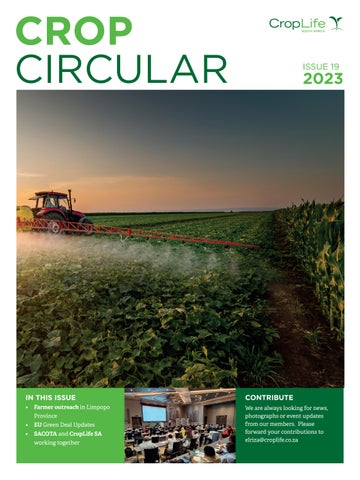
CROP CIRCULAR
ISSUE 19
2023
IN THIS ISSUE
CONTRIBUTE
•
We are always looking for news, photographs or event updates from our members. Please forward your contributions to elriza@croplife.co.za
Farmer outreach in Limpopo Province
•
EU Green Deal Updates
•
SACOTA and CropLife SA working together
WELCOME Welcome to this December 2023 edition of the CropLife SA Crop Circular. It is that time of the year where we reflect on ‘the year that has been’ and it will be no surprise to you, our valued reader that upon reflection, the CropLife SA team concluded that 2023 was quite an eventful year indeed! The last meeting of the CropLife SA Executive Council was held the first week in December, so this afforded the CropLife SA team the opportunity to summarise for the ExCo the key challenges faced by the industry in 2023, along with the many actions and initiatives undertaken by the CropLife SA team in support of all CropLife SA member companies. As a reminder, CropLife SA members get to nominate and vote for representatives from member companies to serve on the CropLife SA ExCo – it is the ExCo that represents the interest of all CropLife SA member companies and that guides the strategic direction the association takes for its members. In the previous edition of the Crop Circular, I outlined some of the major initiatives impacting our industry this year, but two are worth revisiting, namely the new Regulation supporting Act No. 36 of 1947 and the introduction of the Extended Producer Responsibility (EPR) legislation and its specific regulation for pesticide packaging. The CropLife SA sponsored workshop, held in conjunction with staff of the office of the Registrar that explored the nuances of the new regulation supporting Act No. 36 of 1947, was an essential effort for all persons in our industry. There are many regulatory clauses in the new regulation that impact all role players in the plant protection solution industry and not just registration holders. Some key areas that CropLife SA members need to take note of include: • The need for registration holders to provide DALRRD with annual statistics showing the volume of agricultural remedies each registration holder places on the local market. • The requirement for all stages in the value chain to ensure that end users (in our situation, usually farmers) have been made aware of the hazards associated with the mixing, application and possible non-target influences of their products. • The requirement for all GHS warnings to appear on any form of advertisement. It is important to remind all CropLife SA member companies that these are only a few examples and further, that these are now legal requirements – they are not a ‘nice to have’ or something a company can choose to abide by or not. As we explored the new regulation, it became clear that different government ministries are increasingly referring to different pieces of legislation in our country.
The most obvious example is the fact that when holders of registrations of agricultural remedies in South Africa want to renew their registration approvals, amend existing registration approvals or apply for the registration of new products, applicants will have to provide proof that they have registered themselves with the Department of Forestry, Fisheries & the Environment (DFFE) and that they are complying with the EPR legislation by being part of a Producer Responsible Organisation (PRO) – either their own PRO that is a not for profit organisation, or part of an industry-wide PRO. If such proof is not provided when submitting a registration dossier to the office of the Registrar (Act No. 36 of 1947) then said applications will be rejected. The deadline for those companies who supply agricultural remedies and their associated packaging into the local market to register themselves as suppliers of products and their associated packaging with the DFFE, as per EPR legislation, ended in September 2023. Any company that missed the deadline and registers post-deadline, will most likely be levied a fine by DFFE. All CropLife SA members holding registrations for agricultural remedies in South Africa received multiple communications from the CropLife SA team providing guidance on steps to be taken to ensure compliance with the EPR legislation. Therefore, those members that have not complied with the legislation will not receive any assistance (in terms of the EPR) from the CropLife SA team going forward and will have to explain to their fellow industry players why they are not compliant with the EPR legislation. As a reminder, it is a requirement of the CropLife SA code of conduct that all members will abide by all local legislation impacting our industry. In conclusion, I am incredibly proud of how the CropLife SA team has responded to the continuously changing environment in which our member companies operate. The volume of material produced and the number of opportunities for members to gain knowledge of all these issues is just staggering. To repeat myself, all member companies and their staff owe to themselves to attend as many CropLife SA forums as possible, participate in the many working groups that are established for short-term actions as they can and regularly visit the members' portal of the CropLife SA website to avail themselves of all the tools that have been created for them. Finally, I would like to extend my sincere thanks to all the individuals from CropLife SA member companies who ‘go the extra mile’ by participating, and even leading, the various CropLife SA working groups that are established with specific goals in mind. The outcomes of these working groups are for the benefit of all CropLife SA member companies, not only the companies that employ them, so their efforts are appreciated by all. Thank You. So, as the year draws to an end, I extend to you all my best wishes for wonderful family times in the coming weeks, however you choose to celebrate at this time of the year, and I extend to you and your families my best wishes for a healthy and happy 2024. With kind regards. Rod
CONTENT 01
Welcome message from our Chief Executive Officer
07
EU Green Deal Updates
19
News from Polyoak Packaging
03
CropLife SA reminds farmers to do the right thing at Food for Mzansi farmers’ days
17
Online submission system for Act no. 36 of 1947.
20
Nurturing Effective Science Communication
22 05
Farmer outreach in Limpopo Province
18
SACOTA and CropLife SA working together. SACOTA newsletter
In case you missed it The Safe and Legal Transportation of Pesticides by Road
23
In the Media Farmers’ day: Limpopo’s finest answer the call to level up
25
AgriIntel: Did you know?
P2
CropLife SA reminds farmers to do the right thing at Food for Mzansi farmers’ days
CropLife SA proudly participated in a few farmers’ days this year with the team from Food for Mzanzi, most recently in Polokwane and Pretoria, giving the CropLife SA team the opportunity to actively engage with a significant number of farmers. The gatherings provided a platform for over 200 farmers in Polokwane and over 300 farmers in Pretoria to connect, learn, and share insights. Notably, the enthusiasm, determination, and thirst for knowledge exhibited by the young farmers were particularly striking, underlining the agricultural sector’s promising future. CropLife SA’s Hiresh Ramanand took the stage at both events, delivering a compelling 20-minute talk on “Crop Protection: Responsible Use 101.” The focal point of Ramanand’s presentation was the critical importance of understanding and adhering to pesticide labels. Pesticide Labels: He emphasised that a pesticide label is not merely advisory but a legal document under Act No. 36 of 1947. Following label instructions, when coupled with appropriate equipment and calibrated sprayers, ensures effective pest control without compromising the safety of operators or the environment. The rigorous research conducted by pesticide companies to formulate these instructions was highlighted, underscoring their credibility. Transition to GHS Labels: Differences between traditional WHO labels and the new Globally Harmonized System of Classification and Labelling of Chemicals (GHS) format were elucidated and farmers were informed about the upcoming absence of colour bands and PPE pictograms on GHS labels. The transition period was also discussed, urging farmers to train their employees, particularly spray operators, to interpret the new labels. Engaging discussions with the audience fostered a better understanding of the impending changes.
facial protection. The standard attire, including cotton hat, shirt, trousers, as well as rubber gloves and boots, was emphasised for the health and safety of spray operators. Compliance with the OHS Act requirements for providing necessary PPE was also underscored. Container Management: The talk delved into container management, aligning with the NEM: Waste Act (Act No. 59 of 2008). Farmers were informed that recycling empty pesticide containers is the only option under this Act. The triple rinse procedure, certified recyclers, and the CoDiintel declaration form were discussed, emphasising responsible waste disposal practices. Exhibition Stand: Zweli Mgayo managed the exhibition stand on container management at the Pretoria event, drawing considerable interest from farmers. The focus extended to CropLife SA’s website, where various resources, including YouTube videos, multi-lingual posters, PDF information packs, webinars, and cleaning guidelines, are accessible to the public. CropLife SA’s presence at the Food for Mzansi Farmers Days left a lasting impact, with positive feedback indicating that the information shared was well-received by farmers. By addressing crucial topics such as responsible pesticide use, transition to GHS labels, PPE requirements, and container management, CropLife SA continues to play a pivotal role in enhancing knowledge and promoting sustainable practices among farmers. The commitment to increasing our footprint demonstrates CropLife SA’s dedication to empowering farmers and contributing to the advancement of the agricultural sector.
Personal Protective Equipment (PPE): While PPE pictograms will no longer be printed on labels, Ramanand clarified that precautionary statements will convey self-protection levels, including
P4
Farmer outreach in Limpopo Province Chantel Arendse – Lead: Plant Biotechnology
On the 28th of November, CropLife South Africa collaborated with Adonai Capital and Training and Megabiotech Solutions to host a farmer training day on
The extreme temperatures on the day did not deter the enthusiasm of the farmers in attendance who were a lively bunch and very engaging in terms of the questions
the outskirts of Polokwane.
and discussions that followed. Direct feedback from
The event was hosted on the farm of Gerard Mamabolo,
status of glyphosate and addressing the misinformation
a well known champion of the smallholder farmer community in the area. Supported by Megabiotech solutions, Mamabolo accommodated the planting of a maize demonstration trial (quarter hectare) on his farm under irrigation that included a herbicide tolerant (HT) variety, stacked insect resistance (IR) and HT variety and a conventional hybrid variety. Thanks to great support from the local extension officer, Sechaba Memetja, there were 65 maize farmers in attendance, mostly woman with good representation across the
farmers focused on the need for more information on the surrounding its safety and use, farmer challenges with understanding pesticide labels, lack of technical support when procuring inputs and enquiries regarding rebates for proper container disposal. Being out in the field is always a good opportunity to experience firsthand what our smallholder farming communities are up against. Farmer advocacy and training on these key stewardship issues is therefore critical. Not only does it empower our smallholder
generational spectrum.
farmers with the knowledge on safe and responsible use
Stewardship remains an integral and important pillar of
but also gives them an opportunity to make informed
CropLife SA’s portfolio and therefore formed the basis of our advocacy to farmers. The CropLife SA team and invited speakers provided presentations on the following key topics: •
Introduction to biotech traits and how they work.
•
Best practices and responsible use of pesticides, correct use of PPE and container management.
•
Soil correction and fertilisation.
•
Maize demonstration trial field visit.
of plant protection products (including biotech seed), decisions on inputs and seed technology options best suited for their local farming conditions – helping them to produce safely, sustainably and successfully. CropLife SA also acknowledges and appreciates the support it received from Bayer Crop Science for this event.
Workshop: Regulations relating to agricultural remedy Roleen la Grange: Regulatory Manager The second quarter of 2023 showed significant
•
Removal of the requirement for approval of
developments in the regulatory environment
advertisements for agricultural remedies, although
surrounding agricultural remedies. The most important
still adhering to the minimum requirements provided
of these being the promulgation of the long-anticipated
in the regulations.
“Regulations relating to agricultural remedy” which
•
A new category of minor applications for which only
was promulgated on 25 August 2023. These new
a notification to the office of the Registrar is required.
regulations replace the previous “Regulations relating
These changes can be made immediately after the
to agricultural remedies” of 2006, as well as the
Registrar is notified – applicants do not need to wait
“Regulations relating to registration of Fertilizers,
for approval before making such changes.
Farm Feeds, Agricultural Remedies, Stock Remedies,
•
Sterilizing Plants and Pest Control Operators” of 1983.
for which additional restrictions need to be imposed. •
A new category of “low-risk agricultural remedies” which may be expedited for registration.
These new regulations were the topic of discussion at the workshop held on 31 October 2023 as a collaborative
A new category of “restricted agricultural remedies”
•
The requirement of OECD Good Laboratory Practice
initiative between industry and the office of the Registrar
(GLP) accreditation for laboratories doing 5-batch
(Act No. 36 of 1947). All industry representatives impacted
analyses and other studies relating to toxicology and
by these new regulations were invited, including
food safety.
members of CropLife SA, SABO, PSCA, SAWPA and
•
for field trials relating to efficacy and phytotoxicity.
SAPCA. Several new requirements and changes have been included in these regulations, altering the way in
The requirement of Good Experimental Practice (GEP)
•
The requirement of SACNASP registration for
which agricultural remedies are regulated in South
scientists overseeing studies and writing reports
Africa. Some of the noteworthy changes include, but is
submitted in support of a registration.
not limited to:
•
The compulsory reporting of any adverse effects or risks of the agricultural remedy to human health or
•
Aligning the legislation of agricultural remedies with that of the “Regulations for hazardous chemical agents” of 2021 (Occupational Health and Safety Act) in terms of product labelling according to the Globally Harmonized System of Classification and Labelling of Chemicals (GHS).
•
The phasing out of non-essential agricultural remedies classified as “substances of concern” and
the environment. During the workshop, the Registrar communicated his expectations from industry with regards to these new requirements. Various working groups were established to investigate processes, templates and guidelines that need to be created to address these new requirements.
prioritising the registration of possible, less hazardous alternatives.
P6
EU Green Deal Updates from ZOOM ON... CropLife Africa Middle East
1 2 3 4
Proposal for a regulation on the sustainable use of plant protection products
Green Diplomacy: a) Legislative framework for sustainable food systems b) Maximum Residue Limits/Import Tolerances
Legislation for plants produced by certain new genomic techniques
Hazardous chemicals – prohibiting production for export of chemicals banned in the European Union
ABBREVIATIONS LOQ
Limit of Quantification
HHPs
Highly Hazardous Pesticides
SCOPAFF
Standing Committee on Plants, Animals, Food and Feed
MRLs
Maximum Residue Limits
IT
Import Tolerances
1
Proposal for a regulation on the sustainable use of plant protection products
Sustainable use of pesticides regulation at a glance - State of play
Farm to Fork Strategy
Pesticide reduction in use and risk by
50%
Sustainable Use of Pesticides
50%
reduction for more hazardous pesticides*
25% of EU agricultural land to be under organic production models by 2030
Background Information & State of Play The European Commission work programme for 2022 includes a revision of Directive 2009/128/EC, commonly referred to as the Sustainable Pesticide Use Directive or SUD. The SUD aims to achieve a sustainable use of plant protection products (PPPs) by reducing the risks and impacts of PPP use on human health and the environment and promoting integrated pest management, as well as alternative approaches or techniques, such as nonchemical alternatives to pesticides. The legislative proposal was expected in the first quarter of 2022, but due to urgent measures regarding the war in Ukraine, its publication was delayed until the second quarter of 2022. On 22 June 2022, the European Commission tabled a proposal for a regulation on the sustainable use of pesticides (“SUR”), which would repeal and replace Directive 2009/128/EC.
The proposal sets legally binding targets at EU level to reduce by 50% the use and the risk of chemical pesticides as well as the use of the more hazardous pesticides by 2030, in line with the EU's 'farm to fork' strategy. To reach the EU-wide target collectively, Member States would have some flexibility in setting their own binding national reduction targets within defined parameters, allowing account to be taken of national situations, including historical progress and intensity of pesticide use. The proposal would ban the use of all pesticides in sensitive areas. The Commission published an additional study on the Sustainable Use of Pesticides regulation, requested by the Council, in December 2022, according to which the pesticide reduction goals of the Commission proposal for a Regulation on sustainable use of plant protection products (“SUR”) does not threaten food security.
P8
Impact on third countries? Such legislation shows the EU’s ambition when it comes to pesticide use; while it impacts the use of substances in Europe, at a later stage, it could have an indirect effect on third countries via the EU MRLs/IT policy. Please see below point b) on Maximum Residue Limits & Import Tolerances for more information.
What's next? The file is now in the European Parliament (Committee responsible is the Environment, Public Health and Food Safety committee (ENVI), with the Development and Agriculture and Rural Development (AGRI) committee being the designated one for opinion) for discussions and vote and will then go to the Council. While the EU’s ambition is to close this file before the new mandate, it is unclear at this stage whether the legislation will be adopted before the elections next year, as the EU is facing a lot of oppositions, notably from some Northern and Eastern countries. UPDATE - September 2023: The work on the compromise amendments continues in the ENVI and AGRI committees of the European Parliament. In the AGRI committee, there is a good degree of consensus on most of the compromise amendments. However, in ENVI, the most sensitive topics have not yet been addressed. The new timeline foresees the vote in AGRI on 9 October; in ENVI on 24 October; the vote in plenary in November. Regarding the Commission additional study on the SUR that was published on 5 July, most member states raised strong criticism towards the study and its many shortcomings. Nevertheless, member states indicated willingness to continue negotiations at the technical level during Working Parties. Overall, SUR is further behind schedule as committee vote delayed. UPDATE - October 2023: The AGRI Opinion was adopted on 9 October with an overwhelming majority. The ENVI Committee vote took place on 24 October and the position was adopted. The vote in plenary on the ENVI report took place on 22 November. Overall, the text that will be presented does not reflect well for agriculture. The Spanish Presidency (ending end of December) still has the ambition to come to compromise wording on reduction targets and sensitive areas before it finishes its term in December.
2
Green Diplomacy: Legislative framework for sustainable food systems and Maximum Residue Limits and Import Tolerances
Green Diplomacy at a glance - State of play
Farm to Fork Strategy Objective: EU to support the global transition to sustainable agri-food systems
Green Diplomacy
Sustainable Food Systems
Tools: EU will pursue the development of Green Alliances on sustainable food systems EU trade policy sustainability chapter in all EU bilateral trade agreements EU to promote international standards in the relevant international bodies
MRLs/IT
Key initiatives: Legislative framework on sustainable food systems, promoting the global transition to sustainable food systems in internal standard setting bodies Taking into account environmental aspects when assessing requests for import tolerances for pesticide substances no longer approved in the EU
P10
a) Background information & State of play on the legislative framework for Sustainable Food Systems As part of its work programme for 2023, published on 18 October 2022, the European Commission announced a proposal for a regulation on sustainable food systems, aiming to integrate sustainability into all EU food-related policies. The EU 'farm to fork' strategy, launched in 2020, strives to address the challenges of sustainable food systems and recognizes the inextricable links between healthy people, healthy societies and a healthy planet. The strategy further announced the adoption of a horizontal framework law, so as to accelerate and facilitate the transition and ensure that foods placed on the EU market increasingly become sustainable. Such an EU level intervention will aim to establish new foundations for future food policies by introducing sustainability objectives and principles on the basis of an integrated food system approach.
Consequently, the proposal for a framework will lay down general principles and objectives, together with the requirements and responsibilities of all actors in the EU food system. More specifically, it will set out rules on sustainability labelling of food products, minimum criteria for sustainable public procurement of food and governance and monitoring. Through this legislation, EU’s green diplomacy agenda will support a global transition to sustainable agri-food systems. To achieve this goal: EU will pursue the development of Green Alliances on sustainable food systems EU to promote international standards in the relevant international bodies 1
1. At The Conference of the Parties to the Basel, Rotterdam, and Stockholm that took place from 1-12 May 2023, intensive debates were held on ways to enhance the effectiveness of the Rotterdam Convention. Proposal was made to amend the Rotterdam Convention by effectively creating a parallel PIC list. The proposal was to create a parallel PIC list of chemicals (Annex VIII) that can be added when consensus is not reached on adding them to Annex III (Annex VIII chemicals have more stringent trade controls than Annex III chemicals). The proponents of the amendment were determined to push for the decision despite opposition and the debate was highly polarized, with little movement or engagement from either side. While this proposal was not adopted by the Parties, this showed procedural issues, exhaustion of consensus efforts, confusion, and the principle of consensus were debated. One of the two substances newly recommended for listing by the CRC was voted for to be listed in Annex III (terbufos); the other (iprodione) was rejected. All of the previously blocked substances were rejected again (with slightly different configurations of parties raising objections): chrysotile asbestos, carbosulfan, paraquat pesticide formulation, fenthion pesticide formulation, and acetochlor.
What's next? 1. At European Union level: proposal is expected end of Q3 2023. Then, the file will go to the European Parliament and Council for discussions and vote end of 2023/early 2024. 2. In relevant international bodies:
The Global Chemical Management Framework was finalized during the Conference on Chemicals Management (ICCM5) in September 2023. Key pressure points were: i) Highly Hazardous Pesticides (HHPs): Call for global phase out, ii) Banning of exports by all countries of chemicals prohibited nationally. The EU builds on the momentum for a global phase out of HHPs and alleged double standards to drive their policies on production & export ban of prohibited chemicals and pesticides for inclusion in the new Global Chemicals Management Framework. UPDATE - September 2023: In the European Commission’s President State of the Union address, no mention was made with regards to the transition towards sustainable food systems. Mrs. von der Leyen recognized the importance of ‘food security, in harmony with nature, that remains an essential task’. She also recognized the importance of farmers and that ‘the consequences of Russia's aggression against Ukraine, climate change bringing droughts, forest fires and flooding, and new obligations are all having a growing impact on farmers' work and incomes.’ In her address to the European Parliament, Mrs. von der Leyen announced her intention to “launch a strategic dialogue on the future of agriculture in the EU”. UPDATE – October 2023: The Commission Work Programme 2024 was adopted in October 2023. There were a number of files which were absent, notably the Proposal on EU Export Ban and the Framework for Sustainable Food Systems and the REACH Revision. Whilst they are currently absent, the Work Programme can be updated by the Commission at any point.
P12
b) Background information & State of play on key trade developments – Maximum Residues Limits & Import Tolerances The European Commission intends to take into account environmental aspects when assessing requests for import tolerances (MRLs) for pesticide substances no longer approved in the EU while respecting WTO standards and obligations. First step: Lowering MRLs for clothianidin and thiamethoxam to LOQ. Following publication in the Official Journal, the application of the Regulation for lowering the maximum residue limits (MRLs) of clothianidin and thiamethoxam is foreseen for March 2026. There is no indication regarding this timeline for the next substances to be targeted by environmental factors. Substances set to be included in the next environmental factors regulation: Quinoxyfen, Lufenuron, Imidacloprid. According to the minutes of the February SCOPAFF meeting, 4 countries declared that they would vote against setting import tolerances for substances not approved in the EU.
Those countries were identified as France, Spain, Austria and Slovenia. The first set of import tolerances for substance that did not reach sufficient support in SCOPAFF meeting was voted in May. There was no opinion reached on Tricyclazole. This indicates that we can expect less predictability in setting IT for substances not approved in the EU. From a trade point of view, there are concerns about blockage of the setting import tolerances process. The EU is also currently discussing ‘Mirror Clauses’. This is the idea of applying EU health and environmental standards to imported agricultural and agri-food products. This is the general direction that many countries in the EU want the EU to follow – EU farmers are also pressurizing the EU to go in that direction. The objective is to “create a level playing field on trade to ensure EU food is not undercut by cheap rival imports produced with lower standards”. The impact would be reflected in EU trade agreements.
What's next? Next SCOPAFF meeting will take place in October and November 2023 – SCOPAFF agendas are only released two weeks in advance so no details will be available until just before. (SCOPAFF delivers opinions on draft measures that the Commission intends to adopt – it has a key role in the decision-making process. It is composed of representatives of all EU countries and presided by a European Commission representative) The next big meeting for third countries' missions in Brussels (co-organised by the Brazilian and Canadian missions) took place in Autumn. Third countries were encouraged to attend these meetings.
3
Legislation for plants produced by certain new genomic techniques
On 14 September 2022, in her State of the Union address, European Commission President Ursula von der Leyen announced that in the framework of the European Green Deal, the Commission intended to present a legislative proposal on plants produced by certain 'new genomic techniques'. The term refers to new genetic engineering processes such as CRISPR/Cas, which are used to modify the genetic makeup of plants even more profoundly and rapidly than is possible with conventional breeding. The initiative will set a legal framework for plants obtained by targeted mutagenesis (e.g. mutations producing variations in the plant genome introduced by way of radiation or chemicals) and cisgenesis (e.g. a genetic modification of a recipient organism with a gene (cisgene) from the same species or a closely related (crossable) species) and for their food and feed products.
and whether some or all of them should fall within the scope of EU legislation on genetically modified organisms (GMOs), notably Directive 2001/18/EC on the deliberate release into the environment of GMOs. In July 2018, the Court of Justice of the EU ruled that genome-edited organisms fall under the scope of European GMO legislation. Commission proposal on New Genomic Techniques was published on 5 July – overall: The proposal is a good starting point – the proposal makes a distinction between two categories of NGT plants (plants resulting from targeted mutagenesis and cisgenesis, including intragenesis) Category 1: conventional-like NGT plants – this category requires a notification; Category 2: non-conventional like NGT plants considered GMOs – they undergo a lighter GMO risk assessment. NGT plants of both categories are not allowed for organic farming.
There is, however, considerable debate as to how these new techniques should be regulated,
What's next? Feedback period was until 29 September – which gave the opportunity to all stakeholders to provide their views on the draft proposal by the European Commission. The file is now in the European Parliament (Committee responsible is the Environment, Public Health and Food Safety committee, with the Agriculture and Rural Development committee being the designated one for opinion) for discussions and vote and will then go to the Council. UPDATE - October 2023: Work on the New Genomic Techniques file in the Parliament is progressing quickly, with the draft report set to be voted on by the ENVI committee in January, while the AGRI committee will vote directly on the draft opinion in December to expedite the process; the Council is expected to define its general approach by December.
P14
4
Hazardous chemicals – prohibiting production for export of chemicals banned in the European Union (also known as ‘EU Exports Ban’)
EU Export Ban – State of play
Chemical Strategy for Sustainability
EU Exports Ban
The legislative initiative aims : to introduce a mechanism prohibiting production and/or export of certain hazardous chemicals that are banned in the EU to protect non-EU countries from their negative effects on human health and the environment. The initiative will further align internal and external policies and improve the international standing of the EU, strengthening the credibility of our actions. It will fulfil a commitment made in the EU’s chemicals strategy for sustainability.
Potential substances captured by this 'exports ban' (6 chemicals account for 80% of the total volume of PIC chemicals exported): 1,2-dichloroethane, benzene, chlorate, creosote-related substances, carbon tetrachloride and ethylene oxide. Please note that these are only assumptions - we do not yet have a precise list. As part of the legislative initiative which aims to introduce a mechanism prohibiting production and/or export of certain hazardous chemicals that are banned in the EU, stakeholders have been given two opportunities to provide their views:
First opportunity, was through a targeted questionnaire addressed to thirdcountries importing from the European Union chemicals that are banned or severely restricted in the EU – deadline was 21 July 2023. Second opportunity, was through a public consultation opened to all stakeholders (EU and third countries stakeholders) – deadline was 31 July 2023. CropLife Africa Middle East took part in the public consultation.
What's next? EU Export Ban proposal is expected in January 2024. Then, the file will go to the European Parliament and Council for discussions, where some outreach activities can be done prior to that. To be noted: Upcoming elections accelerate focus on key legislative initiatives. Context: Several initiatives are delayed and not everything will the done before the next Commission/EU parliament elections (June 2024). Focus is on the most impacting legislative initiatives as the submission window for new policy proposals is closed (Q3 2023). UPDATE - September 2023: It seems the EU Export Ban proposal will be postponed to the next Commission. Work will, however, continue : The next steps are that the European Commission intends to finish the study with their contractor in the next few months. They will complete an evaluation of the Prior Informed Consent legislation by January 2024. The next foreseen date for the Commission Regulatory Scrutiny Board to review a potential legislative proposal would be in April 2024. Even if this date holds they will then create a package for the next Commission to bring forward a proposal, most probably in 2025. This would all need internal and new Commissioner approval (so there is some uncertainty there too). If this goes forward into the 2025 Work Programme it is likely the impact would be from 2026 onwards (but this is to be confirmed). It seems the European Commission’s Secretary General and Legal Services want to look more at the impact that such legislation may have in some destination countries; they might therefore be conducting some sort of studies on potential impact of bans. UPDATE – October 2023: Work on the proposal is still on-going. At the end of this year, the Commission will publish an evaluation (in the form of a Staff Working Document). Work on preparing the impact assessment continues. No date is set for presenting to the Regulatory Scrutiny Board. The responsibility of moving forward with the initiative in the upcoming Commission lies with the political leadership of the new Commission. DG ENV Services intend to continue working on the file.
Overall, just because things are slower or delayed it does not mean they stop - this means stakeholders have around 12 months to keep up the engagement and outreach via various means. Emphasis should notably be on the trade aspects (i.e., should an EU Export Ban come forward, and should African countries continue importing these banned substances from other regions of the world, they would no longer be able to trade towards the EU as MRLs would be removed for these substances).
P16
Online submission system for Act No. 36 of 1947 Roleen la Grange: Regulatory Manager
On 28 November, a long-anticipated development
platform, both for agricultural remedies and other
in the industry occurred, namely the launch of the
products regulated under the Act.
Department of Agriculture, Land Reform and Rural Development (DALRRD), Directorate Agricultural Inputs
It is anticipated that it will take several years for the
Control’s new online submission system. The event took
online submission system to be fully implemented.
place at The Maslow, Time Square in Pretoria and was
Although the particulars of the phase-in process from
attended by various DALRRD officials, including staff
hard copies to online submissions have not yet been
from Act No. 36 of 1947 and their IT development team.
finalised, it is likely that there will be a period in which both will be required until the system is fully
The system has been in development for several years and will allow applicants to submit registration applications online via a secure portal on the department’s website. Until now, all applications had to be submitted in hard copy to the department. Although the launch took place on 28 November, the system will only go live for industry to use at the beginning of next year. Currently, the platform only allows for applications of agricultural remedies to be submitted (not yet other products regulated under Act No. 36 of 1947, such as fertilisers, farm feeds and stock remedies), and only new applications can be submitted via the platform. The developers are, however, working on expanding the system to increase the capacity for the type of applications that can be submitted via the
tested and operational.
SACOTA and CropLife SA working together SACOTA newsletter – November 2023 – volume 06: 2023 In a collaborative effort between SACOTA and CropLife
Of particular significance was the revelation that
SA, two mini workshops were hosted. The first was
events approved for general release in South Africa, and
on September 27, 2023 at the Capital Hotel in Menlyn
subsequently registered for seed multiplication, must
Maine. This workshop also incorporated the technology
align with the approvals of countries importing from
developers from Bayer, BASF, Syngenta and Corteva. This
South Africa. This synchronisation is needed for South
event provided a unique platform for SACOTA members
Africa to export these genetically modified products to
to discuss the processes surrounding the registration of
international markets. The inverse holds true for South
GMO events for general release and commodity release
African imports as well.
from DALRRD in South Africa. Chantel Arendse, Lead Biotechnology, also demonstrated to members the
The second workshop was held on 17 November 2023 and
global CropLife database whereby members can verify
was specifically focused on exports to China.
the events that are approved and the purpose on a percountry basis.
The mini workshop was led by John Zhao from CropLife China who is based in Beijing. This additional session focused on the import requirements and processes of China. Although South Africa and China have signed export protocols for both maize and soybeans, the process and approval of exporting the physical products are still complicated.
Regulatory process for import approvals 1st Dossier submission
Front desk completeness check
2nd Dossier submission
DCST pre-review
Material import
Lab assignment
In-country studies
Trial protocol review
Front desk completeness check
DCST pre-review
NBC review
MARA administrative sign-off
GMO material import permits
Import approval
Detection method review DCST pre-review
MARA administrative Sign-off
P18
News from Polyoak Packaging Michelle Penlington, National Executive: Marketing and Sustainability
As we roll into the festive season, there is much
to assess machine setters working in the plastic
to celebrate in the pesticide packaging space that
manufacturing industry, soon to qualify South Africa’s
highlights South Africa’s local homegrown talent.
first female Plastics Manufacturing Machine Setter.
Polyoak Packaging is a proud South African plastic
As a founding member of the SA Plastics Pact to build
packaging manufacturer since 1976, with almost 3,000
a circular economy for plastic, Polyoak is committed
employees at over 40 manufacturing plants across South
to sustainability. It has invested in solar PV with an
Africa, and specialist divisions designing and moulding
annual capacity of 5,395,000 kWh, and its Gauteng
drums (up to 250L), closures, bottles, buckets, tubs, and
manufacturing sites have achieved 100% zero waste
even plastic garment hangers.
to landfill, through reuse, repair and recycling. Even employee lunch scraps are biodegraded into compost.
Polyoak’s belief in its people underpins its extensive inhouse training facilities and investment in building South
Polyoak’s substantial investment in advanced multilayer
Africa’s first Trade Test Centre, MERSETA accredited,
moulding technology underpins its ambitious recycled
content targets. In November, Polyoak Packaging was awarded a Worldstar Award by the World Packaging Organisation for its 20L recycled plastic drum range. This multilayer drum with United Nations approval for 30% post-consumer recycled HDPE is the first in South Africa. This recyclable and compact, square drum with locator lugs for secure stacking, was also a finalist in this year’s SAPRO Awards. Polyoak’s 20L bucket with 40% postconsumer recycled polypropylene (rPP), utilising similar multilayer technology, was awarded top honours, with the Gold medal in the SAPRO Best Recycled Product’s rigid packaging category. Polyoak’s 20L PCR drum comprises post-consumer rHDPE in the middle layer. The interior is natural, virgin HDPE to mitigate the risk of chemical reaction, protect the contents and guarantee its safe containment. Virgin HDPE is used for the outer layer, with the option of print
Polyoak’s UN Certified 20L multilayer drum with 30%
and label decoration.
PCR is a first for South Africa. Doing the right thing no longer has to be a compromise.
Utilising rHDPE in monolayer drums, often presents challenges around odour migration, seam strength and structural capability, including topload performance. However, sealing the PCR in the middle layer enables optimal processing and the production of higher quality drums on a more consistent basis. Even dark-coloured rHDPE can be used in the middle layer as UV protection to prevent light ingress. Growing PCR content in rigid packaging requires crossindustry stakeholder collaboration. It cannot be achieved by convertors or recyclers alone. Separation of waste at source, safe disposal and improved waste collection are critical. To this end, Polyoak is excited to become a contributing member of the Croplife SA family. Polyoak Managing Director, Karl Lambrecht concludes, “We are extremely thankful to our customers and partners for working with us on these PCR projects. The fact that recycled polyolefins have 70% lower global warming potential than virgin plastic, and that our multilayer drums contain up to 30% PCR, is a huge win for the environment.” Polyoak’s 20L multilayer bucket with 40% PCR won Gold at this year’s SAPRO Best Recycled Product Awards.
P20
Nurturing Effective Science Communication On the 17th of November, CropLife SA and Agricultural
its potential implications for agriculture and beyond.
Writers SA joined forces to host a continuous professional development (CPD) session for its members
Biologicals: Shaping the Future of Food Production
at the offices of Media 24 in Cape Town. The session
Donvae Hooker, Business Communication Lead at
aimed to empower attendees with the skills necessary
Andermatt Madumbi shared insights into the world of
for accurately communicating or reporting on highly
biologicals, offering an overview of the biologicals market
technical or scientific topics. The session also delved
and its transformative impact on food production. As
into introducing participants to new fields of scientific
agriculture continues to evolve, understanding the role
innovations and illustrated how to effectively tell
of biologicals becomes crucial for those reporting on the
stories using multimedia tools.
industry. Multimedia Storytelling Techniques by Lucentlands The team from Lucentlands provided invaluable practical steps and tips for compiling multimedia stories. In an era where visual and interactive content reigns supreme, mastering the art of multimedia storytelling is essential for effective communication. Attendees gained insights into new and cost-effective tools to enhance their storytelling capabilities. The success of the CPD session was evident in the positive reviews received from all attendees. Many expressed how beneficial the event was in equipping
The Science of Science Communication by Prof. Marina
them with the necessary skills and knowledge.
Joubert
Participants unanimously agreed on the importance of
Prof. Marina Joubert from Stellenbosch University
maintaining open lines of communication and staying
opened the session by enlightening attendees of the best
connected.
practices when sharing science. Her presentation covered a wide array of topics, including an overview of science
The CropLife SA and Agricultural Writers SA CPD
jargon, the best tools for science writing, definitions
session stands as a testament to the commitment
and models of science communication, understanding
of professionals in the agricultural and science
scientists’ motivations and barriers when communicating
communication fields. By fostering an environment of
their work, and the power of storytelling in science
learning and collaboration, the event has undoubtedly
communication. Prof. Joubert’s insights provided a solid
contributed to the enhancement of skills and knowledge
foundation for effective science communication.
among attendees. As the industry continues to evolve, initiatives like these play a vital role in ensuring that
Genome Editing Explained by Dr. Hennie Groenewald
communicators are well-equipped to navigate the
Dr. Hennie Groenewald from Biosafety South Africa,
complexities of scientific innovations and effectively
provided a comprehensive overview of genome editing
convey their significance to the broader audience.
in plant breeding. His presentation delved into what genome editing entails, how it works, and the profound value it holds for humanity. The session not only demystified this cutting-edge field, but also highlighted
In case you missed it Pesticide Distributor/Agent Depot Compliance Checklist Self Governance Please find herewith for your benefit the new “PESTICIDE DISTRIBUTOR/AGENT DEPOT COMPLIANCE CHECKLIST – SELF GOVERNANCE” (click to download). This was a request following the “Extraordinary Distribution Forum” that was held on 15 August 2023. Click here for more.
The Safe and Legal Transportation of Pesticides by Road - Self Governance
CropLife SA New Telephone Number Please note that our telephone number has changed. In future, kindly contact us on:
+27 (0)72 224 4715
Alternatively, you can refer to our website for the team’s individual email addresses.
Checklist: Storage of Pesticides on Farms - Self Governance CropLife SA developed a “CHECKLIST: STORAGE OF PESTICIDES ON FARMS – SELF GOVERNANCE”. Note that members will need to be logged in on the member portal to download the document. Alternatively, this guideline checklist can be located in the “Stewardship” section under “Guidelines” in the member portal. Click here for more.
New Contact Number - Hiresh Ramanand Kindly note that Hiresh Ramanand’s (Stewardship Coordinator) contact number has changed to
+27 (0)82 497 6975
Please update your records accordingly.
Notice to all members of the CropLife SA PRO Please find herewith for your benefit the Microsoft Excel document titled: “THE SAFE AND LEGAL TRANSPORTATION OF PESTICIDES BY ROAD – SELF GOVERNANCE”. This document comprises five Excel Sheets. On each sheet, members will find guideline compliance checklists pertaining to the: (1) “CONSIGNOR”, (2) “OPERATOR”, (3) “DRIVER”, (4) “CONSIGNEE” and (5) “BONA FIDE FARMER”.
The SAWIC website and system to link our participatory members to the CropLife SA PRO is still not functional. We are in communication with the DFFE SAWIC administrators about the developments and will keep you updated. Once their system is functional, we will link you and you will receive an automated email from the SAWIC website to authorise the link with our CropLife SA PRO.
Click here for more.
Click here for more.
Continue on page 9 P22
In case you missed it Reminder to Register: CropLife SA Webinar Series
Communication to Members Forum Participation
As you know, CropLife SA continuously strives to inform and educate its members, their clients, the public and various other stakeholders about the numerous topics and issues within the crop protection industry, most notably pertaining to responsible use and stewardship. This is a kind reminder that these webinars are free to attend, and you can register here.
Kindly take note of the attached communication regarding CropLife SA forum participation. Please do not hesitate to reach out to a member of the team should you have any questions.
The recordings of the previous webinars can also be accessed on the CropLife SA website here.
In the Media
Farmers’ day: Limpopo’s finest answer the call to level up Food for Mzansi - Sinenhlanhla Mncwango The Limpopo leg of Food for Mzansi’s farmers’ days proved to be a huge success judging by the attendees’ reactions. Buoyed by what they’d heard from panellists, as well as having the chance to engage with others, the farmers all agreed that days like these are much needed to help them level up. Read more.
Pest control through irrigation SA Grain - Hiresh Ramanand In an integrated pest management (IPM) programme, irrigation management is viewed as an essential component where dryland plantings are not feasible. Numerous scientists note the importance of adequate, timely irrigation to prevent unnecessary stress to crops so that they are better able to withstand pest pressure. Standing water, for example, hinders the growth of crops. In addition, root diseases and nematode infestations are
generally the result of poor water infiltration or lack of drainage. Therefore, irrigation management will affect diseases, insects, rodents, and weeds. While this is not new information, the question is whether irrigation can be directly utilised to manage pests. The answer is yes. Irrigation methods in pest management include: (1) flood irrigation; (2) high-pressure water spray and, most notably; (3) chemigation. Read more.
Farmworkers demand urgent action on labour and health issues Food for Mzansi - Tiisetso Manoko The lack of political will to address the numerous challenges faced by farmworkers came under scrutiny on the first day of the National Farmworker Platform held in Cape Town by Women on Farms. Responsible pesticide usage, absence of inspectors, the well-being of workers, and claims of “daily torture” were among the issues participants appealed for government help to address. Read more.
South Africa -2023 Winners of the Agricultural Writers SA Awards
Slim bespuiting was nog nooit so maklik nie
Farming Portal
Landbou.com - Marisa Beeton en Gerrit Bezuidenhout
The beautiful venue, Landtscap in the Stellenbosch Winelands set the scene for an outstanding event when it hosted the 2023 Agricultural Writers SA Awards on 17 November. The breath-taking view could, however, not outshine the excellence celebrated at this event.
Vervaardigers van spuittoerusting staan nie stil om nuwe tegnologieë in hul spuite aan te bring nie. Verskillende moterings van die spuitbalk, die selektiewe bespuiting van onkruid, maar nie die gewasse self nie, data-opberging vir beplanning vir die volgende seisoen en doeltreffender toedieningsteikens bied kostedoeltreffende bespuiting wat steeds van onkruid ontslae raak. Lees meer.
The awards pay homage to distinction in agriculture as it recognises top agricultural role-players that invest their energy towards promoting sustainable farming enterprises, elevating food security, supporting rural economies, and nurturing the image of agriculture in South Africa. It also recognises excellence in agricultural journalism writing among the members of Agricultural Writers SA (AWSA).
Gauteng farmers’ day unites more than 300 agriculturists Food for Mzansi - Candice Khumalo
The CropLife South Africa article awards aim to reward responsible reporting on specifically crop protection and plant biotechnology topics. Elriza Theron of CropLife South Africa emphasises that responsible communication about these technologies is our collective duty. “Our farmers need access to the necessary tools to produce enough food in the face of various challenges, and we must work together to ensure these tools are produced, used, and communicated about responsibly. The media has a critical role to play in informing people about this responsibility.” Read more.
In a vibrant celebration of agricultural expertise, Food for Mzansi’s Gauteng farmers’ day brought together over 300 people. With a focus on sharing knowledge, the event became a fertile ground for learning and networking. Sharing eye-opening insights on enhancing crop yields through biotechnology and mitigating the impacts of pests and diseases, CropLife SA experts assisted farmers in gaining a deeper understanding of these rapid agricultural advancements during Food for Mzansi’s farmers’ day held in Gauteng. Read more.
The function and role of South Africa’s Maize and Wheat Forums
Haal die kopseer uit die kalibrasie van spuittoerusting
Agbiz Grain Quarterly - Elmarie Helberg The forums have two main functions, the first being to enquire into cross-cutting industry issues and developing plans to engage government and other role-players. The other goal is focussed on innovation through, among others, the Maize Trust and South African Winter Cereal Industry Trust. These trusts fund research projects that relate either to crop/plant breeding or food safety. There are also various industry bodies that require funding, including the South African Grain Laboratory NPC which monitors crop quality in South Africa, and the South African Grain Information Service. Read more on page 11.
Gerhard Verdoorn – CHIPS Suid-Afrikaanse voedsel- en veselprodusente moet groot struikelblokke oorkom om winsgewend te kan boer. Insetkoste raak al hoe hoër as gevolg van die onstuimige wêreldpolitiek, swak vertoning van ons geldeenheid teen buitelandse geldeenhede, wankelrige infrastruktuur en sinnelose regulatoriese hekkies wat in die landbou se renbaan geplaas word. Produsente kan bloot nie meer bekostig om op hul louere te rus nie en moet elke sent blink vryf voor dit in produksie belê word. Landbou-insette wat brandstof, bemestingstowwe, gewasbeskermingsmiddels en elektrisiteit insluit, gaan mees waarskynlik nooit weer goedkoper word nie en dus moet insette soos gewasbeskermingsmiddels baie omsigtig en teen baie hoë akkuraatheid aangewend word om kostes in te perk. Lees meer.
P24
Did you know? A G R I C U LT U R E I N T E L L I G E N C E
Many countries have established monitoring programmes for pesticide residues in food. These programmes define the analytical scope and sampling strategies for locally produced and imported food. Import tolerances are special maximum residue levels (MRLs) that help to facilitate international trade. They are set by importing countries and are based on foreign residue data for imported crops. Various synonyms are used for maximum pesticide residue levels in food and feed commodities. Some people say ‘maximum residue limit’ while others refer to ‘maximum residue level’. The following international synonyms also exist: • • •
‘Tolerance’ – USA ‘Maximum Permissible Level’ – Russian Federation CXL’ (Codex MRL) – Codex standards
Codex MRLs are international standards that are based on residue data from uses all over the world. Codex is not a regulatory body and its standards, including MRLs (CXLs) are voluntary. Many countries do adopt or consider Codex MRLs in their regulatory processes. South Africa publishes MRL lists as amendments to the previous regulations. They are not exhaustive lists and only show the changes made to the previous version.
To all our members and stakeholders, thank you for your support during 2023. Please note that the CropLife SA office will be operational only for emergencies from 22 December 2023 to 8 January 2024. May you have a wonderful festive season and we look forward to working together in 2024.
CONTACT
If you have any queries, would like to become a member, or if you have general feedback, we would love to hear from you. Please contact any member of our team: CropLife SA Office
072 224 4715
info@croplife.co.za
Rodney Bell - Chief Executive Officer
066 273 6027
rod@croplife.co.za
Chantel Arendse - Lead: Plant Biotechnology
082 992 0952
chantel@croplife.co.za
Gerhard Verdoorn - Operations & Stewardship Manager
082 446 8946
gerhard@croplife.co.za
Hiresh Ramanand – Stewardship Coordinator
082 497 6975
hiresh@croplife.co.za
Roleen la Grange – Regulatory Manager
082 851 7863
roleen@croplife.co.za
Elriza Theron - Advocacy & Communications Manager
072 443 3067
elriza@croplife.co.za
Nadia van Niekerk - Financial & Membership Administrator
072 940 5591
nadia@croplife.co.za
Chana-Lee White - Agri-Intel Manager
072 298 9389
chana@croplife.co.za
Liezel Cronje - Agri-Intel Administrator
072 122 5964
liezel@croplife.co.za
Luigia Steyn - Agri-Intel MRL Consultant
060 508 6369
luigia@croplife.co.za