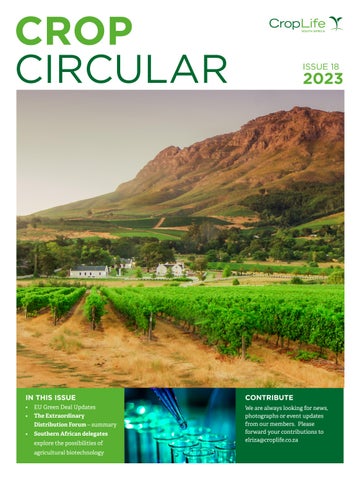
CROP CIRCULAR
ISSUE 18
2023
IN THIS ISSUE
CONTRIBUTE
•
EU Green Deal Updates
•
The Extraordinary
We are always looking for news, photographs or event updates from our members. Please forward your contributions to elriza@croplife.co.za
Distribution Forum – summary •
Southern African delegates explore the possibilities of agricultural biotechnology
WELCOME Welcome to this latest edition of the CropLife SA Crop Circular. I am writing this note knowing that by the time you read this edition, we will be in October and the end of 2023 is not very far away. It is amazing how quickly the year end seems to have arrived.
Rod Bell Chief Executive Officer CropLife South Africa
The past few months have been rather hectic for our industry. Without going into details around all the major initiatives we have faced, it is worth highlighting some of the major items we had to deal with as an industry: • Final implementation of the GHS classification and labelling system in September. • Extensive and ongoing work to identify products that will disappear from the market as their active ingredients and/or co-formulants have carcinogenic, mutagenic or reproductive characteristics (the socalled CMR characteristics) when classified according to the GHS guidelines – the Department of Agriculture, Land Reform & Rural Development has indicated its intention to phase out agricultural remedies whose active ingredients and/or co-formulants are classified as Group 1a or 1b according to the GHS classification mentioned above. • The deadline for all ‘producers’ (those placing packaging on the market that contains pesticides) to register their company as a producer, under the Extended Producer Responsibility legislation for pesticides, with the Department of Forestry, Fisheries & the Environment; this legislation strives for a circular economy for packaging in South Africa and also covers the collection and destruction of obsolete stock of agricultural remedies. • The new regulation in support of Act No. 36 of 1947 was finally published in August so the CropLife SA team and member companies are busy working through the finer details of the new regulation.
• The potential impacts of the EU Green Deal on South African farmers continue to be monitored and information is shared regularly with member companies and industry partners such as grower associations. • After some discussions between both parties and ratification by the respective boards of each association, CropLife SA and the South African Bioproducts Association (SABO) have agreed to co-operate going forward, with the initial areas of co-operation being alignment on regulatory matters impacting biological solutions for pest control in crops. Looking forward to the imminent summer rainfall growing season, feedback from member companies is that unlike previous seasons, there does not appear to be major issues with stock availability for key plant protection solutions in South Africa. Landed costs of products do seem to be on a downward trend, but high cost stock does still exist in the value chain, so the full benefit of lower landed costs will not be immediately realised. Weather forecasters do predict a higherthan-normal possibility for an El Nino weather phenomenon in South Africa this summer so this is something that the industry will need to keep in mind as the summer cropping cycle progresses. Albeit with some significant damages, the tail end of the winter rainfall rainy season has resulted in wonderful water levels in irrigation and drinking water storage dams, which is great news. Even the drought stricken eastern Cape has received a reprieve and its irrigation and drinking water storage dams are filling nicely as I write this message. The CropLife SA team will continue to keep all members updated on key issues impacting our industry. Best wishes to you all for a successful summer rainfall growing season.
CONTENT 01
Welcome message from our Chief Executive Officer
03
19
MyPlas continues to provide constructive support to CropLife South Africa’s container management programme
24
In the Media Podcast: CropLife SA reflects on biotech success
The Extraordinary Distribution Forum – A comprehensive summary
24
In the Media Looking back at CropLife SA’s biotech triumph
07
EU Green Deal Updates
22
WTO SPS notifications from Burundi, Kenya, Rwanda, Tanzania and Uganda – 29 August 2023
25
14 Southern African delegates explore the possibilities of agricultural biotechnology
22
CropLife SA Accredited Trainers - Training Recording Sheet – 31 August 2023
In the Media Pest resistance: CropLife SA champions responsible stewardship
26
Pesticide use: Tips for safe home and garden pest control
P2
The Extraordinary Distribution Forum – A comprehensive summary Hiresh Ramanand – Stewardship Coordinator BACKGROUND CropLife SA held an Extraordinary Distribution Forum on the 15th of August 2023 where all CropLife SA members were invited given that this meeting addressed a very serious matter - Environmental Impact Assessments (EIAs) for, and authorisation of, commercial pesticide storage facilities. The key reason for hosting such a meeting was because the Department of Forestry, Fisheries and the Environment (DFFE) commenced inspections last year at member facilities, where compliance with the National Environmental Management Act (NEMA), 1998 (Act No. 107 of 1998) in terms of the EIA regulations, was deemed not be at a satisfactory level. Dr Gerhard Verdoorn, CropLife SA operations and stewardship manager, requested the DFFE EIA help desk specialists to address members in person and virtually to offer insight into these regulations and advice in terms of compliance. In attendance from DFFE were Mr Franz Scheepers, Ms Chantal Engelbrecht and Ms Betty Mdala. The content of their presentations focused on: (1) EIA and listing notices (LNs); (2) Storage and handling of dangerous goods; (3) NEMA Section 24G; (4) Compliance and enforcement and (5) Competent authorities. Firstly, it was important for CropLife SA members who own/rent or aim to own/construct/develop/rent
commercial pesticide storage facilities (i.e., warehouses and depots) to grasp why it is crucial to have a thorough understanding of the EIA regulations and LNs. An EIA in SA, simply put, is conducted when a new development or activity is proposed. It is a tool used by the competent authority (as defined in NEMA) to assess significant effects of a project/development proposal on the environment. In SA, this means that an EIA provides a means for giving effect to the “environmental right” that is enshrined in Section 24 of the Constitution. This section ensures that ecologically sustainable development is secured while promoting justifiable economic and social development. Members must note, that while the objective is to strive for the most suitable environmental option, there are limitations to what is feasible and practical when considering time, cost, and technology. In essence, an EIA serves to allow for a process that determines the best option that promotes sustainable development through efficient management of social, environmental, and economic impacts to ensure: • Valued environmental resources are not compromised. • Human health is protected. • Social and economic aspects of a proposed development is improved.
By assessing the identification of alternatives, the report pertaining to need and desirability, as well as the sustainability of the development, it allows the competent authority to conclude an informed decision:
activities that may not commence without obtaining environmental authorisation from the competent authority.
• Screening • Scoping • Specialist assessments (i.e., fauna, flora, archaeology, noise, flickering, fire, explosion, flooding, etc.) • Integration and assessment • Public participation (this happens throughout the EIA process) • Competent authority review and decision-making • Implementation of EIA decision • Monitoring
Dangerous goods is defined in LNs 1, 2 and 3 and means goods containing any of the substances as contemplated in the South African National Standard (SANS) 10234-A: 2008 - List of classification and labelling of chemicals in accordance with the Globally Harmonized Systems (GHS) published by the South African Bureau of Standards (SABS), and where the presence of such goods, regardless of quantity, in a blend or mixture, causes such blend or mixture to have one or more of the characteristics listed in the hazard statements in section 4.2.3, namely physical hazards, health hazards or environmental hazards. Alternatively, table C.1 of SANS 10231: 2019 – “Transport of dangerous goods by road – Operational requirements”, may also be referred to for this purpose. Note that dangerous goods (as defined) do not have the same meaning as hazardous substances, hazardous chemicals, hazardous chemical agents or hazardous waste – although all of these are likely to be dangerous goods. Fair to say that at this stage the definition of dangerous goods is at best, nebulous. The DFFE officials did admit to this and assured all attendees that the Department is working to rectify this issue. Members must remember that “ANNEX A – Alphabetical list of chemicals” contained in SANS 10234-A: 2008 was not included in the updated version, SANS 10234: 2019. A legal opinion obtained by the Department noted that dangerous goods activities as identified in the three LNs are valid and SANS 10234A: 2008 must still be referred to for purposes of the EIA regulations LNs 1-3. The status quo is therefore, retained. The DFFE officials highlighted the activity under LNs 1-3 relevant to commercial pesticide storage facilities.
LISTING NOTICES
Listing Notice 1
To provide context on the drafting of the LNs, the Minister responsible for the environment, in accordance with Section 24(2) of NEMA, may identify activities subjected to the EIA prior to commencement in order to prevent substantial detrimental impacts. The activity’s ability to impact the environment is determined by the nature of the activity, extent of the activity and location. It is important to distinguish between listed activities and specified activities. Listed activities are listed everywhere in SA, unless an exclusion applies; whereas specified activities are listed only in identified geographical areas. In the case of specified activities, the relevant provincial member of the executive council (MEC), responsible for environmental management with the concurrence of the Minister, may identify such
Listed Activity: 14 – “The development and related operation of facilities or infrastructure, for the storage, or for the storage and handling, of a dangerous good, where such storage occurs in containers with a combined capacity of 80 cubic metres or more but not exceeding 500 cubic metres”.
• Issue an environmental authorisation with or without conditions; or • Refuse environmental authorisation. EIA PROCESS There are two categories of prescribed processes. A basic assessment would involve small scale activities, shorter process, projects that are not complicated and impacts that can be easily controlled. A scoping and environmental impact report (EIR), i.e., full EIA, involves high scale activities, longer process, projects that are complex and sensitive, as well as impacts deemed significant. The basic assessment process would take 197 days, but where a report needs to be corrected and redistributed, one can expect up to 247. A scoping and EIR process takes 300 days but again, where a report requires correction and redistribution, then one can expect up to 350 days. An EIA is a project-based procedure with several distinct phases, namely:
Listing Notice 2 Listed Activity: 4 - “The development and related operation of facilities or infrastructure, for the storage, or for the storage and handling, of a dangerous good, where such storage occurs in containers with a combined capacity of more than 500 cubic metres”.
P4
Listing Notice 3
ADVICE TO VALUED MEMBERS
Specified Activity 10 – This means that if the dangerous goods volume is below 80 cubic meters, it will not trigger an EIA requirement according to LN 1, but if the goods are stored in one of the listed zones, such as for example on the border of a nature reserve, with a combined capacity of 30 cubic metres or above, an EIA requirement will be triggered. Where such goods are stored in a facility in a listed zone and the combined capacity is less than 30 cubic metres, there will be no EIA requirement. Note that the list of such zones is extensive and needs to be interrogated for each province.
For members with established commercial storage facilities:
Commencing any listed or specified activity without environmental authorisation is a criminal offence.
• Identify which pesticides stored meet the definition of dangerous goods (refer to ANNEX A of SANS 10234-A: 2008; or Table C.1 of SANS 10231) and that these pesticides are packaged in the approved containers. • Determine the combined capacity of identified pesticides. • Where a LN 1 is triggered, and if the combined capacity can be reduced to below 80 cubic metres to avoid the need to obtain environmental authorisation by splitting risk, this is recommended (particularly for crop advisers/agents). In other words, separate flammables/adjuvants from toxic pesticides and store them in separate facilities on different premises. Where this is not feasible, then environmental authorisation will be required by referring to NEMA Section 24G. This will require a basic EIA. • Where a LN 2 is triggered, environmental authorisation will have to be sought by referring to NEMA Section 24G. This will require a scoping and EIR (i.e. full EIA). • Where a LN 3 is triggered due to pesticides stored in a listed zone, it becomes paramount for members to consult with the relevant provincial environmental management authorities by noting NEMA Section 24G. The relevant provincial authorities should be contacted and invited to a meeting to discuss compliance requirements in order to obtain environmental authorisation by the competent authority.
NEMA SECTION 24G - CONSEQUENCES OF UNLAWFUL COMMENCEMENT OF ACTIVITY
For members planning to establish commercial storage facilities:
This section essentially offers the opportunity to legalise a storage facility that did not obtain an environmental authorisation only if the activity is still listed at present. In simple terms, an opportunity is provided to apply for an EIA. The property may be placed in bond with instructions issued by the competent authority. While this is voluntary, members have been warned by the DFFE officials that, should a member not come forward and if caught, that member will face the full might of the law. Members that do come forward will still have to face consequences where a fine may be imposed. In this regard, it is important to remember that laws have changed over time and therefore, any penalties will be determined based on the regulations that were in place when the business operation commenced.
• The most important step at the very start, prior to construction must be to determine whether environmental authorisation will be required. • Where an EIA is required, determine whether this is will entail a basic or full assessment. • Do not plan to erect pesticide storage facilities in listed zones under LN 3, as applicable to each province. Be well-informed on which geographical areas have been identified by the competent authority. It makes sense to consider industrial zones when it comes to commercial pesticide storage. • Where a storage facility is planned in a specified geographical area and there are no other options available, then the provincial environmental management authorities must be consulted to determine the prospects of an environmental
It is clear that all three listings refer to storage in containers with a combined capacity and not to the construction of a warehouse or depot. The listed and specified activities will not be triggered (for the purposes of EIA regulations) where the substance in question is stored in a warehouse or depot unless it is specifically contained in a pesticide container. If the substance is, for example stored in polypropylene/plastic/paper bags, which is placed on open shelves, pallets or stacked on the floor, the listed or specified activities would not be triggered. With that said, members were made aware by the DFFE officials that the term container is under revision and likely to change so that all pesticide packaging is included. Therefore, CropLife SA advises members to be proactive and account for all pesticides that meet the definition of dangerous goods regardless of packaging. This will prove beneficial going forward.
authorisation being issued by the competent authority, as well as compliance requirements. For members that rent or aim to rent commercial storage facilities: • Firstly, those renting need to determine whether the dangerous goods stored in the facility would require an EIA, taking into consideration the activity (as applicable) under each LN. - Where an EIA is deemed necessary, check with the owner that he/she has environmental authorisation for the listed or specified activity. - Where the owner does not have environmental authorisation, members are urged to work with the owner to overcome the issue or seek alternative, compliant facilities, preferably located in industrial zones. • Secondly, for those planning to rent a storage facility, and if the volume of dangerous goods to be stored triggers an EIA, ensure: - The owner has environmental authorisation for the listed or specified activity under the relevant LN. Where this is not the case, and the owner is not willing to work on a solution, then consider alternative, compliant options, preferably located in industrial zones.
WAY FORWARD Members who currently have storage facilities where the activity is listed with no environmental authorisation are urged to do the right thing and utilise Section 24G of NEMA. Work with the relevant environmental management authorities to obtain environmental
authorisation. A concerted effort in this regard has to be made. Members who choose not to heed the CropLife SA advice, will face the consequences. Always remember that while it will cost companies money to be compliant, this will pale in comparison to costs relating to noncompliance. The latest version of NEMA has been uploaded to the CropLife SA member portal and members are encouraged to download this. In addition, it is also crucial to have SANS 10234-A: 2008 or SANS 10231: 2019 in possession. Standards will have to be purchased online via the SABS website: www.sabs.co.za. Where consultants are considered, ensure that they are legit by doing thorough background checks on their experience regarding environmental authorisations. Alternatively, contact me at hiresh@croplife.co.za or Gerhard at gerhard@croplife.co.za. Finally, we would like to extend our gratitude to Mr Scheepers, Ms Engelbrecht and Ms Mdala for taking time to inform CropLife SA members accordingly. This is a step in the right direction towards a constructive publicprivate working relationship. CropLife SA looks forward to further engagements.
P6
EU Green Deal Updates from CropLife Africa Middle East
ZOOM ON...
1 2 3 4
Proposal for a regulation on the sustainable use of plant protection products
Green Diplomacy: a) Legislative framework for sustainable food systems b) Maximum Residue Limits/Import Tolerances
Legislation for plants produced by certain new genomic techniques
Hazardous chemicals – prohibiting production for export of chemicals banned in the European Union
ABBREVIATIONS LOQ
Limit of Quantification
HHPs
Highly Hazardous Pesticides
SCOPAFF
Standing Committee on Plants, Animals, Food and Feed
MRLs
Maximum Residue Limits
IT
Import Tolerances
1
Proposal for a regulation on the sustainable use of plant protection products
Sustainable use of pesticides regulation at a glance - State of play
Farm to Fork Strategy
Pesticide reduction in use and risk by
50%
Sustainable Use of Pesticides
50%
reduction for more hazardous pesticides*
25% of EU agricultural land to be under organic production models by 2030
Background Information & State of Play The European Commission work programme for 2022 includes a revision of Directive 2009/128/EC, commonly referred to as the Sustainable Pesticide Use Directive or SUD. The SUD aims to achieve sustainable use of plant protection products (PPPs) by reducing the risks and impacts of PPP use on human health and the environment and promoting integrated pest management, as well as alternative approaches or techniques, such as nonchemical alternatives to pesticides. The legislative proposal was expected in the first quarter of 2022, but due to urgent measures regarding the war in Ukraine, its publication was delayed until the second quarter of 2022. On 22 June 2022, the European Commission tabled a proposal for a regulation on the sustainable use of pesticides (“SUR”), which would repeal and replace Directive 2009/128/EC.
The proposal sets legally binding targets at EU level to reduce by 50 % the use and the risk of chemical pesticides as well as the use of the more hazardous pesticides by 2030, in line with the EU's 'farm to fork' strategy. To reach the EU-wide target collectively, Member States would have some flexibility in setting their own binding national reduction targets within defined parameters, allowing account to be taken of national situations, including historical progress and intensity of pesticide use. The proposal would ban the use of all pesticides in sensitive areas. The Commission published an additional study on the Sustainable Use of Pesticides regulation, requested by the Council, in December 2022, according to which the pesticide reduction goals of the Commission proposal for a Regulation on sustainable use of plant protection products (“SUR”) does not threaten food security.
P8
Impact on third countries Such legislation shows the EU’s ambition when it comes to pesticide use; while it impacts the use of substances in Europe, at a later stage, it could have an indirect effect on third countries via the EU MRLs/IT policy. Please see below point b) on Maximum Residue Limits & Import Tolerances for more information.
What's next? The file is now in the European Parliament (Committee responsible is the Environment, Public Health and Food Safety committee, with the Development and Agriculture and Rural Development committees being the designated one for opinion) for discussions and vote and will then go to the Council. While the EU’s ambition is to close this file before the new mandate, it is unclear at this stage whether the legislation will be adopted before the elections next year, as the EU is facing a lot of oppositions, notably from some Northern and Eastern countries.
2
Green Diplomacy: Legislative framework for sustainable food systems and Maximum Residue Limits and Import Tolerances
Green Diplomacy at a glance - State of play
Farm to Fork Strategy Objective: EU to support the global transition to sustainable agri-food systems
Green Diplomacy
Sustainable Food Systems
Tools: EU will pursue the development of Green Alliances on sustainable food systems EU trade policy sustainability chapter in all EU bilateral trade agreements EU to promote international standards in the relevant international bodies
MRLs/IT
Key initiatives: Legislative framework on sustainable food systems, promoting the global transition to sustainable food systems in internal standard setting bodies Taking into account environmental aspects when assessing requests for import tolerances for pesticide substances no longer approved in the EU
a) Background information & state of play on the legislative framework for Sustainable Food Systems As part of its work programme for 2023, published on 18 October 2022, the European Commission announced a proposal for a regulation on sustainable food systems, aiming to integrate sustainability into all EU food-related policies. The EU 'farm to fork' strategy, launched in 2020, strives to address the challenges of sustainable food systems and recognizes the inextricable links between healthy people, healthy societies and a healthy planet. The strategy further announced the adoption of a horizontal framework law, so as to accelerate and facilitate the transition and ensure that foods placed on the EU market increasingly become sustainable. Such an EU level intervention will aim to establish new foundations for future food policies by introducing sustainability objectives and principles on the basis of an integrated food system approach.
Consequently, the proposal for a framework will lay down general principles and objectives, together with the requirements and responsibilities of all actors in the EU food system. More specifically, it will set out rules on sustainability labelling of food products, minimum criteria for sustainable public procurement of food and governance and monitoring. Through this legislation, EU’s green diplomacy agenda will support a global transition to sustainable agri-food systems. To achieve this goal: • EU will pursue the development of Green Alliances on sustainable food systems • EU to promote international standards in the relevant international bodies 1
1. At The Conference of the Parties to the Basel, Rotterdam, and Stockholm that took place from 1-12 May 2023, intensive debates were held on ways to enhance the effectiveness of the Rotterdam Convention. A proposal was made to amend the Rotterdam Convention by effectively creating a parallel PIC list. The proposal was to create a parallel PIC list of chemicals (Annex VIII) that can be added when consensus is not reached on adding them to Annex III (Annex VIII chemicals have more stringent trade controls than Annex III chemicals). The proponents of the amendment were determined to push for the decision despite opposition and the debate was highly polarized, with little movement or engagement from either side. While this proposal was not adopted by the Parties, this showed Procedural issues, exhaustion of consensus efforts, confusion, and the principle of consensus were debated. One of the two substances newly recommended for listing by the CRC was voted for to be listed in Annex III (terbufos); the other (iprodione) was rejected. All of the previously blocked substances were rejected again (with slightly different configurations of parties raising objections): chrysotile asbestos, carbosulfan, paraquat pesticide formulation, fenthion pesticide formulation, and acetochlor.
What's next? 1. At European Union level: proposal is expected end of Q3 2023. Then, the file will go to the European Parliament and Council for discussions and vote end of 2023/early 2024. 2. In relevant international bodies: The Global Chemical Management Framework will be finalized during the Conference on Chemicals Management (ICCM5) in September 2023. Key pressure points are: i) Highly Hazardous Pesticides (HHPs): Call for global phase out, ii) Banning of exports by all countries of chemicals prohibited nationally. The EU builds on the momentum for a global phase out of HHPs and alleged double standards to drive their policies on production & export ban of prohibited chemicals and pesticides for inclusion in the new Global Chemicals Management Framework.
P10
b) Background information & state of play on key trade developments – Maximum Residues Limits & Import Tolerances The European Commission intends to take into account environmental aspects when assessing requests for import tolerances (MRLs) for pesticide substances no longer approved in the EU while respecting WTO standards and obligations. First step: Lowering MRLs for clothianidin and thiamethoxam to LOQ (Limit of Quantification). Following publication in the Official Journal, the application of the Regulation for lowering the Maximum Residue Limits (MRLs) of clothianidin and thiamethoxam is foreseen for March 2026. There is no indication regarding timeline for the next substances to be targeted by environmental factorV. Substances set to be included in the next environmental factor regulation: Quinoxyfen, Lufenuron, Imidacloprid. According to the minutes of the February’s SCOPAFF meeting, 4 countries declared that they would vote against setting import tolerances for substances not approved in the EU.
CropLife identified those countries as: France, Spain, Austria and Slovenia. The first set of Import Tolerances (ITs) for substances that did not reach sufficient support in SCOPAFF meeting was voted in May. There was no opinion reached on Tricyclazole. This indicates that we can expect less predictability in setting ITs for substances not approved in the EU. From a trade point of view, there are concerns about blockage of setting ITs process. The EU is also currently discussing ‘Mirror Clauses’. This is the idea of applying EU health and environmental standards to imported agricultural and agri-food products. This is the general direction that many countries in EU want the EU to follow – EU farmers are also SUHVVXUL]LQJ for the EU to go in that direction. The objective is “to create a level playing field on trade to ensure EU food iV not undercut by cheap rival imports produced with lower standards”. The impact would be reflected in EU trade agreements.
What's next? Next SCOPAFF meeting (SCOPAFF delivers opinions on draft measures that the Commission intends to adopt – it has a key role in the decision-making process. It is composed by representatives of all EU countries and presided by a European Commission representative) will take place in October and November 2023 – SCOPAFF agendas are only released two weeks in advance so no details will be available until just before. The next big meeting for third countries' missions in Brussels (co-organised by the Brazilian and Canadian missions) is planned for Autumn - topics to be discussed will likely be SUR, import tolerances and biotechnology. Third countries are encouraged to attend these meetings.
3
Legislation for plants produced by certain new genomic techniques
On 14 September 2022, in her State of the Union address, European Commission President Ursula von der Leyen announced that in the framework of the European Green Deal, the Commission intended to present a legislative proposal on plants produced by certain 'new genomic techniques'. The term refers to new genetic engineering processes such as CRISPR/Cas, which are used to modify the genetic makeup of plants even more profoundly and rapidly than is possible with conventional breeding. The initiative will set a legal framework for plants obtained by targeted mutagenesis (e.g. mutations producing variations in the plant genome introduced by way of radiation or chemicals) and cisgenesis (e.g. a genetic modification of a recipient organism with a gene (cisgene) from the same species or a closely related (crossable) species) and for their food and feed products.
and whether some or all of them should fall within the scope of EU legislation on genetically modified organisms (GMOs), notably Directive 2001/18/EC on the deliberate release into the environment of genetically modified organisms. In July 2018, the Court of Justice of the EU ruled that genome-edited organisms fall under the scope of European GMO legislation. Commission proposal on New Genomic Techniques was published on 5 July – overall: The proposal is a good starting point – the proposal makes a distinction between two categories of NGT plants (plants resulting from targeted mutagenesis and cisgenesis, including intragenesis) Category 1: conventional-like NGT plants – this category requires a notification; Category 2 : non-conventional like NGT plants considered GMOs – they undergo a lighter GMO risk assessment. NGT plants of both categories are not allowed for organic farming.
There is, however, considerable debate as to how these new techniques should be regulated,
What's next? Feedback period until 29 September – which gives the opportunity to all stakeholders to provide their views on the draft proposal by the European Commission. The file is now in the European Parliament (Committee responsible is the Environment, Public Health and Food Safety committee, with the Agriculture and Rural Development committee being the designated one for opinion) for discussions and vote and will then go to the Council.
P12 P12
4
Hazardous chemicals – prohibiting production for export of chemicals banned in the European Union (also known as ‘EU Exports Ban’)
EU Export Ban – State of play
Chemical Strategy for Sustainability
EU Exports Ban
The legislative initiative aims: to introduce a mechanism prohibiting production and/or export of certain hazardous chemicals that are banned in the EU. to protect non-EU countries from their negative effects on human health and the environment. The initiative will further align internal and external policies and improve the international standing of the EU, strengthening the credibility of our actions. It will fulfill a commitment made in the EU’s chemicals strategy for sustainability.
Potential substances captured by this 'exports ban' (6 chemicals account for 80% of the total volume of PIC chemicals exported): 1,2-dichloroethane, benzene, chlorate, creosote-related substances, carbon tetrachloride and ethylene oxide. Please note that these are only assumptions - we do not yet have a precise list. As part of the legislative initiative which aims to introduce a mechanism prohibiting production and/or export of certain hazardous chemicals that are banned in the EU, stakeholderV have been given two opportunities to provide their views:
First opportunity, was through a targeted questionnaire addressed to thirdcountries importing from the European Union chemicals that are banned or severely restricted in the EU – deadline was 21 July 2023. Second opportunity, was through a public consultation opened to all stakeholders (EU and third countries stakeholders) – deadline was 31 July 2023. CropLife Africa Middle East took part in the public consultation.
What's next? EU Export Ban proposal is expected in January 2024. Then, the file will go to the European Parliament and Council for discussions, where some outreach activities can be done prior to that. To be noted: Upcoming elections accelerate focus on key legislative initiatives. Context: Several initiatives are delayed and not everything will be done before the next Commission/EU parliament elections (June 2024). Focus is on the most impacting legislative initiatives as the submission window for new policy proposals is closing (Q3 2023).
Southern African delegates explore the possibilities of agricultural biotechnology Magda du Toit
Since the first products containing biotechnology traits have been commercialised, regulators across the globe
The week kicked off with discussions around the
have been discussing the possibilities of allowing the
commonly experienced issues regarding the practical
planting of GM-crops in their respective countries.
implementation of biotechnology and GM regulations.
Although there are many farmers from various
These included:
countries that, over the past 20 to 30 years, benefitted from the use of the technology, there are still countries in Africa that has yet to fully open the door to its benefits. Representatives from five Southern Africa countries recently attended a study tour and information sessions focusing on biotechnology as guests of the USDA and
• The role of associations in the regulatory framework. • Resistance to the technology and the anti-GM lobby. • The role of public opinion. • The benefits of having a regulatory framework in place. • The benefits of the technology to farmers.
CropLife SA. During the round table discussions and
• Trade and how to handle the various traits with regard to imports and exports of seed and grain.
visits, the group had the opportunity to dissect all
• Communication.
regulatory aspects regarding products derived from
• Research.
biotechnology and other novel breeding technologies.
P14
The group visited Corteva’s research hub near Delmas
“The South American HB4 wheat trait incorporated
where they received first-hand information on the
a gene derived from sunflowers that prevents water
technology behind producing and providing quality
loss, resulting in a bump in production of 16% under
seed that contains biotechnology traits to farmers.
stress conditions and a 3% yield gain under normal
The importance of product stewardship from product
good conditions. In the United States a gene that causes
development till discontinuation was also under the
increased biomass production and consequent carbon
spotlight and the important role stewardship plays in
accumulation have also been inserted into pine and
freedom to operate was highlighted.
poplar cultivars.”
In contrast to a multi-national approach to research,
He added that a Pennycress cultivar that is high in oil
the group also visited FABI (Forestry and Agriculture
was also developed. “This non-food cover crop plays an
Biotechnology Institute) on the campus of the University
important role in preventing erosion and fosters soil
of Pretoria where the focus was more on public research,
health between commodity plantings.”
student education and training. Being based at the university provides FABI with the capacity to build
Petersen said that biotechnology plays an important role
future human resources in biotechnology, that are crucial
in increasing production efficiency and that production
to the future of forestry and agriculture in South Africa.
efficiency have the following benefits:
While giving an in-depth overview of biotechnology and
•
A reduction in on-farm fuel needs.
global statistics, Chris Petersen from the USDA ‘s Foreign
•
A reduction in inputs – fish can grow quicker without needing additional feed.
Agricultural Services pointed out which products were available for either cultivation or imports in the various
•
to reduce food waste.
countries. He also explained the different biosafety laws and approvals needed for cultivation as well imports and
A reduction in food waste – non-browning apples help
•
Yield protection – biotechnology does not only
exports and stressed that each country had the authority
increase output of the plant but also protects it from
to decide on the specific approvals needed as well as the
damage from insects.
procedures to follow.
•
Increases the output potential of the plant.
•
Nutrition and food security through higher yields,
Petersen reminded the group why the industry developed
reduced crop losses, and a reduction in the use of
and used GMO products. “GMO products are developed
insecticides.
and used to enable farmers to adapt to the changing
•
Golden rice – beta-carotene in the rice is converted to
climate, to mitigate atmospheric carbon and to increase
vitamin A in humans which helps to combat
production efficiency.”
blindness.
“When products are developed to enable farmers to better
According to Petersen, most of the objections against
adapt to changes in the climate and to mitigate climatic
biotechnology were not based on science, but despite
conditions, the following are taken into consideration:
that, these objections have a major influence on the
soil salinity, heat, droughts as well as diseases.” Petersen
adoption patterns in countries. He said the following
explained that biotechnology can assist farmers in
were the main drivers in the resistance to the technology:
optimising carbon farming principles and carbon sequestration and to accumulate biomass on-farm.
•
Socio economics – the idea is presented that the
“When crops are converted into biofuels, it also adds to
livelihoods of small farmers will be under threat and
the efforts to reduce agriculture’s global carbon
the misperception is created that only large farmers
footprint.”
can afford the technology, •
result of biotechnology.
Peterson also pointed out that some of the products on the market, are specifically developed to mitigate climate challenges and to address carbon accumulation.
Farm consolidation is presented as a threat and a
•
The anti-corporate sentiment against large multinational corporations that benefit from the
technology and that the success of these
affect the regulatory status of that product with other
companies was evil. “They create misperceptions and
agencies.
misrepresentation. In fact, the technology is becoming
• •
more affordable and accessible to especially small-
He says that he hoped that this study tour enabled the
holder farmers in more and smaller countries.”
group to ascertain for themselves what possibilities lie
The misperception that Africa will not be able to
hidden within the scopes of biotechnology and other
export products to Europe.
modern breeding techniques and also to get a feel of the
Food safety aspects are used to scare the public.
basic legislative regulations needed to facilitate the way
“Biotechnology has been used for more than 30 years
forward.
in the market and nothing has happened.” According to Christopher Simuntala from Zambia, On the question why the US are involved in
Africa is beginning to wake up, realising the benefits of
communication and outreach initiatives, Petersen
biotechnology to address hunger. He mentioned that
explained that the aim was to facilitate continuous
biotechnology is a critical element to solving climate
trade. “Any trade disruption has the ability to affect food
change challenges that was threatening the health
security, supply chain access, value chain development
and food security of many people in Africa. “GMO and
and market stability.”
CRISPR-based genome editing must be considered as powerful technologies and tools for producing crops that
He stressed that the US regulatory framework was
are drought resistant, can help with weed control and are
based on:
disease tolerant. If we can have this, we would be able to produce higher yields. With the increase in population in
–
Science.
Africa, the continent needs to adopt the technology while
–
Risk and risk-proportions.
being cognisant of the safety of the products for humans,
–
Product.
animals, and the environment.”
–
The availability or limits of existing laws. He added that the solutions genetic modification
He further pointed out that different agencies in the
provides to manage plant pathogens and other
country have separate responsibilities and coordinate
production challenges cannot be ignored. “Food security
as and when necessary. He added that in the US the
is not just a solution to hunger in Africa, it is also at the
regulatory status of a product with one agency does not
heart of Africa’s economic and social development.” He pointed out that gene technologies and new breeding techniques have expanded the plant breeding toolbox and that Africa’s challenge was to develop technologies that can mitigate the production challenges of the many small-scale farmers on the continent. He proposed that the following should be done: •
Increased interactions between, and benchmarking amongst, countries.
•
Enhanced collaborations and networking.
•
Review of legislations that already exists.
•
Enhanced data transportability.
•
Increased funding to research activities.
•
Improved university and research facilities and capabilities and link those to the industry. P16
In Mozambique some 80% of the population is involved
According to Dr Rui Dava, advisor the Minister of Science
in agriculture and with only 10% of farmers involved in
and Technology in Mozambique, the study tour is
commercial agriculture. Most farmers are classified as
invaluable for understanding all the technicalities around
subsistence farmers with the main crops grown in the
regulating biotechnology products. “It is good to see the
country being cassava, maize, rice, sorghum, and pulses.
technology in practice as well as the science behind it.
The country allows for importation of GM crops intended
This enables me to inform the ministry. To see how things
for direct use as food, feed or for processing, but requires
work gives us re-assurance about the value and safety
authorisation from the national biosafety authority.
of GM products. We are trying to pass a law on biosafety
The GM grains imported need to be processed prior to
in the country and this visit equips us with practical
distribution.
experience and valuable information in support of the technology.”
Currently there is no GM product development taking place in the country, however, Mozambique is involved
Most production inputs in Botswana come from South
in the Water Efficient Maize for Africa, (WEMA), project
Africa, Zambia, Zimbabwe, and Australia. Although
funded by the Bill and Melinda Gates Foundation as well
livestock farming is the most important sector in
as in the TELA Maize project coordinated by AATF.
Botswana, farmers also produce maize, sorghum, cowpeas, mung beans and millet. For emerging,
At present there are a few institutions involved in
subsistence and some commercial farmers, the import bill
biotechnology in the country:
is high.
•
National Biotechnology Programme
Botswana recognises the potential of biotechnology in
•
National Centre of Biotechnology and Bioscience
improvement of the livelihoods of its people and that
•
Biotechnology Centre of the Eduardo Mondiane
there is a need to build and enhance the capacity of
University
biotech development and regulation to fully exploit the
Biotechnology Laboratory of the Mozambique’s
advantages of biotechnology.
•
Agrarian Research Institute At present however, Botswana has made no progress in implementing the Cartagena protocol as there is no law to provide for this. Consequently, no GM products are allowed in the country and as a result, farmers are losing the opportunity to import seeds into the country to improve their yields. There is also limited public awareness and knowledge on the technology. The national biotechnology and biosafety authority currently in place and the 20-year-old policies are under review at present. The outlook of biotechnology The Biosafety Regulation on the Management of
in Zambia is positive, and they have a communication
Genetically Modified Organisms establishes biosafety
strategy in place to address myths and enhance
standards and control mechanisms for the authorisation
awareness. The government and stakeholders
of import, export, transit, research, as well as
acknowledge that stakeholder engagement is important,
environmental release and use of GM products. There is
and in this regard, they focus on distributors, chiefs,
also an Inter-institutional National Biosafety Working
parliamentarians, government officials, the media as well
Group that provides technical and scientific advice to the
as teachers. Many of the outreach efforts are focused on
Government.
creating champions for biotechnology.
In Madagascar biotechnology is also seen as one of
to communication about science-related subjects. “The
the solutions that can resolve many of the challenges
public is participating in science communication, but
the country is facing. In 2002 the development of the
they are not only participating in the communication,
National Biosecurity framework started and since 2004
they also want to make a choice about the application of
importation of GMO products was allowed.
science and have a say in how science should be applied. The engagement is moving upstream,” she pointed out.
According to Christiaan Vercueil from Grain SA, in
Some of the challenges regarding communication are
South Africa farmers farm with water and this was
mainly focused on misinformation and disinformation,
made possible by the use of biotechnology. “South
she explained. “The production and consumption
African farmers are fast uptakers of new technologies
of information-falsehoods spread faster and wider,
in maize, soybeans, cotton, and wheat. They need to farm
and it is sometimes nearly impossible to correct the
as efficiently as possible. Many farmers adapted their
misinformation.”
cultivation practices to the benefit of water and soil conservation.”
“We have to think about how we tell the story, because our audiences are not necessarily thinking the way we
He pointed out that yields increased in South Africa due
think they do. But equally important is when we tell the
to changes in farmer’s production systems. “New genetics,
story, because first impressions tend to last.”
biotechnology traits and other technologies made a major difference over the past 22 years. Precision agriculture
Chantel Arendse, lead for plant biotechnology at
contributed to yield increases in maize from 4,3 t/ha to 5,4
CropLife SA said that “the aim of the tour was to equip
t/ha. This constitutes a year-on-year increase of 5,2 % or
stakeholders with the necessary information to make
223 kg per year.”
informed decisions when it came to regulating plant biotechnology products in their respective countries.”
According to Elriza Theron from CropLife SA, communication has changed a great deal over the past couple of decades. This was especially true when it comes
P18
MyPlas continues to provide constructive support to CropLife South Africa’s container management programme Hiresh Ramanand – Stewardship Coordinator
During the early stages of the CropLife SA’s container
and subsequently deemed hazardous waste. This also
management programme and in the absence of
presents a major issue when transporting unrinsed
regulations, MyPlas was one of the key certified
empty pesticide containers because recyclers will then
independent plastic recyclers that provided unwavering
have to comply with regulations under the National
support in driving the programme at farm level. Their
Road Traffic Act, 1996 (Act No. 93 of 1996) and various
valiant efforts have no doubt played a critical role in
National Standards when transporting hazardous waste.
catapulting the container management programme to
This is exactly why empty pesticide packaging must be
heights now being realised. To put this into context,
cleaned according to the stated guidelines – to render the
currently South Africa (SA) is only second to Brazil
packaging nominally empty.
when it comes to managing empty pesticide packaging at the end user level.
Abri Albertyn, Strategic Project Manager for MyPlas, notes that while every effort is being made on the part
This year, the programme received a boost when the final
of recyclers to promote the importance of compliance
pesticide-specific extended producer responsibility (EPR)
among farmers, there is still the risk that one unrinsed
regulations and producer responsibility organisation
container may pass through the system, “We as a
(PRO) notices were published by the Department of
company need to think out of the box to firstly make the
Forestry, Fisheries and the Environment (DFFE) on 23
process of collecting even simpler for farmers and,
March 2023. In simple terms, suppliers/producers of
secondly, to ensure that certain clients are comfortable
pesticides who place a product on the market that is
that the post consumer recyclate (PCR) they are
registered under the Fertilizers, Farm Feeds, Agricultural
receiving from us, is not hazardous.”
Remedies and Stock Remedies Act, 1947 (Act No. 36 of 1947), are now responsible for the post-consumer
Albertyn, highlights that “younger generation farmers
management of a product’s life cycle. Suppliers/producers
taking over the running of farms are a lot more tech
of pesticides are therefore, obligated to either set up their
savvy and looking to simplify processes using technology
own scheme, or participate in an established industry-
by bridging the gap between the farm and the recycler”.
led scheme. CropLife SA was registered (Registration
This is now exactly what MyPlas is offering to farmers in
Number: 19/7/5/P/PRO/20230428/038) as the pesticides
the Western Cape. MyPlas has developed the user
PRO on 28 April 2023.
friendly “MyPlaas Collection” platform that can be accessed online by farmers via the following link:
CropLife SA continues to reach out and encourage
http://www.myplaascollect.co.za/
farmers to assist with container management by triple rinsing, puncturing, and recycling empty high-density polyethylene (HDPE) containers through the CropLife SA recycler network, which currently boasts 181 certified recyclers spread across the country. Upon handing over containers that have been adequately cleaned as per the CropLife SA guidelines, which can be found in the container management section of the CropLife SA website, farmers expect to be issued with a “CropLife SA CoDI Intel Declaration of Adequate Disposal” by certified recyclers. While this process is simple, it is concerning that some farmers are not triple rinsing all HDPE pesticide containers. In other words, some farmers are now mixing triple rinsed containers with unrinsed containers when handing over to recyclers. Farmers need to understand why this practice is unacceptable. Firstly, this puts the safety of recyclers at risk since
Figure 1: Mobile phone screenshots of the
the unrinsed containers will contain pesticide residues
“MyPlaas Collection” platform. P20
He further points out that, “with this method of booking
Farmers are reminded that even if pesticide packaging
collections, it brings the responsible solution to the
is thoroughly cleaned, re-using, selling or donating
farmer’s doorstep. Once farmers register, they can then
them as packaging for any other purpose is unlawful.
go ahead and request collections online easily using
Furthermore, pesticide packaging may not be buried
mobile phones, by completing the information required
or burned on the farm; it is a criminal offense in terms
which would take no more than five minutes, and once
of the National Environmental Management (NEM):
completed, they click submit. One of our collectors
Waste Act, 2008 (Act No. 59 of 2008) and a terrible waste
will then attend to their request.” CropLife SA is quite
of a valuable resource that is the livelihood of someone
pleased with the terms of service, where it is clearly
else. In this regard, CropLife SA has the support of the
stated that containers must be triple rinsed according to
Environmental Management Inspectorate (EMI) to clamp
CropLife SA standards, making it clear that no hazardous
down on misconduct. CropLife SA calls on all farmers to
material will be accepted. With regards to the CoDI
act as proud South African citizens and rid our land of
Intel declaration form, to ensure due diligence Albertyn
empty pesticide packaging because it’s the right thing to
explains: “We will only issue the declaration once the
do!
drums have been processed and no irregularities have been found, and where irregularities are found, this will be reported to CropLife SA. We believe this is one way to further support the CropLife SA verification process and not only enabling farmers to act as responsible citizens but also assures our clients or any potential clients that our products are free of pesticide residues.” This is commendable and also shows that innovative methods can be identified to further strengthen existing protocols. It does not stop there though, the platform will also keep a track record of all collections and declarations issued to farmers, thereby assisting with audit procedures. CropLife SA urges all certified recyclers to ensure only empty pesticide packaging that has been cleaned as per the standards are collected. Where foul play is suspected, this must be reported to CropLife SA. All CropLife SA recyclers are warned not to act in contravention of the association’s standard operating procedures by knowingly collecting unrinsed containers. This will result in decertification.
All information and resources can be found by searching the CropLife SA website under “Container Management”: www.croplife.co.za/Home/ ContainerManagement. This includes the CropLife SA guidelines for adequately cleaning various forms of pesticide packaging, the national list of certified recyclers, videos, multi-lingual triple rinse posters, articles, radio, and television interviews.
In case you missed it Regulations Relating to Agricultural Remedies – 25 August 2023
Updated GHS application form - in use from 1 September 2023
Please find herewith the Gazette Notice for the “Regulations Relating to Agricultural Remedy” that was published today. Please note that the CropLife SA team has not yet had time to look at the publication in detail. We will circulate more information as well as a betterquality version of the document in due course. Click here to access the link.
Please find attached the new, amended application form as updated by the GHS SEARCH form working group and Act 36. As discussed in the regulatory liaison meeting on 22 August, the new application form will be in use from 1 September 2023, therefore all applications submitted to Act 36 from 1 September 2023 onwards need to contain the attached application form. Also attached is a copy of the amended application form containing brief explanations on the information that needs to be provided in the new fields.
WTO SPS notifications from Burundi, Kenya, Rwanda, Tanzania and Uganda – 29 August 2023
CropLife SA Accredited Trainers - Training Recording Sheet – 31 August 2023
As many CropLife South Africa members are involved in plant nutrition, please find communication from DALRRD regarding WTO SPS notifications regarding fertilizers. Comments can be submitted to KelebogileB@Dalrrd. gov.za by 13 October 2023. Click here for the entire notification.
Please click here to access the recording sheet. The instructions are clearly set out on the document. Please
Advertising Standards Governance – 29 August 2023 The new regulations for agricultural remedies were promulgated in the government gazette last Friday 25 August 2023. According to the new regulations, it is not required to seek approval for advertisements before publishing or broadcasting it, yet it requires new information to be included in all advertisements. Click here for more information.
CropLife SA expects all individuals who are certified as “Responsible Use Trainers” to submit training statistics to CropLife SA so that the association can keep track of the number of individuals trained. This recording sheet was an item agreed to during the second Distribution Forum that was held on 23 May 2023.
read and follow the instructions carefully. For CropLife SA certified responsible use trainers affiliated with the association’s distribution member companies, the respective distributor management are requested to consolidate all training records for certified trainers into a single document prior to submission. This will also help you to keep track of compliance. In this regard, distributor management are kindly requested to bring the contents of this email to the attention of affiliated CropLife SA certified responsible use trainers and encourage participation. Please forward the completed documents by January 2024 (as per the instructions). Finally, we would like to thank Roy Cackett (Farmers Agri-Care), Pieter Vermaas (Novon) and Johan du Plessis (Shiman) for reviewing the draft version of the recording sheet and providing valuable inputs to enhance the final document.
Continue on page 9
P22
In case you missed it Agri-Intel Update – 01 September 2023 Thank you to all users who took the time to submit a response to the Agri-Intel survey in April 2023. The survey emphasized that many users are not aware of certain features which are already available on the website. We would like to highlight that there are training videos available on the “Industry resources & training” section of the Agri-Intel website. In addition, we have also added the following two new documents to this section which have been compiled from the results of the survey: • Agri-Intel Frequently Asked Questions • This summary provides information regarding points that were raised in the survey. • Agri-Intel Report Heading Summary • The survey highlighted that many users are not aware of some of the features the website already offers. This document was created as a reference to outline what is available in each of the reports on Agri-Intel. The Agri-Intel team is currently working on some new features which will be available on the website in due course. Some of these developments will help to ensure that users are using the information as per the terms and conditions of the website. Please contact the Agri-Intel team should you have any queries.
Registration on SAWIC website for the Pesticides PRO – 13 September 2023 CropLife South Africa is very pleased that a large percentage of pesticide producers registered themselves on the SAWIC website and received their PRO number in quick succession. We commend the Department of Forestry, Fisheries and Environment (DFFE)’s SA Waste information Centre on their quick turn-around time with the issuing of registration numbers to applicants. CropLife SA is, however, concerned that some pesticide producers have not applied for registration yet, despite the looming deadline of 23 September 2023. Click here for a short summary on what we advise all pesticide producers to take note of.
CropLife SA and SABO Collaboration – 19 September 2023 We are excited to share the attached media release with you regarding the collaboration between CropLife SA and SABO. SABO has established working groups to look at the creation of registration guidelines for various subjects. The intention is to integrate both SABO and CropLife SA’s efforts in a way that does not delay nor bring unnecessary administration to existing processes in each organisation. Therefore, the initial focus will be on jointly finalising the creation of regulatory guidelines and processes for sharing with the Registrar (Act No. 36 of 1947). Click here for more information.
GHS tenth revision published – 19 September 2023 Please take note that a new version of the UN Purple Book (Globally Harmonized System of Classification and Labelling of Chemicals), tenth revised edition, has recently been published by the United Nations (July 2023). Click here for more.
GEP: EPPO standards review and SOP proposals for sub-committees – 21 September 2023 The first GEP Steering Committee meeting took place on 10 August 2023. At the meeting, the development and implementation of a GEP system for the South African environment was considered. The aim of the GEP System is to increase the quality and reliability of the field work conducted and provide a standardised framework across the entire industry for trial and assessment methodology. Read more here.
In the Media Podcast: CropLife SA reflects on biotech success Octavia Spandiel - Food for Mzansi June 2023
Watch: CropLife SA holds media day to provide information about issues affecting the plant science industry Plaas TV – June 023 CropLife SA recently held a media information session in Pretoria. The session aimed to provide information about many of the issues facing the plant science industry as well as addressing some consumer concerns. Plaas TV also attended this session – watch the insert for more information on this.
The fields are alive with the fruits of CropLife SA’s labour as its ground-breaking biotechnology trials continue to yield impressive results. In this episode of Farmer’s Inside Track, we take a moment to look back on CropLife’s work, driven by its mission to help farmers make better decisions. Chantel Arendse, the visionary plant biotechnology lead at CropLife SA, shares insights into the team’s vital work and its profound impact on South African farmers. Get ready to delve into the world of biotech agriculture and discover how the organisation is shaping the future of farming. Read the article and listen to podcast here.
Cutworm management: Are producers getting it right? Hiresh Ramanand - SA Grain May 2023 There are several Agrotis cutworm species (Lepidoptera: Noctuidae) present in South Africa, namely black cutworm (Agrotis ipsilon), grey cutworm (Agrotis subalba), brown cutworm (Agrotis longidentifera), spiny cutworm (Agrotis spinifera) and the common cutworm (Agrotis segetum). The common cutworm is the most prominent and economically important species present in South Africa. The larvae are dirty-grey or brown in colour with a smooth, waxy appearance. Why is it important to get cutworm management right? Read more here.
Looking back at CropLife SA’s biotech triumph Octavia Spandiel - Food for Mzansi June 2023 CropLife’s global mission is undeniably centred on helping farmers produce superior, sustainable agricultural products. With millions of hectares around the world devoted to biotech crops, the future looks promising. CropLife SA’s impactful biotech trials empower South African farmers, revolutionising decision-making and cultivating a thriving agricultural future. The fields are alive with the fruits of CropLife SA’s labour as its ground-breaking biotechnology trials continue to yield impressive results. As the season for reflection dawns upon us, Food for Mzansi takes a moment to look back on its work, driven by its mission to help farmers make better decisions. Read more here.
P24
Podcast: Harnessing the power of integrated pest management
control of safer pesticide usage. Listen to the podcast and read the article here.
Farmer’s Inside Track – June 2023
Benefit from agrochemicals, but avoid the hazards!
For many new and developing farmers improving their farming knowledge base, technical skills and business strategies is vital for growth and fast tracking to commercialisation. Over the past few months, Food For Mzansi, commercial journalists, Octavia Spandiel spoke to a number of experts from CropLife South Africa to better understand the importance of responsible pest control in terms of integrated pest management. This week we invited Chantel Arendse, plant biotechnology lead at CropLife SA to wrap up this campaign. Listen to the podcast here.
Pest resistance: CropLife SA champions responsible stewardship Ivor Price - Food for Mzansi July 2023 The rising challenge of pest resistance to pesticides has become a pressing concern in modern agriculture, necessitating proactive measures to prevent its detrimental impact, explained CropLife South Africa regulatory manager Roleen la Grange. She underscored the urgency of this issue, explaining that resistance occurs when pests become less susceptible to the same type of bug spray over time. This phenomenon disrupts the effectiveness of pest control efforts, potentially leading to reduced crop yields and increased economic losses. Read the article and listen to the podcast here.
Packaging and labelling: Safe, sustainable pest control is key Ivor Price – Food for Mzansi August 2023 CropLife SA shines a spotlight on the often-overlooked heroes of pest control – packaging and labelling. Discover how these unsung champions play a vital role in safeguarding your health and the environment, and get ready to embrace five empowering tips that put you in
Magda du Toit – Farmers Weekly August 2023 Agrochemicals are often used as a scapegoat for agriculture’s impact on the environment, yet these chemicals do not by definition harm the environment, and they play an important part in food production, according to Dr Gerhard Verdoorn of CropLife South Africa. Chemical remedies used in agriculture can be classified as being of natural or synthetic origin and are used to keep crops, livestock, poultry and pets free from pests such as insects, fungi and bacteria, as well as fungal and viral diseases and weeds. Read the full article here.
CropLife SA empowers responsible pesticide container disposal Ivor Price – Food for Mzansi August 2023 CropLife SA revolutionises waste management by promoting responsible pesticide container disposal. With innovative initiatives and education, the organisation empowers consumers and farmers to be environmental stewards and changemakers. Listen to the podcast and read the article here.
A few less obvious guidelines for handling plant protection products Elriza Theron – SA Grain September 2023 It is well-known that there are a few principles of responsible use when working with plant protection products that are just not negotiable. Wearing the necessary personal protective clothing, applying products only according to the label instructions and ensuring the products are stored securely out of reach of children, pets and unauthorised persons, are examples that do not require exhaustive explanation of why they are so important. However, there are some perhaps less obvious guidelines that require a bit more thought as to why they need to be followed, because the reasoning for these may not be as apparent as the others. Of course, knowledge is
relative and what is common knowledge to some, may be brand new information to others. So let us explore a few of these responsible use examples so that everyone has the right tools to ensure their safety when working with these essential products. Read the full article here.
Pesticide use: Tips for safe home and garden pest control Ivor Price – Food for Mzansi September 2023
Transportation of pesticides by road Hiresh Ramanand – AgriAbout September 2023 Given that pesticides are considered dangerous goods, transporting such products on South African roads involves the risk of traffic accidents, which may result in spillage of the pesticides, fire, or environmental pollution damage. Therefore, it is important for anyone transporting pesticides to understand the regulations encompassed in the National Road Traffic Act (NRTA), 1996 (Act No. 93 of 1996) under Section 273 (A) of Regulations and Notices No. R225 of 23 November 2005. Failure to adhere to the regulations because of a lack of knowledge will not be an acceptable excuse in court and contravention of the law can lead to an insurance claim being rejected. Read more.
CropLife South Africa imparts essential knowledge on the conscientious use of pesticides in households and gardens in the latest episode of Farmer’s Inside Track. Gain expert strategies to effectively manage pests while safeguarding health and the environment.
Luister: Kyk hiervoor veranderende plaagdoderetikette
Today, the spotlight is on the safe and effective application of pesticides within domestic spaces. For many, the battle against pests like insects, weeds, and plant diseases is an ongoing endeavour that can impact food security, property, health and peace of mind. Expert Hiresh Ramanand, the stewardship coordinator at CropLife South Africa, joined the discussion to provide insights into responsible control strategies and the imperative of mindful pesticide usage.
OFM – September 2023
Listen to the podcast and read the article here.
Gewasbeskermingsprodukte speel ‘n integrale rol in die produksie van gewasse. Hierdie produkte bevat etikette waaraan die boer en sy werkers moet voldoen. CropLife Suid-Afrika (CropLife SA) maan produsente dat produketikette verander en dat dit vir die afsienbare toekoms gaan aanhou verander. Elriza Theron, kommunikasiebestuurder by CropLife SA, sê die rede hiervoor is as gevolg van die wêreldwye geharmoniseerde stelsel van klassifikasie en etikettering van chemikalieë (GHS), wat chemiese middels in verskeie industrieë affekteer. Lees en luister die onderhoud hier.
EU Green Deal: Is dit bewaring of proteksionisme? Lloyd Phillips en Jeanne van der Merwe Landbouweekblad September 2023 Landbouweekblad intekenare kan die artikel hier lees.
Pest-proof gardens: Embrace summer’s bounty safely Candice Khumalo – Health for Mzansi September 2023 With summer on the horizon, the excitement of tending to your garden or nurturing crops grows stronger. Though unwelcome pests are poised to make an appearance, pesticides stand ready as your essential companions in preserving the well-being of your plants. Amid this blooming season, let’s not forget that safety remains our guiding star. Although the term “pesticide” may evoke concerns about potential health risks, it is equally important to acknowledge the benefits these products bring to our homes and gardens. Therefore, it is imperative to take the necessary precautions for safe usage. Read more here.
P26
CONTACT
If you have any queries, would like to become a member, or if you have general feedback, we would love to hear from you. Please contact any member of our team: CropLife SA Office
087 940 4168
info@croplife.co.za
Rodney Bell - Chief Executive Officer
066 273 6027
rod@croplife.co.za
Chantel Arendse - Lead: Plant Biotechnology
082 992 0952
chantel@croplife.co.za
Gerhard Verdoorn - Operations & Stewardship Manager
082 446 8946
gerhard@croplife.co.za
Hiresh Ramanand – Stewardship Coordinator
066 562 5850
hiresh@croplife.co.za
Roleen la Grange – Regulatory Manager
082 851 7863
roleen@croplife.co.za
Elriza Theron - Advocacy & Communications Manager
072 443 3067
elriza@croplife.co.za
Nadia van Niekerk - Financial & Membership Administrator
072 940 5591
nadia@croplife.co.za
Chana-Lee White - Agri-Intel Manager
072 298 9389
chana@croplife.co.za
Liezel Cronje - Agri-Intel Administrator
072 122 5964
liezel@croplife.co.za
Luigia Steyn - Agri-Intel MRL Consultant
060 508 6369
luigia@croplife.co.za