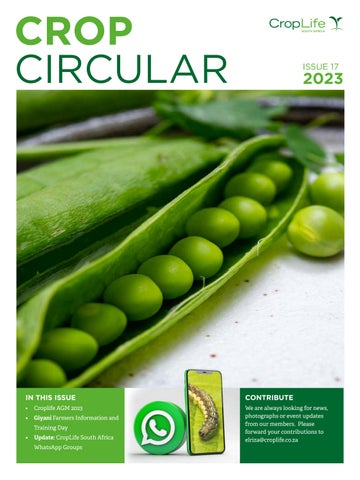
CROP CIRCULAR
ISSUE 17
2023
IN THIS ISSUE
CONTRIBUTE
•
Croplife AGM 2023
•
Giyani Farmers Information and
We are always looking for news, photographs or event updates from our members. Please forward your contributions to elriza@croplife.co.za
Training Day •
Update: CropLife South Africa WhatsApp Groups
CONTENT 03
Annual General Meeting 2023
07
Update: CropLife South Africa WhatsApp Groups
04
11
Why are label instructions for crop protection solutions not followed by end users?
MAN Finance Supports a CropLife SA Certified Recycler
08
Starke Ayres Glows with Pride
13
In case you missed it
14
05
In the Media What farmers need to know about biotech crops
Giyani Farmers Information and Training Day
10
A Brief Note: The 4th Edition Stewardship Best Practices Document, The Newly Developed Self-Audit Checklists & Pesticide Warehouse and Depot Compliance Checklist
15
In the Media Grasping the benefits of GM seed technology
16
In the Media Critical Pest Alert: Near-Pandemic Cockroach Outbreak
P2
Annual General Meeting 2023 CropLife South Africa hosted its annual general meeting (AGM) on 4 April 2023 for the third time as a hybrid event, with the physical venue being at the Grain Hub in Pretoria, while members from other regions could dial in virtually. As is custom, Rod Bell (CEO) opened the meeting and welcomed everyone present, in person and virtually. After a quick recap of the agenda, Kobus Meintjes (President) was introduced to deliver his President’s Report. He emphasised that, despite the numerous challenges that the industry faced, it opened the door for opportunities and subsequently highlighted some of the major achievements of the association throughout the year. These included, among others, hosting important industry events such as the CropCon2022 and the EU Green Deal seminar, guidance and implementation of the EPR regulations, the great strides made in the regulatory environment for new breeding technologies as well as the progress made in terms of GHS implementation, the working group on category 1a and 1b’s in terms of GHS classifications and the numerous functionality additions on Agri-Intel. He concluded by reminding everyone of the association’s purpose, namely “To be the absolute proponent of responsible production, distribution and application of crop protection and public health solutions across the entire value chain. We will continue to enable our members to be providers of environmentally compatible solutions that ensure sustainable, safe and affordable food production, and therefore food security, in South Africa.“ After the report was accepted by the meeting, André Roets of Van Sitterts Auditors presented a summary of the audit of the association’s finances for the 2022 financial year, concluding that the association was in a strong financial position. Rod Bell led the remainder of the meeting by providing an overview of the proposed
budget, as well as facilitating the standard formalities at the AGM, including revealing the newly elected Executive Council. Voting once again took place through an online platform, and the results were as follows:
Newly elected CropLife SA ExCo Distributor Member Representatives Chris Thompson Laeveld Agrochem Quintin Cross AECI Plant Health David Wood Farmers Agri-Care Gideon Hefer Inteligro Supplier Member Representatives Matt Fryer UPL Marius Boshoff Villa (Winfield United) Ben Krog Andermatt Madumbi Ockie Olivier Adama Kobus Meinties Bayer Fanie van der Merwe Corteva Antonie Delport Syngenta Vikesh Vallabh BASF Congratulations to David Wood who was subsequently elected as President and Marius Boshoff as vicePresident. Thank you to all the outgoing ExCo members for their unwavering support and commitment to the industry and we look forward servicing the industry alongside the new ExCo in the coming year.
MAN Finance Supports a CropLife SA Certified Recycler Dr Gerhard H Verdoorn - Operations and Stewardship Manager Zweli Mgayo of Olimekayo Agricultural Solutions joined the ranks of the CropLife SA Certified Recyclers early in 2021 after completing a course in agricultural business leadership through the Chair of Plant Health at the University of Stellenbosch, where he heard about CropLife South Africa and our container management programme. He set up the company with his own investments and was fully operational during the second quarter of 2021 with collecting empty containers from farmers in Limpopo, Mpumalanga and Gauteng. Like all the other CropLife SA certified recyclers who we are extremely proud of, Zweli is a self-starter and knocked on many doors for advice to run an effective recycling business.
MAN Finance heard about Zweli through CropLife SA and invited him to submit a proposal for enterprise development. He got stuck into the task and presented a foolproof business plan (courtesy of what he learnt through the agricultural business leadership course at Stellenbosch) and was awarded items such as a trailer and compactor to compact and transport empty pesticide containers. Zweli said that the MAN Finance investment in his business gave him the boost he was hoping to get
and expanded his range of operations. His vehicle with the MAN Finance, CropLife SA and Olimekayo branding is already well-known among the farmers of Limpopo and Gauteng.
CropLife SA is extremely grateful that an industry totally unrelated to agriculture was prepared to invest their enterprise development money in a person closely related to the association. Not only is it recognition of the dedication of our certified recyclers, but also recognition of CropLife SA’s efforts to rid the agricultural sector of empty pesticide containers. We thank the MAN Finance chief operating officer, Johan Verdoorn, and other company executives for their generous support of Zweli and congratulate Zweli on being recognised for his agricultural leadership. Zweli also participated in a farmers day at Giyani where he spoke to local farmers about CropLife SA’s container management programme. This is just one of many such events where he promotes sound container management by triple rinsing and recycling. The CropLife SA stewardship team is working with Zweli to establish a collection point in Giyani for the farmers so that their empty containers can also find their way into recycling.
P4
Giyani Farmers Information and Training Day Chantel Arendse (Lead: Plant Biotechnology)
Farmers in South Africa face challenges everyday as
resistant or Bt trait technology for protection against stalk
they not only deal with increased pressure from pests
borers, as well as herbicide tolerance for weed control.
and diseases, but also struggle to produce good yields under difficult growing conditions due to adverse weather conditions such as increased temperatures and prolonged periods of little to no rainfall. Our smallholder farmers are particularly vulnerable to these risks as most are not privy to information about available tools and innovations that could help them improve their farming practices and maximise their crop yields in a sustainable and efficient manner. In pursuit of addressing the knowledge gaps of smallholder farmers, CropLife SA embarked on a
The formal training programme included presentations
smallholder farmer training initiative in collaboration
on the following topics: • Introduction to biotech traits and how they work • Fall armyworm (FAW) overview • Integrated pest management – best practices and responsible use of pesticides and container management • Overview of the maize demonstration trial
with its service provider, Megabiotech Solutions, and collaborating partners, Corteva Agriscience and the Limpopo department of agriculture and rural development (LDARD).
•
BT-HT maize experience - farmer testimonial
After the formal training programme, farmers were led into the maize fields and shown with lateral strip tests, how to distinguish between biotech maize varieties as well as observe first-hand pest damage symptoms on maize. Based on the good turnout and positive feedback from attendees at the farmers information day, CropLife SA considers this training activity a successful start to rolling out direct farmer education and outreach to amplify key messages on stewardship and the responsible use of plant protection products, including biotech seed. Follow the conversation and learn more about our farmer’s experiences on Food for Mzansi or access a detailed farmer training report on www.croplife.co.za. You can also watch the highlights reel here:
This initiative took flight with the hosting of a successful farmers information day on the 23rd of March 2023 at Sisimuka Getle, Mopane region, Giyani. A total of 53 growers from the Giyani area and surrounding Mopane region attended the event. The event was hosted on the farm of Mr Jackson Baloyi, one of the smallholder farmers selected to participate in the demonstration trial planted with maize varieties containing both insect P6
Update: CropLife South Africa WhatsApp Groups Hiresh Ramanand – Stewardship Coordinator
The well-known CropLife South Africa Insect Identification WhatsApp group has now had a name change. As of this year, this group has been renamed to ‘CropLife SA Arthropod ID’. This group involves a network of Entomologists from various backgrounds. The idea is to assist with insect identification queries that CropLife SA receives, but first identification has to be confirmed before any advice can be given. This group has been central in the accurate advice communicated by CropLife SA staff to date. In addition, this presents opportunities for information sharing thereby improving the knowledge base of each participant. Given the success of this WhatsApp group, it was decided that CropLife SA should form similar groups focusing on plant disease and weed identification. In this regard, a ‘CropLife SA Plant Disease ID’ group is now up and running. Like the Arthropod ID group, this group boasts a network of plant pathologists from different backgrounds. The ‘CropLife SA Weed ID’ group is still in the process of being formed.
6) Mrs Desiree Van Heerden (Syngenta) 7) Dr Annemie Erasmus (ARC) 8) Mr Henk van der Westhuizen (Philagro SA) CropLife SA Plant Disease ID 1) Mr Hiresh Ramanand (CropLife SA, Group Admin) 2) Dr Gerhard H. Verdoorn (CropLife SA) 3) Ms Archana Nunkumar (KZN DARD) 4) Dr Khumbuzile Bophela (UP) 5) Mr Mandla Sibiya (UP) 6) Mr Nhlonipho Ngubane (UP) 7) Ms Ntombizodwa Maduna (UP) 8) Ms Wilmarie Kriel (Starke Ayres) Examples highlighting the value of both these groups to date: Question: Any idea which species may spin this fine web over branches?
The composition of the current CropLife SA WhatsApp groups are as follows: CropLife SA Arthropod ID 1) Dr Gerhard H. Verdoorn (CropLife SA, Group Admin) 2) Mr Hiresh Ramanand (CropLife SA) 3) Ms Roleen La Grange (CropLife SA) 4) Dr Diedrick Visser (ARC) 5) Dr Schalk Schoeman (SAMAC)
Answer: The caterpillar was identified as Yponomeuta fumigatus.
Question: Can somebody help with an ID on macadamias from the South Coast?
Question: What disease is this on the cob?
Answer: The caterpillar was identified as Euproctis aethiopica. Question: Please identify? Answer: Identified as Boil Smut. Given the stage of infection it was advised that spraying would not be worthwhile.
Answer: Identified as nymphs of red bugs (Pyrrhocoridae). It was advised that these are generally harmless and cause no visible damage to the plants that they feed on.
From the above examples, it can easily be seen that the formation of the WhatsApp groups have been fruitful, ultimately to the benefit of farmers and the public. It should also be noted that the individuals in each group are doing this for the greater good, in their own time and are not being remunerated by CropLife SA, for which we are most grateful! Finally, should there be anyone else from our member companies who would like to be part of these groups and make a contribution towards the greater good, please feel free to reach out to Hiresh Ramanand (hiresh@croplife.co.za).
Starke Ayres Glows with Pride Dr Gerhard H Verdoorn – Operations and Stewardship Manager Fresh vegetables are always attractive (even to the carnivores like myself!) at food retailers. The colours, the promise of nutritious, vitamin-laden bombs in the form of tomatoes, various brassicas, cucurbits and capsicums even convince the carnivores amongst us to savour the vegetable part of a heathy diet. I had the privilege of spending a day at a Starke Ayres field day that was hosted at their premises in Bredell in Gauteng and realised how superb the company is with their wide variety of vegetable and maize cultivars. I was welcomed by Shaun Hobday of Starke Ayres, saw good old friends Terry-Leigh McLaren and Wilmarie Kriel and was introduced to a number of other key figures in Starke Ayres such as Adheesh Ramnath with whom I had a meeting and discussions about self-sustainable homegarden food production.
The highlight of my visit, however, was to be guided by Shaun through their amazing collection of vegetable species and cultivars. Starke Ayres planted their commercial vegetable and maize cultivars specially for their field day to demonstrate to markets, farmers and consumers how advanced this company is in supplying anything a grower may desire. The tables in the main tent had a display in technicolor of more tomato cultivars than I have ever heard of, interspaced with watermelons, sweet melons, cabbages and broccoli as if straight out the Biblical Garden of Eden, carrots in a plethora of colours Continue on page 9
P8
that were like the sparks of fireworks and lettuce that begged for a salad bowl. We then proceeded to the growing plants and what a sight it was. Cabbages the size of 50 bar footballs, broccoli that looked like giant redwoods, cauliflower in the most vivid creams and yellows l have ever seen, tomatoes dotting their wiry plants in all shapes and sizes. Starke Ayres is a member of the Plennegy Group of companies and a long standing supporter of CropLife SA’s Small Pack Forum. Shaun explained that the consumer market, although not the largest in terms of vegetables and maize, is still a very important sector because many home-garden food growers are loyal Starke Ayres customers.
human population. It has a very large set of hothouses where trials are conducted on plant diseases, new plant varieties and seeds are grown for commercial farmers and the consumer market.
My take-away thought for the day was that with such incredible innovation in seeds, no South African should go hungry. Every South African citizen should be able to grow at least five healthy vegetable crops to feed a family and even sell off a few products for pocket money. Starke Ayres is constantly developing new cultivars of mainly vegetable crops to meet the expectations of the growing
Many other CropLife SA members share their premises in Bredell for warehousing of seed and plant protection products.
A Brief Note: The 4th edition stewardship best practices document, the newly developed selfaudit checklists & pesticide warehouse and depot compliance checklist The 4th edition of the CropLife South Africa stewardship best practices document is available to all our valued members on the member portal in the ‘Stewardship’ section. This is a detailed document that focuses on pesticide stewardship where the overarching principle is to always follow label instructions, irrespective of recommendations, advice or common beliefs. The approved label is the legal document and the only guarantee of safe, minimal risk and successful application of a pesticide. Pesticide labels and safety data sheets (SDSs) are available on www.agri-intel.com. In addition, the document outlines the responsibilities in terms of manufacturing, formulating, acquisition, sales, marketing, advertising, promotion, recommendation and use of pesticides within the South African legislative framework. Specifically, the duties and responsibilities, as well as liabilities for each role player in the value chain according to the applicable legislation. Finally, general stewardship activities to be considered by our members as part of their stewardship programmes are also covered in the document, such as responsible use training, integrated pest management (IPM), as well participation in empty container management and obsolete pesticide disposal.
Mr Quade Sing Jam (UPL), then provided valuable inputs from a warehouse perspective. The respective CropLife SA staff members edited and consolidated the checklist. This checklist focuses on seven sections, namely: (1) Regulatory compliance; (2) Structure; (3) Equipment and safety; (4) Storage; (5) First aid; (6) Fire and emergencies; (7) General security, access control and incident recording. The new checklists will assist our members in ensuring: (1) They conduct their business operations within the confines of the law. (2) They identify where remedial action is required and implement solutions timeously. (3) They embrace the importance of stewardship. The current version of the stewardship best practices document will be updated again later in 2023 to cover in more detail, the Globally Harmonized System of Classification and Labelling of Chemicals (GHS). The respective checklists will be updated as and when required. Communication to our members in this regard will be timeous. Our valued members are encouraged to utilise these tools to their benefit. All role players in the pesticide value chain are custodians of pesticide stewardship. Participate in stewardship – it is the right thing to do.
The newly developed self-audit checklists were largely based on the updated stewardship best practices document. Now, instead of drawing up one checklist for all role players, it was decided that the new versions should be specific for each role player, making it easier to understand, follow and complete. A total of eight tailored self-audit checklists with specific instructions were developed. These include: (1) Manufacturers, formulators and repackaging facilities; (2) Registration holders; (3) Distributors; (4) Sales personnel (crop advisors, agents); (5) Consultants/advisors; (6) Pest control operators (business purposes only); (7) End users (farmers/consumers) and finally, (8) Persons (natural or legal) transporting pesticides in the course of business. In addition to the self-audit checklists, the pesticide warehouse and depot compliance checklist was also created. What is notable here is the collaboration between CropLife SA staff and members in developing this checklist. Mr Roy Cackett (Farmers Agri-Care) took the lead where he completed about 90% of the work.
P10
Why are label instructions for crop protection solutions not followed by end users? Hiresh Ramanand - Stewardship Coordinator
THE LABEL IS THE LAW Act No. 36 of 1947
THIS IS THE BILLION RAND QUESTION!
label instructions, more specifically, the warnings and
While a simple question to ask, a difficult one to fully
precautions. As CropLife SA, we are fully aware that
address.
much has been done to convey the critical message of adhering to label instructions. The number of reports
CropLife South Africa receives numerous reports
being received in this manner are now worrying, giving
pertaining to pesticide use by end users where label
the sense that something is about to explode. To get on
instructions have not been followed. Gerhard Verdoorn
top of this situation – difficult questions must be asked.
(Operations and Stewardship Manager) receives 3000
Where are the bolts loose? What are the KEY reasons for
phone calls on average every year where 100% of the
this? The word ‘KEY’ is important because one cannot
cases he deals with are to do with end users (i.e. farmers,
focus on all reasons, the key reason(s) must firstly be
consumers, pest control operators) not reading the
addressed before tackling the lesser, based on collective
agreement among our valued members. The stewardship
Any advice contrary to the label is illegal! This is clearly
portfolio firmly believes that a targeted approach will be
where the breakdown in communication occurs, resulting
crucial for success.
in large number of reports received on a yearly basis. The questions that should be asked: Why is this the case?
The first stewardship forum for the new year was held
The collective agree that they are not wilfully giving
on 08 February 2023. It was clear from previous forums
out wrong advice so what is going on and what is the
that a more focused, interactive, and thought-provoking
industry going to do about it?
approach was needed. This presented the opportunity to workshop this very question during the forum. With that
There were valid suggestions and comments from the
being said, instead of introducing this question during
audience, where discussions were fruitful. Most agree
the forum, which would result in a lot of reasons and
that sales personnel do not fully understand Act No.
ideas being touted but with no clear direction, the need
36, so a suggestion was made to develop a Continuous
to conduct a survey among our members prior to the
Professional Development (CPD) module which deals
forum in order to understand their thoughts was needed.
specifically with Act No. 36 in relation to the pesticide
Collective agreement is important because if the vast
industry. Ultimately though, who does this responsibility
majority are on the same page, this will lead to positive
rest with? Is it just with CropLife SA? The findings here
energy when solving important problems that plague the
implicate all of us. If end users had the legal knowledge,
industry.
would this make a difference? In essence, this is a collective responsibility where all players in the value
There are currently many reasons circulating as to why
chain work in a coordinated manner to get a central
label instructions are not followed by end users. A survey
message across. Now that we have a base to work from,
questionnaire was sent out to all participants, which
our efforts can be focused accordingly.
listed 15 reasons for off-label use, where participants could either agree or disagree with each reason. Once
Going forward, the stewardship forum will workshop
completed forms were received, the responses for each
solutions, identify realistic/practical solutions, set
reason were collated and analysed descriptively. The
achievable goals where targets can be measured.
findings were presented at the stewardship forum and
Coordinated awareness actions aimed at end users with
this invoked positive discussions among all attendees.
regard to Act No. 36 will also be considered. First we need to fix the problem at the level of sales personnel before
The key reason identified, where 92.3% of the 26
directing our focus elsewhere. How do we do this?
participants responded “Yes”, was that end users have no knowledge of the legal requirements of the
One important criticism of this survey was that the
Fertilizers, Farm Feeds, Agricultural Remedies and Stock
participants were largely regulatory and not involved in
Remedies Act 36 of 1947. While extremely concerning,
sales. Thus, expanding this survey questionnaire to sales
the positive regarding this finding, pertained to the fact
personnel and farmers, in particular, will provide insights
that collectively, participants agree that this is where
into their thoughts on why label instructions are not
the wheels come off. Now, some may ask how? This is
followed based on the information we now have at hand.
just a piece of legislation…Well, considering that 80%
This will give better direction on how this situation can
of participants agreed that end users rely solely on the
be tackled.
advice from sales personnel, but where 68% believed that this was not intentional, strongly implies that sales
Finally, Rome was not built in a day and perseverance will
personnel do not know that by law they are obliged
prove vital for success. This is just the start!
to only give out advice that is in line with the label. Therefore, how would one expect the end user to know that the label is the law and must strictly be followed?
P12
In case you missed it Chlorpyrifos Position Statement – 27 February 2023
Depot Compliance Checklist – 27 March 2023
This communication has been compiled to clear any confusion and misinformation that is currently being shared in the industry regarding the current situation with the phase-out of chlorpyrifos-containing agricultural remedies in South Africa. The CropLife SA Team is available to field any questions.
Please find herewith the depot compliance checklist as promised.
Directive re the pesticide packaging PRO – 28 February 2023
The CropLife SA Team has communicated on numerous occasions to all association members, details about the Extended Producer Responsibility legislation (Regulation No. 1184 of 5 November 2020: ‘Regulations Regarding Extended Producer Responsibility’, published by the Department of Forestry, Fisheries & the Environment, under the National Environmental Management: Waste Act, 2008 (Act No. 59 of 2008)).
There appears to be confusion in the market around the implementation of the waste management EPR regulations for packaging materials. CropLife SA has been requested by several members to draft a statement re the waste management levies imposed upon them by manufacturers of packaging materials. We have been in close communication with the Director: Hazardous Waste Management about our container management programme and the development of the PRO Scheme for the Pesticide Sector. Herewith please find a directive from CropLife SA about this and the supporting draft notice, which according the DFFE is imminent.
Errors in Government Notice No. 3072 – 2 March 2023
As many of you will be aware, a government notice was promulgated last week (Government notice No. 3072, ‘Regulations to domesticate the requirements of the Rotterdam Convention on the Prior Informed Consent (PIC) procedure for certain hazardous chemicals and pesticides in international trade’). Upon review of this document, it became obvious that this government notice contains many significant errors and false statements. Read more here. For follow-up communications, please the first update here and second update here.
CropLife SA Calendar 2023 – 8 March 2023
The CropLife SA meeting and training calendar has been finalised and can be downloaded here.
Extended producer responsibility regulation for pesticide containers – 28 March 2023
As a reminder, this legislation sets the legal basis compelling industries to establish a ‘circular economy’ for their industries via the creation of recycling schemes for packaging & obsolete stocks. On 23 March 2023, the DFFE has promulgated the specific regulation for our industry, namely - Regulation No. 3177 “Extended Producer Responsibility Scheme for the Pesticide Sector”. Read more here.
GHS Compliant Labels and Safety Data Sheets – 20 April 2023 This is a reminder that all labels and SDS’s need to be GHS compliant by 30 September 2023. Please refer to the attached Government Notice (No. 2056) regarding the implementation and exemption criteria for GHS compliance. Please submit all applications timeously to DALRRD.
With regards to GHS compliant documents for Agri-Intel, please find a letter attached explaining how the process will work. Please can all Registration holders submit the required documents to Chana (chana@croplife.co.za) as soon as the documents are available.
CropLife SA Webinar Series – 24 April 2023
As you know, CropLife SA continuously strives to inform and educate its members, their clients, the public and various other stakeholders about the numerous topics and issues within the plant science industry, most
notably pertaining to crop protection. As such, we have launched a number of free to attend webinars for anyone who wishes to upskill themselves in this regard.
GHS applications in time should follow-up on their applications with the admin staff. Read more here.
CropLife SA CPD participants will also be able to complete the online questionnaires afterward to obtain the necessary CPD points. The programme and the relevant links to register can be viewed here. Please note that there is a limit to the number of participants, so kindly register at your earliest convenience.
PIC Extension Notice - 15 June 2023
Follow-up on GHS applications – 14 June 2023
During the liaison meeting last week, the registrar’s office indicated that members who have submitted their
As a follow-up to previous communications in this regard, please find the attached government gazette notice confirming the extension of the above-mentioned implementation. This confirms that the implementation for this piece of legislation has been extended to 300 days from publication of the regulation – increased from the original implementation period of 120 days. This means that the terms of the legislation are NOT yet in force. Read more here.
In the Media What farmers need to know about biotech crops Food for Mzansi - January 2023
tools, plant breeders can link a single gene to a specific feature and introduce this directly into plants in a quicker, more effective way. Plant biotechnology is simply a continuation of the breeding process. Read the full article here.
Gevare en risiko’s wanneer terbufos oormatig op aartappels toegedien word CHIPS – Januarie 2023 Dr Gerhard Verdoorn
Plant biotechnology made its introduction in Mzansi over 20 years ago. Today, there are still debates about farmers choosing conventional farming practices or biotech crops. CropLife SA brings us some expert insight into the world of plant biotechnology and what farmers should know. Corteva Agriscience’s developing marketing manager, Charles Matlou, expands on the types of biotech crops approved for commercialisation in South Africa and the difference between conventional and biotech crop farming. Using a variety of increasingly sophisticated genetic
Terbufos is een van die organofosfaatgroepplaagdoders wat insek- en aalwurmdodende eienskappe besit. Die molekule is ’n tipiese organofosfaat met ’n pentavalente fosfor-atoom waaraan twee etoksigroepe, een dubbelgebonde swawel-atoom en een disulfiede-groep gekoppel is. Dit het ’n baie hoë akute orale giftigheid (mondelingse inname) vir soogdiere, maar is effens minder giftig vir voëls. Kontak met die vel is ook gevaarlik vanweë ’n baie hoë velgiftigheid. Lees die volledige artikel hier.
P14
Die leë plaagdoderhouer: Wie moet wat doen? CHIPS – Maart 2023 Dr Gerhard Verdoorn (Operations & Stewardship Manager)
During a recent visit to Limpopo, CropLife SA in collaboration with Megabiotech and the Limpopo department of agriculture and rural development (LDARD), conducted biotech maize demonstration trials, and responsible use of crop protection solutions. Local farmers were excited about the training opportunity which is expected to help them turn a new agricultural leaf while increasing crop yields and reducing the use of agrochemicals. According to CropLife SA, their farmer advocacy and outreach campaign forms part of a larger effort to bridge knowledge gaps that exist around plant biotechnology, best practices and responsible use of pesticides among others. Read the full article here.
Suid-Afrika staan op die rand van ‘n afvalfiasko. Papier, plastieksakke, voedselverpakking, koeldrankbottels en bourommel is besig om die land in ‘n puinhoop te verander. Dit is asof inwoners daarop uit is om hulle lewensomgewing soos die spreekwoordelike varkhok te laat lyk. Asof die sig daarvan nie genoeg is nie, is die gevaar van ongure karakters soos bruinrotte al ‘n gegewe, omdat vaste afval en rommel die ideale lewensruimte vir dié dierasies skep. Die voormalige Departement van Bosbou, Vissery en Omgewing (DBVO) het so vroeg as 2003 al ernstig begin debat voer oor die geweldige uitdagings wat afval en rommel vir die land, sy mense en die omgewing skep. Jare se dinkwerk en hande vat met die samelewing en bedryf het uiteindelik die Nasionale Omgewingsbestuur: Afvalbestuurswet, 2008 (Wet 59 van 2008) gelewer om die bestuur van afval sinvol aan te spreek. Die grondbeginsels van die wet en sy ondersteunende regulasies fokus op vermindering, herwin en hergebruik, veral vir stowwe soos polimere wat verskeie kere se herprosessering kan oorleef voor dit finaal afgeskryf moet word. Lees die volledige artikel hier
CropLife SA gets rural farmers future ready Food for Mzansi – March 2023 In an effort to level up smallholders in selected regions of Limpopo, CropLife SA is exposing rural farmers to the benefits of plant biotechnology in a big way.
Grasping the benefits of GM seed technology Genetic Literacy Project – March 2023 (Originally published in Food for Mzansi)
For farmers, indirect advantages of adopting biotechnology include increased crop yields due to reduced crop losses and damage, higher farmer incomes and livelihoods, the use of fewer resources, and greater flexibility in managing weeds and pests. Although evidence so far indicates that smallholder users of the technology have also reaped similar advantages, this success does not apply equally to smallholder farmers in every region of South Africa. There are cost benefits for farmers using biotech crops. “Farmers planting biotech crops realise good yields. Their operations cost far less than those who are using conventional methods; that’s where we talk about the costs of labour compared to conventional costs,” says [Megabiotech Solutions’ Lesley] Mabasa. “Essentially, it is up to farmers to adopt the technology. The aim is to empower farmers and not to impose.” Read the full article here.
Product registrations – A chemical catch 22
Product labels are changing – what to look out for
Oilseed Focus – March 2023
SA Grain - May 2023 Elriza Theron (Advocacy & Communications Manager)
The need to regulate agricultural remedies in South Africa is a given. Regulations should be in place to protect the health of consumers and workers handling plant protection solutions, as well as the environment. However, in 2020 the European Commission adopted a set of strategies in its European Union (EU) Green Deal that aims to make the EU climate neutral by 2050. While there are several aspects to the Green Deal, the farm-tofork strategy is of great concern to the South African agricultural industry, according to Rod Bell, CEO of CropLife SA. “The EU has every right to implement legislation aimed at protecting its citizens and the environment, but it doesn’t give them the right to be prescriptive over farmers producing crops under different circumstances in other countries,” Bell says. “They need to consider other roleplayers across the world and what is required for food production.” While CropLife SA does not plan on ever challenging this right of the EU, it maintains that all role-players involved in the production of food (either for local consumption or export) in South Africa need to be aware of the implications the introduction of various parts of the EU Green Deal may have. Read the full article here.
Critical Pest Alert: Near-Pandemic Cockroach Outbreak Different versions of this alert appeared on numerous media platforms. The very wet and humid past summer brought about a near-pandemic outbreak of cockroaches in all communities in South Africa. Cockroaches are usually ubiquitous but calls to the CropLife SA emergency line pointed to a massive surge in German cockroaches all over the country. It is not only climate that spurs on their numbers, but also unhygienic conditions that prevail in South Africa. Unfortunately, the surge in cockroach infestation triggered a large-scale unlawful use of pesticides that are not registered for indoor use, with possible disastrous effects. Read the full alert here. Watch the interview with dr. Gerhard Verdoorn on ENCA Late News here.
Producers and farmworkers should be aware that their crop protection product labels are changing and will continue to do so for a while. The reason for this is because of the Globally Harmonised System of Classification and Labelling of Chemicals, or GHS for short, which affects chemical agents in various industries. This article will focus on products used in the crop protection industry. The need for GHS arose because of the global trade of chemicals, which often cross boundaries into areas with different languages and varying levels of literacy, thereby creating challenges when communicating safe and responsible usage instructions of the products. In South Africa, GHS became a legal requirement as from September 2022 and is stipulated in the Regulations for Hazardous Chemical Agents No. R280 of 29 March 2021. Since then, the labels and safety data sheets of crop protection products must follow a standardised approach in communicating the hazards of the chemical. However, bear in mind that there is a transition period for chemicals that were already imported or manufactured prior to this date. Read the full article here.
Beheer rotte en muise op plase AgriOrbit - May 2023 Builepes, beter bekend as die Swart Dood, het tussen 1345 en 1360 ongeveer twee derdes van die Europese bevolking uitgewis. Hierdie bakteriese infeksie wat deur die organisme Yersinia pestis veroorsaak word, het in die vroeë 1900’s skrikwekkende gevolge in Suid-Afrika gehad. Dit is ’n direkte gevolg van knaagdierplae soos muise en rotte. Hoewel ons nie in ’n staat van builepes verkeer nie, is die rotbevolking in Suid-Afrika besig om met rasse skrede toe te neem, veral in die stedelike gebiede waar swak beheer by stortingsterreine en op strate toegepas word. Mense rapporteer gedurig groter hoeveelhede rotte. Die Wêreldgesondheidsorganisasie het reeds in Oktober 2012 ‘n waarskuwing aan nege lande in SuiderAfrika, waarvan Suid-Afrika een was, uitgereik om voorsorgmaatreëls teen ’n rotverpesting te tref. Daar is nie werklik veel aandag hieraan gegee nie en vandag sit Suid-Afrika op die rand van ’n uitbreking van builepes as elke Suid-Afrikaner nie die knaagdiere in sy eie omgewing gaan beheer nie. P16
Luister: Die verantwoordelike gebruik en vernietiging van houers RSG Landbou - Mei 2023 Dr Gerhard Verdoorn van Croplife Suid-Afrika gesels met RSG Landbou-luisteraars oor die verantwoordelike gebruik en vernietiging van houers wat skadelike middels soos plaagdoders bevat. Luister hier na die onderhoud.
Through the lens of a maize farmer Food for Mzansi – May 2023 Ellias Mosomane, a farmer from Cloe in Limpopo, and CropLife SA representative Lesley Mabasa share Mosomane’s experience with the planting of biotech maize seeds at a demonstration trial. Before meeting the CropLife SA team, Mosomane had no idea what plant biotechnology seed was. However, he had an eye-opening moment when the CropLife SA team approached him. “I did not know anything about it until I met Lesley to explain everything to me,” he says. Meanwhile, Mabasa recalls meeting Mosomane as he was just entering the farming industry and says this was the perfect opportunity for a farmer to start off correctly. Read the full article here.
CropLife South Africa and CropLife Africa Middle East Sustainability in Agriculture and Food Security Workshop Agriculture is a major sector in South Africa, that also relies heavily on the exports of agricultural commodities, particularly to the European Union (EU). Yet, food insecurity is a key issue, largely attributed to unpredictable weather and geographic conditions, as well as increased pressure from pests and diseases. These have been exacerbated by climate change, Covid-19, the war in the Ukraine as well as legislative developments in the EU, with the continent and its farmers now facing increased challenges to feed its growing population, both directly in terms of local food production, but also in terms of running viable agricultural businesses for local job creation and economic stimulation of the continent’s relatively poor economy. It is therefore essential to get the sustainable growth agenda right in agriculture, while ensuring food security remains a priority. This is why CropLife South Africa (SA) and CropLife Africa Middle East (AME) hosted different workshops with various stakeholders, including grower groups, government representatives and the media, to discuss the need to bring the African narrative more firmly into relevant policy discussions, notably at EU level. The workshops focused on the following themes: Addressing misconceptions by providing context: Agriculture as a science, especially crop protection, is largely misunderstood and because of this, it’s often the target for activism or emotion-based, anti-science lobbying. This becomes problematic when it places food security or effective, sustainable food production at risk, which is why the discourse between the various stakeholders is of utmost importance. Issues such as toxicity, residues, pesticide regulation and substances of concern must be placed in the appropriate context and within a hazard/risk framework to ensure policy discussions are objective and based in science. Risks to South African agriculture: Some of the policies proposed by the EU in their various strategies relating to the EU Green Deal, pose a very real threat to South African agriculture, which cannot be ignored. The need for food systems to be transformed and for growers to produce safe and nutritious food in an environmentally compatible manner is undeniable, however, any change must be sustainable, and policies must consider the local production conditions as these are not one-size-fits-all, and the realities of EU farming is not the same as those for South African farmers. South African regulators should be cognisant of the possible unintended
consequences of these EU policies and how they will impact not only food security in South Africa, but also jobs, livelihoods and opportunities for economic growth, to name a few. The enforcement of these policies on South African agriculture, when they were not made with South Africans in mind, is a threat to the government’s right to make decisions for its people based on the local conditions and requirements. Requirements from stakeholders: It is of the utmost importance that all stakeholders, including government, industry and growers, give this matter the necessary attention, because food security affects every single South African. The livelihoods of the people of South Africa must be protected at all costs, and stakeholders need to work together so that conversations can continue at EU level, where it matters. We therefore urge government and other stakeholders to participate in the necessary discussions and engage with us to ensure that the country’s right to produce safe and affordable food in sustainable manner within local conditions, is not challenged. Read the full report here.
A G R I C U LT U R E I N T E L L I G E N C E
DID YOU KNOW?
Agricultural remedies (both chemical and biological) are registered under Act No. 36 of 1947 and all start with L, B, K or V numbers. Do you know what these letters mean? In the past, the letters were assigned to the type of products that they were categorised under: L – Landboumiddel (Agricultural remedies) B – Bemestingstowwe (Fertilizers) K – Kunsmis (Fertilizers) V – Veevoer (Livestock)
Labels of products are not recommendations on how to use the product, they are instructions by law. Any deviation from the label is illegal. Warnings and precautions must be adhered to, and the product must be applied to the registered crops and target pests at the registered dosage rate with the methodologies as instructed by the labels.
Residues are leftovers from intentional use of a substance, e.g. from crop protection products used in agricultural production. Whereas contaminants are any substance occurring in foodstuffs that was not added intentionally. Contaminants can arise from e.g. food processing, packaging and transportation.
Maximum residue limits (MRLs) are set by regulatory agencies and are trading standards that are used to enforce legal registered uses of pesticides.
MRLs may be set for primary and secondary food commodities; processed food commodities and animal feed commodities. Policies differ from country to country and most countries define a list with commodities for which MRLs are set.
P18
CONTACT
If you have any queries, would like to become a member, or if you have general feedback, we would love to hear from you. Please contact any member of our team: CropLife SA Office
087 940 4168
info@croplife.co.za
Rodney Bell - Chief Executive Officer
066 273 6027
rod@croplife.co.za
Chantel Arendse - Lead: Plant Biotechnology
082 992 0952
chantel@croplife.co.za
Gerhard Verdoorn - Operations & Stewardship Manager
082 446 8946
gerhard@croplife.co.za
Hiresh Ramanand – Stewardship Coordinator
066 562 5850
hiresh@croplife.co.za
Roleen la Grange – Regulatory Manager
082 851 7863
roleen@croplife.co.za
Elriza Theron - Advocacy & Communications Manager
072 443 3067
elriza@croplife.co.za
Nadia van Niekerk - Financial & Membership Administrator
072 940 5591
nadia@croplife.co.za
Chana-Lee White - Agri-Intel Manager
072 298 9389
chana@croplife.co.za
Liezel Cronje - Agri-Intel Administrator
072 122 5964
liezel@croplife.co.za
Luigia Steyn - Agri-Intel MRL Consultant
060 508 6369
luigia@croplife.co.za