Critical Path respectfully acknowledges the Gadigal people as the traditional custodians of the land where the organisation is based. We recognise Australia’s First Peoples continuing connection to these lands and acknowledge the elders past and present.
Front Cover Image: Taiwan and Australia Choreography Exchange Program, C-Lab, Artwork by Wendy Yu.
Back Cover Image: Plant a Promise, CarriageWorks fellowship auspiced by Critical Path, Artist: Henrietta Baird, Image: Sierra Malevich
2022 was a year of much change and forward motion for Critical Path, Australia’s leading centre for choreographic research and development. Details of staff and Board movements, both into and out of the organisation, are detailed within this report. While we ended the year with a substantially different set of faces to those we started it with, the Board and staff are diving into 2023 with renewed focus and energy, propelled by our 17-year mission to support independent choreographers and dance makers in pushing the boundaries of contemporary practice.
We’re thrilled that 156 artists participated in Critical Path’s choreographic practice programs throughout 2022, which included thirty research projects and nineteen developments. An encouraging statistic given our priority areas – 56% of participating artists identified as either Aboriginal and/or Torres Strait Islander, from a Culturally and Linguistically Diverse Background, or with a Disability.
Industry partners and collaborators who made significant cash and/or in-kind contributions to joint programs included Performance Space, PYT Fairfield, Cementa, Dance Nucleus (Singapore), HORSE (Taiwan), C-LAB (Taiwan), and the
Cultural Division of the Taipei Economic and Cultural Office in Sydney. We also continued our leadership of the muchloved March Dance, in partnership with DirtyFeet.
We thank the NSW Government (through Create NSW) for continuing to provide the security of multi-year investment until 2024 alongside one-off funding for our Digital Enchantment project. We were also supported throughout the year by the Australian Government (through the Australia Council for the Arts) and City of Sydney, with project funding for three distinct sector programs. We are especially grateful to Woollahra Municipal Council, who continue to licence the Drill Hall to Critical Path, permitting use of the venue and the provision of office space so it can remain the home of independent dance artists to experiment and develop work.
Our hard-working staff consistently went above and beyond in 2022, demonstrating an unbridled enthusiasm for the projects and programs that the organisation delivers in supporting artists. On behalf of the Board of Directors, I pay tribute to Stephanie Tatzenko (Finance & Administration Manager), Iris Shen (Producer), Matt Cornell (Digital
Artist-Curator) and Jasmine Gulash (First Nations Producer) for their courage and commitment.
The Board of Directors also deserves emphatic thanks for their support of the staff and contribution to the development of our strategic plan; I’d especially like to pay tribute to outgoing Chair Travis De Vries, and Acting Chair Jasmin Sheppard, two resourceful and generous individuals who provided us with strong leadership throughout 2022.
Reflecting on the year wouldn’t be complete without acknowledging the tenacious, enterprising, and wonderful Claire Hicks. After seven years as the organisation’s Director & CEO, Claire resigned in late 2022 to take up a curatorial role at Carriageworks in early 2023. Claire’s contributions to the independent dance community throughout her tenure will no doubt continue to impact many artists in the years to come, and while she will be missed as Critical Path’s fearless leader. On behalf of the staff, Board, and artists of Critical Path – thank you Claire, for everything you have done and will continue to do.
And to the many dance artists who engaged with Critical Path through our diverse programs – we do this for you. Thank you. We look forward to seeing you back at the Drill in 2023!
Brendan O’Connell - Interim Chair
ABN AND INCORPORATION NUMBER
ABN: 12 049 903 261
Critical Path Incorporated is an Incorporated Association (NSW)
Incorporation Number: INC9881671
REGISTERED OFFICE & PRINCIPAL PLACE OF BUSINESS
The Drill
1C New Beach Road
Rushcutters Bay NSW 2011
RESPONSIBLE ENTITIES
Auditors
Mitchell & Partners, Chartered Accountants
Public Officer (2022)
Claire Hicks
The Committee members of Critical Path Incorporated present their Report together with the financial statements for the year ending 31 December 2022 and the Independent Audit report, covering those financial statements.
The following persons were committee members of Critical Path Incorporated during or since the end of the financial year.
There were 4 general meetings during the year (the AGM was held on 26 April, 2022). In addition, there was a Committee & Team Planning session on 23 October, 2022. Meetings during the year and the number of meetings attended by each member are as follows:
Catherine Sullivan has been Secretary since 8 April 2019. Claire Hicks has been the Association’s Public Officer since June 2016.
Details of Committee Member’ qualifications, experience and special responsibilities can be found below.
TRAVIS DE VRIES
Chair to 15 August
Travis De Vries is the producer and host of Broriginals and the producer of Fear of a Black Planet he is a concept artist and a gamer. He is also the founder and director of Awesome Black and an avid artist. Travis is a trained dancer and fine artist and is alumni of NAISDA Dance College. Travis has a wealth of producing experience having worked as a producer for Sydney Opera House and a range of arts programmes and festivals.
JASMIN SHEPPARD
Artist Representative & Chair (from 15 August 2022 until October 2022)
Jasmin is a contemporary dancer, choreographer and director, a Tagalaka Aboriginal woman with Irish, Chinese and Hungarian ancestry. She spent 12 years with Bangarra Dance Theatre, performing numerous lead roles and choreographed one major work for the company, ‘MACQ’. In 2020 Jasmin created works for NAISDA Dance College, Sydney Dance Company’s PPY program, and Catapult Dance. Her work is passionate, political and has been described as “surreal and highly evocative” (The Australian).
CATHERINE SULLIVAN
Secretary
Catherine is a lawyer with extensive law firm and in-house corporate legal experience and is currently Senior Manager & Senior Legal Counsel at ASX Limited specialising in financial markets, corporate, governance and regulatory law. She is a director of Urban Theatre Projects and National Young Writers Festival and former Chair of Critical Stages and director of Brand X.
ALEXIO CHIBIKA Treasurer
Alexio is a Chartered Accountant with extensive audit experience in an international audit firm across five countries. He is currently a Senior Audit Manager and is responsible for the audits of large listed and multinational organisations. He has experience in Audit, Financial Management, Corporate Governance, Internal controls and Financial Reporting. He has also volunteered as Treasurer for various notfor-profit entities.
BRENDAN O’CONNELL
Brendan has held senior management, programming and producing roles at Sydney Opera House, City of Sydney, Performance Space, Sydney Festival, Adelaide Fringe, and the Australian Consulate-General in New York working across artforms and genres on a suite of large-scale projects and festivals. Brendan is currently Executive Producer at Lucy Guerin Inc.
VIRGINIA LEE
Virginia is a legally qualified professional with extensive strategic and operational experience in government, think tanks and non-profit organisations. She has a background in international trade relations, Asia engagement and law. Her expertise is in developing sustainable corporate strategy, risk assessment, and governance. She currently works in Trade and Investment within the NSW Treasury and is a Board Member on the Professionals in International Trade.
AZZAM MOHAMED
Artist Representative
Azzam, also known as Shazam, is a dancer, performer, and educator from Sudan. Azzam’s dance practice encompasses a range of styles, from traditional cultural dance through to hip hop styles, he is able to bring these forms together to create a breathtaking original dance fusion that echoes his history and at the same time showcases his incredible ability as a dancer. Azzam’s dance practice involves teaching at studios and festivals, performing and touring in stage shows, competing in dance competitions and judging, organizing events, facilitating workshops, and mentoring and coaching young and emerging Australian dancers.
LEE PEMBERTON
Artist Representative (to 25/01/2022)
Lee has worked as a dancer and choreographer. Her experience, skills and interest lie in regional development and equity in the arts. Lee’s recent works engage with site-specific performance creation, the cultivation of remembering and collecting, awakening in the environment and fostering awareness.
LEE-ANNE LITTON
Artist Representative (Joined 15/08/2022)
Lee-Anne is a Sydney-based performing artist originally form Perth, Western Australia. She has a strong investigation and passion for Contact Improvisation and has extensive aerial training specialising in elastic rope and harness work along with other static aerial apparatuses. She has choreographed for several large-scale productions and performed nationally and internationally with some of Australia’s leading physical theatre companies, including her own, Strings Attached along with Stalker and Legs on the Wall.
CHANGES TO THE GOVERNING COMMITTEE
In 2022 changes to the Committee are as follows:
Travis de Vries stepped down as Chair (leaving the board due to other commitments) and Jasmin Sheppard was elected into the role 15/08/2022.
Lee Pemberton (Artist Representative) stepped down 25/01/2022 and Lee-Anne Litton (Artist Representative) joined the board on 15/08/2022.
Virginia Lee - stood down in August and is awaiting confirmation of employer permission to continue.
PYT LAB, Artist: Bianca Willoughby
ORGANISATIONAL STRUCTURE AND KEY RESPONSIBILITIES
There were changes to staffing arrangements throughout the year, including temporary hires and changes to contracts. Please see next section for full details.
STAFFING NOTES
In 2022, Claire Hicks continued in the role of Director (0.8). After 7 years in the position, she gave notice of her leaving the organisation with the aim of ending her tenure by the end of February 2023. The position of Artistic Director/CEO was advertised in late December 2022.
Stephanie Tatzenko continued as Finance and Administration Manager – she gave her notice and will handover the role in January 2023. The new Finance and Administration Manager is Neil Godfrey, who commenced on January 9, 2023, in a part time capacity of 0.8.
Jasmine Gulash continued in the new role of First Nations Producer (0.5) until December 2022. Matt Cornell continued (0.3) as Digital Artist-Curator until December 2022.
Iris Shen took up the role as Producer from January 2022 and finished working with us in early 2023. Critical Path also continued with Karen Steains (financial consultant) on a casual service contract basis.
Contracts with Webgirl (web and e-news support) and QBT Consulting (IT support) continued across the year.
PRINCIPAL ACTIVITIES
Critical Path is a choreographic research and development centre based at the Drill Hall, a large rehearsal space on the harbour in central Sydney, Australia. Our mission is to cultivate a program of research and practice development opportunities for choreographers and dance makers, nurturing diversity and excellence in a supportive critical environment which fosters creative risk-taking.
With a distinct focus on research and innovation, we support Australian choreographers to incubate new ideas and experiments in our studio so that excellent new work can make it to our stages. We aim to nourish a genuinely independent dance company as they push the boundaries of existing practice in relation to local and international fields, enhancing the vibrancy of the Australian dance sector.
We emphasise our role as a hub, a space for the independent artists to congregate, cross fertilise, debate, critique. A place connected into the broader arts sector through a host of partnerships.
OPERATING RESULT
The net surplus for the year amounted to $1,253 (2021: $17,091). Critical Path has been serving the contemporary dance community for 17 years.
2022 ARTISTIC PROGRAM FUNDING
Create NSW
In 2022, we continued to be supported by Create NSW with multi-year funding secured (2+2 years) until end 2024; $280,000 per annum to cover the period January through to December each year. This is a standstill figure on previous year.
From Multi-Year Funds (2021 & 2022) we were able to spend $42,986 on the artistic program.
Critical Path also received Create NSW Project funds of $59,852 for ‘Digital Enchantment’.
AUSTRALIA COUNCIL
LOCAL
Woollahra Municipal Council continues to licence the Drill to Critical Path with use of the Hall and an office. City of Sydney provided a grant of $28,311 for our Amplify Digital Enhancement project commencing 1 July 2021 and running until end June 2022.
PARTNERS
Other partners provided in-kind support or spent cash directly on joint programs including Performance Space, PYT Fairfield, HORSE & C-Lab in Taiwan, Dance Nucleus in Singapore.
OTHER
Other income was generated through:
Donations
Venue Hire
$13,274 (consisting of individual donations and support from the Keir Foundation allocated to March Dance)
$13,320 (rehearsal and development periods for subsidised artists/companies and independent makers)
Other direct in-kind Various professional services and miscellaneous items
Sundries A combination of membership fees and interest income
AUSPICE
Critical Path auspiced the March Dance by the Independent Dance Alliance (an unincorporated group with a membership consisting of Critical Path, DirtyFeet and ReadyMade Works) which included a City of Sydney grant of $20,000.
The organisation also acted as auspice for First Nations’ artist, Henrietta Baird, for her Australia Council grant of $38,339 ($6,611 spent in 2021 and $31 728 spent in 2022), Create NSW grant $42,000 as well as her Carriageworks First Nations Fellowship of $7,480.
OVERALL ENGAGEMENT
324 Total artist participation (156 Unique*)
144 Total live audience for Critical Path activities in 2022
39 Total online audience for Critical Path activities in 2022
449 Digital audience (unique viewers)
514 Digital readership1 of resourcesreports, videos, e-journals
11,663 Online readership2 (including resources from website, Facebook, Instagram, Vimeo, newsletter and Soundcloud)
8,272 Website visitors
22,044 Total pageviews3 on website
RESEARCH
74 Unique artists participated in the research program
105 Artist engagements in the research program
54 Live audience to research sharings
9 Online audience to research sharings
31 Research Projects, including
8 Residencies
21 Space grants
1 Digital project
1 Research Room residency
1. This includes reads of resources (website and issuu) and views of videos.
2. This year’s numbers include page views from google analytics. Page views show how many times people loaded the website after clicking the content. Page views are a far superior metric compared to link clicks because of the depth of information that it can reveal about the success of the content.
3. Pageviews is the total number of pages viewed. Repeated views of a single page are counted.
DEVELOPMENT
102 Unique artists participated in our development Program
196 Artist engagements in the development Program
6 Artists contributed to Critical Dialogues 35 Audience to development
PUBLIC PROGRAMS
40 Unique artists participated in our public program
23 Artist engagements in the delivery of our public program
55 Total live audience for Critical Path activities in 2022 0 Total online audience for Critical Path activities in 2022
95 Audience and Participants across Public Program
YEAR ON YEAR OVERVIEW
Our focus is on those who identify as having and/or are connecting with a choreographic practice. The 156 unique artists Critical Path worked with in 2022 are listed below.
ARTIST DEMOGRAPHICS
Aboriginal and/or Torres Strait Islander Artists
Artists from Culturally and Linguistically Diverse Background
Young Artists
Artists with a Disability
Emerging artists
Mid-Career and Established Artists
Artists’
Sydney Regional
Adelina Larsson
Adrina Petrosian
Alan Schacher
Alejandro Rolandi
Alex Craig
Alice Weber
Alison Plevey
Amy Flannery
Amy Zhang
Angela Goh
Annalouise Paul
Arco Renz
Ashlee Bye
Azzam Mohamed
Beth Lane
Bianca Joanne Willoughby
Brian Fuata
Bridget Baskerville
Brooke Amity Stamp
Callum Mooney
Carla Céspedes
Charemaine Seet
Chen Wu-Kang
Cloé Fournier
Cynthia Florek
Daniel Jenatsch
Daniela Zambrano
David Clarkson
David Huggins
Eisa Jocson
Eliam Etesone Motu
Eliza Cooper
Ella Watson-Heath
Elle Evangelista
Elysa Wendi
Emele Ugavule
Emily Yali
Emma Fishwick
Emma Syme
Gabriela Green Olea
Gemma Sattler + Molly McKenzie
Hanif Patel
Henrietta Baird
I-Chin Lin
I-Wen Chang
Ileanna Sophia Cheladyn
Imogen Cranna
Imogen Yang
Ira Ferris
Jackson Garcia
Jacob Boehme
Jasmin Sheppard
Jasmine Gulash
Jeremy Lowrenčev
Jeremy Santos
Jia-hua Zhan
Jochen Gutsch
Jodie McNeilly
Johanna Clancy
Josh Freedman
Josh Staines
Joshua Twee
Juliet Saito
Justine Shih Pearson
Jye Uren
Kassidy Waters
Kirk Page
Kristina Chan
Laura Osweiler
Leanne Thompson
Lee Ming-chieh
Lee Pemberton
Lee-Anne Litton
Leo Tsao
Lexy Panetta
Lily May Potger
Lily Shearer
Lin Kai-Yu
Linda Dement
Liz Lea
Lizzie Thomson
Louise Morris
Luke George
M@ Cornell
Marianna Poghosyan Gordon
Marilyn Miller
Martin del Amo
Matt Shilcock
Matthew Hughes
Maxine Carlisle
Megan Alice Clune
Melati Suryodarmo
Melody Rachel
Merinda Davies
Mica Lynnah
Michelle St Anne
Mitchell Christie
Moemoana Schwenke
Nanako Nakajima
Nasim Patel
Natasha Sturgis
Neville Boney
Nick Power
Nicola Carter
Nicola Ford
Niki Verrall
Nikki Heywood
Olivia Hadley
Padmini Chettur
Patricia Wood
Patrick Meessmann
Peta Strachan
Pichet Klunchun
Rachael Gunn
Rasmus Olme
Raymond Blanco
Reece Jones
Reina Takeuchi
Rhiannon Newton
Riana Head-Toussaint
Romain Hassanin
Rosalind Crisp
Roslyn Orlando
Samuel Beazley
Samuel Free
Sarah Aiken
Sarah Houbolt
Saskia Ellis
Shana O’Brien
Si Yi Shen
Sidney Mcmahon
Skye Etherington
Sophia Ndaba
Sophia van Gent
Stella Chen
Steve Lu
Strickland Young
Su Wei-Chia
Sue Healey
Susannah Keebler
Tas Repousis
Texas Nixon-Kain
Timothy Ohl
Tiyan Baker
Travis De Vries
Trevor Brown
Vicki Van Hout
Victoria Hunt
WeiZen Ho
Wendy Yu
Xiaoke x Zihan
Yeh Ming Hwa
Yuhsin Su
Zi-ping Tian
Zoë Bastin
2022 RESEARCH FELLOWSHIPS
Critical Path has supported four artist/artist duos in 2022 in artist-led research residencies. These research projects focused on explorations of new ideas, process or practice development without a pre-determined product outcome.
The research residencies are not available for creative development of new work, though they may allow early terrain explorations or deep digging into particular ideas and concerns. They may lay the foundation of new work.
Alan Schacher & WeiZen Ho
The artist-duo inquired how place may be engendered through community engagement and enactment. Their research process focused on ways of devising social choreographies based on symbols that persist in each individual’s memory. Employing walking and conversation as methods for exchange, they engaged with several communities to identify their significant symbols, images, materials and ways of observance and practice. Alan and WeiZen worked with Anthropologist Dr. Phillip Mar (Institute for Culture and Society, Western Sydney University). For the Australia-Asia exchange, they collaborated with Mella Jaarsma, an artist located in Indonesia. Their research counterpart in Yogjakarta was Mira Asriningtyas, an artist, researcher, curator and art writer, who works with LIR Curator Collective.
WeiZen Ho and Alan Schacher, Credit by Karlina Mitchell
Alex Craig
Queer Blind dance artist and maker Alex Craig works collaboratively, opening and holding space for a collective experience of dance that is not centred upon visual sight. For their 2022 Critical Path Research Residency, they explored sound-based languages which support non-sighted navigation of space whilst dancing and communication between collaborators when improvising and/or sharing individual movement languages. They collaborated with choreographers and dancers Victoria Hunt, Jeremy Lowrenčev, and musicians Jochen Gutsch and Trevor Brown, as well as: Imogen Yang, Romain Hassanin, Annalouise Paul, Gabriela Green Olea, Samuel Beazley, Saskia Ellis and Emily Yali.
Image by Iris Shen
Image by Iris Shen
Independent choreographer and dancer Cloé Fournier collaborated with physical theatre director David Clarkson, dancer and inter-disciplinary artist Imogen Cranna, and digital artist Matthew Hugues to explore the complex relationship between digital technology and artistic performance (dance). They looked at the collision between the digital and the human body. We are very excited to finally move into the real, hyper real, fantastical and the ordinary.
Cloé Fournier
Image by Martin Fox
Dr Laura (Amara) Osweiler
Laura’s research explored her lived experience with cataplexy, a neurological sleep disorder, and the new movement languages that emerge from this. She worked with producer and director Paul Osborne and international circus and physical theatre performer and audio describer Sarah Houbolt, They explored themes of isolation, interruption and disruption, Crip Time and Space, body knowledge, types of memory, forms of consciousness and perceptions of the self. Through movement, lighting, dance bungee rigging, music, audio description, autobiographical narrative and live and online audience interaction.
Artist Dr Laura Osweiler, Image by Lucy Parakhina
by
Image
Martin Fox
EXPERIMENTAL CHOREOGRAPHIC RESEARCH RESIDENCY (ECR)
For the 7th year, we have continued our partnership with Performance Space. The recipient of the 2022 ECR residency was Brooke Stamp who collaborated with sound designer Daniel Jenatsch and dramaturgical chaperones Brian Fuata and Sidney McMahon to develop work under the thematic – ‘The Line is a Labyrinth’.
CRITICAL PATH-PYT CHOREOGRAPHIC LAB
Critical Path PYT Choreographic Lab gathered three artists, Bianca Willoughby, Cynthia Florek and Joshua Twee, to consider digital intimacy, ableism and intersectional identities in their choreographic practice. Together, they explored shared concerns around: digital formats, process and intimacies; crip time and ableism; intersectional identities and form explorations. Guest artists were Eliam ‘Royalness’ Motu and Gabriela Green Olea, alongside Matt Cornell.
PYT LAB, Artist: Bianca Willoughby
SPACE GRANTS & BURSARIES
Critical Path offers space grants at the Drill Hall for practice research or development over 3 to 6 days. Across 2022 we offered space grants to: Daniela Zambrano, Nicola Ford, Sophia Ndaba, emma + molly, Sue Healey, Azzam Mohamed, Lexy Panetta. We also supported with space and bursaries Oz Frank’s Suzuki-Praxis workshop. And were one of the many venues who participated in Movement, Movement, Movement – One Day for Dance.
MARCH DANCE
Critical Path is responsible for March Dance in partnership with DirtyFeet. 219 creative participants (artists and cultural workers) engaged with the 2022 Festival. Critical Path provided Space Grants to: Patricia Wood, Sarah Aiken, Brian Fuata, Juliet Saito, The Living Room Theatre, DirtyFeet – Emerging Makers, Adrina Petrosian, Mixed Bill – performance by emerging makers. Bursaries were given to: Lux Eterna, Rakini Devi, Emma Saunders, Amy Zhang, Gabriela Green Olea; and a First Nations bursary to Amy Flannery.
Space Grants, Artist: Sophia Ndaba
Space Grants, Artist: Azzam Mohamed
FIRST NATIONS LED PROGRAM – Producer Jasmine Gulash
Indigenous dramaturgy in dance has created space for action research in the framework of a fully engaged and culturally grounded approach to considering and supporting Indigenous Australian dramaturgies in dance. A series of talks were held online with nation-wide Indigenous contemporary dance practitioners, as well as intensive residencies held at the Drill Hall with emerging and senior choreographers. A detailed report from the findings was collated by Wiradjuri practitioner Tammi Gissell and shared with the wider First Nations contemporary dance community, and other members of arts institutions as a resource document (e.g Australia Council, Sydney Opera House).
Issue 14 of Critical Dialogues, Critical Path’s digital publication, was edited by Jasmine Gulash and titled FIRST NATIONS DIALOGUE: LEARNING INFORMING OUR PRACTICE. It brought into focus Australia’s First Nations dance makers in a revealing and honest dialogue on what informs and inspires their creativity.
A First Nations focused Lab took place at Bundanon with artists Henrietta Baird, Shana O’Brien, Josh Staines and Jasmin Sheppard. Supported by guest practitioner Jasmine Gulash, Critical Path First Nations Producer. Artist worked on their current projects while exploring shared concerns around relationship to the environment. They also engaged with questions and ideas that spark across their diverse making and presentation processes.
In April Critical Path hosted a Regional Practitioner Gathering at Bundanon for artists who are all based in the Hunter Valley/Central Coast area of NSW. The residency-lab was part of a series of activities to nurture networks of regional practitioners and to provide professional and sector development activities. The artists participating were Alejandro Rolandi, Lee-Anne Litton and Sophia Van Gent along with Shana O’Brien, Josh Staines and Jasmin Sheppard. This gathering was supported by Critical Path Director Claire Hicks who is also based in the Central Coast region. Jasmin Sheppard, Josh Staines and Shana O’Brien reconnected at Arts House, Wyong in November 2022, to pick up some of the conversations begun at Bundanon.
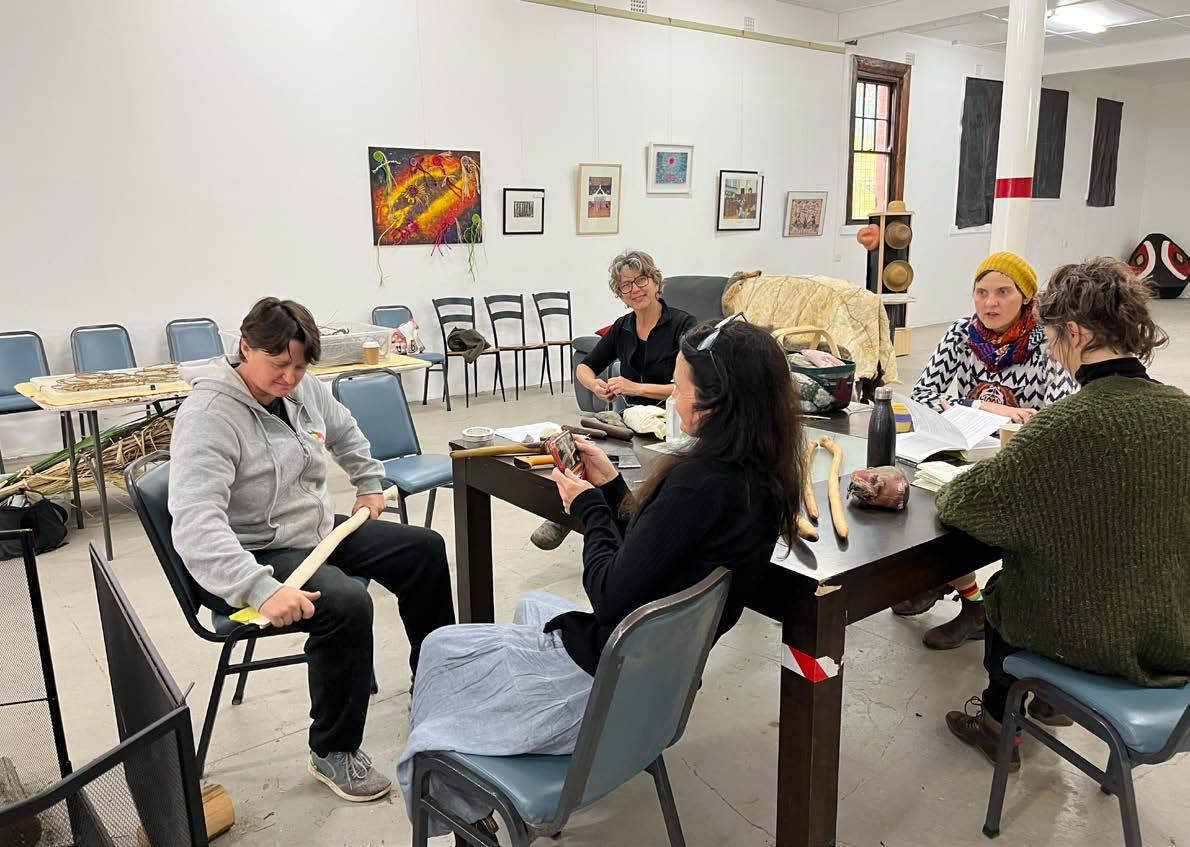
Art For Here LAB, in Kandos – Partnership with Cementa
Art For Here was a one-week Regional Choreographic Development Lab based in Kandos in October 2022, and organised in partnership with Cementa. The lab explores socially embedded practice or choreography relevant to social context and place. The lab’s focus is sharing, research, reflection, and collaborative exploration. The 2022 lab started with an invitation to consider “art for here”. We have invited Bridget Baskerville, Emma Syme (North East Wiradjuri Co Cultural Centre), Ira Ferris, Leanne Thompson and Jo Clancy to this lab. Claire Hicks, Director of Critical Path, facilitated the lab and Cementa festival Creative Director Alex Wisser was the “guest” provocateur.
Art For Here LAB in Kandos
Articulating Practice – Sapphire Coast
Critical Path offered artists a paid opportunity to attend a three-day development project at Gunpowder Trading Post in Wolumla. Artists participating in the project were Beth Lane, Paddy Meessmann, Ashlee Bye, Mica Lynnah, Susannah Keebler, Zoe Bastian. The project was open to artists of any discipline who have a choreographic practice. The group explored how they represent their work and communicate it to others. Claire Hicks facilitated the program, with other guest artists.
INTERNATIONAL EXCHANGES & DIGITAL RESIDENCIES
Charemaine Seet Residency Singapore
In April 2022, choreographer Charemaine Seet embarked on stage 3 of Sixth Daughter - researching Teochew opera movement in Singapore with local opera artists. This research was funded by Critical Path.
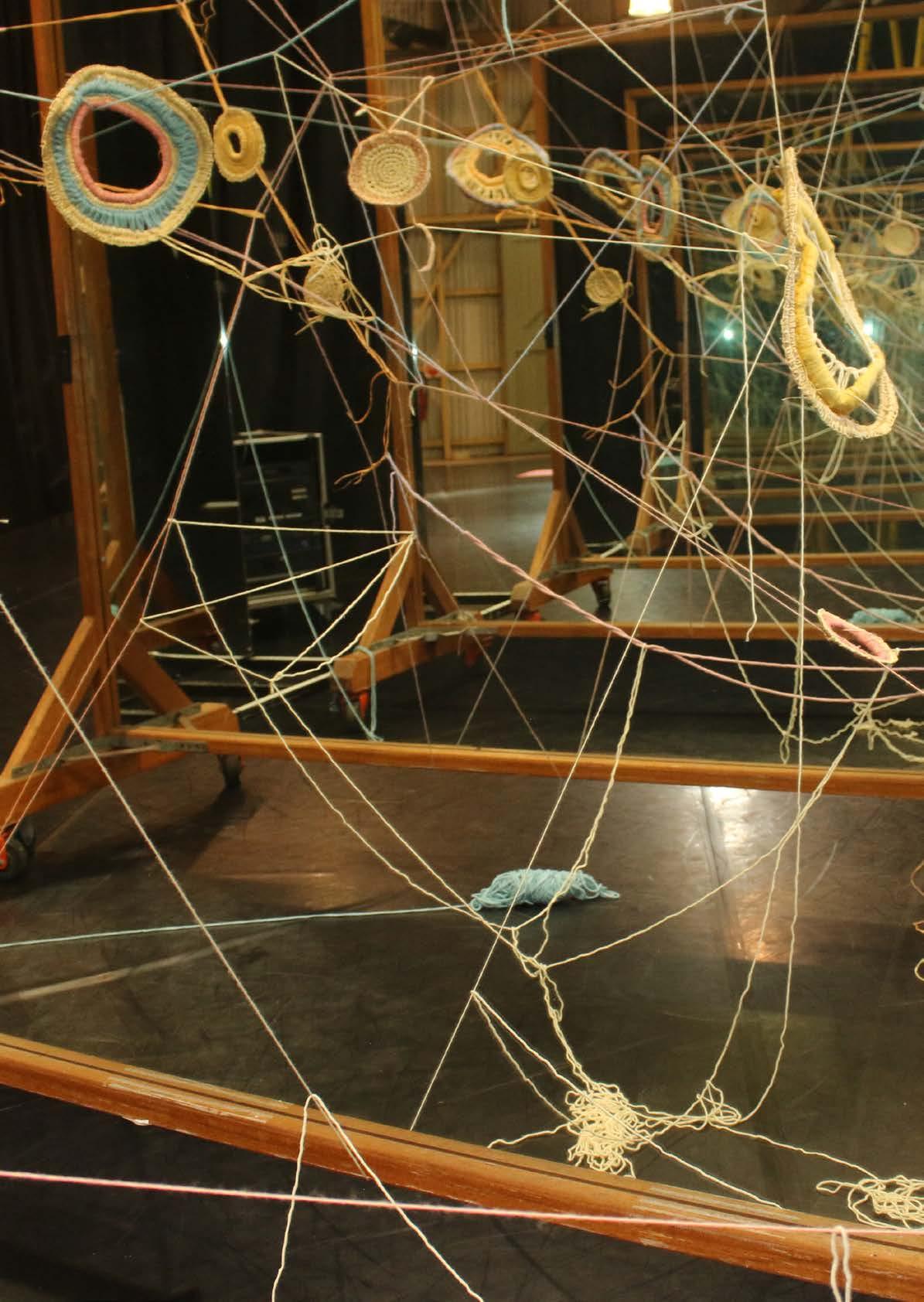
Taiwan and Australia Choreography Exchange Program
This program was a part of our 12 months’ engagement with artist Matt Cornell as Critical Path Digital Artist-Curator. We’ve partnered with The Taiwan Contemporary Culture Lab (C-LAB) and the Cultural Division of the Taipei Economic and Cultural Office in Sydney, Australia, to co-organise the 2022-2024 Taiwan and Australia Choreography Exchange Program. This program supports artists from Sydney and Taiwan with a background in choreography or digital art, and offers them opportunity to deepen their practice, initiate collaborations, and lay foundations for future work.
Taiwan and Australia Choreography Exchange Program
Taiwan and Australia Online Residency Exchange
Artist Stella Chen participated in Critical Path’s online residency in partnership with HORSE and Bare Feet Dance Theater (Mauvais Chausson) in Taiwan. Australian participating artists were: Kristina Chan & Timothy Ohl, Stella Chen, WeiZen Ho, and Strange Attractor (Adelina Larsson & Alison Plevey) and from Taiwan: Chen Wu-Kang, Su Wei-Chia, Yeh Ming-Hwa, Lin I-Chin. Stella is taking forward relationships built through this exchange and using an ‘extension’ online residency to make plans for future remote and in-person collaboration with I-Chin Lin (Mauvais Chausson/Bare Feet Dance Theater).
Michelle St Anne – Live and Online Dance Intimacy
Michelle St Anne, Artistic Director of The Living Room Theatre, worked with collaborator Manu Anand (India) and Imogen Cranna, supported by digital mentor Linda Dement. They questioned the filming of live performance and how live and online worlds can co-exist, each with their unique environments, using choreographically approaches. Ceguva
Ceguva meaning ‘to breathe’ in Vosa Vakaviti was a storytelling digital residency led by Tokelauan Fijian storyteller, Emele Ugavule. Emele worked with illustrator and animator Steffie Yee, and a web developer to create a prototype of an online program that collates time centric data, and creates suggested schedules based on how self, settler and soil time can interact. Dancers Amy Zhang and Moemoana Schwenke collaborated with Emele. This work is foundational for a broader exploration around building a sustainable creative ecosystem that embeds genealogical wellbeing, place specific knowledge, and blood memory into creative process as a proactive – rather than reactive – response to cultural safety and story sovereignty.
Hybrid in-studio and digital research residency: Rosalind Crisp and Lizzie Thomson
In July Rosalind Crisp and Lizzie Thomson took a two-week residency with Critical Path where Lizzie was in person at The Drill and Ros joined on-line. Rosalind Crisp and Lizzie Thomson started dancing together in Omeo Dance studio, Newtown, 25 years ago. After 13 years apart, they returned, together, to the studio; drawn back together through a compelling fascination to work out why they dance(d) and “what the hell we are still dancing for.” This residency was supported by Omeo Dance’s Orbost Studio for Dance Research and Restart Investment to Sustain and Expand (RISE) Fund – an Australian Government initiative.
DOING DRAMATURGY ONLINE COURSE
Critical Path provided two places for NSW-connected practitioners, Brian Fuata and Geraldine Balcazar, to join Critical Path First Nations Producer Jasmine Gulash as participants for DOING DRAMATURGY an online course with Lou Cope, founder of CoAD. Geraldine Balcazar, Brian Fuata and Jasmine Gulash, Critical Path First Nations Producer, were supported to participate in the course, delivered virtually across April/ May/June.
DANCE NUCLEUS PARTNERSHIP
Collaboration to support Rhiannon Newton & Elysa Wendi’s A Strange Place and Nick Power & Hwa Wei- An’s exploration towards Singapore & Sydney Street Dance collaboration. Also, bursaries for Artists that Attract to participate in [CP]3 program.
A Strange Place: Rhiannon Newton & Elysa Wendi
Elysa Wendi and Rhiannon Newton‘s collaboration has evolved since they first met in Campbelltown in 2018. Their collaboration is grounded in conversation, which is understood as a kind of choreography that materially connects their different worlds. Meeting face-to-face, at the edges of bodies of water, and via internet cables that join Hong Kong to Sydney, they have been making attempts to synchronise and share embodied experiences. Through the Critical Path Responsive Residency Elysa and Rhiannon have been developing their practice and also working with Dance Nucleus Singapore to share some of the outcomes of their practice in Vector #2 at Esplanade Theatre. They have collaborated with sound artist Peter Lenaerts to produce a live sound and video installation based on their ongoing conversations. They also exhibited artefacts from their 4 years of practice, including video experiments and transcripts of their conversations.
A Strange Place, Rhiannon Newton & Elysa Wendi
Nick Power Residency Singapore: ELEMENT #14: STEP INTO A WORLD (ALTERNATIVE
PATHS FOR STREET DANCE)
Supported by Critical Path and Dance Nucleus exchange, ELEMENT#14: STEP INTO A WORLD brought together dance artists working between street and contemporary dance in Singapore and Sydney in conjunction with da:ns Festival 2022. Mapping out the needs and interests of the street dance community in Singapore, as a way to propose ideas for creative development or presentation programmes in the near future. Some of the activities and objectives include proposing clear strategies to develop dance practices involving street and contemporary dance in Singapore and explore ideas for longer-term exchanges between Singapore and Sydney.
Critical Practice in Contemporary Performance – online collaborative program
Critical Path combined with ReadyMade Works to support members of Artists that Attract collective (Amy Zhang, Jeremy Santos, Reina Takeuchi) to participate in the [CP]3 program, a distance-learning program for the development of critical praxis in contemporary choreography and performance making, with a focus on the Asian context.
PUBLICATIONS
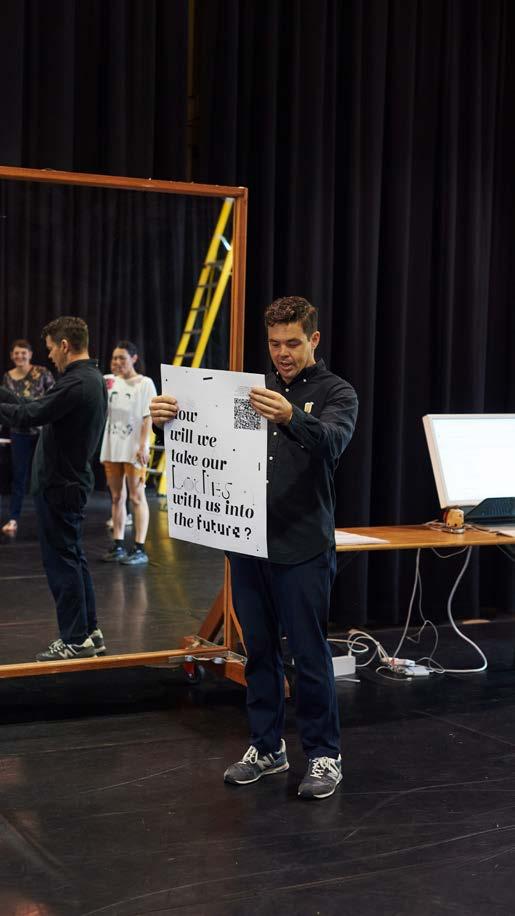
How Will We Take Our Bodies With Us Into The Future?
In this evocation and publication, developed by Critical Path Digital Artist-Curator Matt Cornell, a diverse team of choreographically and digitally involved artists have imagined SciFi futures and subsequent physical realities for our human bodies. Artist drafted their contributions directly into the OpenTab.wiki, iterating in front of each other, editing or adding to each other’s work through permission-less and playful hyperlinking. Launch party for the hyperlinked publication (November 2022) took the form of a dance showing. Some of the texts were generated through dancing.
Massaged by the Medium - Inventories of Affect
A book project by Critical Path Digital Artist-Curator Matt Cornell that makes felt the embodied effects of our (chronic) digital condition. It asks: What is what we’re doing, doing back to us?
Critical Path & Matt Cornell Presents
MASSAGED BY THE MEDIUM
Digital is a verb, an action, that has consequences and fallout.
Digitising anything abstracts information into binary data, divorcing it of the context, culture and com munities from whence it sprang. It, then, homogenises and regulates its application.
INVENTORIES OF AFFECT
The name for the world’s most popular beverage when transcoded from english into binary is
01000011 01101000 01100001
Or it’s other common name:
01010100 01100101 01100001
Binary data is the only code that can be directly understood and executed by a digital computer. It is numerically represented above by a combination of zeros and ones. But the characters written above are representations of binary code— Arabic numerals printed in ink on a page, so that your eyes receive the information in the form of light, and your brain may decode it.
If you can’t read binary… it is inaccessible and will do nothing for you.
The digitally encoded word is not the beverage. Or the ceremony that goes with it. Or the communities who care for it. It is a reference to those things. We can never touch the digital directly.
Dream Cellscapes
A publication by Alice Weber that features reflections and visual remnants from the performance at Cement Fondu which was an outcome of her two-week Research Residency at Critical Path in April 2021 where she collaborated with international artists Vanessa Goodman and Ileanna Cheladyn to explore choreographic practice that plays out in a spreadsheet and IRL. She then performed this project with collaborators Ella Watson-Heath, Juliet Saito and Wendy Yu, with sound by Megan Alice Clune, at the opening of her exhibition at Cement Fondu gallery space.
Produced by Artists from across the Asia Pacific
STATEMENT OF SURPLUS OR DEFICIT AND OTHER COMPREHENSIVE INCOME
Net change in cash and cash equivalents Cash and cash equivalents, beginning of year (181,505) 794,158 388,808 405,351 Cash and cash equivalents, end of year 5 612,653 794,158
This statement should be read in conjunction with the notes to the financial statements.
NOTES TO THE FINANCIAL STATEMENTS
For the year ended 31 December 2022
Critical Path Incorporated
1. General information and statement of compliance
The financial report includes the financial statements and notes of Critical Path Incorporated.
These financial statements are general purpose financial statements that have been prepared in accordance with Australian Accounting Standards - Reduced Disclosure Requirements and the Australian Charities and Not-for-profits Commission Act 2012.
Critical Path Incorporated is a not-for-profit entity for the purposes of preparing the financial statements.
The financial statements for the year ended 31 December 2022 were approved and authorised for issuance by the Committee members.
2. Changes in accounting policies
2.1 There are no new and revised standards that are effective for these financial statements
3. Summary of accounting policies
3.1 Overall considerations
The significant accounting policies that have been used in the preparation of these financial statements are summarised below.
The financial statements have been prepared using the measurement bases specified by Australian Accounting Standards for each type of asset, liability, income and expense. The measurement bases are more fully described in the accounting policies below.
3.2 Revenue
Revenue comprises revenue from the sale of goods, services income, government grants, fundraising activities and client contributions. Revenue from major activities and services is shown in Note 4.
Revenue is measured by reference to the fair value of consideration received or receivable by the Association for goods supplied and services provided, excluding sales taxes, rebates, and trade discounts.
Revenue is recognised when the amount of revenue can be measured reliably, collection is probable, the costs incurred or to be incurred can be measured reliably, and when the criteria for each of the Association’s different activities have been met. Details of the activity-specific recognition criteria are described below.
Government grants
A number of the Association’s programs are supported by grants received from Federal, State and Local governments. If conditions are attached to a grant which must be satisfied before the Association is eligible to receive the contribution, recognition of the grant as revenue is deferred until those conditions are satisfied.
Where a grant is received on the condition that specified services are delivered, to the grantor, this is considered a reciprocal transaction. Revenue is recognised as services are performed and at year–end until the service is delivered.
Revenue from a non-reciprocal grant that is not subject to conditions is recognised when the Association obtains control of the funds, economic benefits are probable, and the amount can be measured reliably. Where a grant may be required to be repaid if certain conditions are not satisfied, a liability is recognised at year end to the extent that conditions remain unsatisfied.
Where the Association receives a non-reciprocal contribution of an asset from a government or other party for no or nominal consideration, the asset is recognised at fair value and a corresponding amount of revenue is recognised.
Donations and bequests
Donations collected, including cash and goods for resale, are recognised as revenue when the Association gains control, economic benefits are probable and the amount of the donation can be measured reliably.
Bequests are recognised when the legacy is received. Revenue from legacies comprising bequests of shares or other property are recognised at fair value, being the market value of the shares or property at the date the Association becomes legally entitled to the shares or property.
Interest income
Interest income is recognised on an accrual basis using the effective interest method.
3.3 Operating expenses
Operating expenses are recognised in surplus or deficit upon utilisation of the service or at the date of their origin.
3.4 Intangible assets
Recognition of other intangible assets:
Acquired intangible assets
Website construction costs as well as acquired computer software licences are capitalised on the basis of the costs incurred to acquire and install the specific website and software.
Subsequent measurement
All intangible assets are accounted for using the cost model whereby capitalised costs are amortised on a straight-line basis over their estimated useful lives, as these assets are considered finite. Residual values and useful lives are reviewed at each reporting date. In addition, they are subject to impairment testing as described in Note 3.14. The following useful lives are applied:
• Database development: 25%
• Software: 25% - 33%
• Website: 33%
Subsequent expenditures on the maintenance of computer software, brand names and website are expensed as incurred.
When an intangible asset is disposed of, the gain or loss on disposal is determined as the difference between the proceeds and the carrying amount of the asset, and is recognised in surplus or deficit within other income or other expenses.
3.5 Property, plant and equipment
Leasehold improvements, plant and other equipment
Leasehold improvements, plant and other equipment (comprising office furniture and equipment) are initially recognised at acquisition cost or manufacturing cost, including any costs directly attributable to bringing the assets to the location and condition necessary for it to be capable of operating in the manner intended by the Association’ management.
Leasehold improvements, plant and other equipment are subsequently measured using the cost model, cost less subsequent depreciation and impairment losses.
Depreciation is recognised on a straight-line basis to write down the cost less estimated residual value of leasehold improvements, plant and other equipment. The following useful lives are applied:
• Leasehold improvement: 20% - 25%
• Plant and equipment: 15% - 33%
In the case of leasehold property, expected useful lives are determined by reference to comparable owned assets or over the term of the lease, if shorter.
Material residual value estimates and estimates of useful life are updated as required, but at least annually.
Gains or losses arising on the disposal of property, plant and equipment are determined as the difference between the disposal proceeds and the carrying amount of the assets and are recognised in surplus or deficit within other income or other expenses.
3.6 Leases
Operating leases
Where the Association is a lessee, payments on operating lease agreements are recognised as an expense on a straight-line basis over the lease term. Associated costs, such as maintenance and insurance, are expensed as incurred.
3.7 Income taxes
No provision for income tax has been raised as the association is exempt from income tax under Div 50 of the Income Tax Assessment Act 1997.
3.8 Cash and cash equivalents
Cash and cash equivalents comprise cash on hand and demand deposits, together with other short-term, highly liquid investments that are readily convertible into known amounts of cash and which are subject to an insignificant risk of changes in value.
3.9
Employee benefits
Short-term employee benefits
Short-term employee benefits are benefits, other than termination benefits, that are expected to be settled wholly within twelve (12) months after the end of the period in which the employees render the related service. Examples of such benefits include wages and salaries, non-monetary benefits and accumulating sick leave. Short-term employee benefits are measured at the undiscounted amounts expected to be paid when the liabilities are settled.
Other long-term employee benefits
The association’s liabilities for long service leave are included in other long-term benefits as they are not expected to be settled wholly within twelve (12) months after the end of the period in which the employees render the related service. They are measured at the present value of the expected future payments to be made to employees. The expected future payments incorporate anticipated future wage and salary levels, experience of employee departures and periods of service, and are discounted at rates determined by reference to market yields at the end of the reporting period on high quality corporate bonds that have maturity dates that approximate the timing of the estimated future cash outflows. Any re-measurements arising from experience adjustments and changes in assumptions are recognised in profit or loss in the periods in which the changes occur.
The association presents employee benefit obligations as current liabilities in the statement of financial position if the association does not have an unconditional right to defer settlement for at least twelve (12) months after the reporting period, irrespective of when the actual settlement is expected to take place.
Post-employment benefits plans
The association provides post-employment benefits through defined contribution plans.
Defined contribution plans
The association pays fixed contributions into independent entities in relation to several state plans and insurance for individual employees. The association has no legal or constructive obligations to pay contributions in addition to its fixed contributions, which are recognised as an expense in the period that relevant employee services are received.
3.10 Provisions, contingent liabilities and contingent assets
Provisions are measured at the estimated expenditure required to settle the present obligation, based on the most reliable evidence available at the reporting date, including the risks and uncertainties associated with the present obligation. Where there are a number of similar obligations, the likelihood that an outflow will be required in settlement is determined by considering the class of obligations as a whole. Provisions are discounted to their present values, where the time value of money is material.
Any reimbursement that the association can be virtually certain to collect from a third party with respect to the obligation is recognised as a separate asset. However, this asset may not exceed the amount of the related provision.
No liability is recognised if an outflow of economic resources as a result of present obligation is not probable. Such situations are disclosed as contingent liabilities, unless the outflow of resources is remote in which case no liability is recognised.
3.11 Deferred income
The liability for deferred income is the unutilised amounts of grants received on the condition that specified services are delivered or conditions are fulfilled. The services are usually provided or the conditions usually fulfilled within twelve (12) months of receipt of the grant. Where the amount received is in respect of services to be provided over a period that exceeds twelve (12) months after the reporting date or the conditions will only be satisfied more than twelve (12) months after the reporting date, the liability is discounted and presented as non-current.
3.12 Goods and Services Tax (GST)
Revenues, expenses and assets are recognised net of the amount of GST, except where the amount of GST incurred is not recoverable from the Australian Taxation Office. In these circumstances the GST is recognised as part of the cost of acquisition of the asset or as part of an item of the expense. Receivables and payables in the statement of financial position are shown inclusive of GST.
Cash flows are presented in the statement of cash flows on a gross basis, except for the GST components of investing and financing activities, which are disclosed as operating cash flows.
3.13 Economic dependence
The association is dependent upon the ongoing receipt of Federal and State Government grants and community and corporate donations to ensure the ongoing continuance of its programs and fundraising. At the date of this report Management has no reason to believe that this financial support will not continue.
3.14 Significant management judgement in applying accounting policies
When preparing the financial statements, management undertakes a number of judgements, estimates and assumptions about the recognition and measurement of assets, liabilities, income and expenses.
Estimation uncertainty
Information about estimates and assumptions that have the most significant effect on recognition and measurement of assets, liabilities, income and expenses is provided below. Actual results may be substantially different.
Impairment
In assessing impairment, management estimates the recoverable amount of each asset or cash-generating unit based on expected future cash flows and uses an interest rate to discount them. Estimation uncertainty relates to assumptions about future operating results and the determination of a suitable discount rate.
Useful lives of depreciable assets
Management reviews its estimate of the useful lives of depreciable assets at each reporting date, based on the expected utility of the assets. Uncertainties in these estimates relate to technical obsolescence that may change the utility of certain assets.
Long service leave
The liability for long service leave is recognised and measured at the present value of the estimated cash flows to be made in respect of all employees at the reporting date. In determining the present value of the liability, estimates of attrition rates and pay increases through promotion and inflation have been taken into account.
4. Grants, other contributions and other income
The Association’s income may be analysed as follows:
5. Cash and cash equivalents Cash and cash equivalents consist the following:
48,473 99,996 31,728
7,480 221,051 59,852
23,311 276,187 484,441
Cash at the end of the financial year as shown in the statement of cash flows is reconciled in the statement of financial position as follows:
6. Trade and other receivables
Trade and other receivables consist the following:
7. Other assets
Other
consist the following:
8. Property, plant and equipment
9. Intangible assets
Details of the company’s intangible assets and their carrying amounts are as follows:
at 1 January 2022
at 1 January 2021
10. Trade and other payables
Trade and other payables recognised consist of the following:
11. Employee remuneration
11.1 Employee benefits expense
Expenses recognised for employee benefits are analysed below:
11.2 Employee provisions
12. Grants liabilities
14. Leases [7]
Operating leases as lessee
The Group’s future minimum operating lease payments are as follows: Minimum lease payments due
15. Related party transactions
The association’s related parties include its key management personnel and related entities as described below. Unless otherwise stated, none of the transactions incorporate special terms and conditions and no guarantees were given or received. Outstanding balances are usually settled in cash.
Transactions with related entities
No remuneration is paid to Committee member or their related parties for acting as Committee members. From time to time Committee members who are also independent artists may be engaged in our Research and Development program and are remunerated under normal industry terms.
Transactions with key management personnel
Key management of the Association are the Executive Members of Critical Path Incorporated’s Committee and members of the Executive Council. Key management personnel remuneration includes the following expenses:
Total key management personnel remuneration
2022: $79,600
2021: $68,584
2020: $90,258
16. Contingent Liabilities and Assets
No contingent liabilities and assets to report.
17. Subsequent Events
No significant events have occurred since the end of the reporting period which would impact on the financial position of the Company disclosed in the statement of financial position as at 31 December 2022 or on the results and cash flow of the Company for the year ended on that date.
18.
Members’ Guarantee - Contribution in winding up
The Association is incorporated under the Associations Incorporation Act 2009. If the Association is wound up, the constitution states that each member is required to contribute a maximum of $10 each towards meeting any outstanding obligations of the Association. At 31 December 2022 the total amount that members of the Association are liable to contribute if the Association wound up is $90 (2021: $110).
19. Charitable fundraising
The association holds an authority to fundraise under the Charitable Fundraising Act, 1991 (NSW) and conducts fundraising appeals throughout the year. Additional information and declarations required to be furnished under the Act are as follows:
All funds raised from fundraising activities, net of direct costs, were applied to the association’s normal operations. The association did not conduct any appeals in which traders were engaged.
Critical Path Incorporated
is a company limited by guarantee, incorporated and domiciled in Australia.
The registered office and principal place of business is:
The Drill, 1C New Beach Road,
Darling Point NSW 2027
COMMITTEE MEMBERS’ DECLARATION
Critical Path Incorporated
In the opinion of the Directors of Critical Path Incorporated (‘the association’)
(a) (b) (i) (ii)
The financial statements are in accordance with the Australian Charities and Not-for-profits Commission Act 2012, including;
giving a true and fair view of the Association’s financial position as at 31 December 2022 and of it’s performance, for the year ended on that date, and complying with Australian Accounting Standards (including the Australian Accounting Interpretations) and the Australian Charities and Not-for-profits Commission Regulations 2013; and
there are reasonable grounds to believe that the Critical Path Incorporated will be able to pay its debts as and when they become due and payable.
Signed in accordance with a resolution of the Directors:
CATHERINE SULLIVAN
COMMITTEE MEMBER
3 May, 2023
DECLARATION BY THE TREASURER
in respect of fundraising appeals pursuant to the Charitable Fundraising (NSW) ACT 1991
Critical Path Incorporated
I, Alexio Chibika, Treasurer of Critical Path Incorporated, declare in my opinion:
the Annual financial report gives a true and fair view of all income and expenditure of Critical Path with respect to fundraising appeal activities for the financial year ended 31 December 2022;
the statement of financial position gives a true and fair view of the state of affairs with respect to fundraising appeal activities as at 31 December 2022;
the provisions of the Charitable Fundraising Act 1991 and Regulations and the conditions attached to the authority have been complied with for the financial year ended 31 December 2022; and
the internal controls exercised by Critical Path are appropriate and effective in accounting for all income received and applied from any fundraising appeals.
We have audited the financial report of Critical Path Incorporated (the association), which comprises the statement of financial position as at 31 December 2022, the statement of surplus or deficit and other comprehensive income, statement of changes in equity, statement of cash flows for the year ended on that date, a summary of significant accounting policies and other explanatory notes and the committees’ declaration.
In our opinion, the accompanying financial report of Critical Path Incorporated is in accordance with Division 60 of the Australian Charities and Not for Profits Commission Act 2012 and the Associated Incorporations Act 2009, including:
• giving a true and fair view of the association’s financial position as at 31 December 2022, and of its performance for the year then ended ; and
• complying with Australian Accounting Standards, Division 60 of the Australian Charities and Not for Profits Commission Regulation 2013, and the Corporations Act 2001.
Basis of Opinion
We conducted our audit in accordance with Australian Auditing Standards. Our responsibilities under those standards are further described in the Auditors Responsibilities for the Audit of the Financial Report section of our report. We are independent of the association in accordance with the auditor independence requirements of the Australian Charities and Not for Profits Commission Act 2012 and the ethical requirements of the Accounting Professional and Ethical Standards Board APES 110: Code of Ethics for Professional Accountants (the Code) that are relevant to our audit of the financial report inAustralia. We have also fulfilled our other ethical responsibilities in accordance with the Code.
We confirm that the independence declaration required by the Australian Charities and Not for Profits Commission Act 2012, which has been given to the committee of Critical Path Incorporated, would be in the same terms if given to the committee as at the time of this auditor’s report.
We believe that the audit evidence we have obtained is sufficient and appropriate to provide a basis for our opinion.
Information Other than the Financial Report and Auditor’s Report Thereon
The committee members are responsible for the other information. The other information comprises the information included in the associations annual report for the year ended 31 December 2022, but does not include the financial report and our auditor’s report thereon.
Our opinion on the financial report does not cover the other information and accordingly we do not express any form of assurance conclusion thereon. In connection with our audit of the financial report, our responsibility is to read the other information and, in doing so, consider whether the other information is materially inconsistent with the financial report or our knowledge obtained in the audit or otherwise appears to be materially misstated. If, based on the work we have performed, we conclude that there is a material misstatement of this other information, we are required to report that fact. We have nothing to report in this regard.
The Responsibility of the Committee for the Financial Statements
The committee members of the association are responsible for the preparation the financial report that gives a true and fair view in accordance with Australian Accounting Standards, the ACNC Act, and the Associated Incorporations Act 2009 and for such internal control as the committee members determine is necessary to enable the preparation of the financial report that gives a true and fair view and is free from material misstatement, whether due to fraud or error.
In preparing the financial report, the committee members are responsible for assessing the association’s ability to continue as a going concern, disclosing, as applicable, matters relating to going concern and using the going concern basis of accounting unless the committee members either intend to liquidate the association or to cease operations, or have no realistic alternatives but to do so.
Auditor’s Responsibility for the Audit of the Financial Report
Our objectives are to obtain reasonable assurance about whether the financial report as a whole is free from material misstatement, whether due to fraud or error, and to issue an auditor’s report that includes our opinion. Reasonable assurance is a high level of assurance, but is not a guarantee that an audit conducted in accordance with the Australian Accounting Standards will always detect a material misstatement when it exists. Misstatements can arise from fraud or error and are considered material if, individually or in the aggregate, they could reasonably be expected to influence the economic decisions of users taken on the basis of this financial report.
As part of an audit in accordance with the Australian Auditing Standards, we exercise professional judgement and maintain professional scepticism throughout the audit. We also:
• Identify and assess the risks of material misstatement of the financial report, whether due to fraud or error, design and perform audit procedures responsive to those risks, and obtain audit evidence that is sufficient and appropriate to provide a basis for our opinion. The risk of not detecting a material misstatement resulting from fraud is higher than for one resulting from error, as fraud may involve collusion, forgery, intentional omissions, misrepresentations, or the override of internal controls.
• Obtain an understanding of internal control relevant to the audit in order to design audit procedures that are appropriate in the circumstances, but not for the purposes of expressing an opinion on the effectiveness of the association’s internal control.
• Evaluate the appropriateness of accounting policies used and the reasonableness of accounting estimates and related disclosures made by the committee.
• Conclude on the appropriateness of the committee’ use of the going concern basis of accounting and, based on the audit evidence obtained, whether a material uncertainty exists related to events or conditions that may cast significant doubt on the registered entity’s ability to continue as a going concern. If we conclude that a material uncertainty exists, we are required to draw attention in our auditor’s report to the related disclosures in the
financial report or, if such disclosures are inadequate, to modify our opinion. Our conclusions are based on the audit evidence obtained up to the date of our auditor’s report. However, future events or conditions may cause the registered entity to cease to continue as a going concern.
We communicate with the responsible entities regarding, among other matters, the planned scope and timing of the audit and significant audit findings, including any significant deficiencies in internal control that we identify during our audit.
We also provide the committee with a statement that we have complied with relevant ethical requirements requiring independence, and to communicate with them all relationships and other matters that may reasonably be thought to bear on our independence, and where applicable, related safeguards.
MITCHELL & PARTNERS
Chartered Accountants
Glenn Merchant CA Partner
Sydney, NSW
Dated this 4th day of May, 2023
For the year ended 31 December 2022
SCHEDULE 1 – GENERAL OPERATIONS
10,845 467,995 48,960 258,526 75 7,759 22,592
The above UNAUDITED detailed statement of surplus or deficit should be read in conjunction with the disclaimer.