Whether you live in a hall, flat, apartment, or at home, we’d love to hear about your experience.
Go in the draw to win a $100 New World Voucher
Good quality housing matters. We want Dunedin to be a great place to live for students at the University of Otago and Otago Polytechnic. We want to understand students’ housing experiences – what is working well, what should stay, and what needs to change to make housing better.
Simply scan the QR code to complete the survey
Takes just a few minutes
Anonymous
Go in the draw to win a New World Grocery Voucher.
For more information on the project visit: dunedin.govt.nz/northd-spatial-plan
Hi everyone,
It’s All In Your Head
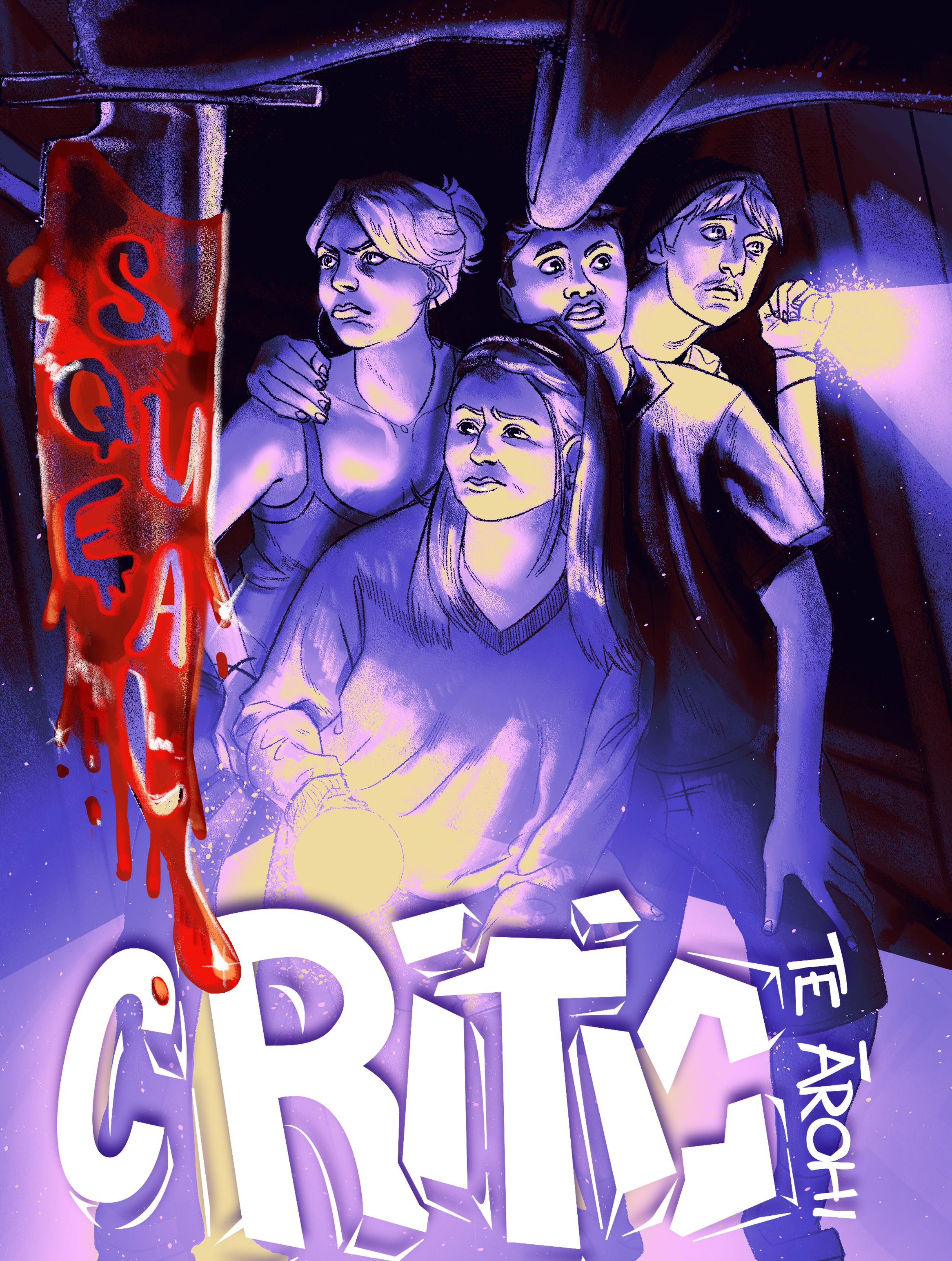
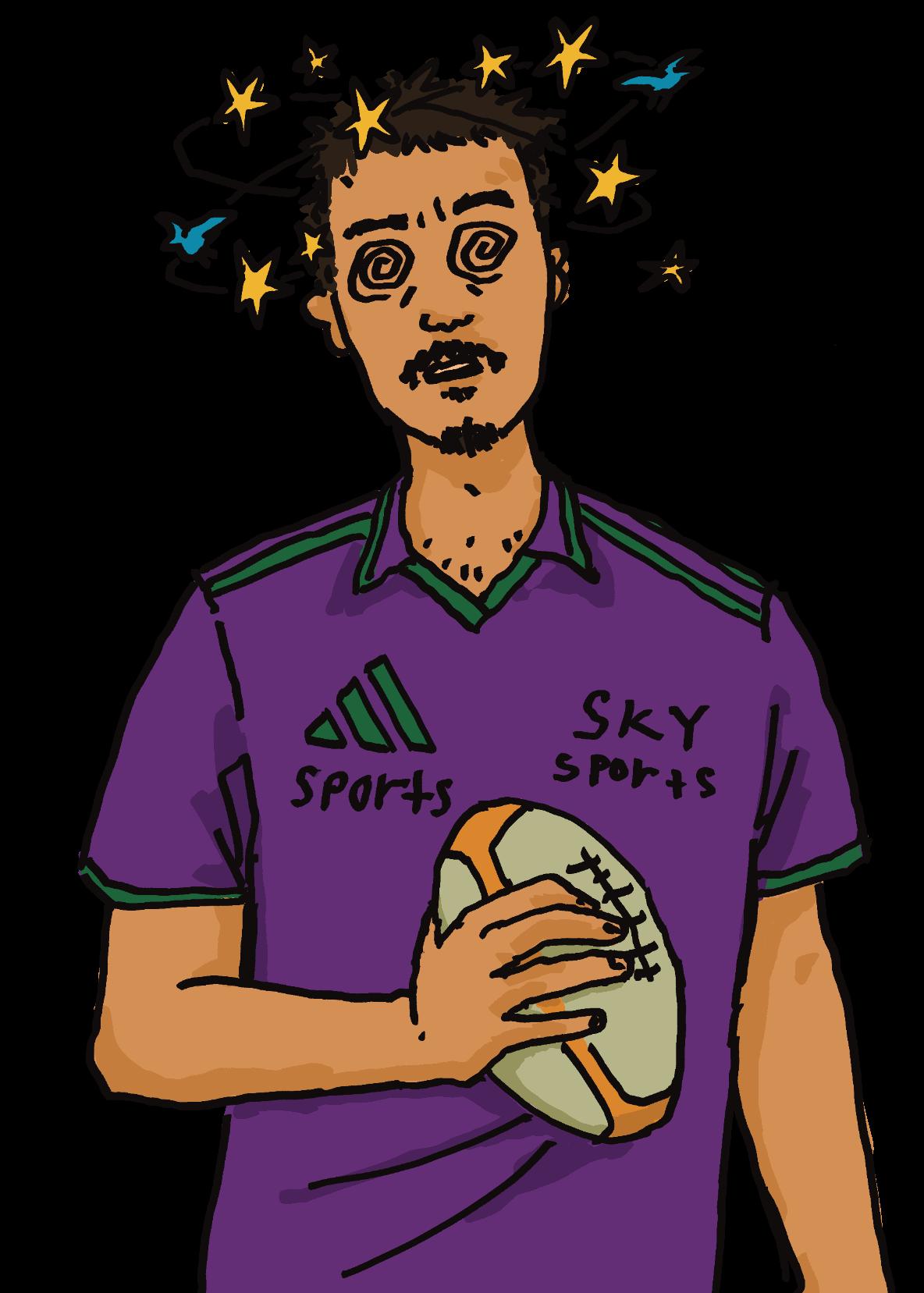
Welcome to Issue 11. We literally have two issues left for the semester after this one, which I think is genuinely insane. How time flies! I’m pleased to say that this issue seems to have a bit of a theme, though it was completely unplanned. Our chunkiest piece is Jesse and Gryffin’s feature on concussions in Aotearoa, which is a bit of a deep dive into how concussions have been regarded in our sporting industry historically and up until today. In culture, I would like to welcome new contributor Saraia, who has done a fantastic (albeit opinionated) job on “decoding” common political speech. Additionally, though I can’t tell you who wrote it, we have a pretty freaky/gross story from someone who got hit up on Tinder by a famous NZ celebrity. In news, we have some heavy hitters from Stella and myself. We consider Grant’s announcement to “review” the Palo Alto partnership, as well investigate the University taking down some of OSJP’s posters calling out the partnership due to a “misunderstanding”. If you’re still wondering what the theme is, then I need you to think very abstractly. All these pieces speak to things that are all in our heads. Jesse and Gryffin show how concussions physically affect the brain, and Sararia points out the subtle manipulation politicians engage in, influencing your perception of the world. Talking to a celeb on Tinder is a bit of a mindfuck, and the article runs through the mixed thoughts and morals that the author felt. The Palo Alto “saga” (for lack of a better word) is a game of pingpong between the University, the OUSA Executive and Staff for Palestine. It’s all left me personally feeling like there are some real mental Olympics taking place to avoid some tricky words. I don’t know if I’d say that there was an “ongoing situation” in Gaza. I think I would say “genocide”, given that’s what the UN Independent International Commission of Inquiry on the Occupied Palestinian Territory concluded. Again, as Sararia discusses, words influence perception. If you want to get out of your head, I don’t blame you. You may notice that our cover is a reference to the up and cumming Capping Show, which will be kicking off on the 14th of May. And, with a name like “Scream”, I’m sure the show will give you lots of new things to worry about. So, the world’s kinda going to shit, but Capping isn’t! Hopefully, at least. Guess you’ll just have to wait for our behind the scenes and review content coming up soon. Get your tickets anyways though. Who gives a fuck what Critic thinks? It’s probably just all in our head.
LETTERS CONTENTS
Hello,
Just wanted to write in and say I've been loving the recent Critic covers, would love to see some of them added to the poster catalogue (shut up and take my money etc). You guys have a great roster of illustrators and they're all doing amazing work. Thank you for all the effort you put in, obviously it has been tough with recent changes and an ever critical student body, just wanted to let you know it doesn't go unappreciated, and beats Salient any day.
a loyal reader
Designer's
Kia ora Critic,
It is not news to anyone that supermarket prices are through the roof and still climbing. And yet my flatmates and I are still the ONLY students I see regularly attending the community gardens in NEV. So this is a PSA to everyone reading: check out your nearest community garden!
I cannot emphasise enough what a difference this will make to your grocery bill. Free produce every week and free afternoon tea with other lovely volunteers (more of which are desperately needed). Our recent hauls have been in the form of runner beans, apples, pears, fresh herbs, and like 10kg of potatoes.
Not to mention getting outside is great for you, and there’s always plenty left over for the local pātaka kai, so regardless of your financial position it’s generally a super valuable way to spend your time—but given the stress a lot of students are under right now it’s a no brainer.
Sincerely,
lover
LETTERS POLICY
Dear Critic,
I’m sorry but seriously what the fuck is wrong with people in central library this year?? Why are the suicide pods absolutely filthy like how hard is it to clean up after yourself? And all the fucking freshers talking so loudly about hubs and physics it’s a library stop talking so loudly. Also what is with people booking study rooms and not showing up? People need to sort their shit out and sleep somewhere where nobody can hear you snore.
Sincerely a seriously pissed off third year
Letters should be 150 words or fewer. The deadline is Thursday at 12pm. Get them into Critic by emailing us at critic@critic.co.nz. Letters of a serious nature directly addressing a specific group or individual will not be published under a pseudonym, except in extraordinary circumstances as negotiated with the
reserves the right to
or decline letters without explanation. Frequently published correspondents in particular may find their letters abridged or excluded. Defamatory or otherwise illegal material will not be printed. We don’t fix the spelling or grammar in letters. If a
they are.
Port Chalmers man wins $1m Lotto – ODT reports Rob Roy has opened a new neighbouring area, with bubble tea available!
Zoe Kravitz and Harry Styles are engaged
A Dunedin man pulled over after swerving all over the road claimed the alcohol he consumed shouldn't count because “it was the blood of christ” — ODT reports
Orange Sky has teamed up with the Salvation Army to bring free laundry and a welcoming space for genuine kōrero to the Ōtepoti community, weekly shifts will run on Thursdays and Saturdays, from 11am to 1:30pm
OUSA invites questions to adminvp@ousa.org. nz to close at 4pm on 13 May 2026 for the Referendum being held 28-30 May 2026.
University Open Days a resounding success, future freshers everywhere
Student Job Search app now available: big news for the unemployed Capping Show tickets are now on sale!
It’s NZ Music Month! Come to Evison Lounge for some kai and music on the 13th and 20th May. We will have duos from Cleos & Doctor Wazoo gracing us with their presence from 12pm - 1pm
“Otago having the highest cost of cannabis per ounce could be down to a local drug dealer doing his part by ‘‘overcharging students’’” — ODT reports
The Otago Japanese Students' Association, are hosting a Ramen Making Event on May 17th Sunday. Anyone can come to learn how to make ramen noodles, and make their own ramen at the event. RSVP is required, so sign-up asap! Instagram page: @ojsa.nz
PALO ALTO PARTNERSHIP UNDER “REVIEW”
Review follows OUSA Executive backlash and Otago Staff for Palestine dossier
As previously reported, the University of Otago has confirmed a partnership with Palo Alto Networks (PANW), a cybersecurity company that has been accused of having “deep links to the Israeli government” by Otago Staff for Palestine (OSP). The partnership is intended to develop a Master in Digital Technology degree for the new Queenstown campus. However, after backlash from students and staff, the partnership is now “under review”, according to a 1000 word letter written by Vice-Chancellor Grant Robertson to the OUSA Executive on the 30th of April. The letter has since been shared with Critic Te Ārohi.
At the end of his super fucking long letter, Grant said he understood the “concerns” that the OUSA Executive and “some students” have about “the situation in Gaza”, which he shared at a “personal level”.
Predating the announcement was the OUSA Executive’s statement on the 24th of April. “The OUSA Executive stands with staff and students against the Uni’s partnership with an Israeli cyber-security company,” the statement read. The statement condemned the partnership for two main reasons: the first being that PANW was “based in Tel Aviv, Israel” with “connections to the Israeli Defence Force” and being the “biggest company on the Israeli stock exchange”, and the second being that PANW had signed a “$250 million contract linked to the Netanyahu-led government”.
Critic understands US-based PANW operates its largest research facility outside of the US in Tel Aviv, Israel. PANW itself was founded by now retired American-Israeli Nir Zuk, who is understood to be a veteran of the Israeli Defence Unit 8200. Unit 8200 is responsible for signal intelligence and cybersecurity. Unit 8200 has been heavily scrutinised for mass surveillance of Palestinians, and utilising AI-driven targeting systems like “Lavender” to identify bomb strikes in Gaza.
PANW recently was named as a technology partner for a contract with an unnamed major Israeli customer. Some analysts speculate that the major customer is the Israeli
By Hanna Varrs & Stella Weston Editor // hanna@critic.co.nz
government, due to the contract being described as supplying cyber and information security services for “critical network infrastructure” in Israel; being valued at around $140-290 million NZD. PANW is a dual-listed public company on both the NASDAQ, and more recently, on the Tel Aviv Stock Exchange (TASE). It is the most valuable company on the TASE at a $133 billion USD market cap. PANW described listing on the TASE as indicative of their “commitment to the local tech ecosystem” in a statement given to Reuters.
In what appears to be a further catalyst for the review alongside the Exec’s statement, Otago Staff for Palestine were asked to prepare a dossier for the Vice-Chancellor about PANW following a meeting on the 13th of April. Olivier Jutel, member of OSP, told Critic that the work, titled “Palo Alto Networks: The Key to the Israeli Military-to-Tech-to-Military Pipeline”, was passed over to Grant on the 22nd. “The cybersecurity sector is deeply interwoven with the national security mission of Israel,” the dossier reads, describing a recent report by the The Times of Israel that quoted Defense Ministry Director Amir Baram describing the transition of Israel from a “cyber-nation into a true defence tech nation.”
Additionally, the dossier notes Netenyahu’s desire for Israel to become a “Super Sparta”, and that defence tech has buoyed the Israeli economy, “enabling” and “supporting” Israel’s acts in the Gaza genocide, with PANW at the “forefront”. OSP is holding a forum regarding the dossier and Palo Alto partnership in the Main Common Room on the 19th of May, 12pm. According to Olivier, the forum will serve as an “important teaching moment for thinking about the technology supply chain and its connection to occupation and genocide.”
Grant’s Letter and The Exec’s Statement
In terms of the actual letter regarding the review, Grant first noted that PANW is the largest cybersecurity company in the world, and they’re already pretty connected to our institutions. “[PANW] provides services all over the globe, including here in New Zealand,” the letter reads, acknowledging PANW’s partnership with the Network for Learning to provide
cybersecurity for “most schools” in New Zealand. Additionally, NZ-based cybersecurity providers the Uni contracts with use PANW’s services, which is “the case in almost every university”
that they did not want to,” the letter continues. “The role of critic and conscience of society is an important one and is expressed every day by staff at the University, and supported by me as Vice-Chancellor.”
Grant also outlined the “due diligence” done in the partnership, which identified PANW’s founder as an Israeli national. The University was aware that Zuk, “like most Israeli nationals”, had served in the military, and they knew of the research facility PANW had in Tel Aviv. Due diligence did not find “direct links” between PANW and the Israeli Defence Force. Additionally, at the time when the agreement was being finalised, a “search” was made of the Boycott, Divest and Sanctions movement (BDS) and “related websites” and there was “no mention of Palo Alto as a target of those campaigns.”
The OUSA Executive’s post acknowledged that the partnership was made “before some of these developments and other contracts were signed”, which was why they were “backing calls by staff, academics, and students” to now withdraw and “recognise these developments change the nature” of the PANW partnership. Grant seemed to confirm this line of reasoning: PANW’s listing on the stock exchange and the “recent contract with an unknown party” for cybersecurity for critical infrastructure in Israel both happened “well after the agreement was finalised.”
Furthermore, Grant referenced the fact that the Uni is looking to partner with more “non-university” organisations, such as “iwi, industry and non-governmental groups” — part of efforts to keep the Uni’s curriculums industry relevant. The stickler is that the Uni doesn’t have a set of guidelines to govern those kinds of partnerships, but they do for ethical procurement and policy. Grant said that he’s asked Deputy Vice-Chancellor External Engagement Professor Jessica Palmer to lead the charge to get that sorted, which will include “consultation across the University”. Palmer has briefed the University Senate about it already. Good things take time, so “acknowledging events that have taken place since this partnership was agreed”, Grant said that he had decided to “review” the partnership.
Grant said the review will include looking at material prepared by the Staff for Palestine Group, responses from Palo Alto to concerns that have been raised, and getting some external
“MISUNDERSTANDING” RESULTS IN UNIVERSITY REMOVING OSJP POSTERS
Posters opposing the Palo Alto partnership were removed from St Dave’s Café
Critic Te Ārohi recently received a tip from a café worker at St David Café, who was allegedly asked to remove posters put up by Otago Students for Justice In Palestine (OSJP) on the 22nd of April. The employee told Critic that café workers were asked to remove the posters, having been told by “someone above” that the posters “incited violence”.
The poster, titled “Otago Uni In Bed With US-Israeli Cyber Warfare!”, encouraged students to endorse the following statement via QR code: “Otago University management has partnered with US/Israeli cyber warfare firm ‘Palo Alto Networks’. Blindsiding students and staff, management have compromised our institution’s responsibility to maintain the highest ethical standards. Our long standing demands for disentanglement from the Israeli war machine have been blatantly disregarded. We do not support Israel’s genocidal regime – this makes us complicit in it. We, the students, do not consent to this partnership and reject it wholeheartedly.”
In response to the allegation, a University spokesperson told Critic that University union management had reviewed the matter, and found that a “misunderstanding” occurred following a “request for posters to be removed from tables inside St David Café, as these are not approved locations for posters.” As a result of the misunderstanding, some posters were also removed from the nearby noticeboard in St David’s, where posters are allowed to be displayed. “We apologise for this error,” the spokesperson said to Critic. “Those posters have since been replaced and are currently displayed on the St David’s noticeboard.”
When asked if the University would ever direct staff to remove posters such as OSJP’s for reasons of “inciting violence”, a spokesperson explained that posters would only be removed if they breach “University regulations”, contain “illegal, defamatory or harmful content”, or are “not placed on an official noticeboard.”
When approached for comment, OSJP confirmed that they had been in comms with the University regarding their postering in the past, understanding that the Uni “doesn't
By Hanna Varrs Editor // hanna@critic.co.nz
allow posters anywhere except a handful of specific notice boards”. “We view this as being needlessly suffocating to cultural and political life on campus,” they explained to Critic. They said that while they were aware of their posters being taken down in non-designated spaces, they felt that removal from designated areas would be an “egregious attack on free speech” on campus that “should be opposed.”
In terms of a potential accusation of their posters “inciting violence”, OSJP were quick in shutting that suggestion down, pointing to the purpose of the poster being to “inform students about management partnering with a firm deeply involved in Israel and its genocidal, settler-colonial project”, and inviting students who oppose this to sign their name in declaration. “In fact, this declaration has been signed by hundreds of individual students so far, as well as OUSA,” OSJP continued. While unsubstantiated, OSJP felt that if “inciting violence” was
LEARY’S THEORY FOR BETTER MENTAL HEALTH SERVICES
By Harry Almey Staff Writer //news@critic.co.nz
Critic’s yarn with Labour Spokesperson for Mental Health
Ingrid Leary, Labour MP of Taieri since 2020, and Labour Spokesperson for Mental Health, recently sat down for her first-ever interview with Critic Te Ārohi. Young people consistently have ranked the mental health crisis and climate change as their top concerns for the future, so Ingrid wants to address that in her mahi in Parliament.
Ingrid emphasised that with the upcoming general election, it’s important for young people to know how Labour perceives “mental and social health […] and the type of approach that we would take.” With mental health policy front of mind for many when heading to the polls, it's an important consideration in choosing who to vote for come November 7th.
Mental and social health (as opposed to just mental) was a frequently-used phrase throughout the interview. As someone living with ADHD, Ingrid said she tends toward horizontal thinking, and therefore sees mental health as something intersectional and connected to social wellbeing. Ingrid believes that social causes of mental distress, such as unstable housing, family violence, and attacks on marginalised communities, can be solved through investment and social inclusion. She added that a fairer taxation system and less inequality could mean that “we might not even encounter [these] problems to start with.”
Ingrid cares deeply about “fair and transparent funding to evidence-based programs,” “absolutely” agreeing with the characterisation that her constant debate with Matt Doocey, the current National Minister of Mental Health, is really about who gets funding, and how much they get. Her main concern is that she claims mental health services provided by Health New Zealand funding arrangements “don't tend to measure outcomes […] they only measure outputs.” This means that people just coming through the door seeking help is the metric for success – not whether or not their issue was actually
Ingrid believes the last Labour Government made some great strides towards improving the funding environment for mental health services. She pointed to their 2019 investment of $1.96 billion dollars over four years, their Access in Choice program, and the improvements made to specialist access as flagship reasons for that belief. She also reckons that there is an “intergenerational difference” in alcohol consumption, and that students are recognising that “alcohol is our most harmful drug,” for our mental health and hauora in general.
Interestingly, Ingrid described the root cause of an underresourced mental health sector as “a workforce crisis”. To illustrate this, Ingrid referenced the fact that the police’s final
been delayed. For context, the police were planning to only attend “higher threshold” callout events, basically where there is an immediate risk to life and safety – but they’ve pushed pause on doing that for now. Ingrid argued that the delay in the final phase of police withdrawal is due to a “hiring freeze”. She explained that last year, Minister Doocey had announced 40 new positions in crisis response teams to support the police stepping away from callouts, but Radio New Zealand recently reported on Doocey admitting that only 7 of those roles had been filled.
“The hiring freeze also looks like the decision to be able to hire, having to be transferred to somebody up the food chain in the organisation and Health New Zealand, who then doesn't make a decision,” Ingrid claimed. “So, there's no explicit refusal to hire.” Instead of explicit refusal, Ingrid accused Health New Zealand of just having it “sitting on their desk”, and not making the decision to “fill that vacancy [...] and that vacancy stays open. They're doing it on purpose to try and avoid the political fallout from it,” she claims, referencing the current government’s commitment to not cut “frontline services”. Other factors like privatisation, burnout of workers, and the migration of “200 people a week to Australia”, probably aren’t helping either.
When asked about any new policies from Labour, they pointed to their snazzy proposal of a ‘Medicard’. These would allow for three free doctor’s visits a year, funded through a targeted capital gains tax, kicking in July 2027. Ingrid asserted the need for policies that promote well being without costing a lot of money. Besides that however, she was tight-lipped, adding that Labour won’t be “releasing our policy [manifesto] until the Budget. It would be irresponsible to do so when we don't know the state of the books.”
Ingrid emphasised the importance of mental health support and policy in Aotearoa, “more than half of the population will experience mental unwellness at some point in their life” noted Ingrid. She also added that on a more personal level, “seeing mental well being is a journey, not as a state, or a label is really important [...] and I think if people realise that, then it can take some of the anxiety out of experiencing mental distress or mental illness.”
In her closing pitch to voters, Ingrid said that “Two votes for Labour gives New Zealand the best chance of a mandate for really progressive policy.” She noted that while “other parties might promise a whole lot of things,” students will need to take a critical lens to policy, and see that Labour “can't just say pie in the sky, because we will be held to account to deliver on it as the leading party.” With the election inching closer week by week, politicians are more than ever campaigning for your vote. The question is — who is going to get it? ★
STUDENT DISCOUNT AVAILABLE
NORTH D IN THIRTY YEARS: WHAT WILL OUR FLATS LOOK LIKE?
By Stella Weston News Editor // news@critic.co.nz
Dunedin City Council gets down with the students
The North Dunedin Spatial Plan Project aims to ensure that there is enough housing for students in North D for the next thirty years. But that’s not just any housing – it’s housing that encapsulates what students want. Novel!
Organised by the City Development Team of the Dunedin City Council (DCC), the goal of this project isn’t for the DCC to do any of the actual building. Instead, the hopes are to use the student input to look into options and make sure “future decisions are based on real experiences, not assumptions.”
The DCC wants to know what tauira value in their flats –whether that’s healthy home compliance, or an adequate balcony to do funnels off. Deputy Mayor Cherry Lucas, who is spearheading the project, was absolutely fizzing: “You don’t often get this opportunity to think and plan for thirty years ahead!”
Cherry envisions a rosy future where all student flats are “warm, and dry, and all of those good things”, and actually “did all meet the healthy homes standards.” Gone will be the days where students excuse the risk of pneumonia for a nice bay window – though Dunedin’s gothic, heritage infrastructure is something special. “We don’t want to lose that special character of Dunedin,” Cherry assured. “It’s balancing the new with the old.”
UNIONS RALLY FOR MAY DAY
Cherry’s kids are students, so she’s been around the North D block, witnessing the “good, the bad and the ugly” of flatting. Speaking of the bad and the ugly, Cherry has a bone to pick with the supply and demand of the shitty housing stock. “If the students didn’t rent those hideous flats, that might help,” she said, hoping it might encourage some landlords to clean up their act. However, she understands that with steadily increasing rent prices, and not enough housing to go around, this isn’t a feasible option for most students – especially with how flustering the flat hunting season can be.
Once the team figures out what’s hip with the kids, they’ll propose a few different options that the Council can consider and present a report later in the year. As well as ākonga, the team are talking to developers, landlords, real estate agents, University and Polytech so that they can get a “real picture of what’s going on in that North Dunedin area.” A scary question at the best of times.
The project is focused mainly on the area between the hospital and the Botans, but you don’t have to be living in this area to give feedback. DCC staff will be on campus over the coming weeks to talk more about the project, and to encourage students to complete the survey. There was also talk of bribes in the form of chocolate fish. Yummy. ★
For more information on the project visit: dunedin.govt.nz/ northd-spatial-plan
The Avengers of Unions assembled in Union Hall
Union flags filled Union Hall last Friday (lol), as around 150 workers, students, and organisers gathered to mark May Day (also known as International Workers’ Day). The hui brought together a wide cross-section of unions — from nurses and firefighters, to supermarket workers and university staff.
The hui, which was one of many held across Aotearoa to mark May Day, comes amid growing frustration with the coalition Government, which speakers repeatedly described as one of the most “anti-worker” in recent decades. Speakers throughout the event framed the upcoming election as a turning point for workers across Aotearoa.
Much of the anger centred on the Government's rollback of pay equity measures in their current term. TEU national secretary Amy Ross labelled it a “ram raid of pay equity” and “the theft of women’s pay”, drawing hoots and hollers from the crowd. She urged attendees to channel their frustrations into electoral participation: “we will not forget what this coalition government has done.”
Andrew Tait of Unite, Aotearoa’s hospitality union, described the union movement as a legacy handed down through the generations. “Workers make the world turn,” he said. “When workers’ rights are under attack – stand up, fight back.”
By Molly Smith-Soppet Culture Editor // culture@critic.co.nz
Other speakers emphasised the lived realities behind policy decisions. A disability care worker spoke emotionally about the impact of pay equity changes, saying the loss had "broken" her sense of future security. “When my granddaughter enters the workforce, I want her to be paid what she’s worth,” she said.
Holly, a mature masters student and union member, described the hui to Critic Te Ārohi as “uplifting.” For her, the connection between student life and union organising comes down to power. “The University and the government have a lot of power over students [...] but we far outnumber our employers,” she said. “Unionising is a way of taking some power back.”
Holly and Andrew pointed specifically to the vulnerability of student workers, who are often unsure of their rights. While union fees can feel like an added cost, Holly says the benefits are clear — her union recently secured a 3.5% pay increase, backdates, plus a bonus for members.
For students interested in getting involved, unions encourage workers to ask their employer which union covers their workplace – which employers are legally required to provide. That info is also available through the New Zealand Council of Trade Unions, which lists affiliated unions and how to join. Many unions offer discounted rates for students and part-time workers, but even just knowing your rights as an employee is a great first step! ★
By Maea Wikohika
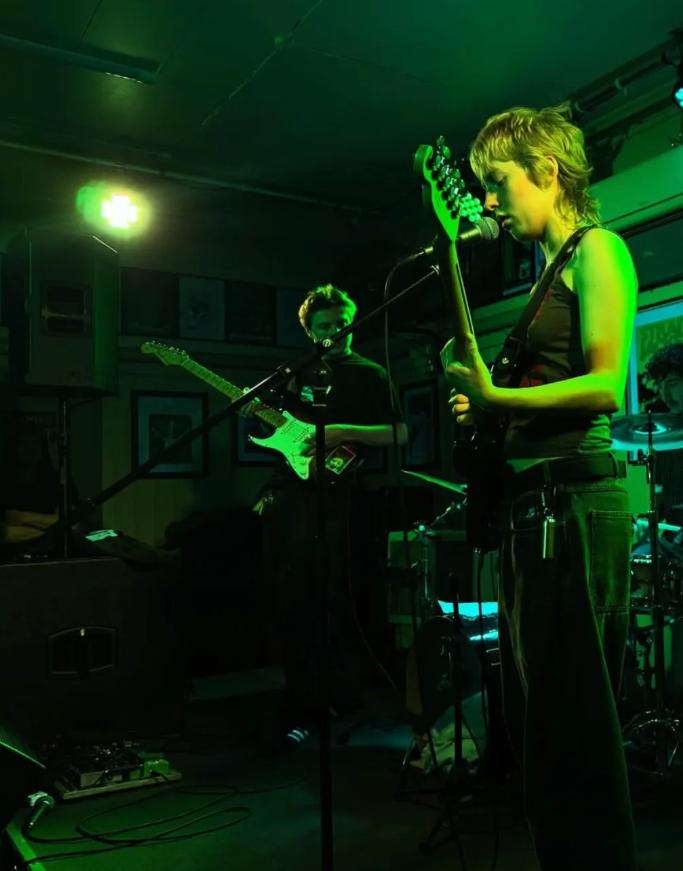
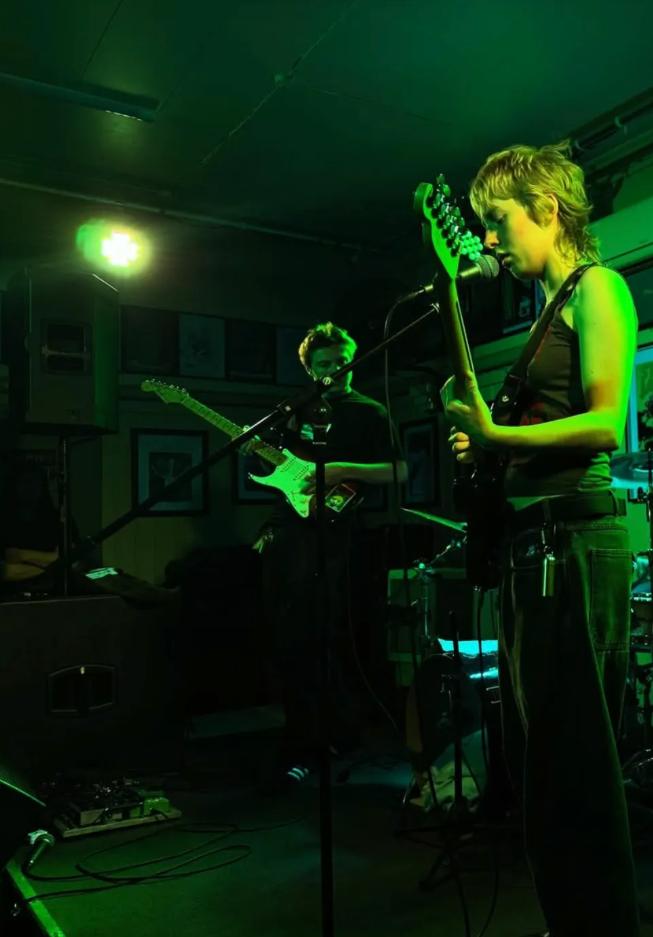
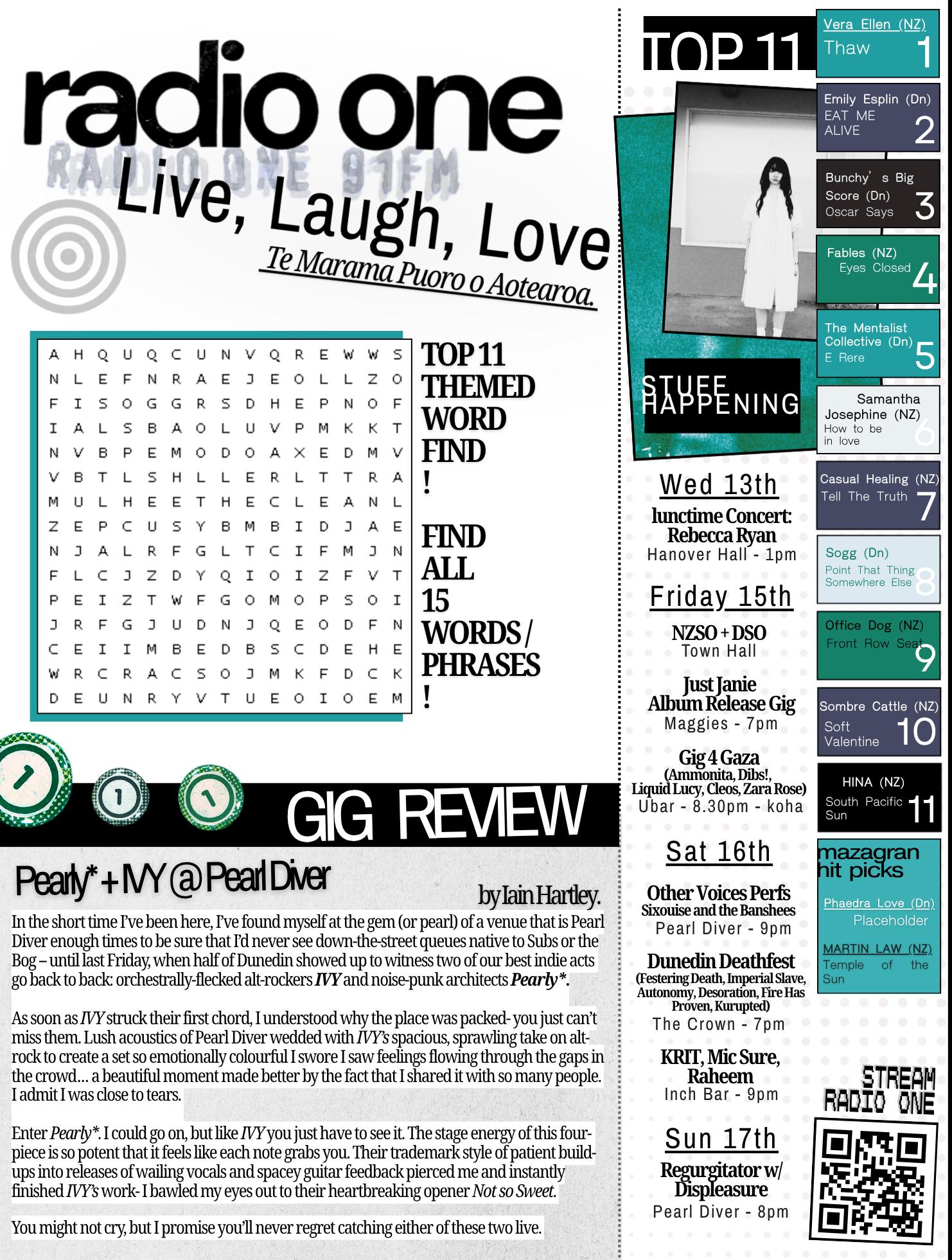
Emily Esplin (she/they) is an emerging Ōtepoti artist carving out a sound that feels raw, honest, and distinctly their own. Her music sits somewhere between vulnerability and distortion, a space where soft introspection collides with an ever-growing rock influence. She’s also single-handedly solving the masc shortage.
With her debut single “Eat Me Alive” just being released, and an EP in progress, Emily is focused on creating music that feels real – not manufactured. In line with their focus on authenticity, Emily isn’t interested in protecting a polished version of who they are. While her artistic identity is ever-evolving, her intentions have remained consistent: be open, be real, and let the rest follow.
That mindset hasn’t come easily, especially with the pressure of releasing music into the world. At its core, her work is deeply personal, and she describes it as a form of journaling – a way to express everything going on in her head. Their music has recurring themes of struggles with mental health and being her own worst enemy, and heartbreak (both in a romantic and a friendship sense).
Working on their debut single, Emily found herself caught in a loop of perfectionism. Recording take after take to no avail, in search of something that felt “right.” It became exhausting: forcing herself through sessions and becoming frustrated, all while chasing a perfectionist ideal that kept slipping further away. Eventually, she stopped trying to be in control, letting the process be more natural and fluid – her new single embodies this rawness. Emily wrote it at the beginning of 2025, while “experiencing a lot of change” in their personal life. In a time of “feeling so strange and claustrophobic,” this single was a way of getting it all out of their system. “People have been enjoying the track, which makes me really happy,” she shares. Clearly getting those feelings out was doing something right.
Being in control of the production process has been indispensable to Emily in developing their sound. She thoroughly enjoys people asking her questions about it, adding that they “love to nerd out.” One of her guiding philosophies is that the music has to make sense to her first, if she thinks too much about how it will be received, the whole process can be derailed. She’s conscious of audience expectations, but wary of letting them dictate their work.
In her view, art loses something crucial when its synthesis is overly calculated. To her, recent pop music feels “like an equation being filled out to create something that will make money and top charts. It feels like regurgitated music.” She added that she’s noticed a rise of this in pop – especially in this new age of AI-generated music. “A lot of it feels really empty,” they said. She emphasised how important it is to her to “push back from that […] The role of the artist is to critique what is happening and make work in response.”
What began as a solo project has since expanded into a full band, something that’s transformed how Emily approaches her music. “Being a solo artist can feel limiting and scary,” Emily admitted, “and I used to be quite quiet with my voice.” The addition of the band, Seth (drums), James (lead guitar) and Phaedra (bass), has given her “confidence and space to experiment with how I use my voice and how everything sounds.”
Live performance has also been a turning point in her journey. Even though they’ve been playing gigs for less than a year, Emily quickly found herself immersed in the local scene – from open mics to eventually opening for touring acts such as IVY and Beatniks. They’ve recently been playing in Ōtautahi, which they described as their best gigs yet, and her first time playing out of Ōtepoti. During these, Emily was trying her best to “really take everything in”, while still engaging with the crowd.
Underlying all of Emily’s work is a simple, but important reminder – this is still meant to be play. Without the constraints of a label or any external expectations, Emily recognises and appreciates the freedom to experiment, to fail, and to grow on her own terms. Rather than letting pressure or expectations carve out their path, she’s focused on protecting the thing that made her start in the first place: a genuine love for making music that feels real. “All I have ever wanted is to share my art with the world, and I'm so excited that it is finally happening for me […] I can’t wait to give people more”.
1 Michael Jackson song, famous for the 'lean' dance move (2)
8 Near, approaching
9 Deliberately leading someone away from the truth
10 Rock musician behind the song 'Purple Haze' (surname)
11 Obstacle course game show
14 Used to direct a horse
15 Big purple fruit
18 Discussion and/or negotiation between enemies
19 It goes back and forth 21 Exclamation of delight or excitement
22 A person with cultural or ancestral origins in Latin America
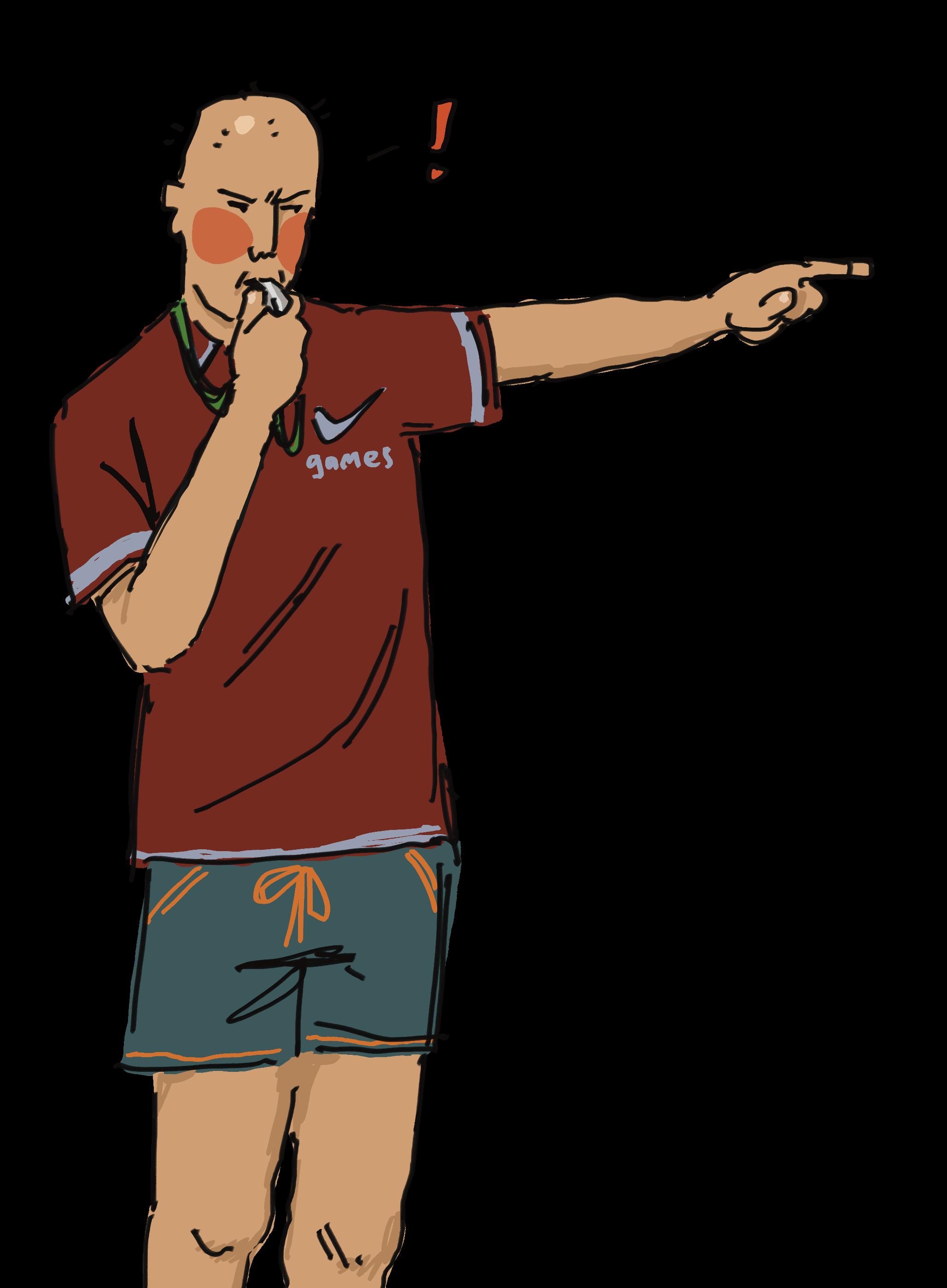
23 Sports official tasked with enforcing rules
2 Keyboard instrument using air or electronic synthesis
3 Gaining unauthorised access to a digital device or computer network
4 Microphone and audio technology company
5 Rapper-turned pop punk artist (3)
6 Agatha Christie and Charles Dickens have this title
7 Website that presents critic and audience reviews of visual media
10 1988 musical comedy classic starring Ricki Lake
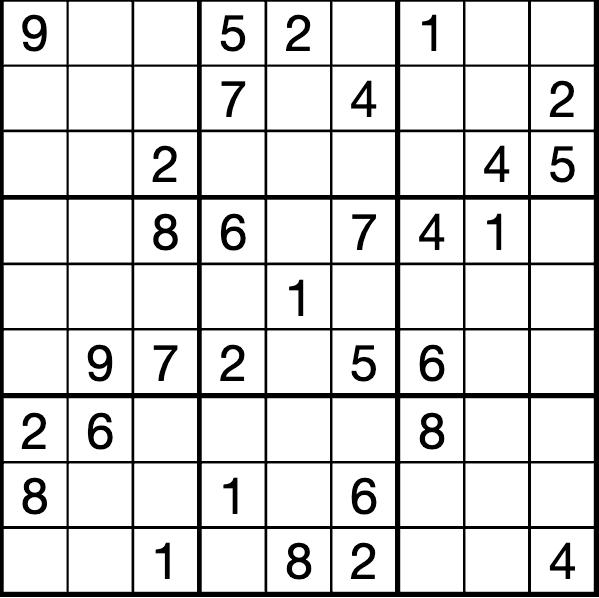
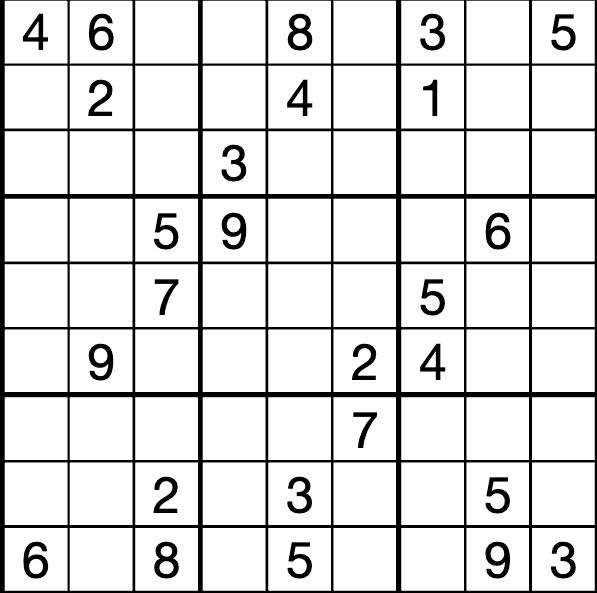
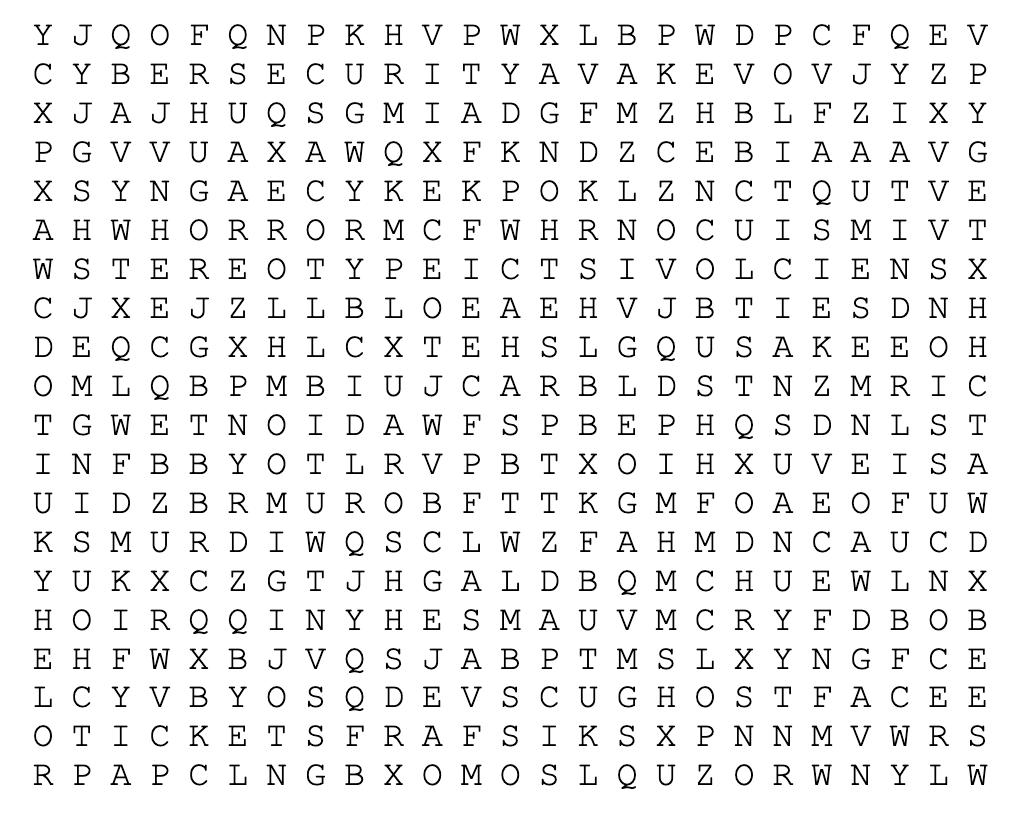
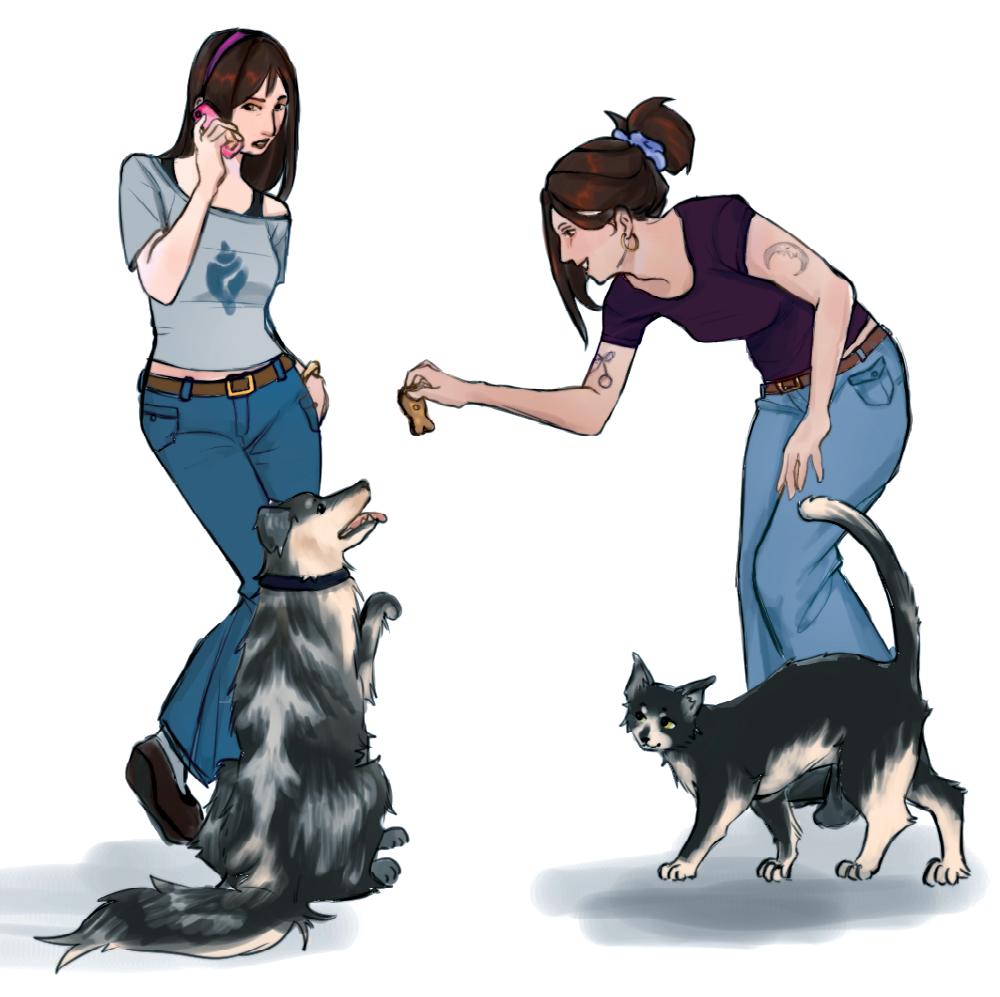
There are 10 differences between the two images Illustrated by Stacy Gordeeva
everything. We just don’t want to get in legal trouble by naming this guy.
When I was 19, my flatmates and I would sometimes pass our spare time by playing a cult favourite game – Tinder. One night, I came across an incredibly well-known Kiwi celebrity. Before I could even register the insanity of the situation, I realised that he had Super Liked me already.
For the uninitiated, a Super Like is Tinder’s “I really, really want you to notice me” button. You get a limited number of these, unless you're willing to fork out actual money. According to WikiHow (a trusted source), a mere three Super Likes can cost about $9.99, and 50 will set you back $75. So yeah – a celebrity
He was over 15 years older than me, which raised
Firstly: Why was some guy I watched on TV with my parents deciding to try and match with me? (ew). Second: given he was that much older than me (nearly 40!), it would have meant that he had his age range customised to show 19 year olds (double ew). I eventually realised a third issue (because it somehow gets worse): he wasn’t even in Dunedin. This man had geographically extended his search radius to reach Cute Hot Teenage Dunedin Girls Near You.
Horrifying. But also,
Nonetheless, I matched with him – mainly because I believed it was someone pretending to be him. Shouldn't the single, high-profile kiwis like him be on Raya, not
We started chatting. At some point I accused him of being a catfish, and he told me to message his official Instagram to confirm. My flatmate and I, thinking we had caught him in his lie, messaged his Instagram feeling smug, only to absolutely lose our minds when he actually replied back.
There was no trick. Same account, same guy.
Given the absurdity of the situation, we still weren’t totally convinced. We thought that maybe it was a social media manager or something fucking with us. Still sceptical, we pushed for proof. He refused to send a photo but eventually sent a voice memo. It was unmistakably him. Same voice, same tone – just now directed at a teenager in Dunedin.
At this point, boredom took over. My flattie and I decided I should keep going, just to see what his deal was. I told him the age gap wasn’t an issue, just to bring it up again to see if he had come to his senses or anything. But god, he just kept insisting it was “crazy,” which was pretty bold, considering he had Super Liked me. When I questioned his allegedly-serendipitous Super Like, he tried to justify it to me by saying he must have found me good looking, but didn't realise I was in Ōtepoti… and 19. Interesting.
We continued chatting, and he began asking me questions about what I did and so on. A real gentleman. Not even chatting to a celebrity makes you immune from dry chats. I complained to him about how shitty my Castle Street flat was, and he insisted I buy warmer stuff for winter. Sensing an opportunity, my flatmate and I laboured the point that I was incredibly poor and cold and probably wouldn’t make it through the night without a big, strong New Zealand male celebrity to save me (financially). He didn’t send me any money. What fucking ever.
Eventually, he added me on Snapchat. His account was, of course, created under a name that was not the one I knew him by. I hoped that moving the chat to Snap would finally get him to show himself. I began sending him face snaps, to which he would reply in chat saying how hot I was, and occasionally bringing up how “crazy” the age gap was.
I was beginning to think it was pretty “crazy” too.
elaborate, deeply niche hallucination or a prank by some deranged social media manager.
But the novelty wore off fast. There’s only so long you can sustain a conversation built entirely on being called “sexy” by someone closer in age to your parents before it starts to feel less funny and more…grim. A friend messaged from my account asking why he was so dry. He replied: “How do you suggest… I get wet?”
That message was basically the last straw for me: the novelty and “craziness” wore off and it started being exactly what it was: a grown man knowingly messaging a 19-year-old and pretending to be conflicted about it.
Like most garden-variety talking stages, the whole thing just fizzled out unspectacularly. Now, it’s my favourite party story. A guaranteed conversation starter. Drop “one time [REDACTED] hit me up on Tinder when I was 19” into a room, and suddenly you’re the belle of the ball. People are always shocked, and I have begun to be too.
The older I get, the more I feel grossed out whenever I see stuff about him online, knowing the real “crazy” way he acted toward me. Luckily I had fabulous flatmates around me. I had people to sanity-check the situation, to laugh it off with, to share the discomfort. Not everyone does. And it makes you wonder how many other “crazy” stories like this aren’t just stories. I wonder if he knows he has become the most iconic piece of lore to come out of that fabled second year flat.
If this sounds familiar to you, you’re not alone. It’s never too late to talk about it or get support. The University’s Te Whare Tāwharau offers help for students dealing with sexual harm or intimate partner violence, whether it’s recent or years ago. You can also contact Safe to Talk by calling 0800 044 334 or texting 4334 which is a free and confidential service available all across the motu.
Out of curiosity, I messaged him again while writing this. Just something casual. He replied quickly, with no acknowledgement of our history. I also had my friend hit him up to see if he would reply to just anyone on Insta, but he never replied to her – making me sure that he remembered who I was. The last thing I asked was why he hadn’t been in touch when he was last in
Illustrated by Gemma McKinney
"Speech is power: speech is to persuade, to convert, to compel." — Ralph Waldo Emerson
The Merriam Webster dictionary defines a politician as “a person experienced in the art or science of government. Especially: one actively engaged in conducting the business of a government.”
I think that definition is almost as ideologically vague as the politicians it describes. Art? Conducting business? It makes politics sound neutral – like it's just management or admin. Like politics is something quiet, or happening in the background.
If I had it my way, I’d redefine it as:
“A spokesperson to slyly persuade you on an agenda that a group of incredibly rich and powerful people have unilaterally decided upon. Especially: one taught the art of rhetoric and branding.”
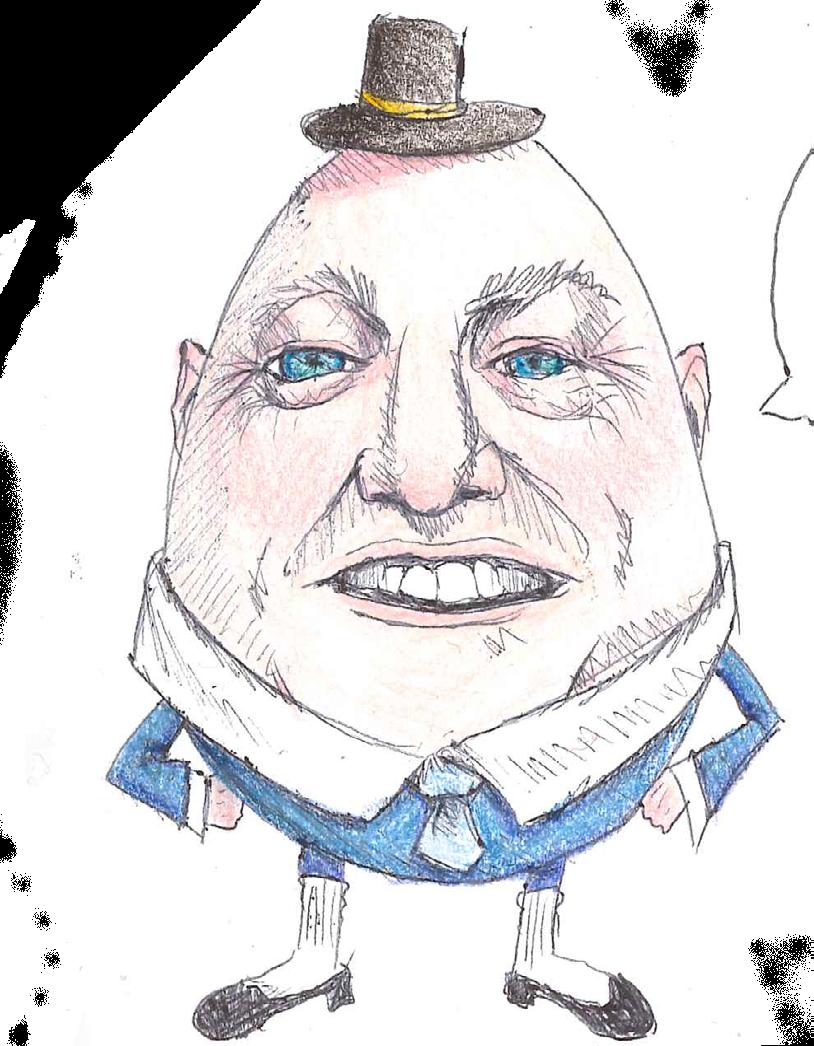
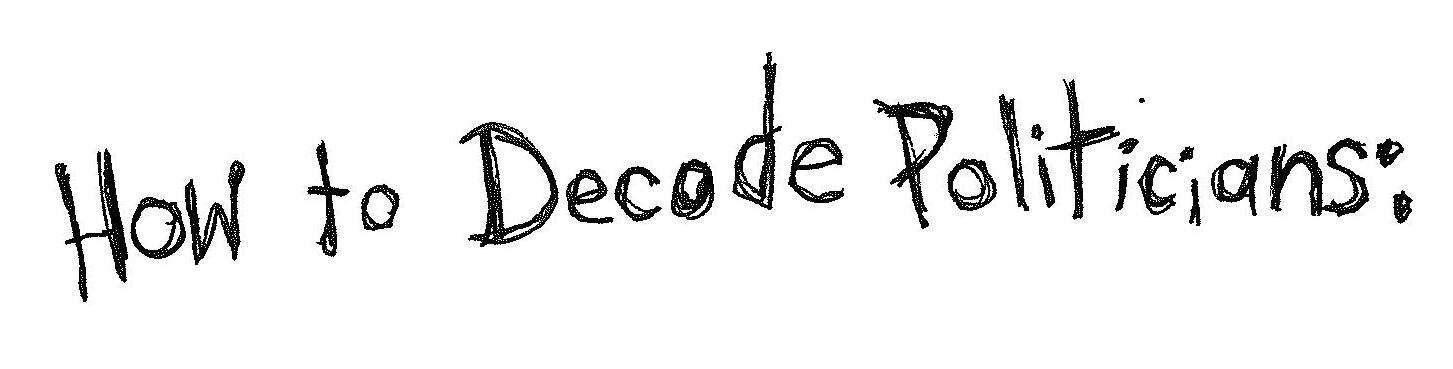
Rhetoric, for reference, is the ancient Greek idea of persuasion through speech. Politicians have that down to a T – they love to talk. Duh. Press conferences, long speeches, interviews and social media posts. There is constant output of speech. And, in today’s politically chaotic world, it's becoming more important than ever to actually listen. Political literacy is hot. But understanding what they’re actually saying? That's where it gets tricky. Take President Donald Trump, for example:
“We’ve got the best tanks, the best ships, the best missiles and rockets – we have the best of everything.”
On the surface, it sounds almost hilariously vague. Students don’t get away with making statements without references in assignments, but it would be unsurprising to
How do you define “the best”?
By Saraia Allais
That’s where sharp-eared audiences need to figure out what’s BS and what’s not.
#1 Saying Nothing (Very Confidently)
One of the most common techniques is called pivoting. This is often used when a politician is asked a hard question. It may sound like they are answering the question, but they’re not. They’ve pivoted: trained to always bring it back to well practiced and media-trained lines.
Then there’s the bridge: “I understand your question, but what really matters is…”
This acknowledges the question just enough to seem respectful, before immediately abandoning it. It leaves you feeling like something was said, but when you try to recall it, there's no concrete details to fall back on.
Even worse, this ambiguity forces you to fill in the gaps yourself. You start interpreting their meaning, connecting dots, doing the mental labour for them. All the while exhausting your mental power – making it harder to become politically invested.
A disengaged public is a complacent one.
Decoding tip: Stay focused on the original question. Don’t exhaust yourself trying to figure out what they mean with their fluffy practiced lines. If they don’t answer, then that's your answer.
Watch for phrases like:
“What I can say is…”
“The reality is…”
“People expect…”
#2 Keywords Are Never Accidental
Politicians rely heavily on filler words. They sound positive, but are deliberately vague. These totemic words trigger an emotional response in us, and allow for our own assumptions to fill in the meaning.
When Chrispoher Luxon says "We are operationalising our government”, it sounds impressive. Technical, even. Great! But what does it actually mean?
They are always improving something, reforming, investing in something – yet the public sees no tangible evidence or change.
Decoding tip: Ask yourself: “what does this actually change?” If you can’t picture a real-world impact, it’s probably just branding.
Words like:
“Reform” “Progress” “Resilience”
#3 No One’s To Blame
No one did the thing, it just… happened. Most likely, no one faced any consequences either. We’re just supposed to accept it as the state of affairs. I believe that politicians are sometimes akin to weasels, always wanting to take the easy way out and run away. By taking the subject out of a statement, they take the blame out of situations. This means they’ve gotten away from any consequences.
The vaguer the better. Unnamed, untalked about things are forgettable.
Decoding tip: Always ask: “who?" and “what?” Because if something isn’t named, it disappears from accountability.
Phrases like:
“Mistakes were made.”
“Processes weren’t followed.”
#4 The Relatability Performance
They’re just like you. Apparently.
When it goes right, we forget all their false promises. When it goes wrong, it’s kinda like your grandparents trying to say “yass queen” and you just cringe. This isn’t accidental, it’s branding. The goal is to feel familiar enough that you stop questioning. Politicians are not just selling their flashy policies, but their personal brand – hoping to snag your vote based either on a hope for a better future, or you reckoning this person would be a pretty mean PM.
They’ll complain about parking, joke about technology, or act casually to seem approachable.
There's also paralipsis: “I won’t even mention…”
Which, of course, means they’re about to mention it. It creates the illusion they’re letting us in on something, while avoiding responsibility for saying it directly.
Decoding tip: Separate the persona from the policy. Liking how someone sounds is not the same as agreeing with what they’re doing.
Watch out for:
Bemoaning an everyday problem
Staged visits
That feeling when you actually start to like your politicians
#5 Numbers, Numbers, Numbers
Numbers and stats can be manipulated while still being technically true – and in speeches there are no citations.
That leaves us doing the unpaid labour of fact-checking.
#6 Fire Hosing
This is where it gets fucking shit.
Politicians will flood the space with so many claims –often false or exaggerated – that it becomes impossible to keep up. This is most popular among Russian and American politicians.
From Trump: “Our country was being invaded by an army of 25 million people”. See also: “The price of eggs is down 82% since March, and everything else is falling rapidly.”
Constant scepticism is exhausting. Eventually, people stop engaging altogether.
At that point, politics becomes evil. It's no longer about persuasion or representation – it’s about sides. National versus Labour, left versus right. Actually, we’re all stuck in the middle of it.
This creates a mob mentality centred around what they want us to believe. If you have ever considered storming the capitol just because your side lost, I’m afraid you have fallen victim to this technique.
You are losing if you take a side, but cannot win on either. This forces you to put your vote in hopes for the ‘less bad option’.
Decoding tip: Don’t exhaust yourself reacting to everything. Step back and look at the patterns.
Watch out for: Repeated, obvious lies Constant denial of facts
My Final Thoughts
You should never ‘ride or die’ with your politicians. They’re not neutral actors, and you can never assume their media-rehearsed version of the truth. It may be hard to muddle through the nonsense they say, but isn’t it much scarier to think you’re the bottom in the relationship just taking their load, accepting it.
Right now, I'm not sure politics is just about policy. It’s about persuasion and marketing.
And if you don’t know how the language works, it works on you. ★
For example, former UK deputy prime minister Nick Clegg claimed 27 million people were £825 better off due to tax cuts – using data from before he introduced those policies.
Decoding tip: Always ask: “When were these statistics taken?” and “Compared to what?” Numbers without context is just a story with graphs and statistics, moving the agenda forward.
Watch for unbacked numbers like:
CRAIG DANIELS
DANIELS
By Gryffin Blockley & Jesse Valpy
out ut
is the only way to confirm CTE, as it requires evidence of that degeneration, through examining a protein called tau, detaching from your brain and clumping into tangles that interfere with the brain's normal function. Billy was the first player based in Aotearoa to be diagnosed with the disease – but he would not be the last.
Māori All-Black Shane Christie passed away at age 39, who retired from rugby in 2017 for similar reasons as Billy. It was also suspected that Shane passed away by suicide. Inferring that he had CTE from his symptoms and lifestyle, Christie spent the final years of his life advocating passionately about the condition. Upon his death, former All Black Carl Hayman (also suspected CTE) expressed his frustration about what he felt was a lack of active response from governing sporting bodies, such as New Zealand Rugby (NZR). NZR is the governing body of Aotearoa’s national sport. Approximately ninety staff and a governance board organises all the rules and regulations that keeps rugby ticking along, from community games, all the way up to the All Blacks.
“Shane wanted people to understand that he was sick, not depressed,” Carl told the Spinoff in an interview in April of this year. “Until [New Zealand Rugby] accepts there is a problem, cases will always be put down to issues around mental health, alcohol and lifestyle.”
In a media release earlier in the year, NZR acknowledged the association between repeated head impacts and CTE. "We are working with researchers to strengthen the understanding of CTE, recognising that further research to look at the brains of individuals who have not played contact sports is needed, before a definitive link can be established,” the statement reads. “While research into the long-term impacts of head injury is ongoing, our focus remains on the support we provide to our rugby community now.” NZR described that they take a “precautionary” approach, focusing on education, sanctions and initiatives such as brain health services. “Support for players who do experience post-concussive symptoms, mental health issues, or cognitive difficulties is a priority, regardless of any pathology that may or may not be identified later.”
When approached by Critic Te Ārohi, NZR were quick to acknowledge their “powerful” influence over public attitudes toward injury. “When fans and young players see their favourite rugby players removed from the field for head injury assessments or ruled out of matches following concussion, it reinforces the message that taking symptoms seriously is not a sign of weakness,” they explained.
As of a couple of weeks ago, the 2026-2027 Brain Health & Concussion Plan was published by NZR, alongside the Rugby Players Association and the NZ Rugby Foundation. In a statement to Critic, NZR described the plan as “setting out the initiatives we are undertaking across five focus areas”: education and training, injury prevention, injury management, research and monitoring and policies, laws and regulations. The Plan will be actioned in partnership with others over the next year.
Despite NZR’s acknowledgement of their role in shaping
how concussions are perceived within the sporting industry today, it’s an attitude that’s taken some time to stick with the game. Head injuries have had a pretty hard time gaining real acknowledgement as something serious and potentially irreversible, thanks to a sporting culture that’s been shaped by national attitudes over time.
A Compounding and Complacent Concussion Culture
A concussion is generally a “mild traumatic brain injury caused by a bump, blow or jolt to the head.” 35,000 New Zealanders suffer from a concussion on an annual basis, with approximately 33% of them remaining unreported. In 2023, ACC accepted upwards of 10,600 sports-related concussion claims, which cost the nation $64 million. In 2020, the English Football Association has introduced strict rules restricting children aged 11 and under from heading footballs during training. This emerged following a study at the University of Glasgow which found that footballers are 3.5 times more likely to suffer from neurodegenerative disease. The US have also banned children under 10 from heading balls since 2015. In comparison, NZ Football have adopted a looser guidelines-oriented approach, encouraging coaches to “limit” heading in junior and youth football practice environments, with no explicit rules in place. Given all of this, there does seem to be a major issue. You’ve only got one brain, so what’s with the apparent concussion complacency?
Illustratedby JimmyTannock
The term ‘concussion’ has generated a polarising response throughout history, depending on who you ask. Early reports into the prevalence of concussionrelated illness and death were met with extensive opposition. Doctor Bennet Omalu discovered CTE by studying the brain of retired United States National Football League (NFL) player Mike Webster in 2002. Omaulu recognised that tangles of tau proteins, which are sustained from repeated brain injuries, form clumps and tangles around blood vessels. These eventually form into plaques in the brain – similar to the brain plaques observed in Alzheimer's or Parkinson's Disease. The degeneration led to a decline in mood, behaviour and executive function, eventually leading to Mike’s suicide at age 50. Researchers had documented similar conditions in boxers since the 1930s, commonly referring to the poorly understood condition as being ‘punch drunk’. Seeing this in a 50-year-old man was highly unusual, and raised enough of a red flag that he published his findings in the Neurosurgery journal in 2005.
Funnily enough, the NFL weren’t too happy to be told that their sport was causing CTE. They fought against Omalu’s findings, attempting to protect their financial interests and the image of their sport. The NFL’s aptly-named Mild Traumatic Brain Injury Committee denied the legitimacy of his research, labelling it “a failure”, and insisting he retract his paper immediately. He did not.
An increased number of former players’ deaths worked toward supporting the connection between severe CTE and participation in contact sport in the following years. Sporting organisations eventually responded to the mounting pressure, carefully crafting responses which preserve their precious commercial image and capacity for profit. In 2013, the NFL settled a classaction lawsuit after being sued by roughly four thousand former players, for exposing them to a substantial unprotected risk of developing severe debilitative CTE. Further settlements soon ensued, creating large amounts of publicity on the severity of the condition. It wasn’t until 2016 that the NFL publicly admitted to a link between the head injuries and CTE.
Despite Omalu’s refusal to retract his work, the NFL’s denial set a precedent. CTE’s initial introduction led further sporting bodies to be cautious in acknowledging the connection between head knocks sustained in sports rough and tumble and CTE. However, largely due to not being able to sue for personal injury through the ACC, there haven't been any major lawsuits to create sudden discourse or headlines about CTE or concussion related injuries in Aotearoa. Instead, Shane Christie and Billy Guyton provided a watershed moment for CTE in New Zealand. This idea of shrugging off risk because it is ‘the way the game should be played’, has now had real reason to sit up and notice that Aotearoa has been part of an international failure to appreciate the real risk of brain injury arising from concussions.
As a consequence, a more scientific and evidencebased approach has been employed. New Zealand-based research (from Universities such as Otago), have formed the basis for official guidelines promulgated by the likes of the ACC and used by sporting organisations like NZR. Concussion management has become a robust part of regulatory conversations, in contrast to America’s high-profile foray into conversations about CTE.
This somewhat cautious approach to engaging with concussion related injury has been compounded in a New Zealand culture of ‘she’ll be right’ sportlovers that’s historically awarded determination and perseverance. Sidelining a player for a bump on the head might be perceived as bubblewrapping them, instead of protecting their life expectancy. Who wants to sit out on their love of the game for a slight jolt to the old noggin? That’s especially true when thousands of young people dream to be celebrity-status level
All Blacks or Black Ferns, creating a culture of constant practice and improvement. The fear of not making a rep team or similar upcoming trial has been enough for plenty of Kiwis to train through and stigmatise the severity of their injuries.
Devastatingly, the death of Billy Guyton had already occurred before Aotearoa had national and consistent concussion guidelines, which were launched in 2024 by the ACC. Nowadays, the magnitude of concussion and brain injury coverage has heightened throughout the media, sports fields and households, sparking more intense discussion about the risks faced by taking part in the sports we love. To some though, concussion is a taboo topic, and safeguards still represent an overlycautious approach in a field where risk is inevitable.
Therefore, changing the culture in sports is not something that can happen instantaneously, and must be changed from all levels of sport. Professional sports players can be role models for sports from the community level and up – what the best of best does will set the precedent for those below. It’s intergenerational.
Candor, Caution and Clinical Commitment
Today, one word is always thrown around, almost synonymously, with concussion guidelines – risk. Sports, one of the largest sources of concussions for young people, are inherently risky. But that doesn’t mean ‘bubble-wrapping’ players, as some people may perceive. “Managing risk does not mean eliminating injury,” an NZR spokesperson told Critic. “It means
making sure that all reasonable steps are taken to reduce how often injuries occur, and how severe they are”.
Helen Littleworth is the Principal Physio at Physio Performance, a physiotherapy clinic in Dunedin. She’s been the physiotherapist for the White Ferns, High Performance Sports New Zealand, Athletics New Zealand and various Olympic teams. She’s also been a team member of the Black Ferns, and captain on eight occasions, as well as a member of the New Zealand Women’s Hockey Team. She knows her shit.
From her extensive experience, she also knows a fair bit about how concussions have been perceived and managed through the last 10-15 years in the sporting industry. “I think it’s definitely changed,” she said. “I think New Zealand Rugby has led the way a little bit with the sporting aspect, especially in Dunedin.”
An NZR spokesperson told Critic that destigmatising concussion by fostering open discussion at “all levels of the game” reinforces a culture where “safety, honesty, and wellbeing” are prioritised. This supports a safer rugby environment, and empowers young players and students to recognise symptoms early, report them with confidence, and seek appropriate care. “Regardless of the sport, both the regulatory body and professional athletes have an important role in educating their communities about safe and responsible practices,” they told Critic. “Rugby is no different.”
For NZR, that culture of being educated and candid looks like ensuring players, coaches, and whānau are “informed, supported, and equipped” to play their part in promoting player safety and reducing the risk of concussion. Education, rules and regulations (such as tackle height laws), sanctions and initiatives like Head Injury Assessments, mandatory recovery periods, and brain health services for players are all “important parts of the system”. Additionally, the NZR has made use of flashing mouth guards – they flash red when a player has a high impact head knock. It’s all part of a system that cultivates a sports industry where “safety, honesty, and wellbeing is the norm”. Professional teams have access to trained doctors and independent medical assessments, and must get clearance by an “Independent Concussion Consultant under the Head Impact Assessment (HIA) Protocol.” Both current and retired players are able visit a brain health screening service, which was established in April of last year. Players go through a set of independently developed online questions and tests with a neuropsychologist, the results of which can be then discussed with a player's GP. The screening service is free of charge, and basically an advanced neurological screening tool, but also a general health checkup.
In Helen’s eyes, that more “structured” approach has been effective in ensuring headknocks receive proper management at a professional level. “Without a doubt,” she says. “Probably over about the last five or seven years, it’s really ramped up. But prior to that, when I was playing international level, the same emphasis definitely wasn’t placed on head knocks as it is now.
It’s very structured [now], especially in rugby. You know what to do.”
Sport NZ is the Government agency responsible for sports and recreation governance in Aotearoa. Like NZR, they have worked towards strengthening their concussion response. Head Injury Assessment (HIA) protocols were first introduced in 2012, and improved in 2021. This involved three separate interventional assessments for during matches, post match and 36-48 hours later. Increased public awareness has led to further landmark changes in how our sporting organisations approach and navigate their concussion policies. Players must be completely symptom free for at least 14 days post-injury before following a careful, gradual return to play programme. Medical clearance is required, and a positive active duty has been imposed on players and coaches alike across all levels of sport. Overall, an ‘if in doubt, sit them out’ approach has been advocated, moulding our concussion culture.
Helen can attest to that positive cultural shift. In games such as rugby league, which attract massive followership, fans get to watch players go off for a HIA following a headknock – many of who will be the next generation of players. “Well, a young kid’s going to see that and go, ‘oh, okay, so if I get a headknock, I’ve got to go off’, you know?”, Helen explained. “I think it’s helping people understand that if they do get a headknock, they’ll probably need to come off. It doesn’t matter how tough you are.”
Additionally, NZR explained to Critic the enormous amount of data that is collected to improve understanding of concussion recovery.
Describing themselves as at the “forefront” of concussion and player welfare initiatives globally, NZR collects and updates concussion histories annually for all contracted players. That historical record includes prior incidents, recovery durations, impact thresholds, and relevant psychological conditions, which is then used to tailor individual return-to-play plans.
Basically: it’s safe to say that there’s a lot that NZR does to manage the risk of concussion related injury, especially
at the professional level. However, as Helen touches on, that culture shift will also need to be back in the community game. That ensures our next generation of players take care of the only head that they’ve got.
Concussion Conversations in the Community
NZR has a Medical and Science Advisory Panel, which oversees science-backed research proposals and projects in the sport. Moving away from a ‘one size fits all’ concussion recovery model has been a mammoth effort in rugby over the last few years. “[R]isk level varies across all levels of the game,” an NZR spokesperson told Critic. Risk is highest at the professional level due to the game being more physical, but there are still injuries at the community level. As such, effective approaches to fostering concussion conversation are essential.
In 2024, both NZR and NZ Football had agreed to stricter community guidelines. These changes helped ensure that lower-level community games were equipped with concussion prevention measures –not just the elite players. NZR promotes concussion awareness and management at the community level through compulsory yearly “RugbySmart education” for coaches and referees. According to the NZR website, RugbySmart has meant catastrophic injuries (spinal, life-altering injuries, or death) have reduced from an average of nine per year, to two. All coaches above the U14 level must attend a RugbySmart session before competition games begin each season. The programme explains signs of injuries, ways to prevent them and how to support this framework in a team environment. This is bolstered by the “Blue Card initiative”, which supports referees to remove players with suspected concussion and initiates a formal medical clearance process.
Referees also receive annual training in concussion recognition and management. Community games use a Concussion Reporting Form to log incidents, provide immediate guidance, and ensure consistent follow-up with players. Additionally, the ACC’s 2024 National Concussion Guidelines have provided more guidance for the community. After a concussion, there’s a mandatory 21-day stand-down period and medical clearance required before returning to play. The protocol is thorough, but not riddled in bureaucracy, to keep players safe and back on their feet without long term issues.
Helen feels that these guidelines have given more clarity to sportspeople that don’t necessarily have access to physiotherapists or medical help ready on the sidelines, as well as parents of younger players. “Clarity is a good word,” she says. “For coaches from school, or coaches that are parents [...] They’ve got that resource now with the ACC, and that’s the protocol.”
That awareness, clarity and attention to how concussions are regarded in community games is essential. As youth make up a large proportion of community, social and semi-professional leagues, it is imperative that concussion mitigation strategies are
implemented across all levels of sport. Even though concussion is a medical issue, it’s the community members who can spot early signs before things get worse. It’s players and coaches who keep an eye out on the field, not necessarily medical professionals. The current students and young people in rugby scrums on a Saturday are Aotearoa’s future coaches, professional players and parents to the next generation of athletes.
Overall, there seems to have been a trickle down effect. Headknocks are taken seriously at the professional level, so they’re taken seriously at the community level. “It’s helping people understand that if they get a headknock, they’ll probably need to come off,” Helen reckons. “And if in doubt, you just keep them off for a young person at a community level, because that’s what would happen at a top level.”
Someone who can attest to this communitylevel protocol is former Otago University Football Club player, Ben Price. Ben was concussed last year whilst playing, but reckoned he spotted the symptoms fast, describing his treatment as a “smooth process”, which was “largely due to seeing a doctor as soon as possible”. Ben was then put on a plan by his physio to return to play as quickly as possible. “I felt extremely out of it, like an extremely bad hangover,” he described. He had a stiff neck for a while, feeling “pretty dopey” for several weeks: forgetful, nauseous and quick to tire.
Ben hasn’t noticed any lingering symptoms, attributing this to taking the concussion seriously throughout the process. “After spending a few days resting, I was gradually able to increase my activity. This involved mindful walking, and once headaches had subsided, I was able to start slow runs. I was allowed back into training, and seven weeks later, I was cleared to return to play.”
Helen also noted that community athletes in Dunedin are now able to visit Axis Sports Medicine, which opened a few weeks ago. Axis provides acute concussion care and specialist treatment for more complex cases. “It’ll be game changing for those sports that haven’t been able to access the rugby concussion clinic, I think.”
Gisela Sole, a Professor from the School of Physiotherapy, told Critic that over the last ten to fifteen years there has been a “far greater awareness” now to what extent concussions can influence the return to play and education for younger community players. Gisela’s research over the years has
investigated topics such as concussion management in community-level rugby, and the development of a concussion framework for secondary schools. A big emphasis of Gisela’s research is returning to physical activity and learning in the healthiest manner possible.
Symptoms of a concussion are no longer limited to just headaches or light sensitivity, but are more broadly linked to causing difficulties with emotional regulation. These can include being “anxious, not sleeping well, and also unpredictable in their emotions. Maybe anger attacks, where previously a person may have been very levelled in their emotional responses,” she explained. According to Gisela, students, adolescents and young people are more at risk of longer term emotional problems sustained from a concussion. Because many young people tend to bounce back and get on their feet quickly, they may feel okay to keep playing, which creates additional risk. Soldiering on through a head knock increases the risk of repetitive low level “subconcussive hits”, which tend to increase damage over a lifetime. This all reinforces the importance of an early community education about concussions, ensuring our future players are smart in their play.
What Should I Do If I
The most important rule when it comes to a suspected concussion is to assume it is one until a medical professional has cleared you. For students, Gisela points toward Student Health, who she described as “fantastic” and “very aware of concussions”. Seeing a doctor means you can get checked and rule out anything more serious. A doctor can also generate an ACC number for your concussion, which can help subsidise or fund subsequent healthcare appointments required for your recovery. Physiotherapists are also a great option for post-concussion care. While they cannot formally diagnose a concussion, they may be able to refer you to a GP if they believe one has been acquired. Physiotherapists holistically look at the entire person in treatment, and can help with vestibular (balance) issues, and rehabilitate symptoms related to neck sprains some people experience post-
The first two days after concussion involve rest – but not total bed rest. “It means being at home, going for walks, being in the garden, doing the normal activities in the house,” Gisela recommends. Other top tips include limiting screen time and trying to stay as calm as possible. When it comes to exercise, a gentle run or a walk will be fine, “as long as it doesn't exacerbate symptoms,” Gisela assures. Another key consideration for tauira is to stay well clear of alcohol for at least one week after a concussion. “Alcohol and [the] brain do not work together,” Gisela explained. Devastating news for some students.
Only 10% of concussions actually involve losing consciousness. Symptoms such as headaches and vomiting should be watched with a keen eye. Gisela said that increased confusion, repeated vomiting, unusual behaviour that’s just “totally out of the ordinary for that person”, weakness in the arms or legs, double vision or blurred vision and also increasing neck pain with maybe tingling numbness in the fingers should be taken very seriously. A trip to A&E is the best thing to do.
A benchmark recovery time for a young person with a minor concussion may be around ten days. An older person may take longer to recover with the same severity of concussion. However, Gisela told Critic that trying to figure out an exact timeframe is fruitless: “it’s very much very unpredictable”. Adolescents in general and older folks tend to take longer to bounce back, as well as young women, who may take up to three weeks or “even a month to recover totally”. These time frames may be lengthy, but they reduce the likelihood of second-impact syndrome (basically when you get another headknock while still concussed), and persistent long-term symptoms that can cause lasting damage.
When it’s time to return to learning, everyone will have different needs. Some ākonga may need sunglasses to minimise bright lights, avoid screen time or do half days. Quiet spaces for study and minimising stress are also extra important – especially if you have assignments or exams to prepare for.
The best thing you can do in this situation is to contact Disability Information & Services (DIS). Gisela said that “[DIS] is also there for short-term conditions [..] so that they can help them with preparation and during exam time”. DIS can find the right solutions for your needs – whether it be extra time in exams, breaks or a quieter room. Everyone in the University community wants you to do your best, but if you’re concerned your knocked-up head may affect that, the best thing you can do is reach out. ★
Going through it? Free help is available, 24/7. Gumboot Friday provides free counselling for under-25s, with no doctor’s referral required. Young people can book directly and access support quickly via gumbootfriday.org.nz
Text 1737 for free mental wellbeing support
Student Health and OUSA Student Support can both provide in-person care as well
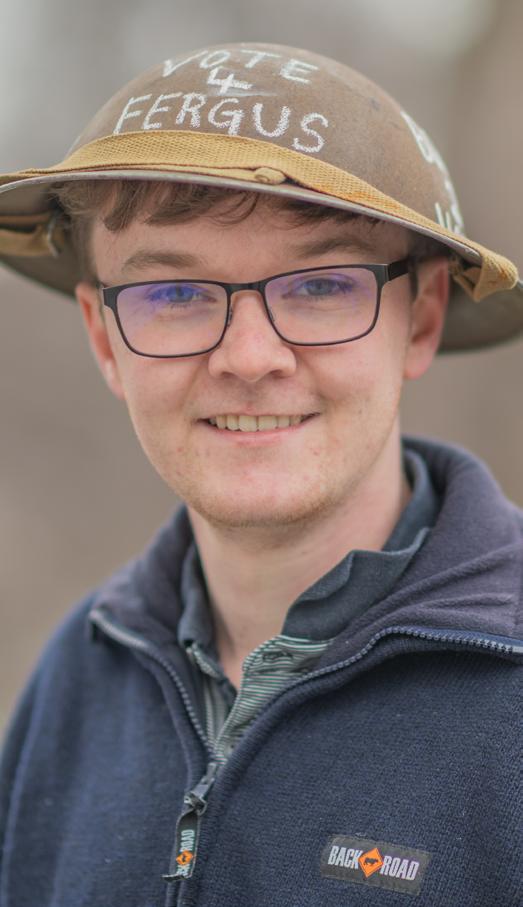
FERGUS PARKS
How do you do, fellow youths?
OUSA’s post-graduate representative (resident UNC) here, using up ink on a column you don't read. And you know what? Good on ya! Exercise that free will, read me or don't. You think I care? Well… maybe a little. Still, I’ll try to earn a minute of your reading time.
I’m supposed to write something vaguely insightful about student life, so here I go. A lot of people come straight from high school into uni and never quite shake that “do as you’re told” mindset. Understandable, but it also means you can end up wasting away what should be some of the best years of your life.
So here’s a little secret from an old fart like me: you’ve got more freedom now than you probably realise. If you’re tired of staring at the same four mouldy walls of your flat, sitting in the same itchy chair in Central that your parents likely sat in and thinking too hard about how words work, you should just go and do something.
Walk around the harbour, or visit the railway station and despair at the death of inter-city rail. Start drawing Peter Griffin on whiteboards around campus and commit to it like it’s your degree. Hell, I'm wearing an army helmet, and no one gives a bat! That said, a little self-preservation goes a long way. You don’t need to become a cautionary tale to prove a point.
So, put on your Sunday clothes. There's lots of world out there!
P.S. Please send help, I fell into the photocopier and have been trapped in this paper format. I think the copier’s made a papier-mâché version of me and is now walking around pretending to be me. If you see “me” walking around, that’s not me – that’s the paper copy. Spill water on it immediately.
Exercising free will (within reason),
Fergus Parks (forklift certified)
FROM THE PĀTAKA
BITE-SIZED UPDATES FROM TE RITO AND TE AROHI
Brady Simeon – Ngāpuhi, Ngāti Hine
(Kaipāpaho Matua/Communications Officer)
Heeni Koero Te Rerenoa – Ngāti Hine, Te Rarawa, Te Waiariki
You can tell what time of year it is by what people are carrying. Shoes in one hand, laptop in the other, everything else tucked in where it fits, moving from one place to the next without really stopping. Within TRM, the volleyball tournament has just passed, Te Huinga Tauira musters are underway, and the familiar tune of Māori Pre-Grad is already at the doorstep, all sitting within the same stretch. Somewhere in between, the headlines have not exactly been quiet either. And if it has somehow passed you by, here is what has been happening.
SOMETHING SPICY SOMETHING SPICY
Between pounamu rising on the black market, a racist haka circulating, and a “missing” taonga resurfacing in Germany, what stands out is not just that these things are happening, but how unsurprising they are becoming.
At the centre of it sits the recent revelation in documents filed with the Waitangi Tribunal, proposing that government obligations to Te Tiriti be reduced to simply “take into account” across nine Acts.
Placed alongside the direction signalled by the Treaty Principles Bill of 2024, it is not a lesser shift – it carries comparable weight in how it would reset the foundations of responsibility. Moves like this do not stay contained in legislation, and they rarely do. Rather, they filter through institutions, decisionmaking, and the everyday systems people rely on. While framed in technical terms, the implications extend well beyond policy, setting a direction that affects not only Māori, but all New Zealanders who live within and rely on those
SWEET SOMETHING SWEET
Some things crank the heat, and others take it down a notch.
Closer to home, that showed through at Relay for Life – an annual kaupapa that raises funds for cancer research, supports those living with it, and remembers those who have passed. In Aotearoa, 77 people are diagnosed with cancer every day, and 1 in 3 will be directly affected by it in their lifetime. This year, TRM fundraised $1,440. This feeds directly into the Cancer Society’s work, which directs around $3.6 million into research each year, alongside care, education, and prevention. It sits in contrast to everything else going on – simple in purpose, and clear in intent.
STILL COOKIN' STILL COOKIN'
Looking ahead to May, our Tumuaki Takirua are stepping up to raise funds for Otago Polyfest, which is set to take off in September. On the flip side, if you’re a haka freak, pull up to the first Te Huinga Tauira practice on 18 May at Te Tumu. With exam season nearly upon us, you won’t want to miss out on our free exam packs in collaboration with NTKA over the next few weeks. We’ll also be hosting our first study wānanga on 23 May. More to come, so keep up with our instagram @teropu.maori for daily updates.
On the night, many of our ngā rōpū came together to support the kaupapa while TRM kept everyone going with kai, creating a pit stop in between laps – a space for pick-me-ups and to
COLUMNS
By Swig60
It’s monsoon season, so it’s time to get wet. Actually, never mind – this isn’t Moaningful Confessions, that's on the next page. This week, Swig60 set sail (not to that island) and somehow ended up stranded with a box of Fiji Dry and very few plans beyond “see what happens.”
With a six-pack costing you just $20 at Leith Liquor, it’s doing its job: cheap, cheerful, and what any finance major would call a sensible financial decision. Perfectly timed for the final weekend of drinking for the vibes, not just the alcohol blanket. Cheap, tropical, and suspiciously easy – like turning your wholesome family holiday into a 7-day bender.
Tasting Notes
Fiji Dry comes in swinging with tropical fruit – yum, sweet and as inoffensive as your nan on your dads side. Taste-wise, you’re getting a strong Schweppes lemon lime and bitters taste –very ‘first schooner as a kid’ vibes. There’s a subtle presence of rum lurking in the background.
And we mean lurking. At 4.8%, this is basically beer in an RTD costume. The rum is doing great at hiding – maybe too good. You’re not getting that usual burn, just a smooth sweetness, with a hint of citrus that makes these babies dangerously easy to to sip… and keep sipping. Suddenly you’ve had six, and nothing has really happened except a mild staring issue.
The carbonation sits in a nice middle ground – enough fizz to keep it interesting, not enough to leave you bloated and burping worse than that old fuck at the pub does. The rum goes down fine, but deleting a box feels less like a flex and more like a part-time job at minimum wage. This isn’t a sprint drink, it’s a slow burn. A situationship, not a one-night-stand in a can.
Ratings
Grog Robertson:
$20 for 10 is cheap, we’ll give it that. But at 4.8%, you’ll be working harder than a fresher on Re-O trying to prove something. Value is there, efficiency is not. 6.5/10.
Brendan McSkullem:
Chuggable, but not a weapon. You can get them down, but you're not gonna be smashing records. It's a solid mid-tier –like a decent root that you forget about by Tuesday.
Israel Chugasania:
0/10. These won’t have you throwing punches – more likely you’ll be smiling at strangers and thinking your chat isn't shit. Despite the saying, this rum won’t have you feeling the rage.
Waisnorkel Naholo:
These are best drunk over lunch, after spending the day looking at some tropical fish, rather than pre-ing with the boys on a Saturday. In my books, it's not at the top but nowhere near the bottom. Coincidentally, that is also my best guess as to where the clit is.
Speight Shepherd:
“Good for the cruise, not for the chaos.” Whatever the fuck that shit means.
Swig60’s Verdict
Fiji Dry is a tasty little number – light, tropical, and a pleasure to drink. Like a hula girl air freshener for your mouth. It’s artificial, vague promises of an ‘exotic’ experience, and you’re not entirely sure why you like it – but you finish your box anyway.
It's the kind of drink you bring to your girlfriend's flats pres –safe, inoffensive, and won’t have you as the main convo in her flat’s groupchat. You aren't trying to make a statement, you just want to be allowed to shower there (and not get asked to help pay for power).
Fiji Dry shouldn’t be the headliner of your night out, but it makes a pretty solid opening number. You’ll skull a few, feel a little funky, then realise if you actually want to get anywhere tonight – you’re gonna need reinforcements, stat.
Pairs best after a hard week of mostly missing lectures, but not your go-to if the goal is to get properly wrecked. Which of course, we always are.
As always,
Drink responsibly. Or at least strategically ★
By Lady Pain Grey
It all started on a warm summer’s night in Australia. It was Hottest 100 day – a national treasure over the ditch. It was the last big effort before uni started up again, and celebration was well and truly in session. To the pub we went! With a solid foundation of day drinking laid, my four hometown friends and I mustered up the courage to face not only the local pub, but pretty much our entire high school class.
Everything was going great, until Homelander came over and started dancing with us. Homelander had been in the year above me in high-school, was a tradie (of course), and had spent the day at the beach (vibes). As we chatted, he told me that I’d “glowed up” since high school (red flag), and offered me a cig (green flag), so we trekked outside with our mates in tow.
After a few chats and a sneaky kiss, the plan was set: kickons at his mate’s house. Pool, drinks, Aussie summer vibes. Perfect. There was just one issue: Homelander had biked to the pub, so he couldn’t take the courtesy shuttle home with the rest of us.
We had to walk.
Sending our friends ahead on the shuttle while we committed to an hour and a half expedition. In 32-degree heat, Doc Martens, and about 17 drinks down, I thought this was a great idea.
It was not.
When we finally got there, no one was in sight. No friends. No party. Just me, him, and six missed calls from my friends. Turns out no one else knew about our plan – we’d just disappeared for 2 hours without a word. Shit happens after a big shift on the bevvies.
Conveniently, Homelander’s place was just around the corner. Inconveniently, his whole extended family was there. In their living room, blocking any path to the bedroom with awkward eye contact, grilling and small talk.
“Guess we’ll take the campervan,” he muttered. Now, this was where I should’ve turned around and walked the two hours to my friend’s. But again, seventeen drinks down – the campervan was the lesser evil.
Nope.
Inside, it’s the usual one-night-stand hook up kind of story. Clothes off, making out – nothing out of the norm. Until… he started sucking my toes. I accidentally kicked him in the face out of shock, and he goes “Sorry, it’s not like I need it, it’s not a fetish or anything… I just really like it.” Meanwhile, all I could think about was how sweaty my feet had become while trapped in their docs, subjected to a true Aussie summer scorcher.
That was enough of that.
We switched things up. Surely, missionary was safe territory. It was not. All things considered, it wasn’t going terribly –actually, pretty good. That was until he started sucking my boob and calling me “mummy,” saying he needs his milk. Fuck nah. And just when I thought it couldn't get worse, he started moaning “I love you” in my ear, as he was coming.
Keep in mind, we’d interacted probably three or four times in our lives.
All of that done, he went outside for a piss, came back freezing cold, climbed in beside me. He insisted on being the little spoon. At that point – exhausted, confused, and still very drunk, I just passed out. Part of my mind wishes this would just be a fucked-up dream. It was not.
The next morning I woke up to him saying, “we should probably get you home”. No chat. No debrief. Just silence.
We got dressed in silence, got in the car in silence, and pulled up to my friend's house in silence. I got out, said “see you never,” and sprinted inside to debrief the weirdest one-nightstand of my life.
For the next few weeks, I made it my civic duty to inform every girl that I knew that Homelander had a thing for feet before I jumped the ditch back to uni. Had to give one last contribution to the small-town gossip train. You’re welcome girls xx ★
Illustrated by Eleanor Walker
Focus on your family this week. They feel distant, and ghosting their calls hasn't been helping. Whether you're throwing a rager or bogged down with assignments, try making some time to call them. Dunedin hasn't gotten the better of you (yet).
Flatmate stereotype: The complainer – always making new house rules and never following them.
J’accuse, in the past you've been known to rile up your friends in the name of DRAMA. If you continue on this path of rage-baiting, you'll begin to see ramifications. If you have more ops than friends, you will have no one left to rage-bait. Be tactful.
Flatmate stereotype: The musician – half your room is instruments, and you are definitely the loudest.
You're going to have a mad horny dream that leaves you feeling empty when you awaken. As you go through the day, you may find yourself thinking back to your night time encounter. No one will ever be quite as good as your dreams.
Flatmate stereotype: The Uber driver – everyone thinks you have unlimited petrol.
As a potent full moon takes its effect on you this week, you're going to feel drawn to address the hidden cravings you've been pushing to the back of your mind. Acknowledge these desires before the energy causes disruption in your life.
Flatmate stereotype: The free spirit – always at your partner’s house.
This week, the Universe is going to make you focus on your career. As the job market glares down upon you, it’s time to have a generational lock in. Rewrite the CV, and update your LinkedIn. Even if it takes you all night, it’s productive procrastination.
Flatmate stereotype: The vaper – filling the house with clouds of kiwi-guava concoctions.
This week you're going to want to break free from the superficial habits you've been clinging to. The full moon triggers a need to be honest with yourself and evaluate your life patterns. Maybe what you've been doing so far isn't working for you anymore.
Flatmate stereotype: The 6am riser – waking everyone up by making a smoothie.
The expressions of others have often governed your actions in the past, but your eyes have been known to deceive you. Don a figurative blindfold and step into the realm of intuition, feeling the movement of the world around you to reach your desires.
Flatmate stereotype: The event manager – you organise wholesome flat-bonding activities.
As you binge watch your favourite trashy show for the 100th time, you'll be suddenly motivated to hit the gym because damn, all these actors are hot. Grab your old running shoes and dig out a valid student ID. Nothing gets past the Unipol front desk people.
Flatmate stereotype: The broke bitch – having the lowest rent in the flat because you took the small room.
This week it feels like a spotlight has been cast down on you with the way your actions are being scrutinised. Watch your P’s and Q’s – one slip up may leave you crushed for the rest of the week, too scared to put yourself back out there.
Flatmate stereotype: The messy one – 80% of the dishes in the sink are yours.
Intrusive thoughts have been burrowing themselves into your mind recently. It's never too late to change your mind. Even if everyone around you is telling you to suck it up, the real ones will be there to support you.
Flatmate stereotype: The hoarder – unable to contain your belongings in your room alone.
You've been a free-range chicken for too long: it's time to finally commit to something. Look deep within to see what your gut is telling you – and actually listen to it! Believe in your intuition to steer you right, and you’ll be happier than ever.
Flatmate stereotype: The regretter – stuck living with people you hate.
You've been searching for a deeper meaning recently, but don't spiral into a quarter life crisis. You don't have time for that with your course load. Just ignore that question until after exams, and you’ve mentally recovered from getting your shit rocked by your degree.
Flatmate stereotype: The Master Chef – the flat favourite on the weekly