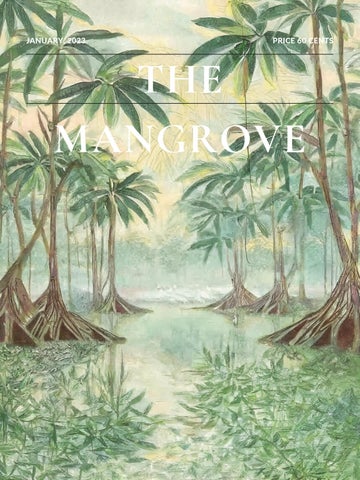
JANUARY, 2023
PRICE 60 CENTS
THE MANGROVE
SEASON 23/24
WHAT DOES IT MEAN? The mere mention of the Caribbean islands often evokes idyllic imagery of sun-kissed beaches, swaying coconut trees, and the crystal-clear blue waters of the Caribbean Sea. However, beneath this exotic facade, the islands carry the enduring imprints of a history marred by slavery, colonialism, and oppression. The islands underwent a profound transformation due to European colonization beginning around 1492 and the establishment of the plantation system, which endured until its abolition in 1848. This historical trajectory not only denied them the opportunity to shape an autonomous identity but also confined them to a post-colonial reality. The absence of subjective agency and autonomy in shaping their own identity, allowing it to evolve organically without interference from diverse colonial influences, renders the Caribbean a locus of perpetual displacement and disruption. Rather than being constructed on a stable foundation, Caribbean society resembles an everflowing stream, with a current in constant flux and change as time progresses. Since the early twentieth century, intellectuals and writers have grappled with the complexity of defining Caribbean identity and articulating a unique history and culture for the region. While some definitions often hinge on singular origins, the intellectual movement known as créolité, encapsulated in the manifesto "Éloge de la Créolité" by Jean Bernabé, Patrick Chamoiseau, and Raphaël
Confiant takes a distinctive approach by drawing on the metaphor of the mangrove to envision the future of Caribbean identity. Positioned as a response to marginalization within the islands, the mangrove symbolizes boundless possibilities with its intricate web of interlocking roots, devoid of a discernible beginning or end. Within a mangrove, establishing a clear starting point or conclusion proves challenging, yet it sustains an ecological life of remarkable richness. By highlighting the fluidity and interconnectedness of identity across all dimensions, créolité comes to embody a harmonious chaos, mirrored in the interlocking roots and dense coastal thickets of the mangrove. As one critic aptly asserts, this chaos is not indicative of a "dehumanized disorder, but that of a mobility, a lightness where nothing is fixed or rigid." In revealing the hybrid and diverse nature of Caribbean identity, créolité symbolizes both order and disorder, unity and multiplicity, chaos and coherence. The use of the mangrove as a metaphor for Caribbean identity encompasses the notion of a continuous adaptation to change. Much like this coastal feature's existence both above and below tides, in saltwater and freshwater, Caribbean people must navigate the cultural milieu that envelops them. They grapple with the Creole history shaping their past and the prospect of a future amalgamating these profoundly distinct cultures.
Building upon the metaphor of the mangrove, Patrick Chamoiseau extends the comparison to describe Creole identity as a mosaic, where multiple cultures intricately interweave to give rise to something distinctly Caribbean. In his eloquent articulation, he asserts that a Caribbean individual transcends being solely African, European, Indian, or an Amerindian descendant; instead, they embody all these cultural threads simultaneously. This nuanced understanding underscores the complex and inclusive nature of Caribbean identity. In the pressing endeavor to redefine Caribbean subjectivity, it becomes evident that the islands' lush natural environment not only serves as a source for intellectuals to formulate poignant theories of identity but also acts as an inspiration for the tangible process of rooting oneself in the land. The symbiotic relationship between the metaphorical mosaic of Creole identity and the diverse cultural elements it encapsulates is reflective of the unique interplay between the theoretical and lived experiences within the Caribbean context. The conceptualization of landscape as a metaphor for Caribbean identity is not a novel approach to delineating the essence of Caribbean identity. Pioneering this exploration was Aimé Césaire, a poet and politician, who emerged as one of the early thinkers seeking to comprehend the plurality of the Caribbean region. Césaire's initial endeavor involved tracing the roots of Caribbean identity in pursuit of a singular origin, a quest to unearth the inception of its history. He coined the term négritude, which centered on reclaiming 'blackness' and turned to Africa as a source to bestow contemporary Caribbean society with a tangible history and motherland. Césaire's work, "Cahier d'un retour au pays natal," published in 1939, is an epic poem that vividly portrays symbolic imagery reflecting the degradation of black people in the Caribbean. It chronicles the rediscovery of an African identity, perceived as a pathway to healing and pride.
In examining the quest for a singular and dichotomous taproot to shape identity, it is important to consider whether this movement might be inadvertently replacing European influences with African ones. This raises the question of whether the diverse contributions of individuals to the intricate tapestry of Caribbean identity and culture are being overlooked. The indigenous inhabitants, who once called the Caribbean their home, roamed the islands, leaving fragments of their history and ancestry scattered for archaeologists to uncover centuries later. The inaugural victims of European exploitation through the repartimiento and encomienda systems, valiantly resisting but ultimately succumbing, their identity permanently buried beneath the soil. Should they not be recognized as the fundamental roots intricately woven into the foundational seed of the island chain? Or consider the role of indentured workers who, though not subjected to the same degree of exploitation as slaves, tirelessly plowed the fertile soil of Caribbean landscapes, sowing seeds from their homelands, enriching the diversity of the islands with their contributions. Hailing from different regions of India, China, Indonesia (Java), Greater Syria (modern-day Lebanon and Syria), and Ireland, these individuals became an integral part of the Caribbean story, infusing diverse traditions, languages, and practices enriched the islands, ultimately creating a vibrant mosaic of influences. Their resilience, labor, and cultural amalgamation represent an integral thread in the intricate fabric that weaves together the unique heritage of the region. Caribbean identity transcends any fixed, primordial setting; it embodies a dynamic and ever-evolving force. Comparable to a plant drawing sustenance from varied sources, these roots, despite being less recognized, play a pivotal role in strengthening the resilience and opulence of the Caribbean's cultural and linguistic terrain. Acknowledging and paying homage to these foundational roots is essential, as they serve as the key to unraveling the multifaceted layers woven into the historical tapestry of the Caribbean.
CREOLE
Languages The Caribbean region stands out for the emergence of distinctive linguistic forms that deviate from the languages brought during the colonial era. This complex linguistic tapestry not only reflects historical encounters among diverse populations but also stands as a testament to the resilience and adaptability of languages amidst cultural genocide and isolation. The genesis of Creole languages traces its roots to African slaves, a significant proportion of whom hailed from two primary regions: Senegambia, encompassing the area between the Senegal and Gambia Rivers, including present-day Senegal, Gambia, Guinea-Bissau, and Mali; and west-central Africa, comprising Angola, Congo, the Democratic Republic of Congo, and Gabon. These individuals spoke diverse languages such as Mandinka, Wolof, and Yoruba, among others. Faced with the necessity for a common means of communication among themselves and with European masters who, due to different colonial affiliations, traded slaves and exposed them to various European languages, African slaves initiated the development of pidgin languages. These pidgin languages, marked by simplified grammatical structures and limited vocabularies tailored for basic communication, emerged as pragmatic solutions to facilitate understanding in the face of linguistic diversity.
Over time, these pidgin languages evolved into the secondary languages of the enslaved population. As subsequent generations used them more extensively, engaging in deeper conversations and interactions, these languages underwent a transformative process. They assimilated vocabulary from the various linguistic backgrounds of the parent languages and developed more complex grammatical structures. This linguistic fusion gradually progressed from simplified pidgin forms to more intricate and nuanced Creole languages. The evolutionary trajectory of these Creole languages is characterized by a continual process of expansion and refinement. These languages, spoken natively by the community, exhibit consistent grammatical systems, possess substantial and stable vocabularies, and are acquired by individuals during childhood as their mother tongue. In the era when Creole languages began to evolve in Caribbean societies, significant divisions emerged between African slaves and their descendants, and the free Europeans who perceived themselves as racially and culturally superior. Creole languages became intertwined with the institution of slavery, and the situation became further complicated as the national elites began to adopt the perspectives of their metropolitan counterparts. Consequently, they distanced
themselves from the burgeoning languages, customs, and beliefs, viewing them through a lens of disdain. Thus, Creole languages were stigmatized as negative cultural and ethnic manifestations, often deemed primitive and linguistically malformed. The process of language creolization did not unfold uniformly across the Caribbean; rather, it was shaped by different factors contingent upon the distinct histories of individual regions. In Hispanic colonies like Cuba, Santo Domingo, and Puerto Rico, the standardization of language was predominantly influenced by the consistent connection to the same metropole. Additionally, the character of the colonial enterprise played a crucial role, as the Spaniards and Portuguese made a more concerted effort to populate their New World territories with peasants of European origin. Consequently, individuals of African descent did not significantly outnumber those who adhered to a European language in accordance with native customs. Nonetheless, regional dynamics varied significantly in areas with diverse colonial domination patterns, marked by the arrival and integration of indentured servants, prisoners of war, and criminals into the social fabric of plantations. These newcomers intersected with previously arrived slaves from various African nations, assuming roles
as domestic servants, skilled craftsmen, and field laborers. This fusion of diverse backgrounds in the Caribbean laid the groundwork for the emergence of new language forms in various settings. Despite originating from subjugated populations, these Creole languages have gradually earned social and even legal recognition in the societies of their origin. In contrast, European perspectives during this era deemed all cultures encountered in the New World—indigenous, African, and Asian—as uncivilized. Given that Creole society predominantly evolved from enslaved groups, European colonists associated it with backwardness and a perceived lack of education. Notwithstanding the evolving perceptions and growing acceptance of Creole languages, vestiges of colonial hierarchies persist to this day. The influence of colonial powers continues to shape linguistic practices, as individuals often look to their historical colonizers as authoritative figures. This dynamic has led to ongoing transformations in the languages spoken, reflecting the enduring impact of colonial legacies on contemporary linguistic landscapes. While strides have been made in recognizing the value and richness of Creole languages, the complex legacy of colonialism still permeates societal attitudes and linguistic dynamics.
mi umapikin tan na oso
Look pon di gyal pompasetting.
Bouche nen ou pou bwè dlo santi
Haitian Creole Haitian Creole, denoted as Kreyòl Ayisyen in its indigenous context, stands as the most widely spoken contemporary Creole language globally, a noteworthy achievement credited to the Haitian community. It is a French-based Creole language spoken by an estimated 10–12 million individuals globally, and holds official language status in Haiti alongside French, with a majority of the populace regarding it as their primary language. The dialect exhibits three primary forms: Northern, prevalent in Cap-Haïtien; Central, commonly used in Port-au-Prince; and Southern, predominant in the Cayes region.
The origin of Haitian Creole can be traced to historical interactions between French settlers and enslaved Africans during the Atlantic slave trade in SaintDomingue (present-day Haiti) throughout the 17th and 18th centuries. While its lexicon bears significant influence from 18th-century French, its grammatical structure aligns more closely with the West African Volta-Congo language branch, specifically the Fongbe and Igbo languages. Additionally, it incorporates elements from Spanish, English, Portuguese, Taino, and other West African languages, culminating in a distinct grammatical framework that distinguishes it from standard French. At its core, Haitian Creole services as a captivating testament to the nuanced interplay of diverse influences. Its symphony resonates with the melodic blend of French sophistication, West African rhythms, Spanish and English undertones, and the echoes of Taino and Portuguese whispers, collectively weaving the tale of a unique Creole language. Beyond its lexical richness, Haitian Creole reflects the indomitable spirit of a people, resilient amidst the tides of historical upheavals. In the grand symphony of global languages, Haitian Creole emerges as a distinctive note, its resonance echoing far beyond the confines of its native shores.
Jamaican Patois Jamaican Patois, colloquially referred to as "Patwah," represents an English-based Creole language molded by a diverse array of influences, including West African, Taíno, Irish, Spanish, Hindi, Portuguese, Chinese, and German. Predominantly spoken in Jamaica and among the Jamaican diaspora, this dynamic language has extended its lexical reach to other Caribbean nations, the United Kingdom, and Toronto, Canada. The roots of Jamaican Patois trace back to the 17th century when enslaved individuals from West and Central Africa assimilated and adapted various forms of English spoken by their slaveholders, encompassing British English, Scots, and Hiberno-English. Jamaican Creole exists along a continuum, ranging from more conservative forms that may not be readily understandable to English speakers, to forms nearly indistinguishable from Standard English. Despite being the native language for a majority of Jamaicans, Patois is often stigmatized, along with other Creoles, as a low-prestige language. The distinctiveness of Jamaican Patois unfurls through its idiosyncratic pronunciation and lexicon, carving out a linguistic niche that, while incorporating English words and derivatives, remains unmistakably separate from its linguistic progenitor. Echoing through the melodic corridors of reggae and dancehall, Patois assumes center stage, not merely as a conduit of conversation but as a pulsating, living art form. Beyond the utilitarian confines of communication, Patois metamorphoses into an expressive heartbeat, finding its sanctuary in the rhythmic cadences of reggae and dancehall. It transcends the mere articulation of words, evolving into the vital pulse of Jamaican culture, where language becomes an undulating dance of life and expression.
Caribbean Hindustani Caribbean Hindustani, symbolized as कै रेबियाई हिंदुस्तानी in Devanagari, 𑂍𑂶𑂩𑂵𑂥𑂱𑂨𑂰𑂆⸱𑂯𑂱𑂁𑂠𑂳𑂮𑂹𑂞𑂰𑂢𑂲 in Kaithi, and َکیریبئائی ہندوستانی in Perso-Arabic, stands as an Indo-Aryan linguistic treasure spoken by the Indo-Caribbean community and its diaspora. Originating as a koiné language, it stems predominantly from the Bhojpuri and Awadhi dialects, prevalent among Indian indentured laborers who transplanted to the Caribbean in the 17th century. Remarkably, Caribbean Hindustani reflects influences from the West African Akan language, along with the Eastern Hindi-Bihari dialects. aribbean Hindustani transcends religious affiliations, with Hindus enriching their usage with more Sanskrit-derived vocabulary, while Muslims integrate Persian, Arabic, and Turkicderived terms. Although Hindus typically employ the Devanagari script for writing, some Muslims opt for the PersoArabic script in the Nastaliq calligraphic hand. Historically, the Kaithi script found usage, but the Latin script has become more prevalent due to its familiarity and ease of application. The language manifests itself across diverse musical genres like chutney music, chutney soca, chutney parang, baithak gana, folk music, classical music, and religious songs. Despite a decline in the use of traditional scripts, Caribbean Hindustani perseveres through its integration into musical expressions. Region-specific variations, such as Guyanese Hindustani and Trinidadian Hindustani, have emerged in places like Guyana and Trinidad and Tobago, respectively. While Indian cultural influences impacted the linguistic landscape, a shift toward a Hindinized version of English occurred in Trinidad and Tobago in the mid to late 1960s, leading to a decline in the use of Hindustani as a primary language. As of 2003, an estimated 15,633 Indo-Trinidadian and Tobagonians converse in Trinidadian Hindustani, with approximately 10,000 opting for Standard Hindi as of 2011. Presently, many Indo-Trinidadians and Tobagonians employ a form of Hinglish, blending Trinidadian and Tobagonian English with Trinidadian Hindustani vocabulary. The language's influence extends beyond oral communication, with phrases, prayers, and vocabulary shaping mainstream English and English Creole dialects in Trinidad and Tobago. In a similar rhythmic cadence, Caribbean Hindustani asserts its distinctive identity, weaving through the cultural fabric of postindentured Caribbean countries. Its unique tonalities and lexical richness create a linguistic terrain that, while influenced by various global elements, maintains an unmistakable autonomy. Resonating through the harmonies of chutney and Hinglish, Caribbean Hindustani assumes a prominent role not only in everyday conversation but as a living, pulsating form of IndoCaribbean cultural expression.
CREOLE Music
Caribbean musical expressions, akin to the Creole languages prevalent in the region, mirror the historical evolution of the area. The convergence of influences stemming from Europe, Africa, India, and China within the framework of New World plantation economies catalyzed the emergence of novel cultural paradigms, new languages, and distinct musical genres. In the Caribbean, creolization contributed to the creation of a wide array of musical forms, ranging from those closely resembling the European patterns, to "neo-African" forms. Each colony created its music within this EuroAfrican array. That is why the Caribbean can be treated as a single musical region despite the major variations found locally. Musical creolization has been expressed in events in which music plays a key role: the fiestas or fetes, sometimes linked to religious practices; work songs that were sung by slaves in the fields in call-and-response style; traditional carnivals that were originally related to European religious celebrations but which little-by-little were taken over and reinterpreted by the Black population. Both Whites and Blacks danced in the carnivals, and both African and European instruments were played. Creolization also occurred in European dances, as slave musicians tended to transform styles to correspond to their aesthetic sensibilities. Building upon the dynamic legacy of creolization in the Caribbean, the rhythmic heartbeat of musical expressions resonates with the pulsating essence of African ancestry, with drums playing a pivotal role.
Beyond this, the relationship between music and dance, the call-and-response style, the communal spirit inherent in the music, and the infusion of syncopated rhythms collectively contribute to the vibrancy of Caribbean musical traditions. These elements come to life in various cultural expressions, such as the exuberant jook dance in the Bahamas, the Kromanti dance, and the rhythmic ceremonies of Gumbe, Kumina, and Convince in Jamaica. Likewise, they manifest in the ritualistic dances of the Rastafarians, the Kalinda dance in Trinidad, the Santeria and Abakua rituals in Cuba, the Palos in the Dominican Republic, the Vodoun ceremonies in Haiti, and the bomba in Puerto Rico – just a glimpse into the rich and diverse array of Caribbean musical heritage. In the initial centuries of the colonial era, Europeans perceived musical expressions of African origin as a tool for social control and a means to enhance labor efficiency. They ascribed functional significance to the music, aligning it with their own interests. Africanbased musical forms gradually gained independent legitimacy and eventually found acceptance within the domestic spheres of European households. The integration of African elements into the repertoires of music ensembles, notably town bands employing Old World instruments to render European harmonies, led to the transformation and Africanization of musical styles and dances from Europe. Illustrative instances include the emergence of merengue in the Dominican Republic, the son and danzón in Cuba, the menta in Jamaica, and the biguine in Martinique. These musical genres evolved as
novel expressions of folk music, thereby contributing to the shaping of each nation's distinct national identity. In essence, the concept of "Creole" or the innovative creation becomes integral to the authenticity of individual countries. Amidst the transformative shifts in the Caribbean region, encompassing urbanization and the proliferation of modern communication channels, music has persistently undergone evolution while remaining tethered to its roots. The emergence of Trinidad's calypso, Jamaica's reggae, and the unifying force of salsa across Cuba, Puerto Rico, and New York exemplifies the continuous cycle of creation and innovation. These Creole musical genres, marked by an intrinsic diversity of style, have transcended national boundaries to become internationally embraced popular music. Caribbean musical expressions flourish through continuous transformation, adapting to the undulating currents of historical shifts, urbanization, and the pervasive influence of modern communication technologies. Manifesting a nuanced interaction between resilience and creativity, this musical odyssey unfolds as a vibrant tableau, depicting a cultural fabric that not only responds to transformations but, at its fundamental core, actively shapes them. Within the dynamic auditory landscape of the Caribbean, the music exudes a contagious vitality, extending an invitation to global audiences to partake in the revelry of a musical heritage that fundamentally constitutes an ongoing masterpiece of evolution.
CREOLE Religions
Enslaved Africans in the Caribbean restructured their ancestral religions in ways that reaffirmed their ethnic identity or served as vehicles for resistance to European dominations, while simultaneously satisfying their spiritual needs. Some of these religions, such as those of Yoruba origin (which are found in Cuban Santeria and in the Shang6 of Trinidad their most important expressions in the Caribbean) have drawn essential content from their African ancestry. This is evident in their rites and pantheons as well as in their priestly organization. In Haiti, where there was practically no White population after the early 19th century, Vodoun evolved to constitute not only an African religion but also a national one. Slavery cut off religion from its former place in African social and political structures and forced Africans to separate it from its original environs to fit it into an unknown world governed by a different logic from that of European masters. Thus, for example, they had to adapt their religious expressions to a European religious chronology, sometimes shrouding African content in Christian forms. The identification of African deities and Catholic saints evolved in part from the slaves' need to disguise their ceremonies. This process yielded a number of different collective representations. Thus, myths of deities such as Omolu could be related to parables of the Scriptures such as that of the Prodigal Son; popular Christian legends could be linked to the orishas (deities) of Santeria; and Biblical allegories could contribute, as they did in Haiti, to a new mythology that replaced the African mythology.
Vodoun, the religion of the Haitian people, is a good example of how a new form of religious expression evolved from French-influenced Catholicism together with a diversity of West African religious traditions. Michael Laguerre 0980) refers to it as a folk religion that developed as a result of the incorporation of West African slaves into colonial Haitian plantation society. He explains how Vodoun developed from house- a hold-based ritual into an extended family-based ritual that after independence in 1801 became and has remained the main religion on the island. Vodoun is part of Haitian Creole culture and represents the very particular way in which African and Christian religious elements came together to form a belief system that permeates almost every aspect of Haitian life. Vodoun-the word itself is Dahomean in origin and signifies "spirit" or "deity"-is applied to all the activities of religious life, from the ritual of the temple to the songs and dances. The Vodoun practiced in Haiti consists of rites, beliefs, and activities of a number of religions such as the Congo-Guinee, the Ibo-Kanga, and others. These become integrated into Haitian practice; according to Harold Courlander (1960), this integration demonstrates how Haitian Vodoun draws from the common inheritance of all these African faiths. Nevertheless, whatever the content of the beliefs brought by the slaves from Africa might have been, when practiced in the New World, they were influenced by external factors: the laborers' daily activities in the plantation, the intermingling among people from various
backgrounds, a new language for communication, new types of housing, a new diet, new patterns of social organization and political power, and a new calendar of events that reflected Catholic feasts and the colonizers' national holidays. All these variables, added to the synthesis of African sacred beliefs, made for the emergence of a Haitian belief system. The songs, essential to the Vodoun ritual, reveal the creolization process. Sung primarily in Haitian Creole, some contain words from African languages and some are simply borrowed from the Catholic church. This is not surprising, for many Vodoun practitioners are baptized and attend Mass in the Catholic and reinterpreted in African terms. These elements are not just fused, they are incorporated in the creative process of forming a new religious system with new meaning. In the Protestant Caribbean, this syncretism took on different forms. Biblical texts were imposed upon slaves to encourage passivity and acceptance (such as the narrative of the submission of the Israelites to Egypt and the captivity in Babylon). Messianism, the expectation of a deliverer or savior, was a concept that Blacks adopted to serve their own needs. Another example is found in the reinterpretation of African trance, as occurred in many of the "Revival" religious sects in Jamaica. These expressions often have a strong messianic sense, as does the Rastafarian movement, although the latter carries not only religious but also strongly political meaning.
WHY STUDY CREOLISATION? Creolisation operates as a conceptual framework that facilitates an understanding of how distinct racialized groups interact, giving rise to novel social, cultural, and racial formations. Originating from the Caribbean, this concept encompasses both a dynamic process and, in specific contexts, a political stance deeply rooted in acknowledging the historical circumstances of individuals brought together by European colonialism. The establishment of the plantation complex, arising from the dispossession of Indigenous peoples, served as the focal point for the exploitation of enslaved Africans and, subsequently, Asian indentured servants. The interactions among Europeans, Africans, and Asians, inherently unequal and strained, have become central to discussions on creolization. Termed as both "descriptive and analytical," creolisation emerges from the lived experiences of subaltern subjects. Initially applied to the descendants of European settlers, the term "Creole" expanded by the eighteenth century to encompass individuals of Black, white, or mixed-race heritage in the Caribbean, Mascarene Islands, and the U.S. South. Despite the seemingly comprehensive nature of the concept and its ability to illuminate the experiences of diverse communities brought together through colonisation, early conceptualisations of creolisation have faced criticism for their selective emphasis on certain groups while neglecting others. Notably, some seminal works on creolisation
in the Caribbean predominantly focus on the interactions between Europeans and enslaved African peoples. The exploration of creolization assumes significance, unraveling nuanced perspectives across dimensions of culture, language, and identity. Defined as the process of cultural and linguistic fusion ensuing from sustained interaction among diverse cultural and linguistic groups, creolization frequently engenders the emergence of a novel, hybrid culture or language. Within the context of globalization, the study of creolisation attains relevance, mirroring the interconnectedness of societies and the fusion of cultures on a global scale. The continuous movement of people, ideas, and commodities across borders actively contributes to the ongoing processes of creolisation worldwide. The examination of creolisation significantly enhances our understanding of social dynamics and the evolution of societies over time. This exploration facilitates researchers and scholars in dissecting factors that contribute to cultural change, linguistic innovation, and the establishment of novel social norms. In essence, the study of creolization offers a lens through which to explore the dynamic and ever-changing nature of human culture and society, providing invaluable insights into the intricate interactions that shape our world.
TO BE CONTINUED...