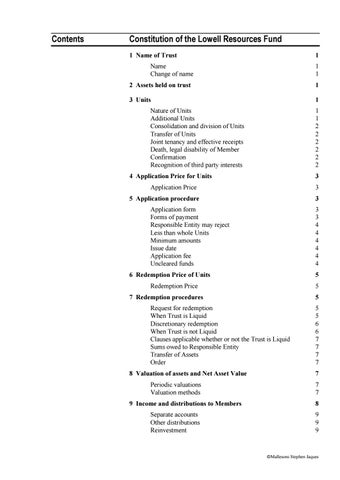
Contents
Constitution of the Lowell Resources Fund 1 Name of Trust
1
Name Change of name
1 1
2 Assets held on trust
1
3 Units
1
Nature of Units Additional Units Consolidation and division of Units Transfer of Units Joint tenancy and effective receipts Death, legal disability of Member Confirmation Recognition of third party interests
1 1 2 2 2 2 2 2
4 Application Price for Units
3
Application Price
3
5 Application procedure
3
Application form Forms of payment Responsible Entity may reject Less than whole Units Minimum amounts Issue date Application fee Uncleared funds
3 3 4 4 4 4 4 4
6 Redemption Price of Units
5
Redemption Price
5
7 Redemption procedures
5
Request for redemption When Trust is Liquid Discretionary redemption When Trust is not Liquid Clauses applicable whether or not the Trust is Liquid Sums owed to Responsible Entity Transfer of Assets Order 8 Valuation of assets and Net Asset Value Periodic valuations Valuation methods 9 Income and distributions to Members Separate accounts Other distributions Reinvestment
5 5 6 6 7 7 7 7 7 7 7 8 9 9 9
ďƒŁMallesons Stephen Jaques
10
11
12
13
14
15
16
Position on transfer of Units
9
Payments
9
Method of payment Rounding Joint Members Deductions Posting of cheques
9 10 10 10 10
Powers of the Responsible Entity
10
General powers Contracting powers Investment powers Power of delegation Exercise of discretion
10 10 10 11 11
Retirement of Responsible Entity
11
Voluntary retirement Compulsory retirement New responsible entity Release
11 11 11 11
Notices to Members
12
Written Joint holders Deemed time of receipt
12 12 12
Notices to the Responsible Entity
12
Written Effective Time Signature
12 12 12
Meetings of Members
12
Corporations Law Responsible Entity may determine Quorum No quorum Joint holder Chairman Adjournment Resolutions binding Non-receipt
12 13 13 13 13 13 13 13 14
Rights and liabilities of Responsible Entity
14
Holding Units Other capacities Responsible Entity may rely
14 14 14
17 Limitation of liability and indemnity in favour of Responsible Entity
15
Limitation on Responsible Entity’s liability Indemnity in favour of Responsible Entity
15 15
18
Liability of Members
16
Liability limited Liability for tax Recourse Restrictions on Members
16 16 16 16
Remuneration and expenses of Responsible Entity
16
Application fee Fees Direct Debit Fee Waiver of fees Expenses
16 17 17 17 18
Duration of the Trust
20
Initial settlement Termination
20 20
Procedure on termination
20
Realisation of Assets Audit of winding up Distribution following termination
20 20 21
Modification of this constitution
21
Responsible Entity may modify Deemed provisions
21 21
23
Inspection of Constitution
22
24
Compliance committee
22
25
Complaints
22
26
Interpretation
23
Definitions Interpretation Other documents Constitution legally binding Governing law Other obligations excluded
23 26 26 27 27 27
19
20
21
22
Schedule 1 - Entitlements to income and capital
28
Schedule 2 Mortgage Facility
32
Definitions Facility of recording Mortgages Recording of Mortgagee interests Notice to Mortgagee Removal of Mortgagee interest Consent to dealings Mortgage over future Assets Redemption Distribution on termination
32 32 32 32 32 32 33 33 33
Payment to Mortgagee Information to Mortgagee Constitution binding on Mortgagee Limitation of liability Rights of the Mortgagee Schedule 3 Right to limit foreign owners
33 33 33 33 34 35
Interpretation Restriction on foreign members Waiver Disposal
35 36 36 36
Schedule 4 Substantial Unitholdings
38
Substantial Unitholding Notice of substantial unitholding Limitations on substantial unitholdings Information concerning substantial unitholdings Relevant Interests Schedule 5 Performance Incentive Fee
38 38 38 39 41 45
Schedule 1
Name of Trust
Name 1.1
The Trust is called the Lowell Resources Fund or by such other name as the Responsible Entity determines from time to time 1.
1.2
If a Responsible Entity retires or is removed its successor as Responsible Entity must, unless otherwise approved by the former Responsible Entity, change the name of the Trust to a name that does not imply an association with the former Responsible Entity or its business.
Change of name
2
Assets held on trust
Holding of assets 2.1
The Assets must be held on trust for Members2.
2.2
The Assets must be clearly identified as property of the Trust and held separately from the assets of the Responsible Entity and any other managed investment scheme if and to the extent that the Corporations Law so requires3.
3.1
The beneficial interest in the Trust is divided into Units.
3.2
Except as provided in this constitution in respect of:
Separately held
3
Units
Nature of Units
(a)
Units ranking for entitlement to Net Income;
(b)
Units ranking for distribution of income; and
(c)
amounts distributed to Members on termination of the Trust;
each Unit confers an equal undivided interest and a Fractional Unit confers a proportion of that equal interest. 3.3
A Unit confers an interest in the Assets as a whole, subject to the Liabilities. It does not confer an interest in a particular Asset.
3.4
The Responsible Entity may create additional Units.
Additional Units
1
See Corporations Regulation 5C.1.02 See section 601FC(2) of the Corporations Law 3 See section 601FC(1)(i) 2
2 Consolidation and division of Units 3.5 Units may be consolidated or divided as determined by the Responsible Entity or as authorised by a Resolution of Members. A consolidation or division must not result in any change to the proportionate interest of Members in the Trust. Transfer of Units 3.6
Subject to this constitution, Members may transfer Units.
3.7
Transfers must be in a form approved by the Responsible Entity and be presented for Registration duly stamped.
3.8
A transfer is not effective until Registered.
3.9
The Responsible Entity may refuse to record any transfer in the Register without giving any reason for the refusal. Any instrument of transfer which the Responsible Entity refuses to record shall (except in the case of suspected fraud) be returned to the person presenting it if a demand is made within 12 months of the Responsible Entity refusing to register.
3.10
The Responsible Entity may register a transfer notwithstanding that the Responsible Entity at the time of registration has notice of the transferor Member’s death.
3.11
The Responsible Entity may refuse to record a transfer in the Register if it would result in either the transferor or transferee holding less than the then current minimum holding amount.
Joint tenancy and effective receipts 3.12 Persons Registered jointly as the holder of a Unit hold as joint tenants and not as tenants in common unless the Responsible Entity otherwise agrees and any person Registered jointly may give an effective receipt on behalf of their joint holders. The Responsible Entity is not required to Register more than 3 people as joint holders of a Unit. Death, legal disability of Member 3.13 If a Member dies or becomes subject to a legal disability such as bankruptcy or insanity, only the survivor (where the deceased was a joint holder holding as a joint tenant) or the legal personal representative (in any other case) will be recognised as having any claim to Units Registered in the Member’s name. Confirmation 3.14
On Registration under this constitution the Responsible Entity must issue a written confirmation within 2 months.
Recognition of third party interests 3.15 The Responsible Entity is not required to recognise the interests of any third party to a Unit. If it does so, the provisions of schedule 2 shall apply.
3
4
Application Price for Units4
Application Price 4.1
Subject to clause 19.1, a Unit must only be issued at an Application Price calculated as: Current Value + Transaction Costs number of Units on issue
4.2
Each of the variables in clause 4.1 must be determined as at the next Valuation Time after: (a)
the Responsible Entity receives the completed application for Units; or
(b)
the Responsible Entity receives the application money, or the property against which Units are to be issued is vested in the Responsible Entity
whichever happens later.
5
4.3
The Responsible Entity may determine that an application for Units or application money or property received by the Responsible Entity after a particular time will be deemed to have been received on the next Business Day.
4.4
The Application Price may be rounded as the Responsible Entity determines.
Application procedure
Application form 5.1
An applicant for Units must complete a form approved by the Responsible Entity if the Responsible Entity so requires (or if the law or ASIC requires).
5.2
Payment in respect of an application in a form acceptable to the Responsible Entity, or a transfer of property of a kind acceptable to the Responsible Entity and able to be vested in the Responsible Entity (accompanied by a recent valuation of the property, if the Responsible Entity requires), must:
Forms of payment
4
(a)
accompany the application;
(b)
be received by or made available to the Responsible Entity within such period before or after the Responsible Entity receives the application form as the Responsible Entity determines from time to time; or
(c)
comprise a reinvestment of distribution in accordance with clause 9.8.
Required to be included by Section 601GA(1)(a)
4 If the Responsible Entity accepts a transfer of property other than cash, any costs associated with the valuation or transfer of the property are payable by the applicant. Responsible Entity may reject 5.3 The Responsible Entity may reject an application in whole or in part without giving any reason for the rejection. Less than whole Units 5.4
Where an application or redemption would result in the issue of less than a whole Unit to a Member, the Responsible Entity in its absolute discretion may: (a)
issue a Fractional Unit;
(b)
contribute its own funds to round up the number of Units issued in respect of the application to a whole number;
(c)
round the Unit up or down; or
(d)
hold the residual amount free of interest and apply it to the next application or redemption made by the Member or pay the amount to the Member when moneys are next paid by the Responsible Entity under this constitution.
Minimum amounts 5.5
The Responsible Entity may set a minimum application amount and a minimum holding for the Trust and alter or waive those amounts at any time.
5.6
Units are taken to be issued when:
Issue date (a)
the Responsible Entity accepts the completed application; or
(b)
the Responsible Entity receives the application money, or the property against which Units are to be issued is vested in the Responsible Entity,
whichever happens later. Application fee 5.7
When calculating the number of Units to be issued, the application fee must first be deducted from the value of the application money or property.
5.8
Units issued against application money paid other than in cleared funds, or in consideration of a transfer of property, are void if the funds are not subsequently cleared or the property does not vest in the Responsible Entity within 1 month of receipt of the application, or such other period as the Responsible Entity determines.
Uncleared funds
5
6
Redemption Price of Units5
Redemption Price 6.1
A Unit must only be redeemed at a Redemption Price calculated as: (Current Value - Transaction Costs) Units on issue
number of
PROVIDED THAT in relation to Units issued prior to the date that the Second Supplemental Deed Poll took effect, the Responsible Entity must make a determination as to which of Parts A or B of Schedule 1 is to apply, and the manner of that application, such that the right of the effected Member, or Former Member (where a redemption request was made in the relevant period), to receive their proper entitlements in respect of those Units is reasonably considered by the Responsible Entity to not be adversely affected." 6.2
7
(a)
while the Trust is Liquid, as at the next Valuation Time after the Responsible Entity receives the completed redemption request; or
(b)
while the Trust is not Liquid, at the time the withdrawal offer closes.
6.3
The Responsible Entity may determine that a redemption request received by the Responsible Entity after a particular time will be deemed to have been received on the next Business Day.
6.4
The Redemption Price may be rounded as the Responsible Entity determines.
Redemption procedures6
Request for redemption 7.1
7.2 When Trust is Liquid7 7.3 7.4
5
Each of the variables in clause 6.1 must be determined:
A Member may make a request for the redemption of some or all of their Units in any manner approved by the Responsible Entity and, while the Trust is Liquid, the Responsible Entity must give effect to that request at the time and in the manner set out in this clause 7. A Member may not withdraw a redemption request unless the Responsible Entity agrees. Clauses 7.4 to 7.10 apply only while the Trust is Liquid8. The Responsible Entity must satisfy a redemption request in respect of a Unit by payment from the Assets of the Redemption Price calculated
Required to be included by Section 601GA(4) These procedures must be fair to all Members: Section 601GA(4) 7 Required to be included by Section 601GA(4)(b)(4), (5) and (6) 8 For definition of a liquid scheme see Section 601KA 6
6 in accordance with clause 6. The payment must be made within 30 days of receipt of the request or such longer period as allowed by clause 7.5. 7.5
If the Responsible Entity has taken all reasonable steps to realise sufficient Assets to satisfy a redemption request and is unable to do so due to one or more circumstances outside its control such as restricted or suspended trading in the market for an Asset, the period allowed for satisfaction of the request may be extended by the number of days during which such circumstances apply.
7.6
The Responsible Entity need not give effect to a redemption request in respect of Units having an aggregate Redemption Price of less than the minimum application amount or such other amount as determined by the Responsible Entity from time to time unless the redemption request relates to the balance of the Member’s holding.
7.7
The Responsible Entity is not obliged to pay any part of the Redemption Price out of its own funds.
7.8
If compliance with a redemption request would result in the Member holding Units with an aggregate Redemption Price which is less than the then current minimum holding amount, the Responsible Entity may treat the redemption request as relating to the balance of the Member’s holding.
7.9
If the Responsible Entity increases the minimum holding amount, the Responsible Entity may after giving 30 days’ notice to a Member who holds Units with an aggregate Redemption Price less than the then current minimum holding amount redeem that Member’s holding without the need for a redemption request.
Discretionary redemption 7.10 If the Responsible Entity is not obliged to give effect to a redemption request, it may redeem some or all of the Units which are the subject of the request9. When Trust is not Liquid10 7.11 While the Trust is not Liquid11, a Member may withdraw from the Trust in accordance with the terms of any current withdrawal offer made by the Responsible Entity in accordance with the provisions of the Corporations Law regulating offers of that kind12. If there is no withdrawal offer currently open for acceptance by Members, a Member has no right to withdraw from the Trust.
9
7.12
The Responsible Entity is not at any time obliged to make a withdrawal offer.
7.13
If the Responsible Entity receives a redemption request before it makes a withdrawal offer, it may treat the request as an acceptance of the offer effective as at the time the offer is made.
Subject to section 601FC(1)(d) Required to be included by Section 601GA(4)(c) if Members are to have right to withdraw 11 For definition of a liquid scheme see Section 601KA(1) 12 Refer sections 601KB to 601KE 10
7 Clauses applicable whether or not the Trust is Liquid 7.14 Clauses 7.15 to 7.17 apply whether or not the Trust is Liquid. Sums owed to Responsible Entity 7.15 The Responsible Entity may deduct from the proceeds of redemption or money paid pursuant to a withdrawal offer any money due to it by the Member. Transfer of Assets 7.16
The Responsible Entity may transfer Assets to a Member rather than pay cash in satisfaction of all or part of a redemption request, pursuant to a withdrawal offer or in payment of a distribution. These Assets with any cash paid must be of equal value to the total amount due to the Member pursuant to the redemption request, withdrawal offer or distribution (based on a valuation done within 1 month before the date of the proposed transfer). If the Responsible Entity requires, the costs involved in transfer of these Assets must be paid by the Member or deducted from the amount due to the Member.
7.17
Unless the Responsible Entity decides otherwise, the first Units issued to a Member are the first redeemed.
Order
8
Valuation of assets and Net Asset Value
Periodic valuations 8.1
The Responsible Entity may cause an Asset to be valued at any time, and must do so as and when required by the Corporations Law.13
8.2
The Responsible Entity may determine Net Asset Value at any time, including more than once on each day.
8.3
The Responsible Entity may determine valuation methods and policies for each category of Asset and change them from time to time. Unless the Responsible Entity determines otherwise, the value of an Asset for the purpose of calculating Net Asset Value will be its market value 14. Where the Responsible Entity values an Asset at other than its market value, or where there is no market value, the valuation methods and policies applied by the Responsible Entity must be capable of allowing for the calculation to be independently verifiable.
Valuation methods
13 14
See section 601FC(j) for Responsible Entity’s obligations concerning valuation ASIC Policy Statement 134, paragraph 29: constitution should set out how scheme property will be valued.
8
9
Income and distributions to Members
Determination by the Responsible Entity 9.1
The Responsible Entity must make a determination that either Part of Schedule 1 is to apply for one or more Distribution Periods.
9.1A
To assist the Responsible Entity to make the determination required of it under clause 9.1, the following principles must be applied: 9.1A.1 If because of Legislation in operation on or from the Effective Date the application of a particular Part under Schedule 1 is reasonably likely to impact more adversely on the interests of Members (and Former Members referred to in clause 6.1) than the application of the other Part, then the Responsible Entity must take the necessary course of action under clause 9.1 to ensure that the Part which least adversely impacts upon Members' (and Former Members', referred to in clause 6.1) interests is applied for the relevant Distribution Period or Financial Year (as the case requires). 9.1A.2 Subject to sub-clause 9.1A.1, the Responsible Entity must: (a) determine at the commencement of the Financial Year commencing after the Second Supplemental Deed Poll took effect and each subsequent Financial Year which Part of Schedule 1 will be applied for that Financial Year; and (b) then apply that Part for each Distribution Period in that Financial Year. 9.1A.3 In this clause 9.1A: (a) "Effective Date" means whichever is the earlier of: (i) the date Legislation enacted after the date the Second Supplemental Deed Poll took effect; or (ii) the date such Legislation is treated as having taken effect; and (b) "Legislation" means an enactment affecting the regulation or taxation of the Trust, the Responsible Entity, the Members (and Former Members referred to in clause 6.1) (in each case solely in their capacity as such), or any matter or thing incidental to any or all of them.
Distributable Income 9.2
The income of the Trust is determined in accordance with the applicable Part of Schedule 1.
9 9.3
The Responsible Entity may decide the classification of any item as being on income or capital account and the extent to which reserves or provisions need to be made.
9.4
The entitlements of Members and Former Members to the income of the Trust are determined in accordance with the applicable Part of Schedule 1.
9.5
The entitlements of Members and Former Members to the income of the Trust are satisfied in accordance with the applicable Part of Schedule 1.
9.6
The Responsible Entity may keep separate accounts of different categories or sources of income, or deductions or credits for tax purposes.
9.7
The Responsible Entity may at any time distribute any amount of capital or income to Members pro rata according to the number of Units held as at a time decided by the Responsible Entity. The distribution may be in cash or by way of additional Units or both.
9.8
The Responsible Entity may decide whether or not to permit or require the Members to reinvest some or all of any distribution to acquire Units.
9.9
If the Responsible Entity decides to permit or require reinvestment, it must notify Members of the procedure for reinvestment and any change in the procedure.
9.10
If reinvestment applies the Responsible Entity is deemed to have received and accepted an application to reinvest distributions immediately before the first Valuation Time in the next Distribution Period.
9.11
After the number of Units has been calculated in accordance with clause 4 and issued to the Member, the amount of any credit balance in the Member’s name in the reinvestment account will be dealt with in accordance with clause 5.4.
Entitlement
Separate accounts
Other distributions
Reinvestment
Position on transfer of Units 9.12 Income allocated in accordance with the applicable Part of Schedule 1, but not distributed when a transfer or transmission of Units is Registered, remains credited to the transferor.
10
Payments
Method of payment 10.1
Money payable by the Responsible Entity to a Member may be paid in any manner the Responsible Entity decides.
10 10.2
Cheques issued by the Responsible Entity that are not presented within 6 months and electronic transfer of funds to a Member which are unsuccessful on three occasions may be cancelled. Where a cheque which is cancelled was drawn in favour of a Member, the money may be reinvested in Units at the Application Price prevailing at the next Valuation Time after the cheque is cancelled.
10.3
Where the Responsible Entity attempts to make a payment by electronic transfer of funds to a Member and the transfer is unsuccessful on three occasions, the money may be reinvested in Units at the Application Price prevailing at the next Valuation Time after failure of the 3rd attempt.
10.4
Only whole cents are to be paid, and any remaining fraction of a cent becomes an Asset.
10.5
A payment to any one of joint Members will discharge the Responsible Entity in respect of the payment.
10.6
The Responsible Entity may deduct a Taxation Amount from any amount to be paid to a Member, or received from a Member.
10.7
A cheque payable to a Member or to another person as directed by the Member may be posted to the Member’s physical address or handed to the Member or a person authorised in writing by the Member15.
Rounding
Joint Members
Deductions
Posting of cheques
11
Powers of the Responsible Entity
General powers 11.1
Contracting powers16 11.2
Subject to this constitution and to the proper performance by the Responsible Entity of its duties under the constitution and at law, the Responsible Entity has all the powers in respect of the Trust that it is possible under the law to confer on a trustee and as though it were the absolute owner of the Assets and acting in its personal capacity.
Without limiting clause 11.1, but subject to the proper performance by the Responsible Entity of its duties under the constitution and at law the Responsible Entity in its capacity as trustee of the Trust has power to borrow and raise money (whether or not on security) and to incur all types of obligations and liabilities.
Investment powers 11.3
15
Without limiting clause 11.1, the Responsible Entity may in its capacity as trustee of the Trust invest in, dispose of or otherwise deal with property and rights in its absolute discretion.17
See Clause 16.3(c) Required to be included by Section 601GA(3) 17 Subject to Section 601FC(4) 16
11 Power of delegation18 11.4
11.5
The Responsible Entity may include in the authorisation provisions to protect and assist those dealing with the agent or delegate as the Responsible Entity thinks fit.
11.6
The agent or delegate may be an associate of the Responsible Entity. 19
Exercise of discretion 11.7
12
The Responsible Entity may authorise any person to act as its agent or delegate (in the case of a joint appointment, jointly and severally) to hold title to any Asset as custodian, perform any act or exercise any discretion within the Responsible Entity’s power, including the power to appoint in turn its own agent or delegate.
The Responsible Entity may in its absolute discretion decide how and when to exercise its powers.
Retirement of Responsible Entity
Voluntary retirement 12.1
Compulsory retirement 12.2
New responsible entity 12.3
The Responsible Entity may retire as the responsible entity of the Trust as permitted by law20. The Responsible Entity must retire as the responsible entity of the Trust when required by law21. Any proposed replacement Responsible Entity must execute a deed by which it covenants to be bound by this constitution as if it had originally been a party to it.
Release 12.4
18
When it retires or is removed, the Responsible Entity is released from all obligations in relation to the Trust arising after the time it retires or is removed.22
See also Section 601FB. Subject to Part 5C.7 20 See Section 601FL. The change does not take effect until the ASIC alters its records: Section 601FJ 21 See Section 601FM and 601FA. 22 See section 601FR for the Responsible Entity’s obligation to transfer records, etc. Section 601FS restricts this release. 19
12
13
Notices to Members
Written 13.1
Subject to the Corporations Law, a notice or other communication required under this constitution to be given to a Member must be given in writing (which includes a fax) or in such other manner as the Responsible Entity determines (including any electronic means of communication), and be delivered or sent to the Member at the Member’s physical or electronic address last advised to the Responsible Entity for delivery of notices.
13.2
In the case of joint Members, the physical or electronic address of the Member means the physical or electronic address of the Member first named in the Register.
Joint holders
Deemed time of receipt 13.3
13.4
14
A notice, cheque or other communication sent by post is taken to be received on the 2nd Business Day after it is posted and a fax is taken to be received upon receipt by the transmitter of confirmation of transmission. Proof of actual receipt is not required. Subject to the law23, the Responsible Entity may determine24 the time at which other forms of communication will be taken to be received. Every person who becomes entitled to any Units shall be bound by every notice which, prior to his name and address being entered in the Register in respect of such Units, has been duly given to the person from whom he derives title to those Units.
Notices to the Responsible Entity
Written 14.1
A notice required under this constitution to be given to the Responsible Entity must be given in writing (which includes a fax and any electronic format), or in such other manner as the Responsible Entity determines.
14.2
The notice is effective only at the time of receipt.
14.3
The notice must bear the actual, facsimile or electronic signature of the Member or a duly authorised officer or representative of the Member 25 unless the Responsible Entity dispenses with this requirement.
Effective Time Signature
15
Meetings of Members
Corporations Law 15.1
23
See Section 601FC(1)(d) See Section 252G(4) 25 See Clause 16.3(c) 24
The Responsible Entity may at any time convene a meeting of Members, and must do so if required by the Corporations Law. 26
13 Responsible Entity may determine 15.2 Subject to this clause 15 and the Corporations Law27, the Responsible Entity may determine the time and place at which a meeting of Members will be convened and the manner in which the meeting will be conducted. Quorum 15.3
The quorum for a meeting of Members is at least 5 Members present in person or by proxy together holding at least 10% of all Units, unless the Trust has only 1 Member who may vote on a Resolution, in which case that 1 Member constitutes a quorum.
15.4
If a quorum is not present within 15 minutes after the scheduled time for the meeting, the meeting is:
No quorum
(a)
if convened on the requisition of Members - dissolved; or
(b)
otherwise - adjourned to such place and time as the Responsible Entity decides.
At any adjourned meeting, if a quorum is not present within 15 minutes after the scheduled time for the meeting, those Members present in person or by proxy constitute a quorum. Joint holder 15.5
In the case of joint holders of Units any one of the joint holders may vote except on a poll, in which case the vote of the person whose name first appears in the Register shall be counted to the exclusion of the remaining joint holder.
15.6
Subject to the Corporations Law28 the Responsible Entity may appoint a person to chair a meeting of Members.
15.7
The decision of the chairman on any matter relating to the conduct of the meeting is final, and a declaration by the chairman that a resolution has been carried or lost is conclusive evidence of that fact.
15.8
The chairman has power to adjourn a meeting for any reason to such place and time as the chairman thinks fit.
15.9
A Resolution binds all Members, whether or not they were present at the meeting.
Chairman
Adjournment
Resolutions binding
15.10 No objection may be made to any vote cast unless the objection is made at the meeting.
26
Refer Part 2G.4 Refer Part 2G.4 28 Refer Part 2G.4 and Section 601FC(1) 27
14 Non-receipt 15.11 If a Member does not receive a notice (including if notice was accidentally omitted to be given to them) the meeting is not invalidated.
16
Rights and liabilities of Responsible Entity
Holding Units 16.1
The Responsible Entity and its associates may hold Units in the Trust in any capacity29.
16.2
Subject to the Corporations Law30, nothing in this constitution restricts the Responsible Entity (or its associates) from:
Other capacities
(a)
dealing with itself (as trustee of the Trust or in another capacity), an associate or with any Member;
(b)
being interested in any contract or transaction with itself (as trustee of the Trust or in another capacity), an associate or with any Member or retaining for its own benefit any profits or benefits derived from any such contract or transaction; or
(c)
acting in the same or a similar capacity in relation to any other managed investment scheme, provided that the Responsible Entity (or its associates) must act in a fiduciary relationship of utmost good faith to Members.
Responsible Entity may rely 16.3 The Responsible Entity may take and may act upon:
29 30
(a)
the opinion or advice of counsel or solicitors, whether or not instructed by the Responsible Entity, in relation to the interpretation of this constitution or any other document (whether statutory or otherwise) or generally in connection with the Trust;
(b)
advice, opinions, statements or information from any bankers, accountants, auditors, stockbrokers, valuers and other persons consulted by the Responsible Entity who are in each case believed by the Responsible Entity in good faith to be expert in relation to the matters upon which they are consulted;
(c)
a document which the Responsible Entity believes in good faith to be the original or a copy of an appointment by a Member of a person to act as their agent for any purpose connected with the Trust; and
(d)
any other document provided to the Responsible Entity in connection with the Trust upon which it is reasonable for the Responsible Entity to rely,
See Section 601FG, Section 253E and Part 5C.7 Refer Part 5C.7
15 and the Responsible Entity will not be liable for anything done, suffered or omitted by it in good faith in reliance upon such opinion, advice, statement, information or document. 16.4
17
If the Responsible Entity is required by ASIC or by law to lodge approved deposits, securities or bonds for the additional protection of Members, it shall do so from its own resources, provided that if the Responsible Entity elects not to comply with such a requirement, it may elect to terminate the Trust in accordance with clause 22.
Limitation of liability and indemnity in favour of Responsible Entity
Limitation on Responsible Entity’s liability 17.1 If the Responsible Entity acts in good faith and without negligence it is not liable in contract, tort or otherwise to Members for any loss suffered in any way relating to the Trust. 17.2
The liability of the Responsible Entity to any person other than a Member in respect of the Trust including any contracts entered into as trustee of the Trust or in relation to any Assets is limited to the Responsible Entity’s ability to be indemnified from the Assets.
17.3
Without limiting clause 17.1, the Responsible Entity shall not be liable: (a)
to any person in respect of any omission or failure to act where the Responsible Entity is forbidden or hindered or prevented from acting by operation of law or by decree or judgement of any court;
(b)
to account to any Member or otherwise for any payments made by the Responsible Entity in good faith to any duly empowered fiscal authority of Australia or any State or Territory for taxes or other charges or with respect to any transaction under this constitution, notwithstanding that such payment ought not or need not have been made.
Indemnity in favour of Responsible Entity 17.4 The Responsible Entity is entitled to be indemnified out of the Assets for any liability incurred by it in properly performing or exercising any of its powers or duties in relation to the Trust31.
31 32
17.5
To the extent permitted by the Corporations Law32, the indemnity under clause 17.4 includes any liability incurred as a result of any act or omission of a delegate or agent appointed by the Responsible Entity.
17.6
This indemnity is in addition to any indemnity allowed by law. It continues to apply after the Responsible Entity retires or is removed as trustee of the Trust.
See Section 601GA(2) See Sections 601FB(2) and 601GA(2)
16
18
Liability of Members
Liability limited 18.1
Subject to clauses 18.3 and 18.5, the liability of a Member is limited to the amount if any which remains unpaid in relation to the Member’s subscription for their Units.
18.2
A Member need not indemnify the Responsible Entity if there is a deficiency in the Assets or meet the claim of any creditor of the Responsible Entity in respect of the Trust.
18.3
To the extent that it is not deducted under clause 10.6, the Responsible Entity is entitled to be indemnified by a Member or a person who was at any time a Member in respect of a Taxation Amount. . The Responsible Entity may after giving 21 days notice to a Member, redeem sufficient Units registered in the Member’s name to satisfy a Taxation Amount plus interest.
18.4
Joint Members are jointly and severally liable in respect of all payments including payments of Taxation Amounts to which clause 18.3 applies.
18.5
In the absence of separate agreement with a Member, the recourse of the Responsible Entity and any creditor is limited to the Assets.
Liability for tax
Recourse
Restrictions on Members 18.6
19
A Member: (a)
must not interfere with any rights or powers of the Responsible Entity under this constitution;
(b)
must not exercise a right in respect of an Asset or lodge a caveat or other notice affecting an Asset or otherwise claim any interest in an Asset; or
(c)
may not require an Asset to be transferred to the Member.
Remuneration and expenses of Responsible Entity
Application fee 19.1
The Responsible Entity is entitled in respect of each application for Units in the Trust which it accepts to a fee of 3% of the application money.
17 Fees 19.2
The Responsible Entity is entitled to: (a)
a custody and compliance fee, calculated daily and payable 6 monthly being the greater of $3,000 per month and an amount calculated according to the formula: (T x A) + (E x C) B Where T
is the lesser of Total Gross Investments and $50 million
A
is 1/12 of 1%
E
is the amount by which Total Gross Investments on that day exceed $50 million
C
is 1/15 of 1%
B
is 365.
The fee shall accrue from day to day. (b)
a management fee, calculated daily and payable quarterly according to the following formula: T x A B Where T
is Total Gross Investments on that day
A
is 2.1%
B
is 365.
The fee shall accrue from day to day. (c)
a performance incentive fee determined in accordance with Schedule 5.
Direct Debit Fee 19.3
The Responsible Entity may charge a fee in respect of applications made under a facility for the direct debit from a Member’s bank account.
19.4
The Responsible Entity may accept lower fees than it is entitled to receive under this constitution, or may defer payment for any period. Where payment is deferred, the fee continues to accrue daily until paid.
Waiver of fees
18 Expenses 19.5
The Responsible Entity shall pay out of the Trust or be reimbursed out of the Trust for: (a)
all costs, expenses, commissions, fees, brokerage, taxes (including any income tax), insurance premiums, and other charges or outgoings payable in accordance with this constitution in respect of the investments of the Trust properly incurred by the Responsible Entity on behalf of the Trust;
(b)
all costs and disbursements incurred by the Responsible Entity in the acquisition sale or other dealing by the Responsible Entity with any of the assets or investments of the Trust;
(c)
all amounts required to repay the principal and pay any interest and costs in respect of borrowings effected by the Responsible Entity in relation to the Trust pursuant to clause 11.2;
(d)
all disbursements incurred by it in connection with the administration of the Trust and the performance of its duties under this constitution other than remuneration payable to the employees of or the Responsible Entity and the costs charges and expenses incurred in the internal administration of the business of the Responsible Entity;
(e)
the reasonable fees and expenses of the auditor of the Trust;
(f)
the reasonable and proper fees, charges and moneys payable to any approved valuers, solicitors, barristers, accountants, stockbrokers, surveyors, contractors, qualified advisers and other person necessary usual or desirable for the purpose of enabling the Responsible Entity to perform its duties and obligations under this constitution;
(g)
the reasonable and proper fees charges and moneys payable to a custodian, provided that the custodian shall be responsible for paying the fees of any sub-custodian and such fees shall not be paid from the Trust;
(h)
all reasonable costs and expenses incurred in or in connection with any amendments modifications or additions to the provisions of this constitution including any costs or expenses reasonably and properly incurred by the Responsible Entity in or in connection with its approval and execution of any deed supplemental to this constitution or obtaining any approvals which may be required by law or otherwise in respect of any such supplemental deed and any costs or expenses reasonably and properly incurred by the Responsible Entity in convening any meeting of Members for the purpose of obtaining their approval in respect of any such amendments modifications or additions;
(i)
any costs or expenses reasonably and properly incurred or paid by the Responsible Entity in or in connection with any rearrangement of the capital structure of the Trust;
19
33
See Section 601JG
(j)
stamp duty on all cheques issued on behalf of the Trust;
(k)
postage in connection with forwarding notices, distribution statements, accounts, confirmations and distribution cheques to Members;
(l)
an amount not exceeding costs of the printing of stationery, envelopes, notices, accounts, distribution statements and cheques in connection with the Trust;
(m)
the cost of the preparation and lodgment of returns pursuant to the Corporations Law or any other law;
(n)
all financial institutions duty, bank account debits tax and all other duties and taxes imposed by any State Territory or Commonwealth government present or future payable by the Responsible Entity in respect of the receipt by or on behalf of the Responsible Entity of any amount payable to the Responsible Entity in respect of the Trust or by way of application moneys or in respect of any amount debited or credited to any account of the Responsible Entity in respect of the Trust of application moneys;
(o)
the cost of the preparation printing registration and distribution of any prospectus up to a maximum amount equal to 0.125% of the Net Asset Value on the last day of the Financial Year and on the last day of the first half of the Financial Year in which such cost is incurred;
(p)
the Responsible Entity shall make provision for meeting outgoings to be paid pursuant to clauses 19.5(j) to (o);
(q)
any insurance premiums33 payable in respect of the members of the compliance committee established by the Responsible Entity in connection with the Trust and the costs of any independent advice sought by the compliance committee;
(r)
the preparation, implementation, amendment and audit of the compliance plan;
(s)
where any mortgage investment is negotiated, purchased or sold by or in conjunction with any person, firm or company being a licensed finance broker, whether or not such broker is related to or associated with the Responsible Entity, fees not exceeding fees payable under the scale authorised by the relevant legislation, or if there is no legislative provision with regard to fees, or authorised scale, then such scale as maybe nominated by the Responsible Entity and properly payable to such broker, shall be paid out of the Trust as an expense of the Trust, in addition to any remuneration payable to the Responsible Entity, or if such fees are payable by the other party to the transaction, shall be paid notwithstanding any such relationship to or association with the Responsible Entity; and
20 (t)
20
the Responsible Entity shall set aside out of the Gross Income of the Trust such sums (not exceeding the maximum amount which the Responsible Entity may for the time being be permitted to retain out such Gross Income and set aside for the credit of such reserve without incurring any liability payment of income tax or additional income tax on the income of the Trust or on the amounts retained under the provisions of the Tax Act), as are determined by the Responsible Entity to the credit of a reserve or reserves for the purposes of meeting any costs and expenses incurred in repairing, maintaining or replacing any investment for the time being comprised in the Trust, or for the purpose of making an allowance for the depreciation of any such investment in any case in which any such cost or expense or depreciation allowance would be deductible from the income of the Trust and taxable under the provisions of the Tax Act, and the Responsible Entity may invest the sums so set aside in further investments.
Duration of the Trust
Initial settlement 20.1
The Trust is established under an umbrella trust deed dated 21 January 1986.
20.2
The Trust terminates on the earliest of:
Termination
21
(a)
20 January 2066;
(b)
the date specified by the Responsible Entity as the date of termination of the Trust in a notice given to Members;
(c)
2 months after a special Resolution of Members being passed resolving to wind up the Trust; and
(d)
the date on which the Trust terminates in accordance with another provision of this constitution or by law34.
Procedure on termination
Realisation of Assets 21.1
Following termination: (a)
no Units may be issued, redeemed or transferred; and
(b)
the Responsible Entity must realise the Assets within 180 days if practical and in any event as soon as possible after that.
Audit of winding up 21.2
34
See Part 5C.9 on winding up
If and to the extent that ASIC policy so requires, the Responsible Entity must arrange for independent review or audit of the final accounts of the Trust by a registered company auditor.
21 Distribution following termination 21.3 Upon the termination of the Trust the Responsible Entity may with the sanction of a special Resolution of Members and subject to the right of indemnity in clause 21.4, distribute the whole or any part or parts of the Trust to the Members in specie and may for that purpose set such value as the Responsible Entity considers fair upon any property to be so distributed.
22
21.4
The Responsible Entity is entitled to pay or be reimbursed for all costs, charges, expenses, liabilities (whether actual or contingent), claims and demands incurred made or apprehended by the Responsible Entity in connection with the Trust or arising out of the winding up of the Trust including the fees of any agents, solicitors, bankers, accountants or other persons (including the Responsible Entity) whom the Responsible Entity may employ in connection with the winding up of the Trust, and is entitled to be indemnified out of the Trust and saved harmless against any of those costs and charges, expenses, claims and demands.
21.5
The net proceeds of realisation, after making allowance for all Liabilities of the Trust (actual and anticipated) and meeting the expenses (including anticipated expenses) of the termination, must be distributed to Members in proportion to their respective holdings according to the number of Units held at the time of termination. The Responsible Entity may distribute proceeds of realisation in instalments.
21.6
Each distribution shall only be made against delivery to the Responsible Entity of such form of receipt and discharge as the Responsible Entity reasonably requires.
21.7
Subject to the Corporations Law, the provisions of this constitution continue to apply from the date of termination until the date of final distribution under clause 21.5.
Modification of this constitution
Responsible Entity may modify 22.1 Subject to the Corporations Law35 and to clause 22.3, the Responsible Entity may by deed modify this constitution. Deemed provisions 22.2
35
If the Corporations Law or any relief from the provisions of the Corporations Law granted by the ASIC requires that this constitution contain certain provisions, then those provisions are deemed to be incorporated into this constitution at all times at which they are required to be included and prevail over any other provisions of this constitution to the extent of any inconsistency. Clause 22.1 does not apply to provisions deemed by this clause 22.2 to be incorporated in the constitution.
See Section 601GC for power to amend the constitution. The amendment cannot take effect until a copy of the modification is lodged with the ASIC
22 22.3
23
Notwithstanding clause 22.1 or any other provision of this constitution, no amendment may be made to this clause 22.3 and no other amendment may be made to this constitution which would result in the Responsible Entity acquiring a beneficial interest in the income of the Trust or in any part of such income within the meaning of section 102(1) of the Income Tax Assessment Act 1936.
Inspection of Constitution A copy of this constitution together with all amendments shall be made available for inspection by Members at all times during business hours on a Business Day at the Responsible Entity’s Office.
24
Compliance committee If any Compliance Committee Member incurs a liability in that capacity in good faith, the Compliance Committee Member is entitled to be indemnified out of the Assets in respect of that liability to the extent permitted by the Corporations Law36.
25
Complaints 25.1
36
See section 601JF
If and for so long as the Corporations Law or ASIC policy requires, if a Member submits to the Responsible Entity a written complaint alleging that the Member has been adversely affected by the Responsible Entity’s conduct in its management or administration of the Trust, the Responsible Entity: (a)
must acknowledge in writing receipt of the complaint as soon as practicable and in any event within 14 days from receipt;
(b)
must ensure that the complaint receives proper consideration resulting in a determination by a person or body designated by the Responsible Entity as appropriate to handle complaints;
(c)
must act in good faith to deal with the complaint by endeavouring to correct any error which is capable of being corrected without affecting the rights of third parties;
(d)
may in its discretion give any of the following remedies to the complainant: (i)
information and explanation regarding the circumstances giving rise to the complaint;
(ii)
an apology; or
(iii)
compensation for loss incurred by the Member as a direct result of the breach (if any); and
23 (e)
25.2
26
must communicate to the complainant as soon as practicable and in any event not more than 45 days after receipt by the Responsible Entity of the complaint: (i)
the determination in relation to the complaint;
(ii)
the remedies (if any) available to the Member; and
(iii)
information regarding any further avenue for complaint.
If any of the matters set out in clause 25.1 cease to be required by the Corporations Law or ASIC policy, the Responsible Entity will ensure that it has in place an adequate system to deal with Member complaints.
Interpretation
Definitions 26.1
In this constitution these words and phrases have the following meaning unless the contrary intention appears: Application Price: the Unit price calculated in accordance with clause 4. ASIC: the Australian Securities and Investments Commission or any regulatory body which replaces it or performs its functions. Assets: all the property, rights and income of the Trust, but not application money or property in respect of which Units have not yet been issued, proceeds of redemption which have not yet been paid or any amount in the distribution account. Business Day: a day other than a Saturday or a Sunday on which banks are open for general banking business in the principal place of business of the Responsible Entity. Compliance Committee Member: a member of a compliance committee established by the Responsible Entity in connection with the Trust. Current Value: Net asset value according to generally accepted accounting principles. Distribution Calculation Date: the last day of each Financial Year and such other days (if any) as the Responsible Entity designates. Distribution Period: (a)
for the final Distribution Period, the period from the day after the preceding Distribution Calculation Date to the date of the final distribution in accordance with clause 21 following termination of the Trust; and
24 (b)
in all other circumstances, the period from the day after the preceding Distribution Calculation Date to, and including, the next occurring Distribution Calculation Date37.
Financial Year: (a)
for the last financial year, the period from 1 July before the date the Trust terminates to the date of distribution on winding up of the Trust; and
(b)
in all other circumstances, the 12 month period ending on 30 June in each year.
Former Member: in respect of a Distribution Period means a person who was Registered as the holder of a Unit at any time during the period but who is not Registered at the end of the Distribution Period. Fractional Unit: a Unit in respect of which there is contributed by the applicant an amount which is less than the full Application Price of a Unit other than a Fractional Unit. Liabilities: all present liabilities of the Trust including any provision which the Responsible Entity decides should be taken into account in determining the liabilities of the Trust. Liquid: has the same meaning as in the Corporations Law38. Member: the person Registered as the holder of a Unit (including persons jointly Registered). Net Asset Value: the value of the Assets calculated in accordance with clause 8 less the Liabilities. Net Income: has the meaning given to it in schedule 1. Number of Units in Issue: the number of Units for the time being created and issued but not cancelled, after all Fractional Units are consolidated as far as possible into whole Units. Office: the registered office in Australia of the Responsible Entity. Redemption Price: the Unit price calculated in accordance with clause 6. Register: the register of Members kept by the Responsible Entity under the Corporations Law. Registered: recorded in the Register. Registration: recording in the Register. 37
The definition does not refer to the first Distribution Period of the Trust as it was an existing fund at the times this definition was adopted 38 Refer Part 5C.6
25 Resolution: (a)
(b)
a resolution passed at a meeting of Members in the Trust: (i)
on a show of hands, by the required majority of Members present in person or by proxy and voting on the show of hands; or
(ii)
on a poll, by the required majority of votes cast by Members present in person or by proxy and voting on the poll; or
where the law allows, a resolution in writing signed by Members holding the required majority of the Units in the Trust.
Except where this constitution or any applicable law provides otherwise, the “required majority” is a simple majority39. Responsible Entity: the company which is registered with the ASIC as the single responsible entity for the Trust under the Corporations Law. Tax: all kinds of taxes, duties, imposts, deductions and charges imposed by a government, together with interest and penalties. Tax Act: the Income Tax Assessment Act 1936 (“1936 Act”), the Income Tax Assessment Act 1997 (“1997 Act”) or both the 1936 Act and the 1997 Act, as appropriate. Taxation Amount: for a Member or a person who was at any time a Member (“Relevant Person”), an amount of Tax which is payable or which is anticipated to become payable by the Responsible Entity on its own account or out of the Fund and which is referable to the Relevant Person. A Taxation Amount includes an amount of Tax imposed on account of or in respect of: (a)
the Relevant Person;
(b)
an amount paid or payable to the Relevant Person;
(c)
a Unit held by the Relevant Person.
Total Gross Investments: the value of all the investments (including cash) forming part of the Trust. Transaction Costs: (a)
39
when calculating the Application Price of a Unit, the Responsible Entity’s estimate of the total cost of acquiring the Assets; and
Circumstances where a special resolution is required include a vote on amendments to this constitution if necessary (see section 601GC(1)(a)), winding up by Members, and choosing a new responsible entity.
26 (b)
when calculating the Redemption Price of a Unit, the Responsible Entity’s estimate of the total cost of selling the Assets,
provided that subject to the Corporations Law40 the Responsible Entity may in connection with any particular application or request for redemption of Units deem these costs to be a lesser sum or zero. Trust: the trust constituted under or governed by this constitution. Unit: an undivided share in the beneficial interest in the Trust as provided in this constitution. Valuation Time: a time at which the Responsible Entity calculates Net Asset Value. Interpretation 26.2
Unless the contrary intention appears, in this constitution: (a)
terms defined in the Corporations Law are used with their defined meaning;
(b)
a reference to a statute, ordinance, code or other law includes regulations and other instruments under it and consolidations, amendments, re-enactments or replacements;
(c)
the singular includes the plural and vice versa;
(d)
the words “includes” or “including”, “for example” or “such as” when introducing a list of items do not exclude a reference to other items, whether of the same class or genus or not;
(e)
amend includes delete or replace;
(f)
person includes a firm, a body corporate, an unincorporated association or an authority;
(g)
the cover page, contents, headings, footnotes, marginal notes and finding lists are for convenience only and do not affect interpretation of this constitution. Any of the above may be amended without the need for a deed pursuant to clause 22; and
(h)
a reference to a year (other than a Financial Year), quarter or month means a calendar year, calendar quarter or calendar month respectively.
Other documents 26.3
40
See section 601FC(1)(d)
A document does not become part of this constitution by reason only of that document referring to this constitution or vice versa, or any electronic link between them.
27 Constitution legally binding41 26.4 This constitution binds the Responsible Entity and each present and future Member and any person claiming through any of them in accordance with its terms (as amended from time to time) as if each of them had been a party to this constitution. Governing law 26.5
This constitution is governed by the law of Victoria.
Other obligations excluded 26.6 Except as required by the Corporations Law all obligations of the Responsible Entity which might otherwise be implied or imposed by law or equity are expressly excluded to the extent permitted by law, including without limitation any obligation of the Responsible Entity in its capacity as trustee of the Trust arising under any statute.
41
Refer Section 601GB
Schedule 1 - Entitlements to income and capital PART A Definitions
The following words have these meanings in this Part A of Schedule 1: Distributable Income: for a Distribution Period, the Income after deducting the Notional Income. Distributable Income Entitlement: the amount calculated in respect of Units held by a Member under paragraph 4 of this Part A. Income: for a Distribution Period, the sum of: (i)
the amount which the Responsible Entity determines to be the “net income” of the Trust under section 95(1) of the Tax Act for the Distribution Period calculated as if the Distribution Period were a year of income;
(ii)
any additional part of the Trust that the Responsible Entity decides is appropriate for distribution in the Distribution Period; and
(iii)
the balance of the Income from the preceding Distribution Period deemed by paragraph 5 of this Part A to be the Income of the Trust for the Distribution Period.
Notional Income: for a Distribution Period, the sum of:
Paragraphs
(a)
an amount equal to the amount of “foreign tax” as defined in the Tax Act, which has been paid or is to be deemed paid under the Tax Act in relation to the foreign income, as so defined, for that Distribution Period; and
(b)
the amount which in relation to the Distribution Period is included in the assessable income under section 160AQT of the Tax Act.
1.
This Part A applies only for a Distribution Period in which the Responsible Entity makes a determination that this Part A is to apply.
2.
A Member at the end of a Distribution Period is presently entitled to both the Distributable Income and the Notional Income for the Distribution Period in the proportion that the Distributable Income Entitlement of the Member for the Distribution Period bears to the sum of all Distributable Income Entitlements for all members for the Distribution Period.
3.
As soon as practicable after the end of a Distribution Period, the Responsible Entity shall determine for the Distribution Period the Income, the Notional Income, the Distributable Income and the Distributable Income Entitlement of Members.
4.
The Distributable Income Entitlement of a Member for a Distribution Period is an amount calculated to the nearest whole cent in accordance with the following formula: Mallesons Stephen Jaques
29 AxC B where A is the number of Units held by the Member at the end of the Distribution Period; B is the number of Units on issue at the end of the Distribution Period; and C is the Distributable Income for the Distribution Period. 5.
If the Responsible Entity considers that it is not practical to distribute some or all of the Income received in a Distribution Period, it may be treated as having been received in the next Distribution Period, unless this would result in it being treated as having been received in the next Financial Year.
6.
The present entitlement of a Member to Income (including Notional Income) for a Distribution Period is satisfied by the distribution to the Member of the Distributable Income Entitlement of the Member for the Distribution Period.
7.
3.8
The Responsible Entity must allocate, or cause to be allocated, and distributed to each Member the Distributable Income Entitlement of the Member for a Distribution Period within 60 days of the end of the Distribution Period.� The Responsible Entity further modifies the Constitution by inserting the following new clauses as Schedule 1, Part B after Part A:
PART B Definitions
Distribution Amount: so much of the excess of the Income for the Distribution Period reduced by the aggregate of the Redemption Income Amounts for Units redeemed in the Distribution Period that the Responsible Entity determines in accordance with paragraph 2 of this Part B to be appropriate for distribution. Income Entitlement: for a Member: the amount, if any, calculated under paragraph 6 of this Part B in respect of Units held by the Member at the end of a Distribution Period. Income: for the Trust for a Distribution Period an amount which the Responsible Entity determines to be the profit for the Distribution Period in accordance with generally accepted accounting principles. Redeemer: a Member who redeemed Units during the Distribution Period, or a person who was a Member at any time in the Distribution Period but who has at the end of the Distribution Period redeemed units held by them and ceased to be a Member.
30 Redemption Income Amount: for a Unit held by a Redeemer, that part of the Income of the Trust for a Distribution Period that the Responsible Entity determines in accordance with generally accepted accounting principles is to be included in the Redemption Price for a Unit redeemed in the Distribution Period. Paragraphs
1.
This Part B applies only for a Distribution Period in which the Responsible Entity makes a determination that this Part B is to apply.
2.
As soon as practicable after the end of a Distribution Period, the Responsible Entity shall determine for the Distribution Period: (a)
for the Trust: (i)
the Income;
(ii)
if there is to be a Distribution Amount; and
(iii)
if there is to be a Distribution Amount, the amount of the Distribution Amount,
(b)
for a Member, the Income Entitlement; and
(c)
for a Unit held by a Redeemer, the Redemption Income Amount.
3.
The Responsible Entity may determine the extent to which the Distribution Amount comprises profits, retained profits, capital, returned capital, or income of a particular character.
4.
The Responsible Entity may determine the extent to which the Redemption Income Amount comprises profits, income or capital of a particular character or type.
5.
At the end of a Distribution Period: (a) a Member is entitled to a distribution of the Member’s Income Entitlement, if any; and (b)
6.
a Redeemer is entitled to the Redemption Income Amounts in respect of Units redeemed by the Redeemer in the Distribution Period, if any.
The Income Entitlement of a Member for the Distribution Period is an amount calculated to the nearest whole cent in accordance with the following formula: AxC B where: A is the number of Units held by the Member at the end of the Distribution Period; and
31 B is the number of Units on issue at the end of the Distribution Period; C is the Distribution Amount for the Distribution Period. 7.
The Responsible Entity must allocate or cause to be allocated and distributed to each Member the Income Entitlement of the Member for a Distribution Period within two months of the end of the Distribution Period.
The amount paid to a Redeemer on redemption of a Unit will satisfy the entitlement of the Redeemer to the Redemption Income Amount.
32
Schedule 2
Mortgage Facility
Definitions For the purposes of this schedule: Mortgagor means each Member which has mortgaged its interest in respect of some or all of their Units; Mortgagee means each person in favour of whom a Mortgagor has Mortgaged its interest in respect of some or all of their Units; Mortgage means each instrument setting out the terms of the mortgage between a Mortgagor and Mortgagee; Mortgaged units means a Member’s Units in respect of which a Mortgagee’s interest has been recorded in the Register; and Secured Moneys means all debts and monetary liabilities of the Mortgagor to the Mortgagee which are secured under the Mortgage. Facility of recording Mortgages 2.1 The Responsible Entity may offer Members the facility of entering a person on the Register as the Mortgagee of some or all of a Member’s Units on such conditions relating to the use and administration of the facility as the Responsible Entity may determine and the Member may agree to from time to time. Recording of Mortgagee interests 2.2 The Responsible Entity may at the request of a Member record the Mortgagee’s interest in respect of some or all of the Member’s Units in the Register. Unless the Responsible Entity otherwise agrees, there must not be entered more than 1 Mortgagee for each Member unless they are joint Mortgagees. Notice to Mortgagee 2.3
On recording the name of a person in the Register as a Mortgagee in respect of a Member’s Units, the Responsible Entity must notify the Mortgagee.
Removal of Mortgagee interest 2.4 The Responsible Entity may remove the record of a Mortgagee’s interest from the Register at the written request of a Mortgagee or on receipt of evidence satisfactory to the Responsible Entity that the Mortgagee no longer has an interest in any of those Units. Consent to dealings 2.5
The Responsible Entity may decline to recognise or carry out any dealing with Mortgaged Units unless it is satisfied that the Mortgagee has consented to the dealing or it is otherwise permitted under this schedule 2.
33 Mortgage over future Assets 2.6 The Mortgagee may be recorded as the Mortgagee of all or part of a Member’s Units, including any Units to which the Member becomes entitled after the Mortgagee is entered in the Register. Redemption 2.7
Subject to this constitution, all redemption proceeds relating to Mortgaged Units must be paid or transferred to the Mortgagee unless the Member with the written consent of the Mortgagee directs that the redemption proceeds be paid or the transfer be made to the Member or another person nominated by the Member.
Distribution on termination 2.8 The proceeds of the realisation of the Assets on termination of the Trust under clause 21.1 relating to Mortgaged Units must be paid to the Mortgagee. Payment to Mortgagee 2.9
2.10
The Responsible Entity must pay any amounts certified in any form satisfactory to the Responsible Entity by the Mortgagee as owed by a Member to the Mortgagee. Payment to a Mortgagee of such amounts is a full and final discharge of the obligations of the Responsible Entity to the relevant Member and Mortgagee in relation to that amount.
Information to Mortgagee 2.11 The Responsible Entity may give a Mortgagee information about a Member’s Mortgaged Units. 2.12
Any notice to the Mortgagee shall be in accordance with clause 13 as if reference to Member is to Mortgagee.
Constitution binding on Mortgagee 2.13 The terms of this constitution bind a Mortgagee. Under no circumstances has a Mortgagee any greater rights under this constitution than those of a Member. Under no circumstances is a Mortgagee personally liable for any of the liabilities of a Member to the Responsible Entity under this constitution. Limitation of liability 2.14
2.15
Subject to the Corporations law, the Responsible Entity has no liability in respect of any act or refusal to act which is believed by the Responsible Entity to be justified under this schedule 2. Under no circumstances is the Responsible Entity to be taken to have notice of or be under an obligation to enquire into the terms of any mortgage, charge or other security interest affecting a Member’s Units. Unless required by law, the Responsible Entity is not obliged to recognise any claim or interest in a Member’s Units by a person other than: (a)
the Member; and
34 (b)
2.16
Rights of the Mortgagee 2.17
the Mortgagee whose interest has been recorded under this schedule 2.
Subject to the Corporations Law, the Responsible Entity is not liable for anything done or omitted to be done in reliance on any notice, direction, certificate or other document reasonably believed by the Responsible Entity to be genuine. On a Mortgagee certifying to the Responsible Entity that a Mortgage has become enforceable: (a)
the Mortgagee is entitled to exercise all the rights, powers, authorities, discretions and remedies of the Mortgagor under this constitution to the exclusion of the Mortgagor;
(b)
the Responsible Entity must deal with the Mortgaged Units in accordance with the directions of the Mortgagee, or any receiver or attorney of the Mortgagee (in each case being directions given in accordance with the applicable provisions of this constitution dealing with the rights of the Mortgagor to give directions to the Responsible Entity) to the exclusion of any directions of the Mortgagor;
(c)
the rights of the Responsible Entity to recover any fees payable to the Responsible Entity under this constitution are postponed to, and rank in point of priority after, the rights of the Mortgagee to recover the Secured Moneys have been paid or repaid in full; and
(d)
any fees received by the Responsible Entity in contravention of paragraph 2.17(c) must be held by the Responsible Entity on trust for the Mortgagee and paid by the Responsible Entity to the Mortgagee to or towards payment of the Secured Moneys and to the extent so paid to the Mortgagee will be deemed to have not been received by the Responsible Entity for the purposes of determining the amount of fees still payable to the Responsible Entity.
35
Schedule 3
Right to limit foreign owners
Interpretation 3.1
For the purposes of this schedule: Australian person means: (a)
an individual who is a resident of Australia (other than a trustee of a trust);
(b)
an individual, wherever residing, who is an Australian citizen and the centre of whose economic interests is not located outside Australia;
(c)
a corporation incorporated under the law of the Commonwealth of Australia or of any State or Territory of Australia other than a corporation which is a foreign person as defined in Section 5 of the Foreign Acquisitions and Takeovers Act; or
(d)
the trustee of a trust (i)
governed by the laws of Australia or any State or Territory of Australia created inter vivos or by will by any testator individual who at the time of creation of the trust or at the time of his death was a person as described in paragraph (a) or (b); or
(ii)
created by a corporation which is a corporation as described in paragraph (c), provided that the trustee or a majority of the trustees(A)
is/are residents of Australia or the trustee (which includes an executor or administrator) is the trustee of an estate of a deceased Australian person as defined by paragraph (a) or (b) at the time of his death; and
(B)
is/are not associates.
associate means an associate of a foreign person: (a)
as defined in Section 6 of the Foreign Acquisitions and Takeovers Act ;
(b)
who would be such an associate in the case of shares in a company; or
(c)
as otherwise determined by the Responsible Entity.
Foreign Person means any person who is not an Australian person.
36 The Foreign Acquisitions and Takeovers Act means the Foreign Acquisitions and Takeovers Act, 1975 of the Commonwealth of Australia as at the date of execution of this Trust Deed Constitution. Restriction on foreign members 3.2 Subject to paragraph 3.4, a Foreign Person shall not be eligible to be registered as a Member with respect to any Units or, where a Foreign Person is already a Member, any further Units if as a result of the registration: (a)
that person (either alone or together with its associates) would hold interests in not less than 15%; or
(b)
any 2 or more Foreign Persons either alone or together with their respective associates would hold interests in not less than 40%
of the total number of Units in the Trust, and (c)
there would or may be, in the Responsible Entity’s opinion, a contravention of any guidelines or instructions issued by or on behalf of the Government of the Commonwealth of Australia in respect of ownership of assets by person not being Australia persons.
Waiver 3.3
The Responsible Entity may expressly waive the requirements either generally or in any particular case or in relation to any number of Units in that Trust Fund on such terms and conditions (if any) as it deems fit from time to time;
3.4
Subject to paragraph 3.4 a Foreign Person shall not without the express consent of the Responsible Entity be eligible to remain a Member of the Trust if he (either alone or together with his associates) would hold interests in not less than 15% of the total number of Units in the Trust.
3.5
The Responsible Entity may decline to issue Units or register any transfer or transmission of a Unit if in the Responsible Entity’s opinion, the issue or registration may breach paragraph 3.2.
3.6
If the Responsible Entity is satisfied that:
Disposal (a)
a person not eligible to become a Member has become a Member;
(b)
a Member has ceased to be eligible to remain a Member; or
(c)
a person has become a Member in circumstances where such acquisition may, in the opinion of the Responsible Entity, result, (having regard to the relevant interests of his associates) in a breach of, or in any action being taken by the Treasurer
37 under the Foreign Takeovers Act or any Act or Parliament, amending, modifying or re-enacting the same, dealing with the same or similar subject matters; the Responsible Entity may, by notice in writing to the Member, require him to dispose of all or such part of the Units as shall be specified in the notice, within the time specified in the notice. 3.7
If the requirements of a notice given under paragraph 3.6 are not complied with by the Member within the time specified and if the Member is still not eligible to be a Member the Responsible Entity may: (a)
cause the number of Units held by the Member which are specified in the notice or any lesser number thereof, to be sold or redeemed in such other manner as the Responsible Entity may determine;
(b)
appoint a person to execute on behalf of the Member the transfer of the Units and to receive the purchase money on his behalf.
The purchase money less the expenses of sale or the Redemption Price shall be paid to the Member whose Units were sold or repurchased. 3.8
Any person seeking to become a Member shall if required by the Responsible Entity, deliver to the Responsible Entity a written statement on oath or otherwise verified as the Responsible Entity may require, made by the person, stating whether the person is an Australian person and such further facts as the Responsible Entity may require to satisfy itself of his eligibility to become a Member. The Responsible Entity, before or at any time after issuing any Units, or approving or rejecting any transfer or transmission of Units, or at any other time and from time to time, may, by notice in writing require to give to the Responsible Entity the information or evidence specified and as the Responsible Entity may consider likely to assist in determining whether or not such person is eligible to become or to remain a Member.
3.9
Nothing in this schedule shall render the Responsible Entitle liable or responsible by reason of any ineligible person becoming or remaining a Member of the Trust or failing to become or ceasing to remain a Member of the Trust.
3.10
For the purposes of this schedule a person has an interest in a Unit in the same circumstances as he has or would have an interest in a share pursuant to the provisions of Section 11 of The Foreign Acquisitions and Takeovers Act.
38
Schedule 4
Substantial Unitholdings
Substantial Unitholding 4.1
4.2
A person has a substantial Unitholding in the Trust if they are entitled to not less than 20% of the total number of Units in issue (“Substantial Unitholder�). The Units to which a person is entitled to include Units in which that person has a relevant interest and Units in which an associate of that person has a relevant interest.
Notice of substantial unitholding 4.3 (a)
A person who is a Substantial Unitholder shall within 2 Business Days after becoming aware of the relevant interest or relevant interests by virtue of which he is a Substantial Unitholder give to the Responsible Entity the required notice accompanied by the required documents. The required notice shall be given notwithstanding that the Person has ceased to be a Substantial Unitholder prior to the expiration of the period within which the required notice is to be given.
(b)
Where there is a change in the relevant interest or relevant interests of a Substantial Unitholder or in the relevant interest or relevant interests of an associate of a Substantial Unitholder the Substantial Unitholder shall within 2 Business Days of becoming aware of the change give to the Responsible Entity the required notice accompanied by the required documents.
(c)
A person who ceases to be a Substantial Unitholder shall within 2 Business Days of becoming aware of the cessation give to the Responsible Entity the required notice accompanied by the required documents.
(d)
In this paragraph 4.3 a reference to the required notice or the required documents is a reference to the notice or the documents which would be required by the Corporations Law to be given if the relevant Trust Fund was a company, a Unit was a share in that company, a Member was a shareholder in that company and a Substantial Unitholder was a substantial shareholder in that company.
Limitations on substantial unitholdings 4.4 (a) The Responsible Entity may decline to issue or to register any transfer or transmission of a Unit if in the Responsible Entity's opinion the issue or registration would or might result in or have the effect of causing: (i)
a person to become a Substantial Unitholder;
39 (ii)
a person (either alone or together with his associates) to be registered as a Member or Members in respect of not less than 20% of the number of Units in issue; or
(iii) a person who is a Substantial Unitholder to become entitled to any further Units or to be registered (either alone or together with his associates) as a Member or Members in respect of any further Units. (b)
If the Responsible Entity is satisfied that a person is a Substantial Unitholder the Responsible Entity may by notice in writing to that person require him within 30 days of the date of the notice or such longer period as may be specified to dispose of the number of Units in respect of which he is registered as a Member as shall be specified in the notice, provided that the number of Units so specified shall not exceed the number of Units the disposal of which the Responsible Entity believes is necessary in order to ensure that the person ceases to be a Substantial Unitholder.
(c)
If at the expiration of the period specified in the notice referred to in paragraph 4.4(b) the Responsible Entity is satisfied that the person is still a Substantial Unitholder the Responsible Entity within 7 days from the expiration of that period may redeem the number of Units which the Responsible Entity believes it is necessary to redeem in order to ensure that the person ceases to be a Substantial Unitholder.
Information concerning substantial unitholdings 4.5. Any person seeking to become a Member, shall if required by the Responsible Entity, deliver to the Responsible Entity a written statement on oath or otherwise verified as the Responsible Entity may require, made by such person or, where the person is a corporation, made by an officer thereof, stating whether the person is currently entitled to any Units and full particulars of such entitlement (if any) and the circumstances by reason of which he has that entitlement (if any) and such other information or evidence as is therein specified and as the Responsible Entity may consider likely to assist in determining whether or not such Person or any other Person is or is likely to become a Substantial Unitholder. The Responsible Entity, before or at any time after issuing any Units, or approving or rejecting any transfer or transmission of Units, or at any other time and from time to time, may, by notice in writing to a Member require him to furnish to the Responsible Entity full particulars of the Units to which the Member is currently entitled and the circumstances by reason of which he has that entitlement and such other information or evidence as is therein specified and as the Responsible Entity may consider likely to assist in determining whether or not such Member or any other person is or is likely to become a Substantial Unitholder.
40 4.6
For the purposes of this schedule the Responsible Entity and any corporation related to the Responsible Entity shall be deemed not to have a relevant interest in any Units and not to be entitled to any Units.
4.7
An associate of a person means: (a)
if the person is a corporation: (i)
a director or secretary of the corporation;
(ii)
a corporation that is related to that person; or
(iii) a director or secretary of such a related corporation; (b)
a person with whom the firstmentioned Person has, or proposes to enter into, an agreement, arrangement, understanding or undertaking, whether formal or informal and whether express or implied: (i)
by reason of which he or the firstmentioned person may exercise, directly or indirectly control the exercise of, or substantially influence the exercise of any voting power attached to Units, whether qualified or not;
(ii)
with a view to controlling or influencing the conduct of affairs of the Trust; or
(iii) under which he or the firstmentioned person may acquire from the other of them Units or may be required to dispose of such Units in accordance with the directions of the other of them;
4.8.
(c)
a person in concert with whom the firstmentioned person is acting, or proposes to act, in respect of the matter to which the reference relates;
(d)
a person with whom the firstmentioned person is, or proposes to become, associated, whether formally or informally, in any other way in respect of the matter to which the reference relates; or
(e)
if the firstmentioned person has entered into, or proposes to enter into, a transaction, or has done or proposes to do, any other act or thing, with a view to becoming associated with a Person as mentioned in paragraph 4.7(b), (c) or (d), that lastmentioned person.
A person shall not be taken to be an associate of another Person by virtue of paragraph 4.7(b), (c), (d) or (e) by reason only that: (a)
one of those persons furnishes advice to, or acts on behalf of, the other person in the proper performance of the functions
41 attaching to his professional capacity or to his business relationship with the other person; (b)
without limiting the generality of paragraph 4.7(a), where the ordinary business of one of those persons includes dealing in securities - specific instructions are given to the person by or on behalf of the other person to acquire Units on behalf of the other person in the ordinary course of that business; or
(c)
the other person has been appointed by the firstmentioned person as a proxy or representative to exercise, at a meeting of Members votes attached to Units of which the firstmentioned person is the holder, where the relevant interest of that other person in those Units that arises by reason of his appointment as proxy or representative would be disregarded under paragraph 4.9(h) by reason of paragraph 4.9(h)(iv).
(a)
Subject to paragraph 4.9 a person has a relevant interest in a Unit if that person has power:
Relevant Interests 4.9.
(b)
(i)
to exercise, or to control the exercise of, the right to vote attached to that Unit, or
(ii)
to dispose of, or to exercise control over the disposal of, that Unit.
It is immaterial for the purposes of this Clause whether the power of a person: (i)
to exercise, or to control the exercise of, the right to vote attached to a Unit; or
(ii)
to dispose of, or exercise control over the disposal of, a Unit,
is expressed or implied or formal or informal, is exercisable alone or jointly with another person or other persons, cannot be related to a particular Unit, or is, or is capable of being made, subject to restraint or restriction, and any such power exercisable jointly with another person or other persons shall, for those purposes, be deemed to be exercisable by either or any of those persons. (c)
A reference in this paragraph 4.9 to power or control includes a reference to power or control that is direct or indirect or is, or is capable of being, exercised as a result of, or by means of, or in breach of, or by revocation of, trusts, agreements, arrangements, understandings and practices, or any of them, whether or not they are enforceable, and a reference in this paragraph 4.9 to a controlling interest includes a reference to such an interest as gives control.
42 (d)
For the purposes of this paragraph 4.9, where a body corporate has power: (i)
to exercise, or to control the exercise of, the right to vote attached to a Unit; or
(ii)
to dispose of, or to exercise control over the disposal of, a Unit, and
(iii) the body corporate is, or its directors are, accustomed or under an obligation, whether formal or informal, to act in accordance with the directions, instructions or wishes of a person in relation to the exercise of the power; (iv)
a person has a controlling interest in the body corporate; or
(v)
a person has power to exercise, or to control the exercise of, the voting power attached to more than 50% of the voting shares in the body corporate,
that person shall be deemed to have the same power in relation to that share as the body corporate has. (e)
For the purposes of paragraph 4.9(d)(v), a person shall be deemed to have the power referred to in that paragraph if: (i)
a person associated with the firstmentioned person has that power;
(ii)
persons associated with the firstmentioned person together have that power; or
(iii) the firstmentioned person and a person or persons associated with him together have that power. (f)
Where a Person: (i)
has entered into an agreement with respect to a Unit;
(ii)
has a right relating to a Unit, whether the right is enforceable presently or in the future and whether on the fulfilment of a condition or not; or
(iii) has an option with respect to a Unit, and, on performance of the agreement, enforcement of the right or exercise of the option, that person would have a relevant interest in the Unit, he shall, for the purposes of this paragraph 4.9, be deemed to have that relevant interest in the Unit.
43 (g)
For the purposes of this paragraph 4.9, where a body corporate is deemed by paragraph 4.9(f) to have a relevant interest in a Unit and: (i)
the body corporate or its directors are accustomed or under an obligation, whether formal or informal, to act in accordance with the directions, instructions or wishes of a person in relation to the exercise of, or the control of the exercise of, any right to vote attached to that Unit, or in relation to the disposal of, or the exercise of control over the disposal of, that Unit;
(ii)
a person has a controlling interest in the body corporate; or
(iii) a person has power to exercise, or to control the exercise of, the voting power attached to more than 50% of the voting shares in the body corporate, that person shall be deemed to have a relevant interest in that Unit. (h)
A relevant interest in a Unit shall be disregarded for the purposes of this constitution: (i)
if the ordinary business of the person who has the relevant interest includes the lending of money and he has authority to exercise his powers as the holder of the relevant interest only by reason of a security given for the purposes of a transaction entered into in the ordinary course of business in connection with the lending of money, not being a transaction entered into with a person associated with the firstmentioned person;
(ii)
if the Unit is subject to a trust, the relevant interest is that of a trustee and: (aa) a beneficiary is deemed, by paragraph 4.9(f), to have a relevant interest in the share by virtue of a presently enforceable and unconditional right referred to in paragraph 4.9(f)(ii) of that subclause; or (bb) the trustee is a bare trustee;
(iii) if the ordinary business of the person who has the relevant interest includes dealing in securities and he has authority to exercise his powers as the holder of the relevant interest only by reason of instructions given to him by or on behalf of another person to dispose of that Unit on behalf of the other person in the ordinary course of business; or
44 (iv)
if the relevant interest is that of a person who has it by reason only of his having been appointed as a proxy or representative to vote at a particular meeting of Members, not being an appointment in return for the making of which the person or a person associated with the person provided valuable consideration.
(i)
For the purposes of paragraph 4.9(h)(ii), a trustee shall not be taken not to be a bare trustee by reason only of the fact that the trustee is entitled in his capacity as a trustee to be remunerated out of the income or property of the trust.
(j)
A relevant interest in a Unit shall not be disregarded by reason only of: (i)
its remoteness; or
(ii)
the manner in which it arose.
45
Schedule 5
Performance Incentive Fee
Interpretation 5.1
For the purposes of this Schedule: Base Price means: (a)
(b)
in respect of the first Performance Period for the Relevant Unit: (i)
the End Price at the end of the immediately preceding Financial Half Year End Date; or
(ii)
if the Relevant Unit is issued during the Performance Period, the application price for that Unit;
in respect of each subsequent Performance Period, the higher of: (i)
the previous Base Price plus the Pre-Incentive Increase for the immediately preceding Performance Period; or
(ii)
the End Price for the immediately preceding Performance Period less any Performance Incentive Fee paid in respect of that Period.
End Price means the NAV per Unit as at the end of a Performance Period Financial Half Year End Date means 30 June and 31 December in each year NAV Per Unit means, as at a particular date, the Net Asset Value (disregarding as Liabilities any liability relating to the Performance Incentive Fee) divided by the number of Units on issue as at that date. Performance Period means the period: (a)
(b)
commencing: (i)
initially, on 1 July, 2006 or (if the Relevant Unit is issued after that date) the date of issue of the Relevant Unit; and
(ii)
subsequently, on the day immediately following the last day of the prior Performance Period: and
ending on the earlier of: (i)
the next Financial Half Year End Date; or
46 (ii)
the end of the day on which the Relevant Unit is redeemed or the final distribution is made in respect of the Relevant Unit.
Relevant Distributions means the sum of all distributions of capital or income either – (a)
made in relation to a Relevant Unit during the relevant Performance Period (except those taken into account, under paragraph (b) below, as reducing the End Price for the prior Performance Period) or
(b)
taken into account as reducing the End Price for that Performance Period despite not being actually made in relation to a Relevant Unit during the relevant Performance Period.
Pre-Incentive Increase means an increase of 10% p.a. on the Base Price (and pro-rata for part of a year). Entitlement to fee 5.2
5.3
Subject to the terms of this Schedule 5, for each Unit (a “Relevant Unit”) that was in issue at any time during a Performance Period, the Responsible Entity is entitled to, and is to be paid, a performance incentive fee (“the Performance Incentive Fee”) out of the Assets. The Performance Incentive Fee for a Performance Period is determined as 17.5% of the amount by which the sum of End Price for the Performance Period plus Relevant Distributions exceeds the sum of the Base Price plus the Pre-Incentive Increase. Accrual and Payment
5.4
The Performance Incentive Fee – (a)
accrues as at the end of each Performance Period; and
(b)
is to be paid as soon as possible after the end of the relevant Performance Period.
No repayment if Pre-Incentive Increase not achieved 5.5
If the End Price for any Performance Period plus Relevant Distributions does not exceed the sum of the Base Price plus the PreIncentive Increase – (a)
no Incentive Performance Fee is payable;
(b)
no deduction or withholding is to be made from any other amount accrued or to accrue due to the Responsible Entity (including any Performance Incentive Fee to which the
47 Responsible Entity becomes entitled in respect of any subsequent Performance Period) solely because of that fact; (c)
the Responsible Entity has no liability to make any payment or other contribution to make up any deficiency between the sum of the End Price plus Relevant Contributions and sum of the Base Price plus the Pre-Incentive Increase;
(d)
the Responsible Entity is not required to repay any amount in respect of any Performance Incentive Fee paid to it, or to which it has become entitled, in respect of any previous Performance Period.