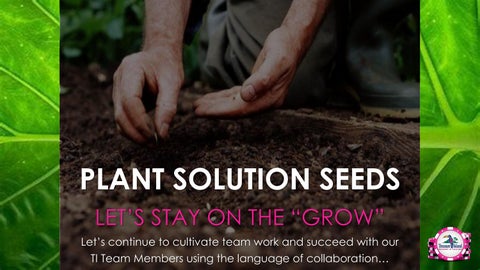
PLANT SOLUTION SEEDS LET’S STAY ON THE “GROW” Let’s continue to cultivate team work and succeed with our
TI Team Members using the language of collaboration…
- Problem Have to Defensive Control Need Demand Resistance Force Fight Debate Destructive Repel Superiority React Hero Self-Centered Control Negative Deny Attack Emotional Disempower
+ Solution +
Choose to Collaborative Balance Feeling Request No Resistance Face Unite THERE ARE MANY Dialogue BENEFITS OF USING A Constructive Attract COLLABORATIVE TONE TO Equality “STAY ON THE GROW” Respond Humble Higher Purpose Empower Positive Consider Concede Not Emotional Empower
ⱷSOLUTION SEEDⱷ Demonstrate a Willingness to Change
Goal: To communicate that you are a flexible and cooperative team member. Example: “Thank you for the feedback; you have given me a lot to think about & I agree we could work on that.”
ⱷSOLUTION SEEDⱷ Detach Yet Confirm
Goal: To defuse and avoid the blame game, while communicating with support at the same time. Example: “I am not responsible for how you acted yesterday, however, please know I want a solution for us/you.”
ⱷSOLUTION SEEDⱷ Say No Directly
Goal: To communicate a clear message of “No.” Example: Acknowledge the Other’s Feelings: “I can see you are excited about your new job selling insurance and it is going well for you.” State Your Position on the Issue: “I am happy with my insurance company and am not interested in changing providers at this time.” Say No Clearly: “Thank you for thinking of me and No, I am not interested in purchasing from you right now.”
ⱷSOLUTION SEEDⱷ Agree to Disagree
Goal: To confirm someone even when you might not completely agree with what they are saying. Example: “I understand that’s how it felt for you; I didn’t experience it that way.”
ⱷSOLUTION SEEDⱷ With/On & With/To Team Language
Goal: To ensure your message is collaborative and continues to communicate cooperation around an issue. Examples: “I would be happy to work with you on this problem.” “I want to work with your department to ensure a positive outcome.”
ⱷSOLUTION SEEDⱷ Use Presumptive Questioning Goal: To imply that what you are asking is possible/already true, as a means to encourage positive group discussion and welcome active, solutions-based feedback. Examples: “Who can provide an example of…?” [implies it is already occurring]. “What did we learn from this?” [implies something was learned]. “Who would like to help me with this?” [implies someone is willing to help]
ⱷSOLUTION SEEDⱷ Problem to Solution
Goal: To focus your response on the issue at hand, [rather than the person], and offer a solution to that issue. Examples: “You seem to be drinking a lot tonight; how we look into getting you a ride home/hotel room?” “I noticed you removed yourself from your table; how about we find you a better seating arrangement?” “It appears as though you might be ready to trigger; would you like to talk about this later?”
ⱷSOLUTION SEEDⱷ Perception Checking
Goal: To save face for someone while addressing a problem squarely/head on. Examples: Describe the behavior you have seen and offer 2 to 3 interpretations of what you may have witnessed; then ask for clarification: “I noticed you rolled your eyes at me in the meeting this morning; I was wondering if you are feeling ok or might have had a question; did I misread that? It felt like you might have been wanting to say something to me?”
ⱷSOLUTION SEEDⱷ Discuss the Acceptable Action
Goal: To shape undesirable behavior towards a more appropriate action by letting the other person offer a correct response. Examples: Just as we might coach our children to use manners: “How are you supposed to ask?” We can prompt with questions like, “What is the procedure we used last time this occurred?” “Who do we call when we need xyz?” “What does the policy state about that?” “How can we/you ensure that these tasks are getting accomplished?”
ⱷSOLUTION SEEDⱷ Establish Agreement First
Goal: To communicate your solutions-based intention before the problem escalates. Example: “I think we can both agree that we don’t want our misunderstandings to continue to interfere with our departments getting this project completed.”
ⱷSOLUTION SEEDⱷ Try it Again Goal: To focus on corrective action and a solution, rather than the merely the problem. Examples: “Maybe we could try it this way now.” “Let’s do it one more time.” “Can we attempt that again to make sure we are on the same page about this?”
ⱷSOLUTION SEEDⱷ If/Then Statements
Goal: To offer an informative & helpful suggestion instead of simply making a demand. Example: Instead of saying, “You should clean the bathrooms now,” say, “If we take care of the bathrooms now, we will be ahead of schedule.” or “If we tidy up the back office, we can fit those extra boxes in that space.”
ⱷSOLUTION SEEDⱷ State Your Interest First
Goal: To make your intention known right away by speaking from the context of your interest. Examples: “I am interested in how you were feeling during the team meeting today.” “I am interested in booking a conference room for our vendors.”
ⱷSOLUTION SEEDⱷ “It” Verses “I”
Goal: To demonstrate ownership and responsibility for a message you communicate to others. Example: Responsible Tone, “I feel irritated when you are late;” “I’m glad I ran into you;” “I’m a bit confused;” “I am bored.” Less Responsible Tone, “It bothers me when you’re late;” “It’s nice to see you;” “It’s confusing;” “It’s a boring training.”
ⱷSOLUTION SEEDⱷ Repeat the Solution
Goal: To counter arguing and rebuttals in a non-defensive way, while remaining consistent. Example: With each rebuttal and excuse you receive, respond by paraphrasing the solution again and again, “Your report is late again this week and I need to know if you are able to get it in on time next week;” “What can we do to ensure it doesn’t happen again;” “Is there anything you might do differently to make sure you are on track this week;” “What are you willing to commit to?”
ⱷSOLUTION SEEDⱷ Tone Shaper
Goal: To create awareness and a clear boundary around someone’s use of an inappropriate tone. Example: “I understand what you are saying and can see you are frustrated, and I would like to ask that you please rethink the tone you are using with me.” “I would prefer that we don’t use sarcasm/swear/yell.”
ⱷSOLUTION SEEDⱷ Replace Can’t with Can Replace Won’t with Will
Goal: To limit any resistance during your interactions and demonstrate your willingness to collaborate. Examples: “Let’s see what I can do.” “We will work it out.” “You can leave once you are done with at task.” “I can check on that before I leave today.” “I will call you back by the end of the day.”
ⱷSOLUTION SEEDⱷ Next Time…
Goal: To effectively coach someone through an error. Examples: “I would appreciate if next time you would knock first before coming into my office.” “Next time let’s go over the agenda before we meet to discuss it with the team.”
ⱷSOLUTION SEEDⱷ Delegate Responsibility
Goal: To model/communicate your support of teamwork and that you share responsibility. Examples: “Can you call her and then email me and we will set up a time to meet?” “Before we discuss this further, let’s each think of some things we…”
ⱷSOLUTION SEEDⱷ “You” Verses “We”
Goal: To set the tone of collaboration. People who use “we” statements imply the issue is the responsibility of both the speaker and the receiver. Example: Responsible Tone: “We have a problem; We can’t talk about this task without fighting; We need to speak to them about the lack of participation.” Less Responsible Tone: “You are creating a problem; You are unable to talk about this issue without getting upset; You need to speak up…”
ⱷSOLUTION SEEDⱷ Address the Reason “Why”
Goal: To broaden awareness and understanding of someone’s impact [behavior] on a group. Example: “You were late to the team meeting again this week [behavior] and the reason I would like to discuss this with you is that when you are late, it disrupts the work flow and we are put in a position where we have to repeat what you’ve missed.”
ⱷSOLUTION SEEDⱷ Point to Positive Behaviors
Goal: To verbally recognize others when they do well, help out, cooperate, or make a contribution. Examples: “I like the way you handled that.” “Your work area looks great today!” “I knew I could count on you to help.” “It seemed much easier with you helping us.” “You well today!”
ⱷSOLUTION SEEDⱷ Observe and Resolve
Goal: To deliver bad news in a neutral and constructive fashion. Examples: “I observed you raising your voice at a guest this morning and I would like to encourage you to pause next time before reacting.” “I noticed you left work again early last night; what can we do to ensure you stay until 5pm today?”
ⱷSOLUTION SEEDⱷ You Pick
Goal: To offer two or three possible options, which allows the other person to have a suggestion, choice opinion and/or to make their own decision. Example: “What do you think; should we go ahead and order those today or wait until we have everything more organized.” “Hey team do we need to meet again to further discuss our ideas or have we decided on this?”
ⱷSOLUTION SEEDⱷ Positive Forecasting and Predicting
Goal: To communicate your confidence in others by framing future action in a positive context. Examples: “I know you will get this done by Friday,” rather than “you must” or “you have to…” “We will/can work to stay focused on our goals so this is done before the New Year.”
ⱷSOLUTION SEEDⱷ Demonstrate Potential Choices
Goal: To ensure there are choices, which allows for disagreement or agreement - To generate discussion and empower others to share their opinions. Examples: “Here are some options; what do you all think?” “Would you rather we focus on x or y this week?” “What comes to mind when we think about…”
ⱷSOLUTION SEEDⱷ Agree & Move to Fix It
Goal: To work through a potential conflict with ease. Example: Address a complaint with, “Yes, I too noticed we have a lot of extra stuff, overwhelming that space; I address it on my next shift.” “I saw that happen too and I will make sure someone takes care of it by the end of the work day today.”
“A Problem Well Stated is a Problem Half Solved”
“Have you explored doing it like this?” “What is it you are hoping will happen?”
THE LANGUAGE OF COLLABORATION
“What is the best case scenario?” “What concerns do you have?”
“What do you hope to achieve?” “Maybe we could…” “It might be in our best interest to…”
“I would like to offer a suggestion…” “What would help the situation?” “Can you say more about that?” “How do you want to be treated?” “What do you think we should do?” “What do you want to have happen?” “What problem are we trying to solve?”
“One option we might want to consider is…” “Please share why you feel so strongly about that…” “What would need to happen for you to be satisfied?”
ASK A COLLABORATIVE QUESTION “Might we be able to…” “Can you agree to…” “I’d like it if we could…” “Would you be willing…” “Are you able to… “Maybe we could…” “Is it possible for us to…” “Suppose we do this…” “What will it take?” “What should we do?”
“I see us moving this way…” “The solution I am hoping for is…” “The outcome I would like is…” “Can you offer a suggestion?” “Let’s see if we can…” “Perhaps we could…”
MORE COLLABORATIVE STATEMENTS “I want us to…” “Are you able to…” “Might we be able to…” “Can you agree to…” “I’d like it if we could…” “Would you be willing…” “Maybe we could…” “What will it take?” “The solution I want is…” “Is it possible for us to…” “Suppose we do this…” “Have you considered…” “Would you rather x or y?” “The outcome I would like is…” “What will it take for us to work together?” “What else can you add to that point; please say more…” “Are there any other ways you could get what you want/need?”
LET GO
To let go doesn't mean to stop caring; it means I can't do it for someone else. To let go is not to cut myself
off... It's the realization that I can’t control another. To let go is not to enable, but to allow learning from natural consequences. To let go is to admit powerlessness, which means the outcome is not in my hands. To let go is not to try and change or blame another, I can only change myself. To let go is not to care for, but to care about. To let go is not to fix, but to be supportive. To let go is not to judge, but to allow another to be a human being. To let go is not to be in the middle arranging all the outcomes, but to allow others to affect their own outcomes. To let go is not to be protective, it is to permit another to face reality. To let go is not to deny, but to accept. To let go is not to nag, scold, or argue, but to search out my own shortcomings and correct them. To let go is not to adjust everything to my desires, but to take each day as it comes and cherish the moment. To let go is not to criticize and regulate anyone, but to try to become what I believe I can be. To let go is not to regret the past, but to grow and live for the future. To let go is to fear less, be kinder & offer your best work. Have the difficult interaction and then let it go.
WE CULTIVATE A CULTURE OF COLLABORATION The language of collaboration focuses on two things: the issue and
the resolution of the issue. The assumption behind this style of communication is that there is always a solution. Operating from this disposition, the underlying message implies, “anyone who is not a part of the solution, is part of the problem.” Effective solutionsbased communicators are synergetic problem solvers who strive for a win/win solution. They are concerned about their own goals and show concern for the goals of others. Their messages include
undertones of mutual respect, a tone of “two heads are better than one,” agreement and “I’m ok, you’re ok.” Like an owl [“who?”], they are willing to assert themselves and use non-threatening
confrontation to balance the issue at hand. Collaborators have the ability to listen and grasp group concerns. They support synergy.
What is the Best Vitamin for a Collaborative Communicator? Answer: “B1”
FINAL POINTS TO PONDER People will continue to be who they are no matter what you think of them. It is not your job to tell others what to do and to make decisions for them. When you invite someone to make a choice and decide for themselves, you are able to stay in control and allow them to take responsibility for their actions. You may not be able to change others, but you can work to set healthy limits and influence them towards a solution. Most people want to get along
with others and like who they see, in the mirror, at the end of the day. When we collaborate, we communicate clearly with others and feel more authentic. “It’s right to do right because it’s right.”
We are “response-able.” We support one another. We operate as one voice and one team. We create winning experiences.
It is what it “IS”
Let’s Stay on the Grow TI!
ISSUE
SOLUTION