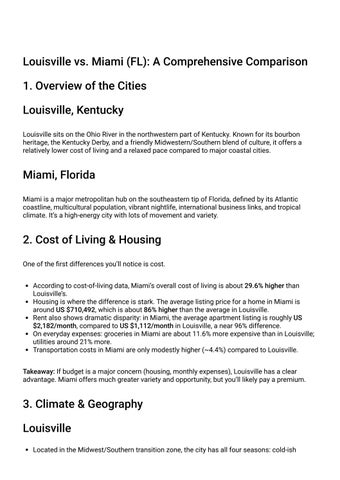
the Cities
Louisville, Kentucky
Louisville sits on the Ohio River in the northwestern part of Kentucky. Known for its bourbon heritage, the Kentucky Derby, and a friendly Midwestern/Southern blend of culture, it offers a relatively lower cost of living and a relaxed pace compared to major coastal cities.
Miami, Florida
Miami is a major metropolitan hub on the southeastern tip of Florida, defned by its Atlantic coastline, multicultural population, vibrant nightlife, international business links, and tropical climate. It’s a high‐energy city with lots of movement and variety.
2. Cost of Living & Housing
One of the frst differences you’ll notice is cost.
According to cost‐of‐living data, Miami’s overall cost of living is about 29.6% higher than Louisville’s.
Housing is where the difference is stark. The average listing price for a home in Miami is around US $710,492, which is about 86% higher than the average in Louisville. Rent also shows dramatic disparity: in Miami, the average apartment listing is roughly US $2,182/month, compared to US $1,112/month in Louisville, a near 96% difference.
On everyday expenses: groceries in Miami are about 11.6% more expensive than in Louisville; utilities around 21% more.
Transportation costs in Miami are only modestly higher (~4.4%) compared to Louisville.
Takeaway: If budget is a major concern (housing, monthly expenses), Louisville has a clear advantage. Miami offers much greater variety and opportunity, but you’ll likely pay a premium.
3. Climate & Geography Louisville
Located in the Midwest/Southern transition zone, the city has all four seasons: cold-ish
winters, warm summers, and pleasant springs/falls. It lies near the Ohio River and has a bit of a more moderate, continental infuence.
Miami
Tropical to subtropical climate: warm to hot nearly year-round, mild “winter” season, lots of sunshine, and beach-friendly weather. Being coastal, Miami also faces more weather risk (hurricanes, tropical storms) and high humidity.
Implications:
If you enjoy distinct seasons (snow in winter, colorful fall foliage, etc.), Louisville might appeal more.
If you prefer sunshine, warm weather nearly all year, and want beach access, Miami is hard to beat.
However, living in a warmer/humid or storm‐prone area means you’ll need to account for things like AC usage, storm preparation, and insurance. This also plays into the utility/housing cost difference referenced above.
4. Culture, Lifestyle & Diversity
Culture & Atmosphere
Miami: Extremely diverse culturally and internationally. Latin American and Caribbean infuences dominate food, music, and nightlife. There’s a strong cosmopolitan, urban‐coastal feel.
Louisville: More rooted in American mid‐south traditions, bourbon and horse culture (the Kentucky Derby), but also emerging arts and food scenes. It feels more manageable, less frantic, and often more relaxed.
Entertainment & Nightlife
Miami offers world-class beaches, vibrant nightlife, international cuisine, arts districts like Wynwood, and a social scene that appeals to younger crowds, tourists, and global professionals.
Louisville has a growing food & craft beer scene, historic neighborhoods, music offerings, the Derby festivities, and a strong sense of local community.
Diversity
Miami is one of the most diverse U.S. cities with a high share of foreign‐born residents and a multilingual population.
Louisville is less internationally cosmopolitan but still offers a mix of urban and southern culture, and often offers easier access to family‐friendly living, quieter neighborhoods.
Takeaway: If you thrive in a fast‐paced, diverse, international environment, Miami is very appealing. If you prefer a more moderate pace, a strong community feel, and fewer extreme costs, Louisville may be a better ft.
5. Career & Business Opportunities
Miami
A global business hub: fnance, trade (especially with Latin America and the Caribbean), tourism, hospitality, real estate, and creative industries. Large airport, international trade links, luxury market. Higher salaries in many industries, but also a higher cost of living.
Louisville
Economy rooted in manufacturing, logistics (being on the Ohio River and near major interstates), healthcare, bourbon/food culture, and emerging tech/innovation sectors. More affordable for startups, small businesses, and lower overhead. Potentially a slower growth environment compared to hyper‐competitive coastal markets, but also less pressure.
Takeaway: Match your career goals. If you’re in a globally oriented industry and want big‐city exposure, Miami might provide that. If you want a more affordable base and still meaningful opportunities, Louisville has merit.
6. Education & Quality of Life
Schools & Universities
Miami area has access to major institutions (e.g., University of Miami) and signifcant research/medical centers. Louisville boasts institutions like the University of Louisville, younger universities, and offers communities where family life and education access may be more relaxed/cost‐effective.
Quality of Life
In Miami: beach access, sunshine, active outdoor culture, but also high cost-of-living, trafc, humidity, and storm risks.
In Louisville: more moderate cost, four seasons, manageable urban size, community feel — but you may sacrifce some of the ultra‐luxury or global exposure of a city like Miami.
Miami trafc can be heavy; commuting and parking may cost more. Public transit exists, but many residents drive. Louisville has less extreme congestion (though some trafc exists) and shorter commutes in many neighborhoods.
7. Real Estate &
Neighborhoods
Miami
Expect high prices, especially in desirable locations (beachfront, downtown, trendy districts). Condos and luxury apartments are prominent; co‐living and rental markets are strong for younger professionals. Neighborhoods vary widely, from high‐end South Beach to more affordable (relatively) suburbs.
Maintenance, insurance, and condo fees can be high given climate risk and luxury features.
Louisville
More affordable housing market. Single‐family homes, historic neighborhoods (e.g., Old Louisville), and suburban options. You can often get more space and yard for the price. Investment potential exists, especially with rising interest in “smaller” cities offering lifestyle + affordability.
Takeaway: For homeowners or renters seeking value and space, Louisville has an advantage. If you’re willing to pay a premium for lifestyle, view, and amenities, or maybe intend to rent and move quickly, Miami delivers, but at a cost.
8. Recreational Activities & Nature
Miami
Beaches, boating, water sports, and year-round outdoor life. Urban life plus tropical nature: Everglades nearby, islands, coastal trails. Nightlife, dining, events, and festivals keep the calendar full.
Louisville
Access to rivers, parks, hiking/biking trails, horse farms, and bourbon tours. Four seasons mean a variety of outdoor activities: spring blooms, autumn colors, winter cold (but rarely extreme), and summer heat.
Cultural events like the Kentucky Derby, music festivals, and bourbon heritage experiences.
Takeaway: If your recreation priorities lean toward beaches and warm weather year-round, choose Miami. If you like seasonal variety and more regional/nature‐based, slower-paced exploration, Louisville will satisfy.
9. Demographics & Community Feel
Population & Density
Miami: large metro footprint, highly dense in urban cores, strong immigrant and international community presence.
Louisville: medium‐sized metro, more spread out, easier to fnd more suburban or quiet residential settings.
Age, Culture & Socialization
Miami tends to attract younger professionals, tourists, transit‐oriented lifestyles, and many nightlife options.
Louisville may offer more stable family‐oriented neighborhoods, quieter evenings, strong sense of local identity.
Community Engagement
Both cities have strong civic pride, but the kinds of communities may differ. In Louisville, you might fnd tighter local networks, neighborhood associations. In Miami, you might fnd more global networks, multicultural enclaves, and a more outward‐facing urban community.
10. Travel, Accessibility
&
International Connections
Miami
Major international airport, strong links to Latin America/Caribbean, cruise ports, and global business.
If travel, overseas clients, or multilingual networks are important, Miami’s edge is substantial.
Louisville
Regional airport, good U.S. domestic connectivity, but fewer direct international routes compared to Miami.
It may require more fying/transfers for overseas travel, but for domestic mobility, it’s quite adequate.
Takeaway: For global time zones, international business, and client travel, Miami is superior. For domestic business or a home-based lifestyle, Louisville is solid and more affordable.
11. Risk, Sustainability & Future Growth
Climate & Environmental Risks
Miami has signifcant exposure to hurricanes, sea-level rise, and high insurance costs. Louisville has fewer extreme climate risks, though it can still experience foods, storms, and snow, but generally less risk than major coastal‐hurricane zones.
Growth Trajectory
Miami: signifcant growth, infux of capital, global attention; competition and cost will remain high.
Louisville: moderate growth, increasing interest because of affordability, possibly more “value upside” for those wanting long‐term home/investment.
Sustainability & Infrastructure
Urban development in Miami is high; issues like trafc, high-rise living, and infrastructure pressure are real.
Louisville may have more room to grow more slowly, infrastructure strain may be less acute, and quality of living may hold up well.
12. Summary Comparison
FeatureLouisville, KYMiami, FLCost of livingMuch lower, more affordableHigher across housing, rent, and utilitiesHousing marketMore space for the money, single‐family homesPremium location rentals/condos, higher pricesClimateFour seasons, moderate weatherTropical, hot & humid, lots of sunshineCulture & diversityStrong local culture, moderate diversityHighly international, vibrant nightlifeCareer & businessAffordable overhead, growth potentialGlobal links, high competition & rewardRecreationNature, parks, seasonal changeBeaches, water sports, and year-round outdoor lifeTravel & connectivityGood domestic travelMajor international hubRisk & future growthLower risk, value‐orientedHigher risk (climate, cost) but higher upside
13. Recommendations: Which One Should You Choose?
Want great value for your housing dollar.
Prefer a slower-paced lifestyle with more space and fewer crowds. Enjoy the appeal of four seasons, local culture, and a strong sense of community. We are building a home/investment and want affordability. Are you okay with less international business exposure or beach access?
Pick Miami if you:
Thrive in a fast-paced, urban, international environment. Want year-round warm weather, beaches, and global travel convenience. Are comfortable paying for the premium and dealing with the higher cost of living. Work in industries with global reach, tropical destination appeal, or luxury markets. Are seeking high energy, nightlife, cultural variety, and want coast access.
14. A Note on the College Football Rivalry — Just
for Fun!
As a lighter aside, if you’re a sports fan, you might appreciate the rivalry between the college teams of these cities: the Louisville Cardinals and the Miami Hurricanes. They have a long history, competing multiple times in the Atlantic Coast Conference (ACC) and vie for the “Schnellenberger Trophy.”
While this doesn’t directly affect living or visiting the cities, it’s a fun cultural tidbit if you enjoy the sports side of city identity.
15. Final Thoughts
In the end, the choice between Louisville and Miami comes down to priorities. There’s no one “better” city universally; rather, one will be better for you given your budget, career, lifestyle preferences, climate comfort, and long‐term goals.
If you value affordability, comfort, space, and a less frenetic pace, Louisville is a compelling choice.
If you’re attracted to global connections, beaches, culture, nightlife, and are willing to pay for those amenities, Miami is a top contender.
Either way, both cities offer rich experiences, strong community opportunities, and distinct advantages. If you’d like a more specifc comparison, say, for families with kids, retirees, or remote workers, I’d be happy to delve into those aspects as well.
Read more at www.creativehives.co