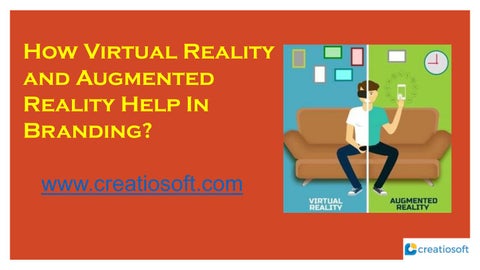
How Virtual Reality and Augmented Reality Help In Branding? www.creatiosoft.com
What is Virtual Reality? Virtual reality (VR) is an artificial, computer-generated simulation or recreation of a real life environment or situation. It immerses the user by making them feel like they are experiencing the simulated reality firsthand, primarily by stimulating their vision and hearing. The most advanced VR experiences even provide freedom of movement – users can move in a digital environment and hear sounds. Moreover, special hand controllers can be used to enhance VR experiences. The entertainment and gaming industry is using virtual reality development for making a multi-billion dollar one and consumers are always keen on novelty. Virtual reality has many other, more serious, applications as well. There are a wide variety of applications for virtual reality which include: Architecture Sport Medicine The Arts Entertainment
What is Augmented Reality? In augmented reality, users see and interact with the real world while digital content is added to it. If this sounds unclear think of Pokemon Go – millions of people all over the world have been rushing with their smartphones in search for small virtual creatures. That’s the most vivid example of augmented reality. There are lots of augmented reality development company that gives unbelievable twists to mundane apps to satisfy next-generation users. A view of physical real-world environment with superimposed computer-generated images, thus changing the perception of reality, is the AR. There are a wide variety of applications for augmented reality which include: Education Real Estate Gaming Entertainment Industries Automotive
The Rising Trend of Virtual and Augmented Reality In digital marketing, engaging consumers and raising brand awareness are both crucial. Using new technology to achieve this has become the rising trend. As far as marketing strategies go, Virtual Reality (VR) and Augmented Reality (AR) remain relatively untapped resources in comparison to more traditional platforms. The technology is curious and promising, as well as steadily on the rise. At the moment, VR is used by 43 million people, with the amount looking to increase in 2018 to 171 million. If those numbers aren’t impressive enough, by 2020 both VR and AR are expected to draw in $150 billion in revenue.
New Technology Makes Your Brand Look Good Gone are the days when people would furrow their brow and ask, “What is VR?� Not to mention the relative obscurity of AR, often assumed to be one in the same.
As mentioned earlier, consumers now look for VR and AR presence as a telling sign of a brand’s strength and innovation. With this new enthusiasm, brands and marketers are recognizing VR and AR technology as being vital in setting themselves apart from other businesses. The experience of this new reality also sets it apart from traditional forms of marketing and advertising, as customers are attracted to the excitement of VR and AR and remain open to it, seeking it out rather than blocking it out. As the technology is still relatively new, digital marketers employing VR and AR currently are at an advantage as competition has yet to skyrocket. By the time the technology becomes ubiquitous, these marketers and their brands will be ahead of most others. Not only do they make a brand look good, but they can also make consumers feel good. With the two slowly permeating the fabric of giant tech companies, consumers can now get even closer to a brand.
VR/AR Technology Meets New Consumer Needs Gone are the days when people would furrow their brow and ask, “What is VR?� Not to mention the relative obscurity of AR, often assumed to be one in the same.
As mentioned earlier, consumers now look for VR and AR presence as a telling sign of a brand’s strength and innovation. With this new enthusiasm, brands and marketers are recognizing VR and AR technology as being vital in setting themselves apart from other businesses. The experience of this new reality also sets it apart from traditional forms of marketing and advertising, as customers are attracted to the excitement of VR and AR and remain open to it, seeking it out rather than blocking it out. As the technology is still relatively new, digital marketers employing VR and AR currently are at an advantage as competition has yet to skyrocket. By the time the technology becomes ubiquitous, these marketers and their brands will be ahead of most others. Not only do they make a brand look good, but they can also make consumers feel good. With the two slowly permeating the fabric of giant tech companies, consumers can now get even closer to a brand.
Reach us:- www.creatiosoft.com