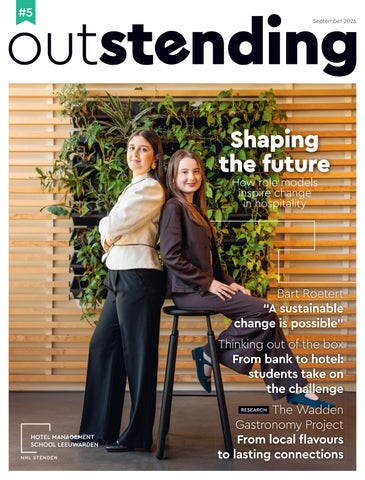
#5
v
September 2026
Shaping the future How role models inspire change in hospitality
Bart Roetert “A sustainable change is possible” Thinking out of the box From bank to hotel: students take on the challenge The Wadden Gastronomy Project From local flavours to lasting connections RESEARCH
contents
13. 2
8.
Designing the future: how HMSL students help shape a new hotel.
In Aruba, students tackle real-world sustainability challenges.
MEET OUR ALUMNI!
7. Raymond Vermolen, Regional Vice President of Operations at Intercontinental Hotel Group (IHG) in East US and the Caribbean 12. Tessa van der Aa, Food & Drinks Manager at Hilton Amsterdam Airport Schiphol 17. Wijnand van den Hoek, artist, known as By Wijnand 36. Gabriella Esselbrugge, Owner and Director of Giethoorn Hospitality & hotel-restaurant De Dames van De Jonge in Giethoorn 45. Andries Bouwman, Mayor of the municipality of Opsterland in Friesland 4. Foreword by Academy Director Marco ten Hoor 6, 16. Did you know...? News and facts about HMSL 24. Sake Jan Velthuis on commercial friendship 28. Research in the spotlight: The Wadden Gastronomy Project 31. The silent role models of hospitality 40. The new word of mouth in choosing a hotel 46. 24 hours in Como with Tereza Petrova COLOPHON – Outstending is the annual magazine for the alumni and partners of Hotel Management School Leeuwarden. Concept & Realisation: Marloes Tervoort – MT redactionele content Copy Editor: Marloes Tervoort Translation & Proofreader: Julia Gorodecky Art Director: Martijn Blokland Marketing & Communication: Pascale de Wijs – Likewise Hotel Management School Leeuwarden Communications: Stephanie van Oorschot, Estelle Almasan Contributors: Firma Fluks, Dingena Mol, Ronnie Zeemering (ZeemeringMedia) Printer: De Bondt Grafimedia Communicatie BV Circulation: 2,500 Contact: Hotel Management School Leeuwarden, Rengerslaan 8–10, 8917 DD Leeuwarden; +31 (0) 88 991 7000 Follow us: @hotelschoolleeuwarden, Hotel Management School Leeuwarden at NHL Stenden
contents
26. 3
18.
Alumna Sharon Peters shares eight lessons on generations, leadership and curiosity, and how different perspectives strengthen workplace collaboration.
RESEARCH: Three questions to the
expert: Dr Albert Postma on scenario planning and futures thinking.
42.
37.
InstockMarket cofounder and director Bart Roetert leads by example, showing how entrepreneurship can drive sustainable change.
Making an impact: The skills that HMSL students develop turn out to be just as valuable in the non-profit sector.
Creating what’s next
foreword
4
Never before have we had so many role models
outstending
Role models Open your phone and within minutes you’ll find entrepreneurs sharing business advice, influencers promoting their lifestyle, athletes demonstrating discipline and leaders explaining their vision. An endless stream of people inviting us to follow, like and subscribe. But are they all role models? Perhaps visibility has become the new measure of influence. Yet when I think back on my own career, the people who shaped me most were often the least visible or famous. They didn’t have thousands of followers. They weren’t building a personal brand. In many cases, they probably didn’t even realise they were having such an impact. They were colleagues, managers, lecturers and mentors who took the time to encourage me, challenge me and help me grow. One of those role models was a former chair of the executive board early in my career. He encouraged me to continue my education, challenged me to think more strategically, and taught me one of the most valuable lessons about leadership: surround yourself with talented people, trust them and help them succeed. It is a lesson that has stayed with me throughout my career. That, to me, is the difference between being admired and being a role model. A role model does not show you a perfect picture. A role model helps you discover your own potential. They inspire not through status, but through actions. Not by telling people what to do, but by showing them what is possible. At Hotel Management School Leeuwarden (HMSL), we see this every day. In lecturers who encourage students to take a step they didn’t think they could take. In alumni who share their experience with young professionals. In managers who coach rather than command. And in students who inspire one another simply by the way they treat people. Hospitality has always been a people business. Not because people serve people, but because people develop people. That is why this edition of Outstending is dedicated to role models. We celebrate individuals who have shaped our industry, challenged conventions and inspired others to grow. But we also invite a more personal question. Who opened a door for you? And, perhaps even more importantly: For whom are you opening doors today? As alumni of HMSL, you are part of a community that spans generations. The knowledge, experience and opportunities you have gained are valuable. Share them. Coach someone. Encourage someone. Open a door for someone. Because the future of hospitality will not only be shaped by innovation, technology or new business models. It will be shaped by people who choose to invest in other people. And isn’t that what hostmanship has always been about? CREATING WHAT’S NEXT. Marco ten Hoor Academy Director Hotel Management School Leeuwarden at NHL Stenden
Creating what’s next
5
did you know...?
Two HMSL alumni. 6
Two award-winning concepts. One major night for hospitality. At the 2025 Entree Awards, known as the Oscars of the hospitality industry, Pascal Hoogenboom and Rodolf Weytingh were celebrated for businesses that stood out for their concept, quality and guest experience. Pascal and the team behind SPOT Langweer won Best New Dine & Drink Concept Local, while Rodolf’s Hotel Thermen Berendonck was named Best New Luxury Hotel 2025. Their success shows how HMSL alumni shape hospitality through strong concepts, memorable guest experiences and entrepreneurial leadership. Scan the QR code for more information.
Summer School
bridges vocational and higher education
“our co ve r models”
FREE TO GO TAKES FIRST PRIZE HMSL students Claudia Lopez Martinez and Carlota Ferreira won the top prize at the 2025 Hayo Apotheker Innovation Fund with Free to Go: a vending concept offering gluten-free and lactose-free products. Their idea stood out for its relevance, business potential and social impact. More than a pitch, Free to Go responds to an everyday need. By making safe food more accessible, the students showed how entrepreneurship and hospitality can create a concept that is practical and promising. Scan the QR code for more information.
For the first time, nine vocational hospitality students took part in the new Design-Based Education (DBE) Summer School. The five-day programme introduced them to higher education and its approach to learning. Working on real-life challenges from practical departments, the students used design thinking to analyse problems, develop creative solutions and build functional prototypes. The programme combined hands-on project work with academic and professional development. Students explored basic concepts in human resource management and motivation theory, designed and facilitated collaborative workshops, and discovered the campus and its community during an interactive urban safari. The Summer School aims to make the transition from vocational to higher education more accessible while offering students first-hand experience of Design-Based Education. Participants who successfully completed this first edition received an official certificate, granting them exemptions equivalent to a full semester and a valuable head start if they continue their studies at the institution.
alumni
Students and alumni of Hotel Management School Leeuwarden are the ultimate game-changers in the field. Who inspired them along the way? And how do they hope to inspire others?
text Firma Fluks
Raymond Vermolen (54) Graduated in: 1994 Position: Regional Vice President of Operations at Intercontinental Hotel Group (IHG) in East US and the Caribbean
7
MEET OUR ALUMNI!
“Inspired by my previous managers, I like to give talent opportunities and responsibilities” How did you end up in Atlanta?
“My first internship was at the Amstel Hotel Amsterdam, which is part of IHG Hotels & Resorts, the company that I still work for. Today, I oversee the operational performance, strategic positioning and brand consistency of well-known international hotel chains and hotel brands in the higher and more luxurious segment. During my internship, I was able to participate in a management development programme, which had just been developed. The goal of the programme was to eventually become general manager. This meant I had to gain experience in five countries and on three continents. I succeeded, and have been working for IHG for 30 years now. There are new challenges all the time, so I’ve never felt like I wanted to work for another company.”
Did you have certain role models in those years?
“My general manager at the Amstel Hotel was different from other managers. He was young and typically Dutch: straightforward and quite direct. He had a certain courage and was almost seen as a kind of rebel. As interns, he gave us managerial roles with a lot of responsibilities. That was innovative at the time. He wanted to attract talent and give people an opportunity. This approach made employees proud of their work, rather than just grateful that they had a job.”
What have you taken from that into your own way of working and leadership?
“I worked in the Middle East for a while and during that period the focus was often on addressing your weaknesses. My manager there, however, looked at the strengths of his team. He organised the work differently and gave responsibilities to people based on what they were good at. That inspired me. I also like to give young people with drive opportunities and responsibilities. As a manager, I therefore not only focus on the goals that need to be achieved, but also on how people feel. I hope that’s where I can make a difference.”
Do you have any advice for students who are at the start of their careers? “Find a mentor, both within your company or industry and beyond it. Don’t limit yourself to what’s part of your job: get involved in other activities, stay curious and learn from different perspectives. I’m lucky to still be friends with the people I went to Hotel Management School Leeuwarden with. We’ve all taken different career paths, so we can learn from each other and offer different perspectives. At our company, we also have a reverse mentorship programme, where managers – including the CEO – are paired with employees in different roles. It’s a reminder that, wherever you are in your career, there’s always something to learn from others.”
Creating what’s next
A unique chal 8
image: Willemijn van der Ploeg
In two years’ time, WestCord Hotels will open a new hotel in a former bank building in Leeuwarden city centre. The monumental building offers so many possibilities that as many as five different design challenges are being carried out simultaneously this year by students at Hotel Management School Leeuwarden.
I Rolf Jan van Zeyl General manager of WestCord WTC Hotel Leeuwarden
Dennis Lobo Lecturer at HMSL and the students’ facilitator
n the heart of Leeuwarden city centre stands a characteristic heritage building, topped with a large glass dome. Until 2013, it was home to Friesland Bank, which was taken over by Rabobank in 2012. WestCord acquired the building in 2023 and is now transforming it into a multi-purpose development combining office space with WestCord The Bank: a full-service hotel with 120 rooms, wellness and meeting facilities, a restaurant and several bars. The hotel is set to open in two years, but in the meantime, students from Hotel Management School Leeuwarden (HMSL) are already able to explore the building and contribute ideas for how it will be shaped. Rolf Jan van Zeyl, who graduated from HMSL in 1995 and is now general manager of the WestCord WTC Hotel Leeuwarden, says that this is already the fourth year that WestCord Hotels has participated in HMSL’s design
DBE
llenge
text Firma Fluks
9
challenges. “It is a fi rst for us to do this for a hotel that has not yet opened, and with as many as five different challenges running simultaneously.”
From brief to bold ideas
WestCord is looking for a restaurant concept that fits both the city and the building, while also attracting non-hotel guests, Rolf Jan explains. “It’s great to see students coming up with new ideas. They really think outside the box.” At the start of the design challenge, all the students were invited to tour the building and get acquainted with the project. Rolf Jan is struck by how motivated they are. “The students make a very good impression. They really get stuck into the subject and go into depth. I haven’t seen that to this extent before. I always tell students they can contact me if they have questions, and they have been.”
Engaged with their student city
Dennis Lobo, lecturer at HMSL and the students’ facilitator, is visibly proud when he hears that the students even wanted to come by a second time to take a closer look at certain things. “I encourage students to do that,” he says. “If Rolf Jan tells them they’re welcome to ask questions, I think it’s important that they take advantage of that opportunity.” Dennis believes the students’ engagement with these challenges is even greater because the hotel is located in the city where they study. “It’s encouraging to see, because it means they’re creating something they genuinely care about.”
A trio of ideas
The challenges for the restaurant, the wellness centre and The Dome were carried out by second-year students and ran until the
Creating what’s next
DBE
Design Challenge 1: The Dome
10
Janne Heuting (20) is working with four other second-year students on the design concept for The Dome. “The seventh and eighth floors will be transformed into hotel rooms, offering stunning views over Leeuwarden. The ninth floor is the focus of the design challenge, as the unique space presents logistical challenges. There is only one lift, and no more than a hundred people are allowed in the space at any one time. “That’s why we have developed a concept for a rotating exhibition, where local businesses can present art, fashion or products. We hope to work with the Fries Museum. It’s great fun to have so much freedom, and that’s also what makes it challenging. Many existing models and theories we’ve learned don’t apply here, so we have to find new approaches.”
Design Challenge 2: The restaurant Cas van Gemert (19) is developing a concept for the restaurant with five other second-year students. “I really want to open my own restaurant later, so I’m delighted that I was able to do this challenge. We presented three different concepts to Rolf Jan. A fine-dining concept featuring Frisian cuisine; a shared dining concept with Frisian tapas; and a six-course dinner, where each course is a dish from a different cuisine. Rolf Jan opted for the shared dining concept and local cuisine to make the restaurant attractive to non-hotel guests as well. We are now developing those plans further and are, for example, working through the financial calculations. The collaboration with WestCord is very motivating. Rolf Jan sets the bar high, but gets the best out of us. This challenge shows me how complex it is to set up a restaurant from scratch. I already thought the hospitality industry was fantastic, but now I’m even more enthusiastic.”
end of last academic year. For these three challenges, the students came up with three ideas after a thorough analysis, which they presented to WestCord Hotels. The company was able to decide on the strongest idea and the students went on to develop that plan further. “In this way, we increase the likelihood that the idea or strategic advice will actually be implemented,” explains Dennis. Rolf Jan is satisfied with this approach too, because it also makes the developed idea fit better with what WestCord Hotels stands for.
Two new mixed groups have been introduced in which first- and third-year students work together on the guest journey in the pre-opening phase. Dennis explains that the first-year students focus on the operational side of the challenge, while the third-
Tiny Ingrid Hanje (20) has come up with a concept for the hotel’s wellness centre together with five fellow students from the second year. “We want to divide the wellness centre into different zones. Visitors fill in a short questionnaire upon arrival, have their fingerprint scanned for a body check and then receive tailormade advice on what they would benefit from at that moment. Think of a relaxation zone, an exercise zone or a recovery zone with a sauna or sleep pod. The total space for the wellness area is 700m2, so there is plenty of scope to work with. We found it very difficult to come up with a unique idea; there are so many different things that need to be considered. A concept such as this cannot be developed by AI. What I’ve mainly discovered is that you have to think things through carefully yourself. I found it a very interesting subject and would like to do the Spa Business Strategy minor.”
year students work on more strategic issues. “The students taking part in this are following the accelerated bachelor’s programme. The design challenges reflect their progression from operational problem-solving to tactical and strategic decision-making. For the third-year students, working in a mixed group is very valuable. Good leadership includes training and motivating others.”
“The students really think outside the box”
First and thirdyear students working together
Design Challenge 3: The wellness centre
A continuing collaboration
The collaboration between HMSL and WestCord Hotels on the design challenges will continue for the next two to three years. Dennis is pleased with this as he sees it as a great opportunity for the students to work together on a special hotel, with such driven people. Rolf Jan is also delighted with the collaboration. “When we open, I will have a wealth of strong concepts,” he says. “After the opening, we will continue the collaboration, but we will organise the design challenges differ-
DBE
Design Challenge 4: The guest journey in the preopening phase Edoardo Galli (21), a third-year student, is part of a mixed group of eight students: four third-year students and four first-year students. “How do we attract the attention of guests before the opening? That was the central question. In our first concept, we focused on the rich history of this place. With the help of AI, we combined old photos of the uniforms worn by the former bank employees with the workwear of WestCord Hotels, and with that we designed new uniforms for the staff of this hotel. Another idea was to give a nod to the building’s past as a bank by making the hotel room key cards in the style of a credit card. I have to admit that I was quite sceptical about working with first-year students at the start, but they really surprised us. These students are on the accelerated bachelor’s programme, and you could especially see that in their motivation and fresh ideas. At times, I didn’t even have time to assign tasks, because they got straight on with everything themselves. One of them put together a prototype key card in a single weekend. The fact that we are such a motivated group is also down to the guidance from WestCord. Rolf Jan always wants to know everything we are doing. He shows us that, when you give people space, great things can happen.”
Design Challenge 5: The guest journey in the preopening phase Willemijn van der Ploeg (20), a third-year student, is working in the second mixed group with four fellow third-year students and four first-year students. “I focus on the strategic issues for the hotel. How can WestCord Hotels best position itself and what makes this hotel unique compared to other hotels in Leeuwarden? Our response was: ‘With history, we embrace the future.’ From this concept, we are developing a brand identity that clearly communicates that this is a modern hotel with respect for its rich history. For example, the old bank vault will be transformed into a bar with beautiful marble floors and walls. I find it very special that we are able to work on something so large-scale and real. It’s also very educational to work with first-year students. As a third-year student, it gives you the opportunity to discover what kind of manager you are and where your leadership skills lie.”
ently.” Rolf Jan does not yet know which concepts will actually be implemented, but says the results will be useful for WestCord Hotels anyway. “Take the market research that the students carried out for the wellness centre. That was done really thoroughly, and it is useful to know what that market already has to offer.”
A pleasant reflection
Initially, Rolf Jan had no clear expectations of what the students would come up with. “I went into this with an open mind and let myself be surprised.” From HMSL’s side, Dennis does have certain expectations. “I know what this process looks like, where students stand when they start and where they need to develop towards,” he explains. “I guide them in working in a disciplined and structured way. That needs to be in place, and the students must also use their brains and be creative. I pay particular attention to the strategic and tactical aspects, and was pleasantly surprised this year. There are some very good ideas. In this type of education, everything is in the students’ hands. As lecturers,
11
we are only there to motivate, encourage and support them.” Rolf Jan thinks it is important to introduce students to the profession and WestCord Hotels. “I want to inspire them about the hotel industry and hope they will continue in this sector. There is a shortage of professionals, so I like to show students what an amazing career you can have in this industry.”
Design Based Education Since 2020, HMSL has adapted its teaching according to the principles of Design Based Education. The underlying educational philosophy is based on Design Thinking. Students are challenged to apply creativity to real-world issues from professional practice, with the aim of finding innovative and forward-thinking solutions. Since the introduction of Design Based Education, the programme has become even more closely aligned with the international job market and encourages entrepreneurship.
Creating what’s next
alumni
Students and alumni of Hotel Management School Leeuwarden are the ultimate game-changers in the field. Who inspired them along the way? And how do they hope to inspire others?
text Firma Fluks
12
Tessa van der Aa (26) Graduated in: 2023 Position: Food & Drinks Manager at Hilton Amsterdam Airport Schiphol
MEET OUR ALUMNI!
“You get a lot in return when everyone feels seen and heard” How did your career at the Hilton begin?
“I started as a student and did my graduation internship in Dubai, where I interned for Jochem-Jan Sleiffer, who at that time was the Hilton President for the Middle East, Africa and Turkey. He inspired me to grow within Hilton, where he worked throughout his career. After that, I followed traineeships within Hilton. Over the course of four years, I lived and worked in four countries: United Arab Emirates, Germany, Italy and Saudi Arabia. I learned a lot from that. At breakneck speed, actually, when you consider that I only graduated in 2023. Jochem-Jan gave me the confidence to go for it.”
Do you see JochemJan Sleiffer as your role model?
“Absolutely. Sadly, he passed away suddenly in 2023. I still think about him often and what I learned from him in the year I worked for him. He was very authentic and approachable. No matter how full his schedule was, he always made time for a chat. From dishwasher to manager: he showed personal interest in everyone. He also taught me that it’s okay to be a bit bold and not be afraid to approach people. Even if someone has a high position. ‘We’re all human,’ he would say.”
What lessons from him do you use in your own leadership?
“Just like Jochem-Jan, I like to get out onto the floor and have brief chats with everyone. In Saudi Arabia, I managed a team of a hundred people, so that took at least an hour each day. But you get a lot in return when everyone feels seen and heard. Recently, someone from the breakfast service asked me if I could order egg cups. She had noticed hotel guests struggling with their boiled eggs every morning. I think it’s important that the team can share these kinds of things with me, so that we can improve things together. These conversations allow me to remove any frustrations while also improving the service.”
What do you pass on to colleagues who now see you as a role model?
“Personal development is very important to me, including within my own team. That’s why I always ask what someone wants to learn, how I can help with that and what their future ambitions are. I believe that your work becomes even more fun if you’re goal-oriented. I like to propagate that. If someone gets the chance to grow or work abroad, I’m the first to encourage that.”
interview text Firma Fluks images Unsplash
13
THAIS NIEROP AND KARELINE VAN DER LINDEN ABOUT THE GRAND TOUR IN ARUBA
Building a sustainable future in Aruba How can tourism contribute to a liveable island? As part of NHL Stenden’s Grand Tour programme, HMSL students can study abroad in their third year. In Aruba, the Destinations in Transition minor immerses them in real-world sustainability challenges, developing critical thinking skills and sustainable solutions for the future of tourism and the local community.
Creating what’s next
interview
14
S
un, sea and mountains of rubbish – if you look beyond the idyllic beach scenes, you will see that tourism in Aruba also has its downsides. Tourism has grown explosively in recent years and accounts for more than 80% of the island’s income. At the same time, Aruba is running out of available living space, and rubbish is becoming an increasing problem, putting pressure on residents’ daily lives. Which is why it is important that the tourism sector transforms and ensures a better balance between the economy, sustainability and quality of life. In the Destinations in Transition (DIT) minor, students from the University of Aruba and Hotel Management School Leeuwarden (HMSL) are given the opportunity to actively think about the challenges involved.
Looking at things from a different perspective
The DIT minor was developed by NHL Stenden and is based on the principles of Design Based Education. For the University of Aruba, this teaching method – which focuses on a practical issue – was new, says Thais Nierop, Dean of the Faculty of Hospitality & Tourism Management Studies. “This form of education challenges students to think critically and creatively. Theory supports the learning, but is not central. It is precisely because the students approach problems differently from the lecturers that valuable insights arise. This minor is not just about finding solutions, but above all about stimulating a new way of thinking – and that is exactly what is needed to develop innovative sustainable solutions.”
Working on real issues
The DIT minor, which lasts eight weeks, was launched in 2024. Two to three times a week, students work in groups on a current sustainability challenge under the guidance of a lecturer. “Each year, attention is given to a different key issue,” explains lecturer and coordinator Kareline van der Linden. “The focus is always on developing a mission, vision and strategic plan for a
sustainability-related design challenge. In the first year, for example, the students worked on the sustainable redevelopment of a historic building. The original assignment was to turn it into a luxury boutique hotel. But the students discovered that this did not fit within the sustainability goals. The client took that insight seriously and eventually decided to give the building a different purpose.”
Excursions outside your bubble
In addition to the design challenge, there is also an excursion every week to get to know Aruba from different perspectives. Students visit an archaeological museum, a recycling project and a care home, among other things. A yoga session is also part of the programme. “For some, that’s outside their comfort zone,” says Kareline. “And that’s a good thing, because we want students to be exposed to as many different aspects of the island as possible. That’s exactly what gets them thinking – and you won’t achieve that if you stay within your own bubble.”
Close links
Professionals from the tourism sector also make an important contribution to the minor through guest lectures and discussions with students. Thais sees that these real-world stories provide many new insights. “The experiences make it clear what does and does not work in practice. In this way, students learn to think critically about how they can approach challenges.” One of the advantages of Aruba is that everything is closely connected on the island. “If students want to get in touch with an organisation or professional, they can do so very easily. Many people know each other, and it’s never difficult to reach someone.”
Personal growth
Students also work on personal development during the DIT minor. They keep a reflection portfolio, recording their growth and insights. “Students’ development comes not only from what they learn during
About Thais Nierop After completing her bachelor’s degree in Hotel and Restaurant Management at Florida International University and an MBA in International Business Administration at the University of Colorado, Thais returned to Aruba. She has been working at the Faculty of Hospitality & Tourism Management Studies of the University of Aruba for more than 20 years now and has been dean of this faculty since August 2025. Her expertise lies in courses in the field of hospitality and tourism management, marketing and human resource management. Thais is also an academic advisor and organises an international study trip every 18 months. “What I like most about my job is that I not only guide students in the classroom, but also help them discover the world. By travelling together and experiencing other cultures, students get to know themselves better and develop skills that are essential for this profession.”
the minor, but also from their personal interests,” says Kareline. “I remember a student who was concerned about stray animals. She came up with ideas to help. But once on the island, she immersed herself in the subject and discovered how complex the social challenges were. That completely changed her perspective.” It is these real-life issues that make the DIT minor so valuable, say both lecturers. Students not only learn to develop solutions, but also understand how problems arise and which interests play a role.
Collaborating across borders
The group of students taking this minor in Aruba includes local and international third-year students with a management background. “It’s great to see how their different perspectives lead to unique solutions,” says Kareline. “International students, for example, realise through conversations with Aruban students that not everything can be done as it is in Europe, because resources on an island are more limited.” The university organises a lot, but students also explore the island together. Thais sees friendships develop as a result. “Our Aruban students often take on the role of hosts. They show international students the island and go to a food festival together, for example. By collaborating in and outside class, students learn from each other and form special connections. I think that’s a major added value of this minor.”
Contributing to sustainable tourism
Because Aruba is currently transitioning towards a more sustainable form of tourism, it is an ideal setting for this minor. At the same time, the problems that play a role on the island are not unique. “Think, for example, of the problems surrounding mass tourism in Croatia after Game of Thrones was filmed there,” says Kareline. “Destinations around the world are struggling with similar challenges. That’s what makes this minor so relevant, and it can give students the tools to take a pioneering role in the sustainable development of tourism.” Creating what’s next
About Kareline van der Linden After studying Business Administration at the University of Curaçao and a master’s degree in Strategic Management at Tilburg University, Kareline worked at the Central Bank of Aruba and the Aruba Tourism Authority. Since 2024, she has been a lecturer and coordinator of the DIT minor. In addition to that, she is pursuing a PhD at the University of Aruba, focusing on innovation on islands and the future of sustainable tourism development in Aruba. “Aruba is at an important crossroads. We have the opportunity to shape tourism in a smarter and more sustainable way. It is great that the students in the DIT minor contribute to this by drawing on their knowledge, experiences and backgrounds. At the same time, it is valuable for them to experience first-hand what is happening on the island.”
Grand Tour In the third year of study, HMSL students can take a minor abroad by participating in the Grand Tour programme. NHL Stenden works with partners in South Africa, Thailand, Indonesia, Italy and Aruba. While broadening their knowledge and experience, students also work on their personal development. For more information about the Grand Tour, please scan the QR code.
15
did you know...?
A DINNER
THAT MADE A DIFFERENCE
16
A student-led fundraising dinner at Restaurant Wannee raised an incredible €36,040 for Stichting Buddyhuis. Created as part of a Design Challenge, the event brought together hospitality, creativity and purpose in one unforgettable evening. From the guest experience to the fundraising itself, students were at the heart of every detail. With 88 guests, an auction, a raffle and a lot of energy in the room, the evening showed exactly what happens when students combine professionalism with heart: they do not just organise an event, they create real impact. Scan the QR code for more information.
WINNING
on the international stage First place in round one, and still first at the finish. HMSL students Yara Smits, Jan-Diederik Schotanus and Carlota Ferreira Carneiro won the EMEA CHRIE University Challenge after two months of managing The Oldehove Hotel in a revenue management simulation. Competing against 17 schools from 14 countries, the team had to make decisions on pricing, performance and strategy while the pressure increased each round. Their win shows how teamwork and classroom knowledge becomes industry skill: reading the market, making smart choices under pressure and staying consistent when every decision affects the result. Scan the QR code for more information.
FROM STUDENT IDEA
TO FRANCHISE SPOTLIGHT
HMSL alumni Reno Wiertz and Siebe de Roos were nominated for the Franchise Starter Award 2026 with their concept, Down to Earth Dining. The idea was first developed during their internships in Sydney and has since grown into a vegetarian fine-dining concept, built around fresh seasonal ingredients, sustainable cooking and creative culinary techniques. Their nomination is a great example of how an idea can grow from student experience into an entrepreneurial venture with real potential. It also shows how alumni continue to combine innovation, sustainability and hospitality in ways that stand out in a competitive market. Scan the QR code for more information.
alumni
Students and alumni of Hotel Management School Leeuwarden are the ultimate game-changers in the field. Who inspired them along the way? And how do they hope to inspire others?
text Firma Fluks
17 Wijnand van den Hoek (38) Graduated in: 2010 Position: artist, known as By Wijnand
MEET OUR ALUMNI!
“Stay true to yourself and deliver the quality you stand for” How does a hotello become an artist?
“After graduating from Hotel Management School Leeuwarden, I worked as a manager in a restaurant and later as a food & beverage manager in a hotel. When I started a family, the working hours started to get increasingly harder to manage, so I switched to a sales role at Just Eat. Creativity has always been a part of of me and during the COVID-19 pandemic, I started painting at home. That was purely intended as a hobby, but I noticed that family and friends liked to hang my art on their walls. At the same time, I felt that I was no longer in the right place at work. I was asking myself more and more often: What if I fully commit to my art? A year ago, I took the leap and became a full-time artist. Now I make a living from my art: colourful, layered works created with acrylic paint and spray paint, in which influences from street and pop art come together in a playful, contemporary style.”
Did you have a role model when you made that switch?
“Not really, but both in hospitality and in sales I worked with colleagues who were genuinely
passionate about their profession, and I learned a lot from that. Because when you’re driven by something, it makes a huge difference. I was good at the sales work, but I didn’t really have that same sense of passion. Now that I’m doing what I truly love, it’s completely different. It doesn’t really feel like work.”
What did you learn at HMSL that still helps you a lot now?
“Stay true to yourself and deliver the quality you stand for. I make art that makes me happy and do not limit myself to one style. Sometimes I make a portrait, other times an abstract piece. In addition to my own art, I also create commissioned work. The challenge here is not to let myself be steered too much by a client. My art is unique precisely because it reflects how I see the world: colourful and full of life, without it being perfect. I see a similarity with the hospitality industry in that respect. When I step into a restaurant that has been built by an entrepreneur with a passion for their business, I notice it straight away. I hope to give people the same feeling when they see my paintings.”
Creating what’s next
lessons from
18
8 lessons
lessons from text Marloes Tervoort images Marieke van Dulmen
“ Paying attention to one another changes the dynamics in a team” Alumna Sharon Peters has built her career around people, development and change. She worked in the international hotel industry, sales and recruitment, before becoming an expert in generation management, talent development and personal branding. With her company Ovidius, she guides organisations on collaboration, leadership and the future of work. In a labour market where four generations often work side by side, she sees one major challenge: we need to really listen to each other. Every generation requires an update
According to Sharon, generational differences are often discussed too superficially. “You hear things like: millennials drink oat milk, Gen Z only wants free time and holidays, and older generations don’t want to change. But of course, it’s not that simple.” Far more important, she says, are upbringing, the spirit of the times and the world people grew up in. From around 1985 onwards, parenting became less hierarchical. Young people were increasingly encouraged to speak up and have a say. That is now reflected in the workplace. While older generations may be more accustomed to hierarchy and loyalty to an employer, younger employees have grown up with autonomy, consultation and participation. They enter organisations expecting their voice to count.
Technology also plays a role. Growing up during the rise of digitalisation and AI creates a different relationship with technology than growing up before that acceleration. And life stage matters too: someone entering the workforce views work differently from someone midway through a career or approaching retirement. Sharon compares generations to software updates. “Every generation requires a new update, just like a laptop. If you never update it, the system eventually slows down. The same applies in the workplace.” Organisations need to make use of those updates rather than allowing old and new systems to get in each other’s way.
Stop judging, start understanding
The biggest mistake organisations make is immediately judging generational differences, Sharon says, when understanding is far more productive. “If we accept that it’s Creating what’s next
normal to have different views on work, communication and leadership, half the problem is already solved.” Communication is a good example. Older generations may be more accustomed to meeting in person, calling or writing detailed emails. Younger generations often communicate faster, more directly and digitally. “Gen Z has never known a world without online communication. That doesn’t make one approach better than another. The strength lies in bringing generations together. We complement each other.”
Almost everyone hates micro management
In her programmes, Sharon often asks teams two simple questions: what gives you energy, and what drains it? The answers are remarkably similar across generations. “Too many meetings, micromanagement and indecision drain
19
Authenticity matters more than status
20
everyone’s energy, regardless of age.” Meetings are a particular culprit. “We can talk for two hours and then leave wondering: what did we actually decide?” Different behaviours then emerge: one person opens a laptop, another mentally checks out of an online meeting, while younger employees wonder what the point is.
Collaboration between gen erations re quires active maintenance
Good collaboration does not happen automatically, particularly now that more age groups are working alongside each other than ever before. People are working longer, while younger generations are smaller in number than those before them. Differences therefore become more visible. Sharon helps organisations explore what gives different generations energy and what drains it. Generations first discuss this separately, before coming together as a team. “People suddenly hear why others struggle with certain things.” That can lead to very practical changes. One organisation completely redesigned its meeting structure: fewer hybrid meetings, no laptops during team meetings, rotating chairs and a later start to accommodate parents taking children to school or childcare. None of these changes were revolutionary. The real gain was attention. “Younger employees don’t just want information; they want to learn from experienced colleagues. Everyone wants to be heard. Once people really start talking to each other again, the energy in a team changes.”
Young and experienced talent need each other
What Sharon finds encouraging is that generations often appreciate each other more than we assume. “In my generation game, I ask people which generation they most enjoy working with. Older generations often say young people keep them sharp, while younger people say they learn a lot from older colleagues.” She experiences this herself. A younger colleague introduced her to voice messages, different apps and new digital collaboration tools. “At first I thought: I’ll just keep doing things the way I always have. But he showed me different ways of working and gave my approach a valuable update.” In return, she helped him understand that not everyone appreciates slang or very short messages. Sharon sees this kind of reciprocity as essential to future-proof organisations.
Leadership is shifting from directing to enabling
Today’s labour market requires a different form of leadership, Sharon argues. “We need to move much more towards coaching leadership. That doesn’t mean hierarchy disappears. Someone will always be responsible. But leaders need to create space, actively seek different perspectives and take psychological safety seriously.” Many employees feel unheard, while team leaders can be reluctant to give direct feedback for fear that someone will disengage or leave. Good leaders, Sharon believes, combine professionalism with humanity. “You can be very clear and still remain warm.”
Personal branding is changing too. “Status used to be much more about job titles, career and position. Younger generations care more about authenticity.” Sharon experienced this while developing a new website for her company. Her youngest child questioned why her face should dominate the homepage: the company was about more than just her. As a result, every employee was given their own page. Younger generations are particularly quick to notice when someone is playing a role or focusing on appearances, Sharon says. A strong personal brand therefore starts not with visibility, but credibility. “Do what genuinely suits you. People should recognise who you are in what you do.”
Stay curious
If Sharon had to name one quality that has shaped her career, it would be curiosity. “I’ve always been curious about what drives people. Why do people do what they do?” She sees that same quality as important for hospitality professionals. “Being service-oriented is valuable, but genuine curiosity about people ultimately makes the difference.” She draws inspiration from younger generations as well as experienced innovators, including generational expert Aad Bonte Koning, who at 74 is still helping organisations prepare for the future. “I find people who keep learning, innovating and questioning how things could be done differently inspiring.” Ultimately, Sharon believes good leadership is not about always being out in front. “To me, a role model is someone who remains curious, gives others space and understands that no one has a monopoly on the truth.”
research
ALBERT POSTMA, PROFESSOR OF TRANSFORMATIVE FORESIGHT:
“You don’t wait for things to happen; you explore which future you want to help create.” Creating what’s next
21
research
OUR RESEARCH PROFESSORSHIPS
22
ONE NAME. MORE IMPACT.
The new European Transformative Futures Institute – ETFI – brings together expertise in futures and foresight, sustainability, hospitality and living labs, creating a stronger platform for research, education and innovation across Leisure, Tourism and Hospitality.
YEOMAN DR IAN HANNEKE ASSEN
DR IAN YEOMAN
DR ELENA CAVAGNARO
DR ALBERT POSTMA
DR STEFAN HARTMAN
RESEARCHES (THE FUTURE OF) HOSPITALITY EDUCATION and how meaningful learning connects theory and practice. Her work focuses on Design Based Learning, trialogical learning processes between hospitality education, research and industry. She also explores how hospitality principles can create value beyond the sector, including education, healthcare, public services and communities
IS A SPECIALIST IN DISRUPTION, INNOVATION AND TOURISM FUTURES. Drawing on extensive experience in scenario planning and futures studies, his research centres on emerging phenomena, with a particular focus on the future hotel and the transformational changes that will occur in the hospitality, tourism and leisure sectors decades ahead.
HAS BEEN AT THE FOREFRONT OF SUSTAINABILITY RESEARCH in hospitality and tourism for more than two decades. With a background in philosophy and business ethics, she examines how organisations, communities and individuals can create value that goes beyond profit, bringing sustainability, responsible leadership and human values together.
SPECIALISES IN TRANSFORMATIVE FORESIGHT IN LEISURE, tourism and hospitality. His work uses futures thinking to help destinations, organisations and regions anticipate change, strengthen resilience and contribute to broad prosperity, bringing education, research and professional practice closely together.
FOCUSES ON SUSTAINABLE TOURISM, destination governance and adaptive capacity. His research examines how destinations and stakeholders can respond to transition and uncertainty through resilience, strategic planning and long-term adaptation, helping tourism and leisure environments remain responsive in a continuously changing world.
research
A BOOK
that looks beyond the check-in desk
RESEARCH Research connected to NHL Stenden received a strong international boost when two journals linked to the academy were included in the 2025 ABDC Journal Quality List. Journal of Tourism Futures moved up from a C to a B ranking, while Research in Hospitality Management entered the list for the first time, with a C ranking. It is a clear sign that research from Leeuwarden is gaining visibility far beyond the classroom. For students, alumni and partners, that recognition matters. It shows that the ideas being developed here are not only relevant to hospitality education, but are also helping shape wider international conversations about the future of tourism and hospitality.
What will hotels look like in 2050? That is the question behind The Future of Hotels – Creating What’s Next, a new book created by researchers from across the professorships at Hotel Management School Leeuwarden. The publication explores the future of hotels through four major themes: hospitality, education, sustainability and disruption. Rather than offering one fixed answer, the book invites readers to think bigger about what hospitality could become. From technology and changing guest expectations to lifelong learning and low-carbon operations, it shows how research can help the industry stay curious, creative and ready for what comes next.
SCAN THE QR CODE FOR MORE INFORMATION:
SCAN THE QR CODE FOR MORE INFORMATION
Creating what’s next
VIRTUAL JOURNEYS, REAL EMOTION Research into VR tourism is opening up exciting new ways to understand visitor experience. By exploring how immersive technologies can trigger awe and emotional engagement, this work shows how innovation is changing the way destinations can inspire future travellers. It is the kind of research that feels highly relevant to a new generation of students interested in experience design, technology and tourism futures. That makes VR tourism more than a tech trend. It opens up new ways to think about accessibility, wellbeing and experience design, while showing how digital innovation can expand who gets to feel inspired by travel in the first place. For a new generation of hospitality professionals, that is a future worth paying attention to. FIND OUT MORE:
23
research
24
SAKE JAN VELTHUIS, SENIOR LECTURER IN NEUROMARKETING, ON COMMERCIAL FRIENDSHIP, HOSTMANSHIP AND THE SILENT ROLE MODELS OF HOSPITALITY
“People don’t just come for a drink”
Why do guests keep returning to the same café, hotel or restaurant? Obviously, it’s because of the food, the location or the service. But according to Sake Jan Velthuis, Senior Lecturer in Neuromarketing, there is often something else at play: the personal bond that develops between guest and employee. He calls it ‘commercial friendship’. In his research, part of the professorship of Elena Cavagnaro, he shows how such relationships arise, why they are valuable to guests and employees, and what hospitality professionals can learn from them.
research text Marloes Tervoort images NHL Stenden
The term sounds like a contradiction to many people. A friend is hardly a customer, are they?
How do you keep the balance between personal attention and professional distance?
“But commercial friendship is not about people who become best friends; it is about social relationships that arise within a professional environment. Think of the bartender who knows what you drink, the receptionist who remembers your name or the server who asks how the weekend you talked about last time was. Those are small moments of recognition, and it is precisely these that make a visit personal. For me, commercial friendship starts with the first conversation between guest and employee. The quality of that relationship can develop from superficial contact to real friendship.”
“You don’t have to become best friends with every guest – that’s not possible. It’s about building a pleasant social relationship within clear boundaries. Some interactions remain superficial, others develop further. And that’s fine. What is important is that it remains sincere. As soon as people feel that personal attention is only being used to sell something, it is counterproductive. Then guests feel used. Authenticity is therefore crucial.”
Your research distinguishes six levels of commercial friendship. Where does the tipping point lie? “We start with the guest you meet for the first time. That is where recognition arises. You know who someone is, perhaps what they drink or why they come back. With regular contact, they become a regular guest. Next, you get the ‘social guest’: someone you talk to longer, who sticks around, or with whom you discover shared interests. At that moment, the relationship shifts from business to personal. From that point on, trust develops. Hosts share more about themselves, and a relationship emerges that goes beyond service. That is often where the tipping point lies, from primarily a guest to primarily a friend. That process happens gradually, but you notice it when there is contact not only during work but also outside of it. The levels after that are friend, good friend and best friend. In terms of content, these friendships do not differ from ‘ordinary’ friendships.”
Why is that important for hospitality companies? “Because people don’t just come back for a drink, meal or hotel stay. They can get that in lots of places. The true differentiator is found in human connection. After the pandemic, people are more critical. If a company only offers a product, it is decreasingly distinctive. It is precisely the personal relationship that creates loyalty, positive experiences and a sense of wanting to return. What’s more, this also makes the work more enjoyable. I worked in the hospitality industry for years and I still meet people I know from that time. Those are the contacts that make the profession special.”
What do the real role models in this field do differently? “They are genuinely curious about people. Not because they have to be, but because they find it important. Often, it’s the small things: they remember names, they know that someone had an important appointment, or they ask how the children’s performance went, because it was discussed last time. That may seem simple, but many employees are never taught how to start such a conversation. We teach students how to serve wine or make coffee, but far less how to connect with people. Yet that is an essential part of hospitality.”
In your latest research, you even measure physical responses during conversations. What does that add? “We measure skin conductance, a physiological response associated with emotional activation. When people react emotionally to something, their body changes subtly. We can measure that. In our research, we found that guests were more emotionally activated during personal conversations than during functional interactions. What surprised me most was how much enjoyment people got from it. Student hosts often found a conversation with a guest more fun than explaining a product. Moreover, their stress levels decreased. They left the conversation more relaxed and found it easier to make contact. This shows that social interaction is not only valuable for guests, but also for employees.”
This issue of Outstending focuses on role models. What example would you like to give alumni? “Never lose sight of the fact that added value in hospitality ultimately stems from human contact. One of the best examples I came across was a hospitality entrepreneur who felt that he needed to understand what was going on in the lives of his guests and his employees. Not out of curiosity, but out of genuine involvement. People like that make the difference. They show that attention is not a trick, but an attitude. And that is perhaps the most important lesson: truly see people. Recognise them. Show them that they matter. That is where the power of hostmanship lies.”
What is commercial friendship? Commercial friendship is a personal relationship that arises within a professional environment, for example between a guest and an employee in a hotel, restaurant or café. Research by Sake Jan Velthuis shows that such relationships develop through six levels: from a first meeting to a strong personal bond. Recognition, personal conversations and mutual trust play an important role in this. These relationships are of great value for hospitality companies. They contribute to loyalty, positive word-of-mouth, guest satisfaction and job satisfaction. Commercial friendship shows that hospitality is not only about service, but above all about human contact.
Creating what’s next
25
research
26
3
questions to th
Dr Albert Postma is professor of Transformative Foresight in Leisure, Tourism & Hospitality at NHL Stenden. For 15 years, he has been helping organisations, regions and companies to look beyond the issues of the day-to-day. Through scenario planning and futures thinking, he teaches them how to deal with uncertainty, major changes and new opportunities. What can hospitality professionals learn from this?
WHY IS SCENARIO PLANNING SO INDISPENSABLE FOR ORGANISATIONS IN TOURISM, LEISURE AND HOSPITALITY RIGHT NOW?
“Many organisations have an image of the future, but that often turns out to be too limited. The COVID-19 pandemic showed how quickly circumstances can change. Nowadays, we face major uncertainties, from geopolitical tensions and climate change to technological developments such as AI. Scenario planning helps organisations explore several possible directions instead of clinging to one vision. Organisations discover what opportunities and risks lie ahead and how to respond. It’s not about predicting what will happen, but about being prepared for different possibilities. This makes organisations better equipped to deal with unexpected developments. Scenarios can also offer hope by showing there are always different paths to the future.”
HOW DOES TRANSFORMATIVE FORESIGHT HELP ORGANISATIONS TO BETTER DEAL WITH UNCERTAINTY AND CHANGE? “We always start with the question: Where do the biggest uncertainties lie? What keeps managers or entrepreneurs awake at night? Together, we map out these issues and investigate which developments can influence them. We then usually work out four scenarios. I often compare them to the four corners of a snooker table: together they determine the playing field within which an organisation makes its choices. This provides insight into different
research text Marloes Tervoort images Unsplash
he expert
DR ALBERT POSTMA, Professor of Transformative Foresight in Leisure, Tourism & Hospitality
27
WHAT TYPE OF ROLE MODEL DOES THE HOSPITALITY INDUSTRY OF TOMORROW NEED?
The future doesn’t just happen to you
possibilities, and companies can investigate which strategies are the most future-proof. An important point is that futures thinking is not just something for management. Employees at all levels are often the first to see changes coming. From reception staff to cleaners: everyone recognises patterns, signals and the emerging needs of guests. By actively using that knowledge, futures thinking becomes part of the entire organisation. This not only creates more agility, but also a culture in which people learn to look ahead together.”
“The sector needs professionals who look beyond today – people who are curious, recognise patterns and dare to think about what will be needed tomorrow. Futures thinking is therefore also a form of leadership. You don’t wait for things to happen; you explore which future you want to help create. The students of today are the managers and decision-makers of tomorrow. By learning to deal with uncertainty and change, they become more resilient. They discover that the future is not something that simply happens to them, but something that they can actively influence. That starts with being curious, recognising signals and engaging in conversation with others. That is perhaps the most important skill for a sector that is constantly evolving.”
Creating what’s next
research
28
RESEARCH IN THE SPOTLIGHT
FROM WORLD HERITAGE TO REGIONAL CUISINE How do you turn a unique landscape into a culinary destination? For five years, the Wadden Gastronomy Project explored how food, tourism and heritage can reinforce each other. Researchers Anke Arts and Ernst Jonker look back on a programme that created new connections between producers, chefs, researchers and entrepreneurs.
T
he Wadden Sea is known worldwide as a UNESCO World Heritage Site. But how recognisable is the region on our plates? That question formed the basis for the Wadden Gastronomy Project, a five-year programme involving, among others, Hotel Management School Leeuwarden (HMSL), ETFI and Visit Wadden. “We wanted to investigate how gastronomy can contribute to the experience of the Wadden region,” says Anke Arts, senior researcher at ETFI. “Not only by making products visible, but also by connecting entrepreneurs, producers and visitors.” That sense of connection turned out to be much needed. During network events, the researchers regularly discovered that entrepreneurs with similar am-
research text Marloes Tervoort image Patrycja Jadach | Unsplash
ANKE ARTS
ERNST JONKER
29 bitions barely knew each other. “Sometimes people literally lived or worked a few kilometres apart,” says Anke. “Bringing them together gave rise to new collaborations and ideas.” MORE THAN MUSSELS AND PRAWNS
One of the biggest discoveries was the wealth of local ingredients. Many visitors associate the Wadden region mainly with fish, prawns and mussels. But the area offers much more. “Think of samphire, saline potatoes, sea buckthorn and salt marsh grass, a local alternative to coriander,” says Ernst Jonker, senior researcher of the Sustainability in Hospitality & Tourism research group. “There are so many opportunities to further develop a distinct culinary identity.”
THE LESSON FOR HMSL MEMBERS
Although the project has officially been completed, the ideas live on in education, research and practice. The most important lesson? Sustainable tourism does not happen by itself. “Hospitality is not just about the guest,” says Anke. “It’s also about the place, the community and the people who live and work there. Anyone who really wants to make an impact in hospitality must learn how to connect.”
“People appreciate a product more to Ernst, this is also a when they know According task for the next generation of its story” professionals. “Dare to look be-
According to Ernst, storytelling plays a key role in this. “People appreciate a product more when they know its story. Where does it come from? Who produces it? How is it connected to the landscape? That turns a meal into part of the overall destination experience.”
yond your own organisation. Innovation happens when people collaborate. That is perhaps the most important result of five years of the Wadden Gastronomy Project.”
THREE INSIGHTS For five years, research, networking and educational development were central to the Wadden Gastronomy Project. The programme brought together entrepreneurs, chefs, producers, students and researchers from all over the Wadden region.
FROM LOCAL PRODUCT TO LOCAL SYSTEM
However, the research also showed that enthusiasm alone is not enough. Many entrepreneurs are keen to source locally, but run into practical challenges. “Logistics is the biggest issue,” says Anke. “A catering entrepreneur cannot drive to multiple suppliers for each individual product. That takes time and money.” That is precisely why initiatives have emerged that bring producers and buyers closer together. One example is Boer & Chef, which collects local products and distributes them to hospitality and leisure businesses. “That kind of entrepreneurship strengthens the regional food chain,” says Ernst.
These are the three most important findings: 1. Strong support for local products Many hospitality entrepreneurs are positive about regional products and recognise the added value for their guests. 2. Awareness does not grow automatically Despite all the attention paid to local food, awareness of Wadden products among both visitors and residents did not grow as strongly as expected. 3. Logistics remains the biggest challenge Producers, catering and leisure businesses are finding it easier to connect with each other, but transport, distribution and scale are still major obstacles.
Creating what’s next
research
SMALL CHANGE, BIG IMPACT 30
In 2025, NHL Stenden collected more than 13,000 bottles and cans through its deposit return system. Donation points and reverse vending machines make recycling easy, visible and part of everyday campus life. The initiative, by Marie Hartman, shows how practical interventions can turn sustainability from an ambition into behaviour. Instead of relying only on policies or large-scale plans, it makes the better choice simple and accessible. For hospitality, that offers a useful lesson: sustainable behaviour can be encouraged through the design of an experience itself. Small changes in how choices are presented and supported can influence what people do and, together, create a significant impact across organisations and visitor environments over time.
WHAT FOOTBALL CAN DO FOR A REGION Football clubs can bring more to a region than supporters on match day. A cross-academy research project using SC Cambuur as a case study explored how football can strengthen regional tourism through local identity, community connection and pride. Rather than focusing on the global appeal of major clubs, research highlights authenticity. It shows that tourism development does not always require scale or spectacle: loyal communities, a sense of belonging and locally rooted stories can create visitor experiences.
TOURISM
AT THE END OF THE WORLD Antarctica raises important questions about the future of tourism. One ETFI-linked project explores how tourism in this remote destination may develop, using scenario planning, adaptation pathways and monitoring tools to help partners prepare for change. Rather than predicting one fixed future, the project examines different possibilities and supports better long-term decisions. This forward-looking approach reflects ETFI’s wider research perspective: anticipating change, testing possible futures and helping stakeholders navigate an international tourism landscape that is constantly evolving in new, unexpected ways.
SUSTAINABLE EVENTS, PRACTICAL SKILLS
Long before guests arrive, choices determine the environmental impact of an event. Transport, energy use, materials, waste and suppliers all play a role. The STEP project brings these often invisible decisions into focus, helping event professionals make more sustainable choices throughout the planning process. Rather than treating sustainability as an addition, STEP embeds it in the way events are designed and delivered. Through practical tools, examples and training, professionals learn how everyday decisions can reduce waste and contribute to more future-proof events. For the hospitality and events sector, the message is clear: sustainability is shaped behind the scenes, well before it appears on a programme or in communication with guests. A sustainable conference, festival or business meeting therefore starts not with a message, but with informed decisions about how the entire experience is organised from beginning to end. SCAN THE QR CODE FOR MORE INFORMATION.
role models
The silent role models of hospitality Not all role models are people. Some are objects, rituals and symbols that have quietly shaped the way we travel, dine and stay. Timeless, iconic and sometimes a little outdated, perhaps. Yet somehow, they continue to define what great hospitality feels like.
IMAGE: JONATHAN COSENS | UNSPLASH
ONE DING. INSTANT ATTENTION You hardly see them anymore, but when you do, you know exactly what to do. One confident tap and someone appears. The hotel bell may be old-school, but its message is timeless: you’re not alone, someone is ready to help.
Creating what’s next
31
32
DR M VAN DILLEN
THE WORLD’S MOST AWKWARD CONVERSATION STARTER Let’s be honest: most people glance at your badge before they look you in the eye. But that’s exactly why it works. A conference badge has launched thousands of conversations, collaborations and careers. Not bad for a piece of cardboard on a string.
role models
33
THE ORIGINAL GOLD-STANDARD REVIEW Before ratings, likes and online reviews took over the world, there was Michelin. Today, anyone with a smartphone can review a restaurant. Yet chefs still dream of that one star. Some things simply never lose their power.
Creating what’s next
role model
34
THE SOUVENIR NOBODY THROWS AWAY KLM-business-class travellers have been collecting them for decades. Tiny Delft Blue houses filled with Dutch gin: completely unnecessary, highly collectible and strangely addictive. Proof that the best hospitality isn’t always practical. Sometimes it’s just memorable.
35
Some people love it. Others think it should have disappeared sometime around 2003. Yet the towel swan refuses to die. And perhaps that’s because it represents something bigger than folded linen. Someone took a few extra minutes to make you smile. In hospitality, that effort still counts for a lot.
Creating what’s next
IMAGE: MARTIJN BLOKLAND | MIDJOURNEY
TASTEFUL OR TACKY? THE DEBATE CONTINUES
alumni
Students and alumni of Hotel Management School Leeuwarden are the ultimate game-changers in the field. Who inspired them along the way? And how do they hope to inspire others?
text Firma Fluks
Gabriella Esselbrugge (47)
36
Graduated in: 2002 Position: Owner and Director of Giethoorn Hospitality & hotel-restaurant De Dames van De Jonge in Giethoorn
MEET OUR ALUMNI!
“Hospitality is not about perfection, but about attention” What motivates you?
What values do you convey in your work?
Who is an important role model for you?
How do you hope your colleagues would describe you as a role model?
“During a defining period in my career, I worked at Booking.com, which was still a startup at the time. Everything revolved around one key question there: How do you bring attention to special places that people don’t yet know about? That has remained my motivation. When I took over the family hotel in 2005, I wanted to do more for the area. This is how the ‘Giethoorn model’ was created, which we apply here as well as in China, South Korea, Vietnam and Malaysia. It is a form of rural development in which we help local communities to make their surroundings more liveable and future-proof with respect for nature and local identity.”
“My grandmother, who started our hotel in 1958. She came from a poor farming family and everything she did was based on hard work, intuition and hospitality. She often didn’t speak the same language as her guests, but she took them to the kitchen or vegetable garden and asked: What do you want to eat? That was her way of connecting, which made her guests feel safe and welcome. From her, I learned that hospitality is not about perfection, but about attention and being seen. That’s why we don’t have a menu, but we talk to guests about what they like.”
“Courage, openness and connection. My teams include people from all over the world, and it is precisely those different perspectives that are so valuable. So when someone in my team comes forward with an idea, I’m very happy to explore it. For me, hospitality is about connecting people, with each other and with our environment. As a hotel, we are part of a larger whole, such as the Weerribben-Wieden National Park. Creating a future-proof environment also requires collaboration. To tackle challenges such as water management, we need to work together and pull in the same direction.”
“That I demonstrate the importance of maintaining a pioneering spirit. It isn’t always easy, but it always pays off. I take people from my team to Asia, even when they don’t speak the language. It’s a challenge, but once they’re there, a whole new world opens up for them. Even without speaking the language, you discover you can still work together. Not everything works out straight away, but by continuing momentum, collaborating and staying open to new insights, you eventually move forward.”
interview
Who is Bart Roetert? Bart Roetert, together with Selma Seddik, founded InstockMarket, a sustainable catering wholesaler based in Diemen that tackles food waste by bringing surplus and rejected products to the market. They do this by working with 200 farmers, growers and food companies. InstockMarket originated from the Instock restaurant, which Bart launched in 2014 with two partners. There, they cooked with ‘rescued’ ingredients – a new and successful concept that became an inspiring example for many other entrepreneurs in food and retail. Instock quickly opened several restaurants in different Dutch cities and expanded into other initiatives, such as beer made from surplus potatoes and bread, as well as food trucks and cookbooks.
text Firma Fluks images Dingena Mol
37
Instockmarket.nl
BART ROETERT, CO-FOUNDER AND DIRECTOR OF INSTOCKMARKET
The impact of giving food a second life Alumnus Bart Roetert couldn’t bear seeing so much food being thrown away while working for a supermarket chain. With his restaurant, he took on the fight against food waste. Now, he’s doing it on a larger scale with the hospitality wholesaler, InstockMarket. They’re both affordable and sustainable – a combination you don’t often see. Creating what’s next
interview
S 38
tudying was a challenge for Bart Roetert at high school, but the first term at Hotel Management School Leeuwarden (HMSL) he found exciting: the lessons were in English and his classmates came from all over the world. “I started with one of the most difficult modules. Many students failed, but I passed on my first try. That gave me a lot of self-confidence and has helped me throughout my later life. From that moment on, I believed that if I set my mind to something, I could achieve it.”
Innovating with wasted food
“ With a sustainable business model, I want to show change is possible”
Bart held on to that mindset of going for something and it came in handy when he became a manager at a branch of Albert Heijn. He saw how many products that were still perfectly edible were not being sold for all kinds of reasons: from damaged packaging to fruit or vegetables with an unusual shape. “I found it hard to see those products being thrown away and I wanted to do something positive about it.” Around that time, the supermarket’s parent company, Ahold, launched an innovation competition. For Bart, this was a good opportunity to do something with his frustration about food waste. Together with some colleagues, Bart came up with a pop-up restaurant that would cook with ‘rescued’ ingredients. They won the competition and left Ahold to set up the restaurant. Ahold supported the former employees financially in the first years, until they could stand on their own two feet and establish their own company. It quickly became a success: in 2014, the first Instock restaurant opened on the Westergasterrein in Amsterdam and two years later restaurants followed in The Hague and Utrecht. And it didn’t stop there; they also developed Instock products made from rescued ingredients, had food trucks at festivals and even ran educational programmes.
Impact on a larger scale
Instock played a pioneering role in making food waste within the food industry visible. At the time, similar initiatives also began to emerge among other entrepreneurs. For example, supermarkets put discount stickers on products that would otherwise be thrown away, fruit and vegetables with irregular shapes were offered at reduced prices, and the Too Good To Go app launched, allowing consumers to save surplus food from waste. Meanwhile, Instock was unstoppable. “It got a bit out of hand,” says Bart. “At one point, there were 100 people working for us. We had built up a broad network of farmers, growers and food companies. Farm-
ers sometimes offered us ten pallets of broccoli. We simply couldn’t use that much in our three restaurants.” This led to a moment of reflection. How great would it be if the entire hospitality chain had access to products that would otherwise go to waste? “It all started with tackling food waste. We were doing that on a small scale, but by setting up a foodservice wholesale business, we can make a much bigger impact.”
Balancing idealism and commerce
Setting up a wholesale business required a new strategy. “With InstockMarket, I wanted to set up a futureproof, sustainable wholesaler that supplies products to restaurants, caterers and other professional kitchens,” says Bart. “Initially, it’s still about ensuring food that would otherwise go to waste ends up on plates, but I also want to be able to respond to customer demand and what suppliers can offer. It’s now about more than just food waste.” The wholesaler’s products have to meet one or more of the five pillars: plant-based, regenerative, local, social and circular. These pillars help guide day-to-day decisions, where it is sometimes a balancing act between idealism and commerce. “Take a trend such as hybrid fish or meat, where part of the product consists of meat or fish and part is plant-based ingredients. I want to be able to explain why I do or do not include that in our range.” Packaging can also sometimes present a dilemma, says Bart. “From a sustainability perspective, everyone wants less packaging material, but sometimes we receive a surplus of twenty kilos of onions. You can’t sell that as one bulk, unpackaged item, so we then look for sustainable packaging solutions to offer them by the kilo.”
Including people in the story
Pioneering as an entrepreneur and building a company, where you have to lead a large team, is sometimes quite a challenge, Bart admits. “Especially when you’re trying to create something that no one has done before. It can be difficult to be a clear leader when you yourself are still figuring out exactly where things are going. What I find important in my leadership style is to bring everyone along in the story. This means that, with every step I take, I explain to my team what I am doing and why. For example, I told them why, during the COVID-19 pandemic, we decided to also sell grocery boxes with rescued food. That was a good way to combat food waste when restaurants closed.”
interview
39
One inspiring leader that Bart likes to take as an example is Henk Jan Beltman, the former CEO of Tony’s Chocolonely. “Our first Instock pop-up restaurant was next to Tony’s Chocolonely’s office and shop. I was able to see up close how Henk Jan used passion and energy to communicate the story of sustainable chocolate and how he is committed to combating exploitation in the cocoa industry. I found that very inspiring. I hope that the InstockMarket story also makes people think. With a sustainable business model, I want to show that it is possible to bring about change. Hopefully, that inspires others to take action as well.”
The impact of a rescued tomato
Bart’s next ambition is to give entrepreneurs in food and retail insight into the impact they can make by choosing surplus products. To achieve this, he’s been working with Wageningen University & Research over the past few years to map the emissions of a conventionally sourced product compared to a rescued prod-
uct. “The result is a dashboard that provides insight into the difference in terms of CO2 impact between a rescued tomato and a conventionally sourced one. Catering businesses can easily calculate their menu and see, for example, how much CO2 they save if they make tomato soup for 100 people using rescued tomatoes rather than conventionally sourced tomatoes. This dashboard makes it even easier to see how using surplus food contributes to lower emissions.” An additional advantage is that InstockMarket is both affordable and sustainable – a combination you don’t often see. According to Bart, businesses don’t have to be afraid of supply shortages. “With the broad network that we’ve built up over the years, it’s no longer difficult for us to source sustainably. This allows us to deliver what customers demand all year round. I’m proud of how we have raised awareness of such a serious issue with great enthusiasm. Last year, Queen Máxima spent an entire afternoon with us because she saw us as a pioneer of the circular economy and wanted to see our approach up close. That was the icing on the cake.” Creating what’s next
“ It all started with tackling food waste on a small scale”
facts & figures text Estelle Almasan
s r e c n e lu f n I m o s Fr m h t i r to Al g o
When travellers choose a hotel today, they are increasingly influenced by people they have never met and technologies they do not fully understand. Social media, guest reviews, creators and AI assistants are reshaping how destinations are discovered and hotels are booked. Who is influencing travel decisions most in 2026?
Social media
IS NOW A MAJOR TRAVEL
61%
GUIDE
of travellers say they discover travel
ideas through social media. In figure was just
35%
2022
, that
. What once started
with guidebooks and travel agencies now starts
THE MOST POWERFUL TRAVEL RECOMMENDATION NO LONGER COMES FROM A BROCHURE. IT COMES FROM A FEED, A REVIEW OR, INCREASINGLY, AN ALGORITHM.
with a scroll.
TIKTOK TIKTOK sells emotions
Researchers found that travel intention on TikTok is driven by useful information, social interaction and emotional connection. People rarely book because content looks good. They book because it feels relevant.
IMAGE: TOBIAS TULLIUS | UNSPLASH
40
The new word of mouth
In hospitality, influence becomes revenue
63%
of hotel guests are willing
to pay extra for desirable room features or add-ons. The challenge for hoteliers is no longer only creating value, but making travellers notice it before they book.
facts & figures Sources: Expedia Group (2025); iSeatz (2025); Amadeus (2025); Booking.com (2025); Journal of Hospitality and Tourism Technology, Emerald (2026).
GEN Z
SOCIAL MEDIA
listens closest
has overtaken friends and family According to a 2025 travel study,
34%
of
travellers use social media for travel inspiration.
33% For the first time,
Influencers affect travel decisions for 39% of travellers overall. Among Gen Z, that rises to 62%. For younger travellers, creators increasingly function as travel advisors.
rely on recommendations from family and
friends.
the digital crowd edges out the personal circle.
IMAGE: AI GENERATED – MARTIJN BLOKLAND | MIDJOURNEY
The most effective influencer isn’t always the most famous
A 2026 academic study found that travellers respond most strongly to influencers who are credible, sincere, interactive, knowledgeable and aligned with their audience. Trust beats glamour. Creating what’s next
AI is the new travel companion
89% of travellers want to use AI for future trip planning. Even more striking: 24% trust AI travel assistants more than influencers (14%). Algorithms are becoming trusted advisors.
41
alumni in... text Marloes Tervoort images Unsplash
42
Making an impact
For many people, hospitality conjures up images of hotels, restaurants and events. But the skills that students develop at Hotel Management School Leeuwarden turn out to be just as valuable in the non-profit sector. There, it’s not about profit, but about creating social impact. Yet the similarities are greater than you might think.
Roelien Bos Lecturer & Academic Operations Process Coordinator
Petra Wienia Lecturer, Personal Coach & Account Manager Placement
T
hat hospitality skills can translate directly into real social impact is something students participating in Alpe d’HuZes, an annual fundraising event in which participants climb the Alpe d’Huez to raise money for cancer research, experience year after year. Lecturers Roelien Bos and Petra Wienia have been supervising a group of Hotel Management School Leeuwarden (HMSL) students who volunteer at the event for years. They
provide catering, organise activities and assist visitors. But according to Roelien, it is about much more than that. “It’s not just about serving a drink. Students engage in conversations with people who have lost a loved one or are seriously ill themselves. That’s when you realise what genuine attention for someone really means.” According to Petra, students only truly understand what volunteering can mean once they are on site. “We can show videos and share stories beforehand, but it is only
alumni in...
43
“Impact has become more important than profit” Sandra Bast is CFO of Dierenbescherming (the Dutch Society for the Protection of Animals). After a career in accountancy, consultancy and financial services, she consciously chose an organisation with a social mission. when you are there that you feel the impact. That’s when you see why people dedicate themselves to this.”
Beyond service
It is precisely in this that the lecturers recognise the essence of hostmanship. Hospitality is not only about service, but about empathy, flexibility, genuine attention, and the ability to sense what someone needs and make others feel welcome and seen. “Here, students learn to adapt, collaborate and deal with unexpected situations,” says Roelien. “But above all, they learn that hospitality is ultimately about people.” According to both Roelien and Petra, this makes volunteering a valuable addition to the programme. The students develop new skills, but also discover the contribution they can make to society. It is precisely these aforementioned qualities – empathy, attentiveness and the ability to truly connect with others – that are essential in organisations working towards a social purpose. In addition, the sector offers ample room for entrepreneurship, creativity and leadership. Whether it’s organising events, raising funds or telling stories that motivate people to act, the skills that students develop during their studies come in handy every day in the non-profit sector. The following three alumni show how a background in hospitality can evolve into a career in which impact takes centre stage.
“When I started my studies at HMSL in 1997, it was the breadth of the programme that appealed to me,” Sandra says. “I wanted to learn how organisations work and how you connect people and processes. That has, in fact, become the common thread throughout my entire career.” After positions at, among others, PwC, Sandra specialised in financial management, data analysis and organisational development. Yet something began to gnaw at her. “I noticed that I was increasingly looking for purpose. I wanted to work for an organisation that’s driven primarily by social impact and not by profit.” That search led her to the Dutch Society for the Protection of Animals more than two years ago. There, she leads finance, real estate, data, IT, facility management and HRM within an organisation that boasts hundreds of employees and thousands of volunteers.
Thinking from another person’s perspective
According to Sandra, her hotel school background still proves to be of value every day. “One of the most important lessons was learning to look from the customer’s perspective. Or rather: from another person’s perspective. This could be a customer, but can also be a volunteer, colleague or donor. Understanding what someone needs helps you make better decisions.” This is particularly essential in the non-profit sector. “You work with people who are volunteering and working for a mission. This requires a different way of collaborating and leading. People’s motivation does not come from financial goals, but from dedication and ideals.” Sandra sees volunteering as a valuable learning experience for students. “You learn to work with different people, discover what matters to you, and experience the significant impact social organisations can have. That stays with you throughout your career.”
Creating what’s next
“Here, it’s really about people”
44
Monique Hullegie is Communications & Marketing Team Manager at Ronald McDonald House Netherlands. After a career in hotels, retail and marketing, she joined this organisation, which supports families with a seriously ill child during hospital treatment, three years ago. “I had been working in the hospitality industry since I was 15 and knew immediately that I wanted to go to hotel school,” says Monique. “What appealed to me was the hospitality: taking care of people, making them feel welcome and offering them a wonderful experience.” After graduating in 1994, Monique built a multifaceted career at various organisations, such as, the Amstel Hotel, Hotel De L’Europe and interiors brand Rivièra Maison. It was through the latter that she came into contact with Ronald McDonald House Netherlands. “We sponsored several Ronald McDonald Houses. When we helped with renovations or interior design there, I spoke to parents, and you could really see how much such a house means to them. From that moment on, I thought: If I ever get the chance to work here, I’ll take it.”
A warm home
That opportunity came three years ago. Ronald McDonald House Netherlands supports thousands of families every year and is largely run by volunteers. “What appeals to me is that everything revolves around people. Parents are in an incredibly difficult situation, and we can offer them a warm home close to their sick child. That is extremely rewarding.” Monique recognises the lessons from HMSL in her work every day. “Hospitality, empathy, listening carefully and putting people at ease: these are skills that are just as important in a non-profit organisation as they are in a hotel.” According to Monique, more students should become acquainted with this sector. “Many people immediately think of hotels when they think of hospitality. But hostmanship goes much further than that. Hospitality skills can make a huge difference in organisations that want to create social impact.”
“I want to create added value for someone else” Karin van den Wijngaard-Sohl studied at HMSL from 1993 until 1997 and currently works as a senior fundraiser for the Amalia Children’s Fund at Radboud University Nijmegen Medical Center. She also supports various social organisations as an independent fundraiser. “I started HMSL without a clear plan,” says Karin. “What appealed to me was its combination of a peoplecentred approach, communication, marketing and collaboration. In retrospect, those are exactly the skills I still use daily.” After her studies, Karin continued her education in Human Resources. She worked in HR roles for many years, until, while looking for childcare, she came across a healthcare institution that was looking for a fundraiser. “I was drawn to it immediately,” she recalls. “The idea that you can arrange something for people who need it really appealed to me. That felt much better than the role I was in before.”
Making a difference
Since then, Karin has been working in the world of fundraising. First for care institutions, and now for the Amalia Children’s Fund. The personal involvement became even greater when her own son was temporarily admitted to the Amalia Children’s Hospital. “Then I saw with my own eyes how much difference additional facilities can make for children and parents. That motivated me even more to do this work.” Karin sees many similarities between hospitality and non-profit. “At HMSL, you learn to create added value for someone else. That’s exactly what fundraising is all about – you are constantly looking at how you can help, connect and support people.” This is precisely why she champions introducing students to volunteer work during their studies. “Dedicating yourself to others makes you more aware of the world around you. Not only does that make you a better professional, but also a better person.”
alumni
Students and alumni of Hotel Management School Leeuwarden are the ultimate game-changers in the field. Who inspired them along the way? And how do they hope to inspire others?
text Firma Fluks
Andries Bouwman (41) Graduated in: 2007 Position: Mayor of the municipality of Opsterland in Friesland
45
MEET OUR ALUMNI!
“Being hospitable is incredibly important for a mayor” How did you become mayor?
What values do you convey in your work?
Who is an important role model for you?
How do you hope your colleagues would describe you as a role model?
“I thought Hotel Management School Leeuwarden was fantastic, but after my first year there I knew that I didn’t want a career in hospitality. Because of my interest in social and political issues, I went on to study international relations and became involved with the Christian Union party. That led me to being invited to be an alderman for the municipality of Tytsjerksteradiel, where I discovered just how much impact you can have on a community and how much of a difference you can make to people’s lives. So, when the opportunity came to become mayor of Opsterland, I seized it immediately.”
“The philosopher and theologian Reinhold Niebuhr. He advocated for a self-critical approach, to view yourself and the world around you with irony and, above all, to engage in conversation with others. He also stressed the importance of recognising the limits of your own perspective while remaining open to the views of others. In my experience, that is far from easy, but it is essential. I call it ‘hopeful perseverance’. Because however hard it may be at times to bridge our differences, I remain hopeful for a better world and strive towards it every day.”
“From my upbringing, I learned how important it is to contribute to society, and I try to convey that in my work. What makes us human is our connection to other people. We live in an age of hyper-individualism, where everything is becoming increasingly digital, often at the expense of human contact. As mayor, I am visible in the community and I want to make a difference by being accessible to all residents. That’s why I place just as much value on attending a 65th wedding anniversary celebration as I do on working on major strategic issues.”
“As a committed and approachable mayor who listens. In a municipality with 30,000 residents, opinions are often divided, especially on issues such as the reception of refugees. It’s precisely in such moments that I believe it’s important for people to feel heard, regardless of the outcome. I see myself as a bridge-builder, and I learned the foundations for this at HMSL. The knowledge I gained there around hospitality and genuine attention to people is still something I draw on every day.”
Creating what’s next
24 hrs
Com
24 H
text Firma Fluks map assessorato turismo comune di como
WITH TEREZ
Tereza Petrova (23) grew up in Bulgaria, near the capital Sofia. She calls studying in the Netherlands at Hotel Management School Leeuwarden a great adventure. “I met so many great people.” Tereza is in the fourth year of her studies; she has just completed her internship as a housekeeping manager at Hilton Lake Como, and will continue to work at the hotel this year. Her choice to go to Italy felt very logical. “I love the rich history that this country offers. I took the Italian course in my second year, and my grandmother lived here for a long time. I wasn’t familiar with Lake Como before, but it’s incredibly beautiful here.”
9AM: BREAKFAST AT BLISS CAFÉ “This is the perfect place to start my day. They serve coffee that’s delicious and reasonably priced. I usually have a latte macchiato with caramel and a tomato, basil and mozzarella sandwich.”
1.
IMAGE: LEONORA | UNSPLASH
46
After completing her internship at Hilton Lake Como, Tereza Petrova decided to stay on at the hotel. For her, Como quickly became more than just a place to work. Here are Tereza’s tips for 24 hours in Como.
11AM: TEA TO GO FROM BUBBLE TEA POKE “I love bubble tea, and they serve all kinds of flavours here. I usually order a bubble tea with matcha. I like to take the drink to the lake’s shore – there are benches dotted everywhere and it’s a great spot to enjoy the view.”
2.
9.
mo
HOURS IN
5. 6. 7.
1.
10.
ZA PETROVA
8.
1PM: PICNIC WITH A PIZZA FROM ROSSOPOMODORO COMO “My favourite place to get lunch is ‘the red tomato’. Their pizzas are delicious. They only have outdoor seating, but I actually think that’s a plus. I tend to take my pizza with me and go for a picnic at the water’s edge. Sometimes I go alone, sometimes with my roommate.”
5.
3.
4.
3.
2PM: ADMIRING THE BEAUTY AT VILLA OLMO “When I’m working, I’m inside a lot, so I always try to go outside whenever I have some free time. This villa is open to the public and is really worth a visit. The architecture is beautiful. The richly decorated interior has been preserved and it’s wonderful to see how people used to live. There’s also a garden that you can visit, with beautiful trees and flowers blooming everywhere.”
2.
47
8PM: ASIAN FOOD AT ASIA QUALITY STREET FOOD OR RAMEN BOY “These are my two favourite restaurants, which I alternate between. I love Asian food and I usually go out for dinner twice a month. It’s a way for me to treat myself. I often go a little later in the evening and have a drink there too.”
4. 9. 10.
3PM: A CABLE-CAR TRIP TO BRUNATE “There’s a cable car near Lake Como that takes you to Brunate in less than ten minutes. As Brunate is in the mountains, you have a great view over the lake and the surrounding area from there. It’s a lovely village to wander around, with plenty of nice cafés and restaurants. Tickets for the cable car can be bought at Piazza Alcide de Gasperi, 4 in Como.”
4PM: SOAKING UP BULGARIAN CULTURE AT MUSEO CASA SLAVEYKOV “A visit to Brunate is extra-special for me, because the famous Bulgarian writer Pencho Slaveykov lived here. Part of his former home is now a museum, and the other part is a restaurant serving Italian food.”
9.30PM: ONE LAST LOOK AT THE LAKE FROM GAIA BAR OR TERRAZZA 241 “There isn’t much nightlife in Como – people prefer to go to Milan to dance. Most cafés are open until 11 pm. That’s fine for me, because I usually have to get up early for work the next day. I like going to Gaia Bar, and also recommend Terrazza 241 at the Hilton Lake Como (external guests can come here with a reservation). Both locations have a terrace overlooking the lake.”
6. Creating what’s next
7. 8.
40
YEARS
SAVE THE DATE
HOTELLOS, THIS ONE IS FOR YOU!
In 2027, we celebrate 40 years of Hotel Management School Leeuwarden. A special moment to reconnect with familiar faces, celebrate our shared history and bring generations of Hotellos back together. HMSL LUSTRUM 24 September 2027 Leeuwarden Find out more on our alumni platform
Reconnect. Reminisce. Celebrate.
ONCE A HOTELLO, ALWAYS PART OF THE COMMUNITY.