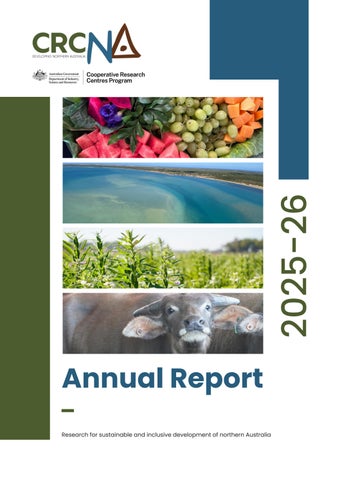
2025-26 Annual Report Research for sustainable and inclusive development of northern Australia
The Cooperative Research Centre for Developing Northern Australia recognises the continuing connection to Sea and Country of Australia’s First Nations People. We acknowledge the Traditional Custodians of the land and water on which our staff and researchers live and work, and pay our respects to their Elders past, present and emerging.
Table of Contents Foreword: Minister for Northern Australia
4
9 Years of impact
5
Chair’s report
8
CEO’s report
10
The year in review
12
How we operate
14
Research projects:
16
1. Sector and supply chain development
17
2. New and developing industries in northern
18
Australia 3. Industry-specific production and supply chain
22
innovation 4. Activating the First Nations Estate
23
5. Advancing health innovation for the north
26
6. Industry-focused education and training
30
7. Policy development and investment solutions
32
Connecting research, industry and communities
34
Membership
36
Sustaining northern research and development
38
Finance and governance
49
Acknowledgments The CRCNA is funded as part of the Australian Government ‘s Cooperative Research Centre Program. We acknowledge the support of our government partners: the Queensland Government, the Northern Territory Government, and the Government of Western Australia. We also thank our project participants and researchers who are developing northern Australia through their research activities and research outputs.
Disclaimer This CRCNA Annual Report 2025-26 summarises CRCNA research activities delivered through funding by the CRCNA. It is possible figures and project participants may change from the time this document was written and published in November 2026. This publication has been provided to intended recipients only. Permission from the CRCNA is required to share this publication with a wider audience. Image credits: CRCNA and/or CRCNA research project partners. Information about the CRCNA and our projects is available at www.crcna.com.au.
Foreword — Minister for Northern Australia The Hon Madeleine King MP Minister for Resources, Minister for Northern Australia I’m pleased to present the Cooperative Research Centre for Developing Northern Australia’s 2025–26 Annual Report. The CRCNA is unique in Australia. Rather than being focused on a particular industry, its remit is geographic, reflecting the distinct challenges and opportunities of northern Australia. The Australian Government values the CRCNA’s ability to bring together researchers,
industry, and local communities to solve problems particular to northern Australia. Whether it is supporting more productive and resilient farming systems, expanding access to healthcare through remote telehealth services, working with First Nations people to activate the Indigenous Estate, or developing new opportunities in tropical aquaculture, the CRCNA plays an important role in turning local knowledge and research into practical outcomes.
“The CRCNA plays an
important role in supporting
the Australian Government’s vision for a prosperous,
sustainable and resilient northern Australia.”
4
Cooperative Research Centre for Developing Northern Australia
This year’s Annual Report highlights a number of projects moving from the research phase into practical application. It is here that we see the CRCNA’s investments creating tangible returns. Earlier this year I toured the Berrimah Export Yards, which prepare cattle trucked in from across northern Australia for export to Indonesia and Southeast Asia. The visit highlighted the importance of northern Australia’s livestock industry and the opportunities to strengthen productivity and supply chains through research and innovation. Through its Cotton, Grains and Cattle program, the CRCNA is working with industry and research partners to develop integrated farming systems that bring cropping and cattle production together. This research is helping producers diversify their operations, improve productivity and make better use of locally grown grain, fodder and cottonseed to support northern beef production. It demonstrates how practical, industry-led research can strengthen regional economies and build more resilient industries. In health, the CRCNA has supported the development of a digital nutrition app, codesigned with First Nations communities to help people
living with chronic kidney disease make informed dietary choices. Approved for release through the Apple and Google app stores, the app demonstrates how research and technology can deliver culturally appropriate health information and support better outcomes for people living in the north. I acknowledge the ongoing contributions of the CRCNA in supporting the Australian Government’s vision for a prosperous, sustainable and resilient northern Australia. I congratulate the CRCNA Board, staff, researchers and industry partners on another year of progress and their continued commitment to delivering practical outcomes for northern communities. Annual Report 2025-26
5
9 years of impact Since 2017, the CRCNA has brought industry, researchers and communities together to turn northern Australia’s opportunities into practical outcomes. Nine years on, that work is helping diversify farming systems, establish tropical aquaculture industries, strengthen First Nations enterprises and bring health care closer to remote communities. It is also building the evidence needed to guide investment, improve policy and support sustainable development. Behind these outcomes are partnerships built over time, local knowledge and research grounded in the realities of the north.
6
Cooperative Research Centre for Developing Northern Australia
As projects mature, impact assessments and research
synthesis are capturing what this investment has made possible, creating a knowledge base that will continue to inform northern Australia’s development for years to come.
Purpose To invest in research that de-risks development and supports a resilient, sustainable and prosperous future for northern Australia.
Approach The CRCNA connects industry, researchers and communities to deliver practical results. Research grounded in northern priorities helps unlock investment, build skills, strengthen First Nations enterprise and improve community wellbeing.
Legacy Nine years of collaboration have built knowledge, capability and partnerships across the north. As research moves into practice, this foundation continues to support industry diversification, better health services and informed development decisions.
“The north’s opportunities continue to grow. CRCNA’s legacy is the knowledge and capability to help realise them.” Annual Report 2025-26
7
Chair’s Report A year of achievements and lasting impact across northern Australia. Northern Australia’s prosperity depends on turning opportunity into productive industries, stronger communities and better services. In 2025–26, CRCNA demonstrated how research grounded in northern conditions, local knowledge and trusted partnerships can help achieve these outcomes.
Dr Sheriden Morris Chair CRCNA 8
As we approach the final year of Commonwealth funding, our focus is on completing research commitments, supporting adoption and capturing the value of our investment. This report shows a portfolio moving into practical application, with benefits across agriculture, aquaculture, First Nations enterprise, water security and health.
Cooperative Research Centre for Developing Northern Australia
These achievements reflect collaboration across the north. Researchers, industry, governments and communities have worked together to address development barriers and build evidence for informed decisions. Our aquaculture partnerships demonstrate this approach, combining scientific expertise with industry experience and Traditional Owner knowledge to support emerging industries and First Nations participation in land and sea Country enterprises. These partnerships remain essential to northern progress. Improving social wellbeing remains central to northern development. Research into costeffective health service delivery developed practical tools for culturally appropriate digital nutrition, trauma-informed care and improved service models. These projects recognise that economic opportunity and community wellbeing are closely connected, and that progress must reflect the needs of the people who live here.
knowledge will be essential to sustaining its value. On behalf of the Board, I thank the Australian Government, our participants, research and industry partners, Traditional Owners and communities for their commitment. I also acknowledge CEO Anthony Curro, our former Chief Executive Operations Sarah Docherty, Chief Scientist Professor Allan Dale and the CRCNA team. Together, we have built a foundation for enduring impact, and our priority is to ensure it continues to serve northern Australia well.
Across the First Nations portfolio, partnerships are strengthening access to water, supporting enterprise development and placing cultural knowledge at the centre of planning. The recognition of Indigenous Connection’s work at the Resilient Australia Awards reflects the value of community-led approaches. Our impact assessments and research synthesis are bringing these achievements together, providing accessible evidence to inform policy, investment and future research. They reinforce a lesson: northern development requires sustained collaboration and the capability to apply knowledge over time. The challenges facing the north will continue beyond CRCNA’s funding term, including workforce shortages, climate pressures, biosecurity risks and supply chain constraints. The establishment of the Centre for Northern Australia offers a platform to build on this work, with future funding still to be determined. Maintaining access to CRCNA’s research and Annual Report 2025-26
9
CEO’s Report Turning Research into Lasting Impact In 2025–26, the CRCNA shifted its emphasis from generating research to ensuring its use. As projects reached completion, we translated findings into practical resources, industry capability and evidence for investment, policy and development across northern Australia. The Kimberley Cotton Gin opening in Kununurra in August 2025 demonstrated this connection. NAIF-supported infrastructure and CRCNA-supported research play
Anthony Curro CEO CRCNA 10
complementary roles. Local processing capacity, alongside research into tropical cropping, rotations and integrated cattle systems, supports agricultural diversification and stronger regional supply chains.
Cooperative Research Centre for Developing Northern Australia
Northern Australia’s distinct climatic, geographic, infrastructure and servicedelivery challenges require research grounded in local conditions. Working with industry and communities, and establishing clear adoption pathways, helps reduce risk and improve decisions. Research delivers greatest value when connected to its users. Across the portfolio, this principle is evident in three outcomes. • Capability built. Aquaculture research strengthened hatchery capability and supplied Blacklip Rock Oyster spat to First Nations sea farmers. Cropping projects strengthened extension networks, while First Nations partnerships supported commercial seafood production and water access. • Practical tools delivered. Cropping projects produced grower guidance, while health research developed tools and models for remote and culturally appropriate care. • Evidence for decisions. Water research informed catchment planning, while First Nations partnerships contributed to spatial planning and the application of cultural knowledge. Capturing the value of this work has become a major priority. Project Impact Statements and Research Synthesis reports highlight adoption, economic returns, capability, policy influence and further investment. Prepared for investors, government, industry and communities, these resources are available on our website,
extending research value beyond individual projects and CRCNA’s term. Retaining this knowledge will help partners apply findings over time and build on the investment already made here. Through to June 2027, our priorities are to complete commitments, maximise adoption, document impact and preserve access to nine years of knowledge, relationships and capability. Funding constraints mean some opportunities depend on arrangements beyond our control. The proposed Centre for Northern Australia offers a potential mechanism to continue connecting research with regional priorities. Future funding remains undetermined, but the need for enduring capability linking industry, communities, government and investment is clear. Our final funding year will focus on translating CRCNA’s substantial research investment into useful knowledge, stronger capability and enduring northern value. I thank Sarah Docherty and Dr Ian Biggs for their contributions and welcome Tahna Jackson and Robyn Dupuis. I acknowledge our staff’s commitment through delivery and transition, and thank our Board, the Australian Government, participants and research, industry and community partners for their continued support.
Annual Report 2025-26
11
The Year in Review Digital nutrition for kidney health A First Nations co-designed nutrition app approved for release through Apple and Google app stores.
New processing infrastructure in Kununurra marks a milestone for agricultural diversification and regional supply chains.
Cultural knowledge recognised through paid work
Supporting Traditional Owner water access
45 Cultural Knowledge Providers employed to inform water security engagement across eight remote communities.
Recognition for research storytelling Belinda Carlson won the 2025 Rural Media Communicators SA/NT Social Media Influencer Award for CRCNA’s Instagram tour highlighting northern research and industry partnerships.
First Nations leadership recognised
Indigenous Connection received Highly Commended at the 2025 Resilient Australia Awards for cultural knowledge-led disaster preparedness research. 12
Kimberley Cotton Gin opens
Cooperative Research Centre for Developing Northern Australia
Nine Cape York groups supported to apply for water licences, backed by 130 maps across 15 catchments.
Practical tools for Kimberley health services New alcohol and other drugs guidance and wellbeing resources developed to support everyday clinical care.
Opening pathways into aquaculture Setting Up for Success guide completed to help First Nations organisations assess aquaculture opportunities in northern WA.
Research translated into practical evidence
Project impact assessments and research syntheses published to inform industry, policy and investment decisions.
Remote health evidence reaches Parliament Telehealth Technician research presented to a Senate inquiry into rural, regional and remote Medicare access.
2.57 million oyster spat supplied Blacklip Rock Oyster spat delivered to First Nations sea farmers across the Northern Territory.
Black Jewfish reaches commercial-scale trial 1.8 million fertilised eggs supplied for the species’ first commercial-scale larval rearing trial.
Building tropical aquaculture expertise Layla Hadden received a 2025 Crawford Fund Student Award for specialist oyster and seaweed training in Tahiti.
International honour for telehealth leadership Professor Anthony Smith received an Honorary Doctorate of Medicine from the University of Southern Denmark.
Global recognition for water research
Honouring regional economic expertise
CQUniversity ranked seventh globally for SDG 6: Clean Water and Sanitation, with Water Security for Northern Australia a key contributing initiative.
Professor John Rolfe was appointed a Member of the Order of Australia for service to regional economic development as an economist and author. Annual Report 2025-26
13
How we operate CRCNA’s mission to develop northern Australia is ambitious in scale. By aligning research with key industry themes, we’re driving sustainable and inclusive growth where the region’s potential is greatest.
2
1
New and developing industries in northern Australia
Sector and supply chain development
Policy 7 development and investment solutions
6
Industryfocused education and training
Our Research Programs
Advancing health innovation for the north 5
14
Cooperative Research Centre for Developing Northern Australia
Industryspecific 3 production and supply chain innovation
Activating the First Nations Estate 4
Our Industry Themes Agriculture, Food and Aquaculture
Completed projects for 2025-26 In 2025–26, CRCNA’s research portfolio entered its final phase of delivery. Projects moved toward adoption, synthesis and final reporting ahead of the Commonwealth Funding Agreement ending on 30 June 2027. Across the portfolio, researchers and partners produced 59 enduser publications and delivered 46 presentations, 32 field days, 27 workshops and eight webinars.
First Nations-led Development
Projects completed for reporting purposes in 2025/26 A1.2021013 - Silvopastoral trials of commercial pine systems in Northern Queensland A.3.2021044 - Determining the impact of prawn viruses on farming of P.monodon in Australia AT.4.2223007 - Aboriginal Sea Company seafood industry development
Northern Health Service Delivery
AT.4.2223008 - Cultural Market System Development AT.4.2021001 - Tiwi Islands Maximising northern tropical forestry AHT.7.2324001 - Chief Scientist supporting research impact and transitional pathways for the CRCNA A.7.2122001 - Scaling Next Generation Water Markets in Northern Australia
Annual Report 2025-26
15
Our Research Programs
16
Cooperative Research Centre for Developing Northern Australia
Objective: Deliver an evidence base which prioritises sector, supply chain and infrastructure investment to provide timely access to high-value international and domestic markets.
1
Research program
Sector and supply chain development With all Program 1 projects completed in previous years, the focus in 2025–26 was on capturing their impact and bringing findings together for practical use. Research synthesis reports consolidate evidence on agricultural markets, supply chains, land use and infrastructure planning to inform investment, regional development and future research priorities. Further themes will be published as projects are completed. Across CRCNA’s research programs, projectlevel impact assessments draw on project data, partner input and stakeholder evidence to identify what has changed. They trace adoption and assess economic, social,
environmental and cultural benefits, including jobs, further investment and contributions to policy. One example is Co-Mapping on Country, led by Centrefarm Aboriginal Horticulture. Its impact assessment identified a return of 86 times CRCNA’s $263,868 investment. The project has since secured $19 million in capital expenditure to establish commercial-scale farming enterprises on Aboriginal land in the Northern Territory. Published assessments and synthesis reports are available at crcna.com.au/impacts.
Annual Report 2025-26
17
Objective: Grow and improve developing industries and assist the establishment of new industries in northern Australia.
2
Research program
New and developing industries in northern Australia Aquaculture
A.2.2122025 - Blacklip Rock Oyster industry development (oysters’ extension) A tropical oyster industry is taking shape across the Top End. Over the year the Darwin Aquaculture Centre produced 112.68 million fertilised eggs across two broodstock runs and supplied 2,572,441 spat to Indigenous Sea Farmers on the Tiwi Islands, in Wadeye, South Goulburn Island and Groote Eylandt. Refined broodstock and settlement methods delivered a repeatable, lower-input protocol suitable 18
Cooperative Research Centre for Developing Northern Australia
for industry adoption, even through wetseason disruption including Cyclone Fina. The Darwin Aquaculture Centre open day in April 2026 drew strong participation from industry, government, research and community stakeholders. A.2.2223018 - Black Jewfish: a new candidate for aquaculture in northern Australia Black Jewfish moved from research trial to industry-relevant production this year. A
dedicated spawn induction supplied 1.8 million fertilised eggs to Humpty Doo Barramundi which was the first commercial-scale larval rearing trial for the species, and first use of temperature-controlled spawning at the Darwin Aquaculture Centre. The project completed its light-intensity trial, Hatchery Manual and Market Report, with a final industry forum planned for August 2026.
Emerging crops and farming systems A.2.2122016 - Great Northern Spices Grower guides for fennel, kalonji and sesame were released this year, backed by winter trial results from Kununurra, Katherine and Emerald. Industry confidence is building: AgriVentis Technologies is progressing a 150-hectare commercial kalonji crop for 2026, and a free agronomic micro-credential has been accepted by CQUniversity for release as an industry training resource. A.2.2122014 - Novel agronomic practices for productive and profitable viticulture (table grapes) This viticulture project is laying the groundwork for a diversified, climate-resilient northern horticulture sector, benchmarking table grape productivity across simulated climates, trialling pheromone-based pest control in Broome, and now extending into asparagus. Two PhD candidates are progressing toward 2026 publication. A.2.2122015 - Ensuring best practice in the free range Buffalo supply chain Working with Traditional Owner partners at Ramingining, Bulman–Weemol and Gunbalanya, the project mapped the wildharvest buffalo supply chain from Arnhem Land to market and assessed economic scenarios, including emerging carbon and nature-repair opportunities. A three-day workshop series in Darwin in May, delivered through the CRCNA and Annual Report 2025-26
19
AgriFutures Australia collaboration, brought together industry, researchers, government and Traditional Owners to discuss progress in animal welfare, market access and population management. A reliable buffalo population survey emerged as a shared biosecurity priority, with coordination progressing through the Northern Territory and Australian governments.
Cotton, Grains, Cattle program Six linked projects across the Northern Territory, Queensland and Western Australia are building practical evidence for integrating cropping and cattle production. During 2025–26, field trials, feeding demonstrations and grower engagement advanced work on crop management, diversification, local feed supplies and environmental stewardship. Findings are being consolidated into guides, tools and case studies to support industry adoption. A.2.2122026 - Northern Territory cropping systems Cover crop, cotton nutrition, soil and pest research strengthened the evidence base for tropical dryland cropping. Despite flooding and crop losses at some sites, the team maintained trials, published a northern crop weeds field guide and engaged growers in environmental stewardship and planning for the industry’s future. The work supports better-informed crop management and development decisions. A.2.2122027 · Crops for Cattle, NT Feeding trials and virtual fencing demonstrations explored how cropping and livestock enterprises can work together. Three virtual fencing sites tested grazing management, including protecting an overgrazed area, managing access to a new water point and supporting strip grazing. Economic analysis is assessing the potential 20
Cooperative Research Centre for Developing Northern Australia
for crop-based feeding to improve cattle productivity and profitability, with final results being consolidated later in 2026. A.2.2122028 · Sustainable diversification of the Ord River Irrigation Area Completed field trials provided evidence on crop rotations and nitrogen management in the Ord. Results indicated that mungbean and chickpea rotations can improve nitrogen productivity, while nitrogen application timing influences cotton performance. Laboratory analysis and PhD research are progressing these findings toward publication and practical grower guidance. A.2.2122029 · Irrigated crop feed products for northern WA cattle Feeding trials demonstrated the potential of irrigated cropping outputs to support local cattle finishing. In a Kununurra trial, cottonseed-fed steers gained 0.77 kg per head per day, compared with 0.58 kg in the control treatment. Modelling indicates that feedlot finishing could bring cattle to market earlier and improve supply continuity, with the final economic assessment pending. A.2.2122030 · North Queensland Farming Systems Research across cotton protection, crop diversification, cattle feeding and wholefarm economics supported more integrated northern farming systems. The project released cotton climate information and management tools, completed an Environmental Stewardship Guide and advanced crop–livestock case studies. Final synthesis will help producers assess diversification options and their implications for productivity, resilience and profitability. A.2.2122031 · North Queensland cropping extension Locally based agronomic support, variety trials and seasonal advice helped growers assess cotton and other cropping options under challenging conditions. A rain-grown
trial at Forty Mile recorded 9.89 bales per hectare for one cotton variety, while a grower tour and field day attracted more than 80 participants. The project strengthened the network connecting local research with on-farm decisions.
CASE STUDY
Local support builds cropping confidence For North Queensland growers, cotton’s potential comes with practical challenges. Variable seasons, high production costs and limited local agronomic data make decisions about crop selection and management particularly important. The Cotton, Grains, Cattle program Enhancing Extension Capacity project combined multiseason variety trials with a locally based Extension and Development Agronomist. Field walks, farm visits and one-on-one advice helped growers interpret findings and assess cotton within rotations alongside grains, sugarcane and other crops. Weather stations and soil monitoring tools supported decisions throughout the season. The research highlighted the importance of drainage, planting timing and strong early
crop establishment. Well-drained fields consistently performed better following heavy rainfall, reinforcing the value of advice grounded in northern conditions. The project also built trusted connections between growers, advisers, researchers and industry. Despite difficult seasons, growers continued to grow or consider cotton within their farming systems, supported by better access to local evidence and practical guidance. The locally based agronomist role is continuing beyond the project, providing an enduring pathway for research to inform farm management and future cropping opportunities.
Annual Report 2025-26
21
Objective: Support the development and growth of established industries by identifying value-add opportunities, new markets, improving supply chains and enhancing productivity.
3
Research program
Industry-specific production and supply chain innovation All Program 3 projects were completed in prior reporting periods. In 2025-26, outcomes from projects including the Douglas Daly Sustainable Development Precincts planning framework and NextGeneration Resilient Orchard Production Systems (Jackfruit) continued to inform regional planning frameworks and industry practice, with final publications available at crcna.com.au.
22
Cooperative Research Centre for Developing Northern Australia
Objective: De-risk investment in First Nation-led enterprises and enhance the skills and capabilities of Aboriginal and Torres Strait Islander peoples.
4
Research program
Activating the First Nations Estate AT.4.2223007 - Unlocking the wealth of Indigenous knowledge and land ownership — seafood industry development (Aboriginal Sea Company) The CRCNA’s partnership with the Aboriginal Sea Company supported workforce development and market access for First Nations seafood enterprises. Practical training and mentoring helped two Wadeye community members gain or renew the qualifications needed to operate under the company’s commercial mud crab licence. A visit with Thamarrurr Sea Farmers demonstrated this work in practice, with a catch of A-grade mud crabs averaging
2.1 kg, pre-sold to the Darwin Fish Market. The catch highlighted the enterprise’s high-quality product and established market connection. Research also examined barriers to First Nations participation in the seafood industry and explored a mobile processing concept to support local jobs and market access. The final report, independently peer-reviewed by the Northern Territory Seafood Council, was completed in June 2026. AT.4.2223010 - Activating Indigenous Peoples Water Rights under the Cape York Water Plan The project supported nine Traditional Owner groups through the Cape York Land Council to Annual Report 2025-26
23
apply for water licences. It also delivered 130 maps across 15 catchments, clarifying licence ownership, constraints and development opportunities. A Water Manual, workshop, policy reform report and Indigenous enterprise case study provide practical resources to help groups exercise their water rights and assess future opportunities. AT.4.2223009 - Spatially enabled planning of the Indigenous estate (Groote Eylandt) The Anindilyakwa Land Council worked with research, government and industry partners to develop community-led mapping tools for the Groote Archipelago. Aerial imagery, detailed terrain data and story maps brought Anindilyakwa knowledge and cultural priorities into planning, with Traditional Owners guiding how information is collected and used. The datasets are already supporting infrastructure, cultural heritage and ranger activities, reducing duplication and costs. Coastal risk mapping also informs climate adaptation and disaster resilience. Stronger local capability and partnerships have helped attract a further $1.56 million in cash and in-kind support for projects within the Land Council’s Data Unit.
24
Cooperative Research Centre for Developing Northern Australia
AT.4.2021001 - Tiwi Islands - Maximising northern tropical forestry Tiwi Plantations Corporation has released the Tiwi Forestry Workforce Plan 2026–2030, mapping out roles, training pathways and career progression to grow local participation in the industry. Alongside it, a first-of-its-kind Tiwi Forestry Seasonal Calendar aligns work programs with Tiwi seasons and ecological knowledge, including when to burn, plant and manage the plantation. The timing is significant, with a major replanting phase now underway and a clear ambition to ensure the next generation of Tiwi people are ready to lead it.
CASE STUDY
Cultural knowledge shapes better services Services designed for urban settings can miss the realities of life on Country. Infrastructure constraints, cultural responsibilities and unsuitable processes can limit access to employment, education and essential services in remote communities. With CRCNA support, Indigenous Connection developed its Cultural Market Systems Development approach to understand these barriers. Combining community engagement, system mapping and a new Community Development Index, the research examines how services can better reflect local conditions and priorities. The approach was applied through work with the Northern Territory Government’s Remote Water Team across eight communities. Forty-five Cultural Knowledge Providers
were formally employed to help design and deliver surveys, workshops and drinking water security forums. Their language skills, local relationships and cultural knowledge helped government staff understand community concerns and navigate cultural governance. In Galiwin’ku, Cultural Knowledge Providers explained: “We feel responsible for water quality and safety, when the water comes from our Country.” The work demonstrated how fairly paid cultural knowledge can strengthen participation and improve service design. It provides a practical foundation for more effective investment and culturally informed relationships, with further research planned to develop and test the Community Development Index alongside communities.
Annual Report 2025-26
25
Objective: Improve health outcomes in northern Australia by strengthening healthseeking behaviours, early detection, access to mental health care and technology, and workforce capability in diagnosis and treatment.
5
Research program
Advancing health innovation for the north H.5.2223004 - Strengthening the Aboriginal and Torres Strait Islander health workforce Led by the Tropical Australian Academic Health Centre (TAAHC), the project supported health-service partners across northern Queensland to implement locally tailored workforce strategies. It completed its implementation phase and delivered a report on research literacy and implementation science, strengthening regional capability to undertake and apply research. Evaluation was underway at year’s end to capture the outcomes and inform future workforce development. 26
Cooperative Research Centre for Developing Northern Australia
H.5.2223005 - Attracting and retaining health workforce Working with Menzies School of Health Research and health-service partners, the project is identifying practical ways to reduce staff turnover and strengthen continuity of care. It examines what health workers value in remote employment and compares the costs and benefits of retention strategies to help services tailor their support. During 2025–26, the Catalyse Mentoring Program concluded with positive evaluation outcomes, while workforce preference research progressed toward publication.
Together, these activities are building evidence to guide recruitment, professional development and retention. The Top End Aboriginal Health Research Alliance (TEAHRA), supported through this work, also secured NHMRC Research Translation Centre funding to strengthen the application of research across Aboriginal Community Controlled Health Services. HT.5.2122005 - Towards trauma-informed primary health care across the Kimberley Aboriginal Community Controlled Health Services Working with Kimberley Aboriginal Medical Services (KAMS), the project developed practical resources to help staff respond to trauma and support patients’ social and emotional wellbeing. A new Alcohol and Other Drugs Clinical Guideline was made available through the MMEx clinical system and introduced through the KAMS Lead Clinicians Forum. A revised Social and Emotional Wellbeing Psychosocial Toolkit and separate implementation guide make the resources easier to apply in everyday care. Reflective supervision and Learning Lunch resources also supported staff skills and wellbeing. H.5.2223002 - Digital Nutrition model of care to improve Chronic Kidney Disease in northern Australia The project co-designed a digital nutrition app with First Nations communities to support people living with chronic kidney disease. Community workshops and clinical input shaped culturally appropriate nutrition information, with the app approved for release through the Apple and Google app stores. During 2025–26, the team published a research paper and prepared user testing to assess the app’s usability, acceptability and cultural safety. The work also supported emerging First Nations researchers and built Annual Report 2025-26
27
a foundation for evaluating digital nutrition support in community settings. H.5.2122004 · Tele-DFD diabetic foot care The project is testing remotely delivered diabetic foot care to assess its effectiveness and potential to improve access to treatment. By year’s end, 141 people had consented and 124 had been allocated to trial groups, reaching more than 87% of the recruitment target. The team was checking clinical data, surveys and interviews ahead of analysis. Findings will establish the model’s effects on patient care and costs. H.5.2223001 · Telehealth Technicians for remote communities The project trains local, non-clinical community members to support patients accessing health care through telehealth. This approach aims to build a local workforce that helps connect remote communities with clinicians. During 2025–26, partners progressed planning for a Community Wellness Clinic at Gawa and presented evidence to a Senate inquiry into rural, regional and remote Medicare access. Further trials and sustainable funding options were being explored to support implementation and assess the model’s contribution to access and continuity of care.
CASE STUDY
Student research in rural healthcare systems New research led by CRCNA-supported student, Sophie Macklin, is helping shape the future of healthcare delivery across rural and remote Australia. Sophie’s study explores how healthcare information flows between services and highlights the challenges clinicians face, with findings pointing to clear opportunities to strengthen care through better digital systems, infrastructure and workforce capability. 28
Cooperative Research Centre for Developing Northern Australia
This work forms part of the CRCNA’s Remote and Rural Health Service Delivery research program and demonstrates the value of investing in education to build capability across the north. Access the report at: crcna.com.au/news/student-researchhighlights-digital-gaps-in-rural-healthcaresystems/
Annual Report 2025-26
29
Objective: Increase technology development, skilled employees and R&D capacity within northern Australia.
6
Research program
Industry-focused education and training During 2025–26, CRCNA’s Education Program supported three PhD students and expanded access to research training. One First Nations student completed the Certificate in Research through CQUniversity, with a further five students enrolling during the year. Students contributed to CRCNA-supported research through field trials, hatchery research, modelling and analysis, building practical skills alongside industry partners. This included exploring cotton production waste as a substrate for growing mushrooms, linking research training with opportunities to add value to agricultural by-products.
30
Cooperative Research Centre for Developing Northern Australia
Across the broader research portfolio, 68 participants undertook structured professional training. Technical training and mentoring also supported growers, aquaculture operators, health professionals, researchers and Traditional Owners to apply research in their work. The Education Program is progressing towards completion in December 2026, with a focus on supporting remaining students and capturing its contribution to northern research capability.
CASE STUDY Connecting health workers across the north For rural and remote health workers, access to specialist advice and professional development can mean costly travel and time away from patients. Project ECHO brought that support closer through online learning, case discussions and peer mentoring. Delivered by the University of Queensland’s Centre for Online Health, its Health eMinds and Telehealth Skills programs built practical capability in mental health care and telehealth delivery.
return of 7.87 times CRCNA’s $590,000 investment, reflecting training efficiencies and potential primary care savings. The project demonstrated how virtual mentoring can strengthen skills and professional connections while helping clinicians support patients locally.
Across 2023–25, the program delivered 47 hours of clinical education to more than 1,500 participants. Among surveyed respondents, 69% reported feeling less professionally isolated. The impact assessment estimated a Annual Report 2025-26
31
Objective: De-risk investment in new, emerging, and established industries by identifying potential investors, policy barriers and solutions.
7
Research program
Policy development and investment solutions AHT.7.2324001 - Chief Scientist supporting research impact and transitional pathways for the CRCNA Led by Chief Scientist Professor Allan Dale, the project brought together CRCNA research findings and documented their impacts to inform policy, investment and future research priorities. Project Impact Statements and research synthesis reports translated completed research into accessible evidence for industry and government. The team also advanced infrastructure and environmental-offset policy work with the Office of Northern Australia and the Department of Climate Change, Energy, the Environment and Water. Continued co32
Cooperative Research Centre for Developing Northern Australia
chairing of the Cape York Infrastructure Package Taskforce contributed to securing $37.7 million for Stage 2 delivery. The project supported transition planning and concluded in 2025–26 with all milestones achieved. AT.7.2021023 - Northern Western Australian Aboriginal Commercial Fishing and Aquaculture The project completed Setting Up for Success, an aquaculture guide developed with Traditional Owner groups and industry across Western Australia. It helps Aboriginal businesses, Native Title holders and First Nations organisations assess opportunities, understand requirements and plan their involvement in aquaculture.
PROGRESS UPDATE
Water Security for Northern Australia Fifteen sub-projects across the Gilbert (Qld), Daly (NT), Ord (WA) and Fitzroy (Qld) catchments are building evidence to support water planning and sustainable agricultural development. Research combines groundwater-inclusive climate modelling, Traditional Owner-led remote sensing and wetland mapping, and assessments of water trading and governance. A whole-of-program workshop at James Cook University in May 2026 brought teams together to share findings and recommendations. Draft component reports underwent technical and stakeholder review, with final feedback being incorporated at year’s end. Final reporting will consolidate the findings into resources for more informed, place-based water and development decisions.
Small habitats play a vital role in freshwater resilience Within the Water Security for Northern Australia program’s Gilbert Catchment node, student researcher Mitchell Heide found that young red claw crayfish actively prefer vegetated habitats. These complex environments provide important refuge during vulnerable early life stages. As rivers contract during the dry season, maintaining these refuges becomes increasingly important. The findings strengthen understanding of freshwater habitat needs and help inform water management that supports resilient ecosystems across northern Australia. Access the report at: crcna.com.au/news/ new-research-highlights-importance-ofvegetation-for-freshwater-species-in-thenorth/
Annual Report 2025-26
33
Connecting research, industry and communities
CRCNA’s engagement during 2025–26 connected research with industry, government and community priorities. Conferences, field days and forums provided opportunities to share findings, strengthen partnerships and explore their application across northern Australia.
Developing Northern Australia Conference Cairns | 22–24 July 2025 More than 500 delegates attended the conference, which featured over 16 CRCNAsupported projects spanning health, First Nations enterprise, agriculture, supply chains and investment readiness. Professor Allan Dale chaired his final conference, bringing a longstanding contribution to northern research and development to a close in this role. Anthony Curro and Belinda Carlson continued to provide strategic support to the organisers and committee, including incoming 2026 Chair Craig Doyle. Kimberley Cotton Gin opening | August 2025 The opening of the Kununurra Cotton Gin marked an important milestone for agricultural diversification in the Ord. Local processing infrastructure supports the developing cotton industry and creates opportunities to strengthen regional supply chains. The occasion highlighted the connection between research, industry investment and the infrastructure needed to support new northern industries.
34
Cooperative Research Centre for Developing Northern Australia
Darwin Dialogue | April 2026 CEO Anthony Curro joined the Australian Strategic Policy Institute’s Darwin Dialogue to discuss northern Australia’s contribution to national resilience and economic security. Discussions explored domestic industry development, two-way investment, sovereign capability and resilient supply chains, alongside the international partnerships needed to address shared strategic challenges. Connecting across industries CRCNA also engaged with producers and researchers through the Northern Australia Beef Research Update Conference in Brisbane and the Douglas Daly Research Farm Field Day in the Northern Territory. Australia’s Great North Conference and the International Symposium on Tropical Fruits in Darwin provided further opportunities to connect research with regional development and horticultural priorities. Health-sector engagement included the Rural and Remote Health Scientific Symposium in Alice Springs and the Digital Health for the Bush forum in Darwin and online, supporting discussion on workforce capability, access to care and digital service delivery.
Annual Report 2025-26
35
Memberships
The CRCNA welcomes all parties with an interest in developing northern Australia to apply for membership. To learn more about CRCNA membership visit crcna.com.au. Current membership for 2025-26 includes:
Advance Cairns Limited AgDots AgriVentis Technologies Pty Ltd ArGyll Consulting Pty Ltd Australian Barramundi Farmers Association Australian Livestock Exporters’ Council Australian Prawn Farmers Association Inc. Australian Mango Industry Association Blueshift Consulting Burdekin-Bowen Integrated Floodplain Management Advisory Committee Inc Burnett Mary Regional Group for NRM Ltd Cairns Airport Pty Ltd Cattle Australia Pty Ltd Central Queensland University Centrefarm Aboriginal Horticulture Limited Charles Darwin University Consolidated Pastoral Company Cotton Seed Distributors Limited 36
Cooperative Research Centre for Developing Northern Australia
CR Eco-efficient Agriculture Consultancy David Larkin Diamond Star Australia Pty Ltd eMerge IT Solutions Pty Ltd Far North Queensland Ports Corporation Far North Regional Organisation of Councils Fitzroy Basin Association Inc Griffith University Greater Whitsunday Alliance Hewitt Cattle Australia Pty Ltd Hexcyl Systems Pty Ltd James Cook University Kimberley Pilbara Cattlemen’s Association Keep Farming Pty Ltd Manbulloo Limited Meat and Livestock Australia Ltd Menzies School of Health Research Mount Isa to Townsville Economic Development Zone
Murujuga Aboriginal Corporation North Australian Indigenous Land & Sea Management Alliance (NAILSMA) Northern Australia Crop Research Alliance Northern Gulf Resource Management Group NQ Regional Organisation of Councils NQ Dry Tropics NT Farmers Association Inc Northern Territory PHN Ornatas Pty Ltd OKR Pty Ltd T/A T.R.A.P Services Ord River District Co-operative Ltd (ORDCO) Pirrone Brothers Produce RDA-Mackay-Isaac-Whitsunday RDA Kimberley RDA Townsville and North West Queensland RDA Tropical North RELA Australia Pty Ltd
Selectability Ltd Sheriden Morris Simbani Research Pty Ltd Southern Gulf NRM Spatial Information Systems Research Limited Sugar Research Australia Ltd Synapse Medical Services Australia Pty Ltd The Trustee for Tiwi Plantations Corporation Trust The Australian Veterinary Association Ltd The University of Queensland Timber Queensland Limited Townsville Enterprise Limited University of Southern Queensland VisionFlex Pty Ltd
Annual Report 2025-26
37
Sustaining northern research and development As CRCNA approaches the conclusion of Commonwealth funding on 30 June 2027, its priority is to ensure nine years of research, partnerships and investment continue to deliver value for northern Australia. During 2025–26, transition work focused on completing research commitments, documenting impacts and keeping findings accessible to industry, communities and policymakers. Supporting adoption and retaining this knowledge will help extend the benefits beyond individual projects.
38
Cooperative Research Centre for Developing Northern Australia
The Centre for Northern Australia (CNA) is being established as a separate, independent not-for-profit organisation to support future research, extension and knowledge translation across the north. Future funding remains to be determined. CRCNA’s research outputs and knowledge resources will be managed to preserve their value and maintain public access, supporting ongoing learning, adoption and informed decision-making.
Finance and governance Annual Report 2025-26
39
Investment impact The CRCNA brings industry, researchers, governments and communities together to support northern Australia’s development. The following snapshot shows the investment, partnerships and outcomes of our research, development and extension activities.
$155.2 million
9%
Partner contributions funds
5%
Third Party funds
leveraged from $75 million federal investment
109
Research projects supported
657
FTE from CRCNA projects over 10 years
$2.89
million, in capacity building through education program
CRCNA active projects
50%
In-kind contributions
36%
Commonwealth funds
CRCNA timeline of operation
80 70 60 50 40
2017
30 20
90% 2026
10 0
Jun Sep Dec Mar Jun Sep Dec Mar Jun Sep Dec Mar Jun Sep Dec Mar Jun 2023 2024 2025 2026 2027
Stakeholder reach The CRCNA works with over 272 project partners to drive outcomes and overcome barriers to development through collaborative research
40
First Nations
Industry
Economic Development
Land Owners
Developers
Governments
Universities
Research Institutes
Environmental
Science
Cooperative Research Centre for Developing Northern Australia
2027
Financial statements
To read the CRCNA’s full financial statements please visit: crcna.com.au/publications/.
Governance The CRCNA governance is led by a board of directors from across northern Australia. Together they bring a wealth of business acumen and networks for strategic decision making to ensure our future is collaborative, considered and planned. The Risk and Finance Audit (RAF) Committee provides a consultative forum which make
recommendations to the CRCNA Board on the appointment of the auditor, CRCNA’s budget allocations, performance and financial benchmarks and other financial matters as required. From February 2026 the RAF Committee was absorbed back into the main CRCNA Board meetings.
Board Members
Sheriden Morris Chair
Dr Rebecca Mohr-Bell
John Wharton AM Deputy Chair
Brendon Douglas Chair of the RAF
Duane Fraser Board Member
Peter Long Board Member
Dr Scott Davis Board Member
Margaret Marty Company Secretary Annual Report 2025-26
41
Board member attendance table 2025-26 Meeting date and number Position
Name
22 21 23 20 4 17 14 JUL AUG OCT NOV DEC MAR MAY 2025 2025 2025 2025 2025 2026 2026 #50
Chair
Sheriden Morris
Deputy Chair
John Wharton
Board Member
Peter Long
Board Member
Rebecca Mohr-Bell
Board Member
Brendon Douglas
Board Member
Scott Davis
Board Member
Duane Fraser
#51
#52
#53
#54
#55
Part
Part
#56
Part
RAF Committee attendance table 2025-26 Meeting date and number Position
42
Name
Chair
Sheriden Morris
Board Member
Peter Long
Board Member
Rebecca Mohr-Bell
Independent Committee Member
Luke Guazzo
Cooperative Research Centre for Developing Northern Australia
07 AUG 2025
20 OCT 2025
13 NOV 2025
12 FEB 2026
#29
#30
#31
#32
@CRC_northernaustralia | crcna.com.au Gurambilbarra Country, Wulgurukaba and Thul Garrie Waja Country, Bindal Suite 5/ 281 Ross River Road Townsville Qld 2026