SPONSORED CONTENT
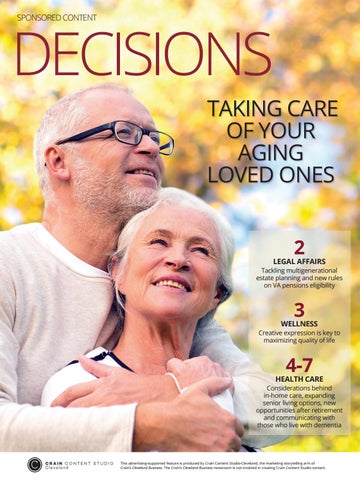
DECISIONS TAKING CARE OF YOUR AGING LOVED ONES 2
LEGAL AFFAIRS
Tackling multigenerational estate planning and new rules on VA pensions eligibility
3
WELLNESS
Creative expression is key to maximizing quality of life
4-7
HEALTH CARE
Considerations behind in-home care, expanding senior living options, new opportunities after retirement and communicating with those who live with dementia
This advertising-supported feature is produced by Crain Content Studio-Cleveland, the marketing storytelling arm of Crain’s Cleveland Business. The Crain’s Cleveland Business newsroom is not involved in creating Crain Content Studio content.
DECISIONS v5.indd 1
3/19/19 12:54 PM
DECISIONS LEGAL
SPONSORED CONTENT S2 • MARCH 25, 2019
Multigenerational estate planning considerations By VINCE GUERRIERI In the years prior to 2001, Arthur Gibbs of Wickens Herzer Panza said he worked with a lot of clients who were interested in estate planning. At the turn of the 21st century, the exemption for the federal estate tax was $675,000, while the exemption for the generation-skipping transfer tax was about $1.03 million. Now, the tax burden for inheritances is far less, with both the federal estate tax and generation-skipping transfer tax exemptions at slightly over $11 million for singles. But that’s no reason to neglect estate planning, said Gibbs, the chair of the Avon firm’s estate planning, probate and elder law department. “This is a marvelous time for people with modest wealth to plan because of the high exemptions, and to have them protected in the
DID YOU KNOW? The federal estate tax applies to the transfer of property at death. The generation-skipping transfer tax is an additional tax on a transfer of property that skips a generation, and thus not subject to the estate tax. future for when the tax laws change,” Gibbs said. The Tax Cuts and Jobs Act signed into law by President Donald Trump in 2018 will sunset in 2025, potentially bringing the estate tax exemption down to historically lower levels, likely around $6 million, Gibbs says. There are two main categories when considering estate plans, Gibbs says: The continuation of a family business and the distri-
bution of assets, which can be everything from real estate to cash to securities. And each of them introduces its own set of issues. One of the considerations involved with distribution of assets is the protection of assets. If a child or grandchild gets into a bad marriage, there’s an option for a trust that the child can administer, but not the spouse. Or, if the heir is in a profession that can get potentially litigious, or is in debt, a trust can be established with a third party to administer, keeping the trust untouched by creditors. “It’s not just filing forms at the probate court or drafting agreements for a trust,” Gibbs said. “Clients who have acquired wealth have been so focused on that that they don’t know how to give it away.” With family businesses, the goal is to keep the business running — with or without the family.
“The real wrinkle with family business is how you get the next generation involved,” he said. “Do they have an interest? That’s only half the equation. The other half is if they have the capacity and skill set? It might not be the right fit. And then, how do you make the kids whole who aren’t in the business? It’s a question of equal vs. equitable. There’s a lot more planning that needs to be done for a family business.” There’s no hard and fast formula for who should sell a family business and who should keep it. Before any planning is initiated, an individual should consult with his or her attorney, the family business accountant and the family financial adviser. “Legal, accounting and financial are the three key components,” Gibbs said. “And all the advisers bring value to the table when they work together.”
New rules impact veterans’ pension eligibility By VINCE GUERRIERI Last October, new rules went into effect for determining veteran and spousal eligibility of VA pensions – a change that was long coming, said Allison McMeechan, a lawyer specializing in Veterans Administration benefits for Reminger, a Cleveland-based law firm. “This is a pretty big overhaul, and it’s been in the making for quite some time,” said McMeechan, a shareholder and chair of the firm’s elder law and special needs planning group. Compensation benefits for combat-in-
jured veterans are unchanged. The biggest change is to pension benefits available to veterans or surviving spouses of limited resources and/or income. To be eligible for the pension, the claimant would have to have a net worth no greater than $127,061. “Now there’s a more bright line asset test,” she said. “Before it was a net-worth tool, but the test was if the assets would be exhausted paying for medical care.” Net worth does not include a home with up to 2 acres of property, family vehicles, personal effects on a regular basis and prepaid funeral and burial lots. That last part is key, McMeechan said. If
someone’s going to apply for VA pension benefits, she advises them to consider pre-paying for a funeral, make any purchases they might have been holding off on or engage in home improvements. “We tell people to reduce assets,” she said. “There are certainly those kinds of spenddown items.” The other major change is a three-year “look-back period,” which is something that had been under consideration for years, McMeechan said. “Before the rules went into effect, people were able to make transfers of assets to children or other family members,” she said.
“Now they can’t do that. If I apply for the veterans pension tomorrow, they’re going to ask if I’ve given away or transferred benefits going back three years that might make me ineligible for a pension.” Any planning should take into consideration the gifts of any assets, and asset spenddown should be taken into account when determining whether a veteran or surviving spouse is eligible for the pension. “Planning for VA benefits is very different than general benefits or end-of-life planning,” she said. “In most cases, we’re looking at how we’re going to get an aged or injured veteran medical expenses.”
Managing editor, custom and special projects: Amy Ann Stoessel, astoessel@crain.com Project editor: Kathy Ames Carr Reporters: Judy Stringer and Vince Guerrieri Graphic designer: Scott Goldman
For more information about custom publishing opportunities, please contact Amy Ann Stoessel.
LITIGATION
TRANSACTIONAL
By V
T beg B be r will ticu the ty y ove 12.7 ject mill can to t Agin mor aver prec tion F mer mig bark ed t nes laun But gate unt F half grow ther mig as a “T wou min al h not Step CEO note fast onto to h risk dise dem
ESTATE/PROBATE
Protecting those you love, and providing peace of mind.
h
T c f c i f
-Allison M. McMeechan Reminger Co., LPA Chair, Elder Law & Special Needs Planning
101 W. Prospect Avenue, Suite 1400 Cleveland, OH 44115 216.687.1311 www.Reminger.com AKRON CINCINNATI CLEVELAND COLUMBUS SANDUSKY TOLEDO YOUNGSTOWN INDIANAPOLIS FT. WAYNE NW INDIANA EVANSVILLE FT. MITCHELL LEXINGTON LOUISVILLE
DECISIONS v5.indd 2
“
3/19/19 12:54 PM
ss is ed,” hat’s is if ight you usible. o be
who ould , an r atand
the d all hen
vetask goin-
derndhen ving
rent anking ured
DECISIONS WELLNESS
SPONSORED CONTENT MARCH 25, 2019 • S3
THE ART OF AGING
Creative expression, engagement key to living with purpose By VINCE GUERRIERI There’s an old song that says life begins at 40. But as America ages, what used to be regarded as the “golden years” will remain a time for activity, particularly since the aging cohort is the baby boomer generation. Twenty years ago, the number of people over age 65 totaled 34.5 million, or 12.7% of the population. It’s projected that by 2030, more than 70 million people — or 28% of Americans— will be 65 or older, according to the National Center for Creative Aging. This aging population is more educated and wealthier on average than the generations that preceded it, according to the national nonprofit organization. For some people, what was formerly considered retirement age might be the opportunity to embark on another career (it’s estimated that almost a third of small businesses started last year were launched by people over age 50). But retirement can also provide a gateway into artistic hobbies or volunteer work. For the better part of the last half-century, volunteering has grown among the elderly. While there’s no real consensus why, it might be as much self-preservation as altruism. “There’s a body of research that would suggest a significant determinant of life satisfaction and actual health is strongly influenced by not being socially isolated,” said Stephanie FallCreek, president and CEO of Fairhill Partners. FallCreek noted that social isolation is a fast-growing research field in gerontology, and studies have linked it to higher blood pressure, a greater risk of heart disease and infectious diseases, and the earlier onset of dementia.
“Art is also a good way to engage with students or children. I definitely think it has therapeutic value for the seniors.” Ashlee Williman, director, Paul W. Alandt Lakeshore Rose Center for Aging Well “There’s also a pretty big chunk of research that indicates health itself is affected by these types of activities. (Social engagement) helps with depression and quality of sleep, among others,” she said. “The benefits are especially enhanced for people who volunteer.” Fairhill Partners, on Cleveland’s East Side, is a clearinghouse of activities, with a multipurpose nonprofit center that provides its own programs, from exercise classes to self management. “All the programs are designed to be best delivered by peer facilitators, either by people who are experiencing those circumstances or caring for someone with comparable conditions,” FallCreek said. The programs are designed to be administered peer to peer, FallCreek said, because Fairhill’s core components to successful aging include having dynamic relationships, either long-standing or newly formed, and having a purpose in life — both of which can be achieved through peer activities. Additionally, the center offers volunteer opportunities for senior citizens of all walks of life, from people on a fixed income who can’t support a lot of philanthropic endeavors to people who might be more well-heeled and want to give back to their community. “Our programs involve older adults giving back and getting back, and I think most of them would put it that way,” she said. “We’re more like an urban senior center, but
help is just a phone call away Telephone-based care coaching for people with chronic health issues and their family caregivers.
To get started, call 216.216.373.1797 benrose.org/services
people don’t come to play bingo.” In addition to its own services, Fairhill leases space to about 35 other entities, such as Ohio State University Extension, which teaches both ornamental and vegetable gardening, and Progress with Chess, which helps seniors retain their mental acuity. “It’s a potpourri of activities,” FallCreek said. “I wouldn’t say it’s a one-stop shop, but it offers that broad range.” CENTER STAGE Studies have shown that engagement in artistic activities is beneficial to an individual’s well-being, particularly to senior citizens. The social bonds are helpful, and the activities themselves provide the kind of brain activity that can stave off dementia. That’s why the Benjamin Rose Institute on Aging offers a variety of
artistic programming in its seven senior centers throughout the Cleveland area, from painting, music and ceramics to things that might not be thought of as art, like gardening or knitting. In fact, the Benjamin Rose Institute on Aging has partnered with other aging and arts organizations throughout the region to establish the Northeast Ohio Center for Creative Aging, one of 14 centers for creative aging in the U.S. and the only one in Ohio. “We want people to participate in art without being intimidated in art,” said Ashlee Williman, director of the Paul W. Alandt Lakeshore Rose Center for Aging Well located in Cleveland’s Collinwood neighborhood. “Sometimes it’s just getting initially engaged in activities and getting out of your comfort zone,” she said. “People become engaged and committed in those activities, and there’s really a sense of pride.” The centers offer a daily hot meal for senior citizens, and other various activities, from tax preparation help to group discussions. “Each center is unique, but we all have a lot of core similarities in programming,” Williman said. The Lakeshore center, not far from where Euclid Beach Park used
to be, offers a natural conversation prompt. “We love to provide opportunities for them to reminisce about Euclid Beach or in general,” she said. The Rose centers also offer a musical theater project. “We want to offer programming to people who think a senior center might not be for them,” Williman said. Seniors engage with students at local schools. Lakeshore center connects with students at the Lakeshore Intergenerational School, while the James Woods center in Ohio City works with students from nearby St. Ignatius High School, reading and rehearsing musicals. “Both the students and seniors look forward to it,” Williman said. “Intergenerational programming has always existed, but we’ve really expanded on it. It’s a chance for seniors and students to share their stories and work with one another. “Art is also a good way to engage with students or children. I definitely think it has therapeutic value for the seniors,” she said. “Particularly for those who can’t express themselves in words, the arts are a great way to express themselves. And once you get a taste of art, you’re more apt to expand.” The senior centers have even worked together to create their own talent show. Last year’s inaugural event featured poetry, music and even a drum circle. They plan to do it again this fall, too. “We’d like to make it an annual tradition,” Williman said.
Meet the challenges of caregiving Caregiving can be difficult. It can be joyful, too. Building Better Caregivers, a workshop developed at Stanford University which meets 2.5 hours once a week for six weeks, can help you. Based on the experiences of thousands of caregivers, this evidence-based program can show you how to care for yourself as well as your loved one, and will open your eyes to the rewards of caregiving, as well as the challenges.
For more information, including class locations and dates, contact: Dr. Stephanie FallCreek Fairhill Partners 12200 Fairhill Rd. Cleveland, Ohio 44120 216-421-1350 ext. 111 sfallcreek@fairhillpartners.org
“BRI Care Consultation” [and design] is a service mark of the Benjamin Rose Institute on Aging.
DECISIONS v5.indd 3
3/19/19 12:54 PM
A is It By
may repe pret A imp how to c und be e • beh You The mes • kno wha you • vali com • unc beh lose pro mot exer bac thos witn • ente ofte each as a pers This pain • wha Wan bath from to c thin A whe brea imp well effe mas with orga the dem B and diffe of c F thos plea
You don’t have to do this alone. Caring for someone with dementia isn’t easy. Hospice of the Western Reserve is here to help. With expertise in palliative and hospice care, we focus on alleviating symptoms while training caregivers on techniques to make life easier – for everyone. Choosing to contact us isn’t about giving up, it’s about taking control and making the most of your days together. We are privileged to have served Northern Ohio families for over 40 years and are committed to remaining the region’s hospice of choice.
Call or visit hospicewr.org today.
Insist on
Car at H Lora trai
800.707.8922 |
DECISIONS v5.indd 4
hospicewr.org
3/19/19 12:54 PM
DECISIONS HEALTH CARE
SPONSORED CONTENT MARCH 25, 2019 • S5
A behavior is not a problem. It’s a message.
At-home providers bring the care seniors need to their doorstep
By CAROLE KLINGLER
By JUDY STRINGER
The physical changes that occur in the brains of people living with dementia impact their ability to process information. As a result, they sometimes respond with puzzling behaviors. A loved one may become anxious or aggressive, repeating certain questions or misinterpreting what he or she hears. Although the disease makes it impossible for a loved one to change how he or she responds, rethinking how to communicate and analyzing the underlying reasons for the behavior can be effective strategies. • The first step is understanding that behaviors may not mean what you think. Your loved one is not trying to be difficult. The behavior isn’t a problem. It’s a message. • Ask questions. Don’t assume you know what the behavior means. Ask who, what, when and where to get to the need your loved one is trying to express. • Express your desire to help. This helps validate feelings and promotes a sense of comfort. • Consider the person’s history to help uncover the true meaning behind their behavior. People living with dementia lose the ability to call on memories to problem solve. Once upon a time, your mother may have used stretching, exercising, heat or ice to address her low back pain. Today, she is unable to recall those coping strategies, so instead, you witness a behavior. • Rather than focus on the behavior, enter her reality. Aggressive behaviors are often a way to communicate pain. View each situation and the resulting behavior as a clue. Is your mother hitting the person who is trying to help her stand up? This may be her way of communicating pain. • Regardless of the behavior, consider what the underlying message might be. Wandering may indicate a need to find a bathroom or a sign of missing a loved one from years past. Hoarding may be a way to compensate for forgetting where things belong. At Hospice of the Western Reserve, when we are managing pain, shortness of breath and anxiety, challenging behaviors improve. Sometimes, these causes are well-managed with medications. Other effective tools include art, music or massage. We are currently collaborating with health care providers, community organizations and caregivers to improve the quality of life for people living with dementia. By understanding what dementia is and how it affects people, we can make a difference throughout the full continuum of care. For more information on caring for those living with advanced dementia, please call 216-383-2222.
There’s a good reason why sayings like “Home is where the heart is” and “There’s no place like home” ring true. For many of us, home equates to family, security and comfort. That does not change as we grow older, said AARP Ohio spokeswoman Michelle Shirer. “In every survey we give to our members and our member’s demographic age group, the overwhelming majority want to stay at home where they can be in their community for as long as possible and where they can live as independently as long as possible,” Shirer said. Yet, aging at home is not without its challenges. A senior with advancing Alzheimer’s or dementia could forget to take medication, for example, or turn off the stove. Diminished mobility and agility increases the risk of falls and fractures and makes everyday chores difficult or dangerous. And, seniors who live alone often experience feelings of isolation and depression. Enter home-based senior care: a win-win for the older adults who want to remain at home and for the caregivers who worry about leaving them there. Broadly speaking, in-home care falls into two categories: home care and home health care. Home care is targeted at older adults who are experiencing difficulty with household activities such as driving, bathing, cooking and cleaning, according to Lisa Kristosik, president of the Visiting Nurse Association of Ohio. Caregivers are typically trained to assist seniors with daily activities and keep them safe and comfortable, but they are not necessarily medically certified. Home health care, on the other hand, is for older adults who need skilled medical services, such as the management of IVs or catheters or extensive wound care. These services are prescribed by a physician and administered by a team of medical professionals, which often includes a registered nurse, a social worker, physical or occupational therapist and a home health aide. “The typical home health care patient usually has some functional disabilities — maybe they are really weak from being in the hospital and not quite able to move around their home safely or drive,” Kristosik said. “One of the most important factors in qualifying for skilled home care under Medicare is being homebound.” Another big difference between the two types of in-home care is who pays for it. While federal programs like Medicare and Medicaid differ from state to state, Medi-
Carole Klingler, RN, BSN, is team leader at Hospice of the Western Reserve’s Lorain County Office as well as a master trainer for Dementia Friends Ohio.
DECISIONS v5.indd 5
Kristosik
Bartel
care typically covers medically necessary home health care, Shirer said, but will not pay for services like housekeeping. Seniors or their families are the primary payers of home care. Shirer said, however, program changes are underway that may extend government program coverage for more services that fall under the home care umbrella, particularly for seniors who qualify for Medicaid. “There is not a lot of information available at this time,” she said. “We just know in general it is something they are negotiating.” SPECIALTY IN-HOME CARE Hospice and palliative care are two specialized areas of home health care, which also both support the family caregiver as well as the patient, said Judy Bartel, chief clinical officer of Hospice of the Western Reserve. While most Americans tend to think of this kind of “hospice” as a place – that patients have to go somewhere to receive it – hospice care can be provided in a person’s own home for those who have a medical prognosis of six months or less, she said. “While we do have three inpatient care facilities when acute symptom management is needed, the majority of hospice care we provide is in the person’s own home or wherever a person calls home, whether that’s a private residence, nursing facility or assisted living community,” Bartel said. In-home hospice services involve a team of providers, orchestrated by a nurse practitioner or registered nurse who acts as case manager. In addition to making sure the patient is comfortable and in as little physical discomfort as possible, capable hospice caretakers are trained to ease the patient’s journey spiritually and prepare friends and family for the loss of a loved one, she said. Palliative care patients are suffering from serious, often life-threatening chronic illnesses — such as advanced chronic obstructive pulmonary disease and heart disease or renal failure — but, unlike hospice patients, they are still undergoing treatment. In these cases, caregivers are deployed to help patients manage their symptoms, maintain independence and avoid unnecessary
PHOTO PROVIDED BY HOSPICE OF THE WESTERN RESERVE
A home care nurse provides hospice care for a patient.
trips to the emergency room, Bartel said. “It’s a 24/7 extra level of security for very sick people,” she said. “If your mom has COPD, for instance, and she’s coughing uncontrollably in the middle of the night, we can send out a nurse as opposed to you taking her to the ER. We do an awful lot of triaging at the home.” Kristosik added that palliative care patients often have severe mobility issues and may even be homebound. The at-home service model “relieves the stress of getting them to a physician or an office visit,” she said. WHEN IS IT TIME? According to the AARP, there are several signs that indicate an aging loved one may need additional support in the home: • Losing interest in meals. Be cognizant of weight loss/gain or changes in eating habits, such as eating more junk or processed foods. Check the fridge and cup-
boards for expired or rotten food. Take note if new groceries go untouched. • Piles of paperwork. Is mail piling up? Are bills going unpaid? • Declining personal hygiene. Has your loved stopped bathing? Is he or she wearing dirty clothes when you come to visit? • Scorched pots and pans. This is a telltale sign pots and pans have been left on the stove, either due to distractions or because they’ve forgotten to take them off after cooking. • Becoming isolated. Has your normally social loved one missed multiple social engagements? Also take note of full mailboxes or unattended gardens, as this could mean limited trips outside the home. If you’re unsure, call a local care provider. Bartel said services like Hospice of the Western Reserve are a great resource of information. “There is likely someone in our agency that can help you sort it out,” she said.
Resource Center Aging & Disability Resource Center is the starting point for information, assistance, options counseling and benefits screening Family Caregiver Support Program Information, respite, counseling and other services
Call for information 216.621.0303 or 800.626.7277
Serving Cuyahoga, Geauga, Lake, Lorain and Medina Counties Learn more at AREAAGINGSOLUTIONS.ORG
3/19/19 12:55 PM
DECISIONS HEALTH CARE
SPONSORED CONTENT S6 • MARCH 25, 2019
Senior living options expand to meet medical needs By JUDY STRINGER With a whopping 10,000 baby boomers turning 65 every day — a phenomenon that is expected to continue into the 2030s, according to the AARP — senior living operators are preparing for an influx of newcomers by expanding their offerings. The landscape once dominated by nursing homes now includes a more diverse set of options.
“When it comes to senior living and care, consumers have more choices than ever,” said Jean Thompson, executive director of Ohio Assisted Living Association, a Columbus-based nonprofit. “It’s important, however, to understand what types of options are available and what those options can provide.” At one end of the housing and health care spectrum is independent living, according to Andy
Ohman, administrator at Briar Hill Health Care. Along with his brother George, administrator of Holly Hill Health Care Residence, Andy oversees the Hill family of senior residences in Geauga County. Broadly speaking, independent living includes any housing designed exclusively for seniors, such as retirement communities, retirement homes, senior housing and senior apartments. Typically, there
are minimal home and yard maintenance requirements in independent living settings, which Andy said is a big draw for aging adults who find household management difficult. Another draw is socialization, given the proximity to other seniors. Independent living may also include amenities like meal services or bus transportation, depending on the community. Assisted living is one step beyond
We are Called to Serve Those Who are Entrusted to Us Introducing Ohman Family Living To patients, residents, families, and healthcare partners we serve, In 1965, our parents, George and Joan Ohman, answered a calling to care for others. Fueled by that calling and their love for others, the Ohmans founded Holly Hill, a nine-bed long-term-care residence in Middlefield, Ohio. One of Holly Hill’s first residents was our father’s brother Bill, who was diagnosed with multiple sclerosis. Treating residents as family goes back to our very beginning. Fifty-five years and three generations later, we have grown into three exceptional campuses of care. We now form the largest post-acute healthcare and senior living provider in Geauga County. Recognizing that our family-owned, family-managed status is a rarity for a healthcare system, we believed it was time to operate under a name that better told our unique story. Today, we proudly introduce to you Ohman Family Living, a new yet familiar name that distinguishes our 5-star continuous care and rehabilitation communities, formerly known as Holly Hill, Briar Hill, and Blossom Hill. Our new name reaffirms our family-run operation for years to come, guided by our value of the supremacy of love and its power to elevate compassion and the quality of life of those entrusted to us. By uniting our facilities and at-home care services under our family name, we more accurately represent the wellconnected, post-acute healthcare system we have become. All our skills and attention are available to every patient and healthcare partner, thus offering a diversity of medical specializations and a seamlessly integrated continuum of care. We are also happy to announce major investments in our Ohman Family Living communities at Holly and Briar. As we move forward and grow under our new brand, be assured that the ownership and team leadership will always remain readily accessible to the patients, families, and healthcare partners we serve. We hope our family promise will give you added reason to consider us when seeking a caring place for your loved ones. We look forward to telling you more about the ways we are continuously improving our quality of care for those who need it most. Let one of our Ohman Family Living members give you a tour of all we offer, answer any of your questions, and most importantly, ease your mind.
Sincerely, The Ohman family
www.OhmanFamilyLiving.com
13422-3 HILL_Ohman_B2C_8.125x10_Crains.indd 1
JOB NUMBER & COMPONENT
3/4/19 4:51 PM
Prepared by:
13422-3 HILL_Ohman_B2C_8.125x10_Crains PUBLICATION or MEDIUM
DECISIONS v5.indd 6
CRAINS CLEVELAND BUSINESS INSERTION DATE
independent living, Thompson said, offering an option for adults who require assistance with daily activities, such as bathing or eating, or have limited mobility. Unlike independent living, assisted living facilities are regulated by the state of Ohio and have a 24-hour staff. Assisted living residents can suffer from chronic conditions or illnesses, like diabetes or chronic heart failure; however, the state limits the level of skilled care that assisted living facilities can provide, Thompson said. If the condition fluctuates so much it requires 24hour monitoring or if a senior requires more than eight hours of skilled care per day, for example, he or she must be placed in a nursing home or skilled nursing facility. At a skilled nursing facility, a physician supervises each resident’s care, and a nurse or other medical professional is almost always on premise. Many times, they also have physical and occupational therapists on staff. Post-acute care and memory care are specialized practices offered inside a nursing home or as a standalone skilled care facility. In post-acute settings, the goal is “to help people get home as quickly as possible and as safely as possible” following a surgery or accident, George said. A medical doctor or a nurse practitioner is involved in the patient’s care. And, seniors recovering in a post-acute unit receive needed therapies five to seven days a week — for two to three hours at a time — compared to people who recover at home, at which a therapist typically visits three times a week for about 45 minutes each time. The goal in memory care, meanwhile, is to keep patients safe and provide activities to help slow the advance of dementia. “They still may be able to walk and feed themselves, but they are typically not safe to be left alone,” he said. “Victims of dementia tend to wander, so they need to be kept in a safe environment.” Not so long ago, “aging in place” was a phrase reserved exclusively for seniors who chose to continue living independently or semi-independently in their own home, as opposed to moving into a nursing home. Today, however, as senior living operators enhance their campuses to provide a continuum of care that can meet the needs of patients as they age, aging in place is taking on new meaning. A popular senior living model is for adults at or near retirement to move into an independent living unit — a home, apartment or condo — on a larger campus that also includes assisted living and skilled nursing components, she said. Residents transition from one living situation to the next as the need arises. Andy said the model has a few big benefits, the first of which is onsite therapy and other services that can help seniors get back on their feet quickly after an injury or hospital stay. The second is the avoidance of disruptive moves or hasty transitions for patients who may already be frail or vulnerable. “Once they make a home with us, they build familiarity with their surroundings,” he said.
1370 W 6th St, 3rd floor Cleveland, OH 44113 216.574.9100
CREATIVE DEPARTMENT Client: HILL GROUP HEALTHCARE Division: HILL GROUP Project: B2C Ad Flat Size: 0” x 0” Trim Size: 8.125” x 10” Live Area: 0” x 0” Bleed: 0” x 0” Line Screen: 133
Approval Copywriter
Initials
Date
AEs DELIVERABLES: Laser
CD - Copy
Comp
Designer/AD
CD - Design
PDF (No Slug)
Quality
JPG
3/19/19 12:55 PM
F By
A his not an i yea In carr ers gart sch land Nin ishe dur a-w “T real them writ said to p geth tim Je num who bin ing ing invo “W kee said ‘use to lo In alon phy pon adu Bea serv whi care in fi A he s pres pur rese Uni that tion hea day oth epid of K pan acti sign bra tem M rele trig off maj hip dise “E has thes F —b are tion phy of She adv
son ults aily ing, ing fae of
sufillonic imaside, tion 24res of , he sing
hysicare, fesmise. sical aff. care d innd-
al is ckly ble” ent, or a the vereive ys a at a o repist k for
eanand the
walk are ne,” end kept
ace” vely nue nde, as sing livamm of pace is
el is t to ving ndo inlled Resiitues. big site can feet pital e of nsiady
h us, sur-
DECISIONS HEALTH CARE
SPONSORED CONTENT MARCH 25, 2019 • S7
For many, retirement is an end and a beginning By JUDY STRINGER After spending the first year of his retirement “doing absolutely nothing,” Larry Jemison, 71, got an itch to make more of his golden years. In 2010, the former senior mail carrier began tutoring first-graders at Nathan Hale, a pre-kindergarten through eighth-grade school that is part off the Cleveland Metropolitan School District. Nine years later, Jemison still relishes his time with students during the two-hour, three-daysa-week shift. “They get so excited when they realize they can read a sentence themselves and understand it or write a sentence themselves,” he said. “At that age, they are starting to put words and meanings together, and it’s an empowering time for them.” Jemison is among a growing number of retirement-age adults who aren’t interested in playing bingo, cutting coupons or watching TV. More and more, today’s aging adults want to stay active and involved — and for good reason. “Working with younger kids keeps my mind active,” Jemison said. “We’ve all heard the phrase ‘use it or lose it.’ Well, I don’t want to lose it.” Indeed, mental stimulation, along with social interaction and physical exercise, is a critical component of well-being among older adults, according to E. Douglas Beach, CEO of the Western Reserve Area Agency on Aging, which provides meals, in-home care and other services for seniors in five Northeast Ohio counties. Absence of one or all of these, he said, can lead to feelings of depression or lack of direction and purpose, or worse. A 2010 study by researchers at Brigham Young University, for instance, found that loneliness and social isolation are as dangerous to one’s health as smoking 15 cigarettes a day or being an alcoholic. In another long-term study of nuns, an epidemiologist at the University of Kentucky found that participants who stayed intellectually active as they aged showed fewer signs of dementia even as their brain tissue, analyzed post-mortem, revealed signs of the disease. Meanwhile, exercise not only releases endorphins known to trigger positive feelings and stave off depression, it helps mitigate major health risks to seniors like hip fractures, blood clots, heart disease, diabetes and dementia. “Exercise is the only thing that has proven to slow down all five of these,” Beach said. Fortunately, today’s older adults — baby boomers, in particular — are more keenly aware of the relationship between mental and physical activity and their quality of life than their parents, said Sheryl Sereda, vice president of advancement and chief advance-
DECISIONS v5.indd 7
Sereda
PHOTO PROVIDED BY ENCORE CLEVELAND
Larry Jemison tutors students for Greater Cleveland Volunteers and the AARP Foundation Experience Corps literacy tutoring program in the Cleveland Metropolitan and Euclid City school districts.
ment officer at Eliza Jennings, an are also planning those activities Olmsted Township-based senior themselves.” care network. Sereda said many senior living “They know the less physical communities today offer walking wellness they have and the less so- trails, fitness centers and somecial contact they have, the bigger times even swimming pools to the negative impact on their cog- provide a variety of exercise opnitive abilities and overall well- tions for residents. Group exercise ness,” she said. “One thing we classes, like yoga or chair yoga, are have noticed recently, certainly a great way to integrate socializamore than in years past, is that tion into a fitness regimen. Senior living operators may also older adults are not only looking for more opportunity to engage organize supper clubs, book clubs 4x4.33.pdf 1 2/22/19 10:15 AM or off-campus outings where resiboth physically and mentally, they
One Call for ALL Your Home Health Care Needs • • • •
Nursing & Rehabilitation Behavioral Health Hospice Private Duty
Call Us 877-698-6264
Beach
dents can interact with their peers and make new friends. Musical concerts and, more recently, educational classes can provide both socialization and intellectual stimulation as well, she said. “Every (senior living) community is distinct, so be sure find out what type of amenities and activities are offered when you are visiting a site or making a decision on where to live. That way, you can decide if those are the types of things that interest you,” Sereda said. “And, if you live in a community that does not offer something that will interest and engage you, ask about starting a new activity.” Community-based senior centers and area YMCAs offer similar fitness and socialization opportunities to older adults living independently, according to Beach. Many churches and synagogues, he said, have also stepped up to
the plate with a growing number of group exercise opportunities and social clubs aimed at their older parishioners. One big concern, however, is transportation. Seniors with mobility issues who live independently or those who can no longer drive often are limited in their ability to participate in outside activities. Non-drivers make 65% fewer social, family, religious and other life-enhancing trips, according to data compiled by WRAAA. What’s more, Ohio spends less per person on public transportation than 44 other states. “We find that once a senior gives up driving, that can be a major limiting factor, and given that Ohio does not have a robust public transit network, that can make it even worse,” Beach said, adding that isolation and inactivity only complicates existing medical issues. “The revolution in senior programming over the last 20 years is to keep as many people in their homes as possible,” Beach said. “Typically that is where they would like to age, but we’d like to see continued movement in public policies, including transit infrastructure, to support the seniors and their caregivers.”
experience
Lasting Moments
that make your day worthwhile Independent Living
Independent Living at the Renaissance Retirement Campus welcomes you into a warm, friendly community surrounded by people who care. Located in idyllic Olmsted Township, The Renaissance is Eliza Jennings’ premier retirement community offering you a variety of options to design your own lifestyle experience. As part of Eliza Jennings, you’ll experience a 130-year tradition of excellence serving older adults. To experience more, call 440.235.7112 or visit us online at elizajennings.org.
www.vnaohio.org
3/19/19 12:55 PM