
Nautical Science vs Marine Engineering

Page 1


NAUTICAL SCIENCE VS MARINE

ENGINEERING: COMPLETE CAREER

COMPARISON GUIDE
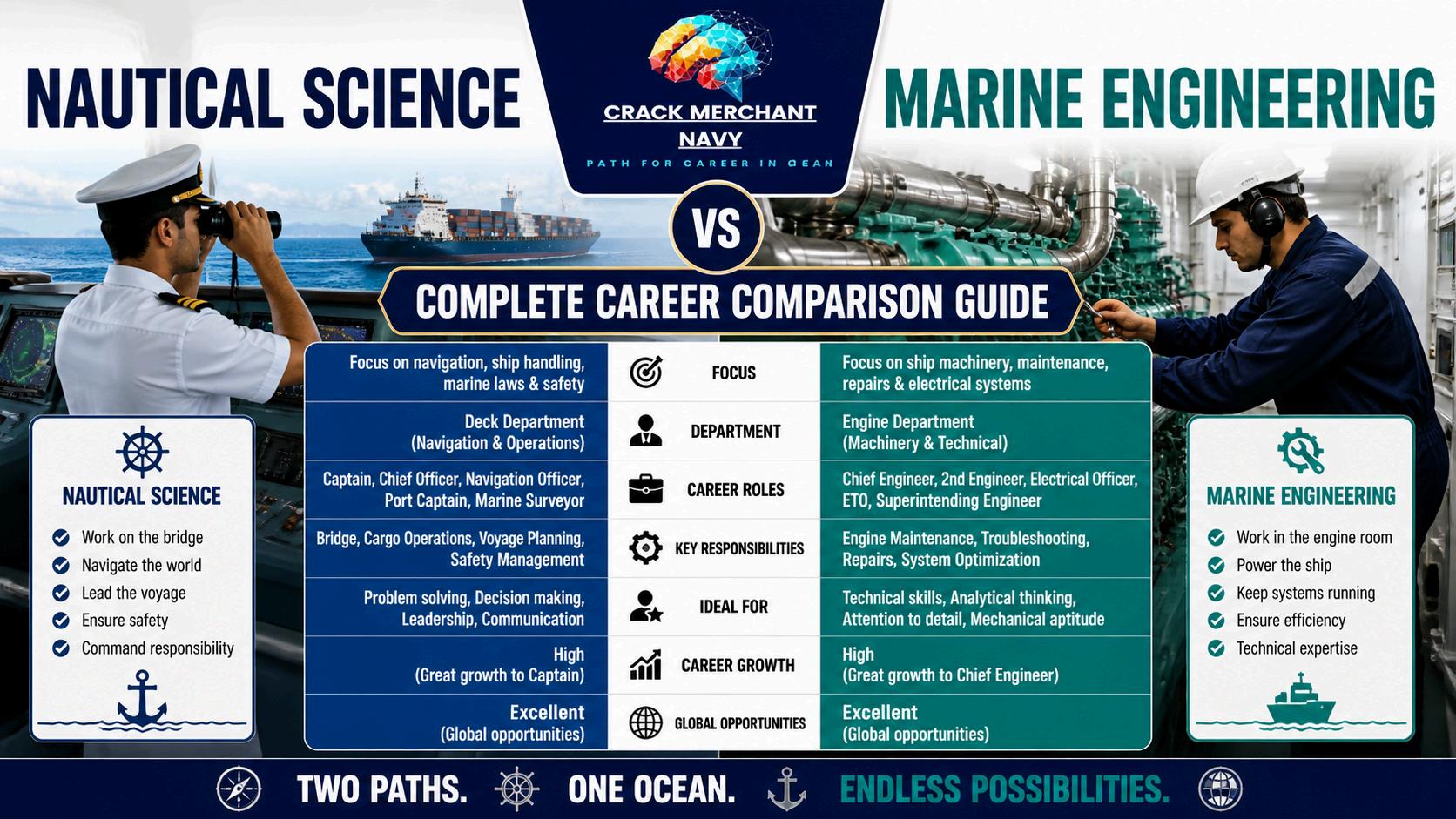
Nautical Science vs marine engineering is the keyword that students search in google, everyday, all day long. Both are subdivisions of the shipping industry and both are essential in making sure that ships run well, safely and profitably in the world ocean. Deciding between these two paths in your career isn’t just a matter of taste, but rather an understanding of the type of work, duties, prospects for career growth and technical work that are involved with each.

In reference to nautical science Vs marine engineering, you should know both fields goes hand in hand. Engineering Marine engineering covers the technology and systems that operate a ship, while nautical science is concerned with how to navigate and run a vessel. That difference is what shapes the whole comparison and helps students to choose the suitable career.

UNDERSTANDINGNAUTICALSCIENCEINDETAIL

Nautical science is the study of the principles and practices relating to navigation and the operation of ships. It is the AND It plays the important role to make sure the ships arrive at destinations safely and legally. In terms of maritime vs engineering science, shipping deck operations are covered by nautical science.

Students who opt for a career in nautical science are taught topics like navigation, meteorology, cargo handling, maritime laws, and ship stability. Its goal is to equip you with skills needed to control the ship’s course, face emergencies and manage operations around the ship. Decisions and leadership are entrenched in the day-to-day life of a deck officer, which is the main career path of nautical science.

Practical training, using ship simulators and at sea, complements theoretical studies in nautical science. Gradually a person rises through the ranks from cadet to officer and finally to captain. The captain has the supreme command of the ship, ensuring the general safety and welfare of all on board.

When considering the field of nautical science vs marine engineering, nautical science attracts those who savor authority, have a penchant for decision-making, and enjoy being hands on with navigation systems.

UNDERSTANDINGMARINEENGINEERINGINDEPTH

In the discussion of nautical science vs marine engineering, marine engineering is the technical equivalent. It deals with the design, operation, maintenance and the troubleshooting of the machinery of the ship. That encompasses engines, boilers, electrical systems and all the mechanical parts that play a role in making a vessel run smoothly.

Thermodynamics, fluid mechanics, marine machinery, electrical engineering and automation systems are the courses taken by students of marine engineering. The profession is very technical and has a high entry point for physics and math requirements. Marine engineers fill its engine rooms and meet their machinery at sea, where they observe and manage all technical aspects of shipboard life. They play an essential role in the journey as even a small malfunction can stop the whole trip. Marine engineering has the following ranks: junior engineer, second engineer, chief engineer (in charge of the entire engineering department on a ship).

When it comes to nautical science vs marine engineering, the latter is best suited for those who love working with machinery, solving problems, and dealing with technical systems.

FUTURESCOPEANDINDUSTRYDEMAND

The scope of nautical science vs marine engineering course is likely to remain good with the growing pace of world trade. Port, ships are backbone of world trade, and there is going to be more demand for competent maritime staff.

Technological progress is also contributing to the development in the nautical science vs marine engineering. Automation and digital systems are being more widely implemented and used, and professionals need to keep up the pace.

Both areas also provide security for future employment and potential for advancement, so they are solid choices for someone who wants to work in the industry in the future.

CONCLUSION

The choice of nautical science or marine engineering really depends on what you want, what you are good at, and what you want from your career. The course of nautical science is for those who want to command, navigate and run ship operations and marine engineering for those interested in engines and mechanical systems. These professions are acknowledged to hold respectability and they contributed a great deal towards the marine industry. After learning the difference and assessing their own interests, students are ready to decide which is better for them: nautical science vs marine engineering, and sail towards a promising career at sea.

The nautical science vs marine engineering comparison shows that there is no better opinion, there is only your best aspiration.

https://crackmerchantnavy.com/nautical-science-

Turn static files into dynamic content formats.

Create a flipbook
Nautical Science vs Marine Engineering by Crack Merchant Navy - Issuu