OFFICE OF THE VICE-CHANCELLOR #CPUT20YEARS
ANNUAL REPORT 2025
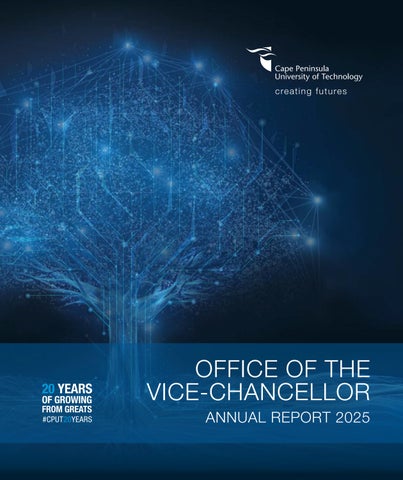
On 1 January 2005, Cape Technikon and Peninsula Technikon merged to form the Cape Peninsula University of Technology – CPUT. This year, CPUT is proud to celebrate 20 years as an amalgamated institution. The digital tree depicted in our 20-year celebrations symbolises growth, connectedness, and oneness. It provides vital connections, mental sustenance, safety, and support for the CPUT community. The branches represent the various fields of study and research, all interlinked; while the trunk supports these branches, and facilitates growth by providing what is needed, in the same way that the support services facilitate the learning, teaching, and research functions at the University. A resilient, healthy tree needs sturdy, developed, and nourished roots. The roots of the tree symbolise the strong heritage institutions that merged to form CPUT. Without the solid base of these, CPUT would not be where it is today. The circuit board overlay represents CPUT’s evolution by using the latest technology as a growth framework and enabler. Our development is grounded in the use of technology, and the interconnectedness that networking provides.
#CPUT20YEARS
OFFICE OF THE VICE-CHANCELLOR ANNUAL REPORT 2025
VISION, MISSION AND VALUES VISION
MISSION
CPUT is Africa’s leading Smart University of Technology, globally renowned for innovation, with graduates that shape a better world for humanity
CPUT transforms its students, through world class researchers who inspire knowledge production and innovation that are cutting edge
VALUES CPUT agrees to oneness and smartness by: •
Embracing a culture of Ethics and Integrity;
•
Seeking Kindness and showing compassion (human heartedness) for the well-being of all our students, staff, stakeholders and the CPUT community, as expressed in ubuntu as a way of living;
•
Embracing Restoration as we deal with the legacy of our past and as we redress issues of equality, gender-based violence, and any form of discrimination;
•
Being a testimony of Unity (ubunye), whilst embracing diversity (ukungafani) in all its forms by being honest, transparent, credible and respectful;
•
Showing Passion and demonstrating enthusiasm, devotion, intensity, tenacity and total commitment to everything that we undertake as a university of technology; delivering uncompromising quality service, and always searching for better ways of doing things;
•
Taking Accountability and accepting responsibility for all our actions and the actions that we commit to; and
•
Being Technologically Astute and understanding, as staff members or students of CPUT who aspire to become technologically astute, that we will embrace and take ownership of and experiment with the possibilities technology offers. These attributes facilitate the novel application of modern technology, enabling the enhancement of productivity and efficiency, whilst always focusing on innovation that is centred on a better world.
#CPUT20YEARS
CONTENTS Foreword by the Vice-Chancellor
2
Message from the Executive Director: Office of the Vice-Chancellor
3
Advancement Directorate
4
Centre for Diversity, Inclusivity and Social Change
13
Marketing and Communication Department
20
Combined Assurance
25
Combined Assurance: Internal Audit
27
Combined Assurance: Enterprise Risk Management
29
Combined Assurance: Compliance Management
32
Combined Assurance: Business Continuity Management
37
Institutional Planning Directorate
40
Quality Management Directorate
45
Stakeholder Engagement Coordination
51
Personal Assistant to the Vice-Chancellor
55
Abbreviations/ Acronyms
56
Staff: Office of the Vice-Chancellor
58
OFFICE OF THE VICE-CHANCELLOR ANNUAL REPORT 2025
1
FOREWORD BY THE VICE-CHANCELLOR Dear Stakeholders, It is with great pride that I present the 2025 Report of the Office of the ViceChancellor, a comprehensive reflection of the Office’s activities over the past year. This Report underscores our unwavering commitment to excellence in education, research, governance, and community engagement. Throughout 2025, we have built and strengthened meaningful relationships through numerous stakeholder engagements. Our interactions with students, unions, industry leaders, school principals, government agencies, research partners, donors, and the Mayor of Cape Town have been particularly impactful, fostering collaborations that advance our university’s strategic priorities and societal contributions. Thanks to the dedication, resilience, and professionalism of our staff and leadership, we have consistently achieved results. Notably, we have once again received a clean audit with no findings, demonstrating our strong governance responsibility. We have successfully met all statutory and regulatory obligations, reinforcing our commitment to transparency and accountability.
Vice-Chancellor, Prof Chris Nhlapo
Our awareness campaigns on ethics, compliance, and university policies have reached many, fostering a culture of integrity and ethical behaviour. Additionally, the automation of key processes has improved operational efficiency, reduced manual errors, and increased transparency – trusted pillars of our institutional excellence. I want to extend my heartfelt appreciation to every member of our university community, our partners, and stakeholders who have contributed towards our shared milestones. Your unwavering support and commitment are truly inspiring. Together, we will shape a resilient, dynamic, and inclusive university that remains at the forefront of transformation and societal development.
Prof Chris Nhlapo Vice-Chancellor
2
OFFICE OF THE VICE-CHANCELLOR ANNUAL REPORT 2025
#CPUT20YEARS
MESSAGE FROM THE EXECUTIVE DIRECTOR: OFFICE OF THE VICE-CHANCELLOR As the Executive Director responsible for translating our strategic initiatives into tangible outcomes, I am proud to present this Report, which highlights our operational achievements and steadfast commitment to institutional integrity. This year has been a testament to the resilience and dedication of our entire team. We have maintained a strong focus on high standards of governance, risk management, compliance, and transformation, ensuring our university remains a beacon of best practices within the higher education landscape. Our ongoing stakeholder engagement efforts have significantly enriched our relationships, promoting collaboration with a diverse range of partners. Moving forward, our goal is to build on these accomplishments by further strengthening our governance structures, expanding stakeholder engagement, securing funds for our students in need, and embedding innovation into our operational fabric. My sincere gratitude to all reporting to the Office of the Vice-Chancellor – you are making us proud.
Executive Director: Office of the Vice-Chancellor, Prof Driekie Hay-Swemmer
Prof Driekie Hay-Swemmer Executive Director: Office of the Vice-Chancellor
OFFICE OF THE VICE-CHANCELLOR ANNUAL REPORT 2025
3
ADVANCEMENT DIRECTORATE 1. Monthly Support to Students and Graduates in Work-Based Learning In a bold effort to combat youth unemployment, CPUT is allocating more than R1.7 million each month to support students and recent graduates participating in work -integrated learning (WIL) and internship programmes. Over 1,400 students and interns receive monthly stipends ranging from R2,000 to R5,500, paid directly into their bank accounts. Funded by generous CPUT donors, these cover essential living costs, removing financial barriers that might otherwise prevent students from completing valuable industry placements, often far from home. “We can report that 64% of the beneficiaries are female students,” says Calvin Maseko, Director: Advancement. “This is a significant contribution to advancing the country’s transformation agenda. We’re deeply grateful to our donor partners who are making this possible.” With South Africa’s youth unemployment rate exceeding 43%, work-based learning is more critical than ever. According to Statistics South Africa, students who complete WIL or internships are far more likely to secure employment quickly, as these experiences bridge the gap between academic study and workplace readiness.
Director Advancement, Calvin Maseko
“These stipends do more than cover transport or meals; they unlock access to opportunity,” Maseko adds. The initiative directly supports the goals of South Africa’s National Development Plan (NDP), promoting youth employment and skills development. It also aligns with CPUT’s Vision 2030, which aims to produce socially responsive graduates equipped for a rapidly evolving world. “As a university, we’re committed to removing the financial barriers that prevent students from completing their work placements,” says Prof Driekie Hay-Swemmer, Executive Director: Office of the Vice-Chancellor. “That is essential for transformation and national growth.”
Technology-Driven Transparency and Management In July 2024, CPUT launched a cloud-based system to manage and track stipend recipients efficiently. The system prevents duplicate applications, improves auditing and reporting, and strengthens project oversight. “We’re rolling out this system across all WIL and internship projects at CPUT,” explains Maseko. “It ensures every beneficiary is accounted for, supporting better transparency and impact measurement.”
4
OFFICE OF THE VICE-CHANCELLOR ANNUAL REPORT 2025
#CPUT20YEARS
Prof Hay-Swemmer notes that, in cases where students are placed within the University and paid via the institutional payroll, CPUT has been pre-funding stipends pending donor disbursements. “This ensures students can continue their placements without interruption, which is vital for their learning and career readiness,” she says.
December 2025 and April 2026, the completion rate is projected to reach approximately 90%. This high success rate underscores the programme’s prestige and impact, demonstrating what is achievable at postgraduate level.
Building a Skilled, Employable Graduate Pipeline
Of the 13 graduates, seven are now employed in academic or research roles. A notable recent beneficiary, Oritondo Muribwathoho, is on track to graduate with a PhD in Mechanical Engineering in December 2025, and has already secured a lecturing position at Durban University of Technology, highlighting the programme’s growing influence and success.
CPUT’s stipend programme is about more than financial assistance; it is about building a pipeline of skilled, employable graduates, ready to contribute meaningfully to the economy and society. “With our donors’ support and our students’ resilience, we are investing in a transformed, capable South Africa,” concludes Prof Hay-Swemmer.
The 2025 programme celebration was held on 30 October. The event included the launch of the Figaji Scholarship for Women in Engineering, also funded by the MFF. Like the Vice-Chancellor’s Prestigious Award, the Figaji Scholarship will support master’s and PhD students, further advancing the University’s transformation agenda.
She also commended students’ patience during unforeseen payment delays, and urged funding partners to streamline disbursement processes to prevent unnecessary disruptions.
2. The Vice-Chancellor’s Prestigious Achievers Award Programme Seven years on, the Vice-Chancellor’s Prestigious Achievers Award Programme continues to build the next generation of academics and researchers. Since its launch in October 2018, this programme has grown significantly. The first beneficiary, Dr Zamavangeli Mdletshe, graduated in April 2023 with a PhD in Mechanical Engineering. She is one of 13 graduates to date, including five doctoral and eight master’s degree holders. The number of awardees has increased to 29, with a strong emphasis on gender transformation: 24 (83%) are female students, and 5 (17%) are male students. This commitment reflects the programme’s dedication to advancing South Africa’s transformation agenda by empowering more female postgraduate scholars. Since its inception, the programme has invested R6.1 million in student development. The Mauerberger Foundation Fund (MFF) contributed R5 million, while CPUT’s Advancement Directorate added R1.1 million. The programme boasts an impressive 77% completion rate – significantly higher than the national average for master’s and doctoral studies in South Africa’s higher education sector. With more beneficiaries expected to graduate in
Prof Brian Figaji, CPUT’s incoming Chancellor, will be officially installed in 2025. A former Vice-Chancellor of the University, he was instrumental in the merger of the Cape Technikon and Peninsula Technikon to form CPUT.
3. Academic Staff Development Grant CPUT, in collaboration with the Faculty of Engineering and the Built Environment (FEBE) and the Advancement Directorate, has successfully secured a third round of funding from the Mining Qualifications Authority (MQA) for its Academic Staff Development Programme (ASDP). This flagship initiative, launched in January 2024, is designed to build long-term academic capacity by developing future lecturers within the engineering disciplines.
OFFICE OF THE DIRECTORATE VICE-CHANCELLOR ANNUAL REPORT 2025 ADVANCEMENT
5
implementation plan. As part of the initiative, CPUT identifies South African nationals who are then supported to complete their master’s or PhD studies. In addition to their academic development, participants receive financial assistance to register as professional engineers with the Engineering Council of South Africa (ECSA). They are funded to present their research at national and international conferences. MQA fully supports participants’ salaries and development costs.
In its first phase, the programme supported the development of six lecturers. That number has since increased to 11, reflecting both the success of the initial phase and the growing confidence in CPUT’s commitment to transformation and excellence in higher education. On 12 August 2025, CPUT and MQA held a celebration to recognise the programme’s progress. The event started with the formal signing of a Memorandum of Understanding (MoU) between MQA CEO, Dr Thabo Mashongoane and CPUT Vice-Chancellor, Prof Chris Nhlapo. This was followed by a recognition ceremony for nine current programme participants, eight of whom are Black female beneficiaries, and one of whom is male.
As part of CPUT’s localisation of the national ASDP, the University has branded its programme “Ntinga”, an isiXhosa word meaning “to soar” or “to fly”. The Ntinga logo features a hummingbird, a symbol chosen for its agility and unique ability. “The hummingbird is the only bird in the world that can fly in all directions – backwards, forwards, sideways, hover, and even upside down. This mirrors the resilience and agility we expect from our Ntinga candidates. Regardless of the pressures they face, they are expected to adapt and soar,” says Prof Suresh Ramsuroop, Dean of FEBE. Currently, FEBE has 19 full-time vacancies in MQA-supported disciplines, that remain unfilled due to a shortage of suitably qualified South African candidates. Some of these posts are temporarily staffed by international academics on fiveyear contracts, as permanent appointments are reserved for South African nationals. The ASDP aims to close this gap by developing qualified local talent from among FEBE’s top-performing master’s and PhD students. Senior staff members on contract or nearing retirement mentor these candidates, to transition them into permanent academic roles upon successful completion of the programme. Oritondo Muribwathoho, one of the programme’s beneficiaries, is set to graduate with a PhD in Mechanical Engineering in December 2025. “The candidates supported through this programme are a testament to what strategic partnerships and forwardthinking investment can achieve. We look forward to the day when these scholars take their place at the front of our lecture halls,” says Prof Ramsuroop.
Since its inception, the ASDP’s funding has increased from R15 million to R26 million, supporting a five-year
6
“I congratulate the candidates, and commend CPUT for its unwavering commitment to excellence and transformation. We look forward to continued collaboration, and to witnessing the impact these future academics will make,” says Dr Thabo Mashongoane, CEO of MQA.
OFFICE OF THE VICE-CHANCELLOR ANNUAL REPORT 2025
#CPUT20YEARS
4. Chancellor’s Fund Launched Recognising the vital role of fostering positive change in the lives of its students and the broader community, CPUT launched the Chancellor’s Fund in April 2025 to empower financially needy students to pursue their education without the burden of financial stress.
Former National Assembly Speaker and Chancellor, Ms Thandi Modise, expressed her firm conviction that CPUT holds great potential to be a driving force for South Africa’s growth and transformation.
The launch event, held at the Cape Town Hotel School, brought together distinguished guests, including university executives, Council members, staff, students, alums, and key external stakeholders, such as donors and industry partners. The former Chancellor, Ms Thandi Modise, delivered an inspiring keynote address. The Chancellor’s Fund is a bold initiative aimed at galvanising philanthropic support to expand access to quality higher education at CPUT. Its primary mission is to raise funds for academically deserving yet financially disadvantaged students, particularly those carrying legacy debt owed to the University. “The broader goal is to promote inclusivity, academic excellence, and innovation by increasing stakeholder investment in the future of our students,” said Mandla Maseko. The evening’s theme, “Towards 20 Years: Celebrating the Creation of Futures,” reflected CPUT’s milestone journey. Vice-Chancellor, Prof Chris Nhlapo emphasised that the University’s growth and success would not have been possible without the generous contributions of dedicated donors, many of whom have supported CPUT since its inception. Prof Nhlapo highlighted that CPUT has over 160,000 alumni, many of whom have become leaders across business, government, education, and civil society. However, he acknowledged ongoing challenges: “Over 80% of our 38,500 students rely on NSFAS funding. The economic challenges are immense and growing. In a first for the University, we are launching The Chancellor’s Fund. We thank our [new] Chancellor for embracing the vision and championing this initiative. The Chancellor’s Fund seeks to address a critical issue affecting students and higher education institutions alike. Student debt not only hinders graduates’ potential, but also limits opportunities for those entering university. With substantial debt, many young people struggle to realise their potential as they begin their careers fully.”
5. CPUT Drives Digital Literacy in Under-Resourced Communities In 2022, CPUT launched the Digital Literacy Project with an initial investment of R1.5 million from BankSETA. The pilot site was Cofimvaba Junior Secondary School in Cofimvaba, a rural town in the Eastern Cape, over 1,000 km from Cape Town. Despite the distance, the school was selected for its significance, as it sends over 100 students to CPUT annually, accounting for 30% of its matriculants, and making it the University’s largest feeder school in the Eastern Cape. The school, like many in rural South Africa, faces numerous challenges, including low digital literacy, poor connectivity, and significant socio-economic hardship. The programme aims to bridge these gaps by providing learners with vital digital skills, and better preparing them for a technologydriven world. Following the success of the pilot, BankSETA expanded the project in 2024 and 2025, funding its rollout in the Western Cape. Target schools included Langa High School and Lotus High School, both situated in communities affected by economic hardship, gangsterism, and crime. In both years, matriculants from these schools received intensive digital skills training during the June school holidays.
OFFICE OF THE DIRECTORATE VICE-CHANCELLOR ANNUAL REPORT 2025 ADVANCEMENT
7
These interventions not only strengthened learners’ digital competencies, but also exposed them to a university environment, planting the seeds for future academic aspirations.
Beyond Subjects: Building Skills for the Future
Infusing STEAM Education: A Lasting Impact In 2023, the Atlantis Special Economic Zone (ASEZ) partnered with CPUT to implement an extra-curricular STEAM (Science, Technology, Engineering, Arts, and Mathematics) programme across five high schools in Atlantis. The programme focused on Robotics and Artificial Intelligence (AI), with 40 Grade 8 learners participating in hands-on workshops that encouraged creativity, innovation, and problem-solving. Two years later, these learners, now in Grade 10, have not only retained their skills, but have become peer mentors, training Grade 8 and 9 learners at Atlantis High School and surrounding schools. Their proficiency has caught the attention of the Department of Basic Education, which now invites them to support capacity-building efforts at other schools, and to participate in competitions. “I want to thank CPUT for planting the seed in 2023,” said Mr Dylan Ferreira, educator at Atlantis High School. “Our learners have taken full ownership of the robotics lessons. I was part of the original group trained by CPUT, but now my students are teaching new skills. They’re passionate, confident, and doing amazing things. They’re outperforming other schools in robotics, and it all started with CPUT. We would love for CPUT to come back and support these learners through to matric. The impact has been incredible.”
8
These projects demonstrate that education extends far beyond traditional school subjects. It is about equipping learners with skills that shape the way they think, interact, and engage in a digitally transformed world. The intervention is part of CPUT’s broader community engagement strategy. By reaching into schools and communities that form the University’s student base, CPUT ensures that its impact is felt long before learners arrive on campus, and long after they graduate. “Through these interventions, we’re not just offering skills, we’re opening doors, building confidence, and helping to shape a new generation of innovators and thinkers,” said Maseko.
6. Donors Discover CPUT’s Hidden Gems During 20-Year Celebration Event On 10 October 2025, CPUT’s Advancement Directorate hosted a special Donor Appreciation Event at the Granger Bay Campus as part of the University’s 20-year celebration. The event was aimed at thanking donors for their support, while showcasing some of the University’s unique assets and innovations that go beyond traditional academic offerings. As part of the programme, donors were taken on an exclusive tour of the Technology Stations at the Bellville Campus, a highlight that left many amazed, particularly those staff members who were included, and who had never experienced the extent of CPUT’s advanced facilities.
OFFICE OF THE VICE-CHANCELLOR ANNUAL REPORT 2025
#CPUT20YEARS
Guests visited various stations, including the AgriFood Technology Station, where they enjoyed a chocolate tasting experience; and the Chemical Engineering Department, where they made ice cream and lip balm using lab-grade equipment. These activities offered a glimpse into how CPUT supports SMMEs and provides students with real-world learning experiences. “Many people think of a university solely as a place that offers courses, and markets itself to prospective students. They often don’t realise the valuable technological infrastructure we host – facilities that are open to industry, and play a direct role in driving economic development, in collaboration with our students,” said Calvin Maseko, Director: Advancement. The event successfully cemented partnerships between CPUT and its funders, many of whom expressed renewed appreciation for the University’s broader role in society, and its impact on innovation, education, and entrepreneurship.
“This tour was not just about celebrating 20 years,” Maseko added. “It was about teaching our donors who we truly are, beyond lecture halls and classrooms, and showing them the transformative work happening behind the scenes.” Donors left the event not only inspired by the experience, but also reaffirmed in their commitment to supporting CPUT and its students.
With South Africa’s youth unemployment rate exceeding 43%, work-based learning is more critical than ever. Partnerships between CPUT and its funders expressed renewed appreciation for the University’s broader role in society, and its impact on innovation, education, and entrepreneurship.
7. CPUT Strengthens STEM Education in UnderResourced Schools CPUT continues to implement STEM interventions in townships and under-resourced schools. These extra-curricular STEM programmes are delivered by CPUT students and academic staff, benefiting high school learners, particularly those from the University’s feeder schools. The STEM projects provide hands-on learning and practical opportunities that foster creativity, motivate discovery, and enhance knowledge retention, supplementing what school educators offer.
OFFICE OF THE DIRECTORATE VICE-CHANCELLOR ANNUAL REPORT 2025 ADVANCEMENT
9
CPUT’s laboratories are open to high school learners, especially for schools lacking adequate lab facilities. This access helps close the gap in practical science education, ensuring that learners continue to study subjects like mathematics and science. Many schools in under-resourced communities either lack laboratories or have poorly equipped ones, limiting educators’ and learners’ ability to teach and learn science effectively. By opening its doors, CPUT provides valuable resources to high school learners, reinforcing the University’s commitment to community engagement. This initiative is crucial in addressing the decline of interest in mathematics and science (especially pure mathematics) among high school learners. Many schools focus on improving matric pass rates, often sidelining these challenging subjects due to competition between education districts and provinces. This trend threatens the future pipeline of students in science-related fields, not only impacting the University, but also the country’s development. Each year, more than 300 learners benefit from these interventions, with lessons offered on Saturdays and during school holidays at CPUT campuses and partner schools. CPUT donors fund these initiatives. By supporting basic education learners to continue STEM subjects through to matric and improve their pass rates, the programme helps qualify more students for university admission in science-related fields, aligning with South Africa’s National Development Plan 2030.
8. Annual Remembrance Day Ceremony Honours the Legacy of CPUT’s Community The Annual Remembrance Day Ceremony held on 13 October 2025 was a heartfelt tribute to students, staff, retired employees, and alums who have passed away, but whose influence continues to shape CPUT’s journey. Family members, friends, and the broader university community gathered at the Dome of Remembrance on the Bellville Campus for the moving event.
10
In his welcoming address, Jerome Corns, former Chairperson of the Dome of Remembrance Committee, reflected on the importance of the Dome as a sacred space for reflection and unity, where each name tells a story of dedication and contribution. “Today, as CPUT celebrates 20 years, we gather not only to mourn, but to celebrate lives of purpose – the students, staff, alumni, and friends of CPUT whose journeys ended too soon, yet whose impact endures. Our theme for this milestone year, ‘Growing from Greats’, is especially fitting. It reminds us that the greatness of CPUT has always been rooted in the greatness of its people, those who taught, served, led, and inspired across generations,” he said. Vice-Chancellor, Prof Chris Nhlapo, read the Roll of Immortalisation, honouring staff, students, retired employees, and alums who passed away in 2025. “As we remember their lives and outstanding service, let us not mourn in sorrow, but celebrate the legacy they leave behind. Their legacy will live on in the hearts and minds of all who knew them,” he said. A special Remembrance Day booklet, listing the names of those who have passed away, was produced for the occasion. Alums who graduated during the Technikon era in the 1970s and 1980s also attended the ceremony. In 2025, CPUT lost 15 employees and nine students. The number of alums who have passed may be higher, as many families do not notify the University.
OFFICE OF THE VICE-CHANCELLOR ANNUAL REPORT 2025
#CPUT20YEARS
A History Interrupted During the apartheid era, especially in the 1970s, students enrolled at teacher training colleges and Technikons that later merged into CPUT faced systemic barriers rooted in racial discrimination and political unrest. Despite completing their studies and making significant contributions to South African education – often serving as teachers, principals, and community leaders – their academic achievements were never officially recognised with graduation certificates. These individuals, many now retired, brought their plea to CPUT during the homecoming event, requesting the University’s support in organising a special graduation ceremony to honour their academic achievements, and formally address historical injustices. A wreath of white flowers was placed inside the Dome, as guests silently passed through, laying white roses as a sign of respect and remembrance. Messages of condolence were delivered by Dr Laurine Platzky, Chairperson of Council; Johnny Basson, Labour Representative; Issa Mapukata, President of Convocation; and Thato Masonganye, Central SRC General Secretary. In her closing remarks, Prof Driekie Hay-Swemmer, Acting Deputy Vice-Chancellor: Operations, encouraged guests to live with intention and passion. “May we honour the memories of the past by embracing the present, and building a brighter future. Let us carry the spirit of love and remembrance with us as we continue to make the most of our time here on Earth.”
9. CPUT Alumni Homecoming Sparks Call for Recognition On 11 July 2025, a group of former students gathered on the Bellville Campus to reconnect with their alma mater and one another at a heartfelt homecoming event. The alumni, many of whom studied at institutions that eventually merged to form CPUT, shared stories of resilience, achievement, and a long-standing desire for formal recognition.The gathering was more than just a nostalgic reunion; it was a decisive moment of reflection on the University’s complex history, and an opportunity to address a legacy of apartheid-era injustices that prevented many students from officially graduating.
Restorative Justice and Institutional Redress This request closely supports South Africa’s broader goals for transformation and nation-building, as well as CPUT’s Vision 2030 dedication to social justice and inclusion. Recognising these alumni’s achievements through a formal ceremony would serve as a meaningful act of restorative justice, and a powerful symbol of healing. The University recognises the challenges involved, especially due to incomplete or missing archival records from the apartheid era. Nonetheless, a proposed verification process involves consulting archived records, engaging retired lecturers and former Vice-Chancellors who are familiar with these students, and verifying employment and qualifications with government education departments.
Moving Forward The alum homecoming sparked momentum towards significant institutional redress. To ensure a thorough and respectful process, a task team will be formed, consisting of representatives from key university departments, including the Faculty of Education, the Graduation Office, the Transformation Office, Archives, and the Alumni Office. This team will oversee verification efforts, and collaborate with former university leaders to gather historical insights. Additionally, a public call will be made to reach other affected alumni who may not yet have come forward, ensuring that this act of recognition is inclusive and extensive.
OFFICE OF THE DIRECTORATE VICE-CHANCELLOR ANNUAL REPORT 2025 ADVANCEMENT
11
A Legacy of Hope and Healing
Income according to sector
This initiative offers CPUT a remarkable opportunity to honour those who persevered through adversity to serve the nation through education. A formal graduation ceremony for these alumni would not only acknowledge their academic success, but also embody the University’s commitment to transformation, inclusion, and historical justice.
Sector
2025 (still counting)
Government
R 75 532 197
82
21
Corporate
R 9 059 641
10
36
Foundation & Trust
R 6 404 679
7
10
R 727 720
1
2
R 9 497
0
6
R 91 733 733
100
75
As one alumnus poignantly shared during the homecoming, “This is about reclaiming our dignity and celebrating the sacrifices we made to ensure education flourished, even when the system sought to hold us back.” With the University’s support, this restorative gesture promises to bring closure and pride to many who have long waited to see their achievements formally recognised.
NGO Individual Total
10. Fundraising The Advancement Directorate is the University’s fundraising and Alumni Relations office. The Directorate raises funds for all three pillars of the University: learning and teaching; research, technology innovation, and partnerships (RTIP); and community engagement.
Donations income Fundraising mechanism
Donation total
Donor count
Advancement
R 91 732 733
73
Online
R 1 000
2
Total
R 91 733 733
75
12
OFFICE OF THE VICE-CHANCELLOR ANNUAL REPORT 2025
% of total Donor count
#CPUT20YEARS
CENTRE FOR DIVERSITY, INCLUSIVITY AND SOCIAL CHANGE (CDISC) The 2025 CDISC Report reflects a year of strategic and inclusive engagement guided by Vision 2030. The report highlights milestones across the Institutional Transformation Forum (ITF), the Institutional Gender-Based Violence Committee (IGBVC), and flagship events. It affirms transformation as both a strategic imperative and a shared ethical commitment. This report also marks the appointment of the new Director, effective 1 December 2024.
1. Institutional Committees: Strategic Gains CDISC is responsible for supporting the ITF and IGBVC. The ITF, chaired by Prof Andile Mji, is a fundamental part of CPUT’s transformation framework, promoting systemic change through its alignment with the seven strategic focus areas of Vision 2030. Through quarterly reporting, coordinated planning, and inclusive engagement, the ITF has integrated transformation into faculties, support units, and strategic partnerships. Key achievements include incorporating multilingualism, digital transformation, disability responsiveness, and gender equity into institutional practices. In 2024, the Persons with Disability Policy was approved. An infographic was created to raise awareness of the new policy, highlighting available services and support. The infographic will be shared once officially approved. The Forum has also strengthened internal collaboration among CDISC, Human Capital (HC), the Division of Student Affairs (DSA), and academic departments, ensuring that transformation is meaningful. The work involved engaging external stakeholders, including Sanlam, Higher Education Resource Services–South Africa (HERS-SA), Ilitha Labantu, the Department of Higher Education and Training (DHET), the Commission for Gender Equality (CGE), and regional universities.
Director: Centre for Diversity, Inclusivity and Social Change, Brightness Mangolothi
Institutional Gender-Based Violence Committee The Vice-Chancellor chairs the IGBVC. The IGBVC plays a vital role in promoting a safe, respectful, and responsible institutional culture. Its activities align with the National Strategic Plan on Gender-Based Violence and Femicide (NSP GBVF) 2020–2023. These include policy development, awareness campaigns, and collaborative interventions that prioritise survivor voices and foster allyship. The committee has incorporated GBV prevention into leadership accountability and organisational performance metrics, strengthening CPUT’s dedication to dignity, justice, and institutional healing.
OFFICE OF THE VICE-CHANCELLOR ANNUAL REPORT 2025
13
The Institutional Gender-Based Violence Committee (IGBVC), affirms transformation as both a strategic imperative and a shared ethical commitment.
One of the committee’s primary initiatives in 2025 was the launch of the CPUT GBV Survey, developed in collaboration with Pillar 6 of the IGBVC, which focuses on Research and Information Management Systems. The survey was designed to investigate the prevalence, perceptions, and definitions of GBV within the CPUT community (students and staff), allowing them to share their experiences and insights, with the aim to: • • • •
Assess how widespread GBV is within and around CPUT; Identify common areas of occurrence and risk; Inform policy development and institutional support mechanisms; and Strengthen data-driven decision-making for prevention and response.
This research-informed approach demonstrates the committee’s dedication to evidence-based transformation.
Systems and Applications (App) Development The IGBVC has been working on digital systems and app-based solutions to improve GBV reporting, support GBV survivors, and enhance institutional responsiveness. These platforms will enable: • • •
Anonymous reporting to ensure safety and confidentiality; Real-time tracking and referral systems for survivors seeking support; and Awareness and education embedded in the app, to promote prevention and allyship.
These innovations will be part of CPUT’s broader digital transformation agenda, and reflect the University’s commitment to smart, inclusive, and responsive systems that uphold the dignity of all community members.
Policy Development A major undertaking nearing completion is the finalisation of CPUT’s Sexual and Gender-Based Violence (SGBV) Policy. The Policy is developed in alignment with Higher Health GBV protocols, ensuring that it reflects national standards for campus health, psychosocial support, and survivor protection. It embeds trauma-informed approaches and referral pathways.
Shared Impact Building an Inclusive CPUT Together, the ITF and IGBVC embody the University’s approach to transformation – intentional, intersectional, and deeply human. Their work shifts the focus from mere compliance, to cultivating a transformative culture. Although there have been notable successes, there is a growing need for a radical campaign that aligns transformation with the University’s core values, fostering space for thoughtful, reflective dialogue and intentionally integrating social justice events into holistic learning, leading, listening, and living. This next phase demands bold imagination, co-creation, and ongoing commitment to ensure that transformation is truly embodied.
14
OFFICE OF THE VICE-CHANCELLOR ANNUAL REPORT 2025
#CPUT20YEARS
2. Transformation through Capacity Building of Staff and Students Capacity building is aimed at addressing Focus Area 4: Smart Human Capital, and Focus Area 7: Smart Student Engagement and Learning Experiences. The University’s transformation agenda embraces a holistic approach that goes beyond race. It integrates gender equity, disability inclusion, digital access, and epistemic justice as essential pillars of institutional change. Racial redress remains foundational, but transformation must respond to the full spectrum of systemic exclusions. Holistic capacity building cultivates critical consciousness, and empowers ethically grounded, emotionally intelligent leadership.
Social Inclusion Workshop To deepen social inclusion at CPUT, CDISC hosted a social inclusion workshop for staff, facilitated by DHET and CGE. The workshop shed light on various policies and frameworks vital to fostering an inclusive environment, including the: • • • • •
Policy Framework for the Realisation of Social Inclusion in the Post-School Education and Training (PSET) System (DHET, 2021); Strategic Disability Policy Framework for the PSET System (DHET, 2018); Policy Framework to Address GBV in the PSET System (DHET, 2020); Gender-Responsive Planning, Budgeting, Monitoring, Evaluation, and Auditing Framework; and Language Implementation Framework for Higher Education.
This engagement reinforced the importance of shared values and collective accountability in realising institutional oneness, as espoused in Vision 2030.
Inclusive Teaching and Universal Design for Learning (UDL) Lecture A lecture on Inclusive Teaching and Universal Design for Learning (UDL) was delivered to the 2025 cohort of the Institutional Teaching Development Programme (ITDP). UDL was presented as a proactive pedagogical framework that recognises learner diversity, and eliminates barriers to access, participation, and success. The session covered inclusive curriculum design, assessment equity, and the intersection of disability, language, and socio-economic status. Academics reflected on their positionalities and the emotional labour involved in inclusive teaching through case studies they developed based on their personal experiences of inclusion and exclusion. Feedback highlighted the need for a module tailored for both early-career and senior academics. This module will be embedded in the University’s core values of respect, inclusivity, excellence, and innovation.
First-Years’ Orientation A transformation-oriented approach was introduced to first-year students across various fields. The aim was to familiarise students with concepts of equity, social justice, and their rights. The orientation clarified institutional structures, and guided students on how to access support, and participate in transformation initiatives. By embedding transformation into the first-year experience, the University fosters a student body that is informed, empowered, and dedicated to co-creating inclusion.
University Committees CDISC is represented on 13 university committees, and has played a pivotal role in shaping institutional discourse on language policy, Broad-Based Black Economic Empowerment (BBBEE), inclusive processes, policies, and an ecosystem, and the provision of disaggregated data. Without granular data on race, gender, disability, and socioeconomic status, the University cannot meaningfully monitor or evaluate its transformation trajectory. These insights are critical to identifying gaps, and recalibrating strategies in alignment with the Transformation Barometer.
OFFICE OF THE VICE-CHANCELLOR REPORT 2025 CENTRE FOR DIVERSITY, INCLUSIVITYANNUAL AND SOCIAL CHANGE
15
Faculty Engagement To deepen institutional ownership and foster a shared language of change, CDISC is presented at all six faculty board meetings. These engagements unpacked key terms, such as equity, inclusion, decolonisation, and universal access, and built a shared vocabulary for transformation. Faculties were invited to reflect on their unique context, and co-create interventions that are both locally grounded and institutionally aligned. This approach reinforces the view of transformation as a collective responsibility embedded in every academic and administrative domain.
3. Commemorative Events Driving Institutional Equity Four key commemorative interventions were hosted by CDISC:
International Women’s Day On 28 March 2025, CPUT celebrated International Women’s Day with a lively virtual event titled, “Accelerate Action”, organised by CDISC, in partnership with various departments. The programme focused on amplifying diverse voices, reforming institutional structures, and promoting women’s leadership in academia and beyond. Primary aims included strengthening advocacy against GBV, fostering inclusive policy reform, and committing to sustainable gender equality initiatives aligned with the United Nations Sustainable Development Goals (UN SDG) 5, including creating opportunities for co-creation with women across Africa and the global North, promoting transnational solidarity, and shared learning, aligned with UN SDG 17 on partnerships.
The keynote address was delivered by the remarkable Prof Grace Khunou, Director of Leadership and Transformation at Unisa and Director of Educational Engagement. A leading scholar and advocate for gender equity, Prof Khunou has played a key role in shaping discourse on women’s issues in higher education, and is co-editor of “Black Academic Voices: The South African Experience”. The programme also featured international speakers from HERS-East Africa and the University of Leeds. The CGE and HERSSA conveyed messages of support, emphasising the national and regional importance of the event; advancing Smart Internationalisation and building strong connections with quintuple helix partners. Outcomes included the development of renewed institutional policies supporting gender inclusivity, greater visibility of women in leadership, and enhanced cross-sector collaboration to promote structural change and women’s empowerment.
Pride Month: LGBTQIA+ Advocacy Throughout June 2025, CDISC dedicated its communications to honouring International Pride Month through a powerful digital campaign. Weekly statements were released via Newsflash and social media, each designed to educate, inspire, and foster a culture of respect, dignity, and belonging among LGBTQIA+ students and staff. The main themes included LGBTQIA+ activism, intersectionality, campus safety, and allyship. It aimed to engage the University community in meaningful reflection, while reaffirming CPUT’s dedication to diversity, inclusion, and social justice. Each message featured a concise, impactful title and narrative, highlighting South African Queer icons, affirming spaces, and the strength of collective awareness. Statement titles included: • • • • •
International Pride Month Series: International Pride Month; Honouring Queer Icons: Celebrating South Africa’s Trailblazers in LGBTQIA+ Advocacy; Exploring Intersectionality; Creating Safer and Affirming Campuses for LGBTQIA+ Students and Staff at CPUT; and Building Allyship through Awareness: Empowering Students and Staff at CPUT.
This initiative reaffirmed CDISC’s role in fostering an inclusive institutional culture, and promoting transformation through visibility, education, and solidarity.
16
OFFICE OF THE VICE-CHANCELLOR ANNUAL REPORT 2025
#CPUT20YEARS
Women’s Month Celebration The Women’s Month Celebration 2025 marked a powerful tribute to the Institution’s women leaders as part of CPUT’s 20th anniversary. Held at the Granger Bay Campus, the event launched the commemorative book, Women Leaders: Journey of Growth to Greatness. Under the theme, “Advancing Transformation: Celebrating Greatness in CPUT Women”, the celebration was made possible through collaboration between CDISC and a wide range of partners, including Sanlam, McDonald’s, Orion, Momentum, and several university departments, which include Fundani, the Advancement Directorate, and Human Capital. In her opening remarks, Prof Driekie Hay-Swemmer encouraged women to reflect on their transformative roles and the legacy they are shaping. The keynote address by CPUT’s inaugural Vice-Chancellor, Prof Vuyisa Mazwi-Tanga, focused on holistic women’s empowerment and inclusive leadership. Further speakers provided insights on financial inclusion (Lebohang Monyatsi), personal branding (Prof Mercy Makhitha), and Human Capital advancing gender transformation (Vuyokazi Dwane). The afternoon session consisted of a panel discussion on the book and the 20-year celebration, featuring Prof Anna Dippenaar, Prof Veruscha Fester, and Delicia de Vos. The panelists further explored current initiatives and the way forward. The celebration not only honoured past and present achievements, but also inspired future generations to embrace leadership, transformation, and shared growth.
Women Leaders: Journey of Growth to Greatness The book, Women Leaders: Journey of Growth to Greatness celebrates the resilience, leadership, and transformative impact of women across CPUT. Featuring 24 chapters authored by women in faculties, support services, student affairs, and research, it offers deep personal and professional reflections on navigating leadership within higher education. Each narrative is a testament to the power of perseverance, collaboration, and purpose-driven growth, marking CPUT’s 20-year milestone with voices that have shaped its transformation.
resilience and belonging recur throughout. The book affirms the importance of storytelling as a tool for healing, visibility, and legacy-building. It positions women’s voices as central to CPUT’s journey toward becoming a socially just and globally relevant university. Women Leaders presents several practical lessons: embrace authenticity and vulnerability as strengths; build networks of support and mentorship; advocate for inclusive policies and practices; and prioritise personal wellness as a basis for sustainable leadership. It encourages women to “fix each other’s crowns”, to lead collaboratively, and to challenge exclusionary systems with courage and clarity. The stories serve as both inspiration and a blueprint for those navigating leadership within complex institutional environments. Ultimately, Women Leaders: Journey of Growth to Greatness is more than a celebration – it invites women to reflect, connect, and act; to lead with purpose. It is a legacy project that will continue to inspire generations of women to rise and lead.
The book foregrounds intersectionality, highlighting how race, gender, class, and institutional culture intersect in shaping women’s experiences. Themes of wellness, identity,
OFFICE OF THE VICE-CHANCELLOR REPORT 2025 CENTRE FOR DIVERSITY, INCLUSIVITYANNUAL AND SOCIAL CHANGE
17
Heritage Day The annual Heritage Day festival celebrated the richness of living heritage under the theme “20 Years of Growing from Greats – Celebrating our Living Heritage”. The event featured a vibrant mix of dance, music, poetry, fashion, and art, showcasing the diverse cultural expressions within the University community. The Director of CDISC emphasised the importance of heritage as both a reflection of our roots and a legacy for future generations, encouraging unity through shared stories and traditions. The keynote address by Dr Buntu Godongwana, Senior Lecturer in the Faculty of Engineering and the Built Environment (FEBE), highlighted the need for inclusive systems that allow culture and science to co-exist. The programme included a presentation on Indigenous Knowledge in Water and Agriculture by Dr Evans Shoko, a cultural garments showcase by Fashion Design students, and spirited performances by the AmaXhosa Student Society and Hanover Residence students. These elements collectively honoured the intersection of tradition, innovation, and student creativity. A highlight of the festival was the Heritage Day Poetry Competition, which invited original submissions from across the University. The winners, Luloyisokazi Nonxuba, Kabelo Lekhoro, Ntsako Mohlala, and Lakhiwa Ngaka, recited their work during the event, which will be published in the CPUT Poetry Anthology 2025. The festival was a collaborative effort involving CDISC, CPUT Libraries, the Faculty of Informatics and Design, FEBE, Marketing and Communication Department, Strategic Initiatives and Partnerships Directorate, and Cape Town Hotel School.
4. Strengthening Institutional Voice and Influence on Transformation Throughout 2025, CDISC has actively participated in national and international transformation discussions through speaking engagements, panel appearances, research presentations, and strategic conferences. These platforms have served not only as channels for institutional representation, but also as vital spaces for personal capacity development, thought leadership, and networking. The Director presented at several high-impact forums upon invitation, including the National Association of Student Development Professionals (NASDEV) Women’s Conference, the Southern African Regional Universities Association (SARUA) Roundtable on Women in Science, the Ilitha Labantu Stakeholder Dialogue on fostering social cohesion and ensuring safe communities, co-hosted with Honourable Deputy Minister in the Presidency, Ms Nonceba Mhlauli, the Association of College and University Housing Officers–International (ACUHO–I) Women’s Conference, and the G20 Education for Equality and Peace Summit. She also contributed to the International Workplace Bullying and Harassment Association (IWBHA) Masterclass (11–12 September 2025) on “Global Contextualising of Workplace Bullying: Asia and Africa in Focus”, and participated as a panelist at the University of the Free State (UFS) “Are Bathrooms Safe?” dialogue, and the Durban University of Technology (DUT) Student Development 2025 Conference, which explored inclusion, safety, and student empowerment. In pursuit of continental transformation, CDISC hosted The Education Collaborative, a pan-African initiative aimed at empowering over 1.1 million students by 2030 to become ethical, entrepreneurial leaders. Its network-based model fosters trust, shared accountability, and sustainable change across higher education systems in sub-Saharan Africa. Through regional hubs, member institutions co-create contextually relevant innovations aligned with their strategic priorities. The Collaborative’s programmes address pressing sector challenges, from graduate outcomes, to institutional standards. Participation strengthens leadership, drives systemic reform, and builds capacity to shape industries and economies. The CDISC team further extended its reach and capacity by attending the National Social Inclusion Workshop for Universities, the Higher Education Disability Services
18
OFFICE OF THE VICE-CHANCELLOR ANNUAL REPORT 2025
#CPUT20YEARS
Association (HEDSA) Conference, the Global Anti-Racism Summit, and the Women’s Retreat, hosted by CPUT’s Human Capital Department. This reinforces our commitment to equity, justice, and institutional healing. These engagements have enabled the team to share CPUT’s transformation practices, learn from global counterparts, and strengthen networks for collaborative change.
As CPUT marks 20 years of transformation, CDISC’s work continues to anchor diversity, inclusivity, and social change. A notable scholarly contribution came from Zikhona Plaatjie, Stream Coordinator: Monitoring and Evaluation, who co-presented a paper at the Centre for the Study of the Afterlife of Violence and the Reparative Quest (AVReQ) Postgraduate Colloquium hosted by Stellenbosch University (9–10 September 2025). Under the theme, “Histories and Continuities of Structural Violence”, her presentation critically examined how institutional ethics processes across universities often reproduce structural barriers, particularly when research engages with GBV and marginalised communities. This reflection deepened the transformation of conversation, and called for more inclusive, ethical research frameworks.
Transformation must be lived, not only led – felt in classrooms, corridors, and communities.
These engagements reflect CDISC’s strategic role in shaping transformation discourse, amplifying institutional voice, and building leadership capacity. They also affirm CPUT’s position as a socially responsive university committed to inclusive excellence, intersectional advocacy, and global relevance. In conclusion, as CPUT marks 20 years of transformation, CDISC’s work continues to anchor diversity, inclusivity, and social change. This year’s achievements reflect a maturing transformation ecosystem – one that is data-driven, people-centred, and globally engaged. The journey is far from over. Deeper conversations, radical campaigns, and deliberate social inclusion must shape the next chapter. Transformation must be lived, not only led – felt in classrooms, corridors, and communities.
OFFICE OF THE VICE-CHANCELLOR ANNUAL REPORT 2025 CENTRE FOR DIVERSITY, INCLUSIVITY AND SOCIAL CHANGE
19
MARKETING AND COMMUNICATION DEPARTMENT The Marketing and Communication Department (MCD) continued its mission to spotlight the accomplishments, innovations and events of our community of staff and students. This year had a very special theme infused into all activities: "20 Years of Growing from Greats". As CPUT celebrated 20 years of existence, MCD played a pivotal role in ensuring this legacy year was appropriately captured. It presented a unique opportunity to celebrate the institutional journey we have been on for two decades, and to pay homage to the pioneers behind the success of CPUT.
"CPUTree" Dinner A commemorative dinner provided a platform to formally introduce the "CPUTree", a symbol of growth, connectedness, and unity. The tree was presented to Council Members, the Chancellor, and external stakeholders at a dinner celebrating 20 years of achievement, and inspiring reflection on the University’s legacy and vision.
Shero Campaign
Director: Marketing and Communication Department, Dr Garth van Gensen
20
Female staff members who have spent two or more decades in the employ of CPUT shared their career highlights on the Institution’s social media pages. The narrative started with “I have remained rooted at CPUT for over 20 years because...”. The campaign offered women the chance to share their personal career narratives, and promoted unity and appreciation for CPUT’s stalwart ladies.
SHERO Campus Fun Run/Walk As part of our Women’s Month celebrations, CPUT Sheroes turned out in large numbers for the Shero Campus Fun Run/Walk, held at the Bellville Campus. The event fostered a sense of community, inclusivity, and social cohesion among women within the Institution. As part of the ongoing Division of Student Affairs Food and Sanitary Dignity Drive, all participants were asked to donate non-perishable food items as their “entry fee”.
OFFICE OF THE VICE-CHANCELLOR ANNUAL REPORT 2025
#CPUT20YEARS
Launch of the CPUT Shop The establishment of a dedicated CPUT Shop responds to a clear institutional need for accessible, reliable, and consistent access to branded merchandise and corporate gifts. Branded clothing and merchandise are powerful tools for promoting CPUT’s corporate identity, strengthening stakeholder loyalty, and fostering a sense of belonging among students, staff, and alumni. Research in higher education branding shows that visible, high-quality merchandise reinforces institutional pride, particularly among students and alumni who serve as brand ambassadors beyond the University.
CPUT Website In keeping with CPUT’s vision of being a technology-led university, the institutional website has been redesigned and rebuilt. This was a challenging, multi-year project that encompassed much more than the addition of slick new graphics and agile navigation. Instead, it was a complete restructuring of the underlying technical architecture to ensure a more intuitive and engaging website. As the first point of contact for most initial interactions with the brand, the CPUT website needed to be more than just a repository of information; it needed to reflect an innovative technology focus.
OFFICE OF THE VICE-CHANCELLOR REPORT 2025 MARKETING AND COMMUNICATION ANNUAL DEPARTMENT
21
The new-look website features include:
Open Day 2025 Campaign
•
A comprehensive advertising campaign comprised of the following:
• •
An AI-powered chatbot answers queries, and is constantly being retrained on the latest information; Accessibility features, such as magnification and textto-speech, assist differently-abled individuals with a seamless web experience; and Based on traffic pattern analysis from the previous website, a quick navigation feature was set up to direct visitors to the resources they commonly use.
• • • • •
19 roadside billboards were utilised, located along the N2, M5, Claremont Main Road, Paarl, Somerset West, Marine Drive; and at 39 Sasol and BP service stations; Two-week radio campaign on Good Hope FM; including a four-hour broadcast with four interview slots on the Open Day event day; One-week radio campaign on Umhlobo Wenene; Two-day advertising campaign on KFM; and Two-week TikTok campaign, which had 351 shares and 1,591,510 views.
Social Media CPUT manages four official social media platforms: Facebook, X (Twitter), Instagram, and TikTok. As of October 2025, the follower distribution across these platforms is as follows: • • • •
Facebook: 255,200 followers X: 21,929 followers Instagram: 13,300 followers TikTok: 465 followers (with 1,798 total likes)
Between January and October 2025, the CPUT Facebook page achieved remarkable audience engagement, registering over 16.3 million total views, reaching approximately 3 million users, and 168,100 content interactions. Facebook remains the strongest performer in terms of reach and interaction, while TikTok shows promising early success. Moving forward, the focus will be on sustaining engagement, leveraging video content, and further optimising cross-platform strategies to elevate CPUT’s online visibility and community engagement.
22
20-Year Vodcast Series In a special vodcast series, past and present leaders, staff, and alumni of the Institution were invited to reflect on their memories of helping to build CPUT into one of the strongest higher education brands in the country.
OFFICE OF THE VICE-CHANCELLOR ANNUAL REPORT 2025
#CPUT20YEARS
The recordings included the current Vice-Chancellor, Prof Chris Nhlapo; the former Pentech Vice-Chancellor, Prof Brian Figaji; the first CPUT Vice-Chancellor, Prof Vuyisa Mazwi-Tanga; past SRC Presidents; and CPUT staff. By curating compelling stories from a diverse range of voices, the series acted as both a celebration and a legacy-building platform – capturing not only where we come from, but also where we are heading.
CPUT Calendar 2025 The wall and desk calendar were the first touchpoints for staff to be introduced to the 2025 theme, “20 Years of Growing from Greats”. The materials included information on the symbolism of the “CPUTree”, Vision 2030, and various highlights the Institution has enjoyed over the past 20 years. The calendars were printed and distributed to all staff members at the start of the 2025 academic year, and served as a daily reminder of the year’s significance.
As CPUT celebrated 20 years of existence, MCD played a pivotal role in ensuring this legacy year was appropriately captured. It presented a unique opportunity to celebrate the institutional journey we have been on for two decades, and to pay homage to the pioneers behind the success of CPUT.
OFFICE OF THE VICE-CHANCELLOR REPORT 2025 MARKETING AND COMMUNICATION ANNUAL DEPARTMENT
23
CPUT 2025 Graduation
CPUT Annual Report 2024
In collaboration with the Assessment and Graduation Centre, the design and layout of five CPUT Autumn 2025 Graduation booklets and one booklet for the 2025 medalists were produced in-house. The booklets are designed to be distributed electronically, aligning with the Vision 2030 values of embracing technology, and reducing print costs. They are available for viewing and download on the CPUT website. A small number of printed copies were produced for use by the Procession at the ceremonies.
Working in collaboration with the Office of the ViceChancellor and the Department of Finance, the Publications Unit oversaw the design, editing, and printing of the CPUT Annual Report 2024, and ensuring that the process remained on schedule. In line with the One Smart CPUT strategic goal, the final report was uploaded to the CPUT website for online viewing as a pageable document.
Media More preemptive and personalised press engagements marked the 2025 academic year. In anticipation of the impending focus on university residences, CPUT hosted journalists at the newest 400-bed residence, Cape Suites. The engagement aimed to showcase the quality and calibre of university-owned residences, and to engage reporters directly about what the Institution is doing in anticipation of the start of the academic year. Following ministerial visits, the CPUT Media Liaison engaged journalists on-site at the District Six Campus to demonstrate that no students remained in that area. The year commenced with Executive Management participating in a media training workshop with eNCA anchor Gareth Edwards. Participants were coached in the art of interviews, and valuable tips on framing narratives were provided to enhance the University’s public perception. The VC Media Mingle is an annual event that provides an opportunity to network with journalists and build relationships with those reporting on the Institution in the popular press. In 2025, MCD hosted one of its most influential media engagement events to date. The event drew a remarkable number of senior decision-making media professionals, who had the chance to engage directly with the Vice-Chancellor, the Chair of Council, and the Director of MCD. CPUT saw an average value of R52 million in press coverage in 2025.
24
OFFICE OF THE VICE-CHANCELLOR ANNUAL REPORT 2025
#CPUT20YEARS
COMBINED ASSURANCE CPUT adopted a combined assurance model in 2021 to provide a coordinated approach to all University assurance activities. The CPUT Combined Assurance Framework outlines the model, which is designed to ensure that CPUT addresses all significant risks the University faces, and to monitor the relationship between the University’s assurance providers, such as Risk Management, Compliance Management, and Internal Audit, and the various leaders within CPUT. Combined assurance is the process where internal and external assurance providers collaborate to communicate information to Management and the University’s governance bodies. The aim is to integrate and align assurance activities so that Executive Management (EM) and governance bodies (such as the Council and Audit and Risk Oversight Committee (AROC)) gain a comprehensive view of the University’s governance effectiveness, risks, and controls, enabling them to establish priorities and take action.
The CPUT combined assurance framework is aligned with the University’s risk management approach. Risks facing the University are identified, evaluated, and managed through implementing risk mitigations, such as insurance, strategic actions, or specific internal controls.
Principles of Combined Assurance at CPUT CPUT has adopted a principles-based approach to combined assurance. This approach draws on the International Internal Auditing’s (IIA) Three Lines Model (IIA 2020) and aims to offer flexibility. As a result, Council, EM, and assurance providers are not confined to strict lines or rules. The CPUT combined assurance framework is founded on six principles (Figure 1).
SIX PRINCIPLES OF THE CPUT COMBINED ASSURANCE FRAMEWORK 1
CPUT has implemented appropriate governance structures and processes that enable accountability by Council, action by Management, and assurance by Independent Audit.
2
Council and its subcommittees ensure appropriate structures and processes are in place for effective governance.
3
4
Management's responsibility to achieve CPUT’s objectives comprises both first- and second-line roles. First-line roles are mostly aligned with the delivery of services, and include the roles of support functions. Second-line roles assist with managing risk. Internal Audit (Line 3) provides independent and objective assurance and advice on the adequacy and effectiveness of CPUT’s governance and risk management. This is achieved through systematic and disciplined processes, expertise, and insight.
5
Internal Audit's independence from the responsibilities of Management is critical to its objectivity, authority, and credibility.
6
All roles working collectively contribute to the creation and protection of value when they are aligned with each other, and with the interests of stakeholders.
Figure 1: Six Principles of the CPUT Combined Assurance Framework
Key Roles in the CPUT Combined Assurance Model
OFFICE OF THE VICE-CHANCELLOR ANNUAL REPORT 2025
25
Key role players in the CPUT Combined Assurance Model include Council and its committees, Management (Lines 1 and 2), Internal Audit (Line 3), and external assurance providers. The responsibilities of these role players are generally outlined as: • • •
Accountability by Council to stakeholders for oversight; Actions taken by Management, including risk management, to achieve organisational objectives; and Assurance and advice by an Independent Audit Function to provide insight, confidence, and encouragement for continuous improvement.
The role players, their responsibilities and interactions are depicted in Figure 2.
GOVERNING BODY Governing body roles: Integrity, leadership, and transparency
MANAGEMENT
INTERNAL AUDIT
Actions (including managing risk) to achieve organisational objectives
Independent assurance
First-line roles: Provision of products/ services to clients; managing risk
KEY
Second-line roles: Expertise, support, monitoring and challenge on risk-related matters
Accountability, reporting
Third-line roles: Independent and objective assurance and advice on all matters related to the achievement of objectives
Delegation, direction, resources, oversight
EXTERNAL ASSURANCE PROVIDERS
Accountability to stakeholders for organisational oversight
Alignment, communication coordination, collaboration
Figure 2: Combined Assurance Framework (Source: IIA 2020) This is a consolidated report of four of the combined assurance partners, namely: • • • •
Internal Audit (Line 3); Enterprise Risk Management (Line 2); Business Continuity (Line 2); and Compliance Management (Line 2).
Other second-line functions in CPUT include the Quality Management Directorate, which also reports to the Office of the ViceChancellor; and IT Governance, and the Safety, Health and Environmental (SHE) Unit, which report to the DVC: Operations.
26
OFFICE OF THE VICE-CHANCELLOR ANNUAL REPORT 2025
#CPUT20YEARS
COMBINED ASSURANCE: INTERNAL AUDIT Introduction CPUT Internal Audit reports its functionality to the Audit and Risk Oversight Committee of Council (AROC), and administratively to the Office of the ViceChancellor. The Director manages the Internal Audit Function, which is supported by BDO Advisory Services (Pty) Ltd as a co-source partner to execute the annual Audit Plan.
CPUT Internal Audit Vision and Mission The Internal Audit Strategy was approved at the March 2021 Council meeting. The approach was informed by Vision 2030 – One Smart CPUT, with a Vision and Mission customised for CPUT Internal Audit.
Vision CPUT Internal Audit strives to be the benchmark of excellence for internal audit functions in higher education in Africa by providing insightful assurance and advisory services that will operate as catalysts for enhancing the University’s ability to be globally renowned for cutting-edge innovation with graduates that shape a better world for humanity.
Mission CPUT Internal Audit will enhance and protect organisational value by providing riskbased and objective assurance, advice, and insight in support of CPUT’s Vision 2030 – One Smart University through a combined assurance approach and using cutting-edge technology.
Director: Internal Audit, Driekie van Dyk
2025 Audit Plan The yearly Audit Plan, created using a risk-based audit approach, is approved by AROC. Any modifications to the plan, due to shifts in the risk landscape, are also brought before AROC for approval. The audit team aims to finish the 2025 Audit Plan by the January 2026 AROC meeting.
OFFICE OF THE VICE-CHANCELLOR ANNUAL REPORT 2025
27
Three Areas of Strategic Focus Internal Audit’s Vision and Mission are delivered through three broad focus areas: People, Process, and Technology. Tactical implementation continued in 2024 and 2025, with efforts predominantly focused on the Technology component, particularly the implementation of an audit management solution. The Strategy is scheduled to be refreshed in 2026 to ensure it remains aligned with the Vision and Mission, while continuing to meet stakeholder requirements, and comply with IIA standards.
Focus 1: People
Focus 2: Process
PROCESS
TECHNOLOGY
Using agile audit methodologies that comply with IIA standards to develop and deliver on an Internal Audit Plan that is responsive to risk, while also meeting stakeholder needs
Using modern audit technologies to enhance audit coverage and enable continuous adding, while also driving efficiency, and fostering a culture of innovation and personal development in the use of technology
•
•
The DiligentOne audit management solution was implemented in March 2024. All follow-up activities are now done using the system.
•
Diligent HighBond also has a data analytics and robotics solution. The Internal Audit team embraces this capability in every audit engagement. Analytics and automation remained a key focus of the Function in 2025.
•
Combined assurance partners are being onboarded on the DiligentOne platform to utilise the capabilities that can be used by most Governance, Risk, and Compliance functions.
PEOPLE
Attracting and developing the right mix of talent within CPUT Internal Audit to deliver on our mission and to add value to the University today, and to continue adding value in future by evolving in pace with changes at the University, while balancing between effective risk coverage and cost •
•
There is currently a vacancy for the Audit Manager position, which is expected to be filled in early 2026. Further appointments are on hold in anticipation of the strategy refresh planned for 2026. CPUT Internal Audit will continue to rely on co-source partners to maintain continuity and access to specialist functions. The contract of CPUT’s co-source partner, BDO Advisory, was extended to end 2026.
28
Focus 3: Technology
•
Audit methodology formed part of the onboarding processes for BDO and the Audit Manager, and remains under continuous development. Projects to demonstrate compliance to the new Global Internal Auditing Standards commenced in 2025, starting with updating the Internal Audit Charter, and AROC Terms of Reference.
OFFICE OF THE VICE-CHANCELLOR ANNUAL REPORT 2025
#CPUT20YEARS
COMBINED ASSURANCE: ENTERPRISE RISK MANAGEMENT The Enterprise Risk Management Function reports to the Office of the ViceChancellor, serving the Quality Assurance and Risk Management Committee, and the Audit and Risk Oversight Committee of Council. The report highlights initiatives in the approved Enterprise Risk Management (ERM) Project Plan 2025. The update provides an overview of the end-to-end ERM practices, including risk governance, risk assessment, monitoring and reporting, and continuous improvement.
Highlights of the Approved ERM Project Plan 2025
Continuous Improvement
Risk Governance
Risk Culture
Risk and Control Optimisation
Risk Assessment
Risk Monitoring and Reporting
Risk Quantification and Aggregation
OFFICE OF THE VICE-CHANCELLOR ANNUAL REPORT 2025
Acting Director: Enterprise Risk Management, Dr Rueben Chibvongodze
29
PLANNED ERM INITIATIVE
OUTCOME
STATUS
1 RISK GOVERNANCE Communication of approved ERM governance and management documents
The socialisation of the reviewed Risk Management Policy and the updated ERM Framework and Methodology, both signed off by the Vice-Chancellor (VC) and Principal on 30 October 2024, continued throughout 2025. The documents were discussed during risk awareness sessions and risk review workshops during 2025.
3
Operationalisation of Council-approved risk appetite and tolerance limits
The approved limits informed all planned risk reviews throughout 2025.
3
Implementation of the ACFE Fraud Risk Governance and Management Scorecard (ACFE FRGMS)
The CPUT Fraud Risk Register was updated and reviewed by the respective Management Committee (ManCom) members during 2025.
3
Implementation of Diligent risk and compliance software modules
All appointed Combined Assurance (Risk and Compliance) Champions were trained to use the Diligent software platform during May–July 2025.
3
Formal appointment of Combined Assurance (Risk) Champions per approved criteria
ManCom members issued formal appointment letters to the appointed Combined Assurance (Risk) Champions. The appropriateness of appointed Risk Champions is continuously reviewed by the approved criteria in the ERM Framework and Methodology.
3
Roll out risk assessments across CPUT based on the material risk criterion focussing on areas of significant (material) risk
All support service functions and faculties reviewed their respective risk profiles during January–June 2025, facilitated by the ERM function. The risk reviews were all approved by the respective ManCom members, including Executive Management (EM).
3
Conduct an Institutional Risk Workshop (IRW)
The Workshop is scheduled for 31 October 2025. The outcome will contribute to the University’s risk-based audit planning methodology.
2 RISK ASSESSMENT
The appointed Risk Champions are responsible for coordinating risk reviews within their respective portfolios and faculties for the second six-monthly cycle of the year. The Institutional Risk Review (IRR) was reviewed and signed off by the VC on 18 June 2025. The final IRR sign-off is planned for early December 2025. The Institutional Ethics (Fraud) Risk Review is a component of the IRR.
3 RISK QUANTIFICATION AND AGGREGATION Roll-out of a key risk indicator reporting process
All faculties and support service functions have developed, implemented, and continuously report on key risk indicators.
3
Use of strategic financial scenario analyses and stress testing of university finances by the Finance Function
The Finance Divisional Risk Review Q1 2025 included strategic financial scenario analysis, and stress testing of the University’s financial statements and budget posture.
3
30
OFFICE OF THE VICE-CHANCELLOR ANNUAL REPORT 2025
#CPUT20YEARS
PLANNED ERM INITIATIVE
OUTCOME
Continuous employment of quantitative risk assessment techniques
The ERM Function used techniques such as financial ratio analysis, risk velocity, and financial sensitivity analyses, inter alia.
STATUS
3
4 RISK MONITORING AND REPORTING Operationalisation of the Council-approved Combined Assurance Framework
The meetings of the Institutional Combined Assurance Forum (ICAF) are scheduled in the Institutional Calendar. All planned meetings were held: 26 January (planning session); 27 May (operational reporting); and 14 October 2025 (operational reporting).
3
Planned risk reporting to risk governance and management structures, per required intervals
All quarterly and monthly reports were prepared and submitted per required timelines to QARM, GEC, ISPC, ITGC, and AROC of Council. Monthly ERM reports to the VC were submitted, as required.
3
5 RISK AND CONTROL OPTIMISATION Conduct a risk assessment of the University’s BCM initiative, and respond to assurance reports for continuous improvement
A business continuity risk review deep dive was conducted during Q1 2025. Action plans were developed and are in progress, and on track. An Internal Audit BCM Advisory Report was issued during Q1 2025, and six out of ten findings have thus far been closed.
Continuous review of the ESG risk and opportunity
An ESG Project Plan is in progress, and on track.
1 x senior and middle management fraud risk awareness session was held on 10 June 2025. 1 x university staff fraud risk awareness session was held on 13 June 2025. The session included key insights from the ACFE Global: www.acfe.com.
3
6 RISK CULTURE INITIATIVES Inculcation of a risk-aware culture
7 CONTINUOUS IMPROVEMENT INITIATIVES Identify and action areas for continuous improvement
KEY:
The Internal Audit Gartner ERM Maturity Assessment Report rated the CPUT ERM Initiative at Level 4+ out of a maximum possible of a 5-point scale during 2024, indicating a high-level of ERM maturity. The University will, going forward, leverage automation to bolster its capabilities from a combined assurance perspective. In addition to the Diligent governance, risk, and compliance (GRC) software licences currently in use, the University will explore other technologies, including, but not limited to, predictive analytics, MATLAB, Python, R.
3
3Completed and ongoing In progress and on-track
The completion of the ERM initiatives was made possible by the support and commitment of staff, students, Combined Assurance (Risk) Champions, ManCom, Council, and its risk governance committees.
OFFICE OF THE VICE-CHANCELLOR ANNUAL REPORT 2025 COMBINED ASSURANCE: ENTERPRISE RISK MANAGEMENT
31
COMBINED ASSURANCE: COMPLIANCE MANAGEMENT Introduction The Compliance Management Function (CMF) advances a university-wide ethics and compliance programme that prevents, detects, and responds to regulatory and conduct risks. In 2025, we strengthened the foundations laid in 2023–2024 – digitised declarations, a consolidated Legislative Universe, targeted training, policy governance via the Policy Library, and data-protection practices – so they are easier for staff and students to use, and for the University to evidence publicly. CMF provides management reports to the Vice-Chancellor (VC)/ Executive Management (EM); and oversight reporting to Council committees, i.e. the Audit and Risk Oversight Committee (of Council) (AROC) and the Governance and Ethics Committee (GEC), where applicable, consistent with the King IV principle that governing bodies ensure combined assurance across lines of defence. CPUT’s Oversight Framework positions CMF as a key second-line coordinator; with Internal Audit (third-line) providing independent assurance.
Governance and Mandate Manager: Compliance Management, Sibusiso Mtatase
The CMF’s mandate is to coordinate, facilitate, and advocate for a university-wide ethics and compliance programme, assuring the VC, EM, GEC, AROC, and Council that controls exist to prevent, detect, and mitigate compliance risks. The Function’s scope currently centres on compliance coordination, with a planned evolution to an integrated Ethics & Compliance capability, in partnership with other CPUT functions, including Human Capital (HC) (ethics culture and conduct), Legal Services, Risk, Internal Audit, and Information and Communication Technology (ICT) Security. Regulatory landscape: CPUT operates within a complex statutory framework that includes, amongst others, the Protection of Personal Information Act (POPIA), the Higher Education Act, labour statutes, health and safety regulations, and sectorspecific directives. The CMF’s Legislative Universe consolidates these obligations, and links them to owners and controls. The CMF’s programme is underpinned by a structured framework comprising seven elements. These elements collectively function to prevent, detect, and discourage potential compliance risks throughout the University, thereby ensuring its ethical and legal integrity.
32
OFFICE OF THE VICE-CHANCELLOR ANNUAL REPORT 2025
#CPUT20YEARS
Establishing clear guidelines and protocols
1
Upholding ethics and compliance
Policies and procedures
2
Cultivating transparency and accountability
5
Reporting
Empowering stakeholders
Oversight
3
Strengthening compliance through evaluation
Education and training
Upholding ethical commitment
6
Enforcement and discipline
4
Monitoring and auditing
Safeguarding ethical integrity
7
Response and prevention
Figure 1: The seven elements of CPUT’s Ethics and Compliance Programme
Key Activities and Achievements (2025)
•
Online Declaration Functionality
•
CPUT advanced a single, policy-linked digital process for declarations of conflict of interest, gifts/benefits/hospitality (GBH), and related-party interests. These were designed to make ethical disclosure intuitive for staff, while creating auditable, comparable data for institutional transparency. The approach combined policy alignment, user-tested forms, automated routing to line managers/Compliance, and a standard data model to support public reporting from 2026 onward. Outputs • Unified online forms with embedded policy guidance and examples for frequent scenarios (e.g., outside work, procurement-adjacent relationships); • Automated routing and tracking configuration for linemanager stewardship and compliance oversight; • Standardised data fields, validation rules, and sign-off paths to enable consistent analytics; and • Staff-portal help content and FAQs. Next Steps (2026) • Run annual attestation windows for managers; publish participation and timeliness rates per faculty/ department;
Launch declaration analytics (trendlines; high-signal areas; closure quality checks); and Extend related-party matching and procurement crosschecks; refine escalation guidance.
Compliance Risk Assessment and Compliance Obligation Register (Legislative Universe) To provide a single source of truth for CPUT’s statutory and policy duties, the Function conducted a university-wide compliance risk assessment, and built a Legislative Universe that maps obligations to owners, controls, and monitoring indicators. The work blended bottom-up obligation capture with Executive validation workshops, and aligned outputs with ERM to enable consistent monitoring of risks and mitigations. Outputs • Legislative Universe matrix linking obligations to accountable owners, core controls, and evidence; • Compliance Risk Register integrated with ERM (risk descriptions, inherent/residual ratings, and response plans); and • Defined key risk indicators (KRIs)/monitoring indicators for priority statutes and processes.
OFFICE OF ASSURANCE: THE VICE-CHANCELLOR ANNUAL REPORT 2025 COMBINED COMPLIANCE MANAGEMENT
33
Next Steps (2026) • Complete policy-to-obligation crosswalk, and publish an owner dashboard; • Pilot “second line” compliance sampling on high-risk areas (e.g., POPIA, procurement, Health & Safety); table results on the Office of the Vice-Chancellor (OVC) site; and • Embed KRIs into ERM dashboards; refresh the heat map each quarter.
Contract Management Benchmarking CPUT benchmarked its contract lifecycle against South African public-sector practice and university comparators in order to close historic audit findings, and strengthen intake, review, approval, storage, performance management, and renewal discipline. The approach combined document analysis, process mapping, and a responsible, accountable, consulted, and informed (RACI) (role clarity) review to propose pragmatic improvements that fit current capacity. Outputs • Executive benchmarking brief with comparative gaps and a phased implementation roadmap; • Draft standard templates (intake coversheet, legal review checklist, risk-tiered contract templates); • Draft RACI and Standard Operating Procedure (SOP) set for intake-to-close-out, including version control and performance/renewal checkpoints; and • Specification for a central contract register, and renewal-alert mechanism. Next Steps (2026) • Stand up the central register with renewal alerts; adopt the standard template pack; • Implement pre-award compliance checks (conflicts, POPIA clauses, vendor due diligence); and • Track timeliness of track renewals and post-award performance reviews; publish summary metrics via OVC.
Whistleblowing Root-Cause Analysis A structured review of hotline and ethics-case patterns focused on where and why risks emerge, distinguishing control-design gaps from adherence and culture issues,
34
so that remedies address underlying causes rather than symptoms. The analysis combined case-type trends, processing lead times, and outcome themes with targeted interviews in high-signal areas. Outputs • Thematic map of root causes across policy clarity, supervision, maker–checker discipline and awareness; • Agreed corrective actions (e.g., threshold clarifications for gifts/GBH; outside-work approvals; manager coaching packs); • Standard feedback-loop guidance to reporters to build trust and closure quality; and • Metrics definitions for volume, outcome, and time-toclosure reporting (for OVC publication). Next Steps (2026) • Publish anonymised quarterly hotline dashboards, and lessons-learnt summaries; • Monitor closure timeliness and quality; escalate overdue actions through line governance; and • Fold lessons learnt into policy text and micro-learning refreshers.
Data Protection and Information Governance Enhancement (POPIA) To embed privacy-by-design and strengthen informationgovernance practice, CPUT expanded staff awareness, refreshed artefacts, and prepared assurance routines that will make 2026 privacy reporting visible and comparable. The approach emphasised lightweight training for managers, templated agreements, and Data Protection Impact Assessment (DPIA) triggers for new systems and vendors. Outputs • Updated privacy notices and incident-response guidance aligned to POPIA practice; • DPIA template, vendor due-diligence clauses Data Processing Agreement/ Data Sharing Agreement (DPA/ DSA) library and procurement insertion points; • Micro-modules and manager toolkits (records, sharing, secure handling) for rollout; and • Proposed privacy metrics (DPIAs completed, DPAs executed, incidents tested).
OFFICE OF THE VICE-CHANCELLOR ANNUAL REPORT 2025
#CPUT20YEARS
Next Steps (2026) • Enforce DPIA triggers on new systems/projects; publish quarterly counts and themes; • Track vendor privacy due diligence completion; standardise clause adoption rates; and • Run an incident tabletop; publish capability improvements and follow-ups.
Outputs • Ongoing Policy Library governance (version control; accessibility); • Continued ethics and compliance learning (use of video modules; induction refresh); and • Combined Assurance participation with Internal Audit, Risk, Legal, and ICT Security on cross-cutting themes.
Other 2025 Activities
Next Steps (2026) • Introduce a Register of Compliance Recommendations, and publish closure rates; • Issue a succinct, repeatable quarterly OVC update aligned with the Seven Elements (training, hotline, monitoring, response); and • Calibrate a minimum annual training standard and track by cohort.
Beyond the flagship projects, the Function maintained essential enablement so that policies, training, and combined assurance routines remain coherent and accessible to the CPUT community.
PROGRAMME EFFECTIVENESS ASSESSMENT – SEVEN ELEMENTS Element
2025 Evidence of Progress
Gaps/Improvement Areas
1
Executive Oversight
Regular reporting to OVC/EM and GEC; integration with ERM/Combined Assurance; oversight framework clarified
Formalise annual Ethics and Compliance attestation; increase visibility of Management accountability for training/declarations
2
Written Standards
Policy Library live; approved policies increased from 22 (2023) to 69 (2024); 2025 maintenance continues
Complete the legislative crosswalk within each policy; publish “policy owner” dashboard
3
Communication and Training
Expanded training (700+ staff in 2024) with sustained campaigns in 2025, manager toolkits for privacy and declarations
Improve training completion enforcement; establish minimum hours per employee benchmark (e.g., 2–4 hours per year)
4
Auditing and Monitoring
Integrated monitoring via declarations system; risk-aligned testing with Combined Assurance
Develop second-line compliance checks (sampling of high-risk obligations each quarter)
5
Reporting (Lines of Communication)
Hotline used; improved feedback to reporters; clearer manager escalation paths
Track time-to-triage and closure as key performance indicators (KPIs); publish an anonymous summary to build trust
6
Enforcement and Discipline
Policy-linked sanctions communicated; line management involved in declaration conflicts
Consolidate the Register of Compliance Recommendations (disciplinary/controls), and track implementation
7
Response and Continuous Improvement
Root-cause analysis executed; targeted fixes (policy clarifications; manager coaching)
Introduce lessons-learnt loops into policy and training updates; schedule post-incident reviews
OFFICE OF ASSURANCE: THE VICE-CHANCELLOR ANNUAL REPORT 2025 COMBINED COMPLIANCE MANAGEMENT
35
CPUT’s Compliance Management Function serves a community of approximately 4,000 staff and 35,000+ students. In 2025, the focus was foundational: making compliance simpler, clearer and more transparent.
36
Conclusion CPUT’s Compliance Management Function serves a community of approximately 4,000 staff and 35,000+ students. In 2025, our focus was deliberately foundational: to make compliance simpler, clearer and more transparent for everyone by stabilising digital declarations, consolidating the Legislative Universe, completing a whistleblowing root-cause review, finalising contract management benchmarking, and sustaining data protection and policy governance practices. These actions strengthen everyday decision-making; and enable the University to demonstrate, in public, that we manage our obligations responsibly and consistently. Because 2025 was a build year, this report does not claim adoption outcomes. Instead, we have set the metrics, definitions, and data structures required for credible, comparable reporting from 2026 onward. The Office of the Vice-Chancellor will use these baselines to publish regular updates that show progress over time in a manner that is meaningful to staff, students, and partners.
OFFICE OF THE VICE-CHANCELLOR ANNUAL REPORT 2025
#CPUT20YEARS
COMBINED ASSURANCE: BUSINESS CONTINUITY MANAGEMENT This report highlights the Business Continuity Management (BCM), including environmental, social, and governance (ESG) initiatives planned and conducted during 2025.
Update to the Approved 3-Year BCM Project Plan (2025–2027) BCM Governance Vision 2030 BCM Strategy The approved two-pronged Vision 2030 BCM Strategy continued to be implemented from a short-term resilience and a long-term sustainability perspective. BCM 3-year Project Plan (2025–2027) The BCM 3-year Project Plan (2025–2027) was approved by the Audit and Risk Oversight Committee (AROC) of Council on 31 January 2025, following a recommendation from the Quality Assurance and Risk Management Committee (QARM). The implementation is in progress and on track. Institutional Business Continuity and Sustainability Management Forum (IBCSF) The IBCSF was established in October 2024. The Executive Director: Office of the Vice-Chancellor is an ex officio member who provides executive oversight and sponsorship of the forum. The Director: Business Continuity and Disaster Recovery is the operational chairperson of the forum. Four meetings were scheduled in the Institutional Calendar 2025. All sessions were held as planned.
Director: Business Continuity and Disaster Recovery, Dr Rueben Chibvongodze
BCM Policy Working Group The development of a policy and procedure for Business Continuity and Sustainability Management commenced through the establishment of a policy working group. The policy development and consultative process followed the University’s approved policy development framework. The two documents were recommended by AROC to Council for consideration and approval on 10 October 2025, after consultations with QARM, GEC, ISPC, PPCC, and ITGC of Council, among other risk-related structures and stakeholders.
OFFICE OF THE VICE-CHANCELLOR ANNUAL REPORT 2025
37
CPUT BCM Methodology
Institutional Business Continuity Plan (IBCP)
The University approved the implementation of an emerging, leading practice BCM methodology that aligns with industry standards, the Good Practice Guidelines (GPG) 7.0 Edition (2023), designed by the Business Continuity Institute, and with guidance from the International Organisation for Standardisation (ISO) 22301:2019 BCM Standard.
The IBCP is designed to enable CPUT to respond to a myriad of events or incidents that could develop into a crisis, disruption, or emergency.
The approved CPUT BCM System (BCMS) Methodology is depicted below:
Establishing a BCMS Embracing business continuity
Validation
CPUT Resilience Framework The CPUT Resilience Framework includes a range of risk-related strategies, policies, procedures, guidelines, and supporting response mechanisms that will direct the University’s business continuity efforts, including crisis and emergency management approaches and mechanisms. Environmental, Social, and Governance (ESG) The ESG Project Plan 2025 was approved by AROC on 31 January 2025, after recommendation by QARM. The approved CPUT Vision 2030 Sustainable Development Strategy continued to be operationalised during 2025 via the Institutional Business Continuity and Sustainability Forum (IBCSF). The six pillars of the CPUT Vision 2030 Sustainable Development Strategy are as follows:
Enabling Solutions
Analysis Solutions Design
The rollout of institutional BIAs and RAs is scheduled from October to November 2025. The outcome of the BIA process is a list of prioritised (mission-critical) business functions, activities, processes, and assets, including key interdependencies between processes, activities, and dependencies with external stakeholders necessary to maintain operations during a disruption. The results of BCM RAs are the identification of risks and single points of failure. The outcomes from the BIA and RA processes will guide the development of strategies and solutions as part of the preparation of the Institutional Business Continuity Plan (IBCP).
38
Energy Management
Water Management
Waste Management
Community Development
OFFICE OF THE VICE-CHANCELLOR ANNUAL REPORT 2025
Food Security
Biodiversity Stewardship
#CPUT20YEARS
The University’s resilience framework is further enhanced by the eight established BCM clusters: health; climate change and adaptation; energy and infrastructure; technology; civil disobedience; finance; staff and international travel; and compliance and reputation. Continual Professional Development: Directorate: BCDR The Director: BCDR was confirmed as a Certified Business Continuity Professional (CBCP) by the Business Continuity Institute, United Kingdom, on 12 September 2025. The Director also passed the scenarios and simulations-based ISO 22301 BCM Lead Implementer certification exam, administered by the Professional Evaluation and Certifications Board, based in Montreal, Canada. Dr Chibvongodze will also be graduating with a PhD in Financial Risk Measurement and Management from the Department of Finance, Risk Management and Banking at the University of South Africa.
Conclusion The University continues to explore collaborations with other higher education institutions, both locally and globally, to enhance its resilience capabilities.
OFFICE OF THE VICE-CHANCELLOR REPORT 2025 COMBINED ASSURANCE: BUSINESS ANNUAL CONTINUITY MANAGEMENT
The University continues to explore collaborations with other higher education institutions, both locally and globally, to enhance its resilience capabilities.
39
INSTITUTIONAL PLANNING DIRECTORATE This report presents some of the key achievements for the Institutional Planning Directorate (IPD) in 2025.
IPD Staff Appointments Dr Mxolisi Masango assumed the role of Director for IPD, effective 1 February 2025. Mr Thabile Ralane and Mr Khayalethu Mbulawa were both appointed as HEMIS Administrative Officers, effective 1 April 2025. Ms Nqabakazi Dyantyi was appointed as a Data Intern under the CPUT Siyaphumelela-Kresge Foundation funded initiative for the period 1 June to 31 December 2025.
Enrolment Plan 2026–2030 The student headcount and staff projections for CPUT were finalised for the next Enrolment Planning Cycle 2026–2030, following extensive consultations with CPUT stakeholders, including faculties, Executive Management, and the Department of Higher Education and Training (DHET). The Council-approved Enrolment Plan for 2026–2030 was submitted to DHET on 23 June 2025. The figure below provides a summary of the Enrolment Plan 2026–2030 projections.
Director: Institutional Planning Directorate, Dr Mxolisi Masango
Student Headcount Projections: 2026-2030 50000
30000 20000
37431 39264
34513 36204
40000 22100 23183 9500 9500
10000
9006
9447
3408 3574
1850 1940 701
735
312 327
Master’s
Doctoral
0 First-time entering UG
Diplomas Advanced and diploma/ Certificates PCGE
Degrees
2026
Total UG
2027
PG less M
2028
2029
2862 3003
Total PG
2030
Figure 1: Enrolment Plan 2026–2030 projections
40
OFFICE OF THE VICE-CHANCELLOR ANNUAL REPORT 2025
Total UG/PG
#CPUT20YEARS
Vision 2030 Evaluation System – Integrated Monitoring Model (IMM) The IMM dashboard is part of the PowerHEDA system aimed at assisting CPUT with the evaluation and monitoring of the Strategic Plan 2021–2030 (Vision 2030). The IMM can extract data automatically from the various CPUT data systems, where available, and generate different types of reports for reporting purposes, both internally and externally. To date, the system has been fully developed (see screenshot below), and is ready for piloting as soon as the input data has been provided by the various CPUT portfolios. It is anticipated that the system will be fully operational in 2026 and onwards.
Figure 2: The IMM dashboard
DHET Statutory Reporting for 2025 The following statutory reports have been developed for submission and approval by Council (November meeting): Mid-Term Performance Report for 2025: The report provides information related to students enrolled at CPUT in 2025, as of 30 June, against the Ministerial approved targets, and the financial performance of the University against the CPUT Annual Performance Plan (APP) for 2025, which was submitted to DHET. Annual Performance Plan (APP) for 2026: This report presents the key priorities for the 2026 academic year. It addresses both planning and budgeting, and is aligned with the Institution’s Strategic Plan.
OFFICE OF THE PLANNING VICE-CHANCELLOR ANNUAL REPORT 2025 INSTITUTIONAL DIRECTORATE
41
Higher Education Management Information System (HEMIS) Audit The 2025 HEMIS audit was conducted by Deloitte, and the final audited reports were successfully submitted to DHET on 31 July 2025 for the following datasets: Student Data; Staff Data; and Clinical Training Grant (CTG) Data. It must be noted that a clean audit was obtained for the HEMIS data.
PO Box 578 Cape Town 8000 South Africa
Deloitte & Touche Registered Auditors Audit & Assurance Audit The Ridge 6 Marina Road Portswood District V&A Waterfront Cape Town 8000 Tel: +27 (0)21 427 5300 www.deloitte.com
Executive Director: Finance Cape Peninsula University of Technology (CPUT) Administration Building, Symphony Way (off Robert Sobukwe Road) Bellville 7530
Figure 4: Residence Occupation Monitor Dashboard
PowerHEDA Activity Monitor The latest figures on utilisation of the PowerHEDA system show that the number of registered CPUT users was 4,317. The PowerHEDA system currently has a total of 69 dashboards, 357 reports, and 147 datasets.
Figure 3: The report of the HEMIS audit conducted by Deloitte
PowerHEDA Enhancements in 2025 As part of improving IPD’s data analytics reporting tools, several enhancements were introduced in 2025, including the following reports and dashboards: • • •
Residence Occupation Monitor Dashboard; Improved Residence Report to track student eligibility throughout the year; and Improved Faculty Dashboards, including the Possible Graduate Report.
New Qualifications Several new qualifications were either accredited with the Council on Higher Education (CHE), or registered with the South African Qualifications Authority (SAQA) in 2025. These are presented in the table below:
Managing Partner: ML Tshabalala
A full list of partners and directors is available on request
B-BBEE rating: Level 1 contribution in terms of the DTI Generic Scorecard as per the amended Codes of Good Practice Associate of Deloitte Africa, a Member of Deloitte Touche Tohmatsu Limited
42
OFFICE OF THE VICE-CHANCELLOR ANNUAL REPORT 2025
#CPUT20YEARS
New Qualification Accreditation with CHE
National Qualifications Framework (NQF) Registration with SAQA
Master of Health Sciences in Transdisciplinary Health (full accreditation)
Master of Clothing and Textile Technology
Doctor of Marine Science (conditional accreditation)
Postgraduate Diploma in Mathematical Sciences
Master of Biotechnology (conditional accreditation)
Doctor of Emergency Medical Care Doctor of Philosophy in Nursing Science
In addition, 66 qualifications were successfully submitted to CHE and SAQA for re-registration. All qualifications that were not aligned to the Higher Educations Qualifications SubFramework (HEQSF) were phased out by the end of 2024.
Programme and Qualification Mix (PQM) A revised PQM was approved in April 2025, following a thorough analysis and extensive consultation with DHET. Twelve minor amendments to existing qualifications were approved by the Qualifications Evaluation Committee (QEC) and the Senate Academic Planning Committee (S-APC).
COUNCIL ON HIGHER EDUCATION IFC National Benchmarking Project – South Africa BRIEFING SESSION JULY 2025
An online survey platform was created by IPD to collate survey responses from CPUT key stakeholders in September/October 2025. The final project results are expected to be published in early 2026.
Graduate Destination Survey (GDS) 2023/2024 A high-level report, which presents findings on the employability and primary activity of CPUT’s graduates who were conferred on their degrees in December 2023 and April 2024, was finalised in 2025. The final response rate was 22,1% (1,736 out of a targeted population of 7,855). The reported employment rate for this cohort is 41,7%. PRIMARY ACTIVITY OF THE GRADUATES 40,0%
Council on Higher Education (CHE) – International Finance Corporation (IFC) Benchmarking Study IPD facilitated CPUT’s participation in the 2025 CHE-IFC National Benchmarking on Employability Practices and Digital Maturity of higher education institutions in South Africa. The research project is part of a collaboration between CHE and IFC, a member organisation of the World Bank group.
35,0%
35,2% 29,5%
30,0%
23,0%
25,0% 20,0% 15,0%
9,0%
10,0%
3,2%
5,0% 0,0% Employed (full-time)
Employed (part-time)
Self-employed
Studying
Unemployed
Figure 5: Graduate Destination Survey (GDS) 2023/2024 results
OFFICE OF THEPLANNING VICE-CHANCELLOR ANNUAL REPORT 2025 INSTITUTIONAL DIRECTORATE
43
Postgraduate Student Experience Survey (PSES) Data collection for the study, targeting all registered postgraduate (PG) students at CPUT in 2025, was conducted online in August 2025. A response rate of 14,9% has been achieved to date (460 responses from a targeted population of 3,080 PG students). The study report is expected to be finalised later this year.
Senate Academic Planning Committee (S.APC) 2025 Workshop IPD, in consultation with the DVC: Learning and Teaching (Chairperson of the S.APC), formulated the 2025 workshop programme. The workshop on 6 October 2025 was focused on the Enrolment Plan for 2026–2030, and the faculty strategic interventions required to maximise student throughput, full-time equivalent (FTE) performance, and research output. The Director: IPD chaired and facilitated the workshop. Dr M Masango and Ms J Thomas delivered a total of four presentations.
Research Output for IPD Below is a list of research outputs produced by IPD in 2025: Research article: Fezile Wagner, Lerato P Makuapane, Ryan G Wagner & Mxolisi Masango. 2025. Second-year blues: A qualitative study exploring themes related to anxiety among second-year undergraduate students at a South African university. Journal of Further and Higher Education, 49 (6). https://doi.org/10.1080/0309877X.2025.2486466 Conference keynote speaker: Dr Mxolisi Masango, “Leveraging Data Analytics for Impactful Institutional Planning – A Fit Minds Case Study”. Vaal University of Technology (VUT): Teaching and Learning Conference 2025, 9–12 September 2025, Emerald Casino, Vanderbijlpark.
Capacity Development for IPD Staff The higher education landscape and data analytics tools are constantly evolving, requiring Institutional Planning professionals who are adaptable and committed to continuous professional development to stay current with new trends and technologies. As part of constant learning and capacity development for IPD staff, the following events were attended in 2025: • • • • • • •
CHE Conference (February 2025) ITS UserGroup (March 2025) Southern African Association for Institutional Research (SAAIR) Quality Forum (July 2025) SAAIR HEMIS Institute (August 2025) SAAIR Conference (October 2025) SAQA Conference (October 2025) PowerHEDA UserGroup (November 2025)
44
IPD Strategic Planning Workshop: IPD held its strategic planning workshop on 28 August 2025 at the Newlands satellite campus. The purpose of the workshop was to review IPD’s performance over the past three years across various operational units, and to plan for the next five years (2026–2030). The planning discussions concentrated on the technology, tools, and staff capacity (including skills and expertise) required by the Directorate moving forward. The draft IPD Strategic Plan for 2026–2030 will be finalised in early 2026.
OFFICE OF THE VICE-CHANCELLOR ANNUAL REPORT 2025
#CPUT20YEARS
QUALITY MANAGEMENT DIRECTORATE Quality is because we are. Enhancing accountability through quality reviews Quality reviews play a pivotal role in safeguarding the integrity and excellence of our academic qualifications while enhancing institutional accountability. These reviews are guided by a cyclical and reflective schedule, collaboratively developed with faculties and departments, and formally approved by the Quality Assurance and Risk Management Committee at the start of each academic year. This structured process offers a valuable opportunity to critically assess the quality, relevance, and effectiveness of our academic programmes. Reviews are carried out either by professional accrediting bodies, or through external peer evaluation involving academic and industry experts in the relevant fields. Through these engagements, we continue to confirm the rigour, relevance, and credibility of our educational offerings. For the 2025 academic year, a total of 15 quality reviews were scheduled, comprising 11 internal qualification reviews, and four external reviews conducted by professional bodies. To date, eight internal reviews have been completed, with the remaining three currently in progress and expected to be concluded by the end of October 2025. Among the external reviews, the Engineering Council of South Africa (ECSA) conducted an interim visit to the Department of Mechanical and Mechatronic Engineering in March 2025. The South African Nursing Council (SANC) carried out a successful four-day qualification review, reaffirming our ongoing commitment to academic quality and professional standards. The Department of Dental Sciences, however, postponed the site visit by the South African Dental Technicians Council (SADTC) until the Cape Peninsula University of Technology (CPUT) secures the required building occupation certificates, and obtains Council on Higher Education (CHE) approval for the new delivery site.
Director: Quality Management Directorate, Dr Siyanda Makaula
Preparations are also ongoing in the Department of Construction Management and Quantity Surveying for an upcoming review by the professional body. The South African Council for the Quantity Surveying Profession (SACQSP) is set to conduct a site visit on 27 October 2025, as part of the Institution’s continuous external quality assurance procedures.
OFFICE OF THE VICE-CHANCELLOR ANNUAL REPORT 2025
45
A key success factor during this cycle was the inclusion of independent student critical reflections in the development of departmental Self-Evaluation Reports (SERs). This approach significantly enriched the quality and depth of the review process, ensuring that the student voice was meaningfully represented as an essential perspective in assessing academic quality. Ahead of hybrid qualification review site visits, students were briefed, in order to facilitate their informed and constructive participation. Another notable enabler was the prompt acceptance of invitations by academic peers to serve on review panels, allowing sufficient time for preparation and engagement. Pre-site briefing meetings held with panel members ensured clarity of expectations, and alignment of approach. The success of the reviews was further reinforced by the collaborative support of the Quality Management Directorate (QMD) and consistent communication with Heads of Department (HoDs) throughout the review cycle. These coordinated efforts ensured the reviews were conducted thoroughly, consistently, and with dedication. To improve coordination and real-time communication, WhatsApp groups were established as platforms for updates, engagement, and scheduling of interview sessions. However, some challenges were identified. A significant concern was the high number of CPUT colleagues who declined invitations to serve on review panels, especially from mid-October onwards. Additionally, several external panel members withdrew at short notice, sometimes just days prior to scheduled virtual accreditation site visits, causing last-minute disruptions to the review process. Despite these setbacks, both internal and external reviews were successfully completed, demonstrating the resilience, professionalism, and dedication of everyone involved. Encouragingly, the relationship between the Institution and various professional bodies has significantly improved over the year, establishing a strong foundation for future collaboration, trust, and mutual engagement.
Quality Improvement At CPUT, we are committed to fostering a culture of ongoing quality improvement, constantly seeking to enhance our processes, and support our community. This commitment drives us towards excellence, and establishes a strong
46
quality improvement framework. The continuous quality improvement initiative is a key pillar of the University’s quality management system, aimed at cultivating a pervasive culture of quality, and elevating the overall educational experience beyond previous standards. Quality Improvement Plans (QIPs) are carefully developed in response to the findings from comprehensive quality reviews. These plans are created in close collaboration with the academic HoDs, ensuring they are tailored to the specific needs and challenges of each department. The approval, validation, and ongoing monitoring of these plans are carried out regularly and systematically, reflecting a commitment to continuous growth and enhancement. Looking ahead to 2026, QMD remains dedicated to refining and validating the Departmental Quality Improvement Plans (DQIPs). This ongoing process is essential for assessing progress in addressing identified issues, and implementing necessary improvements. The successful completion of items on the DQIPs not only indicates significant progress in the Directorate's quality management systems, but also marks a vital step towards greater maturity and effectiveness in delivering quality education and services at CPUT.
CPUT Council on Higher Education (CHE) Institutional Audit QIP CPUT received the Institutional Audits Improvement Plan feedback from CHE. The CHE Institutional Audits Committee (IAC) was impressed by the University’s strategic thematic approach, which enables an institutionally wellorganised and focused response to the Higher Education Quality Committee’s recommendations. Additionally, the IAC recognised the University’s collaborative spirit, demonstrated through extensive stakeholder engagement. This commitment reflects a genuine dedication to addressing the critical areas highlighted in the audit report via an inclusive and participative process. The letter further advised that CPUT revise the QIP, and improve the activities outlined in it, making the actions and strategy more detailed and precise. The revised CPUT IA Improvement Plan is to be submitted to CHE by 30 November 2025.
Departmental Quality Improvement Plans (DQIPs) From October 2024 to October 2025, DQIPs established a firm foundation for identifying priority areas, promoting accountability, and tracking progress across academic
OFFICE OF THE VICE-CHANCELLOR ANNUAL REPORT 2025
#CPUT20YEARS
departments, faculties, and support units. This was done through the implementation, monitoring, and validation of DQIPs emanating from the quality review outcomes. Three cycles were successfully conducted by QMD over the year, working closely with the academic HoDs. QMD conducted three DQIP HoD feedback meetings in 2025. The meetings served as platforms for the HoDs to engage and to have workshops, emphasising DQIP processes and their significance. The meetings allowed for reflective engagement on the DQIP process, and pinpointed areas for improvement to enhance overall processes.
Blue- and Red-Flagged Departments Celebrating success is a vital part of our transformative quality culture at CPUT. After completing the first DQIP validation cycle, 37 departments have received Blue-Flag Status for 2025. This distinguished recognition shows that these departments have effectively addressed and resolved all issues identified in their DQIPs. This milestone demonstrates their steadfast commitment to quality standards, and their proactive dedication to ongoing institutional enhancement. Additionally, we are pleased to report that no departments were red flagged in the July 2025 validation cycles.
Doctoral Review Quality Improvement Plan (Doc QIP) After receiving the outcomes of the Progress Report for the Doctoral Degrees National Review Quality Improvement Plan on 17 April 2025, QMD, in collaboration with the Centre for Postgraduate Studies (CPGS) and various faculties, worked diligently to address all outstanding recommendations from CHE. The Doc QIP was then validated, along with the necessary supporting evidence. Subsequently, the progress report was approved by the Higher Degrees Committee of CPUT on 29 May 2025, and successfully submitted to CHE at the end of May 2025. This marks a significant step forward in our pursuit of academic excellence and institutional effectiveness.
Quality Roundtable Sessions The Quality Roundtable Sessions are dynamic platforms designed to facilitate the exchange of data, information, and insights on quality management and assurance. These sessions go beyond traditional knowledge-sharing forums by encouraging rigorous academic discourse, and fostering
a culture of scholarship. The Quality Roundtable Sessions enable collaborative and reflective discussions at CPUT. In 2025, three insightful and informative Quality Roundtable Sessions took place between February and June. The first, hosted by Dr Siyanda Makaula, featured a presentation on “The Evolution of Quality Assurance Systems in Higher Education”, based on a paper written by Mustafa Kayyali, which set the tone for robust discussions on 19 February 2025. The second session was led by Ms Gugu Mhlauli, and included Prof Pravina Pillay’s compelling insights on “Massification at Universities of Higher Learning in South Africa” on 30 May 2025. The third session was led by external expert Prof Sioux McKenna, and addressed the Senate’s Stewardship of the Academic Project in Higher Education on 10 June 2025. These sessions have sparked meaningful dialogue across disciplines, and reaffirmed the University’s commitment to reflective practice and academic development.
Conferences Attended To stay current with trends in higher education and research, QMD attended the 2025 Council on Higher Education Higher Education Conference, where Ms Gugu Mhlauli co-authored and presented a study titled, “Quality Improvement Plans: A Driver for Quality Enhancement in Higher Education”. The study was co-authored with a colleague from the University of the Witwatersrand. On the international stage, Dr Makaula attended the INQAAHE 18th Biennial Conference in Tokyo, Japan, in May 2025, presenting a paper titled, “Negotiating Binaries in Modes of Provision: A Higher Education Practice Standard for Blended and Online Learning”.
Institutional Engagements In 2025, QMD enhanced student and staff involvement within CPUT’s quality management system, in line with its five-year strategic plan. Guided by a comprehensive engagement framework, QMD pursued four key objectives to increase participation in quality assurance, encourage continuous improvement, and foster collaboration with stakeholders. Through a collaborative, participatory, and reflective approach, students and staff were empowered to contribute meaningfully to quality processes and institutional decision-making. Improved feedback mechanisms further enabled them to share insights, and influence quality outcomes.
OFFICE OF THE VICE-CHANCELLOR ANNUAL REPORT 2025 QUALITY MANAGEMENT DIRECTORATE
47
Quality reviews play a pivotal role in safeguarding the integrity and excellence of our academic qualifications, while enhancing institutional accountability.
QMD’s initiatives, including reflection sessions, reviews, focus groups, and workshops, showcased its dedication to embedding an innovative, inclusive, and transformative quality culture. This report highlights the main achievements, challenges, and lessons learnt from January to October 2025.
Student Engagement Student Quality Desk Workshop To prepare students for active involvement in institutional quality assurance, a capacity-building workshop was held for the 2025 Student Quality Desk (SQD) members. Representatives from all six faculties participated, improving their understanding of quality processes, and aligning SQD roles with Vision 2030. This workshop marked the official start of student engagement activities for the year. CHE Conference Attendance To improve students’ understanding of quality management in higher education, QMD arranged for two SQD members (one undergraduate, and one postgraduate) to attend the National Council on Higher Education Conference, themed, “The State of Quality of Higher Education in South Africa Three Decades into Democracy”. This event provided valuable exposure to national quality debates and perspectives. Student Engagement in Quality Reviews Throughout the year, QMD actively involved students in departmental programme quality reviews, ensuring their participation from start to finish. More than 12 independent student critical reflection sessions were facilitated, enhancing student voices in the departmental Self-Evaluation Reports, and fostering meaningful engagement in quality reviews. Students also took part in panel review interviews, with QMD providing pre- and post-briefing sessions to ensure they felt comfortable, confident, and able to respond without bias; thereby maintaining the integrity of the review process. Departments involved included: Industrial and Systems Engineering; Environmental Management (UG and PG); Nursing Sciences; Dental Sciences; Mechanical and Mechatronic Engineering (PGDip); Civil Engineering (Honours); Urban and Regional Planning; Chemical Engineering (Honours); Accounting Sciences; Nature Conservation and Marine Sciences; Sport Management; and Mathematics and Physics. Students’ Participation in Themed Review on Modes of Learning and Teaching Provision To strengthen the student voice in the CHE Themed Review on Modes of Learning and Teaching Provision, the Student Quality Desk, designated as Working Group 3, played a key role in developing the Self-Evaluation Report (SER). Undergraduate and postgraduate SQD members organised focus group sessions across all six faculties to gather data for the SER. They also held writing and discussion meetings with their assigned themed review writer to present their findings and engage further in the review process. This demonstrates the impressive maturity of the SQD in quality assurance, and their increasing leadership in championing institutional quality initiatives.
48
OFFICE OF THE VICE-CHANCELLOR ANNUAL REPORT 2025
#CPUT20YEARS
Reflexive Engagements The SQD offered a platform for reflective engagement with students, holding quarterly sessions to discuss and provide guidance on quality from the students’ perspective. Both the undergraduate and postgraduate SQDs played a key role in the 2025 quality assurance activities, actively contributing to faculty quality forums, and ensuring that student voices were heard within the faculty quality systems.
Staff Engagement Departmental Staff Engagements Staff engagement started positively in 2025, and continued to flourish throughout the year. Building on the successful approach used during the identification of the Blue Flag departments in the second DQIP validation in 2024, the HoDs were contacted to encourage engagement with their staff. The responses were overwhelmingly positive, with HoDs welcoming QMD’s involvement in motivating their teams. QMD conducted staff engagement sessions with the following departments: Biotechnology; Hospitality and Management; Electrical, Electronic and Computer Engineering; Education Foundation Phase; Horticultural Sciences; Marketing; Mathematics and Physics; and Senior Phase and FET. Birth of the Academic Staff Quality Desk (ASQD) To boost academic staff engagement in the institutional quality management system, QMD established the Academic Staff Quality Desk (ASQD) in March 2025, formalising staff participation in quality initiatives. The Desk developed its Terms of Reference, elected interim leadership, and began aligning its mandate with the “Smart Human Capital” pillar of Vision 2030. Staff Participation in the CHE Themed Review on Modes of Learning and Teaching Provision The ASQD acted as Working Group 2 for the Themed Review on Modes of Learning and Teaching Provision, engaging 142 academic staff from all faculties through focus group discussions and reflective dialogues. For the first time, academic staff of all ranks were directly involved in producing the institutional Self-Evaluation Report, marking a significant milestone in inclusive quality assurance practice. National Representation and Partnerships QMD continues to strengthen its partnerships and representation within national higher education quality assurance structures. From 30 September to 2 October 2025,
it co-hosted the Higher Education Quality Assurance Forum (HEQAF) 2025 with the University of South Africa (Unisa) under the theme, “Creating Adaptive Quality Learning Environments”. The QMD delegation included three SQD members, whose participation demonstrated CPUT’s commitment to student engagement in quality assurance, not only within the Institution, but also across the national higher education landscape. Their contributions during discussions and breakout sessions highlighted the unique student perspective in shaping high-quality, adaptive, and inclusive systems. In addition, an ASQD representative formed part of the delegation, gaining first-hand exposure to national quality assurance practices, and engaging with peers from other universities. This cross-institutional engagement strengthened CPUT’s visibility and influence within the national quality assurance community, while reinforcing the University’s dedication to developing adaptive, participatory, and future-focused quality learning environments. Despite the successes, some of the key challenges include limited student availability during review panel sessions due to work commitments; infrastructure and digital access issues across faculties; and heavy academic workloads affecting staff participation. Conclusion 2025 has shown notable progress in fostering a culture of shared quality ownership among students and staff at CPUT. Through reflective engagement, participatory reviews, and inclusive governance mechanisms, the Quality Management Directorate has enhanced institutional responsiveness, transparency, and accountability.
Enhancing an Institutionalised Smart and Transformative Quality Culture The 2025 quality promotion activities are progressing smoothly, supported by a comprehensive plan to steer the year’s efforts in enhancing quality across the Institution. The plan, aligned with QMD’s strategic and operational goals, incorporates recommendations from various portfolios to ensure a unified approach to quality promotion throughout the year. Due to the CHE Themed Review on Modes of Learning and Teaching Provision, several scheduled quality promotion activities were temporarily paused due to limited capacity to manage multiple institutional priorities.
OFFICE OF THE VICE-CHANCELLOR ANNUAL REPORT 2025 QUALITY MANAGEMENT DIRECTORATE
49
Despite these challenges, the Quality Management Directorate has made notable progress in fostering a smart and transformative quality culture across the University through targeted engagements, workshops, and collaborations.
Highlights of 2025 Quality Promotion Activities Strengthening Institutional Engagement In pursuit of institutionalising a smart, transformative quality culture, QMD actively engaged stakeholders across faculties and support units to raise awareness and encourage participation in quality enhancement initiatives. Early in the year, QMD initiated consultations with internal stakeholders to identify priority areas for capacity building and quality promotion. Capacity Building and Stakeholder Engagement QMD launched a series of capacity-building workshops to enhance understanding and implement quality processes. It hosted a session for internal qualification review panel members, including HoDs, Learning and Teaching Coordinators, Work-Integrated Learning Coordinators, and researchers. This workshop clarified the roles and expectations of internal reviewers in qualification evaluations. QMD also advanced the rollout of the Quality Management Practice Standards (QMPS) across support service units. Workshops were conducted with Property Services, Protection Services, and Human Capital. These sessions helped units align their operations with institutional priorities, transformation goals, and quality standards. Through these engagements, the Directorate established a foundation for a culture of accountability, reflection, and continuous improvement within both academic and administrative functions. Faculty-Based Quality Promotion Activities QMD hosted a collaborative roadshow titled, “Unlocking Excellence: Quality Promotion Workshop for a Transformative Culture Shift” with the Faculty of Applied Sciences. The event aimed to foster a shared sense of responsibility for quality, and to promote a mindset of ongoing improvement. The workshop was well received and interactive, employing tools such as the Mentimeter to gather staff views on quality awareness and practices. Collaboration and Visibility Initiatives The Directorate’s commitment to collaboration extended beyond CPUT. During the CHE conference, themed, “The State of Quality of Higher Education in South Africa
50
Three Decades into Democracy”, QMD staff and two SQD representatives gained valuable exposure to national quality debates. This platform enriched institutional knowledge, and reaffirmed CPUT’s role in shaping the national quality landscape. QMD also enhanced its visibility by updating its webpage to include the new QMD icon and slogan, “Quality is because we are”. In addition, the first and second edition of the Quality Assurance Chronicles were published to share insights, updates, and success stories across the CPUT community. National Collaboration through HEQAF 2025 This forum provided a strategic platform to reimagine quality assurance frameworks responsive to evolving sectoral needs, featuring keynote addresses, panel discussions, and research presentations on technology, inclusion, and transformation. CPUT played a central role in planning and executing this landmark event, contributing to marketing, logistics, and speaker nominations, and sharing lessons from its successful hosting of the 2024 forum. Conclusion While 2025 presented competing institutional priorities, notably the CHE Themed Review, the Quality Management Directorate successfully maintained momentum in fostering a culture of quality across CPUT. Through capacity-building initiatives, faculty roadshows, national collaborations, and the rollout of Quality Management Practice Standards, QMD continued to enhance institutional systems and engagement. The Directorate’s work in 2025 reflects a growing culture of shared responsibility, collaboration, and transformative quality thinking, a testament to QMD’s commitment to ensuring that “Quality is because we are”.
QMS Digital QMD has made notable progress in advancing its integrated digital quality management system. Although the project is still ongoing, the developers are currently focused on launching the pilot, which is anticipated to happen before the year’s end. Furthermore, other aspects are still in progress, including the budget allocation for the project. ICTS is overseeing this matter, as the project will be implemented in phases.
OFFICE OF THE VICE-CHANCELLOR ANNUAL REPORT 2025
#CPUT20YEARS
STAKEHOLDER ENGAGEMENT COORDINATION This 2025 Annual Report highlights the Office of the Vice-Chancellor’s (OVC) contributions towards Vision 2030, and commemorates the 20th anniversary of the University. Stakeholder Engagement Coordination is strategically committed to advancing the institutional mission and vision, directly aligning with Focus Area 6, which emphasises that, “stakeholder relationships and strategic partnerships are key to driving innovation”. 2025 was marked by the 20th anniversary celebrations, including themed engagements such as recognising CPUT NRF-rated Researchers and PostDoctoral Fellows; the VC’s Final Lecture (retirement) initiative; and exciting new projects, including the Student Leadership Mentorship Programme, and the ViceChancellor’s Excellence Awards. Social media presence has played a vital role in showcasing OVC activities, and celebrating the University’s successes and achievements throughout the year. The following outlines a selection of key engagements and activities with internal, external, and global stakeholders in 2025, that were coordinated and showcased on the Vice-Chancellor’s (VC's) social media platforms, serving as representative highlights of the year’s extensive programme. Annual Vice-Chancellor’s Excellence Awards for Support Staff and Students: The initiative recognises the outstanding work of support staff. It was strategically extended to include students, encouraging overall excellence by rewarding those who excel academically, and display CPUT excellence in all areas.
OFFICE OF THE VICE-CHANCELLOR ANNUAL REPORT 2025
Coordinator: Stakeholder Engagement Coordination, Busiswa Luqhide
51
Retirees’ Last Lecture: This initiative was introduced to honour retiring staff, allowing them a moment of reflection in the presence of loved ones. This event was fittingly featured during the “20 Years of Growing from Greats” celebrations, with an inspiring lecture by Prof Jessy van Wyk titled, “Four Decades of Higher Education in Food and Science”.
Vice-Chancellor's Student Leadership Mentorship: This ongoing mentorship programme features capacity-building workshops, excursions, and one-on-one leadership conversations, designed to develop student leadership skills. The initiative focuses on instilling principles of ethical, authentic, and cooperative governance.
NRF-Rated Researchers and Postdoc Fellows: As part of the 20-year celebration, the OVC recognised individuals who drive knowledge, innovation, and excellence within the Institution.
Physical Planning Council Committee and Student Services Council Committee: These site visits were covered on our social media platforms to showcase Council members’ active involvement and vested interest in the Institution’s growth and well-being, assuring all stakeholders of their commitment.
52
OFFICE OF THE VICE-CHANCELLOR ANNUAL REPORT 2025
#CPUT20YEARS
The Welcome of the UWC Vice-Chancellor: In line with the institutional value of ubuntu (humanity) and the strategic goal of Smart Engagement (Focus Area 6), CPUT’s Vice-Chancellor hosted the new Vice-Chancellor of UWC, Prof Robert Balfour, on the Bellville Campus. This meeting strengthens ties with neighbouring institutions, and highlights our commitment to collaborative community engagement.
The Vice-Chancellor’s international engagements were strategically leveraged across social media platforms to enhance institutional visibility. A key example was the VC’s visit to the University of Luanda, where he delivered a keynote address at the 3rd Annual Scientific Conference. His address focused on “Cooperation for the Dynamisation of Research, Innovation, and Human Capacity Building for the Sustainable Development of Society”.
Goodnow Hall Reopening: Following extensive restoration after a 2016 fire, the Goodnow Hall heritage building on the Wellington Campus was reopened. The official reopening was featured in the 20th anniversary social media coverage.
The Vice-Chancellor also hosted a delegation from North Carolina Agricultural and Technical State University to explore new partnership opportunities and, earlier in the year, visited Erasmus University of Applied Sciences and Arts in Brussels during the F’SATI board meeting in France to reinforce that existing partnership.
OFFICE OF THEENGAGEMENT VICE-CHANCELLOR ANNUAL REPORT 2025 STAKEHOLDER COORDINATION
53
CPUT took part in the 9th U6 Plus Consortium of African Universities International Conference, held in the Gambia. The Consortium’s main aim is to strengthen academic links and foster collaborative efforts among member universities across Africa. During the three-day conference, the VC officially concluded his tenure by handing over the chairmanship. This transition was marked by a comprehensive report detailing the notable achievements and key milestones reached under his leadership.
The Office of the Vice-Chancellor actively supports the achievement of the Sustainable Development Goals (SDGs), particularly those related to food security and wellbeing, by consistently providing student food vouchers and dignity packs. Vice-Chancellor’s Monthly Themed Video Series: The OVC maintained active engagement on social media by featuring monthly-themed video clips from the ViceChancellor. These videos were strategically deployed to highlight current institutional foci, and significant events, including Mental Health Awareness, Youth Month celebrations, graduation congratulations, well wishes for assessment, and the like.
Conclusion I sincerely thank all stakeholders for their invaluable support and collaboration in the initiatives described in this Annual Report, as well as for their backing of those not explicitly mentioned. The following appendices are available on request: Effective stakeholder engagement in the OVC has successfully positioned the Institution as a key partner, resulting in numerous invitations to high-level forums with both internal and external entities. A notable example of this influence was the invitation to meet with the Mayor of Cape Town, Geordin Hill-Lewis. During this engagement, the Mayor publicly affirmed his commitment to supporting Cape Town’s universities, including CPUT.
54
• • • •
Stakeholder databases Invitations and programmes Minutes of the engagements Attendance registers
OFFICE OF THE VICE-CHANCELLOR ANNUAL REPORT 2025
#CPUT20YEARS
PERSONAL ASSISTANT TO THE VICE-CHANCELLOR The Office of the Vice-Chancellor is a dynamic and demanding environment that requires strong organisational skills, attention to detail, and consistent professionalism. In 2025, the Office remained exceptionally busy, with no two days alike. Unforeseen matters often arose, requiring flexibility, quick decision making, and effective coordination. As Personal Assistant, my responsibilities include managing operations, financial processes, and protocols, while providing executive support to the ViceChancellor. Maintaining professionalism in the Office, and ensuring clear, consistent communication with internal and external stakeholders are key. This year marked my 10th year of service, which commenced as the Executive Secretary to the Deputy Vice-Chancellor for Knowledge and Information Technology (DVC: KITS) in 2014. My decade of service to CPUT coincides with the Institution’s celebration of "20 Years of Growing from Greats". I am extremely proud to be part of this, as CPUT reflects on its journey of transformation and excellence, with renewed commitment to impactful education, inclusive growth, and advancing technology for a better future. I am deeply grateful to all staff for their collegiality, cooperation, and contributions throughout 2025. Their support has been invaluable in enabling me to carry out the duties of the Office of the Vice-Chancellor effectively.
Personal Assistant to the Vice-Chancellor, Shanaaz Bailey
OFFICE OF THE VICE-CHANCELLOR ANNUAL REPORT 2025
55
ABBREVIATIONS/ACRONYMS AI
Artificial intelligence
FEd
Faculty of Education
AROC
Audit and Risk Oversight Committee (of Council)
FID
Faculty of Informatics and Design
FTE
Full-time equivalent
ASQD
Academic Staff Quality Desk
GDS
Graduate Destination Survey
ASDP
Academic Staff Development Programme
GBH
Gifts/benefits/hospitality
BBBEE
Broad-Based Black Economic Empowerment
GBV
Gender-based violence
BCDR
Business Continuity and Disaster Recovery
GEC
Governance and Ethics Committee
BCM
Business Continuity Management
GEWE
Gender Equality, Women Empowerment
BIIC
Business Innovation and Incubation Centre
HC
Human Capital (Department)
CDISC
Centre for Diversity, Inclusivity and Social Change
HDC
Higher Degrees Committee
HE
Higher education
CGE
Commission for Gender Equality
HEI
Higher education institution
CHE
Council on Higher Education
HEMIS
CHEC
Cape Higher Education Consortium
Higher Education Management Information System
CMF
Compliance Management Function
HEQAF
Higher Education Quality Assurance Forum
CPGS
Centre for Postgraduates Studies
HEQSF
Higher Education Qualifications Subframework
DHET
Department of Higher Education and Training
HERS-SA
Higher Education Resource Services–South Africa
Doc QIP
Doctoral Review Quality Improvement Plan
HoD
Head of Department
DPIA
Data Protection Impact Assessment
HPCSA
Health Professions Council of South Africa
DQIP
Departmental Quality Improvement Plan
IAC
Institutional Audits Committee
DSA
Division of Student Affairs
IBCP
Institutional Business Continuity Plan
DVC
Deputy Vice-Chancellor
ICTS
ECSA
Engineering Council of South Africa
Information and Communication Technology Services (Department)
EM
Executive Management
IFC
International Finance Corporation
ERM
Enterprise Risk Management
IGBVC
ESG
Environmental, Social, and Governance
Institutional Gender Based Violence Committee
FAQ
Frequently asked question
IIA
International Internal Auditing
FAS
Faculty of Applied Sciences
IMM
Integrated Monitoring Model
FBMS
Faculty of Business and Management Sciences
IPD
Institutional Planning Directorate
IQF
Institutional Quality Forum
FEBE
Faculty of Engineering and the Built Environment
IR
Institutional Research
ISPC
Institutional Strategic Planning Committee
56
OFFICE OF THE VICE-CHANCELLOR ANNUAL REPORT 2025
#CPUT20YEARS
IT
Information Technology
ITF
Institutional Transformation Forum
SACQSP
South African Council for the Quantity Surveying Profession
KPI
Key performance indicator
SADTC
South African Dental Technicians Council
LGBTQIA+
Lesbian, Gay, Bisexual, Transgender, Queer, Intersex, Asexual, Plus
SAHRC
South African Human Rights Commission
SANC
South African Nursing Council
ManCom
Management Committee
SAQA
South African Qualifications Authority
MCD
Marketing and Communication Department
SARETEC
MoU
Memorandum of Understanding
South African Renewable Energy Technology Centre
MQA
Mining Qualifications Authority
SDGs
Sustainable Development Goals
NDP
National Development Plan
SER
Self-evaluation report
NGO
Non-Governmental Organisation
SETA
Sector Education and Training Authority
NQF
National Qualifications Framework
SGBV
Sexual and Gender-Based Violence (Policy)
NRF
National Research Foundation
SIP
Strategic Initiatives and Partnerships
NSP-GBVF
National Strategic Plan on Gender-Based Violence and Femicide
SOP
Standard Operating Procedure
SQD
Student Quality Desk
OVC
Office of the Vice-Chancellor
SRC
Student Representative Council
PGDip
Postgraduate Diploma
STEAM
P-SET
Post-school education and training
Science, Technology, Engineering, Arts, and Mathematics
PA
Personal Assistant
STEM
PG
Postgraduate
Science, Technology, Engineering, Mathematics
PG-SQD
Postgraduate Student Quality Desk
UDL
Universal Design for Learning
POPIA
Protection of Personal Information Act
UG
Undergraduate
PQM
Programme and Qualification Mix
Unisa
University of South Africa
QAF
Quality Assurance Framework
UoT
University of Technology
QARM
Quality Assurance and Risk Management Committee
USAf
Universities South Africa
V2030
Vision 2030 (CPUT Strategic Plan)
QEC
Qualifications Evaluation Committee
VC
Vice-Chancellor
QMD
Quality Management Directorate
VUT
Vaal University of Technology
QMPS
Quality Management Practice Standards
WIL
Work-integrated learning
RTIP
Research, Technology Innovation and Partnerships
S.APC
Senate Academic Planning Committee
SAAIR
Southern African Association for Institutional Research
OFFICE OF THE VICE-CHANCELLOR ANNUAL REPORT 2025 ABBREVIATIONS/ACRONYMS
57
The Office of the Vice-Chancellor acknowledges all staff working in the various divisions within the Office for their valued contributions to achieving the objectives listed in this Report and the aspirations of the University. Office of the Vice-Chancellor Prof C Nhlapo, Vice-Chancellor Prof D Hay-Swemmer, Executive Director Ms S Bailey, Personal Assistant to the Vice-Chancellor Ms B Luqhide, Stakeholder Engagement Coordinator Advancement Directorate Mr C Maseko, Director: Advancement Ms L Hendricks, Donor Researcher and Database Officer Ms H Pietersen, Advancement Officer: Corporates, Trusts & Foundations Mr F Jooste, Alumni Officer Centre for Diversity, Inclusivity and Social Change Ms B Mangolothi, Director: CDISC Ms V Cornelius, Office Coordinator Mr T Mfisa, Stream Coordinator, Gender Equality, Diversity, and Inclusivity Ms Z Plaatjie, Stream Coordinator, Transformation Monitoring and Evaluation Marketing and Communication Department Dr G Van Gensen, Director: MCD Ms S Koch, Secretary Ms M Gulu, Secretary Mr D Stocken, Institutional Marketing & Branding Specialist Ms M Marais, Senior Publications Officer Ms C Cloete, Public Relations & Events Officer Mr C Christians, Web Editor Mr G Barends, Student Recruitment Officer Ms T Mtshekisa, Student Recruitment Officer Mr K Mitchell, Student Recruitment Officer Ms L Kansley, Media Relations Officer Ms I Fredericks, Communication Officer Mr A Boyce, Communication Officer Mr C Mnisi, Audio-Visual Technician
58
Internal Audit Ms H Van Dyk, Director: Internal Audit Enterprise Enterprise Risk Management Dr R Chibvongodze, Acting Director: Enterprise Risk Management Compliance Management Mr S Mtatase, Manager: Compliance Management Business Continuity Management Dr R Chibvongodze, Director: Business Continuity and Disaster Recovery Institutional Planning Directorate Dr M Masango, Director: IPD Ms Q Behardien, Secretary Ms J Thomas, HEMIS Coordinator Ms M Moller, Senior HEMIS Officer Ms T Healey, Academic Planner Ms D Richter, Institutional Researcher Quality Management Directorate Dr S Makaula, Director: QMD Ms R Weideman, Manager: Quality Reviews Ms E Ansen, Senior Quality Officer Ms G Mhlauli, Manager: Quality Enhancement Ms E Van Der Westhuizen, Quality Officer Ms N Dayile, Quality Officer Ms Z Sholoko, QMD Intern Mr J Leukes, QMD Intern
OFFICE OF THE VICE-CHANCELLOR ANNUAL REPORT 2025
58
#CPUT20YEARS
VISION 2030 - ONE SMART CPUT In order for CPUT to become One Smart University, the following strategic focus areas were identified, and will steer CPUT towards 2030: FOCUS AREA 1 | A Smart ITC environment and CTS workforce FOCUS AREA 2 | Smart Teaching and Learning and Learning Environments FOCUS AREA 3 | Smart RTIP that is relevant and excellent in its knowledge production FOCUS AREA 4 | Smart Human Capital and Talent FOCUS AREA 5 | Smart internationalisation FOCUS AREA 6 | Smart engagement and strong links with quintuple helix partners FOCUS AREA 7 | Smart student engagement and learning experiences The notion of One Smart CPUT is designed in terms of two key dimensions that are in support of CPUT’s one smart university concept.
DIMENSION 1: ONENESS The oneness dimension of V2030 is focused on our human-centricity through our smart people and the smart CPUT community that values and embraces unity (ubunye) in diversity (ukungafani).
DIMENSION 2: SMARTNESS The smartness dimension of CPUT’s Strategy is focused on technological developments and innovations as considered by the current and future industrial revolutions.
+27 (0)21 959 6767 info@cput.ac.za www.cput.ac.za @cput @wearecput www.facebook.com/ cput.ac.za