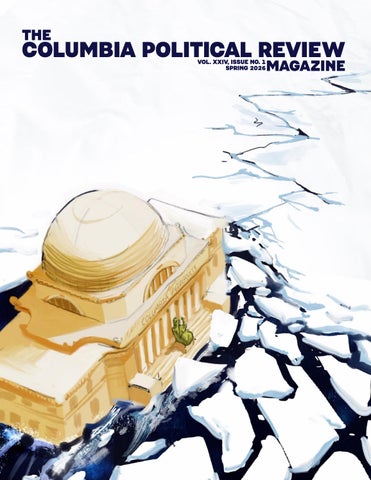

THE COLUMBIA POLITICAL REVIEW
VOL. XXIV, ISSUE NO. 1 SPRING 2026


EDITORIAL BOARD
Editor-in-Chief
Soumya Kamada
Publisher
Shreya Karnik
Chief of Staff
Arvin Kim
Director of Print
Annika Aumentado
Director of Publicity
Vivian Hnin Zar Ni
Director of Engagement
Katherine Buckman
Managing Editors
Lara Harmankaya
Cecily Bush
Ashley Park
Atreyi Basu
Bella Lubelcheck
Oscar Uhalde
Eva Atkins
Priya Shah
Jacob Gold, Column
Parini Rao, Interviews
Roma Tivare, Policy 360
Josh Cohen, Submissions
PRINT &
PUBLICITY
Director of Print
Annika Aumentado
Print Designer
Celine Chien
Illustrators
Jamie Kim
Shay Baer
Director of Publicity
Vivian Hnin Zar Ni
Director of Engagement
Katherine Buckman
Publicity Designers
Samantha Bounato
Betale Getahun
Abigail Zhao
STAFF
Senior Editors
Aasiya Zaidi, Akshara Santoshkumar, Andrew Chung, Aum Desai, Ava DiGiuseppe, Chantel Hope, Emmeline Reinhardt, Ethan Leung, Lauren Chao, Lizzie Melashvili, Phoebe Huang Quinn Morris, Rosie Alchalel, Samidha
Mishra, Sunanya Guthikonda, Tara Tulshyan, Tiffany Pham, Wren Greeley-Havard, Yoona Lee, Camilo Choi, Nadia Knoblauch, Natalie Krawczyk, Maytal Chelst, Malvika Reddy, Tyler Jaewon Kim
Junior Editors
Aarushi Shah, Afa Nuriyeva, Angela Lu, Anokhi Mehta, Bohan Gao, Braden Mendiburu, Carina Rudolph-Math, Ethan Singleton, Jack Bradner, Jeeah Kim, Jia Luan, Kaixi Catherine Zhang, Louis Rosenthal, Matthew Siu, Megan Chui, Mia Rinehart, Ruchi Mangtani, Sara Yang, Shaadi Ghorbani, Shreya Chhaya, Victoria Afolabi, Yusuf Arifin, Jamie Kim, Jemma Granite, Liane Bdair, Eli Levy, Nathan Shurts, Theodore Griffin, Elaheh Khazi, Helena Fernández Garrido
Staff Writers
Aarnah Kurella, Abra Cotner, Addison Page, Adithi Kadle, Afomia Giday, Aine Reeves, Ainsley Pearce, Alexia Puiu, Alison Chiu, Amanda Hui, Amelia Harrington, Anaya Qayyum, Antara Kshirsagar, Antonio Vazquez, Ashley Kim, Audrey Jones, Aveen Burney, Bethany Lloyd, Cadence Gonzales, Caro Garlich, Carolina Javier, Chloe Rotonda, Corinne Wingate, David Feuer, Ekin Matanza, Eleanor Cao, Eleni Maglaras, Elif Sahin, Ella Hummel, Elle Sumarokov, Ellen Hovhannisyan, Ellie Aars, Ema Velasco, Emma Arsic-Wills, Emma Listgarten, Enzo Dervisevic, Eric Chen, Ethan Rhee, Eva Kabatas, Fiona Hu, Giacomo Buitoni, Grace Zhou |Gregory Collins, Heidi Small, Henry Drucker, Iqra Waheed, Jackie Cecil, Janani Harish, Jane Park, Jasmine Lianalyn Rocha, Jazzlee Cerritos, Jordan Jacoel, Jules Kramer, June Liu, Kylie Thibodeau, Lauren Shin, Lily O’Brien, Madeline Lee, Matthew Siu, Maximilian Peh, Muhammad Haris Shah, Myra Prasad, Nata-
lia Solis, Nick Venable, Preston Lee, Preston Parker, Ryu Hattori, Shane Montal, Sharanya Maulik, Shinyoung Park, Shreya Prabhu, Tanisha Dakhawe, Tyler Prozes, Vanda Vaziri Kashani, Yutong Wu
COLUMN
Managing Editor
Jacob Gold
Senior Editors
Natalie Krawczyk, Camilo Choi, Nadia Knoblauch
Junior Editors
Jamie Kim, Jemma Granite, Liane Bdair
Columnists
Ishaan Barrett, Lora Tseytlin, Lukas Roybal, Luke Park, Nayantara Alva, Sandrine Sader, Yongjae Kim, Yunus Akdal
INTERVIEWS
Managing Editor
Parini Rao
Content Editors
Kate Mao, Madeline Senate
Technical Editors
Ray Wu, Wyatt King
Staff Correspondents
Ajay Balaje, Amanda Cisse, Amanda Hui, Anagha Menon, Isabel Lu, Jacob Drews, Justin James, Paulina Carbonell, Pieter Koeman, Reza Shayesteh, Rohan Sarma, Santiago Castano-Medina, Sophia Smerling, Zoe Kothandaraman
POLICY 360
Managing Editor
Roma Tivare
Senior Editors
Nathan Shurts, Maytal Chelst
Junior Editors
Eli Levy, Theodore Griffin, Braden Mendiburu
Staff Writers
Ariel Mura, Sydney Finver, Liam Barbieri, Thomas Coorey, Miya Segal, Jay Jacobson, Alexander Vincenti, Karen Wu, Soenke Pietsch, Carolyn Zhao
SENIOR ADVISOR
Adam Kinder
DEAR READER,
As the Columbia Political Review enters its 25th year, the political atmosphere on Columbia University’s campus has reached a moment of stillness, torn between apprehension and desensitization. The world outside the gates, by contrast, is anything but still. Whether the icy silence on campus arises from fear of political and social retaliation, administrative consequences, or pure burnout, it has become more important than ever to seek out and participate in communities that spark curiosity, tenacity, agreement, and, most importantly, disagreement.
Incidentally, it is also the 250th anniversary of the United States. There is something to be said about milestones such as these: they offer a moment of reflection on the progress that has been made and recognition of the work yet to be done. For the past 25 years, CPR has served as a place for students and community members to find what they care about and learn how to defend it effectively. The publication has remained a unique space on campus for political speech and specifically, incisive analysis. The discourse cultivated by CPR exists and persists so long as we all continue to participate, engage, and stay true to a willingness to challenge and be challenged. After 25 years of centering compelling arguments through a rigorous editorial process, my hope is that the next 25 years exemplify CPR’s capacity to embrace the discomfort of being confronted.
In the pages that follow, sixteen of our writers have pierced through this icy silence with their steadfast voices. To name a few, Ishaan Barrett (CC ‘26) examines the depletion of the American people’s trust in political promises as a response to President Donald Trump’s military decisions. Yunus Akdal (GS ‘26) dissects the Neo-Luddite movement at Columbia University and its relationship with capitalism through the lecture of Karl Marx. In an interview with the Knight First Amendment Institute, Madeline Senate (CC ‘29) discusses democratic backsliding through the lens of free speech, censorship, and academic freedom.
Amid the uncertainty within and outside our gates, it is much more convenient to remain quiet. However, I urge you to accept the challenge of remaining engaged in the face of desensitization. It is not enough to know what we believe or even just how to defend it; we must also seek out the discomfort of criticism and disagreement. The Columbia Political Review stands as a community dedicated to providing an unyielding space for writers to think in public and willingly invite skepticism and debate. With that, it is my deepest honor to present the Spring 2026 Columbia Political Review Magazine.
With continued resolve,
Soumya Kamada Editor-in-Chief

(nation)

Castillo Javier Police had never set foot in Haiti, but that didn’t stop the Dominican Republic from deporting him there in 2023, after officials arrested him during his nightly grocery run. The fact that he was born in the Dominican Republic or that he had his birth certificate on him didn’t stop them either. When President Trump announced his plans earlier this year to overturn birthright citizenship in the United States, American citizens saw it as a shocking escalation of nationalist politics threatening a constitutionally-recognized legal right. But for many in the Dominican Republic, that threat has long been realized. In a court decision in 2013, the Dominican Supreme Court overturned jus soli— birthright citizenship—for the children of foreign-born parents, retroactively stripping citizenship primarily
from Dominicans of Haitian descent, dating back to 1929. While Public Law 169-14 would attempt to provide a path to citizenship through naturalization processes for the Haitian Dominicans, many eligible candidates have been unable to obtain naturalization. The Court’s decision has adversely affected as many as 245,000 Dominicans and left between 120,000 and 130,000 stateless. But more than just a humanitarian crisis, the DR’s state-led campaign to proclaim its own citizens as “stateless” reveals another crisis entirely: the failing of a modern liberal state, which relies on exclusion to define national identity. While national identity may seem theoretical, the human cost of this exclusion is immediate and material. Rejected by their home country, and with no legal claim to citizenship in Haiti, individuals affected by the ruling are barred from exercising the basic rights of a citizen like education, healthcare, employment, and
the right to own property. While these are relatively new exclu- sions, the issue is a long- standing one, especially between the DR and Haiti. With a majority Black population on both halves of the island, the tense racial and national relations between Dominicans and Haitians are often lost on a foreign audience. But they have existed throughout the history of both of these countries, dating back to Hispaniola’s dual colonization by both the French in modern-day Haiti and the Spanish in modern-day DR. Haiti’s independence in 1804, which made it the first Black republic in the world, laid the groundwork for the perceived threat of Black independence to the Spanish mixed race elite—something that has fueled the DR’s anti-Haitianism ever since. This came to fruition most memorably in 1937, when US-backed dictator Rafael Trujillo ordered the Parsley Massacre, killing thousands of
DOMINICAN ETHNONATIONALISM THREATENS THE NATION statelEss
BY REAGAN RICKER ILLUSTRATED BY SHAY BAER
Haitians near the border provinces in an effort to “dominicanize the border.”
Statelessness campaigns like these not only reveal unimaginable humanitarian crises but also pivotal contradictions inherent within the idea of a liberal nation-state. What those contradictions leave us with is hypocrisy masquerading as liberal democracy: the state cannot make commitments to universal equality and other democratic principles while privileging one ethnic group at the same time. When states organize themselves around ethnic belonging or an identity tied to one particular group—as in the case of white nationalism in the Dominican Republic, rooted in its Spanish mixed race elite history—exclusion isn’t accidental: it is a structural necessity.
Inevitably, the casualties of this contradiction are whoever the state doesn’t represent. Dominicans of Haitian descent aren’t the only victims: the Dominican Republic only follows a long list of state actors using statelessness to legally exclude minorities. In Buddhist-majority Myanmar, the 1982 Citizenship Law rendered roughly 3.5 million Rohingya, a minority group, stateless before later launching a genocidal campaign in 2017. Consequently, when hundreds
of thousands fled, fearing the persecution that comes from statelessness, countries like Bangladesh or Malaysia refused to recognize them as refugees due to their stateless status. The same is true for the Bidoon in Kuwait, a stateless Arab minority facing abuse from a state that has deemed them “illegal residents” even though they were born on Kuwaiti soil. Despite these various groups having legal and cultural ties to the countries restricting their citizenship, all three countries make the claim of “foreignness” to justify their exclusion, whether it’s a foreignness of race, religion, or language.
Thus, statelessness becomes a way for countries to create the exclusion upon which its ethnic nationalism depends. It’s a dangerous truth: once a state proves it can strip citizenship from one group, it reveals that at any given time, the state can override the laws that protect membership under the social contract. Statelessness not only delegitimizes citizenship for those stripped of it, but it also undermines the concept as a whole, turning it into a conditional privilege instead of a universal right. The current reality in the DR is threatening—if a government can so easily revoke the protection of its people while benefiting from
their participation, then the social contract collapses, and all that liberal democracy promised along with it. This crisis of statelessness—which also might be construed as a crisis of ethnonationalism—is not an isolated phenomenon. Surges in identity politics are deeply linked to economic insecurity, social disruption, and the failures of globalization. When people feel left behind economically, socially, or politically, or feel as if the benefits of growth or democracy are unevenly distributed, identity becomes a fallback to reclaim a sense of belonging that the state couldn’t provide them with. Just as with a dominant mestizo Spanish identity in the Dominican Republic, states’ culturally-formed identities take priority over universal equality. Ultimately, the DR’s reliance on statelessness to promote a national Dominican identity grounded in whiteness reveals a contradiction at the heart of the modern state: the liberal nation-state project promises equality, but that equality will forever be defined by the inequality of others. Thus, the nation-state fails not because it has abandoned its liberal-democratic ideals, but because those ideals of equality will always
remain structurally at odds with the ethnic and racial boundaries that define the modern state. In the case of the DR, where the state should expand its sense of equality against ethnic nationalism, it chooses instead to minimize it by retracting citizenship. The result is a democracy that may survive in form (for now), but one that dies in substance.
So, what can we do as ethnic nationalism causes a collapse of the nation-state? Unfortunately, the DR’s own hand in creating statelessness limits the usual menu of policy solutions. In most contexts, the first step would involve addressing recommendations for streamlining their immigration system—for example, by resolving the cases of Dominicans who qualify for citizenship, but haven’t been processed, or by providing temporary refugee status within the country to children of foreign immigrants. But a state that manufactures statelessness has little internal incentive to reverse it, and those solutions only deal with the consequences of a failing nation-state, not its root causes.
The most meaningful pressure to reverse statelessness must come from outside. International recognition still matters—especially to a country like the Dominican Republic, whose “Dominicanization” campaign is, in part, trying to rid itself of Haiti’s illegitimacy on the world
stage. Organizations like the UN Human Rights Council and state actors like the US should use their presence to bring awareness to the issue and take in Haitian immigrants, all while imposing sanctions or conditioning aid. But authority remains an issue in both cases—the UN rarely commands sustained geopolitical attention, and with the US hoping to overturn birthright citizenship itself, it’s more likely to follow in the Dominican Republic’s footsteps rather than condemn its actions.
While ethnonationalism is resurging, the model of states defining belonging through ethnicity, religion, and identity is old. When global and cultural forces combine to fan the flames of exclusion, enforced statelessness erases the identity and lived reality of people who were simply born to the “wrong” parents. Justifying the erasure of so many of his own citizens, former Dominican President Dr. Leonal Fernandez said that “[t]here do not exist, nor can there ever exist, descendants of either Dominicans or Haitians who are stateless.” While he may be able to deny the truth of hundreds of thousands of stateless Dominicans, we cannot. The liberal nation state is structurally regressing before our eyes, at the expense of democracy. And if one person is erasable, we are all erasable.
Reagan Ricker (CC ’29) is a staff writer for the Columbia Political Review from Seattle, Washington. She hopes to pursue a career in immigration law and her primary interests lie in Latin American and Caribbean politics, immigration policy, and journalism.
Edited by Ariana Campo Prego, Wren Greeley-Havard, and Jonathan Pollak
Scan the QR code on the right for the full article (with citations)


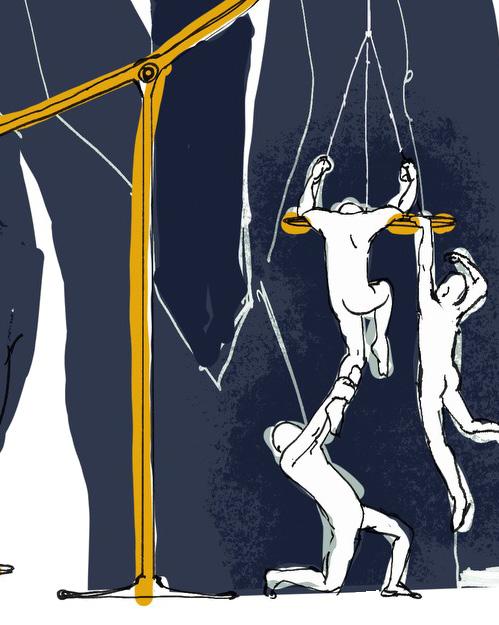
A 21ST CENTURY BIOLOGY BUFF:
THE NIH’S POLITICAL PAUSE ON HFT RESEARCH
BY ENZO DERVIŠEVIĆ
ILLUSTRATED BY SHAY BAER & JAMIE KIM
Speaking on January 22nd, National Institutes of Health (NIH) Director Jay Bhattacharya publicly announced the agency was “pushing American biomedical science into the 21st century.” The declaration was accompanied by innovation-bound rhetoric concerning “breakthrough technologies,” “cutting-edge platforms,” and “fundamental reinvention of scientific practice.” Ironically, the announcement was a new policy that halted the use of human fetal tissue (HFT) in government-sponsored research. Hidden behind the speech’s rhetoric of scientific progress is the reality that the ban is a step backward for biomedical research.
The move against HFT is a byproduct of the Trump administration’s suspension of $29.86 billion in grants from the NIH, National Science Foundation (NSF), and Environmental Protection Agency (EPA) in 2025. The ban on fetal tissue research was report-
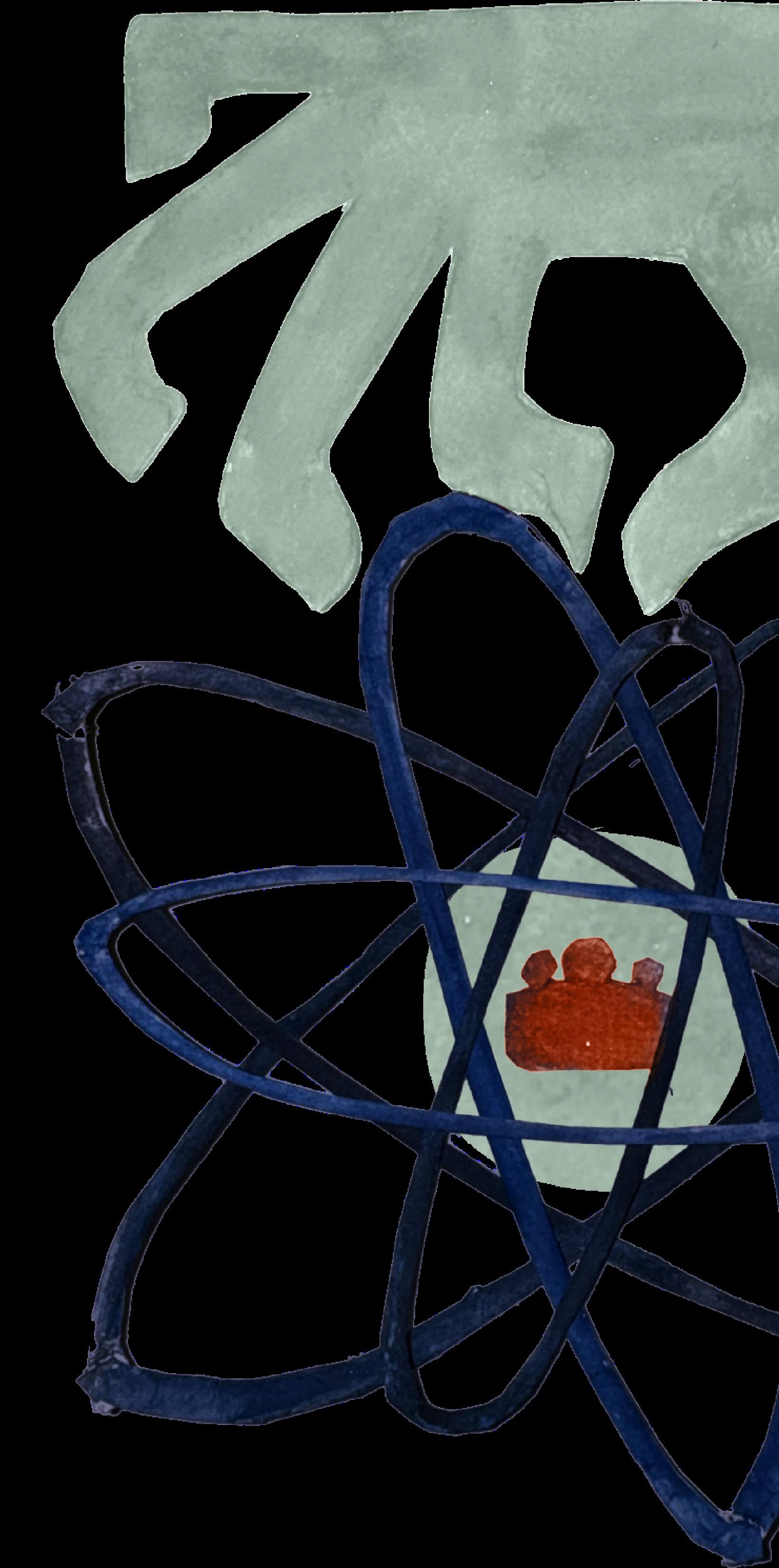

ed on the anniversary of the foundational, since-overturned, case of Roe v. Wade, giving the White House a victory for its anti-abortion base. In the context of broader grant freezes and the targeting of agencies central to public health and environmental science, the government is showing a concerning pattern of defunding research that conflicts with political priorities. In framing the restriction of fetal tissue research as innovative, the administration is attempting to recast ideological intervention as scientific progress. Yet, HFT remains foundational to biomedical discovery.
The ban risks undermining biomedical discovery by prematurely forcing a shift to underdeveloped alternatives and relocating research to the private sphere, where oversight is limited and progress may stall.
With the proposed alternatives being ethically underexamined, the ban threatens to destabilize biomedical discovery, driving critical work out of the public sector and into the private sphere, where it faces even less oversight.
Of note, the NIH’s governing rules on the matter were updated in March to reinforce the ban, citing the Dickey Wicker Amendment, which prohibits research where human embryos are “destroyed, discarded, or knowingly subjected to risk of injury.” The amendment, however, was originally written in the context of in vitro fertilization (IVF) as opposed to fetal tissue from elective abortions, which involves already-terminated pregnancies. The legal application here is then a conflation of two distinct categories of biological material and research.
Human fetal tissue refers to donated tissue and extra-embryonic cells that are obtained from “elective abortions” with patient consent, paired with strict federal
oversight. At the forefront of biology, HFT has been used to study how human cells develop and react to different environments–properties that, critically, cannot be fully replicated by animal or synthetic models. With such traits, HFT has further served as a resource for modeling human immune systems, testing vaccines, and studying neurological disease.
Immediately following the news, the International Society for Stem Cell Research (ISSCR) pushed back, cautioning that the “abrupt ending of NIH support... will undermine the development of new therapies for diseases that affect American families.” As Tyler Lamb, director of policy for the ISSCR, emphasized, “human fetal tissue research has been indispensable to biomedical progress and remains the gold standard for revealing how human cells and organs form.” For example, researchers used donated fetal tissue from women who had legal abortions to modify mice to “have immune systems that behave like a human’s.” These “humanized mice” played a “key role in testing and developing treatments for HIV/AIDS.” Without these models, then, lines of research into immune system-based treatments would be stalled.
An outright exclusion of scientific research involving HFT, though, was the predictable next step for a conservative government which has been slowing this research for years. In 2018, the first Trump administration urged NIH scientists to stop obtaining fetal tissue. The NIH subsequently published a “Notice of Intent to Publish Funding Opportunities… that Do Not Rely on Human Fetal Tissue.” In other words, in resuming his presidency, the move was not an improvised policy switch but a continuation of a years-long ideological project.
Yet, the Trump administration claims that fetal tissue research should be replaced on ethical grounds, with Secretary Kennedy arguing the “ethics demand it.” This raises a few questions: what are the proposed technological innovations and specified alternatives? And what are their ethical implications? To the NIH, the future of biology rests on “organoids, tissue chips, computational biology, and other cutting-edge platforms,” which reduce “ethical concerns.”
Human organoids are three-dimensional and self-organized tissue cultures grown from “embryonic stem cells (ESCs), induced pluripotent stem cells (iPSCs), adult stem cells and tissue-specific progenitors.” Per the Harvard Stem Cell Institute, through curating specific environments in the laboratory, organoids “can follow genetic instructions to self-organize.” creating structures that mimic organs made from various types of cells. Though many doctors would caution such a characterization for fear of stigmatizing the technology, organoids have become the “Frankenstein” of stem cell science. Indeed, organoids are a highly promising biotechnology as they have been utilized to study the interactions of pathogens, like Zika virus, with human brain cells. The case for organoids, however, is not
without complications.
The groundwork for organoid research was laid in 2008 with scientist Yoshiki Sasai’s published study on “guiding embryonic stem cells to grow into cortical tissue.” While the term “organoid” was not coined at this moment in scientific research, it’s a testament to the recency of the technology. Amidst discussions of upcoming biological technologies, one of the most contested and controversial are brain organoids. In essentially re-developing a human brain from scratch, a wave of unprecedented questions surface: how do we weigh the ethical implications of brain organoids relative to isolated human cells? What if the organoids “become self-aware, or capable of feeling pain?” The extent to which the brain organoids are demonstrative of human attributes impacts the moral status that is given to the cell structure. These human attributes demand further research before their widespread use.
Beyond ethical debates, however, organoids are not yet scientifically equipped to replace HFT. Treating them as such risks undermining the quality of biomedical research. Per a February editorial from Nature, organoids were recorded to “not currently mimic fetal cell biology faithfully.” Some studies on complex neural organoids found them unable to “fully mirror, or recapitulate, the gene-expression patterns seen in brain tissue.” Indeed, organoids are a miraculous, fascinating, perplexing technology, but banning the use of fetal tissue removes the benchmark that these underdeveloped technologies depend on to improve. Removing HFT research slows the development of the alternative technologies meant to replace it.
On the matter of the ethics of using HFT and organoids, one of the most important topics of conversation is the adjacent technology of embryoids. Instead of cellularly replicating a specific organ, embryoids are another stem-cell derived technology
that model “integrated development of the entire conceptus or a part of it.” These human embryoids have similar “morphological and gene expression features to real human embryos” making them the sole resource in analyzing embryo development past the legal two week post-fertilization limit. Through advances in the use of embryonic and extraembryonic stem cells, studying embryogenesis and embryo development in these embryo-like structures has become more practical, and possible. However, the use of such technologies raises further questions as to whether the embryoids themselves can be considered a form of human life; this tension arises at the dearth of explicit regulation on human embryonic research. So, it would seem that the socalled reduced “ethical concerns” the government claims to be mitigating are only kindled further.
The absence of clear ethical consensus over these technologies has allowed for the government to act on ideology rather than science. Since the political field has yet to address the ethical questions around organoids and embryoids, it allows the government to sneak behind declarations dense with innovation jargon to hide the underlying political move. But, when the federal government chooses the “winners” and “losers” of who gets funding based on ideology instead of scientific merit, the subsequent research becomes destabilized. This instability, and lack of federal support, has the highly predictable outcome of pushing research out of the public sphere and into the private sector. As author Anna Kramer reports for Notus, the current administration has “embraced the privatization of scientific research,” expelling research “out of the federal government wherever possible.” As politicization of science continues, governments use research “to promote a nonscientific agenda.”
With federal grants, applicant proposals are evaluated through a pro-
cess of rigorous peer review. This system is notably absent though when dealing with private research money, effectively jeopardizing public safety.
David Resnick’s research warns that over-reliance on industry generated studies can cost lives, as was the case for sildenafil’s unexplored association with myocardial infarction. The absence of intense external scrutiny places the welfare of human subjects at risk, and exposes scientific progress to follow the cultural zeitgeist.
Donor autonomy also carries a certain degree of bias. Since private investment is driven by return on investment, funders have the tendency to fixate on one trendy and attention-grabbing topic at a time (e.g., Artificial Intelligence). This leaves a swath of essential research abandoned, particularly “basic science” upon which broader discoveries depend. This further marks a halt in the speed of scientific accomplishment. Per a study at Columbia Mailman School, private equity investments in healthcare are linked with “mixed to harmful effects on healthcare quality” and higher costs to patients. With worse healthcare quality but higher corresponding prices comes a warranted skepticism. A 2023 study found that Republicans and Democrats generally demonstrated equal levels of distrust in scientific research “produced by industry” and “science linked to the private sector.” Here, there seems to be a correlation between the administration’s move to privatization and American reaction. In June 2025, a mere 8% of US adults reported a great trust in science, marking a drastic drop from the June 2023 record of 32%. The downstream effect on the American people from privatization is a self-reinforcing cycle: degraded research quality, poorer health outcomes, an erosion of public trust in science, and diminished funding that starts the cycle anew. Science funding in the private sector, shaped by incentives for profit
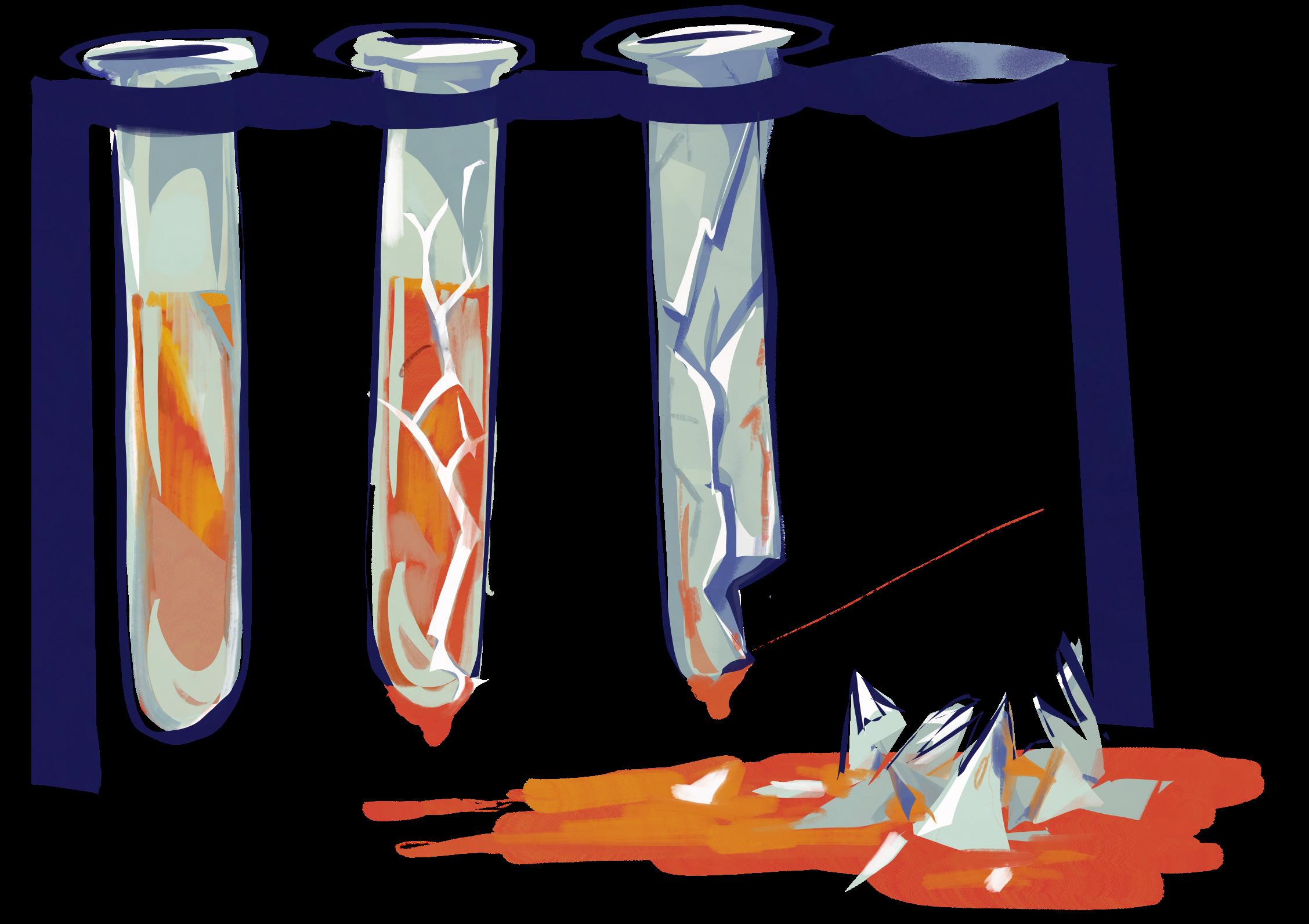
and absent of transparency requirements, risks turning medical discovery into a pendulum swinging towards whatever is fashionable.
The move against HFT is a microcosm of a larger transformation
in American science towards lower public trust, lower quality research in biomedical institutions, and adverse health outcomes for Americans. In light of defunding HFT research, the Trump administration is betting big
Edited by Matthew Siu, Angela Lu, and Eva Atkins
Scan the QR code on the right for the full article (with citations)
on alternatives (e.g., organoids) while it simultaneously dismantles the exact research needed to prove those alternatives work: burn the library, and the architects build blindly.

Enzo Dervišević (CC ‘29) is a staff writer for CPR from Aurora, Colorado, studying biology. He can be reached at ed3161@columbia.edu.
who gets KATY GLENN BASS
AN INTERVIEW WITH KNIGHT
INSTITUTE RESEARCH DIRECTOR

BY MADELINE SENATE ILLUSTRATED BY SHAY BAER
Madeline Senate: You’re currently working as the Research Director of Knight First Institute, but you began working to protect freedom of expression with PEN America, a nonprofit that defends free speech and press with a focus on writers and journalists, in 2014. How has the conversation regarding free speech changed over time in your experience? Do you feel like progress has been made in the fight for First Amendment rights?
Katy Glenn Bass: Since 2014, the prominence of First Amendment issues and free speech issues globally have increased a lot in terms of salience. It seems in some ways that almost every political fight we’re having in this country relates to free speech in some way.
I think the importance of free speech rights and the value of free expression has become more apparent over those years. In terms of whether there has been progress made, I think we’re really in a battle for the soul of the Constitution right now, so progress is a hard thing to describe. However, I would say that I think people are really aware of how important these rights are, both for themselves and for our society more broadly.
With the Knight Institute, you’ve put together multiple research initiatives focusing on recent technological developments, such as platform algorithms and artificial intelligence. This new technology has drastically changed the structure of public discourse, and it will continue to change the way people continue to discuss politics in the future. Do you feel like technology has allowed for a greater freedom of expression, or alternatively, has technology hindered freedom of expression in other ways?
This is a complicated question because right now, everyone is very aware of the harm that new technologies are posing to free expression. If you asked this question ten or fifteen years ago, I think you would have gotten much more optimistic answers from people who work on this. There was a lot of hope that the Internet and global connectivity were going to bring about a new wave of democracy and free speech around the world. Now, we’re seeing the bottom of that cycle where everyone now thinks that technology is enabling authoritarianism and sending us into the darkness—and there’s some truth to both of those things. However, technology has also been really wonderful for dramatically expanding people’s access to information. People now have the ability to inform themselves and listen to people from anywhere in the world in a way that was not possible before the Internet.
I share people’s concerns about some of the side effects of these new technologies, but I also still think it’s been a really enormous development in terms of people’s ability to organize. The Internet has ushered in new ways for people to learn from one another and find information that they might want to explore on their own.
In your experience, how have these technological developments changed the way that scholars view and debate constitutional issues?
Now, so much of our speech happens on privately owned platforms. As you know, the Constitution and the Bill of Rights were primarily written with the government in mind as the chief source of danger to those rights, which makes sense because the Internet did not exist in the 18th century.
However, all of those rights and the court framework that has been built up around those rights really view the government as the problem and main infringer of rights. Now we have
this new environment where almost all communication happens on platforms owned by companies, not by the government. Those companies’ decisions have a real impact on our freedom of speech and our ability to express ourselves, but they’re not government actions. So, in some ways, the First Amendment doesn’t have a lot of work to do there. But, then you also have this second layer to look at where the government is trying to influence what those companies do. The government is putting pressure on them to take down certain speech or not take down certain speech, or criticizing platforms for being biased towards one political view or another. Therefore, technology has changed a lot about the way we think about where the threats to free speech are coming from and what can be done about them.
On the topic of the responsibility of these private platforms, the issue of misinformation on social media has been a highly debated topic in recent years. While some feel as though social media platforms bear the responsibility of fact checking and limiting the spread of false information, others argue that this would pose a threat to freedom of speech. This debate has even culminated in legal challenges, such as in Murthy vs. Missouri, where Missouri and Louisiana sued the US government for having social media platforms remove posts related to the pandemic. What role do you believe social media platforms play in enforcing the accuracy of information?
There’s two things to consider here. One is the role that social media platforms should play in terms of their social responsibility, or their responsibility to their users. The other category is how effective they are at doing what the users of that platform want
them to be doing—and those are not the same question and they don’t necessarily lead to the same answer.
On most platforms, users would prefer that the platform be doing something to try to remove inaccurate information, at least about really important things like public health messaging, the efficacy of vaccines, etc. That’s what the Murthy case was about in part.
Most users don’t like thinking of the social media platforms they use as vectors of misinformation and disinformation. However, for many years, we’ve also seen platforms that have tried to make an effort to do this. There was more of this in the past, but now, most platforms have stepped back from the idea that they should be really policing the factual nature of information on their platforms.
Yet, I think their ability to do that is more questionable. The amount of information that’s being posted on these platforms and shared on these platforms every second is really hard for the human brain to even fathom. It’s just so much information, so platforms are really limited in their capabilities to police information. Even if that’s a role that we want them to play, the technological realities of these platforms makes it hard for them to do that accurately. They can either overshoot and they take down too much stuff, including stuff that I think most people would not consider to be factually inaccurate, or they undershoot and they leave up a lot stuff. Then, people see the stuff on the platform and
think, “Wait, why is that there? That’s crazy.” It’s a hard problem.
Do you believe that it’s possible to strike some sort of ideal balance between overshooting and not having enough fact checking?

I think this is one of those things where the users of the platforms are probably the ones best positioned to ask for that. They can use their own ability to exit that platform if they don’t like the way it is operating. One example of this is the platform X. Once Twitter was taken over by Elon Musk, a number of users left the platform because they didn’t like the new decisions that were being made by new leadership about content moderation and about the kinds of accounts that they were hosting online. I’m sympathetic to the fact that there are only so many options on social media. There are not an endless number of platforms to use, but one thing that holds promise is newer platforms like Blue Sky where users have more control over moderation decisions (like what they want to see and what they don’t want to see). Things like that are the way forward.
Beyond the digital sphere, the censorship of free speech has been especially relevant to higher education. The Foundation for Individual Rights and Expression (FIRE) gives universities speech climate grades to measure free expression on campus, which is based on student surveys, campus policies and speech related controversies. Columbia University received an F in the speech climate. In your opinion, is this a fair assessment? What benchmarks need to be met for this assessment to change?
I can’t really speak to the FIRE grade because I don’t know that much about the methodology they use to come up with those scores, but I think for many campuses across the United States, their record on free expression has been pretty dismal over the last few years in terms of cracking down on particular kinds of expression. In terms of applying rules differently to different speakers or actors, one of the most important benchmarks that I would highlight going forward is for private campuses (not public universities or state schools). They have a lot of leeway in terms of the law and the sorts of rules they want to set for expression on campus.
However, whatever those rules are, they should be informed by First Amendment values and they should be applied fairly and equally across the board. If you can’t do that, then you deserve the failing grade.
To what extent do you believe that private universities should have more leeway in managing free speech as opposed to public universities?
It’s a matter of how the First Amendment applies differently to public schools versus private schools, but in general, I would say that private schools should look to the principles of the First Amendment for making rules: don’t discriminate on the basis of viewpoint or on the basis of content, apply those rules fairly, try to maximize free expression values. You want to try to accommodate as much speech and debate and expression on campus as possible. Those things are all encoded in the First Amendment, and that is where I would point private universities when setting their rules.
While universities are aiming to maintain their academic freedom and allow for pure freedom of expression, they’re also facing growing pressures to moderate this expression according to political sentiments. Columbia and other universities have been heavily criticized in recent years for their policies on free speech and agreements with the Trump administration. Do you view educational institutions more as perpetrators of censorship, or actors which can lead the fight against it?
I would take a step back and look at where the pressure is coming from. As critical as the Knight Institute and I have been of universities that have settled with the administration, I must underscore that it is entirely inappropriate and unconstitutional for the government to be putting this kind of pressure on universities in the first place.
That is the main problem. The Trump administration is doing this by withholding federal funding, which is vital for the massive research apparatuses that exist on most of these campuses. They’re putting these universities in a pretty much impossible position. Even if you fight in court, it may take years to resolve and you have to gamble that it will go in your favor (even though I think you do have a strong First Amendment case there). You either have to live with the fact that you may not see that funding for years or you have to bend to the enormous pressure from your own community and government to cut a deal so that you can get that money back and the university’s research operations can continue. That’s a completely unfair position to put any university in. One thing that has been really unfortunate about the last few months is that so many schools have been really reluctant to press for their rights in court. There have only been a very small number of universities that have tried to sue over this withhold-
ing of funding as a lever for pushing universities to agree to the administration’s terms.
The First Amendment law is very much in the university’s favor in these cases, but courts take a long time to decide issues, and then there’s appeals to go through. Most schools can’t live with multiple years of interrupted funding. I think they’ve been put in a really hard place. However, for the most part, I would have liked to see more resistance from those universities than we have seen.
If we look at patterns spanning across the whole country, there have been numerous cases that suggest that the US may be experiencing democratic backsliding and decreasing the constitutional rights of US citizens. The US was added to the Civics Monitor Watch list, which is a list of countries that have experienced decreased civil liberties. Do you feel like this claim rings true regarding the current state of rights in the US?
Yes, unfortunately, I think it does. It’s also something that many scholars of democracy and authoritarianism have noted as well: we’re clearly in a moment of backsliding.
Can you elaborate more on what this backsliding looks like in the US?
It’s this onslaught against all sorts of speech and sites of opposition to the administration. One reason they are going after universities is because universities are sites where effective resistance would form. But you’re also seeing it in terms of their attempt to bring pressure on all sorts of private institutions: the attacks on the media and the frivolous lawsuits against major media outlets. Those outlets have then decided to settle rather than fight in court where their First Amendment rights would have been vindicated.
Across the board, it’s an attempt to superimpose an authoritarian power structure on our democracy. Yet, I will also say that for all of the surprising capitulation that we’ve seen at the elite level by traditional media outlets that have settled lawsuits that Trump has brought and the universities that have signed settlement agreements, one thing that is giving me a lot of hope is that you are also seeing a lot of popular resistance—not necessarily on the elite level, but the massive protests that we saw last month and the election results that we got last week. There are a lot of reasons to think that normal everyday people in this country do not like what is happen ing, understand what is at stake and the importance of their rights, and are doing what they can to push back.

In addition to popular protests, how can you see this country moving forward in the future to address all this backsliding?
It’s going to be a long road, but I think protest opens the space for further action. The protest in itself is a way of showing people that you are not alone in being upset about what’s happening and disagreeing with it. It also creates moments for people to organize communities and give them a next step, whether that is knocking on doors for a political candidate or starting to organize for change in their local communities. I think we’re already seeing that happen everywhere.
I think elections continue to be a really important part of this. Voting is not everything, but it’s a significant part of a democracy. We’re now about a year out from the 2026 midterm congressional elections, so supporting whatever candidate really speaks to you the most and doing what you can to volunteer for them is another way forward.
I also think that continuing to stay informed and ucating yourself on what is happening by talking about it with your own network of friends and loved ones is another thing that we can do together. Regarding longterm rebuilding, it will be years at least. It will be a long time before we’ve managed to repair all of this
damage and some of this is going to have to happen through new legislation to better protect our rights from this kind of dangerous pressure from the government. This can be a way to curb the government’s powers and ability to make those sorts of threats, which is something that I hope a future Congress will take up.
Madeline Senate (CC ’29) is a staff correspondent at the Columbia Political Review majoring in Political Science on the Pre-Law track. Madeline spent the past fall working on the Virginian gubernatorial race, during which she attended her first (and second) political rally. You can contact Madeline at ms7430@columbia.edu
Edited by Parini Rao
Scan the QR code on the right for the full video and transcript (with citations)


TRUMP, IRan, & THe Death of PoLITIca L PRoMIse


BY ISHAAN BARRETT
ILLUSTRATED BY JAMIE KIM
On Saturday, February 28, 2026, the U.S. government attacked Iran, striking the nation’s capital, Tehran, and other large cities in the region. The strikes prompted retaliation from Iran, who immediately targeted sites critical to U.S. interests in the region. Though tensions between Iran and the U.S. have heated up before, most recently when the U.S. targeted three Iranian nuclear sites last June, these new strikes have escalated the conflict
even further than before leading to a full-on regional war. The widespread civilian casualties in Iran have included a girls’ elementary school in the southern town of Minab and at least 18 additional civilian deaths in Lamerd.
While the strikes are ongoing and, ensuing consequences of U.S. involvement are still uncertain, the larger calculus of Trump’s choice to directly target Iran with overwhelming force calls into question the con-
sistency of U.S. leadership. More importantly, it challenges the campaign promises that Trump made to the American people, and brings into question the ethics of a White House more consumed with its vision of international military hegemony than ever before.
Trump’s escalation in Iran adds to a growing portfolio of foreign intervention that he distanced himself from when he began campaigning in 2024. Venezuela, Somalia, Cuba,
Mexico, Greenland, and Iraq are just a few of the countries that Trump has either directly targeted or threatened since the start of his second term. Yet, despite his past record of foreign involvement, Trump’s long-standing promises to the American people, both in his campaign and during time in office, have hinged on decoupling the U.S. from foreign conflicts.
Even within his own party, his allies brought criticism almost immediately following the new wave of strikes. Congresswoman Marjorie Taylor Greene (R-GA) recently issued a scathing rebuke of Trump’s actions within Iran and the dubious claims made by the intelligence community about the country’s nuclear infrastructure. Trump’s Democratic counterparts have been equally if not more heavy handed in their anger against the administration’s military actions against Iran. Given Trump’s ideological track record, and the mounting anger against him on both sides of the aisle, the central question is what explains this sudden about-face from America’s commander in chief.
By any standard, Trump’s actions against Iran are a major risk. Engaging in single-handed regime change using shaky intelligence as a backing makes his move against Iran hard to ground in a real, credible threat. And lacking a clear plan for who should lead Iran next, Trump’s risk-taking
a regime change operation that serves U.S. strategic interests—primarily nuclear security—and Trump’s desire to claim a transformative political legacy.
This logic would largely make sense. Consider that in 2018, Trump withdrew from the Iran nuclear deal, or Joint Comprehensive Plan of Action, (JCPOA), which he had long criticized prior to taking office. The deal was a critical agreement involving the U.S. and other major countries resolved to restrict Iran’s nuclear program and included provisions to inhibit uranium enrichment in exchange for a softening of sanctions against the country. By dismantling the diplomatic structure that constrained Iran’s nuclear program, Trump manufactured the very conditions that he is now using to justify this new military escalation. The nuclear rationale he has employed throughout his second term is entirely circular: U.S. withdrawal from JCPOA has precipitated the now-alarmist posturing of America’s intelligence and military community.
Trump’s inconsistent Iran policy, including his 2018 administrative choices, the bombing from last June, and the current military escalations, reflects a much broader unraveling of international credibility. It has produced an environment in which the White House’s stated rationale
his administration claimed that they had obliterated Iran’s nuclear capabilities; yet his State of the Union speech highlighted the ongoing development of Iran’s nuclear program. Moreover, U.S. intelligence assessments from years prior concluded that Iran had not made a decision to develop nuclear weapons; U.S. officials confirmed as much after strikes last June. So the imminent nuclear threat that Trump is peddling does not exist according to his own government’s assessments.
These contradictions suggest that the rational actor model of political behavior cannot—nor should—apply to any analysis of Trump’s behavior. A more simple explanation might be retaliation for Iran’s violations of human rights. In January, Iran arrested and killed numerous protesters—mostly students—to try and curb anti-governmental activity in the country that garnered international attention. Iran’s actions against its own citizens contributed, in large part, to the breakdown of diplomatic negotiations with the U.S., but leveraging that as justification for further conflict would be counterintuitive at best and immoral at worst. The bombing campaign against Iran has claimed the lives of schoolchildren and innocent Iranian civilians, which means that the administration’s humanitarian posture collapses. Under
is that much more reckless. For instance, U.S. intelligence sources are already under scrutiny for over-inflating their threat assessment of Iran’s missile arsenal. In the days leading up to the strikes, U.S. sources made exaggerated claims about the lethality of Iran’s military arsenal. The working assumption by people outside the intelligence community is that these claims are widely exaggerated, serving more as justification for
for war has shifted so frequently that no single justification can withstand scrutiny on its own terms. The Trump administration has offered multiple different reasons for the same policy of aggression, weaving a network of contradictions that even his allies in Congress are struggling to buy.
His recent State of the Union address is a perfect example of this at work. Previously, to justify his June 2025 strikes against Iran, Trump and
the weight of its own consequences, nobody—Trump especially—can claim to be avenging the massacre of Iranian university students while bombing their secondary schools. If neither strategic logic nor humanitarian concern explains Trump’s actions, only self-interest remains as a plausible driver of his decision making.
And self-interest, in this context, is not difficult to trace. Trump’s ap-
proval ratings have cratered to an alltime low: his 61 percent disapproval rate—a fourteen point swing since he took office—has threatening implications for the Republican party as midterms roll around. His domestic agenda, from DOGE to mass deportations to the gutting of federal agencies, has generated sustained and substantial backlash with no signs of relenting. War has always been the most reliable instrument of political distraction, and Trump himself has argued as much. From 2011 to 2013, he argued repeatedly that Obama would attack Iran “to get re-elected” or “to save face” when poll numbers dropped for the White House. This cynical commentary is now doctrine, the consequences of which now extending far beyond the midterm election cycle.
Internationally, the strikes have already fractured whatever remained of American diplomatic credibility. Oman’s foreign minister urged the U.S. not to get further involved in the conflict, arguing that the war is not America’s to fight. Pakistan, which had nominated Trump for the Nobel Peace Prize just months earlier, has condemned the operation outright. Iran’s retaliatory strikes against U.S.

assets throughout the region—in Qatar, Bahrain, Kuwait, and the UAE— have transformed a bilateral confrontation into a regional crisis that threatens the Strait of Hormuz and a third of the world’s seaborne oil supply. And the death of Iran’s Supreme Leader Ayatollah Ali Khamenei complicates this calculus even further.
The removal of Iran’s paramount authority creates a power vacuum for which Washington has no articulated plan to deal with. The regime may fracture, consolidate around hardliners within the country, or descend into chaos, and Trump’s encouragement for Iranians to take over offers revolutionary rhetoric without any framework to support it. In fact, the premise of U.S. involvement in toppling an old regime and instating a new one raises its own ethical questions that history has already answered in part (and resoundingly in the negative). It is one thing to topple a leader but another entirely to try and control the outcome of what comes next only to make things worse. The U.S. learned this first-hand in Iraq and Afghanistan when things went ostensibly, and rapidly, sideways. Yet, it seems like there is no indication that the U.S. has internalized these lessons in
the decades since.
Domestically, the constitutional breach is just as severe. Trump launched the largest U.S. military operation since Iraq without congressional authorization, prompting bipartisan calls for an immediate War Powers Resolution vote. That members of his party are breaking ranks this quickly—and this vocally—should signal how untenable his position is. It also shows how little of this was planned with a concrete endgame in mind. What remains now is a presidency defined by wreckage, rather than the type of strategic political calculus that the highest national office—and White House—warrants. Trump did not go to war with Iran because it was necessary. He went to war because in the absence of a coherent domestic legacy, an American-induced foreign crisis was the only lever he could pull.
With the floor vanishing beneath Trump’s feet, the American public is left with one final, dismal question: how far will he drag us down? And, most importantly, when we finally stop plummeting, will there be anyone left to pull us back?
Ishaan Barrett (CC ‘26) is a senior studying urban studies and political science. His previous writing has been featured in URBAN Magazine at Columbia GSAPP, the Harvard Urban Review, the Barnard-Columbia Urban Review, the Columbia Policy Journal, and the Columbia Daily Spectator. A current Rose Research Ambassador and Gilder Lehrman Institute grantee, Barrett has previously held fellowships at the IRCPL, Harriman Institute, and the Holder Initiative, where he currently serves on the board. He can be reached at i.barrett@columbia.edu.
Edited by Jamie Kim, Nadia Knoblauch, and Jacob Gold
Scan the QR code on the right for the full article (with citations)


CHALLENGING THE COLOMBIA TESTS THE LIMITS OF US HEGEMONY
BY SHARANYA MAULIK ILLUSTRATED BY SHAY BAER & JAMIE KIM
Tand moral conviction are colliding across the Americas, signaling the breakdown of a longstanding partnership as the United States punishes Colombia for opposing its policies and asserting its independence.
Economic threats began early into President Trump’s administration when a dispute over US flights to Colombia carrying deported individuals triggered a series of escalating trade threats. Between January and April, Washington warned it
on R oe
he nation of Colombia has stood as one of the United States’ most reliable allies in Latin America for decades. The partnership, forged through counter-narcotics cooperation and cemented by a free-trade pact, once symbolized Washington’s vision of a stable, USaligned hemisphere. However, given the recent changes in US and Colombian political priorities, that framework has begun to crack. In the span of a single year, the alliance has weathered trade disputes, clashing foreign-policy ideals, and even the revocation of Colombian President Gustavo Petro’s US visa. The United States’ recent escalation of tariffs, visa restrictions, and public rebukes against Colombia marks not an isolated diplomatic spat, but a broader unraveling of the US–Colombia alliance, driven by the collision of Washington’s coercive trade policies and Bogotá’s ideological realignment under President Gustavo Petro. Economic pressure

CTR in E
would impose tariffs up to 25 percent on Colombian imports unless Bogotá cooperated. Trade, once a tool of partnership, became an instrument of punishment. In April, the United States followed through with a 10 percent global tariff that included Colombia, a measure that cut into exports, slowed trade, and risked thousands of domestic jobs. The United States justified its actions as a defense of economic fairness and security, but for many in Bogota, it revealed a willingness to weaponize the geopolitical relationship.
What might have once been settled through diplomacy became a public show of leverage with much more significant, broader impacts on the Colombian people. Colombia’s economic reliance on US markets, long seen as a pillar of stability, had become a point of vulnerability. Ideological beliefs exacerbated these rifts in the alliance. In May 2024, President Petro severed diplomatic ties with Israel, denouncing its government as “genocidal” in response to the Gaza war. By July 2025, he was hosting a “Hague Group” summit in Bogota, urging nations to resist Israeli aggression and calling on the United Nations to assemble an “army of nations” to liberate Palestine. Colombia’s foreign policy shift has placed the country within a rising current of left-leaning, sovereignty-focused governance across Latin America, described as a “Pink Tide 2.0.” This regional movement reflects governments seeking greater autonomy in foreign affairs, reduced dependence on Washington, and alignment with Global South causes. Yet this turn directly clashed with the Trump administration’s reassertion of US dominance under what foreign policy analysts have informally dubbed a Second Monroe Doctrine or ‘Donroe Doctrine’. This framework has shaped Washington’s increasingly coercive foreign policy in Latin America and underpinned its intolerance for ideological deviation within its own hemisphere. For decades, Bogota’s foreign policy largely aligned with US interests. Now, under Petro’s leadership, Bogotá has emerged as a central challenger to US hemispheric authority, a role that the Second Monroe Doctrine increasingly frames as subversive. Petro’s decision resonated with students, activists, and citizens across Latin America who saw Palestine as a test of global justice. For Washington, however, Colombia’s defiance was not simply moral self-assertion,
but geopolitical insubordination.
The US responded swiftly and severely, signaling that it would impose economic and diplo -
called its ambassador from Washington, signaling the lowest point in bilateral relations in decades. In October 2025, President Trump announced that the United States would halt all foreign assistance to Colombia. Prior to this incident, the country had received an estimated $230 million USD in the last fiscal year and over $700 million USD in 2023.
The rupture carries implications well beyond Bo
economy. Washington’s means of coercion still carry weight, even as political authority diminishes. Every act of resistance risks economic repercussions, a vulnerability the US has increasingly leveraged as a form of coercive soft power. At the same time, Colombia has begun expanding trade ties with China, a shift visible across Latin America. But whether this gradual reorientation can provide enough economic stability to offset potential US retaliation remains
matic consequences on countries that assert ideological independence. This pattern echoed the Trump adminis tration’s broader posture toward the region, evident in its rollback of ties with Cuba and its intensified sanc tions on Venezuela, showing how left-leaning governments often face US pressure for ideological reasons.
In September 2025, after Presi dent Petro spoke at a pro-Palestine rally outside the United Nations headquarters in New York, urging US soldiers to “defy orders” supporting Israel, President Trump revoked Pet ro’s visa. The move was largely sym bolic as sitting heads of
ly need standard visas, but its implications were profound. By targeting Pet ro personally, Washington signaled that disagreement would be met not with dialogue but with exclusion. Petro criticized the decision on social media as a violation of interna tional norms, and Trump responded, asserting US dominance and defend ing his actions. By escalating into a public, personal clash on social me dia, the feud marked the moment the long-standing US–Colombia alliance openly fractured. Colombia soon re

global political expression. Colombia’s resistance exposes a broader decline in US influence across Latin America. Once the uncontested leader of the hemisphere, the United States now confronts a region more ideologically pluralistic and less
compliant. As the US punishes dissent, reviving a Monroe Doctrine approach, it hastens the erosion of the very influence it seeks to preserve. Nations across the region now exercise greater autonomy in trade and ideology, limiting Washington’s abil-
ity to shape outcomes. Ultimately, the US–Colombia rupture illustrates a shifting world order, one in which coercion can no longer disguise insecurity, and where US power will continue to erode if it cannot adapt to a hemisphere increasingly unwilling
Sharanya Maulik (BC ’28) is a staff writer for the Columbia Political Review studying political science and economics, with a focus on voting behavior and macroeconomic policy. She’s also unusually good at planning her next hypothetical vacation with budget flights.
Edited by Wren Greeley-Havard, Ariana Campo Prego, and Jonathan Pollak
Scan the QR code on the right for the full article (with citations)




IN TRUMP’S ‘NARCO-TERRORISM’ THERE’S NARCO
On September 2, 2025, the United States military struck a Venezuelan vessel in international waters, killing the 11 individuals on board. This strike was the first of a volley of attacks President Trump made against alleged narco-terrorists in the waters surrounding Latin America. Two months later, on October 27th, Trump’s strikes broadened to include regions of the eastern Pacific. Trump justified his attacks as necessary to defend against the importation of fentanyl into the United States, an act that he labeled as narco-terrorism, but his invocation of the term contrasts its historical origins. In 1983, President of Peru Fernando Belaúnde, first used the term when responding to cartel violence against police. Within the past twenty years, the term narcoterrorism has broadened from just narcotics-oriented groups engaging in terror to now

including terror-oriented organizations trafficking narcotics for profit. Narcoterrorism’s broadening scope demonstrates the term’s increasing complexity.
Despite this historical nuance, Trump’s counter-narcoterrorism policy reflects a narrower outlook. In his term-one response to the Taliban, President Trump failed to stem their then-thriving narcotics trade by underemphasizing a counter-narcotics approach. Trump’s recent terrorist designations and boat strikes have overemphasized and misrepresented Latin American cartels’ ties to terrorism. Both instances demonstrate how Trump conflates vastly different narcoterrorist organizations under the general, ambiguous framing of ‘terrorism.’ Domestically, this conflation muddles counterterrorism responses by precluding effective inter-agency cooperation. Because the US plays a

formative role in international counter-terrorism efforts, Trump’s weaponization of terrorism’s definitional malleability could have unintended consequences.
Terrorism is inherently hard to define, as indicated by the failure of international institutions and states to reach an agreement on how to understand the term. The United Nations’ 2011 Special Tribunal in Lebanon began to outline a few foundational elements to partially define terrorism: (i) the perpetration of a criminal act (such as murder, kidnapping, hostage-taking, arson, and so on), or threatening such an act; (ii) the intent to spread fear among the population (which would generally entail the creation of public danger) or directly or indirectly coerce a national or international authority to take some action, or to refrain from taking it; (iii) when the act involves a transnational
element.
The Appeals Chamber of the Lebanon tribunal determined that this definition provides “more than a mere concordance of laws,” suggesting a broader consensus. However, scholars find the tribune’s rulings “dubious” at best because they mix domestic and international terrorism as well as conflate criminal and non-criminal definitions, oversimplifying and diluting the nuances of terrorism. Though not included by the Tribunal, religious, political, or ideological motivations often factor into various states’ definitions of terrorism. Motivation-based approaches to defining terror also complicate the construction of a comprehensive definition because states’ cultural, political, and social differences influence what they consider legitimate and justified.
Coupled with the lack of international consensus on defining terrorism, much less narcoterrorism, this ambiguity offers a place for domestic exploitation. Without an international standard to use as a reference point, states’ definitions matter even more. President Trump’s generalized interpretation of narcoterrorism foreign policy condenses it into a strategic label that weaponizes the malleability of both terms, terrorism and narcoterrorism.
Trump’s first-term policies against the Taliban in Afghanistan underemphasized how the narcotics market underpinned their terrorist operations. Political and economic turmoil after the Soviet-Afghan war and years of civil conflict historically catalyzed Afghanistan’s opium cultivation investments, making them responsible for 95% of heroin in Europe by 2021. However, President Trump’s initial plans for military involvement in Afghanistan largely ignored opium and its profits for the Taliban. Instead, Trump’s Operation Iron Tempest concentrated strikes on several of the Taliban’s heroin laboratories. Although an ostensibly impressive and effective show of force, Operation Iron Tempest wasn’t successful in practice. Trump’s 200 strikes did not stem the Taliban’s profits, and researchers from the London School of Economics discovered that the ‘laboratories’ struck by the U.S. were little more than mud huts. Trump’s minute impact relative to the military’s praise and robust military technology deployed suggests that this terror-oriented response was a tactical mismatch for the drug trade. By ineffectively using militaristic counterterrorism policy as a one-size-fits-all approach to narcoterrorism, Trump seems to focus more on the ‘terror’ than the ‘narco’.
“Designating Cartels And Other Organizations As Foreign Terrorist Organizations And Specially Designated Global Terrorists,” newly identified the narcotics cartel Tren de Aragua (TdA) as a terrorist organization. This redefinition escalates President Biden’s 2024 designation of TdA as a transnational criminal organization. In response to this escalation, scholarly critics pushed back, arguing that Trump’s designation was incorrect because TdA seeks profit without an ideological or political basis. By highlighting the ‘terror’ of cartel organizations, Trump weaponizes narco-terrorism and its definitional malleability to associate the visceral ideological and legal reactions of ‘terrorism’ with Venezuelan cartels.

A derivation of terrorism emerging from this unstable lack of international consensus, narcoterrorism is also an inherently malleable term. Political science researcher Tamara Makarenko’s 2004 concept of the crime-terror continuum begins to outline the complex, dynamic relationship between to disparate groups carries inherent ambiguity.

Just as Trump’s first administration ignored the Taliban’s ‘narco’, his second administration now focuses on the ‘terror’ of Latin American cartels. Trump’s Executive Order 14157,
Even when Trump engages with the ‘narco,’ he simplifies its complexity. Just as EO 14157 redefined TdA, Trump’s invocation of the Alien Enemies Act newly classified the “Cartel of the Suns” as a narco-terrorist organization. However, the label “Cartel of the Suns” mischaracterizes the non-centralized network of drug trafficking in Venezuela as an official institution. These designations prefaced Trump’s narcoterrorism charges in March against Venezuela’s President Nicolás Maduro, which accused him of being the long-time leader of the elusive Cartel of the Suns. By mischaracterizing Venezuela’s criminal networks as a unified body and terror-oriented syndicate, Trump’s definitions reshape rather than describe reality.
This conflation, then, compounds Trump’s ability to justify terror-level responses to Maduro and Venezuelan drug trafficking. Trump’s termone response to the Taliban’s drug facilities and ongoing strikes near Latin America show similar military might. Like his attacks against the Taliban’s mud huts, the recent strikes seemingly target defenseless individuals operating with lower levels of technology relative to their assailants. During Trump’s first term, the Air Force Secretary disapproved of
using F-22 fighters against the Taliban’s narcotics factories. It seems that unarmed boats in international waters would be a lower order target.
Yet, as Trump’s strikes continue into November, reporters speculate that the military has employed manned AC-130J gunships and unmanned AC-130J MQ-9 Reaper drones using Hellfire missiles. Trump equalizes terror-oriented and narcotics-oriented groups through his rhetoric and military response.
Comparing President Bush’s response during the War on Terror with Trump’s narco-terror conflation reveals how weaponizing definitions blunts domestic counterterrorism.
Like Trump’s attitude toward Latin American cartels, President Bush also emphasized the ‘terror’ in his campaign against weapons of mass destruction (WMDs). Steven Casteel, the DEA chief of intelligence during Bush’s first term, criticized Bush for refusing to link the War on Terror to drug trafficking financing. Indeed, Bush steered clear of using the term “narcoterrorism” when referring to various “terrorist” organizations. In a 2002 discussion with the President of Colombia, Andrés Pastrana, President Bush repeatedly referred to Latin American narco-terrorists by withholding the term “narco” while Pastrana instead labeled them as “narco terroris[ts].” Centering a federal response around terrorism versus narcoterrorism matters because it reconfigures inter-agency coordination against the threat. Bush’s aversion to using the term “narcoterrorism” led to the DEA’s exclusion from the interagency table for the War on Terror despite their advanced intelligence capabilities and traditional terrorist organizations’ involvement
in drug markets. Acknowledging this convergence becomes a prerequisite for implementing effective coordination between the CIA, DEA, and State Department.
Following this definitional conflation, the US becomes less equipped to deal with important goals like stopping WMD proliferation among terrorist organizations. A core tenet of Bush’s invasion was to eliminate a terrorist “axis of evil” with nuclear capabilities, through the destruction of supposed WMDs in Iraq. Similarly, Trump’s rhetoric accuses Venezuela of weaponizing cocaine as a chemical “weapon” of mass destruction. In 2019, James F. McDonnell, a President Trump-appointed official of the Countering Weapons of Mass Destruction Office (CWMD), issued a memorandum to classify fentanyl as a WMD. This memorandum suggested the reallocation of counter-WMD resources for the interdiction of fentanyl when smuggled and preventing its use as a weapon. A product of narco-terror conflation, trade-offs from counter-WMD resource reallocation diminish the ability to assess higher-order risks like nuclear proliferation.
Trump’s conflation of narcoterrorism and terrorism also demonstrates how weaponizing ‘terrorism’ hinders counter-terrorism discourse in the international community. The United States’ Foreign Terrorist Organization (FTO) list is a “beacon” for other states’ terrorist designations globally. Even though the US’s allies often do not consider criminal organizations FTOs, Trump’s narco-terror conflation might, at best, complicate counter-terrorist coordination with these other countries. Because FTO designations and terrorism’s defini-
tions formulate a state’s approach to counter-terrorism, discrepancies between coordinating parties might hinder their collective capabilities. At worst, the US’s conflation of narcotics organizations and terrorist groups could set an adverse precedent for countries that look to the US’s norms to do the same.
Trump’s weaponization of definitional malleability reinforces militaristic responses, convolutes domestic counter-terrorism, and sets an adverse precedent for the international community. Returning once more to the crime-terror continuum clarifies how policymakers might reframe counterterrorist policies. Because of seemingly infinite variations between narcotics and terrorism, every organization seems to be unique. As the US navigates the ever-shifting atmosphere of narcotics trafficking, terrorism, and their nexus, policymakers must consider the domestic implications of organizational exclusion and the US’s role in setting international standards for counter-terrorism. Advancing an international focus on defining terrorism remains important, but states must also acknowledge divergences in national definitions and FTO lists — not weaponize these gaps. Because terrorist organizations increasingly mobilize transnationally, a multilateral, international coordination is a necessary response. As Trump continues the campaign of strikes against ships in the Pacific and Caribbean, it is imperative that the country recognizes how weaponizing ambiguous definitions at home can swiftly morph into entangling conflicts abroad.
Jack Bradner (CC ‘29) is a junior editor for the Columbia Political Review studying English and Political Science. He can be reached at jab2503@columbia.edu
Edited by Brooklynne Roman, Marcello Marturi, and Shreya Karnik
Scan the QR code on the right for the full article (with citations)




FLIP PHONES & CAPITALISM
BY YUNUS AKDAL
ILLUSTRATED BY JAMIE KIM & SHAE BAER
CAPITALISM
There are very few ideas in our language named after figures whose historical existence remains uncertain.
Even religious doctrines conceal their mythologism by abstracting narrative figures into systematic and universal titles. The title of “Christ” predates Christianity itself, coming from the Greek “Christos” (Χριστός), which means the “anointed one.” In a literal sense, Christian-ity means the followers of the chosen one. Similarly, the word “Islam” has its origins in the word “salama” (سلم), which meant “submission” in ancient Arabic. By the same token, we see the Robin Hoodists of our generation refer to them- selves as socialists, even if they have nothing to do with socialism.
Luddism is one exception. The word “Luddism” comes from a number of 18th-century anecdotes from Leicestershire about a boy called Ned Ludd (or Edward Ludlam) who allegedly tore apart knitting frames in protest of the perceived replacement of manual labour with capital. Written and historical records of him are mostly limited to rare Luddite letters and proclamations that were signed as “King Ludd,” or his secular counterpart, “General Ludd.” That the perceived epitome of Luddism (an individual whose accumulated resentment against the capital becomes his casus belli) is itself mythological says a great deal about the self-seriousness of Luddism as an ideology.Even Marx, who admittedly shared a common interest in the study of political economy with the Luddites, did not think it a worthwhile investment to partake in criticism of Luddism. He devoted only one paragraph
in Capital Volume 1 to it:
“The struggle between the capitalist and the wage-worker dates from the very origin of industrial capital, and it raged throughout the period of manufacture. But only since the introduction of machinery has the workman attacked the instrument of labor. He rebels against this particular form of the instrument, which, in his eyes, is only a formidable enemy. It took both time and experience before the work people learnt to distinguish between machinery and its employment by capital, and to direct their attacks, not against the material instruments of production, but against the mode in which they are used.”
Marx, in his beautifully dry and scornful tone, understands Luddism as a symptomatic and necessary reaction to the development of capitalism, rather than as an ideology in itself. For Marx, any self-serious ideology concerns itself with the political instrumentalization of labor and capital (which itself is a mere form of labor that has crystallised into an object form), rather than attempting to reject what essentially exists in the realm of historical necessity.This may hold true, even for our neo-Luddite friends off and on campus. To what extent can the neo-Luddites of our day “oppose” the agency of technology, if this opposition can only consist of ordering “world’s smartest dumb
phone” for the stunning price of only $399 because it has Spotify but not TikTok? Under the immanent and perpetual accumulation of capital, it gets harder and harder every day to be as authentic as Father Ludd.
II.
To try to understand the neo-Luddite movement through the lens of Luddism as a historical movement would be anachronistic, however. The only other feature they effectively share is my sincere antipathies.
In the past, I took the initiative to attend (with the aid of my apparent abundance of spare time) what has been referred to as the “S.H.I.T.P.H.O.N.E conferences,” organized by “Lamp Club,” the self-professed radical branch of the neo-Luddite movement in New York City. The conferences I attended involved a number of Gen Z college students and some two Boomer hippies who would come together to read poetry in the park, wear gnome hats, and conclude their meetings by breaking old phones. I remember vividly, however, that some name-dropping occurred at the conferences, couched in Marxist language, with incoherent references to capitalism and the neo-liberal order, whatever those mean. Unfortunately, it never seemed to exceed the level of the kind of Žižek-adjacent rhetoric your ex probably indulged in.
Hence, due to the political unseriousness of the neo-luddites, I did not intend to write about them until very recently. In December, CPR writer and comrade neo-Luddite Preston Parker reported on the group from a decidedly political angle, describing the movement as a “path to political optimism by seeking to rediscover the fundamentals of human interaction.” Parker, whom I had the privilege of meeting at a S.H.I.T.P.H.O.N.E conference, was to help establish the neo-Luddite movement on campus. Later, I was completely baffled when I read the Blue and White interview with Ned Ludd 1 and Ned Ludd 9. According to the Ludds, the neo-Luddites had a political manifesto which contained their own critique of political economy and a “plan of action.”
Looking at the interview reveals an important comparison. The original Luddites were opposed to the use of technological means of production only in relation to wages and job security. Hence, the original Luddites were in many ways a labor movement, and they were generally uninterested in a romanticized vision of men in its natural state. In this sense, the neo-Luddites are far more Amish than the original Luddites. It is evident in the interview that neo-Luddites (or nepo-Luddites, if you may), being the petty-bourgeois students that they are, do not concern themselves with the organization of the means of production, but simply with its corresponding social relations; namely, the admittedly alluring bourgeois conception of authentic personhood, and matters of sociability. It is no wonder that the theorists of neo-Luddism constantly speak of “alienation” but not “estrangement.”
III.
The neo-Luddite insistence upon its politicism, despite the obvious fact that its critique of society is predicated upon the personal-social realm as opposed to the political-economic, raises a question that is fundamental to contemporary politics, namely, the question of the separation of the personal and the political.
For Marx, the separation as such symbolizes one of the greatest accomplishments of the politically emancipated nation-states in the aftermath of the European Enlightenment. At the same time, it constitutes the structural limit of emancipation under the given political state.
Our generation has come to know of this separation through its alleged afterlife via the ideological maneuver of the second-wave feminists with the slogan “the personal is political:” which from the point of Marxism, attempts to override the contradiction that is symptomatic of and constantly reproduced by capitalism by enforcing the false identity of objects: by saying that they are the same. This is in fact a form of fetishism, whereby historically and socially mediated contradictions within capitalism, in this case, that of the separation of the public-private realms, is understood as a matter of identity equivalence.
As Marxists, if we must understand the divide of the personal and political realms as a symptom of the crisis of capitalism, we must also understand any rejection of this divide on ideological basis as another symptom of this crisis. Capitalism, within itself, immanently produces its own opposition.
When I directed the question of the personal and the political to my friend Addie, a self-described neo-Luddite, in a WKCR interview in March, she expressed her concerns about politics becoming apathetic when it becomes too absorbed in itself: “[Politics] doesn’t feel human anymore. It doesn’t feel like a personal issue. You can talk about all sorts of ‘campaigns,’ and you can talk about them as ‘campaigns,’ and that could be alienating to people…These in-person, weird, silly, open, inclusive events [that neo-Luddites organize] are how we are going to win anything; by making it fun to be on campus; making it something people want to fight for.” She added: “I am so interested in merging those two identities [the personal and political]. I think they can interact in a beautiful way.”
A political understanding of neo-Luddism reveals that it has very little to do with technology. Technology seems to be only one of the many obstacles the contemporary world has brought upon itself, which makes it hard to form personal relationships, a feeling of belonging, and, more significantly, a sense of radical agency. Neo-Luddism, just as the demand to combine the political with personal, is in
fact a demand for a radical form of politics that has been absent from our political epoch for the past 178 years (that is, since 1848).
Another thing to reflect upon is the general shortcomings of our political moment. The question of whether neo-Luddism is a lifestyle or a political orientation can be asked of all forms of political action we engage in today. How much of your Amazon boycott desires a political end, and how much of it is an ego reaction to your personal irrelevance?
Functionally, however, the political and personal realms remain separate under conditions of capitalism. Yourtears well-spent on Boromir’s death scene in The Lord of the Rings: Fellowship of the Ring Extended Edition, when he tells Aragorn, beneath his breath, “I would’ve followed you, my brother. My captain. My king,” probably does not mean that you will vote in favour of the divine right in the coming election.
The main reason for this, at least for Marx, is very simple. The Third Estate in the 18th-century; its 19th-century successor, the proletariat; and its alleged 21st-century successor, the neo-Luddite movement, did not have agency over their own movements, let alone over society at large. Within the crisis of capitalism, all of our freedoms appear contradictory and insufficient. To Marx, both the then-con-

Edited by Jemma Granite, Camilo
temporary and now-contemporary thinkers severely overestimate the extent to which the individual can transform political reality through their personal contributions, which in fact points to the necessity of the revolutionary project. The task of the revolutionary project is to free society and make the personal the political, or in Marx’s iterations, make “philosophy realize itself,” make philosophy a matter of practice, so that ideas may freely transform the world, and so that our neo-Luddite friends can freely partake in their public neuroticisms.
Whether such a project is feasible or not is in fact not a “scholastic question,” it is a very practical one. It remains to be answered by the generations to come. Much luck to us.
One thing is for certain. There is nothing more Columbiaesque than splitting your MacBook Airs in half and believing that somewhere there lies a political metaphor.
Jacob Gold
Scan the QR code on the right for the full article (with citations)

Yunus Akdal GS ‘26 is a political science student and a critical theory enthusiast.
Choi, and
THe hIJaCKin

InsIDe
the RePeal oF
THe EnDAnGERMEnT FInDInG
BY NAYANTARA ALVA ILLUSTRATED BY SHAY BAER
On November 11, 2024, Lee Zeldin was announced as Trump’s pick for the 17th Administrator of the US Environmental Protection Agency (EPA). Considering his relatively scant background in environmental and public health issues, the world was taken aback by the appointment. But with a deeper look at his past campaign record, powered by over $400,000 of oil lobby money and grounded in a relentless call for the allowance of fracking, Zeldin proves to be the quintessential harbinger of Trump’s America-first pursuit of ‘energy dominance.’
Zeldin came into office the subsequent January with the honorable mission of “protect[ing] human health and the environment.” Exactly 7 months later, he proposed striking down one of the core pillars that allowed the EPA to do just that: the Endangerment Finding.
inG
The 2009 Endangerment Finding gave the EPA the legal foundation and obligation under the Clean Air Act (CAA) to regulate greenhouse gas (GHG) emissions by formally enshrining the scientific consensus that they endanger public health and welfare. The CAA, which has long required the EPA to regulate polluting substances, has a prerequisite condition embedded in its statutes: a substance must be “reasonably anticipated to endanger public health or welfare” to fall under its purview. A repeal of the Endangerment finding, therefore, absolves and prevents the EPA from overseeing all GHG emissions, be that from vehicular, industrial, or power plant sources. It also rescinds all present regulations made pursuant to the finding, the primary ones comprising environmental standards on fuel-powered vehicles and engines.
While the repeal has been framed as a cost-cutting measure that eases burdens on American consumers, this claim quickly unravels under scrutiny, revealing something far deeper than the long-standing Trumpian distaste for climate policy. We are observing a deeper shift within the EPA itself, where legally dubious processes and selective reasoning are being actively weaponized
to justify pre-determined outcomes. What emerges is a clear throughline: the gradual transition of the fossil fuel industry from peripheral actors to puppet-masters, with Zeldin’s long-standing ties serving as a strong blueprint for the agency’s realignment.
This February, it was made official. The EPA declared greenhouse gas emissions neither a historical, present, nor future threat to human health, hailing the move as the “single largest deregulatory action in US history.”
Naturally, this action immediately triggered a lawsuit from some of the largest environmental and health groups in the US. While we cannot project its resolution with certainty, legal scholars expect the final decision to be rendered only in 2028 after several rounds in court. Until then, the implications of this policy change are expected to be pervasive and multifaceted. Some critics fear the economic and health impacts of increased pollution on American citizens, some grieve America’s loss of credibility among allies and its erosion of technological advantage among competitors. Others feel cautious about the deference of regulatory responsibility toward states, caused by the vacuum now created at the federal level.
Lurking in the background of this grand political theater is a group that calls itself the ‘Climate Working Group’ (CWG). Contrary to its title, this group consists of five infamous climate minimizers, cherry-picked by former founder-CEO of Liberty Energy (one of the largest fracking companies in North America) and present US Secretary of Energy, Chris Wright. Under the shared belief that
the world adopts an “exaggerated or incomplete” view of climate change, the CWG authored the report that constitutes the supposed scientific underpinning of the EPA repeal.
While this paper has gone far from unnoticed by the scientific community, a detail that few people are privy to is Zeldin’s brazen, direct coordination with the Department of Energy (DOE) throughout the report, shaping it with the explicit goal of undermining the Endangerment Finding in the future.
Another lesser-known detail: just two weeks before the repeal was finalized, the formation of this group was declared a legal violation. At the District Court of Massachusetts, it was ruled that the Energy Department had violated the 1972 Federal Advisory Committee Act, which requires advisory committees to conduct open meetings, enable public access to their records, and be composed of a diverse range of viewpoints. Documents released in the case revealed that the DOE had intentionally kept the existence of the CWG a secret, emphasizing the importance of handling its meetings with “silence and restraint pending completion of [the report’s] process.” The release of documents also found several internal DOE review comments flagging scientific failings in the report, most of which went unaddressed after the EPA encouraged minimal revisions.
Those comments were not without reason. The paper engages in a vigorous battle against scientific consensus, concluding that elevated CO2 enhances plant growth, future emission trends are overstated, and extreme weather events have shown no increase in frequency and intensity. Most importantly, it declares that US

policy actions will have “undetectably small direct impacts on the global climate” and that “excessively aggressive mitigation policies could prove more detrimental than beneficial [for the economy].”
Zeldin takes this last claim very seriously. In the news release of its final ruling, the EPA focuses almost exclusively on the economic benefit of the repeal, specifically its trickle-down effect on net savings for the average American consumer. Further, although the initial proposal for the repeal heavily touted the DOE scientific report, the EPA betrays itself as nearly self-aware of the paper’s illegitimacy by making absolutely no mention of it in its final ruling. Clearly, this change in framing was made purely to improve the repeal’s chances in court, for its rationale still entirely rests on the paper’s ‘discoveries,’ especially its call to bring in costs as an iron constraint to the climate discussion.
But it doesn’t take too much examination to bust the cost-cutting myth, either. Across its news releases, the EPA heralds the figure of $1.3 trillion in savings between 2027 and 2055, estimating $1.1 trillion from the reduced costs for new vehicles, and $200 billion from the avoided costs of EV chargers and related equipment. If this figure seems too good to be true, that’s because it is. The EPA conveniently excludes half of the standard equation required for a net savings analysis: it completely nullifies all the costs of the repeal.
This is not a mere calculation error. The EPA is entirely aware of
these costs and displays them bright and bold in its Regulatory Impact Analysis. Here, a chart displays four modelled scenarios to calculate the net savings of the repeal. The first scenario projects nearly $1.5 trillion in costs through 2055, associated with higher fuel purchases, vehicle maintenance costs, and future energy insecurity, among other factors. This results in a net loss of $180 billion to American consumers. The other three scenarios, which use varying combinations of lower fuel prices and 2.5-year fuel cost periods, still show a much lower figure of net savings than $1.3 trillion. And even here, the EPA betrays itself once again. It projects a 29% increase in gasoline prices by 2050 as a result of the repeal, implicitly declaring scenario one the most legitimate, and therefore the net loss the most likely. What we see here, therefore, is a deliberate lie to the public to represent the repeal as a policy that benefits them.
What makes everything worse is that the costs above represent only the tip of the iceberg. One can only imagine the compounded health and environmental costs caused by the resulting increase in global warming. The Environmental Defense Fund has attempted to estimate this, calculating a whopping increase of $4.7 trillion in public and private expenses by 2055, tied to the climate damage caused by the repeal.
So, what’s left? If neither science nor economic logic can fully justify the repeal, what remains is its political function. The most illuminating lens to use here is one situated with-
in the broader goal of Trump’s energy-dominance agenda, which, much to most experts’ chagrin, he defines as inherently anti-climate-action. To this end, the EPA has seen a complete hijacking, beginning with the firing of almost 400 staff at the beginning of Zeldin’s term, the enforced administrative leave of the Director of the Greenhouse Gas Reduction Fund, and the cancellation of $1.7 billion in environmental justice grants. The list goes on, the most recent action being the rollback on MATS, which relieves several standards on mercury emissions and other air toxins. This rule covers some of the emissions that the Endangerment Finding’s repeal could not touch, together reducing regulation on polluting sources to a frail slap on the wrist. Announced at a massive coal-fired power plant in Kentucky, it is clear who this new rule caters to, despite, again, the EPA’s justification hinging on consumer cost savings.
None of these actions have ever been aimed at correcting science or improving affordability. They have hardly been about long-term energy dominance either, as any macroeconomist and energy expert will confirm. At its core, the hijacking of the EPA centers around Trump making good on his promises to the oil industry, which contributed over $75 million to his 2024 campaign in exchange for getting everything they wanted on their policy wishlist. Together, Trump and Zeldin have kept their scout’s honor—a worthy cause to sacrifice American interests, isn’t it?
Nayantara Alva (GS ‘26) is a columnist with a special interest in energy issues. An economics major across Sciences Po Paris and Columbia University, she is focused on the intersection of markets, policy, and power, particularly as they shape climate outcomes.
Edited by Liane Bdair, Natalie Krawczyk, and Jacob Gold
Scan the QR code on the right for the full article (with citations)

S N
N S

IS HERE TO STAY?
MA S I O EE A S I TTO
y time as an exchange student in Japan has often felt like a mad sprint for assimilation—absorbing as much of the norms and language as I can to avoid standing out as a foreigner. But, as I sat less than 10 feet away from Sanseito Member of the Diet Mizuho Umemura in a workshop titled “What is Japan First?,” I felt a strong sense that this goal had eluded me.
Umemura, to her credit, proved a formidable orator: she embodied the image of a concerned mother who became a politician to protect her children’s future. We made awkward eye contact a few times while she unraveled her well-spun narrative: Japanese citizens are fighting bitterly for life in the face of a tyrannical globalist government, which injects misbehaving and economically-burdensome foreigners into society as cheap labor for multinational corporations. Though this rhetoric is inflammatory, it points to real, deep concerns about Japan’s cost of living
BY TAZIA MOHAMMAD ILLUSTRATED BY SHAY BAER, JAMIE KIM
crisis and the shifting nature of national identity amidst a growing immigrant population. Sanseito, an ultraconservative populist movement that expanded from 1 to 14 seats in this summer’s elections, has capitalized on the steadily growing discontent towards the ruling Liberal Democratic Party (LDP) for its perceived inability to address these issues. This leaves the LDP, which has held majority power in the Diet almost continuously since 1955, at a critical juncture. While Sanseito’s legislative reach remains minimal now, decisive action is needed to prevent its evolution from a party of short-term novelty to one with serious, long-term influence. The stakes of this potential power shift are high not only for Japan’s foreign-born residents, whose civil rights are on the chopping block in Sanseito’s agenda, but also for Japan’s democracy amidst a global wave of right-wing authoritarianism.
A key part of Sanseito’s messaging strategy is that it attracts politically disengaged constituents who are experiencing financial strain due to Japan’s rising cost of living. In November, I interviewed Nobuyuki Hamano, a senior research fellow at Sompo International who worked on the Abe administration’s growth strategy in 2015 on this issue. According to Hamano, Sanseito didn’t gain traction within the LDP’s voting coalition so much as it “gathered up people with no affiliation who were starting to care a little more” about politics. Indeed, an Upper House poll on the 2025 election reported voter turnout rose 6% from 2022, with the number of early voters growing by 30%. Unaffiliated voters are a ripe demographic, with the Pew Research Center reporting in 2024 that 56% of adults “didn’t feel close” to any political party. With wage growth failing to match a nationally unprecedented 2% rise in the consumer price index and the political blowbacks from embezzlement scandals and accusations of foreign influence on LDP leadership,
confidence in the LDP has steadily dwindled. Hamano also suggested that, given its heavy reliance on multiparty coalitions in the National Diet, the LDP is unable to effectively address these concerns without weighing an array of conflicting interests and demographic demands.
Sanseito is eagerly filling in the gaps: it promises its voters tax cuts and 100,000 yen credits for children under the age of 15, right alongside policies cutting access to healthcare and restricting capital ownership for foreign residents under the narrative of reallocating resources to Japanese citizens. These policies play on the economic fears of Japanese citizens by offering short-term and hot-button solutions, which thrive on the atmosphere of uncertainty and lack of political leadership within the LDP.
In line with its hostile stance toward the rights of foreign residents, Sanseito also works to mobilize its voters by stirring up anti-foreigner sentiment. This strategy requires little analysis; it is the natural process of scapegoating that occurs when rising economic insecurity converges with the compounded frictions of introducing cultural diversity into an ethnically homogenous population. Umemura’s workshop reflected these frictions. Drawing upon issues like tourist overcrowding and foreign property investors potentially drawing business away from local communities, Sanseito creates the illusion of an “excessive acceptance of foreigners” to the detriment of Japanese society. Its members
blame foreigners for the nation’s economic woes, citing without proof that “too much money is being spent on social security and education support for foreigners” despite their making up little more than 3% of the Japanese population.

The public normalization of these claims is difficult to accurately measure due to a vast array of conflicting surveys. While a recent NHK poll found that 64% of respondents agreed that foreigners were “overly favored” by the Japanese government, another inquiry conducted by the Japan Center for International Exchange noted that 43% of respondents expressed positive feelings about increased immigration, while 35% were negative and 22% were ambivalent. Interestingly, research conducted by the Faculty of Human Sciences at the University of Osaka found that anonymity had a positive effect on respondents’ attitudes towards foreigners; that is, they were less likely to express exclusionary opinions if they knew others wouldn’t see their responses. This indicates that there may be


perceived social pressure to take a harder stance on foreigners in Japan, and that average attitudes are more complex and multifaceted than we currently understand. It’s also likely that online echo chambers are not only exaggerating the presence of foreigners and the inconveniences associated with overtourism, but also overly magnifying the existence of anti-foreigner sentiment, given the tendency of social media algorithms to disproportionately promote inflammatory content.
Such ambiguity presents a key opportunity for the LDP to counter Sanseito’s anti-immigrant rhetoric by facilitating concrete policies to assimilate foreigners into Japanese society. Japan is unique in that it currently lacks any official immigration policy, instead maintaining limited regulations for various visas, which has caused ire in the past because citizens often feel that a wave of immigrants are entering without any explanation from the National Diet. Thus, the LDP can claw back ground from Sanseito by implementing comprehensive laws defining normalized pathways to legal residency and show they are taking active steps to ensure foreigners adapt. Unfortunately, it seems that the Takaichi administration is taking a similar approach to mainstream American Democrats in addressing the opposition’s xenophobic sentiment. They are promising to take a more punitive stance on migrants, unwittingly bolstering Sanseito’s narrative that there genuinely is an immigrant crisis. If
this pattern continues, we may see a more coherent rise in anti-foreigner sentiment over the next few years.
In terms of addressing national economic insecurities, the LDP faces a much more difficult task than its right-wing opponents. Sanseito wins elections by criticizing the current administration. But, assuming it continues to grow, the party won’t have to prove the efficacy of its policies until it gains enough power in the Diet to tangibly effect policy decisions. Conversely, the LDP must balance developing strategies for long-term sustainable growth with marketing itself as an effective legislator now. With an issue as complex as inflation, this is hard to do, as there are a multitude of factors driving rising prices. On one hand, the Bank of Japan is limited in its capacity to address inflation via raising interest rates, since there are concerns over weakening domestic consumption trends already burdened by high public debt and an aging population. Additionally, current inflation in Japan is predominantly driven by a 49% climb in the price of rice caused by supply shocks due to bad weather. There are limited immediate solutions to this issue beyond fiscal stimulus campaigns—which often struggle to receive legislative approval given Japan’s high public national debt.

Solving these issues requires longterm investments in domestic production and human capital to drive sustainable economic growth—the fruits of which do not appear overnight. So, the LDP will have to accompany its rebuilding strategies with immedi-
ate relief policies for Japanese citizens.
Luckily, the stimulus package introduced by Takaichi’s cabinet in November does just that. The bill includes both long-term investments in critical industries and education and immediate tax cuts for the burdened populace. The political success of this policy now lies in the LDP’s ability to effectively market to citizens its positive impacts.

Ultimately, the Sanseito movement is gaining traction by filling in gaps left by the LDP in addressing voter insecurities—using foreign-born residents as a scapegoat. Though the party makes up a minority in the National Diet, it is persuasive, and its rapid expansion through local elections indicates it is building strong foundations. However, despite Sanseito’s efforts, public attitudes toward the assimilation of foreigners into Japanese society are more accurately characterized by ambivalence rather than a contentious divide between acceptance and intolerance. The LDP must capitalize on this ambiguity by directly addressing voter concerns and taking a more cohesive stance on immigration reform; if not, foreign-born residents might not have a future in Japan.
Note: This article would not have been possible without the incredible translation work of Hanako Sakanoue, a third-year undergraduate majoring in Social Sciences at Sophia University.
Edited by Tyler Kim, Eva Atkins, and Cecily Bush
Scan the QR code on the right for the full article (with citations)

Tazia Mohammad (CC ‘27) is an Economics-Political Science major at Columbia College.
IRON CURTAIN
BY STEPHEN ZHUKOV ILLUSTRATED BY SHAY BAER
Nearly four years ago, on February 24, 2022, Russian President Vladimir Putin announced the commencement of a “special military operation” in Ukraine, a brutal invasion that has cost hundreds of thousands of lives and displaced millions. The Russo-Ukrainian war has become the largest conflict on the European continent since World War II and has developed into a war of attrition. Immediately following the start of the Russian bombardment of Ukraine, European Commission President Ursula von der Leyen announced a sweeping package of sanctions aimed at the Russian finance, energy, technology, and transport sectors, seeking to “weaken Russia’s economic base and its capacity to modernise.” In the following days, as Russian troops quickly marched towards the Ukrainian capital, Kyiv, additional sanctions were introduced. These packages, however, shifted from targeting broad economic sectors towards focusing on the comfort of Russian nationals.
From banning Russian aircrafts from flying in EU airspace to prohibiting the import of luxury goods, the
supplemental rounds of sanctions directly targeted the privileges of the Russian elite. Furthermore, those in Putin’s inner circle, including members of the State Duma and his ministers, were individually sanctioned. This means their EU assets were frozen and they were banned from entering the EU. Additionally, thousands of Western businesses participated in “corporate self-sanctioning” by shutting their doors in Russia, fearing reputational, ethical, and legal repercussions if they continued operating in the invading country. These businesses included McDonald’s, Nike, Apple, Mastercard, and several other household names. When asked about the sanctions’ goals, the then-High Representative for Foreign Affairs and Security Policy, Josep Borrell, remarked, “The aim is not to harm the Russian people, but to pull the rock out from under the Kremlin’s war machine… to make the Russian economy feel the consequences.”
Unfortunately, following Borrell’s departure from the role in late 2024, the EU has diverged from its ambition of protecting the Russian people. Since the appointment of former Estonian prime minister Kaja Kallas
as Borrell’s replacement, the EU has shifted blame for the war to the Russian middle classes. By directly accusing ordinary Russian citizens, who have little agency in deciding their government’s actions, of helping the war effort, the EU is shutting down a possible key ally in its opposition to Putin. Furthermore, the wider sanction packages targeting political elites are easily undermined because of a lack of effective enforcement. Therefore, if the EU wishes to make an actual impact on ending the war, it needs to shift its focus from targeting the broad Russian public and actually enforce sanctions on those in power.
To understand this idea, it is critical to contextualize Russia’s immediate domestic reaction to the war. While the EU was quickly responding to the invasion, people inside the Federation began to panic. Hundreds of thousands of Russians frantically fled Putin’s regime, fearing a military draft and, even worse, possible government-enforced travel restrictions. This would be a move eerily similar to the Soviet period, when the Communist-controlled Iron Curtain prevented people from traveling outside the Eastern Bloc. Day-long traffic
CURTAIN
jams emerged at the borders, as citizens packed what they could and left for nearby countries such as Georgia, Armenia, and Kazakhstan. Surprisingly, though, this travel ban never occurred.
Unlike Soviet times, Putin is still allowing Russians to exit and enter the country freely. However, the EU is now restricting Russians from entering the Schengen Area, a zone of 27 European countries that have abolished internal borders, ensuring free and easy travel between them. In a misguided attempt to further punish the government for its invasion, EU countries have enacted severe travel restrictions on Russian nationals trying to enter their borders, culminating in the November 6 decision prohibiting the issuance of multiple-entry EU visas to Russian passport holders. This has made travel to the EU incredibly difficult, especially for ordinary Russians as they must apply and pay for a visa every time they wish to enter the EU, effectively cutting them off from Western and Central Europe. High Representative Kallas has justified the EU’s decision by claiming that “traveling to and moving freely within the EU is a privilege, not a right” and asserting that ordinary Russians should do more to
stop the invasion. Unfortunately, EU leaders do not recognize that these restrictions are only turning Russians away from Europe and are reinforcing propaganda material for Putin’s domestic claims of Russophobia and Western aggression.
Putin’s emphasis on an aggressive and Russophobic West has been central to justifying the invasion of Ukraine, because he has framed the war as a necessary defense of Russian interests against Western imperialism and anti-Russian sentiment. Six months before the start of the conflict, Putin released an essay called “On the Historical Unity of Russians and Ukrainians.” He used this essay to examine the joint histories of Russia and Ukraine, concluding that they had only become divided because of Western intervention and the promotion of Russophobia by Kyivan politicians. Many Western scholars have condemned this essay for using misleading information and falsehoods to reach this point. In his February 24th announcement of the invasion, Putin further blamed Western nations for the conflict, citing the expansion of NATO as a primary source of aggression against the Russian Federation. By barring Russians from receiving mutli-entry Schen-
gen visas, the EU has handed Putin a new “Russophobic” soundbite. Maria Zakharova, a spokeswoman for the Russian Ministry of Foreign Affairs, spoke out against the recent sanction, claiming that the EU was prioritizing undocumented migrants over law-abiding Russian citizens. Her words demonstrate how the Kremlin is using the visa regulation to its advantage, emphasizing that the EU would rather house thousands of illegal immigrants than legally let Russians into their borders. By charging all Russian nationals for the crimes of their government, as the EU has done with the recent sanction passage, Putin’s propaganda rhetoric is only strengthened.
When evaluating the effectiveness of restrictive measures, it is essential to understand the disproportionate effect that sanction packages have on ordinary Russian citizens compared to powerful Russian elites. The Anti-Corruption Foundation (ACF) investigates high-scale Russian corruption and, following the start of the war in Ukraine, works to expose how elites evade sanctions. The foundation was established by Alexei Navalny, Russia’s most prominent opposition leader, though currently is overseen by his widow, Yulia Navalnaya, fol
lowing her husband’s death under suspicious circumstances in a Russian penitentiary. The ACF investigates the loopholes that Putin’s allies exploit to continue living lavishly, even under the guise of sanctions. Their recent video essay, “The Channel One Anchor from Honduras: Inside the Lavish Life of Putin’s Favourite Propagandist,” describes how Ekaterina Andreeva, a key propagandist who the EU individually sanctioned, has avoided restrictive measures and
travels freely. In Russia, Andreeva is the figurehead of television, due to her thirty-year tenure as the primary news anchor for the country’s leading state-controlled television program, Channel One. She is indispensable to Putin’s propaganda machine, and spends her time on air spewing Kremlin talking points promoting European Russophobia, Nazification in Ukraine, and the legitimacy of Putin’s government. Yet, when she is not in the broadcasting studio, she spends her time traveling freely through EU countries, including Finland, Norway, and Montenegro, where she
owns a villa worth 10 million euros. Furthermore, her children comfortably live in another EU member state, Latvia, while their lives are funded by rubles stolen from the Russian government. The Moscow native Andreeva holds three citizenships: Russian, Houndruan, and finally Montenegrin, which is her key to crossing the EU border.
The main factor that EU officials seem to misunderstand is that the recent visa regulation packages do not affect elites like Andreeva, as she can continue traveling as a legal Montenegrin citizen. Andreeva is not alone in this: hundreds of elites hold “gold-
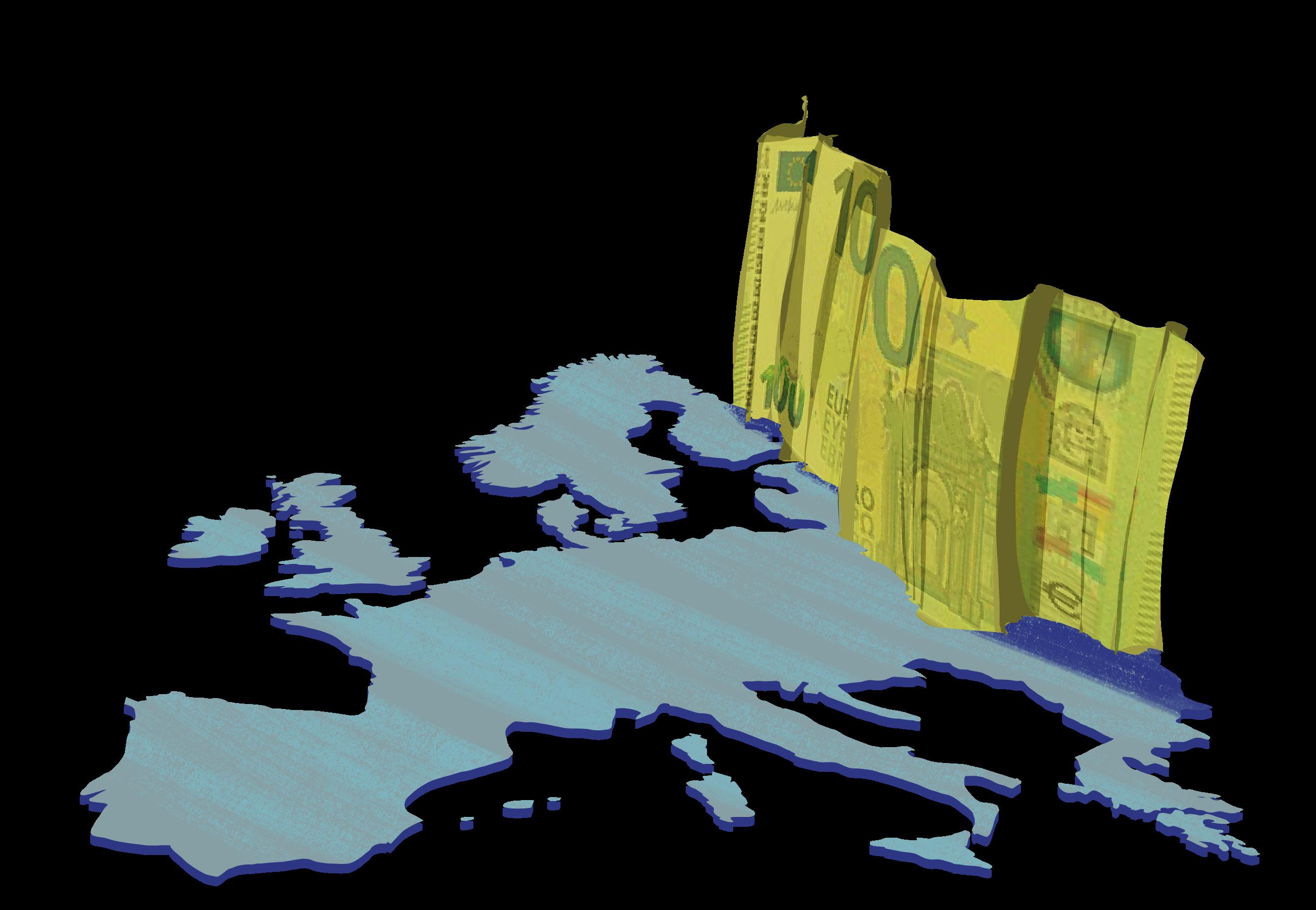
en passports” that allow them to bypass any travel regulations. They include Sergey Brilev, a fellow Channel One host and Putin propagandist who holds British citizenship, and Ekaterina Lavrova, who holds American citizenship. Lavrova is the daughter of Sergey Lavrov, the Russian Minister of Foreign Affairs, whose authority in the war is second only to Putin’s, and she is a graduate of Columbia College. It is important to recognize that it is rare for individuals directly in Putin’s inner circle, such as Andreeva, to hold these citizenships. However, those adjacent to them, such as friends or family members, often do, as their support of the war is more indirect and unnoticed. Through these connections, inner circle elites can profit handsomely. Dmitry Medvedev, the former Russian President and Prime Minister, is reportedly the primary beneficiary of a Tuscan vineyard owned by his longtime associate, Ilya Yeliseev. Shockingly, the vineyard receives major EU subsidies, with Medvedev having indirectly received 94,200 euros from the EU following the Russian invasion. Ordinary Russians do not have the same access to citizenships or resources as the political elite. The brunt of the sanctions falls disproportionately on them, even though they are not the ones leading the war. Aside from visa regulations, another way this disproportionality is evident is through the business practices of Western companies in Russia. Corporations accessible to the lower and middle classes, like Starbucks, Levi’s, or Amazon, have almost all left. However, Italian fashion house Brunello Cucinelli continues to operate and show new collections in Moscow locations. The designer brand is known for its high-end and luxurious clothes, with jackets from its latest winter collection starting at $11,800. Obviously, this price point is tailored for the most affluent Russians, who have the most to gain from the continued war in Ukraine. Another example concerns the release of Apple’s iPhone 17. Although Apple pulled out of Russia shortly after the invasion, the latest iPhone showed up on shelves in Moscow immediately after it was released. Resellers sold the new phone at a price 57% higher than its price in the United States. Clearly, elites are still accessing the Western goods they prefer and only suffer relatively minor inconveniences like price rises, yet ordinary people are completely cut off from the Western world. This inconsistency represents the major problem with the EU’s sanctions: they
punish the Russian people for their government’s crimes, while leaving loopholes for letting elites live as they please.
The EU’s emphasis on Russian citizens’ collective responsibility for the actions of the Kremlin completely undermines its credibility and institutional resourcefulness to the Russian people. The EU achieves nothing by alienating the common people in its’ misdirected attempt to end the war. Officials are actively playing into Putin’s hands by providing him with the evidence and opportunity to strengthen his claims of Russophobia and Western aggression. The EU is effectively drawing a new Iron Curtain between itself and Russia; this time, however, the curtain has goldtrimmed openings, big enough to fit just the privileged few. Rather than taking away the passports of Kremlin crooks and strengthening the sanction enforcement mechanisms against them, the EU targets the majority of Russians who have no say in their governance. If the EU wishes to stop the conflict, it must reassess its priorities. Will they prioritize performatively sanctioning Russia, and only hurting those not in power? Or, will they work to investigate and punish the elites whose hands are stained red from Ukrainian blood?
Edited by Mia Rinehart, Oscar Uhalde, and Shreya Karnik
Scan the QR code on the right for the full article (with citations)

Stephen Zhukov (CC’28) is a Staff Writer from Knoxville, Tennessee. He is studying political science and Russian and is interested in Eastern European policy, diplomacy, and law. He can be reached at sz3313@columbia.edu.
HoUsE THe
A l W ªY s WIns
BY LUKAS ROYBAL ILLUSTRATED BY JAMIE KIM
sports betting while I am within state lines. I can, however, choose either ‘Yes’ or ‘No’ on a prediction for “Los Angeles (L)” or “Los Angeles (C)” when they play a “professional basketball game,” which is allowed in all 50 states for adults over 18. Instead of offering a “gambling product,” prediction markets have devised a legal-speak workaround. They offer “a platform where people can bet on the outcome of future events, by buying and selling shares in the outcomes.” These are not bets but “event contracts,” a form of financial derivative that is federally regulated by the Commodity Futures Trading Commission (CFTC).
However, these days, ‘regulated’ usually means its antonym, with the White House boasting the “Best Deregulation Year in History” last December, and ‘federal authority’ of ten means the will of President Don ald Trump. Regarding prediction markets, the commander-in-chief is waging an anti-regulation war on many fronts. In the courts, the ad ministration scrapped a Biden-era proposal to ban these markets and dropped investigations into leading firms. In the court of public opinion, the Trump-appointed head of the CFTC, Michael Selig, has embarked on an op-ed cru
sade, penning articles in both the Washington Post and the Wall Street Journal with in a month of each other that at tacked states’ attempts to regu late prediction market platforms. Naturally, with no check on how betting is done or what is being bet on, the industry has been stacking its chips. Exponentially so. Bets across all categories exploded in the first year of Trump’s term, with stand outs like the Economics category growing 905 percent, Tech & Sci ence rising 1637 percent, and Politics
outpacing Sports—a powerhouse of the gambling industry—by 400 percent on Kalshi and Polymarket. The White House’s simultaneous grab of regulatory authority and release of regulatory action has left massive amounts of trades to be conducted on countless scenarios. It seems almost inevitable, then, that cases of suspicious trades—like the anonymous user who made over $1 million in a day with ‘dumb luck’—are on the rise.
A broad position of anti-regulation very well may be the sole wind propelling the sails of the Trump prediction market agenda onward, but the interests that lie within the family dynasty run deeper. Enter Donald Trump Jr.
Though he shares his father’s name, Donald Trump Jr.’s spokesman claims they share very little by way of conflicts of interests. Trump



Edited

Lukas Roybal (CC ‘27) is a columnist from Los Angeles, CA, studying Political Science, Philosophy, and Film. He is interested in American law, particularly antitrust, criminal justice, and the First Amendment.
by Jemma Granite, Camilo Choi, and Jacob Gold
Scan the QR code on the right for the full article (with citations)



TH e FRaY I n
MULTILateRALISM In cRISis
The post-Cold War international order was built on the promise that multilateral institutions could manage conflict, coordinate prosperity, and give smaller states a seat at the table of global governance. Decades later, that promise is under strain from multiple directions at once with rising nationalism, power competition, regional instability. Across the political spectrum,there is growing skepticism that institutions designed in the twentieth century are equipped to address today’s challenges.
However, institutions endure, adapt, and sometimes surprise. These five articles examine multilateralism from within, tracing how the Arab League, Mercosur, the European Union, ASEAN, and BRICS+ are each grappling with what cooperation means in their region, on their terms, and at this particular moment in history. Each piece asks, explicitly or implicitly, the same questions: what has multilateralism actually delivered? Where has it fallen short and why? And is there still a desire to sustain it?
The answers vary. Mercosur’s EU partnership and ASEAN’s Digital Econ-
omy Framework Agreement demonstrate that patient institutional cooperation can still generate binding outcomes. On the other hand, the Arab League cannot compel its own heads of state to attend its annual summit. The EU is actively expanding its multilateral partnerships. And, BRICS+ struggles to articulate a shared agenda beyond opposition to Western financial dominance. These institutions reflect fundamentally different relationships between institutions and the states that compose them.
G o RDeR
FBY MIYA SEGAL
BY MIYA SEGAL
or the Arab League, multilateralism marks the delineation between idealism and the reality of the precocious environment of the Middle East and North Africa (MENA). Since its founding in 1945, the Arab League has toed the line between broad coordination and mere rhetorical unity amongst its 22 member states and operational weakness in the face of the authoritative power of individual states. Over the years, as the MENA region is continually destabilized by interstate war, civil conflict, and regime change, member states have often sought to leverage crises to elevate their own diplomatic standing rather than to consolidate supranational authority. This pattern ultimately leads to institutional underperformance and feigned multilateralism while power politics unfold elsewhere in the region. Unfortunately, the pattern is structured by the League’s own design. The League operates on consensus or near-consensus voting conditions, with non-unanimous resolutions only binding to states that consent to them explicitly. There is no centralized enforcement authority, no military apparatus, and no independent fiscal capacity. In contrast, the European Union, for example, possesses delegated competencies, a court system, and mechanisms for sanctioning non-compliance. Institutional authority in the Arab League is derived from member states’ wills and concerns at every stage, including agenda-setting, implementation, and enforcement. In this configuration, multilateralism is substantively thin; the institution cannot transform state positions. These sovereignty-maximizing features also converge with a second structural constraint: intra-Arab status competition. Regional leaders such as Egypt, Saudi Arabia, and Qatar have successfully found political capital and regional status by actively seeking out roles as independent diplomatic brokers. Recent mediation initiatives, including Lebanon, Gaza, Sudan, and Libya, have not been conducted through trilateral coordination or League forums, but rather through
bilateral coalitions. High-profile summits, including the French-Saudi initiative on the two-state solution, are also typically convened outside of the League structure. Consequently, diplomatic successes are attributed only to the state involved. It seems further competition with Iran (which is not a member) over regional supremacy fuels desire for such players to achieve visibility unilaterally and not collectively through League mechanisms.
If multilateralism were actively functioning within the League, states would be expected to channel major diplomatic initiatives through the institution to enhance collective credibility. Instead, overlapping institutions enable member states to engage in ‘forum shopping.’ Organizations such as the Gulf Cooperation Council, the African Union, and the Organization of Islamic Cooperation offer alternate—and more specified—venues to circumvent and weaken the League’s agenda-setting authority. Ultimately, such additional institutions relegate the League to one-of-many, rather than being the sole institutional core of Arab multilateralism.
Still, the League is not devoid of function, finding its greatest successes in the trade realm. The Greater Arab Free Trade Area, established in 1998, reduced tariffs between many member states for products like steel, iron, and electric materials. In this manner, the League’s institutional coordination produced tangible results. Similarly, the League has engaged with China to facilitate expanded infrastructure and energy collaborations; this is especially helpful for Gulf states looking to diversify beyond their primary U.S. partnerships.
Ultimately, however, the Arab League’s sovereignty-maximizing design disincentivizes deep engagement with the multilateral system in the Arab world. Its rules protect autonomy while its resolutions lack coercive force, almost encouraging regional players to bypass the institution in favor of clout on the international stage. This dynamic was recently exemplified at the League’s last annual summit, hosted by Iraq, which was notably snubbed by several senior Arab leaders. Although it is unclear whether such absences were intended as contempt for Iraq’s regional standing or, more relevantly, as mere indifference to the institution itself, the event was quite telling. If executive-level participation in the League’s premier forum is not even required, then multilateralism in the organization is not functioning, and the League is reduced to bare symbolism.
MERCOSUR
BY ARIEL MURA
Headquartered in Montevideo, Uruguay, Mercosur currently stands as an example for how multilateralism can benefit an often ignored region of the world, allowing it to develop sustainably and build important alliances with both nearby and faraway countries.
The Southern Common Market—Mercado Común del Sur (Mercosur) in Spanish and Mercado Comum do Sul (Mercosul) in Portuguese—is a South American trade bloc and customs union. Established by the Treaty of Asunción on March 26, 1991, Mercosur’s primary goal is to create a so-called “common market of the southern cone” that facilitates the movement of goods and services among member countries, encouraging economic development and diversification. The establishing treaty also outlines a gradual elimination of tariffs and trade barriers, aiming to promote economic cooperation and regional integration in South America.
The treaty’s goals have largely been successful in the past three decades. Mercosur’s current framework allows its five full members (Argentina, Bolivia, Brazil, Paraguay, and Uruguay) and seven associated states (Chile, Colombia, Ecuador, Guyana, Panama, Peru, and Suriname) to coordinate more effectively than in the past. These 12 countries also maintain close relationships with the two observer members, Mexico and New Zealand, granting Mercosur access to partnerships with strong economies even outside the region.
The success of Mercosur’s development and global impact as a result of effective multilateralism, however, has not been without challenges. Political analysts have described Mercosur as “being plagued by a lack of direction for some years now,” operating as “an imperfect customs union” rather than a true common market. Additionally, disagreements between member states threaten to weaken the alliance, with the clearest example being the indefinite suspension of Venezuela in December 2016 as a result of its failure to meet its democratic and trade commitments. Such disagreements exemplify how, while multilateralism can produce impressive results of economic development and productive interstate-alliances, it is still a difficult process that requires sustained efforts and accountability measures to ensure relationships between nations are beneficial.
For instance, while the European Union (E.U.)-Mercosur Partnership Agreement required approximately 25 years of negotiations, it has succeeded in building one of the world’s biggest free trade zones. A free trade pact signed in January 2026 and provisionally implemented in February 2026, this partnership aims to reduce tariffs on key agri-food products, boost trade and investment on both sides, and foster sustainable development. According to the European Commission, this will “send a powerful signal in favour of rules-based trade and against protectionism.” Not only does this benefit the powerful European economies, it also allows the Americas, a region with no permanent members on the UN Security Council and only two members in the Group of 20 (G20), to have a greater presence on the global stage. Brazilian President Luiz Inácio Lula da Silva adds to this sentiment: “In a context of growing protectionism and unilateralism, the agreement demonstrates that a different model of global governance is possible—one that is more active, representative, inclusive, and just.”
Additionally, the Treaty of Asunción under which Mercosur was founded sought not only to enhance trade, but also to promote social justice. This is a key aspect of the E.U.-Mercosur agreement, with efforts to combat climate change and promote sustainable development by strengthening workers’ rights and supporting the development of circular economies in areas including forestry, mining and regenerative agriculture. The E.U. has also pushed to include provisions that require both blocs to “effectively implement the Paris Climate Agreement” and undertake “concrete and measurable commitments to preserve the biodiversity of ecosystems and tackle deforestation.” While the actual results of these efforts are still to be seen, they provide hope that multilateralism can produce effective alliances between countries amidst an era of increasing protectionism and interstate conflict, seeking to collaboratively address common challenges and support the needs of countries around the world.
EUROPEAN UNION
BY LIAM BARBIERI
Adhering to its commitment to the preservation of global cooperation and the prevention of conflict, the European Union (EU) has redefined the model of multilateralism. Through establishing the proper multilateral framework, the EU facilitates states to solve present-day global challenges, uphold human rights, combat climate change, and maintain peace and stability..
On an international level, the E.U. endorses the UN80 initiative, proposed by the current United Nations (U.N.) Secretary-General António Guterres, which aims to strengthen the effective agency of the U.N. whilst reducing the bureaucracy faced when tackling international disputes. From streamlining paperwork to prohibiting the proliferation of excessive committee work, the UN80 initiative would provide the most important platform for multilateral collaboration to function at a much more efficient and productive standard, enabling greater agency to occur through multilateral diplomacy.
The E.U. is committed to ensuring that every voice is heard and that proper communication is fostered. On the global stage, the E.U. proudly supported the African Union’s recent ascension to the G20, which the E.U. indirectly participates in through its member states of Germany, France, and Italy. This is one of the many steps that the E.U. is taking to expand its international multilateral cooperation, as it has already begun fostering relationships and open dialogue with other multinational organizations such as the Organisation of the African, Caribbean and Pacific States (OACPS), the Association of Southeast Asian Nations (ASEAN), or the Community of Latin American and Carib -
bean States (CELAC).
Moreover, the E.U. has worked in tandem with other international organizations (such as the North Atlantic Treaty Organization) to implement policies to stabilize regions and secure peace. Most recently, the E.U. collaborated with other multinational organizations to implement further sanctions on Iran due to its having committed various human rights violations. Hence, underlining how multilateralism can also represent a tool for the E.U. in the international community to further its policy objectives, promote democracy and peace, build democratic communities, and harness technology, which enables us to do so.
Meanwhile, on an organizational level, the E.U. has noticed how multilateralism is not merely exclusive to state-level entities, but also includes international non-profit social organizations that work in tandem with these states. In this manner, the E.U. is working closely with domestic agencies to promote economic growth, human rights, and international peace. It is oftentimes through these very organizations that the E.U. has had the greatest success in implementing its multilateral policies, such as its collaboration with the World Health Organization during the COVID-19 pandemic.
Moreover, the E.U. is aiming to, and has taken steps towards, expanding the number of agencies with which it interacts and deepening its relationships with the organizations themselves. Whether it be with UNICEF or the WTO, the E.U. has begun to address sociocultural elements of European societies, essential to preserving vibrantly diverse European cultures and facilitating the integration of cultures alongside multilateral cooperation.
Multilateralism is essential to the development of the international community, and from the perspective of the E.U., especially in the upholding of human rights, combatting climate change, and maintaining peace and stability. Whether it be working together to uphold the EU’s values or promoting peace and stability in the international community, the E.U. remains steadfast in assuring that multilateralism is further developed and entrenched in its member states and the rest of the world.
BY THOMAS COOREY
When Asia is divided into its principal geopolitical subregions, the Southeast stands alone as the only region without a major power. Russia, China, and India dominate the North, East, and South: each of the three possess nuclear weapons, two sit permanently on the UN Security Council, and combined, they comprise almost 40% of the world’s population and over 20% of the global GDP. This creates a situation in which the smattering of small states in the Southeast of the continent are forced to navigate a complex foreign relations landscape while under the restraints of their comparative weakness. Their solution? ASEAN.
The Association of Southeast Asian Nations (ASEAN) is an 11-member organization spanning from Myanmar to the Philippines to Indonesia. In recent decades, the group’s goals have expanded from simply protecting its members’ sovereignty. Instead, greater importance has been assigned to auxiliary elements of the ASEAN Declaration, with the organization working to accelerate economic growth, facilitate cultural and scientific advancement, and maintain regional peace. Rather than survival, there is a new overarching objective: raising living standards throughout the bloc via multilateral engagement.
This shift in strategic direction is the product of changed policy priorities since ASEAN’s founding in 1967. Indonesia is now more concerned about environmental protection and human trafficking than containing communism, and Malaysia has transitioned from seeking colonial independence to looking for digital economic growth opportunities. Structurally, these changes represent a regional cooperation framework being strengthened in order to address an increasingly transnational set of challenges that, as put by Professor Sheldon Simon, “require [multilateralism] rather than ad hoc diplomacy.”
Yet the question remains: what does this multilateralism look like in an increasingly isolationist international system? As the U.S. upends global trade through the introduction of sweeping tariffs, ASEAN—a group that traded $571.7 billion worth of goods and services with the U.S. in 2024—would be expected to suffer. However, a commitment to
multilateralism has largely enabled it to escape the most fatalist predictions for Asian markets. Free trade agreements such as the Regional Comprehensive Economic Partnership (RCEP) present non-American markets where ASEAN exports remain competitive against domestic products, and the coordination of closer trade relations with China is being discussed to create an ‘export sponge’ that would leave the region less susceptible to changes in U.S. markets. These efforts would suggest that multilateralism is alive and well in Asia’s Southeast; ASEAN is bucking the isolationist trend.
Hence, ASEAN’s future should look much like its past. Amidst a context of great-power animosity between the U.S. and China akin to that which necessitated its founding, the organization must continue its policy of combining member states’ capabilities; doing so has allowed ASEAN to punch well above its weight compared to its constituent parts. As a single nation, it would have the world’s fifth largest economy, despite the fact the average global GDP ranking of ASEAN member states is 77th. Ongoing projects such as the Digital Economy Framework Agreement (DEFA)—the world’s first regional treaty governing the digital economy due to be signed in 2026—demonstrate the power of multilateralism to create concrete returns for member states. It is anticipated that DEFA will establish consistent regulations upon which cross-border systems of e-commerce and cybersecurity can be built, supporting a digital ecosystem anticipated to reach $2 trillion by 2030. Such multilateral cooperation has enabled ASEAN countries to seize world-leading, industry-defining economic opportunities beyond that which any individual member could have hoped to achieve, and its continued support will undoubtedly produce further prospects in the future.
In a world where multilateral policy appears dead in the water at best—and below the waterline at worst—ASEAN presents a compelling argument for the case that regional transnational cooperation is not a sinking ship.
BY SYDNEY FINVER
By the fall of the Berlin Wall, it had become glaringly evident that Western influence had dominated the globe. Developing nations have since been pressured to reconcile with and integrate into the United States hegemony through multilateral agreements. As the Soviet Union disintegrated, Hegel’s prediction that the world would reach a state of political homeostasis seemed to be realized. 20 years later, BRIC was formed, with Brazil, Russia, India, and China coordinating efforts to counterpose themselves against the US and Western authority.
The pact is both economic and diplomatic in nature, and works under the pretence that Western institutions do little to help emerging countries, and has put significant effort into reducing dependence on the US dollar. Since 2009, six additional countries have joined the bloc (now named BRICS+), with relatively little opposition from the U.S. Under the Biden administration, National Security Advisor Jake Sullivan went on the record to say: “We are not looking at the BRICS as evolving into some kind of geopolitical rival to the United States or anyone else. This is a very diverse collection of countries…with differences of view on critical issues.” In his second term, President Trump has made a stronger affirmation of his opposition to the bloc, threatening 100% tariffs on BRICS+ countries if they attempt to weaken the dollar. Although BRICS+ is facing dismissal and backlash, the pact could be placed in a unique position to gain traction and influence now that the U.S. is withdrawing from multilateral entities.
The alliance comprises a diverse set of countries, each with drastically different historical encounters and perspectives on the US, and thus different methodological and ideological approaches to the objectives from the multilateral union. For Russia and China, multilateralism is a means of gaining power, control, and au-
thority throughout the globe. For Brazil, the union is not primarily an anti-Western confrontation, but rather an opportunity for economic and social growth: deviating from reliance on U.S. trade and gaining national autonomy. Within BRICS+, a clear power insecurity is prominent. This can be seen from Brazil’s rejection of adding other countries to the allyship with concern that it will dilute the nation’s power within the group. Even with these deviations, each country is united by a primary goal: balancing the U.S.’s hegemony to deviate from the current status quo in the name of geopolitical advancement.
With the U.S. stepping down from multilateral bodies, BRICS+ could use this to their advantage by welcoming more allies and expanding their bloc, segueing into economic initiatives that could work as alternatives to Western-led unions. Across the Global South, there is a clear desire to stray away from U.S. financial leadership. In 2022, UN Secretary-General António Guterres argued that the world economic system is “a morally bankrupt global financial system” that “perpetuates poverty and inequalities.” As long as BRICS+ rides the waves of anti-US leadership and taps into international interests, they will succeed in balancing US hegemony.
That said, BRICS+ seems to be a form of cooperation among member nations to gain independence and strength at the individual level rather than a multilateral movement toward geopolitical peace. Given the current power imbalances in allyship, BRICS+ gaining traction would likely further exacerbate this separation, deepening the inevitable divide.
The decline of Western-led institutions creates space for nations to shift perspectives on how multilateral bodies function. US withdrawals, paired with the rising influence of BRICS+, strengthen the position of Middle powers such as Brazil and India, potentially leading to the emergence of ad hoc cooperation. Middle powers play a significant role in multilateral entities, serving as bridges between superpowers and the Global South. They could champion multilateralism in which countries are united not by fixed, homogeneous opinions but by issue-based coalitions, which benefits them because it maximizes their diplomatic agency and autonomy. With this, multilateralism would become more of a competition: countries competing for sway on equal playing fields, rather than following the ringleader. This would give greater power to smaller, developing countries while eliminating a monopoly of power.
Altogether, these five examples resist any clear verdict on multilateralism’s health. But they do reveal a pattern: the institutions that function are those where member states have found cooperation more valuable than exit; when unilateral action is cheaper, bilateral deals more prestigious, or collective commitment too costly to domestic politics, the institutions hollow out.
A more volatile international environment, marked by economic nationalism, great-power rivalry, and the erosion of the norms that once made global institutions legible is pushing states to hedge. This results in a drift from globalism to regionalism as a pragmatic response to uncertainty. ASEAN deepens intra-Asian frameworks. Mercosur consolidates a hemispheric identity. Even the EU, the most ambitious multilateral project in existence, increasingly operates through bilateral relationships with other regional blocs rather than through universal forums.
Whether this regionalist turn reflects multilateralism’s contraction or its evolution is the question these pieces leave open. What they make clear is that the answer will not be determined by any single institution or crisis, but by the accumulated choices of states deciding, and and again, whether cooperation is worth the cost.
Scan the QR code on the right for the full article (with citations)

This roundtable was edited by Eli Levy, Maytal Chelstm and Maytal Chelst.
we weLcoME AnonyMoUs SU bmisSions
IN THESE TIMES OF INSTITUTIONAL PRESSURE AND SOCIAL ISOLATION, WE FEEL THAT IT IS OUR MORAL IMPERATIVE NOT TO SHUT UP. AS A VENUE FOR FREE SPEECH ON CAMPUS, THE COLUMBIA POLITICAL REVIEW WELCOMES PERSPECTIVES FROM EVERY CORNER OF THE IDEOLOGICAL SPECTRUM THROUGH OUR ONLINE SUBMISSION PROCESS. THIS INCLUDES THE VOICES OF THOSE WHO HAVE BEEN TARGETED BY THE AUTHORITIES OR HAVE BEEN SOCIALLY ISOLATED FOR THEIR VIEWS. NATURALLY, THE CURRENT POLITICAL ENVIRONMENT HAS MADE MANY LEGITIMATELY FEARFUL TO EXPRESS THEMSELVES, BUT WE BELIEVE THAT MAKES IT ALL THE MORE IMPORTANT TO STAY LOUD. TO THAT END, WE HAVE INFRASTRUCTURE THAT ALLOWS US TO ACCEPT SUBMISSIONS, ANONYMOUS OR OTHERWISE. PLEASE FIND OUR “SUBMIT A PITCH” TAB AT CPREVIEW.ORG AND SHARE YOUR THOUGHTS!


From “A Letter to Sundial: Columbia Doesn’t Need Your Moderation” by Adam Kinder, former CPR Editor-in-Chief, 2025
“Our team created a new process to accept anonymous submissions from every part of the Columbia community. The reasons for that decision were many, but they all rested on one basic principle: that requiring someone to risk everything in order to write about the world’s problems is destructive to any speech environment seriously concerned with solving those problems.”
“Embracing anonymity can give writers the freedom to express even their most personal views, those that we all have but might never dare to express if compelled to attach our name to them. That is where the “full weight” of an argument lies, not in the author’s byline.”
“Anonymity is not cowardice. Sometimes, it’s the only way that the truth can reach the page.”