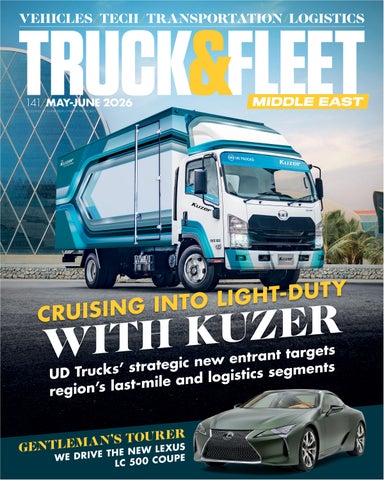
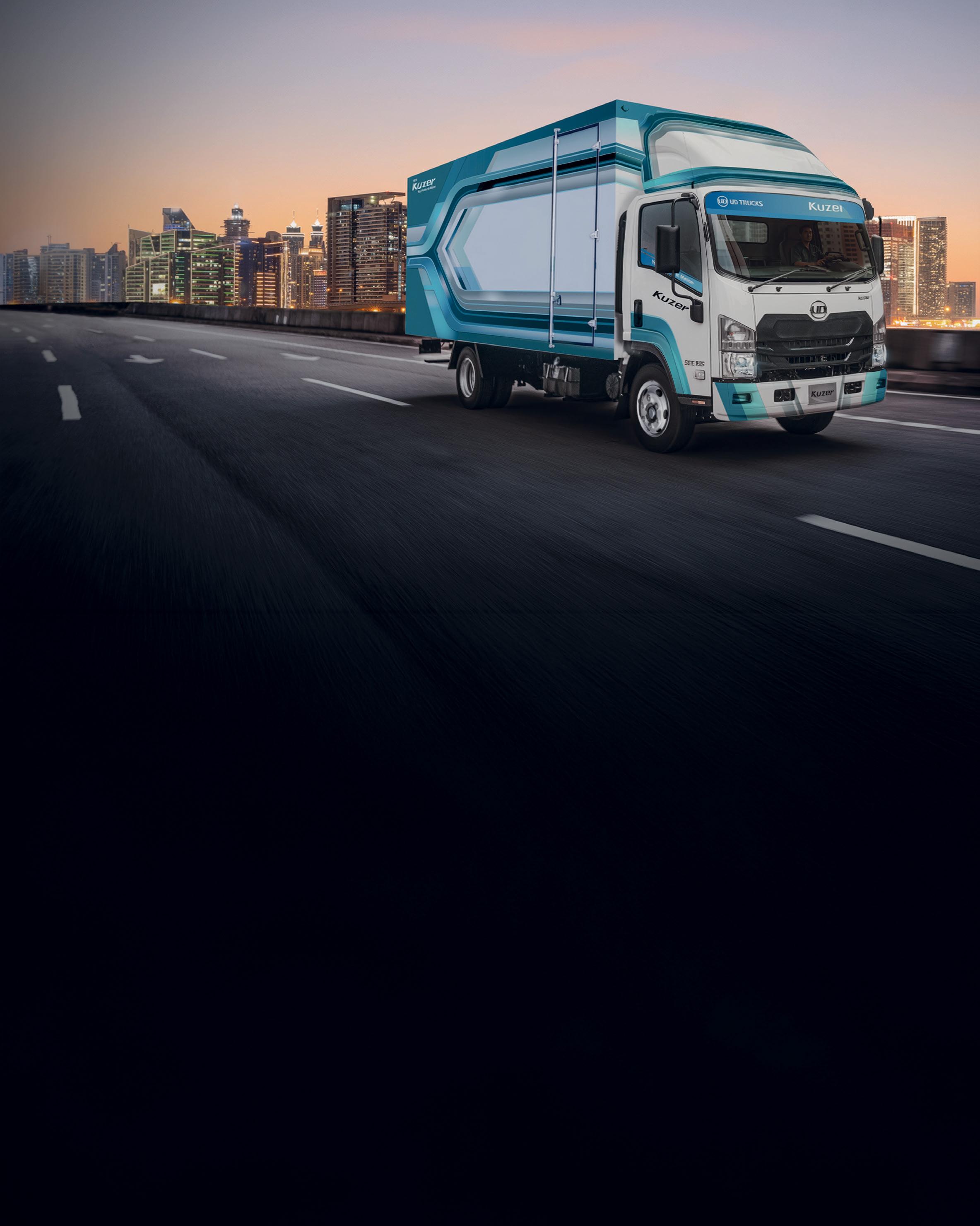
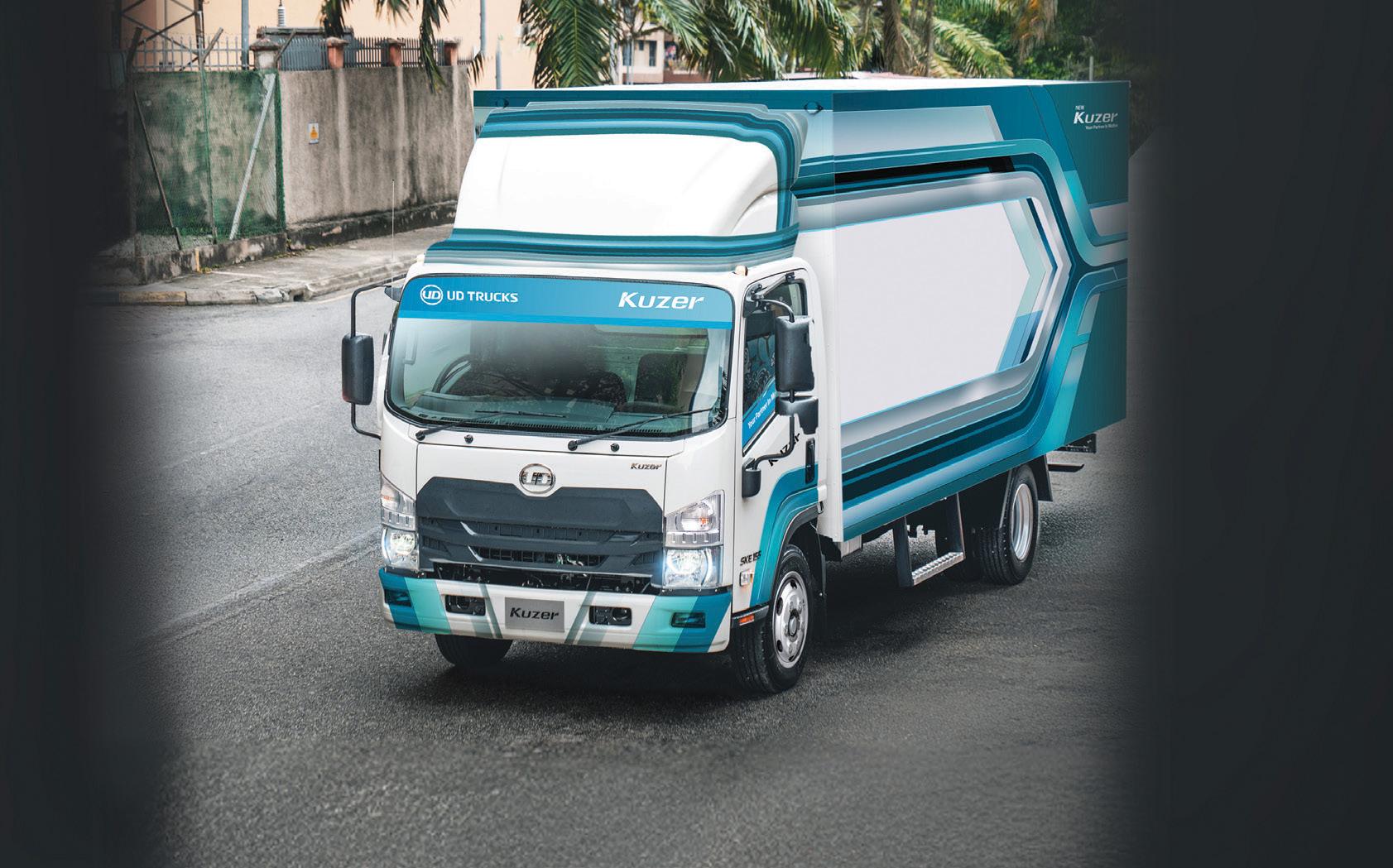
20 / THE KUZER CRUISES IN UD Trucks targets the last-mile and urban logistics segment with new light-duty model.
ALSO
NEWS
06 / NEWS FROM THE MONTH
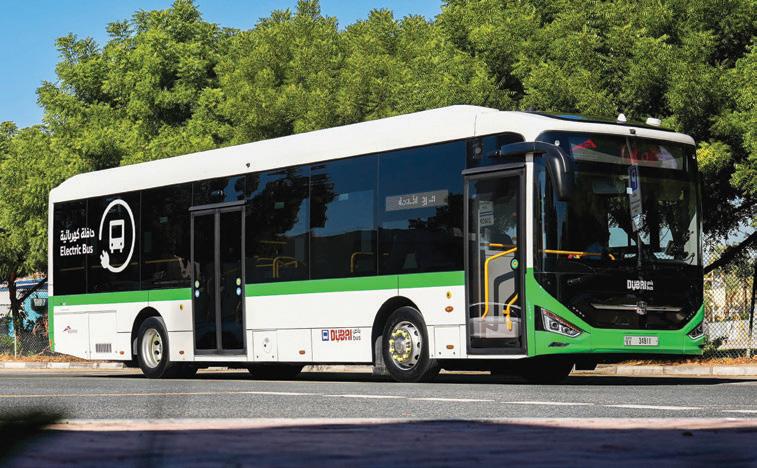
Dubai to launch 735 electric buses in green push.
LAUNCHES
10 / NEW LINCOLN RANGE
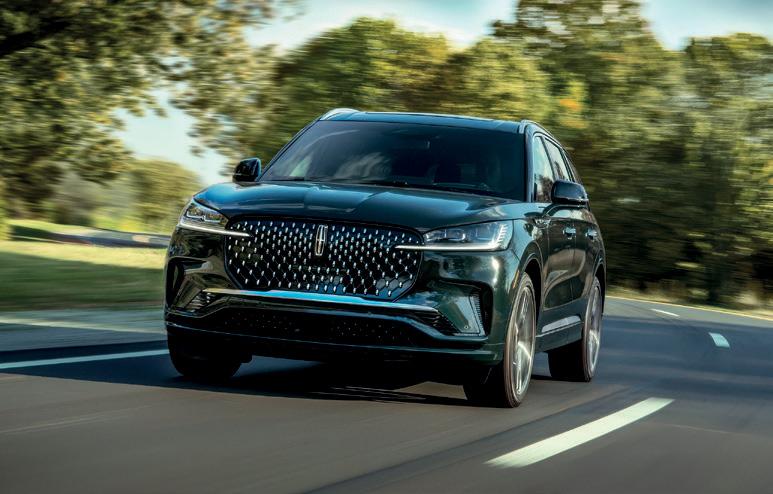
Luxury brand brings in 4-model SUV line-up.
TEST DRIVE
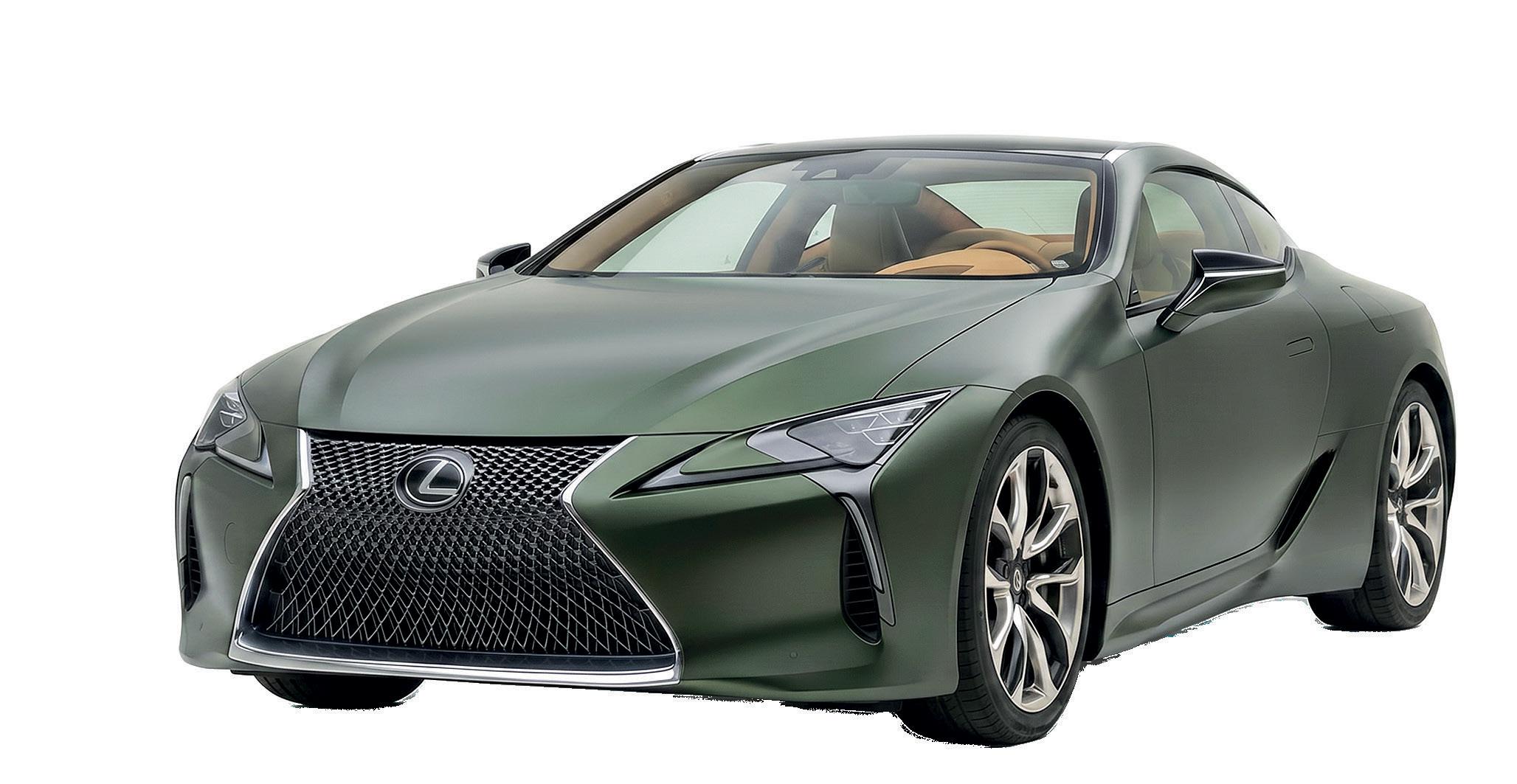
12 / GENTLEMAN’S TOURER
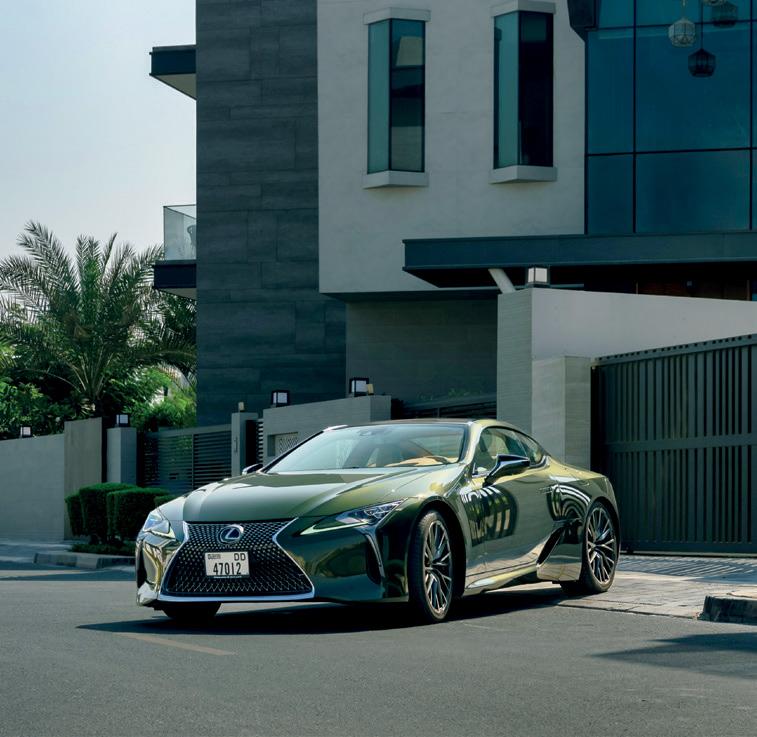
The new Lexus LC 500 wows our editor.
INTERVIEW
16 / UPTIME MOBILITY
ZF’s Philippe Colpron outlines the aftermarket specialist’s new tech-heavy direction.
FEATURE
26 / BOOSTING THE QUARRY
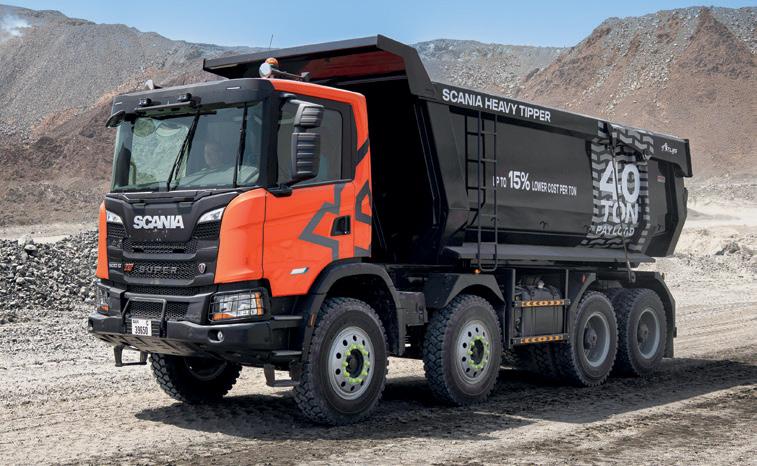
Scania is shifting the paradigm in mining and quarrying work with its 8x4 Super tipper.
AFTERMARKET
32 / THE FUTURE OF SERVICING
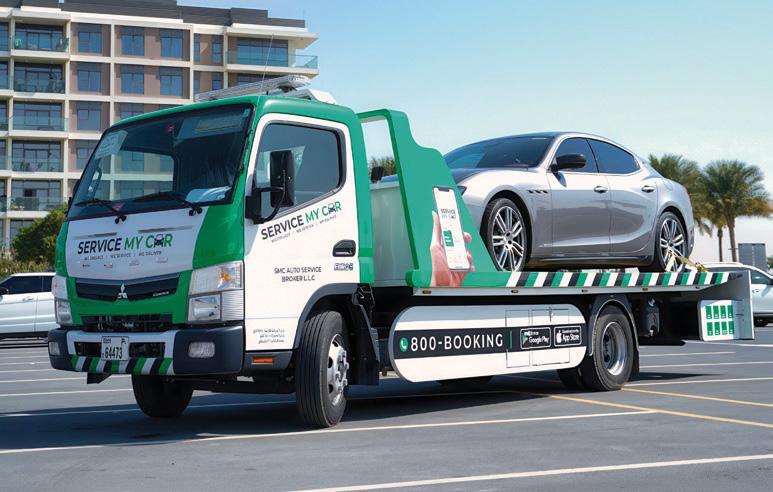
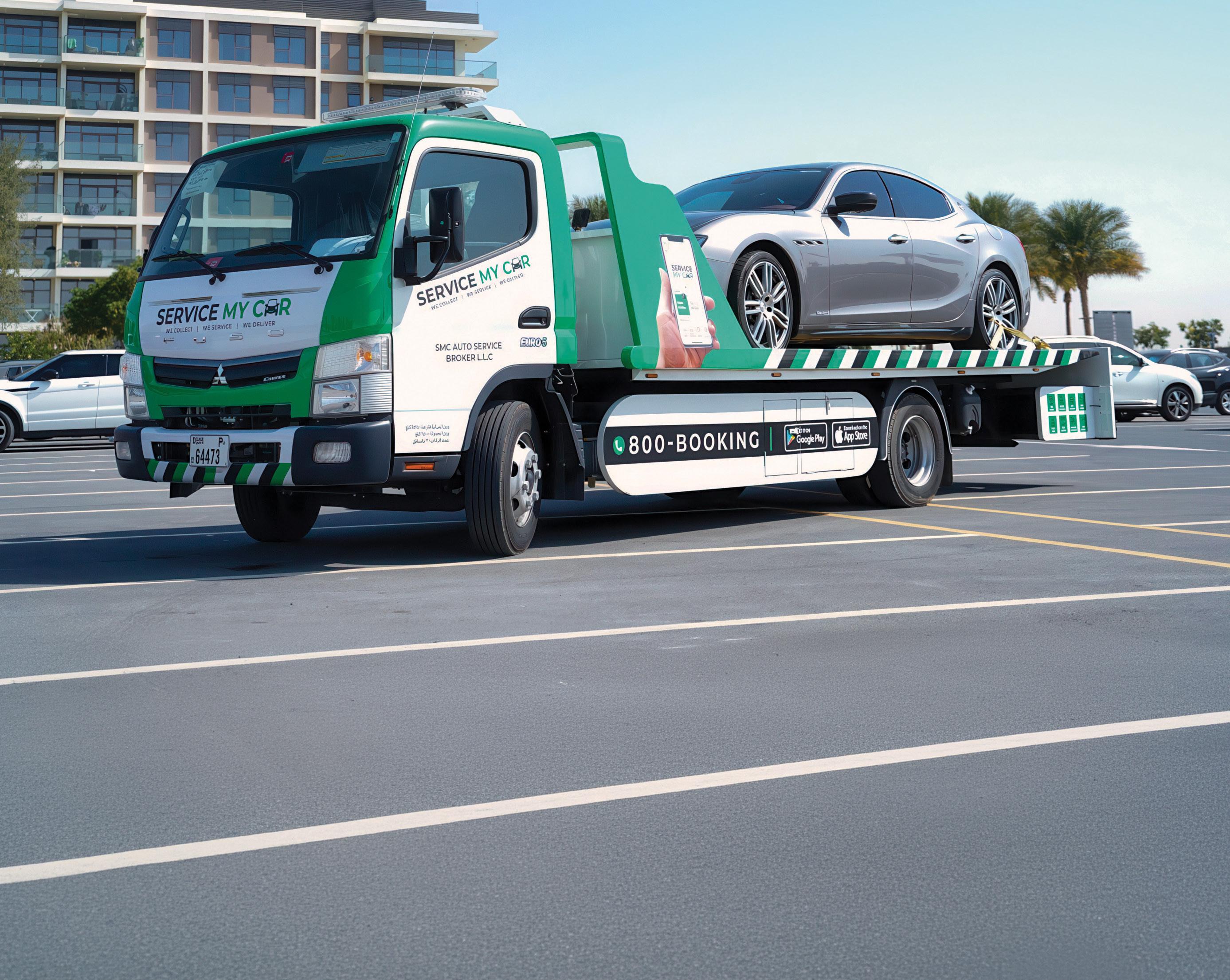
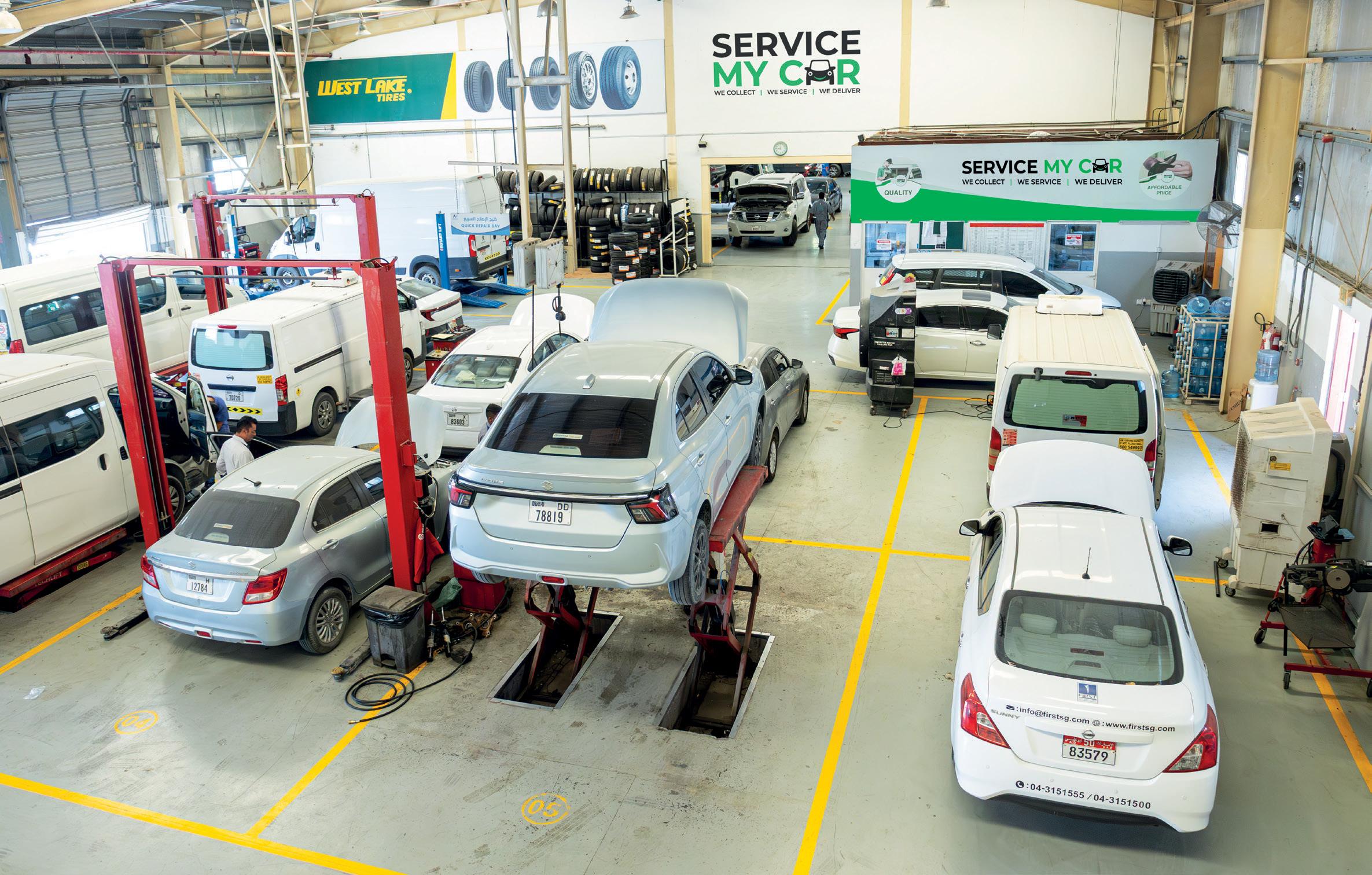
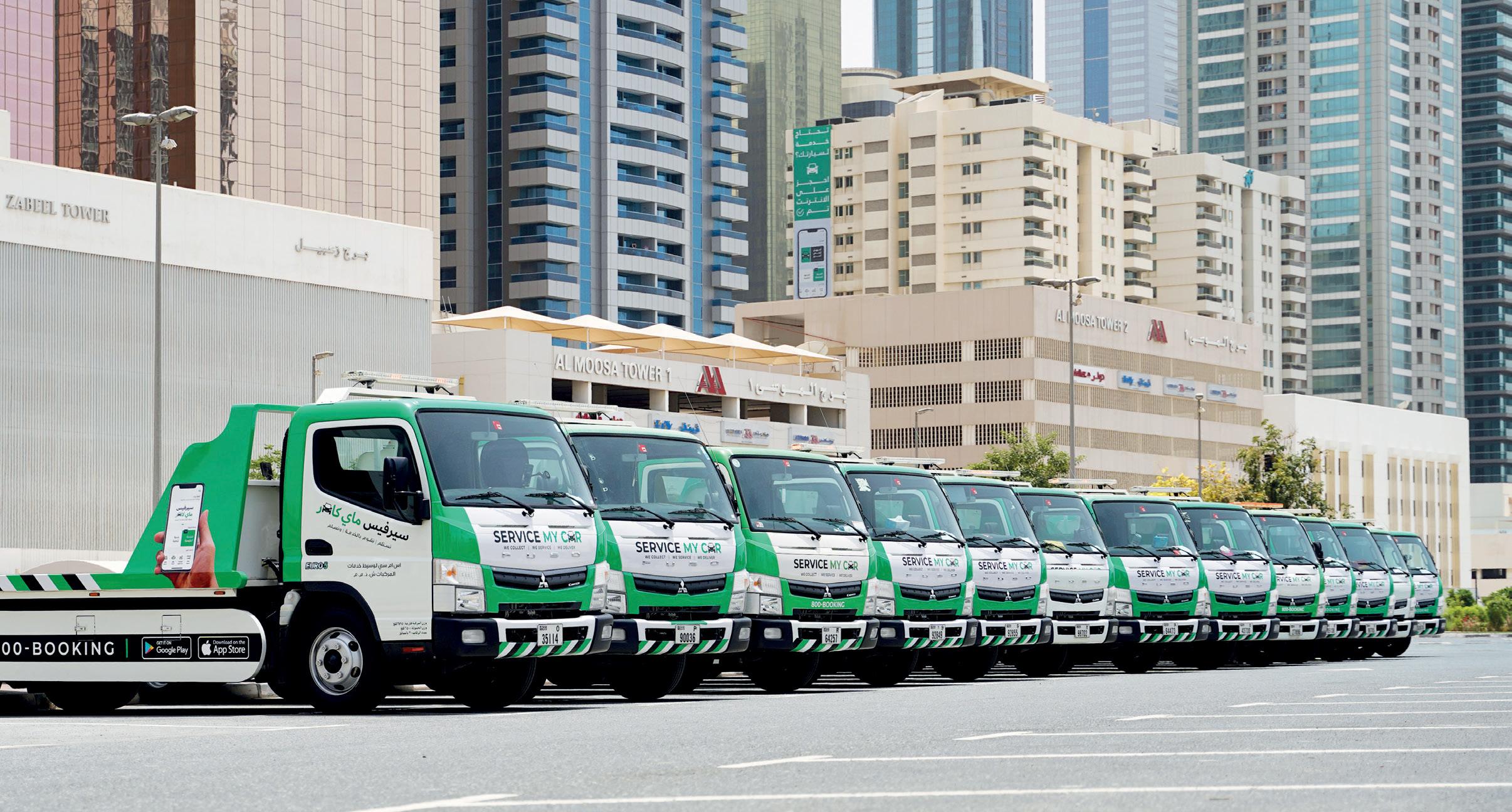
Service My Car is expanding its technology led footprint for aftersales service across the UAE.
SUSTAINABILITY
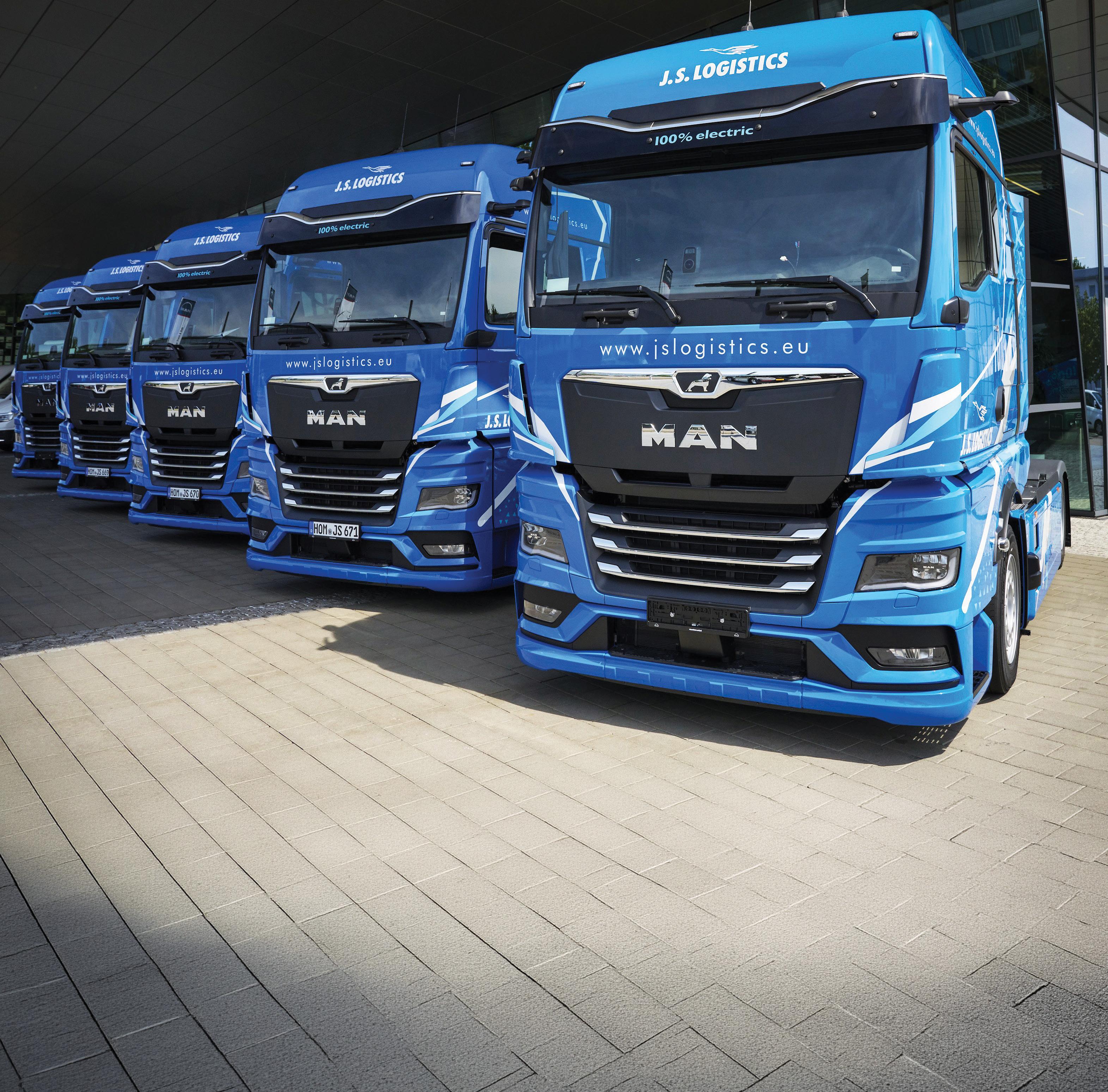
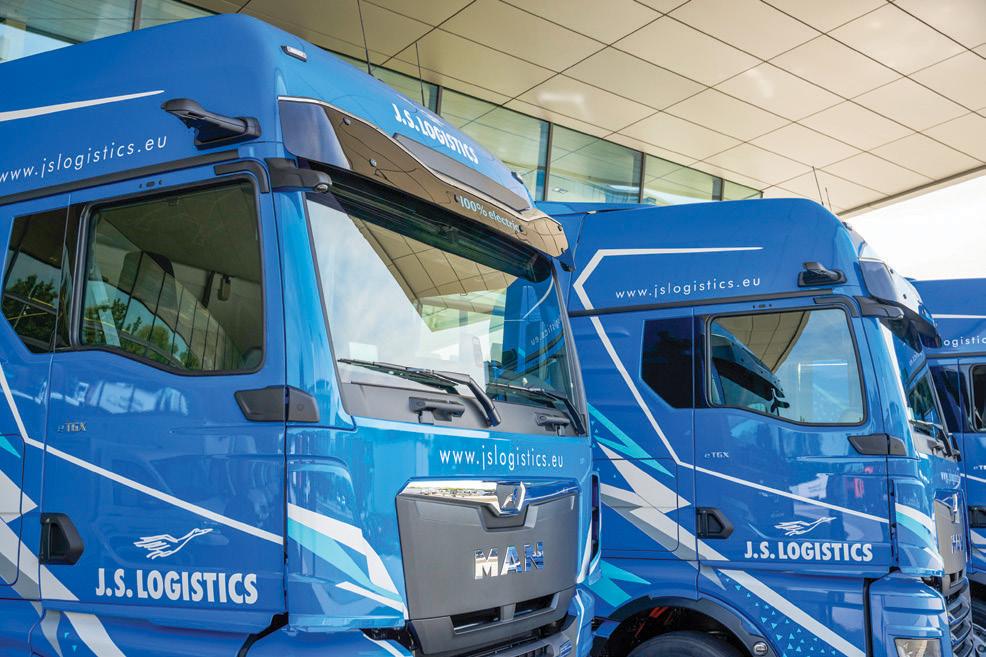
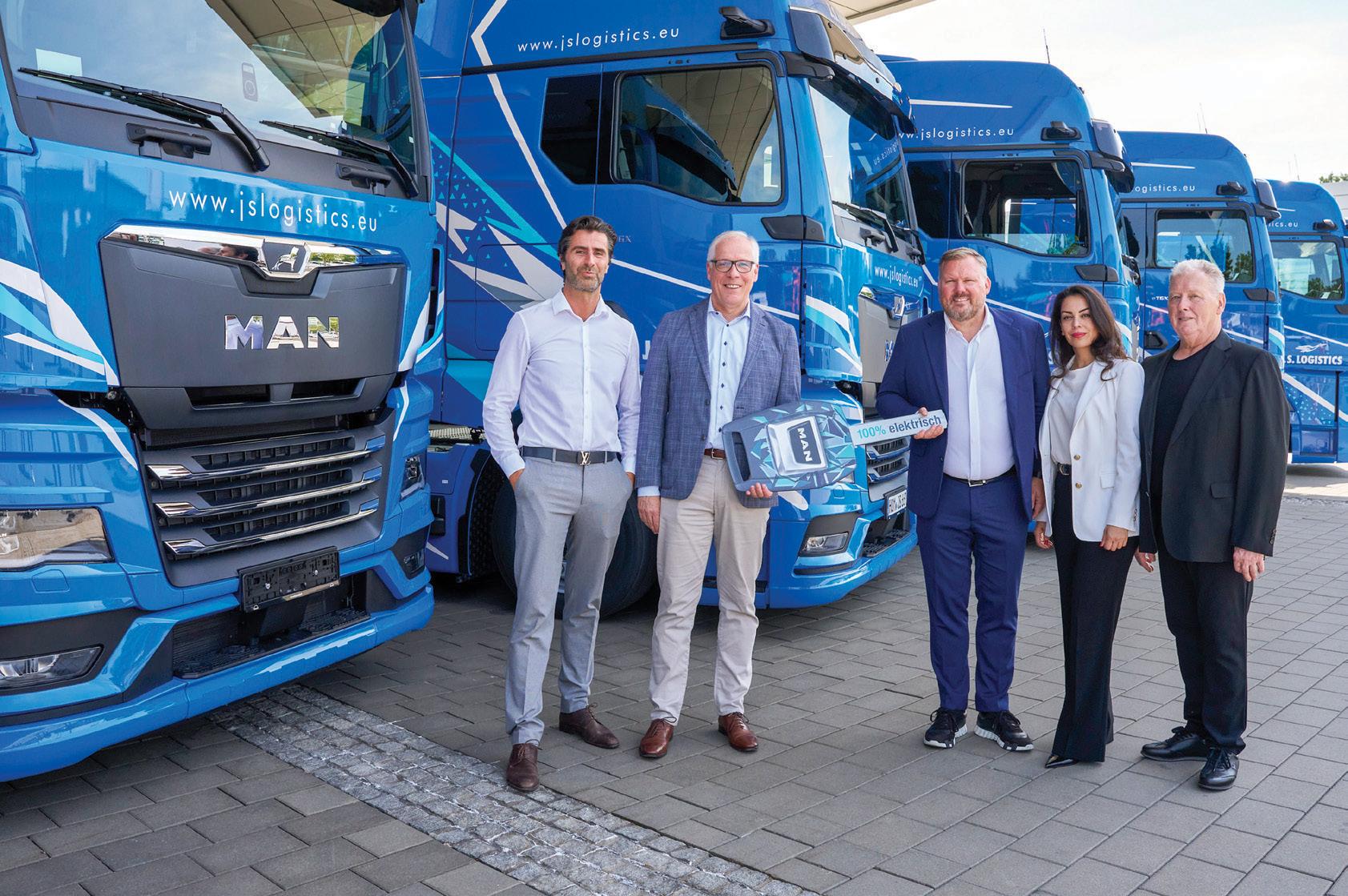
38 / MAN DRIVES EV LOGISTICS
German truck giant shows how battery-electric heavy trucks can clean up inbound logistics.
DRIVING THROUGH DISRUPTION
Conflicts uniquely give rise to conflicting outcomes, both negative and positive.
The US-Iran war has exposed not only the soft underbelly of the Middle East’s logistics enterprise but also its resilience and flexibility to cope with pressure. While in the first few months of the conflict, there was a palpable strain on the region’s logistics and supply chains, the sector soon found ways out.
The UAE’s dominant port and maritime logistics infrastructure – Jebel Ali, KEZAD, Fujairah – were also tested from the beginning of the conflict, and though they unfailingly demonstrated their utility and vitality, the region realised that there needed to be a Plan B, and perhaps even a C.
With the Hormuz blockade rendering much of the logistics infrastructure on the UAE’s Arabian Gulf coast temporarily redundant, as well as leaving the likes of Dammam, Doha, Manama and Kuwait moribund, alternatives were quickly identified both on the Arabian Sea and Red Sea coasts. Enter Salalah and Jeddah.
These, however, while offering the safety of being relatively far from the war theatre, were double edged swords – the distance was both their advantage and disadvantage. In order to utilise these safe harbours, both inbound and outbound goods needed access to and from them.
And that access was possible only by road, using trucks. Naturally, the cost of truck transport
went up as demand for trucks skyrocketed. Over the last few months, people that T&FME has spoken with in the road logistics sector – from truck manufacturers, dealers, renters, fleet operators to consigners – have all reported that, for instance, the cost to rent a truck on the Dubai-Jeddah route has gone up anywhere from three to five times depending on the truck type when compared to pre-February levels. So high has the demand crested that every available vehicle has sometimes been pressed into duty on the nearly-2,000km route, including truck models not designed for long-haul transport.
The spin-off effect has been an increase in intra- and inter-city transport costs owing to a shortage of vehicles. And it is into this scenario that our cover story in this issue has a direct bearing – now is the right time for a light-duty urban transport truck to hit the regional market. While UD Trucks obviously did not plan the launch of its new Kuzer light-duty model in the Middle East to coincide with a conflict, the timing could not have been more propitious.
Many vehicles remotely capable of being viable on the Salalah or Jeddah runs have been pressed into service on those routes. But with no abatement in e-commerce and last-mile delivery requirements in the region, the vacuum in urban logistics needs to be filled.
The Kuzer couldn’t have cruised in at a better time!
ANIRBAN BAGCHI HEAD OF CONTENT
GROUP MANAGING DIRECTOR
raz.islam@cpitrademedia.com
+971 4 375 5471
DIRECTOR OF FINANCE & BUSINESS OPERATIONS
SHIYAS KAREEM shiyas.kareem@cpitrademedia.com
+971 4 375 5474
EDITORIAL
EDITORIAL DIRECTOR
jason.saundalkar@cpitrademedia.com
+971 4 375 5475
HEAD OF CONTENT ANIRBAN BAGCHI anirban.bagchi@cpitrademedia.com
+971 50 945 6963
ADVERTISING
GROUP SALES MANAGER brian.fernandes@cpitrademedia.com
+971 50 143 3872
SALES MANAGER SADAF SHAH sadaf.shah@cpitrademedia.com
+971 4 433 2856
STUDIO
ART DIRECTOR SIMON COBON simon.cobon@cpitrademedia.com
PHINSON MATHEW GEORGE phinson.george@cpitrademedia.com
PRODUCTION & IT SPECIALIST jarris.pedroso@cpitrademedia.com
MARKETING
SOCIAL MEDIA EXECUTIVE franzil.dias@cpitrademedia.com
WEB DEVELOPMENT
SENIOR DIGITAL MANAGER abdul.baeis@cpitrademedia.com
FINANCE
CREDIT CONTROL EXECUTIVE
cameron.cardozo@cpitrademedia.com +971 4 375 5499
FOUNDER DOMINIC DE SOUSA (1959-2015)
Trade Media. PO Box 13700, Dubai, UAE. +971 4
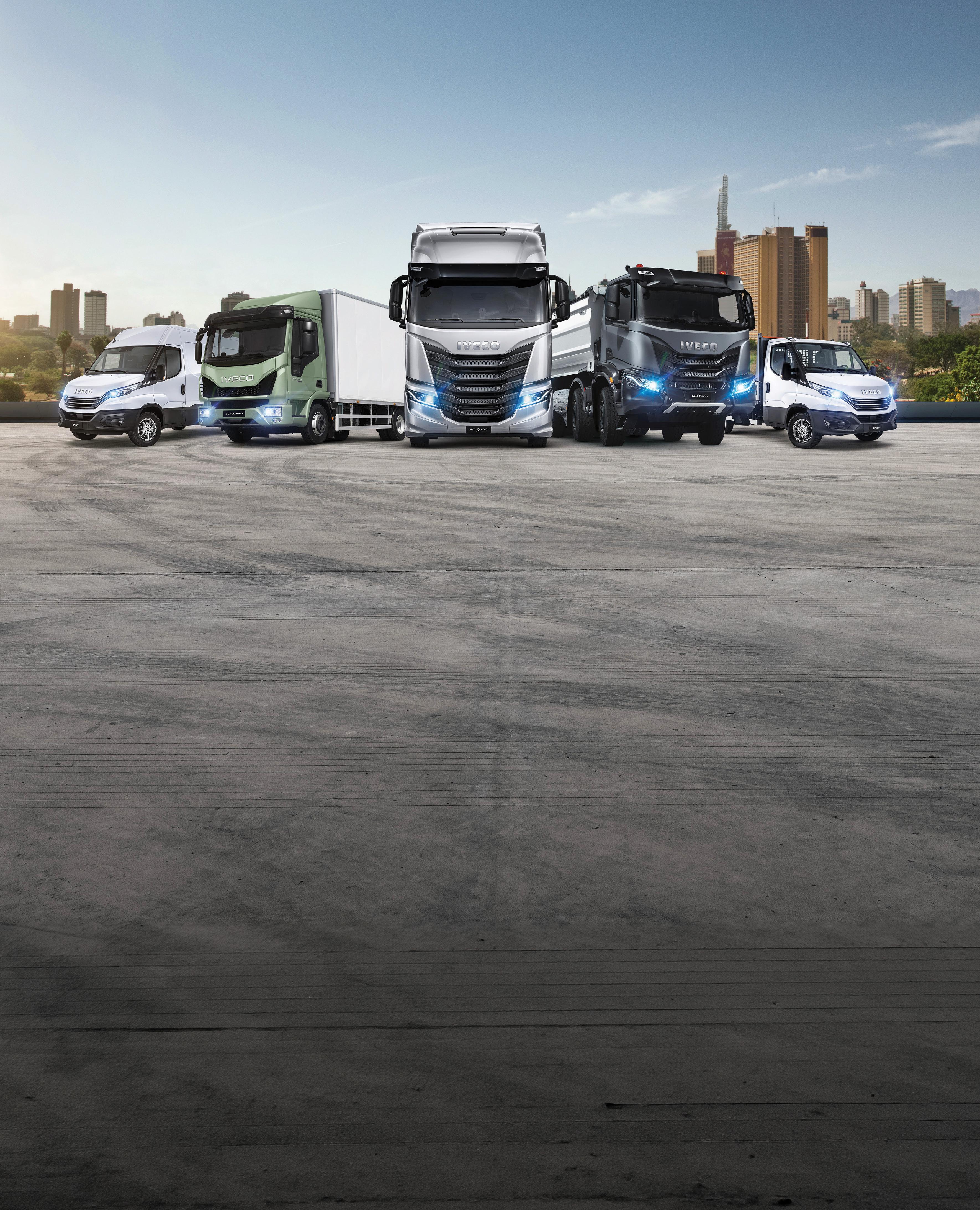
Drive the road of change.
Full offering
- Full range vehicles with the most advanced technologies
- Highly customized product driven by market needs and optimized Total Cost of Ownership
High capillarity of aftersales
- Repair and Maintenance contracts and competitive warranty conditions
- Origin 100% IVECO Parts and a widespread network coverage
European technology
- High quality complete line-up in terms of tonnage, power, torque, safety, ergonomics
- High performance and robust trucks for extreme Off-road conditions
Customer centricity
- Comfort, ergonomics and the latest safety technology to make on board easier
- Driver Style Evaluation tool on Heavy ON-road range and optimized vehicle design to improve customer profitability
*Full-page Advertisement – CMME
ruck & Fleet ME Full-Page Specification
Artwork size: 240 mm (w) x 300 mm (h)
Bleed - +10mm
Color Mode : CMYK
Resolution: 300 dpi
format : High-Res PDF
Construction Machinery ME
Full-page Specification
Artwork size: 240 mm (w) x 300 mm (h)
Bleeds: 5 mm
Color Mode: CMYK
CARS
Resolution: 300 dpi
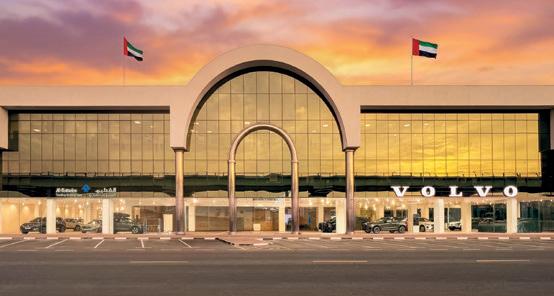
Al-Futtaim opens largest Volvo showroom in UAE on Sheikh Zayed Road
format: High-Res PDF
*Newsletter Banner
CARS
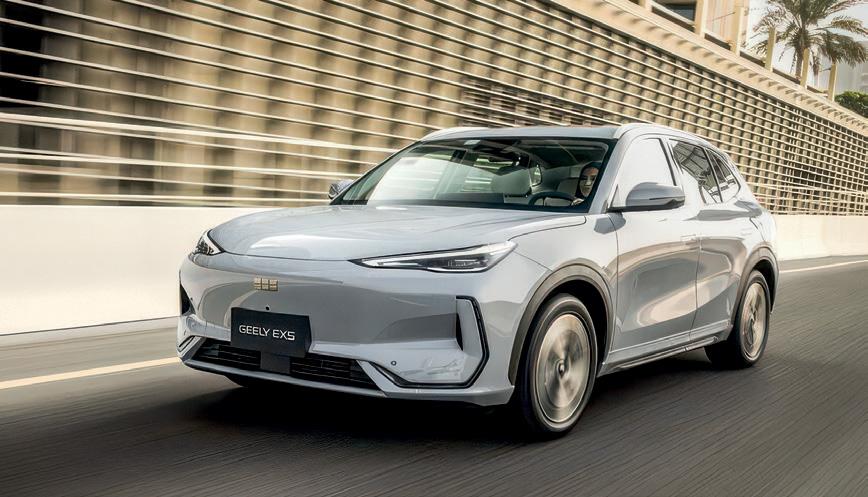
Geely targets Middle East growth as overseas sales surge 138%
China’s Geely Auto is accelerating its expansion across the Middle East, focusing on the UAE and wider GCC, after reporting a sharp rise in overseas sales and continued growth in its new energy vehicle portfolio
728px x 90px, 500px x 80px, 420px x 350px
PNG / JPG / GIF
Hyperlink
FLEET
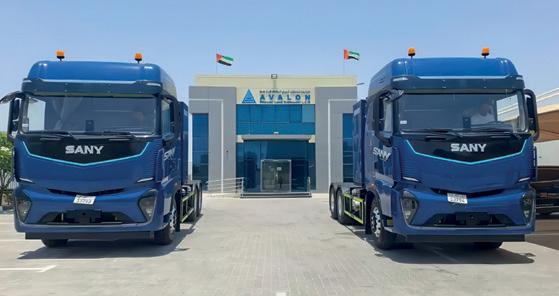
Avalon expands UAE fleet with SANY heavy-duty electric trucks
*Email Campaign – Truck & Fleet
LAUNCH
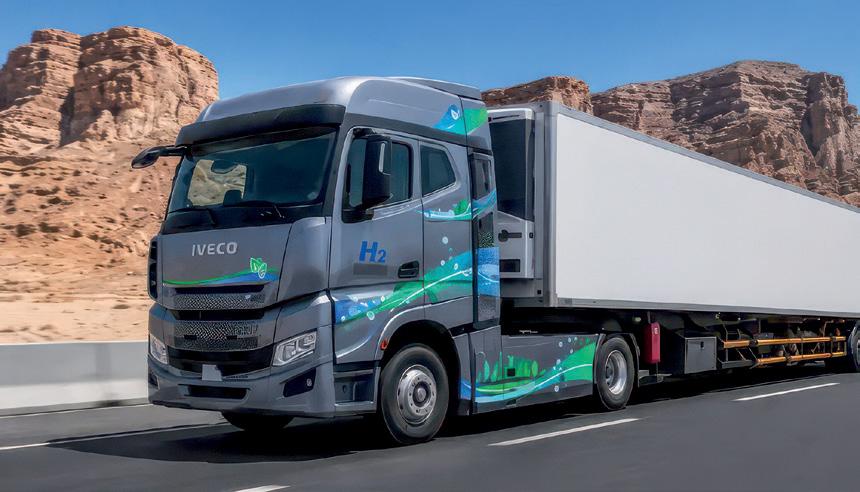
Saudi Arabia launches first autonomous hydrogen-powered heavy-duty truck
New hydrogen fuel cell truck combines zero-emission operation with autonomous driving technology to support longhaul freight and logistics operations
Approved mailer designed by the client plus the following. FROM (usually the client’s Company name)
SUBJECT (the subject line that should appear on the e-mail)
FLEET
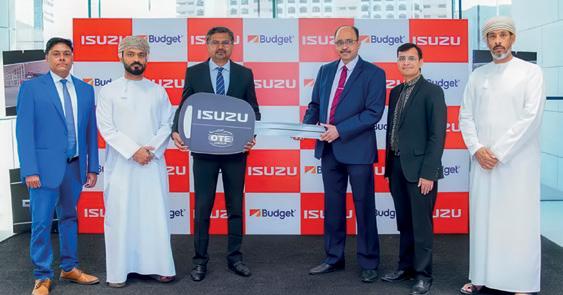
Isuzu Oman delivers 125 vehicles to Budget Rent a Car in fleet expansion deal
TRANSPORTATION
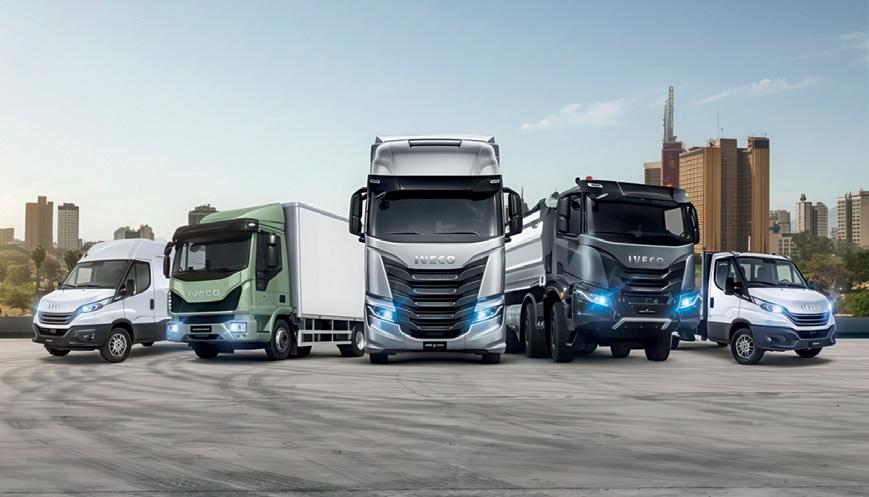
Inside IVECO’s Madrid powerhouse
The beating heart of IVECO’s global heavy-duty truck production, where every truck is a custom-built Innovation
All e-mailers must be in HTML format where images are coded with 'Absolute URL'.
The width of the designed mailer must not be more than 700 pixels and at 72DPI. restrictions on the mailer ’s height.
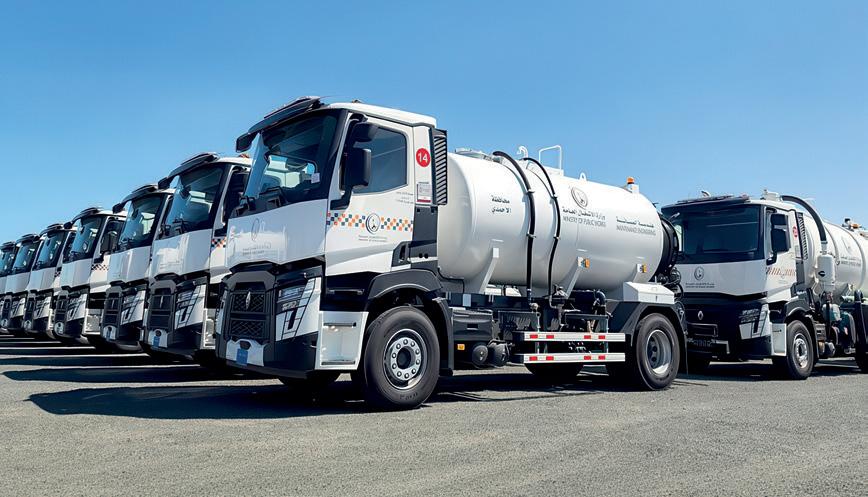
Shoneez delivers 24 Renault Trucks units to Kuwait Ministry of Public Works
CSS and form fields are not allowed as most e-mail clients don't recognize them. cases like these, a dedicated landing page must be provided by the client and linked on the HTML mailer.
Fleet of Renault C380 trucks will support sewage management, vacuum suction and public utility maintenance operations as part of the ministry’s fleet modernisation programme
banners are included make sure that they are NOT in flash/SWF format
ebsite MPU Banners
300px x 250px, 600px x 500px
TRANSPORTATION
PNG / JPG / GIF
Hyperlink
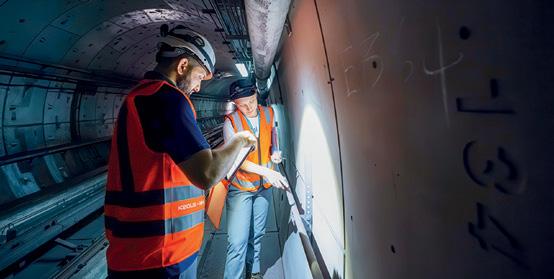
RTA concludes rehabilitation works on Dubai Metro tunnels
CARS
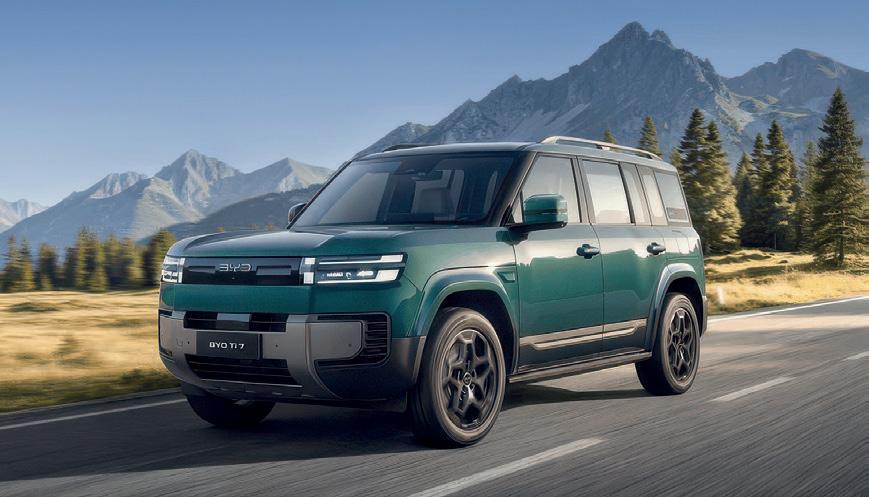
Al-Futtaim BYD launches TI-7
plug-in hybrid SUV in UAE
New plug-in hybrid model combines long-range efficiency, off-road capability and advanced driver assistance technologies as demand for electrified vehicles grows across the GCC
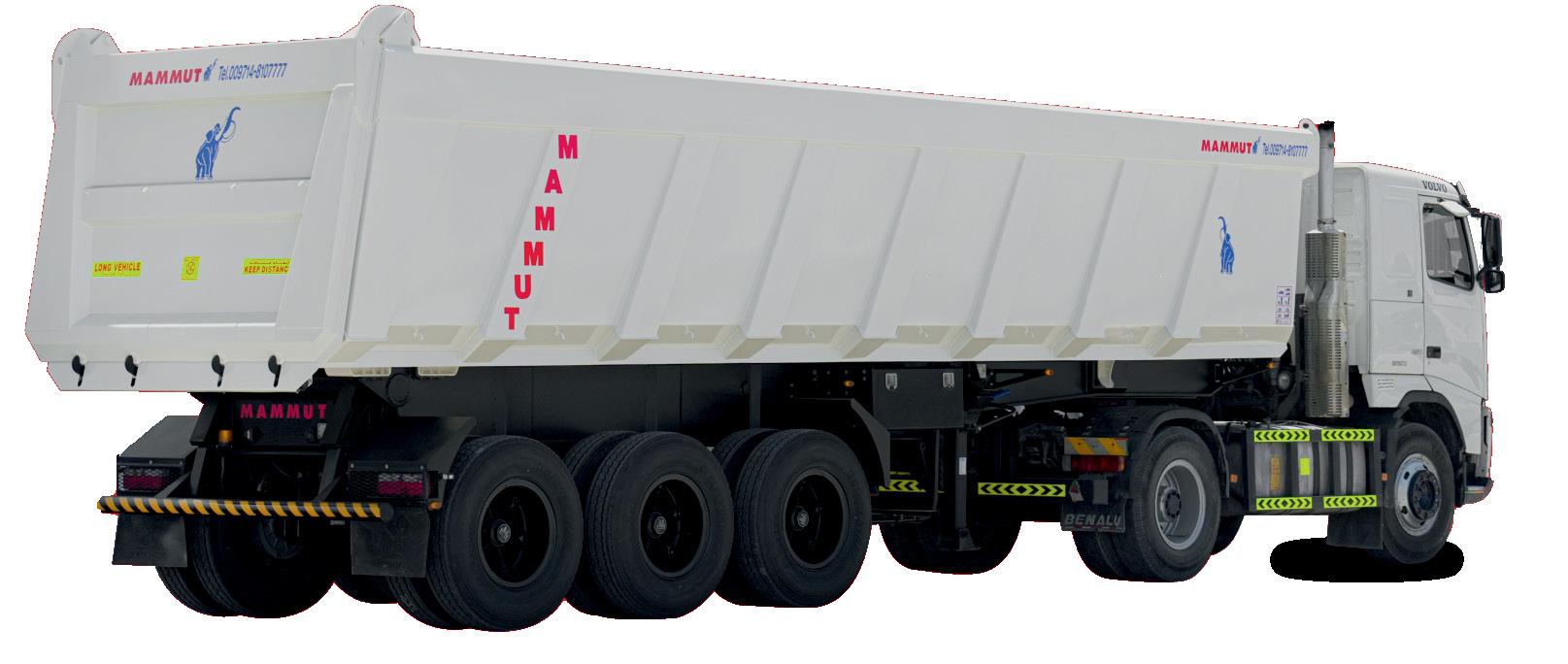
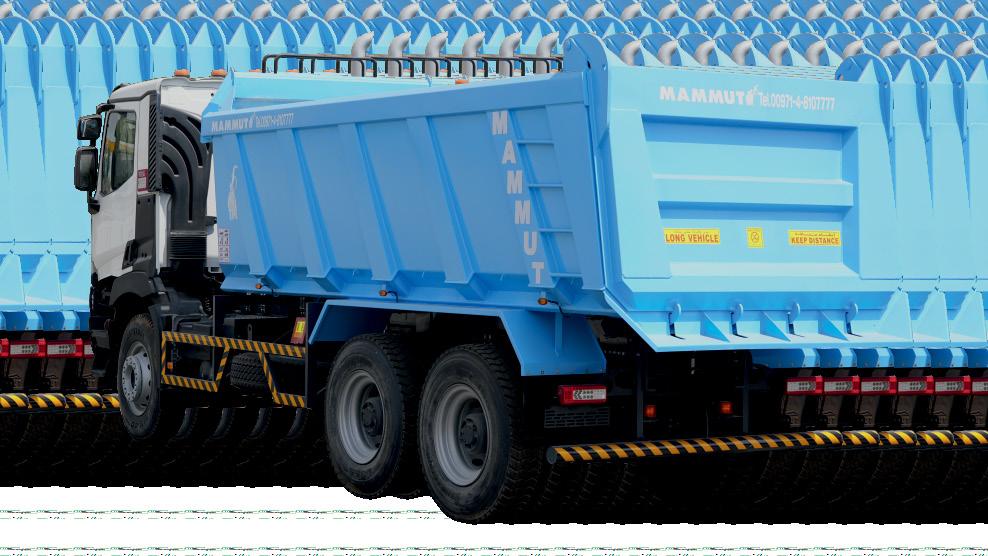
TIPPER TRAILERS
AVAILABLE CAPACITIES: 18 | 23 | 32 | 36 | 48 CBM
TRANSPARENT SPECS AND PROVEN DURABILITY
BUILT FOR THE HEAVIEST LOADS, WITH NO RECONFIGURATIONS
ENGINEERED FOR UPTIME: FEWER BREAKDOWNS, FEWER DELAYS
DUBAI’S RTA LAUNCHES AI-POWERED BUS STATION / NEW TRUCK DELIVERIES IN SAUDI AND KUWAIT /AUTONOMOUS HYDROGEN TRUCKS IN SAUDI ARABIA
Dubai plans largest-ever roll-out of electric buses with 735 vehicles NETWORK
EMIRATE SET TO UNDERTAKE BIGGEST EV BUS DEPLOYMENT IN UAE AS PART OF AMBITIOUS STRATEGY TO CREATE FULLY SUSTAINABLE AND ZERO-EMISSION PUBLIC TRANSPORT
GREEN PUBLIC TRANSPORT
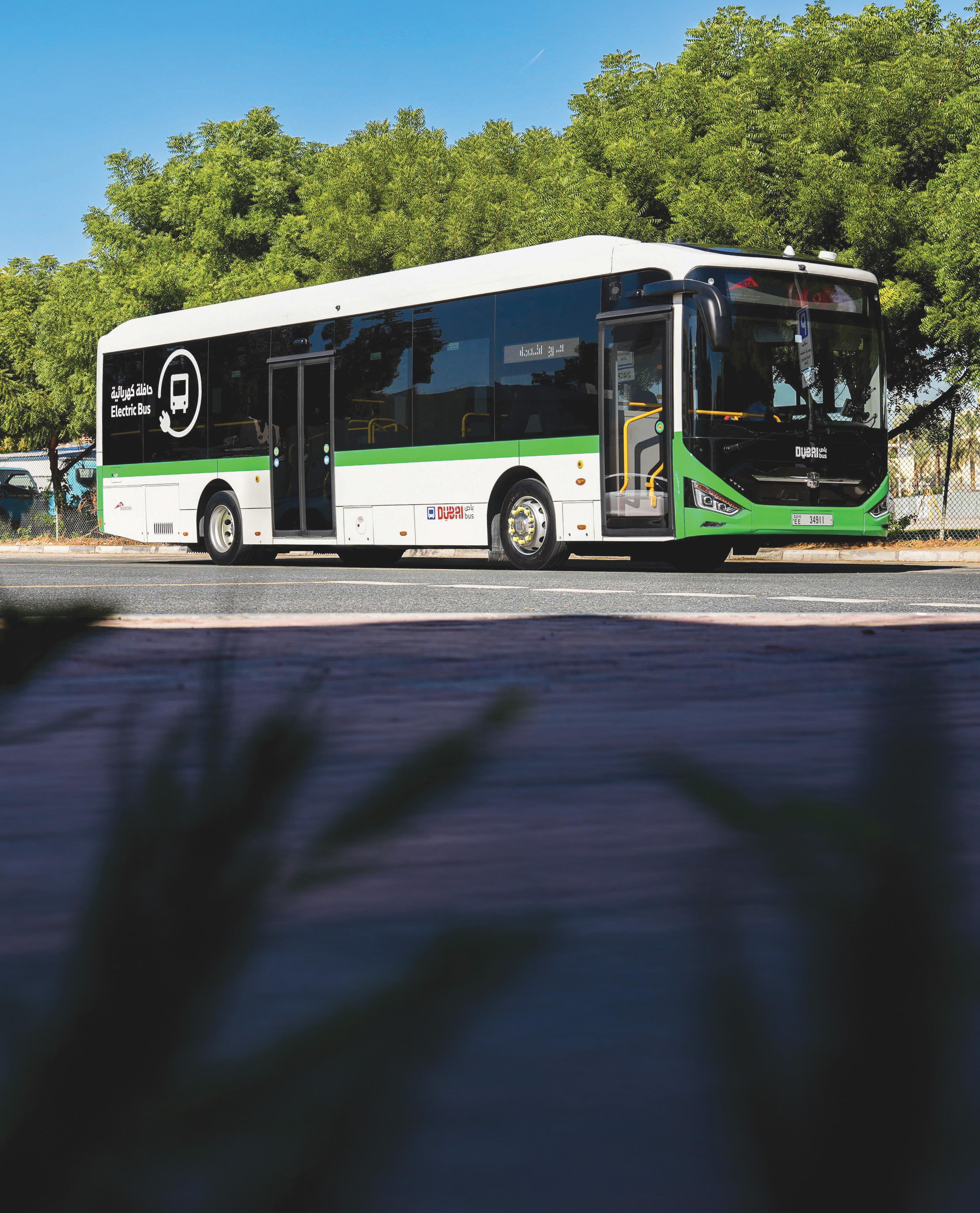
Dubai is set to undertake the largest electric bus rollout in the UAE as part of an ambitious strategy to create a fully sustainable and zero-emission public transport network.
The Roads and Transport Authority (RTA) has announced plans to introduce 735 electric buses across the emirate in 2026, marking a major
milestone in the city’s wider environmental and transport transformation agenda.
Dubai has already begun integrating environmentally friendly vehicles into its transport system. At present, the emirate operates 40 electric buses alongside hydrogen-powered vehicles as part of a gradual transition towards alternative energy transport solutions.
To support the expanded fleet, the RTA has invested in charging infrastructure across several strategic locations. A total of 32 high-capacity charging stations have been installed at five major depots, including facilities in Al Quoz, Jebel Ali and Business Bay. These depots are expected to play a central role in maintaining and operating the larger electric fleet once it
becomes fully operational.
One of the newly introduced electric buses has already entered service on Route F13. The vehicle is equipped with a 470-kWh battery and is capable of travelling up to 370 kilometres on a single charge, demonstrating the growing capability of electric public transport technology in the region.
UAE MOVES TO PROTECT MOTORCYCLE DELIVERY RIDERS FROM RISING SUMMER HEAT WITH LIMITS ON MIDDAY PEAK WORKLOADS
DUBAI’S RTA LAUNCHES FIRST AI-POWERED SMART BUS STATION
PUBLIC TRANSPORT
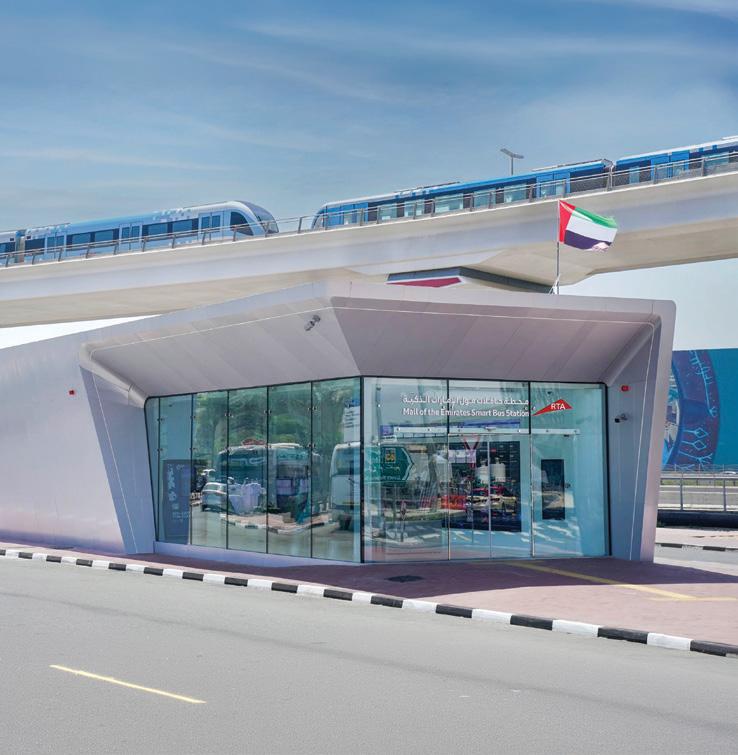
Dubai’s Roads and Transport Authority (RTA) has unveiled the Mall of the Emirates Smart Bus Station, the city’s first fully smart bus station, in a move aimed at strengthening Dubai’s public transport network through digital innovation and sustainable mobility solutions.
The new station, directly linked to Mall of the Emirates Metro Station, serves 11 bus routes and offers customers around-theclock interactive digital services designed to improve convenience, reduce waiting times and create a smoother travel experience.
Designed with sustainability and modern technology at its core, it represents what the RTA describes as a future model for public transport facilities across Dubai. Authorities plan to expand the concept to further integrate the emirate’s transport network and support growing demand for smart mobility services.
Mattar Al Tayer, Director General and Chairman of the Board of Executive Directors of the RTA, said the project marked “a major step forward” in the authority’s strategy to create a more attractive and integrated public transport system”.
The station spans 147m2 and can accommodate up to 20 passengers at a time. Among key features is a real-time digital information system displaying bus and Metro arrival times, taxi availability, station maps and various routes. A smart kiosk provides additional customer services, including a virtual assistant for journey planning.
AL MULLA SUPPLIES 150 MERCEDES-BENZ TRUCKS TO KUWAIT’S UNITED ACTROS
FLEET
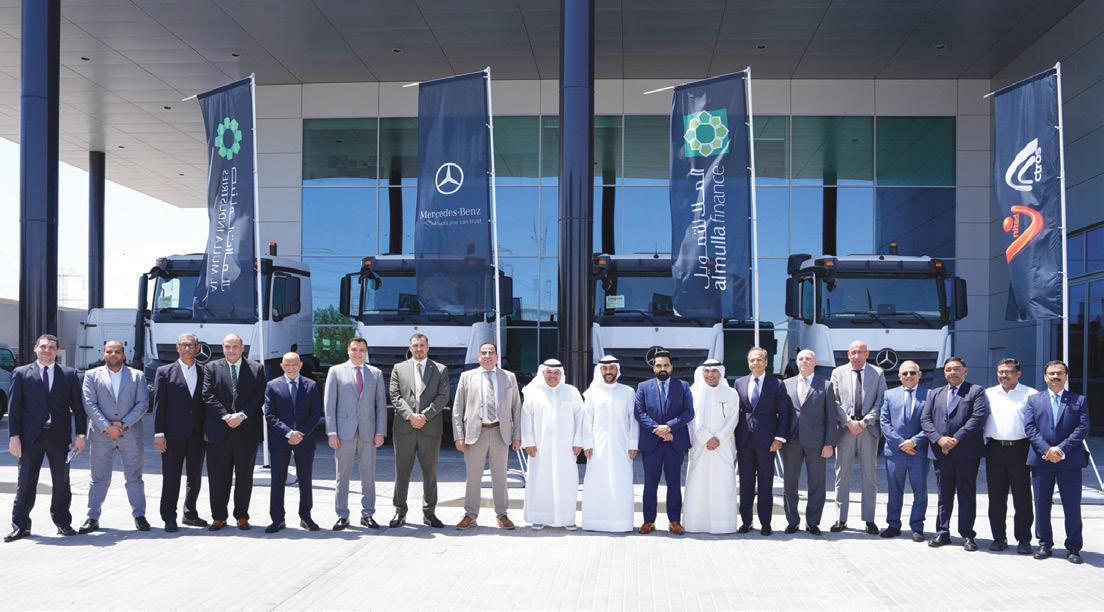
Al Mulla Automobiles – Commercial Vehicles, the authorised distributor of Mercedes-Benz Trucks in Kuwait, has delivered more than 150 MercedesBenz trucks to United Actros as part of a strategic fleet partnership in Kuwait.
United Actros is a major operator in the construction aggregates and infrastructure logistics sector. The agreement was delivered through a fully integrated package that included vehicle supply, tailored financing and specialist engineering support, coordinated across Al Mulla Group’s Automotive, Finance and Industrial divisions.
A ceremonial key handover took place at the new Mercedes-Benz Commercial Vehicles showroom in Al Ahmadi, attended by Talal A. Al Mulla, Board Member and Chief Executive Officer of Al Mulla Group, alongside Imad Flayhan, Managing Director of
Al Mulla Automotive, and Elie Zoghb, Managing Director of Trading & Manufacturing and Rental & Leasing at Al Mulla Group. Senior representatives from United Actros also attended, led by Fahad Sanitan Alzubi, Mohamed Nadeem and Mohamed Abdulrahman, together with management teams from both organisations.
The ceremony marked the official delivery of the fleet and highlighted
the long-standing strategic partnership between the two companies. The transaction is regarded as one of the largest Mercedes-Benz commercial vehicle fleet deals completed in Kuwait in recent years and reflects Al Mulla Group’s ongoing commitment to supporting the country’s infrastructure and logistics industries through integrated business solutions.
SHONEEZ DELIVERS 24 RENAULT TRUCKS UNITS TO KUWAIT’S MINISTRY OF PUBLIC WORKS
FLEET
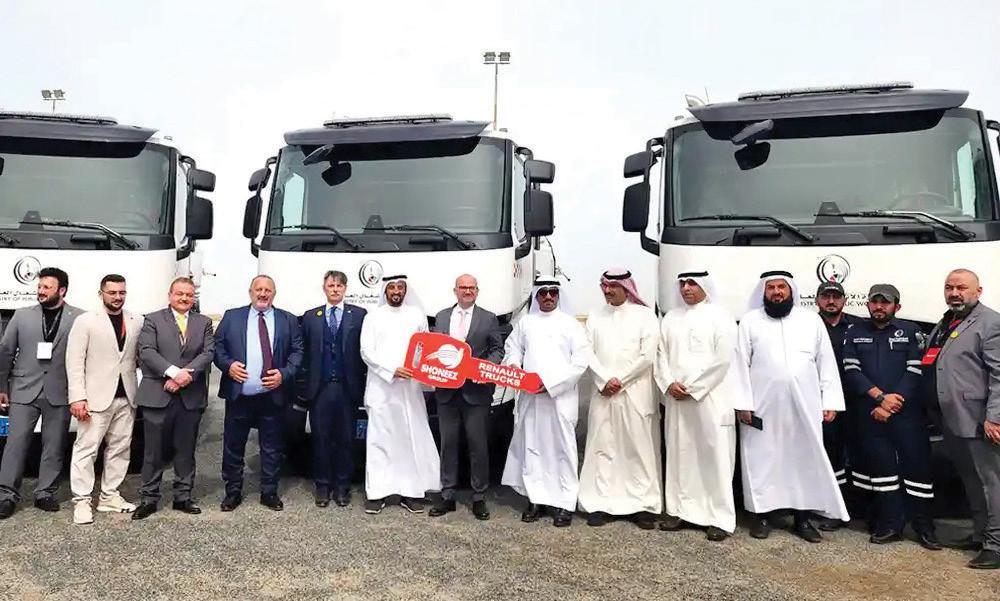
Shoneez Trading Group, the authorised distributor of Renault Trucks in Kuwait, has delivered a fleet of 24 Renault C380 4x2 trucks to the Ministry of Public Works (MPW) as part of an ongoing programme to modernise the ministry’s operational fleet.
The delivery was announced under the patronage of the
French Ambassador and in the presence of the MPW Undersecretary, highlighting the significance of the project for Kuwait’s public infrastructure sector.
The new vehicles will be deployed across a range of municipal and utility applications, including vacuum suction, sewage management and public utility maintenance. According
to Shoneez, the Renault C380 trucks have been specified to meet the demands of heavy-duty infrastructure operations while operating reliably in Kuwait’s challenging climatic conditions. The delivery forms part of a wider strategic collaboration between Shoneez Trading Group and the Ministry of Public Works aimed at enhancing operational efficiency and supporting the maintenance of essential public services nationwide.
Shoneez said the Renault models supplied to the ministry incorporate technologies designed for specialised utility operations and are backed by the company’s aftersales support network to maximise fleet uptime and performance. The deployment of the Renault Trucks fleet is expected to strengthen the ministry’s capabilities in carrying out critical public works activities.
AVALON EXPANDS FLEET WITH SANY EV TRUCKS
SUSTAINABLE LOGISTICS
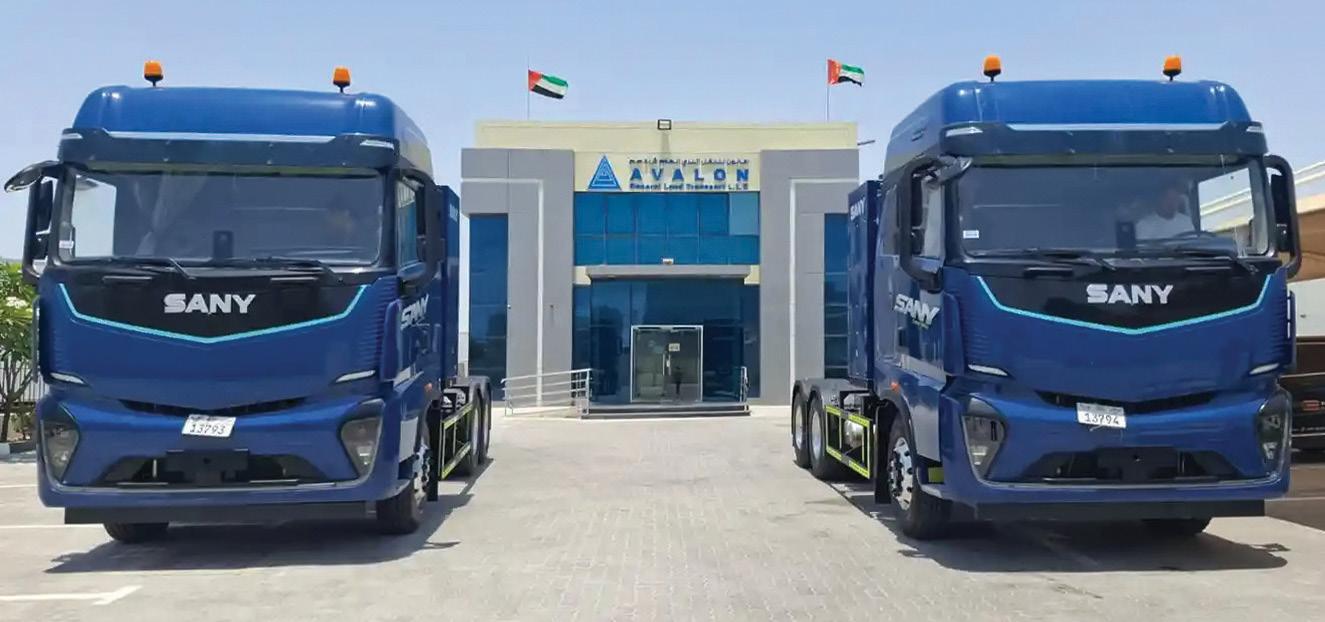
Avalon General Land Transport (Avalon) has expanded its UAE fleet with the addition of new SANY heavy-duty electric trucks, marking a further step in the company’s transition towards lower-emission freight transport operations.
The vehicles have been supplied by Emirates Global Motor Electric, a subsidiary of Al Fahim Group and the authorised distributor of SANY electric commercial vehicles in the UAE. The new trucks will be deployed across Avalon’s domestic logistics network, supporting cargo
transportation activities while helping to reduce the environmental impact of operations.
According to Avalon, the investment forms part of a long-term sustainability strategy focused on cleaner logistics, lower fleet emissions and greater operational efficiency. The company said the latest additions will strengthen its ability to deliver transport services while advancing its environmental objectives across the UAE and wider GCC region.
The move reflects growing interest in battery-electric heavy-duty vehicles within the Gulf’s transport and logistics sector, as operators seek practical solutions to reduce carbon emissions without compromising productivity.
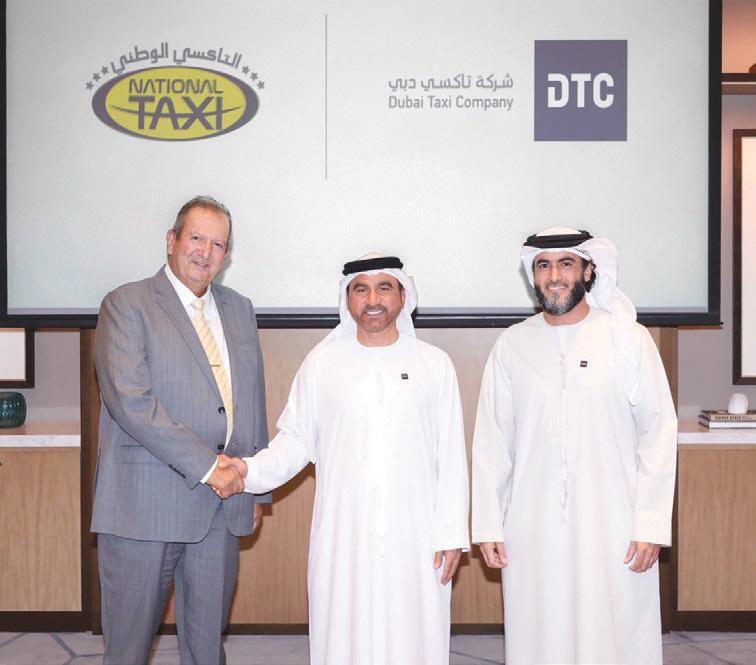
DUBAI TAXI EXPANDS INTO ABU DHABI WITH $395M NATIONAL TAXI TAKEOVER
FLEET
Dubai Taxi Company has agreed to acquire National Taxi in a deal valued at Dh1.45 billion ($395 million), marking the largest consolidation in the UAE taxi industry and expanding the company’s operations into Abu Dhabi for the first time.
The agreement, announced by Dubai Media Office on Tuesday, will raise Dubai Taxi’s share of the Dubai market from 47% to 59%. National Taxi operates more than 2,700 vehicles across Dubai and Abu Dhabi, with the acquisition expected to give Dubai Taxi an estimated 12% share of the capital’s taxi market.
KSA LAUNCHES FIRST AUTONOMOUS HYDROGEN-POWERED HEAVY-DUTY TRUCK
SUSTAINABILITY
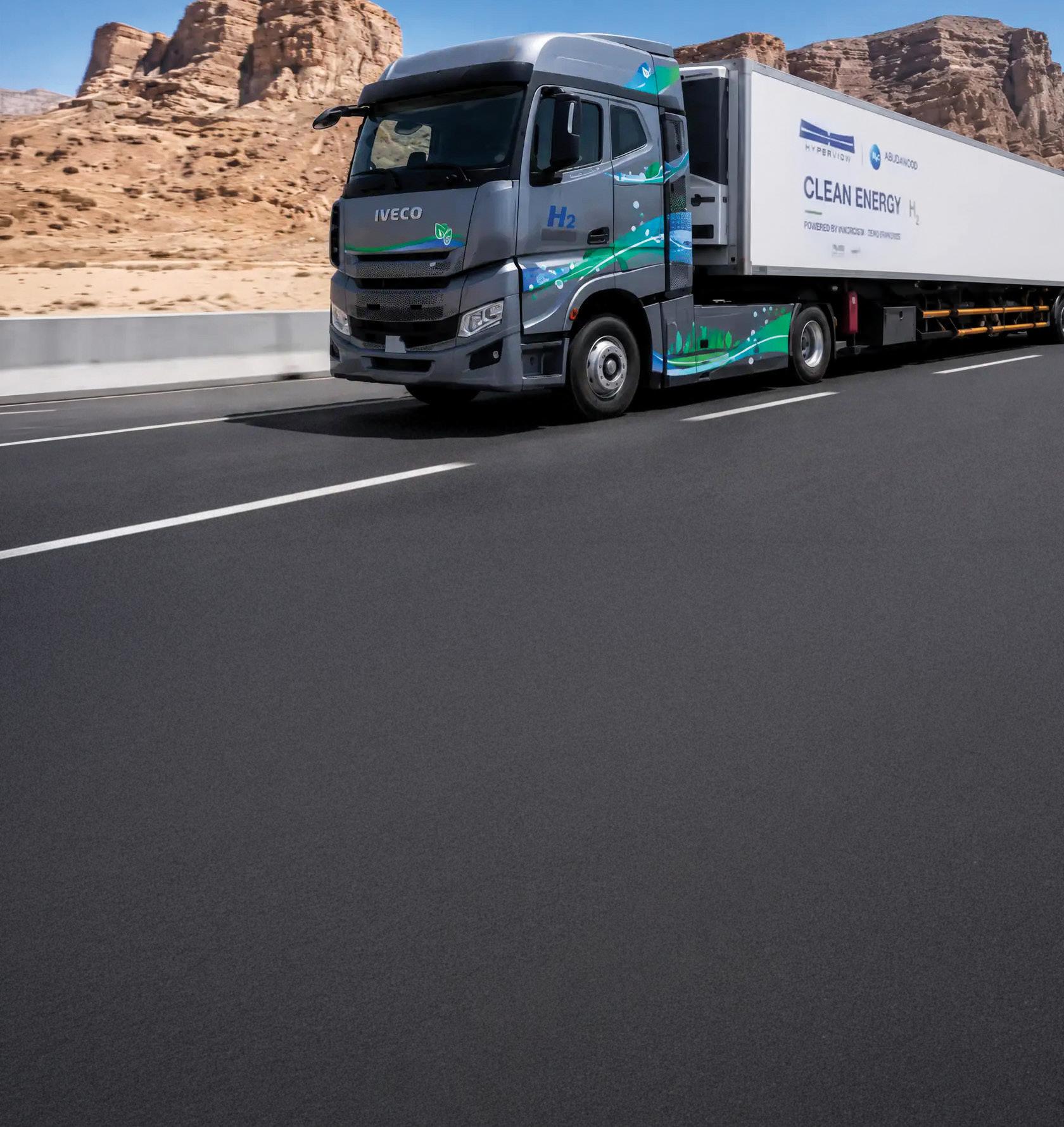
Saudi Arabia has launched its first hydrogenpowered heavy-duty truck equipped with autonomous driving technology.
The initiative has been sponsored by the Kingdom’s Transport General Authority (TGA), with support from the Ministry of Energy and the Ministry of Transport and Logistic Services. The project
has been delivered through a partnership involving logistics company Ismail Abudawood, consumer goods manufacturer Procter & Gamble (P&G) and technology firm Hyperview.
Designed for heavy cargo and logistics operations, the truck runs on clean hydrogen fuel and produces zero carbon emissions during operation. It offers a driving range of up to 1,500km
on a single refuelling cycle and can be refuelled within minutes, helping to address some of the operational challenges associated with long-haul trucking where vehicle uptime is critical.
The vehicle is equipped with multiple levels of autonomous driving capability, alongside digital systems that enable continuous software updates and performance monitoring.
The move represents a major step in Dubai Taxi’s wider growth strategy. As of March 2026, the company operated a fleet of 11,417 vehicles across taxi, limousine, bus and delivery bike services, reflecting annual growth of 16%.
Earlier this year, Dubai Taxi and ride-hailing partner Bolt signed a strategic agreement with National Taxi to integrate 1,823 vehicles into the Bolt e-hailing platform. The partnership expanded service coverage across Dubai and paved the way for the full acquisition.
Dubai Taxi has also been investing in autonomous transport and recently launched fully driverless commercial ridehailing services through a partnership with Baidu’s Apollo Go platform.
NEW MODELS MARK LINCOLN’S REVAMPED REGIONAL SUV RANGE / NISSAN TARGETS MIDDLE EAST PICK-UP SEGMENT WITH ALL-NEW NAVARA PRO
LAUNCHES
4 MODELS IN THE SUV-ONLY RANGE
Lincoln expands Middle East luxury SUV line-up
COMPLETE SUV-ONLY RANGE UNVEILED FOR THE REGION, SPANNING COMPACT TO FLAGSHIP MODELS, COMBINING COMFORT, ADVANCED TECHNOLOGY AND HYBRID EFFICIENCY FOR GCC DRIVING CONDITIONS
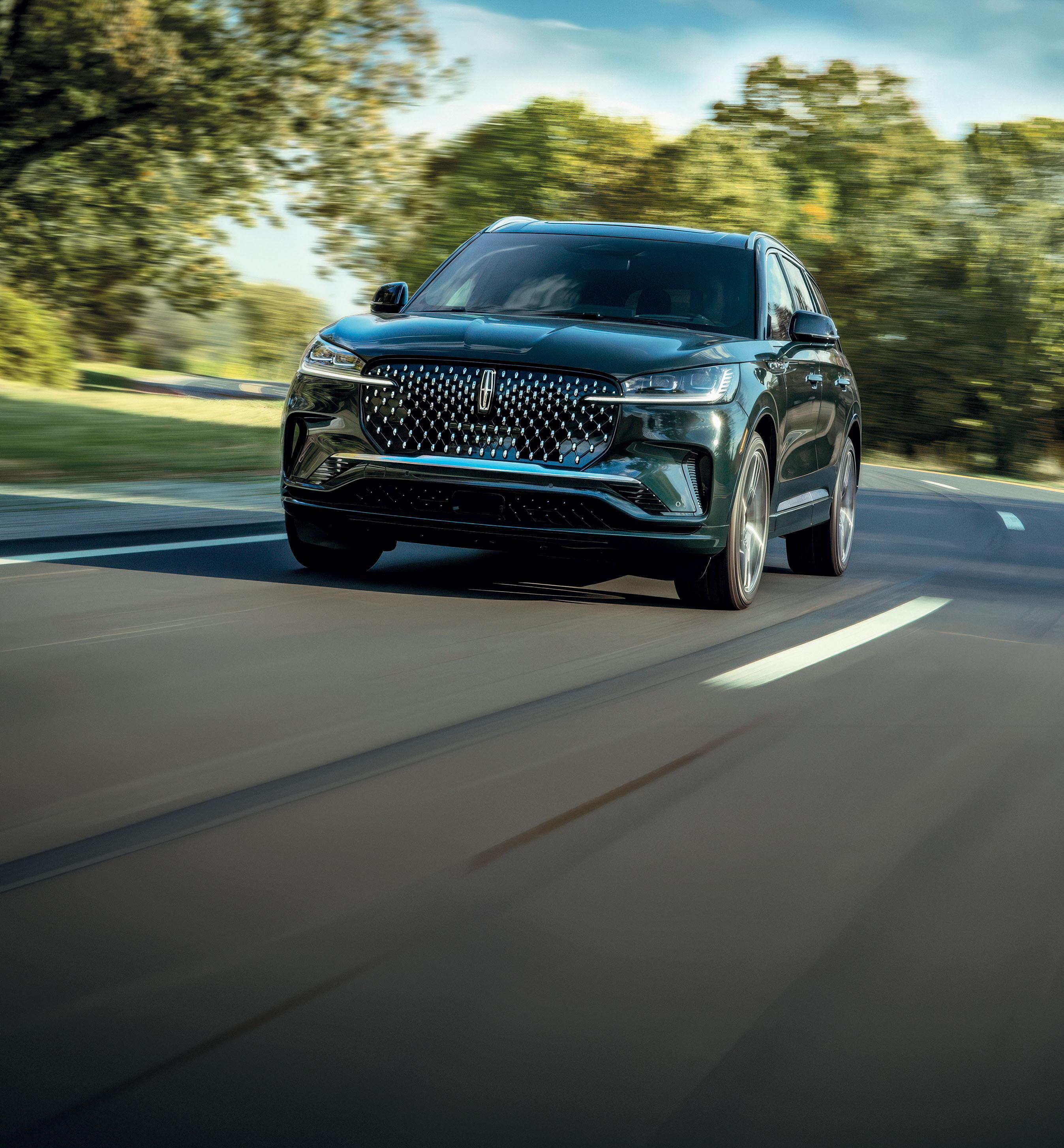
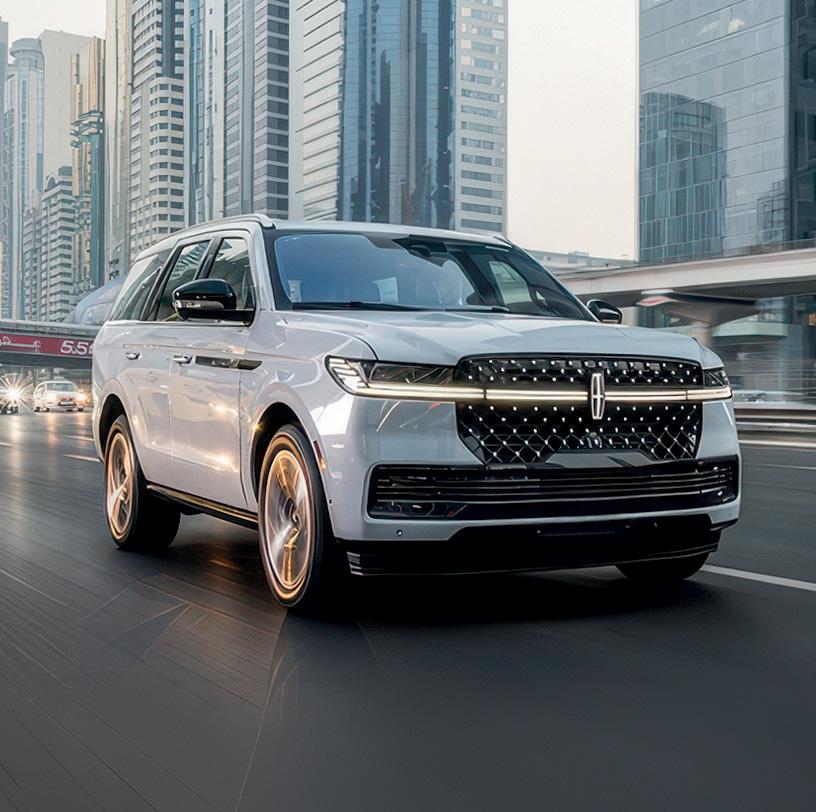
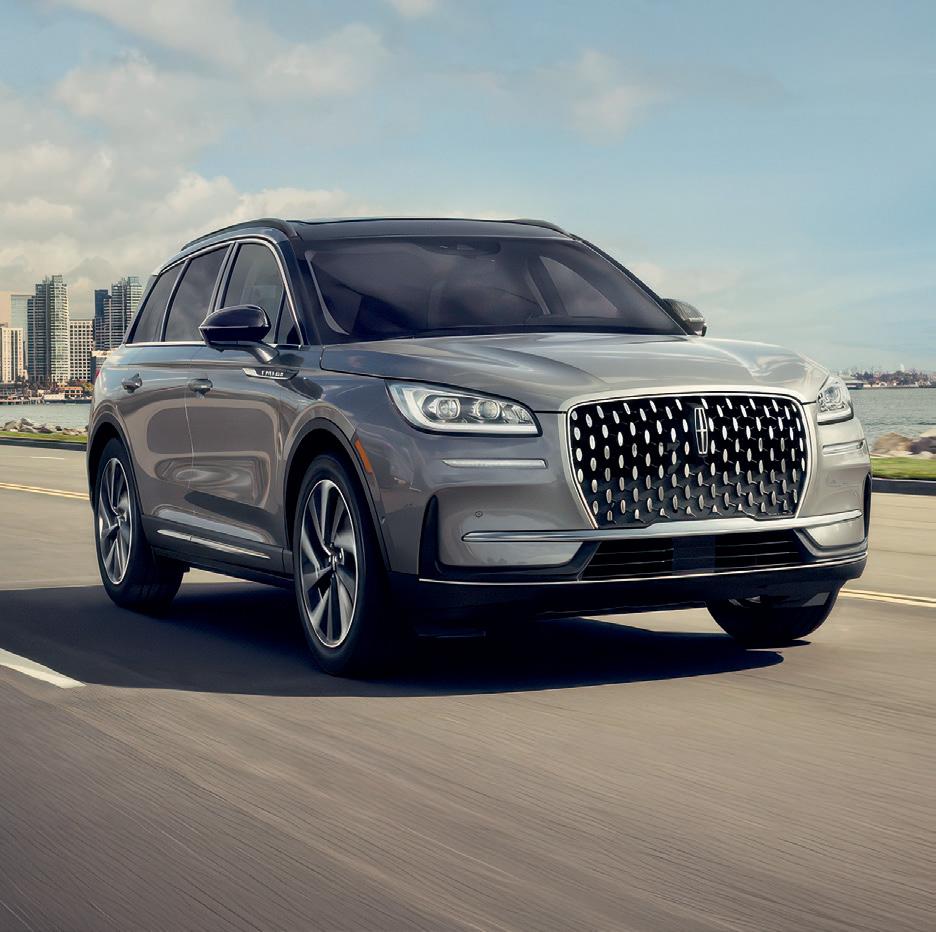
Lincoln has strengthened its position in the Middle East luxury market with a complete SUV-only lineup designed to meet the region’s diverse driving demands, from congested urban routes to long intercity journeys across the GCC.
The brand’s four-model portfolio, comprising the Corsair, Nautilus, Aviator and Navigator, has been developed to deliver tailored driving dynamics and premium comfort across every segment, reflecting growing regional demand for SUVs
Across the range, Lincoln is placing emphasis on human centric design, wellness focused
interiors and advanced driver assistance systems, positioning its vehicles as calm and private spaces within increasingly complex driving environments.
The company is also introducing more efficient powertrains, including hybrid technology in the Nautilus, as customers respond to rising fuel costs and a broader shift towards sustainability.
At the top of the range, the Navigator represents Lincoln’s flagship interpretation of full size luxury. Powered by a 3.5 litre twin turbocharged V6 engine producing 440 horsepower and 691 newton metres of torque, it
is engineered to deliver smooth and effortless performance across varied road conditions. Inside, the model functions as a mobile retreat featuring Lincoln Rejuvenate, a multi sensory experience that integrates lighting, sound, seat movement and scent to create a spa like atmosphere for occupants.
The cabin is defined by a 48 inch panoramic display paired with an 11.1 inch central touchscreen, providing access to navigation, entertainment and connected services. Available Perfect Position seats offer up to 30 way adjustment with heating, ventilation and massage functions,
while a 28 speaker Revel Ultima 3D audio system enhances in cabin immersion. Practical features such as the Lincoln Split Gate improve usability by simplifying loading and offering a versatile outdoor seating surface.
The Aviator brings three row versatility to the line-up with a focus on family oriented luxury. It is powered by a 3.0 litre twin turbocharged V6 engine producing 400 horsepower and 563 newton metres of torque, paired with a 10 speed automatic transmission and all wheel drive. The interior offers flexible seating for six or seven passengers, including
FEATURES AND PERFORMANCE
available captain’s chairs and power tip and slide second row seats designed to improve access and comfort.
The Nautilus focuses on electrified efficiency through its full hybrid system. It combines a 2-litre turbocharged engine with an electric motor to produce 287hp while achieving fuel
SPECIFICATIONS
economy of up to 16.1 km/l. The self charging system uses regenerative braking to capture energy, eliminating the need for external charging
At the compact end of the range, the Corsair is designed for urban drivers seeking premium comfort in a smaller footprint, powered by a 2-litre turbo producing 250hp.
Navigator 3.5 litre twin turbo V6, 440 hp, 691 Nm, 48-inch panoramic plus 11.1 inch touchscreen
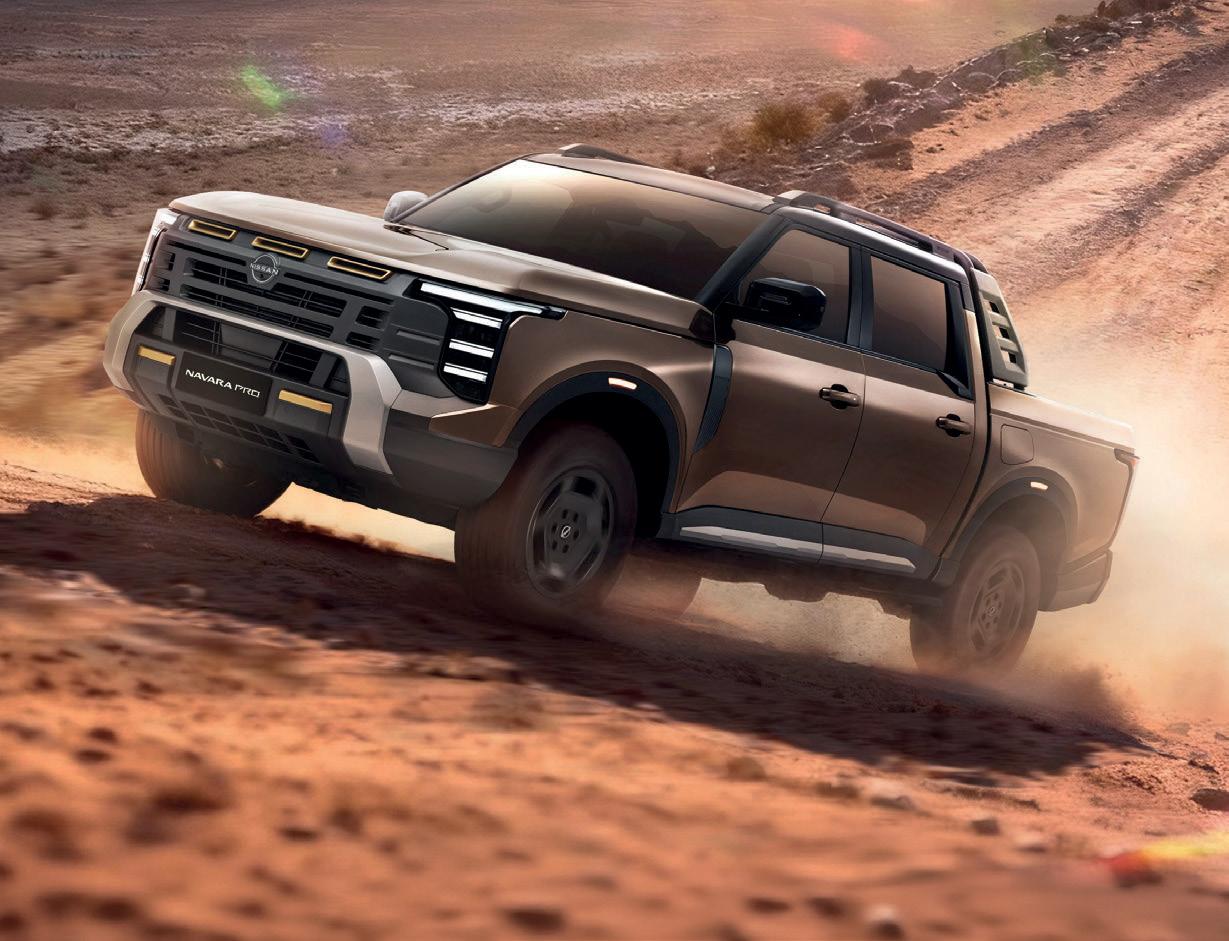
NISSAN’S NEW NAVARA PRO TARGETS ME PICK-UP SEGMENT
CHINA-BUILT NAVARA PRO IS NISSAN’S FIRST EXPORT PICK-UP FROM ITS CHINESE JV, OFFERING VERSATILITY FOR FLEETS AND LIFESTYLE BUYERS
Nissan is introducing the all-new Navara PRO pickup truck to the Middle East, marking a significant milestone in the brand’s global strategy as the first Nissan commercial vehicle manufactured in China to be exported to the region.
Positioned as a dual-purpose pickup for both commercial fleet operators and retail customers, the Navara PRO continues the nameplate’s long standing reputation for durability and versatility in Middle Eastern markets, where pickup trucks remain central to construction, logistics and lifestyle use cases.
The model arrives as part of Nissan’s broader product offensive in the region, which has recently included new SUVs and crossovers aimed at strengthening the brand’s presence across multiple segments. Within this strategy, the Navara PRO is expected to play a key role in reinforcing Nissan’s position in the highly competitive pickup market.
Engineered with two internal combustion engine variants, the Navara PRO has been developed to deliver strong performance and adaptability across demanding operating environments. Nissan says the model combines rugged capability with improved refinement, allowing it to serve both heavy-duty commercial
applications and everyday private use.
Speaking on its development, Richard Candler, Corporate Executive, Family, Product and Components Strategy at Nissan Motor Co. Ltd, said the new pickup builds on decades of engineering experience. “The Navara PRO combines Nissan’s long standing pickup heritage with the latest advanced powertrain and technology innovations. ,” he said. “It delivers efficient, effortless performance with the quality and intrepid spirit that has defined Nissan pickups for nearly a century.”
The pickup has also been designed with direct input from regional requirements, according to Thierry Sabbagh, Divisional Vice President for Nissan in the Middle East, KSA, CIS and India, with versatility central to its appeal across fleet and retail customers.
HIGHLIGHTS
Engine Dual ICE variants
Positioning
Commercial and lifestyle pickup
Manufacturing Zhengzhou Nissan joint venture, China
Design concept
Rugged Tech styling, dual purpose versatility
AND COMMERCIAL USE
Lincoln’s latest SUVs offer features such as multi-speaker audio systems, large touchscreens, and powerful engine options.
LUXURY WITH UTILITY
Lincoln’s range of SUVs for the Middle East market comprise models that combine refinement and everyday practicality.
A GENTLEMAN’S TOURER-DE-FORCE
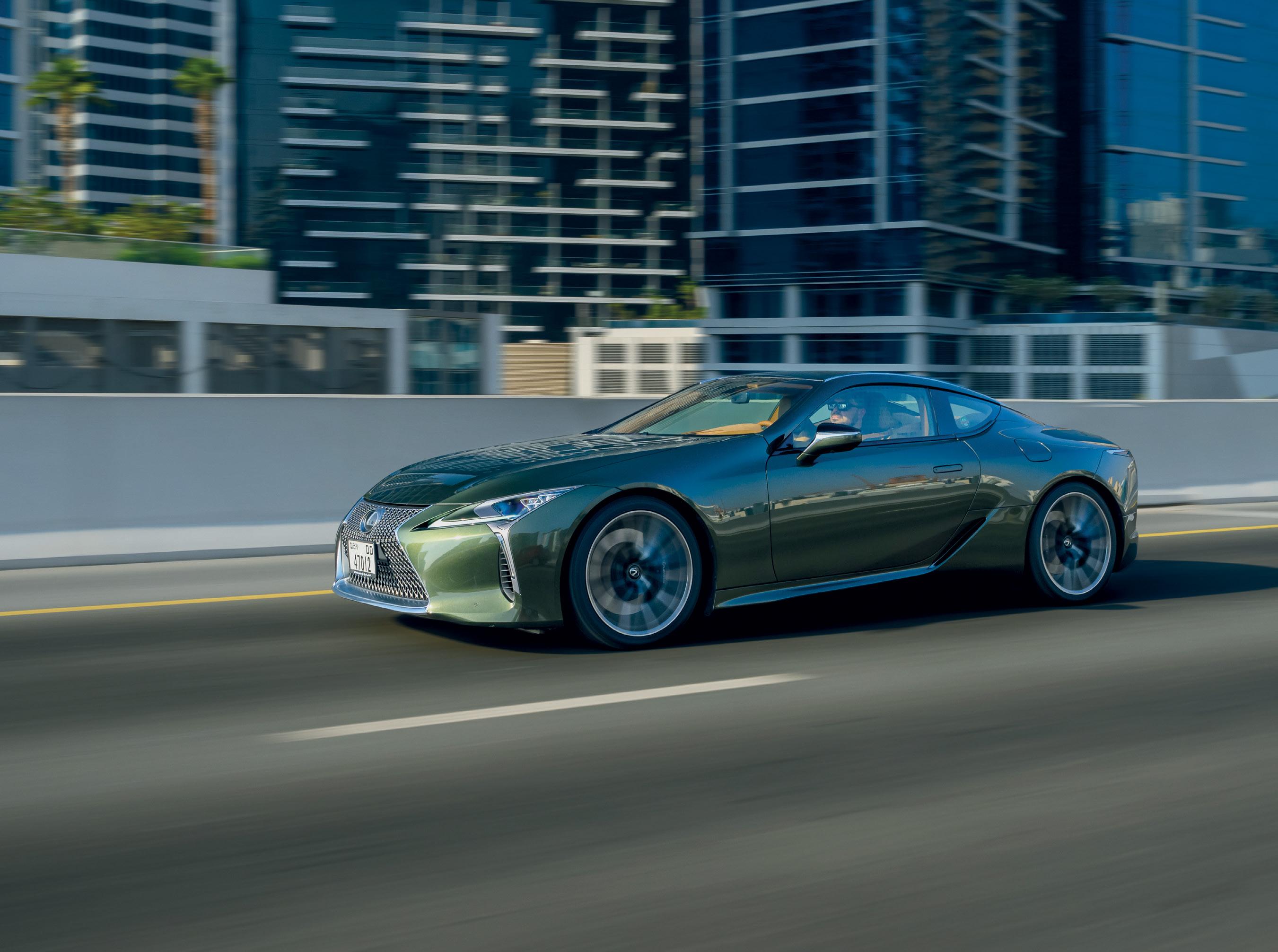
As Lexus unleashes its newly updated 2026 LC 500 coupe onto the sun-drenched tarmac of Dubai, Anirban Bagchi finds out if this naturally aspirated masterpiece is the ultimate grand tourer
Most contemporary sports cars want to fight you. They are tense, high-strung, and constantly buzzing like they drank far too much espresso, begging you to break speed limits just to feel alive. But not this one.
The 2026 Lexus LC 500 coupe, which has been recently introduced in the UAE, will give you a sensation of pure, unadulterated serenity. This isn’t a rowdy track weapon stripped of its dignity for razor-thin lap times. This is the consummate gentleman’s tourer, an automotive silk sheet draped over a mechanical heart of pure gold. In it, you simply glide down
the road as it delivers an experience where prestige meets everyday usability.
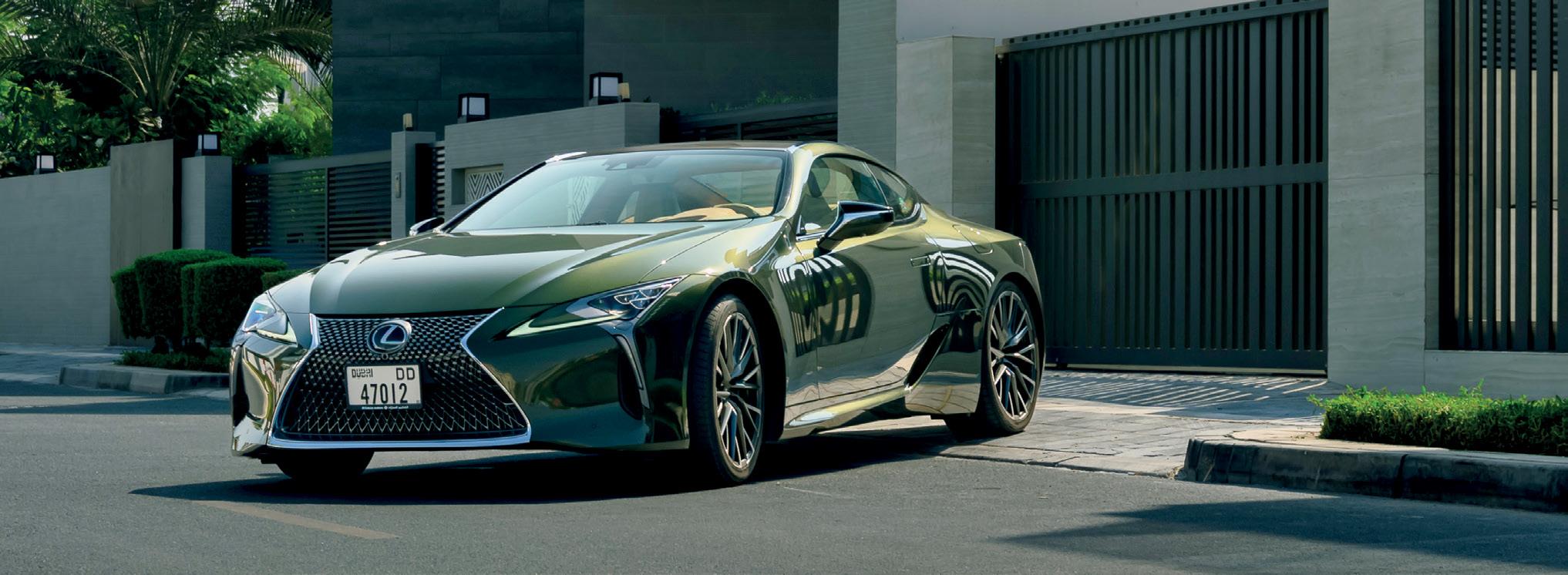
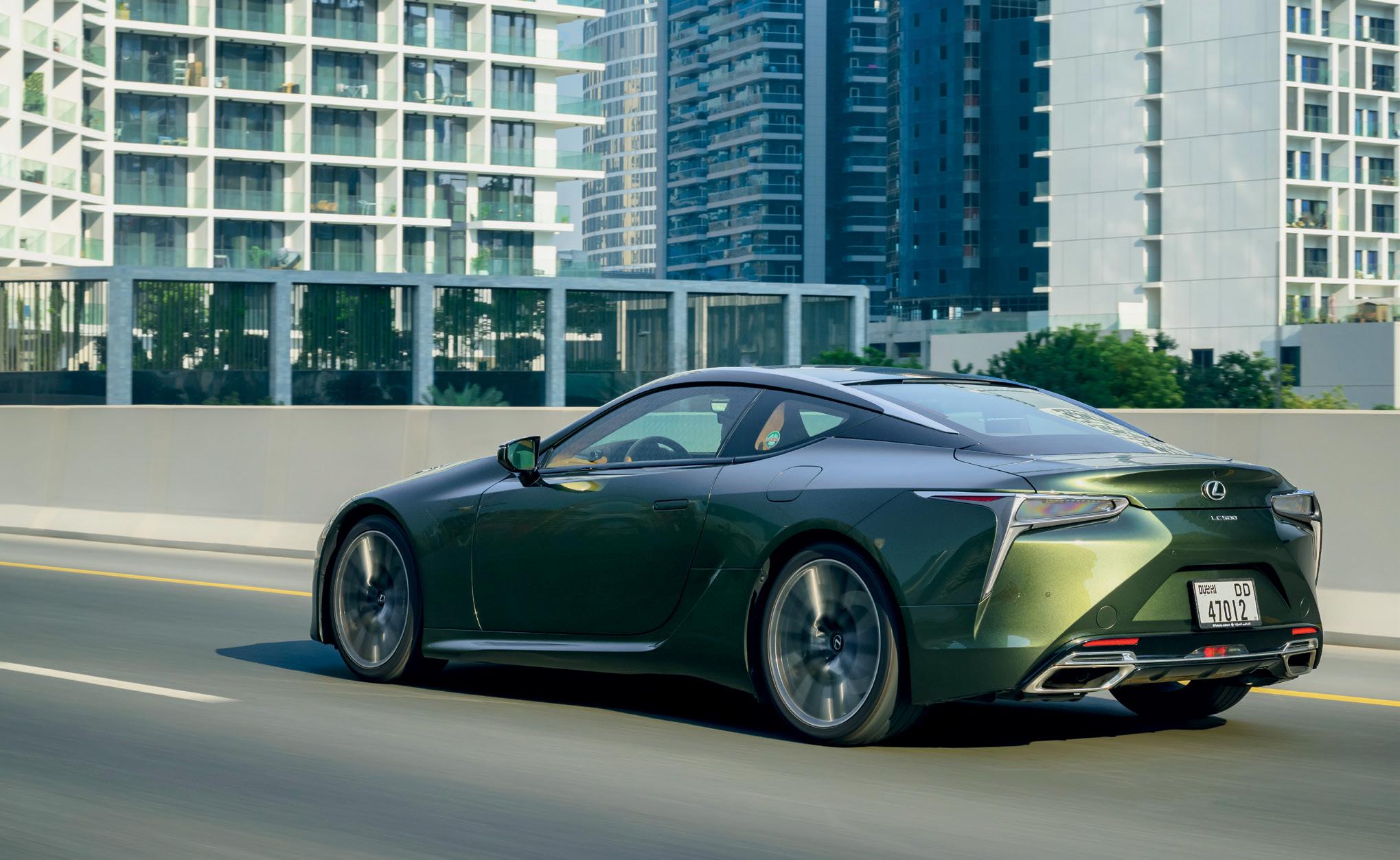
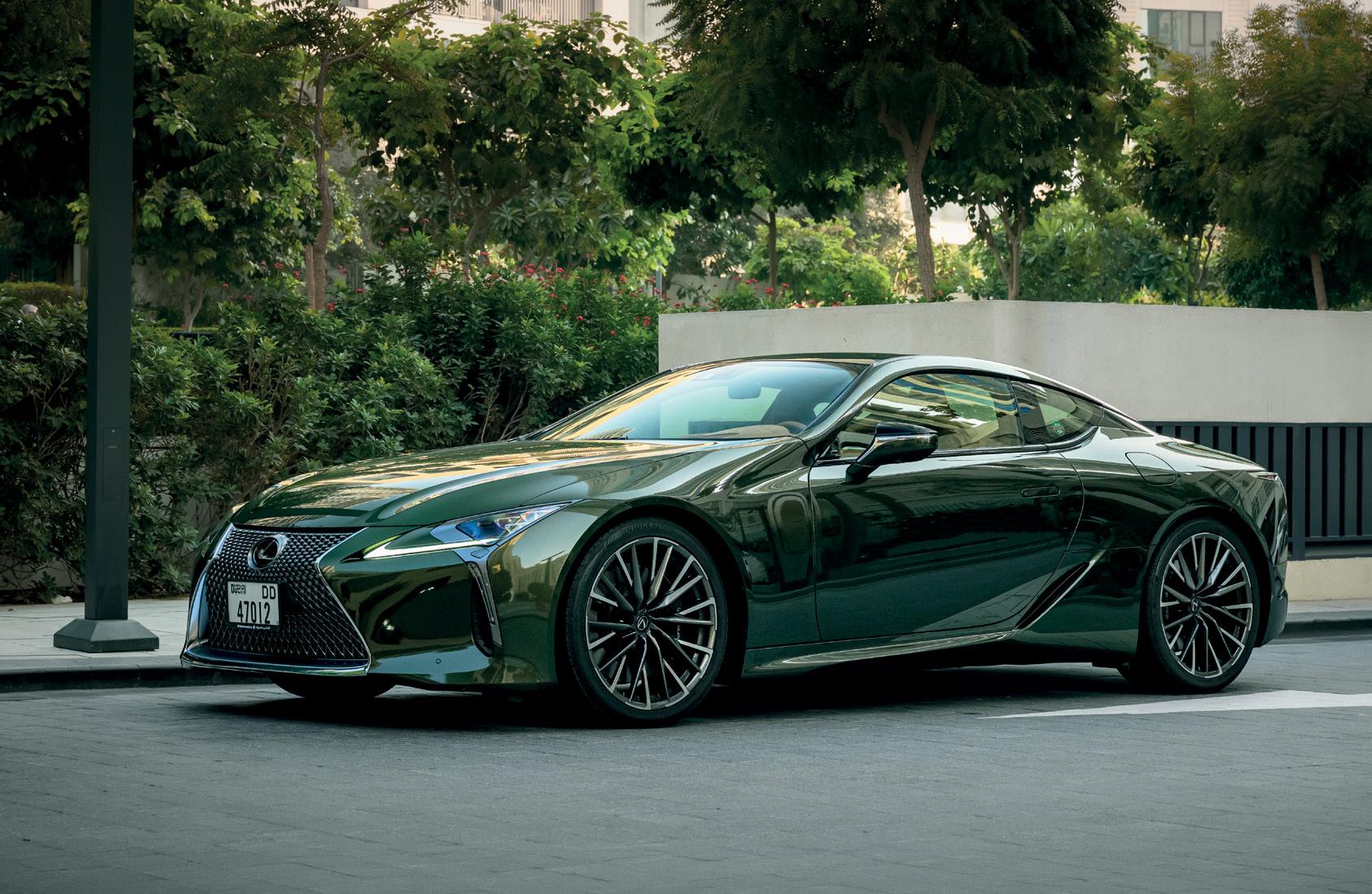
Al-Futtaim Lexus has just introduced this updated flagship to the UAE market, and seeing it in the metal outside the showroom is a genuinely theatrical event. It beautifully retains those breathtaking, concept-car proportions that make valets at the Atlantis The Royal sprint across the driveway for the keys. The ultra-low hood, dramatic spindle grille, and those hypnotising 3D infinity-loop rear taillights give it an unmatched presence on the road. Yet, the 2026 updates introduce subtle structural refinements and localised suspension tuning that elevate its road manners from merely excellent to entirely ethereal.
In Normal or Comfort mode, it behaves exactly like an automotive cloud”
Cocooning cabin
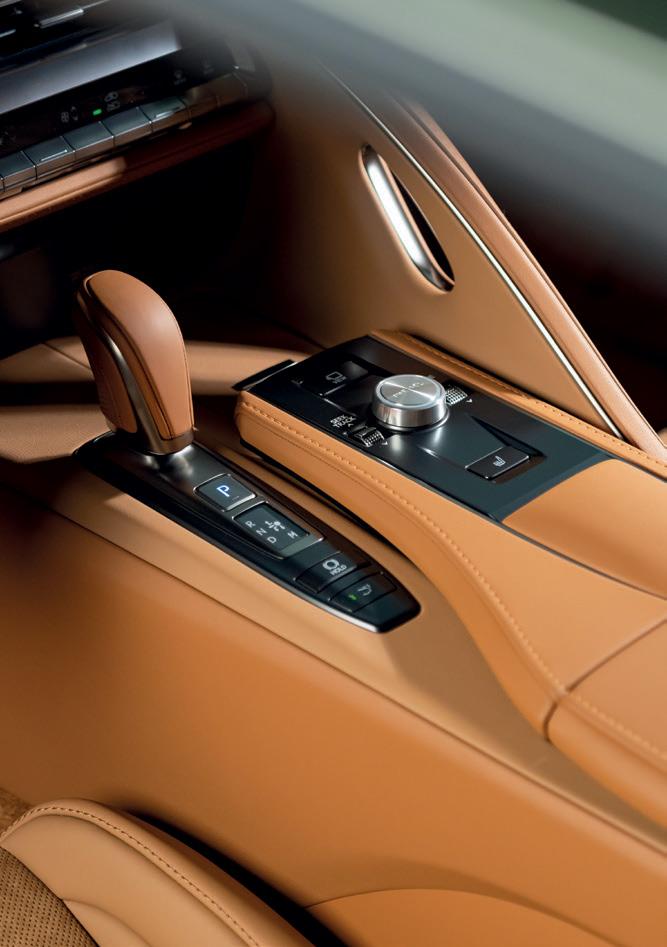
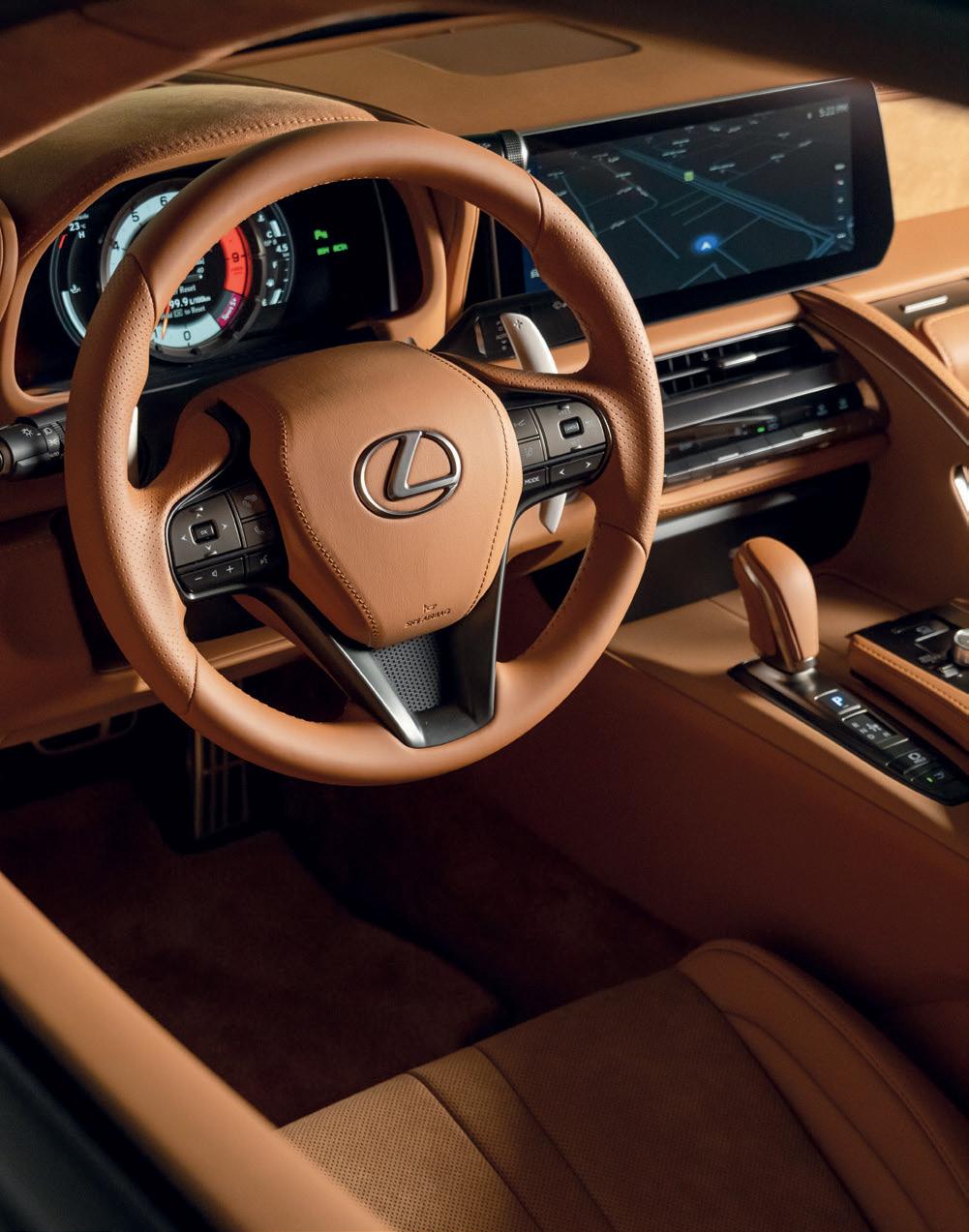
Slipping into the cabin is like stepping into an ultra-exclusive majlis curated by a master designer. Richly soft surfaces elevate your sense of touch immediately. Every single surface my fingers touch feels exceptionally expensive, heavy, and satisfyingly analogue in its construction. Lexus’s master craftspeople have created a cockpit that completely engulfs me in absolute luxury to enjoy an uninterrupted, plush riding experience.
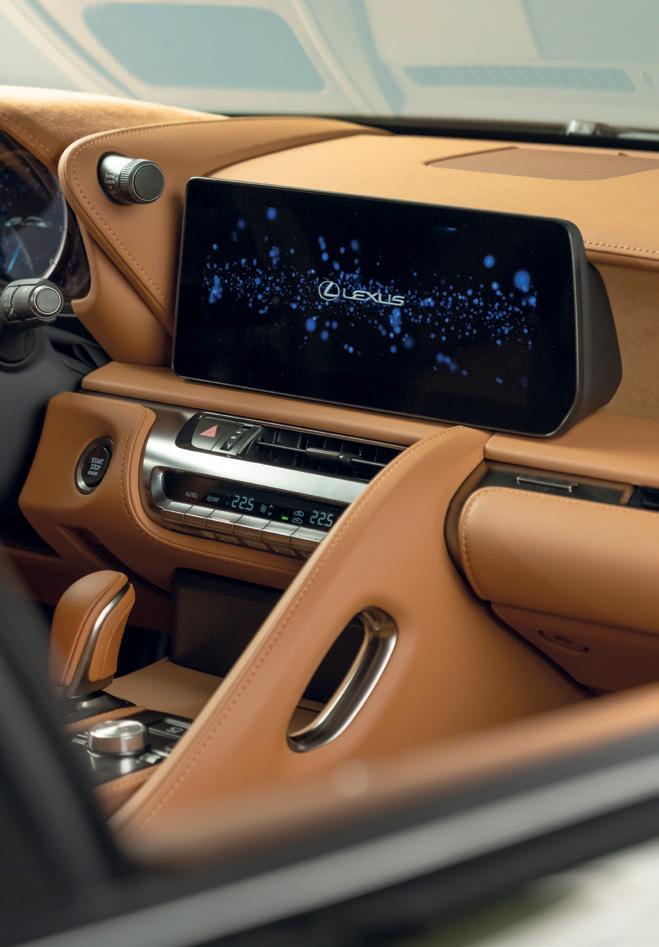
The updated dashboard features a gorgeous 12.3-inch high-resolution touchscreen that supports wireless smartphone connectivity, effortlessly fixing the only real ergonomic complaint
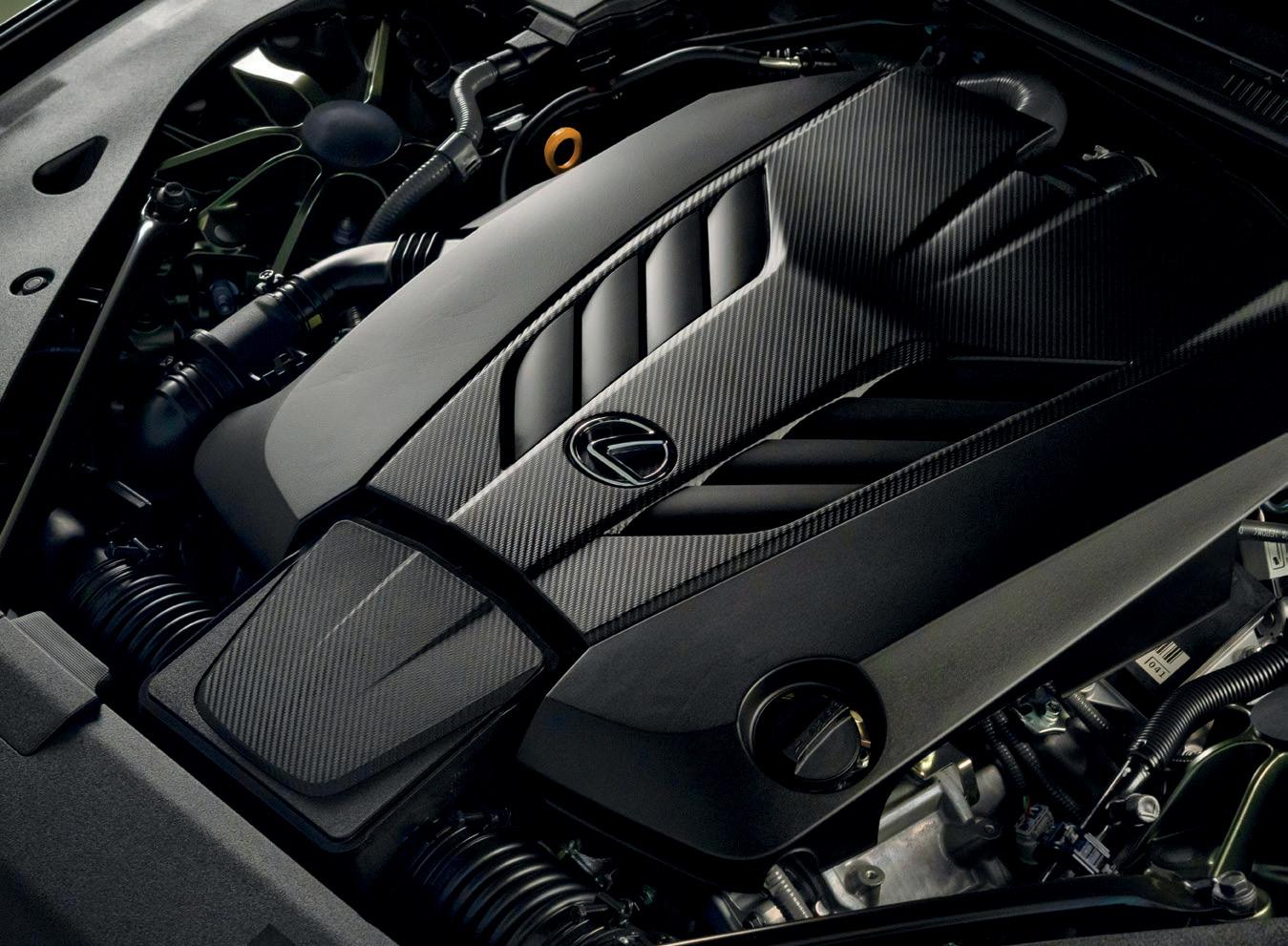
anyone ever had about this grand platform. It is remarkably quiet in here. At 120km/h on the highway, the flush windows, advanced aerodynamic underbody panels, and active noise cancellation technology isolate you from the outside world so completely that the bustling Dubai traffic feels like a silent movie playing out beyond the tinted glass. It doesn’t just travel; it cocoons you. But do not mistake this plushness for mechanical weakness. Beneath that long, beautifully sculpted hood lies a masterpiece of internal combustion: a naturally aspirated 5.0-litre V8.
In 2026, an engine like this feels like a glorious defiance of modern automotive trends. There are no turbochargers to
delay throttle response, no complex hybrid lag, and absolutely no synthetic digital humming pumped into the cabin. Just pure, linear, effortless power on tap whenever your right foot demands it.
When driven on sweeping bends and curvy, twisty roads, the LC 500 showcases its breathtaking dual personality. In Normal or Comfort mode, it behaves exactly like an automotive cloud. The adaptive variable suspension glides over expansion joints, minor road imperfections, and changing tarmac textures with an ultrasmoothness that feels almost supernatural. It doesn’t crash over bumps; it simply iron-softens them out of existence before they ever reach the cabin floor.
It is highly engaging, deeply visceral, and immensely fun to hustle”
The feeling is light, fluid, and incredibly relaxed. The 10-speed automatic transmission shuffles through its gears completely imperceptibly in the background, keeping the V8 engine whispering quietly like a sleeping giant. This is the ultimate luxury experience, a rolling sanctuary where you could comfortably travel across the entire length of the Emirates and arrive fresher, calmer, and more relaxed than when you initially left.
Modes enhance driving feel
Upon twisting that distinctive rotary dial sitting on the side of the instrument binnacle into Sport+ mode, though, this sophisticated gentleman instantly sheds the velvet evening jacket and puts on a pair of
ELEGANT YET STEALTHY
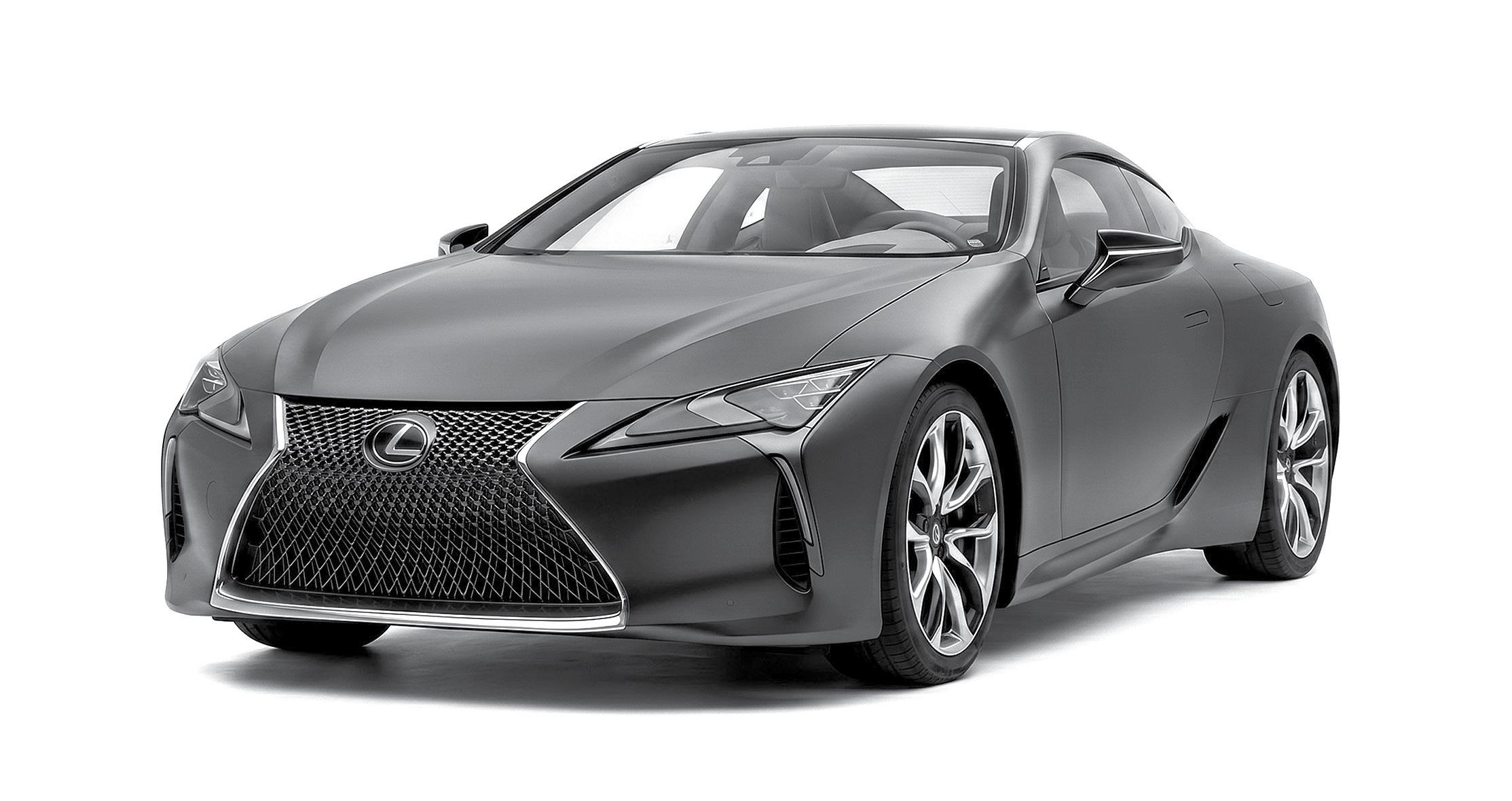
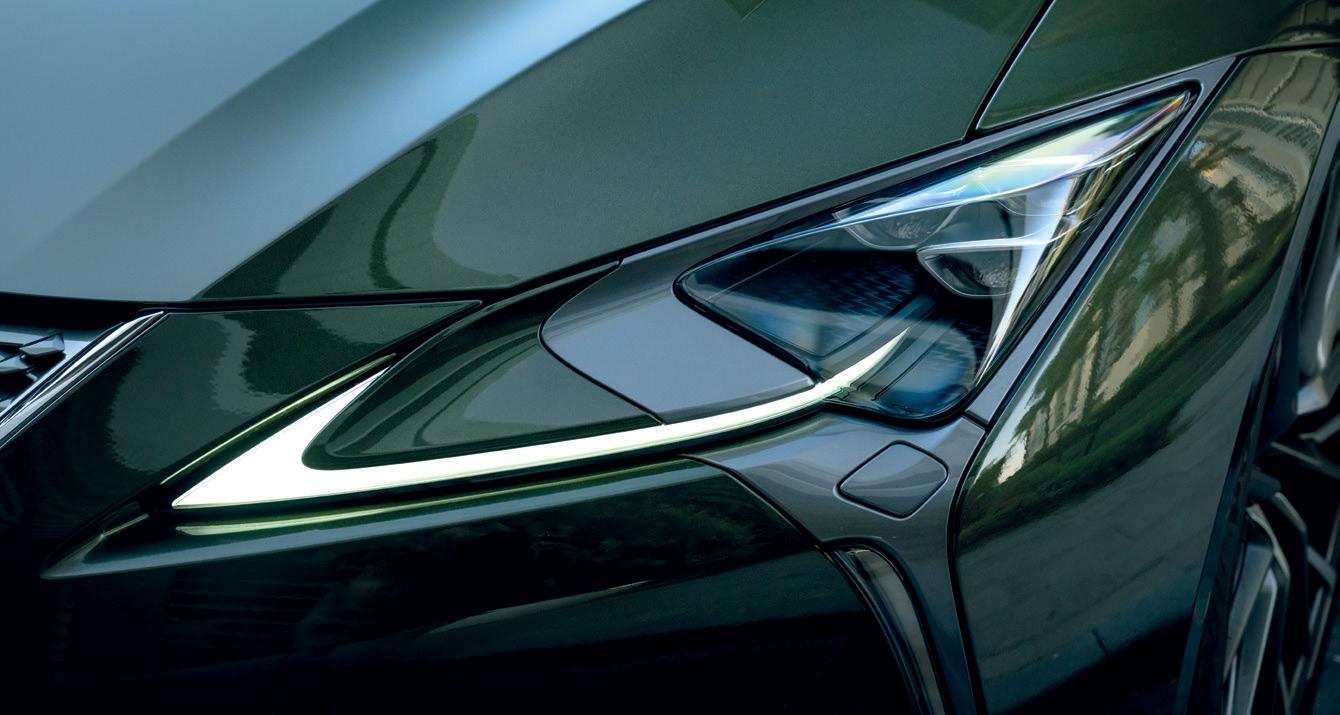
A swooping, ultra-low hood, dramatic spindle grille, and hypnotising front and rear light arrays give the new Lexus LC 500 an unmatched presence on the road.
Acres
Engine Type 5.0-Litre Naturally Aspirated V8
Displacement 4,969 cc
Maximum Power 471hp @ 7,100 RPM
Maximum Torque 540Nm @ 4,800 RPM
Transmission 10-Speed Sport Direct Shift Automatic
Drivetrain Rear-Wheel Drive (RWD)
0–100 km/h 4.7 Seconds (Claimed)
Top Speed 280 km/h (Electronically Limited)
Fuel Tank Capacity 82 Litres
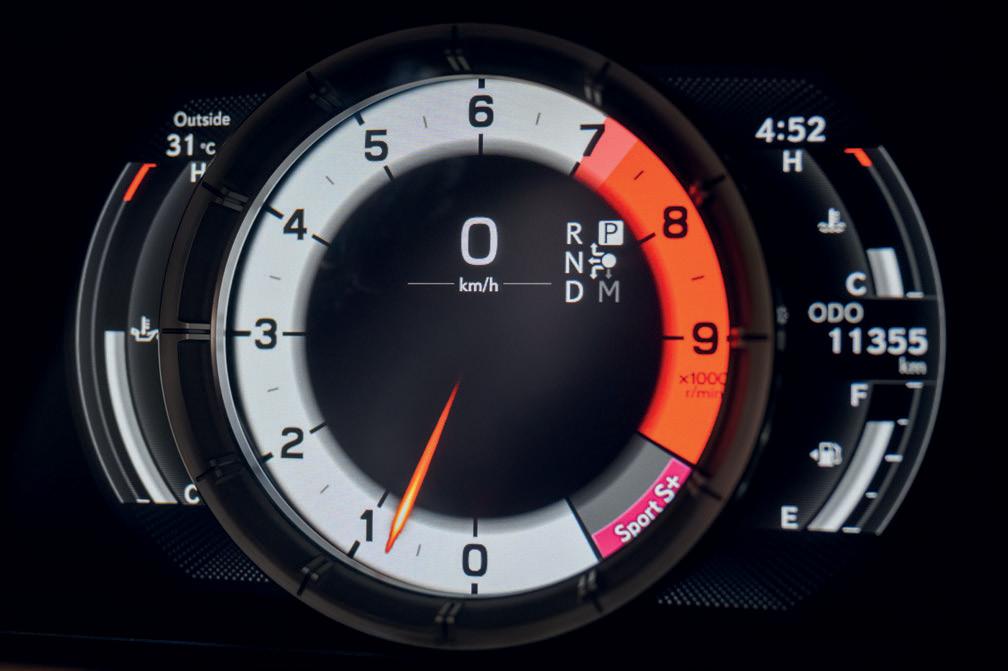
tightly wrapped boxing gloves. The digital instrument cluster mechanistically slides to the right with a crisp mechanical whir, expanding the display to reveal a bold, racing-inspired tachometer. The adaptive dampers firm up instantly, the steering gains a reassuring, meaty weight, and the throttle response sharpens to a razor’s edge. Mash your right foot down, and that quiet, serene cabin is instantly shattered by a glorious, authentic mechanical V8 wail. Because this engine is naturally aspirated, the power doesn’t hit you in a sudden, violent turbo-dump that breaks tire traction. Instead, it builds progressively and swellingly, pulling harder and harder with a beautiful crescendo all the way up to its screaming 7,300 RPM redline.
Chasing the revs is an addictive, incredibly playful experience that brings out the inner enthusiast. With a few clicks of the solid magnesium paddle shifters mounted right behind the steering wheel, the 10-speed gearbox fires off lightning-fast downshifts, accompanied by crisp, metallic barks and crackles from the rear exhaust pipes.
Despite its substantial grand tourer weight, the rigid chassis dances through corners with surprising agility and composure, aided tremendously by the active rear-wheel steering which virtually shrinks the car’s dimensions around you as you apex.
It is highly engaging, deeply visceral, and immensely fun to hustle.
LEXUS LC 500 – SPEC SHEET
POWER AND FINESSE
of the softest, highest quality leather cover every interior surface, while a 12.3-inch high-resolution touchscreen and a changing digital instrument cluster are visual delights that accurately represent the 471bhp, 5-litre V8 under the hood.
Versatile luxury
Yet, the true genius of this machine lies in its versatility. The moment twisty roads end and city traffic begins once again, another quick twist of the dial returns the vehicle to Comfort mode. The exhaust baffles close, the engine quietens down, the suspension softens immediately, and you are once again effortlessly gliding along in a rolling sanctuary. This remarkable ability to deliver both an ultimate luxury riding comfort and a sporty and fun drive with just a few quick mode switches is the LC 500’s true magic trick. It doesn’t force you to compromise. It is a masterclass in modern grand touring refinement, proving that soul, luxury, and performance can still coexist beautifully in a single, timeless package in what can only be described as a gentleman’s tourer.
FLEET VIABILITY: THE PREMIUM RENTAL PERSPECTIVE
For luxury fleet owners and high-end car rental agencies, the 2026 Lexus LC 500 represents an exceptionally lucrative asset. In a market saturated with temperamental, high-maintenance European supercars, this grand tourer offers the possibility to be a refreshing and highly profitable alternative.
Renters in the UAE actively seek out vehicles that combine curbside prestige with effortless daily drivability, making the LC 500 a prime candidate for VIP hotel transport, high-
profile corporate leasing, and premium tourist rentals. From an operational standpoint, the vehicle’s bulletproof Lexus reliability is its greatest commercial weapon. Unlike its turbocharged competitors, the naturally aspirated 5.0-litre V8 engine is notoriously robust, drastically reducing mechanical downtime and unscheduled maintenance costs. Furthermore, parts availability and service support through the established network in the UAE guarantee rapid
turnaround times for fleet servicing. The interior materials, while undeniably opulent, are engineered to withstand heavy use without showing premature wear, preserving the car’s residual value.
With its dual-character driving dynamics, it appeals equally to clients wanting a relaxing, ultrasmooth cruise down Jumeirah Beach Road and those seeking a spirited drive. It has the potential to deliver high rental yields, the excellent resale value that Lexus enjoys, and peace of mind for commercial operators.
CUTTING EDGE DESIGN
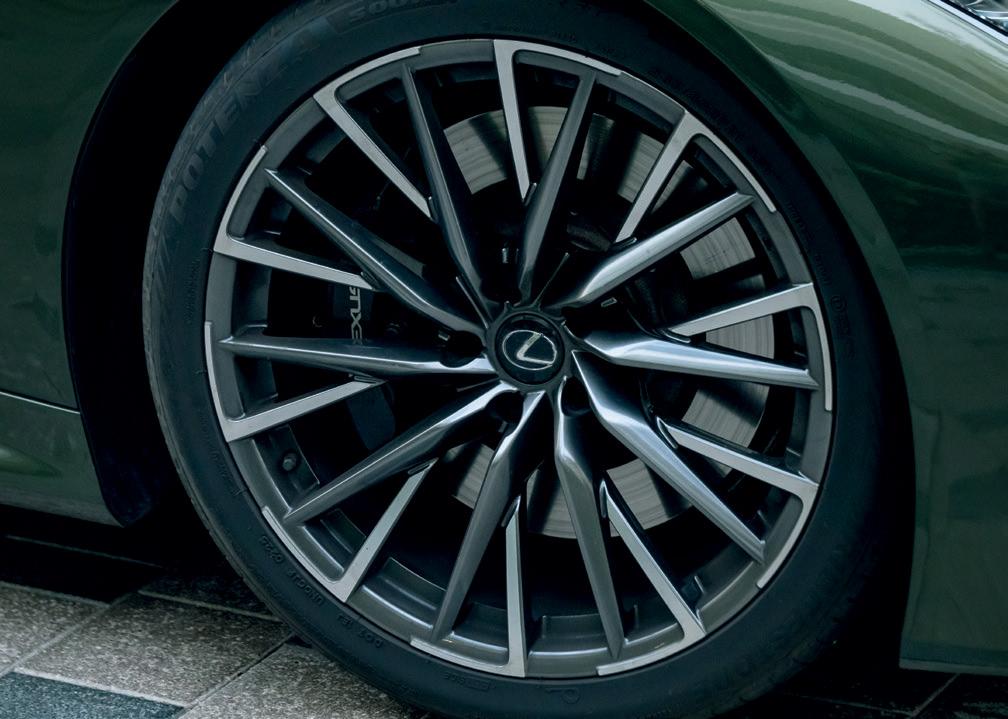
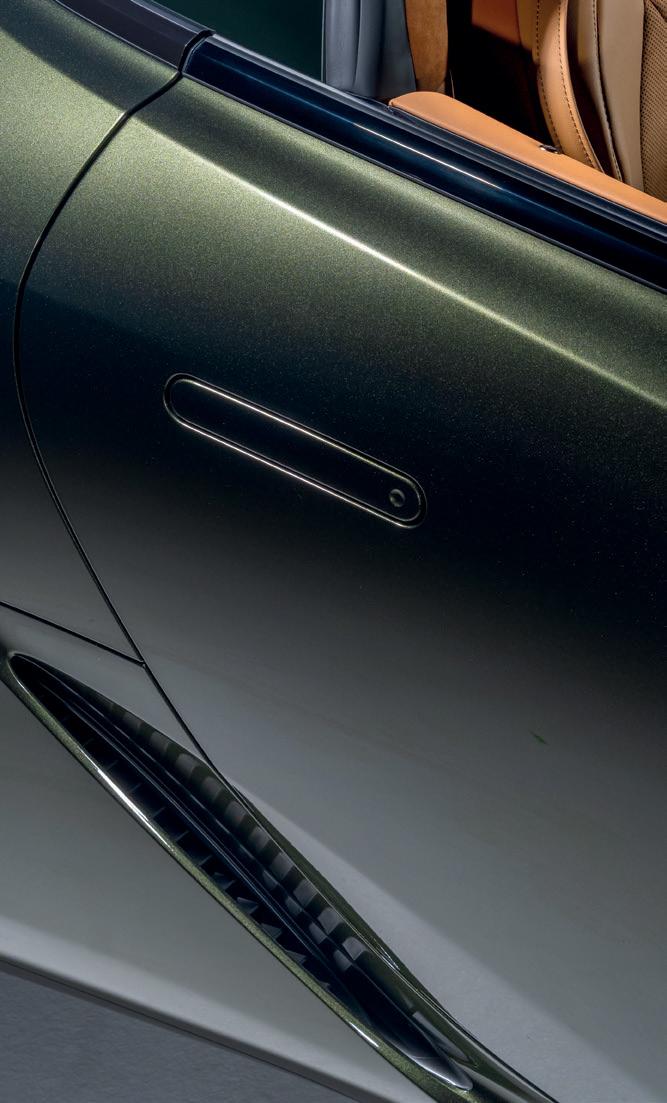
From the spokes of the alloy wheels, the angular arrangement of LEDs to the faux side air scoops, the new Lexus LC 500 is an exercise in understated styling excellence, and looks particularly stunning in profile.
DRIVING THE FUTURE OF
MOBILITY UPTIME
The ZF Group is balancing today’s mechanical realities with tomorrow’s digital transformation — putting uptime, predictive intelligence and partnership at the heart of a rapidly evolving service ecosystem, says
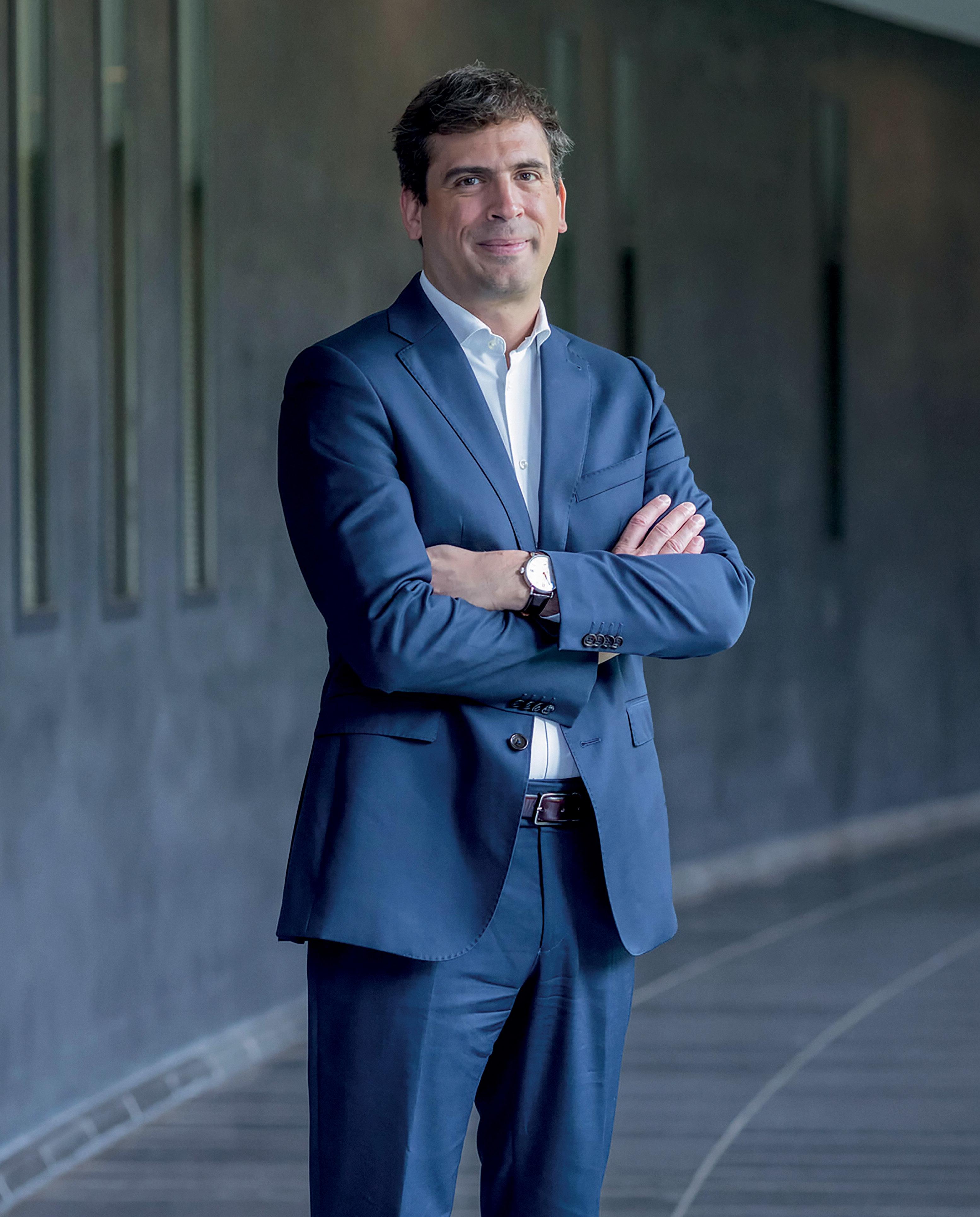
Philippe Colpron, Executive Vice President and Head of
the
ZF Aftermarket
division
As ZF Aftermarket transforms itself to meet market demands, what is the company’s vision for the future of the global aftermarket?
At ZF we are No. 1 in brakes, steering and suspensions of light and heavy commercial vehicles, as well as in powertrain components, such as clutch and transmissions. I’m very happy to lead that business across commercial vehicles and industrial applications, as well as passenger cars.
In recent years, the industry has faced uncertainty around the pace of technological change and the growing importance of sustainability. Despite this, I’ve always been confident in the long term importance of the aftermarket.
Mobility has become a fundamental expectation of modern life, whether it’s people travelling freely or essential goods arriving at our doors. This demand isn’t slowing down; it is evolving and expanding.
To keep society moving efficiently, vehicles must remain reliable, safe, and continuously operational. That’s where
the aftermarket plays an indispensable role. As mobility grows more complex, maintaining Uptime and performance becomes even more critical.
Our vision at ZF Aftermarket reflects this reality. We aim to stand alongside our customers as partners, helping them maximize vehicle Uptime, improve efficiency, and meet the rising expectations placed on modern mobility. Ultimately, our mission is to ensure that mobility remains dependable, sustainable, and always available when the world needs it.
Why is Uptime a more important matter now in the industry than it has ever been?
Uptime has become one of the most critical topics in our industry today. The main reason is that every push for greater efficiency adds a new layer of complexity. Vehicles, operations, and supply chains are more advanced than ever, and that means the cost of downtime, whether for fleets, workshops, or distributors, has never been higher.
Each customer segment is also undergoing its own transformation.
For ZF, Mobility Uptime means keeping every vehicle safe, productive, and operational throughout its lifecycle”
Parts distributors are digitizing their operations, workshops are adapting to new technologies and skills requirements, and fleets are evolving their business models and ownership structures. All these shifts create a more competitive market where everyone is striving to differentiate themselves.
To support our customers effectively in this environment, we must improve our capabilities. That means embracing new technologies, advancing digitalization, and adapting to the new expectations of the market while staying close to our customers. Ensuring Uptime isn’t just a service goal anymore; it’s a strategic necessity for the entire mobility ecosystem
What does “Mobility Uptime” mean for ZF and what is your approach towards it?
For ZF, Mobility Uptime means keeping every vehicle — of any age, technology, or drivetrain — safe, productive, and operational throughout its lifecycle. The industry is in a transition where traditional and future technologies coexist, and our customers must succeed in both.
ZF’s strength is our ability to support conventional systems while also delivering the innovations needed for new mobility. We help customers make this shift in a way that remains operationally and financially sustainable. For distributors, that means using data and intelligence to turn inventory faster. For workshops, it means providing the training, tools, and digital capabilities required to service increasingly software defined vehicles. As more fleets rely on automated decision making, we connect workshops, distributors, and operators into an integrated ecosystem.
Ultimately, Mobility Uptime is about ensuring customers stay profitable,
One of ZF Aftermarket’s strengths is the breadth and depth of our solutions”
prepared, and fully operational, both today and in the future.
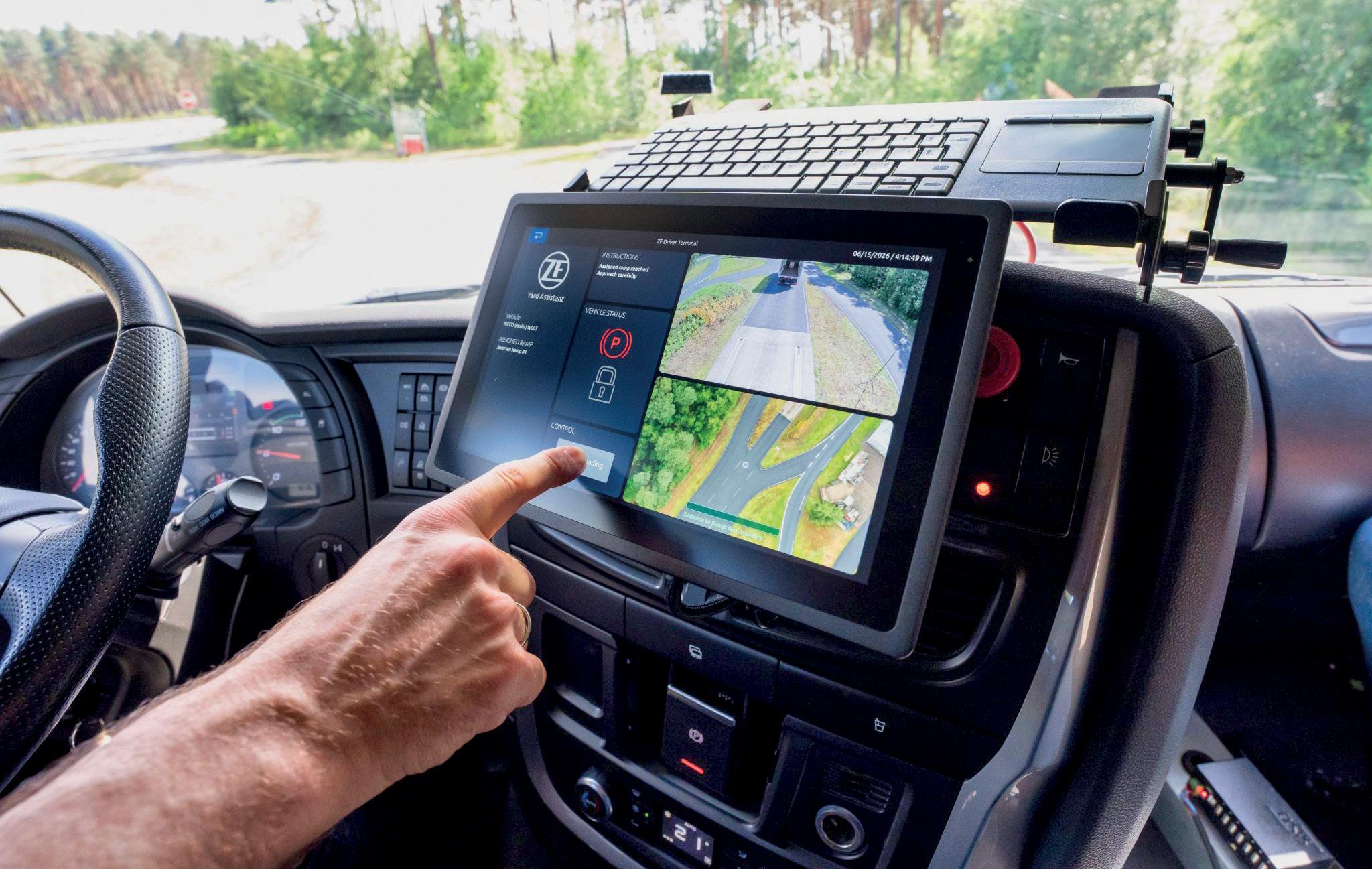
What are the major pain points of your customers today that become the biggest causes for downtime? And what is ZF doing to address these pain points? Today, downtime often stems from not having fast, accurate information on what has failed, which part is needed, and how to repair it. That’s why we’re heavily investing in digitalisation, to quickly identify failure modes, recommend the right parts, and get that insight to the right person. For workshops, our focus is advanced multi
brand diagnostics. By applying deeper troubleshooting capabilities and AI driven analysis, we help technicians diagnose issues faster and with more precision, reducing unnecessary downtime.
For distributors, the main challenge is stocking the right parts. We support them with data and intelligence to build the optimal range and ensure consistent availability. Quality is critical — poor quality parts create more downtime — so strong product information and reliable brands are central.
Once vehicles are on the road, we aim to keep them there. Our telematics and remote diagnostic solutions enable predictive and preventive maintenance, feeding real time health data into fleet planning systems so issues are addressed before they lead to breakdowns.
Overall, we tackle downtime at every stage: diagnosis, parts availability, and in operation monitoring — ensuring our customers run more reliably and efficiently
In certain regions, such as the Middle East, fleets still operate in reactive maintenance cycles. What is ZF doing here to help accelerate digital adoption?
The Middle East and the wider IMEA region are very diverse. You have highly developed urban areas with modern vehicle fleets, but also regions that are still developing. Because of this, it’s difficult to describe the entire market with one definition.
One of ZF Aftermarket’s strengths is the breadth and depth of our solutions across different vehicle types, ages, and origins. This allows us to support all parts of the region, regardless of where they are in their digital journey.
We already have strong examples in markets like Saudi Arabia, Turkey, and
TACKLING DOWNTIME
Mobility Uptime for ZF is about ensuring customers stay profitable, prepared, and fully operational by tackling downtime at every stage with diagnosis, parts availability, and operation monitoring for reliability and efficiency.
IN-HOUSE TELEMATICS DEVELOPMENT
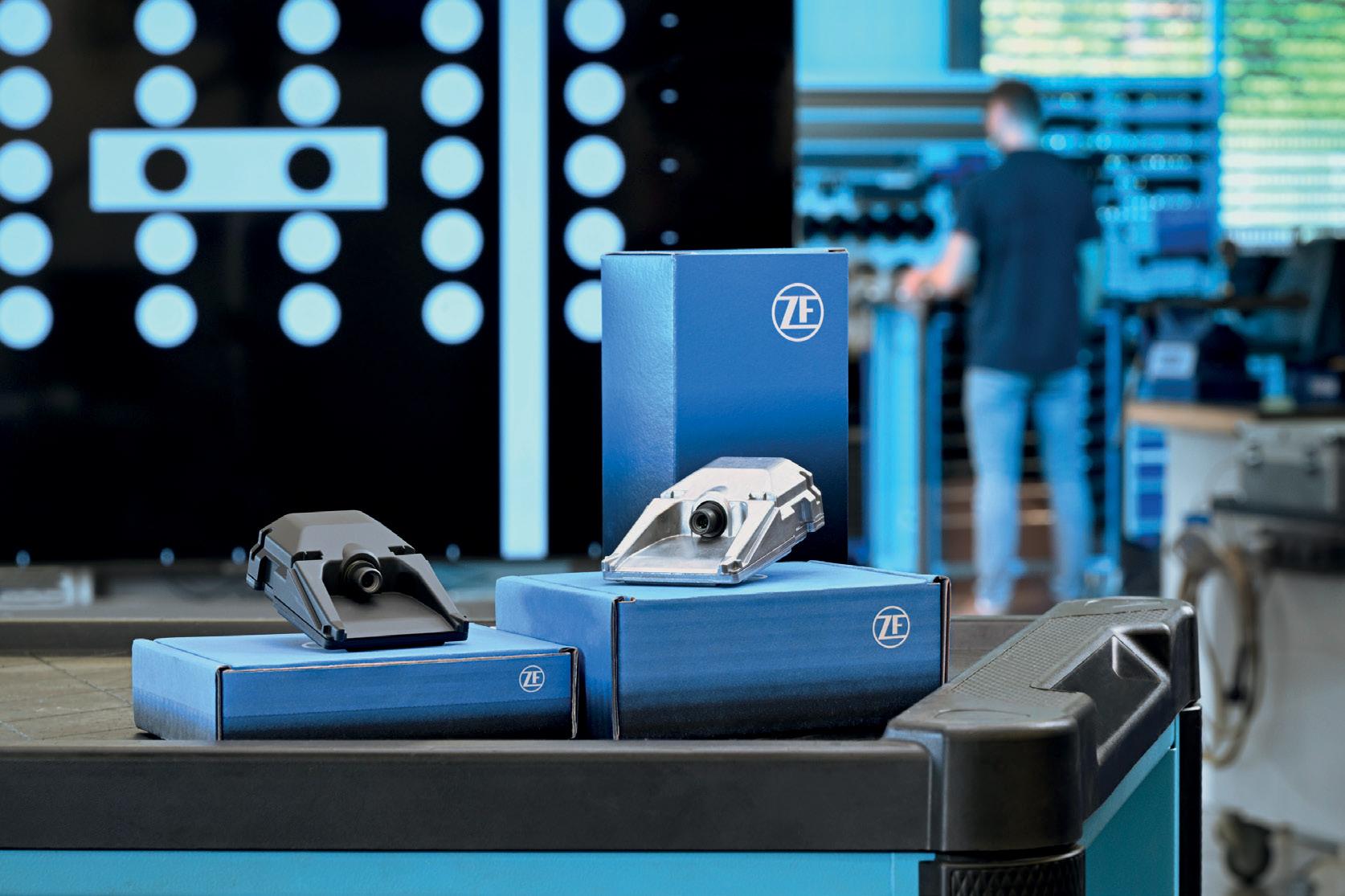
Building on its strong diagnostics capabilities, ZF decided to develop its own telematics and fleet management solutions while also onboarding partners for complementary services.
India, which were early adopters of our advanced telematics solutions. These fleets had very specific use cases and were able to calculate their total cost of ownership and payback clearly.
In Turkey, for example, the reliability of city buses is critical in dense urban environments. In the region’s cold chain, maintaining the quality and reliability of refrigerated transport is essential.
So, there are multiple relevant use cases, and we have both the technical solutions and the flexibility to adapt them to local requirements. Equally important are partnerships with the right local entrepreneurs to help ensure we implement these solutions successfully together
What do you imagine the service ecosystem of the future will look like?
To focus only on future solutions ignores the realities customers manage today, while focusing only on the present overlooks the clear transformation underway. The service ecosystem of the future must balance both, and ZF is well positioned because of the breadth of our portfolio.
Core systems such as chassis, braking, suspension, and steering will remain essential regardless of powertrain, so we continue to invest heavily in them. At the same time, vehicles are becoming increasingly software driven, which makes our expertise in advanced diagnostics more important than ever.
Our transmission business shows this duality well: combustion
engine transmissions require a strong global remanufacturing footprint, while electrified systems demand different technologies but similar deep technical and software capabilities.
Ultimately, the future service ecosystem will be shaped by what happens in the workshop. If mechanics spend most of their time navigating multiple screens and loading codes instead of repairing vehicles, efficiency and capacity suffer. Every minute matters.
By understanding the full journey of both the mechanic and the vehicle, enabling
INTELLIGENT SUPPORT FOR PARTS
Stocking the right parts is a constant challenge for distributors, and ZF supports them with data and intelligence to build the optimal range and ensure consistent availability.
Quality is critical — poor quality parts create more downtime”
more remote work and integrating tools into a single interface — we can deliver true efficiency, higher productivity, and sustainable business performance.
How important are partnerships with telematics providers, fleet management systems, and OEMs? Partnerships are essential, but sometimes you need to take the lead to make them happen. This is why ZF decided to develop its own telematics and fleet management solutions and build on our strong diagnostics capabilities.
At the same time, in order to be more relevant you need to onboard more partners. It’s important for us to reach out to existing and potential partners — and we welcome them to reach out to us as well. Our value proposition becomes stronger with complementary services such as tyres, fuel card payments, and other non-competing vehicle technologies. We have those associations when it comes to, for example, workshop loyalty programmes that include batteries, as they’re complementary to our value offering.
So partnerships are key in the field of technology and software, and we use our role as OEM to be able to have that exchange. In the aftermarket field, we need to bring something which is compelling for the workshops that leverages the ability to minimise the pain point of our customers through collaboration.
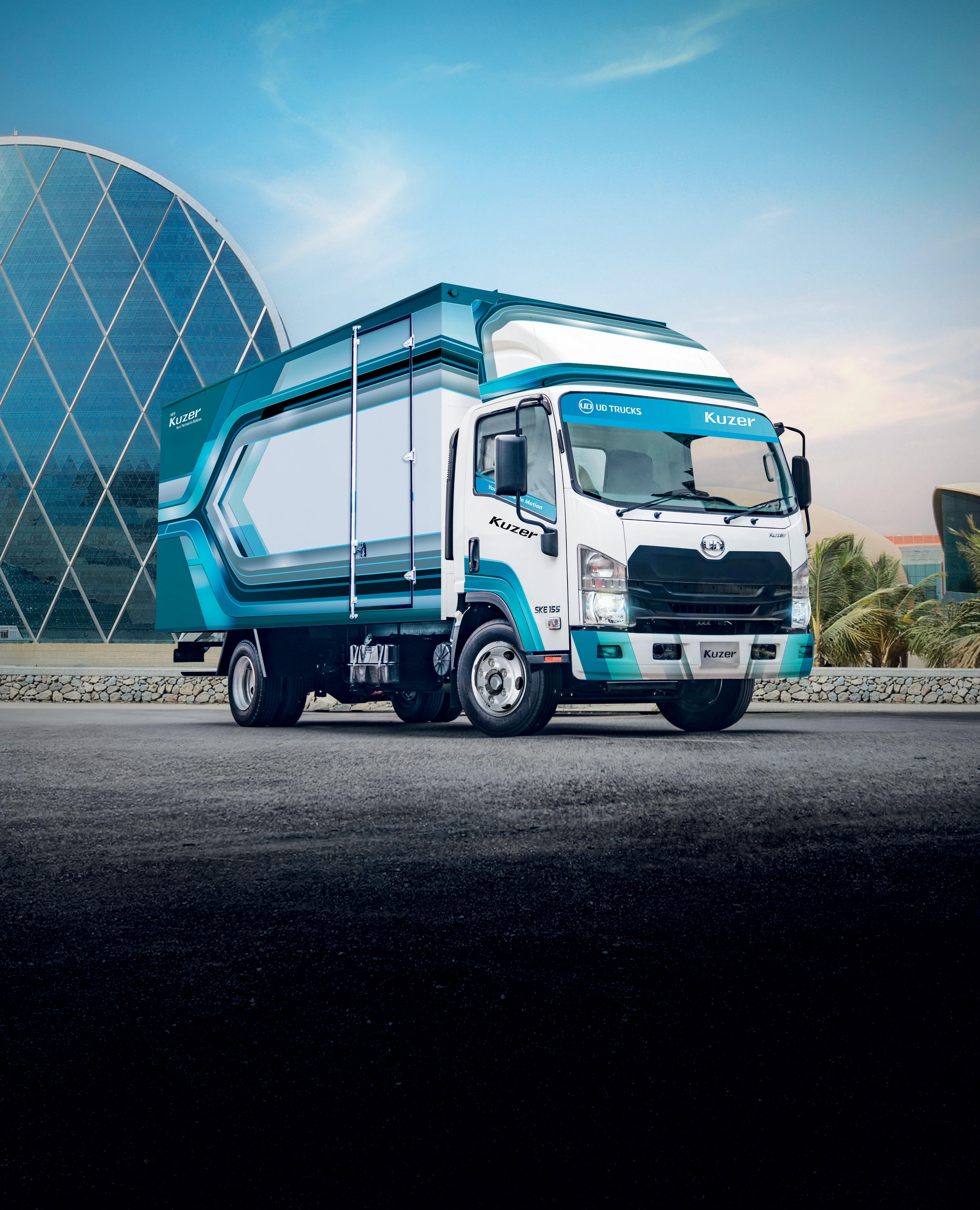
THE KUZER CRUISES IN
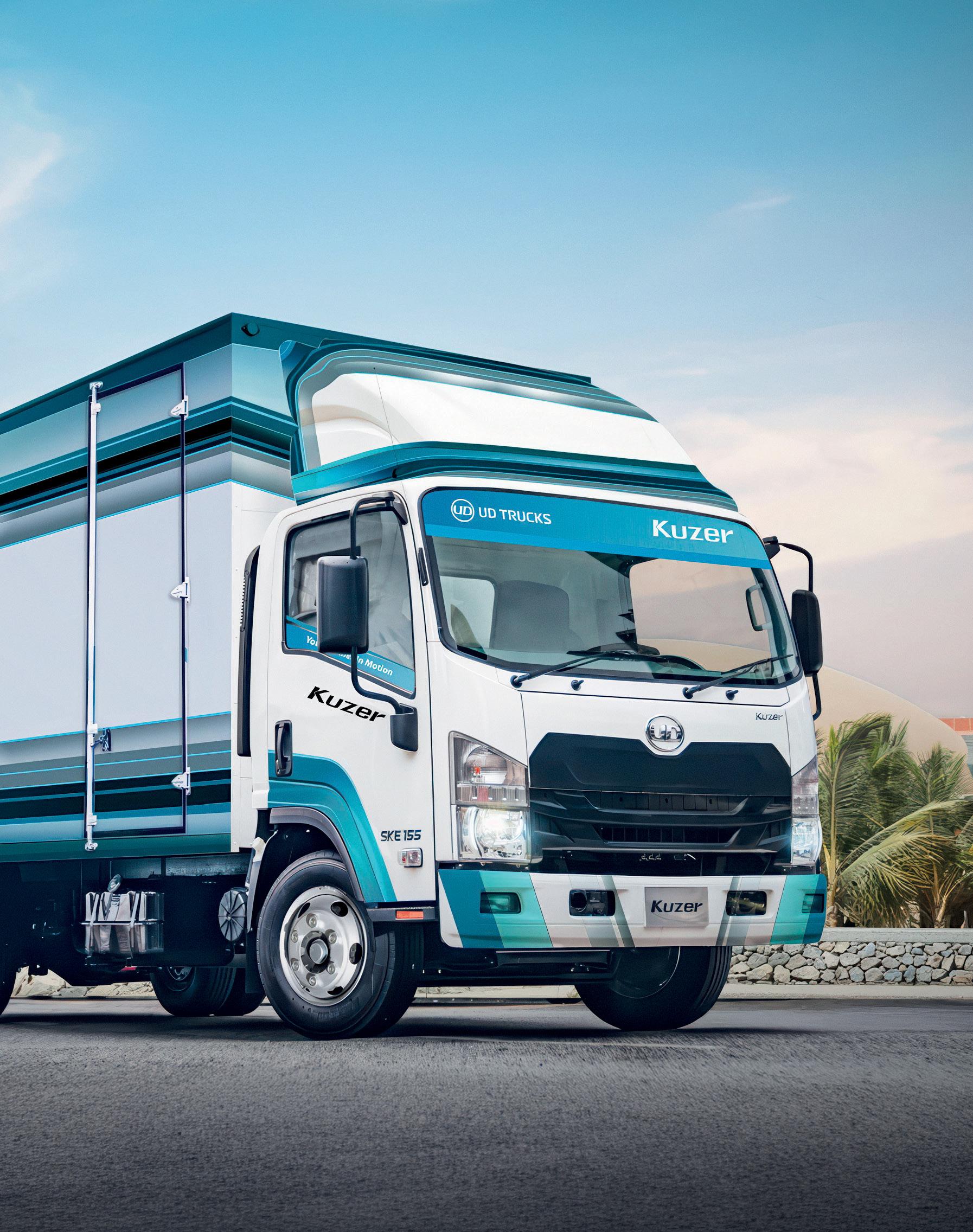
UD Trucks enters the region’s light-duty segment with a strategically engineered new model that completes its portfolio, and aims to capture the fast-expanding last-mile and urban logistics markets
The Middle East’s commercial vehicle landscape is reaching a level of sophistication that shows a clear structural shift. Expanding ecommerce activity, growing retail distribution networks and rising demand for faster delivery cycles –coupled with ongoing urbanization around the region - are all shaping how fleets are configured and operated. At the centre of this change is the light-duty truck segment, which has become increasingly important for operators seeking flexibility in congested city environments and efficient solutions for last-mile and mid-mile transport.
For manufacturers, this shift is redefining product strategy. While mediumand heavy-duty trucks continue to serve long-haul, construction and infrastructure segments, light-duty vehicles are now essential for urban distribution ecosystems. It is within this context that UD Trucks has introduced its new Kuzer model range in the region this year, marking its first dedicated entry into the light-duty segment.
For UD Trucks, which has long been recognised for its strength in medium- and heavy-duty applications, the launch represents a deliberate expansion of its value proposition. The Kuzer is positioned not simply as a new product, but as a strategic bridge into a segment that is becoming central to fleet growth across the GCC market.
DEVELOPED FOR URBAN TASKS
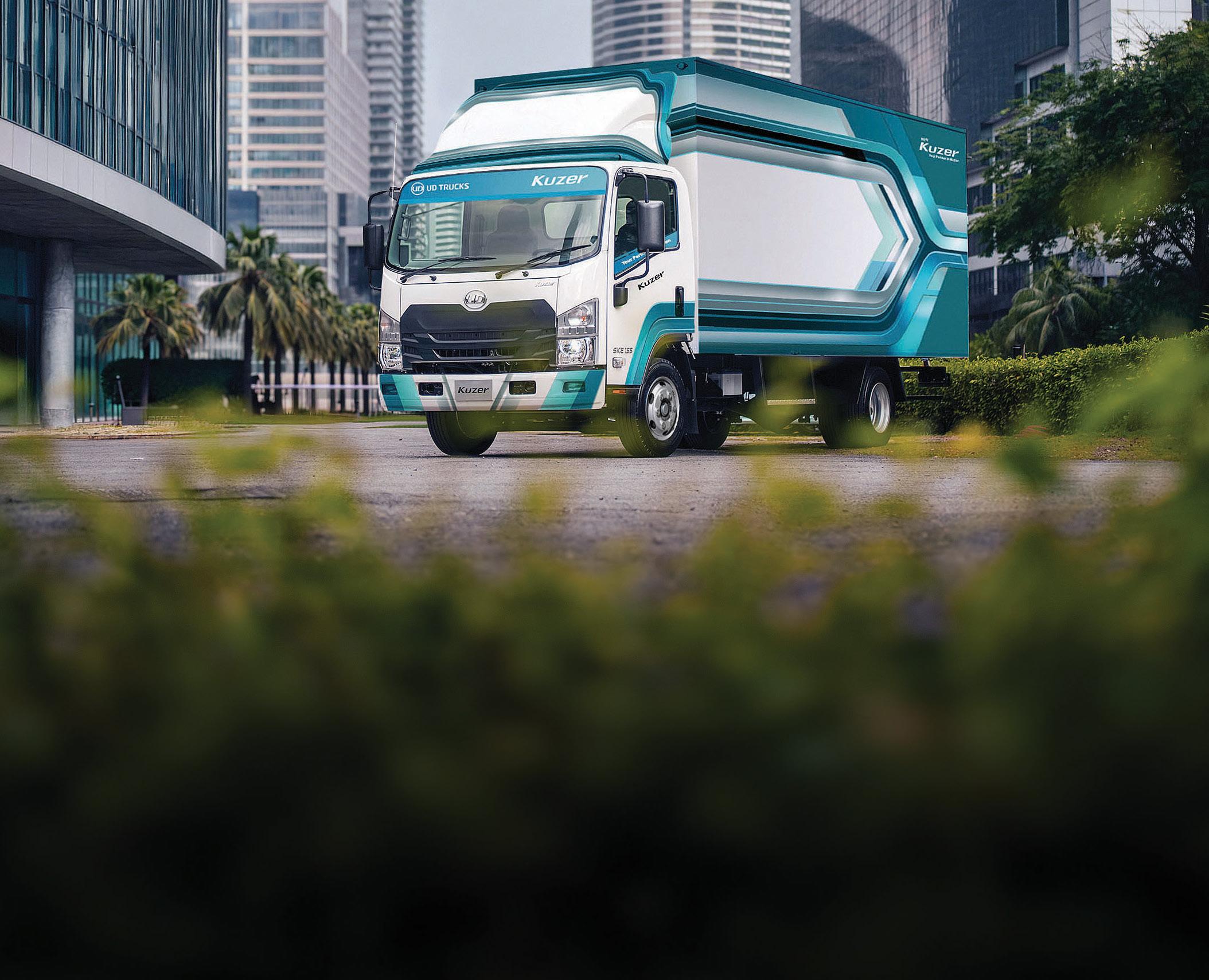
The Kuzer has been developed to meet strong demand for light-duty trucks capable of operating efficiently in dense urban environments, as e-commerce and rapid delivery expectations rise across Gulf cities.
TAPPING INTO A GROWTH SEGMENT
Responding to a shifting market
According to Majda Rochdi, Marketing and Communications Director, UD Trucks MEENA, the timing of the launch, which took place in Q1 this year, is closely linked to structural changes in demand across the region.
“The timing was driven by what we were seeing in the market and hearing directly from our customers and partners. Across the region, and particularly in the UAE, population growth, economic development and rising consumption are creating stronger
For us, Kuzer was a response to a clear market need”
demand for efficient, reliable light duty transport solutions,” Rochdi tells T&FME.
She adds that customer pull from existing UD Trucks users played a significant role in accelerating the company’s entry into this segment.
“At the same time, many of our existing customers in the medium- and heavy-duty segments were asking us to expand into light-duty, based on the success we had in these sectors. They already know UD Trucks for reliability, after-sales support and longterm value, and they wanted the option to
UD Trucks has positioned the Kuzer not simply as a new product, but as a strategic bridge into a segment that is becoming central to fleet growth across the GCC markets.
source more of their fleet from one trusted partner.” For UD Trucks, the Kuzer therefore represents both a response to market demand and an extension of existing customer relationships rather than a standalone product push – and Rochdi affirms: “So, for us, Kuzer was not simply a new product launch. It was a response to a clear market need.”
Completing the portfolio strategy
One of the most significant implications of the Kuzer introduction is the completion of UD Trucks’ product portfolio across light-, mediumand heavy-duty applications. This positions the company to engage more holistically with fleet operators whose requirements increasingly span multiple vehicle categories.
“It is a very important step for the brand. UD Trucks already has a strong
Our aspiration is for the Kuzer to establish itself as a podium player in the market”
position in the medium-duty segment and a growing presence in heavy-duty. With Kuzer, we can now offer customers a complete portfolio across light-, medium- and heavy-duty applications,” Rochdi explains.
Fleet rationalisation is becoming a key trend across the Middle East, particularly among operators in logistics, distribution and municipal services. Many are seeking to reduce supplier complexity while improving consistency in service and maintenance standards.
“This matters because many fleet operators want to simplify their operations. They want a one-stop shop for their commercial vehicles and fleet management. They prefer to work with fewer suppliers, especially when they trust the product quality, dealer support and after sales service
behind the brand,” Rochdi notes, adding that beyond existing customers, the Kuzer also opens access to new segments that may not previously have engaged with UD Trucks due to its focus on larger commercial vehicles.
“The Kuzer also opens the door for us to reach new customers who may not have considered UD Trucks before. That makes it an important part of our longterm growth strategy in the region.”
Targeting urban logistics growth
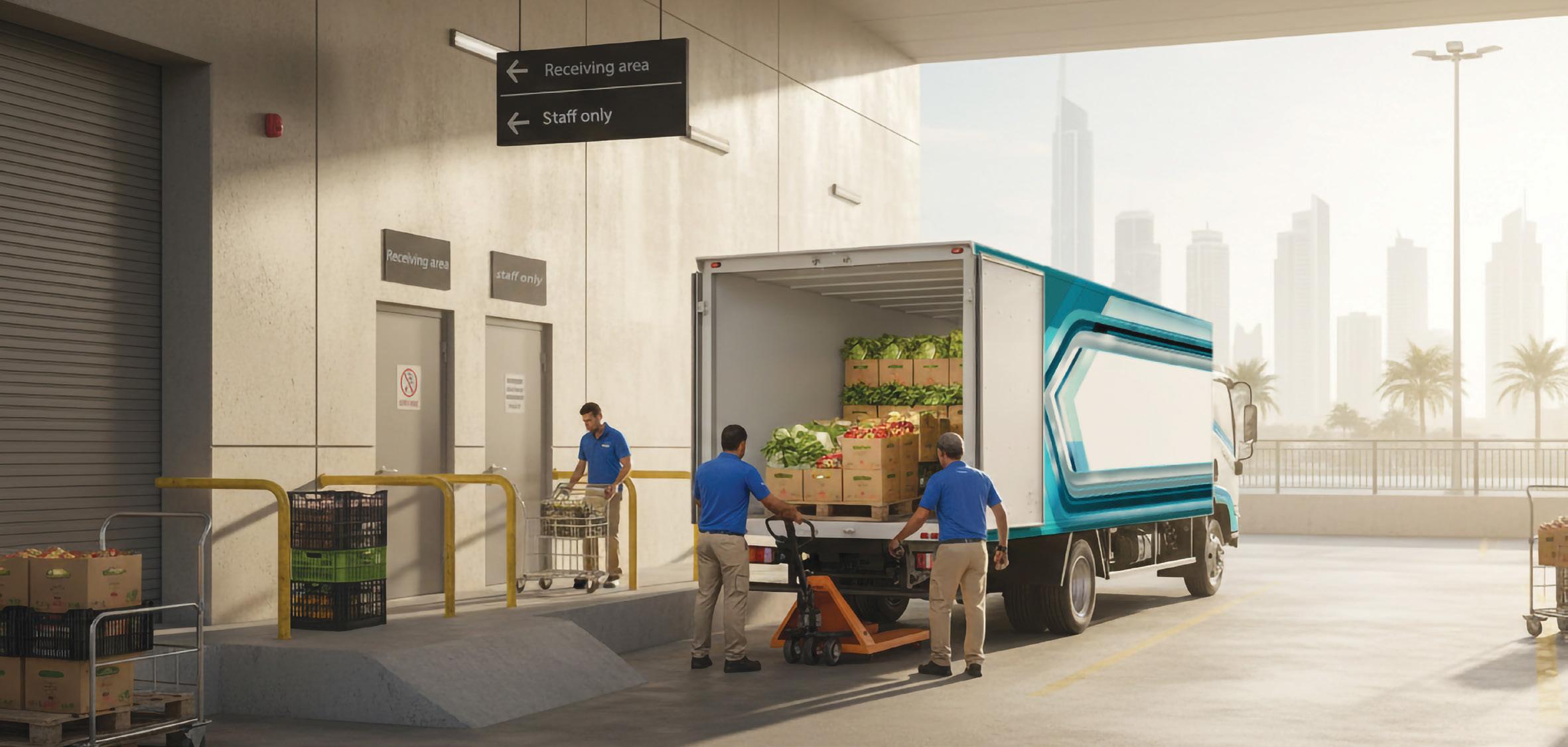
The rise of e-commerce and rapid delivery expectations across Gulf cities has created strong demand for light-duty trucks capable of operating efficiently in dense urban environments. The Kuzer has been developed with these applications in mind, focusing on reliability, flexibility and uptime.
The arrival of UD Trucks’ Kuzer in the Middle East was not a standalone product introduction but the result of a long preparation cycle spanning almost two years. For UD Trucks, the priority was ensuring that the entire support ecosystem was fully ready before the first customer vehicle entered service.
“The public launch was only the visible part of the process. Behind the scenes, preparation started almost two years earlier,” reveals Majda Rochdi.
A significant part of this work focused on dealer readiness across key markets, particularly with partners such as Al Masaood Commercial Vehicles and Equipment in Abu Dhabi and United Diesel in Dubai and the Northern Emirates.
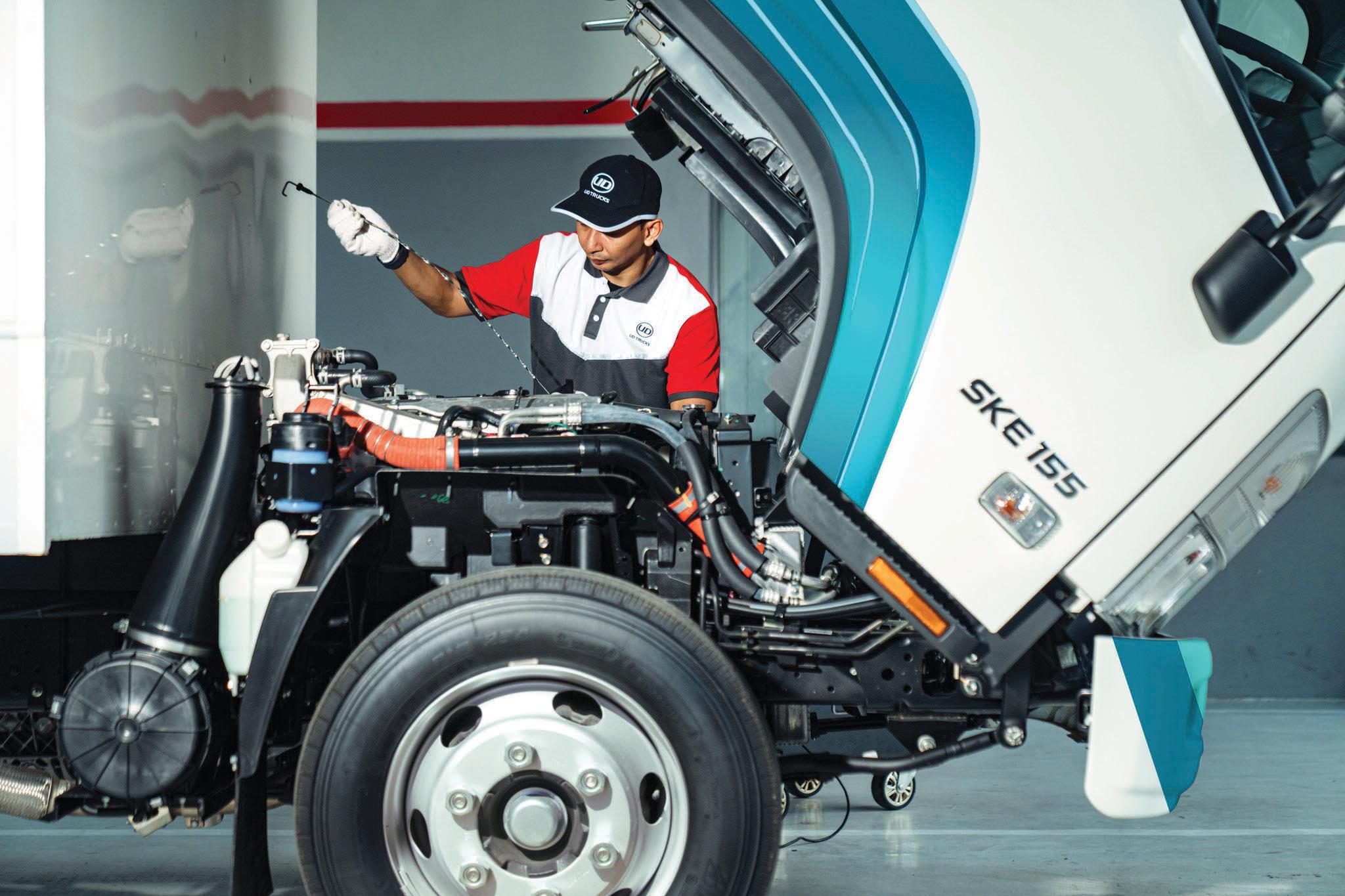
Sales teams, technicians and service advisors underwent structured training programmes designed to ensure consistent product understanding and service quality. Rochdi adds that UD Trucks also strengthened
workshop capabilities and ensured that “teams were prepared to support the vehicle from day one”.
Spare parts availability and supply chain readiness were other critical focus areas, with UD Trucks prioritising uptime assurance for fleet customers operating in time-sensitive logistics environments, she adds.
For the company, this behindthe-scenes preparation is essential to building trust in a new segment, particularly in light-
duty operations where utilisation rates are high and downtime can quickly impact profitability.
“These investments reflect our commitment to minimising downtime and delivering a seamless ownership experience,” Rochdi emphasizes.
She adds that the message is clear: “The Kuzer launch is not only about entering a new segment, but about ensuring that every element of the customer journey is supported from day one.”
“The Kuzer has been developed for customers operating in mid-mile and last-mile distribution. We see strong potential in urban logistics, retail distribution, e-commerce support, municipal operations, waste management and city services,” Rochdi points out.
These sectors are characterised by frequent stop-start cycles, high utilisation rates and tight delivery schedules, making operational consistency a critical requirement.
“These are sectors where uptime, efficiency and reliability are critical. UD Trucks already has a strong reputation in municipal and fleet operations through our medium- and heavy-duty ranges, so the Kuzer allows us to extend that value into the light duty segment,” she
We see strong potential in urban logistics, e-commerce support, municipal operations and city services”
says, adding that the ability to support municipal operations is particularly relevant in the GCC, where city services such as waste collection, water distribution and infrastructure support rely heavily on dependable light commercial vehicles.
Engineering choice, customer input
A key aspect of the Kuzer’s development has been the level of direct engagement with customers and dealers in defining its specifications for the Middle East market. This includes decisions around gross vehicle weight configurations and transmission options.
Explaining this process, Rochdi says: “At UD Trucks, we believe the starting point should always be the customer’s operation. Before finalising the Kuzer offer, we worked
closely with customers and dealer partners to understand what the market really needed.”
One of the most notable outcomes of this approach was the development of a 7.5 tonne variant with automated manual transmission for municipal use cases.
“This 7.5-ton GVW variant was engineered keeping municipal applications in mind. Customers using compactors and tippers in stop-start environments wanted a reliable AMT solution in the light-duty segment. Their feedback played a direct role in shaping that configuration,” Rochdi recalls.
This type of collaboration highlights a broader industry trend in which product development is increasingly influenced by real-world operational data rather than purely engineering-driven design cycles.
WHY AMT MATTERS IN CITY LOGISTICS
Urban logistics across the Middle East is becoming increasingly demanding, with light-duty trucks operating in dense traffic conditions, requiring frequent stops and tight delivery schedules.
In this environment, transmission choice plays a critical role in both driver comfort and operational efficiency.
Automated manual transmission (AMT) has therefore emerged as an important feature for cityfocused applications of the Kuzer, particularly in municipal and
waste management operations.
Majda Rochdi points out that one of the examples is “the 7.5 ton GVW variant with automated manual transmission for municipal applications”.
Customers operating compactors and tippers in stop-start environments have been particularly influential in shaping this specification.
“These customers wanted a reliable AMT solution in the light-duty segment. Their feedback played a direct role
in shaping that configuration,” Rochdi elaborates.
Beyond operational efficiency, AMT also contributes to reduced driver fatigue, which is a growing concern in urban logistics sectors where long shifts and congested routes are common.
“This is especially important in urban distribution, where trucks often operate in slow, innercity traffic, requiring frequent stopping and starting,” Rochdi explains. “By reducing the need for constant gear changes, AMT
allows drivers to focus more on road conditions and safety, improving both productivity and operational consistency.
“We strive to make the traffic environment safe for all, and AMT helps the drivers to focus on the road and their job.”
As fleets across the GCC continue to prioritise uptime, safety and driver retention, driveline technologies such as AMT are expected to play an increasingly important role in light duty truck specifications.
The Kuzer range offers multiple engine and transmission combinations designed to match different operational requirements - from urban distribution to heavier payload applications.
“The Kuzer range gives customers a choice depending on their application. The 3-litre 4JJ1 TC engine is well suited for the 6.5-ton model and for customers who need efficiency and versatility in daily operations,” Rochdi details.
“For heavier or more demanding applications, the 5.2-litre 4HK1 TCN engine is available on the 7.5 ton and 8.5 ton variants, offering higher power and torque for demanding operations.”
Transmission key for city use
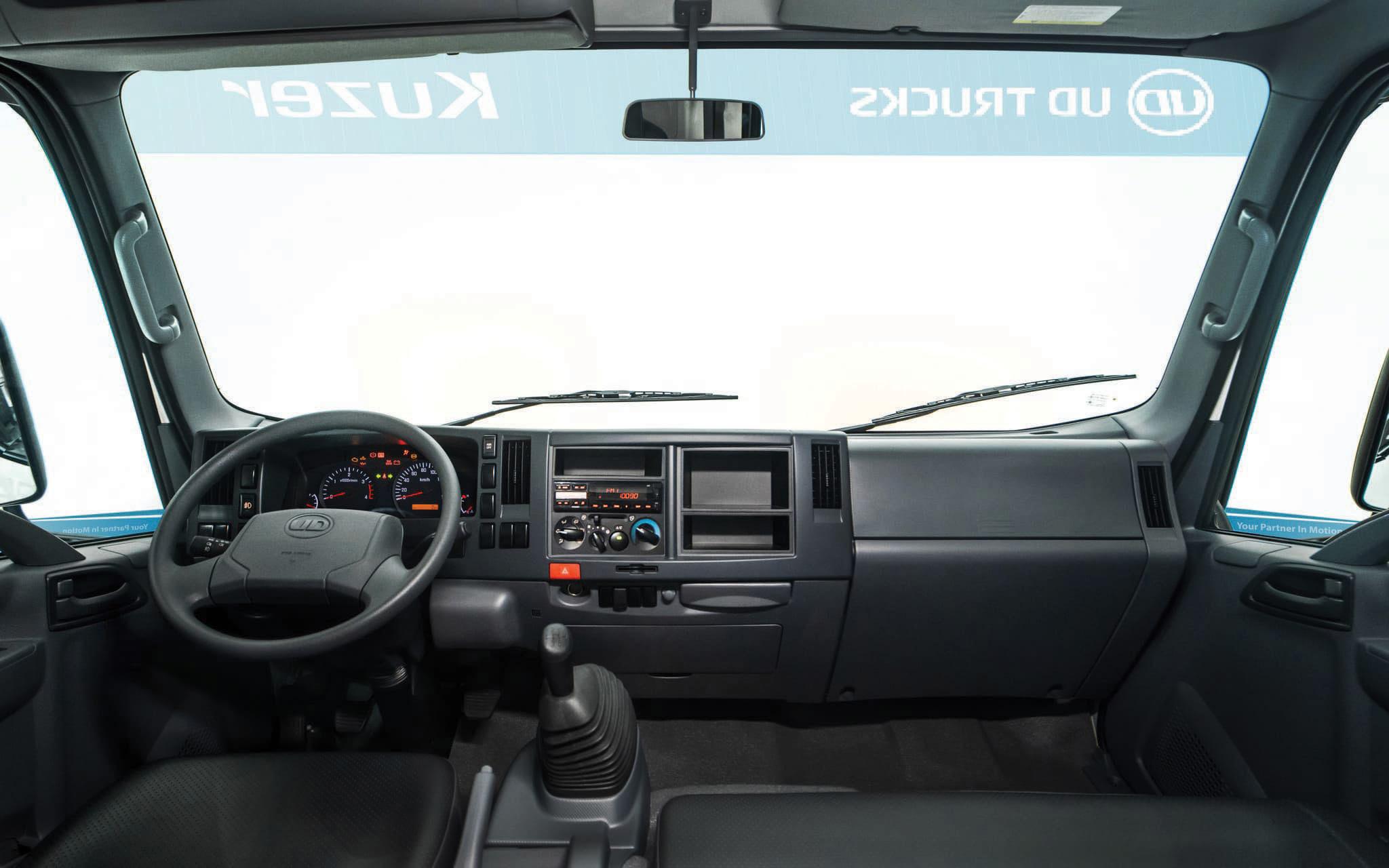
Transmission choice, including automated manual transmission, is particularly relevant for stop start city driving conditions, she notes, adding: “Combined with transmission options including AMT, this allows customers to select a driveline that matches their route, payload and operating environment. This is especially important in urban distribution, where trucks often operate in frequent stop-start traffic.”
She also highlights the driver experience in such conditions, describing: “This is physically challenging for the driver too. We strive to make the traffic environment safe for all, and AMT helps the drivers to focus on the road.”
While technical specifications are important, UD Trucks emphasises that the Kuzer proposition is built around a total ownership experience rather than hardware alone. “For us, the difference is not
KEEPING THE DRIVER IN FOCUS
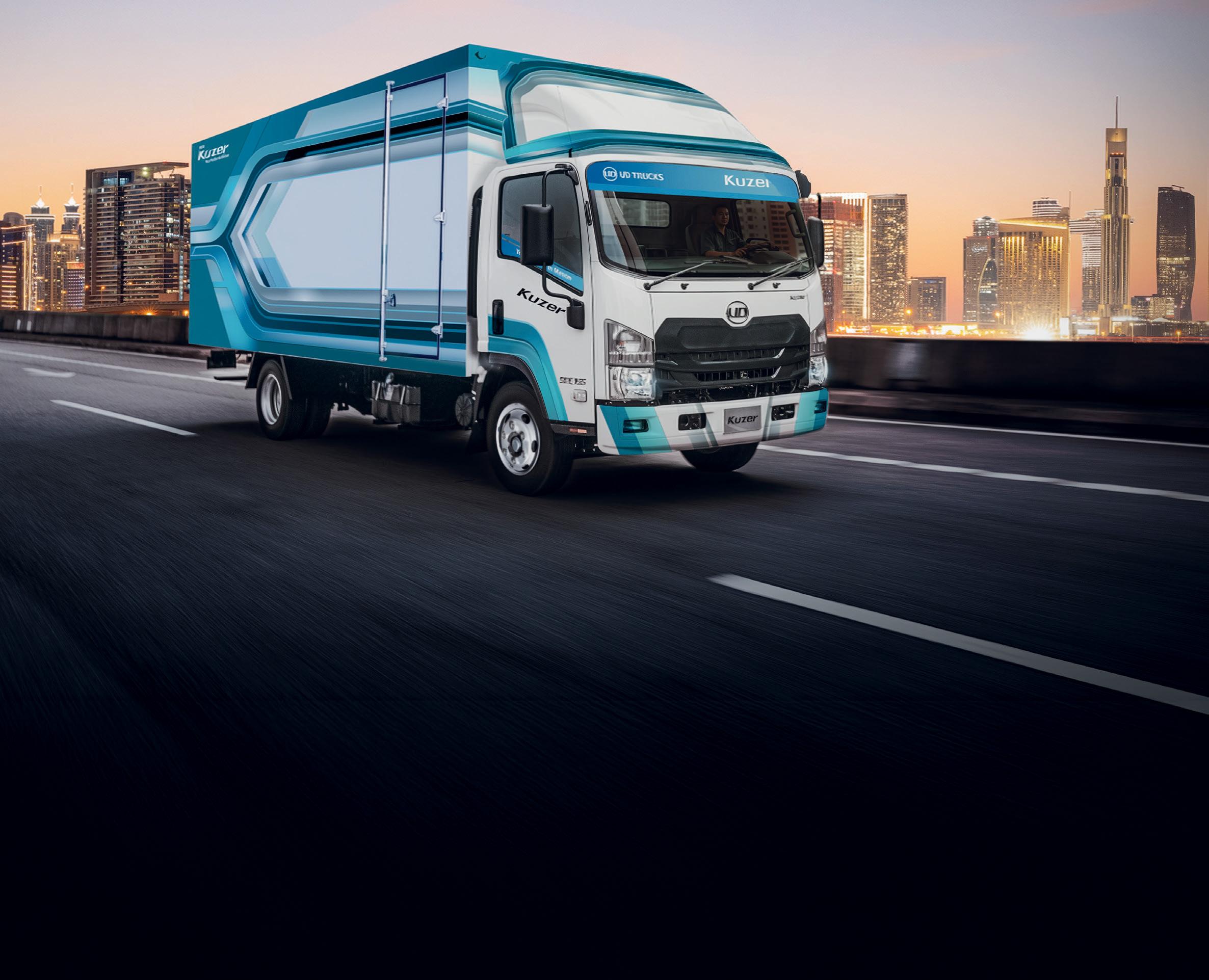
With trucks operating in frequent stop-start traffic for urban distribution, which is physically challenging for drivers, the Kuzer looks after the driver experience with a comfortable and ergonomic cab, complete with its convenient AMT.
only the truck itself. It is the full ownership experience around it. Customers are looking for reliability, uptime, responsive service and predictable operating costs,” Rochdi says, adding that the brand’s dealer network, after-sales infrastructure and service packages are central to this value proposition.
“The Kuzer is supported by UD Trucks dealer network, our strong after-sales structure, extended warranty options and service contracts.”
This integrated support structure is intended to reduce operational uncertainty for fleet operators, particularly
With the Kuzer, we can now offer customers a complete portfolio”
in competitive logistics markets where downtime directly impacts profitability.
The introduction of the Kuzer marks a significant milestone in UD Trucks’ regional strategy, extending its presence into a segment that is becoming increasingly central to urban mobility and logistics efficiency across the Middle East. With ecommerce expansion, population growth and rising delivery expectations reshaping fleet operations, light-duty trucks are no longer a secondary consideration but a core component of modern transport networks.
Integrated commercial vehicle offering For UD Trucks, the launch represents more than product diversification. It signals a shift towards a fully integrated commercial vehicle offering designed to serve fleets across every duty class. As Rochdi highlights, success will ultimately be measured not only in sales volume but in long-term customer trust, dealer capability and sustained market penetration.
“We have ambitious plans for the Kuzer and see significant growth potential within the UAE’s highly competitive light-duty truck segment. Over the next 3-5 years, our aspiration is for the Kuzer to establish itself as a podium player in the market,” she concludes.
In a region where operational efficiency and uptime are now central to fleet decision making, the Kuzer enters the market at a moment when demand for adaptable, reliable and cost-efficient light-duty solutions has never been stronger.
BOOSTING QUARRY PRODUCTIVITY
Scania Middle East is targeting the region’s growing mining sector with its 8x4 Super tipper, designed to deliver higher productivity, lower fuel consumption and reduced operating costs
The Middle East’s mining and quarrying sector is entering a new phase of growth. While the region has long been associated with oil & gas, governments are increasingly investing in the development of mineral resources as part of wider economic diversification strategies. Major infrastructure projects, urban expansion and industrial development are driving sustained demand for aggregates, limestone, gabbro and other construction materials, while ambitious national programmes, particularly in Saudi Arabia, are encouraging investment in the exploration and extraction of valuable minerals.
As production increases, so too does the need for efficient transport solutions capable of moving large volumes of material safely and economically. Fleet operators today are looking beyond outright purchase price, placing greater emphasis on productivity, fuel consumption, uptime, driver wellbeing and total cost of ownership. Manufacturers, in turn, are responding with vehicles that deliver more than simply high payloads, instead offering complete transport solutions tailored to the specific demands of heavy-duty applications.
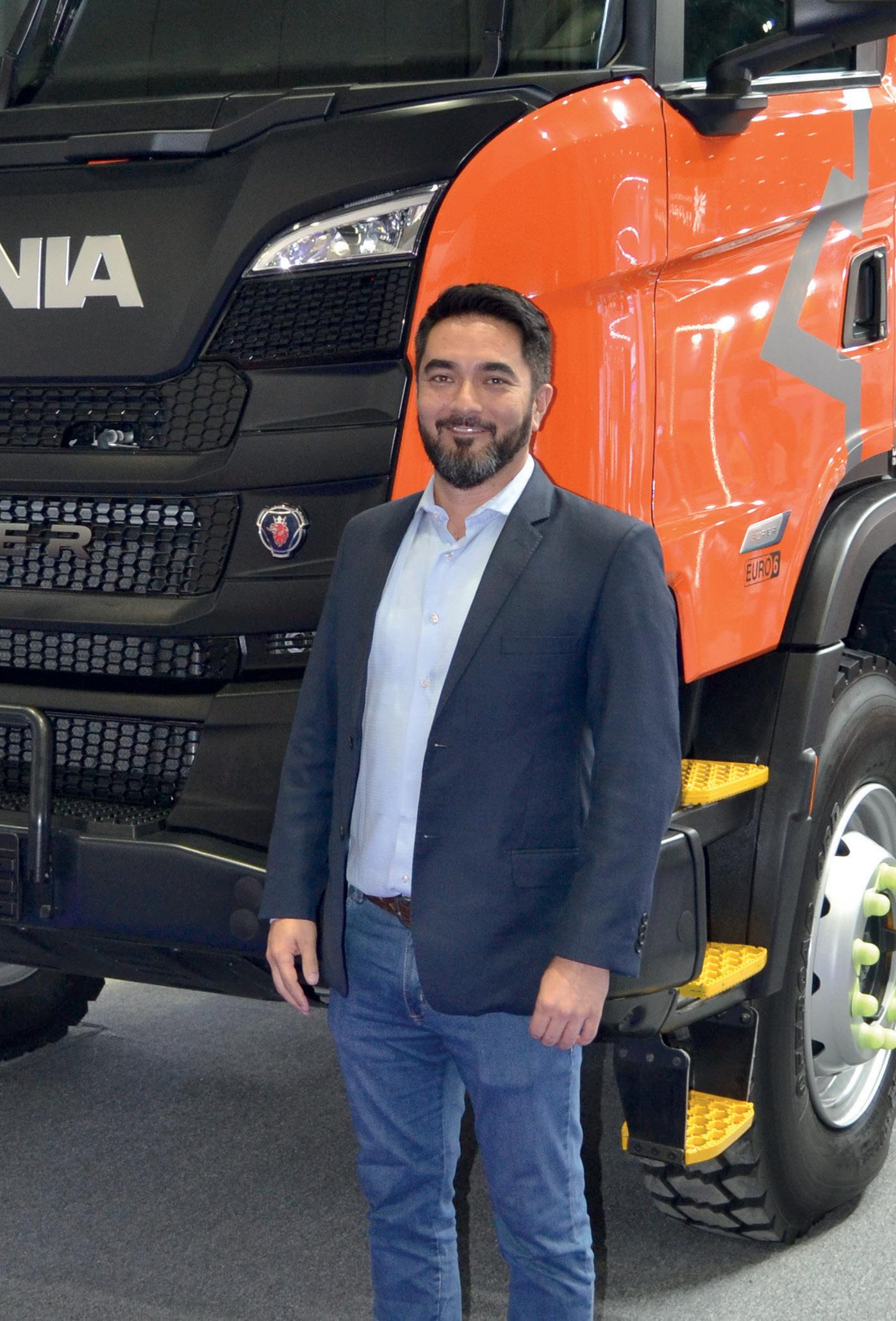
It is against this backdrop that Scania is strengthening its focus on the mining and quarrying sector across the Middle East. Leading this effort is Luciano Piccirillo, who recently assumed the role of Sales Director for Scania Middle East after nearly two decades with the Swedish truck manufacturer.
Originally from Brazil, Piccirillo joined Scania in 2006 and has spent almost 20 years with the company in a variety of commercial roles. His extensive experience within the business provides him with a strong understanding of Scania’s engineering philosophy and its approach to delivering customer specific transport solutions.
“The mining sector is a very important sector in the Middle East and it is increasing in importance across the region,” he explains. “This is particularly true in countries such as Saudi Arabia, the UAE and Oman.”
Rather than offering a single standard specification, Scania approaches the market through its well-established modular vehicle architecture, allowing trucks to be configured according to individual customer requirements.
“We have the possibility through our modular system to configure and customise our trucks to meet any demand that
customers and operators have,” says Piccirillo. “Mining and quarrying is therefore a very important segment for us in this region.”
This flexibility has become one of Scania’s defining characteristics globally. By combining different chassis layouts, powertrain options, cabs and axle configurations from a common component platform, the company is able to build vehicles suited to a wide variety of applications while maintaining parts commonality and simplifying maintenance throughout the vehicle’s operating life.
Scania’s mining offering
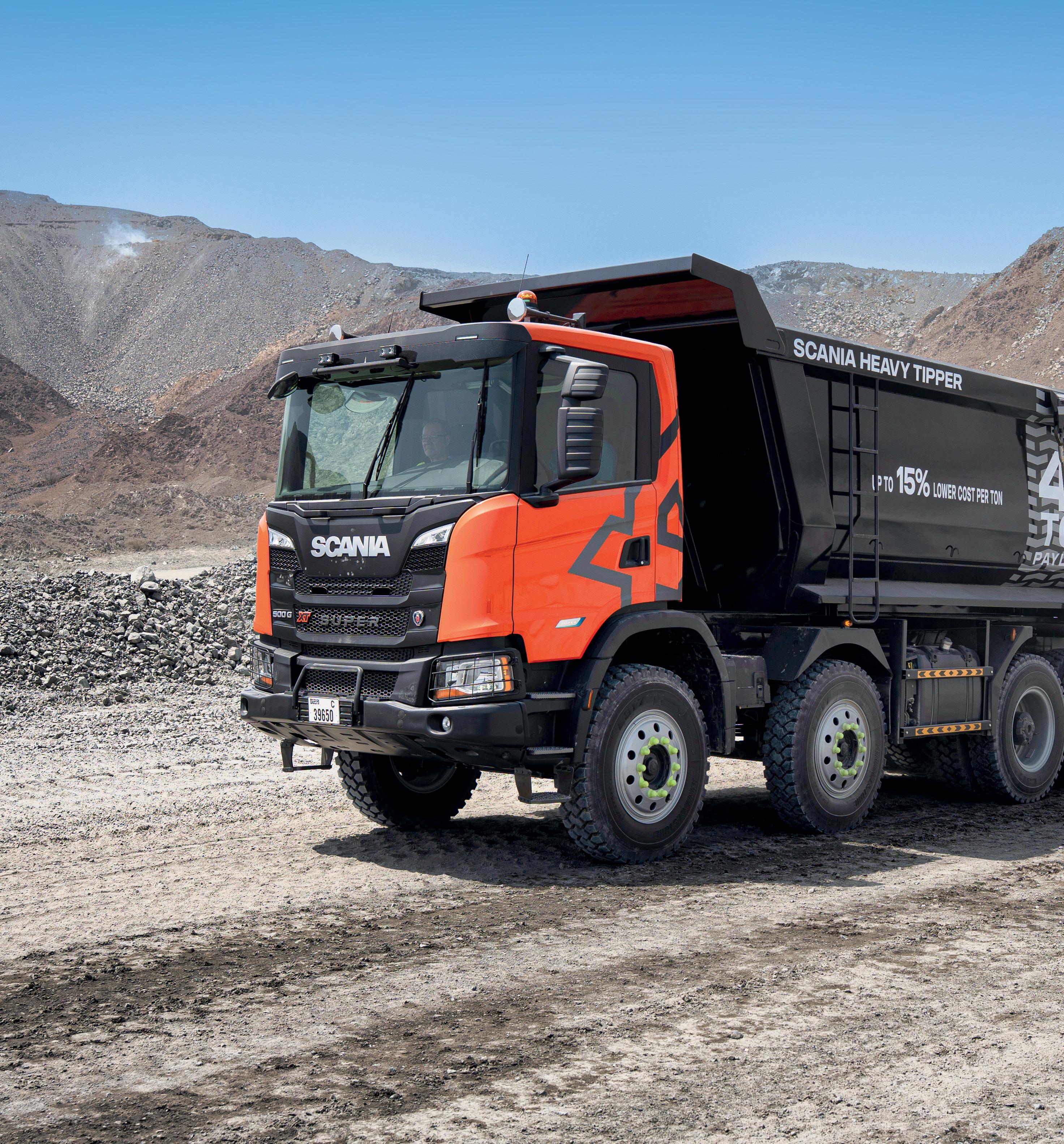
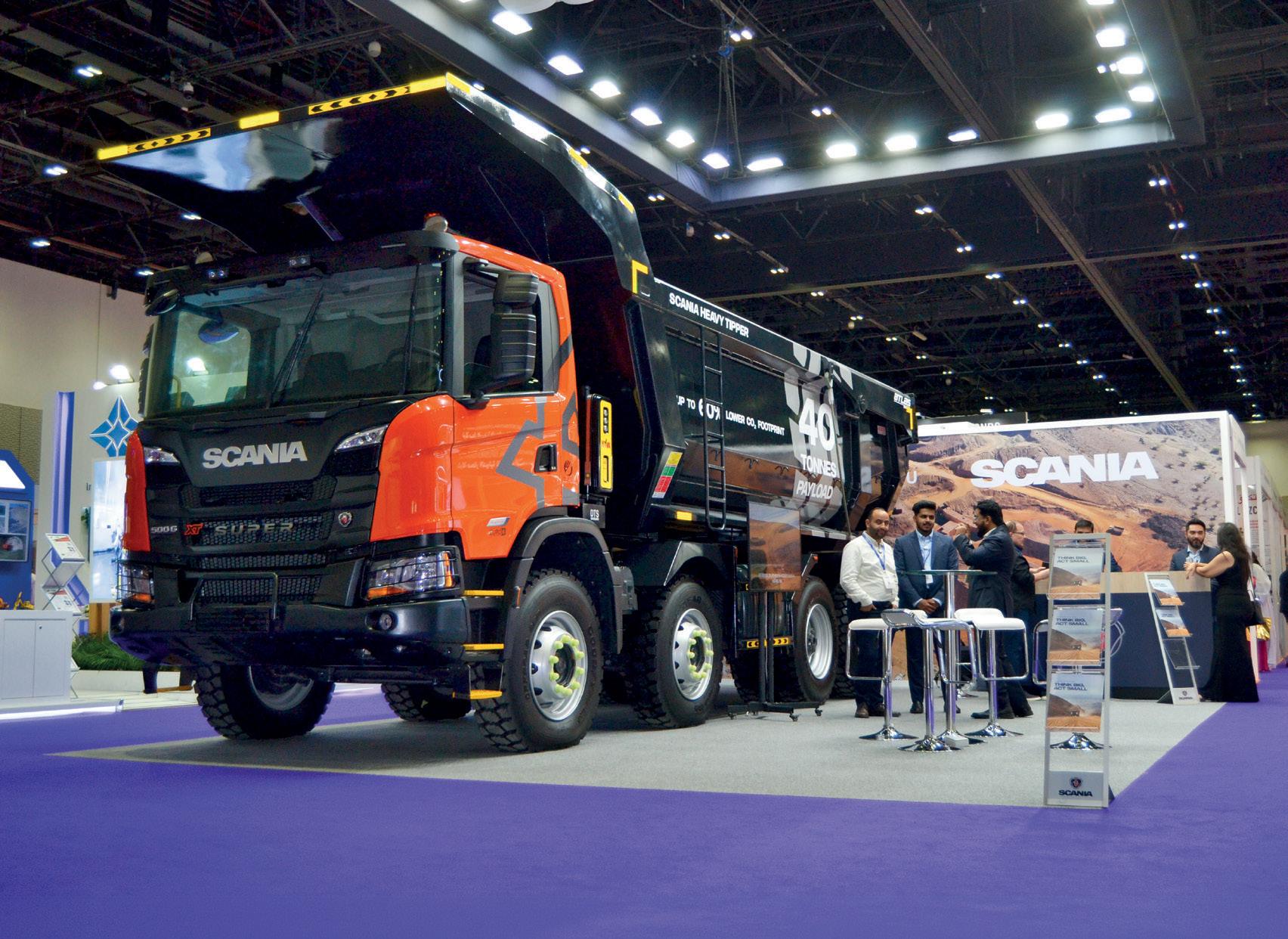
For mining and quarry operations in the Middle East, the company’s principal offering is its 8x4 Super tipper. According to Piccirillo, the vehicle has been developed to maximise payload while delivering the efficiency expected from an on road truck.
“The main product that we are bullish about is our 8x4 tipper, which has a gross vehicle weight of 60 tonnes while offering a payload of around 40 tonnes,” he says.
While conventional thinking often places rigid dump trucks and articulated haulers at the centre of quarry operations, Piccirillo believes there is significant scope for road-based tippers to undertake work traditionally handled by what the industry commonly refers to as “yellow machines”.
“Our truck competes with some of the smaller rigid and articulated haulers and even some larger models,” he explains. “Sometimes customers prefer to have two or three of our 8x4 tippers instead of one large hauler or dumper.”
The reasoning extends beyond simple payload calculations. Because the Scania trucks can travel at higher average speeds over suitable haul roads, cycle times can be reduced significantly. This allows operators to complete more loading and unloading cycles during a working shift, potentially moving more material overall despite each individual truck carrying a smaller payload than a dedicated mining dumper.
“We can decrease the cycle time because of the speed of the trucks,” says Piccirillo. “This enables customers to produce much more using our vehicles.”
Driver comfort also plays an important role in maintaining productivity throughout long operating shifts, and Piccirillo explains that the trucks offer “very good comfort for drivers, which means less fatigue and more trips during the day.”
This emphasis on ergonomics reflects a broader trend across the commercial vehicle industry. Comfortable seating, improved visibility, lower noise levels and easier vehicle controls are increasingly recognised as factors that contribute not only to driver wellbeing but also to safety, retention and operational efficiency, particularly as skilled driver shortages continue to affect many transport markets around the world.
High TCO
While productivity remains a major purchasing criterion, fleet owners are increasingly evaluating vehicles through the lens of total cost of ownership. Piccirillo believes this is an area where Scania’s solution demonstrates clear advantages.
“The comparison depends on the application and on which machine you are looking at,” he says. “Mining equipment ranges from around 40 tonnes to well over 150 tonnes of payload, so every operation is different.”
However, he argues that customers often discover meaningful savings when considering the complete operating picture rather than the purchase price alone.
“Normally, we have a much better price, not only for the truck itself but also when considering the total cost of operation, including maintenance, fuel costs and everything else.”
RETHINKING TRADITIONAL WAYS
Sales
for
We can work with any local factory”
Fuel efficiency has become one of the defining performance measures for modern heavy trucks, particularly as diesel prices and environmental considerations continue to influence purchasing decisions.
Central to Scania’s latest offering is the company’s Super powertrain, introduced globally to improve drivetrain efficiency through a combination of engine, gearbox and axle developments. Describing the Super platform as a significant step forward,
TARGETING MINING AND QUARRYING
Piccirillo says: “This model is part of our Super platform, which is our new powertrain that provides much better fuel consumption.”
The featured mining tipper is powered by a 500hp engine, combining high output with the efficiency improvements delivered by the new drivetrain.
“When we combine the 500hp engine with Euro 6 emissions compliance and the improved powertrain, we are able to increase fuel economy significantly depending on the application and vehicle configuration,” he explains.
Although real world fuel savings naturally vary according to terrain, payload, operating conditions and driving style, improvements in fuel efficiency translate directly into lower running costs over the lifetime of the vehicle.
Lower emissions
At the same time, reduced fuel consumption contributes to lower carbon emissions, an increasingly important consideration as governments and fleet operators pursue broader sustainability objectives.
Piccirillo points out that the truck also meets Euro 6 emissions standards. “This enables us to reduce carbon dioxide emissions compared with previous generations while providing customers with a greener transport solution.”
Across the GCC, sustainability is becoming a growing consideration even in traditionally heavy industries such as mining and quarrying. Although battery electric solutions are beginning to emerge for selected applications globally, efficient internal combustion engines continue to play a central role in reducing emissions across many demanding off road and heavy haul operations.
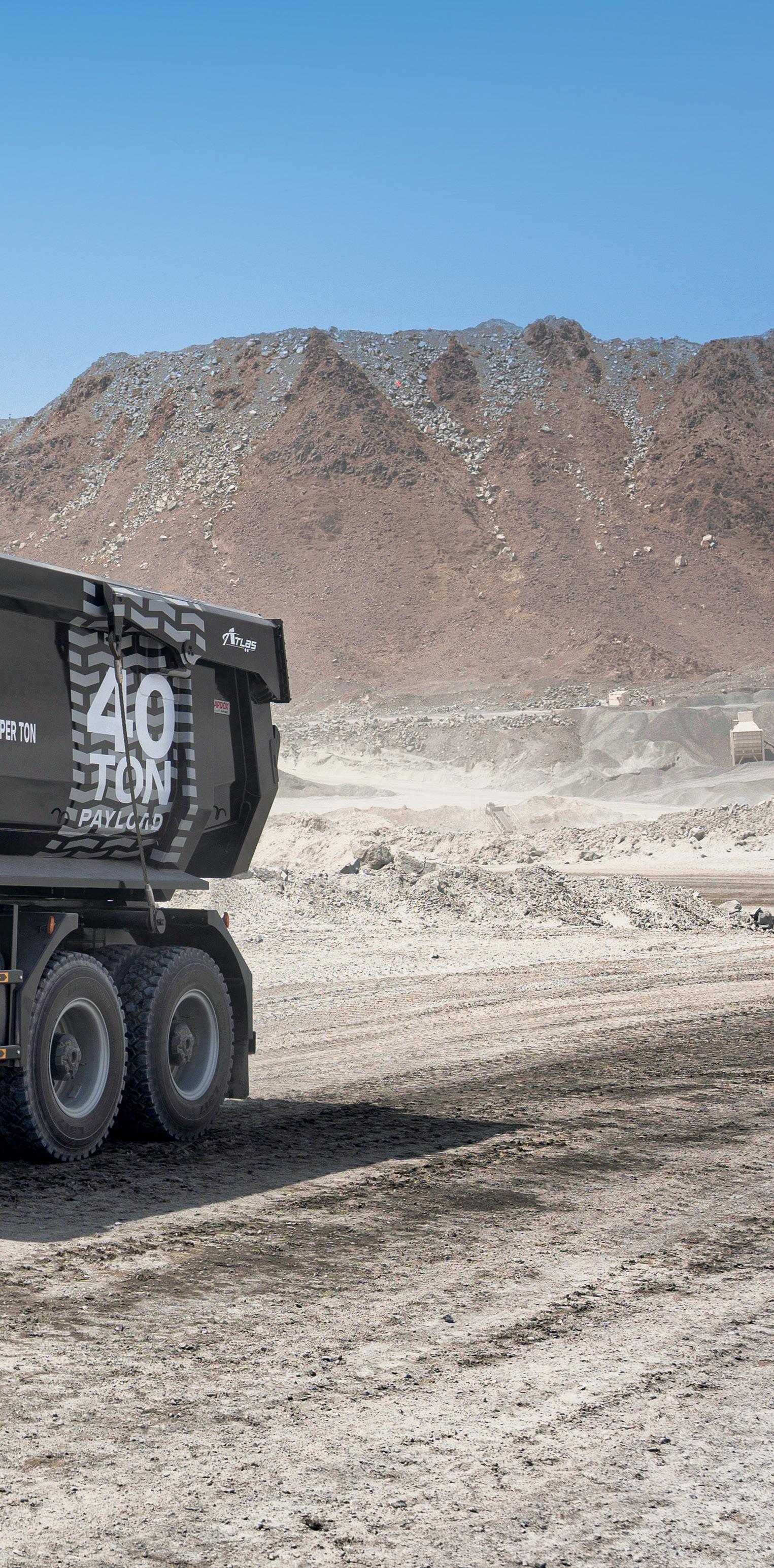
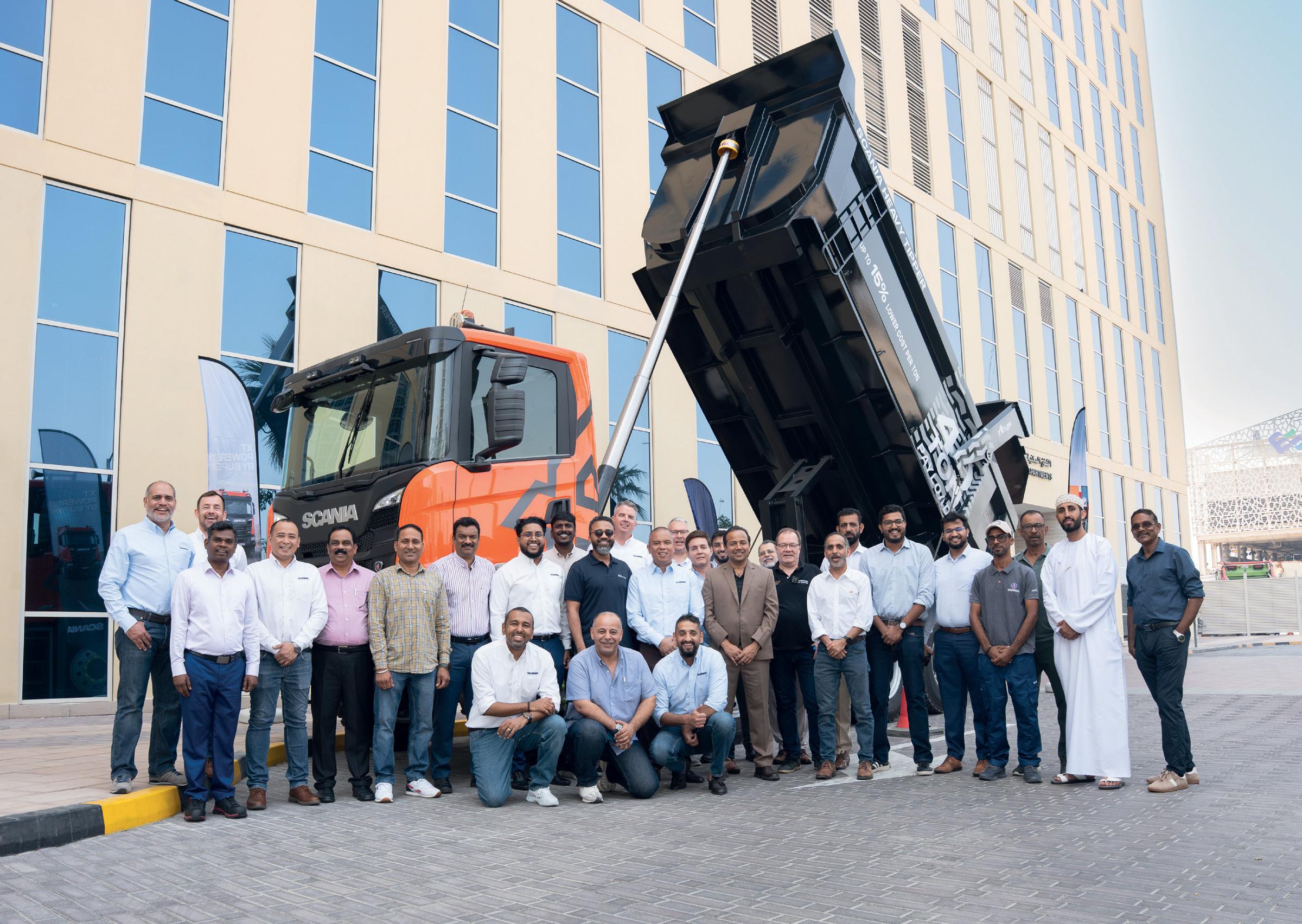
Beyond the truck itself, Scania’s regional strategy also relies on strong local partnerships to deliver complete customer solutions. The tipper body displayed on the featured vehicle carries Atlas branding, reflecting Scania’s collaboration with local bodybuilders.
“In the UAE, the tipper body is built together with Al Shirawi Enterprises, which is also our dealer and distributor for Dubai and the Northern Emirates,” Piccirillo explains. “Atlas is the bodybuilder within the Al Shirawi Group, and they have built this tipper.”
Rather than insisting on a single supplier, Scania works with approved local manufacturers capable of building bodies to its engineering specifications.
The Scania 8x4 Super tipper, which has a gross vehicle weight of 60 tonnes while offering a payload of around 40 tonnes, was displayed at the last edition of the Mining Show in Dubai.
Luciano Piccirillo,
Director, Scania Middle East, believes there is significant scope
road-based tippers to undertake work traditionally handled by what the industry commonly refers to as “yellow machines”.
COLLABORATIVE APPROACH
“We can work with any local factory or partner to produce the tipper body according to Scania’s specifications,” Piccirillo reveals.
This localised approach enables customers to benefit from shorter lead times, regional technical expertise and body designs tailored to local operating conditions. The same philosophy extends across the wider Middle East.
“In Saudi Arabia, for example, we have a very good dealer partner in GCC Olayan,” says Piccirillo.
Saudi Arabia represents one of Scania’s key strategic markets for mining and quarrying, driven by the Kingdom’s ambitious industrial expansion plans and growing investment in mineral extraction.
“Saudi is a strategic market for us as we continue to grow in the mining and quarrying sector,” he says. “Our 500hp 8x4 Super can be equipped with a locally manufactured Saudi tipper body built according to Scania’s standards and requirements.”
We have the possibility through our modular system to configure and customise our trucks to meet any demand”
This combination of globally engineered chassis and locally produced bodies allows operators to receive vehicles optimised both for Scania’s performance expectations and for the practical realities of operating within individual markets.
Proven in the field
Importantly, the concept is already proving itself in the field. While large mining dumpers remain indispensable in many high capacity operations, Piccirillo says customers across the region are increasingly recognising the advantages offered by Scania’s transport solution.
“We already have projects in both the UAE and Saudi Arabia where Scania tippers are being used instead of yellow machines,” he reveals.
Among the strongest examples is Fujairah, one of the UAE’s most significant quarrying centres.
“We recently supplied a batch of trucks to quarries in Fujairah,” he says. “In fact,
we already have many Scania units working there across various quarry operations.”
As mining activity accelerates across the Gulf, transport requirements will continue to evolve alongside customer expectations. Operators are demanding equipment that not only carries heavier loads but also delivers greater fuel efficiency, lower emissions, improved uptime and reduced operating costs throughout its working life.
For Piccirillo, these changing priorities align closely with Scania’s long standing engineering philosophy. By combining modular vehicle design, efficient powertrains, local partnerships and a focus on productivity, the company aims to position its 8x4 Super tipper as more than simply another heavy truck. Instead, it represents a transport solution designed to help mining and quarry operators move more material, more efficiently and more sustainably, while delivering the long term economic value increasingly sought by fleets across the Middle East’s rapidly expanding extractive industries.
Rather than insisting on a single supplier, Scania works with approved local manufacturers capable of building bodies to its engineering specifications, and can work with any local factory or partner to produce the tipper body according to its specifications.
SCANIA STARTS PRODUCTION OF EXTENDED CAB / AI PARKING ON OMODA AND JAECOO UAE MODELS / ROX TO
UAE moves to protect delivery riders in rising summer heat WORKSHOP
LAST-MILE
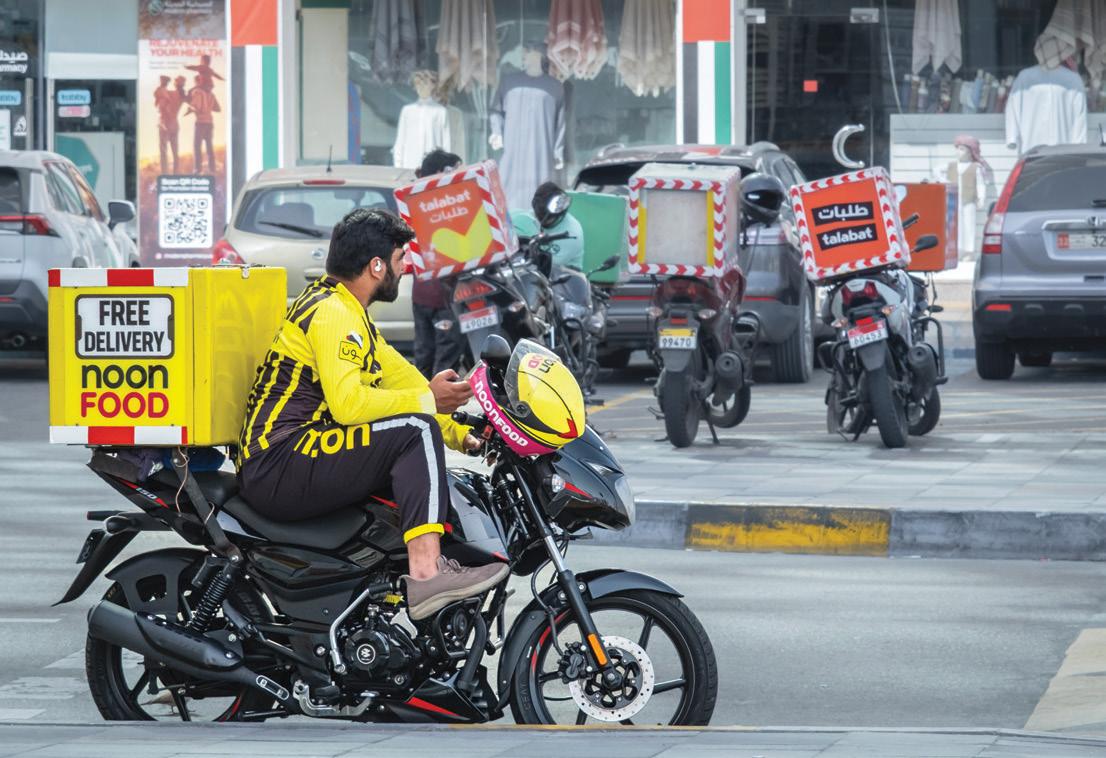
Delivery platforms in the UAE are being required to strengthen protections for riders during the summer months, with the Ministry of Human Resources and Emiratisation (MoHRE) reinforcing restrictions designed to reduce heat-related risks during the hottest part of the day.
Under the updated guidance, delivery riders cannot be required to work during the official midday break period if they choose not to. The ministry has also confirmed that delivery on foot is prohibited during restricted hours, while platforms
must ensure riders have access to suitable rest facilities and information on available cooling stations.
The measures form part of the UAE’s annual midday break initiative, which restricts outdoor work under direct sunlight and in open areas during peak heat conditions. The programme aims to protect workers operating in sectors where exposure to extreme temperatures can create health and safety risks.
For delivery operators, the regulations introduce additional requirements around workload management during peak heat
periods. Delivery platforms have been instructed to ensure riders are aware of rest station locations, with relevant maps and guidance made available through digital platforms.
In addition, riders working through delivery applications are limited to a maximum of three orders during the restricted period, helping to reduce pressure on individuals operating in challenging weather conditions.
The measures come as the UAE’s delivery sector continues to expand, driven by rising demand for food, retail and e-commerce services. With thousands of riders operating daily across urban areas, ensuring safer working conditions has become an increasing priority for regulators and logistics providers.
MoHRE has also highlighted the responsibility of employers and platform operators to monitor compliance and provide appropriate support. Companies are expected to organise delivery operations in a way that accounts for weather conditions while maintaining service continuity.
Rest stations, hydration facilities and improved access to shaded areas remain central elements of the summer safety programme.
PARKIN AND GLYDWAYS TARGET SMARTER PARKING MOBILITY
INFRASTRUCTURE
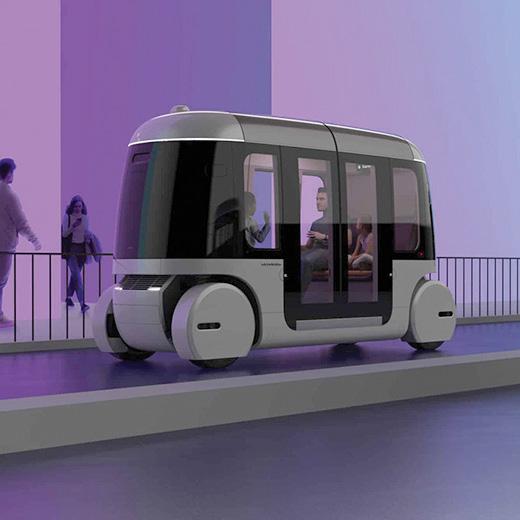
Dubai’s parking infrastructure is set to become part of a wider smart mobility network through a collaboration between Parkin and autonomous transport specialist Glydways.
The partnership will explore the integration of Glydways’ autonomous transport technology within Parkinmanaged parking facilities, creating new opportunities for seamless connections between parking locations and surrounding destinations.
The companies will work on developing mobility solutions that combine parking services with autonomous transportation. Glydways’ system uses compact autonomous vehicles operating on dedicated pathways, designed to provide efficient passenger movement while reducing congestion and improving accessibility.
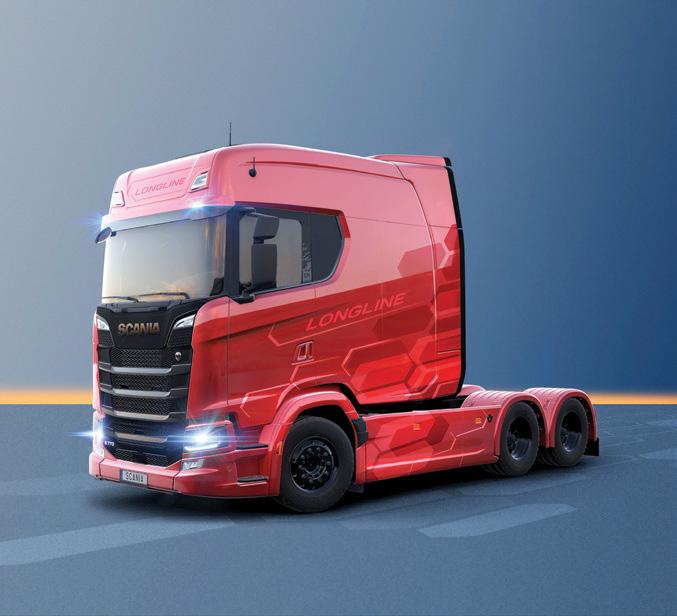
SCANIA LONGLINE BRINGS EXTENDED CAB CONCEPT INTO PRODUCTION
MANUFACTURING
Swedish trucks and commercial vehicles giant Scania has moved its Longline cab concept into series production, offering operators a factory-developed solution focused on increased space, comfort and interior flexibility.
Combining elements of the manufacturer’s CrewCab and S-series high-roof cab designs, the Longline creates an extended cab configuration aimed at operators seeking improved driver living conditions.
Production will take place at Scania’s Laxå facility in Sweden, while chassis assembly continues at the company’s main location in Södertälje, south of Stockholm.
Rather than providing a fully finished interior, the cab is designed as a flexible platform, allowing customers and bodybuilders to configure the space according to operational requirements.
Available initially in 28 and 31 extended lengths, the high-roof cab provides more than two metres of interior standing height.
According to Scania, the cab has been developed in response to customer demand, and the company positions the Longline as a solution for improving driver comfort and supporting operator efforts to attract and retain skilled drivers in the long-haul trucking business.
OMODA AND JAECOO INTRODUCE AI PARKING TECHNOLOGY FOR UAE MARKET MODELS
TECHNOLOGY
Chinese passenger automotive vehicle makers OMODA and JAECOO are preparing to introduce an artificial intelligence-based valet parking system in the UAE, bringing advanced autonomous parking capability to selected models.
The Valet Parking Driver (VPD) system enables vehicles to independently identify suitable parking spaces and complete parking manoeuvres without driver input.
The technology is designed to support drivers in busy urban environments, including shopping centres, commercial areas and entertainment districts.
The system was demonstrated internationally on the JAECOO J7 SHS during recent technology showcases, highlighting the brands’ focus on intelligent mobility solutions. The UAE rollout aligns with the country’s wider push
towards smart transportation and AI-enabled infrastructure. The technology could also provide practical benefits in the region’s harsh summer conditions by reducing the need for drivers to search for parking spaces in exposed outdoor areas.
The VPD system forms part of OMODA and JAECOO’s broader
technology strategy, which includes hybrid powertrains, connected vehicle systems and artificial intelligence applications.
The brands’ Super Hybrid System (SHS) range, including the JAECOO J7 SHS, JAECOO J8 SHS and OMODA C7 SHS, has become a key part of their UAE market expansion.
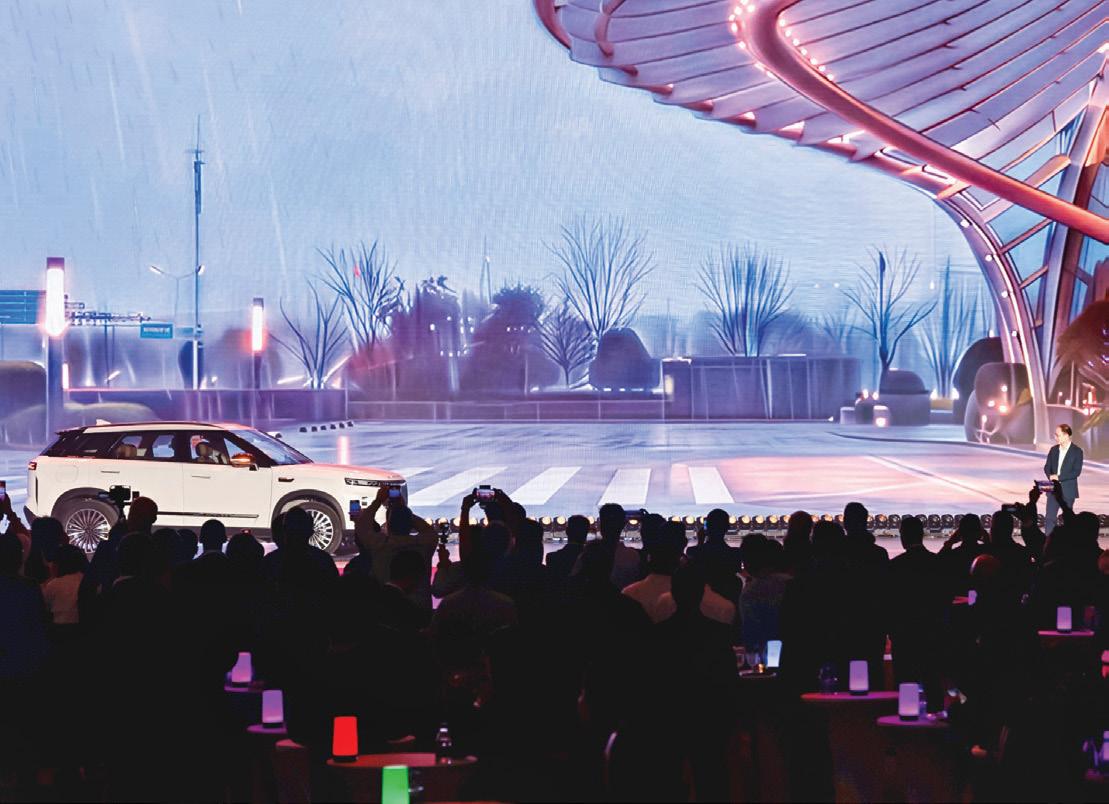
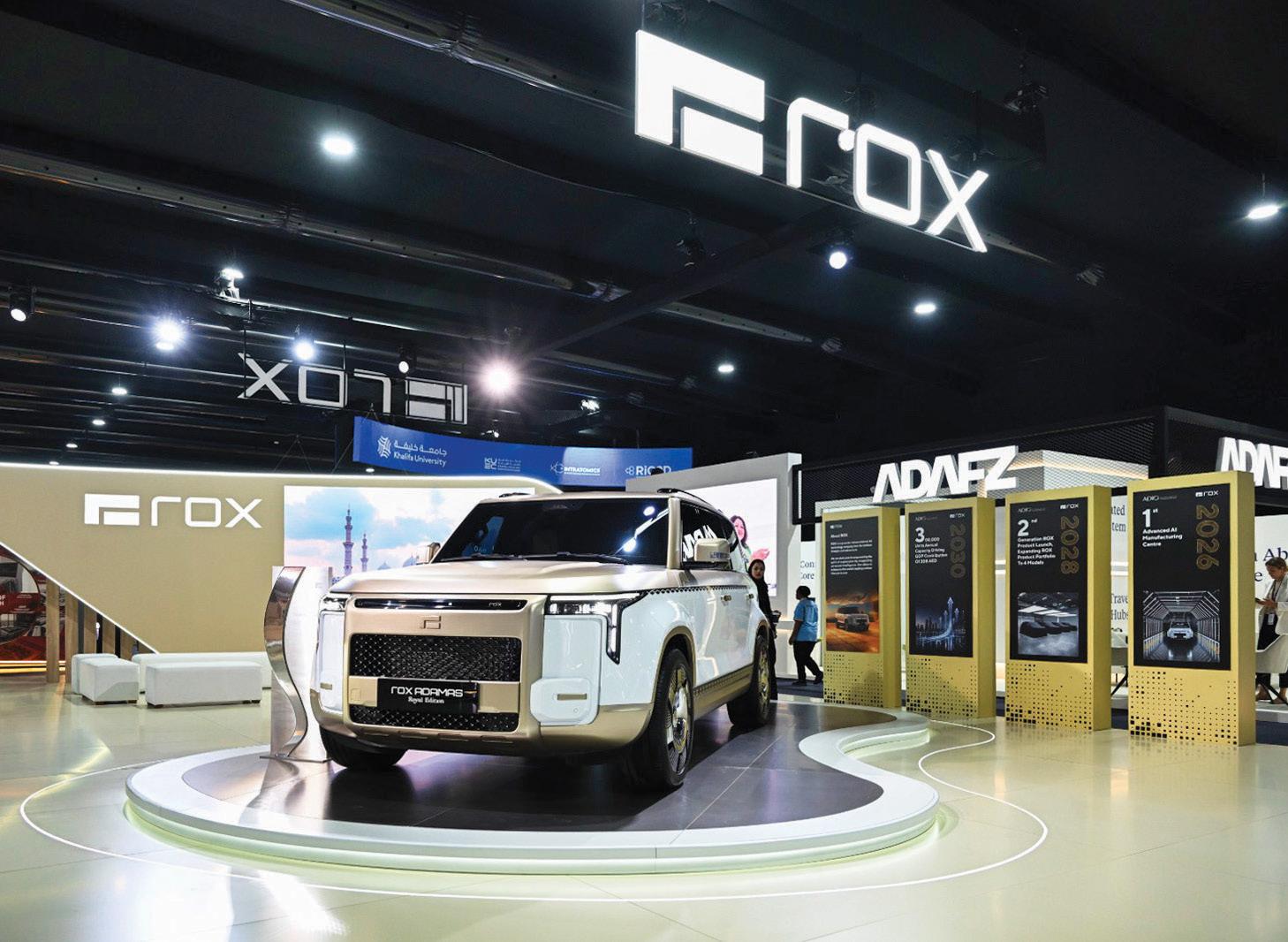
ROX PLANS AI MANUFACTURING HUB IN ABU DHABI
MANUFACTURING
ROX Motor is set to establish the Middle East’s first Advanced AI Manufacturing Centre in Abu Dhabi through a strategic agreement with Khalifa Economic Zones Abu Dhabi (KEZAD).
The facility, scheduled to begin operations in the second half of 2026, is planned to support intelligent vehicle production and regional exports as part of the UAE’s growing advanced manufacturing sector.
ROX has outlined a target annual production capacity of 300,000 vehicles by 2030, with the project expected to contribute towards the UAE’s Operation 300Bn industrial development strategy.
The manufacturing centre will use AI-enabled production capabilities and is intended to create a broader automotive ecosystem supporting vehicle assembly, supply chains and export operations.
The project follows ROX’s expansion in the UAE, including the establishment of its global headquarters in Abu Dhabi and regional parts operations in Dubai.
By combining manufacturing capability with Abu Dhabi’s industrial infrastructure and logistics network, the company aims to position the UAE as a base for intelligent vehicle development and international distribution.
DRIVING SERVICE INTO THE FUTURE
Tech-driven mobility platform Service My Car is redefining service for a new generation of customers in the regional auto sector who are increasingly demanding uptime and digitalisation
As vehicle owners and fleets in the Middle East demand greater uptime, visibility and efficiency, the automotive services sector is responding to the challenge and seeking to redefine its offerings by combining technology, data and operational capability into one connected platform.
One company at the forefront of this endeavour, especially where passenger vehicles are concerned is Service My Car.
Prem Anand Kumar, Business Head of Service My Car, has watched customer expectations evolve at remarkable speed in
his three decades in the region’s automotive sector, and tells T&FME that the future of automotive service lies not in repairs alone, but in convenience, transparency and intelligent mobility support.
“After nearly 30 years in the GCC automotive industry, one thing has become very clear: customer expectations have changed dramatically. Whether it is an individual vehicle owner or a fleet operator, today’s market demands convenience, transparency, speed, and data driven decision making. The organisations that can combine technology with operational excellence will define the future of automotive aftersales,” Kumar says.
In essence, we are building an automotive maintenance ecosystem”
From workshop to platform
Service My Car has deliberately positioned itself away from the traditional workshop model and towards a technology enabled service ecosystem, he explains.
“Today, Service My Car operates as a technology enabled automotive services platform rather than a conventional repair workshop. Our focus is on simplifying the entire vehicle maintenance journey through digital connectivity, operational transparency, and a strong service network.”
The model combines digital accessibility with the physical capability of established service providers including Auto Fix,
and Kumar explains further: “What differentiates us is that we combine the convenience of a digital platform with the operational strength of established workshop networks such as Auto Fix. Customers and fleet operators can access a complete range of services from preventive maintenance and repairs to inspections, insurance support, roadside assistance, vehicle evaluations, and fleet management solutions through a single point of contact.”
The company believes this integrated approach is becoming increasingly important for fleet operators managing rising operating costs and tighter utilisation targets.
“Our platform provides online booking, pickup and delivery, digital inspections, real time status updates, and centralized service records. This allows customers and fleet managers to make informed decisions while reducing administrative effort and vehicle downtime.
“In essence, we are building an automotive maintenance ecosystem where technology, convenience, transparency, and service quality come together to deliver a superior ownership experience,” says the Service My Car Operations Head.
The strategy is already influencing the company’s geographical expansion plans across the region, which is driven by customer demand, vehicle population growth, and the increasing need for organised aftermarket services, he points out.
Kumar adds that markets such as Al Ain and Ras Al Khaimah in the UAE present clear opportunities due to increasing vehicle numbers and the absence of organised service networks – and cites these as reasons that his company has expanded into these territories after cementing its position in Dubai.
“Within the UAE, markets such as Al Ain and Ras Al Khaimah have shown strong potential due to growing vehicle ownership, limited availability of structured multi brand service solutions, and increasing demand for convenient maintenance services,” he says, adding that Service My Car applies a rigorous framework before entering any new territory.
“When evaluating new markets, we look at vehicle parc size, growth potential, fleet concentration, logistics feasibility, competitive landscape, and the availability of qualified service partners.”
Saudi Arabia is also firmly in the company’s sights, and Kumar calls it the “natural next step”. “The Saudi Vision 2030,
economic diversification, and the Kingdom’s expanding mobility sector create significant opportunities for organised automotive service providers. Our objective is not simply geographic expansion but building sustainable service ecosystems that deliver consistent quality and customer experience across every market we enter,” he explains.
The uptime economy
For commercial vehicle operators, the definition of value has changed significantly in recent years, and Kumar points out that fleet operators today are “no longer buying repairs; they are buying uptime, predictability, and operational efficiency”.
That shift is transforming relationships between fleets and aftermarket providers across the region.
“Fleet customers face increasing pressure to maximise vehicle availability while controlling operating costs. Through Auto Fix’s workshop network and Service My
Our vision is to build a connected mobility ecosystem that helps customers and fleet operators maximise uptime”
Car’s digital platform, we provide preventive maintenance programmes, centralised service coordination, digital approvals, and real time visibility into vehicle status.
“This allows fleet managers to plan maintenance proactively rather than reacting to breakdowns. Our focus is simple: reduce downtime, improve turnaround times, and help customers maximise asset utilisation while lowering total cost of ownership.”
Service My Car is now investing heavily in dedicated fleet management capabilities as operators demand more data and visibility from service partners. Kumar reveals that the company is currently developing dedicated fleet management solutions that combine technology, analytics, and service delivery into a single ecosystem.
“Fleet operators increasingly require centralised maintenance records, approval workflows, service scheduling, vehicle history tracking, cost reporting, and operational analytics,” he explains. “Our in-
VISION FOR TOMORROW
Prem Anand Kumar, Business Head of Service My Car, feels the future of automotive service lies not in repairs alone, but in convenience, transparency and intelligent mobility support
DIGITAL TRANSPARENCY
Service My Car enables customers to monitor service activity in real time while maintaining complete visibility over approvals and expenditure.
house platform is being designed to provide fleet managers with complete visibility into vehicle performance, maintenance costs, service history, and repair approvals. Over the next few years, we see this evolving beyond maintenance management into a broader mobility management platform focused on uptime optimisation and data driven decision making.”
Digital by design
Technology is at the centre of every aspect of the Service My Car proposition. In Kumar’s words: “Digitalisation sits at the heart of our business model.”
Customers can now monitor service activity in real time while maintaining complete visibility over approvals and expenditure. Explaining how, he says: “Today, customers can book services digitally, track vehicle movement, receive inspection reports, approve estimates online, and monitor repair progress in real time. This significantly improves transparency and reduces communication gaps.”
The advantages become even more pronounced in fleet environments where
The future of automotive aftersales is no longer about fixing vehicles; it is about maximising mobility”
multiple stakeholders require access to service information and vehicle history.
“For fleet operators, digitalisation creates even greater value through centralised service records, maintenance history, approval workflows, and vehicle health tracking.”
Service My Car is also introducing advanced analytics and intelligent workflows to improve customer engagement and operational efficiency, and is leveraging customer analytics and AI driven workflows to improve service recommendations, optimise resource allocation, and enhance customer engagement.
“Ultimately, digitalisation allows us to transform automotive maintenance from a reactive process into a proactive and data driven experience,” Kumar says.
Changing customer expectations are also reshaping the wider commercial vehicle aftermarket, and today, fleet operators are looking for partners who can help maximise vehicle uptime, improve operational efficiency, and reduce total cost of ownership.
“Commercial fleets, ride hailing operators, last mile delivery companies, and
corporate mobility providers increasingly demand faster turnaround times, real time visibility, centralised reporting, proactive maintenance solutions, and dedicated support,” Kumar observes.
“We are also seeing growing demand for fleet health monitoring, digital approvals, consolidated invoicing, mobile maintenance support, roadside assistance, and dedicated account management.”
Through the combined strengths of Service My Car and Auto Fix, the Business Head says the objective is not just to repair vehicles but to become a strategic partner that helps fleet operators improve productivity and control operating costs.
Preparing for electrification
Sustainability and electrification are becoming central themes across the transport sector and Service My Car sees itself playing an important role in supporting that transition.
“One of the biggest contributions we make is extending vehicle life through preventive maintenance and timely repairs. A well-maintained vehicle consumes
less fuel, produces fewer emissions, and delivers better operational efficiency.
“Our digital operating model also reduces paperwork through paperless workflows, digital inspections, online approvals, and electronic service records. For fleet customers, preventive maintenance programmes help improve fuel efficiency, reduce breakdowns, and lower overall environmental impact,” he reveals.
Service My Car recently entered into a partnership with PlusX Electric, with the move reflecting the company’s long-term view of the market.
“The EV market in the GCC is still in its early stages, but the momentum is clearly accelerating. Government initiatives, sustainability targets, charging infrastructure investments, and the arrival of new EV brands, particularly from China, are driving adoption across the UAE and Saudi Arabia.
“To prepare for this transition, Service My Car is strengthening its EV service network through specialised partnerships, technician training, highvoltage safety protocols, EV diagnostics, and dedicated repair processes.”
Kumar emphasizes his company’s belief that many fleet operators will adopt a mixed fleet strategy for years to come, operating both ICE and EV vehicles. He is making Service My Car’s objective to help customers navigate this transition
IN-APP CONVENIENCE
Customers can book services digitally, track vehicle movement, receive inspection reports, approve estimates online, and monitor repair progress in real time on the Service My Car app.
smoothly through a single platform capable of supporting both worlds.
Trust above all
As the business expands across the Gulf, Kumar believes maintaining consistency and trust will ultimately determine success.
“Trust is the foundation of any successful aftermarket business, particularly when serving fleet operators where vehicle reliability directly impacts business performance. Every workshop
Trust is the foundation of any successful aftermarket business”
within our network undergoes a rigorous evaluation process covering technical capability, facility standards, equipment, manpower competency, and operational processes,” he says.
“Through our digital platform, customers receive detailed inspections, photographic evidence, clear estimates, and approval-based repair workflows before any work is carried out. This eliminates uncertainty and creates confidence in the repair process.”
Looking ahead, Kumar sees Service My Car evolving into something much larger than a service provider or workshop network.
“Over the next five years, we see Service My Car evolving beyond a vehicle servicing platform into a broader mobility ecosystem,” he says.
Summing up Service My Car, its operations and market, Kumar underscores: “The future of automotive aftersales is no longer about fixing vehicles; it is about maximising mobility. Our vision is to build a connected mobility ecosystem that helps customers and fleet operators maximise uptime, reduce operating costs, and embrace the future with confidence.
“Whether through Service My Car’s digital platform or Auto Fix’s service network, our focus remains the same, delivering trust, transparency, and operational excellence at every stage of the vehicle lifecycle”.
Through their combined strength, Service My Car and Auto Fix aim to not just repair vehicles but become strategic partners that helps fleet operators improve productivity and control operating costs.
IVECO’S MADRID POWERHOUSE
The beating heart of IVECO’s global heavyduty truck production, where every truck is a custom-built innovation
IVECO’s Madrid facility stands as Spain’s only production site for heavy-duty industrial vehicles, manufacturing the brand’s entire heavy range for global markets including Italy, Germany, Spain, and Turkey.
Spanning 374,000 square metres, the plant features a one-kilometre main assembly line. Nearly 40,000 vehicle configurations are available - each truck is built to meet specific customer needs, making every unit virtually unique. With 267 base models and over 2,800 customisable options, each truck is tailored to individual customer needs - so much so that the same configuration is produced, on average, only three times a year.
“Every truck we build is essentially a one-off, custom-made to meet specific requirements,” says José Manuel Jaquotot, Director of IVECO’s Madrid and Valladolid plants. “Each vehicle has a unique identifier that allows us to track it from cab production in Valladolid to final assembly in Madrid, ensuring full traceability and quality.”
The Madrid plant’s production process is highly flexible and precise, supported by advanced logistics and automation systems. Advanced automation, AGV (Automated Guided Vehicle) systems, and 100% renewable electricity use make the plant a model of efficiency and environmental responsibility. The dedicated AGV system moves vehicles along the line, allowing for dynamic takt time adjustments based on each truck’s complexitywithout disrupting the overall flow.
The cab arrives from IVECO Valladolid plant already welded and painted and is fully outfitted in Madrid with components such as the dashboard, seats, bunks, and airbag. The dashboard alone undergoes over 100 electrical tests and is assembled on a dedicated line due to its complexity.
The “marriage” of chassis and cab marks a key moment in the assembly process. From there, the truck takes shape with the installation of exterior components, wheels, and final testing - including leak checks, geometry calibration, and functional inspections.
Each vehicle has a unique identifier that allows us to track it from cab
production in Valladolid to final assembly in Madrid”
Beyond technology, the plant’s strength lies in its people. Over 2,700 skilled employees drive excellence and adaptability, managing constant product updates and innovation. The team brings deep expertise and agility to manage continuous product updates. In 2025 alone, the plant handled 10 new launches.
Sustainability is embedded in every step. The Madrid plant uses 100% renewable electricity and in 2025 recycled almost 90% of the water used in production. Together with Valladolid, it leads Iveco Group’s efforts in sustainable manufacturing and is part of a pioneering solar self-consumption project with Edison Next Spain, helping avoid around 500 tons of CO₂ emissions annually.
IVECO’s commitment to decarbonisation goes beyond vehicle technology — it extends to how those vehicles are made. The Madrid plant exemplifies this vision: a place where innovation, customisation, and sustainability come together to shape the future of transport.
MAN DRIVES LOGISTICS ELECTRIFICATION
As
fleet operators explore lower-emission transport, MAN is demonstrating how battery electric heavy-duty logistics is moving beyond pilot projects and into everyday operations
Electrification may have arrived first in urban delivery vans and municipal fleets, but the next major frontier is increasingly becoming long distance logistics. Across Europe and the Middle East alike, manufacturers, transport operators and logistics providers are examining how battery electric trucks can move beyond demonstrations and become commercially viable assets within mainstream supply chains.
For fleet operators in the Gulf, where sustainability targets are becoming increasingly ambitious and large logistics developments continue to emerge, the challenge is no longer whether electrification will happen but where it can make commercial and operational sense first. Fixed transport corridors, predictable routes and hub-based logistics operations are widely expected to become the starting point for heavy duty electrification.
It is precisely this model that MAN Truck & Bus is now putting into practice
30% Reduction MAN is aiming for in vehicle delivery emissions before 2030
within its own supply chain operations. Working alongside J.S. Logistics, the manufacturer has introduced five fully electric MAN eTGX trucks into daily operation, transporting supplier components between manufacturing facilities in Germany and supplier locations in Hungary.
The deployment marks the first use of the electric flagship in cross border inbound transport within MAN’s own production logistics network.
The vehicles operate across both direct transport routes and consolidated freight
movements via logistics hubs, creating an operational model that closely mirrors the type of distribution systems increasingly emerging across the Gulf region.
One of the most demanding operations links Lébény in Hungary with Munich, covering approximately 520km in each direction. To maximise efficiency, the route uses a relay model in which two trucks travel towards one another, exchange trailers at a designated meeting point and return to their original depots.
The operation runs as a full truckload service, allowing customer consignments to move directly between locations without intermediate unloading or redistribution. Another electric truck supports consolidated deliveries from the logistics centre in Győr to MAN’s production facilities, primarily serving Munich.
Further electric operations are centred around the logistics hub in Kirkel, Germany, where freight originating in France, Spain, Portugal, the United Kingdom and Ireland is transported to production facilities in Munich and Nuremberg on routes extending up to 400km.
Role of logistics specialists
The project also highlights the increasingly important role of logistics specialists in accelerating transport electrification. Headquartered in Kirkel in Germany’s Saarland region, J.S. Logistics has developed into a major integrated logistics provider with operations spanning Germany, Luxembourg, Spain, Lithuania and Hungary.
The family-owned business provides everything from less than truckload and full truckload transport to contract logistics, industrial services and just in time supply chain solutions for customers operating in the automotive, chemical and consumer goods sectors. Sustainability and the gradual expansion of electric mobility have become central elements of the company’s long term strategy.
From a Middle East perspective, the significance of the project lies not simply in the vehicles themselves but in the operational blueprint they provide. Similar route structures already exist between logistics hubs, ports and industrial zones across the Gulf, creating potential opportunities for electrification as charging infrastructure expands.
The deployment forms part of a much wider decarbonisation programme within
MAN’s inbound logistics operations.
The manufacturer’s inbound transport activities account for up to 165 million kilometres every year, underlining the scale of the challenge and the opportunity.
The target is ambitious. By the middle of 2026, MAN aims to have around 50 battery electric trucks operating within inbound logistics while continuing to expand charging infrastructure across production plants and service locations.
“By deploying the eTGX in our own production logistics, we are demonstrating together with strong partners that zero emission heavy duty transport already works in real world operations today,” says Michael Kobriger, Executive Board Member for Production and Logistics at MAN Truck and Bus. “We are consistently driving the transformation forward both for our customers and within our own network.”
Number of battery electric trucks MAN aims to have in operation within inbound logistics by the middle of this year
Supporting this transition is MAN Transport Solutions, which provides customers with support covering route analysis, charging infrastructure planning and the integration of electric trucks into existing fleet operations.
Roadmap for the future
The company is also extending decarbonisation beyond inbound transport through its Electrifying Outbound initiative, which aims to reduce emissions generated through vehicle delivery operations by 30 per cent before 2030.
The five eTGX vehicles were officially handed over at the MAN Truck Forum in Munich, where Friedrich Baumann, Executive Board Member for Sales and Customer Solutions at MAN Truck and Bus, presented the vehicles to Jerome Schüssler, Owner and Managing Director of J.S. Logistics.
For transport operators in the Middle East, projects such as this offer an early indication of how heavy duty electrification is likely to evolve over the coming decade. Rather than replacing every diesel truck overnight, the first wave of adoption is expected to focus on predictable logistics corridors where route lengths, charging opportunities and operational requirements align.
As battery technology improves and charging networks continue to expand, the transition from pilot schemes to commercially viable logistics operations may arrive far sooner than many fleet operators once expected.
ELECTRIC DELIVERY
The five eTGX vehicles were officially handed over at the MAN Truck Forum in Munich, where Friedrich Baumann, Executive Board Member for Sales and Customer Solutions at MAN Truck and Bus, presented the vehicles to Jerome Schüssler, Owner and Managing Director of J.S. Logistics.
THE 3-POINTED STAR 130 YEARS OF
Mercedes-Benz Museum marks commercial vehicles milestone with special
The Mercedes-Benz Museum in Stuttgart opens a special exhibition on June 28 this year, celebrating 130 years of commercial vehicles and charting the development of trucks and vans from the earliest motorised transport to today’s electric era.
Titled “130 Years of Commercial Vehicles”, the exhibition reflects on a legacy that began in 1896 when Gottlieb Daimler delivered what is widely regarded as the world’s first truck. In the same year, Carl Benz also sold his first delivery van, laying the foundations for a transport revolution that continues to shape global logistics.
Running until April 4, 2027, the exhibition is staged in Collection Room 5 and features seven selected vehicles that illustrate key milestones in the evolution of Mercedes-Benz commercial transport. Together, they demonstrate how engineering innovation has continuously reshaped the role of trucks and vans in industry, trade and everyday life.
A central theme of the exhibition is the importance of commercial vehicles as the backbone of modern economies. For more than a century, trucks and vans have ensured the steady movement of goods, supporting supply chains, enabling urban development and connecting markets across the world.
This story is brought to life through a combination of historic vehicles, multimedia stations and interactive installations, including an animated LED globe that visualises the global footprint of Mercedes-Benz commercial vehicles. Traditional communication elements such as the historic Litfaß column are also integrated with digital displays to provide context on the evolution of transport and logistics.
The vehicle line-up on display spans more than a century of development. Early innovation is represented by the Benz 1C truck from 1922, a 1.5-tonne model that reflects the beginnings of series production in commercial transport and
exhibition
was later adapted for fire service use. Post-war mobility and economic recovery are highlighted through models such as the Mercedes-Benz 170 V panel van from 1952 and the O 319 D panorama bus from 1961, both of which reflect the growing importance of flexible transport solutions during Europe’s economic expansion.
The Mercedes-Benz L 911 from 1966 illustrates the rugged working reality of midcentury trucking, while modern urban logistics are represented by the all-electric eVito from 2023.
The exhibition also highlights the evolution of Mercedes-Benz light commercial vehicles through the eSprinter, introduced in 2024 as the latest generation of the long-running Sprinter model line.
At the top end of modern truck development is the eActros 600, also introduced in 2024. With a battery capacity of 621kWh and a range of up to 500km without recharging, it represents the brand’s latest step towards long-haul electric transport and a key milestone in the transition to zero-emission logistics.
NEXT ISSUE: FUSO ELECTRIC TRUCKS, TRANSFORMING HOME-GROWN RIDE HAILING SERVICES, USED VOLVO TRUCKS, AND MUCH MORE