ISSUE
J U LY/AU G U ST 2 0 2 6 FO R T H E C O N ST R U CT I O N S P EC I A L I ST Licensed by Dubai Development Authority
131
Focus
The Greater Muscat Structure plan Design
The changing face of hospitality Market
Residential market in Abu Dhabi Management
Turning architectural clarity to an advantage
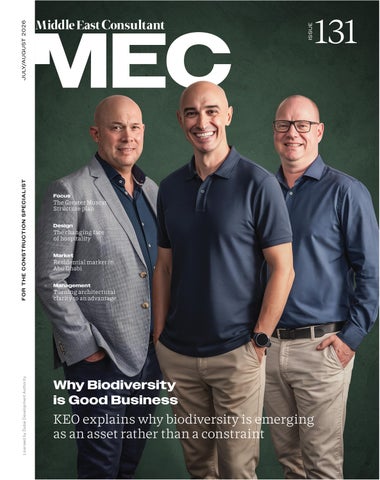
Why Biodiversity is Good Business KEO explains why biodiversity is emerging as an asset rather than a constraint
Building Intelligence
The construction industry has always been defined by its ability to turn complexity into something tangible. Today, that complexity is increasingly being managed digitally, as artificial intelligence, digital twins and agentic AI move from concepts to practical tools. AI is already helping project teams analyse vast amounts of data, identify risks, optimise schedules and improve decision-making. Digital twins are creating virtual representations of buildings and infrastructure, connecting design, construction and operations in ways previously difficult to achieve. Agentic AI promises to go further, with systems capable of planning tasks, coordinating workflows and acting on behalf of project teams. For the Middle East, this transformation could be particularly significant. The region is delivering some of the world’s most ambitious projects, from smart cities and mega-developments to advanced transport and energy infrastructure. But technological adoption should not be confused with progress. The industry must address data ownership, interoperability, cybersecurity, accountability and the future role of people. An AI-generated recommendation may be fast, but who is responsible when it is wrong? A digital twin is only as valuable as the accuracy of its underlying data. Autonomous agents will also require clear boundaries to operate safely within complex project environments. The opportunity is enormous, but the goal should not be automation for its own sake. It should be a smarter, safer and more productive industry. Construction is entering a new digital era. The winners will understand not only what these technologies can do, but where human judgement remains indispensable.
Clayton Aldo Vallabhan Deputy Editor, ME Consultant
MECONSTRUCTIONNEWS.COM
1
CONTENTS
28 COVER STORY
The Sustainability and Environment team at KEO speaks with Clayton Vallabhan of MEC about how biodiversity is becoming a value driver for projects, and how environmental consultancy is changing in the region
2
JULY-AUGUST 2026
INITIATE 10 D-Marin appointed as marina consultant for BAYN Marina ⁄ 12 JLL elevates Maroun Deeb to Head of Project & Development Services MEA ⁄ 13 AtkinsRealis to serve as design consultant for Expo 2030 Riyadh pavilion ⁄ 14 Aedas designs Rixos branded residences in Al Reem Island ⁄ 16 Parsons wins program and construction management contract for Lusail
INTERFACE 38 Lee French, Partner and Managing Director MENA at Cundall on how The Greater Muscat Structure Plan goes beyond just master-planning, while integrating sustainability, economic development and the environmnent at its core
INNOVATE 50 Design that holds value: Why it is crucial to understand a property’s architectural potential before committing to it ⁄ 56 The future hospitality brand will be built around values: Hospitality must create brands that stand for something people genuinely believe in ⁄ 64 How technology is changing the way architecture is designed and delivered: Technology is changing the way architects and consultants work ⁄ 72 As part of our ‘Women in Construction’ focus, MEC sits down with Olivia Taylor, Senior Consultant, HKA
MECONSTRUCTIONNEWS.COM
3
GROUP
MANAGING DIRECTOR Raz Islam DIRECTOR OF FINANCE & BUSINESS OPERATIONS Shiyas Kareem
raz.islam@cpitrademedia.com shiyas.kareem@cpitrademedia.com
EDITORIAL
EDITORIAL DIRECTOR Jason Saundalkar
jason.saundalkar@cpitrademedia.com
DEPUTY EDITOR Clayton Aldo Vallabhan
clayton.aldo@cpitrademedia.com
ASSOCIATE EDITOR Priyanka Raina
priyanka.raina@cpitrademedia.com
ADVERTISING
GLOBAL ACCOUNT MANAGER Jas Kaur
jas.kaur@cpitrademedia.com
STUDIO
ART DIRECTOR Simon Cobon
simon.cobon@cpitrademedia.com
GRAPHIC DESIGNER Percival Manalaysay
percival.manalaysay@cpitrademedia.com
PHOTOGRAPHER Maksym Poriechkin
maksym.poriechkin@cpitrademedia.com
CIRCULATION & PRODUCTION
DIRECTOR OF MARKETING & MEDIA OPERATIONS Phinson Mathew George PRODUCTION & IT SPECIALIST Jarris Pedroso
phinson.george@cpitrademedia.com jarris.pedroso@cpitrademedia.com
MARKETING
SOCIAL MEDIA EXECUTIVE Franzil Dias
franzil.dias@cpitrademedia.com
WEB DEVELOPMENT
SENIOR DIGITAL MANAGER Abdul Baeis
abdul.baeis@cpitrademedia.com
FOUNDER Dominic De Sousa (1959-2015)
When you have finished with this magazine, please recycle it The publisher of this magazine has made every effort to ensure the content is accurate on the date of publication. The opinions and views expressed in the articles do not necessarily reflect the publisher and editor. The published material, adverts, editorials and all other content are published in good faith. No part of this publication or any part of the contents thereof may be reproduced, stored or transmitted in any form without the permission of the publisher in writing. Publication licensed by Dubai Development Authority to CPI Trade Publishing FZ LLC. Printed by Well Pack Printing Press. CPI Trade Media. PO Box 13700, Dubai, UAE. +971 4 375 5470 cpitrademedia.com © Copyright 2026. All rights reserved.
4
JULY-AUGUST 2026
ISSUE
J U LY/AU G U ST 2 0 2 6
Licensed by Dubai Development Authority
131
232 JULY-AUG 2026
FO R T H E C O N ST R U CT I O N S P EC I A L I ST
DIGITAL PIONEERS CELEBRATING THE CONSTRUCTION INNOVATORS TRANSFORMING PROJECT DESIGN AND DELIVERY Focus
The Greater Muscat Structure plan Design
The changing face of hospitality Market
Residential market in Abu Dhabi
VEHICLES/ TECH / TRANSPORTATION/LOGISTICS
Management
Turning architectural clarity to an advantage
MIDDLE EAST
141/MAY-JUNE 2O26
Licensed by Dubai Development Authority
LI CENSED BY D U BAI D EVELO PM ENT AU TH O RIT Y
Why Biodiversity is Good Business KEO explains why biodiversity is emerging as an asset rather than a constraint
CRUISI N G IN ON THE COVER
KEO explains why biodiversity is emerging as an asset rather than a constraint
TO LI G HT-D
UT Y
W ITH KUZE
R
ts entrant targe strategic new nts UD Trucks’ istics segme t-mile and log region’s las
N’S TOUR ER GENTLEMAE THE NEW LEXUS WE DRIV
LC 500 COU
PE
ISSUE 165 2026 MAY-JULY
MEConstructionNews.com @meconstructionn MEConstructionNews me-construction-news
RS MACHINERY MASTE 6 ARDS 202 CMME AW
IS YE AR’S PED UP TH EAST AWARDS LE WHO SCOO DISCOV ERN MACHINERY MIDD TIO CONSTRUC
GET THE
WHOLE PICTURE
ONLINE
POPULAR
FEATURES
INDUSTRY
Meraas awards a contract to International Foundation Group for Atélis at d3
Building a new Dubai icon: The DEC Campus Legacy Project Phase One INFRASTRUCTURE
DEWA commissions 793 11kV substations in first 6 months of 2026
CONSTRUCTION
Shamal awards Dutco main works contract for its residential project at former Dubai Zoo site
Stability as strategy
CONSULTANT
SSH to provide construction supervision services for cultural project in Oman
CONSTRUCTION
Masah Contracting secures contract for 40-storey Al Khobar residential tower
6
JULY-AUGUST 2026
Geopolitical uncertainty sharpens focus on construction costs
FEATURED NEWS
UPCOMING EVENTS
INFRASTRUCTURE
New venture to deliver rapidly deployable desalination and water treatment systems The launch comes after the UN University Institute for Water, Environment and Health warned the world is an era of global water bankruptcy
SEPTEMBER
Real Estate Leaders Summit 23 September 2026 Dubai, United Arab Emirates
INDUSTRY
Wynn Al Marjan Island unveils its beachfront, lagoon, and offshore reef Wynn Al Marjan Island’s completed beachfront, lagoon, and offshore reef offer the first look at Wynn Beach, which has been designed across three distinct environments
SEPTEMBER
Energy & Sustainability Summit 30 September 2026 Dubai, United Arab Emirates
ENERGY
Acwa Power completes construction on a green hydrogen project in NEOM The $8.5bn facility is now in the commissioning stage and commercial operations are set to begin next year
OCTOBER
Women in Construction Connect 7 October 2026 Dubai, United Arab Emirates
CONSTRUCTION
Saudi Telecom unit to build data centres in Dammam The 18-month contract covers the establishment, construction and preparation of the DDC307 data centre and other works
OCTOBER
Digital Construction Summit 21 October 2026 Dubai, United Arab Emirates
INDUSTRY
RSG and DarkSky International create new DarkSky Resort certification Desert Rock and Nujuma, a Ritz-Carlton Reserve have become the first resorts in the world to earn the certification
DECEMBER
Middle East Consultant Awards 9 December 2026 Dubai, United Arab Emirates
MECONSTRUCTIONNEWS.COM
7
INITI 8
JULY-AUGUST 2026
INSIDE
10 D-Marin appointed as Marina consultant for BAYN Marina ⁄ 12 JLL elevates Maroun Deeb to Head of Project & Development Services for MEA ⁄ 13 AtkinsRealis to serve as design consultant for Expo 2030 Riyadh pavilion ⁄ 14 Aedas designs Rixos Branded Residences in Al Reem Island ⁄ 16 Parsons wins program and construction management contract for Lusail
IATE A deep dive into the biggest construction headlines that caught our eye this month
MECONSTRUCTIONNEWS.COM
9
INITIATE
D-Marin appointed as Marina consultant for BAYN Marina
10
JULY-AUGUST 2026
ORA Developers has appointed D-Marin
through strategic berth-mix planning
Parvin Mansoor Al Awadhi, Head of
as the marina consultant for BAYN, the
and leveraging our global operational
Development and Design at ORA Developers
developer’s flagship coastal community
expertise. We look forward to bringing a
added, “BAYN is built around a clear vision for
in Ghantoot.
world-class yachting experience to this
this coastline. The marina is central to that
landmark development,” said Selcuk Balci,
vision, and its design will reflect the same
D-Marin Dubai’s Managing Director.
standards of quality and environmental
As per the terms of the deal, D-Marin will provide technical consultancy to support the marina’s design, bringing
The BAYN marina forms part of a fully
responsibility that define every element of
its regional expertise and operational
integrated coastal destination in Ghantoot,
this masterplan. That commitment extends
knowledge to one of the UAE’s most
set along one of the Arabian Gulf’s last
beyond from design to delivery and the long-
significant emerging coastal developments.
undeveloped coastlines, with more than
term resident experience. Ghantoot is one
The consultancy will provide market
55% of its land dedicated to open space
of the last undeveloped coastlines on the
knowledge and technical advisory
and greenery, alongside direct access to a
Arabian Gulf, with a natural character that
services, offering strategic insights and
natural lagoon and canal, said a statement.
places a clear responsibility on how we build
expert guidance to support the project’s
D-Marin said that it operates
thoughtfully. D-Marin brings the operational
development and decision-making
7-marinas in the UAE including Al Seef,
expertise and environmental stewardship
process, the statement added.
Jaddaf Waterfront, Marasi Bay, Marsa
that this coastline deserves. We look forward
“D-Marin is committed to premium,
Al Arab and Port De La Mer with the
to working with them as we bring BAYN’s
sustainable, and innovative marina
recent additions of Palm Jumeirah and
waterfront vision to life.”
management across the Mediterranean
Dubai Islands.
BAYN will be delivered in phases
and the UAE. We are delighted to be
It has also achieved 2-major
across 4.8m sqm comprising multiple villa
trusted by ORA Developers to provide
environmental milestones in recent
and apartment communities, a 204-berth
the technical consultancy required to
months, with Marsa Al Arab becoming
marina, 1.2km of natural beachfront, a 5-star
design a project that truly suits market
Dubai’s only Blue Flag-certified marina and
resort, schools, a business park, a medical
demand. Our goal is to ensure the marina
Marasi Bay Marina earning Gold Anchor
centre, a sports club, leisure and wellness
is perfectly positioned for long-term
status, reinforcing the brand’s ongoing
facilities, natural lagoons and canals, and
success by optimising investment costs
commitment to sustainability.
retail and dining throughout.
MECONSTRUCTIONNEWS.COM
11
INITIATE
JLL has appointed Maroun Deeb as Head of Project & Development Services (PDS) for the Middle East and Africa region. As part of his expanded role, Deeb will be overseeing strategic growth and capability integration across the Middle East and Africa. His focus will include strengthening regional collaboration while maintaining strong local market expertise, advancing client-centric project delivery and developing the next generation of project leaders. “I’m honoured to lead our Project & Development Services teams across such a dynamic and fast-growing region. Our priority is to deliver long-term value for our clients while empowering our people to do their best work. The Middle East and Africa present extraordinary opportunities for innovation and impact, and I look forward to building on the strong foundations already in place,” Deeb stated. The appointment showcases JLL’s commitment to delivering greater value for clients in an increasingly complex environment shaped by geopolitical uncertainty, shifting demographics, sustainability demands and rapid technological change. Strengthening regional leadership helps ensure clearer oversight, more consistent execution and better outcomes across real estate projects in different markets, the firm said in a statement. Since joining JLL in 2015, Deeb has been instrumental in growing the firm’s Project
JLL elevates Maroun Deeb to Head of Project & Development Services MEA 12
JULY-AUGUST 2026
& Development Services business in Saudi Arabia. Under his leadership, the business evolved to managing the construction delivery of shopping malls, hotels and hospitality assets, commercial buildings, giga projects and mission critical facilities, serving private and public sector clients.
AtkinsRealis to serve as design consultant for Expo 2030 Riyadh pavilion AtkinsRealis has been awarded the lead
the environment, while reflecting the
multidisciplinary design disciplines
design consultancy contract by the Expo
overarching vision and sustainability
and integration of sustainable design
2030 Riyadh Company for its Place and
objectives of Expo 2030 Riyadh.
principles as well as ensuring the pa
Planet Pavilion, said to be one of the
The Place and Planet Pavilion is
signature thematic pavilions planned for the
expected to be one of the central attractions
vilion meets the highest standards of innovation, visitor experience, and
mega event to be held in the Saudi capital.
of Expo 2030 Riyadh, contributing to the
environmental performance.
Under the agreement, the firm will
event’s mission of promoting global
The contract further boosts
lead the design and multidisciplinary
collaboration, sustainable development,
AtkinsRealis’ presence in Saudi Arabia’s
consultancy services for the pavilion,
and technological innovation.
rapidly growing mega-project sector
supporting the development of a
AtkinsRealis said its scope of work
and supports the Kingdom’s Vision
landmark venue that will showcase the
includes provision of architectural and
2030 ambitions to deliver a world-class
relationship between people, places, and
engineering design, co-ordination of
international exposition.
MECONSTRUCTIONNEWS.COM
13
INITIATE
14
JULY-AUGUST 2026
Aedas designs Rixos Branded Residences in Al Reem Island
Aedas has said that it has designed the
distinctive and elegant aesthetic, it added.
Rixos Al Reem Residences in Abu Dhabi
The tower’s massing and facade
for East&West Properties. This marks
are designed to optimise orientation,
the second Rixos branded residential
enhance residential comfort, and
development delivered through
establish an identity within the skyline. At
their partnership.
the podium level, landscaped terraces and
The project is said to build on the
activated edges create a strong connection
success of Rixos Financial Center Road
to the public realm, fostering pedestrian
Residences in Dubai, the first-ever Rixos
engagement and urban integration.
branded residences worldwide, also
The collaboration between Aedas
designed by Aedas. Following a positive
and East&West Properties embodies
market response, East&West Properties
a shared vision to create distinctive
has once again entrusted Aedas with the
residential destinations that harmonise
development of the next Rixos residential
architecture, hospitality, and lifestyle.
destination in the UAE, said a statement.
Through this partnership, both parties
Conceptualised as a waterfront
contribute to the growing demand for
address, the development is positioned
branded residential experiences across
to offer views of the sea and the Abu
the region.
Dhabi skyline. In response to the urban
This project marks Aedas’s further
landscape of Al Reem Island, often
expansion of its portfolio of branded
characterised by repetitive glass façades,
residential developments in the Middle
the design adopts a more restrained
East, solidifying its role in shaping
architectural language. Simplicity
integrated, hospitality-led living
emerges as a defining gesture, creating a
environments, the statement concluded.
MECONSTRUCTIONNEWS.COM
15
INITIATE
C
M
Y
CM
Parsons wins program and construction management contract for Lusail Parsons has been selected by Lusail Real
stakeholders across the program to drive
Estate Development Company (LREDC)
the successful delivery.
National Vision 2030,” added El-Essnawi. Spanning 38sqkm, Lusail comprises
to provide program management,
“Lusail is one of the most
19-residential, mixed use, commercial,
construction management, and
significant urban developments in the
entertainment, and waterfront districts,
construction supervision (PMCMCS) to
region, and we are proud to continue
including 4-islands and growing hospitality.
support the delivery of the Lusail City
supporting its delivery,” said Ahmed El-
This award strengthens Parsons’
Infrastructure Program, a master-planned
Essnawi, VP – Qatar Country Manager
position as a trusted delivery partner
development north of Doha.
at Parsons.
for complex Middle East development
The 3-year contract represents
“Since 2006, we have been working with
programs, supporting public and private
a continuation of Parsons’ ongoing
LREDC to provide project management,
sector clients with integrated PMCMCS. In
engagement in Lusail under a new
construction management and site
November 2026, Qatari Diar is celebrating
contractual arrangement. Under the
supervision for infrastructure, utilities,
its 20th anniversary, a true milestone
contract, Parsons will provide oversight
and landscape projects. This new program
reflecting 2 decades of improving the
of design and construction, interface
reflects our longstanding relationship in
quality of life and its commitment to
management, project controls, quality
delivering complex, multi-stakeholder
local communities, partnerships and
assurance, and coordination with multiple
developments that support the Qatar
sustainability, it added.
16
JULY-AUGUST 2026
MY
CY
CMY
K
INITIATE
Abu Dhabi residential market review Experts at Valustrat said, Abu Dhabi’s residential market continued to expand in Q2 2026 although the pace of capital value growth moderated following several quarters of strong appreciation. Compared with Dubai, the capital remains at an earlier stage in its property cycle, with relatively more affordable price points continuing to support end-user demand. Despite ongoing geopolitical uncertainty across the region, Abu Dhabi’s residential market has remained resilient, with no material evidence of weakening demand. While Abu Dhabi and Dubai do not move in perfect synchrony, they have historically followed similar long-term market cycles, with changes in sentiment typically reaching the capital after a delay. The ValuStrat Price Index (VPI) for Abu Dhabi’s freehold residential market rose to 151.1 points, increasing 2.1% quarter-on-quarter and 17.8% year-on-year. Although values continued to rise, the slower quarterly increase indicates a gradual moderation following an extended period of rapid growth. Apartments continued to outperform villas, supported by strong domestic demand for strategically located communities offering ready homes at relatively affordable price points. The apartment VPI increased 2.9% quarterly and 24.1% annually, while villa values rose 1.3% quarteron-quarter and 12% year-on-year. Among apartment communities, Al Reef recorded the strongest annual capital appreciation, followed by Al Muneera, Al Reem & Saadiyat islands, and Al Bandar.
18
JULY-AUGUST 2026
MECONSTRUCTIONNEWS.COM
19
INITIATE
RESIDENTIAL CAPITAL VALUES Apartments (%)
Villas (%)
250
20%
200
10%
150
0%
100
-10%
50
-20%
Q1
Q2
Q3
Q4
Q1
Q2
2023
Q3
Q4
Q1
Q2
2024
Beyond the residential market, Abu Dhabi’s commercial
Q3
Q4
2025
Q2
Q1 2026
RESIDENTIAL CAPITAL VALUES
property sectors continued to demonstrate resilience. The office
The ValuStrat Price Index (VPI) increased 2.1% quarter-on-
market remained well supported by sustained business activity
quarter to 151.1 points (Q1 2021 = 100).
and limited availability of high-quality space, allowing both capital values and rents to maintain their upward trajectory. The industrial sector also continued to perform strongly, underpinned by robust demand from logistics operators, manufacturing businesses, and trade-related occupiers. Growth in industrial and warehousing demand reflects Abu
Quarterly Change
VPI
VPI
While residential capital values continued to rise, the pace of growth slowed to its weakest quarterly level in two years, suggesting a gradual moderation following a sustained period of strong appreciation. Despite the moderation in quarterly growth, annual capital gains remained robust at 17.8%.
Dhabi’s ongoing investment in infrastructure, economic
Continued growth in the VPI was driven by strong domestic
diversification, and supply chain development, with market
demand for strategically located communities offering ready
fundamentals remaining favourable.
apartments at relatively affordable price points.
AVERAGE APARTMENT RENT Q2 2025
Q2 2026
Average Yearly Change (%) 20%
160
15%
13.8%
120
10%
7.7% 5.5%
80
5% 0.0%
40
0%
Studio
20
JULY-AUGUST 2026
One Bedroom
Two Bedroom
Three Bedroom
Quarterly Change
AED (Thousands)
200
RESIDENTIAL RENTAL VALUES Apartments (%)
Villas (%)
250
20%
200
10%
150
0%
100
-10%
50
-20%
Q1
Q2
Q3
Q4
Q1
2023
Q2
Q3
Q4
Q1
2024
Apartments continued to outperform villas, with the
Q2
Q3
Q4
2025
Q2
Q1 2026
RESIDENTIAL RENTS – APARTMENT
apartment VPI rising 2.9% quarter-on-quarter and 24.1% year-
Studio apartments recorded the strongest annual rental growth,
on-year to 147.5 points. By comparison, the villa VPI increased
with asking rents increasing 13.8%, followed by one-bedroom
1.3% quarterly and 12.0% annually to 154.8 points.
units, which rose 7.7% year-on-year.
Within the apartment segment, Al Reef recorded the
Among tracked apartment locations, quarterly rental growth
strongest annual capital growth, with values rising 41.6%,
was highest in Al Reef at 4.1%, followed by Al Muneera at 3.3%.
followed by Al Muneera Island (24.7%), Al Reem Island (22.0%), and Al Bandar (21.8%). Saadiyat Island also delivered robust performance, posting an 18.3% annual increase. In the villa segment, Al Reef also topped performance with
Rents on Saadiyat Island and Al Reem remained stable over the quarter, while Al Bandar recorded a 2% decline. Average annual apartment asking rents were US $20,150 for studios, US $26,684 for 1-bedroom units, US $36,760 for 2-bedroom units and US $49,830 for 3-bedroom units.
a 27.9% annual increase, followed by Saadiyat Island (12%) and Al Raha (4.6%).
RESIDENTIAL RENTS – VILLA
Sources: Valustrat, Quanta, Reidin, MEED Projects, Urban Planning Council
4-bedroom villas recorded the strongest annual growth in asking RESIDENTIAL RENTAL VALUES
rents, rising 7.2% year-on-year, followed by three-bedroom villas,
The VPI for rental values in Abu Dhabi grew by 4.7% annually and
with rents increasing 6.5%.
stable quarterly to reach 128.6 points, compared to a baseline of 100 points in Q1 2021. Villas achieved 131.5 points with rents rising 4.4% annually and stable quarterly, while apartments reached 126 points, up by 5% YoY and stable QoQ. The average annual residential asking rent in Abu Dhabi stood at US $44,574. Apartment asking rents in Abu Dhabi City averaged US $33,356 per annum, while citywide villa asking rents averaged US $70,796 per year. As of 2nd June 2026, Abu Dhabi implemented a temporary 0% rent increase cap, replacing the previous 5% annual limit
“The ValuStrat Price Index (VPI) for Abu Dhabi’s freehold residential market rose to 151.1 points, increasing 17.8% year-on-year.”
on residential, commercial, and industrial properties until further notice.
VALUSTRAT
MECONSTRUCTIONNEWS.COM
21
Quarterly Change
VPI
VPI
INITIATE
AVERAGE VILLA RENT Q2 2025
Q2 2026
200
Average Yearly Change (%) 8%
7.2%
6%
120
4%
80
2%
Quarterly Change
AED (Thousands)
6.5% 160
0.6% 0%
40
One Bedroom
Two Bedroom
Citywide villa asking rents averaged US $70,796 per year.
the expected residential pipeline for the whole of 2026.
On a quarterly basis, villa rents rose most in Al Raha, increasing by 2.5%.
Three Bedroom
An estimated 37,700 new residential units are scheduled to be delivered by 2030.
Villa rents remained stable on Saadiyat Island, but declined by 1.3% in Mohammed Bin Zayed City and 2% in Al Reef.
18,339 new homes are projected to enter the capital’s housing supply in 2026, with apartments accounting for 51% of additions
Average annual rents were US $53,642 for three-bedroom
and villas and townhouses making up the remaining 49%.
villas, US $72,430 for 4-bedroom villas and US $85,500 for 5-bedroom villas.
Sobha Realty announced its entry into the Abu Dhabi residential market with the launch of Sobha City, a US $10.9bn mixed residential development in Al Bahia spanning 38m sq ft. The project will comprise 4,000 apartments, 2,500 villas and
RESIDENTIAL SUPPLY
Abu Dhabi saw the completion of 1,834 apartments and 1,620
80 mansions, with the first phase expected to be completed
villas during the first half of 2026, representing 18.8% of
by Q4 2029.
RESIDENTIAL OFF-PLAN SALES Average Price
10,000
2000
8,000
1800
6,000
1600
4,000
1400
2,000
1200
Q1
Q2
Q3 2023
22
JULY-AUGUST 2026
Q4
Q1
Q2
Q3 2024
Q4
Q1
Q2
Q3 2025
Q4
Q2
Q1 2026
AED / sq ft
Sales Volume
Sa les Volume
RESIDENTIAL SUPPLY Current Stock
New Apartments
New Villas
Units (Thousands)
375
350
325
300
275
2023
2024
2025
Object 1 announced its first Abu Dhabi project, A1LA
2027E
sqft), down 4% quarterly but up 21.2% annually.
Residence, a 171 unit residential development on Al Reem Island due for completion in Q4 2028.
2026E
The average ticket size for off-plan homes rose 25.9% year on year but fell 15.7% quarter on quarter to US $1.2mn, reflecting
Aldar launched Yas Point, a US $6bn waterfront development
developers continued focus on high-end residential offerings.
on Yas Island comprising 1,600 branded residences, a five-star resort, and retail and leisure facilities across 600,000sqm.
RESIDENTIAL READY SALES TRANSACTIONS
Ready property transaction volumes declined 28.3% year on year and 19% quarter on quarter.
RESIDENTIAL OFF-PLAN SALES TRANSACTIONS
Abu Dhabi recorded another strong quarter for off-plan
Ready home prices averaged US $4,234 per sqm (US $393),
transaction volumes, with 6,061 properties sold, representing
up 10.9% annually but down 4.3% quarterly.
84% of total sales and 156% annual growth.
The average ready home ticket size reached US $762,423, rising
Off-plan prices averaged US $6,166 per sqm (US $573 per
18.8% annually and 4.7% quarterly.
RESIDENTIAL READY SALES Average Price
3,000
1500
2,500
1400
2,000
1300
1,500
1200
1,000
1100
Q1
Q2
Q3 2023
Q4
Q1
Q2
Q3 2024
Q4
Q1
Q2
Q3 2025
Q4
Q2
Q1 2026
MECONSTRUCTIONNEWS.COM
23
AED / sq ft
Sales Volume
Sa les Volume
PALM STRAND BOARD (PSB®)
Sustainable. Versatile. High-Performance.
100%
ZERO
1,430 kg
Up to 90 minutes
Up to 55 dB
Sustainable
Formaldehyde Emissions
of biogenic carbonsequestered by each m3 of PSB®
Fire Rated
Sound Insulation
Versatile Applications Across Industries
Modular Prefabricated Structures
Interior Fit-Out & Joinery
Flooring Systems
Fire & Non-Fire Rated Doors
Exhibition & Temporary Structures
GLOBALLY & LOCALLY CERTIFIED FOR QUALITY, PERFORMANCE, AND SUSTAINABILITY
ADDRESS
PHONE & FAX
ONLINE
Al Talah Board Manufacturing Company Ltd. KEZAD, Abu Dhabi, UAE
Tel.: Fax:
Email: Website:
+971 2 246 7042 +971 2 671 7933
info@desertboard.ae www.desertboard.ae
INTER 26
JULY-AUGUST 2026
INSIDE
28 The Sustainability and Environment team at KEO speaks with Clayton Vallabhan of MEC about how biodiversity is becoming a value driver for projects, and how environmental consultancy is changing in the region ⁄ 38 Lee French, Partner and Managing Director MENA at Cundall on how The Greater Muscat Structure Plan goes beyond just master-planning, while integrating sustainability, economic development and the environment at its core
RFACE Going behind-the-scenes with the region’s top construction consultants and industry trailblazers
MECONSTRUCTIONNEWS.COM
27
INTERFACE
The Evolution of Environmental Consultancy The Sustainability and Environment team at KEO speaks with Clayton Vallabhan of MEC about how biodiversity is becoming a value driver for projects, and how environmental consultancy is changing in the region
28
JULY-AUGUST 2026
MECONSTRUCTIONNEWS.COM
29
INTERFACE Christian Millar MD, KEO-Sustainability + Environment, Eoin Sheridan, Executive Director, Environment & Sustainability, KEO-Sustainability + Environment and Shaun Pearce, Director of Environment, KEO-Sustainability + Environment.
Environmental consultancy has changed in the region. Not
Environmental consultants are responding by taking
long ago, environmental specialists were typically brought
on a broader strategic role, working alongside clients from
into projects to secure permits, complete impact assessments
the earliest stages of project development to help shape
and ensure developments met regulatory requirements. Their
planning, inform investment decisions, identify opportunities,
role was largely reactive, focused on helping projects satisfy
reduce risk and create long-term value throughout the
environmental obligations.
project lifecycle.
Today, clients expect environmental consultants to do much more than secure approvals.
Few areas illustrate this evolution more clearly than biodiversity. Traditionally viewed as a permitting hurdle
Governments are strengthening environmental regulation,
or environmental constraint, biodiversity is increasingly
investors are embedding ESG performance into funding
recognised as a business consideration capable of improving
decisions, and developers are under growing pressure to
project outcomes. Strong biodiversity strategies can strengthen
deliver projects that are not only commercially successful
ESG performance, support access to finance, streamline
but environmentally responsible. Together, these forces
regulatory approvals and help developments differentiate
are redefining what clients expect from environmental
themselves in an increasingly competitive market.
consultancy—and when they expect that expertise to be involved.
“Historically biodiversity has been captured on the project risk register as a permitting hurdle to clear before the real work began. That framing is changing. Developers are increasingly recognising that strong biodiversity outcomes generate measurable returns: better ESG ratings, smoother regulatory
Dr. Muhammad Hanif, Regional Manager, KEO.
pathways, improved access to green finance, and meaningful brand differentiation in a crowded giga-project landscape. Biodiversity is moving from a cost line to a value driver,” says Shaun Pearce, Director of Environment at KEO.
“The earlier the data lands, the more design flexibility there is. By the time the plan is signed off, the costly redesigns have already been avoided.” DR. MUHAMMAD HANIF
30
JULY-AUGUST 2026
MECONSTRUCTIONNEWS.COM
31
INTERFACE
the data lands, the more design flexibility there is. By the time the plan is signed off, the costly redesigns have already been avoided,” explains Dr. Muhammad Hanif, Regional Manager at KEO. Central to this approach is the mitigation hierarchy, a globally recognised framework that prioritises avoiding environmental impacts before seeking to minimise, restore or offset them. “The hierarchy is straightforward: avoid first, minimise where you can't avoid, restore what's disturbed, and offset only as a last resort. Early data lets you sit much higher up that ladder. Routing infrastructure around a sensitive habitat is almost always cheaper and lower-risk than offsetting it later. Late-stage offsets expose projects to regulatory pushback, programme delays and reputational impact. Early identification is, in effect, insurance against being forced into the most expensive tier of the hierarchy.” says Ahsan Raza, Project Manager at KEO. Increasingly, detailed species-specific surveys are complementing broad habitat Christian Millar MD, KEO-Sustainability + Environment.
assessments, enabling design teams to make informed decisions based on the habitats and species present rather than broad ecological assumptions. “A general habitat survey tells you the landscape; species-
BIODIVERSITY MOVES TO THE DESIGN TABLE
specific surveys tell you what is actually living in it, and where.
One of the clearest examples of this changing role is the way
For range-restricted or threatened species, that distinction
biodiversity is influencing project design.
matters enormously. Knowing precisely where a spiny-tailed
For many years, ecological surveys were carried out after
lizard colony sits, or where a narrow-range gecko population
plans had largely been frozen, limiting opportunities to respond
overlaps a development footprint, allows design teams to
to environmental constraints without costly redesigns. Today,
make targeted decisions—shift a road, redesign a culvert,
biodiversity specialists are increasingly involved before key
preserve a wadi corridor—rather than blanket commitments
planning decisions are made, providing the environmental
that may protect the wrong area at significant cost,” observes
intelligence needed to influence site selection, infrastructure
Dr Muhammad Afzal, Ecologist at KEO. The commercial benefits
planning and development layouts from the outset.
are equally significant. As green bonds, sustainability-linked
“It means biodiversity specialists are in the room before
loans and ESG-screened investment become more common;
the plan is formalised, not after. In practice, that's baseline
biodiversity is increasingly influencing investment decisions
surveys, species mapping, and habitat sensitivity overlays
as well as design.
informing site selection, layout optioneering, building
“The link between ESG performance and access to external
footprints, road alignments, and lighting design. The earlier
funding is reshaping environmental ambitions, with green
32
JULY-AUGUST 2026
“When the CFO is asking about species protection plans, the centre of gravity has shifted.” CHRISTIAN MILLAR
bonds, sustainability-linked loans and ESG-screened equity
CSR conversation to a treasury conversation. When the CFO
now forming a meaningful share of how projects are financed.
is asking about species protection plans, the centre of gravity
Lenders are no longer satisfied with stated intent. They
has shifted,” says Christian Millar, Managing Director, KEO-
want measurable, audited environmental outcomes tied to
Sustainability + Environment.
disbursement triggers. That has elevated biodiversity from a RAISING THE STANDARD
Environmental regulation is also evolving. Across the Middle Governments are investing in stronger environmental institutions, clearer governance and more rigorous oversight, recognising that environmental performance is becoming fundamental to long-term development.
East, governments are investing in stronger environmental institutions, clearer governance and more rigorous oversight,
MECONSTRUCTIONNEWS.COM
33
INTERFACE
“Programmes that skip the monitoring step are not relocation; they are displacement.” EOIN SHERIDAN
recognising that environmental performance is becoming
Cover Development and Combating Desertification (NCVC)
fundamental to long-term development.
have significantly expanded environmental oversight and
In Saudi Arabia, organisations such as the National Center
monitoring capabilities. The Environmental Agency (EAD) in
for Wildlife (NCW) and the National Center for Vegetation
Abu Dhabi has been leading from the front with state of the environment reports and regional habitat mapping. Regulatory maturity is gradually aligning with development and at times
Eoin Sheridan, Executive Director, Environment & Sustainability, KEO-Sustainability + Environment.
pre-empting it. “The infrastructure is taking shape for stronger regulatory control. In KSA the NCW, the NCVC, and growing inter-agency coordination represent real progress. The next step is depth: clear, published technical standards for biodiversity, surveys, retention, translocations, holding facilities and post-release monitoring; transparent permit timelines; and consistent enforcement across regions. Equally important is investment in local technical capacity, so regulatory expertise grows alongside the development pipeline rather than lagging it,” says Raza. Developers are also raising their own expectations. Increasingly, they are adopting environmental and social management frameworks
that
go
beyond
statutory
requirements, often benchmarking them against international standards such as the World Bank International Financing Corporation (IFC) Performance Standards. “The leading developers are writing their own environmental and social management frameworks, often benchmarked against IFC Performance Standards or equivalent international references. In practice, self-regulation is doing significant lifting. Where it works, it's because senior leadership treats environmental and social performance as a board-level KPI rather than a compliance line item. Where it doesn't, it's usually
34
JULY-AUGUST 2026
because frameworks exist on paper without authority on the ground. Self-regulation can lead it but cannot fully substitute for clear public standards,” explains Pearce. Biodiversity is just one example of how environmental consultancy has broadened. Clients increasingly expect integrated advice across various verticals including, but not limited to, environmental governance, environmental and social management systems, waste, air quality and biodiversity, amongst other disciplines ensuring informed decision-making throughout the investment lifecycle. KEO is supporting this transition through projects including a citywide Environmental and Social Management Systems aligned with IFC Performance Standards, Citywide waste and air quality strategies, minimum functional specifications for the most sensitive marine developments aligned with IFC standards, and managing environmental
Dr Muhammad Afzal, Ecologist, KEO.
compliance across projects in environmental and heritage sensitive areas. Together, these projects demonstrate how clients are strategically embedding environmental governance
of these programmes depends on scientific rigour, careful
across entire programmes rather than individual projects.
planning and long-term monitoring rather than simply moving animals out of the way of development.
PROTECTION IN PRACTICE
“Ethical relocation starts long before any animal is moved. It
In the context of rapid development and the ambition to adopt
involves comprehensive baseline data, regulator engagement and
the mitigation hierarchy, many challenges are still presented.
permitting, purpose-built holding facilities meeting recognised
As development expands into previously undisturbed
welfare standards, species-appropriate capture protocols,
landscapes, wildlife relocation is becoming an increasingly
veterinary oversight, genetically and ecologically suitable
important part of environmental management. While not ideal,
release sites, and long-term post-release monitoring to confirm
these programmes are sometimes the reality. The success
the population has actually established. Programmes that skip the monitoring step are not relocation; they are displacement,”
“A general habitat survey tells you the landscape; speciesspecific surveys tell you what is actually living in it, and where.”
remarks Eoin Sheridan, Executive Director, Environment & Sustainability, KEO-Sustainability + Environment. The emphasis on monitoring reflects a broader shift in environmental practice. Regulators and developers increasingly expect evidence that mitigation measures are delivering meaningful outcomes, not simply that they have been implemented. KEO has adopted techniques designed to minimise stress and maximise animal welfare throughout the process. Rather than relying on unethical methods such as flooding reptile burrows to force animals to the surface, the team uses endoscopes to identify occupied burrows before carefully excavating reptiles by hand. The approach reduces the risk of injury while allowing
DR. MUHAMMAD AFZAL
animals to be safely relocated to suitable habitats.
MECONSTRUCTIONNEWS.COM
35
INTERFACE
“The region is in a rare position, building at scale while environmental frameworks are still being written or adapted, which means biodiversity can be designed in rather than bolted on.” SHAUN PEARCE
Well-designed relocation programmes also help establish future industry standards. “Well-documented programmes generate the evidence base regulators need to write better standards. When programmes can demonstrate survival rates, breeding success and population stability years after release, that data becomes the reference point for future permits across the region. The most useful thing the industry can do for regulators right now is to run programmes
Shaun Pearce, Director of Environment, KEO-Sustainability + Environment.
transparently and share the learnings, including the parts that didn't work,” explains Dr. Afzal. developers, regulators and consultants continue to adopt the THE FUTURE OF ENVIRONMENTAL CONSULTANCY
practice, informing design, better data, clearer standards and
The Middle East has a unique opportunity to redefine the
honest monitoring, the Middle East could end up exporting
role of environmental consultancy. Unlike many mature
models rather than importing them. The challenge will be
markets, where environmental policy evolved alongside
maintaining that ambition once the novelty wears off and
decades of urbanisation, many countries across the region
budgets tighten,” concludes Pearce.
are simultaneously building new cities, infrastructure and
Biodiversity is one example of how environmental
regulatory frameworks. That creates the opportunity to
consultancy is evolving. As regulation matures, investor
integrate environmental thinking into projects from the outset
expectations rise and projects become more complex,
rather than retrofit solutions later.
environmental specialists are becoming trusted advisers
“The future looks cautiously optimistic. The region is
throughout the project lifecycle. Their role is no longer
in a rare position, building at scale while environmental
simply to obtain an environmental permit, but to help clients
frameworks are still being written or adapted, which means
make better decisions—creating developments that are more
biodiversity can be designed in rather than bolted on. If
resilient, more investable and better prepared for the future.
36
JULY-AUGUST 2026
INTERFACE
38
JULY-AUGUST 2026
Blueprint for the Future Lee French, Partner and Managing Director MENA at Cundall speaks with Clayton Vallabhan of MEC about how The Greater Muscat Structure Plan goes beyond just masterplanning, while integrating sustainability, economic development and the environment at its core
MECONSTRUCTIONNEWS.COM
39
INTERFACE
As cities across the Middle East deal with rapid urbanisation
infrastructure, economic development and environmental
and climate pressures, Oman is emerging with a planning
priorities into a single vision.
model that is attracting regional attention. At the centre of this
“This went beyond producing a traditional land-use plan.
transformation is the Greater Muscat Structure Plan, an initiative
The project established targeted urban policies and strategies,
that demonstrates how long-term national ambitions can be
supported by an integrated sustainability and smart city approach
translated into implementable urban strategies.
that brought together infrastructure, mobility, environment,
For Lee French, Partner and Managing Director MENA at Cundall, the significance of the project extends well beyond Muscat itself.
economic development and social priorities under a single vision.” The Greater Muscat Structure Plan also forms part of Cundall's wider contribution to Oman's planning agenda,
“The Greater Muscat Structure Plan is significant because it
alongside the Greater Salalah Structure Plan, the Ibri Structure
demonstrates how ambitious national visions can be translated
Plan and Salalah Smart City. Together, these initiatives illustrate
into a practical, deliverable outcomes at the metropolitan scale. A
how national policy can be translated into regional and local
key driver was aligning the plan with Oman Vision 2040 and the
frameworks that support sustainable growth, infrastructure
country's Net Zero 2050 commitments, ensuring that long-term
investment and economic diversification.
national aspirations were embedded within day-to-day planning and investment decisions,” he says.
French highlights the collaborative process that underpinned the project.
French explains that the project moves beyond conventional
“Working closely with stakeholders, Cundall played a key role in
master planning by integrating sustainability, mobility,
developing this approach through a comprehensive sustainability and smart city framework comprising more than 100 indicators and KPIs across nine thematic areas. This provides a measurable
Coastside view of Taqah plateau in Salala, Dhofar, Sultanate of Oman.
40
JULY-AUGUST 2026
pathway for tracking progress, strengthening accountability and embedding sustainability into decision-making,” he adds.
Lee French, Partner and Managing Director for MENA at Cundall.
One of the defining characteristics of the Greater Muscat Structure Plan is its commitment to balancing sustainability, connectivity and competitiveness without compromising Oman's cultural identity. According to French, preserving Muscat's distinctive character was fundamental to the planning process. “The principle of the Structure Plan was not only to balance these three ambitions but to integrate them within a single framework rooted in Muscat’s unique geography, history and heritage,” states French. He explains, “Preserving the landscape driven topography, the neighbourhood constructs and the building form identity was fundamental to the strategy. Through sensitive climate resilient integration, 15-minute communities and carefully defined building height and typology guidance, the plan retains the core Omani identity while developing resilience and future aspirations. Through our work on both Muscat and Salalah, we have seen that the most successful plans are those that strengthen local identity rather than replace it.”
environmental priorities and stakeholder interests around a shared vision, the structure plans are helping shape more
A NEW PLANNING FRAMEWORK FOR OMAN
resilient, connected and sustainable places. The result is not just
Taken collectively, Oman's major structure plans reveal an
a vision for the future, but a practical framework for delivering
evolution in the country's approach to regional planning.
it,” explains French.
French believes they represent a move away from fragmented development towards an integrated national framework.
French also points to the importance of phased implementation. “The phased spatial strategies provide a
“Collectively, these projects demonstrate a real drive to adopt
clear roadmap for sustainable growth, replacing reactive
and roll out true regional framework. which moves away from
planning with a proactive, long-term approach. By considering
isolated expansion. This approach ensures that everything is
environmental, economic and urban development priorities
connected, linking Vision 2040 to the Oman National Spatial
together, they create a coherent blueprint to follow, ensuring
Strategy (ONSS), and into Structure Plans, ensuring that national
that every strategy and investment decision remains aligned
aspirations are translated into coordinated, scalable and
with the national aspirations,” he remarks.
deliverable development outcomes at every level,” he continues.
Regional structure plans also play a vital role in
This long-term perspective is already reshaping how cities
strengthening the relationship between cities, surrounding
and regions are planned.
communities and economic opportunities.
“Oman’s approach demonstrates that long-term planning
“Large-scale structure plans create value by understanding
is most effective when it is coupled with a clear path to
how people, infrastructure, employment centres and services
implementation. By aligning infrastructure, development,
interact across an entire region. By bringing together investors,
MECONSTRUCTIONNEWS.COM
41
INTERFACE
The plan focuses on compact development by increasing population densities in better connected areas, reducing urban sprawl.
addresses this by promoting more coordinated, sustainable patterns of growth that make better use of infrastructure investment, protect environmental assets and improve longterm resilience,” he continues.
developers and government authorities around a shared vision,
While many countries develop ambitious national
they ensure that growth is planned holistically rather than
strategies, implementation often proves the greatest challenge.
through isolated projects. Extensive stakeholder engagement
French believes Oman's planning hierarchy has successfully
throughout the process helps align priorities, guide investment,
bridged this gap.
and create stronger connections between communities, economic centres and critical infrastructure,” he says. This philosophy has been reiterated through Cundall's work across Muscat, Salalah and Ibri.
“Many countries have ambitious national visions, but translating high-level aspirations into practical, deliverable outcomes can be challenging. Oman has successfully bridged this gap through a clear planning hierarchy. Vision
“This approach has been a common theme across Cundall's
2040 establishes the country's long-term ambitions, the
work on the Greater Muscat Structure Plan, Greater Salalah
Oman National Spatial Strategy translates these into spatial
Structure Plan and Ibri Structure Plan. One of Muscat's most
priorities, and the structure plans convert them into implementable
pressing challenges is accommodating population growth
policies, projects and investment frameworks,” states French.
while managing urban sprawl and its associated infrastructure,
“By developing spatially at the regional and city level, the
environmental and resource impacts. The Structure Plan
structure plans transformed national economic, population
42
JULY-AUGUST 2026
Climate resilience is a very important part of Oman's planning agenda, particularly through the adoption of regional-scale strategies.
and climate objectives into development strategies grounded in local realities. This ensured that growth aspirations were supported by realistic infrastructure requirements, land-use policies and delivery mechanisms,” he adds. BUILDING CLIMATE RESILIENCE AT REGIONAL SCALE
Climate resilience has become a defining feature of Oman's planning agenda, particularly through the adoption of regionalscale strategies. French argues that many climate risks cannot be addressed through isolated projects. “Climate risks do not stop at site or municipal boundaries. Challenges such as extreme heat, water security and environmental protection are interconnected and often span entire regions, making a regional-scale approach essential for
“Oman has demonstrated that bringing providers, planners, authorities and other stakeholders together from the outset leads to more coordinated and effective decision-making.”
developing effective, long-term resilience strategies,” he notes. Furthermore, French explains how national climate ambitions are embedded throughout the planning hierarchy.
LEE FRENCH
MECONSTRUCTIONNEWS.COM
43
INTERFACE
“Oman's planning framework provides a clear example of
from the location and resilience of infrastructure assets to the
how national climate ambitions can be translated into local
development of Transit Oriented Developments (TOD) and overall
action. By embedding climate resilience objectives from Vision
urban connectivity,” he continues.
2040 and the Oman National Spatial Strategy into regional and city-level structure plans, a consistent framework is established
LESSONS FOR THE REGION
for all stakeholders to follow. This ensures that climate goals
French believes other cities facing infrastructure challenges
are not simply aspirational but are supported by tangible
can learn valuable lessons from Oman's collaborative approach.
policies, infrastructure investments and development controls,” states French.
“The biggest lesson is the importance of early and continuous collaboration. Oman has demonstrated that
Without such coordination, he warns, progress can become
bringing infrastructure providers, planners, authorities and
fragmented. “Without this coordinated approach, climate action
other stakeholders together from the outset leads to more
can become fragmented, with individual projects or authorities
coordinated and effective decision-making. For cities dealing
pursuing isolated solutions that fail to address wider regional
with legacy infrastructure, this helps avoid fragmented
challenges. Regional planning enables integrated responses,
approaches, prioritise investment and ensure upgrades
aligning government departments, infrastructure providers, developers and local communities around shared priorities and outcomes,” says French. He also points to the increasing importance of dedicated implementation strategies. “The development of a dedicated Urban Risk and Climate Change Mitigation Strategy provided both clear targets and a practical delivery pathway, ensuring that national resilience objectives were translated into locally relevant actions. This creates greater consistency, supports informed decision-making and helps deliver more resilient, sustainable communities across Oman,” he adds. Another defining feature of Oman's approach is its infrastructure-first philosophy. French believes infrastructure should lead development rather than follow it. “Across our work on Muscat, Salalah and Ibri, we have consistently found that infrastructure must be treated as a primary driver of development rather than a response to it. By planning infrastructure from the outset, cities can accommodate growth more efficiently, avoid costly future interventions and ensure development is resilient, connected and sustainable. The most successful cities are those where infrastructure and development evolve together, not independently of one another,” explains French. “In setting out the structure plan and the infrastructure first approach, it allowed the consortium to integrate the growing needs of the population, the economy and the environment in a way that removed the risk of reactivity and unplanned or underutilised infrastructure. It also enabled infrastructure to be an equal driver in planning for development, the phasing of it and the criticality of key infrastructure. This spans everything
44
JULY-AUGUST 2026
A defining feature of Oman's approach is its infrastructure-first philosophy.
support long-term growth, resilience and quality of life,” he says. “For cities seeking to modernise or retrofit legacy
While every city has its own context, he says the principles remain widely applicable.
infrastructure, the lesson is clear: investment decisions should
“While each city will have its own social, economic and
be guided by a shared long-term vision rather than short-
environmental context, the fundamental lesson remains the
term requirements. Early coordination between planners,
same. This approach is highly transferable to emerging markets
infrastructure providers and government agencies leads to more
across MENA and beyond, requiring the foresight, commitment
efficient investment, reduced disruption and better outcomes
and technical capability to translate an overarching vision into
for communities,” explains French.
practical spatial planning frameworks. The key lesson from Oman
Looking beyond Oman, French believes the model has broad international relevance.
is that meaningful change happens when long-term aspirations are supported by clear implementation pathways that connect strategy
“The success of the Greater Muscat Structure Plan lies in its
with delivery on the ground. Cities do not become more sustainable,
fully integrated approach, bringing together policy, planning,
resilient or competitive through vision alone; success comes from
engineering, and environmental expertise into a single, cohesive
translating ambition into coordinated policies, infrastructure
vision,” he states.
investment and place-based action,” concludes French.
MECONSTRUCTIONNEWS.COM
45
09 DECEMBER 2026 DUBAI, UNITED ARAB EMIRATES
Celebrating excellence across the construction consultancy sector.
Individual, Company and Project Categories
28
Categories
40+ Judges
800+ Nominations
Content
Sponsorship
Marketing
Jason Saundalkar
Jas Kaur
Phinson Mathew George
Editorial Director +971 4 375 5475 jason.s@cpitrademedia.com
Clayton Aldo Vallabhan
Deputy Editor +971 4 375 5498 clayton.aldo@cpitrademedia.com
Global Account Manager +44 7927 450 337 jas.kaur@cpitrademedia.com
Director of Marketing & Media Operations +971 4 375 5476 phinson.george@cpitrademedia.com
© 2026 CPI Trade Media. All rights reserved.
SILVER PARTNER
Nominate now
SILVER PARTNER
DEADLINE: 30 OCT 2026
MEDIA PARTNER
MEDIA PARTNER
MEDIA PARTNER
INNO 48
JULY-AUGUST 2026
INSIDE
50 Design That Holds Value:Why it is crucial to understand a property’s architectural potential before committing to it writes Nicola Farmer, Founder, NVF Lifestyle ⁄ 56 The Future Hospitality Brand Will Be Built Around Values: Hospitality must create brands that stand for something people genuinely believe in explains Diane Thorsen, Design Principal and Co-Global Hospitality Leader, Gensler ⁄ 64 How Technology Is Changing the Way Architecture Is Designed and Delivered: Technology is changing the way architects and consultants work writes Mohamed Salah Seguen, CEO of Access Consult
OVATE A curated collection of reports on the latest industry ideas, trends and critical issues
MECONSTRUCTIONNEWS.COM
49
INNOVATE
50
JULY-AUGUST 2026
Design that holds value: Turning architectural clarity into market advantage It is crucial to understand a property’s architectural potential before committing to it writes Nicola Farmer, Founder, NVF Lifestyle
MECONSTRUCTIONNEWS.COM
51
INNOVATE
Farmer says understanding the architectural potential of a property is extremely important in orderto translate architectural clarity into market advantage.
In 20-years of practice, the observation that has stayed with me most is also the simplest - and it never stops being striking. Most buyers spend months selecting finishes, fixtures and furnishings, yet devote remarkably little attention to a far more important question: Does the architecture itself have the capacity to create value? The most consequential design decision in property is not the one made with your interior designer; it is the one made before you sign. I work at the intersection of design and property investment and that position has given me a clear view of where value is created and where it quietly erodes. What I observe consistently is that the buyers and developers delivering the strongest exit returns are not always those who spent the most on design. They are the ones who understood a property's architectural potential before they committed to it. In practice, this means translating architectural clarity into market advantage by recognising spatial opportunities and constraints before they become financial outcomes. WHY ARCHITECTURAL ASSESSMENT MATTERS MORE THAN EVER
Dubai’s residential market has matured in ways that make this observation more consequential than ever. According to Knight Frank’s Dubai Residential Market Review in 2025, aggregate residential transaction volumes for the 2025 year-to-date exceeded US $84.4bn, one of the highest totals ever recorded. In the same period, this data confirmed that Dubai led the global market for super-prime residential transactions for the fifth consecutive quarter. Yet despite this scale and sophistication, one structural gap in how buyers and investors approach property persists: design thinking enters the acquisition process far too late. By the time a fit-out brief is assembled, many of the decisions that will ultimately determine a property’s exit performance have already been fixed into the structure and cannot be undone. Architectural clarity is what separates properties that hold and compound value from those that plateau. It is not a conversation about aesthetics, but a question of whether a property has the spatial foundations to perform. Ceiling heights, the orientation of natural light, the sequencing of rooms from
52
JULY-AUGUST 2026
“Buyers are not simply paying for renovated finishes, they are paying for a fundamentally better spatial experience.” NICOLA FARMER
MECONSTRUCTIONNEWS.COM
53
INNOVATE
Once architectural clarity exists then that creates a competitive edge that influences buyer demand. This in turn improves long-term asset performance.
arrival through to private retreat, the proportional relationship
fragmented floor plan, where the kitchen sits disconnected from
between living and ancillary space: these are the metrics that
the garden and dining beyond, will always read as a compromise
sophisticated buyers register when they walk into a property,
to a discerning buyer, regardless of how beautifully it is finished.
even when they cannot articulate what they are responding to.
For instance, when we were designing the Al Reem
They feel when a space works. When such architectural clarity
townhouse, the space was planned with the kitchen opening
exists, they create a competitive edge that extends beyond
to the primary living and dining space and thus became one of
design appreciation and directly influences buyer demand,
the most value-accretive interventions. In many of the villas we
resale desirability and long-term asset performance
designed in conventional villa typologies across communities like Al Reem, Arabian Ranches and The Meadows, the original
THE VALUE OF GOOD SPATIAL BONES
compartmentalised layout was a planning norm rather than
This matters because the variables driving those premiums
a considered choice. Where structural conditions allow the
are largely fixed at the point of construction. Floor-to-ceiling
floor plane to flow uninterrupted from kitchen through to
heights in a completed apartment cannot be altered. A poorly
outdoor terrace, the spatial transformation is dramatic and
oriented living room will never perform as a naturally lit space. A
the home becomes a measurably different product at resale. The distinction is important: buyers are not simply paying for renovated finishes, they are paying for a fundamentally better spatial experience. That difference is where architectural clarity becomes market advantage. DESIGN QUESTIONS ARE INVESTMENT QUESTIONS
My position, shaped equally by architectural practice and close engagement with how property investment performs, is that architectural assessment belongs at the acquisition stage. Before committing, the questions that carry the most weight are structural. Does this home possess proportions that read as generous? How does light move through the space across the day? Can the layout be reconfigured to unlock greater performance, and at what realistic cost? These are not design questions. They are investment questions, and they deserve the same rigour applied to yield analysis, legal title, or service charge forecasting. Viewed through this lens, architectural due diligence becomes a form of risk mitigation and value creation, helping investors identify hidden upside before the broader market recognises it. We saw this in the villas we designed across Arabian Ranches and The Meadows, where the decision to address ceiling volumes, reorient the arrival sequence, and dissolve the visual boundary
54
JULY-AUGUST 2026
between interior and garden was made and costed before construction began. The result in each case was a home that the market responded to differently at exit. Not because the
As market conditions evolve architectural qualities such as light, volume, flow and adaptability function as differentiators to make architectural clarity a market advantage.
interior design, decor and the finishes were exceptional, though often they were, but because the space itself performed. I have
day. In properties where architectural decisions were made to
equally worked in contexts where structural limitations built
prioritise light, through full-height sliding glazed doors that
into a development meant that no level of design investment
dissolve the interior-garden boundary and window placements
could fully recover the value deficit. In every one of those cases,
that track the arc of the morning sun, the market response at exit
the constraint was identifiable before purchase. It simply was
is measurably different. These decisions cannot be retrofitted.
not looked for.
They are either present in the property you are acquiring, or they are not. As markets become more sophisticated, qualities such
LIGHT AS AN INVESTMENT METRIC
as light, volume, flow, and adaptability increasingly function as
Light deserves particular attention as an investment metric
differentiators, making architectural clarity a market advantage.
because it is consistently underweighted in how buyers evaluate
Ultimately, the strongest returns are often created long
property at acquisition. The difference between a living space
before a property reaches the market again. They begin with
with clerestory glazing that draws direct sun deep into a
the ability to read architecture as an investment asset,
double-height volume and a room dependent on a single north-
transforming architectural clarity into lasting market advantage
facing window is not a stylistic preference. It is a structural
- and the advantage lies with those who recognise value before
condition that shapes how a home feels at every hour of the
others do.
MECONSTRUCTIONNEWS.COM
55
INNOVATE
The future hospitality brand will be built around values Hospitality must create brands that stand for something people genuinely believe in writes Diane Thorsen, Design Principal and CoGlobal Hospitality Leader, Gensler
56
JULY-AUGUST 2026
MECONSTRUCTIONNEWS.COM
57
INNOVATE People are organising their lives around creativity, wellness, sustainability, craftsmanship, food culture, outdoor exploration and community.
For decades, the hospitality industry has responded to changing guest expectations in a familiar way: create another brand. As new traveller segments emerge and preferences evolve, the hospitality industry has responded with an ever-expanding portfolio of brands. What began as a straightforward distinction between business and leisure hotels has grown into a complex landscape of lifestyle, luxury, wellness, design-led, experience-led, ultraluxury, extended-stay, and branded residential offerings. This proliferation of sub-brands reflects an industry that has become highly adept at identifying niche audiences and tailoring concepts to meet their expectations. But after a recent conversation with a hotel operator, I found myself wondering whether the strategy is still serving its original purpose. Are all these new brands genuinely creating meaningful differentiation, or are they simply adding another layer of complexity for owners, operators and guests to navigate? The hospitality sector has reached a point where many brands are speaking the same language. Nearly every brand promises authenticity, almost all claim a connection Nearly every hospitality brand promises authenticity with many focussing on wellness, sustainability and meaningful experiences.
58
JULY-AUGUST 2026
to local culture, wellness, sustainability and meaningful experiences. The vocabulary has become remarkably consistent, making it increasingly difficult for guests to understand what genuinely sets one brand apart from another. This raises a bigger
question about the future of hospitality branding. Perhaps the
The industry's own research is beginning to validate this shift.
challenge is no longer creating more brands, but creating brands
According to Minor Hotels' 2026 Travel Trends Report, wellness,
that stand for something people genuinely believe in. I believe
cultural immersion and sustainability are now among the
the future hospitality brand will not be defined primarily by
primary drivers of booking decisions, while 94% of travellers
market segment, it will be defined by values.
globally intend to maintain or increase their travel frequency in 2026. The implication is clear: people are not traveling less;
FROM MARKET SEGMENTS TO HUMAN VALUES
they are travelling more intentionally.
Historically, hospitality brands have been built around
This shift extends beyond hospitality into residential
demographics and travel behaviours. Brands were designed
and mixed-use environments. Projects such as Alaya Villas at
for business travellers, families, luxury seekers or younger
Tilal Al Ghaf demonstrate how sustainability, wellbeing and a
guests looking for social experiences. Success depended on
connection to nature are becoming core expectations rather
understanding where guests fit within a particular category
than premium add-ons, reflecting broader consumer values
and delivering a consistent product accordingly. Today's guests
across the built environment.
increasingly see themselves differently. However, people are in fact organising their lives around
HOTELS AS CULTURAL PLATFORMS
values rather than demographics, they identify with creativity,
As values become increasingly important, hospitality brands
wellness, sustainability, craftsmanship, food culture, outdoor
have an opportunity to evolve beyond their traditional role
exploration, personal growth and community. They seek
as accommodation providers. I have seen this firsthand
experiences that reflect who they are and what they care about.
through projects that seek to embed themselves within their
MECONSTRUCTIONNEWS.COM
59
INNOVATE
surroundings rather than stand apart from them. At Nikki Beach
where artisans can share their craft, where local stories are
Resort & Spa Ras Al Khaimah, for example, the design draws
amplified and where visitors can engage with a destination
directly from the natural rhythms of the coastline, creating
beyond surface-level attractions.
experiences that feel intrinsically connected to place rather than imported from elsewhere.
The most memorable hospitality experiences rarely happen because a guest recognises a logo. They happen because
The next generation of successful hotels should look to
someone feels part of something larger than themselves.
function more like cultural platforms. Their value will not
They happen when a property creates a sense of belonging,
be defined solely by guestrooms, amenities or even service
this is where emotional loyalty is formed. It is also where
standards, instead, it will be created through the communities
hospitality brands can create lasting relevance in a highly
they cultivate, the conversations they enable and the experiences
competitive market.
they make possible. These properties become places where
Global Hotel Alliance's 2026 Travel Trends Survey similarly
ideas are exchanged, creativity is nurtured and local culture
found that travellers are increasingly prioritising meaning,
is celebrated in meaningful ways. They become environments
identity and personal restoration over traditional luxury markers. In many ways, the most successful hotels are becoming places where guests find connection with a community, a culture
The most memorable hospitality experieces usually happen when a property creates a sense of belonging and this is where emotional loyalty is formed.
60
JULY-AUGUST 2026
or a shared purpose, rather than simply a room for the night.
Diane Thorsen, Design Principal and Co-Global Hospitality Leader, Gensler.
THE TENSION BETWEEN SCALE AND SCARCITY
For much of the industry's history, growth has been measured through expansion; more hotels, more destinations, more keys, more brands. But as global portfolios continue to grow, a new tension is emerging: Can a brand still feel special when it exists everywhere? Increasingly,
guests
are
seeking
experiences that feel bespoke, tailored, unique, personal and tied to a specific place. Scarcity is becoming one of hospitality's most valuable forms of currency, not scarcity defined by price or exclusivity, but scarcity defined by relevance. Guests value experiences that could only happen in that destination. They value discovery, they value encounters that are inseparable from the people, culture and character of a place. Luxury travel trends for 2026 consistently point towards cultural immersion, slower travel and authentic local experiences as key motivators for high-value travellers. Increasingly, luxury is being redefined not by abundance, but by access to experiences that feel genuinely rooted in place. The properties creating the strongest emotional connections
fewer brands. Brands that become embedded within local
are often those that resist becoming predictable. They offer
communities, brands that actively support local economies,
experiences that feel earned rather than distributed across a
artists, makers and entrepreneurs. Brands that evolve through
global template. This does not mean consistency disappears,
partnerships, programming and meaningful experiences rather
rather, it means consistency shifts from standardised design
than simply entering new markets. Brands that guests do not
and programming towards a consistent set of values expressed
just recognise, but for which they actively advocate, because
differently in every location. In this model, authenticity becomes
those brands reflect something about themselves. Recognition
more important than uniformity.
creates awareness, but resonance creates loyalty - the backbone of all hospitality brands.
RETHINKING WHAT GROWTH MEANS
None of this suggests operators should stop growing. However,
The distinction between the two will become increasingly important as the market becomes more crowded.
it may require the industry to reconsider what growth actually means. The future may require a broader definition
WHAT GUESTS TRULY VALUE
than physical expansion, one that includes cultural impact,
When we look beyond hospitality trends and marketing
community engagement and long-term relevance. Instead of
language, several universal human values continue to
launching increasingly specialised sub-brands, operators may
emerge. Guests value trust, inspiration, purpose, belonging,
find greater value in building deeper cultural equity around
craftsmanship. These are not hospitality attributes they are
MECONSTRUCTIONNEWS.COM
61
INNOVATE
“The next generation of successful hotels should look to function more like cultural platforms. ” DIANE THORSEN
human values. Sustainability also continues to influence
across consumer industries. People increasingly seek brands
perception and purchasing decisions. Amadeus' Travel Dreams
that help express who they are and what they believe, hospitality
2026 research found that travellers who prioritise sustainability
is no exception.
are willing to pay an average premium of 11.7% for hotels with stronger environmental credentials, while 35% of hoteliers now
THE BRANDS PEOPLE WOULD MISS
view sustainability as a key differentiator.
Ultimately, the most important question for any hospitality
For a recent project we completed called Sani Ikos Andalucia in Spain, locally sourced materials, regional craftsmanship and
brand may be surprisingly simple: Would people miss it if it disappeared?
culturally inspired art were integral to creating an experience
The brands that endure will be those that create genuine
that resonates with guests seeking authenticity alongside
value for guests, employees and local communities alike. They
luxury. The project's success reinforces the idea that meaning
will foster belonging, champion meaningful causes and create
and place are increasingly becoming luxury's defining attributes.
experiences that leave a lasting impression long after checkout.
The future of branding may therefore involve a transition
The future of hospitality will not be defined by the number of
away from traditional industry metrics and towards more
brands guests recognise, it will be defined by the values they
meaningful forms of connection. Standardisation gives way to
choose to share.
authenticity and brand loyalty evolves into community loyalty.
As the industry continues its race to launch new concepts
Luxury becomes less about status and more about meaning.
and capture new audiences, the most successful brands may
Consistency is replaced by cultural relevance, scale is balanced
be those brave enough to focus less on expansion and more on
by scarcity and choice becomes identity.
meaning. In the years ahead, values, culture and belonging will
These shifts reflect a broader transformation taking place
62
JULY-AUGUST 2026
become hospitality's most powerful competitive advantage.
07 October 2026 Topgolf Dubai, United Arab Emirates
PARTNER
PARTNER
PRESENTED BY
Sponsorship
Marketing
Raz Islam
Phinson Mathew George
Managing Director
Director of Marketing & Media Operations
+971 4 375 5471
+971 4 375 5476
raz.islam@cpitrademedia.com
phinson.george@cpitrademedia.com
PRESENTED BY
© 2026 CPI Trade Media. All rights reserved.
Connect, collaborate and create opportunities
PRESENTED BY
REGISTER NOW
INNOVATE
64
JULY-AUGUST 2026
How technology is changing the way architecture is designed and delivered Technology is changing the way architects and consultants work writes Mohamed Salah Seguen, CEO of Access Consult
MECONSTRUCTIONNEWS.COM
65
INNOVATE
The Burj Khalifa, Museum of the Future, Louvre Abu Dhabi, and countless other developments have helped establish the UAE as a global benchmark for architectural ambition. Yet the success of modern architecture is no longer defined solely by what is built, but increasingly by how it is designed and delivered. Dubai became the world’s first government to go 100% paperless, while AI adoption in the UAE reached 97% in 2025, the highest globally. This reflects the central role technology now plays across business, government, and the built environment, and architecture is no exception. Architecture has always evolved with the tools available to it. From hand drawings to computer-aided design, 3D modelling, BIM, digital visualisation, and now AI-assisted workflows, each stage of technological progress has changed the way architects work Technology is quickly gaining ground in Dubai, where the vision is having 25% of its buildings 3D printed by 2030.
66
JULY-AUGUST 2026
and deliver projects. However, technology should not be viewed as a replacement for architects or consultants. Its real value lies in expanding their ability to design with greater clarity, coordinate with greater accuracy, and deliver projects with greater confidence.
With Abu Dhabi’s real estate
projects in the UAE have already demonstrated that these
transactions reaching US $18bn
integrated workflows can reduce construction costs up to 80%
and Dubai recording US $68.6bn
and labour costs up to 60%.
in transactions in Q1 2026, the
This does not remove the need for architectural judgment.
pace and scale of development
In fact, it makes judgment even more important. Digital tools
across the UAE continue to
can generate options, but architects still need to decide which
accelerate. Projects are becoming
options are meaningful, buildable, appropriate to the site,
larger, timelines are tighter,
aligned with the client’s objectives, and responsive to the people
client expectations are higher,
who will use the building.
and authority requirements are increasingly sophisticated. In this environment, digital transformation has become essential for consultants seeking to maintain quality and support better project outcomes. TECHNOLOGY AS A DESIGN ENABLER
Digital tools, 3D modelling, computational design,
and
AI-assisted workflows allow architects to test ideas faster and study multiple options
“Looking ahead, the future of architecture is expected to be shaped by greater integration between AI, automation, data analytics, and smart building systems.” MOHAMED SALAH SEGUEN
before a project moves into detailed design. Instead of relying only on static drawings or isolated design studies, teams
BEYOND VISUALISATION TO BETTER COORDINATION
can explore massing, layouts,
In real projects, design quality depends on how well architecture,
material
daylight,
structure, MEP, interiors, facade, authority requirements, cost
circulation, views, and spatial relationships with much greater
considerations, and construction realities come together. When
speed. The Dubai Municipality mandated the use of BIM in
these disciplines work in isolation, the risk of errors, design
2015 for large-scale buildings and government projects, and
clashes, delays, and costly changes increases.
options,
has since introduced automated BIM-based e-permitting
This is where tools such as BIM, 3D coordination, clash
platforms to streamline approvals. This shows how digital
detection, digital documentation platforms, visualisation
design is becoming part of the wider approval and delivery
software, and interactive presentation tools have become
ecosystem that supports faster and more transparent
critical. They allow project teams to identify conflicts earlier,
project development.
improve drawing accuracy, coordinate across disciplines, and
Furthermore, digital design enables a direct translation to
reduce the likelihood of issues appearing later on site. A clash
advanced manufacturing. Driven by Dubai’s ambitious vision
that is solved digitally during design is far less costly than a
to have 25% of its buildings 3D printed by 2030, computational
clash discovered during construction.
tools allow architects to generate and optimise the complex
At the same time, these technologies help bridge the gap
geometries required for 3D concrete printing. Early 3D-printed
between technical teams and non-technical stakeholders.
MECONSTRUCTIONNEWS.COM
67
INNOVATE Mohamed Salah Seguen, CEO of Access Consult.
In the UAE, investments directed towards artificial intelligence exceeded US $148bn during 2024 and 2025, further reinforcing AI’s role in this digital transformation. In architecture and consultancy, AI can support early-stage design assistance. It can help teams process information faster and reduce repetitive tasks that often consume valuable time during project development. However, AI must be used carefully and responsibly. It should not be presented as a tool that can independently replace professional expertise. The UAE’s AI Ethics Guidelines and the Dubai Universal Blueprint for Artificial Intelligence emphasise human oversight, accountability, and transparency as core principles for AI deployment. These frameworks reinforce the idea that AI systems should support professional decision-making, while still requiring responsible use. In architecture, creativity, cultural understanding,
technical
knowledge,
regulatory awareness, and accountability remain human responsibilities. In the built environment, a wrong assumption can affect not only design quality, but also safety, Developers, investors, end-users, operators, and other decision-
compliance, cost, and long-term performance. This is particularly
makers need to understand what a project will feel like, how it will
important in the UAE, where projects must respond to specific
function, and what choices need to be made at each stage. Digital
authority requirements, climate conditions, and fast-paced
walkthroughs, rendered models, simulations, and interactive
construction practices.
presentations make the design process more transparent and accessible. When stakeholders can clearly understand space,
THE FUTURE OF ARCHITECTURE
light, layout, scale, materiality, and movement, they are able
Architecture is entering a period of significant transformation
to provide better feedback and make decisions with greater
driven by advances in digital technology, sustainability
confidence. This improves alignment across the project team, and
requirements, changing user expectations, and evolving urban
helps avoid late-stage changes that can affect cost and timelines.
needs. Today, many firms already use digital twins, cloud-based collaboration platforms, computational design, and artificial
USING AI RESPONSIBLY IN ARCHITECTURE
intelligence to improve project coordination and decision-
A PwC survey of capital projects and infrastructure specialists
making. These technologies are helping architects work more
across the Middle East found that 65% rank digital technology
efficiently and manage increasingly complex projects.
among their top 3 investment priorities for the next 2-3 years.
Looking ahead, the future of architecture is expected to be
This reflects a wider shift across the built environment, where
shaped by greater integration between AI, automation, data
technology is becoming a core part of how projects are delivered.
analytics, and smart building systems. Predictive design tools
68
JULY-AUGUST 2026
“Digital tools, 3D modelling and computational design allow architects to test ideas faster and study multiple options before a project moves into detailed design.” MOHAMED SALAH SEGUEN
may help architects evaluate performance outcomes earlier in
important considerations. Architects must also respond to
the design process, while digital twins could enable real-time
growing pressures related to climate resilience, carbon reduction,
monitoring of buildings throughout their lifecycle. Advances in
resource efficiency, and the creation of healthier environments.
robotics, modular construction, and additive manufacturing will
Despite these challenges, the opportunities are
also deeply influence how buildings are designed and delivered.
substantial. Technology can enable better-informed design
For instance, Dubai Municipality’s "70–70 Strategy," launched in
decisions, improved collaboration across disciplines,
early 2026, aims to shift 70% of construction to off-site modular
enhanced sustainability performance, and more responsive
manufacturing and achieve 70% factory automation by 2030.
urban development. Successful implementation will
Reflecting this push, market forecasts indicate that modular
depend on maintaining a balance between technological
construction techniques in the UAE are currently expanding
innovation, stringent local regulations, and professional
at a 6.54% CAGR.
architectural judgement.
At the same time, the profession faces important challenges. Rapid technological change requires continuous upskilling and adaptation. Data security, ethical use of AI, regulatory compliance, and maintaining design originality will become increasingly
Nowadays, many firms already use digital twins, cloud-based collaboration platforms, computational design, and artificial intelligence to improve project coordination and decision-making.
MECONSTRUCTIONNEWS.COM
69
30 September 2026
Achieving Sustainability Objectives Through Regenerative Construction, Green Finance Initiatives and Green Decommissioning Habtoor Grand JBR, Dubai
Content
Sponsorship
Marketing
Jason Saundalkar
Raz Islam
Phinson Mathew George
Editorial Director +971 4 375 5475 jason.s@cpitrademedia.com
Priyanka Raina
Associate Editor +971 4 375 5475 priyanka.raina@cpitrademedia.com
Managing Director +971 4 375 5471 raz.islam@cpitrademedia.com
Director of Marketing & Media Operations +971 4 375 5476 phinson.george@cpitrademedia.com
© 2026 CPI Trade Media. All rights reserved. SUPPORT PARTNER
Complimentary
SUPPORT PARTNER
Register Now
Register for free and stay connected PRESENTED BY
PRESENTED BY
PRESENTED BY
WOMEN IN CONSTRUCTION
Olivia Taylor Each month Middle East Consultant (MEC) sits down with an executive from the built environment to get to know them better from a professional and personal standpoint. Through the ‘Women in Construction’ focus, we learn more about their role, achievements, how they have progressed through their career, and any challenges they have faced. Here, MEC sits down with Olivia Taylor, Senior Consultant, HKA.
What drove you to get into construction?
Interestingly, my first creative passion was jewellery design. At school I completed a jewellery design course with a teacher I'm still in touch with today, more than 25 years later. I loved the entire process—from developing an idea with a client to designing, casting and creating something that was both functional and beautiful. That experience sparked my passion for design, and architecture felt like the natural progression. Instead of creating individual pieces of jewellery, I could create spaces that would shape people's lives for decades. What has kept me in the industry is the problem-solving. Throughout my career, I've been drawn to complex technical challenges and finding practical solutions. That eventually led me into construction claims and disputes, where you're unpicking highly technical issues and helping resolve them. Looking back, it's a natural extension of what first attracted me to design. Having worked across the full project lifecycle—from concept design through construction and, ultimately, dispute resolution—has given me a holistic understanding of how projects are created and where challenges arise. Tell us about your career and your key achievements.
I'd describe my career as having 3 distinct stages. The first major milestone was qualifying as a Chartered Architect in the UK. Becoming chartered requires 3 degrees and around 8-years of study and professional experience, so achieving that was a huge personal and professional accomplishment.
72
JULY-AUGUST 2026
MECONSTRUCTIONNEWS.COM
73
WOMEN IN CONSTRUCTION
The second was making the decision to leave architecture and move into quantum consulting and construction disputes. After investing so much time building one career, starting again in a completely different discipline was daunting, and many people thought I was taking a huge risk. But it has given me an incredibly broad understanding of the industry, combining technical, programming and commercial expertise. My proudest achievement, however, has been becoming a mother. Returning to work after maternity leave meant rebuilding my confidence, strengthening my resilience and re-establishing my career. That experience has made me a more rounded professional and, I hope, a better role model for others. How have you made your mark in the industry? What projects have you worked on?
I've had the opportunity to work on several landmark projects throughout my career, including Ain Dubai and Here East in London, which transformed the former Olympic Broadcast Centre into a thriving business and innovation hub now home to companies such as Sky Sports and University College London's
planning, project management, quantity surveying, commercial
robotics department.
management and specialist consultancy.
I've worked across a wide range of sectors, each with its
Personally, I've been fortunate to work with supportive
own technical and commercial complexities. While many
colleagues throughout my career, although, like many young
people associate architecture with design and drawing, the
professionals, I felt I had to establish my credibility very early
reality is that architects spend much of their time coordinating
on. I overcame that by focusing on developing deep technical
multidisciplinary teams, resolving technical issues and
expertise and consistently delivering high-quality work. Over
managing complex project challenges. That variety has been
time, your reputation speaks for itself.
one of the most rewarding aspects of my career.
The industry offers incredible opportunities, but we need to do a better job of showing young women just how many
What are some of the barriers to women
different career paths exist.
entering construction?
I think the biggest barrier is perception. When people hear
The GCC construction sector remains male-
"construction," they often picture building sites, hard hats
dominated. How do you see that changing?
and high-visibility jackets. In reality, the industry offers an
It is still male-dominated, but I genuinely believe the industry
enormous range of careers, including architecture, engineering,
is moving in the right direction.
74
JULY-AUGUST 2026
Part of the challenge is simply time. Serious conversations
That cultural change has to come from leadership. When
around gender equality have accelerated over the past decade,
organisations judge people on their outcomes rather than their
but it takes years for those entering the profession to progress
physical presence, they create environments where talented
into senior leadership positions.
people can thrive regardless of gender or family responsibilities.
When I started my career, it was unusual to walk into a meeting and see multiple women around the table in senior
Ultimately, I'd like to see progression driven purely by capability, contribution and performance.
technical roles. Today, that's becoming increasingly common. The bigger issue now is retention. Many professionals
What has your experience been like working in the
reach the most important stage of their career development at
GCC compared with the UK?
exactly the same time as major life events—starting a family,
The GCC is often perceived as being a more difficult place for
relocating or taking on caring responsibilities. If we want to
women to build careers, but my experience has been much more
see more women in leadership, we need to create workplaces
positive and nuanced.
that support people through those stages rather than losing talented professionals mid-career.
I've worked with talented professionals from many different nationalities and backgrounds, and some of the strongest project leaders I've worked alongside have been women.
How important is mental health in the workplace?
One of the biggest advantages of working in the GCC is the
It's something I'm incredibly passionate about. My sister is a
scale and ambition of the projects. They're fast-paced, technically
mental health nurse, and I'm also a qualified Mental Health First
complex and give relatively young professionals opportunities
Aider. I first trained while working in London and volunteered
to take on significant responsibility much earlier in their careers
to complete the training again after joining HKA.
than they might elsewhere.
Mental health affects everyone at different stages of life,
While challenges still exist, I've found that if you're
and businesses have a responsibility to create environments
capable, hardworking and willing to learn, there are excellent
where people feel comfortable asking for support. That means
opportunities to build a rewarding career.
providing access to mental health resources, encouraging open conversations, giving people the time they need when they're
Have you experienced discrimination during
struggling and ensuring those experiences don't negatively
your career?
affect career progression.
Early in my career there were occasions when my expertise
People know they can come to me if they need someone to
was questioned in ways I didn't see happen to male colleagues.
talk to. I'd like to see those conversations become even more
I was sometimes spoken over in meetings, challenged before
normal, particularly for men, who are often less likely to seek support. Mental health should never carry a stigma, regardless of your gender or position within an organisation. What should governments and construction firms do to improve diversity and equal pay?
Equal pay is closely linked to career progression. To create a genuinely level playing field, organisations need transparent promotion pathways, objective performance measures and regular reviews of pay structures. As a working parent, I also believe flexibility should never be viewed as solely a women's issue. Men and women should
“When I started my career, it was unusual to walk into a meeting and see multiple women around the table in senior technical roles.”
both feel able to take on caring responsibilities without that affecting perceptions of commitment or ambition.
OLIVIA TAYLOR
MECONSTRUCTIONNEWS.COM
75
WOMEN IN CONSTRUCTION
I had finished explaining my position or judged based on my
and those experiences have made me more resilient and more
age rather than my experience. On a couple of occasions I was
empathetic towards others facing similar challenges.
even asked my age during professional meetings. Construction is naturally a high-pressure environment, and
Do you feel there is a limit to how far women
robust debate is part of the job. But there's a difference between
can progress?
challenging an idea and dismissing someone's expertise.
Five years ago, I might have answered differently. Today, I don't
Those experiences taught me the importance of preparation.
believe my gender limits my own progression, but I also think
Rather than trying to be the loudest voice in the room, I focused
it's unrealistic to pretend barriers don't still exist. Women
on being the best-prepared. Strong technical knowledge and
remain underrepresented in senior leadership across much of
consistent delivery build credibility over time.
the industry.
The industry has improved significantly since I started,
Architecture is a good example. Around half of architecture students are women, yet only around a third of registered architects are female, and representation at senior leadership level drops even further. Progress is happening, but there's still work to do around retention, visibility and supporting people through key life stages. My approach has always been to keep developing my expertise, deliver results and continue putting myself forward for opportunities. What advice would you give to women entering the construction industry?
My biggest piece of advice is: don't mistake confidence for competence. Construction can sometimes reward the loudest voice in the room, but the loudest person isn't always the most knowledgeable. Build your technical expertise, understand your subject thoroughly and have confidence in your own judgement. There will be times when you're underestimated or challenged more than others. Don't let those moments define your confidence or your career. The industry needs talented people. If you're willing to work hard, keep learning and develop real expertise, there is absolutely a place for you.
76
JULY-AUGUST 2026
Building the UAE Real Estate Market Opportunities, Challenges, Demands and the Vision of the Leaders Dusit Thani, Dubai
BRONZE PARTNER
BRONZE PARTNER
SUPPORT PARTNER
PRESENTED BY
PRESENTED BY
PRESENTED BY
SUPPORT PARTNER
Content
Sponsorship
Marketing
Jason Saundalkar
Raz Islam
Phinson Mathew George
Editorial Director +971 4 375 5475 jason.s@cpitrademedia.com
Priyanka Raina
Associate Editor +971 4 375 5475 priyanka.raina@cpitrademedia.com
Managing Director +971 4 375 5471 raz.islam@cpitrademedia.com
© 2026 CPI Trade Media. All rights reserved.
23 September 2026
Director of Marketing & Media Operations +971 4 375 5476 phinson.george@cpitrademedia.com
Complimentary
Register Now
Register for free and stay connected
Shaping the UAE Skyline for Over
50 YEARS
+971 4 3736777
Engineering Contracting Company (ECC Contracting), part of ECC Group, has been closely intertwined with the UAE’s transformation for more than five decades. Established in 1975, ECC Contracting was among the pioneering companies that helped shape the nation’s built environment, contributing to Dubai’s evolving skyline through more than 400 completed projects.
Al Jreena Street, Al Quoz Industrial Area 3
info@ecccontracting.ae
www.ecccontracting.ae