Licensed by Dubai Development Authority
233 SEPT-OCT 2026
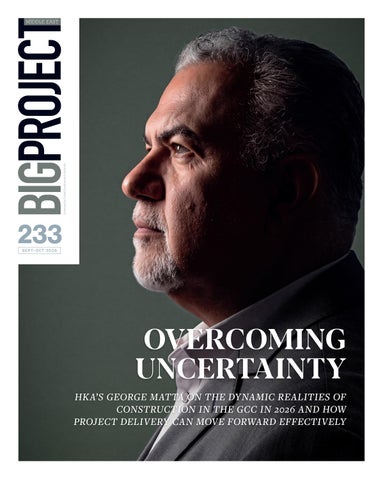
OVERCOMING UNCERTAINTY HKA’S GEORGE MATTA ON THE DYNAMIC REALITIES OF CONSTRUCTION IN THE GCC IN 2026 AND HOW PROJECT DELIVERY CAN MOVE FORWARD EFFECTIVELY
3 ways Volvo excavators help lower your costs.
Optimized engine power. Less fuel consumed. Engine-pump optimization continuolsy adjusts pump flow and pressure to match the load, cutting fuel consumption without compromising performnace.
Faster cycle times. More work done. Electro-hydraulic control and automated boom and bucket movements enable precise digging and shorter cycle times with minimal input.
Longer service intervals. More time on the job. A 1,000-hour engine service interval means 50% less oil and filters, and fewer interruptions on the jobsite.
Explore more
Shaping the UAE Skyline for Over
50 YEARS Engineering Contracting Company (ECC Contracting), part of ECC Group, has been closely intertwined with the UAE's transformation for more than five decades. Established in 1975, ECC Contracting was among the pioneering companies that helped shape the nation's built environment, contributing to Dubais evolving skyline through more than 400 completed projects.
+971 4 3736777
Al Jreena Street, Al Quoz Industrial Area 3
info@ecccontracting.ae
www.ecccontracting.ae
Quality Takes Quality Takes You You Higher Higher
sales.uae@sinoboom.com
1 7 N OV E M B E R 2 02 6 | D U S I T T H A N I © 2026 CPI Trade Media. All rights reserved.
Building the UAE Real Estate Market Opportunities, Challenges, Demands and the Vision of the Leaders
SPONSORS AND PARTNERS
Organisations supporting the summit
Our supporters, exhibitors, media brands and organisers help bring the industry together.
BRONZE PARTNER
BRONZE PARTNER
SUPPORT PARTNER
PRESENTED BY
PRESENTED BY
PRESENTED BY
SUPPORT PARTNER
CONTENT
SPONSORSHIP
MARKETING
Jason Saundalkar
Raz Islam
Phinson Mathew George
Editorial Director +971 4 375 5475 jason.s@cpitrademedia.com
Priyanka Raina
Associate Editor +971 4 375 5475 priyanka.raina@cpitrademedia.com
Managing Director +971 4 375 5471 raz.islam@cpitrademedia.com
Director of Marketing & Media Operations +971 4 375 5476 phinson.george@cpitrademedia.com
SUPPORT PARTNER
Register Now
BigProjectME.com
INTRO / WELCOME
The time to act is now Welcome to a new edition of Big Project Middle East (BPME). By the time you read this, the team and I will be putting the final touches on the agendas for our calendar of highly anticipated summits in Q4. In working on these agendas, a few issues have again emerged as a common thread that stands in the way of industry progression, and project progress: inadequate pre-construction planning, approval bottlenecks, scope creep and late design changes, supply chain and logistics challenges, budget overruns, poor communication, silos within organisations, and other issues. Of those issues, perhaps the most challenging to solve is communication and collaboration. Ineffective communication, whether by accident or deliberate, can lead to misunderstandings, delayed updates, rework, payment issues and more. The reality is until the supply chain comes together and sees every entity and person as a valued partner, all the mandates, technology, modern processes etc will be for nought. And
the time to come together really is now, as it’s crucial for the industry to get more efficient, ensure that all stakeholders earn profits, and make sure projects are as sustainable as possible through their entire lifecycle. With the world now unavoidably on track to breach the 1.5-degrees Celsius global warming limit (as per a recent UN report), anything and everything has to be done to ensure emissions and global temperatures do not keep increasing. This is because every fraction of a degrees above 1.5C increases the frequency, and severity, of extreme weather events, such as intense heatwaves, wildfires, severe floods, and catastrophic ecosystem damage. All of this is already affecting our way of life, so the time to act really is right now.
Jason Saundalkar EDITORIAL DIRECTOR 7
SEPTEMBER-OCTOBER 2026
CONTENTS
14 ANALYSIS 14 The Briefing Eagle Hills and Government of Maldives ink deal for US $12bn waterfront development 24 The Big Picture A wrap-up of the biggest international construction news stories for the month 28 Market Report CBRE sheds light on RAK's economy and reviews the performance of the emirate's real estate sector in H1 2026
34
28
34 In Profile
Overcoming Uncertainty
HKA's George Matta speaks to BPME's Jason Saundalkar about the dynamic realities of construction in the GCC in 2026, regional project pipelines, gaps in the supply chain, and how project delivery can move forward effectively
8
BigProjectME.com
CONTENTS
58
48 In Profile
Cementing the UAE's Future
Mariusz Mlodawski, Country Director at CEMEX UAE speaks to BPME's Jason Saundalkar about the company's operations, evolving customer requirements, its focus on digital transformation, sustainability and safety, the impact of regional geopolitics, and its growth plans
48
INSIGHT 58 In Profile BPME's Priyanka Raina speaks to Naresh Perwani, Founder & Chairman at Neoterra Developments about Elmora, the thinking behind 'Luxury Done Thoughtfully' 72 Comment Before businesses ask what AI can do for their portfolio, they should ask whether their portfolio is ready for AI, says Digital Cooperation Organisation's Suheer Drwesh
76
80 Final Update National Properties begins handover of 399 Hills Park
9
GROUP MANAGING DIRECTOR Raz Islam DIRECTOR OF FINANCE & BUSINESS OPERATIONS Shiyas Kareem
raz.islam@cpitrademedia.com shiyas.kareem@cpitrademedia.com
EDITORIAL EDITORIAL DIRECTOR Jason Saundalkar ASSOCIATE EDITOR Priyanka Raina
jason.s@cpitrademedia.com priyanka.raina@cpitrademedia.com
COMMERCIAL PARTNERSHIPS MANAGING DIRECTOR Raz Islam PARTNER DEVELOPMENT EXECUTIVE Raunak Kamat
raz.islam@cpitrademedia.com raunak.kamat@cpitrademedia.com
STUDIO ART DIRECTOR Simon Cobon
simon.cobon@cpitrademedia.com
GRAPHIC DESIGNER Percival Manalaysay
percival.manalaysay@cpitrademedia.com
PHOTOGRAPHER Maksym Poriechkin
maksym.poriechkin@cpitrademedia.com
MARKETING & OPERATIONS DIRECTOR OF MARKETING & MEDIA OPERATIONS
Phinson Mathew George
phinson.george@cpitrademedia.com
PRODUCTION & IT SPECIALIST Jarris Pedroso
jarris.pedroso@cpitrademedia.com
SOCIAL MEDIA EXECUTIVE Franzil Dias
franzil.dias@cpitrademedia.com
WEB DEVELOPMENT SENIOR DIGITAL MANAGER Abdul Baeis
abdul.baeis@cpitrademedia.com
FOUNDER Dominic De Sousa (1959-2015)
When you have finished with this magazine, please recycle it The publisher of this magazine has made every effort to ensure the content is accurate on the date of publication. The opinions and views expressed in the articles do not necessarily reflect the publisher and editor. The published material, adverts, editorials and all other content are published in good faith. No part of this publication or any part of the contents thereof may be reproduced, stored or transmitted in any form without the permission of the publisher in writing. Publication licensed by Dubai Development Authority to CPI Trade Publishing FZ LLC
CPI Trade Media. PO Box 13700, Dubai, UAE. +971 4 375 5470 cpitrademedia.com
© Copyright 2026. All rights reserved.
10
ISSUE
O CTO B E R 2 0 2 6
133
Focus
AI changing how buildings are managed Design
Designing climateresponsive architecture Market
Licensed by Dubai Development Authority
FO R T H E C O N ST R U CT I O N S P EC I A L I ST
Residential market in Ras Al Khaimah Management
Engineering efficient energy infrastructure
The Data-Driven Construction Shift Licensed by Dubai Development Authority
Compass’ Aljufairi on how technology is changing conventional construction
233 SEPT-OCT 2026
00_Cover.indd 1
OVERCOMING UNCERTAINTY HKA’S GEORGE MATTA ON THE DYNAMIC REALITIES OF CONSTRUCTION IN THE GCC IN 2026 AND HOW PROJECT DELIVERY CAN MOVE FORWARD EFFECTIVELY
ON THE COVER
HKA's George Matta discusses the dynamic realities of construction in the GCC following the outbreak of the conflict between the US, Israel and Iran, and outlines his thoughts on how projects can move forward effectively
22/10/2026 2:25:33 PM
VEHICLES/ TECH / TRANSPORTATION/LOGISTICS
MIDDLE EAST
142/JULY-AUGUST 2O26 LI CENSED BY D U BAI D EVELO PM ENT AU TH O RIT Y
, NEW CONF USED TRUCKS
IDENCE WITH
OV ED FAMCO APPR ned tified pre -ow Famco’s cer et expansion Al-Futtaim ve smart fle dri s ck tru Volvo
CHE RY ENT
VA NEW HI MA RITO RY
ERS PICK-UP
TER
ISSUE 167 2026 -OCTOBER SEPTEMBER
BigProjectME.com @bigproject_me BigProjectMiddleEast bigprojectme
CROSSINGROOVSER T O L A NDC
HITACHI
G GINEERIN -Y EA R ENN TO DELI VER GI AN T’S 75 JA PA NESE MEETS A NEW VISIO GE HERITA AN MACHINES MORE TH
GET THE
WHOLE PICTURE
SEPTEMBER-OCTOBER 2026
ONLINE
POPULAR
FEATURES
CONSTRUCTION
Almal completes superstructure of ‘The Unexpected’ Al Marjan Island
Building the Extraordinary PROPERTY
Burtville debuts Bab Al Qasr Beach Resort Residence 77
CONSTRUCTION
Al Othaim reveals US $4.3bn Saudi real estate investment plans
Innovation as a bridge
INDUSTRY
Oraya Developers to launch first UAE project in Ras Al Khaimah
INFRASTRUCTURE
Etihad Rail, Parkin and Q Mobility to operate smart parking at stations 12
Dust, downtime and delays: The hidden cost of equipment contamination on construction sites
BigProjectME.com
ONLINE
FEATURED NEWS
UPCOMING EVENTS
CONSTRUCTION
Dubai Municipality completes projects worth US $440mn in 2026 These projects, delivered through its Public Facilities Agency, demonstrate the municipality’s commitment to expanding Dubai’s public destinations
NOVEMBER
Real Estate Leaders Summit 17 November 2026 Dubai, United Arab Emirates
PROPERTY
Nakheel unveils Bay Estate, Dubai Islands The residential collection includes garden villas, attached villas and townhouses, offering a range of private island living options
NOVEMBER
Specialist Construction Summit 18 November 2026 Dubai, United Arab Emirates
INFRASTRUCTURE
Submer and ACES ink MoU to increase AI-ready data centre capacity in KSA The 2-partners aim to take customers in the Kingdom from early planning through deployment and long-term operation
NOVEMBER
Women in Construction Connect 25 November 2026 Dubai, United Arab Emirates
INDUSTRY
Dubai CommerCity unveils US $490mn e-commerce infrastructure expansion The expansion comes as demand for office, logistics and retail space for e-commerce and technology companies grows in the UAE
DECEMBER
Middle East Consultant Awards 9 December 2026 Dubai, United Arab Emirates
PROPERTY
BNW Developments launches Sydney office, for Australians to invest in the UAE BNW Developments is set to offer Australian investors stronger yields and international diversification in the UAE
FEBRUARY
Construction Machinery ME Confex 3-4 February 2027 Dubai, United Arab Emirates 13
THE BRIEFING / DEVELOPMENT
SEPTEMBER-OCTOBER 2026
Eagle Hills & Government of Maldives ink deal for US $12bn waterfront development The project aims to bring together international hospitality, premium residences, branded residences, a world-class marina, and much more
14
BigProjectME.com
UAE-based developer Eagle Hills and the Government of Maldives have signed a commercial terms agreement for the development of the Maldives Waterfront and Marina. The project is billed as a major new integrated island destination in the Ras Malé area, and is said to be one of the most ambitious development initiatives in the country’s history. According to a statement by Eagle Hills, the commercial terms
THE BRIEFING / DEVELOPMENT
agreement sets out the shared vision and principal commercial terms of the project, with detailed terms to be developed as the project progresses. With an overall development scale envisioned in the region of US $12bn over its various phases, the project represents a transformational long-term vision for the Maldives, the statement said. Mohamed Alabbar, Chairman of Eagle Hills said, “The Maldives is a
truly special place, with unmatched beauty and global appeal. Our ambition is to build responsibly on that strength and create something truly world-class.”
WORLD CLASS DESTINATION The Maldives is recognised around the world for its natural beauty, hospitality and unique island experience, and has established a unique position in the global hospitality and tourism market.
15
SEPTEMBER-OCTOBER 2026
THE BRIEFING / DEVELOPMENT
TRANSFORMATIONAL PROJECT With an overall development value said to be in the region of US $12bn over its different phases, the project is said to be a transformational long-term vision for the Maldives.
The project is envisioned as a world-class global tourism, waterfront and marina destination, and aims to bring together international hospitality, premium residences, branded residences, a worldclass marina, waterfront leisure, retail, dining, entertainment, wellness, education, healthcare and community facilities within an integrated destination. H.E. Dr. Abdulla Muththalib, Minister of Infrastructure, Housing and Urban Development, Maldives added, “In Eagle Hills and its Chairman, Mohamed Alabbar, the Maldives has a partner whose record speaks for itself — from the making of Downtown 16
Dubai to Belgrade Waterfront and destinations across 3-continents, few names in global real estate carry the same authority in building cityscale destinations from the ground up. That is the calibre of partnership we have secured for Ras Malé.” At its heart will be an internationally significant destination where hotels and resorts, premium residences, branded residences, marina experiences, waterfront promenades, dining, retail, wellness and entertainment come together around the water. Education, healthcare, community infrastructure and high-quality public spaces will complete an integrated environment combining tourism, residential life and year-round economic activity. Properties within the destination will be offered through a long-term leasehold framework under Maldivian law, with terms of up to 99-years. Upon each transfer, whether through sale or inheritance, a new leasehold
term of up to 99-years will commence, providing lasting continuity for owners across generations, it added. Eagle Hills said that the development is expected to broaden the Maldives’ tourism offering, and will create new reasons to visit, stay longer, return and invest, while attracting new international visitor segments and further strengthening the country’s position as one of the world’s most desirable tourism and lifestyle destinations. Responsible development and environmental stewardship will guide the project from planning through delivery. The masterplan will respond carefully to the Maldives’ unique relationship with the ocean and its sensitive island environment, embedding sustainability, resilient infrastructure and protection of the natural setting throughout, the statement explained. The project will be developed on reclaimed land, with no further dredging to be undertaken by Eagle Hills. Independent marine monitoring will accompany construction as the project progresses, helping ensure the development remains sensitive to the waters and natural environment that define the Maldives, it added. The Maldives Waterfront and Marina is projected to establish a major new platform for sustained foreign investment in the Maldives. The expected inflow of international capital will underpin long-term value creation across the Maldivian economy. The wider activity generated by the development is also expected to create significant tax contributions and stimulate growth across hospitality, construction, retail, marine services, technology and other sectors.
Every Take-Off, Planned & Delivered Airports are built in phases. RIB Candy helps align structure, packages and systems so every part of the build is delivered on time, ready for use.
Build with certainty. Build with Candy.
THE BRIEFING / RESTORATION
18
SEPTEMBER-OCTOBER 2026
BigProjectME.com
THE BRIEFING / RESTORATION
ALEC and EAD partner for hydrological mangrove restoration pilot in Abu Dhabi EAD said that it will lead the scientific planning and implementation of the project
An agreement has been signed by ALEC Engineering and Contracting and the Environment Agency – Abu Dhabi (EAD). The agreement will support a first-of-its-kind hydrological mangrove restoration pilot project in Abu Dhabi. According to a statement, the 3-year project will explore whether restoring the natural hydrological conditions of a mangrove area in need of restoration can help the ecosystem return to long-term ecological health. In doing so, the initiative will examine the underlying conditions required to secure the future health and resilience of Abu Dhabi’s mangrove habitats. EAD said that it will lead the scientific planning and implementation of the project, including site selection, ecological and hydrological assessments, identification of the required restoration interventions, and the monitoring and reporting of project outcomes. The pilot will establish baseline information for the selected site
and track progress against defined restoration and biodiversity indicators. Its findings are expected to strengthen scientific understanding of mangrove hydrology in Abu Dhabi, and help inform the planning of future ecosystem restoration initiatives. The project is said to support the science-led restoration objectives of the Abu Dhabi Mangrove Initiative and complements the UAE’s national climate and biodiversity targets. By examining the conditions needed for mangrove habitats to recover and thrive, it will contribute to a broader understanding of how protection, hydrological restoration and long-term monitoring can work together to deliver durable ecological outcomes, the statement explained. Maitha Mohamed Al Hameli, Acting Executive Director, Terrestrial and Marine Biodiversity of the Environment Agency – Abu Dhabi said, “We welcome ALEC’s support for this pilot, which reflects the kind of long-term, science-based commitment 19
SEPTEMBER-OCTOBER 2026
THE BRIEFING / RESTORATION
MAKING A PLEDGE Earlier ALEC signed the Abu Dhabi Mangrove Initiative Partners Pledge, and committed to supporting the conservation and restoration of mangroves and other blue carbon ecosystems.
the Abu Dhabi Mangrove Initiative was established to encourage. The findings will strengthen our understanding of how mangrove sites respond to restored hydrological conditions and will inform how we plan future restoration in the emirate. Through this pilot, we aim to build the scientific evidence needed for long-term solutions that safeguard Abu Dhabi’s mangroves, a defining feature of the emirate’s natural heritage.” Sean McQue, Managing Director – ALEC added, “Abu Dhabi is a capital defined by extraordinary ambition, creating next-generation cultural and visitor experiences, while protecting
20
the natural heritage that gives the emirate its identity. For ALEC, this partnership is an important step in turning our commitment to nature into tangible action. As our first biodiversity restoration investment, the project enables us to contribute directly to the protection and restoration of Abu Dhabi’s mangrove ecosystems, while supporting a science-led approach that will generate measurable biodiversity outcomes. Through this pilot, we are supporting the development of the knowledge, evidence and practical understanding needed to help these vital ecosystems recover and thrive. In doing so, we are proud to support Abu Dhabi’s ambition to protect its natural heritage and contribute to a more resilient future for the emirate.” Earlier this year, ALEC signed the Abu Dhabi Mangrove Initiative Partners Pledge, and committed to supporting the conservation and
restoration of mangroves and other blue carbon ecosystems, advance science-based restoration, and reduce its impact on nature, the firm said. This partnership marks ALEC’s first flagship nature restoration investment with measurable biodiversity outcomes and forms part of ALEC’s broader commitment to integrating biodiversity considerations into its sustainability strategy and contributing to nature-positive outcomes in the regions where it operates, it added. As a company whose activities interact with land, water and ecosystems, ALEC said that it recognises the importance of supporting the protection and enhancement of natural habitats. Through this partnership, ALEC will support the collection of ecological baseline data, monitoring of biodiversity indicators and conservation of a priority coastal ecosystem.
THE BRIEFING / PROPERTY
SEPTEMBER-OCTOBER 2026
Arada expands into Saudi Arabia with launch of Arada KSA The master developer said that the expansion is supported by a 10m sqm land bank worth US $13.34bn spread across the Kingdom
22
BigProjectME.com
Master Developer Arada has launched Arada KSA, which is said to be a new real estate development company that will be responsible for delivering large-scale communities across the Kingdom of Saudi Arabia. According to a statement from the developer, the new entity has been founded in strategic partnership with XTOPIA, a community and lifestyle company developing integrated mixeduse destinations across the region. Mohammed AlDhabaan, Chairman of XTOPIA, has been appointed Chairman of Arada KSA, reflecting the significance of the local partnership at the heart of the new company's foundation. Arada KSA is said to have access to a significant 10m sqm land bank across Saudi Arabia with a collective value of US $13.34bn, spanning key strategic locations including Riyadh, Jeddah and Makkah. AlDhabaan commented, “The establishment of Arada KSA marks a significant step forward for the development of world-class communities in the Kingdom. Our land bank, which features key strategic locations across the Kingdom, positions Arada KSA as a platform with genuine national scale and reach. Saudi Arabia’s residential market has never offered more compelling long-term fundamentals, and the combination of Arada’s global track record in community building with XTOPIA’s deep local expertise creates a platform with real longterm potential for the Kingdom.” The entry into Saudi Arabia is said to be the latest step in Arada's global expansion. The company now has a project pipeline valued at $50bn across 5-markets, with a portfolio of more than 70,000 homes spanning
THE BRIEFING / PROPERTY
PROJECT PIPELINE The company now has a project pipeline valued at $50bn across 5-markets, with a portfolio of more than 70,000 homes across multiple markets.
the United Kingdom, Syria, Australia, the UAE and, now, the Kingdom of Saudi Arabia. In total, Arada has completed 17,000 homes to date. Arada KSA’s first project is an $3.8bn residential master plan in the Al Rimal District of northeastern Riyadh. The project is said to be one of the largest private real estate projects to be announced in the Saudi capital in recent years. Working in close partnership with the relevant government
authorities, Arada KSA will develop a master plan for the site that is fully aligned with Saudi Arabia's housing vision and national development priorities, the statement noted. The development will be delivered on a plot of approximately 2.5m sqm and is expected to feature an estimated 3,500 villas and townhouses surrounded by 100,000 trees, with world-class amenities including a school, retail, a community centre and sporting facilities. The Al Rimal project will be funded through a Capital Market Authorityregulated investment structure managed by a licensed financial company. Onsite construction and sales of the project are both scheduled to commence in 2027, the firm said. 23
SEPTEMBER-OCTOBER 2026
THE BRIEFING / GLOBAL EYE
01 SYRIA
Arada and Syrian Soverign Fund form JV to develop New Damascus Arada has announced its entry into Syria through a JV with the state-owned Syrian Sovereign Fund. The first project will be the development of a major new fully integrated city on a 4m sqm site west of Damascus. With an estimated Gross Development Value (GDV) of US $7bn, the development will be in an area known as New Damascus, near the Mezzeh district, on a plateau approximately 10 minutes from Damascus city centre and 25 minutes from Damascus International Airport.
01 UNITED 02 KUWAIT KINGDOM
03 BAHRAIN
VA Tech Wabag inks desalination plant deal in Kuwait
Parkin and Amakin ink partnership
VA Tech Wabag has secured the design, build, operate (DBO) contract for the Doha SWRO Desalination Plant with Recarbonation System – Stage II in Kuwait. The project comprises the design, engineering, procurement, construction and commissioning of a 60 MIGD SWRO Desalination Plant, with a state-ofthe-art Recarbonation System, and is scheduled to be completed over a period of 36-months. The contract includes a 5-year O&M period to ensure long-term reliability and operational excellence.
24
Parkin Company has signed an agreement with Bahrain Car Parks Company (Amakin) to establish a framework for collaboration across parking technologies, digital mobility services and regional business development. The MoU establishes a framework for the companies to leverage their respective technology, operational and market capabilities to advance regional customer experience, improve operational efficiency and support the development of smarter parking and mobility services across the GCC.
BigProjectME.com
THE BRIEFING / GLOBAL EYE
05 OMAN
OPAZ awards contract to develop Duqm’s Fisheries Industries Zone Oman’s Public Authority for Special Economic Zones and Free Zones (OPAZ) has awarded a contract to construct roads and supporting infrastructure at the Fisheries Industries Zone in Duqm. The project includes an internal road network spanning 8.7km. Additionally, it will see the installation of 2-roundabouts, traffic signals, and road markings, along with sewerage and potable water networks, irrigation channels, electricity networks, street lighting, and telecommunications infrastructure.
01
02 03 06
04 05
04 QATAR
06 SAUDI ARABIA
Ashghal unveils US $114mn roads and infrastructure projects
Sepco wins Saudi BESS contract
Qatar’s Public Works Authority (Ashghal) has begun construction of the second phase of a roads and infrastructure project in Izghawa and Al Thumaid, with an estimated investment of US $114.8mn. It will deliver road networks and essential infrastructure for 771 plots, serving residential developments alongside schools, commercial centres, mosques and other public facilities. Ashghal said construction will be undertaken sequentially across 3 geographical zones to minimise disruptions.
The Saudi Arabia Group 1-KSB Independent Battery Energy Storage System (BESS) project has been secured by Shandong Electric Power Construction Corporation (Sepco). The project is said to form part of the Kingdom’s first wave of large-scale battery energy storage projects. The Al Khushaybi BESS project has a planned capacity of 500MW/2,000MWh. It supports Saudi Arabia’s energy transition ambitions, particularly the development of energy storage infrastructure to complement its expanding renewable energy capacity.
25
PALM STRAND BOARD (PSB®)
Sustainable. Versatile. High-Performance.
100%
ZERO
1,430 kg
Up to 90 minutes
Up to 55 dB
Sustainable
Formaldehyde Emissions
of biogenic carbonsequestered by each m3 of PSB®
Fire Rated
Sound Insulation
Versatile Applications Across Industries
Modular Prefabricated Structures
Interior Fit-Out & Joinery
Flooring Systems
Fire & Non-Fire Rated Doors
Exhibition & Temporary Structures
GLOBALLY & LOCALLY CERTIFIED FOR QUALITY, PERFORMANCE, AND SUSTAINABILITY
ADDRESS
PHONE & FAX
ONLINE
Al Talah Board Manufacturing Company Ltd. KEZAD, Abu Dhabi, UAE
Tel.: Fax:
Email: Website:
+971 2 246 7042 +971 2 671 7933
info@desertboard.ae www.desertboard.ae
MARKET REPORT / RAS AL KHAIMAH
28
SEPTEMBER-OCTOBER 2026
BigProjectME.com
MARKET REPORT / RAS AL KHAIMAH
H1 2026 RAK Real Estate Review CBRE sheds light on Ras Al Khaimah’s economy and reviews the performance of one of the emirate’s strongest growth stories – residential real estate
In response to evolving regional geopolitical conditions, the UAE has accelerated a coordinated set of economic support measures and structural reforms aimed at reinforcing resilience, sustaining capital inflows, and safeguarding trade continuity, providing a supportive backdrop for RAK’s growth. Inflation remains contained at 1.3% in 2025 and is forecast to rise to 2.9% in 2026, while business activity remains in expansionary territory, with the PMI bouncing to 55.3 in August from 52.7 in July and 50.8 in June. Since March 2026, the UAE has implemented targeted measures to support foreign direct investment (FDI) and maintain trade continuity, including liquidity support, business relief initiatives such as loan restructuring and fee deferrals, and enhanced customs facilitation. The CEPA program has also expanded rapidly to 37 agreements globally (as of mid-2026), with 18 now in force, up from six in early 2025. These efforts have coincided with record non-oil trade of US
$525bn in H1 2026, a 13.1% increase year-on-year. Complementing these measures are alternative logistics corridors, including Saudi land routes and East Coast ports, alongside Dubai’s $680.6mn stimulus package to improve business liquidity and support SMEs and the wider private sector, reinforcing the UAE’s position as a resilient hub for trade and investment. At the emirate level, RAK is aligning closely with these initiatives through enhanced investor incentives and industrial expansion. RAKEZ now supports over 40,000 companies and continues to expand its investor ecosystem through simplified licensing, digitalized services, and targeted partnerships signed in 2026 to attract international businesses and strengthen industrial competitiveness, alongside active participation in national initiatives such as ‘Make it in the Emirates’. These efforts are strengthening RAK’s positioning as a competitive manufacturing and trade hub, wellplaced to capture incremental FDI. 29
MARKET REPORT / RAS AL KHAIMAH
SEPTEMBER-OCTOBER 2026
RAS AL KHAIMAH, CPI MAIN INDEX 110
100
90
80
70
2010
2012
RAK macroeconomic overview
In H1 2026, RAK demonstrated continued fiscal resilience while navigating increased regional headwinds. Highlighting this underlying strength, S&P Global reaffirmed the emirate's ‘A/A-1’ rating with a stable outlook in Mar-26, while Fitch affirmed its 'A+' rating in Apr-26 but placed it on 'Rating Watch Negative' (RWN), citing the potential medium-term economic impact of the prolonged regional conflict. Both agencies pointed to a robust net asset position, expected to average 23% of GDP in the coming years.
2014
2016
2018
2020
S&P Global also revised its 2026 GDP growth forecast for RAK down to 2.0% (from 3.6% previously) due to regional geopolitical risks, though it maintained its 'Stable' outlook, reflecting confidence in the emirate's fiscal buffers, low debt levels, and continued financial support from the UAE federation. Despite these external pressures, the emirate's economic fundamentals remain anchored by the anticipated delivery of highimpact projects, most notably the Wynn Al Marjan Island integrated resort. Wynn Resorts confirmed in
2022
2024
2026
August 2026 that the $5.1bn project opening date is September 2027. RAK's business activity remained robust through H1 2026, with the RAK Chamber of Commerce & Industry reporting $210.1mn in new investment capital across 967 newly registered establishments, drawing 1,399 new investors from 68 nationalities and an expected 2,449 jobs, alongside 9,963 license renewals, 138 new free zone establishments, and 70 new branches of local and foreign firms. Inflation trended remarkably higher through H1 2026, with RAK’s CPI reaching 105.5 in June–
RAS AL KHAIMAH, GDP GROWTH RATES (%), GDP PER CAPITA (US$ THOUSANDS) GDP PER CAPITA (US$ THOUSANDS)
REAL GDP GROWTH
30
20
10
0
-10
30
2020
2021
2022
2023
2024
2025
2026
2027
2028
2029
SOURCE: CBRE RESEARCH, RAK STATISTICS CENTRE, S&P GLOBAL, OXFORD ECONOMICS, MACROBOND, REIDIN
2008
BigProjectME.com
MARKET REPORT / RAS AL KHAIMAH
RAS AL KHAIMAH RESIDENTIAL PRICE INDEX, Q2 2026 250
200 WYNN RESORT ANNOUNCEMENT 150
100
50
2014
2015
2016
2017
a 5.5% year-on-year increase. This upward price pressure was primarily driven by growth in the Transport and Recreation, Sport & Culture, Education expenditures. RAK residential overview
The residential market sustained strong momentum through June 2026, with apartment prices reaching $625.7 per sqft, up 18% y-o-y. On a quarterly basis, prices eased 1.9%, reflecting a period of stabilisation following the high-value launches in late 2025. At a community level, Al Marjan Island led annual growth, with
2018
2019
2020
2021
apartment prices up 23.1% yearon-year, though softening 2.4% quarter-on-quarter. Al Hamra recorded a more moderate 14.7% year-on-year increase, with a sharper quarterly decline of 12.3%. The first half of 2026 was notably defined by record-breaking milestones. The Sky Palace at Waldorf Astoria Residences sold for a $35.4mn, the highest-value residential transaction in the emirate's history, followed by the project's penthouse for $15mn. At Mondrian Al Marjan Island Beach Residences, a Sky Mansion was sold for $10.5mn in January, followed
2022
2023
2024
2025
2026
by a further $34.7mn transaction in May, underscoring sustained demand for trophy properties. Similarly, the villa segment showed consistent momentum, as average prices rose to $348.2 per sqft, a modest 0.5% quarterly decline, and a 7.3% annual gain, bolstered by a 10.5% year-on-year price jump in Al Hamra district. Looking at ready stocks, apartment prices have reached $284.3 per sqft, whilst ready villas have reached $340 per sqft, marking a 11% and 10% increase respectively as compared to Q2 2025.
RAS AL KHAIMAH RESIDENTIAL RENTAL INDEX, Q2 2026 VILLAS
APARTMENTS
2023
2024
80
60
40
20
2021
2022
2025
2026
31
MARKET REPORT / RAS AL KHAIMAH
SEPTEMBER-OCTOBER 2026
RAS AL KHAIMAH NEW SUPPLY BREAKDOWN, BY PRODUCT TYPE (2026-2030) APARTMENTS
BRANDED RESIDENCES
TOWNHOUSES
VILLAS
100
80
60
40
20
2026
The rental sector remains on a strong upward trajectory, with Mina Al Arab continuing to outperform the broader apartment market via a substantial 10.6% year-on-year increase. This was complemented by steady growth in Al Marjan Island, which saw a 3.2% rise. Together, they drove the total rental market to a robust 14.3% annual growth rate, though quarterly performance saw a significant moderation of 6.8%. Villa rental performance was more fragmented, where Al Hamra recorded strong annual and quarterly gains of 8.7% and 5.3%, respectively.
2027
2028
2029
While Mina Al Arab moderated, softening by 0.6% year-on-year and 6.9% quarter-on-quarter. The first 2-months of the year ushered in a wave of transformative, multi-billion-dirham real estate announcements across the emirate. At Marjan Beach, RAK Properties announced The Strand masterplan and its Lunara towers, while developer Beyond Developments unveiled the $6.81bn Evermore alongside its first phase, Le Chateau. Additionally, Aark Developers officially launched the Karl Lagerfeld Beach Residences on Al Marjan Island.
2030
Despite the positive performance, growth moderation has started to be evident in quarterly performance and is further anticipated over the coming quarters. Heightened geopolitical tensions are expected to weigh on investor sentiment, curbing transactional activity and price appreciation. While core fundamentals remain strong, the market is likely to enter a phase of gradual normalisation following a long period of outsized growth. RAK’s residential market predominantly comprises apartments, accounting for 63% of the total
RAS AL KHAIMAH NEW SUPPLY BREAKDOWN, BY GEOGRAPHY (2026-2030) AL HAMRA
AL WADI DESERT
MARJAN ISLAND
MARJAN BEACH
MINA AL ARAB
2026
2027
2028
2029
RAK CITY
100
80
60
40
20
32
2030
RAK CENTRAL
BigProjectME.com
MARKET REPORT / RAS AL KHAIMAH
-1.5%
55.3%
28.6%
Y-o-Y forecast decrease in GDP in 2026
UAE PMI August 26 reading, from 52.7 in July 26
Y-o-Y decrease in RAK RevPAR (YTD June 26)
32.1PP
14.3%
18.0%
Y-o-Y decrease in RAK hotel occupancy (YTD June 26)
Y-o-Y increase in RAK average apartment rents
Y-o-Y increase in RAK apartments sales values
freehold stock and an estimated 62% of new units scheduled for delivery between 2026-2030. That said, the yearly share swings widely from 98% in 2027 down to 50% in 2028–2029, before jumping again to 71% in 2030. That dip coincides with the rise of branded residence completions, which account for 22% of the total delivered inventory (~10,000 units). This will help transform the market, with the composition shifting from a more negligible presence during 2026 and 2027 to roughly half of all newly completed stock during 2028 and 2029, before settling around
30% in 2030. Villas, by contrast, will become inconsequential for the pipeline post 2026, when they made up about 40% of expected supply, whilst townhouses remain a marginal product throughout the period. Post 2030 villas are likely to see growth return as development focus likely shifts again towards more suburban developments. While Marjan Island remains the dominant contributor with a 64% share of the new stock, limited project availability is shifting momentum toward emerging master plans in the emirate. New communities like
Marjan Beach and RAK Central, along with Mira Coral Bay, the new master development in Al Mairid (RAK City), will capture more pipeline share during 2029 and 2030. Following the modest 320 units delivered in H1 2026 and roughly 1,500 expected in H2 2026, the market is set for a dramatic acceleration as completions rise to 4,300 units in 2027 alone, then surge past 24,000 units cumulatively across 2028–2030, an annual average of roughly 8,000 units - albeit with further impacts on delivery timelines likely given the current regional backdrop.
UNITED ARAB EMIRATES GROSS DOMESTIC PRODUCT, Y-O-Y % CHANGE 8
6
4
2
0
-2
2025
2026
2027
2028
33
IN PROFILE / HKA
34
SEPTEMBER-OCTOBER 2026
IN PROFILE / HKA
OVERCOMING UNCERTAINTY HKA’S GEORGE MATTA SPEAKS TO BIG PROJECT ME’S JASON SAUNDALKAR ABOUT THE DYNAMIC REALITIES OF CONSTRUCTION IN THE GCC IN 2026, REGIONAL PROJECT PIPELINES, GAPS IN THE SUPPLY CHAIN AND HOW PROJECT DELIVERY CAN MOVE FORWARD EFFECTIVELY
35
IN PROFILE / HKA
Prior to February 2026, the construction market across GCC countries, particularly key markets such as the UAE and Saudi Arabia, had been developing at pace, driven by several influences, including short- and longterm national agendas. According to data from MEED, monthly contract awards across GCC countries averaged US $32bn right up to February of this year, following which a pronounced decline was observed, as a result of the conflict between Israel, the United States and Iran.
GLOBAL EXPERT George Matta is a Partner at HKA.
36
SEPTEMBER-OCTOBER 2026
Following the start of the conflict and ensuing disruptions, including the closure of the Strait of Hormuz, MEED data reported that contract awards fell from $26bn in February to $11.8bn in March, while the number of contracts signed also dropped from 80 to 25. In Q2 2026 however, a Kamco report revealed that the Kingdom awarded $30bn worth of projects, up 160% from Q1 and 54% higher compared to 2025. The report noted that Saudi Arabia was the only GCC country to record growth in project awards on both a quarterly and annual basis, thus enabling the Kingdom to maintain its status as the region’s busiest construction project market. With regards to the UAE, the Kamco report revealed that Q2 awards totalled $20.5bn, down 5.4% year-onyear and 56.6% quarter-on-quarter. That said, during Q2, a separate report by AGBI revealed that deliveries in Dubai were progressing, with 27,000 homes handed over – a figure that is said to be the highest quarterly volume in 5-years. Since the outbreak of the regional conflict and disruptions to trade, the construction supply chain has had to grapple with a number of issues, with the most pronounced being cost escalation. Insurance broker Lockton said that in March war-risk premiums for Hormuz transits had risen between 3% to 5% of vessel value, while a Moody’s Ratings report said that imported building material costs were up 2025% benchmarked against pre-conflict levels. The report noted that cost increases were being largely absorbed by contractors rather than developers; it also said that contractors had been able to build up stronger margins during the recent property cycle. Several months on from the beginning of the conflict, the construction segment remains under pressure, however activity and investment is continuing, confirms George Matta, Partner at HKA. Matta has significant regional and international construction, claims and dispute resolution experience.
BigProjectME.com
IN PROFILE / HKA
Still a vibrant construction market?
Sharing his views on the current market, he comments, “The latest published figures are positive and show strong growth over the coming period. Saudi Arabia still has a pipeline of around $1.3tn, while the UAE stands at approximately $772bn. Cumulatively that is a pipeline of over $2tn, which really positions the Gulf region as one of the most significant construction markets in the world.” “I don’t foresee this changing in the next 6-months or beyond. We know that there have been shifts. In KSA for example, there has been a reprioritisation of focus and there have been phasing adjustments, but the scale of the opportunity remains significant, with plenty of work to be done in Qiddiya City, Dirriyah City, Sports Boulevard, the Red Sea, Jeddah Central, and multiple infrastructure
LIGHT RAIL PROJECT The Dubai Metro Blue Line will span 30km and feature 9-elevated stations and 5 underground stations, including 3-transfer/interchange stations and 1-iconic station. To support the development of the line, the RTA has redeployed the 2,000t Al Wugeisha tunnel boring machine.
projects including transportation, water, and energy. The emphasis in recent times has been on deliverability and there are no signs of slowing down or diminishing scope.” He continues, “In the UAE as well, we see significant movement in infrastructure, including the proposed Dubai Metro Gold Line, the ongoing works on the AED20bn (approximately US$5.6bn) Dubai Metro Blue line, as well as ongoing investments into road infrastructure, power 37
IN PROFILE / HKA
SEPTEMBER-OCTOBER 2026
C
M
Y
CM
MY
CY
CMY
K
What we are seeing now is the programme, productivity and commercial consequences of sustained uncertainty. and renewable energy systems, desalination plants, aviation infrastructure, data centres and more. So, while we may see some fluctuations in the market due to regional geopolitics, the strategic drivers and ambition in the key construction markets of Saudi Arabia and the UAE remain intact. These are not short-term projects but rather long-term economic transformation programmes.” Shedding light on the impact the regional conflict has had on the construction industry, Matta explains, “Since the conflict began earlier this year, we’ve seen
DUBAI METRO EXPANSION The Blue Line was approved by His Highness Sheikh Mohammed bin Rashid Al Maktoum, Vice President and Prime Minister of the UAE and Ruler of Dubai on 24 November 2023, with a total investment of US $5.6bn.
38
impact across procurement and logistics, contractors have experienced longer shipping times, increased freight cost, higher insurance premium and overall uncertainty. There’s also reduced reliability within the established supply chain, and we know that with many projects, there were concerns about the availability of critical equipment, specialist materials, and long-lead items that are usually sourced from international markets.” “That said, since those early days, the industry has demonstrated a remarkable ability to adapt. We’ve seen contractors, suppliers and project owners implement diverse sourcing strategies, and look to identify alternative shipping routes, increase inventory buffers and procure long lead items earlier. There’s also been a significant focus on enhancing supply chain monitoring, and the result is many of the immediate logistics challenges
IN PROFILE / HKA
are now better understood and to some extent, more manageable than they were at the outset,” he states. “Following the initial disruption to operations, longer term consequences are becoming more visible. We’ve seen that there are still some disruptions on
STEADY PROGRESS In June 2026, the Dubai Government said the Al Maktoum International Airport development project had achieved significant milestones across key delivery streams, including enabling works, runway infrastructure, and the initial structural foundations for passenger terminals and gates.
40
SEPTEMBER-OCTOBER 2026
site when contractors were trying to mitigate risks and were prioritising works on different areas of a project. What has arguably become more challenging is the impact on project delivery itself because this is where we’re seeing some re-sequencing of work where contractors are trying to mitigate risks. But even then, there is some impact in terms of productivity loss, as there are instances where specialist resources are required to mobilise and demobilise repeatedly, creating inefficiencies and productivity losses.,” he notes. That said, Matta tells Big Project ME’s Jason Sandalkar that the industry has largely adapted to
BigProjectME.com
the immediate logistics shock. Here, he says that the bigger challenge is actually managing the cumulative effect of disruption on programmes. “What we are seeing now is the programme, productivity and commercial consequences of sustained uncertainty.” Following the outbreak of the regional conflict, some public and private sector organisations have actually accelerated project delivery, and announced all-new large-scale projects. Asked for his thoughts on this, Matta cautions that acceleration is often viewed as an obvious response to uncertainty, and warns that unless projects are planned and managed well, new project
IN PROFILE / HKA
launches and project acceleration can be the fastest way to create cost overruns, productivity loss and disputes. “Acceleration should be driven by a clear understanding of the project. On many projects, particularly large infrastructure schemes and complex giga projects, adding labour or more shifts does not automatically result in faster delivery. In some cases, it can actually reduce productivity as it can increase congestion, create interface challenges, and put pressure on supervision, coordination and quality control,” he warns. “The most successful projects that achieved acceleration without significant cost consequences have focussed on improving project fundamentals before the introduction of physical acceleration. So, for example, it starts with ensuring sufficient design maturity. That's fundamental because a lot of projects attempt to accelerate construction before the design has been finished. Based on my experience over the last 3-years in the Middle East, incomplete or evolving design remains one of the leading causes of delay and disruption because it results in increased work and rework on site. So rather than focus on physical acceleration, it’s important to have sufficient design maturity because it can significantly support a project’s delivery.” Matta notes that there are other ways to positively support a project’s delivery, including early procurement of long lead items, which makes increases in site resources unnecessary. “When critical equipment, materials, or other project inputs are unavailable, delays inevitably arise and then the natural response might be to increase site resources in order to increase overall project performance. Ultimately, successful acceleration is achieved through
Project owners and developers need to recognise that prolonged pressure on contractors to absorb unforeseen cost increases can ultimately affect project delivery as much as contractor performance. 41
IN PROFILE / HKA
ROBUST PROJECT PIPELINE Saudi Arabia’s construction pipeline is said to be in the realm of US $1.3tn, and is still being driven primarily by Saudi Vision 2030, several urban initiatives and international events.
better planning, earlier decision-making, and smart execution, not just ramping up site resources.” From logistics to resilience
Discussing what the future might look like for industry players and whether disruptions could worsen and cause a slowdown in the construction segment, Matta remains optimistic. He reckons that even if 42
SEPTEMBER-OCTOBER 2026
regional geopolitics persist beyond 2026, the industry will move forward and switch gears from managing disruptions to managing prolonged uncertainty. “Compared to the start of the region’s geopolitical challenges, there is more knowledge and resilience on projects, and greater awareness about how to manage the ongoing situation properly. The companies that will be the most successful going forward are those that focus more on resilience rather than on predictions. In practical terms that means diversification of procurement and the supply network, identifying long-lead items earlier in the project lifecycle, strengthening project control and programme management, investing in supply chain visibility, maintaining robust contemporaneous
BigProjectME.com
project reports and records, and developing proactive claims and contract management processes.” He continues, “Ultimately, I do not believe the regional construction market will slow significantly as a result of geopolitical uncertainty. The fundamental drivers behind investment in both the UAE and Saudi Arabia remain strong, whether it’s because of economic diversification ambitions, population growth, energy transition or vision programmes. So, while the first phase of the crisis was about logistics, the next phase will be about resilience. The companies that succeed will be those that adapt quickly, while maintaining certainty in project delivery.” Industry reports seem to suggest that, generally speaking, contractors have had to absorb cost escalations over the last several months. Asked for his thoughts on this and how risks can be addressed better, Matta notes that cooperation is critical between contractors and clients. “Project owners and developers need to recognise that prolonged pressure on contractors to absorb unforeseen cost increases can ultimately affect project delivery as much as contractor performance. The most successful projects are typically those where owners and contractors work collaboratively to address emerging risks and changing market conditions. Where external events create genuine cost pressures, parties should engage openly and seek practical and commercially sustainable solutions rather than allowing positions to become entrenched. In the current environment, the focus should not be on whether owners or contractors absorb all of the risk, but on how those risks can be managed and allocated in a way that protects project outcomes. A healthy and resilient supply chain is in the interest of all stakeholders. Contractors need commercially sustainable outcomes to continue investing in resources, capability and project delivery, while owners benefit from greater delivery certainty, reduced disruption
IN PROFILE / HKA
and a lower risk of claims and disputes. Ultimately, when projects are delivered successfully, both the owner and the contractor benefit,” he confirms. Asked about who should be driving awareness of the need for collaboration and compromise between parties in the construction supply chain, Matta responds, “I think it should be led by the government and mirrored by private clients/developers. Just as the government has shown
DESIGN CHALLENGES Matta states that design-issues continue to be a major point of contention for contractors, and notes issues are amplified in cases where a project is fast tracked or accelerated in any way.
43
SEPTEMBER-OCTOBER 2026
IN PROFILE / HKA
commitment to maintaining infrastructure investment during this period of uncertainty, clients/developers should demonstrate the same commitment through collaborative project delivery and proactive engagement with their supply chains. In this climate, it’s important to show commitment but equally, to demonstrate understanding and flexibility with critical partners because ultimately those decisions will impact project delivery.” “The government can also further support the construction supply chain when it comes to projects by addressing the usual causes for delays by accelerating the approvals of permits, improving the movement of critical materials and so on. Governments don’t necessarily need to shift all the risks but they can create an environment where those risks are understood, managed and allocated to the organisations that can deal with them most effectively.” Asked about the most common, as well as the biggest challenges that contractors typically face on projects, Matta says that outside of challenges caused by ongoing regional geopolitics, design related issues can seriously complicate project delivery. “Over the last several years, much of my work has focused on major disputes and arbitration proceedings, and design-issues continue to be a major point of contention for contractors. It is amplified in cases where a project is fast tracked or accelerated in any way. Typical issues can range from incomplete design to design changes/variations after construction has begun, and even late approvals on certain drawings. The geopolitical conflict has certainly added some complexity to project delivery but design-related challenges have been an issue for contractors for a long-time, and are likely to be a problem in the future unless a concerted effort is made to change,” Matta remarks. “HKA's latest CRUX Insight report continues to identify incomplete or late design information among 44
the most significant causes of project distress, delay and dispute across the Middle East,” he highlights. A need for more contractors?
Looking to 2030 and beyond, the construction pipeline across the GCC remains healthy, with a report by Strategy& indicating that the pipeline of infrastructure and industrial expansion offers a golden opportunity for the region’s next decade. As new opportunities
CAPACITY CONSTRAINTS There is growing pressure on contractor capacity across parts of the GCC given the scale of the current and future project pipeline, Matta warns.
BigProjectME.com
and projects come to light alongside projects that are already underway, one part of the construction supply chain in particular could face significant challenges. In the last 25 years, global and regional events have put pressure on contractors. Major challenges first began due to the 2008 Global Financial Crisis, which saw many Tier 1 and Tier 2 contractors exit the GCC market, with those that remained facing lower profit margins for many years. The oil price slump between 2014-2016 followed by the outbreak of the COVID-19 in 2020, put additional pressure on contractors, with some collapsing following years of dealing with unsustainable debt and a lack of liquidity. Today, at the time of going to press, the lack of contractors across the GCC remains a cause for
IN PROFILE / HKA
Saudi Arabia still has a pipeline of around $1.3tn, while the UAE stands at approximately $772bn. Cumulatively that is a pipeline of over $2tn. concern, when you take into consideration the sheer number of construction projects that are already underway, and the potential pipeline to come. Speaking about the state of the regional contractor market, Matta outlines, “There is growing pressure on contractor capacity across parts of the GCC given the scale of the current and future project pipeline. As activity continues to increase, attracting and retaining capable international contractors will be important to maintaining delivery momentum and market competitiveness.” “The greater challenge is not necessarily attracting contractors to a single opportunity, but encouraging long-term participation across multiple programmes and projects. In that respect, governments and project owners can play an important role by creating commercial environments that encourage investment, support delivery certainty, and promote balanced risk allocation. Markets are generally most attractive when risk is allocated to the parties best placed to manage it, and when there is confidence in the long-term sustainability of project delivery,” Matta remarks. Making his closing statements, he says it’s vital that entities within the construction supply chain cooperate more effectively and actively support each other on projects when it comes to spreading risk. “The industry has to work together to create sustainable outcomes for all stakeholders. Projects are complex and external factors continue to evolve. While not every risk can be avoided, owners, contractors, consultants and suppliers can work more collaboratively to improve project outcomes and strengthen supply chain resilience. This is an opportunity for both the public and private sectors to work together, ensuring the industry remains resilient and well positioned to deliver on the significant opportunities that the region continues to offer,” he concludes. 45
IN PROFILE / CEMEX UAE
48
SEPTEMBER-OCTOBER 2026
IN PROFILE / CEMEX UAE
CEMENTING THE UAE’S FUTURE MARIUSZ MLODAWSKI, COUNTRY DIRECTOR AT CEMEX UAE SPEAKS TO BPME’S JASON SAUNDALKAR ABOUT THE COMPANY’S OPERATIONS, EVOLVING CUSTOMER REQUIREMENTS, ITS FOCUS ON DIGITAL TRANSFORMATION, SUSTAINABILITY AND SAFETY, THE IMPACT OF REGIONAL GEOPOLITICS, AND ITS GROWTH PLANS
49
IN PROFILE / CEMEX UAE
SEPTEMBER-OCTOBER 2026
IN COUNTRY Mariusz Mlodawski is Country Director at CEMEX UAE.
Hodiryat Bridge, DEWA and ADEWA, the Kingdom of Saudi Arabia Pavilion for Expo 2020, the Dubai Hills Mall, Burj Royale Downtown Dubai, the Leader Sports Mall, FIVE luxury apartments at Jumeirah Beach Residence, Ferrari World at Yas Island, the Emirates Palace Hotel in Abu Dhabi, SeaWorld at Yas Island, in addition to numerous mixed-use towers, including the UAE's tallest industrial tower, as well as hundreds of private villas. Here, Big Project Middle East’s Jason Saundalkar talks to Mariusz Mlodawski, Country Director at CEMEX UAE about the company’s operations, evolving customer requirements, its focus on digital transformation, sustainability and safety, the impact of regional geopolitics, and its growth plans. Share an overview of your business performance in 2025-2026 and discuss influences that shaped your business in this period.
Cemex is a global construction materials and solutions company that now has over 19-years of experience in the UAE. The company’s footprint in the country is extensive and its vertical integration has enabled it to supply key cities with innovative sustainable concrete and low-carbon cement, thus supporting national agenda projects and objectives. The company offers a range of solutions including cement, ready-mix concrete and admixtures. In fact, its high-quality and durable concrete can be found in projects including: the Burj Al Arab, Dubai International Airport, a number of projects overseen by the Roads and Transport Authority, the gold-rated LEED-certified Mirdif City Center, 50
2025 and 2026 have been strong years for Cemex in the UAE. We delivered solid operational and financial performance despite volatility in global supply chains and raw material markets. Demand remained resilient, supported by strong population growth, real estate activity, industrial development, logistics investments, and the acceleration of landmark infrastructure projects across the UAE. We also made significant progress in sustainability, increasing the adoption of our lowcarbon Vertua concrete portfolio and further reducing the carbon intensity of our products. What has been particularly encouraging is the quality of growth. Customers increasingly value not only reliable supply, but also technical expertise, digital integration, sustainability credentials, and execution capability on complex projects. Those strengths align well with Cemex’s value proposition.
MEConstructionNews.com
IN PROFILE / CEMEX UAE
What do you anticipate in 2027 in terms of demand?
Talk us through Cemex’s approach to building
We remain cautiously optimistic about 2027. The UAE continues to benefit from strong economic fundamentals, a growing population, government investment, and a robust project pipeline. Demand is being driven by major infrastructure developments, transportation projects, aviation expansion, logistics facilities, energy investments, data centres and high-end real estate developments. Projects such as the expansion of the Al Maktoum International Airport, transportation infrastructure, large mixed-use developments, and urban transformation initiatives are expected to continue generating significant demand for cement and ready-mix concrete. At the same time, we believe growth will increasingly favour suppliers capable of delivering lower-carbon solutions, digital integration, operational reliability, and superior technical support. The market is evolving from a pure-volume environment to a value-driven environment.
a sustainable business in the UAE.
Sustainability is embedded in our business strategy rather than being treated as a separate initiative. Our approach is guided by Cemex's global ‘Future in Action’ program, which aims to achieve Net Zero CO2 emissions by 2050, while also creating value for our customers, communities, employees, and shareholders. In the UAE, our sustainability strategy is built around 3-priorities: • Smart Decarbonisation • Improving operational efficiency and resource utilisation
A LOW CARBON FUTURE The company believes that the market will increasingly favour suppliers capable of delivering lower-carbon solutions, digital integration, operational reliability, and superior technical support.
51
SEPTEMBER-OCTOBER 2026
IN PROFILE / CEMEX UAE
Customers increasingly value not only reliable supply, but also technical expertise, digital integration, sustainability credentials, and execution capability on complex projects. • Support customers in reducing embodied carbon in their projects This includes lower-clinker cements, high-performance supplementary cementitious materials, recycled water usage, aggregate reclamation, digital optimisation, and widespread deployment of our Vertua low-carbon concrete portfolio. We firmly believe sustainability and profitability reinforce each other. Many of the initiatives that reduce emissions also improve efficiency, reduce waste, and strengthen long-term competitiveness.
Our response has been focused on resilience. We diversified sourcing, strengthened inventory planning, leveraged Cemex's global procurement network, optimised logistics, and invested heavily in operational excellence. Another challenge has been the increasing complexity of customer requirements. Projects now require higher sustainability standards, more technical support, tighter schedules, and greater digital integration. We have invested significantly in technical services, product innovation, and customer-facing digital platforms to meet these expectations.
What are some of the challenges that Cemex has faced
How have your customers’ needs evolved
in the last 2-years, and how have you addressed them?
in the UAE over the last 2-years?
The industry has faced several challenges recently. Supply chain volatility has remained a key concern, particularly regarding supplementary cementitious materials and chemicals. We also experienced fluctuations in shipping costs, energy markets, raw material availability, and geopolitical uncertainties affecting regional logistics.
Customer expectations have evolved significantly. Historically, procurement decisions focused primarily on price, quality, and delivery. Today, sustainability, carbon footprint, transparency, digital connectivity, and overall project value are becoming equally important. Developers, contractors, and government entities are increasingly requesting Environmental Product
52
MEConstructionNews.com
Declarations (EPDs), embodied carbon assessments, and lower-carbon mix designs. They also expect digital order tracking, technical optimisation, and lifecycle support. As a result, the conversation is moving beyond simply supplying concrete. Customers are seeking partners who can help them achieve ESG objectives, while maintaining performance and construction efficiency. Talk us through your manufacturing and distribution facilities in the UAE and plans.
Cemex operates an integrated network across the UAE that includes ready-mix facilities in Dubai and Abu Dhabi markets, a cement and GGBFS operation in Dubai, admixture chemical plant in the same city, and infrastructure-focused mobile production across the UAE. We are ready to operate in every place in the UAE. We continue investing in operational efficiency, lower-carbon manufacturing, digital technologies, energy optimisation, and production flexibility. We
IN PROFILE / CEMEX UAE
are also evaluating opportunities to support future growth corridors and major infrastructure projects with innovative delivery models, including projectspecific solutions and mobile operations. How does Cemex approach safety? Have you deployed technology-based solutions?
Safety is our number one value. At Cemex, we believe that every incident is preventable, and we operate under our global Zero4Life framework. Safety is actually integrated into every decision we make on a day-today basis, from our plant operations and logistics to project execution and leadership routines.
EXTENSIVE FACILITIES Cemex’s facilities in the UAE include ready-mix facilities in Dubai and Abu Dhabi, a cement and GGBFS operation in Dubai (as well as an admixture chemical plant), and infrastructurefocused mobile production across the UAE.
53
SEPTEMBER-OCTOBER 2026
IN PROFILE / CEMEX UAE
The UAE has achieved strong safety performance through a proactive culture built around Visible Felt Leadership (VFL), Near Miss Hazard Analysis (NMHA), and continuous employee engagement. Technology is increasingly supporting this effort. We utilise AI driven solutions - driver assistance systems, digital safety reporting, predictive analytics, telematics, and AI-enabled safety initiatives. What are your plans in terms of expanding in the UAE?
The UAE remains one of the most attractive construction markets in the Middle East, and it continues to be an important platform to showcase our most advanced products and solutions. Our priorities are to support major infrastructure projects, expand sustainable product offerings, strengthen our customers network, and enhance operational capabilities. How has recent geopolitics affected your supply chain?
The geopolitical environment has highlighted the importance of supply chain resilience. Like many global manufacturers, we continuously monitor disruptions affecting shipping routes, and raw material availability and its routes. Our diversified sourcing model, integrated operations, and global procurement network have helped us maintain continuity of supply without single day stoppage. We have developed alternative supply routes, qualified multiple sources for key materials, increased planning visibility, and strengthened inventory management practices. As a result, we have continued supplying customers reliably, while minimising the impact of external disruptions.
We firmly believe sustainability and profitability reinforce each other. Many of the initiatives that reduce emissions also improve efficiency, reduce waste, and strengthen long-term competitiveness . 54
How does Cemex continue to innovate?
Innovation is central to our strategy. We continuously develop new low-carbon materials, optimise mix designs, improve digital customer experiences, and collaborate with contractors, consultants, developers, universities, and industry organisations. We believe the smart decarbonisation of construction requires collaboration across the value chain. No single company can achieve the industry's sustainability objectives alone. How does Cemex approach sustainability and decarbonisation?
Our sustainability strategy is structured around Smart Decarbonisation and responsible nature. We focus on reducing clinker content, increasing alternative materials, improving energy efficiency, incorporating circular economy principles, optimising transportation, and expanding low-carbon products as well as preserving nature. In parallel, we are investing globally in innovation pathways that support long-term carbon reduction, including alternative fuels, new cement technologies, and future carbon capture solutions. Talk us through your low-carbon building solutions.
Our flagship sustainable product family is Vertua. Vertua products are designed to significantly reduce embodied carbon, while maintaining the performance, durability, and quality expected by customers. Depending on the product category, CO2 reductions can range from approximately 30% to over 70% compared to conventional alternatives.
MEConstructionNews.com
IN PROFILE / CEMEX UAE
TECH FOCUSED The firm utilises AI driven solutions - driver assistance systems, digital safety reporting, predictive analytics, telematics, and AIenabled safety initiatives.
performance, lower-carbon solutions. Sustainability therefore creates value simultaneously for customers, shareholders, communities, and future generations. Talk us through Cemex's digital transformation.
In the UAE, Vertua already represents most of our ready-mix portfolio. This portfolio supports international sustainability frameworks and helps customers meet ambitious environmental targets without compromising structural performance. Why is sustainability important for value creation in the short- and long-term?
In the short term, sustainability improves operational efficiency, reduces waste, lowers resource consumption, and strengthens competitiveness. In the long term, it creates resilience. As regulations evolve and customer expectations increase, the companies best positioned for growth will be those that can offer high-
Digital transformation has fundamentally changed how we interact with customers and manage operations. Today, customers expect the same transparency and responsiveness from construction materials suppliers that they receive from leading technology companies. Through platforms such as Cemex Go and a range of operational analytics tools, customers can place orders, track deliveries, manage documentation, and access project information in real time. The UAE achieved 100% Cemex Go adoption, becoming the first ready-mix business globally to reach that milestone. Through our digital platform, customers benefit from full end-to-end visibility of their orders, including real-time tracking, delivery status, and documentation. It provides unprecedented transparency, predictability, and control. A key part of our digital ecosystem is our centralised customer service and dispatch centre, which manages thousands of customer interactions and order-related calls every day. Through advanced analytics and real-time dashboards, we maintain full visibility of customer service KPIs, including response levels, waiting times, call volumes, 55
SEPTEMBER-OCTOBER 2026
IN PROFILE / CEMEX UAE
At Cemex, we believe that every incident is preventable, and we operate under our global Zero4Life framework. Safety is integrated into every decision we make. order status, and customer satisfaction. We also monitor on-time delivery performance across our network and utilise data-driven commercial tools to support pricing decisions, market responsiveness, and value-based solutions for our customers. This enables faster decision-making, greater transparency, and consistently superior customer experience. Beyond customer service, safety digitalisation is a major focus area. We leverage telematics, driver’s assistance systems, digital safety reporting, Near Miss Hazard Analysis (NMHA) platforms, and real-time safety dashboards that provide visibility of leading indicators across our operations.
SAFETY FIRST The company believes that every incident is preventable and actually integrates safety into decisions relating to plant operations, logistics, project execution and even leadership routines.
56
In addition, Cemex has deployed safety tools that give employees instant access to critical safety standards, procedures, and alerts, help strengthen preventive safety behaviors and reinforce our Zero4Life culture Your closing statement?
The UAE is one of the most dynamic construction markets in the world, and we are excited about the opportunities ahead. The future of construction will be defined by 3-factors: sustainability, digitalisation, and resilience. At Cemex, we are committed to leading that transformation by delivering lower-carbon materials, safer operations, greater innovation, and world-class customer experiences. Our mission remains clear: to build a better future through sustainable construction solutions that help shape the next generation of infrastructure and urban development in the UAE and across the region.
RULE EVERY JOB SITE 1.1 m2
4.6 m
68.5 kW
NOTICE: ALWAYS FOLLOW WARNINGS AND INSTRUCTIONS PROVIDED BY THE MANUFACTURER. MORE INFORMATION AT BOBCAT.COM
IN PROFILE / NEOTERRA DEVELOPMENTS
SEPTEMBER-OCTOBER 2026
LUXURY WITH INTENTION
BPME’S PRIYANKA RAINA SPEAKS TO NARESH PERWANI, FOUNDER & CHAIRMAN AT NEOTERRA DEVELOPMENTS ABOUT ELMORA, THE THINKING BEHIND ‘LUXURY DONE THOUGHTFULLY’, AND HOW CONSIDERED DESIGN, TECHNOLOGY, SUSTAINABILITY AND LONG-TERM QUALITY ARE SHAPING THE FUTURE OF LUXURY RESIDENTIAL DEVELOPMENTS IN DUBAI
58
IN PROFILE / NEOTERRA DEVELOPMENTS
59
IN PROFILE / NEOTERRA DEVELOPMENTS
Dubai’s real estate story has always been closely connected with ambition. From its rapidly evolving skyline to increasingly sophisticated residential communities, the emirate’s property and construction segments have developed around a willingness to build at scale, while continually raising the expectations of what can actually be built. Today, however, the definition of luxury is becoming more considered. As buyers become more discerning, the conversation is shifting beyond impressive façades, expansive amenities and premium finishes towards the quality of everyday living. Privacy, thoughtful layouts, technology, sustainability, material performance and long-term value are becoming just as important as the visual impact of a development. For real estate developers, this means delivering a premium project is about far more than the finished product. Its design intent must be maintained through complex construction processes, procurement challenges and evolving global supply chains, while multiple disciplines work together to deliver a cohesive result. In Dubai’s demanding market, the ability to balance efficiency and cost with quality has become an essential part of the development process. Against this backdrop, Neoterra Developments’ Elmora takes a considered approach to premium living, with just 85 residences. Here, Big Project Middle East’s Priyanka Raina speaks to Naresh Perwani, Founder & Chairman at Neoterra Developments about the thinking behind the project and why, for Neoterra, true luxury is about getting every detail right.
From planning and material selection to functionality, technology and execution, every decision needs to serve a purpose. We focus on creating homes that feel refined, comfortable and relevant over the long term. 60
SEPTEMBER-OCTOBER 2026
COMMITTED TO QUALITY Long-term quality means creating a building that continues to perform after handover says Perwani.
Discussing the developer's philosophy Perwani comments, “For us ‘Luxury Done Thoughtfully’ means looking beyond expensive finishes or visual appeal and considering how every element contributes to the overall living experience. Luxury should feel intentional, not excessive. From planning and material selection to functionality, technology and execution, every decision needs to serve a purpose. We focus on creating homes that feel refined, comfortable and relevant over the long term. This means prioritising quality, durability and thoughtful design rather than simply adding features because they are considered luxurious. Ultimately, it is about creating an environment where every detail has been considered and the experience feels effortless for the resident.” Staying true to the original vision
Commenting on Elmora itself in terms of its original vision and design brief, he explains, “The vision for Elmora was to create an intimate residential development with a strong sense of identity, privacy and understated elegance. With only 85 residences, we had an opportunity to create something that felt considered and personal rather than designed purely around scale. The brief focused on creating well-planned homes, refined common spaces and an overall environment that would feel contemporary while remaining timeless.” “As the project progressed, there were naturally details that evolved through the design and construction process, but we remained consistent with the original architectural intent. The objective throughout was to create a residential experience that felt cohesive, comfortable and genuinely well considered.” Speaking to Perwani about how the project’s intimate scale influenced the project’s overall development strategy, he explains, “The scale of Elmora gave us the opportunity to take a more focused and detail-oriented approach to the development. With 85 residences, we could pay greater attention to individual layouts, material selections, shared spaces and the overall resident experience. We were not approaching the project simply from a volume or density perspective. Instead, we wanted each element to contribute to the identity of the development. A more intimate scale also allowed us to think carefully about privacy, functionality and how residents would interact with the spaces around
BigProjectME.com
them. For us, the smaller number of residences supported a more deliberate approach to both design and execution.” Asked about the most technically challenging aspects of Elmora, Perwani responds, “One of the key challenges was coordinating multiple disciplines, while maintaining the original design intent, quality standards and delivery programme. A development of this nature requires constant alignment between architects, engineers, consultants, contractors, suppliers and project management teams. Even a relatively small design change can have implications across several disciplines. Our focus was therefore on identifying potential issues early and resolving them before they affected the construction process. Strong communication and regular coordination have been essential throughout the project. The challenge is not simply delivering
IN PROFILE / NEOTERRA DEVELOPMENTS
individual components, but ensuring that all of them come together seamlessly, while maintaining the quality and experience we originally envisioned for Elmora.” Commenting on how the project’s teams maintained the original design intent in line of ongoing regional geopolitics and strained supply chains, Perwani explains, “We establish the core design principles at the beginning of the project and use those principles as a benchmark throughout development. At the same time, we recognise that global supply chains, logistics and market conditions can change significantly during a project lifecycle. When alternatives become necessary, we evaluate them against the original specification, looking at quality, performance, durability and visual consistency. The objective is not to replicate a product at any cost, but to ensure that any alternative 61
IN PROFILE / NEOTERRA DEVELOPMENTS
PREMIUM PROJECT The developer said its objective was to create a home that performs responsibly, while still delivering the refined experience expected from a premium residential project.
delivers the same level of performance and contributes to the overall design. This approach allows us to remain practical while protecting the integrity of the original vision.” On a boutique project such as Elmora Residence, quality control and procurement are key aspects of the project’s delivery cycle. Speaking about these aspects, Perwani remarks, “Quality control begins well before installation. It involves detailed specifications, material approvals, samples, mock-ups and regular inspections throughout the construction process. We believe that quality needs to be monitored continuously rather than assessed only at the final stage. Procurement has also become more complex as global shipping and supply-chain conditions continue to fluctuate. Our approach is to work closely with suppliers and project partners, anticipate potential delays and identify
62
SEPTEMBER-OCTOBER 2026
suitable alternatives early where necessary. Any substitute material or product still needs to meet our requirements for quality, performance and aesthetics. The objective is to maintain consistency without allowing procurement challenges to compromise the finished development.” Speaking about how the developer is maintaining its focus on quality, while simultaneously building at pace, Perwani responds, “We believe speed should come from planning, coordination and disciplined execution rather than from compromising on standards. Early decisionmaking is particularly important because delays in design approvals, procurement or technical coordination can have a significant impact later in the programme. Clear responsibilities across consultants, contractors and suppliers also help maintain accountability." He continues, "Regular quality reviews allow us to identify issues before they become more difficult or costly to resolve. Dubai is a fast-moving market, and there is naturally pressure to deliver efficiently but we believe efficiency and quality should work together. The objective
BigProjectME.com
IN PROFILE / NEOTERRA DEVELOPMENTS
Long-term quality means creating a building that continues to perform, function and feel relevant well beyond handover. is to maintain momentum while protecting the details and standards that ultimately define the finished development.” On the issue of long-term quality and what it means to the developer, Perwani says, “Long-term quality means creating a building that continues to perform, function and feel relevant well beyond handover. We therefore look at more than the immediate visual impact of a material or design element. Durability, maintainability, performance and timelessness are important considerations throughout the decisionmaking process. A product may look impressive on day-1 but its real value becomes apparent over years of use. We want our developments to age well and remain comfortable and functional for residents. That means considering the entire lifecycle of the building, from construction and operation through to maintenance, rather than focusing solely on how the property looks when it is first completed. Environmental considerations
Dubai is well known for its year-round sunshine, pleasant
winters, and scorching summers, all of which gives developers, architects and engineers a lot to consider with regards to building design and performance. Asked about how the city’s climate influenced Elmora’s design, Perwani states, “Dubai’s climate is a fundamental consideration when developing residential properties. It influences decisions ranging from façade and glazing performance to material durability, landscaping, cooling requirements and energy efficiency.” He continues, “At Elmora, we have considered not only how materials and spaces look, but also how they will perform in Dubai’s demanding environmental conditions over time. The objective is to create comfortable interiors and durable external environments, while being mindful of operational
PROJECT CHALLENGES The developer said one of the key challenges was coordinating multiple disciplines, while maintaining the original design intent, quality standards and delivery programne.
63
IN PROFILE / NEOTERRA DEVELOPMENTS
efficiency. Landscaping, for example, needs to respond to the local climate rather than simply being selected for visual appeal. Ultimately, designing for Dubai means balancing aesthetics, comfort, performance and long-term durability.” Commenting on the residential project’s sustainability focus, Perwani explains, “Our approach to sustainability is practical and integrated into the development rather than treated as an additional feature. We look at areas such as efficient building systems, energy-conscious design, responsible material selection and landscaping that is appropriate for Dubai’s climate. Sustainability, in our view, should also consider longevity. Selecting durable materials and systems that can perform effectively over time can reduce
UNDERSTATED ELEGANCE The vision for Elmora was to create an intimate residential development with a strong sense of identity, privacy and understated elegance.
64
SEPTEMBER-OCTOBER 2026
the need for unnecessary replacement and maintenance. We are focused on making decisions that improve efficiency without compromising resident comfort or the quality of the development. The objective is to create a home that performs responsibly, while still delivering the refined experience expected from a premium residential project.” Speaking about balancing luxury with sustainable construction practices, Perwani remarks, “We believe luxury and responsible construction should complement each other. A premium home does not necessarily need excessive features or materials to feel luxurious. In many cases, thoughtful planning, high-quality durable materials, efficient systems and well-designed spaces can create a much stronger sense of luxury. We therefore focus on where investment can genuinely improve the resident experience and long-term performance of the property. Responsible construction is about making considered choices around materials, resources and functionality, while maintaining the quality expected
BigProjectME.com
IN PROFILE / NEOTERRA DEVELOPMENTS
LEADING THE WAY Naresh Perwani, Founder & Chairman at Neoterra Developments.
from the development. For us, the most meaningful form of luxury is creating spaces that feel exceptional today while continuing to perform well into the future.” Neoterra Developments appointed GRID as the project’s development lifecycle management partner. GRID was founded in 2019 with a vision to redefine real estate development through thoughtful design and purposeful spaces, and has a portfolio exceeding US $2.2bn and 6.8m sqft in the UAE and UK. Asked about how the collaboration with GRID and other partners shaped Elmora, Perwani says, “Collaboration has been fundamental to the development of Elmora. A successful project requires alignment across architecture, engineering, procurement, construction, project management and development. Each stakeholder brings a different area of expertise, and the quality of the final product depends on how effectively those disciplines work together. GRID’s development lifecycle management role has helped bring these different stakeholders together and maintain coordination throughout the various stages of the project. This level of collaboration also allows potential issues to be identified earlier and decisions to be made more efficiently. Ultimately, strong partnerships give us greater control over the development process and help ensure that the original vision is carried through to completion.” Technology in the spotlight
Technology is playing a growing role in the design and delivery of projects, and can also positively impact resident experiences, once a project is handed over. Highlighting the importance of digital tools, Perwani explains, “Digital tools are increasingly important in how we plan, coordinate and deliver developments. BIM, for example, allows different teams to work with a more integrated understanding of the building,
and can help identify potential clashes or issues before they reach the construction stage. This improves coordination and supports better decision-making. Beyond construction, we also consider smart-building technologies where they can deliver tangible benefits to residents or improve building operations. Technology should not be incorporated simply because it is available. We look at whether it can improve convenience, efficiency, security, maintenance or the overall living experience. The focus is always on practical value rather than technology for its own sake.” Asked about how the developer distinguishes between useful technology and technology that is more of a marketing function, Perwani notes, “We start with a straightforward question: Does the technology genuinely improve the resident experience or the way the building operates? If it provides practical, reliable and long-term value, then it has a clear purpose. If it is being introduced simply 65
IN PROFILE / NEOTERRA DEVELOPMENTS
because it is new or because it sounds impressive in a sales presentation, we question whether it is necessary.” “Technology should ultimately make life easier, more efficient or more secure rather than create additional complexity. We also consider how sustainable and maintainable the technology will be overtime. For us, innovation is valuable when it solves a real problem and continues to provide meaningful benefits after handover.” Evolving tastes
Customer tastes and expectations shift but what remains constant is their impact on projects because they directly dictate viability, sales trajectories, and long-term profitability. Asked about customers’ expectations today, Perwani outlines, “Today’s buyers are increasingly informed and are looking beyond traditional indicators of luxury. They are paying greater attention to the quality of layouts, privacy, wellness, technology, sustainability, amenities and the overall quality of everyday living. There is also a greater appreciation for functionality and long-term value. This is encouraging developers to think more holistically about the resident experience rather than focusing only on visual impact.” “At Neoterra, we see this as an important shift in the market. A premium development needs to consider 66
SEPTEMBER-OCTOBER 2026
CONSIDERED CHOICES Responsible construction is about making considered choices around materials, resources and functionality, Perwani says.
how people actually live, work, relax and interact with their homes. Ultimately, luxury is becoming more personal, practical and experience-led,” he points out. Discussing lessons learnt on Elmora and how they will influence Neoterra’s future developments, he says, “Elmora has reinforced our belief that thoughtful planning, attention to detail and strong collaboration are fundamental to creating lasting value. One of the key lessons is that quality is determined by many decisions made throughout the development process, not just by the final finishes. It has also reinforced the importance of having a clear vision while remaining flexible enough to respond to changing market, procurement and construction conditions.” “As we look at future developments, we will continue to focus on intelligent design, quality of experience, durability and responsible development. We want Neoterra residential projects to stand out not simply because they look premium but because they perform well and remain relevant over time,” he concludes.
COMMENT / HVAC
SEPTEMBER-OCTOBER 2026
Why building retrofits don’t have to start with demolition Airvoice’s Vitalii Matiunin outlines a more practical way to approach retrofit challenges in a way that is less disruptive
Whenever there is a registered problem with the air quality in a commercial building, owners and operators usually have 2-ways of approaching it. First, there's a full mechanical replacement that involves removing aging HVAC equipment, installing new controls and rerouting distribution across occupied spaces. It may be the technically cleanest solution but it is aligned with such difficulties as the increased capital cost, required coordination and disruption to tenants. The alternative is to simply wait until a clear mechanical failure forces the issue. However, there is a third path that may be slightly overlooked, and it’s to change how the existing system is operated before deciding that the system itself needs to be replaced. The trap of outdated logic
In many buildings, the heavy equipment is still capable of doing more than it currently does. The bottleneck is the outdated logic, where controls rely on old schedules, sensors provide too little information, and operating decisions are based on assumptions 68
about how the building is used rather than what is actually happening inside. A fixed ventilation schedule, for example, assumes occupancy follows a predictable pattern. In reality, a meeting room might be packed at 10am and completely deserted by 12pm. Then add the invisible operational drift. A damper gets stuck, airflow deviates from the original specification, or a maintenance crew manually overrides a control mode to address a complaint and leaves it that way permanently. Because none of these triggers is a failure of some sort, the problem remains invisible. The building quietly consumes excess energy, ventilates completely empty spaces, and responds poorly to the changes of outside climate, without management having a clear picture of why. Adding an intelligence layer changes that; instead of treating the building according to a fixed schedule, AI-driven controls allow it to respond to what's happening in real time based on occupancy density, CO2 and particulate levels, outdoor conditions, and many more factors.
BigProjectME.com
COMMENT / HVAC
69
SEPTEMBER-OCTOBER 2026
COMMENT / HVAC
For instance, if a specific room in a building consistently spikes in CO2 output right after a team meeting starts, the system can recommend to increase outdoor air volume, or dynamically rebalance airflow between zones. Conversely, if particulate levels rise outside, blindly opening dampers or windows even if indoor CO2 is elevated, is the wrong move. The system provides respective recommendations and increases filtration or activates an air purifier until outdoor conditions improve. 70
REAL TIME RESPONSE Instead of treating a building according to a fixed schedule, AIdriven controls can allow it to respond to what's happening in real time says Vitalii.
Because these responses are precisely targeted, they lead to energy benefits. For example, ASHRAE RP-1747 showed that CO2-based demand-controlled ventilation reduced HVAC energy use by 9-33% compared to standard baselines, depending on climate. The value is not just avoiding a replacement
This changes the sequence of a retrofit decision. Instead of starting with a massive CapEx project, owners can establish exactly what the building is doing and whether existing infrastructure
BigProjectME.com
can deliver better results through a different operating strategy. If live data shows that air quality improves through modified ventilation or filtration schedules, the asset might not need major mechanical work at all. This also addresses the classic split incentive in commercial real estate. For a landlord, investing in indoor environmental quality is not an obvious business decision. The owner pays for the improvement, while much of the immediate benefit is experienced by the tenant. A tenant may know that a space is poorly ventilated, but have little control over the HVAC system. The owner has the authority to change it, but may not have enough evidence to connect the problem with a measurable return. That financial proof, however, is already emerging in the market. Research from MIT's Real Estate Innovation Lab, analyzing ten major U.S. markets, matched WELL- and Fitwelcertified offices against comparable, non-certified neighbors. The certified spaces commanded a 4.4 to 7.7% premium in effective rent, holding true even after controlling for building age, renovation, and lease duration. While an air-quality intervention doesn't automatically guarantee a rent premium, the MIT study proves the market places a financial value on healthier indoor environments. Better monitoring simply gives owners the proof they need to establish whether an intervention is working and whether the asset can capitalize on it. When hardware really is the problem
Still, one must remain realistic about the limits of the intelligence layer. If an air-handling system is fundamentally undersized, ductwork cannot deliver the required airflow, or the building
COMMENT / HVAC
Instead of starting with a massive CapEx project, owners can establish exactly what the building is doing and whether existing infrastructure can deliver better results.
simply does not have enough mechanical capacity, better sensors cannot create capacity that does not exist. Yet, even when the hardware is the absolute bottleneck, data sharpens the retrofit strategy. Monitoring might reveal that poor ventilation is localised to one specific zone due to a balancing issue, rather than a systemic failure across the entire floor. A control change can address part of the problem before mechanical work becomes necessary. If new hardware is ultimately required, the diagnosis becomes surgical. Instead of tearing out an entire system based on poor overall performance, an owner targets the specific physical constraint. Continuous monitoring then closes the loop after the intervention, proving whether the expensive new equipment actually performs in the field as promised on the specification sheet. The real value of such strategy is shifting the mindset that mechanical replacement is just one option for improving building performance. Depending on what the data shows, the right intervention might be a new piece of equipment, a different control strategy, or simply a shift in when ventilation runs and how it responds to outdoor conditions. Adding intelligence first ensures these decisions are based on hard data, rather than the age of the equipment or general assumptions. So, for owners and operators, the most practical starting question may be simpler: what is this building actually doing today, what can its existing systems do better, and where is new hardware genuinely necessary? That is a more practical way to approach the retrofit challenge and, in many cases, a much less disruptive one. Vitalii Matiunin is Co-Founder and CEO of Airvoice. 71
COMMENT / PROJECT MANAGEMENT
SEPTEMBER-OCTOBER 2026
Your AI is only as good as your governance: What PMOs must fix before they automate Before businesses ask what AI can do for their portfolio, they should ask whether their portfolio is ready for AI highlights Digital Cooperation Organisation’s Suheer Drwesh
72
BigProjectME.com
Every conversation about artificial intelligence (AI) in project management starts with the same hope: dashboards that predict slippage before it happens, status reports that write themselves, risks flagged by algorithms instead of discovered in steering committees. It is an appealing picture, but does it depict reality in terms of what can be achieved, and what governance must be in place to enable long-term success? More than 25 years of leading enterprise PMO practices and digital transformation initiatives across government, banking, consulting, and international digital economy organisations have taught me this: the PMOs that will extract real value from AI are not the ones with the best tools. They are the ones that fixed their foundations first. This is the uncomfortable truth our industry tends to skip over. We talk about predictive analytics, while our underlying project data lives across multiple spreadsheets with 3-different definitions of ‘on track’. We demo AI copilots while our governance rhythms still depend on who remembered to update the RAID log. We chase the technology and ignore the plumbing, and then we wonder why the pilot never scales. If your data and processes are not ready, your AI is not either. Path to adoption
Before any organisation asks, ‘Which AI tool should our PMO adopt?’, it should be able to answer 3-harder questions. Do we have a single, trusted source of portfolio data? Is our data governed — owned, quality-assured, consistently defined across every program? And do our people engage with and trust what the system tells them? In my experience, the honest answer to at least 1 of these is usually no. That is not a reason for pessimism. It is a reason for sequencing. The PMOs that will differentiate themselves in the next 12
COMMENT / PROJECT MANAGEMENT
Stakeholder adoption is earned through transparency: showing people how the insight was generated, where it can be wrong, and where their expertise remains decisive.
months are doing the unglamorous work now: standardising data models, hardening governance, building the discipline that makes AI outputs trustworthy rather than merely impressive. Trusted insights do not come from smarter algorithms. They come from boring, well-run foundations. Starting right
A practical starting point is to agree on what the numbers actually mean. A milestone cannot be ‘complete’ in one program and ‘substantially complete’ in another without a clear distinction. The same applies to budget variance, benefits realisation, resource capacity and risk severity. PMOs need common definitions, accountable data owners and regular checks that challenge inconsistencies before they reach an executive dashboard. This does not require perfect information. It requires information whose limitations are understood, documented and visible to the people making decisions. Governance must also extend to the AI itself. Who approves the use cases? Which data may be accessed, and who can challenge an automated recommendation? How are errors reported and corrected? In a portfolio environment, a confident but flawed forecast can redirect funding, distort priorities or create unnecessary pressure on delivery teams. Human oversight cannot be a disclaimer added at the end of a presentation. It must be designed into the workflow, with clear escalation paths, audit trails and accountability for every consequential decision. Another myth worth retiring is that PMO transformation is a technology program. It is a people and culture program that happens to use technology. The hardest part of moving a PMO from a reporting function to a strategic, value-driven partner is not the tooling — it is convincing experienced delivery professionals that a 73
SEPTEMBER-OCTOBER 2026
COMMENT / PROJECT MANAGEMENT
disruption. That shift, from historian to forecaster, changes the PMO's seat at the table. You stop being the function that tells leadership what went wrong and become the function that helps them decide what to do next. That is the difference between an average PMO and a high-performing one — and AI can be an accelerant. The right leadership conversation
model trained on their data is an amplifier of their judgment, not a replacement for it. Stakeholder adoption is earned through transparency: showing people how the insight was generated, where it can be wrong, and where their expertise remains decisive. That is why I favor starting with a focused operational problem rather than announcing a sweeping AI transformation. Choose a recurring pain point, such as identifying dependencies across programs or improving the timeliness of risk escalation. Establish a baseline, define what better performance looks like and test whether AI improves decisions rather than simply producing reports faster. Measure false alerts as carefully as successful predictions. Then use the results to refine the process, develop capabilities and expand only when the evidence supports it. There is also a question of posture. The traditional PMO reported on the past — what was spent, what slipped, what was delivered. The AI-enabled PMO can increasingly operate in the future tense: what is likely to slip, where value is at risk, and which dependencies may cause 74
MYTH VS REALITY Another myth worth retiring is that PMO transformation is a technology program; it is a people and culture program that happens to use technology outlines Drwesh.
This also requires a different kind of leadership conversation. A PMO should not bring executives another dashboard and call it progress. It should bring choices: where intervention is needed, which trade-offs are emerging and what action would protect the intended benefits. AI can help surface patterns, but leaders still have to weigh political, financial and organisational realities that are not fully captured in a dataset. The goal is not automated certainty. It is better-informed accountability, exercised early enough to make a difference. I say all of this from a particular vantage point. In my current role, I see this same transition play out at national scale — governments and institutions working to build the data governance, institutional readiness and cooperation frameworks that make AI adoption trustworthy rather than theatrical. The lesson from the enterprise PMO and the lesson from national digital transformation are the same: ambition without foundations produces pilots; ambition with foundations produces change. So, my invitation to fellow PMO and transformation leaders is simple. Before you ask what AI can do for your portfolio, ask whether your portfolio is ready for AI. Fix the data. Strengthen the governance. Bring your people with you. Do that, and this will not be a race you are watching — it will be one you are winning. Suheer Drwesh is EPMO Director at Digital Cooperation Organisation.
18 November 2026
Bringing together developers, designers, engineers, contractors and decision-makers shaping the future of specialist construction. Dusit Thani, Dubai
250+
100+
200+
Industry Leaders
Senior Decision-Makers
Executive Introductions Facilitated
PARTNER
SILVER PARTNER
SUPPORT PARTNER
MEDIA PARTNER
MEDIA PARTNER
MEDIA PARTNER
EXHIBITOR
Content & Speakers
Partnerships
Marketing
Jason Saundalkar
Raz Islam
Phinson Mathew George
Editorial Director +971 4 375 5475 jason.s@cpitrademedia.com
Clayton Aldo Vallabhan
Deputy Editor, Construction +971 4 375 5498 clayton.aldo@cpitrademedia.com
Managing Director +971 4 375 5471 raz.islam@cpitrademedia.com
© 2026 CPI Trade Media. All rights reserved.
Building the Complex Assets that Will Define the Cities of Tomorrow
Director of Marketing & Media Operations +971 4 375 5476 phinson.george@cpitrademedia.com
Complimentary
Register Now
Register for free and stay connected
COMMENT / BUILDING CODES
76
SEPTEMBER-OCTOBER 2026
BigProjectME.com
COMMENT / BUILDING CODES
Why building codes are becoming a strategic priority for GCC mega developments The region's most successful developments will be those that balance ambition with resilience, innovation with safety and growth with sustainability, ICC MENA’s Mohamed Amer notes Across the GCC, the built environment has become one of the most powerful enablers of economic transformation. From Saudi Arabia's Vision 2030 and Oman Vision 2040 to the Dubai 2040 Urban Master Plan and the UAE's wider long-term urban development strategies, governments across the region are investing heavily in tourism destinations, industrial hubs, smart cities, logistics corridors and mixed-use communities designed to diversify their economies and create new engines for growth. These projects are reshaping skylines, attracting global investment and positioning the GCC as a global hub for innovation, business and talent. Yet as the scale and complexity of development continues to grow, so too does the importance of an often-overlooked factor that underpins long-term success: building codes. Traditionally viewed as a regulatory requirement, building codes are increasingly emerging as a strategic tool for protecting investment, managing risk and ensuring
that ambitious developments deliver value over decades, not just years. As ambition grows, so does complexity
This shift reflects the changing nature of development across the region. Today's mega projects are not simply collections of buildings. They are integrated ecosystems that combine residential, commercial, hospitality, mobility and digital infrastructure into highly interconnected environments. Many are designed to function as self-contained communities, supporting millions of visitors, residents and businesses. As projects become more sophisticated, the consequences of failure become more significant. For developments valued in the billions of dollars, challenges related to safety, operational performance, resilience or sustainability can carry substantial financial and reputational implications. Delays, retrofits, operational inefficiencies and other unforeseen 77
SEPTEMBER-OCTOBER 2026
COMMENT / BUILDING CODES
disruptions can all impact long-term asset value and investor confidence. Increasingly, the question facing developers is not whether they can build ambitious projects, but whether those projects will be able to continue performing effectively 20, 30 or even 50 years into the future. The critical role of building codes
At their core, building codes establish a framework for safety and performance. However, their value extends far beyond compliance. Strong codes provide consistency, predictability and accountability throughout the development and operational lifecycle. They help reduce uncertainty, support quality construction and create confidence that projects are being designed and delivered to internationally recognised standards. In many ways, building codes should be viewed as part of the enabling infrastructure that supports economic growth. Just as transportation networks, utilities and digital connectivity underpin the functionality of modern cities, building codes provide the institutional framework that supports safe, robust and sustainable development. From compliance requirement to investment enabler
Through our work across the region, the International Code Council (ICC) is seeing growing demand from governments, regulators, developers and industry stakeholders for frameworks that support both innovation and long-term performance. In fact, one of the most notable shifts in recent years has been the increasing focus on resilience and lifecycle performance at the earliest stages of project planning. Conversations that were once centred primarily on compliance alone are now increasingly focused on risk management, future readiness and long-term asset value. 78
Strong codes provide consistency, predictability and accountability throughout the development and operational lifecycle.
This evolution is particularly relevant as the GCC seeks to attract greater levels of foreign investment and private-sector participation in major developments. Investors today assess more than a project's vision or commercial potential. They also evaluate the regulatory environment that supports it. Clear, robust and internationally recognised building regulatory frameworks help reduce risk, strengthen governance and provide greater confidence in the long-term viability of projects. For global investors comparing opportunities across multiple markets, regulatory certainty can be a significant competitive advantage. Building for long-term value
The region's growing focus on sustainability is also reinforcing the strategic importance of building codes. Across the GCC, governments have established ambitious environmental targets and Net Zero commitments. Achieving these goals will require more than innovative technologies or renewable energy investments alone. It will require buildings and communities that are designed from the outset to support energy efficiency, resource conservation and long-term resilience. Building codes help translate these ambitions into practical outcomes. They provide a framework for addressing critical issues such as energy performance, wateruse efficiency, occupant wellbeing and climate adaptation, while ensuring that sustainability objectives are embedded throughout the development process. This is particularly important in a region facing rising temperatures, growing energy demands and therefore increasing pressure to optimise resources. Moreover, resilience today is no longer limited to emergency preparedness. It also encompasses a building's ability to
BigProjectME.com
adapt, perform efficiently and continue serving its purpose under changing environmental and operational conditions. For decades, ICC's International Codes, or I-Codes, have helped inform building regulatory frameworks around the world. In the GCC, they have served as the foundation for several regional frameworks, including the Saudi Building Code, Abu Dhabi International Building Code as well as the Oman Building Codes currently under development. By combining globally recognised best practices with local requirements, these frameworks help support innovation while maintaining a strong focus on protection and performance. As the GCC enters the next phase of its development, success will be measured not only by the scale of projects delivered, but by how effectively they perform over time.
COMMENT / BUILDING CODES
IMPLICATIONS For developments valued in the billions, challenges related to safety, operational performance, resilience or sustainability can carry substantial financial and reputational implications, cautions Amer.
The region's most successful developments will be those that balance ambition with resilience, innovation with safety and growth with sustainability. They will be the projects that continue creating value for investors, businesses and communities long after construction is complete. Building codes rarely capture headlines but are one of the most important foundations upon which the future of the GCC's built environment will depend. In a region pursuing some of the world's most ambitious economic transformation agendas, that makes them far more than a compliance requirement, it makes them a strategic asset. Mohamed Amer is Managing Director at ICC MENA. 79
SEPTEMBER-OCTOBER 2026
FINAL UPDATE / PROGRESS REPORT
UNITED ARAB EMIRATES
National Properties begins handover of 399 Hills Park National Properties announced the completion of 399 Hills Park, its flagship residential and retail development within Dubai Hills Estate. The developer said it has also begun the handover process of units to buyers. Comprising 399 residential units across 2 towers, 399 Hills Park recorded strong market demand, with all of the tower’s units sold. Homeowners in this tower are now receiving their new residences. In line with its long-term investment strategy, National Properties is retaining the second tower as an income-generating asset. “The completion and handover of 399 Hills Park represents
80
an important achievement for National Properties and reinforces our commitment to developing high-quality real estate assets that deliver sustainable value. At National Bonds, we believe disciplined saving is what turns life goals into reality, and owning a home remains one of the most important of those goals for people in the UAE. Seeing families receive the keys to their new homes is a powerful reflection of that purpose. By retaining the second tower, we are also building recurring income for the Mudaraba portfolio that underpins returns for our savers,” said Mohammed Qasim Al Ali, Group CEO of National Bonds.
The completion comes as Dubai’s real estate sector continues its strong growth, with 104 projects valued at more than US $31bn completed in the first half of 2026, according to Dubai Land Department data. It also follows National Properties’ recent launch of a $136mn Grade A income generating commercial tower in Dubai’s Barsha Heights, further expanding its portfolio into the commercial segment. The handover of the residential project in Dubai Hills Estate is said to further strengthens National Properties’ growing portfolio of real estate developments and investments.
Turn growth challenges into competitive advantages. Wherever your projects take you, Trimble scales with your ambition. Whether it’s supporting new materials, handling local compliance or growing from single seats to enterprise deployments, we’ll help you deliver with confidence.
REWORK CALCULATOR Let’s uncover your hidden costs Scan this QR Code.
This free access tool is designed to help structural and MEP professionals visualise the financial impact of rework in a project. By inputting a few key details and using data from the Construction Industry Institute, you can see how small oversights can escalate as the project progresses from design to construction.
www.trimble.com