ISSUE 87 | SEPTEMBER 2026
Licensed by Dubai Development Authority
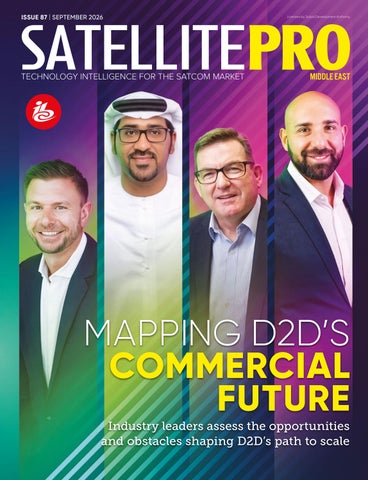
MAPPING D2D’S COMMERCIAL FUTURE Industry leaders assess the opportunities and obstacles shaping D2D’s path to scale
CONNECTING QATAR TO THE WORLD AND BEYOND At Es’hailSat, we power Qatar’s communications through cutting-edge satellite technology. From broadcasting and government services to business connectivity and beyond, we ensure secure, reliable, and high-performance satellite solutions across the region. We are enabling a future that is always connected and always advancing.
www.eshailsat.qa
Visit Us at IBC 2026 Hall-1, Stand No. F68 RAI, Amsterdam September 11 to 14, 2026
INTRO
SEPTEMBER 2026 satelliteprome.com
EDITORIAL MANAGING DIRECTOR AND EDITOR VIJAYA CHERIAN vijaya.cherian@cpipromedia.com +971 (55) 1053787 EDITORIAL CONTRIBUTORS KALYANI GOPINATH NUSRAT ALI UROOJ FATIMA SUB EDITOR AELRED DOYLE ADVERTISING KEY ACCOUNT MANAGER VIJAYA CHERIAN vijaya.cherian@cpipromedia.com +971 (55) 1053787 GROUP SALES DIRECTOR SANDIP VIRK
WELCOME
sandip.virk@cpipromedia.com +971 (0) 50 929 1845 / +44 (0) 7516 993 862 FINANCE FINANCE EXECUTIVE YONWIN D’SOUZA finance@cpipromedia.com DESIGN & PRODUCTION ART DIRECTOR DAVID FRASER design@cpipromedia.com EVENTS & MARKETING EVENTS EXECUTIVE SARAH NATHAN marketing@cpipromedia.com DIGITAL SERVICES WEB DEVELOPER HAFIZ MUHAMMAD WAQAS IT@cpipromedia.com FOUNDER DOMINIC DE SOUSA (1959-2015) PARTNER MARIA DE SOUSA
The publisher of this magazine has made every effort to ensure the content is accurate on the date of publication. The opinions and views expressed in the articles do not necessarily reflect the publisher and editor. The published material, adverts, editorials and all other content are published in good faith. No part of this publication or any part of the contents thereof may be reproduced, stored or transmitted in any form without the permission of the publisher in writing. Publication licensed by Dubai Development Authority to CPI Pro Media FZ LLC. Printed by Al Bony Printing Press LLC. CPI Pro Media. PO Box 13700, Dubai, UAE. DQuarters, Dubai Media City (TECOM) +971 55 1053787 cpipromedia.com © Copyright 2026. All rights reserved.
The fifth edition of Make it in the Emirates, held in Abu Dhabi earlier this year, offered perhaps the clearest indication yet of how the UAE’s space ambitions are evolving. Beyond headline missions, and satellites procured and launched, we are witnessing a more complex industrial picture, involving sovereign programmes, commercial manufacturers, specialist start-ups, international investment and partnerships intended to bring technology and expertise into the country. This marks an important transition. A successful space economy needs more than landmark missions. It requires companies capable of designing subsystems, manufacturing components, integrating payloads, testing spacecraft, developing mission software and training the engineers who will eventually lead those activities. That ecosystem is beginning to take shape with EDGE Group’s FADA developing sovereign space capabilities across satellite subsystems, ground stations, remote sensing and cybersecurity. Then there’s Orbitworks, a joint venture between Marlan Space and Loft Orbital, that has just shipped the first EO satellite made entirely in the UAE. Alongside it, companies
such as Hex20 and Aliensense are developing small-satellite platforms, sensors, autonomous sensing and space-grade visual systems. Space42 is building local expertise through its Foresight radar satellites with ICEYE, while MBRSC’s MBZ-SAT saw UAE companies produce around 90% of its mechanical structures. That momentum extends across the region. In this issue, we explore the MENA launch pipeline from some of the region’s major space and satellite operators, alongside new players adding fresh capabilities to its growing space ecosystem. SatellitePro ME will be at IBC and CABSAT with a strong regional focus, while also looking at major global trends such as direct-todevice (D2D) connectivity. Space and satellite will have a prominent presence at both shows, providing plenty of opportunity to continue many of these conversations. We look forward to being part of them and hope to see many of you there.
VIJAYA CHERIAN
Editor SatellitePro ME
01
57
OCTOBER 2026
DUBAI EXHIBITION CENTRE EXPO CITY
The Region’s Largest Event for Satellite Communications & Space Technology.
What to Exp e ct in 2026
8,000+ REGISTER NOW
Visitors
200+
Exhibiting Companies
50+
Countries
CO-LOCATED WITH
FULL CONFERENCE ACCESS
150+ Speakers
ORGANISED BY
CONTENTS
SEPTEMBER 2026 satelliteprome.com
04 Industry News UPDATE
Space42 signs MoU with Leonardo DRS; Thales Alenia Space to build Es’hailSat satellite; Arabsat and LTT sign partnership; and more
10 SATEXPO at CABSAT SHOW PREVIEW
SATEXPO returns with a wider remit spanning satellite, space and emerging applications
12 The Race for Full Coverage COVER STORY
D2D satellite services are moving into commercial deployment, but spectrum, devices, regulation and business cases will determine how quickly they can scale
04 12
18 MENA’s Space Pipeline LAUNCH OUTLOOK
We examine the major commercial satellite launches set to reshape the Arab world’s space landscape through 2030
26 Building Independence NATIONAL CAPABILITY
The UAE is building the expertise and infrastructure needed for an independent, resilient space programme
18
28 Why IP Still Needs Satellite TECH UPDATE
DVB-NIP addresses the cost, scale and connectivity limits of IP-only distribution
30 From Data to Intelligence SPACE SITUATIONAL AWARENESS
Transforming SSA data into trusted, actionable intelligence
34 Satellite at IBC IBC2026
34
Hall 1 reflects an industry pursuing growth in connectivity, mobility and direct-to-device services
36 Inside Orbitworks’ cloud model for space IN CONVERSATION
Salim Al Alawi explains how Orbitworks is opening up its AI and manufacturing capabilities across the space stack
03
IN ASSOCIATION WITH
6 OCTOBER 2026 / THE WESTIN DUBAI MINA SEYAHI BEACH RESORT & MARINA
Voting has closed. The finalists have been announced. Connect with us to attend the gala awards ceremony GOLD SPONSOR
NETWORKING SPONSOR
NETWORKING SPONSOR
NETWORKING SPONSOR
Table Bookings and Sponsorship Vijaya Cherian +971 55 105 3787 Vijaya.cherian@cpipromedia.com
© 2026 CPI Pro Media. All rights reserved.
Sarah Nathan marketing@cpipromedia.com
PRESENTED BY
PRESENTED BY
Learn
More
UPDATE
SEPTEMBER 2026 satelliteprome.com
Space42 signs MoU with Leonardo DRS to boost national security systems PARTNERSHIP
Space42 and Leonardo DRS, a USA-based defence contractor, have signed a Memorandum of Understanding (MoU) to establish a framework to integrate Leonardo DRS mission systems with Space42’s satellite connectivity to boost sovereign national security across the UAE. Under the MoU, Leonardo DRS will contribute its expertise in C5ISR mission systems while Space42 will provide secure, AI-enabled satellite communications and Beyond Line of Sight (BLOS) connectivity. Together, the companies will explore the joint design and integration of advanced mission capabilities for the UAE. “By combining our sovereign satellite
Ahmed AlMehrzi, CCO-Government, Space42 (second from right) with executives from Leonardo DRS.
infrastructure and AIenabled communications capabilities with Leonardo DRS’s advanced mission systems, we are strengthening protected communications that advance the UAE’s national security ecosystem,” said
Ahmed AlMehrzi, Chief Commercial Officer – Government at Space42. “This MoU marks a significant step forward in our commitment to supporting UAE national security priorities with proven, advanced integrated
capabilities that enable mission success in today’s evolving threat landscape,” said Denny Crumley, Senior Vice President & General Manager of the Leonardo DRS Land Electronics business unit. “We are proud to be a part of this opportunity with Space42 as we continue to grow our international business with strategic partners around the world.” Leonardo DRS delivers tactical computing, AIenabled processing, and integrated C4/C5/C6ISR solutions that reduce the cognitive burden on crews operating in complex security environments. The systems are designed to deliver real-time situational awareness and are scalable, platform agnostic and support open architectures.
Space42 reports record H1 results with revenue at $260m FINANCIAL REPORT
UAE-based SpaceTech company Space42 reported record financial results for the first half of 2026, with revenue rising 15% yearon-year to $260m, driven by its Space Services and Smart Solutions businesses. The company ended H1 with more than $1.1bn in cash and an order backlog of $6.3bn. Space Services revenue increased 15% following the commencement
of a $700m, 15-year government capacity services contract in July 2025, supported by the successful launch of the Thuraya-4 satellite. Smart Solutions revenue rose 14% , driven by growing government demand for geospatial intelligence, Earth observation (EO) capabilities and situational awareness solutions. The company also announced that
shareholders approved a share buyback programme of up to 2.5% of its issued share capital during the General Assembly. Subject to approval by the Abu Dhabi Securities Exchange, the programme is expected to begin in the third quarter of 2026. In satellite communications, Space42 accelerated the commercial rollout of Thuraya-4 services and successfully tested
direct-to-device SMS and SOS services on standard smartphones with Skylo Technologies. Commercial deployment is expected before the end of 2026. Its Al Yah 4 and Al Yah 5 satellite programmes remains on schedule and within budget under a $5.1bn, 17-year government contract. The programme is expected to generate approximately $300m in annual revenue from Q4 2026.
05
UPDATE
SEPTEMBER 2026 satelliteprome.com
Es’hailSat selects Thales Alenia Space to build software-defined satellite SATELLITE DEAL
Es’hailSat, the Qatari Satellite Company, has awarded Thales Alenia Space a contract to develop a nextgeneration software-defined communications satellite, Eshail-3/Türksat-Biruni. The satellite will be built by Thales Alenia Space, the joint venture between Thales and Leonardo, and will be shared with Turkish satellite operator Türksat. It is designed to deliver high-speed broadband
services while enhancing regional connectivity and strengthening satellite communications capabilities for both operators across Europe, Africa, Central Asia and the Middle East. The satellite will be based on Thales Alenia Space’s Space INSPIRE (INstant SPace In-orbit REconfiguration) platform, a fully software-defined system that enables operators to reconfigure the satellite’s capabilities
while it is in orbit. The technology is designed to respond quickly to changing broadband demand and optimise the use of satellite resources throughout the spacecraft’s operational life. Under the agreement, Thales Alenia Space will serve as the prime contractor, overseeing the satellite’s design, manufacturing, testing and delivery, as well as providing the associated ground segment and support services.
Ali Ahmed Al-Kuwari, President and CEO at Es’hailSat, said: “The signing of this contract with Thales Alenia Space marks a defining moment for Es’hailSat and for Qatar’s ambitions as a leading satellite service provider. Eshail-3/TürksatBiruni will not only expand our coverage and capabilities into new strategic markets, but also strengthen the resilience and independence of Qatar’s communications infrastructure.”
Dr Abdullah Aljohani joins NSG as Chief Technology Officer NEW APPOINTMENT
Saudi-based Neo Space Group (NSG) has appointed Dr Abdullah Aljohani as its new Chief Technology & Operations Officer (CT&OO). Dr Aljohani brings over two decades of expertise in satellite communications architecture, advanced wireless technologies and AI-driven communications systems. In his new position, he will oversee the company’s technology strategy, engineering development and operational performance across its space and satellite communications services. Dr Aljohani will be responsible for advancing technology and operational capabilities designed to support
06
government agencies, defence organisations and critical national infrastructure. Working closely with national stakeholders, he will also help align NSG’s innovation and technology investments with Saudi Arabia’s broader strategic objectives, space
ambitions and digital transformation initiatives. Before joining NSG, Dr Aljohani served as Executive Director of Strategic Partnerships at the Research, Development and Innovation Authority, where he played a key role in establishing the organisation
and driving national programmes focused on 6G technologies, quantum computing and semiconductors. Earlier, he held several senior positions at the Communications, Space & Technology Commission, leading international spectrum initiatives, contributing to Saudi Arabia’s spectrum policy framework and representing the Kingdom on the global stage, including as Vice Chairman of the ITU-R Study Group 3. Alongside his executive career, Dr Aljohani has made significant contributions to academia as an Associate Professor and former founder of a research laboratory at King Abdulaziz University.
UPDATE
SEPTEMBER 2026 satelliteprome.com
Qualcomm names Wassim Chourbaji as EMEA President NEW APPOINTMENT
Qualcomm Incorporated has appointed Wassim Chourbaji as Senior Vice President and President of its Europe, Middle East and Africa (EMEA) operations, effective immediately. In his new role, Chourbaji will oversee the company’s strategy across the region and lead the execution of its business priorities across multiple sectors. A Qualcomm veteran of more than two decades, Chourbaji has held several leadership positions within the company. Most recently,
he served as President of Qualcomm Middle East and Africa (MEA),
while also leading the company’s government affairs organisation across the wider EMEA region. The leadership transition comes as Enrico Salvatori, who has headed Qualcomm’s EMEA business for more than 20 years, prepares to retire in June 2027 after 25 years with the company. Effective immediately, Salvatori has assumed the role of Chairman and will continue to oversee Qualcomm’s EMEA Automotive business until his retirement.
UAE’s LEONAV-1 mission achieves major navigation milestone SPACE MISSION
The National Space Science and Technology Centre (NSSTC) at the United Arab Emirates University has announced a key milestone for its LEONAV-1 mission with the successful validation of its navigation payload and processing of navigation signals transmitted from Low Earth Orbit (LEO). LEONAV-I was launched on July 7, 2026, with the support and funding of the UAE Space Agency. The milestone supports the development of LEO-based navigation technologies and reinforces the UAE’s efforts to create innovative solutions for
the next generation of positioning, navigation and timing systems. It also reflects the country’s continued investment in national talent and international collaboration. NSSTC’s Emirati engineers and researchers have led the mission through every
stage, from satellite development and testing to in-orbit operations and performance monitoring. Developed together with leading French institutions, the project has facilitated knowledge exchange, technology transfer and the development of technical solutions.
Nilesat’s Cairo teleport retains WTA Tier 4 certification CERTIFICATION
The World Teleport Association (WTA) has renewed the Tier 4 certification of Nilesat’s Cairo Teleport following a re-certification audit, reaffirming the facility’s adherence to the highest standards of operational excellence under WTA’s Teleport Certification Programme. WTA independently evaluates teleport facilities based on service quality, operational performance and infrastructure. Full certification is awarded after an on-site audit validating more than 170 operational criteria. Commenting on the achievement, Sameh Katta, Chief Executive Officer, Nilesat, said: “Obtaining this certificate from an independent, reputable international organisation reflects the distinguished services we can provide to our customers, whom we are keen to satisfy through our constant pursuit of continuous improvement in order to always be at the forefront of teleport service providers in the Middle East and Africa.”
07
UPDATE
SEPTEMBER 2026 satelliteprome.com
UAE Space Agency gives operators 90 days to obtain licences and permits REGULATORY COMPLIANCE
The UAE Space Agency (UAESA) has announced a 90-day grace period for companies, organisations and individuals operating, or planning to operate, in the country’s space sector to regularise their status and obtain the required licences and permits under the UAE’s space regulations. The grace period, which began on July 27, 2026, is being implemented in accordance with Federal Decree-Law No. (46) of 2023 on the Regulation of the Space Sector. The initiative is aimed at strengthening regulatory governance while supporting the sustainable growth of the national space industry through a structured and investment-friendly
Osama Al Shehhi, Director of the Space Licensing and Permits Office, UAE Space Agency.
operating environment. The agency said all public and private entities, as well as individuals carrying out activities covered under the law, must complete registration procedures and secure the necessary approvals within the specified timeframe to
ensure compliance with the country’s legal and regulatory framework. After the expiration of the specified deadline, the supervisory and legal measures stipulated by law will be taken against non-compliant entities in accordance
with the applicable legislation in the UAE. Osama Al Shehhi, Director of the Space Licensing and Permits Office at the UAESA, said: “We invite all companies, organisations, and individuals who are currently engaged in, or intend to engage in, space activities or activities related to the space sector to contact the UAE Space Agency and begin the registration and licensing procedures within the specified timeframe. This will ensure that their operations are aligned with the approved legal and regulatory frameworks.” Further information on licensing, permits and compliance requirements can be obtained through UAESA’s official communication channels.
TDRA approves regulatory updates to radio spectrum REGULATORY COMPLIANCE
The UAE’s Telecommunications and Digital Government Regulatory Authority (TDRA) has approved updated regulatory frameworks governing radio spectrum to support the development of the country’s advanced air mobility ecosystem, including air taxis, delivery drones and next-generation electric aerial vehicles. The authority adopted
08
the fourth edition of the Regulatory Framework for Aeronautical Radio Systems and the third edition of the Regulatory Framework for Unmanned Aircraft Radio Systems. The revised frameworks establish the spectrum resources and regulatory foundation required for communication, navigation and air traffic surveillance systems that underpin advanced air mobility. The move aims to
improve airspace safety, enhance operational efficiency and encourage innovation across the smart mobility sector. H.E Eng. Mohammed Al Ramsi, Deputy Director General of the Telecommunications Sector at TDRA, said: “The UAE believes that building the future begins with preparing for it. At TDRA, we continue to develop regulatory frameworks that keep pace with rapid technological
transformations and enable innovation across various sectors. The update of the regulatory frameworks for aeronautical radio systems and unmanned aircraft radio systems is part of TDRA’s efforts to provide an advanced regulatory environment that supports advanced air mobility ecosystems and ensures the readiness of the spectrum infrastructure required for their efficient and reliable operation.”
UPDATE
SEPTEMBER 2026 satelliteprome.com
Arabsat and LTT ink deal to strengthen Libya’s satellite connectivity PARTNERSHIP
The Arab Satellite Communications Organisation (Arabsat) and Libya Telecom and Technology (LTT) have signed a strategic partnership agreement aimed at strengthening satellite communications and supporting the continued development of Libya’s digital communications infrastructure. The agreement establishes a long-term collaboration and aims that combines Arabsat’s satellite infrastructure and regional coverage with LTT’s expertise in Libya’s telecommunications market,
delivering secure, reliable and scalable satellite connectivity across the country. Under the agreement, Arabsat will provide High Throughput Satellite (HTS) capacity through Arabsat-6A at 30.5 degrees East to support LTT’s existing and future connectivity requirements. The two companies will also explore additional opportunities to expand their service portfolios and develop new satellite-based solutions for government agencies, enterprises, telecommunications operators and other critical sectors. The partnership is
expected to improve network resilience and service continuity while supporting Libya’s broader digital transformation efforts. Commenting on the agreement, Dr Badr N. Alsuwaidan, Chief Executive Officer of Arabsat, said: “Through this agreement with LTT, Arabsat will provide advanced satellite capacity and satellite communication solutions that will enhance communications services across Libya, supporting the evolving needs of government entities, telecommunications operators, enterprises, and strategic and critical sectors
through secure, reliable, and high-performance satellite connectivity. Eng. Ammar Al-Bouzaidi, Chairman of the Board of LTT, added: “The signing of this agreement marks an important milestone in our collaboration with Arabsat. By combining Arabsat’s advanced satellite capabilities with LTT’s national expertise, we will strengthen our communications infrastructure, enhance service quality, and deliver reliable connectivity solutions that support the evolving needs of our customers and the future development of Libya’s digital economy.”
ICEYE appoints Christos Kolimenakis CEO of UAE operations NEW APPOINTMENT
The appointment of Christos Kolimenakis as ICEYE’s Chief Executive Officer marks a strategic step in strengthening the company’s long-term presence in the country and reinforcing cooperation between the European Union and the UAE in the fields of space, defence and advanced technologies. His appointment reflects ICEYE’s commitment to expanding its local operations and enhancing collaboration with government entities, industry partners and national organisations as the UAE continues
its efforts to establish itself as a global hub for the space sector. Kolimenakis joins ICEYE following a 15-year career at JPMorgan, where he
most recently served as Managing Director in the bank’s UAE office. In that role, he led the firm’s Innovation Economy coverage across Europe,
the Middle East and Africa (EMEA), advising high-growth technology companies and building strong relationships across the region’s innovation ecosystem. As CEO of ICEYE UAE, Kolimenakis will oversee the company’s operations in the country, strengthen strategic partnerships and support its long-term expansion plans. He will also work closely with customers and stakeholders to help advance sovereign space capabilities and contribute to the continued development of the UAE’s space ecosystem.
09
SATEXPO
SEPTEMBER 2026 satelliteprome.com
SATEXPO EXPANDS CABSAT’S SPACE AMBITIONS
Returning for its second edition alongside CABSAT, now in its 33rd year, SATEXPO will put satellite communications, space technologies, government programmes and emerging commercial applications into sharper focus when the two events take place at Dubai Exhibition Centre from 5–7 October Satellite has formed an important part of CABSAT for more than three decades, reflecting the central role it has historically played in broadcast distribution across the region. This year, however, the sector will have a more distinct identity through SATEXPO, which returns as a dedicated platform for the rapidly expanding satellite and space ecosystem. SATEXPO will take place
10
alongside CABSAT from 5–7 October 2026 at the Dubai Exhibition Centre, Expo City Dubai, CABSAT’s new home from this year. The event will bring together satellite operators, manufacturers, technology providers, systems integrators, launch service companies, government entities and emerging commercial space businesses. According to Rajendra Salgaonkar, Head of Sales, Exhibitions Department at Dubai World Trade Centre, the name SATEXPO
was chosen as it “represents a much broader ecosystem encompassing space technologies, connectivity, Earth observation, mobility, defence applications and the rapidly expanding commercial space economy.” “The identity communicates our ambition to create the Middle East’s leading business platform dedicated to the satellite and space sector.” While satellite will retain its longstanding connection with media distribution, SATEXPO is intended to
SATEXPO
SEPTEMBER 2026 satelliteprome.com
widen the scope of the conversation, covering satellite communications, space infrastructure, national space programmes, Earth observation, mobility, defence, NewSpace ventures and investment. This expanded remit is also expected to attract a broader range of buyers and decision-makers while preserving the natural relationship between the broadcast and satellite industries. Media distribution remains an important market for satellite operators, but connectivity, mobility, Earth observation, directto-device services and sovereign space programmes are becoming increasingly significant sources of investment and growth. The UAE Space Agency has confirmed its patronage of SATEXPO, underlining the event’s connection to the UAE’s wider space ambitions. Organisers are also working with industry associations, commercial organisations, government agencies and international trade bodies to develop the conference programme and encourage participation. “The UAE Space Agency’s patronage provides important strategic support and reinforces SATEXPO’s role in advancing regional space development,” Salgaonkar explained. “Our partnerships also help create a platform for discussion between policymakers, regulators, industry leaders, investors and technology innovators.” The second edition is expected to welcome established satellite businesses as well as new participants. Dedicated opportunities are also being developed for startups and emerging technology companies to present their solutions, connect with investors and meet prospective customers. The full exhibitor list will be released closer to the event as participation is confirmed. The SATEXPO conference will
address both established satellite markets and the new technologies reshaping the industry. Broadcasting and content distribution will remain part of the programme, together with enterprise connectivity, aviation and maritime services. These will be complemented by discussions on direct-to-device connectivity, software-defined satellites, AI-enabled workflows, Earth observation analytics and sovereign space capabilities. “The programme is structured to reflect both the evolution of satellite communications and the rapid emergence of new commercial opportunities,” remarked Salgaonkar. Beyond technology, the conference will examine some of the commercial, policy and regulatory challenges confronting the sector, such as spectrum management, investment and financing, cybersecurity, sustainability, space debris mitigation and increasing pressure on orbital resources. These issues require greater collaboration among governments, regulators, operators and technology providers. Bringing these groups together is therefore an important part of SATEXPO’s purpose.
Exhibitors will also be encouraged to use the event for technology demonstrations, product launches, partnership announcements and updates on projects spanning satellite communications, ground infrastructure and space applications. Business engagement will include pre-arranged matchmaking, hosted-buyer meetings, investor engagement, networking and direct interaction between participating companies and government entities. The co-location with CABSAT is expected to give SATEXPO added advantage. “Participants can engage with a wider range of decision-makers than they might typically encounter at a standalone satellite exhibition, creating valuable opportunities for crosssector business,” he pointed out. Dubai’s growing position in the global space economy makes it a natural setting for the event. “With significant investment in national space programmes and growing international participation, Dubai is ideally placed to bring together the global satellite and space community and help shape future partnerships across the Middle East, Africa and South Asia.”
11
COVER STORY
SEPTEMBER 2026 satelliteprome.com
D2D SCALES NEW HEIGHTS
Satellite direct-to-device services are moving into commercial deployment, but spectrum, device availability, regulation and an uncertain consumer business model will determine how quickly they achieve scale, reports Vijaya Cherian
12
COVER STORY
SEPTEMBER 2026 satelliteprome.com
For years, the prospect of connecting an ordinary mobile phone directly to a satellite appeared to belong to the distant future. That future has now begun to arrive. Emergency messaging has introduced satellite connectivity to mainstream smartphone users, commercial deployments are under way, and satellite and mobile operators are developing services that could eventually extend from text and voice to connected vehicles, industrial monitoring and more data-intensive applications. Yet demonstrating that directto-device (D2D) technology works is not the same as establishing a sustainable mass market. The industry must still answer some fundamental questions. Will consumers pay continuously for connectivity they may rarely use? Can operators secure sufficient spectrum across multiple countries? How quickly will compatible chipsets and devices become widely available? And will the various D2D architectures coexist or eventually consolidate around a smaller number of networks and commercial models? Space42, Viasat, Iridium and SES have approach this evolving market from different positions, but their assessments converge on one important point: technology alone will not take D2D into the mainstream. Its success will depend on the development of an integrated ecosystem encompassing satellite operators, mobile network operators (MNOs), device manufacturers, chipset suppliers, regulators and standards bodies. Deployment is not adoption
The D2D market has moved beyond proof-of-concept demonstrations. Consumer
messaging services have been launched, MNO partnerships are proliferating and standardsbased services are moving closer to commercial availability. Nevertheless, there is still a significant distance between initial deployment and adoption at scale. Space42 has provided further evidence of that progress through a UAE trial involving its Thuraya-4 satellite and Skylo Technologies’ 3GPP-compliant
Once satellite connectivity is available on the smartphones people already carry, it opens doors to communication for the billions that remain underserved” Jassem Nasser, Chief Growth Officer, Space42
NTN platform. The test delivered two-way D2D connectivity, including SMS and SOS services, to an Android smartphone and a satellite messaging device. “The demo showed that standards-based D2D services are ready to move beyond technical testing towards commercial deployment,” says Jassem Nasser, Chief Growth Officer at Space42. Brian Aziz, Vice President of Global Sales at Iridium, offers a cautious assessment of current consumer demand. “The consumer D2D market has clearly transitioned into the deployment phase, but the central question remains: how broadly are consumers adopting the technology? On certain platforms it’s still a free service and on others it’s a plan add-on with what seems to have very low usage and adoption at this point.” The introduction of emergency satellite messaging by major handset manufacturers gave D2D something the satellite industry had previously struggled to achieve: widespread consumer recognition. Safety provided an easily understood proposition and prompted mobile operators to consider how satellite coverage might fit into their own portfolios. That momentum, however, has not resolved the commercial challenge. An emergency service can carry considerable value even when it is seldom used, but that same characteristic makes recurring consumer pricing difficult. D2D must therefore evolve from an emergency fallback into a broader form of coverage assurance if it is to become part of everyday mobile subscriptions. For Kevin Cohen, VP of Direct-to-Device at Viasat, the longer-term opportunity lies in making satellite capability available through existing mobile plans, extending connectivity
13
COVER STORY
into areas where terrestrial networks are unavailable, patchy or congested. That could include remote locations as well as smaller suburban and semi-rural “white spots”. “The real opportunity is to make connectivity more resilient and more widely available, giving users confidence that they can stay connected even when terrestrial networks are out of reach.” Viasat’s December 2025 consumer research suggests there is demand for that reassurance. Around 80% of those surveyed expressed interest in satelliteenabled smartphone services, more than 60% said they would pay extra for them and 47% would consider switching operators if connectivity outside terrestrial coverage was included in their subscription. Interest, however, does not automatically translate into sustained usage or profitable services. The price consumers will accept, the capabilities offered and the way satellite access is bundled into existing plans will be decisive. Searching for the first viable market
Consumer connectivity may offer the largest potential scale, but enterprise IoT could present a clearer early business case. Remote assets, fleets and infrastructure generate a persistent need for monitoring, alerts and tracking. Unlike an emergency feature that a smartphone owner may never activate, enterprise connectivity can support daily operations and generate measurable savings. Space42 takes a more definite position on which market will develop first. “Consumer connectivity will lead near-term demand as it offers the fastest path to scale. Once satellite connectivity is available on the smartphones people already carry, it opens doors to communication
14
SEPTEMBER 2026 satelliteprome.com
Satellite is becoming a coverage layer within the mobile ecosystem rather than an alternative to it” Brian Aziz, Vice President of Global Sales, Iridium for the billions that remain underserved,” says Nasser. Viasat does not regard consumer and enterprise services as competing paths. Emergency messaging and coverage assurance can familiarise consumers with satellite connectivity, while industrial deployments create focused commercial applications as the wider ecosystem develops. Its research among decisionmakers in agriculture, transport and mining found that 69%
planned to adopt D2D-enabled IoT within 12 months, rising to 91% within 18 months. Cohen identifies remote monitoring, asset and fleet tracking, sensor data, worker-safety alerts, equipment diagnostics, two-way communications, voice and light data among the most realistic applications over the next three to five years. Iridium is more emphatic about the near-term enterprise opportunity. While the economics of consumer smartphone connectivity remain unproven, the company expects standardisation to reduce the cost and complexity of serving industrial users. “The enterprise driver was less visible but larger in the long run: supply chain and critical infrastructure visibility. Grid monitoring, water systems, agriculture, and fleets can no longer accept dead zones in their operations. Customers stopped asking for coverage where it’s convenient and started asking for coverage where there are no other options,” notes Aziz. SES also sees critical infrastructure, connected vehicles and government communications becoming increasingly important as the decade progresses. Gerry Collins, Director Product Management, Enterprise at SES, highlights the potential for D2D private networks serving first responders and military users, where resilience, reach and control may matter more than mass-market consumer pricing. The emerging picture is therefore not one of consumer or enterprise adoption, but of different markets advancing at different speeds. Consumer services may give D2D visibility and eventual volume, while enterprise, automotive and government applications could provide earlier and more readily quantifiable value.
COVER STORY
SEPTEMBER 2026 satelliteprome.com
Spectrum shapes the coverage map
No issue exposes the differences between D2D models more clearly than spectrum. Some systems use terrestrial cellular frequencies under arrangements with MNOs. Others operate through spectrum already allocated to Mobile Satellite Services (MSS), including L- and S-band. Using terrestrial spectrum can enable connectivity with existing handsets, but permissions are generally tied to national licenses and regulatory conditions. A service that crosses borders must consequently navigate different rules, agreements and interference requirements in each market. Iridium regards its globally coordinated L-band spectrum as one of its principal advantages. Aziz argues that global D2D cannot be separated from the complex regulatory work required to support it. “Serving a device in 190-plus countries means you need spectrum rights that work in all of them. A lot of D2D architectures depend on terrestrial spectrum licensed market by market, which means the coverage map is really a licensing map. Iridium’s L-band spectrum is globally coordinated.” This is particularly important for assets that move between countries or across oceans. Iridium’s proposition is built around an existing cross-linked LEO constellation, global coverage and a single service relationship rather than a patchwork of national arrangements. Viasat similarly sees coordinated MSS spectrum as a foundation for international services. It argues that harmonisation can reduce development complexity for operators and manufacturers while potentially allowing future D2D services to operate across satellite infrastructure in different orbits. SES, meanwhile, is positioning itself to accommodate more than
one model. Its partnership with Lynk combines Lynk’s D2D satellite technology with SES’ global ground infrastructure, multi-orbit capabilities, regulatory expertise and customer relationships. The planned merger between Lynk and Omnispace would add globally coordinated S-band spectrum to a proposition that also works with terrestrial cellular frequencies. Collins believes access to spectrum and the architecture built around it will ultimately separate viable services from those that struggle to scale. “Access to sufficient globally harmonised spectrum simplifies the system architecture in-space, on the ground and at a device level and those two – global spectrum and an associated system architecture – will become key to deciding which players succeed in the market.” Regulation will therefore remain central to D2D’s development. The
industry is watching preparations for the 2027 World Radiocommunication Conference, where studies into possible new MSS allocations for direct connectivity to International Mobile Telecommunications user equipment form part of the agenda. National authorisations, cross-border interference and the protection of existing terrestrial services will remain relevant even if the conference establishes a broader international framework. Becoming part of the mobile ecosystem
Previous generations of mobile satellite communications existed largely alongside terrestrial networks. Users bought specialist terminals, subscribed to separate services and accepted different pricing because they had a requirement that conventional networks could not meet.
The industry needs to demonstrate that there is a sustainable, scalable model for D2D broadband services” Gerry Collins, Director Product Management, Enterprise, SES
15
COVER STORY
D2D changes that relationship. Under the 3GPP non-terrestrial network framework, satellite can increasingly become another coverage layer within the wider mobile environment. This opens access to the enormous ecosystem already created around cellular connectivity, including chipsets, modules, SIMs, roaming, billing, network cores and device certification. Space42’s Thuraya-4 trial also tested how this integration could work from the customer and operator perspectives. Nasser says: “The successful demonstration validated that satellite connectivity can integrate with existing mobile operator networks (MNOs), allowing customers to use the same device, SIM and phone number while enabling operators to extend coverage without changing their core infrastructure.” “Satellite used to be a parallel universe: different hardware, different protocols, different sales channels, different pricing, different everything,” says Aziz. “What’s changed is that satellite is becoming a coverage layer within the mobile ecosystem rather than an alternative to it.” Iridium NTN Direct is intended to allow standards-based modules to connect to the company’s existing network in the same way that they access terrestrial infrastructure. Iridium says MNOs will not need to replace their present systems because the service can work with the protocols, core infrastructure, billing arrangements and SIM environment they already use. The same philosophy underpins SES’ strategy. Its objective is not to displace MNOs or compete for ownership of their customers, but to give them additional reach. SES also expects requirements to vary between operators. Some want narrowband services encompassing text, voice and
16
SEPTEMBER 2026 satelliteprome.com
Space42’s Thuraya-4 trial successfully demonstrated the integration of satellite connectivity with existing mobile operator networks.
potentially light data, while others are considering broadband. Lynk plans to begin with narrowband connectivity, establishing revenues that can support successive generations of satellite design and higherperformance services. This incremental approach may prove more commercially realistic than attempting to deliver the full broadband vision immediately. “The industry needs to demonstrate that there is a sustainable, scalable model for D2D broadband services,” says Collins. “This is being promised in the market, and it will be interesting to see how this is delivered, what the performance will be, and how much spectrum is required.” Devices remain a constraint
Even with networks, spectrum and operator agreements in place, D2D cannot achieve mass adoption without compatible devices. Only a proportion of current phones, vehicles, modules and IoT equipment incorporate the chipsets, filters and supported frequency bands required for NTN connectivity.
This is why Viasat places the development of an open ecosystem alongside spectrum and commercial value as a prerequisite for scale. “This means collaborating on shared standards, technical development, policy coordination and innovation to help deliver a more consistent user experience and accelerate interoperability. 3GPP NTN standards provide a common foundation for satellite and terrestrial networks to work together, supporting a more seamless end-user experience.” The availability of supported smartphones from major manufacturers is already creating a larger addressable market. Higher chipset volumes should also lower the cost of specialised devices for industrial, government and automotive applications. The measure of success will not merely be the number of compatible flagship phones. D2D will begin to reach scale when satellite functionality becomes routine across multiple device categories and price points, and when users no longer require separate hardware or subscriptions to access it.
COVER STORY
SEPTEMBER 2026 satelliteprome.com
Coexistence before consolidation
The number of proposed D2D constellations, spectrum strategies and partnerships raises an inevitable question: can all these approaches survive? In the near term, coexistence appears possible because the market encompasses very different service requirements. Emergency texts, industrial sensor data, connected-car applications, sovereign government networks and consumer broadband cannot necessarily be addressed through a single architecture or pricing model. There is also a fundamental strategic divide. Some satellite providers intend to work through MNOs as wholesale or infrastructure partners, while others may seek a more direct relationship with end users. Their use of terrestrial or MSS spectrum introduces another distinction. Over time, however, capital requirements, spectrum access, manufacturing capacity, launches and the need for global distribution may encourage consolidation. The planned Lynk– Omnispace merger illustrates how complementary technology, spectrum, investment and routes to market can be assembled into a broader proposition. Existing operators will also seek to turn their established assets into competitive advantages. Iridium has upgraded its operational constellation to support 5G waveforms through software, avoiding a new launch campaign for NTN Direct. SES intends to use its GEO and MEO infrastructure to support Lynk’s flight operations and data backhaul, reducing the number of additional ground stations required. Viasat and Space42, through Equatys, intend to bring together existing and planned MSS capabilities to support a global standards-based service.
Equatys is being formed as a neutral, multi-participant platform through which MNOs can access shared space infrastructure while retaining their spectrum rights and customer relationships. Its commercial structure draws on the infrastructure-sharing model already established in terrestrial telecommunications. “The TowerCo model applies a proven approach from terrestrial telecommunications. Each participant retains control of its spectrum rights, customer relationships, and commercial
The long-term ambition is for users to access many of the services they already rely on today” Kevin Cohen, VP of Direct-to-Device, Viasat
offerings while leveraging common space and ground infrastructure,” explains Nasser. The result may not be a market with one dominant technical model. More likely, a smaller number of architectures will emerge around particular combinations of spectrum, coverage, capacity and customer need. When satellite becomes invisible
Over the next several years, D2D’s progress will be measured through commercial rather than purely technical milestones: widespread availability of compatible chipsets, services launched across multiple countries, integration into existing mobile plans, sustainable enterprise deployments, interoperable networks, and prices that both consumers and operators can justify. Its ultimate ambition is straightforward but demanding. A user should be able to move beyond terrestrial coverage and remain connected without changing devices, inserting another SIM or consciously selecting a satellite service. Likewise, an enterprise should be able to track an asset across terrestrial and satellite networks through a single module, contract and operating environment. This is also central to Space42’s long-term position. Nasser says the objective is to “make standardsbased satellite connectivity a part of everyday communications”. As Cohen explains: “The long-term ambition is for users to access many of the services they already rely on today, from messaging and voice to more data-intensive applications, without needing to think about whether they are connected via a terrestrial or satellite network.” That may be the clearest definition of mainstream D2D. It will have achieved its purpose when the satellite link becomes a dependable part of everyday connectivity.
17
MENA LAUNCH PIPELINE
SEPTEMBER 2026 satelliteprome.com
MENA’S NEXT WAVE OF SATELLITES
SatellitePro ME takes a closer look at the regional launch pipeline, with the latest updates from some of MENA’s leading satellite operators on the spacecraft and constellations set to shape the market through 2030
The next chapter of the Middle East’s satellite story will not be measured by how many of them reach orbit but what their function will be once they get there. Across the region, a new generation of satellites is beginning to take shape. Established operators are preparing replacements for strategic geostationary assets, but the satellites now under construction are markedly more adaptable than their predecessors.
18
Software-defined payloads will allow operators to alter coverage, capacity and frequencies after launch, responding to demand rather than remaining tied to a configuration fixed years earlier. At the same time, Earth observation (EO) is becoming a much more prominent part of the regional space economy. Smaller satellites in low Earth orbit are being combined with synthetic aperture radar, multiple sensors and onboard artificial intelligence (AI) to shorten the journey from an image captured in space to a decision made on the ground.
The publicly announced pipeline currently includes the first spacecraft in the UAE’s Altair constellation, expected in late 2026, through new secure communications satellites for Space42, Arabsat’s next-generation fleet programme, Oman’s first national communications satellite and a shared satellite programme being developed by Es’hailSat and Türksat. Taken together, the projects illustrate a regional market that is broadening well beyond conventional broadcast capacity.
MENA LAUNCH PIPELINE
SEPTEMBER 2026 satelliteprome.com
Major upcoming MENA launches at a glance
Operator
Mission
Orbit
Public launch window
Primary role
Orbitworks
First Altair satellite
LEO
October 2026
AI-enabled Earth observation
Arabsat
Arabsat-7A
GEO, 30.5°E
TBC
Flexible C/Ku-band communications
Space42
Al Yah 4
GEO
2027
Secure government communications
Space42
Al Yah 5
GEO
2028
Secure government communications
SCT Oman
OmanSat-1
GEO
Mid 2028
Ka-band broadband and mobility
Es’hailSat/Türksat
Es’hail-3 / Türksat-Biruni
GEO
2030
Flexible broadband connectivity
19
MENA LAUNCH PIPELINE
Dr. Hamdullah Mohib, Acting Chief Executive Officer, Orbitworks.
Altair puts Earth observation and AI first
The most immediate launch in the regional lineup is also the one that most clearly departs from the traditional model of a large communications satellite in geostationary orbit. Abu Dhabi-based Orbitworks, which is reportedly the Middle East’s first private space infrastructure company, is developing Altair, a planned constellation of ten AI-enabled EO satellites, with the first spacecraft publicly expected to launch in October 2026. Orbitworks is a joint venture between the UAE’s Marlan Space and US-based Loft Orbital. Its manufacturing facility in Abu Dhabi has been established to assemble, integrate and test satellites locally, while the Altair programme is intended to provide a commercial route to sovereign space capability. The constellation is expected to combine multiple sensor types
20
SEPTEMBER 2026 satelliteprome.com
with onboard processing. That matters because conventional EO missions often send large volumes of raw imagery to the ground before useful information can be extracted. By running AI models on the satellite, Altair is intended to identify relevant observations and return actionable information much more quickly. Potential applications range from maritime monitoring, defence and infrastructure surveillance to disaster response, environmental assessment and the tracking of development projects. Orbitworks has also described a constellation-as-aservice model through which governments, researchers and commercial organisations could access satellite capability without financing and operating an entire constellation of their own. Altair will serve as more than just another imaging system. It tests whether a regionally manufactured constellation can sell intelligence rather than pixels, and whether onboard AI can reduce the time between observation and action sufficiently to create new commercial markets.
Space42 renews the UAE’s secure GEO capacity
Space42’s Al Yah 4 and Al Yah 5 programme represents a different kind of regional priority: the longterm renewal of secure national communications infrastructure. The two geostationary satellites are planned for launch in 2027 and 2028 respectively aboard SpaceX Falcon 9 rockets. Space42 reported in May 2026 that the programme remained on schedule and within budget. The Spacecraft Preliminary Design Review had been completed, and the Critical Design Review was scheduled for completion within the first half of 2026. Airbus is designing and manufacturing both satellites on its Eurostar Neo platform. Each will carry a flexible, multi-band payload that can be reconfigured in orbit, enabling Space42 to adjust coverage, capacity and frequencies as government requirements and mission conditions evolve. The satellites are expected to provide secure communications across the Middle East, Africa, Europe and Asia, supporting both defence and civil requirements.
Space42’s Al Yah 4 and Al Yah 5 geostationary satellites are planned for launch in 2027 and 2028 respectively aboard SpaceX Falcon 9 rockets.
5 -7 OCT 2026 33 RD EDITION
EMPOWERING CREATORS. INNOVATING ENTERTAINMENT. BUILDING THE FUTURE OF MEDIA
WHAT TO EXPECT IN 2026
18,800+ VISITORS
450+
EXHIBITING COMPANIES
REGISTER NOW
FULL CONFERENCE ACCESS
120+
COUNTRIES
CO-LOCATED WITH
700+ EXHIBITING BRANDS
MENA LAUNCH PIPELINE
Al Yah 4 and Al Yah 5 will ultimately replace Al Yah 1 and Al Yah 2, launched in 2011 and 2012. The procurement programme – including the spacecraft, ground infrastructure, launch and insurance – has an expected value of approximately $1.1bn. It sits within a much larger $5.1bn, 17-year UAE Government mandate for satellite capacity and managed services, which is expected to generate approximately $300m in annual revenue from Q4 2026. The programme also demonstrates how the definition of resilience is changing. A secure satellite is no longer judged only by its coverage and protected links. The ability to redirect capacity, alter beam patterns and reassign frequencies after launch can be equally important when demand changes rapidly or communications are disrupted. Alongside the two GEO satellites, Space42 is advancing sovereign LEO and MEO broadband capabilities under a new multi-orbit strategy. These planned non-geostationary capabilities are intended to complement Al Yah 4 and Al Yah 5 by adding lower-latency connectivity and further resilience for secure communications. Where Earth observation fits
Space42’s recently completed Foresight constellation also demonstrates how the region’s satellite priorities are expanding beyond communications. Its fivesatellite Foresight constellation uses synthetic aperture radar (SAR) which can image the Earth by day or night and through cloud cover. Foresight-3, Foresight-4 and Foresight-5 were developed in partnership with ICEYE and launched in November 2025. They were deployed into midinclination low Earth orbits, complementing the constellation’s existing satellites and extending
22
SEPTEMBER 2026 satelliteprome.com
Space42’s Foresight-3, -4 and -5 satellites are now operational, delivering SAR imagery to its GIQ intelligence platform.
monitoring across regions where Space42 says more than 90% of the world’s population resides. Operating across complementary orbits is also intended to support consistent imaging performance throughout the day. Space42 completed their in-orbit testing during Q1 2026, ahead of the planned commencement of commercial operations in Q2. In June, the company confirmed that all three satellites were fully operational, completing the current five-satellite constellation. The imagery feeds Space42’s GIQ geospatial intelligence platform, which uses AI to turn raw satellite data into information intended to support decisions within minutes. According to Space42, the constellation can deliver imagery at resolutions of up to 25cm, allowing relatively small changes on the ground to be detected. The company also says GIQ can help reduce emergency response times by up to 90%, predictivemaintenance costs by up to 30% and operational inefficiencies by up to 25%. The system can serve governments and industries requiring persistent monitoring,
including disaster response, infrastructure, maritime activity and environmental applications. Arabsat-7A brings flexibility to 30.5° East
Arabsat-7A is set to become one of the most significant fleet-renewal missions for the satellite operator. The spacecraft is being built by Thales Alenia Space on its fully software-defined Space INSPIRE platform – short for INstant SPace In-orbit Reconfiguration – and will be owned and operated by Arabsat. Planned for the 30.5° East orbital position, Arabsat-7A will operate alongside Arabsat-6A and Arabsat5A. It will replace much of the C- and Ku-band capacity currently supplied by Arabsat-5A as that spacecraft approaches the end of its operational life, helping to ensure continuity for existing customers and partners. It is also expected to add high-throughput Kuband capacity across the Middle East and Africa, with coverage extending into parts of Europe. The software-defined architecture is central to the mission. Instead of launching with a rigid configuration
MENA LAUNCH PIPELINE
SEPTEMBER 2026 satelliteprome.com
designed around forecasts made several years earlier, Arabsat will be able to reconfigure services and adjust the satellite’s resources in orbit in response to changing broadband demand. The platform is also intended to improve video broadcasting performance and enable Arabsat to make more efficient use of the satellite’s available resources. This flexibility will support a broader mixture of broadcast, broadband, government and enterprise requirements throughout the spacecraft’s lifetime, while allowing Arabsat to expand into additional service verticals. That flexibility will also be supported by a new generation of Q/V-band RF gateways being developed by ACTIA Aerospace as a core part of Arabsat-7A’s ground segment. The deployment will comprise two geographically separated gateways, providing greater resilience, higher capacity and more flexible traffic routing. ACTIA’s remit includes system design, deployment, testing and commissioning, as well as operator training and long-term technical support.
Oman prepares to operate its own national satellite
OmanSat-1 will mark a major change in Oman’s position within the regional satellite market. Space Communication Technologies, the country’s national satellite operator, awarded Airbus a contract in November 2025 for the satellite and its associated system. As of June 2026, OmanSat-1 had entered its final design stage, with its technical specifications and engineering reviews expected to be completed during the year. Airbus Defence and Space will begin manufacturing the satellite once this phase is complete. The satellite will be based on Airbus’ OneSat product line: a fully digital, software-defined geostationary platform that can change its coverage, capacity and frequency allocation in orbit. OmanSat-1 is intended to provide high-throughput Ka-band capacity primarily over Oman and its economic waters, with coverage extending across the wider Middle East, East Africa and Asia. The planned service portfolio is correspondingly broad. Airbus and SCT have identified
government and private networks, oil and gas, banking, broadband, maritime communications and in-flight connectivity among the addressable markets. For Oman, the programme is also about building national capability, transferring knowledge and reducing dependence on capacity controlled entirely outside the country. Omani engineers are already working alongside Airbus specialists during the satellite’s design and development. In a parallel capacity-building initiative, ten Omani engineers will undertake an intensive 30-month Airbus training programme covering the design, manufacture and launch of CubeSats. The initiative is intended to build the specialist skills required to support Oman’s emerging space industry and localise advanced communications technologies. Airbus is responsible for an endto-end system that includes the satellite, ground-segment software and launch service. OmanSat-1 is expected to be delivered in mid2028, with launch from the United States targeted for the third quarter of that year. Full commercial
From left to right: Ahmet Hamdi Atalay, CEO of Türksat; H.E. Essa bin Hilal Al-Kuwari, Chairman of Es’hailSat; H.E. Sheikh Mohammed bin Abdulrahman Al Thani, Prime Minister & Minister of Foreign Affairs, Qatar; Ali Ahmed Al-Kuwari, President & CEO of Es’hailSat; and Hervé Derrey, CEO of Thales Alenia Space.
23
MENA LAUNCH PIPELINE
operations are currently projected to begin in the second half of 2029. The programme is part of Oman’s National Space Policy and its wider ambition to position the Sultanate as a regional gateway for spaceenabled services. The country intends to combine its sovereign satellite capabilities with its existing telecommunications infrastructure, which includes more than 20 submarine cables connecting it to international networks. Oman’s second route to sovereign connectivity
Oman’s satellite ambitions are also advancing through a separate private-sector initiative. In January 2026, US satellite manufacturer Astranis announced an agreement with Oman-based MB Group to build a dedicated MicroGEO communications satellite, which is expected to launch as part of the manufacturer’s Block 3 mission later in 2026. The satellite forms part of a $200m investment by MB Group in sovereign connectivity infrastructure, including the spacecraft, ground stations and related systems. It is intended to deliver secure, enterprisegrade broadband connectivity while giving MB Group greater control over the configuration and operation of the network. Unlike the larger, softwaredefined OmanSat-1 being developed by Airbus for the country’s national satellite operator, the Astranis spacecraft will use the company’s smaller MicroGEO platform. Astranis says this approach can provide dedicated geostationary capacity more quickly and at a lower cost than a conventional large GEO satellite. The planned system is expected
24
SEPTEMBER 2026 satelliteprome.com
to support government bodies, enterprises and communities in Oman, with coverage potentially extending to other markets across the Middle East. Ground infrastructure is already being established in Oman, with additional teleports reportedly planned in Saudi Arabia and Iraq. Together, the two programmes illustrate the different routes through which Oman is developing sovereign satellite capacity: a long-term national infrastructure programme led by Space Communication Technologies and a faster, privately funded dedicated-satellite model being pursued by MB Group. Es’hailSat and Türksat share a new-generation spacecraft
The Es’hail-3/Türksat-Biruni project introduces another model: a joint satellite programme combining the orbital resources, infrastructure and commercial reach of two regional operators. Thales Alenia Space announced the manufacturing contract in June 2026, while Es’hailSat and Türksat signed a strategic agreement covering capacity sharing and joint commercial expansion. The project was valued at approximately USD 347m at the time it was announced. Built on the software-defined Space INSPIRE platform, the high-throughput Ka-band satellite is intended to provide highspeed broadband connectivity across Europe, Africa, Central Asia and the Middle East, with additional reach into Sub-Saharan Africa. Its digital payload will enable its capacity and coverage to be adjusted in orbit, giving Es’hailSat and Türksat greater freedom to respond to market demand during the mission. As prime contractor, Thales Alenia Space will be responsible for the satellite’s design,
manufacture, testing and onground delivery, as well as its ground segment and associated services. The programme therefore encompasses not only the spacecraft but also the ground infrastructure required to manage and reconfigure its capacity throughout its operational life. The satellite will operate at 50° East, with Türksat providing the orbital rights and associated frequencies. The two operators intend to combine their satellite assets, ground infrastructure, distribution networks and customer relationships to maximise the spacecraft’s commercial reach and capacity utilisation. For Es’hailSat, the new spacecraft expands a fleet currently centred on Es’hail-1 and Es’hail-2 and adds a stronger
SEPTEMBER 2026 satelliteprome.com
MENA LAUNCH PIPELINE
broadband dimension to an operator widely associated with broadcasting, government and communications services from 25.5°/26° East. Unlike its earlier satellites, which were focused primarily on television broadcasting, Es’hail-3 will place greater emphasis on communications services. Target markets include fixed and mobile connectivity, aviation and maritime communications, government and enterprise VSAT services, and the oil, gas and energy sectors. Es’hailSat also sees the programme as a means of strengthening the resilience and independence of Qatar’s communications infrastructure while expanding into new strategic markets. For Türksat, the mission adds shared capacity and reach without
software-defined or highly reconfigurable architectures. Operators are effectively replacing fixed infrastructure in space with platforms that can be adapted during their working lives. Second is sovereignty. Secure government communications remain central to the Space42 programme, while OmanSat-1 is intended to give Oman national infrastructure and operational capability of its own. Orbitworks is approaching the same objective from another direction by manufacturing satellites in Abu Dhabi and offering access to a locally based EO constellation. Third is the rise of Earth intelligence. The region’s earlier satellite programmes were dominated by telecommunications and broadcasting. Altair and Foresight show how EO, SAR, AI and geospatial analytics are becoming commercial products in their own right. Their value lies not in just taking better pictures, but in recognising changes quickly enough to inform action. Finally, the pipeline is increasingly multi-orbit. GEO remains indispensable for wide-area coverage, secure communications and consistent capacity, while LEO enables lower revisit times, smaller spacecraft and constellations that can observe the Earth more frequently. Regional operators are no longer choosing one orbit as the answer to every problem. Launch dates will shift, programmes will evolve and additional missions are likely to be announced before several of these satellites leave the ground. And yet, we know that MENA’s next generation of satellites are being designed to adapt, observe, process and protect – and, increasingly, to turn regional space assets into services that can compete far beyond the region.
requiring the partners to duplicate every element of the programme. The arrangement should also allow both operators to share infrastructure investment while entering complementary markets across MENA, Europe, Central Asia and Sub-Saharan Africa. Es’hailSat CEO Ali Ahmed Al Kuwari confirmed in June 2026 that the satellite is expected to launch in 2030, following a threeto-four-year design, manufacturing and launch programme. A pipeline that is changing shape
The missions differ greatly in size, orbit and purpose, but several common themes run through the regional pipeline. First is flexibility. Arabsat-7A, Al Yah 4, Al Yah 5, OmanSat-1 and Es’hail-3/Türksat-Biruni are all being developed around
25
SPACE SOVEREIGNITY
SEPTEMBER 2026 satelliteprome.com
SOVEREIGNTY IS A DESIGN DECISION It cannot be procured, and it cannot be added later. The UAE is writing its independence into the architecture of its spacecraft, says Dr Anton Ivanov
Sovereignty in space is the ability to choose: to select a supplier rather than depend on one, to redesign around a component that has become unavailable rather than wait for permission, to be turned down by a partner and still fly. That is a higher standard than making everything yourself, and a more resilient one. It has become the organising principle of the UAE’s space
26
programme, and the past few years have made it urgent. Anyone who has procured flight components lately knows the market has grown slower, more expensive, and less predictable. Lead times stretch. Approval cycles run on their own timetable. A single-source component is no longer only a technical risk; it is a programmatic one. Supply chain resilience is therefore an engineering requirement, and it has a deadline.
A design that quietly assumes one particular part will be available has embedded a dependency nobody has priced, and dependencies of that kind surface at the worst possible moment: after the interfaces are frozen and when swapping a component means reopening the analysis and the re-qualification campaign. The question to ask of every subsystem is what the alternative is and what switching to it would cost, and the time to ask it is at the stage
SPACE SOVEREIGNITY
SEPTEMBER 2026 satelliteprome.com
of the first architecture review. By the critical design review stage, the answer is expensive. By integration it is a delay. What makes substitution possible is not domestic manufacturing alone. It is owning the design logic. Buy a spacecraft and you inherit several thousand answers to questions you never had to ask; when a part goes out of production, you cannot tell which of those answers still holds, or what breaks if you change one. Build it and you own the questions. You own the mass budget, the power budget, and the argument over which of them gives way. You own the choice between the component with flight heritage and the component that actually fits. You own the schedule, which is the only part of a space programme that never negotiates. This is why the capability the UAE has been acquiring is not principally assembly. It is space systems engineering: the discipline that determines what a spacecraft is before anyone cuts metal, how a mission breaks into subsystems, where the interfaces sit, how risk is allocated, what gets verified and how. It is the part of the value chain that international partners are least willing to hand over, precisely because it is the part that confers independence. Assembly can be taught in a few years. Judgement takes a programme. The Emirates Mission to the Asteroid Belt is where that judgement is being formed. The EMA Probe (which is part of the main MBR Spacecraft) that will study the asteroid 269 Justitia was designed, built and tested in Abu Dhabi, the first interplanetary spacecraft developed this way in the UAE, and it has now come through its test campaign. It was built alongside international partners and that is the point. Sovereignty did not require doing
it alone. It required being the party that wrote the requirements. All of which makes this a question about people rather than hardware. Hardware can be sourced; engineers who understand why a spacecraft is designed the way it is cannot. The national team on EMA is the first of its kind in the country: Emirati engineers holding technical responsibility for an interplanetary programme rather than observing one. They came through the UAE Space Agency’s (UAESA) National Space Academy and the training programme run alongside it by the Technology Innovation Institute (TII), and then into design reviews where both decisions and consequences were real. Judgement of this kind is not taught. It is acquired through experience. Sirb, the UAE’s national synthetic aperture radar constellation, applies the same logic on an industrial scale. Led by FADA (EDGE’s space entity) as prime contractor with substantial TII R&D involvement,
it brings international partners in through structured knowledge transfer while localising assembly, integration and testing so that each satellite depends less on outside help than the last. But it matters just as much as a mechanism for developing expertise inside the country. None of this happens by accident, and none of it is old. TII’s Space Exploration, Propulsion and Space Research Centre was established in 2022; the National Space Academy took its first cohort in 2023. Programmes are structured to build local capability, from local suppliers and test facilities, to terms that require partners to transfer capability rather than simply deliver finished systems. The UAESA anchors each mission. The Advanced Technology Research Council builds the research and industrial base on which these programmes depend, including TII’s work. In 2028 the UAE expects both EMA and the first Sirb satellite to reach orbit. Launches make good photographs, but they are only a partial measure of what has been built. The better measure is quieter, and it is not a percentage of parts made locally. It is whether the requirements were written here, whether the trades were argued here, whether the anomalies were diagnosed here, and therefore whether, when a supplier or a government somewhere decides a component is no longer available, the mission changes its design and carries on. Every spacecraft carries the judgement of whoever designed it. This one carries ours. Dr Anton Ivanov is Executive Director for Space Exploration, Propulsion and Space Research Centre, Technology Innovation Institute (TII) in the UAE
27
TECH UPDATE
SEPTEMBER 2026 satelliteprome.com
SATELLITE BROADCAST: IS IT REALLY OVER? For a long time, the broadcast industry has relied heavily on satellite distribution to reliably deliver content across wide geographical areas. However, the shift to IP-based distribution has signalled the beginning of a sea change for the satellite industry as broadcasters across the globe migrate to IP, says Helen Weedon, Managing Director of SIG
It’s easy to understand IP’s appeal to broadcasters: not only is it more cost efficient and flexible than traditional satellite distribution, but it also enables personalised viewing experiences that enhance engagement, as well as addressable advertising, which increases ad revenue. However, while IP clearly has a lot to offer, some limitations remain.
28
Recognising the limitations of IP
One major drawback of IP-based distribution for broadcasters is the cost of scaling. Unlike satellite distribution where costs are fixed regardless of how many viewers are receiving the transmission, with IP, distribution costs, specifically CDN (content delivery network) costs, increase in line with viewership. Added to that, IP-distribution is also limited by network constraints. A congested IP network can have a
negative impact on service quality and reliability, making it difficult for broadcasters to consistently meet viewers’ expectations for high quality, seamless delivery. Another issue is service provision. If connectivity is unavailable or unreliable in a particular region due to a lack of robust terrestrial infrastructure, broadcasters and service providers cannot deliver their OTT services, leaving vast areas underserved. Delivering a streamed service offering that meets viewers needs while managing delivery costs and network constraints is a huge challenge for broadcasters. This has led to the realisation that the best approach to distribution may well be combining the strengths of both satellite and IP technologies. However, this is technically challenging due to the architectural differences between the two. Technical challenges to operating a hybrid approach
The fundamental difference between satellite and IP transport layers creates challenges at both the sending and receiving ends. Satellite broadcasting utilises MPEG Transport Streams (MPEG-
TECH UPDATE
SEPTEMBER 2026 satelliteprome.com
TS), while broadband networks use IP packets. Broadcasters using both modes of delivery need to maintain separate IP and satellite broadcast delivery chains. Rather than creating a single stream and sending it across both transport models, IP packets have to be repackaged into MPEG Transport Streams for delivery by satellite and then converted back at various points. Similarly, on the receiver side, user devices need to be able to receive content being transmitted by different modes of delivery. The result is greater complexity, duplicated workflows and added delivery costs. The need to address these technical challenges and enable broadcasters to leverage satellite alongside IP-based distribution was the driving force behind the development of the DVB-NIP (native IP over satellite) standard. Overview of DVB-NIP
Developed by the Digital Video Broadcasting Project (DVB) and published in 2024, the DVB-NIP standard enables the delivery of OTT streamed content to IP-based devices using satellite networks. DVB-NIP also addresses many of the technical complexities that arise when adopting a hybrid satellite/ IP distribution model. It introduces a common transport layer enabling satellite networks to transport IP natively. This removes the need for IP packets to be repackaged, reducing complexity, duplication and delivery costs for broadcasters. DVB-NIP provides a multicast solution to deliver broadcast-grade content simultaneously to multiple endpoints, without requiring an individual stream for each viewer. Additionally, distributing IP-based content over satellite rather than IP networks reduces the problem of network congestion, delivering a consistent quality of experience. DVB-NIP content also blends
Helen Weedon, Managing Director of SIG.
natively with terrestrial unicast broadband, allowing satellite and broadband content to work together seamlessly. For viewers, the distinction between the two delivery methods effectively disappears, creating a consistent and seamless viewing experience across devices and platforms. With DVB-NIP, direct-to-home service providers can integrate OTT content with their traditional broadcast linear channels. Another major benefit of the DVBNIP standard is that it enables the delivery of OTT content to regions where terrestrial connectivity is lacking, expanding reach to otherwise underserved areas. Renewing satellite’s relevancy in broadcast
While DVB-NIP is still in the early stages of adoption, operators are already recognising its potential. By overcoming IP’s limitations and extending reach, it repositions satellite as an integral part of an IP-first media ecosystem. A number of Satcoms Innovation Group (SIG) members such as SES and Eutelsat are spearheading DVBNIP development and adoption.
SES led the group defining its commercial requirements, while SES and Eutelsat co-chaired the DVB Technical Group that developed the DVB-NIP standard. Manufacturers such as Enensys, Broadpeak, Inverto, ST Engineering iDirect and Dektec, are DVB working group members and have been heavily involved in the development of the DVB-NIP standard. Their shared aim is to unify OTT and broadcast delivery strategies under a single native IP ecosystem, with satellite complementing rather than competing with terrestrial networks. A notable practical deployment is Eutelsat and ST Engineering’s partnership with Peruvian public broadcaster IRTP to deliver OTT content to remote and underserved populations. The deployment acts as a world-first blueprint for using DVB-NIP for IP and satellite convergence. As with any transition to a new standard, there are of course some challenges that need to be overcome. These include Digital Rights Management, which will likely require a standardised approach to reassure rightsholders, and market adoption. Wider adoption will require greater coordination between operators, hardware manufacturers and service providers across the value chain. That said, the industry seems to be moving in the right direction, as is evident by SES’ very recent launch of hybrid set-topboxes that support DVB-NIP. Satellite is the master of reinvention, and that has never been more evident than now. The real test will be whether the industry can move from promising trials to broad adoption without reintroducing the complexity it is trying to remove. If it does, satellite will not just continue alongside IP but will be integral to broadcast’s IP-based distribution model.
29
SPACE INTELLIGENCE
SEPTEMBER 2026 satelliteprome.com
SSA: MANAGING THE DATA As orbital traffic grows, Space Data Association’s Alex Cacioni examines why turning fragmented space data into accurate, actionable intelligence is becoming critical to safe and sustainable space operations
30
SPACE INTELLIGENCE
SEPTEMBER 2026 satelliteprome.com
Understanding the orbital landscape is key to the success of the satellite industry. As we see the numbers of active satellites boom, the challenges surrounding Space Situational Awareness (SSA) are growing. Not only are we facing more satellites and debris to track, but we are also facing the issue of managing more flight dynamics data than ever before. This brings huge difficulties when developing STM platforms as all data is not equal and processing datasets require sophisticated models to ensure that accurate assessments are made. A complex and crowded environment
The space environment is complex and increasingly crowded. With a slew of satellites set for sustained launch in LEO and continued launches in GEO and MEO, the picture in orbit is set to become even busier, resulting in a challenging situation on our orbital highways. Space Traffic Management (STM) is more essential than ever today. As on any road, congestion has the potential to cause considerable problems. Therefore, building an accurate picture of the overall situation in every orbit is critical. Information required for effective STM includes: the characterisation of space objects; the speed and direction it is travelling in; planned launches and other operational information such as planned manoeuvres. This data helps to identify how operational satellites will be affected by the space traffic around them. At present, satellite operators can access this data from a combination of governmental space surveillance networks and commercial space situational awareness providers. They may also have their own on-board telemetry and perhaps their own sensors on the ground and on board their satellites.
At present, the likes of SpaceTrack.org and the Office of Space Commerce in the United States offer critical space data to operators worldwide. In Europe, the European Union Space Surveillance and Tracking (EUSST) provides data to European operators and ingests data from its network of ground sensors. In addition to this, there have been many commercial SSA providers that have emerged and this is particularly true over the last decade where there has been a considerable increase in satellite deployment, in LEO especially. Data fragmentation – what is it?
The emergence of multiple companies offering SSA services now means that there is a huge amount of data available with many operators feeling that there is almost too much, and unsure of what data they can trust. Whilst the amount of data gathered is positive and demonstrates how far we have come in terms of SSA, data fragmentation is a recognised concern, as isolated or proprietary datasets can lead to incomplete or inconsistent situational awareness. Data fragmentation refers to the siloed nature of data that is obtained from sensors across the globe. This data is not standardised and as the orbits get busier, there is an increased risk of collision. On top of this, there can be a reluctance to share data that is sensitive such as those satellites used for defence purposes or satellites that serve certain commercial interests. There is a fear that it may compromise security or trust. This makes bringing all the data together in one place very challenging. This is also coupled with the fact that metrics are not standardised, resulting in data that must be processed manually which can result in false alarms. In addition, a lot of debris in orbit is simply not tracked at all – again leading to an incomplete dataset.
31
SPACE INTELLIGENCE
SEPTEMBER 2026 satelliteprome.com
The resulting actionable products include conjunction warnings, collision risk metrics (such as probability of collision), and recommended mitigation actions, for example collision avoidance manoeuvres.
How much sensor data do we need?
There is no single threshold that defines a “good” level of SSA. The required amount of data depends on the orbit regime, the size of the object, and the criticality of the mission. In practice, measurement quality, revisit rate, and sensor diversity tend to be more important than raw data volume alone. Data fusion from multiple independent sensors significantly improves accuracy, robustness, and confidence in conjunction assessments. One of the main challenges is making efficient and reliable use of all the available information, while validating the accuracy and consistency of different data sources. Organisations such as the Space Data Association (SDA) help satellite operators by organising, prioritising, and operationally exploiting this information. Processing the data
Once the raw sensor measurements are collected, they must be made usable for satellite operators. To do this, it is first filtered, correlated, and fused to maintain orbital state vectors together with their associated uncertainties. Advanced orbit determination, propagation, and covariance (uncertainty) management techniques are then applied to predict future object positions and potential close approaches. Screening criteria is based on probability of collision (PoC), which accounts for satellite miss-distances as well as the uncertainties of data used. However, one of the difficulties is that Special Perturbation (highly accurate) data as well as most O/O (Owner/Operator) ephemeris and third-party data do not include realistic covariance that accurately represents the accuracies of the data. To mitigate these concerns, synthetic covariance can be
32
We need a single true source of data
To move forward effectively, we must take steps as an industry to unite and collaborate” Alex Cacioni, Executive Director, SDA introduced. Covariance represents the accuracy of the satellite’s orbit. Synthetic covariance of orbit is generated by comparing the variations of the ephemeris over time. By performing synthetic covariance, it empirically provides an estimate of the orbit uncertainties consistent with the orbit ephemeris. The use of synthetic covariance also addresses the instances where the SP data and some third-party data do not contain information. The empirical technique accounts for potential unknown/unreported manoeuvres in the data. Together with the orbit ephemeris and the synthetic covariance, this represents a consistent dataset that can be used for Collision Avoidance screening and provides realistic risks and information for effective decision making.
There are many positives to take from where we as an industry find ourselves. We know just how critical data is to the safety of all orbital regimes and the wealth of data available is proof that the issue of STM has been recognised as a priority. However, the sheer amount of data also presents a huge challenge. The data may be plentiful, but it must also be useful, and actionable and not data for data’s sake. To be able to exploit it effectively, the data must be standardised so that it can processed but as an industry, we are working in silos, and this approach will not help but hinder spaceflight safety and sustainability. If operators receive conflicting data, it sets back the ability to make timely, accurate conjunction assessments and manoeuvre decisions. Data sharing, standardisation, and trusted collaboration between operators are essential to building a coherent and reliable picture of the space environment. The Space Safety Portal (SSP) gives operators access to improved conjunction screening and collision avoidance detection data partners to improve data latency and data gaps, advanced cybersecurity and data security functionality. To move forward effectively, we must take steps as an industry to unite and collaborate to ensure that data available to operators is as useful as it possibly can be. It is only in this way that we can effectively assure safety of flight and space sustainability. Alex Cacioni is Executive Director at Space Data Association
Create the Moment Where media and entertainment come to life
Register Now: show.ibc.org
#IBC2026
IBC 2026
SEPTEMBER 2026 satelliteprome.com
HALL 1 REFLECTS A CHANGING SATELLITE INDUSTRY From resilient DTH services across MENA to multi-orbit networks, direct-to-device connectivity and booming in-flight demand, IBC’s Hall 1 reflects a satellite industry adapting to new markets and opportunities, says Chris Forrester Hall 1 at IBC is where the satellite operators gather, alongside set-topbox manufacturers, middleware and encryption providers, and connectivity experts. This is where SES, Eutelsat, Arabsat, Türksat and Es’hailSat are located. There are, of course, other important events, such as Novaspace’s World Space Business Week in Paris, also held in September, and the SATELLITE Conference and Exhibition in Washington, DC, which next takes
34
place in March 2027. While Paris and Washington are both key events in the satellite calendar, IBC is one of the rooms where it happens: clients meet, contracts are negotiated and signed, and press releases are issued. That is not to say that the satellite operators have it all their own way. Just a couple of aisles across from SES are Amazon Web Services, Google Cloud, Cisco, Dolby Laboratories and Huawei Technologies. In the other direction, there are Irdeto and Ateme, Skyworth/Strong,
Nagravision and Ruwido, with its snazzy remote controls. This close proximity between the leading players in content distribution is what makes IBC compelling. Despite a gentle decline in many markets in what was once their key direct-to-home (DTH) business, satellite is still an essential part of a channel’s delivery mix. For example, satellite DTH remains one of the most important means of receiving television channels in Germany. And while plenty of markets are suffering a slow decline in satellite viewing, the MENA
IBC 2026
SEPTEMBER 2026 satelliteprome.com
market remains robust and buoyant. Arabsat and Es’hailSat maintain very strong positions in the region, while Eutelsat claims its joint offering with Nilesat delivers around 1,000 channels and reaches 95% of satellite TV homes in the region – an estimated 66m homes. Eutelsat’s 13° East orbital position also serves Iraq and Iran with 170 channels and some 27m homes. Aymeric Genty, President of Eutelsat’s Video Business Unit, admits that in many markets, video distribution by satellite is structurally declining. “But not in the MENA region,” he stresses. “In our video business, we have to maintain a strong position as this is important in the part that video plays in the profitability of Eutelsat. In general, DTH is a declining market and in some markets the decline is steeper than others, and this is especially true where DTT is well established and this includes most of Europe and North America.” He explains that the Middle East is especially robust at the joint 7/8° West orbital position operated with Nilesat. “It is difficult to predict the long-term future for DTH over the Middle East, but our 7/8° West operation is extremely resilient. The way we see it, for example, in North Africa is that we do not see that many new channels coming in. Those days are over. But we still see DTH, and in particular, free-to-air, as being strong. Moreover, we do not see channels being cancelled in large volumes. Some go, of course, but there are innovative solutions on satellite that strengthen our offering. This includes IP solutions so that the home can view satellite TV through any of their devices at the same time.” The current geopolitical situation in and around the Gulf doesn’t help. But as Genty says, the problems are encouraging some of Eutelsat’s existing major clients to look beyond the MENA region. “We have had
great support from many MENA countries, not least Qatar, Saudi Arabia and the Emirates and we do not see them going away any time soon. Major broadcasting groups in the region and even beyond the region see the opportunities in MENA to be considerable.” The conflict in the MENA region has also led to regional satellite players supplying high-volume connectivity solutions to clients. There are significant local plans, including Equatys, a direct-to-device venture from Abu Dhabi’s Space42 and Viasat that could be supported by up to 2,800 LEO satellites. SES, which completed its acquisition of Intelsat in 2025, is also continuing to expand its O3b mPOWER medium Earth orbit constellation. However, the geopolitical challenges extend beyond the core MENA region. Eutelsat, like other international operators, has also been affected by Russia’s war in Ukraine and the resulting sanctions, including regulatory orders
Aymeric Genty, President of Eutelsat’s Video Business Unit.
requiring it to stop broadcasting certain Russian channels. Meanwhile, IBC will continue to stimulate debate, encourage dialogue and showcase innovation. Starlink-type broadband services and direct-to-device connectivity are both hot topics that will feature prominently in discussions. Space-based delivery of entertainment and broadband to aircraft is another topic that IBC will examine. Indeed, Viasat says that during the recent FIFA World Cup, nearly three million aircraft passengers tuned into live international football through its Live In-Flight TV service, collectively watching more than 3.8 million hours of coverage across almost 2,000 connected aircraft. The volume of satellite-delivered data being consumed by airline passengers is truly staggering. Emirates alone says that in the seven months to 30 June, more than one petabyte of data was consumed by guests aboard the 36 widebody aircraft fitted with Starlink as of that date. Passenger feedback has also been extremely positive. Thales Vice-President of Product Management Kurt Weidemeyer, who oversees the company’s FlytEDGE in-flight entertainment platform, says: “As you start doing the math, and you start connecting everyone on an aircraft and they want to do something like stream, or do something that they do on the ground, that adds up, and you’re going to need all the capacity you can.” Moreover, Thales says that hybrid solutions are needed, with LEO, MEO and GEO networks combining to deliver that in-flight experience. IBC will hear more about direct-to-device plans from Starlink, Amazon Leo, Space42’s Equatys and others. The satellite players in IBC’s Hall 1 are well prepared to address these challenges.
35
LAST WORD
SEPTEMBER 2026 satelliteprome.com
ORBITWORKS BOOSTS UAE SPACE AMBITIONS Following the shipment of Altair-1, the first AI-enabled commercial EO satellite built in the UAE, Orbitworks VP of Business Development Salim Al Alawi explains the company’s “cloud model for space” and what it offers customers When Orbitworks describes a “cloud model for space”, what exactly can a customer purchase?
Customers can access as much or as little of the space infrastructure stack as their mission requires. Through Altair, they can access AI-enabled, multi-sensing capacity, real-time communications and onboard compute without owning a satellite. They can use Orbitworks applications, work with us to customise solutions, or deploy their own or third-party applications. For customers needing dedicated capability, we can build physical missions around custom payloads and edge computing, from a single satellite to a full constellation. We can also act as an industrial partner for companies and strategic programmes that need manufacturing, integration, testing and production capability at scale. How do its physical and on-demand mission models differ commercially and operationally?
They represent different levels of ownership, customisation and speed. Altair access is the fastest route. Customers can use existing sensing, AI, compute and communications capacity in orbit, including deploying or customising applications without owning spacecraft infrastructure.
36
A physical mission is for customers that need dedicated capability. We configure and build a spacecraft around their payload and mission requirements, including onboard edge computing, and can scale from one satellite to complete constellations. We can also support industrial partnerships where Orbitworks manufactures, integrates or produces spacecraft for customers developing their own strategic programmes.
classes, built around our HUB and Cockpit technologies, gives us both reuse and customisation capabilities. Customers can also bring their own AI models and applications to run on Altair’s compute and sensing infrastructure. And where partners already have their own spacecraft architecture, Orbitworks can engage purely at the industrial level through manufacturing, integration, testing or production.
Can a software company deploy an algorithm aboard your satellite without owning hardware or procuring a launch?
How does Orbitworks manage the potential overlap between its roles as a satellite manufacturer, operator of the Altair constellation and provider of space-derived intelligence?
Yes. A software or AI company can access Altair’s onboard compute, multi-sensing data and communications infrastructure without designing a spacecraft or procuring a launch. They can deploy their own algorithm, work with Orbitworks to adapt it, or build a complete application around Altair’s capabilities. Can customers bring thirdparty payloads, satellite buses or AI models, and how much integration work is required?
Flexibility is central to our architecture. Our standard spacecraft platforms are designed to host different payloads and sensors agnostically, while our pipeline of standard buses across different mission
Orbitworks is fundamentally a space infrastructure company, spanning manufacturing, spacecraft operations and AI-enabled solutions. That allows us to vertically integrate our own missions, but also to open individual layers of that infrastructure to partners. One customer may use us purely as a manufacturing partner. Another may ask us to manufacture, launch and operate spacecraft while retaining mission control. A software company may simply host its application on Altair. Others may want an end-to-end solution. Altair-1 will now undergo post-shipment testing and launch vehicle integration ahead of its launch with SpaceX in October 2026.
5 NOVEMBER 2026 / THE WESTIN DUBAI MINA SEYAHI BEACH RESORT & MARINA
The premier B2B conference and awards of the MENA Media and Entertainment industry NOMINATIONS NOW OPEN! GOLD SPONSOR
PRINCIPAL SPONSOR
ASSOCIATE SPONSOR
NETWORKING SPONSOR
Awards Nominations and Sponsorship Vijaya Cherian +971 55 105 3787 vijaya.cherian@cpipromedia.com
© 2026 CPI Pro Media. All rights reserved.
Sarah Nathan marketing@cpipromedia.com
STR ATEGIC TECH PARTNER
NETWORKING SPONSOR
PRESENTED BY
Learn
More