ISSUE 188 | SEPTEMBER 2026
Licensed by Dubai Development Authority
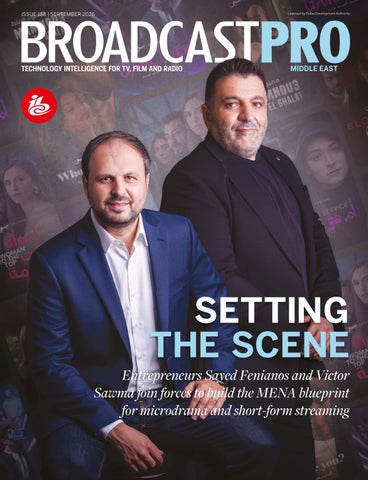
SETTING THE SCENE Entrepreneurs Sayed Fenianos and Victor Sawma join forces to build the MENA blueprint for microdrama and short-form streaming
PRO|INTRO
broadcastprome.com
GROUP Managing Director Vijaya Cherian vijaya.cherian@cpipromedia.com +971 (0) 55 105 3787
EDITORIAL Editorial Director Vijaya Cherian vijaya.cherian@cpipromedia.com +971 (0) 55 105 3787 Editorial Contributors Kalyani Gopinath Nusrat Ali
WELCOME
Urooj Fatima
Whenever we talk about streaming services in the Middle East,
Sub Editor Aelred Doyle
there is often an international technology provider somewhere in the story. Global vendors have played an important role in the
ADVERTISING
region’s transformation. But when we come to IBC, we also come
Group Sales Director Sandip Virk
with another purpose. As a B2B media brand representing the Middle
sandip.virk@cpipromedia.com
East’s broadcast and media industry, we look for regional companies
+971 (0) 50 929 1845 / +44 (0) 7516 993 862
and people building technology, creating new business models and
FINANCE
proving that innovation does not only travel in one direction.
Finance Executive Yonwin D’souza finance@cpipromedia.com
DESIGN & PRODUCTION Art Director David Fraser design@cpipromedia.com
EVENTS & MARKETING
Our cover story is a good example. Scene made its mark as the Arab world’s first dedicated microdrama platform, building oneminute vertical stories for audiences accustomed to consuming content on their phones. More interestingly, the technology powering it comes not from an international vendor, but from Hibrid, a UAE-based company founded by Lebanese technology entrepreneur Victor Sawma.
Events Executive Sarah Nathan
There is a bigger point here than regional pride. Streaming today
marketing@cpipromedia.com
involves more than delivering video over the internet. What matters
DIGITAL SERVICES Web Developer Hafiz Muhammad Waqas IT@cpipromedia.com
FOUNDER Dominic De Sousa (1959-2015)
is whether the infrastructure can scale while adapting to different services, audiences, commercial models and workflows. That is what makes the Hibrid proposition interesting. Its value goes beyond the technology to understanding streaming’s operational realities and configuring infrastructure around different requirements. For us, Scene and Hibrid represent something larger: a Middle East media ecosystem moving from being predominantly a consumer
PARTNER
of international technology to creating its own solutions. Across
Maria De Sousa
the region are exceptional engineers, entrepreneurs, producers and creatives whose work deserves international visibility.
Published by
You will find more of them throughout this issue, in our case studies, production stories and technology deployments. As we head to Amsterdam, that is what we take to IBC: an appetite to
The publisher of this magazine has made every effort to ensure the content is accurate on the date of publication. The opinions and views expressed in the articles do not necessarily reflect the publisher and editor. The published
discover what the world has to offer our region, but also stories about what the Middle East has to offer the world.
material, adverts, editorials and all other content are published in good faith. No part of this publication or any part of the contents thereof may be reproduced, stored or transmitted in any form without the permission of the publisher in writing. Publication licensed by Dubai Development Authority to CPI Pro Media FZ LLC. Printed by Al Bony Printing Press LLC. CPI Pro Media. PO Box 13700, Dubai, UAE. DQuarters, Dubai Media City (TECOM) +971 55 1053787 cpipromedia.com
VIJAYA CHERIAN,
© Copyright 2026. All rights reserved.
EDITORIAL DIRECTOR 1
PRO|CO NTENTS
broadcastprome.com
5
CABSAT 2026 BEYOND THE SHOW FLOOR CABSAT expands scope with an enhanced engagement programme and networking, as well as knowledge-sharing opportunities
12
UPDATE
COVER STORY
NEWS
SMALL SCREEN, BIG SCENE
BeIN to bring European football season live to MENA; MBC Group posts $613.3m revenue for H1 2026; Nile TV International unveils new editorial vision; Dubai forms Media Narrative Committee; and more
Scene, together with technology partner Hibrid, is taking its mobile-first microdrama model beyond scripted entertainment to build a wider microTV ecosystem for regional audiences
PRODUCTION IN SAUDI ARABIA AN UNSCRIPTED CAREER
20
From an unexpected start in production to founding Yellow Camel, Rasha AlEmam reflects on her remarkable filmmaking journey
26
14
VIRTUAL ADVERTISING
FOOTBALL FOR CHILDREN — UAE
JORDAN SCORES
FOOTBALL GOES VIRTUAL
JFA is turning overseas matches into commercial inventory with Sponix Tech, using virtual advertising to give domestic sponsors visibility in localised match feeds without disrupting the host broadcaster’s production
The UAE Pro League combines animation, AR and AI to reimagine the live match experience for a new generation of young fans
36
PRODUCTION NOTES UAE TO KAMPALA UAE’s Toy Green Films & Nomad Media spent 18 months capturing the resilience and ambition behind Uganda’s Ghetto Kids
PRODUCT REVIEW
IBC2026
A SMARTER RESOLVE
NEW LAUNCHES
DaVinci Resolve 21 brings AI integration to the edit suite. Monther Abuswaireh puts its real-world credentials to the test
As IBC returns, we bring you a sneak peak into some of the innovations exhibitors are bringing to the show this year
42
EDUTAINMENT IN QATAR
48
56 GUEST COLUMN WINNING LOYALTY
KICKING OFF CURIOSITY Jeem TV turns World Cup action into an interactive mix of football, learning and cultural discovery for young Arab viewers
32
51
WBD’s Grigory Lavrov unpacks why media brands must look beyond viewership to build more durable relationships with consumers 3
First Gulf Company: Designing Broadcast Infrastructure for the Next Decade The broadcast industry is entering a new era, one in which success is no longer defined solely by adopting the latest technologies, but by building infrastructure that can evolve alongside them. IP workflows, cloud-based production, artificial intelligence, and automation are reshaping the media landscape faster than many facilities were built to accommodate. The result is a shift in how broadcasters plan: rather than asking what a facility needs today, the region's leading operators are asking what it will need years from now. This shift is visible across the region, where broadcasters are investing in multi-platform content delivery, remote production, and software-defined workflows. As these environments grow more interconnected, systems integration has become a strategic discipline — bringing together multiple technologies and vendors into one seamless, reliable ecosystem,
with every component designed for future expansion. With more than two decades of experience delivering some of the region's most complex broadcast and media technology projects — from flagship channel launches to large-scale IP transport and remote production deployments — First Gulf Company (FGC) has built its position as a regional leader in systems integration around one principle: infrastructure decisions made today shape performance for years to come. Our approach goes beyond implementation. We work alongside clients to understand their long-term vision, enabling them to embrace emerging technologies without compromising reliability, performance, or business continuity. This philosophy is embedded in our brand promise — Trusted to do. It reflects a commitment
that goes beyond delivering technology: standing behind every system long after commissioning, and being the partner broadcasters rely on when systems must simply work, every time. As the industry continues to evolve, future-ready infrastructure will be always defined by flexibility, resilience, and intelligent integration. These are the principles that shape every project we deliver, and the reason broadcasters across the region continue to place their trust in FGC as they build for the next decade.
Explore our latest projects, solutions, and industry insights at fgc.me
Inquiries: info@fgc.me
09/26 broadcastprome.com
PRO|N E WS
Keep up-to-date at broadcastprome.com
BeIN Sports to bring new European football season live across MENA European club football has returned to action with beIN Sports preparing to deliver live and exclusive coverage of the new season across 24 MENA markets. The broadcaster will once again serve as the exclusive MENA home of several of Europe’s leading domestic leagues and UEFA club competitions, covering the season from its opening trophy through to the final matches. The new campaign
began on August 12. BeIN will broadcast every Premier League,
ERTU DIGITISES EGYPT’S BROADCAST HERITAGE Egypt is modernising
the project is the
the Egyptian Radio
digitisation of Egypt’s
and Television Union
extensive radio and
(ERTU) building
TV archive. Nearly
as part of a wider
one million audio and
strategy to digitise its
video tapes containing
media and preserve
around 800,000
its broadcasting
hours of TV and radio
heritage. Plans are
programming will be
also in place to expand
catalogues, indexed
the distribution of
and digitised.
Egyptian content
AI and other
across digital and
advanced technologies
streaming platforms
will be used to
while improving
restore and convert
efficiency.
archival material into
A key element of
high-quality files.
LaLiga and Ligue 1 fixture live and exclusively in MENA, along with selected
matches from the Turkish Süper Lig. Alongside live match coverage, it will provide dedicated studio shows, expert analysis and commentary from regional and international football specialists. Coverage will be available in Arabic, English and French, giving audiences across MENA comprehensive access to the European football season through beIN Sports and TOD by beIN.
CINEGOUNA SERIES SELECTS SIX ARAB PROJECTS FOR 2026 DEBUT Six Arab series projects have been selected for El Gouna Film Festival’s (EGFF) inaugural edition of CineGouna Series, following an open call that attracted 165 submissions. The projects were chosen for their diverse subjects and storytelling approaches. The Series was launched earlier this year in response to the rapid growth of the regional series sector.
The programme will run in two stages. The first is a six-week online development lab featuring specialised workshops, individual mentoring and support in preparing projects for pitching. In the second stage, selected writers will participate in a dedicated series market featuring one-to-one meetings, networking opportunities and presentations to industry representatives.
5
PRO|N E WS
SEPTEMBER 2026
LaLiga and Footballco spotlight MENA fandom in new documentary LaLiga and football media and culture company Footballco have launched a new documentary, A Journey of Passion, highlighting the unique ways MENA football fans connect with Spanish football through their local cultures and personal identities. It is being distributed through LaLiga’s channels and those of the featured clubs, alongside Footballco’s MENA media network,
including Kooora and the Arabic edition of GOAL. The documentary looks
beyond the football pitch to explore how LaLiga has become part of everyday
life as it follows three passionate fans from Egypt, Saudi Arabia and Morocco, documenting their personal relationships with their clubs and the ways they maintain that connection despite being thousands of kilometres away. It captures their experiences as they visit the stadiums, walk onto the pitches, meet fellow supporters and finally watch their beloved clubs from the stands.
MBC GROUP POSTS $613.3M REVENUE IN H1 2026 MBC Group has reported
fair-value loss on its
disciplined pricing and
budgets, postpone
revenues of $613.3m
investment in Arabian
expanding business-to-
campaigns and adopt
for the first half of
Contracting Services
business partnerships.
shorter booking cycles.
2026, down 24.6%
Company. Excluding
AVOD revenue,
from $799m in the
that, the Group posted
however, fell 11% amid
commercial activities
same period last year,
a normalised net profit
weaker advertising,
dropped 42.4% to
as weaker advertising
of $47.3m, compared
while other revenue
$146.93m, mainly due
demand and lower
with $80.3m in H1 2025.
more than doubled
to the completion of
MBC Shahid remained
to $8.12m, helped by
major contracts.
contributions from major Broadcast & Technical
a key growth driver,
increased programme
The M&E segment
Services contracts
with revenues rising
sales to third parties.
generated $77.10m in
weighed on performance.
18.5% year-on-year to
The Broadcasting
revenue, a 51.5% year-
The decline reflected
$219.77m. The streaming
& Other Commercial
on-year decline. Net
the timing of revenue
platform also recorded
Activities (BOCA)
profit was $186,000.
recognition across
net profit of $14.43m,
segment remained
Media & Entertainment
putting it on track
MBC Group’s largest
underpin the Group’s
(M&E) projects and
to achieve full-year
revenue contributor,
broader performance.
continued geopolitical
profitability in 2026.
though revenue declined
MBC maintained
uncertainty in the region.
SVOD revenue increased
32.7% year-on-year to
audience momentum
23.3% to $177.41m,
$311.5m. Advertising
during Q2 with a diverse
net loss of $9.1m for the
supported by subscriber
revenue fell 20.8% to
slate covering drama,
six months ending June
growth across MENA and
$164.42m as geopolitical
entertainment, Arabic
30, 2026, largely due
international markets,
uncertainty prompted
adaptations and locally
to a $56.2m unrealised
strong retention,
advertisers to reduce
produced originals.
MBC Group recorded a
6
Revenue from other
Content continued to
The world’s most powerful broadcast audio mixer designed for a SMPTE-2110 future! Fairlight Live audio panels are the mixing control center of your live production! Designed to integrate with Fairlight Live software, the world’s most powerful audio mixer, you can manage unlimited channels and complex mixes with subtle adjustments using precision faders and knobs. Real-time visual feedback is provided by LCD displays. USB-C and SMPTE 2110 network integration ensures seamless compatibility with ATEM switchers.
Upper Deck Function Buttons The function buttons allow fast access to channel processing and routing tools including EQ, dynamics, plugins, panning, and bus assignments. When you select a function, the menu buttons, encoders, and touchscreen automatically adapt to show relevant controls and parameters. Function buttons work with soft menu buttons to navigate parameter pages, keeping advanced mixer functions organized and accessible.
Customizable Channel Strips
Tools for Live Production
Fairlight Live audio panels feature customizable channel strips which include a motorized fader, solo, mute, and select buttons, plus a rotary encoder for fast access to channel functions. The bright LCD touch screen display keeps channel status and identification clear. Assign any strip to any track or bus, plus a single strip can control multiple tracks or buses simultaneously.
The most important live production functions are grouped so you can move quickly between rehearsal, playback, cue execution, and show automation. Player recorder lets you record and play back virtual sound checks. Cue player gives instant access to audio and MIDI cues for jingles, stingers, and effects. Snapshot controls enable fast preview, recall, update, and creation of snapshots for seamless show transitions.
LCD Touchscreen Display Each group of 10 channel strips has a dedicated LCD touchscreen, giving you a comprehensive graphical display of your audio mix including channel VU meters and mixer status. Adjust plugins, assign channels to busses, manage monitoring, configure layers, and set spill zones via the touchscreen. You can control complex live mixing in one place without navigating to separate menus during live production.
www.blackmagicdesign.com/ae SRP excludes duties, shipping and sales tax.
Fairlight Live ..........................................Free Download Fairlight Live Audio Panels ...................................... From US$2,229
Learn More!
PRO|N E WS
SEPTEMBER 2026
Nile TV unveils new visual identity and editorial strategy Nile TV International has launched the first stage of a wider institutional transformation focused on enhancing editorial operations, developing media talent and expanding the channel’s ability to present Egypt’s perspectives internationally. The broadcaster has introduced a refreshed visual identity inspired by the colours of the Egyptian flag. The transformation includes the restructuring
of newsroom operations, introducing new editorial procedures, a unified editorial terminology guide and redesigned workflows to improve efficiency and decision-making. Further, a dedicated Digital Media and Archiving Department will now manage digital assets, preserve content and support digital transitions. The channel has recruited new media professionals, with 10 broadcasters joining its
on-air team. Original daily production has increased from approximately six hours to over 15 hours. The expanded schedule includes news bulletins, current affairs, politics, business, culture, tourism, Arab and African affairs, and religious programming in English and French. The next stage will focus on launching a new website, introducing live-streaming and expanding the channel’s social media presence.
INTERNATIONAL PRODUCTIONS DRIVE MOROCCO’S FILM SECTOR TO RECORD $180M INVESTMENT TV projects remained a major contributor to the sector: Christopher Nolan’s The Odyssey was the largest foreign production of the year, generating over $25.2m in local The Odyssey emerged as the largest foreign production of the year.
investment. Moroccan films strengthened the domestic box office,
Morocco’s film
support, according
with several local titles
industry delivered a
to the Moroccan
outperforming major
strong performance,
Cinematographic
international releases.
attracting nearly $180m
Centre’s (CCM)
in cinema-related
annual report.
remained strong with the
investment, driven by
Foreign productions
completion of 26 feature
a rise in international
contributed $121m, while
films. The audiovisual
productions, local
domestic productions
sector remained
filmmaking, strong
generated investments
active across multiple
box-office performance
worth $59.6m.
formats representing
and increased public
8
International film and
Local filmmaking
investments of $65.1m.
SAUDI BOX OFFICE GENERATES $9.5M IN WEEKLY REVENUE Saudi Arabia’s cinema box office generated approximately $9.5m in revenue during the August 9-15 week, with more than 725,900 tickets sold across 40 films screening in the Kingdom’s cinemas. The figures, published by the Saudi Film Commission, highlight continued activity in the country’s rapidly expanding theatrical market. Aks Sir has been a notable performer, accumulating nearly $933,000 in box-office revenue since its release, placing it fourth in the Saudi box office by revenue. The latest figures underline the scale of Saudi Arabia’s theatrical market, where 40 films collectively attracted more than three-quarters of a million cinema admissions during the reporting period.
See us at IBC booth 10.A31
I‘M AN ARTIST
BERNHARD POPOVIC QUICK REACTION FILM www.quickreaction.film
"
On set, losing comms means losing sight of the production – that’s why my Riedel headset is always on. With Artist and Bolero intercom, I can truly focus on getting the shot – knowing that every department is in sync when it matters most.“
ARTIST INTERCOM
Professional and reliable live communications. Seamless integration of Riedel‘s SmartPanel and Bolero wireless intercom. Easily scaling from 16 to 1024 ports with flexible licensing.
Become an ARTIST www.riedel.net Photo by Stefan Klinge
#iamanartist
PRO|N E WS
SEPTEMBER 2026
UAE-based streaming platform Begin inks three-year Serie A rights deal for Pakistan UAE-headquartered streaming platform Begin has secured exclusive broadcast and sublicensing rights for Serie A, Coppa Italia and the Supercoppa Italiana in Pakistan. Under a three-year agreement, football fans in Pakistan will have access to live and on-demand coverage of matches and fixtures from all three competitions. The deal adds Italy’s top-flight football league
Jonathan Mark Tatti, CEO of Begin.
and its two major domestic cup competitions to Begin’s growing sports offering, as
the company continues its strategy of bringing globally recognised sporting events
to Pakistani audiences and investing in the country’s expanding digital sports entertainment market. Begin’s existing football portfolio includes LaLiga, the Saudi Pro League, the EFL and the Carabao Cup, as well as the Spanish Supercopa. The platform also carries major international sporting properties such as MotoGP and Zuffa Boxing, among other global events.
DUBAI ESTABLISHES MEDIA NARRATIVE COMMITTEE
10
His Highness Sheikh
of the Dubai Media
narrative in coordination
and international media
Ahmed bin Mohammed
Council (DMC), the
with relevant entities
trends to support
bin Rashid Al Maktoum,
committee will define
before submitting
decision-making. It will
Second Deputy
the overarching
recommendations to
also provide technical
Ruler of Dubai and
framework, strategic
the DMC for approval
media advice to the
Chairman of the
priorities and key
and monitoring
DMC and other relevant
Dubai Media Council,
pillars of Dubai’s media
implementation. It
entities when requested.
has issued Council
narrative. DMNC will
will also propose
Dubai Media Council’s
Decision No. (16) of
focus on strengthening
mechanisms to align
General Secretariat will
2026 establishing the
coordination between
media efforts across
provide administrative
Dubai Media Narrative
government, semi-
sectors and guide
and technical support
Committee (DMNC),
government and private
official engagement on
to the committee.
tasked with developing
sector organisations
international platforms
Under the decision,
and coordinating the
to ensure coherent
and with global media.
all government
emirate’s strategic
messaging. It will
The committee
entities and relevant
media narrative
also work to counter
will establish key
organisations in Dubai
across government,
misinformation and
performance indicators
are required to provide
semi-government and
false news through
to measure the
the data, information,
private sector entities.
transparent, fact-
effectiveness of Dubai’s
studies, reports
Chaired by Her
based communication.
media narrative and
and documentation
Excellency Mona
Further, it will develop
prepare analytical
needed to enable the
Ghanem Al Marri,
policies, strategic
reports assessing
committee to carry
Vice Chairperson and
plans and priorities
opportunities,
out its responsibilities
Managing Director
for Dubai’s media
challenges and local
effectively.
P R O | CA B S AT 2 0 2 6
SEPTEMBER 2026
CABSAT ENTERS A NEW CHAPTER Rajendra Salgaonkar, Head of Sales at Dubai World Trade Centre, outlines what visitors can expect from CABSAT this year With the current situation, what changes can we expect at CABSAT 2026 in terms of exhibition space, exhibitor numbers and participating countries?
The media industry has always adapted quickly to change. While geopolitical developments have naturally created uncertainty across global markets, we have not seen any decline in the industry’s appetite to do business in the Middle East. Technology is evolving rapidly.
12
Broadcasters are redefining their business models, content owners are looking at new monetisation opportunities, and technology providers are helping customers navigate AI, cloud and IP transformation. For 2026, we are expecting over 700 international brands from more than 120 countries, with strong participation from Europe, North America, Asia and across the Middle East and Africa. Our move to the Dubai Exhibition Centre also gives
us the space and infrastructure to support the continued growth of the event while enhancing the overall visitor experience. Beyond the exhibition floor, what new features, demonstration areas, meeting formats or networking opportunities are being introduced this year?
Today’s exhibitors expect much more than stand traffic – they want quality conversations that lead to business. We
P R O | CA B S AT 2 0 2 6
broadcastprome.com
are enhancing our buyer engagement programme, creating more structured business-matching opportunities and introducing concierge-led meetings between exhibitors and qualified buyers. CABSAT will also feature a Co-production Salon, a live virtual production set, microdrama workshops and a Content Creators Lab. Visitors can also expect more live technology demonstrations, networking sessions and knowledgesharing opportunities. Which technologies and industry developments are likely to dominate CABSAT 2026?
The industry is going through one of its biggest technological shifts. We are seeing AI being integrated into production workflows, content management, localisation, automation and audience engagement. At the same time, cloud production, IP infrastructure, streaming, virtual production, immersive experiences and content monetisation continue to attract significant investment across the region. Perhaps the biggest trend is convergence. The lines between broadcasting, streaming, telecommunications, satellite, pro AV and digital media continue to blur, and CABSAT has evolved to reflect this changing ecosystem. How is the conference programme evolving this year, and which themes, speakers or sessions would you highlight?
The conference programme has evolved alongside the industry. While technology remains central, we are placing greater emphasis on the commercial side of media transformation: how businesses are adapting, creating new revenue
For 2026, we are expecting over 700 international brands from more than 120 countries RAJENDRA SALGAONKAR, HEAD OF SALES, DUBAI WORLD TRADE CENTRE streams and responding to changing audience expectations. This year’s programme will cover AI, cloud transformation, sports broadcasting, microdrama, OTT, content monetisation, the creator economy, media sustainability and future broadcast infrastructure.
What are you doing to ensure that CABSAT continues to attract senior buyers, broadcasters, content owners, production companies and government representatives from across the Middle East, Africa and South Asia?
Our focus has always been on senior decision-makers and people responsible for investments, partnerships and technology adoption within their organisations. Through our hosted buyer programme, targeted marketing campaigns, strategic industry partnerships and extensive regional outreach, we continue to strengthen the quality of visitors attending CABSAT. For someone deciding whether
With SATEXPO receiving a
to attend this year, what will
distinct identity, how will the core
they experience at CABSAT
CABSAT offering and Integrate
2026 that they would not have
Middle East be positioned?
encountered at previous editions?
It became increasingly clear that each platform deserved its own identity while continuing to benefit from being co-located. CABSAT remains the region’s leading event for broadcast, media production, content creation and content delivery. SATEXPO has established itself as a dedicated platform for the satellite and space industry, bringing together satellite operators, manufacturers, government agencies, defence, mobility and next-generation connectivity providers. Integrate Middle East continues to focus on professional AV, immersive technologies, smart buildings and integrated experiences. Each event has a clearly defined audience, but together they create an ecosystem that reflects how these industries increasingly intersect.
Visitors will experience a much broader technology ecosystem than before, from AI-powered media workflows and cloudnative broadcasting to satellite innovation, virtual production, pro AV integration and new content monetisation strategies. For anyone looking to understand where the industry is heading, CABSAT remains the place where those conversations begin. Are you offering any preferential rates for attendees?
Registered visitors will have access to preferential hotel rates and travel benefits through our official travel partners. We are also working with Emirates Airline on exclusive travel offers for attendees, with details to be announced through CABSAT’s official channels. 13
P R O | C OV E R
SEPTEMBER 2026
MICRO STORIES MACRO AMBITION Scene was among the early movers to build a dedicated microdrama platform for MENA, creating one-minute vertical episodes for a generation accustomed to consuming content on their phones. Now it wants to turn that proposition into a much broader micro-TV ecosystem. Scene founder and CEO Sayed Fenianos and Hibrid founder, CTO and CIO Victor Sawma give Vijaya Cherian an inside look at the content strategy and technology powering the microdrama platform When Scene entered the MENA market, microdrama was still a relatively unfamiliar proposition in the region. Short-form vertical video was already part of everyday viewing, particularly among younger audiences, but professionally produced episodic storytelling remained largely tied to television and conventional streaming. For Scene founder and CEO Sayed Fenianos, that gap presented an opportunity. Social platforms had demonstrated the appetite for short, mobile-first viewing, but he believed there was room between the informality of social video and the time commitment demanded by traditional premium entertainment. “The idea behind Scene came from observing a simple reality: people’s attention spans have changed, but storytelling hasn’t evolved at the same pace.” Scene set out to occupy that middle ground with professionally produced vertical stories structured around episodes of approximately one minute. Its series typically run for 50 to 60 episodes, meaning a complete story can be consumed in roughly an hour, but in 14
increments suited to mobile viewing. The format has required a different approach to writing and production. Scripts have little room for exposition or scenes that do not move the story forward. Shooting is conceived for the vertical frame, editing is faster and individual episodes must provide enough progression to keep viewers moving immediately to the next. Fenianos says the lesson from Scene’s early experience is that duration itself is less important than maintaining momentum. “We’ve found that approximately one-minute episodes create the strongest retention, provided every episode delivers meaningful progression and ends with a compelling reason to continue or a cliffhanger.” That has implications beyond the creative process. A conventional television episode might ask viewers to decide what to watch every 30 or 45 minutes. On Scene, the platform effectively must retain that viewer every minute. Technology therefore becomes inseparable from the content proposition: a compelling cliffhanger loses some of its value if the next episode takes too long to start.
Building for microdrama
That challenge brought Scene together with Hibrid, a UAE-based infrastructure and technology company founded by Lebanese entrepreneur Victor Sawma. Beyond supplying the underlying technology, Hibrid serves as a strategic partner to Scene, supporting the wider development of the platform and its commercial proposition. Hibrid was tasked with providing the cloud infrastructure, streaming platform and security underpinning Scene, working alongside Klev, which developed the OTT CMS. Together, the technology ecosystem delivers an integrated solution spanning video preparation and delivery, AI enablement, audience analytics, security and monetisation. Sawma says the brief was unusual because vertical microdrama was still relatively new in the region. The most obvious difference was the format, but the bigger technical consideration was the speed with which one short video had to give way to another. “Given the relatively weak internet infrastructure in the region, Hibrid’s main challenge was to focus on providing high-
broadcastprome.com
P R O | C OV E R
15
P R O | C OV E R
SEPTEMBER 2026
Sayed Fenianos, founder and CEO, Scene.
quality video content with ultra-low latency when playing videos.” Sawma clarifies that the principal challenge was not consumer connectivity itself, but uneven CDN performance across different regional markets. Hibrid’s role extends from video ingestion and transcoding to cloud hosting, delivery and platform security. Content entering the platform is transcoded into different technical profiles so that playback can be matched to the capabilities of the viewer’s device and connection. A multi-CDN architecture handles delivery, dynamically shifting traffic to serve users from an appropriate CDN edge. Hibrid says the infrastructure is designed to scale to millions of concurrent viewers, allowing Scene to expand without having to redesign its delivery architecture as audiences grow. For a platform built around one-minute episodes, however, scale is only part of the equation. Playback has to feel almost continuous. Sawma says this begins 16
before the viewer presses play. “It all starts with proper video preparation during the ingestion workflow. This includes optimising video bitrates without sacrificing quality, optimising key frames, warming cloud storage and CDN edges, optimising video chunks and switching between technical codecs and streaming protocols smartly, depending on viewer device capabilities.” Vertical video also requires changes to transcoding profiles and player behaviour, particularly on handheld devices. Hibrid engineered
People’s attention spans have changed, but storytelling hasn’t evolved at the same pace SAYED FENIANOS, FOUNDER AND CEO, SCENE
support across the streaming delivery chain, creating a complete workflow designed to move vertical content frictionlessly from ingestion and transcoding through to playback. Custom engineering was also required to integrate Scene’s monetisation requirements with the infrastructure. Importantly, Fenianos does not describe Hibrid simply as an infrastructure supplier. Scene deliberately sought a technology team that understood the wider product it wanted to create. “We deliberately partnered with Hibrid and Klev to build up a technology team that shared our vision of building a mobile-first entertainment platform rather than simply another streaming application.” Sawma makes a similar distinction from the technology side, describing Hibrid as a strategic business partner involved in product strategy, consultancy, knowledge transfer and support throughout the project. From microdrama to micro TV
The architecture is now being asked to support a considerably bigger ambition. Drama was Scene’s starting point, but Fenianos says the company was never intended to remain solely a microdrama service. The next stage is what Scene calls micro TV: a broader destination bringing the short-form approach to cooking, lifestyle, documentaries, reality, sports highlights, entertainment, education and creator-led programming. “The vision is simple: whatever people enjoy watching, they should be able to enjoy it in a concise, premium format.” Scene already has dozens of original productions spanning markets including Lebanon, Egypt, Syria, Saudi Arabia and Tunisia, and intends to grow
P R O | C OV E R
broadcastprome.com
the catalogue through its own productions as well as partnerships with studios, independent producers, writers and creators. That regional spread is important because Scene does not regard Arabic-speaking audiences as a single homogeneous market. Its content strategy takes account of different preferences across Saudi Arabia, Egypt, the Levant and the UAE, while looking for themes capable of travelling across borders. Authenticity, Fenianos argues, matters more than imposing a common style or dialect. “People connect with genuine stories before they connect with language.” Most Scene originals are consequently conceived specifically for vertical viewing rather than recut from conventional television. The company is, however, exploring whether existing film and television libraries can be restructured into micro-formats, potentially giving established IP another route to younger audiences.
for editorial judgement. “Data can tell us what audiences watched. It cannot tell us what audiences will fall in love with next.” The same balance between technology and content applies to AI. Hibrid already offers AI capabilities across its video platform, including subtitle generation and localisation, metadata extraction, trailer generation, offensive-content detection, scene and chapter detection, horizontal-to-vertical conversion and other workflow functions. Scene expects intelligent personalisation and localisation to become increasingly important
as micro TV expands into more categories and languages. Arabic remains its priority, but the longerterm strategy includes subtitling, dubbing and potentially original productions in additional languages. Securing and monetising the experience
Scene continues to operate on a freemium foundation, complemented by subscriptions, advertising, branded entertainment and product placement. The shortform structure potentially opens different opportunities for brands because viewers may consume many consecutive episodes within
Following the viewer
The short episode structure also produces a particularly detailed picture of viewing behaviour. Scene monitors completion rates, episode progression, retention, subscription conversion, advertising engagement and sharing behaviour to understand whether viewers are moving through a story rather than simply sampling it. Hibrid’s platform captures viewing activity at close to secondby-second level, enabling playback to resume from where a user stopped and supporting rules around episode access. Those signals also feed the platform’s personalisation capabilities, with some recommendations responding to behaviour in near real time. For Fenianos, however, analytics are an input rather than a substitute 17
P R O | C OV E R
a single session. Hibrid’s integration of analytics with the platform’s monetisation capabilities enables Scene to understand how those viewing patterns translate into subscription conversion, advertising engagement and commercial value. At infrastructure level, Hibrid has also integrated a range of protection measures including hotlink protection, signed URLs, DRM and video encryption, which Scene can activate as required. Cloud infrastructure is also central to the ability to absorb spikes in viewing without maintaining capacity that may sit unused at other times. Hibrid’s relationship with Alibaba Cloud gives it another route to provide regional cloud and AI services, while addressing dataresidency requirements in markets where those considerations apply. “Cloud infrastructures are vital for any digital solution nowadays, especially when it comes to availability and ability to handle spikes.” The underlying architecture was designed with expansion in mind, although the precise technical requirements of Scene’s next phase are still being determined as the micro-TV proposition develops.
SEPTEMBER 2026
Hibrid’s main challenge was to focus on providing high-quality video content with ultralow latency when playing videos VICTOR SAWMA, FOUNDER, CTO AND CIO, HIBRID
A model from the region
There is a wider significance to the partnership as both companies are building the platform for a fragmented and rapidly changing regional audience. One company is attempting to establish a new content category; the other is building the infrastructure needed to make that viewing behaviour practical at scale. Scene also sees the format as an opportunity to widen the regional creative pool. Lower production barriers can give emerging writers, directors, actors and digital creators 18
opportunities to reach audiences without following the traditional route into television or film. Partnerships with local producers across different markets will be central to building that pipeline. For Hibrid, meanwhile, the work may have applications beyond Scene. Sawma says vertical short-form video is already generating wider interest, with other projects under discussion. Scene’s ambitions are substantial. Fenianos wants the platform to
become the leading micro-TV service in the region and ultimately a global reference for premium micro-content. “Just as streaming transformed traditional television, we believe micro TV will redefine the next generation of entertainment.” Whether micro TV becomes a category in its own right remains to be seen. What Scene and Hibrid demonstrate, however, is that the shift towards short-form viewing is beginning to influence much more than programme duration. It is changing how content is conceived and produced, how platforms are architected, how viewing behaviour is measured and how technology and creative strategy come together. In that sense, Scene has gone beyond putting shorter programmes on a smaller screen. It is testing whether an entertainment proposition conceived in the region, and a technology stack engineered around the habits of mobile-first audiences, can provide a different model for premium streaming in MENA and beyond.
IP
SDI & HDMI Inputs
SDI & HDMI Outputs
Mic/Line Inputs
Edge
Line Outputs
ONE
MADI In/Out
USB‑C Audio (class compliant)
Audio DSP & Mixer
One Box. Countless Solutions.
De‑Embed / Shuffle/Embed
GPI I/O
Headphone Outputs
Embedding/ De-Embedding
Join us at IBC #8.B90
Studio Floors
Live Event Venues
Feature availability is subject to the selected licensing configuration.
Remote Production
Post-ProductionSuites
Scan for details.
Pro AV Installs
Commentary Positions
P R O | P R O D U C T I O N I N KS A
SEPTEMBER 2026
AN UNSCRIPTED PATH IN PRODUCTION From leading film productions in Saudi Arabia to heading Yellow Camel, one of Saudi Arabia’s major production services and production companies, Rasha AlEmam’s career path has had unexpected twists. She discusses her journey, the transition in the Kingdom’s film landscape, and where she envisions the media scene heading with Sarah Nathan
20
P R O | P R O D U C T I O N I N KS A
broadcastprome.com
Rasha AlEmam’s career in film production has not been intentional. In fact, from 1998 to 2002, she worked in a hospital as a contracts auditor. When MBC shifted its operations from London to Dubai and was on the lookout for qualified Saudi Arabian nationals, her résumé found its way to the network and she moved to the company, expecting to continue her career in audit. Instead, the CEO placed her in production. “I told him I don’t know anything about production,” AlEmam recalls. “He said, you have a producer’s character and you’ll learn on the job.” That exchange marked the start of a career in production and broadcast that has now lasted more than 20 years. At MBC, AlEmam started “bottomup”, working as a production assistant on TV shows. In 2007, she helped launch MTV Arabia with AMG. The next year, she moved back to her home city, Jeddah, where she joined Alif TV as it prepared to launch a TV channel. Although that venture never came to fruition, Alif pivoted to radio and AlEmam stayed on to help launch the station; she eventually became the CEO. It wasn’t until 2019 that AlEmam felt the pull of scripted production again. She began attending workshops and writers’ room sessions out of curiosity, slowly reviving her passion for producing film and TV. The opportunity to shift paths arrived promptly in 2020, when MBC brought her on for Desert Warrior and she ultimately accepted the role of Head of Productions at MBC Studios Saudi Arabia. With a year of location scouting, 16 weeks of preparation and 14 weeks of shooting, Desert Warrior was a project of historically large scale, unlike anything the Kingdom had
I want a Saudi film that travels globally and is watched by audiences from the United States to China RASHA ALEMAM, FILMMAKER seen before. “It was a production with the largest budget in the Middle East,” AlEmam recounts. “We had 750 people of 52 nationalities on crew, and 120 Saudi Arabian trainees.” The venture demanded organisation and coordination from her. “You manage everything: budgets, people, locations, the director, the studio … It’s just what you have to do as a producer.” Her involvement with Hollywood standards was an eye-opener. “Everything moved like clockwork because everyone knew what they had to do,” AlEmam explains. “The work ethic is very respectable. Everything is a little bit more seamless.” The success of the production eventually drew attention from filmmakers internationally, who were interested in Saudi Arabia’s potential and specifically AlEmam herself. Committed to her role at MBC, she pointed them towards other industry contacts; however, as requests kept coming, she began to reconsider and toyed with the idea of starting her own company. After some reflection, AlEmam resigned from MBC. “I felt it was time for me to branch out. Many people wanted to come film in Saudi Arabia and the infrastructure was still very nascent. I wanted to give producers the best possible experience in Saudi Arabia.”
And so, Yellow Camel was established in 2022 as a Saudi production company. Since then, it has worked with international and regional productions while expanding into the development of original Saudi content. Its first project, the Hindi film Dunki, was the first sign of its potential and calibre. “We basically became the goto company for production services for international shoots,” says AlEmam. Much of her time is dedicated to educating producers about Saudi Arabia’s film landscape – “the variety of locations, the costs, the resources available, the incentives and how to apply for, receive and maximise them, the red lines on scripts and what you can and cannot shoot”. Larger productions usually warrant her presence on set. “I have a brilliant team, but when it’s a big project I always prefer to be on set myself, like Dunki with Shah Rukh Khan or, more recently, In the Grey with Guy Ritchie. But after being in the industry for 24 years, I have more of a strategic role.” A standard part of her role is improving international producers’ understanding of Saudi Arabia. “Ninety-nine percent of the meeting is changing their perceptions first,” says AlEmam. The one she most frequently encounters is that Saudi Arabia equals desert. In reality, its geography spans green hills in the south, Jeddah’s old city, Riyadh’s futuristic skyline, AlUla’s heritage sites and NEOM’s coastline and mountains. To address this, she routinely shares a location deck with interested producers. “We could even build you Manhattan in the back lot, if you want,” she claims. A second common assumption is that the Kingdom lacks equipment and crew. By her estimation, approximately 99% of what an international shoot needs is already 21
P R O | P R O D U C T I O N I N KS A
available locally. Perceptions of Saudi Arabia’s society are also outdated – in AlEmam’s experience, people occasionally question whether women can work on Saudi crews. “Saudi Arabia has done a lot of marketing, but the media in other countries don’t always show these changes,” AlEmam posits. “We still have people unaware of all the progress in Saudi Arabia – of our readiness for film and the facilities, resources and talent. We now have several ambassadors, but I still get questions about these things.” Saudi Arabia’s film and TV production rebate of up to 60%, an incentive that AlEmam cites as the highest in the world, also sits at the centre of her pitch to producers. However, she emphasises that adhering to the rebate’s guidelines is non-negotiable. Although the Kingdom faced teething issues when rolling it out, the process is now 100% reliable. “The policy of the rebate is very clear. If you don’t follow it, you won’t get all your money. It was
22
SEPTEMBER 2026
Diversifying our activities has allowed us to continue growing, strengthen the business and be ready for new opportunities as the industry continues to evolve RASHA ALEMAM, FILMMAKER a work in progress, but today it’s in place, ready and happening.” Today, the services arm of Yellow Camel Studios is a well-oiled machine that “runs on autopilot”, also consulting on film sets, hosting workshops and training people on sets. With a reliable team of 15 capable of managing operations, AlEmam is afforded time to invest efforts into other aspects of production. In
parallel, Yellow Camel has significantly expanded into developing original IP, with a slate of 17 projects currently in development, reflecting the company’s long-term vision alongside its production services business. “I love true stories and can’t resist them, so we’re continuously looking for them,” AlEmam enthuses. A recent project she co-produced, Hajjaan, depicts the relationship between a boy and a camel and Saudi Arabia’s camel race scene. AlEmam is proud to share that the riders in the film were the camels’ owners in real life. “The little anecdotes really help bring together the whole production,” she says. The film also reflects Yellow Camel’s commitment to bringing authentic Saudi stories, culture and talent to audiences through locally rooted narratives. “Sometimes our stories and emotions are so universal,” she explains. “I want a Saudi film that travels globally and is watched by audiences from the United States to China.” As a film producer, AlEmam is cognisant of the difficulty of predicting success. “I always say to do your best and hope for the best. Give it all your energy, loyalty, commitment and time. It’s a tricky market – some films work and some don’t, but the ones that don’t are not necessarily bad films. Sometimes films can work in local but not global markets.” Among the realities hardest to translate onto the big screen is the scale of generational change in Saudi Arabia. The gap between a preinternet life and the country today is challenging to convey without the narrative being reduced to a stereotypical misrepresentation of the Kingdom. “It’s a difficult story to relay in a way that doesn’t come back negatively, because that’s where
P R O | P R O D U C T I O N I N KS A
broadcastprome.com
Rasha AlEmam (second from right) on the set of Desert Warrior.
people tend to go, especially when it comes to perceptions of women’s status and treatment,” says AlEmam. Another obstacle she has faced is securing funding for original content, a challenge shared by production companies in many markets. Although Yellow Camel Studios benefits from the support of investors and the backing of its chairman for private projects, market conditions can occasionally impact the timing of individual productions. Rather than slowing the business, Yellow Camel has responded by further diversifying its activities through government RFPs, production consultancy, international production services, and year-round training and workshops. “The industry, like any other, has its natural cycles, so we’ve always focused on being adaptable,” AlEmam says. “Diversifying our activities
has allowed us to continue growing, strengthen the business and be ready for new opportunities as the industry continues to evolve.” Observing the current landscape of film and TV in the Kingdom, AlEmam is clear that there is nothing she would change; instead, she is only keen to see it expand. For instance, she believes there is much space for local screenwriting talent to make their mark: “They’re getting better and there are more, but it’s still a weak point to focus on.” Additionally, she hopes to see more young Saudi Arabians train in the stunts and VFX departments. “These are very specific skillsets that require a lot of passion.” AlEmam is confident that Saudi Arabia is on a steady trajectory to more global attention. Referencing resources, government backing
and the dynamic energy of Saudi Arabian youth, she says: “Saudi Arabia has achieved in five years what other nations achieved in 20. When I shot Desert Warrior in 2021, there was almost nothing.” Looking ahead, AlEmam sees Yellow Camel playing a central role in shaping the next chapter of Saudi filmmaking, by continuing to champion local stories while attracting international productions to the Kingdom. “Today we have top-of-the-line stages in Jeddah, Riyadh, NEOM and AlUla, and the top virtual stage in Riyadh. There’s an art university in Riyadh where you can learn film. Local crews have advanced so much, and skillsets are becoming better with every project. Saudi Arabia is going to become the film hub of the world very soon.” 23
The premier B2B conference and awards of the MENA Media and Entertainment industry 5 NOVEMBER 2026 / THE WESTIN DUBAI MINA SEYAHI BEACH RESORT & MARINA
NOMINATIONS NOW OPEN!
Awards Nominations and Sponsorship Vijaya Cherian +971 55 105 3787 vijaya.cherian@cpipromedia.com
© 2026 CPI Pro Media. All rights reserved.
Sarah Nathan marketing@cpipromedia.com
Learn
More
GOLD SPONSOR
PRINCIPAL SPONSOR
ASSOCIATE SPONSOR
STR ATEGIC TECH PARTNER
NETWORKING SPONSOR
NETWORKING SPONSOR
PRESENTED BY
P R O | V I R T UA L A DV E R T I S I N G
For JFA, Sponix deployed SPboard, its cloud-based virtual advertising platform, to insert sponsor messages into a live feed.
26
SEPTEMBER 2026
P R O | V I R T UA L A DV E R T I S I N G
broadcastprome.com
JFA GAINS A VIRTUAL ADVANTAGE The Jordan Football Association has transformed matches played outside the country into new sponsorship opportunities by introducing Sponix Tech’s virtual advertising into its localised broadcast feeds, without installing equipment at the stadium or disrupting the host broadcaster’s production workflow. Vijaya Cherian examines the technology and commercial model behind the project
When Jordan’s national football team plays abroad, its domestic sponsors face an obvious limitation: the physical advertising visible inside the stadium is generally intended for the host market. Even when the Jordan Football Association (JFA), the governing body for football in Jordan, holds the rights to provide a localised broadcast feed for viewers at home, its partners may receive little or no exposure during the match. JFA wanted to overcome this constraint by creating additional advertising inventory within the Jordanian broadcast. More importantly, it needed to do this without installing new equipment at overseas venues or making changes to the host broadcaster’s core production. The federation enlisted Sponix Tech to introduce virtual advertising into the live feed, enabling physical perimeter branding to be replaced or supplemented with advertising tailored specifically to viewers in Jordan. “Without Sponix’s virtual advertising technology, JFA’s
sponsors would have had no brand visibility during these away matches,” says Mohammad Ali Abbaspoor, founder and CEO of Sponix Tech. Software-based broadcast technology
Headquartered in Qatar, Sponix develops AI-powered broadcast solutions for leagues, football associations, broadcasters and sponsors. Its software-based technologies operate remotely using the live programme feed and do not require dedicated hardware to be installed at the venue. For the JFA project, Sponix deployed SPboard, its cloud-based virtual advertising platform, which inserts sponsor messages into a live feed and allows the content to be adapted by territory, language or audience. It uses AI, machine learning and computer vision to process the programme feed remotely and integrate the virtual advertising into the existing production workflow. The arrangement with JFA is not tied to a fixed number of fixtures. Whenever Jordan plays outside the
country and the federation controls the localised broadcast feed for the Jordanian market, the two entities can introduce virtual advertising. The model is particularly relevant to international friendlies, for which an away football association will often retain the right to broadcast a match in its home market. Competitions organised by FIFA or the Asian Football Confederation are generally treated differently, as their broadcast and commercial rights are typically centralised and managed by the governing body. Cloud-based deployment
At the centre of the operation is SPboard. It receives the live programme feed and uses AI to identify the active camera, track the relevant advertising surfaces and distinguish foreground objects such as players, officials and the ball. Once the approved advertising has been inserted, the processed programme feed is returned to the broadcaster or distribution partner for transmission. Jordan TV and the host broadcaster 27
P R O | V I R T UA L A DV E R T I S I N G
are involved in the wider broadcast workflow and signal integration. Because the processing takes place remotely in the cloud, no dedicated hardware or specialist camera installation is required at the stadium. The system can therefore be incorporated into an existing broadcast workflow with limited operational intervention – an important consideration for one-off international matches staged at different venues. “Our solution is 100% nonintrusive, making integration and implementation significantly simpler than conventional virtual advertising systems,” Abbaspoor explains. “Unlike other solutions, there is no need for complex integration with the production workflow or lengthy calibration processes, allowing deployment with minimal operational impact.” According to Abbaspoor, this approach works for international friendlies where preparation time may be limited and installing a conventional system for a single match at a particular stadium may not be practical or cost-effective.
SEPTEMBER 2026
Without Sponix’s virtual advertising technology, JFA’s sponsors would have had no brand visibility during these away matches MOHAMMAD ALI ABBASPOOR, FOUNDER AND CEO, SPONIX TECH Keeping the advertising in position
The platform’s AI handles camera recognition, perspective and surface tracking, player and object segmentation, occlusion management, camera-cut detection, lighting adaptation and virtualcontent rendering. Together, these processes keep the advertising correctly positioned within the broadcast image as the camera moves or its perspective changes. Segmentation and occlusion management ensure that players,
Mohammad Ali Abbaspoor, founder and CEO, Sponix Tech.
28
match officials and the ball appear in front of the inserted advertising. The rendering is also adjusted to reflect changes in lighting and colour across the playing environment. SPboard supports the main broadcast camera as well as both offside cameras. This extends the virtual treatment beyond the principal wide shot and maintains the advertising layer as the director cuts between the three angles. If the production switches to an unsupported camera, the virtual layer is not applied. The cloud processing introduces a latency of 2.5 seconds. According to Sponix, synchronised backup systems run alongside the primary processing workflow to protect the output if a technical issue occurs. From unseen to commercial exposure
For the JFA, the technology has converted previously unavailable inventory into a commercial product. During matches delivered through the platform, sponsors can receive 90 minutes of virtual LED advertising and up to eight virtual 3D carpets. The federation has used the system across a series of recent matches outside Jordan, including fixtures against Switzerland, Colombia and Albania. Precise viewership, exposure and revenue figures have not been provided, making it difficult to quantify the commercial uplift. The practical comparison, however, is between sponsors having no presence in the original international feed and gaining match-long visibility in the version broadcast in Jordan. “By using Sponix, the federation was able to provide its sponsors with 90 minutes of virtual LED advertising and up to eight virtual 3D carpets in every match delivered through our platform. This transformed
IN ASSOCIATION WITH
6 OCTOBER 2026 / THE WESTIN DUBAI MINA SEYAHI BEACH RESORT & MARINA
Voting has closed. The finalists have been announced. Connect with us to attend the gala awards ceremony GOLD SPONSOR
NETWORKING SPONSOR
NETWORKING SPONSOR
NETWORKING SPONSOR
Table Bookings and Sponsorship Vijaya Cherian +971 55 105 3787 Vijaya.cherian@cpipromedia.com
© 2026 CPI Pro Media. All rights reserved.
Sarah Nathan marketing@cpipromedia.com
PRESENTED BY
PRESENTED BY
Learn
More
P R O | V I R T UA L A DV E R T I S I N G
SEPTEMBER 2026
Mohammed Slehat, JFA Director of Marketing (R), with Mohammad Ali Abbaspoor, founder and CEO of Sponix Tech (second from right), and team members.
inventory that would otherwise have had no value for the Jordanian market into premium commercial exposure, creating a significant new revenue opportunity for the federation and enhanced visibility for its partners,” says Abbaspoor. The approach also enables different advertising to be shown in different territories using the same match feed. Rights holders can develop regional sponsorship packages, allocate sponsors by market and separate broadcast inventory from digital, replay or highlights opportunities. For local partners, it provides exposure tailored to the audience they are attempting to reach. Each deployment nevertheless requires preparation. Although the underlying technology remains broadly consistent, commercialrights structures, broadcast formats, sponsor restrictions, distribution platforms and creative approval processes differ between markets. These parameters must therefore 30
be confirmed before matchday. A model extending across the region
The commercial model used by the JFA has also been deployed by other football associations in the region. During the June FIFA international window, Sponix deployed SPboard for three additional regional football associations using virtual advertising for the first time. It worked with the Qatar Football Association for Qatar’s
Our solution is 100% non-intrusive, making integration and implementation significantly simpler than conventional virtual advertising systems MOHAMMAD ALI ABBASPOOR, FOUNDER AND CEO, SPONIX TECH
international friendly against Ireland at Dublin’s Aviva Stadium, with the Saudi Arabian Football Federation for Saudi Arabia’s match against Ecuador, and with the Iraq Football Association for Iraq’s fixture against Venezuela. The Iraq-Venezuela fixture provided a different test for the technology, because the stadium did not have static perimeter advertising boards. Sponix instead generated virtual LED boards and 3D carpets for the Iraqi broadcast feed. “Despite the stadium having no static perimeter advertising boards whatsoever, Sponix successfully generated premium virtual LED boards and 3D carpets exclusively for the Iraqi broadcast feed. This demonstrated that high-quality virtual advertising can be delivered even in venues without any physical advertising infrastructure,” Abbaspoor says. In some deployments, Sponix’s role extends beyond processing the broadcast feed. The company can also sell the virtual LED positions, 3D carpets and other virtual branding inventory on behalf of the rights holder. For JFA, this model offers a way to extract greater commercial value from rights it already controls. Matches outside Jordan that once provided its sponsors with little or no visibility can become market-specific advertising platforms, while the host production remains largely untouched. Abbaspoor credits Mohammed Slehat, JFA Director of Marketing and Communications, and his team with helping to bring the initiative to fruition. “His commitment to innovation and creating new commercial opportunities for Jordanian football has been instrumental in the successful implementation of this initiative.”
PRO|SP O RTS
SEPTEMBER 2026
A DIFFERENT BALL GAME How do you make a live football broadcast compelling to children growing up with gaming, animation and interactive media? The UAE Pro League set out to answer that question with an ambitious animated viewing experience combining live match coverage with 3D characters, augmented reality, virtual production and AI. Jamal Abdulnaser, Broadcast & Television Production Director at UAE Pro League, takes BroadcastPro ME behind the scenes of the production For generations of football fans, learning the game meant watching the same broadcast as everyone else. The commentary, graphics, camera language and presentation were largely designed for a general audience, regardless of whether the viewer was eight or 48. But children coming to football today inhabit a very different media world. Gaming, animated characters, vertical video and interactive digital environments are 32
already part of how they consume entertainment. For the UAE Pro League, that raised an interesting question: could the language of those experiences be brought into a live football broadcast without diminishing the match itself? The answer was an alternative animated football experience designed specifically for younger viewers. Rather than altering the underlying sport, the UAE Pro League built another storytelling
layer around it, using characters, augmented reality (AR) and child-friendly commentary to engage younger audiences. “As broadcasters, we’re constantly asking how we can bring football to new audiences,” says Jamal Abdulnaser, Broadcast & Television Production Director at UAE Pro League. “For us, this was about creating an additional layer of storytelling that helps build the next generation of football fans.”
PRO|SP O RTS
broadcastprome.com
Enter Robogol
At the heart of the experience is Robogol, a robot dispatched on a mission to harvest the emotional energy generated by a football match to save his galaxy. Around that premise, the UAE Pro League created a cast of 3D mascots and approximately 20 narrative vignettes to be introduced as the match unfolded. The characters were conceived, modelled, rigged and animated in-house, while the storyline provided a framework through which children could experience moments such as goals, fouls and other developments on the pitch. The mascots could react playfully to match events while the commentary team explained both the football and developments within Robogol’s fictional universe. The production also departed from convention in its commentary by pairing an adult with a child. “This allowed us to fully lean into the format, placing the child in a state of genuine wonder and the adult in a role of pedagogical contextualisation.”
Building a virtual football world
Behind the playful exterior was a substantial production operation involving around 20 specialists across the UAE Pro League’s creative, technical and production departments. The project moved from kick-off in January this year to deployment by the end of April. Its workflow was organised around four areas: creation of the characters and narrative material; infrastructure and transmission; image engineering for AR stability; and the live production itself. DreamWall orchestrated production across graphics, scripting, data integration, SRT infrastructure
and live technical direction. Its digital artists and engineers also created the virtual studio environment in Unreal Engine. The wider graphics pipeline drew on tools including Maya, Blender, Cinema 4D and Unreal Engine, with the latter acting as the principal real-time engine for animated environments and rendering. AR served as the bridge. “AR ensures the seamless integration and compositing of playful graphic elements and 3D characters directly over the live camera capture. It adds a deeply immersive dimension and heavily drives audience interaction,” says Abdulnaser.
The UAE Pro League created a cast of 3D mascots which were introduced as the match unfolded.
33
PRO|SP O RTS
SEPTEMBER 2026
Robotic drone sequences, holographic trophy presentations and other visual effects were created through Blender and Unreal Engine and integrated into the programme in real time, but deciding when to deploy them remained a human editorial decision. The director continued to call the match live, determining where AR elements would enhance the action. UAE to Belgium – and back again
One of the most technically demanding aspects of the project was that much of this production did not take place alongside the match. Four live video feeds were transported securely from the stadium to the service provider in Belgium using SRT. This created a remote international production chain between the UAE and Europe, and introduced round-trip network latency of five-ten seconds. That posed a particular problem for AR. Virtual objects needed to remain aligned with the underlying camera image; latency and changing camera perspectives can destabilise that relationship.
34
For us, this was about creating an additional layer of storytelling that helps build the next generation of football fans JAMAL ABDULNASER, BROADCAST & TELEVISION PRODUCTION DIRECTOR, UAE PRO LEAGUE
The UAE Pro League deployed fixed wide-angle cameras to provide more stable images for AR tracking and compensate for the network delay. “The major challenge lay in completely reconfiguring the project for remote production between the UAE and Belgium. Our teams had to seamlessly balance a strict requirement for 100% airtime security with managing a round-trip network latency of five to ten seconds.” The hybrid workflow was designed partly around that requirement for reliability. Around 20 vignettes were scripted in advance but triggered
PRO|SP O RTS
broadcastprome.com
according to events during the live match. Graphics were controlled live, while avatar commentary was pre-produced to provide greater certainty on air. Letting the match trigger the graphics
Automation added another dimension. Live match statistics were connected to the production system so that events could trigger relevant AR assets, reducing the need for every graphical response to be initiated manually. On the editorial side, AI MEDIA LAB developed an AI solution to generate contextual dialogue for the mascots. “The level of automation is exceptionally high,” Abdulnaser explains. “The triggering of AR graphics is tied directly to live match statistics, while AI automates the delivery of the mascots’ dialogue based on the immediate context of the game.” AI’s primary role here was to enable virtual characters to respond to the match without adding another layer of manual intervention. Abdulnaser says that is an indication of how AI could ultimately find a practical place within sports production. “AI enhances the editorial landscape with autonomous virtual characters without overloading traditional production crews, effectively shaping the future of broadcasting formats.”
For the UAE Pro League, the project also sits within a broader effort to use technology to create different ways of experiencing football. “Digital transformation is about finding meaningful ways to connect with audiences and create value for fans, broadcasters and advertisers.” A children’s broadcast opens another potential commercial layer as well. A virtual world has space for brands to appear in ways that go beyond conventional advertising positions. “Sponsors are not limited to traditional advertising positions. They can become part of the content experience itself through virtual environments, character interactions, educational segments, branded storytelling and digital activations.”
potentially tailored by language, geography or individual viewing preferences. Abdulnaser says AI and real-time graphics will “significantly increase the interactivity and personalisation of live programming”. The significance of the experiment may extend beyond Robogol and his animated universe. Beneath the mascots
sits a production model combining live sport, remote workflows, gameengine graphics, match data, automation and AI, all assembled around a clearly defined audience. But as Abdulnaser says, the starting point for this experiment for the UAE Pro League was not what it could do with technology, but how it could get a child to watch football.
A new broadcast language?
The UAE Pro League describes the project as the first time such a concept has been developed around a football match. However, it also points towards an interesting direction for sports rights holders. Alternative broadcasts are increasingly able to target specific audiences without changing the primary feed. Children can receive one treatment, established fans another, with future versions
ENGINEERING BEYOND THE SIGNAL™
35
P R O | D O C U M E N TA RY
SEPTEMBER 2026
UAE PRODUCTION HOUSE MOVES IN STEP WITH THE GHETTO KIDS Performing with Shakira at the FIFA World Cup final marked an extraordinary chapter for Uganda’s Ghetto Kids. But behind the infectious choreography lies a story of adversity, purpose and one man’s determination to transform lives. BroadcastPro ME explores the making of the documentary that captured their remarkable journey 36
P R O | D O C U M E N TA RY
broadcastprome.com
Long before they reached the FIFA World Cup final, the Ghetto Kids had built a global following through dance. Their energetic performances had attracted millions online and eventually carried the Ugandan troupe to the final of Britain’s Got Talent. What those performances did not reveal was where the children had come from or the work taking place behind their success. That journey reached another extraordinary milestone in July 2026, when the Ghetto Kids joined Shakira and Burna Boy at the World Cup Final halftime show. Shakira invited the troupe after seeing a video of their improvised choreography to her song ‘Zoo’, taking them from the streets of Kampala to one of the world’s largest stages. At the centre of that story is Ghetto Kids founder Kavuma Dauda, who uses dance to help children from Uganda’s ghettos gain access to food, shelter and education. That story attracted the attention of Toy Green Films, a creative community established by the founder of UAE-based Nomad Media Group, Phil Griffiths. What began with an introduction to Dauda developed into three visits to Uganda, approximately 13 to 14 shooting days and an extensive post-production process. The documentary ultimately took around 18 months to complete.
We were telling an intimate, visceral story, and the kit enabled that PHIL GRIFFITHS, FOUNDER & DIRECTOR, NOMAD MEDIA GROUP / TOY GREEN FILMS a privilege as a filmmaker,” says Griffiths. At the time, the Ghetto Kids were competing in Britain’s Got Talent. Their progress through the competition offered a compelling underlying storyline, running alongside the broader account of the children and the foundation. The documentary, however, was conceived principally as a character study of Dauda. The children and their individual experiences would provide subplots within a narrative centred on the man who had brought them together and the purpose behind his work. Griffiths had never visited Uganda or Kampala, and did not want his
assumptions to determine how the story would be told. Rather than arriving with a rigid structure, he allowed Dauda and the children to guide the crew through their surroundings. Giving the contributors control
A small crew was critical to establishing trust. Griffiths believes that a large production team arriving with extensive camera and sound equipment can immediately put people on alert, irrespective of the subject or location. As a result, Toy Green deliberately limited its footprint. This allowed the filmmakers to enter homes, streets and neighbourhoods without overwhelming the children or making the community feel that an outside production team had taken control. “A small crew means we fit in. They feel like they’re leading us, rather than the other way around. Automatically you build relationships and get the authenticity that comes when people relax on camera and give you a much more genuine account of themselves and their lives.”
Discovering the man behind the performances
The project began when Hazem, one of Toy Green’s producers, told the team about Dauda. Several video calls followed, allowing Griffiths to understand his background, motivations and relationship with the children. “The positivity he exuded, his selflessness, his kindness – and then to top it all, he was achieving these extraordinary things through the medium of dance. It felt like a remarkable story to be part of, and what
The documentary was shot with Sony Alpha 1 cameras whose inconspicuous appearance allowed crew to film without attracting unnecessary attention.
37
P R O | D O C U M E N TA RY
SEPTEMBER 2026
our contributors comfortable while not causing too much of a scene when filming in the ghettos. We were telling an intimate, visceral story, and the kit enabled that,” notes Griffiths. The lightweight configuration also made the production more responsive. The team could move between interviews, observational sequences, dance performances and general views with relatively little disruption. Translating dance into camera movement
Building a compact camera package
The scale of the crew was reflected in the production kit. The documentary was shot on Sony Alpha 1 cameras with G-series lenses, supported by a couple of gimbals and basic lighting. The cameras’ inconspicuous appearance made them easier to carry through airports, where they could pass for tourist cameras rather than components of a larger cinema package. On location, their compact form allowed the team to film without attracting unnecessary attention, particularly in Kampala’s ghettos. Uganda itself supplied much of the visual richness, says Griffiths. The deep, dark oranges of Kampala contrasted with the lush greens of the rural countryside, while the natural light and varied weather added texture to the imagery without the need for an extensive lighting setup. “The A1 is the best camera I’ve come across in terms of balancing travel ease with picture quality. The smaller cameras meant we could keep 38
Dance was not treated only as something happening in front of the lens. It influenced the documentary’s visual language, pacing and editing. Performance sequences were used to punctuate the narrative, giving viewers time to digest what they had seen while allowing the children to express themselves through the medium for which they had become known. Movement was also carried into the general views. The filmmakers would hold one image before
Behind the scenes with the Ghetto Kids.
whipping the camera towards the next, creating transitions that reflected Kampala’s pace and energy. Walk-and-talk interviews kept contributors connected to their surroundings, while real-time and slow-motion footage captured the children dancing, walking and moving through their environment. The visual rhythm changed according to location. In Kampala, the crew sought to convey a hectic, continually active city through fast cuts, street noise and everyday life. Drone footage revealed the intricate streets and passageways, along with the corrugated rooftops of the ghettos. The rural areas of Gombe received a markedly different treatment. Here, the camera slowed down. Locked-off compositions, longer observational takes and measured drone shots created a calmer rhythm and allowed the landscape to dictate the pace. The physical character of the children’s home led to another stylistic shift. The house was small
P R O | D O C U M E N TA RY
broadcastprome.com
and crowded, so when Dauda took the filmmakers through it, they shot and edited the sequence to reproduce that sensation. Tight framing and quick cuts communicated the limited space rather than attempting to disguise it. In the recording studio, the Ghetto Kids performed the same song five or six times. Instead of selecting a single take or presenting the recordings sequentially, the filmmakers intercut the different performances into one rendition. The technique brought multiple layers of energy, creativity and enjoyment into a single sequence. Abandoning the conventional production model
Griffiths ordinarily develops a documentary through an exploratory shoot, an initial edit and a more targeted return visit. The Ghetto Kids documentary resisted that process. “The production process was a beast,” he says. “Part of what I love about not having a rigid plan going into a documentary is that you follow the story wherever it leads. Usually, I’d approach it with an initial three- or four-day shoot, spend time with the subjects, get a real feel for the narrative, go back into the edit, identify what’s working and what’s missing, then return for a second shoot. On Ghetto Kids, I threw all of that out of the window.” The project became as much a personal journey for Griffiths as a film. The team generated a substantial volume of material, while the changing relationship between the filmmakers and contributors continually widened the documentary’s scope. The eight months spent clipping up the material illustrates how the true scale of a documentary cannot be measured by shooting days alone. The team had to review footage gathered across separate visits, find connections between evolving storylines and shape
a film that had deliberately not been prescribed before production began. Negotiating access in Kampala
Filming in Kampala’s ghettos brought practical and security considerations. The filmmakers discussed obtaining police protection with their fixer, but eventually followed Dauda’s local knowledge. He introduced the team to the ‘chairman’ of the ghetto and a contribution of $50 secured permission and protection, allowing the crew to film freely in the area. The arrangement proved effective and avoided introducing a visible police presence into the environment the filmmakers were trying to observe. Transport created a more persistent difficulty. The condition of
A small crew means we fit in. They feel like they’re leading us, rather than the other way around PHIL GRIFFITHS, FOUNDER & DIRECTOR, NOMAD MEDIA GROUP / TOY GREEN FILMS
the roads and the severity of Kampala’s traffic meant journeys regularly took far longer than anticipated. A trip to Nebbi in northern Uganda required nine hours on some of the worst roads Griffiths had experienced. The production repeatedly underestimated how much of each day would be consumed by travel, he says. When observation becomes participation
As the filmmakers spent more time with Dauda and the children, the boundaries of the project began to change. The crew became involved in building a goat farm with the community and helped secure sponsorship for a new house for the children. “The lines between documentary, collaboration and foundation work became completely blurred, and they still are,” Griffiths says. This also connected with the creative philosophy behind Toy Green Films. Griffiths established the community after Nomad Media Group had spent nearly 15 years producing branded content and documentaries, including work for National Geographic and Discovery. “We set up Toy Green Films to tell stories about people we genuinely wanted to tell stories about. It was something we wanted to create 39
P R O | D O C U M E N TA RY
SEPTEMBER 2026
purely for ourselves. The mantra was simple: find incredible, inspirational and interesting characters and tell their stories,” he explains. Before filming Dauda and the Ghetto Kids, Toy Green had produced two long-form documentaries: one featuring street artist and Banksy collaborator Ben Eine, and another centred on protest street artists. Griffiths sees a common thread running through the films. Toy Green is drawn to what he calls “characters who are the light in the darkness”: outliers, misfits and people with maverick mindsets who have achieved extraordinary things against the odds. Dauda belonged within that wider editorial vision, although the production developed into a deeper and more sustained collaboration than initially expected. Taking the documentary directly to its audience
Toy Green funded the documentary and had a conventional distribution deal on the table. The filmmakers nevertheless chose to make it freely
available on YouTube. Under the proposed arrangement, the film could have been sold to different channels and broadcast at varying times. However, there was no guarantee the audience already following the Ghetto Kids would be able to access it. The troupe had nearly 10m Instagram followers and well over 2m YouTube subscribers. Releasing the documentary on YouTube placed it where that audience already lived and ensured that it could be watched at any time. The decision meant Toy Green knew
Filmmaker Phil Griffiths with members of the Ghetto Kids.
40
it would not recover its investment. “This documentary needed to act as rocket fuel for Dauda’s ambition to help as many street children in Uganda as possible – and if he has his way, across the whole of Africa – and sitting it on YouTube means anybody can see it, at any time, for as long as YouTube exists.” For Griffiths, the choice also reflects a belief that the production industry can sometimes overlook the privilege involved in telling other people’s stories, experiencing unfamiliar places and being creative for its own sake. That does not mean he has rejected every prospect of a future commercial return. “If Netflix worldwide ever wanted to pay us a fortune to put the film on their platform, I’d be OK with that.” For him, the film’s greatest value lies in giving the troupe’s work a degree of permanence and credibility beyond the next viral video or international appearance. “The film gave Dauda’s work legitimacy. It gave the Ugandan leadership, charitable sponsors and the wider world something concrete to point to. A better understanding of who he is and the incredible things they are achieving. It became a tool for the foundation to grow. That’s what I’m most proud of.”
WORLD’S LARGEST RADIO DEPLOYMENTS RELY ON NAUTEL
Visit Nautel at Stand H2-D55
FM
Impressive N+1 systems: high levels of redundancy, automated and cost effective.
90%
NEW Built-in AoIP streaming
EFFICIENCY
MW
1 kW – 2 MW: power savings, outstanding reliability and world-class customer service.
RACK-MOUNT FM
150 W – 6 kW: compact, efficient and affordable.
ALSO Synchronous FM, DAB/DAB+/DMB and DRM30/DRM+ solutions
nautel.com
PRO|RE VIE W
SEPTEMBER 2026
DAVINCI RESOLVE 21: AI MAGIC OR MEANINGFUL UPGRADE? With AI now embedded more deeply across the post-production workflow, Monther Abuswaireh, co-founder of AskMonther.com, puts DaVinci Resolve 21 through its paces to see whether its new tools genuinely save editors’ time, and whether the upgrade is worth it I still remember the days when opening Blackmagic Design’s DaVinci Resolve meant only one thing: you were walking into a darkened, highly specialised colour grading suite equipped with massive control panels and heavyduty dedicated hardware. Back then, it was an elite tool. If you needed to edit video, you turned to another NLE; if you needed complex audio post-production or visual effects, you booted up entirely separate software. 42
Fast forward to today, and Blackmagic Design has engineered an all-in-one post-production powerhouse. With the release of DaVinci Resolve 21, Blackmagic is not merely rolling out minor userinterface tweaks or iterative fixes; it is deeply embedding the DaVinci Neural Engine (AI) directly into the daily creative video pipeline. As someone who deals with highpressure, fast-turnaround broadcast
and post-production environments every single day, I wanted to put version 21 through a rigorous real-world test. I asked myself a straightforward question: Is this new AI integration a genuine game-changer that saves precious hours during crunch time, or is it just a clever collection of marketing buzzwords? Let’s open a timeline, load up some heavy footage and dive into the breakdown.
PRO|RE VIE W
broadcastprome.com
AI IntelliSearch uses neural network models to scan, index and categorise clips.
The AI assistant you actually want on set
Artificial intelligence in video editing software often gets a bad reputation for being gimmick-heavy or unreliable. However, Resolve 21’s new machinelearning algorithms feel less like automated gimmicks and more like having a hyper-efficient assistant editor sitting right beside you in the edit bay. Searching content with AI IntelliSearch
Managing and sorting through massive bins filled with hundreds of hours of raw B-roll and interview footage is easily one of the most tedious, timedraining parts of any editing project. In previous versions, finding a hyperspecific clip meant endlessly scrubbing through media until your eyes bled. The new AI IntelliSearch completely redefines media organisation. By leveraging dedicated neural network models (available in both Faster and Better analysis modes in the Extras Download Manager), the software scans, indexes and categorises clips based on facial recognition, specific objects and overall scene context. You no longer need to rely purely on manual logging or exact file names; you can simply type “wide shot of a car” or select a recognised face in the
Face Gallery, and IntelliSearch filters matching timeline segments in seconds. For newsrooms, sports replays and documentary editors handling terabytes of incoming media, this single tool eliminates hours of manual searching. Adjusting focus with AI CineFocus
We have all encountered that soulcrushing moment during postproduction: a crucial, emotionally charged interview take where the camera operator missed the critical eye focus by just a few millimetres. In the past, that footage was either discarded or forced through unnatural sharpening filters. The new AI CineFocus filter is a technological revelation for narrative
and commercial editors. It analyses 2D footage to generate a high-precision internal depth map of the scene. It then models an ultra-realistic virtual lens over your footage, complete with customisable aperture sizes, blade configurations, anamorphic stretch parameters and organic bokeh shapes. By placing a split-prism pointer over your viewer, you can digitally ‘pull focus’ or shift the focal plane after the shoot is over. While it won’t fix a completely ruined, blown-out blur, it performs wonders when softening flat backgrounds or correcting subtle focus errors on close-ups. Rescuing ruined takes with AI Motion Deblur
Fast camera pans, handheld camera shake or improper shutter angle settings often introduce extreme motion blur, rendering an otherwise perfect take unusable. The new AI Motion Deblur tool solves this exact issue by analysing surrounding frames to intelligently reconstruct lost edge detail and eliminate softness. By calculating motion vectors, the DaVinci Neural Engine sharpens fast-moving subjects while preserving natural image textures. During testing on erratic, handheld documentary B-roll, Motion Deblur successfully rescued
AI CineFocus analyses 2D footage to generate a high-precision internal depth map.
43
PRO|RE VIE W
SEPTEMBER 2026
small edit or adjustment on the timeline could trigger background recalculations, causing severe playback lag. DaVinci Resolve 21 addresses this pain point directly with Render in Place. Once you have tracked your subject, you can render the mask cache locally or export it as an external matte node. This locks the tracked mask in place, allowing you to scrub, playback and colour grade your timeline butterysmooth without burning up system VRAM or hearing computer fans scream. AI Motion Deblur restores detail and sharpens fast-moving subjects.
shots that would have otherwise gone straight to the trash bin.
day-to-day workflow updates on the Edit and Fusion pages that provide the biggest relief to professional editors.
Fast scratch audio via the Advanced AI Speech Generator
Magic Mask Render in Place
During the rough-cut and storyboarding phases, editors frequently need temporary voiceover tracks (scratch VO) to test timing, pacing and client pitches. Waiting for professional voice actors or recording rough temp tracks yourself can slow down creative momentum. The Advanced AI Speech Generator allows editors to type written text directly into a dedicated tool window and generate natural-sounding spoken audio directly onto the timeline. The tool features built-in voice models alongside parameters to modulate speed, pitch, prosody and emotional variation. Furthermore, you can feed a clean 20-second audio sample into the system to create custom voice profiles. The resulting audio clips populate directly into your timeline, providing a seamless way to preview narrative flow before committing to final voice talent.
The Magic Mask feature (powered by the DaVinci Neural Engine) has long been celebrated for its ability to isolate characters, features and objects without manual rotoscoping. Its primary drawback was system performance; any
effects on the Edit page
& motion graphics upgrades
44
Managing localised graphics, dynamic titles and multi-language lowerthirds is a daily reality in broadcast environments. Stacking dozens of individual text tracks often turns the timeline into an unmanageable mess. The upgraded Text+ and MultiText tools bring massive quality-of-life enhancements. Resolve 21 introduces built-in spell checking across all text elements, underlining spelling errors in red and providing instant replacement suggestions via right-click. Additionally, full support for colour fonts, bitmap fonts and native emojis (accessible via standard system shortcuts) gives graphic designers the freedom to create expressive, modern typography. The MultiText tool also features improved controls for position, pivot alignment and direct CSV data imports, making bulk graphic creation faster than ever. Keyframing and animating Fusion
Streamlining the timeline: Editing
While AI headlines the marketing campaigns, it is often the structural
Enhanced Text+ and MultiText tools
The Advanced AI Speech Generator turns text into natural-sounding speech.
For traditional timeline editors, switching to the node-based architecture of the Fusion page can feel daunting and time-consuming when all you need is a quick graphic animation. Resolve 21 bridges this gap by enabling users to keyframe Fusion effects, generators and titles directly within the Edit page Keyframe Editor. You can
PRO|RE VIE W
broadcastprome.com
Render in Place enables smoother playback and colour grading without repeated background recalculations.
now adjust splines, apply bezier easing curves, step keyframes and set loop or ‘ping-pong’ animation behaviours without ever leaving your primary editing timeline. This democratises high-end motion graphics, giving editors total control over Fusion parameters right where they cut.
Audio mastery: Organisational power in Fairlight
A visually stunning edit is useless if the audio post-production phase is disorganised. As timelines expand, managing complex audio setups can quickly turn chaotic. Manage audio tracks with
Instant Picture-in-Picture (Resolve FX)
Fairlight Folder Tracks
Creating reaction shots, commentary overlays or broadcast split-screen layouts previously required manual cropping, scaling and positioning across multiple video tracks. The new Instant Picture-in-Picture Resolve FX automates this multi-step task. By applying the effect to a top video track, editors get instant, customisable picture-in-picture layouts. The inspector provides granular controls for window rounding, custom border widths, drop shadows, fill opacities and direct on-screen transform handles. What used to take ten minutes of manual tweaking now happens in a single drag-and-drop action.
In heavy post-production projects –
DaVinci Resolve 21 proves that Blackmagic Design truly understands the pain points of modern video professionals MONTHER ABUSWAIREH, CO-FOUNDER, ASKMONTHER.COM
where dialogue, Foley, sound effects, group ADR and music stems easily add up to over 100 individual tracks – navigating the Fairlight timeline used to be overwhelming. Resolve 21 solves this by introducing Folder Tracks in Fairlight. Sound editors can now select multiple audio tracks and group them into collapsible, nested folders (supporting up to three levels of depth). You can collapse an entire 20-track sound effects group into a single clean timeline track while working on dialogue or music. Folder tracks support folder-level Solo, Mute and Composite editing, dramatically improving workspace organisation, mixer navigation and track routing. The unfiltered truth: Pros & cons
No software release is entirely perfect, and to provide an honest, balanced perspective for anyone contemplating hitting that update button, we must look closely at both sides of the coin. On the positive side, DaVinci Resolve 21 delivers unmistakable efficiency 45
PRO|RE VIE W
SEPTEMBER 2026
Fairlight Folder Tracks groups multiple audio tracks into collapsible, nested folders, simplifying navigation and organisation.
gains that directly impact everyday editing workflows. The introduction of AI IntelliSearch fundamentally transforms footage discovery, eliminating hours of manual logging. Fairlight’s new Folder Tracks introduce a long-overdue organisational structure to massive sound mixes, and the ability to Render in Place for Magic Mask ensures that heavy timelines remain responsive and smooth. However, these powerful innovations come with a reality check regarding hardware demands. To fully capitalise on the heavy Neural Engine features without bottlenecks, your system requires serious processing muscle – specifically a high-end GPU equipped with plenty of dedicated VRAM, along with substantial disk space for downloading AI models. On older or mid-range workstations, rendering intensive effects like CineFocus and Motion Deblur can turn into a time-consuming process. 46
Additionally, while the Edit page updates simplify basic graphics, entering Fusion’s advanced 3D and USD environments still presents a steep learning curve for newcomers. Ultimately, the performance gains are immense, provided your rig is built to handle the load.
Verdict: Is DaVinci Resolve 21 worth the upgrade?
DaVinci Resolve 21 proves that Blackmagic Design truly understands the pain points of modern video professionals. Rather than adding superficial AI tools for marketing appeal, they targeted the most repetitive, time-draining and frustrating parts of our daily editing lives – searching footage, manual rotoscoping, organisation and fixing focus/shake flaws. If your hardware workstation is equipped to handle the processing demands, upgrading to version 21 is a complete no-brainer. It is smarter and more organised, and keeps you focused on what actually matters: telling great stories. MONTHER ABUSWAIREH, FOUNDER OF ASKMONTHER LLC, IS ALSO AN INNOVATION SPECIALIST AT AL JAZEERA, AND A SENIOR TRAINER AND L&D CONSULTANT AT AL JAZEERA MEDIA INSTITUTE.
5 -7 OCT 2026 33 RD EDITION
EMPOWERING CREATORS. INNOVATING ENTERTAINMENT. BUILDING THE FUTURE OF MEDIA
WHAT TO EXPECT IN 2026
18,800+ VISITORS
450+
EXHIBITING COMPANIES
REGISTER NOW
FULL CONFERENCE ACCESS
120+
COUNTRIES
CO-LOCATED WITH
700+ EXHIBITING BRANDS
P R O | E D U TA I N M E N T I N QATA R
SEPTEMBER 2026
BEYOND THE FIELD Jeem TV used the FIFA World Cup 2026 to introduce young Arab audiences to football through an interactive mix of sport, learning and cultural discovery. Latifa Al Mana, Director of Content and Kids’ Channels at beIN Media Group, explains how the initiative reflects the channel’s broader ambition to develop original Arabic programming that informs, entertains and gives children a voice Major sporting events have a rare ability to bring different generations together, but their impact on younger viewers depends considerably on how the story is told. For Jeem TV, a beIN Media Group channel, the 2026 World Cup offered an opportunity to turn the tournament into an accessible learning experience for children across the Arab world. 48
Jeem TV built on the approach it developed during the 2022 World Cup in Qatar, when the tournament’s presence in the region created an especially powerful connection with young Arab audiences. For the 2026 edition, the channel developed World Cup Journey, a daily 45-minute programme that reinterpreted the competition through the interests, language and perspectives of children.
Rather than concentrating only on scores and match outcomes, the programme introduced viewers to teams and players, explained elements of the game and explored the qualities associated with sport, including discipline, perseverance, teamwork and mutual respect. “We saw the FIFA World Cup as much more than a football tournament,” says
P R O | E D U TA I N M E N T I N QATA R
broadcastprome.com
Latifa Al Mana, Director of Content and Kids’ Channels at beIN Media Group. “For us, it was a unique opportunity to inspire children and introduce them to the sport in a simple, engaging way.” The aim behind World Cup Journey was to enable children to experience the excitement surrounding the competition, instead of merely observing it. Young football enthusiasts appeared throughout the programme to discuss teams and players, make match predictions, and participate in quizzes and challenges. “By giving them a platform to express their opinions and make predictions, we helped build their confidence, spark their curiosity and develop their analytical skills, all while making the tournament even more meaningful and enjoyable for them,” Al Mana explains. The programme’s structure reflected how children consume and respond to media. The 45-minute running time was divided into shorter segments. The intention was to sustain attention through variety while moving away from a conventional presenter-led approach. According to Al Mana, young audiences are increasingly attracted to content that allows them to become involved. “We wanted young viewers to feel like active participants rather than passive observers, creating an experience that was both entertaining and educational while helping them develop a deeper understanding of the game.” Football also served as a route into subjects extending beyond sport. With participating teams representing countries from across the world, World Cup Journey incorporated information about the cultures, traditions and notable landmarks of participating nations, presenting these subjects in a format suitable for different age groups. “It transformed the tournament into an educational journey, fostering curiosity, open-mindedness and respect for global diversity,” says Al Mana.
Children experience sports through content that is both entertaining and enriching LATIFA AL MANA, DIRECTOR OF CONTENT AND KIDS’ CHANNELS, BEIN MEDIA GROUP Although the 2026 World Cup provided the immediate catalyst, Jeem TV’s ambitions extend beyond a single programme or tournament. The channel is continuing to develop original Arabic content across sport, science, culture and other subjects that reflect children’s interests and encourage them to explore new ideas. This emphasis on original programming is part of a longerterm effort to assemble a substantial content library for a new generation of Arabic-speaking viewers. The aim is to offer material that is entertaining enough to compete for children’s attention while retaining a meaningful educational and cultural purpose. For Jeem TV, creating future football supporters is not the only objective. Sports content also provides a means of introducing values that can influence children’s behaviour away from the pitch, from learning how to collaborate with others to handling both achievement and disappointment. “When children experience sports through content that is both entertaining and enriching, they gain far more than an interest in the game,” Al Mana says. “They develop positive values and habits that stay with them for life.” Central to Jeem TV’s wider proposition is its use of Modern Standard Arabic. All its programming is produced in the language, using vocabulary and presentation styles
adapted to the ages and interests of its audiences. The channel’s approach is to position Arabic not simply as a formal subject associated with school, but as a contemporary language through which children can engage with sport, science, culture and major international events. “We strive to weave Arabic naturally into our content so children experience it as a vibrant, living language, something engaging and immediately relevant to their world, rather than a concept confined strictly to the classroom,” Al Mana explains. The 2026 World Cup provided Jeem TV with an exceptionally visible stage, but the channel’s work surrounding the competition illustrates a broader direction for children’s media at beIN. By combining original Arabic production, age-appropriate learning and genuine participation, Jeem TV is seeking to create programming that speaks to children on their own terms while strengthening their connection to language, culture and the wider world.
49
www.for-a.com
Connecting the present, Building the future STAND 2.B53 viztrick AiDi AI-Powered Sports Storytelling Bring analysis straight into the action. With no internet required, AiDi gives production teams real-time player tracking, motion data, telestration and graphics at the touch of a tablet. It even generates social-media-ready vertical video, and the excitement of sports can be streamed vertically in real time – turning fast-moving sport into engaging stories for every viewer.
HANABI HVS-Q12 Confidence for Every Live Production From live events to studio production, HVS-Q12 gives teams the flexibility to handle any setup with ease. Manage multiple sources, combine on-site and remote feeds, and adapt quickly as productions evolve, all within a compact system designed for reliable, day-to-day operation.
MixBoard® Unlimited Layers, Creative Freedom
Shortlisted for MixBoard® in the BroadcastPro ME Awards 2026. Best in Video Production.
Create visually rich productions without the limits of traditional workflows. MixBoard brings switching, graphics and media together in one intuitive environment, making it easy to build dynamic layouts, combine sources and deliver polished content across live events, corporate and online productions.
FOR-A – More than 55 years of innovative broadcast technology solutions FOR-A Middle East & Africa Office | UAE, Dubai, Dubai Studio City, DSC Tower, Office207 | Tel : +971 4 551 5830
PRO|IBC2026
broadcastprome.com
EMAM, PLAYBOX NEO AND SNEWS LAUNCH COMBINED NUVEX SYSTEM STANDS SNEWS (7.D17), EMAM (6.A20), PLAYBOX NEO (7.C29) EMAM, PlayBox Neo and SNEWS have officially launched Nuvex, a connected broadcast workflow platform with media management, newsroom production and automated playout in a single streamlined environment. The platform was highlighted at the SET show last month and will now be showcased at the IBC2026 exhibition at the RAI Convention Centre in Amsterdam. Nuvex is built for broadcasters, news organisations and media teams that need to move faster from story
planning and content ingest to editing, graphics, scheduling, playout and archive. By bringing together EMAM’s media asset management expertise, PlayBox Neo’s channel branding and playout technology, and SNEWS’s newsroom production capabilities,
Nuvex gives production teams a seamless connected path from the newsroom to air. Key capabilities include unified access to media assets for newsroom, editing, programming and operations teams; integrated ingest, archive and media processing
workflows for cloud, on-premises and hybrid environments; as well as connected newsroom planning, rundown preparation and production workflows. Further capabilities include broadcast playout and channel branding support for scheduled and live operations, plus scalable collaboration across distributed teams and facilities. “Nuvex represents the next step in making broadcast workflows simpler, faster and more collaborative,” said David Miller, President, EMAM. Nuvex will be available at each of the partner stands during IBC.
RISE 4K CAMERA FROM PTZOPTICS TO DEBUT AT IBC STAND 1.B07 PTZOptics will launch Rise 4K, its new flagship broadcast PTZ camera, bringing cinematic 4K imaging and professional broadcast connectivity to productions of every size, at IBC2026. Rise is powered by a 1-inch, 50MP CMOS sensor that captures 4K60 imaging and 20x optical zoom with professional features including 12G-SDI, timecode, genlock, FreeD camera
tracking and SFP+ fibre connectivity. Designed for broadcasters, sports teams, live events, enterprise studios, universities, houses of worship and independent productions, Rise makes technology traditionally associated with high-budget studios accessible to a wider range of production teams. It also ships with Horizon Web,
providing intelligent presets, tracking, autoframing and automation through a
user-friendly, browserbased interface. The launch of Rise 4K advances PTZOptics’ visual reasoning strategy, connecting high-performance imaging and camera robotics with visual AI models to automate actions in real time and create more intelligent workflows across multiple industries. Rise is available to order now, with shipping beginning in Q4 2026.
51
PRO|IBC2026
SEPTEMBER 2026
PROTON TO DEBUT IMAGE STABILISATION CAMERA AT IBC
RIEDEL TO DEMO HORIZON ST 2110 MULTIVIEWER APP STANDS 10.A24, 10.A31, 10.A38
into native IP
At IBC2026, Riedel
maintaining the
will present the IBC
operational flexibility
premiere of the new
required for modern
MediorNet HorizoN
live production.
ST 2110 MultiViewer
STAND 10.F21 Proton Camera Innovations GmbH will reveal its PROTON IS, a miniature broadcast camera that offers complete image stabilisation. Designed as a next-level body camera, it delivers steady, professional-grade imagery from locations that traditional stabilisation systems cannot reach. The camera is built around a two-part architecture that separates the imaging head from the processing unit. The camera head measures just 20x20x22.5mm and draws only 0.5W, while the processor and power supply measures 23x23x70mm and draws 2.3W with passive cooling. The two elements are connected by up to 90cm of flexible cabling. The split body/lens system means the camera works particularly well in a body-mounted context, allowing the weight to be distributed more evenly. This makes it ideal 52
for referees or players, with image stabilisation compensating for the bobbing motion of a body-mounted camera to produce stable, immersive imagery. The camera can create steady shots everywhere, from body-worn deployments to vehicle mounts, drone undercarriages to helmet rigs. Delivering crisp 1080p60 footage in 10-bit quality, the camera incorporates PROTON’s VEGA broadcast-grade shading, delivering the colour accuracy and dynamic range that professional productions demand. An integrated stereo microphone captures embedded audio, while the low power draw of just 2.8W total – 4.7-24V operational range – allows integration into powerconstrained environments. The PROTON IS fits into any SDI transmitter system, with full remote control available via RS485.
environments while
With its modular
app, expanding native
architecture
IP capabilities and
and app-based
reinforcing HorizoN’s
concept, MediorNet
role in modern
continues to evolve
ST 2110-based
alongside changing
infrastructures.
industry standards
It brings multiviewing
and production
directly into the
requirements.
MediorNet processing
The portfolio
environment, helping
brings together
production teams
decentralised
combine signal
baseband devices
transport, routing,
such as MediorNet
processing and
MicroN UHD, the
monitoring within
hybrid MediorNet
a coordinated
HorizoN platform, and
infrastructure. The
MediorNet VirtU and
MultiViewer app
FusioN IP solutions
extends Riedel’s
to support adaptable
established
workflows across SDI
multiviewer approach
and IP environments.
PRO|IBC2026
SEPTEMBER 2026
MRMC TO MAKE FIRST IBC APPEARANCE UNDER MULTIDYNE ORGANISATION STANDS 12.H11, 11.C12 MultiDyne Video & Fiber Optic Systems will highlight its growing focus on camera robotics and motion control at IBC2026, where MRMC (MultiDyne Robotics Motion Control) will make its first appearance as part of MultiDyne. MRMC will showcase products and solutions targeting broadcast, film and commercial production and rental. The MRMC stand will feature three technology families designed for different production applications. Among them will be Cinebot Nano, a compact nine-axis robotic camera system aimed at
smaller production teams. The system can handle cameras weighing up to 7kg. It includes PushMoco control, allowing operators to physically move the robotic arm and record keyframes, and Flair Lite software for creating accurate and repeatable camera movements. The StudioBot range will demonstrate
MRMC’s robotic camera technology for broadcast applications. The systems combine multi-axis camera movement with precision, repeatability and automation, enabling broadcasters to create more dynamic studio content while supporting virtual and automated production workflows. StudioBot is available
in several configurations and uses Robokam software for centralised graphical control of shots, movements and playlists. The platform controls multiple robotic systems and executes complex sequences without requiring operators to have programming expertise. The third product family, Slidekamera by MRMC, expands the company’s motion-control offering into rail-based systems with modular sliders and PTZ camera movers for single-camera productions and large multi-camera studios. The systems provide controlled and fluid movement across several production environments.
BEAM DYNAMICS TO DEBUT WITH LICENSE INTELLIGENCE MODULE STAND 14.FT29 Beam Dynamics will make its IBC2026 debut this September with its connected platform, License Intelligence, designed to help broadcast, live production and professional AV organisations manage their technology estates. The new module focuses on software licences, support agreements and renewals. License Intelligence is designed to consolidate agreements into a
54
central register, allowing users to monitor renewal dates, costs, suppliers, owners and locations. It can provide advance alerts and link individual agreements to the equipment and
systems they support, giving organisations greater visibility over upcoming expenditure. The platform can compare costs, plan budgets and identify contracts requiring
attention without repeatedly rebuilding the same information. License Intelligence also monitors software versions, security updates and known vulnerabilities. By connecting these details to specific assets, it can help organisations identify affected systems, determine where action is required and assess the potential operational risks associated with missed renewals or updates.
PRO|IBC2026
broadcastprome.com
DZJINIUS TO SHOWCASE NEW ON-SET APPLICATION STAND 1.B01
across departments, dzjinius on-set enables production teams to focus more on delivery and less on administration. Unlike PDF-based markup tools, dzjinius on-set works with live production data. Its upcoming annotation layer will link notes to structured entities such as scenes, schedules and characters, so information remains accurate and traceable as versions change. The application is built to function in demanding production environments, with online-first performance and offline capability for locations with limited connectivity. At IBC2026, dzjinius on-set will launch with the daily production report, live production visibility, live call sheet and script & scene delivery on the tablet. The annotation layer, continuity capture and post-production feeds will follow in 2027.
Dzjinius, an all-in-one production management platform, will showcase its new application, dzjinius on-set, at IBC2026. Designed for second assistant directors, script supervisors and heads of production, the tablet-first mobile application brings real-time data capture and operational visibility directly to the studio floor. Dzjinius on-set bridges the gap between office systems and on-set reality by connecting the studio floor directly to the production database. The application enables teams to capture production data in real time, including daily reports, schedule tracking and scene-level information, all recorded in a structured format that remains connected to the full workflow, from pre- to post-production. By eliminating manual data entry, reducing errors and improving alignment
Production Management Workflow Reporting
Secure Database
Call Sheet & Cast/Crew List
Script Writer
Mobile App
Drama Scheduling
Auditions & Casting
Resource Scheduling & Time Registration
HR Management
Budgeting & Controlling
Production Scheduling
Integrations
Accounting
Payroll / HR Platform
Media Asset Management
Newsroom Platform
Ticketing Software
PROFUZ LAPIS SHARPENS SEARCH AND AI WORKFLOWS
STAND 8.A88
SubtitleNEXT
Profuz Digital is set
platform streamline
to launch a powerful
localisation and
upgrade to its
broadcast workflows.
Profuz LAPIS digital
Other new
media management
capabilities include
platform at IBC this
S3 Glacier integration,
year. Organisations
file duplication
including France Galop,
checking, live subtitles
Canal+ France, the
stream generation,
Council of Europe and
ElevenLabs API
Bulgarian National
integration, automatic
Radio have adopted
content fingerprinting,
Profuz LAPIS for digital
embedded metadata
asset management.
handling, image
The latest version
extraction from hi-res
of LAPIS features
video, multilingual
AI-assisted search
rich text fields and
across all data and
customisable markers.
all fields, alongside
LAPIS coordinates
improved reporting,
tasks across multiple
archiving module
AI processing engines
restoration, life-cycles
within a unified
management, metadata
workflow, progressively
handling, video
enriching data at each
playback and subtitle
stage. The platform
generation. Enriched
centralises media
multi-source analysis
assets including news,
combines speech
images, audio, films,
recognition, face
documentaries, series,
detection and content
clips and promotions,
fingerprinting, while
enabling them to be
new AI transcription
securely categorised,
integrations with
searched, filtered,
Profuz Digital’s
tagged and managed.
55
PRO|GU E S T
SEPTEMBER 2026
GRIGORY LAVROV
Passive viewership is declining. Active, on-demand, socially connected consumption is the new baseline
What makes content brands stand out as audience behaviours change Content brands in the MENA region face a defining question: in a market where audiences have more choice, more platforms and higher expectations, what drives long-term loyalty? The answer is not reach, algorithmic advantage or content volume. It is trust, cultural relevance and brand consistency.
every touchpoint a brand occupies. When those experiences are inconsistent in tone, quality or editorial identity, trust erodes. The practical implication is that brand management can no longer be treated as secondary to content production.
Audiences want to see their own experiences, cultures and perspectives represented. Content brands that treat local relevance as an add-on, rather than as a strategic foundation, will underperform against those that invest in understanding and reflecting the cultural context of their audience.
Multi-platform behaviour: The scale of MENA audience shift
Expansion, not replacement
What long-term audience
The data points to a region that has moved rapidly away from traditional broadcast consumption. More than 70% of Arab youth now consume video content primarily through digital platforms, reflecting a fundamental change in how audiences expect to access, interact with and share content. Passive viewership is declining. Active, on-demand, socially connected consumption is the new baseline.
A common misreading of the data is to frame the rise of streaming and short-form video as the decline of linear TV. Audiences in the UAE and Saudi Arabia are not replacing one format with another; they are consuming multiple formats simultaneously. This behaviour creates an opportunity for content brands. With more brand touchpoints, those that maintain cross-platform consistency can build deeper, more durable audience relationships.
engagement actually requires
How audience trust is formed and lost
In an environment where content supply exceeds any individual’s capacity to consume it, trust has become the critical differentiator. The Reuters Institute Digital News Report 2024 identifies brand familiarity and perceived consistency as two of the primary drivers of audience loyalty across global markets. Trust is built through repeated, consistent interactions across 56
Local relevance as a competitive imperative
One of the clearest lessons from MENA’s audience behaviour data is that audiences with access to international streaming libraries are not abandoning locally produced content. Demand for Arabic-language originals and regionally specific formats has grown alongside access to global content, not at its expense.
Sustaining audience engagement requires media organisations to distinguish between viewership and audience. Viewership is a transactional metric. Audience is a relational asset. Optimising exclusively for viewership at the expense of brand depth is a strategic risk. Content brands that perform well on long-term engagement share several characteristics: consistent editorial identity across platforms, investment in local and culturally specific content, transparent and responsive audience communication, and a track record of quality that gives viewers a reliable reason to return. These are the structural foundations on which sustainable audience relationships are built. GRIGORY LAVROV IS VP MARKETING, LOCAL BRANDS & FRANCHISE MANAGEMENT, CEE & MENAT AT WARNER BROS. DISCOVERY
Create the Moment Where media and entertainment come to life
Register Now: show.ibc.org
#IBC2026