ISSUE 181 | JANUARY 2026
Licensed by Dubai Development Authority
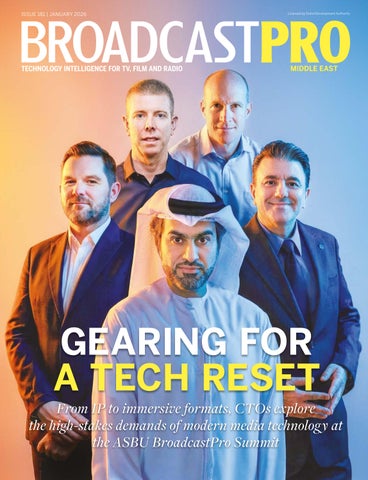
GEARING FOR A TECH RESET From IP to immersive formats, CTOs explore the high-stakes demands of modern media technology at the ASBU BroadcastPro Summit
5 FEBRUARY 2026 / RIYADH, KSA
Inspiring Innovation. Sharing Experiences. Connecting MENA Media Leaders #broadcastproKSA GOLD SPONSOR
SILVER SPONSOR
SILVER SPONSOR
PRESENTED BY
PRESENTED BY
Conference Booking and Sponsorship
Register Now
Vijaya Cherian +971 55 105 3787 Vijaya.cherian@cpipromedia.com
Register online to attend for free and stay connected
© 2026 CPI Pro Media. All rights reserved.
Sandip Virk +44 773 444 2526 Sandip.virk@cpipromedia.com
PRO|INTRO
broadcastprome.com
GROUP Managing Director Vijaya Cherian vijaya.cherian@cpipromedia.com +971 (0) 55 105 3787
EDITORIAL Editorial Director Vijaya Cherian vijaya.cherian@cpipromedia.com +971 (0) 55 105 3787 Editorial Contributors Kalyani Gopinath Nusrat Ali Urooj Fatima
WELCOME November and December were a whirlwind for the region’s media and broadcast sectors. For BroadcastPro, it marked the completion of our
Sub Editor Aelred Doyle
first year under the new CPI Pro Media brand, and I am deeply grateful
ADVERTISING
to God for guiding us every step of the way. The period was packed with
Group Sales Director Sandip Virk
conferences, panels, film festivals, partnerships and launches. The ASBU
sandip.virk@cpipromedia.com
BroadcastPro Summit & Awards stood out for its focus on consolidation,
+971 (0) 50 929 1845 / +44 (0) 7516 993 862
strategic partnerships, and trends shaping media and entertainment.
FINANCE Finance Executive Yonwin D’souza finance@cpipromedia.com
DESIGN & PRODUCTION Art Director David Fraser design@cpipromedia.com
EVENTS & MARKETING events@cpipromedia.com
DIGITAL SERVICES Web Developer Hafiz Muhammad Waqas IT@cpipromedia.com
FOUNDER Dominic De Sousa (1959-2015)
Discussions on consolidation at our CEO panel now seem almost prescient in light of Netflix’s bid for Warner Bros. Discovery, with farreaching implications for the region’s media strategy. Looking ahead to 2026, the Gulf and MENA media markets are poised for significant growth. Consolidation will accelerate as regional platforms, studios and investors align to compete globally. AI-driven production will move from experimentation to full-scale workflows, reshaping content creation, post-production and audience engagement. FAST and AVOD models will expand, while creatorled IP will continue to rise, turning digital talent into mainstream content leaders. Beyond technology, the Gulf is establishing itself as a soft power through media and high-profile investments. Sports ventures, film financing, major content deals and global partnerships will amplify the region’s reach. Stories originating here are making a tangible impact worldwide, showcasing local creativity to global audiences. Meanwhile, infrastructure expansion in the UAE and Saudi Arabia will strengthen the region as a hub for high-end
PARTNER Maria De Sousa
production, cloud computing and AI-enabled workflows. With such momentum, the start of 2026 offers an ideal launchpad. We are now open for registrations and sponsorship opportunities
Published by
for our Saudi Summit on February 5, scheduled immediately after FOMEX in Riyadh. November’s events were just the prelude; the new year promises a stage for innovation, influence and unprecedented
The publisher of this magazine has made every effort to ensure the content
growth. I wish all of you a blessed and happy new year.
is accurate on the date of publication. The opinions and views expressed in the articles do not necessarily reflect the publisher and editor. The published material, adverts, editorials and all other content are published in good faith. No part of this publication or any part of the contents thereof may be reproduced, stored or transmitted in any form without the permission of the publisher in writing. Publication licensed by Dubai Development Authority to CPI Pro Media FZ LLC. Printed by Al Bony Printing Press LLC. CPI Pro Media. PO Box 13700, Dubai, UAE. DQuarters, Dubai Science Park (TECOM) +971 55 1053787 cpipromedia.com
VIJAYA CHERIAN,
© Copyright 2026. All rights reserved.
EDITORIAL DIRECTOR 1
PRO|CO NTENTS
broadcastprome.com
BRIDGE SUMMIT — ABU DHABI
4
CREATOR ECONOMY GETS BOOST The Bridge Summit in Abu Dhabi highlighted how regional creators have become core contributors to industrial, technological and commercial ecosystems, driving creator-led IP, platforms and production models
UPDATE NEWS Shams to house mega media complex; MediaKind to buy Harmonic; Qatar announces 50% production rebate; Two senior exec appointments at Dubai Media Council; PlayMaker Studios opens in Qiddiya City, KSA; and more
12 BROADCASTPRO SUMMIT — CEO PANEL MENA MEDIA’S PROFITABILITY DILEMMA Regional CEOs debate whether AVOD, SVOD, sports and AI can help unlock sustainable revenues
20
14
BROADCASTPRO SUMMIT — CTO PANEL AIMING FOR A TECH RESET CTOs examine how media infrastructure is being rewired for IP, UHD and emerging technologies, while managing risk, operations and AI
BROADCASTPRO SUMMIT — SPORTS PANEL CHANGING THE RULES OF THE GAME Sports executives on how AI-driven highlights, phygital formats, hyper-localisation and social-first distribution are central to sports production, engagement and monetisation
30
26 BROADCASTPRO SUMMIT — AI PANEL AI ACROSS THE MEDIA STACK From hyper-personalised streaming and AI-driven advertising to multimodal newsroom pipelines and governance frameworks, specialists contend that AI is now deeply woven into daily media operations
GUEST COLUMN MEDIA AS STRATEGY
36
GCC investments in international media are not whimsical but part of deliberate national strategies, says Karim Sarkis 3
PRO|N E WS
01/26
JANUARY 2026
Keep up-to-date at broadcastprome.com
Massive media complex planned at Shams Sharjah has approved a package of major media projects in Sharjah Media City (Shams). The Shams Studio project will establish a large unified government media hub consolidating several key media entities under one integrated complex. The initiative, approved by Sheikh Dr Sultan bin Muhammad Al Qasimi, Ruler of Sharjah and Supreme Council Member, brings together the Sharjah Media Council, the Sharjah Government Media Bureau, the Sharjah Broadcasting Authority (SBA) and Sharjah Media City (Shams), which will
serve as the headquarters for the new development. The project includes the creation of one of the region’s largest government media complexes, featuring five state-of-the-art studios ranging from 1,500-3,400sqm. These will
cater to film, television, drama and digital content production, offering specialised post-production suites equipped with advanced editing tools, visual effects units and sound design capabilities. Designed to support
An overivew of the complex.
television and cinematic projects, the hub will include a new building for SBA. Its first phase will see the establishment of a dedicated news building and a facility for Sharjah Sports Channel. The Shams Studio project also encompasses the creation of Shams Creative Oasis, a centre for cultural, artistic and educational activities. The oasis will include a 700-seat theatre, spaces for community events, artistic performances and training programmes aimed at fostering local talent and expanding creative opportunities across the emirate.
CEDARS ART CONFIRMS NINE SCRIPTED SERIES FOR RAMADAN 2026
4
Cedars Art Production,
secondary rights and
10 performers on Shahid
peak during the
part of the Sabbah
regional licensing. Egypt
and Netflix, reaching
month, accounting
Brothers group, has
forms the backbone
audiences in more
for around 40% of
announced a slate of
of the slate with five
than 30 territories.
annual advertising
nine new scripted series
projects that range
for Ramadan 2026. The
Ramadan continues to
spend in the region,
from family comedy to
be the most competitive
according to Ipsos.
line-up features a mix of
long-running franchises.
period in the Arabic
At the same time,
social dramas, thrillers,
Cedars Art typically
television calendar,
demand for Arabic
comedies and romantic
produces an average
with high-budget series
dramas on streaming
series. All titles are set
of eight titles each
dominating prime-
platforms has surged,
to premiere on MBC and
Ramadan. The
time schedules across
growing 24-fold within
Shahid, with several
company’s catalogue
free-to-air channels and
MENA and 21-fold
pan-Arab productions
now exceeds 150 titles,
streaming platforms.
internationally, based on
also available for
including frequent top-
Advertising rates
Parrot Analytics data.
PRO|N E WS
broadcastprome.com
MEDIAKIND TO ACQUIRE HARMONIC’S VIDEO BUSINESS IN $145M DEAL MediaKind has entered into an agreement to acquire the video business of Harmonic Inc. The transaction is valued at approximately $145m. The two companies will move to sign a purchase agreement immediately after completing a French employee works council consultation process. The deal is expected to close in Q1 2026, pending standard regulatory approvals and closing conditions. The transaction creates an independent SaaS streaming infrastructure provider by combining two established video technology organisations with complementary strengths in SaaS streaming, appliance platforms and cloud AV workloads. The combined company will generate more than $100m in annual recurring revenue (ARR) and over $150m in annual appliance revenue, and create an enhanced foundation for long-term growth.
Inter Medya and Rise Studios partner for co-productions Turkey’s Inter Medya has entered a strategic coproduction partnership with MENA media company Rise Studios. Their collaboration aims to elevate stories with global appeal while strengthening regional creative output and expanding the global presence of scripted content. As part of the agreement, the companies will jointly produce high-end Turkish drama Caged Love (Tutsak Sevda). Production is set to begin in January 2026, with casting and the international release strategy now in development. Inter Medya will act as executive
Can Okan, founder & CEO, Inter Medya, with Amanda Turnbull, founder & CEO, Rise Studios.
producer and lead worldwide distribution. By aligning creative and commercial strategies from the earliest stages, Inter Medya and Rise Studios aim to deliver content designed to resonate with audiences worldwide. Can Okan, founder &
CEO, Inter Medya, said: “We are excited to launch this strategic partnership with Rise Studios ... This co-investment marks an important step in strengthening our joint capacity to develop premium, globally competitive productions.”
MIRAMAX AND MEDIA CITY QATAR PARTNER TO DEVELOP FILM AND TV PROJECTS Miramax has announced
early developments
a new collaboration with
is an Arabic-language
Miramax CEO
the Film Committee
adaptation of Miramax’s
Jonathan Glickman
at Media City Qatar to
2001 romantic
hailed the agreement as a
co-develop film and
comedy Serendipity.
milestone collaboration,
television projects aimed
All titles are being
be shared later.
emphasising the
at elevating Qatar’s
created through
studio’s commitment
presence in the global
Miramax’s regional
to cultivating authentic
entertainment industry.
MENA+T division,
stories from the Arab
The partnership will see
headquartered in
world while producing
the US studio, owned
Doha and led by Lucy
high-quality content
by Qatar’s beIN Media
Dertavitian. The company
with global potential.
Group and Paramount
said the projects are
He added that the
Global, executive
at different stages
partnership deepens
produce one original
of development, with
the studio’s investment
scripted series and one
production schedules
in the region’s
feature film. Among the
and release plans to
creative landscape.
5
PRO|N E WS
JANUARY 2026
Teresa Antas Rio joins OSN Group to spearhead marketing transformation how audiences connect with the company’s content by emphasising cultural relevance, emotional resonance and elevated creative standards. Under her leadership, OSN+ will focus on enhancing curated storytelling to build stronger viewer connections, while Anghami will sharpen its role as a hub for regional music culture.
OSN Group has named Teresa Antas Rio as its new Vice President of Marketing, placing her in charge of marketing, creative direction and communications across the company’s entertainment brands, including OSN+ and Anghami. She will spearhead OSN Group’s marketing transformation. Her mandate includes shaping
SONY PICTURES - QATAR INK DEAL TO CO-FINANCE ARABIC FILMS Sony Pictures has signed a multi-year partnership with
Before joining the company, Teresa was Brand Director at Neom Media in Saudi Arabia. Her career includes over a decade at Unilever, where she led global and regional marketing and digital initiatives across Europe. She later joined The Walt Disney Company as Marketing Director for Disney+ and FOX TV Networks in Portugal.
QATAR JOINS GCC BANDWAGON WITH 50% PRODUCTION REBATE
the Film Committee at Media City Qatar to co-finance
The Film Committee at
of a project’s qualifying
Arabic films. Projects may include original screenplays
Media City Qatar has
costs are incurred in
or adaptations of titles from Sony’s library. Each film will
announced the launch
a designated regional
be overseen by a jointly approved local producer. Both
of the Qatar Screen
partner country, those
Sony and the Film Committee will share authority over
Production Incentive
can also be rebated.
key creative and financial decisions. The agreement
(QSPI) programme, an
Designed to
also includes the creation of a writers’ incubation lab.
initiative that offers
accommodate
productions a cash
productions of all
rebate of up to 50% on
sizes and formats, the
qualifying expenditure
QSPI covers feature
in Qatar. The structure
films, television series,
includes a base
commercials and
40% rebate, with an
post-production or VFX
additional uplift of up
work. Eligible expenses
to 10% for projects
include goods,
that hire Qatari talent,
services and labour
invest in local training
sourced both locally
or highlight the
and internationally.
nation’s culture. The
The programme also
programme is designed
prioritises capacity-
with regional flexibility,
building and industry
allowing productions to
training alongside
shoot selected portions
financial incentives.
DUBAI CROWN PRINCE ANNOUNCES NEW CHIEF EXECUTIVES AT DMC His Highness Sheikh Hamdan bin Mohammed bin Rashid Al Maktoum, Crown Prince of Dubai, Deputy Prime Minister, Minister of Defence of the UAE and Chairman of The Executive Council of Dubai, has issued two executive council resolutions appointing new chief executives within the Dubai Media
6
Council (DMC). Hesham Mohammed Abdulrahim Al Olama has been named CEO of the Media Development Sector at DMC, and Rashid Humaid Saeed Al Marri from the Government of Dubai Media Office has been made CEO of the Media Regulation Sector. Both decisions took effect November 1, 2025.
in neighbouring Arab
Applications for the
countries. If up to 25%
QSPI will open in Q2 2026.
ATEM Mini Extreme ISO G2 lets you build a high end broadcast studio! ATEM Mini Extreme ISO G2 makes it easy to create professional multi camera productions for live streaming! Simply connect ATEM Mini Extreme and you can live switch up to 8 high quality video camera inputs for dramatically better quality images. You can even sync your recording to Blackmagic Cloud, so you can edit your live production with DaVinci Resolve anywhere in the world!
Share Internal Storage with Multiple Users
Build the World’s Most Amazing Broadcast Studio!
The Most Advanced Broadcast Quality Control Panel
The ATEM Mini Extreme ISO G2 is ideal for building a high-end broadcast studio
The front panel has buttons for selecting sources, triggering transitions, and
as it offers all the ATEM Mini features plus extra features! It has a professional
setting video effects. It also features an innovative audio mixer control area
style control panel with amazing input buttons. It has 3 independent video
with live metering on a Fairlight style HDMI status output. You get buttons for
outputs that can be routed. The built-in Thunderbolt offers live video capture
recording, streaming, and dedicated output buttons for changing outputs
and playback, enabling real-time effects software or live action replay.
between the 8 cameras, program, preview, multi-view, or Fairlight status.
Get Powerful Broadcast Replay with DaVinci Resolve Blackmagic Replay uses the ISO files recorded by ATEM Mini Extreme ISO G2 to do replay in DaVinci Resolve. The ISO files are recorded to a CFexpress card which DaVinci can access via Ethernet. You can use multi-view in the cut page to view all cameras in DaVinci Resolve at the same time. The files will even continuously upload as you’re recording so you can edit live!
www.blackmagicdesign.com/ae SRP excludes duties, shipping and sales tax.
ATEM Mini Extreme ISO G2 is not just a switcher, it’s also a shared network disk using the 10G Ethernet port to the internal CFexpress memory card or external USB disk! CFexpress cards are extremely fast so they can keep up with recording multiple ISO video files while external network users all work on separate computers for editing, color correction, VFX and audio post production.
ATEM Mini Extreme ISO G2 US$1,995
Learn More!
PRO|N E WS
JANUARY 2026
Advanced Media to host 2026 edition of CINECommunity in January Advanced Media Trading has announced the return of its biannual digital cinema gathering, CINECommunity, from January 15-17, organised in collaboration with Courtyard Art & Community Centre and in partnership with Analog The Room. The event will be hosted at Advanced Media’s UAE headquarters in Dubai and will feature nine digital cinema workshops addressing topics ranging from cinematic lighting after dark and digital intermediate workflows to sustainability-focused filmmaking initiatives. For the first time, half of the workshops will be led by experienced female professionals, including Los Angelesbased cinematographer Sarah Winters, Cairo-based
A picture from last year’s edition.
director of photography Zeina Khalil and Abu Dhabi’s first sustainable production advisor, Nena Ostrogovic. The programme will also see the return of previous instructors Fouad Aoun and Nikita Petsa, alongside new contributors such as the team from Magic Lab, a Prague-headquartered picture post-production and VFX studio. While the event is brand-agnostic, there will be representation from well-known companies
such as Sony, DJI, RED, Zeiss and Atomos. At this edition, Advanced Media will pay tribute to the Courtyard Art & Community Centre, Dubai’s longstanding cultural landmark. Advanced Media’s premises will be transformed to echo the Courtyard’s distinctive landscape, and the Courtyard’s architect, Dariush Zandi, will lead a seminar on the importance of community in the creative process on January 16.
Additionally, a broadcast session showcasing the RED Cine-Broadcast module, featuring the RED V-RAPTOR XL, will be held at the Courtyard Playhouse on January 15, ahead of CINECommunity’s official opening. Analog The Room will host a ‘Journey Through Camera Evolution and Hands-on with All Formats’ workshop led by photographer Mohammed Kamal, giving participants a practical exploration of camera formats across generations. Registrations for CINECommunity workshops are open. The free-to-attend workshops are 90 minutes each and will be conducted in Advanced Media’s showroom and training space.
SHAHID, DISNEY+ AND OSN+ LAUNCH MENA’S FIRST UNIFIED OTT BUNDLE Shahid, Disney+ and
billing. The subscription
the digital entertainment
added: “This agreement
OSN+ have announced
became available
experience in the region.
reflects a shared ambition
a landmark partnership
from December 18.
With one subscription,
between Disney+ and
Speaking about the
one payment, and full
Shahid to shape the
streaming bundle for
unified bundle, Natasha
access to premium
future of entertainment
audiences across the
Matos-Hemingway,
content from all three
in the Middle East.”
GCC, bringing all three
Chief Commercial and
platforms, we’re
platforms together under
Marketing Officer at
delivering unbeatable
CBO at OSN+, noted
a single subscription
Shahid, said: “This
convenience, value
that this partnership
available exclusively
bundle is a major step
and entertainment.”
with Shahid takes the
through Shahid. The
in our ongoing mission
Karl Holmes, SVP
viewer experience
bundle features unified
to simplify and elevate
and GM, Disney+ EMEA,
“to the next level”.
that introduces a unified
8
Choucri Khairallah,
PRO|N E WS
JANUARY 2026
FOMEX 2026 exhibitor line-up to include major global industry players The Future of Media Exhibition (FOMEX) 2026, taking place alongside the Saudi Media Forum from February 2-4, is set to bring together leading global and regional media technology players in Riyadh. A core pillar of the Saudi Media Forum, FOMEX serves as a dedicated platform for showcasing the latest advancements in
broadcasting, production, digital content, artificial intelligence and immersive media technologies. The exhibition will host more than 250 local, regional and international companies, offering hands-on access to next-generation tools and solutions shaping the future of media. The diverse exhibitor line-up spans broadcast
PIXEL ARTWORKS NAMES MARTA MARINHO AS MIDDLE EAST CREATIVE DIRECTOR
SKANDHA MEDIA NAMES NEW VP OF SALES
Marta Marinho is Pixel Artwork’s new Creative Director for the Middle East. Based in the company’s Dubai studio, Marinho will oversee the development of narrativeled, technology-powered environments for brands. Before joining Pixel Artworks, Marinho worked at Blit Studio in Barcelona, where she led projects for BMW, Audi and Xiaomi.
10
Skandha Media Services has appointed K.S. Avinash as its new Vice President of Sales. Avinash brings more than 16 years of experience in sales, presales and media technology to the company. His background spans post-production workflows, media asset management, content supply chain optimisation and cloud migration. In his new role, Avinash will drive Skandha’s expansion across India and APAC.
infrastructure, content creation, audio-visual technology and digital media solutions. Confirmed exhibitors include international brands such as Grass Valley, Ross Video, Sony, Canon, Fujifilm, Vizrt, Imagine Communications, TUV Network, Arte Engineering and Shure. Companies such as Evertz, Ikegami, Harmonic,
Nilesat and Canare Middle East are expected to highlight developments in satellite broadcasting, video processing, camera technology and broadcast infrastructure. The event further aims to demonstrate how emerging technologies are reshaping storytelling, audience engagement and media workflows.
FILM PRODUCTION HUB PLAYMAKER STUDIOS OPENS IN QIDDIYA CITY Saudi Arabia’s
service production
PlayMaker Studios
facilities designed
has officially opened
for large-scale
its doors in Qiddiya
projects. The complex
City. Historical action
includes production
film Unbroken Sword
offices and premium
(working title) has
on-site amenities.
begun pre-production
Construction has
at the new facility.
begun on two
Spread across 50
additional high-tech
acres, PlayMaker
soundstages, slated
Studios features
for completion in
expansive backlots,
2026, which will
two purpose-built
increase capacity for
soundstages, flexible
multiple simultaneous
workshops and full-
productions.
PRO|N E WS
broadcastprome.com
WBD REJECTS PARAMOUNT BID, BACKS NETFLIX DEAL The board of Warner Bros. Discovery (WBD) has formally rejected a $108bn hostile takeover proposal from Paramount Global, arguing that the offer carries significant risks and is inferior to a rival merger agreement with Netflix. Despite the higher headline price, the board cited “significant risks and costs” associated with Paramount’s proposal. Paramount urged WBD’s shareholders to reject the Netflixbacked deal. The offer is supported by a consortium that includes Saudi Arabia’s Public Investment Fund, Abu Dhabi’s L’imad Holding, the Qatar Investment Authority and Affinity Partners. The standoff sets the stage for an intensifying battle for control of WBD as shareholders weigh a higher-priced but contested hostile bid against a lower-valued deal that the board says offers greater certainty and fewer execution risks.
Winners of Fujifilm Short Film Festival announced in Dubai
Winners of the Fujifilm Short Film Festival with the festival’s officials.
The inaugural Fujifilm Short Film Festival, presented in partnership with Cinema Akil and Gulf Photo Plus, celebrated emerging filmmakers from the Middle East, Africa and Central Asia. More than $15,000 worth of cash prizes and filmmaking
equipment were presented by Fujifilm Middle East. The winning films were Sweet Refuge by Maryam Mir (Special Mention); Almost Intangible by Taraneh Esmailian (Best Film and Student Category); Nsala by Mickael-Sltan
None (Experimental Category); All This Death by Fadi Syriani (Narrative Category); I Told You So by Malak AlSayyad (Documentary Category); and Glory of the Meadow by Nima Shamsaei (Audience Choice Award).
SAUDI MEDIA FORUM LAUNCHES SAUDI MEDIA AWARD 2026 Saudi Media Forum
and the Human
Chairman Mohammed
Capability Development
Al-Harthi has
Programme.
announced the launch
Al-Harthi explained
of the Saudi Media
that the initiative
Award 2026. The
continues to serve as
ceremony will take
a national platform
place during the Saudi
recognising creative
ALA SIAM JOINS HAIVISION
Media Forum. The new
talent, intellectuals
Haivision has appointed
edition once again
and emerging media
Ala Siam as Sales Director
highlights outstanding
professionals. The
for the Middle East. Siam
contributions across
initiative aligns with
will be responsible for
the media sector.
broader efforts to
developing live production
According to SPA, the
shape a modern media
and streaming projects
award is supported and
environment that
across the region, working
sponsored by Minister
enhances content
with partners and end users.
of Media Salman Al-
quality, strengthens
Siam brings more than 16
Dossary and organised
Saudi media identity
years of experience across
in partnership with
and raises professional
the Middle East, Africa, and
the Ministry of Media
standards.
Central and Eastern Europe. Siam will be based in Dubai. 11
PRO|E VENT
JANUARY 2026
Bridge Summit signals Abu Dhabi’s push to build creator economy The Bridge Summit in Abu Dhabi last month arrived with the scale and ambition of a global convening. Heads of state, policymakers, investors and international cultural figures such as Idris Elba and Priyanka Chopra were among the speakers, highlighting the Summit’s broader positioning within culture, influence and global soft power. But beyond the high-level optics, the Summit also surfaced a series of concrete partnerships, deal announcements and creative conversations that were particularly telling for the creator economy and the future of media production. Together, they offered a snapshot of how creators in the region are being integrated into larger industrial, technological and commercial ecosystems. One headline that caught our eye was Spacetoon’s partnership with 8Flamez to produce a new animated series inspired by AboFlah. With over 47.5m 12
subscribers and 8bn views, he is one of the Arab world’s most influential digital creators. This deal signifies how creator IP is now being formally developed, protected and scaled through established production pipelines. The resulting 10-episode series, Slay-man, introduces a superhero character inspired by AboFlah’s real name, Hasan Sulaiman. In a first for the creator, he will also voice the animated character himself. Already in production and slated for release in mid-2026, the project speaks to a wider change at the Bridge Summit, where creators were positioned not as marketing add-ons but as central intellectual property owners. Another parallel thread running through the Summit was youth and creator enablement. The Arab Youth Center signed two strategic MoUs with the Bridge Summit and Visioneers, aimed at integrating Arab
talent into regional and international media, innovation and technology ecosystems. These agreements directly impact creators on the ground, from opening pathways into professional media environments to improving the quality, sustainability and global reach of Arabic digital content. The Visioneers partnership focuses on equipping young creators with the tools, skills and platforms required to operate in an increasingly competitive digital economy, making clear that influence alone is no longer enough without structure, support and commercial literacy. Creators were also central to conversations around sports and entertainment. One interesting session brought together Gerard Piqué and AboFlah to discuss the evolution of the Kings League, a digitally native sports-entertainment format that blends football, creators and audience
PRO|E VENT
broadcastprome.com
participation. Reflecting on the inaugural Kings League MENA, held in Saudi Arabia in November 2025, the session explored how creators are no longer simply amplifying sport but actively reshaping it. For Piqué, the Kings League represents a new generation of sports IP built for digital platforms and real-time audience feedback. Running such a fast-growing venture, he noted, comes with the pressures of a startup environment, from managing a 260-person team to constantly responding to fan behaviour. Plans for a Kings League MENA edition for People of Determination show how inclusion is being built into new formats. Saad Sarour of 8Flamez reinforced the economic logic behind this model, arguing that creators are redefining the relationship between audiences and sport by involving fans as partners rather than spectators, generating value through shared
ownership of the experience. In addition to its focus on content and platforms, the Summit also highlighted the infrastructure required to support long-term creative industries. A landmark $200m partnership between Archeo Futurus, Trillium Technologies and Daywalker Global was announced to establish the UAE as a hub for advanced media production and compute. The deal includes the launch of a Media and Technology Innovation Center in Abu Dhabi focused on AI infrastructure, cloud technologies and next-generation production tools, alongside plans to film at least two major motion pictures in the country. For creators and producers, this kind of investment matters less for its headline figure than for what it enables: access to high-end production capabilities, localised compute power and a more robust ecosystem. Music creators were also part of
the conversation, particularly around independence and AI. Producer Julian Bunetta spoke about his Notebook platform, designed as a private space where artists can connect directly with superfans and retain control over their creative and commercial journeys. In a separate session, AI storyteller and performer King Willonius demonstrated how AI can collapse the distance between idea and execution, building a song live on stage based on audience input. Rather than a threat, the discussion framed AI as an accelerant. Overall, the Summit functioned as an ecosystem still taking shape, where creators sit alongside studios, startups, investors and institutions. For the creator community, the Summit’s most interesting takeaway was not who attended, but how seriously creator-led IP, platforms and production are now being taken as foundational to the future of media.
From left to right - Actress Priyanka Chopra Jonas; Emirati filmmaker Nahla Al Fahad; and Slay-man, an AboFlah-inspired animated superhero.
Kamel Weiss (l), GM of SpacetoonGo, with Hassan Suleyman, well known Kuwaiti YouTuber and streamer, popularly known online as AboFlah.
Archeo Futurus, Trillium Technologies and Daywalker Global announced a $200m partnership to establish the UAE as a hub for advanced media production and compute.
13
PRO|CEO
Turning a profit is the central question for broadcasters in 2026. Moderator Karim Sarkis cut straight to the chase in the headline panel at November’s BroadcastPro Summit: the economics no longer add up. “Our consumer habits have changed and our content types have changed. But making money is one of the hardest things to do,” Sarkis, Partner at Strategy&, declared, setting the stage for the hour-long annual CEO Forum. Under the broad theme of ‘Navigating disruption and driving growth’, four regional CEOs tackled the industry’s shifting sands: Elie Habib, CEO, OSN+; Maaz Sheikh, CEO, StarzPlay; Peter Mrkic, Managing Director, TOD – MENA; and Somair Rizvi, co-founder and CEO, myco.io. The regional streaming video market in 2025 is worth $1.5bn, according to global technology research and advisory firm Omdia. Demand remains strong enough that the market is projected to
JANUARY 2026
grow more than fivefold to $8.4bn by 2029, on the back of expanding digital infrastructure, high mobile penetration and a young, highly engaged population. Against that metric, however, there was definitive agreement on the difficulties around profitability. “Making money on SVOD is hard. AVOD is even harder. And we’re between hard and very hard, trying to do both,” Sheikh said. Bridging the gap between AVOD and SVOD
He was responding to Sarkis’ opening question – is it harder to make money with AVOD or with SVOD? StarzPlay, Sheikh said, has been experimenting with a combined model. That means free access for some sports, such as the Indian Premier League (fully AVOD). With the Ultimate Fighting Championship, the prelims aired free with the main card behind a subscription paywall.
PROFITABILITY REMAINS ELUSIVE FOR MENA’S MEDIA SECTOR As platforms compete with social video, piracy and each other, the region’s top CEOs explore what keeps viewers coming back, and how AI can drive elusive revenue metrics. Keith J. Fernandez summarises the discussion 14
“That seems to open up the funnel at the top and allows for conversion,” he said, adding that the move bypasses advertising on search and social media. Experiments are now also the norm at OSN+. The platform recently launched an ad-lite tier, which Habib said should not be classified as AVOD. He was unconvinced that AVOD alone can fund premium TV and film in the region right now. “Pure AVOD economics, in their current form in the Middle East, remain challenging to sustain for premium content,” he said. “That will change eventually as consumer psychology evolves,” he added, but he felt that’s unlikely in the immediate future, certainly not in 2026. “I still think SVOD has room to grow. If we want to continue producing top-tier content, whether Arabic or international, we need to invest more in a multi-tier SVOD offering.” He spoke openly about how experimenting with revenue models is the way forward – particularly as streamers compete with YouTube on both content and monetisation. “I like to experiment … I say, let’s test and validate it. If it makes sense, then I win. If it doesn’t make sense, then I learn,” he said. A stack of eight ads might work during Ramadan, but viewers tend to drop off outside the season, forcing broadcasters to reacquire the same users. “AVOD can be an effective acquisition strategy, allowing platforms to introduce users to the service in a lower-friction way rather than relying solely on external digital advertising,” Habib said. “That’s a strategy we use, and it makes perfect sense.” By contrast, myco’s Rizvi brought a battle-tested AVOD story to the panel. “We started as an AVOD player. That’s how we built scale and got the bulk of the users to the platform. Once we let them experience the
PRO|CEO
broadcastprome.com
product, we were able to convert them into paying loyal customers.” Sharing the advertising-based sports broadcaster’s approach to profitability, he said AVOD was always seen as a growth strategy and the platform’s decentralised revenue-sharing model sets it apart from other players. “That’s our differentiation. On Facebook, YouTube or any other social platform where you advertise, the ad revenue is shared between the creator and the platform, although it’s the viewer who is the most important element in this entire economy. And they’re left out.” For him, ads aren’t a side hustle; they’re the foundation. The upsell
There are 57 streaming services in the MENA region, but the top five account for more than 60% [of the market] … [Consolidation] has to be the future PETER MRKIC, MANAGING DIRECTOR, TOD – MENA
comes later, and the real sell is often not the content but the absence of ads. “I feel ad-free is a real value that users are chasing. That’s why people pay for Spotify Premium or YouTube Premium.” Mrkic’s approach remains adaptive. TOD is also still experimenting, though the platform’s catalogue is dominated by sport. “The industry is moving toward a mix of AVOD and ad-subsidised models. We’re assessing these approaches carefully, with the intent of selecting the one that delivers the greatest value to our viewers while supporting sustainable growth.” The panel converged on one 15
PRO|CEO
point: AVOD is a powerful on-ramp, but it’s not yet the destination. Sport: Poisoned chalice or necessary evil?
From a content perspective, sport remains a high-traffic vector. The region’s diversity makes scripted content a challenge for most operators, who depend on high-demand events to drive subscriptions and advertising. Sarkis anchored the segment with an old horse racing joke: “How do you become a millionaire in horse racing? You start as a billionaire. Is it the same thing for sports rights?” Four CEOs, four strategies: staying away from sports altogether, strategic partnerships, paying full value for rights, and profitably monetising niche rights in select markets. The approach at TOD is to use sport to pull people in, then broaden their diet, Mrkic said. “We use sports to acquire customers, but then we use entertainment content to retain them.” The operator’s bouquet features more than 50 sports properties, which he said serve as a differentiator against competition from social media and search platforms.
Karim Sarkis, Partner at Strategy&.
16
JANUARY 2026
Making the viewers a stakeholder in this ecosystem is very important to get their loyalty, to get that engagement SOMAIR RIZVI, CO-FOUNDER AND CEO, MYCO.IO “If viewers are looking for short clips, highlights or ad-led content, there are plenty of platforms offering that,” he noted. “But many customers still value and are willing to pay for a premium, ad-free experience that delivers live sport and entertainment without interruption and at the highest quality.” But what does it take to be profitable? Is sport enough? Or does it need to be combined with entertainment? “We make fun of sports, but who’s made money on entertainment?” asked Sheikh. “No one. The reality is it’s not sports versus entertainment. It’s about building scale.” He offered an insight into the region’s dynamics. With so many
languages and tastes, he argued, there may be no single show that can reach 400m people. “The audience is very fragmented here ... So how do you build scale if there’s no single entertainment product that’s going to transcend the 400m people? You have to go to sports to build that scale.” StarzPlay’s most profitable product, he said, was rugby – though that only brings in around 20,000 customers. “Are 20,000 customers going to pay my bills and help me build a billion-dollar company?” The rise of fandom as a revenue lever
But that kind of segmented, hyperengaged audience could prove valuable to media companies, a 2024 Deloitte survey revealed. More than half (58%) of all GenZers and 50% of millennials say following their favourite music artist is important to their identity, with the number averaging 40% across both groups for their favourite movie, franchise or series. For Rizvi, fandom presents the key lever for profitability. Myco sees viewers not as passive consumers of content, but as active participants with
Somair Rizvi, co-founder and CEO, myco.io.
PRO|CEO
broadcastprome.com
Peter Mrkic, Managing Director, TOD – MENA.
Making money on SVOD is hard. AVOD is even harder. And we’re between hard and very hard, trying to do both MAAZ SHEIKH, CEO, STARZPLAY
Maaz Sheikh, CEO, StarzPlay.
Elie Habib, CEO, OSN+.
economic and creative influence. “We call it the viewer economy,” he said. “Making the viewers a stakeholder in this ecosystem is very important to get their loyalty, to get that engagement.” GenZ in particular expect this kind of participation because they have grown up watching creators monetise directly on social platforms. “We treat fans as stakeholders [and] they get a share of our ad revenues. They get to choose, even in terms of what content gets produced, and we want them to invest in content with us, the way we are building our ecosystem.” A strategy that has worked for myco: fantasy sport. Habib came at fandom from a different angle: lifetime value and churn. OSN+ uses analytics metrics such as time spent to understand how viewers connect with its content. “Time spent is the measure of how you know that you’re going to have more success. Because we’re in a recurring business, we fight churn. Churn is the enemy.” He explained that identifying what attracts fans of the platform enables his team to market new products to them over the year, not just during Ramadan. “You own one month, you can do pretty well across the remaining 11 months …
that seems to be the better way for us.” Broadening the content mix with AI-only channels
AI is now de rigueur for every business plan. “I think the best part about AI is that it’s making failure cheaper,” Rizvi said, describing how AI tools are being used across the content end of the business, speeding up edits, creating animation and even in the creation of promos. The next step is launching an AI-native new channel. “We’re about to launch a 24/7 news channel completely run by AI, no need of studios, camera equipment, anchors…” AI is also supporting the discovery and content detection space, he said, as well as in advertising technology. “There’s real-time A-B testing happening, where I can serve a different ad to you based on your profile and I’ll get a different ad served to me while a live sport is happening.” Other panellists also framed AI as a support tool. Mrkic and Sheikh both saw applications in dubbing and subtitling. Habib addressed a common misconception about data-driven content decisions: “We don’t fund 17
PRO|CEO
projects like HBO’s next A Knight of the Seven Kingdoms just because of the data that we have,” he said, pushing back against the idea that algorithms alone determine big-budget productions. Nor is AI generating new income streams yet (although AI-native channels may change that). Rather, it is defending the fragile ones. When ARPU remains low and piracy is persistent, AI helps slow leakage. “If viewers get a good ad that’s relevant to them, they’re not going to complain much,” Habib said. AI can reduce churn from poorly targeted ads. At the end, was there a consensus around the big revenue question?
JANUARY 2026
Because we’re in a recurring business, we fight churn. Churn is the enemy ELIE HABIB, CEO, OSN+ With several business models, a common pathway forward remains elusive. The panel agreed on the diagnosis: costs are rising faster than certainty. But no single monetisation model emerged as dominant. The answer, then, is not something as
simple as building one revenue stream, but tighter discipline across every area of the business. The panel ended on the topic of consolidation in the Middle East broadcast sector. “Consolidation will happen. I think the next probably 24 to 36 months, you’ll see far fewer players in this market,” said Peter Mrkic of TOD. “There are 57 streaming services in the MENA region, but the top five account for more than 60% [of the market] … [Consolidation] has to be the future.” He said that while the big players would continue to survive, smaller players would be swallowed up unless they operate within a specific niche.
THE COST OF PIRACY TO THE MEDIA BUSINESS Piracy came up repeatedly as a
have a harder time than
fans are directed to legitimate,
commercial constraint during the
elsewhere. In the US, legal
high-quality viewing experiences.”
panel. Sheikh called it the biggest
restrictions prevent search
BeIN has introduced a
structural drag on streaming’s
engines from driving traffic to
new tiered offering aimed at
economics. “We see a significant
pirate websites, but “we do not
countering pirate IPTV sellers.
impact on our numbers,” he
have a legal infrastructure to
Priced at around $10 in the UAE,
said, explaining how interrupting
stop pirated sites from showing
the mobile-only plan gives viewers
illegal streams during the India-
up on search engines”.
access to premium sports and
Pakistan cricket final led to
Mrkic called piracy a daily
entertainment on TOD, with
“thousands of sign-ups in the
operational war. With its volume
the flexibility to upgrade to a
last 10 minutes of the match”.
of sports properties, he said TOD
full big-screen experience.The
Sarkis, however, wasn’t
is “constantly being pirated”,
strategy is intended to offer a
prepared to let piracy stand as
to the point where he believes
legitimate, accessible alternative
the all-purpose explanation.
the service is one of the most
for customers who might
“Piracy exists everywhere. Game
bootlegged sites in the region.
otherwise turn to illicit services.
of Thrones … was the most
Besides fighting back through
Rizvi, meanwhile, brought a
pirated thing ever, and that
anti-piracy coalitions, TOD is
different take to the conversation:
didn’t stop HBO from becoming
pushing for tougher regulatory
regardless of search traffic, the
profitable. [But] if tomorrow
frameworks, though these remain
most dangerous pirates aren’t
you solved your piracy problem,
in the nascent stage in the region.
always on the open web. “I think
Internally, beIN has assembled
IPTV is the biggest threat that’s
a tactical response team to tackle
behind secured walls,” he said.
piracy helps, but it doesn’t
the issue. “We have dedicated
For AED 200, consumers can
magically repair the P&L.
are you all profitable?” The consensus answer: Fixing
18
teams across the group focused
now access 14,000 channels,
Distinguishing between piracy
solely on combating piracy,”
including StarzPlay, TOD and
in different geographies, Habib
he said. “Illegal streams are
Netflix. “I feel that is where
said that MENA broadcasters
identified and taken down, and
the control needs to be.”
ﻣﻌﺴﻜﺮ اﻻﺑﺘﻜﺎر اﻹﻋﻼﻣﻲ
SAUDI MIB MEDIA INNIVATION BOOTCAMP
An Inspiring Launch
The Saudi Media Innovation Camp
Part of the Business Accelerators at the Saudi Media Forum 2026
Its aims Innovation
Empowerment
Development
Enabling Saudi and international talents to craft intelligent and impactful content.
Advancing digital storytelling and production through emerging technologies.
Creating AI-powered media solutions that redefine the way stories are produced and experienced.
Intelligent Virtual Presenters
AI-Enhanced Journalism
Key Focus Areas Smart Content Creation
Who Can Apply
Companies
Media Institutions
Individual Creators
For any inquiries:
@saudimf.s Saudi.mib@saudimf.sa Deadline for Submissions
25 DEC 2025
PRO|TECH
JANUARY 2026
UNPACKING THE BOX: HOW TECHNOLOGY IS REINVENTING BROADCAST, BIT BY BIT From IP migration to immersive UHD, the broadcast industry is reinventing itself faster than at any time in decades. With new technologies emerging, the CTO panel at the ASBU BroadcastPro Summit agreed that those managing this shift will need to keep operations running while rebuilding the plane mid-flight. Keith J. Fernandez reports Time was we could gather at the office watercooler and discuss the same show from last night – because everyone had watched it when it aired, we all knew each character’s back story and each person had their own idea of where the show might go, which characters they wanted to ship and how the final dénouement might play out. Today, that shared viewing culture has splintered. We’ve moved into a fragmented TV universe where everyone in that conversation has watched something different, usually on a different app, often at a different point in the narrative. That fragmentation is about to go further as a wide range of technologies upend familiar systems and reconfigure them into a more modular, competitive ecosystem in which influence and value are distributed rather than concentrated. In the rush to stay ahead, everything is being rewritten: business models, people, workflows, even trust. That’s the consensus attendees at the ASBU BroadcastPro Summit 20
2025 were left with, as five chief technology officers discussed how broadcast is undergoing its most radical reinvention in decades as part of a panel titled ‘Broadcast Unbound: Tech transformations redefining the industry’. The panellists were Brad Eliot, CTO of IMI; Dom Wedgwood,
We are deconstructing everything we’ve ever known about this beautiful supply chain, whether you work in production, engineering or the business side of things DOM WEDGWOOD, CTO, ARQIVA
CTO of Arqiva; Hejar Berenji, CTO, Kurdistan’s Rudaw Media Network; Mohammad O. bin Zayed Alfalasi, Head of Technology and Operations at evision; and Jeremy Courtney, Senior Director within the CTO Office at Lawo. The session was moderated by Paul Wallis, CEO of digital agency Granite MENA. The panel discussed the ongoing transformation and the consequent emerging weaknesses and threats, how teams have dealt with engineering and organisational bottlenecks, and what AI means for the sector – where it’s delivering value and where it’s creating new demands. Berenji set the stage with his opening comments, describing the combined impact of different technologies as a moment of freedom. “Freedom in the way of collecting content and information [and] preparing it. Freedom in any way possible.” The result is an unparalleled opportunity to innovate and build new value chains that do not depend
PRO|TECH
broadcastprome.com
on traditional audience buckets, production methods, broadcast devices or language geographies. Berenji called this “intelligent media”, a term gaining currency across the industry, though it has no universally accepted definition yet. For him, it’s a new layer of tech that underpins existing media workflows. “If we combine AI, cloud, internet protocol (IP), remote production, content, all these new technologies together … it would go all the way from creation to personalised distribution, based on where the audience is and whatever they want to see that appeals to them.”
Wallis touched on several recent tech shifts from proprietary hardware and locked ecosystems to locationdependent production, and how nearly every aspect of the business is being re-evaluated, while Wedgewood stated that the sector is at a turning point. “We are deconstructing everything we’ve ever known about this beautiful supply chain, whether you work in production, engineering or the business side of things.” There’s been an ongoing shift from SDI to IP-based production workflows. Then there’s the growing integration of the cloud into broadcast and OTT, perhaps as a crossover from enterprise
systems. As in other sectors, softwaredefined architectures are speeding up improvements to products and services, instead of depending on rigid, taskspecific and expensive devices. Remote and hybrid production continue, and distributed production is the new norm. With these changes come new challenges around interoperability, talent adaptation and cybersecurity. From SDIs to IP and beyond
With the industry moving from legacy operational structures to cloud-first IP workflows, Wallis questioned what bottlenecks and organisational challenges the panel faced.
21
PRO|TECH
Paul Wallis, CEO, Granite MENA.
Eliot described how a move to new studios this year prompted a debate on whether the team should stick with standard patterns or embrace new technology. IMI eventually chose an SMPTE ST2110-compliant infrastructure to combine the group’s different business units and ensure that thirdparty systems can be seamlessly integrated. “IP gave us flexibility. With the convergence of technology, it became a bit of a no-brainer.” The shift required the company to extensively test new equipment and train operators and technology, while running a 24-7 news channel. The execution proved harder than first anticipated. “The big takeaway and learning for us was that the transition was a lot harder on the engineers and operators after working in a certain way for so many years, and the adoption took a lot longer,” said Eliot. “But now the learning curve has flattened, we’re reaping the rewards.” The other major challenge is network capability. Although IP is becoming the norm, particularly for live production, not all vendors are ready for full IP adoption, Eliot 22
JANUARY 2026
Hejar Berenji, CTO, Rudaw Media Network.
pointed out. Consequently, businesses will need to take a hybrid approach and keep two different workflows running simultaneously during the transition period. “It’s not as simple as plug-and-play, but we took on the pain and it’s [all] upside from here.” Software-based architectures are also driving structural changes across the entire industry. Courtney described the ultimate goal for manufacturers: “Live production at any scale delivered on flexible software, media
applications running on standard compute [with] standard networking being delivered and monitored from anywhere the user chooses.” He acknowledged how the shift ripples up to the manufacturing end: “There’s no reason for us to offer new technology again unless it adds value to our customers.” When technology does add value, vendors need to preempt adoption challenges and simplify usage so that customers can continue to work in the way they always have.
So far, people are seeing AI only as a cost-saving or efficiency tool. We need to start thinking about its use in generating new revenue MOHAMMAD O. BIN ZAYED ALFALASI, HEAD OF TECHNOLOGY AND OPERATIONS, EVISION
Mohammad O. bin Zayed Alfalasi, Head of Technology and Operations, evision.
PRO|TECH
broadcastprome.com
The big takeaway and learning for us was that the transition was a lot harder on the engineers and operators after working in a certain way for so many years Brad Eliot, CTO, IMI.
Remote production as a business strategy
Another key discussion was remote and distributed production. With highbandwidth internet now widespread, live content can be created remotely with feeds sent to central processing facilities and distributed across multiple locations. Everything happens in real time, with lower travel and logistics costs and less dependence on on-site equipment and staff. At Rudaw, what began as a response
Jeremy Courtney, Senior Director within the CTO Office, Lawo.
BRAD ELIOT, CTO, IMI to operational challenges has now become a reliable, scalable production standard, commented Berenji: “Our audiences live in four different countries, with some in diaspora communities. So we had to deal with distributed production from day one.” The war with ISIS further accelerated field-based workflows as viewers demanded on-the-ground reporting, shaping a culture of rapid adaptability. He agreed that hybrid models built on flexibility and innovation are the
way forward. Broadcast operators must have their own unified tech layer merging AI, cloud, IP and remote production and content tools if they are to eventually personalise content delivery. Despite successes like Rudaw’s, these federated systems have not yet been widely embraced. Wedgwood said that this is because the industry is wedded to specific working styles. Broadcast has been slow to double down on new approaches, despite subsectors such as sports using remote commentary, remote graphics and multi-language workflows for years. The pandemic helped remote production gain traction, but operational hurdles have largely given way to commercial ones. “The points of friction are not the technology and operations now, as they were for so long,” he explained. “It’s often things outside of our scope, such as in the commercial domain. Rights cycles are still with us in sports broadcasting, for example.” Short rights cycles hinder investment in scalable workflows, and the sector still underuses end-to-end data. Another challenge is that accountability remains fragmented, with many suppliers each
Dom Wedgwood, CTO, Arqiva.
23
PRO|TECH
handling one slice of the workflow. “It’s very difficult in a distributed [set-up] to say what’s our mean time to recovery in a live environment.” Additionally, interoperability continues to vary by programming asset. High-volume events build stable playbooks, while ad-hoc sports require repeated integration. “There’s still quite a long way to go,” Wedgwood admitted. This shift toward software naturally leads to the question of where those programmes are hosted. Today, the answer is the cloud; but as Courtney remarked, “Cloud means different things to different people. You can have an on-premise cloud, you can have an off-premise cloud.” For broadcasters, the trend is now containerisation, with the necessary software bundled together so it can run from anywhere. “It’s more efficient and cheaper. You get more bang for your buck,” said Courtney. AI for everything, except ethics
But perhaps the biggest impact will come from AI and automation, which are reshaping every stage of the industry. The panellists agreed that AI can augment and support, but cannot serve as a substitute for human judgement. They discussed practical applications being used across the industry, with AI enhancing rather than replacing human judgement. “Ethics, taste and exceptions can be managed by people, all the rest of production or broadcasting facility can be run by automation,” said evision’s Alfalasi. “AI can help support automation – the camera, logo, graphics, generation, all this can be enhanced with AI. [But] the director or the executive producer must decide which version of the AI-generated product can be used.” On the topic of trust, Courtney said broadcasters aren’t willing to leave decisions about what goes on air to technology, but are happy to be assisted. 24
JANUARY 2026
Security is not tied to IT anymore; it should live in every single editorial or technical person in any organisation HEJAR BERENJI, CTO, RUDAW MEDIA NETWORK “I’m sure using AI as an assistance tool to help humans achieve more is something that we’re going to see in a very prevalent way. [But] could I see a newsroom today trusting AI with what goes to air? Maybe that’s a stretch.” For multilingual news operations catering to diverse audiences across the region, AI could raise the bar by automatically translating and delivering content in other languages, Berenji said. Audio from a Kurdish journalist, for instance, that has already been fact-checked and approved by editors, could be automatically regenerated into a different language and the content served to other audiences in near-real time without damaging editorial credibility. “So you have the same journalist – because we need to protect the rights of the journalist who generated that content and show them on screen – their voice would read the same news in Portuguese, from the Kurdish original, or go from English to Arabic at the fastest pace possible,” he said. “We have the freedom of delivering information in many ways.” Alfalasi took it one step further: AI avatars would be a practical application for product-level innovation. “So far, people are seeing AI only as a cost-saving or efficiency tool. We need to start thinking about its use in generating new revenue.”
Broadcast security moves from IT to editorial
As broadcasters invest in higherquality content and more distributed infrastructure, they’re also exposing themselves to new vulnerabilities. With distributed production and connected IP networks, cybersecurity moves from IT concern to operational necessity. Eliot described the shift: “Before it was just the domain of the corporate IT guys. Now it cuts across everything.” Vendor communities are catching on; OEMs that previously wouldn’t allow antivirus on servers now embrace security by design. “It has to be part of security by design, in terms of all the architecture, whether it be your broadcast environments, your corporate IT, and that convergence of those technologies is now what’s bringing that to the fore,” he added. Berenji emphasised that security extends beyond technical defences to information integrity. While hacks are commonplace and expected, malicious actors are increasingly turning to psychological methods such as phishing and organisations must prepare current and future generations to defend against both technical breaches and information warfare designed to change how people think. “Security is not tied to IT anymore; it should live in every single editorial or technical person in any organisation nowadays.” Balancing current and future needs is precisely what the industry must do as it faces greater fragmentation on every front. As the sector adopts new technology and abandons the assumption that infrastructure should be permanent, flexibility may well become the new foundation. As Alfalasi said in his closing statements: “Change is the only constant that I see going forward.”
PRO|AI
JANUARY 2026
THE AI MAKEOVER As artificial intelligence (AI) moves from pilot projects to fullscale deployment, media organisations across the Middle East are rethinking how content is created, delivered and managed. The ASBU BroadcastPro Summit brought together senior technology leaders from the media to explore what it means to embed AI across the entire content stack. Vijaya Cherian reports
26
PRO|AI
broadcastprome.com
Under the banner ‘AI Across the Stack: From Creativity to Code’, the panel quickly moved past the hype to examine real-world deployments already transforming recommendation engines, newsroom workflows, live production and software engineering. Moderated by Paritosh Mukhija, Partner for Media, Entertainment, Sports and Culture at Arthur D Little, the session brought together Dominic Baillie, founder of baillie.ai; Faraz Arshad, CTO of StarzPlay; and Srinivas Kuppa, Head of Technology at Al Mashhad TV. From hyper-personalised streaming experiences and AI-driven advertising to multimodal newsroom pipelines and governance frameworks designed to mitigate risk, the conversation highlighted just how deeply AI is woven into the daily operations of media organisations. The panel opened with a clear consensus: AI in media has moved far beyond pilots and proofs of concept. Across streaming platforms, newsrooms and production environments, it is already reshaping how content is created, distributed and engineered. For Srinivas Kuppa, Head of Technology at Al Mashhad TV, the most immediate impact has been felt across production and distribution workflows. “There are many use cases nowadays, especially in the distribution domain,” he said, pointing to everything from key framing and reframing to transcription, subtitling, voice synthesis and avatars. In television production, these tools are no longer experimental. “These are the typical use cases we see, especially in the production side, in the television industry.” But at Al Mashhad, AI adoption has gone further than isolated tools. Kuppa described what he called an “enterprise AI landscape”: “We have primary functions for content creation, creativity and production, and then we have support functions.” Creative
teams have been the fastest adopters, particularly for promos, text to image and text to video workflows, while the newsroom has focused on research depth and deepfake detection.
You don’t get the best benefit out of AI by isolating a box here and there. To really get the most out of AI, think about what it’s really good at, and what you can do now that you could never do before DOMINIC BAILLIE, FOUNDER, BAILLIE.AI
“In terms of news, it is very important for us to identify deepfakes,” Kuppa said. “It is also very important to do deep research so that editorial staff can create a meaningful article for television channels and for news production.” To support this, Al Mashhad has built an in-house context protocol server. “We integrated several models and built a meaningful output and a workflow where media management can be achieved,” he said, adding that upscaling old or disorganised content is now part of everyday newsroom operations. At StarzPlay, AI’s biggest gains have come from personalisation and engagement, commented CTO Faraz Arshad. “Earlier, we used to have reasoning AI models based on chain-of-thought approaches, where specific use cases were predefined and the AI responded accordingly. But in the last one-and-a-half years, we have moved from a traditional rules-driven 27
PRO|AI
JANUARY 2026
Paritosh Mukhija, Partner for Media, Entertainment, Sports and Culture, Arthur D Little.
recommendation engine to a fully hyperpersonalised recommendation engine with the help of neural AI models.” That shift had very a quick positive impact. “We immediately started seeing a shift in terms of engagement, streaming behaviour and content consumption,” Arshad said. Crucially, it has also unlocked cross-genre content discoverability. “We are clearly seeing the spikes when there are big sports events; on the same days, the relevant entertainment engagement also goes up, and vice versa.” This cross-genre offering has allowed StarzPlay to enhance its monetisation and offerings. With AVOD forming part of its business model, AI-driven profiling is now also shaping the advertising strategy. “If you are more into sports, we will be offering relevant ads from the likes of Nike or Adidas,” Arshad said. “If you lean towards entertainment, you will see more relevant ads from trendyol or other e-commerce platforms.” He described this as “segmenting the right profile of each and every customer.” Operationally, these changes are already visible in KPIs. “Time to play is one of the early identifiers,” Arshad noted. “If people are clicking 28
Srinivas Kuppa, Head of Technology, Al Mashhad TV.
and going into content descriptions, that means they are also interested in these genres.” The platform now refreshes predictions dynamically. “Every refresh has a different prediction. That is the main driver behind getting to know your customer faster.” AI’s influence, however, is not limited to front-end experiences. Arshad described how their platform engineering is changing with time. “Earlier, we used to evaluate a developer based on the quality of the code and how many dev tickets he was addressing every day. Now it is more
If we can produce a tenminute highlights package live within less than three seconds, that will be a good achievement for us SRINIVAS KUPPA, HEAD OF TECHNOLOGY, AL MASHHAD TV
about how much code he is generating using AI to solve big problems and how fast the dev leads are doing the code reviews using AI,” he said. StarzPlay has built the development orchestration layer across multiple large language models to track productivity, security and performance. “If someone was closing six tickets in a day previously, now he is doing 12 or 14 with more accuracy, better code quality and better performance management on the vulnerabilities and security side,” Arshad said. While the shift has not been without friction, he clarified that “so far, it is going in the right direction.” From a broader industry perspective, Dominic Baillie argued that AI is a deeper shift than previous technology transitions. “AI is the biggest mindset change. As broadcast engineering folk, we are used to buying a product that does this or that from a vendor. AI does not work that way.” He cautioned against treating AI like a collection of disconnected tools. “You don’t get the best benefit out of AI by isolating a box here and there. To really get the most out of AI, think about what it’s really good at, and what you can do now that you could never do before.”
PRO|AI
broadcastprome.com
That rethinking, he acknowledged, is hard. “AI is an enabler because you get the freedom to experiment. But at the same time you have to rethink everything.” In a region keen to lead on AI adoption, he warned against superficial implementation. “I suspect there is a lot of ‘we need AI’ and a lot of people finding AI, and everybody saying we have AI. We will get that for the next few years.” On risk, bias and governance, Baillie was blunt. “I have never been a fan of excuses. We could not move to cloud because it was too risky. Now with AI, it is the same story.” He argued that bias and hallucination are manageable problems. “There are ethical models out there. You can train your own model as well.” Looking ahead, Kuppa highlighted live production as the next frontier. “Computing power is a bottleneck for live environments. If we can produce a ten-minute highlights package live within less than three seconds, that will be a good achievement for us.” He also pointed to quantum computing as a longerterm accelerator. “Quantum can definitely help quantum leap AI.”
Faraz Arshad, CTO, StarzPlay.
We are reaching a point where we can easily anthropomorphise our own model and start to get a different kind of output FARAZ ARSHAD, CTO, STARZPLAY Arshad, meanwhile, predicted a shift towards control and governance, citing risks such as model poisoning. “This is another big thing that is hitting everyone in the world of AI, where people have started abusing their models. We are reaching a point where we can easily anthropomorphise our own model and start to get a different kind of output. I guess a lot of focus is going to be on governance of AI models, and their integrated usage. And once you have the right governance in place, the right protocols and standards, it will help further,” he noted.
“We all have MCPs to interact with each other, but someone could add misleading or malicious data to a knowledge base or tool your AI accesses via RAG with MCP. These are going to be the next challenges that we will have to deal with. At the same time, we’ll be able to identify the real use cases that are allowing us to enable AI in the right way. This is where I see us going as well for six or seven out of ten use cases. Our focus is likely to be on securing them, governing them, putting them in the right structure, and then taking the lead from there.” Baillie closed with a vision that prioritised personalisation over the automation of creativity. “Algorithms cannot cry. Storytelling is human. I do think that using AI to personalise content is the immediate future. We can create content on the fly, customise it on the fly, and ultimately personalise it.” Across the panel, one message was clear. AI is no longer about replacing humans or automating isolated tasks. It is about reimagining how media organisations think, build and serve audiences, across the entire stack.
Dominic Baillie, founder, baillie.ai.
29
PRO|SP O RT
JANUARY 2026
GAME ON – REINVENTING SPORTS BROADCASTING IN MENA As MENA rewrites the rules in producing and broadcasting sports, industry experts at the ASBU BroadcastPro ME Summit discussed optimum business models, fan engagement strategies and using social platforms to reach digital-first sports fans 30
PRO|SP O RT
broadcastprome.com
Captivating viewers like no other form of entertainment, sport has pushed platforms to compete harder in an increasingly crowded space. MENA’s rise as a premier sporting hub, along with the growing number of global events on its calendar, has redefined the larger goals for broadcasters. Moderated by John Nolan, Head of Sports and Commercial Investment and MD of Apex Content Ventures at Publicis Media, the panel comprised Andre Flackel, Executive Advisor, Phygital International DMCC; Barry Kassab, Market Development Manager, Shure; Peter Van Dam, Chief Broadcasting Officer, Saudi Pro League; Ross Munro, Head of Commercial, UK at WSC Sports; and Samah Raydan, VP, Dentsu Sports Analytics, MENA. The entertaining power of sport continues to push digital consumption higher. Over a short period of time, the region has shifted from a maledominated, football-loving fanbase to a diverse, inclusive sports economy. As MENA becomes the epicentre of sport, Nolan asked the panel how they were innovating for the future. “It is an exciting time to work in sport in this region,” said Samah Raydan. “There are a lot of advancements in sport technology, in marketing, CRM solutions, SEOs, sports analytics, predictive analytics, all of which are reshaping fan consumption in real time.” With everyone competing to capture the same audience segment, innovation is key and regional specifics of differing languages, dialects and cultural nuances drive the need to localise content. It takes fan engagement to new levels, said Ross Munro. “What excites us is the ability to create localised content with the generative tools that are out there for automating highlights, which we have been doing for the past 10 years.” As broadcast transforms visually,
The reason we came here is because of the enormous support from local authorities and the sports ministry. It is the perfect playground for us ANDRE FLACKEL, EXECUTIVE ADVISOR, PHYGITAL INTERNATIONAL DMCC broadcast audio is rising to the occasion with high-tier wireless systems that promise interferencefree reliability. “These systems bring wireless connectivity where things can work seamlessly. In live events and sport, interruptions of any kind
are a no-go; it is a no-pay even in some cases. Our wireless systems are a staple in the region, and our field production products have been gamechangers,” claimed Barry Kassab. Another rising segment in the region is phygital sports, a hybrid format that blends traditional physical sport with digital and virtual elements. It combines initial video game performance with a subsequent realworld contest in the same sport, with the outcome based on both scores. “You play football or basketball or any other discipline such as drone racing in a video console like PlayStation. The same team then goes onto a smaller-sized actual football field or basketball court, and the combined score determines the winner,” said Andre Flackel. “The reason we came here is because of the enormous support from local authorities and the sports ministry. It is the perfect playground for us.”
31
PRO|SP O RT
Taking advantage of the host of opportunities that sport brings, regional governments have facilitated developments through infrastructure building and ownership of strategic sports rights. Regional associations such as the Saudi Pro League incorporate new trends and techniques that go beyond the traditional 90 minutes of play. “The game is the game, and it will never change. But we want to bring something different to game productions by way of cameras that go on the field in a celebratory moment, through ref cams and in other ways,” said Peter Van Dam. “We made some bold moves in the past few months; we have a new rights holder in Thmanyah and that synergy will pave the way forward.” From a storytelling perspective and the global relevance of football, the challenges of maintaining the quality of live coverage remain significant. Adopting alternative approaches to graphics, statistics and data to keep fans engaged brings the entertainment factor. Social media and influencers also play an important part in reaching
JANUARY 2026
We made some bold moves in the past few months; we have a new rights holder in Thmanyah and that synergy will pave the way forward PETER VAN DAM, CHIEF BROADCASTING OFFICER, SAUDI PRO LEAGUE audience segments that are not reachable through standard promotions. “The world of football began looking at the region when Ronaldo walked in three years ago. Since then, the Saudi leadership has made it clear through Vision 2030 that the Kingdom intends to become an established global player. The quality of the league has risen, and we’re now seeing local talent moving into European leagues,” added Van Dam. While the leagues are focused on improving the live experience,
John Nolan, Head of Sports and Commercial Investment and MD of Apex Content Ventures, Publicis Media.
32
extending the life of that live product gives younger viewers content they can consume on the go. With AI powering new formats and highlights, it caters to a generation that watches ten games in the time it once took to watch one. “We are taking live broadcast streams, then slicing and dicing the video and the data, and putting together engaging highlights, compilations and reels. That live metadata feed can create immersive live experiences,” commented Munro. “Everyone has seen catch-up services, rapid recap, key moments that sit within a panel within a live broadcast. We’re effectively powering all of that. The evolution of that will be personalised for each individual user. They will know what type of moments a viewer is inclined to watch based predominantly on first-party data.” Access to data is vital to personalisation and creating a richer experience. Working through the football pyramid reveals a dearth of first-party data, but there is a big drive for it now. “Without data it is difficult to fuse first-party data with the metadata threads that are coming
Peter Van Dam, Chief Broadcasting Officer, Saudi Pro League.
PRO|SP O RT
broadcastprome.com
Andre Flackel, Executive Advisor, Phygital International DMCC.
through a live broadcast,” said Munro. Van Dam agreed that data is essential. “But it isn’t a group anymore. It’s a person somewhere in the world. And that becomes very important. We have a big data project running, the biggest of its kind. Data is collected from suppliers such as Opta, as well as internal data, which is then segregated into usable data for broadcast, acquisition, talent spotting and many others. This is fed into a system where it is enriched again, giving content even greater accuracy and value.” In a world where data technology pushes everything forward, the next generation of sports entertainment brings the real and digital worlds together. “At level one, we are collecting basic data and building that up,” said Flackel. “When you develop something from the beginning, you can define it. Our media rights strategy has less boundaries, so it is easier for us, for example, to work with streamers and treat them as media partners. And we have people on YouTube and Twitch streaming our content.” To appeal to a growing global audience with an average age of 25
Ross Munro, Head of Commercial, UK, WSC Sports.
that consumes short-form content is challenging. “We cannot translate to 100 languages or even 50, so we rely on partners to help us with AI tools, with localisation and media rights partners and streamers who bring us closer to audiences.” Partnerships are integral to this, added Flackel.
We are taking live broadcast streams, then slicing and dicing the video and the data, and putting together engaging highlights, compilations and reels. That live metadata feed can create immersive live experiences ROSS MUNRO, HEAD OF COMMERCIAL, UK, WSC SPORTS
In the digital world, sound has become an important part of the VR experience. While video has seen massive evolution, live sport is stereo content. The shotgun microphone is currently the only engine that can pick up audio from the field, claimed Kassab. “This technology can be very directional at certain frequencies but when it comes to noise from the background and the cheering, it is more omni or multi-directional,” he explained. “We have been studying people’s gaming experiences where they must customise sound, customise experience, as well as be in the game conveniently. Shure has created the DCA901 smart microphone, a single element that has eight shotgun microphones that are steerable. It picks up very directional sound from 100 hertz onwards, but it allows me to direct the microphone away from the noise if I need to. From an ROI perspective, I can scale up, get more people attracted to live sport rather than watching from far away.” To viably market a sport, creating the right contextual data and transforming that into sports intelligence is 33
PRO|SP O RT
JANUARY 2026
Audiences have passion points that trigger engagement, and advertisers look to invest in or innovate around that commercial potential SAMAH RAYDAN, VP, DENTSU SPORTS ANALYTICS, MENA Samah Raydan, VP, Dentsu Sports Analytics, MENA.
valuable. “This intelligence can be used to drive a business forward. It drives marketing, strategic storytelling, commercialisation and monetisation,” said Raydan. The first step is to understand fans beyond demographics – to know their media habits, how they engage with sports, favourite teams, brands and so on, and to personalise and design solutions that respond to these
expectations. Data without context becomes impractical, added Raydan. Growth and innovation are led by enthusiastic young fans. Sports marketing and fan engagement strategy must be responsive to evolving fan behaviour. Organisations must keep up. “If they’re bored with a live game, they will leave or switch to esports or to a platform that is offering better content,”
Barry Kassab, Market Development Manager, Shure.
34
said Raydan. “There are plenty of substitutes available, and brands need to move at the speed of fans.” The emergence of social media shows how addictive and gripping digital engagement is. “At WSC, we are trying to extract those experiences and replicate them on our clients’ own channels. And if you can effectively migrate a lot of those audiences and bring them to your own, the prospects are better moving forward,” said Munro. The region is also witnessing the rebirth of audio through the popularity of podcasts. While mastering sound is crucial for live sport, the biggest icons of podcasts use a microphone. “That quality of sound brings the audiences. If it doesn’t sound good, people will phase away. We have leveraged on quality – ours is plug-and-play with a built-in DSP. It reduces noise, focusing on the audio of the speaker. It allows virtual mixes on a laptop by drag-and-drop through a USB interface or device. From banking to private sector to government, every third podcaster uses a Shure microphone – you can
PRO|SP O RT
broadcastprome.com
hear the difference,” said Kassab. Adaptability, merging VR and AR data analytics, podcasts, ultra-targeted content – platforms innovate for the next best thing that can build viewership. “We are always looking to test new grounds that will add value to the league. Thmanyah was one of them,” said Van Dam. Having podcasts with referees; influencers on a screen together with a viewer; a specialist to give the second-screen experience; these are some of the ideas that the league is working on. “The other part is to bring fans back to the stadiums and get them more engaged with clubs. Getting our infrastructure to a world-class level that viewers come off their seat and come back into sport – that’s an important task.” Digital infrastructure takes time, but investments are starting to happen. Companies are investing in CRM
solutions. “Audiences have passion points that trigger engagement, and advertisers look to invest in or innovate around that commercial potential,” said Raydan. “We help brands and rights holders unlock the full potential
That quality of sound brings the audiences. If it doesn’t sound good, people will phase away. We have leveraged on quality – ours is plug-and-play with a built-in DSP BARRY KASSAB, MARKET DEVELOPMENT MANAGER, SHURE
of their sports investment through data-driven insights and strategic storytelling, using our proprietary sports analytics tools. It helps them understand fans. We are innovating the way we are thinking and trying to move the behaviour from a relationship-oriented investment to an insight-driven, value-based one.” The importance of social media and influencers, fan engagement, technology and data remain the basis for all investor-backed decisions. As the region gathers momentum, excitement is building for audiences as well as for those bringing content to them. Rights holders and investors assessing the value of sponsorships and sports assets, measuring their full impact, will drive maturity in sports analytics in the region and accelerate investment in data infrastructure. The mantra remains the same – to deliver sport live, everywhere, instantly.
35
PRO|GU E S T
JANUARY 2026
KARIM SARKIS
The media industry has become increasingly global, and the size of transactions has only grown
Global media, Gulf money: Returns, influence and sector development The reaction to GCC funds participating in the Paramount bid for Warner Bros. Discovery is tiresome but by now familiar. It’s typically one of two reactions. Either the barbarians are at the gate to brainwash, take over storytelling and manipulate perceptions. Or it’s the new dumb money that just wants to be seen. What this fails to recognise is that GCC investing in international media is a decades-long activity with clear aims for diversification of revenue, generating returns on investments, building media sectors and creating jobs. Abu Dhabi created Imagenation in 2008 to invest a billion dollars in film production with, among others, Warner Bros. That deal is also the reason a Warner Bros. World theme park opened in Abu Dhabi in 2018. Mubadala has been a key investor in WME/Endeavour since 2012. In 2024, Mubadala played a role in taking Endeavour private alongside its long-time investment partner, Silver Lake, which is also involved in the Paramount bid. The Abu Dhabi fund Redbird IMI acquired the independent UK producer All3Media in 2024. Qatar bought into Miramax, a Hollywood studio, in 2010 through QIA, and today jointly owns it, through beIN Media Group, with Paramount. BeIN has gone on to become a major 36
owner of sports media rights in Europe as well as buying Turkey’s largest payTV operator, Digiturk. In November 2025, Qatar announced a slate of film production deals with several partners including Sony, Miramax and Neon. Saudi Arabia has accelerated its media investments since cinemas reopened in 2018. Most recently, through Humain, it announced an investment in Luma AI, a video GenAI company. In October 2025, it backed Arena SNK Studios, a new independent US film and live entertainment venture. It has also been an avid investor in video games through Savvy Games Group, who acquired Electronic Arts alongside Silver Lake. There are more investments than can be listed in this article. If you expand the definition of media into entertainment and sports, the list is even longer. These investments have not been whimsical. All three countries have national strategies that identify media as a key sector. Along with their international investments, these countries have developed their domestic media ecosystems by creating film sector regulatory and development bodies, production facilities, talent development programmes, film festivals, film funds and incentive programmes. Based on the headlines, you would think that foreign investment in US
media is something new, but of course it isn’t. Sony bought Columbia Pictures in 1989. China’s Tencent acquired the majority of Riot Games in 2011. Wanda Group bought US studio Legendary Entertainment in 2016. Singapore’s Temasek invested in entertainment and sports agency CAA in 2017. The investments are not unidirectional. Comcast bought Europe’s Sky Group in 2018. Disney merged its India media assets with Reliance Industries. Paramount’s international holdings include Channel 5 in the UK. By their nature, sovereign wealth funds (SWF) are tools for economic diversification as well as revenue generation. Some of them have a dual objective to develop national sectors through their international investments. Their success has led President Trump, in February 2025, to sign an executive order to begin planning for a US SWF. The media industry has become increasingly global, and the size of transactions has only grown. By strategically deploying their capital, the GCC SWFs are generating returns, developing domestic markets and having a seat at the table of deals that are reshaping the global media industry. KARIM SARKIS IS PARTNER AT STRATEGY&
Attract and retain customers with rewards they’ll love Keep your ur customers coming back with able Buy One Get One Free offers unbeatable across dining, attractions, spas, salons, fitness and nd hotels and more.
The ENTERTAINER TERTA T INER business helps you: Attract and convert new customers
Drive loyalty and engagement
Gain actionable customer insights
250+ solutions delivered worldwide
business.theentertainerme.com
Scan the QR code to discuss your branded, custom rewards solution