ISSUE 189 | OCTOBER 2026
Licensed by Dubai Development Authority
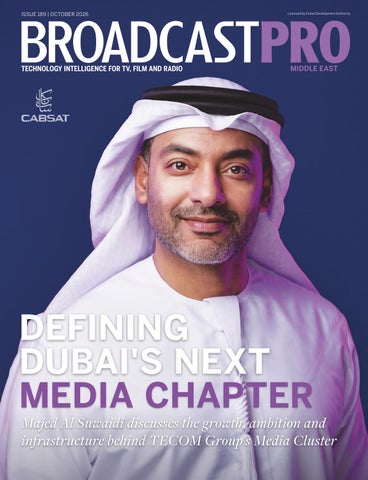
DEFINING DUBAI'S NEXT MEDIA CHAPTER
Majed Al Suwaidi discusses the growth, ambition and infrastructure behind TECOM Group's Media Cluster
PRO|INTRO
broadcastprome.com
EDITORIAL MD & Publishing Director Vijaya Cherian vijaya.cherian@cpipromedia.com +971 (0) 55 105 3787 Editorial Contributors Kalyani Gopinath Nusrat Ali Urooj Fatima Sub Editor Aelred Doyle
ADVERTISING
WELCOME
Key Accounts Vijaya Cherian
After months of uncertainty, we have finally arrived at CABSAT. Yes,
vijaya.cherian@cpipromedia.com
there are fewer exhibitors, a new venue and, inevitably, questions about
+971 (0) 55 105 3787
how it will all work. But I believe those who come are here because
Sales Director Sandip Virk
they see MENA as a market worth investing in for the long term.
sandip.virk@cpipromedia.com
Having just returned from IBC, I was struck by the sight of some
+971 (0) 50 929 1845 / +44 (0) 7516 993 862
old familiar faces back on company stands as consultants. Their
FINANCE
return has reinforced something I have been noticing for months:
Finance Executive Yonwin D’souza
when a system breaks, everyone seems to be looking for that one
finance@cpipromedia.com
person who knows how the whole thing works.
DESIGN & PRODUCTION
These are necessary changes, and they have brought valuable
Art Director David Fraser
new skills into broadcast. But somewhere along the way, did we
design@cpipromedia.com
begin to take the experienced broadcast engineer for granted? A
Our industry has embraced IP, cloud, automation and now AI.
EVENTS & MARKETING Events Executive Sarah Nathan marketing@cpipromedia.com
DIGITAL SERVICES Web Developer Hafiz Muhammad Waqas IT@cpipromedia.com
demo can show us what a system can do. An engineer who has spent years keeping channels on air knows what can go wrong when a new solution enters a live operation and has to work with systems that were never designed to work together. They also understand the legacy infrastructure still sitting beneath many new workflows. Today’s specialists may be brilliant in their own fields, but someone still needs to see the whole picture. That judgement is hard to replace once it has walked out the
FOUNDER
door. Perhaps organisations that let go of experienced engineers
Dominic De Sousa (1959-2015)
too quickly are recognising that now. Ideally, they should have been working alongside the next generation and passing on what
PARTNER
they know. Innovation needs people who can make it dependable.
Maria De Sousa
It is something I will be thinking about as I walk the CABSAT floor, where every impressive solution raises the same question:
Published by
who will make it work when it matters? That is also why I look forward to the BroadcastPro Manufacturer Awards during CABSAT. We will celebrate
The publisher of this magazine has made every effort to ensure the content is accurate on the date of publication. The opinions and views expressed in the articles do not necessarily reflect the publisher and editor. The published
innovative solutions and the people whose knowledge turns them into something broadcasters can rely on. See you in Dubai.
material, adverts, editorials and all other content are published in good faith. No part of this publication or any part of the contents thereof may be reproduced, stored or transmitted in any form without the permission of the publisher in writing. Publication licensed by Dubai Development Authority to CPI Pro Media FZ LLC. Printed by Al Bony Printing Press LLC. CPI Pro Media. PO Box 13700, Dubai, UAE. DQuarters, Dubai Media City (TECOM) +971 55 1053787 cpipromedia.com
VIJAYA CHERIAN,
© Copyright 2026. All rights reserved.
EDITORIAL DIRECTOR 1
PRO|CO NTENTS
broadcastprome.com
5
IBC2026
UPDATE NEWS
INNOVATION IN ACTION
CineNow builds UAE investment platform for Indian film IP; CNN Creators opens studio in Doha; Pebble extends deal with Asharq; MAD Solutions & IRTH announce partnership; STC Group and SRMG sign MoU for production; and more
IBC2026 put practical innovation centre stage, as AI, IP, cloud and emerging technologies move closer to real-world deployment
COVER STORY DUBAI’S MEDIA CLUSTER ON THE MAP
BROADCASTPRO ME – ROUNDTABLE AI IN MENA: BEYOND THE HYPE High-profile media leaders gathered to discuss where AI is delivering value, and why Arabic accuracy, data sovereignty, trust and human judgement remain critical
12
18
Beyond Dubai Media City’s 25-year milestone, Majed Al Suwaidi talks about shaping TECOM’s Media Cluster into a creative ecosystem for the next generation of businesses, talent and technologies
PRODUCTION NOTES LEBANON THROUGH ARCHIVES
24 BEHIND THE SCENES FROM REAL TO REEL
36
From broken systems to ordinary lives, filmmaker Karim Kassem explores the realities that have shaped Pipes and his body of work
Filmmaker Lana Daher spent seven years navigating thousands of archival fragments to create Do You Love Me, a deeply personal portrait of Beirut told through memory rather than history
SPORT
CABSAT 2026
ASIAN BOXING ENTERS MENA RING
THE TECH EDIT
Asian Boxing and UAE-based IITech are building a digital ecosystem designed to take the sport to more audiences
48 FILMING IN EGYPT MAKING KEMET
42
Mo Ismail unpacks the production of Kemet: Year One, from building ancient settlements to filming across remote landscapes
We bring you a glimpse of what to expect at CABSAT, from AI and cloud production to broadcast infrastructure and next-generation workflows
54
30 60 GUEST COLUMN BUILDING AN AI STRATEGY The real opportunity for AI lies in building it around people, data and workflows, argues Dominic Baillie 3
We craft visuals that inspire, backed by technology that delivers. From data-driven graphics and bold channel branding to automated templates and immersive design, we don’t just execute ideas, we engineer them. AI drives both art and systems in everything we do. Since day one, innovation and engagement have been our backbone. Redefining media standards is our mission. W W W. R E S O N 8 M E D I A . C O M
reson8media info@reson8media.com
10/26 broadcastprome.com
PRO|N E WS
Keep up-to-date at broadcastprome.com
CineNow builds UAE-led investment infrastructure for Indian film IP CineNow, an entertainment investment vehicle focused on Indian film and entertainment IP, is entering the next phase of its $150m investment programme by expanding its UAE-based professional network and developing infrastructure for cross-border investment and tokenisation. Under the model, the India team will focus on sourcing films, evaluating IP and developing creative partnerships, while the UAE team will lead the
Rohit Dalmia, Chairman and Managing Director of CineNow.
international investment framework and tokenisation infrastructure.
At the centre of CineNow’s approach is the positioning of film IP as an investable asset rather than as standalone projects. The company plans to deploy $150m across more than 30 films over a six-year period. Its India-based team will assess projects according to creativity, commercial potential, production economics, distribution prospects and long-term IP value. CineNow’s UAE team will then develop the
investment infrastructure around those assets. “We are now moving from establishing the vehicle to building the infrastructure required to execute our vision. India is where we are identifying and developing the film IP, while the UAE gives us an important base from which to develop the tokenisation, investment and international relationships around that IP,” said Rohit Dalmia, Chairman and Managing Director of CineNow.
DUBAI INTERNATIONAL FILM FESTIVAL SET FOR COMEBACK AFTER A DECADE The Dubai International Film Festival (DIFF) will return on December 8, 2027, marking the festival’s comeback after a decade-long hiatus and launching its 15th edition with a renewed focus on Middle Eastern cinema and talent. The announcement was made by Mona Ghanem Al Marri, Vice Chairperson and MD of the Dubai Media Council, at the Arab Media
Summit last month. Originally launched in 2004, DIFF was established with the aim of positioning Dubai as a gateway for Arab cinema to international audiences. Across 14 editions, the festival developed into a major regional film platform, providing opportunities for Arab filmmakers and productions while bringing international cinema and leading
industry figures to Dubai. The festival last took place in 2017. Al Marri said the revived festival would build on its legacy while responding to changes in the regional and global film industries. The first edition of the new chapter will place Middle Eastern films and filmmakers at the centre, with an emphasis on bringing regional stories and creative voices to
wider audiences and international markets. The new DIFF is also being positioned as an industry platform rather than solely a public film event. Its programmes will seek to connect filmmakers with producers, creative talent with investors and projects with potential markets, while creating opportunities for partnerships and new productions.
5
PRO|N E WS
OCTOBER 2026
CNN Creators opens studio and production hub in Doha CNN’s multiplatform programming initiative, CNN Creators, unveiled a new production facility at Media City Qatar in Doha last month, expanding its production capabilities. The open-plan studio combines a studio, newsroom and production centre in a
MFORMEDIA APPOINTS NEW MANAGING DIRECTOR
single on-camera space, giving the team greater scope to experiment with storytelling formats while supporting live and multiplatform programming. The studio features multiple remotely operated cameras suspended
from ceiling tracks, providing a continuously moving, 360-degree view of the Creator environment. The control room supports both vertical and horizontal broadcasting, enabling live streams as well as linear television broadcasts.
DICM 2026 BRINGS BACK PITCHING CHALLENGE FOR ARAB STORYTELLERS
Ziad Kebbi (pic centre) has joined Dubai production company MFORMEDIA as MD. Managing Partners Khalil Homeissy (extreme left) and Ralph Matar (right) will continue to oversee the group’s overall strategy and key
The Dubai International
pitch their projects
relationships, while Kebbi
Content Market
live before an expert
will take responsibility
(DICM), taking
jury and industry
for operations, an
place November
professionals. The
expanded production
10-11, is bringing
initiative aims to
slate and delivery across
back its Spotlight
identify original Arabic
the company’s content
Stories pitching
scripted projects
divisions. MFORMEDIA
challenge 2026,
and help emerging
is shifting its focus
offering emerging
storytellers move
towards the ownership
MENA creators
their ideas towards
and development
an opportunity to
development and
of original IP.
present original
production. The
Arabic-language
winning script
content projects to
will progress to
producers, buyers
production with
and distributors.
AFLAM Production.
Shortlisted
Submissions are open
participants will
6
until October 15.
FILM ALULA PARTNERS WITH SHERBORNE MEDIA TO BOOST PRODUCTION FINANCING Film AlUla, the film agency of the Royal Commission for AlUla, has signed an MoU with international film financier Sherborne Media Finance LLC to establish a financial framework aimed at expanding production support for Saudi, regional and international filmmakers shooting in AlUla. Eligible productions will be able to access debt financing secured against production rebates, grants, incentives and other soft-money funding. Combined support packages will cover up to 50% of eligible production expenditure incurred in AlUla. The initiative is designed to secure upfront liquidity against contracted rebates and incentives, a major financing challenge for producers.
The world’s most powerful broadcast audio mixer designed for a SMPTE-2110 future! Fairlight Live audio panels are the mixing control center of your live production! Designed to integrate with Fairlight Live software, the world’s most powerful audio mixer, you can manage unlimited channels and complex mixes with subtle adjustments using precision faders and knobs. Real-time visual feedback is provided by LCD displays. USB-C and SMPTE 2110 network integration ensures seamless compatibility with ATEM switchers.
Upper Deck Function Buttons The function buttons allow fast access to channel processing and routing tools including EQ, dynamics, plugins, panning, and bus assignments. When you select a function, the menu buttons, encoders, and touchscreen automatically adapt to show relevant controls and parameters. Function buttons work with soft menu buttons to navigate parameter pages, keeping advanced mixer functions organized and accessible.
Customizable Channel Strips
Tools for Live Production
Fairlight Live audio panels feature customizable channel strips which include a motorized fader, solo, mute, and select buttons, plus a rotary encoder for fast access to channel functions. The bright LCD touch screen display keeps channel status and identification clear. Assign any strip to any track or bus, plus a single strip can control multiple tracks or buses simultaneously.
The most important live production functions are grouped so you can move quickly between rehearsal, playback, cue execution, and show automation. Player recorder lets you record and play back virtual sound checks. Cue player gives instant access to audio and MIDI cues for jingles, stingers, and effects. Snapshot controls enable fast preview, recall, update, and creation of snapshots for seamless show transitions.
LCD Touchscreen Display Each group of 10 channel strips has a dedicated LCD touchscreen, giving you a comprehensive graphical display of your audio mix including channel VU meters and mixer status. Adjust plugins, assign channels to busses, manage monitoring, configure layers, and set spill zones via the touchscreen. You can control complex live mixing in one place without navigating to separate menus during live production.
Fairlight Live............................................Free Download Fairlight Live Audio Panels..... From US$2,229
Learn more at www.blackmagicdesign.com/ae SRP excludes duties, shipping and sales tax.
Learn More!
PRO|N E WS
OCTOBER 2026
Pebble extends deal with Asharq to move playout operations to Riyadh Pebble has expanded its partnership with Asharq, part of the Saudi Research and Media Group (SRMG), as the broadcaster consolidates its channel playout operations in Riyadh. The latest deployment involves relocating Asharq’s channels from Dubai to the King Abdullah Financial District (KAFD) in Riyadh, while adding Asharq Culture channel to the Pebble platform. In addition, three
Thmanyah sports channels have been integrated into Pebble playout to support live event broadcasting. Asharq’s Riyadh facility now hosts playout for
STC GROUP AND SRMG SIGN MOU TO EXPLORE AI PRODUCTION STC Group and Saudi Research and Media Group (SRMG) have signed an MoU to collaborate on media production technology, cloud infrastructure and AI-powered workflows in Saudi Arabia. The proposed collaboration covers five key areas: high-speed connectivity, cloud-based production, advanced studio infrastructure, emerging production technologies and the application of AI across the content production lifecycle. Potential projects include the use of fibre-optic connectivity
8
and edge computing for studios and remote production, and cloud platforms for media storage, editing, asset management and post-production. The companies will also explore next-generation broadcast technologies, virtual production, real-time processing, augmented reality and virtual reality. The MoU is exploratory and does not include specific investment commitments, implementation schedules or confirmed projects.
Bloomberg Asharq News, Asharq Discovery, Asharq Documentary and Asharq Culture. The facility also supports Thmanyah, after it secured the
rights to broadcast Saudi Premier League football and turned to Asharq to provide infrastructure for its sports channels. Omran Abdullah, VP Engineering IT and Technology SRMG News at Asharq, said: “Pebble has been a strong partner since 2019... That experience gave us confidence as we moved the Asharq operation to Riyadh and added the three Thmanyah sports channels to the platform.”
TELFAZ11 PARTNERS WITH AL-ITTIHAD TO CREATE NEW SPORTS FILMS AND SERIES
UNITED MEDIA SERVICES RESHAPES LEADERSHIP WITH SAIF EL-WAZIRY AT HELM
Al-Ittihad Club has joined
United Media Services
forces with Saudi media
(UMS) has appointed
company Telfaz11 to
Saif El-Waziry Chairman
develop and produce
and Managing Director
sports entertainment
as the Egyptian media
content that brings
group introduces a new
the club’s heritage and
board and leadership
identity to new audiences.
structure. He joined UMS
The collaboration will
executive leadership
see the development
in May 2026 as Vice
of several projects
Chairman and Managing
including films, series
Director. In July, he was
and other entertainment
promoted to Chairman.
productions. A number
In September, the
of projects are already
company formally
in development, with
announced its new
further details expected
board, confirming El-
to be announced in
Waziry as Chairman and
the coming period.
Managing Director.
PRO|N E WS
OCTOBER 2026
Arqiva backs beIN Sports’ 2026 World Cup coverage Arqiva recently highlighted the role of its satellite and fibre infrastructure in supporting beIN Sports’ coverage of the 2026 FIFA World Cup across MENA. The company provided satellite uplink services to distribute the broadcaster’s coverage across the region
via Es’hailSat-1, alongside fibre connectivity. Arqiva said its infrastructure was operated against a 99.999% availability target. Israel Esteban, Chief Technology Officer, beIN Media Group, said: “Delivering coverage of a global sporting event
on this scale requires dependable technology and trusted partners. Arqiva’s support helped provide the resilient infrastructure needed to ensure audiences across the MENA region could enjoy uninterrupted access to our FIFA World Cup coverage.”
MAD SOLUTIONS & IRTH PARTNER FOR ARAB FILM AND TV PROJECTS
ALI JABER MOVES FROM EXECUTIVE TO ADVISORY ROLE AT MBC GROUP AFTER 15 YEARS
MAD Solutions has
producers, studios,
partnered with IRTH to
broadcasters,
develop, package and
streaming platforms
support film, TV and
and international
other entertainment
partners. The
projects from across
collaboration will
the Arab world.
cover original films,
The companies
TV series and projects
aim to create a
built around talent
development and
represented by MAD
production pathway,
Celebrity. It will also
taking projects from
provide consultancy
MBC Group has
early-stage ideas
services to third-
announced that Ali
and writing through
party producers.The
Jaber will transition from
packaging and
companies are now
his position as Chief
market positioning
developing their first
Content Officer to an
to connections with
slate of projects.
advisory role, where he will continue supporting the group on strategic priorities and business continuity. The move marks a new phase in Jaber’s 15-year association with MBC Group, during which he played a key role in developing the region’s media and entertainment sector. 10
Egyptian author, screenwriter and producer Haitham Dabbour flanked by MAD Solutions co-founders Alaa Karkouti (L) and Maher Diab (R).
WBD AND DOGUS MEDIA PARTNER TO COFINANCE AND BROADCAST TURKISH SERIES Warner Bros. Discovery (WBD) and Turkey’s Doğuş Media Group have entered into a strategic partnership to co-finance and co-broadcast Turkish scripted series, with the upcoming romantic comedydrama Salted Love (Tuzlu Kahve) the first project under the agreement. Produced by Poll Films, it will premiere on Doğuş Media Group’s freeto-air channel Star TV before becoming available on HBO Max in Turkey and internationally 24 hours later. The partnership comes as WBD expands its streaming operations in Turkey. It acquired Turkish streaming platform BluTV in late 2023, relaunching it under the HBO Max brand, while continuing to invest in locally produced original programming.
PRO|IBC2026
OCTOBER 2026
IBC2026: BUSINESS, INNOVATION AND A CHANGING MEDIA LANDSCAPE IBC2026 brought the global media, entertainment and technology industry together at RAI Amsterdam for four days of business, innovation and networking, attracting 41,225 attendees from 170 countries and more than 1,300 exhibitors. The event reflected an industry navigating rapid technological and commercial change, but increasingly focused on how new technologies can translate into practical applications and business opportunities. The number of first-time exhibitors rose by more than a third compared with 2025, while several established international brands expanded their presence, the organiser claimed. A 12
total of 256 companies made their IBC debut, a 36% increase on the previous year. For many, the show provided an opportunity to enter new markets, meet customers and establish partnerships. For first-time exhibitor EON Media, the Future Tech zone provided a platform to enter the European market. “The Future Tech zone has been the ideal place for us to make our IBC debut and launch into Europe. We’ve had great customer conversations and a lot of drop-by visitors who were truly engaged.” Avid also reported increased activity at its stand, with Kara MartinBeijer, Vice President, Corporate Marketing at Avid, pointing to
the larger presence the company brought to the show and the quality of customer conversations. For established exhibitors, IBC remains an important feedback loop between technology developers and the market. Ross Video reported selling one of its new solutions on the first day, with Executive VP and CMO Jeff Moore describing the show as a major opportunity for its product teams to understand where the industry is heading. The increased emphasis on emerging technology was particularly evident at Future Tech, which expanded its role at IBC2026. Future Tech Ignite brought more
PRO|IBC2026
broadcastprome.com
than 70 startups and emerging companies together with investors and established organisations from the media and entertainment sector. The initiative, supported by EIT Culture & Creativity as Innovation Partner, was designed to connect emerging companies with the wider industry. Anette Schaefer, CEO of EIT Culture & Creativity, highlighted the value of IBC’s international reach and its ability to bring industry leaders together to exchange ideas. That emphasis on connection extended to IBC’s networking programme. The new Braindate Lounge enabled IBC Exchange pass holders to arrange one-to-one and small-group discussions around specific areas of expertise, experience and professional challenges. Collaboration was also at the heart of the IBC Accelerator Media Innovation Programme, which brought broadcasters, streamers and technology companies together to tackle nine real-world industry challenges. Projects explored areas including agentic AI, immersive experiences, private 5G, accessibility, content
provenance and live-event streaming. The resulting proofs-of-concepts were intended to move emerging technologies beyond experimentation and towards practical deployment. Caroline Ewerton, Senior Vice President, Content Operations & Technology at DAZN, which championed multiple Accelerator projects, highlighted the opportunity for organisations to work together on where the industry is heading. The IBC Conference provided a broader view of those changes, bringing together senior executives from media, entertainment, technology and sport. Speakers from organisations including Banijay, BBC Studios, CNN, FIFA, Globo, Google, ITV, JioStar, Meta, Netflix, Snap, UEFA, Warner Bros. Discovery and YouTube discussed the practical applications of AI, changing business models, live sports economics, content discovery, security, trust and content provenance. The conference also reflected how much the definition of broadcasting has expanded. Creator-led businesses, sports organisations and emerging content formats now sit alongside
traditional broadcasters, streamers and technology providers within the same ecosystem. As Evan Shapiro, Media Cartographer at ESHAP, observed, IBC continues to evolve what the word broadcasting means, bringing together participants from across regions and sectors to share challenges and solutions. That broader ecosystem was perhaps the clearest thread running through IBC2026. While AI, IP, cloud, immersive technology and other emerging technologies remained prominent, the focus was increasingly on how these technologies can be applied, integrated and turned into sustainable business value. For IBC, the show also marked another step towards its 60th anniversary, with the organisation pointing to the business activity, partnerships and innovation generated at this year’s event as foundations for its continued evolution. The next edition is scheduled to take place at RAI Amsterdam 10-13 September 2027. 13
PRO|IBC2026
OCTOBER 2026
FROM THE SHOW FLOOR
IMAGINE COMMUNICATIONS
Dr Glodina Lostanlen (l), CRO, and Anas Hantash (r), Sales Director, MENA, GCC and South Asia, Imagine Communications.
At the Imagine Communications stand, Chief Revenue Officer Dr Glodina Lostanlen highlighted the company’s move to connect its applications with AI through Model Context Protocol (MCP), with initial use cases spanning advertising rights and scheduling, production and playout. Imagine is taking a pragmatic approach, testing specific applications with customers rather than pursuing AI for its own sake. “It’s pragmatic innovation,”
LAWO Lawo put EdgeOne at the centre of its IBC showcase, with Chief Marketing Officer Andreas Hilmer highlighting the platform’s European premiere. The compact processing platform was shown running a commentary application through its native HTML-based user interface, without an external computer. The device combines audio and video
BACKLIGHT processing with JPEG XS compression in a single unit. Hilmer also highlighted Lawo’s recent collaboration with Grass Valley, aimed at giving customers greater flexibility across the two vendors’ platforms and reducing concerns about vendor lock-in. A live demonstration at IBC showed the integration in action.
Andreas Hilmer, CMO, Lawo.
14
Lostanlen said, adding that the company was focused on missioncritical capabilities while keeping its platforms open and adaptable. For MENA, Sales Director Anas Hantash said the region’s transition to IP is accelerating, with 2110 increasingly appearing in RFPs. Imagine’s regional team has grown to almost 16 people, while its Dubai demo lab gives customers a working end-to-end IP environment to test before committing to a deployment.
At the Backlight stand, Liz Dellheim highlighted new AI capabilities across iconik and Wildmoka, from AI metadata enrichment and naturallanguage search
Liz Dellheim, Associate Director, Product Marketing, Backlight.
to Wildmoka’s AI Moments
a pragmatic approach
for automatically
to AI, focusing on
identifying highlights
applications with
from live or file-based
clear ROI rather
content. The company
than simply adding
is also bringing the
it for its own sake.
two platforms closer
“Our AI metadata
together, with a
enrichment is not
native Wildmoka
vector analysis,”
publishing panel now
she explained. “It
available in iconik and
is leveraging AI to
further integration of
extract existing
Wildmoka’s ingest and
context around an
transcoding pipeline
asset and pulling
in development.
that into the
Dellheim said
metadata, reducing
Backlight was taking
manual labour.”
PRO|IBC2026
OCTOBER 2026
MULTIDYNE Matt Watkins spoke about Multidyne’s acquisition of robotics specialist MRMC and its move into IP-based transport. The acquisition expands Multidyne into robotics and motion control, while complementing its existing fibre transport portfolio. Watkins said the companies operate at the camera end
Matt Watkins, Director of Sales Operations & Western US Sales, Multidyne.
of the production chain, creating opportunities to combine MRMC’s robotic systems with Multidyne’s fibre transport and power technologies. The company also highlighted its SilverBack IP, a cameraback transport solution that puts cinema camera signals directly onto a 25Gb network rather than through a conventional base station. Watkins said the IP technology developed for SilverBack will eventually extend to other Multidyne platforms, including VersaBricks and VersaFrame, as the company broadens its portfolio beyond traditional fibre transport.
TECHEX leagues are now offering direct-to-fan broadcast services, while the growing popularity of multiview is creating its own scalability challenge: David Edwards, Senior Product Manager, TechEx.
“Eight parallel games can result in 280
At the TechEx stand,
channel variants of
David Edwards
Multiview.” TechEx
highlighted how the
is responding with
growing scale and
software-native,
complexity of live
cloud-based
sports is putting
workflows designed
new demands
to scale resources
on broadcast
around live events,
infrastructure. He
rather than relying
noted that 55%
on fixed hardware
of major sports
infrastructure.
VIDENDUM At the Videndum stand, one highlight was Autoscript’s Voice Controller for WinPlus-IP, a new voicecontrolled prompting solution that enables presenters to control the movement of the script by speaking. Built on the speech recognition technology behind the company’s existing Autoscript Voice solution, Voice Controller lets the prompter respond to the
16
presenter’s delivery without a dedicated hand or foot controller. This allows presenters to set their own pace and concentrate on delivering the script. Autoscript said the system works wherever audio can be routed, allowing it to fit into existing production workflows. IBC visitors were able to try Voice Controller in hands-on demos.
Robin Brown, Product Specialist Autoscript & Autocue.
TRANSFORMING MENA BROADCASTING FROM MARKET-LEADING REACH AT 7/8° WEST, TO IP-NATIVE SERVICES, SMARTER AUDIENCE ENGAGEMENT AND MULTI-ORBIT CONNECTIVITY, EUTELSAT IS OPENING NEW POSSIBILITIES FOR BROADCASTERS ACROSS MENA. Find out more at www.eutelsat.com
P R O | C OV E R
18
OCTOBER 2026
P R O | C OV E R
broadcastprome.com
BUILDING DUBAI’S NEXT MEDIA CHAPTER As Dubai Media City marks 25 years, Majed Al Suwaidi, Senior Vice President of Dubai Media City, Dubai Production City and Dubai Studio City, part of TECOM Group, speaks to Vijaya Cherian about the scale of its Media Cluster, the businesses and talent flowing into Dubai’s creative economy, and the infrastructure needed for a market increasingly shaped by streaming, gaming, data and AI Earlier this year, Dubai Media City celebrated its twenty-fifth anniversary with key partners and members of its expanding ecosystem. What began as a dedicated base for media businesses became the foundation of TECOM Group’s Media Cluster, which encompasses Dubai Production City and Dubai Studio City and supports activities that range from broadcasting, advertising and publishing to production, gaming and digital content. The scale is considerable. The three districts are home to more than 40,000 creative professionals and the address of more than 60% of Fortune 500 companies in the media sector. The community includes international and regional businesses such as Flick Global, Publicis Groupe, Augustus Media, WPP and Blink Studios, alongside broadcasters, agencies, production companies and a growing population of digital creators. For Majed Al Suwaidi, Senior Vice President of Dubai Media City, Dubai Production City and Dubai Studio City, the anniversary reflects how the ecosystem has developed. “This
depth and diversity reflect Dubai’s position as a global hub for the creative economy and media innovation.” That position is also reflected in investment and employment data beyond the districts themselves. In 2025, Dubai attracted 754 new projects in the cultural and creative industries, according to Financial Times fDi Markets data. Those projects generated 19,304 new jobs. Consequently, greenfield foreign direct investment (FDI) capital inflows into the sector rose to $3.756 bn. The figures give substance to Dubai Economic Agenda ‘D33’ ambitions to attract investment and consolidate the emirate’s place in the global creative economy. Al Suwaidi explains how the Media Cluster contributes to these ambitions by continually strengthening its integrated media ecosystem and infrastructure, attracting foreign direct investment and supporting talent development. Its role as Knowledge Partner for the ‘Arab Media Outlook – Future Vision’ report is part of a broader effort to foster industry development and knowledge exchange.
A media ecosystem built around different functions
The model is built around each business district playing a distinct yet complementary role. “Dubai Media City serves as the hub for new media, broadcasting, advertising and digital content creators; Dubai Studio City provides advanced production infrastructure, including state-of-the-art sound stages, production studios, recording facilities and green rooms; and Dubai Production City supports light industries, publishing and printing,” elaborates Al Suwaidi. The logic is not simply to place related companies near one another, but to provide an integrated media ecosystem and infrastructure across the three districts, supported by world-class facilities, smart services through the axs platform and co-working facilities such as D/Quarters for companies seeking more adaptable space. The Media Cluster continues to explore nextgeneration production technologies and flexible space solutions for streaming, gaming and digital-first businesses. 19
P R O | C OV E R
“Diversification is embedded in our model, with activities spanning news, advertising, production, gaming, publishing and emerging digital formats. This breadth fosters cross-unit collaboration among our specialised business districts,” Al Suwaidi says. This matters because the media market itself is becoming harder to divide into neat categories. Between 2024 and 2028, the MENA media market is projected to grow from $17bn to $20.6bn, according to the ‘Arab Media Outlook – Future Vision’ report. Much of that expansion is expected to come from digital-first formats, including internet advertising, OTT video, music streaming and gaming. Advertising is moving towards more data-driven and platform-based models, while traditional broadcasters are adopting hybrid digital strategies. Podcast networks and influencer-led content businesses are adding still more participants to the value chain. “New global companies demand agile, technologically advanced environments that support digitalfirst strategies, AI integration and flexible working models. We cater to this by providing cutting-edge infrastructure and content creation
OCTOBER 2026
Diversification is embedded in our model, with activities spanning news, advertising, production, gaming, publishing and ... digital formats MAJED AL SUWAIDI, SENIOR VP, DUBAI MEDIA CITY, DUBAI PRODUCTION CITY AND DUBAI STUDIO CITY
facilities through our three business districts and in5 Media, alongside adaptive co-working spaces like D/ Quarters,” explains Al Suwaidi. “We also work closely with policymakers as well as academia to ensure that companies have access to a diverse talent pool to meet their evolving needs in content development and distribution. We are continually strengthening our integrated media ecosystem, reinforcing our position as a partner of choice for multinational media businesses as well as entrepreneurs in the region.” TECOM Group’s Education Cluster, comprising Dubai Knowledge Park and Dubai International Academic City, provides access to skilled talent, while cross-sector collaboration with technology companies at Dubai Internet City supports media businesses as they scale and innovate. Backing companies at different stages
The media cluster’s proposition also spans markedly different types of customers: multinational groups that want an established regional base, SMEs seeking 20
broadcastprome.com
room to expand, and startups that may still be testing a product or business model. The latter are served through TECOM Group’s entrepreneurship incubator in5, which has supported more than 1,100 startups across media, technology, science and design since its inception and provides entrepreneurs with structured pathways to scale. Across its different verticals, Al Suwaidi explains, “Startups have collectively raised over AED 9bn ($2.45bn) since in5’s inception, highlighting the role that access to mentorship, networks and funding opportunities can play in supporting entrepreneurs and the broader ecosystem. Empowerment begins with access to infrastructure, potential funding and markets.” The distinction is important. For media startups, incubation can extend beyond mentoring to include routes to finance, specialist facilities, commercial partnerships and customers. The in5 Investor Hub connects founders with angel investors, venture capitalists and institutional investors. Halo AI, Wittify AI, Bellboy and MyGatePass are among the companies Al Suwaidi cites as evidence of ideas progressing into operating businesses. This support sits alongside a wider regional expansion in production incentives and targeted public funding. Dubai Media City, Dubai Production City and Dubai Studio City complement these efforts by providing readyto-use infrastructure, integrated services, access to talent and potential investors, and a community through which companies can find partners and exchange knowledge. “Our strength lies in the depth, flexibility and connectivity of the ecosystem we provide, enabling innovators to thrive and shape the future of industries from Dubai,” says Al Suwaidi. The national business environment provides an additional tailwind. The UAE ranked first globally for the fifth consecutive year in the Global Entrepreneurship Monitor Report 2025-2026 as a conducive environment for starting and operating new businesses. For media entrepreneurs, however, favourable policy is only one part of the equation. This achievement reflects the country’s forward-looking policies, business-friendly environment and robust investment climate, which together support startups in scaling innovative ventures locally and internationally.
P R O | C OV E R
around AI, while others remain at the stage of assessing where it can offer genuine operational or creative value. Al Suwaidi describes the Media Cluster’s role in supporting businesses as they navigate the implications of AI: “Businesses are exploring AI’s applications and implications at different stages, and our role is to facilitate knowledge exchange and collaboration, enabling businesses to adapt, experiment and innovate.” That approach extends to events and external partnerships. Creative Brunch is among the events organised across its districts, with strategic partnerships including Dubai Lynx and participation in industry platforms including CABSAT, MEASA’s leading event for media, broadcast and pro AV solutions. As a strategic partner of CABSAT this
AI moves into the media value chain
Artificial intelligence now cuts across many of the activities in the media value chain. Its effect is visible in content personalisation, advertising and gaming, but the likely consequences extend to production efficiency, monetisation and interactive storytelling. The pace of adoption is uneven: some businesses are already building products 21
P R O | C OV E R
OCTOBER 2026
Dubai Media City serves as the hub for new media, broadcasting, advertising and digital content creators.
year, it plans to showcase success stories from its ecosystem and connect with international industry peers. Its Knowledge Partner role for the ‘Arab Media Outlook – Future Vision’ report similarly gives it a role in mapping the forces reshaping the Arab media business. The next phase
A 25-year history gives Dubai Media City institutional weight, but the next chapter will be shaped by how effectively media companies respond to the ongoing shifts in the sector. These shifts bring both challenges and opportunities. Audience behaviour continues to fragment, production and distribution are converging, and technology companies are increasingly influencing media operating models. Infrastructure must therefore be sufficiently specialised for present needs and flexible enough to accommodate formats and businesses that are still emerging. 22
Startups have collectively raised over $2.45bn since in5’s inception, highlighting the role that access to mentorship, networks and funding opportunities can play in supporting entrepreneurs and the broader ecosystem MAJED AL SUWAIDI, SENIOR VP, DUBAI MEDIA CITY, DUBAI PRODUCTION CITY AND DUBAI STUDIO CITY
The media cluster provides a connected model: three sectorfocused districts, production and co-working facilities, startup incubation, talent pipelines and industry platforms. Media companies can leverage these foundations and infrastructure to create, produce and distribute work from Dubai. “Connecting businesses spanning the media value chain strengthens engagement and knowledge exchange, supporting growth and reinforcing Dubai’s position as a global media hub. By cultivating a collaborative and innovative community and providing access to skilled talent and knowledge, we establish the conditions for sustainable growth,” Al Suwaidi says, adding that he sees adaptability as an important factor. “The next decade will be shaped by how effectively the sector responds to evolving technologies, audience behaviours and demand for new forms of content.”
P R O | R O U N D TA B L E
OCTOBER 2026
THE REAL TEST FOR AI AI is moving rapidly into the heart of MENA’s media operations, but questions about trust, Arabic-language accuracy, infrastructure, data sovereignty and cost mean people remain firmly in control. BroadcastPro ME and Alibaba brought regional media and technology leaders together for a roundtable on what is working, what is not and where the industry goes next. Vijaya Cherian summarises the discussion
24
P R O | R O U N D TA B L E
broadcastprome.com
AI is no longer a side project for the Middle East media industry. It is accelerating software development, metadata, moderation, content production, sports coverage and subtitling, while increasingly shaping what individual viewers see. To explore these shifts, BroadcastPro ME and Alibaba brought together a select group of regional media and technology leaders for an intimate roundtable discussion on AI. The session was moderated by Dipesh Makwana of Alibaba and co-moderated by Vijaya Cherian, Editor of BroadcastPro ME. Joining them were Basel Al Tamimi, Chief Innovation Officer, AI & Digital Transformation at VUZ; Fadi Radi, Vice President of Digital Products and Creative at SRMG News; Faraz Arshad, Chief Technology Officer at StarzPlay; Jonathan Mark, CEO and co-founder of BEGIN; Melvin Saldanha, SVP Technology & Product at OSNtv; Richard Fitzgerald, CEO and founder of Augustus Media; Suhail Ahmed, Chief Broadcast Technology Transformation Officer at IMI; and Srinivas Kuppa, Head of Technology at Al Mashhad TV. The question now is where AI creates measurable value, what it costs at scale and whether its data, language and governance can be trusted. The discussion showed an industry moving beyond experimentation while recognising that not every task or market is ready for full automation. AI moves into the operating model
At SRMG News, AI is being established as a foundation across the business rather than confined to individual pilots. Fadi Radi said its applications now span editorial, personalisation, production and development. The
Moderator Dipesh Makwana, Alibaba.
group’s relaunched GOAT sports aggregation app is one example, bringing together information from its sports brands while using AI in both the product and its production. “AI is in every single department at the moment,” Radi said. “All these aspects are now AI-based.” VUZ, a socially immersive company, has similarly approached adoption on two fronts: improving internal productivity and creating external products and revenue opportunities. Basel Al Tamimi said the company had examined functions ranging from finance and technology to production, content and marketing, while accepting that AI also exposes skill gaps and forces established workflows to be reconsidered. One practical application is moderation. VUZ allows creators to broadcast live and interact with viewers, but monitoring conversations becomes difficult as the service scales across MENA’s many dialects. Large language models are helping reduce the burden on human moderators. The company is also exploring how AI, object recognition and 360-degree video could provide event organisers
with information about attendance and movement around venues. “We are trying to combine different technologies – AI, 360 and cloud – to build new business models and new services that can tackle new challenges in the market,” Al Tamimi explained. For StarzPlay, the immediate gains have come from operational tasks where mistakes carry relatively limited risk. Faraz Arshad said the company began with content operations, metadata, synopses and poster creation before developing more capabilities in-house. AI-assisted development has lifted the number of tickets handled by a developer from seven or eight a day to around 16-18, he said, while helping reduce a typical telco platform deployment from roughly a year to five or six months. His conclusion was to be pragmatic: “Use it where it makes sense. Keep your expectations realistic.” Content at scale – but not at any cost
The breadth of current deployment was particularly visible at Augustus Media. Richard Fitzgerald said AI is involved in a significant share of the company’s output across text, 25
P R O | R O U N D TA B L E
Richard Fitzgerald, CEO and founder of Augustus Media.
audio and video. Instagram carousels are converted into articles and translated into appropriate local Arabic; its podcast network uses AI-generated audio; and automated cameras cover lower-tier sports that would otherwise struggle to justify conventional production costs. The economic case is compelling, but Fitzgerald draws a line around premium original storytelling. Audiences are still inclined to scrutinise visibly AI-generated work for errors rather than immerse themselves in the story, he argued. Technology should therefore enable products that could not be produced conventionally, or make viable coverage that would otherwise not exist. “You either create workflows, make money or build audience. If you put a product out there that you can’t do with OB trucks, and someone wants to subscribe, then it works,” he said. UAE-headquartered streaming service BEGIN faces a different economic reality in markets including Pakistan, Bangladesh and Sri Lanka, where the average revenue per user (ARPU) is low and connectivity can be inconsistent. Jonathan Mark described AI as both a means of survival and a 26
OCTOBER 2026
Srinivas Kuppa, Head of Technology, Al Mashhad TV.
tool for improving unit economics. It is being applied to streaming delivery and infrastructure costs as well as production, promotional content, language commentary and contextual advertising. “AI is obviously bringing efficiency into my infrastructure and how I deliver content,” Mark said. “AI is not here to replace the storyteller; what we are trying to do at BEGIN is take our best content to regional audiences and expand it. For me, AI is about being able to scale.” At Al Mashhad TV, the journey began with experimentation intended partly to upskill engineers. Srinivas Kuppa said the team tested different video, voice and text models before building a framework that could connect them across enterprise workflows. No single provider could deliver everything required, particularly for Arabic, making the ability to combine models important. Kuppa estimated that some internal workflows had already achieved 3040% of their potential gains, though adoption also requires reassurance and cultural change. “I won’t say we have adopted AI completely, but we are in the race,” he said.
Suhail Ahmed, Chief Broadcast Technology Transformation Officer at IMI.
Arabic is not a onelanguage problem
Arabic-language performance remains one of the clearest limits on automation. The difficulty extends beyond translating into Modern Standard Arabic: models must contend with national, regional and even local variations, as well as tone, context and the editorial identity of individual brands. OSNtv encountered this while developing AI-assisted subtitling for premium Hollywood content. Melvin Saldanha said speech-to-text could
Basel Al Tamimi, Chief Innovation Officer, AI & Digital Transformation, VUZ.
P R O | R O U N D TA B L E
broadcastprome.com
Jonathan Mark, co-founder and CEO of BEGIN.
reach very high levels of accuracy when checked against studio scripts. Translation into Arabic proved harder, prompting the team to create a glossary so that terms retained their intended meaning. The resulting output could reach approximately 85-90%, but human intervention was still required to meet the standard expected of premium content. “We believe subtitles should be 100% accurate,” Saldanha said. “AI is not there 100%, and I don’t think it will be without humans, because getting the Arabic dialect correct
Faraz Arshad, Chief Technology Officer, StarzPlay.
for every sentence in a creative context is absolutely challenging.” Radi said SRMG News has embedded each brand’s editorial policy into its systems, allowing AI to guide users on language, terminology, place names and tone of voice. “Branding is not only the way it looks; it is in the tone of voice, the terms and the editorial policy,” he clarified. Even localisation by country may be insufficient. Saudi Arabia alone contains multiple accents, Radi noted, making it difficult for one model to deliver consistent performance across the Kingdom. For the moment, accuracy above 90-95% may be achievable for particular accents and use cases, but not reliably across all of them. Trust must remain a human responsibility
For news organisations, the central issue is not just efficiency but credibility. Suhail Ahmed distinguished between tasks AI can accelerate and editorial judgements that should remain with people. AI can assist research, spelling, workflow automation and the reuse of data within existing production tools, but it should not be given autonomous authority
Melvin Saldanha, SVP Technology & Product, OSNtv.
to validate and publish a story. “We provide content, but most importantly we provide trust,” Ahmed said. “I would still want the human element to make sure that this is real, not fake.” IMI is also trying to introduce AI inside the tools journalists already use, rather than adding another interface for them to manage. Its approach recognises that linear and digital operations differ, and that individual assets within the group have distinct workflows and editorial identities. Shared technology may do much of the heavy lifting, but Ahmed stressed that “what makes the assets unique, we want to retain”. The distinction between synthetic and real content will also affect public acceptance. Dipesh Makwana noted that agencies are already creating AI-generated commercials at a fraction of conventional costs, but this introduces a wider question: “How are you telling or distinguishing between what is real and what is AI?” Saldanha argued that disclosure is essential: “What is most important is to tell the audience what is AI and what is real. That’s where the gap is today. People are always guessing.”
Fadi Radi, VP of Digital Products and Creative at SRMG News.
27
P R O | R O U N D TA B L E
OCTOBER 2026
The Alibaba team with speakers from the roundtable.
Sovereignty meets infrastructure reality
Data residency produced some of the roundtable’s sharpest concerns. Using an AI service may appear compliant at the application layer, but organisations may not know where prompts, customer information or model processing ultimately reside. Arshad argued that usage policies address only part of the problem. “The real challenge is where you are going to process this. We need the right policies not only on utilisation, but on operationalisation – where you process the tokens, host the data and train the models.” Saldanha proposed separating highly sensitive customer and security information from business and content data, rather than treating every dataset alike. Keeping critical categories within national borders will increase storage and compute costs, making classification essential. “Who is the controller and who is the processor of the data? Those are the first questions.” Ahmed said one revealing test is whether suppliers will sign a dataprocessing agreement committing them to comply with future UAE 28
regulation. Their willingness often evaporates once that obligation is written down. Until regulation and regional infrastructure mature, IMI expects to take a tiered approach, retaining some information in-house even at a premium while allowing lower-risk workloads to be outsourced. Makwana saw the solution as a shared responsibility. “Every country has its own regulations requiring data sovereignty, and that requires infrastructure in each country. Is the answer that private companies invest, or that government does more to provide sovereign AI and data centres? I believe it is a combination of both.” The case for regional infrastructure is operational as well as regulatory. Fitzgerald pointed to the importance of proximity and latency in live sport: sending a feed thousands of kilometres to a distant data centre and back makes little sense when the viewer may be close to the venue. Yet global providers may struggle to justify investment in emerging markets without sufficient demand. From recommendation to intent
AI’s next commercial opportunity may
lie in moving beyond conventional recommendation engines. Radi envisaged agents creating individually tailored sports packages: not the same highlights for every subscriber, but edits centred on a viewer’s favourite player. Saldanha similarly argued that the next step is to combine knowledge of the customer, content and intent to create a better experience, rather than merely recommending one title because someone watched another. That experience can also connect content and commerce. StarzPlay has tested an integration with Trendyol that links recognised products in programming to an e-commerce journey without disclosing the identity of individual buyers. The platform receives a share of sales, the retailer gains qualified interest and the viewer receives a more direct route to a product. Arshad said the pilot produced encouraging leads, though scaling will depend on more e-commerce companies offering suitable APIs. The destination, then, is not automation for its own sake. It is an operating model in which AI expands output, improves economics and personalises experiences while people continue to provide judgement, creativity and accountability. MENA may have an opportunity to leapfrog older markets burdened by legacy infrastructure, Saldanha concluded, moving towards cloud and agentic operations with the advantage of designing intelligence into the stack from the outset. The region’s progress will nevertheless be determined by discipline as much as ambition: selecting the right model for each task, locating data responsibly, investing in Arabic capabilities and recognising when the human in the loop is not an interim compromise but an essential part of the product.
CONNECTING QATAR TO THE WORLD AND BEYOND At Es’hailSat, we power Qatar’s communications through cutting-edge satellite technology. From broadcasting and government services to business connectivity and beyond, we ensure secure, reliable, and high-performance satellite solutions across the region. We are enabling a future that is always connected and always advancing.
www.eshailsat.qa
V i s i t U s a t CABSAT 2026 Hall-S13, Stand No.H4-B10, Dubai Exhibition Center October 5 to 7, 2026
PRO|LEBAN O N
OCTOBER 2026
REFRAMING LEBANON Following a fresh pair of festival honours for Do You Love Me, Lebanese filmmaker Lana Daher tells Vijaya Cherian how she searched through 20,000 archival elements, negotiated close to 400 contracts and spent almost a thousand hours in the editing room to turn 70 years of fragmented audiovisual history into a love letter to Beirut
Lana Daher’s debut feature Do You Love Me added two more honours to its international festival run in August. The archive-based documentary won the New Amour Award at Rotterdam’s Roffa Mon Amour festival, days before the Lebanese filmmaker received the Katrin Cartlidge Foundation Award at the Sarajevo Film Festival. This follows an awards run that has included the Audience Award at CPH:DOX, the main prize of the Student Jury at Docudays UA, a Special Jury Mention for Directing at the Austin Asian American Film Festival and the Political Film Award of the Friedrich Ebert Foundation at Filmfest Hamburg. For audiences in the UAE, the film screened twice at Cinema Akil this year: first during the venue’s fifth Arab Cinema Week and again last month. Built entirely from archival material, the 76-minute feature traverses approximately 70 years of Lebanon’s audiovisual memory through independent cinema, television, radio, music, photography, found footage and home videos. Rather than arranging these materials into a conventional historical account, Daher uses them to evoke the experience of 30
a country in which private memory and collective trauma are inseparable. “At its core, it’s a love letter to my city, Beirut, one that came from a very personal need to show the reality of living in a place marked by constant crisis, and to reflect on how that reality feels like across generations. I chose memory over history very deliberately. In Lebanon, there is no unified national archive or even history book taught in schools. Official history is non-existent or politically motivated. And the archives are fragmented. Memory, on the other hand, is something we all carry, even when it’s partial, contradictory or unspoken. I wanted the film to hold that fragmentation rather than smooth it into a single narrative.” The resulting film moves through association, rhythm and emotional resonance rather than dates or explanatory narration. Moments of celebration and popular culture sit alongside destruction and grief, allowing the contradictions of Lebanese life to emerge without being reconciled into a single authoritative version. For Daher, who grew up in Beirut and is originally from southern Lebanon, the project was also a means
of discovering a cinematic heritage that had not been readily available to her when she was younger. Lebanese films were rarely encountered at school, online or on DVD. It was principally through Beirut’s Metropolis Cinema that she discovered both Lebanese filmmakers and arthouse cinema from elsewhere. Her years as a DJ also shaped her instinctive relationship with music, which would become fundamental to the film’s rhythm and soundtrack. From music to memory
Daher began working on Do You Love Me in 2018, though the original idea was narrower. Her early research examined the relationship between war and music: how songs retain memories, move between contexts and acquire new meanings during conflict. That enquiry led her to the Bendaly family, whose song supplies the film’s title, but gradually opened onto something more personal. “Little by little, I realised what really mattered to me was more personal: my own relationship to Beirut, to memory, to childhood and trauma. That’s when the film started to find its real shape. Something moving constantly between
broadcastprome.com
PRO|LEBAN O N
31
PRO|LEBAN O N
the intimate and the collective.” Researching, writing and editing began simultaneously. In the absence of a traditional script or central character, Daher could only discover the story by bringing images and sounds together. The archive was therefore not material gathered after the film had been conceived; rather, it became the means through which the film could be conceived at all. At first, much of the footage available to her came from foreign repositories, including France’s INA, British Pathé, Getty and YouTube. These sources offered access, but their images frequently framed Lebanon from outside – often through war, politics or an inherited colonial perspective. Cost was also a consideration for a film built entirely from archives, but the more consequential decision was creative. “I wanted the film to be built from a local point of view, so from there I built my own map of where materials actually existed: through 32
OCTOBER 2026
filmmakers, private collectors, broadcasters, journalists, musicians, photographers and families willing to share their personal footage.” As that map expanded, so did the project. Daher and her collaborators eventually researched approximately 20,000 archival elements. Only a small fraction – around 7%, by her estimate – was incorporated into the completed film. Its hundreds of fragments include material drawn from 106 feature films, as well as photographs, home videos, music videos, short films, podcasts,
This film taught me to stop trying to explain my country rationally and instead accept its complexity LANA DAHER, FILMMAKER
television extracts, radio recordings and journalistic archives. The film’s website credits around 200 sources, though that does not reflect the multiple elements sometimes taken from a single work or collection. The scale of the search revealed something larger than a shortage of institutional infrastructure. Lebanon’s audiovisual history had survived, but in pieces: on forgotten reels, personal hard drives and family recordings, and within decades of independent filmmaking. “The more I immersed myself in it, the clearer it became that the archive wasn’t just my source material: it was the subject of the film.” Building an archive in Premiere
With no centralised catalogue to follow, Daher created her own system inside Adobe Premiere Pro. She organised the material by source and subject, but also by theme and emotional register, cross-referencing individual items across several categories. That
PRO|LEBAN O N
broadcastprome.com
structure became a creative instrument as well as a research database, as relationships between materials began to suggest the form of the film. Daher worked alone for roughly the first three years. Once funding became available, she recruited junior editors and researchers, often filmmakers fresh from film school, to help locate, organise and test the material. By the time editor Qutaiba Barhamji joined the project approximately five and a half years into its development, she had built an almost four-hour rough cut and an extensive, carefully structured body of research. Barhamji asked whether they should refine that cut or start again; Daher chose to start from scratch. “That rough cut became a reference point rather than a foundation. It had done its job of getting things out of my system and showing me what didn’t belong in the film’s language.” The two approached the new cut almost as if writing fiction, searching for a guiding thread without imposing
a protagonist, voice-over or linear chronology. They established rules: they would not lift complete scenes from existing films, but isolate and recombine individual shots; no politician or figure of authority would become the film’s central voice; and every fragment would have to justify itself narratively and emotionally. Barhamji’s relationship to the source material was important. Originally from Syria, he spoke Arabic, knew Lebanese culture and had visited the country, but did not carry the same personal attachments to the images or the events they depicted. That distance required each choice to communicate beyond shared Lebanese memory. Their collaboration extended across five editing sessions and nearly a thousand hours over approximately 18 months, with breaks of several weeks between sessions. These pauses allowed them to return to the film with enough distance to test its rhythm and underlying emotional logic. One of its most important
connective moments was discovered only during the final editing session. All the while, events outside the editing room continued to echo the images within it. Daher developed the film through Lebanon’s economic collapse, the 2020 Beirut port explosion, fuel and electricity shortages, internal clashes and wars with Israel. Working with the past did not insulate her from the present; it offered a means of processing it. “Working entirely with archives gave me a strange kind of temporal distance‚ not to escape any of it, but to actually process it.” An image from the explosion
Among the material gathered, one discovery offered an unfamiliar point of entry into an event witnessed repeatedly through news and social media. A filmmaker and cinematographer friend gave Daher a hard drive containing footage from an unfinished project. His camera had happened to be recording when 33
PRO|LEBAN O N
the Beirut port exploded on 4 August, 2020. Forgotten on his shoulder, it continued filming as he ran through the streets to help people. The image became one of the longest uninterrupted shots in Do You Love Me. Unlike much of the material undergoing the normal demands of post-production, it was left exactly as captured, without colour grading or sound treatment. “Finding footage such as this one allowed me to have a different point of entry into that horror, an image that was not known but a moment still absorbed in the collective unconscious.” The decision reflects the ethical framework Daher and Barhamji applied throughout the edit. Material considered excessively violent or intrusive was excluded, as was anything whose new use would contradict its original context. The filmmakers sought to suggest violence rather than reproduce it directly. Likewise, technical refinement was never allowed to erase the character or circumstances of an image. Preserving that variety nevertheless made conforming the film painstaking. Its source materials arrived with different resolutions, aspect ratios, frame rates and levels of deterioration. In some cases, the final licensed file differed from the version originally used in the edit, introducing altered frame rates or requiring a shot to be replaced and conformed again. When an isolated image had originally contained dialogue or music that could not follow it into its new context, the team had to reconstruct its soundscape. AI tools played a limited restorative role, helping improve sound, separate dialogue from background music and remove burnt-in subtitles from certain images. “One aesthetic and technical 34
OCTOBER 2026
Working entirely with archives gave me a strange kind of temporal distance‚ not to escape any of it, but to actually process it LANA DAHER, FILMMAKER principle mattered more than any single fix: I didn’t want to smooth everything into uniform polish.” Clearing a fragmented history
Finding the material did not necessarily mean its ownership was clear. Some works carried complicated chains of ownership; others existed in private hands without the processes normally associated with a commercial archive. The completed film required close to 400 contracts covering its images and sound. Some desired material had to
be surrendered, but the process also revealed considerable generosity among the people and institutions holding Lebanon’s scattered audiovisual record. “Rights clearance was honestly one of the most challenging parts of this whole process. So many legal and bureaucratic challenges across broadcasters, independent filmmakers, photographers, musicians and private family collections, each with their own rules, expectations and sometimes complicated ownership histories.” Beyond the feature itself, Daher has created an online index crediting and reconnecting audiences with many of the works and resources encountered during the research. It extends one of the film’s underlying ideas: that Lebanon’s audiovisual history has not disappeared, even in the absence of a unified national archive. It remains dispersed among the people who have filmed, recorded, collected and preserved it. After seven years spent trying to make those fragments speak to one another, the process also altered Daher’s relationship with her country. “This film taught me to stop trying to explain my country rationally and instead accept its complexity‚ and that shift changed my relationship to my home, to my own identity, with more lucidity but also a kind of calm. It also taught me that our history isn’t absent, just fragmented, scattered across cinema, music, photography and home videos, in the hands of many different people. Part of what this film did was simply shine a light on all of that existing work.” As for what follows such an exhaustive debut, Daher is keeping the details to herself for now. She has several ideas under consideration, but only one definite ambition: “I hope the next film does not take another eight years.”
On-Prem, Cloud, Hybrid, And AI-Powered — With You Today, Building For Tomorrow.
rcsworks.com
PRO|PRO D U CTIO N
OCTOBER 2026
OF PIPES AND DREAMS Lebanese filmmaker Karim Kassem discusses his latest film Pipes, his evolving cinematic interests and the human stories that emerge from his home country’s realities, reflecting on his creative process and the personal and societal questions that shape his work The debut of Pipes at the Karlovy Vary International Film Festival this year marked the release of Lebanese director and cinematographer Karim Kassem’s fifth feature film. It also saw the Best Actor award go to 71-year-old Ghassan Saad, a nonprofessional actor who plays the film’s protagonist, Hassan. The film follows the retired water authority worker as he helps his neighbours amid the havoc caused by a missing pipe, while grappling with grief following
36
the suspicious death of a friend. For Kassem, it is the newest entry in a catalogue that has made him a prolific artistic voice in Lebanese cinema: Only the Winds (2020), Octopus (2021), Thiiird (2023), Moondove (2024) and now Pipes. Hassan was first introduced to audiences in Moondove, and the connection Kassem established with the actor who portrayed him prompted a second collaboration. “The more we got to know Ghassan Saad (Hassan), the more his quiet
sensitivity, humour and instinctive yet powerful presence on screen inspired us to dig deeper into his personal history and write a film centred around him and his inner world,” explains Kassem. “His dual role in his village as a longtime beloved community theatre actor and harassed water authority employee presented an irresistible mix for a hybrid film set against the backdrop of a disastrous drought.” The crisis at the centre of Pipes is not wholly fictional; Kassem drew from the shortages that local communities regularly face. “The water issues we see in Pipes are an everyday reality of the village where we shot the film, and have been for some years now.” With this premise as the opening, the feature film interweaves more profound themes of loneliness, grief and friendship. “These were inspired by our close relationship with Ghassan, but equally they represent a universal experience, hence why he is intentionally fictionalised as Hassan.” Reflecting on the lessons learnt while creating Pipes, Kassem shares that “I don’t think Pipes necessarily taught us anything we didn’t already know about Lebanon, but it has certainly deepened our understanding of the felt sense of life in a country like Lebanon, as well as the universal human predicament as a whole.”
PRO|PRO D U CTIO N
broadcastprome.com
For Pipes, Kassem moved between writing, directing, cinematography and producing.
Much of that understanding comes from working alongside his longtime writing partner Nadia Hassan. “What making each of these films has continually shown us is that the human spirit is one that allows for great humour and deep despair to exist in tandem.” Pipes is also a deliberate attempt to honour a community very often overlooked and under-represented in Lebanese life. “Migrant workers in Lebanon’s cities and villages are a vital contributor to society and become part of its cultural fabric, often forging lasting relationships that transcend borders,” Kassem asserts. A look into the creative process
Looking across Kassem’s five feature films, the pattern is hard to miss:
I have always been inspired by films that reveal the extraordinary in the ordinary KARIM KASSEM, FILMMAKER characters setting out to fix something, whether a city, relationship, memory or system. Kassem traces it to two sources, with the first being locale: “This theme is prevalent in large part due to the nature of growing up and living in Lebanon, as well as filming the stories that naturally grow from this landscape and collective psyche. We are constantly navigating a broken system
while imagining a better tomorrow.” The second is an impulse that extends beyond any one country: “Yearning is universal. Human beings gravitate towards connection and a sense of security and closure, all while facing the daily reality of an impermanent life, constantly in flux.” Intertwining the personal with the social in his writing is no accident either – Kassem intentionally frames his characters’ private struggles to mirror wider societal ones, in keeping with his mindset that “micro-realities are a reflection of the larger collective consciousness”. However, he notes that he never sets out to create films that have specifically political plotlines, leaving it to the audience to perceive them how they wish. Asked whether he succumbs to possible international 37
PRO|PRO D U CTIO N
expectations of which Lebanese stories ought to be told, Kassem’s answer is unequivocal: “No. I write what I feel compelled to write.” The philosophy of finding art within what exists extends to what draws Kassem’s camera’s attention in the first place. “I have always been inspired by films that reveal the extraordinary in the ordinary, like those of Abbas Kiarostami, for example, and I find this approach to be the most truthful way to make cinema.” Kassem also appreciates the value that seemingly banal locations can offer creatively. With a history of using garages and workplaces as meaningful settings, he says, “Physical locations are where a lot of the stories begin. They are all-important to how the films look and feel, and I consider them a character in their own right. A lot of the writing starts from the location and not always from the actors’ stories.” Versatility as a filmmaker
Across his features, Kassem has had 38
OCTOBER 2026
director, writer, cinematographer and producer credits – all roles he assumed for Pipes again. “I have never had the liberty of only holding one position. I have no complaints thus far, because each project teaches me something.” However, he is keen to experience being a contributor to outside projects in a singular role: “I would like to collaborate with others as cinematographer, for example.” Five films in, having dabbled in meta-cinema, silent cinema, black-andwhite and triptych, Kassem still finds himself in “an experimental phase”. Regarding Pipes as his first linear narrative film, he has no intention of abandoning the curious pursuit of the unfamiliar. “I want to keep exploring my own ways of making films, without necessarily getting trapped in thinking I must make one kind of film to get somewhere specific in my career.” This passion and drive haven’t come for free – sacrifice has been a natural accompaniment to the course of his filmmaking career. With his social life taking a significant hit, Kassem says, “It has taken a lot of discipline, madness and perhaps luck, or something I am not explicitly aware of that is running through me, to be able to work at this pace.”
Facing the challenges of filmmaking
No stranger to insufficient funding in the filmmaking world, Kassem is quick to credit the sources that have helped him create thus far. “We are extremely grateful to the continued support of film grants that make it possible for us to create the films we are inspired to make without sacrificing artistic integrity.” Acutely aware that funding remains a significant obstacle, he chooses to impose constraints during the writing process. “I write my scripts according to a smaller budget. If we are talking industry standards, the films are considered no-budget, not even low-budget. The films are made with a mix of will, personality, help from friends, technical knowledge and an understanding of production.” Besides traditional financial struggles, Kassem is also challenged
The human spirit is one that allows for great humour and deep despair to exist in tandem KARIM KASSEM, FILMMAKER
Non-professional actor Ghassan Saad plays the lead character Hassan in Pipes.
CONNECTING WHAT’S NEXT
TRANSMISSION
IP TRANSPORT & NETWORKS
MONITORING & ANALYTICS
SERVICES & SUPPORT
PRO|PRO D U CTIO N
OCTOBER 2026
him sustain his journey as a filmmaker: his father, whom he regards as his “greatest pillar”; Nadia Hassan, who has assisted on all five of his films and has co-written three; editor Alex Bakri, who has cut four of his five films; colourist and painter Belal Hibri, who “makes digital look like 35mm”; sound engineer Firas Anani; and music composer Sugam Khetan. What the future holds
We are constantly navigating a broken system while imagining a better tomorrow KARIM KASSEM, FILMMAKER by the side effects of political unrest in Lebanon. “To live in Lebanon is to constantly grapple with electricity outages, fuel issues, sanctions and periods of insecurity, unrest and war.” How it all began
The media scene is a landscape Kassem has known his entire life. Born and raised in Beirut, he is the son of a former news cameraman who later pursued a career in production. Although Kassem’s father never steered him towards a career in filmmaking, cameras were a constant presence growing up. A communication arts and mixed media graduate, Kassem spent four years as a DJ until a professor, impressed by his 35mm photography, invited him to document landmarks in Indonesia. Little did he know that this venture would bring his future into focus: “This made me doubt 40
a career in music, and I ended up staying behind the camera – something already determined by the universe.” After 10 years in the United States, Kassem now resides in Lebanon, working largely without a conventional industry base to fall back on. “I do side gigs as a cinematographer or producer, but after leaving the US the majority of funds come from grants and screening fees, since I never had a professional base or life working in Lebanon.” He is generous in acknowledging the support system that has helped
Reflecting on his films, Kassem sees a body of work defined less by plot and more by substance: “There seems to be an interest in the hybrid, slowcinema nature of our films and the very human stories at the heart of them.” Ultimately, he hopes to prompt a degree of reflection among audiences, be it inwards, towards others or towards humanity as a whole. “Pipes are a way to move through a village or a community – it’s a path to reach others through water, the keeper of life.” Asked what excites him most about the next chapter of his journey, his answer is spare but resonant: “That the will remains.”
PRO|SP O RT
OCTOBER 2026
LEVELLING THE PLAYING FIELD Through a new partnership with UAE-based IITech, Asian Boxing is building a digital platform that brings together streaming, media rights, athlete storytelling, data and commercial tools. Asian Boxing Secretary General Ali Salameh and IITech founder and CEO Raad Haddadin speak to BroadcastPro ME about creating a year-round media ecosystem for the sport and using the Gulf as a bridge to wider markets
42
PRO|SP O RT
broadcastprome.com
Asian boxing has never been short of talent, compelling competition or powerful human stories. Across the continent, athletes from countries including Uzbekistan, Kazakhstan, India, Thailand and the Philippines have built formidable reputations inside the ring. Yet the sport has lacked the unified digital infrastructure needed to elevate its content and personalities consistently, beyond individual tournaments. Asian Boxing, a continental body established in late 2024, is now addressing that gap through a wideranging partnership with UAE-based company, Integrated Innovation Technologies (IITech). Combining a digital transformation project with a three-year media commercialisation mandate, the collaboration brings together technology, AI, cloud infrastructure, media distribution and commercial tools in a single ecosystem. “This technology serves as the engine that can transform how a sport operates, how it connects with its audiences and how it creates long-term commercial value,” says Raad Haddadin, founder and CEO of IITech. “Asian Boxing has an enormous amount of talent, content and stories, but historically much of that value has remained fragmented across events, countries, federations and platforms. We try to bring those pieces together. We want a fan watching a live event, an athlete building their profile, a federation managing its content and a broadcaster acquiring rights to all become part of the same ecosystem.” The resulting platform will encompass athlete management, event operations, live and on-demand content, media distribution, fan engagement, data analytics and commercial growth. Haddadin describes the objective as building “the digital infrastructure for a modern sports organisation – one that can understand its audiences, build direct relationships with fans, create new
Today’s partners want more than logo placement. They want meaningful engagement, authentic storytelling and measurable impact ALI SALAMEH, SECRETARY GENERAL, ASIAN BOXING revenue opportunities and continuously evolve its content and services”. The three-year timeframe will allow IITech to build, test and scale the model across Asia. Its UAE base also creates an opportunity to connect Asian Boxing with audiences and commercial partners across the wider MENA region. From events to ecosystem
Rather than approaching the project solely as the development of another streaming service, the partners positioned it as a digital foundation for Asian Boxing’s wider
operations. Streaming is nevertheless one of its central components. “Fans will have access to several different parts of the game like live events, highlights, archives, athlete features, behind-the-scenes content, interviews, documentaries and shortform digital content,” says Haddadin. “We are developing both B2C subscription services for fans and B2B distribution models for broadcasters, federations and commercial partners.” In the meantime, user profiles and content consumption data will provide the boxing entity with insight into which athletes, competitions and formats attract audiences in different territories. That information can then help shape its programming, marketing and sponsorship strategies. Currently, IITech has exclusive media distribution and commercialisation rights to Asian Boxing content for three years for the whole of Asia. “Our strategy is to maximise visibility and accessibility through a combination of traditional broadcasting, direct-to-consumer subscriptions, OTT services, social 43
PRO|SP O RT
OCTOBER 2026
This technology serves as the engine that can transform how a sport operates, how it connects with its audiences and how it creates long-term commercial value RAAD HADDADIN, FOUNDER AND CEO, IITECH
media content distribution and B2B licensing agreements.” For broadcasters, the proposition goes beyond acquiring live bouts. “Previously, content distribution was largely event-based and decentralised. Through centralised content management and distribution, we can package and deliver content more efficiently to broadcasters, OTT services, FAST channels, digital publishers and social media platforms. This significantly expands reach while creating consistent branding and monetisation opportunities.” The platform provides a supporting library of highlights, statistics, rankings, athlete features, interviews and promotional assets. This additional material can help media partners build coverage around a competition and introduce audiences to boxers who may not yet be widely known outside their home markets.
exposure is part of Asian Boxing’s strategy to make the federation more self-sustaining and generate greater investment in the sport. “From day one, our priorities have been to establish strong governance, deliver world-class competitions, invest in education, modernise the way we operate, embrace technology and
create new commercial opportunities that allow us to grow independently … commercialisation is about creating a sustainable cycle of investment. “I want Asian Boxing to provide the strongest athlete pathway in the world, from grassroots participation through to continental championships, World Boxing competitions and ultimately the Olympic Games. But that pathway cannot exist without a strong confederation behind it. That is why we are building an organisation that is commercially sustainable, technologically advanced and internationally respected. “Those are not corporate ambitions; they are investments in our athletes. A stronger confederation creates greater opportunities. Better competitions. Better education. Better coaching. Better officiating. Better athlete welfare. Better careers. Greater visibility. Greater financial opportunities.” Financial sustainability is one of the most important responsibilities of
Turning attention into investment
Ali Salameh, Secretary General of Asian Boxing, says this broader 44
Asian Boxing Secretary General Ali Salameh with the winners of the Asian Boxing U19 & U23 Boxing Championships 2026, held in Jakarta.
PRO|SP O RT
modern sports leadership, he adds. “Revenue allows us to improve competitions, invest in athlete development, educate coaches and officials, support our national federations, embrace new technologies and continue expanding opportunities across the continent. Media rights, sponsorship and digital platforms all play an important role, because today’s partners want more than logo placement. They want meaningful engagement, authentic storytelling and measurable impact. “That is why we have placed such a strong emphasis on media, digital content and athlete storytelling. Every boxer and every national federation has a story. Those stories inspire people, grow audiences, attract partners and increase the value of our sport. The stronger our commercial foundation becomes, the more we can reinvest in our athletes.” 46
OCTOBER 2026
The power of technology
To reach audiences across Asia, the platform supports multiple languages, connectivity levels and viewing habits. IITech has consequently adopted a mobile-first strategy, while automated translation, subtitling and AI-assisted adaptation have helped make content accessible across different territories without requiring every asset to be recreated manually. “Technology is transforming every aspect of sport,” says Salameh. “For us, innovation is about improving the lives and creating better opportunities for everyone involved in our sport. AI is already beginning to change officiating, supporting fairer and more consistent scoring while enhancing the education and development of referees and judges. Data analytics help coaches better understand performance, identify talent earlier and personalise athlete development. Advances in sports science
and medical technology are allowing us to better protect athlete health, improve recovery and extend careers. “But I also believe technology has an equally important role outside the ring. Digital platforms and AI can help athletes build their personal brands, protect their reputations, connect with fans around the world and become ambassadors for the values they represent. They can receive media education, communication training and learn how to use their voice responsibly, because today’s champions are expected to lead not only through performance but through influence. Technology also allows federations to educate more coaches, officials and administrators than ever before, removing geographical barriers and ensuring knowledge reaches every corner of Asia. “My hope is that these things will no longer be viewed as innovation. They will simply be the standard. Every boxer, regardless of where they come from, should have access to the same education, the same technology, the same expertise and the same opportunity to fulfil their potential. That is what modernisation means to me.” A bridge through the Gulf
This partnership between the two entities also ropes in the UAE and the wider Gulf region. MENA has emerged as a major destination for combat sports and offers advanced venues, broadcast infrastructure, international connectivity and access to investment and sponsorship expertise. Asian Boxing sees an opportunity to not only stage competitions in the region but to also develop relationships across media, technology, education and commerce. As its UAE-based technology and distribution partner, IITech can connect the federation and its content with broadcasters, platforms,
PRO|SP O RT
broadcastprome.com
investors and sponsors across MENA. “The UAE has demonstrated what can be achieved when sport is supported by long-term vision, innovation and investment,” says Salameh. “The wider MENA region is becoming one of the world’s leading sporting destinations, and we see tremendous opportunities to work together. For Asian Boxing, this is about much more than hosting events. It is about creating strategic partnerships that strengthen our entire ecosystem.” Salameh says the region’s infrastructure, global connectivity and commercial expertise are closely aligned with Asian Boxing’s ambitions. As its presence grows through competitions, education programmes and commercial partnerships, however, the objective is to ensure that the resulting opportunities reach national federations and boxers across the continent. Over the next three years, the partners will measure progress through
The UAE has demonstrated what can be achieved when sport is supported by long-term vision, innovation and investment ALI SALAMEH, SECRETARY GENERAL, ASIAN BOXING audience and subscriber growth, broadcaster agreements, federation adoption, content consumption, digital engagement, sponsorship revenue, geographical expansion and commercial sustainability. The technology and distribution models have also been designed
to be eventually adapted by other governing bodies and sports. Asian Boxing will provide an early test of whether a unified platform can enable a federation to manage its own audience relationships while operating as a content owner, rights licensor and direct-to-consumer service. Salameh’s longer-term measure of success, however, is simpler. “Five years from now, I hope we are no longer talking about what athletes deserve. I hope we are simply delivering it. If by then Asian Boxing is recognised around the world as the organisation that consistently develops champions because it always puts the athlete first, I will consider that our greatest achievement. That is the legacy I want us to leave … not buildings or balance sheets, but a generation of athletes whose lives were changed because we chose to build a confederation around opportunity.”
Standout Solutions Bridging Broadcast and Pro AV •
Pro Convert encoders & decoders: bridge HDMI or SDI with NDI®
•
Modator: modular, high-density, rack-mount IP conversion
•
Ultra Encode family: flexible live streaming and AV-over-IP
•
USB Capture family: bring HDMI or SDI signals into software
•
Director One: all-in-one production and streaming Magewell has been at the forefront of the broadcast-AV convergence since long before it was a buzzword. From IP conversion and streaming to integrated production, our solutions deliver the reliability and feature-richness that broadcasters need at budget-friendly price points for their expanding media platforms. Learn more at www.magewell.com.
Dubai Exhibition Center, H1-C57, 5-7 OCT
© 2026 Nanjing Magewell Electronics Co., Ltd. All rights reserved. NDI® is a trademark of Vizrt Group.
47
P R O | E GY P T
OCTOBER 2026
NILE NARRATIVES Following the recent regional theatrical rollout of Kemet: Year One, Desert Eagle Films founder Mo Ismail takes Vijaya Cherian behind the scenes of an ambitious first feature that involved constructing prehistoric settlements, filming across rarely seen Egyptian landscapes and completing principal photography in just 22 days 48
P R O | E GY P T
broadcastprome.com
Long before the pyramids, the pharaohs or even recorded history, communities along the Nile were learning how to survive, organise and pass knowledge from one generation to the next. It is this distant and largely unexplored world that Desert Eagle Films has sought to bring to the screen in Kemet: Year One. Beginning its rollout recently through Empire Entertainment, the actionadventure feature follows a father’s journey across prehistoric Egypt as he attempts to reunite with his son. Along the way, the film explores survival, family, legacy and the beginnings of civilisation against a landscape that is as central to the story as any of its characters. For Desert Eagle Films founder Mo Ismail, who wrote the story and served as producer, director and lead actor, the release marks the culmination of a journey that began nearly four years earlier. “The idea was conceptualised back in late 2022. The script was developed in 2023. And then we spent at least two years scouting locations, talking to advisors, historians, doctors and so on.” The project subsequently moved into its financing phase in 2024, beginning what Ismail describes as one of the most difficult parts of producing his first feature. Although he had already accumulated extensive experience across commercials, music videos and branded production, packaging and financing an independently developed motion picture required an entirely different commercial model.
His introduction to acting came through a student short film, The Forbidden Fruit, which went on to receive recognition at local film festivals. Commercial work followed, but it was observing the financial and operational mechanics of a production that led him to recognise where his own interests lay: “I’m not really an actor. I enjoy processes and systems, so I felt production is probably the best thing I can do.” After working on music-video sets, Ismail produced his first video. He subsequently worked with Mirror Image Pictures before establishing production company MO2 in Dubai in 2016, concentrating on lifestyle, automotive and adrenaline-led branded content. The interruption brought by the pandemic gave him an opportunity to reconsider the direction of his career, and in late 2022 he established Desert Eagle Films in Abu Dhabi’s twofour54, with a specific focus on developing Arabic action, adventure, thriller and drama features. “Our aim is to highlight and export stories from Africa, the Middle East and Asia to global audiences. We can produce locally at a fraction of
the cost compared to what I would produce in Hollywood, depending on the personnel and other factors.” Rather than compete in the comedy and television-drama genres that dominate the region’s production landscape, the studio set out to develop film genres that Ismail believed were underserved in Arabic-language cinema: “We want to pave our own path in action, drama, adventure and thriller.” Finding funding
The scale envisioned for Kemet: Year One made financing particularly challenging. Ismail initially estimated that the feature could be made for $500,000-600,000, but early discussions with distributors produced estimates closer to $3m. Drawing on his experience as an on-the-ground producer, he developed a production model designed to achieve the necessary scale without approaching that figure. Desert Eagle Films and Ismail’s other businesses had already invested approximately $460,000 in development, location scouting and other preparatory work when the project attracted the
From production to feature films
Born in Cairo, Ismail moved to the United States as a child and began working at 14. After building an early career in sales, he relocated to the UAE in 2010 and enrolled at the American University of Sharjah, where he shifted his academic focus from business to mass communication.
Each location for Kemet: Year One was selected for a particular visual or narrative requirement, says Mo Ismail.
49
P R O | E GY P T
interest of Badr University in Cairo. Following an initial meeting with founder Dr Hassan El Kalla, the two organisations entered into a co-production agreement. The university financed approximately half the project, while the partners took equal stakes in its intellectual property. The collaboration subsequently expanded into an agreement to produce ten films over five years with BUC Studios, the university’s newly established Studio and Entertainment arm. The final budget for Kemet: Year One, including the funds invested during development, was approximately $1.1m. Ismail says the production remained within its allocated budget. The responsibility of delivering the production was compounded when the project’s original director withdrew shortly before the university agreement was finalised. Ismail initially began searching for a replacement, but as the one who wrote the story and understood the characters, Dr Hassan felt Ismail would be a
Mo Ismail (left), in costume, reviews footage on set. The production was filmed using RED cameras, including the RED Raptor XE, reportedly used for the first time in the Middle East.
50
OCTOBER 2026
The camera team had only four days for camera tests, location surveys and preparations with the directing team.
better fit for the director’s role. “I was never meant to direct this movie. But it helped us retain full creative control.” Searching for prehistoric Egypt
The locations were fundamental to the film’s ambition. Ismail and his team spent two years scouting terrain that had seldom, if ever, appeared in an Egyptian feature. The production eventually travelled across southern Egypt, filming around Kom Ombo, Luxor and Aswan, as well as near Lake Nasser and in the Western Desert. “I wanted to ensure we shot in areas that have never been seen before. And I didn’t care if it was 20, 30, 40, 50km inside the desert or down the Nile, we were going to get there.” Each location was selected for a particular visual or narrative requirement. Rock formations and water currents around Luxor supported underwater sequences, while Aswan provided a base from which the company could reach deserts, mountains and areas along the Nile. The production also filmed near Lake Nasser with the assistance of the Egyptian armed forces and at one of the country’s largest dunes for Khar’s journey through the desert. The most important location, however, was Tingar Island, surrounded
by the Nile. It became the site of the production’s principal settlement and gave the filmmakers a naturally fluctuating water level that helped evoke life beside the river before modern dams regulated its flow. The location’s natural characteristics added a scale and texture that would have been difficult to reproduce in a studio or through digital set extensions. “It is here that we built a fully prehistoric village that was fully functional. We had six massive huts. We had a huge communal ceremonial area. If we did not have this kind of natural landscape, the movie would have been completely different. Also, because we had this, our production value went from like one to ten.” Building the world ground-up
Once the land agreement had been signed at the end of September, the production had just 35 days to construct three settlements: the principal village, a secondary Nubian village and the Kadan camp. Production designer Mohamed Fathy led a workforce of more than 100 artisans, carpenters and construction workers recruited from Aswan. Ismail was determined that the buildings should not look like conventional film
P R O | E GY P T
broadcastprome.com
sets, and the design team therefore consulted the project’s historical references and used natural materials similar to those available to the communities represented on screen. The camera team arrived at the beginning of November last year, leaving approximately four days for camera tests, final location surveys and preparations with the directing team. Principal photography wrapped on December 1. Although the original schedule had allowed 26 or 27 filming days, weekly rest days reduced the shoot itself to approximately 22. On an ordinary day, the production involved between 100 and 120 cast and crew. “The biggest day number documented, we had over 580. On the days when we had the extras, we had almost 4, 500 people.” Preparing a new cast
Except for established Egyptian actor Ahmed El Tohamy, who plays Goran, much of the cast was made up of emerging performers taking on their first substantial feature-film roles. Casting took place over several stages, beginning
I was never meant to direct this movie. But it helped us retain full creative control MO ISMAIL, FOUNDER, DESERT EAGLE FILMS with open auditions intended largely to find extras and identify potential new talent. Subsequent rounds narrowed down the candidates for speaking roles before casting director Marwa Gabriel conducted the final auditions. The physical demands of the production played an important part in the casting. Those playing hunters were selected partly for their fitness and brought to the location a week before filming. They trained in archery, combat and movement while becoming accustomed to the heat, terrain and costumes. “For the week before we started shooting, I brought them in early to the set and told everyone to take
off their shoes, and we started living like the characters in the film.” By placing the actors in the environment before filming began, Ismail hoped their movement and reactions would appear less rehearsed. The terrain itself contributed to the physicality of the performances. Climbing a sandcovered mountain, for example, became genuinely difficult when the surface gave way beneath the actors’ hands and feet. “If you put an actor in a real situation, they’re going to outperform, they’re going to really enjoy it and they’re going to come with their own flair for the roles. And that’s exactly what happened.” Choosing practical production
That insistence on authenticity also changed the film’s visual-effects strategy. The original screenplay was conceived as approximately 80% practical and 20% VFX, with several digitally created animal encounters. Once he became director, Ismail reassessed those sequences and removed anything he believed could undermine the film’s realism. An intended confrontation with a lion was among the scenes
The crew of Kemet: Year One.
51
P R O | E GY P T
abandoned, while a more elaborate crocodile sequence was scaled back. VFX remained necessary for a deerhunting sequence, a hippopotamus attack, arrows, blood, clean-up work and elements of the final battle. However, the digital work was integrated into footage captured on location rather than used to replace the environments or performances. “The lion would have killed me. I removed the scene. I would probably say 95% of the movie is real. And even the VFX shots that are there are all integrated onto real shots.” Post-production was completed through Desert Eagle Films’ collaboration with a team in India, led by Rakesh Chamanam and creative producer Govind Vishnu. Their remit covered editing, colour grading, visual effects, compositing and music. Capturing Kemet with RED
The production was filmed using RED cameras purchased by Desert Eagle Films. The compact Komodo-X bodies were particularly valuable in caves and other confined locations, while the V-Raptor XE systems served as the principal cameras. “We shot everything using the RED systems. We used the RED Raptor XE the first time in the Middle East. We had two of those. We also had two RED Komodo Xs, which we invested in as well.” Owning the systems allowed the production to undertake extensive testing without the continuing costs associated with equipment rental. It also gave Desert Eagle Films a camera package that could be deployed immediately on subsequent features. The visual world is accompanied by a fully original score that runs throughout the film. Rather than treating the soundtrack solely as a component of the finished feature, Desert Eagle Films released it separately 52
OCTOBER 2026
We want to pave our own path in action, drama, adventure and thriller MO ISMAIL, FOUNDER, DESERT EAGLE FILMS on Anghami, Spotify, iTunes and other music platforms: “We wanted to treat the music as its own ancillary product.” The approach reflects Ismail’s wider view of filmmaking as both an artistic undertaking and a commercial enterprise. In addition to theatrical exhibition, the studio is pursuing streaming, airline and other distribution opportunities for Kemet: Year One. “When we first started, I looked at films. Number one, it’s definitely an art form, but it’s also its own business. At the end of the day, each film operates like a company.” Building a regional film slate
Kemet: Year One is intended to serve as the foundation for a much broader slate. While financing and producing the
feature, Desert Eagle Films continued developing new English- and Arabiclanguage scripts through an internal process designed to produce a new screenplay approximately every three months. Projects in development include Lost in Sinai, Cairo-set action film 60 Minutes to Zero, military feature Desert Wings, oil-rig thriller The Rig and UAE-connected space film Falcon One. For Ismail, the opportunity lies in creating Arabic action, adventure and science-fiction films comparable in ambition to the international titles on which regional audiences have grown up. It also involves reclaiming historical and cultural narratives that have frequently been interpreted for the region by filmmakers from elsewhere. This was a central reason for choosing Kemet as the studio’s first feature. The title derives from an ancient name for the fertile land surrounding the Nile, while the desert was known as Deshret. By setting the story before Egypt’s dynastic period, the filmmakers could explore a civilisation at the point when its identity and social structures were only beginning to emerge. “We made this film for our country. We made it for the wider Middle East and as a gift to the world. I have always seen Hollywood portray our stories in a different manner.” At its heart, however, the scale of the landscape and production surrounds a personal story about a father and son. That emotional relationship, Ismail says, was always intended to make its remote historical setting identifiable to contemporary viewers. “Hopefully this will give you the first window into our civilisation before pharaohs and before empires, and before history was written,” he concludes. As we went to press, the team was preparing the film for its festival run, with streaming deals in place for a November 1 launch.
5 NOVEMBER 2026 / THE WESTIN DUBAI MINA SEYAHI BEACH RESORT & MARINA
The premier B2B conference and awards of the MENA Media and Entertainment industry NOMINATIONS NOW OPEN! GOLD SPONSOR
ASSOCIATE SPONSOR
ASSOCIATE SPONSOR
STR ATEGIC TECH PARTNER
NETWORKING SPONSOR
Awards Nominations and Sponsorship Vijaya Cherian +971 55 105 3787 vijaya.cherian@cpipromedia.com
© 2026 CPI Pro Media. All rights reserved.
Sarah Nathan marketing@cpipromedia.com
PRINCIPAL SPONSOR
NETWORKING SPONSOR
PRESENTED BY
Learn
More
P R O | CA B S AT 2 0 2 6
OCTOBER 2026
CABSAT AND SATEXPO BRING MEDIA AND SPACE INDUSTRIES TOGETHER AT EXPO CITY DUBAI
CABSAT and SATEXPO will take place 5–7 October 2026, bringing together the media, brodcast, pro AV, satellite and space industries. Now in its 33rd edition and held in partnership with Dubai Studio City, CABSAT is the region’s unified sourcing platform for media technology, content creation, broadcast and professional audiovisual solutions. Co-located SATEXPO, in its second edition and held in strategic partnership with the UAE Space Agency, connects the international satellite, space and advanced-connectivity ecosystem. CABSAT expects more than 18,800 visitors, 450+ exhibiting companies and 700+ brands from over 120 countries, alongside more than 150 speakers and 50+ hours of industry content. Exhibitors include Grass Valley, Ross Video, Evertz, Imagine Communications, Haivision, LiveU, NAGRAVISION and Qvest. SATEXPO expects more than 8,000 visitors, 150+ exhibitors from over 70 54
countries and 80+ expert speakers. Participating companies include Eutelsat, SES, Telesat, APSTAR, Space Norway and ST Engineering iDirect. Contentverse Director’s Cut, the evolution of CABSAT’s Content Congress, will explore how AI, new storytelling formats, audience behaviour and commercial models are changing content creation, distribution and monetisation. Speakers include Amith Jain of JioStar, Moon Baz of Meta, Assad Ghanem of Viu and Ellie Habib of OSN+. The MENA media and entertainment market is projected to reach $18bn by 2028, with digital platforms accounting for 74%. The UAE and Saudi Arabia are projected to represent 66% of the regional market. Globally, the industry is expected to reach approximately $4.2tn by 2030. The Co-Production Salon, in partnership with H-consult, will arrange curated meetings for creators, producers and investors to
explore financing and international collaboration. The Dubai Studio City Sound Stage Tour will showcase Dubai’s production infrastructure, while the BroadcastPro Manufacturer Awards 2026 will recognise technologies and solutions advancing broadcast and media production. On the exhibition floor, providers will demonstrate production, broadcast engineering, cloud and IP solutions as media organisations adopt more flexible, softwaredefined workflows. Klaus-Joerg Jasper, Sales Director Middle East, Lawo, said open, software-based and IP-native technologies are helping media companies move from fixed infrastructure towards more flexible, service-oriented production models. Under its ‘Connecting the future’ theme, SATEXPO spans satellite manufacturing and launch services, ground systems, connectivity, downstream applications and space-data analytics. It will connect governments, operators, technology providers, investors and emerging space businesses. The SATExpo Summit will address orbital safety, sustainability, in-space infrastructure and human spaceflight, while the Satellite Innovation Showcase, Startups and Space-Tech Demonstrations will spotlight emerging tech, supported by a Matchmaking Programme. Together, the two events offer complementary platforms for technology discovery and business exchange across media and space.
P R O | CA B S AT 2 0 2 6
broadcastprome.com
FIRST GULF COMPANY TO DEMO END-TO-END BROADCAST INFRASTRUCTURE STAND H2-D10 First Gulf Company (FGC) will use CABSAT 2026 to highlight its systems integration expertise and experience delivering complex broadcast and media technology projects across the region. CABSAT will take place October 5-7 at Dubai Exhibition Centre (DEC), Expo City. The company’s
presence at the show will centre on the changing infrastructure requirements of broadcasters and media organisations, with discussions spanning broadcast facilities, studios, production and postproduction environments, master control rooms, transmission systems, satellite communications and IP-based infrastructure.
FGC plans to showcase its end-to-end systems integration capabilities, covering consultancy and system design through to integration, installation, commissioning and ongoing technical support. Its emphasis will be on how integrated infrastructure can help organisations address requirements around performance, reliability,
resilience and operational efficiency, particularly as broadcast environments become increasingly complex and IP-based. The CABSAT presence is also part of FGC’s wider ‘Trusted to do’ positioning, which the company says reflects the technical expertise and experience behind its work on complex systems integration projects.
UNILUMIN PROMISES TO LIGHT UP CABSAT WITH LED TECHNOLOGY STAND H2-B20 As the Middle East’s broadcast and media sector prepares for CABSAT 2026, Unilumin is set to present its latest LED display technologies aimed at supporting modern production studios, broadcast facilities and control rooms. It will participate alongside Qvest and showcase its solutions at that booth. As broadcasters in Dubai, Riyadh and Doha continue to invest in advanced infrastructure, fine-pitch LED technology is gaining wider adoption for its scalability, wide viewing angles, consistent colour reproduction, high refresh rates and enhanced brightness and contrast control. LED is increasingly
being incorporated into studio environments as part of virtual and extended production workflows, where large-format displays can serve as visual backdrops, production surfaces or information displays. This places greater demands on factors such as pixel pitch, colour consistency, refresh performance and camera compatibility., particularly where LED is being captured
directly on camera. Unilumin is also highlighting the importance of reliability and consistent image quality in environments where systems are expected to operate continuously. Its LED solutions are designed to support production studios, live broadcast facilities and other professional environments requiring stable performance throughout extended
workflows. A key technology on display will be Micro LED in Package (MIP), which is designed to enhance colour accuracy, contrast and image uniformity. Unilumin’s Upanel II series incorporates the technology to provide consistent, highquality visuals while supporting comfortable viewing during long production sessions. The ULW III series will also feature at the event, combining integrated system design, front-access maintenance and backup capabilities. The solution is intended to improve operational efficiency and system continuity, helping maintain reliable performance in demanding production environments.
55
P R O | CA B S AT 2 0 2 6
OCTOBER 2026
INTERRA SYSTEMS FOCUSES ON QUALITY CONTROL AND AI SOLUTIONS STAND PD-34 Interra Systems will showcase its latest media quality control, monitoring, captioning and video analysis technologies at CABSAT. The company will demonstrate its Orion, Baton, Baton Captions and VEGA platforms across live sports, premium content, OTT, FAST, IP and hybrid workflows. A key theme will be the selective use of AI to accelerate diagnostics, multilingual captioning and localisation, and the management of live and streaming services. Interra Systems will also introduce an artifact-driven, no-reference Video Quality Index (VQI) to Orion. The capability assesses visual degradation directly from live feeds without requiring a source reference,
providing scalable qualityof-experience insights across individual edge renditions. At the heart of the showcase is Orion, which provides visibility across linear, IP and OTT delivery chains. The latest capabilities extend monitoring across 4K, IP and production workflows, with an integrated multiviewer for live production and upgrades to Orion Central Manager for live sports, news and streaming services
across on-premises, hybrid and cloud environments. The latest Orion release supports NDI, Zixi and JPEG-XS, alongside 4K over SDI and ST2110 infrastructure and framelevel analysis for 4K at 60fps. AI and machinelearning enhancements improve frame-corruption and dropout detection, while VEGA integration enables both referencebased and no-reference video quality assessment.
Baton Automated QC, which provides automated quality and compliance checks for high-volume workflows will also be featured. Updates include enhanced audio and video checks, improved ProRes decoding, multicore AV1 analysis and validation for Dolby Vision and Dolby Atmos SADM in MXF. Baton Captions adds AI-assisted captioning, localisation and comparison tools, while VEGA Media Analyzer provides diagnostic and perceptual quality measurements using VMAF, PSNR and SSIM. Rounding out the CABSAT showcase is Vega Media Analyzer, which helps engineering and operations teams validate content, troubleshoot streams and maintain interoperability.
TELESTREAM BRINGS INTELLIGENT MEDIA OPERATIONS TO CABSAT
56
STAND H2-C30
Ingest, Practical AI,
infrastructures.
workflows. It supports
Telestream will
intelligent workflow
Pulse, its software-
deployment across
showcase technologies
automation and DIVA
based monitoring and
public cloud, customer
spanning automation,
archive management
analysis platform for
virtual private clouds
AI, monitoring and
across the content
ST 2110 production
and on-premises
cloud-native media
lifecycle, from ingest
environments, will be
environments.
operations, with a
and processing through
among the featured
At CABSAT,
focus on helping
to archive and delivery.
technologies. Another
Telestream will engage
focus will be The
with broadcasters and
media organisations
Telestream will
manage increasingly
also highlight its
UP Platform, a suite
media organisations on
complex production and
Measurement Portfolio,
of composable,
modernising workflows,
distribution workflows.
covering monitoring,
cloud-native media
applying AI to
A key focus will be the
analysis, precision
applications and
operational challenges
Vantage Ecosystem,
timing and observability
services that can be
and improving visibility
bringing together Global
for modern media
combined into flexible
across IP environments.
5 -7 OCT 2026 33 RD EDITION
EMPOWERING CREATORS. INNOVATING ENTERTAINMENT. BUILDING THE FUTURE OF MEDIA
WHAT TO EXPECT IN 2026
18,800+ VISITORS
450+
EXHIBITING COMPANIES
REGISTER NOW
FULL CONFERENCE ACCESS
120+
COUNTRIES
CO-LOCATED WITH
700+ EXHIBITING BRANDS
P R O | CA B S AT 2 0 2 6
OCTOBER 2026
ADVANCED MEDIA REPRESENTS SEVERAL INDUSTRY BRANDS AT CABSAT STAND H1-C10 Advanced Media, a key exhibitor at CABSAT since 2003, returns to CABSAT 2026 with a strong focus on integrated, end-toend media workflows for broadcast, production, and digital content creation. This year, Advanced Media will showcase solutions from EditShare, Vanilla System, CatMotion, Spectra Logic, Trexo
Innovation, Sony Professional and RED Digital Cinema, bringing together technologies designed to support today’s evolving media and production environments. The stand will feature collaborative storage and AIenabled media management, virtual production and AR workflows, scalable long-term archiving, advanced studio camera-
TVU TARGETS FLEXIBLE LIVE PRODUCTION WORKFLOWS
STAND H1-E10 TVU Networks will showcase technologies spanning the media supply chain. Its CABSAT presence will focus on its broader media supply chain approach, connecting content acquisition and contribution with cloud-based production, channel playout and distribution. The company’s platform combines cloud, SaaS, on-premise and hybrid workflows, emphasising
58
interoperability and automation. TVU Networks will also showcase TVU Producer for cloud-based live production; TVU MediaHub for routing, encoding and processing live content; TVU Channel for channel origination and playout; and its new MediaMesh Platform Tools for building, operating and monitoring softwaredefined live production workflows across cloud and hybrid environments.
motion systems, and programmable movement solutions including the Trexo Slide Kit. Visitors will also have the opportunity to experience the latest cine-broadcast capabilities from RED, combining cinematic image acquisition with live broadcast workflows, alongside Phantom Track technology for advanced virtual production and
multi-layer capture. Through live demonstrations and integrated workflows, Advanced Media will highlight how these technologies work together across the entire production ecosystem from acquisition and camera movement to production, media management, post-production and long-term archiving.
QVEST TAKES PRACTICAL MEDIA TECH APPROACH STAND H2-B20
including automated
Qvest is set to return
metadata creation,
to CABSAT, where
video analysis, content
it will showcase
discovery, quality
practical technology
control and workflow
solutions spanning
automation. Qvest’s
AI, software-defined
approach is designed
production, OTT and
to move AI from
broadcast workflows.
experimentation into
It will focus on
practical production
addressing real-world
environments
operational challenges
while maintaining
and demonstrating
governance and
how emerging
human oversight.
technologies can be
Qvest will also
applied within media
present its Dynamic
organisations.
Media Facility
A key point will
(DMF) Showcase,
be AI Accelerators
highlighting software-
powered by NVIDIA,
defined production
which Qvest will
and the move away
demonstrate in the
from workflows tied to
context of media
dedicated hardware.
workflows. The
The company will
company’s broader
also host technology
Applied AI portfolio
partners Unilumin
covers applications
and Avid at its booth.
57
OCTOBER 2026
DUBAI EXHIBITION CENTRE EXPO CITY
The Region’s Largest Event for Satellite Communications & Space Technology.
What to Exp e ct in 2026
8,000+ REGISTER NOW
Visitors
200+
Exhibiting Companies
50+
Countries
CO-LOCATED WITH
FULL CONFERENCE ACCESS
150+ Speakers
ORGANISED BY
PRO|GU E S T
OCTOBER 2026
DOMINIC BAILLIE
AI won’t wait for your people to be ready. It is going to change everything, fast
The AI Advantage Is Yours to Build Television has been through many transitions: analogue to digital, tape to file, baseband to network, satellite to streaming, on-premise to cloud. Every one of them worked, and every one of them took years to pay off. The tech was never the slow part. People were: retraining crews, rewriting job descriptions, redesigning workflows built around the old ways, persuading the people who ran them that the new way was worth the risk. AI is no different, except that it touches more roles at once and improves faster than anything before it. It arrived overnight, so nobody is an expert and everybody is learning. The user, the adopter and the builder each have a different picture of what it can do, what it can break and what comes next. IBC, and now CABSAT, will show you what the adopters have done with it, but what does it take to make it work for you? It helps to split AI in your organisation into three kinds: shadow AI, vendor AI and your AI. Shadow AI This is what your team is already using — unsanctioned, ungoverned
and unchecked. It may be breaching your policies, your processes and in some cases the law, along with 60
the protections you’ve put in place for your IP. Chatbots are built to agree with whomever is asking, so a wrong answer arrives looking exactly like a right one, with nobody in the loop to catch it. Vendor AI This is what arrives inside the tools you already pay for — the feature
that cleans up an image, cuts a rough edit, or researches and drafts a script. You didn’t so much choose it as receive it in an update, and it sits in a black box, isolated from everything else with unknown models, policies or safeguards. Your AI This is what connects it all — the part you design deliberately so that the tools, the data and your people stop working in silos and start working as one team. It is the least developed of the three and the most important, because it’s where the advantage is. It’s also the one part no vendor is building for you. It depends on your outcomes, your data, your rules and your people, and nobody outside the building knows those as well as you do. Think of it as staffing rather than software. Models are the tools: the
transcription engine, the vision model, the language model. Agents are the workers that pick up the right tools and do a task with them. Your AI is the management layer above both, and it does what any good production manager does: decides which worker takes which job in what order, what gets checked before it moves on, and what happens when something comes back wrong. Your rules set the running order, your content moves between systems instead of being held prisoner in whichever product produced it, and a tool can be swapped as it improves without rebuilding the team around it. None of this is a purchase. It is a series of decisions about how your organisation works, and the systems you build from them, which is why the organisations that start now will be very hard to catch. AI won’t wait for your people to be ready. It is going to change everything, fast. This speed of iteration demands flexibility in your architectures and technology but, more importantly, it demands technology that serves your people and helps them be better, faster and more creative. DOMINIC BAILLIE IS FOUNDER AND CHIEF AI OFFICER AT BAILLIE.AI
Discover the World’s Only Complete Workf low Ecosystem Built by Creators. Trusted by Production Professionals Worldwide. Anyone can put components in a housing and call it a product. Since 1988, our team of filmmakers, editors, DITs, and engineers has designed and built the professional-grade storage, docking, connectivity, and memory card solutions we’d want to use on our own projects. We then put them through intensive, rigorous qualification testing because your confidence and trust in us is what matters most when the shoot can’t stop and the deadline won’t move. From on-set capture to the edit bay, OWC offers the world’s only complete workflow ecosystem that lets you Capture, Create, Connect, and Collaborate with confidence.
Memory Cards, Storage, Docking, and Connectivity for Broadcast, Post, and Production:
CAPTURE
Atlas SD & CFexpress memory cards + readers
CREATE
ThunderBlade, Envoy & Express portable SSDs
CONNECT
Thunderbolt 5 docks, hubs & cabling
Go Forth and Create with Confidence. available at titandatasolutions.com
COLLABORATE
Two-Bay to Eight-Bay ThunderBay RAID + Jellyfish Nomad storage