PUBLICATION LICENSED BY DUBAI PRODUCTION CITY, DCCA
EDITION 69
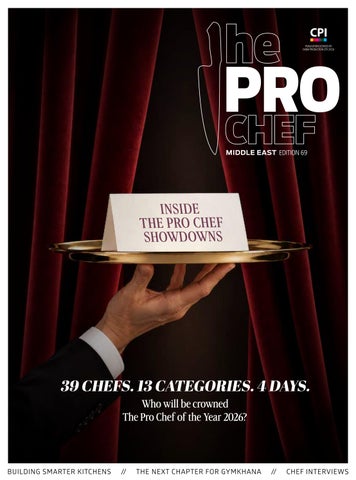
INSID E THE PRO CHEF SHOWDOWNS
39 CHEFS. 13 CATEGORIES. 4 DAYS. Who will be crowned The Pro Chef of the Year 2026?
BUILDING SMARTER KITCHENS
//
THE NEXT CHAPTER FOR GYMKHANA
//
CHEF INTERVIEWS
TITLE PARTNERS
SHOWDOWN VENUE PARTNER
Connect with the people behind the GCC’s most influential restaurants and hospitality brands The Pro Chef & Hospitality Awards 2026 takes place on November 26, bringing together chefs, culinary leaders, F&B decision-makers, restaurateurs, and suppliers from across the GCC. Interested in partnering with us? Get in touch to explore opportunities for 2026. Liz Smyth liz.smyth@cpimediagroup.com
TITLE PARTNER
Gill Fairclough gill.fairclough@cpimediagroup.com
EVENT PARTNERS
PRESENTED BY
OFFICIAL MEDIA PARTNER
OFFICIAL REFRIGERATION PUBLICATION
SHOWDOWN VENUE PARTNER
ORGANISED BY
EDITOR'S NOTE
Welcome EDITORIAL ASSISTANT EDITOR: Blanche D’mello blanche.dmello@cpimediagroup.com ADVERTISING GROUP SALES DIRECTOR: Liz Smyth liz.smyth@cpimediagroup.com
And just like that, we’re heading into Q4. For the F&B industry, that usually means one thing: there is no such thing as “slowing down”. The calendar gets fuller, kitchens get busier, new openings stack up, and somewhere between service and end-of-year targets, there is little time to pause.
SALES DIRECTOR: Gill Fairclough gill.fairclough@cpimediagroup.com SALES & MARKETING MANAGER: Yash Gehlot yash.gehlot@cpimediagroup.com CONSULTANT: Ivan Grbic ivan.grbic@cpimediagroup.com prochef.sales@cpimediagroup.com DESIGN Froilan A. Cosgafa IV FOR OTHER ENQUIRIES, PLEASE VISIT: www.theprochefme.com FOUNDER CPI MEDIA GROUP Dominic De Sousa (1959-2015)
PRINTED BY Wellpack Printing Press LLC PUBLISHED BY
This issue looks at how people across the industry are building, growing, and adapting in a market that continues to move quickly. We look at what it takes to grow without losing what made a concept work in the first place, with Artem Login on scaling L’ETO beyond its café roots while keeping the brand consistent. We also go behind the scenes with FYTE Hospitality to explore how operators are creating brands that can actually scale, rather than simply adding another name to the portfolio. At Gymkhana’s new Dubai outpost, Executive Chef Rahul Rana talks about bringing the London restaurant’s identity to a new city, developing the team behind it, and creating dishes exclusive to Dubai. And, of course, this issue comes at an important point in The Pro Chef & Hospitality Awards calendar. The Pro Chef Showdowns 2026 brought together 39 chefs across 13 categories for four days of competition at The Dish, within Depachika Food Hall. The knives are down, the scores are in, and now we look ahead to November 26, when the winners across the Chef Showdowns, Stars of Hospitality, and Partners & Providers categories will be announced. Turn to page 42 for a look inside The Pro Chef Showdowns. Enjoy reading.
Editor Head Office: Office 1307, DSC Tower, Dubai Studio City, Dubai, United Arab Emirates, PO Box 13700 Tel: +971 4 568 2993 Email: info@cpimediagroup.com A publication licensed by Dubai Production City, DCCA
© Copyright 2026 CPI Media Group FZ LLC. All rights reserved. While the publishers have made every effort to ensure the accuracy of all information in this magazine, they will not be held responsible for any errors therein. www.cpimediagroup.com
Edition 69 / The Pro Chef Middle East
3
44 CONTENTS 04 NEWS BITES
Culinary news across the Middle East
06 DINING IN THE UAE
Explore the latest menu creations and hotspots
10 A DAY IN THE LIFE WITH Chef Jabir Moses of ONA
12 THE STRATEGY BEHIND L’ETO
Artem Login on scaling L’ETO beyond cafés while keeping the brand consistent
16 MADE IN THE UAE
FYTE Hospitality on building scalable brands
22 BUILDING SMARTER, MORE SUSTAINABLE KITCHENS
Darren Andow on sustainability, food waste and large-scale kitchen operations at Fairmont The Palm
12 2
The Pro Chef Middle East / Edition 69
26 THE BUSINESS OF BAKING How bakery is opening up new opportunities for operators
THE PRO CHEF MIDDLE EAST
30 CHEF’S SPECIAL
Chef Milos Radojcic, Head Chef at La Colline, shares his favourite dish
32 A NEW CHAPTER FOR GYMKHANA
How Gymkhana adapted its London identity for Dubai
38 THE NEXT MOVE
Alexandros Sperxos on evolving THE DISH and what comes next
42 THE ERTH APPROACH
Executive Chef Arivu Ravi on the people and processes behind Erth’s Michelin star
44 INSIDE THE PRO CHEF SHOWDOWNS 2026
39 chefs, 13 categories, and four days of competition at Depachika Food Hall
16
52 CHEF’S PLAYBOOK
Kameel Rasyid of bkry on experimentation, fermentation and making the most of every ingredient
56 INSIDE THE MIRAVAL KITCHEN
Two dishes from Miraval The Red Sea, with Chef Hamdy Hassan
61 MEXICO, THROUGH A DIFFERENT LENS Chef Brandon Arriaga on defining Mexican cuisine at Cocina Tres
64 CHEF’S CHOICE
Chef Ricardo Bojador, Executive Chef at Tanso, shares his favourite kitchen tool and why
38
61
30
56 Edition 69 / The Pro Chef Middle East
3
CULINARY NEWS FROM THE MIDDLE EAST AND BEYOND
DUBAI DEPARTMENT OF ECONOMY AND TOURISM LAUNCHES TWO SUSTAINABILITY COURSES FOR HOSPITALITY SECTOR The Dubai Department of Economy and Tourism (DET) has launched two sustainability courses for tourism and hospitality professionals through Dubai College of Tourism’s Dubai Way platform. Developed under the Dubai Sustainable Tourism initiatives, the courses cover the updated 27 Measures of Sustainability framework for hotels, which expands the previous 19 requirements to include energy and water efficiency, waste management, responsible sourcing, employee engagement, guest awareness, community initiatives and climate action, alongside broader sustainability principles including circular
practices and resource consumption. Hotels will be assessed against the 27 measures in future cycles of the Dubai Sustainable Tourism Stamp. Since launching in 2017, Dubai Way has trained more than 190,000 candidates across more than 1,475 establishments and delivered over 3 million training hours. The courses also complement DST tools such as the Carbon Calculator, which helps hotels track emissions and identify areas for reduction and potential cost savings. The new courses will be available on the Dubai Way platform.
Global Food Week 2026 will take place at ADNEC Centre Abu Dhabi from 6 to 8 October, with registration now open for visitors to the exhibition and attendees of the second Global Food Security Summit (GFSS). Organised by ADNEC Group in partnership with the Abu Dhabi Agriculture and Food Safety Authority (ADAFSA), the event will bring together the global food ecosystem through an exhibition, industry sessions and a B2B platform. This year’s edition will also introduce Shop at the Show, a B2C platform allowing visitors to purchase products directly from exhibitors. The exhibition will feature international pavilions, food innovations and traditional products, while offering exhibitors access to buyers, policymakers and business leaders and opportunities to enter the UAE market. The GFSS will bring together policymakers, industry experts, researchers and innovators to discuss food security, resilience, innovation and sustainability, with a focus on strengthening global food systems and Abu Dhabi’s role in food security solutions.
4
The Pro Chef Middle East / Edition 69
Photographs SUPPLIED
GLOBAL FOOD WEEK 2026 RETURNS TO ABU DHABI
JAYASOM OPENS FLAGSHIP WELLNESS RESORT AT AMAALA
DUBAI SME AND KITOPI EXPAND THE EMIRATI CHEF’S TABLE WITH FOUNDER SERIES Jayasom has opened its flagship property, Jayasom Wellness Resort, AMAALA, on Saudi Arabia’s Red Sea coast, offering personalised wellness programmes focused on stress management, energy, healthy weight management and physical wellbeing. The resort features more than 200 therapies and treatments across six areas, including Traditional and Holistic Health, Physio Relief and Recovery, Strength & Mobility, Spa & Hydrotherapy, Aesthetic & Clinical, and Nutrition & Vitality. Its programmes combine evidence-based practices with traditional wellness approaches from Saudi Arabia, the wider Middle East and Asia, with offerings including sound therapy, Traditional Arab and Eastern practices, Watsu flotation, mineral pools and ICAROS immersive movement. The resort is divided into Jayana, an adults-only wellness retreat, and Jayela, a family-focused offering with dedicated spaces and activities for children and teenagers. Jayasom’s signature Essence of Jayasom programme is available from opening, with a dedicated Wellness Advisor tailoring stays to individual goals, alongside programmes focused on family wellbeing, shared wellbeing, women’s health, leadership, detoxification and physical vitality. Nutrition is also central to the offering, with meals tailored to individual goals and a menu featuring plant-based dishes, fermentation and pickling programmes using seasonal produce.
Dubai SME and Kitopi have launched a three-month Founder Series under The Emirati Chef’s Table, supporting 12 Emirati chefs and culinary entrepreneurs from September to November 2026. Following the programme’s first cohort of five F&B entrepreneurs in 2025, the series gives founders access to Kitopi’s kitchens, customer base and delivery network, alongside mentorship, content and marketing support. Selected concepts will also be available through Eatopi, allowing founders to reach customers and test their offerings. The first batch, running until 2 October, features Wadeema Abdalla of Saccharose Desserts, Rehab Al Ameri of Local Foundry, Abdulrahman Lootah of One Made and Zainab Al Mousawi of To The Moon & Back. The second and third batches will run from 2 to 30 October and 2 to 30 November, with further founders to be announced ahead of each launch. The Emirati Chef’s Table was launched in 2025 to provide Emirati F&B entrepreneurs with mentorship and market exposure, with the 2026 Founder Series adding direct operational experience and customer engagement through Kitopi’s platforms and network.
MELIÁ HOTELS INTERNATIONAL ANNOUNCES GRAN MELIÁ’S UAE DEBUT Meliá Hotels International will bring Gran Meliá to the UAE for the first time with J1 Hotel, a Gran Meliá Hotel, opening in Dubai’s Jumeirah 1 in Q4 2027. First announced in 2025, the hotel will feature 366 rooms and suites, four swimming pools, direct beach access, restaurants and bars, wellness facilities, and meeting and event spaces. Forty rooms and suites will have private pools. F&B will include Jul’s, making its Dubai debut with a contemporary take on Greek cuisine, and Tala, a Pan-Middle Eastern restaurant overlooking the marina. Previously announced concepts include Zuma Beach House, Park Chinois and Novikov Restaurant & Beach Club, alongside an all-day restaurant. Journée Wellbeing will occupy the rooftop, offering treatments, advanced therapies, fitness and wellness experiences, including Aufguss sauna ceremonies and Reformer Pilates. J1 Hotel will be Meliá Hotels International’s third Dubai property, following Meliá Desert Palm and ME by Meliá Dubai, and will be led by General Manager Pedro Neto, who has more than 20 years of luxury hospitality experience.
Edition 69 / The Pro Chef Middle East
5
PIERRE HERMÉ PARIS
DISCOVER THE LATEST MENU ADDITIONS AND LAUNCHES IN THE COUNTRY
MANÃO MANĀO, Dubai’s Michelin-starred Thai restaurant at Wasl Vita, has introduced two new tasting menus: an 8-course Chef’s Special Tasting Menu for AED350 and a 12-course tasting menu for AED650. The 12-course menu features MANĀO signatures including Miang and Lobster Khanom Krok, alongside new dishes such as King Crab Shoulder with fermented green chilli nam jim, King Crab Leg with spicy coconut broth, mangosteen and caviar, Mung Bean Crepe with shredded lamb curry, White Curry of Beef and Sticky Rice Roti with coconut-smoked short ribs. Desserts include Passion Fruit Granita, Khao Lam and White Sesame Ice Cream. The 8-course menu includes Miang, Lobster Khanom Krok, Curry Puff, Sour Tomato Broth, Sticky Rice Roti, Young Coconut and Papaya Salad, a choice of White Curry of Lamb or Yellow Curry with Prawn, and Passion Fruit Granita, with optional supplements including King Crab, Gillardeau Oyster and Black Sticky Rice Pudding with White Sesame Ice Cream.
6
The Pro Chef Middle East / Edition 69
Pierre Hermé Paris will open at Marina Mall Abu Dhabi this September, following the success of Majlis by Pierre Hermé at Rosewood Abu Dhabi. The flagship will offer all-day dining alongside the Maison’s signature pastries, chocolates and macarons, including Ispahan, Infiniment Vanille and 2000 Feuilles, as well as viennoiserie and savoury dishes such as Pierre Hermé Chicken Croque Monsieur, Avocado Toast with Confit Egg Yolk and Pistachio Vinaigrette, and Pan-Seared Beef Tenderloin with Crushed Potatoes, Seasonal Vegetables and Beef Jus. The opening forms part of the Maison’s wider Middle East expansion, with plans to enter Saudi Arabia in the coming years.
TAPASAKE TAPASAKE will reopen soon at One Za’abeel with a new restaurant, infinity pool and a new sky lounge across The Link. The destination will combine Japanese-led cuisine with Mediterranean influences, music and nightlife. The Restaurant bring together Japanese cooking techniques with Mediterranean ingredients and flavours. The infinity pool will remain a key feature, while the new
sky lounge will offer a daytime-to-evening experience with music and a more energetic atmosphere after dark. The reopening follows a joint venture between Kerzner International and Sunset Hospitality Group, supporting TAPASAKE’s expansion as a standalone lifestyle concept. Further details on the menu and spaces will be announced ahead of the opening.
ORFALI BROS Orfali Bros has introduced two updated tasting menus, The OG 2.0 and The Voyage 2.0. The Voyage 2.0 is a 13-course menu priced at AED795 per person, drawing on the brothers’ Syrian roots alongside influences, ingredients and techniques encountered beyond them, with fermentation and preparations from the Orfali Bros Lab featured throughout. Highlights include Baklava Caviar, a take on the craftsmanship of Syrian and Turkish baklava; Foie Gras Royale with duck caramel, hazelnut and truffle; Mirage, inspired by the cold spoon salads of Syrian summers; and Kibbeh Mishwieh, a contemporary take on the classic dish. The OG 2.0 offers a shorter tasting experience at AED350 per person, bringing together Orfali Bros signatures and current dishes including Corn Bomb, Caviar Bun, Tuna Salsa Roja and Orfali Bayaldi.
Edition 69 / The Pro Chef Middle East
7
TH E C OUN TR Y
CHEF’S SOCIETY Majid Al Futtaim has fully opened Chef’s Society at City Centre Mirdif, bringing ten concepts spanning Emirati, Indian, Cantonese, Levantine, Japanese and Italian cuisines. The lineup includes MICHELIN Bib Gourmand restaurants Bait Maryam by Chef Salam Daqqaq and REIF Japanese Kushiyaki by Chef Reif Othman, alongside Anara by Chef Kunal Kapur, Ying Ji Dim Sum by Chef Lin Deshan and Slab by Chef Omar Rodrigues. Other concepts include Bonci by Chef Gabriele Bonci, ATHAR By the Qlab, The Matcha Tokyo, My Cookie Dough and Beurre. Designed as a culinary collective, Chef’s Society brings together chefs and their concepts in a foodfocused destination at City Centre Mirdif.
99 SUSHI BAR & RESTAURANT 99 Sushi Bar & Restaurant will relocate to Dubai Creek Harbour in Q4 2026, bringing its contemporary Japanese fine-dining concept to the waterfront community. The new venue will feature a larger bar and lounge, a terrace and waterfront views, while retaining the Japanese cuisine and signature dishes associated with the brand. Founded in Madrid in 2005, 99 Sushi has expanded across Spain, the UAE, Monaco, Rabat and Budapest, with its Abu Dhabi restaurant holding a MICHELIN Star for three consecutive years. The Dubai move follows the brand’s previous location in Downtown and coincides with the launch of its London restaurant.
8
The Pro Chef Middle East / Edition 69
THE COUNTDOWN STARTS NOW. Celebrating its 17th year, the Good Food Middle East Awards return this October, bringing together the region’s most exciting restaurants, hotels and food and beverage names. The nominations are in. Now it’s time to have your say.
VOTING OPENS OCTOBER 2026
Visit bbcgoodfoodme.com/awards/2026.
AUDITED BY
VENUE SPONSOR
HOSTED BY
OFFICIAL MEDIA PARTNER
ORGANISED BY
TH E C OUN TR Y
24 HOURS WITH
CHEF JABIR MOSES Chef Jabir Moses walks us through a day at ONA
10 The Pro Chef Middle East / Edition 69
15:00
First real breather of the day, and honestly this is when my brain actually turns on for the creative stuff. Playing with flavour pairings, working through why something on the menu works, sometimes it's refining a dish on the menu, or working on new dishes for the future.
16:00
Admin gets crammed in wherever there's room in this window. Recipe workbook, SOPs, supplier calls. Some days I get a proper hour for it, some days it's fifteen minutes before something else pulls me away. Either way it has to get done.
16:30 05:30
Up before everyone else. Quick prayer, then just sitting with a coffee for a few minutes before the day takes over. Probably the only quiet I get until tonight.
06:15
Time with the team sometimes is showing someone a technique, sometimes just sitting with someone who’s ready for more responsibility. Honestly, this is the part that actually matters long term: a kitchen that can run without me standing over it.
18:00
Kids are still knocked out. I peek in before I head out, don't want to wake them, but I like seeing them for a second before the door closes behind me.
Evening's quieter for us, so this is when I go through prep lists with the team of what's needed for tomorrow, what got missed today, briefing everyone on how to manage prep so we're not scrambling in the morning.
07:00
19:00
Get to ONA. First thing I do is walk the kitchen, quality control check across the board, making sure hot kitchen and pastry are all set up and ready to go. Then it's about the team checking in, getting a read on everyone, making sure they're motivated and switched on for the day ahead. 13 people, three sections, and it only works if everyone's clear on what today looks like.
08:00
Breakfast kicks off. This is where you find out if yesterday's briefing actually landed or not.
10:00
This is the real crunch. Breakfast hits its peak, and the tickets don't stop coming; every station is under pressure, every plate still has to go out right. No room to think about anything except what's in front of me. Tickets, taste, keep moving.
12:00
Deep clean and reorganising. Walking through every section, resetting stations, sorting out anything that's drifted out of place during the day. This is where the kitchen actually gets set up to win tomorrow, not just survive it.
20:00
Final walk-through with the closing team, make sure everything's set up for tomorrow's opening, then out the door.
20:45
Home. Bedtime with the kids is our usual routine and rituals, especially with my eldest son, who needs that consistency to settle. Exhausting, but it's my favourite part of the day.
21:30
Dinner with my wife, simple catch-up, how the day went, and recollections of what had happened through the day or simple chit-chat.
Lunch rolls straight into breakfast, basically no gap. Back on the pass, checking every plate before it leaves. In an all-day spot like ours, someone might've had breakfast here and comes back for lunch, so it has to taste like the same kitchen made both.
22:15
13:30
23:00
Lunch peak. This is the stretch where you can tell if the kitchen's actually solid or just holding on. Reading tickets, reading who's struggling before they say anything.
We settle down and try to catch up on whatever series we're on. Some nights we actually watch it, some nights I'm out before the episode ends.
Lights out. Get maybe six, six and a half hours before it all starts again. Food, family, the kitchen - the same three things every day, just shuffled around depending on what the day needs from me
Edition 69 / The Pro Chef Middle East
11
TH E C OUN TR Y
THE STRATEGY BEHIND L’ETO As L’ETO expands beyond cafés into standalone dining concepts, founder Artem Login shares his approach to growth, guest experience, and building brands with staying power
S
ince launching L’ETO in London in 2011, Artem Login has grown the café and restaurant brand into an international business with more than 40 locations. In this interview, Login discusses scaling carefully, maintaining brand consistency across markets, and what defines long-term success in hospitality today.
What was the original gap you saw in the market when you launched L’ETO in London in 2011? Honestly, London in 2011 was a fascinating moment for hospitality. The city was still finding its footing after 2008, and the middle ground between a coffee shop and a proper restaurant was almost empty — that space where you might bring a laptop on a Wednesday afternoon and also come back for dinner on a Friday. The whole idea of the “third place” was only just starting to take shape, and there was real room for someone to do it with proper craft behind it. We saw that gap clearly. People wanted somewhere they could walk into in the morning and feel just as at home in the evening, and feel that both visits had been thought about. So we put pastry, interior and service into the same brief and treated them as one piece of work rather than three separate departments. The cake display in the window wasn’t a marketing device, by the way — it came out of wanting the place to feel like a destination, somewhere with a sense of occasion.
12 The Pro Chef Middle East / Edition 69
L’ETO has grown into a 40-plus store international brand. What do you think has been the main reason it scaled so successfully? I’d say we’ve been stubborn about a couple of things. The product, the pastry craft, the way the room feels when you walk in — we’ve held the line on those, even when there’s been pressure to move faster. Scaling is the moment where it’s easy to lose the thing that made the concept work in the first place, and we’ve tried very hard not to let that happen. And realistically, 40-plus sites in 14 years isn’t particularly fast. We’ve walked away from far more locations than we’ve taken. Careful about partners, careful about cities, and willing to be slow when slowness was the right answer. That’s the less glamorous version of why it’s worked.
How do you make sure a brand like L’ETO keeps its identity intact when it moves into very different markets? The thing I’ve learned is that brand identity doesn’t really live in the guidelines. It lives in how the team greets you when you walk in, in what the branch manager does when an order doesn’t go quite right on a busy Saturday morning, in whether anyone on the floor remembers a regular from last Thursday. That’s the layer you have to look after. On the surface, we adapt without much fuss — menu tweaks for the local palate, breakfast format shifts, the cake and pastry line edited for
what resonates in each market, things sized for the climate. That said, our signature cakes always stay in the lineup wherever we go — they’re the ones our guests properly love, and they’re a piece of the brand’s DNA we carry with us everywhere. The region isn’t Knightsbridge and the concept has to respect that. But the tempo of service, the standard, the way a guest is read in the first thirty seconds — that has to be the same wherever you are. I spend a lot of time on the ground during openings, because that side of the culture moves from person to person. You can’t put it in a deck and email it to the team.
Across your different venues, what tells you that a concept is really working, both creatively and commercially? Two signals, really. The first is whether the team genuinely want to be there. You can usually feel it within thirty seconds of walking in — the way the team carries themselves, who’s talking to whom, whether there’s a bit of warmth in the room. That’s never a coincidence, and it’s also very hard to manufacture from the outside. The second is repeat custom that arrives without prompting — no campaign, no offer, just guests turning up on a Tuesday because they fancy it. Earning that in a city as competitive as London or Dubai is genuinely difficult, because there’s always something new and exciting opening down the road. The P&L tells you about last quarter; those two signals tell you about next year.
Edition 69 / The Pro Chef Middle East 13
TH E C OUN TR Y
Where do you see the biggest opportunity in hospitality right now for brands that are trying to do something different? People, honestly. I know that’s a less exciting answer than the AI and format conversations, and those conversations are real — we look closely at all of it. But the industry across both the UK and the Gulf is in the middle of a proper labour shift. The UK workforce has changed its shape, and the regional growth here means good senior operators are in demand everywhere. So the brands that figure out how to keep their best people for the long run end up with a real edge.
L’ETO Restaurant is launching as a standalone full dining concept in its own right. What was the vision behind it, and how does it relate to the L’ETO brand without being an extension of it? L’ETO Restaurant is the logical next step for our restaurant division in this region — and the reason it’s happening here, in Abu Dhabi specifically, is
14 The Pro Chef Middle East / Edition 69
that we’ve genuinely taken the time to understand the city. The culture matters, the heritage matters, the way people eat here matters. So this concept has been built for Abu Dhabi from the ground up, with real care for the place rather than being a version of something we’ve done elsewhere. The name does some of the work for us, which obviously helps. People here already know L’ETO — they know the cakes we started with fifteen years ago, they know the service, the small attentions, the way a guest is looked after the moment they walk in. That’s been earned, not bought. As a deliberate nod to that, we’ve kept the signature cake display inside the new restaurant — it’s a proper piece of brand DNA we wanted in the room, not a logo on the wall, the actual craft on view. That continuity is important to us. But the experience itself is a different proposition. New kitchen team, new menu, a different pace from anything we’ve done under the L’ETO name before. We’re building on a platform we’ve spent fifteen years earning, and from that platform
we’re creating something genuinely new. And — without wanting to sound too sentimental about it — we’ve put our heart into this one. It’s not a side project. It’s the next chapter.
How are you positioning this concept differently within a competitive F&B landscape where new openings are happening frequently? The GCC has an extraordinary F&B scene — a huge number of brilliant restaurants opening across the region all the time, and the bar is genuinely high. That’s actually one of the reasons it’s such a wonderful market to operate in. The way we’re thinking about positioning is less about being the loudest opening and more about being the place you come back to six months in, when the launch noise has settled and you want to eat well on a Wednesday evening. In practical terms, that means putting less weight on the theatrics of week one and more on what ends up on the plate, on the lighting at ten at night, on the people working
the floor. Quietly confident rather than headline-led. Less novelty, more substance. That’s the bet we’re making, and if you get year one right, year two tends to look after itself.
From a business point of view, what indicators define success for this new concept in its first year? In our market, year-one revenue is a slightly noisy signal. New openings in the region tend to do well in the first couple of months because the audience here is so engaged and curious — which is a wonderful thing about the Gulf, but it doesn’t fully tell you whether you’ve built something that will still be busy in eighteen months. So the figures I personally watch are: covers per night in months six to nine — that’s when you find out whether the room genuinely works once the launch attention has settled; staff retention at the six-month mark, because a growing market always means demand for good people; and the share of bookings coming from guests who’ve already eaten with us. Average spend matters too, but it’s the least telling of the four. If the room is full of repeat diners after a year, the rest tends to fall into place. Edition 69 / The Pro Chef Middle East 15
TH E IN N OV ATOR
MADE IN THE UAE
Co-founders Tamer Elkhayat and Faisal Yabroudi on building scalable brands, maintaining operational discipline, and why they believe the next generation of global hospitality brands will come from the UAE
H
ow would you describe FYTE Hospitality’s journey so far?
FYTE Hospitality was founded with a simple ambition: to build hospitality brands that shape the future of the industry. At FYTE, we believe the future of hospitality isn’t something you wait for, it’s something you build. We don’t follow trends, we create what’s next. Although FYTE was formally established in 2024, we’ve been building hospitality businesses together for over a decade. Lasting success comes from bold ideas, disciplined execution, relentless operational excellence and investing in people. We’ve launched and grown Kokoro, WINDOW and Katei, secured the GCC master franchise for Hikiniku To Come, successfully launched Bake My Day in Saudi Arabia, and celebrated the opening of Kokoro Cannes. Kokoro will soon announce three new international cities, WINDOW will make its international debut, and Bake My Day has further international expansion in the pipeline. Across the GCC, we’re expanding Kokoro and working to grow Hikiniku To Come with the right partners who share our long-term vision. Beyond restaurants, we’re developing our own hotel brand, which we’ll announce soon, while also working with leading hospitality groups to redefine hotel food and
16 The Pro Chef Middle East / Edition 69
Great food brings guests in once. Hospitality brings them back." beverage experiences. We believe the next chapter belongs to hospitality brands built in the UAE and recognised globally. Every new venture creates opportunities for our people to grow because restaurants don’t scale, people do. Our ambition is to build one of the world’s most respected hospitality companies through the brands we create, the people we develop and the impact we leave on the industry.
What does FYTE Hospitality look for in a concept before deciding to bring it into the region? We don’t invest in trends; we invest in brands. We look for concepts that move the industry forward, build loyal communities, have strong operational foundations, exceptional product quality and can scale without losing their identity.
Edition 69 / The Pro Chef Middle East
17
TH E IN N OV ATOR
"The future of hospitality isn't something you wait for, it's something you build." 18 The Pro Chef Middle East / Edition 69
How has Dubai’s dining audience changed since you launched Kokoro? Dubai has become one of the world’s most sophisticated dining markets. Guests expect authenticity, consistency and genuine hospitality, and they measure every new opening against the best they’ve experienced anywhere in the world. Every concept we launch must contribute something meaningful and raise the standard of the market.
What’s the biggest misconception people have about running a franchise concept versus building an original one? Many believe franchising is easier: the concept, the brand and the playbook already exist. The reality is that protecting someone else’s legacy demands the same discipline as building your own, often with less room to improvise, since every decision is measured against a standard already set
elsewhere. Whether protecting someone else’s legacy or creating your own, guests only judge the quality of the experience.
What does operational discipline look like day to day at a concept like WINDOW or Kokoro? Operational excellence is built through thousands of small decisions every day, from every ingredient to every guest interaction. Continuous training, coaching, accountability and an uncompromising culture are essential.
Menus can be copied, concepts can be copied, but culture cannot.
What keeps guests coming back to a concept long after opening night? Great food brings guests in once. Hospitality brings them back. Consistency, emotional connection and a genuine sense of community, the feeling of being recognised and remembered, are what create long-term loyalty.
What excites you most about scaling a hospitality group in the UAE right now? The UAE is one of the world’s most exciting hospitality markets. It’s no longer just a place that imports great concepts. It’s becoming a place that creates brands with global potential. That’s the future we want FYTE to help shape.
How do you approach timing when launching a new concept in Dubai? There’s never a perfect time to open a Edition 69 / The Pro Chef Middle East 19
TH E IN N OV ATOR
"The UAE is no longer just a place that imports great concepts. It's becoming a place that creates brands with global potential." restaurant. We identify what’s missing in the market and create concepts that genuinely add value. We’re not ready because construction is complete, we’re ready when our team is ready to welcome our very first guest. Live service is the best teacher, so we continuously learn and improve after opening while ensuring the first impression reflects our standards.
Where do you see Dubai’s dining scene heading over the next few years, and how does FYTE want to fit into that? The future belongs to authentic brands with strong identities and consistent execution. We believe the next generation of globally recognised hospitality brands will come from this region, brands like Kokoro and WINDOW carrying the UAE’s name abroad instead of importing someone else’s, and we want FYTE to help lead that movement.
What does long-term success look like for FYTE Hospitality? Long-term success is measured by the brands we build, the people we develop and the legacy we leave. We’ll continue expanding Kokoro and WINDOW internationally, growing Kokoro and Hikiniku To Come across the GCC, launch our own hotel brand and help redefine hotel food and beverage experiences. Our goal is simple: create brands that stand the test of time and prove concepts built in the UAE can compete with the very best in the world.
20 The Pro Chef Middle East / Edition 69
For the first time in the awards’ history, Abu Dhabi will also have its very own dedicated programme. The inaugural Good Food Middle East Abu Dhabi Awards 2026 launches this year, recognising the capital’s restaurants, hotels, and food and beverage brands in their own right. It’s a long time coming: Abu Dhabi’s dining scene has grown into something truly exciting, and it deserves a celebration that reflects that.
VOTING OPENS OCTOBER 2026
Visit bbcgoodfoodme.com/awards/abu-dhabi-2026. For sponsorship opportunities, email events@cpimediagroup.com.
CULINARY PARTNER
EVENT PARTNER
RAFFLE DRAW PRIZE SPONSOR
AUDITED BY
HOSTED BY
OFFICIAL MEDIA PARTNER
ORGANISED BY
TH E C HEF
BUILDING SMARTER, MORE SUSTAINABLE KITCHENS Culinary Director Darren Andow explains how Fairmont The Palm approaches sustainability, food waste reduction, and large-scale kitchen operations
A
s Culinary Director of Fairmont The Palm, Darren oversees a wide portfolio of restaurants while focusing on sustainability, operational efficiency, and developing strong kitchen teams. In this interview, he talks about balancing creativity with consistency across multiple outlets, reducing food waste, working with local producers, and why sustainability is becoming increasingly important in modern luxury dining.
How do you balance creativity with efficiency across 11 dining and catering outlets? Balancing creativity with efficiency starts with structure. Each outlet has a clear culinary identity, which allows the chefs to be creative within the defined concept. From an operational perspective, we focus heavily on sourcing the best ingredients, ensuring they are prepared correctly, and on menu engineering. Innovation doesn’t always mean complexity; sometimes the best dishes are the simplest. Often, it’s about getting the basics right. Consistency, systems, and strong communication enable creativity to scale.
What guides your leadership style when managing such a large culinary team? My leadership style is rooted in clarity, accountability, and mentorship. In large operations, people need to understand not just what they are doing but also why it is being done. I believe in leading by example, setting clear expectations, and creating an environment where chefs
22 The Pro Chef Middle East / Edition 69
feel both supported and challenged. Developing future leaders is just as important as delivering today’s service.
How do you define a sustainabilityfirst approach in a high-volume luxury hotel? At Fairmont The Palm, a sustainabilityfirst approach means making responsible choices part of everyday operations rather than positioning them as separate initiatives. In a high-volume luxury environment, the scale is significant, so consistency and discipline are critical. From a culinary standpoint, this begins with sourcing. We align closely with Fairmont and Accor’s sustainability commitments by prioritising responsibly sourced seafood, working with regional and UAE-based suppliers where possible, and reducing reliance on air-freighted products. Today, approximately 90% of our suppliers are local, and around 80% of our produce is sourced locally, with a strong preference for local chicken and eggs. Menu planning is deliberately seasonal, allowing us to work with ingredients at their best while minimising waste and environmental impact. In the kitchens, we actively support the hotel’s broader sustainability efforts through waste segregation, food-waste monitoring, and yield-focused cooking techniques. We’ve significantly reduced single-use plastics across culinary operations, optimised portion control across outlets, and invested in energyefficient kitchen equipment, aligning with the property’s sustainability goals. All kitchen lighting has been converted
to LED, equipment is selected based on energy-efficiency performance, and operational practices such as chiller optimisation during lean periods and defrosting in chillers rather than under running water are standardised across kitchens. Water conservation and responsible cleaning practices are also embedded into daily routines. All kitchen taps are fitted with high-efficiency aerators, and ROX electrolysed water is used for washing and disinfecting fruits and vegetables, eliminating chemical usage and reducing wastewater load. My chefs are trained to understand how their decisions, from prep methods to menu execution, directly impact both the environment and operational efficiency. In a luxury setting, sustainability should never feel like a compromise. When done properly, it enhances quality, sharpens creativity, and strengthens the guest experience.
What strategies have you introduced to reduce food waste effectively? At Fairmont The Palm, reducing food waste is driven by data, discipline, and team engagement. Given the scale of our culinary operation, accurate insights are essential, which is why we use the Winnow food-waste monitoring system across our kitchens. Winnow allows us to track exactly what is being wasted, in what quantities, and at which stages of production. This real-time data helps us make informed decisions around menu planning, purchasing, portion
Edition 69 / The Pro Chef Middle East 23
TH E C HEF
control, and production levels, particularly across high-volume outlets and banqueting. Rather than relying on assumptions, we can clearly identify patterns and address the root causes of waste. Alongside data, we focus strongly on yield management and crossutilisation. Ingredients are selected and planned to work across multiple outlets, while trimmings and by-products are repurposed into stocks, sauces, and secondary preparations using nose-totail and root-to-stem techniques. Buffet replenishment is also managed more strategically to reduce overproduction without compromising the guest experience. All food waste from our kitchens is sent for composting, ensuring none is sent to landfill. Equally important is culture. Winnow has become a powerful educational tool for our teams, helping chefs visualise the impact of waste and take ownership of improvement. By combining technology with training and clear KPIs, food waste reduction at Fairmont The Palm supports both our sustainability objectives and operational efficiency, while maintaining the high standards expected in a luxury hotel.
How do you prioritise local and regional producers while keeping menus creative and appealing? Local and regional sourcing actually fuels creativity. Working with seasonal produce encourages chefs to design menus that evolve naturally throughout the year. We collaborate closely with suppliers to understand what’s available and at its best, then build dishes around those ingredients. It results in fresher flavours, reduced food miles, and menus that feel more authentic and relevant to our location.
Which initiatives have had the biggest impact on both sustainability and operational efficiency? Menu rationalisation has been one of the most impactful initiatives, streamlining offerings without losing variety. Choosing ingredients wisely plays a big part in creating new dishes or menus; this, in turn, improves purchasing efficiency, reduces waste, and allows chefs to focus on perfecting the dishes. Operational optimisation has also played a key role. Despite major
24 The Pro Chef Middle East / Edition 69
expansions in 2025, including the opening of Bask Beach Bar with additional washrooms, a significantly enlarged Flow Kitchen, and an expanded Serenity Spa, electricity consumption increased by only 3.5% compared to 2024, while water consumption was reduced by 2.6%. These results reflect disciplined kitchen practices, energy-efficient equipment selection, and continuous monitoring. Investment in training and standardised recipes has also delivered strong results, ensuring consistency while reducing overproduction and operational errors.
What strategies do you use to cultivate talent and ensure high performance across your kitchens? Talent development starts with
opportunity. We promote from within wherever possible and provide structured training, mentoring, and exposure across different cuisines and outlets. Regular performance reviews, clear career pathways, and fostering a culture of respect and learning are essential. When chefs feel invested in, performance naturally follows.
How do you design menus that are sustainable, efficient, and still innovative? Can you share a dish or concept where sustainability directly influenced its creation? Designing sustainable menus starts with ingredients that are responsibly sourced, seasonal, and versatile. One
and be patient. Luxury hospitality demands consistency, discipline, and resilience. Seek out mentors, remain open to feedback, and never stop learning, whether it’s new techniques, leadership skills, or sustainability practices. Your attitude and work ethic will define your career just as much as your talent.
How do you measure the success of sustainability initiatives through guest feedback, operations, or team engagement? Success is measured through a combination of metrics and culture. Operational data, such as waste reduction and cost efficiency, provides clear indicators, while guest feedback confirms that quality and experience remain uncompromising. For example, despite significant operational expansion, our ability to tightly control electricity usage and reduce water consumption year-onyear demonstrates that sustainability is embedded into daily practice rather than treated as a standalone initiative. Equally important is team engagement ; when chefs actively champion sustainability, you know the message has truly landed.
How can culinary leaders use sustainability as a point of differentiation in luxury hospitality?
excellent example from Fairmont The Palm is our approach at Flow Kitchen, where sustainability directly informs both concept and execution. Flow Kitchen prioritises locally sourced produce, supported by an onsite organic bio-garden that supplies kitchens with fresh herbs and vegetables for daily specials. By building menus around these principles, we reduce food miles, minimise waste, and deliver dishes that surprise and delight guests through freshness and flavour. This model ensures that sustainability isn’t an afterthought but a creative driver, pushing us to experiment with alternatives, fully respect ingredients, and design dishes that are both efficient to produce and compelling for guests.
How do you balance guest expectations with sustainability goals, especially in fine dining? Guests expect exceptional quality above all else. Our role is to meet those expectations while making responsible choices behind the scenes. When sustainability enhances flavour, storytelling, and authenticity, guests are very receptive. Transparency helps share the journey of ingredients and concepts, adding depth to the dining experience rather than limiting it.
What advice would you give to aspiring chefs who want to build a successful career in luxury hospitality? Master the fundamentals, stay curious,
Sustainability has become a defining factor for guests who expect luxury experiences to be both responsible and exceptional. At Fairmont The Palm, we leverage sustainability not just as an operational practice, but as a key part of our culinary identity. From responsibly sourced seafood and regional ingredients to innovative waste-reduction practices and seasonal menus, every decision reinforces our commitment to the environment while enhancing quality and creativity. Chefs can differentiate their brands by integrating sustainability into storytelling, guest experiences, and menu design. When guests see transparency and purpose in what they’re served, it elevates perceptions of luxury. It’s no longer enough to be indulgent; the modern luxury guest values responsible indulgence, and that is where sustainability becomes a true point of distinction. Edition 69 / The Pro Chef Middle East 25
TH E IN N OV ATOR
THE BUSINESS OF BAKING With more restaurant operators entering Dubai’s bakery scene, the interesting question is no longer why bakeries are booming, but what each operator is trying to build by Blanche D'mello
T
here is no denying the rise of bakeries. I should know. I have written about it enough. But one development within that growth is far more compelling than another new opening: established restaurant operators are increasingly creating distinct bakery concepts within their existing businesses. The easy explanation is that bakeries are trending. It is also the least interesting one. An existing kitchen, location or team can reduce the cost and complexity of testing a new idea, but it does not automatically give that idea a market. A bakery still needs a product people want and a production model that the business can sustainably support. For Kelvin Cheung, 852 Bakery, which found its home within Jun’s, began with a gap he saw in the market and a personal connection to the menu. “We noticed there was a real gap in the market when it came to Asian-style baked goods, particularly Chinese ones,” he says. “For us, it felt like a natural progression. We were already making some great breads and baked products in our kitchen, so it made sense to take what we were doing and build something around the flavours and baked goods I grew up with.” 852 Bakery features Hong Konginspired baked goods alongside more familiar formats. “We’ve seen a strong response to the Asian flavours and
26 The Pro Chef Middle East / Edition 69
Kelvin Cheung
products, but also to things that feel familiar, like our bagels and sandwiches, with a different point of view,” Cheung says. There is also a straightforward commercial reason why more restaurant operators are looking at bakeries. “We are definitely seeing an uptick, with at least two other Asian bakeries opening within restaurants in the last six months,” he says. “I think it can be a smart way to extend an existing kitchen and make better use of the infrastructure you already have. It also requires less financial commitment than opening a standalone operation, which is particularly relevant when the market is uncertain.” But the financial argument only works if the existing operation can actually accommodate the bakery. Cheung points to temperature control, oven capacity, refrigeration and freezer space, proofing and storage, finishing areas and, perhaps most importantly, whether the team can produce the
additional range without disrupting the restaurant. CRISP. demonstrates another use for an established restaurant when launching a bakery: testing the concept before committing to a standalone site. CRISP. is Reif Othman’s first bakery concept launched in June. “CRISP. came from something genuine. I spent time in Copenhagen, became obsessed with the bakery culture there and came back wanting to reinterpret it through my own world: Japan, Singapore, Dubai, and everything I’ve eaten and experienced,” says Othman. The bakery operates from REIF Japanese Kushiyaki in Dubai Hills, alongside the restaurant’s existing operation, but has its own identity and menu. Its offering moves between Japanese technique and Nordic influence, with products including shio pan, pandan kaya jam doughnuts, matcha crème caramel castella and vanilla brûlé millefeuille. “We already had a strong kitchen
and infrastructure, so why spend a fortune opening another box before understanding the concept properly?” he says. Shared infrastructure, however, does not mean shared discipline. “Everything starts much earlier than the guest sees. Fermentation, resting, proofing, baking, cooling—you have to build the whole day backwards around the product,” he says. There is another test for CRISP.: whether the product works outside the restaurant. “Delivery is the real test,” Othman says. “In the restaurant, everything is perfect when we hand it to you. On delivery, the product has to survive the box, the car, Dubai traffic and then still make you happy when you open it.” Delivery also gives Othman another way to assess the concept. Away from the restaurant environment, there is less of an experience around the product. What remains is the bake itself, how well it travels and whether customers are willing to order it. Edition 69 / The Pro Chef Middle East 27
TH E IN N OV ATOR
Reif Othman
Othman sees several ways CRISP. could grow: another location, a different format, more products or collaborations. “I’m also very protective of the brand,” he says. “I would rather have one CRISP. that people actively seek out than ten average bakeries everywhere.” SHUKR Bakehouse represents a different calculation again. Launched this September, the concept was co-founded by Panchali Mahendra alongside Rashed Yakhlef and a third partner and is built around a narrower proposition: one hero bake and one signature coffee. Located in
28 The Pro Chef Middle East / Edition 69
the backroom of 11 Woodfire, SHUKR has a physical connection to an established restaurant business while operating as its own delivery-only concept. At the centre of the business is the ensaymada, the Filipino bake known for its soft, pillowy texture, buttery richness and generous cheese topping. Mahendra and her partners developed their version over months of research and recipe testing with Carol Contreras, Group Head Pastry Chef at Atelier House Hospitality. For Mahendra, who has spent more than two decades building and shaping restaurant concepts, SHUKR presented an opportunity to strip that approach back. “Maybe because after two decades of building restaurants, I have realised that more is not always better. Restaurants teach you to think about menus, categories, dayparts, guest occasions and all the different reasons somebody might come through the door. With SHUKR, we almost challenged ourselves to forget all of that and ask a much simpler question: what if we just became really good at one thing?" she says. “It sounds easier than opening a full restaurant, but in many ways it makes you more exposed. If you have 40 dishes, a guest may fall in love with five of them. When you have one hero product, that product has to carry the entire brand."
Panchali Mahendra, Rashed Yakhlef, and Carol Contreras
That is an important distinction in a category where a smaller footprint can make a bakery look deceptively simple. A restaurant can absorb an underperforming dish across a broad menu. A bakery built around one hero product has much less room for error. The three bakeries offer different perspectives on opening a new concept within an existing business. For Cheung, the bakery addresses a specific product gap. For Othman, it further provides a way to build and test a new concept using an existing operation. For Mahendra, the opportunity takes a different route: stripping the format back until one product carries the weight of the entire brand. As Othman puts it: “Don’t open a bakery because bakeries are trending. There are already enough croissants in Dubai. You need a reason to exist. And secondly, don't underestimate the operation. Having an existing kitchen helps, but bread and pastry are their own discipline. If you don't respect that, the customer will know very quickly.” The business of baking is shifting, specifically for restaurant operators. It is not simply about opening a standalone bakery, but about finding different ways to make the format work within an existing operation and create a new revenue stream, test a concept or serve an unmet demand. Edition 69 / The Pro Chef Middle East 29
ON MENUS ES CURRENTLY THE BEST DISH I – AS S ACROSS DUBA AT RESTAURANT LV S THEMSE ES CHOSEN BY CHEF
CHEF MILOS RADOJCIC HEAD CHEF AT LA COLLINE
What is the signature dish on the menu?
Are there any personal or cultural influences behind the dish? My approach with L’Entrecôte is rooted very much in the tradition of the French brasserie. I don't believe that a classic dish always needs to be completely reinvented. Sometimes the challenge is to take something people already know and make every element of it better. That philosophy influences much of what we do at La Colline. We start with recognisable French recipes and focus heavily on the quality of the produce, sourcing, technique and consistency of execution. Even our signature sauce follows that principle. It retains the richness and herbaceous character you expect from a traditional French steak sauce, but we have developed it to be more balanced and less overpowering. The sauce should complement the beef rather than hide its flavour. For me, that balance between tradition and refinement is what defines the dish and more broadly, the style of cooking at La Colline Brasserie.
Are there any unique techniques or cooking methods used in preparing this dish? A significant part of the character of L’Entrecôte comes from the way the beef is cooked. We use Japanese binchotan charcoal, known for producing extremely intense, consistent heat while burning very
30 The Pro Chef Middle East / Edition 69
cleanly. This allows us to develop a beautiful exterior crust while keeping the flavour of the beef itself at the centre of the dish. The steak is cooked on a custom-built four-level charcoal grill that was designed specifically around the way we handle the meat. Each level has a different function: from gently tempering the beef before cooking to intense direct grilling for colour and caramelisation, followed by more controlled cooking and, finally, resting away from the strongest heat. Resting is particularly important to us. We allow the beef sufficient time after grilling so that, when sliced, a medium-rare or medium steak has an even pink colour through the centre and retains its juices rather than losing them onto the plate. The same attention is given to the accompaniments. Our skinon shoestring fries are cooked in pure Wagyu beef tallow, which we render ourselves in the restaurant from Wagyu fat. The tallow is kept fresh and changed daily, giving the fries an exceptionally crisp texture and a subtle depth of beef flavour. Our signature sauce is also produced entirely in-house. It contains more than 18 ingredients, with parsley and tarragon forming the principal herb profile alongside French butter and cream, Dijon mustard, slowly caramelised onion and our house veal jus. The jus itself is prepared using veal marrow bones, giving it a naturally rich, gelatinous body. Even the vinaigrette accompanying the salad involves fermentation: lemon and grapefruit are fermented before being
Photography SUPPLIED
The signature dish at La Colline Brasserie is L’Entrecôte. It features Australian Black Angus sirloin with MB4+ marbling and 250-day grain-fed beef, selected for its rich beef flavour, tenderness and beautiful marbling. The beef is supplied exclusively to La Colline, making it an important part of the identity of the dish. L’Entrecôte is served with skin-on shoestring fries, a fresh mixedleaf salad and a choice of pepper sauce or our signature La Colline sauce. For me, the dish represents what La Colline is about: taking a recognisable French brasserie classic and elevating it through exceptional ingredients, careful sourcing and strong execution.
incorporated with Dijon and wholegrain mustards, olive oil, shallot and a touch of garlic. These techniques are not there simply for complexity; each one is designed to improve flavour, texture and balance across what, at first sight, appears to be a very simple steak-frites dish.
For me, what makes the dish special is not unnecessary complexity. It is taking a classic French brasserie dish that everybody recognises and being uncompromising about the quality and execution of every single component.
What sets this dish apart from others?
What do you hope people feel or experience when they taste this dish for the first time?
What sets L’Entrecôte apart is the level of attention behind something that, at first glance, appears very simple. Steak, fries, salad and sauce are familiar components, but we treat every one of them with the same level of importance. We start with an exclusive Australian Black Angus MB4+ sirloin, cook it over Japanese binchotan charcoal and give it the time it needs to rest properly before serving. The fries are cooked in Wagyu beef tallow rendered in-house, the salad is prepared fresh every day and dressed with our own fermented citrus vinaigrette, and the signature sauce is built entirely from scratch using more than 18 ingredients. Sourcing is equally important to us. Wherever possible, we work directly with the source and use authentic, high-quality French products rather than substitutes, because these details have a direct impact on the final flavour.
When guests taste L’Entrecôte for the first time, I want there to be an immediate sense of familiarity and comfort. Steak, fries, salad and sauce are all familiar to people, so the dish should feel approachable from the first bite. But after that first impression, I want them to start discovering the details — the smokiness from the charcoal, the richness of the beef, the crispness of the fries cooked in Wagyu tallow, the freshness and acidity of the salad, and the depth of the signature sauce. For me, the best food does not need to be complicated to create an emotional response. It should make you stop for a moment, enjoy what is in front of you and immediately want another bite. Ultimately, I want guests to leave with the feeling that they have eaten something familiar, but experienced it in a way that feels more refined, more complete and memorable. Edition 69 / The Pro Chef Middle East 31
TH E C HEF
A NEW CHAPTER FOR GYMKHANA With Gymkhana now open in Dubai, Chef Rahul Rana shares how he built a new kitchen team, adapted the London restaurant’s offering for Dubai, and preserved its identity in a new market.
32 The Pro Chef Middle East / Edition 69
Edition 69 / The Pro Chef Middle East 33
TH E C HEF
K
nown to Dubai's dining scene for leading Michelin-starred Avatara, Rahul's approach to food was shaped long before his career in the UAE by stories of his grandfather cooking for Indian maharajas. It was an early lesson that "food has the power to bring people together", and one that continues to guide how he creates experiences for guests today. Ahead of the launch, we sat down with Rahul to talk about the responsibility of introducing Gymkhana's legacy to a new market, how he built a team to meet that expectation, and what Dubai diners could expect to find on the menu when the doors finally opened.
How do you go about building and training a new kitchen team for a brand with this level of expectation attached to it? I focus on creating a culture built on continuous learning, ensuring every chef understands not just the recipe but the story behind each dish. With a brand like Gymkhana, the entire team must understand what makes the restaurant special and feel connected to what we’re creating together. Strong foundations are everything. Once the team masters Gymkhana’s standards and techniques, they gain the confidence to execute every service with precision. For me, it is also about creating an environment where everyone continues to develop and take pride in what they put on the plate.
How do you keep Gymkhana’s identity consistent while adapting to a new city and audience? Gymkhana’s identity is rooted in authentic Indian flavours, traditional techniques, generous food and exceptional hospitality. Those fundamentals never change and are incredibly important to protect as we introduce Gymkhana to a new audience. We follow an 80/20 approach, with around 80% of the menu carrying Gymkhana’s core London DNA, while 20% allows us to respond to Dubai’s local tastes and ingredients. It means guests still experience the Gymkhana they know and love, while leaving room for Dubai to develop its own signatures and something new to discover.
How does sourcing for Gymkhana in Dubai compare to sourcing in London? Every market presents different opportunities and challenges when it comes to sourcing, which sets our focus on finding the right ingredients to deliver the depth, balance and consistency of flavour that define Gymkhana. Some ingredients need to be carefully sourced internationally, while Dubai also allows us to explore ingredients and preferences specific to the region. Ultimately, wherever we are cooking, quality and consistency remain the priority.
34 The Pro Chef Middle East / Edition 69
Edition 69 / The Pro Chef Middle East 35
TH E C HEF
36 The Pro Chef Middle East / Edition 69
“Having spent years cooking in Dubai, it’s incredibly rewarding to introduce one of the world’s most celebrated Indian restaurants to a city that has embraced my own culinary journey. ” What does opening Gymkhana’s first UAE outpost mean to you personally? Having spent years cooking in Dubai, it’s incredibly rewarding to introduce one of the world’s most celebrated Indian restaurants to a city that has embraced my own culinary journey. Dubai has played such an important role in my career, so being part of Gymkhana’s first UAE outpost makes this opening particularly special to me. Dubai has an incredibly knowledgeable audience when it comes to food, which makes opening here exciting. It’s an opportunity to celebrate India’s rich culinary heritage while contributing to a dining scene that already has such a deep appreciation and understanding of the cuisine.
Are there any dishes on the Dubai menu created specifically for this location? Alongside Gymkhana London’s signature favourites, the Dubai menu will include exclusive dishes created specifically for this location, including the Makhmali King Crab with Malai Pyaaz and Wagyu Beef Sukka with Bone Marrow. These sit alongside the classics, allowing guests to experience the Gymkhana they know while discovering something unique to Dubai. Every new addition has been developed to complement
Gymkhana’s existing menu rather than reinvent it. The aim is for these dishes to feel unmistakably Gymkhana while allowing Dubai to build its own signatures and memories around the restaurant.
What do you hope Dubai diners take away from their first Gymkhana experience? I hope guests leave with a deeper appreciation for the richness and refinement of Indian cuisine and the incredible depth of flavour and tradition behind every dish. There is so much to Indian cuisine, and being able to share that with diners is something I am very passionate about. More than anything, I want guests to experience the warmth and generosity that sit at the heart of Gymkhana. It should feel refined but never overly formal, a place centred around great food and genuine hospitality that people want to return to again and again.
What advice would you give a young Indian chef trying to build a career in Dubai’s restaurant scene right now?
Stay grounded in your roots while remaining open to learning from different cultures, techniques and experiences. Dubai is an incredibly diverse city, and there is so much you can learn from the people you encounter here. Focus on discipline, curiosity, patience, consistency and mastering the fundamentals. Those qualities will always take you further. Keep learning, stay passionate about what you do and never lose sight of the traditions and experiences that shaped you as a chef.
Where do you see Indian fine dining in the region heading over the next few years? The region is ready for authentic, refined Indian restaurants, and as diners become more adventurous, I think there will be increasing demand for experiences that honour the depth of Indian cuisine. There is already so much sophistication in its techniques, spices and depth of flavour, and I believe we will continue to see greater appreciation for that across the region. Edition 69 / The Pro Chef Middle East 37
TH E C HEF
THE NEXT MOVE Alexandros Sperxos, founder of THE DISH, discusses the concept’s evolution, its two Dubai locations and plans for further growth
H
ow would you describe the journey so far?
The journey with THE DISH has been exciting and very rewarding. For me, THE DISH is personal because it represents my Mediterranean roots, my experience as a chef and the inspiration I have collected throughout my travels. Travelling has always been an important part of my journey with food. Whenever I visit a different country, I try to understand the local flavours, ingredients, cooking techniques and the way people enjoy food. I take those experiences back to the kitchen and explore how they can work together with my Mediterranean style to create something new. THE DISH gives me the freedom to bring those experiences to the plate while still keeping a strong Mediterranean identity. Seeing guests return, bring their families and connect with the food has been one of the most rewarding parts of the journey. We continue to learn, experiment and evolve.
What made you choose these two specific locations to launch THE DISH? The two locations allow THE DISH to reach different audiences while maintaining the same identity. Culinara at One&Only One Za’abeel is a unique culinary destination that brings together different chefs and concepts. It
38 The Pro Chef Middle East / Edition 69
Edition 69 / The Pro Chef Middle East 39
TH E C HEF
“You need to keep learning and creating, but at the same time, you should never lose the identity that made the concept special in the first place.” was a great platform for us to showcase THE DISH and our approach to contemporary Mediterranean cuisine. Depachika Food Hall at Palm Jumeirah Mall has a different energy, with residents, families and international visitors. Palm Jumeirah was also an important location for us because we already had a strong connection with customers in that area. Both locations have their own character, but our philosophy remains the same: fresh ingredients, generous flavours and food designed to bring people together.
Has the concept evolved from what you originally imagined? If so, how? Yes, definitely. I believe every restaurant evolves once you start serving guests every day. The foundation of THE DISH has remained the same, but the concept continues to develop through our guests, our team, my travels and the new flavours and techniques I discover along the way. We pay attention to what people connect with and what they come back for, while also continuing to introduce new ideas. For me, evolution is important. You need to keep learning and creating, but at the same time, you should never lose the identity that made the concept special in the first place.
40 The Pro Chef Middle East / Edition 69
How do you approach menu planning for THE DISH? What are you looking for when developing a new dish? For me, it always starts with the ingredient, but inspiration can come from anywhere. I travel regularly, and food is always a major part of how I experience a country. I visit local markets, try traditional dishes, speak with people and discover ingredients and cooking techniques that may be completely different from what I grew up with. I don’t simply copy a dish that I discover while travelling. I take the flavour, ingredient or idea that inspired me and think about how I can combine it with my Mediterranean roots and cooking style. From there, we experiment and build something new that has its own identity. That is one of the things I enjoy most as a chef - taking inspiration from different cultures and bringing those flavours together naturally on one plate. At the same time, I don’t believe food needs to be complicated. Quality, freshness and balance always come first. Every new dish needs to taste good, have a reason to be on the menu and still feel like THE DISH.
Are there any new projects or concepts you can share for 2026/2027? Yes, we have some exciting plans for 2026 and 2027. One of our main focuses is the continued growth of THE DISH. We are currently looking at opportunities to bring the concept to another destination and introduce the brand to a new audience. We want to grow carefully and make sure that every new location keeps the same quality, identity and experience that THE DISH represents. At the same time, we are continuing to develop the brand through new dishes, seasonal menus and new dining experiences. Travel and discovering different food cultures will also continue to inspire what we create. There are also a few new food concepts being developed, which we hope to share more about soon. For us, 2027 will be about growth, new destinations and continuing to build strong food concepts with their own identity. Edition 69 / The Pro Chef Middle East 41
TH E C HEF
THE ERTH APPROACH
Executive Chef Arivu Ravi on team alignment, supplier relationships and the discipline behind sustaining a Michelin star at Erth for three years running
E
rth has been awarded a Michelin star for three consecutive years. How has that shifted the pressure or mindset in the kitchen compared to winning the star the first time?
Receiving the first Michelin star was incredibly special because it showed that what we were creating at Erth had meaning and relevance beyond our own kitchen. After that, the mindset shifted. Earning the star was a milestone, but maintaining that standard year after year brings a different kind of responsibility. The pressure is greater, but it is also positive. It encourages us to remain consistent while continuing to evolve, without losing sight of who we are or what Erth represents.
When you introduce a new dish at Erth, how do you decide how far you can push it before it stops feeling Emirati? For us, the question is not whether a dish looks traditional, but whether its soul remains Emirati. We can explore new techniques, textures and presentations, but the flavours, ingredients, memories and stories must remain connected to our culture. I always ask myself: if we remove the presentation, can you still recognise where the dish comes from? If the answer is yes, then we have moved it forward without losing its identity.
What does a typical day look like for you, from the moment you walk into the kitchen? My day usually begins with the team. We review the previous service, the day’s preparations, upcoming reservations and events, and any areas that require additional attention.
42 The Pro Chef Middle East / Edition 69
I then spend time tasting, checking preparations and speaking with the chefs. I do not believe a kitchen can be led entirely from an office; I need to be present and understand what is happening at every stage. During service, my focus is on the food, communication, timing and, most importantly, the guest. Afterwards, we review what went well and what we can
improve. Every service is different, but the objective remains the same: to be better than we were the day before.
What is a dish on the current menu that means the most to you personally, and why? The lamb machboos is especially meaningful to me because it represents what we are trying to achieve at Erth.
Machboos carries a strong emotional connection for people across the region. It evokes home, family and shared gatherings, so presenting such a familiar dish through a fine-dining lens comes with great responsibility. It demonstrates that Emirati food does not need to become something else to be considered sophisticated. We can honour our own cuisine, present it with confidence and show the world how beautiful it can be.
How do you keep your team motivated and aligned around a vision this specific? I keep the team aligned by ensuring that everyone understands the meaning behind what we create. Each dish carries something of Emirati homes, the generosity of our culture and the pride we have in our heritage. I also give people responsibility and encourage them to contribute. A young chef may bring an idea or perspective that I have not considered. When people know their voices matter, they feel more connected to the restaurant and its direction. I always remind the team that a Michelin star is never one person’s achievement. It belongs to everyone who contributes to the kitchen each day.
What have you learned about growing a concept like this? I have learned that growth is not simply about opening more restaurants. It is about protecting the identity of the concept while giving it space to evolve. As a business grows, systems and consistency become increasingly important, but culture matters even more. You need the right people, clear standards, strong training and a shared commitment to the values behind the concept. I never want growth to dilute what makes Erth special. Every step forward should strengthen the way we represent Emirati cuisine.
How does your relationship with local farmers and producers shape what you cook? Our relationships with local farmers and producers are extremely important because they connect us directly to the land. Working closely with them gives us a better understanding of seasonality,
availability and the true character of each ingredient. Sometimes a particular ingredient arrives in the kitchen and inspires the dish, rather than the dish determining the ingredient. We want to continue increasing our use of local produce and working with people who share our philosophy. For me, sustainability is not simply a word on a menu. It means understanding where our ingredients come from and building meaningful relationships with the people who produce them.
What would you say to a young Emirati or regional chef building a career? Learn your own cuisine before trying to impress the world with someone else’s. Travel, explore different cultures, learn new techniques and work in excellent kitchens, but do not lose your identity along the way. There is a tremendous opportunity for young chefs from this region because the world is becoming increasingly curious about our food and culture. Be patient, remain curious, respect your team and do not be afraid to make mistakes. Your background is not a limitation; it can become your greatest strength.
What has changed about how the world sees Emirati cuisine since Erth earned its star? I believe people increasingly recognise that Emirati cuisine belongs on the international fine-dining stage without having to lose its identity. Emirati food has always been associated with traditional dishes and generous
hospitality, but there is much more to explore: the techniques, ingredients, history and stories that have shaped our cuisine. The Michelin recognition helped begin a wider conversation. More importantly, it gave chefs from this region greater confidence that we can tell our own stories, in our own way, and be recognised internationally for doing so.
What goals have you set for Erth’s future, and what would you like the brand to be known for next? My ambition is for Erth to become a global reference point for Emirati cuisine. We want to continue developing our culinary approach, deepen our relationships with local farmers and producers, and create more opportunities for young Emirati and regional talent. In time, we also hope to take Erth’s philosophy beyond Abu Dhabi and introduce more people to the depth and character of Emirati cuisine. Edition 69 / The Pro Chef Middle East 43
TITLE PARTNER
VENUE PARTNER
INSIDE THE PRO CHEF SHOWDOWNS 2026 From 7 to 10 September, Depachika Food Hall at Palm Jumeirah Mall hosted 39 chefs competing across 13 culinary categories at The Dish by Chef Sperxos. Each chef had one hour to prepare a dish, with entries judged on creativity, technique, presentation and culinary expertise.
44 The Pro Chef Middle East / Edition 69
The format was straightforward, but the time limit made every decision count. Chefs had just 60 minutes to plan, cook and plate their dishes, working in front of the judging panel and, for much of the four-day competition, a live audience at the Depachika Food Hall, Palm Jumeirah Mall.
Americas Cuisine Chef
British Cuisine Chef
David Reyes, MAXZI The Good Food Shop
Colin Dunne, Seagrill Bistro, Fairmont The Palm
Alexander Hammerl, Waldorf Astoria Ras Al Khaimah
Champika Udayanga, The Dubliner's, Le Meridien Dubai Hotel &
Janishq Munge, El Moreno Taqueria
Conference Centre Muhammad Ishfaq, Reform Social & Grill
French Cuisine Chef
Fusion Cuisine Chef
Sujon Rozario, carine, Emirates Golf Club
Naveen Raja Rajasekaran, Garage Restaurant,
Elias Saoud, La Maison Ani
W Abu Dhabi - Yas Island Mirsat Yilmaz, Broadway, Emirates Palace Mandarin Oriental, Abu Dhabi Youness Bardoud, Zenon Dubai
Indian Cuisine Chef Arif Muhammad, Little Miss India, Fairmont The Palm Ashish Kumar, Kinara, JA Lake View Hotel, JA Resorts and Hotels Vishnu Teja, Maui Beach Restaurant and Zoya by Maui, Sofitel
Italian Cuisine Chef Omar El Ajmi, Trattoria, Sarood Hospitality Giandonato Tafuri, Roberto's Muscat
Dubai The Palm
Diego Bellodi, Gloria Osteria
Japanese Cuisine Chef
Meat Specialist
Jun Tomioka, Hotaru Holdings Pushkar Karandikar, Bâoli, Sunset Hospitality Group Takashi Namekata, TakaHisa
Burak Pazarlioglu, The Guild, EatX Wilson Shim, HANU, Sunset Hospitality Group Hyunkoo Kim, Smoki Moto, Marriott Resort Palm Jumeirah
Mediterranean Cuisine Chef
Middle Eastern Cuisine Chef
Stephano Veerayen, Surf Club Dubai
Boutros Makary, Anantara Mina Ras Al Khaimah Resort
Tolgahan Devrim Baransel, Levantera, Marriott Resort Palm Jumeirah
Ninad Salvi, Gerbou
Fabio Fasano, African Queen Dubai
Saleh Jali, Mijana, The Ritz-Carlton Abu Dhabi, Grand Canal
Pan-Asian Cuisine Chef
Pastry Chef
Koyi Tanabe, Salvaje and Arrogante, Salvaje Group
Ronnie Mercado Sicat, Grand Hyatt Abu Dhabi Hotel
Wai Mon, CÉ LA VI
& Residences Emirates Pearl Xira Andrea Marcus, Hotaru Holdings
Seafood Specialist Chef Marvic Josel De Guzman, SUSHISAMBA Dubai, Sunset Hospitality Group Lalitha Neelagamawaththe, Aprons & Hammers, Tactile Food Group Raulito Baquiran, Moana, Sofitel Dubai The Palm
Edition 68 / The Pro Chef Middle East 45
THE JUDGES The Showdown was judged by a panel of chefs, culinary directors, restaurateurs, hospitality professionals, and our partners, bringing experience from across Dubai and the wider region.for much of the four-day competition, a live audience at the Depachika Food Hall, Palm Jumeirah Mall.
Alex Sperxos Founder of The Dish
Marc Hardiman Culinary Director, The Mangroves Abu Dhabi, LXR Hotels & Resorts
Vineet Bhatia MBE Chef, Restaurateur, Author and Media Personality
Darren Andow Culinary Director, Fairmont The Palm
Omar Basiony Executive Chef, Bâoli Dubai
Kyung Soo Moon Culinary Director, Sunset Hospitality Group
Roberto Segura Founder, RS Hospitality Consultants
46 The Pro Chef Middle East / Edition 69
Colin Clague Global Culinary Director and Partner, The FAB Group
Thinus van der Westhuizen Culinary Director, 99 Sushi Bar & Restaurant
Luca Bertelloni Executive Chef, The Ritz-Carlton Abu Dhabi, Grand Canal
Laura Lai Coughlin Food Writer and Presenter
Reif Othman Chef and Owner, Hotaru Holdings
James Knight-Paccheco Chef, Broadcaster and Hospitality Advisor
Craig Best Founder, Take a Seat
Beyond the individual categories, the four days also contributed to the search for the ultimate Pro Chef of the Year, based on the final scores across the Showdown categories. The Showdown is part of the wider Pro Chef & Hospitality Awards 2026. While the competition has now wrapped, the results remain under wraps until the awards ceremony on 26 November at The Ritz-Carlton, JBR. Winners across all Showdown categories, alongside the additional award categories, will be revealed on the night, with this year's finalists coming together to celebrate the region's hospitality industry.
Edition 69 / The Pro Chef Middle East 47
48 The Pro Chef Middle East / Edition 69
Edition 69 / The Pro Chef Middle East 49
50 The Pro Chef Middle East / Edition 69
Thank you to our sponsors TITLE PARTNER
SHOWDOWN VENUE PARTNER
EVENT PARTNERS
PRESENTED BY
OFFICIAL MEDIA PARTNER
OFFICIAL REFRIGERATION PUBLICATION
ORGANISED BY
Edition 69 / The Pro Chef Middle East 51
TH E C HEF
Kameel Rasyid Eril takes us inside bkry’s approach to pastry, from stone-milled grains and fermented honey to zero-waste techniques
52 The Pro Chef Middle East / Edition 69
What's the most unique or rare ingredient you've sourced recently for bkry, and how are you using it in your bakes? We’ve been working a lot with Adore Vanilla, which has an amazing depth and character compared with standard vanilla. More recently, we’ve also received a few new cacao origins that we’re testing for upcoming desserts and chocolate work. And something I’m personally excited about is a really good rye grain from a farm in India. We want to mill it ourselves and understand how its flavour can work across bread, pastry and even desserts.
What's the most innovative zero-waste technique you've developed in the bakery? For us, zero waste is really about finding a second purpose for ingredients before they become waste. One example is our leftover sourdough. We mix it with cooked rice, dehydrate it and fry it to make sourdough crackers. Lemon and orange peels are candied and reused in our panettone French toast, which we serve every day. We also collect dough trimmings from production and turn them into brioche buns instead of throwing them away. Whatever we genuinely cannot reuse in the kitchen is shared with the Waste Lab, where it can be processed further and turned into compost.
With bkry now expanding across the UAE and beyond, what training methods have been most effective in keeping a culture of sustainability and collaboration alive across multiple branches? The most effective thing has been training through systems
Edition 69 / The Pro Chef Middle East 53
TH E C HEF
rather than depending on one person. We build clear SOPs, recipes, QC standards and training structures, but we also explain why we do something. If somebody understands why we choose a certain ingredient, why we separate waste, or why consistency matters, they can make better decisions even when a senior person isn't standing next to them. We also try to keep communication between R&D, production and the branches very open. The goal is that people don't only execute recipes, they understand bkry's way of thinking and eventually contribute ideas themselves.
What's the most innovative item you've created recently, and what inspired it? Recently I’ve been very interested in bringing grain, fermentation and chocolate closer together. We’re experimenting with freshly milled grains such as rye alongside different cacao origins, looking at how their natural acidity, nuttiness and fermented characteristics can complement each other. We also recently found a beautiful forest honey from Ethiopia, and instead of using it as it is, we started fermenting it to discover another side of its flavour. From that, we developed a nougatine that we later coat in chocolate to create a dragée. Another project I’m working on is something quite personal to me: traditional fermented cassava. We make it completely in-house at bkry, steaming the cassava, inoculating it with a fermentation
54 The Pro Chef Middle East / Edition 69
culture and allowing it to develop until it becomes soft, aromatic and naturally sweet. I grew up knowing this flavour, but now I’m looking at how we can reinterpret it as a dessert at bkry. What excites me is taking familiar ingredients and pushing them one step further through milling, fermentation or chocolate not to make them complicated, but to reveal a character that was already there.
What's the most unconventional tool in your kitchen that might surprise other pastry chefs? Probably our stone mill, but we also have equipment you would not normally expect to find in a bakery, like a rotavapor and a fermentation chamber that I actually built myself after following a DIY setup I found on YouTube, specifically so I could make koji in-house. Most pastry kitchens buy flour as a finished ingredient, while we like to start one step earlier. Milling our own grains changes the way we think about flour, its freshness, aroma, texture and how it behaves in a recipe. The rotavapor and fermentation chamber allow us to explore ingredients in a completely different way, whether through flavour extraction, fermentation or developing new aromas and textures. A lot of these tools are really there to answer my own curiosity. I’m always asking, “What happens if we take this ingredient one step further?” Sometimes it becomes a new product, sometimes a new technique, and sometimes it simply teaches us something that we can use later.
What do you see as the biggest challenge facing the bakery and pastry industry today? I think the biggest challenge is balancing quality, craftsmanship and commercial reality. Customers want better ingredients, sustainability, consistency and innovation, but at the same time ingredient prices, labour and operating costs continue to increase. For me, the challenge is not simply producing more new products. It's staying relevant without losing your identity, while building a business that is sustainable financially as well as environmentally.
bkry's new branches lean on materials like DateCrete and a circular economy approach. Are there any new technologies or tools you've incorporated into the kitchen alongside that?
THE DREAM SUPPLIER LIST If he could bring any supplier into bkry's network tomorrow: exceptional butter from Edinburgh, heritage grains from Kornby Mølle in Denmark, and Yorkshire Forced Rhubarb, traditionally grown in total darkness in England's Rhubarb Triangle. "It's not really about having the most famous supplier. It's about finding producers who are deeply connected to what they grow or make."
We’re interested in technology, but we don’t automatically assume that newer means better. Sometimes modern processing can actually remove part of the value, flavour or nutritional quality of an ingredient. That is one of the reasons we use a stone mill. Milling the grain more gently allows us to keep more of its natural character and nutrients, while also giving us better control over freshness and flavour. At the same time, we’re also testing technology that can improve the way the bakery operates behind the scenes. One example is a unit we recently installed on our electrical system that is designed to help reduce overall energy consumption. It is still under observation, so we’re monitoring the results before making any big claims about its impact. For us, technology should have a clear purpose. Sometimes that means using new systems to reduce energy and improve efficiency, and sometimes it means going back to an older method because it preserves the ingredient better.
One piece of advice from your "little black book" that every chef should know? “It’s not about how pretty it looks. It’s about how good it tastes.” Taste starts with the ingredient, so the first job is to source the best ingredient you can. After that, it is about choosing the right technique to bring out its best character without overcomplicating it. A beautiful presentation might catch someone’s attention, but flavour is what makes them remember the dish. So I always come back to the same thing: start with a great ingredient, understand it, and use the best method to let it speak for itself.
Edition 69 / The Pro Chef Middle East 55
TH E C HEF
56 The Pro Chef Middle East / Edition 69
INSIDE THE MIRAVAL KITCHEN
With more than 20 years of experience across the Middle East, Asia, Africa and Europe, Chef Hamdy Hassan brings a broad range of influences to his role as Executive Chef at Miraval The Red Sea. Here, he shares two dishes that reflect his approach.
Edition 69 / The Pro Chef Middle East 57
TH E C HEF
“With this dish, I wanted to celebrate the freshness of the sea while bringing in the vibrant flavors and colors of the region. The salmon is simply grilled to preserve its natural flavor and texture. I pair it with creamy purple mashed potatoes and grilled asparagus, then finish it with a fresh dragon fruit salsa that adds a bright, slightly sweet contrast. The dish is all about balance: freshness, color, texture and simplicity. It reflects my approach to Red Sea dining, bringing together the richness of the sea with fresh, vibrant ingredients from the land.”
— Chef Hamdy Hassan
58 The Pro Chef Middle East / Edition 69
Grilled Atlantic Salmon, Purple Mashed Potatoes, Grilled Asparagus And Dragon Fruit Salsa GRILLED ATLANTIC SALMON 400g salmon fillets, cut into 2 x 200 g 15ml lemon juice 6g garlic, finely chopped Salt and white pepper to taste 60ml vegetable oil
Instructions 1 Season the salmon fillets with lemon juice, pepper, garlic and salt. Refrigerate for at least 2 hours. 2 Preheat the grill to medium heat and lightly oil the grate. 3 Place salmon on the preheated grill and discard marinade. Cook until the fish flakes easily. DRAGON FRUIT SALSA 150g dragon fruit (pitaya), flesh removed and diced 45g red bell pepper, seeded and finely diced 10g red onion, finely minced 10g jalapeño, seeded and finely chopped 1g fresh cilantro, chopped 15ml fresh lime juice 4ml honey or agave syrup Kosher salt to taste
Instructions 1 Trim and dice the dragon fruit into roughly equal pieces. Finely dice the red bell pepper, mince the red onion and seed the jalapeño. 2 Finely chop the jalapeño and roughly chop the cilantro. Try to keep pieces similar in size so every scoop has a balanced texture and color. 3 In a medium mixing bowl, gently combine the diced dragon fruit, bell pepper, red onion, jalapeño and cilantro. Add the fresh lime juice, honey (or agave) and kosher salt. 4 Toss gently to combine. Taste and adjust seasoning — add a little more lime or salt if needed.
PURPLE MASHED POTATOES 250g purple potatoes 120ml milk 30g butter Salt and pepper to taste
Instructions 1 Wash and chop the purple potatoes into cubes. 2 Place the potatoes in a large pot and pour enough cold water to cover the potatoes by at least 2.5-5 cm. 3 Place the pot on the stove and bring to a boil over medium-high heat. 4 Cook until the potatoes are fork-tender, about 15 minutes. 5 Drain the potatoes and return the pot to the stove. 6 Add the hot milk and butter, then season with salt. 7 Using a potato masher, mash the potatoes until you reach the desired consistency. GRILLED ASPARAGUS 450g thick asparagus spears 15-30ml extra virgin olive oil Kosher salt to taste
Instructions 1 Place the asparagus spears on the grill, with the thickest ends positioned toward the hottest part of the grill. (Alternatively, you can use a grill pan heated over high heat). 2 Grill the asparagus spears for 2-4 minutes, until lightly charred and just fork-tender, turning them often so that they brown on all sides. 3 Remove from the grill.
Edition 69 / The Pro Chef Middle East 59
TH E C HEF
Miraval Vegan Scallops with Truffle Pea Puree INGREDIENTS Truffle Pea Puree 150g fresh peas, blanched and set aside 5g (1 tbs) fresh mint leaves 9g (3 cloves) garlic, slow-cooked and smashed 15ml olive oil 30ml truffle oil 25g shredded vegan Parmesan Salt and pepper to taste Vegan Scallops 800g celeriac, sliced and shaped into scallops 240ml warm water 15g mild white miso paste 120ml green grape juice 2-3g kelp granules 5ml tamari 15ml olive oil 1g fresh herb thyme 2g chopped garlic Microgreens as garnish INSTRUCTIONS AND METHODS For the Truffle Pea Puree 1 In a food processor, add all ingredients and blend until completely smooth. Set aside. For the Vegan Scallop 1 Slice the celeriac crosswise into approximately 2.5 cm-thick pieces and shape into scallops. Score the top and bottom of each scallop. 2 In a large bowl, whisk together the warm water, miso paste, kelp granules, tamari, and grape juice. Add the scallops and cook until tender. Set aside. 3 Add the olive oil, chopped garlic and fresh thyme. Marinate for at least one hour. 4 Preheat the oven to 275°F. 5 Drain the scallops, discarding the soaking liquid, and pat dry. 6 In a cast-iron skillet on medium-high heat, melt 1-2 tablespoons of vegan butter. Add the scallops and pan-sear each side until the edges are nicely golden-brown, about 5-6 minutes per side. 7 Transfer the skillet to the oven and cook for 7 minutes on the middle rack. Keep warm until ready to serve.
60 The Pro Chef Middle East / Edition 69
“With the Miraval vegan scallops, I wanted to create a dish that feels elegant and familiar while celebrating the beauty of vegetables. I use celeriac to create the ‘scallops’, then infuse them with white miso, kelp, tamari, garlic and thyme, which gives them a subtle depth and an ocean-inspired character. The truffle pea purée brings freshness, sweetness and a touch of luxury, while the mint and olive oil keep the dish bright and balanced. For me, this dish reflects the Red Sea dining philosophy: using fresh, thoughtful ingredients to create something that connects the land and the sea in a modern, plant-based way.”
— Chef Hamdy Hassan
T HE C HEF
MEXICO, THROUGH A DIFFERENT LENS Chef Brandon Arriaga draws on experience in some of the world's most demanding kitchens to develop a Mexican seafood-led menu at Cocina Tres
Edition 69 / The Pro Chef Middle East 61
TH E C HEF
C
hef Brandon Arriaga has spent his career moving between some of the most demanding kitchens in Mexico, Denmark and Japan, including Pujol and Máximo in Mexico City, Chiune in Japan and Kong Hans Kælder in Copenhagen. Now leading the kitchen at Cocina Tres in Dubai, the menu takes its cues from Mexico's coastal regions, with handmade tortillas, seafood, ceviches and wood-fire cooking at the centre of the menu. For Arriaga, building the restaurant's identity began with looking beyond a single version of Mexican cuisine.
What was your vision for Cocina TRES when you first came on board? The vision was to bring traditional Mexican flavours to Dubai through a contemporary, seafood-led cuisine. I wanted the food to feel rooted in Mexico, while also responding to where we are and the ingredients available to us here.
Take us behind the scenes of planning the menu. Where do you start? We started with the different regions of Mexico: Oaxaca, Yucatán and Baja California. Each region has its own ingredients, techniques and way of cooking, so that became the starting point for building the menu and understanding what we wanted to bring to the table.
62 The Pro Chef Middle East / Edition 69
What does it take to build a distinct Mexican culinary identity in Dubai, and what challenges come with it? One of the biggest challenges is the produce. Some ingredients simply aren't available here, so we have to find ways to bring them to Dubai while maintaining their quality and consistency. For example, we bring in our corn every three to four months. At the same time, working closely with local suppliers is important because they help us understand what is available here and how we can work with it.
What do you hope diners discover about Mexican cuisine through your dishes?
I want people to feel Mexico through the food. The flavours, the ingredients, the techniques — everything should give you a sense of Mexico, even though you are eating it here in Dubai.
How would you describe the culture you’re building in the kitchen?
How would you describe your culinary philosophy, and how has it evolved?
Respectful, thoughtful and focused, but also human. We have to respect the ingredients, respect each other and understand that we are all part of the same kitchen.
For me, it is crucial to speak with the farmers, the fishermen and the people who are closest to the product. They are the ones who know it best, and ultimately, they can tell you what is going to be on the menu. I don't want to decide everything from behind a desk — the product should have a voice in the cooking.
What’s one lesson you hope to pass on to the next generation of chefs? There is more life outside the kitchen than inside the kitchen. At the end of the day, it is just life. Cooking is important, but you also need to live, experience things and have a life outside of the restaurant. Edition 69 / The Pro Chef Middle East 63
O N THE PASS / S W E E T E N D I N G
THE CHEF'S CHOICE
Chef Ricardo Bojador, Executive Chef at Tansō, on the Japanese kitchen tool he keeps coming back to
64 The Pro Chef Middle East / Edition 69
The Suribachi & Surikogi My favourite kitchen tool is the suribachi and surikogi. I like it because it’s such a simple tool, but it gives you a lot of control. You can change the texture, release the aroma of the ingredients and build the flavour exactly how you want it. The suribachi and surikogi are a traditional Japanese mortar and pestle, with a ridged ceramic bowl and wooden pestle. I use it to work with ingredients including sesame, spices and aromatics, as well as to make sauces and pastes. You’re not just grinding something down. You can decide how far you want to take it. You can keep some texture, make it finer, or turn it into a paste. The pressure you use and the time you spend working the ingredients can completely change the result. I think that’s one of the things I really appreciate about Japanese cooking. The technique is there to bring out what is already in the ingredient. You’re not trying to hide it or change it unnecessarily. You’re trying to understand what the ingredient needs and then use the technique to bring that out. You can feel the ingredients changing as you work with them. You can feel when the texture is right, and you can smell the aromas being released. There’s something very direct about that. You’re working with your hands and responding to the ingredient rather than simply pressing a button. You don’t always need more equipment to achieve more. Sometimes, the right tool, used with precision, is enough. For me, that’s what I like about the suribachi. It’s simple, but there is a lot you can do with it if you understand how to use it.
WHERE FOOD AND CHEFS COME FIRST theprochefme.com