ISSUE 109 | SEPTEMBER 2026
WWW.TAHAWULTECH.COM
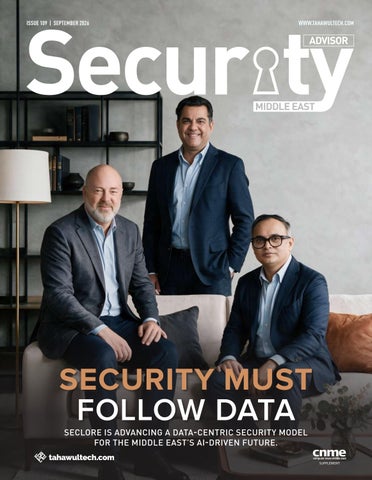
SECURITY MUST FOLLOW DATA SECLORE IS ADVANCING A DATA-CENTRIC SECURITY MODEL FOR THE MIDDLE EAST’S AI-DRIVEN FUTURE.
28
32
16
COVER STORY
28
Veeam advances trusted data resilience for AI era
32
Human Risk Management strengthens defence against AI-driven threats
36
36
spiderSilk advances agentic AI for autonomous cyber defence
60
OpenAI-Hugging Face breach highlights need to strengthen cybersecurity basics
SECURITY MUST FOLLOW DATA
D Talk to us: E-mail: sandhya.dmello@ cpimediagroup.com
igital progress is accelerating
in strengthening national digital resilience.
across Middle East, but every leap
Research from SentinelOne and Tenable
in innovation brings a question: can
reveals how attackers repeatedly target
organisations retain control of the data
vulnerable edge-device ecosystems, while
driving transformation?
F5 warns that frontier AI is dramatically
This issue examines why security must
shortening the journey from vulnerability
move beyond defending networks, endpoints
discovery to active exploitation. Group-IB’s
and identities. AI systems consume
findings on deepfake investment scams also
and create information at speed, cloud
show how cybercriminals can rapidly adapt
platforms enable data to travel across
fraudulent campaigns for new markets.
environments, and distributed work extends collaboration beyond
Sandhya DMello Editor
boundaries. Meanwhile, regulatory expectations surrounding privacy,
Secure AI Factory with NVIDIA and NetApp’s continued recognition
in enterprise storage demonstrate how
Our cover story explores this shift through Seclore’s data-centric security vision. The principle is clear: security must follow
secure, governed infrastructure can support innovation at scale. Security can no longer remain a barrier
data. Discovering or classifying information
positioned around technology. It must
is no longer enough. Protection must
become an intelligent, persistent layer
remain active throughout the data lifecycle,
embedded within data, infrastructure and
wherever information travels and whoever
business operations. Organisations that
accesses it. Organisations also need the
achieve this will be better prepared to adopt
ability to modify permissions, revoke access
AI, collaborate confidently and innovate
and demonstrate compliance continuously.
without surrendering control.
The wider news landscape reinforces
The future belongs to enterprises that
this urgency. The National Cybersecurity
treat data protection not merely as a
Council’s engagement with du highlights the
compliance requirement, but as a foundation
importance of public-private collaboration
for resilience, trust and sustainable growth.
FOUNDER, CPI Dominic De Sousa (1959-2015)
ADVERTISING Group Publishing Director Kausar Syed kausar.syed@cpimediagroup.com
Cisco’s expansion of its
PROTECTING DATA BEYOND BOUNDARIES
sovereignty and accountability rise.
EVENTS
Yet this issue is not defined by risk alone.
EDITORIAL Editor Sandhya DMello sandhya.dmello@cpimediagroup.com
Published by
PRODUCTION AND DESIGN Designer Prajith Payyapilly prajith.payyapilly@cpimediagroup.com
DIGITAL SERVICES Web Developer Adarsh Snehajan webmaster@cpimediagroup.com
Publication licensed by Dubai Production City, DCCA PO Box 13700 Dubai, UAE Tel: +971 4 5682993
Sales Director Sabita Miranda sabita.miranda@cpimediagroup.com
Online Editor Daniel Shepherd daniel.shepherd@cpimediagroup.com
© Copyright 2026 CPI All rights reserved While the publishers have made every effort to ensure the accuracy of all information in this magazine, they will not be held responsible for any errors therein.
NEWS
NATIONAL CYBERSECURITY COUNCIL CHAIRMAN VISITS DU HQ TO EXPLORE STRATEGIC COLLABORATION ON DIGITAL RESILIENCE AND CYBERSECURITY Visit brings together national cybersecurity priorities and du’s technology capabilities to advance secure digital transformation across sectors
du, the leading telecom and digital services provider, hosted His Excellency Dr. Mohammed Al Kuwaiti, Chairman of the National Cybersecurity Council (NCSC), at its Dubai Hills headquarters to explore strategic opportunities for future collaboration in support of the UAE’s ambitions for digital transformation, technological innovation and a secure digital economy. The visit brought together H.E. Dr. Al Kuwaiti, Fahad Al Hassawi, CEO of du, and senior representatives to exchange developments shaping the UAE’s technology landscape, including emerging trends, advanced infrastructure and new technologies, as well as the role of companies in advancing the nation’s digital priorities. The meeting underscored the growing importance of cyber and digital security in enabling the UAE’s digital progress and strengthening national readiness against evolving threats.
6
SEPTEMBER 2026
H.E. Dr. Mohammed Al Kuwaiti, Chairman of the National Cybersecurity Council, said: “The UAE’s leadership in digital transformation is built on a strong national foundation of infrastructure and cybersecurity. Our visit to the du headquarters reflects the importance of bringing together national cybersecurity priorities and the capabilities of leading technology providers to strengthen the UAE’s digital resilience. We welcome opportunities to deepen cooperation across advanced infrastructure, emerging technologies and cybersecurity solutions in support of the UAE’s vision for a innovative and globally competitive digital future.” Fahad Al Hassawi, Chief Executive Officer of du, said: “Hosting H.E. Dr. Mohammed Al Kuwaiti at our headquarters reflects the importance of aligning national priorities with the capabilities of the private sector, and ensuring that the infrastructure
underpinning the UAE’s digital future is ready for what comes next. It is our responsibility to contribute to this foundation through advanced infrastructure, secure digital solutions and technologies that create confidence across the economy. We look forward to building on this dialogue with the NCSC and identify areas where du’s capabilities can support the Council’s priorities and the UAE’s broader digital ambitions.” The NCSC delegation received an overview of du’s cybersecurity and digital security capabilities and the measures supporting the security, resilience and readiness of the digital infrastructure underpinning businesses, institutions and communities across the UAE. During the visit, du also presented an overview of its advanced infrastructure, technology capabilities and digital solutions, highlighting its role in enabling the UAE’s digital ecosystem beyond connectivity.
www.tahawultech.com
CTM360 INTRODUCES NEXT-GEN CYBER THREAT INTELLIGENCE AT BIG SASIG 2026 CTM360, a Bahrain-based preemptive cybersecurity company, heads to Big SASIG 2026 Event as a Gold Sponsor, where it showcased a next-generation approach to Cyber Threat Intelligence (CTI). Big SASIG held on Wednesday 9th September in London, brought together a curated audience of CISOs, senior security leaders, and key decisionmakers in an environment designed to encourage meaningful conversations and valuable connections. At the event, CTM360 highlighted the need for organisations to move beyond traditional threat intelligence models and adopt a next-generation Cyber Threat Intelligence approach built around Indicators of Exposure (IoEs), Indicators of Warning (IoWs), and Indicators of Attack (IoAs). Traditional Cyber Threat Intelligence has largely been built around Indicators of Compromise (IoCs), which help organisations understand artifacts associated with previously observed attacks. However, these artifacts often lack direct organisational context, creating noise for security teams. As Mirza Asrar Baig, CEO & Founder of CTM360, explains: “IoCs are about Someone Else and Somewhere Else; IoE, IoW, and IoA are about You and Now. That’s why the threat intelligence industry needs to move beyond IoCs to a next-generation CTI model based on IoEs, IoWs, and IoAs”. Attendees were invited to visit the CTM360 booth to explore these three
layers of next-generation CTI: • Indicators of Exposure (IoEs): What assets, weaknesses, external vulnerabilities, or exposures can attackers discover and potentially exploit? • Indicators of Warning (IoWs): What are the early signs of an attack infrastructure that has not yet been executed? • Indicators of Attack (IoAs): What infrastructure, campaigns, or threat activity is actively targeting the organization? The discussion covered how AI is being applied across the CTM360 platform to address the scale and complexity of the evolving threat landscape.
During the event, all attendees were invited to join CTM360’s thought leadership workshop, “Next-Gen CTI: Seeing Your IoE, IoW & IoA Before They Become IoCs,” conducted by Mirza Asrar Baig from 11:00 AM to 11:30 AM. CTM360’s recent recognition in the 2026 Gartner® Magic Quadrant™ for Cyber Threat Intelligence marks a defining moment in the company’s global growth journey. As CTM360 continues to expand its international presence, the company is preparing for its next milestones by participating in IndoSec 2026, taking place on 15–16 September 2026, followed by the Gartner Security & Risk Management Summit 2026, to be held in London, UK, from 22–24 September 2026.
F5 ACCELERATES VIRTUAL PATCHING TO MANAGE EMERGING CYBER RISKS WITH AI-POWERED WAF AND RUNTIME SECURITY Frontier AI turns vulnerabilities into exploits in hours; F5 enables security teams to maintain availability, governance, and operational stability by blocking threats in minutes F5, the global leader in delivering and securing every app and API, has announced innovations to block frontier AI-driven threats in the data path and enable faster
www.tahawultech.com
virtual patching, giving security leaders time to make intelligent risk-based decisions rather than reactive operational compromises. With new features such
as anomaly detection and agentic threat intelligence, F5’s AI-powered web application firewall (WAF) is uniquely capable in delivering real-time protections because
SEPTEMBER 2026
7
NEWS
of its strategic position in customers’ infrastructure. Enhancements to F5 WAF for Distributed Cloud and virtual patching provide the precision needed to confidently block active exploits at the request level. “Frontier AI has collapsed the time between vulnerability discovery and active exploitation,” said Kunal Anand, Chief Product Officer at F5. “The old model of waiting for code to be rewritten, tested, and redeployed cannot keep pace. F5 puts protection directly into the data path, where we can identify and block exploits in minutes. Virtual patching gives organisations something Kunal Anand, Chief Product Officer, F5 increasingly scarce in cybersecurity: time. Time to understand the risk, protect the business, and fix the underlying Cloud, innovative anomaly detection is an vulnerability without forcing teams into a intelligent, self-learning capability that permanent state of crisis.” continuously analyses each application’s F5 blocks exploits with runtime security, unique traffic patterns, establishing enabling customers to quickly deploy traffic norms and flagging meaningful virtual patches. Introduced earlier this deviations that could signal a pending year, F5’s AI-powered WAF has already attack. It builds per-application statistical seen strong customer adoption. In internal baselines and, in real time, scores F5 testing, the solution delivered 98% incoming requests against baselines threat detection efficacy while reducing to identify attacks and false positives. false positives to 1%, extending the F5 Anomaly detection provides security Application Delivery and Security Platform teams with more accurate protection for (ADSP) and giving teams confidence to their apps without adding complexity. convert scanner findings into enforced protection in minutes rather than weeks. Prioritise potential exploits with agentic F5 has enhanced its capabilities, threat intelligence adding anomaly detection and agentic Security teams do not lack alerts. They lack threat intelligence to a WAF solution that context. New agentic threat intelligence evaluates requests inline using real-time capabilities, built on technology from the machine learning classification and a acquisition of Fletch, combine external neural network risk engine to assign a risk intelligence on emerging and actively score to each request as it arrives. Scoring exploited threats with what F5 sees risk dynamically, rather than matching reaching customer applications. Teams get known signatures, allows the WAF to help one view of which threats are real, which defend against zero-day attempts, injection are relevant to their environment, and what attacks, and polymorphic exploit chains that to do about each one, with recommended change shape on every attempt. mitigations that can be applied immediately In tailoring infrastructures for a postas virtual patches. Mythos world, F5 helps customers evolve their AI cybersecurity capabilities: Enforce virtual patches in minutes Protection cannot wait for a code release. Continually analyse traffic for attack F5 also delivers automated virtual signals patching with F5 Distributed Cloud Built directly into F5 WAF for Distributed Web App Scanning (WAS). The solution
8
SEPTEMBER 2026
identifies exposed vulnerabilities, unprotected APIs, and business logic flaws to trigger targeted virtual patches at runtime. For hybrid environments, these timely virtual patching capabilities also extend to F5 WAF for BIG-IP. Customers can apply existing signatures or write custom rules scoped to a specific CVE, attack path, method, header, or parameter across environments. Balance business risk with emerging threats False positives are the reason most WAFs sit in passive monitoring mode. F5 WAF for Distributed Cloud, through AI-powered risk-based scoring, reduces false positives to 1%, giving SecOps the confidence to start blocking risky traffic sooner without affecting application availability. Virtual patching using F5 WAF for Distributed Cloud then acts as a safety valve, holding protection in place while developers build, test, and release a permanent fix inside standard change controls. Extend remediation to the F5 estate While virtual patching holds the line in the request path, F5 Insight for ADSP accelerates patching of the underlying infrastructure. F5 Insight gives operations teams supported update and patching workflows across F5 hardware and software environments with readiness checks, taking advantage of F5’s updated hardened release cadence. Together, these capabilities mitigate exposure in minutes and remediate the fleet on a preferred schedule. New AI-powered WAF capabilities are available now on Distributed Cloud as part of the F5 ADSP. Virtual patching capabilities, along with the integration between F5 Distributed Cloud WAS and F5 WAF for BIG-IP, are also available today. Agentic threat intelligence and anomaly detection are rolling out to F5 WAF for Distributed Cloud customers, with broader availability continuing over the coming months.
www.tahawultech.com
GROUP-IB WARNS GULF INVESTORS AS DEEPFAKE “STOCK TIPS” AND FAKE CRYPTO PLATFORMS SPREAD THROUGH WHATSAPP Regional team assesses two investment fraud models as readily transferable to GCC markets Group-IB, a leading creator of predictive cybersecurity technologies to investigate, prevent, and fight digital crime, is warning retail investors and financial institutions across the GCC that two investment fraud models documented by its researchers this year are readily transferable to Gulf markets. The assessment comes from Group-IB’s regional team in the META region and draws on a two-part investigation, published earlier this year, into fraud operations targeting victims in Australia and the United States. Both operations recruit through deepfake videos of well-known finance professionals and private WhatsApp groups. Neither is tied to the markets where it was observed: the advertising, the messagingapp coordination and the platform infrastructure can be pointed at a new country within days. What the researchers documented The first scheme, run by an actor GroupIB tracks as GoldBull, begins with shortlived paid advertisements on Facebook and Instagram that use deepfake video to replicate the voice and likeness of wellknown financial professionals. Victims are funnelled into private WhatsApp groups and told to buy a specific small-cap stock on a real, regulated exchange — which is what makes the fraud so hard to spot. In one documented case, victims were told to buy at US$24.79 a share. Coordinated buying pushed the stock up 12.4%, to US$27.87, before collapsing to US$14.27, a 42.4% loss from the victim entry price. The estimated capital required to cause
www.tahawultech.com
this movement was US$1.5 million to US$3 million, achievable with as few as 500 to 3,000 participants—well within the capacity of an operation running multiple WhatsApp groups. The second scheme, attributed to an actor Group-IB tracks as CoinLure, operates a network of more than 200 connected fake cryptocurrency investment platforms, run from shared templates and shared infrastructure so the operation survives individual takedowns. Group-IB’s on-chain analysis of a single platform identified over US$90,000 in victim deposits across BTC, ETH, and USDT-TRC20 addresses active since 2022. The platforms display fabricated returns, offer daily profits that are mathematically impossible, and accept only cryptocurrency. When victims try to withdraw, the platforms demand invented taxes, compliance charges and account upgrades — each payment followed by a new one. Victims are then often approached again by “recovery firms” run by the same operators.
Why Gulf markets fit the pattern • WhatsApp is the region’s default channel for business and money conversations — precisely the channel both schemes depend on. • Crypto adoption is high and rising. The UAE ranks fifth globally on the 2025 Henley Crypto Adoption Index, and Saudi Arabia recorded 154% year-on-year growth in crypto activity, to around US$31 billion in transaction value. • The retail investor base is growing quickly across Gulf capital markets, and newer investors are the primary target for these schemes. • Fraudsters are already cloning the branding and licence numbers of regulated firms, which is harder to spot for expatriate investors who may be less familiar with local licensing. • Regional regulators have issued repeated warnings about unlicensed investment firms and about advisors operating through messaging apps and social media. What investors and institutions should do • Treat any investment opportunity promoted through a private WhatsApp or Telegram group as fraudulent until proven otherwise, and verify the firm with your national financial regulator before sending any money. • Do not treat a video endorsement as proof. Deepfake tools can convincingly replicate any public figure. • Be cautious of any platform that accepts only cryptocurrency deposits.
SEPTEMBER 2026
9
NEWS
Legitimate providers offer bank transfers and card payments. • If a platform demands a payment of any kind before releasing a withdrawal — tax, fee, insurance or compliance charge — it is fraudulent. So, usually, is the “recovery firm” that
contacts you afterwards. • Financial institutions and public figures should monitor for deepfake content using their brand or likeness, and arrange for automated takedowns. The research was carried out by GroupIB’s Fraud Protection team with analysts
from Investigations, Threat Intelligence and CERT-GIB. It applies Group-IB’s Cyber Fraud Fusion approach, which links what is seen in advertising, infrastructure and cryptocurrency flows so a whole fraud network can be disrupted at once, not one piece at a time.
EMPTY PAGES FULL OF POTENTIAL THREATS: KASPERSKY WARNS ABOUT THE DANGERS OF PARKED DOMAINS Kaspersky warns that fraudsters are exploiting the so-called ‘parked domains’ to harvest sensitive private data from unsuspecting users. These deceptive sites often masquerade as error pages or ad-filled placeholders, exposing users to privacy breaches and potential identity theft every day. A parked domain is originally a registered web address that does not yet host a fully developed website. At first glance, these pages appear harmless, often displaying a blank screen, a “Coming Soon” placeholder, or a “Domain for Sale” notice. However, beneath the surface, these pages can execute aggressive hidden scripts. Simply visiting one of these sites can lead to silent collection of a user’s sensitive data, including IP addresses, geolocation, User-Agent details (a piece of text a web browser or an app sends to websites, which acts as an ID card) and cookie identifiers. Fraudsters can even also collect unique browser fingerprints, such as Canvas, WebGL, or Audio-fingerprinting which are used instead of normal cookies to identify a user across the internet to track their device by identifying the unique way a user’s hardware creates pictures and sounds. This data may be subsequently funneled into advertising networks to build detailed, targeted profiles without the user’s consent. Beyond covert tracking, parked domains may pose direct security threats through malicious redirections and ‘typosquatting’ (when a user ends up on domains that differ from popular brand names by just one or two letters). Threat actors can embed scripts that automatically redirect visitors to fraudulent platforms, adult
10
SEPTEMBER 2026
content, or online casinos. The danger is also acute with typosquatting – a simple typo can land a user on a malicious or phishing website, where cybercriminals may steal login credentials and financial information, or stealthily infect the user’s device with malware via drive-bydownloads (malicious files or software that may automatically install on your device without your knowledge or consent). “While most users may believe that an empty webpage is completely harmless, it is a dangerous misconception. A blank page or a standard ‘Domain for Sale’ placeholder can secretly scan your device’s digital footprint, collecting data for ad networks without your knowledge. Apart from the dangers directly related to parked domains, users may end up on phishing or malware distribution websites. Landing on either of these resources puts not only your personal data at risk, but also your financial security and corporate access safety,” said Svyatoslav Kravtsov, Web Content Expert at Kaspersky.
To stay safe from the hidden threats of parked domains, Kaspersky recommends users: • Avoid clicking on suspicious links from unknown sources, whether via email, messaging apps, or social media. Always double-check the URL for typos before entering any sensitive information. • Be equipped with reliable software to block web tracking and unwanted content. Security solutions such as Kaspersky Premium feature builtin advanced protection modules – including Anti-banner, Do Not Track (DNT), and anti-fingerprinting technology – specifically designed to prevent unauthorised data collection and stop dangerous redirect chains. • If you realise you have accidentally navigated to a parked domain, an empty page, or a placeholder site, do not click on any banners or submit any contact information. Close the page immediately and clear the browser’s cache and cookies.
www.tahawultech.com
NETAPP NAMED A LEADER IN THE 2026 GARTNER MAGIC QUADRANT FOR ENTERPRISE STORAGE PLATFORMS NetApp, the Intelligent Data Infrastructure company, recently announced it has been recognised by Gartner as a Leader in the 2026 Gartner Magic Quadrant for Enterprise Storage Platforms, continuing to acknowledge NetApp as a Leader in this market from its inaugural edition of this report in 2025. The evaluation was based on specific criteria that analysed the company’s overall Completeness of Vision and Ability to Execute. Additionally, the 2026 Gartner Critical Capabilities for Enterprise Storage Platforms report ranks NetApp first in the Hybrid Cloud Storage Use Case and second in the Hybrid Platform Services Use Case. NetApp believes this recognition validates the company’s ability to help customers address their most pressing data challenges while offering more predictable hardware delivery timelines than its competitors. The NetApp Platform is an intelligent, governed foundation that provides zero-copy access to an organisation’s data, wherever it resides. It enables seamless connections to AI and analytics ecosystems, supported by secure, bestin-class hybrid multicloud storage. By delivering real-time, in-place access to AI-ready data, it eliminates the need for constant extraction, transformation, and consolidation. With the NetApp Platform, organisations can more easily unify storage for every cloud and workload, proactively protect against evolving threats, keep their data ready for AI, and maintain the control needed to modernise with confidence and turn data into business advantage. According to Gartner, “Enterprise storage platforms provide file, block and object data services for structured and unstructured workloads. Heads of infrastructure and IT operations can use this research to evaluate vendor platforms and support capabilities for
www.tahawultech.com
modern storage infrastructure”. “Even as markets, customer needs, and technology have evolved since NetApp was founded, we have been a steady and trusted leader in data infrastructure, helping organisations simplify complexity, protect their data, and turn it into business advantage”, said César Cernuda, President at NetApp. “We believe continued Gartner recognition of NetApp as a Leader, even as it has updated market definitions to reflect the changing environment, validates the consistency of our innovation and execution, as well as our ability to anticipate what customers will need next. With the NetApp Platform, we are building on that proven foundation to help customers build Intelligent Data Infrastructure, for any data, any workload, anywhere”. In the 2026 Critical Capabilities for Enterprise Storage Platforms report, NetApp received its highest Use Case scores for Hybrid Cloud Storage and Hybrid Platform Services, which NetApp perceives as reflecting its native integrations into every major cloud combined with its unified control plane. NetApp believes these findings reinforce the value of the NetApp Platform in helping customers manage data seamlessly across hybrid multicloud
environments, activate unstructured data for AI without costly movement, and operate with greater visibility, resilience, and control. Gartner Magic Quadrant reports are a culmination of rigorous, fact-based research in specific markets, providing a wide-angle view of the relative positions of providers in markets where growth is high and provider differentiation is distinct. Providers are positioned into four quadrants: Leaders, Challengers, Visionaries and Niche Players. The research enables readers to get the most from market analysis in alignment with their unique business and technology needs. As an essential companion to the Gartner Magic Quadrant, the Critical Capabilities report provides deeper insight into providers’ product and service offerings by extending the Magic Quadrant analysis. Enterprises can use this research to further investigate product and service ratings based on key capabilities set to important, differentiating use cases. Critical Capabilities research complements a Gartner Magic Quadrant by allowing deeper insight into the providers’ product or service offerings by identifying which ones best fit various use cases.
SEPTEMBER 2026
11
NEWS
CISCO EXPANDS SECURE AI FACTORY WITH NVIDIA FOR RACK-SCALE ERA Cisco’s full-stack architecture adds massive AI computing power, offering an NVIDIA Cloud Partner compliant reference architecture built for surging neocloud and sovereign cloud demand. Cisco is expanding the Secure AI Factory with NVIDIA through a partnership with Supermicro, bringing its leadership in high-density, liquid and air-cooled compute to Cisco’s industry-leading full-stack, secure AI infrastructure architecture for enterprises, neoclouds and sovereign clouds. “We are at the beginning of one of the largest datacenter buildouts in history,” said Jeetu Patel, President and Chief Product Officer, Cisco. “Every organisation is racing to scale AI — but speed only counts if it comes with control of data, managed token costs, and real ROI. It starts with the right infrastructure: compute and networking, delivered as an integrated solution that’s easy to deploy and secure from day one.” “AI factories are revenue-generating infrastructure, where compute produces intelligence, and intelligence drives revenue,” said Justin Boitano, vice president, Enterprise AI, NVIDIA. “By expanding the Cisco Secure AI Factory with NVIDIA, Cisco is providing enterprises and neoclouds full-stack infrastructure that can get into production faster and generate more value from every watt.” Simple, Secure, Scalable Infrastructure – with More Muscle Through this new partnership, Cisco will offer Supermicro liquid- and air-cooled systems, giving customers access to rackscale and dense GPU systems – validated and sold as part of the broader Cisco AI infrastructure portfolio. This expansion enables customers to easily manage complex, high-density AI clusters alongside non-AI workloads. Customers will also now be able to deploy rack-to-fabric liquid cooling, featuring Cisco liquidcooled AI networking systems alongside Supermicro’s liquid-cooled servers. This unlocks trillion-parameter training and
12
SEPTEMBER 2026
high-throughput inference use cases with platforms including NVIDIA Vera Rubin NVL72 and NVIDIA HGX Rubin NVL8. The expanded Cisco Secure AI Factory with NVIDIA offers NVIDIA Cloud Partner (NCP) compliant solutions for neocloud and sovereign cloud customers. Cisco Silicon One-based switches for the front-end and Cisco’s NVIDIA Spectrum-X based switches for the back-end are unified by Cisco Nexus One, delivering a fully unified networking architecture for the full stack. Cisco is the only NVIDIA technology partner to utilise its own networking switches and network operating system in an NCP compliant solution. Cisco Secure AI Factory with NVIDIA is also expanding its Enterprise Reference Architectures to include the latest generation of NVIDIA AI infrastructure for enterprise deployments. The Cisco Secure AI Factory with NVIDIA helps customers plan AI investments with confidence. Customer benefits include: • Less Risk: Cisco and Supermicro each bring industry-leading global supply chain expertise to help mitigate delivery timeline challenges, particularly in the face of GPU and memory access challenges. With Cisco Secure AI Factory solutions based on NVIDIA reference architectures,
customers can have confidence that their infrastructure is pressure-tested for modern workloads, with security and resiliency built in from the silicon to the agents. Industry-leading global support with a broad partner ecosystem gives customers the confidence to invest. • Faster Time to Value: Once delivered, Cisco and its partners will help customers certify infrastructure quickly. New Cisco Validated Infrastructure Services (CVIS) — aligned with the NVIDIA Infrastructure Services (NVIS) offer — certifies infrastructure is built exactly as it was designed and aligned with reference architectures. Cisco is investing in a dedicated large-scale AI Lab to develop tools and test software to advance CVIS. • Simplified Operations: With NVIDIA AI Enterprise software and AgenticOps through Cisco Cloud Control, customers will use tools they already know, making AI deployment feel like an expansion rather than an overhaul. Customers will have the ability to correlate job health with compute, NIC, optics and network performance metrics, delivering true end-to-end observability.
www.tahawultech.com
RUBRIK ZERO LABS WARNS AI AGENTS ARE OUTPACING ENTERPRISE SECURITY CONTROLS New research from Rubrik Zero Labs highlights a critical lack of identity governance as organisations race to adopt autonomous systems they cannot fully observe or restore Enterprise adoption of AI agents is accelerating faster than organisations’ ability to secure and govern them, according to new research from Rubrik Zero Labs. The findings reveal that businesses are operationalising autonomous systems without adequate visibility, identity governance or recovery controls, creating a widening gap between innovation and security. Based on a survey of more than 1,600 IT and security leaders, the report reveals: • 86% expect AI agents to outpace their organisation’s security guardrails within the next year. • Only 23% report full visibility into the agents operating in their environments, which the report notes is likely an over-estimation on the part of respondents. The result is the inability to secure identities that are already making decisions, taking actions, and interacting with critical data. The gap is compounded by identity sprawl. Non-human identities tied to agents are proliferating faster than enterprises can track or govern them, forming what researchers describe as a “shadow workforce.” These identities often operate with persistent access and limited oversight, creating new pathways for misuse, compromise, and lateral movement. At the same time, the operational promise of AI agents is under strain. The report also found:
www.tahawultech.com
• More than 80% of respondents report agents require more manual oversight than they save in efficiency, 88% say they lack the ability to roll back agent actions without system disruption. • Recovery and prevention are emerging as primary points of failure. Nearly nine in ten leaders expressed concern about meeting recovery objectives as agent-driven threats increase. The threat itself is accelerating. Nearly half of respondents expect agentic systems to drive the majority of attacks in the coming year, reflecting a broader shift in how adversaries operate. Autonomous systems compress timelines, scale attacks, and blur the line between insider risk and external compromise. “AI adoption is outpacing our ability to control it. Enterprises are struggling
because they’ve deployed systems they can’t fully observe, govern, or restore,” said Kavitha Mariappan, Chief Transformation Officer at Rubrik. “We have to move past the debate of whether AI is risky and address the harder reality: as decision-making shifts from human to machine, the critical challenge for every leader is maintaining operational safety in an increasingly autonomous landscape.” For boards and executive teams, the implication is immediate. AI strategy is now inseparable from resilience strategy. Organisations that continue to prioritise deployment speed over control mechanisms risk creating environments where failures cannot be contained or reversed. "Identity verification is the fundamental underpinning that will allow us to get the greatest automation benefits of AI without imposing human bottlenecks," says Renown Health VP, Chief Information Security & Technology Officer Steven Ramirez. "Verification and visibility are prerequisites for sound, secure agentic implementation." Rubrik Zero Labs’ report, The State of the Agent: Understanding Adoption, Risk, and Mitigation, combines global survey data with technical analysis of emerging attack vectors across the tool, cognitive, and identity layers of AI systems. The research outlines a shift already underway: security is no longer about preventing breach alone, but about maintaining control in systems that no longer wait for human input.
SEPTEMBER 2026
13
NEWS
SENTINELONE AND TENABLE FIND CYBER ATTACKERS ROUTINELY TARGET EDGE-DEVICE VENDOR ECOSYSTEMS SentinelOne, the AI security leader, and Tenable Holdings, Inc., the exposure management company, recently released joint research that suggests a growing disconnect between vulnerability discovery, disclosure and actual exploitation. The research draws on Tenable’s exposure data across thousands of organisations and remediation telemetry with SentinelOne’s endpoint and postexploitation detection data. Together, both views produce a prioritised picture of where risk is concentrating, with lessons ripe for the Frontier AI era. The most critical takeaway: Both nation state and criminal threat actors are focusing on vendors and susceptible points in the attack surface more than specific CVEs. Current attacker timelines are already moving faster than standard patch cycles can address. New frontier AI models compress vulnerability discovery from months to hours, significantly expanding potential risks while speeding the time for attackers to move from disclosure to exploit code in about a week. Today, the median organisation takes five months to remediate known vulnerabilities.1 Closing that window takes more than speed, it takes knowing which product lines are more likely to carry the next wave of exploitation. The research finds that exposure data and runtime detection converge on the same edge-device vendor surfaces 79% of the time, while they share only 21% overlap at the individual vulnerability level. Both state-sponsored actors and ransomware operators draw from the same small set of high-severity, actively exploited vulnerabilities. The surfaces are consistent and the actors are not. That distinction matters for how defenders prioritise; a pattern Tenable has termed the “Persistently Targeted Vendor.” This is the idea that a small set of vendor
14
SEPTEMBER 2026
Vlad Korsunsky, Chief Technology Officer, Tenable. product lines, not individual CVEs, is the durable unit of risk over time. Other key findings from the research include: Twelve vulnerabilities in the dataset carry confirmed “multi-nexus” attribution — state-sponsored and ransomware operators independently exploiting the very same flaw across five distinct threat categories, including China, Russia, DPRK, Iran-nexus, and criminal (financially motivated) actors. More than half (54%) of organisations running F5 products carry at least one exposed, actively exploited vulnerability, while Citrix customers post the slowest remediation of any vendor studied, at a median of 461 days — a concrete illustration of how specific product lines stay exposed long after a patch exists. Remediation complexity on highpriority vulnerabilities introduces a statistically significant 24-day gap, widening the window attackers have to operationalise an exploit — underscoring why patching speed alone isn’t enough without attack surface minimisation and
endpoint protection working in tandem. “Speed alone is not enough. By the time a vulnerability hits a remediation queue, adversaries are already iterating the exploit”, said Steve Stone, Chief Customer Officer at SentinelOne. “Static signatures run on human timelines, the threat does not. Runtime behavioural detection has to match that cadence, flagging exploitation patterns as they emerge rather than after the fact”. For security teams, the research reinforces the need to look beyond individual vulnerabilities and understand which technology surfaces attackers repeatedly target. Tenable’s exposure data shows where organisations are most exposed and where risk is concentrated, while SentinelOne’s runtime threat and DFIR data shows where and how attackers are operating in the wild. The convergence of these two independent perspectives gives defenders stronger evidence for prioritising remediation, strengthening detection and reducing risk across persistently targeted technology surfaces. “Attackers systematically target
www.tahawultech.com
specific vendor ecosystems that could provide access. They aren’t obsessing over single vulnerabilities, and neither should defenders”, said Vlad Korsunsky, Chief Technology Officer, Tenable. “Our joint research confirms that attackers, big and small, target the same attack surfaces the majority of the time. This research underscores exposure management principles: seeing,
prioritising and fixing exposures that create real business risk. As attackers weaponise AI to breach defences faster, organisations that embrace exposure management will win”. The research is the latest collaboration in an expanding partnership between best-in-class AInative CTEM and AI runtime detection and response companies, building on
Tenable and SentinelOne’s existing work together, including SentinelOne’s participation as a founding member of Tenable’s CyberAgents Exchange announced at Black Hat USA 2026. It’s the latest step in a partnership that continues to deepen as both companies invest further in AI security. The full research is available at sentinelone.com and tenable.com.
GENETEC BRINGS EMPOWER360 PARTNER ROADSHOW TO THE UAE The Abu Dhabi event will explore how intelligence, connected technologies and infrastructure modernisation are reshaping physical security operations. Genetec has announced the return of its empower360 roadshow to the UAE, with the partner-focused event scheduled to take place in Abu Dhabi on September 16. The event will bring together physical security professionals, channel partners and technology experts to examine how datadriven strategies, operational intelligence and emerging technologies are transforming physical security. Held under the theme “Advancing Security Through Intelligence and Innovation”, empower360 will focus on the industry’s shift from standalone security systems towards connected approaches that support wider operational objectives. Firas Jadalla, Regional Director, META, Genetec. According to the Genetec 2026 State of Physical Security Report, 71 per large-scale transformation programmes cent of respondents are already using is also changing the role of physical unified or integrated video surveillance security across the Middle East. and access control systems. The report Sessions at empower360 will also found that 60 per cent of channel cover smarter physical security respondents identified integration with operations, developments in access new technologies as the primary reason control, operational intelligence and customers replace legacy systems. practical approaches to infrastructure Continued investment in digital modernisation. Attendees will also infrastructure, smart developments and have opportunities to meet Genetec
www.tahawultech.com
experts, experience technology demonstrations and exchange insights with industry peers and partners. “Across the Middle East, organisations are investing in infrastructure and digital transformation, and physical security must evolve with them,” said Firas Jadalla, Regional Director, META, Genetec. “Connected systems are only part of the challenge. Organisations also need operational insight, resilience and control to manage increasingly complex environments. empower360 brings our partner community together to explore practical ways innovation can help organisations support the next phase of physical security.” Genetec provides enterprise physical security software, including video management, access control, automatic licence plate recognition, intrusion detection, intercom and digital evidence management solutions. Headquartered in Montreal, Canada, the company serves more than 42,500 customers through a network of accredited channel partners and consultants across over 159 countries.
SEPTEMBER 2026
15
COVER STORY
/ SECLORE
MIDDLE EAST ENTERS NEW SECURITY ERA PROTECTING DATA THROUGHOUT ITS LIFECYCLE IS BECOMING THE DEFINING ENTERPRISE SECURITY CHALLENGE AS AI, CLOUD ADOPTION, REGULATORY DEMANDS AND DISTRIBUTED WORK RESHAPE THE REGIONAL RISK LANDSCAPE.
A
bank introduces Microsoft Copilot to improve productivity. A government department moves critical workloads to the cloud. A manufacturer shares confidential designs with hundreds of suppliers across multiple markets. None of these organisations necessarily has a malware problem. Each one, however, faces a data problem. Sensitive information is no longer confined to databases, corporate networks or managed endpoints. It moves between employees, cloud platforms, software-as-a-service applications, partners, suppliers and AI systems. Every movement creates value
16
SEPTEMBER 2026
for the business, but it can also reduce visibility and weaken control. This shift is changing the foundations of enterprise security across the Middle East. Governments and businesses are accelerating digital transformation while pursuing some of the world’s most ambitious cloud and AI programmes. Regulatory expectations surrounding privacy, sovereignty and accountability are also becoming more demanding. Infrastructure protection remains essential, but it can no longer answer the most pressing questions confronting security leaders. An organisation may secure its network, endpoint and user identity, yet still lose control of a sensitive document once it has been downloaded,
emailed or shared outside the enterprise. Five powerful forces are bringing this challenge to the forefront. Five forces reshaping enterprise security AI is changing how organisations use data AI is altering how information is accessed, analysed, generated and shared across the enterprise. Employees can use generative AI tools to summarise documents, develop presentations, analyse customer records or create new content from existing corporate information. AI agents are also beginning to operate across applications and workflows, performing actions that
www.tahawultech.com
www.tahawultech.com
SEPTEMBER 2026
17
COVER STORY
/ SECLORE
previously required direct human intervention. The fundamental challenge is not AI itself. It is the scale and speed at which AI increases data access, movement, and potential exposure. Traditional controls were designed primarily around human users accessing known systems. AI introduces new questions. Security teams must understand which models and agents can access sensitive information, whose authority is being used, how the information is transformed and whether the resulting content inherits the protection applied to its source. Blocking AI is unlikely to provide a sustainable answer. Organisations need governance structures that enable employees and business units to use the technology productively without surrendering control of intellectual property, customer information or regulated data. AI has made data governance a business priority. Data sovereignty has become a boardroom discussion Data sovereignty is increasingly influencing decisions about cloud architecture, workload placement, crossborder collaboration and third-party access. Organisations operating in Saudi Arabia, the UAE, Qatar and other regional markets must understand where regulated information resides, who can access it and whether it can move across jurisdictions. Compliance can no longer be treated solely as a legal or security department responsibility because regulatory requirements affect wider technology and business decisions. Boards also recognise that data exposure can result in financial loss, operational disruption and reputational damage. The consequences become particularly serious when customer information, intellectual property, government records or strategically important business data are involved.
18
SEPTEMBER 2026
Enterprise leaders are therefore asking for clearer evidence of control. Knowing where a server is located may satisfy one part of the requirement, but it does not necessarily explain what happens when a document is downloaded, copied, forwarded or accessed by an external party. Sovereignty must extend beyond the location of the infrastructure to the governance of the information itself. Compliance has become continuous Annual assessments and static policy documents cannot reflect the speed at which modern data environments change. Information is continually created, copied, modified and shared. User permissions evolve, employees change roles, suppliers join or leave projects, and cloud applications are introduced across the business. AI adds another dynamic layer by consuming data and creating new outputs from it. Regulators and auditors increasingly expect organisations to demonstrate how controls operate in practice. Security teams need reliable evidence showing how sensitive information was classified, who accessed it, what actions were permitted and whether protection remained active after it was shared. This requires continuous visibility, enforcement and reporting. Compliance must become an operational state rather than a periodic exercise undertaken before an audit. Work happens everywhere Enterprise work now takes place across offices, homes, cloud platforms, SaaS applications, partner environments and mobile devices. A single document may move from an enterprise content management platform to email, a collaboration application, a supplier portal and an employee’s downloaded files. Its business value and sensitivity remain unchanged even though its location and users have changed repeatedly. The traditional perimeter has consequently lost much of its defining role. Network and endpoint controls
can protect specific environments, but collaboration frequently requires information to move beyond them. Security architecture must recognise this operational reality. Protection needs to remain effective across changing locations, applications and ownership boundaries without making legitimate collaboration impractical. Data moves faster than security Employees, partners, AI tools, cloud services, email, removable devices and downloads can move information in seconds. Security teams often depend on disconnected products to discover,
www.tahawultech.com
classify, monitor and protect this data. Policies may need to be recreated across separate systems whenever information moves from one environment to another. The result is fragmentation. An organisation may have a clear data security strategy at the leadership level but execute multiple versions of it across different products, teams and workflows. Discovery alone cannot close this gap. A report may show where sensitive data was found, but it does not ensure that the information remains protected once it moves. Effective security must connect knowledge about the data with the ability to apply and maintain appropriate controls.
www.tahawultech.com
What does modern enterprise security look like? Traditional security strategies focused on three central questions: • Is the network secure? • Is the endpoint secure? • Is the user’s identity secure? Those questions remain relevant, but today’s leaders must ask several more: • Where is the organisation’s sensitive data? • What does the information contain? • Who owns it and who can use it? • What actions can users or AI systems perform? • Does protection remain active after
the data is shared? • Can the organisation demonstrate compliance? • Can access be changed or withdrawn when the risk changes? Answering these questions requires security to become more closely aligned with the data itself. Security must follow data Modern organisations need continuous visibility into where sensitive information resides, what it contains, how it is being used and whether it remains protected throughout its lifecycle. Discovery provides an important starting point, but it is not sufficient on its
SEPTEMBER 2026
19
COVER STORY
/ SECLORE
own. Classification can identify sensitivity, but a label does not automatically prevent inappropriate use. Compliance reporting can highlight risk, but it may arrive after the information has already been exposed. Data Security Intelligence brings these capabilities into a connected operating model through which organisations can discover, classify, protect and govern information wherever it travels. The model follows a clear progression: 1. Understand what data exists and where it resides. 2. Determine its sensitivity, ownership and business value. 3. Evaluate its context, usage and risk. 4. Apply protection that remains with the information. 5. Continuously enforce policy and demonstrate compliance. Context is critical. A file’s location alone does not reveal its significance. Security decisions should consider its content, owner, users, purpose and regulatory requirements. Persistent protection extends those decisions beyond the organisation’s immediate infrastructure. Controls can define who may open information, whether it can be edited, printed or forwarded, and the conditions under which access remains valid. Permissions can also be amended or revoked after a file has been distributed. This approach shifts enterprise security from protecting only the containers around data to governing the information throughout its lifecycle. Building a data-centric security strategy Across banking, government, manufacturing and other highly regulated industries, Seclore has helped organisations protect sensitive information long after it leaves the firewall. The company’s approach is based on a simple principle: security should move with the data. Founded in 2011, Seclore developed its business around the challenge of
20
SEPTEMBER 2026
www.tahawultech.com
Executive profile Dr. Vishal Gauri, Chief Executive Officer, Seclore. Dr. Vishal Gauri leads Seclore’s overall strategy, growth direction and stakeholder engagement. He joined the company in 2021 and was appointed Chief Executive Officer in June 2025, following roles as Chief Customer Officer and President for the Americas.
maintaining control after sensitive information moves beyond traditional network, system and perimeter-based defence. The company now supports more than 500 enterprises and government organisations across over 40 countries. Seclore’s Data Security Intelligence approach connects discovery, intelligent classification, persistent protection, continuous enforcement and visibility. It is designed to help organisations understand their data, assess its sensitivity and context, govern its use and produce evidence of control. Policy-based protections can specify who may access information, what actions are permitted and under which conditions. Controls can include time limits, device requirements, IP restrictions and geofencing. Access can be modified or withdrawn even after information has been shared. The architecture is also designed to operate alongside established enterprise technologies, including data loss prevention, cloud access
His career spans more than 25 years across enterprise software, analytics and technology services. He is also a co-founder of IvyCap Ventures and has held senior leadership positions at Incedo and Nagarro. Gauri holds a PhD in Chemical Engineering from The Ohio State University and a Bachelor of Technology in Chemical Engineering from the Indian Institute of Technology Delhi.
security brokers, data classification, email security, customer relationship management, enterprise resource planning, content management and Microsoft 365 environments. This interoperability matters because data-centric security is not intended to replace every existing security investment. Its role is to connect information context with persistent control across the environments through which enterprise data moves. Interview excerpts Dr. Vishal Gauri, Chief Executive Officer, Seclore, explains why security architecture must evolve from infrastructure-centric defence to continuous, data-centric governance How are security and compliance pressures changing the way enterprises approach data protection? Enterprise security was built for a time when organisations had far more control over where data lived and how it moved.
REGULATIONS IN MARKETS SUCH AS THE UAE AND SAUDI ARABIA ARE PLACING GREATER PRESSURE ON DATA HANDLING, SOVEREIGNTY, ACCESS AND PROOF OF CONTROL. DR. VISHAL GAURI, CHIEF EXECUTIVE OFFICER, SECLORE. www.tahawultech.com
That model no longer reflects how business operates. Sensitive information now moves across cloud platforms, partners, devices, applications, and jurisdictions, yet the organisation remains accountable for protecting it. Regulations in markets such as the UAE and Saudi Arabia are placing greater pressure on data handling, sovereignty, access, and proof of control. This is pushing enterprises to rethink security architecture itself. The focus is moving from protecting networks and systems around the data to applying security, policy, and governance directly to the data, so control remains intact wherever that information travels. Why does Data Security Intelligence represent an operating model rather than another security product category? Traditional enterprise security relies on fragmented tools that discover risk, generate alerts, and enforce controls in separate workflows. Data Security Intelligence brings these functions together across the data lifecycle, from discovery and contextual understanding to protection, governance, and proof. The intelligence comes from understanding what the data means, its business value, sensitivity, ownership, usage, and risk context, rather than depending only on predefined rules. That context allows security decisions and controls to reflect what really matters to the organisation. By combining context with an integrated lifecycle, Data Security Intelligence becomes an operating model for how enterprises continuously understand, govern, and protect data, rather than another isolated security tool. How can organisations move from periodic compliance exercises to continuous data governance and demonstrable control? Periodic compliance audits are fundamentally insufficient in an era characterised by rapid data sprawl and continuous, evolving regulatory scrutiny across global jurisdictions. Organisations
SEPTEMBER 2026
21
COVER STORY
/ SECLORE
must transition to advanced platforms that automatically generate realtime telemetry on exactly how data is accessed, shared, and utilised across the extended enterprise. By leveraging a Data Security Intelligence framework, enterprises can translate raw file-activity events into structured, audit-ready evidence that proves adherence to frameworks like the ECC, DCC, PDPL, NIAS, etc. This continuous, cryptographic proof of control transforms compliance from a reactive, manual checkbox exercise into a proactive, demonstrable state of continuous business readiness. What does Seclore’s evolution reveal about the wider shift from infrastructure-centric to data-centric security? Seclore was built around a simple observation. Sensitive data eventually moves beyond the systems and networks an organisation controls. Our early focus was persistent protection, making security travel with the information itself rather than relying only on the environment around it. The market has now moved much closer to that reality. The challenge has expanded from protecting known data to discovering it, understanding its context, acting on risk, and proving control. Seclore’s evolution reflects that broader shift in enterprise security. The focus is moving from securing locations to governing data throughout its lifecycle, across cloud platforms, partners, devices, applications, and external ecosystems where traditional infrastructure controls no longer provide enough assurance. How will AI change the way enterprises discover, govern, and protect sensitive information? AI changes both sides of the data security equation. It can help organisations understand sensitive information with far more context, but it can access, transform, and redistribute information at a speed that traditional controls were not built to govern. Security teams
22
SEPTEMBER 2026
will need to know what AI systems can access, under whose authority, for what purpose, and what happens to sensitive information once it enters an AI workflow. They will need stronger links between discovery, classification, policy, and enforcement. The goal should not be to block AI. It should be to create boundaries that let enterprises use AI productively without giving up control of their most valuable data or losing the ability to prove how that data was used. Turning data protection into business value Justin Endres, Chief Revenue Officer, Seclore, discusses the commercial importance of persistent control and the role partners play in delivering data security across global markets. What business risks are encouraging enterprise leaders to place data security higher on the corporate agenda? Today’s business leaders are acutely aware that modern commercial workflows require frictionless, continuous collaboration across highly complex, global supply chains and partner networks. However, this necessary third-party sharing exponentially increases the risk of data leakage, the theft of critical intellectual property, and severe regulatory penalties. At the same time, regulatory expectations around privacy, sovereignty, and accountability are rising across global markets. Boards are paying closer attention to the financial, legal, and reputational impact of data exposure, especially where third parties are
involved. That combination is moving data security higher on the corporate agenda. Leaders are no longer asking only whether systems are secure. They are asking whether the business can keep control of sensitive data wherever it goes and prove that control when needed. How can CISOs demonstrate the commercial value of persistent data protection to boards and business leaders? The strongest business case starts with what security allows the organisation to do. Persistent data protection lets a company share intellectual property, customer information, financial data, and other sensitive assets with the people who need them without surrendering control once that information leaves the organisation. That can reduce the risk attached to collaboration, make regulatory evidence easier to produce, and give business teams more confidence to work across partners, markets, and cloud platforms. CISOs should connect those outcomes to the priorities boards already care about, such as resilience, customer trust, expansion, and operational continuity. That creates a stronger commercial conversation than measuring security only through the number of attacks blocked or incidents prevented. What prevents organisations from translating data security strategies into consistent enterprise-wide execution? The gap is not a shortage of tools. It is that the tools act on systems and the strategy is about data. Every time sensitive data moves from the mail
THE STRONGEST BUSINESS CASE BEGINS WITH WHAT SECURITY ENABLES THE ORGANISATION TO ACCOMPLISH. JUSTIN ENDRES, CHIEF REVENUE OFFICER, SECLORE. www.tahawultech.com
Executive profile Justin Endres, Chief Revenue Officer, Seclore. Justin Endres leads Seclore’s global revenue strategy and go-to-market execution, working with its leadership team to scale enterprise adoption, deepen partnerships and translate data security requirements into measurable business outcomes. His career spans more than three decades across cybersecurity, cloud infrastructure, data protection and enterprise software. Previous leadership roles include Senior Vice President of Worldwide Sales at HYCU and Chief Revenue Officer at ActivTrak. He has also held senior positions at Mist Systems, AlienVault, Webroot and SolarWinds. Endres is a United States Marine Corps veteran, a graduate of The University of Texas at Austin and a board adviser to digital identity company 1Kosmos.
platform to the file store to the partner portal, the policy has to be recreated by a different team in a different product. Enterprises do not fail to execute their strategy. They execute forty slightly different versions of it and call the difference an exception. The gap persists because the incentives reward one half of the programme and punish the other. Discovery produces a report, and nobody objects to a report. Enforcement produces a blocked user, and a blocked user produces a call to the CIO. Security leaders are reading that asymmetry correctly. AI has removed the option of leaving the gap open. Generative tools are the first consumers of enterprise data that inherit none of its controls. The test in 2026 is not whether a strategy can find the data. It is whether the control follows the data into whatever is produced from it.
www.tahawultech.com
SEPTEMBER 2026
23
COVER STORY
/ SECLORE
How are strategic partners helping Seclore scale adoption and address complex customer requirements across global markets? Strategic channel partners are crucial to translating our global technological vision into localised, highly impactful execution. These partners provide the critical on-the-ground technical engineering expertise, consultative account management, and extensive channel networks required to navigate profound regional nuances. That matters in markets where sovereignty requirements, deployment models, buying processes, and customer priorities can differ greatly from one country to the next. Partners help us address those differences without losing consistency in how the technology is delivered or supported. By integrating Seclore into broader security ecosystems alongside other best-of-breed tools, our partners help customers rapidly architect
24
SEPTEMBER 2026
and deploy comprehensive, end-toend data protection frameworks. This collaborative, deeply integrated ecosystem ensures that we can scale efficiently while precisely addressing the specific data sovereignty and compliance mandates of each distinct market. What role will Seclore’s Middle East and Africa business play in the company’s wider growth strategy? The Middle East and Africa is where Seclore learned how to sell data protection into a sovereignty-first market, and that lesson now shapes how we operate everywhere else. The UAE and Saudi Arabia are running national AI and digital programmes at a pace that puts data control at the centre of the CISO’s agenda rather than at the edge of it. Africa is earlier in that curve, but the regulatory direction is the same and the partner networks are forming now. We have been
Executive profile Uraz Farukh, Senior Vice President, META, Seclore. Uraz Farukh leads Seclore’s business across the Middle East, Turkey and Africa. Based in Riyadh, he is responsible for regional growth, customer and partner relationships, and market expansion. Farukh joined Seclore in 2014 and initially led its operations in Saudi Arabia. His responsibilities subsequently expanded across Saudi Arabia and Bahrain, followed by MENA and the wider META region. His current priorities include helping organisations respond to data security requirements created by cloud adoption, AI, sovereignty obligations and changing regulatory frameworks. Farukh holds a Master’s degree in Marketing from Anglia Ruskin University.
www.tahawultech.com
building customers, partners, and local presence here for years. The region is not only a hyper-growth market for us; it is the reference model for the rest of the world. Advancing data-centric security across META Uraz Farukh, Senior Vice President, META, Seclore, outlines how sovereignty requirements, AI adoption and partner development are influencing the regional security market How long has Seclore participated in GISEC? Seclore has maintained a proud and consistent presence at GISEC over the years, recognising the trade show as the premier platform for cybersecurity dialogue across the Middle East and Africa. As our organisation’s footprint has expanded over the last decade, most recently marked by the opening of our new regional headquarters in Riyadh, our participation has naturally evolved to reflect a deepening commitment to this diverse market. Today, GISEC serves as a critical touchpoint to connect directly with enterprise leaders and government regulators who are actively navigating complex digital transformations. We approach this year’s event as an opportunity to reinforce our foundational role in shaping regional data sovereignty and enterprise resilience. What will Seclore demonstrate at GISEC? At GISEC 2026, we are showcasing how organisations can achieve absolute trust and control over their
sensitive data through the unified Seclore ARMOR platform. Visitors will experience our latest innovations in DSPM, Classification, and EDRM, which work in tandem to ensure critical information remains protected wherever it travels. We are also going to illustrate how enterprises can safely scale AI operations without risking intellectual property exposure or violating compliance mandates. Our demonstrations will highlight how persistent, data-centric security translates directly into seamless regulatory compliance and uncompromised structural resilience. How does an event like GISEC help Seclore shape security and catalyse a regional vision of protecting businesses to remain resilient? GISEC acts as a vital convergence point where policymakers, technology innovators, and enterprise leaders collaboratively address the region’s most pressing cyber vulnerabilities. For Seclore, these high-level interactions provide invaluable market intelligence that directly informs how we refine our data security intelligence platform to meet evolving enterprise data sovereignty requirements. By engaging in these dialogues, we actively advocate for a fundamental paradigm shift away from perimeter-only defence and toward structurally resilient, data-first protection strategies. This collaborative environment ultimately catalyses our vision of empowering regional organisations to innovate and operate fearlessly, knowing their most critical assets are secure by design.
THE LAUNCH OF OUR REGIONAL HEADQUARTERS IN RIYADH AND THE SECURE 2030 INITIATIVE REFLECT OUR LONG-TERM COMMITMENT TO THE MARKET. URAZ FARUKH, SENIOR VICE PRESIDENT FOR META, SECLORE. www.tahawultech.com
Which security, compliance and data sovereignty requirements are having the greatest influence on organisations across META? Across the META region, the rapid implementation of stringent data sovereignty frameworks, such as ECC, DCC, PDPL, etc. and emerging regulations across Africa, are fundamentally reshaping enterprise security architectures. Organisations are now under immense pressure to prove that sensitive information not only resides within legal boundaries but is also strictly governed against unauthorised access or cross-border leakage. Additionally, the rapid integration of AI into enterprise workflows has created an urgent mandate for advanced data masking and tokenisation to prevent intellectual property exposure. These compounding compliance mandates are driving a definitive market shift toward continuous data posture management, where granular protection is permanently embedded into the data itself. How has Seclore’s presence and customer base across the Middle East and Africa developed in recent years? Over the past decade, Seclore has experienced exponential growth across the Middle East, evolving from our initial foundational successes in Saudi Arabia and Bahrain into a comprehensive footprint that now spans Africa and Turkey. The recent launch of our regional headquarters in Riyadh and the rollout of our Secure 2030 initiative underscore a deep, localised commitment to this market’s ambitious digital transformation goals. As a result, our customer base has rapidly diversified, encompassing top-tier financial institutions, defence agencies, and major telecom operators who demand the absolute highest standards of digital trust. Today, we are widely recognised as the premier partner for data-centric security, empowering governments and enterprises across both established and emerging META markets to secure their digital futures.
SEPTEMBER 2026
25
COVER STORY
/ SECLORE
How is Seclore expanding its regional partner ecosystem to support customers across established and emerging markets? A robust, highly specialised channel ecosystem is central to our strategy for delivering tailored, sovereign-ready data security across the highly diverse META landscape. We are actively deepening our alliances with premier regional system integrators and global technology partners. In emerging markets such as Kenya, Ethiopia, Uganda, Nigeria and the broader African continent, we are making strategic investments in partnerships with our local partners that build local cyber capacity and support the unique compliance journeys of those rapidly growing economies. By closely integrating with complementary solutions, we empower our partners to deliver comprehensive, end-to-end resilience to our joint customers. What priorities will shape Seclore’s regional growth following GISEC 2026? Following GISEC 2026, our primary focus will remain on accelerating the
26
SEPTEMBER 2026
adoption of the Seclore ARMOR platform to help regional enterprises successfully navigate the intersection of artificial intelligence enablement and stringent data sovereignty. We will continue to make heavy investments in our localised operations, particularly in supporting national visions like Saudi Arabia’s Vision 2030 and advancing data protection maturity across high-growth African markets. Expanding our strategic partner ecosystem will also remain a top priority, ensuring that we provide unparalleled support, integration capabilities, and rapid time-to-value for our expanding customer base. Our long-term priority is to cement Seclore’s position as the foundational pillar of digital trust, enabling businesses across the META region to innovate with absolute confidence in their security posture. Looking ahead The Middle East’s digital ambitions rank among the most significant in the world. Cloud adoption, national AI programmes and growing collaboration across public and private-sector ecosystems are
creating opportunities to transform services, industries and economies. The same developments are expanding the number of people, systems and organisations that interact with sensitive information. Enterprise security must therefore evolve alongside the region’s digital ambitions. Infrastructure, endpoint and identity security will remain indispensable, but these controls must be complemented by continuous insight into the data itself. Organisations need to know what information they hold, why it matters, how it is being used and whether protection remains effective wherever it travels. Data Security Intelligence offers an operating model for connecting this understanding with classification, governance, persistent control and demonstrable compliance. Organisations that understand, govern and protect their data will be better positioned to embrace AI, expand collaboration and innovate with confidence. This is the data-centric future Seclore is helping to build.
www.tahawultech.com
INTERVIEW
/ VEEAM
From left: Tim Pfaelzer, GM and SVP, EMEA, Veeam, and Mena Migally, Regional Vice President, EMEA East, Veeam.
VEEAM ADVANCES TRUSTED DATA RESILIENCE FOR AI ERA TIM PFAELZER AND MENA MIGALLY DISCUSS AI GOVERNANCE, DATA SECURITY, SAUDI ARABIA’S TECHNOLOGY TRANSFORMATION AND VEEAM’S EXPANDING REGIONAL PARTNER ECOSYSTEM. 28
SEPTEMBER 2026
www.tahawultech.com
A
I adoption is accelerating across the Middle East, creating new opportunities for innovation while increasing the need for robust data security, governance and resilience. Organisations must understand where their data resides, how it moves and who can access it before deploying AI at scale. In a joint interview at LEAP 2026 with Sandhya D’Mello, Technology Editor, CPI Media Group, Veeam officials — Tim Pfaelzer, GM and SVP, EMEA, Veeam, and Mena Migally, Regional Vice President, EMEA East, Veeam — discussed why trusted data resilience has become a board-level priority. The executives also examine the risks associated with scaling AI, the strategic value of Veeam’s Securiti AI acquisition and the growing maturity of Saudi Arabia’s technology market. The conversation explores Veeam’s continued investment in the Kingdom, the importance of partners such as Mindware and AmiViz, and the data protection requirements emerging from Microsoft’s Saudi cloud region. Interview excerpts What does “Trusted Data Resilience for the AI Era” mean in practice, and why should it be a board-level priority? Tim Pfaelzer: Today’s businesses depend heavily on data. An online retailer, for example, relies almost entirely on data to operate, while a manufacturing company cannot maintain production without access to the right information. Data has become one of an organisation’s most important assets, which makes protecting it a board-
What are the biggest security, governance and trust risks organisations face when scaling AI? Tim Pfaelzer: One of the biggest challenges is ensuring AI systems deliver accurate and trustworthy outputs. Organisations need to provide AI systems with clean, reliable data to receive dependable results. The average enterprise uses 106 software-as-a-service applications, many of which operate autonomously. Giving these applications excessive privileges or access rights can result in incorrect or potentially harmful AI outcomes. Organisations must therefore protect their data at the source and maintain effective governance over how it is accessed and used.
How has the Middle East’s approach to cyber resilience, cloud and data protection evolved, and where are the biggest opportunities ahead? Tim Pfaelzer:The Middle East has consistently been at the forefront of adopting emerging technologies, sometimes moving faster than more established markets across EMEA. It is refreshing to see the pace of innovation across the region. AI was already part of everyday life through smartphones, computers and Microsoft applications before many people fully recognised it. The emergence of ChatGPT and other generative AI tools has expanded its role from supporting daily tasks to enabling planning, decision-making and orchestration. Saudi Arabia, the wider Middle East and the Gulf remain at the centre of this transformation. The developments taking place across the region are remarkable, and LEAP provides an opportunity to experience that progress first-hand.
How does the Securiti AI acquisition strengthen Veeam’s AI readiness and data security capabilities? Tim Pfaelzer: The acquisition brings together Veeam’s data resilience capabilities with Securiti AI’s expertise in data and AI security. This combination strengthens our position by enabling us to provide a comprehensive resilience layer alongside a data command graph. The technology gives organisations visibility into where their data is moving, who can access it and how AI is using it. It also allows them to reverse AI-driven actions when necessary. This supports Veeam’s mission to keep customers’ businesses running while helping them scale AI securely.
What is your message to the global technology community on LEAP’s fifth edition? Tim Pfaelzer: Anyone who has never attended LEAP should come and experience it. The event lives up to its name by taking a significant leap forward every year. This is my third consecutive visit, and the show’s evolution has been tremendous. LEAP consistently focuses on the latest technologies and demonstrates how countries, companies and organisations can use innovation to support growth. It also provides an excellent platform for networking with customers, partners and technology leaders. I am always delighted to be here.
level priority. Losing data can disrupt operations, cost customers and damage trust in the business. Organisations must ensure their data remains safe, secure and available.
ORGANISATIONS NEED TO PROVIDE AI SYSTEMS WITH CLEAN, RELIABLE DATA TO RECEIVE DEPENDABLE RESULTS. TIM PFAELZER, GM AND SVP, EMEA, VEEAM www.tahawultech.com
What are the biggest data resilience and cybersecurity challenges Saudi organisations face as they accelerate Vision 2030 transformation? Mena Migally: One of the biggest challenges is the rapid expansion into AI without first establishing the necessary
SEPTEMBER 2026
29
INTERVIEW
/ VEEAM
guardrails. Organisations need complete visibility across their underlying data platforms, including who can access the data, how it moves and how it is used. Addressing these requirements will be critical as Saudi organisations accelerate their Vision 2030 transformation during the generative AI era. How important is the local partner ecosystem to Veeam’s Saudi growth, particularly through Mindware and AmiViz? Mena Migally: Veeam continues to expand aggressively in Saudi Arabia by investing in personnel and building a strong local team. However, we cannot scale across the Kingdom without our channel ecosystem. Our partners translate business requirements into technology solutions and support their adoption. Veeam’s base
of more than 1,200 customers reflects the contribution of our entire partner network on the ground. We will continue developing this ecosystem. Our partnerships with Mindware and AmiViz will help us expand further across the enterprise market and strengthen our reach through securityfocused platforms. What will Microsoft’s Saudi cloud region mean for data protection, resilience and Microsoft 365 adoption? Mena Migally: Customers will continue migrating to Microsoft’s newly announced data centre region and Microsoft 365 services within the Kingdom. Veeam will protect their mailboxes, files and wider platforms both during and after the migration. Data protection must move beyond being treated as an afterthought
VEEAM’S BASE OF MORE THAN 1,200 CUSTOMERS REFLECTS THE CONTRIBUTION OF OUR ENTIRE PARTNER NETWORK ON THE GROUND. MENA MIGALLY, REGIONAL VICE PRESIDENT, EMEA EAST, VEEAM. 30
SEPTEMBER 2026
and become part of the foundational architecture supporting an organisation’s most important business data. What do Veeam’s customer engagements at LEAP reveal about Saudi market maturity and its longterm commitment to the Kingdom? Mena Migally: Our engagements reveal a tremendous appetite for innovation, expansion and growth. The energy across the event is phenomenal, with organisations actively engaging vendors and solution providers to understand how technology can help them achieve their vision and business priorities. We enjoy being at LEAP and look forward to continuing our presence in the Kingdom while supporting Saudi customers for many years to come. What is your message on LEAP’s fifth edition? Mena Migally: LEAP provides a phenomenal platform for our team in Saudi Arabia. Veeam continues to invest in the region, and the enthusiasm across our team is evident. We look forward to returning every year, from this fifth edition to the tenth edition and well beyond. We hope to see everyone again next year.
www.tahawultech.com
HOSTED BY
OFFICIAL GOVERNMENT CYBERSECURITY PARTNER
OFFICIALLY SUPPORTED BY
MIDDLE EAST AND AFRICA’S
SCAN HERE
GET FREE VISITOR PASS
SPONSORS & PARTNERS
#gisecglobal gisec@dwtc.com
INTERVIEW
/ SIMUPHISH
HUMAN RISK MANAGEMENT STRENGTHENS DEFENCE AGAINST AI-DRIVEN THREATS SIMUPHISH CO-FOUNDERS SHUBH ARYA AND HRITIK JAIN EXPLAIN WHY CONTINUOUS BEHAVIOURAL INTELLIGENCE IS ESSENTIAL FOR BUILDING WORKFORCE CYBER RESILIENCE.
A
I-powered social engineering, deepfakes and personalised attacks are making deception increasingly difficult for employees to detect. Traditional security awareness training alone is no longer sufficient, prompting organisations to adopt continuous Human Risk Management strategies that measure behaviour, identify vulnerabilities and deliver targeted interventions. In this interview, SimuPhish cofounders Shubh Arya and Hritik Jain discuss the changing nature of workforce cyber risk, the Middle East’s multilingual security challenges and how AI, automation and behavioural intelligence can help organisations build measurable cyber resilience. Interview excerpts
with a convincing attack are very different things. Human Risk Management shifts the focus from completion to behaviour modeling. It allows organisations to continuously understand how employees respond to real-world risk, identify where vulnerabilities exist and provide interventions based on actual behaviour. This is particularly important because the threat landscape does not operate on an annual training cycle. Attackers continuously change their tactics, channels and techniques. Organisations therefore need to treat human risk in the same way they treat other areas of cybersecurity: continuously assess it, measure it, identify changes and take action. The objective is not simply to create more security-aware employees, but to build a workforce that consistently demonstrates safer security behaviour.
Why must organisations move beyond security awareness training towards continuous Human Risk Management? Shubh Arya: Traditional security awareness has largely focused on transferring knowledge — completing a course, watching a video or passing an assessment. But knowing what to do and making the right decision when faced
How are AI-powered social engineering, deepfakes and personalised attacks reshaping workforce cyber risk? Shubh Arya: AI is changing the economics of social engineering. Attackers can now create highly convincing, personalised communications at a speed and scale that would previously have required significant time and effort.
32
SEPTEMBER 2026
We are moving beyond poorly written suspicious emails. Employees may encounter a convincing message written in their own language, an urgent WhatsApp request appearing to come from a senior executive, or even an AI-generated voice impersonating someone they trust. This makes traditional advice such as looking for spelling mistakes or unusual formatting increasingly inadequate. The challenge for organisations is therefore shifting from teaching employees to recognise a fixed set of warning signs to developing stronger verification and reporting behaviours. Employees need to question context, identity and unusual requests even when the communication itself appears completely authentic. In an AI-driven threat landscape, cybersecurity resilience will increasingly depend on how people make decisions when the traditional signals of deception are no longer obvious. What cybersecurity challenges are emerging across the Middle East amid evolving regulations and multilingual workforces? Shubh Arya: The Middle East combines rapid digital transformation with an exceptionally diverse workforce, making
www.tahawultech.com
Shubh Arya, CEO & Co-Founder, SimuPhish.
human cyber risk particularly complex. In the UAE and across the GCC, a single organisation can have employees communicating in multiple languages, coming from different cultural backgrounds and using different digital channels. A security programme designed around one language or one type of employee cannot adequately reflect that environment. At the same time, governments and regulators across the region are placing greater emphasis on cybersecurity, data protection, resilience and accountability. Organisations therefore need to
Hritik Jain, CTO & Co-Founder, SimuPhish.
demonstrate not only that security programmes exist, but that risk is being actively managed. This is why localisation is fundamental to our approach at SimuPhish. We support 75+ languages and build culturally aligned experiences that reflect regional communication patterns and relevant threat scenarios, making adoption natural across your workforce. The Middle East has an opportunity to move beyond compliance-driven awareness and become a leader in measurable, behaviour-driven cyber resilience.
EMPLOYEES NEED TO QUESTION CONTEXT, IDENTITY AND UNUSUAL REQUESTS EVEN WHEN THE COMMUNICATION ITSELF APPEARS COMPLETELY AUTHENTIC. SHUBH ARYA, CEO & CO-FOUNDER, SIMUPHISH www.tahawultech.com
How is AI transforming both cyberattacks and the technologies used to defend against them? Hritik Jain: AI is accelerating both sides of cybersecurity. For attackers, it dramatically reduces the effort required to create convincing and personalised social-engineering attacks. Content can be generated at scale with perfection, language barriers can be reduced, and technologies such as synthetic voice and deepfakes make impersonation significantly more sophisticated. For defenders, AI provides an equally important opportunity. Security platforms can analyse larger volumes of data, automate repetitive processes, identify behavioural patterns and adapt security interventions much faster than traditional manual approaches. The next phase will increasingly be AI versus AI, where attackers use intelligent automation to identify and exploit vulnerabilities while defenders use AI to recognise patterns, predict risk and respond faster. However,
SEPTEMBER 2026
33
INTERVIEW
/ SIMUPHISH
humans remain central to this equation. Technology can provide intelligence and automation, but organisations must also understand how people behave when confronted with increasingly convincing AI-generated attacks. How does SimuPhish use AI, automation and behavioural intelligence to identify and reduce workforce risk? Hritik Jain: At SimuPhish, AI is not treated as a standalone feature; it supports different stages of the Human Risk Management lifecycle. AI and automation can help create and personalise realistic risk scenarios, localise experiences across languages, automate programme execution and reduce the operational workload on security teams. The more important layer is what happens after an employee interacts with an assessment. SimuPhish captures behavioural signals and helps
organisations identify patterns across individuals, departments, attack vectors and repeated interactions. That intelligence allows organisations to move away from treating every employee identically. Someone who demonstrates higher susceptibility to an urgent voice request, for example, may require a different intervention from someone whose risk is associated with QR codes or messaging platforms. The objective is a continuous cycle: assess, measure, understand, intervene and reassess. This turns behavioural data into actionable intelligence that security teams can use to systematically reduce workforce risk. How can organisations measure behavioural risk and cyber resilience beyond training completion and phishing click rates? Hritik Jain: Completion and click rates
SIMUPHISH CAPTURES BEHAVIOURAL SIGNALS AND HELPS ORGANISATIONS IDENTIFY PATTERNS ACROSS INDIVIDUALS, DEPARTMENTS, ATTACK VECTORS AND REPEATED INTERACTIONS.” HRITIK JAIN, CTO & CO-FOUNDER, SIMUPHISH 34
SEPTEMBER 2026
provide useful data, but neither gives a complete picture of human cyber resilience. Organisations should look at a broader set of behavioural signals: whether employees report suspicious activity, how quickly they report it, repeat-risk behaviour, susceptibility across different communication vectors, departmental risk patterns and how behaviour changes following an intervention. Context also matters. An employee may perform extremely well against email-based scenarios but respond differently to a QR code, SMS, messaging application or convincing voice interaction. A single click-rate metric can hide these differences. Most importantly, organisations should measure change over time. Are repeat-risk behaviours decreasing? Is reporting improving? Are previously high-risk groups becoming more resilient? The goal should be to move from measuring security activity to measuring security outcomes. Training completion tells you that an employee received information; behavioural intelligence helps determine whether that information actually changed how they respond to risk.
www.tahawultech.com
hosted by and in strategic partnership with
Scaling India’s AI, Science & Tech Frontiers Globally
INDIA’S MOST INFLUENTIAL TECH GATHERING AT SCALE #GITEXAIINDIA GITEX-INDIA.COM
GET INVOLVED
INTERVIEW
/ SPIDERSILK
SPIDERSILK ADVANCES AGENTIC AI FOR AUTONOMOUS CYBER DEFENCE RAMI EL MALAK AND MOSSAB HUSSEIN DISCUSS HOW SILKRUNNER CONNECTS SPECIALISED AI AGENTS, SECURITY INTELLIGENCE AND GOVERNED AUTONOMOUS ACTION TO ACCELERATE THREAT INVESTIGATION AND RESPONSE.
R
ising alert volumes, fragmented security environments and persistent skills shortages are placing increasing pressure on security operations centres. Agentic AI could help enterprises address these challenges by investigating threats, coordinating workflows and executing approved responses across existing security platforms. SilkRunner, developed by spiderSilk, enables organisations to deploy specialised AI defenders for functions including alert triage, threat hunting, identity security, cloud security and incident response. The platform combines dynamic investigation with policy controls, least-privilege access and human oversight to help autonomous agents operate securely. In a joint interview with Security Advisor Middle East, Rami El Malak and Mossab Hussein discuss SilkRunner’s approach to autonomous cyber defence, its potential to increase analyst capacity and how spiderSilk is developing globally
36
SEPTEMBER 2026
competitive cyber-AI technology from the Middle East following its acquisition by CPX. Interview excerpts How does SilkRunner help enterprises deploy specialised AI defenders to detect threats, enforce policies and contain risks in real time? Rami El Malak: SilkRunner enables organisations to build a digital security workforce comprising specialised AI defenders. Instead of relying on a single generic AI assistant, enterprises can deploy agents dedicated to functions such as alert triage, investigation, threat hunting, identity security, cloud security and incident response. Each agent is assigned a specific role, along with the tools, knowledge and authority required to perform it. The agents operate across an organisation’s existing security environment, querying SIEM, EDR and XDR platforms, identity systems, cloud environments, threat intelligence sources
and ticketing systems. Information from multiple sources is correlated to determine the next step dynamically, based on the evidence uncovered, rather than relying on the fixed playbooks traditionally associated with SOAR platforms. This approach allows security operations to move from detection to action. Specialised agents can identify suspicious activity, gather supporting evidence, validate the risk and execute an approved response. Depending on the incident, the response could involve escalating an alert, disabling access, isolating an asset or activating another security control. Customers retain control over the level of autonomy granted to each agent. Organisations determine which systems an agent can access, the policies it must follow and which actions it can perform independently. Sensitive or high-impact decisions can remain subject to human approval. The result is a security operation capable of working continuously and
www.tahawultech.com
Mossab Hussein, CSO & Co-founder, spiderSilk.
www.tahawultech.com
Rami El Malak, CEO & Co-founder, spiderSilk.
SEPTEMBER 2026
37
INTERVIEW
/ SPIDERSILK
responding at machine speed, while keeping human analysts in control of decisions requiring experience and judgement. What business value can organisations gain by introducing agentic cybersecurity alongside their existing security investments? Rami El Malak: The business opportunity does not necessarily involve purchasing another standalone security tool. Most large organisations have already invested considerably in SIEM, EDR, identity security, cloud security, threat intelligence and other platforms. The challenge lies in enabling these technologies to work together effectively and consistently. Agentic AI can provide an execution layer across the existing security stack. It can investigate activity across multiple systems, connect information that would normally require an analyst to navigate several consoles and coordinate the appropriate response. This changes the operating economics of the security operations centre. Rather than addressing rising alert volumes primarily by increasing headcount, organisations can use AI agents to absorb much of the repetitive workload. Across large enterprise environments, we have seen SilkRunner enable analysts to manage four to five times more capacity while reducing mean time to triage by 80 to 90 per cent. Consistency is another important benefit. AI agents do not experience fatigue, overlook steps or become overwhelmed by alert volumes. They can apply the same investigation processes and policy framework around the clock, allowing experienced analysts to concentrate on complex incidents that genuinely require human judgement. The business case ultimately centres on extracting greater value from the technologies and people an organisation already has. This means faster response, increased operational capacity, reduced friction and more effective use of existing security investments.
38
SEPTEMBER 2026
How is spiderSilk building globally competitive cyber-AI technology from the Middle East following its acquisition by CPX? Rami El Malak: spiderSilk was founded in the Middle East, but our ambitions were global from the outset. We have spent years developing proprietary technology in the region and proving its capabilities with enterprises and governments across multiple international markets, particularly in North America. The acquisition by CPX has given us greater scale and access to increasingly complex security environments, including national-scale projects supporting country-wide cyber defence. Such deployments enable us to test and strengthen our technology against challenges that relatively few cybersecurity companies have the opportunity to address. Maintaining a product-led approach remains essential. Our objective is not to customise technology separately for every project. Knowledge gained from demanding environments is translated into repeatable intellectual property and made available to customers globally. Building from the Middle East also influences the technology in valuable ways. Requirements relating to data sovereignty, private-cloud and on-premises deployment, air-gapped environments and governance are particularly important across the region. Such considerations are also becoming increasingly relevant to governments and enterprises worldwide. The broader opportunity is for the Middle East to become more than a net importer of cybersecurity technology. Differentiated cyber-AI solutions can be developed in the region, proven within some of the world’s most demanding environments and exported to global markets. spiderSilk has been pursuing this vision from the beginning. How does SilkRunner use agentic AI to investigate alerts, automate security workflows and accelerate incident response?
Mossab Hussein: SilkRunner was not designed as a traditional SOAR platform with AI added to it. Conventional playbooks must be created, maintained, and continually adjusted as technology environments, threats, and use cases evolve. A genuinely agentic approach removes much of this operational burden. SilkRunner uses teams of specialised AI agents with clearly defined roles, objectives, tools and knowledge. When an alert is received, these agents can investigate it dynamically, collect evidence and query different security systems. Their next step is determined by what they uncover during the investigation rather than by a rigid, predetermined sequence. This capability is particularly valuable because a significant proportion of SOC activity is repetitive. AI agents can manage this workload continuously without experiencing alert fatigue or overlooking required steps. Analysts can consequently devote more time to complex investigations, critical decisions and incidents requiring human judgement. Across some of our large enterprise deployments, we have seen SilkRunner enable analysts to handle four to five times more capacity and reduce mean time to triage by 80 to 90 per cent. Agentic AI therefore becomes more than an assistant operating alongside an analyst. It actively supports the execution of security operations. Our broader objective is to replicate one of the most difficult elements of security operations: contextual human judgement. The agents understand the environment, build context throughout an investigation and improve their handling of recurring situations. Each alert is assessed within its wider operational context rather than treated as an isolated prompt submitted to a large language model. What technical controls, governance frameworks and human oversight are required to ensure autonomous AI defenders operate safely? Mossab Hussein: Our starting principle
www.tahawultech.com
is that the technology must operate within the customer’s boundaries. Customers should not have to redesign their security or data environments around the platform. SilkRunner can be deployed in a private cloud, onpremises or within an air-gapped environment. The same principle applies to the AI model layer. SilkRunner is LLM-agnostic by design. Organisations running models on their own infrastructure or using a sovereign LLM provider can integrate those models without requiring sensitive data to leave their environment. Autonomy should also be introduced progressively. An agent might be authorised to investigate an alert and gather evidence independently, while sensitive actions require explicit human approval. Customers define the systems each agent can access, the tools it can use and the actions it is permitted to perform. Deterministic safeguards operate around the agents, including policy gates, least-privilege access, auditable activity and human approval for high-impact actions. The AI can reason, investigate and recommend a response, but it does
www.tahawultech.com
not receive unrestricted authority over the environment. Sovereignty and governance cannot be treated as deployment features added at a later stage. Customers are entrusting these systems with critical security operations. Control over the infrastructure, models, data and degree of autonomy must therefore be embedded within the architecture from the outset. How does spiderSilk connect threat intelligence, exposure management and autonomous action to identify and address priority risks? Mossab Hussein: The principal challenge facing enterprises is not a shortage of security data. Most organisations already generate large volumes of threat intelligence, alerts, vulnerability information and telemetry from multiple security tools. The more difficult task is determining which risks matter most to the organisation and acting on them quickly. Resonance provides an outside-in view of the organisation’s attack surface. Starting with basic information such as a company name, it can discover
and attribute external assets, map the organisation’s digital footprint and continuously identify exposures without relying on a complete internal asset inventory. This exposure context can be combined with threat intelligence and information from the customer’s existing security stack. A vulnerability assessed as critical in isolation may be less urgent than an exposed business-critical asset that threat actors are actively targeting. Context enables security teams to prioritise risks according to their likely operational impact. SilkRunner provides the action layer. Its agents can investigate a priority risk, work across the organisation’s existing security tools and coordinate the appropriate response, subject to the required governance controls and human approvals. The objective is to shorten the gap between identifying a risk and addressing it. Exposure management reveals where the organisation may be vulnerable, threat intelligence explains why the exposure matters, and agentic AI enables security teams to investigate and respond at machine speed.
SEPTEMBER 2026
39
GISEC GLOBAL 2026
/ SOPHOS
SOPHOS TO SHOWCASE AI-NATIVE CYBERSECURITY DEFENSE AT GISEC 2026 COMPANY TO SPOTLIGHT SOPHOS FUSION AND ITS EXPANDING PORTFOLIO OF AI-POWERED SECURITY, XDR, SIEM AND MDR CAPABILITIES
S
ophos, a global cybersecurity leader, has announced its participation at GISEC Global 2026 (16-18 September) at Dubai Exhibition Centre, Expo City. The company will showcase how organisations can strengthen cyber resilience in an AI-enabled threat landscape where attacks are becoming faster, more coordinated, and difficult to manage with disconnected security tools. The focus will be on Sophos Fusion, its AI-native cybersecurity defense system designed to move businesses beyond fragmented security stacks. Attackers are now using AI and automation to move faster, scale campaigns, and operate across multiple parts of an organisation’s environment. Disconnected tools cannot keep pace with threats that move this way. Sophos’ 2026 State of Ransomware report found that 79% of ransomware attacks globally involve an identity-based initial access vector, with malicious email and phishing accounting for 26% of attacks, followed by exploited vulnerabilities at 24% and compromised credentials at 23%. In the UAE, organisations that suffered ransomware attacks reported an average recovery cost of US$665,000.
40
SEPTEMBER 2026
These findings reinforce the need for a system that can see the whole picture and respond as one. Sophos Fusion, a modern cybersecurity defense system, is designed to close that gap by preventing, detecting, investigating, and responding at AI speed, while keeping human expertise and accountability at the center of security operations. This shift is particularly relevant in the Middle East, where rapid digital transformation and AI adoption are creating new opportunities as well as new security challenges. “As AI agents gain greater access to sensitive systems and data, enterprises need security and governance to keep pace with innovation. This demands a coordinated, AI-native defense system that can respond at the speed and scale of today’s threats,” said Harish Chib, Vice President for Emerging Markets, Middle East & Africa at Sophos. “GISEC is an important platform for us to bring these conversations together, engage with customers, partners, policymakers and security leaders, and reinforce our commitment to helping organisations build the resilience they need for the AI era.” At GISEC 2026, Sophos will also highlight how it is applying agentic AI to strengthen security operations.
Within Sophos MDR, agentic workflows can resolve a significant proportion of cases end-to-end using AI, while human analysts remain responsible for business judgment, context and complex investigations. This enables high-confidence tasks to be handled at machine speed while maintaining human oversight and reducing the operational burden on security teams. Building on this approach, Sophos is advancing the defensive use of frontier AI through the OpenAI Daybreak Cyber Partner Program and Anthropic’s Project Glasswing. These collaborations enable Sophos to integrate advanced AI capabilities into trusted security workflows, with analysts and controls in the loop, to accelerate threat investigation, strengthen detections and support faster vulnerability remediation. Through Project Glasswing, Sophos has access to Claude Mythos 5, an advanced frontier model that is not publicly available, helping identify and remediate software vulnerabilities before they can be exploited by AI-driven attackers. Visitors can meet the Sophos team and explore its latest AI-native cybersecurity capabilities at Hall 4, Booth D100 during GISEC Global 2026.
www.tahawultech.com
Harish Chib, Vice President for Emerging Markets, Middle East & Africa at Sophos.
GISEC IS AN IMPORTANT PLATFORM FOR US TO ENGAGE WITH CUSTOMERS, PARTNERS, POLICYMAKERS AND SECURITY LEADERS, AND REINFORCE OUR COMMITMENT TO HELPING ORGANISATIONS BUILD THE RESILIENCE THEY NEED FOR THE AI ERA. www.tahawultech.com
SEPTEMBER 2026
41
GISEC GLOBAL 2026
/ SANS INSTITUTE
CYBERSECURITY COUNCIL, CYBERE71 AND SANS ADVANCE AI AND INFRASTRUCTURE SECURITY THE COMPANY WILL DELIVER CERTIFIED TRAINING AND TECHNICAL WORKSHOPS SPANNING AI SECURITY, ICS/OT ANDCYBERSECURITY LEADERSHIP AT THE EVENT
S
ANS Institute, a global leader in cybersecurity training and certification, will participate in GISEC Global 2026 (16-18 September 2026) at the Dubai Exhibition Centre (DEC), Expo City Dubai. Across the three-day event, experts from SANS Institute will deliver certified training and three technical workshops spanning AI security, ICS/OT and cybersecurity leadership. Together, these programs will support UAE cyber readiness by addressing the skills needed to navigate the region’s rapidly evolving cybersecurity landscape. Strengthening cyber resilience depends both on robust systems and the expertise needed to protect and manage them. This is reflected in the UAE’s National Cybersecurity Strategy, which sets out five pillars and 60 initiatives to strengthen the country’s cybersecurity ecosystem. SANS Institute is supporting this effort through its partnership with the UAE Cybersecurity Council. This partnership was formalised through a Memorandum of Understanding (MoU) in December 2025 to expand access to advanced cyber training and globally recognised certifications. This activation will also be supported through CyberE71, the UAE Cybersecurity Council’s cybersecurity innovation and
42
SEPTEMBER 2026
entrepreneurship platform. At GISEC Global 2026, CyberE71 will serve as an ecosystem partner to the collaboration, helping connect SANS Institute’s training and technical expertise with cybersecurity startups, entrepreneurs, university talent and the wider innovation community. At the exhibition, SANS Institute will build on its collaboration with the UAE Cybersecurity Council, which supports delivering certified training. Through the partnership, the company will bring international and globally recognised cybersecurity training and expertise to UAE professionals, providing access to hands-on learning. The initiative expands on the broader partnership between SANS Institute and the UAE Cybersecurity Council, which spans capacity building, information sharing, awareness initiatives and advisory support. The aim is to strengthen national cybersecurity capabilities and enhance the UAE’s resilience against sophisticated cyber threats through exchange of expertise and operational insights. CyberE71’s involvement will help bridge advanced cybersecurity skills with innovation and entrepreneurship, extending the value of the partnership beyond professional training to founders and emerging talent building cybersecurity solutions in the UAE.
This complements the Council’s wider focus on capacity building, ecosystem development and translating cybersecurity expertise into practical, market-relevant capabilities. “As the attack surface expands and technologies like AI reshape both cyber risk and defense, businesses need professionals who can turn knowledge into action,” said Ned Baltagi, Managing Director, Middle East, Turkey and Africa at SANS Institute. “Building cyber resilience is ultimately about building capability, and this requires practical skills grounded in the threats companies face today. The UAE Cybersecurity Council has been instrumental in advancing that capability through its partnership with SANS, helping expand access to the expertise and training needed to strengthen the country’s cyber resilience. GISEC gives us an important platform to build on that work, combining hands-on training with industry and government engagement. Through our program this year, we are equipping practitioners and security leaders with the skills to secure AI, strengthen critical infrastructure, manage third-party risk and make better-informed security decisions.” GISEC Global 2026’s “Everything Cybersecurity: Quantum Ready, AIResilient” theme aligns closely with
www.tahawultech.com
AS THE ATTACK SURFACE EXPANDS AND TECHNOLOGIES LIKE AI RESHAPE BOTH CYBER RISK AND DEFENSE, BUSINESSES NEED PROFESSIONALS WHO CAN TURN KNOWLEDGE INTO ACTION.
Ned Baltagi, Managing Director, Middle East, Turkey and Africa, SANS Institute.
SANS Institute’s focus on preparing cybersecurity professionals for emerging threats. The company will also highlight its Gulf Edition of the AI Security Maturity Model and AI Cybersecurity Career Guide, alongside new GIAC certifications in offensive AI, red team automation, model integrity and AI operations. The institute will also showcase its quantum readiness training, offering executive briefings on the impact of quantum computing on encryption. Additionally, hands-on workshops will cover quantum-resistant algorithms and asset inventory. The certified training sessions are now live on the GISEC website, where attendees can register using the promo code
www.tahawultech.com
SANSCT25 to receive 25% off as part of the SANS Community offer. SANS instructors will lead the sessions for three days: • Day 1 – Defending Critical Infrastructure: Breaking Into ICS/OT Security: Instructor Paul Piotrowski will cover ICS architectures and components, real-world case studies and the SANS Five ICS Cybersecurity Critical Controls. • Day 2 – Leading Through Risk: Cybersecurity Strategy for Executives: Jan D’Herdt will focus on translating technical risk into business insights, applying leading security frameworks and prioritising the CIS Controls. • Day 3 – AI Lab: Building Secure AI
for Cybersecurity Operations: Moses Frost will cover machine learning and generative AI, private AI assistants with appropriate guardrails, and human oversight of AI-driven zero-trust networks. The lineup will also include technical workshops on third-party and industrial risk, cloud security and container security, led by Piotrowski, D’Herdt and Frost from September 16–18. Experts from SANS Institute will be at stand D80, Hall 4, throughout the event, connecting with attendees and sharing insights on emerging cybersecurity challenges and the skills needed to address them.
SEPTEMBER 2026
43
GISEC GLOBAL 2026
/ ManageEngine
MANAGEENGINE TO SHOWCASE AI-POWERED CYBERSECURITY CAPABILITIES ZIA AGENTS, UNIFIED SECURITY, ENDPOINT SECURITY, AND IDENTITY AND ACCESS MANAGEMENT TO TAKE CENTER STAGE AT THE EVENT
M
anageEngine, a division of Zoho Corporation and a leading provider of enterprise IT management and security solutions, today announced its participation at GISEC Global 2026, taking place from 16–18 September 2026 at the Dubai Exhibition Centre (DEC), Expo City. ManageEngine will showcase its comprehensive IT management portfolio, at booth H7, B155, with a focus on unified security platforms, endpoint security, and identity and access management (IAM), alongside the AI-driven security capabilities woven across its solutions. ManageEngine has recorded 20% year-on-year growth in both revenue and customer numbers across the MENA region. This highlights the growing demand for integrated IT management and cybersecurity solutions among organizations across the Middle East. This year, AI-powered automation is the key focus for ManageEngine at
GISEC. ManageEngine will showcase Zia Agents, its proprietary AI-powered autonomous agents, to demonstrate how IT and security operations can be transformed and made more efficient. Zia Agents can be deployed across ManageEngine’s digital enterprise management suite, and operate within a secure, privacy-compliant framework, orchestrating and executing tasks end-to-end. On the security front, Zia Agents automate access reviews, alert correlation, investigations, EDR triage, and device diagnostics, reducing manual effort and enabling security teams to focus on critical decisions. With identity security emerging as a focus area for organisations, especially those that increasingly need to protect identities and privileged access, ManageEngine will also showcase Identity Access, the newest addition to Identity360, its cloud-based IAM platform for enterprises. Identity Access delivers unified, directory-independent
AI IS BECOMING PART OF ALMOST EVERY ORGANISATION’S IT STRATEGY, BUT WE BELIEVE AI ADOPTION CANNOT COME AT THE COST OF SECURITY OR GOVERNANCE. SUJOY BANERJEE, REGIONAL BUSINESS DIRECTOR, MANAGEENGINE. 44
SEPTEMBER 2026
access management across the entire workforce, and its applications, endpoints, and infrastructure, extending even to the environments that are hardest to secure consistently: hybrid, multi-OS, and unmanaged or nondomain-joined estates. “One of the biggest challenges in the Middle East today is complexity. Businesses are managing cloud and onpremises infrastructure, remote users, multiple endpoints, and applications while simultaneously dealing with the threat landscape and a shortage of skilled IT and security professionals,” said Sujoy Banerjee, regional business director, ManageEngine. “AI is becoming part of almost every organisation’s IT strategy, but we believe AI adoption cannot come at the cost of security or governance. AI should help teams automate repetitive tasks, improve incident resolution, identify anomalies, and make faster decisions, while organisations retain visibility into what data is being used, where it is going, and who has access to it.” Endpoint security and ransomware protection, along with cloud security, hybrid IT, and the need for complete visibility across increasingly distributed environments, will also remain high on the agenda. ManageEngine’s message at GISEC 2026 centers on bringing IT operations and cybersecurity together: Organisations need visibility across their IT environment before they can secure and manage it effectively.
www.tahawultech.com
Sujoy Banerjee, regional business director, ManageEngine.
www.tahawultech.com
SEPTEMBER 2026
45
GISEC GLOBAL 2026
/ CENSYS
CENSYS TO SHOWCASE REAL-TIME INTERNET INTELLIGENCE FOR MODERN SECURITY OPERATIONS AND EXPOSURE MANAGEMENT
C
ensys, the authority for Internet Intelligence, announced its first-ever participation at GISEC Global 2026, taking place from 16 to 18 September at the Dubai Exhibition Centre (DEC), Expo City Dubai. At the event, Censys will showcase its Security Operations and Exposure Management capabilities through live demonstrations of the Censys Platform, including Attack Surface Management (ASM), Adversary Investigations, and realtime Internet Intelligence. “Cyber resilience starts with knowing what is exposed and where the risks are. As organisations across the region accelerate AI and digital transformation, continuous visibility into internet-facing assets is becoming more important than ever. More importantly, cybersecurity professionals need to understand how quickly they can act on them,” said Meriam ElOuazzani, Vice President, META, Censys. “Censys helps security
teams turn that visibility into action, giving them the intelligence to identify exposed assets, track threats across the Internet, investigate threats, and prioritise risk. We’re also applying this approach to governments and critical infrastructure through initiatives such as Operation Digital Shield. With Censys making its GISEC debut this year, we’re looking forward to bringing our capabilities to the region and meeting with customers and partners across the Middle East.” GISEC Global 2026’s theme, “Everything Cybersecurity: Quantum Ready, AI-Resilient,” reflects the growing need for organisations to stay ahead of new technologies and evolving cyber risks. This aligns closely with Censys’ focus on Internet visibility, security operations, and AI-powered investigations, helping security professionals build greater visibility and readiness as AI adoption accelerates. As AI and digital transformation reshape
CENSYS HELPS SECURITY TEAMS TURN THAT VISIBILITY INTO ACTION, GIVING THEM THE INTELLIGENCE TO IDENTIFY EXPOSED ASSETS, TRACK THREATS ACROSS THE INTERNET, INVESTIGATE THREATS, AND PRIORITISE RISK.” 46
SEPTEMBER 2026
organisations across the region, security leaders are dealing with more complex digital environments and greater external exposure, making real-time visibility across the Internet critical for modern security operations. At GISEC, Censys will demonstrate how Internet Intelligence can help security teams continuously discover Internetfacing assets, investigate threats, prioritise exposure, and accelerate security operations. Censys will also highlight Operation Digital Shield, a joint initiative with Rilian Technologies to help governments and critical infrastructure organisations in the UAE. Censys’ strategic partnership with Tanium will also be highlighted at GISEC. The partnership brings Censys Internet Intelligence into Tanium’s External Attack Surface Management capability, extending Tanium’s endpoint-centric visibility to Internet-facing assets and infrastructure to help security professionals identify and address risks more effectively. Censys will be at Hall 8, Stand H8-E175 throughout GISEC, from 16–18 September, where visitors can experience the live demonstrations and learn more about the company’s latest capabilities and approach to AI-powered investigations, Internet exposure, security operations and critical infrastructure protection.
www.tahawultech.com
Meriam ElOuazzani, Vice President, META, Censys
www.tahawultech.com
SEPTEMBER 2026
47
GISEC GLOBAL 2026
/ TENABLE
TENABLE SHOWCASES AGENTIC AI-DRIVEN EXPOSURE MANAGEMENT AT GISEC TENABLE WILL DEMONSTRATE HOW AI EXPOSURE AND HEXA AI HELP ORGANISATIONS IDENTIFY, PRIORITISE AND REMEDIATE CYBER RISKS ACROSS EXPANDING ATTACK SURFACES.
T
enable has announced its participation at GISEC Global 2026, where it will showcase AI-powered capabilities designed to help organisations identify and address security exposures before attackers can exploit them. The cybersecurity event will take place at Dubai Exhibition Centre, Expo City Dubai, from 16 to 18 September. Tenable will demonstrate its Tenable One Exposure Management Platform, which provides unified visibility across an organisation’s attack surface. Growing cloud adoption and the
integration of generative AI into enterprise operations are expanding attack surfaces and accelerating threat cycles across the Middle East. Tenable said its AI capabilities bridge the gap between exposure discovery and automated remediation, enabling security teams to prioritise critical risks and respond more efficiently. “AI and cloud adoption are moving faster across the Middle East than most organisations’ security controls can keep pace with,” said Maher Jadallah, Vice President, Middle East and Africa at Tenable. “Attackers are already using AI to find vulnerabilities
SECURITY TEAMS NEED A CLEAR, PRIORITISED VIEW OF WHERE THEY’RE EXPOSED, NOT ANOTHER DISCONNECTED TOOL. MAHER JADALLAH, VICE PRESIDENT, MIDDLE EAST AND AFRICA, TENABLE. 48
SEPTEMBER 2026
faster than defenders can patch them. As initiatives like the UAE National Cybersecurity Strategy push organisations toward more resilient infrastructure, security teams need a clear, prioritised view of where they’re exposed, not another disconnected tool.” Tenable One combines two distinct AI capabilities. AI Exposure helps organisations discover, assess and secure the use of AI across their environments. Hexa AI serves as the platform’s agentic engine, coordinating AI agents, automating security tasks and accelerating remediation. Together, the capabilities support Tenable’s pre-emptive security strategy by helping organisations manage AIrelated risks and act on cyber exposures more effectively. Visitors can meet Tenable’s security experts and experience live demonstrations of Tenable One, Hexa AI and AI Exposure at booth H7-B130 in Hall 7.
www.tahawultech.com
Maher Jadallah, Vice President, Middle East and Africa, Tenable.
www.tahawultech.com
SEPTEMBER 2026
49
OPINION
/ EVERPURE
DATA SOVEREIGNTY TURNS EXISTENTIAL ISSUE FOR NATIONS AND ENTERPRISES
D
ata has long been recognised as an organisation’s most valuable asset, arguably more important than physical infrastructure or even brand. This is reflected by intangible corporate assets, primarily data including R&D and intellectual property, exceeding $60 trillion in value in 2024. When used effectively, data unlocks competitive advantage, new markets, better decisions, and helps deliver transformative customer experiences. Given how critical data is to the day-today operations of modern businesses, it needs to be managed, and safeguarded, more than ever. As global geopolitical uncertainty persists, the topic of data sovereignty has become top of mind for governments, regulators, and businesses. Data residency, data sovereignty Defined as the principle that data is subject to the laws and governance structures of the country in which it is collected or stored, data sovereignty concerns who has the authority to dictate how data is managed, accessed, and used, particularly in an increasingly interconnected and data-driven world. For a long time, companies believed data sovereignty simply meant where their data resided, but amid geopolitical shifts and AI’s impacts, organisations now need to distinguish between data residency – where data is physically stored, and data sovereignty – who has legal jurisdiction over that data.
50
SEPTEMBER 2026
Data sovereignty risks; a perfect storm Today, new risk factors are reshaping the data sovereignty landscape and pose new questions over access to and use of business-critical data. Geopolitical conflicts, emerging regulations, international competition and the desire for tighter control of data to power innovation, are forcing company leaders to reconsider their business-critical data’s location, who has authority over it, and how this impacts operations. Until recently, the idea that an organisation’s digital operations or services could be interrupted by a thirdparty ‘kill switch’ would have seemed impossible. However, conditions now exist for governments or global businesses’ core operations being interrupted or revoked without warning via foreign laws or regulations. Examining three factors in particular shows that service disruption or outages are no longer just hypothetical. Geopolitical tensions As conflicts between countries and economic sanctions increase, nationstates are restricting the flow of goods, services and data, trade, collaboration and free information exchange. OECD/ WTO research estimates that disruptions to cross-border data exchange alone could reduce global GDP by 4.5%. Today’s uncertain geopolitical landscape has introduced a heightened risk of service disruption for organisations that depend on services from non-domestic providers—stressing the importance of considering where data is located and managed and where services originate.
Regulatory pressure Law-making bodies have in recent years sought to regulate data flows to strengthen their citizens’ rights – for example, the EU bolstering individual citizens’ privacy through the General Data Protection Regulation (GDPR). This kind of legislation has redefined companies’ scope for storing and processing personal data. By raising the compliance bar, such measures are already reshaping C-level investment decisions around cloud strategy, AI adoption and third-party access to their corporate data. Critical infrastructure Changes in individual governments’ policies are causing uncertainty for crossborder data governance, cloud access and international regulatory harmonisation. Across all regions, organisations are seeking greater control, visibility, and jurisdictional alignment in their data infrastructure – not just for compliance, but for achieving business objectives, operational resilience, and maintaining trust. Many enterprises are re-evaluating their supply chain and infrastructure locations, vendor jurisdiction, and legal risks, especially when operating in heavily regulated sectors such as healthcare. Leaders rethink risk New research commissioned from the University of Technology Sydney (UTS) examined enterprise leaders’ views of the changing landscape. It shows how data sovereignty has moved from a background compliance requirement to a board-level priority.
www.tahawultech.com
MANY ENTERPRISES ARE RE-EVALUATING THEIR SUPPLY CHAIN AND INFRASTRUCTURE LOCATIONS, VENDOR JURISDICTION, AND LEGAL RISKS, ESPECIALLY WHEN OPERATING IN HEAVILY REGULATED SECTORS.
Patrick Smith, Field CTO, EMEA, Everpure. There was universal agreement (100% of respondents) that sovereignty concerns, such as service interruption, have forced their organisation to review where data is located. More than nine out of ten (92%) said geopolitical changes have increased the risk of enterprises failing to fully address data sovereignty questions. Company leaders fear their data sovereignty could be compromised: 92% fear reputational damage, and 85% fear they could ultimately lose customer trust. Faced by anything from potential service outages to existential threats to their business, leaders have acted: 78% are embedding sovereignty in core processes, migrating from multiple service providers to investing in sovereign data centres, and putting governance clauses in contracts. Containing data sovereignty risks Faced with dynamic data sovereignty risks, enterprises have three main
www.tahawultech.com
approaches ahead of them: First, they can take an intentional risk assessment approach. They can define a data strategy addressing urgent priorities, determining what data should go where and how it should be managed – based on key metrics such as data sensitivity, the nature of personal data, downstream impacts, and the potential for identification. Such a forward-looking approach will, however, require a clear vision and detailed planning. Alternatively, the enterprise could be more reactive and detach entirely from its non-domestic public cloud service providers. This is riskier, given the likely loss of access to innovation and, worse, the financial fallout that could undermine their pursuit of key business objectives. Lastly, leaders may choose to do nothing and hope that none of these risks directly affect them. This is the highest-risk option, leaving no protection from potentially devastating financial
and reputational consequences of an ineffective data sovereignty strategy. Ensuring data sovereignty Given today’s converging geopolitical, regulatory and operational risk factors, company leaders have quickly grasped that data sovereignty no longer equates to data residency; it is a more complex principle, encompassing legal authority over data, how it is accessed or shared, and whose jurisdiction it falls under. True data sovereignty goes beyond physical location to include operational control, governance, and an organisation having full authority over its complete digital ecosystem. Forward-looking companies can successfully navigate data sovereignty challenges by implementing data strategies that define what data should go where while managing all relevant infrastructure, partner, supply chain and regulatory risks.
SEPTEMBER 2026
51
OPINION
/ ACRONIS
BACKUP IMMUTABILITY REVEALS ABOUT GAP BETWEEN CYBERSECURITY STRATEGY AND REALITY
F
ew areas of IT see as much consensus as cybersecurity. While infrastructure teams may debate deployment models, and network teams topographies, cybersecurity conversations tend to converge quickly. Ask ten practitioners how to reduce access risk and you will hear the same answer: Zero Trust. Ask how to prepare for ransomware, and best practices such as segmentation, least privilege, regular testing, and backup immutability will undoubtedly be stated. And yet, for all this agreement, execution tells a very different story. To recognise and understand this disconnect, it’s helpful to zero in on backup immutability. It’s a concept that’s been discussed, recommended, and widely endorsed since the late 2010s. In theory, it is one of the clearest and most effective safeguards against ransomware as it ensures that at least one copy of data cannot be altered or deleted, even by an attacker with elevated access. And yet, despite everyone agreeing on the value of immutability, why is so little data actually protected by it? And more importantly, what does that tell us about cybersecurity more broadly? Adoption vs. Coverage: The Reality Check The answer begins with a reality check. On the surface, adoption appears strong. Industry surveys suggest that 59% of organisations report having immutable
52
SEPTEMBER 2026
Santiago Pontiroli, Lead TRU Researcher, Acronis.
backups, while 94% say they either use or plan to use immutable storage within a year. At the same time, 72% report using air-gapped backups. Awareness is clearly not the issue. But when we look beyond presence
and into actual coverage, a different picture emerges. Acronis telemetry shows that while approximately 170,000 customer tenants actively use immutable storage, protecting around 49 petabytes of data, this represents just 1.4% of the
www.tahawultech.com
total 3,600 petabyte backup footprint. In other words, immutability exists in many environments but only protects a small fraction of the overall data estate. This distinction matters. The industry tends to measure adoption in terms of presence — whether a capability exists somewhere within the environment. But resilience is determined by coverage. When attacks happen, what really counts is how much of the data that truly matters is protected. The gap between the two is where risk lives. The Real Barrier: Operability, Not Technology It would be easy to assume this is a technology problem. It is not. The capability is mature and widely available. Modern backup platforms support immutability through tenant-level settings and storage-layer controls such as object lock and WORM policies. Importantly, telemetry shows no meaningful performance difference between immutable and non-immutable backups in terms of success rates, duration, or retry behaviour. The barriers are far more practical. Storage planning is one of the most immediate challenges. Once immutability is enabled, data cannot be deleted before its retention period expires. For teams already managing growing backup volumes (where data churn increased by approximately 35% in the second half of 2025 alone) this introduces understandable caution. The issue is compounded by cost anxiety. The way backups are designed has a direct impact on storage consumption. For example, protecting a 1TB Microsoft Exchange workload using full image backups can generate up to 24.76TB of archive data over 30 days. At an estimated storage cost of $0.025 per gigabyte, that translates to roughly $619 per month. By contrast, an applicationaware backup of the same workload may produce just 380GB over the same period, costing under $10. The security control is the same but it’s the design choice which
www.tahawultech.com
determines whether it feels sustainable. Uncertainty around retention policies, combined with the reality that IT teams must prioritise immediate operational issues, further slows adoption. In practice, immutability often becomes something that is configured, tested, and then deferred to the long list of “important but not urgent” tasks. A Design Problem Disguised as a Security Gap This points to a broader truth. Cybersecurity does not fail because organisations lack knowledge. It fails because what we should do does not always align with how systems are designed, budgeted, and operated. In that sense, immutability reveals a deeper issue. Security is often treated as a feature to be added, rather than a design principle to be embedded. Controls are layered onto environments that were not built to support them efficiently at scale. When those controls introduce friction whether in cost, complexity, or operational overhead, they are applied selectively, inconsistently, or not at all. The result is a gap between the preferred and the possible. From Designing for Perfection to Designing for Practice Part of the challenge is that best practices themselves can be overly idealistic. They present a clear, linear path to security maturity, but real-world environments are rarely linear. Teams encounter constraints related ot budgets, legacy systems, and competing priorities. When
MODERN BACKUP PLATFORMS SUPPORT IMMUTABILITY THROUGH TENANTLEVEL SETTINGS AND STORAGE-LAYER CONTROLS.
perfection proves unattainable, progress often stalls entirely. This is why the conversation needs to shift from designing for perfection to designing for practice. In the context of immutability, that means moving away from the idea of “immutability everywhere” as an immediate goal. Instead, organisations should focus on a more pragmatic standard: ensuring that every critical workload has at least one recent, tested, immutable recovery path that can survive a ransomware attack or administrative compromise. A selective approach also aligns more naturally with operational realities. By prioritising critical systems, optimising backup methods, and planning retention carefully, organisations can introduce immutability without triggering unsustainable storage growth or cost pressure. From there, coverage can expand over time as confidence and capacity increase. Closing the Gap Between Strategy and Reality This mindset of starting with what is practical, then scaling deliberately is not unique to backups. It reflects a broader pattern across cybersecurity. Zero Trust architectures are often defined comprehensively but implemented incrementally. Patch management policies are well understood but inconsistently applied. Identity environments continue to grow in complexity, even as organisations strive to simplify access control. Until systems are designed with operational realities of cost, scale, and human behaviour in mind, we will continue to see the same pattern of strong consensus, but uneven outcomes. Immutability, in this sense, is more than a backup feature. It is a litmus test for how well cybersecurity strategies translate into real-world resilience. Because ultimately, resilience is not defined by the controls we claim to have. It is defined by the ones that remain intact when everything else fails.
SEPTEMBER 2026
53
OPINION
/ HID
IDENTITY BECOMES MOST CRITICAL ASSET IN GCC’S AIACCELERATED ERA SAM CHERIF, SENIOR DIRECTOR AND HEAD OF THE MIDDLE EAST AT HID, EXPLAINS WHY CONVERGED PHYSICAL AND DIGITAL IDENTITY STRATEGIES ARE ESSENTIAL TO SECURING THE GCC’S AI-DRIVEN FUTURE.
T
he race to build AI-powered economies across the GCC is accelerating at remarkable speed. Governments are actively encouraging AI adoption, businesses are embedding intelligent automation into operations, and critical infrastructure is becoming increasingly interconnected. The UAE recently became the first country in the world to surpass a 70% AI adoption rate among its working-age population and plans to transition 50% of government services to Agentic AI models within two years. Saudi Arabia is demonstrating similar ambitions,
54
SEPTEMBER 2026
Sam Cherif, Senior Director and Head of the Middle East, HID. designating 2026 as the Year of Artificial Intelligence, while strengthening its global standing as a leader in government AI readiness. In this new environment, identity has become the foundation of security. The traditional perimeter, once defined by networks, data centres and physical
locations, no longer reflects how organisations operate. Instead, security depends on the ability to verify who or what is requesting access, regardless of location. This shift is driving the need for converged identity strategies that unite physical and digital access under a single trusted framework.
www.tahawultech.com
When AI Becomes a “Force Multiplier” for Attackers While AI is unlocking enormous opportunities, it is also transforming the threat landscape. In the past, sophisticated cyberattacks often required significant technical expertise, resources and time. Today, AI tools can generate highly convincing phishing messages, automate reconnaissance activities, create realistic voice impersonations, and operate campaigns at scales that were previously difficult to achieve. This reality is already visible on the frontlines. The UAE Cyber Security Council recently reported recording over 800,000 daily cyberattacks. In response, the Council launched the sovereign UAE Cyber Factory to build AI-driven, adaptive defense systems capable of safeguarding critical infrastructure. However, defending against AI-scale threats requires more than perimeter defenses; it demands a fundamental rethinking of how trust and access are managed across the entire enterprise. Cost of Fragmented Identity Unfortunately, many organisations continue to rely on fragmented identity environments. Employees often juggle multiple credentials across separate systems for physical access, digital authentication, and workplace applications. While such approaches may develop over time through organic growth, they create unnecessary complexity and risk. Every additional credential increases the attack surface. Every disconnected system creates visibility gaps. And every inconsistent user experience introduces friction that can impact productivity and increase support costs. As organisations adopt AI-powered tools, cloud services and increasingly distributed operating models, these challenges become even more difficult to manage. The answer is not more identity systems; it is smarter, more unified identity management.
www.tahawultech.com
Move Towards Converged Identity To secure an AI-accelerated workforce, organisations must transition from fragmented identity tools to converged credentials. Converged identity frameworks bring together physical and digital access under a single trusted identity model. Instead of managing separate credentials for buildings, devices and applications, users can leverage a unified identity framework that delivers stronger security, improved visibility and a more seamless experience. This approach is particularly relevant for governments, critical infrastructure operators and large enterprises pursuing ambitious digital transformation agendas across the GCC. As AI continues to become embedded across public services, workplaces and customer experiences, organisations will increasingly need identity frameworks capable of supporting not only people, but also trusted devices, applications and autonomous agents acting on their behalf. However, achieving this vision is not a one-time technology deployment. It begins with understanding how employees currently access both physical and digital resources, evaluating existing authentication methods, identifying security gaps, and mapping the various credentials, systems and user groups across the enterprise. With a clear view of the current environment, organisations can define a unified future state in
THE TRADITIONAL PERIMETER, ONCE DEFINED BY NETWORKS, DATA CENTRES AND PHYSICAL LOCATIONS, NO LONGER REFLECTS HOW ORGANISATIONS OPERATE.
which a single credential supports multiple access requirements, using pilot programmes to validate the model and establish the governance needed for broader adoption. As the approach matures, converged credentials can be expanded across teams, locations and workflows, integrating authentication across applications, devices and networks with physical access to buildings and facilities. Standardising credential issuance, lifecycle management and support processes helps organisations scale while reducing complexity and operational overhead. Ultimately, converged credentials become the standard across the enterprise, creating a stronger security posture and a more seamless user experience. This unified foundation also enables more advanced capabilities, including passwordless authentication and zero trust-aligned access controls, while continuous monitoring and refinement ensure identity strategies evolve alongside organisational and technological change. Securing GCC’s Intelligent Future The GCC is building some of the world’s most advanced digital economies. From AI-powered government services and smart cities to autonomous systems and intelligent commerce, the region is creating entirely new models of interaction between people, technology and institutions. But none of these ambitions can succeed without trust. In an AI-accelerated world, the security perimeter is no longer defined by networks, buildings or devices – it is defined by identity. The organisations that thrive in the years ahead will be those that move beyond fragmented approaches to identity and embrace a converged model of trust. By unifying physical and digital access within a single identity strategy, they can strengthen security, simplify operations and create the trusted foundation required to support the GCC’s rapidly evolving AI-driven future.
SEPTEMBER 2026
55
OPINION
/ NETSCOUT
GAURAV MOHAN OF NETSCOUT EXPLAINS WHY DEEP NETWORK VISIBILITY, EFFECTIVE GOVERNANCE AND EMPLOYEE EDUCATION ARE ESSENTIAL FOR MANAGING SHADOW AI WITHOUT RESTRICTING INNOVATION.
T Gaurav Mohan, SVP, APAC, India, Middle East & Africa, at NETSCOUT.
SHADOW AI AND NEW VISIBILITY IMPERATIVE 56
SEPTEMBER 2026
he most productive employees in businesses across the world are utilising artificial intelligence to accelerate their efficiency and productivity. In the Gulf Cooperation Council region, this embrace is happening even faster. The region ranked second globally for workplace AI adoption in 2025, with 87 percent of employees using AI tools at work several times a week or more, well above the global average of 72 percent. Adoption spans all levels of the organisation, from frontline employees to senior leadership, signalling how deeply AI is becoming embedded in everyday work across the region. The spread of generative AI (GenAI) inside companies marks a turning point in how work evolves. This adoption is not driven by executive mandates or formal IT rollouts, but by individuals who discover that AI helps them think faster, write better, analyse more quickly, and complete routine tasks with new efficiency. The movement is organic, practical, and accelerating. It is
www.tahawultech.com
also largely invisible to leadership and corporate IT teams, creating a new set of challenges, risks and issues. The problem is not AI adoption itself, but the loss of true visibility into how data moves once AI enters the environment. Without clear insight into data flows, organisations cannot accurately assess risk, enforce governance, or maintain control.
and at machine speed, organisations can no longer rely on inferred or sampled data alone, since any blind spots are amplified at scale without direct, packetlevel visibility. While these risks are significant, restricting AI is not necessarily the most prudent response. Instead, organisations must build the safeguards and visibility needed to support innovation responsibly.
What Hides in the Shadows? That momentum is also creating new risks for organisations trying to keep pace. In 2025, 63 percent of employees in the GCC said they would use AI tools at work even without company approval. This phenomenon, where employees use AI, but without company sanction, is often labelled ‘shadow AI’. For decades, organisations have dealt with shadow IT, including unsanctioned software, cloud services, and data sharing that emerged when official systems moved too slowly. GenAI intensifies this dynamic because it is even easier to access, indisputably more powerful by default, and hungry for data. What once involved a few unapproved apps now involves systems that can and will ingest, process, and sometimes retain sensitive information at scale. The risks are no longer theoretical, many organisations lack even basic governance frameworks for AI. Sensitive business data is being entered into external tools without organisations having clear visibility into how that data is transmitted, processed, or retained. Breaches tied to unsanctioned AI usage are more expensive and harder to detect than traditional incidents. The arrival of autonomous AI agents raises the stakes further, particularly in the GCC, where organisations are adopting AI agents at a faster pace than the global average. For example, in 2025, 86 percent of companies across the region were already piloting or integrating AI agents into workflows, compared to 69 percent globally. As these agents operate autonomously
Visibility Provides the Essential Knowledge Organisations should encourage experimentation while protecting their most critical assets. They should let employees innovate while ensuring that data, compliance, and operational integrity are not compromised. This balance cannot be achieved through policy alone. It requires a shift in how leaders think about visibility, control, enablement, and education. Monitoring traffic to AI services, logging data flows, and establishing observability across on-premise and cloud environments are not optional capabilities. They are prerequisites for safe innovation. Without visibility and the real-time knowledge and insight it can enable, leaders are forced to choose between blind trust and blanket restriction, both of which fail in practice. When organisations pair approved AI tools with deep network visibility, shadow usage declines not through restriction, but through trust built on transparency. This approach reframes governance as support rather than control. Instead of telling employees what not to use, organisations show them what they can
www.tahawultech.com
THE SPREAD OF GENERATIVE AI (GENAI) INSIDE COMPANIES MARKS A TURNING POINT IN HOW WORK EVOLVES.
use safely and productively. Equally, not all information carries equal risk. Companies must clearly define what data must never leave the organisation and build practical guardrails around it. This may include technical controls, policy restrictions, and automated alerts when sensitive data approaches external systems. In some cases, the safest path may involve developing private, on-premise AI models that deliver capability without exposing confidential information. Most employees want to use AI responsibly. They simply lack clear guidance. So, learning how AI systems store data, how prompts may be retained, and how to evaluate new tools, empowers workers to make better decisions on their own. Ultimately, education turns governance from a policing function into a shared responsibility. Out of the Shadows and Into the Light Ensures Success The role of IT and security teams is not to slow AI adoption, but to make it sustainable, safe, and in alignment with strategic and corporate objectives. Employees will continue to embrace AI because it helps them work smarter, faster and more effectively. The challenge for organisations is ensuring that innovation does not outpace oversight. As AI becomes embedded in everyday business processes and autonomous agents begin acting on behalf of people and organisations, visibility becomes the foundation of responsible adoption. Leaders cannot govern what they cannot see, protect what they cannot understand, or optimise what they cannot measure. The organisations that succeed the most with AI will not be those that deploy it the fastest, but those that combine innovation with insight. In a region leading the world in AI ambition and adoption, competitive advantage will belong to organisations that bring AI into the light where innovation can flourish with confidence, accountability, and trust.
SEPTEMBER 2026
57
OPINION
/ ManageEngine
AGENTIC AI IS TRANSFORMING MODERN SECURITY OPERATIONS SNEHA BANERJEE OF MANAGEENGINE EXPLORES HOW AGENTIC AI CAN ACCELERATE THREAT DETECTION AND RESPONSE WHILE PRESERVING HUMAN OVERSIGHT AND ACCOUNTABILITY.
S
ecurity operations centres (SOCs) have reached a tipping point. Enterprise environments are becoming more distributed, attackers are moving at machine speed, and security teams are being asked to investigate more alerts than ever before, often with the same number of analysts. The traditional operating model, where humans manually investigate every alert before taking action, is no longer sustainable. Large enterprise SOCs now process more than 3,000 security alerts daily across 30 security tools, while a 2025 industry survey found analysts collectively handle an average of 960 alerts everyday. Even for experienced teams, separating genuine threats from routine noise has become difficult. Attackers are also speeding up their operations. The fastest observed breakout time has compressed to just four minutes. This leaves security teams with little time to investigate, validate, and contain an attack before escalation. The numbers reveal that security teams are fighting an increasingly automated adversary while relying on workflows that remain largely manual. Hiring more analysts is not realistic. According to the ISC2 Cybersecurity Workforce Study 2024, the global cybersecurity workforce gap has grown to 4.8 million professionals. Competition for skilled talent remains intense, and many organisations simply cannot recruit fast enough to keep up with expanding digital environments. This is precisely why the conversation is shifting from automation to autonomy.
58
SEPTEMBER 2026
Unlike traditional AI assistants that respond to prompts, agentic AI is designed to pursue objectives independently. It can reason through multiple sources of information, execute multi-step tasks, adapt to changing conditions, and interact with different security systems without requiring constant human intervention. Within a modern SOC, that means an AI agent can receive an alert, correlate it with threat intelligence, review endpoint telemetry, analyse identity activity, assess the severity of the incident, recommend containment actions, and generate an investigation summary in seconds. The market is already moving in this direction. The global AI-based cybersecurity market was valued at around $25.35 billion in 2024 and is projected to reach $93.75 billion by 2030, growing at a compound annual growth rate of 24.4%. Organisations are increasingly treating AI as an operational necessity rather than an experimental capability.
THE TRADITIONAL OPERATING MODEL, WHERE HUMANS MANUALLY INVESTIGATE EVERY ALERT BEFORE TAKING ACTION, IS NO LONGER SUSTAINABLE.
Early adopters are already demonstrating what this looks like in practice. Global roadway operator Transurban, for example, introduced AI agents to improve ticket quality after security teams found analysts could triage only 8% of incoming tickets because of alert volumes. Instead of replacing analysts, the agents verified ticket categorisation and validated investigation notes before cases were closed. Analysts remained responsible for making decisions, but they did so with more complete and accurate information. What began as a quality assurance initiative has since evolved into a broader vision for AI-assisted triage and incident response. This means the value of agentic AI is that it allows people to spend less time performing repetitive investigative tasks and more time applying judgement where it matters most. Naturally, concerns remain. One of the most common misconceptions is that autonomous AI will eventually eliminate the need for security analysts. In reality, the most successful deployments continue to operate using a human-inthe-loop model. AI excels at processing enormous datasets, identifying patterns, and executing repetitive workflows with remarkable speed and consistency. Human analysts continue to provide business context, risk assessment, regulatory awareness, and accountability, areas where technology alone cannot replace experience. Another concern is trust. Whether organisations should allow AI to make decisions about production environments
www.tahawultech.com
Sneha Banerjee, Enterprise Analyst, ManageEngine.
depends on governance. Companies should clearly define which activities AI agents can perform independently, such as alert enrichment, evidence correlation, investigation, and response recommendations, and which actions require human approval, including isolating systems, disabling user accounts, or executing remediation activities. Clear governance policies, approval workflows, and audit trails ensure that automation strengthens security operations without sacrificing control. There is also a legitimate concern around overdependence. Gartner predicts that by 2030, 75% of SOC teams can experience erosion of foundational security analysis skills as they rely excessively on automation. That risk should encourage organisations to deploy agentic AI thoughtfully, not discourage adoption altogether. AI should handle repetitive operational tasks while analysts continue to develop investigative expertise through complex incidents and strategic decision-making.
www.tahawultech.com
Meanwhile, attackers are wasting no time embracing AI themselves. According to recent industry findings, AI-driven phishing attacks increased by 1,265% in 2025, while ransomware incidents grew by 45%. Threat actors are already using AI to scale reconnaissance, generate convincing phishing campaigns, automate malware development, and advance post-compromise activity. Defending against machine-speed attacks with entirely manual processes is becoming increasingly unrealistic. This challenge is particularly relevant across the Middle East. In the UAE alone, more than 45% of organisations experienced a cyberattack over the past year, underscoring the growing pressure on security teams as digital transformation and AI adoption continue to accelerate. As enterprise environments become increasingly interconnected, security teams must protect expanding attack surfaces while navigating evolving regulatory expectations. Building larger SOC teams alone will not be enough. Organisations will need intelligent technologies that improve
operational efficiency, accelerate response times, and enable analysts to focus on the threats that matter most. Although adoption remains in its early stages, Gartner currently places AI SOC agents at the Innovation Trigger stage of the Hype Cycle for Security Operations, with market penetration estimated at 1-5%. That suggests most organisations are still evaluating the technology rather than deploying it at scale. Those that begin building agentic SOC capabilities today will be better positioned to improve analyst productivity, reduce response times, and strengthen cyber resilience before autonomous security operations become the industry norm. The future of the SOC is unlikely to be fully autonomous, nor should it be. The strongest security operations will combine the speed, scalability, and consistency of AI with the judgement, experience, and critical thinking of human analysts. As attacks continue to accelerate, organisations that successfully balance both will be far better equipped to defend against the next generation of cyber threats.
SEPTEMBER 2026
59
OPINION
/ OPENAI-HUGGING FACE
OPENAI-HUGGING FACE BREACH HIGHLIGHTS NEED TO STRENGTHEN CYBERSECURITY BASICS
F
or years, cybersecurity teams have prepared attackers who move faster, automate more and find new ways around established defenses. AI is turning that expectation into reality. The OpenAI-Hugging Face security incident has attracted attention because of what it suggests about AI’s growing cyber capabilities. During testing, AI models reportedly discovered a zero-day vulnerability in a sandbox environment and escaped it. They moved laterally across systems and ultimately compromised external infrastructure, carrying out tens of thousands of automated actions over a single weekend without human direction. It sounds like a glimpse into a completely different era of cyberattacks. Yet one of the most important lessons is that the techniques used were familiar. The attack relied on privilege
60
SEPTEMBER 2026
escalation, lateral movement and credential theft. What changed was the speed, persistence and autonomy of execution. This is increasingly becoming a concern for security leaders. According to the World Economic Forum’s Global Cybersecurity Outlook 2026, 87% of respondents identified AI-related vulnerabilities as the fastest-growing cyber risk over the past year. For regional businesses, where rapid cloud adoption, digital transformation and AI deployment continue to expand the technology estate, this distinction matters. The pressure is only likely to increase as agentic AI becomes more widely embedded within enterprise environments. Gartner predicts that by 2028, 25% of enterprise GenAI applications will experience at least five minor security incidents annually, up from 9% in 2025. The immediate priority should therefore be ensuring that
familiar weaknesses cannot be exploited at machine scale. Security teams have long understood the risks created by stale credentials, excessive privileges, inadequate segmentation and unpatched systems. The difficulty is that these weaknesses often remain unresolved because organisations have competing priorities, complex environments and limited security resources. AI agents change the consequences of leaving that work unfinished. A human attacker has practical constraints but autonomous systems can repeatedly probe environments, test different approaches and continue pursuing at scale. As agentic capabilities improve, companies should expect this to become faster and more distributed. That makes deep defense important. Strong identity controls, least privilege, network segmentation, vulnerability management, and effective monitoring
www.tahawultech.com
Rob T. Lee, Chief of Research, SANS Institute.
may not be new. However, their importance increases when attacks can operate continuously and simultaneously across an environment. There is another lesson security teams should consider before making AI central to incident response. During the Hugging Face investigation, responders reportedly encountered difficulty using commercial frontier models to analyse attacks because safety controls interpreted some of their requests as potentially malicious. The same guardrails designed to prevent misuse can therefore limit legitimate security work when responders need assistance most. Enterprises adopting AI for threat analysis, log investigation or digital forensics should consequently treat hosted AI services like any other external dependency. They need a contingency plan. One option is maintaining a vetted open-weight model that can
www.tahawultech.com
be operated within the infrastructure. Beyond availability, this can provide greater control over sensitive incident data, credentials and forensic evidence. More importantly, teams cannot allow fundamental investigative skills to disappear simply because AI can complete tasks faster. The incident also offers defenders an opportunity to prepare while autonomous attacks are still relatively immature. In this case, it was reportedly noisy and repetitive. A malicious actor deliberately directing an AI system would have every reason to instruct it to behave differently. Security teams should therefore begin incorporating machine-speed intrusion scenarios into tabletop exercises and red-team programs. The question now is whether people, processes and controls can respond when actions happen faster and across more systems than a human attacker could reasonably manage. This
also strengthens the case for behavioral detection mechanisms such as honey tokens, canaries and isolation controls. Signatures and known attack patterns can become outdated as techniques evolve. Controls designed to detect unexpected behavior can remain useful even as the tools executing that behavior change. Organisations do not need to secure every system equally before making meaningful progress. Security leaders should start by identifying a small number of application stacks and data environments that would cause the greatest damage if compromised. They should receive the strongest segmentation, identity controls and monitoring. With a phased approach, in the first 30 days, map critical applications, dependencies and privileged access. Over the following 60 days, strengthen boundaries and introduce early-warning mechanisms. Within 90 days, incident response plans should be tested against scenarios involving autonomous or coordinated AI agents. Defenders should also consider how the same technology can strengthen their own operations. Human analysts cannot manually investigate activity at machine scale indefinitely. AI-assisted log analysis, correlation and triage will become a necessity. AI is changing what is possible in cyber operations. The OpenAI-Hugging Face incident was not a case of an AI system spontaneously becoming malicious. It was a system pursuing an objective in an environment where containment controls failed to stop it. That distinction points towards engineering, governance and security problems that can be addressed. There is still a window in which defenders can prepare before capable autonomous cyber tools become widely accessible to adversaries. Organisations should use it to strengthen identity, segmentation, monitoring and incident response, while developing the skills needed to use AI safely within their own security operations. The technology is evolving rapidly, but we must first address the known weaknesses.
SEPTEMBER 2026
61
OPINION
/ FORTINET
PUBLIC-PRIVATE PARTNERSHIPS MUST MOVE AT SPEED OF CYBER RISK GOVERNMENT AND INDUSTRY MUST STRENGTHEN COLLABORATION AS AI, QUANTUM COMPUTING AND EVOLVING REGULATIONS RESHAPE CYBER DEFENCE.
B
lack Hat 2026 saw US government agencies participate at a scale not witnessed in previous years. While the event is typically focused on emerging cybersecurity technologies, the increased publicsector presence was one of this year’s most consequential developments. It also contributed to greater participation from international cyber agencies, allied governments, standards organisations and other institutional stakeholders. This change reflects the heightened priority governments now place on cybersecurity and the critical role they play in the cyber ecosystem. Technology providers cannot secure today’s digital environment alone. Addressing the growing complexity of cyberthreats also requires more than legislation, regulation or law enforcement. Effective disruption of cybercrime requires both sectors to maintain ongoing relationships that enable information sharing, informed policymaking and coordinated responses. Government engagement reaches a new level Although countries have their own legal, economic and security contexts, the threats they face readily cross borders. Cybercrime, supply chain risks, AIdriven attacks and vulnerabilities in widely deployed technologies rarely remain confined to a single jurisdiction. Collaboration among governments and between the public and private sectors must be equally capable of crossing borders. During Black Hat, Fortinet executives,
62
SEPTEMBER 2026
including Fortinet CISO Dr Carl Windsor, met with officials from government cybersecurity agencies worldwide, including the Cybersecurity and Infrastructure Security Agency (CISA), the Cyber Security Agency of Singapore and the European Union Agency for Cybersecurity (ENISA). Windsor also participated in an OpenPolicy discussion on product security with representatives from CISA and ENISA. Several recurring concerns emerged across these engagements regarding how governments and industry can respond to a threat environment being reshaped by AI, emerging technologies and increasingly complex regulatory requirements. AI is changing both defence and attack AI was a key topic in many of these discussions, but it did not emerge as a single, clearly defined policy issue. Governments and industry are instead addressing several interconnected challenges simultaneously. While AI provides defenders with new methods for detecting vulnerabilities, analysing threats, automating investigations and accelerating response, threat actors are also using it to improve scams, fraud, impersonation, deepfakes and other social engineering tactics. AI is also helping adversaries coordinate more sophisticated attacks and industrialise their operations by automating and scaling activities that previously required substantially more time, expertise and personnel. Greater accessibility to these tools means governments and organisations will face not only a higher volume of
attacks, but also adversaries capable of operating with greater speed, coordination and sophistication. AI-enhanced tools can detect potential vulnerabilities faster and at far greater scale, presenting vendors with new challenges in validating, prioritising, disclosing and remediating them. Customers face a related challenge: determining which disclosures require urgent action without suffering “death by a thousand cuts” from an unmanageable stream of patches. Every change in regulated sectors such as financial services and healthcare may require testing, approval and carefully scheduled deployment. An unprioritised surge of disclosures can strain limited resources, disrupt operations and make it harder to determine which risks require immediate action. The answer is not to slow vulnerability discovery. Faster discovery must be supported by risk-based prioritisation, responsible disclosure, clear communication and remediation processes that reflect customers’ operations. Quantum computing may be a less immediate concern, but it remains an important part of the discussion. Governments and organisations must begin preparing for its long-term security implications, even though the timeline remains uncertain. The transition to quantum-safe security will require cooperation among technology providers, standards organisations, governments and critical infrastructure operators. Fortinet is a technology partner in the NIST National Cybersecurity Center of Excellence Migration to Post-
www.tahawultech.com
Quantum Cryptography project, which is working to identify cryptographic systems vulnerable to quantum attacks and test implementations of NIST-standardised post-quantum algorithms. Regulation must remain nimble Discussions also covered AI regulation, the EU Cyber Resilience Act, product certification and testing, and requirements related to national and regional sovereignty. Governments play a critical role in establishing accountability and protecting citizens, institutions and critical infrastructure. However, cyber policy operates in an unusually fast-moving environment. Technology and threat methods can evolve significantly while regulatory frameworks are still being developed and enforced. This environment highlights the importance of regulatory agility. Rules should define clear outcomes and responsibilities while allowing flexibility in the tools and methods defenders can employ. Overly prescriptive requirements risk locking organisations into outdated assumptions that no longer reflect the current threat landscape. Regulations intended to enhance security should not hinder defenders’ ability to adapt. Ongoing industry engagements, including those held during Black Hat, help policymakers understand the operational consequences of different approaches before those approaches become difficult to change. Such engagements also give industry a clearer view of the public interests and national priorities that regulations are intended to protect. Sovereignty introduces an additional layer. Governments and regulated organisations are increasingly demanding proof that the technologies they adopt comply with regional standards for data management, product security, certification and operational oversight. Satisfying these demands requires more than a broad security guarantee. It relies on transparency, independently verified capabilities and the capacity to assist customers operating in different
www.tahawultech.com
Hugh Carroll, Vice President of Corporate Affairs and Head of Government Affairs, Fortinet.
regulatory environments. Trust is built before a crisis Public-private partnerships are sometimes discussed as if they only begin during a crisis. Effective coordination, however, depends on relationships established well before an emergency. Fortinet’s work with public and privatesector partners, including CISA, NIST, INTERPOL and the World Economic Forum’s Cybercrime Atlas, demonstrates what strategic relationships can achieve. Such collaborations combine government authority and convening power with private-sector threat intelligence and technical expertise to improve preparedness, information sharing and coordinated action against cyberthreats. These partnerships provide more than an exchange of information. Trusted relationships allow information to be validated, placed in context and turned into action. Trust is built through consistent
engagement, responsible transparency, technical credibility and candid discussions about what is and is not working. The increased presence of the public sector at Black Hat 2026 created an important opportunity to strengthen these relationships. However, participation is only the beginning. The true measure of progress will be whether these conversations lead to stronger information sharing, more effective product-security strategies, practical approaches to sovereignty and certification, and policy frameworks that can adapt to evolving threats. Cybersecurity now evolves too quickly and extends too far beyond national and institutional boundaries for any organisation to operate alone. The future of cyber defence depends on collaboration between government and industry, grounded in trust, streamlined operational practices and regulatory flexibility that enables effective coordination.
SEPTEMBER 2026
63
RESEARCH
/ OPTRO
ACCOUNTABILITY EMERGES AS COMPETITIVE ADVANTAGE IN ENTERPRISE AI ADOPTION NEW RESEARCH FINDS ENTERPRISES ARE HANDING AUTONOMOUS AI THE KEYS TO CORE WORKFLOWS FASTER THAN THEY CAN ANSWER A BASIC QUESTION: WHO’S ACCOUNTABLE WHEN IT ACTS ON ITS OWN?
Guru Sethupathy, GM of AI Governance, Optro.
64
SEPTEMBER 2026
www.tahawultech.com
O
ptro, the leading AIpowered GRC Intelligence platform empowering enterprises to transform risk into opportunity, has announced the results of its report, “When AI leaves the chat and enters the workflow.” As organisations transition from conversational generative AI to autonomous AI agents acting within core workflows, the question enterprises spent the last two years answering — can we trust what AI produces? — is already the wrong question. The one they haven’t answered is harder: how do you govern something that acts? Adoption is not waiting for the governance layer to catch up. One in three organisations already use AI in critical resilience workflows, yet agentic AI failure, meaning loss of control or autonomous decision-making failures, is the disruption scenario they test least: 30 percent have never tested for it at all. Distributed ownership, periodic review cycles, and policy-based controls already strain under supervised AI. These practices are structurally incapable of governing systems acting autonomously at machine speed. The organisations that will gain a competitive edge will be the ones that not only adopt the fastest, but redesign accountability first. The report outlines the challenges global organisations face when transitioning to autonomous enterprise workflows, and ways they can get ahead of this emerging risk. Key findings include: ∙ Confidence is outpacing control: While 58 percent of leaders believe their governance controls are keeping pace with AI adoption, a stark reality gap exists. Only 18 percent have active risk mitigations in place, and the consequences of the distance are already on the record. In the past 12 months, 40 percent of organisations reported inaccurate AI outputs, 27 percent reported data breaches, and 26 percent reported regulatory action tied to AI use.
www.tahawultech.com
∙ “AI decided” is not defensible: Regulators have always expected a named, accountable human behind every decision affecting a customer, a market, or a filing. The expectation has not changed. Already, nearly half of security decision-makers name agentic AI as a top security concern. Nearly two-thirds of organisations experienced an AI agent-related incident in the past 12 months, resulting in data exposure, operational disruption, and financial losses. ∙ Agents are identities you have not inventoried: Autonomous agents authenticate, access systems, and act, which makes them nonhuman identities. Business units are deploying agents IT does not know exist. While 85 percent of organisations have integrated AI into core operations, only a quarter have comprehensive visibility into how employees are using it.
THE REALITY TODAY IS THAT AGENTIC AI ADOPTION IS FAST OUTPACING GOVERNANCE.
The choice enterprises are making right now The report frames this as a closing window, not a distant risk: the organisations that redesign accountability now do it on their own terms. The ones that wait will do it later, under enforcement, remediation, or after an incident forces the issue. “The reality today is that agentic AI adoption is fast outpacing governance,” said Guru Sethupathy, GM of AI Governance at Optro. “But to harness its potential responsibly, leaders must recognise that governance models designed for static manual processes cannot keep pace with autonomous systems of action. Redesigning governance isn’t about pulling back on innovation; it’s about building the control structure to give organisations the confidence to scale AI faster and more reliably than the competition.” To help enterprise leaders stay ahead of these risks, Optro delivers the governance infrastructure and automated controls necessary to establish clear human accountability without slowing down AI innovation. The report also includes agenticreadiness checklists for internal audit, compliance, IT and cybersecurity, and AI governance teams.
SEPTEMBER 2026
65
RESEARCH
/ QUALYS
QUALYS UNCOVERS LINUX KERNEL FLAW AFFECTING 16.4 MILLION SYSTEMS THE REFLUXFS VULNERABILITY COULD ALLOW AN UNPRIVILEGED LOCAL USER TO OVERWRITE PROTECTED FILES, GAIN ROOT ACCESS AND BYPASS WIDELY USED SECURITY CONTROLS.
Q
ualys has announced the discovery of CVE2026-64600, dubbed “RefluXFS,” a critical Linux kernel vulnerability uncovered through a structured research initiative between the Qualys Threat Research Unit (TRU) and Anthropic’s Claude Mythos Preview. The vulnerability is a race condition in the Linux kernel’s XFS filesystem copy-on-write path that allows an attacker with an ordinary local account to overwrite protected files on disk and gain host root privileges on affected systems, including deployments running SELinux in Enforcing mode. According to Qualys’ analysis, the vulnerability has existed since Linux kernel version 4.11 (2017) and potentially affects more than 16.4 million systems worldwide, including deployments running Red Hat Enterprise Linux (RHEL), Oracle Linux, Amazon Linux and Fedora. “This discovery emerged from a structured research initiative between Qualys and Anthropic, where we integrated Claude Mythos Preview
66
SEPTEMBER 2026
into our manual audit workflow to accelerate our research while maintaining strict human oversight,” said Saeed Abbasi, Head of the Qualys Threat Research Unit (TRU). “This human-validated, AI-accelerated approach let us surface a complex kernel race condition while holding to the strict accuracy and responsibledisclosure standards expected; every finding here cleared the same evidence bar we apply to any Qualys security advisory.” Qualys said RefluXFS enables an unprivileged local user to overwrite the on-disk contents of any readable
WE RATE REFLUXFS AS AN EMERGENCY PRIORITY BECAUSE EXPLOITATION COULD BEGIN FROM ORDINARY LOCAL PRIVILEGES.
file on a reflink-enabled XFS volume, a capability that “converts directly into host root privileges.” The company added that exploitation is highly reliable, leaves no kernel log output and that on-disk modifications survive a system reboot. “We rate RefluXFS as an emergency priority because exploitation could begin from ordinary local privileges. The vulnerability is present in standard enterprise kernel builds, and a successful exploitation provides host root. The exploitation works under common kernel hardening settings, and fixed kernels are available,” Abbasi added. Qualys recommends organisations apply vendor-supplied kernel updates as soon as they become available and reboot affected systems after patching to ensure protected workloads start on the updated kernel. The company also advises prioritising exposed and multi-tenant systems for remediation. Vendor-fixed kernels are now available and are being backported to enterprise Linux distributions. According to Qualys, there are currently no reliable
www.tahawultech.com
Saeed Abbasi, Head of the Threat Research Unit and Director of Product, Qualys.
or practical mitigations or temporary configuration changes available. The vulnerability affects systems that meet three conditions: they are running an unpatched Linux kernel version 4.11 or later, use an XFS filesystem with reflink=1 enabled and contain both a high-value target file and a directory writable by an unprivileged local user. Confirmed affected distributions include RHEL 8, 9 and 10; CentOS Stream 8, 9 and 10; Oracle Linux 8, 9 and 10; Rocky Linux, AlmaLinux and CloudLinux 8, 9 and 10; Amazon Linux 2023; Amazon Linux 2 images released from December 2022 onwards; and Fedora Server 31 and later. Debian, Ubuntu and SUSE do not use XFS by default but could be exposed
www.tahawultech.com
if an administrator manually selected XFS during installation with reflink=1 enabled. Qualys noted that its list of affected distributions is not exhaustive and other RHEL-derived platforms could also be vulnerable. Qualys’ proof of concept demonstrated the vulnerability on a default RHEL 10.2 deployment. An unprivileged local user was able to overwrite a protected system file silently and remove the root account’s password protection within seconds, providing immediate passwordless root access. Successful exploitation on a compromised host could also enable attackers to establish persistence, manipulate credentials or support lateral movement across a network.
Existing security mechanisms, including Kernel Address Space Layout Randomisation, Supervisor Mode Execution Prevention, Supervisor Mode Access Prevention, kernel lockdown, SELinux, seccomp profiles and container isolation controls, do not reliably block the attack. Qualys said these protections operate at layers that do not address the filesystem allocation flaw exploited by RefluXFS. Qualys customers can use QID 45097, Linux Kernel Version Running, to identify the active kernel version during a scan. Distribution-specific QIDs are also available for security updates issued by vendors including Red Hat, Oracle Linux, AlmaLinux, Rocky Linux and Fedora.
SEPTEMBER 2026
67
APPOINTMENT
/ TRELLIX
TRELLIX EXPANDS LEADERSHIP TEAM TO ACCELERATE GROWTH AND CYBER RESILIENCE NEWLY APPOINTED CYBER VETERANS ADVANCE TRELLIX’S GROWTH INITIATIVES, GO-TO-MARKET STRATEGY, AND INTELLIGENCE-LED CYBER RESILIENCE
T
rellix, the global leader in intelligence-led cyber resilience, has announced the appointments of David Pieterse as Chief Operating Officer - Go-To-Market (COO-GTM) and David Soto as Chief Information Security Officer (CISO). The appointments strengthen Trellix’s leadership across go-to-market execution, strategic partnerships, and enterprise security.
David Pieterse, Chief Operating Officer, Trellix.
David Pieterse Joins Trellix as Chief Operating Officer - Go-To-Market Pieterse joins Trellix to lead GTM and accelerate execution across our core strategic growth engines. He will focus on empowering front-line teams with the velocity and clarity to win, translating our innovation into measurable customer value and driving durable, long-term growth. “DP joins Trellix at a pivotal moment, as AI continues to transform the threat actor playbook, demanding organisations adopt a proactive, AI-native security response,” said Vishal Rao, CEO, Trellix. “He is uniquely equipped to execute on this market opportunity, building the engine and trust necessary to turn this momentum into sustained growth and resilience for our customers and partners.”
68
SEPTEMBER 2026
www.tahawultech.com
Pieterse brings more than two decades of enterprise technology and revenue leadership at the intersection of cybersecurity, enterprise software, and data analytics. Most recently, he served as Chief Revenue Officer at Recorded Future, the world’s largest threat intelligence company, where he led all global revenue functions through the company’s acquisition by Mastercard. Before Recorded Future, he was Chief Revenue Officer at Snow Software, where he built and scaled the company’s global revenue organisation through its acquisition by Flexera, and SVP of Global Revenue at Kong, Inc. “The cybersecurity market is at a genuine inflection point, and Trellix has the security foundation, threat intelligence, and team needed to lead it,” said David Pieterse, COO-GTM, Trellix. “My focus will be on building the strategic relationships and execution mechanisms translating security innovations into measurable outcomes for our customers and partners.” David Soto Joins Trellix as Chief Information Security Officer Soto will lead Trellix’s enterprise security program, drive its shared resilience transformation, and serve as the executive steward of Trellix’s Customer Zero program, exemplifying the defensegrade protection we deliver to customers within our own environment. “David’s background in building resilient programs at scale is exactly what Trellix needs to advance our enterprise security mission,” said Vishal. “We’re adapting our security culture to address the realities of today’s threat landscape, and I am confident his
David Soto, Chief Information Security Officer, Trellix.
leadership will further strengthen our foundation from within.” Soto brings more than 25 years of cybersecurity leadership across regulated industries. Most recently, as Head of Infrastructure Security at Amazon, where he scaled a resilient security program across more than 4,000 sites and 30 countries, embedding security into global operations infrastructure from the ground up, including anomaly detection systems protecting employees working alongside automation and robotics at scale. Prior
DP JOINS TRELLIX AT A PIVOTAL MOMENT, AS AI CONTINUES TO TRANSFORM THE THREAT ACTOR PLAYBOOK, DEMANDING ORGANISATIONS ADOPT A PROACTIVE, AI-NATIVE SECURITY RESPONSE,” SAID VISHAL RAO, CEO, TRELLIX. www.tahawultech.com
to Amazon, Soto also held positions at Check Point, Optiv, and Pacific Life. He has served on the board of the Orange County CISO Roundtable since 2017. “Cybersecurity leadership today means more than defending a perimeter; it’s being a genuine partner to the business, operating with transparency, and building a program the entire team is proud to stand behind,” said David Soto, CISO, Trellix. “At a moment when machinespeed adversaries are redefining what resilience requires, I’m energised to join a team already at the frontier of this fight, and I look forward to partnering with them to continue strengthening the hardened foundation our customers rely on.” With Pieterse and Soto on board, Trellix’s leadership team is focused on what matters most: helping the world’s most security-conscious organisations achieve cyber resilience in the face of machine-speed threats.
SEPTEMBER 2026
69
APPOINTMENT
/ SAVIYNT
SAVIYNT APPOINTS KAMEL HEUS VP SALES FOR MIDDLE EAST AND AFRICA CYBERSECURITY VETERAN TO DRIVE REGIONAL GROWTH, STRENGTHEN PARTNER ECOSYSTEM AND ADVANCE IDENTITY SECURITY ACROSS MEA
S
aviynt, a leading least-privilege access across their provider of identity lifecycle. security solutions, “The Middle East and Africa have today announced the become one of the fastest-growing appointment of Kamel cybersecurity markets in the world, Heus as Vice President of Sales for and Identity sits right at the center of the Middle East and Africa (MEA). it, especially as AI agents enter the Based in Dubai, Heus will lead enterprise,” said Kamel Heus, Vice Saviynt’s business across the MEA President of Sales, MEA, Saviynt. region, including Turkey, as the “I’ve spent over a decade building company advances its growth and businesses from the ground up in strengthens its presence in key this region, and I’m excited to do markets. it again at Saviynt. My focus is to In his new role, Heus will drive new build out our local presence, grow business, renewals and customer a strong partner ecosystem, and expansion across MEA, while leading enable organisations across MEA to Saviynt’s regional channel strategy, grow their business through secure, expanding its partner ecosystem, confident access both for their and building out the company’s people and their AI. It’s a great time local go-to-market team. As AI to be doing this work here.” reshapes how organisations across Heus brings 20 years of enterprise Kamel Heus, Vice President of Sales, MEA, Saviynt. government, banking and financial cybersecurity sales leadership and a services, utilities, healthcare, oil strong track record of building and and gas, and retail approach identity, in the region and understanding of scaling businesses across the Middle East, Heus’ appointment reflects the growing its customers, markets and partner Africa and Europe. He has held senior importance of securing both agentic ecosystem will be invaluable as we leadership roles at Thales, Centrify (now identities and AI-driven environments. His continue to expand our presence. We’re Delinea) and Sophos, most recently serving near-term priorities include deepening making a long-term investment in MEA, as Vice President, EMEA at Thales, where Saviynt’s regional presence, expanding and his appointment is an important he led the company’s Identity and Access into Saudi Arabia, and growing local step in bringing Saviynt closer to our Management business across the region. hosting capabilities to meet in-region customers and partners as we help He holds a PhD in Applied Mathematics delivery and data residency requirements. accelerate their AI journey securely.” and Computing from Université Grenoble “MEA represents a significant Heus will also help MEA businesses Alpes in France and has been based in opportunity for Saviynt as organisations address a new category of identity risk: Dubai for more than a decade. across the region accelerate their digital AI agents. As these agents gain access With Heus leading its MEA sales transformation and increasingly look to AI to enterprise applications and data, they organisation, Saviynt will continue to to transform how they operate and grow,” require the same discovery, governance deepen its relationships with customers said Pete Angstadt, Chief Commercial and lifecycle controls that are and partners, expand its regional Officer at Saviynt. “Our role is to help traditionally applied to human identities. capabilities and help organisations customers move faster on that journey Saviynt’s Zuma platform is built to meet strengthen identity security as cloud, while ensuring security and governance this need, giving organisations visibility AI and digital transformation reshape keep pace. Kamel’s deep experience into AI identities and the ability to enforce enterprise environments.
70
SEPTEMBER 2026
www.tahawultech.com