ISSUE 403 I AUGUST 2026 TAHAWULTECH.COM
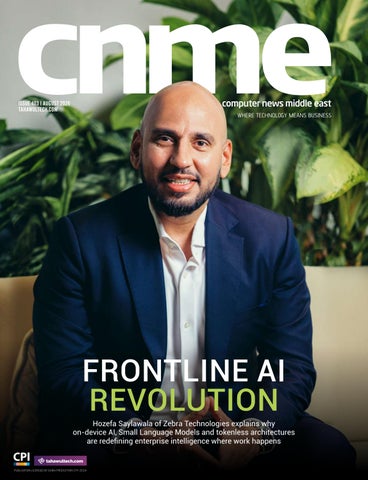
FRONTLINE AI REVOLUTION
Hozefa Saylawala of Zebra Technologies explains why on-device AI, Small Language Models and tokenless architectures are redefining enterprise intelligence where work happens
PUBLICATION LICENSED BY DUBAI PRODUCTION CITY, DCCA
hosted by and in strategic partnership with
Scaling India’s AI, Science & Tech Frontiers Globally
INDIA’S MOST INFLUENTIAL TECH GATHERING AT SCALE #GITEXAIINDIA GITEX-INDIA.COM
GET INVOLVED
EDITORIAL
AI moves from promise to practical impact Our events
Artificial intelligence is entering a more demanding phase. The conversation is no longer centred solely on what AI could achieve, but on how organisations can deploy it securely, responsibly and at scale while delivering measurable value. This shift runs throughout the August 2026 issue of CNME.
Talk to us: Sandhya D'Mello Editor, CNME E-mail: sandhya.dmello@ cpimediagroup.com
Technology is advancing Our online platforms rapidly, but sustainable transformation tahawultech.com depends on more than adoption. Our social media
facebook.com/tahawultech
twitter.com/tahawultech
linkedin.com/in/tahawultech
Our cover story explores how Zebra Technologies is bringing enterprise intelligence closer to frontline workers through on-device AI, Small Language Models and tokenless architectures. Hozefa Saylawala, Senior Director for EMEA, Strategy, Products and Sales Engineering at Zebra Technologies, explains how localised intelligence can reduce dependence on cloud connectivity, control processing costs and support faster decisions where work happens. The approach demonstrates how AI can complement human expertise across retail, logistics, healthcare and manufacturing without replacing the people at the centre of these operations. Infrastructure remains critical to this transformation. Cisco research reveals that 81% of UAE organisations expect AI workloads to push network capacity to its limits within three years. The finding serves as a timely reminder that ambitious AI strategies require modern networks, trusted data foundations, resilient cybersecurity and sufficient computing capacity. Regional momentum is equally evident in Confluent’s research, which identifies the UAE and Saudi Arabia among the global leaders in agentic AI deployment. Yet progress brings greater responsibility. Organisations must establish clear governance, observability and accountability to understand how autonomous agents operate, what decisions they make and whether they deliver genuine business outcomes. Education provides another important dimension. Tarek Jundi, CEO of Ankabut, discusses the connected systems, trusted infrastructure and structured data needed to create AI-ready learning environments while preserving the uniquely human contribution of educators. Other interviews examine Saudi Arabia’s expanding innovation ecosystem, Iraq’s journey towards digital financial inclusion and the emergence of intelligent homes capable of anticipating residents’ needs. This issue also celebrates the leaders shaping the UAE’s digital future through our coverage of the GovTech Innovation Forum & Awards 2026. The event brought together government officials, technology executives, CIOs and CISOs to recognise achievements in AI, cybersecurity, cloud, data infrastructure and digital transformation. Our opinion pages examine the operational questions accompanying this new era, from preserving industrial knowledge and extracting measurable value from AI agents to improving data quality, strengthening observability and applying intelligence across connected environments.
PUBLICATION LICENSED BY DUBAI PRODUCTION CITY, DCCA
Technology is advancing rapidly, but sustainable transformation depends on more than adoption. It requires resilient foundations, responsible leadership and a clear understanding of the problems being solved. This issue captures a region increasingly focused on converting technological ambition into practical, trusted and lasting impact.
INTO NEW WORLDS YOU’RE ONE LEAP AWAY From 31 Aug - 3 Sept 2026 Riyadh Exhibition and Convention Center - Malham, Saudi Arabia
SECURE YOUR PASS NOW
CONTENTS
30
22 COVER STORY
44
Ankabut
DATAIKU
44 AI agents need observability to operate without chaos and Saudi Arabia lead global agentic AI 62 UAE deployment
08
X7e Plus 5G combines endurance, 68 HONOR durability and AI
62
Confluent
Cisco MEA–TRC
81% of UAE organisations expect AI to push 08 networks to their limits GovTech Innovation Forum & Awards 10 celebrates UAE digital leadership builds the foundation for AI-ready 30 Ankabut education in UAE
10
GovTech Innovation Forum & Awards
68
FOUNDER, CPI Dominic De Sousa (1959-2015)
ADVERTISING Group Publishing Director Kausar Syed kausar.syed@cpimediagroup.com
EDITORIAL Editor Sandhya D'Mello sandhya.dmello@cpimediagroup.com
Sales Director Sabita Miranda sabita.miranda@cpimediagroup.com
OnlineEditor Daniel Shepherd daniel.shepherd@cpimediagroup.com
HONOR
Published by
PRODUCTION AND DESIGN Designer Prajith Payyapilly prajith.payyapilly@cpimediagroup.com
DIGITAL SERVICES Web Developer Adarsh Snehajan webmaster@cpimediagroup.com
Publication licensed by Dubai Production City, DCCA PO Box 13700 Dubai, UAE Tel: +971 4 5682993 © Copyright 2026 CPI All rights reserved While the publishers have made every effort to ensure the accuracy of all information in this magazine, they will not be held responsible for any errors therein.
NEWS
DeepSeek examines inhouse chip development
Anthropic considers making Samsung a manufacturing partner Anthropic is reportedly in early stage discussions with Samsung Electronics to serve as a manufacturing partner for a custom-made AI chip. The Information reported the two companies are still working out what the processor should do, how
DeepSeek, the AI start-up based
powerful it needs to be, and how it
compute strategy”, but declined to
would integrate into a server.
share any additional information on its
in China, is reportedly developing
A representative for Anthropic
its own AI chip in a bid to reduce
told Mobile World Live a diversified
chip roadmap.
dependence on processors
hardware stack, which includes
among AI companies to diversify their
developed by Nvidia and Huawei.
Amazon’s Trainium chips, Google’s
chip supply as demand for their services
According to Reuters, the chip
TPUs and Nvidia’s GPUs, “is and will
continues to surge and to lessen
will be designed to tackle inference
remain central to how we scale our
dependence on Nvidia.
The talks reflect a broader push
workloads, a stage of AI computing where trained models are utilised for generating responses for users rather than for training new models.
6
Meta starts planning separate cloud business
The company has apparently been working on the project for about a year and is in talks with external partners including chip-design firms, foundries and memory suppliers. It has also increased recruitment of chip design engineers, although hiring has been conducted privately without public job listings. For DeepSeek, developing its own silicon could alleviate growing pressure from U.S. export
According to recent reports Meta
As part of the plans, Meta will look at
restrictions limiting Chinese
Platforms is planning to set-up a
selling access to AI models that are hosted
companies’ access to advanced AI
separate cloud business. This unit would
on the company’s infrastructure. In such
chips. The company has previously
sell access to computing power and AI
a scenario, sources claim Meta would run
relied on Nvidia and Huawei
models in a move to help fund Meta's
data centres and chips that power the
hardware, including Nvidia’s H800
AI ambitions and reduce reliance on
models and charge developers for access.
chip to train the foundation model
advertising revenue.
behind its R1 reasoning model. However, developing in-house AI
Bloomberg reported the Facebookowner could form the unit to sell
This would set up direct competition with Amazon Web Services’ Bedrock offering, for example.
silicon could still prove a challenge
outside customers excess computer
as China’s access to critical
power, rivalling “neocloud” businesses
first large language model under its
Meta unleashed Muse Spark, its
minerals, advanced manufacturing
such as CoreWeave.
so-called superintelligence push in
facilities and high-bandwidth
The potential business line will be
memory components remains
part of Meta Compute, its offering that
powerful to date and designed to
constrained by U.S. restrictions.
runs and manages AI infrastructure
improve AI features across its social
assets.
media apps.
AUGUST 2026
April, which it positioned as the most
www.tahawultech.com
Microsoft reveals new AI unit Microsoft recently announced that it is investing $2.5 billion into a new business division called Microsoft Frontier Company. This new company is aimed at helping enterprise clients implement and scale AI systems. Microsoft’s Frontier Company is deploying 6,000 engineers, consultants and industry specialists to work directly with customers on designing, launching and improving AI systems tied to measurable business outcomes. Judson Althoff, CEO of Microsoft’s
Bridging the two, he said, requires
commercial business, explained in a blog
deep engineering and industry expertise
differentiated value in the markets that
post companies need two items to succeed
capable of continuously refining how
with AI: a platform where their own
AI agents handle business processes,
organisations run AI models from
proprietary data, expertise and workflows
so that a company’s proprietary
OpenAI, Anthropic, Microsoft’s own
accumulate and improve over time
intelligence keeps compounding and
AI unit, open-source projects or
regardless of which underlying models
translates into measurable results.
specialised industry models, without
they choose, and a separate governance
“This is what Microsoft Frontier
being locked into any single provider.
layer that lets them monitor, control
Company was built to do: focus on
and secure AI systems across their tech
end-to-end Frontier Transformation,
Microsoft’s business in the Americas
stack while tracking return on investment
enabling customers to amplify
and Asia over six years at the company,
through financial operations practices.
their IQ with AI while refining their
serves as president.
they serve”, he said. Althoff noted the platform will let
Rodrigo Kede Lima, who has led
7
WhatsApp to roll out username IDs in privacy push WhatsApp is making
usernames to help provide
preparations to implement
consistency across platforms.
usernames across its
WhatsApp added the
messaging platform. This
reservation period intends
change will allow users to
to help users secure their
connect without sharing
preferred username before
their phone numbers in a
the wider launch, noting its
move aimed at strengthening
base of more than 3 billion
privacy.
users means “a lot of names
WhatsApp said users can
overlap”.
begin reserving optional
Carissa Veliz, professor at
usernames this week, ahead
Oxford University, told BBC
of a phased global launch of
News: “It is a good feature,
the feature over the coming
but even if it does offer more
months. Users who opt-in will be able
searchable public directory or username
privacy, remember WhatsApp is not a
to message new contacts by exchanging
suggestions.
privacy-friendly app overall”. She added
usernames rather than phone numbers. The Meta Platforms-owned service noted the rollout is its “latest
Phone numbers will still be required to create a WhatsApp account. For businesses, creators and
the service “collects much metadata about users for marketing purposes” and argued: “We have to remember that
step to make WhatsApp even more
organisations, the messaging service
WhatsApp is owned by Meta – one of
private” because “a phone number
will allow eligible accounts to claim
the tech companies with the worst track
is personal”, adding there will be no
existing Instagram or Facebook
records when it comes to privacy”.
www.tahawultech.com
AUGUST 2026
NEWS
81% of UAE organisations expect AI to push network capacity to its limits within three years New research, released by Cisco in partnership with Foundry, reveals that organisations in the UAE have approximately three years before AI-driven network traffic increases significantly across key AI workloads, network capacity reaches its limit, and attack surfaces expand beyond what current defences can manage. The study, based on a survey of 200 IT leaders in the UAE (and 3,472 across the world), confirms that the rapid rise of large language models (LLMs) and the emerging wave of agentic AI are placing unprecedented strain on enterprise campus and branch networks. Alongside compute, the network is now
Mohannad Abuissa, MD & CTO, Solutions Engineering, Cisco MEA–TRC.
a major factor in whether enterprise AI deployments succeed or fail. Mohannad Abuissa, MD & CTO,
8
Solutions Engineering, Cisco MEA–
support it, the underlying network
modernisation is becoming essential
TRC, said: “Our study shows that while
infrastructure must continue to evolve
to help organisations unlock the
UAE enterprises display remarkable
at the same pace. As AI workloads
transformative power of AI and ensure
ambition to adopt AI, particularly
increase traffic, latency sensitivity and
investments in this space continue to
agentic AI, and the networks to
security complexity, ongoing network
deliver measurable business value”.
e& and Lenovo collaborate on vehicle tech e&’s Carrier & Wholesale
intelligent mobility and digital
Services unit recently joined
economy projects spanning the
forces with Lenovo Connect to
GCC and other countries.
expand connected vehicle and
Lenovo Connect chief
related IoT services across a
growth officer Charlie Zhao
host of countries.
pointed to rising demand for
The partnership is based
connected mobility and IoT
around combining e&’s
services, stating “reliable
international network
global connectivity becomes
footprint, 5G capabilities and
increasingly critical.”
regulatory knowledge with
Nabil Baccouche, group chief
Lenovo Connect’s technology
Carrier & Wholesale officer at
to provide connectivity for electric
efficiently deploy connected mobility
e&, added the partnership “reflects our
vehicles, connected cars and next-
solutions across multiple markets.
commitment to advancing connected
generation mobility applications. The pair said the agreement aims
Beyond connected vehicle
mobility and IoT innovation worldwide”
deployments, the companies positioned
noting the pair would deliver “a robust
to simplify international rollouts
the deal as supporting wider digital
solution that empowers businesses to
by providing secure and scalable
transformation initiatives, including the
scale connected services with confidence
connectivity, enabling enterprises to
development of smart infrastructure,
across international markets.”
AUGUST 2026
www.tahawultech.com
AWS launches AI engineering unit Amazon Web Services (AWS) recently created a dedicated forward deployed engineering
SpaceX is reportedly prototyping an AI handset
(FDE) organisation designed to embed engineers directly inside customer teams. These engineers will help build and implement production AI systems and compress project timelines from months to days. Backed by a $1 billion
SpaceX is reported to have finished
investment, the model is built
development on a prototype
around three principles: it is agentic-
outcomes rather than billable hours.
first, uses compressed timelines and is
In a blog announcing the new
changing how people interact with
structured so customers become self-
organisation, AWS VP of Frontier AI
AI. The reported device was shown
sufficient once an engagement ends.
Francessca Vasquez emphasised the
to investors and other stakeholders
internal unit will do more than build
during a roadshow ahead of
purpose-built agents directly inside
and maintain requested systems.
SpaceX's since-completed IPO.
customer engineering, business and
“Customers leave AWS FDE
AWS FDE embeds frontier teams and
handset-like device aimed at
The Wall Street Journal (WSJ)
security teams to build production
deployments with both new solutions
reported the device has a sleek
AI systems using the their own data,
and new engineering capabilities”, she
design slimmer than an iPhone
governance and processes.
stated. “Along with agentic systems
and would run on a proprietary
running in their own AWS environment,
operating system while integrating
treats deployments as standalone
they gain lasting AI skills, workflows
AI technology from Elon Musk’s
projects, AWS stated FDE is structured
and patterns they can use to innovate
xAI.
around shared goals and business
independently”.
Unlike traditional consulting, which
Sources told the WSJ the device would use a Qualcomm Snapdragon chipset. SpaceX told some investors
EU outlines funding for AI gigafactories
the project remains at an early stage, with the design subject to change and no certainty the device
The European Union (EU)
will ultimately be produced.
recently outlined plans to
The project reflects Musk’s
provide €10 billion in funding
expanding ambitions across satellite
to build seven AI gigafactories
connectivity, rocketry and AI.
in the union. This news comes
WSJ noted the prototype
in addition to unlocking €20
reportedly draws on the “everything
billion in private investment
app” concept Musk has promoted
for the project.
since acquiring Twitter, now X, in
In its latest push to
2022 which bundle services like
accelerate Europe’s
payments, food delivery and travel
technological sovereignty and close
booking into a single platform.
the gap to the U.S. and China, the EU
software and cloud technology stacks,
The report claims investors
stated the initiative would expand AI
high-speed connectivity and energy-
in SpaceX and Tesla have been
compute capacity and give start-ups,
efficient data centres.
told Musk has long envisioned
SMEs, industry and others access to
They will add to Europe’s network
infrastructure for training, inference
of 19 AI gigafactories with the aim of
platform for his various companies’
and tuning of advanced frontier AI
ensuring the continent can develop
technology, which could also reduce
models.
advanced AI on its own infrastructure in
his reliance on outside hardware
It explained the gigafactories would be
line with EU rules, following standards
makers.
used to combine advanced AI processors,
on data protection, security and ethics.
www.tahawultech.com
a consumer device to serve as a
AUGUST 2026
9
GOVTECH INNOVATION FORUM & AWARDS 2026
10
GOVTECH INNOVATION FORUM & AWARDS 2026 CELEBRATES LEADERS SHAPING UAE’S DIGITAL FUTURE More than 50 awards presented as government entities, technology leaders and innovators are recognised for advancing AI, cybersecurity, digital transformation and smart government.
AUGUST 2026
www.tahawultech.com
Senior government officials, technology executives, CIOs, CISOs and digital transformation leaders gathered at The RitzCarlton JBR, Dubai, for the GovTech Innovation Forum & Awards 2026, an evening dedicated to celebrating the organisations and individuals driving the UAE’s next chapter of digital government and technology innovation. Organised by CPI Media Group, the event showcased how artificial intelligence, cybersecurity, cloud, data infrastructure, blockchain and emerging technologies are transforming public services, strengthening national resilience and accelerating the UAE’s vision of becoming one of the world’s leading digital nations. The evening commenced with a welcome address by Sandhya D’Mello, Technology Editor, CPI Media Group, who highlighted the importance of collaboration between government institutions, technology providers and industry leaders in delivering secure, citizen-centric and AI-enabled public services. The programme featured keynote presentations by Karthikeyan Gunasekar, Technologist for MEA, AI Networking Evangelist WW, Consulting Systems Expert, HPE, who explored how intelligent networking is becoming the foundation for AI-native enterprises,
www.tahawultech.com
and Wassim Abi Saab, Regional Alliances & Channel Manager, Everpure, formerly Pure Storage, who shared insights into building resilient, AI-ready data platforms capable of supporting the next generation of enterprise innovation. A key highlight of the forum was an engaging panel discussion moderated by Sandhya D’Mello, bringing together distinguished government and industry experts including Eric Badenhorst, Sales Engineering Director – META, Rubrik; Fadi Kanafani, General Manager – Technology, Yas Holding Technology; Haitham Saif, Field Chief Technology Officer – Middle East and Africa, HPE Networking; Marwah Eissa, Information Technology Specialist, Digital Transformation Department, Ministry of Finance, UAE; Mohit Pandey, Head of Sales – Middle East, Turkey and Africa, Seagate Technology; Muhannad Khattab, Managing Director – UAE, NTT DATA; and Murad Ali, Head of GCC at Logitech for Business. The panel explored how organisations can strengthen cyber resilience beyond traditional backup and recovery, transform AI investments into measurable business outcomes, modernise enterprise networks for AI workloads, build resilient data infrastructures, accelerate
digital transformation through trusted governance and create intelligent workplaces that enable secure, productive and AIpowered collaboration. The programme continued with an insightful fireside chat, featuring Mario M. Veljovic, General Manager at VAD Technologies and Maya Zakhour, Partner Ecosystem Director, BeyondTrust, also moderated by Sandhya D’Mello. The conversation explored how artificial intelligence, emerging technologies and digital innovation are reshaping industries, creating new opportunities for growth and redefining leadership in an increasingly AI-driven world. The session also highlighted the importance of responsible AI adoption, cross-sector collaboration and human-centric innovation in building resilient, future-ready organisations. The evening culminated in the GovTech Innovation Awards, where more than 50 awards were presented to outstanding government entities, public sector departments, technology companies and individual leaders for their achievements across AI implementation, cybersecurity, digital infrastructure, blockchain, data management, smart mobility, public-private partnerships, citizen empowerment, operational excellence, government
AUGUST 2026
11
GOVTECH INNOVATION FORUM & AWARDS 2026
12
technology leadership and digital transformation. Speaking at the event, Kausar Syed, Group Publishing Director, CPI Media Group, said: “The GovTech Innovation Forum & Awards has become a platform for recognising the leaders and organisations transforming ambitious digital strategies into measurable national impact. This year’s winners demonstrate that meaningful innovation is driven not only by technology, but by visionary leadership, trusted partnerships and a commitment to delivering better outcomes for citizens. Their achievements continue to reinforce the UAE’s position as a global benchmark for digital government and technology excellence.” The event was supported by leading technology partners including Gold Sponsors Everpure, Alpha Data, HPE, Logitech, NTT DATA, Rubrik, Trend AI, Yas Holding Technology, and ZKTeco and
Silver Sponsors: Finesse, Gruve, Seagate and ASBIS.. The sponsors showcased innovations that are helping governments and enterprises strengthen cyber resilience, modernise digital infrastructure, accelerate AI adoption and build secure, intelligent and future-ready organisations. One of the evening’s standout recognitions, the Digital Transformation Project of the Year – UAE, was presented to Emirates NBD for successfully driving a large-scale digital transformation initiative that has strengthened operational excellence, enhanced customer experiences, and delivered measurable business outcomes through technology-led innovation. The award also recognised the collaborative efforts behind the achievement, with Office Connect acknowledged as Emirates NBD’s strategic technology and services partner for its contribution in implementing digital workflow and automation solutions that streamlined processes, reduced manual intervention, and enabled more efficient
The GovTech Innovation Forum & Awards has become a platform for recognising the leaders and organisations transforming ambitious digital strategies into measurable national impact. Kausar Syed, Group Publishing Director, CPI Media Group.
service delivery across key business functions. The recognition underscored the growing importance of ecosystem partnerships in accelerating enterprisewide digital transformation and delivering long-term business value. Among the evening’s standout winners were Dubai Multi Commodities Centre (DMCC), recognised as Dubai IT Department of the Year for its pioneering adoption of AI, automation and immersive digital technologies; Abu Dhabi Police GHQ, honoured through Lt. Col. Dr. Hamad Al Nuaimi, recipient of the Critical Infrastructure Technology Visionary of the Year award for advancing missioncritical communications and public safety technologies; Aldar Properties PJSC, whose Mohamed Al Shamsi received the Government Infrastructure & Operations Leader of the Year award for driving secure and resilient technology operations; and Dr. Majeda of Edge, Integrated Transport Company – Abu Dhabi Mobility and Dubai Culture & Arts Authority. The GovTech Innovation Forum & Awards 2026 concluded with a celebration of the region’s most inspiring government technology leaders and organisations, recognising their outstanding contributions to advancing digital transformation, fostering innovation and shaping the future of smart government across the UAE and the wider region.
AUGUST 2026
www.tahawultech.com
13
www.tahawultech.com
AUGUST 2026
GOVTECH INNOVATION FORUM & AWARDS 2026
Rubrik AI-Powered Cybersecurity Solution of the Year
Logitech
Seagate Technology
Hybrid Workplace Collaboration Vendor of the Year
Best AI Infrastructure Enabler of the Year
14
ZKTeco Government Security Solutions Provider of the Year
AUGUST 2026
Everpure
VAD Technologies
Enterprise Data Platform of the Year
AI Data Management Solutions Distributor of the Year
www.tahawultech.com
CPX Holding
Dubai Culture & Arts Authority, Government of Dubai
UAE Empowerment Initiative of the Year
Innovative Initiative of the Year
15
Emirates NBD Digital Transformation Project of the Year - UAE
Hassan Alnoon National Experts Program
Hadi Anwar CPX Holding
Jinson Pappachan Emirates Policy Center
Sovereign AI Transformation Leader of the Year
National Cybersecurity Leader of the Year
Knowledge and Innovation Leader of the Year
www.tahawultech.com
AUGUST 2026
GOVTECH INNOVATION FORUM & AWARDS 2026
Integrated Transport Centre - Abu Dhabi Mobility Innovative Management Systems and Projects of the Year
16 Marwah Eissa Ministry of Finance, UAE
Shafiullah Ismail Mubadala Capital
Dr. Majeda Al Marzooqi EDGE Group PJSC
Excellence in Government Technology Enablement
Digital Trust & Cyber Resilience Leader of the Year
Woman in Government Technology Leadership Excellence
Municipality & Planning Department, Government of Ajman Ajman IT Department of the Year
AUGUST 2026
www.tahawultech.com
Dubai Multi Commodities Centre Authority (DMCC) Dubai IT Department of the Year
17
IFS Industrial AI Innovation Excellence Award
Emirates Integrated Registries Company (EIRC) National Digital Infrastructure Project of the Year
Sharjah City Municipality
Ankabut
Sharjah IT Department of the Year
EdTech Ecosystem Enabler of the Year
www.tahawultech.com
AUGUST 2026
GOVTECH INNOVATION FORUM & AWARDS 2026
Mohammed Munib National Bonds Corporation
Mohammed Rizwan Razeek Abdullah Aldah Group
Future IT Leader of the Year
CISO of the Year
Rathod Govind Mahesh Naik EtihadWE Cyber Risk Management Leader of the Year
18
Dubai Taxi Company PJSC Smart City Initiative of the Year
ASBIS Middle East
Yas Holding Technology
Data Center Solutions Provider of the Year
Digital Transformation Enabler for Public Sector
AUGUST 2026
Mohammad Al Suwaidi Dubai Air Navigation Services (dans) Aviation Technology Visionary of the Year
www.tahawultech.com
Gruve Agentic AI Powered Cyber Excellence Award
Biju Hameed Dubai Airports Government IT Leader of the Year
19
Muhammad Affan Sharjah Maritime Academy (SMA) Future Intelligence Leader of the Year
Lt. Col. Dr. Hamad Al Nuaimi Abu Dhabi Police GHQ
Saif Al Shehhi EDGE Group PJSC
Critical Infrastructure Technology Visionary of the Year
Outstanding Excellence in IT and Cybersecurity
Ahmed AlSharawi Federal Tax Authority Government Digital Foundations Leader of the Year
www.tahawultech.com
AUGUST 2026
GOVTECH INNOVATION FORUM & AWARDS 2026
Ministry of Health and Prevention (MoHAP) Public and Private Partnership of the Year
20 Ali Al Kaf Alhashmi Mubadala
AUGUST 2026
Mohamed Al Shamsi Aldar Properties PJSC
Future-Ready Technology Leader of the Year
Government Infrastructure & Operations Leader of the Year
Fujairah Martial Arts Club
Dubai World Trade Centre
Citizen Empowerment Initiative of the Year
AI Implementation of the Year
www.tahawultech.com
Towell Auto Group, Oman Digital Transformation Project of the Year - Oman
21 Anton MuthuKumar Benjamin Fernando Department of Health - Abu Dhabi
Omar Aburub Engineering Office, Government of Dubai
Dr. Mohammad Alawadhi Ministry of Health and Prevention (MoHAP)
Cyber Risk & Resilience Leader of the Year
Operational Excellence in Government Technology
Government Visionary Leader of the Year
Sam Roberts Emirates Nuclear Energy Company (ENEC) Technology Operations Visionary of the Year
Nasser Alneyadi Ministry of Interior – UAE Government Security Leader of the Year
Wahib M. Yusuf Emarat - Emirates Petroleum Company Smart Government Innovation Leader of the Year
Loun Ahmed Ibrahim Al-Hosani Ministry of Culture, Government of the United Arab Emirates Cultural Innovation Leader of the Year
Dr. Fayid Kadambodan Dubai Integrated Economic Zones Authority (DIEZ) Technology Business Leader of the Year
The General Administration of Customs –
Ammar Al Braiki Dubai Taxi Company PJSC Innovative and Sustainable Future Accelerator of the Year
Waleed Aldhuhoori Roads & Transport Authority (RTA), Government of Dubai Digital Transformation Leader of the Year
Yanal Qasim Alkhasoneh The General Administration of Customs – Abu Dhabi Strategic AI Leader of the Year in Government
Abu Dhabi Best Blockchain Implementation of the Year
Emirates Health Services (EHS) Government Pioneer of the Year
www.tahawultech.com
AUGUST 2026
COVER STORY
22
Hozefa Saylawala, Senior Director for EMEA – Strategy, Products and Technical Architects, Zebra Technologies.
AUGUST 2026
www.tahawultech.com
Zebra Technologies
FRONTLINEOPTIMISED AI: BRINGING ENTERPRISE INTELLIGENCE TO THE EDGE Hozefa Saylawala, Senior Director for EMEA – Strategy, Products and Technical Architects at Zebra Technologies, explains how on-device AI, Small Language Models (SLMs) and tokenless architectures are helping organisations reduce cloud costs, boost productivity and empower frontline workers with intelligent, real-time decision-making. Artificial intelligence is rapidly moving beyond cloudbased copilots and generic chatbots into the hands of frontline workers who keep global supply chains, retail operations, healthcare services and logistics networks running. Yet many organisations continue to face challenges around cloud dependency, unpredictable token-based costs, data privacy and unreliable connectivity, making it difficult to scale AI where it can deliver the greatest operational impact. Zebra Technologies is taking a different approach by bringing AI directly to
www.tahawultech.com
the edge through on-device intelligence, Small Language Models (SLMs) and tokenless AI designed specifically for frontline environments. Rather than replacing workers, the company's AI strategy focuses on augmenting human decisionmaking with fast, secure and context-aware assistance that continues to operate even without an internet connection. Leading this vision across Europe, the Middle East and Africa is Hozefa Saylawala, Senior Director, EMEA – Strategy, Products and Sales Engineering at Zebra Technologies.
23
A technology industry veteran with more than two decades of experience, Hozefa is responsible for driving the regional strategy behind Zebra's intelligent automation, connected frontline and asset visibility initiatives while overseeing product strategy, industry solutions, sales engineering and the company's ISV ecosystem. Widely recognised for his expertise in the practical application of AI and machine vision to solve enterprise challenges, he regularly advises customers and partners on transforming frontline operations through intelligent technologies.
AUGUST 2026
COVER STORY
In this exclusive interview with CNME, Hozefa explains why the future of enterprise AI lies beyond the cloud, how on-device intelligence and tokenless AI can reduce costs while improving productivity, and why organisations should rethink the way they deploy AI across their frontline workforce. Interview Excerpts
24
What does Zebra mean by frontline-optimised AI, and how is it different from the broader enterprise AI narrative? Before answering that, I'd like to share some exciting news. Zebra Technologies was recently recognised by The Wall Street Journal among the world's top AI companies, alongside names such as NVIDIA, Intel, Alphabet and Microsoft. It is a proud moment for us and reflects the unique role Zebra plays in the AI ecosystem. To understand why, think of today's AI industry as a modern-day gold rush with three key participants. The first are the tool makers that build the powerful chips powering AI, represented by companies such as NVIDIA and Intel.The second are the landowners, represented
By keeping AI tokenless and localised, enterprises can avoid the unpredictable costs associated with cloud processing and API usage. by cloud and AI platform providers such as Microsoft and Alphabet, which provide the infrastructure and intelligence. The third are the miners, and this is where Zebra fits in. We take AI into the field and put it to work in the physical world. While many technology companies focus on AI for digital environments such as office software, websites and cloud applications, the global economy runs on physical work, including warehouses, retail stores, transportation networks and hospitals. Zebra enables AI where frontline work actually happens. Millions of frontline workers use Zebra handheld computers, scanners and sensors every day. By embedding AI directly into these devices, Zebra bridges the gap between digital intelligence and physical operations. A warehouse worker needs immediate answers such as where a shipment is located, how to process a return or what task to perform next. That is
Frontline-optimised AI is designed specifically for the fast-paced environment in which frontline workers operate. AUGUST 2026
why Zebra develops highly specialised, task-specific AI. The AI is trained on industryspecific workflows, standard operating procedures (SOPs) and operational processes across retail, transportation, logistics and healthcare, making it practical, accurate and ready for deployment from day one. While some use cases and agentic workflows require private and hybrid cloud, frontline-optimised AI is designed specifically for the fast-paced environment in which frontline workers operate. It delivers responses in milliseconds, works even without an internet connection, avoids recurring token-based usage fees and keeps sensitive enterprise data securely on the device rather than sending it to the cloud. Why are large clouddependent AI models not always practical for frontline environments such as warehouses, retail floors and field operations? There are three primary reasons, which include speed, connectivity, and cost. The first is speed, where the Cloud-based AI requires every request to travel to the cloud before a response is returned. Even a delay of a few seconds can affect productivity when a worker is assisting a customer, scanning inventory or fulfilling an order. The second is connectivity. Frontline workers often operate in warehouse basements, remote locations or areas with unreliable
www.tahawultech.com
25 Wi-Fi or mobile coverage. Without connectivity, cloud AI becomes unavailable when it is needed most. The third is cost. Most cloud AI platforms charge according to token consumption. For organisations with thousands of frontline workers using AI throughout the day, these recurring costs can quickly become significant and difficult to predict. For these reasons, cloud-dependent AI is not always the most practical model for frontline operations. How do Small Language Models (SLMs) bring intelligence directly onto handheld mobile devices used by frontline workers? Most people are familiar with Large Language Models
www.tahawultech.com
(LLMs), but Small Language Models (SLMs) are equally important for enterprise operations. An SLM is essentially a compact AI model that runs directly on a Zebra mobile computer instead of relying on a cloud data centre. This delivers two significant advantages. First, it places intelligence directly into the worker's hands. Instead of sending every request to the cloud, the AI processes information locally and delivers responses almost instantly. Second, it is highly specialised. Rather than drawing information from the entire internet, the SLM is trained on an organisation's own SOPs, manuals, product catalogues and operational procedures. As a result, it
provides highly relevant and context-specific answers without being distracted by irrelevant information. This combination of local processing and domainspecific knowledge makes SLMs especially valuable for frontline environments. Can you explain Zebra's Frontline AI portfolio, including AI Enablers, AI Blueprints and AI Companion, in simple terms? We have intentionally designed our Frontline AI portfolio so organisations can adopt AI at different levels depending on where they are in their digital transformation journey. Think of it as three connected building blocks. The first layer is AI Enablers. These are
AUGUST 2026
COVER STORY
26
specialised AI capabilities that perform individual tasks such as reading multiple barcodes simultaneously, recognising products on shelves or identifying objects through computer vision. They serve as reusable AI components that developers can easily integrate into applications instead of building sophisticated AI models from scratch. They are essentially the building blocks of enterprise AI. The second layer is AI Blueprints. These combine multiple AI Enablers, APIs and workflows into readymade solutions for common frontline scenarios such as inventory management, warehouse operations and automated shelf auditing. Instead of starting with a blank page, organisations receive proven frameworks that can be customised for their own operations,
Hozefa Saylawala is the Senior Director for EMEA – Strategy, Products and Technical Architects at Zebra Technologies. In this role, he is responsible for defining and executing the regional strategy to drive market share growth and accelerate the adoption of Zebra’s key strategic pillars: Connected Frontline Asset Visibility, and Intelligent Automation. A 20-year veteran of the technology industry, Hozefa joined Zebra in 2004 and has a proven track record of success, including previous experience at Hewlett Packard and Dell. He is a recognised thought leader on the practical application of AI and machine vision to solve enterprise
AUGUST 2026
significantly reducing implementation time while ensuring AI continues to improve through ongoing monitoring and optimisation. The third layer is AI Companion, which is the capability frontline workers interact with directly. It is a conversational AI assistant that runs on Zebra mobile devices and allows employees to ask questions naturally, such as, "How do I process a return?" or "What is the procedure for this task?" AI Companion searches the organisation's own manuals and operating procedures, provides immediate answers and can even launch the relevant application or workflow to guide the worker through the next step. Together, AI Enablers, AI Blueprints and AI Companion create a complete AI ecosystem that supports developers, enterprise
challenges and is a sought-after speaker and juror for industry events. Hozefa leads a diverse organisation that includes Zebra’s Products teams, who manage the lifecycle of Zebra’s innovative hardware and software portfolios; the Industry Solutions Group, whose vertical specialists architect solutions for specific customer environments; and the Sales Engineering teams, whom Hozefa is transforming into industry evangelists and trusted advisors for customers and partners. He also guides the Independent Software Vendor (ISV) programme, fostering a robust partner ecosystem to deliver comprehensive and integrated solutions.
IT teams and frontline employees alike. This layered approach enables organisations to accelerate AI adoption while delivering practical, measurable business outcomes across frontline operations. What is tokenless AI, and why should CIOs and IT leaders pay attention to it? Tokenless AI simply means AI that does not charge organisations every time it is used. Most cloud-based AI platforms calculate costs based on tokens, with every prompt and response contributing to ongoing usage charges. For CIOs and IT leaders, this creates a significant challenge because AI costs become increasingly difficult to forecast as adoption expands across the organisation. Tokenless AI addresses this by enabling AI to run locally on Zebra devices using Small Language Models. This provides several important business benefits. It delivers predictable budgets because AI costs are known upfront instead of increasing with usage. It enables unlimited AI usage without concerns about token consumption. Most importantly, it improves return on investment by eliminating recurring cloud AI costs while still delivering powerful AI capabilities to frontline workers. Although AI-enabled devices may require a higher upfront investment, organisations achieve stronger long-term value
www.tahawultech.com
through lower operating costs, improved productivity and greater cost predictability. How can tokenless and localised AI architectures help enterprises avoid unpredictable cloud and API usage costs? By keeping AI tokenless and localised, enterprises can avoid the unpredictable costs associated with cloud processing and API usage. The biggest advantage is that AI runs directly on the Zebra device instead of sending every request to a cloud server for processing. I often compare this to owning your own highway rather than paying a toll every time you drive. Once AI operates locally, there is effectively no toll booth. The second advantage is a fixed-cost model. The primary investment is the AI-enabled hardware itself. Once an organisation deploys a Zebra AI-capable device, the ondevice AI capabilities can be used without recurring token or API charges. This fundamentally changes the economics of enterprise AI, shifting organisations from unpredictable operational expenditure (OpEx) to a more predictable capital investment (CapEx). It gives CIOs greater budget certainty while allowing employees to use AI as often as they need without worrying about escalating usage costs. How does Zebra's AI strategy help organisations reduce cloud costs and improve
www.tahawultech.com
27
the total cost of ownership (TCO) of frontline mobile computing? Procurement cost is often the first concern customers raise, particularly organisations that are highly price-sensitive. However, businesses should evaluate technology over its entire lifecycle rather than focusing solely on the initial purchase price. A mobile device typically remains in service for three to five years. During that period,
recurring cloud AI charges, software subscriptions and productivity losses can significantly exceed the original hardware investment. Zebra's AI strategy improves total cost of ownership in three important ways. First, by running AI directly on the device, organisations significantly reduce or even eliminate cloud processing costs. Second, they avoid
AUGUST 2026
COVER STORY
recurring software and AI usage fees while enabling frontline workers to become more productive using the same device. This increases operational efficiency without introducing additional ongoing expenses. Third, because AI continues to function offline, employees remain productive even during network outages or in locations with limited connectivity. Eliminating downtime translates directly into higher productivity and lower operating costs. Taken together, these benefits deliver a stronger return on investment and a significantly lower total cost of ownership throughout the device's lifecycle.
28
Why should organisations upgrade to AI-enabled hardware now instead of waiting for AI use cases to mature further? Waiting comes with its own cost. Organisations that delay AI adoption risk losing productivity and operational efficiency every day, even though those costs are not always immediately visible on the balance sheet. Today's Zebra mobile
An SLM is essentially a compact AI model that runs directly on a Zebra mobile computer instead of relying on a cloud data centre. AUGUST 2026
computers are already equipped with dedicated AI processors designed to run ondevice AI models efficiently. They provide the foundation for both current and future AIdriven workflows. There are three compelling reasons to upgrade now. First, organisations can immediately improve workforce productivity and operational accuracy using AI capabilities that are already available today. Second, early adopters gain a competitive advantage by enabling frontline employees to make faster, more informed decisions while competitors continue to rely on traditional workflows. Third, organisations future-proof their technology investments. AI-ready hardware is designed to support evolving AI capabilities without requiring frequent hardware refreshes, resulting in stronger ROI and a longer technology lifecycle. Rather than waiting for future AI innovations, organisations can begin realising measurable business value today while ensuring they are prepared for the next generation of enterprise AI. How do Zebra's AI offerings empower frontline workers rather than replace them, and what impact could this have on enterprise mobility in the Middle East? Zebra's AI is designed to augment people, not replace them. It acts as a digital assistant that helps frontline workers perform their jobs more efficiently, accurately
and confidently. Instead of relying on guesswork, employees can ask questions in natural language and receive immediate, context-aware guidance based on company procedures, policies and workflows. This enables workers to make better decisions while reducing errors. AI also accelerates routine tasks by proactively providing relevant information and recommending the next best action. Rather than spending valuable time searching for information, workers can focus on serving customers, managing inventory or completing operational tasks. Another major advantage is breaking down language barriers. Many frontline workers operate in multilingual environments where standard operating procedures may be written in English even though employees speak different native languages. Zebra's AI capabilities support real-time translation, allowing workers to ask questions and receive guidance in their preferred language while accessing the same enterprise knowledge base. For organisations across the Middle East, this creates a more productive, betterinformed and more inclusive frontline workforce. AI is not replacing employees; it is equipping them with intelligent tools that improve decision-making, enhance service quality and enable enterprise mobility at a much higher level.
www.tahawultech.com
HOSTED BY
OFFICIAL GOVERNMENT CYBERSECURITY PARTNER
OFFICIALLY SUPPORTED BY
MIDDLE EAST AND AFRICA’S
SCAN HERE
GET FREE VISITOR PASS
SPONSORS & PARTNERS
#gisecglobal gisec@dwtc.com
INTERVIEW
ANKABUT
ANKABUT BUILDS FOUNDATION FOR AI-READY EDUCATION IN UAE Tarek Jundi explains how connected systems, agentic AI and trusted digital infrastructure can transform learning while preserving the uniquely human role of educators
30
Artificial intelligence is rapidly moving from an experimental technology to a strategic requirement across the UAE’s education sector. However, successful adoption depends on more than deploying new tools. Educational institutions need connected systems, structured data, trusted infrastructure and unified digital experiences capable of supporting AI at scale. Ankabut is positioning itself as a national enabler of this transformation, evolving from an infrastructure services provider into an integrated education ecosystem partner. The company aims to create what it describes as an “education operating system” that connects applications, data and users across schools and universities. In an exclusive interview with CNME, Tarek Jundi, CEO of Ankabut, discusses institutional readiness for the
AUGUST 2026
UAE Ministry of Education’s Nova initiative, the potential of agentic AI in classrooms and school operations, the importance of data sovereignty and the human qualities technology must never replace.
Interview Excerpts What does genuine Nova readiness look like for UAE educational institutions, and how is Ankabut helping them prepare? Nova, an initiative introduced by the UAE Ministry of Education, signals a new national vision for the adoption of AI and generative AI. AI-driven transformation is no longer optional. It has become an institutional mandate. The real question is whether schools and universities are equally prepared for this transformation. Readiness is
not simply about possessing AI tools because most institutions already use some form of digital technology. The deeper challenge is that many of these tools and systems do not communicate with one another. Introducing AI into a fragmented environment is like trying to operate a highperformance engine using poor-quality fuel. Technology tends to underperform when the underlying foundation is not ready. Genuine readiness requires structured data, seamless information flows across applications, connected systems and the ability to make decisions in real time. Ankabut helps institutions build this foundation by connecting their existing systems, applications and digital environments. We structure the data, unify the user experience and establish an agentic AI service-
www.tahawultech.com
Tarek Jundi, CEO, Ankabut.
31
www.tahawultech.com
AUGUST 2026
INTERVIEW
delivery platform capable of supporting initiatives such as Nova.
How can agentic AI transform learning and daily operations in K-12 schools?
32
For decades, organisations have built systems that wait for people to ask questions or provide instructions. Agentic AI changes this model by enabling systems to identify issues and initiate appropriate action before people intervene. If a student’s attendance begins to decline or their academic performance changes, an agentic AI system could identify the pattern, alert the appropriate people and trigger a relevant support mechanism. This could happen before the student, teacher or parent fully recognises the problem. The same principle can be applied to school and university operations. Agentic AI can support scheduling, parent communications, compliance reporting and other routine administrative responsibilities, giving educators more time to focus on work requiring human judgement. The UAE’s introduction of an AI curriculum reflects this broader ambition. Students are not only learning technical skills but also examining AI ethics and its role in society. This approach can strengthen critical thinking and help students progress from being users of technology to becoming its designers and creators.
AUGUST 2026
How is Ankabut empowering schools, students and parents while supporting the UAE’s vision for AI-driven education? Parents frequently need to access several applications simply to understand how their child is performing. Students can also encounter different learning environments across schools or even within the same institution. Teachers often spend a significant part of their working day completing administrative tasks. This fragmented experience is neither efficient nor sustainable. A genuinely connected education ecosystem can address these challenges.
Ankabut aims to serve as a trusted national enabler by bringing these systems and experiences together. We are working towards building what we describe as the operating system of a school. This represents Ankabut’s evolution from an infrastructure services provider into a comprehensive education ecosystem partner capable of supporting institutions, educators, students and parents through one connected environment.
What should remain uniquely human in education as AI becomes more capable? Students may not remember every worksheet they completed or every digital
www.tahawultech.com
tool they used, but they often remember the teacher who believed in them when nobody else did. No AI system can replicate that experience. Empathy, curiosity and the ability to inspire are distinctly human qualities. A teacher can read the room, connect a subject to a student’s reallife experience and adjust a lesson or communication style according to the situation. These capabilities are built on trust and relationships, not merely data. AI and agentic AI should manage repetitive tasks and give teachers more time to focus on areas requiring human involvement. The purpose of AI is not to compete with educators but to create the time and space they need to teach, guide and inspire more effectively.
Why is the UAE well positioned to become a global leader in AIenabled education? Education is inherently a high-trust sector because it involves student data, research intellectual property and academic integrity. The UAE is well positioned because it has treated AI as a national priority for several years and supported its ambitions with clear direction and governance. AI cannot operate effectively in isolated environments. Some countries introduce governance frameworks only after problems emerge, but the UAE has worked to establish the necessary conditions in
www.tahawultech.com
advance. Its focus on data privacy, sovereignty and responsible governance gives institutions the confidence to move forward. AI needs infrastructure that respects data privacy, cloud sovereignty and regulatory requirements. With these foundations in place, educational institutions can concentrate on execution while remaining protected by an established governance framework.
Should every student become AI literate, and what does AI literacy mean in practice? AI literacy should be treated as a lifelong capability rather than an elective subject or a one-time module. Students will carry these skills into every job they undertake and many areas of their daily lives. Effective AI literacy cannot focus solely on restrictions and risks. Students must also understand the technology’s capabilities and learn to question its outputs, recognise its limitations and examine how AI models are designed and applied. Ethics and governance remain important, but education must go further. If we concentrate only on caution, we risk raising a generation of responsible consumers rather than capable creators. Students need the knowledge and confidence to move from using today’s AI models to designing tomorrow’s technologies. Genuine AI literacy should enable the next generation to
shape technology rather than simply consume it.
How does Ankabut support trusted infrastructure, data sovereignty and academic integrity across educational institutions? The central challenge is not the technology itself but the fragmentation of infrastructure, data and user experiences. Fragmented foundations inevitably produce fragmented AI use cases. Ankabut is building an environment designed for AI from the outset instead of adding generative AI capabilities later. We are investing in three principal areas: AI-enabled digital campuses, unified user experiences and structured data. Students, teachers and administrators should be able to access services through a unified presentation layer, whether through a mobile application or a digital portal. Meanwhile, institutional data must be structured and connected so it can support secure and effective AI applications. Bringing these elements together creates a cohesive education environment and moves us closer to what we call an education operating system for schools and universities. Ankabut is not seeking to introduce another disconnected platform. Our goal is to provide the unifying layer that brings existing systems together seamlessly.
AUGUST 2026
33
INTERVIEW
First Iraqi Bank
FIRST IRAQI BANK BUILDS IRAQ’S DIGITAL FINANCE FUTURE WITH SEAMLESS CONSUMER EXPERIENCE Kawa Junad, Founder and Shareholder, First Iraqi Bank, explains why simplicity, trust, and everyday use cases hold the key to financial inclusion in a cash-heavy economy
34
Iraq’s journey towards digital finance is unlike that of most markets in the region. With fewer than one-third of adults holding a bank account, the country’s transformation is not simply a shift from cash to digital payments but, for many citizens, a first step into formal financial services altogether. Building adoption in such an environment demands more than
technology. Education, trust, accessibility, and a growing ecosystem of everyday use cases all play a decisive role. Kawa Junad, has been at the centre of this shift, guiding efforts to bring simple, secure, and reliable digital banking to consumers and merchants across a traditionally cash-heavy economy. From QR payments and Soft POS solutions
Kawa Junad.
that lower barriers for small businesses, to digital onboarding and eKYC that ease account opening, the focus has remained on removing friction while safeguarding the integrity of the system. The following excerpts capture Junad’s insights on the technologies accelerating financial inclusion, the foundations of consumer and merchant trust, and the road ahead for embedding digital finance into everyday life in Iraq, along with the lessons this journey offers other emerging markets.
Interview Excerpts: How did your telecom background shape the way you approached building digital banking? My telecom background shaped how I approach digital banking. Telecom teaches you that a service is only as strong as the infrastructure behind it — coverage, reliability, scale and ease of use. Customers rarely notice the network when it works, but feel it immediately when it fails. I brought that mindset to Iraq, where the task was not simply launching an app but building
AUGUST 2026
www.tahawultech.com
the full system around the customer: connectivity, onboarding, merchant acceptance, trust, compliance and daily usefulness. Both sectors are infrastructure businesses requiring scale, reliability and trust, and both connect people to essential services in this market.
What does digital transformation look like in a market where many people are still transitioning from cash to formal banking services for the first time? Digital transformation in Iraq begins from a more foundational starting point than in mature banking markets. Fewer than onethird of adults hold a bank account, which means most customers are not simply shifting from cash to digital payments but entering formal financial services for the first time. Technology alone is therefore insufficient; education, awareness, trust, and access are equally critical. Early efforts focused on explaining the value of banking itself before demonstrating the convenience of a digital bank. Success depends on simple products, effortless onboarding, and immediate, everyday benefits. Ultimately, transformation is a gradual process of changing habits and building confidence.
Which technologies have had the greatest impact on accelerating financial inclusion and adoption? The greatest impact has
www.tahawultech.com
come from technologies that remove friction for customers and merchants alike. QR payments and Soft POS have proved particularly significant, enabling small businesses to accept digital payments through smartphones they already own, without additional hardware or cost. Merchant acceptance remains one of the strongest drivers of customer adoption, as people use digital payments only where they shop, dine, and access services. Digital onboarding, facial recognition, and eKYC have similarly lowered barriers to account opening while preserving security and compliance. The most impactful technologies simplify the customer experience while strengthening the reliability of the system behind it.
What does it take to build trust in digital banking among consumers and merchants traditionally reliant on cash? Trust is built through repeated, reliable experience. Cash is familiar, and digital banking must earn that same confidence over time. For consumers, services must be simple, secure, and consistently dependable; a failed payment or slow support damages trust quickly. For merchants, the value must be practical,
Transformation is a gradual process of changing habits and building confidence.
easing daily operations rather than simply appearing modern. Education is equally vital in a market where many are new to formal banking, which is why we engaged customers where they lived, studied, and shopped. As digital payments become visible across local merchants, bills, and transfers among family and friends, familiarity gradually changes behaviour.
What still needs to happen for digital finance to become part of everyday life across Iraq, and what can other emerging markets learn? The next stage is embedding digital finance into normal daily behaviour, spanning merchant payments, bills, salaries, expense management, and government services. Achieving this requires reliable connectivity, simple onboarding, accessible merchant tools, customer education, and regulation that supports innovation while protecting system integrity. SMEs are critical, needing payment acceptance, cash management, and growthenabling services embedded within the platforms they already use. Embedded finance will define the future, with financial services integrated seamlessly into everyday activities rather than standalone applications. The lesson for other emerging markets is clear: fintech scales when infrastructure, trust, regulation, merchant acceptance, and customer behaviour evolve together.
AUGUST 2026
35
INTERVIEW
Nasser Centre for Science and Technology
PEOPLE, NOT TECHNOLOGY, DECIDE FATE OF AI PROJECTS Shereen Faisal, Project Manager and AI Data Scientist at Nasser Centre for Science and Technology, tells Tahawultech.com why transparency, governance, and focused pilot projects are essential to overcoming hesitation and scaling AI successfully.
36
Artificial intelligence has moved firmly onto boardroom agendas across the region, yet hesitation continues to slow adoption among organisations and end users alike. Concerns around trust, transparency, data protection, and the impact on people and established workflows remain the most common barriers, often outweighing questions about the technology itself. Shereen Faisal, Project Manager and AI Data Scientist at Nasser Centre for Science and Technology, believes confidence in AI is earned through honest communication, strong governance, and practical results delivered in a controlled and transparent way. Speaking to CNME, Faisal explains why focused pilot projects create internal advocates, how leaders can set realistic expectations, and why placing people at the
centre of every initiative is the surest path to scaling AI successfully and sustainably.
Interview Excerpts What are the biggest reasons organisations and end users remain hesitant to embrace AI projects today? Hesitation is rarely about the technology itself. It stems from uncertainty about how AI makes decisions, how reliable it is, how data is used, and its impact on people and established ways of working. For organisations, the biggest concern is trust. Leaders need assurance that AI will produce reliable outcomes, operate securely, and comply with regulations. For end users, the concerns are more personal, from data protection to whether meaningful human support will remain. Confidence grows when AI delivers practical, measurable benefits in a controlled and transparent way. Trust is built through experience, good governance, and consistent results.
Leaders should foster a culture of learning, treating insights and occasional setbacks as part of the innovation process. AUGUST 2026
How can organisations build trust in AI by being more transparent about its capabilities, limitations, and decisionmaking processes? Trust begins with honest communication. A common mistake is presenting AI as capable of solving every problem, when every system has strengths, limitations, and conditions under which it performs well or less effectively. Organisations should clearly explain what an AI system is designed to do, how it supports decisionmaking, and where human judgement remains essential. Transparency should also extend to how systems are developed and governed, covering data quality, security, fairness, privacy, and ongoing monitoring. Building trust is an ongoing process, not a single communication exercise, and when transparency becomes part of the culture, confidence grows naturally.
Why are quick wins and focused pilot projects so important in overcoming resistance to AI adoption? Focused pilots allow organisations to learn before
www.tahawultech.com
they scale, evaluating not only whether the technology works but how it fits within existing workflows and what organisational changes may be required. They create space to experiment without the pressure of enterprisewide deployment, refining processes and success metrics while the scope remains manageable. Successful pilots also create internal advocates. When employees and business leaders experience tangible improvements firsthand, they become champions for broader adoption. Each successful initiative strengthens internal knowledge and builds a culture that is more confident, informed, and prepared to embrace AI-driven transformation.
How can business leaders set realistic expectations that encourage longterm confidence and sustained adoption of AI? Leaders must position AI as a journey of continuous improvement rather than a one-time solution. Unrealistic expectations arise when AI is presented as an instant transformation, when in practice value is achieved gradually. Leaders should define clear, measurable objectives tied to specific business challenges, tracking outcomes such as improved decision quality, reduced processing time, or enhanced customer experience. Incremental progress deserves celebration, since smaller improvements often create cumulative value and build
www.tahawultech.com
37
Shereen Faisal, Project Manager and AI Data Scientist, Nasser Centre for Science and Technology.
organisational confidence. Above all, leaders should foster a culture of learning, treating insights and occasional setbacks as part of the innovation process.
What practical advice would you give organisations looking to overcome customer and user hesitation while scaling AI initiatives successfully? Focus on people. Successful adoption is achieved by helping people understand how AI improves their experience, solves real
problems, and fits naturally into the way they work. Communication is a powerful enabler, so organisations should explain why AI is being introduced, what value it will deliver, and where human involvement remains important. Involving users early ensures solutions address genuine needs and creates a sense of ownership. Adoption should be a continuous process supported by training, feedback, and refinement. Success should be measured by user acceptance and business impact, not technical performance alone.
AUGUST 2026
INTERVIEW
ORIGEN
ORIGEN’S DOMIA TURNS SMART HOME INTO ONE THAT ANTICIPATES ITS OWNER Eddie Cheng, co-founder and chief technology officer of Origen, says DOMIA is built to anticipate residents’ needs rather than simply respond to their commands.
38
Luxury real estate in Abu Dhabi is booming, but according to Eddie Cheng, cofounder and chief technology officer of Origen, marble and views have a ceiling that intelligence does not. Origen’s generative living platform, DOMIA, aims to move smart homes beyond reactive commands towards a system that anticipates residents’ needs, from granting guest access ahead of arrival to winding a home down for sleep before anyone feels tired. Cheng argues that trust in such a system comes from architecture rather than policy: sensors that detect presence and movement without cameras, and data that stays on local hardware rather than in the cloud. Below, he discusses how
The opportunity isn’t connected homes, it’s intelligent communities where the infrastructure quietly works on residents’ behalf. AUGUST 2026
this approach could scale from individual homes to intelligent, AI-native communities, and why Abu Dhabi is positioned to lead that shift.
From the LLM to a Jarvis in every home will take under ten. Within luxury living, the ultimate amenity isn’t more devices; it’s time and attention returned to you.
Interview Excerpts
Privacy remains a key concern in connected homes: how does Origen deliver intelligent, predictive experiences without compromising personal data or security?
What makes a generative living platform fundamentally different from today’s smart home systems, and why do you believe it represents the future of luxury living? Today’s smart home is reactive. You issue a command, it obeys: a remote control with extra steps that places the entire burden of intelligence on you. A generative living platform, DOMIA, inverts that. It understands multi-round requests, remembers your preferences, and acts before being asked: generating temporary guest access before they arrive; winding the house down for sleep before you feel tired, on the rhythm it has learned; and alerting you to a stranger lingering outside before you’d think to check. Electricity took nearly 100 years to reach every home; broadband around 30.
Trust isn’t earned by a privacy policy; it’s earned by architecture, so we treat privacy as the foundation, not a feature. A home that senses and learns has to be one you can trust, and that comes down to two things: how it perceives you, and where what it learns lives. The system reads presence, movement, even sleep through millimetre-wave radar and lidar, with no camera indoors: it senses everything and watches nothing. Your habits are processed and kept on the home’s own hardware, inside your own walls, and never handed off to the cloud. This is why automation and security aren’t a trade-off: keeping everything local is
www.tahawultech.com
exactly what makes the home both responsive and safe.
How do you see AI transforming residential developments from connected homes into truly intelligent, community-wide ecosystems? Once intelligence is woven in at the system level rather than bolted on device by device, the home stops being a collection of gadgets and becomes a space that adapts to you. Scale that across a development and the logic extends outward: buildings that flag maintenance before it becomes a problem, energy balanced across homes, shared amenities that respond to real demand. The global smart-home market is set to grow from roughly $147 billion in 2025 to about $848 billion by 2034. The opportunity isn’t connected homes, it’s intelligent communities where the infrastructure quietly works on residents’ behalf.
What does predictive living look like in practice, and how can AI enhance everyday comfort, convenience, and peace of mind for residents? Predictive living means the home gets it before you do. Air quality improves before you notice it’s bad. A maintenance issue is flagged before it becomes a breakdown. Lights dim as a film starts, because the home learned that’s what you do. We spend most of our waking hours at home, yet
www.tahawultech.com
39
Eddie Cheng, co-founder and chief technology officer, Origen. it’s the least intelligent space we own. The best technology disappears: you notice the outcome, not the system. The right question isn’t “how many devices does it support?” but “how often do I have to think about it?”
Why is the UAE, and Abu Dhabi in particular, uniquely positioned to lead the global shift towards AI-native, intelligent communities? Timing and location favour Origen: Abu Dhabi just had a record Dh142 billion in housing transactions, up 44% in a single year, with luxury and branded residences selling out almost as fast as they launch. When that
much capital floods the top end, everyone competes on the same marble, the same views, the same finishes, and all of those have a ceiling. Intelligence has no such ceiling: a home that truly understands you keeps getting better the longer you live in it, so its marginal value far outruns anything you can quarry. This is the shift we see coming: at the high end, intelligence, not materials, becomes the real differentiator. With a government that treats AI as national infrastructure and a culture that builds new rather than retrofits, Abu Dhabi is simply where an AI-native home should be born. This is why we built DOMIA here.
AUGUST 2026
INTERVIEW
Salam
SALAM BUILDS INNOVATION ECOSYSTEM POWERING SAUDI ARABIA’S DIGITAL FUTURE Ahmed Al Anqari, Chief Executive Officer of Salam, discusses how the company’s expanding Research & Innovation Centres are nurturing AI, cloud, and cybersecurity talent while strengthening industry-academia collaboration in support of Saudi Vision 2030.
40
Saudi Arabia is accelerating its transformation into a global digital economy, placing innovation, artificial intelligence, and home-grown talent at the centre of its Vision 2030 ambitions. Continued investment in research, digital infrastructure, and advanced technologies is creating stronger links between academia, industry, and technology leaders to develop the next generation of innovators and accelerate the Kingdom’s knowledge-based economy. Ahmed Al Anqari, Chief Executive Officer of Salam, discusses how the company’s new Research & Innovation Centre in Al Ahsa builds on the success
of its Riyadh facility to strengthen industryacademia collaboration, nurture expertise in AI, cloud and cybersecurity, and empower Saudi talent to develop globally competitive innovations. He also outlines Salam’s long-term vision for expanding its innovation ecosystem and supporting Saudi Arabia’s ambition to become a regional digital innovation powerhouse.
Interview Excerpts: What strategic gap in Saudi Arabia’s innovation landscape does Salam’s new Research & Innovation Centre in Al Ahsa aim to address? The strategic opportunity is not a shortage of talent; Saudi Arabia has an ambitious and capable generation of young innovators. The challenge
This expansion is not about opening another facility; it is about investing in people, enabling innovation across the Kingdom, and creating lasting value for the communities we serve. AUGUST 2026
is ensuring that this talent develops in close alignment with the evolving needs of the digital economy. Salam’s Research & Innovation Centre in Al Ahsa serves as a bridge between academia and industry, providing students and aspiring innovators with practical exposure, applied research opportunities, and direct engagement with real business challenges. By strengthening this connection, the centre helps accelerate the development of future-ready digital capabilities while contributing to a more innovation-driven economy in line with Saudi Arabia’s long-term ambitions.
Following the success of the Riyadh centre, what key lessons have shaped the vision and priorities for the Al Ahsa facility? The success of our Riyadh Research and Innovation Centre reinforced an important belief: meaningful innovation thrives when talent is given the right environment, the right tools, and the opportunity to solve real-
www.tahawultech.com
world challenges. Over the past two years, the center has demonstrated the value of this approach through tangible outcomes, including training more than 1,300 participants, earning international recognition for trainee-led innovations, and supporting projects that progressed to incubation to address realworld challenges in areas such as healthcare, environmental monitoring, and accessibility. These achievements validated our model and provided valuable insights into how innovation can be nurtured through the integration of learning, applied research, and hands-on development. That experience shaped our vision for Al Ahsa. Rather than simply replicating the first center, we wanted to expand our impact by extending opportunities to a new region and strengthening collaboration with local academic institutions. The Al Ahsa facility reflects our long-term commitment to building a sustainable innovation ecosystem that develops national talent, supports research and applied innovation, and contributes to Saudi Arabia’s digital future. This expansion is not about opening another facility; it is about investing in people, enabling innovation across the Kingdom, and creating lasting value for the communities we serve.
How will the new center strengthen collaboration between academia, industry and technology partners to accelerate www.tahawultech.com
41
Ahmed Al Anqari, Chief Executive Officer of Salam. innovation and digital skills development? Innovation is most effective when education, industry and the wider innovation ecosystem work together. The Research & Innovation Centre was established to create that connection. Through our partnership with TVTC, students complement their academic education with practical experience and applied projects that reflect real industry needs. By bringing together education, innovation and industry, the centre helps develop future-ready digital skills, encourages knowledge
exchange and supports the transformation of ideas into practical solutions. This collaborative model not only enhances talent development but also contributes to building a stronger and more sustainable innovation ecosystem in Saudi Arabia.
AI, cloud and cybersecurity are among the center’s priority areas, where do you see the greatest opportunities for Saudi talent to create globally competitive innovations? Saudi Arabia’s designation of 2026 as the Year of
AUGUST 2026
INTERVIEW
42
AI signals extraordinary commitment to this field, and the Kingdom’s ranking of 14th in the 2025 Global AI Index, leading the Arab world in AI model development, demonstrates that local talent is already producing globally relevant work. The greatest opportunities lie at the intersection of AI with practical, societal challenges. The Riyadh center’s track record offers compelling evidence: trainees developed innovations in healthcare, environmental monitoring, and solutions improving quality of life for people with
disabilities, areas where Saudi innovations can address both local needs and global markets. With government spending on emerging technologies increasing by over 56 percent in 2024 and AI companies in the Kingdom securing $9.1 billion in funding, the ecosystem is primed to support ambitious projects. The telecommunications sector itself presents rich opportunities, as AI is enabling more intelligent network management, predictive maintenance capabilities, and enhanced security monitoring across complex infrastructure environments.”
Looking ahead, how does Salam envision its expanding network of
The telecommunications sector itself presents rich opportunities, as AI is enabling more intelligent network management, predictive maintenance capabilities, and enhanced security monitoring across complex infrastructure environments. AUGUST 2026
Research & Innovation Centers contributing to Saudi Vision 2030 and the Kingdom’s ambition to become a regional digital innovation powerhouse? We see these centres as long-term investments in Saudi Arabia’s innovation capacity. Our ambition is to build a nationwide network that connects education, innovation and industry, creating an environment where talent can develop the skills, experience and mindset needed to lead the digital economy. By expanding this model across the Kingdom, we aim to strengthen the national innovation ecosystem, accelerate the development of future-ready talent, and support applied innovation that delivers real economic and societal value. Ultimately, this contributes to the objectives of Saudi Vision 2030 and reinforces Saudi Arabia’s position as a regional leader in digital innovation.
www.tahawultech.com
Unleashing intelligence at scale Design Build Operate Protect
Join us at LEAP Booth H4 160 in Hall 4 Artificial Intelligence is transforming industries, but AI is only as powerful as the data behind it. At our booth, explore how organizations like yours are using this integrated approach to improve performance, protect capital investments and build more resilient operations.
About Octave
Octave provides enterprise software that helps organizations design, build, operate and protect critical industrial and infrastructure assets. Octave supports decisions across the full asset lifecycle where performance, safety and reliability matter and failure is not an option. Octave connects engineering, operational and safety workflows, enabling customers to convert complex operational data into decisions that improve performance, resilience and incident response across real-world environments. Octave has more than 7,000 employees in 45 countries. Learn more at octave.com and follow us on LinkedIn.
©2026 Octave Intelligence plc and/or affiliates. All rights reserved.
octave.com
OPINION
DATAIKU
AI AGENTS NEED OBSERVABILITY TO OPERATE AUTONOMOUSLY WITHOUT CHAOS AI observability gives enterprises the transparency and traceability needed to manage autonomous systems while strengthening reliability compliance and trust. Very soon, AI agents will be everywhere. For a snapshot of how adoption could evolve, it would be prudent to observe the UAE, where early adoption of technologies has become a tradition across both the public and private sectors. While the buoyancy of the nascent UAE agentic AI market is difficult to gauge,
44 Sid Bhatia, Area VP and GM, Middle East, Turkey, and Africa (META), Dataiku.
AUGUST 2026
one estimate predicts the nation’s overall autonomous systems market, of which agentic AI is a part, could top $4 billion by 2033. The UAE organisations have chosen to embed AI agents into everyday live corporate workflows, giving them jobs from coordination to decision-making. APIs
connect agentic AI to core systems and databases, and agents have even begun to work with other agents. But while focusing on the potential rewards – greater efficiency, enhanced accuracy, reduced costs – how many enterprises have made progress on understanding the risks agents pose? Let’s start by remembering that agentic AI does not rely on prompts. An agent is built to embark on multistep operations and given significant freedom in its execution. Agents operate probabilistically, which is why they can adapt in real time. Taken together with their collaboration with other agents, complexity compounds rapidly when each of these agents can call multiple others and each can run multiple tools. Humans have little insight into what decisions the AI agent makes or into the reasoning behind them. Often, all that can be seen is that an agent invoked a service. There is no visibility of why. We can see successes and failures without any traceability of how they arose. Observability has become the number-one issue in autonomous AI.
www.tahawultech.com
Say ‘no’ to grey areas Given the business’s responsibilities to its industry, market, and government, there can be no grey areas in agentic AI. Uptime metrics are of no help when something goes wrong. Postmortems do not, of themselves, restore market confidence. Agent decisions must be traceable; risks must be detectable. AI observability is the term we use to describe the methodology that captures the telemetry of AI operation – every logical step, every decision, every API call, every model interaction. Underpinning observability is what we call MELT (Metrics, Events, Logs, Traces) data. Metrics measure performance and cost (e.g. latency, token usage, and model accuracy); events include everything from API calls to human handoffs; logs are records of interactions (prompts, outputs, and so on) used for debugging or audits; and traces connect the other telemetry, recording the full path of a workflow. Observability has become a necessary part of AI governance, a way of guaranteeing operational reliability, cost management, and compliance. It removes agentic AI from its black box and makes it a manageable, compliance-ready asset. Of course, derisking multi-agent environments – where agents can call not only multiple tools but also other agents with the same invocation capabilities – is much more complicated. In these environments, observability
www.tahawultech.com
must also capture agent-toagent interactions.
Observability in practice To integrate observability into governance, we must integrate it into the AI lifecycle. Pre-deployment evaluation must determine an agent’s reliability and dashboards must show its minute-byminute progress, including the presence of model drift. The agent and its monitors must be guided by policies that prevent unsafe or non-compliant actions. It is in these steps that we make agentic AI fit for purpose and for scalability. Indeed, we can justifiably claim that observability does not impede innovation. It enables it. Technical and lineof-business teams can use the insights brought to them by observability to experiment safely with new ideas while making sure confidence in production systems never slips. It is understood that delivery of observability is essentially delivery of a cultural change within the business – one in which designers and users of agents understand the necessity of being able to see each step as it unfolds. To deliver effective observability will require more than standalone monitoring tools. To capture the complex
Observability has become a necessary part of AI governance, a way of guaranteeing operational reliability, cost management, and compliance.
interactions of prompts, models, tools, data, systems, and policy, organisations will need a unified, enterprisegrade AI platform that unites data preparation, model development, deployment, and governance. With observability treated as part of the AI lifecycle, teams gain insights across data pipelines, models, and agent workflows. They will see everything that occurs, from initial user input and prompt construction, through model inference and tool calls, to the final output. Users will be able to dissect cross-layer lineage, observing data sources, feature transformations, model versions, and agent decisions. Real-time data on token usage, performance, and failure points will be fed to users from multiple agents through the enterprise AI platform. Enterprise AI cannot survive without observability. Agentic AI’s rapid rise means systems move from concept to field operations too quickly for current oversight approaches to adequately capture. Agents are de facto colleagues to human employees. They are customer-facing team members with real-world responsibilities. As such, their potential for real-world impact cannot be ignored. Relying on a system that behaves in ways that cannot be explained is a recipe for non-compliance. We must know how AI reasons, how it uses data, and how it evolves over time. Only then can we claim to trust it. Transparency is critical to that trust. And observability is critical to transparency.
AUGUST 2026
45
OPINION
Riverbed Technology
UNDIAGNOSED IT ISSUES ARE UNDERMINING CLINICAL CARE Proactive visibility and intelligent automation can eliminate hidden digital friction, strengthen clinical continuity and improve patient outcomes.
46
In medicine, chronic pain is often the most dangerous kind. According to the World Health Organization, chronic conditions account for over 70% of deaths globally, with many cases exacerbated by delayed diagnosis and intervention. These conditions are rarely urgent enough to demand immediate attention, yet persistent enough to erode a patient’s quality of life over time. Clinicians would, without hesitation, encourage patients to act promptly, recognising that early diagnosis dramatically improves outcomes. And yet, within their professional lives, they repeat the same pattern, not with physical health, but in digital performance. As hospitals and clinics have scaled digitalisation, clinicians today are working through a constant layer of low-level IT friction. This rarely triggers an incident report, but it is persistent, cumulative, and deeply disruptive. Consider a nurse waiting several extra
AUGUST 2026
seconds for a patient record to load, repeated dozens of times during a shift. Or a radiology technician delayed in uploading large imaging files, creating bottlenecks in diagnostics. Individually, these may appear minor inconveniences but cumulatively, they lead to delayed clinical decisionmaking, reduced patient throughput, extended waiting times, and increased pressure on already stretched staff.
Visibility Gap in Modern Healthcare Systems The fundamental issue is that many of these disruptions are never formally reported. A nurse in the tenth hour of a shift is unlikely to log the minutes-long delay faced when accessing email. As a result, traditional IT metrics such as tickets, alerts, and service-level agreements offer only a partial view of reality. This creates a dangerous disconnect. IT teams may believe systems are performing within acceptable thresholds, while clinicians continue
to experience ongoing disruption. Just as with serious illnesses, the most impactful issues are often the least visible. This challenge is further compounded by the way many healthcare systems in the region are structured. IT is typically centralised, and while this drives efficiency, it also introduces latency and complexity in response. When issues arise at a facility, IT teams must be mobilised, sometimes physically, to diagnose and resolve them. In environments where clinicians rely on uninterrupted system performance, this delay can be significant. When this dynamic is applied across rapidly expanding healthcare systems, the impact is magnified significantly. Across the GCC, the healthcare IT market is expected to grow more than fivefold by 2033. As digital infrastructure expands in parallel with patient demand, even marginal inefficiencies risk becoming systemic
www.tahawultech.com
Salman Ali, Senior Manager – Solution Engineering, GCC, Riverbed Technology.
barriers to care delivery. If traditional reporting mechanisms fail to capture the reality of clinician experience, healthcare organisations must shift from reactive models of IT support to proactive, intelligence-led operations. This is where the foundations for meaningful automation are established.
From Reactive IT to Pre-emptive Clinical Continuity Automation is often positioned as a means of improving IT efficiency. In healthcare, however, this framing is insufficient. Automation must be understood as a clinical enabler. Clinicians operate in environments where time, precision, and reliability are critical. Systems must function
www.tahawultech.com
seamlessly, often under pressure, with no tolerance for delay or uncertainty. When digital tools fail to meet these expectations, the consequences are immediate. The evolution of healthcare IT therefore hinges on a shift from reactive support models to pre-emptive operations. It is no longer enough to respond quickly when issues arise. The objective must be to prevent disruption entirely by resolving issues before they are experienced on the frontline. Achieving this requires comprehensive visibility across devices, applications, and networks, capturing real user experience rather than relying solely on reported incidents. However, visibility alone is not sufficient. Insight must translate into action. This is increasingly being
realised through intelligent automation that can address common, recurring issues without human intervention. For clinicians, the impact is immediate and tangible. A doctor conducting a teleconsultation, for example, no longer experiences disruptions caused by degraded collaboration tools because background processes such as application cache clearing are handled automatically. Similarly, performance issues linked to outdated or corrupted system states can be resolved through automated actions such as clearing system caches or restarting devices, restoring performance before it affects clinical workflows. These interventions may appear minor from a technical perspective, but their cumulative impact is
AUGUST 2026
47
OPINION
48
significant. By removing the small, persistent points of friction that clinicians encounter daily, automation helps preserve focus, reduce frustration, and maintain the continuity of care delivery.
Such frameworks require automation to be transparent, auditable, and secure by design, and thus ensure that increased proactivity does not come at the expense of patient safety or trust.
Navigating Regulatory Realities in Healthcare Automation
Unlocking Additional Value Through Intelligent Infrastructure
Regulatory frameworks across the Gulf are shaping how healthcare organisations approach automation, not by limiting innovation, but by defining the conditions under which it must operate. In the UAE, Federal Law No. 2 of 2019 mandates that health data be stored within national borders and protected under strict confidentiality standards, directly influencing how automated systems are designed. The Dubai Health Authority’s AI policy requires human oversight in clinical decisionmaking, while Abu Dhabi’s Healthcare Information and Cyber Security (ADHICS) framework enforces stringent controls around encryption, access management, and incident response. Saudi Arabia follows a similarly structured model. The Saudi Food and Drug Authority governs AIenabled medical devices, the Saudi Data and Artificial Intelligence Authority oversees data privacy under the Personal Data Protection Law, and the National Cybersecurity Authority mandates security controls across critical infrastructure.
Just as early diagnosis in medicine can lead to broader health benefits, establishing proactive, intelligence-led IT operations can unlock value beyond immediate issue resolution. A key example lies in how healthcare organisations manage their physical infrastructure. Hospitals rely on complex ecosystems of devices, from clinician workstations to diagnostic equipment, which are often replaced on fixed schedules. While predictable, this approach can be inefficient, resulting in premature upgrades or prolonged use of underperforming systems. With real-time visibility into performance and utilisation, healthcare providers can shift to a more precise model, basing decisions on actual need rather than age. This enables better allocation of resources and ensures critical systems are prioritised. At The
AUGUST 2026
Healthcare providers across the Gulf are investing heavily in digital capabilities to meet growing demand and rising expectations.
Princess Alexandra Hospital NHS Trust, such an approach is projected to deliver savings of approximately £2.5 million to £3 million over five years, freeing up funds for patient care. The benefits extend beyond cost. Reliable, highperforming equipment directly supports clinicians in delivering timely, effective care, particularly in highacuity environments where system performance is critical.
Addressing the Invisible to Improve the Visible Healthcare providers across the Gulf are investing heavily in digital capabilities to meet growing demand and rising expectations. As these environments become more advanced, the risks associated with unseen inefficiencies also increase. The lesson from clinical practice is that conditions that go undiagnosed rarely resolve themselves. They persist, evolve, and become harder to address over time. The same principle applies to healthcare IT. By identifying and addressing these small, unreported, yet persistent disruptions, healthcare organisations can unlock meaningful improvements in clinician experience, operational efficiency, and ultimately, patient outcomes. In doing so, automation moves beyond a technical capability and becomes a foundation for more reliable, resilient, and responsive care.
www.tahawultech.com
IFS Nexus Black
AI WILL INFILTRATE INDUSTRIAL WORKFORCE, APPLY IT TO TRAIN NEXT-GEN A silent crisis is shaking the very foundations of modern society The industrial workforce responsible for building the global economy is at risk of crumbling. The people charged with keeping our power grids online, factories humming, utilities reliable, and supply chains moving
uninterrupted are retiring at a fast clip. Sure, this may seem like the natural cycle of things—and mass retirement opens the door to at least 3.8 million jobs. But it hides a deeply troubling reality: tacit knowledge, along with
Kriti Sharma, CEO, IFS Nexus Black.
www.tahawultech.com
practical skills refined over decades of hands-on work, is at risk of leaving with them. While technologies from artificial intelligence to robotics to computer vision are transforming industrial operations, we’re dangerously close as a society to losing the ability to diagnose a failing motor by sound, read analog engineering drawings, or understand the quirks of a 60-year-old machine that predates Disco. This kind of expertise is rarely written down in one place and always valuable, especially when there’s a mechanical issue or systemlevel disruption. Meanwhile, generative AI is making information feel instantly available. The tension here is real and consequential. The question facing junior industrial professionals across industries, from heavy manufacturing to utilities to supply chain: If software can answer questions in seconds, why spend years learning by doing (and, in some cases, failing)? When it comes to industrial operations, the answer is actually quite simple.
AUGUST 2026
49
OPINION
50
We can’t afford to lose earned knowledge or train a workforce that uses AI without understanding the system it supports from soup to nuts. The opportunity with AI is to preserve that knowledge and apply it at scale—keeping pace with gen AI advancements while surfacing information earned over years.
AI’s Elevated Role: Copilot, Not Autopilot Industry runs on machinery and management making the right calls. Consistently. Confidently. But it’s not that simple. Across the industrial economy, it’s common for a small group of experienced workers to serve as keepers of an outsized amount of knowledge. They know which vibration or clanking
AUGUST 2026
noise spells trouble, which workaround keeps production going during a shortage, and which drawing accurately reflects the latest hardware installments in the field. At the same time, many companies still operate using a patchwork of small group expertise, spreadsheets, and fragmented databases requiring manual collation. When one system goes down or an expert retires (or, frankly, is out sick), it’s nearly impossible to answer simple questions like: what parts do we have, which assets matter most, or where is money being wasted? These aren’t just small businesses or Mom and Pop shops. Manufacturing giants, automobile OEMs, fleet management companies, and defense contractors are among the collection
of expertise-dependent organisations primed for AI support.
Trade Painstaking Decisions for Decision Intelligence The other driving factor: Industrial work is full of tradeoffs. Factory managers, technicians, floor mechanics, and engineers are constantly faced with dilemmas: fix or replace, act now or wait, cut costs or reduce risk, maximise uptime or meet sustainability goals. These decisions affect millions of assets and must be made under regulatory scrutiny, often with incomplete information. AI helps people make better decisions, not turn on autopilot and zone out. AI is good at pulling together signals from various
www.tahawultech.com
sources and making sense of them in a way that humans understand immediately, such as maintenance history, sensor data, demand forecasts, market conditions, and environmental risks. When used well, AI can help teams plan, predict, and prioritise. AI backstops human judgment. With the available tech, neither human or machine should be left to their own devices. This ability to support decision-making goes beyond convenience or cost efficiency. It’s a powerful industrial asset as power grids, utilities, and manufacturers face unprecedented demands from electrification, data center growth and expansion, and full-scale automation. AI can help spot problems earlier, justify investment choices, and safely extend the life of aging equipment. That is not automation for its own sake. It is about keeping essential systems reliable.
AI: A Workforce Equaliser for Trade and Technical Work Younger workers (18-35) are often criticised for relying too much on technology, or expected to do so when a system falters or machinery requires maintenance. In reality, they want tools that help them do meaningful work safely and efficiently. Younger workers are also among the first groups to fully embrace that AI advances insanely fast. The tech available today is good enough to accurately
www.tahawultech.com
reflect seasoned experience, shorten learning curves, and close talent gaps with near-instant, but verified and context-rich data gleaned from real world work. Why that matters: AI can demolish the barrier to entry to industrial jobs without neutering the skills required to do the job. Younger pros benefit from AI’s ability to dramatically reduce time spent mining for information or wrestling with fragmented systems. AI actually renders jobs more technical and more rewarding. Both appealing to younger workforce members. That shift matters. Industrial roles from field service manager to HVAC technician to factory shift worker keep the world running, yet they are often misrepresented as techagnostic or low-skill. In reality, they require deep expertise and a variety of skill sets. Across the industrial economy, AI is poised to accelerate skills training ten-fold and open the door for a new generation of industrial pros to step in—and here’s the important bit—without sacrificing quality, let alone imploding the entire system. We’re seeing vocational programs at community college enrollment numbers tick up. This is a signal
AI can help spot problems earlier, justify investment choices, and safely extend the life of aging equipment.
that Gen Z is open-minded and ready to take on blue collar work in favor of desk jobs. It’s also evidence that AI is not only serving as an equaliser, but actively reshaping and advancing blue collar’s next generation.
Embrace AI as a Workforce Asset, Or Lose Everything While industrial AI is just beginning to enter mainstream conversations, the window to act is already closing. I estimate we have 1-2 years left to capture decades of industrial knowledge in AI applications and front-edge tech platforms supported by AI on the backend, or we lose it. Everything. The industrial economy operates in the real world, with communities around the globe relying on it for jobs, electricity, and much more. People building AI to meet unprecedented demand need to ship practical tools that respect human experience, support better decisions, and make complex systems easier to understand—whether you’ve been on the job for four weeks or 40 years. AI can (and should) be applied to industrial operations in an authoritative, but supporting role across sectors and specific use cases. Today. If done right, the tech won’t hollow out the industrial workforce. In fact, incorporating AI at scale to support a younger workforce may be the only way to sustain it.
AUGUST 2026
51
OPINION
BMC Helix
MIDDLE EAST CAN TURN AI AGENTS INTO MEASURABLE VALUE Salman Kazmi, Area Vice President – META & EE at BMC Helix explains that the winners will not be those with the most agents, but those who can prove which ones deliver.
52
Today, across the Gulf, the question about AI agents has shifted from whether they work inside real IT operations to a far harder one: what they deliver. Banks, telecom operators, and government services across the region have proven, many times over, that agents can be deployed. The gap that now needs closing is one of delivery. But why does it exist? The Middle East is not a follower but a global leader in the AI market. National strategies in the UAE and Saudi Arabia have placed AI at the centre of all economic diversifications, and enterprises are deploying AI at a pace that often outstrips mature markets. This is a genuine advantage, but this comes at a structural risk, when agents are rolled out faster than an organisation can account for them, it can lead to several operational blind spots. Though the agent runs its tasks and the platforms log its activity, no one can say with confidence whether anything meaningful has changed. There is no doubt that agents have accelerated service or reduced repetitive work. The answer, however, gets murkier when you push a level deeper. Ask any regional CIO which agents are genuinely being
AUGUST 2026
used, which ones are reducing cost and risk, where the next investment goes – and that confidence wanes. This isn’t a failure of the technology but of accountability to keep pace with adoption. It shows that deployment has run ahead of understanding.
The trap of mistaking the agent for the win A large part of the problem is a misreading of what agentic AI is for. While it is tempting to treat the agent itself as an achievement, it is important to understand that the agent is only a mechanism. The real value begins a step later, when IT can absorb more demand, strip drag out of everyday processes and give skilled people room to work on the problems that move the business forward. When seen that way, AI stops being a tool that automates tasks and becomes something more useful by contributing to create capacity. It takes on the repetitive, high-volume work that consumes a team's day and returns experienced people to higher-value problems. For a region simultaneously building local talent depth and scaling digital services at speed, that shift from automation to capacity is an important detail.
And this can only happen if the organisation can see, trust and measure what its agents are doing, which brings the problem back to where it started. This has pushed many in the market to instinctively control, which includes centralising the experience, routing agentic work through a control tower, and managing everything as a layer above existing systems. A control layer can make agentic AI look managed without ever demonstrating that it is valuable, and for enterprises investing heavily on the expectation of a return, looking managed is not the same as being worth it.
What an operating model does instead? The point of an operating model is to make the right work safe to move faster from the outset. This requires governance that is built right into how agents are created, tested, deployed, observed, measured and improved instead of bolting on after the agents have been created. A catalogue and a kill switch only help after you know something exists or after it has failed. An operating model, or AgentOps, works earlier and deeper; it applies governance to operational truth, the
www.tahawultech.com
use case, the workflow, the behaviour, the risk and the outcome. In practice, that plays out across the full lifecycle of an agent. Agents are built with guardrails around autonomy, testing, review, and the specific workflows they are permitted to touch. They live in a marketplace where teams discover and reuse trusted agents rather than rebuilding from scratch. Observability reveals what each agent is doing, where it operates, which systems it touches, and whether it is behaving as intended. Each agent connects to outcomes, measured against the value it creates and the cost or risk it carries. And portfolio management lets IT see where demand is rising, which agents are earning their place, and where new use cases deserve priority - without slowing the teams building them. This means organisations that win with agentic AI aren’t the ones with the highest agent count but those that know which agents are worth scaling.
Why measurement decides the outcome? While governance will soon become table stakes with every serious enterprise offering it, the genuine differentiator is a layer beyond it. It answers whether an organisation can build the feedback loops that make agentic AI useful enough that people keep choosing to use it. This is the point too many AI strategies miss. If no one uses an agent, its technical sophistication is irrelevant; it
www.tahawultech.com
Salman Kazmi, Area Vice President, META, BMC Helix.
53 is simply shelfware with better branding. Measurement works best as a live operating signal, telling IT whether an agent is solving the right problem, whether people trust it enough to rely on it, and whether it has earned the right to expand. That is how agentic AI crosses from interesting activity into accountable impact and feedback becoming adoption, and adoption becoming the confidence to scale responsibly. For the Middle East, this is precisely where ambition must meet discipline. The region has already proven it can adopt AI quickly; the next phase is proving that people will use it, that work improves because of it and the value compounds over time. Digital capacity comes
from small improvements stacking across IT such as fewer manual handoffs, faster resolution, better reuse, less operational drag, more skilled time redirected to work that matters. One agent improves a process, another removes avoidable tickets, another lets teams reuse trusted work instead of rebuilding it. Individually, each gain looks modest and operational. Together, they become capacity and over time, they turn into real economic impact. Thus, the current challenge that remains is running agents in a way the business can trust. Get that right, and digital capacity stops being a slide in a strategy deck. It becomes the way IT changes what the business believes is possible.
AUGUST 2026
OPINION
Omnix International
AIOT: MOVING FROM CONNECTED SYSTEMS TO INTELLIGENT OPERATIONS Enterprises are moving beyond simply watching operations to actually predicting and acting on them cutting costs, boosting efficiency, and helping the Middle East build smarter, more self-running systems says Walid Gomaa, CEO of Omnix International
54
Today, most enterprises are not lacking data, they lack decisions. Over the past decade, organisations have invested heavily in connected infrastructure. Sensors, dashboards, and integrated platforms, what we broadly call IoT, are now standard across industries. Yet despite this, many organisations still struggle to respond quickly and effectively to operational events. The challenge is simple: IoT connects and collects, but it does not decide. This is where AIoT (Artificial Intelligence of Things) changes the equation. AIoT brings intelligence into connected environments. It enables systems not only to observe what is happening, but to understand it, anticipate what comes next, and act accordingly. The shift is fundamental, from monitoring to decisionmaking. AIoT used AI capabilities such as machine learning, computer vision, natural language processing (NLP), etc. to empower decision-making. In practical terms, traditional IoT tells you what is happening. AIoT tells you what it means and what to do next.
AUGUST 2026
The Reality Before adopting AIoT, most organisations face a familiar set of challenges. Data exists, but it is fragmented across systems. Visibility exists, but it is not real-time or actionable. Response exists, but it is often delayed. At the same time, new complexities are emerging: • Cybersecurity risks are expanding as operational systems become connected. • Talent gaps are slowing down adoption and scaling. • Data sovereignty requirements especially in markets like the UAE are adding regulatory pressure. Security is no longer optional. As AIoT expands into operational environments, resilience must be built into the architecture from day one
What are customers asking for The conversation with customers has changed. They are no longer asking for technology, they are asking for outcomes. • Faster time to value • Clear return on investment • Scalable, modular architectures • Built-in cybersecurity Most importantly, they want solutions that can be adopted in phases
without disrupting ongoing operations. This is pushing the industry toward more practical, use-case-driven deployments, where edge, cloud, and AI are tightly integrated into operational workflows.
From Monitoring to Intelligence Many organisations have already invested in monitoring. But monitoring alone does not drive performance. The real value comes when intelligence is embedded into operations. AIoT enables predictive maintenance, real-time operational optimisation, safety & compliance monitoring and workflow automation. According to analaysts, predictive maintenance alone can reduce maintenance costs by up to 25%. AIoT extends this further by integrating decision-making into workflows, supported by digital twins, automation, and AI-driven interfaces. The result is not just efficiency; it is a fundamentally different operating model.
AIoT as a Strategic Layer AIoT is not another technology layer. It is an integration layer. It connects engineering
www.tahawultech.com
systems, infrastructure, digital platforms, and AI into a single operating environment. This allows organisations to move beyond isolated deployments and toward outcome-driven operations. This is particularly relevant in sectors such as infrastructure & smart cities, energy, utilities, manufacturing and transportation. In these environments, AIoT bridges physical assets with digital intelligence turning operations into adaptive, responsive systems. AIoT - the market opportunity globally and in the Middle East AIoT’s global potential has been estimated at $171 billion and is expected to reach $896.8 billion from 2025 to 2030. In the Middle East, UAE and Saudi Arabia alone have invested nearly $50 billion towards smart city programs. Infrastructure, Energy, Manufacturing and Smart cities are the industries that are defining and driving the Middle East’s economic ambition. We are already witnessing how AIoT is enabling industry across sectors. Optimising load distribution and integrating renewable sources at scale in the energy sector. Reducing defect rates and unplanned downtime in real time quality monitoring in the manufacturing sector. Eventually, managing traffic flows, public safety infrastructure and utility consumption across urban environments with smart city initiatives. The UAE Industry 4.0
www.tahawultech.com
Walid Gomaa, CEO, Omnix International.
programme is a key pillar of Operation 300bn. It is structured to advance integrations of these solutions across the industrial sector. It targets a 30% improvement in the industrial areas by automating processes, integrating value chains, and enabling a responsive supply chain operation. AIoT is already enabling industry specific outcomes across sectors. In Saudi Arabia, partnerships such as Vodafone Business IoT Mobily and Telenor-stc are expanding managed IoT services. The Saudi government is building a megacity with smart infrastructure projects under the Vision 2030, with AIoT first strategy into transportations, utilities and public services. With demands across energy, healthcare and industrial operations the
Saudi IoT Market is expected to reach USD 28.3billion by 2033.
The Road Ahead The next phase of digital transformation will not be defined by more systems, but by smarter systems. AIoT will become a foundational layer for how organisations operate—enabling environments that are more aware, more responsive, and increasingly autonomous. The real shift is this: Organisations are evolving from connected operations to intelligent operations, and ultimately to autonomous operations. Those investing in AIoT today are not just improving efficiency. They are building the operating model that will define competitiveness in the next decade.
AUGUST 2026
55
OPINION
AVEVA
HOW INNOVATION AT THE EDGE UNLOCKS REAL-TIME INTELLIGENCE AI depends on the quality of the data that feeds it, but in industry, it must also arrive in context and on time to avert disruption. Enriching data at the point of capture can shorten time to value on AI projects
56
The old principle of garbage in, garbage out still applies in the age of artificial intelligence (AI). Industry understands that the quality of data inputs shapes the output you receive. Few leaders can explain, however, what that garbage looks like or how to categorise it (to borrow a term from our local waste management company). Nearly two-thirds of organisations (63%) either don’t have the right data management practices for AI or are unsure if they do, according to a Gartner survey. The research firm expects businesses to abandon 60% of AI projects that are unsupported by AI-ready data in 2026. The real money, then, sits on a slightly different question: how do companies ensure their data is AIready, so that AI pilots and eventual use cases can drive a sustained impact on performance?
Load. That model works for reporting, where data is stored, and downstream tools make sense of it later. But it’s less appropriate to deep analysis in industrial operations, where data is useful for a shorter time and must be turned into usable insight before the window of opportunity has passed. Nor can existing approaches truly handle the hundreds of quintillions of data that companies rely on every day to make core business strategy decisions.
In industry, “garbage” data means data whose usefulness is limited because it arrives too late or is thin in context or isn’t harmonised with other parts of the business: IT and enterprise systems. A sensor reading only becomes meaningful when it is connected to the asset it belongs to, the process it supports, and the surrounding operational and maintenance history. Every situation doesn’t require waiting for raw sensor data to be moved and then be processed by an
Gururaj Purohit, Product Portfolio Expert, MEA, AVEVA.
Solving the data readiness gap in industry To answer, we must take a closer look at industrial data pipelines. These automated workflows were built around a three-stage process: Extract, Transform,
AUGUST 2026
www.tahawultech.com
AI, before it sends back an alert that a machine is on the verge of breaking down. The further industrial data travels before it gets processed, the less useful the resulting insights. Beyond latency, that holds equally for the time and manual effort spent in building and connecting the workflows that make most data usable. That sensor reading that may have taken minutes to travel before being sent out as an alert can now trigger a condition-based action within a few seconds and notify the team in a message that also describes the state of the asset, its recent operating conditions, and the potential business impact if action is not taken. When teams depend on hand-scripted code and stitched integrations, implementation cycles for AI projects can slow to a crawl.
Intelligence that lives in the flow Data pipelines must therefore do more of the number crunching earlier in the cycle. They must reach across the full IT, OT and enterprise stack to enrich and analyse data as it streams in. And they must be able to trigger actions based on conditions predefined by domain experts. In that sense, the data pipeline becomes a part of the way the business responds. This is what real-time intelligence means in industrial operations today. A stronger pipeline changes the quality of the stream itself. It does so by capturing the event or asset context rather
www.tahawultech.com
than passing along raw values. The result is information that can be understood not only by people, but also by AI systems that depend on operational, engineering and maintenance context to make accurate recommendations. Modular, low-code/no-code flows that enrich and harmonise the data in motion make it easier for both people and AI models to use. And new use cases can move from months of preparation to weeks or less. They also help create a shared operational context across the organisation, giving people and AI a common understanding of how assets, processes and systems are connected. On the factory floor, the change shows up as usable information in use cases that depend on data freshness and consistent context, such as live quality monitoring, anomaly detection and condition-based actions. With less waiting and faster decisions, the result is faster time to value. The business sees the solution to its operational issues while outcomes can still be changed. Once logic sits inside the flow, actions can follow quickly. Increasingly, these workflows are becoming the foundation for systems that can coordinate decisions and actions across operations, maintenance and enterprise teams.
AI at scale, from bolt-on to inbuilt In one case, a US-based film extrusion manufacturer realised over $5 million in
annual savings while finished goods inventory dropped 200%. The change came down to providing realtime industrial intelligence, with AI-infused insights arriving faster because of pipeline integrations between operations and enterprise data. Now the business wants to unlock even more value from AI and is readying itself for AIdriven demand planning and optimised manufacturing. We’re at the point on the AI adoption curve where the technology is evolving from a bolt-on to a builtin foundation for business models, and one-third (32%) of leaders in a recent survey say it will reshape operations as it scales across the enterprise, from shop floor to top floor. To do so, AI systems must be fed with data that arrives on time and with context attached: which asset a reading belongs to, how it relates to surrounding systems, how its deviation could change simulation flows, and the resulting impact on reliability, production and the bottom line. Research shows companies that operate as a real-time business, where employees have the data to decide and act in real time, are typically market leaders. Those in the top quartile for real-time operations also achieve more than 50% higher revenue growth and almost double the profit margins (97% higher) of their peers. With AI, you can move fast and win things, but only if the data arrives decision ready and in time to act.
AUGUST 2026
57
OPINION ServiceNow
AI-NATIVE CRM IS TRANSFORMING B2B SALES EXPERIENCE AI-native CRM eliminates administrative friction, accelerates quoting and empowers B2B sales teams to build stronger customer relationships.
58
As Middle East countries pursue diversification programs to reduce their reliance on petrochemicals, B2B enterprises are taking center stage. And since, in the digital era, we cannot discuss the sales field without mentioning customer relationship management (CRM) systems, we should take time to consider how AI is evolving in the CRM arena. A 2024 global report from LinkedIn and Ipsos claimed that by “[offloading] administrative tasks”, AI could “double every salesperson’s average selling time from 10 to 20+ hours per week”. Any job role that finds 75% of its daily time swallowed by non-productivity tasks is a prime candidate for review. But when that review reveals that the non-productivity tasks are in many ways created by legacy CRM platforms, it is time to review CRM itself to find out what is going wrong. CRM is supposed to be a productivity engine for sales executives, but after a cursory examination, we can see that much of the performance bottleneck lies in the quoting process. Quoting workflows in digital CRM should be quick and accurate but current tools place many
AUGUST 2026
Fares Asadi, Director, CRM Solution Consulting – EMEA South, ServiceNow.
hurdles between the seller and the quote – obstacles that require the salesperson to consult with colleagues and comb through many different spreadsheets before manually preparing the quote. Manual data entry seems out of place in the AI-driven present, as does screenhopping and touring multiple systems. In a business that has access to AI, we would not expect to find such disconnected systems, and we certainly would not expect to be waiting for approval from other humans. Meanwhile, the potential customer is either waiting and becoming more frustrated or has moved on to a competitor who can quote more rapidly. Additionally, in this legacy ecosystem, repeat customers may also churn when they grow weary of
pricing inconsistencies. Lost opportunities and dwindling customer loyalty are the results.
Greater brand loyalty through deeper relationships A change is necessary within CRM, and it arrives in the form of an AI-native sales platform. The admin-bloated legacy system is replaced with an automated, frictionless experience. Embedded AI takes care of quoting; it oversees sales and order management; it takes the admin away from sales teams so they can focus on building meaningful, lasting relationships with customers. AI helps sellers further by delivering pre-contact and real-time insights that allow human salespeople to
www.tahawultech.com
understand the needs of the customer. Buyers remember impactful experiences, whether they are positive or negative. With the help of AI, sales professionals can deliver the right solution every time, which deepens the relationship and builds brand loyalty. AI CRM empowers sales teams in multiple ways. Faster quotes come from the capability of AI to pull real-time pricing, including any relevant discounts or configuration options. There will be no need for a seller to sift through data manually because AI can link together CRM, ERP, and product catalogs in a unified workflow. AI is well known for handling complexity with ease; this allows it to use customer context to craft granular configurations and build solutions with far higher requirements fits. AI’s autonomy allows it to – within certain trust thresholds – accelerate approvals, either by making compliance-driven decisions itself or by instantly routing requests to the right authority. The value-add of AI in CRM continues by reducing error rates along the entire pipeline, including the quote process. Additionally, configurations can be validated against margin and policy requirements in an instant. The customer experience has been overhauled. Quotes are an on-the-spot capability in many instances, and they are more accurate, thereby building trust throughout the market. On top of this, the
www.tahawultech.com
experience benefits sellers having more time to dedicate to customer interaction.
Consistency, accuracy, and trust The other side to AI CRM is the culture shift that occurs within the selling organization. AI-centric businesses have stopped automating old workflows and have pivoted to reinventing the sales process for an AI-native world. In the new paradigm, consistency and accuracy build trust. Most Middle East businesses will have direct experience of potential sales flaming out because of an inaccurate quote. AI always retrieves correct pricing and never applies expired discounts or configurations in breach of policy. AI also routinely sidesteps other stumbling blocks, such as change orders, and is excellent at exceptionhandling and other delivery challenges. The culture shift that occurs when embracing AI as a native component of the sales function means the C-suite never has to worry about teams manually checking each line item against pricing rules and approval policies that may be scattered across many different spreadsheets, memos, and other resources. AI-native platforms remove guesswork from the quote-tocash process. Policy, pricing, and configuration become the domain of AI – automated and verified without admin headache for the seller or frustration for the customer.
All of this leads to a more profitable business. Reps do not waste time chasing status updates; instead, they drive revenue. B2B customers enjoy an experience often reserved for the B2C segment, which leads to longer-term relationships and higher lifetime value. AI-native CRM platforms bring personalization to the fore and allow sellers to close transactions more quickly and land more profitable deals. This is a sea change in the B2B sales arena because AI can do something that humans, despite all their ingenuity, cannot do accurately in real time: analyze transaction data to recommend further purchases.
Awaiting your command In an AI-driven sales team, with pipelines resident on an AI-native platform, order fulfillment is a more efficient process, moving seamlessly from quote to delivery. With approvals now automated, waiting times are a relic of the past. AI-driven insights feed finance and legal teams, leading to more effective decision-making at all levels. Legacy systems created friction, but AI is here to lubricate the wheels of business and allow Middle East enterprises to switch from the current grind. When a quarter of a sales executive’s work week is soaked up by administrative burden, it is time to reevaluate what it means to sell. AI-native CRM is purpose-built for this reimagining. It awaits your command.
AUGUST 2026
59
ADVERTORIAL
PROTECTING SOCIETY IN THE AI ERA: WHY PUBLIC SAFETY NETWORKS NEED A NEW DIGITAL FOUNDATION 60
Public safety organizations are entering a new era. Their mission, delivering secure and reliable communications during emergencies, remains unchanged, but the environment in which they operate is becoming far more complex. First responders face increasingly sophisticated threats, more frequent extreme weather events, dense urban infrastructures, and rising expectations for fast, coordinated responses. At the same time, a powerful technological shift is underway. Artificial intelligence (AI), distributed computing, secure optical infrastructure, and autonomous network operations are redefining what is possible in emergency response. To benefit from these advances, public safety organizations must rethink the digital foundation that supports their operations. Data centers, edge computing, network security, and automation are becoming as
AUGUST 2026
mission critical as radios and command centers. Bringing intelligence closer to the incident Consider a major incident involving hazardous materials near a busy transport hub. Police, firefighters, and medical teams respond simultaneously. Drones provide aerial views, body worn cameras stream live video, vehicles transmit telemetry, and AI analytics identify hazards and evacuation priorities in real time. In such scenarios, milliseconds matter. Relying solely on centralized data centers introduces latency that can slow situational awareness and decision making. Distributed data center architectures address this by placing compute and AI inference capabilities closer to the field, local command centers or network edge locations. This allows critical intelligence to be generated
where it is needed most. Take AI assisted video analytics for example: edge based AI can immediately detect wildfire spread, chemical leaks, crowd movements, or trapped individuals, without sending massive volumes of raw data to a distant cloud. This delivers three advantages: near real time insight for incident commanders, reduced network congestion during crises, and continued operation even if connectivity to centralized systems is degraded. Protecting the data that protects society Greater intelligence also means greater responsibility. Public safety operations generate highly sensitive data, body camera footage, drone imagery, location information, dispatch records, and inter agency communications. If compromised, this data could expose critical infrastructure, disrupt operations, or
www.tahawultech.com
threaten citizen privacy. Physical infrastructure protection is therefore essential. Fiber networks, the backbone of modern mission critical communications, are increasingly vulnerable to covert attacks such as signal tapping. Fiber sensing technologies are transforming optical networks into active security assets, capable of detecting tampering or suspicious activity early. This shift enables proactive, rather than reactive, protection. Cybersecurity risks are evolving as well. While current encryption remains effective against classical attacks, the emergence of quantum computing introduces long term risks, including “harvest now, decrypt later.” Given the long lifecycle of public safety systems, delaying action is not an option. Multi layer quantum safe
www.tahawultech.com
networking helps mitigate this risk by securing communications across IP and optical layers, while quantum safe cryptography protects sensitive data flows between distributed sites and field personnel. Towards autonomous networks As public safety networks grow more complex, autonomous operations become equally important. AI driven orchestration can simplify cross domain network management, enabling operators to express intent in natural language while automation coordinates actions across wireless, IP, optical, cloud, satellite and edge environments. The road ahead AI has the potential to fundamentally improve how
public safety organizations anticipate, respond to, and recover from incidents. But this potential can only be realized if the underlying communications network is equally intelligent, secure and adaptive. Distributed intelligence accelerates situational awareness. Advanced physical and cyber protections strengthen trust. Increasing automation ensures continuity under extreme conditions. By deploying distributed, dynamic and automated cloud platforms, public safety agencies can ensure their networks are not merely AI-compatible, but AIenabled. In doing so, they lay the foundation for faster decisions, better coordination and safer outcomes for responders and the communities they serve.
AUGUST 2026
61
RESEARCH Confluent
UAE AND KSA LEAD GLOBAL AGENTIC AI DEPLOYMENT Middle East organisations outpace global peers on AI production rollouts, with data streaming emerging as the infrastructure priority to sustain momentum
62
The UAE and Saudi Arabia are among the global leaders in deploying agentic AI solutions, with 38% of organisations in both markets already running agentic AI in production. This figure sits among the highest recorded globally, according to Confluent's 2026 Data Streaming Report. The findings position the Gulf as a frontrunner in translating AI ambition into operational reality. The report, which surveyed 4,625 IT leaders worldwide, also finds that Gulf organisations have identified clearly what is needed to sustain this momentum. In both the UAE and KSA, 95% of IT leaders believe data streaming platforms can accelerate AI adoption, and 95% expect data streaming to increase the impact of their AI investments. This reflects a region that is not just deploying AI, but thinking strategically about the infrastructure required to scale it. Clarity on the road ahead That strategic clarity is also evident in how Gulf IT leaders are prioritising investment. In both UAE and KSA, the vast majority of respondents
AUGUST 2026
rank data streaming as a strategic business priority, even placing it ahead of AI and machine learning technologies (90% in UAE, 88% in KSA). This signals a mature understanding that the value of AI depends on the quality and speed of the data that feeds it, and the actions needed to address this.
Gulf organisations are clear-eyed about the challenges that remain. Nearly three in four IT leaders in both markets report facing at least three major AI adoption challenges which is consistent with global peers. The three most commonly cited barriers include insufficient infrastructure for real-time
Karim Azar, AVP & GM at Confluent Middle East.
www.tahawultech.com
63 data processing, uncertainty around data lineage, timeliness and quality, and insufficient AI and data skills and expertise. Just over 66% in both markets also identify data infrastructure and quality as specific challenges for agentic AI deployment. Rather than signals of stalled progress, these findings reflect the priorities of organisations that are already in production and managing the realities of scaling. Data streaming as the infrastructure of choice The research suggests Gulf organisations see data streaming as the mechanism to close these remaining gaps. Nearly all (95%) of UAE and KSA respondents believe data streaming platforms help unblock agentic AI
www.tahawultech.com
progress by making data more trustworthy, contextualised and discoverable. Commenting on these findings, Karim Azar, AVP & GM at Confluent Middle East, said, “What the UAE and Saudi Arabia data tells us is genuinely encouraging. These are markets that have moved decisively from AI experimentation into deployment, and their IT leaders have a clear view of what comes next. The
The focus on data streaming as a strategic priority reflects an understanding that sustaining AI performance at scale requires the right data infrastructure underneath.”
focus on data streaming as a strategic priority reflects an understanding that sustaining AI performance at scale requires the right data infrastructure underneath it. Backed by the commendable government investment and vision, I see the Middle East as well positioned to lead that next phase.” The findings echo a broader global pattern identified in the research. “Most organisations do not have an AI investment problem, they have a data problem. AI systems depend on fresh, accurate and contextual information, but too many are still being built on fragmented data, batch processes, and infrastructure that was not designed for continuous intelligence,” said Shaun Clowes, Chief Product Officer at Confluent.
AUGUST 2026
RESEARCH AppsFlyer
UAE AD FRAUD DROPS AS FRAUDSTERS SHIFT TO ORGANIC AND OWNED MEDIA AppsFlyer research warns that declining fraudulent installs mask growing risks across organic traffic, owned media and less-monitored channels.
64
AppsFlyer, the Modern Marketing Cloud, has published the State of Fraud for Marketers 2026, revealing that the UAE has seen a significant reduction in overall fraud volume with a simultaneous migration toward channels where detection is weakest, raising fresh concerns for marketers across the GCC. UAE: Sharp Drop in Volume Masks a Dangerous Migration The headline numbers for the UAE are encouraging. Fraudulent installs on Android fell 23% year-on-year, from 16.7 million to 12.8 million. On iOS, the decline was steeper still with a 46% drop, from 9.6 million to 5.2 million installs. For marketers who have invested in fraud detection over the past year, these figures represent a measurable return. The decline, however, was not linear. UAE iOS fraud spiked sharply in Q2 2025 — installs surged to 15.2 million before collapsing in Q3 — with 71% of that peak volume traced to a single technique involving fabricated app store receipts.
AUGUST 2026
By Q1 2026, that technique's share of UAE iOS fraud had fallen to 41%, suggesting the specific operation had been disrupted. The volume drop is real, but it reflects a targeted intervention rather than a structural improvement across the market.
Fraud Does Not Disappear, It Moves The UAE experience reflects a broader global pattern. Drawing on data from 106.4 billion installs across 246,000 apps, AppsFlyer's research finds that when fraud is tackled in one channel, it
Sarah Maina, Regional Manager, Middle East & France, at AppsFlyer.
www.tahawultech.com
migrates to wherever detection is thinnest. The destination it has currently settled in most heavily is the one channel almost no team monitors for fraud: organic traffic. Organic installs are the benchmark every marketing team uses to judge whether paid activity is working. Globally, organic now accounts for 52% of all fraudulent installs, making it the single largest fraud channel. When that baseline is inflated, every comparison built on top of it is skewed. "There's a question worth asking: why would a fraudster attack organic traffic, when there's no direct payout for doing so? The answer is that organic is the benchmark. It's the number every marketer uses to judge whether a paid campaign is performing. If you can inflate that number, you shift what 'normal' looks like, and suddenly, fraudulent paid installs don't look fraudulent anymore. They look like they're just keeping pace. Whether that's intentional or not, it's the effect. And right now, a lot of marketers are optimising against a benchmark that's been moved," said Adam Smart, Global Director of Product, Gaming, at AppsFlyer. The Channels Carrying the Most Risk in 2026 Beyond organic, two other channels saw significant increases in fraud rates over the past year. Owned media fraud, covering channels that brands control directly, such as push notifications, email, and in-app messaging,
www.tahawultech.com
rose 221% year-on-year, from a rate of 3.4% to 11%. Fraud through demandside platforms (DSPs), the technology used to buy programmatic advertising, rose 59%, from 5.6% to 8.9%. In both cases, the increase reflects the same dynamic: as higher-profile channels came under greater scrutiny, fraud operations migrated to wherever controls were less developed. Affiliate marketing, which is widely used across the GCC for performance-driven campaigns in sectors from e-commerce to financial services, carries a structurally elevated fraud risk. The gap between fraud rates in affiliate channels and those in selfreporting networks (closed platforms such as major
Lower fraud volumes are a positive sign, but they are not the same as a cleaner market
social and search properties that measure their own performance) reached 36 times in Q1 2026, and remained above 30 times in every quarter of the year. Affiliates ran at approximately 40% fraud across all four quarters while self-reporting networks ran at around 1%. That gap reflects how much more room for manipulation exists when there are more intermediaries between an advertiser and the actual traffic source. "Lower fraud volumes are a positive sign, but they are not the same as a cleaner market. In the UAE, as elsewhere, the data shows that fraud has moved into organic baselines, owned media, and channels that were not on the watchlist. For GCC marketers, the priority now is to apply the same scrutiny to the channels they trust as they already apply to the ones they suspect," said Sarah Maina, Regional Manager, Middle East & France, at AppsFlyer.
AUGUST 2026
65
PRODUCT REVIEW Shokz
SHOKZ OPENFIT PRO BRINGS NOISE REDUCTION TO OPEN-EAR LISTENING New earbuds pair adaptive noise reduction with situational awareness for office, gym and outdoor use
66
Open-ear earbuds have long carried a structural trade-off: keeping the wearer aware of their surroundings has typically meant giving up acoustic control. The Shokz OpenFit Pro, priced at Dh949, sets out to close that gap by introducing adaptive noise reduction to an open-ear design without shutting out environmental awareness altogether. Nickel-titanium alloy earhooks shape themselves to the contours of each ear, while Shokz 2.0 silicone keeps contact points soft enough for extended wear. Each earbud weighs 12.3g, and the openear format avoids the pressure build-up that can come with sealed in-ear designs, making the OpenFit Pro suited to long days at the desk or extended training sessions alike. Noise reduction, open-ear style At the centre of the design is Shokz's Open-Ear Noise Reduction system. Rather than relying on the acoustic seal that conventional ANC depends on, it combines a triple-microphone array, feedforward and feedback signal processing, an AI-
AUGUST 2026
driven ear-adaptive algorithm and a Noise Reduction Ring that stabilises acoustic capture. Together, these elements target ambient midfrequency noise, such as office chatter or café background sound, while leaving higherpriority environmental cues audible. The result is not silence, but a calmer acoustic backdrop that still keeps the wearer connected to their surroundings. Sound reproduction comes from a synchronised dualdiaphragm driver system (11 x 20mm), pairing a PMI aluminium dome for high frequencies with a silicone diaphragm for bass, supported by OpenBass 2.0 for added lowend depth. Notably, the OpenFit Pro is among the first open-ear earbuds to offer Dolby Atmos optimisation, paired with head tracking to keep the soundstage anchored around the listener during compatible content. • Adaptive noise reduction with open-ear awareness • Up to 50 hours of battery life with charging case • Dolby Atmos, head tracking and Bluetooth 6.1
Battery and performance Battery life stands out as one of the product's strongest points. With noise reduction switched on, the earbuds run for up to six hours, extending to 24 hours with the charging case. Turning noise reduction off pushes single-charge use to 12 hours and total use to 50 hours with the case. Call time reaches up to ten hours per charge and 40 hours with
www.tahawultech.com
67
the case, and a 10-minute quick charge adds up to four hours of playback. Bluetooth 6.1 supports stable multidevice pairing, useful for anyone switching between phone, laptop and tablet through the day. Call quality benefits from the same triple-mic system, which improves voice separation and reduces wind noise without cutting off ambient
www.tahawultech.com
sound entirely. An IP55 rating adds a reasonable level of protection against sweat and light moisture. Compared with bone conduction alternatives, the OpenFit Pro offers noticeably stronger sound fidelity, and against passive open-ear designs, it introduces the first meaningful layer of noise reduction the category has seen. It remains less isolating
than sealed ANC in-ears such as AirPods Pro-class devices, so listeners after total noise blocking should look elsewhere. But for office professionals in shared spaces, outdoor athletes and anyone who finds full in-ear isolation uncomfortable, the OpenFit Pro offers a rare middle ground: quieter surroundings without losing touch with them.
AUGUST 2026
INTERVIEW PRODUCT REVIEW HONOR X7e Plus 5G
HONOR X7E PLUS 5G: BIG BATTERY, RUGGED BUILD AND AI TOOLS AT ACCESSIBLE PRICE 68
With an 8100mAh battery, IP69K protection, AI Image-toVideo 2.0 and a starting price of Dh899, HONOR’s latest 5G smartphone is built for users who want endurance, durability and everyday intelligence without moving into flagship pricing HONOR’s new X7e Plus 5G is positioned as a smartphone for users who value reliability, long battery life and durability over premium-device excess. At a starting price of AED 899, the device brings together a massive 8100mAh battery, 45W HONOR SuperCharge, 5G connectivity and a broad set of AI-powered features. The strongest highlight is clearly the battery. With an 8100mAh capacity, HONOR says the X7e Plus 5G offers the largest battery in its category, making it suitable for heavy users who need their phone to last through work, travel, social media, calls, entertainment and
AUGUST 2026
navigation without constant charging anxiety. The addition of 45W HONOR SuperCharge also helps reduce downtime when the device needs a quick top-up. The HONOR X7e Plus 5G offers up to 2.5m drop resistance and carries SGS Premium Performance Certification with a 5-Star drop-resistance rating. It also comes with IP68, IP69 and IP69K water and
• Massive 8100mAh battery with 45W fast charging • IP69K protection and 2.5m drop resistance • AI-powered creative and productivity tools
dust resistance, giving users added confidence against rain, dust, splashes and water exposure. Wet-hand Touch further improves usability by keeping the display responsive when the screen or fingers are damp. HONOR has also added a strong AI angle to the device. AI Image-to-Video 2.0 allows users to turn still images into video content using prompts
www.tahawultech.com
69
and templates, making the phone more appealing for social media creators and everyday users who want quick creative tools. The phone also includes AI Eraser, AI Upscale, AI Translation, AI Notes, AI Recorder and Magic Portal, powered by MagicOS 10.0 based on Android 16. The dedicated AI Button is a useful addition, offering faster access to smart tools
www.tahawultech.com
and camera functions. A double press can open the camera directly, even from the lock screen, while custom gestures allow users to launch selected apps or features more quickly. Overall, the HONOR X7e Plus 5G appears to be a strong option for users looking for a dependable everyday smartphone with exceptional battery life, rugged protection and
practical AI features. It may not be positioned as a flagship, but it brings several high-value features into a more affordable segment. The HONOR X7e Plus 5G is available in Velvet Black, Meteor Silver and Desert Gold, starting from AED 899 through HONOR’s official online store and authorised retail partners across the UAE.
AUGUST 2026
PRODUCT REVIEW LENOVO
LENOVO WIDENS TABLET RANGE WITH IDEA TAB PLUS AND YOGA TAB Two new releases target opposite ends of the market, one built for students and budget buyers, the other aimed at users who want a premium slate. Lenovo has widened its Android tablet range with two devices that could hardly be more different in ambition, yet both make a strong case for value in a market.
70
Budget pick: Idea Tab Plus Pitched squarely at students and cost-conscious buyers, the Idea Tab Plus centres on a 12.1-inch IPS LCD panel running at 2560 x 1600 resolution with a 90Hz refresh rate. Peak brightness reaches 800 nits, which keeps the screen legible outdoors, and reviewers have praised its colour accuracy despite the modest price point. Under the hood sits a MediaTek Dimensity 6400 chipset paired with up to 12GB of RAM and 256GB of storage, expandable via microSD. A 10,200mAh battery, one of the largest in its class, supports up to 13 hours of continuous video playback, while 45W wired charging keeps downtime short. A quad-speaker array tuned by Dolby Atmos rounds out the media credentials, and
AUGUST 2026
the tablet ships with stylus support through the Lenovo Tab Pen Plus alongside a suite of notetaking and learning apps. Build quality punches above its price bracket too, with a glass front and aluminium frame and back rather than
the plastic often found at this tier. Weighing 530g, it remains light enough for allday carrying between classes. Premium pick: Yoga Tab The Yoga Tab sits at the top of Lenovo's refreshed line-up and was launched as a direct
www.tahawultech.com
Lenovo Idea Tab Plus • 12.1-inch 2.5K IPS display, 90Hz, 800 nits peak brightness • MediaTek Dimensity 6400 chipset, up to 12GB RAM • 10,200mAh battery, 45W charging, quadspeaker Dolby Atmos
Power comes from a Qualcomm Snapdragon 8 Gen 3 octa-core chipset, still a strong performer despite being a couple of generations old, paired with up to 12GB of RAM and 256GB of storage. Android 15 ships out of the box, backed by three years of major OS upgrades. An 8,860mAh battery, Gorilla Glass 7i protection, and support for the Lenovo Tab Pen Pro complete a spec sheet built for creative and productivity workloads rather than pure media consumption. Nearly every review unit arrives bundled with a keyboard, kickstand cover and rival to Samsung's Galaxy Tab S11. Its 11.1-inch LTPS display runs at a sharp 3200 x 2000 resolution with a 144Hz refresh rate and Dolby Vision support, delivering some of the smoothest and most detailed visuals in the segment.
www.tahawultech.com
Lenovo Yoga Tab • 11.1-inch LTPS display, 3200 x 2000, 144Hz, Dolby Vision • Qualcomm Snapdragon 8 Gen 3 chipset, up to 12GB RAM • 8,860mAh battery, Tab Pen Pro support, bundled keyboard and kickstand
stylus, a package reviewers have called unusually generous for the price. The device also carries forward Lenovo's long-running Yoga design language, favouring practicality such as a sturdy kickstand over flashier alternatives. Both tablets reflect a deliberate strategy: the Idea Tab Plus wins on battery life and screen size for its price bracket, while the Yoga Tab leans on display sharpness, refresh rate and accessory bundling to justify its position higher up the range. Buyers choosing between them should weigh whether raw stamina and affordability matter more than display fidelity and a bundled productivity kit. Either way, Lenovo has closed much of the gap with premium Android rivals without asking buyers to pay flagship prices.
AUGUST 2026
71
APPOINTMENT
Kapture
KONICA KHANDELWAL MOVES FROM INCEPTION-G42 TO JOIN KAPTURE CX AS VP MIDDLE EAST Appointment strengthens regional leadership as Kapture CX scales its Agentic AI platform across BFSI, Retail and Public Sector following its recent pre-Series B funding.
72
Kapture CX, a global, verticalised full-stack Agentic AI platform for customer experience automation, announced the appointment of Konica Khandelwal as Vice President – Middle East. Based in Dubai, she will lead the company’s regional growth strategy with a focus on accelerating agentic AI adoption. The appointment builds on Kapture CX’s recent funding and reflects the company’s continued focus on scaling its commercial operations across the GCC.
In her new role, Konica will lead enterprise sales, strategic partnerships and customer success initiatives, helping organisations deploy Agentic AI solutions that improve customer experience and operational efficiency. The company is also strengthening its regional infrastructure with investments in in-country data residency capabilities to help government and regulated enterprises address evolving compliance and data sovereignty requirements. The GCC continues to emerge as one of the world’s leading AI markets. Governments across the region, particularly the UAE, are rapidly integrating AI
As the region enters this next phase of enterprise AI adoption, I look forward to working closely with our customers and partners to help them accelerate CX transformation with Kapture’s full-stack solutions. AUGUST 2026
into public services while enterprises are moving beyond pilot projects toward organisation-wide AI deployment. This growing momentum presents a significant opportunity for CX platforms capable of delivering enterprise-grade automation. “The Middle East represents one of our top strategic growth markets, and we are making significant investments to strengthen our presence across the region,” said Sheshgiri Kamath, Cofounder and CEO of Kapture CX. “Konica brings deep expertise in scaling enterprise AI businesses and digital transformation across industries. Her experience will play an important role as we help more organisations leverage Agentic AI to transform customer experience.” Konica Khandelwal, VP – Middle East, said, “Organisations across the
www.tahawultech.com
Konica Khandelwal.
www.tahawultech.com
GCC are looking for AI that delivers measurable business outcomes, and Kapture CX’s AgentOS platform is built to meet that need. As the region enters this next phase of enterprise AI adoption, I look forward to working closely with our customers and partners to help them accelerate CX transformation with Kapture’s full-stack solutions.” Konica brings over 18 years of experience in enterprise technology, AI and digital transformation across the Middle East. Prior to joining Kapture CX, she led strategic AI adoption programmes for government and public sector organisations at Inception, a G42 company. She has also held senior leadership positions at TONOMUS Safana within the NEOM ecosystem, Yellow.ai and Kore.ai, where she led enterprise sales, strategic partnerships and AI transformation initiatives across the region. The appointment comes at a time of strong momentum for Kapture CX. Since its Series A funding in 2023, the company has achieved 4x revenue growth while reaching profitability, and serves more than 1,000 enterprises across 18 countries. The recently announced pre-series B funding will support global expansion, deeper penetration into the GCC market and continued innovation across its Agentic AI platform.
AUGUST 2026
73
APPOINTMENT
Robo.ai
ROBO.AI APPOINTS DR. JASEM AL MANSORY CEO OF ALIF HOLDING
74
Robo.ai announced the appointment of Dr. Jasem Ibrahim Mansour Al-Mansory as Chief Executive Officer of its proposed subsidiary Alif Holding, an Abu Dhabiheadquartered intelligent industrial technology group, effective immediately. Together with the Group's previously announced Chairman appointment, this appointment completes the Group's core leadership and marks the formal establishment of Alif Holding's governance structure and management team. Under the banner of "Building Intelligent Industries," Alif Holding is intended to operate two integrated platforms — intelligent software and intelligent equipment — and, upon establishment, to develop, integrate and manufacture AI systems in the UAE across sectors including energy, oil and gas, ports, public safety, utilities, mining, transportation, smart cities and critical infrastructure. As Chief Executive Officer, Dr. AlMansory will direct the Group's day-to-day operations and management. In terms of governance, the Group's Board of Directors will be chaired by H.E. Dr. Ahmed Naser Al-Raisi, former President of INTERPOL, who will oversee strategic direction and top-level security and compliance governance. The Chief Executive Officer will be accountable to the
AUGUST 2026
Dr. Jasem Ibrahim Mansour Al-Mansory. Board. Building a local senior management team is a core principle for the Group, with both its Chairman and Chief Executive Officer senior UAE nationals; the Group intends to ground its decision-making and operations locally and to develop national talent and domestic industrial capability. With more than three decades of service in the UAE Ministry of Interior, Dr. Al-Mansory retired at the rank of Brigadier. He most recently served as Deputy Inspector General and Acting Director General, and earlier as Director of the Inspection Department in the Office of the General Inspector and as Head of Administrative and Financial Affairs. He holds a PhD in Human Resource Management from the University of Southampton, United Kingdom, along with a Master's in Police Sciences and a bachelor's in
business administration from Ajman University, as well as professional qualifications in digital transformation and the application of artificial intelligence. "My immediate priorities are to build a management team rooted in the UAE, to establish sound operating and governance systems, and to translate the Group's technology and manufacturing capabilities into deliverable outcomes — based in the UAE, serving the GCC and reaching global markets," said Dr. AlMansory. "Building the Group calls for leadership that combines sound governance with the ability to execute," said H.E. Dr. Ahmed Naser Al-Raisi, Chairman of Alif Holding. "I look forward to working with Dr. Al-Mansory and the management team."
www.tahawultech.com
FAST
FAST APPOINTS HEAD OF PEOPLE AND CULTURE Hashim Mahmood joins from TikTok to lead a workforce of 200+ people and 180+ AI agents FAST, the Dubai headquartered Marketing technology group, today announced the appointment of Hashim Mahmood as Head of People and Culture. His remit covers the group's human teams and the 180 AI agents now working alongside them. FAST runs 180 AI agents across its companies. The agents carry the work that was holding growth back, and the group is hiring more people now than at any point in its history. Mahmood's job is to make the two work together. Waseem Afzal, Founder and CEO of FAST, said: "We are hiring more AI equipped people now than at any point in our history, and the agents are the reason why. They take on the work that was holding the business back, which frees our teams to do the work that grows it. That is how we get ten times out of the same business. It also creates a management problem that nobody has a manual for. Hashim has built people functions inside one of the world's fastest growing technology companies, in some of the most demanding markets there are. That is the experience this job needs." Mahmood joins from
www.tahawultech.com
Hashim Mahmood.
TikTok/ByteDance, where he served as Regional HR Director for METAP (Middle East, Turkey, Africa and Pakistan) and CSA (Central and South Asia) - one of the platform's most complex and commercially significant territory clusters. He brings extensive experience building people functions and organisational capability at scale across high growth and emerging markets. In his new role, Mahmood will lead FAST's people agenda across the group's ecosystem of companies,
including Platformance, PULSR, PerformR, Radius, LION, MATTE MENA and Calibrate Commerce. Alongside culture, leadership and talent, he owns the question of how human teams and AI agents are structured, managed and measured together. Most companies are adding AI to jobs that already exist. FAST built the group with agents inside the operating model, which puts a set of people questions in front of the business earlier than most. Hashim Mahmood, Head of People and Culture, said: "Every company is being told that AI is changing how they work. Few have had to answer what that means for their people on a Monday morning. FAST has 180+ agents across the business and is hiring more people than ever, which tells you the two work together. The questions that arise are real and largely unanswered. How do you build a team when part of its capacity is software? What does a career look like, and what counts as good work, when routine work is already handled? I would rather work on those questions here than read about them in someone else's case study five years from now."
AUGUST 2026
75
APPOINTMENT
SAP
SAP APPOINTS NEW HEAD OF GROWTH MARKETS, INCLUDING BAHRAIN Experienced technology leader to support customer innovation, AI adoption and business growth across Bahrain and strategic markets in the region
76
Global technology company SAP has appointed Saqib Sabah as Head of Growth Markets. With more than 30 years’ experience in the technology industry, Sabah will focus on supporting customer innovation and business growth across a portfolio of strategic markets within SAP’s Middle East and Africa region, including Bahrain and Kuwait. “Growth markets represent an important opportunity for SAP as organisations increasingly look to harness the value of cloud technologies, data and Business AI,” said Ahmed AlFaifi, Managing Director and Senior Vice President, SAP Middle East & Africa – North, to whom Sabah will report directly. “Through innovations such as Business AI and SAP’s vision for the Autonomous Enterprise, we are helping customers use AI agents to streamline operations, accelerate decision-making and unlock new opportunities for growth. Saqib’s leadership experience and deep understanding of customer needs make him ideally positioned to support organisations on this journey.” Sabah is returning to SAP, having previously served as Managing Director of SAP Malaysia and Chief Operating
AUGUST 2026
Saqib Sabah. Officer of SAP Pakistan. Most recently, he held a senior regional leadership position with another major global technology company, overseeing business growth across multiple markets in Asia. With more than 30 years’ experience in the technology industry, he brings extensive expertise across Asia and the Middle East. Commenting on his appointment, Sabah said: “I am delighted to be returning to SAP at such an important time for businesses across the region. Organisations
are increasingly exploring how AI, data and cloud technologies can help them respond faster to changing market conditions, improve operational efficiency and deliver better customer experiences. I look forward to working closely with our customers, partners and teams to help them achieve their business objectives and unlock new opportunities for growth.” Sabah is currently pursuing doctoral research examining the impact of AI on retail investing.
www.tahawultech.com
Workday
WORKDAY APPOINTS BERND LEUKERT TO EMEA ADVISORY BOARD Seasoned technology leader to support Workday’s AI driven growth strategy in Europe, the Middle East, and Africa Workday, Inc., the enterprise AI platform for HR, finance, and IT, announced the appointment of Bernd Leukert to its EMEA Advisory Board, effective immediately. Leukert brings more than thirty years of experience in leadership roles at global technology and financial services companies including BP, DWS and SAP. This strategic appointment comes as Workday helps organisations across the region use trusted AI agents to drive measurable business outcomes and accelerate transformation in a new era of work. The Workday EMEA Advisory Board brings together a select group of external, highly experienced, C suite executives who partner with the EMEA Workday leadership team to help organisations navigate the future of work in an AI driven economy. “I’ve long admired Workday for its ability to combine a strong culture of innovation with a clear focus on customer success,” said Bernd Leukert. “I am excited by Workday’s AI first vision and its focus on using trusted AI agents, grounded in rich business context, to drive productivity and business value for organisations across EMEA.” Based in Germany, Leukert has held roles spanning
www.tahawultech.com
77
Bernd Leukert. product development, cloud transformation and enterprise software, and has served on multiple boards and advisory councils. Most recently he was a member of the Management Board, Technology, Data and Innovation, at Deutsche Bank AG, and has a detailed understanding of international financial
I’ve long admired Workday for its ability to combine a strong culture of innovation with a clear focus on customer success.
regulation. “We are delighted to welcome Bernd as an advisor on our EMEA Advisory Board,” said Carolyn Horne, Senior Vice President, Strategic Accounts, EMEA, Workday. “His experience and guidance will be invaluable as we continue to support organisations across the region to modernise their workforces and finance operations with trusted, AI powered capabilities grounded in the context and guardrails that run their businesses, and to drive measurable outcomes.”
AUGUST 2026
APPOINTMENT
PwC Middle East
PWC MIDDLE EAST APPOINTS FAISAL AL SARRAJ AS COUNTRY SENIOR PARTNER FOR SAUDI ARABIA Experienced technology leader to support customer innovation, AI adoption and business growth across Bahrain and strategic markets in the region
78
PwC Middle East has appointed Faisal Al Sarraj as Country Senior Partner for Saudi Arabia, reinforcing the firm’s long-term commitment to Saudi Arabia and reflecting its continued investment in the Kingdom’s future. Faisal is a Saudi leader with more than 27 years of experience, including 17 years in consulting and 10 years in the banking sector. Throughout his career, he has advised government entities, financial institutions and leading organisations, supporting many of the Kingdom's strategic priorities. He is recognised for building trusted relationships, bringing together multidisciplinary teams and developing Saudi talent. Laura Hinton, PwC Middle East Senior Partner, said: “Faisal's appointment reflects the depth of leadership we have built in Saudi Arabia over many years. He has earned the trust of our clients and people through his leadership, deep understanding of the Kingdom, and commitment to developing local talent. As
AUGUST 2026
Saudi Arabia continues its remarkable transformation, I am confident he will build on our strong foundation, strengthen collaboration across our firm and help us deliver even greater impact for our clients and the Kingdom." Faisal succeeds Riyadh Al Najjar, who has made a significant contribution to the firm and its people during his tenure as Country Senior Partner. Riyadh will continue to support the firm as Chair of the Middle East Supervisory Board. Speaking on his appointment, Faisal Al Sarraj, Country Senior Partner for Saudi Arabia at PwC Middle East, said: “It is a privilege to take on this role and lead
• Leadership transition reflects PwC Middle East’s continued investment in Saudi Arabia and commitment to developing leadership in the Kingdom. • Faisal Al Sarraj appointed Country Senior Partner for Saudi Arabia, bringing more than 27 years of experience, including 17 years in consulting and 10 years in the banking sector.
our business in Saudi Arabia. Our people, our capabilities and our long-standing commitment to the Kingdom provide a strong foundation for the future. I am proud to lead the next chapter of our journey as we continue supporting organisations across Saudi Arabia and contributing to the ambitions of Vision 2030.” With its Regional Headquarters based in Riyadh, PwC Middle East continues to expand its capabilities and deepen its presence across Saudi Arabia. Through investments in its people, technology, regional capabilities and innovation, including its Experience Centre, the firm is helping organisations solve increasingly complex challenges and deliver outcomes that matter in a rapidly evolving business landscape. The appointment marks the next chapter of PwC Middle East’s journey in Saudi Arabia, reflecting the firm's confidence in its people, its leadership and Saudi Arabia's long-term future.
www.tahawultech.com
Faisal Al Sarraj.
79
www.tahawultech.com
AUGUST 2026
APPOINTMENT
B Capital
B CAPITAL NAMES DR. ANDREW JACKSON GENERAL PARTNER AND CHIEF AI OFFICER Former G42 Chief AI Officer will lead the firm’s global AI strategy across investment, portfolio management, operations and founder support.
80
Dr. Andrew Jackson flanked by Eduardo Saverin, Co-Founder and Co-CEO of B Capital and Raj Ganguly, Co-Founder and Co-CEO of B Capital.
AUGUST 2026
www.tahawultech.com
B Capital, a global multistage investment firm, announced the appointment of Dr. Andrew Jackson as General Partner and Chief AI Officer. Dr. Jackson will lead B Capital’s global artificial intelligence (AI) strategy, working across investment, portfolio management and operations teams to enhance sourcing, diligence, knowledge sharing and founder support. He will also provide technology leadership for AI-driven businesses incubated by B Capital. Dr. Jackson brings more than 20 years of experience in AI, machine learning and data, with deep expertise in enterprise deployment and responsible AI leadership. He most recently served as Chief AI Officer at G42, where he partnered with OpenAI to develop countryspecific AI strategies to drive industry transformation across the UAE and oversaw governance for Stargate UAE, a 5-gigawatt AI infrastructure cluster that is the largest of its kind outside the U.S. He also founded a Microsoft-backed regional AI Foundation focused on advancing best practices in AI governance. Previously, Dr. Jackson founded and served as CEO of Inception, an AI lab and G42 company that created the most extensive family of open-source AI models in the MENA region and supported the AI transformation of regional leaders in investment, government and energy. Earlier in his career,
www.tahawultech.com
Dr. Jackson played a key role in expanding Palantir’s presence across the MENA region. He holds a PhD in machine learning from Trinity College Dublin. In addition to providing technology leadership to the firm’s investments in AIdriven businesses, including the recently announced agreement to acquire Russell Investments, Dr. Jackson will help establish an ecosystem of AI companies that will conduct AI research, build AI native products and services and form partnerships that focus on transforming the investment industry. Under his guidance, these efforts will scale B Capital’s internal proprietary technology platform, develop new AI tools for investment, create AI driven investment products and help define the future of AI through advanced research. “AI will not replace human judgment in private investing, but it will amplify it,” said Raj Ganguly, Co-Founder and Co-CEO of B Capital. “The firms that win in the next decade will be those that combine exceptional investing talent with worldclass AI capabilities. Andy brings a rare combination
We are at a pivotal moment when AI is becoming embedded in how organisations operate and compete, Dr. Andrew Jackson as General Partner and Chief AI Officer.
of technical expertise, operating experience and strategic vision, with a proven track record of building and scaling AI systems in complex, realworld environments. I’m confident he will help us strengthen how we identify opportunities, support founders and management teams, and create value across our portfolio, while preserving the insight, trust and relationships that have always defined our approach as partners.” “AI is creating one of the most significant platform shifts of our time,” said Eduardo Saverin, CoFounder and Co-CEO of B Capital. “Andy has spent his career helping organisations translate technological innovation into business impact. His experience will strengthen our ability to support founders building AInative companies and help shape the next generation of business leaders.” "We are at a pivotal moment when AI is becoming embedded in how organisations operate and compete," Dr. Jackson said. "What excites me about B Capital is its commitment to apply AI thoughtfully across the investment lifecycle while helping an array of industries harness the technology to build stronger businesses. By combining deep investing expertise with AI-driven capabilities, we have an opportunity to create a differentiated platform for founders, management teams and investors."
AUGUST 2026
81
PRODUCT REVIEW APPOINTMENT
Investor Pointe
INVESTOR POINTE APPOINTS MANFREDI BARGIONI AS CHIEF CLIENT OFFICER
Untap co-founder will lead the company’s expanded client success and services teams, supporting private markets firms across global regions.
82
Investor Pointe, a global technology and services firm supporting private markets operations, has appointed Manfredi Bargioni as Chief Client Officer. Bargioni will lead the company’s expanded client success and services teams, with responsibility for clients worldwide. Based in Investor Pointe’s London office, he will focus on helping private markets firms improve their use of technology, operations and data. The appointment supports Investor Pointe’s strategy of combining human expertise with agentic technology according to each organisation’s operational requirements. Bargioni co-founded Untap, which is now part of Investor Pointe, and brings more than 20 years of experience in financial services and business development. His career includes senior leadership roles at Citigroup and UBS, alongside serving as Chief Operating Officer of Hydra Management. His teams support private markets investment managers, wealth managers, advisers and fund administrators through services covering account management, investor servicing and technology implementation.
AUGUST 2026
Manfredi Bargioni, Chief Client Officer, Investor Pointe. Investor Pointe said the expanded function will combine local expertise with its multijurisdictional technology platform. Regional leadership will include Harriet Barlow and Olivia Gibson in EMEA, Claudia Madriaga in South America, Max Fenn in Asia-Pacific and Jay Shows in North America. “For us, client success encompasses the entire relationship: the product roadmap, the services we provide, and the challenges we address together,” said Bargioni. “We want every client to realise the full value of their technology and, above all, their data. Their success is our success, and we see ourselves as an extension of their team.”
Bargioni added that Investor Pointe can support self-service, comanaged or fully managed operating models across fund operations, investor relations and data workflows. This approach is intended to help clients keep their teams focused on investor relationships and returns. Investor Pointe CEO Scott Hofmann said private markets firms face increasing investor demand for real-time reporting and transparency, while much of the industry’s data remains held across spreadsheets and disconnected systems. “Our model combines AI-powered technology with a dedicated services team so firms can close that gap without having to develop the capability in-house,” Hofmann said. He added that client success has been an important differentiator for Investor Pointe and that the newly created leadership role reflects its growing importance to the company. “Manfredi’s extensive experience, closely aligned with how private markets firms actually operate, provides the perspective we need to achieve positive client outcomes, and that’s why he’s the right person for the job as we grow,” Hofmann said.
www.tahawultech.com