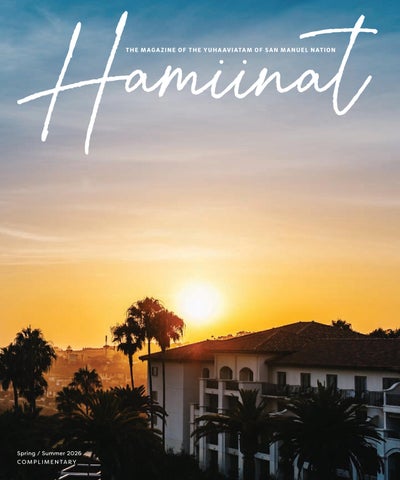
THE MAGAZINE OF THE YUHAAVIATAM OF SAN MANUEL NATION

Friday, September 25, 2026
6 PM - 9 PM
Celebrating California Indian Culture, Heritage and Family California Native American Day is celebrated on the fourth Friday in September.
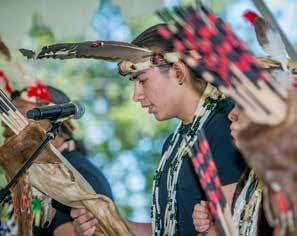
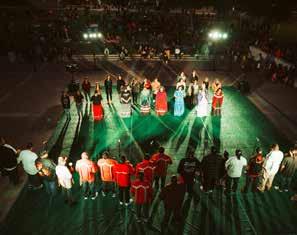
Bring your lawn chairs and blankets. For more information, call (909) 537-3502.

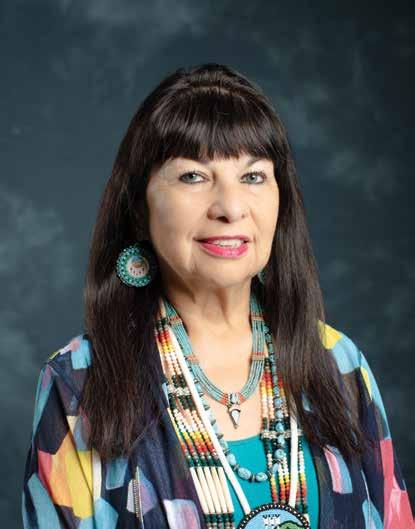
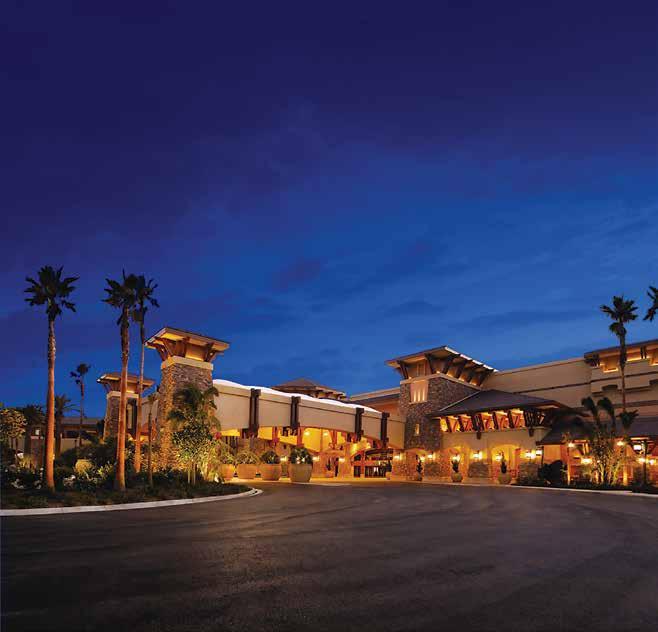
Hamiintamc! On behalf of Yuhaaviatam of San Manuel Nation (YSMN), I’m delighted that your travels have brought you to one of our hospitality offerings, including Yaamava’ Resort & Casino at San Manuel in Highland, California; Palms Casino Resort in Las Vegas; and the latest addition, Waldorf Astoria Monarch Beach Resort & Club in Dana Point, California.
It’s an absolute pleasure to share the Spring/Summer 2026 issue of Hamiinat, the official magazine of Yuhaaviatam, which showcases our culture, heritage, and enterprises. The title is an expression of greeting in the Maara’yam (Serrano) language and extends friendship, goodwill, and hospitality, for which our Tribe is renowned.
Inside this issue, you’re invited to join us as we highlight what makes our resorts unique and what experiences await you, no matter your destination.
In our cover story, Butterfly Effect, experience blissful beach culture in true SoCal style at the acclaimed Waldorf Astoria Monarch Beach Resort & Club. This 175-acre oceanfront oasis is now fully owned by Yuhaaviatam, with traditions deeply rooted in heartfelt hospitality. Discover the resort’s story and signature experiences in this immersive feature.
In Taste Makers, step into three kitchens where creativity, craft, and culture collide. Chefs Everton Clarke, Alejandro Placeres, Marty Lopez, and Steve Benjamin have redefined casino and resort dining at Yaamava’, Palms, and Monarch Beach, respectively. Here, they’re giving us a peek at how pushing culinary boundaries makes these properties truly a cut above the rest.
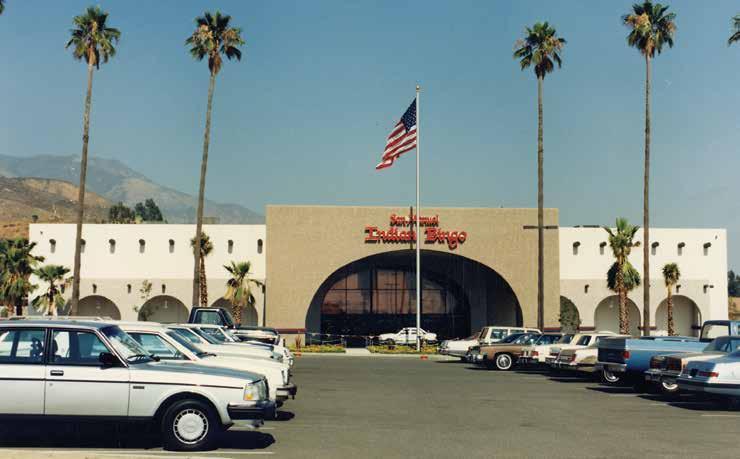
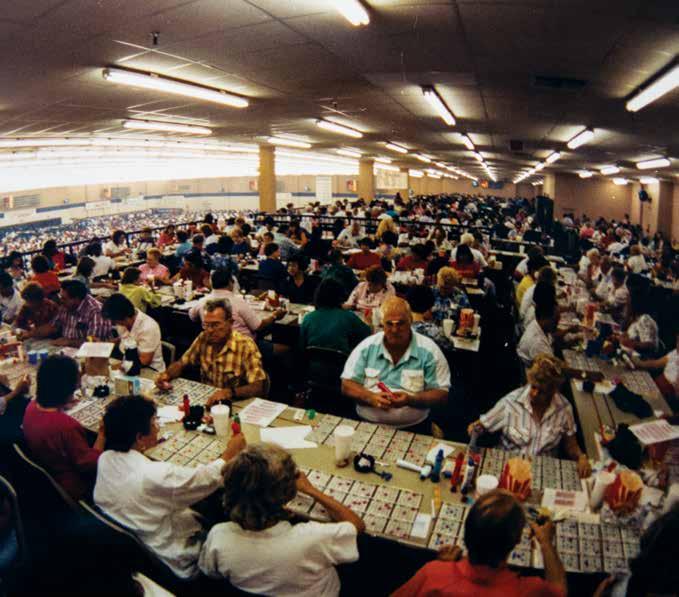
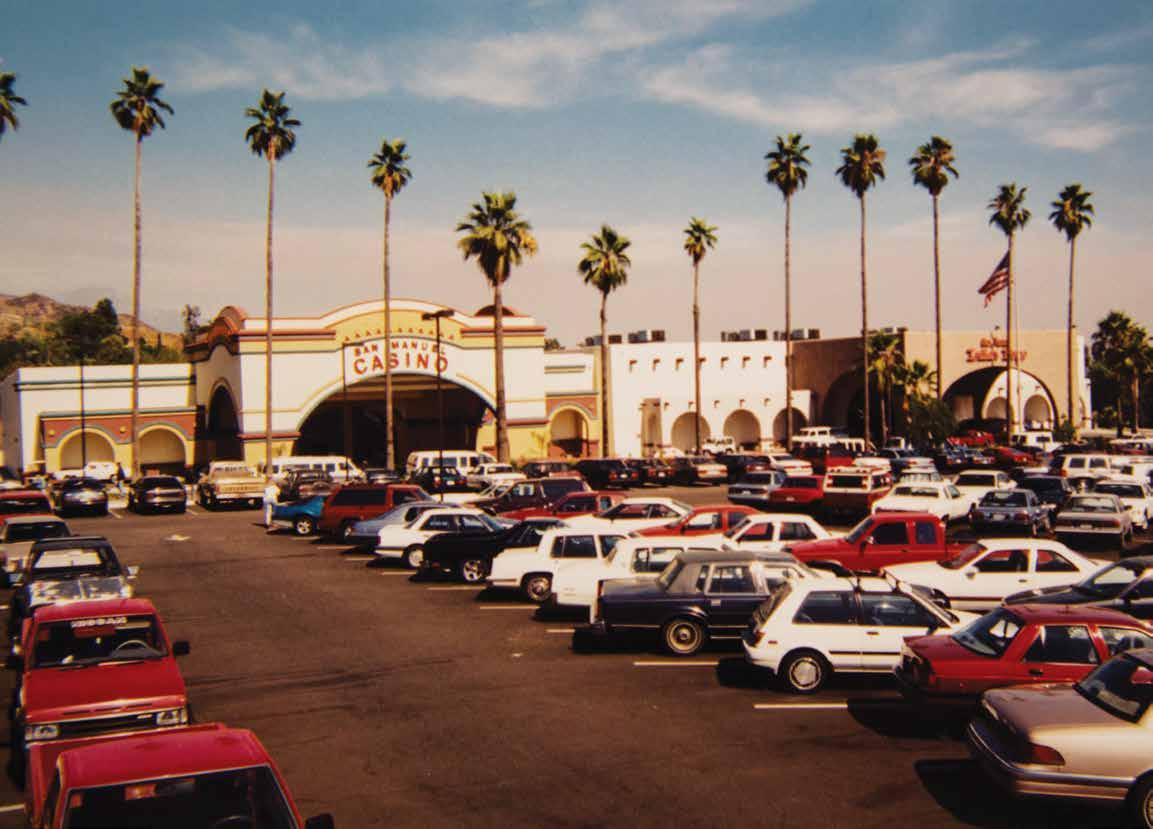
Another feature in this issue is Milestone Moments, which celebrates Yuhaaviatam’s 40 years of gaming excellence. What began as a modest bingo hall in 1986 has evolved into one of the most iconic gaming destinations in the nation. In this commemorative anniversary profile, we chart the four-decade journey from San Manuel Indian Bingo to San Manuel Casino to Yaamava’ — a world-class resort. Through archival moments, this story honors a 40-year legacy built upon resilience, vision, and cultural pride.
When your stay with us comes to an end, this magazine is yours to keep. Please visit us at sanmanuel-nsn.gov for complete digital issues of Hamiinat and follow us on social media @yuhaaviatam.
From all of us, hakup a’ai — thank you — for being our guest! We’re eager to share our unique culture and our exciting offerings and initiatives with you.

Chairwoman Lynn “Nay” Valbuena Yuhaaviatam of San Manuel Nation

It’s







SPRING / SUMMER 2026
YUHAAVIATAM TRIBAL COUNCIL OF SAN MANUEL
CHAIRPERSON Lynn Valbuena
VICE CHAIRPERSON Johnny Hernandez, Jr.
SECRETARY Audrey Martinez
TREASURER Latisha Prieto
CULTURE SEAT MEMBER Joseph Maarango
FIRST GOVERNING COUNCIL MEMBER Ed Duro
SECOND GOVERNING COUNCIL MEMBER Laurena Bolden
CONTRIBUTORS
Peter Arceo
Jacob Coin
Shoshawna Covington
Eric Dahlstrom
Drew Dixon
Franklin Ducheneaux
Sonna Gonzales
Kenji Hall
Juan Herrera
Daniel Little
Angelica Loera
Chelsea Marek
Devon O’Connell
Noel Olson
Jake Orta
Tina Ramos
Dianna Scina
Ken Shoji
Chef Oliver Wolf
A VERY SPECIAL THANK YOU TO THE FOLLOWING:
Jamie Barron
Henry Duro
Audrey Hernandez
Gauge Hernandez
Sophia Hernandez
Ken Ramirez
Runningbear Ramirez
James Ramos
Thank you to the Yuhaaviatam of San Manuel Nation and the entire tribal community for sharing their stories: past, present, and future.
EDITORIAL
MANAGING EDITOR Jessica Stops
PRODUCTION MANAGER Leah Ponce
PUBLISHER Peter Gotfredson
CREATIVE DIRECTOR Lisa Thé
EDITOR Kate Nelson
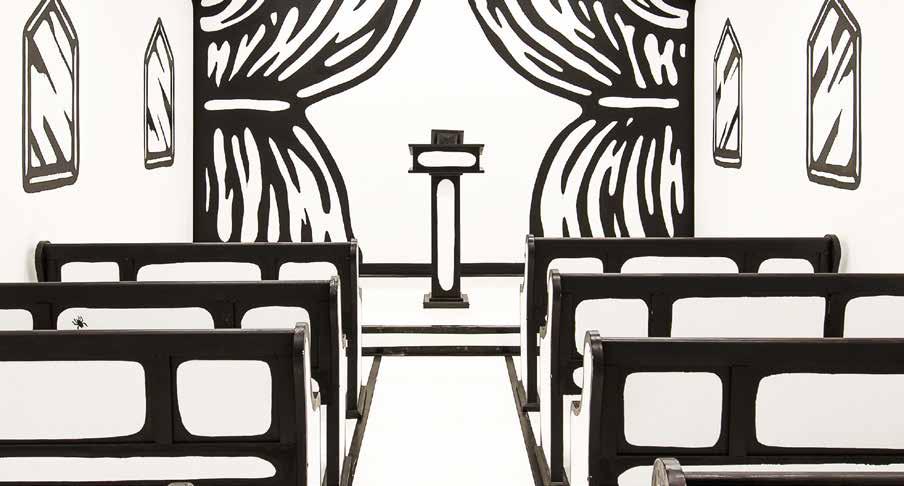
Say “I do” inside an immersive black-and-white dreamscape that turns the classic Las Vegas wedding chapel on its head. Designed by world-renowned visual artist Joshua Vides, Palms’ Til Death Do Us Part Wedding Chapel blends bold art, modern style and timeless vows—perfect for couples who want something unforgettable, not ordinary.

8 / MILESTONE
Yuhaaviatam of San Manuel Nation celebrates 40 years of gaming.
12 / NE XT G ENE RAT ION
The San Manuel Youth Committee played a key role in the 2025 Sacramento Native American Heritage Month parade.
16 / AWARD
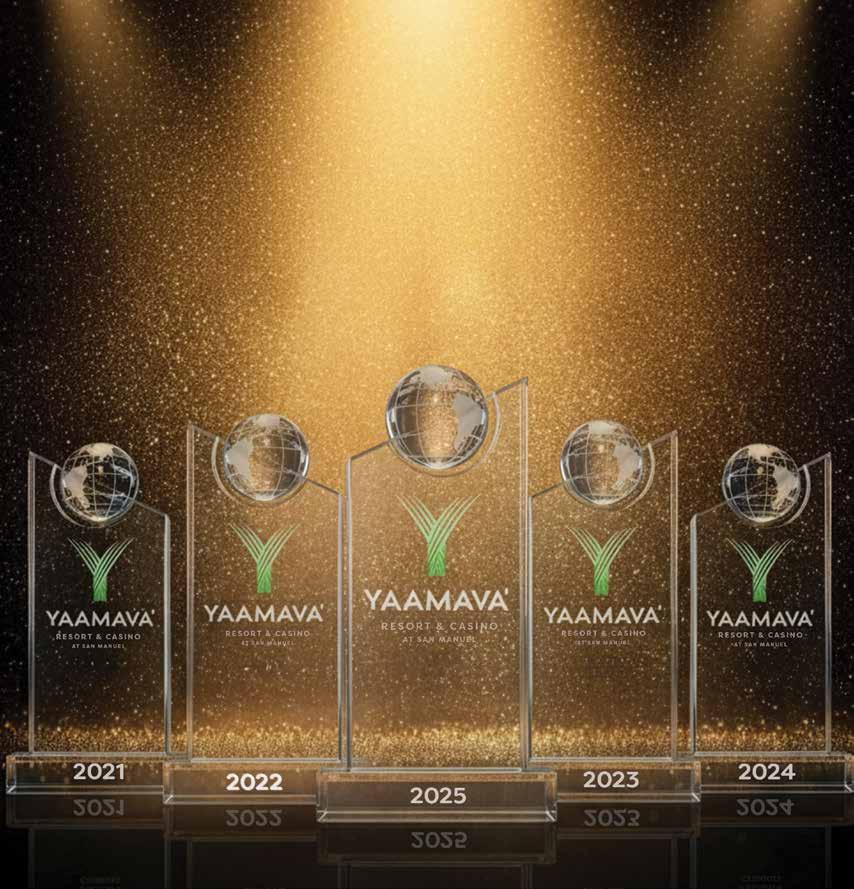
Yuhaaviatam earns a record-setting fifth consecutive Responsible Business of the Year title at the Global Gaming Awards.
18 / HI STORY
Inside the complex history of Indian gaming: the second installment in a three-part series.
22 / POLICY
An in-depth look at current threats to tribal gaming sovereignty in the state of California.
26 / TI MEL INE
Highlights to know from Yuhaaviatam’s long history.
28 / IN ME MORIAM
Remembering two Yuhaaviatam community pillars, Rowena Ramos and Dodie Morongo.

On him: Ayimach Horizons Tank Top With Cut-Out, Two-Tone Swim Trunk; ayimach-horizons.myshopify.com | On her: Ayimach Horizons One-Piece Earth-Tone Bathing Suit; ayimach-horizons.myshopify.com
32 / COVER
Reflecting on a transformative stay at Waldorf Astoria Monarch Beach Resort & Club.
40 / R ECOGNIT ION
The National Native American Hall of Fame celebrates six Indigenous leaders in its 2025 class.
42 / PROFILE
A look at artist and community leader George Rivera’s lasting impact across Indian Country.
48 / EDUCAT ION
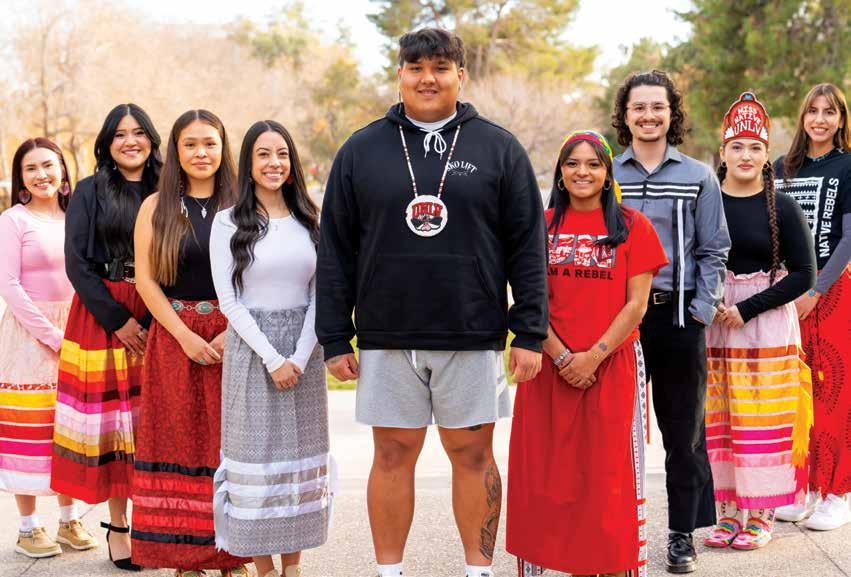
How the University of Nevada, Las Vegas champions tribal-focused programs thanks to two key leaders.
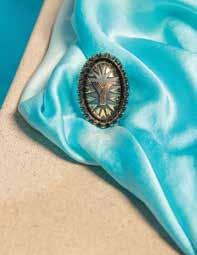
George Rivera Yaamava’ Queen Ring; georgeriverastudio.com
| The JS Look Silk Scarf; instagram.com/thejslook
52 / ACCOLADE
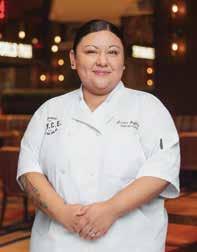
A.Y.C.E. Buffet Chef de Cuisine Jessica Buffington earns the Hospitality Hero Award.
54 / PHILANTH ROPY
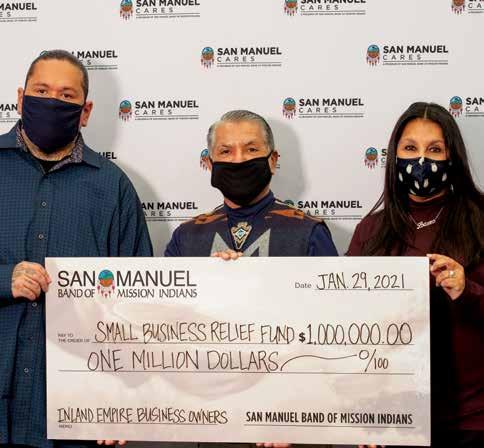
With a $10 million donation, Yuhaaviatam strengthens its partnership with SAC Health.
58 / FASHI ON
Kahara Hodges and Martin Sensmeier show off the latest Native-designed resort wear at Monarch Beach.
66 / SAVOR
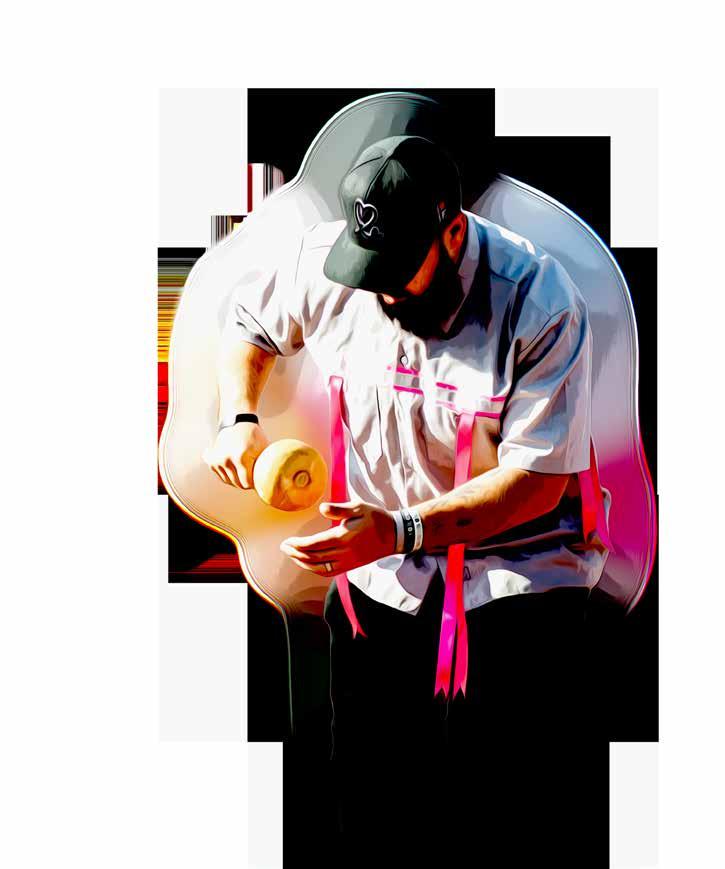
Meet four chefs crafting the culinary experiences at Yaamava’ Resort & Casino at San Manuel, Palms Casino Resort Las Vegas, and Monarch Beach.
74 / TR ENDS
Everyday luxuries in every color of the rainbow from Yaamava’.
78 / HAPPENI NG
Television icons celebrate milestones and nostalgia at Yaamava’.
80 / ENTERTAINMENT
Hip-hop legends Salt-N-Pepa perform at Yaamava’ Theater.







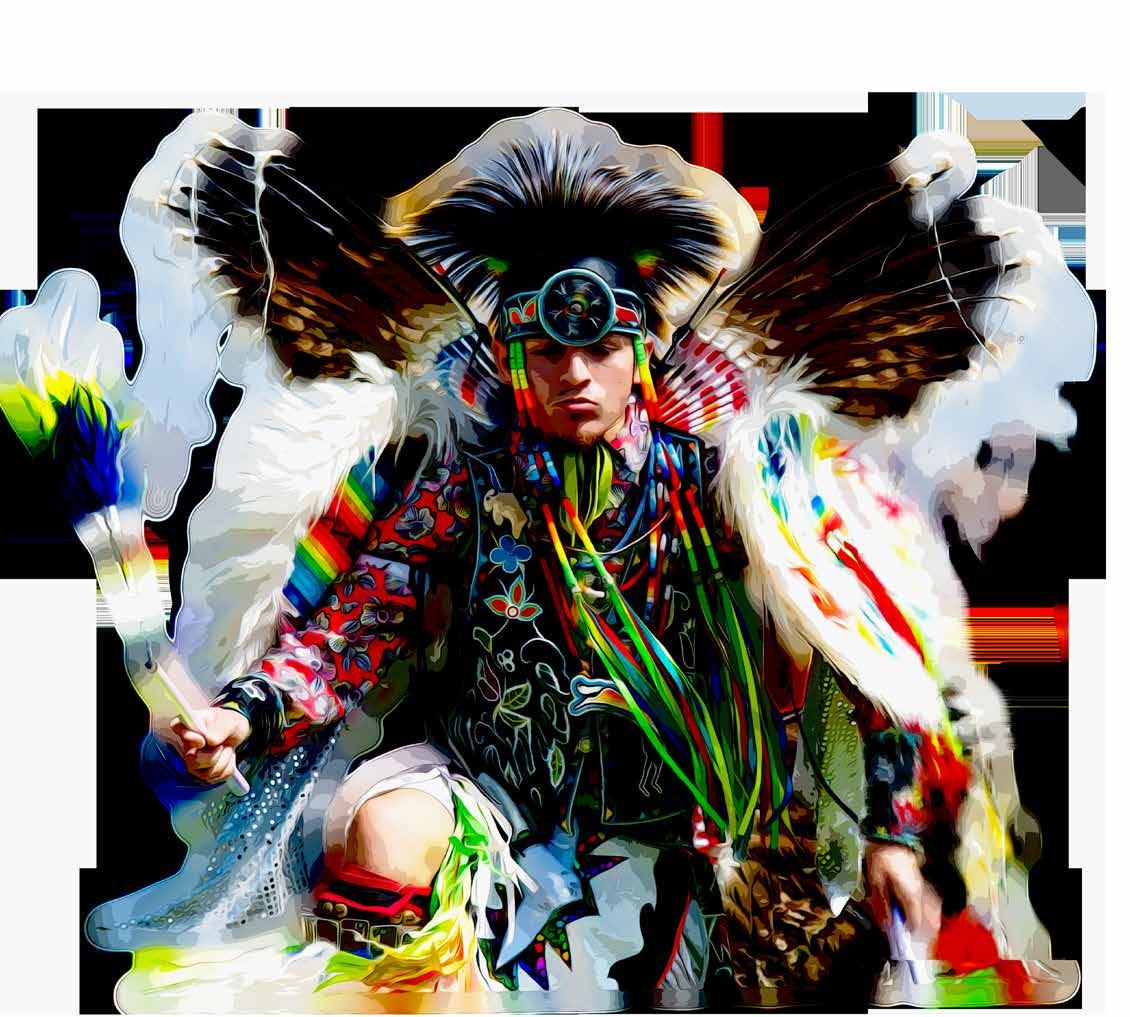
puh-mee-ah chah-kee-meev)
What we came with. The phrase describes our heritage, traditions, culture and all the songs and dances our people have passed down over many generations.
In this section, we commemorate Yuhaaviatam of San Manuel Nation’s 40 years of gaming excellence, including a record-setting fifth consecutive Responsible Business of the Year title at the Global Gaming Awards. We remember two Yuhaaviatam community pillars who recently passed on and look back at the San Manuel Youth Committee’s participation in the 2025 Sacramento Native American Heritage Month parade. Importantly, we outline the current threats to tribal gaming sovereignty in California. And in the second installment of a three-part series, we dive deep into the history of Indian gaming.
Photography by Jaquai Herrera
Yuhaaviatam of San Manuel Nation celebrates 40 years of gaming.
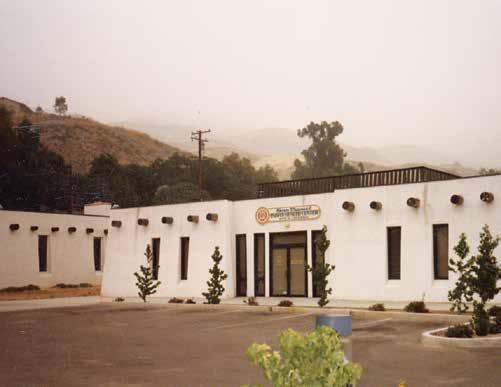
CLINIC THAT WAS MOVED OFF RESERVATION FOR THE ORIGINAL BINGO HALL, PRE-1986
“I began my journey with the Tribe more than 40 years ago as a registered dental assistant. The Reservation clinic was moved to make way for the original Bingo Hall. Since then, I’ve had the honor of witnessing the Tribe reinvest gaming revenues to transform communities and team members’ lives. Today, the off-Reservation clinic stands as a modern, state-of-the-art facility, proudly serving thousands of Native families.”
–DIANNA SCINA, Director of Experiential Marketing
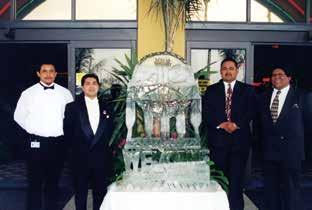
CASINO FIRST ANNIVERSARY, 1995
“After the success of our Bingo Hall, we sought to expand by building a casino but faced a major challenge. Under the Indian Gaming Regulatory Act of 1988, we needed a state compact to offer casino games — and none existed at the time.”
–KEN RAMIREZ, Tribal Citizen, Chairman, and Former General Manager of San Manuel Indian Bingo & Casino
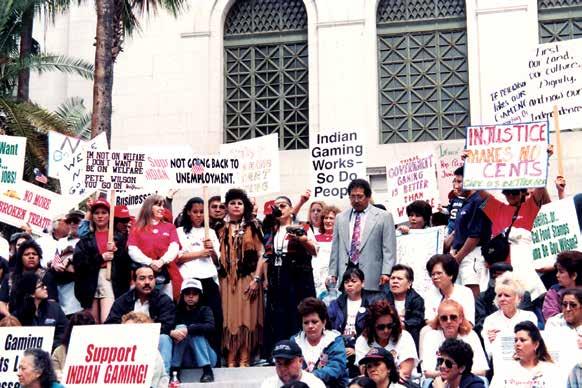
“The fight for tribal government gaming is another chapter in a fight for survival and self-determination.”
–CHAIRWOMAN LYNN VALBUENA
“Our success in gaming grows from the spirit of hospitality and fun at the heart of our people. The Reservation has always been a place of family and welcome, and that is the feeling we want every guest and team member to experience.”
–SECRETARY AUDREY MARTINEZ
‹
BINGO HALL, 1987
“Yuhaaviatam of San Manuel Nation responsibility is rooted in our sovereign authority to define our own path toward self-sufficiency and sustainability. We honor our ancestors by continuing the tradition of preparing for future generations while creating a strong community of citizens to exercise and protect our tribal sovereignty. Our demonstrated integrity in tribal gaming for 40 years has brought business success that provides critical infrastructure needs and vital resources for our people, while also bringing economic growth and jobs to the region.”
–VICE CHAIRMAN JOHNNY HERNANDEZ, JR.
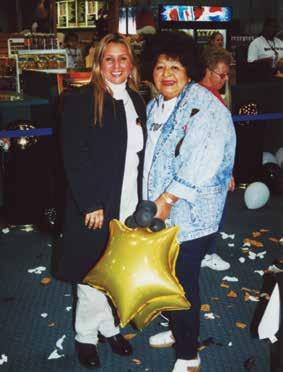
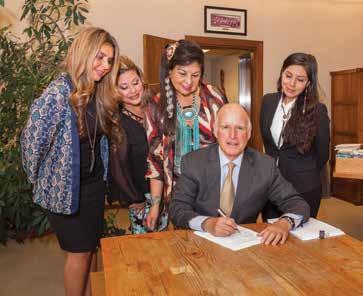
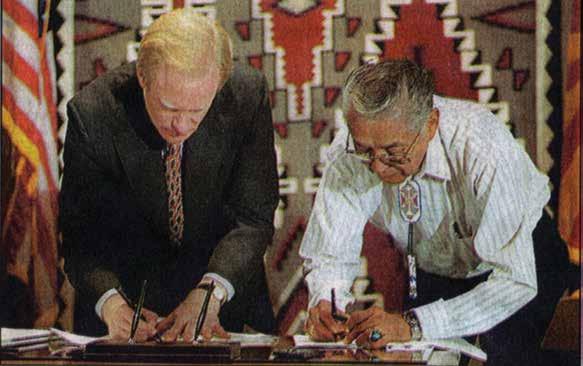
SABRINA CASTANEDA, JAMIE BARRON, LYNN VALBUENA, GOVERNOR JERRY BROWN, AND MELONIE CALDERON SIGNING GAMING COMPACT, 2016
“The tribal-state gaming compact requires us to work with the governor’s office to grow our business in ways that are responsible and balance the needs of the Tribe and California.”
–JAMIE BARRON, Tribal Citizen and former Tribal Council Member
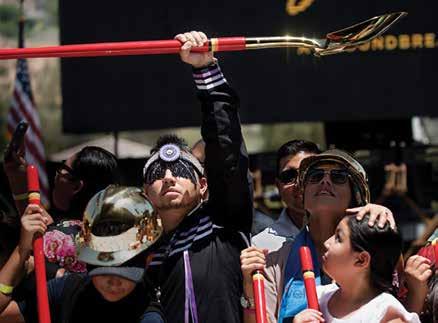
YAAMAVA’ RESORT & CASINO GROUNDBREAKING, 2018 “THIS IS NOT A BUSINESS. WE DO NOT DEFINE SUCCESS IN QUARTERS OR YEARS, BUT IN WHAT WILL ULTIMATELY BENEFIT SEVEN GENERATIONS AHEAD. YAAMAVA’ MEANS ‘SPRING’ IN OUR LANGUAGE, REPRESENTING ALL THE PROMISE OF THE FUTURE.”
– RUNNINGBEAR RAMIREZ, Tribal Citizen
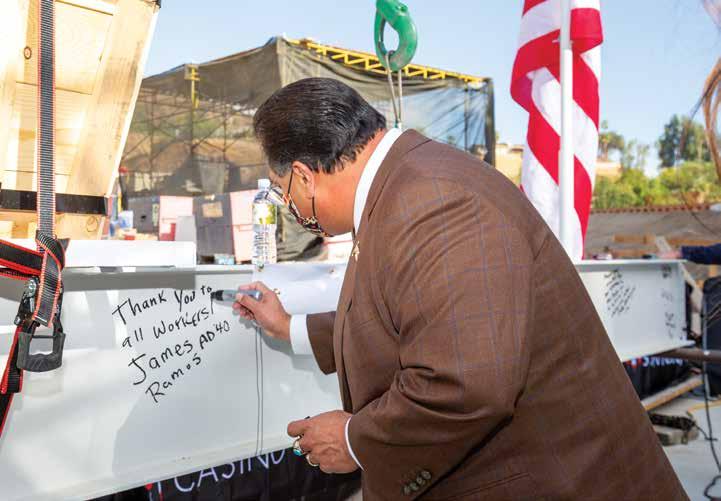
BEAM SIGNING, 2021
“Our economic growth is a bridge back to the cultural practices, language, and quality of life our ancestors envisioned for the generations to come. Through hardship and limited land, the resilience of our elders ensured that the Yuhaaviatam of San Manuel Nation would not only endure, but rise stronger than ever.”
–FORMER CHAIRMAN JAMES RAMOS
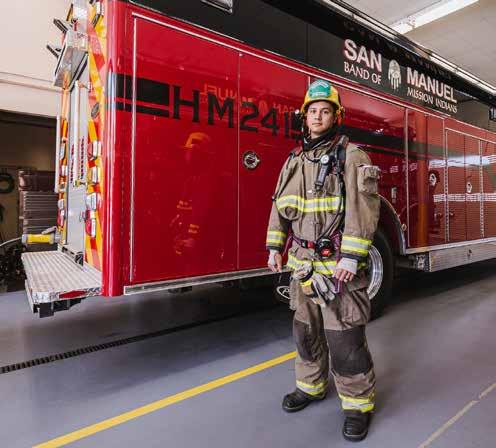

“Yaamava’ Resort & Casino grew from walking side-by-side with our team members and our community. Each new phase of development rises with hundreds of jobs and renewed hope in a region once devastated by closures, uplifting our Reservation and the surrounding communities we are forever connected to.”
–FORMER CHAIRMAN HENRY DURO
The San Manuel Youth Committee played a key role in the 2025 Sacramento Native American Heritage Month parade.
By Nika Bartoo-Smith / Photography by Jaquai Herrera
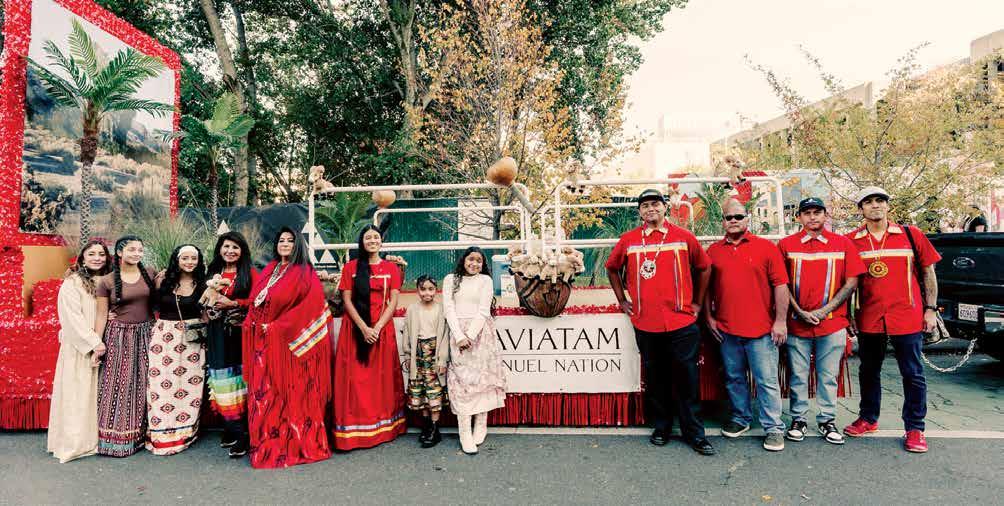
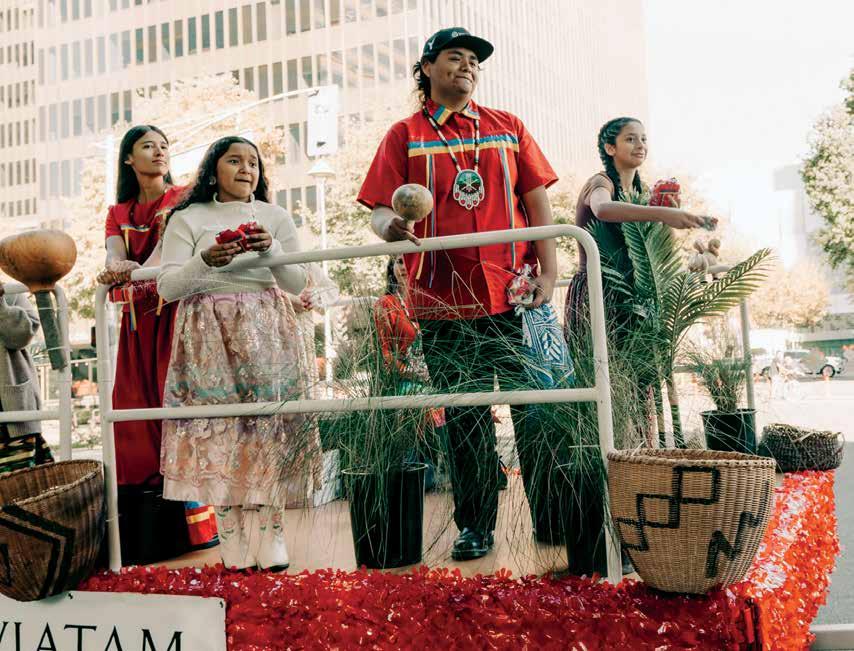
DRESSED IN ribbon skirts they had handcrafted, sisters Audrey and Sophia Hernandez stood together with their family, smiling, waving, and handing out goodies from atop a float during the Native American Heritage Month parade in Sacramento last November. “It is important to express our culture and show everyone how proud we are of our Tribe,” Sophia said. Although this was the second annual Native American Heritage Month parade held in California’s capital city, it marked the first time that the Yuhaaviatam of San Manuel Nation participated in the spirited affair with a float.
“I was kind of scared at first, but I’m super glad that we went,” said Audrey, noting that she had never been to Sacramento before and was intimidated by the idea of standing on the float. “I’m hoping we can go again this year; I want to tell my cousins and other youth to participate.”
Audrey and Sophia remember that as they were lining up for the parade, the weather was a bit gloomy, with a slight chill in the air. But as the start time drew near, excitement filled the air. And once the Yuhaaviatam float took off, the cold seemed to dissipate, as they smiled and waved to hundreds of observers.
Audrey, 16, and Sophia, 14, are both members of the San Manuel Youth Committee, serving as vice chair and representative, respectively. They got involved in last year’s parade when the planning committee asked the Youth Committee for their help with the design. Over the course of a few meetings, their vision came to life. The backdrop for the float featured an image of the desert, inspired by the Oasis of Mara in Twentynine Palms.
“The Serrano people landed in Mara from another planet, and that’s where we all branched out from,” said Gauge Hernandez, 20, who serves as Youth
Committee treasurer. “We’re showing people that this is our ancestral home; it’s the very beginning of where we come from.” Though Gauge was not able to attend the parade, his ideas helped shape the float. In addition to the eye-catching backdrop, it was covered in desert foliage, basket weavings, and gourd rattles.
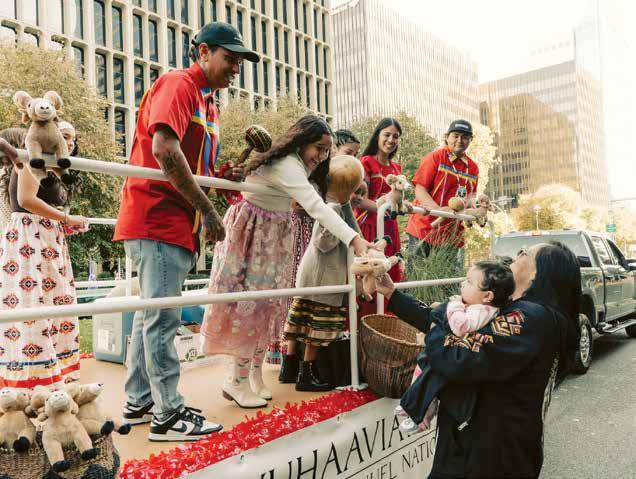
During the parade, Audrey, Sophia, and other Yuhaaviatam tribal citizens handed out candy, handmade origami ribbon shirt replicas, and bighorn sheep stuffed animals to families who had gathered on the streets.
Audrey reflected on the excitement on the kids’ faces when she gave them a stuffed bighorn sheep during the parade. More than just a cute new toy, it was also a small but meaningful way to educate other youth about Yuhaaviatam through an animal with particular significance to the Tribe.
“The bighorn sheep are native animals to our Serrano territory, so we’ve got to protect them, like our ancestors did,” said Audrey. “They were a big part of our ancestors’ lives, so they’re a big part of our lives. It’s all about maintaining them and making sure they’re still around.”
Sponsored by California tribes and the California Native American Legislative Caucus, the parade was a shared point of Indigenous pride and a celebration of culture and heritage.
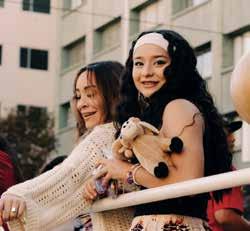
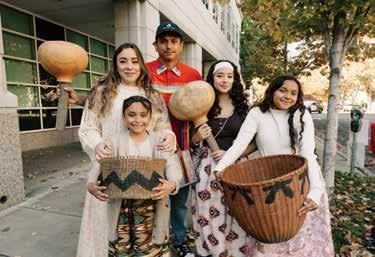
“It is important to express our culture and show EVERYONE HOW PROUD WE ARE OF OUR TRIBE.”
“I think it’s really important not only for tribes to participate, but also for people living in California — Native or not — to watch the parade and see all these tribes that live here, that you share a home with,” Gauge said. “Because all of this was our home at one point, and now we share it.”
Being part of the float design gave Audrey and Sophia a greater sense of pride during the parade. Not only did they get to stand on the float representing
the Yuhaaviatam of San Manuel Nation, but they also knew they had been instrumental in creating the final presentation on display for hundreds of onlookers. The sisters are already thinking about the possibilities for the 2026 parade and hope to bring even more youth on board for the experience. “I’m so glad that I went, and I really want to go again,” Audrey said. “Whenever they called out our Tribe, I felt so excited and proud that I’m a part of this Tribe.”

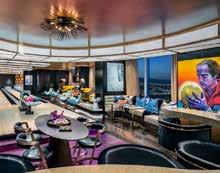
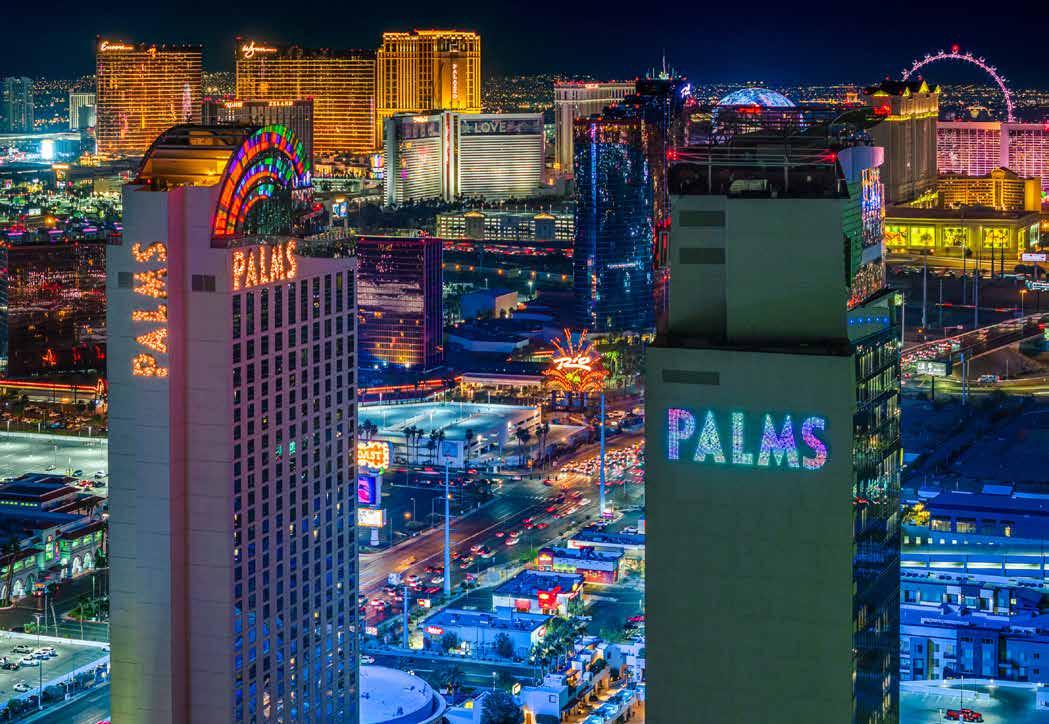
Play with the best in Las Vegas featuring nearly 1,700 slot machines, high-limit gaming and amazing experiential suites. With two luxurious GHOSTBAR





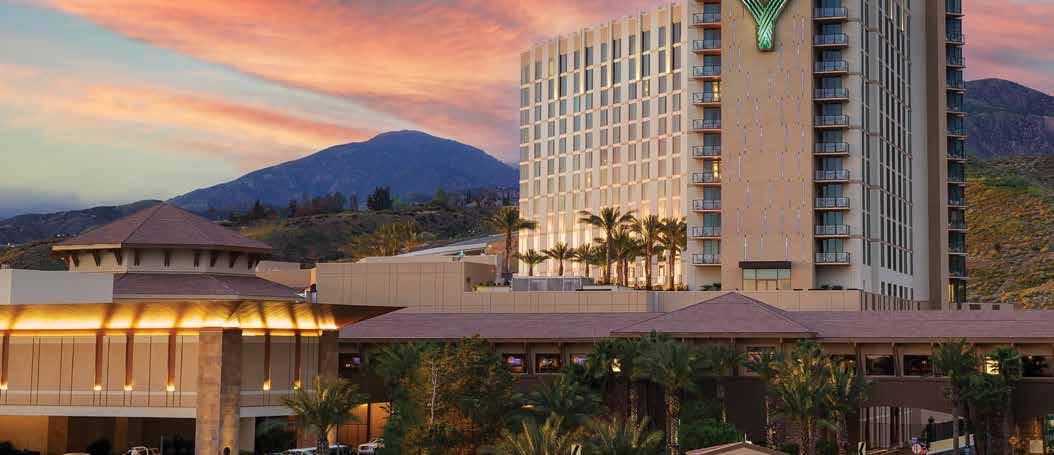


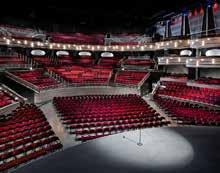
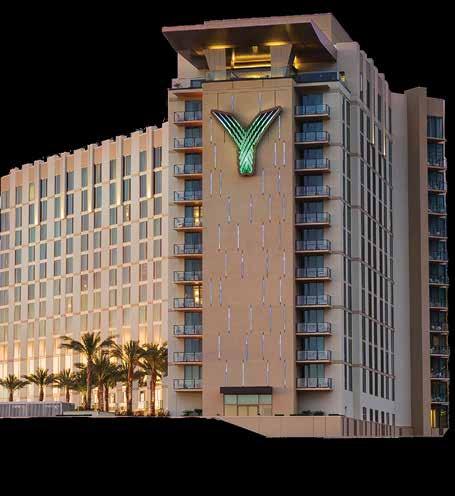
You’re invited to a stay that raises the standard. Experience ultra-premium luxury everywhere you set foot at Yaamava’ Resort & Casino. From world-class theater acts to award-winning spa accommodations, you’re bound to feel right at home at the only AAA Five-Diamond casino hotel. Book your next trip and enjoy leading-edge cuisine, 7,400+ slots, and so much more upon check-in.

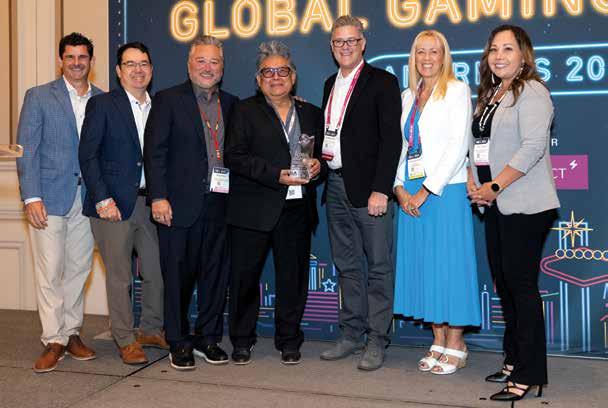
Yuhaaviatam of San Manuel Nation earns a record-setting fifth consecutive Responsible Business of the Year title.
By Robin Alcantara-Carcano
EVERY FALL , gaming industry leaders gather in Las Vegas to celebrate excellence and innovation at the Global Gaming Awards. At the 2025 ceremony, Yuhaaviatam of San Manuel Nation was voted to its fifth consecutive title as Responsible Business of the Year by the gaming industry during the largest international gaming convention at the Global Gaming Expo. This is a record-setting achievement that reaffirms the distinct leadership role that tribal nations play in shaping the industry’s future.
What sets Yuhaaviatam apart from other operators? Everything. This federally recognized Tribe is anchored in values that have been passed down through generations and that have become integral to the way the Tribe conducts business for the Tribe. Just as their ancestors planned for the long-term well-being of the community, the Tribe continues to focus on strengthening sovereignty and self-sustainability for the next seven generations and beyond.
For the Tribe, responsible business is not a program — it’s a worldview and application of the Yuhaavitam way of life in all that they do. Responsibility is truly woven into every decision, every investment, every act of stewardship. As a leader in philanthropic giving among tribes, a top employer in the Inland Empire, and a steadfast advocate for responsible gaming, Yuhaaviatam sets standards that few organizations can match.
Central to this philosophy is Yawa’ — a Maara’yam principle meaning “to act on one’s beliefs.” Guided by Yawa’, the Tribe practices principled philanthropy with a focus on creating lasting, transformative impacts. Yuhaaviatam is on track to become the first tribe to surpass half a billion dollars in charitable giving. Over the past two decades, contributions have exceeded $450 million through more than 5,000 grants, supporting important causes across Serrano ancestral lands as well as in Indigenous communities nationwide.
In 2025, the Tribe announced its third-largest grant ever: a $10 million contribution to SAC Health in San Bernardino to expand comprehensive, accessible healthcare in the region. The new Brier Campus is projected to serve more than 300,000 patient
As always, responsible gaming remains a core priority. The Tribe has contributed more THAN $2.4 MILLION TO EDUCATION AND PREVENTION EFFORTS.
visits within its first five years — a transformative investment in community well-being.
In the same year, nearly 200 grants were awarded through the 2025 San Manuel Cares grant cycle, totaling more than $13.5 million. These investments included a $250,000 grant to Olive Crest Inland Empire and Desert Communities to extend continuous care services to 1,250 children; a $600,000 grant to the Cal Poly Pomona Philanthropic Foundation to create education pathways for 1,500 community college students; and a $400,000 grant to Boys & Girls Clubs of America to expand afterschool programming for more than 2,800 Native youth across California.
The Tribe’s commitment to responsibility extends to team members as well. As a five-time “Great Place To Work” certified employer, Yuhaaviatam empowers them to activate in their respective communities through matching gift programs and volunteer time off. In 2025 alone, team members donated nearly $50,000 and volunteered more than 1,600 hours to causes close to their hearts — a reflection of a workplace culture rooted in purpose and community.
As always, responsible gaming remains a core priority. The Tribe has contributed more than $2.4 million to education and prevention efforts, including a grant to the California Council on Problem Gambling (CalPG) to support the launch of a new online
learning platform. Another long-time Yuhaaviatam partner, the National Council on Problem Gambling, is crucial in strengthening national efforts to address problem gambling through year-round programs, training, and outreach.
While most businesses can and often do move to other locations and replicate their corporate responsibility programs, Yuhaaviatam of San Manuel Nation is inseparable from its ancestral lands, cultural values, and enduring traditions. This fifth consecutive Responsible Business of the Year accolade is more than an award — it is a reflection of who the Tribe is, the legacy it honors, and the future it continues to build.
Inside the complex history of Indian gaming: the second in a three-part series.
BY RICHARD ARLIN WALKER
The genesis of today’s multi-billion dollar tribal gaming industry can be traced back to a $147.95 tax bill sent in 1972 to Helen Johnson on Minnesota’s Leech Lake Reservation.
Itasca County officials believed they were within their rights to collect property tax from Johnson and her husband, Russell Bryan, for their mobile home on the Reservation. Congress had ceded to 16 states, including Minnesota, some of its authority on tribal lands. But that authority was related to prosecution of crimes committed on reservations, not civil regulatory authority such as taxation and land use.
Johnson and Bryan sued, asserting that the state had no authority to impose its taxes on tribal lands. And in 1976, the U.S. Supreme Court ruled unanimously in their favor.
It was a decision that emboldened tribal nations as they entered the emerging gaming industry to build new economies. Bryan v. Itasca County became the basis for other court decisions upholding tribes’ rights to regulate gaming on their lands.
“These court decisions really were an impetus for me to begin developing legislation,” said Franklin
Ducheneaux (Cheyenne River Sioux), then-counsel for the House Committee on Indian Affairs.
“There were a number of tribes throughout the country that were experimenting with gambling, free of state control,” Ducheneaux continued. “Some courts ruled against the tribes, and some ruled for them. But in my long experience in Indian affairs, when you have tribes winning these kinds of decisions and being free of state control, it was going to generate a backlash. And I thought we should get ahead of the curve.”
Ducheneaux began drafting the Indian Gaming Regulatory Act (IGRA) to establish a regulatory framework for gaming on tribal lands.
The final version, signed into law in 1988, requires states to negotiate gaming compacts with tribal governments. Among its terms: States must negotiate in good faith, and the Secretary of the Interior may approve compacts if states fail to do so. Compacts take into consideration state regulatory concerns such as wagering age limits, security, and
Read part one of the series in the Hamiinat Fall 2025 / Winter 2026 issue online at sanmanuel-nsn.gov/news/hamiinat-magazine.
enforcement. Compacts are reviewed by the National Indian Gaming Commission and the Secretary of the Interior to ensure they align with federal law. Gaming ushered in a new era for tribal economies, generating billions of dollars in annual revenue across Indian Country that supports public services on reservations and in neighboring communities, employing tens of thousands of people, and spurring investments in economic development.
Still, IGRA wasn’t an easy sell. Tribal leaders opposed it, fearing the law would hinder tribal sovereignty. “In our early hearings in the 98th and 99th congresses, there were statements in opposition from tribes,” Ducheneaux said. “But I think some tribes saw the writing on the wall.”
Eric Dahlstrom, a federal Indian law attorney who was involved in the development of Indian gaming law in the states of Arizona and Wisconsin, recalled: “The federal government, as difficult as they were to get along with, at least understood that they had a special responsibility to tribes. So what tribes wanted to have was tribal regulation of gaming on Indian
lands overseen by the feds. But the states wanted state involvement.”
Governors were pushing Congress to extend states’ regulatory authority. Opponents of tribal gaming had the attention of influential Congressmen Claude Pepper of Florida and Tony Coelho of California. At the same time, President Ronald Reagan appointed three Supreme Court justices and elevated one to chief justice, shifting the court to the right.
By the time Representative Mo Udall of Arizona introduced the bill Ducheneaux had written, two cases challenging state enforcement of bingo and card games on tribal lands had been decided by circuit courts in favor of tribes. But now a similar case, California v. Cabazon Band of Mission Indians (1987), had made its way to the U.S. Supreme Court.
“We had a long, bitter meeting in the Capital about the bill,” Ducheneaux said. “It was sitting on the table, we were ready to go with it, and they wouldn’t take it. Opponents in Congress believed the Supreme Court was going to reverse the lower courts’ decisions and subject Indian gaming to state control. So they
essentially told us to go to hell. But then down came the Cabazon decision.”
The Supreme Court ruled 6-3 in favor of the Cabazon Band on Feb. 25, 1987, mirroring other decisions. The Cabazon Band, a sovereign tribal nation, could regulate gaming on its lands free of state interference.
“We jerked that bill off the table,” Ducheneaux said, “and I wrote what is basically IGRA now.”
The Cabazon decision forced states to come to terms with the sovereignty of tribal nations. It also compelled tribal governments to compromise in order to ease state opposition to their gaming enterprises. Ducheneaux wasn’t happy with some of the compromises he wrote into the bill, such as revenue sharing, to quell the opposition of states. But he did so recognizing that Congress holds broad, exclusive power to manage tribal affairs, including delegating its authority, as it did with Public Law 280 (1953).
“Had we not done anything,” Ducheneaux said, “it’s very possible Congress might have passed a bill that simply banned tribal gaming period.”
An Uneasy Relationship “Tribes were not used to working with states,” said Dahlstrom. “The state was largely the enemy, and the view was that they’re here to tax us and take our rights away.”
The IGRA requirement that both sides meet and agree on a compact helped evolve the relationships between state and tribal governments.
“I think one thing that’s happened is that tribes and states have a much more productive relationship in many jurisdictions,” Dahlstrom said. “It’s still competitive, but it’s a more businesslike relationship, partially because of the work on gaming.”
Gaming revenues have fueled economic development, jobs creation, and philanthropy throughout Indian Country. It’s also been a boon for states, which get a share of revenue — from 18 to 25 percent of net win from slot machines, according to various sources — in exchange for exclusivity rights.
When IGRA became law in 1988, gaming on 70 reservations — non-banked card games and bingo
The Cabazon decision forced states to come to TERMS WITH THE SOVEREIGNTY
— generated more than $100 million a year.1 In fiscal year 2024, 243 federally recognized tribes operated 532 gaming enterprises — casinos, bingo halls, and electronic gaming — that generated a record $43.9 billion in gross revenue, according to the National Indian Gaming Commission. 2 That’s roughly 43% of total U.S. casino gaming revenue.3
“I think that the drive for autonomy and selfdetermination and bettering the economic status of their communities was the real motivation,” Dahlstrom said of the fight for tribal gaming rights.
“Tribes have done a phenomenal job of promoting the benefit of self-determination from an economic point of view,” he explained.
“Tribal gaming, where it’s well articulated, is highly supported in non-tribal communities. That doesn’t happen accidentally, because there’s a lot of racism against tribes. Tribes asserting their rights in a way to improve the economic viability of their communities is something that has resonated in a very positive way with the non-tribal public and non-tribal governments.”

Three key court rulings upholding the right of tribal governments to regulate gaming on their lands.
SEMINOLE TRIBE V. BUTTERWORTH (1981): The U.S. Fifth Circuit Court of Appeals ruled that the state of Florida did not have authority to enforce its bingo laws on Seminole lands.
BARONA BAND OF MISSION INDIANS V. DUFFY (1982): The U.S. Ninth Circuit Court of Appeals ruled that the state of California did not have authority to enforce its bingo and poker laws on Barona lands. This ruling, along with similar cases, established that tribes could operate gaming enterprises free from state regulation.
CALIFORNIA V. CABAZON BAND OF MISSION INDIANS (1987): The U.S. Supreme Court ruled that California’s gambling laws were civil/regulatory and therefore couldn’t be enforced on reservations, because tribal governments have civil/regulatory authority on tribal lands.
1.
E-Journal). 2. National Indian Gaming Commission FY 2024 Gross Gaming Revenue Report. 3. National Indian Gaming Commission FY 2024 Gross Gaming Revenue Report
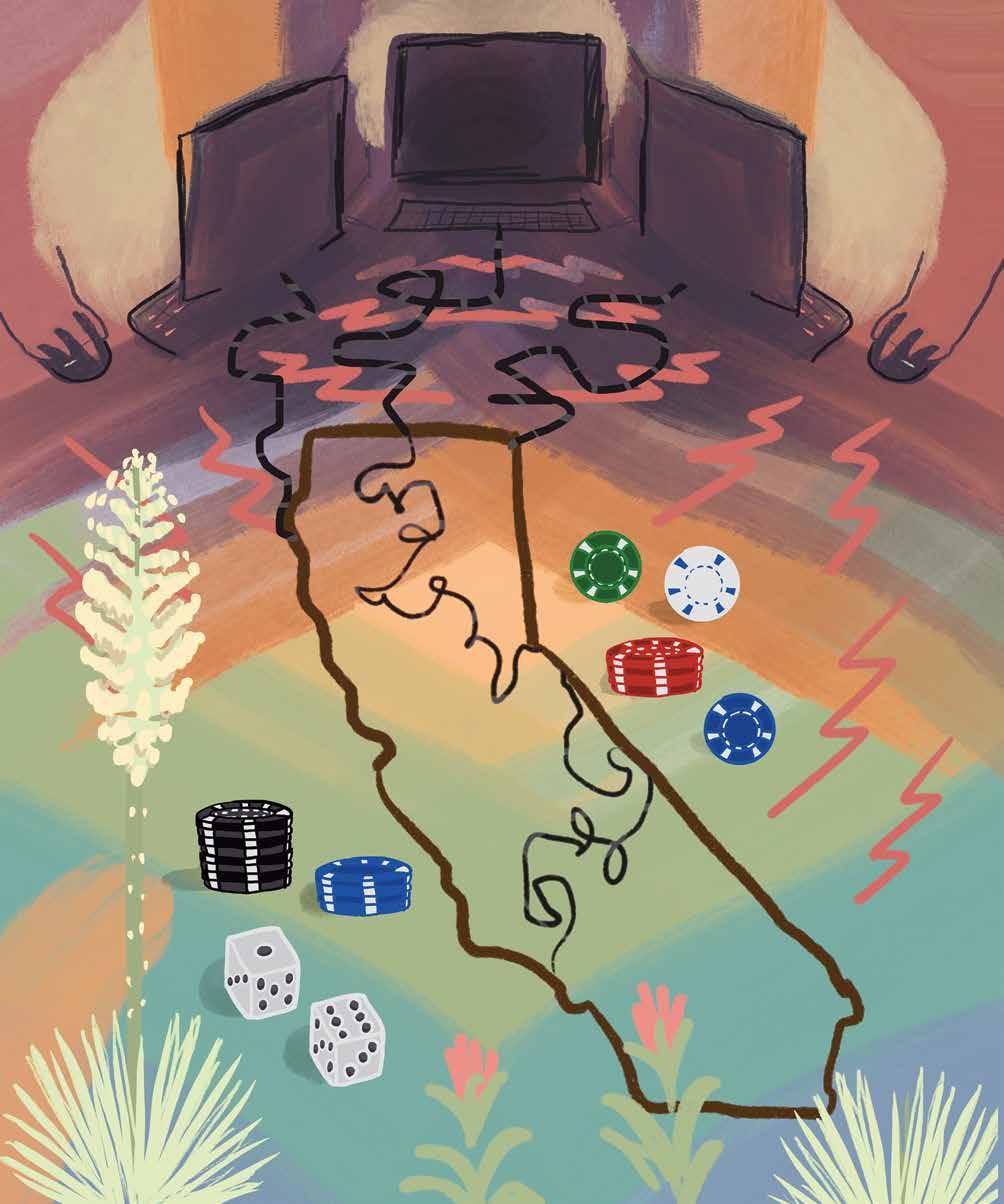
An in-depth look at current threats to tribal gaming sovereignty.
By Rob Stutzman
In 2022, out-of-state online sports betting platforms made an audacious attempt to storm the California market and undermine the governmental right of tribes to be the exclusive operators of casino-style gaming in the state. We know what happened. Yuhaaviatam of San Manuel Nation led a tribal response that buried online companies at the ballot box. Californians ultimately sided with tribes by a 2-to-1 margin.
But even today, threats remain. Unauthorized and unregulated online gaming is proliferating. Online sweepstakes, daily fantasy sports (DFS), and prediction markets are expanding, with the ultimate goal of capturing the gaming marketplace as a realtime, loosely regulated enterprise. Yuhaaviatam has not relented in its efforts to lead a response for safeguarding tribal government gaming rights and exclusivity in California. Vice Chairman Johnny Hernandez, Jr. has spent significant time speaking at local, state, national, and international levels about these serious threats and impacts to tribal government gaming rights and sovereignty.
Securing tribal government gaming rights and exclusivity was hard-won. More than a dozen years after the U.S. Supreme Court decision in Cabazon (1987) and the Congressional enactment of the Indian Gaming Regulatory Act of 1988, tribal nations in California were still prevented from exercising their right to offer gaming on their lands.
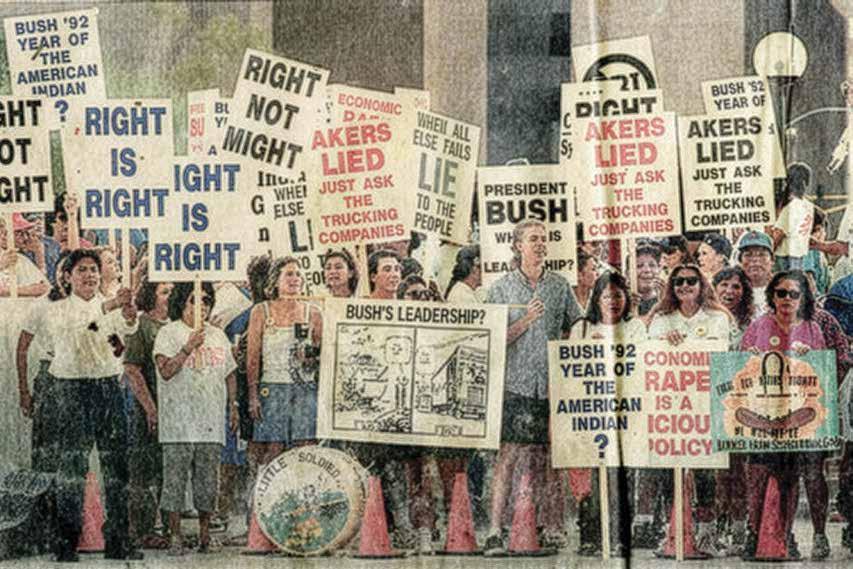
Political pundits said it could not be done. However, a unified coalition of tribal nations in the state undertook a ballot initiative in 1998. Prop 5, which would allow tribes to conduct gaming on their lands, was passed by 63 percent of California voters — a super majority.
After Prop 5 was successfully challenged, tribal nations went back to the drawing board and crafted a new ballot initiative, this time to amend the California Constitution to authorize tribal gaming on Indian lands. In March 2000, an even larger 65 percent majority of voters supported the constitutional amendment. This approval also established the state’s public policy on casino-style gaming by stating that a limited scope of casino-style gaming conducted by tribal nations on Indian lands is authorized.
The voters were clear in 2000 that only tribal nations were authorized to conduct Vegas-style gaming in California. Now, that public policy is under threat by commercial gaming companies, online gaming companies, and others who want to take over the carefully created gaming environment in California.
Industry experts projected that online sweepstakes would become a $14.3 billion industry in 2025. Fortunately, here in California, Yuhaaviatam took action and sponsored legislation to provide clear statutory guidance that these online sweepstakes are illegal in California.
AB 831 was authored by Assemblyman Avelino Valencia (D-Anaheim). He proved to be a powerful author for this legislation to protect tribal gaming sovereignty. “We cannot look the other way while these platforms exploit legal gray areas,” he wrote in

FOR MANY TRIBES THROUGHOUT CALIFORNIA AND THE REST OF THE UNITED STATES, GAMING HAS PROVED TO BE A TREMENDOUS ECONOMIC ENGINE THAT ALLOWED TRIBES TO IMPROVE THE LIVES OF ITS CITIZENS AND BRING JOBS AND ECONOMIC RESOURCES TO SURROUNDING COMMUNITIES.
a statement. “These operations undermine the voterapproved framework that affirms tribal governments’ sovereign right to conduct gaming in California. AB 831 strengthens that framework and ensures gaming in California remains fair and accountable.”
The shady online sweepstakes operators stood up a phony group to oppose AB 831 and spread disinformation. Tragically, they also exploited some small non-gaming tribes with promises of revenue if sweepstakes remained legal. Even so, the legislature delivered a rare unanimous approval of AB 831, and Governor Gavin Newsom signed it into law.
The impact was swift and evident. Vendors and operators have abandoned California endeavors, likely because the law attached criminal liability to operations that continued. AB 831 is a powerful success story showcasing Yuhaaviatam’s continued vigilance and leadership in protecting the enduring partnership between sovereign tribes and the state of California, as established and affirmed by voters.
Last summer, California Attorney General Rob Bonta’s office issued a detailed legal opinion that DFS is illegal in the state. He cited existing case law and rejected claims by DFS operators that they offer a game of skill rather than chance.
“Yes, California law prohibits the operation of daily fantasy sports games with players physically located within California, regardless of where the operators and associated technology are located,” he wrote. But Bonta’s opinion has gone unheeded by DFS operators, and the state has not yet followed through on enforcement of the Attorney General’s opinion. Many DFS games are indistinguishable from conventional sports betting, including bundling prop bets regarding individual athlete accomplishments. Such individual prop bets have been at the heart of scandals that have rocked the National Basketball Association, Major League Baseball, and NCAA men’s basketball. In 2015, an executive from sportsbooks operator William Hill said, “You put up something of value (cash) to win something of value (cash). It’s the classic definition of gambling.”
Prediction markets are the latest threat to tribal gaming. These companies offer traditional sports betting dressed up as federally regulated “events contracts” in violation of federal, state, and tribal law. The federal law that prediction markets hide behind, though, was never intended to include this type of gambling activity.
Without any meaningful federal regulation or enforcement, companies like Kalshi, Crypto.com, and Polymarket are proliferating online, selling these “contracts” without restriction or oversight. Existing sports betting operators like DraftKings and FanDuel have also entered the fray, putting their state gaming licenses in jeopardy by chasing a quick payday regardless of the unlawful nature of the activity.
In the past year, these and similar companies have quickly pushed the line further into traditional sports betting. At first, they offered simple money-line bets on whether a team will win or lose a game. From there, they expanded to total points per season. Now,
these companies offer a full menu of proposition bets and parlays. Some have announced they will allow betting on credit, similar to a casino marker, and have started offering “free play” promotions, similar to those offered by traditional sports books.
This rapid expansion has led to concern that traditional casino-style games will be next on offer if prediction markets are not stopped from offering sports-event contracts. These companies take the extreme position that anything should be fair game as a contract subject. Tradable contracts have extended into absurdity, including topics such as whether the Earth is flat, how many times Elon Musk will tweet, and whether certain words will be said during presentations and speeches. There is no reason to believe that if these companies are allowed to go unchecked, they will not quickly expand into full online casino gambling.
Prediction markets are also being scrutinized for insider trading and manipulation. For example, just hours before a U.S. operation to arrest Venezuelan President Nicolás Maduro, more than $32,000 was placed on Polymarket predicting that he would be removed from office by a certain date. The wager returned more than $400,000 in profit. This is a prime example of how an unregulated gaming market is vulnerable to fraud, manipulation, and insider wagering — the opposite of the fair and wellregulated tribal gaming model in California.
Whittier College Professor Emeritus I. Nelson Rose, who specializes in gambling law, gives his take on sports-event contracts. “Of course it’s gambling,” he said in an interview with financial and business analysis website MarketWatch. “The idea that it’s a market doesn’t make it any less gambling.”
These prediction platforms are under scrutiny. States and tribes have taken legal action to shut down sports betting through events contracts, but it remains unclear how federal courts will rule. If courts determine that sports-event contracts and contracts based on traditional casino games are federally regulated commodity markets and exempt from the Indian Gaming Regulatory Act (IGRA) and state compact requirements, the impact on tribes could be devastating.
Collectively, tribes are joining forces against prediction markets, and additional lawsuits are under consideration. Although recent decisions in some jurisdictions have been encouraging, tribes don’t want to rely solely on litigation. There is also ongoing consideration of asking Congress to eliminate the loopholes that allow these companies to circumvent gaming regulations.
This will prove to be a pivotal year for preserving tribal gaming operations in California. Both state and federally elected officials must confront critical questions related to the future of well-regulated tribal gaming.
Unlawful gaming must not be allowed to threaten the significant economic and social value that gaming tribes provide to both Native and non-Native residents throughout California. For many tribes throughout California and the rest of the United States, gaming has proved to be a tremendous economic engine
“A THREAT TO TRIBAL GOVERNMENT GAMING RIGHTS AND EXCLUSIVITY IS A THREAT TO TRIBAL NATIONS AS WELL AS THE STATE’S ECONOMY AND WORKFORCE.”
that has allowed tribes to improve the lives of their citizens and bring jobs and economic resources to surrounding communities. This purpose, written into IGRA, was intentional and has proven successful.
This success is also due to the regulatory expertise and vigilance exercised by tribes. Under California’s current framework recognizing tribes’ exclusive right to operate gaming, residents benefit from a safe, well-regulated marketplace that supports tribes, local communities, and the state. This includes strict and effective measures to ensure age verification, address problem gambling, enforce auditing and anti-money-laundering controls, and provide dispute resolution to consumers. That is the promise tribes made and have delivered on in California.
Tribes have fought for decades to protect this sovereign right to control what happens on their own lands. Fighting off threats to sovereignty is not new, but past success has depended on fierce vigilance and, when necessary, decisive action. Yuhaaviatam is committed to continuing its engagement with state and federal officials, the courts, and closely aligned partners in the ongoing effort to protect tribal rights.
The time is now for the legislature to affirm the position that any prediction event contracts relating to sports, contests, people, politics, catastrophe, and death are illegal under existing California law. Just like the Tribe’s effort to combat online sweepstakes, Yuhaaviatam is committed to strongly defending tribal sovereignty. This will once again be an opportunity for California lawmakers to resist efforts by out-of-state corporations that do not pay taxes, protect children, or create jobs in California.
“Tribal government gaming is the most regulated in the industry, with established accountability to protect consumers,” said Yuhaaviatam Vice Chairman Johnny Hernandez, Jr. “We will be persistent in defending the preservation of gaming exclusivity for tribes. We carry the important responsibility of taking care of our tribal communities and play an important role in the state’s overall economic environment. A threat to tribal government gaming rights and exclusivity is a threat to tribal nations as well as the state’s economy and workforce.”
A look at the resilience and determination of the Yuhaaviatam to remain self-sufficient and sovereign.
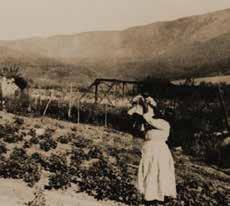
Since Time Immemorial Maara’yam people inhabit the mountains, valleys and deserts of Southern California.
1700s-1820s
Spanish missionaries and military encounter the Yuhaaviatam (one clan of the Maara’yam), which they call “Serrano” or “highlander.” Many Maara’yam are forced into the mission system as slave labor for Spain.

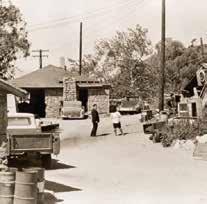
1880s
Native American boarding schools are established in the U.S. with the primary objective of “civilizing” or assimilating Native American children and youth into EuroAmerican culture, while destroying and vilifying Native American culture.
Early to Mid-1900s Tribe adapts and adjusts to reservation life. U.S. government continues to dictate what the Tribe can and cannot do.
1953
Congress passes PL-83-280, which transferred criminal and some civil jurisdiction over Indian Country from the federal governments to certain states including California. Today, 376 of 574 federally recognized tribes are located in PL 83-280 states.
1966
Articles of Association are adopted by
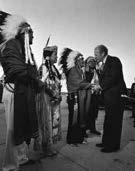
1850s-1860s
American settlers invade Serrano territory. CA governor instructs militias to exterminate Native people. Yuhaaviatam are killed and chased out of their territory.
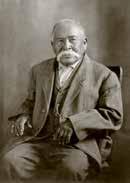
1866
Raids and bloodshed decimate the Tribe. Kiika’ Santos Manuel makes a decision to courageously bring the remnant of his people from the mountains to safety on the valley floor.
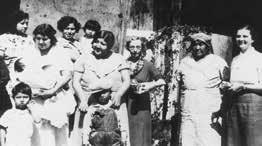
1879
Carlisle Indian Industrial School opens in Carlisle, PA. Thousands of Indian children are shipped from their homes and families to the school to “Kill the Indian, save the man,” to assimilate them into mainstream society.
December 29, 1891
U.S. President Benjamin Harrison signs Executive Order establishing the San Manuel Indian Reservation with 640 acres. Serrano ancestral territory encompassed 7.4 million acres in California.
1934
Indian Reorganization Act is enacted by U.S. Congress, aimed at decreasing federal control of American Indian affairs and increasing Indian self-government and responsibility.
1970
In address to Congress regarding the federal policy of terminating relationships with tribes, President Nixon states, “This policy of forced termination is wrong.” He then outlines a policy of selfdetermination rather than termination.
1975
President Ford signs the Indian SelfDetermination and Education Assistance Act, a federal policy of Indian selfdetermination, first declared by President Nixon.
1980s
SMBMI seeks new business opportunities to strengthen sovereignty and journey towards self-sufficiency.
1978
Indian gaming movement begins with Seminole Tribe of Florida.

Proposition 5 is supported by 63 percent of voters in favor of gaming by Indian tribes in California. A lawsuit by a labor union causes the measure to be struck down by California Supreme Court.
Proposition 1A, supported by 65 percent of California voters, changes the state constitution and provides exclusive right to Indian tribes to operate a limited scope of casino-style gaming on Indian lands, in accordance with federal law.
Residence Inn by Marriott opens in Sacramento, CA. The project is from the Three Fires intertribal economic partnership, which includes San Manuel Band of Mission Indians.
Hampton Inn and Suites Hotel opens in Highland, CA, at San Manuel Village, a development of the San Manuel Band of Mission Indians.
2016 SMBMI acquires sacred lands in San Bernardino Mountains with purchase of Arrowhead Springs Hotel.

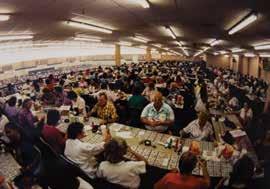
1986
San Manuel Indian Bingo opens.
1987
California v. Cabazon: U.S. Supreme Court landmark decision affirms right of tribal governments to conduct gaming on their lands.
1988
Indian Gaming Regulatory Act passes, creating statutory framework for Indian gaming.
Tribe takes an active role in passing Proposition 5 and Proposition 1A.
San Manuel Indian Bingo adds gaming operations and advances goal of economic selfsufficiency.

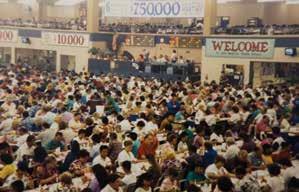
New San Manuel Indian Bingo and Casino opens.
Residence Inn by Marriott opens in Washington, D.C. The project is from the Four Fires intertribal economic partnership, which includes San Manuel Band of Mission Indians.

2006
San Manuel Band of Mission Indians breaks ground on San Manuel Village in Highland, CA, a mixed-use, offreservation, commercial development.

2021
San Manuel Casino becomes Yaamava’ Resort & Casino at San Manuel.
Yaamava’ expansion project opens, including gaming spaces, restaurants, lounges and hotel tower, as well as retail, spa, and pool amenities.
After five years of tribal citizen collaborations over a charter of government, the San Manuel General Council ratifies the Yuhaaviatam of San Manuel Nation Constitution on December 12.
Hamiinat magazine launches.
2022
San Manuel Gaming and Hospitality Authority opens the Palms Casino Resort in Las Vegas.
San Manuel leads defeat of sports gambling ballot initiative in California; 83 percent of voters reject Prop 27.
Opening of the Autograph Collection, The Draftsman Hotel, in Charlottesville, VA, a joint venture that includes the San Manuel Band of Mission Indians.
U.S. Supreme Court overturns the Professional and Amateur Sports Protection Act (PASPA); opening door to stateauthorized sports gambling.
San Manuel Gaming and Hospitality Authority forms to explore economic growth opportunities.
2023
San Manuel Landing opens.
Tribe invests in Waldorf Astoria Monarch Beach Resort.

2025
San Manuel Band of Mission Indians reclaims ancestral name, Yuhaaviatam of San Manuel Nation.
2026
San Manuel Investment Authority acquires 100 percent ownership in Waldorf Astoria Monarch Beach Resort & Club.

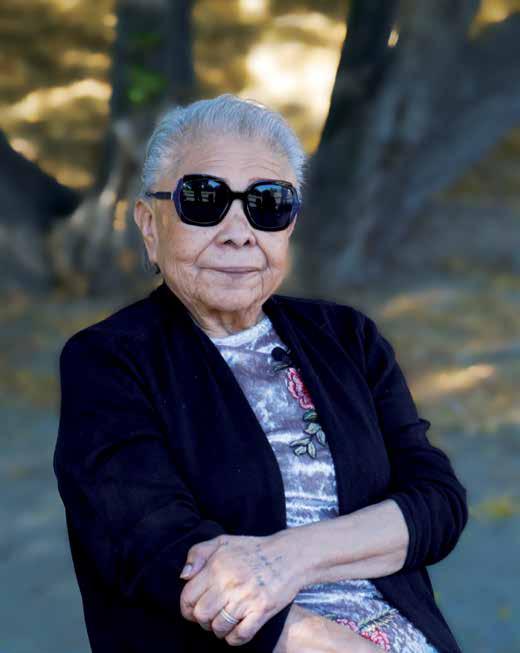
March 2, 1939 – June 8, 2025
Geraldine “Dodie” Morongo was born on the San Manuel Reservation. Her father was an enrolled member of the Tribe; her mother from the Cahuilla Band of Indians. She grew up on the Reservation and attended school in Highland, California. She married Domingo Campos, an enrolled member of the Fort Mojave Tribe, and had four children. In addition to serving on Tribal Council as Chairwoman, she worked as a certified nursing assistant as well as at the San Manuel Bingo Hall when it first opened in 1986. She was proud of her Yuhaaviatam heritage and is best remembered by her family for her dedication and her selfless spirit.

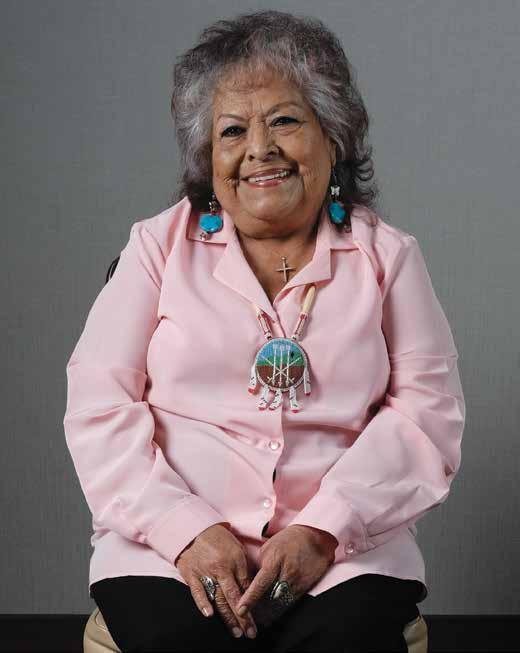
September 28, 1941 – November 11, 2025
A lifelong resident of the San Manuel Reservation, Rowena “Rena” Ramos was a beloved mother, grandmother, great-grandmother, mentor, spiritual leader, and culture keeper. A longtime cosmetologist, she was dedicated to teaching her family, including her 39 grandchildren, and the children of the Reservation about the Tribe’s culture so that they would understand where they came from. She was dedicated to the Tribe and played a pivotal role in establishing early governmental guidelines. Alongside her husband, James Ramos, she established a legacy of philanthropy by partnering with several organizations serving children in the community.




Puyu’houpkcav: together. When all are together as one, we accomplish more. We strive each day towards unity of purpose and spirit.
In this section, we highlight community commitments, philanthropic endeavors, and impressive accolades, including Yuhaaviatam of San Manuel Nation Chairwoman Lynn Valbuena’s induction into the National Native American Hall of Fame. We profile another change maker in Indian Country, artist and tribal leader George Rivera of the Pojoaque Pueblo. We showcase the important work of Yuhaaviatam community partners SAC Health and University of Nevada, Las Vegas. And in our cover story, we reflect on a recent stay at the Waldorf Astoria Monarch Beach Resort & Club.
How a transformative stay at Waldorf Astoria Monarch Beach Resort & Club changed the trajectory of my entire year. / BY KATE
exactly where you’re supposed to be.” These words rang truer to me than they ever have before, as the instructor gently uttered them during an intimate sound bath meditation session.
I found myself at Waldorf Astoria Monarch Beach Resort & Club in California’s tony Orange County earlier this year in desperate need of a recharge. I was on the tail end of a months-long spiritual roller coaster with highs and lows that had challenged me to grow in ways both exciting and exhausting. And as it turns out, this was precisely the place I needed to be at that pivotal point in time.

It felt particularly poignant to me that the AAA Five-Diamond, Forbes Four-Star property had recently come under Indigenous proprietorship. Through the San Manuel Investment Authority and its affiliated entities, Yuhaaviatam of San Manuel Nation acquired full ownership last October, having held a partial ownership interest since 2023. As a Native American myself, I endeavor to be a conscious consumer and support tribally led businesses whenever possible, with an understanding of the meaningful, direct impact this has on uplifting our Indigenous communities.
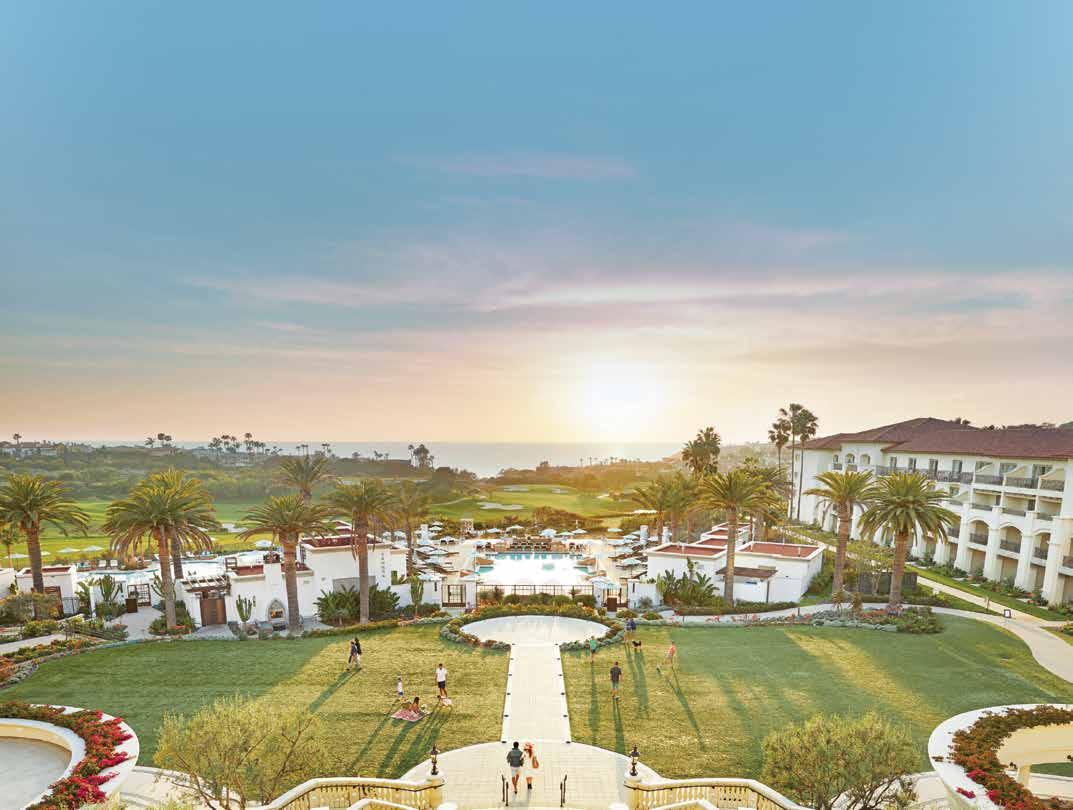
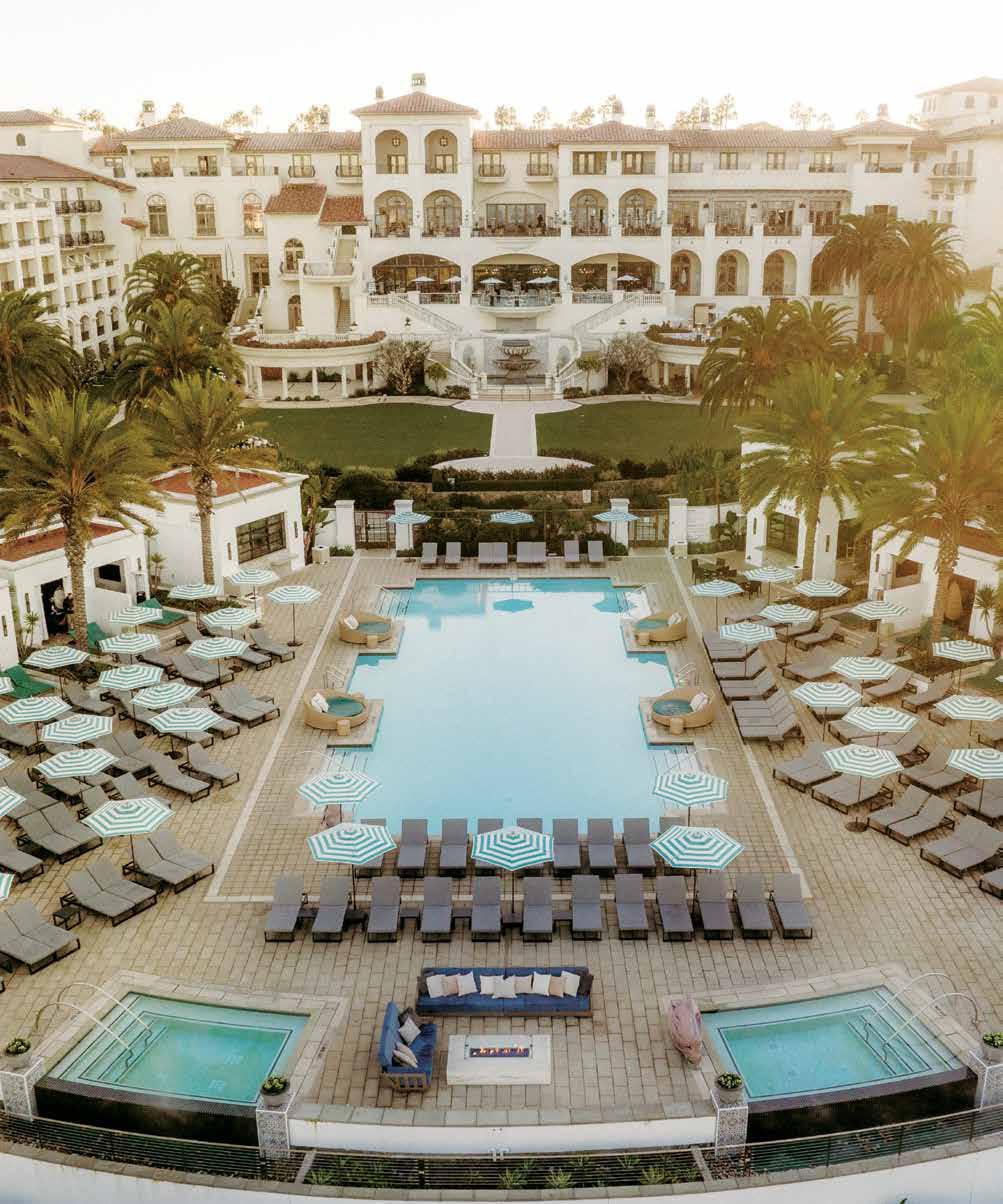
Upon arriving at the sunny SoCal sanctuary — 175 oasis-like acres situated atop a seaside bluff overlooking the Pacific Ocean — I could already sense myself settling into the soothing surroundings. The calming coastal-inspired interior design invites guests to do just that, enveloping you in a watercolor painting of sand, salmon, seafoam, and sky-blue hues. Several public spaces, including the lobby and lobby bar, were recently reimagined to ensure that the refuge-like feeling continues around every corner.
But what really calls to you are the expansive waterfront views waiting just beyond the lobby and living room setting, especially for a water lover like me — a Cancer born in a Southeast Alaska island town who learned to swim before I learned to walk. As soon as I got checked in, I felt myself magnetized to the terrace to take it all in.


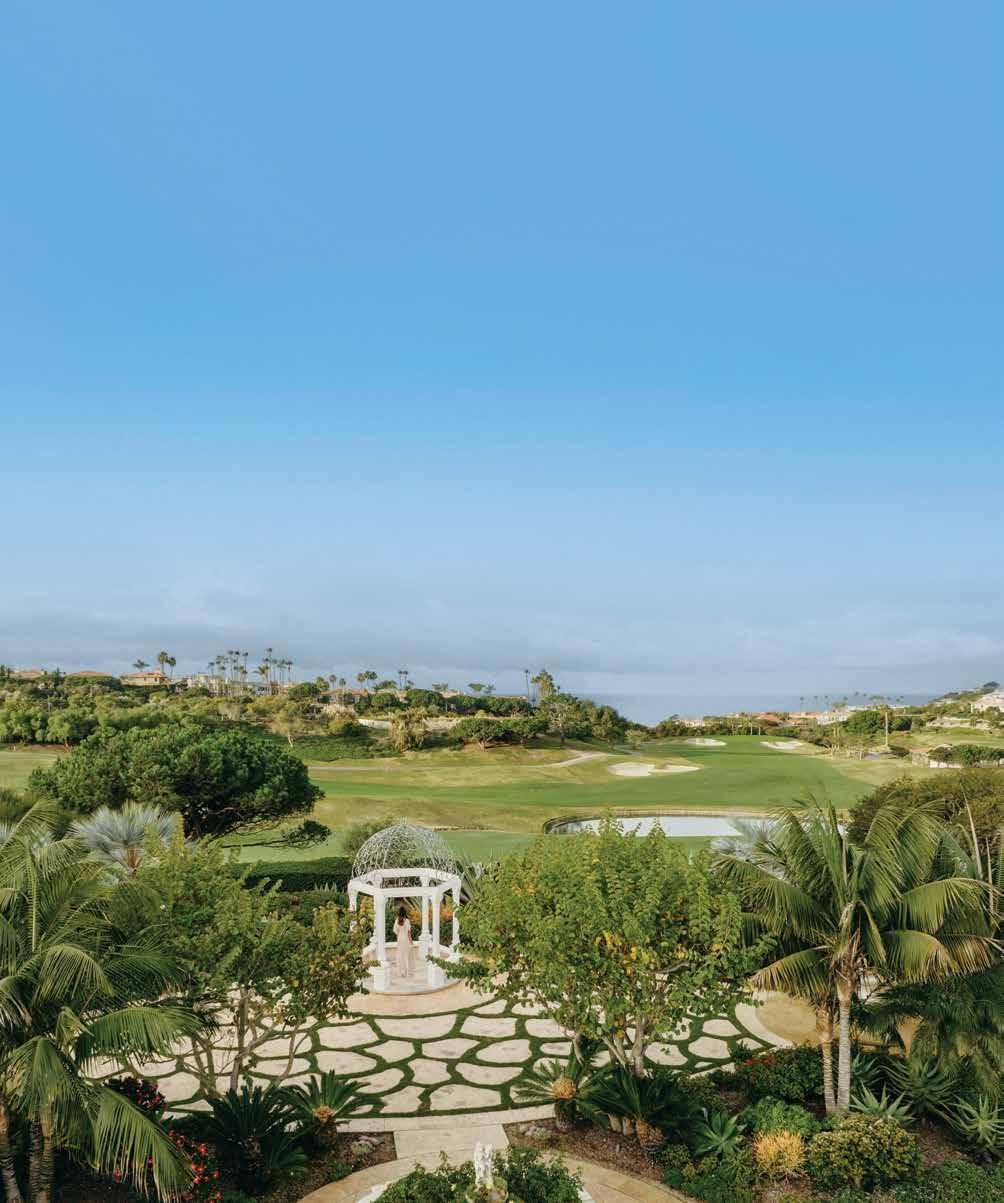
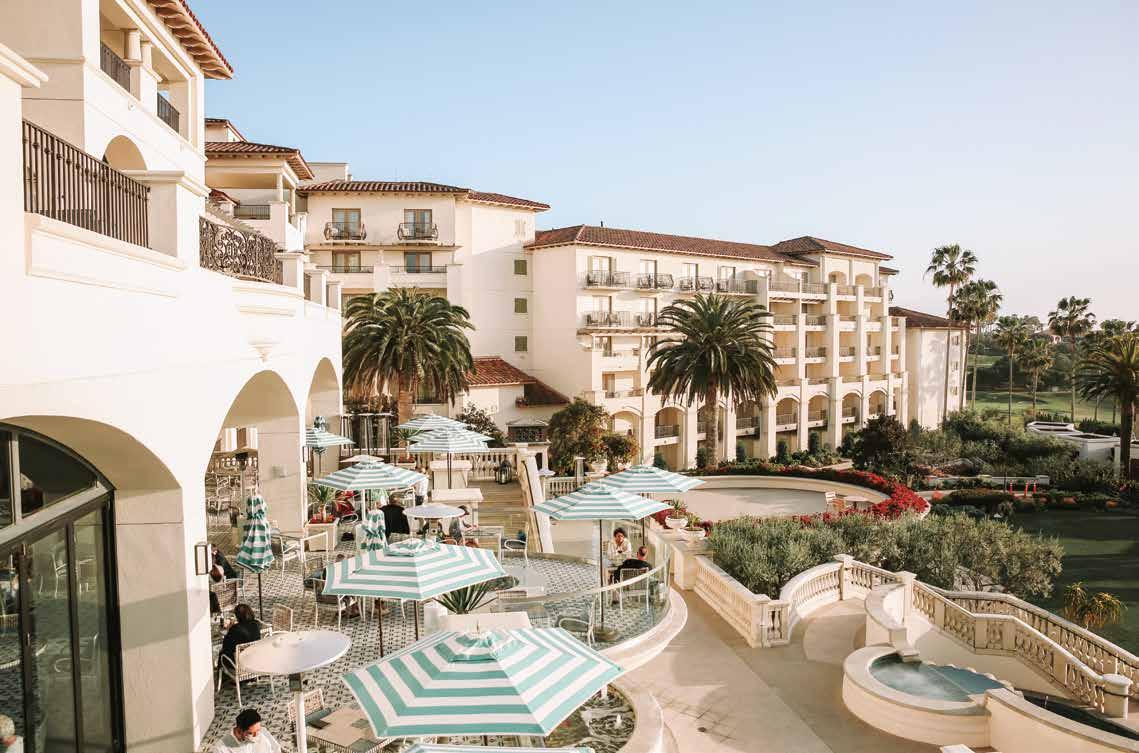
From the vantage point five stories up, you can see the many layers of the property unfolding below: peeks of poppy striped umbrellas, a regal fountain, the well-groomed Grand Lawn, two tempting pools, the premier golf course, and finally the ocean itself, all beneath a picture-perfect sky. For me, that single snapshot was more captivating than any beautiful brochure, any social-media post, any cleverly written campaign could ever be.
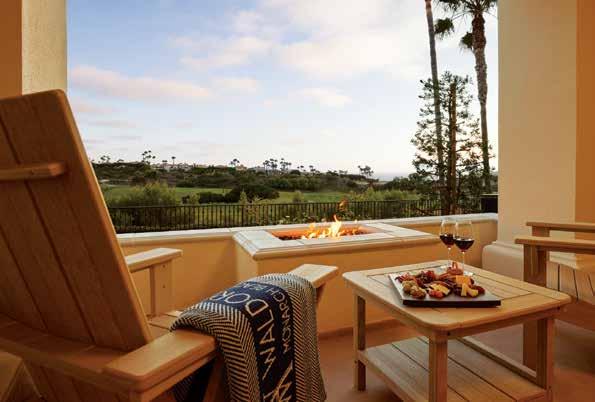
I pulled myself away from that vista long enough to get settled into my suite, one of the hotel’s 400 guest rooms (including 75 suites and seven penthouses). These accommodations underwent a revamp of their own back in 2022 to fully embody the essence of a seaside hacienda. That comes to life via a coastal chic color palette, natural wood finishes, and a handpicked art collection. Select ground-level guest rooms got an added upgrade of private fire pits, ideal for enjoying cooler Cali nights.
Grateful to escape the Midwest’s frigid winter, I relished the unseasonably warm temperatures that the area was experiencing. I set out for the beach, taking to the walking path that the helpful front desk staff had mapped out for me. Along the way, I
couldn’t help but marvel at the transportive tropical paradise that surrounded me from all angles.
Across the pristinely manicured grounds, little vignettes offer opportunities to stop and smell the flowers — or snap an effortless pic against an Instagram-primed backdrop. A standout among these alluring areas is no doubt the Botanical Garden, where hummingbirds and the resort’s namesake butterflies float above blooms and buds. It just begs to host a wedding or intimate gathering (as do the rest of the hotel’s inviting indoor and outdoor meeting and event spaces, clocking in at a collective 110,000 square feet).
As I meandered along the paved walkway, my senses were heightened. Upon nearing my destination, I could hear, smell, and feel the ocean just beyond. Then it came into view: Salt Creek Beach, the inspiration behind the iconic Endless Summer movie poster. This long-time surfer hot spot was immortalized some 60 years ago, when artist John Van Hamersveld created the famed silhouette that has become synonymous with the popular SoCal sport.
My pace quickened as I neared the sandy expanse outstretched before me and felt the humidity of the winter waves hit my skin. I kicked off my shoes,
WAS IT COINCIDENCE OR KISMET that I had undergone a metamorphosis, much like a butterfly, here at Monarch Beach?


marched down to the water, and tucked my toes into the tide. I instantly felt the calming effects of the ocean, as marine biologist and conservationist Wallace J. Nichols, PhD, outlines in his book, Blue Mind. Indeed, cognitive neuroscience studies show that simply spending time near water has healing properties, helping to ease stress, reduce fatigue, and lower heart rate and blood pressure. As it turns out, my love of water is backed by scientific research — and Monarch Beach is the perfect place to satisfy that need.
I eventually wandered back to the palatial property, along the way stopping to admire the award-winning golf course built upon the seaside bluffs. I myself am an occasional golfer at best. But as a lifelong amateur athlete, I have huge respect for those who have mastered this challenging sport — and the beautiful
courses where it’s played. Designed by preeminent golf architect Robert Trent Jones, Jr., Monarch Beach Golf Links is among the most sublime I have laid eyes on. The unmatched views overlooking the ocean are sure to soothe any heartache brought on by a bad lie. Back at the resort, I readied myself for the next order of business on my relaxation-oriented itinerary: a much-needed massage at the Waldorf Astoria Spa. The enticing offerings here surpass those of a typical spa menu. Sure, there are massages, facials, and nail services aplenty, but there are also thoughtfully curated treatments intended to address the everyday stressors of modern living. For instance, the Art of Stillness package involves a silent arrival ritual, a 60-minute De-Stress Massage, a 90-minute Deep Body Renewal treatment, a 25-minute Therabody Lounger


session, and finally dedicated Tranquility Lounge time intended for reflecting and journaling. All spa goers can access the saunas, steam rooms, Jacuzzis, relaxation lounges, and outdoor lap pool, allowing for a buildyour-own-wellness-adventure kind of day.
While still in my post-massage haze, I strolled over to AVEO Table + Bar for a leisurely lunch. Out on the terrace — with that same breathtaking property view that first caught my attention — I snacked on hamachi ceviche and a California cobb salad with grilled salmon. Specializing in local seafood and seasonal plates, the oceanview eatery is one of seven culinary concepts dotting the property.
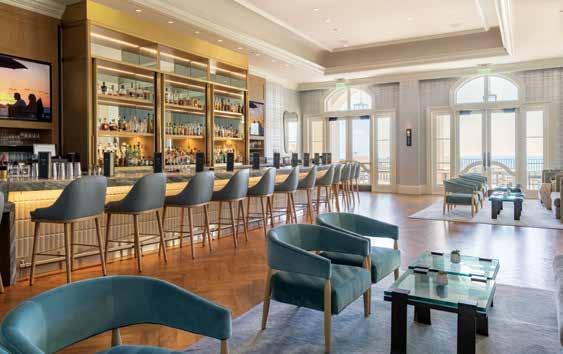
At flagship restaurant Bourbon Steak Orange County, renowned chef Michael Mina has crafted a menu of mouthwatering dishes including caviar, chilled shellfish, and the signature black Angus and Wagyu steaks, all served alongside an impressive collection of wines and whiskies. Meanwhile, “living room” bar 33 North has rightfully earned top honors for its inventive cocktail program and elevated bites;
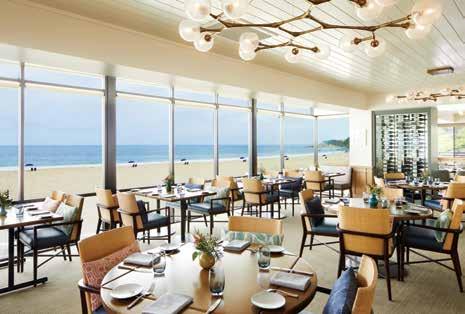
it was one of only 11 hotel bars in the United States named to the 2025 Forbes Hotel Star Bars List. Rounding out the more casual side of things are coffee shop/market Part + Parcel, poolside cantina Sombra, and golf course go-to spot Club 19. My afternoon spent lounging at the pool was made complete thanks to some hyper-fresh tuna tartare, a plateful of California fruits, and a refreshing glass of rosé. For me, the quintessential dining experience was undoubtedly the sunset dinner I savored at Monarch Bay Beach Club. To reach the restaurant — situated right along the ocean, as its name implies — I hopped on the quaint complimentary tram that takes you from the hotel to the waterfront. The Beach Club has been a beloved spot since its opening in 1962 and is now accessible exclusively to members and resort guests. From my prime spot on the front deck perched above the spacious Beach Lawn, I watched the sun sink into the blue waves below and I noshed on the most nurturing, nourishing lobster and seafood risotto I’ve ever eaten. (I resisted the urge
to lick the bowl clean, though I certainly did that in the privacy of my own suite when ordering in-room dining, available 24 hours a day.)
Back to that sound bath session. On my final day at the property, I made my way to the Athletic Club, where guests can partake in dozens of weekly fitness classes in addition to hitting the spacious, state-of-theart gym. After nearly an hour of guided meditation, the instructor gently beckoned my fellow participants and me back to full consciousness. At some point during the class while we had our eyes closed, she had set out an oracle card for each of us, intended to connect us with our higher intuition. When I flipped mine over, it revealed the word “Transformation,” alongside a divine feminine character surrounded by butterflies. Was it coincidence or was it kismet that I had undergone a metamorphosis, much like a butterfly, here at Waldorf Astoria Monarch Beach? As we all slowly returned to the reality of the day, she reminded us of the power of staying in the present moment with these three simple words: Be here now.
Inside
Beach Golf Links.
Monarch Beach Golf Links is one of only a handful of oceanfront golf courses in California, and it stands out from the crowd. Situated steps from the Waldorf Astoria in Dana Point, the picturesque public course was designed by renowned golf architect Robert Trent Jones, Jr. and first opened for play in 1983.
Since then, golf greats including Tiger Woods, Phil Mickelson, Bubba Watson, and Arnold Palmer have all teed off at the 6,645yard, par-70 course, as have celebrities like actor Bruce Willis, musician Jimmy Buffett, and sports star Shaquille O’Neal. Monarch Beach Golf Links has also earned impressive accolades, including being named a Golf Magazine Gold Medal Resort and a Golf Digest Best Place to Play. And all for good reason.
“It truly captures the essence of coastal Orange County: a love of being outside, athletic, and sporty, but also laid-back,” PGA Director of Player Development and Marketing Jackie Riegle told Troon Magazine. “It’s such a perfect balance for the guest who likes the finer things in life but also might hit some shots while barefoot and wants music playing during a round.”
Beyond its undeniable beauty, Monarch Beach Golf Links has hosted thousands of charity events over the years. Those philanthropic initiatives have raised more than $30 million for local and regional charities such as the American Cancer Society, the American Heart Association, and the Boys & Girls Club of Capistrano Valley. A great-looking course that also does good? If we’re keeping score, that’s definitely a hole-in-one.
The National Native American Hall of Fame celebrates six Indigenous leaders in its 2025 class.
By James Parker Shield
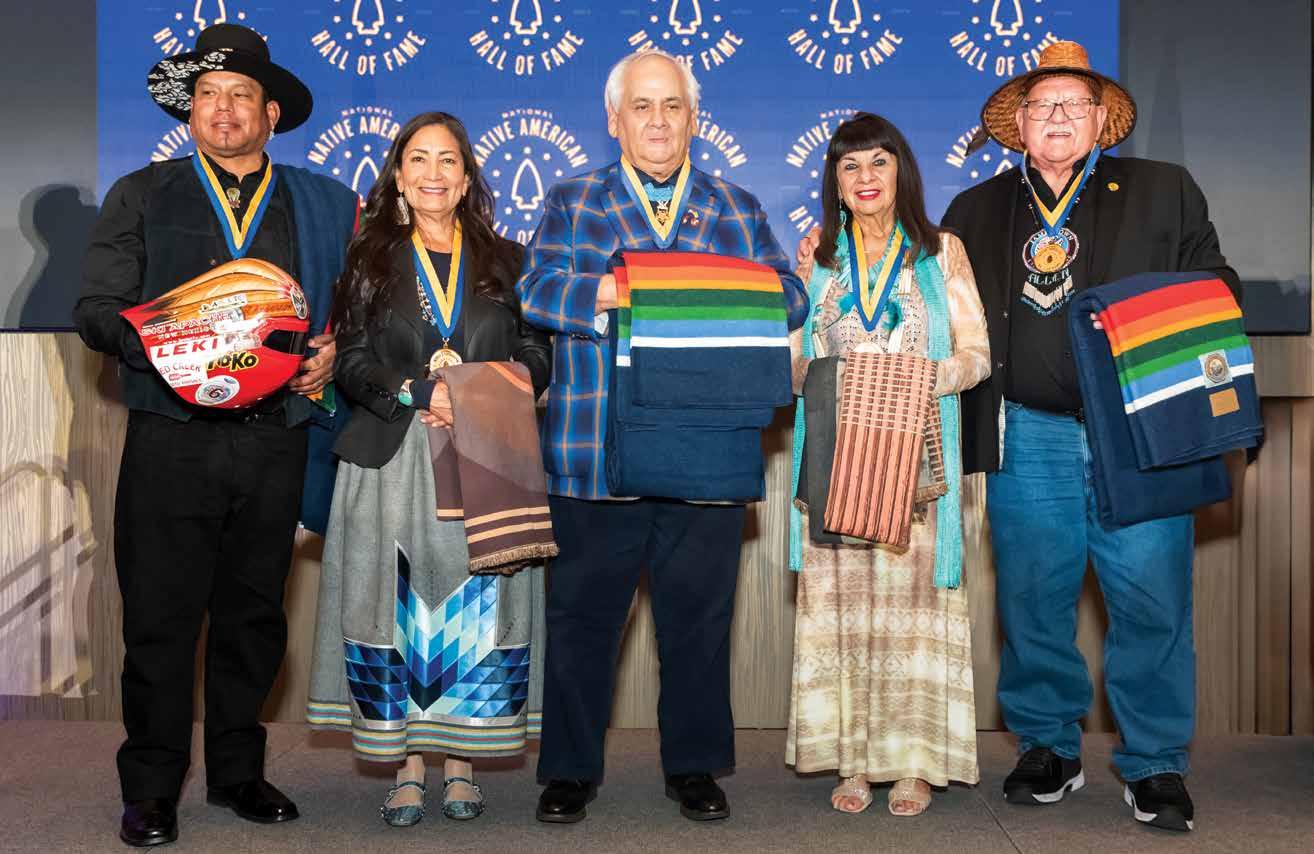
THE NATIONAL Native American Hall of Fame honors exemplary Native Americans whose lives reflect their tribal cultures, inspire others, and affirm the enduring contributions that Indigenous people have made to our nation’s story. Each year, the organization brings together tribal leaders, elders, families, and youth to recognize individuals whose influence reaches far beyond their own communities. The 2025 induction ceremony in Oklahoma City reflected that purpose, highlighting six individuals whose careers span governance, military service, athletics, and national leadership.
Leading the class was Chairwoman Lynn Valbuena of the Yuhaaviatam of San Manuel Nation, a figure whose impact has been built over decades of service. Her leadership journey began in community housing and local governance before evolving into longterm tribal leadership. Serving multiple terms as Chairwoman and previously serving two terms as Vice Chairwoman and multiple terms as Secretary/ Treasurer, she has guided her Tribe through significant growth while maintaining a strong focus on education, health services, and cultural continuity. Her work has extended beyond her own Tribe, with ongoing contributions to regional and national initiatives supporting tribal sovereignty and collaboration, including building relationships and fostering collaboration across all levels of government — local, regional, state, federal, and among tribal nations — contributing to her Tribe’s continued success. Her induction recognizes a career defined by mentorship, consistency, and a deep commitment to preparing tomorrow’s tribal leaders.
The inductees also included Deb Haaland of Laguna Pueblo, whose career represents a milestone in Indigenous representation at the federal level. As the first Native American to serve in a U.S. Cabinet position, as Secretary of the Interior, she has reshaped conversations about land management, environmental responsibility, and tribal consultation. Beyond the historic nature of that appointment, her influence reflects decades of advocacy and public service, demonstrating how Indigenous leadership can shape policy at the highest levels while remaining rooted in community values.
Military service and sacrifice were represented by Specialist Five Dwight W. Birdwell of the Cherokee
Nation of Oklahoma. A Vietnam War veteran and Medal of Honor recipient, he exemplifies extraordinary courage and selflessness in combat. His induction recognizes not only individual bravery but also the long-standing tradition of Native military service. His story stands as a reminder that service to country and service to community have long gone hand-in-hand for Indigenous groups.
Athletic excellence brought another dimension to the 2025 class through Ross Anderson, a member of the Cheyenne and Arapaho Tribes and the Mescalero/ Chiricahua Apache. His achievements in professional speed skiing place him among the fastest competitors in the world, breaking barriers in a sport with little Native representation. His induction recognizes discipline, perseverance, and the power of visibility — reaffirming that Indigenous athletes can excel on global stages while carrying their identities with pride. Another inductee whose influence extends well beyond personal achievement is Notah Begay III, of the Navajo Nation and San Felipe/lsleta Pueblo. Known for his success in professional golf, he has made a lasting impact through his ongoing work with Native youth. By developing programs that promote health, education, and opportunity, he has opened doors for young people who may not otherwise have access to sports and mentorship. His induction highlights the role of giving back as a defining measure of success.
Rounding out the class is W. Ron Allen, Chairman and CEO of the Jamestown S’Klallam Tribe, whose leadership transformed his Tribe’s economic future. Taking office during a time of limited resources, he has built sustainable enterprises that strengthen tribal self-determination while supporting social services and cultural initiatives. His career stands as an example of long-term vision and strategic leadership grounded in accountability to community.
Taken altogether, the 2025 inductees reflect the wide scope of Native leadership today. Encompassing tribal governance, federal service, military valor, athletic achievement, and youth advocacy, their accomplishments demonstrate that Indigenous excellence is not confined to one path or profession. The National Native American Hall of Fame recognizes them not only for their individual achievements but also for the ways in which their work continues to shape tribal communities and inspire future generations.
By
A look at artist and community leader George Rivera’s lasting impact across Indian Country.
George Rivera is the ultimate multi-hyphenate. He’s an artist known the world over for his monumental stone and bronze sculptures. He’s a jewelry designer, scaling down his designs into wearable works of art. He’s a fixture of the creative community surrounding Santa Fe, New Mexico. He’s a tribal leader, a teacher, a husband, a father, and a friend. For all these reasons and more, Rivera is an inspiration to countless people across Indian Country.
In shaping Native American history, he is continuing to carve a path first forged by his ancestors. More than 70 years before Rivera became Governor of the Pojoaque Pueblo, his great-grandfather, Jose Antonio Tapia, led his community’s return to their northern New Mexico village after they had sought refuge from settler encroachment in nearby Colorado and a smallpox epidemic nearly wiped out the Tribe entirely.
Rivera was in France on an artistic sojourn in his 20s when he felt an undeniable magnetism back to his people’s homelands. “I had this ancestral vision and pull to come home,” said Rivera, who lives in Pojoaque Pueblo with his wife, Felicia RosackerRivera, and the two youngest of his five children. “There were no words. There were no letters. There was no message sent to me. It was something that just came to me, and it was such a clear and powerful vision that I was supposed to focus on my Tribe.”
First stepping into the Lieutenant Governor role in 1992 at age 27, Rivera went on to serve his Tribe in an official capacity for 22 years. His impressive accomplishments during that tenure — founding the Poeh Cultural Center, developing the Buffalo Thunder Resort, navigating state and federal gaming issues, advancing tribal economic development — have left a lasting legacy on his community and on Indian Country as a whole. Eventually, he sat on the New Mexico Economic Development Board as well as the state’s film commission board, at a time when Indigenous representation was rare in such spaces. “We really broke all the doors open,” he recalled.
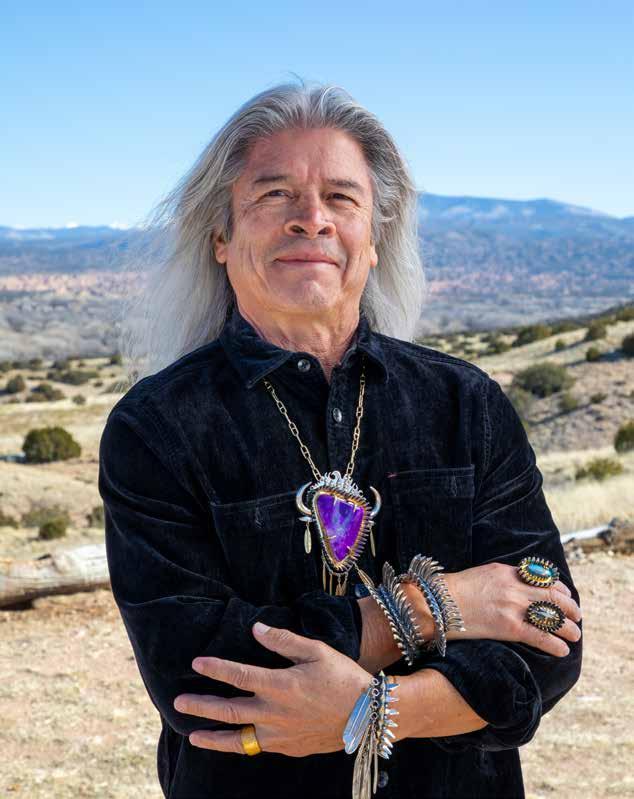

Rivera learned the ropes from his uncle, Jacob Viarrial, who preceded him in the Pojoaque Pueblo governorship and was a fierce advocate on topics like water rights and tribal gaming. “He told me, ‘You can’t just be an artist; to be a tribal leader, you have to be a politician and a businessman,’” Rivera recalled. “He taught me to really be fearless. I took the time to learn, and I worked on things until they got done, even if it required several years.”
For Rivera, there are parallels between his civic work and his artistic practice. “No matter what I was doing — from meeting the president to testifying in front of Congress — I always maintained my integrity and remembered I was doing this for my people,” he said. “There were definitely difficult moments, but like with my artwork, I like things that are challenging and complex.”
It was a high-school elective class that first turned Rivera on to the power of art, which led him to study at the Institute of American Indian Arts in Santa Fe, the California College of Arts and Craft in Oakland, and the Lacoste School of Arts in France. Over time, the student became the teacher. During his three-year stint in France, Rivera served as a sculpture assistant teacher, showing others how to carve stone using just a hammer and chisel. Since returning stateside decades ago, he has remained committed to his mentorship work to this day.
“THE INSPIRATION BEHIND MY ARTWORK IS WHO I AM AND WHE RE I AM FROM.”
In addition to formal training, globetrotting played a major role in informing his artistry. “Travel was as much my education as sitting in any classroom,” he said. “I had built up knowledge and experience, but the fearlessness came from traveling alone — being out there and seeing what had been made by both modern artists and greats like Van Gogh, Cézanne,
and Picasso. That international experience helped me realize there truly are no limits.”
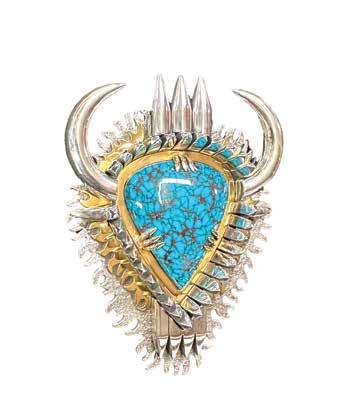
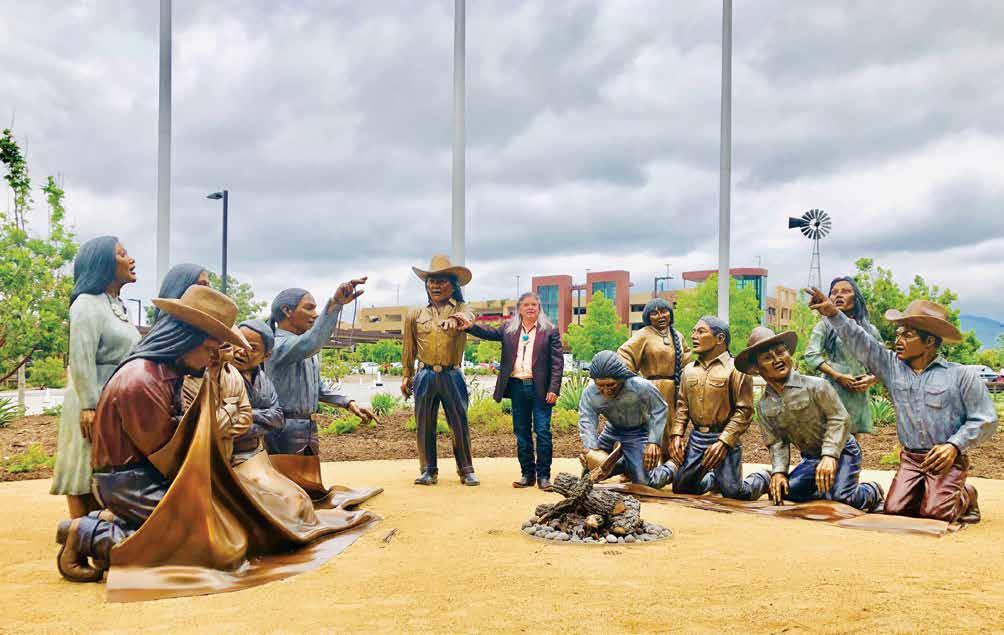
Like his talents, Rivera’s mediums are many, including clay, stone, metalwork, ceramics, painting, sketching, and even architectural design. All of it is intended to reflect his Pojoaque Pueblo heritage. “The inspiration behind my artwork is who I am and where I am from,” he explained. “My influences come from my experiences, my surroundings, my dreams, and my visions that have led me to where I am right now.”
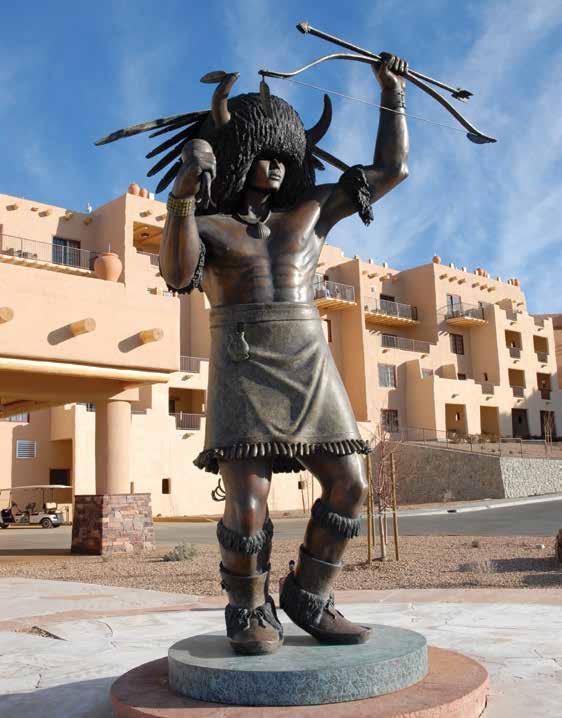
Standing tall among his monumental creations is the 12-foot bronze sculpture “Buffalo Dancer II,” which sits outside the Smithsonian’s National Museum of the American Indian on the National Mall in Washington, D.C. There’s also the 12-ton buffalo sculpture carved from Virginia sandstone that’s on permanent display in the Pojoaque Pueblo. But his most personal work is undoubtedly “Lightning Boy,” a bronze sculpture that’s now part of the permanent collection at Santa Fe’s Museum of Indian Arts & Culture.
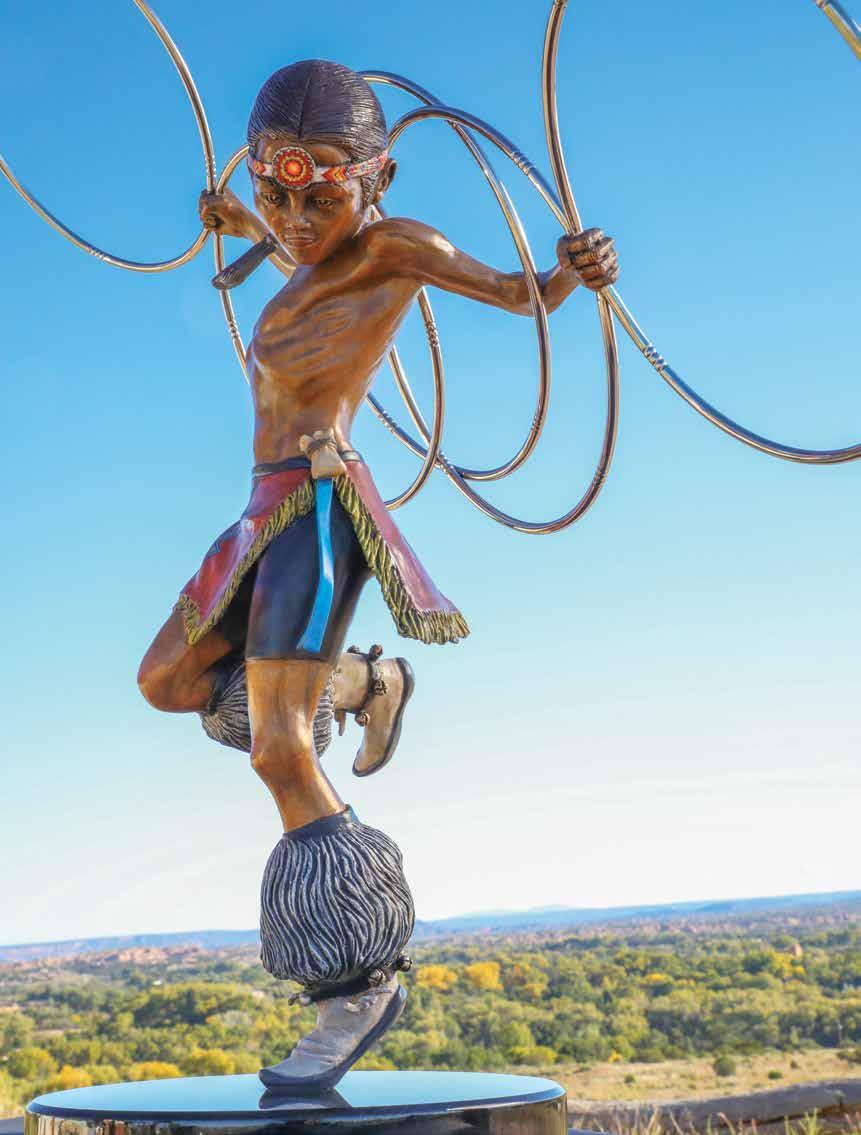
It’s an ode to George and Felicia’s son, Valentino Tzigiwhaeno (Tino), who passed away in 2016 at the age of eight after a tragic car accident and a long battle with the resulting injuries. Tino, who was known as “Lightning Boy” thanks to his Tewa name, was a talented hoop dancer, and the sculpture shows him twirling in tribal regalia. In addition to channeling his pain into his art, George and Felicia
also founded the Lightning Boy Foundation in Tino’s honor. The nonprofit offers traditional hoop dance instruction and dance programming to Native youth, with an aim to bolster confidence through cultural expression. His two youngest children, Paloma and YsaDora, are dancers with the foundation.
This spring, Rivera will install a commissioned life-size “Lightning Boy” sculpture at the Boys & Girls Clubs of America national headquarters in Atlanta. He and his son PaaWee are among the few Indigenous inductees in the organization’s Alumni Hall of Fame (along with late Oneida advocate Ernest Stevens, Jr.). He has long championed the nonprofit’s work, including establishing the Pueblo of Pojoaque Boys & Girls Club and serving on its board.
“I’m a lifer Boys Clubber, and we’re some of the proudest people I know,” Rivera said. “I was raised at the Boys Club; I spent so many hours there as a teenager — working out, teaching, coaching. It was a big part of my life growing up, so I always wanted to give back. It’s so important to provide our Native youth with opportunities to stay busy, stay focused, and stay out of trouble.”
Another recent endeavor harks back to his youth: jewelry making, which he dabbled in as a teen alongside his father. During the COVID pandemic, he returned to the artistic discipline, which takes a similar creative process as his sculptures. Although





the scale is certainly different from his monumental works, there’s an undeniable continuity between his sculptures and his baubles, which are unapologetically bold and bombastic.
“When you do monumental bronze, you feel like you could do anything in the arts, so I wanted to give jewelry a shot,” he said. “I quickly realized my interest was in sculpted-out jewelry without any limits. I took concepts that some people might find too outrageous — spikes, flames, and all these complexities — and made them for myself, figuring they’d end up on a runway or exhibited on a pedestal somewhere. But it turns out that people love fresh, bold ideas.”
In those fresh, bold ideas, he has established not only an extended fan base but also kinship among fellow Santa Fe area artists like Kenneth Johnson

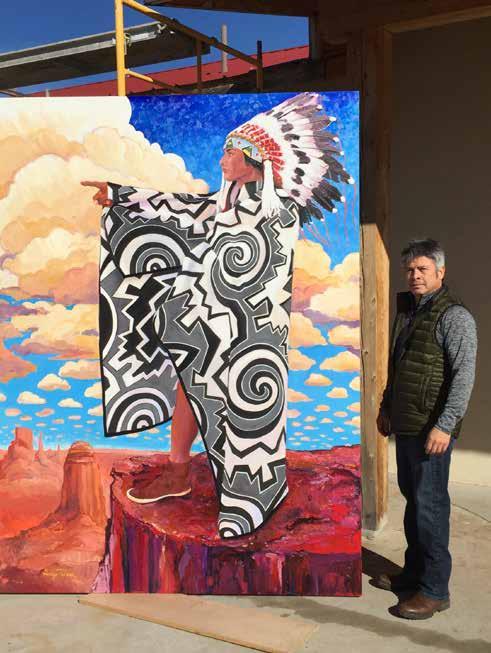
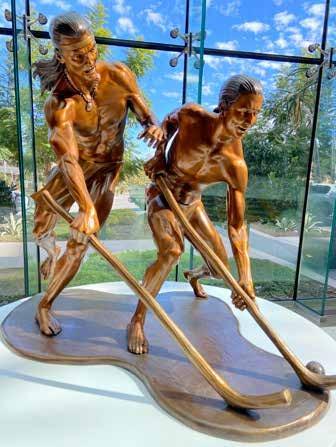
(Left) “The Vision” 6-by-8foot oil painting owned by NCAIED (2016). (Right) Feather bracelet in silver, gold, and black diamonds (2025). (Below) “Pechanga Shinny” bronze sculpture on display at SoFi Stadium in Los Angeles (2021).
(Muscogee/Seminole) and Cody Sanderson (Navajo). The trio often collaborate, including on a custom gorget dubbed “Stars, Spikes, and Feathers Forever.” Combining gold, silver, Bisbee turquoise, and oxblood coral, the piece reflected their interlacing cultures and raised an impressive $67,500 at the 2025 SWAIA Santa Fe Indian Market Gala. This is just one example of how his artistic expressions and his community contributions are inextricably intertwined.
It’s a living ancestral legacy that Rivera is handing down to his four living children, who are carving out their own history-making paths. For example, his son PaaWee served as the White House Director of Tribal Affairs for President Joe Biden, and his daughter
PoQueen served as executive director of the White House Council on Native American Affairs under that same administration.
“You just hope that what you do in life is good and that it gets passed on,” Rivera concluded. “My two older children who are now professionals are super involved and super successful. They’re just outstanding. I hope that I’ve been able to impart a couple lessons upon them: No. 1 is to keep the culture alive, and No. 2 is to be fearless.” Sound advice indeed.
How the University of Nevada, Las Vegas champions tribal-focused programs.
By Richard Arlin Walker
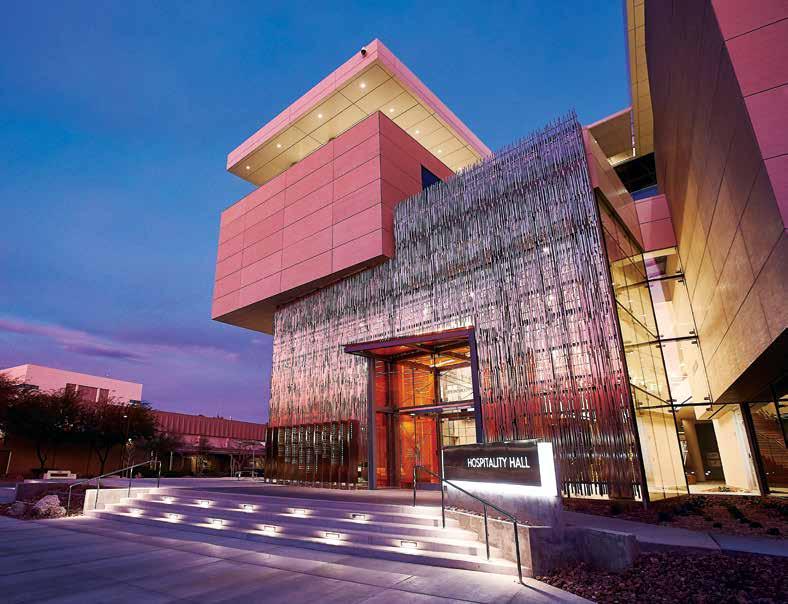
THE YEAR was 2023 and University of Nevada, Las Vegas (UNLV) President Keith Whitfield knew he needed to change how gaming, hospitality management, and tribal law were taught if UNLV was going to attract and retain Native American students.
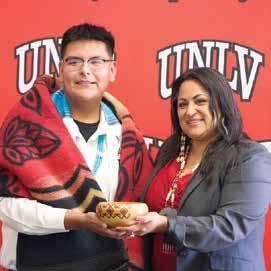
UNLV had received a $9 million gift from Yuhaaviatam of San Manuel Nation a few years earlier in 2020, but at that point, the school’s faculty wasn’t prepared to develop and teach culturally relevant curricula and programs. Whitfield turned to two Indigenous women he would later refer to as “the lightning and the thunder.”
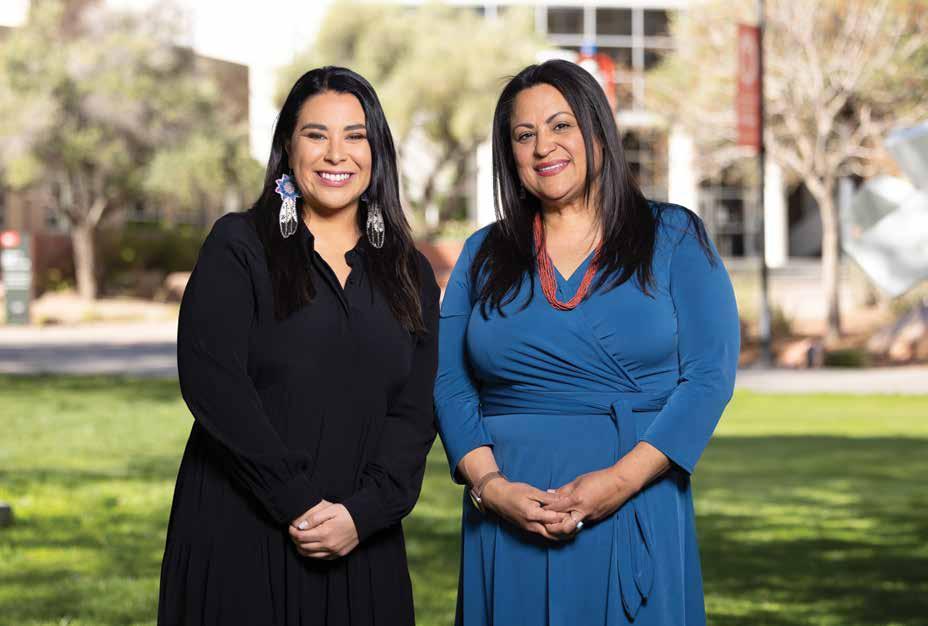
In the past two years, Danielle Finn (Standing Rock Sioux) of UNLV’s William S. Boyd School of Law and Tammi Tiger (Choctaw) of UNLV’s William F. Harrah College of Hospitality have developed curricula, established relationships and worked with their faculty to build networks in Indian Country, and
created new pathways to careers with tribal nations in law, gaming, and management of hospitality and tourism enterprises such as casinos, resorts, entertainment venues, and golf courses.
Finn is the law school’s first Indigenous full-time professor and serves as the director of its Indian Nations Gaming and Governance Program. She is also an associate judge for the Cheyenne River Sioux Tribe and the former Native American affairs advisor to Minnesota Governor Tim Walz. Meanwhile, Tiger serves as director of the Tribal Education Initiative at Harrah College of Hospitality. She is also a Nevada Department of Native American Affairs Commissioner and had previously worked in county government for 25 years.
“Tammi and I would walk into a room together and President Whitfield would say, ‘Here comes the storm — the lightning and the thunder,’” Finn recalled. “It
got people moving, in a good way. Obviously, we always want to be good relatives to everybody, but we also don’t take ‘no’ for an answer. We find ways to make things happen. I think that’s just our strength as Native women.”
The results so far? Roughly 30 law students are Native American, Alaska Native, or Native Hawaiian. Four law professors, in addition to Finn, are Indigenous. There are 26 Indigenous students in the hospitality program; 22 are undergraduates, three are working on master’s degrees, and in fall 2026, Tiger will be one of the college’s first Native PhD students. Today, Harrah College of Hospitality is the top-ranked hospitality college in the nation and is ranked among the top five in the world.
“When Tammi and Danielle joined UNLV, they had this uphill battle, because their colleges’ faculty and staff really didn’t understand Native American
communities and the importance of this programming,” said Yuhaaviatam Vice President of Tribal Brand Marketing & Strategic Philanthropy Jessica Stops.
“The details of our gift were somewhat ambiguous,” she continued. “We asked that they provide a scholarship to a law student who’s interested in Indian gaming and tribal governance; develop public programming and courses pertaining to tribal governance and Indian gaming; and build connections with tribal nations across the country and specifically within Nevada and California. Tammi and Danielle came in and turned it into magic.”
Here was the issue: Despite the fact that UNLV is located in the nation’s gaming capital and within a state that shares geography with 28 tribal nations, few Native students — the future legal and business leaders of Indian Country — were studying there.
The opportunities are massive, considering that
“WHEN YOU THINK ABOUT THESE PROGRAMS, IT’S ALL ABOUT PROTECTING AND PRESERVING TRIBAL SOVEREIGNTY.”
more than 200 tribes operate more than 530 tribal gaming enterprises across 29 U.S. states, with hotels, entertainment venues, and golf courses employing thousands of people and bolstering local and regional economies. But the challenges were also daunting, given that the country’s more than 570 tribal nations each have their own laws, governance, and enterprises.
Previously, UNLV faculty didn’t have connections within Indian Country that they could tap to help develop appropriate coursework, so curricula and classroom presentations lacked relevance. “I went through our entire curriculum, and there was only one module about tribal gaming and hospitality,” Tiger recalled. “Tribal gaming represents 45 percent of gaming revenue across the country, and it wasn’t really even part of our curriculum.”
The consequences were evident. “We were losing Native students at the law school,” said Finn. “They wanted to transfer to or were doing visiting semesters at other schools with Indian law programs. But now, they love our law school and want to be part of the community we’re building.”
The duo knew that if they were going to turn things around, they first needed to ensure professors and advisors understood tribal sovereignty and governance. “I started from the basics,” Tiger remembered. “I explained our history and worldview as Native Americans, our government-to-government relationship with the United States, and the fact that there’s a federal law that allows us to have gaming on our tribal lands.”
Over the past few years, Tiger and Finn have worked tirelessly. They joined university committees and hosted cultural events. They conducted focus groups with leaders in tribal gaming, Indian law, hospitality education, and tourism management. They promoted the Native Youth College Camp nationwide, attracting more than 130 students in 2024 — the most ever at UNLV. They represented the school at numerous conferences and events, reaching
by Troy Shay
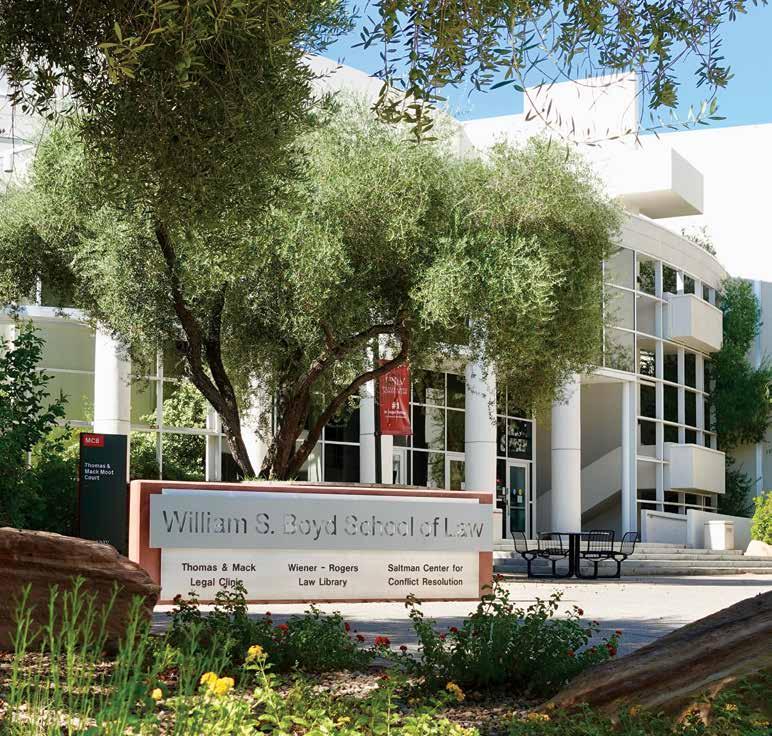
more than 1,000 prospective students between 2023 and 2025. They developed a nationwide network of UNLV alums to provide industry mentorship and internship opportunities. They coordinated with the campus liaison to help Native students navigate college, advocated to retain and promote the Native American fee waiver, and made courses available online for greater access to students living in their tribal communities.
Finn also helped establish the tribal law section of the State Bar of Nevada, which governs all attorneys in the state. “Now, we have more than 30 Native attorneys in the state who have a place in the State Bar,” she said. “They are very much becoming involved with federal Indian law and Indian gaming because of the program.”
The impact of all these efforts goes beyond just Native students. Non-Native students are gaining knowledge of cultural protocols they need to know if they intend to work in Indian Country. “A good deal of students taking our classes are non-Native, and we ensure that they have the cultural sensitivity training
“THIS PROGRAM IS REALLY ABOUT PREPARING THE NEXT GENERATION OF LEADERS WHO CAN PROTECT THE LEGAL FRAMEWORK THAT ALLOWS TRIBES TO ENGAGE IN GAMING.”
Photography by Trevon Barnes/Tigers.i
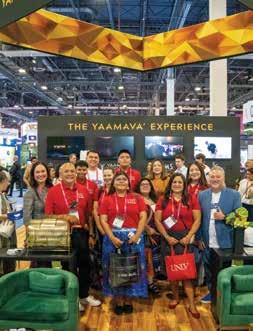
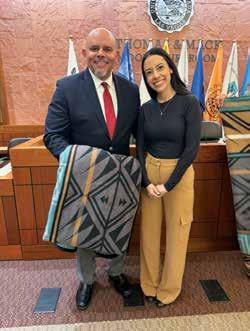
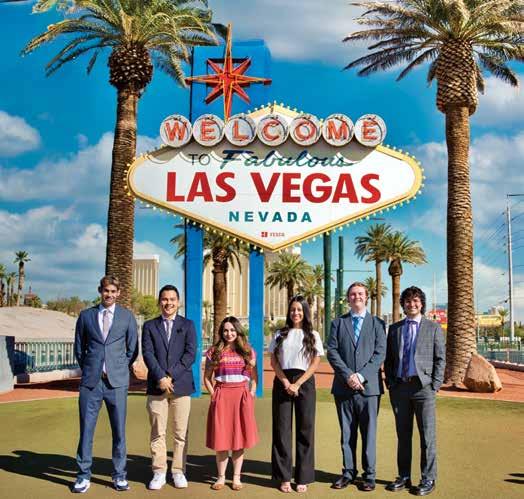
needed to be able to walk into a Native American community setting,” Finn said. “We introduce ourselves first. We shake hands. We give thanks. There might be a prayer. We talk about all of these things in all of our classes.”
Yuhaaviatam plays a key role in that on-the-ground education. “We have an alternative spring break class, where I’ll take 20 law students to San Manuel, and they’ll interact with everyone for a few days,” Finn continued. “Before they go, they get cultural sensitivity training: Don’t touch objects that don’t belong to you. Don’t take pictures unless you’re given permission. These kinds of considerations are very important to Native communities, and we make sure everybody understands them.”
Peter Arceo (Chamorro), who serves as Yuhaaviatam’s chief gaming officer, graduated from UNLV in 1996. He emphasizes the importance of looking at the business through an Indigenous lens. For example, corporate gaming is guided by shareholders’ profit expectations, whereas tribal gaming is guided by the community’s needs.
“In the corporate world, the conversation centers around, ‘What were the results this month?’ ‘What’s the outlook for the quarter?’ ‘What are we going to do for the year?’” he said. “At San Manuel, the conversation is, ‘Is this the right decision for 10 years from now?’ It’s a much longer-term mindset that takes into account the community, because the community depends on the success of that business.”
Kenji Hall, who serves as general manager at Yaamava’ Resort & Casino at San Manuel, earned his degree in hotel administration at UNLV in 1993. The popular property attracts more than 14 million annual visitors — second only to Disneyland in terms of California tourism.
“We always ensure we’re doing the right thing for people over profit,” Hall said. “That’s the philanthropic side of what the Tribe does — trying to make their ancestral lands a better place. You feel such a sense of purpose in it.”
Big picture, that’s exactly the intent of UNLV’s Native-focused programming: to develop future leaders who can help safeguard tribal sovereignty and spearhead ongoing innovation and enterprise.
“When you think about these programs, it’s all about protecting and preserving tribal sovereignty,” Finn said. “It has been nearly 40 years since the Indian Gaming Regulatory Act was enacted, and it’s been running strong. Many tribes, like Yuhaaviatam, have really benefited, but there are still a lot of tribes that have not gotten there yet. This program is really about preparing the next generation of leaders who can protect the legal framework that allows tribes to engage in gaming.”
In the years to come, there will no doubt be a ripple effect of Finn’s and Tiger’s hard work across UNLV and beyond, predicts Jessica Stops, who was instrumental in establishing the Yuhaaviatam $9 million gift to the university. “When this all started, there was a vision but no outline as to where it could go,” she said. “Tammi and Danielle really brought that vision forward and are continuing to build upon it for the future.”
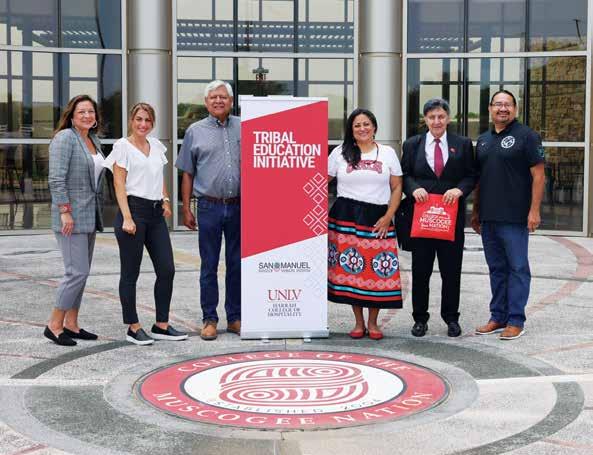
A.Y.C.E. Buffet Chef de Cuisine Jessica Buffington earns the Hospitality Hero Award.
By Ryan Slattery / Photography by Robert John Kley
RUNNING ONE of the top buffets in Las Vegas is no easy task. Sure, it’s a massive team effort, but this feat requires a charismatic, high-energy leader with great communication skills, endless empathy, and quick problem-solving instincts. Jessica Buffington is that person.
As Chef de Cuisine for the A.Y.C.E. Buffet inside Palms Casino Resort Las Vegas, she heads up the restaurant’s day-to-day operations. It’s a demanding job, but one Buffington relishes.
For her hard work, she was recently recognized with a Hospitality Hero Award from the Las Vegas Convention and Visitors Authority. Each quarter, two frontline hospitality workers are selected to receive the accolade by an independent committee made up of faculty and staff members at the University of Nevada, Las Vegas’s William F. Harrah School of Hospitality. Buffington was honored “for her genuine enthusiasm and for inspiring her team to transform every meal into a meaningful experience for guests.”
It all came as a surprise to the 33-year-old chef. “I didn’t even know they had nominated me,” she said. “I’m still mind-blown. It feels good to be recognized. We love what we do here every day. My cooks are my second family. I’m so proud of them.”
Buffington began her career as a dishwasher and worked several jobs before coming to Palms in 2015. There, she started as a buffet cook and worked her way up to sous chef before ultimately taking over the head position in March 2023. “I always felt like I could do more, and they gave me a shot,” she recalled.
“We love what we do here every day. My cooks are my second family. I’M SO PROUD OF THEM.”
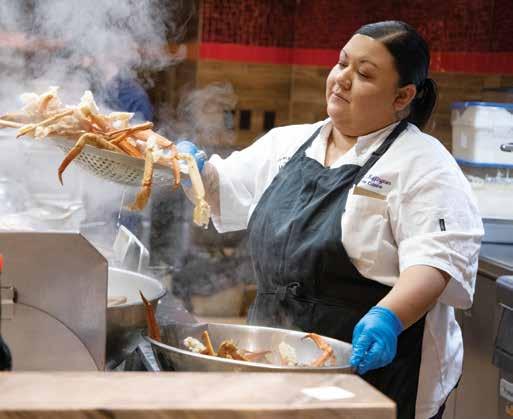
offers a large selection of vegan and gluten-free dishes, such as vegan enchiladas, eggplant parmesan, and a spicy tofu “chicken” sandwich.
Now, Buffington is running the buffet with a focus on both service (birthday guests receive mini cakes) and safety (diners with food allergies get a personalized chef walkthrough). Plus there’s a decided emphasis on inclusivity for those who have dietary restrictions or preferences. For example, A.Y.C.E.
Of course, the restaurant is best known for its endless lobster and snow crab meals, taking place every Wednesday and Thursday evening — when guests savor an estimated 4,000 pounds of whole lobster and 1,400 pounds of lobster tails each night.
For Buffington, her job encompasses countless
considerations long before the food ever hits the line, and organization is key. Her work includes ordering ingredients for the buffet’s 100-plus dishes, scheduling chefs (roughly 40 cooks per service), and anticipating how many patrons might come through on any given day based on reservations and walk-ins.
“It’s a lot of planning,” Buffington said. “You have to be five steps ahead of any possible situation — anticipating any kind of bumps that the cooks might experience. But no matter what’s going on, my smile never drops.”
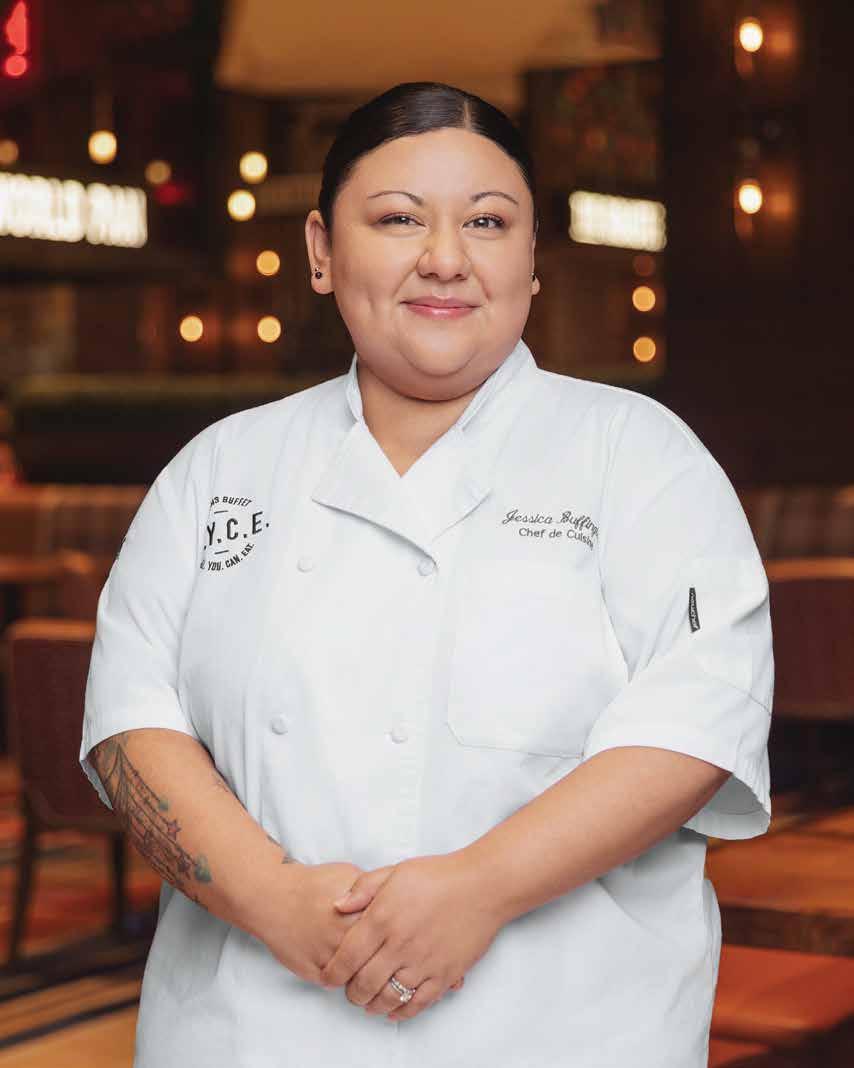
With a $10 million donation, Yuhaaviatam of San Manuel Nation strengthens its partnership with SAC Health.
By Armando Carmona
LAST FALL, the Yuhaaviatam of San Manuel Nation committed a $10 million gift to SAC Health, one of the largest community-based healthcare providers in California’s Inland Empire. The investment strengthens the clinic system’s capacity to provide for more than 60,000 underserved patients annually. It also supports continued expansion at SAC Health’s new $85 million Brier Campus in San Bernardino, a facility designed to dramatically increase access to its comprehensive medical and behavioral health services.
For a region where uninsured, underinsured, and undocumented families often face significant barriers to care, this monumental donation represents more than just financial support. It reinforces longterm stability for an institution rooted in trust and access. The new campus expands specialty services, increases clinical space, and allows SAC Health to deepen its reach into communities that have historically experienced systemic inequities.
The gift also reflects Yuhaaviatam’s broader approach to regional investment. Much more than simply short-term philanthropy, the focus is on bolstering institutions that serve as anchors of community well-being. In SAC Health, the Tribe saw an organization deeply embedded in the neighborhoods it serves and committed to remaining present for the long haul.
“The investment that the Tribe has made here is an investment in the community,” said former Tribal Chairman Ken Ramirez. “It’s about being good stewards of the local area.”
Of course, place is not simply geography for Yuhaaviatam. It is responsibility. It is memory. It is stewardship that transcends place and time, expanding beyond existing borders and forward into future generations. That worldview shapes how Yuhaaviatam leads — not only for its own tribal citizens, but across the Inland Empire.
Ramirez often speaks about leadership through a
“The investment that the Tribe has made here is an investment in the community. It’s about being good stewards of the local area.”
seven-generations lens. Decisions, he explains, must honor those who came before and those who will come after. “We have to be good stewards of the land,” he said. “This is our ancestral homeland, and we’re ultimately responsible for what goes in it and on it.”
That philosophy is apparent in the Tribe’s approach to partnership, investment, and regional engagement. Growth has never been pursued simply for the sake of growth. Instead, economic strength has been considered a tool of self-determination — the ability to stand independently and to invest intentionally.
That philosophy resonates with SAC Health CEO Jason Lohr, MD. His own journey to the Inland Empire

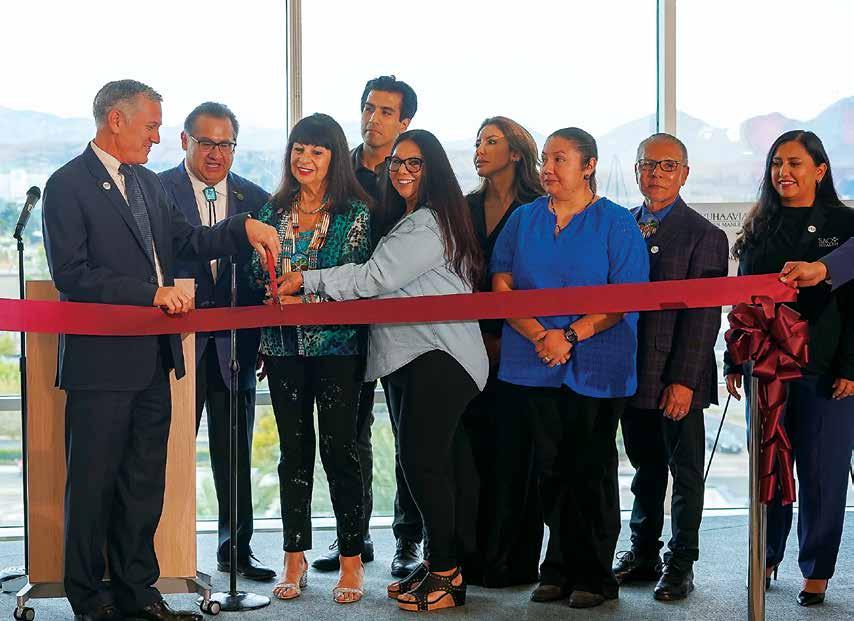
was shaped by movement. Raised in a Navy family, he lived in multiple states and cultures. As a physician, he and his family spent five years in Africa and two in Honduras, serving communities with extremely limited access to care. Simply put, his life has been defined by global service. Yet the Inland Empire is now the place he has called home the longest.
When Lohr first considered working in San Bernardino, he wondered if the need would compare to what he had seen overseas. Within his first week at SAC Health, those doubts dissipated.
“Proximity and presence are powerful,” said Lohr. For him, living in the community matters. It shapes how he sees the challenges his patients face, helping him better understand housing insecurity, food access, transportation, and immigration concerns.
It also deepens trust. “Trust between patient and doctor is critical,” he explained. “If there’s a
“The partnership with Yuhaaviatam has been a tremendous blessing.”
relationship, patients are more likely to follow through with care.”
“The partnership with Yuhaaviatam has been a tremendous blessing,” Lohr said. For example, the $10 million investment ensures that the new Brier Campus is not just a physical place but an enduring commitment to accessibility, dignity, and positive long-term health outcomes.
The gift is an investment in infrastructure, but also in trust. It affirms that thriving communities are built when institutions remain present, accountable, and grounded.
For the Yuhaaviatam people, the land holds memory and meaning that cannot be relocated. For SAC Health, serving where the need exists creates deeper connection and trust. This long-standing partnership is one rooted in place and community, honoring heritage while also building infrastructure for the future.
Müčisck: your favorite things. A word to acknowledge all those things in life you find yourself drawn toward.
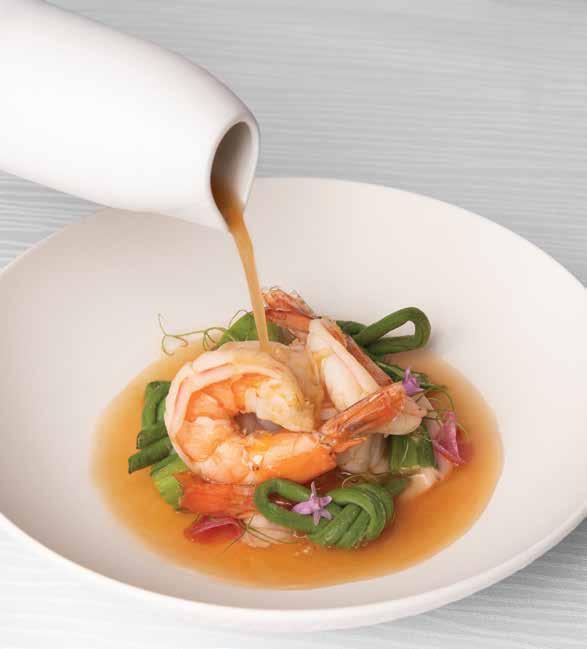
In this section, Indigenous It couple Kahara Hodges and Martin Sensmeier help show off the latest Native-designed resort wear at the Waldorf Astoria Monarch Beach Resort & Club. We get to know the four chefs crafting the culinary experiences at Yaamava’ Resort & Casino at San Manuel, Palms Casino Resort Las Vegas, and Monarch Beach. We also tap into some major ’90s nostalgia, with a story about the Pod Meets World taping at Yaamava’ as well as a recap of renowned hip-hop group Salt-N-Pepa’s recent Yaamava’ concert.
Photography
by Robert John Kley
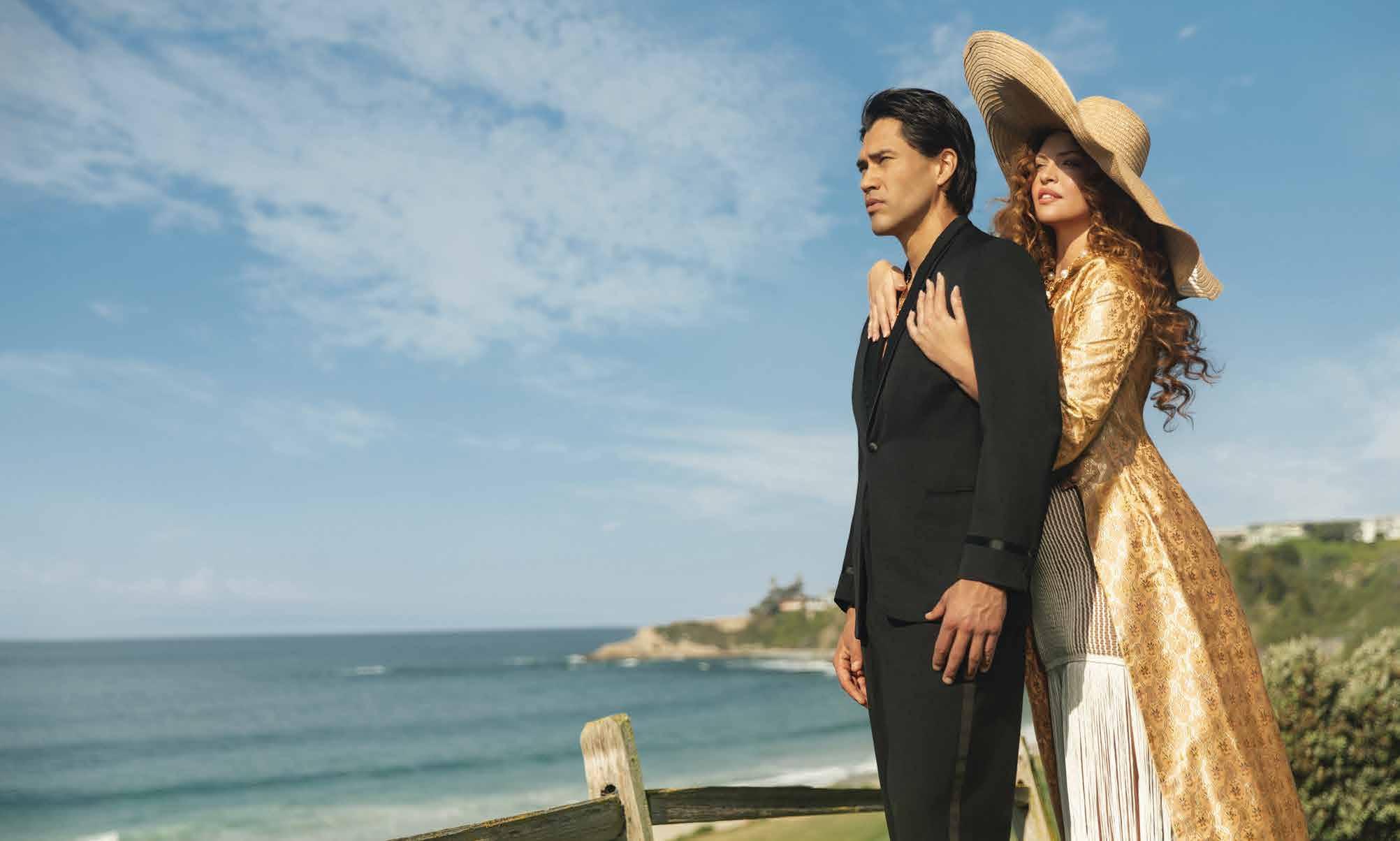
Kahara Hodges and Martin Sensmeier show off Native-designed resort wear at the Waldorf Astoria Monarch Beach Resort & Club.


(Opposite) Afro Amazonia Wear Off-Shoulder Cropped Top with Short Puff Sleeves, Ruffled Wide-Leg Pants; afrocurvyamazonia.com | Ataumbi Metals Sterling Silver and 18-karat Yellow Gold Rose Cut Black Diamond and Brilliant Cut Diamonds Cuff and 18-karat White Gold Black Lip Mussel Shell Rose Cut and Brilliant Cut Diamond Earrings; ataumbimetals.com
(This page) On her: Sky-Eagle Collection Summer Swimsuit, Morning Star Macrame Cover-Up, Summer Zip Top Handbag; skyeaglecollection.com | Copper Canoe Woman Shell Woman Acrylic and Abalone Inlay Earrings; coppercanoewoman.com | On him: 4Kinship Upcycled Vintage Workwear Shirt, Upcycled Vintage Military Shorts; 4kinship.com | George Rivera Peace Ring Made with 18-karat Gold, Silver, Diamonds, and Bisbee Turquoise; georgeriverastudio.com
(This page) On him: Vividus Sports Vividus Crew Sweatshirt, Vividus Tee; vividussports.com | On her: Vividus Sports Cindy Polo, Dulce Skort; vividussports.com
(Opposite) 4Kinship Upcycled Vintage ’50s Military Shirt Dress, Upcycled Vintage ’50s Parachute Dress (worn as skirt); 4kinship.com | WxMountain Eternity Shell Body Chainmail; wxmountain.com


Indigenous It couple Kahara Hodges and Martin Sensmeier lead with love.
BY KATE NELSON / PHOTOGRAPHY BY ROBERT JOHN KLEY
THEIR MEET-CUTE sounds like something out of an Indigenous rom-com: Kahara Hodges and Martin Sensmeier were first introduced in 2016 by a mutual friend, renowned Northern Cheyenne fashion designer Bethany Yellowtail. The Diné/Chicana/African American model/singer and the Tlingit/Koyukon-Athabascan actor were friends until everything changed during what Hodges calls a magical weekend in Seattle getting creative in the studio together.
They were playing their favorite film soundtracks — which combine their shared interests of movies and music — and “Kissing You” by Des’ree from the 1996 Baz Luhrman rendition of Romeo + Juliet came on. Sensmeier asked Hodges to dance, and the deal was sealed. “It felt like time froze,” Hodges recalled. “When he asked me to dance, it felt like electric bolts all over. Our friendship shifted after that.”
Fast-forward a decade later, and their partnership has blossomed beautifully. There’s still the trust, comfort, and mutual respect that was established early on in their friendship. But now, there’s a full Arizona household with two sons, ages four and six, running around and running the show.
All the while, both parents have continued to expand their creative horizons. Hodges has built upon her impressive modeling portfolio — including work for brands like Ralph Lauren, Sephora, and SKIMS — while delving more into her music, with high-profile gigs such as singing the national anthem at the 2024 NCAA Men’s National Championship Basketball Game. Known for his strong acting roles in films and TV shows like The Magnificent Seven, Wind River, Westworld, and Yellowstone, Sensmeier has also added writer, producer, and director to his résumé.
“That’s the life of an artist, right?” said Sensmeier. “You have to continue creating, because it can be hard making a living as an artist. Denzel Washington was my all-time favorite actor growing up, and having an opportunity to work with him for six months was incredible. He says that luck is when preparation meets opportunity. When an opportunity presents itself and you’re prepared and you follow through, good things happen.”
“WE CHERISH OUR TIME TOGETHER AND NOTICE ALL THE SIMPLE JOYS OF LIFE.”
Of course, there’s also plenty of talent in the mix for this creative couple, who cheer each other on at every chance. They’ve even gotten to work together on the 2023 film Frybread Face and Me. The coming-of-age story set on the Navajo Nation illustrates how cultural connection can bridge the gap between the traditional and modern worlds.
Their family of four does this on a regular basis, spending time in community on their tribes’ ancestral homelands in both Alaska and Arizona. Sensmeier’s hometown, the remote village of Yakutat, is among Hodges’ happy places. “Summertime in Alaska is absolutely amazing,” she said. “My ideal day is a summer day in Yakutat going to the beach, going fishing, going hiking through the woods and picking berries.”
With their work, both are contributing to the ever-growing authentic Indigenous representation we’re seeing in media. “I take these opportunities very seriously,” said Sensmeier. “I’m often representing a tribe that’s not my own, so I do a lot of preparation alongside people from that tribe to culturally advise me. That’s important, because I’ve got to get it right. But at the end of the day, we’re all people, we’re all human beings.”
Understandably, balancing their professional and personal lives can be challenging, especially when Sensmeier is away on set for extended periods of time. But it ultimately all comes back to family, as mom and dad are their most important roles.
“We are really blessed with the opportunity to be super present with our family,” said Hodges. “We cherish our time together and notice all the simple joys of life. We try to spread positivity and lead with love — that’s our family legacy.”

On her: 4Kinship Upcycled Vintage Cropped Western Shirt; 4kinship.com | Breezy Designs Turquoise Love Bridal Satin Pants; breezydesignsonline.com | Copper Canoe Woman Tidal Mnúxv it (Metamorphosis) earrings; coppercanoewoman.com | George Rivera Yaamava’ Queen Ring Made with 18-karat Gold and Silver; georgeriverastudio.com | On him: 4Kinship White Sands Denim Twill Set; 4kinship.com | George Rivera Sugilite Buffalo Pendant Made with Sugilite, 18-karat Gold, and Silver, Wave Spiked Bracelet in Silver; georgeriverastudio.com ’
Meet the four chefs helming the kitchens and crafting the distinctly delectable culinary experiences across Yuhaaviatam of San Manuel Nation’s hospitality portfolio, including Palms Casino Resort Las Vegas, Yaamava’ Resort & Casino at San Manuel, and Waldorf Astoria Monarch Beach Resort & Club.
By Ashleigh Pisarcik

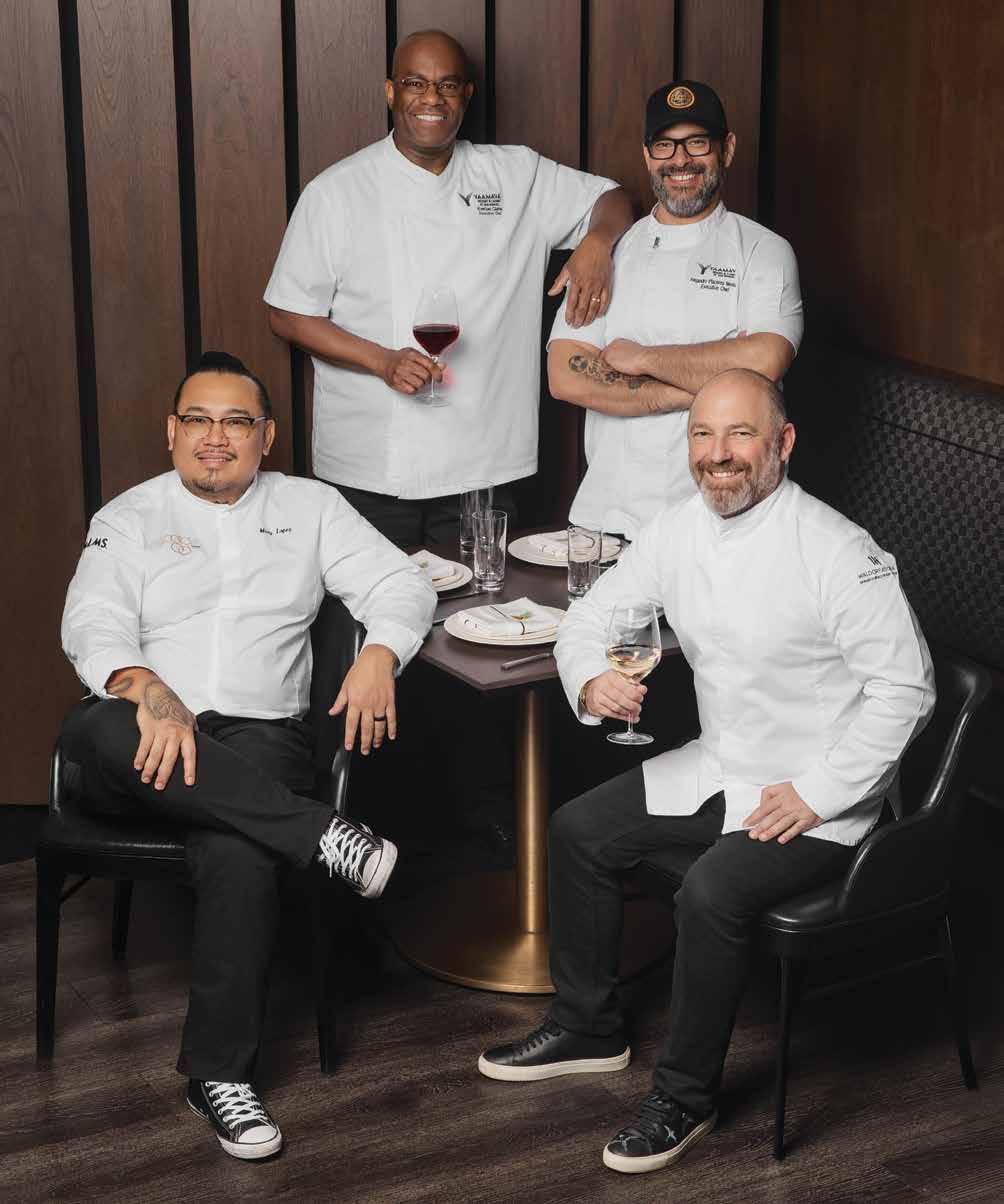
of San Manuel Nation’s portfolio of luxury properties exist three very different worlds, each defined by their landscape. Palms Casino Resort glitters among the bright lights of Las Vegas. Yaamava’ Resort & Casino at San Manuel blends into the still serenity of California’s San Bernardino Mountains. And Waldorf Astoria Monarch Beach Resort & Club graces one of America’s most pristine coastlines in Orange County.
Linked together by a Tribe deeply rooted in hospitality, these incredible destinations share another common thread: award-winning cuisine, brought to life by chefs Marty Lopez, Everton Clarke, Alejandro (Alex) Placeres, and Steve Benjamin.
While these four artisans are as unique as the scenery outside their respective kitchens, they bond in one another’s company over a shared love of food, favored techniques, and the infusion of their personal culinary journeys into the tastes at Palms, Yaamava’, and Monarch. And they’re a group to be reckoned with.
For Steve Benjamin — a Michelin-starred chef who trained under French culinary icon Joël Robuchon — resort cuisine is about understated indulgence and harmonizing ingredients with the environment. At Monarch Beach, where Benjamin serves as Culinary Director, this means artfully plating the California coastal setting.
“Simplicity in luxury has the best flavor,” said Benjamin. “And I stick to what Mr. Robuchon taught me: no more than three flavors on the plate.”
He explained, “The Zen and quiet elements of Monarch translate to ingredients like seafood, avocado — things that are very California-driven. Local identity is what makes Monarch stand out.”
In the desert playground of Las Vegas, standing out is the rule for success in a constantly evolving culinary scene. “Our aim is to always be different from what the rest of the city has,”
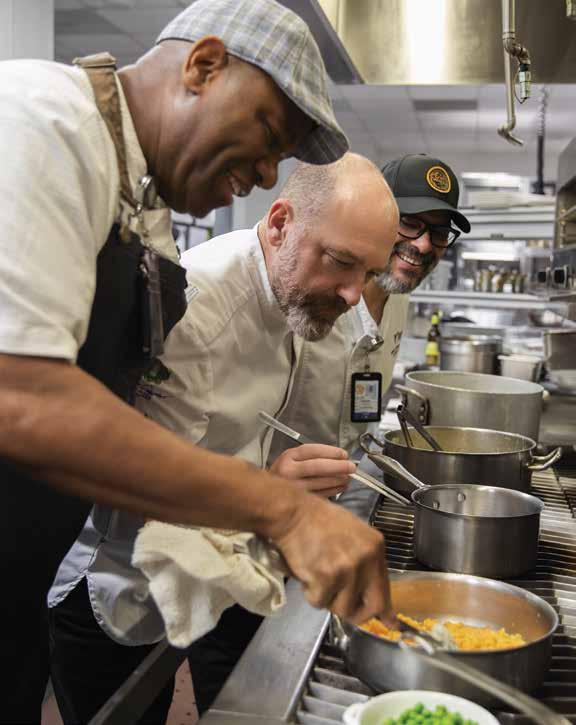

said Marty Lopez, Executive Chef at Scotch 80 Prime within Palms Casino Resort. “We take the traditional steakhouse route and make it fresh and playful.”
For Lopez, the ingredients are the stars of the show at Scotch 80 Prime. He places a thoughtful emphasis on the journey of ingredients, understanding how the individual makings of a dish are the life’s work of others, just as cooking is to him.
“Take a simple ingredient like lettuce,” Lopez explained. “Every day, someone gets up, kisses his wife goodbye, and picks lettuce all day long on a farm so that he can support his household. After he picks it, someone else packs it, ships it, delivers it, receives it, and preps it.”
Lopez’s culinary philosophy? Finding the best ingredients possible and giving them the highest form of respect. “Whether it’s a chili pepper, a piece of salmon, or even Japanese Wagyu, all these things are equally the same,” he said. “Ingredients were once part of this world, and the best thing we can do is honor that life by preparing them the best way possible.”
At Yaamava’, the only AAA Five-Diamond casino resort in the United States, culinary excellence is all about innovation and exceeding guest expectations at an award-winning luxury property like this.
“It takes a team like we have to sit down and have peaceful arguments about how we want to move forward with dishes or what crazy idea Chef Everton saw on Instagram,” said Alex Placeres, one half of the Executive Chef duo at Yaamava’.
While his counterpart, Everton Clarke, does draw some inspiration from social media, his flavors also come from worldwide experience in culinary leadership, including a stint in Dubai.
“Our brains are always working around food and
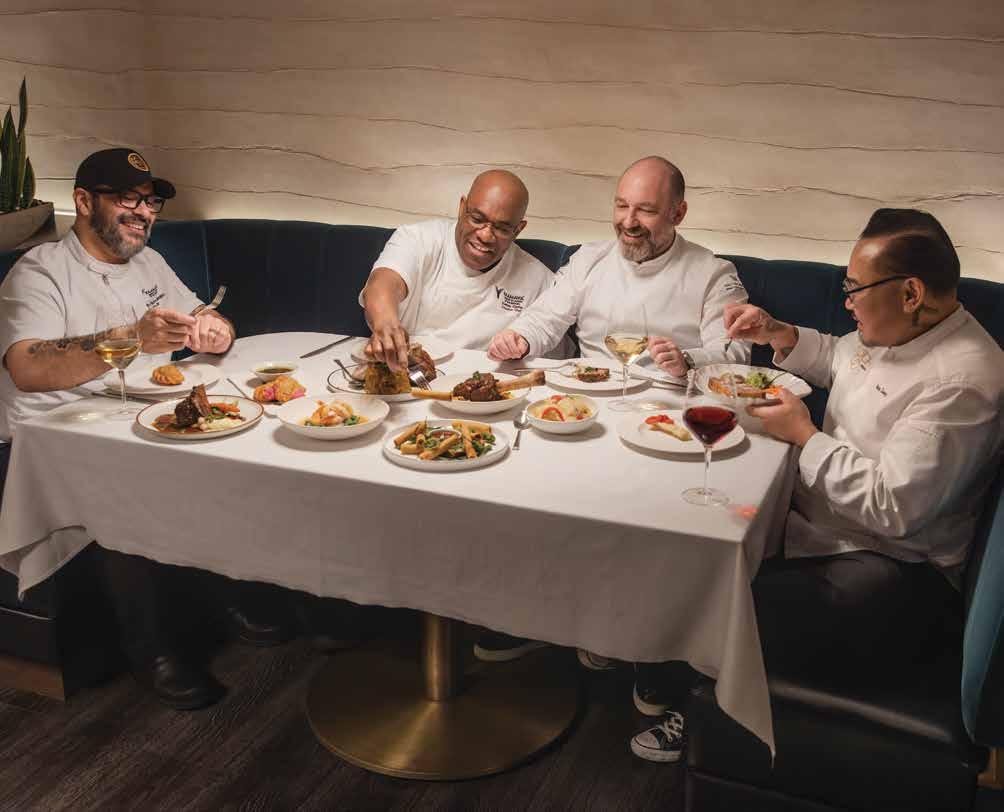
what’s next,” said Clarke. “A burger is just a burger, but how can we make it taste a little bit different? We stay contemporary and listen to what our guests are saying.”
Yaamava’ sits just 60 miles outside of Los Angeles, so much like Scotch 80 Prime, The Pines Modern Steakhouse (a Forbes Four-Star restaurant) must stand a cut above the rest.
For Placeres, it’s the Wagyu and Kobe beef programs and some of the world’s rarest wines that give The Pines its signature. And you’d be hardpressed to find a restaurant in the City of Angels that serves its fare atop Versace dinnerware — just one example of The Pines’ many elegant outfits for classic dishes. “I like what comes out of the fusion of new and traditional,” said Placeres.
Outside the heat of the kitchen, there’s no shortage of laughter as this dynamic group gathers around
“INGREDIENTS WERE ONCE PART OF THIS WORLD, AND THE BEST THING WE CAN DO IS HONOR THAT LIFE BY PREPARING THEM THE BEST WAY POSSIBLE.”
the table to talk culinary favorites and dealbreakers. Despite their varied backgrounds, they can all agree on a few things: Ribeye is superior to filet. Truffles are the most misunderstood luxury ingredient. It’s butter over olive oil, always. Similarly, it’s cast iron instead of stainless-steel cookware. Seasonal menus reign supreme over daily specials. And the food trends they wish would quietly disappear? Cheetos dust, oversize food, and Dubai chocolate, to name a few. When prompted to pick their favorite items on their respective resort menus, Clarke and Placeres opt for the dry-aged Wagyu — with whipped potatoes and mac and cheese, respectively — at The Pines Modern Steakhouse. For Benjamin, it’s the burger at AVEO — a nostalgic dish that reminds him of Sunday evenings spent noshing on Big Macs and French fries as a kid in Paris. As for Lopez? “That’s like picking a favorite child,” he said with a laugh.
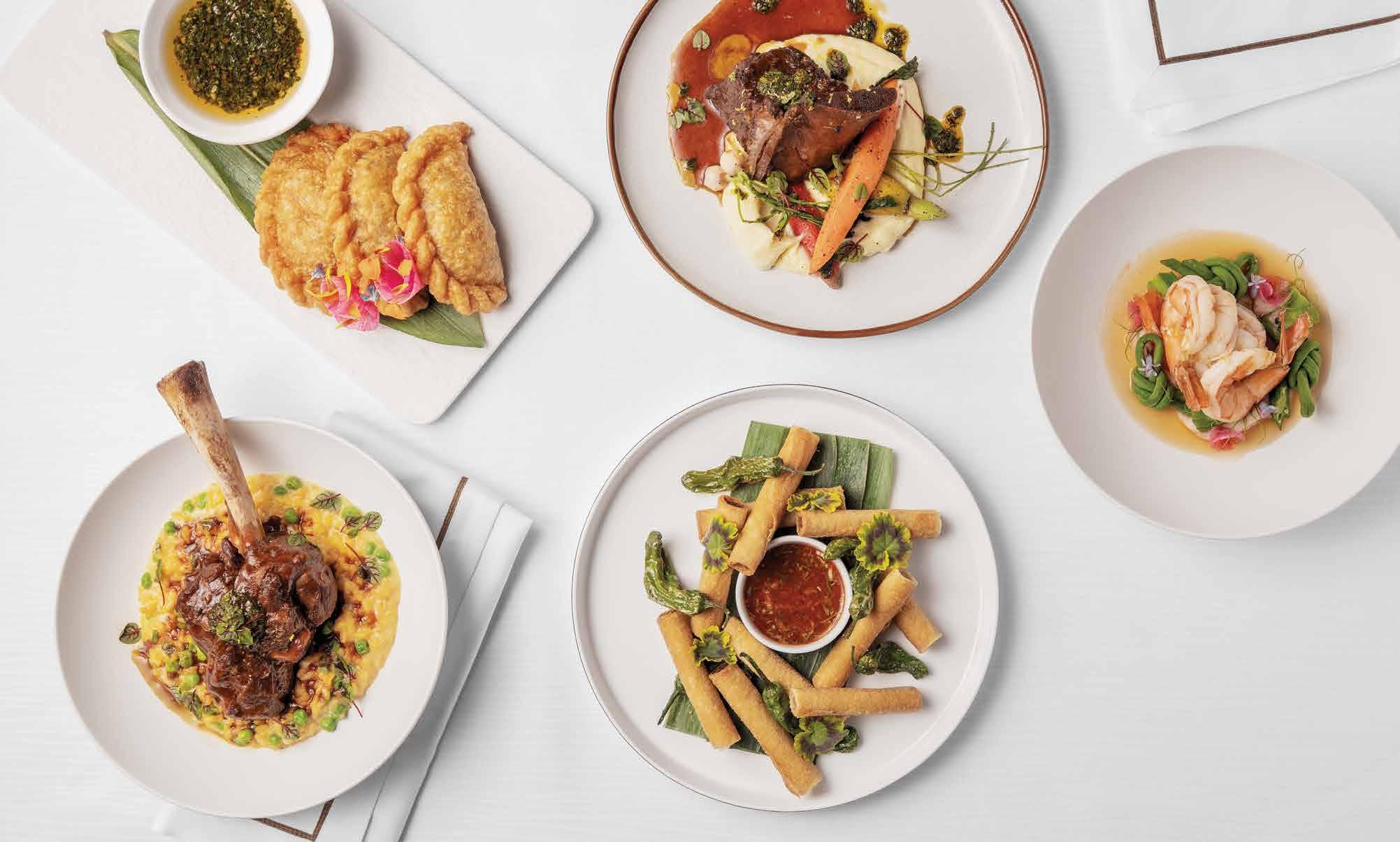
Chef Everton Clarke’s dishes — braised lamb shank with English pea risotto and lemon gremolata, and braised beef short rib with parsnip purée and seasonal vegetables — capture his connection to the spirit of springtime in Connecticut. He recalls this season as a time of renewal, when young local lamb was tender and slowly braised while his family cleaned out their homes and garden. Braising has always been a favorite technique of his, a method that builds depth and layers of flavor over time. Through these dishes, he shares the seasonality and quiet tradition embedded in those memories — a celebration of food that brings people together around something warm, patient, and deeply satisfying.
Inspired by the rhythms of family and the comforts of home, Chef Marty Lopez’s trio of dishes — Iberico pork lumpia with chili agrodolce, Wagyu empanadas with chimichurri, and tiger prawns simmered in tamarind broth — captures the heart of his Filipino-American story. Each plate is a familiar presence in his own life: sinigang ladled out for his kids, lumpia quickly disappearing at potlucks, and empanadas that recall afternoon snacks prepared by his mom and grandmother. His dishes remind us that no matter where we come from, food brings us all together.
(This page) In Chef Alex Placeres’ mofongo, lechón, and yuka with garlic, he returns to the flavors that first shaped his love for food. It’s a plate steeped in memory, with echoes of his grandmother’s kitchen and the traditional Boricua staples that defined home. Bold in presentation and explosive in flavor, this dish mirrors his own culinary identity: rooted in heritage, driven by passion, and grounded in the vibrant spirit of Puerto Rican culture.

(Opposite) Chef Steve Benjamin’s pâté en croûte — layered with chicken breast, pork shoulder, veal belly, chicken liver, and pistachios then finished with a white soy sauce gelée — is a labor of love that reflects his deep connection to French culinary traditions. It’s a dish that demands patience and precision, taking at least three days to prepare. Raised in Paris, he describes the delicacy as a partnership between the hunters (chasseurs) and the butchers (charcutiers). His early training in pastry shaped his understanding of the dough, the bake, and the final gleaming gelée that completes the meticulous preparation. For him, it’s a dish that honors both the heritage and the technical artistry that have shaped his craft.
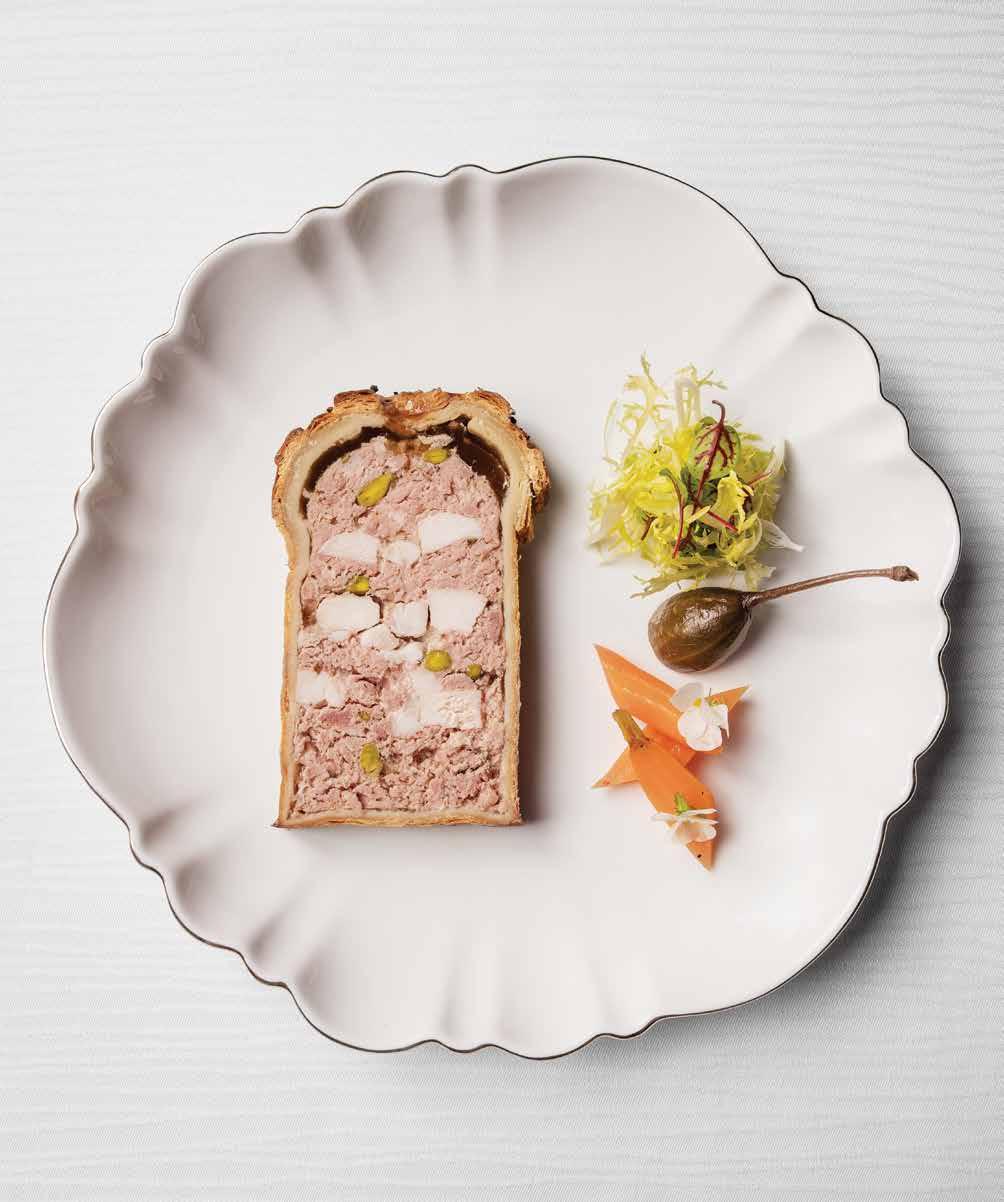
EVERYDAY LUXURIES IN EVERY COLOR OF THE RAINBOW FROM YAAMAVA’ RESORT & CASINO AT SAN MANUEL.

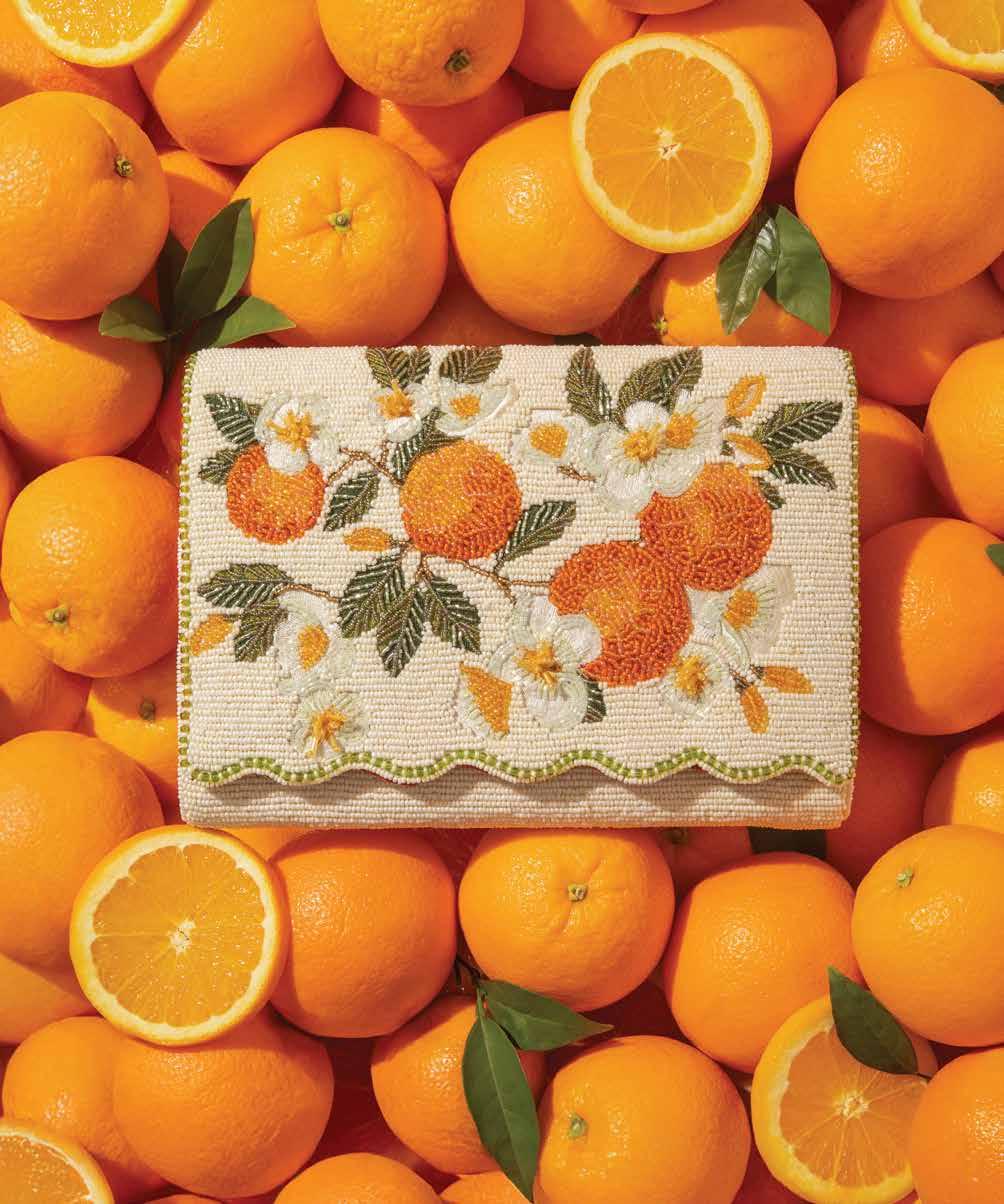



Yon-Ka Paris Elixir Vital, Lait Hydratant Vitality Travel and Full Size, and SPF 50+ Mineral Fluid; all available at Serrano Spa at Yaamava’. Valmont L’Elixir Des Glaciers Lifting Eye Serum and L’Elixir Des Glaciers Crème De Masque Merveilleuse; both available at Serrano Spa at Yaamava’.
Television icons celebrate milestones and nostalgia at Yaamava’ Resort & Casino.
AS YAAMAVA’ Re sort & Casino at S an Manuel celebrates its 40th anniversary this year, there’s nostalgia in the custom-scented air of 777 San Manuel Boulevard. This impressive milestone is a throwback to simpler times: when clothing matched the neon colors of the casino lights and photos from a night at San Manuel Indian Bingo needed to be developed, not downloaded. But Yaamava’ isn’t the only thing turning 40 in 2026.
So too are droves of millennials who spent their childhood Friday nights watching TGIF on ABC; now, they’re plenty old enough for a trip to the casino. Retro worlds collided last December, when Yaamava’ welcomed the stars of Boy Meets World: Danielle Fishel, Will Friedle, and Rider Strong — or as ’90s kids everywhere know them: Topanga Lawrence, Eric Matthews, and Shawn Hunter, respectively.
Celebrating a milestone of their own, the trio escaped to Yaamava’ for a vacation and an exclusive taping of Pod Meets World, their hit podcast that recently surpassed 50 million downloads.
Surrounded by beautiful mountain views in the Y Lounge, the cast gave listeners a peek inside their stay at the only AAA Five-Diamond casino resort in the United States. They started their Yaamava’ visit with spa treatments and some much-needed R & R after a busy holiday season and Fishel’s rigorous eight-week run on Dancing with the Stars.
“I was so relaxed, there could have been 10 strangers in the room and I wouldn’t have even noticed,” Friedle said of his 90-minute massage. Fishel went on to detail Serrano Spa’s little luxuries, like ringing delicate chime bells to signal her service provider into the treatment room.
Proving that Topanga and Shawn still stick together even outside the halls of John Adams High School, Fishel and Strong then hit the gaming floor, where they both bet black on roulette.
“Why didn’t one of you bet on red and the other bet on black, and then you just split the money?” Friedle asked of the duo.
“Because I’m talking about vibes, man,” Fishel responded. “I don’t want to be sending out red vibes while he’s over there sending black [vibes], and then we’ve got competing vibes.”
After a win at the tables and a delicious meal at The
By Ashleigh Pisarcik
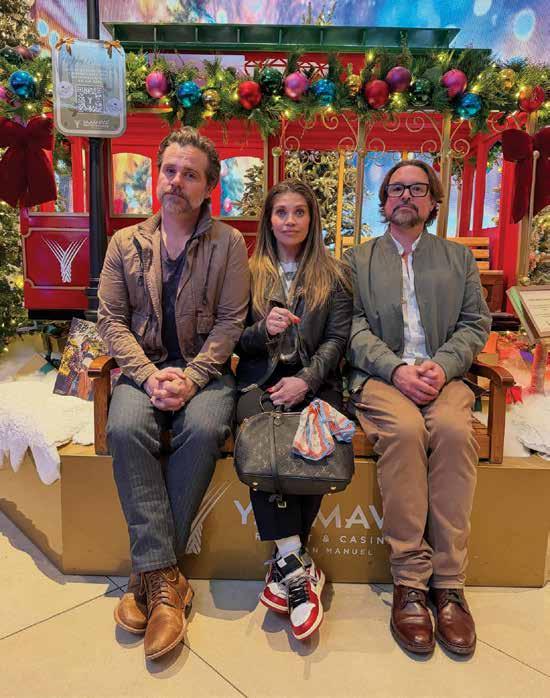

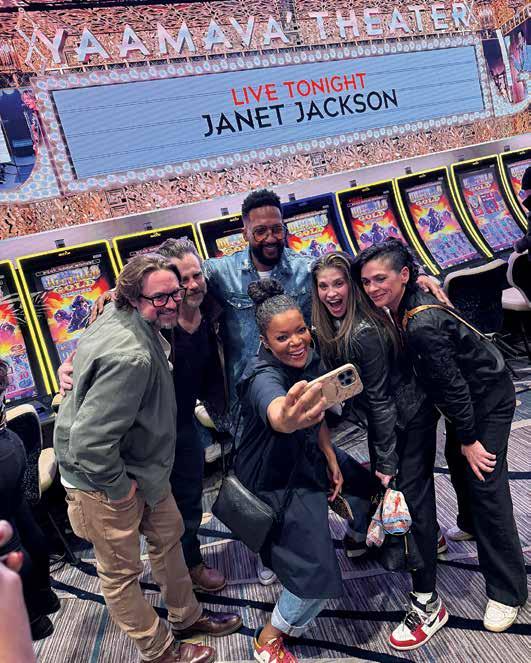
Pines Modern Steakhouse, the crew was ready for the ultimate highlight of their Yaamava’ experience: a Janet Jackson concert. Yaamava’ Theater is known for showcasing iconic entertainers in its intimate 2,500seat venue — and the cast couldn’t stop gushing about it. “That says something about Yaamava’, when huge talents are like, ‘I want to end my tour there,’” Friedle remarked about the songstress’s final show of 2025.
Fishel added, “Seeing Janet Jackson’s name on the marquee was one of those things where you’re like, ‘Shoot, this is massive!’”
“This was a big-stage show in an intimate space,” said Strong. “I found myself watching Janet in-person
way more than [on] the screens.”
“It was like being in a private room,” agreed Fishel.
The Janet Jackson audience was star-studded, with the cast running into actress Yvette Nicole Brown (most recently known for her role on Community) and posing for photos together in front of the Yaamava’ Theater marquee.
As the trio packed up the next morning, they took a little piece of Yaamava’ home with them. Fascinated with Club Serrano’s popular continuity gifting program that extends the sparkle of the casino floor long after hands are played, they received that week’s special treat: slow cookers and serving utensils. “You
“That says something about Yaamava’, when huge talents are like, ‘I want to end my tour there.’”

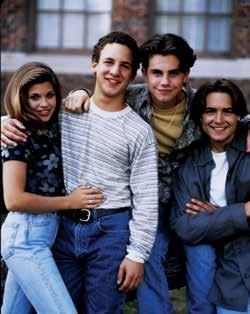
know what these slow cookers are great for? Dips,” said Fishel with a laugh. “Let’s have a dip party!”
Topanga, Eric, and Shawn had enough fun at Yaamava’ that Mr. Feeny surely would have been disappointed in them. “This place is awesome, and I want everyone to know it,” Friedle concluded.
Boy Meets World fans can catch the Yaamava’ episodes of Pod Meets World wherever they listen to podcasts. And next time millennials hit the casino, they may just see their childhood favorites sitting at the blackjack tables, watching an A-list concert, or noshing on fine-dining fare. Moments like these are what make Yaamava’ the best-in-class grown-up playground.
BY RUSSELL WEAKLAND
PHOTOGRAPHY BY 226 PRODUCTIONS
Hip-hop legends Salt-N-Pepa perform at Yaamava’ Resort & Casino at San Manuel.


didn’t just arrive at a pivotal moment in hip-hop — they helped define it. Emerging from New York City in the mid-1980s, Cheryl “Salt” James, Sandra “Pepa” Denton, and later Deidra “Spinderella” Roper built a sound and identity that expanded the possibilities for women in rap. At a time when the genre was largely dominated by male voices, the trio carved out space with a mix of confidence, style, and approachability that would leave a lasting imprint on music and culture alike.
That impact was on full display at Yaamava’ Resort & Casino at San Manuel, where the group rang in the New Year with a performance that doubled as both celebration and statement. For an act whose influence stretches across generations, the venue offered the perfect setting to bring together longtime fans and new audiences in one incredible room.
“It’s been about two years that I took a break, so it was very exciting to be back on stage,” James said. “It was pretty special because Spinderella was also back, so it was a reunion of sorts that you guys got at Yaamava’. And it was New Year’s Eve, so everybody was happy. The crowd was alive and kicking and doing all the loving on Salt-N-Pepa that we love so much. It was an awesome night.”
Salt-N-Pepa’s rise was never just about chart success. It was about visibility and influence — bringing what they’ve long described as “fun, fashion, and femininity” to hip-hop without sacrificing on credibility. In doing so, the group helped reshape expectations, proving that female artists in the genre could be commercially dominant, culturally relevant, and fully in control of their own image.
That legacy now spans nearly four decades, carried by a catalog of songs that have outlived the eras that produced them. Tracks like “Push It” and “Shoop” remain embedded in the DNA of pop culture, instantly recognizable across generations. Indeed, the group’s music has served as the soundtrack for everything from house parties to major cultural moments, creating a kind of timeless familiarity few artists achieve.
Inside Yaamava’ Theater, that familiarity translated into something magical. The crowd reflected the

group’s wide reach, including fans who grew up with their music alongside younger listeners experiencing it live for the first time. That resulted in a vibe that felt less like a traditional concert and more like a shared celebration — amplified by the energy of New Year’s Eve, with the entire room leaning into both nostalgia and anticipation for what’s ahead.
With Spinderella back behind the turntables, the trio returned in full force to reclaim their rightful spot as one of hip-hop’s most recognizable lineups — something that didn’t go unnoticed by the audience. It added a sense of completeness to the night, reinforcing the chemistry that has long defined their presence on stage.
Moments like that underscore what has always set Salt-N-Pepa apart. While their influence is often discussed in terms of music, it extends just as strongly into identity and presentation. From the beginning, they embraced individuality, pairing bold fashion choices with lyrics balancing humor, empowerment, and relatability. It was a combination that broadened hip-hop’s appeal without diluting its edge.
Their breakthrough came during a formative period for the genre, as artists like Run-DMC were establishing a blueprint for mainstream success. SaltN-Pepa drew from that foundation while building something distinctly their own, rising alongside contemporaries such as Roxanne Shanté an d
contributing to a rapidly evolving cultural movement. Over time, their music began to transcend its original context. “Push It,” famously released as a B-side, evolved into a global phenomenon — one that continues to resonate in ways even the group couldn’t have predicted. “That record has a mind of its own,” James said. “People sometimes don’t even know Salt-N-Pepa, but they know ‘Push It.’” Its unmistakable rhythm and infectious energy turned the song into a staple far beyond traditional hip-hop spaces, cementing the group’s crossover appeal.
That kind of longevity doesn’t happen by accident. It requires both resilience and a willingness to evolve — qualities Salt-N-Pepa have demonstrated repeatedly over the years. Their ability to step away, reset, and return has allowed them to navigate an industry that often moves on quickly, maintaining a connection with audiences that feels both authentic and enduring.
Now, returning to the stage at a venue like Yaamava’ Theater, that connection feels even more intentional. James points to a deeper sense of appreciation that has come with time — both for the journey and for their longtime fans.
“I feel like the older I get, the more I appreciate everything even more,” she said. “The longevity we’ve had, the fans we’ve acquired, the success we’ve had. But it’s exciting in a different way now; it’s an appreciation for still being here.”
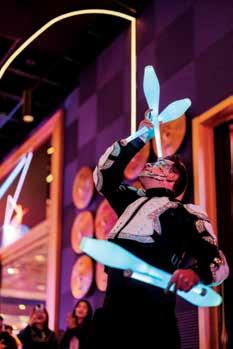
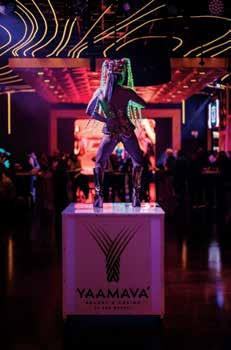

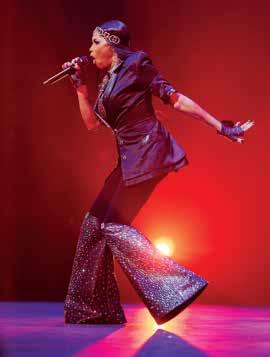
In recent years, Yaamava’ Theater has positioned itself as more than just a performance space, becoming a cultural hub for live entertainment in Southern California. Its impressive ability to host artists with deep histories while attracting diverse audiences mirrors the kind of longevity Salt-N-Pepa represent. That longevity was formally recognized in 2025, when the group received the Rock & Roll Hall of Fame Musical Influence Award.
The honor placed them among a select group of artists whose work has had a lasting impact on the evolution of music — an acknowledgment that their contributions extend far beyond their own discography. “It was very special, because it was the Influence Award,” James said. “Salt-N-Pepa have been known to influence a generation in every way possible.” Influence, in this case, is both direct and far-reaching. Countless artists have followed in their footsteps, building upon the pathways Salt-N-Pepa carved out. Their presence helped normalize the idea of women as central figures in hip-hop, not exceptions to it.
That perspective shapes how the group approaches live performance today. The focus isn’t on perfection but rather on connection. “Our motto has always been to have fun on stage,” James said. “Because when you’re having fun, they’re having fun. That’s what I think about before I walk on stage: Just have fun. Don’t take it too seriously. When you just relax into it and connect with the audience, it’s always a good time.”
Nearly 40 years after their debut, Salt-N-Pepa continue to occupy a rare space in music, one defined by both legacy and continued relevance. Their songs still fill dance floors, their influence still shapes the genre, and their performances still bring people together in ways that feel alive and resonant.
The night wasn’t just about revisiting hits — it was about reaffirming a connection that has never really faded. And as James sees it, that ongoing relationship with the audience is what keeps everything moving forward. “We’re still here,” she said. “And as long as we’re here, we’re going to keep bringing that joy to the stage.”

Whether it's a corporate event, family gathering, or a friendly golf tournament, our stunning course and exceptional service will make your day unforgettable.





instruction, MBGL offers a variety of lesson opportunties including Group Team Building or Corporate Clinic coaching events.

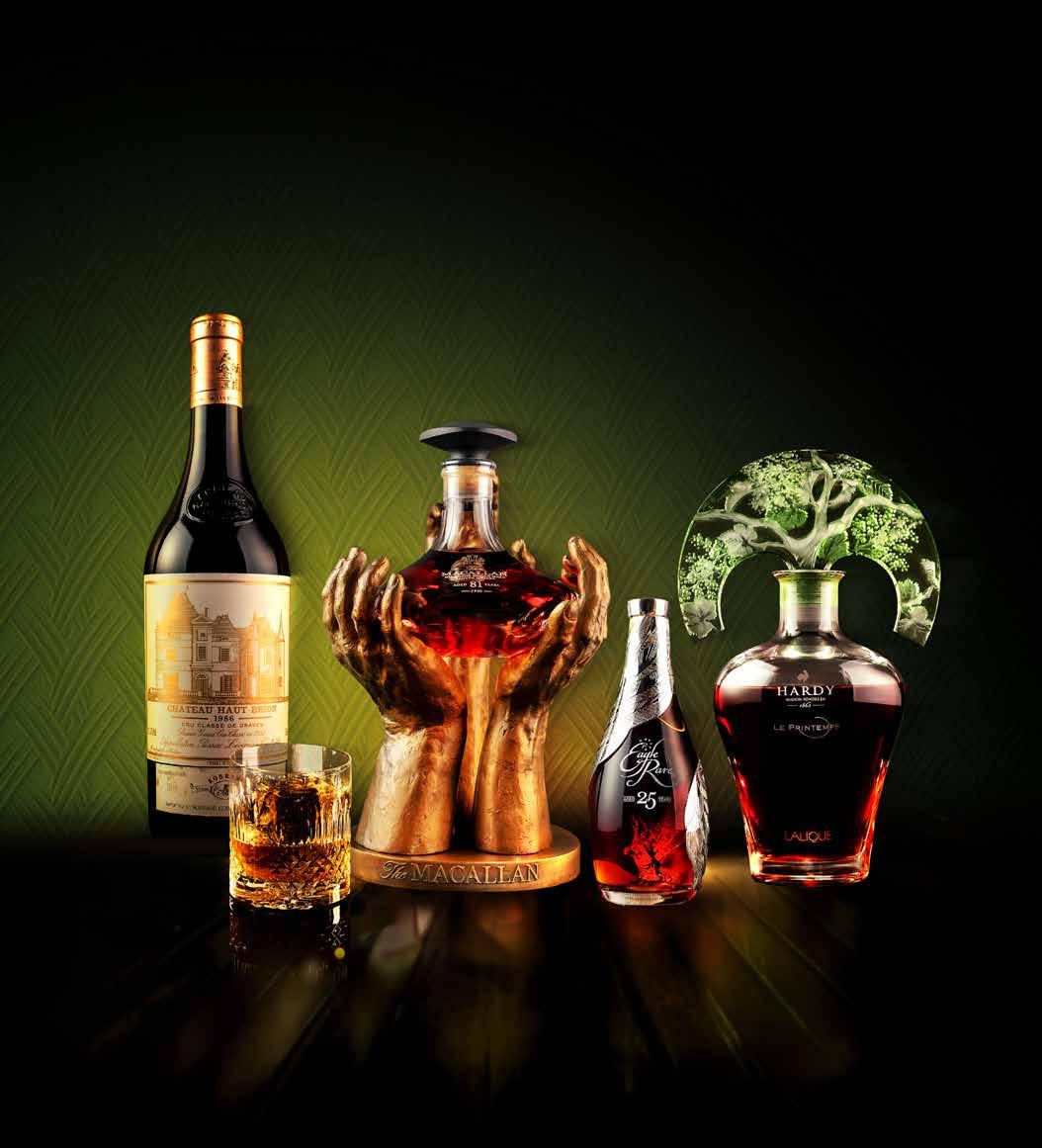




Our name reclaimed

Long before the San Manuel Band of Mission Indians, our Tribe had a name–Yuhaaviatam. It was known among our ancestors. It is our own, spoken in our language and rooted in traditions. Today, we return to this namesake so its spirit may live on in all of us.
We are People of the Pines. We are Yuhaaviatam of San Manuel Nation.