Beyond the numbers: How CPAs change lives
The new face of accounting in industry series: Retail
Tax Season: What early trends mean for CPAs

The new face of accounting in industry series: Retail
Tax Season: What early trends mean for CPAs



14 Beyond the numbers: How CPAs change lives
How CPAs go beyond technical expertise to build trust, guide decisions and create meaningful impact for businesses, nonprofits and communities.
4 Leadership through service: How Ann Gabriel's passion for the profession fueled a lifetime of advocacy
Ann Gabriel’s career shows how a lifelong commitment to service, mentorship and advocacy can strengthen both the accounting profession and the broader business community.
8 AI sameness: Are you unique, special, and different?
While AI can improve speed and efficiency, accountants must combine it with human judgment, client context and distinctive expertise to avoid sounding generic and losing perceived value.
10 Financial report of the U.S. government: One of the best-kept secrets
The federal government’s annual financial report offers the most complete picture of the nation’s fiscal health, yet remains largely overlooked.
20 Tax Season: What early trends mean for CPAs
The 2026 tax season has required CPAs to navigate major federal tax law changes, state conformity issues and ongoing IRS service challenges while helping clients plan proactively.
26 The new face of accounting in industry series: Retail
As retail becomes more digital, data-driven and AI-enabled, accountants are taking on a more strategic role that requires new skills in analytics, technology, risk management and cross-functional decision-making.
VOLUME 21 | ISSUE 3
EDITOR IN CHIEF
Amber Epling-Skinner –AEpling-Skinner@ohiocpa.com
GRAPHIC DESIGN
Sam Kaiser – skaiser@ohiocpa.com
Kyle Anderson – kanderson@ohiocpa.com
EDITORIAL OFFICES
CPA Voice 4249 Easton Way, Suite 150 Columbus, OH 43219
Tel: 614.764.2727
Email: CPAVoice@ohiocpa.com Website: www.ohiocpa.com
ADVERTISING
For our display advertising rates or a copy of our media kit, contact us at sales@ohiocpa.com or call 614.764.2727
ARTICLE SUBMISSIONS
We welcome submissions of analytical articles on issues relevant to Ohio CPAs. Desired length is 800-1200 words. Send an electronic copy with a cover letter to the editor at AEpling-Skinner@ohiocpa.com. Please note that CPA Voice is not a peer-reviewed journal.
REPRINTS
For reprint permission, contact the editor at the address above.
CPA Voice is the official magazine of The Ohio Society of Certified Public Accountants. CPA Voice’s purpose is to serve as the primary news and information vehicle for more than 19,000 Ohio CPA members and related professionals. Articles are reviewed for technical accuracy. However, the materials and information contained within CPA Voice are offered as information only and not as practice, financial, accounting, legal or other professional advice. While we strive to present accurate and reliable information, The Ohio Society of CPAs makes no warranties regarding the accuracy of the information provided herein. Readers are strongly encouraged to conduct appropriate research to determine the accuracy of the information provided and to consult with an appropriate, competent professional adviser before acting on the information contained in this publication. The statements of fact, thoughts, advice and opinions expressed in CPA Voice are those of the authors alone and do not represent or imply the positions, opinions, nor endorsement of The Ohio Society of CPAs or of its publisher, editors, Board of Directors, or members. It is our policy not to knowingly accept advertising that discriminates on the basis of race, religion, gender, age or origin. The Ohio Society of CPAs reserves the right to reject paid advertising in its sole discretion. We do not necessarily endorse the resources, services or products unrelated to The Ohio Society of CPAs that may appear or be referenced within CPA Voice, and make no representation or warranties about those products or services or the accuracy and claims regarding those products and services. Advertisers and their agencies assume liability for all advertisement content and responsibility for all claims resulting from such advertisements made against The Ohio Society of CPAs.
The Ohio Society of CPAs does not guarantee delivery dates for CPA Voice and disclaims all warranties, express or implied, and assumes no responsibility whatsoever for damages incurred as a result of delivery delays.
CPA Voice (ISSN 0749-8284) is published six times per year by The Ohio Society of CPAs, 4249 Easton Way, Suite 150, Columbus OH 43219, 614.764.2727.
Copyright © 2026 by The Ohio Society of CPAs; all rights reserved. No part of the contents of CPA Voice may be reproduced by any means or in any form, or incorporated into any information retrieval system without the written consent of CPA Voice. Permission requests may be sent to the editor at the address above. While care will be given to all materials submitted for publication, we do not accept responsibility for unsolicited manuscripts, and they will not be returned unless accompanied by a self-addressed postage prepaid envelope.
Periodicals postage paid at Columbus, OH and at additional mailing offices.
You may notice something a little different. What used to be a bimonthly publication is now a quarterly magazine. That shift is intentional, giving us more room to go deeper and spend time on the issues that really matter to the accounting profession and the business environment around it.
There’s no shortage of information coming at all of us every day. Our goal with CPA Voice is about intention. We want this to be something worth slowing down for, offering perspective, not just updates, and reflecting the profession you’re part of.
This change doesn’t affect the value you receive, either. The total amount of complimentary CPE available through CPA Voice each year will stay the same. Instead of one hour per issue, you’ll now be able to earn 1.5 credit hours with each quarterly edition.
As we made this shift, it felt like the right moment, coming just after National Accounting Day on May 19, to step back and reflect a bit.
The CPA designation is grounded in something fundamental: trust.
Not just technical expertise, but judgment, integrity and the ability to help people navigate decisions that aren’t always clear-cut. While that has always been true, it feels especially relevant right now.
Things are moving quickly. Information spreads fast, and it’s not always reliable. Technology is changing how work
gets done. In the middle of all of that, people are looking for clarity, and for someone they can rely on. That’s where CPAs continue to stand out.
Business leaders depend on you to help them make difficult decisions. Communities rely on you for transparency and accountability. Individuals and families turn to you during some of the most important moments in their lives.
And that kind of trust isn’t built overnight. It comes from showing up, doing the work well and upholding high standards over time. That’s what we stand for.
A lot of that work happens quietly.
It includes helping small business owners plan next steps, ensuring information is accurate and reliable, guiding decisions that affect employees and communities, and mentoring the next generation to consider the profession.
These contributions may not always be visible, but they matter.
At the same time, there’s still a gap in how the profession is understood by people outside of it. Too often, accounting is seen narrowly, while in reality, the profession offers one of the most dynamic and versatile career paths in today’s workforce.
Today’s CPAs are strategic advisors, technology leaders, forensic investigators, entrepreneurs, auditors, CFOs and public servants. They work across healthcare, sports,
entertainment, government, manufacturing, startups and Fortune 500 companies. They lead organizations, influence policy and help shape the future of business itself.
That’s an important story to keep telling — especially to students and emerging professionals who are deciding where they want to make a difference.
National Accounting Day is not simply about recognizing those already serving. It’s also an opportunity to showcase what this profession truly offers students and emerging leaders searching for meaningful, impactful careers. We all want work that provides stability, flexibility, opportunity and purpose. Accounting offers all of those things while opening doors across countless industries and leadership roles.
As technology continues to evolve, some have questioned whether automation or artificial intelligence will diminish the role of accountants. In fact, the opposite is happening. While technology is transforming certain technical tasks, it is elevating the importance of the uniquely human

Log in to ohiocpa.com/myoscpa, look up the exam using the product ID number above and answer the 18 required questions based on content in CPA Voice.
Cost
Members Free
Non-members $40
Exams remain available online – and may be completed for CPE – through the same month of the following calendar year.
qualities that define great CPAs: judgment, communication, strategic thinking and ethical decision-making.
Technology can process information. It cannot replace trust.
In a world where trust can sometimes feel fragile, CPAs continue to demonstrate the enduring value of expertise grounded in ethics, accountability and service. That commitment strengthens businesses, organizations and communities across Ohio and throughout the country.
And that is worth celebrating — not only on May 19, but every day after.

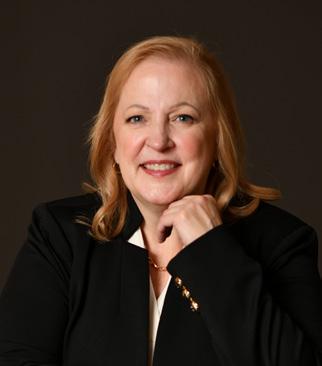
Laura Hay, CPA, CAE President & CEO
The Ohio Society of
CPAs
MAY | JUNE | JULY 2026
Product ID: #74330
Online Instructions
1. Log in to ohiocpa.com/myoscpa
2. Search "CPA Voice" and hit enter. Then select "On-Demand Courses" to see the available exams.
3. Click "Add to cart" and purchase the exam.
4. Now click "Return to Dashboard."
5. Go to "My Learning Center" and the exam will be located under the "Current" tab. Turn off pop-up blockers then click "Launch."
Self-Assessment Exam Results
Respondents taking the exam online receive their results immediately. Respondents who pass with a grade of 70% or better receive 1.5 CPE credits in specialized knowledge, as approved by the Accountancy Board of Ohio.

By Molly Neal, OSCPA manager of advocacy initiatives
For E. Ann Gabriel, CPA, Ph.D., the accounting profession has always been about more than numbers. It has been about helping businesses grow, mentoring future professionals and ensuring the CPA profession has a strong voice in the legislative process.
“My connection to accounting started early,” Gabriel said. “My dad owned his own business, and my mom ran the office. By the time I was eight or nine, I was helping my mom with the books.”
That early exposure to small-business operations shaped the course of her career. In 1971, after earning a Bachelor of Business Administration from the University of Michigan, Gabriel joined Coopers & Lybrand in Columbus. She became a CPA in 1973 and advanced from staff accountant to senior manager during a 13-year career in public accounting.
“Even when I entered public accounting, I gravitated toward the small-business division because that’s where I felt we could do the most good,” Gabriel said. “With small businesses, you can truly add value and make a real impact.”
One story she still enjoys sharing is that one of the businesses her firm worked with was the original Wendy’s restaurant opened by Dave Thomas in Columbus in 1969.
“I still love telling that story because it captures what I love most — helping businesses grow from the ground up,” she said.
Gabriel later transitioned into corporate accounting, serving as controller for ChemLawn Corporation from 1984 to 1989. She also worked as controller for the “Son of Heaven” exhibit in Columbus, which featured artifacts from China, including the Terracotta Warriors.
“That role meant I had experience across every major sector of accounting: public accounting, corporate, government, and education,” Gabriel said.
Although she initially expected to spend her entire career in practice and industry, Gabriel eventually pursued another long-held interest: teaching.
“When I was in college, I remember thinking it might be fun to be a college professor — followed immediately by, ‘But I’ll never get a Ph.D.,’” she recalled. “Now, when I advise students, I always tell them: Never say never, and never say always. You truly don’t know where life will take you.”
Gabriel earned both her Master of Arts and Ph.D. from Ohio State University in 1993 before beginning her academic career at the University of Notre Dame. In 2001, she joined Ohio University’s School of Accountancy, where she ultimately served as the James E. Daley Professor of Accountancy and director of the School of Accountancy.
Throughout her academic career, Gabriel became known not only as an educator but also as a mentor and leader. She served in numerous university leadership positions, advised
students, mentored future accountants and remained heavily involved in professional organizations and community service.
Still, one of the most impactful aspects of her career has been her decades-long involvement in advocacy and the Ohio CPA/PAC.
Her introduction to advocacy came unexpectedly.
“The Society introduced different PAC giving levels, and one level — around $500 — was labeled ‘Leader of the Pack,’” Gabriel said. “I’ll be honest: A little ego played a role. I thought, well, I want to be a leader of the pack, and that decision became my entry point into advocacy.”
That initial contribution quickly grew into a deep commitment to protecting and advancing the profession.
Gabriel became involved in the Key Contact Program, joined the Ohio CPA/PAC Board of Trustees, chaired the East/ Southeast Screening Committee and later served on the statewide endorsement committee. She also served on The Ohio Society of CPAs Professional Ethics Committee and held several leadership positions within the Society over the years.
For Gabriel, advocacy became personal because she saw firsthand how legislation and public policy directly affect CPAs and their clients.

“For me, it’s never been a question of whether it’s worth it— it is,” she said.
That commitment is reflected in her continued support of the Ohio CPA/PAC. Gabriel said she and her husband consistently contributed together at the leadership level. After his death, she continued giving on behalf of both of them and now contributes $1,000 annually to the Ohio CPA/ PAC.
“My husband and I both understood the value of advocacy and contributed together,” Gabriel said. “After he died, I continued contributing on behalf of both of us.”
One issue that particularly shaped her perspective was tort reform. Early in her public accounting career, Gabriel worked on a real estate investment trust that later went bankrupt. Although the claims against the accountants were ultimately dismissed, the litigation lasted nearly a decade.
“That experience made the importance of tort reform very real,” she said.
She also points to CPA mobility legislation as a major achievement for the profession. Allowing CPAs to practice more easily across state lines created important flexibility for firms and practitioners, particularly in border areas such as
Toledo and Cincinnati.
Gabriel has also been deeply engaged in efforts to protect the CPA license and maintain professional standards. She supported maintaining the 150-hour licensure requirement while allowing candidates to sit for the CPA Exam at 120 hours, a balance she believes helps strengthen the profession while also supporting the talent pipeline.
“Allowing candidates to sit for the exam at 120 hours gives them a foot in the door, while providing flexibility in how they complete the remaining credits,” she said.
At the same time, Gabriel emphasized that advocacy work is never finished. Issues such as municipal income taxes, centralized tax collection proposals and efforts to expand sales tax to professional services continue to reappear year after year.
“Advocacy is never static,” Gabriel said. “It often feels like playing whack-a-mole, but that ongoing vigilance is exactly why the PAC matters.”
She believes one of the most important aspects of advocacy is building relationships and ensuring legislators understand the role CPAs play in the business community and broader economy.

“Knowing legislators personally matters, especially when you occasionally need their help—and when they need insight from the profession,” she said.
Gabriel also believes supporting the Ohio CPA/PAC is a professional responsibility.
“When asked whether my PAC involvement is driven more by professional responsibility or personal passion, the honest answer is both,” she said. “It began very much as a sense of professional obligation—supporting the profession that had given me so much.”
That sense of responsibility has continued long into retirement. Although Gabriel officially retired in 2018, she remains actively involved in professional and civic leadership, including service on the Ohio Society’s Political Action Committee Board of Trustees, the Ohio University Foundation Board of Directors, and numerous audit, finance and investment committees throughout Ohio.
Looking back on her career, Gabriel believes the Ohio CPA/ PAC’s success ultimately comes down to engagement and shared purpose.
“When we stay focused, organized, and connected, the
PAC makes a real difference for CPAs, their clients, and the public,” she said. “That impact—combined with shared purpose and community—is what makes the service worthwhile.”
Gabriel’s story serves as a powerful reminder that advocacy is essential to protecting the future of the profession. Through decades of leadership, mentorship and Ohio CPA/ PAC involvement, she has demonstrated how one member’s commitment can create a lasting impact for CPAs across Ohio.
Look for the new Leg Up series at the beginning of each month, when the OSCPA Advocacy team will spotlight dedicated CPA/PAC supporters in the “CPA/PAC Donor Spotlight” series.

Molly Neal is the manager of advocacy initiatives for The Ohio Society of CPAs, supporting the organization’s legislative and regulatory advocacy efforts. She can be reached at mneal@ohiocpa.com

By Samantha Mansfield
The speed at which artificial intelligence (AI) can complete tasks is incredibly appealing. For years, the accounting profession has been trying to fulfill the increasing needs of clients while challenged with a lean talent bench. Given the easy accessibility and adoption of AI tools, anyone can generate summaries, draft communications, analyze data, conduct research, and even outline recommendations.
But here’s the challenge: if everyone is using the same tools (e.g., Anthropic’s Claude, OpenAI’s ChatGPT, Microsoft’s Copilot) in very similar ways, the output we’re all developing begins to look, sound, and feel the same. An overreliance on AI’s output can lead to a feeling of “me too” or sameness, where we risk not standing out or not being perceived as adding value. And, as good as AI is (and it’s getting better every day), taking a “cut and paste” approach to delivering its output could lead to mistakes and damaged reputations, too.
Welcome to the risks of AI sameness.
When we stop applying our own judgment, expertise, critical thinking and problem solving, and when we stop providing unique deliverables and fostering deep client relationships we risk becoming indistinguishable from any other practitioner.
A growing number of clients are asking AI for input before coming to you. They are using the same tools we use, including some of the deeper tax and accounting research engines. They will quickly notice the similarity and differences in the responses you and AI produce. They may have two thoughts when they compare AI’s output to yours:
• “AI generated the same responses my accountant just gave me. Do I need to pay my accountant when I can do this myself?”
• “AI gave me more options than my accountant did, so maybe my accountant doesn’t know as much about this question, and I should use AI instead.”
AI, just like any technology, is only as good as the operator. If you don’t have deep, trusting relationships with your clients, they may not reveal that they asked AI for input
before or after talking to you. Clients then run the risk of making ill-informed decisions because the AI output lacks highly valuable contextual insights that only you have. You want to protect your clients from falling prey to this. If clients aren’t telling you they are using AI, start asking them, “Do you ever ask AI for input on your finances/business? I ask because we hope our clients are beginning to use AI, and we also want to be sure they’re aware that AI does sometimes produce very credible feelings, but inaccurate responses for their situation and we don’t want that to happen to you.“
Clients are also getting good at spotting AI-generated responses (or asking AI to identify the percentage of your output that was AI-generated). They are beginning to recognize and even expect that we are using AI. And we don’t want to hide that we are. These powerful tools are game-changing for us and our clients. Our unique, special, and different “pixie dust” and important contextual information transforms any AI output into tailor-made responses. Without that increased insight or advice, clients could begin to push back on fees, thinking we are saving time and costs but not adding anything new, so the AI “savings” should be passed on to them. If we fall into the pit of AI sameness, we risk seeing fees decline.
We’re also hearing of clients uploading their accounting firm deliverables to simplify your instructions to them. Perhaps you should, too, before you send them to the client? Instead of making clients turn to AI tools to understand their next steps, you can get input from AI on ways to simplify instructions and foresee next steps, so clients are able to take the appropriate actions from your deliverables.
AI is not the enemy of differentiation. Instead, it’s a powerful accelerator of it, when used intentionally. Practitioners who stand out are those who combine the efficiency of AI with the elements that make us and our firms unique, special, and different (USD).
In fact, we’ll want to help guide our clients to use AI in their lives and businesses, so they can remain competitive, too.
That means you need to be able to articulate your USDs and ensure that your differentiators don’t sound like the same things AI can do for your clients. Too often, we hear practitioners say their value to clients include:
• Being responsive
• Analyzing data
• Identifying trends
• Highlighting anomalies in their data
Clients could think, “Can’t AI do that, too?”
As a practitioner, it is time to reimagine and then reinforce the value you bring to your clients, and the difference you make for them. Answer these questions:
• How is your service to this client transformative to their life or business?
• What unique insights can you bring, or what questions are you asking, that AI is not?
• How is your knowledge of their circumstances critical to their success?
• How is your unique expertise or experience adding value to any machine-generated output? Where are you adding unique value?
• How well do you know this client so you can anticipate questions and needs they have? If not that well, what can you do to learn more?
We all must use AI to maintain a competitive advantage, but we must use it as another tool in our toolset like our sophisticated tax software and the financial dashboards we provide. Clients have been using QuickBooks, but most still need our expertise. They will use AI but must see how and when your unique value is critical to their success.
Let’s use this new tool to redefine the service and value we can provide. AI will give us quick access to so much more analysis and data, but we must leverage that increased efficiency and depth to ask, “What additional value or insight can we provide?”
Right now, there is a great deal of skepticism on how much AI can be trusted, but as technology learns and gets smarter, adoption and trust will increase. Practitioners who thrive are not those who rely on it the most but are the ones who use it the most thoughtfully and communicate their unique value to clients. Use AI to deliver more of what differentiates you.

Samantha Mansfield is a senior consultant and leadership coach at ConvergenceCoaching, LLC. Samantha’s passion is sharing knowledge to enable others to reach their goals.
This article was originally printed in the April 8 Inspired Ideas blog and is reprinted with permission from the author and ConvergenceCoaching®, LLC. © 2000-2026, ConvergenceCoaching LLC

Financial report of the U.S. Government: One of the best-kept secrets
Michael G. Doorley, CPA, U.S. Debt Forum
What if one of the most important financial documents in America is also one of the least known? On March 19, the U.S. Treasury released the Financial Report of the United States Government for Fiscal Year 2025 . For CPAs, the document should feel familiar: audited, accrual-based financial statements accompanied by management discussion and analysis (MD&A), notes, required supplementary information and an independent auditor’s report.
Yet, despite its scope and significance, the report remains largely unknown and absent from professional discourse, financial analysis and policy makers’ conversations. That absence raises a fundamental question: why is the federal government’s most complete set of financial statements not central to how it plans and how its financial condition is evaluated? Here are some considerations:
Federal financial reporting originates from Article I, Section 9, Clause 7 of the U.S. Constitution, which requires publication of a “Statement and Account” of public receipts and expenditures. Historically, this requirement has been fulfilled through cash-based reporting, culminating in the annual budget deficit.
However, as federal operations expanded — particularly in the post-World War II era — the limitations of cashbasis reporting became increasingly apparent. Significant programs running over a fiscal year and long-term commitments were not reflected in measures of annual performance.
The Chief Financial Officers Act of 1990 addressed this gap by requiring audited, accrual-based financial statements for the federal government. The first consolidated audit, issued for fiscal year 1997, resulted in a Disclaimer of Opinion — a result that has continued for 29 years through fiscal year 2025.
Public discussion of federal finances continues to center on the annual budget deficit. From an accounting perspective, this focus is incomplete.
The budget deficit is a cash-based measure, reflecting current-period inflows and outflows. It does not capture:
• Changes in long-term liabilities
• Accruals for earned benefits
• The full cost of government operations
By contrast, the financial report presents net operating cost, an accrual-based measure analogous to net income (or loss) in the private sector. The report explicitly identifies this measure as the government’s “bottom line.”
For fiscal year 2025:
• Budget deficit: $1.8 trillion
• Net operating cost: $2.1 trillion (before the reversal of the tariff income relative to FY 2025 later deemed illegal by the Supreme Court)
A more significant difference occurred in fiscal year 2022:
• Budget deficit: $1.4 trillion
• Net operating cost: $4.2 trillion
The 200% increase illustrates the impact of accrual accounting in capturing costs and changes in assumptions that are not reflected in cash-based reporting.
For CPAs, the distinction is straightforward: evaluating financial performance without considering accrual-based results would be inconsistent with the concept of generally accepted accounting principles. Yet this distinction is rarely applied in the government’s financial discussions.
The government’s consolidated balance sheet further underscores the importance of accrual-based reporting.
For fiscal year 2025:
• Total assets: $6 trillion (exclusive of Stewardship and Heritage assets)
• Total liabilities: $48 trillion
• Net position: $(42) trillion
Significant liabilities include federal employee and veteran benefits ($15 trillion) —
a topic rarely discussed in public — as well as publicly held debt and accrued interest.
In addition, required supplementary information shows the present value of projected social insurance shortfalls over a 75-year horizon:
• Social Security and Medicare (Parts A, B, and D): $(88.4) trillion
This is a $10 trillion increase from the prior year. While these sustainability measures are not recognized as liabilities under federal accounting standards, they provide critical context for assessing long-term fiscal condition.
The report reveals a structural imbalance driven by rising obligations and insufficient revenues over the long term. It includes repeated warnings — dozens of them — about the government being on unsustainable fiscal path. These are not political opinions. They are audited findings.
The financial statements are audited by the Government Accountability Office (GAO). Despite decades of effort, the GAO continues to issue a disclaimer of opinion on the consolidated financial statements.
The reasons are well documented and persistent:
• Material weaknesses in internal control over financial reporting
• Inability to obtain sufficient, appropriate audit evidence
• Significant limitations related to certain agencies, most notably the U.S. Department of Defense
• Ongoing challenges in accounting for certain assets, liabilities and interagency balances
At the component level, many CFO Act Agencies receive unmodified opinions. However, from a consolidation standpoint, the unresolved deficiencies are significant enough to preclude an overall unmodified opinion.
For CPAs, this presents a familiar but uncomfortable reality: the financial statements exist, but their auditability remains constrained by systemic issues.
Thus, the federal government produces audited, accrualbased financial statements in accordance with federal government accounting standards. These statements provide a more complete picture of financial performance and condition than cash-based measures alone.
However, they remain virtually unknown and underutilized in both professional and public discourse.
As former Congressman Jim Cooper (D-TN-5) once observed, the Financial Report has been “one of the best kept secrets in America.” That observation continues to hold relevance today.
For CPAs, the question is not whether the information is important and available, it is whether others should know.

Michael Doorley, CPA, is the founder of U.S. Debt Forum (usdebtforum.com), which seeks to educate others on the financial position and condition of the U.S. government. He chairs a monthly special interest group on the U.S. national debt and was a former public accounting auditor and 35 year financial services executive who served in CFO, CAO, COO and Board roles.
1. The federal government’s annual financial report is a largely overlooked but essential source for understanding the nation’s true fiscal condition.
2. Cash-based budget deficit figures miss major long-term obligations, while accrual-based net operating cost provides a more complete accounting picture.
3. There are serious concerns about the government’s financial position, including massive liabilities, unsustainable long-term commitments and ongoing audit limitations.





INCLUSION & engagement

For those outside the profession, the image of a CPA is pretty narrow: someone who does your taxes or audit. But as CPAs themselves know, the reality is so much bigger.
CPAs help nonprofit organizations survive uncertain times. They help students discover career paths and confidence they didn’t know they had. They help business owners make decisions that affect employees, families and communities. They guide people through challenges, growth and change.
In honor of National Accounting Day, the Ohio Society of CPAs is highlighting how CPAs’ work goes far beyond technical expertise. These stories show that while accounting knowledge matters, it’s the human side of the profession that leaves the biggest impact.
When Ben Antonelli first began working with nonprofit organizations nearly two decades ago, he quickly realized the work was far more challenging and relationship-driven than he expected.
“Nonprofits are the most complex industry from a reporting standpoint,” he said. “There are so many different funding sources and rules around how money can be spent.”
As a principal with Rea Business Advisors, Antonelli works with nonprofit clients across Ohio, helping organizations navigate everything from reporting requirements to longterm strategy.
“At a nonprofit, there are many levels of connection to make an impact,” he said.
That advisory role becomes especially important because nonprofit organizations operate with constant uncertainty. Funding streams shift, regulations change and economic conditions impact donations and grants.
“There’s always tension between maintaining financial discipline in the face of uncertainty,” Antonelli said.
For him, some of the most rewarding moments happen when clients bring him into conversations when they’re weighing big decisions.
“The best thing is when they call and want to run something by you in advance,” he said. “Maybe they’re applying for a grant or creating a foundation. Those phone calls are when you know you’re in a good spot with them.”
Antonelli says the COVID and post-COVID years underscored just how important the CPA advisory role can be for nonprofit organizations facing uncertainty.


“I’ve been doing this for 20 years, and the level of guidance we provided for our nonprofit clients was never greater than during those timeframes,” he said.
Looking back, he’s been able to watch nonprofits strengthen financially while expanding their impact in the community.
“You step further into that mission side of things, and you see the impact,” he said. “One organization might serve 5,000 people, and another might serve 25,000 people. It’s rewarding to see how they’re each impacting communities with the dollars they get.”
That perspective has changed Antonelli personally, too.
“Once you get that feeling of really contributing to a charity, it really gets you," he said.
For Courtney Clark, being a CPA has never been just about delivering technical answers. It has been about helping people navigate uncertainty, change and pressure while keeping their businesses and teams moving forward.
“Being a trusted advisor means meeting your client where they are,” Clark said. “That can vary from moment to moment.”
As a leader in multistate tax services at Deloitte and immediate past chair of the Ohio Society of CPAs, Clark said
clients are often balancing far more than the technical side of business decisions.
A company preparing for a merger, for example, may also be dealing with uncertainty about staffing, organizational structure or the future of an internal tax department.
“The CPA’s role is to listen, then help the client chart a multifaceted path for the business,” she said.
That human side of the profession has become even more important as technology continues changing the accounting landscape. While automation and AI are making technical work faster and more efficient, Clark said they cannot replace the trust clients place in their advisors.
“The CPA is the professional who instills trust,” she said. “Technology is an exciting way to augment our services, but it cannot build a business leader’s or family’s trust without human connection.”
Clients expect firms to use the latest technology, she said, but technical efficiency alone isn’t enough.
“The technology is table stakes,” Clark said. “A CPA is a professional who understands their role in ensuring the work product answers the client’s needs.”
For Clark, some of the most meaningful moments in her career have come when clients faced difficult business realities and needed guidance beyond the numbers themselves.
During one economic downturn, Clark and her colleagues worked with a client whose business was struggling with cash flow challenges. The company needed help identifying ways to manage taxable income and preserve cash while navigating the downturn.
Through accounting method planning strategies, the team helped delay certain tax payments, giving the business additional financial flexibility during a critical period.
“That allowed them to retain employees who would have otherwise been laid off,” Clark said.
The experience reinforced for her that accounting work can have ripple effects far beyond financial statements or tax filings.
“The project was highly rewarding, especially to witness when the client’s business then rebounded,” she said.
For Clark, that’s the bigger story of the CPA profession. At its best, the work is about helping people solve problems, make decisions with confidence and get through difficult moments stronger than before.
When Tracey Holecek first entered the accounting profession, she didn’t realize just how much of the work would center around people.
“My dad said, ‘You’re good with numbers, you’ll make a good accountant,’” she recalled. “I never thought of it as a people business until I was in it.”
Now, after more than 30 years working with businesses ranging from startups to Fortune 500 companies, Holecek sees relationship building, communication and education as some of the most important parts of being a CPA.
“We’re more than number crunchers,” she said. “It’s explaining the numbers and telling the story. Clients sometimes need help understanding what it all means and connecting the dots so they can make decisions about their business.”
That realization became especially clear when she moved into consulting work and began helping smaller businesses understand not just what their numbers were, but why they mattered.
“I was educating them more about why we’re doing things rather than just doing it,” she said. “That was when it really clicked. There’s more to this than just accounting.”
As a leader with Acclarity, Holecek often steps into situations where businesses feel overwhelmed or uncertain.
“We like to say that we bring calm to chaos,” she said.
One engagement still stands out years later. A company seeking investors needed audited financial statements, but deficiencies uncovered during the audit process threatened to derail those plans.

Holecek and her team helped clean up the accounting, document complex transactions and create sustainable processes moving forward.
“The result was a clean audit, confidence for investors and they received the capital they needed to grow,” she said.
For Holecek, those moments reinforce that accounting work affects far more than financial statements.
“Our work not only impacts the business itself, but also the professional and personal lives of the people who work there,” she said.
She believes that human connection is becoming even more important as technology continues reshaping the profession.
“We still need people to translate the information, explain it and provide insights,” she said. “Technology gives us more opportunities to provide higher-value services.”
And that’s the message she now shares whenever she can with students considering the profession.
“You can have a personality and be an accountant,” she said. “You can really make an impact. You can help businesses succeed.”
When Jessie Wright talks to students about accounting, she wants them to see something much bigger than tax returns and spreadsheets.
“We impact everything,” she said. “I can’t think of a business, industry, or mission that isn’t impacted by a CPA behind it.”
Wright, who teaches at Youngstown State University (YSU) while also working in public accounting at SSB, LLC, spends a lot of time helping students picture themselves in the profession.
“Accounting felt abstract to me when I was in school,” she said. “I didn’t know a CPA. I just liked the accounting classes.”
Now, she works to make the profession feel real and accessible.
“You’ve got to paint the picture for them,” she said.
When reviewing a declining trend analysis, Wright challenges students to think like advisors and problem solvers rather than simply memorizing concepts.
“I’ll tell them, ‘Get up out of your comfy chair. Let’s get down to the plant and ask questions and figure it out,’” she said. “We’re the problem solvers. We’re the leaders.”
Those conversations often continue after class. Students regularly stop to ask about career paths, CPA licensure and opportunities within the profession.
“These little informal pockets of time are great ways to pique their interest and share what a career in accounting can really do,” Wright said.
Because she teaches both introductory accounting courses and senior-level audit classes, Wright gets to watch students grow over several years.
“I’ll get comments like, ‘You’re the reason I changed my major to accounting, and I’m so glad I did,’” she said. “It’s so cool to hear that.”

Some of the biggest impacts come from moments unrelated to technical accounting concepts.
She recalled a student who was performing well in class, but eventually admitted he still hadn’t been able to afford his textbook several weeks into the semester. Wright immediately reached out to The Ohio CPA Foundation for help.
“Because of that, this student knew that even though he’s not a CPA yet, this profession was willing to help him,” Wright said. “That was huge.”
For Wright, that willingness to support others is part of what makes accounting special.
“This profession isn’t going to exclude you because your path is different,” she said. “This profession is welcoming of different circumstances.”
For former YSU student Alaina Fullerman, CPA, the impact of a CPA came through mentorship and encouragement. Fullerman credits Wright with helping her find internship opportunities, introducing her to professional connections and encouraging her to pursue both leadership opportunities and CPA licensure.
“She puts her heart into her work and wants each and every one of her students to have a foot in the door somewhere as they’re getting ready to graduate,” Fullerman said. “It means more than she could ever understand to students.”
For Claire Nutter, CPA, the impact of a CPA came through career guidance and having someone consistently in her corner.
Nutter first connected with Holecek while growing up in the same neighborhood. When Nutter was uncertain about her career direction, Holecek took the time to talk with her about accounting and the opportunities available in the profession.
“She encouraged me to go down the CPA path because she thought it would be a good fit,” Nutter said.
Later, when Nutter was searching for internships in college, Holecek helped connect her with contacts at GBQ, which led to an internship and eventually a full-time position after graduation.
“She has played a key role in shaping my career and helping me get to where I am today,” Nutter said.
Now a CPA herself, Nutter said Holecek’s support extended far beyond career advice.
“She really cares about not just the professional growth, but also the personal growth that comes with it,” Nutter said.
“As I became a licensed CPA, she was very encouraging and celebrated me every step of the way. It was so nice to have someone in my corner doing that.”
The stories of how CPAs change lives may look different, but they share the same foundation: communication, trust, empathy and the willingness to help someone move forward.
The OSCPA celebrates the impact CPAs make every day, but National Accounting Day is a special opportunity to recognize the people behind the profession and the difference they make in the lives of others.

Natalie Rooney is a freelance writer based in Eagle, Colorado. A former vice president of communications for The Ohio Society of CPAs, she has been writing for state SPA societies for more than 20 years. You can reach her at natalie.g.rooney@gmail.com
1. CPAs serve as trusted advisors who help organizations and individuals navigate uncertainty, growth and change.
2. The profession’s biggest impact is human, not technical— through trust, communication, mentorship and problemsolving, CPAs help strengthen businesses, nonprofits and communities.
3. AI and automation can improve efficiency, but they cannot replace the insight, empathy and confidence CPAs provide.

By Michael Bowman and Blakely Lengacher
The 2026 tax filing season is fully underway. Ohio CPAs were able to file many calendar-year-end income tax returns before the original deadline in April, but they will do a significant amount of work this summer and fall to prepare and file returns extended this spring. For tax practitioners, this season has involved navigating technical issues while managing continued tax uncertainty.
The spring tax season also reinforced the importance of proactive tax planning and year-round communication with clients. The following trends have been especially important to Ohio CPAs this spring.
The enactment of the One Big Beautiful Bill Act, or OB3, on July 4, 2025, has heavily shaped tax compliance for taxpayers and practitioners this year. The legislation included changes to corporate, pass-through and individual taxation. OB3 modified many Internal Revenue Code rules, including the qualified business income deduction, Section 199A; the taxation of overtime wages and tips; and various corporate provisions, including the foreign-derived deduction eligible income deduction, Section 250. The items with the broadest applicability for businesses and individuals are outlined below.
• IRC Section 174 research expenditures: OB3 addressed the mandatory capitalization and amortization rules under IRC Section 174. The legislation generally restored more favorable treatment for domestic research expenditures by allowing taxpayers greater flexibility to deduct qualifying costs currently rather than amortizing them over extended recovery periods. For many businesses, this change has resulted in a significant cash-tax savings opportunity. Corporate taxpayers have had to consider the interaction between Section 174 rules and other laws to manage their effective tax rate. These considerations often led to scenario modeling and planning involving accounting-method considerations, tax elections and amended returns.
• IRC Section 163(j): OB3 modified the businessinterest-expense limitation rules under IRC Section 163(j), significantly affecting taxpayers with debt. The revised rules permanently restored the EBITDA method for calculating the business-interest-expense limitation. For many businesses, these changes reduced taxable income and decreased federal and state cash taxes.
• Bonus depreciation: The OB3 legislation enhanced bonus depreciation, allowing taxpayers to accelerate deductions for relevant expenditures. This created immediate cash-flow benefits for capital-intensive taxpayers and increased refund opportunities in many cases. OB3 introduced IRC Section 168(n), which allows a 100% bonus-depreciation deduction for qualified production property placed in service in the United States, benefiting certain manufacturers and producers looking to expand their domestic operations.
• Tax Cuts and Jobs Act extensions: OB3 permanently extended the Tax Cuts and Jobs Act individual income tax rates, the increased standard deduction and the repeal of personal exemptions.
• SALT cap increase: The state and local tax deduction limitation was increased from $10,000 to $40,000, giving many taxpayers an additional tax-savings opportunity. This was particularly helpful in high-tax states.
• Charitable contribution deduction changes: OB3 modified the rules for charitable contribution deductions for both individuals and corporations. Starting in tax year 2026, the charitable deduction for individual taxpayers who itemize will be subject to additional limitations. Taxpayers who claim the standard deduction also may claim a larger deduction for qualifying charitable cash contributions. Additionally, the corporate charitable tax deduction is now subject to a 1% floor. Many CPAs began working with clients in 2025 to optimize the tax benefit of charitable contributions given these rule changes.
Some Ohio CPAs report an anecdotal decrease in their clients' 2025 cash-tax liabilities and corresponding increases in taxpayer refunds. This observation is supported by data published by the Internal Revenue Service. Many of these refunds were likely triggered by OB3 provisions affecting business deductions and individual tax benefits.

However, these observations will need to be confirmed by the IRS after reviewing final return data.
Many taxpayers chose to extend their 2025 tax returns because they needed more time to gather filing data. Ohio CPAs reported delays in the delivery of brokerage Form 1099 data as one contributing factor. The uncertainty and nuance surrounding OB3 provisions also were an issue. These extensions led to many client conversations in which CPAs reassured clients that filing an extension is common and appropriate when more time is needed to file accurately.
The IRS published favorable electronic filing and refundprocessing results. However, Ohio tax practitioners continued to experience delays resolving tax notices and connecting with service agents when calling IRS service centers. Staffing reductions and resource constraints at the IRS may have contributed to slower response times for high-touch issues. Tax scams also prompt taxpayer inquiries
and telephone calls, which slow response times for general matters.
One of the more burdensome challenges of the 2026 filing season is state conformity with OB3. Rolling conformity states, such as Colorado, Illinois and New York, automatically incorporated OB3 provisions as federal law changed. However, some of these states subsequently decoupled from specific OB3 provisions, particularly bonus depreciation and Section 174, creating additional complexity for multistate taxpayers. Below, we summarize guidance from Ohio and certain neighboring states on major provisions in OB3.
• Ohio: Ohio enacted legislation conforming to the Internal Revenue Code as of March 5, 2026, incorporating OB3 provisions. While Ohio does conform to the new bonus depreciation for qualified production property under Section 168(n), the state remains decoupled from bonus depreciation under Section 168(k) and the increased Section 179 deduction limits.
October 21-22, 2026
November 11-12, 2026
8:30 a.m. — 4:45 p.m. 16 credits
OSCPA presents
Virtually join thousands of your peers. Select a track or mix it up at the largest, most comprehensive learning opportunity of the year!

To learn more or register, go to: or call 614.764.2727 , option 2.
Unlock access to 40+ sessions, including:

The future of automation in accounting
Using analytics to refi ne your strategy
Essentials in cybersecurity
Financial components of a law enforcement investigation
Ohio professional standards and responsibilities
Taxpayers are required to add back these amounts claimed for federal tax purposes, but they may deduct them gradually on their Ohio returns over a period of years. Additionally, taxpayers with tax years ending after March 7, 2025, and before March 5, 2026, may irrevocably elect to apply OB3 provisions either on 2025 returns or on 2026 returns.
• Michigan: Michigan enacted several decoupling provisions in response to OB3. The state updated its Internal Revenue Code conformity date to Jan. 1, 2025, but simultaneously decoupled from several major federal provisions, including portions of bonus depreciation and research expenditure changes. Michigan will continue to decouple from IRC Section 168(k), will decouple from IRC Section 168(n), and will follow the Tax Cuts and Jobs Act version of IRC Section 179. It will continue to conform to the pre-OB3 treatment of IRC Section 174 amortization and will apply IRC Section 163(j) limitations using prior adjusted taxable income calculations.
• Pennsylvania: Pennsylvania enacted selective decoupling provisions from several OB3 corporate tax changes for CNIT purposes. The state will require taxpayers to amortize research and experimentation expenditures, both domestic and foreign, over five years.


This approach effectively extends the recovery period for most pre-2025 domestic research and experimentation expenditures while simultaneously accelerating the recovery for foreign research and experimentation expenditures. Pennsylvania also decoupled from the federal provision allowing immediate expensing of certain qualified production property, instead requiring taxpayers to apply standard depreciation rules applicable to real property. In addition, Pennsylvania will continue applying the IRC Section 163(j) businessinterest-expense limitation rules as they existed on Dec. 31, 2024. Pennsylvania legislation surrounding OB3 will require companies to unwind federal benefits and apply more complex state-specific computations.
The first part of tax season demonstrated how quickly federal tax legislation can reshape the tax landscape for both taxpayers and practitioners. For CPAs, the spring reinforced that state conformity analysis is more critical than ever and that multistate tax computations are becoming increasingly complex. The most important takeaway for CPAs is a simple reminder: Clients rely on us for proactive planning and year-round communication amid legislative uncertainty and regulatory change.
Blakely Lengacher is a Supervisor in GTM’s East Central Practice and is based out of the firm’s Cincinnati office. Currently, she is focused on income tax compliance and has 6 years of federal, state and local tax experience with a focus on complex issues like related party transactions, GILTI, Subpart F, Section 78, Section 382, and net operating losses.
Michael is a Director in GTM’s East Central Practice where he leads the firm’s local growth and expansion efforts in the marketplace. He brings more than twenty years of experience serving multinational companies in the areas of business taxation. Michael has assisted his clients with a variety of needs including domestic income tax compliance, accounting for income taxes under ASC 740, due diligence reviews, and tax planning in a multitude of industries such as retail, manufacturing, and technology (SaaS), among others. He is a member of the Ohio Society of CPAs and chairs the federal taxation committee.
1. OB3 significantly changed 2026 tax compliance, especially around Section 174, Section 163(j), bonus depreciation and individual tax provisions.
2. State conformity created major complexity, since Ohio and neighboring states adopted or decoupled from OB3 provisions differently.
3. CPAs need proactive, year-round client communication, as tax law changes, return extensions and IRS service delays continue to affect filing season.




Whether you’re still basking in the glow of passing your CPA exam, a mid-level manager who needs a change or a seasoned CFO who wants top talent, the OSCPA Career Center is your one-stop-shop to uncover rewarding careers and discover untapped talent.
• Post jobs
• Review resumes
• Screen candidates
• Expand your reach with enhanced posting options
• Explore our recruitment and retention resources
• Search for jobs
• Customize your job alerts
• Post resumes anonymously
• Save resumes and cover letters on your dashboard
• Access videos and articles on interviewing, resume writing and more
• Get free interview coaching via email or more personalized coaching for a fee
For more info, visit ohiocpa.com/career-center

The new face of accounting in industry series: retail
By Dr. Tiffany Crosby, PhD, CPA, CGMA, MBA
Accounting has a perception problem. The general public does not understand what accountants do. In reality, many business leaders do not fully understand what accountants do either.
OSCPA has set out to change that reality through its Look Beyond campaign. As we continue to raise awareness of who accountants are, what they do and the opportunities that exist, the No. 1 question we hear is about AI. Specifically, will AI replace accountants?
The best way to answer that question is to explore how accounting is changing across different industry sectors. That is the express purpose of the Accounting in Industry Series. This edition turns its attention to the retail sector. If you have ever purchased anything in a store or online, you have engaged with the retail sector. But have you considered the accounting systems, processes and people that underpin strategic, operational and financial decisions?
Retail, once defined primarily by storefronts, inventory counts and seasonal sales cycles, is rapidly becoming a technology-enabled, data-driven and customer-experiencefocused industry. E-commerce platforms, artificial intelligence, digital payments, supply chain analytics and personalized marketing are reshaping how retailers operate and compete. Modern retail combines physical stores, online commerce, mobile applications, social media marketplaces and digital fulfillment networks into interconnected customer
ecosystems. Consumers expect personalized experiences, real-time inventory visibility, rapid delivery, frictionless payments and flexible return policies. Think about how a retailer like Target knows what to recommend based on your shopping habits. Or how Amazon has leveraged advanced analytics, automated fulfillment centers and dynamic pricing systems to help shoppers sort through thousands of options and then ship items in one day, or sometimes three hours.
The accounting professionals in these organizations are more strategic, analytical and operationally integrated than ever before. This reshaping of the retail sector changes the work accountants do and requires new knowledge and skill sets. Advancements in omnichannel commerce, artificial intelligence, customer analytics, digital payment systems and automated supply chains require accountants to rethink revenue recognition, inventory valuation, fraud prevention, forecasting, risk management and management reporting. For accountants serving retail organizations, the implications are clear: Adaptability and continuous upskilling are essential.
Here is a quick glimpse at how the changing retail environment is shifting what accountants need to consider:
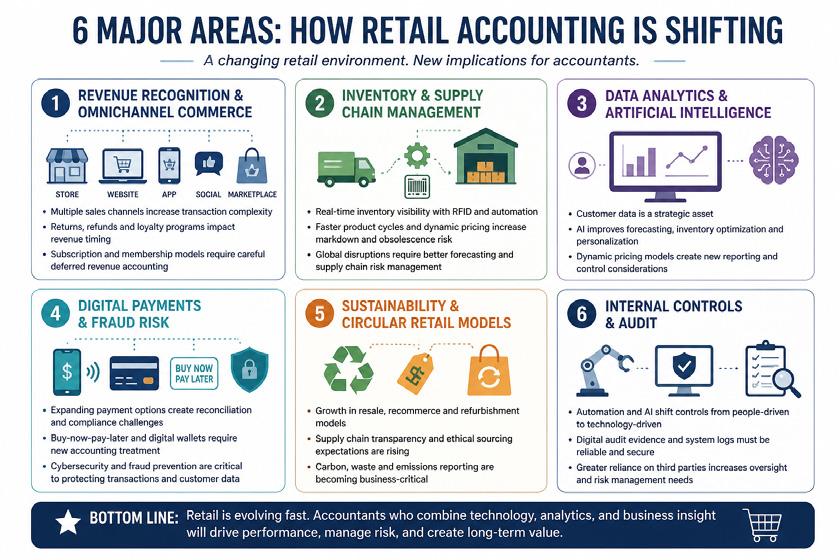
When does a sale actually happen? Revenue recognition has become decidedly more complex in an omnichannel commerce environment.
• First, multiple sales channels mean data everywhere. Retailers now sell through stores, websites, apps, social commerce platforms, third-party marketplaces and subscription services. Imagine transaction data arriving from half a dozen systems, each with its own timing, currency and contractual terms, all of which need to be reconciled to a single set of books. This complexity is a day in the life of a retail accountant.
• Second, companies often use a generous return window to drive customer loyalty. But this creates greater complexity in estimating return reserves and managing refund liabilities, a complexity that lands squarely on the accountant’s desk.
• A $99 annual membership fee that hits in January is
not necessarily January revenue. Loyalty programs, memberships and subscription services require accountants to determine how much revenue to defer for recognition at a later date.
Inventory and supply chain management
Inventory can be just as challenging. What do you do when your inventory count changes faster than your close cycle? This reality has elevated the importance of real-time inventory visibility. Retailers increasingly rely on RFID tags, automated inventory systems and predictive analytics to meet this need. Additionally, rapid product cycles, changing consumer preferences and dynamic pricing increase the risk of markdowns, obsolescence and impairment. Accountants take all these factors and translate the operational noise into numbers that leadership can trust for decision-making.
Geopolitical instability, tariffs, weather events and transportation delays are additional factors that require accountants to reassess forecasting assumptions, sourcing risks and cost structures. When tariffs change overnight,

Support the future of the accounting profession. Learn more about our programs at ohiocpa.com/Foundation . Make a gift of any amount online at ohiocpa.com/Donate .
• Welcomes the next generation to our profession
• Introduces students to the bene ts and values of becoming a CPA
• Contributes to leadership development programs that enable students to enter the workforce prepared for success Your generous support:


Thank you. Your gift makes all the difference!




This summer, learning is on your terms. Between June and August, choose from a mix of webinars and on-demand courses to build your ideal itinerary. Drop in like a quick dip in the pool or map out a longer getaway. Pick one of three adventures or chart your own course to earn 12 CPE credits (for the price of 8!).



accountants are often asked what they mean for margins, pricing and guidance. They must be able to communicate the potential impact.
In the retail sector, customer data is a strategic asset, and there is a vast array of data that can be collected and analyzed, especially in an artificial-intelligence-fueled environment. But just because the data can be collected and analyzed, should it be? And if the algorithm makes the decision, who is responsible for the outcome? How do you know the algorithm got it right and did not succumb to correlation bias or other fallacies? AI-driven forecasting is not error-proof, which is why retail accountants must stay engaged in the process. Accountability still rests with the humans in the loop. Their critical thinking cannot be subordinated to an algorithm, even one advanced enough to do dynamic pricing and real-time forecasting.
On the payment front, retail accountants are dealing with payment methods that did not exist five years ago. Buy now, pay later arrangements, mobile wallets, digital currencies and embedded finance solutions create new challenges for reconciliation, compliance and reporting. As retail
transactions become increasingly digital, accountants must work closely with IT and cybersecurity teams to strengthen controls over customer data, payment systems and financial transactions.
Driven by consumer demand, investor pressure and emerging regulations, retailers are rethinking what happens to products after they are sold. Companies are creating circular models that include buyback, resale, refurbishment and recycling programs. For retail accountants, this sustainability focus creates the need to determine how to value returned goods, recognize revenue and track refurbishment costs. Accountants may also be engaged in tracking the environmental footprint of the entire supply chain and supporting disclosures of sourcing practices, labor conditions and environmental impacts such as emissions and packaging waste.
The automated and digital retail environment also changes internal controls and audit processes. Self-checkout systems, automated warehouses and AI-driven fulfillment processes shift control from people-driven to technologydriven environments, raising new questions. When a self-

checkout flags a discrepancy or an automated warehouse ships the wrong item, the control failure may belong to a system configuration, an algorithm or a third party. Accountants must be able to troubleshoot those issues. Additionally, retail accountants must be able to evaluate the reliability of digital transaction logs, automated approvals and AI-generated forecasts.
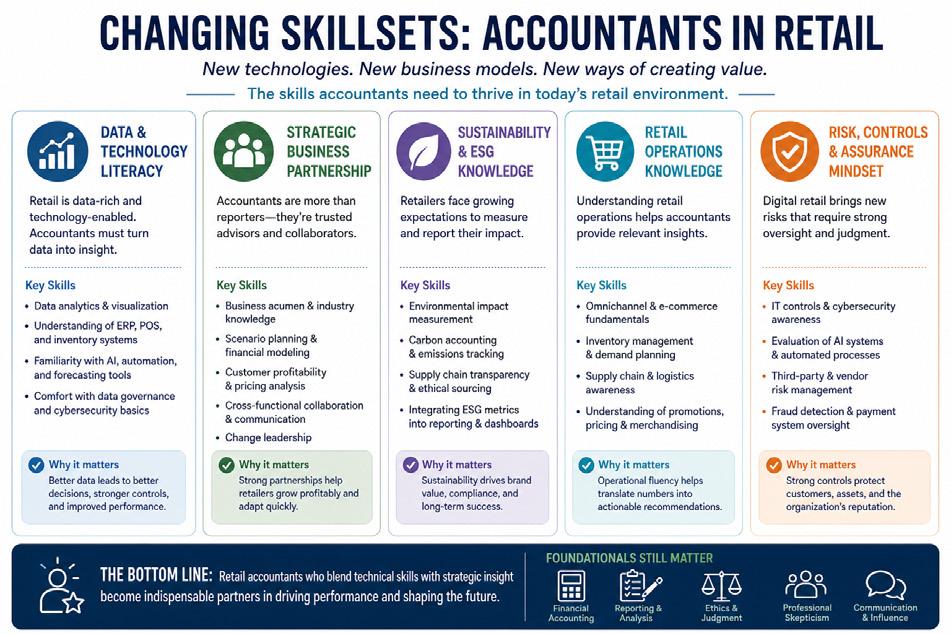
As the work changes, so do the skills accountants require. Retail accountants are not operating behind the scenes, disconnected from strategy. They are embedded in decisions that shape pricing, customer engagement, operational efficiency and growth. As a result, retail accountants need strong data analytics, visualization and technology literacy skills. While they do not need to become software developers or data scientists, they do need to understand how retail technologies influence financial reporting, operational performance and strategic decisionmaking. Familiarity with enterprise resource planning systems, customer analytics platforms, automated inventory systems and AI-enabled forecasting tools will become increasingly valuable.
Retail accountants must also become stronger business partners. They will need to collaborate cross-functionally with marketing, merchandising, operations, e-commerce, logistics and cybersecurity teams. Accountants will increasingly help organizations evaluate customer profitability, pricing strategies, promotional effectiveness, inventory optimization and supply chain resilience.
As retailers adopt sustainability initiatives and circular business models, accountants may also need to quantify
environmental impacts and connect them to cost, efficiency and brand value. This may include measuring waste reduction, tracking resale performance, supporting sustainability disclosures and integrating ESG metrics into financial dashboards and decision-making processes.
Internal auditors serving retail organizations will also need to expand their competencies. Digital retail environments require a stronger understanding of information technology controls, cybersecurity risks, payment processing systems and third-party vendor oversight. Auditors may also need to assess AI-driven pricing and forecasting systems for accuracy, consistency, explainability and bias. As retailers rely more heavily on automation and customer analytics, maintaining trust in data and systems becomes a critical assurance function.
This evolution is not without friction. Many accounting teams are being asked to develop data fluency and strategic partnership skills while navigating tight headcounts and faster close cycles. Individuals who are curious, adaptable and willing to engage with technology will find that retail is a sector where their work genuinely shapes outcomes. Those who are critical thinkers and system-oriented problem-solvers can thrive in a dynamic retail accounting environment.

Tiffany Crosby, PhD, CPA, CGMA, MBA, is the senior vice president of The Ohio Society of CPAs and oversees culture and organizational development, thought leadership, workforce development and OSCPA’s B2B sales organization. She can be reached at tcrosby@ohiocpa.com or 614.321.2215.
1. Retail accounting is becoming more strategic and tech-driven, with accountants helping guide decisions across e-commerce, AI, digital payments and supply chains.
2. Core accounting areas are getting more complex, especially revenue recognition, inventory valuation, fraud prevention, forecasting and internal controls.
3. Accountants need new skills to stay relevant, including data analytics, technology literacy, cross-functional collaboration and continuous upskilling.





Our comprehensive package of learning resources designed to meet the unique and diverse needs of corporate accounting
This innovative learning license model elevates performance by giving your team access to a world of engaging content, including the following:
• OSCPA’s Member Curriculum, including semi-annual professional issues updates and regular lunch and learns with today’s thought leaders
• National-level quality virtual conferences, including Accounting Show and Mega Tax
• On-Demand Access Pass, including more than 250 hours of content on a wide range of topics across 9 core competencies
• Best-in-class Ethics & Professional Standards, including live and on-demand options
Eide Bailly has promoted Leslie Bohn, CPA to partner.
The following members were named in Forbes’ America’s Best-In-State CPAs list:
Samuel J. Agresti, CPA, shareholder, Brady Ware
Mallory M. Ashbrook, CPA, director of forensic and dispute advisory services, GBQ Partners
Robin Baum, CPA, managing partner, Zinner and Co.
Kuno Bell, CPA, managing partner, Pease Bell CPAs
Chris Bellamy, CPA, ceo, Cohen & Advisory
Mark Bober, CPA, partner, Executive Committee, Bober Markey Fedorovich
Julie Boland, CPA, managing partner, EY
Heather Bucher, CPA, managing partner, Cincinnati, KSM (Katz, Sapper & Miller)
Tami Bolder, CPA, director, CBIZ
Courtney Clark, CPA, partner, Deloitte Tax
Michelle Buckley, CPA, vice president, Meaden & Moore
Richard Craig, CPA, managing partner, 415 Group
Betty Collins, CPA, managing shareholder, Brady Ware
Darci Congrove, CPA, managing director, GBQ Partners
Scott Cress, CPA, director, Barnes Dennig
Rachael Cruse, CPA, director, Barnes Dennig
Megan Durst, CPA, principal, Dark Horse CPAs
Robert W. Evans, CPA, managing director, Brady Ware
Tom Groskopf, CPA, director, Barnes Dennig
Tracey Holecek, CPA, senior managing director, Acclarity
Glenn Harper, CPA, owner, Harper & Company CPAs Plus
Devesh Kamal, CPA, shareholder in charge, Clark Schaefer Hackett
Daniel Moore, CPA, ceo and founder, D.T. Moore and Company
Randy Myeroff, CPA, senior advisor, Cohen
Kendra C. Myers, CPA, vice president, Meaden & Moore
Terry F. Offenberger, CPA, managing shareholder, Hammerman, Graf, Hughes
Daniel Prendergast, CPA, retired partner, CPA Service
Tim Petrey, CPA, ceo, HD Growth Partners
Chrissie A. Powers, CPA, managing member, Powers Forensic Accounting
Jay Rammes, CPA, managing director, Barnes Dennig
Robert Ramsay, CPA, director, Barnes Dennig
Rosemary Rehner, CPA, president, Barnes Wendling CPAs
Kerry Roe, CPA, president, Clark Schaefer Hackett Business Advisors
Kristin Romaker, CPA, director, GBQ Partners
Dylan Romans, CPA, shareholder, Brady Ware
Matt Rosen, CPA, director, Barnes Dennig
Jay Rueger, CPA, partner, Katz, Sapper & Miller
Jon Ruple, CPA, managing shareholder, Maloney + Novotny
Lisa Shuneson, CPA, ceo, Whalen
Steven Swann, CPA, partner, Bober Markey Fedorovich
Tod Wagner, CPA, partner, Bober Markey Fedorovich
Paul Weisinger, CPA, principal, Rea Business Advisors
Mark Welp, CPA, principal, Holbrook & Manter
CHAIR OF THE BOARD
Angela Lewis, CPA Crowe LLP Columbus
PAST CHAIR
Courtney Clark, CPA Deloitte Columbus
Emily Chaffee, CPA Packer Thomas Canfield
Darci Congrove, CPA GBQ Columbus
Robert Fay, CPA
Robert F. Fay, CPA, PFS, CGMA Canton
CHAIR-ELECT
Greg Jonovich, CPA Materion Corp. Mayfield Heights
VICE CHAIR, FINANCE
Brandi Carson, CPA La-Z-Boy Inc. Toledo
Tracey Holecek, CPA Acclarity Columbus
Mark McKinley, CPA Rea Columbus
Jake Nix, CPA RISCPoint Cleveland
Gillette, Robert G. of Columbus OH
As a result of a decision of a hearing panel of the Joint Trial Board, Mr. Gillette was admonished effective March 13, 2026. Mr. Gillette was found guilty of violating OSCPA bylaw Article V, Section B (7) for failing to cooperate with the Ethics Charing Authority (ECA) in its investigation of his professional conduct by not responding to interrogatories and the request for documents. Mr. Gillette also failed to comply with the corrective actions as directed by the ECA in an executed settlement agreement.
PRESIDENT AND CEO
Laura Hay, CPA, CAE
The Ohio Society of CPAs Columbus
Dan Perschke, CPA Scripps Cincinnati
Kerry Roe, CPA Clark Schaefer Hackett & Co. Cincinnati
Jon Ruple, CPA Maloney + Novotny Cleveland
Carolyn Smith, CPA, MBA, CRMA Governmental Accounting Standards Board Columbus
Mark Welp, CPA, CFE Holbrook & Manter Columbus
Earn the global designation for financial professionals.
Explore the CGMA® Program: A lifelong professional learning journey that puts you on the path to take your career to a new level. You’ll learn and acquire the skills it takes to become a more strategic, confident, secure and insightful leader. Get started at CGMA.org/Program
Holly Rodillo Bernstein, CPA, CGMA Director of Accounting, SoulCycle